
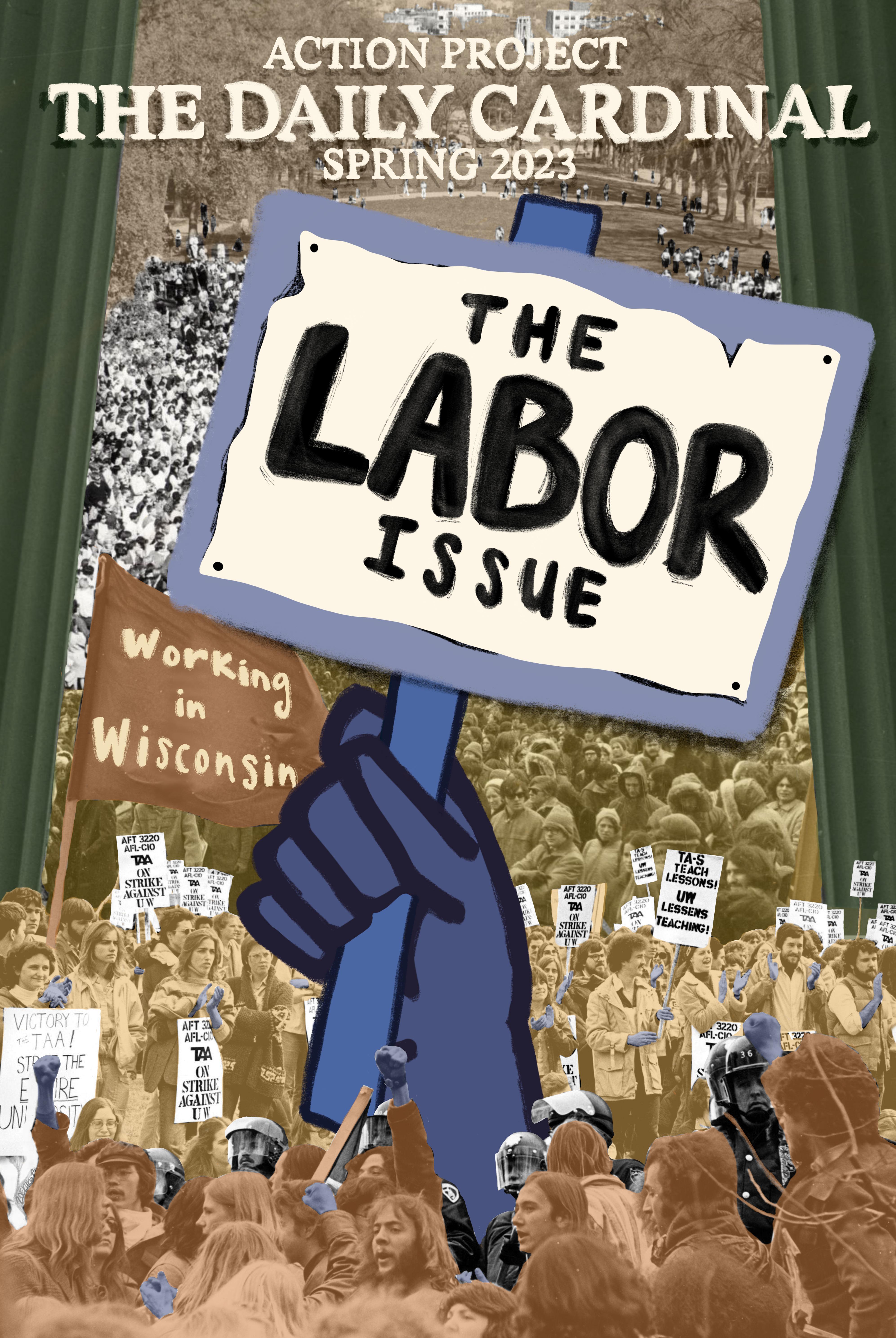
“…the great state University of Wisconsin should ever encourage that continual and fearless sifting and winnowing by which alone the truth can be found.” University of Wisconsin-Madison Since 1892 dailycardinal.com Spring Action Project 2023 l ZOE KUKLA/THE DAILY CARDINAL
Media Manager Clare McManamon
Business and Advertising
business@dailycardinal.com
Business Manager
Asher Anderson • Brandon Sanger
Advertising Managers Noal Basil • Sam Mayo Marketing Director Mason Waas
The Daily Cardinal is a nonproft organization run by its staff members and elected editors. It receives no funds from the university. Operating revenue is generated from advertising and subscription sales.
The Daily Cardinal is published weekdays and distributed at the University of WisconsinMadison and its surrounding community with a circulation of 10,000.
Capital Newspapers, Inc. is the Cardinal’s printer. The Daily Cardinal is printed on recycled paper. The Cardinal is a member of the Associated Collegiate Press and the Wisconsin Newspaper Association. All copy, photographs and graphics appearing in The Daily Cardinal are the sole property of the Cardinal and may not be reproduced without written permission of the editor in chief. The Daily Cardinal accepts advertising representing a wide range of views. This acceptance does not imply agreement with the views expressed. The Cardinal reserves the right to reject advertisements judged offensive based on imagery, wording or both.
Complaints: News and editorial complaints should be presented to the editor in chief. Business and advertising complaints should be presented to the business manager.
Letters Policy: Letters must be word processed and must include contact information. No anonymous letters will be printed. All letters to the editor will be printed at the discretion of The Daily Cardinal. Letters may be sent to opinion@ dailycardinal.com.

Editorial Board Graham Brown • Em-J Krigsman • Anupras Mohapatra • Jessica Sonkin • Priyanka Vasavan • Sophia Vento • Ethan Wollins
Board of Directors Scott Girard, President • Herman
Letter from the Editor: Working in Wisconsin
By Sophia Vento and Jessica Sonkin EDITOR-IN-CHIEF AND MANAGING EDITOR
The University of WisconsinMadison, the city of Madison and the state of Wisconsin have a long tradition within the labor movement, prompting questions about the past, present and future of work across the state.
At a university level, the Teaching Assistants’ Association is credited as the first graduate student worker union in the country — ever. In Wisconsin, worker advocacy shaped other national and state laws relating to both compensation and unemployment.
Moreover, we’ve seen how the dismantling of Wisconsin’s labor relations system through the 2011 passage of Act
By Nadya Hayasi STAFF WRITER
The Teaching Assistants’ Association (TAA) at the University of WisconsinMadison works to ensure all graduate students earn a living wage and continues the fight to address issues within the workplace a ecting each department within the university.
TAA is the labor union representing all graduate student workers at UW-Madison, including teaching assistants (TAs), research assistants (RAs), graduate assistants (GAs) and fellows.

Third-year microbiology graduate student and TAA organizer Madeline Topf described the TAA as a community where graduate students come together to share their concerns regarding their working environment and address issues as a coalition.
“The TAA is a community of grad workers, so it’s really kind of a vehicle for people to have support on any of these issues that they and their fellow coworkers care about,” Topf said.
One issue the TAA has been particularly vocal about is the wages graduate students receive and the fees they have to pay back to the school.
10 profoundly a ected hundreds of thousands of workers across the state. Contemporary issues ranging from the recognition of a nurses union to graduate student workers’ rights at UW-Madison are deeply rooted in Gov. Scott Walker’s administration’s decision. Despite much of our sta being elementary-aged when Act 10 was implemented, our native Wisconsin sta ers remember the impact of the controversial law on their teachers and schools, and this impact lingers today — over 10 years later.
Throughout our time on campus, as reporters, students and community members, we’ve seen how workers’ advocacy for safe, healthy working
International students also pay an additional $200 in fees which go towards the cost of maintaining international student services.
“We don’t get paid a living wage, we don’t get paid enough,” Maya Banks, a fifthyear Ph.D. candidate in the mathematics department, shared. “We make around $25,000 a year [in my department], which is about $10,000 less than the cost of living in Madison. And that doesn’t include what we have to pay in segregated fees and international student fees.”
To attain a living wage in Madison and a ord food, medical bills, housing, transportation and other miscellaneous costs, an individual would need to earn at least $36,000, according to the Massachusetts Institute of Technology’s living wage calculator. Not being able to attain that number causes graduate students to worry about their ability to a ord basic necessities.
“I’m kind of living this reality which includes putting o going to the doctor, worry-
conditions and better compensation shaped our community. From petitions to unionize and unionizations of co ee shops and bakeries to fights for increases in minimum wages, working Wisconsinites are at the forefront of critical political, economic and social conversations across the state.
Furthermore, the e ects of the COVID pandemic on our labor force and the way Wisconsinites work have been staggering. If anything, the global health crisis, aside from exposing deeply ingrained inequities, ineptitudes and injustices within our economic and labor system, has forever changed our community’s relationship with and perception of work.
In February 2023, President Joe
Biden even made the Madison area his first stop following his State of the Union address, sharing his “bluecollar blueprint” for the economy and labor force at a local labor union training center.
At The Daily Cardinal, we recognize the value of labor and work across this campus, city and state. With this special issue, we hope to center the voices of working Wisconsinites while exposing their struggles and highlighting needed areas of support. We invite our readers to explore the intrinsic role of labor in the Wisconsin economy and contemplate our community’s responsibility in our state’s labor force.
for graduate students
ing about food, not being able to a ord the food I want or that are nutritious and skipping meals,” Topf said. “This is the reality for many grad workers, that we are very concerned with our finances and it really takes up a lot of our mental capacity.”
Topf explained how, as a result, she and other graduate students are constantly worried about whether they can a ord basic necessities while still working and studying full-time.
“As people who are doing research in microbiology, we should be focusing on solving really big problems and solving the problems of tomorrow, but we can’t look beyond today and devote our entire focus and energy to those pursuits,” Topf continued.
Nina Denne, a second-year graduate student in the cell molecular biology program and corporate secretary for the TAA, echoed the same sentiments regarding wages graduate students receive for the work they do.
“I think a lot of the time as graduate students, we some-
times forget that we are workers too,” Denne said. “We teach classes, we do research, we write grants and so much more. We do deserve better working conditions.”
Students in the microbiology department came together last fall to write a letter to program administrators, asking for a stipend that matches the Madison living wage, and for the program to pay for both segregated and international student fees.
The graduate students also demanded the program establish greater student representation in its leadership and improve diversity, equity and inclusion e orts within the department. While the students did not get an o cial response to the letter, they will be receiving an unplanned raise of $456 per year, according to Topf.
“We have more protocols in place for increased transparency about how decisions are made that a ect us and our work,” Topf said. “There’s overall just more discussion and acknowledgement that these issues are real. I think
that this shows that we do have a lot of power when we work together and collectively have a voice.”
Another issue graduate students are concerned about includes working conditions, which vary between each department. In the mathematics department, specifically, Banks shared TAs are working on improvements in the grading process to make it more e cient and friendly for workers by standardizing the amount of time given to graduate students to grade examinations.
“One thing that people want is more of a say in the policies and procedures around teaching, because many grad students in my department are employed as TAs, that is our most common funding source,” Banks said. ”We want to be able to have more say in how our teaching positions work.”
Ultimately, TAA members hope to increase awareness and membership, and are working to engage other graduate students to come together and advocate for the issues they face across the university.
© , The Daily Cardinal Media Corporation
ISSN -5 98
Minimum stipend rates for 50% appointments — which include graduate students working 20 hours per week, or half of full-time employment, while completing their required academic course load — were raised for the 2023-24 academic year, with TAs receiving a salary of $23,227 per year.
However, graduate students also continue to pay a total of $1,523.04 in segregated fees, which are charges assessed to all students for student services, activities, programs and facilities that support the mission of University of Wisconsin System institutions, according to the Bursar’s O ce.
“In my department, our biggest priority right now is helping bring in more people into the democratic structures of our union so that people can have more say in what they need, what kind of improvements they want and so that we have more collective power when we fight for these improvements,” Banks said.
Topf, Banks and Denne agreed the only way to provoke change from the university administration is through collective action from all the graduate students.
“We need to work together as a community through the union and push for change, and that can only happen when we stand together as a union and work together,” Denne said.
2 Thursday, March 23, 2023 news
Corrections or clarifcations? Call The Daily Cardinal offce at 608-262-8000 or send an email to edit@dailycardinal.com. For the record l An independent student newspaper, serving the University of Wisconsin-Madison community since 1892 Volume 132, Issue 25 2142 Vilas Communication Hall 821 University Avenue Madison, Wis., 53706-1497 (608) 262-8000 News and Editorial edit@dailycardinal.com News Team News Manager Hope Karnopp Campus Editor Madeleine Afonso College Editor Anthony Trombi City Editor Francesca Pica State Editor Tyler Katzenberger Associate News Editor Ellie Bourdo Features Editor Annabella Rosciglione Opinion Editors Priyanka Vasavan • Graham Brown Arts Editors Noah Fellinger • Kai Wen Li Sports Editors Donnie Slusher • Cole Wozniak The Beet Editor Mackenzie Moore Special Pages Editor Zoe Bendoff Photo Editor Lauren Aguila • Meghan Spirito Graphics Editors Zoe Kukla • Henry Moore Science Editor Julia Wiessing Life & Style Editor Sophie Walk Podcast Director Elena Price Copy Chiefs Kodie Engst • Ella Gorodetzky Copy Editors Jasper Bernstein • Kraymer Gladem • Drake White-Bergey • Noe Goldhaber Social
• Don Miner • Nancy Sandy • Phil Hands • Josh Klemons • Barbara Arnold • Jennifer Sereno Editor-in-Chief
Vento Managing
dailycardinal.com
Baumann • Ishita Chakraborty
Sophia
Editor Jessica Sonkin
‘We don’t get paid a living wage’: The TAA on ensuring rights
RIVER KRATOCHVIL/THE DAILY CARDINAL
UW Health nurses confront shortage, campaign for union recognition
By Ava Menkes STAFF WRITER
Stepping into a highly needed role at the beginning of the COVID-19 pandemic, nurses have played a crucial and often underappreciated role in hospitals since, a spokesperson from SEIU Healthcare Wisconsin said. During the pandemic, nurses faced traumatic turnover experiences which left the sta ng problem in disarray, according to the health care workers union.
University of Wisconsin Health nurses’ union e orts serves to highlight how nurse drawbacks created notable deficiencies in UW hospitals.
The UW Hospitals and Clinics Authority includes UW Health, East Madison Hospital and American Family Children’s Hospital. The system employs 3,400 nurses, including 2,600 nurses in the union, according to the Milwaukee Journal Sentinel.

In 2019, nurses signed union cards calling on UW Health to recognize them, but the board refused. In early 2022, 1,500 nurses signed union cards and presented them to the UW Health administration but were not acknowledged, ultimately leading to a vote for a strike.
Later, in September 2022, the strike was averted by an agreement between UW Health and the nurses. The union voice was reestablished, but the nurses did not gain the right to bargain a contract. The right to collectively bargain a contract would mean the nurses would work with UW Health, and through a representative they both agree on, establish agreements for better working conditions or compensation.
The turnover experience
Nurses faced many challenges regarding the pandemic and sta ng shortage, leaving hospitals understa ed, according to a spokesperson with SEIU Healthcare Wisconsin.
“It was a little surreal,” UW Health Nurse Mary Jorgensen said. “We had shortages and issues before COVID. But COVID just exacerbated them, so a lot of nurses have left the field
since then [due] to distress and [from] PTSD. We have been really struggling post-COVID with sta ng.”
UW Health currently faces a vacancy rate of 10% while the national average of vacancy rates for nursing positions is 17%, leadership at UW Health shared in a statement with The Daily Cardinal.
The turnover rate for nursing positions at UW Health is less than 12%, compared to the national turnover rate of 21%, the statement said.
“Our benefits and compensation compare favorably to other regional health systems and to peer organizations throughout the country,” UW Health noted.
UW Health nurse Sarah Langland said the low turnover rate does not translate to a representation of the nurses’ struggles.
“There is still vast room for improvement, and even at 12%, it takes an average of like 50 nurses on a unit — losing seven to eight nurses,” Langland said. “Well, that’s like three to four nurses per shift. That’s a huge impact.”
Plan of action
Strategies to mitigate the shortage and increase the number of nurses in the field include the internal nurse traveler program, two nurse residency programs and “significant” tuition reimbursements for employees in nursing, according to leadership at UW Health.
The “Internal Traveler Program” is an incentive in which UW Health
pays nurses to take on more shifts. Additionally, UW Health hired outside traveling nurses, which is often costly, to fill sta ng gaps in the short term, according to the SEIU Healthcare Wisconsin spokesperson.
Leadership at UW Health is also committed to the “meet and discuss” process of open conversation between the administration and nurses, according to leadership at UW Health. It was created in September by UW Health and the SEIU.
“The agreement ensures that this process will continue while any court proceedings are pending to determine whether nurses at UW Health can legally obtain union recognition and collectively bargain,” leadership at UW Health explained in their statement to The Daily Cardinal.
Solution shortcomings
While these programs signal significant and positive change, nurses still describe setbacks they believe need to be addressed.
Nurses at UW Health work anywhere from 13 to 16 hours a day. Nurses who travel don’t have a sucient amount of time for commuting or winding down from work, according to Langland and Jorgensen.
Many of Langland’s coworkers diverted to other hospitals o ering higher wages, therefore not requiring them to pick up overtime, she said.
“It’s very hard, mentally and emotionally, to come in and want to provide the best care for your patients, but you’re still struggling with the short sta ng,” Langland said.
UW Health has several specialized units, such as cystic fibrosis, which require in-depth knowledge about the disease and dedicated sta to manage specialized medications like those used for pulmonary hypertension, Langland explained.
“I’ve worked with awesome [traveling nurses], but they’re not core sta ,” Langland said. “They’re not staying, they’re not becoming experienced.”
Jorgensen agrees the program may pose long-term instability.
“Although we appreciate the
opportunity to make more money, they’re basically asking nurses who are already working full time, burned out, to work even more,” she said.
Numerous nurses left their occupations due to burnout or switched to non-direct patient care roles such as research. Others pursued further education and training to become nurse practitioners, according to Langland.
While UW Health is recruiting and hiring, they’re not working to retain their experienced and established nurses, Jorgensen said.
“In the end, short sta ng ultimately needs to be addressed in a more sustainable manner,” Langland added. “That was one of our main focuses with a nurses union — was to address things like that so that we can overall create an environment of better care.”
Moving forward
The “meet and discuss” process has allowed UW Health nurses to formally connect on a regular basis as a united voice for the first time since 2014.
“Even though it can be kind of hard from the outside to understand, that was actually a monumental change and a really big thing that UW did. And we appreciate that,” Langland said. “We appreciate having a voice at the table to come down and say, ‘Hey, let’s meet about these things.’”
Ultimately, UW Health recognizing the nurses union would protect sharing power between the nurses and the administration, according to an SEIU Healthcare Wisconsin spokesperson.
The ultimate goal is to get a written contract that will legitimize how much nurses are paid, outlining their benefits, working conditions and staffing levels, the spokesperson emphasized. The nurses are currently exploring three routes to secure a collective bargaining agreement: in the Dane County Circuit Court, in a petition to the Wisconsin Supreme Court and via a National Labor Relations Board Reelection, according to the spokesperson.
Only one success among these three routes is necessary to secure this agreement. However, they are all still in progress, the spokesperson said.
In the Dane County Circuit Court, former Gov. Scott Walker appointed a director of the Wisconsin Employment Relations Commission that found UW Health was not covered under the Wisconsin Peace Act.
The Peace Act states certain employers have the right to bargain a contract with their employees. The nurses believe UW Health meets the standards of those employers, according to Langland and Jorgensen. The nurses union appealed that decision in Dane County Circuit Court and is currently awaiting the verdict.
In early February, the Wisconsin Supreme Court rejected UW Health’s petition to determine whether they can voluntarily recognize the union.
The nurses saw this as a relief because now the petition can be sent through the lower courts, following the process from the circuit courts rather than cutting directly to the Wisconsin Supreme Court.
The nurses’ third strategy in hopes of obtaining collective bargaining rights is their November petition to the National Labor Relations Board.
If the National Labor Relations Board agrees the union falls under the Wisconsin Peace Act, the nurses will hold an election to decide whether they want to be unionized and get full collective bargaining, according to Jorgensen.
“[UW Health] is the number one hospital in Wisconsin, and all the employees at UW should be treated like they work at the number one hospital in Wisconsin,” Jorgensen said. “Because when we are, then patient satisfaction is better. The care is fantastic.”
Remote work opportunities aren’t equal across Wisconsin
By Anna Kleiber STAFF WRITER
Remote work in Wisconsin skyrocketed since the COVID-19 pandemic began. But according to a new report from the Wisconsin Policy Forum, remote work options are not equally distributed across the state, which could worsen existing digital divides.
Released in February 2023, the Wisconsin Policy Forum report, titled “The Uneven Rise of Remote Work,” found job type and infrastructure played a role in creating a remote work divide within the state by analyzing remote work data from 2021.
Among the 100 largest metropolitan areas nationally, Madison ranked 22nd in share of workers who primarily worked from home in 2021, according to the report. Similarly, Dane County residents were the most likely to work remotely in the state, with nearly a quarter reporting they work from home.
However, residents in neighboring Rock and Dodge counties — both less populous than Dane County — had less than 10% of residents working from home, according to the report.
Joe Peterangelo, a senior researcher for Wisconsin Policy Forum, authored the 2023
report and found working from home is more common in some Wisconsin countries than others, primarily due to uneven concentrations of “remote-capable” occupations.
Put simply, di erences in local economies impact who can work remotely, Peterangleo said.
“The counties that we found that had the smallest concentrations of remote work, they tend to be more manufacturing focused,” he explained.
Hands-on jobs are more common than professional positions in Wisconsin’s rural counties, Peterangelo said. In Dodge County, only 11.3% of jobs were in highly remote-capable sectors. approximately 30% of total jobs in Dodge County are within the manufacturing sector, the county’s leading sector, according to state data from the Quarterly Census of Employment and Wages.
Additionally, a National Bureau of Economic Research study estimated at least two-thirds of jobs in each of five major sectors — finance and insurance, educational services, information, corporate management and professional, scientific and technical services — can be done fully or partially from home, whereas less than one quarter of jobs in other sectors like agriculture and manufacturing can be done remotely.
“The occupations that tend to o er more
remote and hybrid opportunities already tend to have more advantages, higher pay, better benefits,” Peterangelo said.
He warned those benefits, if left concentrated in urban counties and among wealthier residents, could worsen preexisting inequities among Wisconsin workers.
“This could be another benefit for workers who tend to already have more advantages,” Peterangelo said. “There’s also a racial equity issue, too, because occupations that tend to not allow remote and hybrid are more likely to have higher concentrations of Black and Hispanic workers.”
Broadband in Wisconsin
Among jobs with remote work potential, rural areas still lag behind, according to the Wisconsin Policy Forum report. Remote work typically means video meetings, VPN usage and other tasks requiring broadband internet connection that rural areas lack.
Approximately 22% of rural Wisconsinites — more than three times the state average — don’t have the infrastructure needed for an internet connection fast or reliable enough to meet federal broadband standards, according to the Federal Communications Commission’s 2021 Broadband Deployment Report. To meet broadband require-
ments, the FCC requires download speeds of 25 megabits per second and upload speeds of three megabits per second.
This is all assuming the FCC’s maps are accurate — something multiple states have challenged, according to the Cap Times. In Wisconsin, the Public Service Commission (PSC) challenged more than 7,000 locations in October of last year where they believed accurate numbers on broadband access were missing or incorrect.
In February 2023, Gov. Tony Evers proposed a budget calling for the state to invest $750 million in broadband expansion over the next decade. Broadband maps released last year by the FCC identify underserved areas that would qualify for federal funding made available through the Broadband Equity, Access and Deployment Program established by the bipartisan infrastructure law.
“Whether it’s going to school, working from home, or running a small business, broadband is essential to ensuring our families, communities, and our state bounce back from this pandemic even better than we were before it hit,” Evers said in a statement last November.
dailycardinal.com Thursday, March 30, 2023 l 3
news remote work page 6
COURTESY OF WIKIMEDIA COMMONS
How working in UW Housing complicates the Madison housing crisis
By Noe Goldhaber STAFF WRITER
Emmett Lockwood has lived in the Open House Living Learning Community (LLC) in Phillips Residence Hall at the University of Wisconsin-Madison for two years, first as a resident and now as the community’s House Fellow. House Fellows, a term for what is commonly known as a resident assistant, provide an essential role in university dorms — enforcing policy and building community. There are approximately 200 House Fellows across campus.
When Lockwood was making his college decision, the Open House community presence solidified his choice. Open House provides inclusive housing, spaces and special programming for members of the LGBTQIA+ community and is one of 11 LLCs within UW Housing.
“Open House is honestly what drew me to UW-Madison,” Lockwood said. “I think there is no other community like this in the country, in terms of having a space for students to explore their identity while also being at college. I did not come into college worrying about having a transphobic roommate.”
Early in his first-year, while other students were finalizing their plans to live in o -campus apartments or houses the following year, Lockwood was concerned about the accessibility of o -campus living, the Madison housing market and the stability of signing a legal contract with people he had only known for a matter of weeks.
Over the past two years, UW-Madison has seen two of its largest classes in university history. Further, increasing enrollment of affluent and out of state students, and the privatization of the Madison housing market, has led to an unaffordable luxury apartment market in Madison, according to a 2020 study from UW-Madison’s geography department.

Being a House Fellow provides a dorm room — often a single — on campus free of charge, a meal plan and a stipend for hours on call. Knowing the then-current Open House House Fellow was leaving the position, Lockwood decided to apply.
“I thought it was honestly mindboggling how first-years were coming in and choosing the people who they wanted to live with for the next year in October,” Lockwood said. “I thought, as a student, I don’t want to have to deal with the logistics of signing a lease right now.”
Housing crisis impacts House Fellow role
Last year, approximately 380 individuals applied for a House Fellow position, and this year the number almost doubled with 639 students applying for the position, according to statistics from Brendon Dybdahl, director of marketing for the university’s Division of Housing. 75% of House Fellows during the 2021-22 academic year decided to keep their positions, when normally, only half of each year’s House Fellows remain, according to Dybdahl. This left only 73 open positions this year, he said.
Sutton Kreutzfeldt is one of many first-year students who applied for the House Fellow position but was rejected. While it’s di cult to accurately pinpoint why the demand and retention for the position increased this year, Kreutzfeldt cited the Madison housing crisis as a motivating factor in applying.
“There was very limited other housing in Madison, so I just thought the House Fellow position would be a good option to have,” Kreutzfeldt said. “I looked at a lot of other housing options, and they were very expensive, very limited. Everything was either sold out or just way out of my price range.”
Di culties with the position, a dealbreaker for some
Although the House Fellow turnover rate has been low in recent years according to Dybdahl, some House Fellows still decided to leave the job. Colleen Wall started college with the goal of having only $5,000 in debt, and the House Fellow position stood out as an opportunity to make money and save on housing and food, she said.
Wall spent her junior year as a House Fellow in Witte Residence
Hall. Although she said weekends were stressful and di cult at times, she described feeling supported by her supervisors and bonded with her residents. However, due to medical reasons, Wall requested a change to the Lakeshore community, as the Southeast community noise on weekends and lack of sleep negatively impacted her health.
Wall was a House Fellow in
dents’ success in their academic life, rather than [in Adams] which seem[s] to just want to drill down on every policy even if individual circumstances didn’t make sense for it.”
Wall had greater di culties with her supervisor in Adams, who once threatened termination due to a cheerleading schedule that coincided with House Fellow position meetings, according to Wall. She decided to leave
then I don’t know where I’m going to live because the price [of housing] is so high,” Zappia said. “That doesn’t mean that we’re being exploited to do a bunch of work, but there is kind of that pressure there because of the positionality of the job.”
While there are di culties and challenges with the position, both Lockwood and Zappia provide an
Adams Residence Hall last semester but decided to leave at the end of the semester.
“I think the reward for me changed when I was in Witte from the pure idea of getting housing and food to really enjoying my interaction with the residents,” Wall said. “When I went to Lakeshore, I wasn’t getting that. I was doing so much extra to reach out and try to form these connections, and I wasn’t getting anything in return.”
Adams Residence Hall houses a higher concentration of upperclassmen and single rooms, so Wall found her residents were more independent with less need for her help or support. Further, Wall found the policies she was asked to enforce in Adams were too strict and intense.
“My supervisor [in Adams] was very strict about everything, and I just didn’t see the need for it,” Wall said.
“My supervisors in Witte focused more on safety and individual stu-
during the semester for many of these reasons, but also to live with friends during her last semester of college.
“I think threatening a student that’s already under a ton of stress with losing a job because of something that was an honest mistake or an accident or was out of their hands was an unfortunate [choice] for the management,” Wall said.
Pressures and rewards with the job
Dominic Zappia, a House Fellow in the International LLC in Adams Residence Hall, said while he really enjoys his job and the perks associated with the position, he would have to find housing mid-year in an increasingly di cult market to navigate if he were to lose the position.
“As I’ve been doing the job, I’m very aware that if I don’t meet expectations, if I don’t complete [my tasks],
essential role in the dorms. Lockwood aids in the transition from high school to college and supports identity formation for his residents in Open House. Zappia helps international students transition to living in a new country.
“I joke that most people, when they are struggling with mental health issues, get a therapy dog — and housing gave me 38 residents. It’s amazing having students who come to you,” Lockwood said. “I want students to walk away from Open House feeling like they have an ownership and a place on this campus, and it’s rewarding to see students do that … I love this space on campus.”
“It’s really rewarding and really fulfilling to have the position that I have because I get to welcome a lot of international students from very, very diverse backgrounds to our campus and be a resource for them,” Zappia added. “It’s a responsibility and one that I really don’t take lightly.”
‘The work really never ends’: Former Epic Systems employees discuss company culture, work-life balance
By Jasper Bernstein STAFF WRITER
With its headquarters in Verona and its founding in Madison, Epic Systems has become one of the most prominent technological employers in the region. While some former employees have praised the company’s culture and structure, others have raised concerns about issues such as work-life balance and the company’s strict hybrid work policy.
Founded in 1979 by Judy Faulkner, Epic started as a small software company providing billing services to healthcare providers. Over the years, the company grew and evolved, becoming one of the largest healthcare software
companies in the world.
Epic has deep ties to the University of WisconsinMadison, employing over 1,200 university graduates. The company has also endowed three computer-science faculty positions, supporting various departments across the university.
“Epic is consistently a top employer of UW-Madison graduates,” said Sara Lazenby, an institutional policy analyst at UW-Madison. “[The company hires] for roles like software developers, project managers, technical solutions engineers, quality managers, software engineers and other related roles.”
A youthful environment
Fifty-five percent of Epic employees are between 20 and 30 years old, according to Zippia. Combined with a majority of employees staying at the company for under four years, Epic has a young workforce.
“I joined Epic as my first career job,” said Rishi Satpathy, former technical solutions engineer at Epic. “It was very interesting. A lot of people are very gung-ho about work [and] they’re kind of still [figuring out] what to expect.”
Satpathy said the company’s youthful environment should not be viewed as a
negative characteristic.
“Epic puts you in a lot of [different] situations — some of the people I’ve worked with, who were there for five years, are in their late 20s and early 30s,” Satpathy explained. “They have a ton of insight and a ton of knowledge of both the product [and] working with our customers.”
However, this perspective is not universally accepted. A former Epic employee, who asked to remain anonymous, said the company’s youthfulness creates a highly social and closed-o work environment.
“When I started, I [realized that Epic] is a very ‘fresh out of college’ sort of environment. People are pretty young,” the former employ-
ee said. “There’s a lot of emphasis on people socializing together and going out together and joining clubs together. [The culture] creates a very insulated social bubble for you to live within.”
The insular culture does lend itself to productivity, Satpathy said.
“We’re working with people who are very driven [and] who want to get things done — there’s nothing that falls to the wayside,” said Satpathy. “You can knock on people’s doors. It’s very easy to find people who are able to help you. There’s a lot of structure around [collaboration] as you’re working through these complex situations.”
4 Thursday, March 30, 2023 dailycardinal.com
news l
LIAM BERAN/THE DAILY CARDINAL
epic systems page 5
Madison teachers union pushes for better pay, resources amid sta ng shortage
By Francesca Pica CITY NEWS EDITOR
Madison Metropolitan School District (MMSD) staff union Madison Teachers Inc. launched a campaign to push for additional resources and support to help Madison teachers amid the district’s ongoing sta shortage.
Sta ng shortages in public schools are a nationwide problem, but Madison schools are experiencing shortages more acute than many surrounding Wisconsin school districts, according to Madison Teachers Inc. vice president and eighth grade teacher Andrea Missureli.
“Teachers are leaving the profession in general or are leaving Madison to go to other schools,” Missureli said. “We want them to stay here and be a part of Madison and the great things that can happen.”
Madison Metropolitan School District Communications and Public Affairs Director Tim LeMonds told the Capital Times the district had 88 sta vacancies as of Jan. 23, approximately 3% of the total workforce.
LeMonds did not respond to repeated requests for comment.
Missureli said the shortage has stretched many teachers thin, as they are asked to take on more responsibilities to make up for gaps in sta ng.
“Burnout definitely is a big concern,” Missureli said. “There’s a lot of new initiatives, planning time — teachers are asked to do certain stu and not what they need to get done.”
Additional responsibilities have impacted the school district’s ability to hire and retain teachers, whose time is increasingly eaten up by the additional workload, Missureli said.
“A lot of that’s happening outside of the school day, which is really hard to have a family and a life if you’re working all the time and
+EPIC SYSTEMS
not getting paid that great to do it,” she said. “Not many people want to stick around for that.”
Missureli said the COVID-19 pandemic exacerbated many of the school district’s problems, including understa ng, educator burnout and fewer resources for teachers and students.
Teachers experienced greater levels of anxiety compared to other professions, according to a study from the American Educational Research Association. The study found the effect was especially severe for those teaching remotely.
In response, Madison Teachers Inc. published a petition urging the MMSD to provide more resources to hire and retain teaching sta
“The pandemic has left our public schools understa ed and under-supported,” the petition reads. “MMSD’s remaining sta are doing more with less, struggling to manage an unsustainable situation from which our students are bound to lose.”
The union launched the “Schools Madison Students Deserve” campaign, aimed at pushing the school district and school board to prioritize student and sta needs in the district’s budget. The campaign called on the school district to halt cuts to sta positions, hire additional support sta , reduce class sizes and increase the pay rate for sta working additional hours, such as over lunch.
“It really is draining and wearing and tearing on teachers that they’re doing so [many] extra jobs because we don’t have the sta ng to do it,” Missureli said. “And with it there’s the pay — teachers aren’t even paid their contract rates to do all these extra jobs. If you give up your lunch, it’s $4 you get paid.”
LeMonds previously told the Capital Times the district has been working to hire teachers to address
the sta ng shortage.
“Within the last 12 months alone, the district has hired more teachers than it has in its recent history,” LeMonds said. “That said, the nationwide teacher shortage remains a very real concern and continues to impact schools in Wisconsin and across the country.”
Though the pandemic exacerbated the shortage, sta ng had been tight for years, Missureli said. She noted some of the shortage is because of changes to educators’ wages, compensation and benefits under Act 10, a law passed under former Gov. Scott Walker that limited collective bargaining rights for public sector employees.
“Ever since Act 10, it really has decreased our amount of people coming out to become teachers,” Missureli said. “We used to have 300 applications for one position here in Madison, and now we can’t get people to apply.”
Act 10, passed in 2011 to address Wisconsin’s projected $3.6 billion budget deficit, limited public teachers exclusively to negotiations over wage increases not exceeding the Consumer Price Index. Under the law, public sector employees are not obligated to pay union dues, and unions cannot automatically collect dues from employees’ paychecks.
Erica Turner, associate professor in the Department of Educational Policy Studies at the University of Wisconsin-Madison, said another potential consequence is the change in public perception of teachers.
“[Teachers] are suddenly given this message that people think that teachers don’t work hard and are not deserving of their pay, which is not necessarily particularly high in comparison to people with similar educational levels,” Turner said. “It also has this more intangible
both intrinsically [and extrinsically] rewarding — working on something that you feel makes an impact. If you’re able to demonstrate value [and] communicate e ectively, that’s reflected in your compensation.”
In general, Epic’s culture lends itself well towards growth, former employees said.
e ect on the profession and how teaching is seen and how people understand how it’s regarded.”
According to data from the Center for American Progress Action Fund, the percentage of teachers who retired or left the profession rose from 6.4% to 10.5% after the 2010-11 school year, when Walker signed Act 10 into law. Many of those were early retirements from teachers concerned about a decrease in benefits, according to Turner.
Turner said though the State Legislature faced difficulties balancing the state budget, the decision to weaken collective bargaining was not necessary to reduce the deficit.
“State budgets were really pressed at that time, but cuts didn’t have to come from education,” Turner said. “Another alternative would have been to raise taxes, especially on the highest earners.”
Turner said much of the power to address sta ng shortages lies with the State Legislature, which decides how much money funds education. She said the legislature has the ability to address the problem by increasing state funding for education.
“It is a political choice,” she said. “We could put more money into education, and we could pay
reopening. According to a May 2021 workplace study, a majority — 66% — of U.S. employees remained concerned about returning to the workplace at the time — seven months after Epic’s reopening.
people more.”
Additionally, Missureli said providing more resources for Madison teachers ultimately benefits students.
“We want to make sure that we’re sta ed because we want the best schools here in Madison for our students,” Missureli said. “They deserve that.”humans to increased healing and resiliency for animals, according to The Human-Animal Bond Research Institute.
Unfortunately, COVID-19 has a ected many personal relationships and constant exposure has significantly decreased.
“Before COVID, we spent a lot of time with clients and their pets all in the room together, discussing if they have any other social service needs that we can help provide for them,” Alvarez said in a press release.
With COVID-19 restrictions, clients cannot enter the WisCARES building, and the majority of the trust-building conversations take place through masked social distancing in the parking lot. Despite these setbacks, WisCARES is still dedicated to providing care for pets regardless of the financial situation the owner is facing.
More information can be found on their website at wiscares.wisc.edu.
employee asked.
However, Epic reported their work conditions were positive.
The daily workload
The youthfulness of the company, for better or worse, tends to lend itself to higher workloads, former employees said.
“I definitely had mental health struggles as a result of being overworked, not having time to see friends or family, or pursue hobbies,” the former employee explained. “The work really never ends.”
The company currently holds a work-life balance rating of 2.4 out of five on Indeed.
“I don’t really ever recall a situation where an employee’s needs were even talked about or mentioned — the client comes first. And if you’re a customer or hospital, that’s great.
If you’re an employee, not so much,” said the former employee. “You need to know what you need, and go ask for it. And then hope that someone is willing to help you with it.”
While the vast majority — 79% — of employees at Epic receive a salary between $60,000 and $100,000 per year, online reviews of the company mention a “workwork balance” and how the “worklife balance can be challenging if you don’t set good boundaries.”
“Epic is definitely a company where they expect about 45ish hours of logged work from you a week, [but the workload is] also generally not treated as an unrealistic expectation,” said Satpathy. “It still felt
“Most of the professional skills that I have at this point in my career, I learned at Epic. It’s a company full of really highly motivated, driven people who get work done,” said the former employee. “It is really cool to get in a room with people and get work done. You can do a lot there if you are driven and motivated.”
With such high turnover, Epic’s professional growth is important to employees, said Satpathy.
“A lot of the core project management skills, a lot of the technical skills … still transfer to other jobs,” explained Satpathy of his new career. “My experience at Epic and my ability to work with customers transferred very easily and helped me pick those things up as needed.”
In a company-wide email sent in early July 2020, CEO Faulkner described the August 2020 process of the Epic campus’ nearly complete
“Epic was one of the companies that really pushed for people to come back into the o ce very early,” said Satpathy. “Even afterwards, they had a pretty strict hybrid work policy where you only got a limited number of days [to work remotely] per year.”
The demands placed on employees at Epic Systems were notably high, often requiring long hours and a high level of dedication to meet the company’s expectations, said the former employee.
“If you ever worked 40 hours a week, that was amazing. It was more in the 60 to 80 hours [a] week range,” said the former employee who asked to remain anonymous. “They would sort people by the most [hours] logged and even if you were above 40, but you were still at the low end, you were going to be the first person getting assigned stu .”
“Why isn’t the solution to decrease the amount of work or hire more people?” the former
“At Epic, salaried employees work 45-hour weeks on average. The most recent data available from Gallup for the average work week of fulltime employees in the U.S. was that a 47-hour work week is average,” Epic’s media team told The Daily Cardinal. “Of the sta that have chosen to leave Epic, 91% do not list workload concerns as the primary reason they were leaving.”
Epic technology is currently used in one-third of US hospitals — requiring a large workforce that has traditionally siphoned o of UW-Madison, Lazenby says.

“I was looking for a change [and] I wanted to do something that would directly help people, that would make a di erence in terms of their day to day work,” explained Satpathy.
In a technology-driven field, Epic has grown into one of the biggest healthcare companies in the world, with deep ties to UW-Madison. And in a growing field, Epic will continue to play a large role in the job market.
“I’m super grateful that they took a chance on me,” said Satpathy.

news dailycardinal.com Thursday, March 30, 2023 l 5
LAUREN AGUILA/THE DAILY CARDINAL
COURTESY OF EPIC SYSTEMS VIA WIKIPEDIA COMMONS
Dane County introduces trauma recovery program
By Marin Rosen STAFF WRITER
In 2021, Marilyn McCluskey, an intensive care unit nurse at a local Madison hospital, felt her anxiety grow so severe she sought grief counseling to help cope with her experience on the front lines during the COVID-19 pandemic.
McCluskey said the counselor told her she was one of many health care workers experiencing symptoms of PTSD in the workplace.
“She described us as having veteran episodes like we were in war,” said McCluskey.
In January, Dane County allocated $621,000 to mental health support for health care providers through a trauma recovery program in response to the mental health crisis among frontline workers exacerbated by the COVID-19 pandemic. The Health Care and Public Health Workforce Mental Health and Trauma Recovery and Workforce Development Program will be funded through Public Health Madison & Dane County.
Nurses hope the program will address the lasting impacts the pandemic had on their mental health and provide support.
Frontline health care workers report high levels of stress, burnout
McCluskey began nursing because of her desire to help those who could not help themselves, which ultimately carried her through the pandemic.
“For me, when people get really, really sick, they get so scared that they could die,” McCluskey said. “Their fear is real, and I just can’t imagine not being that person that would just watch and not know what to do or how to help.”
But because of sta shortages and low morale among hospital sta due to COVID-19, McCluskey said she is stressed and overwhelmed by a lack of mental health support in the workplace. McCluskey shared the struggle of her emotions getting in the way of patient care during the pandemic.
“I need to work through some of these feelings because I can’t guide [patients],” said McCluskey. “That’s what all of us health care sta should be doing, but we do run that risk of our own thoughts, biases and opinions sneaking in if we are not mentally well.”
Ann Russell, a flight nurse of 12 years, works on transporting critically ill or injured patients to trauma centers for treatment. The pandemic made this work increasingly dicult, Russell said.
“Flying in a helicopter is already physically stressful due to the extreme conditions,” Russell
+REMOTE WORK
Benefits and disadvantages to remote work
Wisconsin’s rural residents are missing out on potential benefits that come with working from home in “remote-capable” sectors, which multiple workers claim includes a more flexible work schedule and lack of a daily commute.
Sarah Heywood, a UW-Madison sophomore, works remotely for Aspirus Wausau Hospital registering patients over the phone for their appointments in Wausau.
“I really enjoy working remotely because it gives me a chance to stay involved and connected to my job at Aspirus while I am away at college,” Heywood said.
From her dorm room in Madison, Heywood is able to update patient information and assist patients with their questions and concerns over the phone before logging any changes in that information into Epic.

“This makes the hospital visits go a lot smoother and saves a lot of time,” Heywood said. “I am able to strengthen my communication and computer skills as well as multi-task by talking and typing in patient information in the computer system at the same time in
Sta ng vacancies exacerbate mental health concerns
In its 2023 annual report, the Wisconsin Hospital Association found vacancy rates among health care workers rose from 5.3% to 9.9% between September 2020 and September 2021. Though vacancy rates rose across all 17 of the documented professions, the rate spiked most sharply in nursing and frontline positions such as lab technologists, respiratory therapists and surgical technicians.

McCluskey said her department struggled with vacancies during the pandemic and losing nurses to other health care professions, like travel nursing, that traditionally o er more pay.
“In our unit before COVID there were almost no turnovers, and it was very rare to have open spots,” said McCluskey. “You had to have a crazy amount of critical care experience, and the ICU is very picky about who they were able to hire. We were desperate to fill up positions, and now we’re hiring people right out of college with no experience in the ICU.”
A 2022 study conducted by SEIU
an e cient way.”
As an accountant for University Housing at UW-Madison, Cheryl S., who asked to stay anonymous, is also able to work remotely from home full-time. Though working from home was an initial adjustment as the university moved its operations online at the start of the pandemic, Cheryl S. said the flexibility and casual environment that came with remote work were well received by employees, some of whom remained remote permanently.
“I absolutely love working remotely,” Cheryl S. said. “Not having to commute to campus daily is the best. This gives me back over 90 minutes to my day and also saves me over 1,300 dollars in annual parking fees. I do miss being around the students on campus and their energy.”
Reducing or eliminating commute times is a factor most valued by many remote employees. Not having to commute, and having the flexibility to balance work and life, are top-cited reasons for why many prefer remote work, a 2021 Gallup poll found.
“[Remote work] o ers more flexibility to people to build their
Dane County takes action to address mental health
According to a 2021 survey from the Kaiser Family Foundation, 62% of frontline health care workers reported the COVID-19 pandemic had a negative impact on their mental health. Similarly, the SEIU study showed one in six Dane County health care workers rated the severity of the pandemic on their mental health and well-being a 10 out of 10.
For Russell, these statistics bore out in her day-to-day work life.
“During COVID, I reached a new level of resilience in my practice, both mental and physical,” said Russell. “I experienced anxiety due to the unknown nature of a pandemic and landscape, but also because I observed burnout in several of my fellow nurses. I saw firsthand the desperation and frustration of these health care professionals.”
The Health Care and Public Health Workforce Mental Health and Trauma Recovery and Workforce Development Program included in the 2023 county budget allotted money for the
own schedules in some cases, or at least have some flexibility to change things based on other things going on in their household,” Peterangelo said. “I have co-workers who arranged their schedules a little bit based on their age, child care needs or other responsibilities they have.”
Peterangelo also noted Wisconsin women were 3.4% more likely than men to work from home in 2021, a finding he said was linked to uneven gender distribution across remote-capable occupations.
“Certain occupations that are more male dominated, like manufacturing and construction, are ones that workers have to be onsite for,” Peterangelo said. “Women are getting more opportunities now to have flexibility or hybrid arrangements, and that can really help with their kind of longerterm pay and income.”
Though there are plenty of benefits to remote work, one disadvantage at an individual level is decreasing collaboration in the virtual workplace. The shift to remote work also a ected sectors like transportation and service industries that rely on foot tra c from workers in more “remote-
creation of free telephone hotlines, health care worker support groups and a training program for providers to work with their peers on mental wellness. Russell told The Daily Cardinal she thinks this initiative is a good start in addressing a growing mental health crisis among health care workers.
McCluskey supports the amendment with the hope that the program will normalize the struggle of health care workers and provide adequate support and counseling they need to push forward in their work.
“During COVID, a lot of nurses felt this hopelessness. If we can’t help anybody, if we can’t cure anybody, those thoughts start creeping in, and you see more and more nurses burn out,” said McCluskey. “Any program that can help normalize these feelings of inadequacy and hopelessness is always gonna be helpful. It’s better than nothing, which is what we have right now.”
Looking to the future, health care workers hope for sustained support
While the Health Care and Public Health Workforce Mental Health and Trauma Recovery and Workforce Development Program is a step towards improving the overall well-being of frontline health care workers, Russell said nurses need continued support.
“It needs to be recognized that nursing education must hone in on resiliency and self-care training. Studies have shown that new nurses are trained to care for patients but not necessarily themselves,” said Russell. “This inability leads to early burnout. Additional e orts could be focused on mentoring new nurses, which fosters a sense of well-being and inclusion.”
McCluskey also called for increased support from the county.
“I can’t imagine not being that person [to help others], but it’s hard to keep going when you feel like you can’t help. I think what’s kept me going is that I have been able to remind myself of the times that I was able to do something for that patient, when I was able to bring about healing,” said McCluskey.
Russell said frontline health care workers deserve the support the amendment o ers, allowing them to continue to serve their community.
“My motivation to continue to practice as a nurse stems from my love for the profession, my specialty and the profession of nursing,” said Russell. “It has been an honor and privilege to care for patients and serve the community. I take strength from knowing that what I do matters.”
capable” sectors for their revenue, Peterangelo said.
“There are fewer people commuting into downtown and into job centers — that affects the businesses there that rely on workers,” Peterangelo said. “Workers are going in every day to work in the restaurants and coffee shops, but the people who would be their customers might not be around as often and frequenting their establishments.”
While remote work has bridged the gender gap and allowed more
women an opportunity to maintain a career while starting a family, Peterangelo acknowledged that there’s more progress to make in terms of racial equity in accessing remote work.
“Some of this stuff is changing generationally, there’s more equity, as time goes on between spouses so there’s a positive side [to remote work] with gender equity,” Peterangelo said. “But in terms of other forms of equity, there’s still some room to grow.”
news
6 l Thursday, March 30, 2023 dailycardinal.com
PAIGE STEVENSON/THE DAILY CARDINAL
LIAM BERAN/THE DAILY CARDINAL
The long, complicated process to achieve tenure at UW-Madison
By Beth Shoop STAFF WRITER
To tenured University of Wisconsin-Madison Professor Matthew H. Brown, academic tenure can be “worrisome.”
The six year long undertaking achieves a new prestige in higher education, which professors can acquire through an approval process. Tenure ensures job security for an indefinite period of time and allows for professors to take greater educational risks with research projects and their courses.
A UW-Madison administrator explained that reaching the “tenured” status requires compiling a tenure record. The record must show strong work in three key areas: research, teaching and service.
Brown explained that as a professor, not being on the tenure track or reaching the end without approval often leads to unemployment.
“To not get tenure means to lose your job,” Brown said. “And to not get tenure means to walk away from your chance at being a major voice in a particular field of research.”
UW-Madison Assistant Professor in Gender and Women’s Studies Kelly Marie Ward began the tenure process in 2021 and explained how there is more to approval than merely following the listed steps.
“Departmental politics also play a role. There could be a situation where somebody in a position of power in the department just doesn’t like you,” Ward said. “So, while you have worked for years to check o all the boxes, when it comes down to it, there could be politics at play that prevents you from getting tenure.”
Brown explained that receiving tenure at a university with the highest level of research activity, an R1 university, such as UW-Madison, is only achievable by proving you’re a productive researcher. In Brown’s field of humanities, this is done by publishing at least one book through a major university press and showing expertise in multiple articles for scholarly journals, he said.
Brown explained that the anxiety of tenure often stems from the fear of not finding publishers for writing. Taking specific research and writing from a Ph.D. dissertation, and turning it into a book that appeals to and excites publishers and individuals of a wider field is nerve wracking, Brown explained.
“In the humanities, that book just looms over your head, and until you feel like you have the book under control, you’re just constantly worried,” Brown said.
Harrowing questions swirled through Brown’s mind as he tried to complete this step of the tenure clock.
“For a lot of people, this is major existential dread,” Brown said. “Questions of, ‘Can I do that work quick enough? Can I turn it? Can I get it to a publisher? Are they going to find it interesting? If I get denied by my first choice for a publisher,
Student wages: A never-ending battle
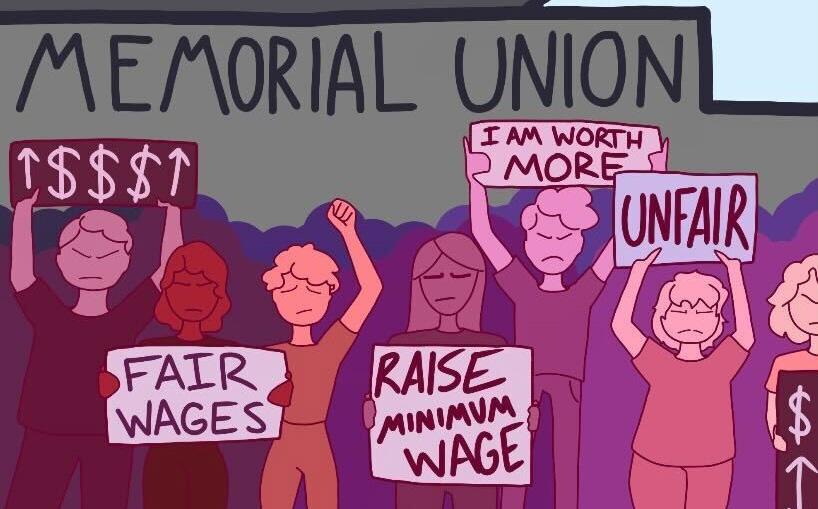 By Gwendolyn Christenson STAFF WRITER
University of Wisconsin-Madison
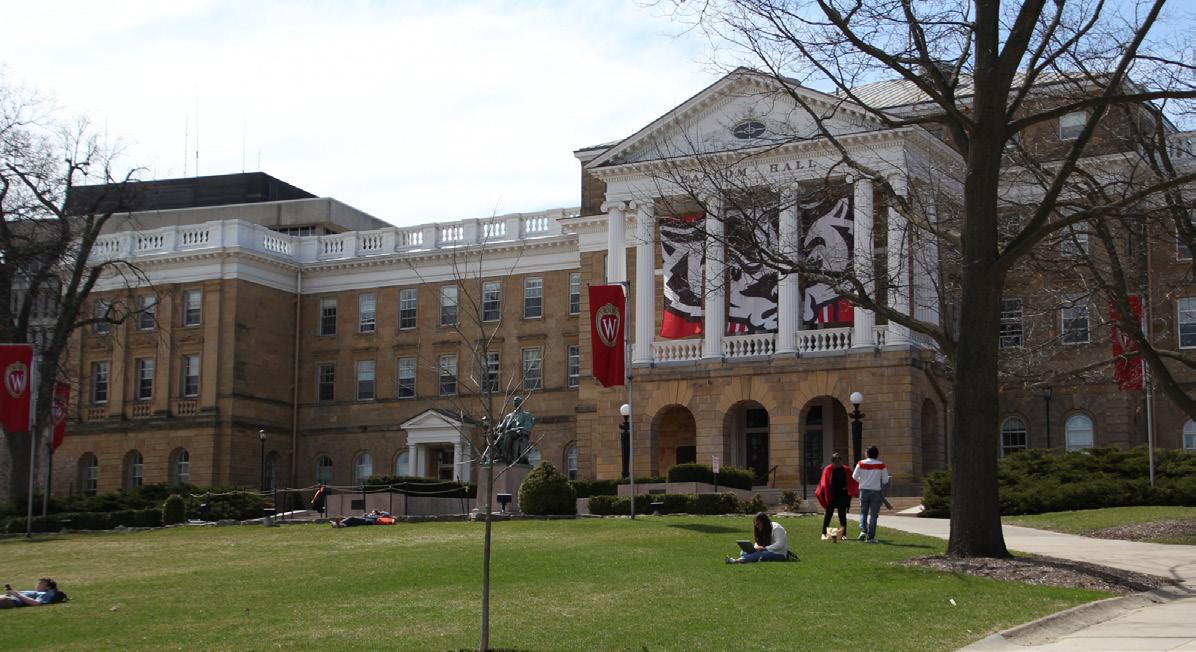
tuition prices for the 2023-24 school year are an estimated $10,798 for Wisconsin residents and $39,428 for non-residents, according to the university’s financial aid website. With a rise in tuition prices on the horizon, according to recent news, some students need jobs at school to sustain their lifestyles.
Two current student workers said they work between four and 10 hours a week at their campus jobs but require second jobs in order to pay for rent, food and entertainment.
mittee saw that we were actually organized and that we might have the ability to actually pull o an action, they decided that the best thing to do was say they’ll grant a wage increase.”
In one of Emspak’s recent articles, he said after gaining the support of Dean Martha Peterson the starting wage for student workers was raised to Wisconsin’s minimum wage at the time.
Today’s wage battles at UW-Madison
Today, Emspak continues to advocate for student workers and has devoted much of his time to analyzing UW-Madison’s financial situation.
then what position am I in?’”
Ward expressed similar views and concerns related to the publishing and approval of highly specific research. Fears of proving the importance and value of research can be di cult when dealing with less commonly examined topics, Ward explained.
“You can imagine instances of a bias against an individual because of their identities or in the research that they do,” Ward said. “Researching things related to marginalized populations that are under-researched or that people in your department aren’t familiar with, that could be a situation where they don’t value or don’t see the value in your work, and they are deciding whether or not to recommend you for tenure.”
The tenure process is often not the only thing on a professor’s daily agenda, Ward explained. Finding a balance between the three areas of tenure in addition to managing a life outside of work can pose challenges, Ward noted.
“I have two kids, I don’t get to work the same way that my peers who don’t have kids work in terms of just powering through, publishing tons and working nights and weekends,” Ward said. “I don’t have the time, the energy or the desire to work like that.”
Both professors agreed research is the top evaluation point of the tenure record, meaning service and teaching can occasionally fall to the wayside until the process is completed. Brown described this as a drawback for students coming to a top tier research institution.
“As long as you’re a productive researcher, teaching is a secondary concern,” said Brown. “The people meeting you in class, their ability to teach might not be the number one most important part of what they do every day and may not be the biggest priority in their head.”
Ward reiterated similar views of the tenure process.
“You can do the bare minimum for service and for teaching, and that will be okay,” Ward said. “If you do the most mediocre, basic, bare minimum of research, that could be dangerous for you in getting tenure.”
Brown explained that e ective, influential teaching has always been important to him, and since becoming tenured, his focus on teaching has heightened. Now that he does not have to prioritize his writing, research and publications, he has been able to spend
more time perfecting lectures and course information.
Yet, the service aspect of becoming tenured can become extremely time consuming, according to Brown. At times, over 50% of his day was consumed by performing service work as the webmaster for the African Literature Association, he explained. This portion of his day did not help make him a leading voice in the field, he explained, but rather, it was a way to serve and give back to his field.
Up until 2015, Wisconsin had tenure written into the state statute. The removal of tenure from state law did not change UW-Madison’s pledge to prioritize tenure and protection for teachers, according to a university administrator.
Brown said the removal of tenure created a sense of fear regarding job security, especially considering the size of his department. The Department of African Cultural Studies being small, and possibly construed as political, leaves it susceptible to elimination, Brown explained. Before tenure was taken out of state law, elimination would not be possible.
“The university has pledged that if you’re a tenured professor, we would find a new home for you if we eliminate your department, but that’s just talk,” Brown said. “Nobody knows for sure what would happen in reality and on paper, so it can have a chilling effect.”
A UW-Madison administrator explained that throughout the process, usually annually, individuals on the “tenure clock” will meet with small mentoring committees to receive guidance and advice on the portfolio they’re creating. While such groups provide support, Brown and Ward said their greatest support came from other sources.
Ward has been relying on other non-tenured professors one or two years ahead of her in the process for guidance. Brown said he made it through the difficult six years because of camaraderie between individuals in his department also facing the struggles of the tenure process.
“My department had several junior scholars, tenure track professors, at the same time,” Brown said. “We formed an ad hoc cohort and became very friendly, not only on campus but even outside of campus and have definitely supported each other.”
“I’m out of state, and if I didn’t have help with tuition, I wouldn’t be able to attend this school … A job like this isn’t supposed to help you succeed,” said a supervisor at Memorial Union about his current hourly pay.
Past wage battles at UW-Madison
The University of Wisconsin Systems website states that since 1903 when Charles Van Hise became president of UW-Madison, there have been discussions about tuition a ordability — this includes conversations on how student wages can be altered to make paying for tuition achievable for full-time students, according to UW-Madison’s website.
In 1904, Van Hise introduced a philosophy called the Wisconsin Idea. He proposed that all Wisconsin residents should be able to reap the benefits of public higher education since part of their taxes fund the UW System. This would mean tuition would be a ordable and students would only be limited based on their academic performance, at least according to UW-Madison’s website.
Sixty years later, a major problem
“Fundamentally, we have to take a look at the way the university is financed, and it cannot be financed anymore through tuition,” said Emspak.
Some current student workers feel disrespected by the university and think their education is no longer prioritized. Amelia Wilson has been a university tour guide for four semesters and still requires two jobs to a ord her rent.
“As tour guides, we are the faces of the university. It’s really frustrating to think about how much we as tour guides do for the university and how little they do for us in return,” said Wilson.
An anonymous tour guide supervisor said she not only feels underpaid, but she is also scheduled for one-third of the hours she was initially promised. She has relied on a second job to continue her education at UW-Madison as well.
“If you want a job for actual livable money, it is not feasible to only have this job,” said the supervisor about their campus position.
arose for student workers.
Frank Emspak, a 1965 graduate of UW-Madison, was one of the many student workers who unionized to address unfair wages. During the 1960s, student workers at UW-Madison were paid less than Wisconsin’s minimum wage — $1.25 at the time, according to Emspak. Emspak and the other students in the union encouraged the university to adopt a work-study program. This program would benefit students by allowing them to have a realistic work and school balance, since students would only work 10 hours a week and be able to cover their tuition in full.
Emspak said his experience in the union changed his perspectives on the power students hold when it comes to their wages. He firmly believes that with hard work, change is possible.
“We maybe spent a year talking to a committee,” Emspak said. “The university set up to meet with us and got nowhere, but then when the com-
They followed up by explaining, “There should be more allocated to the student workers who work so hard at their jobs everyday, setting aside schoolwork or other responsibilities to help their various work sectors function, something which I feel is not respected or valued.”
Wages for some student jobs start at as little as $12 an hour. This begs the question of how one pays for schooling on top of those expenditures.
The average amount of student loan debt for graduating seniors who needed financial assistance in 2021 was $27,107, according to a UW news release.
In Emspak’s view, one way to make changes in student wages and tuition would require a change at the state level in order for the UW System to receive more taxpayer money.
“We are often told we are the ‘face of the university,’” an anonymous student worker said. “It would be nice to be compensated in a way that reflects that.”
news dailycardinal.com Thursday, March 30, 2023 l 7
DRAKE WHITE-BERGEY/THE DAILY CARDINAL
BRENNA REA/THE DAILY CARDINAL
Unions find foothold after historic decline
By Elena Price PODCAST DIRECTOR
In the wake of the COVID-19 pandemic, union favorability is on the rise after years of decline. Recent Gallup polling found 71% of Americans approve of labor unions — the highest level since 1965.
But in 2022, only 187,000 Wisconsinites were union members — a 13% drop from 2021 and the lowest number recorded since at least 1989, according to data from the U.S. Bureau of Labor Statistics. Additionally, with union membership at 7.1%, Wisconsin’s labor unions trail the national average by 3% and neighboring states Minnesota, Illinois and Michigan by at least 4% each.
Despite years of decline, Wisconsin used to be one of the most unionized states in the nation, according to the Center for American Progress.
Michael Childers, co-chair of the University of Wisconsin’s School for Workers, said policies like Act 10 and right-to-work laws made it harder for Wisconsin employees to unionize in the past decade. However, heightened public favorability and campaign moves from Democratic politicians, including President Joe Biden, could launch Wisconsin’s unions back into the spotlight ahead of Wisconsin’s 2024 elections.
“The relationships that we [Democrats] have with unions are instrumental in what we both aim to achieve, which is economic security and solidarity with all workers,” said Rep. Kristina Shelton (D-Green Bay).
Rise and fall of Wisconsin unions

For many decades, the Midwest was the region with some of the highest rates of union membership. In 1964, the highest concentration of U.S. union workers was in the Midwest, according to data from NPR. This included 34% of Wisconsin workers who were union members, a total nearly five times greater than in 2022.
What stood Wisconsin apart from the rest of the nation was that its Legislature passed labor laws ensuring workers’ rights much earlier than other states and refrained from passing restrictive laws, according to Childers.
While in the 1940s the Southeast and some Western states passed section 14 of the Taft-Hartley Act –or “right to work” laws – the industrialized Midwest initially held o , Childers said. Wisconsin would not pass a similar law until 2015.
“That was a change to labor law in Wisconsin, that’s pretty recent that traditionally had never been an issue here,” stated Childers.
In 1959, Wisconsin was also the first state in the U.S. to authorize public sector workers to organize and bargain with their employers — a right previously only guaranteed to private workers under federal law — with the passing of the Municipal Employment Relations Act.
Union membership in Wisconsin slowly declined over the latter half of the 20th century and into the 2000s, following national data trends from NPR. By 2010, just 14.2% of workers in Wisconsin were part of a union, though the
state’s unionization rate was still higher than the national average of 11.9%, according to Wisconsin Public Radio.
However, that trend would reverse after Republican Gov. Scott Walker signed o on legislation limiting collective bargaining rights for public employees a year later.
Prior to Act 10’s passage, an estimated 1.5 million people, including Wisconsin teachers, firefighters and other unionized public employees, descended on the State Capitol building for weeks of protest. Members of the UW-Madison Teaching Assistants’ Association and some other protestors occupied the Capitol, sleeping inside for days. Meanwhile, 14 Democratic state senators fled to Illinois to avoid voting on the bill.
Educators believed “a teacher’s working conditions are a student’s learning conditions,” Childers explained.
But with support from the Republican-controlled Wisconsin Legislature, Walker passed Act 10 in March 2011, which Childers said greatly curtailed public sector workers’ ability to bargain with employers as a union.
Under Act 10, unions must garner 51% of support from all employees every year to remain active. Employees who don’t vote are essentially counted as “no” votes, Childers said.
“It actually requires 51% of the eligible voters — not of the votes cast, [but] of the amount of people that would be a part of the bargaining unit,” he explained. “By those rules, I don’t think we would have elected any president for the last 40 years.”
If the union does end up recertifying, they are only allowed to bargain their wages with employers, according to Childers.
“You’re going to go through a lot of work to basically talk about very little,” Childers said.
In order for Democrats to gain control in the Assembly House and Senate to repeal “right to work” or Act 10, they need not only the voting numbers but also a major revision of Wisconsin’s voting district boundaries.
“Wisconsin has its own set of issues with the way the congressional maps have been drawn,” Childers said. “Unless that gets sorted out, I don’t see anything changing.”
UW Health employee recalls union decline after Act 10
Without the protections unions provided, pagers at UW Health have felt the conditions worsening at their place of work since Act 10’s passage.
Nathan Reid works as a pager and messenger at UW Health, a 24-hour department where he connects callers to doctors and answers emergency phones. When Reid started, pagers were a part of the Service Employees International Union (SEIU), the same union that represented UW Health Nurses. Reid felt he had the “full weight” of organized labor behind him.
“It wouldn’t just be you, or wouldn’t just be a bunch of individuals, you had the SEIU,” Reid said. “That’s one of the biggest health care unions in the country.”
But when the union was phased out following Act 10 — just six months into Reid’s tenure — he noticed a decline in benefits.
“One of the very first things that changed was every employee had to get a very small percentage, like [a] 10 to 11% raise to compensate for the fact that with the unions going away,” Reid said. “Everyone’s health benefits — and essentially everything that comes out of their paycheck every two weeks — was all going to go up.”
Without SEIU, UW-Health was able to do whatever they wanted, Reid said. He and other employees felt they were “treated as items rather than people,” he added.
“It’s hard to explain to people who have only been hired in the last year or two, what it was like,” Reid said. “There seemed to be a lot more camaraderie. There seemed to be a lot more enjoyment in what people did with their job from day to day because they had those extra assets.”
With health workers forced to spread themselves thin with little support, compensation or extra incentives during the COVID-19 pandemic, Reid said he and others began to feel overwhelmed and overworked. Almost half of the long-term pagers quit within the pandemic’s first year, according to Reid.
“Those were all employees who had been there through the unions, and they lost a lot of their benefits because the unions went away,” he added. “COVID just made their jobs unbearable.”
Although working conditions
planned a three-day strike but instead negotiated a compromise plan where they would begin talks with the Wisconsin Employment Relations Commission on whether UW Health can lawfully recognize a nurses union. Under the compromise, nurses agreed not to organize another strike so long as UW Health negotiated in good faith.
While some union leaders took the agreement as a sign of hope, Reid remains cautious.
“To be perfectly honest, a lot of us [pagers] were wishing the strike had actually happened… those negotiations could take years,” he said. “It was a good way to really stop some bad publicity for UW Health.”
worsened during the pandemic, Reid said it created an environment where employers were forced to create better working conditions for their employees or face mass quitting.
“COVID had the e ect of, in a strange way, almost creating some of what a union is trying to achieve,” he said. “Things got so bad because of COVID, that it forced UW Health to not be able to ignore all the grievances people were having.”
While COVID created conditions where employers like UW Health had to improve working conditions, Nate was left contemplating all he and his fellow co-workers went through to see these changes.
“Work got so grim and hard, and it a ected so many people in such a negative way, that it almost makes you wonder, ‘Was it worth the cost of it?’” Reid added. “But at least it got the attention of UW Health as a whole.”
COVID brings changing perspectives on unionization
Although COVID brought hardship for nurses and other essential workers, the pandemic helped change people’s views on their relationship with work and wide disparities in benefits, Childers said.
“A lot of frontline workers who were being told, ‘You’re essential’ — they’re believing it,” Childers said. “They’re like, ‘Well if we’re essential, why should we have to work two jobs to be able to make our bills or be able to have a decent life?’”
Five Starbucks locations in Wisconsin have made successful e orts at unionizing in 2022 after protests, strikes and petitions to the National Labor Relations Board. In July 2022, the Starbucks at Madison’s Capitol Square voted overwhelmingly to unionize.
“[Wisconsin Starbucks growing unionization] shows that even, despite whatever clause we still have in our labor law, workers are going to try to come together when they feel like they are not being heard or that things are unfair,” Childers explained.
Additionally, UW Health nurses — who faced severe sta ng and health benefit cuts with additional hours of work even before COVID exacerbated their working conditions — are currently trying to reinstate their union.
In early September, the nurses
Whether the talks lean in favor of the nurses creating a union again or not, as Childers described, very little in terms of labor union law can change substantially until political demographics in the Legislature change.
“There’s no unity of purpose within our government [regarding] potentially reversing things like right-to-work or Act 10. I don’t see that on the horizon here in Wisconsin,” Childers said. “You’d have to have a major change in the Legislature for that to happen.”
Political appetite for unions
In a broader scope, state and federal lawmakers — including President Biden — are looking to capitalize on union frustrations and rising public support for organized labor in upcoming elections.
During his presidential campaign in 2020, Biden vowed to be “the most pro-union president you’ve ever seen.” As president, Biden passed two large bills — the Inflation Reduction Act, and the Bipartisan Infrastructure Investment and Jobs Act — which the White House said incentivized employers to emphasize workers’ rights and support unions.
“There’s a lot in those two large bills that were passed that [does] favor companies using union workers, which will increase demand for those workers which provides more family-supporting jobs,” Childers said.
Additionally, during a campaign stop near Madison following his 2023 State of the Union address, Biden promised a “bluecollar blueprint” to rebuild U.S. infrastructure with union jobs.
“Wall Street did not build this country,” Biden said in February.
“The middle class built the country, and unions built the middle class.”
Recent train derailments across the country following Biden’s turn to Congress to stop a rail worker strike from occurring late last year left some voters questioning his commitment to the cause.
Still, Rep. Shelton said Democrats remain committed to engaging union voters ahead of the 2024 elections.
“When you bring folks together on economic security, you can and should talk about union power — but you also have to talk about things like clean water, good housing, childcare, strong public schools, criminal justice reform,” Sheldon said. “It creates an umbrella for which people can understand how the common cause of economic security really relates to all the other things.”
news l
8 Thursday, March 30, 2023 dailycardinal.com
DRAKE WHITE-BERGEY/THE DAILY CARDINAL
Wisconsin’s place in the NIL revolution
By Matthew Neschis STAFF WRITER
Ed O’Bannon beamed with joy atop the ladder, firmly grasping the rim with his right hand and a piece of the net in the other. Minutes earlier, his UCLA Bruins defeated the Arkansas Razorbacks, 89-78, in the 1995 NCAA National Championship game. For O’Bannon, it was a fairytale ending to his senior year.
Surprisingly enough, O’Bannon’s most significant collegiate victory wouldn’t come for another 19 years, and it wouldn’t come on the court, but in the courtroom.
O’Bannon first challenged the NCAA in the court of law in 2009, suing the organization’s Electronic Arts and Collegiate Licensing Company over using his name, image and likeness (NIL) in a college basketball video game. For years, the NCAA had gotten away with using student-athletes’ image without compensation, routinely falling back on their model of “amateurism.” Players weren’t considered professionals, so they weren’t eligible to earn a paycheck.
That all changed in 2014 when District Judge Claudia Wilken ruled that the NCAA’s ever changing definition of amateurism violated antitrust laws. EA Sports was subsequently forced to discontinue its line of NCAA video games and pay $60 million to 24,819 athletes.
The monumental ruling suddenly threatened the NCAA’s hard stance against allowing its athletes to benefit from their NIL. The matter eventually reached the Supreme Court seven years later in the 2021 case National Collegiate Athletic Association v. Alston.
On the issue of restrictions placed upon academic-related benefits, the Court unanimously ruled in favor of Shawne Alston, who formerly played running back at West Virginia University. In Justice Brett Kavanaugh’s concurring opinion, he stated the “NCAA’s business model of using unpaid student-athletes to generate billions of dollars in revenue for the colleges raises serious questions under the antitrust laws.”
It wasn’t long before the NCAA lifted their regulations on athleticrelated benefits as well. On June
30, 2021, the goliath organization announced college athletes would be eligible to profit o their NIL.
“This is an important day for college athletes since they all are now able to take advantage of name, image and likeness opportunities,” NCAA President Mark Emmert said in a press release. “With the variety of state laws adopted across the country, we will continue to work with Congress to develop a solution that will provide clarity on a national level.”
Wisconsin student-athletes were quick to act following the watershed revision, swiftly capitalizing on the custom merchandise, autograph signings and endorsement deals that now awaited them.
Then-Badger quarterback Graham Mertz revealed his trademark logo on July 1, becoming the first collegiate athlete to possess one. Many of his teammates quickly followed suit, as Wisconsin’s entire o ensive line partnered with Mission BBQ — the same food chain that sponsored Wisconsin legend Joe Thomas.
UW’s Matt Henningsen (football), Dana Rettke (volleyball) and Chayla Edwards (women’s hockey) also seized the opportunity to promote themselves, joining Degree
Deodorant as part of their Breaking Limits team.
Over time, Badgers’ NIL deals increased in size and creativity.
Collin Wilder and Chucky Hepburn immortalized moments of greatness through apparel. Once Wilder’s “Grit Factory” trucker hat became the rallying symbol of the defense — players routinely donned the hat on the sideline after forcing a turnover — the safety partnered with two companies to place the slogan on caps and shirts.
And after Hepburn buried an iconic 3-pointer against No. 8 Purdue to share the Big Ten Conference regular-season title, the point guard printed the shot on shirts with the title “The Chucky Special.”
Other athletes didn’t stray far from home when partnering with companies. La Crosse natives and basketball stars Johnny and Jordan Davis signed with the Wisconsinbased clothing company Jockey, serving as the poster children of homegrown talent for the company’s “Made In America campaign.”
Running back Braelon Allen, born and raised in Fond du Lac, joined Iron Joc Performance Gear & Apparel, where he, too, represented a clothing company based in his home state.
As Wisconsin athletes’ NIL portfolios continued to grow, the university stepped in to provide even more opportunities.
On April 21, 2022, the athletic department launched YouDub, an online NIL marketplace solely intended for Badger athletes. Through YouDub, businesses are given a direct line of access to students’ bios, social media profiles, interests and preferences. If a company believes the athlete is a good match for their brand image, they can pitch them on possible NIL partnerships. Contracts, bookings and payments can all be securely done through the platform, which is powered by Opendorse.
YouDub additionally provides fans with personal access to their favorite Badger stars. Video shoutouts, autographs and public appearances are all able to be purchased for a price determined by each athlete.
“This is an exciting step in our evolving e orts to provide the highest level of support to our studentathletes when it comes to their NIL opportunities,” UW Athletic Director Chris McIntosh said after YouDub’s release.
“We are fortunate to have a large and passionate fan base that not only supports the e orts of our pro-
gram and our teams collectively, but specifically takes pride in supporting our student-athletes individually as Badgers.”
Wisconsin student-athletes received NIL assistance from sources outside the athletic department as well. UW Athletics donors launched the Varsity Collective on June 4 with the intent of becoming the “premier destination for Wisconsin studentathletes to identify business opportunities.” Through the collective, Wisconsin alumni and businesses can put money towards NIL deals for UW athletes, as well as mentor students through the ever-changing NIL world.
While the future of NIL deals poses many benefits, it also poses several risks.
NIL has become a bargaining chip utilized by collegiate programs to lure highly-touted athletes from high school and the transfer portal. With the help of collectives, universities have been able to promise recruits and prospects deals worth thousands of dollars before they ever don the school’s colors.
“NIL has been used as a recruiting inducement,” Wisconsin men’s basketball coach Greg Gard said last year. “It’s NIL promise versus NIL promise. It’s become pay for play in some regards, where the amounts have gotten astronomical, and it’s happened instantaneously.”
Though the NCAA formally bans the use of NIL deals for improper recruiting purposes, little has been done to deter programs from doing so. University of Miami women’s basketball coach Katie Meier was caught facilitating illegal contact between Haley and Hanna Cavinder — two prospective Fresno State transfers — and John Ruiz, a Hurricanes booster, last month. Despite the clear breach of rules, the program was only issued a minor $5,000 fine and one-year probation.
It remains to be seen what role NIL will play for Wisconsin Athletics. During an age in which star athletes, transfer-portal acquisitions and triple figure deals reign supreme, the Badgers will be faced with a tough decision — to stick with the old ways or embrace the new age.
By Donnie Slusher SPORTS EDITOR
It has now been nearly two full years since Chris McIntosh succeeded Barry Alvarez as athletic director.
After not making many significant decisions during the 2021-22 year, McIntosh shook the athletic program to its core in year two.
In the fall, he executed two of the boldest moves in the history of Wisconsin football — firing head football coach Paul Chryst midseason, then hiring Luke Fickell from Cincinnati. McIntosh also later fired men’s hockey coach Tony Granato, an ex-player and two-time Big Ten Coach of the Year, after seven seasons.
While the men’s sports require overhauls, the women’s teams
continue to succeed. The two most recent Wisconsin championships came from women’s sports — hockey in March and volleyball in December 2021.
Yet, despite their outstanding success, those programs are not treated with nearly the same attention or investment as the major men’s sports. They obviously don’t require the same urgent attention, but any form of attention would be a start.
Money!
McIntosh, an ex-Badger offensive lineman, has yet to shy away from investing in the football program. One of the first significant moments of his tenure was the renovation of Camp Randall’s south end zone in August 2022.
The aforementioned coach shake-up was bold enough, not to mention the $11 million it cost to get rid of Chryst and Fickell’s $7.5 million yearly salary for the next seven years.
It won’t stop there. Hiring Fickell was just the start of a major football overhaul.
“It’s no secret that we’re pursuing a new indoor practice facility,” McIntosh said during Fickell’s introductory press conference.
Almost all of these extra luxuries are possible because of boosters. Other sports aren’t privileged with a group of rich, competitive old men who can easily shell out money for a new end zone, practice facility or coach contract.
Continue reading @dailycardinal.com
DONNIE SLUSHER/THE DAILY CARDINAL
DILLON ARONOFF/THE DAILY CARDINAL
10 Thursday, March 30, 2023 dailycardinal.com sports l
Mark Johnson began his career on the Wisconsin ice, playing for his father, the legendary "Badger Bob.” 46 years later, Johnson has accumulated eight total championships now seven as head coach.
Column: Women’s teams, coaches deserve same investment as men’s
‘The technical aspect is the spectacle aspect’: The unseen labor of theatre
By Noah Fellinger ARTS EDITOR
The spectacle of theater is part of what continues to draw crowds in the age of smartphones and streaming services. Upon sitting down to watch a live performance, the dazzling lights, sounds and sets never fail to mesmerize an audience. To those sitting in the auditorium, such theatricality might appear to have an almost e ortlessly magical quality to it.
But, what most audiences don’t see are the many hours of diligent work stagehands and other backstage workers devote to shape this experience. Although actors tend to receive the most attention, many will argue stagehands are the foundation upon which every performance rests.
Without them, the show will not, in fact, go on.
The Wisconsin Union Theater and the University of WisconsinMadison Department of Theatre and Drama host numerous performances year-round, relying on the crucial labor of stagehands. Many are professional technicians and specialists, but most are part-time student workers. The Daily Cardinal spoke with Grace, a UW-Madison student employed by the Wisconsin Union Theater as a stagehand, who emphasized the huge breadth of tasks stagehands are responsible for. She asked not to be identified using her last name.
“There is no such thing as a mundane day,” Grace said. “Like, my first time doing the Nutcracker at Shannon Hall I learned how to
take the dance floor o of this huge rolling machine, and that process is so funny. And we painted the floor as well.”
Grace described some of her other responsibilities, including operating soundboards, working lights, setting the stage and hauling equipment. But, as she explained, this type of work can be physically demanding.
“For someone who’s petite, the hardest part would be lifting the speakers. We have some really big speakers. It’s sometimes hard to lug that around. You’ve got to be strong. And then the rig system, which also requires upper body strength,” she said.
Working as a stagehand isn’t only physically demanding, but the irregularity of performances can be demanding on one’s schedule, too. This is especially true of some student stagehands.
“Sometimes you can work 10 hours a week, maybe less. Sometimes you can work like 30-plus or more. I know that for the Wisconsin Film Festival, that tends to be a bigger chunk of time,” Grace said. “Shannon Hall [also] does … graduations. There’s four graduations and that’s 36 hours in three days.”
A stagehand’s work presents unique challenges that most other professions don’t. Despite this, the average Wisconsin stage worker salary of $36,407 continues to lag behind the $58,260 national average. But, as Grace noted, joining a union is a great way for stagehands to bridge that gap.
“[I make] $16.10 [an hour] I think, but then there are levels,”
Grace said. “Once you’re able to join the union — because you do have to work a certain amount of hours to join — the pay increases.”
In Madison, the largest stage worker union is the local chapter of the International Alliance of Theatrical Stage Employees (IATSE). IATSE was founded in 1893 amid the transition of theater companies from the cooperative-based model to the modern tour-based one.
Since then, IATSE has fought to improve working conditions for stagehands by negotiating minimum pay rates and limiting the number of hours stagehands may be required to work. In Wisconsin, stagehands who are members of a union make an
average salary of approximately $44,566 a year — over $8,000 more than non-union stagehands. But, non-union stagehands, like Grace, may still see some benefits thanks to the union.
“One of the shifts I did for IATSE was a changeover shift at the Kohl Center,” Grace said. “It was [converting the court from a] hockey to basketball court. I was being paid $21 an hour, and then once you hit midnight, it went to $25.”
For those who do not intend to pursue a career as a stagehand, Grace said the experience working backstage can be of great benefit to a wide variety of roles within the entertainment industry, including acting.
“There’s a lot of benefit as an actor learning the fundamentals of stagecraft. Actors memorize their lines and everything, but if you don’t have the crew, you don’t have sound, lighting [or] sets,” Grace said. “So it really [gives you] perspective. You also respect the process of what the crew members are doing.”
Grace stressed how crucial stagehands are to the performing arts.
“Each role is, no matter how small it might sound, it’s needed,” Grace said. “Without backstage people, things would not get done. The technical element is the spectacle element. So without the spectacle, you just have actors there with nothing, nothing around them. No lights.”
The songs of the workers: From the fields to the factories
By Je rey Brown SENIOR STAFF WRITER
Deep in the isolation of the COVID-19 lockdowns, a song of hope spread across TikTok and embedded itself in pop culture. As we awaited the vaccine, voices rang out for the Wellerman to come “to bring us sugar and tea and rum.” This shanty cry for a supply ship to bring relief went viral — a recognition of the power of work songs across time and context.
Before orchestras could fit into pockets and work was done alone with earbuds in, there were work songs. The story of music cannot be told without recognizing its deep roots in labor. Rock and roll owes its existence to the blues, which in turn evolved from the songs of chain gangs and the antebellum work songs before them. From the boats to the fields and hills to the factories, laborers sang songs of better days, of struggle and of unity.
These are the songs of the workers.
The boats
Before the era of sea shanties came to an end due to the rise of steam engines in the 1880s, wooden ships crossed oceans with only ropes, canvas and the sailors who knew how to operate them — and
who knew the songs to work to. For a song to be a shanty, it must have been a song used by sailors in the midst of labor — otherwise it’s just a sparkling sea song.
Shanties took di erent forms depending on what tasks they were associated with. Halyard shanties were sung while raising and lowering sails, a process requiring quick bursts of well-coordinated force among large teams. “Blow the Man Down” is full of energy and uses a call and response format to keep everyone on pace. Capstan shanties were sung while turning a large crank, called a capstan, to raise the anchor. This process was grueling and would take hours of constant whole-body pushing in circles, and thus were where sailors sang songs like “Shenandoah.” This song held a steady rhythm while telling the story of being far from comfort. These ships went from port to port and continent to continent, picking up and dropping o workers as they went. The songs went with them.
“Shenandoah” originated as a riverboat song and “Blow the Man Down” is believed to be an adaptation of the song “Knock a Man Down,” which was sung among African American workers, possibly as they were load-
ing cotton and other goods onto merchant ships while working as roustabouts. “Roll ‘Im On Down” is another version of that tune, this time originating in the Bahamas. And the halyard song “Pay Me My Money Down” likely originates with Black sailors from the West Indies, who then spread the song to Black roustabouts, the title for this work, loading lumber onto ships at Georgia ports.
The fields and hills
At the same time, in hills and fields across the United States, enslaved people sang “slave songs.” An oral tradition among the most oppressed, there are few written records of what these songs would sound like.
Given the lack of written records and the wide variety of culture and tradition among enslaved people, it’s hard to know when or where songs originated. The book “Slave Songs of the United States” was published in 1867, after the end of the Civil War, by abolitionists who likely interviewed freedmen about their experiences as enslaved people. This was the first project of its size, transcribing songs from diverse regions of the south. Yet, it makes no note about the context around each song’s
use. Some were gospel songs sung on Sundays, others were sung for recreation and some songs, often called field hollers, were sung by enslaved people at work. These specifics may remain unknown forever.
This is not the case for what came next: chain gangs. The passing of the 13th Amendment ended all slavery in the U.S., yet kept the notable exception of labor as punishment for crimes. After the end of Reconstruction in the 1890s, Southern states quickly passed laws known as the Black Codes to exploit the prison exception by criminalizing nonsense like loitering to create a system for Black Americans to be arrested, imprisoned and put back into forced labor. These wouldn’t be phased out until the mid-1950s.
The recency of chain gangs should be alarming but also means there are relatively extensive recordings of their songs as well as interviews with their singers. Between 1933 and 1939, musicologist John Lomax and his then 18-year-old son Alan recorded nearly 250 songs sung at Mississippi State Penitentiary. Yet, due to limitations of the technology and the reality of recording over a hundred people working outdoors, it was impossible to get
quality recordings of the singing in the actual field. John Lomax would instead ask the workers, both individuals and some small groups, to reenact songs during their lunch breaks. In a 1947 interview with Alan Lomax, blues artist Big Bill Broonzy described his experience singing while laying railroad on a chain gang as:
“One guy maybe would be saying something or moaning or humming or something and I set the spike and I hit one lick then he’d come over and hit the lick … and back and forth like that. They don’t care whether it was in time or what note it was, it would just be singing and humming around. There wasn’t any words [most] of the time. Sometimes you’d say a word … some of them didn’t rhyme and some did rhyme. It didn’t make any di erent with them.”
Laying down railroad tracks required rhythm and coordination within teams, just like raising sails. Songs like “Long Hot Summer Days” and “John Henry” reflect this in their combination of steady rhythm with call and response to create the enchanting yet haunting tone that would directly become the somber, soulful sound of the blues ...
Continuereadingonline@dailycardinal.com
AARON DONG/THE DAILY CARDINAL
arts dailycardinal.com Thursday, March 30, 2023 l 11
Scott Walker’s legacy: The fall of unions
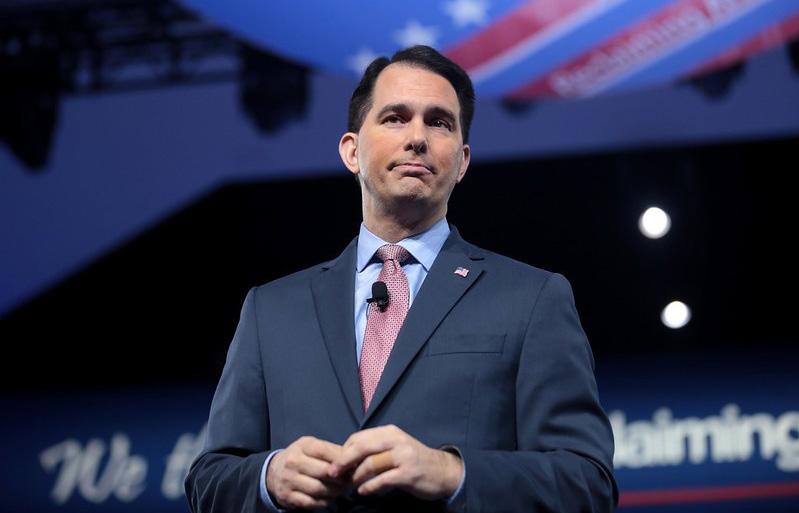 By Owen Puckett STAFF WRITER
“Wisconsin is open for business,” Gov. Scott Walker’s administration proudly declared, pointing to signs that the state’s business climate was improving.
In 2010, only 10% of CEOs in Wisconsin thought the state was moving in the right direction — by December 2011, that number had risen to 94%. These numbers come directly after Act 10, a controversial Wisconsin law passed in 2011 that remains a divisive issue among labor advocates and policymakers. Insisting the original intent behind Act 10 in 2011 was because the state was “broke,” and that it was an attempt to address a shortfall in the state’s budget, the law mandated public sector unions hold recertification elections annually. Unlike typical democratic elections, unions would need to win a majority of all eligible voters, not just a majority of votes. It effectively outlawed collective bargaining for worker benefits and workplace safety — even the wages workers could negotiate were capped by inflation. It also barred unions from deducting dues from union paychecks.
These new rules in Wisconsin meant the end for many already weakened public-sector unions.
In truth, the “hard” problems Wisconsin Republicans took on were not so much economic as political. The state was never “broke.” Its debt had a high credit
rating. It faced a less daunting budget deficit than many other states.
State unemployment was lower than the national rate, and the previous administration, led by Democratic Gov. Jim Doyle, wrestled with a deficit almost $2 billion larger. So it’s hard to believe Act 10 was simply “an attempt to address a budget shortfall” when we know business first politics are not new to the state.
Since 1980, the share of state revenue provided by corporate taxes has fallen by more than 30%, and two-thirds of corporations pay no state taxes — increasing dramatically in 2011. Meanwhile, many aspects of social spending were slashed. With a rollback of the Earned Income Tax Credit, taxes on the working poor rose. This was not just an attempt to fix a budget shortfall, but also an attempt to destroy their opponent’s base in the unions and drive a stake through the heart of social-democratic Wisconsin.
By that metric, Act 10 has been remarkably e ective; in the past year alone, Wisconsin’s public sector unions lost 13% of their members from the year before. Additionally, the diminishment of public sector workers had helped pave the way for Walker to sign in a right-to-work law in 2015, breaking his earlier pledge not to do so.
These right-to-work laws, along with Act 10, eroded union finances and bargaining power, ultimately contributing to a 10% decline in the state’s union membership since 2011. Now, barely 8% of Wisconsin
workers are unionized — the lowest number on record.
However, Act 10’s impact over the past decade stretches beyond a decline in union membership. The law also damaged the state’s infrastructure and services, including the K-12 public education system.
An analysis from the Center for American Progress found that
after teachers, while poorer districts, many rural, face constant teacher shortages and high turnover rates.
Private sector unions have been targeted as well. The right-to-work movement — founded by avowed white supremacist Vance Muse in the 1940s before being taken over by conservative industrialists
have been weakened or eliminated. Ultimately, this has had a ripple e ect through the entire state economy, with workers bearing the brunt and business owners reaping the rewards of austerity measures, shifting the economic and political balance of power away from regular citizens and toward corporate interests.
It’s time for government o cials to take a comprehensive approach towards protecting labor laws in this country, incorporating lessons learned from Wisconsin and other states where similar labor policies were implemented. Doing so would help ensure American workers can access the resources they need to weather hardships, such as economic downturns, without having to sacrifice essential protections and benefits.
in the year following the passing of Act 10, median compensation for Wisconsin teachers decreased by 8.2%; the percentage of teachers who left the profession spiked to 10.5%, up 6.4% from the year before; the percentage of teachers with fewer than five years of experience jumped from 19.6% in the 2010-11 school year to 24.1% in the 2015-16 school year.
Additionally, the loss of collective bargaining rights has made teachers’ wages and benefits more uneven across the state. Wealthier districts can now entice sought-
such as Fred Koch — appeared to have petered out by 2010. But over the next decade, West Virginia, Kentucky, Indiana and Michigan — the birthplace of the United Auto Workers union — joined Wisconsin in becoming right-to-work states.
Today, there are roughly 27 of these states.
The consequences of these laws have been devastating for millions of working-class people across the country. In states such as Wisconsin, union membership has plummeted, wages and benefits have stagnated and workers’ rights
For individuals who benefit from the protection and benefits of a strong union, it is essential to remember the lessons of Act 10 and to continue to advocate for labor rights and worker protections.
It is far past the time for America to realize that unions are not detrimental to capitalism but instead crucial components of a functioning society. A thriving workforce is a critical part of a thriving economy, and the rebuilding of the American labor movement should be a top priority for all Americans.
Owen Puckett is a sophomore studying Political Science. Do you agree that unions aren’t detrimental to capitalism? Send all comments to opinion@dailycardinal.com.
The agricultural labor shortage: a struggle to fill plates
By Charlotte Relac STAFF WRITER
How food gets on our plate is often a mere afterthought. We eat three meals a day and munch on late night snacks, but the farmers and agricultural workers providing this food remain completely out of sight.
We expect food to show up on our grocery store shelves day after day and week after week, but what would happen if it didn’t? We saw it before with the COVID19 pandemic, where shelves were wiped clean or filled with obrand products that couldn’t be
replaced for weeks.
There is a labor shortage, and no one is talking about it. We need agricultural workers to perform essential daily tasks crucial to keeping a farm up and running, but with the decrease in help comes a decrease in food available for buying and consumption.
Prices have risen since 2020, and they don’t seem to be dropping any time soon. According to the American Farm Bureau Federation, grocery bills across America are rising at the fastest pace in more than 40 years.
There has been a 73% decline in self-employed and family farmworkers from 1950 to 2000, according to the National Agriculture Statistical Service’s Farm Labor Survey (NASS FLS). During that same time period, there has also been a 52% decline in the number of farm hands hired.
Yet, we are not helping the problem. Nearly 40% of all food — equal to nearly 130 billion meals — is wasted in America every year. We Americans must learn to be more sustainable eaters. This can range from being proactive grocery shoppers to starting o with
smaller portions on our plates.
Many Americans are used to having constant access to food, where others are faced with constant food insecurity.
Unpredictable weather, unequal work-life balance, high real estate for land, high cost of machinery and the physical demand of the industry are all factors driving potential farmers away.
Many immigration-centered sectors of the United States Department of Homeland Security also covertly add to this labor shortage. Undocumented immigrants account for nearly half of farm hands, 25% being of Mexican descent.
Absent immigration reform and harsh citizenship and deportation laws have forced farmers to choose between cutting production and losing crops or hiring undocumented farm hands. The increase in border control enforcement and deportation laws is hurting the American economy.
Immigrants do a lot of good for the U.S. economy by taking on jobs Americans no longer want. Due to lack of consensus, immigration reform goes in circles, causing America’s food production to suffer.
Here, farmers run into yet another problem. As the percentage of immigrants with college degrees increases, and as literacy rates improve, opportunities for less labor intensive jobs also increase. Even with an increase in hourly wages, primary farm
operators still struggle to retain employees because of other available opportunities.
This is the struggle today’s farmers are living through. With no one else to turn to, they either take the work upon themselves — making the job even less desirable — or are forced to pay out of pocket for high-end machinery and other supplies.
This is the story no one tells us as we throw away half of the vegetables on our plate because we simply took too many. While we may get constant reminders from our parents to look for the cheaper options at the grocery store, there is a whole other side to the story a majority of people are unaware of or don’t seem to care about.

Aware of the crisis at hand, it’s important to move forward by only buying what we know we need. Many Americans take for granted the easy access to food that they’ve been given. Too often, groceries go to waste by sitting in the fridge for too long. To get the most out of the meals we make, we need to start off by appreciating the work that goes into growing the food we are eating every day.
Charlotte Relac is a sophomore studying Journalism and Mass Communication. Do you agree we are not conscious enoughofwhereourfoodcomes from? Send all comments to opinion@dailycardinal.com
opinion
SHAYNA KAPLAN/THE DAILY CARDINAL
12 Thursday, March 30, 2023 dailycardinal.com l
COURTESY OF GAGE SKIDMORE VIA FLICKR
Q&A: Dr. Emily Bick on research, industry, academia
When I went to grad school — and I highly recommend taking a couple of years between bachelor’s and graduate school — I had a much clearer idea of what I wanted to learn. Grad school is probably one of the only times in your life where you get to sit and think and develop your own questions and pursue your own interests. If you come in with a really good perspective on what you want to learn and what you want to do, you’re much more successful.
What did you do after getting your PhD? Did you think you’d return to industry or stay in academia?
hardest parts, and it’s particularly hard because I am very much an ideas person, but if you pursue all of them nothing gets done.
By Julia Wiessing SCIENCE EDITOR
In summer of 2022, Dr. Emily Bick became an assistant professor in the University of Wisconsin-Madison’s department of entomology and an extension specialist through the Department of Extension.
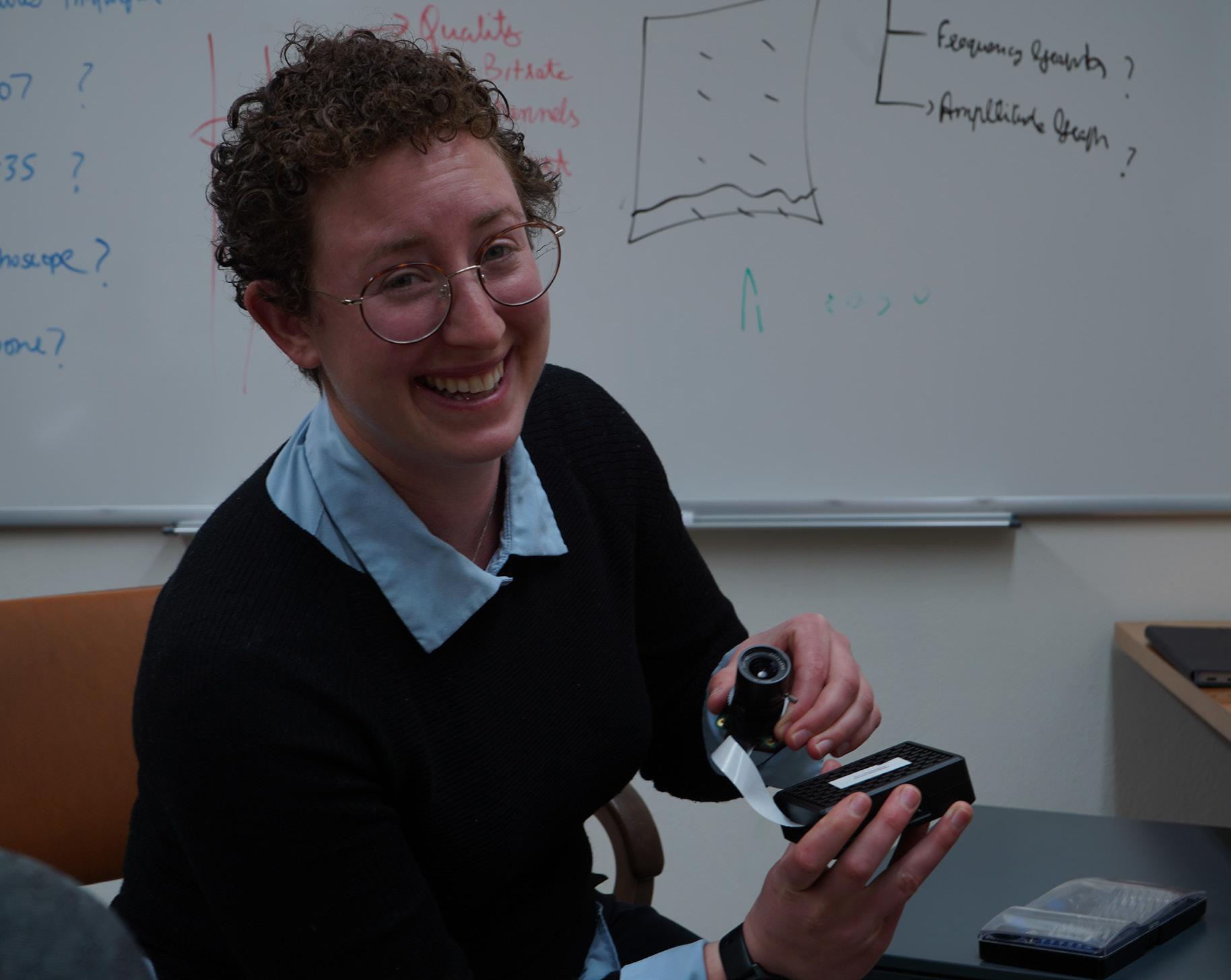
Bick’s research focuses on applied agroecology, digital entomology and spatial population biology. The Bick lab aims to develop tools and frameworks for data driven, precision pest management.
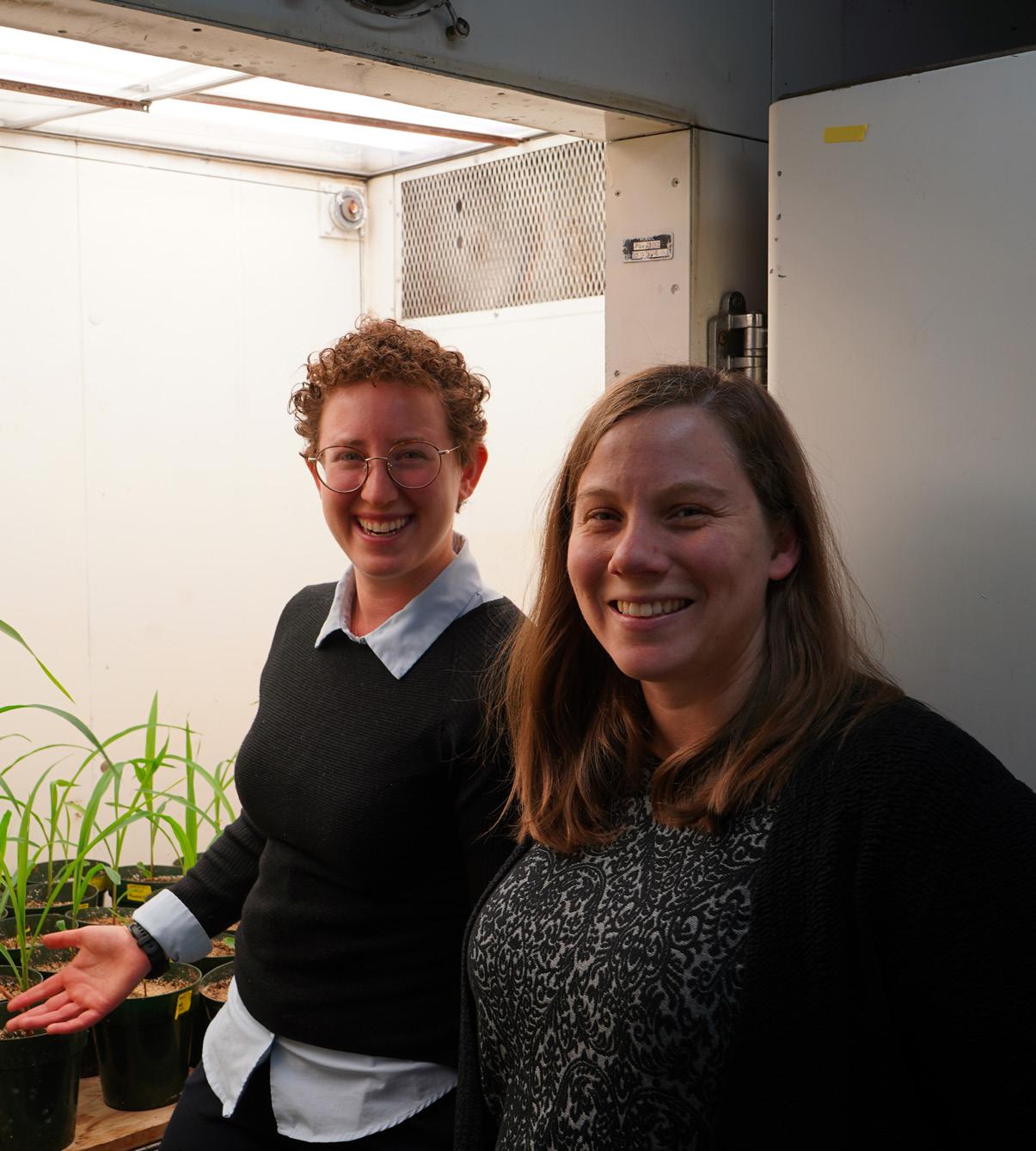
Bick sat down with The Daily Cardinal to talk about her career path, her work in industry and her journey in academia.
Thisinterviewhasbeeneditedforclarityandbrevity.
Tell me a little bit about your undergraduate career, how did you know you wanted to research entomology?
I actually started doing science research in high school. There was a four year science research course I took where we had to develop our own project. They picked some of the best science students and said, “Okay, if you want this opportunity, go for it. Try out science research.”
We had to think of a topic we [were] really passionate about. At the time, I’d just come back from summer camp, which meant I’d been eaten alive by mosquitos. So I came back and said, “You know what, I’m developing a much stronger bug spray. That’s all I want to do, that’s going to be my four year project.” I was just totally enamored with how we keep mosquitos away from us.
Over the course of that four year project, I needed help [and]
sought out the local university and met with two entomology professors. [I] really developed an understanding about how insects and people interact, and what that relationship actually looks like. All of a sudden I became a lot less interested in personal protection from mosquitoes and more about insects, pathogens and people.
When you were in undergrad, did you know you wanted to do your masters degree?
No. I was actually dead set against grad school, I thought I was going to work straight away. I had a lot of research experience in my undergrad. I worked in a nematology lab, which was not for me.
I spent a summer in Davis, California doing some fieldwork in agriculture with an organic pesticide company. I knew I wanted to get more handson field experience. I moved to Minneapolis straight out of undergrad and started working for a tree pesticide company for two years working mostly on [the] emerald ash borer.
What’s the difference between working as a researcher in undergrad and working in industry? What did that transition look like?
I thought I had a really wonderful preparation for working in the field from my Bachelor’s experience. A part of it was that I was given enough support to pursue my interests. Essentially, the work I was doing was 100% self driven by my senior year in college, which meant as soon as I got into the real world I was able to relatively successfully work
as a research and development program manager. In this job, I was coordinating with outside interests, leading trials and successfully executing protocol out of that.
There was a really stark set of di erences between academia and working in industry. The end goal of pursuing your own academic questions is figuring out the answer to the question. But the end goal for working for a company is supporting their essential money making products with science. So, when I was asking some deeper questions, I received some pushback, and you’re a lot more limited in what you’re able to do.
As a working professional, I was essentially running the same protocol. I invented this protocol — it’s great. It was interesting [and] it was creative, but I was running the same protocol year after year. After three field seasons, it was much less interesting.
How did you decide you wanted to go back for your master’s and doctoral degree?
Actually, I was inspired by a professor out of Michigan State University named Deb McCullough where she was basically doing the same type of work [with emerald ash borers]. What she had done was used a set of models to figure out if we could get to a herd immunity level e ect with pesticides and trees. Essentially buying the trees enough time to respond to the pesticides. I thought it was really interesting that you could optimize an ecosystem and come up with an economic solution that was beneficial for everyone.
When I started my masters I was highly interested in going straight back into industry, but by the time I taught my first class, I realized I really loved the teaching piece [of academia], I really enjoyed the mentoring piece and I really liked the freedom to pursue your own questions. Because of that, by my third year I had called up my parents and told them I was gonna be a professor or try to be an academic of some sort.
I was keen on the intellectual freedom which allows me to pursue my own curiosity. I also really liked the “impact the world” piece, which is not necessarily the challenge, but a challenge with academia.
How has your first year as an associate professor been?
It’s much better now that I have some help! I spent the first six months mostly applying for grants, which I mostly didn’t get because the granting rate is like one in 10 and [I was] really dialing in [what I] wanted my lab to be. That was one of the
One of the things that we’ve been doing is making a sensor that can give us high quality insect data that you can answer interesting applied questions with. We are going to use this sensor to see if we can quantify biodiversity. Instead of just asking about specific species, we’re going to ask about how many types of species and what is the diversity of the species in an area. Having that kind of low cost system and high quality data will help us answer if our conservation impacts are actually working and what the actual impact of some of these agricultural practices are. But we need better data, we need automated entomological data collection.
Do you have any advice for Daily Cardinal readers that want to get into STEM research?
I am a big believer in knowing something that you’re aiming for. If you have a target, if you see that target, it doesn’t matter if that changes. I thought I’d be in industry, and I’m not, right? If you have a target that you’re aiming for, you’re going to go a lot further than if you’re kind of meandering along.
In terms of direct paths, there are no direct paths. I’ve been working on everything from mosquitoes to urban trees to bio control with a base of aquatic weeds, then strawberries and grapes and canola. Now I’m the corn and soy person for the state of Wisconsin. There’s no direct path. Interests change and evolve. There are certainly ways to integrate that diversity of paths into the type of work that you’re doing in the future.
science dailycardinal.com Thursday, March 30, 2023 l 13
Dr. Emily Bick shows off some of technology her and her lab is working on. Since joining UW-Madison, Bick has been expanding her lab to work on a variety of projects.
JULIA WIESSING/THE DAILY CARDINAL
Bick (left) and post-doctoral researcher Dr. Kim Gibson (right) in front of their plant growth chamber.
JULIA WIESSING/THE DAILY CARDINAL
A glimpse into unpaid internships
By Samantha Benish
SENIOR STAFF WRITER
Kate Roglieri never thought she’d be stuck in this position.
Coming fresh o her sophomore year at the University of Wisconsin-Madison, Roglieri began to find a niche in her studies. She found a passion for politics in her political science major, and things were clicking into place. Her goal was to attend law school after graduating from UW. In order to achieve that dream, she knew she needed to grow an impressive resume.
After researching a number of summer internships, she found the perfect position: a legislative intern for State Rep. Jonathan Brosto ’s o ce. Multiple rounds of interviews passed by and Roglieri was o ered the internship — the unpaid internship.
Unpaid internships have been around since the Middle Ages, despite looking a little di erent over the years. Back then, apprentices would be provided food, boarding and clothing in addition to their abundance of new skills. The shift to the more modern internship came in the 20th century with the establishment of the Fair Labor Standards Act (FLSA) of 1938. As TIME summarized in 2012, a job that met six requirements could legally qualify as an unpaid internship: the internship must be similar to training that would be given in an educational environment; the internship must be for the benefit of the intern; the intern does not displace regular employees; the employer derives no immediate advantage from the intern; the intern is not entitled to a job at the end of the internship; and the intern understands that they are not entitled to wages.
Under the FLSA, any employee of a for-profit company must be paid for their work. However, interns are not considered employees under the FLSA — that’s how companies are able to employ them. Individual states have varying stances when it comes to unpaid internships, including how strict the internship can be in terms of school accreditation and proposals.
This comes as no surprise. In recent decades, the stereotypical idea of an “intern” has raised alarm bells for a number of roles. Publishing, entertainment and fashion are among the top industries notoriously known for exploiting unpaid interns. Movies, books and TV are known to famously depict interns taking out the trash, going on co ee runs and doing the grunt work of the o ce.
It seems like there are only downsides to unpaid internships. That is, until you look at the other end of the spectrum.
“I think unpaid internships are important,” Roglieri said. “They can be very valuable and humbling in a way. It gave me confidence for getting a job in the future. I [wasn’t] on payroll. I was just there to learn and soak things up.”
Roglieri’s day-to-day responsibilities included writing letters and emails to constituents, working on her personal research project and attending in-person sessions at the State Capitol, she said.
“I learned how to work independently, and I was able to network,” Roglieri said. “There was less pressure in knowing I wasn’t getting paid.”
While she thrived working for Brostoff’s office, Roglieri struggled financially. She had to pick up another part-time job at a local restaurant just to pay her
Advantages student employment
By Sophie Walk STAFF WRITER
The University of WisconsinMadison has a whopping 9,000 student employees. The opportunities are endless, with jobs ranging from working at a dining hall on campus or being a personal trainer at the gym to working at an o cial university o ce.
Working while enrolled in college has become increasingly normalized in recent years as college tuition and rent prices increased. In 2020, 74% of undergraduate students were working part-time jobs while pursuing their degrees, according to the U.S. Department of Education.
Student employment is a unique opportunity for students to gain professional and leadership skills, build their professional network and explore potential careers all while getting paid.
When employed by a university facility, students have the opportunity to better connect with their campus community and build friendships with people they may not have met otherwise.
UW-Madison o ers a number of opportunities for students through its student jobs website.
One available option for students involves qualifying for
Federal Work-Study through the Free Application for Federal Student Aid (FAFSA).
UW’s work-study page notes that work-study is not a loan or a grant but rather a need-based part-time employment program in which the government and employer share the payroll cost of employing a student. The money you earn while working will not be directly applied toward tuition, like a loan, or dispersed to you directly. Instead, you earn the o ered amount by working at your campus job. Essentially, Federal Work-Study is the portion of your financial aid o er set aside for you to earn at an eligible job.
The pros of accepting Federal Work-Study include:
1. Some jobs are set aside only for work-study qualifying students, increasing your chances of being hired, according to the university.
2. When you file your FAFSA the following year, your earnings from work-study are not included in your annual gross income, meaning earning workstudy income doesn’t count against your actual earned income, while earnings through any other job might.
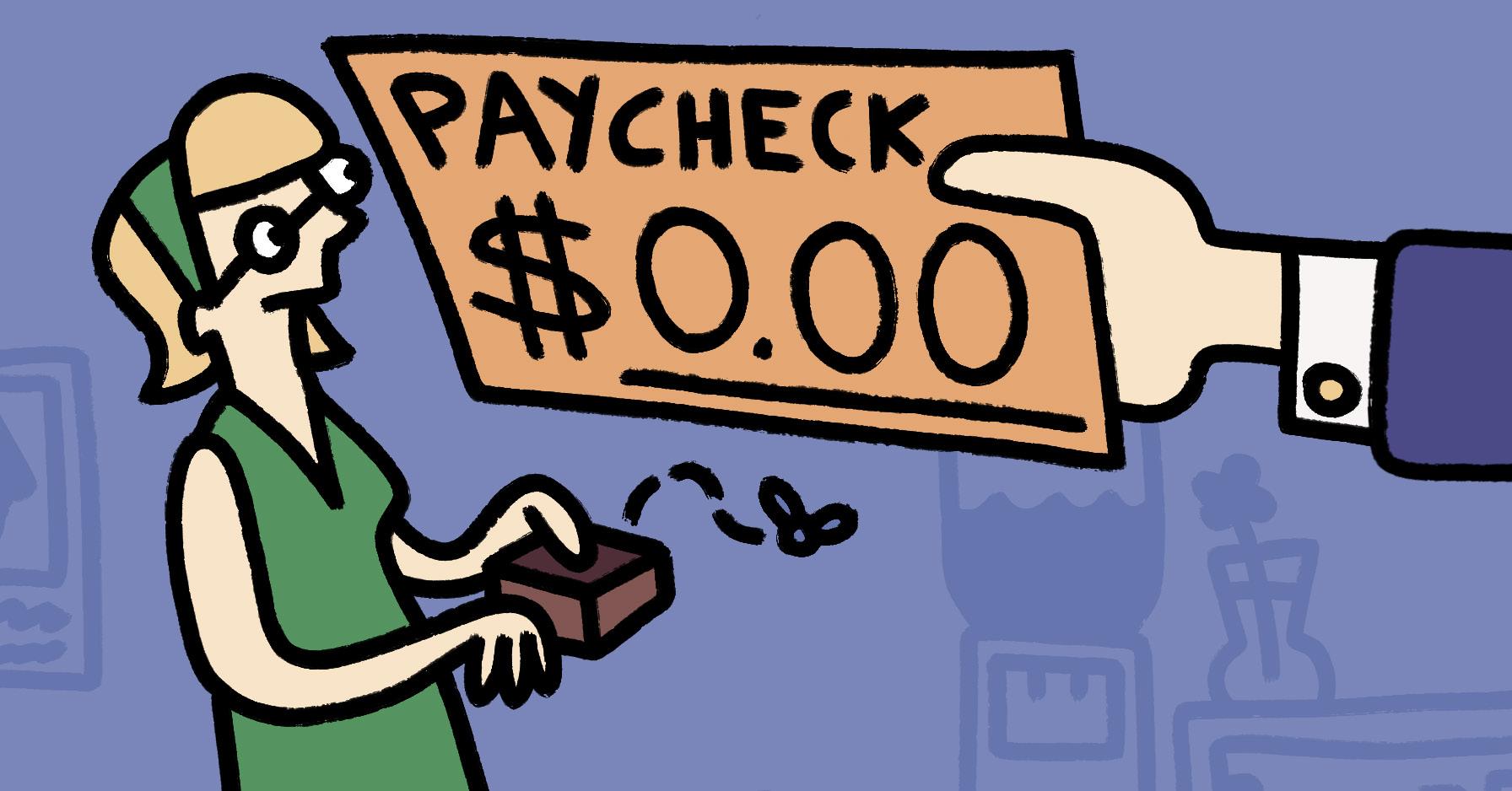
The student jobs website also
features numerous job postings from o cial university departments and o ces. There are jobs at Gordon Dining and Event Center, various campus libraries, residence halls and more.
Sophomore Halle Pietz works for a university o ce at UW-Madison. Her employers wished to remain unnamed to protect themselves as well as their student employees’ privacy.
Pietz has worked as a student employee for almost a year and finds the experience has allowed her to strengthen skills and develop new ones.
“I have strengthened my customer service skills a lot, especially with talking on the phone and writing formal emails,” she said. “I have also gained knowledge of multiple databases and learned how to act as a coworker with my own peers and with professionals.”
Flexibility is a significant benefit of having a student job. Many employers will build your schedule around classes, according to the student jobs website. Pietz even said it’s one of her favorite parts of her job.
“I like the fact that they consider me as a student first, and if I need time o for anything school related, they are very con-
apartment rent.
From 2020 to 2021, three out of four unpaid interns were white and financially stable. It shows the fine line between economic inequalities and unpaid internships — many individuals do not have the financial capacity to give up paid work. This provides individuals with financial means a leg up, as they’re able to take advantage of professional development and advancement opportunities. Others may not have that privilege. It’s a challenge employers and students alike struggle with in an overly competitive professional world.
While unpaid internships are still around, the rise of paid internships provides a hopeful gateway for college students to get their foot into the door of the professional world. Despite their drawbacks, individuals like Roglieri choose to see the positives of these unpaid roles.
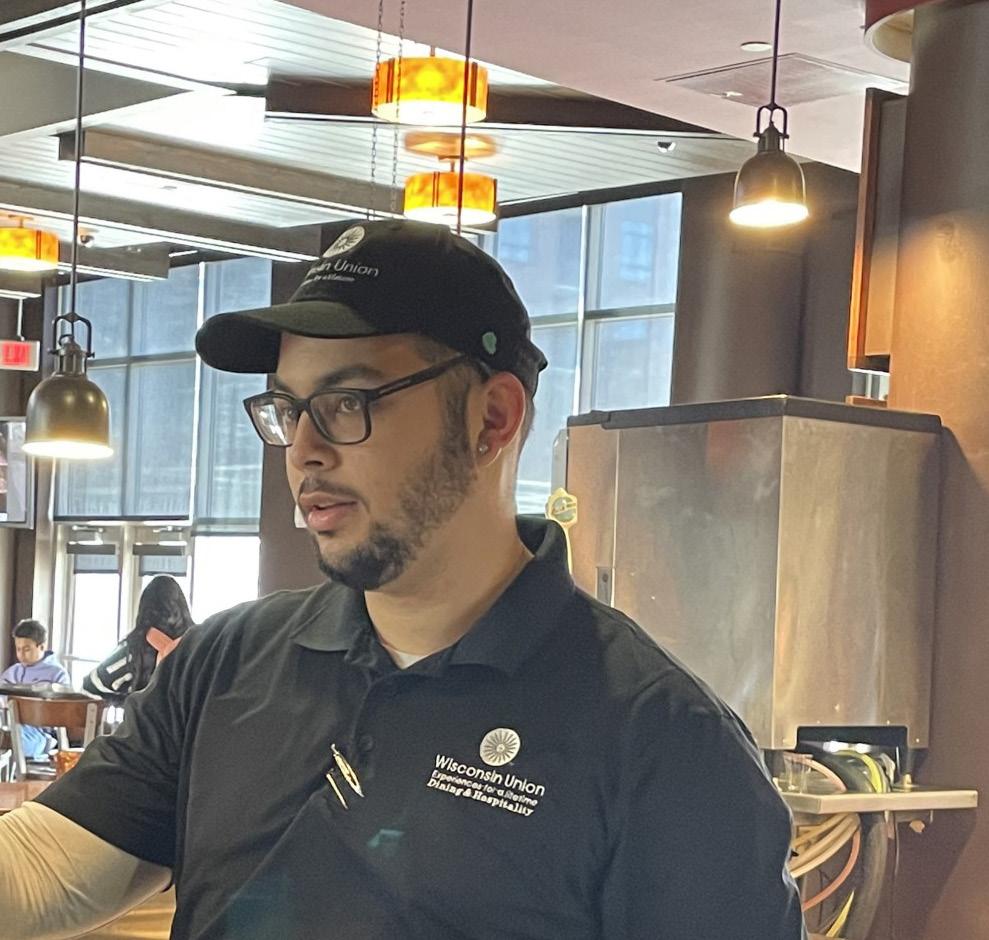
The summer after working at Brosto ’s o ce, Roglieri scored a paid internship with the Tony Evers for Wisconsin campaign as a campaign finance intern.
“That unpaid internship helped me get to the next step,” she said. “At the end of the day, the focus was just what I was learning.”
Roglieri is set to graduate from UW-Madison in May and is heading o to Brooklyn Law in the fall. Everything finally clicked into place for the 21-year-old — and she accredits it all to the summer of working for free.
Disclaimer:Theauthorofthisstorywasacquaintedwiththe intervieweepriortothisstory.
siderate,” she said. “My supervisors are all very concerned with my well-being.”
Student jobs also come with a number of pros many people are unaware of. For one, most of the jobs o ered on campus actually pay more than the federal minimum wage, with university housing and the Wisconsin Union having their hourly pay set at $15 per hour.
These factors combined can
make working a university student job a worthwhile opportunity for many people. Students are given flexibility with their schedules, they learn professional skills, they can make new connections and, most importantly, they are treated as students first.
Disclaimer: The author of this story was acquainted with the interviewee prior to this story.
HENRY A. MOORE/THE DAILY CARDINAL
14 Thursday, March 30, 2023 dailycardinal.com life & style l
ALEXA COLEMAN/THE DAILY CARDINAL Student jobs are available in all parts of the university and multiple industries
The overlooked student jobs
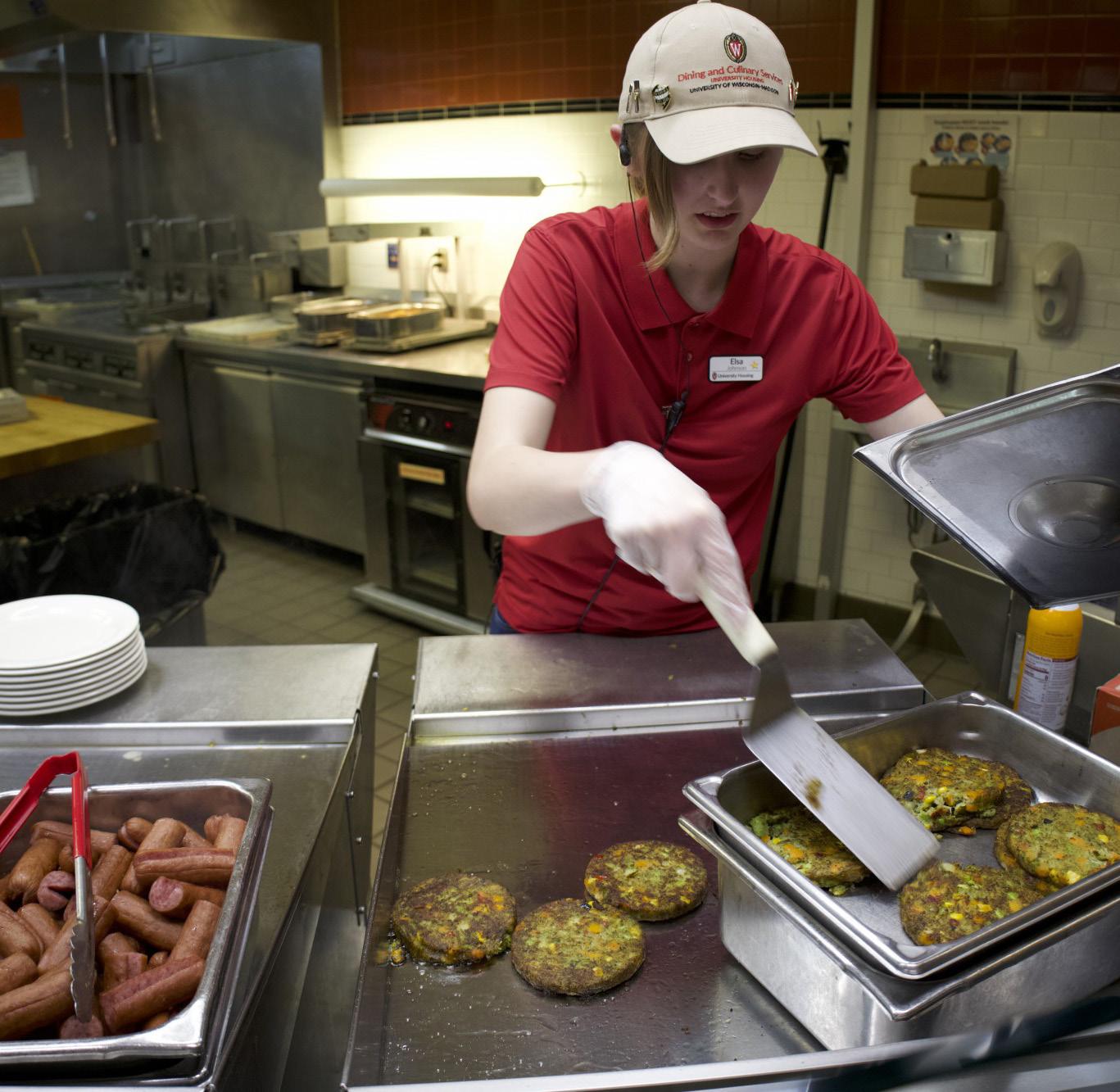
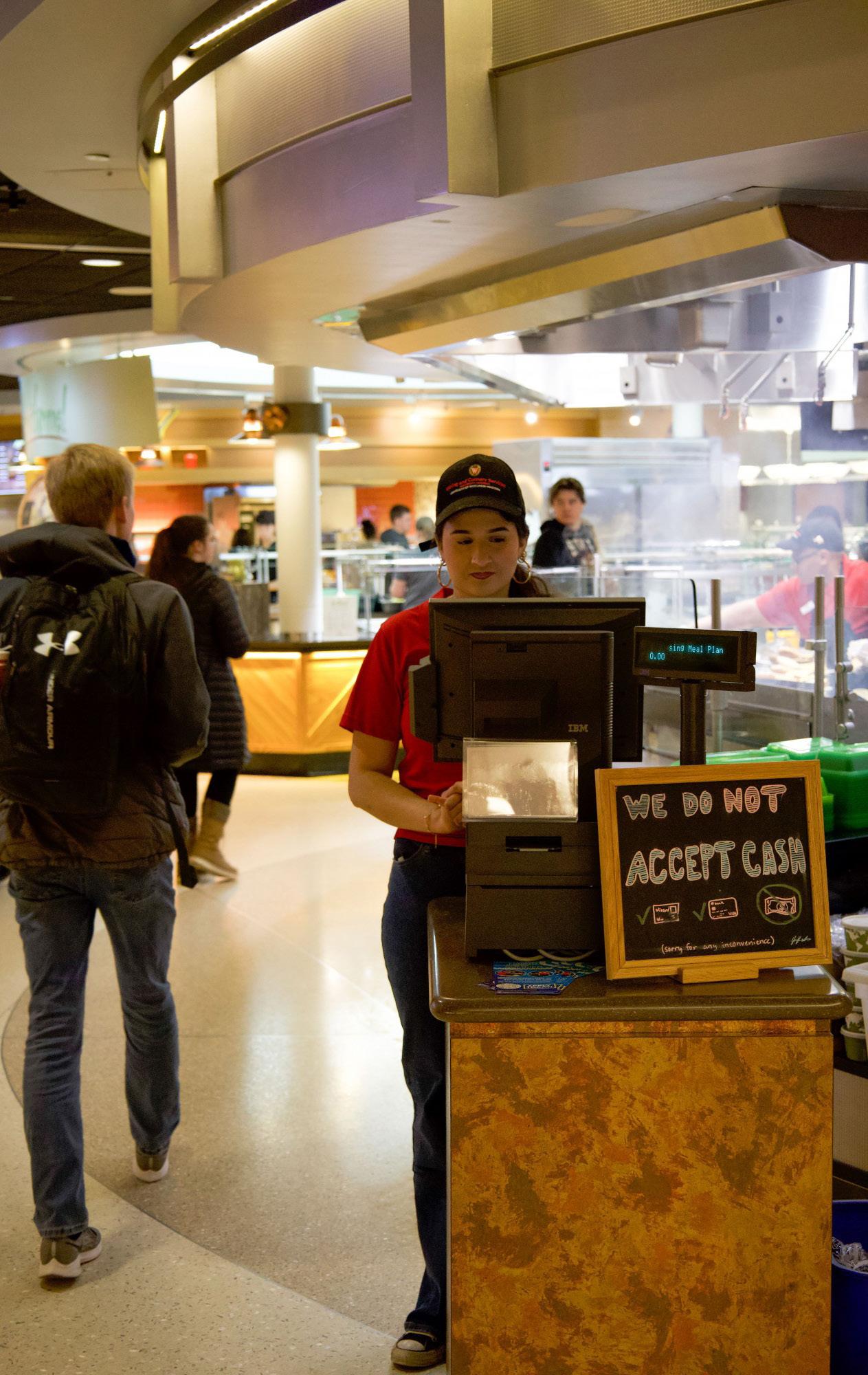

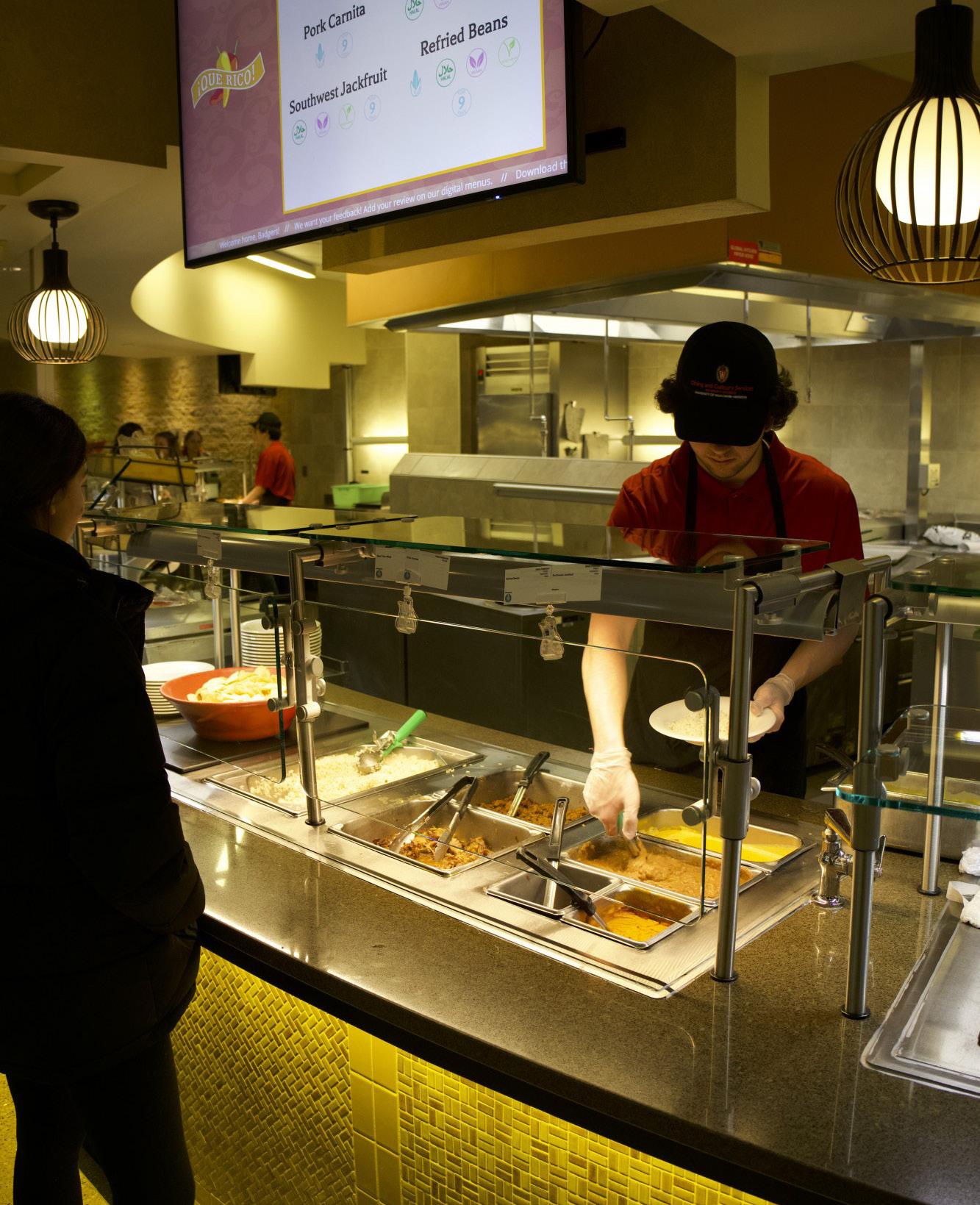
photo feature
This photo page highlights some of UW-Madison’s campus jobs that are not only necessary but sometimes underappreciated.
Memorial Union custodian cleans trash cans near Peets Coffee.
Four Lakes Dining student-staff member prepares food.
Strada in its early hours as student workers open the restaurant.
Four Lakes student-staff member serves food.
LAUREN AGUILA/THE DAILY CARDINAL NICK DUDA/THE DAILY CARDINAL NICK DUDA/THE DAILY CARDINAL NICK DUDA/THE DAILY CARDINAL LAUREN AGUILA/THE DAILY CARDINAL dailycardinal.com Thursday, March 30, 2023 l 15
Four Lakes student-staff cashier waits to swipe payment cards.
A brief history: Wisconsin labor
unions
Wisconsin bricklayers form frst union in Wisconsin


Industrial Workers of the World forms


• More radical than the American Federation of Labor
Passed Wisconsin Civil Service Law (merit-based system for state govt. jobs)
Wisconsin passes nation’s frst Worker’s Compensation Law after New York’s Triangle Shirtwaist Factory fre
Wisconsin Unemployment Compensation Law passed Wisconsin is the frst state to enact unemployment compensation
Wisconsin Employment Relations Act passed
• Supports the Right to Unionize

Wisconsin is one of the frst three states to ban employment discrimination based on race, creed, national origin or ancestry

Municipal Employment Relations Act passed Gives employees of Wisconsin schools, political subdivisions of the state, etc. the right to be represented by a union and bargain with employers collectively



Highest concentration of union workers in America are in the Midwest
Wisconsin state workers given bargaining rights
Gov. Scott Walker passes Act 10
Preceded with protests across the state Unions must reassemble and vote yearly (need 51% eligible employees’ support) If unions reelected, they can only bargain wages
U.S. labor union approval rate at highest point since 1965
Benefts in Wisconsin have been declining since Act 10 passed Biden administration legislation supports union workers
1847
1905
1911
1932
1937
1945
1956
1964
1967
2011
2023
special pages l
16 Thursday, March 30, 2023 dailycardinal.com
