energyfocus
ISSUE 35 SPRING 2019
F RO M T H E E N E RGY I N D U S T R I E S C O U N C I L VIEW FROM THE TOP Gordon Birrell, BP Upstream COO for Production, Transformation and Carbon
AI POWERS UP Next generation technologies that will reshape the energy sector
OIL AND GAS What will the drill rigs of the future look like?
Looking to the future What will the energy industry look like in 50 years?
RENEWABLES Technologies shaping offshore wind’s evolution
FIRETEC MEANS QUALITY FOR TOTAL FIRE SOLUTIONS
For peace of mind, choose the AEI Cables range of Firetec Total Fire Solutions cabling for all your needs, ensuring power for all essential services including lighting, fire alarms and sprinkler systems. The Firetec range comes with the assurance of approvals from independent bodies including BASEC and LPCB, and we also work with Lloyds, MoD, Network Rail and LUL, while working to international standards around the world including American and Canadian approval systems.
When it comes to product performance and safety for today’s modern complex buildings there can be no compromise. Choose AEI Cables.
aeicables.co.uk
AEI Cables Limited Unit 32 Crowther Road, Crowther Industrial Estate Washington, Tyne & Wear NE38 0AQ Tel: 0191 410 3111 Email: enquiries@aeicables.co.uk
Contents ISSUE 35 SPRING 2019
FROM THE EIC
Nicholas Newman looks at next generation rigs
6 View from the top
29 Carbon management and storage: The future of oil and gas
Gordon Birrell, Chief Operating Officer for Production, Transformation and Carbon, Upstream, BP
10 News and events Updates from the EIC
14 The big question
We ask members: What does the future hold for the offshore oil and gas industry?
16 Special report: Where will oil and gas be in 50 years?
Professor Stuart Haszeldine, University of Edinburgh
30 Towards fully autonomous oil and gas platforms
Jeremy Bowden looks at key growth sectors
20 Artificial intelligence powers up
33 Q&A
50 My business Brett Isard, E2S
36 Towards the ion age Sofiane Boukhalfa, Senior Project Architect and Navneeta Kaul, Technology Consultant, PreScouter
16
NUCLEAR
What does the future hold for oil and gas?
Håvard Devold, Group Vice-President Digital, ABB Oil, Gas & Chemical Business
Lucy Woods on advanced digital technologies
POWER
Gordon Birrell
26 The rig of the future
5 Foreword
From the Chief Executive
06
OIL AND GAS
40 What’s holding nuclear back?
David Hess, Policy Analyst, World Nuclear Association
45 Nuclear reimagined Dr Rita Baranwal, Director, Gateway for Accelerated Innovation in Nuclear
Janette Marx, CEO, Airswift
34 Making the one Gulf dream a reality OTC 2019 preview
RENEWABLES
26
46 Winds of change
Alex Louden, Innovation Manager, ORE Catapult
Drilling gets smarter
49 A bright and buoyant market
40
Bernard Prouvost, Founder and Chairman, Ciel & Terre
Rethinking nuclear
46
Future trends for offshore wind
The Energy Industries Council 89 Albert Embankment, London SE1 7TP Tel +44 (0)20 7091 8600 Email info@the-eic.com Chief executive: Stuart Broadley Should you wish to send your views, please email: info@redactive.co.uk
Editors Sairah Fawcitt +44(0)20 7880 6200 sairah.fawcitt@redactive.co.uk Edward White +44(0)20 7091 8638 edward.white@the-eic.com Account director Will Hurrell Production Rachel Young Senior designer Gary Hill Picture editor Akin Falope Content sub-editor Kate Bennett
For sales and advertising please contact Tim Cariss +44(0)7759 463456 tim.cariss@redactive.co.uk Energy Focus is online at energyfocus.the-eic.com ISSN 0957 4883 © 2019 The Energy Industries Council
Energy Focus is the official magazine of the Energy Industries Council (EIC). Views expressed by contributors or advertisers are not necessarily those of the EIC or the editorial team. The EIC will accept no responsibility for any loss occasioned to any person acting or refraining from action as a result of the material included in this publication.
Publisher Redactive Media Group, Level 5, 78 Chamber Street, London E1 8BL Tel: +44(0)20 7880 6200 www.redactive.co.uk
Recycle your magazine’s plastic wrap – check your local LDPE facilities to find out how.
www.the-eic.com | energyfocus
3
The accredited* international scheme that validates core competency for safe working in potentially hazardous, flammable or explosive atmospheres
Competency in Explosive atmospheres
THE ORIGINAL AND THE BEST ●
Over 70,000 Operatives/Technicians & Engineers certificated
●
Worldwide coverage including Europe, Africa, Asia and Americas
●
Now delivered in English, Dutch, French, Norwegian, Azeri and Russian
●
Determines Core Competency by the combined validation of both practical skills and ability by assessment as well as underpinning knowledge by online examination
●
Based upon the International Standards IEC 60079 Parts 14 & 17; European ATEX Directives; U.S. NEC500 & 505 Codes and local in-country regulations.
●
CompEx Modules are available for electrical & mechanical craftspersons/operatives/technicians, professional application design engineers and responsible persons/duty holders.
Equipment Asset Registers, Site Inspection and Defect Management is an integral part of the Responsible Person's duties, CompEx Ex14 provides guidance to understand and manage these key responsibilities.
For more details go to www.compex.org.uk CompEx Certification Body - JTLimited, Part of the JTL Group Email: info@compex.org.uk
CompEx is a registered trademark of JTLimited, the CompEx Certification Body www.compex.org.uk * JTLimited, the CompEx Certification Body is accredited to ISO/IEC 17024:2012 General Requirements of Certification Bodies providing certification of persons
New worker on site? Always ask to see their CompEx® certificate Photographs courtesy of Dow Corning, BP, Statoil, Total and JTLimited.
Foreword Stuart Broadley CEO
From the Chief Executive: Technological innovations are set to transform the future energy landscape. In this edition of Energy Focus we ask, what do the next 50 years have in store for our industry? The technology used to produce and consume energy has always been of great importance. Faced now with the dual challenge of rising global energy demand and the need to deliver this with lower emissions, its role in society has never been more critical. In this issue of Energy Focus, launched at OTC 2019, we attempt to answer the question posed at this year’s conference of what the next 50 years has in store for the offshore industry. We put the spotlight on technological developments taking place over the next few decades across the oil and gas, power, nuclear and renewable sectors, with a particular focus on innovations set to create waves offshore. Our view from the top interviewee is Gordon Birrell, BP’s Upstream Chief Operating Officer for Production, Transformation and Carbon, and one of the headline speakers at OTC this year. In a candid interview he talks about how BP is leveraging next generation digital tools to support the energy transition to a lower-carbon future and the innovations set to take place on its Gulf of Mexico assets. Turn to page 6 to find out more. As is clear from Gordon’s interview, next horizon technology will change the way the energy industry works. On page 20 our special feature looks at the part that Li-Fi, optical computing, quantum sensors and artificial intelligence will play in making our industry safer, more efficient and above all sustainable. Given that this edition of Energy Focus is an OTC technology special, we commissioned an article which imagines what the oil rigs of the future may look like (page 26). Referring back to this year’s conference theme once again, we also forecast what the next 50 years
will have in store for the oil and gas industry in general on page 16. Offshore wind is really taking off in the US. So much so that opportunities for oil and gas companies to diversify into the sector have been included in the OTC conference programme. On page 46 you’ll find a fascinating article from Alex Louden, Innovation Manager at ORE Catapult, describing the technology set to hit the industry over the next 50 years: autonomous bug-like maintenance robots crawling over turbines, floating kite power generators, multi-rotor and vertical axis turbines… The offshore wind farms of tomorrow are going to look very different to those of today. While renewable energy sources such as wind and solar are becoming more common across the world, the one issue holding back green power is intermittency. Put simply, if the wind doesn’t blow or the sun doesn’t shine, wind farms and solar plants don’t generate power. However, that’s changing, with energy storage playing a major role. As the race to create the next revolutionary battery heats up, we take a look at the emerging competitors (page 36). Once again, the EIC is managing the OTC UK pavilion, hosting almost 50 exhibitors showcasing the very best that the UK offshore oil and gas industry has to offer. You’ll find a full list of the companies in our OTC preview piece (page 34), as well as a round-up of North American oil and gas activity and how the EIC is making the One Gulf dream a reality for contractors and service providers on both sides of the border. For this edition’s big question (page 14), we ask exhibiting EIC member companies Balmoral Offshore Engineering, Hilti
Corporation and IMI Precision Engineering what challenges will be faced by the offshore industry in the future and the design, technological and work flow solutions being put in place to meet them. Profiled in our popular my business section is another exhibitor at OTC. We spoke to E2S MD Brett Isard about what day-to-day life is like at the one of the world’s leading independent warning signals manufacturers (page 50). If you are at OTC 2019, please make sure you pay the EIC team a visit at stand 1539 in Hall D. We’ll be happy to introduce you to any of our exhibitors as well as talk you through the suite of business development products that the EIC has in place to support your growth in the North American region and indeed around the entire globe.
Stuart Broadley EIC CEO stuart.broadley@the-eic.com
www.the-eic.com | energyfocus
5
From the EIC Q&A Gordon Birrell
Our digital journey started with democratising data before moving on to digital twins. We’re now focused on machine learning and artificial intelligence
6 energyfocus | www.the-eic.com
Q&A Gordon Birrell: From the EIC
Energy Focus talks with Gordon Birrell about how BP is transforming operations by leveraging advanced digital technology
View from the top
What role are oil and natural gas likely to play as energy markets transition to a lower-carbon energy system? In all the scenarios we have explored, oil and gas are going to be required for a long time to meet the energy needs of the world. But as we work to meet these needs, we must also be mindful of both sides of the dual challenge – providing more energy and with lower-carbon emissions. That’s where advantaged oil and natural gas come into play. Ultimately, we have thousands of people at BP, who wake up every day focused and committed to meeting this dual challenge. As part of this, we have set clear, near-term and specific targets to reduce our own carbon footprint. Since 2016, we have generated 2.5m tonnes of sustainable greenhouse gas emissions reductions. In the past year, we achieved a methane intensity of 0.2%. These are steps in the right direction. I’m one of those thousands of people who wake up every day to get after this challenge. My job is to produce energy with an ever-decreasing carbon footprint, bringing emissions reductions to the heart of our oil and gas production.
IMAGES: ISTOCK
Q&A: Gordon Birrell BP’s Upstream Chief Operating Officer for Production, Transformation and Carbon
How is BP leveraging Industry 4.0 technologies to meet the dual challenge? Our digital journey started with democratising data before moving on to digital twins. We’re now focused on machine learning (ML) and artificial intelligence (AI). BP is now running several proofs of concept in the ML/ AI area and has made some significant investments in companies that we believe can target these approaches to our most valuable opportunities. Most recently we invested in Belmont Technologies to develop a digital tool we call Sandy. Sandy interrogates BP’s databases of geophysical and subsurface data, intuitively linking information together, identifying new connections and workflows and creating a robust knowledge-graph of the subsurface. It then uses AI neural networks to interpret results and perform rapid simulations. We expect the combination of BP and Belmont could save up to 90% of the time currently spent hunting, cleansing and then integrating information, accelerating key decisions about our wells and field developments, and enabling our scientists and engineers to spend their time on high value opportunities.
About Gordon Birrell Gordon Birrell has been BP’s Upstream Chief Operating Officer of Production, Transformation and Carbon since 2017. He joined BP in 1986 and has worked in various other positions for BP including Regional President for Azerbaijan, Georgia and Turkey, Head of Safety and Operational Risk for Upstream, Upstream Technology Vice President, and Head of Upstream Executive Office. Gordon Birrell has an MBA from Warwick University and an honours degree in Electrical and Electronic Engineering from Heriot-Watt University, Edinburgh. He is a Fellow of the Royal Academy of Engineering and a Fellow of the Institute of Engineering and Technology.
www.the-eic.com | energyfocus
7
From the EIC: Q&A Gordon Birrell
We see fast-paced tie-backs playing a major role in the US Gulf of Mexico
Looking ahead, I expect us to be thriving, because there will still be a growth in energy demand
To what extent is BP’s modernisation and transformation programme transforming business? We started with a very simple modernisation and transformation (M&T) framework aimed at dialling up certain parts of our mindset as a business, progressing our digital ambitions and becoming more agile in how we work. This was targeted not only at better business performance but also at shaping BP as one of the best places to work in terms of culture and environment. The benefits have been clear. Our M&T programme has supported more than a thousand projects to date and we only see that growing. We know that the problems we need to solve will take a huge diversity of thought. Part of this transformation is ensuring we have people from all over the business coming together to work on these projects in an agile way. We’ve seen project time slashed and efficiency increased, all while keeping safety at the core of our day-to-day operations. Can you detail some of BP’s major projects coming online over the next few years that will be impacted by new technologies? We see fast-paced tie-backs playing a huge role in areas where we have a major presence, such as the US Gulf of Mexico (GoM). We are accelerating development of smaller pools of oil tied-back to existing infrastructure, which adds a lot of value for BP. This is an example of what we call advantaged oil and gas development. Our recent sanction for the US$1.3bn Atlantis Phase 3 development is the latest example of this approach – growing advantaged oil and gas production through one of our existing major production hubs in the Gulf. And this development was supported by major breakthroughs in advanced seismic imaging and reservoir characterisation that revealed an additional 400m barrels of oil in place at the Atlantis field. This same approach has uncovered another billion barrels at Thunder Horse. This is where our investment in digital technologies is coming into play and significantly moving the dial from an upstream perspective. Which fourth generation technologies will BP be developing? We’re running several proofs of concepts to better understand how these types of technologies might create value and where they could be applied. We don’t develop these technologies ourselves, rather we work with universities, start-ups and established industry players to shape the technologies to support our highest value use-cases and deploy them rapidly. Turning to the US, what technology will BP be using to make future GoM finds? Proprietary algorithms we have developed enhance a seismic imaging technique known as Full Waveform Inversion. It was the application of these,
8 energyfocus | www.the-eic.com
coupled with reservoir characterisation, that enabled us to identify a further billion barrels at Thunder Horse. The algorithms, applied with our supercomputing facilities, allowed seismic data that would have previously taken a year to analyse to be processed in only a few weeks. Our proprietary Wolfspar technology uses an ultra-low frequency source during seismic surveys allowing geophysicists to see deeper below salt layers. We are planning its use in the Thunder Horse and Atlantis fields to better understand the reservoirs. What will drilling rigs look like in 50 years? The big focuses for modernisation in drilling will continue to be safety related and increasing the rate, range and quality of data generated while drilling. Removing people from harm’s way through robotics will drive safety performance. More and better-quality data and associated analytics will enable real-time decision-making, improving outcomes and increasing the likelihood of success. There are radically different technologies out there which may mature, such as laser drilling, but a rig will still be required to host the equipment and create a penetration into rock to place a well. How is BP building the workforce for a digitalised future? One of the best investments we can make is in our people. We have a tremendously talented workforce that we’re very proud of. The latest generation of innovators who are joining us know tech. They’re shaping our future and we recognise that. In upstream, we’ve started a reverse mentoring programme with our executive leadership, where innovative early-career staff are paired with senior executives, regularly meeting and exchanging ideas. I have a mentor, who is early in his career and is a specialist in data science and automation. We also host digital and data science bootcamps and launched a digital capability portal, which acts as a one-stop for building digital skills. I never take for granted the trust our workforce has placed in BP to build their career here. It’s the motivation behind both improving our business and helping build the type of energy future we all want to be a part of. Where do you see the industry in 10, 20… 50 years’ time? Looking ahead, I expect us to be thriving, because there will still be a growth in energy demand in the world. It may have a different profile from today, but it will still be growing. We’ll be much more digital, working in agile ways and many processes will be automated. But we’ll still be focussed on pushing the frontiers to help solve the world’s biggest energy challenges.
WAVE-4 Smallest footprint. Best performance. Uncompromised safety. Offshore crew transfer. #WAVE4 | #CrewTransfer
+44 1872 321155 info@reflexmarine.com www.reflexmarine.com
U P DAT E S F RO M T H E E N E RGY I N D U S T R I E S C O U N C I L
news&events introduce members to regional energy markets and their major players.
Worldwide business support
IMAGES: ISTOCK/SHUTTERSTOCK/LONDON ARRAY
About the EIC Established in 1943, the EIC is the leading trade association for companies working in the global energy industries. Our member companies, who supply goods and services across the oil and gas, power, nuclear and renewables sectors, have the experience and expertise that operators and contractors require. As a not-for-profit organisation with offices in key international locations, the EIC’s role is to help members maximise commercial opportunities worldwide. We do this in a variety of ways: 10 energyfocus | www.the-eic.com
Enabling members to expand into markets across the globe
Market insight
Helping members to track global energy projects and assets Our projects database, EICDataStream, provides extensive information on more than 8,500 active and future projects in all energy sectors. By tracking full project lifecycles from feasibility to construction and then completion, it helps members to identify opportunities and plan their business development strategies. Our operations and maintenance database, EICAssetMap, puts the details of more than 4,000 energy facilities across Asia Pacific, Europe and the Middle East at your fingertips.
High-profile international events Connecting members with buyers and partners The EIC hosts flagship industry events that bring together supply chain companies with global energy contractors and operators, and bespoke events that keep members informed about projects, sector developments and markets. Our overseas trade delegations and EIC-run pavilions at international exhibitions
Member companies who want to do business outside the UK can rely on our global network of offices to provide regional market knowledge, one-to-one advice and practical support. We also provide virtual and rental offices, and facilities for hotdesking, meetings, conferences and corporate events.
Business intelligence Keeping members informed and raising their profile
We help our members to stay connected with the world of energy through informative online news, e-bulletins, market reports and industry publications. Our comprehensive directory of member supplier services is also a useful resource for operators and contractors.
Industry courses
Enhancing members’ skills and knowledge Our quality courses, which can be delivered off-site or in-house, are led by highly experienced trainers with industry backgrounds. We tailor our training to suit a variety of levels and also work with member companies to run programmes, some of which include tours to manufacturing companies.
From the EIC News and events
EIC Global Offshore Wind Insight Report The EIC’s latest Insight Report covers the rapidly growing offshore wind industry. In 2018 global installed capacity exceeded 18GW, and the sector shows no signs of slowing down, with estimates that it will reach 115GW by 2030 and a staggering 200GW by 2040. This report, produced by expert EIC analysts, highlights where that growth will take place in Europe, the US and the fast-emerging Asia Pacific market, introducing you to the key players, new
entrants, and their pipeline of projects and supply chain gaps. As well as detailing where the opportunities lie for suppliers, there is also a section on how oil and gas companies can diversify into the sector, including case studies from those companies who have already made the move. Find out where the opportunities are in this rapidly developing market. Download the EIC Global Offshore Wind Insight Report now, free of charge to EIC members or just ÂŁ195 for non-members, by visiting: www.the-eic.com/Publications/ MarketIntelligenceReports
NEW RT O P RE OUT NOW www.the-eic.com | energyfocus
11
EVENTS COMING UP
Are you Fit4Energy? Fit4Energy (F4E) is a bespoke scale-up programme for businesses in the oil, gas and energy sectors. Run by Robert Gordon University and developed in partnership with the EIC and Opportunity North East, it equips participants with the knowledge, insights and best practice to successfully plan for and implement growth. Gaining F4E approval demonstrates to clients that you have the appropriate growth support processes, procedures and strategies in place when tendering for large-scale projects. To find out more and book your place on this course, visit: www.rgu.ac.uk/fit4energy
EIC Connect Energy Thailand
When: 16 May Where: Bangkok Why attend? Building on the success of recent EIC Connect events in Indonesia, Malaysia and Vietnam, we take our flagship event model to Thailand for the first time. EIC Connect events bring together suppliers, operators and contractors to find out how they can collaborate on local energy developments through conference sessions, project briefings and one-to-one appointments. Confirmed speakers include the national upstream oil company PTTEP, the Thai Ministry of Energy and the Electricity Generating Authority of Thailand. For more information, please visit: www.the-eic.com/EICConnect/ EnergyThailand
IMAGES: ISTOCK/THE ELS CLUB, DUBAI
Overseas delegation to Mauritania and Senegal
When: 17–21 June Why attend? Mauritania and Senegal announced themselves as major players on the world oil scene in 2015 with the giant Tortue West discovery, which straddles both countries’ maritime borders. The West African neighbours are welcoming technology and expertise from international companies to help them unlock their vast resources. During the five days we’ll organise 10–14 meetings with
12 energyfocus | www.the-eic.com
representatives from Senegal’s national oil company Petrosen, international companies taking part in the development of the countries’ oil and gas resources, including BP, Cairn and Kosmos, as well as local Department for International Trade and Chambers of Commerce representatives. For the full itinerary please visit: www.the-eic.com/Events/Overseas Delegations/SenegalMauritania
Energy Exports Conference When: 18–19 June Where: Aberdeen AECC Why attend? This major new energy conference and exhibition aims to support the UK supply chain in exporting its products, services and expertise into global markets.
Whether you’re yet to start exporting, are at the very early stages or have been an established exporter for years, this event will help you in your journey to access new customers around the world. Twenty speakers from major international operators and contractors will be discussing more than US$150bn of project opportunities, with a focus on the supply chain gaps they are looking to fill with UK content. Delegates will also hear from agencies who provide funding, tools and advice to those companies looking to export. An exhibition will also take place during the two days as well as a networking dinner on the first night. For more information, please visit: https://exportsconference.energy
LEADING COMPRESSOR TECHNOLOGY AND SERVICES www.burckhardtcompression.com
From the EIC Members’ comment
The
BIG question
What does the future hold for the offshore oil and gas industry?
Three EIC member companies exhibiting on the UK pavilion at OTC 2019 talk about the challenges ahead for offshore energy and the need to exploit new technologies
Gary Yeoman Sales Director at Balmoral Offshore Engineering
both in terms of time and hard cash, on their projects. Indeed, it wouldn’t be stretching the imagination to say that we have aided the feasibility of many projects through the application of acquired knowledge. Our innovation teams are constantly evolving materials and developing or refining product lines to improve performance, reduce installation times and generally assist our clients in meeting and exceeding their requirements for buoyancy, insulation and elastomer products. A great example of this is the development of exploration and production buoyancy systems that can operate at depths of 4,500m sea water – something that was unimaginable only a few years ago but will be vital as the sector continues to push into ever-deeper waters. A commitment to positive collaboration, R&D and people development is key to the future success of our industry.
We operate in a global market and the requirement for energy continues to increase: recent reports suggest worldwide energy demand will have increased by some 33% come 2040. In a determined effort to make the sector more sustainable, it’s clear the industry is moving towards a more collaborative model. This is something we have always practised as we work closely with clients to offer the best technical and product solutions to their challenges. We actively encourage clients to engage with us at the earliest possible stage of their project discussions. This is where we can make suggestions, drawn from almost 40 years’ experience, that can be drafted into their EXHIBITING AT OTC 2019 feasibility studies. HALL D, We have highly experienced With almost 40 years’ experience, STAND engineering and technical teams Balmoral is the acknowledged 1339-A that have helped clients save innovator and market leader for significant amounts of resources, subsea buoyancy, insulation and
14 energyfocus | www.the-eic.com
elastomer products. The company provides a global service from concept to design, manufacturing and testing. Its products have been deployed on practically every deepwater project worldwide
Daniel Rubio Global Head of O&G Offshore at Hilti Corporation Offshore oil and gas is a constantly evolving industry, demanding a continuous reduction of total cost of operations and shorter project cycles from engineering to commissioning. Companies must be able to respond to the market with a global presence and local timely response and agility, offering relevant solutions efficiently designed for the industry using state-of-the-art innovation. AI and automated solutions for 3D modelling and engineering will improve integration before construction and reduce the time from start to commissioning. In addition, we will see an exponential
Members’ comment: From the EIC
increase in the use of modular designed systems pre-engineered, pre-tested and certified. This will allow a shift from a current sequential engineering/ construction model to a parallel integrated workflow from design and across multiple fabrication geographic locations. We will also see an increase in the expected longevity of offshore platforms. Lower cost lifecycle management is anticipated while maintaining an ability to quickly modernise, re-task and re-locate assets with reduced down time. Modular and flexible infrastructure design will become more prevalent to achieve easier and more cost-effective mission flexibility and modernisation. Furthermore, the future will include a larger reduction in hot work and remedial welding making for a cleaner and safer environment not polluted by fumes, air contamination and equipment hazards.
With financial controls in the oil and gas market becoming ever tighter, management of assets is becoming more and more critical. This means making equipment easier to maintain while also managing its asset life and maintenance, repair and overhaul planning. Emergency shutdown (ESD) valves are one of the most safety critical devices
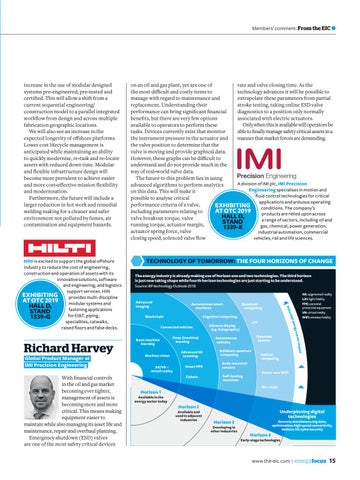
Advanced imaging
Autonomous smart machines
Blockchain
Cognitive computing
Connected vehicles Basic machine learning Machine vision AR/VR – mixed reality
Quantum computing
Deep (machine) learning Advanced 3D scanning
LiFi
Advance display (eg. holographic)
Quantum sensors
Autonomous vehicles Adiabatic quantum computing
Smart PPE
Body-mounted sensors
Cobots
Self-healing machines
AR: augmented reality LiFi: light fidelity PPE: personal protective equipment VR: virtual reality WiFi: wireless fidelity
act tor imp
Global Product Manager at IMI Precision Engineering
The energy industry is already making use of horizon one and two technologies. The third horizon is just now taking shape while fourth horizon technologies are just starting to be understood. Source: BP technology Outlook 2018
ec rgy s l ene
Richard Harvey
TECHNOLOGY OF TOMORROW: THE FOUR HORIZONS OF CHANGE
ia ent Pot
Hilti is excited to support the global offshore industry to reduce the cost of engineering, construction and operation of assets with its innovative solutions, software and engineering, and logistics support services. Hilti EXHIBITING provides multi-discipline AT OTC 2019 modular systems and HALL D, fastening applications STAND for EI&T, piping, 1339-G specialities, catwalks, raised floors and false decks.
rate and valve closing time. As the on an oil and gas plant, yet are one of technology advances it will be possible to the most difficult and costly items to extrapolate these parameters from partial manage with regard to maintenance and stroke testing, taking online ESD valve replacement. Understanding their diagnostics to a position only normally performance can bring significant financial associated with electric actuators. benefits, but there are very few options Only when this is available will operators be available to operators to perform these able to finally manage safety critical assets in a tasks. Devices currently exist that monitor manner that market forces are demanding. the instrument pressure in the actuator and the valve position to determine that the valve is moving and provide graphical data. However, these graphs can be difficult to understand and do not provide much in the way of real-world valve data. The future to this problem lies in using A division of IMI plc, IMI Precision advanced algorithms to perform analytics Engineering specialises in motion and on this data. This will make it fluid control technologies for critical possible to analyse critical applications and arduous operating performance criteria of a valve, EXHIBITING conditions. The company’s AT OTC 2019 including parameters relating to products are relied upon across HALL D, valve breakout torque, valve a range of sectors, including oil and STAND running torque, actuator margin, gas, chemical, power generation, 1339-K actuator spring force, valve industrial automation, commercial closing speed, solenoid valve flow vehicles, rail and life sciences.
Optical computing
Power over WiFi
Bio-chips
Horizon 1 Available in the energy sector today
Horizon 2 Available and used in adjacent industries
Underpinning digital technologies Sensors; simulations; big data; optimisation; high speed connectivity, wieless; 5G; cybersecurity
Horizon 3 Developing in other industries
Horizon 4 Early-stage technologies
www.the-eic.com | energyfocus
15
Special report Fuelling the future
Where will oil and gas be in
Oil and gas will remain very important for the next five decades, writes Jeremy Bowden, especially in developing nations, with petrochemicals, liquefied natural gas (LNG) and clean fuels of particular interest
O
il majors remain bullish about the prospects for the oil and gas sector going forward, despite rising concern about oil demand growth in the mid-to-longer term. BP’s chief economist Spencer Dale, for example, recently said that even under BP’s Rapid Transition scenario of radical switching to cleaner fuels compatible with meeting the Paris climate goals, oil demand would still only be reduced by around 28m barrels per day (MMbbl/d) in 2040 to 80MMbbl/d. ‘If we can produce among the cheapest oil of the 80MMbbl/d demand in 2040, then we can carry on producing that oil,’ he said, when presenting BP’s latest long-term energy outlook. Even under this worst-case scenario, oil and gas would still provide half of the world’s energy needs in 2040, leaving plenty of growth
16 energyfocus | www.the-eic.com
room for hydrocarbon producers – and other scenarios suggest higher shares. The outlook for gas is more positive than oil, with most forecasters expecting its market to expand rapidly, taking over from oil as the primary hydrocarbon within a decade or two due to its lower CO2, sulphur oxides, nitrogen oxides and particulate emissions, compared to oil and coal.
Focus on efficiency Above all, the situation is expected to lead to an increased focus on efficiency among oil and gas companies, which must compete for the remaining pool of demand – both among themselves and with the low-cost producers in OPEC and elsewhere. If there is a shrinking market, this will prove tough. Production costs have already come down sharply since the oil price collapse in 2014 and that trend has been maintained despite the recent recovery in prices – oil and gas
LNG IS EXPECTED TO SEE ITS MARKET SIZE DOUBLE BY
2030
Fuelling the future: Special report
Petrochemicals will account for more than a third of global oil demand growth by 2030 and nearly half of demand growth by 2050
www.the-eic.com | energyfocus
17
Fuelling the future: Special report
companies are increasingly focusing on oil they can develop profitably at oil prices of US$35 per barrel and below. This is despite the fact that most of the easy-to-extract oil and gas (to which most companies have access) has already been produced. The ability to keep downward pressure on costs while producing from increasingly complex or far-flung accumulations will be a major challenge over future years. Adaptations to shave off costs per barrel are likely to include field development designs that allow for a longer field life and enhanced extraction, as well as modular design, digitalisation and other technical advances.
IMAGES: SHUTTERSTOCK/ISTOCK
Shale and offshore focus There is also likely to be more of a focus on deepwater offshore output and shale oil production as other easier-to-get-at opportunities are exhausted and as shale technology improves. The US is expected to dominate global output growth over coming years, with shale production there likely to account for nearly 70% of all production over the next three decades. Production from the Permian shale deposit in west Texas alone reached almost 4MMbbl/d in February, and in its reference case, the US Energy Information Agency expects US production to peak at almost 15MMbbl/d in 2027 (and fall to 12MMbbl/d by 2050), while other scenarios show it continuing to rise up to 2040. Between them, Western majors BP, Chevron, ExxonMobil and Shell are expected to boost their share of total US onshore supply growth from around 15–20% today to 30–40% between 2020 and 2025, according to Energy Intelligence – with most of that in the Permian – bringing stable finance and a more integrated model to the sector. Shale wells have a shorter productive duration, so there will be plenty of activity in maintaining output. There has also been pressure to keep upstream costs in check by passing over harder-to-pump, lower-margin reserves, known as portfolio high-grading. Such an approach also fits with the Paris climate goals by implying that less competitive assets will never be developed.
Growth areas Among the key areas of demand growth over the next 50 years will be petrochemicals, which is the oil demand area that is expected
18 energyfocus | www.the-eic.com
10,000bbl/d ExxonMobil aims to supply 10,000bbl/d of biofuel derived from algae to the aviation sector by 2025 to keep growing for the longest. It will be relatively unaffected by any CO2 emissions regulations, as the CO2 is locked up inside the plastics, although concern over plastic pollution is growing. The International Energy Agency said in its 2018 Energy Outlook report last year that petrochemicals would account for more than a third of global oil demand growth by 2030 and nearly half of demand growth by 2050, adding nearly 7MMbbl/d by the middle of the century. However, oil refiners will have to compete with an increase in ethane and natural gas liquids produced from US shale, which can also be used as petrochemical feedstock. Another key growth sector is likely to be LNG, which is expected to see its market size double by 2030. One factor that could extend demand, particularly for gas, well beyond 2030 is carbon capture and storage (CCS), which enables the continued use of fossil fuels without the associated emissions. While oil and gas companies are generally supportive of CCS (for example, Shell’s proposed Peterhead gas-fired power plant CCS), government support is needed. The UK government is backing the technology and it remains a key part of the EU’s plans for decarbonisation. If successful, CCS would mean a guaranteed long-term market for gas. There has been some CCS progress in Scandinavia. Norway already pipes some CO2 from industrial gas users near Oslo to a depleted offshore oil field. And in February, a carbon capture assessment project was awarded to Aker Solutions for the 230,000bbl/d Preemraff Lysekil refinery in Sweden. The study’s scope includes pilot testing carbon capture from the refinery flue
CCS COULD EXTEND DEMAND FOR GAS WELL BEYOND
2030
gas and designing a carbon capture plant for the refinery’s hydrogen production unit.
Greener fuels A third key growth area is biofuels, hydrogen and other low-carbon alternatives to fossil fuels. ExxonMobil, for example, has focused its low-carbon investment on advanced biofuels. It aims to supply 10,000bbl/d of biofuel derived from algae to the aviation sector from a plant in California by 2025 – the technology is scalable up to ‘hundreds of thousands of barrels a day’, according to Vijay Swarup, Vice President for Research and Development at ExxonMobil. He said the company was not interested in niche applications: ‘The pathway here is to get to that large scale.’ Biofuel is already added to gasoline and diesel on both sides of the Atlantic, but these are not advanced biofuels and rely on the agricultural sector to supply crops. To avoid the environmental and social issues associated with some of these biofuels, Exxon’s algae would not compete with food crops and could be grown on unproductive land using saltwater and avoiding any vegetation clearance. Some farms may even be able to use waste CO2 to make the algae grow more quickly. The project is being tackled in partnership with Synthetic Genomics, and in 2017 managed to create algae that produced twice as much fat (which is converted into fuel) as it would in the wild, without reducing growth rates. Norway will be the first country to introduce a 0.5% advanced biofuel mix into jet fuel starting in 2020, rising to 30% by 2030, and others are likely to follow – guaranteeing a market for advanced biofuels beyond specialist applications. Like all other industries, the energy sector must prepare for a lower-carbon world. It has more to achieve than most, but consumers will still need large volumes of oil and gas in 20 to 30 years, and there is considerable potential for fossil fuels to continue playing a part for many years beyond that, especially in systems where carbon emissions can be removed.
Extend component life and improve the performance of safety critical Oil & Gas components with the application of environmentally responsible coating solutions. Reduce lead time and cost using Bodycote’s comprehensive Oil & Gas accredited coatings and ancillary services, including: Full range of thermal spray coatings Thermo-chemical range of ceramic technology Pre and post-finish grinding Lapping Chemical stripping Non-destructive testing
Visit us at
BOOTH 1739-I (UK PAVILION)
Offshore Technology Conference, Houston, Texas USA
6 9 MAY 2019
heat treatment | metal joining | hot isostatic pressing | surface technology
www.bodycote.com
© Bodycote plc 2018 – Ref: ID188491, Design by ID
LESS WEAR LESS DOWNTIME LESS COST MORE PRODUCTION
Feature Digital innovation
20 energyfocus | www.the-eic.com
Digital innovation: Feature
Artificial intelligence powers up Lucy Woods looks at how artificial intelligence and other advanced digital technologies will reshape the energy sector
I
n 50 years’ time, many energy sector jobs could be made quicker and more efficient thanks to upcoming technology. By 2050, BP’s Energy Outlook 2018 predicts that digital technology improvements – from holograms to self-healing machines – could reduce energy sector costs by 20–30%. The newest of these innovations include light fidelity (LiFi), optical computing, power over WiFi, and quantum sensors.
produce decent bandwidth’ and will most likely be seen in the near future being added to ‘light infrastructure that’s already been deployed’ due to the low cost of integrating LiFi with existing LED devices.
Optical computing Optical computing uses light to transfer data; computers today send information via electrical currents, which limits how fast
IMAGES: Science Photo Library/Istock
Light fidelity LiFi is the ability to send data via LED light beams. Instead of using radio waves (which are used for WiFi), LiFi uses visible light waves to send data to a photo sensor, which then converts the information back into readable data. In a few years, the energy industry could use LiFi as a more secure, faster alternative to sending data via WiFi. Max Shtein, materials science and engineering professor at the University of Michigan, told Energy Focus that LiFi ‘could
information can be sent, read and understood. According to Shtein, using photons instead of electrons to send data could allow computer tasks to be completed thousands of times faster than they are today. This increase in computing speed could allow grid operations to react faster to disturbances or fluctuations, and to balance energy demand and supply – improving grid stability, and making it easier to utilise less predictable forms of renewable energy, such as wind and solar.
Power over WiFi
Optical computing could improve grid stability, making it easier to utilise less predictable forms of renewable energy, such as wind and solar
Routers leak energy when sending a WiFi signal. Researchers at the University of Washington asked: what if this power could be harvested instead? What if WiFi hotspots could double up as wireless charging spots? While it will take decades of testing before it becomes widely available, and devices need to remain close to the router to recharge, power over WiFi (PoWiFi) could be used as a backup power supply for smaller www.the-eic.com | energyfocus
21
Feature: Digital innovation
devices within a few short years. Small devices used in the energy industry, such as sensors, could be recharged using PoWiFi, explains Shtein.
Quantum sensors Quantum sensors can detect tiny, distant waves given out by atoms and ions and then read those waves with incredible accuracy. Sensing quantum waves from deep underground is challenging for today’s tech, but as quantum sensors are developed further for industry, this tech could greatly advance navigation and mapping, including the mapping of underground resources such as water and oil. If sensors can be ‘sufficiently miniaturised and deployed on various autonomous vehicles or drones, it could provide a lot of information about the distribution of minerals and the types of materials in the world’, says Shtein.
Artificial intelligence in energy One other technology the BP report highlights as an area to watch is artificial intelligence (AI). Smart robots are already making labour safer and easier by completing tasks in hazardous environments such as offshore rigs and nuclear power plants. Offshore rigs can be hostile places for humans – cold and wet, with exposure to chemicals, risk of explosions, and isolated work conditions. Getting staff there and back is expensive and difficult, requiring helicopters, boats and ferries. International robotic solutions team ExRobotics has developed autonomous inspector robots that could lessen danger and save time, labour and money. The robot is fitted with caterpillar tracks; it measures temperature, vibrations and emissions and takes pictures and videos, analysing and identifying dangerous leaks or faults. Similar robots may also assist with decommissioning plants and rigs in the next few years, says Dorian Scholz, AI Researcher for Energy Robotics (the team that creates the software for ExRobotics). To safely decommission seven nuclear reactors in Germany by 2022, robot creators are competing at the European Robotics Hackathon, held in July this year at the Zwentendorf nuclear power plant in Austria. The primary aim of these robots is that in the next 50 years, ‘humans do not need to be in unsafe areas anymore’, says Scholz.
22 energyfocus | www.the-eic.com
Digital innovations driving energy forward Safer connectivity
Unlike WiFi, which uses radio frequency technology, LiFi uses light – providing safe wireless connectivity in areas that WiFi cannot, such as power plants and petrochemical facilities
Faster decision making
Although some tools are still required to make it into a reality, by performing calculations at the speed of light, optical computing will enable grid operations to react faster to help improve grid stability
Wireless power PoWiFi, an innovative new technology, could one day power critical sensor devices, found in all areas of the energy production process, by harvesting WiFi signals
Knowing where to drill
Gravity surveys with quantum sensors could aid discovery of oil and gas resources, and increase yields – potentially worth trillions
Making energy safer
A game-changer for the energy industry, AI is helping to develop more efficient and safe energy production techniques
What if WiFi hotspots could double up as wireless charging-spots? Limitations of artificial intelligence AI is developing rapidly, but it is still in its infancy; it will take years of research before robots are commonplace. ‘Most robots are still floored by carpets or steps,’ says Bill Mitchell, Head of Policy at the British Computer Society. AI is firmly in the ‘narrow’ intelligence category: unable to complete multiple tasks similarly to, or better than, humans. To advance the technology available to the energy industry, lots of people need to be adequately trained, says Scholz, and pathways for academics to enter the energy sector made attractive, says Mitchell. Funding and skills gaps ‘make it tricky to maintain a consistent talent pipeline from academia to industry’, adds Shtein. One way the UK energy sector could fill the demand for tech talent is by encouraging more women and people from minority groups or less traditional education backgrounds. ‘Diversity at the moment is poor,’ says Mitchell. ‘It’s a massive problem.’ ‘There could be more women,’ says Scholz. He describes energy tech as ‘a boys club at the moment – but it does not need to be’.
Hopes for the future There are misconceptions in the speed of development when thinking about the future of AI, says Scholz. Technology development ‘over the years tends to be very disjointed’, says Shtein, giving the example of the ‘out of sync’ development of solar cells, followed by battery technologies. The take-up of new technologies ‘will be slow’, adds Scholz; it will take ‘maybe 20 or 50 years until robots are doing everything’. But the main question for increasing tech use in the energy sector is ‘a social question’, says Scholz: ‘How do we work with more robots and less people so that humans will do less intense laborious work and more fulfilling, interesting and creative work that we like?’
lb/cf
fact
BPD bbl/h
Highest capacity Coriolis flowmeter on the market OPTIMASS 2400 – technology driven by KROHNE • Multiple straight tube Coriolis flowmeter in sizes DN100…400 / 4…16” • Mass flow measurement up to 4600 t/h MC NJO • Entrained Gas Management (EGMTM): reliable indication of gas entrainments, maintaining operation at all times • Highest safety factor with optional pressure rating 180 bar / 2,610 psi, PED approved secondary containment up to 150 bar / 2,175 psi • NACE compliant with Duplex or Super Duplex as wetted material • ATEX, IECEx, CSA, FM, NEPSI, MID, OIML, API & AGA compliant
products
solutions
services
More facts: www.krohne.com
°F
MEETING INDUSTRY CHANGES WITH INNOVATE UPGRADE & RETROFIT SOLUTIONS In difficult trading conditions the Oil & Gas industry is depending more on asset life extension to keep installations running safely and effectively for longer. In recent years our upgrade and retrofits service has helped clients all over the world keep their equipment both effective and fit-for-purpose as requirements and operating conditions change.
Our focus at all times is on optimising the throughput and life span of valve equipment, by designing and maintaining them to withstand even the most severe service conditions. The unique combination of our specialist engineers, diagnostics equipment and CFD software enables us to design bespoke, innovative solutions to the upgrade and retrofi tting of valve equipment with minimal downtime from our fully equipped dedicated aftermarket facility. Typical projects include upgrading trims to help avoid sand impurities, changing to carbide and shrouded seat design to reduce the effects of cavitation and more.
SUBSEA CHOKE VALVE ASSET LIFE EXTENSION Over the past eight years, KOSO Kent Introl has supported numerous clients with upgrades and retrofi ts to over 70 subsea choke valves operating within North Sea and Norwegian Continental Shelf assets. We were approached by the International Oil Company (IOC) for support with a major North Sea asset that was experiencing issues with a number of subsea choke valve failures. The choke valves in question were critical to the operation of numerous subsea Christmas trees and flow control modules. During the process of sizing a subsea choke valve it is typical for the well life to range between one to fi ve years, any changes to well properties during this period can have a signifi cant effect on its life. After conducting a detailed analysis of both the changes in well parameters and the OEM’s original choke valve design, we were able to make the necessary modifi cations to the valves design, enabling its successful redeployment for years to come. In instances such as this one, we have been able to support clients with the enhancement and modifi cation of subsea choke valves, ultimately extending the life and duty cycles of these valves.
TRIED & TESTED VALVE DESIGNS BEFORE & AFTER MANUFACTURE We use CFD simulation software to ensure that cost effective designs are selected and fully analysed in terms of erosion, pressure and velocity distribution, even for the most severe service applications. Render created by NEL
ENGINEERING AN IN-HOUSE VECTOR RETROFIT SOLUTION KOSO Kent Introl were approached to support an FPSO in the North Sea with updates and enhancements to an existing water injection dump valve originally commissioned in 1995. The injection dump valve was previously fi tted with an updated trim in 2015, but changes to the operating conditions meant that this was returned after two years of service, meaning a new solution was required. Upon inspection of the valve it was clear that whilst the body was in fair condition, there was signifi cant levels of erosion to the previously supplied trim. This erosion had been caused by a combination of both abrasion and cavitation owing to high levels of sand content within the injected water. We were faced with the challenge of designing and manufacturing a smaller, technical solution that would fi t within the dimensions of the existing valve body. Enhancements were also made to the valve seat, moving from a threaded to a clamped solution, improving the overall serviceability of the valve. The upgraded injection dump valve benefi ted from our OEM warranty, covering the unlikely event of any manufacturing faults or material defects.
TRUST THE EXPERTS Our industry leading professional OEM valve services are delivered by our experienced technical team, many of whom are available for rapid deployment to most locations worldwide. Throughout the process, our focus is on helping you continue to operate safely and cost-effectively with minimal downtime and disruption of service.
kentintrol.com T: +44 (0)1484 710311 | E: info@kentintrol.com KOSO Kent Introl Limited is part of the KOSO Group of companies.
Oil and Gas Drilling rigs
(Below) One of the robots ORCA is working with is ANYmal, an autonomous quadruped uniquely equipped to deal with the intricate layouts of offshore rigs
T
oday, there about 270 offshore oil and gas rigs operating worldwide. The majority of oil rigs in shallower waters are operated by fixed or jack-up rigs, while those operating in waters deeper than 500ft tend to be floating or subsea rigs. Traditionally, drilling into the earth’s surface is a very energy, labour and capitalintensive activity. However, this is beginning to change. Just as on land, on-site selfgeneration based on wind or solar to power rigs is beginning to take off. A typical North Sea or Gulf of Mexico rig currently operates with between 50 to 200 people according to the size of rig, but these numbers are set to fall with the application of artificial intelligence (AI) as rigs in deep waters become the preserve of AI-enabled robots controlled by humans in onshore control centres. Offshore rigs currently cost on average around US$650m, which is up to 20 times more than the average cost of land rigs – but the ‘industrialisation’ of rig design and production could bring down costs in coming years.
IMAGES: © ANYBOTICS/RICHARD DAVIES, TOTAL
Smart drilling races ahead The 2014 oil price collapse shocked the industry into retrenchment of capital expenditure, exploration and operating costs. On the positive side, however, the industry was forced into examining the new technologies coming on stream, including the Internet of Things, connected devices, cloud computing, standardisation and modularisation, 3D printing and now AI and automation.This has embedded further cost cuts and productivity increases as offshore exploration and production increases and orientates towards gas. New rigs are increasingly being built with integrated sensor nets covering every aspect of the rig and the equipment used. Such sensors are designed to provide decision
26 energyfocus | www.the-eic.com
The rig of the future Nicholas Newman drills down into next generation rigs makers on the rig with better information to make operational decisions. For instance, sensors are being used in the drilling process to provide data on wellhead pressures, status of the drilling head and content of the oil and gas being extracted. In addition, we are seeing all aspects of the rig being monitored, including the location
and health of the crew. This provides information for station keeping and even detecting structural concerns.
Robotic roustabouts The vision of a rig operated entirely by autonomous robots is still in the realm of science fiction. Robots are still a rarity on offshore rigs and they are still controlled by people, often from remote locations. Ian Phillips, CEO, Oil and Gas Innovation Centre in Aberdeen, predicts that, ‘human
Predictive maintenance and operations optimisation can help reduce: Material costs by 10% Finding and development costs by 5% Predictive analytics are expected to reduce downtime by 5%
Autonomous operations could help cut: Inspection and maintenance costs by 25% Drilling and completion costs (shelf and deepwater areas) by 20% Reduce downtime by 20%
Drilling rigs: Oil and Gas
assisted machines [robots] will be increasingly taking over many of the dangerous tasks’ on rigs. On the drill floor, for instance, automated drilling systems – also known as robotic roustabouts – are taking over many of the repetitive but hard labour tasks, such as applying the torque to pipe connections. Leading the field are companies like the US’s Nabors and Norway’s RDS. In the coming years, robots will be ubiquitous on rigs, able to work hand-in-hand with humans.
New technology maximises efficiency Drilling is set to become more efficient. The combined application of cloud computing and big data analysis software is improving how drilling data is collected, monitored and analysed. Having accurate continuous measurement of mechanical, hydraulic and engineering drilling data is vital to balance fluid pressures, optimise the drilling process and maintain a safe operating environment. In fact, Colorado School of Mines suggests that by 2050, chemical industrial lasers could perhaps replace conventional drilling solutions. At present, though,
Roughneck robot the ARGONAUT, is being tested on Total’s Alwyn platform in the North Sea
major strides will have to be taken before the technology is commercially competitive with conventional drilling technology. Certainly, the use of lasers could improve extraction rates of fields that are currently less than 10%.
AI is put to the test AI-enabled robots are currently being tested at Total’s Alwyn platform, located approximately 440km north-east of Aberdeen. These sophisticated robots are equipped with sensors that enable them to understand their environment, while algorithms allow them to plan, act and interact with humans and the environment. Other robots are carrying out visual inspections and detecting gas leaks as part of the US$47.5m Offshore Robotics for Certification of Assets (ORCA) programme, which is developing autonomous and semi-autonomous AI-enabled robots that are capable of inspecting, repairing, maintaining and certifying offshore-energy installations. This could become standard in the future. However, the prospect of a fully automated offshore industry is a very big ask, given that AI is in its infancy. As Phillips cautions, ‘AI prior learning is a big challenge to teach machines, especially given the unpredictability of events’.
Designs on the future As for the rigs themselves, it is increasingly likely the industry will make use of either floating or remotely operated automated subsea rigs fixed to the sea bottom. Total’s £3.5bn Laggan Tormore gas field off Shetland is credited with being the
By 2050, chemical industrial lasers could replace conventional drilling solutions first example of a subsea-to-shore development. The field development is based on a combination of floating drill rigs to develop the wells and subsea automated rigs, which are supervised by a control centre on the isle of Shetland. Total’s pioneering effort is likely to be emulated by others developing deepwater fields. Meanwhile, rig operators are looking at ways to reduce their greenhouse emissions. At present, most rigs depend on using on board gas-fuelled turbines to provide power. Two solutions to save space and cut emissions are being looked at by Equinor and other operators: the first is to directly link rigs to nearby floating wind farms, or directly by subsea cable to the mainland grid.
Changing role of the workforce ‘One thing is clear: there are likely to be fewer people working offshore,’ states Phillips – and the balance of the workforce is likely to shift from offshore towards onshore command and control centres. Technical advances will create the need for a new skill set of flexibility, creativity and problem-solving ability, and increase reliance on technology, software, and computer specialists.
www.the-eic.com | energyfocus
27
Improving efficiency & minimising downtime It’s in our DNA For over 60 years our customers have relied on Rotork for dependable flow control solutions. Rotork products and services help companies in the oil & gas, water & wastewater, power, marine, mining, chemical, pharmaceutical and food industries around the world. Our unrivalled worldwide sales and service network provides a local Rotork contact point for customers in every region.
Rotork Innovation A Client Support Programme that helps you to: • Protect your investment • Increase plant availability • Maximise productivity • Reduce cost of ownership • Protect the environments
T +44 (0)1225 733200
E information@rotork.com
rotork.com
Oil and Gas UK CCS
Carbon management and storage: The future of oil and gas Carbon capture and storage offers a lifeline to the UK oil and gas industry, writes Professor Stuart Haszeldine at the University of Edinburgh
IMAGE: EQUINOR
T
he oil and gas industry achieved global supremacy in the supply of convenient and portable energy from the early 1900s. By the 1970s, the impact of carbon emissions from these products became clear. The industry now accepts that environmental mitigation is both essential and urgent. Last November, the UK government hosted an international summit on carbon capture, usage and storage (CCUS) in Edinburgh, where it unveiled its CCUS Action Plan for the UK. Unlike previous attempts at carbon management, this time the benefits of carbon capture and storage (CCS) are being recognised right across the energy system, from electricity to heat and transport, and across the whole economy, from manufacturing to waste disposal.
North-east Scotland can act as a global centre of expertise for design, project management, component construction and sustainable finance packages for CO2 storage systems worldwide. Acorn’s pathway is similar to Norway’s Northern Lights project, with an ambition to be operating by the early 2020s. Both see a role for clusters of CO2 capture from multiple industries, mid-range transport by shipping and pipelines to a well-evaluated single CO2 storage site offshore. Both have full storage permits awarded by regulators. Many CCUS projects across Europe are ready to follow, several involving Scotland and the expertise of the Scottish Carbon Capture & Storage partnership, with projects such as ALIGN-CCUS progressing industrial involvement.
An industry in waiting
For oil companies seeking existing operational practices to balance CO2 budgets, the use of CO2-enhanced oil recovery may rise up a list of options. That enables additional oil production, with the CO2 injected through infrastructure built at no cost to the taxpayer. North Sea calculations suggest 20 suitable fields exist, offering a potential 1–6bn barrels of additional oil, and storing 100m tonnes of CO2.
It is already possible to see a pathway into this new future. Mature basins, such as the North Sea, have a catalogue of depleted fields and an abundance of legacy pipework infrastructure that can be deployed for safe and permanent carbon storage. The UK also has the people skills and business methods to tackle a new offshore industry. The UK government’s advisers, the Committee on Climate Change, state that the first projects should exist in the mid-2020s, with 100m tonnes of CO2 per year stored in 2050. Repurposing existing equipment brings projected savings of some 50–70% compared to new-build alternatives. The Acorn project based at St Fergus in north-east Scotland could be storing CO2 from 2023, at a cost of just £300m for the initial transport and storage network. Increasing and augmenting this activity includes making use of the deep-water port at Peterhead to provide CO2 offloading facilities for shipping, so that the coastal industrial regions of Tees, Humber and South Wales can access secure CO2 storage.
The case for CCS
CO2 capture
Transport
This transition to CO2 storage is gaining speed as the impact of climate change becomes more publicly visible. Some oil and gas companies, such as BP, Shell and Total, are now discussing storing CO2 resulting from their operations, and the desire to create ‘greener gas’ for heat by 2025 may rapidly drive hydrogen production from methane, requiring a CO2 removal and storage service. Shell’s latest annual report states that ‘regulations designed to limit the increase of global temperature... could have a material adverse effect on Shell... through higher costs... and reduced demand’. The message is clear – change is coming. Most progress has been achieved in the UK by decarbonising electricity. The future will be different, focused on heating and industry. This leaves 20% of greenhouse gas emissions which are hard to capture. That gap will be filled by direct air capture, which is now attracting venture investment by oil companies such as BHP, Chevron and Occidental. The resulting CO2 will inevitably require storage. A North Sea carbon storage industry can be ready and waiting within a generation. By Professor Stuart Haszeldine, Professor of CCS, University of Edinburgh and Director, Scottish Carbon Capture & Storage
Permanently stored
Norway’s Northern Lights project aims to provide an open source CO2 transport and storage service for Europe
www.the-eic.com | energyfocus
29
Oil and Gas Digital autonomy
The industry is moving towards autonomous operations and within 5–10 years we should have full automation, writes Håvard Devold at ABB’s Oil, Gas & Chemical Business
S
elf-operating offshore platforms may be as much a part of the future as self-driving cars. Both application areas face similar hurdles, though legislation is a greater obstacle for oil and gas operators. A way forward is clear: platforms will be autonomous in the not-too-distant future. In recent years, oil producers have increasingly adopted digital technologies to help with planning, operations and cost control. What may really change the game in the years ahead is a move towards autonomous systems enabled by digital technologies. Full autonomous operation of offshore facilities is anticipated in the next 5–10 years.
Drivers for digital change Autonomous operations help make systems safer, more capable and reliable, as well as more cost-effective. Removing people from the process reduces the scope for errors and improves safety. Research suggests 80% of downtime is preventable, and half of this is due to operator errors. These errors cost the petrochemical industry US$20bn per year. Significant
savings are also possible in other areas, such as energy use. Overall, it may be possible to reduce operational costs by as much as 30%. Cost control is a major driver for autonomous operations, as alternative forms of energy are entering the market and diverting revenue away from oil and gas. The extent of this is a matter for debate, however, what is known is that oil prices fluctuate. For businesses to be sustainable in the longterm, oil producers need to ensure that production is profitable at around US$40 a barrel. Thus, autonomous operations may be perceived as more of a necessity than an optional requirement.
A stepwise approach The introduction of autonomous operations is already happening, step by step. At the moment, autonomous operations are being used in control systems. Other technologies will follow suit, such as maintenance, for which digitalisation is starting to make inroads. There is an increased use of artificial intelligence and advanced analytics in this area, with much more anticipated in coming years. Robotic technology is also taking its
autonomous Towards fully
oil and gas platforms
30 energyfocus | www.the-eic.com
Digital autonomy: Oil and Gas
first steps in the industry. Advanced robotics exist that are made specifically for the inspection of equipment. These robots can replace the manual inspection of facilities, including inside tanks and pipes, as well as other parts of the platform. In the future, a range of robots, drones, augmented reality and virtual reality may come into play. If a fault, such as a leak, is suspected and needs to be pinpointed, it may be possible to send a drone on a scouting mission. ABB has several existing and upcoming projects for drones, with foreseen inclusion in unmanned and autonomous operations, and system capability to dispatch a drone for visual clarification.
IMAGES: ISTOCK
Paving the way for autonomy Much of the technology needed for fully autonomous operations already exists. The challenge lies in scaling-up operations. A prototype facility can be set up with relative ease. However, to put an autonomous system on a full-scale facility with more than 30,000 inputs and outputs adds another level of complexity. The next step will involve testing the installations. ABB plans to install autonomous
Autonomous operations help make systems safer, more capable and reliable, as well as more cost-effective
which can limit digital ecosystem potential. Current work processes and business models may also progress. Oil and gas companies risk losing out to companies from other sectors that have already adapted to changing markets by embracing new business models that integrate information technology with operational technology. Over time, such changes may fundamentally change the industry, with corporate dominance evolving across different parts of the sector.
An innovative future awaits systems on some upcoming installations for test purposes, although these will not yet be enabled for full autonomy. Much of the data coming from sensors is not consistent nor integrated across platforms, however, with further standardisation required. The Industrial Internet of Things is a powerful enabler here, comprising a large number of standards by which components can communicate. Advances are also sought with cyber security, as many traditional cyber security best practices do not apply to industrial control systems, with some companies cautiously restricting data use,
Current legislation has been developed over many years based on manned operations, with a human presence required for many processes. With autonomous systems being installed to mirror conventional working on some new facilities, evidence that autonomous operations can be carried out safely is being accumulated and presented to regulators. Regulations may improve as soon as during the next decade, facilitating digital technology implementation and full autonomous operation of offshore platforms. By HĂĽvard Devold, Group Vice-President Digital, ABB Oil, Gas & Chemical Business
Much of the technology needed for fully autonomous operations already exists. The challenge lies in scaling-up operations
www.the-eic.com | energyfocus
31
Motors | Automation | Energy | Transmission & Distribution | Coatings
Solutions for the ENERGY INDUSTRY
Visit WEG on Stand
6717 WEG in the Energy Industry WEG manufactures, supplies, installs and services products and systems across all energy generating sectors from generators for Biomass plants to motors for the oil industry, from full wind generating systems to inverters for solar farms. With manufacturing facilities in ten countries and over 1200 service centres Worldwide, WEG can offer support for all conditions,across all continents.
For further information visit www.weg.net.
Turning energy into solutions
www.weg.net
Oil and Gas Recruitment
What’s next for the energy workforce? Energy Focus talks with Janette Marx, CEO of Airswift – a global workforce solutions provider and EIC member company – about the workforce of the future What does Industry 4.0 mean for the O&G workforce? It’s having a direct impact on the workforce. Traditional roles are transforming with technology, which means the workforce needs to evolve with the changes and learn new skill-sets – those most in-demand include cyber security, data analytics, data protection and compliance. Our 2019 Global Energy Talent Index report shows that 47% of professionals across the entire energy industry are worried about the impending talent emergency. As the labour market tightens, Industry 4.0 is one of the solutions to our talent shortage. It’s not making roles go away, it’s evolving roles and it’s changing what we need from the workforce to elevate what we’re doing today and in the future. Work will be available, but people will need to be trained to make sure they have the right skills to go with it.
IMAGES: GETTY
How is gender diversity impacting the talent shortage? It’s another answer to the talent shortage. Although a number of companies have been adopting more programmes to attract female workers into the industry, change is moving slowly. Talking to students who are deciding what they’re going to study and to people about what they want to do in their careers, it’s clear that oil and gas still has a way to go to attract a very diverse workforce. How will O&G compete with other energy sectors to attract the people it needs? Oil and gas should focus on their employee value proposition – their brand proposition that companies go out to market with. Millennials don’t necessarily see the oil and gas industry as innovative, which is a major driver of career choice among this generation. And they love renewables
because it is viewed as clean. Yet oil and gas is doing so much when it comes to innovation – just look at the work on artificial intelligence and robotic process automation from the oil field to offshore developments. Oil and gas is constantly looking at different ways to reinvent itself and become much more efficient. I don’t think the younger generation knows how exciting oil and gas really can be, with the openness to innovation that it actually has. The opportunities are vast. What are the biggest challenges facing oil and gas recruiters today? Looking at upstream, there are a lot of people with a drilling, production or completion background that are still unemployed from the downturn. Technology has changed quite a bit since their time in the industry, which is now making it more difficult to bring them back into the sector. Companies
need to look at training and mentoring programmes to upskill these people, because it’s a good pool of talent that is ready and willing to come back to work. Meanwhile, downstream there are not enough of the right people with the right skills to fill the demand for the roles that companies have. We’re working with companies to flex up on their requirements, looking at transferable skills for the type of talent they can hire. This is an area where we see the demand outpacing the supply of talent in a heavy way. For the very large shortage of talent in the liquefied natural gas (LNG) market, we are looking at a global solution for our LNG clients and moving people across countries to fill these roles. What more is needed from companies and governments to help build the future workforce? Companies need to provide more flexible training, coaching and mentoring programmes, and open up more graduate and apprentice schemes. Governments are tackling the skills gap but I believe they could invest even further into anticipating future skills needs with a greater focus on encouraging people to learn these new skills. They need to combine forces with companies to build the bridge between training and work to make the training relevant. Only by matching their skills to the needs of businesses will workers be able to access immediate roles to put those skills to use, learn on the job and back up their training. How will oil and gas look in 2050? Very different from what it is today. We’re moving at a rapid pace for change and any position that can be automated will be automated. And through automation, we’re going to really accelerate the pace of change into 2050. Roles will be much more specific, demanding more creative and critical thinking in very strategic ways. You won’t find people doing any type of repeatable task. Overall, recruitment for the industry will be very different too. The industry itself will change quite a bit by 2050 and the workforce will be changing right along with it. www.the-eic.com | energyfocus
33
Oil and Gas North America
CANADA
OTC 2019
Making the one Gulf dream a reality Looking to explore new opportunities on both sides of the Gulf of Mexico? Make the EIC stand in Hall D at OTC 2019 the first stop on your international business journey
E
ver since Mexico’s historic energy reform in 2013, the idea of being able to approach the Gulf of Mexico (GoM) as ‘one Gulf’ has been a tantalising prospect for the governments, operators and contractors on both sides of the border. With at least 50bn barrels of recoverable resources left across the Gulf, it is not hard to see why. We are already seeing the benefits of collaboration in Mexico’s shallow water, with a consortium of Mexico’s Sierra Oil & Gas, the US’ Talos Energy and the UK’s Premier Oil making the Zama discovery. Holding up to 2bn barrels, Zama has been described as one of the largest shallow water finds in the past two decades. To date, Pemex has not entered the deepwater on its side of the GoM in any meaningful way; with such an abundance of oil closer to the shoreline, it has not really needed to. However, with Mexican oil production at a low ebb, and stiff regional competition from the Permian Basin, Brazil’s pre-salt and now Guyana, GoM producers have to make the most of the resources they have at hand. More than 3,000 deepwater fields have been developed in the US Gulf, some of which are now reaching maturity. With operators and contractors looking for new destinations for their crews, where better than the Mexican side of the Gulf, where only 50 or so deepwater fields have been developed? The similar
34 energyfocus | www.the-eic.com
geology should make it a relatively easy crossover technically, and given the data sets we have seen, a safe exploration and production investment, too. The Mexican GoM would benefit from 20 years of US GoM deepwater drilling and production experience, as well as the efficiencies and cost savings that could be brought about by the joint development of multiple plays and shared assets and infrastructure. While both parts of the GoM share similar geology, regulations, procurement and procedures on either side of the Gulf are quite different. However, doing business across the Gulf is something the EIC is well positioned to help with. Our North America HQ is located at the heart of Houston’s Energy Corridor, with office facilities available for rent. We also know just about everyone in the area, be it operators or Tier 1, 2 or 3 contractors, as well as all the chambers of commerce and governmental bodies. Recently, we held our first ever EIC Connect event in Mexico City, bringing one of the largest ever delegations of UK companies working in the energy sector to Mexico in order to meet buyers and procurement specialists from a range of Mexican companies active in the Gulf. So, for those of you thinking about making the most of opportunities on both sides of the border, make sure you visit the EIC on stand 1539 at OTC or contact us by email at houston@the-eic.com to find out how we can help your business grow.
A lease sale for acreage offshore the province of Newfoundland and Labrador resulted in record high bids, totalling US$992m over five blocks. A partnership between Suncor Energy and Husky Energy, as well as majors BHP and Equinor, will develop the sites. Other major offshore developments include Equinor and Husky Energy’s US$4.98bn Core Bay du Nord in the Flemish Pass Basin and ExxonMobil’s US$3.5bn Hebron Pool 3 phase 1 subsea tie-back. Onshore developments make up the bulk of planned CAPEX – EICDataStream is currently tracking US$79.3bn of planned projects in the Alberta oil sands region, including Teck Resources’ 74,000bbl/d Frontier Oil Sands Mine project phases 1 and 2.
THE US
The US GoM has weathered the oil downturn and competition from other prolific oil provinces and continues to attract capital-intensive projects from leading IOCs. Shell is pushing forward with the US$3bn Vito oil field, while BP is on track to start production from the US$9bn Mad Dog phase 2 in 2021. Key projects in the pre-FEED/FEED stage include Chevron’s Anchor and Total’s North Platte discoveries. The Gulf’s extensive oil and gas infrastructure has also motivated the maximisation of existing assets: BP has recently sanctioned a US$1.3bn expansion of the Atlantis field, awarding an EPI contract to TechnipFMC in January 2019.
North America: Oil and Gas
ACTIVITY TO WATCH ACROSS THE REGION Looking to expand into North America? The EIC can help For those of you thinking about doing business in the US, please get in touch with the EIC Houston team (houston@the-eic.com) about its EICLaunchPad service, which provides a low-cost, low-risk entry into this market. Located in the heart of Houston’s Energy Corridor, we can provide you with serviced office facilities, meeting rooms and hot desks, as well as a virtual office service: everything you need to start building your business in the region.
MEXICO
Oil production in Mexico continues to decline. Pemex reported record low production rates of 1.62MMbbl/d of oil and 3.70Bcf/d of gas in January 2019; a 15% and 8.9% year-to-year decrease, respectively. The Mexican government plans to increase oil and natural gas production despite budgetary constraints and the suspension of onshore bidding rounds 3.2 and 3.3. BHP Billiton has increased its planned investment in the Trion field by US$256m, allowing for an additional appraisal well. Eni has taken an FID on its US$2bn Area 1 development. Pemex has also reported plans to develop a series of 20 new oil and gas discoveries onshore and offshore at Campeche and Tabasco.
TRINIDAD AND TOBAGO
The Caribbean country is set to remain a leading oil and gas market in the North America region, following a commitment by oil majors to invest up to US$10bn in the country during the next five years. BP, one of the most active IOCs in Trinidad, has recently brought onstream a gas platform at the Angelin gas field, which will supply gas to the Atlantic LNG facility. The operator is currently making progress with the Cassia C and Matapal offshore gas projects, which received FIDs in December 2018. BHP, meanwhile, is working on the Ruby-Delaware offshore gas project, with an FID expected in the second half of 2019.
Visit the EIC-hosted UK pavilion Please take the time to visit the exhibitors on the UK pavilion in Hall D to find out how their innovative products and services can add real value to your projects and programmes.
Design, engineering and consultancy BMT International Clarksons Research Fluorocarbon Griffin-Woodhouse Heatric Linear Composites
Hazardous area and safety equipment ABTECH E2S HMi Elements Orga Pyroban Raytec Rota Engineering Survitec Group The Monobuoy Company
Instrumentation and control Advanced Sensors HTL Group IMI Precision Engineering
Logistics and load handling ACE Winches ALE Bridon International UTC Overseas
Specialist technology providers Balmoral Offshore Engineering Barton Firtop Engineering Bodycote Surface Technology Castrol Offshore Colson X-Cel CRC–Evans Pipeline International Cutting & Wear Ducab UK Evoqua Water Technologies FoundOcean Hilti Noralis Osbit PEI Genesis Peppers Cable Glands Pharos Marine Automatic Power PJ Valves Techfluid Veolia Whitford
www.the-eic.com | energyfocus
35
Power Battery technologies
Towards the
ion age The race to build the next innovative battery is heating up. Sofiane Boukhalfa and Navneeta Kaul at PreScouter look at the disruptive battery technologies that could revolutionise energy storage in the next five decades
E
nergy storage technology and its continuing evolution will enable significant improvements in many critical areas of life. Better energy storage solutions will aid our shift to renewable energy and help combat climate change, allow for further miniaturisation of electronic devices and the proliferation of the Internet of Things and edge sensor networks, and power wearable clothing and augmented technology that follows us everywhere we go. Batteries are a critical component of the world of energy storage solutions and a wide range of devices from mobile electronics to electric vehicles (EVs).
The search for a better battery The importance of batteries is highlighted by the intense research and development currently ongoing across the world to develop new or improved battery chemistries, components and technologies. During the next 50 years, it will be the applications and products that will drive battery adoption and determine which battery technologies and chemistries will win in the marketplace. Such applications have specific requirements, such as energy density (how much energy can be stored), power density (how quickly it can be
36 energyfocus | www.the-eic.com
In the near future, we will see high-performance batteries with optimised chemistries for specific applications ranging from EVs to grid storage accessed), lifetime (performance across the lifetime of the battery), cost and many others. For some applications – especially those targeted for individual consumers such as mobile devices and EVs – cost is one of the key factors that will decide which battery chemistries will end up in which devices and how the overall market will evolve. Concerns over toxicity and other dangers are also influencing which of these technologies are being selected. Finally, new chemistries are being unlocked thanks to nanotechnology and artificial intelligence. In the near future, we expect to see high-performance batteries with optimised chemistries for specific applications ranging
from EVs to grid storage. With new approaches such as nanotechnology and carbon coating, future battery techs will see improvements to lithium-ion (Li-ion) batteries by incorporating and optimising the content and nanoarchitecture of other materials like silicon, which can help increase energy density and maintain battery performance.
Tomorrow’s technology Emerging battery technologies that could play a pivotal role in reducing the cost of energy storage and creating new opportunities in the energy sector include:
Solid-state batteries Solid-state batteries are seen as an important part of the futuristic battery landscape by many experts. In contrast to most batteries used today, solid-state batteries use solid electrolytes to regulate the flow of the current, which has the potential to increase energy density, capacity, lifespan and safety. Despite so many advantages, these batteries have a higher charging time. New research approaches to improve solid-state batteries include designing the battery components from phosphate compounds to enable higher charging rates, as well as developing a ceramic solid-state electrolyte that could enable Li-ion batteries with twice the energy performance.
Battery technologies: Power
Aluminium-ion batteries could reach the market within the next
10-15 YEARS The progress in solid-state batteries could significantly enhance the performance of EVs, as well as medical devices, aircraft and satellites through increased run time, improved safety and lower cost.
Sulphur-based chemistries Sulphur is a low-cost additive that can be combined with other materials such as lithium and sodium to create high-energy density batteries. Li-sulphur batteries have a high storage capacity. However, they have lifecycle issues and a higher discharge rate. Sodium-sulphur batteries hold great promise. Extensive research is focused on the development of low-cost room-temperature sodium-sulphur battery systems for widespread, large-scale applications, including renewable grids with enhanced safety. With continued advancements, they could soon become suitable for renewable-grid scale installations capable of delivering steady baseload electricity and next-generation storage technologies. www.the-eic.com | energyfocus
37
Power: Battery technologies
Battery storage at a glance Air-based chemistries Research on metal-air batteries has gained momentum in recent years for high-energy storage in electric transportation. They are synthesised by combining a metal anode, an air-breathing cathode that allows continuous oxygen supply from the surrounding air and an electrolyte solution. The chemistry behind Li-air batteries is so challenging that researchers have shifted focus to sodium, potassium, magnesium, zinc and iron-air batteries. Though still early in the stage, the metal-air chemistries have higher energy density than Li-air and a faster charging rate. With extensive research, industrial feasibility of the manufacturing process, low cost, low weight, precise architectural design and excellent electrochemical performance, thesebatteries could push forward battery innovation for large-scale energy storage in the next 50 years.
Non lithium-based battery chemistries There is a shift today to move away from lithium-based chemistries due to its high cost, raw material supply issues and technical limitations that can limit the lifetime of the battery. Aluminium, sodium, magnesium and potassium-based battery chemistries could provide a big boost for large-scale energy storage, including solar power for industrial applications, in the next 50 years.
+
50 -
Metal-air batteries could push forward battery innovation for large-scale energy storage in the next 50 years
Solid-state batteries could significantly enhance the performance of EVs, medical devices, aircraft and satellites through increased run time, improved safety and lower cost
15
Aluminium-ion batteries could reach the market within the next 10–15 years Sulphur-based batteries could soon become suitable for renewable-grid scale installations
Aluminium-ion batteries Due to the widespread availability, low cost and abundance of aluminium, it is being investigated as a potential replacement for lithium. Compared to a single ion released by lithium, aluminium, when used as an anode, releases three electrons. These batteries, however, still lack ideal current collectors that can work with the electrolyte solution. Further, the electrolyte fluid is very corrosive, which makes the conductive parts very vulnerable to damage. These batteries are still far away from commercialisation; but with continued research advances, aluminium-ion batteries could reach the market within the next 10 to 15 years.
Magnesium batteries Magnesium batteries have great potential to replace Li-ion batteries as they provide
38 energyfocus | www.the-eic.com
x2
Magnesium batteries have great potential to replace lithium-ion batteries as they provide double the energy
10
Proton batteries will be commercially available within 5–10 years
The surge to generate cleaner energy has pushed innovations in battery design double the energy and have a lower risk of overheating and double the energy. However, recharging the battery is difficult. Ongoing research efforts are currently focusing on mitigating this limitation. Within the next five years, magnesium-based batteries could reach their full potential and be ready for widespread roll-out.
Proton batteries The surge to generate cleaner energy with zero emissions has pushed innovations in battery design. The viability of proton exchange membrane fuel cells in the transportation sector remains a challenge due to the high cost of production, transportation and storage of hydrogen gas. In a major advancement for efficient hydrogen-powered energy production, researchers at RMIT University in Melbourne, Australia, reported the technical feasibility of a proton battery for the first time. Aside from using small amounts of platinum as a catalyst, the raw materials for the proton battery are cheap and abundant. It holds promise as a contender to the current Li-ion batteries.
Charging ahead All the battery technologies discussed here offer a promising start to realising their real potential in large-scale energy storage and transport. This is not an exhaustive list of future technologies, but rather a snapshot of how research is actively working to improve these technologies for important applications. With more research and industrial investments, the performance of batteries will continue to improve, with reduced costs and scale-up of manufacturing. By Sofiane Boukhalfa, Senior Project Architect, and Navneeta Kaul, Technology Consultant, PreScouter
'LVFRYHU PRUH
.QRZVOH\ 6. DUH ZRUOG OHDGHUV LQ WKH GHVLJQ DQG VXSSO\ RI Ë‹ UH Ë‹ JKWLQJ V\VWHPV VHUYLQJ WKH RLO JDV DQG SHWURFKHPLFDO LQGXVWULHV f 'HOXJH V\VWHPV f )RDP V\VWHPV f +\GUDQWV KHDGHUV f 5HPRWH FRQWUROOHG PRQLWRUV f )L[HG RVFLOODWLQJ PRQLWRUV f %HVSRNH V\VWHP GHVLJQ
.QRZVOH\ 6. /LPLWHG &HQWUHSRLQW 0DUVKDOO 6WHYHQV :D\ 7UDIIRUG 3DUN 0DQFKHVWHU 0 $( 8QLWHG .LQJGRP 7 ) VDOHV#NQRZVOH\VN FR XN ZZZ NQRZVOH\VN FRP
Nuclear Global prospects
nuclear back? What’s holding
40 energyfocus | www.the-eic.com
Global prospects: Nuclear
For nuclear energy to make a significant contribution to the global sustainable development agenda, the sector should address the issues of economics and public acceptance while embracing the opportunities of innovation and trade, writes David Hess at the World Nuclear Association
W
orldwide, the nuclear industry is growing, and the amount of energy produced by nuclear plants has increased steadily for over five years. However, the growth of nuclear has not proportionally matched that of global electricity demand and as a result the share of nuclear electricity has fallen in recent years to about 10%, down from a historic high of 17%. The story of nuclear energy is different depending on where you look. In the Organisation for Economic Co-operation and Development (OECD) countries, nuclear makes a significant contribution to electricity supply (~20%). In non-OECD countries (currently at < 5%) we see interest blossoming, with some newcomers making rapid progress towards constructing their first nuclear plants. The global prospects of nuclear energy therefore depend on whether the sector can address the distinct regional factors affecting progress, and especially those in newcomer markets. These days, the global energy dialogue is arguably dominated by four challenges:
IMAGES: GETTY
Meeting clean development objectives. Despite progress, it is estimated that roughly one billion people still live without access to any electricity. What energy access people have is mostly produced by polluting sources, which contribute to seven million premature deaths each year. As countries industrialise, they must find ways to increase the supply of clean and reliable energy. Mitigating climate change and protecting the environment. Limiting the rise in global
temperatures to less than 2ยบC above pre-industrial times requires deep cuts to emissions of greenhouse gases from the energy sector. Other environmental issues are gaining urgency and also require change, including ocean plastic, deforestation/land use, sustainable resource management and species loss. Boosting flexibility and resilience. Within many electricity markets there is increasing demand for flexibility services to balance the impacts of variable renewables. At the same time the threats facing the electricity system are evolving. In addition to the normal challenges of fuel and resource security are the growing number of cyber-attacks and increasing impacts of severe weather events. Integrating new technologies. Over the past 20 years, technological innovation in energy has progressed at dizzying speeds. While renewables and shale gas receive a lot of attention, breakthroughs have occurred across the sector: mineral extraction, energy production, distribution and consumption. New technologies bring benefits, but also further challenges that require adaptations to policy frameworks, market structures and from existing operators. Nuclear energy helps to address all four of these challenges. In fact, nuclear energy is probably unique in its cross-cutting potential here, and substantial progress is made extremely difficult when it is excluded from the portfolio of available options. More generally, nuclear technology (of which nuclear energy is a major subset) directly helps countries to achieve nine of the 17 UN sustainable development goals. The case for nuclear is strong in developed www.the-eic.com | energyfocus
41
Nuclear: Global prospects
countries, but it is paramount for meeting the objectives of developing ones.
Unleashing atomic potential So what exactly is holding back nuclear energy development globally, and what can be done about it? Traditional industry focus areas include waste management and safety. However, while these remain important issues, many organisations are dedicated to them and progress has been fairly consistent. In most places they are no longer the primary issues blocking expansion. Rather, observation suggests the following: Trade. It is in Asia, Africa, Eastern Europe and South America that we see the largest near-term potential for rapidly expanding nuclear energy. How can the international community help to improve readiness in these places and speed their nuclear deployment? How can countries that have not yet begun to embark on reactor programmes be encouraged to do so? As the nuclear industry expands globally, so will the demand for advanced reactor technologies and fuel cycle services. Some of these are considered sensitive by the countries that developed them. What must be done to address these sensitivities and get governments to enable transfers instead of blocking them? Public and political support. While it takes decades to build up a nuclear sector, it only takes one term of a sitting government to start shutting nuclear facilities down. How can nuclear energy be depoliticised so that support is maintained and industry prospects do not disappear with the next election cycle?
Nuclear energy Is low-carbon, boasting low life-cycle emissions Has among the smallest land and resource footprints of any energy source Helps to avoids pollution such as NOx, SOx, heavy metals and particulate matter Is flexible in terms of siting and not limited by fuel resource availability and transport infrastructure (railways, pipelines, etc) Is capable of operating reliably at capacity factors in excess of 90%, but can also load follow if desired Provides rotational inertia that helps to stabilise the grid and regulate frequency Allows stockpiling of fuel, which boosts security of energy supplies Is among the most cost-competitive energy options over many decades of operation Is a major employer in rural areas, supporting skilled hi-tech jobs and local economic activity Offers proven technology that is available today and can be scaled comparatively quickly Can provide isotopes and support for research, medicine, industrial and agricultural purposes Is improving, with new technologies offering greater efficiencies and opening up new applications to enable decarbonisation of heat, industry and transport sectors
Every nuclear facility must establish and maintain trust with its neighbours. This is implicitly based upon effective safety and waste handling, but also includes commitments to transparency and support for local communities. How can public trust be built, especially in the age of NIMBYism, digital media and well-resourced opposition groups? Innovation. Research and development has led to changes in all parts of the energy sector,
How can nuclear energy be depoliticised so that support is maintained and industry prospects do not disappear with the next election cycle? but progress in new nuclear technologies has been slow in comparison as a result of high regulation and cost barriers. How can new nuclear technologies be brought to market faster? And how do advanced reactors break into niches such as heat and desalination? Nuclear plants may be expected to operate for as long as 80 years, but in that period the energy landscape can change profoundly. How should nuclear facilities adjust to integrate new technologies, and how can they increase their resilience to security threats and the impacts of climate change? Economics. Recent nuclear projects in Western countries have run into construction difficulties that have inflated costs and delayed operations, in some cases leading to abandonment. This has undermined confidence in nuclear energy in policymakers, and led would-be developers to set conservative cost estimates for future projects. How can industry improve performance and start reducing costs and project schedules? How can existing nuclear facilities cut operating costs? How can policymakers effectively facilitate new nuclear investment and adjust market structures to value the benefits they bring? These are the questions that industry, regulators, researchers and policymakers must answer in order for nuclear energy to thrive in the future. Much is at stake, since failure will seriously set back the global sustainable development agenda. By David Hess, Policy Analyst, World Nuclear Association and member of the Harmony Team, which aims for nuclear to provide at least 25% of electricity by 2050 as part of a diverse low-carbon mix
42 energyfocus | www.the-eic.com
Top entry ball valves
Goggle valves
Propane desuperheating
Double disk through conduit Top unheading and bottom unheading devices
Turbo expander valves
Sliding gate valves
Engineering GREAT Solutions
IMI Critical Engineering The world-leading provider of highly engineered flow control solutions for critical applications
HIPPS Ensures your investment and production output is protected
DRAGÂŽ Anti-Surge Valves For critical service applications there is only one proven choice
Slide Valves Slide valves for fluid catalytic cracking (FCC) and flue gas lines
Butterfly Valves Suitable for high pressure, tight shut-off, cryogenic, throttling and isolation duties
Direct Aftermarket Service Supported by over 250 field service specialists, we can commission, service or support you anywhere in the world
www.imi-critical.com | sales@imi-critical.com | See website for regional sales offices | Social Med
ENERGY EXPORTS CONFERENCE Aberdeen Exhibition & Conference Centre, Aberdeen / 18-19 JUNE
2019
Access $150bn of global opportunities
Organised by the EIC and our partners: Aberdeen & Grampian Chamber of Commerce, Decom North Sea, Department for International Trade, Energy Voice, Oil & Gas Authority, Oil & Gas UK, Oil & Gas Vision, Opportunity North East, Scottish Development International, Scottish Enterprise, Subsea UK, UK Export Finance, Upstream, VisitBritain
Key objectives • Inspire the next generation of exporters. • Double UK oil and gas service sector revenues, in line with Vision 2035. • Connect British suppliers with major global project opportunities and associated energy company decision makers. • Encourage diversification across all energy sectors.
https://exportsconference.energy
BO NO O W KIN O G PE S N
Nuclear Next generation technology
Nuclear reimagined Advanced reactors could be the key to US energy security writes Dr Rita Baranwal at the US Department of Energy’s Gateway for Accelerated Innovation in Nuclear initiative (Left) Advanced nuclear is on the horizon. A rendering of a desert compound, where an advanced nuclear reactor pumps out 1,000-plus MW of capacity to help power a nearby growing city, is one of six ‘scenarios’ for nuclear power by think tank Third Way
New wave of innovation Small modular reactors
Utah Associated Municipal Power Systems is working to secure power contracts to build a 12-module NuScale plant – one of the US’ first SMR projects – at Idaho National Laboratory by 2026
Advanced reactors
T
he world’s high-performing nuclear reactors have operated reliably for decades, generating 11% of global electricity and 30% of the world’s low-carbon electricity. Nuclear power plays a major role in the US with 98 operating nuclear power reactors in 30 states, accounting for more than 30% of worldwide nuclear generation of electricity. The next decade will be crucial for the industry as it tries to bridge the gap between its current fleet of reactors and new designs that are clean, reliable, resilient, abundant, flexible and affordable.
IMAGES: THIRD WAY
A new vision for nuclear Envision a smart, interconnected system that leverages benefits from clean energy to power our homes, businesses, schools and hospitals, while providing electricity and heat for transportation and industrial processes. Like the overall power system, the next generation of nuclear reactors will look and operate differently – and we can already see the shape of these new systems taking form today. Advanced small modular reactors (SMRs) will require reduced capital investment and have a much smaller footprint than a traditional reactor, and other forms of energy production. One US utility currently uses about 13,000 acres to generate 50MW of electricity at one
of its wind farms. Its proposed SMR would generate 720MW on only 35 acres. SMRs can support intermittent renewables by helping integrate wind and solar power into an overall clean electricity system. Because they can achieve enormous economies of scale, lowering the cost, SMRs are ideally suited for water desalination. The nuclear industry also is looking at smaller machines that produce from 2–20MW to power military bases, remote mining operations and isolated communities. Innovation moves quickly. The world’s first SMR could be deployed in less than a decade. Smaller reactors could be demonstrated in three to five years.
Realising nuclear energy’s true potential Through the US Department of Energy’s (DOE’s) Gateway for Accelerated Innovation in Nuclear (GAIN) initiative, private sector companies acquire access to government testing facilities and expertise. This reduces uncertainties and financial risks, eliminating barriers to commercialisation. With exciting innovations in the field and a growing desire to produce reliable, resilient and clean energy, students in greater numbers are looking at nuclear careers – from the engineers who design systems to technicians who operate them.
The US is looking into new ways of producing high assay low-enriched uranium which does not commercially exist in the US. It is required by many advanced reactors to achieve smaller designs that get more power per unit of volume
Advancing manufacturing
BWX Technologies and Oak Ridge National Laboratory are two of several organisations developing different nuclear components through additive manufacturing – a process most commonly known as 3D printing
Advanced fuels
Fuel vendors Framatome, Global Nuclear Fuel and Westinghouse are working together to commercialise their accident-tolerant fuel for deployment in commercial reactors by 2025. These new, robust fuels have the potential to improve plant performance
This talent pipeline will drive technological advancements and cost efficiencies as we visualise and design future energy systems. Furthermore, bipartisan support for nuclear energy is growing in the US Congress and at state capitals across the nation. This combination of innovation, policy and momentum has generated an enthusiasm around nuclear energy not seen in decades, so much so that I am confident to say that in 50 years, the world’s energy systems will look radically different than they do today. By Dr Rita Baranwal, Director for the US DOE’s GAIN initiative www.the-eic.com | energyfocus
45
Renewables Offshore wind
Winds of change These are certainly exciting times for offshore wind energy, writes Alex Louden at ORE Catapult, as a UK innovation explosion looks set to revolutionise the industry
ILLUSTRATION: © ORE CATAPULT
T
he future of the offshore wind industry has come into sharp focus with the recent announcement of the offshore wind sector deal by the UK government. The objective of the deal is to ensure that 30% of UK electricity comes from offshore wind by 2030, delivering £48bn of investment in UK infrastructure and creating 27,000 jobs. An explosion of innovation in the UK offshore wind sector will help to turn this ambition into reality, and the coming decades are set to see a huge amount of progress. We could see an army of autonomous robots servicing giant offshore wind turbines with tens of rotors, while parachute-shaped kites will transform how we think about
Wind, the Block Island wind farm is a 30MW project with five 6MW turbines. There are currently 12 active commercial leases for offshore wind; fully-built, there is the potential to support approximately 15GW of offshore wind capacity. Over the past decade, wind power in the US has more than tripled, and it is now the largest source of renewable energy in the country.
UK shapes the future Technical capability has come on leaps and bounds in recent years and if we look back to 2006, very few people would have foreseen how far we have come with turbine technology, for example. Issues faced by intermittency will hopefully soon be a thing of the past, with energy storage technology maturing to become a key part of the UK’s energy mix. The technology developments being driven by the advancement of the UK offshore wind
wind turbines. Pioneering designs and storage technology will also help to achieve the 30% target.
New era for US offshore wind While the offshore wind sector is wellestablished in the UK, it is also a burgeoning industry in the US. According to the American Wind Energy Association the US has a vast offshore wind energy resource with a technical potential of more than 2,000GW or nearly double the nation’s current electricity use. The first commercial offshore wind project in the US, the Block Island wind farm, came online in 2016. Located 3.8 miles from Block Island, off the coast of Rhode Island in the Atlantic Ocean, and developed by Deepwater
2020–30: Floating wind farms will become the norm, with significantly larger turbines generating over 15MW of energy
46 energyfocus | www.the-eic.com
Offshore wind: Renewables
sector will undoubtedly have a profound influence on the shape of the future offshore wind market in the US and elsewhere. While it is impossible to say with certainty what the future holds, using some of the most innovative technologies available as examples, we can start to visualise how the offshore wind farm of the future might develop. Bladebug will make blade maintenance safer (Above) AI-driven monitoring systems will be commonplace
2020–30 ORE Catapult predicts that by 2030, floating wind farms will become the norm, with significantly larger turbines generating over 15MW of energy, compared to the 8MW drive trains today. Blades themselves will be larger, but novel materials will reduce the cost of repairs and maintenance. Drones and artificial intelligence (AI) driven monitoring systems will be commonplace, with RAB Microfluidics developing real-time oil monitoring
‘lab-on-a-chip’ technology for powertrains, autonomous drones from Perceptual Robotics in Bristol, and Darlington’s Modus Seabed Intervention’s automated underwater vehicle and docking station meaning basic subsea repairs and maintenance can be carried out without human intervention. Rovco’s AI-driven 3D
vision-based underwater survey solution is another example, with the Bristol company saying its tech could potentially save hundreds of millions of pounds on offshore inspections every year. Drones will not be the only robots swarming over offshore turbines. Soon to be tested on ORE Catapult’s 7MW Levenmouth demonstration turbine in Fife, Bladebug is both the name of the London micro-SME and its innovative robotic blade crawler, which uses novel adhesion technology to walk along the surface of a turbine blade, collecting data on its condition. This could significantly reduce the cost and risk of blade maintenance activities – and can operate even when the wind is too strong for flying drones. Storage solutions being developed in the UK, such as Equinor’s BatWind technology, will end intermittency issues inherent with existing wind power technology and ensure
30%
The objective of the deal is to ensure that 30% of UK electricity comes from offshore wind by 2030, delivering £48bn of investment in UK infrastructure and creating 27,000 jobs
2030–40: Roll out of floating kite power generators and multi-rotor turbines www.the-eic.com | energyfocus
47
Renewables: Offshore wind
every ounce of renewable energy harnessed from the wind is used. The role big data will play in the determination of maintenance cycles will grow exponentially, with owners/operators investing in data analysis to unleash data’s currently untapped potential.
2030–40 By 2040, turbines will be accompanied by a new type of technology. There will be extensive rollout of a floating kite power generator, such as that being developed by Kite Power Systems in Glasgow, which uses a wing as a kite to harness power in a wider swept area than turbines can. Because the kites are lightweight, the systems use less material than conventional wind technology, so produce energy at a lower cost. Turbines will take on a new look, with designs moving from the single-rotor designs we see today to arrays of multiple rotors on a single structure, drastically reducing installation and maintenance costs. And these turbines will benefit from even cheaper generators. Expensive rare-earth magnets will be replaced by cheap, abundantly available ferrite magnets thanks to an innovative generator developed by Essex’s GreenSpur Renewables. Robotic inspections, meanwhile, will become entirely autonomous, with advanced AI making basic maintenance and repair operations cheaper than ever, and Rovco expects to be offering fully autonomous unmanned survey solutions.
2040–50 Wind turbines will continue to grow in size, with 200 metre blades becoming the norm in
UK AMBITION
50GW
BY 2050
Vertical axis turbines will be able to function in extreme weather
single-rotor designs. Because of their size, these blades will use an entirely new construction method, with flexible blade structures used to reduce the likelihood of breakage. Secondary rotors could start to be used on the tip of blades – where because of their high speed they will generate even more power from every gust.
Vertical axis turbines, now still in their infancy, will start to address the challenges current designs pose in weight, with larger traditional blades becoming less feasible on a tower structure. These vertical axis blades will have numerous other benefits, such as being able to generate power no matter which direction the wind is blowing in. The rise of the robots will continue with the introduction of the mothership. These are fully autonomous boats that can transfer crew to turbines as well as more advanced robots and drones, acting both as a charging station and data-hub, allowing for even more complex tasks and repairs to be carried out than ever before. Whatever the future holds, the work taking place right here in the UK will have a pivotal impact not just on how we generate energy, but on how we view offshore renewables. By Alex Louden, Innovation Manager, ORE Catapult
2040–50: Vertical axis turbines will start to address the challenges current designs pose in weight, with larger traditional blades becoming less feasible on a tower structure 48 energyfocus | www.the-eic.com
Renewables Floating solar
A bright and buoyant market
As the market moves beyond niche applications floating solar is opening up new opportunities, writes Bernard Prouvost at Ciel & Terre
A
relatively new industry, floating solar photovoltaic systems will soon play an important role in the global clean energy production marketplace. In recent years, floating solar has grown rapidly, from 10MW of global installed capacity in 2014 to almost 1.2GW today. And with the installation of larger scale facilities gaining momentum worldwide, the World Bank estimates the global potential of floating solar, even under conservative assumptions, to be 400GW.
IMAGES: CIEL & TERRE INTERNATIONAL
Buoyant market in Asia Asia is the epicentre for this new technology’s expansion. An attractive option for powerhungry countries with weak grids, high population density and competing uses for available land, floating solar is taking off in China, India, Japan, South Korea and Taiwan. While Japan is the world leader in floating photovoltaic installations, with more than 60 projects built since its first in 2007, China is home to the world’s largest floating solar power plant. Built for China Energy Conservation and Environmental Protection Group, the solar park, located at a flooded former coal mine in the northern part of Anhui province, uses innovative Ciel & Terre Hydrelio technology. The 70MW solar array,
which became operational this year, is home to 194,000 solar modules and can power almost 21,000 homes. China is set to break another record when the 150MW floating solar power station by Three Gorges New Energy firm is completed.
Global revolution Supported by ambitious government programmes and attractive feed-in-tariff schemes, floating solar is now installed in more than 25 countries and is becoming more competitive thanks to the plummeting cost of floating systems, allowing many large-size projects to flourish. India is expected to take the lead in making floating solar a multi-gigawatt-size market. With a very high population density, a number of a large reservoirs and strong political commitment, several central and local government tenders have already
Drivers for future growth The floating solar market will dramatically grow in the coming years. This increase will be driven by: Grid parity Growing scarcity of land in many countries Growing constraints for grid connection in remote regions Environmental issues about using land Evaporation concerns in many reservoirs in hot countries New opportunities of large ‘near shore’ projects on salty waters in well protected bays
awarded more than 1GW to be built before the end of 2020. In the US, East Coast states including California have shown great interest, with several arrays planned for 2019. The US floating solar panel market size is anticipated to be more than US$250m by 2024, and favourable federal government initiatives to encourage the deployment of clean energy technologies will only further complement the industry outlook. Europe is also on the move, with the Netherlands, Spain and Portugal entering the market. France will have its first floating solar power plant in 2019, while the UK’s floating solar panel market looks set to witness strong growth of more than 60% in terms of volume by 2024. The introduction of regulations to limit CO2 emissions will further boost growth.
A new industry Floating solar is expected to top 1.5GW in 2019. Technological advancement coupled with declining solar component costs will create major new opportunities to scale-up solar energy around the world, with floating solar achieving 5% of the global solar market in 2023 – a volume of 6–8GW per year. Availability of limited land space for the deployment of new solar systems will significantly drive the floating solar market across the globe, while feed-in-tariff schemes by several countries will further enhance the industry landscape. By Bernard Prouvost, Founder and Chairman, Ciel & Terre www.the-eic.com | energyfocus
49
EIC Member Focus E2S
MY BUSINESS
Brett Isard, E2S
our distributor in France, AE&T, which has further strengthened our sales channels in Europe, is also an exciting opportunity.
Can you tell us a little bit about E2S? E2S is a world-leading independent manufacturer of warning signals and call points for industrial, marine, hazardous location and explosionproof environments. During the past 27 years we have developed the most comprehensive range of life safety notification and control devices, approved to the latest global standards. How did E2S start out? We started in 1992 in London with a mission to produce solutions for industrial fire and general purpose signalling, with the focus on lead time, customer service, and research and development. Within five years we had expanded the range into the offshore market with our first explosion-proof devices, and today our portfolio includes over 280 products. What’s a typical day like? E2S works with a worldwide network of distributors, so we are continuously supporting their activities. We also partner with system integrators and solution providers – and as we always like to say ‘yes’ to a requirement for a special product configuration or custom feature, every day is a new challenge! If you weren’t working at E2S, what do you think you’d be doing? Having worked in the signalling industry for over 30 years, I honestly couldn’t see myself doing anything else! But if not for E2S, I almost certainly would be involved in some sort of manufacturing. There is immense satisfaction in identifying the demand, designing an innovative solution and witnessing the evolution of the final product. What’s been E2S’ biggest highlight to date? Our highlights are all around our R&D achievements and the opportunities that the
50 energyfocus | www.the-eic.com
What would it surprise our readers to know about E2S? The variety of applications that we have provided solutions for; E2S signals are not only employed in fire and gas systems. For example, we have designed and supplied our audible signals for all the railway level crossings in the UK, and integrated our products into the tsunami early warning system installed throughout the Philippines.
Manging Director Brett Isard takes Energy Focus behind the scenes at E2S resulting products and approvals enable us to win. For example, E2S is the market leader in SIL2 compliant signalling and activation; this has facilitated partnerships on a number of prestigious projects around the world. And yours? For me, the expansion into North America has been a great personal highlight. Developing targeted solutions that provide our partners with cutting edge performance and new features has seen our Houston facility grow exponentially. The recent acquisition of
What’s next for E2S? We are currently expanding our facility in London, which will see our manufacturing areas increase by 30%. In Houston, the E2S facility will be introducing the ability to configure products, which will reduce lead times even further, while our policy of continuous R&D means we will have more exciting new product releases in the coming months. What do you think the next 50 years have in store for the offshore industry? The drive for cost reductions will undoubtedly continue to be a theme for the offshore industry. Advancing the interoperability of disparate systems to gain operational efficiencies will become a focus, as will the demand to improve safety through the use of more intelligent devices with diagnostic capabilities.
What will visitors to your stand at OTC find on offer? The new D1xB2 beacon family featuring Xenon and LED beacons. Approved to UL, cUL, ATEX and IECEx standards for Class I/ II Div1, Class I Zone 1 and Zone 21, these next generation devices offer a global solution for high EXHIBITING performance UL1638 signalling AT OTC 2019 HALL D, in explosion-proof applications.
STAND 1739-J
THE LEADING GLOBAL STOCKHOLDER & SUPPLIER OF PIPES, FITTINGS & FLANGES
WE CONTINUE T INVEST IN O O STOCK PROG UR RAMME We have ha d 300 tonnes of stock Duplex and Super Duple x delivered to the UK br anch this ye ar with the same again to be deliver ed before the end of th e year.
SUPER DUPLEX
DUPLEX
EXOTIC ALLOYS
plus many more...
SEAMLESS PIPES
WELDED PIPES
BUTT WELD FITTINGS
FORGED FITTINGS
FLANGES
special piping materials brochure online
www.specialpipingmaterials.com
30 YEAR
ANNIVERSARY
ENGLAND sales@specialpipingmaterials.com SCOTLAND sales@specialpipingmaterials.co.uk
BRAZIL comercial@specialpipingmaterials.com.br
AUSTRALIA sales@specialpipingmaterials.com.au
SINGAPORE sales@specialpipingmaterials.com.sg
USA sales@specialpipingmaterialsusa.com
DUBAI sales@specialpipingmaterials.ae
BERTLING – ALWAYS A SMART MOVE
An excellent operational performance does not need many words of explanation, but one simple answer: Bertling. Visit www.bertling.com to find out more.