May 2018
JUST TRANSITION: A BUSINESS GUIDE FROM THE JUST TRANSITION CENTRE AND THE B TEAM Just Transition: A Business Guide May 2018
EXECUTIVE SUMMARY
2
What is a just transition to net-zero? On a national or regional scale, a just transition is an economy-wide process that produces the plans, policies and investments that lead to a future where all jobs are green and decent, greenhouse gas emissions are at net-zero, poverty is eradicated, and communities are thriving and resilient.Just transition is based on social dialogue between workers and their unions; For companies, a just transition is an enterprise-wide process to plan and implement companies’ emissions reductions efforts, based on social dialogue between workers and their unions, and employers. This includes a company’s supply chains. The goal is to reduce emissions and increase resource productivity in a way that retains and improves employment, maximizes positive effects for workers and local communities, and allows the company to grasp the commercial opportunities of the low-carbon transition.
Photo by Dominic Chavez
“Just Transition” is a key requirement of the Paris Agreement, as defined by the UN International Labor Organization’s global guidelines for just transition. Social dialogue between employers and workers and their unions is the basis of just transition, and a key part of the OECD Guidelines for Multinational Enterprises. Comprehensive disclosure of transition risks and opportunities on all areas of a business, including the workforce, is increasingly a requirement demanded by investors, through mechanisms such as the TCFD and the CDP.
This guidance is intended for companies that have or will commit to net-zero emissions or another, science-based climate goal. It outlines the practical considerations, steps and processes companies should follow to ensure a just transition for the company’s workers and the communities where the company operates. Many companies will find that this guidance complements the processes they already have in place to guide strategy and change processes. This guidance will be supplemented in due course by sector-specific and geographically relevant guidance.
Why is a just transition important for companies? Effective action on climate change requires the fastest and broadest transformation of sectors and economies ever. This change is already happening and businesses who want to grasp its commercial opportunities need to be able to change rapidly too. A just transition makes this possible by engaging workers and their unions in the change process. It also ensures a company, its workforce, and local communities have the skills, investments, and capabilities they
need to thrive in the face of rapid climate and commercial change. From a commercial perspective, implementing a just transition allows companies to plan for, manage and optimize the operational and reputational effects of cutting emissions and increasing resource productivity. This improves oversight of transition benefits and costs, increases social support for climate action and sustainability, and ensures good labor and community relations. A just transition allows companies to take action on climate and the sustainable development goals (SDGs), in particular SDG 8 on Decent Work and Economic Growth, together.
All companies should plan ahead for decarbonisation, ensure that workers have the opportunities and skills required to take on new jobs, enable employees to plan for the future, and invest in community renewal. Sharan Burrow and Paul Polman, 2015
Just Transition: A Business Guide May 2018
WHAT IS A JUST TRANSITION?
3
Who should use this guidance? This guidance responds to requests from companies that want operational advice on how to implement a just transition. It has been prepared via a unique cooperation between companies, unions and experts, led by The B Team and the International Trade Union Confederation (ITUC)’s Just Transition Centre. The B Team is a group of global business leaders who are committed to catalysing a better way of doing business, for the wellbeing of people and planet. ITUC is the global peak body for the world’s unions, representing 180 million workers in 207 million workers in 163 countries. The Just Transition Centre is an initiative from ITUC and the European Trade Union Confederation that helps unions and their allies get concrete plans for just transition at different levels.
CASE STUDY NATIONAL JUST TRANSITION Starting in the 1970s, social dialogue between Danish employers, unions and government produced strong industrial and climate policy aimed first at energy independence and later at transitioning the power sector from coal to wind. Building on a skilled workforce and manufacturing base from shipbuilding, Denmark was able to develop a globally competitive wind industry. Denmark’s wind industry includes Vestas, the world’s second largest wind turbine manufacturer, and Ørsted, the world’s largest offshore wind company. In Denmark, these countries enjoy good industrial relations, a highly skilled and motivated workforce, and global recognition as clean economy leaders.
Companies can use the guidance at all levels, from the Board and Corporate Executive Committee to Corporate Strategy, HR, Health, Safety and Environment, Legal & Compliance, Operations and Procurement teams. The guidance applies to the whole enterprise, including supply chains.
In 2015 Denmark’s wind industry employed 31,251 people and wind power delivered 42% of Denmark’s electricity. While reaching these goals, Denmark became a net energy exporter, and decreased coal use by 50%. Worker engagement throughout the process means that Danish unions are fully behind strong wind and climate policies. They see green jobs as the country’s biggest potential motor for new job creation.
What is a just transition? Simply put, a just transition is a process involving employers, unions, and sometimes governments and communities, planning and delivering the transition of economies, sectors, and companies to low carbon, socially just and environmentally sustainable activities.
At the company level, a just transition is an enterprise-wide process that plans emissions reduction efforts to maximize positive impacts and minimize negative impacts on workers and communities through retention and redeployment, skills training, new job creation, social inclusion and community renewal. Companies can support communities in transition through funds, supporting skills training, and working with local government and other employers to create new jobs and improve existing jobs. A company-level just transition process is based on social dialogue between the company and its workers, through their unions. Where just transition requires government action, for example at regional or national levels, governments also participate. Other actors, such as community organisations and groups, may be engaged in a broader dialogue process.
Part of the just transition is to invest more money in stimulating the right transition. Paul Polman, CEO, Unilever
Photo by Spirited Pictures
Just Transition: A Business Guide May 2018
WHY SHOULD COMPANIES IMPLEMENT A JUST TRANSITION?
CASE STUDY: JUST TRANSITION IN A BUSINESS
Enel is an Italian multinational in the electricity sector, employing 62,080 people, which set a science-based CO2 emissions target and has committed to decarbonize its energy mix by no later than 2050. As part of its decarbonisation plan Enel plans to close 13 GW of thermal power stations in Italy while expanding renewable energy, demand management and other measures. It has worked with local government, business, and communities where the thermal plants are located to develop plans for new economic development post-closure. Enel also agreed a Global Framework Agreement with its sector Global unions and a just transition agreement with its Italian unions. Together, these two agreements establish:
• • • • • •
A commitment to respecting human rights and to fair labor practices, including in Enel’s supply chain; A recruitment plan using apprenticeship to ensure the knowledge transfer of competences from elderly to young workers; Internal mobility and training; A commitment to retention, retraining and redeployment, as opposed to retrenchment, particularly for workers at thermal plants; Early pension for older workers; Dedicated training to ensure qualification and employability of workers both during the “recruitment phase” and in “professional mobility” as well as for the creation of new skills for the development of new business.” (Enel, 2016).
The global economy faces rapid transformation by the necessity of a low carbon transition and adaptation to climate change. An explosive development of new, clean technologies is changing economies, sector by sector. Businesses urgently need to understand how the low carbon transition will impact them, and plan in such a way that minimizes risks and maximizes opportunities. Investors increasingly require businesses to disclose climate risk and opportunities, including the risks of transition. Disclosure initiatives, such as that recommended by the Task Force for Climate-Related Financial Disclosure, and the ClimateAction100+, ask businesses to disclose their strategy, risk management, governance and ways of evaluating the impacts of climate-related risks and opportunities. Investors also increasingly look for disclosure of labor practices and workforce planning, seeing it as material to the company’s performance as well as part of responsible investment. Examples include ShareAction’s Workforce Disclosure Initiative, backed by 10 TRN USD in investor capital, and CalPERS’ Responsible Contractor Program.
4
element for full disclosure. In today’s dynamic business environment where growth is being increasingly driven through a ‘knowledge economy’, it is the workforce—their combined talent, efficiency and skill—which determines the business’ success and growth. Therefore, for most businesses, working with unions to define impacts of the transition and make a robust plan for the workforce will be critical for having a true understanding of their climate-related risks and opportunities.
An understanding of the climate-related transition risks and opportunities associated with a business’
Just Transition: A Business Guide May 2018
RISKS AND OPPORTUNITIES OF TRANSITION
TRANSITION
POLICY & LEGAL
LEGAL • A good plan for workforce transition, based on social dialogue, reduces the risk of labour law violations and
POLICY • Without a longer-term plan for company transition and worker retraining/reskilling, businesses risk being unprepared for new climate regulations such as carbon pricing. They can face increased costs and loss of market share relative to
TECHNOLOGY
MARKET
REPUTATION
• Businesses may need to rapidly deploy retraining/ hiring schemes, which are more costly than long-term, pre-planned schemes developed together with workers
• Sudden market shifts can impact businesses and workers, threatening revenues and jobs. Businesses with poor labour practices may be less able to adapt quickly while maintaining productivity.
• Poor labour practices and lack of dialogue with workers can affect recruitment, retention, brand, and customer perception.
affect their competitiveness and ability to produce new • Failing to consult with workers and unions on improving skills and processes can mean missing on important
ASSOCIATED OPPORTUNITIES Changing Perception: • Companies that have strong climate targets and good labour practices have a competitive • Reputational benefits also increase customer loyalty, increase brand recognition and can lead to increased customer base. • Creation of green jobs improves social license to operate and improves relations with government, investors and other stakeholders. • Social dialogue can help reduce the impact of adverse shocks in the short-term by facilitating adjustments in wages and working time, so that layoffs can be avoided and the business and its • Good labour practices and good workforce relations are likely to increase productivity as well as employee creativity and flexibility.
5
This table gives an overview of the types of risks associated with climate-related impacts on a business’ workforce and closely associated communities, and the related financial impacts on companies. This framework is adapted from the Task Force for Climate- Related Financial Disclosure (TCFD) Recommendations.
Improvements & Innovations • Social dialogue to identify skills needs, and business investment in reskilling/retraining can help • Employee participation in training decisions can help identify crucial areas for skill and industrial upgrading, benefiting business performance. Policy Actions: • Government-led national just transition plans will channel investment towards industries which are able to smoothly transition and provide decent jobs. Businesses that have just transition provisions will be best positioned to attract that investment. • Prepared businesses can enter into policy dialogues with government and unions to help shape regulations and legal reforms, ensuring these address the needs of workers and enterprises. Industrial Relations: • When companies and unions work together to plan and enact just transition strategies, it creates the stability needed to ensure smooth operations and continued investments. Just Transition: A Business Guide May 2018
THE BUSINESS CASE The Big Picture Company planning, performance and disclosure on ESG issues are increasingly important for investors and ratings agencies. In 2016, 68 percent of investors said that non-financial (ESG) information was material to their investment decisions. This is because there is a clear link between good management of these issues and company returns, especially over time. In particular, research shows that “employee relationships and workforce practices have large impacts on operational performance,� and that social dialogue provides multiple operational benefits. Better Returns Labor-friendly companies produce better returns, as do companies with environmental targets. This is in part because companies that engage in social dialogue with their unions are better at avoiding costly industrial conflict and have higher productivity, while companies that focus on resource productivity and sustainability have lower costs. Better Planning A just transition process allows companies to address climate and workforce issues at the same time, together. It promotes the kind of long-term strategic planning on sustainability that investors such as Blackrock now demand. Better Recruitment and Retention Companies that engage in social dialogue have lower turnover, and thus lower recruitment and retraining costs. Almost half the workforce (42 percent) want to work for an organisation that has a positive impact on the world, and 36 percent are willing to work harder if their company benefits society (Global Tolerance 2015 Survey).
Improved Innovation and Technology Development A just transition process based on social dialogue can identify joint company and workforce needs for improved skills and training, thus fostering rapid uptake and development of new and sustainable technologies. Better labor practices are linked to higher workforce skill levels as well as to better returns. And more sustainable companies tend to be more innovative, particularly those that engage in social dialogue.
6
CASE STUDY REPUTATIONAL BENEFITS German engineering giant Siemens became known as an industry leader when it invested ÂŁ160m in wind turbine production and installation facilities in the UK, creating 1,000 new jobs. Its adherence to creating fair, safe jobs, as well as a meaningful career path into the renewable energy sector for young graduates through its two-year training programme, sets it apart from its competitors. Siemens received considerable press and political attention when announcing this initiative in 2015.
Better Brand and Reputation Customers appreciate companies that invest in their workforce - 70 percent of millennials, who represent globally $2.5 trillion in spending power, are willing to spend more with brands that support causes they care about. (Forbes 2014). 39 percent of investors say that human rights risk would cause them to rule out an investment immediately. Finally, implementing just transition principles, paying fair tax and supporting the space for unions to demand improvement to labour standards and formalization of work, allows businesses to align their climate action and social responsibility goals. Just transition is reflected in the SDGs, particularly in Goal 8, which commits governments to decent work and full employment for all.
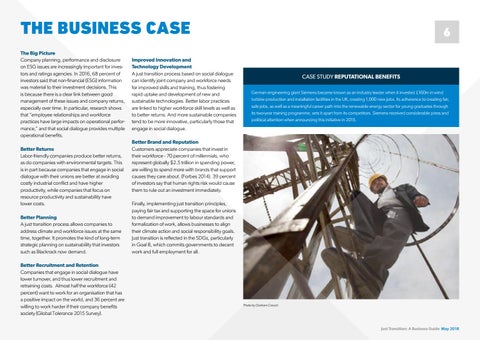
Photo by Graham Crouch
Just Transition: A Business Guide May 2018
HOW CAN COMPANIES IMPLEMENT A JUST TRANSITION?
7
A just transition at the company level involves three stages of action: Engage, Plan and Enact.
STEP 1: ENGAGE Ensure social dialogue with workers and their unions, and potentially government; consult broadly with key stakeholders such as communities.
•
Forecasting and finding ways to maximize the positive impacts of company-level climate action on workers and communities, as well as minimizing its negative impacts.
The foundation of just transition is co-creation of plans through social dialogue between workers and employers, and potentially government and communities. Social dialogue ranges from information sharing to negotiation and collective bargaining. This includes all phases from initial discussions about climate action, analysis and target setting through to planning, delivery, monitoring and reporting.
•
Forecasting skills needs and employment opportunities at different levels, and designing appropriate skills training services.
•
Locally, to design and deliver policies and actions that help to create new industries, jobs and social services provisions for workers and communities.
We recommend formal, regular dialogue processes, for example via the establishment of joint management-labour environment committees with transparent terms of reference, appointment processes and outcomes. These can be created at company and sector levels, and can also be used at local and national levels through collaboration between unions and sectoral or employers’ organisations.
•
Locally and nationally, developing and advocating for government policies that support just transition, particularly for vulnerable workers and communities, and drive job creation, decent work, development and poverty eradication.
In the context of emissions reductions and just transition, topics for discussion during a social dialogue can include: As a starting point, companies should have written policies and active programs on both climate action and human rights. Policies and programs should cover the whole enterprise and be approved through standard governance processes. They should also ensure that company operations, including supply chains, are working to get to net-zero emissions while recognizing, protecting and promoting human rights, including gender rights.
Human rights related to work are particularly important, such as the rights to decent and favourable pay and conditions, the right to organize and collectively bargain and the right to social protection. The ability to organize and collectively bargain is key for just transition. Without it, workers have no meaningful voice in the planning process.
•
Developing improved processes, services, knowledge, innovations or new technologies that reduce emissions and waste or promote productivity and resource efficiency.
•
Analyzing and agreeing different options for climate action by the company or its sector, including pathways to net-zero emissions.
Tripartite dialogue, between unions, the company and relevant government bodies, is also strongly recommended. This too can be accomplished via joint management-labour environment committees. In addition to dialogue with workers and their unions, the company should ensure adequate, informed and ongoing consultation with relevant stakeholders, particularly communities where the company has facilities, employees or significant parts of its supply chain. Relevant stakeholders can also include civil society organisations, particularly those concerned with environment, human rights and labour rights.
Just Transition: A Business Guide May 2018
8 STEP 2: PLAN Collaborate to produce concrete, time-bound, enterprise and sectoral plans for just transition, including emissions reductions. With a foundation of social dialogue, a company can move to planning its emissions reductions. This requires evaluating where and how a company can reduce emissions in the short, medium and long term. A company must also evaluate the commercial consequences of those emissions reductions. Sometimes emissions reductions can be profitable, for example when new and more efficient processes save energy or other commodities. Sometimes they will require phasing out a supplier, product or business area. And sometimes they may require short-term losses in order to reach longer-term goals for new, clean products and services. Company-level decisions to cut emissions can have effects–positive and negative–on workers and communities. Reducing emissions might require hiring additional workers, improving the skills of workers, redeploying workers or retrenchment in high-emissions business areas. In communities where a company or its suppliers are or could become the main employer, decisions to cut emissions can affect jobs, livelihoods, the community’s tax base and its economic and social fabric.
UNIONS AND EMPLOYERS COLLABORATE TO ENSURE A JUST TRANSITION IN AUSTRALIA In 2017, AGL Energy, an Australian power producer, announced it would close the coal-fired Liddell power station by 2022 and replace the power with a combination of gas, wind, solar and battery sources, despite calls by the Australian government to keep the plant open until 2027. Keeping the plant open for an additional five years was commercially undesirable as well as contributing to higher emissions. AGL reported that the transition would produce considerable savings, generating more affordable energy at $83 per megawatt hour compared with continuing to use coal which would cost $106/MWh. It would also shrink AGL’s carbon footprint by almost 18 percent, contributing to Australia’s carbon reduction goals. The union representing workers at the Liddell site, the Construction, Forestry, Mining and Energy Union (CFMEU), worked closely with AGL as they drew up plans to ensure all existing employees would be able to remain in employment at the repurposed Liddell plant, transition to a nearby plant or take a voluntary redundancy. In other words, there were no involuntary redundancies. The Mining and Energy president of the CFMEU Tony Maher, who helped negotiate the deal, publicly praised the company for treating employment security with as much importance as energy security and profitability.
A good company plan for just transition is concrete, time-bound, applies indicators, sets measurable goals and is enterprise-wide. Good plans: •
Produce rapid reductions in company-wide emissions, consistent with a commitment to net-zero emissions or with pathways for keeping global temperature increases well below 2°C. They include both short and long term targets and measures.
•
Consider the risk workers and communities might or will face over time and include in just transition plans options and resources to manage this risk and build resilience. Good plans will align with government and other stakeholder action on climate resilience.
•
Result in creation of decent jobs within the company and its supply chains – that is, jobs with fair income, security in the workplace, social protection and the effective right to organize and collectively bargain. This includes jobs in the company’s supply chains and the formalization of informal work.
•
Provide for retention, reskilling and redeployment for workers as part of the company’s transformation, rather than redundancies.
•
Include equal opportunities for training and employment opportunities for women, young people, the poor and other marginalized groups, as well as measures that produce equitable outcomes.
•
Drive investment in community economic diversification or renewal.
Company plans for emissions reductions and climate resilience should also cover the company’s supply chains. In supply chains, and in communities, the company should move to formalize informal work related to the greening of the economy, such as materials recovery, rescue, recycling, forest protection, disaster response and building community and ecosystem resilience. In addition to ensuring formal conditions of work, pay, and occupational health and safety, a company should support formalization of work through training, capacity building, certification and advocating for legislation.
Photo by Gerhard Jörén
Just Transition: A Business Guide May 2018
9 STEP 3: ENACT Deliver plans and advocate for broader action to promote just transition. Delivery of company plans should be accompanied by regular monitoring, reporting and social dialogue focused on accountability, results and learning. Transparency towards workers, communities, other stakeholders and shareholders is key. Company plans for just transition are most effective when they are tied to the broader context of action by other employers, local and regional governments, national governments and investors. Companies should advocate and collaborate, individually and through organisations, for stronger collective action and policy alignment on social protection, education and training and technology development and dissemination. SOCIAL PROTECTION: Governments are primarily responsible for ensuring access to social protection, financing and delivery of benefits and services to just transition, a company therefore should assess and include its contribution to social protection, for example healthcare benefits and retirement security. Companies should also pay their taxes, which are essential to create a sustainable financing base for many social protection programmes. Individually and through sectoral and employers’ organisations, companies should advocate for governments to ensure adequate income support, social protection entitlements such as pensions, unemployment benefits, health insurance, retirement security and help low-income households to meet energy costs.
EDUCATION AND TRAINING: Companies should provide appropriate, continuous training services with financial support to workers so that they can reskill and upskill. Alternatively, or in parallel, companies can ensure that unions, vocational institutes or governments have the resources, financial and otherwise, to develop and provide appropriate training. Appropriate training services include initial learning in green business practices, continuous learning in occupational safety and health and continuous reskilling and upskilling in environmentally friendly technology and innovation. A best practice is development of training services through dialogue between the company and its unions or in a dialogue between sectoral employers and sectoral unions. Alternatively, groups of employers and unions in a community or region can cooperate to develop the content and scope of training services. An additional best practice is to ensure that the company offers or supports training services resulting in certification. INNOVATION: Companies should invest in, and collaborate on, the research and development and commercialization of green technology. This could include providing financial and technical support to other enterprises and institutes to support the creation of business areas and jobs within their own businesses, as well as in the wider economy.
CASE STUDY THE CONSTRUCTION SECTOR, BELGIUM Employers and Unions collaborating on upskilling and skills development Stronger energy efficiency standards in the EU and Belgium have driven an increase in jobs retrofitting buildings as well as building new structures to a higher standard of energy efficiency. These standards, along with technological innovation in the building sector, have developed so quickly that it is challenging for workers to keep up to date. To address this issue, the three main trade unions in Belgium and sector employers have collaborated on developing courses for construction workers linked to green buildings and energy efficiency measures. Workers and employers assess the need for skills training together and develop proposals, which lead to very concrete training programs executed by the government organisations.
CONCLUSION We believe the transition to net-zero is inevitable. What is not inevitable, without forethought and dedicated planning, is that the transition is beneficial for our planet and all its people. By following this guidance, companies in dialogue with their workers will be able to clearly identify pitfalls and opportunities in making this transition as quickly and prosperously as is needed to ensure a safe climate for all. Photo by Enrico Fabian
Just Transition: A Business Guide May 2018
ANNEX I: PRINCIPLES AND RECOMMENDATIONS FOR JUST TRANSITION
Just Transition: A Business Guide May 2018
ANNEX I — PRINCIPLES AND RECOMMENDATIONS FOR JUST TRANSITION
The principles below can be used and adapted by businesses into various processes, including their procurement principles, business planning, employment planning and emissions reduction strategies. Respect, protect and promote human and gender rights, particularly rights related to work as they are the foundation for social dialogue. Companies should have written policies and active programs that ensure company operations, including supply chains, recognize, protect and promote human rights, as outlined by the UN guiding principles on business and human rights. This includes human rights related to work, particularly the rights to decent and favourable pay and conditions, the right to organize and collectively bargain and the right to social protection. The right to organize is particularly important for just transition. Without unions, it is virtually impossible for individual workers to participate in transition discussions in a meaningful way.
for just transition. We recommend formal, regular dialogue processes, for example via the establishment of joint management-labour environment committees with transparent terms of reference, appointment processes and outcomes. These should be created at company and sector levels and can also be used at local and national levels. Topics for social dialogue can include: •
•
• In addition, companies should have whole-of-enterprise gender policies in place that promote equitable outcomes.
Developing improved processes, services, knowledge, innovations or new technologies that reduce emissions and waste or promote productivity and resource efficiency. Analyzing and agreeing different options for climate action by the company or its sector, including pathways to net-zero emissions. Forecasting and finding ways to maximize the positive impacts of company-level climate action on workers and communities, as well as minimizing its negative impacts.
Ensure social dialogue between workers via their unions and companies, and consultation with key stakeholders.
•
Forecasting skills needs and employment opportunities at different levels, and designing appropriate skills training services.
Social dialogue should be an integral part of plans, strategies and processes for just transition. This includes all phases from initial discussions about climate action, analysis, target setting and planning, delivery, monitoring and reporting.
•
Locally, to design and deliver policies and actions that help to diversify and revive communities and their economies.
•
Locally and nationally, developing and advocating for government policies that support just transition, particularly for vulnerable workers and communities, and drive job creation, decent work, development and poverty eradication.
Social dialogue can include information sharing, negotiation and collective bargaining. A best practice is to ensure that collective bargaining agreements at all levels contain specific provisions committing the company and its workers to net-zero plans and plans
11
Tripartite dialogue, between unions, the company and relevant government bodies, is also strongly recommended. This too can be accomplished via joint management-labour environment committees.
or opportunity for new or different educational or training institutes, greater or fewer demands on public services, including services related to social protection and more or fewer community residents.
In addition to dialogue with workers, a company should ensure adequate, informed and ongoing consultation with relevant stakeholders, particularly communities where the company has facilities, employees or significant parts of its supply chain. Relevant stakeholders can also include civil society organisations, particularly those concerned with environment, human rights and labour rights.
Anticipate and plan for how the workers and communities will face climate risk, and strive to build resilience.
Anticipate and plan for how the transition to net-zero emissions will effect employment and communities, both positively and negatively. As part of the goal-setting, planning, and delivery processes for climate action, a company and workers should collaborate to forecast the potential impacts of company climate action on workers and local communities.
Workers and communities are at risk of climate change that cannot be mitigated. Companies should strive to work with impacted stakeholders, as well as with governments and other relevant organisations to recognize these risks and plan to build resilience to overcome these risks. Such risks could include, but are not limited to: housing, food and water supply and infrastructure damage. Choose emissions reductions plans that also promote sustainable development – that drive environmental sustainability, jobs and decent work, social inclusion and poverty eradication. Specifically, plans should:
Categories of potential impacts on workers, positive and negative, can include: the number of jobs, the need for retraining, upskilling, or redeployment, the formalization of informal jobs, expected quality and duration of the employment contract, expected pay and other renumeration for new jobs, changes in other conditions of work and the availability and security of social protection through and beyond the transition process, including unemployment insurance, sick leave, health care and pension. Categories of potential impacts on communities can include: direct and indirect effects on community economies and/or tax base, greater or less investment in the community, including investment in new, green infrastructure, more or fewer employment or livelihood opportunities in the community, a need
•
Produce rapid reductions in company-wide emissions, consistent with a commitment to net-zero emissions or with pathways for keeping global temperature increases well below 2°C above pre-industrial times. They include both short and longer term targets and measures.
•
Result in net creation of decent jobs within the company and its supply chains – that is, jobs with fair income, security in the workplace, social protection, and the effective right to organize and collectively bargain. This includes jobs in the company’s supply chains and the formalization of informal work.
Just Transition: A Business Guide May 2018
12
•
•
•
Provide for retention, reskilling and redeployment for workers as part of the company’s transformation, rather than redundancies and promote the formalization of informal work. Include equal opportunities for training and employment opportunities for women, young people, the poor and other marginalized groups, as well as measures that produce equitable outcomes. Drive investment in community economic diversification or renewal.
Ensure and support adequate and sustainable social protection for job losses and displacement. While the transition to a low-carbon economy presents opportunities for new, decent jobs and enhanced social inclusion, some communities may be negatively impacted by resultant job loss and displacement in the short- and medium-term. Adequate social protection, including healthcare, income support and social services, is critical for a just protection gives workers the security they need to move between jobs or even between sectors, and can also help to support communities who have been displaced by climate change. More generally, social protection is widely recognised as important to reduce poverty and inequality, foster decent work and contribute to productive employment. Social protection systems vary significantly between countries, however the certain key elements have been identified at international-level . These include healthcare, income replacement benefits in the case of sickness, old age, unemployment, work-injury, disability, and maternity, child and family benefits,
survivors’ benefits in the case of the death of a spouse or parent and social assistance benefits and services that guarantee basic income security. Governments have the primary responsibility in ensuring access to social protection, however businesses delivery of many benefits and services. For example in the area of pensions, unemployment benefits, maternity and parental leave benefits and health insurance. Companies’ tax payments are also essential for creating a sustainable financing base for many social protection programmes. The extent of a company’s responsibility for social protection will vary depending on the company’s location, its policies, local laws, and government institutions. The following considerations for social protection are especially important to consider in the context of a just transition: •
•
•
•
Ensuring access to adequate income support, such as unemployment and social assistance benefits, to ensure decent livelihoods for those out of work as well as others that have been negatively financially impacted in the transition to a low-carbon economy Promoting the portability of social protection entitlements, such as pensions, unemployment benefits, paid educational leave and health insurance, between jobs and across borders Ensuring that reskilling and training measures for those out of work are accompanied by adequate financial support, such as through education subsidies, training benefits, unemployment benefits and/or social assistance Ensuring access to retirement security for those out of work with limited prospects of finding a
new job or reskilling, particularly older workers •
Helping low-income households to meet energy costs, for example through fuel subsidies and financial support for energy-efficient home improvements
As part of just transition plans and their implementation, prioritize retraining and redeployment of workers, and ensure and support skills development, particularly for vulnerable workers. As part of the transition process, some workers will need or want reskilling and upskilling in order to access green jobs, improve productivity in their current jobs or improve their skills and understanding of technology in the jobs they have. Reskilling and upskilling are the responsibility of companies and governments. A company should provide appropriate, continuous training services to workers so that they can reskill and upskill, and/or ensure that unions, vocational institutes or governments have the resources, financial and otherwise, to develop and provide appropriate training. Up-skilling and training measures for those out of work should be accompanied by adequate financial support, as outlined in the section on social protection below. Appropriate training services include initial learning in green business practices, continuous learning in occupational safety and health, and continuous reskilling and upskilling in environmentally friendly technology and innovation that is relevant for the sector. A best practice is development of training services through dialogue between the company and its unions or in a dialogue between sectoral employers and
sectoral unions. Alternatively, groups of employers and unions in a community or region can cooperate to develop the content and scope of training services. An additional best practice is to ensure that the company offers or supports training services resulting in certification. The company should ensure that there is equal access to opportunities for skills acquisition, in particular for young people, women and workers who need to be redeployed, including across borders. Training services should be of suitable timing and duration and companies should have supportive policies that enable individuals to balance their work, family and lifelong learning interests. In addition to training services, companies should promote and deliver work-related training and practical experience as part of the training process in order to increase the employability of workers. For example, joint management-labour environment committees, or quality circles, can be used to share knowledge and advice aimed at improving resource and energy efficiency, reducing waste, and applying safe and clean technologies and working methods. Companies can also consider providing financial and technical support to other enterprises and institutes undertaking research and development in green technologies, and support cluster development and incubation. Advocate for rapid and just action on climate change, and policies and investments that support just transition. Sectoral and employers’ organisations should work to promote strong climate and just transition targets, policies and supportive lobbying positions and invest in precompetitive sectoral collaboration on development, commercialization and dissemination of green Just Transition: A Business Guide May 2018
13 technology and know-how. At regional and national levels businesses should play an active role in the formulation and implementation of strong climate, just transition, labour market and social protection policies, and the public investments in green and decent jobs, training and education, sustainable infrastructure and community renewal to back them up. See for instance in ILO Convention on Social Security (Minimum Standards), 1952 (No. 102) and ILO Social Protection Floors Recommendation, 2012 (No. 202)
For more information on The B Team and the Just Transition Centre’s work on just transition in businesses, please get in touch with: Samantha Smith, Director, Just Transition Centre samantha.smith@justtransitioncentre.org www.ituc-csi.org/just-transition-centre
Emily Hickson, Senior Manager, Net-Zero by 2050 eh@bteam.org www.bteam.org Photo by Dominic Sansoni
Just Transition: A Business Guide May 2018