EDITORIAL LETTER MEDITERRANEWS NO.13
Message from the
Executive Director
César Guerrero
The year is ending soon! I don’t want to start the countdown in advance -although rushing the holidays is not a bad idea-, but this is the last issue of the Mediterranews magazine of 2018, this is why I would like to send everyone my best wishes for 2019.
CREDITS
It is said that the best way to learn is to travel, if this is true, then this year we learned a great deal. We had the opportunity to embark on a few exchanges of experience that enriched to a great extent our projects. This was possible thanks to the kind contributions made by our partners and donors.
EDITOR-IN-CHIEF Antonieta Valenzuela
Thanks to all our friends from Cordova (Alaska), Point Reyes (California), Brunswick (Georgia), Vancouver (Canada), Buffalo (New York), Aguascalientes (Mexico), Cozumel (Mexico) and recently, Ithaca (New York), where we had the opportunity to visit the astonishing Cornell Lab of Ornithology. These experiences help us look at our projects through a critical eye and learn from other successful projects to enhance our own. Additionally, these exchanges of experience introduce us to new friends who are committed to make this a better world! Sometimes it was us who made the journey, but it is equally important to be a host than a visitor. I praise all those researchers, volunteers and students who gave their talent and time so that the conservation projects of this region prosper full steam ahead. It was a pleasure having collaborations with Environment for the Americas, University of the Americas Puebla, San Diego Natural History Museum, National Autonomous University of Mexico, University of San Diego, US Fish and Wildlife Service, CETMAR, National Institute of Anthropology and History, Ibero-American University and of course, our beloved Autonomous University of Baja California. I would like to make a special mention to our friends from NOLS Mexico, with whom I did not only have unforgettable memories sailing on a kayak in the middle of the Gulf of California, but I was also taught how to reduce my impact while on outdoor activities, and now I’m an expert on catholes. Anyway, enjoy this issue! Thanks to all authors who contributed with their stories in these pages. So get the mistletoe and your favorite drinks ready, and prepare yourselves for some serious eating, because this year is coming to an end. Read you in 2019!
DIRECTOR César Guerrero
EDITORIAL DESIGN Laura Tamayo EDITORIAL BOARD Jorge Andrade Pamela Castro Claudia Guzmán Verónica Meza Bárbara Ramírez COVER PHOTO Mirna Borrego CONTRIBUTORS Cecilia Alducin Mirna Borrego Gaël Courtin Enah Fonseca Andrea González Claudia Guzmán José Lamberto Hernández Erika Jiménez Luis Fernando López Juan López Marisol Montellano Christine Smith Antonieta Valenzuela Verónica Vargas Oscar Vélez TRANSLATION Oscar Colunga Bárbara Ramírez Antonieta Valenzuela Estefanía Vázquez
César Guerrero Executive Director of Terra Peninsular NOVEMBER 2018
02
19 CONTENTS
Contents
MEDITERRANEWS NO.13 | NOVEMBER 2018
TERRA MOMENTS “Protected Nature Reserves in Baja California” by Antonieta Valenzuela
04
“Working Together for the Common Good” by Gaël Courtin
TERRA NEWS “Surrounded by Mountains, Birds and Skyscrapers” by Erika Jiménez, José Lamberto and Mirna Borrego
05
“Shell Middens in Punta Mazo: Windows to the Past” by Luis Fernando López, Cecilia Alducin, Andrea González, Verónica Vargas, Juan López and Enah Fonseca
13
“Socrates and Outdoor Activities” by Claudia Guzmán
19
11
TERRA STORY “Birding for Conservation” by Christine Smith
03
MEDITERRANEWS
SPECIAL ARTICLE “Buried Treasures of El Rosario, Baja California” by Marisol Montellano
25
“Let’s Stop Using Plastic Today, Tomorrow Will Too Late” by Oscar Vélez
28
ENVIRONMENTAL DATES AND EVENTS
29
GLOSSARY
29
09
TERRA FACTS “Results of the Campaign The Beach Belongs to Everyone” by Jonathan Vargas, Claudia Guzmán and Antonieta Valenzuela
18
TERRA ACTIONS
FAUNA “From Extraction to Consumption: Octopus Fishing in San Quintín” by Leticia Marisol Talavera and Luis Fernando López
MY LIFE IN TERRA
Mediterranews is a science communication magazine published in February, May, August and November by Terra Peninsular, a non-profit environmental organization that protects nature in Baja California since 2001. Previous issues available on
16
www.terrapeninsular.org/ mediterranews
Address: Calle Tercera 1282, Zona Centro, C.P. 22800. Ensenada, Baja California, México. Email: info@terrapeninsular.org
Valle Tranquilo Nature Reserve, in El Rosario. Photo: Bárbara Ramírez.
TERRA MOMENTS
Protected Nature Reserves in Baja California Terra Peninsular protects four nature reserves in Baja California, these sites are certified as Areas Voluntarily Destined for Conservation through the National Commission of Natural Protected Areas (Conanp in Spanish). In each nature reserve species of flora and fauna of importance for conservation are protected, also monitoring activities and research projects are carried out with national and international institutions.
Punta Mazo Nature Reserve, in San Quintín. Photo: Alexis Eduardo Trejo.
The protected nature reserves are: - Rancho La Concepcion Nature Reserve, certified since 2013. - Valle Tranquilo Nature Reserve, certified since 2013. - Punta Mazo Nature Reserve, certified since 2014. - Monte Ceniza Nature Reserve, certified since 2017.
Rancho La Concepción Nature Reserve, in Sierra de San Pedro Mártir. Photo: Pamela Weston.
More information here: http://terrapeninsular.org/en/naturereserves-protected-areas/
Monte Ceniza Nature Reserve, in San Quintín. Photo: Antonieta Valenzuela.
NOVIEMBRE 2018 NOVEMBER 2018
14 04
TERRA NEWS
Surrounded by Mountains, Birds and Skyscrapers Our experience in the 1st Vancouver International Bird Festival By Erika JimĂŠnez, JosĂŠ Lamberto and Mirna Borrego
W
e attended the first Vancouver International Bird Festival, in Canada, from August 19 to 26, 2018 and it was an unforgettable experience.
05
MEDITERRANEWS
The adventure began when we arrived to the airport. While walking around to pick up our luggage we stopped to take a photo with a flyer that promoted the activities of the festival and the International Ornithological Congress that was celebrated at the same time. We were very excited!
TERRA NEWS
Terra Peninsular and the Commission for Environmental Cooperation (CEC) gave us the opportunity to experiment a week full of outdoors activities, museums, passion for birds and a lot of creativity. Participants: • Erika Jiménez, Head of the Environmental Education Department of Ensenada. • José Lamberto, professor at La Chorera high school in San Quintín, mentor of a group of students involved in conservation activities that protect their home environment. • Mirna Borrego, Education and Community Outreach Officer at Terra Peninsular and coordinator of the Bird Festival.
The festival began with a parade of more than 200 birds. Photo: José Lamberto.
To organize a festival, it is essential to join forces, not only with the institution that supports it with academic sense, but also with the government agencies that support and boost the promotion of conservation activities and citizen science. The key piece that makes the perfect triad is the community element, and during this trip we discovered that more than friends with common interests, we are a strong work team.
Our main objective during our visit to Vancouver was to absorbe like sponges the experience and learn as much as we could to enrich our contributions to our bird festivals.
Erika, José Lamberto and Mirna attended the 1st. Vancouver International Bird Festival. Photo: Terra Peninsular.
The festival began with a parade of over 200 birds from different ecosystems, represented by people of all ages who walked on stilts and flew along the shore of the breakwater to the Vancouver Convention Center to officially start the grand opening. The parade was led by natives of the region, who also performed a ceremony to bless the beginning of the week of activities accompanied by a group of aerial acrobats. This inauguration represented the beginning of three simultaneous events: the Vancouver International Bird Festival, the International Ornithological Congress and the annual Artists for Conservation Festival. Certainly all three of us agreed that this parade was something extraordinary and it was our favorite activity.
NOVEMBER 2018
06
TERRA NEWS
On Wednesday morning we visited the Science Museum where we met Jody Allair, an ornithologist from Bird Studies in Canada, who gave a talk on how to start birding and he also shared tips and anecdotes. That same day in the afternoon we attended the opening of a large exhibition of 62 modules and a lecture series called Nature and Bird Expo at the Convention Center, where they also unveiled a mural called “Silent Skies”, a 100 feet long mural composed by a large mosaic of drawings of 678 endangered birds made by recognized artists of nature and wildlife. Some of these drawings were for sale to raise funds and support bird conservation and education projects. We had the opportunity to attend a guided tour at the Beaty Biodiversity Museum where Ildiko Szabo, a taxidermy expert, showed us the second largest scientific collection in British Columbia; this collection has more than 40,000 organisms representing around 2,500 species including birds, mammals, reptiles and amphibians.
“Silent Skies” is a 100 feet long mural composed by a mosaic of drawings of 678 endangered birds. Photo: Erika Jimenez.
We attended different lectures; we met incredible people like Purnima Barnman, a conservationist woman who showed us the strength of community work. We spoke with Rob Butler, a very recognized ornithologist who danced at the inauguration dressed as a bird and who is also coordinator of the Festival in Vancouver. We realized that we are on the right track; it was a really exciting week. This festival was more than we have ever imagined, it inspired us more than we thought and it made us value our growing opportunities even more; we want to see more people from the community participating, birdwatching and promoting respect for nature. We want to inspire others, the community, festival organizers and more visitors who travel throughout the migratory route, because birds have no borders, birds inspire us.
Ceremony to bless the beginning of the week of activities. Photo: Mirna Borrego 07
MEDITERRANEWS
TERRA NEWS
Erika Jiménez, Rob Butler and José Lamberto Hernández. Photo: Mirna Borrego.
“From this trip, I am taking with me from this trip an experience that I can´t describe in a few words how big and excellent of a festival I was able to witness in a country where people are very kind, where the environment and climate seem to have made a truce with visitors used to warm days, a place where they respect and care for the environment. I remember that when we were looking for a place to dispose our trash we only needed to turn to one side and we would find a trash can in perfect conditions. There is a lot we need to learn from a country like this. Now we have the responsibility of transmitting to our students, community, friends and our children the importance of respect for birds and the environment.” -José Lamberto Hernández Inauguration of the festival. Photo: José Lamberto. NOVEMBER 2018
08
FAUNA
From Extraction to Consumption: Octopus Fishing in San Quintín By Leticia Marisol Talavera and Luis Fernando López / Biology graduates of the Faculty of Advanced Studies Iztacala UNAM
F
ishing is one of the most important economic activities of our country and by 2016 it contributed an estimated 35 billion pesos (Notimex, 2017), this is a historical amount, with a tendency to increase. Baja California, specifically, occupies the third place nationwide with 10% of the national production (Martinez, 2018). Cedros Island, El Rosario, Valle Tranquilo and San Quintín are some of the most important sites of the region, since organisms of highly economic value are captured here, such as abalone, shrimp, lobster, urchins, tuna and octopus (SEPESCA, 2015). In Baja California there are two octopus species of commercial interest: Pacific red octopus (Octopus Rubescens) and the Verrill’s two-spot octopus (octopus bimaculatus); the latter is the most commonly fished, and the Pacific red octopus has also been seen as a potential fishing resource for the region (SEPESCA, 2015). These animals are distinguished from other mollusks by the absence of an external shell, their rounded body, and the cephalic region is attached to eight arms with suckers. Likewise, they are capable of changing their color in dangerous situations (Pliego-Cárdenas, 2009; Guzmán-García et al., 2017). The Verrill’s two-spot octopus is generally grey and has characteristic blue spots, which are called ocelli and are found at the base of the second and third pair of arms (Castellanos, 2018). Their distribution in the world’s oceans ranges from the poles 09 MEDITERRANEWS
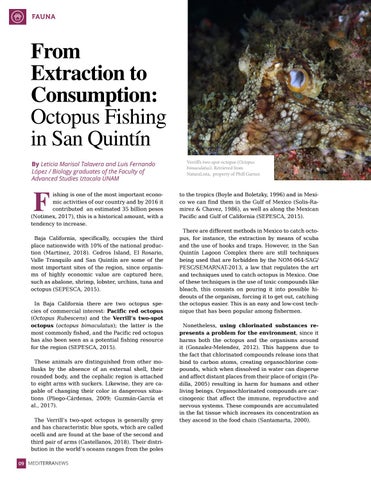
Verrill’s two-spot octopus (Octopus bimaculatus). Retrieved from NaturaLista, property of Phill Garner.
to the tropics (Boyle and Boletzky, 1996) and in Mexico we can find them in the Gulf of Mexico (Solis-Ramirez & Chavez, 1986), as well as along the Mexican Pacific and Gulf of California (SEPESCA, 2015). There are different methods in Mexico to catch octopus, for instance, the extraction by means of scuba and the use of hooks and traps. However, in the San Quintín Lagoon Complex there are still techniques being used that are forbidden by the NOM-064-SAG/ PESC/SEMARNAT-2013, a law that regulates the art and techniques used to catch octopus in Mexico. One of these techniques is the use of toxic compounds like bleach, this consists on pouring it into possible hideouts of the organism, forcing it to get out, catching the octopus easier. This is an easy and low-cost technique that has been popular among fishermen. Nonetheless, using chlorinated substances represents a problem for the environment, since it harms both the octopus and the organisms around it (Gonzalez-Melendez, 2012). This happens due to the fact that chlorinated compounds release ions that bind to carbon atoms, creating organochlorine compounds, which when dissolved in water can disperse and affect distant places from their place of origin (Padilla, 2005) resulting in harm for humans and other living beings. Organochlorinated compounds are carcinogenic that affect the immune, reproductive and nervous systems. These compounds are accumulated in the fat tissue which increases its concentration as they ascend in the food chain (Santamarta, 2000).
FAUNA
Pacific red octopus (Octopus rubescens). Retrieved from NaturaLista, property of Ann B.
20-inches hose Octopus fishing in Campeche, México. Crédit: Tierra Fértil Multimedia Editorial
Due to the importance of octopus fishing in the region, the use of these illegal practices for its extraction can lead to ecological and health negative effects, for the octopus and the living beings that coexist, integrating the human being, consumer and user of this resource and of the sea.
ABOUT THE AUTHORS Leticia Marisol Talavera Olmos is a Biology graduate from the Faculty of Advanced Studies at Iztacala, UNAM. Her main interests are marine and terrestrial animals, Ecology and Conservation, besides sports and music. She is currently working on her thesis about spatial and temporal segregation of species of the procyonidae family in the Tehuacán-Cuicatlán Biosphere Reserve in Puebla. One of her objectives is the dissemination of scientific communication among the youth and children, particularly on topics of environmental education. sol10lirba@hotmail.com Luis Fernando López Calvillo is a Biology graduate from the Faculty of Advanced Studies at Iztacala, UNAM. Interested in plants, both for their ecological issues and natural resources, he has supported Terra Peninsular in projects such as the monitoring of macroinvertebrates and macroalgae of the intertidal zone and the removal of exotic species in the dunes of the Punta Mazo Nature Reserve. He is currently working on his thesis on germination and development of guamúchil seeds. jocaylf@gmail.com
Sucking bulb
Regular pen
Bleach is one of the artifacts used for octopus fishing. Photo retrieved from the Sánchez Sotomayor report,
References ● Boyle,
P., y Boletzky, V. (1996). Cephalopod populations: definition and dynamics. Philosophical Transactions of the Royal Society of London Series Biological Sciences 351(1343), 985-1002. doi: 10.1098/rstb.1996.0089 ● Castellanos, S. (2018). Reproducción del pulpo Octopus bimaculatus Verrill, 1883 en Bahía de los Ángeles, Baja California, México (tesis de maestría). Instituto Politécnico Nacional, La Paz, México. ● Comisión Nacional de Acuacultura y Pesca. (2017) Gobierno de la República: México, tercer productor mundial de pulpo, “un manjar de los mares”. Recuperado de: https:// www.gob.mx/conapesca/articulos/mexico-tercer-productor-mundial-de-pulpo-unmanjar-de-los-mares?idiom=es ● González-Meléndez, M. (2012) Análisis cualitativo sobre el método de pesca para el pulpo de la Laguna Guerrero Negro, B.C.S., y sus implicaciones sociales (tesis de licenciatura). Universidad Autónoma de Baja California Sur. Baja California Sur, México. ● Guzmán-García, X., Ramos-Apolinar, P., Hernández-Calderas, I., García-Barrientos, R., y Jerónimo-Juarez, J. R. (2017). Potencial biotecnológico de las vísceras del pulpo. Ciencia. 68 (1) ● Martínez, G. (13 de Mayo de 2018) Baja California afianza producción pesquera. El Economista. Recuperado de https://www.eleconomista.com.mx/estados/BajaCalifornia-afianza-produccion-pesquera-20180513-0095.html ● Norma Oficial Mexicana-064-SAG/PESC/SEMARNAT-2013. Diario Oficial de la Nación. Ciudad de México, México, 21 de enero del 2015. ● Notimex. (18 de Junio de 2017). Incrementa 19% el PIB del sector pesquero en México. Excelsior. Recuperado de: https://www.excelsior.com.mx/ nacional/2017/06/18/1170633#view-1 ● López-Uriarte, E., Ríos-Jara, E., y González-Rodríguez, M. (2008). Diet and Feeding habits of Octopus hubbsorum Berry, 1953, in the Central Mexican Pacific. The Veliger, 51 (1), 26-42 ● Padilla, B., Díez, F., y Ordoñez, S. (2005). Tratamiento de efluentes acuosos contaminados con compuestos organoclorados. Ingeniería del agua, Vol. (12), 361-375. ● Pliego-Cárdenas, R. (2009) Biología reproductiva del pulpo Octopus hubbsorum Berry, 1953 (Cephalopoda, Octopodidae) en la Isla Espíritu Santo, Golfo de California, México. (tesis de maestría). Instituto Politécnico Nacional. La Paz, México. ● Santamarta, J. (2000). Un futuro sin cloro. World Watch, 2, 51-55. ● Secretaría de Pesca y Acuacultura del Estado de Baja California. (2015) Carta Estatal Pesquera de Baja California 2000-2015. ● Solís-Ramírez, M. J., Chávez, E. A. (1986) Evaluación y régimen óptimo de pesca de pulpo en la Península de Yucatán. Anal. Inst. Cien. Mar Limnol., 13: 1-18.
NOVEMBER 2018
10
TERRA FACTS
11
TERRA FACTS
12
TERRA NEWS
Shell Middens in Punta Mazo: Windows to the Past By Luis Fernando López, Cecilia Alducin, Andrea González, Verónica Vargas, Juan López and Enah Fonseca
W
hat we know about the ancient human groups in the peninsula of Baja California has been thanks to the remains of materials located in archaeological sites called shell middens. Although their main component defines them, shells are not the only elements present, and we can find remains of the consumption of mollusks but also of animals and plant species. We can infer activities of preparation, consumption and disposal of food, as well as the development of productive and overnight activities. That is why, from the study of shell middens we can investigate the daily life of the hunter-gatherers-fishers who lived hundreds of years ago. Extensive excavations were carried out in order to obtain as much information as possible about the groups that settled in the Punta Mazo Nature Reserve in San Quintín, as part of the 2018 season of the project “Study of camps on the coastline and intermontane valleys of Baja California”. This field season was the result of a collaboration between the National Institute of Anthropology and History in Mexico and the non profit organization Terra Peninsular. Fieldwork was conducted in the southern part of the Punta Mazo Nature Reserve, in an area of vol canic rock formations. The excavation point where we worked had been previously selected from a surface survey project carried out in 2017 (Fonseca, 2017, Fonseca and Mejía 2017).
13
MEDITERRANEWS
Figure 1 Rocky shelter number 3. It is an archeological shell midden. Photo: Enah Fonseca.
During that field season, a series of rock shelters - shallow natural caves - were identified and numbered from 1 to 6, from north to south. For this year’s excavation season, rock shelters number 3 and 4 were selected due to their good conservation status, as well as the diversity of lithic and malacological materials observed on the surface of shelter 3, and a mortar carved in fixed rock identified on the shelter 4 (Fig. 1). Reticles were mounted within the rock shelters to divide the excavation grid in order to systematize the information of each square unit. Fieldwork dynamics consisted of excavating layers of soil inside the shelters (Fig. 2); subsequently, the sediment was sifted using a 1/8 inch screen mesh to identify and classify shells, lithic - stone artifacts - and bones (Fig. 3). Excavation tools such as trowels, pickaxes and different brushes were used. In addition to the mechanical process of soil removal, the process of registering the layers at different depths was fundamental.
Figure 3 The sediment is sifted with a 1/8 inch screen mesh to identify and classify shells, lithic materials and bones. Photo: Enah Fonseca.
TERRA NEWS
Photographs and drawings of the archaeological elements on the surface were taken and sketched. At the end, a description of all the layers in the excavation profiles (vertical differences in the layers) was made (Fig. 4). Later, at El Refugio - our home and center of operations during the field season -, the shell materials were separated by species and size (length of the shell). The specimens or fragments that were burned were registered to identify if they showed signs of having been modified to make tools or ornaments (Fig. 5).
One of the significant findings worth highlighting was the difference in shell content between both shelters. In shelter 3 large, amounts of shell fragments were found, mainly black abalone (Haliotis cracherodii), California mussel (Mytilus californianus) and owl limpet (Lottia gigantea). Because of the perforations and angular cuts that some of these fragments presented, it was inferred they had been used to make jewelry; hence the importance of the malacological material for its ornamental and aesthetic value. (Fig. 6). Unlike shelter 3, there were few shells in shelter 4, however a large amount of lithic material was found, most of it chipped-off stone (flakes). The differences noted
Figure 2 Rocky shelter number 4 during the excavation process. Photo: Enah Fonseca. Figure 4 Record of the excavated profiles of shelter 3. Photo: Enah Fonseca.
NOVEMBER 2018
14
TERRA NEWS
Figure 5 Shell analysis in process. In addition to the taxonomic identification, burned fragments or with any traces of having been modified to elaborate artifacts or ornaments must be separated. Photo: Enah Fonseca.
between the two shelters are related to the use/ function of the area and the objects, which indicates on the one hand that there were areas destined to the preparation/consumption of food where certain specimens of shell were also selected for the elaboration of ornaments, and on the other hand there were areas destined to the manufacture of stone tools. Regarding the bone material found that was found, there was a predominance of fish, rodents and birds; however, otter teeth and part of a burned whale vertebra were also identified (Fig. 7). Finally, one of the greatest contributions of the field season to our training was to discover the importance of biology in archaeological studies. In addition to the taxonomic recognition of the species that were found, we can analyze abundance and size to understand the behavior of past societies regarding their consumption patterns, resource management and changes over time.
Figure 6 Abalone shell with perforation and angular cuts. Probably used as an earring. Photo: Enah Fonseca.
Figure 7 Fragment of a burned whale vertebra. Photo: Enah Fonseca.
References
●Fonseca Ibarra, Enah Montserrat (2017) Estudio de campamentos en la línea costera y valles intermontanos de Baja California. Surface route report 2017, Report presented to the Council of Archeology, INAH, Mexico. ●FFonseca, Enah and Gabriela Inés Mejía (2017) Not All Those Who Wander Are Lost. Mediterranews, December, Terra Peninsular: 9-10.
15
MEDITERRANEWS
Christine helped to count birds during the internship. Photo: Terra Peninsular.
TERRA STORY
Birding for Conservation By Christine Smith / Environment for the Americas Hello! My name is Christine and this is my first blog post for Terra Peninsular. My traveling companion, Lupita, and I have been lucky enough to embark on a three-month long internship with Terra in Baja California. The internship is a partnership with Environment for the Americas, a nonprofit in the United States dedicated to increasing diversity in the sciences and connecting people to birds, all in the name of awareness and conservation. The first activity of our internship was a trip from January 12th to the 26th. The goal of said trip was to survey birds of interest along the coasts of Baja California and Baja California Sur. The peninsula is home to multiple priority sites that are crucial to what are called “umbrella� species some of which are endemic and losing habitat.
Photo: Christine Smith.
This trip was more amazing than I could have ever imagined. We had the privilege of working in places that many residents of Baja never even see. Pristine beaches, areas where birds find sustenance and rest in the winter, may appear desolate at first glance but they are actually a part of chain of habitats crucial to the survival of many animals. Upon closer observation, there is so much life here. Shorebirds feeding on macroinvertebrates in the sand, plants growing on sand dunes and in marshes, birds of prey hunting, tides shifting, and evidence of nocturnal inhabitants. Our trip began in San Ignacio, a site of great importance to both endemic and migratory species. There, we met the rest of our team, partners from various organizations in La Paz. Our primary species of interest were shorebirds (part of the Migratory Shorebird Project), black brants, reddish egrets, oystercatchers, snowy plovers, red knots, and species endemic to the peninsula. Having had some previous experience surveying shorebirds for the Migratory Shorebird Project in Alaska, this part of the surveys was more practice for me than anything else. Having expert birders as our leads on this trip was such a luxury as I had the freedom to ask for help and guidance to improve my identification skills. We all counted and identified birds as a team reinforcing the results of the primary observers. Bouncing our observations off of each other allowed me to sharpen my skills in counting large flocks and identification while narrowing the team’s margin of error.
NOVEMBER 2018
16
TERRA STORY
We continued traveling north to Laguna La Bocana, Guerrero Negro, and ultimately, San Quintín. Along the way I saw almost all of the bird species endemic to the peninsula, estuaries, and the reserve in San Quintin that Terra Peninsular protects, and grey whales. The reserve in San Quintin might have been my favorite site of the trip. It was beautiful; marshes, beaches, and sand dunes, moss, lichen, coyote tracks, black skimmers, snowy plovers, the list goes on. Laguna Ojo de Liebre near Guerrero Negro was swarming with grey whales and their calves. I had never been so close to a whale in my life. Just out of arms reach. Mothers with their calves, pushing them to the surface so they can breathe. I actually saw their eyes, heard them breathe, and watched them swim under our boat. My heart pounded in amazement, actually seeing their massiveness, seeing them living. I was moved. Baja California is such a gorgeous place, it’s an honor to have had the chance to explore it with people who are working to protect its habitats. The habitats of Baja California are unique and invaluable. The species we monitored are indicators to how these areas are being affected by climate change and in turn help better inform conservation efforts. I’m so grateful to have played even a small part in this.
Photo: Christine Smith.
Reddish egret (Egretta rufescens). Photo: Christine Smith.
This Terra Story was published on Terra Peninsular’s blog. You can read the online version in www.terrapeninsular.org Subscribe and receive our Terra Stories and new information via email.
17
MEDITERRANEWS
http://terrapeninsular.org/en/birding-for-conservation-christine-smith/
MY LIFE IN TERRA
Working Together for the Common Good The Experience of Gaël Courtin in San Quintín By Gaël Courtin /Terra Peninsular volunteer
I
n December, I was strolling around Baja California and I was impressed with the richness and beauty of the peninsula, so I contacted organizations to participate in conservation programs. Then, I was invited by Terra Peninsular to participate in a project to remove Carpobrotus edulis from the dunes of the Punta Mazo Nature Reserve in March 2018, with Jorge Andrade and his team. When I arrived at the reserve it was an honor to feel part of that unique ecosystem, both for its nature and for the people who live there. We stayed at El Refugio for two weeks and lived each day with the force of the natural elements, the sound of the waves and the presence of majestic volcanoes in the neighborhood. The work team consisted of 10 people, divided into 5 groups of “mixed” pairs (1 person from the local community La Chorera and 1 person from Terra Peninsular). It was a very generous work group, I was accepted even though I am a foreigner, it didn’t matter whether or not I was Mexican, whether or not I was a biologist, we were all in the same effort
Photo: Terra Peninsular.
23
and walked with the same knowledge because we were in the process of sharing and learning together. After work was done, we didn’t remain isolated from the community and there were even times of community events in which we were all invited to participate. These conservation projects, that work in direct contact with the local population, are very important to create a strong impact on people that are not aware of environmental conservation issues or do not worry about. We therefore fulfilled two objectives: to reintegrate science into the community (which many conservation projects leave the locals out and rather impose knowledge) and to actively involve local members of the community. Terra Peninsular is aware of this and implements it on their projects. Day after day, the difficulty or the monotonous feeling of the working conditions didn’t matter, because we were surrounded by a welcoming work environment. We were guided by the eagerness feeling of cleaning our dunes to preserve and restore the original beauty of the area, without exotic species. I liked this project because it was another way to do nature conservation by involving everyone. In the end, it was a success and more than that because the Punta Mazo Nature Reserve conservation is no longer just the goal of Terra Peninsular but now it is also the goal of the entire community. Today, I can also proudly say: I am Terra!
Photo: Terra Peninsular.
MEDITERRANEWS NOVEMBER 2018
18
TERRA NEWS
19
MEDITERRANEWS
TERRA NEWS
Socrates
and Outdoor Activities By Claudia Guzmรกn / Terra Peninsular
Living well
S
ocrates is considered the precursor of ethics because of his innumerable speeches about the virtue, that for him meant to know to do good (this in a practical sense). That is, those who do evil do it because they do not know good. He related ethics with living a good life. What is it to live a good life? Having material possessions? Unlimited internet? For Socrates, a good life had to do with the proper use of reason, with taking care of the soul (conscience), with seeking knowledge and doing good. Is this a current issue? Does it have any application? It most certainly does, perhaps in this time Socrates would relate living a good life with taking care of nature. Knowing about it would be the greatest virtue.
Hike to the top of the Sudoeste volcano. Photo: Mirna Borrego.
NOVEMBER 2018
20
TERRA NEWS
The course required moments of introspection, teamwork, individual and collective learning from all participants. Photo: Laura Tamayo.
What does Socrates have to do with outdoor activities? An example of how to bring ethics to everyday life is the National Outdoor Leadership School (NOLS) founded by the mountaineer Paul Petzolt in 1965 in Lander, Wyoming, United States, with the objective of teaching outdoor life skills, practical conservation, and leadership. NOLS conducts a wide range of courses: hiking, mountaineering, sea and river kayaking, spelunking, horseback riding, rock climbing, skiing and sailing. They also promote the protection of wild areas through publications, scientific research and seminars specialized in techniques to minimize the impacts caused by recreational use in natural areas.
21
MEDITERRANEWS
In the early 1990s, the US Forest Service worked with NOLS to develop a science-based, minimal-impact, practical education training for non-motorized recreational activities. This is how the non-profit organization Leave No Trace Center for Outdoor Ethics began. This organization promotes the seven principles of Leave No Trace, which provide guidance to enjoy our natural world in a sustainable way.
TERRA NEWS
The seven principles are: 1) Plan ahead and prepare. 2) Travel and camp on durable surfaces. 3) Dispose of waste properly. 4) Leave what you find. 5) Minimize campfire impacts. 6) Respect wildlife. 7) Be considerate of other visitors. Download the infographic here: bit.ly/7-principles-Leave-No-Trace
First generation of Leave No Trace trainers in Mexico For the first time, the Leave No Trace trainers course was held in Mexico, in September 2018 at the Punta Mazo Nature Reserve. The course was taught by two excellent instructors: Mckenzie and Caio. The group was formed by representatives of important nature reserves in Baja California: Felipe and Jesús, park rangers of the Sierra San Pedro Mártir National Park; Héctor, a na-
tive of El Rosario and Field Officer of the Valle Tranquilo Nature Reserve; Lamberto, professor at a local middle school in La Chorera; Johana, Panchito, Jahaziel and Natalia, middle school students, and inhabitants of La Chorera, a community near the Punta Mazo Nature Reserve, as well as representatives from the Department of Conservation and Communication of Terra Peninsular. During two intensive days, the course demanded moments of introspection, teamwork, individual and collective learning from all participants. The course was aimed to learn the seven principles of Leave No Trace in a practical but conscious way. For example, to learn principle two “Prepare and camp on durable surfaces” the group had to undertake a trip to the site chosen to camp, observe and reflect why they considered it the best place, everyone had to give their point of view, listen, and the most difficult part: make a decision. What Socrates would call appropriate use of reason.
The course was held at the Punta Mazo Nature Reserve, in San Quintín, Baja California. Photo: Mirna Borrego.
NOVEMBER 2018
22
TERRA NEWS
San Quintín was the scenario for the first NOLS trainer course in Mexico. Photo: Mirna Borrego.
The greatest virtue One of the objectives of the course was to generate a personal and team action plan based on environmental ethics. Personally, I can say that my intention is to bring expedition behavior to the different areas of my life. The group action plan will be interesting, each group in this course designed their plan thinking about improving their life, their family, their school, their community and their natural areas. The Terra Peninsular team is committed to promoting and applying the seven principles in conservation projects; we are convinced that good living is related to the quality of our environment. Also, we will be a platform to continue replicating these courses in Baja California. Photo: Mirna Borrego.
“After many years of studying ethics, I’ve reached the conclusion that all of it can be summarized in three virtues: courage to live, generosity to coexist, and prudence to survive.” -Fernando Savater, 2005
23
MEDITERRANEWS
TERRA NEWS
The instructors of NOLS, Caio and Mckenzie, with the Executive Director of Terra Peninsular, César Guerrero. Photo: Mirna Borrego.
ABOUT THE AUTHOR Claudia is the Community Engagement Coordinator at Terra Peninsular since 2017 and an editorial board member of the Mediterranews magazine. claudia@terrapeninsular.org
References
●NOLS. (2018). Historia de NOLS. Recuperado de https://www.nols.edu/es/acerca/historia/ ●Leave No Trace (2018). The Leave No Trace Seven Principles. Recuperado de https://lnt.org/learn/7principles
First generation of Leave No Trace trainers in Mexico Photo: Mirna Borrego.
NOVEMBER 2018
24
SPECIAL ARTICLE
Buried Treasures of El Rosario, Baja California By Marisol Montellano / UNAM
D
uring the 60’s and 70’s, American paleontologists spent several summers surveying the surroundings of El Rosario , and discovered remains of dinosaurs, crocodiles, lizards and other vertebrates. Later, students and teachers from the Autonomous University of Baja California (UABC) made expeditions to the area. Since 2004, staff members of the Institute of Geology of the National Autonomous University of Mexico, together with researchers from the United States, have resumed the survey in the area. Our objective is to know the fauna that lived there during the Late Cretaceous (74 million years ago), to do an environmental reconstruction, and how this fauna is compared with those of other North American locations, among other questions. The emphasis has been on recovering the remains of small vertebrates (microvertebrates) such as amphibians and reptiles, to name a few.
How do we do it? We begin prospecting, this is walking through the canyons, climbing the walls of the hills, and looking for evidence of fossil remains, like pieces of bones and teeth. When those are found, the area and its surroundings are examined more carefully, and sacks are filled with sediment, which are sent to Mexico City for sieving in the facilities of the Institute of Geology at the National Autonomous University of Mexico.
25
MEDITERRANEWS
In the laboratory, the sediment is soaked, passed through sieves of different aperture sizes, dried and then observed under a microscope to separate the remains of microvertebrates for further study. It is a tedious but very exciting work when identifiable remains are found, since most of the material is fragmented and difficult to identify. This material is studied by undergraduate, graduate and specialist students in different groups. To give context to how and where Baja California was 70 million years ago: North America did not look like we see it now, it was bisected by a sea that divided it into two great continents Laurasia and Appalachia; Baja California was on the Pacific coast of Laurasia and was attached to the continent, the Sea of Cortez did not exist, it was formed many millions of years later. When we compare the faunas of the same age of El Rosario with those of the rest of North America (Canada and the United States) the results indicate a peculiar faunistic composition, so this site is important since it suggests that the fauna of continental vertebrates was not homogeneous throughout Laurasia.
SPECIAL TERRA ARTICLE NEWS
Fossil wood. Photo: Marisol Montellano.
Dinosaur tooth of small carnivore. Photo: René Hernández.
Infructescence. Photo: Marisol Montellano.
What have we found?
Remains of microfossils ready to be collected. Photo: René Hernández.
Amphibians, different groups of lizards, crocodiles, a type of ray, fish, turtles and mammals have been identified. Duck-billed dinosaur teeth have also been collected, which are the most abundant, as well as small and large carnivorous dinosaurs.
The presence of dinosaur egg shell fragments and the remains of young dinosaurs is something exciting. Along with these studies, isotopic studies are also carried out, which will help us determine the temperature and humidity.
Among the interesting and abundant fossils, we found a lizard that was only known by a pair of teeth, now we know it for almost all its skeleton and it has been possible to determine how it replaced its teeth.
Traces of petrified trees have been found in different places, as well as leaves, fruits and seeds. Unfortunately, in recent years the petrified trees have been looted, which is a cause for concern because, on the one hand, part of the area’s paleontological heritage is lost, and on the other, when they are removed without taking into account the geological context, valuable information is lost to reconstruct the paleoflora and paleoenvironment.
NOVEMBER 2018
26
SPECIAL ARTICLE
How do we visualize El Rosario 74 million years ago? It was a fluvial environment with a great river that opened in many branches, there were episodes with a lot of energy that dragged everything, and there were emergent places that were stable and that developed soils where plants could grow. Associated with this landscape were freshwater fish and some of them were brackish water species, such as amphibians, reptiles, turtles, crocodiles, mammals and small and large dinosaurs. Finally, I would like to acknowledge the disinterested support of the inhabitants of El Rosario, without whom our work would not be possible year after year.
ABOUT THE AUTHOR Graduated from Biology of the Faculty from Sciences at the National Autonomous University of Mexico (UNAM), Marisol studied the Master of Science in the same faculty. She obtained a PhD in Paleontology from the University of California, Berkeley. Upon her return she joined the Institute of Geology of the UNAM, where she is a researcher. Currently, she is a teacher at the Faculty of Sciences and is a member of the National System of Researchers. marmont@unam.mx Looking for microvertebrates in the sediments of El Gallo. Photo: RenĂŠ HernĂĄndez.
27
MEDITERRANEWS
Outcrop of the El Gallo formation. Photo: Marisol Montellano.
TERRA ACTIONS
Let’s Stop Using Plastic Today,Tomorrow Will Too Late By Oscar Vélez
As stated on the 2018 state of plastics report by the UN Environment: “If we do not take actions to decrease and eradicate the use of plastic by 2050 there will be more plastic than fish in the oceans”. This is, over 12 billion plastic tons on the blue surface of the planet. The are many problems: the first one is that plastics take longer to degrade, up to 100 years (bags), 500 years (packages and bottles), and up to 1,000 years (other types of plastics), these residues have a great impact on the earth and our health. Another issue is derived from the constant plastic consume, since 5 billion plastic bags are used every year, and 1 million plastic bottles are bought every minute. It is estimated that the plastic production could raise up to 900% by 2020 with regard to 1980. And by the year 2030, we will be producing 619 million tons of plastic each year, representing over half of the waste we dispose on the planet. The alarming thing is that over 13 million tons of our garbage reaches the oceans every year. Nowadays there are five islands of plastic: one in the Indian Ocean, two in the Atlantic, and two in the Pacific. Moreover, there are 5 to 50 billion microplastics (those small fragments we can’t see) accumulated in marine species, which later on end up in our plates when we consume them.
At the same time, plastics cost the lives of 1 million shorebirds and 100,000 marine mammals per year. Likewise, every year 1.6 million oil barrels are used fto produce plastic containers, which requires a great amount of energy and causes the increment of greenhouse gases, and an increase in environmental pollution, affecting our health, the ecological balance and our quality of life.
WHAT DOES THIS REVEAL? We need to stop using plastic Banning the production of plastics is not enough to solve this problem. This is why it is so important to re-educate ourselves, raise awareness stop littering, recycle and reuse products, and reduce plastic use. As consumers, we have the duty to promote and demand alternatives such as the production of bioplastics made from plants and bacteria that degrade within 0.2 to 24 months. Fortunately, efforts are being made to reduce the use of plastics: some supermarkets charge their customers for plastic bags, others use biodegradable bags or cloth bags; they have also been taxed to discourage consumption. In India, edible plates are being used and, instead of having a plastic plate that ends up in the oceans, they have one that is edible and, if
it is not eaten, it is at least biodegradable. Dell has announced that its packages will be 100% plastic free, currently and that they are at a 94% and using wheat, cardboard and bamboo materials; the company is also experimenting with a material known as myco foam, which comes from the agricultural waste. While it is a challenge to stop using plastic, pushing through habit transformation can trigger change to reduce the plastic impact. Let’s clean up our oceans as they are our planet’s lungs and plastic is choking them. Let’s join the campaigns: #NoPlastic #NoPlasticBags #ZeroPlastic #PlasticFreeJuly #ZeroWater And if we can’t reuse plastic, we have to reject it.
References ●Noticias ONU. (2018). O nos divorciamos del plástico, o nos olvidamos del planeta. Retrieved from https://news. un.org/es/story/2018/06/1435111 ●Worldenvironmentday.global. (2018). Retrieved from http://worldenvironmentday.global/sites/default/files/ toolkit_with_nature/WED_Key_Messages_Spanish.pdf ●Greenpeace España. (2018). Los océanos del mundo están llenos de plásticos. Retrieved from https://es.greenpeace. org/es/noticias/los-oceanos-del-mundo-estan-llenos-deplasticos-diamundialdelosoceanos/
ABOUT THE AUTHOR Oscar has a Master´s degree in Environmental Management, he is a specialist in Energy Policy and Environmental Management. He is an International Relations graduate, and a consultant, educator and environmental journalist, as well as activist, leader and coordinator of citizen campaigns. Founder and Director of Revive México, an organization committed to building a sustainable, co-responsible, ethical, civic and participatory society that evolves without compromising the ecological and social balance; all of this through a new culture that safeguards human rights and Earth rights. oscarvrg@hotmail.com
@ReviveMexicoCA / https://www.facebook.com/ReviveMexicoCA/
NOVEMBER 2018
28
ENVIRONMENTAL DATES AND EVENTS
Festive Dates November
December
1
5
World Day of Ecology
27
15
International Conservation Day
World Clean Air Day
20
27
Revolution Day (Mexico)
Giving Tuesday
4
25
5
26
Biologists’ Day (Mexico)
World Environment Day
A-Z
International Environmental Education Day
4th. San Quintín Bay Bird Festival
11
11 International Mountain Day
Christmas
29
International Day for Biological Diversity
31
New Year’s Eve
Establishment of the United Nations Environment Programme (UNEP)
22
Winter solstice
24
Christmas Eve
Glossary Brackish water Brackish water is water that is saltier than fresh water, but not as salty as seawater. It contains between 0.5 and 30 grams of salt per liter. Cephalic region The cephalic region (head) or cranial region (skull) is at the top of the body and visible from the front and rear. Food chain A food chain is a linear sequence of organisms through which nutrients and energy pass as one organism eats another. In a food chain, each organism occupies a different trophic level, defined by how many energy transfers separate it from the basic input of the chain. Lithic materials Materials or artifacts made from rocks or minerals.
29
6-8
25
15
January 2019 Journalist’s Day (Mexico)
International Volunteer Day
MEDITERRANEWS
Macroinvertebrates Species that do not present a spine and in some cases do not have any type of skeleton. Malacological materials Materials produced from mollusks rests. Microvertebrates Vertebrate species of reduced body size or any vertebrate species that can give rise to microfossils. Myco foam Mushroom based packaging material used as an alternative to expandable polystyrene (EPS). Overnight Stay for the night in a particular place. Paleoenvironment An environment prevailing at a particular time in the geological past.
Paleoflora In geology, the fossil flora of any formation, or group of related formations, or of any period of geological history. Rock shelter A shallow cave or cave like area. Shell midden Archaeological deposit that can contain food remains such as shells from shellfish, animal bones, tools and household objects. Spelunking Spelunking, or caving, is a sport in which people explore caves. Umbrella species Species with habitat requirements similar to other species and, therefore, equal or more sensitive to changes in habitat. In conservation biology, protecting these umbrella species means protecting other species from the same biotic community.