INDIGENT DEFENSE



COURSE DIRECTORS: Lynn Pride Richardson & Rick Wardroup
February 17, 2023 • Dallas, TX
Date Friday, February 17, 2023
Location Aloft Dallas Downtown 1033 Young St., Dallas, Texas 75202
Course Director Lynn Pride Richardson and Rick Wardroup
Total CLE Hours 6.0 Ethics: 1.0
Friday, February 17, 2023
Time Topic Speaker 8:15 am Registration & Continental Breakfast 8:45 am Opening Remarks Lynn Pride-Richardson and Rick Wardroup
9:00 am 1.0 Mitigation in the Non-Capital Case Liz Harvey
10:00 am 1.0 Defending the Blood Test DWI Case Chad Hughes 11:00 am Break 11:15 am 1.0 Evidence Refresher Impeachment and Objecting/Responding to Objections Eric Porterfield
12:15 pm Lunch Line
Presentation: Lawyer Wellness Rick Wardroup
pm Break
pm 1.0 General Forensic Pathology and How it Applies to the Fallacy of the Shaken Baby Syndrome Katherine Judson 2:45 pm 1.0
Caseload Standards for Indigent Defenders

Malia Brink
3:45 pm Adjourn
INDIGENT DEFENSE SEMINAR INFORMATION
:: 6808 Hill Meadow Dr :: Austin, Texas :: 512.478.2514 p :: 512.469.9107 f :: www.tcdla.com
TCDLA
1.0 ETHICS
1:30
12:30 pm
Lunch
1:45
Criminal Defense Lawyers Project

speakers topic
Mitigation: Telling Your Client’s Story
Liz Harvey
Chad Hughes Defending the DWI Blood Case
Eric Porterfield Impeaching Witnesses in Federal and Texas Criminal Cases
Katherine Judson
Cognitive Bias in Forensic Pathology Decisions & Ending Manner-of-Death Testimony and Other Opinion Determinations of Crime
6808 Hill Meadow Dr :: Austin, Texas :: 512.478.2514 p :: 512.469.9107 f :: www.tcdla.com
Indigent Defense Table of Contents
Criminal Defense Lawyers Project
Indigent Defense
February 17, 2023
Aloft Dallas Downtown 1033 Young St, Dallas, Texas 75202
Topic:
Mitigation: Telling Your Client’s Story
Speaker: Liz Harvey
Harvey Sentencing Consulting
P.O. Box 30175 Austin, TX 78703
512.762.933 Phone
512.253.4238 Fax
liz@harveymitigation.com Email
Co-Authors: Mairead Burke, LMSW
Burke Mitigation and Consulting, LLC
P.O. Box 8313 Silber Spring, MD 20907 858.705.0338 Phone
mairead@burkemitigation.com Email www.burkemitigation.com Website
Clay B. Steadman
Jesko & Steadman
612 Earl Garrett St. Kerrville, TX 78028 830.257.5005 Phone
CSteadman612@hotmail.com Email
6808 Hill Meadow Dr :: Austin, Texas :: 512.478.2514 p :: 512.469.9107 f :: www.tcdla.com
USE OF MITIGATION EVIDENCE
MAIREAD BURKE, LMSW, Austin Mitigation Specialist
Burke Mitigation and Consulting, LLC
CLAY B. STEADMAN, Kerrville
Law Offices of Jesko & Steadman
State Bar of Texas
SEX, DRUGS, & SURVEILLANCE
April 19, 2017
Austin
CHAPTER 9
This paper provides the nuts and bolts of what a lawyer needs to get a mitigation specialist on board, what a lawyer can expect a mitigation specialist to provide, and how to integrate mitigation information into every stage of the case to tell your client’s story.
MAIREAD BURKE, LMSW
P.O. Box 11543 ∙ Austin, TX 78711-1543
858-705-0338 ∙
mairead@burkemitigation.com ∙ Fax 512-842-7098
EDUCATION
University of Chicago
Master of Arts, School of Social Service Administration
Concentration: Clinical Social Work
Santa Clara University
Bachelor of Arts
Major: Communication
Minor: Women’s and Gender Studies
LICENSURE AND MEMBERSHIPS
Chicago, IL- 2013
Santa Clara, CA- 2007
Licensed Master Social Worker with the Texas State Board of Social Worker Examiners since July 2014.
License #: 59512
National Association of Social Workers
Texas Criminal Defense Lawyers Association
EXPERIENCE
Mitigation Specialist and Case Consultant
Burke Mitigation and Consulting, LLC
Contractor
Austin, TX
October 2014- Present Independent
January 2014- October 2014
Emergency Department Social Worker Austin, TX
St. David’s Medical Center
Adult Case Manager
Howard Brown Health Center
Graduate Social Work Intern: Therapist
Jewish Child and Family Services
Graduate Social Work Intern
December 2014- Present
Chicago, IL
June 2013- April 2014
Chicago, IL
September 2012- May 2013
Chicago, IL
ACCESS Community Health Network Clinic at Sullivan High School
Mitigation Specialist and Forensic Investigator
NOLA Investigates
Jesuit Volunteer Corps Intern
NOLA Investigates
October 2011- June 2012
New Orleans, LA
August 2008- September 2011
New Orleans, LA
August 2007- August 2008
Clay B. Steadman
Is a partner in the Law Offices of Jesko & Steadman, in Kerrville, Texas. He has had a general law practice with his wife, Elizabeth, in Kerrville since 1995. His primary focus is litigation, with an emphasis on criminal defense.
As an active member of the Texas Criminal Defense Lawyers Association since 1995, he served on TCDLA’s Board of Directors from 2009 – 2015. Currently, he is a co-chair of the TCDLA Rural Practice Committee, and is a member of the Criminal Defense Lawyers Project Committee. Clay is also a member of the Board of Directors of the Texas Criminal Defense Lawyers Educational Institute, and currently serves as the Vice-Chair of TCDLEI. He is a TCDLEI Super Fellow. Clay was appointed to serve on the faculty of the 41st Annual Texas Criminal Trial College for 2017.
As a charter member of the Hill Country Criminal Defense Lawyers Association, he has served on the Board of Directors since 2013. He is member of the National Association of Criminal Defense Lawyers and the National Child Abuse Defense & Resource Center. Clay is also a member of the Kerr County Bar Association, and has been since 1995. In the past, within the Kerr County Bar Association, he has served in various leadership roles as President and Secretary. He is also a member of The College of the State Bar of Texas, and a member of the Texas State Bar Computer and Technology, Construction Law, and Consumer and Commercial Law Sections.
An active speaker, he has presented and spoken at over 20 continuing legal education seminars, served as course director, and authored numerous articles on various criminal defense legal topics.
Participating and being active in many local organizations throughout Kerrville and the surrounding area remains an important part of Clay’s fabric as a general law practitioner, in what is a predominately rural area. He remains actively involved with the Kerrville Tivy High School Mock Trial Team, and has been an attorney advisor with the team since 2001. In 2005, as an attorney advisor, the Kerrville Tivy High School Mock Trial Team won the Texas High School Mock Trial Competition, and competed in the National High School Mock Trial Competition in Charlotte, North Carolina. Locally, Clay has also served on the board of directors for the Hill Country Crisis Council, the Norman Turner Rehab House and the Riverhill Country Club.
Clay received his B.B.A. in Finance from the University of Texas at Austin in 1989, and his J.D. from St. Mary’s Law School in 1992.
Use of Mitigation Evidence Chapter 9 i TABLE OF CONTENTS I. INTRODUCTION ................................................................................................................................................... 1 A. Applicable Standards and Case Law for Mitigation and Investigation ........................................................... 2 1. American Bar Association Standard on Criminal Justice [Section 4-4.1 (a)] 2 2. State Bar of Texas Performance Guidelines for Non-Capital Criminal Defense Representation [Guideline 4.1: Investigation – Generally] 2 3. Duty to Investigate Mitigation and Punishment Evidence 2 B. Mitigation: Where Do I Start 3 1. Case Law to Justify the Use of a Mitigation Specialist 3 2. First Steps for Retained Counsel 4 3. First Steps for Court Appointed Counsel 4 4. Retaining Your Mitigation Specialist 5 C. What You Can Expect from a Mitigation Specialist 6 D. Collecting Records for the Mitigation Investigation 6 1. Types of Records 6 2. Getting Records with a Signed Release 7 3. Use of Subpoenas and Motions/Court Orders to Obtain Records 7 4. Texas Public Information Act 10 5. 56.36 Crime Victim Act Provisions 11 6. Issues and Areas of Concern in Collecting Information 11 E. Using Mitigation Evidence ............................................................................................................................ 13 1. Use of Mitigation During Punishment ................................................................................................... 13 2. Case Law ............................................................................................................................................... 13 3. Incorporating Mitigation Evidence Into Guilt/Innocence ...................................................................... 14 4. Additional Factors to Consider .............................................................................................................. 15 5. Telling Your Client’s Story to the Jury ................................................................................................. 16 6. Demonstrative Exhibits ......................................................................................................................... 17 7. Accommodations for Trial..................................................................................................................... 18 F. Problems encountered by the lawyer ............................................................................................................. 18 1. Getting Mitigation Evidence Admitted ................................................................................................. 18 2. Most Common Mistakes ........................................................................................................................ 19 II. CONCLUSION ..................................................................................................................................................... 19 APPENDIX ................................................................................................................................................................... 20
USE OF MITIGATION EVIDENCE
I. INTRODUCTION
Mitigation has been generally defined as the action of reducing the severity, seriousness, or painfulness of something. Mitigation can be used as a verb or a noun. In a practical sense when referenced, it can generally be seen as a manner of risk reduction. When an attorney collects, and uses mitigation evidence, it is a means by which to tell your client’s story and offer an explanation of their action(s), which require consideration by the trier of fact.
In defending someone accused of a criminal act, there are three basic premises of your client’s responsibility and their acceptance of same: (1) I didn’t do it, (2) I did it but I had a good reason, and (3) I did it and I am sorry. Generally, when collecting and using mitigation evidence we would be focusing on (3) I did it, and I am sorry, but (2) could become relevant in a situation where the accused may have an insanity or diminished capacity defense, and same is argued during the guilt/innocence phase of the trial. However, in most cases the use of mitigation evidence will be implemented during the punishment phase of a trial. Indeed, if you are offering evidence to reduce the severity, seriousness or painfulness of an act, it is by its very definition punishment evidence, and it is unlikely to have any relevance during the guilt/innocence phase of the trial. However, its limited relevance in the guilt/innocence phase, should not deter you from attempting to offer same at the outset of trial, if the premise of your defensive strategy is “I did it, and I am sorry”.
Mitigation can be an art-form to be perfected throughout the trial, that allows us to tell our client’s story from a compassionate point of view, which resonates acceptance of responsibility. The court or jury does not want to hear your client’s excuse(s) for their behavior, but they will listen to your explanation. The use of mitigation can allow you to explain how your client finds himself in his current situation (alleged criminal act), and offer their explanation of what precipitated and led to the manner in which he acted. Mitigation can illustrate to those charged with making a decision regarding your client’s criminal culpability, a rational understanding of your client’s perception of the event(s) which have led to this very time in his life. It is a time of your client’s reckoning and judgment, which if presented and argued successfully, allows the decision maker to consider a fuller explanation of your client’s behavior, and not solely focus on the result.
William Shakespeare often incorporated themes of mercy and forgiveness throughout his literary works. In the Merchant of Venice, Shakespeare offers the following quote from his character Portia, who is then presently disguised as the attorney Balthazar, who pleads for mercy from Shylock before the Venetian Court of Justice:
The quality of mercy is not strain'd,
It droppeth as the gentle rain from heaven
Upon the place beneath: it is twice blest;
It blesseth him that gives and him that takes:
'Tis mightiest in the mightiest: it becomes
The throned monarch better than his crown;
His sceptre shows the force of temporal power, The attribute to awe and majesty, Wherein doth sit the dread and fear of kings; But mercy is above this sceptred sway; It is enthroned in the hearts of kings, It is an attribute to God himself;
And earthly power doth then show likest God's When mercy seasons justice. Therefore, Jew, Though justice be thy plea, consider this, That, in the course of justice, none of us
Should see salvation: we do pray for mercy;
And that same prayer doth teach us all to render The deeds of mercy. I have spoke thus much
To mitigate the justice of thy plea; Which if thou follow, this strict court of Venice
Must needs give sentence 'gainst the merchant there.
The Merchant of Venice, Act 4, Scene
This quote is an example of the high esteem that Shakespeare held for those who had compassion and showed mercy. Specifically, this is an example of how Shakespeare presented mercy as a quality which was most valuable to
Use of Mitigation Evidence Chapter 9 1
those individuals in positions of power, influence and standing within society. See Generally, Bloody Constraint: War and Chivalry in Shakespeare. Oxford University Press. Theodor Meron. (1998) Page 133. ISBN 0195123832.
A. Applicable Standards and Case Law for Mitigation and Investigation
As attorneys and zealous advocates, we are required to properly investigate and prepare our client’s defense, and to ensure that this effort and manner of preparation continues through trial, if necessary. Child abuse and child death cases are particularly difficult because of the complexity of the subject matter, and the horrendous facts that are generally involved. However, as difficult as it is to defend these types of cases, we cannot “mail it in”, so to speak. At all times, you need to be diligent and thorough in your efforts of investigating the facts of your client’s case, as well as preparing same for trial.
1. American Bar Association Standard on Criminal Justice [Section 4-4.1 (a)]
Defense counsel should explore all avenues leading to facts relevant to the merits of the case and the penalty in the event of conviction. The investigation should include efforts to secure information in the possession of the prosecution and law enforcement authorities. The duty to investigate exists regardless of the accused’s admissions or statements to defense counsel of facts constituting guilt or the accused stated desire to plead guilty. In other words, we must investigate the case facts despite our client’s best efforts to handcuff our ability to effectively defend their case
2. State Bar of Texas Performance Guidelines for Non-Capital Criminal Defense Representation [Guideline 4.1: Investigation – Generally]
You are required to complete an independent review of the case as promptly as possible. This is a good reason for getting an investigator involved as soon as possible. Verify that the charge(s) are legally and factually correct. Verify and investigate both areas of the client’s case, specifically being those facts pertaining to guilt/innocence and punishment. Ex Parte Niswanger, 335 S.W.3d 611 (Tex. Crim. App. 2011) [Citing Strickland v. Washington]
Counsel’s function is to make the adversarial testing process work in the particular case. Accordingly, competent advice requires that an attorney conduct an independent legal and factual investigation sufficient to enable him to have a firm command of the case and relationship between the facts and each element of the offense.
3. Duty to Investigate Mitigation and Punishment Evidence
The standard by which the appellate court’s review ineffective assistance of counsel, is the same for both the guilt/innocence and punishment phases of a defendant’s trial. See Hernandez v. State, 988 S.W.2d 770 (Tex. Crim. App 1999). Further, in 2006, the Texas Court of Criminal Appeals expanded this rationale in holding that a defense counsel’s failure to investigate the basis of his client’s mitigation defense can amount to ineffective assistance of counsel. Ex Parte Gonzales, 204 S.W.3d 391 (Tex. Crim. App. 2006).
Moreover, the United States Supreme Court had previously adopted this standard, as espoused in Ex Parte Gonzales, in non-capital cases. See Wiggins v. Smith, 539 U.S. 510 (2003). Both the First and Fourteenth Courts of Appeals in Houston, Texas, have found that defense counsel can be ineffective in a non-capital case, for failure to present available character evidence when the record shows that the witnesses would have been able to offer mitigating testimony. See Milburn v. State, 15 S.W.3d 267 (Tex. App. – Houston [14th Dist.] 2000, pet. ref’d); See also, Shanklin v. State 190 S.W.3d 154 (Tex. App. – Houston [1st] 2005), pet. dism’d 211 S.W.3d 315 (Tex. Crim. App. 2007).
I know what you are thinking, great I am now paranoid about how I am defending my client’s case. That is not the intended purpose of this article, as I am always uncomfortable in the ethics portion of any CLE seminar, because it is human nature to second guess your decisions. You are not alone, as any good trial attorney will have those same anxieties during trial preparation. The purpose of providing you the applicable case law and standards is to help you identify what is required to be investigated for mitigation purposes, and seek the trial court’s assistance, if necessary, in providing effective assistance of counsel in the punishment phase of your client’s trial
We must remind ourselves that we have a duty not only to investigate those facts pertaining to the guilt or innocence of our client, but to also thoroughly investigate any and all facts pertaining to the punishment of our client. In a punishment type case, facing an impossible set of facts, you can sometimes feel overwhelmed or that there is nothing you can do to assist and/or defend your client. However, you must persist, and continue to investigate thoroughly any pertinent mitigation and/or punishment evidence, because the failure to do so may result in a finding of ineffective assistance of counsel
Use of Mitigation Evidence Chapter 9 2
B. Mitigation: Where Do I Start
In the recent movie, “The Martian”, starring Matt Damon, there is a great line at the end of the movie where Damon’s character, who survived alone on Mars for 543 days before being rescued, tells a group of astronaut candidates, “You just begin. You do the math. You solve one problem …. and you solve the next one…and then the next. And if you solve enough problems, you get to come home.” As an attorney, I can identify with this statement, as we are often put in what appears to be an impossible situation, and asked to fix it, make it right. It can be an overwhelming sensation, that may intimidate us into a position of taking no action at all. I would argue that this not a solution or a strategy, but is a form of resignation. No pun intended, but it is not rocket science, as you should be able to readily recognize when you are retained or appointed on a case, if the collection and use of mitigation evidence will assist you in representing your client effectively. So, what do I need to do? You begin, by recognizing the need to investigate, collect and use all mitigation information and evidence concerning your client, his background, his family, and what circumstances have delivered him to you for advice and guidance.
If you are retained, you will need to make sure that your client has paid you or has sufficient funds in reserve to hire a mitigation specialist, an investigator, and usually at least one psychological or psychiatric expert. Based upon my experience in this area of the law, you will normally need a minimum of $10,000.00, to initially retain the services of a mitigation specialist, an investigator, and a psychologist. This may vary from case to case, but it has been my experience that most retainers for these types of experts and investigators, depending upon the severity of the case, will range from $3,000.00 to $5,000.00. Further, it is likely that the initial retainer will not be sufficient to pay all expenses and fees for these types of experts through trial.
If you are court appointed, or if your client has hired you but is now out of available funds for these types of experts and investigators, you are required to seek assistance from the trial court, and request authorization for the funding for these types of experts and investigators.
1. Case Law to Justify the Use of a Mitigation Specialist
a. Ake
Established that an indigent defendant has a right to a court-appointed expert under certain circumstances. Ake v. Oklahoma, 470 U.S 68, 105 S.Ct. 1087 (1985). In Taylor v. State, the Texas Court of Criminal Appeals, in following the precedent established in Ake, held that the defendant is entitled to independent expert assistance, not one who is required to report to the State or the court. Taylor v. State, 939 S.W. 2d 148 (Tex. Crim. App. 1996).
As previously mentioned above, defense counsel’s failure to investigate available facts or a basis of the client’s mitigating evidence, can be held as ineffective assistance of counsel. Ex Parte Gonzales at 391. More specifically, the Court reasoned that in determining whether or not counsel conducted a reasonable investigation, the reviewing court must initially determine if a reasonable investigation would uncovered the available mitigation evidence. See Id.
b. Miller v. Dretke
United States 5th Circuit Opinion. Female Defendant was charged and convicted of deadly conduct and sentenced to 8 years in prison. The Court had determined that there was significant psychological evidence available regarding the Defendant’s mental and emotional state, due to injuries she suffered as a result of a car accident. Specifically, the court reasoned that defense counsel’s failure to pursue this type of mitigation investigation and present this evidence through the defendant’s physicians, was not a sound tactical or strategic decision. The Defendant’s case was reversed for ineffective assistance of counsel for purposes of punishment. See Generally, Miller vs. Dretke, 420 F.3d 356 (5th Cir. 2005)
Lair v. State
Texas First Court of Appeals Opinion. The Defendant was convicted of possession of a controlled substance of more than 200 grams but less than 400 grams. First degree felony, further enhanced on basis of Defendant’s prior felony conviction. The Defendant was sentenced to 70 years in prison. The appellate court found that there were over twenty witnesses, including the Defendant’s mother, relatives, and neighbors, who were ready and willing to testify, but were never contacted by defense counsel. The appellate court concluded that a reasonable probability existed that the Defendant’s prison sentence would have been less severe had the jury had the opportunity to balance the mitigating testimony, which was available from the additional witnesses, who were subsequently not called during punishment to testify. Therefore, in the instant case the appellate court concluded the Defendant was actually and substantially prejudiced by his defense counsel’s failure to seek out and present available mitigating character evidence from those additional witnesses. The Defendant’s case was reversed for purposes of punishment. See Lair v. State, 265 S.W.3d 580 (Tex. App. – Houston [1st Dist.] 2008).
Use of Mitigation Evidence Chapter 9 3
c.
d. Lampkin v. State Texas Sixth Court of Appeals Opinion. The Defendant was convicted of felony driving while intoxicated, third or more. After finding the Defendant guilty of felony driving while intoxicated, he was enhanced based on two prior felony convictions, and sentenced to 99 years in prison. The appellate court found the defendant’s trial counsel did not know about the available mitigating evidence, because he did not investigate the matter. The appellate court concluded that it was beyond speculation or conjecture that a reasonable probability existed that the Defendant’s assessed prison sentence would have been less severe had the available mitigating evidence been presented at trial. Therefore, the Defendant’s case was reversed for purposes of punishment. See, Lampkin v. State, 470 S.W.3d 876 (Tex. App. –Texarkana 2014).
In applying this line of case precedent and rationale, it is clear that a criminal defense attorney is compelled to investigate all reasonably available mitigation evidence. Further, it is clear that if your client does not have adequate funds to hire the appropriate expert(s) and investigator(s), in order to investigate and present all relevant mitigating evidence, they must seek assistance and funds from court to do so.
2. First Steps for Retained Counsel
If retained, you will need to interview your client and make an initial determination if his background or circumstances have any connection to the situation surrounding the criminal accusation in question. I have found that in preparing a case for trial, which involves mitigating facts and evidence, you will generally need to employ and utilize least three (3) types of expert and investigative resources:
a. Fact Investigator
b. Mitigation Specialist/Investigator
c. Psychologist
Some cases, either based on the criminal conduct alleged or the background of the accused, may involve the employment and utilization of a specific type of expert for purposes of mitigation. By example in a sexual assault case, you may need to employ the services of a qualified psychologist to perform and complete a sexual assault risk assessment and evaluation. The same may be the case in a situation in which your client was an abused spouse and a victim of battered spousal syndrome. Your ability to find and employ a qualified expert, as same pertains to your case, is only limited by your creativity in defense strategy.
You may have to prepare for a potential Gatekeeper hearing under Texas Rules of Evidence 705. As a defense attorney, I have used this type of hearing to voir dire the State’s expert, and potentially exclude their testimony, as it is not relevant or probative in assisting the jury making a determination regarding guilt/innocence or punishment. However, the Gatekeeper hearing can be used by the State in this same capacity. Keep in mind that during the punishment phase of a trial, the court generally takes a much more liberal position on what it determines to be relevant and material. As such, it is usually easier to argue the relevancy and admissibility of mitigation evidence during punishment.
Make sure when you quote a fee for the case, that you have considered what if any expert or investigative resources you may need in preparing for trial. Moreover, you need to ensure that adequate resources are available to employ those types of expert and investigative resources. Based upon the case law discussed above, it is clear that defense counsel’s failure to employ the necessary mitigating resources, because the client is out of money, will expose defense counsel to post-judgment ineffective assistance of counsel claim.
In the event that your client has retained your legal services, but at some point, no longer has sufficient funds to retain and employ expert(s) and investigator(s) for any purpose, including a mitigation investigation, you must seek an authorization of funds for those types of resources from the trial court. This will be accomplished in the same manner as if you were a court appointed attorney. The only difference, is in the motion you would present to the court for authorization of funds, is that you would assert that your client was not initially indigent or that his family initially retained you as his counsel, but currently the defendant has no other resources available for fees, expenses or services, and is now indigent. I will sometimes provide the trial court an affidavit from my client to that effect, which is attached to the ex parte motion seeking funds.
3. First Steps for Court Appointed Counsel
You will still need to interview your client and his available family members, to determine if his background or family history has any connection to pending criminal accusation. Once you have determined the need to investigate potential mitigation evidence, you will need to request authorization of funds from the trial court, such that you can retain the appropriate resources.
Use of Mitigation Evidence Chapter 9 4
a. Ex Parte Motion for Authorization to Expend Funds for Mitigation Specialist
b. Ex Parte Motion for Authorization to Expend Funds for Psychological Expert
c. Motion for Authorization to Expend Funds for Investigator
I do not usually file a motion for an investigator ex parte, because from a strategy standpoint I want the State to know that I am also investigating the facts surrounding the case.
4. Retaining Your Mitigation Specialist Getting Started:
a. Once you have reviewed the case facts and spoken to your client, make the necessary phone calls to available experts, investigators, or mitigation specialists, and determine their availability, hourly rate, and terms of employment.
b. Obtain the necessary funding required for the mitigation specialist or other experts. This is accomplished by getting a retainer for the mitigation specialist payable to them or your trust account, or getting an Order Authorizing Funding from the trial court. The funding order should specify the mitigation specialist’s and expert’s hour rate, the number of hours of work initially authorized, and the amount of funds initially authorized. The Order Authorizing Funding should also provide for the reimbursement of necessary travel and other miscellaneous expenses connected to the investigation.
c. Provide the mitigation specialist or other experts with a legal retention letter from your office, which outlines payment considerations and terms of employment. (A Copy is Included in the Document Appendix)
d. Deliver the retainer check or order authorizing funding and legal retention letter to the mitigation specialist or other experts.
e. If your client is in custody, then you will need to prepare a letter to the county or state correctional facility in which he or she is being held, authorizing your mitigation specialist, investigator, or expert to have access to your client. You need to ensure that your mitigation specialist, investigator or expert when meeting with your client at the correctional facility is provided a secure and private meeting area, such that privilege is maintained. (A Copy is Included in the Document Appendix)
f. Make sure that you provide the mitigation specialist or other experts with all the discoverable information, witness interviews, and offense reports. I usually do this digitally, and provide all members of the defense team a flash drive with the discoverable information received from the State. Also, I would have your mitigation specialist meet with the client and start collecting information prior to having your psychologist or other expert evaluate your client. I normally proceed in this manner, such that you and your mitigation specialist can formulate a plan for exactly how and under what specific psychological criteria you want to have your client evaluated. As an example, in a murder case you may not want to have a complete psychological evaluation completed by your expert, because this type of evaluation, which includes an MMPI (Minnesota Multiphasic Personality Inventory), may indicate that your client is a sociopath or has sociopathic characteristics. This is because the MMPI is standardized psychometric test of adult personality and psychopathology. This type of testing can often open Pandora’s box, regarding your client and his propensity to break the law or for violence. In some cases, we do not want an initial psychological evaluation, however complete it may be, which may provide a differential diagnosis or could be used to determine a therapeutic assessment procedure. As the point of the spear, you and the mitigation specialist need to coordinate your efforts so that you can control the content and expected outcome of your client’s psychological evaluation.
g. One caveat I would offer pertains to a situation in which you are utilizing the services of a psychologist or psychiatrist or other therapeutic expert. While you should initially provide this type of expert all the information you receive from the State, you must be cautious in how you provide this type of expert any information you, your investigator, or mitigation specialist have obtained. If this expert is potentially going to testify, by proceeding cautiously, you can monitor and limit the dissemination of otherwise privileged or harmful information. Keep in mind, once you designate this witness as a testifying expert, any information they have reviewed in preparation of their testimony can be subpoenaed to trial. While it will be necessary to have this expert review some of the information, you, the investigator, or mitigation specialist have obtained, it should not just be forwarded to them for review, without taking any precautionary safeguards.
Use of Mitigation Evidence Chapter 9 5
Attached Document Appendix:
See the
C. What You Can Expect from a Mitigation Specialist
A mitigation specialist will cultivate information through interviews, record collection and analysis, and research; and will assist the attorney in developing mitigation themes and strategies for the presentation of information to the trier of the fact.
Breaking that down step-by-step, first the mitigation specialist will meet with the client, go over their life history and gather pertinent information, and have the client sign HIPAA compliant releases. Then, the mitigation specialist will obtain the client’s records, analyze them, and interview additional witnesses, like the client’s family and friends. Next, the mitigation specialist will provide you with: interview summaries/testimony outlines, records with Business Records Affidavits that are suitable for introduction as exhibits, and a biopsychosocial history of the client.
This mitigation investigation will be the most in-depth assessment the client has ever undergone, and it’s expected that the mitigation investigation will uncover issues that have gone undiagnosed and untreated for myriad reasons. For that reason, it’s important that the mitigation specialist is qualified by training and experience to recognize signs and symptoms of possible psychiatric, psychological, medical, neurological, substance abuse, educational, and developmental issues that come up in interviews and records.
A mitigation specialist is not a testifying expert; they will assist in identifying issues that warrant expert assessment, identifying specific experts, and developing specific questions for the experts to evaluate and provide opinions about. Once you’ve chosen the expert, the mitigation can consult with them about their role in the case and provide relevant background information.
Next, the mitigation specialist will use the gathered information and expert opinions to assist you in preparing for plea negotiation. If the case is not resolved through a plea, they will assist in developing strategies for the presentation of lay and expert witnesses at trial.
In preparation for trial the mitigation specialist will provide a Punishment Phase Witness List, a memo that synthesizes pertinent mitigation information into a comprehensive mitigation guide. The memo includes mitigation themes, lay and expert witnesses to testify and an outline of their testimony, witnesses they anticipate the State may call and their anticipated testimony, and a recommendation with supportive reasoning for an appropriate sentence.
D. Collecting Records for the Mitigation Investigation
1. Types of Records
The following is a list of records a mitigation specialist will likely collect, depending on the specific needs of your case. The list is by no means exhaustive, but it gives an idea of the common records that are needed in a mitigation investigation:
a. Medical records
b. Psychological records
c. Psychiatric records
d. Educational and Special Educational records
e. Social Security Disability records
f. Employment records
g. Personnel records
h. Social Security Earnings records
i. Military records
j. Child Protective Services and other community agency records
k. Foster care and other placement records
l. Arrest, conviction, correctional, and probation records
m. Juvenile arrest, conviction, correctional, and probation records
n. Police Department calls for service records to client’s residences
The following records from discovery and/or the investigation of the crime, and really all records from discovery, are relevant to the mitigation investigation and should be provided to your mitigation specialist:
a. Client’s statement
b. Witness statements
c. Affidavits of Non-Prosecution (which is a type of statement)
d. Offense reports
e. I.R.S. records
f. Property records
g. Court records
Use of Mitigation Evidence Chapter 9 6
h. Attorney General records and information
i. Texas Department of Criminal Justice Institutional Division
j. County Jail records
k. Police Department records of complaints
l. Video Cam surveillance records
m. Crime Lab records
n. Medical Examiner (autopsy) reports
o. Crime Stoppers records
p. Social Media in all forms
2. Getting Records with a Signed Release
A HIPAA compliant release with your client’s full name, date of birth, social security number if applicable, and signature is needed to obtain the following records. The mitigation specialist will collect these records with a Business Records Affidavit so they are suitable for introduction as exhibits (See Document Appendix).
a. Medical records
b. Psychological records
c. Psychiatric records
d. Educational and Special Educational records
e. Employment records
f. Personnel records
The following records require agency-specific signed releases.
a. Social Security Disability records require SSA-3288 (See Document Appendix)
b. Social Security Earnings records require SSA-7050-F4 (See Document Appendix)
c. Military records require Standard Form 180 (See Document Appendix)
I encourage you to request these records with a signed release rather than a subpoena so the records will come directly to you instead of being shared with the prosecution. If agencies refuse to provide records, then consider issuing a subpoena.
3. Use of Subpoenas and Motions/Court Orders to Obtain Records
When using a subpoena to obtain records you should first file a specific motion requesting the information in question, and get a court order requiring same be produced. After obtaining a court order requiring the production of the documents, issue a subpoena duces tecum and attach the court order as an exhibit. I will then either subpoena the documents using the duces tecum to a specific pre-trial court setting, or request that the documents be produced instanter. If I am attempting to subpoena information which I believe a party may deem sensitive, I will state in my motion for discovery and subsequent subpoena that the records may be produced to the court “in camera”. My general experience has been once the court signs and order requiring the documents to be produced, most entities will comply with an instanter request because they do not want to appear in court unnecessarily. However, this is not the case with Child Protective Services records as they will require the redacted records to be produced in conjunction with a signed agreed protective order covering same, or have the records redacted and produced “in camera”.
a. Child Protective Services
Use of subpoenas to obtain CPS records, which generally are subpoenaed “in camera”. Note: Provisions which generally necessitate an “in camera” inspection of CPS records:
(1) Tex. Fam. Code Section 261.201 Confidentiality and Disclosure of Information
(2) 40 Tex. Admin. Code Section 700.202 Definitions
(3) 40 Tex. Admin. Code Section 700.203 Access to Confidential Information Maintained by the Texas Department of Protective and Regulatory Services (TDPRS)
(4) 40 Tex. Admin. Code Section 700.204 Redaction of Records Prior to Release
(5) 40 Tex. Admin. Code Section 700.205 Procedures for Requesting Access to Confidential Information
(6) 40 Tex. Admin. Code Section 700.206 Videotapes, Audiotapes and Photographs
(7) 40 Tex. Admin Code Section 700.207 Charges for Copies of Records
Use of Mitigation Evidence Chapter 9 7
Procedurally you can request and/or subpoena these records, and they will be subject to being redacted by the CPS legal/records department, and upon being “desensitized” they are produced “in camera” for inspection by the court. I sometimes receive the redacted records in hardcopy form, but lately have been receiving them in digital form on a CD or DVD. In reviewing these records if you discover a redacted portion which may contain material, relevant or potentially exculpatory information you should file a specific motion for discovery on that issue, and assert your rationale for requiring the court to order CPS to produce that information in an un-redacted form.
b. Juvenile Detention and Probation Records
I would file a motion specifically referencing and requesting that this type of information be produced by the State or in the alternative order that it be produced and file a subpoena duces tecum requesting same and attaching a copy of the Court’s order stating what must be produced. If the State files a Motion to Quash, I initially would agree to the documents being produced “in camera” to the Court, subject to review, and then produced to the Defendant. If the court refuses to produce the documents submitted “in camera”, request the court make a finding that you are not entitled to said documents, object to the court’s finding, and then have all the documents marked as an appellate exhibit, to be unsealed if an appeal is pursued.
c. Adult Probation
I would file a motion specifically referencing and requesting that this type of information be produced by the State or in the alternative order that it be produced and file a subpoena duces tecum requesting same and attaching a copy of the Court’s order stating what must be produced. If the State files a Motion to Quash, I initially would agree to the documents being produced “in camera” to the Court, subject to review, and then produced to the Defendant. If the court refuses to produce the documents submitted “in camera”, request the court make a finding that you are not entitled to said documents, object to the court’s finding, and then have all the documents marked as an appellate exhibit, to be unsealed if an appeal is pursued.
d. Jail
I would file a motion specifically referencing and requesting that this type of information be produced by the State or in the alternative order that it be produced and file a subpoena duces tecum requesting same and attaching a copy of the Court’s order stating what must be produced. If the State files a Motion to Quash, I initially would agree to the documents being produced “in camera” to the Court, subject to review, and then produced to the Defendant. If the court refuses to produce the documents submitted “in camera”, request the court make a finding that you are not entitled to said documents, object to the court’s finding, and then have all the documents marked as an appellate exhibit, to be unsealed if an appeal is pursued.
e. Prison
Most types of Prison Records are available to be subpoenaed, so long as you are willing to pay for the expense of copying and delivering the records to you, and you send the subpoena to the correct contact individual. In most instances, you will be attempting to get your client’s prison records, and as such, a release is the most expedient manner in which to request these records. I have listed below some of the addresses and contact information I have used in the past to request certain documents regarding T.D.C.J.I.D. records.
(1) Offender Visitor List
Attention: Custodian of Records
Texas Department of Criminal Justice T.D.C.J. Open Records Office and Pen Packets
Huntsville, Texas 77342-0099
Phone: (936) 437-8696
Fax: (936) 437-6227
(2) Disciplinary Records
Attention: Custodian of Records
Texas Department of Criminal Justice T.D.C.J. Open Records Office and Pen Packets
Huntsville, Texas 77342-0099
Phone: (936) 437-8696
Fax: (936) 437-6227
Use of Mitigation Evidence Chapter 9 8
(3)
Inmate Grievance Records
Attention: Custodian of Inmate Grievance Records
901 Normal Park, Suite #101
Huntsville, Texas 77320
Phone: (936) 437-8024
(4)
Inmate Medical Records
Attention: Custodian of Medical Records Health Services Archives
262 FM 3478, Suite #B
Hunstville, Texas 77320
Phone: (936) 439-1345
You may also need to contact UTMB Managed Care to subpoena medical records and can get their contact information by calling their office at (936) 439-1345. As such, once you contact this office you can determine if you need to issue two separate subpoenas.
f. Medical and Mental Health
If these records cannot be obtained with a signed HIPAA compliant release, then consider using court action to collect them. When subpoenaing medical records, mental health records, or counseling and therapy records, you will need the individuals full name, date of birth, social security number if available, the dates and/or period of treatment specific to you case, and the name and address of the facility and/or care provider. These types of subpoenas are sometimes objected to by the facility or care provider under HIPAA. If this is the case, I would file a specific motion for discovery on this issue and address same with the court, specifically identifying why this information is necessary. If the court grants your discovery request, re-issue the subpoena with the attached order stating that the described information is to be delivered “in camera” to the Court for inspection, and within the subpoena itself identify a pretrial hearing date and time for which these records are to be produced.
g. Miscellaneous Records
I will also use a court order and subpoena duces tecum to request and obtain the following additional types of records:
(1) Employment Records
If these records cannot be obtained with a signed HIPAA compliant release, then consider using court action to collect them. I first file a specific motion for discovery requesting these specific type of records, identifying the employer name and address. Once I have obtained a court order regarding this type of information I will issue a subpoena duces tecum and attach the court order as an exhibit.
(2) School Records
If these records cannot be obtained with a signed HIPAA compliant release, then consider using court action to collect them. I first file a specific motion for discovery requesting these specific type of records, identifying the school district name and address or school name and address. Once I have obtained a court order regarding this type of information, I will issue a subpoena duces tecum and attach the court order as an exhibit. When subpoenaing education/school records, you will need to include the individual’s full name, date of birth, social security number if available, the dates and periods of records you are seeking, and the name and address of the specific educational entity you are requesting the records from.
(3) Crime Stoppers Records
The Defendant has a right to Crime Stoppers Information. As such you will need to file a discovery motion requesting this information and/or prepare a subpoena to the individual in possession of the applicable local crime stoppers information. This information can be subpoenaed and produced “in camera”. Under Thomas v. State, 837 S.W.2d 106 (Tex. Crim. App. 1992), the defendant has a constitutional right to the production of crime stoppers information in the possession of the local Crime Stoppers program, the Crime Stoppers Advisory Council or the District Attorney’s office. Further, what is more interesting, under Crawford v. State, 892 S.W.2d 1 (Tex. Crim. App. 1994), any exculpatory information contained within a crime stoppers report is “Brady” material, and as such, there is no burden on the defendant under the Fourteenth Amendment to specifically request this material. This presents an interesting twist to the newly enacted amendments to Article 39.14 (Michael Morton Act), as the State has a continuing obligation to produce “Brady” material, which could potentially include Crime Stoppers information and records. Because of the potential “Brady”
Use of Mitigation Evidence Chapter 9 9
element involved, you may want to subpoena the requested information “in camera”, because at a minimum the court can then make a determination if the requested information contains “Brady” material. If the court denies you access to this information, I would request that it be sealed, and marked as an exhibit for appellate purposes. This way you can attempt to preserve error, and further insist that the court is now the gatekeeper of this information, and should it be deemed material at the time it is inspected or at any future stage of the trial, it must be released to the defendant for review. See Generally, Thomas v. State, 837 S.W.2d 106 (Tex. Crim. App. 1992). This presents an interesting dynamic at trial, because if the information is “Brady”, but initially withheld from the inspection of the defendant, I would argue that the release of this information during trial is a Brady violation, and request a mistrial, and subsequently argue that jeopardy has attached.
Once you have started gathering any of these types of records via subpoena, and you may want to use these records in any form at trial, you must meet the requirements under the Texas Rules of Evidence 803 (6) – Business Records Exception, and the authentication requirements under Texas Rules of Evidence 902 (10), you will need to have the necessary affidavit completed and the records filed with the required notice being sent to the State or any other opposing party, at least 14 days prior to the commencement of trial.
4. Texas Public Information Act
Prepare an Open Records Request pursuant to the Texas Public Information Act, Chapter 552, of the Texas Government Code, to any Police Departments or other law enforcement subdivisions you believe could have information regarding your client
a. Use of the Texas Public Information Act to obtain other possible incidents of unlawful conduct involving the alleged victim, the family of the victim, or any other fact or mitigation witnesses. At this stage an investigator’s services can be invaluable, because these types of witnesses are generally more receptive to speaking to an investigator than the defense attorney.
b. Use of Texas Public Information Act to make an open records request to Texas Commission on Law Enforcement regarding any law enforcement personnel involved, such that you can verify their education and training.
c. Generally, you can obtain Attorney General Records and/or documents by sending a written request to the Public Information Coordinator. Again, if this is not successful or you do not receive a response, file a specific motion for discovery and obtain a ruling, and attach the order to the subpoena, and request that said information be subpoenaed “in camera” to the Court on a specific date and time. At a minimum, it will force the Attorney General of Texas to respond.
d. Be aware of the requirements of Chapter 552 of the Texas Government Code, as these are the statutory guidelines for requesting information pursuant and under the Texas Public Information Act. Listed below are some of the pertinent sections of Texas Public Information Act, which I have referenced and used in obtaining certain public information and records.
(1) §552.002 –Definition of Public Information; Media Containing Public Information
(2) §552.003 – Definitions
(3) §552.004 – Preservation of Information
(4) §552.021 – Availability of Public Information
(5) §552.022
(6) §552.026
(7) §552.0055
Categories of Public Information; Examples
Education Records
Subpoena Duces Tecum or Discovery Request (A subpoena duces tecum or request for discovery that is issued in compliance with a statute or rule of civil or criminal procedure is not considered to be a request for information under this chapter) (ie: don’t refer to the information you may be requesting pursuant to a subpoena or your request for discovery as public information or records).
(8) §552.225
(9) §552.228
(10) §552.231
Time for Examination
Providing Suitable Copy of Public Information Within Reasonable Time
Responding to Request for Information That Require Programming or Manipulation of Data
(11) §552.261
Charge for Providing Copies of Public Information
Use of Mitigation Evidence Chapter 9 10
–
–
–
–
–
–
–
5. 56.36 Crime Victim Act Provisions
Under Article 56.36 of the Texas Code of Criminal Procedure, an application for compensation must be verified, and contain among other things, the date upon which the criminally injurious conduct occurred, and a description of the nature and circumstances of the criminally injurious conduct. In my opinion this is a sworn statement of the alleged victim, which should be discoverable under Article 39.14.
Currently, I have taken the position that we should be able to discover and subpoena certain Crime Victim’s compensation records. Any individual who applies for and accepts compensation from the crime victim’s fund agrees to cooperate with and pursue the prosecution of the accused. I would argue that this is in some cases a financial motive for the alleged victim to pursue this case. Articles 56.311 through 56.54 of the Texas Code of Criminal Procedure, basically establish the requirements of the application for, and the award and/or receipt of Crime Victims Funds from the Attorney General’s Office. There is not a specific prohibition of which I am aware that prohibits you from obtaining this information, and if there is a hearing conducted under Article 56.40 on an application for compensation, this hearing or pre-hearing conference is open to the public, unless the Attorney General or hearing officer determines it should not be public. I would argue that this issue merits further thought, because given the right set of circumstances we should at least file a specific motion for discovery and/or subpoena these records “in camera”.
Under Article 56.36 of the Texas Code of Criminal Procedure, an application for compensation must be verified, and contain among other things, the date upon which the criminally injurious conduct occurred, and a description of the nature and circumstances of the criminally injurious conduct. In my opinion this is a sworn statement of the alleged victim, which should be discoverable under Article 39.14. If we can obtain this information it may be very useful in our investigation. I would suggest that you initially file a specific motion of discovery, requesting this information, and explaining why it is relevant, and necessary in the preparation of the client’s defense. The application itself and its required contents under Article 56.36 is a type of sworn fact statement, which should be discoverable. This will force the State, and perhaps the Attorney General’s office to respond and offer argument and authorities as to why this information is and should be protected. If you can obtain a ruling granting this discovery request, then you should subpoena the necessary records from the individual who has been designated in your county to be the Victim Assistance Coordinator. Attach a copy of the court’s order to your subpoena, and subpoena the records to the court on a designated pre-trial date. I would make sure that the Attorney General’s Office is given a courtesy copy of the subpoena. Obtaining an affidavit of non-prosecution, can be used as mitigation evidence, but if used in trial you would need to proffer same through the alleged victim, such that the jury is aware that the victim does not want to pursue the case.
6. Issues and Areas of Concern in Collecting Information
a. Affidavits of Non-Prosecution
(1) If you have an investigator, allow your investigator to make the initial contact with the alleged victim. You will need to monitor the content of how your investigator should communicate with the alleged victim. In my opinion, it is not wise to allow your investigator to get too involved in procuring the affidavit, because you do not want to sacrifice the credibility of your investigator, or jeopardize their continued involvement in the investigation process.
(2) In reaching out to the alleged victim for this purpose, you must understand that any information or resultant contact conveyed to the alleged victim for this purpose, depending upon the circumstances, may be turned over to the State or Law Enforcement.
(3) In contacting the alleged victim, you need to be familiar with said alleged victim’s rights of privacy, and of the very expansive list of rights they have under Chapter 56 of the Texas Code of Criminal Procedure (Rights of Crime Victims). In reviewing the articles contained in Chapter 56 these individuals are not referred to as an alleged victim, but in fact are assumed to be victims from the beginning of the legal proceedings. So much for the presumption of innocence.
(4) Initially, as a general rule I will not contact or have my investigator contact the alleged victim for purposes of signing an Affidavit of Non-Prosecution, unless we have received information that they desire to cooperate with our investigation and execute an affidavit of this nature.
(5) If the alleged victim desires to execute an Affidavit of Non-Prosecution, it can be accomplished for any specified reason as explained in the affidavit, but the basic rational rests on two premises; (1) the alleged victim no longer desires to pursue the prosecution of the defendant, and the interests of justice are served by a dismissal of the charges, and (2) the alleged victim recants their previous statement as being untrue, and as a result the defendant should not be prosecuted.
(6) You cannot give legal advice to the alleged victim. If I meet with the alleged victim to sign the affidavit, I will record the meeting with their consent, and explain to them that I cannot give them legal advice, and if
Use of Mitigation Evidence Chapter 9 11
they have any questions regarding the substance of the affidavit itself, or how it may affect them from a legal perspective, they need to seek the advice of legal counsel.
(7) In the event that you are preparing an affidavit, based upon the fact that the alleged victim is now recanting their statement, if asked by the individual about the potential legal consequences of recanting and/or retracting their statement based upon it being a false statement, I will tell them they can potentially face charges ranging from false report to a peace officer (based upon an unsworn statement), to perjury (based upon a sworn statement), but I will not elaborate or offer legal advice. If this issue arises, you should tell the alleged victim not to sign the affidavit until they have had the opportunity to seek the advice of legal counsel.
(8) It is my experience that most Affidavits of Non-Prosecution are executed because the alleged victim no longer desires to pursue the investigation.
(9) You need to explain to your client and the alleged victim, that regardless of whether the Affidavit of NonProsecution is executed, the State still has the prerogative to pursue criminal charges.
(10) Based on my experience, other than notarizing the affidavit if necessary, your staff should not discuss or play any role in obtaining the Affidavit of Non-Prosecution.
b. Interviewing and Getting a Statement From the Alleged Victim
(1) It is always preferable to use an investigator to get a statement from the alleged victim.
(2) Other than notarizing the statement if it is sworn to or acknowledged, your staff should not discuss or play any role in obtaining a statement from the alleged victim.
(3) Again, know if the alleged victim is not cooperative with your investigative efforts any information they obtain from you or your investigator will certainly be turned over to the State. (ie: never tell an alleged victim, well my client is saying this is what happened) The alleged victim is just like any witness, they do not have to speak to you or your investigator.
(4) If an alleged victim will speak to me, and I am taking a statement from them, I will record the statement with their consent. If they will not consent to me recording the statement, that should be a red flag as to what may commence in that interview. If I cannot record the statement, and I continue the interview I may have just made myself a witness in the case as to a prior inconsistent statement to which I would have to testify in trial. In my opinion you should always avoid this situation as it is not worth the risk, and does not further your investigation.
(5) It is preferable for the reasons previously discussed to use an investigator to get a statement from an alleged victim. Often having an experienced investigator working on your defense team, when this type of situation arises, is the only thing that may allow you to use that prior inconsistent statement in trial.
(6) In contacting and getting a statement from an alleged victim, whether it is you or your investigator, be aware of Texas Penal Code Sections 36.05 (Tampering With Witness) and 36.06 (Obstruction or Retaliation).
(7) If family or friends are cooperating with your investigation, and they are assisting in contacting or getting a statement from an alleged victim, they need to be made aware of Texas Penal Code Sections 36.05 (Tampering With Witness) and 36.06 ( Obstruction or Retaliation).
(8) The purpose of mentioning these penal code statutes is based on my previous experience you may get a call from the State or law enforcement suggesting these lines have been crossed, and you need to be familiar with them, so you can respond appropriately.
c. Interviewing and Getting a Statement From a Witness
(1) Many of the same caveats and precautions, which apply in interviewing and obtaining a statement from an alleged victim, apply to witnesses as well. It is unusual to get a statement from a mitigation witness before trial, but these guidelines for interviewing are important to keep in mind with all witnesses.
(2) It is always preferable to use an investigator in obtaining a witness statement.
(3) Other than notarizing the statement if it is sworn to or acknowledged, your staff should not discuss or play any role in obtaining a statement from a witness.
(4) The witness does not have to speak to you or your investigator. If they choose not to speak to you or your investigator, that needs to be documented, such that you can confront them with the fact that they refused to speak to you. I will usually ask them why they refuse to speak to me or my investigator, because that information can be useful, depending on the answer.
(5) If I am the person conducting an interview of a witness, I will ask permission and get consent to record the interview. If possible, I will have another person with me when I speak to a witness, so there is no confusion as to what was being discussed. If the witness will not allow me to record the conversation, and I don’t have
Use of Mitigation Evidence Chapter 9 12
a witness I will generally tread lightly, because the witness could turn on you, and again you become a witness to a prior inconsistent statement.
(6) In contacting and getting a statement from a witness, whether it is you or your investigator, be aware of Texas Penal Code Sections 36.05 (Tampering With Witness) and 36.06 (Obstruction or Retaliation).
(7) If family or friends are cooperating with your investigation, and they are assisting in contacting or getting a statement from a witness, they need to be made aware of Texas Penal Code Sections 36.05 (Tampering With Witness) and 36.06 ( Obstruction or Retaliation).
(8) The purpose of mentioning these statutes is based on my previous experience you may get a call from the State or law enforcement suggesting these lines have been crossed, and you need to be familiar with them, so you can respond appropriately.
E. Using Mitigation Evidence
The use of mitigation evidence during trial is not much different than the use of other factual evidence, however, mitigation evidence tells a different story than factual evidence. When using mitigation facts and evidence, the premise of the defense is:
1. I did it, but I had a reason or
2. I did it and I am sorry
Using mitigation evidence effectively allows you to offer the jury an explanation regarding your client’s behavior or action(s) that contributed to his pending set of circumstances. As discussed previously, a jury will be much more accepting of your client’s explanation versus an excuse. It is a hollow and meaningless apology for criminal behavior if your client’s only response to a criminal accusation is I am sorry. A sincere apology must offer context and an explanation of the behavior or the circumstances involved.
If a husband cheats on his wife, the husband’s action(s) are unforgivable. While no apology can comfort his wife, she will require an explanation, because that is human nature. I believe that before we can forgive, we must understand. Before, we can understand, we require information, and that information must be plausible. The jury must be able to understand and follow the mitigation information and evidence we give them to consider. If the jury understands your client’s explanation, they can sympathize with his story and are more likely to identify with his behavior. The successful combination of these story-telling elements, allows you to offer the jury a compelling mitigation defensive theory.
1. Use of Mitigation During Punishment
a. If at all relevant as to the circumstances of the commission of the offense, client’s background or psychological history I would attempt to admit the evidence.
b. You must lay the proper predicate, through the appropriate witness for the mitigation evidence.
c. You must convince the court of the relevance of the mitigation evidence.
d. If the State objects and the court sustains the objection to the mitigation evidence you need to argue the admissibility under the appropriate case law.
e. If the court does not allow you to admit the proposed mitigation evidence, you need to reiterate your objection to the court’s ruling and request a hearing outside of the presence of the jury, such that you can create a bill of exception which will preserve the mitigation evidence or testimony for appellate review, if necessary.
2. Case Law
a. Positive Legal Precedent Regarding Treatment of Admissibility of Mitigation Evidence
(1)
Draheim v. State
The focus of the punishment phase of trial is the personal responsibility and moral blameworthiness of the defendant for the crime with which he is charged. Moreover, evidence regarding the criminal offense charged or the defendant that tends to reduce a defendant’s moral blameworthiness may be received during the punishment phase of defendant’s trial as mitigating evidence. See Generally, Draheim v. State, 916 S.W. 2d 716 (Tex. App.
San Antonio 1996, pet ref’d).
(2)
Sanders v. State
Use of Mitigation Evidence Chapter 9 13
–
Evidence may be offered during the punishment phase of the defendant’s trial which concerns the circumstances of the offense itself or to the defendant himself before, or during the time of the commission of the offense. See Sanders vs. State, 25 S.W.3d 854 (Tex. App. – Houston [14th Dist.] 200, no pet.).
b. Negative Legal Precedent Regarding Admissibility of Mitigation Evidence
(1) Stiehl v. State
Factors arising independently of the defendant or arising after the offense was committed are properly excluded as punishment evidence. This case dealt with the defendant attempting to enter into evidence certain conditions of the county jail in which defendant was being detained. See Stiehl v. State, 585 S.W.2d 716 (Tex. Crim. App. 1979).
(2) Miller v. State
The defendant is not permitted to present and admit evidence of their contrition through a third person, as this type of evidence is legally not admissible. Miller v. State, 770 S.W.2d 865 (Tex. App. – Austin, 1989, pet ref’d).
3. Incorporating Mitigation Evidence Into Guilt/Innocence
The prospect of using mitigation evidence in the guilt/innocence phase of your client’s trial is only limited by your creativity and your ability to overcome the State’s objection as to relevance. However, there are two distinct areas in which you can always use mitigation evidence in the guilt/innocence phase of a trial as follows:
a. Incompetency & Insanity
If you believe that your client may suffer from some type of mental illness or intellectual disability which renders them unable to proceed to trial, you are required to file a motion requesting a competency evaluation under Chapter 46B of the Texas Code of Criminal Procedure. However, if when having received the case you suspect that incompetency is a possibility you should seek to retain the services of your own independent psychologist to evaluate your client on this basis and test their intellectual functioning. You do not want to rely solely on the court appointed psychologist for this purpose, and you want to have the ability from a trial standpoint to get ahead of the State on this issue.
If you have given notice of the affirmative defense of insanity, under Chapter 46C of the Texas Code of Criminal Procedure, again you are going to have to retain your own independent psychological expert to assist you in this regard, prior to giving notice TCCP 46C, which then subjects your client to an evaluation by a psychologist appointed by the court.
Further, from a strategy perspective, even if your client is found to be competent to stand trial, but does suffer from some type of mental illness or intellectual disability, you can enter mitigation evidence during guilt/innocence for several relevant reasons. Moreover, if you are arguing not guilty by reason of insanity, you have an absolute right to put on this type of evidence. In these situations, even if not successful in arguing that your client is incompetent or that he is was insane at the time of the offense, you will be effectively front-loading your mitigation evidence for purposes of using same during punishment. If successful, this strategy can have a profound effect on the jury, because you have introduced them who your client is, and why his behavior can be explained.
b. Other Instances of Front-Loading Mitigation
This type of evidence should be admissible during guilt/innocence to the extent it demonstrates your client’s state of mind, his mental health history as same pertains to his home environment and family, and offers a plausible explanation for the circumstances surrounding the criminal act alleged to have been committed. Some examples would be:
(1) Challenging the indictment with information about the defendant’s state of mind
Some medical and psychiatric issues make a defendant incapable of acting in an intentional and knowingly manner.
• A person with certain intellectual disabilities doesn’t have the ability to form the mens rea to act intentionally and knowingly, as required under the Texas Penal Code for some criminal allegations. The pervasive nature of an intellectual disability can affect state of mind of an individual at all times.
• There are cognitive and rational processing issues associated with other mental illnesses, (ie: a person with paranoid schizophrenia will have decreased cognitive functioning)
Use of Mitigation Evidence Chapter 9 14
• The significance of and meaning of an intellectual disability or mental illness can offer the court, and ultimately the jury, an explanation of why the defendant behaved in a certain manner, within the context of the crime charged. By example, some individuals who suffer from an intellectual disability are often followers, and as function of their intellectual disability they are easily manipulated, and do not have the mental acuity to plan a criminal act or scheme.
(2) Challenging a Client’s Statement
Your client is slow and suffers from a learning disability or intellectual disability, but confesses to law enforcement. This confession may be the product of a false confession, and as such, while some of it may be true, the basis of the confession is false. This will allow you during guilt/innocence to offer an explanation of your client’s behavior and initial interaction with law enforcement.
Suppressing your client’s statement on this basis:
• Considering the client’s medical and psychiatric issues, was the defendant competent to understand Miranda and the waiver of his right to remain silent?
• Considering the client’s medical and psychiatric issues, did the defendant have the capacity to understand the warning at the beginning of jail phone call before making a recorded call which may amount to a confession?
(3) Examples of frontloading mitigation
• Your client evades law enforcement. If your client has paranoid schizophrenia, this information is valuable to a jury to understand how he reacted to law enforcement.
• If attempting to argue self-defense in a case where a woman has killed her husband, but she herself has been a repeated victim of abuse and suffers from battered spousal syndrome. It is relevant for the jury to understand her background and fear, so you can explain why her action(s) were reasonable.
• Your client is extremely high on methamphetamine and hurts or kills someone. The State will argue that voluntary intoxication is not a defense. This is true, and the jury cannot consider same as a defense to the actual crime committed. However, I would argue that your client’s state of mind is relevant as same concerns the circumstances under which the act was committed or how the act was committed. This could allow you to successfully argue that your client was criminally negligent, rather than reckless or committed an act intentionally and knowingly. I am not suggesting you will be successful in pursuing this defense, however, it should allow you to argue said evidence is relevant, such that it can be introduced during the guilt/innocence phase of the trial. This normally will not work in a case of intoxication assault or manslaughter. However, if your client suffers from obvious signs of mental illness and is intoxicated at the time of the offense, I would argue that evidence of your client’s mental health status is relevant during guilt/innocence, such that you cannot distinguish between the effects of the intoxication or mental illness, for purposes of trial. How many of our clients with mental illness self-medicate with alcohol or drugs? In my opinion that is relevant during any phase of a trial.
Again, you are only limited on the use of mitigation evidence during the guilt/innocence phase of your client’s trial, by your own creativity and being able to overcome the State’s relevancy objection(s).
4. Additional Factors to Consider
In all cases, but particularly in felony cases where there is a punishment range in sentencing, it is critical to present mitigation in a way that resonates with the values and beliefs system of your jurors. A jury in a conservative county may respond very differently than a jury in a more progressive and liberal county. When you’ve begun your mitigation investigation and you know your mitigation issues, consider your potential jurors’ background and history, the social climate of their community, and the values of the local community. You are going to want to voir dire the prospective jurors about generic circumstances related to your client, such as a poor family structure, problems with drugs or alcohol, mental illness, intellectual disabilities, and certain abuse cycles. When contemplating the use of mitigation evidence during trial, you must begin to preface your argument in a generic manner by discussing with the jury the feelings about accountability and what are circumstances when one should not be held accountable or is less accountable. This type of voir dire depends upon the circumstances of the case and your client’s background, and can be discussed with the jurors in a generic manner, without discussing the facts of the case.
a. Examples of Voir Dire Questions Concerning Mitigation:
Use of Mitigation Evidence Chapter 9 15
(1) Anyone here suffer from or been treated for a mental illness (if sensitive ask if can discuss up at the bench)?
(2) Anyone have a family member or friend who suffers from or has been treated for mental illness?
(3) Anyone here ever battled drug or alcohol problems (it is a demon we are all susceptible to)?
(4) Anyone have a family member battle problems with drugs or alcohol?
(5) How do you feel about psychologists, do you trust them?
(6) Do you believe that sometimes our behavior cannot be controlled?
(7) In a situation where your behavior is not controlled should you be held responsible for your actions?
(8) Are there reasons why someone might not be able to control their behavior?
(9) What are some of the reasons a person might not be able to control their behavior?
b. Some Specific Issues to Consider
(1) Local Community (ie: Location, Location, Location)
It is the jurors’ community. Their community and their values. You need to be aware of what the local context of those values may be given the circumstances of your case. If your case is in a smaller jurisdiction with a predominately older or retired community, be aware of how they may interpret your case’s mitigating factors.
(2) Political affiliation
If you are in a very conservative county, local political positions and values need to be taken into consideration. An example of this would be in this heightened climate regarding immigration, depending on where your trial is taking place, your client’s educational background, family history and immigration status may be issues to consider.
(3) Race
Very similar consideration to the immigration issue. What must be considered is can your client who may not be Caucasian, have a jury pool which is not ethnically diverse understand and sympathize with his particular set of circumstances, which may concern his family and socio-economic background.
(4) Gender & Age
These two considerations present similar considerations in jury selection, based upon your contemplation of the use of mitigation evidence during trial. These considerations will also have to be considered with the social norms and morays of the community.
(5) Religion
This issue is basically a factor that is considered when looking at the community as a whole. Certain religious and social values of a prospective juror can curtail their ability to accept certain evidence as credible. In a situation where a religious juror believes literally “an eye for an eye”, it will be difficult for them to consider mitigation evidence which may diminish the client’s moral blameworthiness. A prospective juror with this type of mind set is more interested in accountability than the potential benefits of rehabilitation. During voir dire, it is important in this context regarding religion to explore the juror’s belief system and how it can affect their ability to consider the full range of punishment. In some cases, that may be probation to life in prison. Many jurors will disqualify themselves when they tell the court, “look if I think he did it he needs to be hung.’”
(6) Recent news events
Publicity can always influence a jury panel in a case. However, this is generally an issue you would have to consider with the specific mitigation issues in your case.
5.
a.
Telling Your Client’s Story to the Jury
Use of a Fact or Lay Witness
While your client cannot apologize or expressly make statements of remorse through a third person in trial [See Miller v. State, supra], you can use witnesses who know and have observed your client to explain to the jury his behavior. Using a family member as a witness to testify regarding your client’s mental health problems, such as paranoid and delusional behavior. Using a friend to explain your client’s drug history and abuse. By using these types of witnesses, you can create a cast of characters that have observed your client, his behavior, and struggles over his lifetime. Telling your client’s story of family, his home environment, and the events which most effected or altered his behavior, through the observations of another, can evoke emotion within the jury, and allow them to identify with your client, and hopefully gather a sense of understanding regarding his action(s).
Use of Mitigation Evidence Chapter 9 16
b Expert Witnesses
While the fact or lay witnesses tell the jury what they observed and saw happen, your expert puts that testimony in context for the jury, and explains why it happened. The lay witness explains what the catalyst was that triggered the behavior, or the resultant behavior itself, but the expert puts the behavior into perspective and offers the jury a scientific explanation concerning how and why the catalyst or event observed would result in the behavior observed. The expert adds significance and credibility to your client’s story, through the eyes of the lay witness. Therefore, it is critical that the expert and mitigation specialist have access to all the family members and friends so this type of information can be put into perspective for the jury. The expert can rely on hearsay information and evidence, which may otherwise be inadmissible, in order to reach a conclusion as to factual determinative issue before the trier of fact. By example, the State’s experts do this all the time in capital cases, where they opine on future dangerousness, given a certain limited amount of evidence. Your expert, by interweaving the personal observations of these lay witnesses, regarding your client’s behavior and personal struggles, can offer to the jury an opinion that is believable, and as such, a story they will accept and understand.
It’s important that your expert witnesses draw a specific link between their opinion and the defendant’s specific impairments or actions.
6. Demonstrative Exhibits
Connect and engage with the decision makers by incorporating different learning styles into lay and expert witness testimony. Consider how you could tap into the three main learning styles auditory, visual, and kinesthetic to help your story resonate for jurors
a. Auditory
In the courtroom setting a lot of information will be relayed to decision makers through listening to testimony. How can you elevate the experience to connect with auditory learners? Stories, stories, stories. Your mitigation specialist will direct you to the storytellers in the family and what the good stories are. Not all attorneys have practice eliciting emotional anecdotal testimony it’s a different feel and pace than the guilt/innocence phase so meet with your mitigation specialist and the lay witness to prepare together.
Expert witnesses should incorporate the lay witnesses’ stories to support their opinion, as they can add meaning to findings that sometimes feel abstract. For example, it’s one thing for an expert to say that your client with an intellectual disability struggled to care for their self. It brings that finding to life to incorporate the story from mom where she says that into his 20s, her son needed to be reminded every morning and every night to brush his teeth, and once she didn’t see him for a few days and he didn’t brush his teeth that whole time.
b. Visual
Your mitigation specialist will collect photos of your client from family, friends, and possibly schools or other organizations. Photos can communicate a range of issues from poverty, dysfunction, and neglect in candid family photos, to the juxtaposition of a formal family photo paired with witness testimony about a very different reality behind the scenes. A school photo can show your client’s peer group, a special education classroom, or show how much they stood out from their peers.
Passing around blown up photos during witness testimony, or having blown-up photos on poster board while witnesses testify are ways to incorporate photo exhibits.
Nonverbal communication is another type of visual information that decision makers are taking in all the time. You and your client are demonstrative exhibits throughout the trial; consider what your interactions tell the decision makers.
c. Kinesthetic
Use charts, diagrams, or maps to communicate information to kinesthetic learners. If your client has a 70 IQ, less than 2% of the population falls into the 70 and under range and an IQ bell curve can be a powerful way to illustrate how rare and severe your client’s disability is. (See Document Appendix)
To accompany lay and expert witness testimony, the mitigation specialist can create a family genogram supported by records that shows mental health history, abuse history, and other relevant issues. (See Document Appendix)
To illustrate developmental chaos, use a map with markers to illustrate how often your client’s family was evicted and moved or to show frequency and proximity of community violence in his neighborhood
Use of Mitigation Evidence Chapter 9 17
7. Accommodations for Trial
During the mitigation investigation you may learn that your client has a disability, and depending on the medical or psychiatric issue they may be entitled to reasonable accommodations under Title II the Americans with Disabilities Act.
If the case goes to trial keep in the mind that accommodations may affect the flow and pace of the trial. Also consider how the accommodations may provide nonverbal mitigation information to your decision makers. Consider how this information will impact their view of your client and how it integrates with your mitigation themes.
The following are types of accommodations that could be required depending on an individual’s disability. These examples are from “Americans with Disabilities Act- Frequently Asked Questions” from the Michigan State Court Administrative Office (See Document Appendix).
a. Types of accommodations for people with cognitive or developmental disabilities may include: “having the court and witnesses talk slowly or write things down, repeating information using different wording or a different communication approach, allowing time for information to be fully understood, presenting information in a clear, concise, concrete and simple manner; when necessary, taking periodic brakes; presenting tasks in a step-by-step manner, letting the individual perform each step after explanation; scheduling court proceedings at a different time to meet the medical needs of the individual; providing a coach or support person at the proceeding; or allowing videotaped testimony or use of video conferencing technology in lieu of a personal appearance.”
b. Types of accommodations for people with psychiatric disabilities may include: “scheduling court proceedings at certain times to coincide with medication requirements or effects; presenting information in a different manner to be better processed by the individual such as providing instructions in a written or recorded format; changing procedures as they relate to the interaction with witnesses and court staff in the courtroom; eliminating distractions; speaking slowly and distinctly; or allowing video conferencing technology in lieu of a personal appearance.”
F. Problems encountered by the lawyer 1. Getting Mitigation Evidence Admitted
Most of your problems surrounding the admissibility of mitigation evidence during trial will involve three potential obstacles, as follows:
a. Overcoming the state’s relevance objection(s); and
b. Being cognizant and aware of the potential extraneous offenses that you may end up opening the door on. Often you must balance the pros and cons of the admissibility of extraneous offenses, in using mitigation evidence. However, this balancing act is usually only applicable to instances where you are front-loading your mitigation evidence in guilt/innocence. My general experience in punishment is if the State has an extraneous bad act, whether it is an adjudicated or unadjudicated act, they will attempt to admit same in punishment. Punishment is basically a free for all, where most anything goes, so long as it is remotely relevant. However, if it is an unadjudicated act, you should always contest the State’s proffer, ask for a hearing outside the presence of the jury, and argue that based on the proffer the court could not find, that a jury could find that the defendant committed the extraneous bad act beyond a reasonable doubt. Extraneous offenses and how to handle them during trial is an entire CLE topic itself, but if you have any questions about this topic please give me a call.
c. The admissibility of your expert’s testimony can sometimes be an area of concern and subject to a challenge under TRE 705 (c). Under TRE 705 (c), an expert’s opinion is inadmissible if the underlying facts or data do not provide a sufficient basis for the opinion. In this regard, every expert is potentially vulnerable to a challenge, prior to or during trial under TRE 705, as to whether they should be allowed to testify and offer said opinion. Generally, most well settled scientific fields and disciplines will not be subject to this challenge (ie: DNA testing, and most psychological evaluations). Whether your expert will come under this scrutiny by the court, will depend upon what type of expert you have retained, and the subject matter on which they will testify, as same relates to your client, his background, or the criminal behavior alleged. If the court refuses to allow your expert to testify under TRE 705 (c), you need to immediately object, and request the jury be excused, such that you can then prepare a bill of exception and have your expert testify to said opinion, preserving same for appellate purposes, if necessary. If you do not object and fail to perfect the bill of exception with your expert’s testimony, you have not preserved anything for purposes of appeal.
Use of Mitigation Evidence Chapter 9 18
2. Most Common Mistakes
In gathering and presenting mitigation evidence at trial, you can become overwhelmed and develop a sense of utter futility. Therefore, I would tell you that the most common mistake I see, is we sometimes give up to easily. What is the worst thing the court can do? Become annoyed or angry, overrule your objection, rule your mitigation evidence is inadmissible, or embarrass you in open court. I would agree that all those things have happened to me in the past, and none of them feel very good at the time, but it pales in comparison to how you will feel if you just give up. Your sense of compassion and justice will help you survive the onslaught and tirade of an angry court, so I would submit to you that giving up is not an option. You must continue, when necessary, to object, request your applicable limiting instructions, and prove up a bill of exception, because as difficult as this exercise is for us, in the end your client pays the tab. Now we all make mistakes and that is understandable, but giving up is not. The prosecution should never achieve their desired result through acts of attrition. If prepared for trial, giving up is not an option.
II. CONCLUSION
The purpose of this paper is not to tell you that everything you knew about mitigation was wrong, or tell you that the thoughts and concepts of this paper are the only way to approach mitigation evidence. Quite the contrary, the purpose of this paper is to stress the importance of a proper mitigation investigation in certain cases, and how effective the use of this type of evidence can be at trial. We wanted to give you a small glimpse of how we approach collecting mitigation evidence, preparing mitigation evidence and concepts for trial, presenting the mitigation evidence to the jury, and using it to tell our client’s story. I have found that the most important components of building an effective mitigation argument are:
1. Be a good listener
2. Become a virtual sponge of information and knowledge regarding your client, his background, his family, his life circumstances, why he acted the way he did, and why God put him here with us
3. Become a great storyteller- jurors love a great story and a great story will resonate with them
5. Try to develop a good working relationship with your client
6. Have a rational and compassionate understanding of your client’s story. You can’t tell his story, and expect the jury to accept it, if you don’t believe in him.
7. Be patient
I have also found over the years, that the hardest two things for me to do in any case, especially one where it may be an obvious punishment case, is to be a good listener, and be patient. Sometimes it may take a while and a several client conferences for your client to warm up to you and how you are handling his case. Be patient, as good things come to those who wait. In some cases, I will go spend some time in my client’s community or neighborhood and just talk to the family. How is church? How is work? Did you go to the ballgame last Friday? This may seem like casual conversation, but it shows your client’s family and friends you care, and you want them to care so they will help you defend their friend, their child, or their sibling. The components mentioned above are very easy to achieve, as all it takes is practice and the desire to make it happen. I hope that this paper has been somewhat informative, and that you find the sample documents in the Document Appendix useful. If you have any other questions, please feel free to contact us at your convenience.
Use of Mitigation Evidence Chapter 9 19
DOCUMENT APPEN D IX
EXHIBIT A Motion to Proceed Ex Parte and Motion for Appointment of a Mitigation Expert Specialist and Request That this Motion and Attached Order Be Sealed
EXHIBIT B Motion to Proceed Ex Parte and Motion for Appointment of Expert Assistance and Request .to Seal Motion and Order
EXHIBIT C Motion for Initial Authorization to Expend Funds for Investigator
EXHIBIT D Expert Retention Letter
EXHIBIT E Administrator to Jail Letter
EXHIBIT F Motion for Voir Dire of Expert Witness
EXHIBIT G Request for Hearing Outside of Presence of Jury
EXHIBIT H Defendant's Written Request for State to Designate Experts
EXHIBIT I Defendant's Written Request for Notice of State's Intention to Use Evidence of Extraneous Offenses at Trial
EXHIBIT J Client Interview Form
EXHIBIT K Criminal I Juvenile Client Interview Form
EXHIBIT L To Do List (Criminal)
EXHIBIT M Investigation Plan [Witnesses]
EXHIBIT N John Doe Trial Preparation Worksheet
EXHIBIT O Investigation Checklist .
EXHIBIT P Records and Documents Retrieval History
EXHIBIT Q Jen Robinson Genogram
EXHIBIT R Wechsler Intelligence Score
EXHIBIT S Social Security Administration - Consent for Release Information
EXHIBIT T American with Disabilities Act - Frequently Asked Questions
Use of Mitigation Evidence Chapter 9 20
EXHIBIT U Instruction and Information Sheet for SF 180 , Request Pertaining to Military Records
EXHIBIT V Request for Social Security Earnings Information
EXHIBIT W Authorization for Release of Medical/ Psychiatric/ Substance Abuse - Arrest/ Criminal - Correctional/ Probation/ Parole - School/ Educational - LitigationEmployment/ Income - Records and Information
EXHIBIT X Affidavit for Business Records
EXHIBIT Y Business Records Filing
EXHIBIT Z Notice of Filing of Business Records
EXHIBIT AA Specific Motion for Discovery
EXHIBIT BB Public Information Records Request Letter
EXHIBIT CC Various Examples of Applications to Issue Subpoena Duces Tecum
EXHIBIT DD Affidavit of Non-Prosecution
Use of Mitigation Evidence Chapter 9 21
EXHIBIT A

MOTION TO PROCEED EX PARTE AND MOTION FOR APPOINTMENT OF A MITIGATION EXPERT SPECIALIST AND REQUEST THAT THIS MOTION AND ATTACHED ORDER BE SEALED
THE FOLLOWING IS WORK PRODUCT OF THE UNDERSIGNED ATTORNEY AND IS INTENDED FOR DISCLOSURE TO THE TRIAL COURT ONLY.
TO THE HONORABLE JUDGE OF SAID COURT:
NOW COMES, John Doe, Defendant in the above entitled and numbered case, by and through the undersigned counsel, and to proceed ex-parte, in camera, and on a sealed record with regard to applications for expert fees, and moves this Court pursuant to the Sixth and Fourteenth Amendments to the United States Constitution, Article I, Sections 3, 3a, 10, 13 and 19 of the Texas Constitution, and Article 26.05( d) of the Texas Code of Criminal Procedure, to appoint a Mitigation Investigation Specialist to assist in the evaluation, preparation, and presentation of a defense, and for good cause shows the following:
Factual Matters which May Sueeest Mental Illness or Temporary Insanity as an Affirmative Defense and/or Mitieatine Factor, as Same is Related to the Defendant's Potential State of Mind or Diminished Mental Capacity Durine the Commission of the Alleeed Criminal Offense
Based on information available to undersigned counsel, it is believed that the Defendant may have an undiagnosed history of mental illness. Further, the Defendant may suffer from a learning disability and/or cognitive problem in processing information. As a result of the Defendant's cognitive problems in processing information, and the possibility that he may suffer from mental illness, said factors all may have contributed to the Defendant's diminished mental capacity, as same relates to his alleged participation in the commission of this alleged criminal offense. This evidence, if available and ultimately verified, may assist the Defendant in establishing a plausible defense,
STATE OF TEXAS § IN THE DISTRICT COURT § vs. § ***TH JUDICIAL DISTRICT §
DOE § ****
NO.****
JOHN
COUNTY, TEXAS
I.
Use of Mitigation Evidence Chapter 9 23
through the argument of a diminished mental capacity , as same relates to the Defendant's alleged and required " mens rea", (ie: state of mind) , at the tim e that the alleged criminal offense was committed. Further, this evidence , if available and discovered , through the investigation of same with a qualified " Mitigation Investigation Specialist", would assist the Defendant in potentially establishing a viable argument for mitigation as same relates to the punishment phase , if necessary , in the trial of said alleged criminal offense. Further, based on the information currently available to defense counsel , it is believed that Defendant may have suffered from some type of psychotic and / or psychological break at the time of the commission of the alleged offense , and a " Mitigation Inv estigation Specialist" is necessary in order to discover and retrie v e any necessary background and historic information regarding the Defendant, which may assist in presenting an available affirmative defense at the guilt/innocence phase of trial and relevant mitigation evidence during the punishment phase of trial. Specifically , this defense may necessarily include an affirmative defense of " Not Guilty by Reason of Insanity. "
II.
Need for Mitieation Investieation Specialist
Without expert assistance of a " Mitigation Investigation Specialist", counsel cannot possibly interview and / or gather all of the relevant and known information which is available to begin developing a logical and cohesive argument regarding the potentiality of the Defendant ' s diminished mental capacity at the time of the alleged criminal offense , and whether a person with the Defendant's history and potential existence of undiagnosed mental health problems would be suffering from said effects of said diminished mental capacity under the circumstances, then existing, at the time of the alleged commission of said criminal offense. Furthermore, onl y an expert " Mitigation Investigation Specialist" can gather the required information , and properly convey the mitigating quality of the Defendant's mental illness , if any, and / or diminished mental capacity at the time of the alleged criminal offense , or assist in a defense strategy that explains what the Defendant was likely experiencing at the time of the offense , if same should be necessary , for purposes of punishment.
Use of Mitigation Evidence Chapter 9 24
Legal Basis for Expert Assistance in the Form of a Mitigation Investigation Specialist
The United States Supreme Court held that an indigent defendant has a constitutional right to the assistance of a competent, independent expert. See Ake v. Oklahoma, 4 70 U.S. 68 ( 1985). The purpose of this holding is to ensure that indigent defendants are given the same due process as wealthier defendants, including, and perhaps especially, the right to the effective assistance of counsel. Id
The Defendant would assert that the necessity of an independent expert, as requested herein, would necessarily include the skills of a "Mitigation Investigation Specialist", such that this individual would have a background in mental health and/or poly substance abuse, and be experienced in gathering, deciphering, and organizing mental health records, hospitalization records, MHMR records, counseling records, educational records, school records, psychological evaluations, records of incarceration (including disciplinary records), and any other remotely relevant records which may establish the Defendant's mental capacity, mental illness, and/or state of mind at the time of the commission of the alleged criminal offense. Appointing any expert, other than one whose information and/or findings are privileged and whose efforts and advice are rendered exclusively in the Defendant's best interests, is not an expert (ie: Mitigation Investigation Specialist), rendering assistance to Defendant or his trial preparation efforts, and therefore the due process requirements of Ake are not met. See Rey v. State, 897 S. W .2d 333 (Tex.Crim.App.1995).
Defendant would assert that when an indigent accused makes a clear showing to the trial judge that the mental condition, mental capacity, and/ or state of mind of the accused will and/or may be a significant factor at a critical stage of trial, the judge has a clear duty upon request to appoint a qualified expert in the area of "Mitigation Investigation", in order to assist in the preparation of the Defendant's case for trial, implementing all elements of a potential defensive trial strategy available, at both the guilt/ innocense and punishment phases of Defendant's trial.
III.
Use of Mitigation Evidence Chapter 9 25
Application for Fees
1. Counsel has spoken with [Name of Expert] , a competent and qualified specialist in the field of " Mitigation Investigation". Counsel has found that a mitigation specialists ability to gather required and appropriate information, specific to the field, are skills that legal counsel for the Defendant does not possess , and as such, these services which [Name of Expert] , can provide are vital to the success and preparation of the Defendant's case for trial. [Name of Expert] would require an initial authorization of at least a $ ***** *, expenditure of funds to ensure that she can begin work and gather any necessary documentation with regards to Defendant's case. Ms.[Expert] would bill at a reasonable hourly rate of$***** per hour , and charge appropriately for copies of various documents , necessary document retrieval , review of said documents and/or mental health records , conduct required witness interviews , and I or milage as required. Further, Ms. [Expert] estimates that it would require a minimum of** hours to complete a mitigation investigation in this matter.
2. The services of a " Mitigation Investigation Specialist" are necessary to enable John Doe to prepare effectively for trial , present favorable evidence and to cross-examine the state ' s witnesses.
3. If John Doe is not provided with expert assistance , such as a Mitigation Investigation Specialist, John Doe will be deprived of due process, due course , and equal protection of the laws , the effective assistance of counsel, the right to confront witnesses , the right to a fair and impartial trial, the right to present evidence on behalf of the defense , and the right to explain or deny evidence presented against the defense in the punishment phase , in violation of the Sixth and Fourteenth Amendments to the United States Constitution and Article I, Sections 3, 3a, 10 , 13 and 19 of the Texas Constitution.
IV.
Use of Mitigation Evidence Chapter 9 26
Request that this Motion and Order be Sealed
The following motion contains vital trial strategy information gathered by the appointed counsel for the Defendant , and as such, is work-product , which should not be disclosed to the State. Therefore , the Defendant would move this Court upon consideration of this motion ex-parte , that the contents of said motion and order be sealed until further order of this Court . The Court ' s failure to seal this motion and order, would result in a violation of the Defendant's right to due process , and / or effective legal representation as the Defendant ' s potential trial strategy would be compromised.
PRAYER
WHEREFORE, PREMISES CONSIDERED, John Doe requests that this Court consider this motion and order that sufficient funds be initially authorized in the amount of$******, such that counsel for the Defendant can retain the services of a "Mitigation Investigation Specialist", to assist in the investigation, evaluation, preparation and presentation of the defense. Further, that after consideration of this Motion, and ruling on same , that this Motion, and the subsequent attached Order be sealed until further order of this Court.
Respectfully Submitted ,
Law Offices of JESKO & STEADMAN
612 Earl Garrett Street
Kerrville , Texas 78028
Telephone: (830) 257-5005
Facsimile: (830) 896-1563
E-mail: jesksted @ktc.com
By: _______________
Clay B. Steadman State Bar No. 00785038
Attorney for John Doe
v.
Use of Mitigation Evidence Chapter 9 27
CERTIFICATE OF SERVICE
No certificate of service is necessary, as this Motion and Order are being filed ex-parte, and hand delivered to the Court for review and consideration on , as same contains information regarding potential defense strategies and attorney work-product, and request has heretofore been made by the Defendant that this Motion and attached Order be sealed.
Clay B. Steadman Attorney for John Doe
Use of Mitigation Evidence Chapter 9 28
On the _ day of ________, 2017 , came on to be considered John Doe ' s Motion to Proceed Ex Parte and Motion for Appointment of Mitigation Investigation Specialist and Request that this Motion and Attached Order be Sealed. After consideration of same , this Court Orders that John Doe ' s Motion to Proceed Ex Parte and Motion for Appointment of Mitigation Investigation Specialist and Request that this Motion and Attached Order be Sealed, be in all things :
THEREFORE , IT IS ORDERED that the Defendant is hereby initially authorized to expend funds in the amount of$****** , for purposes of retaining the services of a " Mitigation Investigation Specialist", to assist in the investigation and preparation of the Defendant ' s case for trial.
FURTHER, IT IS ORDERED that the Defendant ' s request that this Motion and attached Order, be in all things GRANTED , and that the Motion and this attached Order be sealed until further order of this Court.
Signed on ________ , 2017.
JUDGE PRESIDING

OF
§ IN THE DISTRICT COURT § vs. § ***rn JUDICIAL DISTRICT § JOHN DOE § **** COUNTY,
NO.**** STATE
TEXAS
TEXAS ORDER
[ ] GRANTED [ ] DENIED
Use of Mitigation Evidence Chapter 9 29
EXHIBITB

STATE OF TEXAS vs. JOHN DOE
MOTION TO PROCEED EX PARTE AND MOTION FOR APPOINTMENT OF EXPERT ASSISTANCE AND REQUEST TO SEAL MOTION AND ORDER
THE FOLLOWING IS WORK PRODUCT OF THE UNDERSIGNED ATTORNEY AND IS INTENDED FOR DISCLOSURE TO THE TRIAL COURT ONLY. TO THE HONORABLE JUDGE OF SAID COURT:
NOW COMES John Doe, Defendant in the above entitled and numbered case, by and through the undersigned counsel, and to proceed ex-parte, in camera, and on a sealed record with regard to applications for expert fees, and moves this Court pursuant to the Sixth and Fourteenth Amendments to the United States Constitution, Article I, Sections 3, 3a, 10, i3 and 19 of the Texas Constitution, and Article 26.05( d) of the Texas Code of Criminal Procedure, to appoint a psychological expert to assist in the evaluation, preparation, and presentation of a defense, and for good cause shows the following:
Factual Matters which May Be Raised
Based upon review of the limited information that has been initially provided, it is possible that the Defendant may have a history of mental health issues and/or mental illness. Further, at the time of the alleged criminal act the Defendant may have been suffering from the debilitating effects of said mental health issues, which necessarily offers an explanation of the action(s) of the Defendant, and/or reaction(s) of the Defendant on the date of the alleged offense. Further, based upon Defendant's previous history, it may be possible that the Defendant suffers from yet an undiagnosed mental health disorder.
Need for Expert Assistance
Without psychological expert assistance, counsel cannot know whether a person with the Defendant's possible mental health problems and/or this type of history, can be held criminally
NO.**** § IN THE DISTRICT COURT § § ***rn JUDICIAL DISTRICT § § ***** COUNTY, TEXAS
Use of Mitigation Evidence Chapter 9 31
responsible for the events which ultimately lead to the alleged actions and / or reaction(s) of the defendant. A psychological evaluation is necessary to determine if any v iable mitigation evidence is available , and/or evidence is present which would diminish the Defendant's criminal responsibility , if any
Furthermore , only an expert can convey the mitigating quality of the Defendant's history of substance abuse , and / or possible mental illness , or explain what the Defendant was likely experiencing at the time of the alleged offense.
Legal Basis for Expert Assistance
The United States Supreme Court held that an indigent defendant has a constitutional right to the assistance of a competent , independent expert. See Ake v. Oklahoma, 4 70 U.S . 68 ( 1985). The purpose of this holding is to ensure that indigent defendants are given the same due process as wealthier defendants, including, and perhaps especially, the right to the effective assistance of counsel. Id.
Appointing an expert whose purpose is to assist the court and whose findings are made public necessarily renders such an expert incapable of an undivided loyalty to the Defendant. Appointing any expert other than one whose findings are privileged and whose efforts and advice are rendered exclusively in the Defendant's best interests , is not a psychiatrist rendering assistance to Defendant or the defense , and therefore the due process requirements of Ake are not met. See Rey v State, 897 S.W.2d 333 (Tex.Crim.App.1995).
When an indigent accused makes a clear showing to the trial judge that the mental condition, and / or mental illness of the accused will be a significant factor at a critical stage of trial , the judge has a clear duty upon request to appoint a psychiatric expert to assist.
Application for Fees
1. [Name of Expert] is a competent and qualified specialist in the field of forensic psychology. It is appointed counsel ' s understanding that the process to review the Defendant's mental health records , conduct an interview, and perform a psychological and social history examination and evaluation, including but not limited to a determination whether the Defendant was
Use of Mitigation Evidence Chapter 9 32
suffering from any type of mental illness , emotional condition, or diminished capacity, at the time of the alleged offense , may initially require an expenditure of at least $ *** ***, for the completion of said evaluation.
2 The services of a psychologist are necessary to enable John Doe to prepare effectively for trial, present favorable evidence and to cross-examine the state's witnesses. The evidence which will be the subject of expert opinion is critical to a determination of John Doe ' s mental state , and / or condition at the time of the offense.
3. The services of a psychologist are necessary to investigate and develop any mitigating factors which are apparent and present as a result of the Defendant's current mental state , and any and all factors and/or circumstances surrounding his state of mind at the time that he is allegedly to have committed the offense as charged. Specifically, a qualified psychologist is necessary and imperati ve to assist in the Defendant's trial preparation , because such an expert can explain the mitigating quality of Defendant's mental illness or explain what the Defendant was likely experiencing at the time of the alleged offense.
4. If John Doe is not provided with expert assistance , John Doe will be deprived of due process , due course , and equal protection of the laws , the effective assistance of counsel , the right to confront witnesses , the right to a fair and impartial trial , the right to present evidence on behalf of the defense , and the right to explain or deny evidence presented against the defense in the punishment phase , in violation of the Sixth and Fourteenth Amendments to the United States Constitution and Article I, Sections 3, 3a, 10 , 13 and 19 of the Texas Constitution.
Request that this Motion and Order be Sealed
The following motion contains vital trial strategy information gathered by the appointed counsel for the Defendant, and as such, is work-product , which should not be disclosed to the State. Therefore , the Defendant would move this Court upon consideration of this motion ex-parte , that the contents of said motion and order be sealed until further order of this Court. The Court ' s failure to seal this motion and order, would result in a violation of the Defendant ' s right to due process , and / or effective legal representation as the Defendant's potential trial strategy would be compromised .
Use of Mitigation Evidence Chapter 9 33
WHEREFORE, PREMISES CONSIDERED, John Doe requests that this Court consider this motion and initially order that sufficient funds, in the amount of$****** , such that a competent psychological expert can be retained to assist in the investigation, evaluation, preparation and presentation of the defense.
Respectfully Submitted ,
Law Offices of JESKO & STEADMAN
612 Earl Garrett Street
Kerrville, Texas 78028
Telephone: (830) 257-5005
Facsimile: (830) 896-1563
E -mail: jesksted @ ktc.com
By: _______________
Clay B. Steadman State Bar No.
00785038
Attorney for John Doe
CERTIFICATE OF SERVICE
No certificate of service is necessary , as this motion and order are being filed ex -parte, as same contains information regarding potential defense strategies and work-product , and request has hereby been made by the Defendant that this motion and order be sealed.
Signed on __________
Clay B. Steadman Attorney for John Doe
Use of Mitigation Evidence Chapter 9 34
On the __ day of ______ , 2017 , came on to be considered John Doe ' s Motion to Proceed Ex Parte and Motion for Appointment of Expert Assistance and Request to Seal Motion and Order, and said motion is hereby: [ ] GRANTED
It is hereby Ordered that the Defendant be authorized to initially expend funds in the amount of$****** , for the completion of the investigations, such that [Name of Expert] , a qualified psychologist can be retained to assist in the investigation, evaluation, preparation and presentation of a defense for the Defendant at trial.
Further, it is hereby Ordered that pursuant to the Defendant's request that the Defendant's Motion to Proceed Ex-Parte and Motion for Appointment of Expert Assistance and Request to Seal Motion and Order and the attached Order regarding same be immediately sealed until further written order of this Court.
Signed on ________, 2017.
JUDGE PRESIDING
NO.**** § IN THE DISTRICT COURT § § *** rn JUDICIAL DISTRICT § § ***** COUNTY, TEXAS
STATE OF TEXAS vs. JOHN DOE
ORDER
[ ] DENIED
Use of Mitigation Evidence Chapter 9 35
EXHIBIT C

MOTION FOR INITIAL AUTHORIZATION TO EXPEND FUNDS FOR INVESTIGATOR
TO THE HONORABLE JUDGE OF SAID COURT:
NOW COMES John Doe, Defendant, and files this motion requesting initial authorization to expend funds for investigator, and in support would show:
1. Defendant has been charged by indictment with [charge].
2. The Court has found Defendant to be indigent and without funds to hire counsel and has appointed Clay B. Steadman for representation in this cause.
3. Clay B. Steadman will be required to employ a private investigator to complete preparations for the defense of this case, such duties to include but are not limited to interviewing witnesses and obtaining records which may be necessary. Further, without the assistance of a private investigator to assist in preparation of the defense in this case undersigned counsel would submit that he would not be providing effective assistance of counsel as provided for under the Constitution of the United States of America, and as outlined in the U.S. Supreme Court Case, Washington v. Strickland.
4. Defendant requests the Court for initial authorization of the expenditure of funds in the amount of$******, for an investigator in this case as provided by Article 26.05 of the Code of Criminal Procedure.
WHEREFORE, PREMISES CONSIDERED, Defendant prays that the Court initially authorize the expenditure of county funds for investigation in this cause in the amount of$******.
NO.**** STATE OF TEXAS § IN THE DISTRICT COURT § vs. § ***rn JUDICIAL DISTRICT § JOHN DOE § ***** COUNTY, TEXAS
Use of Mitigation Evidence Chapter 9 37
Respectfully submitted ,
Law Offices of JESKO & STEADMA N
612 Earl Garrett Street
Kerrville, Texas 78028
Phone: (830) 257-5005
Facsimile: (830) 896-1563
E-mail: jesksted@ ktc.com
By: _______________
Clay B. Steadman State Bar No. 00785038 Attorney for John Doe
CERTIFICATE OF SERVICE
This is to certify that on _______ , 2017, a true and correct copy of the above and foregoing document was served on the *** th Judicial District Attorney ' s Office, by facsimile.
Via Facsimile No. (***) ***-****
Name of District Attorney
***th District Attorney's Office
Address Line 1
Address Line 2
Clay B. Steadman
Use of Mitigation Evidence Chapter 9 38
STATE OF TEXAS
IN THE DISTRICT COURT
***rn JUDICIAL DISTRICT § JOHN DOE
vs.
***** COUNTY, TEXAS ORDER
On ________, 2017, the Court heard the request of John Doe for the Initial Authorization to expend funds for an investigator.
The Court finds that the request should be: [ ] GRANTED [ ] DENIED
As such, this Court ORDERS that counsel for Defendant be initially authorized to expend up to$****** for investigation in this cause.
Signed on _________ , 2017.
JUDGE PRESIDING
cc: Via Facsimile: (830) 896-1563
Clay B. Steadman
Via Facsimile No.(***) ***-**** ***th Judicial District Attorney's Office
NO.****
§
§
§
§
Use of Mitigation Evidence Chapter 9 39
EXHIBITD

Law Offices of ESKO & STEADMAN
Elizabeth J. Jesko
Clay B. Steadman
Via E-mail: [E-mail addressJ and Facsimile:(***) ***-****
Name of Expert Mitigation Specialist
Address Line 1
Address Line 2
Re: Cause No. ****
Date In the *** 1 h Judicial District Court of***** County, Texas
State of Texas vs. John Doe
Dear Mr./Ms. [Name of Expert] :
This letter confirms that you have been retained by this firm to be a mitigation expert, in connection with the above-referenced matters. The alleged offender is our client, John Doe and he is currently an inmate at the***** County Jail.
This firm has been court-appointed to represent the above Defendant, and as such , enclosed is the Order on the Motion to Proceed Ex Parte and Motion for Appointment of Mitigation Expert Specialist and Request that this Motion and Attached Order be Sealed, along with the Motion to Proceed Ex Parte and Motion for Appointment ofMitigation Expert Specialist and Request that this Motion and Attached Order be Sealed, which has been signed by the Court, authorizing funds in the amount of ********** dollars ($******). If your services should exceed the initial funds authorized, please contact this office prior to incurring any additional expenses on this case.
Once we have received the discovery regarding this case , I will forward a copy of same to you for your review.
It is understood that any and all information, and/or documentation collected and/or received by you in connection with the above referenced matter is considered to be protected by attorney-client privilege, and as such, is the work product of this office. This office looks forward to working with you on this matter.
612 Earl Garrett Street Kerrville , Texas 78028 Te lephone No. (830) 257-5005 Facsi mile No. (830) 896-1563
Use of Mitigation Evidence Chapter 9 41
Name of Expert
Date
Page2
If you require any additional information, please contact my office and I will arrange to provide same to you. Thank you.
Very truly yours,
Clay B. Steadman
CBS/dkg Enclosures
cc: cf
Use of Mitigation Evidence Chapter 9 42
EXHIBITE

Law Offices of ESKO & STEADMAN
Elizabeth J. Jesko
Clay B. Steadman
Via Facsimile(***) ***-****
Administrator **** County Jail
Address Line 1
Address Line 2
Re: Cause No. ****
State of Texas vs. John Doe
Date
In the *** 1 h Judicial District Court of***** County, Texas
Dear Sir:
I have been appointed by the Court to represent inmate John Doe , regarding his pending criminal case. [Name of Expert], has been employed as an expert witness in this matter and is authorized to discuss this case with my client, John Doe, at the**** County Jail.
Please contact me if you have any questions or comments.
Very truly yours,
Clay B. Steadman
CBS / dkg
cc: cf [Name of Expert]
612 Earl Garrett Street
Telephone No. (830) 257-5005 Facsimile No. (830) 896-1563
Kerrville, Texas 78028
Use of Mitigation Evidence Chapter 9 44
EXHIBITF

MOTION FOR VOIR DIRE OF EXPERT WITNESS
TO THE HONORABLE JUDGE OF SAID COURT:
Now comes John Doe, Defendant in the above styled and numbered cause, and moves this Court to conduct a hearing prior to trial and outside the presence of the jury to determine the preliminary question of the qualification of all expert witnesses upon which the state intends to rely at trial , and to determine the underlying facts and data upon which their opinions are based, and for good cause shows the following:
l. John Doe expects the state to rely upon specific expert witnesses to testify as to certain facts at trial , which may prove necessary in proving its case.
2. These specific expert witnesses are listed as follows: a. **
3. The burden of establishing the admissibility of an expert's opinion rests on the party offering the evidence.
4. Whether the proffered witness possesses the requisite qualifications is a preliminary matter for the trial court to decide and not a matter of weight only to be determined by the jury.
5. The party offering such evidence also bears the burden of establishing the relevance of the proffered and / or proposed evidence and testimony to be offered
NO.**** STATE OF TEXAS § IN THE DISTRICT COURT § vs. § ***nd JUDICIAL DISTRICT § JOHN DOE § ********* COUNTY, TEXAS
Use of Mitigation Evidence Chapter 9 46
during trial. Moreover , as a State sponsored witness and proponent of said proffered and / or proposed evidence and testimony , the State and its witness must establish the relevance of said evidence and testimony under Texas Rules of Evidence 40 I and 402 , and that the probative value outweighs the danger of one or more of the following; (1) unfair prejudice, (2) confusing the issues. (3) misleading the jury , (4) undue delay , or (5) needlessly presenting cumulative evidence. See Texas Rules of Evidence 401 and 402. Specifically , the Court when undertaking an analysis of this TRE 403 balancing test, based on this Motion and Defendant's obje'ction to said State sponsored evidence and testimony , Defendant would request that this Court consider and take this issue under advisement in accordance with the Texas Court of Criminal Appeals' opinion in Gigliobianco v. State , (which outlines the specific criteria for completing said TRE 403 balancing test analysis), and Mazon v. State , which requires said analysis by the trial court upon Defendant ' s objection. See Gigliobianco v. State, 210 S.W.3d 637, 641-642 (Tex. Crim. App. 2006); See Generally Mozon v. State, 911 S.W.2d 841 (Tex. Crim. App. 1999).
6. John Doe requests a hearing on the preliminary question concerning the expert's qualification pursuant to Rule 104(a) of the Texas Rules of Evidence.
7. In addition to the Rule I 04(a) hearing , John Doe is entitled to a voir dire examination out of the hearing of the jury "to examine the expert about the underlying facts or data." See Texas Rules of Evidence 705(b ).
WHEREFORE, PREMISES CONSIDERED , John Doe respectfully prays that this Honorable Court grant this motion and order a voir dire hearing pursuant to Texas Rules of
Use of Mitigation Evidence Chapter 9 47
Evidence 104(a) , 401 , 402 , 403 , and 705(b ) , with regards to the expert witnesses as designated by the State , wherein the Defendant raises an objection to same .
Respectfully s ubmitt ed ,
JESKO & STEADMAN
612 Earl Garrett
Kerrville, Texas 78028
Tel: (830) 257-5005
Fax: (830) 896-1563
By: ______________
Clay B. Steadman State Bar No. 00785038
jesksted
@ ktc .com Attorney for John Doe

CERTIFICATE OF SERVICE
This is to certify that on * *** , 2017 , a true and correct copy of the above and foregoing document was served on the ***nd District Attorney's Office , ****, Texas **, by facsimile transmission to(***)***-****.
Clay B. Steadman
Use of Mitigation Evidence Chapter 9 48
On January 5 , 2017 , came on to be considered John Doe's Motion for Voir Dire of Expert Witness , and said motion is hereby:
NO.**** § IN THE DISTRICT COURT § § ***nd JUDICIAL DISTRICT § § ************ COUNTY, TEXAS
STATE OF TEXAS vs. JOHN DOE
ORDER
[ ] Granted [ ] Denied JUDGE PRESIDING Use of Mitigation Evidence Chapter 9 49
EXHIBITG

REQUEST FOR HEARING OUTSIDE OF PRESENCE OF JURY
TO THE HONORABLE JUDGE OF SAID COURT:
NOW COMES, John Doe, Defendant, and files this request for a hearing outside the presence of the jury, and in support thereof shows:
1. This Request for Hearing Outside the Presence of the Jury, is made in accordance with the Defendant's Motion for Notice of State's Intention to Use Evidence of Extraneous Offenses at Trial, or the Defendant's Written Request for Notice of State's Intention to Use Evidence of Extraneous Offenses at Trial, which has been filed in the above styled and numbered cause, and a copy of which has been delivered to the *** 1 h Judicial District Attorney's Office, as evidenced by the Certificate of Service attached thereto.
2. Defendant is aware that the State may during the course of the Defendant's trial, whether during the guilt/innocence phase and/or punishment phase of said trial, attempt to bring in evidence concerning offense(s) event(s) and/or action(s), allegedly committed by the Defendant, which are extraneous in nature ((As is defined by the Texas Court of Criminal Appeals in Rankin v. State) (See Rankin v. State, 974 S.W.2d 707 (Tex.Cr.App. 1996)). As such, the Defendant requests that the Court conduct a hearing outside the presence of the jury, in accordance with the Texas Court of Criminal Appeals holding in Harrell v State ((Harrell v. State, 884 S.W.2d 154 (Tex.Cr.App. 1994)) , and pursuant to Rule 104 (b) of the Texas Rules of Evidence, to consider the following:
NO.**** § IN THE DISTRICT COURT § § ***rn JUDICIAL DISTRICT § § ***** COUNTY, TEXAS
STATE OF TEXAS vs. JOHN DOE
Use of Mitigation Evidence Chapter 9 51
A. Defendant would request that the Court conduct an evidentiary hearing , outside the presence of the jury, such that this Court can make an initial determination at the conclusion of the State ' s proffer of evidence regarding extraneous act(s) and / or offense(s) , which were allegedly committed by the Defendant, and determine whether or not a jury could find beyond a reasonable doubt that the alleged extraneous act(s) and / or offense(s) , in fact , were committed by the Defendant. Defendant would argue that the Court "must" find that a jury could reasonably find beyond a reasonable doubt that the defendant committed the extraneous offense as alleged by the State. See Harrell v. State , 884 S.W. 2d 154 (Tex.Cr.App. 1994).
B. Whether or not the Defendant had requested notice of the State ' s Intention to Use Evidence of Extraneous Offenses at Trial , by the timely filing of the Defendant's Motion for Notice of State ' s Intention to Use Evidence of Extraneous Offenses at Trial and receiving a ruling regarding same , or the Defendant's Written Request for Notice of State ' s Intention to Use Evidence of Extraneous Offenses at Trial.
C. Whether or not the State provided adequate and sufficient notice of its intention to use evidence of extraneous offense( s) at trial in accordance with Buchanan v. State, and Hayden v. State. See Generally, Buchanan v. State, 911 S.W. 2d 11 (Tex.Cr.App. 1995) and Hayden v. State, 66 S.W. 2d 269 (Tex.Cr.App. 2001).
D. In the event that the Court determines , based upon the State ' s proffer of evidence , that a jury could find beyond a reasonable doubt that the alleged
Use of Mitigation Evidence Chapter 9 52
extraneous act( s) and/or offense( s) , in fact , were committed by the Defendant, Defendant would further object to the admission of any such evidence of the extraneous offense(s) or act(s) , as this evidence is not relevant to the case at bar, pursuant to Rule 401 of the Texas Rules of Evidence , and as such , will not assist the jury in reaching a decision regarding the guilt or innocence of the Defendant, and/or any other issue they are given instruction(s) regarding during the guilt/innocence and / or punishment phase of the Defendant ' s trial.
E. Further , the Defendant would request that in the event that this Court deems that evidence of said extraneous act(s) and / or offense(s) is relevant , under Texas Rules of Evidence 401 , that this Court engage in a balancing test , as provided for under Texas Rules of Evidence 403 , to determine if the prejudicial value of said evidence would be outweighed by its prejudicial effect. Defendant would request that the Court, when undertaking this requested Rule 403 analysis , that it do so by balancing the required factors concerning a Rule 403 analysis , as outlined and in accordance with Gigliobianco v. State. See Gi~liobianco v. State, 210 S.W. 3d, 637 (Tex. Crim. App. 2006). Moreover, the Defendant would object to any evidence and/or testimony of this extraneous nature being admitted into evidence , as the probative value of any extraneous act(s) and/or offense(s ) allegedly committed by the Defendant, would be far outweighed by its prejudicial effect, and would result in the Defendant not receiving a fair and impartial trial , as guaranteed to him under the United States and Texas Constitutions.
Use of Mitigation Evidence Chapter 9 53
3. If evidence and / or testimony concerning this extraneous matter( s) is considered in the presence of the jury, the effect on Defendant could be unduly prejudicial, create a suggestion of guilt and thereby infringe on the Defendant's constitutional right to a presumption of innocence, as conferred upon and guaranteed to the Defendant by the United States and Texas Constitutions.
WHEREF O RE, PREMISES CO NSID ERED, Defendant prays that a hearing be conducted outside the presence of the jury , in accordance with the Rule 104 (b) of the Texas Rules of Evidence and the substantive portion of the Defendant's request as outlined herein.
Respectfully submitted ,
Law Offices of JESKO & STEADMAN
612 Earl Garrett Street
Kerrville, Texas 78028
Telephone: (830) 257 -5005
Facsimile: (830) 896-1563
E-mail: jesksted @ ktc.com
By: ________ Clay B . Steadman State Bar No . 00785038 Attorney for John Doe
This is to certify that on , 2017, a true and correct copy of the above and foregoing document was served on the on the ***1 h Judicial District Attorney's Office, via facsimile.
Via Facsimile No . (***) ***-****
Name of District Attorney
***1 h District Attorney ' s Office
Address Line 1
Address Line 2
Clay B. Steadman
CE R TIFICATE O F SE R VICE
Use of Mitigation Evidence Chapter 9 54
On ________, 2017 , came on to be considered Defendant's Request for Hearing Outside the Presence of the Jury, and said motion is hereby:
cc: Via Facsimile No. (830) 896-1563
Clay B. Steadman
Via Facsimile No. (***) ***-**** *** 1 h Judicial District Attorney's Office
NO.**** § IN THE DISTRICT COURT § § ***rn JUDICIAL DISTRICT § § ***** COUNTY, TEXAS ORDER
STATE OF TEXAS vs. JOHN DOE
[ ] GRANTED ]DENIED JUDGE PRESIDING
Use of Mitigation Evidence Chapter 9 55
EXHIBITH

DEFENDANT'S WRITTEN REQUEST FOR STATE TO DESIGNATE EXPERTS
The Defendant, John Doe , in the above entitled and numbered cause , and respectfully requests the State designate and disclose to the Defendant the name and address of each witness the State may use at trial as an expert witness , and/or which witness may be used to present evidence under Rules 702 , 703 , and 705, of the Texas Rules of Evidence. The Defendant requests that the State be required to designate and disclose to the Defendant the name and address of each witness the State may use at trial as an expert witness , and/or which witness may be used to present evidence under Rules 702, 703 , and 705 , of the Texas Rules of Evidence, in accordance with Article 39 . 14
(b) of the Texas Code of Criminal Procedure , no later than the 20 1h day before the date the above entitled and numbered cause is set for trial. This written request is hereby made in accordance with the Standing Discovery Control Order for the *** 1 h Judicial District Court of **** and **** Counties.
Respectfully submitted,
Law Offices of JESKO & STEADMAN
612 Earl Garrett Street
Kerrville, Texas 78028
Telephone: (830) 257-5005
Facsimile: (830) 896-1563
E-mail: jesksted@ktc .com
Clay B. Steadman
State Bar No. 00785038
Attorney for John Doe
NO.**** § IN THE DISTRICT COURT § § ***rn JUDICIAL DISTRICT § § ********** COUNTY, TEXAS
STATE OF TEXAS vs. JOHN DOE
Use of Mitigation Evidence Chapter 9 57
CERTIFICATE OF SERVICE
This is to certify that on , 2017 , a true and correct copy of Defendant ' s Written Request for State to Designate Experts , was served on the on the *** th Judicial District Attorney's Office , by facsimile.
Via Facsimile No. (***) ***-****
Name of District Attorney *** th District Attorney ' s Office

Address Line 1
Address Line 2 Clay B. Steadman
Use of Mitigation Evidence Chapter 9 58
EXHIBIT I

DEFENDANT'S WRITTEN REQUEST FOR NOTICE OF STATE'S INTENTION TO USE EVIDENCE OF EXTRANEOUS OFFENSES AT TRIAL
Defendant, John Doe makes this written request pursuant to Texas Rules of Evidence 404(b ), 609(f), 803, 804, 902, and Articles 37.07, 38.37, and 38.371, of the Texas Code of Criminal Procedure, and in accordance with the Standing Discovery Control Order for the * * *1h Judicial District Court of**** and******** Counties.
In furtherance of said request the Defendant would show the following:
RULE 404(a) AND (b)
John Doe requests that the attorney for the State of Texas to give reasonable pre-trial notice of the State's intent to use evidence of crimes, wrongs or acts pursuant to TRE 404(a) and (b)

This request is made for the State to give the requested notice in accordance with the Standing Discovery Control Order, as referenced herein. The request for notice includes the discovery of all evidence that the State has that would be used to establish each prior crime, wrong, or act.
RULE 609
John Doe requests that the attorney for the State of Texas to give notice of the State's intent to use, pursuant to Rule 609 of the Texas Rules of Evidence, evidence of any prior convictions which the State may seek to introduce to impeach the credibility of Defendant.
NO.**** STATE OF TEXAS § IN THE DISTRICT COURT § vs. § ***rn JUDICIAL DISTRICT § JOHN DOE § ********** COUNTY, TEXAS
Use of Mitigation Evidence Chapter 9 60
This request is made for the State to give the requested notice in accordance with the Standing Discovery Control Order, as referenced herein. This request includes the discovery of any supporting documentation regarding such prior convictions.
RULES 803, 804, AND 902
John Doe requests that the attorney for the State of Texas to give notice of the State's intent to use any records , documents or other evidence pursuant to Rules 803 , 804 and 902 of the Texas Rules of Evidence , which the State may seek to introduce in this cause.
This request is made for the State to give the requested notice in accordance with the Standing Discovery Control Order, as referenced herein. This request includes complete copies of any such documents or records and any supporting documentation.
Defendant further requests a reasonable opportunity to investigate whether the preparation or sources of the information, or any other circumstances concerning the proposed evidence , indicate a lack of trustworthiness.
ARTICLE 37.07, EVIDENCE OF PRIOR CRIMINAL RECORD IN ALL CRIMINAL CAUSES AFTER A FINDING OF GUILT
John Doe requests that the attorney for the State of Texas to give notice of the State's intent to use any items and/or evidence pursuant to Article 37.07 , Sec . 3, of the Texas Code of Criminal Procedure , that constitute evidence of, the prior criminal record of the Defendant, his general reputation , his character, and opinion regarding his character, the circumstances of the offense for which he is being tried , any extraneous crimes , wrongs or acts which may apply and be used and introduced into evidence by the State , in the punishment phase of the Defendant's trial , under Article 37 .07 , Sec. 3 , of the Texas Code of Criminal Procedure.
Use of Mitigation Evidence Chapter 9 61
This request is made for the State to give the requested notice in accordance with the Standing Discovery Control Order, as referenced herein. This request includes complete copies of any such documents or records and any supporting documentation.
ARTICLE 38.37 EVIDENCE OF EXTRANEOUS OFFENSES OR ACTS
John Doe requests that the attorney for the State of Texas to give notice of the State's intent to use any items and/or evidence pursuant to Article 38.37 , Sections (1) and / or Sections (2) , of the Texas Code of Criminal Procedure , in accordance with the notice provision of Article 38.37 , that constitute evidence of any extraneous crimes , wrongs or acts which may apply to the above-styled and numbered cause , by reason of the criminal offense charged against Defendant, which criminal offense is listed under Sections (1) and / or (2) of Article 38.37 , as specifically enumerated below:
(1) Chapter 21 (Sexual Offenses);
(2) Chapter 25.02 (Prohibited Sexual Conduct) ;
(3) Chapter 22 (Assaultive Offenses) ;
(4) Section 43.25 (Sexual Performance by a child); or
(5) An attempt or conspiracy to commit an offense listed in Section 1 of Article 38.37 of the Texas Code of Criminal Procedure.
This request is made for the State to give the requested notice in accordance with the ***th Judicial District Court ' s Standing Discovery Control Order. This request includes complete copies of any such documents or records and any supporting documentation.
ARTICLE 38.371 EVIDENCE
John Doe requests that the attorney for the State of Texas to give notice of the State's intent to use any items and / or evidence pursuant to Article 38.371 , at least 10 days before trial.
Use of Mitigation Evidence Chapter 9 62
This request is made for the State to give the requested notice in accordance with the *** th Judicial District Court's Standing Discovery Control Order. This request includes complete copies of any such documents or records and any supporting documentation.
This written request regarding the above styled and numbered cause and Defendant named herein , as delivered to the *** 1h Judicial District Attorney ' s Office is intended to request that the State give reasonable notice (as specifically requested and described herein) , to the Defendant, pursuant to the ***th Judicial District Court ' s Standing Discovery Control Order.
Respectfully submitted,
Law Offices of JESKO AND STEADMAN
612 Earl Garrett Street
Kerrville, Texas 78028
Telephone: (830) 257-5005
Facsimile: (830) 896-1563
E-mail: jesk sted @ ktc.com
Clay B. Steadman
State Bar No. 00785038
Attorney for John Doe
CERTIFICATE OF SERVICE
This is to certify that on , 2017 , a true and correct copy of the Defendant ' s Written Request for Notice of State's Intention to Use Evidence of Extraneous Offenses at Trial was served on the *** th Judicial District Attorney's Office , by facsimile.
Via Facsimile N o. (***) ***-****
Name of District Attorney
*** th District Attorney ' s Office
Address Line 1
Address Line 2
Clay B . Steadman
Use of Mitigation Evidence Chapter 9 63
EXHIBIT J

THE INFORMATION CONTAINED IN THIS CLIENT INTERVIEW FORM IS SUBJECT TO ATTORNEY/CLIENT PRIVILEGE
CLIENT INTERVIEW FORM
Date Form Completed: ____________
Client's Personal Information
Client Name:--------
Date of Birth :
Social Security No .: ________
Complete Address (Street , City , State & Zip) : ___________________


Length of Service: _____ Year of discharge: ___________


E mployer Prior to Arrest: __________________________
E mployer's Address (Street , City , State & Zip): __________________

Employer's Telephone Number: __________
Supervisor ' s Name : ____________________________
Type of work did before your arrest ? ______________________
Sex: - -
Driver's License No.: ----------
Home Telephone Number:
Cell Phone Number : __________
Circle
1 2 3 4 5 6 7 8 9 10 11 12 College:
________
Education:
Highest Public School Grade Completed:
___ yes ___ no , Ifyes , number of years competed _______ , or list degree(s) -Military Service : Yes No Branch:
Marital
Singl e Married Divorced CLIENT INTERVIEW FORM - THE INFORMATION CONTAINED IN THIS CLIENT INTERVIEW FORM IS SUBJECT TO ATTORNEY /CLIENT PRIVILEGE Pagel of6 Use of Mitigation Evidence Chapter 9 65
Status: ___
If Married, Spouse's Name: ___________________________
Complete Address (Street, City, State & Zip): ___________________
Home Telephone Number: ___________
Cell Phone Number: ________
Spouse ' s Employer:------------------------------
Employer's Address (Street , City, State & Zip): ___________________


Employer's Telephone Number: _________________________
Type of Work Your Spouse Does? ________________________
Closest Living!! Blood Relative :
Name: ___________________________________
Complete Address (Street , City, State & Zip): ____________________
Home Telephone Number: ___________
Current Charges
Cell Phone Number: ________
Charge(s): (List all charges pending against you, even ifl am not representing you on all of them)
________________________
Date of Arrest ________
Date of Arrest ------------------------
Date of Arrest
Date of Arrest
Where arrested? ------------------------------~
Time _________ ___ Day _ __ Night
Who was with you at the time of your arrest?
CLIENT INTERVIEW FORM - THE INFORMATION CONTAINED IN THIS CLIENT INTERVIEW FORM IS SUBJECT TO ATTORNEY/CLIENT PRIVILEGE Page 2 of 6 Use of Mitigation Evidence Chapter 9 66
Was there a search warrant when you were arrested? ____ If so, do you have a copy? ___
Was anything taken by police at time of arrest? If so, please describe.
Have you given a written statement to anyone?
Were yo u given any tests by the police? If so, what tests?
Did you make an oral statement to anyone? If so, to who about what.
Prior Criminal History: (list every arrest whether convicted or not)


Have yo u ever been on parole or probation? If so, (1) when, (2) where (3) how long (4) are you still on?
If so, state the circumstances (charge, year, length of parole/ probation, terms and conditions, did you have any problems completing, did you complete the parole /probation) .
Do you have any charges pending against you in any other city, county or state? If so, what and where?
CLIENT INTERVIEW FORM - THE INFORMA TJON CONTAINED lN THIS CLIENT lNTERVIEW FORM IS SUBJECT TO ATTORNEY/CLIENT PRIVILEGE Page3 of6 Use of Mitigation Evidence Chapter 9 67
Have you ever been treated by a psychiatrist or psychologist?
Have you ever had a serious injury? If yes , please describe.
What is the name of the alleged victim or complaining witness:


Address or location of victim or complaining witness:


Age of complaining victim or witness? _________________________
Is the complaining victim or witness related to you? If so , how?
Sex of complaining victim or witness? _________________________
What do the police or the alleged victim or complaining witness claim that you did to cause your arrest? (TELL US YOUR SIDE OF WHAT HAPPENED TO CAUSE YOUR ARREST, BE SPECIFIC)
CLIENT INTERVIEW FORM -THE INFORMATION CONTAINED lN THIS CLIENT lNTERVIEW FORM IS SUBJECT TO ATTORNEY/CLIENT PRIVILEGE Page 4 of6 Use of Mitigation Evidence Chapter 9 68


CLIENT lNTERVlEW FORM -THE INFORMATION CONTAINED IN THIS CLIENT INTERVIEW FORM lS SUBJECT TO ATTORNEY/CLfENT PRIVIL EGE Page 5 of6 Use of Mitigation Evidence Chapter 9 69
Considering that most bond companies require 15% of the total bond(s) you have on you plus fees , can you make bond ? Yes No
Your mother's name , address and telephone:
Your father's name , address and telephone:
As you attorney I cannot talk with anyone reference your case unless you give specific authorization. List the names of the people you would want me to discuss or give information to reference your case.
I , ____________________ , authorize my attorney , Clay Steadman , to discuss and give information reference my case to above listed people.
Signature of client authorizing release of information: ___________________


CLIENT INTERVIEW FORM - THE INFORMATION CONTAINED IN THIS CLIENT INTERVIEW FORM IS SUBJECT TO ATTORNEY/CLIENT PRIVILEGE Page 6 of6 Use of Mitigation Evidence Chapter 9 70
EXHIBITK

CRIMINAL/JUVENILE CLIENT INTERVIEW
Date Mag. Number
Aliases
Jail location Address Phone Number ---------------------------
Length of time at current address ____________________
Lives with Own Rent Other
Social Security Number _________ D.L. Number
State current drivers license held
Automobile Color Year Personal Information
Age_____
Date of Birth
Place of Birth
Weight________
Hair color
Citizenship _____ Race Eye color Glasses
Physical handicaps_________________________
Distinguishing marks, scars, tattoos ___________________
Habits (narcotics, prescription drugs , alcohol, etc.):
Time Cause Number Place Court Gener a I Information
Use of Mitigation Evidence Chapter 9 72
Doe s client want me to contact Patrician Mvt. ? -
Re Ii g ion , name of church , pas tor _____________________
Gang affiliation ___________________________
Marital Information
Married Single__ Divorced Widowed Separated __
Spouse name ___________________________
Age__ Date of birth Place of birth --------- ---
Length of marriage ___ Spouse occupation _ _
Spouse employer _____________
Dutie s Busines s phone ____
Children
Name , age , location , legitimac y , support from client : I. - -
___
. ________
Parents & Extended Family
Does client have contact with them ? -
Father Mother - -
Address Address
Phone number
Occupation ____________
Phone number
O cc up at ion
2.
3
4 -
Use of Mitigation Evidence Chapter 9 73
Business phone
Business phone___________
May I C<?ntact? May I contact? ___________
Siblings (name, address, age, phone number , if relevant): ___________
Military Service Information
Branch of service Length of duty __________
Honorable dischar ge_______ Rank at discharge_________
Duty___________________________
Service-related disabilities
Veteran 's benefits received
Mental Health Information
Mental institution or hospital , name of examining doctors , diagnosis: ________
Education Information
Can client read ? ----------------------------
High school attended, date of graduation , or highest grade completed: _______
College attended , degree obtained, dates of attendance: _____________
Employment Information
Employer name and address: ______________________
Occupation , duties-
Income /sa lary ____________________________
Use of Mitigation Evidence Chapter 9 74
Length of employment_____ Busines s phone___________
Prior employment ___
Reason for leav ing
Criminal Record Information
Prior juvenile record ______
Prior adult record
Other pending char g e s _______
Arrest Information
Basis for the arrest (warrant , exigent circumstances , post-indictment): _______
Wa s client given his / her ri g ht s? __
When ?
C ontent s of statement
By whom ?Did client make a statement ? - --------------------------
An y police brutality ? _____ Blood test ? -
Lineup/ showup ? ______ Fingerprint? _____
Hair ample __ Ploy g raph __ When was bond set?
Client's Version oflnstant Offense
Write out on separate sheet of paper.
Co-Defendant Information
Breath test
Med/psych ____ - - -
Name , address , phone ____
A ttorn ey name , address , phon e
Use of Mitigation Evidence Chapter 9 75
______________________
Prior criminal record - - ~
Cooperative or antagonistic ? _____________
Statements (oral , written , res ges ta e )____________________
Wills / he " take the rap ?" ___________
Witness Information
Fact witnesses: 1. ---------------- ------------------
2. -3. - -
Character witnesses: 1.
.3. - -
Co-Counsel Information
Co-counsel name , address , and phone - - - -~

Bond amount
Case Information P.R. interview ?
Bond company - - -
Does client wish to waive indictment? --------------~
E xamining trial? ______
2
Use of Mitigation Evidence Chapter 9 76
Time and date of examining trial _ _
Bond reduction hearing settin g, ___
Pretrial hearin g setting, ________
Offense charged _______
Offense indicted -
Pen a I Code/ Controlled Sub s tances Act section - - - ---~
Repeater or habitual ________ Range of punishment _____
Use of Mitigation Evidence Chapter 9 77
EXHIBITL

[ ] obtain copy of indictment
To Do List (Criminal)
[ ] obtain copy of autopsy report
[ ] talk to someone about it to determine if there are alternate causes of death that could create a defense.
[ ] note who potential witne s ses are
[ ] visit scene of alleged crime
[ ] interview D
[ ] determine ifthere are potential defense witnesses you need to call interview the witnesses
[ ] determine if there are potential psychiatric issues
if so , have D examined
[ ] send out subpoenas for witnesses
[ ] talk to D's family about punishment issues / witnesses
[ ] obtain D's school record s
[ ] file pre-trial motions
get hearing on motions
[ ] get ruling on motions
[ ] prepare questions for witnesses
prepare opening statement
[ ] prepare closing statement
[ ] copy cases that deal with legal issues that may be raised during trial
Use of Mitigation Evidence Chapter 9 79
EXHIBITM

Notes:
INVESTIGATION PLAN [Witnesses]

___________ Charge(s): ___________ Witness Name Interviewed/Date Written/Recorded Posit ive/Negative
Name/Relationship to Client Synopsis of Witness Factual Knowledge
Client:
Witness
Use of Mitigation Evidence Chapter 9 81
EXHIBITN

Establish client's whereabouts and develop a timeline as same relates to the injuries sustained by child Develop a list of other potential suspects who were alone with the child and could have inflicted injuries which resulted in death. Defensive theory is that client did not injure child , and was passed out at the time of the injuries being inflicted
Steps Description 1 Review Offense Report 2 Review Autopsy Report 3 Establish Client's Whereabouts During Assault 4 Investigate Possibility of Other Suspects 5 Obtain Additional Records Concerning Child 6 Obtain Additional Records Concernign Client 7 Retain Necessary Medical Experts 8 Conference with Experts to Determine any Additional Records Needed 9 Conference with State's Medical Experts 10 Continue to Investigate and Establish other possible suspects 11 Develop Punishment Argument 12 Obtain Additional Records Pertaining to Mitigation and Punishment 13 Retain Necessary Punishment Experts
Goal:
Tasks Assigned To Status Resource List Obtain from State Along with Attorney Witness Statements Prosecutor's Office Obtain from State or Directly Attorney From Medical Examiner Prosecutor's Office or Medical Examiner Attorney and/or Obtain Client's Statement Investigator No Outside Source Interview/Obtain Additional Investigator Witness Statements No Outside Source Subpoena and Request Attorney and/or Through Discovery Investigator No Outside Source Prepare Necessary Releases Investigator and/or and Subpoenas Mitigation Specialist No Outside Source Client to Provide Funds or Request Court Authorize Attorney Presiding Judge (Ex Parte Motions) Discuss Defensive Theory Attorney Regarding Cause of Death Defense Medical Experts Attorney Call on State's Medical Examiner after consulting Call State's Medical Examiner with Defense experts
Develop timeline of events to
did not
it,
Mitigation Specialist and
treatment providers
Client's
Presiding
Establish other suspects had Investigator
show client
access to child do
or not only person with access Obtain character and mitigation I
if applicable client's 'd Mitigation Specia ist current
ev1 ence Obtain records through Mitigation Specialist releases and subpeonas
current and previous treatment providers Client to Provide Funds or Request Court Authorize Attorney
Judge (Ex Parte Motions)
EXHIBIT O

Investigation Checklist
Client: John Doe Lead Attorney: Steadman Trial Date:

Tasks Resources Priority Target Date Status Notes Interview Client Investigator and 1 [Date] HNote] Attorney Obtain Offense Report Attorney 1 [Date] Obtain Autopsy Report Attorney 2 [Date] [Note] Obtain Additional Investigator and 2 [Date] not started [Note] Medical Records Attorney Interview and Obtain Investigator 2 Witness Statements Develop Timeline of Investigator and 3 Events Attorney
Case Type: Investigator
EXHIBITP

-
Records and Documents
Retrieval History

Date Hired: [Text] [Text] Possesion of -Child's Medical Record Child's Physicians TDPRS Child Protective Services Records Client's Treatment Providers Client's Mental Health Records Client's Medical Records Client's Treatment Providers Trial Date: [Date] - - -Priority Request Date Status Notes-1 9/10/2015 co m p l e t e received 1 9/10/2015 co mpl e t e received "in camera" 2 9/10/2015 in progress requested not yet received 3 [Date] n ot s t a rted not yet requested
Client:
EXHIBITQ

Jen Robinson
Genogram
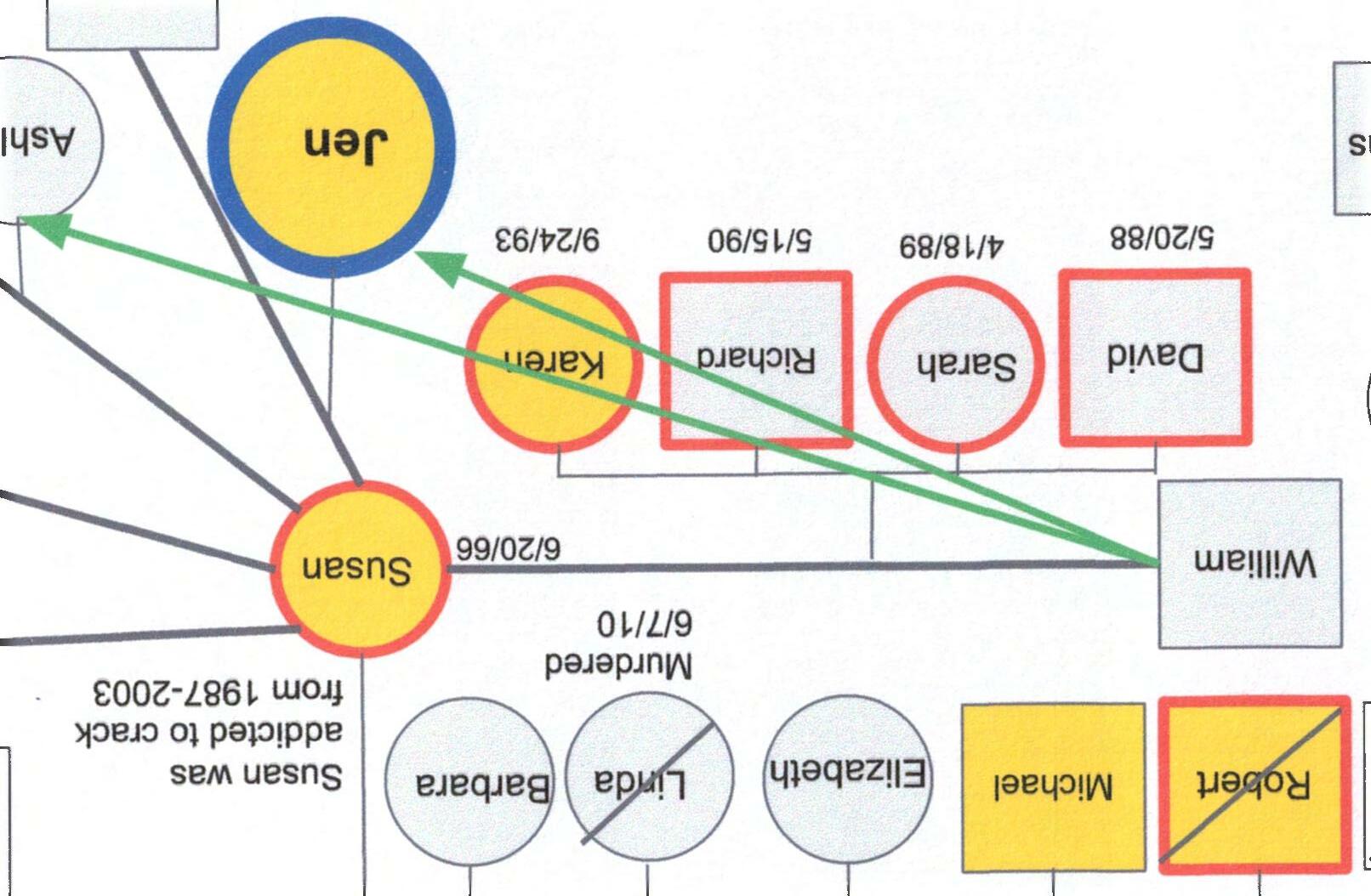


Q = defendant
Mary was Jen's caretaker after James and Patricia . She died when Jen was 18 2/5/38
DOD: 6/22/10
D =substance abuse 1 .,.....,._..,. .---------, Q = criminal history
IZJ =deceased
MM/DD/YY =Date of birth
.... = sexually abused
Jen's Godmother . She was a part-time caretaker 0-3, then primary caretaker 3-4 8
Jen met Thomas when she! Thomas I was 17 and he was 41 yeas old He was physically, psychologically, and emotionally abusive. Jen contracted HIV from Thomas.
James was a primary caretaker; he died when .-----..... Jen was 9-10

Patricia was a primary caretaker with James ; she d. when Jen was 10-11
Susan was
1987-2003

Michael William David 5/20/88 5/15/90
Charles 8/24/47
5/8/83 EJ I ??/??/06 ? ? ? Mairead Burke, LMSW mairead@burkemitigation.com (858) 705-0338
DOD: 2002 from
Chris addicted to crack 3/21/79
EXHIBITR

http://open.lib.umn.edu/intropsyc/ chapter /9-2-the-social-cultural-and-political-aspects-of-intelligence /

Ill 0 u Ill0 QJ ..0 E :::, z About 95% of people fall in this range within 30 points of 100 / . 68°k • About 68% of people fall in this range within 15 points of 100 Less than 2% of people fall in this range~ .,,. Less than 2% of people fall in / this range 34% 34% 13.5% 55 70 85 100 115 130 145 Wechsler intelligence score
EXHIBITS

Complete this form only if you want us to give information or records about you , a minor, or a legally incompetent adult, to an individual or group (for example , a doctor or an insurance company) If you are the natural or adoptive parent or legal guardian, acting on behalf of a minor child , you may complete this form to release only the minor's non-medical records We may charge a fee for providing information unrelated to the administration of a program under the Social Security Act.
NOTE: Do not use this form to :
• Request the release of medical records on behalf of a minor child Instead , visit your local Social Security office or call our tollfree number , 1-800-772- 1213 (TTY-1-800-325-0778) , or
• Request detailed information about your earnings or employment history Instead , complete and mail form SSA-7050-F4 You can obtain form SSA-7050-F4 from your local Social Security office or online at www ssa gov/online/ssa-7050 pdf.
How to Com lete this Form
We will not honor this form unless all required fields are completed An asterisk(*) indicates a required field. Also, we will not honor blanket requests for "any and all records" or the "entire file." You must specify the information you are requesting and you must sign and date this form We may charge a fee to release information for non-program purposes.
• Fill in your name , date of birth, and social security number or the name , date of birth , and social security number of the person to whom the requested information pertains
• Fill in the name and address of the person or organization where you want us to send the requested information
• Specify the reason you want us to release the information.
• Check the box next to the type(s) of information you want us to release including the date ranges , where applicable

• You , the parent or the legal guardian acting on behalf of a minor child or legally incompetent adult , must sign and date this form and provide a daytime phone number.
• If you are not the individual to whom the requested information pertains , state your relationship to that person We may require proof of relationship
PRIVACY ACT STATEMENT
Section 205(a) of the Social Security Act , as amended , authorizes us to collect the information requested on this form We will use the information you provide to respond to your request for access to the records we maintain about you or to process your request to release your records to a third party. You do not have to provide the requested information Your response is voluntary ; however , we cannot honor your request to release information or records about you to another person or organization without your consent. We rarely use the information provided on this form for any purpose other than to respond to requests for SSA records information. However , the Privacy Act (5 U S C § 552a(b)) permits us to disclose the information you provide on this form in accordance with approved routine uses , which include but are not limited to the following:
1 To enable an agency or third party to assist Social Security in establishing rights to Social Security benefits and or coverage ;
2 To make determinations for eligibility in similar health and income maintenance programs at the Federal, State, and local level;
3.To comply with Federal laws requiring the disclosure of the information from our records; and,
4.To facilitate statistical research, audit , or investigative activities necessary to assure the integrity of SSA programs
We may also use the information you provide when we match records by computer . Computer matching programs compare our records with those of other Federal , State , or local government agencies. We use information from these matching programs to establish or verify a person's eligibility for Federally-funded or administered benefit programs and for repayment of incorrect payments or overpayments under these programs Additional information regarding this form, routine uses of information, and other Social Security programs is available on our Internet website, www socialsecurity.gov, or at your local Social Security office.
PAPERWORK REDUCTION ACT STATEMENT
This information collection meets the requirements of 44 U S C § 3507, as amended by section 2 of the Paperwork Reduction Act of 1995. You do not need to answer these questions unless we display a valid Office of Management and Budget control number We estimate that it will take about 3 minutes to read the instructions, gather the facts, and answer the questions SEND OR BRING THE COMPLETED FORM TO YOUR LOCAL SOCIAL SECURITY OFFICE. You can find your local Social Security office through SSA's website at_www socialsecurity gov. Offices are also listed under U.S. Government agencies in your telephone directory or you may call 1-800-772-1213 (TYY 1-800-325-0778). You may send comments on our time estimate above to : SSA , 6401 Security Blvd., Baltimore, MD 21235-6401. Send only comments relating to our time estimate to this address, not the completed form.
Form SSA-3288 (07-2013) EF (07-2013) Destroy Prior Editions
rm Form Approved OMB No 0960-0566
Social Security Administration Consent for Release of Information
Use of Mitigation Evidence Chapter 9 93
Social Security Admin istration
Consent for Release of Information
Form Approved
OMS No 0960 -0566
You must complete all required fields We will not honor your request unless all required fields are completed (*signifies a required field)
TO: Social Security Administration
* My Full Name
*My Date of Birth
*My Social Security Number (MM/DDNYYY)
I authorize the Social Security Administration to release information or records about me to :
* NAME OF PERSON OR ORGANIZATION:

*ADDRESS OF PERSON OR ORGANIZATION:
*I want this information released because:
We may charge a fee to release information for non-program purposes
* Please release the following information selected from the list below: You must specify the records you are requesting by checking at least one box We will not honor a request for "any and all records" or "my entire file " Also , we will not disclose records unless you include the applicable date ranges where requested
1. D Social Security Number
2 D Current monthly Social Security benefit amount
3. D Current monthly Supplemental Security Income payment amount
4. D My benefit or payment amounts from date to date
5. D My Medicare entitlement from date to date _____
6 D Medical records from my claims folder(s) from date to date _____ If you want us to release a minor child's medical records , do not use this form Instead , contact your local Social Security office
7 D Complete medical records from my claims folder(s)
8 D Other record(s) from my file (you must specify the records you are requesting, e.g., doctor report, application, determination or questionnaire)
I am the individual, to whom the requested information or record applies, or the parent or legal guardian of a minor, or the legal guardian of a legally incompetent adult I declare under penalty of perjury (28 CFR § 16.41 (d)(2004)) that I have examined all the information on this fonn, and any accompanying statements or forms, and it is true and correct to the best of my knowledge. I understand that anyone who knowingly or willfully seeks or obtain access to records about another person under false pretenses is punishable by a fine of up to $5,000. I also understand that I must pay all applicable fees for requesting information for a non-program-related purpose.
*Signature:
*Address:
Relationship (if not the subject of the record):
*Date:
*Daytime Phone:
Witnesses must sign this form ONLY if the above signature is by mark (X) If signed by mark (X ), two witnesses to the signing who know the signee must sign below and provide their full addresses. Please print the signee's name next to the mark (X) on the signature line above
1 Signature of witness
Address(Number and street ,City ,State , and Zip Code)
2.Signature of witness
Address(Number and street ,City ,State , and Zip Code)
SSA-3288 (07-2013) EF (07-2013) Use of Mitigation Evidence Chapter 9 94
Form
EXHIBIT T

American with Disabilities Act - Frequently Asked Questions
Title II of the ADA prohibits discrimination against qualified individuals w ith disabilities in all programs, activities, and services of public entities, including courts. The ADA applies to all state and local governments , their d epartments and agencies , and any other instrumentalities or specialpurpose di s tricts of state or local government. 1
1. What is a "disability" under the ADA?
A physical , mental or communication disability that substantially limits one or more of the major life activities such as caring for oneself, performing manual tasks , walking , seeing , hearing , speaking , breathing, learning , and working. Some examples include mobility or other motor disabilities , vision disabilities , speech and hearing disabilities , environmental sensitivities , learning disabilities , and psychological disorders. The disability makes it hard for the person to do activities that most other people can do. It also may restrict the person ' s way of doing things and /or where and for how long the person can do a certain acti v ity or function . People who have a record of such disability or are regarded as having such disability also meet the definition of "disabled" for purpose s of having a reasonable accommodation made.
2. Who is a "qualified" person with a disability?
A qualified person with a di s ability is one who meets the essential eligibility r equirements for the program or service offered by the court with or without reasonable accommodation. For example, in order to be eligible for jury service the statute requires that persons be able to read , speak, and understand the English language. A deaf person reads , speaks and understands the English language , so that person is qualified . However , an accommodation must be made in order for that person to fully participate in jury service Another example would be an attorney who must use a wheelchair is a qualified person with a disability , since s/h e is licensed to practice law in the state. The court must make a reasonable accommodation to assure that the courtroom is accessible for all facets of any proceeding in which the attorney must participate.
3. How does Title Il affect participation in a court's programs, activities, and services?
A court must eliminate any eligibility criteria for participation in programs, activities, and services that screen out or tend to screen out persons with disabilities , unless it can establish that the requirements are necessary for the provision of the service , program, or activity The court may, however, adopt legitimate safety requirements necessary for safe operation if they are based on real risks, not on stereotypes or generalizations about individuals with disabilities. Finally, a court must reasonably modify its policies, practices , or procedures to avoid discrimination.
Use of Mitigation Evidence Chapter 9 96
I http ://www ada gov/t2hlt95. htm
4. Are there any limitations on the program-accessibility requirement?
Yes . A public entity does not have to take any action that it can demonstrate would result in a fundamental alteration in the nature of its program or activity , or in undue financial and administrative burdens This determination can only be made by the head of the public entity or his or her designee and must be accompanied by a written statement of the reasons for reaching that conclusion The determination that undue burdens would result must be based on all resources available for use in the program . If an action would result in such an alteration or such burdens, the public entity must take any other action that would not result in such an alteration or such burdens but would nevertheless ensure that individuals with disabilities receive the benefits and services of the program or activity.
5. What are some examples of the types of modifications in policies and practices that would be reasonable in most cases?
Examples include rewriting policies that categorically exclude people with disabilities from serving on juries , such as people who are deaf or blind ; permitting a witness or spectator with diabetes to consume a snack, such as candy, as needed to maintain blood sugar levels ; permitting persons with celiac disease who require gluten free meals to bring them to court; or explaining the words on an instruction sheet to a citizen who is mentally challenged.
6. Who may request an accommodation?
Any qualified person with a disability who has business in a state court, including attorneys, litigants , defendants , probationers, witnesses , potential jurors , prospective employees and public observers of court services and programs may request reasonable accommodation by contacting the local ADA Coordinator
7. May spectators obtain reasonable accommodation in the courtroom?
Yes , the courts must provide auxiliary aids to courtroom spectators as needed to ensure their equal participation in and benefit from court programs and services. Access to these services must be provided unless the court can demonstrate that the accommodation would result in a fundamental alteration of the nature of a service, program, or activity, or cause an undue financial or administrative burden. For example, an untimely request for accommodation by a spectator need not be granted if it would require a continuation of the court proceedings that would cause the undue administrative burden of rescheduling the parties, attorneys, and witnesses.
8. How is a request for reasonable accommodation submitted?
Each court has an ADA Coordinator who is responsible for arranging reasonable accommodations for people with disabilities. You can access the list of court ADA Coordinators at: htt p: //courts .mi .gov / Se lf- help/Directories/Pages/Court-ADA-Coordinators.aspx.
Use of Mitigation Evidence Chapter 9 97
In addition, the ADA Online Request form is available at: http: //courts mi gov/Administration/SCAO/F orms /courtforms / general/mc70.pdf.
The request should identify the particular court activity or service for which accommodation is sought; the date, time, and location where the accommodation is needed; a description of the disability; and the type of accommodation being requested. All requests for an accommodation will be held confidential.
9. When must the request for accommodation be made?
To avoid causing undue disruption of court proceedings or processes, requests for accommodation must be given with reasonable notice. If the request relates to a jury summons, the individual should contact the Jury Clerk for the court in question as soon in advance as possible. If the request concerns a particular court proceeding, the request should be made as soon in advance as practicable to allow time to consider the request and arrange for reasonable accommodation
10. Is the court required to provide the requested accommodation?
The court, with assistance from the local ADA coordinator, decides what reasonable accommodation can be made. Primary consideration is given to the request of the individual with the disability ; however , an alternative accommodation may be offered if equally effective . The court is not required to make modifications that would fundamentally alter the servi c e or program or cause an undue administrative or financial burden
11. Who pays for the auxiliary aids and services?
Auxiliary aids and services necessary for effective communication or to enable participation in services , other than devices of a personal nature, are to be provided at no cost to the person with the disability. The court is responsible for providing and paying the incurred costs .
12. What kinds of accommodation are available?
The court must ensure that court programs are physically accessible to people with disabilities by removing architectural barriers. Examples of architectural accommodations to facilitate accessibility to people with disabilities are: providing wheelchair ramps (at proper pitch and in safe locations) and wheelchair accessible restrooms in compliance with ADA accessibility standards , as described in the response to FAQ 21 ; allowing suffici ent time for people with disabilities to travel to and from a barrier free restroom ; adjusting the height of public information counters ; labeling facilities with Braille letterin g; providing adequate lighting in the courtrooms for those with vision disabilities ; providing adjustable microphones for witnesses ; altering openings to the well so that wheelchairs can pass through ; allowing jurors and prospective jurors to sit out s ide the jury box or allowing witnesses to sit outside the witness box , as applicable , if those are not accessible for a wheelchair or if steps are
Use of Mitigation Evidence Chapter 9 98
required for persons who cannot easily climb up or down them. For additional accommodations that may be provided to people with specific disabilities, see the answers to FAQ 14 through FAQ 18
13. What does the requirement for effective communication mean in a court?
The court must ensure that its communications with people with disabilities are as effective as communications with others so that all can fully participate and enjoy the services and programs provided. The provision of auxiliary aids and services, at no charge , may be a reasonable accommodation to ensure effective communication for a person with a hearing, visual or speech disability. The type of auxiliary aid or service necessary to ensure effective communication will vary in accordance with the length and complexity of the communication involved and the individual's specific disability and preferred mode of communication . Every effort shall be made to meet the specific needs of the individual. The court is not responsible, however, for providing devices of a personal nature such as prescription eyeglasses , hearing aids, wheelchairs, and / or personal medical or attendant care.
14. What types of accommodations are available to assist people who are deaf or hard of hearing?
Depending on the needs of the individual and the nature of the impairment, an accommodation may involve:
• allowing the person to sit where he or she can hear better;
• allowing use of a telecommunication system to communicate;
• providing a qualified sign interpreter appointed by the court ;
• or providing an assistive listening system or computer-aided transcription device.
Some deaf and hard of hearing people rely on written notes to communicate with hearing people Although writing can supplement other modes of communication, using it exclusively is tedious, cumbersome, and time-consuming. Also, since literacy levels vary as with any population, it is not accurate to assume that written notes will be effective for all deaf or hard of hearing people.
A common misconception is that all deaf and hard of hearing people can read lips. However, very few people can read lips well enough to understand speech , even under optimum conditions.
Below are several effective ways to telecommunicate with deaf, hard of hearing, and speech impaired people: ·
A. Text Telephone (TTY)
This is a special type of telephone with a keyboard and a small screen where typed text appears Every court should consider having a TTY to handle · incoming calls and for the public to use - the equivalent of a public phone booth.
Use of Mitigation Evidence Chapter 9 99
B. Email
Another text-based way to communicate is to use email through a computer, a web-enabled pager system, or a personal digital assistant.
C. Telecommunications Relay Service (TRS)
Telecommunications Relay Service (TRS) is a telephone service that allows persons with hearing or speech disabilities to place and receive telephone calls. TRS is available in all 50 states, the District of Columbia, Puerto Rico , and the U.S. territories for local and/or long distance calls. TRS providers - generally telephone companies - are compensated for the costs of providing TRS from either a state or a federal fund. There is no cost to the TRS user.
1. How Does TRS Work?
TRS uses operators, called communications assistants (CAs), to facilitate telephone calls between people with hearing and speech disabilities and other individuals. A TRS call may be initiated by either a person with a hearing or speech disability, or a person without such disability. When a person with a hearing or speech disability initiates a TRS call, the person uses a TTY or other text input device to call the TRS relay center, and gives a CA the number of the party that he or she wants to call. The CA in tum places an outbound traditional voice call to that person. The CA then serves as a link for the call, relaying the text of the calling party in voice to the called party, and converting to text what the called party voices back to the calling party.
2. What Forms ofTRS Are Available?
There are several forms ofTRS , depending on the particular needs of the user and the equipment available .
a. Text-to-Voice TTY-based TRS - With this type of"traditiona l" TRS, a person with a hearing or speech disability uses a special text telephone, called a TTY , to call the CA at the relay center. TTYs have a keyboard and allow people to type their telephone conversations. The text is read on a display screen and / or a paper printout. A TTY user calls a TRS relay center and types the number of the person he or she wishes to call . The CA at the relay center then makes a voice telephone call to the other party to the ca ll , and relays the call back and forth between the parties by speaking what a text user types, and typing what a voice telephone user speaks.
b. Voice Carry Over - Voice Carry Over (VCO) is a type of TRS that allows a person with a hearing disability, but who wants to use his or her own voice, to speak directly to the called party and receive responses in text from the CA. No typing is required by the calling party. This service is particularly useful to senior citizens who have lost their hearing, but who can still speak.
Use of Mitigation Evidence Chapter 9 100
c. Hearing Carry Over - Hearing Carry Over (HCO) is a type of TRS that allows a person with a speech disability, but who wants to use his/her own hearing, to listen to the called party and type his/her part of the conversation on a TTY. The CA reads these words to the called party, and the caller hears responses directly from the called party.
d. Speech-to-Speech (STS) Relay Service - This form of TRS is used by a person with a speech disability. A CA, who is specially trained in understanding a variety of speech disorders, repeats what the caller says in a manner that makes the caller's words clear and understandable to the called party. No special telephone is needed. For more information regarding STS visit www.fcc.gov/cgb/consumerfacts/speechtospeech.html.
e. Shared Non-English Language Relay Services - Due to the large number of Spanish speakers in the United States, the FCC requires interstate TRS providers to offer Spanish-to-Spanish traditional TRS. Although Spanish language relay is not required for intrastate (within a state) TRS, many states with large numbers of Spanish speakers offer this service on a voluntary basis. The FCC also allows TRS providers who voluntarily offer other shared non-English language interstate TRS, such as French-to-French, to be compensated from the federal TRS fund.
f. Captioned Telephone Service - Captioned telephone service, like VCO, is used by persons with a hearing disability but some residual hearing. It uses a special telephone that has a text screen to display captions of what the other paiiy to the conversation is saying. A captioned telephone allows the user, on one line, to speak to the called party and to simultaneously listen to the other party and read captions of what the other party is saying There is a "two- line " version of captioned telephone service that offers additional features, such as call waiting, *69, call forwarding, and direct dialing for 911 emergency service. Unlike traditional TRS (where the CA types what the called party says), the CA repeats or re-voices what the called party says. Speech recognition technology automatically transcribes the CA's voice into text, which is then transmitted directly to the user's captioned telephone text display.
g. Video Relay Service (YRS) - This Internet-based form of TRS allows persons whose primary language is American Sign Language (ASL) to communicate with the CA in ASL using video conferencing equipment. The CA speaks what is signed to the called party, and signs the called party's response back to the caller. VRS is not required by the FCC, but is offered by several TRS providers. VRS allows conversations to flow in near real time and in a faster and more natural manner than text-based TRS. Beginning January 1, 2006, TRS providers that offer VRS must provide it 24 hours a day, seven days a week, and must answer incoming calls within a specific period of time so that VRS users do not have to wait for a long time. For more information regarding VRS visit www .fcc.gov/cgb/consumerfacts/videorelay.html.
h. Internet Protocol UP) Relay Service - IP Relay is a text-based form of TRS that uses the Internet, rather than traditional telephone lines, for the leg of the call between the person with a hearing or speech disability and
Use of Mitigation Evidence Chapter 9 101
the CA. Otherwise, the call is generally handled just like a TTY-based TRS call. The user may use a computer or other web-enabled device to communicate with the CA. IP Relay is not required by the FCC, but is offered by several TRS providers. For more information regarding IP Relay , visit www.fcc gov/ cgb/ consumerfacts / iprelay.html.
1. IP Captioned Telephone Service - IP captioned telephone service, one of the newest forms of TRS, combines elements of captioned telephone service and IP Relay . IP captioned telephone service can be provided in a variety of ways, but uses the Internet - rather than the telephone networkto provide the link and captions between the caller with a hearing disability and the CA. It allows the user to simultaneously both listen to, and read the text of, what the other party in a telephone conversation is saying. IP captioned telephone service can be used with an existing voice telephone and a computer or other Web-enabled device without requiring any specialized equipment. For more information regarding IP captioned telephone service, visit www.fcc.gov/cgb/consumerfacts/ipcaptioned.html.
3. 711 Access to TRS
Just as you can call 411 for information, you can dial 711 to connect to certain forms ofTRS anywhere in the United States. Dialing 711 makes it easier for travelers to use TRS because they do not have to remember TRS numbers in every state. Because of technological limitations, however, 711 access is not available for the Internet-based forms of TRS (YRS and IP Relay).
For more information regarding 711, visit www fcc.gov/cgb/consumerfacts/711.htrnl
D. Sign Language and Interpreters
Many deaf and hard of hearing people use American Sign Language (ASL) rather than spoken English as their primary mode of communication. ASL is a natural language recognized globally and used by members of the deaf community here in the United States. It is linguistically complete with unique rules for language structure and use that include phonology, morphology , syntax , semantics , and discourse.
Family members or amateurs who know some sign language should never interpret for a court-related process. They may lack the techniques and skills needed for effective interpretation, generally are not familiar with court terminology and protocols , and have difficulty being neutral in the process
Not all deaf or hard of hearing people are proficient in American Sign Language . Occasionally, it will be necessary to use other means of ensuring communication. A person who is both deaf and blind may need an interpreter skilled in tactile communication Some deaf and hard of hearing people do not use sign language but require an "oral" interpreter who silently mouths the speaker ' s words to them.
Use of Mitigation Evidence Chapter 9 102
Complete information on sign language interpreters can be found at: http ://www6. di eg state mi us / interpreter/
E. Assistive Listening Systems
Assistive Listening Systems transmit sound as directly as possible to a hearing aid. Such systems should not be confused with audio systems that are designed to make the sound louder. Rather than enhancing all the sounds in the room, an assistive listening device can bring specific sounds directly to the user's ears.
F. Real-Time Transcription
Real-time transcription works effectively for individuals who have strong reading skills and for those who do not know sign language. Because of the speed of the transcription, it will not work for slow readers.
15. What types of accommodations are available to assist people who are legally blind or visually disabled?
Depending on the needs of the individual and the nature of the disability , accommodation may involve: providing forms and instructions in Braille, large print or on audio tape ; providing assistance at the counter in filling out necessary paperwork; having written materials read out loud in the courtroom; allowing the person to sit closer than usual if they have limited vision; or providing additional lighting if the lighting is a problem
People who are blind or visually disabled often can be assisted by increasing the size of an object, by changing viewing distance , by improving illumination , and by improving contrast. Changing size and distance go hand in hand. Size can be changed in several different ways : an object can be made larger (such as a big-button telephone), materials can be reproduced larger (such as large print), a nearby object can be enlarged (using a magnifier) , or a far-away object can be enlarged (using a telescope) . Devices can be set into glass frames , some of which are bi-optic.
The most critical consideration for a low-vision individual is lighting The midday offers the best light. Halogen bulbs and lamps that place direct light on a subject are highly recommended . When considering which bulbs to use, incandescent bulbs with a high wattage are preferred over florescent. Florescent bulbs throw off a glaring blue light. If the person with a visual disability is referring to notes, additional light (such as a gooseneck lamp) may be necessary .
Contrast in written materials also can be important. The more words crowded onto a page and the more similar the ink and paper colors , the less one can discriminate. Using 14-point or larger black type on yellow paper will greatly increase the readability of materials .
Use of Mitigation Evidence Chapter 9 103
16. What types of accom m odatio n s are availab l e to assist p eo p le wit h mob ility disabilities?
Depending on the needs of the individual and the nature of the disability, accommodation may include: having the clerk mail out forms to a person limited in his or her ability to v isit the courthouse ; or holding a proceeding in a more accessible location .
Depending on the nature of the disability and the preferences of the person with the disability , i t may be a reasonable accommodation to allow the testimony of a witness to be videotaped , or the use of v ideo conferencing technology in lieu of a personal appearance These types of accommodations may be offered, but should not be forced on a person with a mobility disability Often , the types of accommodations discussed in the response to FAQ 12 are preferable to the person with the disability and are perceived to be more respectful of that person ' s individual rights to appear and participate in court proceedings.
Many persons with limited mobility do not initially appear to have a disability, particularly if they do not use a cane or other assistive device. A disability may become apparent only when the per s on moves about the court facility with difficulty or when a crowd or rush of people affects the person ' s balance. Signs of a limitation of mobility include unsteadiness , walking slowly, aberrations in gait , holding back , or requiring unusual time to get around the court facility or to follow instructions related to movement. When these conditions are observed , it may be appropriate for court personnel to ask if any assistance is required and, when necessary , to alert the judge that more time may be needed by the individual. Accommodations for such persons usually require no extra court personnel or other additional expense.
Loss of balance and falling are significant risks to persons oflirnited mobility in unfamiliar public places. What accommodations are reasonable and helpful to minimize these risks?
• Proactively anticipate and minimize these risks . Conspicuously mark changes in elevation and mark the top of steps or stairs. Don't overly polish floors , and use products that minimize slipperiness. Have consistent and adequate lighting .
• Have adequate seating for persons who have to wait.
• Offer adequate time for breaks when a person with limited mobility is in the courtroom so the person does not have to rush.
• Offer the person access to elevators , when available , and opportunities to sit and remain seated when others are expected to stand .
• Offer alternate restroom facilities if the public facilities are not close to the courtroom involved.
Use of Mitigation Evidence Chapter 9 104
• Avoid risks for an individua l who has difficulty climbing even a few steps or accessing positions in a jury box with different elevations either by offering a chair nearby or having a security person extend an arm to help steady the individual. This can be particularly problematic if a prospective juror of limited mobility is excused during voir dire and has to pass by other prospective jurors who are seated .
• Encourage court personnel to recognize and be responsive to mobil i ty limitations , such as by avoiding unnecessary rushing, not walking closely behind a person who is moving slowly , and not passing the person from behind on the right side as opposed to the left side. These and other similar actions can be surprising and can affect a person ' s balance.
• Refrain from giving hands-on assistance without first asking (except when a person is in the process of falling) , as an unexpected touching may affect the person ' s balance.
• Ask how best to help a person who has fallen ; don't attempt to assist the person without consent. Fall s are inherently unexpected. The person may need time to gather composure , assess whether there is an injury , or use individual means that work best for that p ers on to get to a standing position. After the person is up , it is helpful to offer a chair and offer water.
• Don't mov e a person who has fallen and cannot move, does not want to move, or is unconscious . Call an emergency medical service or other trained personnel to minimize further injury Block off the area until help arrives
Re-evaluate handicap parking All too frequently, handicap spaces are not the closest to the main building entrance. At least some spaces should be near the entrance . If a ramp starts at some distance from the entrance, some handicap spaces should be near the entrance and some near the bottom of the ramp.
17 . W h at types of acc ommod ati on s are ava il abl e to ass ist p eopl e w i th co gni tive or d eve l opm en t al di s abili ti es?
Developmental disability is an umbrella term referring to disabilities present before an individual reaches 22 years of age. Examples of developmental disabilities are cerebral palsy , epilepsy , autism , hearing loss , Down syndrome , mental retardation , spinal injury , or brain injury. Cognitive di s abilities refer to any disability affecting mental processes. Examples include mental retardation , attention deficit hyperactivity disorder (ADHD), dyslexia, Alzheimer's disease , aphasia , brain injury, language delay, and learning disabilities . Remember that many individuals with developmental and cognitive disabilities may not have limited intellectual functioning Those that do may require accommodation.
Depending on the needs of the individual and the nature of the disability , accommodation may include : having the court and witnesses ta lk slowly or write things down; when
Use of Mitigation Evidence Chapter 9 105
necessary , repeating information using different wording or a different communication approach , allowing tim e for information to be fully understood ; presenting information in a clear, concise , concrete and simple manner ; when necessary , taking periodic breaks; presenting tasks in a step-b y -step manner, letting the individual perform each step after explanation ; scheduling court proceedings at a different time to meet the medical needs of the individual ; providing a coach or support person at the proceeding ; or allowing v ideotaped testimony or the use of video conferencing technology in lieu of a personal appearance
18. What types of accommodations are available to assist people with psychiatric disabilities?
A person with a psychiatric disability is someone with a mental illness , which significantly interferes with that person's performance of major life activities , such as learning , thinking , communicating , and sleeping , among others The most common forms of mental illnesses resulting in psychiatric disabilities are anxiety disorders , depressive disorders , and schizophrenia Anxiety disorders are the most common group of mental illnesses and include panic disorder, phobias , obsessive-compulsive disorder, and post-traumatic stress disorder characteri z ed b y severe fear or anxiety associated with particular objects and situations. Depressive disorders include major depression , manicdepressive illness , and seasonal affective disorder characterized by disturbances or changes in mood s. Schizophrenia is a highly complex illness characterized by thoughts that seem fragmented and difficulty processing information.
Depending on the needs of the individual and the nature of the disability , accommodation may include : scheduling court proceedings at ce1tain times to coincide with medication requirements or effects ; pre s enting information in a different manner to be better processed by the individual such as providing instructions in a written or recorded format ; changing procedures as they relate to the interaction with witnesses and court staff in the courtroom; eliminating distractions ; speaking slowly and distinctly ; or allowing videotaped testimony or the use of video conferencing technology in lieu of a personal appearance.
19. What if the request for accommodation is denied?
Each court should have a local policy or local administrative order regarding the ADA and the grievance procedure adopted by the court.
20.
What does the ADA require for accessibility to court facilities?
Courts must ensure that indi v iduals with disabilities are not excluded from services , programs , and activities because existing buildings are inaccessible Court programs , when viewed in their entirety, must be readily accessible to and usable by individuals with disabilities This standard , known as program accessibility , applies to court facilities that existed on January 26 , 1992. Courts do not necessarily have to make each of their existing facilities accessible if the service , program, or activity can be made accessible in another manner . For example, if a court holds hearings on the second floor
Use of Mitigation Evidence Chapter 9 106
of a building without elevators, it can make the program accessible by holding the hearings in an accessible room on the first floor or in another facility. The specific judicial system will be viewed in its entirety when determining accessibility. Therefore, if the court system in a particular jurisdiction consists of numerous facilities, and a specific proceeding can be moved within reason from an inaccessible facility to an accessible facility, the specific judicial system would be in compliance with the programaccessibility requirements.
21. How can a court determine if a new building is accessible?
A court facility will be in compliance with the ADA for new construction and alterations if it follows either of two accessibility standards. It can choose either the Uniform Federal Accessibility Standards (UFAS) or The Americans with Disabilities Act Standards for Accessible Design (ADA Standards). If the court chooses the ADA Standards, it is not entitled to the elevator exemption (which permits certain private buildings under three stories or under 3,000 square feet per floor to be constructed without an elevator). The ADA Standards contain requirements necessary to make a building or other facility architecturally (physically) accessible to people with disabilities. The ADA Standards identify what features need to be accessible, set forth the number of those features that need to be made accessible, and then provide the specific measurements, dimensions and other technical information needed to make the feature accessible.
22. What are the alteration requirements for historic court buildings?
Alteration to historic courthouses must comply with the specific provisions governing historic properties in ADA Standards or UF AS to the maximum extent feasible. Under those provisions, alterations should be done in full compliance with the alterations standards for other types of buildings. However, if following the usual standards would threaten or destroy the historic significance of a feature of the courthouse, alternative standards may be used The decision to use alternative standards for that feature must be made in consultation with the appropriate historic advisory board designated in ADA Standards or UFAS, and interested persons, including those with disabilities, should be invited to participate in the
decision-making
process .
The alternative requirements for historic buildings or facilities provide for minimal levels of access. For example:
• An accessible route is only required from one site access point (such as the parking lot).
• A ramp may be steeper than is ordinarily permitted.
• The accessible entrance does not need to be the one used by the general public.
• Only one accessible toilet is required , and it may be unisex.
• Accessible routes are required on the level of the accessible entrance and on other levels where practicable.
Use of Mitigation Evidence Chapter 9 107
23. What type of funding is available to help courts comply with the ADA?
The Department of Justice occasionally has funding available for ADA related projects and technical assistance. Their website address is http ://www.justice.gov/
24. What options are available to a court if it determines that it cannot adequately provide the requested accommodation?
Courts should consider contacting local advocacy groups, libraries, or other entities that may have resources available at no or minimal costs.
25. What is an assistance animal?
Assistance animals help people with disabilities in their day-to-day activities. Some examples include: guiding a blind or visually disabled person; alerting people with hearing impairments to sounds ; pulling wheelchairs or carrying and picking up things for people with mobility disabilities; and assisting people with mobility disabilities with balance.
26. Are assistance animals allowed in the courts?
An assistance animal must be permitted to accompany the individual with a disability to all areas of the facility where customers are normally allowed to go 2 An individual with an assistance dog may not be segregated from other members of the public
The care and supervision of the assistance dog is the sole responsibility of the owner. The court is not required to provide care , food or a special location for the animal.
What if an assistance dog barks or growls at other people , or otherwise acts out of control or disruptive to the courtroom proceedings? It first must be noted that assistance dogs have special training and often are bred , selected and continued in their training programs for their ability to function in difficult circumstances Usually , an assistance dog that acts inappropriately does so as a response to the possibly inappropriate actions of others in the immediate area . When an assistance dog is present, the owner should be consulted as to how to encourage others to act in an appropriate manner. This is usually best done by advising them to ignore the dog ' s presence, not to speak to the dog or touch it , to allow it to do its work in an unfettered way , and not to take any actions that could be perceived as presenting a danger to the owner. In the rare instance when disruptive behavior happens , an assistance dog may be excluded from the courthouse if there is reason to believe the animal's behavior poses a direct threat to the health or safety of others. A service animal that displays vicious behavior towards other customers may be excluded. In addition , a court is not required to accommodate an assistance animal if it would result in a fundamental alteration to the nature of the business . A dog that barks during a hearing may be excluded; however, before excluding an assistance dog, the owner and possibly experts familiar with the particular type of assistance dog and its training should be consulted to determine what other measures short of exclusion may be taken. The owner 2
MCL 3 7.1302 Use of Mitigation Evidence Chapter 9 108
can most likely assist in identifying experts who may be affiliated with the dog 's training program. In the event an assistance dog is excluded, the individual with the disability should be given the option of continuing his or her participation in the court services. Most importantly, there should be consultation with the owner and possibly with experts in how best to exclude the animal with minimal disruption to its current and future ability to be of service.
General ADA Compliance in Courts
27. What is a self-evaluation and what does it require courts to do?
A self-evaluation is a public entity ' s assessment of its current policies and practices. The ADA requires that courts perform a self-assessment of their programs, services , and facilities to determine whether the courts are in compliance with the act. The selfevaluation identifies and corrects those policies and practices that are inconsistent with Title II's requirements. If the self-assessment identifies areas in which the court is not in compliance with the ADA, the court must formulate a plan to address the problems. All public entities , including courts, should have completed a self-evaluation by January 26, 1993. Structural changes to achieve program accessibility should have been completed by January 26 , 1995. A court that has not completed its self-evaluation transition plan should take steps to do so .
28. Who has the responsibility for ADA compliance when courts are located in buildings that are owned or leased by another government agency?
The ADA places the legal obligation on each agency respectively. When agencies share the same building, they can work to ensure that facility modifications are made as needed to provide program accessibility. Each agency is responsible for ensuring effective communication and for providing auxiliary aids and services as needed. It is often possible to share resources or equipment, such as assistive listening systems or Braille printers.
Use of Mitigation Evidence Chapter 9 109
EXHIBITU

- -----~
INSTRUCTION AND INFORMATION SHEET FOR SF 180, REQUEST PERTAINING TO MILITARY RECORDS
1. General Information. The Standard Form 180, Request Pertaining to Military Records (SF180) is used to request information from military records Certain identifying information is necessary to determine the loc ation of an individual's record of military service. Please try to answer each item on the SF 180 If you do not have and cannot obtain the information for an item , show "NA," meaning the informat ion is "not avai lable ". Include as much of the requested information as you can. Incomplete information may delay response time To determine where to mail this request see Page 2 of the SF 180 for record locations and facility addresses.
Online requests may be su bmitted to the National Personnel Records Center (NPRC) by a veteran or deceased veteran's next-of-kin using eVetRecs at http: //www .archives.gov/ veterans/ military-service-records/
2. Personnel Records/Military Human Resource Records/Official Military Personnel File (OMPF) and Medical Records /S ervice Treatment Records (STR). Personnel records of military members who were di scharged , retired, or died in service LESS THAN 62 YEARS AGO and medical records are in the legal custody of the military service department and are administe red in accordance with rules issued by the Department of Defense and the Department of Homeland Security (OHS, Coast Guard). STRs of persons on active duty are generally kept at the local servicing clinic. After the last day of active duty , STRs should be requested from the appropriate address on page 2 of the SF 180. (See item 3, Archival Records, if the military member was discharged, retired or died in service more than 62 years ago.)
a. Release of information: Release of information is subject to restrictions imposed by the military services consistent with Department of Defense regulations, the provisions of the Freedom of Information Act (FOIA) and the Privacy Act of 1974. The service member (either past or present) or the member's legal guardian has access to almost any information contained in that member's own record. The authorization s ignature of the service member or the member's legal guardian is need ed in Section III of the SFI 80. Others requesting information from military personnel records and / or STRs must have the release aut hori zation in Section III of the SF 180 signed by the member or legal guardian. If the appropriate signature cannot be obtained, only limited types of information can be provided. If the former member is deceased, the surviving next-of-kin may , under certain circumstances, be entitled to greater access to a deceased veteran's records than a member of the general public The next-of-kin may be any of the following: unremarried surviving spouse, father , mother, son, daughter, sister, or brother. Requesters MUST provi d e proof of deat h , s uc h as a copy of a death certificate, newspaper article (o b ituary) or death notice, coroner's report of death, funeral director's signed statement of death, or verdict of coroner's jury.
b Fees for records: There is no charge for most services provided to service members or next-of-kin of deceased veterans. A nominal fee is charged for certain types of service. In most instances , service fees cannot be determined in advance. If your request involves a service fee , you will recei ve an invoice with your records
3. Archival Records. Personnel records of military members who were discharged, retired, or died in service 62 OR MORE YEARS AGO have been transferred to the legal custody of NARA and are referred to as "arc hival records".
a. Release of Information: Archival records are open to the public The Privacy Act of 1974 does not apply to archival records, therefore, written authorization from the veteran or next-of-kin is not required In order to protect the privacy of the veteran, his/her family, and third parties named in the records , the personal privacy exemption of the Freedom of Information Act (5 U.S .C. 552 (b) (6)) may still apply and may preclude the release of some information.
b. Fees for Archival Records : Access to archival records are granted by offering copies of the records for a fee (44 U.S.C. 2116 (c)). If a fee applies to the photocopies of documents in the requested record , you will receive an invoice. Photocopies will be sent after payment is made For more information see http ://www.arc hive s.gov/s t-louis /archival-programs/military-personnel-archival/ompf-archival-requests html
4. Where reply may be sent. The reply may be sent to the service member or any other address designated by the service member or other authorized requester lfthe designated address is NOT registered to the addressee by the U.S. Postal Service (USPS) , provide BOTH the addressee's name AND "in ca re of' (c/ o) the name of the person to whom the address is registered on the NAME line in Section l!T, item 3, on page l of the SF 180. The COMPLETE address must be provided, INCLUDING any apartment/suite/unit/lot/space/etc. number.
S. Definitions and abbreviations. DISCHARGED the individual has no current military status; SERVICE TREATMENT RECORD (STR) - The chronology of medical , mental health, and dental care received by service members during the course of their military career (does not include records of treatment while hospitalized) ; TDRL- Temporary Disability Retired List.
6. Service completed before World War I. National Archives Trust Fund (NATF) forms mus t be used to request these records. Obtain the forms byemail from i11quire@11ara.gov or write to the Code 6 a ddress on page 2 of the SF 180.
PRIVACY ACT OF 1974 COMPLIANCE INFORMATION
The fol lowing information is provided in accordance with 5 U.S.C. 552a(e)(3) and applies to this form. Authority for col lection of the infonnation is 44 U.S.C. 2907, 3101, and 3103, and Public Law I 04-134 (April 26, 1996), as amended in title 31, section 7701. Disclosure of the information is vo luntary. [f the requested information is not provided, it may del ay servicing your inquiry because the faci lity servicing the service member's record may not have all of the information needed to locate it. The purpose of the information on th.is form is to assist the facility servicing the records (see the address list) in locating the correct military service record( s) or information to answer your inquiry This form is then retained as a record of disclosure. The form may also be disclosed to Department of Defense components , the Department of Veteran s Affairs , the Department of Homeland Security (OHS, U.S. Coast Guard) , or the National Archives and Records Administration when the original custodian of the military health and personnel records transfers all or patt of those reco rds to that agency. If the service member was a member of the National Guard , the form may also be disclosed to the Adjutant General of the appropriate state, District of Columbia, or Puerto Rico , where he or she served.
PAPERWORK REDUCTION ACT PUBLIC BURDEN STATEMENT
Public burden reporting for this collection of information is es tim ated to be five minutes per request, including time for reviewing instructions and completing and reviewing the collection of information. Send comments regarding the burden estimate or any other aspect of the collection of inform ation, including suggestions for reducing this burden , to National Archives and Records Administration (ISSD), 860 l Adelphi Road , College Park , MD 207406001. DO NOT SEND COMPLETED FORMS TO THIS ADDRESS. SEND COMPLETED FORMS TO THE APPROPRIATE ADDRESS LISTED ON PAGE 2 OF THE SF 180.
Use of Mitigation Evidence Chapter 9 111
Standard Form 180 (Rev. 11/2015) (Page I)

Prescribed by NARA (36 CFR 1233.18 (d))
REQUEST PERTAINING TO MILITARY RECORDS
Requests from veterans or deceased veteran's next-of-kin may be submitted online by using eVetRecs at http:
To ensure the best possible service, please thoroughly review the accompanying instructions before filling out this
1. NAME USED DURING SERVICE (last, first, full middle)
5. SERVICE, PAST AND PRESENT (For an effective records search, it is important that ALL service be shown below)

a. ACTIVE -


b. RESERVE - D D
c. STATE D D NATIONALGUARD
6. JS THIS PERSON DECEASED? D NO D YES - MUST provide Dale of Death if veteran is deceased:
7. DID THIS PERSON RETIRE FROM MILITARY SERVICE? 0 NO O YES
SECTION II-INFORMATION AND/OR DOCUMENTS REQUESTED
1. CHECK THE ITEM(S) YOU ARE REQUESTING:
DD Form 214 or equivalent. Year(s) in which form(s) iss ued to veteran: This form contains information normally needed to verify military service. A copy may be sent to the veteran, the deceased veteran 's next-of-kin, or other persons or organizations, if authorized in Section ill, below An UNDELETED DD214 is ordinarily required to determine eligibility for benefits. If you request a DELETED copy, the following items will be blacked out: authority for separation, reason for separation, reenlistment eligibility code, separation (SPD/ SPN) code, and, for separations after June 30, 1979, character of separation and dates of time lost. An UNDELETED copy will be sent UNLESS YOU SPECIFY A DELETED COPY by checking this box: 0 I want a DELETED copy.
D Medical Records Includes Service Treatment Records, Health (outpatient) and Dental Records. IF HOSPITALIZED (inpatient) the FACILITY NAME and DATE (month and ye ar) for EA CH admission MUST be provided: D Other (Specify):
2. PURPOSE: (Providing information about the purpose of the request is strictly voluntary; however, it may help to provide the best possible response and may re su lt in a faster reply Information provided will in no way be used to make a decision to deny the request.)
Explain here:---
1.
2. D I am the MILITARY SERVICE MEMBER OR VETERAN identified in Section I , above. D I am the DECEASED VETERAN'S NEXT-OF-KIN (MUST submit Proof of Death. See item 2a on instruction sheet.)

(Relationship to deceased veteran)
3. SEND INFORMATION/DOCUMENTS TO: (Please print or type. See item 4 on accompanying instructions.)
DII am the VETERAN'S LEGAL GUARDIAN (MUST submit copy of Court Appointment) or AUTHORIZED REPRESENT ATJYE (MUST subMit capy of Authoriz,uion Letter or Power ofAllorney) OTHER
(Specify type of Other)
4. AUTHORIZATION SIGNATURE: I declare (or certify, verify, or state) under penalty of perjury under the laws of the United States of America that the information in this Section m is true and correct and that I authorize the release of the requested information. (See items 2a or
3a on accompanying instruction sheet Without the Authorization Signature of the veteran, next-o.fkin ofdeceased veteran, veteran's legal guardian, authorized government agent, or other authorized representative, only limited information can be released unless the request is archival No signature is required if the request iffor archival records .)
Signature Required - Do not print
• This form is available at http:llw ww.archives.gov/veteranslmilitary-servicerecords/sta ndard-form-180.html on the National Archives and Records Administration (NARA) web site. •
Authorized for local reproduction Previous edition unusable OMB No. 3095-0029 Expires 04/30/2018
terans/military-service-records/
PLEASE PRINT LEGIBLY OR TYPE BELOW SECTION l - INFORMATION NEEDED TO LOCATE RECORDS (Furnish as much information as possible.) l
//www.a rchives.gov/ve
form
2. SOCIAL SECURITY# 3. DATE OF BIRTH 4. PLACE OF BIRTH
DATE DATE SERVICE NUMBER BRANCH OF
ENTERED RELEASED OFFICER ENLISTED (If unknown, write " unknown ")
SERVICE
D
D
D
D Benefits (explain) D Employment D VA Loan Programs D Medical D Genealogy D Correction D Personal O Other (explain)
SECTION III- RETURN ADDRESS AND SIGNATURE
Name Street Apt. City State
Zip Code
Daytime phone Fax Number Email address Date Use of Mitigation Evidence Chapter 9 112
Standard Form 180 (Rev. 11 / 2015) ( P age 2) Prescribed b y NARA (36 CFR 1233.18 (d)) Autho rized for local reproduction


Th e va ri ou s ca tegor ies of m ili tary se rvice reco rd s are desc ri bed in t he c hart be low. Fo r eac h category t here is a co de numb er w hi c h indi ca

Previous editio n unusable OMB No. 3095-0029 Ex p ires 04/ 30/ 20 18
at t he bott om of th e
tru ct ion a nd In fo rm a ti on Sh eet acco mpany in g thi s fo rm as need ed BRANC H CU R R EN T S TAT US OF SE RVI CE MEM B E R Perso nn e l M e dical or Service R ecor d T r eat m e n t R ecord Discharged , deceased , or retired before 5/ J/1994 14 14 Discharged , deceased, or retired 5/ 1/ 1994 - 9/30/ 2004 14 II Discharged , deceased, or retired I O/l / 2004 - 12/31 / 2013 I II AI R Discharged , deceased, or relired on or after 1/ 1/ 2014 I 13 FO R CE Active (including Natio nal Guard on active duty in t he Air Force) , TDRL, or ge neral officers retired with pay I Reserve , fRR , Retired Reserve in non-pay status, current National Guard officers not on active duty in the Air Force , or Nationa l Guard 2 released from active duty in t he Air Force C urrent Nationa l Guard enl isted not on act ive duty in the Air Force 2 13 Discharge, deceased , o r retired before 1/ 1/ 1898 6 D ischa rged , deceased, or retired III /1898 - 3/3 1/1998 14 14 C O AS T Discharged, deceased, or retired 4/ 1/ 1998 - 9/30/2006 14 I I GU ARD D ischarged, deceased, or retired I O/l / 2006 - 9/30/ 2013 3 II Discharged , deceased, or retired on or after I0/ 1/ 2013 3 14 Active, Reserve, Individual Ready Reserve or TDRL 3 Discharged, deceased, or retired before 1/ 1/ 1895 6 Discharged , deceased , or retired 1/111905 - 4/3011994 14 14 Discharged , deceased, o r retired 5/ 111994 - 12/ 31/1998 14 II M A R I NE Discharged, deceased, or retired 1/ 1/1999 - 12/31/2013 C ORP S 4 II Discharged , deceased, o r retired on or after 1/ 1/2014 4 8 Ind ivid ual Ready Reserve 5 Active, Selected Marine Co rps Reserve, TDRL 4 Discharged, deceased, orrclircd before 1 1/Ill 912 (enlisted) or before 7/1/1917 (office r) 6 Discharged , deceased, or retired 11 / 1/ 1912 - I 011511992 (enlisted) or 7/ 1/1917 - I 0/15 / 1992 (officer) 14 D ischarged, deceased, or retired I 0/ 16/ 1992 - 9/ 30/ 2002 14 JI A R M Y D ischa rged , deceased, or retired (including TDRL) I 0/ 1/ 2002 - 12/31 / 2013 7 II D ischa rged, deceased, or retired (including TDRL) on or after J/ J/ 2014 7 9 Current Soldier (Active, Reserve (including Individual Ready Reserve) or National G uard) 7 D ischarged, deceased , or retired before I/J/1886 (enlisted) or before 1/ 1/ 1903 (officer) 6 Discharged, deceased , or retired 1/ 1/ 1886 - 1/30/ 1994 (enl isted) or 1/ 1/1903 - 1/30/1994 (officer) 14 14 Discharged, deceased, or retired 1/31 / 1994 - 12/ 3 1/1994 14 II NAV Y Discha rged, deceased, or retired 1/ 1/1995 - 12/31/2013 10 II Discharged, deceased , or retired on or after 1/ 1/ 2014 JO 8 Active, Reserve, or TOR L JO PHS Pub lic Hea llh Service - Comm issio ned Corps officers only 12 ADDRESS L I ST O F CUST ODI ANS a nd SELF - SE R VI CE WEB SIT ES (BY C OD E NU MB E R S S HO WN ABO VE) - Wh e r e to write/ se nd thi s fo rm Air Force Per s onn el C e nt er Nati o na l Arch ives & Reco rd s Ad min istra t ion Depart m en t of Vetera ns Affa i r s HQ AF P C/DPS I RP Research Services ( RDT I R ) Re cor d s Ma n age men t Ce n te r l 550 C Street Wes t, S uite 19 6 700 Penmylvaaia AvenK NW 11 ATTN: Releueoflnformation Ra n dolph AF B, TX 78150-4721 Washington, DC 20408-0001 P 0 - Box 5020 SL Louis, MO 63115-5020 Air Reserve Per s on n el Ce nt er US Arm y Buman Resources C ommand 's web page: Divis ion of C ommissioned Corps Offittr Support Recor d s Ma n age m e n t B r a n c h ( D PTSC) hl!P§.:/lwww hr c a rm m ilffAfi.D/A c cessinlff"ol/Jo r YolO 2 18420 E Silve r C r eek A ve nu e 7 R uest in g %10Your 'Yo2 QQ!Jlcial 'Yo20Milita,:y'Yo20 Pers 12 ATIN : Records Offiar B uil d in g 390 MS 68 onn e / Yol OFi le YolODocum enL, 1101 Wooton Parkway, Plaza Levd, Saik 100 B u c kl ey AFB , CO 80011 o r 1-SSS-ARMYBRC ( I-SSS-276-9472) Rockville, MD 20852 C o mm a nd er , Per so nn el Service Cen te r AF STR Processing Center (BOPS- C- M R ) MS72 00 Navy Medicine Records Activity (NMRA ) 13 ATfN : Release of Information 3 US Coas t G u a rd 8 BUMED Detachment SL Louis 3370 Nacogdoches Road, Suite 116 2703 Ma rtin L uth e r Ki n g J r Ave S E 4300 Goodfellow Boukvard, Building 103 S an Antonio, TX 78217 Wa s h i n gto n , DC 20593- 7200 SL L ouis, MO 63120 MR C..ustomer Service@uscg.mil National Personnel Records C ellter (Military Personnel Records) Headq ua rters U.S. Mari ne Co r ps I Archives Drive Ma np ower Ma n age m e n t Record s & Pe r for m a nce A M E DD Record Processing Center 14 SL Louis, MO 63138-1002 4 ( MM RP-10) 9 3370 Nacogdoches Road, Saik 116 2008 E lli ot R oa d S an Antonio, TX 78217 eVetRecs: Q uan tico, VA 22134 -5030 h tte :llwww arc h ives gov/veteranslmiliJare.s~n;i~rdsl Marin e Fo r ces R eserve N avy Personnel C ommand (PERS-313) s 20 00 Opelo u sas Ave nu e 10 5720 Integrity Drive New Or lea n s, LA 7014 6-54 00 Millington, TN 38055-3120 Use of Mitigation Evidence Chapter 9 113
tes th e a ddre ss
p age to w h ich t hi s requ est s hould b e sent. P lease refer to t he Ins
INSTRUCTION AND INFORMATION SHEET FOR SF 180, REQUEST PERTAINING TO MILITARY RECORDS
1. General Information. The Standard Form 180, Request Pertaining to Military Records (SFl80) is used to request information from military records. Certain identifying information is necessary to determine the location ofan individua l' s record of military service Please try to answer each item on the SF 180. If you do not have and cannot obtain the information for an item, show "NA," meaning the information is "not available". Include as much of the requested information as you can Incomplete information may delay response time. To determine where to mail this request see Page 2 of the SF 180 for record locations and facility addresses
Online requests may be submitted to the National Personnel Records Center (NPRC) by a veteran or decea se d veteran's next-of-kin usi ng eVetRecs at http: //www.archives.gov/ veterans/ military-service-records/
2. Personnel Records/Military Human Resource Records/Official Military Personnel File (OMPF) and Medical Record s/Service Treatment Records (STR). Personnel records of military members who were discharged, retired , or died in service LESS THAN 62 YEARS AGO and medical records are in the legal custody of the military service department and are administered in accordance with rul es issued by the D epartment of Defense an d the Department of Homeland Security (OHS , Coast Guard). STRs of persons on active duty are generally kept at the local servicing clinic. After the last day of active duty , STRs should be requested from the appropriate address on page 2 of the SF 180. (See it e m 3 , Archival Records , if the military member was discharged , retired or died in service more than 62 years ago.)
a Release of information: Release of information is subject to restrictions imposed by the military sc1viccs consistent with Dep art ment of Defense regulations, the provisions of the Freedom of Information Act (FOIA) and the Privacy Act of 1974. The service member (either past or present) or the member's legal guardian has access to almost any information contained in that member's own record The authorization signature of the service member or the member's legal guardian is needed in Section IJJ of the SFI 80. Others requesting information from military personnel records and/or STRs must have the release anthorization in Section lII of the SF 180 signed by the member or legal guardian. If the appropriate signature cannot be obtained, only limited types of information can be provided. If the former member is deceased , the surviving next-of-kin may , under certain circumstances , be entitled to greater access to a deceased veteran's records than a member of the general public. The next-of-kin may be any of the following: unremarried surviving spouse, father , mother, son, daughter, sister, or brother. Requesters MUST provide proof of death, such as a copy of a death certificate, newspaper article (obituary) or death notice, coroner's report of death, funeral director's signed statement of death, or verdict of coroner's jury.
b. Fees for records : There is no charge for most services provided to service members or next-of-kin of deceased veterans. A nominal fee is charged for certain types of service In most instances , service fees cannot be determined in advance If your request involves a service fee, you will receive an invoice with your records
3. Archival Records. Personnel records of military members who were discharged, retired, or died in service 62 OR MORE YEARS AGO have been transferred to the legal custody of NARA and are referred to as "archival records"
a. Release of Information : Archival records are open to the public The Privacy Act of 1974 does not apply to archival records, therefore, written authorization from the veteran or next-of-kin is not required. In order to protect the privacy of the veteran, his/her family, and third parties named in the records , the personal privacy exemption of the Freedom of Information Act (5 U S.C 552 (b) (6)) may still apply and may preclude the release of some information
b. Fees for Archiva l Records: Access to archival records are granted by offering copies of the records for a fee (44 U.S.C 2116 (c)) lfa fee applies to the photocopies of documents in the requested record , you will receive an invoice. Photocopies will be sent after payment is made For more information see http: // www archives.gov/s t-louis/archival-programs/military-personnel-archival/ompf-archival-requests.html
4. Where reply may be sent. The reply may be sent to the service member or any other address designated by the service member or other authorized requester. If the designated address is NOT registered to the addressee by the U.S. Postal Service (USPS), provide BOTH the addressee's name AND "in care of' (c/ o) the name of the person to whom the address is registered on the NAME line in Section Ill, item 3, on page I of the SF 180. The COMPLETE address must be provided, INCLUDING any apartment/suite/unit/lot/space/etc number
5. Definitions and abbreviations. DISCHARGED the individual has no current military status; SERVICE TREATMENT RECORD (STR) - The chronology of medical , mental health , and dental care received by service members during the course of their military career (does not include records of treatment while hospitalized) ; TDRL- Temporary Disability Retired List.
6 Service completed before World War I. National Archives Trust Fund (NA TF) forms must be used to request these records. Obtain the forms byemail from i11qui re@11ara.gov or write lo the Code 6 address on page 2 of the SF 180
PRIVACY ACT OF 1974 COMPLIANCE I FORMATION
The following information is provided in accordance with 5 U S.C. 552a(e)(3) and applies lo this form. Authority for collection of the infonnation is 44 U S.C. 2907 , 310 I, and 3 I 03 , and Public Law I 04-134 (April 26 , 1996), as amended in title 31 , section 7701. Disclosure of the information is vo lun tary If the requested information is not provided , it may dela y serv icing your inquiry because the facility servicing the service member's record may not have all of the information ne e ded to locate it. The purpose of the information on this form is to assist th e facility servicing the records (see the address list) in locating the correct military serv ice record (s) or information to answer your inquiry This form is then retained as a record of disclosure The form may also be disclosed to Department of Defen se components , the Department of Veterans Affairs, the Department of Homeland Security (OHS , U S. Coast Guard), or the National Archives a nd Records Administration when the original custodian of the military health a nd perso nnel records transfers all or part of those records to that agency. If the service member was a member of the National Guard , the form may also be disclosed to the Adjutant General of the a ppropriate state , District of Columbia, or Puerto Rico , where he or s he served.
PAPERWORK REDUCTIO ACT
PUBLIC BURDEN STATEMENT
Public burden reporting for this collection of information is estimated to be five minutes per request, including time for reviewing instructions and completing and reviewing the collection of information Send comments regarding the burden estimate or any other aspect of the collection of information , including suggestions for reducing this burden , to National Archives and Record s Administration (ISSD) , 860 I Adelphi Road , College Park , MD 207406001. DO NOT SEND COMPLETED FORMS TO THIS ADDRESS SEND COMPLETED FORMS TO THE APPROPRIATE ADDRESS LISTED ON PAGE 2 OF THE SF 180.
Use of Mitigation Evidence Chapter 9 114
REQUEST PERTAINING TO MILITARY RECORDS
5. SERVICE , PAST AND PRESENT (Fo r an effective records search. it is important that ALL service be shown below.)
a. ACTIVE -
b. RESERVE -
c. STATE
NATlONALGUARD
6. IS TmS PERSON DECEASED? D NO D YES - MUST provide Date of D ea th if vete ran is deceased:
7. DID THIS PERSON RETIRE FROM MILITARY SERVICE? 0 NO O YES
SECTION II - INFORMATION AND/OR DOCUMENTS REQUESTED
1. CHECK THE ITEM(S) YOU ARE REQUESTING:
D DD Form 214 or equivalent. Year(s) in which form(s) issued to veteran: This form co ntains information normally needed to verify military service. A copy may be sent to the veteran, the deceased veteran ' s next-of-kin, or other persons or o r ganizations , if author i zed in Section III, below An UNDELETED DD214 is ordinarily required to determine eligibility for benefits If you reque st a D ELETED copy, the following items will be blacked out: authority for separation, reason for separation, reenlistment eligibility code , separation ( SPD/ SPN) code, and, for se paration s after June 30, 1979, character of separation and dates of time lost. An UNDELETED copy will be sent UNLESS YOU SPECIFY A DELETED COPY by checking this box: 0 I want a DELETED copy
D Medical Records Includes Service Treatment Records , Health (outpatient) and Dental Records IF HOSPITALIZED (inpatient) the FACILITY NAME and DATE (m onth and ye ar)for EACH admission MUST be provided: D Other (Spec ify) :
2. PURPOSE: (Pro v iding information about the purpose of the request is strictly voluntary; however, it may help to provide the best possible response and may result in a faster repl y. informat ion provided will in no way be used to make a decision to deny the request.)
1.
2. 0 I am the MILITARY SERVICE MEMBER OR VETERAN identified in Section I, above. D
I am th e DECEASED VETE RAN'S NEXT -O F-KIN (MUST submit Proof of Death See item 2a on instmction s heet.)
(Relations hip to deceased veteran)
3 SEND INFORMA TIONffiOCUMENTS TO:
(Please print or type See item 4 on accompanying instmctions.) Name Street Apt. City State Zip Code
• This fonn is availab le at http:!!www.archives.govlveleranslmiliJary-servicerecordslstandard-form-180.html on the Nationa l Archives and Records Administratio n {NARA) web site. •

I am the VE'fERAN 'S LEGAL GUARDIAN (MUSTsubmitcopyofCourt Appointment) or AUTHORJZED REPRESENTATlVE (MUST submit copy of Authoriv,tion Letter or Power of Attorney) OTHER
(Specify type of Other)
4. AUTHORIZATION SIGNATURE: I declare {or certify, verify, or state) under penalty of perjury under the laws of the United States of America that the information in this Section ID is true and correct and that I authorize the release of the requested information. (See items la or 3a on accompanying instruction sheet Without the Authorization Signature of the veteran, next-of-kin ofdeceased veteran, veteran 's legal guardian, authorized government agent, or other authorized representative, only limited information can be released unless the request is archival. No signature is required if the requ est iffor archival records )
Standard Form I 80 (Rev I J/20 I5) (Page I) Prescribed by NARA (36 CFR 1233.18 (d)) Autho rized for local reproduction Previous edit ion unusa ble OMB No 3095-0029 Expires 04/3 0/20 I8
from veterans or deceased veteran's next-of-kin may be submitted online by using eVetRecs at http: //www.arc hives.gov/vete rans/military-service-records/
ensure the best possible serv ice, please thoroughly revi ew the accompanying in struction s before filling out thi s form. PLEASE PRINT LEGIBLY OR TYPE BELOW SECTION I - INFORMATION NEEDED TO LOCATE RECORDS (Fllrnish as much information as possible.) I
Requests
To
SERVICE (l
t,
, full middle) 2. SOCIAL SECURITY# 3. DATE OF BIRTH 4. PLACE OF BIRTH
1. NAME USED DURING
as
first
DATE DATE SERVICE NUMBER BRANCH OF SERVICE ENTERED RELEASED OFFICER E NLISTED (If unknown , write " unknown ")
D D
D D
D D
O Benefits(ex plain) 0 E mployment O VALoanPrograms O Medical O Genealogy O Correction O Personal O Other(explain) Ex plain
- RETURN ADDRESS AND SIGNATURE
SECTlON III
Signature Required - Do not print Date Daytime phone Fax Number Email address Use of Mitigation Evidence Chapter 9 115
Standard Form 180 (Rev. 11/2015) (Page 2)
Prescribed by NARA (36 CFR 1233.18 (d))
Authorized for local reproduction
The various catego rie s of military serv ice records are described in the chart below. For each category the re is a code number which indicates the address at the bottom of th e page to which this r eq uest should be se nt. Pl ease refer to the In structio n and !nfom1ation Sheet accompanying this fom1 as needed.

Records Officer Building 390 M S 68 onn e/Yo20File%20.Docum e nts
>%20Pen


Wooton Parkway, Plaza 1-d, Sllitt IN Buckl ey AFB, CO 80011 or l~ARMYHRC (1~276-9472) Rockville, MD 20852
C ommander, Perso nn e l Service Ce nter
AF STR Processing Center (BOPS-C-M R) MS7200
Medicine Records Activity (NMRA)
n unusable OMB No. 3095-0029 Ex p ires 04/30/ 2018
Previous editio
BRA CH CU RR ENT STATUS OF SE RVIC E MEMBER P e r so nnel M cdica l or Service R eco rd Tr e.ttm e nt R eco rd Discharged , deceased , or retired before 5/1 /1994 14 14 Discharged , deceased, or retired 5/ 1/ 1994 - 9/30/ 2004 14 II Di scha rged, deceased , or retired I 0/ 1/ 2004 - 12/3 1/ 2013 I 11 A IR Discharged , deceased. or relired on or after 1/ 1/ 2014 I 13 FO R CE Active (includi ng National Guard on active duty in the Air Force ), TDRL, or general officers retired with pay I Reserve , IRR , Retired Reserve in non-pay status, current Na tional Guard officers not on active duty in the Air Force , or ationa l Guard 2 released from active duty in the Air Force C urrent Nationa l Guard enlisted not on ac tive duty in the Air Force 2 13 Dis c harge , deceased , or rclircd before 1/ 1/ 1898 6 Discharged , deceased, or retired 1/1/1898 - 3/3 1/1998 14 14 COAST Di sc harged , deceased, or retired 4/1 / 1998 - 9/30/ 2006 14 II GUARD Discharged, deceased, or retired 10/ 1/2006 - 9/ 30/2013 3 II Discharged, deceased , or retired on or after 10/ 1/ 2013 3 14 Active, Reserve, Individual Ready Reserve or TDRL 3 Discharged , deceased , or retired before l / 1/ 1895 6 Discharged, deceased, or retired 1/ 1/1905-4/30/ 1994 14 14 Di sc harged , deceased, or retired 5/l / 1994 - 12/31 / 1998 14 II MAR I NE Discharged , deceased, or retired 1/1 / 1999 • 12/31 / 2013 4 II CO RP S Discharged, deceased, or retired on or after 1/ 1/ 2014 4 8 Individual Ready Reserve 5 Active, Selected Marine Corps Reserve , TDRL 4 Di scha rged, deceased, or retired before 11/ 1/1912 (enl isted) or before 7/ 1/ 1917 (officer) 6 Discha rged, deceased, or retired 11 / 1/1912 - I 0/15/1992 (enlisted) or 7/ 1/ 1917 - I 0/ 15 / 1992 (officer) 14 Discharged, deceased, or retired I0/ 16/ 1992 - 9/30/ 2002 14 II A RM Y Discharged , deceased , or retired (includi ng TDRL) I 0/ 1/ 2002 - 12/31/2013 7 II Discharged , deceased, or retired (includi ng TDRL) on or after J/ 1/ 2014 7 9 Current Soldier (Active, Reserve (including Indi vid ual Ready Reserve) o r Nat ional Guard) 7 Discharged, deceased , o r retired before J/ J/1886 (enlisted) or before J/ 1/ 1903 (office r) 6 Dis cha rged, deceased , or retired 1/ 1/ 1886 - 1/30/ 1994 (en listed) or 1/ 1/ 1903 - 1/30/1994 (officer) 14 14 Discharged , deceased, or retired I /3 1/ 1994 - 12 /31 /1994 14 II NAVY Discharged , deceased, or retired 1/ 1/ 1995 - 12/31 / 2013 JO II Discharged, deceased, or retired on or after 1/ 1/ 2014 JO 8 Active, Reserve , or TORL 10 PHS Public Health Service - Commissioned Corps officers on ly 12 ADDR ESS LIST OF CUSTODIANS a nd SELF -SE R VICE WEBSITES (BY CODE NUMBE R S SHOWN ABOVE) - Where to write/se nd this form A ir Force Personnel Ce n ter atio n a l Archives & R ecords Administration Departme nt of Ve terans Affairs HQ AFPC / DPSIRP Research Services (RDTIR) Records Manage m e nt Ce n ter 1 6 11 ATIN: Release oflnformation 550 C S tree t West, S uite 19 700 Pennsylvania A venue NW P.O. Box 5020 Randolph AFB, TX 78150-4721 Washington, DC 20408-0001 St. Louio, MO 63115-5020 Air Re se rve Perso nnel Center US Army Human Resources Command's web page: Division of Commissioned Corps Off"JCEr Support Reco rds Manage ment Branch ( DPTSC) ht/J!_s:llwww hrs..g rm r. miVI'AGDIAccesiin ~Oo r 'YolO 2 18420 E. Si lver C reek Ave nu e 7 Rl!!l.uesting'Yo2 0Your"/o2(}QffJ.cial 'Yo2 0Mili!B!J
12
ATfN:
1101
Navy
13
3 US Coast G u ard 8 BUMED Detachment St. Louis 3370 Nacogdoches Road, Suite 116 2703 Marti n Lut h er King Jr Ave SE 43N Goodfellow Boulevard, Building 103 San Antonio, TX 78217 Washington, DC 20593 · 7200 St. Louis, MO 63120 MR Cus lomerService@uscg_ mil National Penonnel Records Ceater (Military Penonnel Records) Headquarters U S. Marine C orp s l Archives Drive Ma np ower Management Records & Performance AMEDD Record Processing Cenur 14 St. Louis, MO 63138-1002 4 (MMRP-10) 9 3370 Nacogdoches Road, Suitt 116 2008 E lli ot Road Sa n Antonio, TX 78217 eVetRecs: Q u antico, VA 22134-5030 ht!J!.:llwww a r chives govlvete ranslmi/itan,-service-recordsl Marine Forces Reserve Navy Penonnel C ommand (PERS-313) 5 2000 Opelousas Ave nue 10 5720 lategrity Drive New Orlean s, LA 70146-5400 Millington, TN 38055-3120 Use of Mitigation Evidence Chapter 9 116
ATIN: Releueoflnformation
EXHIBITV

REQUEST FOR SOCIAL SECURITY EARNINGS INFORMATION
* Use This Form If You Need
1. Certified/Non-Certified Detailed Earnings Information
Includes periods of employment or self-employment and the names and addresses of employers . OR

2. Certified Yearly Totals of Earnings
Includes total earnings for each year but does not include the names and addresses of employers
Privacy Act Statement
DO NOT USE THIS FORM TO REQUEST YEARLY EARNINGS TOTALS
Yearly earn ing s totals are FREE to the public if you do not require cert ifi cat ion
To obta in FREE yearly totals of earn in gs , visit ou r website at www ssa gov/my account.
Collection and Use of Personal Information
Section 205 of the Social Security Act , as amended , authorizes us to collect the information on this form We will use the information you provide to ident ify your records and send the earnings information you request.
Completion of this form is voluntary ; however , failure to do so may prevent your request from being processed
We rarely use the information in your earn in gs record for any purpose other than for determining your entitlement to Social Security benefits However , we may use it for the administration and integrity of Social Security programs We may also disclose information to another person or to another agency in accordance with approved routine uses , which include but are not limited to the following :
1. To enable a third party or an agency to assist Social Security in establishing rights to Social Security benefits and/or coverage ;
2. To comply with Federal laws requiring the release of information from Social Security records (e.g. , to the Government Accountability Office and Department of Veterans' Affairs );
3 To make determ inations for eligibility in similar health and income maintenance programs at the Federal , State , and local level ; and ,
4 To facilitate statistical research, audit , or investigat ive activities necessary to assure the integrity and improvement of Social Security programs.
A complete list of routine uses for earnings information is available in our Systems of Records Notices entitled , the Earnings Recording and Self-Employment Income System (60-0059) , the Master Beneficiary Record (60-0090), and the SSA - Initiated Personal Earnings and Benefit Estimate Statement (60-0224). In addition , you may choose to pay for the earnings information you requested with a credit card . 31 C.F.R. Part 206 specifically authorizes us to collect credit card information The information you provide about your credit card is voluntary. Providing payment information is only necessary if you are making payment by credit card You do not need to fill out the credit card information if you choose another means of payment (for example , by check or money order) If you choose the credit card payment option , we will provide the information you give us to the banks handling your credit card account and the Social Securit y Adm inistration 's (SSA ) account.
Routine uses applicable to credit card information, include but are not limited to :
(1 ) to enable a third party or an agency to assist Social Security to effect a salary or an administrative offset or to an agent of SSA that is a consumer reporting agency for preparation of a commercial credit report in accordance with 31 U S C §§ 3711 , 3717 and 3718; and (2) to a consumer reporting agency or debt collection agent to aid in the collection of outstanding debts to the Federal Government. A complete list of routine uses for credit card information is available in our System of Records Notice entitled, the Financial Transactions of SSA Accounting and Finance Offices (60-0231 ) The notice , additional information regarding this form , routine uses of information , and our programs and systems is available on-line at www .socialsecurity .gov or at you r local Social Security office.
Paperwork Reduction Act Statement - This information collection meets the requirements of 44 U S C § 3507 , as amended by section 2 of the Paperwork Reduction Act of 1995 You do not need to answer these questions unless we display a valid Office of Management and Budget control number . We estimate that it will take about 11 minutes to read the instructions , gather the facts , and answer the questions Send only comments relating to our time estimate above to: SSA , 6401 Security Blvd, Baltimore, MD 21235-6401.
(10-
UF
prior
Social
Page 1 of 4 OMB No 0960-0525
Form SSA-7050-F4
2016)
Discontinue
editions
Security Administration
Use of Mitigation Evidence Chapter 9 118
REQUEST FOR SOCIAL SECURITY EARNINGS INFORMATION
1 Provide your name as it appears on your most recent Social Security card or the name of the individual whose earnings you are requesting
First Name : j IMiddle Initial : D
Last Name : I I I
Social Security Number (SSN) [I]] - [I] - j j j j I One SSN per request
Date of Birth : [D I [I] I I I I I I
Other Name(s) Used
(Include Maiden Name)
Date of Death: [DI [I] I I I I I j
2. What kind of earnings information do you need? (Choose ONE of the follow ing types of earn ings or SSA must return this request.)
(Includes the names and addresses of employers)
If you check this box , tell us why you need this information below.
D Certified Yearly Totals of Earnings $33
(Does not include the names and addresses of employers) Yearly earnings totals are FREE to the public if you do not require certification To obtain FREE yearly totals of earnings, visit our website at www ssa gov/myaccount.
Year(s) Requested :
D Itemized Statement of Earnings $115 Year(s) Requested: I I I I Ito I I I I I I I I I Ito I I I I I


D Check this box if you want the earnings info rmation CERTIFIED for an additional $33 00 fee
Year(s) Requested :
Year(s) Requested : I I I I I I I I
3 If you would like this information sent to someone else, please fill in the information below. I authorize the Social Security Administration to release the earnings information to : Name City
4 I am the individual to whom the record pertains (or a person authorized to sign on behalf of that individual) I understand that any false representation to knowingly and willfully obtain information from Social Security records is punishable by a fine of not more than $5,000 or one year in pr ison
Signature AND Printed Name of Individual or Legal Guardian SSA must receive this form within 120 days from the date signed
Date : [I] ' [I] ' I I I I I
Relationship (if applicable , you must attach proof) Daytime Phone : Address State City ZIP Code
W itn esses must sign this form ONLY if the above signature is by marked (X) If signed by mark (X), two witnesses to the signing who know the signee must sign below and provide their full addresses Please print the signee's name next to the mark (X) on the signature line above
1 Signature of Witness 2. Signature of Witness Address (Number and Street, City, State and ZIP Code)


Form SSA-7050-F4 (10-2016) UF Page 2 of 4
IState
IZIP Code
Address
Use of Mitigation Evidence Chapter 9 119
Address (Number and Street, City, State and ZIP Code)
REQUEST FOR SOCIAL SECURITY EARNINGS INFORMATION
INFORMATION ABOUT YOUR REQUEST
You may use this form to request earnings information for only ONE Social Security Number (SSN)
How do I get my earnings statement?
You must complete the attached form Tell us the specific years of earnings you want , type of earnings record , and provide your mailing address The itemized statement of earnings will be mailed to ONE address , therefore , if you want the statement sent to someone other than yourself, provide their address in section 3 Mail the comp leted form to SSA within 120 days of signature If you sign with an "X" , your mark must be witnessed by two impartial persons who must provide their name and address in the spaces provided . Select ONE type of earnings statement and include the appropriate fee
1. Certified/Non-Certified Itemized Statement of Earnings
This statement includes years of self-employment or employment and the names and addresses of employers
2. Certified Yearly Totals of Earnings
This statement includes the total earnings for each year requested but does not include the names and addresses of employers
If you require one of each type of earnings statement , you must complete two separate forms Mail each form to SSA with one form of payment attached to each request.
How do I get someone else's earnings statement?
You may get someone else's earnings information if you meet one of the following criteria , attach the necessary documents to show your entitlement to the earnings information and include the appropriate fee
1. Someone Else's Earnings
The natural or adopt ive parent or legal guardian of a minor child , or the legal guardian of a legally declared incompetent individual , may obtain earnings information if acting in the best interest of the minor child or incompetent individual. You must include proof of your relationship to the individual with your request. The proof may include a birth certificate , court order , adoption decree , or other legally binding document.
2. A Deceased Person's Earnings
You can request earnings information from the record of a deceased person if you are:
• The lega l representati ve of the estate ;
• A survivor (that is , the spouse , parent , child , divorced spouse of divorced parent) ; or
• An individual with a material interest (e .g ., financial) who is an heir at law , next of kin , beneficiary under the will or donee of property of the decedent.
You must include proof of death and proof of your relationship to the deceased with your request.
Is There A Fee For Earnings Information?
Yes We charge a $115 fee for providing information for purposes unrelated to the administration of our programs .
1. Certified or Non-Certified Itemized Statement of Earnings
In most instances , individua ls request Itemized Statements of Earnings for purposes unrelated to our programs such as a private pension plan or personal injury suit. Bulk submitters may email OCO .Pension . Fun d @ssa gov for an alternate method of obtaining itemized earnings information
We will~ the itemized earnings information for an additional $33 00 fee Certification is usually not necessary unless you are specifica lly requested to obtain a certified earnings record
Sometimes , there is no charge for itemized earnings information. If you have reason to believe your earnings are not correct (for example , you have previously received earnings information from us and it does not agree with your records), we will supply you w ith more detail for the year(s) in question Be sure to show the year(s) involved on the request form and explain why you need the information If you do not tell us why you need the inform ation , we will charge a fee.
2. Certified Yearly Totals of Earnings
We charge $33 to certify yearly totals of earnings
However, if you do not want or need certification , you may obtain yearly totals FREE of charge at www ssa gov/myaccount. Certification is usually not necessary unless you are advised specifically to obtain a certified earnings record.
Method of Payment
This Fee Is Not Refundable. DO NOT SEND CASH
You may pay by credit card , check or money order.
• Credit Card Instructions
Complete the credit card section on page 4 and return it with your request form
• Check or Money Order Instructions
Enclose one check or money order per request form payable to the Social Security Administration and write the Social Security number in the memo
How long will it take SSA to process my request?
Please allow SSA 120 days to process this request. After 120 days , you may contact 1-800-772-1213 to leave an inquiry regarding your request.
Form SSA-7050-F4 (10-2016) UF Page 3 of 4
Use of Mitigation Evidence Chapter 9 120
REQUEST FOR SOCIAL SECURITY EARNINGS INFORMATION
• Where do I send my complete request?
Mail the completed form , supporting documentation, and applicable fee to : Social Security Administration
Division of Earnings and Business Services
P.O . Box 33011 Baltimore , Maryland 21290-3003
If using private contractor such as FedEx mail form , supporting documentation and applicable fee to : Social Security Administration
Division of Earnings and Business Services
6100 Wabash Ave. Baltimore , Maryland 21215
• How much do I have to pay for an Itemized Statement of Earnings?
Non-Certified Itemized Statement of Earnings Certified Itemized Statement of Earnings $115 .00 $148.00


• How much do I have to pay for Certified Yearly Totals of Earnings?
Certified yearly totals of earnings cost $33.00 You may obtain non-certified yearly totals FREE of charge at www ssa.gov/myaccount. Certification is usually not necessary unless you are specifically asked to obtain a certified earnings record.
YOU CAN MAKE YOUR PAYMENT BY CREDIT CARD
As a convenience, we offer you the option to make your payment by credit card. However, regular credit card rules will apply. You may also pay by check or money order. Make check payable to Social Security Administration.
SSA-7050-F4 (10-2016) UF Page 4 of 4
Form
D Visa D American Express
D MasterCard D Discover Credit Card Holder's Name (Enter the name from the credit card) First Name , Middle Initial , Last Name Credit Card Holder's Address Number & Street City, State, & ZIP Code Daytime Telephone Number ( I AL~1 I > I I I I - I I I I I Credit Card Number I I I I I - I I I I I -I I I I I - I I I I Credit Card Expiration Date (MM/YY) Amount
Credit Card Holder's Signature Authorization
Name IDate
'Remi ttance Control# I Use of Mitigation Evidence Chapter 9 121
CHECK ONE
Charged $ See above to select the correct fee for your request. Applicable fees are $33 , $115 , or $148 SSA will return forms without the appropriate fee
DO NOT WRITE IN THIS SPACE
OFFICE USE ONLY
EXHIBITW

(!)"! , First Name Last Name , do hereby A uth o ri ze the Relea s e of an y form of record s from my birth to the pre s en t date. includin g MEDI CAL / P SYC HOLOGI CAL/PS Y C H IA TRI C/ SUB STANCE A B USE information , including Registration Information , Admission a nd Discharge summaries , History & Physicals , Consultation reports , Operative reports , Laboratory reports , Pathology reports , Diagnostic reports , emergency room records , (including copies) as well as any other reports , evaluations , testing, assessments , histories , examinations, notes , prescriptions , treatment plans and instructions , limitations or any other form of document relating to the diagnosis and /or treatment of any real or s uspected conditions , including, but not limited to medical , psychiatric , ps ychological , alcoholism , substance abuse , sickle cell anemia, communicable diseases such as HI V/A ID S a nd s ex u a ll y r e la t ed di so rd e r , which is under your care, custody or control , pertaining to myself or any other person for whom I may legally consent."
(2)"1 do hereby further A uth o rize th e R ele ase o f an y fo rm of A RR EST o r C RI M I NA L R EC ORD S , C ORR EC TIO NAL or PROB ATIO N a nd /o r P A RO LE R EC ORD S or information in the possession of any community, c ity, coun ty, s t a te or federal pen a l in s titution , includin g juvenile facili t ies, m edi ca l facilitie s, m e ntal hea lth fa ciliti es, s ub s tan ce abu se tr e atment facilitie s and any court or pr o bation or par o le d e partment. It is my intention that this authorization include any and all information contained in my Central File, Unit File, Classification File, Grievance File , Gang Classification File , Medical Service File , Counseling, Education or other Treatment file or Probation / Parole Case or Supervision File including : Travel Cards , Incident reports , Disciplinary Reports , Educational or Training Records , Diagnostic , Assessment or Treatment records or Progress Reports for any Medical , Psychiatric or Educational services or other documents, data, reports , offense information (reports , summaries , records , statements , documents , notes) , case file documents or notes and /or reports or any other form of information "
(3)" 1 do hereby further A uthori z e the Relea se o f an y and all LIT IG A TIO N o r A TTORNEY files , records , and materials concerning my re pr ese nt a tion in an y and all c riminal o r civ il m atte r s, whether pending or closed I also expressly waive my Attorney-Client privilege and authorize my former attorney to discuss and give information regarding any aspect of his representation to my attorney or attorney representative listed below This release covers all materials in the possession ofmy attorney and / or his agents including, but not limited to : all files , memoranda, records , (including medical , psychiatric , substance abuse , school , employment, criminal , and military records) ; statements by witnesses or myself; whether given orally , taped or in writing ; and notes (including investigative and research notes) and notes of meetings and te lephone conversations concerning my representation "
(4)" 1 do hereby further A uthori z e the Relea s e o f an y form of E MPLOY MENT Record s includin g, applications, hiring documents, employment eligibility documents , disciplinary or termination documents , data , reports , evaluations , pay rates /sa lary rates or other compensation , as well as an y accident or incident information or other employment file documents and /or reports or any other form of information pertaining to my present and / or previous e mplo y men t hi s t o r y, unemployment , worker's compensation , Social Security Earnings information "
(5)"1 do hereby further A uthori ze the Relea s e o f an y form o f I NC O ME OR FINANC IAL Record s, including : payroll or earnings information , banking , checking , savings or loan deposit, withdrawal or payment records ; and an y Tax records or filings submitted to any State or Federal Internal Revenue Service or tax office ."
(6)"1 do hereby further A uthori z e the Relea s e o f an y form o f SC HOOL o r E D UCA TIO NAL Record s, documents , data , reports , disciplinary information (reports , summaries , records , statements) case file documents , Testing, Assessments , Evaluations and academic transcripts , Conference notes , or any other form of information pertaining to my present , and /or past educational activities including any of the previously listed information held separately pertaining to any S p eci a l Educati o n services that I may have received "
(7) " I do hereby A uthorize the Departm e nt of Famil y and Protec t ive S ervice s to release to my representative any and all info r mation , records , documents , or reports , that they have in their possession concerning myself or my child(ren) , including but not limited : All case files with documentation , caseworker notes (typed , handwritten) , case narratives , risk assessments , safety assessments , legal documents including affidavits , pleadings , orders of the court and / or affidavits ; Family Team Plans , Family Plans of Service (original and amended) , PHOTOGRAPHS , medical records , law enforcement records , school records , psychological and /or social evaluations , signed acknowledgments , drug test authorizations , drug test results , drug and /or alcohol assessments , Parental Child Safety Placements , Safety Plans , documents associated with a removal and /or placements , correspondence, collateral contact information , audio or video recordings I
Purp ose: These records are being requested in order to assist my Attorney in preparation of my defense in a legal matter.
R ev oc ati o n : This consent will expire 180 days from the fulfillment of this request by the provider. I further understand that I may revoke this authorization at any time by notifying the provider in writing The revocation will not affect any actions taken before the receipt of the written revocation
C opi es of thi s R equ est for Inform a ti o n: A copy of this request, either by facsim i le or by zerox , shall be treated as an original.
I understand that I am not required to sign this Authorization form in exchange for receiving treatment or payment from any treatment provider.
S u ch records should be released immediate ly upon request to my Attorney, Attorney
Name and address, or his rep rese n tative Mitigation Specialist name, address, phone, fax . l understand that if the recipient autho r ized to r eceive the information is not a cove red entity the released information may no longer be protected by fede r a l and state privacy regu lations.
Date of Birth :-------Signatu re
SS#:
AU THORI ZA TION F OR R ELEASE O F ME DI CAL/PSYC HI AT RI C/SU BSTANCE A B USE - A RR EST/C RI MINA L -C ORR ECT IO NAL/P ROB ATIO / PARO LE SC HOO U E D UCA TIO NAL - LITI GATIO N - EM P LO YME T/ I NC O ME - R EC ORD S AND I NFORMATIO
EXPR ESSLY WA I VE, R ELEASE, AN D DI SCHA R GE T H E D E P A R TMENT AN D IT S O F FI CE R S AND EMPLO YEES FROM
CAUSE O F ACTI O N OR CLA I MS A RI S I NG F ROM ANY DISCLOSU R E O F I FORM ATIO N OR R ELEASE O F C O F ID E TlAL R EC ORD S, P U RSUA T T O T HI S AUT HORlZA TIO ."
ANY
Signed this ___ d ay of ___, 20_ Use of Mitigation Evidence Chapter 9 123
EXHIBITX

AFFIDAVIT FOR BUSINESS RECORDS

On April 19, 2017 , Jane Doe appeared before me , and after being placed under oath affirmed the truth of the following:
"My name is Jane Doe. I am over the age of 18 years , of sound mind , and personally acquainted with the facts stated in this affidavit.
1. "I am the custodian of records of**** Employment, and am familiar with the manner in which its records are created and maintained by virtue of my duties and responsibilities.
2. "Attached are 20 pag es of records. These are the original records or the exact duplicates of the original records.
3. "The records were made at or near the time of each act , event, condition , opinion , or diagnosis set forth.
4. "The records were made by , or from information transmitted by , persons with knowledge of the matters set forth.
5 . "The records were kept in the course of regularly conducted business activity.
6. "ft is the regular practice of the business activity to make the records."
Jane Doe, Affiant
Sworn to and subscribed before me on the_ day of ____, 2017.
STATE OF TEXAS § IN THE DISTRICT COURT § vs § ****** JUDICIAL DISTRICT § JOHN DOE § KERR COUNTY , TEXAS
NO.******
ST ATE OF TEXAS COUNTY OF KERR § § §
Use of Mitigation Evidence Chapter 9 125
NOTARY PUBLIC Use of Mitigation Evidence Chapter 9 126
EXHIBITY

BUSINESS REC ORD S FILING

TO THE JUDGE OF SAID C O URT:
Now comes John Doe , Defendant in the above styled and numbered cause , and files the attached busines s records and affidavit of Jane Doe pursuant to Rule 902(10) of the Texas Rules of Evidence.
Notice of this filing has been g iven to the state as required by that rule
Respectfully submitted ,
JESKO & STE ADMAN
612 Earl Garrett
Kerrville , Texas 78028
Tel: (830) 257 - 5005
Fax: (830) 896-1563
By: ________________ Clay B Steadman State Bar No. 00785038 jesksted @ ktc .com Attorney for John Doe
This is to certify that on April 19 , 2017 , a true and correct copy of the above and foregoing document was served on the *** District Attorney's Office , ** * County, by fax to (** *O ***** **) .
Clay B. Steadman
STATE O F TEXAS vs . J O HN DO E N O. ****** § IN THE D IST RI CT C O U R T § § ****** JU D ICIAL D IST RI CT § § KE RR C O UNTY, TEXAS
CE R TIFICATE O F SE R V ICE
Use of Mitigation Evidence Chapter 9 128
On the _ day of _____ , 2017 , came on to be considered John Doe's Business Records Filing , and said motion is hereby:

NO.****** § IN THE DISTRICT COURT § § ****** JUDICIAL DISTRICT § § KERR COUNTY, TEXAS
STATE OF TEXAS vs. JOHN DOE
ORDER
[ ] Granted [ ] Denied
Use of Mitigation Evidence Chapter 9 129
JUDGE PRESIDING
EXHIBIT Z

NOTICE OF FILING OF BUSINESS RECORDS
Defendant, John Doe, hereby gives notice of the filing of Self-Authenticating Business Records and Affidavit with the clerk of said Court. Pursuant to Rule 902(1 O)(A) of the Texas Rules of Evidence, the business records are filed, along with supporting affidavit more than 14 days prior to trial. The affidavit was made on April 19, 2017 by Jane Doe of** Emp lo yment.
These records are avai labl e for inspection and copying, at the opposing party's expense , by arrangement with Defense counsel.
Respectfully submitted,
JESKO & STEADMAN
612 Earl Garrett
Kerrville , Texas 78028
Tel: (830) 257-5005
Fax: (830) 896-1563
By: ________________ Clay B. Steadman State Bar No. 00785038 jesksted @ ktc.com Attorney for John Doe


CERTIFICATE OF SERVICE
This is to certify that on April 19, 2017, a true and correct copy of the above and foregoing document was served on the District Attorney's Office, Kerr County, by fax to (***O *** -* ***.
Clay B. Steadman
NO.****** STATE OF TEXAS § IN THE DISTRICT COURT § vs. § ****** JUDICIAL DISTRICT § JOHN DOE § KERR COUNTY, TEXAS
Use of Mitigation Evidence Chapter 9 131
EXHIBIT AA

STA'fE OF TEXAS
\'S. JOHN DOE
nIE DI TRICT COURT
J DICIAL DISTRl'.CT COUNTY, TEXAS
MOTION FOR DI SCOVERY
1'10 THE HO . OR.ABLE JUDGE OF SAID CO RT :
Now comes John Doc, Defendant in the above entitJed and numbered cause, by and through undersigned counsel, iand l!li'lJlkes this Motion for Dis~overy. and for good cau..<1C. sllows the rol 1owing:
'fES1$. BF.PORT AND·SCIENTI FIC .EVIDENCE
Defendant moves tb.e Court to order the l_J District Attorney to produce und permjt counsel for Defendant to inspect the following desi gnated items relating io tests reports .and 11ny other scientific e v idence in !lhis case:
i " Any and all 00U11Soling records, furms , me:rno1andum; notes, and/or dt1<:um.ents. regaro.in@ Jane Doe. [dat:e of birth] . and the names .md addresses of tht: counselors who provided counseling o:r therapeutic son,ices to Jane Doe, from [dat~] through the current ,date;

2 Any and all names and addresses of the doctors \vb o provided medicaJ treatm ent to Jane Doe, [date of birth], fbr the years ldatel through cur.rent date ; and
3 . Any and aU medical records, and r access to medical record..'l for Jane Doe, i [date of birth].. for the years [date] through cum.mt date. and lhe ruimos and addresses of die medical treatment facilities which provided se1Vice to Jane Doe. fur that same period oftime
. o.xxxxx
IN
' § f § --
l A-
Use of Mitigation Evidence Chapter 9 133
ll.
In support of this motion. Defendant would how that (a) me items requested are, and/or should be ir1, the exclusive possession. custody and oonttot of lhe Slate of Tex.as or the United States Go cmmcnt by and through its agents, the police or the prosecuting attorneys office, and Defendant has nu other means of ascermi.n.ing the di closure requested; (b) the items requested are not privll~ged; {c) I.he items and infom1ation requested arc material to this cause and the issues of guilt or innocence and punishment to be determined in this cause~ (d) Dcl"cndant cannot safely go to trial without such infm:tmtlion and inspection, nor t--an Oel'endant adequately prepare a defeme herein; (e) Defendant's rights will be violated under Article 39 .14 of the Texas Code of Criminal .Procedure, Article I, Seetions 3. 3a. 10. 13 and 19 of ,the Constitution Qf the State of Texas. and th~ Fill:h, S1xth. EiQ;hth and Fourte~rrth Amendments to t!lre Constitution ofthc United 'tates of Amerka by such absent such discovery.
Honurable Court will grant this Motion for Discovery in all things .
Re peetfuUy submitted,
Law Offices of (ATTORNEY J
L ttomey~s Addm.s]
Telephooe o. rtxxx) xxxftxxxx]
Facsimile o. ({XX:.x.) xxx:-XXX)(]
 By:-- - -~
[AtromeyJ
Stul'e Har No. xxx.x.xxxx
At1Qmey for Defendant, John Doe
Use of Mitigation Evidence Chapter 9 134
TI,is is to ,certify that on {date], a true and oorrect copy of the above and foregoing document was served on the L_J District Attornt:!ys Office. by facsimile .

LName of District Attorney]
LJ Di triet Attomey s Office
[ ddress tJfOistrict Attorney' s Office]
[Altomey} Use of Mitigation Evidence Chapter 9 135
On the ________ day of • 2014. c.:mu: on to be considered Defendants Motion For Disoov,ery. and after considering same. Defendant's Motion is hereby:
lT I , THEREFORE ORDERED that the f _ l Distri ct Atto:roey•s Otlice is to produce and permit counsel for Defend.."lllt to inspect the following designated items relating to tests, report:;. and :my other scientific evidenc.e in this case, or state whether said infrmnation exists:

1. Any urn.I aU <.."Ounseling r«orwi, forms, memorandum, notes, and/or documents, regarding, Jane Doe. [date of' birth). and the names and addresses of the counselors who provided counseling or therapeutic services to Jane Doe. from (dateJ th:ro~gh the current date;
2. Any and all names and addresses of the doctors who provided medit.-al treatment to Jane Doe. [d ate of birth], for the years [date] through current date; and
3. Any und all medical records. and/or access to medit.-al recoros for Jane Doe. [dat~ of birth}, for the years [date] through current date, ai1d the names and addresses of the medical treatment facilities which provided services to Jane Doc, for that srunc period of time.
NO XXXXX STATE OF TEXAS § § § § § lN THE DISTRICT COURT JUDICIAL DISTRICT ---.IOH DOE - -CO TY TEXA
( J GRANl'ED f ( D'ENIED
e<:: Via Fae. imile No. (xxx) xxx-xxxx [Attorney] Via Facsimile No ,(xxt) ~·xrx.t L J District A:ttomcy's Office PllliSIDlNG JUDGE Use of Mitigation Evidence Chapter 9 136
EXHIBIT BB

·La Offices of i SKO & STEADMAN
1'deplro11c No. {810} n1..soo, fil.aimil~No. (SJO>896-1 63
Augu t 27, 2014
Via Facsimile Nt, (325) 597;..J)520
Brady Police Department
Attn : Custodian of Records
209 S. Elm Street Brady, Texa.e; 76825
Re: Public Rl«:.ords Iuquest
Dear Custodian of Records ;
Any and all aceident reports, from fdate] th.rough (date], ith regards to J ame of per.son!, [date of birth).

Please contact my office, or [Jnvestigatorj once the above inrom1ati n is available for pick
This .re.quest is mmie under the Texas Public Information Act. Chapter 552:; Texas Government C-Ode. which guarantees the public' s access to information in the custody of goveromen tal agencies. 1 respectfully request copies f the foUowing information: up.
Thank you for your assi 'lance in this matter. Should you have any other questions or comments~please contact my office.
Very t mly yours.
Clay B. Steadman
CBS /dk& cc : er
Eli'3ktJl 1. Jesko. t 1A)' ll, Stl'Mtnm
612 E.irl Garrett .Sllllll Kerrville, Tcxas 7800:S
Use of Mitigation Evidence Chapter 9 138
Law Offices of .ESKO & STEADMAN
BUm:ie1h l. 1~ (Jay B, , tcadman
August 21, 2014
Via Facsimile No. (J25) 396,.1458
Menard County Sheri:trs Offict!
Attn: Con:nie Baker
Custodian of Records
205 Tipton Street
Menard, Texas 76859
Re: Pub.lie Records R~q·aest
De-~r Ms. Baker:
This request is made Wlder the Texas Public.: Tnformation Act* Chapter 552 Texas C,10 mm cnt Code, whiclt gua:mn.tees tbe public's access to· information in the custody of governmental agencies. I respectfully request opi~ of the folfowi:ng information:
Any and all otren . r~po.rts 11 call , and/or .accident reports, from (date) through [dateJ - mi repnb t<a the following: ·

l. ~ume or person f, lDa'fe uf' Birth};
2. [Name of perso J, i(Dafe of Birth];
3. I' ame-0f p~ onJ,IDat~ o.f Birth].
Please -ontact my offi\.»e, or [lnvestigatorJ once tire above information is available for pick up.
Thank you for your assistance in I.his matter. Should you have any ,other questions or co.Imll:ents. please contact my office.
Very trul yours
Clay B. teadman CBS/dkg
olt 1:m,.1 <m~n ~1 K1.nvil k,.'f ..,,. s 8028 Teleph :nt No. (810) 257- 5005 Fae11imile No. (.llll)) S!Jt:i-1561
Use of Mitigation Evidence Chapter 9 139
ct: cf
EXHIBIT CC

APPLIC .TIQN TO ISS IE SUBPOENA l)UC.ES TJ:ClJM
This Applicntiun to Issue Subpoena Duces Tecmn is fd~ by the Defendant, for the witness identified below to appear at ,the[_ District Court, in [.___ J Couruy, Texas. on ID4t~ of Hearingl at (Time o.f Hearing] to give testimony and produce other evidence if necessary. including the documents listed herein on same date to [AttomeyJ [Attorney's Addressj.
1. Under Artic1e24.03o.fthe TexasCodeofCriminal Procedure, roqucstlsherebymadc for the issuance of a subpoena for the following witness to uppear in this cause. whose restirnony is material to the Defendant:
Name:
L&eation :
Vo tion:
l ame of Facility I
(Address offacility]
[Phone nUJhberoffacifity]
Custodian of Records for [Name or Facility]
It,equest is further made that the Custodian ofRee<rrds for ame of 1:acility}, bring and produce the following evidence as previously .requested herein. specifically beiag the date and time that said witness is subpoenaed to appc,ar:
Any *1ttd all medita!l record, memt>nmdum. and/or docum.e.o.ts, frum tdate] through fdatel ·n:ga:nJiDg ~lane Doe; Date of Birth: p)a.tef.
and reqiie~1 lo.nrmnge a time and pla.,e for the docume:ntsrequcst.cd to be inspected and/or oopicd.. or in the alternative. to runrnge for copies of the document..-. requested to be delivered to and made

STATE OF TEXA, JOHN DOE NO.XXXXX § IN TIIE DlS~fRICT C(J RT § § JUDIC!M; DISTRICT § § COUNTY, TEXAS
Use of Mitigation Evidence Chapter 9 141
f .aw Offi<.."eS of [ATI'ORNeY]
[Attorney's Addms)
Telephone No. ((xxx) xxx-xxxx]
Facsimile Nn. f{xxx) ~x-:x.xxx]

[Attorney)
State Bar No. xxx.icx.-ux
Attomey for Oeferrdant. J()hn O.oe
Use of Mitigation Evidence Chapter 9 142
STA,TE OF TEXAS JOHNUOE
NO,.XXXXX
§ 1N THE DISTR1C1~COURT
§
§ JUDICIAL DISTRICT
§
§ ,COUNTY, TEXAS
APi;LICATl,Q?i TO ISSUESlJJJPOII!&DUCE:S:[ECUM
identitled below to appear at the r _ J DistriGt Cou~ in L _J County. Te~ on fDatc of
iadudmg the documents listed herein 011 sffl:ne date to, [Attorney] [Attorney's,Address) .

1. Under Artide24. 03 of'thc TexuCodeofCr:iminaJ Procedure. -reques:tisbereby made
Name: Lat:ation : IName of Facility)
[Addre~~of Facility]
[Phone number of Facility]
Custodian of Reoonis ibr [Name of Facilit)ij
Any and all hospital records,, :mcm<>rtJtd:um an,d/tu• doc:ument,, from ~&de) th:rougl ldatcl, regarding J~ne Doe; Da1e uf Birth: IVatel, regarding any admittance t& f.N1tm .c of i)u:ilityJ~
availabl e to fAttomeyj, at tire address stated herein.
Use of Mitigation Evidence Chapter 9 143
Law Offioos of [ATIOKNEYf

{At,lomey' s Address)
Telephone No. J(xxx) xx;x,.,,o::x-x]
Faesimile No. f(nx) xxx-x"xxl
IAttomey}
Stal'.c Bar N<l. x:xxxxxn
Attorney for lle~ndant, John Doe
Use of Mitigation Evidence Chapter 9 144
ST ATE OF TEXAS
·v.s.
,IOHN DOE
§ 1N THE DISTRICT OOtrRT
§
§ JUD:lCIAL DISTRlCT
§
§ COUNT\", TEXAS
APPLICATION TOJSSlJESUBPOEN"AiDUCES TECUM
Name: L1>eafio.n !
[N"me of School] [Address of School l (Ph<me numbor of Schoo! I Custodia,n r,f R,coords for lName of School]
Request is further made that 'the Custodian of ~coros for [Name of School}, bring and
Any and all scbuol r:ecord!, memo~a mlum and/or do-cwntou. fmm ldate] thmugh [datel, regarding: Jane Jloe; Da.~ of Birth~ (Date).
2. Witness mayoo:ntact [AttomeyJ [Attom~y·s ArldressJ, upon .rooeiptofsaid subpoena
availa:ble to fAttomey), al the address stated herein.

Use of Mitigation Evidence Chapter 9 145
1,aw Offices of[ArrO.RNEY]
[Attomey's Address]
Telephone No. r(xxx) xu-xxxx)
Facsimile No. [(xn) xn-~xxxJ
 By:._--------------
(Attorney I
Smto Bar No. uxxx~xx Attorney for De:fendant, John.Doe
By:._--------------
(Attorney I
Smto Bar No. uxxx~xx Attorney for De:fendant, John.Doe
Use of Mitigation Evidence Chapter 9 146
STA TR OF TEXAS
§ IN THE DISTRICT COURT
§ vs.
;JOHN DOE
§ JUDICIAL DJrSTlUCT
§
§ COUNTY,,TEXAS
This Application to Issue ,Subpoena Duoos Tecum is filed by the Defendant, 1or the wi1nes.-., identified below to appear at the L ..J District Court; in ._(__....] Count,. Texas, on {Date of
1. Under Articlc.24Jll of the Texas Code ofCriminal Procedure, request is.hereby made

Na.me : Location:
Vocation:
Chi1d Protective Scrvice-s [A<ldress of CPS Offioel [Phone munber of CPS Offi:ce] Custodian of Reoords for Child PrlJteclive Services
1. Jan(!; Doe,~ of birth;: (Datej
2. Jou Doc, date of birth: [Date]!
Use of Mitigation Evidence Chapter 9 147
2. Witness may contact [Attorney] [Attorney's Address], upon rt.ceiptofsa.id &tibpoena
awi1ab!c to LAUo.mcyJ. at the address stated herein.
3. Applicant r,cqoosts. pursuant to Article 24J)4(a)(4)(A) of th e Texas Code ofCriminal Procedure, th.at the subpoena not be served by ocrtifi,cd mail. ·

Respectfully submitted, Uw Offit"\,'S Of [ TTORNEY] [Attomey's Address)
Telepb.O'ne No. [(xxx) xxx-xxxxJ
F~simill e No. [(,c,xx) xxx-xxnJ
Dy: ______________ [AltOJTl(!:y]
State Bar No. xxxxxxxx
Attorney for Defendant. John Doe
Note: {Alternatively. based ,on what is requ ested to be produced. 1 wiU use "'Instanter'' language:]
Use of Mitigation Evidence Chapter 9 148
NO.XXXXX
§ IN TRR DlSTRJCT' COUR1' § vs. § .JUDICIAL DISTRICT
STATE OF TEXAS
§
JOU · DOE
APfLJCADQN TO ISS
§ CO NTY, TEXAS
Ibis pplication to Issue ubpoen:a Duces Tecum is filed by the Defendant. for the \\silness
Hea'rlng] at fTiine of Heoringt, to give tcstimot:1)' and produce ,other evidence if neeesm(ty , incllilding the documents listed herein on same date to (Anomcy] (Attorney' s; Ad\lres ].
1. Under Article 24.03 ofthe Texas Code of Criminal Procedure request is herobymade for the issuance of a subpoena for Ule following witness: to appear in i.hi cause, whos:c testimony is material to the Defendant :

ame:
l~o~ation:
Vo<:ation:
[Business N.uneJ
[Address of Business]
[Phone nU'mber of Business]
Custodian of Records for lBusinoss]
Request is further made that the Custodian of Records fO'r [Busin~~~ ], bring and produce the following evidence as previously request~d herei~ spccifica!Ly being the date and time that said
Any aml au em plqyment l"eoords._ and/or document, cone~rning John Doe,, date of birth: mm , fro the ·time period beginning Id tel to (date] Spe<'ifi~all~ ' including any and an r<.~orw in.dieatin,g the calendar day: .he wol"ked or mis ed, and Mr. Do:c'.lls work cbedule during hi employment.
2. Witness rnay contact fAtt<>meyj {Attorney' s Address], upon reeeipiof said subpoena and reque$t to arrange a time and place for rhe documents requested to be inspected undlor copied. or in the alternati ve. to ammgc for copies of the documents requested to be deli¥ered to and made available to [At1omcy J, at tire address: stated herein.
Use of Mitigation Evidence Chapter 9 149
3. Applicantreques:ts~pursuartti<lArtic1e24 04(a)(4)(A)ofthc'rexasCodeofCriminul

Rcspcct.fuJJy submitted,
Law 0fi1ees of [ATIORNEY]
(Attorney's Addn~s ·j Telephone , o. [(xxx ) xxx-xxx.~)
Facsimil~ No. [{xxx) x>.x~lOO'QC]
By:~-- ~-------------------~~~~-
[AttarneyJ
State Bar No. xxxxxx x.x
AUomey for Defendant, John Doe
Note: [AJtematively. based on wha! is reqi.tested to be produced.! ""HI use ·•mstanter•· language.]
Use of Mitigation Evidence Chapter 9 150
STATE OF TEXAS
NO.XXXXX
§ J1 '.l.'l!E DISTRICT COURT
§, vs. § .,HJDlCIAL DIST.RICT
JOHN DOE
§
§ COUNTY-. TEXAS, &PtlJCATIONTO JSSU:fi1 SVBfQENADUCES TECUM
including the documents. listed herein on SMD ~ date to IAttomey] {Atrom~y·s Address I,

l Under Article 24 03 ofthe Tcx:as Code ofCriminal Prooodure, request is.hereby made
Nam,e: Location: [MHI\-fR f acilityJ [Address (If FacHityJ
.[Phone number of Facility] Custodian of.Records for (l'vfHMR. Facility]
Request is farther 'l:nB.de that the Custodian of Record's for [MIIMR facility], bring and produce the foUowing evidence as 1.xreviously requested here~ specifically ;being the date and time
Any and all record.s lfegardmg John Dot, Date of Birtb: ul'ufn:n:, regarding an1 admittance 10: th:e fMHMR FaeiUtyJ.
Use of Mitigation Evidence Chapter 9 151
3. Applicant .requests. punuant kl Arlicfc 24.04(a)(4)(A) ofthe Texas CodeofCriminal

Respoolfully submitted,
I..aw Office.c; of [A T'fOR.N£Y 1 (Auomey's Address]
Telephone o. ({:xxx) xxx-xxxx]
fla~simHe No. ( xxx) xx,c-xxxx ] By~~-------------
IAttomey}
:State Bur No. X)OO(XXXX
Attorney for Defendant. John Doe
ote: [AJtematively. based on what is requested. to be produced. I will use ~~1nsumu,r'' language .]
Use of Mitigation Evidence Chapter 9 152
JOHN DOE CO flTY, TE
APPLICATION TO l • . , UE SUBPOE ' ADUCES TECUM
This Applieation to Issue Subpoena Duces Tecum L·filed by the De:fcn<iant. for the witness identified below to appear al the [_J District Court, in ~E___,] Cmmty, Texas on IDate of including the documents listed herein on s.:1me dale to [Attorney]; [Attorney's Address].
1, Under Article24.03 ofthe Tex:asCodeof Crimin.al Prooodure,roquest is hereby made for the iss uance of a subpoena for th~ following ·witness to appear in this cause, wbl~ t~1imony is muterial ,to the Defendant:
Name: Location : Vocation :
[County J'ui) Facility) [Address of County Jail)
I.Phone number of County Jail] Custodian ofReoords for [County Jail Facilityj
Request is further mad that the Custodian of Record., for [Cow1ty Jail Facility]~ bring and produce me fullowing e\'idenoo a previousl y requested he:rein, s~ificalty being the date and time that Aflid witness is subpoenaed to appear.
An and all couuty jail re&:urds ndlor county jail visit recordings, a:nd/ur county jail telepbone n:,eon:lings,,from the date of incarceration to the present date., for John Doe, Date of Birth: u/wnxx, SID# TXn:nuxx.
2. Witnessma: . contactfAtt<>mey] [Attomey'sAddres.sl. upon receipt of said subpoena, and request to arrange a time and place for the documents requested tu be in:,-pected and/or copied. or in the alternative, to arrange for copi:e:; of dJe documents requested to be deUv.crcd to and made available to [AttomeyJ, at t he address stated herein.

TATE OF TEXAS § § § § § THE DISTRI(;T. CO RT vs. JUDlCJAL DISTRICT
NO.XXXXX
Use of Mitigation Evidence Chapter 9 153
3 . Applicant reque~ts. pursuant to Article 24.'l)4(a.)(4)(A) ofthe Texas Code ofCriminal Procedure. that the subpoena not be served by certified mail.

Respectfully ubmitted
Law Offi.<:,es of LA TTORNEYl fAttorney's Address]
Telephone · o. [(xxx} xxx-xxxxJ
Facsinrile No. [(:xxx) xxx-xx~x}
By: ____
{AttomeyJ
ta'te Bar o. xx.xxxxxx
Attorney for Defendant, John Doe
Note; I Altcmativety~ hased on what is requested to be pmdtre.cd, 1 will use "J~1nn1er•· 1ansuage.]
Use of Mitigation Evidence Chapter 9 154
This Application. to Issue Subpoena. D:u:cces Tecum is filed by the Defendant fur the witness iden.1iUed below to appear at 1be L_J Di rriet Court. in ._r _.l County, Texas. 011 [Date of including t he documents Ii ted he.rein on same date to [AltomeyJ [Attomey's Address].
1. Under Article 24Jl3 ofthe TcxasCode ,ofCriminal Procedure. request is hereby made for the is ·uance of a subpoena for the following wiln.ess to appear in this cause. wb.o:st l~limony is material to the Defendant:

Name:
Lotation :
Vocation:
[Adult Probation] [Address of Adult Probation J ;[Phone nu:rnber of Adult .Probation] Cu todian of Rocords for i[Aduk Probation]
Request is further made that the Custodian of Records for [Adult ProbationJ bring and pmducethe following evidence as previow.I requested h rein, specilka11y beio3 the date and time that said wimess is subpoenaed to appear:
Any and all probation :r«ord. :1 undlor di$clp inacy record psydtulugi a( nd/o.r psyehiatric r,c,ords, r~garding JQb:a Doe, Date of Birth: n :ln/xxn.
2 Witness may cont.act [ At1.omey] [Attomct s Address] upon receipttof said subpoena and reque~t to arrange a time and place for the documents requested to be inspected and/or copied. or in the alternative, 10 armn,ge for copies c,f the documents .requeste<.1 to be deli ered to and tnade available to fAttomeyJ, at the address stated herein
STATE OF TEXAS
· DOE ' C).XXXXX § J TH DIS'rRICT COURT § § .JUUICIAL DISTRICT § § . COUNTY, TEXAS
TO ISSUE .SURf'1iNA
JOH
AtpLlCA'flON
.DUC&5 TF.CUM.
Use of Mitigation Evidence Chapter 9 155
3, Applicantrequests,pur:sunnttoArtiele24,04(a)(4)(A),oftheTe.'liasCodeofCriminal Pmcedu~. thm the ~uhpoena not be served by ceni fie<l mail.

Respectfull submitted.
La:w Oftlces oftATTOO.NE\' l [Attornet~ Address]
Telephone No. [(xxx) xxx-xxx J
Facsimile No. [(xn) nx.·xxxxJ BY.-..-~~~~~~~-------~~~~[Attomey]
Sm:ie Bar No. xxxxx..'<xx
Attorney fur De~mlant. John Doc
ote: [Alternatively, based on what is requested to be produced. I will Ulie ""Instanter language.]
Use of Mitigation Evidence Chapter 9 156
This Application to Issue Subpoena Duces Tecum is filed by ttic Defendant, for the witness identified below to appear at the [__J .Distri,c,1 Court~ in .... I ___] County,. Texa~ on ro te of Hea:ri~gJ at rrtme of Hearing), to give testimony W1d produce other evidence if n.eccssmy. i.ncludin,g me documents listed herein.on same date to [Attorney] [Attorney' s Ad~ssJ.
1. Under Article 24;03 ofthe Texas Code -ofCriminal Procedure.,request is hereby made for the issuance of a: subpoena for the following witness to appear in this cause, who e testimony is material to the Defunda.nt:
,mne: Location : ·vocation :
r ame ofCounselotl
tAddress of CounscJorl
{!Phone number of Counselor}
Mental I lealth Protession.al
Request is furtlmr made that {Name of ounselorJ, bring und produce the following e idencc as previc.n.cdy requested herein, specifically being the d:a:te and time that said witness is subpoenaed to appear:
Any and all ~oun eling records, formfit memorandum, oat~, a:ndlor docu.rnents rqarding: Jane Doc; Oat~ of Birth : x /xvx>Ju. that tbe re.quested records havt= been deliv:ered lo, the Court for an ··in camera" inspection.

·o.xxxx STATE OF TEXAS § IN 11IE DISTRICT COUR § . J UDICIAL DJSTRIL"'T § JOUN DOE § COUNTY TEXAS
Use of Mitigation Evidence Chapter 9 157
2. Witness may c«>ntact [AUomeyJ [Attorney's AddRss], upon ret'eipt of satd subpoena
or in the ultemathre., to arrange for oopies of the documents tcquested to be delivered to and made avmlabl lo fAttorneyj. at the ac.ldress stated hercjn,

Applicant request~ pu~nt 10 Article 24.04(a)(4 A) orttre Texa.c; Code of Criminal Procedure, thait the subpoena not b~ served by certified mail.
Re~pectfully mbmitted, Law Offices of [A·r-ro l!Y] lAttorney's, Address]
Telephone No. L{xxx) xxx -xxxx]
FucsimUe No. {(xxx) xxx-xxx.x,] By=--~~-----~~~---~~~~------
LAtto.mey]
State Bar o x:xx~ Au.omey for .Defendant. John Doe
Use of Mitigation Evidence Chapter 9 158
EXHIBIT DD

DEFORE ME t'he undersigned authority personally appeared [1· ame of person] , \\.1ho, after being by me duly swom stated tlte following tJndcr oath:
"My name is 1[Name of person). tam over the ag~ of fourteen (l 4) years, and [ run competent
"I am the complaining witness in the above cause filed aga.in.~t John Doc. whom I am aware hM been charged with foffenst!]
I want to advise th~ Court and the[_] Distt.ict Atmmey', office, that l do not v,,ish t(> pursue an criminal charges against fohn Doe I would request thatthe pm!it!Cution of this ca.us be withdrawn , d i sm issed and termirutted, and it is my desire that ,the L_) Dis.trict Attomey•s office, dismiss nil such charges against loh.n Doo.
" I undermmd that the charges will not nec.essarily be dismissed. as a re ultof t:his affidavit If the charges are dismisscd.1 "Ym not in any way hold Ihe offices oftibe L..J District Allomoy's Office. the fName of Count. ] County law enforcement agencies, or State of Texas responsible for the dismissal of charge , .,r for any action of John Doe or any other result t hat may ·04~ur
'"l AM SlO ING TH IS AFFTD VIT VOL AlULY. IHAVE ,OTBEENCOF.RCED
OR THREATENED [N ANY WAY TO SIONTHJS AFFIDAVIT.NOR HAS ANY PROMISE 0 1: ANY NATURE BEE MADE IN ID{CHANOE FOR MY EXECUTION OF IllIS AFFIDAVIT.

AFFIDAVI TOF 0 -PROSECUT ION ST TE OF TEXAS CO 1''TY OF ---§ §
Use of Mitigation Evidence Chapter 9 160
'•I UNDERSTAND THAT SHOULD l HAVE ANY QUF.STIONS REGARDlNO THll SlONJNG OF THlS AFFIDAVIT. r HAVE THF. RIGHT ANO SHOULD SEEK THE ADVICE OF

t ,EGAL COUNSEL Of MY OWN CHOICE.. t
SIGNED th is the _ day of __ = • 2014.
[Name of person). Atlfa:nt.
SlJBSCRlBllD AND SWOR! TO before me on this the __ day of __ • 2014, by fName of person].
Notary PubJic, State of Texas
Use of Mitigation Evidence Chapter 9 161
Mitigation: Telling Your Client’s Story
Elizabeth J. Harvey, LCSW
ABA & Texas Capital Guidelines
GUIDELINE 1.1 ─ OBJECTIVE AND SCOPE OF GUIDELINES
• These Guidelines apply from the moment the client is taken into custody and extend to all stages of every case in which the State of Texas may be entitled to seek the death penalty, including initial and ongoing investigation, pretrial proceedings, trial, post-conviction review, clemency proceedings and any connected litigation.
What the Mitigation Investigation Should Generate
• The developmental history of the defendant;
• Evidence of physical, psychological or neurological impairment
• Information about the (often complicated) relationship between the defendant and the victim
• Support for the defendant by family and friends (especially since many crimes happen within families)
• An explanation for prior behavioral/criminal history
• Any evidence of possible intellectual disability
• Recommendations of and questions for testifying experts
Source Materials for Mitigation
• Interviews with lay witnesses
• Records documenting the client’s history, prior behavior and contacts with public and private institutions
• Interpretation of expert assessment, treatment and evaluation of the defendant that substantiate his or her deficits
What Makes the Client Who They Are
• Genetics
• Congenital abnormalities
• Physiological issues
• Pre- and post-natal health
• FASD and drug exposure
• Early Development
• Family socioeconomic status
• Parent’s abilities and disabilities
• Siblings
• Neighborhood – peer influences
• Racism and structural inequality
• Family and parental incarceration
• Physical and/or sexual abuse
• Accidents, illnesses, injuries
• Psychological traumas
• Religion
• Education
• Absence of positive, presence of negative mentors
• Substance abuse
• Nutrition
• Environmental toxins
• Family dynamics
• Gender and sexuality
Mitigation Assessments
• Competency
To stand trial
To give a statement
• Psychiatric Diagnosis
Major Mental Illness
Developmental Disability (ID)
Cognitive/neurological impairments
• NGRI
• The Client’s Life Story
• Help in assembling a viable experts & referral questions
Common Mitigation Themes
• Prior generations of impaired family members
• Developmental difficulties/traumas, sometimes genetic, sometimes due to environmental circumstances
• Chaotic home lives (poverty, criminality, sexual/physical abuse, frequent moves, divorce, substance abusing parents, incarcerated parents)
• Poor cognitive ability/school performance – often including Special Education involvement & little family emphasis on education
• Substance abuse starting in late childhood, early teen years (and often acute intoxication at the time of the crime)
• Some degree of neuropsychological impairment (may be difficult to quantify)
• A personal history of some degree of psychiatric illness
• The vast majority are <25 years old – the age at which the brain is fully developed
Adverse Childhood Experiences


Trauma Informed Practice


Applying Mitigation Themes
• The argument we’re making is: Inherent ‘evil’ (DA)
v. Determinism (Defense)
• The above characteristics of capital defendants prejudice jurors against them. It’s easy for them to ‘throw away’ our clients.
• These factors were beyond our client’s control – they are not the result of choices our clients made.
• Our clients are victims of these circumstances.
Using Mitigation
Our client is NOT the “worst of the worst”
Impulsive/Situational Behavior v. Predatory Behavior
Link developmental characteristics with Impulsive/Situational behavior
Link client characteristics with resources
Cost & Complexity of case (Budget)
Using Mitigation
• Get a ‘Needs Assessment’ of your client
There are identifiable Factors, that were beyond the client’s control (Genetic & Environmental Factors) that brought them to the criminal situation
• Identify resources that will be available to your client
While incarcerated
While on Parole/Probation
Age, Education, Substance abuse treatment, job training, supervision, placement, family support, employment assistance, cognitive-behavioral treatment
Using Mitigation at Trial
“What is a reasonable consequence and resolution?”
• Remorse is the #1 characteristic for reduced sentences
• Age – (see chart)
• Has family who cares about him
Important to his children/spouse/parents/siblings
Execution impact
• Burden v. asset to society
• Draw the link between developmental influences which led to client characteristics which led the client to criminal situation
• Client now has the ability to make choices that count

What the Mitigation Specialist Should Provide to You
A Life
History of the client
Admissible copies of all records collected
Summaries of all witnesses interviewed
Displays
An outline of and order of witnesses, their testimony and documents or pictures that the witness will introduce
•
•
•
•
•
What the Mitigation Specialist Needs From You
• Funding Order, appointment letter, payment and updated funding
• A copy of all discovery materials
• Jail access to the client
• Subpoena sent for pen pack
• State’s expert witness list
• Subpoena for county jail records
• Regular case discussions – updates
• Timely appointment of evaluating experts
• Theory of the case





Indigent Defense February 17, 2023 Aloft Dallas Downtown 1033 Young St, Dallas, Texas 75202 6808 Hill Meadow Dr :: Austin, Texas :: 512.478.2514 p :: 512.469.9107 f :: www.tcdla.com Criminal Defense Lawyers Project Topic: Defending the Blood Test DWI Case Speaker: Chad Hughes Griffith & Associates 108 W Main St Waxahachie, Texas 75165 972.938.8343 Phone 972.938.8333 Fax chad@griffithlegal.com Email
Indigent Defense February 17, 2023 Aloft Dallas Downtown 1033 Young St, Dallas, Texas 75202 6808 Hill Meadow Dr :: Austin, Texas :: 512.478.2514 p :: 512.469.9107 f :: www.tcdla.com Criminal Defense Lawyers Project Topic: Impeaching Witnesses in Federal and Texas Criminal Cases Speaker: Eric Porterfield 214.752.5971 Phone 972.938.8333 Fax chad@griffithlegal.com Email
Impeaching Witnesses in Federal and Texas Criminal Cases
Assoc. Prof. Eric Porterfield, UNT Dallas College of Law
I. Introduction
Witness credibility is a central issue. Impeachment discredits a witness and invites the finder of fact to question the witness’s credibility. The rules of evidence provide many significant limitations on how witnesses may be impeached. Impeachment methods fall into one of five distinct categories with distinct rules: Bias or Interest, Inconsistent Statements, Character, Capacity, and Contradiction, reducible to the mnemonic BICCC. This paper will describe the limits under Federal and Texas law for each category of impeachment and highlight the differences.
II. Who May Impeach?
As an initial matter, there is no limit under either Federal or Texas law as to who may impeach a witness. Any party, including the party calling the witness, may impeach a witness. See Fed. R. Evid. 607; Tex. R. Evid. 607. The two rules are identically worded.
III. Impeachment Methods
The following methods of witness impeachment are available in Federal court and Texas state court.
A. Bias
Bias is some reason, independent of the merits of the case, for the witness to slant or fabricate testimony. Cross examination on a witness’s bias is an important part of the Confrontation Clause in both federal and state criminal prosecutions. Davis v. Alaska, 415 U.S. 308, 317 (1974). “The Confrontation Clause of the Sixth Amendment is satisfied where defense counsel has been permitted to expose to the jury the facts from which jurors, as the sole triers of fact and credibility, could appropriately draw inferences relating to the reliability of the witness.” United States v. Restivo, 8 F.3d 274, 278 (5th Cir. 1993), cert. denied, 513 U.S. 807 (1994).
Federal courts consider bias an important part of witness credibility. “The partiality of a witness is subject to exploration at trial, and is always relevant as discrediting the witness and affecting the weight of his testimony.” United States v. Landerman, 109 F.3d 1053, 1062 (5th Cir.), opinion modified on reh’g, 116 F.3d 119 (5th Cir. 1997) (internal citations omitted) (“Counsel should be allowed great latitude in cross examining a witness regarding his motivation or incentive to falsify testimony, and this is especially so when cross examining an accomplice or a person cooperating with the Government.”).
Texas courts also consider bias important. “The Court has frequently stated that great latitude should be allowed the accused in showing any fact which would tend to establish ill feeling, bias, motive and animus upon the part of any witness testifying against him.” Evans v. State, 519 S.W. 2d 868, 871 (Tex. Crim. App. 1975); accord Hilliard v. State, 881 S.W. 2d 917, 922 (Tex. App. Fort Worth 1994, no pet.) (trial court frustrated appellant’s right to effective cross-examination by denying him the right to explore possible bias). “A defendant is entitled to pursue all avenues of cross-
1
Impeaching Witnesses in Federal and Texas Criminal Cases
Assoc. Prof. Eric Porterfield, UNT Dallas College of Law
examination reasonably calculated to expose a motive, bias, or interest for the witness to testify.”
Carroll v. State, 916 S.W. 2d 494, 497 (Tex. Crim. App. 1996).
Texas courts, however, impose procedural hurdles on admitting extrinsic evidence of bias. Rule 613(b) provides:
(b) Witness’s Bias or Interest.
(1) Foundation Requirement. When examining a witness about the witness’s bias or interest, a party must first tell the witness the circumstances or statements that tend to show the witness’s bias or interest. If examining a witness about a statement whether oral or written to prove the witness’s bias or interest, a party must tell the witness:
(A) the contents of the statement;
(B) the time and place of the statement; and
(C) the person to whom the statement was made.
(2) Need Not Show Written Statement. If a party uses a written statement to prove the witness’s bias or interest, a party need not show the statement to the witness before inquiring about it, but must, upon request, show it to opposing counsel.
(3) Opportunity to Explain or Deny. A witness must be given the opportunity to explain or deny the circumstances or statements that tend to show the witness’s bias or interest. And the witness’s proponent may present evidence to rebut the charge of bias or interest.
(4) Extrinsic Evidence. Extrinsic evidence of a witness’s bias or interest is not admissible unless the witness is first examined about the bias or interest and fails to unequivocally admit it.
Unlike Federal practice, a witness must be told the circumstances or statements that tend to show the witness’s bias before admitting any extrinsic evidence of bias. The witness must be given the chance to explain or deny the bias or interest but that can come after the witness has testified. The Texas rule applies this predicate for prior statements, regardless of whether they are offered as inconsistent statements or as statements to show bias or interest. The federal rules do not explicitly allow for impeachment for bias or interest. The drafters of the federal rules appear to have believed that impeachment for bias or interest was so fundamental that no explicit rule was required. Although the federal rules do not specify a precise method of impeachment for bias or interest, most federal courts require the impeaching attorney to follow the same steps for impeachment with a prior statement, regardless of whether it is offered as a prior inconsistent statement or to show bias or interest. See Section B, Inconsistent Statement, infra
The following are specific examples of bias or interest that should be admissible to impeach a witness.
• Bias Stemming from Pending Charges or Probationary Status. In Davis v. Alaska, 415 U.S. 308 (1974), the Court held that the defendant should have been allowed to prove that the state's identification witness was on juvenile probation at the time of trial and at the time of the events he testified to. This evidence was admissible, not to generally impeach the witness's
2
Impeaching Witnesses in Federal and Texas Criminal Cases
Assoc. Prof. Eric Porterfield, UNT Dallas College of Law
character as a truthful person under Rule 609, but rather to show the existence of possible bias or interest causing the witness to misidentify the defendant because of his vulnerable status as a probationer. Id. at 317-18.
• Bias Stemming from Promises of Leniency In Giglio v. United States, 405 U.S. 150 (1972), one prosecutor promised the government’s key witness that he would not be indicted if he testified. Another prosecutor tried the case, and at the trial, the witness denied that he had been promised immunity. Due process requires that such a promise be disclosed to the defense, since “evidence of any understanding or agreement as to a future prosecution would be relevant to his credibility and the jury was entitled to know of it.” Id. at 155. Giglio “is constitutionally dictated and cannot be cleverly circumvented” by an agreement between the prosecution and defense counsel to give the witness immunity but to keep him unaware of it until after he testified. Burkhalter v. State, 493 S.W.2d 214, 219 (Tex. Crim. App. 1973).
• Bias Stemming from Hostility or Violence Against Accused by Witness. Appellant was entitled to prove that the state's witness had attacked appellant in public, had thrown drinks at him, and had tried to attack girls he was with, because this tended to prove here malice, bias, ill feeling, animus or prejudice. Koehler v. State, 679 S.W. 2d 6, 10 (Tex. Crim. App. 1984). Where appellant contended that the police had beat a confession out of him, he was entitled to crossexamine the police on this issue. Fuentes v. State, 664 S.W. 2d 333, 335 (Tex. Crim. App. 1984). Where appellant’s defense to the charge of possession of cocaine was that the cocaine was planted on him by the police, the trial court erred in excluding evidence of bias or hatred by a particular class police officers against appellant. Coleman v. State, 545 S.W. 2d 831, 835 (Tex. Crim. App. 1977).
• Bias Related to Civil Litigation. “For the purpose of discrediting him, it may be shown that a prosecuting witness has brought a civil suit for damages based upon the same occurrence as that for which the accused is being prosecuted.” Blake v. State, 365 S.W. 2d 795, 796 (Tex. Crim. App. 1963); accord Rhodes v. State, 387 S.W. 2d 413, 414 (Tex. Crim. App. 1965); Gilson v. State, 145 S.W. 2d 182, 183 (Tex. Crim. App. 1940); Vyoral v. State, 224 S.W. 889, 889 (Tex. Crim. App. 1920); Hoffman v. State, 209 S.W. 747, 748 (Tex. Crim. App. 1919); see Zuniga v. State, 664 S.W. 2d 366, 369 (Tex. App. Corpus Christi 1983, no pet.) (“bringing of a civil suit is proper evidence of bias or interest”).
• Racial Bias. The trial court permitted appellant to ask the complainant if he had anything against black people; if he had ever stated or had feelings or oppositions to people of the black race, or whether there was anything in his past that would show an aversion to blacks. Counsel was not permitted to ask the complainant about various acts of alleged bigotry, including: whether he had an established propensity for hating people of the black race; if he had been terminated from employment on several occasions for violence against blacks; whether he had fired every black employee he ever had, and if he was terminated as manager of a liquor store in Florida because he had problems with black customers. This was error. “Racial bigotry is a prototypical form of bias.” Hurd v. State, 725 S.W. 2d 249, 253 (Tex. Crim. App. 1987). It is reasonable to assume that the alleged racial bias of the witness could furnish him with a motive for favoring the state in his testimony. Id. at 253 n.1.
3
Impeaching Witnesses in Federal and Texas Criminal Cases
Assoc. Prof. Eric Porterfield, UNT Dallas College of Law
• Bias in Sexual Assault Cases In Olden v. Kentucky, 488 U. S. 227 (1988), the defendant was charged with various sexual crimes against the complainant, and his defense was consent. Defendant wanted to prove that the complainant was co-habitating with Russell, asserting that this was necessary to prove her motivation to lie against him. Specifically, defendant argued that he and the complainant had engaged in consensual sex, and that the complainant, because she feared jeopardizing her relationship with Russell, lied about being raped. The Court found that the trial court had erred in excluding this evidence, holding that a reasonable jury might have had a much different impression of the complainant’s credibility had the defendant been able to expose her motivation through cross examination. Id. at 233. Where the appellant’ s sole defense was consent, the trial court erred in prohibiting him from presenting evidence that the complainant had previously engaged in group sexual encounters with other men. This evidence, in combination with expert testimony on the subject of nymphomania, was relevant to show the complainant's motive to protect her alleged affliction. Chew v. State, 804 S.W. 2d 633, 638 (Tex. App. San Antonio 1991, pet. ref’d).
• Bias Against Justice System. Appellant was entitled to prove that the state’s witness had distributed handbills, and why he had distributed them, where this showed his bias and prejudice against the system of justice in Austin. Jackson v. State, 482 S.W. 2d 864, 868 (Tex. Crim. App. 1972).
• Bias Stemming from Membership in Organizations. “A witness’ and a party’ s common membership in an organization, even without proof that the witness or party has personally adopted its tenets, is certainly probative of bias.” United States v. Abel, 469 U.S. 45, 52 (1984). The trial court properly allowed the state to impeach its own recalcitrant witness with evidence that both he and the defendant were members of the “Black Villains Assassins,” because their gang affiliation showed bias. Bridgewater v. State, 905 S.W. 2d 349, 353 (Tex. App. Fort Worth 1995, no pet.); see McKnight v. State, 874 S.W. 2d 745, 746 (Tex. App. Fort Worth 1994, no pet.)(evidence that witness and appellant belonged to same gang bore on witness’ s veracity and bias, and was sufficiently probative to be admissible); see also Bynum v. State, 731 S.W. 2d 661, 664-65 (Tex. App. Houston [14th Dist.] 1987, no pet.).
• Arrest Quotas. The trial court erred in not permitting appellant to cross-examine the arresting officer in a drink solicitation case about how much money he had spent at the bar, where appellant's theory was that the officer had to make meritless arrests in order to justify his expenses. Vela v. State, 776 S.W. 2d 721, 725 (Tex. App. Corpus Christi 1989, no pet.).
• Bias Stemming from Relationships. It was not error for the state to prove that the witness enjoyed a “special relationship with” and was “romantically involved with” appellant, for the purpose of showing the witness’s bias. Vaughn v. State, 888 S.W. 2d 62, 74-75 (Tex. App. Houston [1st Dist.] 1994, pet. granted).
• Parole Files Where the defendant alleges that his file with the Texas Board of Pardons and Paroles contains letters from a state’s witness which would tend to show her bias, prejudice and motive for testifying, the trial court must examine these letters in camera. If the letters do tend to show bias, they must be made available for cross-examination after the witness testifies. Texas Board of Pardons and Paroles v. Miller, 590 S.W. 2d 142, 145 (Tex. Crim. App. 1979).
4
Impeaching Witnesses in Federal and Texas Criminal Cases
Assoc. Prof. Eric Porterfield, UNT Dallas College of Law
• Defense Witness Bias Typically, bias by proof of pending charges is used to impeach witnesses for the state. “In most cases proof of a pending charge against a defense witness has no bearing on his motive to testify for an accused.” Alexander v. State, 740 S.W. 2d 749, 763 n.7 (Tex. Crim. App. 1987); see Murphy v. State, 587 S.W. 2d 718, 723 (Tex. Crim. App. 1979); Fentis v. State, 528 S.W. 2d 590, 593 (Tex. Crim. App. 1975); but see Staley v. State, 888 S.W. 2d 45, 50 (Tex. App. Tyler 1994, no pet.) (impeachment permitted where defense witness was under indictment and being prosecuted in same court as appellant); McKnight v. State, 874 S.W. 2d 745, 747-48 (Tex. App. Fort Worth 1994, no pet.) (animosity between prosecutor and witness).
B.
Inconsistent Statement
The Federal Rules of Evidence permit a witness to be impeached with his or her prior inconsistent statements.
Rule 613. Witness’s Prior Statement
(a) Showing or Disclosing the Statement During Examination. When examining a witness about the witness’s prior statement, a party need not show it or disclose its contents to the witness. But the party must, on request, show it or disclose its contents to an adverse party’s attorney.
(b) Extrinsic Evidence of a Prior Inconsistent Statement. Extrinsic evidence of a witness’s prior inconsistent statement is admissible only if the witness is given an opportunity to explain or deny the statement and an adverse party is given an opportunity to examine the witness about it, or if justice so requires. This subdivision (b) does not apply to an opposing party’s statement under Rule 801(d)(2).
Texas Rule of Evidence 613 is similar but has important procedural differences.
Rule 613. Witness’s Prior Statement and Bias or Interest
(a) Witness’s Prior Inconsistent Statement.
(1) Foundation Requirement. When examining a witness about the witness’s prior inconsistent statement whether oral or written a party must first tell the witness:
(A) the contents of the statement;
(B) the time and place of the statement; and
(C) the person to whom the witness made the statement.
(2) Need Not Show Written Statement. If the witness’s prior inconsistent statement is written, a party need not show it to the witness before inquiring about it, but must, upon request, show it to opposing counsel.
(3) Opportunity to Explain or Deny. A witness must be given the opportunity to explain or deny the prior inconsistent statement.
5
Impeaching Witnesses in Federal and Texas Criminal Cases
Assoc. Prof. Eric Porterfield, UNT Dallas College of Law
(4) Extrinsic Evidence. Extrinsic evidence of a witness’s prior inconsistent statement is not admissible unless the witness is first examined about the statement and fails to unequivocally admit making the statement.
(5) Opposing Party’s Statement. This subdivision (a) does not apply to an opposing party’s statement under Rule 801(e)(2). ***
(c) Witness’s Prior Consistent Statement.
Unless Rule 801(e)(1)(B) provides otherwise, a witness’s prior consistent statement is not admissible if offered solely to enhance the witness’s credibility.
The federal practice is significantly different from the Texas practice. Texas rule 613 requires that the witness be told of the time and place of the prior written or oral statement and the person to whom the statement was made. If the witness unequivocally admits making the statement, extrinsic evidence of the statement is not admissible. The witness must be given an opportunity to explain or deny the statement, but this opportunity can come later, such as on redirect. Although the Texas rule states: “A witness must be given the opportunity to explain or deny the prior inconsistent statement,” that requirement is not within the “Foundation Requirement” section of the rule. Instead, the “Foundation Requirement” section of the rule states only that the examining party “must first tell the witness: (A) the contents of the statement; (B) the time and place of the statement; and (C) the person to whom the witness made the statement.” And the witness is not entitled to see a copy of a prior written statement before the impeachment; however, the opposing attorney is entitled to a copy upon request.
The federal rule, on the other hand, allows the witness to be cross-examined about a prior statement without the witness being informed of the time and place of the prior statement and the person to whom the statement was made. The federal rule also allows extrinsic evidence of a prior inconsistent statement to be admitted, even if the witness has not yet been asked about the prior statement, provided the witness is given a chance to explain or deny the statement at some point during the trial. Similar to the Texas practice, the federal rule requires opposing counsel to be shown a copy of a prior written statement upon request.
The federal approach therefore allows the impeaching party to satisfy the predicate by excusing the witness subject to recall and then admitting the prior statement into evidence. The predicate is satisfied because the proponent of the witness theoretically can later recall the witness to explain or deny the prior statement. In fact, even when the foundation is not established during the crossexamination of the witness, the federal rule gives the judge the discretion to admit the prior statement after the witness has been permanently excused “if justice so requires.” Some courts, however, have softened the impact of the federal rule by holding that the trial judge retains the discretion to exclude evidence of a prior statement when the witness is not first given the opportunity to explain or deny the statement.
6
Impeaching Witnesses in Federal and Texas Criminal Cases
Assoc. Prof. Eric Porterfield, UNT Dallas College of Law
C. Character Evidence
There are several different categories of impeachment by character evidence: (1) impeachment by character reputation or opinion witnesses, (2) impeachment by specific instances of untruthful conduct, and (3) impeachment by conviction for a crime.
1. Reputation or Opinion Witnesses
Federal and Texas Rule of Evidence 608(a) are identically worded:
(a) Reputation or Opinion Evidence. A witness’s credibility may be attacked or supported by testimony about the witness’s reputation for having a character for truthfulness or untruthfulness, or by testimony in the form of an opinion about that character. But evidence of truthful character is admissible only after the witness’s character for truthfulness has been attacked.
A witness can be impeached by calling another witness who will testify that the witness to be impeached has a poor character for truthfulness. This type of impeachment does not permit inquiry into specific instances of conduct. The direct examination of such witnesses is very limited. The questioner may only inquire as to the character witness’s basis for personal knowledge and her opinion or knowledge of the witness to be impeached character for truthfulness.
Q: Ms. Character Witness, are you acquainted with Witness X?
A: Yes, I am.
Q: In what context do you know Witness X?
A: He has been my neighbor for more than 10 years.
Q: So you have known Witness X for more than 10 years?
A: Yes.
Q: In that time, have you formed an opinion of Witness X’s character for truthfulness or untruthfulness?
A: Yes, I have.
Q: And what is your opinion of Witness X’s character for truthfulness or untruthfulness?
A: In my opinion, he is a very untruthful person.
Importantly, the character witness may not provide specific instances of conduct to explain why Witness X has a poor character for truthfulness. On cross examination, however, the Character Witness may be asked about specific instances of Witness X’s conduct, provided that the instances are probative of truthfulness.
2. Impeachment by Specific Instances of Conduct Other Than Convictions
Federal Rule of Evidence 608(b) permits witnesses to be impeached by specific instances of conduct that are probative of untruthfulness. Texas law does not permit this.
7
Impeaching Witnesses in Federal and Texas Criminal Cases
Assoc. Prof. Eric Porterfield, UNT Dallas College of Law
(b) Specific Instances of Conduct. Except for a criminal conviction under Rule 609, extrinsic evidence is not admissible to prove specific instances of a witness’s conduct in order to attack or support the witness’s character for truthfulness. But the court may, on cross-examination, allow them to be inquired into if they are probative of the character for truthfulness or untruthfulness of:
(1) the witness; or
(2) another witness whose character the witness being cross-examined has testified about.
By testifying on another matter, a witness does not waive any privilege against selfincrimination for testimony that relates only to the witness’s character for truthfulness. While a witness can be asked whether he or she engaged in behavior that is probative of character for truthfulness, the questioner may not admit extrinsic evidence about such behavior. This is commonly referred to as being “stuck” with the witness’s answer. See United States v. Abel, 469 U.S. 45 (1984); United States v. Fusco, 748 F.2d 996 (5th Cir. 1984).
Some examples of specific instances of conduct that are probative of truthfulness include:
• Using a different name than the name given at trial. United States v. Ojeda, 23 F.3d 1473, 1476–77 (8th Cir. 1994).
• Lying on an employment application. United States v. Howard, 774 F.2d 838, 844–45 (7th Cir. 1985).
• Lying on loan applications. United States v. Chevalier, 1 F.3d 581, 582, 583–84 (7th Cir. 1993).
• Failing to file tax returns. Chnapkova v. Koh, 985 F.2d 79, 82–83 (2d Cir. 1993).
• Bribery. United States v. Nosov, 221 F. Supp. 2d 445, 448–51 (S.D.N.Y. 2002), aff’d, 119 F. App’x 311 (2d Cir. 2004). However, questions about pornographic behavior is not be probative of truthfulness. Id.
Such questions about specific instances of conduct other than convictions would not be permissible to impeach a witness’s character for truthfulness in Texas courts.
3. Impeachment by Conviction of Crime
Both the Federal and Texas rules allow a witness to be impeached with certain criminal convictions for the purpose of showing the witness has a poor character for truthfulness. Both rules apply only when a criminal conviction is offered to impeach character for truthfulness; when a conviction is offered for some other purpose, such as bias, Rule 609 does not govern admissibility. See Davis v. Alaska. There are many differences, however, between the federal and Texas rules.
Federal Rule of Evidence 609 provides: Rule 609. Impeachment by Evidence of a Criminal Conviction
(a) In General. The following rules apply to attacking a witness’s character for truthfulness by evidence of a criminal conviction:
8
Impeaching Witnesses in Federal and Texas Criminal Cases
Assoc. Prof. Eric Porterfield, UNT Dallas College of Law
(1) for a crime that, in the convicting jurisdiction, was punishable by death or by imprisonment for more than one year, the evidence:
(A) must be admitted, subject to Rule 403, in a civil case or in a criminal case in which the witness is not a defendant; and
(B) must be admitted in a criminal case in which the witness is a defendant, if the probative value of the evidence outweighs its prejudicial effect to that defendant; and
(2) for any crime regardless of the punishment, the evidence must be admitted if the court can readily determine that establishing the elements of the crime required proving or the witness’s admitting a dishonest act or false statement.
(b) Limit on Using the Evidence After 10 Years. This subdivision (b) applies if more than 10 years have passed since the witness’s conviction or release from confinement for it, whichever is later. Evidence of the conviction is admissible only if:
(1) its probative value, supported by specific facts and circumstances, substantially outweighs its prejudicial effect; and
(2) the proponent gives an adverse party reasonable written notice of the intent to use it so that the party has a fair opportunity to contest its use.
(c) Effect of a Pardon, Annulment, or Certificate of Rehabilitation. Evidence of a conviction is not admissible if:
(1) the conviction has been the subject of a pardon, annulment, certificate of rehabilitation, or other equivalent procedure based on a finding that the person has been rehabilitated, and the person has not been convicted of a later crime punishable by death or by imprisonment for more than one year; or
(2) the conviction has been the subject of a pardon, annulment, or other equivalent procedure based on a finding of innocence.
(d) Juvenile Adjudications. Evidence of a juvenile adjudication is admissible under this rule only if:
(1) it is offered in a criminal case;
(2) the adjudication was of a witness other than the defendant;
(3) an adult’s conviction for that offense would be admissible to attack the adult’s credibility; and
(4) admitting the evidence is necessary to fairly determine guilt or innocence.
(e) Pendency of an Appeal. A conviction that satisfies this rule is admissible even if an appeal is pending. Evidence of the pendency is also admissible.
The federal rule breaks down into three separate rules. The first rule is for impeaching a criminal defendant with his or her previous conviction of a serious crime:
9
Impeaching Witnesses in Federal and Texas Criminal Cases
Assoc. Prof. Eric Porterfield, UNT Dallas College of Law
If the conviction is for a . . .
1. Crime punishable in the convicting jurisdiction by death or imprisonment for more than 1 year, and
2. The witness IS the accused criminal defendant,
3. It must be admitted, if the probative value outweighs the prejudicial effect to that defendant.
The second rule is for impeaching a witness other than the criminal defendant with a conviction of a serious crime:
If the conviction is for a . . .
1. Crime punishable in the convicting jurisdiction by death or imprisonment for more than 1 year, and
2. The witness is not the accused criminal defendant,
3. It must be admitted, subject to Rule 403’s balancing test in any case.
The third rule is for impeaching any witness with a conviction for a crime of dishonesty or false statement:
If the conviction is for a . . .
1. Crime where the elements or the witness’s admission proved a dishonest act or false statement,
2. For any witness,
3. It must be admitted (and 403 does not apply).
The rule also provides three types of exceptions: remote convictions, pardons, and juvenile convictions. After determining that the particular conviction is preliminarily admissible, go on to analyze whether:
1. The remote conviction exception applies, where the conviction or release from confinement (whichever is later) was more than 10 years ago, or
2. The pardon or equivalent exception applies, where the conviction was the subject of a pardon, annulment, certificate of rehabilitation, or equivalent procedure, or
3. The juvenile exception applies, where the conviction was as a juvenile. Texas Rule of Evidence 609 provides:
(a) In General. Evidence of a criminal conviction offered to attack a witness's character for truthfulness must be admitted if:
(1) the crime was a felony or involved moral turpitude, regardless of punishment;
(2) the probative value of the evidence outweighs its prejudicial effect to a party; and
(3) it is elicited from the witness or established by public record.
(b) Limit on Using the Evidence After 10 Years. This subdivision (b) applies if more than 10 years have passed since the witness's conviction or release from confinement for it, whichever is later. Evidence of the conviction is admissible only if its probative value, supported by specific facts and circumstances, substantially outweighs its prejudicial effect.
10
Impeaching Witnesses in Federal and Texas Criminal Cases
Assoc. Prof. Eric Porterfield, UNT Dallas College of Law
(c) Effect of a Pardon, Annulment, or Certificate of Rehabilitation. Evidence of a conviction is not admissible if:
(1) the conviction has been the subject of a pardon, annulment, certificate of rehabilitation, or other equivalent procedure based on a finding that the person has been rehabilitated, and the person has not been convicted of a later crime that was classified as a felony or involved moral turpitude, regardless of punishment;
(2) probation has been satisfactorily completed for the conviction, and the person has not been convicted of a later crime that was classified as a felony or involved moral turpitude, regardless of punishment; or
(3) the conviction has been the subject of a pardon, annulment, or other equivalent procedure based on a finding of innocence.
(d) Juvenile Adjudications. Evidence of a juvenile adjudication is admissible under this rule only if:
(1) the witness is a party in a proceeding conducted under title 3 of the Texas Family Code; or
(2) the United States or Texas Constitution requires that it be admitted.
(e) Pendency of an Appeal. A conviction for which an appeal is pending is not admissible under this rule.
(f) Notice. Evidence of a witness's conviction is not admissible under this rule if, after receiving from the adverse party a timely written request specifying the witness, the proponent of the conviction fails to provide sufficient written notice of intent to use the conviction. Notice is sufficient if it provides a fair opportunity to contest the use of such evidence.
Texas allows impeachment with a criminal conviction that is either a felony or a crime of moral turpitude and the probative value outweighs its prejudicial effect. Unlike the federal rule, Texas does not differentiate between the type of witness the conviction is offered against. And every conviction must satisfy the same “reverse 403”1 balancing test before the conviction is admissible. There is likely very little difference in the type of “serious crimes” that could be admissible under Texas or federal law – the former refers to felonies and the latter refers to crimes punishable by more than one year incarceration. There is significant, if not perfect, overlap between these two categories. Texas, however, has a different idea of crimes other than serious crimes/felonies that are admissible. Texas refers to the much broader idea of crimes of “moral turpitude” rather than crimes of dishonesty or false statement. “Generally, moral turpitude means something that is inherently immoral or dishonest.” Hutson v. State, 843 S.W. 2d 106, 107 (Tex. App. Texarkana 1992, no pet.); see also Hardeman v. State, 868 S.W. 2d 404, 405 (Tex. App. Austin 1993), pet. dism’d, 891 S.W. 2d 960 (Tex. Crim. App. 1995) (“the quality of a crime involving grave infringement of the moral sentiment of the
1 The balancing test is not technically a mirror image of Rule 403 because probative value does not have to substantially outweigh prejudicial effect.
11
Impeaching Witnesses in Federal and Texas Criminal Cases
Assoc. Prof. Eric Porterfield, UNT Dallas College of Law
community as distinguished from statutory mala prohibita”); Searcy v. State Bar of Texas, 604 S.W. 2d 256, 258 (Tex. Civ. App. San Antonio 1980, writ ref’d n.r.e.) (acts which are base, vile or depraved). The following offenses do involve moral turpitude:
• Theft. Milligan v. State, 554 S.W. 2d 192, 196 (Tex. Crim. App. 1977).
• Prostitution. Holgin v. State, 480 S.W. 2d 405, 408 (Tex. Crim. App. 1972); Husting v. State, 790 S.W. 2d 121, 126 (Tex. App. San Antonio 1990, no pet.).
• Misdemeanor aggravated assault on a female. Trippell v. State, 535 S.W. 2d 178, 180 (Tex. Crim. App. 1976).
• Misdemeanor assault by a man against a woman. Hardeman v. State, 868 S.W. 2d 404, 405 (Tex. App. Austin 1993), pet. dism'd, 891 S.W. 2d 960 (Tex. Crim. App. 1995); contra, Tenery v. State, 680 S.W. 2d 629, 639-40 (Tex. App. Corpus Christi 1984, pet. ref'd) (suggesting that assault on a female which was not aggravated is not a crime of moral turpitude); see also Jessup v. State, 853 S.W. 2d 141, 144 (Tex. App. Fort Worth 1993, pet. ref'd).
• Making a false report to a police officer, regardless of whether it was done for personal gain. Robertson v. State, 685 S.W. 2d 488, 492 (Tex. App. Fort Worth 1985, no pet.).
• Indecent exposure, when coupled with an intent to arouse or gratify sexual desire. Polk v. State, 865 S.W. 2d 627, 630 (Tex. App. Fort Worth 1993, pet. ref'd).
• Swindling. Sherman v. State, 62 S.W. 2d 146, 150 (Tex. Crim. App. 1933).
• Failure to stop and render aid. Tate v. State Bar of Texas, 920 S.W. 2d 727, 729-30 (Tex. App.-Houston [1st Dist.] 1996, writ denied) (although not a crime of moral turpitude per se, it was under the facts of this case).
The following offenses do not involve moral turpitude:
• Misdemeanor possession of marijuana. Bell v. State, 620 S.W. 2d 116, 121 (Tex. Crim. App. 1981).
• Misdemeanor driving while intoxicated. Shipman v. State, 604 S.W. 2d 182, 183 (Tex. Crim. App. 1980); accord Janecka v. State, 937 S.W. 2d 456, 464 (Tex. Crim. App. 1996); Ladner v. State, 868 S.W. 2d 417, 425-26 (Tex. App Tyler 1993, pet. ref'd).
• Unlawfully carrying a pistol. Trippell v. State, 535 S.W. 2d 178, 180 (Tex. Crim. App. 1976); Brousseau v. State, 663 S.W. 2d 691, 694 (Tex. App. Corpus Christi 1983, no pet.).
• Disturbing the peace. Garza v. State, 532 S.W. 2d 624, 625 (Tex. Crim. App. 1976).
• Adjudication for juvenile delinquency. Rivas v. State, 501 S.W. 2d 918, 919 (Tex. Crim. App. 1973).
• Public intoxication. Ochoa v. State, 481 S.W. 2d 847, 850 (Tex. Crim. App. 1972); Brousseau v. State, 663 S.W. 2d 691, 694 (Tex. App. Corpus Christi 1983, no pet.).
• Misdemeanor aggravated assault, not against a woman. Valdez v. State, 450 S.W. 2d 624, 625 (Tex. Crim. App. 1970).
• Driving with a suspended license. Stephens v. State, 417 S.W. 2d 286, 288 (Tex. Crim. App. 1967).
12
Impeaching Witnesses in Federal and Texas Criminal Cases
Assoc. Prof. Eric Porterfield, UNT Dallas College of Law
• Selling or handling whiskey. Smith v. State, 346 S.W. 2d 611, 611 (Tex. Crim. App. 1961); see Rivera v. State, 255 S.W. 2d 219, 219 (Tex. Crim. App. 1953)(violations of the liquor law).
• Gambling. Neill v. State, 258 S.W. 2d 328, 331 (Tex. Crim. App. 1953).
• Reckless conduct and misdemeanor assaultive offenses not involving violence against women. Patterson v. State, 783 S.W. 2d 268, 271 (Tex. App. Houston [14th Dist.] 1989, pet. ref'd).
• Criminal trespass. Hutson v. State, 843 S.W. 2d 106, 107 (Tex. App. Texarkana 1992, no pet.).
• Criminal mischief. Gonzalez v. State, 648 S.W. 2d 740, 742 (Tex. App. Beaumont 1983, no pet.)(even where conduct involved taking money from coin operated video machines).
• Contempt for failure to pay support. Jessup v. State, 853 S.W. 2d 141, 144 (Tex. App. Fort Worth 1993, pet. ref'd).
In contrast, the advisory committee notes to Federal Rule of Evidence 609 provide the following examples of crimes of dishonesty or false statement: “the committee means crimes such as perjury or subordination of perjury, false statement, criminal fraud, embezzlement or false pretense, or any other offense, in the nature of crimen falsi the commission of which involves some element of untruthfulness, deceit, or falsification bearing on the accused's propensity to testify truthfully. . . .
[E]vidence that a witness was convicted of making a false claim to a federal agent is admissible under this subdivision regardless of whether the crime was charged under a section that expressly references deceit (e.g., 18 U.S.C. §1001, Material Misrepresentation to the Federal Government) or a section that does not (e.g., 18 U.S.C. §1503, Obstruction of Justice).” The committee also provided examples that do not apply: “some decisions that take an unduly broad view of ‘dishonesty,’ admitting convictions such as for bank robbery or bank larceny.”
The remote crime exception is essentially the same under the federal and Texas rules. Where the date of conviction or release from confinement (whichever is later) is more than 10 years before the date the witness to be impeached is testifying, the conviction is inadmissible, unless the probative value of the conviction substantially outweighs the prejudicial effect, a true reverse 403 analysis. The federal rule requires notice of intent to use a remote conviction while the Texas rule already requires notice of intent to use any conviction under Rule 609.
The pardon exception is also essentially the same. If the conviction is the result of a pardon, certificate of rehabilitation or similar procedure, the conviction is not admissible unless the witness has had an intervening conviction that would have been admissible under the other provisions of the applicable Rule 609. Under both federal and Texas rules, a conviction that has been the subject of a pardon based on actual innocence is never admissible, even if there is a subsequent conviction.
Texas also includes that successfully completing probation renders the conviction inadmissible, a provision that is absent from the federal rule. There is no distinction between a probation period that has expired and one that is satisfactorily completed. “Therefore, when the probationary term has expired and the witness has not been subsequently convicted of a felony or crime involving moral turpitude, the prior conviction is not admissible for impeachment purposes.”
Ex parte Menchaca, 854 S.W. 2d 128, 131 (Tex. Crim. App. 1993) (emphasis in original).
The provisions of the juvenile conviction exception are slightly different. In practice, however, juvenile convictions are rarely admissible. The most significant determinant of whether a juvenile
13
Impeaching Witnesses in Federal and Texas Criminal Cases
Assoc. Prof. Eric Porterfield, UNT Dallas College of Law
conviction is admissible is whether excluding the juvenile conviction would violate the Constitution. The quintessential example is Davis v Alaska, where the defendant should have been allowed to question the state’s identification witness about his vulnerable status as a convicted juvenile offender because it was relevant to the witness’s bias or interest in testifying for the state. 415 U.S. 308 (1974); see Bias Stemming from Pending Charges or Probationary Status, supra.
One small but significant difference between federal and Texas rule 609 is that the pendency of an appeal does not affect the admissibility in federal court but renders the conviction inadmissible in Texas state court. And the Texas rule requires the opposing party to be given written notice of intent to use a conviction under Rule 609 upon written request.
D. Capacity
A witness may be impeached with evidence that the witness suffered from some infirmity that affected the witness’s capacity. Capacity includes the witness’s ability to perceive, recall, or testify accurately about an event. The rules do not explicitly address impeachment of a witness’s capacity. This impeachment method is largely restrained by the rules of relevance, including Rule 403, and Rule 611 vesting discretion in the trial court to control the presentation of evidence to effectively determine truth, avoid wasting time, and protecting witnesses from harassment or undue embarrassment. Subject to these rules, extrinsic evidence is generally admissible because whether a witness really had the opportunity to acquire personal knowledge and is accurately conveying that personal knowledge to the jury is central to the truth-seeking function of a trial. There are many possible ways to demonstrate a witness’s defects in capacity:
• Mental illness, insanity, or mental condition. “Insane persons who, in the opinion of the court, are in an insane condition of mind at the time when they are offered as a witness, or who, in the opinion of the court, were in that condition when the events happened of which they are called to testify” are incompetent as witnesses. Tex. R. Evid. 601(a); see Fed. R. Evid. 601(a)(1). “Cross-examination of a testifying State's witness to show that the witness has suffered a recent mental illness or disturbance is proper, provided that such mental illness or disturbance is such that it might tend to reflect upon the witness’s credibility.” Virts v. State, 739 S.W. 2d 25, 30 (Tex. Crim. App. 1987).
• Alcohol or drug use by the witness. The substance use must have been used contemporaneously with the event; otherwise, the evidence is merely the witness’s propensity to use substances, which is impermissible character evidence. It is impermissible to impeach a witness with merely the fact that she is addicted to drugs. “Counsel must demonstrate an actual drug-based mental impairment during the witness’ observation of the crime in order to pursue impeachment of a witness’ perceptual capacity with evidence of drug addiction. Lagrone v. State, 942 S.W.2d 602, 613 (Tex. Crim. App. 1997). The trial court properly admitted evidence that appellant had consumed a quart of beer at lunch, because this was relevant to his mental and physical condition at the time of the baby’s death. Sandow v. State, 787 S.W. 2d 588, 598 (Tex. App. Austin 1990, pet. ref’d). Whether the defense witness was smoking marijuana was admissible to show motive and to test his ability to recollect the events in question. Albiar v. State, 705 S.W. 2d 305, 309 (Tex. App. San Antonio 1986), rev’d on other grounds, 739 S.W. 2d 360 (Tex. Crim. App. 1987).
14
Impeaching Witnesses in Federal and Texas Criminal Cases
Assoc. Prof. Eric Porterfield, UNT Dallas College of Law
• Poor eyesight, hearing, memory, etc. The question that arises most often is whether expert testimony is admissible to impeach a witness’s ability to accurately perceive and recall. Expert testimony on the reliability of eyewitness identification is matter of whether expert witness’s opinion is relevant and reliable. Jordan v. State, 928 S.W.2d 550, 556 (Tex. Crim. App. 1996) Although expert testimony on eyewitness reliability is ostensibly admissible in the right case, many federal cases in the Fifth Circuit affirm the exclusion of such testimony at trial. See, e.g., U.S. v. McGinnis, 201 Fed. Appx. 246 (5th Cir. 2006); United States v. Moore, 786 F.2d 1308 (5th Cir. 1986), reh. Den., en banc 791 F.2d 928; United States v. Thevis, 665 F2d 616 (5th Cir. 1982).
E. Contradiction
An impeaching party can always attempt to elicit testimony from the witness that contradicts all or part of the witness’ own testimony. Dopico v. State, 752 S.W. 2d 212, 215 (Tex. App. Houston [1st Dist.] 1988, pet. ref’d) (The trial court erred in not permitting appellant to cross-examine officer Rosales, who failed to mention the presence of an informant, which contradicted the testimony of another state’s witness.). The question arises when a party seeks to offer extrinsic evidence (evidence other than testimony from the witness currently testifying) to contradict the witness. The question typically turns on whether the contradiction is of a material fact versus a merely collateral issue. The classic test as to whether a matter is material or merely collateral is whether the fact “[c]ould . . . have been shown in evidence for any purpose independently of the contradiction?”
3A Wigmore, Evidence Sec. 1003, at 961 (Chadbourne rev. 1970) see also Ramirez v. State, 802 S.W. 2d 674, 675 (Tex. Crim. App. 1990) (“The general rule is that a party is not entitled to impeach a witness on a collateral matter. ‘The test as to whether a matter is collateral is whether the cross-examining party would be entitled to prove it as a part of his case tending to establish his plea.’”).
15
Criminal Defense Lawyers Project
Indigent Defense
February 17, 2023
Aloft Dallas Downtown 1033 Young St, Dallas, Texas 75202
Topic:
Cognitive Bias in Forensic Pathology Decisions
Speaker: Katherine Judson
608.736.2437 Phone kate@cifsjustice.org
Author:
Itiel E. Dror, Ph.D. University College London
Judy Melinek, M.D. Pathology Expert Inc.
Jonathan L. Arden, M.D., MDArden Foresics, PC
Jeff Kukucka, Ph.D.
Towson University
Sarah Hawkins
Clark County Public Defender’s Office
Joye Carter, M.D./Ph.D.
Sheriff/Coroner Division at San Luis Obispo County, California
Daniel S. Atherton, M.D.
University of Alabama at Birmingham
6808 Hill Meadow Dr :: Austin, Texas :: 512.478.2514 p :: 512.469.9107 f :: www.tcdla.com
Do not cite or quote without permission of corresponding author
Cognitive bias in forensic pathology decisions
Itiel E. Dror*, Ph.D., University College London
Judy Melinek, M.D., PathologyExpert Inc.
Jonathan L. Arden, M.D., MDArden Forensics, PC
Jeff Kukucka, Ph.D.,Towson University
Sarah Hawkins, Clark County Public Defender’s Office
Joye Carter, M.D./Ph.D., Sheriff/Coroner Division at San Luis Obispo County, California
Daniel S. Atherton , M.D., University of Alabama at Birmingham
* Corresponding author, Itiel Dror: i.dror@ucl.ac.uk; Itiel@cci-hq.com
1 In Press, Journal of Forensic Sciences
Cognitive bias in forensic pathology decisions
ABSTRACT
Forensic pathologists’ decisions are critical in police investigations and court proceedings as they determine whether an unnatural death of a young child was an accident or homicide. Does cognitive bias affect forensic pathologists’ decision making? To address this question, we examined all death certificates issued during a 10 -year period in the State of Nevada in the United States for children under the age of six. We also conducted an experiment with 133 forensic pathologists in which we tested whether knowledge of irrelevant non-medical information that should have no bearing on forensic pathologists’ decisions influenced their manner of death determination s The dataset of death certificates indicated that forensic pathologists were more likely to rule "homicide" rather than "accident" for deaths of Black children relative to White children. This may arise because the base-rate expectation creates an a priori cognitive bias to rule that Black children died as a result of homicide, which then perpetuates itself . Corroborating this explanation, the experimental data with the 133 forensic pathologists exhibited biased decisions when given identical medical information but different irrelevant non-medical information about the race of the child and who was the caregiver who brought them to the hospital. These findings together demonstrate how extraneous information can result in cognitive bias in forensic pathology decision making.
KEYWORDS: forensic pathology, cognitive bias, contextual influence, task-relevance, bias, decision making, expertise, confirmation bias, stereotypes.
2
HIGHLIGHTS
• Two data sets revealing cognitive bias in forensic pathologists’ decisions about manner of death
• Death certificate data show racial disparity in judging child deaths as homicide versus accidental
• Experimental data reveal forensic pathology contextual bias by irrelevant non-medical information
• Both data sets show extraneous information, e.g., race, cognitively biasing forensic pathologists
• Cognitively informed training and policies must be in place to minimize forensic pathology biases
3
Cognitive b ias in forensic pathology decisions
The biases that may have led to unjustified deaths by police actions have received much attention and have been extensively discussed (e.g., [1 -3] ), but are the deceased also subject to bias after their death by scientists examining their bodies? Are scientists biased by race or other irrelevant contextual information (4 )?
Forensic pathologists play a critical part in administering justice because of their role in criminal investigations and court proceedings, as they determine whether the manner of death was homicide vs. something else (e.g., accidental or suicide). Despite bias plaguing many forensic domains (5), f orensic scientists often deny that bias can impact their decisions (the bias blind spot [6] , and the fallacies of expert immunity and illusion of control [7 ]).
Especially acute has been the resistance to adopt policies that minimize bias, which has "been met with stern resistance from the forensic pathology community" ([8] p. 261) . However, cognitive bias in forensic science decisions has led to erroneous conclusions with devastating consequences (e.g., [9,10] ).
Cognitive b iases are not intentional discriminatory biases (11 ), and they can emerge from various sources ( 7). They can emerge from the specific case at hand and how it was examined, from the specific person conducting the examination and organizational factors, as well as from human nature see sources of bias in Figure 1. Indeed, research has demonstrated the forensic confirmation bias ("the class of effects through which an individual's pre-existing beliefs, expectations, motives, and situational context influence the
4
collection, perception, and interpretation of evidence during the course of a criminal case"
[12] p. 45 ). Such cognitive bias has been shown to influence DNA mixture interpretations, fingerprint comparisons, toxicology, and other forensic science judgments (7,13 ).
Documented biases emerge, for example, from contextual influences, such as 'an eyewitness identified the suspect', or 'the suspect confessed.' Past research has revealed racial bias in medical diagnosis and treatment of living patients ( e.g., [14-1 6]) , including children (e.g., 17 ) but no research has explored biases in manner of death determinations among forensic pathologists, the principle medical arm of the death investigation system.
FIG. 1 –Eight sources of bias that may impact observations and conclusions, even by expert scientists. They are organized in a taxonomy with three categories: starting at the top, with sources relating to the specific case at hand (Category A); sources relating to the specific person conducting the analysis (Category B); and at the bottom, sources that relate to human nature (Category C). Taken from [7].

5
To examine bias in manner of death decisions, the obvious data are death certificates, which document the decisions made in real deaths by medically or legally qualified experts (depending on the case and jurisdiction, the manner of death may be determined by medical examiners, forensic pathologists, or coroners who frequently rely on the opinion of the forensic pathologist in determining the manner of death in this paper we use them interchangeably).
We therefore examined all death certificates of children under the age of six issued in the State of Nevada over a ten year period, comparing the recorded manners of death of "accident" versus "homicide" across White and Black children.
Although death certificates reflect real death cases, each case is different, and the ground truth of the real manner of death is unknown. Hence, to complement these archival data, we also conducted an experiment in which we presented 133 forensic pathologists with identical medical information about a child ! s death, but randomly assigned them with differing medically- irrelevant contextual information, and asked them to determine the manner of death It is important to note that non- medical contextual information may not only be considered when determining the manner of death, but in fact, must be considered.
By its very nature of being a circumstantial explanation, the manner of death is dependent on the in vestigation, which provides the circumstances (and as necessary, the broader background, e.g., medical history) surrounding the death.
The issue of cognitive bias is not trying to ignore or deny the need for circumstances, i.e., contextual information, to determine a manner of death), but rather identifying and
6
recognizing what contextual information is irrelevant to that decision -making process. The specific contextual information chosen in the experimental study was purposely (and properly) designed to be always irrelevant to determining the manner of death, allowing the data to reflect whether cognitive bias impacts the decisions and conclusions of the forensic pathologists
Death Certificate Data
We examined all death certificates of children under the age of six from a dataset of all death certificates issued in the state of Nevada between 2009 and 2019. Our focus was on Black and White children in which a qualified expert concluded that the death was unnatural, i.e., neither "natural" nor "undetermined" ("suicide" was inapplicable to young children), thus focusing on "accident" and "homicide" determinations (N = 1,024).
Overall, the percentage of unnatural child deaths (i.e., that medical examiners categorized as "accident" or "homicide," combined) was comparable across White and Black children: 23.3% vs. 23.5%, respectively. However, when separating "homicide" versus "accident," a very different picture emerged: coroners more often attributed death to homicide when the child was Black (8.5%) versus White (5.6%) and more often ruled the death accidental when the child was White (17.7%) versus Black (15.0%). See Figure 2, X2(1) = 4.02, p < .05, OR = 1.81 [95% CI: 1.01, 3.25].
Stated otherwise, the data revealed that forensic pathologists ruled a White child's unnatural death as "homicide" 24% of the time, versus as "accident" 76% of the time, yielding an approximate ratio of 1:3. In contrast, forensic pathologists ruled a Black child's
7
unnatural death as "homicide" 36% of the time, versus as "accident" 64% of the time, resulting in a ratio of about 1:2.

We must be careful in drawing conclusions about bias from these archival data, especially given that the ground truth of how these children actually died is unknown For example, it is possible that Black children die from homicide more often than White children.
FIG. 2–Forensic pathologists were more likely to attribute the deaths of Black children to homicide, relative to White children; whereas the deaths of White children, relative to black, were more likely deemed accidental.
Experimental Data
To complement the death certificate data, we conducted an experiment with a sample of qualified forensic pathologists, who examined a hypothetical death case of a young child, with identical medical information but different extraneous medically irrelevant contextual information (the child was either Black and the mother's boyfriend was the caretaker, or the child was White and the grandmother was the caretaker).
Method
Participants All participants (N = 133) were American Board of Pathology Board- certified members of the National Association of Medical Examiners (NAME, their premier
8
professional organization, founded in 1966). The participants consisted of 50 females and 79 males (4 left this information blank), and 10 were under the age of 35 years, 30 were between the ages of 35 -45, 39 were between 46 -55, 28 between 56 -65, 17 between 66- 75, and 6 over 75 (3 left age information blank). The participants were recruited through an email sent to the NAME mailing list of 713 pathologists (18.6% response rate).
Materials. Participants read a vignette describing a not straightforward or simple case in which a 3.5 year old child was presented to an Emergency Department with diminished vital signs and who died shortly after arrival. In the vignette, the caretaker described finding the toddler unresponsive on the floor of a living room. Postmortem examination determined that the toddler had a skull fracture and subarachnoid hemorrhage of the brain. The vignette further briefly described scene and ancillary investigation findings, as well as the results of the medical examination (details about bruising on the head, neck and extremities, as well as the fractures and brain injury).
By random assignment, each pathologist read one of two vignettes, which were identical apart from two pieces of information: some were told that the child was African- American and that the caretaker was the mother's boyfriend (henceforth referred to as the "Black condition", n= 65 ), whereas the other pathologists were told that that child was White and that the caretaker was the child ! s grandmother (henceforth referred to as the "White condition", n= 68 ). To be consistent with typical medical information, the race of the child was stated, but the race of the caretaker was not explicitly stated (the caretakers explicitly differed only in their relation s to the child as well as their sex; implicitly they may have differed in their age and race).
9
Procedure. Medical examiners who responded to the recruitment email were randomly assigned to either the Black or White condition. They were given the information and asked to examine the case and to determine the manner of death –they were not directed to do it differently than they do ordinarily. The standard death certificate format mandates that the manner of death be determined as either "natural," "accident," "suicide," "homicide," or "undetermined." Because of the autopsy findings and circumstances described in the case, "natural" and "suicide" were not viable options, leaving realistically only the options of "accident" or "homicide", or that the manner of death was "undetermined."
Results
None of the participants determined the manner of death as "natural" or "suicide," and 78 participants ruled the manner of death as "undetermined." The "undetermined" decisions were comparable across both groups of contextual information (38 vs. 40, for the Black vs. White conditions, respectively).
Of interest were the remaining 55 participants who reached a conclusive determination about the manner of death, with 23 ruling it an "accident" and 32 ruling it a "homicide." The medically- irrelevant information had a significant impact on manner of death determinations, revealing a clear contextual effect In the Black condition, the pathologists were about five times more likely to rule the death as a "homicide" rather than an "accident" (35.4% vs. 6.2%), but in the White condition, the results were the opposite: The pathologists ruled the death as a "homicide" only about half as often as they ruled it an "accident" (13.2% vs. 27.9%). See Figure 3, X2(1) = 15.89, p < .0001, OR = 12.14 [95% CI: 3.23, 45.68].
10
As presented in Figure 3 , with all medical data identical, forensic pathologists were biased in their decisions. The data do not allow us to ascertain whether they were biased by the race of the child or/and characteristics of the caretaker T he important finding is that their decisions were noticeably affected by medically-irrelevant contextual information (information that should not have any bearing on the decision). Moreover, their decisions were made with confidence, given that pathologists also had the option to decide that the manner of death was undetermined (indeed, 78 participants did not reach a conclusive manner of death).
FIG. 3–With identical medical findings, the proportion of forensic pathologists determining that the manner of death was an "accident" (left panel) vs. a "homicide" (right panel). White bars are for White children with the grandmother as a caretaker; Black bars are for Black children with the mother's boyfriend as a caretaker. When the forensic pathologists could not reach a decision (an "accident" or "homicide") with confidence, they concluded that the manner of death was "undetermined."
Most important is the phenomenon id entified in this study, namely demonstra ting that biases by medically- irrelevant contextual information do affect the conclusions reached by medical examiners. The degree and the detailed nature of these biasing effects require further research, but establish ing biases in forensic pathology decision making –the first study to do so– is not diminished by the potential limitation of not knowing which specific

11
irrelevant information biased them (the race of the child, or/and the nature of the caretaker). Also , one must remember that the experimental study is complemented and corroborated by the data from the death certificates. These, together, are discussed below.
Discussion
A dataset of death certificates revealed that Black children, relative to White children, were more often judged as victims of homicides rather than accidents. We then complemented these archival data with an experiment that directly manipulated medically-irrelevant contextual information, and found that forensic pathologists' decisions were dramatically influenced and biased by such information.
Cognitive bias is not about denying the need for certain relevant contextual information, but rather about the need to identify and recognize what contextual information is relevant to the decision -making process. The race of the child and who was the caretaker were chosen because they are irrelevant to determining the manner of death in our experimental study, thus allowing the experimental data to reveal whether or not cognitive bias impacts forensic pathologists.
The experimental data, along with the death certificate data, taken together, show that even highly trained professional scientists can be subconsciously biased in their decisions
When considering the possibility of bias, it is important to consider its possible source.
Cognitive b ias can emerge from factors related to the particular case itself (see Figure 1, Category A) e.g., the race of the child in a given case activates implicit racial bias. However, the bias may not emerge from racial bias per se, but instead originate from the second
12
category of sources of bias, namely base rate (see Figure 1, Category B). That is to say, the forensic pathologists may "learn” over time, regardless of accuracy, that more Black children than White children die as a result of homicide. As a result, the forensic pathologists develop an a priori expectation , high prior odds, that a Black child has died as a result of homicide rather than accident.
With time, the pathologists are thus exposed to more rulings that Black children die from homicide, which strengthens the base-rate bias and prompts even more "homicide" findings thereby creating a bias that perpetuates itself, resulting in bias cascade and bias snowball effects (5,7 ). It may even be that Black children were in the past indeed more likely to die from homicide, and that is no longer the case (now, or in the future), but the bias has already established itself, feeding and reinforcing itself –a self- fulfilling prophecy
This source of cognitive bias relates to the medical examiner's experience and other factors connected to their work environment (Category B) and is not mutually exclusive to implicit racial bias per se (Category A). These biases Categories, A, B, and C can unconsciously impact experts, and therefore, we do not insinuate that forensic pathologists intentionally discriminate and knowingly conduct their work in a racially biased manner.
As per the limitations of our studies, given that the death certificates were from the state of Nevada in the United States, it does not allow us to necessarily generalize our findings to other states in the United States or to other countries. Also, the experimental contextual manipulation included both the race of the child and the nature of the caregiver, not allowing to determine which (or if both) contributed to the biasing effect. Furthermore, the
13
caretakers were not only explicitly different in their relation to the child, but also in their sex (as well as perhaps implied differences about their age and race).
Further research can compare the Nevada death certificates to those in other locations, and examine what factors may impact the level of racial bias in determining the manner of death of children , as well as explore other factors that may bias manner of death decisions. Also, further experimental research can elucidate and tease apart the different cognitive biases at play in forensic pathology (e.g., what we found in our experimental study, the race of the child vs. nature of caregiver, as well as other contextu al information). Nevertheless, the critical finding from our experimental study is that it is the first study to examine and demonstrate that medically-irrelevant contextual information does bias forensic pathology decision making.
Our two data sets are the first step in examining biases in post-mortem decision-making, and they do not answer all the questions. For example, were the forensic pathologists aware that the medically- irrelevant contextual information impacted their decisions? And, what, if any, contextual information is required for their medical decision making? These are important questions that need further research. Even with answers to the above research questions, there is a need to examine if such cognitive bias impacts how experts perceive information , their testing strategies, or/and how they interpret the findings (7,18 )
The data presented in our study is the first to establish cognitive bias in forensic pathology decisions and it has important implications to policies. A critical step is to develop and implement policies that mitigate bias. In many police and forensic domains efforts are made
14
to have policies to minimize bias, however such policies have yet to be accepted or implemented in the forensic p athology domain (8). Hence, our study is critical in demonstrating cognitive bias in forensic pathology, and should drive discussions, further research and policies in forensic pathology. Rather than denying the existence of bias, there needs to be a cognitively informed discussion on what (as well as how and when) contextual information should be appropriately used in forensic pathology decision making (19 ) Our concerns about cognitive bias in forensic pathology decision making do not call for removing all contextual information, nor do we claim that context cannot be (and is often) important and relevant.
Furthermore, c ontextual information is not always a simple dichotomy of relevant vs. nonrelevant, but more of a continuum (8). In addition, an added complexity is that the level of relevance (or lack thereof) can be decision and case dependent, thus changing from case to case and between different types of decisions The relevance continuum starts with the most relevant, the body of evidence itself –the deceased. Then there is a variety of contextual information that can play a role in interpreting that body of evidence. Moving along the continuum of relevance is the medical history, then findings from the death scene, and moving to social history and various other leads and findings from the police investigation Further down alon g the continuum, moving further and fu rther away from the actual body of evidence, is the wider circumstantial context, such as who brought the deceased to the hospital and the socio-economic status of the deceased.
15
Given this continuum:
1. Forensic pathology decisions and conclusions about the cause of death should be based solely on medically relevant information. The manner of death, being a broader circumstantial explanation for how the cause of death occurred, often relies on some investigative, i.e., non-medical, information. However, that does not mean that all contextual information is task relevant to the assessment and determination of the manner of death. Therefore, it must be recognized that some types of circumstantial information should not be considered in that decision -making process. The two factors that were manipulated in our experimental study were task- irrelevant to the decision on the manner of death, and thus should not have affected the decisions, yet they clearly did affect the conclusions, demonstrating cognitive bias in forensic pathology decision making.
2. Since there is no clear cutoff place along the relevance continuum which applies to all cases, there needs to be a discussion and debate about the (mis)use of contextual information by forensic pathologists Such a discussion should take into account research and findings from cognitive science, especially those about the nature of decision making, sources of bias and contextual influences (e.g., [7,11]). The forensic pathology community should not deny the existence of cognitive bias and potential effects of contextual information, and should consider and explore ways to mitigate and minimize such biases. What is clear is that at some point along the relevant-irrelevant continuum, the context is so far removed and is so task irrelevant, that it should never be used. The forensic pathology community needs to consider and explore the (mis)use of contextual information in light of our data showing that such extraneous information
16
can cognitively bias forensic pathologists. Hence, the need for debate and to take action regarding bias in forensic pathology.
3. Medical relevant information should be the primary driver of pathology decisions, supplemented by the less medically relevant when needed and justified To achieve this, the forensic pathology community must explore and adopt proce dures that minimize bias. Procedures such as Linear Sequential Unmasking (LSU), minimize bias in forensic DNA and fingerprinting by optimizing the sequence and timing of expo sure to potentially biasing information and making sure to document their potential effects The forensic pathology community should consider LSU approaches for context management (as well as compartmentalization and case managers) in forensic pathology, which will optimize the use of contextual information in a way that minimizes bias. These context management policies will be there to ensure that the medical information, rather than context, drives the forensic pathology decision making ( 5,7).
4. It is ideal when the medical pathology decisions are based primarily (if not totally) on the medical relevant information. As the decision is more and more supplemented by, and dependent on, contextual information that is less and less medical, the medical decision weakens. It is warranted and we fully support when non-medical information independently corroborates medical decisions (that strengthens the medical decision), but not when the non-medical information is the major (and implicitly hidden) driver of the conclusions.
5. There is a difference when non-medical context and investigative findings are used to suggest seeking medical information, such as which toxicology tests to run, versus when they implicitly influence and bias a medical decision. Consider, for example, a decision whether a death is suicide or homicide. Does the pathologist need to know that next to
17
the body was an empty bottle of pills? Yes, and they should also know which pills they were, that is not disputed. However, this context is not to be used to determine the manner of death per se, bu t more to trigger which toxicology tests to run, which can help determine the manner of death. N on-medical context can be used to trigger such tests, or theories, as well as requests for additional information –that is part of the legitimate, not necessarily biased, pathology inquiry. However, when the non-medical contextual information and investigative findings cognitively bias the pathologists’ decisions, and do so implicitly without transparency about the factors that actua lly underpin the decision, that is a major concern.
6. There should be transparency (20) about if and what contextual information was relied upon, i.e., that the pathologists’ report s explicitly state what non-medical contextual information was known and used in their decisions, and how it has impacted their conclusions. It is important to distinguish and make very clear when decisions are medical (and based on medial informatio n) and when decisions are non-medical (and are based on contextual and non-medical information). Most dangerous is when juries and other fact finders take the non-medical decisions as being medical and medically based decisions. To avoid that non-medical decisions be unintentionally disguised as medical, the forensic pathology reports and testimony must make it explicitly clear what is medical and what is not medical. The cognitive challenge and problem is that when one is exposed to non- medical irrelevant context, it can unconsciously impacts the medical decisions. Given that there is no awareness of such cognitive bias, pathologists cannot account and report what factors actually influenced their decisions. The point is that there needs to be a discussion of how to deal with these issues, rather than just falling into the bias blind spot (6) and dismissing the entire issue under the false belief
18
and pretense that bias does not exist. Two options to consider are adopting LSU kind of context management tools (that blind some information and optimize the exposure and timing of other information), and detailing, documenting and reporting what (as well as when and by whom) information was given to the forensic pathologist.
It is also important to note that in many domains it is relatively easy to have policies that blind scientists to irrelevant contextual information , but in forensic pathology this is not always feasible (e.g., during an autopsy, the race of the deceased is present). However, context management policies, such as LSU, compartmentalization and proper blind reviews (5,7,21) can be developed and considered in forensic pathology (e.g., race-blind peer reviews in complex and not straightforward cases).
“Acknowledging that bias can influence forensic science experts would be a substantial step toward implementing countermeasures that could greatly improve forensic evidence and the fair administration of justice” (5). Thus, policies that mandate proper cognitive education and training in forensic pathology are important, so they properly understand that no one is immune to cognitive bias nor that it can be controlled by mere willpower (7), and therefore mitigating actions are required.
The findings about bias in forensic pathology have implications that go beyond police investigations, court proceedings, training, and best practices, as they touch upon wider issues, such as stereotyping and prejudice, unconscious processes, motivation, cognitive and perceptual confirmation biases, and a whole host of psychology and law, and socially important issues (21 ).
19
References:
1. National Academies of Sciences. Racial Bias and Disparities in Proactive Policing in Proactive Policing: Effects on Crime and Communities. Washington, DC: The National Academies Press, 2018;251 -301
2. Correll J, Park B, Judd CM, Wittenbrink B. The police officer’s dilemma: Using ethnicity to disambiguate potentially threatening individuals. J Personality Soc Psy 2002:83(6):1314 –29. doi: 10.1037/0022- 3514.83.6.1314.
3. DeGue S, Fowler KA, Calkins C. Deaths due to use of lethal force by law enforcement. Am J Prev Med. 2016;51:S173 –87. doi: 10.1016/j.amepre.2016.08.027.
4. Thorp HH. Time to look in the mirror. Science 2020:368(6496):1161. doi: 10.1126/science.abd1896.
5. Dror IE. Biases in forensic experts. Science 2018: 360(6386) :243. doi: 10.1126/science.aat8443.
6. Kukucka J, Kassin S, Zapf P, Dror IE. Cognitive b ias and blindness: A global survey of forensic science examiners. J Appl Res Memory Cognition 2017;6(4):452 -9. doi: 10.1016/j.jarmac.2017.09.001.
7. Dror IE. Cognitive and h uman f actors in expert Decision making: Six fallacies and the eight sources of bias. Anal Chem 2020;92(12);7998 –8004. doi: 10.1021/acs.analchem.0c00704
8. Simon D. Minimizing error and b ias in death investigations. Seton Hall Law Rev 2018;49:255 -305.
9. Garrett BL. Convicting the innocent: Where criminal prosecutions go wrong.
Cambridge, MA: Harvard University Press, 2012;1-376.
10. Garrett BL. Autopsy of a Crime lab . University of California Press, 2021;1 -264.
20
11. Kahneman D, Sibony O., Sunstein CR. Noise. William Collins publishers, 2021;1 -384.
12. Kassin SM, Dror IE, Kukucka J. The forensic confirmation bias: Problems, perspectives, and proposed solutions. J Appl Res Memory Cognition 2013;2(1):42 -52. doi: 10.1016/j.jarmac.2013.01.001.
13. Cooper GS, Meterko V. Cognitive bias research in forensic scienc e: A systematic review. Forensic Sci Int 2019;297:35 -46. doi: 10.1016/j.forsciint.2019.01.016.
14. FitzGerald C, Hurst S. Implicit bias in healthcare professionals: a systematic review. BMC Med Ethics. 2017;18:1-18. doi: 10.1186/s12910-017-0179 -8.
15. Chapman E, Kaatz A, Carnes M. Physicians and implicit bias: how doctors may unwittingly perpetuate health care disparities. J Gen intern med 2013;28:1504- 10.
16. Anderson KO, Green CR, Payne, R. Racial and ethnic disparities in pain: Causes and consequences of unequal c are. J Pain 2009;10:1187-204. doi: 10.1016/j.jpain.2009.10.002.
17. Goyal MK, Kuppermann N, Cleary SD, Teach SJ, Chamberlain JM. Racial disparities in pain management of children with appendicitis in emergency departments. JAMA Pediatrics 2015;169:996- 1002. doi: 10.1001/jamapediatrics.2015.1915.
18. Dror IE. A h ierarchy of expert p erformance. J Appl Res Memory Cognition 2016; 5(2):121-7. doi: 10.1016/j.jarmac.2016.03.001.
19. Thompson WC. Determining the proper evidentiary basis for an expert opinion: What do experts need to know and when do they know too much? In Robertson C, Kesselheim A., Editors. Blinding as a Solution to Bias: Strengthening Biomedical Science, Forensic Science, and Law. Elsevier, 2015; 133-50.
21
20. Almazrouei MA. Comment on “Cognitive and Human Factors in Expert Decision
Making: Six Fallacies and the Eight Sources of Bias”. Anal Chem 2020;92:12725-6.
doi: 10.1021/acs.analchem.0c03002.
21. Mattijssen EJAT, Witteman CLM, Berger CEH, Stoel RD. Cognitive biases in the peer review of bullet and cartridge case comparison casework: a field study. Sci Justice 2020:60:337 -46. doi: 10.1016/j.scijus.2020.01.005.
22. Eberhardt J. Biased: Uncovering the Hidden Prejudice That Shapes What We See, Think, and Do. Penguin Random House, 2020;1 -368
22
Criminal Defense Lawyers Project
Indigent Defense
February 17, 2023
Aloft Dallas Downtown 1033 Young St, Dallas, Texas 75202
Topic:
Speaker: Katherine Judson
608.736.2437 Phone kate@cifsjustice.org
Author: Keith A. Findley
Dean A. Strang
6808 Hill Meadow Dr :: Austin, Texas :: 512.478.2514 p :: 512.469.9107 f :: www.tcdla.com
Ending Manner-of-Death Testimony and other Opinion Determinations of Crime

Legal Studies Research Paper Series Paper No. 1737 Ending Manner-of-Death Testimony and Other Opinion Determinations of Crime Keith A. Findley & Dean A. Strang This paper can be downloaded without charge from the Social Science Research Network Electronic Paper Collection at: https://ssrn.com/abstract=4019606 Electronic copy available at: https://ssrn.com/abstract=4019606
ENDING MANNER-OF-DEATH TESTIMONY AND OTHER OPINION DETERMINATIONS OF CRIME
Keith A. Findley* & Dean A. Strang**
INTRODUCTION
In January 2011, Ellen Greenberg’s fiancé and her apartmentbuilding manager broke down her apartment door after she failed repeatedly to respond to attempts to contact her.1 They found her dead in a pool of blood on the kitchen floor, the victim of 20 stab wounds to her chest, torso, head, and neck, including stab wounds to the back of her head and to her body through her clothes. They found a half-eaten fruit salad on the kitchen counter along with an overturned knife block. By all appearances, Greenberg was the victim of a grisly homicide, and the medical examiner (ME) initially ruled it as such.
Eventually, however, the ME changed the finding to suicide. It was a curious determination, especially given the nearly two-dozen stab wounds including wounds atypical of suicide, such as through the clothing and to the back of the head along with the absence of a suicide note, the appearance that her death had interrupted her dining on the fruit salad, the fact that she had expressed no thoughts to anyone of harming herself and appeared happy to family. Moreover, she had behaved normally earlier that day by, for example, filling up the gas tank in her car before returning home that morning. So why did the ME change the manner-of-death determination to suicide?
The answer lies not in any medical evidence or in anything the ME was specially trained to consider, but in ordinary circumstantial evidence the fact that Greenberg’s apartment was locked from the inside with a swing bar, and the only other entrance, an exterior balcony on the sixth-floor apartment, was covered with fresh, undisturbed snow. Moreover, Greenberg had no defensive wounds, nothing was stolen from her apartment, and she had been on anxiety medication and a sleep aid,
* Professor of Law, University of Wisconsin Law School; Co-Founder and President, Center on Integrity in Forensic Sciences; Co-Founder, Wisconsin Innocence Project. I am grateful to Dan Simon and Kathy Pakes for helpful comments on a draft of this article.
** Distinguished Professor in Residence, Loyola University Chicago School of Law; Of Counsel, Strang Bradley, LLC; Co-Founder, Center on Integrity in Forensic Sciences.
1 The facts in this case narrative are drawn from Jessica Lipscomb, A woman with 20 stab wounds died of suicide, an autopsy found. Her parents are unconvinced: ‘It makes no sense.’ WASH POST, 10/27/2021, available at https://www.washingtonpost.com/nation/2021/10/27/ellen-greenbergsuicide-stabbing/.
1
Electronic copy available at: https://ssrn.com/abstract=4019606
both of which listed suicidal ideations as possible side effects. These were the kinds of circumstances that juries are called upon to consider every day, and that juries are fully capable of assessing without expert interpretation from a physician. Yet they were also the kinds of nonexpert evidence that routinely underlie medical opinion testimony about manner of death or injury.
In courtrooms across America, MEs and other medical doctors routinely testify to their opinions about both cause and manner of death and about whether injuries were produced by criminal activity or something else.2 “Cause” meaning specifically physiological cause3 generally refers to findings such as heart attack, infection, gunshot wound to the head, or strangulation findings that medical experts, drawing on medical expertise, are trained to make.
“Manner” determinations, by contrast, generally refer to interpreting external factors, beyond medical findings about disease or injury to the body, to reach conclusions about whether the “ cause ” was homicidal, suicidal, accidental, natural, or undetermined.4 While medical expertise often contributes to understanding manner of death, that determination almost always demands consideration also of ordinary evidence that neither requires nor is improved by a physician’s assessment. Because jurors (or judges) typically are assigned responsibility for assessing such ordinary evidence, a question arises: why are medical experts routinely called upon and allowed to testify expansively about “manner?”
There is another, perhaps more subtle, problem with “manner” determinations by medical experts: those opinions conceal an epistemological problem. How does the ME or other medical expert know the veracity or accuracy of the ordinary evidence that provides the contextual support for the “manner” opinion in the end? That is, the
2 Cause and manner of death determinations are routinely made by coroners and MEs. Medical experts also often make determinations about cause and manner of injury in non-death cases, as in, for example, child abuse cases, although that terminology is not routinely used in that context. The legal issues related to such cause-and-manner determinations are the same in both death and non-death cases, so in this paper references to “cause and manner” are meant to apply to both death and non-death cases.
3 NAT’L RES. COUNCIL OF THE NAT’L ACADEMIES, STRENGTHENING FORENSIC SCIENCE IN THE UNITED STATES: A PATH FORWARD 257 (2009) [hereinafter NAS REPORT]; see also THE AUTOPSY COMMITTEE AND THE FORENSIC PATHOLOGY COMMITTEE OF THE COLLEGE OF AMERICAN PATHOLOGISTS IN CONJUNCTION WITH THE NATIONAL ASSOCIATION OF MEDICAL EXAMINERS, CAUSE-OF-DEATH STATEMENTS AND CERTIFICATION OF NATURAL AND UNNATURAL DEATHS 3 (Randy L. Hanzlick, ed. (1997) (defining “cause of death” as “the disease (condition)” that led to death).
4 RANDY HANZLICK, JOHN C. HUNSAKER III, GREGORY J. DAVIS, NATIONAL ASSOCIATION OF MEDICAL EXAMINERS, A GUIDE FOR MANNER OF DEATH CLASSIFICATION
3 (2002); NAS REPORT, supra note __, at 2 48, 257.
2
Electronic copy available at: https://ssrn.com/abstract=4019606
“manner” determination both shifts the responsibility for assessing ordinary evidence away from the constitutionally proper fact-finder, who is as capable of considering ordinary evidence as the doctor, and rests in part on the merely assumed provenance of that ordinary evidence. Worse, the medical expert does not have the tools that jurors and judges have for assessing the truth and accuracy of that ordinary evidence: an oath taken by the evidence-giver; cross-examination; rules of evidence designed to exclude the grossly unreliable; and the opportunity of an adversary to offer contrary evidence. Instead, the medical expert has professional incentives, which may bleed into personal incentives and cognitive biases, to accept this ordinary, contextual evidence from the police without challenge, regardless of its possible weaknesses
In this essay we examine the historical accident that created the practice of calling on medical experts to testify not only about cause, but also manner of death or injury. We consider three approaches that U.S. courts use when considering the admissibility of cause- and manner-of death opinions. We then examine the nature of manner determinations, looking at the kinds of facts that inform those decisions, and we consider whether such opinion testimony is appropriately admitted under the Rules of Evidence.
In the end, we conclude that manner of death or injury opinion testimony is almost always improper under existing evidentiary rules.
First, to the extent it relies upon non-medical facts, it produces opinions that exceed the scope of a physician’s medical expertise. Second, because it ventures into questions of etiology rather than diagnosis, it fails to meet the standards demanded by Federal Rule of Evidence 702 and Daubert v. Merrill Dow Pharmaceuticals, Inc.5 In typical diagnostic scenarios, the accepted process of differential diagnosis generally provides adequate reliability for admissibility under Rule 702 and Daubert.; cause determinations often present no evidentiary problem, then. By contrast, manner determinations entail not a differential diagnosis, but a differential etiology,6 with fewer assurances of reliability. Third, because manner determinations almost always depend on ordinary factual evidence the stuff juries can assess on their own manner determinations are not “helpful” to the factfinder, as required by Rule 702. Fourth, in a criminal case, a manner determination often
5
509 U.S. 579 (1993).
6 In this paper we equate manner determinations with etiology in this sense. Manner calls for a determination of whether a death was a homicide, accident, natural event, suicide, or undetermined. To make that determination, the physician must by necessity, at least to some extent, determine etiology what happened that made this a homicide, accident, natural event, or suicide? Etiology thus can be understood as a specific determination of what events produced the manner of death (or injury).
3
Electronic copy available at: https://ssrn.com/abstract=4019606
imports a tacit opinion on the mental state of an actor the very type of opinion that the Federal Rules of Evidence explicitly forbid in Rule 704(b) Moreover, to the extent manner determinations depend on ordinary facts that juries will hear about and consider, embedding them in medical opinion evidence runs the risk of unwitting double-counting of those facts once by the expert, and then a second time, independently, by the jury or judge. At a minimum, it heightens the risk that the jury will defer inappropriately to a purported expert: that the lab coat, not the evidence, will decide the case.7
I. The ME’s or Coroner’s Original Warrant to Determine “Cause and Manner” of Death or Injury
Under the Rules of Evidence, experts enjoy a privileged place in U.S. courtrooms. And among experts, medical experts and coroners8 often enjoy even greater privileges than most. The greater leeway extended to such experts is evident in several respects. First, ordinary witnesses usually are allowed to testify only to observed facts, not to their opinions about what they have observed.9 Second, all other witnesses are limited to testifying about matters they have personally perceived and are prohibited from testifying about what others have said or what they have read or learned from other sources.10 Finally, while witnesses may testify about “ultimate issues” in a case,11 they may not testify about “whether the defendant did or did not have a mental
7 See Keith A. Findley, The Absence or Misuse of Statistics in Forensic Science as a Contributor to Wrongful Convictions: From Pattern Matching to Medical Opinions About Child Abuse, 125 DICKINSON L. REV 615, 650-651 (2021)
8 Note initially the distinction between medical examiners and coroners. The more modern, statutory office of medical examiner always is filled by a physician, almost always one trained in pathology. As we explain below, the ancient office of coroner, which persists in many parts of the United States (especially rural areas) is an elective office, typically, that may be filled by anyone. Coroners may be nurses or even people with no medical training. When a coroner happens to be a medical doctor, he or she may be a medical doctor with a specialty other than pathology. For our purposes, though, the distinction between ME’s and coroners really does not matter: as to manner of death, both MEs and coroners are venturing into non-medical, ordinary evidence as to which neither is any better qualified than a representative juror in interpreting. We therefore consider MEs and coroners together, unless expressly noted otherwise.
9 See FED. R. EVID. 602 (requiring personal knowledge), 701 (permitting lay witnesses to offer opinions only under limited circumstances), and 702 (permitting experts to render opinions).
10 See id.; FED R. EVID 602 (requiring personal knowledge) and 802 (banning most hearsay)
11 FED. R. EVID. 704(a).
4
Electronic
https://ssrn.com/abstract=4019606
copy available at:
state or condition that constitutes an element of the crime charged or of a defense,”12 and courts generally prevent witnesses from occupying the entire decisional field that is they prevent them from usurping the function of the jury and rendering opinions about guilt or liability on the basis of all evidence in the case.13 But medical experts often are permitted to exceed these limitations, and they do indeed render opinions that at times purport to decide the entire case 14
The ME’s or coroner’s warrant for rendering such opinions starts with the duties they are assigned by statute. Medical examiners and coroners are charged by law in most states with responsibility to determine cause and manner of death.15 Typically, that responsibility includes signing a death certificate “describing the manner or circumstances under which death occurred (natural, accident, suicide, homicide, or undetermined).”16 The death certificate serves multiple
12 FED R. EVID 704(b).
13 See, e.g., United States v. Wright, 48 M.J. 896, 901–02 (A.F. Ct. Crim. App. 1998) (“Expert testimony may not be used to determine the credibility of the victim nor may an expert offer an opinion as to the guilt or innocence of the accused.”); Stephens v. State, 774 P.2d 60, 66 (Wy. 1989) (quoting 3 CHARLES E. TORCIA, WHARTON’S CRIMINAL EVIDENCE § 566 (14th ed. 1987) (“[A] witness may not state his opinion as to . . . whether the defendant was guilty or innocent of the crime charged[.]”)); United States v. Thanh Quoc Hoang, 891 F. Supp. 2d 1355, 1362 (M.D. Ga. 2012) (quoting Montgomery v. Aetna Cas. & Sur. Co., 898 F.2d 1537, 1541 (11th Cir. 1990) (“Although Rule 704(a) abolished the ultimate issue rule, an expert ‘may not, however, merely tell the jury what result to reach. A witness also may not testify to the legal implications of conduct.’”).
14 See Deborah Tuerkheimer, The Next Innocence Project: Shaken Baby Syndrome and the Criminal Courts, 87 WASH. U. L. REV. 1, 5 (2011); Deborah Tuerkheimer, Science-Dependent Prosecution and the Problem of Epistemic Contingency: A Study of Shaken Baby Syndrome, 3 ALA. L. REV. 513, 515-16 (2011); Keith A. Findley, D. Michael Risinger, Patrick D. Barnes, Julie A. Mack, David A. Moran, Barry C. Scheck, & Thomas L. Bohan, Feigned Consensus: Usurping the Law in Shaken Baby Syndrome/Abusive Head Trauma Prosecutions, 2019 WIS. L. REV. 1211, 1251-52.
15 NAS REPORT, supra note __, at 256; see, e.g., Iowa Code § 331.802(2)(a) (requiring county medical examiners to ‘‘conduct a preliminary investigation of the cause and manner of death [and] prepare a written report of the findings’’ when ‘‘a person’s death affects the public interest’’); Mich. Comp. Laws Ann §§52.202(1), … .205(3) (2006) (“A county medical examiner shall investigate the cause and manner of death,” and that the medical examiner must “carefully reduce or cause to be reduced to writing every fact and circumstance tending to show the condition of the body and the cause and manner of death.”)
16 Id. at 257 See also Evan W. Matshes & Sam W. Andrews, The Autopsy as a ‘Dying’ Art, 42 CHAMPION 34, 35 (2018) (the “manner of death determination is … an opinion offered by the Coroner or Medical Examiner, with no legal bearing. This opinion is offered primarily for statistical purposes, as part of a statutory
5
Electronic copy available at: https://ssrn.com/abstract=4019606
purposes: it “informs families about specific conditions that led to death; provides local, state and national mortality statistics by cataloging morbidity and mortality; indicates priorities for funding programs and policy making for public health and safety issues; and, serves as the legal and administrative documentation of the death.”17
While such statues thus make cause and manner determinations part of the ME’s statistics-generating and administrative duties, does that legislative and administrative charge mean they also are entitled to offer opinion testimony in court on both issues? Courts often assume as much, but, as explained below, the Rules of Evidence to say nothing of objective reason say otherwise. Why then do courts almost reflexively permit such expansive opinion testimony? It may be little more than a historical accident with resulting inertia, or a simple misunderstanding of the purpose and nature of manner determinations, more than principle and law.
The coroner system initially emerged in the ninth or tenth century as an office whose purpose was to safeguard the financial interests of the crown in criminal cases.18 “On behalf of the crown, the crowner was responsible for inquests to confirm the identity of the deceased, determine the cause and manner of death, confiscate property, collect death duties, and investigate treasure troves.”19 For nearly one hundred years the National Academy of Sciences and other scientific bodies have pushed for abolishing the coroner system and moving toward MEs20 because the coroner traditionally, and frequently today, is an elected (occasionally appointed) position that requires no medical training at all.21 Today, in many jurisdictions, coroners have been supplanted by MEs, but the coroner remains statutorily intact in many states, either alone or in tandem with an ME.22
obligation to produce a death certificate describing how and why a person died.”).
17 Amy Hawes & Darinka Mileusnic-Polchan, Medical Examiners and ‘Manner of death’: How Is a Suicide Determination Made?, 55 TENN B.J. 20, 21 (2019).
18 NAS REPORT, supra note __, at 241 (citing Institute of Medicine (IOM). 2003. Medicolegal Death Investigation System: Workshop Summary. Washington, DC: The National Academies Press, p. 8).
19 Id. (emphasis added).
20 See, e.g., id. at. 242, 247, 267; Bulletin of the National Research Council, No. 6, National Research Council of the National Academy of Sciences, The Coroner and the Medical Examiner 89 (1928).
21 NAS REPORT, supra note __, at 247
22 “As of 2004, administratively, 16 states had a centralized statewide medical examiner system, 14 had a county coroner system, 7 had a county medical examiner system, and 13 had a mixed county ME/C system.” Id. at 245 (citing J.C.U. Downs, Board Member and Chair, Governmental Affairs
6
Electronic copy available at: https://ssrn.com/abstract=4019606
II. Judicial Approaches to Admissibility of Cause and Manner Determinations
As MEs began to assume responsibility for determining cause and manner of death and signing death certificates, courts turned to them to testify as experts on those matters 23 Courts also often admit the ME’s autopsy report itself with its cause-and-manner determinations, sometimes over hearsay and Confrontation Clause objections.24
In the United States today, courts are not consistent as to whether MEs may testify about both cause and manner of death, but some general principles and approaches are discernible. First, courts almost always permit MEs to testify about cause of death, because that determination almost always depends upon medical expertise to determine if the death was caused by, for example, disease, blunt force trauma, poisoning, heart attack, strangulation, or the like. (Even then, a few courts have limited some cause-of-death testimony in those somewhat rare occasions when the determination was based primarily on ordinary non-medical evidence rather than on physical examination of the body at autopsy.25)
Second, some courts admit ME testimony on both cause and manner in almost every case. Illustrative of this group of states is Kentucky, where the state’s Supreme Court has held that both are generally admissible because “it is axiomatic that a determination of the cause and manner which led to a person’s death is generally scientific in origin and outside the common knowledge of layperson jurors.’’
26 Third, some courts take
Committee, National Association of Medical Examiners; Vice Chair, Consortium of Forensic Science Organizations; Coastal Regional Medical Examiner, Georgia Bureau of Investigation. Presentation to the committee. June 5, 2007).
23 See Michael Panella, Problematic Legal Causations of Death, 44 TENN. B.J. 21, 24 (2008) (“Given that the medical examiner determines the cause and manner of death, the medical examiner's findings may be critical in the legal proceedings involving problematic death causation”; “the courts may rely on the medical examiner for the cause and manner of death when faced with problematic causation issues.”).
24 Andrew Higley, Note, Tales of the Dead: Why Autopsy Reports Should Be Classified as Testimonial Statements under the Confrontation Clause, 48 N. ENG. L. REV. 171, 176 (2013).
25 See, e.g., State v. Tyler, 867 N.W.2d 136 (Iowa 2015).
26 Baraka v. Commonwealth, 194 S.W.3d 313, 314 (Ky. 2006) See also State v. Commander, 396 S.C. 254, 721 S.E.2d 413, 419 (2011) (finding manner-ofdeath opinion evidence admissible because “the anecdotal history [provided by police and] relied on by the medical examiner was the type of information routinely relied on by medical professionals in conducting autopsies”); Medlock v. State, 263 Ga. 246, 430 S.E.2d 754, 756–57 (1993); State v. Byles, 652 So.2d 59, 61–62 (La. Ct. App.1995) (“A physician testifying as an expert
7
Electronic copy available at: https://ssrn.com/abstract=4019606
a more nuanced approach, particularly with regard to manner-of-death: they generally admit both cause and manner opinions but exclude such evidence, especially manner determinations, on a case-by-case basis, depending on whether the opinion was based on medical evidence from the autopsy or instead almost entirely on non-medical evidence.27 As the Arizona Court of Appeals put it, after surveying nationwide caselaw: “To the extent that there is a common thread amongst these cases, it is that the admissibility in a criminal case of a medical examiner’s opinion regarding the manner of death depends on the particular facts and circumstances of each case.’’28
The Iowa Supreme Court’s decision in State v. Tyler is illuminating, because it thoroughly canvasses the case law from around the country and also because it recognizes some of the problems with admitting some ME cause and manner opinion evidence. In Tyler, the Court held that it was error to admit both cause- and manner-of-death testimony under the unique circumstances of that case because the ME admitted that both opinions were dependent on ordinary, non-medical evidence. The issue at trial was whether the defendant’s baby was stillborn or born alive and then drowned in a bathtub. The ME conceded that the medical evidence was indeterminate on that question, and that the only thing that caused him to revise his initial findings from undetermined to drowning (cause) and homicide (manner) was that police informed him that, after initially claiming the baby was born still,29 the defendant eventually told police that the baby had moved and cried after birth and she had filled the bathtub to drown him.30 Because both the cause and manner conclusions therefore were wholly dependent on ordinary, non-medical evidence, both determinations were beyond the proper scope of expert testimony. The Court concluded that “the district court abused its discretion in allowing the medical examiner to testify to the cause and manner of Baby Tyler’s death because the medical examiner based his opinions primarily, if not exclusively, on Tyler’s
may properly give an opinion as to the probable manner in which a wound or other traumatic injury was inflicted where such testimony is based on facts within the expert’s knowledge.”); Com. v. Pikul, 400 Mass. 550, 511 N.E.2d 336, 339 (1987); State v. Jones, 59 Wash. App. 744, 801 P.2d 263, 267 (1990) (“[U]nder the facts and circumstances presented, the doctors were better qualified than jurors to adjudge the cause of death and whether the fatal blow was accidental or inflicted.”), review denied, 116 Wash.2d 1021, 811 P.2d 219 (1991); State v. Smith, 178 W.Va. 104, 358 S.E.2d 188, 191 n. 1 (1987).
27 See, e.g., Tyler, supra note __, at 156-57 (collecting cases).
28 State v. Sosnowicz, 229 Ariz. 90, 270 P.3d 917, 923–24 (Ct. App. 2012).
29 Tyler, supra, at 146.
30 Id. at 147.
8
Electronic copy available at: https://ssrn.com/abstract=4019606
inconsistent and uncorroborated statements to the police as opposed to objective, scientific, or medical evidence.”31
But the Tyler Court did not hold that all cause- or manner-ofdeath opinion evidence is inadmissible. Rather, the Court observed that, “when a medical examiner over-relies on witness statements or information obtained through police investigation in forming his or her opinions on cause or manner of death, such opinions may not assist the trier of fact. Numerous jurisdictions have held that when a medical examiner bases his or her opinions on cause or manner of death largely on statements of lay witnesses or information obtained through police investigation, such opinions are inadmissible under rules similar to our rule 5.702” (the Iowa corollary to FRE 702).32 The Court also held that such opinions are not admissible because they “are not sufficiently based on scientific, technical, or specialized knowledge….”33 Consistent with those rationales, Tyler announced a case-by-case approach to admissibility:
Having surveyed the authority on the issue, we conclude there are circumstances when a medical examiner’s opinions on cause or manner of death may assist the jury, even when such opinions are based in part on witness statements or information obtained through police investigation. However, our review of the caselaw confirms there is no bright-line rule for determining whether a medical examiner may opine on cause or manner of death when his or her opinions are based, in whole or in part, on such information. Instead, whether a medical examiner’s opinion on cause or manner of death is admissible depends on the particular circumstances of each case. For example, when a medical examiner bases his or her opinion of cause or manner of death largely on witness statements or information obtained through police investigation, such opinions would ordinarily be
31 Id. at 144. For other cases adopting a similar approach and conclusion, see, e.g., Sosnowicz, supra note __, at 922; Maxwell v. State, 262 Ga. 73, 414 S.E.2d 470, 473–74 (1992), overruled on other grounds by Wall v. State, 269 Ga. 506, 500 S.E.2d 904, 907 (1998); People v. Perry, 229 Ill. App.3d 29, 170 Ill. Dec. 823, 593 N.E.2d 712, 716 (1992); State v. Vining, 645 A.2d 20, 20–21 (Me. 1994); State v. Jamerson, 153 N.J. 318, 708 A.2d 1183, 1189, 1195 (1998); People v. Eberle, 265 A.D.2d 881, 697 N.Y.S.2d 218, 219 (1999); Bond v. Commonwealth, 226 Va. 534, 311 S.E.2d 769, 772 (1984)
32 Tyler, supra, note __, at 156.
33 Id. at 157.
9
Electronic copy available at: https://ssrn.com/abstract=4019606
inadmissible under rule 5.702 because they would not assist the trier of fact.34
While several courts have followed the Tyler approach, to our knowledge no court has adopted a per se rule excluding all manner-ofdeath (or injury) testimony. The time has come for just such a rule.
III. Toward a Per Se Rule of Exclusion for Opinion Evidence on “Manner” (and a Case-by-Case Rule on “Cause”)
Considering whether manner evidence (and in some cases even cause evidence) should be admissible requires consideration of the divergent purposes MEs serve as investigators, administrators, and data-collectors on one hand and expert witnesses in court on the other, as well as the fundamental structure of the trial process that the Rules of Evidence protect Forensic pathologists have strenuously argued that, to fulfill their statutory duties as MEs to determine cause and manner of death, they must be able to base their opinions on unlimited case information both scientific or medical evidence and ordinary lay evidence.35 When MEs are performing their statutory duties to complete death certificates or to classify deaths for epidemiological records or statistical purposes, there is usually no reason to contest the consideration of contextual information in that process. Prohibiting them from considering all relevant evidence would undermine their statutory and administrative roles, just as barring juries from hearing anything but scientific or medical evidence would compromise juries’ ability to find facts at trials. But note that the governmental-function rationale applies to MEs, like juries, only in those circumstances where they are the ultimate fact-finders. When performing bureaucratic and public health data-collection duties, the ME is indeed the fact-finder, just as the jury is in the courtroom. As death investigator, the ME should have access to all available relevant and helpful information, or at least there is no sound policy reason to deny the ME access to that information although, as noted below, even then the ME still should grapple with the challenges posed by cognitive biases introduced by context information 36
When the ME ventures into the courtroom, however, the standard of proof, the allocation of fact-finder, and the public interest change significantly. In the courtroom, the ME no longer is the fact-finder. As an
34 Id. at 162.
35 See William Oliver, John Fudenberg, Julie Howe, & Lindsey Thomas, Cognitive Bias in Medicolegal Death Investigation, 5 ACAD. FORENSIC PATHOL. 548, 549 (2015); William R. Oliver, Manner Determination in Forensic Pathology, 4 ACAD FORENSIC PATHOL 480 (2014).
36 See infra notes __ and accompanying text.
10
Electronic copy available at: https://ssrn.com/abstract=4019606
expert witness, her license in the courtroom is much more limited: to provide specialized knowledge drawn from her unique expertise that the jury cannot access or comprehend without the help of an expert.37 In that context, where a person’s liberty is at risk of state deprivation, the Constitution has designated the jury as the fact-finder. The jury is charged with considering all relevant (and otherwise admissible) evidence, deciding ultimate questions of fact, and concluding whether the prosecution’s theory on manner of death is right. Accordingly, a tension arises whenever a medical expert analyzes and opines about both cause and manner of death or injury, and in doing so relies upon contextual (non-medical) evidence to support a manner conclusion. It is a tension that raises concerns for the legal system on several fronts. First, exposure to such context information exacerbates the risk of error from innate cognitive biases. Second, because assessment of such ordinary and often vigorously contested context evidence is not scientific but subjective, untested, untestable, and often inaccurate, it fails the reliability standards demanded by Daubert and Rule 702. Third, allowing the ME to testify to manner of death is not “helpful” to the jury as required by Rule 702, and even worse, constitutes vouching for the prosecution’s preferred theory of the facts and inferences and the credibility of witnesses. Fourth, it creates a risk that it will improperly allow smuggled opinions on a human actor’s mental state, in violation of Rule 704(b). Finally, it permits unlawful usurpation of the role of the jury alone to determine the guilt of the accused. We take up each of these considerations in turn and demonstrate how each is best addressed by a per se ban on manner opinion evidence, and a case-bycase approach to cause evidence.
A. Working Around the Cognitive Bias Conundrum
Cognitive bias, and in particular context bias, now is widely recognized as a serious threat to the accuracy and reliability of forensic sciences across many disciplines (just as it is recognized as a potential source of significant error in all academic scientific research and laboratory testing).38 The NAS put it bluntly: “forensic science experts are vulnerable to cognitive and contextual bias.”39 These biases, the NAS
37 See FED. R. EVID. 702.
38 See S. M. Kassin, I. E. Dror, & J. Kukucka, The Forensic Confirmation Bias: Problems, Perspectives, and Proposed Solutions, 2 J. APPLIED RES. IN MEM. & COGNIT 42 (2013); D. Michael Risinger, Michael J. Saks, William C. Thompson, & Robert Rosenthal, The Daubert/Kumho Implications of Observer Effects in Forensic Science: Hidden Problems of Expectation and Suggestion, 90 CAL L. REV 1 (2002)
39 NAS REPORT, supra note __, at 8 n.8.
11
Electronic copy available at: https://ssrn.com/abstract=4019606
explained, “are not the result of character flaws; instead, they are common features of decision making, and they cannot be willed away.”40
Cognitive bias refers to the wide range of cognitive shortcuts or inclinations that can serve us well in most contexts but can lead us astray in disastrous ways in others. The cognitive biases that are widely addressed in the forensic science and criminal justice literature include confirmation bias, hindsight bias, outcome bias, motivated reasoning, group-think, role effects, cognitive dissonance, anchoring effects, availability bias (or heuristic) and more.41 All of these can affect ME offices, both because education in one field does nothing to eliminate human cognitive biases and because ME offices are closely allied with police agencies and prosecutors
Additionally, another cognitive bias has particular relevance to the forensic science disciplines, including forensic pathology and other medical specialties: context bias.42 Context bias refers to the risk that an analyst’s exposure to task-irrelevant information can bias the way the analyst interprets case data, especially when those data are ambiguous.43 If, for example, a fingerprint examiner learns that the suspect was seen in the area of the crime, or that the suspect made incriminating statements, that knowledge might lead the examiner, even unwittingly, to see similarities between the crime scene latent prints and the suspect’s rolled print and to declare a “match” when the analyst might not have otherwise. The psychological research on this is extensive, rendering it beyond legitimate dispute that such cognitive biases are ubiquitous and dangerous, and apply to all humans, including experts operating in their fields of expertise 44 That includes medicine.45
40 Id. at 122.
41 See Risinger et al., supra note __, at 12-21; Keith A. Findley & Michael A. Scott, The Multiple Dimensions of Tunnel Vision in Criminal Cases, 2006 WIS. L. REV. 291, 307-322; Silvia Mamede, Tamra van Gog, Kees van den Berge, et al., Effect of Availability Bias and Reflective Reasoning on Diagnostic Accuracy Among Internal Medicine Residents, 304 J. AMER MED ASS’N 1198 (2010).
42 See NAS REPORT, supra note __, at 8 n. 8; Itiel Dror, Judy Melinek, Jonathan L. Arden, Jeff Kukucka, Sarah Hawkins, Joye Carter, Daniel S. Atherton, Cognitive Bias in Forensic Pathology Decisions, 00 J FORENSIC SCI 1 (2021).
43 See Risinger et al., supra note __.
44 See DAN SIMON, IN DOUBT: THE PSYCHOLOGY OF THE CRIMINAL JUSTICE PROCESS (2012); Itiel E. Dror, Cognitive and Human Factors in Expert Decision Making: Six Fallacies and the Eight Sources of Bias. 92 ANAL CHEM 7998 (2020); Jeff Kukucka, Saul M. Kassin, P. A. Zapf, & Itiel E. Dror, Cognitive Bias and Blindness: A Global Survey of Forensic Science Examiners, 6 J. APPL RESEARCH IN MEM AND COGNIT 452 (2017).
45 NATIONAL ACADEMIES OF SCIENCES, ENGINEERING, AND MEDICINE, IMPROVING DIAGNOSIS IN HEALTH CARE 56-58 (2015); Joseph J. Lockhart & Saty Satya-Murti, Diagnosing Crime and Diagnosing Disease: Bias Reduction Strategies in the
12
Electronic copy available at: https://ssrn.com/abstract=4019606
When it comes to medical opinions related to cause and manner of death or injury, context bias presents a unique challenge. For many of the pattern-matching forensic disciplines (e.g., fingerprints, firearms & toolmarks, bitemarks, handwriting comparison, fiber and hair comparison, shoe and tire impressions, drug spectra, and the like), discerning what evidence is task-relevant and what is task-irrelevant is often straightforward and non-controversial.46 When pattern analysts, for example, compare evidence from the crime scene to evidence from the defendant, they usually need to know little or nothing more than what they can see in the disputed evidence itself and in the known sample used for comparison the fingerprint patterns, the shoe or tire marks, etc. There is no need for them to know about the prosecution’s theory of the case, or about evidence of purported confessions, witness statements, or any of the other ordinary evidence the jury will be called upon to consider. Knowledge of that information does not help them determine, from a scientific or expertise-related perspective, whether the patterns match. Indeed, it can lead them to see patterns that might not be there.
Forensic pathology and other medical specialties are different. For them, the exposure to context information creates a true conundrum, to use Dan Simon’s term.47 On the one hand, non-medical evidence of unknown reliability can skew an ME’s interpretation of medical information, rendering the ultimate opinion vulnerable to error, just as contextual information can taint interpretations made by other forensic analysts. On the other hand, as forensic pathologists correctly remind us,48 background information49 is at the same time essential to an informed death investigation, particularly one charged with determining manner of death.50 First, the medical profession rightly considers contextual information in general: medical history, family history, diet, habits, and so on. And second, forensic pathology specifically seeks
Forensic and Clinical Services, 62 J. FORENSIC SCI. 1534, 1537 (2017) (In clinical medicine, “diagnostic errors can, and do, occur in response to extraneous contextual information.”).
46 See Dan Simon, Minimizing Error and Bias in Death Investigations, 49 SETON HALL L, REV 255, 276-77 (2019).
47 Id. at 256.
48 Oliver, supra note __ at 549.
49 In death investigations, “background information” is often understood as “any information that is not derived directly from the postmortem medical testing or autopsy.” Simon, supra note __, at 267-268.
50 See Lockhart & Satya-Murti, supra note __, at 1537 (“Complex medical decisions are, at once, both dependent and also vulnerable to raw contextual information.”); Simon, supra note __, at 293 (“allowing an unfettered flow of background information is likely to skew some investigations away from reaching accurate conclusions, but blocking access to that information is bound to stifle and skew other investigations”).
13
Electronic copy available at: https://ssrn.com/abstract=4019606
background information such as the victim’s or suspect’s behavior leading up to the incident, the presence of non-medical physical evidence, the physical setting in which the body was found, the statements of witnesses, etc. This information may be important to determining manner of death in the ME’s administrative and data collecting roles. Without it, for example, it might be impossible for an ME to decide for those purposes whether a fatal dose of poison was ingested voluntarily (suicide), mistakenly (accident), or through coercion or intervention of a third party (homicide). Moreover, as Dan Simon has observed, “background information also plays an important facilitative role in death examinations by way of enabling the generation of investigative hypotheses without which the process is unlikely to succeed.”51
Debate rages about how to address this conundrum. Some scholars call for implementation of case management systems, such as those being adopted in other forensic disciplines, to blind MEs from nonmedical or background information that might taint their analyses.52 In particular, for many disciplines, linear sequential unmasking is often proposed to address context bias,53 and is indeed being implemented in some prestigious forensic laboratories.54 Linear sequential unmasking employs a case manager to screen information before it is released to the analyst; the manager sequentially releases background information only as needed to complete the analysis, so that early steps in the process can be analyzed without risk of bias from that information.55
Death investigators, however, have pushed back strenuously, arguing that such limitations are unworkable in a field as “complex, sprawling, iterative, and open-ended” as death investigations.56 They contend that, in order to determine cause and manner of death, all caserelevant information is task-relevant for the ME; that to deprive MEs of any such information would create more errors than it would prevent;
51 Simon, supra note __, at 256.
52 See, e.g., Itiel Dror & Jeff Kukucka, Linear Sequential Unmasking–Expanded (LSU-E): A General Approach for Improving Decision Making as Well as Minimizing Noise and Bias, 3 FORENSIC SCI INT SYNERG (2021), https://www.ncbi.nlm.nih.gov/pmc/articles/PMC8385162/pdf/main.pdf
53 Id.; see also D. E. Krane, S. Ford, J. R. Gilder, K. Inman, A. Jamieson, et al., Sequential Unmasking: A Means of Minimizing Observer Effects in Forensic DNA Interpretation, 53 J. FORENS SCI 1006 (2008); Itiel E. Dror, William C. Thompson, Christian A. Meissner, Irv Kornfield, Dan Krane, Michael Saks, & Michael Risinger, Letter to the Editor Context Management Toolbox: A Linear Sequential Unmasking (LSU) Approach for Minimizing Cognitive Bias in Forensic Decision Making, 60 J. OF FORENSIC SCI 1111 (2015).
54 See Simon, supra note__, at 260.
55 See Dror & Kukucka, supra note __.
56 See Simon, supra note ___, at 255, 261 (summarizing the opposition by death investigators to any context management).
14
Electronic copy available at: https://ssrn.com/abstract=4019606
and that to deny physicians such information is tantamount to limiting their ability to practice medicine.57 Indeed, in death investigations, because investigators explicitly and intentionally factor non-medical background information into their conclusions, exposure to background information is often not so much a matter of cognitive bias as it is a feature of the “legal and normative aspects of death examination.”58
In a thoughtful response to those objections, Dan Simon has proposed a compromise. Simon suggests a system in which death investigators have unfettered access to general background information in most cases, but utilize a structured context management system to minimize context biases in a very small number of what he calls “acute cases” those in which the case is “headed for criminal proceedings, in which the costs of investigative errors are particularly high and the prospect of incomplete or inconclusive investigations is more tolerated, and in which the investigative task is non-obvious.”59 Even for those rare cases, he would only blind the MEs to some background information: “death examiners shall continue to be exposed to the medical history and death scene findings, but not to the less reliable types of information.”60 There is much to be said for Simon’s proposal, at least as a starting point for taking seriously the challenges posed by context biases. At the very least, Simon’s work reminds us of the potential for error from unreliable context information even in the death investigator’s bureaucratic role in recording cause and manner of death a risk that the death investigation community has not yet been willing to acknowledge or address in a serious way.
But our purpose here is not to weigh in on the best process for generating cause and manner determinations for data collection, statistical, and public policy purposes. Our purpose instead is to highlight an obvious pathway forward for resolving this conundrum in the courtroom. It is a pathway, in fact, offered both by Simon and the chorus of forensic pathologists who object to any context management systems, but that gets lost in the more heated debates about whether context bias is a serious problem and about how context bias might be managed. The solution: regardless of what MEs and coroners do in their own domain pursuant to their statutory duties, their testimony in the courtroom should be limited uniformly to offering medical-evidencebased expertise, which in every case would exclude opinions about manner of death (or other injury). Those opinions always entail heavy reliance on non-medical, or background, information.
Simon makes the point this way:
57 Oliver et al., supra note __, at 549; Oliver, supra note __, at 651 See generally Lockhart & Satya-Murti, supra note __, at 1537.
58 Simon, supra note __, at 275.
59 Simon, supra note __, at 264.
60 Id.
15
Electronic
available
https://ssrn.com/abstract=4019606
copy
at:
It must not be overlooked that manner of death determinations have no rightful place in criminal proceedings. As stated above, in their public health capacity, forensic pathologists serve as the effective final decision maker and are free to use low standards of proof in reaching their decisions, whereas in the criminal domain the final decision making authority is vested in the jury and should be made using the high threshold of beyond a reasonable doubt.61
Simon also notes: “Recall that the critical manner of death determination classifying a death as a homicide is strictly for the jury to make.”62
On this point, the mainstream forensic pathology community appears to agree with Simon (and us). Dr. William Oliver and his colleagues, for example, argue that it is a mistake to “ignore what manner determination is, and why it is done. Manner determination is not a legal determination. It is a public health classification for statistical analysis. It is absurd to pretend that manner determination has inherent legal meaning, and it is a misuse of manner to act as if it does.”63 Oliver elaborates: “[I]t is inappropriate to ignore the actual purpose of manner and claim that manner determination should be changed so that it can be misused more egregiously.”64 Similarly, in 2021, 86 prominent forensic pathologists and death investigators signed a letter to the editor of the Journal of Forensic Science in which, among other things, they addressed what they called the “misuse” of manner determinations as evidence in court. They wrote: “The fact that this tool for aggregate statistics often does not fit well in court is not a criticism of manner determination by forensic pathologists. It is instead a criticism of misuse of manner determination by the courts.”65 We think this criticism wellfounded and urge courts to listen to what forensic pathologists are saying about their own manner determinations. Hence, as Simon put it, “lawmakers and judges … are strongly encouraged to alter this legal situation and purge the criminal process of all references to manner of death determinations.”66 In the following sections, we explain why this approach indeed follows unavoidably from existing evidentiary rules and principles.
61 Simon, supra note __, at 294.
62 Id.
63 Oliver et al., supra note __, at 552.
64 Id. at 553.
65 Brian Peterson et al., Letter to the Editor: Commentary on: Dror IE, Melinek J, Arden JL, Kukucka J, Hawkins S, Carter J, et al. Cognitive bias in forensic pathology decisions, 66 J. FORENSIC SCI 2541, 2542 (2021).
66 Simon, supra note __, at 296.
16
Electronic copy available at: https://ssrn.com/abstract=4019606
B. The Unreliability and Non-Scientific Nature of Individual Manner Determinations
Admissibility of expert opinion evidence is governed in federal and most state courts in the U.S. by Federal Rule of Evidence 702 or its state corollaries, as interpreted in the Daubert trilogy of Supreme Court cases.67 At bottom, the rules demand that trial judges play a rigorous gatekeeping role to screen out purported scientific and technical opinion evidence if it lacks sufficient reliability or is not helpful to the trier of fact. In a nutshell, Daubert and Rule 702 required that courts ensure that expert opinion evidence meet the following requirements:68
1. The expert must have expertise, as demonstrated “by knowledge, skill, experience, training, or education.”69
2. The opinion must be based on principles or methods that are sufficiently reliable to constitute good science,70 or, if not science, areas of expertise that bear sufficient indicia of reliability to demonstrate (a) a reliable process, (b) sufficient facts or data, and (c) reliable application of the process to those facts and data.71
3. The expert’s opinion must “help the trier of fact to understand the evidence or to determine a fact in issue.”72 Expert testimony on manner runs afoul of all three requirements in virtually every instance (and occasionally but less frequently in cause determinations as well, as exemplified by the Tyler case). Looking at the first two requirements qualified expertise, and reliable processes and
67 Daubert v. Merrell Dow Pharmaceuticals, Inc., 509 U.S. 579 (1993); General Electric Co. v. Joiner, 522 U.S. 136 (1997); and Kumho Tire v. Carmichael, 526 U.S. 137 (1999).
68 Rule 702 provides in full:
A witness who is qualified as an expert by knowledge, skill, experience, training, or education may testify in the form of an opinion or otherwise if:
(a) the expert’s scientific, technical, or other specialized knowledge will help the trier of fact to understand the evidence or to determine a fact in issue;
(b) the testimony is based on sufficient facts or data;
(c) the testimony is the product of reliable principles and methods; and
(d) the expert has reliably applied the principles and methods to the facts of the case.
69 FED R. EVID 702
70 See Daubert, 509 U.S. at 589-95 (discussing the components required to qualify as good science).
71 FED R. EVID 702(b), (c), and (d).
72 FED. R. EVID. 702(a).
17
Electronic copy available at: https://ssrn.com/abstract=4019606
application of those processes it is clear that, as a group, MEs are qualified as medical experts and employ valid and reliable medical procedures, for many purposes.73 Their education, training, and experience clearly make them experts in medical matters. And no one doubts that modern medicine applies scientifically valid procedures and relies upon adequate data for many diagnostic purposes, despite sometimes alarming rates of error in virtually all types of diagnoses.74 But that conclusion about expertise and reliability applies only to determinations that depend on the scientific and medical principles and training that physicians bring to the task.
Manner determinations always exceed these limits. Manner determinations, almost by definition, require consideration of nonmedical or background information. Cause can often be determined largely, if not exclusively, by examination of the body and laboratory analysis of fluids and tissue obtained from the body. The autopsy and associated medical tests can identify blunt force trauma, or stab wounds, or illnesses, or the like. But how that blunt force trauma was inflicted requires much more it requires ordinary background information and circumstantial evidence. A physician can know from examination of the body that a gunshot wound caused death. But the physician cannot know from examination of the body alone whether that gunshot wound was the result of an accident, suicide, or homicide. The Ellen Greenberg case, described at the outset, illustrates the point vividly. One might think that nearly two-dozen stab wounds, including through the clothing and in the back of the head, would alone be enough to permit a physician to determine this was a homicide. But it took context information the fact that the door was locked from the inside and snow on the balcony was undisturbed to lead the ME to change the manner determination (whether correctly or incorrectly) to suicide.
The problem is this: interpreting such background or context information is an ordinary task for fact-finders that does not require and is not even advanced by medical training. Hence, while an ME might be well qualified to render opinions based on medical evidence, she has no special training or qualifications that make her an expert on interpreting things like the meaning of a locked door or undisturbed snow. Quite simply, analyzing such evidence exceeds the expertise of the ME.
73 The third requirement is our next point, in part III.C. below.
74 See, e.g., Mark L. Graber, The incidence of diagnostic error in medicine, 22
BRIT MED J. ii21 (2013); Gordon D. Schiff, O. Hasan, S. Kim, et al., Diagnostic error in medicine: analysis of 583 physician-reported errors, 169 ARCH. INTERN.
MED 1881 (2009); James Anderst, Monica Nielsen-Parker, Mary Moffatt, Terra Frazier, Chris Kennedy, Using simulation to identify sources of medical diagnostic error in child physical abuse, 52 CHILD ABUSE & NEGLECT 62 (2016).
18
Electronic copy available at: https://ssrn.com/abstract=4019606
Likewise, considering such evidence moves the determination outside the categories of good science or reliable processes demanded by Rule 702 and Daubert There is simply no science behind figuring out what to make of the locked door or the undisturbed snow. And there is no medical data, nor any reliable medical process, to rely upon to aid in the interpretation of this information. It is for this reason that some courts on a case-by-case basis exclude some manner determinations that rely heavily on such information.75 What is required is ordinary reasoning from evidence to a conclusion just what juries are called upon to employ themselves.
Importantly, again, this observation about manner determinations that they are unscientific and bear no special indicia of reliability is one that forensic pathologists themselves embrace. Pathologist William Oliver surveyed MEs and found that “most medical examiners accept that their determinations of manner are made with uncertainty.”76 He elaborates that, “[b]ecause [manner] is a matter of weighing information for which there may not be much certainty, virtually every serious discussion of manner accepts that in many cases there is no ‘right’ or ‘ wrong ’ answer.”77 He explains that the reason MEs accept unreliability or uncertainty in their manner determinations is because the manner determination is not intended to resolve individual cases, but is “to allow the collection of aggregate statistics from death certificates for public health purposes. ”78 For that purpose, in most cases the cause and manner of death are obvious and non-controversial. Only the exceptional case is ambiguous. And of these, even smaller numbers are prosecuted as crimes, necessitating ME testimony. But, Oliver points out, for statistical purposes, even “if every single case where the manner
75 See, e.g., Tyler, supra note ___; Sosnowicz, supra note __, at 922; Maxwell supra note __, at 473–74; Perry, supra note __, at 716; Vining, supra note __, at 20–21; Jamerson, supra note __, at 1189, 1195; Eberle, supra note __, at 219; Bond, supra note __, at 772.
76 William R. Oliver, Intent in Manner Determination, 2 ACAD. FORENSIC PATHOL. 126 (2012).
77 Oliver et al., supra note __, at 552. Consider an example that Oliver does not use by recurring to our example of the gunshot wound assigned as cause of death. In fact, sometimes it will not be clear on medical principles and training alone whether a gunshot wound was ante-mortem, post-mortem, or perimortem. But if medical examination suggests no other cause of death, for statistical and administrative purposes, a medical examiner reasonably could conclude that it was ante-mortem and therefore caused death. Combined with other, non-medical context information, that same reasonable supposition might lead to a manner determination of homicide. Again, that would be fine for many routine purposes outside a courtroom. But within the courtroom, the manner determination would be two-fold separated from what medical science itself could determine in such a case.
78 Oliver et al., supra note __, at 552.
19
Electronic copy available at: https://ssrn.com/abstract=4019606
is disputed had been incorrectly determined by the medical examiner or coroner’s pathologist, it would be statistically irrelevant. From the perspective of the purpose of manner determination, it simply does not matter whether or not some individual case in litigation is determined incorrectly.”79
True as a matter of statistics. But of course for the criminal justice system, getting the individual case right is all that matters. That is why Oliver calls manner-of-death testimony in litigated cases an “off-label use[].”80
Oliver is not at all alone in that view. An influential Guide to Manner Determination published by the National Association of Medical Examiners notes: “It must be realized that when differing opinions occur regarding manner-of-death classification, there is often no ‘right’ or ‘wrong’ answer or specific classification that is better than its alternatives.”81 As we noted above, in 2021 86 prominent death investigators, primarily forensic pathologists, signed a published letter making the same points. They wrote:
Manner determination is not a “scientific” determination. It is a cultural determination that places a death in a social context for the purpose of public health statistics. Manner determination is by no means uniform in practice for example, at least one large office deems death by drug overdose as “undetermined” with respect to manner, while many others by convention deem such cases “accidental.” The criteria are guided by policy promulgated by the National Association of Medical Examiners (NAME) and the Centers for Disease Control and Prevention (CDC). This is why the NAME guidelines explicitly acknowledge that there is no “right” answer in many manner determinations, and that the goal is consistency rather than some nonexistent criteria for correctness. Manner determination is designed to assist public health agencies and the CDC, and it is they who determine what should and should not be considered relevant. The fact that this tool for aggregate statistics often does not fit well in court is not a criticism of manner determination by forensic
79 Id. at 553.
80 Id
81 RANDY HANZLICK, JOHN C. HUNSAKER, GREGORY J. DAVIS, A GUIDE FOR MANNER OF DEATH CLASSIFICATION 29 (2002). Electronic copy available at:
20
https://ssrn.com/abstract=4019606
pathologists. It is instead a criticism of misuse of manner determination by the courts.82
Hence, it will not do to conclude that manner determinations are admissible, as many courts do reflexively, simply because MEs are assigned responsibility by statute to determine both cause and manner of death.83 That rationale wholly ignores the critical question of why or toward what end MEs are charged with that responsibility. And the MEs themselves tell us, it is for bureaucratic statistic-keeping, the administrative necessity of death certificates (which then have several routine, collateral uses for funeral homes, insurance claims, probate, cessation of public benefits, and so on), and public health and policy reasons, not for generating testimony in contested court cases.
In those contested court cases, too, the epistemological problem hidden in the manner determination becomes easiest to see. All or most of the ordinary, contextual evidence that the ME folds into a manner determination comes from law enforcement officers or prosecutors. These are the natural allies of and frequent collaborators with medical examiners' offices. Both the ME and the police and prosecution are local government employees (or a regularly consulted prosecution expert, in the case of some forensic pathologists). They work in tandem frequently. For both professional and often personal reasons, then, the risk of a bandwagon or familiarity bias or just uncritical acceptance of casual information is very high when an ME receives ordinary, contextual evidence from others in the investigative and prosecutorial apparatus.
82 Peterson et al., supra note __, at 2541-42 See also Panella, supra note __, at 25 (“For some manners of death, there exists nonuniformity within the medical examiner community with different opinions predicated upon various philosophical views, training or office policy.”); Hawes & Mileusnic-Polchan, supra note __, at 22. (“A medicolegal suicide is a classification of professional opinion based on forensic investigative information after a complete investigation. It is never possible to ‘second-guess’ what was in a decedent’s mind; we must rely on explicit or implicit evidence of intent, while acknowledging that there may potentially be more than one interpretation of some evidence.”).
83 See, e.g., People v. Unger, 278 Mich. App. 210, 251-53, 749 N.W.2d 272 (2008) (noting that MEs are required by statute to investigate both cause and manner of death, and concluding that therefore “it is not beyond a forensic pathologist’s area of expertise to offer testimony in the courts of this state concerning both the cause of death and the manner of death”); People v. Yost, 278 Mich. App. 341, 395, 749 N.W.2d 753 (2008) (per curiam) (finding it significant that medical examiners are required by statute to investigate both the cause and manner of death, and thus, “medical examiners must routinely investigate and determine whether the manner of death for a particular person was suicide”).
21
Electronic copy available at: https://ssrn.com/abstract=4019606
And even an objective ME, or one given to critical assessment, lacks the tools that juries and judges have at their disposal in considering this sort of ordinary evidence, which again they are as equipped as the medical expert to assess. All of the time-honored safeguards of the trial process the jurors’ oath, the witnesses’ oath, confrontation through cross-examination, the rules of evidence, and the adversary’s opportunity to introduce competing or contrary evidence are afforded the fact-finder in a courtroom. None of them are available to the ME, even if she would be inclined to use them. The ME either accepts on faith information from law-enforcement colleagues or, at best, has not the means that jurors and judges have to test that information.
Yet, because that ordinary, contextual evidence often is barely acknowledged or buried in the final opinions of the ME or other medical expert on manner, the implicit determination that this information is true, accurate, or at least highly reliable is invisible. The ME rarely is called upon to answer or explain how she knows what she claims to “know.” Provenance is presumed, rather than tested or even addressed honestly.
That epistemological problem finds no justification in the evidentiary rule that experts may rely on information that other qualified experts in the same field reasonably use as a basis of their opinions.84 That relaxed rule of information-gathering and reliance for experts is about admissibility, not about epistemology. Not all the information that the expert “has been made aware of” beyond what he personally observed need be admissible, or true.85 But nowhere does the rule suggest that its reliability or veracity is unimportant or may be presumed or overlooked. To the contrary, “facts or data” that otherwise would be inadmissible may be disclosed to the jury only if their probative value in helping to evaluate the opinion substantially outweighs their prejudicial effect.86
There is the rub. As an epistemological matter, the ME cannot meet the first requirement that this contextual information really consists of “facts.” Even if a jury could find that the information is factual, it has little or no probative value when embedded in the very opinion that the jurors must evaluate, for they would be the superior assessors of that contextual information in the first place. The ME has no better training in that role than the jurors or judge, and they have the better tools. They also may not labor with the same cognitive biases that familiarity and professional alliance breed.
It is time, then, that legal rule makers and courts take forensic pathologists at their word: manner determinations do not fit the expertise and reliability paradigms established by Rule 702 and Daubert.
84 See FED R. EVID. 703.
85 Id
86 Id.
22
Electronic copy available at: https://ssrn.com/abstract=4019606
And that applies across the board, in all litigated cases in which manner is at issue. For such manner determinations are not just sometimes dependent on context evidence of unknown reliability, or divergent policies, cultural norms, and standards, but in every case, at least in every disputed case that goes to litigation.
To understand why, consider again what the pathologists themselves have said: “Manner determination is not a ‘scientific’ determination. It is a cultural determination that places a death in a social context ….”87 Where does that context come from? Either from non-scientific context information, or from cultural norms the very stuff juries, not experts, are supposed to consider and apply in the courtroom.88 Without context evidence, except perhaps in the rarest of circumstances, no medical expertise can tell anyone, MEs included, whether any death was inflicted by some other person (i.e., a homicide). An analogy to the pattern-matching forensic disciplines can help make this point. Pattern-matching (fingerprint, shoeprint, tire print, firearms, bitemark, and the like) analysts can compare patterns on evidence from the crime scene and evidence from the accused and find similarities that make it possible (or even likely) that the suspect was the source of the crime-scene evidence. But a determination that the suspect was the source always (or nearly always; we cannot rule out every possible odd case) requires additional context information information that exceeds the analyst’s expertise to rule out the possibility that the observed similarities were merely a coincidence. Was the accused in the area at the time of the crime, or locked up or otherwise incapacitated? Did the suspect have a motive? Did other evidence place the suspect at the scene? William Thompson explains that analyst opinions about “source probabilities” are problematic because they are “based partly on the examiner’s analysis of the physical characteristics of the items being compared, and partly on the examiner’s assumptions or conclusions about the strength of other evidence that bears on whether the items have a common source.”89 Bayesian statistical analysis also can help us understand this point. Again, the insights of forensic pathologist William Oliver are instructive. In arguing that contextual information is needed for an ME
87 Peterson et al. supra note __.
88 See D. Michael Risinger, Unsafe Verdicts: The Need for Reformed Standards for the Trial and Review of Factual Innocence Claims, 41 HOUS L. REV. 1281, 1291 (2004); Keith A. Findley, Innocence Protection in the Appellate Process, 93 MARQ. L. REV. 591, 624 (2009).
89 William C. Thompson, How Should Forensic Scientists Present Source Conclusions?, 48 SETON HALL L. REV. 773, 777 (2018).
23
Electronic copy available at: https://ssrn.com/abstract=4019606
to make a manner determination, Oliver draws on Bayes’s Theorem.90 In simple terms, Bayes’s Theorem teaches that, to make an ultimate determination what Bayesians call the “posterior odds” of a fact in question the decisionmaker must take the “prior odds” that is, the assessed likelihood of the fact in question based on other, pre-existing evidence (e.g., context evidence) and multiply it by the likelihood ratio created by new evidence under consideration. Likelihood ratios are, again in simplified terms, the ratio of the likelihood of seeing a particular piece of evidence if one hypothesis (say, the prosecutor’s hypothesis, or the guilt hypothesis) is true divided by the likelihood of seeing the evidence if an alternative hypothesis (the defense hypothesis, or the notguilty hypothesis) is true. In the ME context, the prior probability can be understood as the likelihood that the death was a homicide given the context or background information in the case. The likelihood ratio can then be understood as the strength of the medical evidence, expressed as the likelihood of seeing the particular medical findings if the death was a homicide divided by the likelihood of the medical findings if the death was not a homicide. In the medical context, Oliver explains it this way:
Bayes’ theorem notes that the posterior probability of a diagnosis (i.e., the probability of a diagnosis given some evidence) is a function of the prior probabilities of the presence of the diagnosis regardless of the evidence, and the presence of the evidence regardless of the diagnosis. … These prior probabilities are cohort-specific. History and context are the primary ways in which these cohorts are identified.91
This analysis thus makes clear that determining manner of death that is, reaching an ultimate opinion (in Bayesian terms, assessing posterior odds) on manner of death necessarily requires consideration of prior odds, which unavoidably is based on context evidence. As one of us put it in the context of analyzing broadly the role of forensic expert evidence,
It is the role of the legal fact-finder (judge or jury) to reach ultimate conclusions about guilt or absence of guilt what we might think of as an expression of the posterior odds. Theoretically, the legal fact-finder will embark on this task by considering the available relevant evidence in the case
90 William R. Oliver, Commentary on: Lockhart JJ, Satya-Murti S. Diagnosing crime and diagnosing disease: bias reduction strategies in the forensic and clinical sciences, 63 J FORENSIC SCI 650, 650 (2017)
91 Id.
24
Electronic copy available at: https://ssrn.com/abstract=4019606
to intuit some belief in the prior odds of the defendant’s guilt. To that, the testimony of the expert (the forensic analyst) might add an evaluation of the evidence, i.e., a likelihood ratio that is, an assessment of the likelihood of seeing the particular evidence (the fingerprints, the bullet striations, or the like) if the defendant is the source which the fact-finder might use intuitively as a multiplier, to arrive at the posterior odds. Breaking down the decision points required to assess the evidence in this way makes it clear that determining the prior odds and the posterior odds is, or least should be, a task reserved for the legal factfinder, not the forensic analyst. The analyst only adds the likelihood ratio the likelihood of seeing the particular forensic patterns if the defendant is the source.92
Put more simply, ME testimony about manner inevitably implicates an opinion about prior odds and posterior odds, and thereby necessarily incorporates ordinary evidence that exceeds the reliability assurances of the expert’s expertise and scientific processes.
C. Unhelpfulness to the Jury
The foregoing analysis should make it apparent that ME testimony on manner also fails Rule 702 and Daubert for another reason, the Daubert framework’s third requirement: it is not helpful to the jury. Recall that, under Rule 702, even if an expert has reliable expertise, her opinions will be admissible only if they “will help the trier of fact to understand the evidence or to determine a fact in issue.”93 Certainly, medical expertise can help the jury understand the injuries or illnesses from which an individual suffers, and even help the jury understand whether those medical findings are consistent with homicide or some other action by an accused individual. But the manner determination itself the conclusion that this was or was not a homicide (or other criminal act) is different. As the foregoing analysis demonstrates, that determination can only be made on the basis of the medical evidence in combination with the non-medical context evidence. But because the jury is fully capable of assessing that non-medical context evidence the meaning of the locked door or the snow on the porch, or in another case the veracity of a confession or a suicide note or the relationship between victim and accused expert testimony that depends upon that evidence simply is not helpful. The jurors can assess it themselves
92 Keith A. Findley, The Absence or Misuse of Statistics in Forensic Science as a Contributor to Wrongful Convictions: From Pattern Matching to Medical Opinions About Child Abuse, 125 DICKINSON L. REV. 615, 647-648 (2021).
93 FED. R. EVID. 702(a).
25
Electronic copy available
https://ssrn.com/abstract=4019606
at:
Indeed, permitting manner testimony will often be detrimental to jury determinations on manner questions. Because manner determinations will always depend to some extent on ordinary, nonmedical evidence, determining manner will always include assessment of that ordinary, non-medical evidence both by the ME and then again independently by the jury. In effect, although usually unnoticed, that evidence will be double-counted, leading to inappropriate overweighting of the probative value of that evidence. Moreover, because the jury will often be unaware of the ME’s reliance on that same ordinary evidence, or at least the extent of that reliance, the jury will be misled by an illusion of independence. To the jury, the ME’s opinion will appear to be strong, independent, scientific corroboration of the jury’s own assessment of the other evidence in the case, when in fact it may be to a large extent just the ME’s own assessment of that same evidence as a thirteenth juror 94 Moreover, “[t]his problem [is] exacerbated by the fact that when an ‘expert’ takes the witness stand, preferably in a white lab coat, her testimony takes on a ‘mystic infallibility.’”95
Courts have widely recognized the lack of “helpfulness” as a basis for excluding some manner determinations when they depend on ordinary case evidence. As one court has put it, the general rule is that “if the court or jury is able to draw its own conclusions without the assistance of an expert opinion, the admission of such testimony is not only unnecessary but improper.”96 Typifying this, the Arizona Court of Appeals in State v. Sosnowicz held that the ME’s manner opinion was inadmissible because the doctor did not rely “on any ‘specialized knowledge’ to classify the death as a ‘homicide’ rather than an accident.”97 Instead, “he based his conclusion that the death was a homicide on the circumstances reported to him by the police. Indeed, Dr. Stano was in no better position to determine the manner of death than was the jury who heard the actual trial testimony of witnesses and had the opportunity to evaluate their credibility.”98
94 For discussions of the double-counting problem and what Simon calls “pseudo corroboration,” see Simon, supra note __, at 273; Simon, supra note __, at 181; Findley, supra note __, at 651.
95 Rebecca Brown & Peter Neufeld, Chimes of Freedom Flashing: For Each Unharmful Gentle Soul Misplaced Inside a Jail, 76 N.Y.U. ANN. SURV. AM. L. 235, 265 (quoting United States v. Allison, 498 F.2d 741, 744 (D.C. Cir. 1974)).
96 Cramer v. Theda Clark Memorial Hospital, 45 Wis. 2d 147, 151, 172 N.W. 2d 427, 429 (1969).
97 State v. Sosnowicz, 229 Ariz. 902, ¶ 20, 70 P.3d 917, ¶ 20 (Ct. App. 2012).
98 Id. The Sosnowicz Court went on to cite these additional cases for the same proposition:
¶ 21 As have courts in other jurisdictions under similar circumstances, we conclude that the medical examiner’s testimony was not admissible pursuant to Rule 702 See, e.g.,
26
To this we add only that
Electronic copy available at: https://ssrn.com/abstract=4019606
because manner determinations inevitably rely on such ordinary evidence in every case, as explained above, the opinions about manner are unhelpful in every case. Again, an ME’s opinion about the medical findings will typically be helpful, but the combination of that expertisebased testimony with ordinary evidence that the jury is fully capable of assessing to reach a manner determination is not.
D. Improper Intrusion into the Core Functions of the Jury
All of this leads to yet another reason why opinion evidence on manner is impermissible: it inevitably intrudes improperly into the core functions of the jury. Courts uniformly carve out some matters that are so central to the jury’s function that no witness is permitted to intrude into them. Among those is the rule that no witness my testify about the credibility of another witness, and accordingly “expert testimony is not admissible merely to bolster a witness’s credibility.”99 The Iowa Supreme Court in Tyler explained the rule this way:
Our system of justice vests the jury with the function of evaluating a witness’s credibility. The reason for not allowing this testimony is that a witness’s credibility ‘‘is not a ‘fact in issue’ subject to expert opinion.’’ Such opinions not only replace the jury’s function in
State v. Vining, 645 A.2d 20, 21 (Me.1994) (determining that medical examiner’s testimony that victim’s death was a homicide and not an accident was erroneously admitted: “Her opinion was based solely on her discussions with the police investigators and therefore amounted to an assessment of the credibility and investigatory acumen of the police.”); State v. Jamerson, 153 N.J. 318, 708 A.2d 1183, 1195 (1998) (holding that the medical examiner “should not have been permitted to testify that this was a reckless homicide rather than an accidental killing” because “there were circumstances leading up to the accident that were within the understanding of the average juror”); Bond v. Commonwealth, 226 Va. 534, 311 S.E.2d 769, 772 (1984) (concluding that the medical examiner’s testimony was inadmissible: “The ultimate question was whether the decedent jumped intentionally, fell accidentally, or was thrown to her death. The facts and circumstances shown by the testimony of lay witnesses were sufficient to enable a jury to decide that question. The expert's opinion was based largely, if not entirely, upon the same facts and circumstances.”).
To the extent, therefore, that the manner determination might constitute an opinion that the defendant or another witness was lying, it runs afoul of this rule.
27
note __, at 154. Electronic copy available at: https://ssrn.com/abstract=4019606
99 Tyler, supra
determining credibility, but the jury can employ this type of testimony as a direct comment on defendant’s guilt or innocence. Moreover, when an expert comments, directly or indirectly, on a witness’s credibility, the expert is giving his or her scientific certainty stamp of approval on the testimony even though an expert cannot accurately opine when a witness is telling the truth. In our system of justice, it is the jury’s function to determine the credibility of a witness.100
More fundamentally, and ubiquitously, manner opinions run afoul of the rule that no witness may opine on the guilt or innocence of the accused, because that judgment is reserved for the jury. Courts consistently hold that the final judgment about guilt is reserved solely for the jury.101 To the extent that determining manner of death effectively answers the triable issues related to guilt in a case, such testimony violates this rule.
An analogy to investigating police officers can help make this clear. MEs, as death investigators, serve a role much like that of police they investigate to determine if a crime occurred, and if so, how it occurred. To do so, they may rely on expertise,102 but they will also invariably and appropriately rely on ordinary evidentiary facts. Like MEs, police deploy their expertise and the facts they have amassed to reach a conclusion an opinion about criminality in the case. They then forward that conclusion and their opinions to the prosecutor when they refer the case for prosecution. But in the courtroom, police are limited to describing the facts they found in their investigation (or their expert opinions on issues short of guilt); they are never permitted to apply their investigative expertise to the facts they collected and offer an
100 Id. (citing State v. Dudley, 856 N.W.2d 856 N.W.2d 668, 676–77 (citations omitted) (quoting State v. Hulbert, 481 N.W.2d 329, 332 (Iowa 1992)).
101 See, e.g., United States v. Wright, 48 M.J. 896, 901–02 (A.F. Ct. Crim. App. 1998) (“Expert testimony may not be used to determine the credibility of the victim nor may an expert offer an opinion as to the guilt or innocence of the accused.”); Stephens v. State, 774 P.2d 60, 66 (Wy. 1989) (quoting 3 Charles E. Torcia, Wharton’s Criminal Evidence § 566 (14th ed. 1987) (“[A] witness may not state his opinion as to . . . whether the defendant was guilty or innocent of the crime charged[.]”)); United States v. Thanh Quoc Hoang, 891 F. Supp. 2d 1355, 1362 (M.D. Ga. 2012) (quoting Montgomery v. Aetna Cas. & Sur. Co., 898 F.2d 1537, 1541 (11th Cir. 1990) (“Although Rule 704(a) abolished the ultimate issue rule, an expert ‘may not, however, merely tell the jury what result to reach. A witness also may not testify to the legal implications of conduct.’”).
102 The expertise police and MEs bring to the task will be quite different, but they will each employ a type of expertise.
28
Electronic copy available at: https://ssrn.com/abstract=4019606
opinion about guilt or about whether a crime occurred.103 It is that same principle that drives a rule against ME opinion evidence on manner determinations.
When performing her investigative and bureaucratic functions, the ME actually functions very much like indeed, typically in tandem with the police. Police officers but never representatives of the defendant are often present during the autopsy itself and help shape the ME’s investigation.104 Most of the background and context information MEs rely upon usually comes directly from law enforcement and social service agencies. While such information is often vigorously contested at trial, the ME, not being exposed to those contrary claims, might accept state agency versions of the evidence. But the jury, as fact finder, has an independent duty to assess information, and a far greater opportunity to hear competing information or interpretations of the evidence through contested trial proceedings, and may discount or reject police and ME investigative assumptions and assessments.
F. Violation of Rule 704(b)
This problem of usurping the jury’s core functions now has a specific rule of evidence to underscore it. The rules of evidence provide generally that “[a]n opinion is not objectionable just because it embraces an ultimate issue.”105 But not so when, in a criminal case, an expert
103 See, e.g., State v. Trinidad, 228 A.3d 1243, 1255-56 (N.J. 2020) (under the rule that “police officers may not opine directly on a defendant’s guilt in a criminal case,” it was error for an officer to testify that his investigation led him to conclude that the defendant’s actions “appeared to have been criminal”); State v. Steadman, 855 P.2d 919, 924 (Kan. 1993) (finding error to admit police testimony “that in their opinion the defendant was guilty of the crime and exhibited the pressure felt by a guilty person [and] other persons interviewed were not guilty of the crime…”); State v. Black, 109 Wash. 2d 336, 348, 745 P.2d 12 (1987) (“No witness, lay or expert, may testify to his opinion as to the guilt of a defendant, ]whether by direct statement or inference.”).
104 “One systemic feature that appears to produce error … is that medical examiners long have been close allies of police and prosecutors frequently partisans, not neutrals. Many allow the police, but not others, to observe autopsies and to influence critical steps in death investigation. They often talk freely to prosecutors, but only grudgingly if at all to defense lawyers. In a 2011 survey, 22 percent of medical examiners and coroners reported pressure from government officials to change the cause or manner of death on a certificate.”
Peter Neufeld, Keith Findley, & Dean Strang, Thousands of missed police killings prove we must address systemic bias in forensic science, WASH POST (Oct. 15, 2021) available at
https://www.washingtonpost.com/opinions/2021/10/15/medicalexaminers-forensics-bias-police-killings/
105 FED. R. EVID. 704(a).
29
Electronic copy available at: https://ssrn.com/abstract=4019606
witness proposes to opine on whether the accused did or did not have a mental state or condition that is an element of the crime charged or a defense to it. This the expert may not do, regardless his or her area of expertise.106 Almost always, when an ME offers an opinion that a death was due to homicide (or accident), he necessarily if tacitly is opining on intent, recklessness, or negligence all elements of a charged offense, typically.
That forensic pathology attempts to limit its manner determination of “homicide” to the non-legal conclusion that a second person was the actor who supplied the cause of death merely strengthens the point that Rule 704(b) excludes that opinion. First, that sort of fine, hair-splitting, definitional distinction between homicide for statistical and other statutory purposes, on the one hand, and legal purposes on the other hand, is likely to be lost on a jury (and may not be a matter of jury instructions by the court). At the very least, this would be a reason to exclude the opinion under Rule 403 because its potential to confuse the jury far outweighs its probative value. And second, the very definition of homicide for manner determinations concedes that it is an opinion that embraces an element of the offense or a defense, but in a way that conflates the medical examiner’s statutory duties with the different legal offense that the jury must decide. That amounts to a concession that it has no actual probative value in the courtroom. Rule 704(b) exists for exactly that reason. Opinions that merely invite the fact-finder to defer to the conclusions of a stranger to the jury box, in effect to vote by proxy, have no probative value. They tend to prove nothing; rather, they propose to shift to a non-juror the task of weighing proof.
All of these points explain, too, why the admissibility of even cause-of-death determinations should be considered case by case. Often the cause opinion will not run afoul of the rules of evidence and the proper structure of fact-finding in a trial. But on occasion it will. And when non-medical, ordinary evidence underlies an ME’s determination of cause, that opinion is no less contrary to the rules of evidence and corrosive of the structural reliance on juries, not government officials, to decide facts and guilt or innocence than when the ME offers manner opinions.
IV. Manner Evidence Related to Other Offenses, Including Child Abuse
106 FED R. EVID. 704(b) (“In a criminal case, an expert witness must not state an opinion about whether the defendant did or did not have a mental state or condition that constitutes an element of the crime charged or of a defense. Those matters are for the trier of fact alone.”)
30
. Electronic copy available at: https://ssrn.com/abstract=4019606
Our discussion so far has focused on manner determinations by MEs in death cases. That is most frequently the context in which these issues are discussed in the cases and the literature. But we want to make clear that the same problems with such opinions as evidence in court apply just as much truly, often even with more force in other types of cases in which a physician is called upon to render an opinion about whether a crime occurred, and if so, how it was committed. Most notably, that occurs when child-abuse physicians (or MEs) render opinions that a child was the victim of abuse (sometimes, but not always, leading to death), as in Shaken Baby Syndrome or Abusive Head Trauma (SBS/AHT) cases.
Whether a child dies or survives, child-abuse physicians, as well as MEs, routinely investigate and render opinions, based upon nonspecific medical findings107 coupled with context evidence, to “diagnose” abuse involving violent shaking or shaking with impact. While these physicians insist that such determinations are medical “diagnoses,”108 they clearly go beyond diagnosis to assess manner, and even more specifically, a particular etiology109 that is, they not only diagnose what ails the child’s body and what treatment to prescribe, but also purport to determine what external factors caused or were the source of those injuries.110 And just like all other manner determinations, the
107 It is universally recognized in the literature that there are no medical findings that are specific for or uniquely diagnostic of abuse, and that indeed all of the diagnostic findings in such cases have multiple known etiologies. See, e.g., Kent P. Hymel et al., Derivation of a Clinical Prediction Rule for Pediatric Abusive Head Trauma, 14 PEDIATRIC CRITICAL CARE MED. 210, 212, 217 (2013) (“Gold standard definitional criteria for AHT do not exist. . . .”); Narang, supra note __, at 628 (Appendix B) (listing the numerous conditions or etiologies that can produce subdural hematomas, one of the cardinal findings underlying an SBS diagnosis); Id. at 629 (Appendix C) (listing the numerous conditions or etiologies that can produce retinal hemorrhages, the second primary diagnostic finding underlying most SBS/AHT determinations).
108 See A. K. Choudhary et al., Consensus Statement on Abusive Head Trauma in Infants and Young Children, 48 PEDIATRIC RADIOL. 1048 (2018).
109 See Findley et al., Feigned Consensus, supra note __, at 1238-45; Randy Papetti, Paige Kaneb, & Lindsay Herf, Outside the Echo Chamber: A Response to the “Consensus Statement on Abusive Head Trauma in Infants and Young Children,” 59 SANTA CLARA L. REV. 299, 301 (2019) (“SBS/AHT is not a typical medical diagnosis. … [I]ts dominant function is forensic. It is not a diagnosis made for treatment, but rather to identify abuse specifically, that the child has been violently shaken or subjected to other severe ‘acceleration-deceleration’ head trauma.”); Findley & Risinger, supra note __, at 1219 (use of the word “diagnosis” “is not quite right, for these cases do not involve a medical diagnosis in the true sense. Rather, they involve a causation inquiry that goes beyond diagnosis, and ventures into etiology a matter that exceeds the expertise of physicians”)
110 Id.
31
Electronic copy available at: https://ssrn.com/abstract=4019606
determination of abuse as the manner of the injury, or the underlying etiology, depends not just on the physician’s medical expertise and consideration of medical evidence again, the medical evidence itself that is used to determine SBS/AHT is non-specific but also on consideration of non-medical context evidence that jurors are as equipped as a doctor to assess.111
Moreover, the SBS/AHT determination inevitably runs afoul of the other rules discussed above, just as does the more general mannerof-death determination. Child-abuse physicians, for example, invariably rely upon information that they have no expertise in assessing: things like confessions,112 a parent’s demeanor or character,113 or the parent’s
111 See infra notes
112 See, e.g., M. Vinchon, S. de Foort-Dhellemmes, M. Desurmont, & I. Delestret, Confessed Abuse Versus Witnessed Accidents in Infants: Comparison of Clinical, Radiological, and Ophthalmological Data in Corroborated Cases, 26
CHILD’S NERV SYST 637 (2010); S. P. Starling, S. Patel, B. L. Burke, A. P. Sirotnak, S.T. Stronks, & P. Rosquist, Analysis of Perpetrator Admissions to Inflicted Traumatic Brain Injury in Children, 158 ARCH. PEDIATR. ADOLESC. MED. 454 (2004); D. Biron, & D. Shelton, Perpetrator Accounts in Infant Abusive Head Trauma Brought About by a Shaking Event, 29 CHILD ABUSE & NEGLECT 1347 (2005); G. A. Edwards, S. A. Maguire, J. R. Gaither, & J. M. Leventhal, What Do Confessions Reveal about Abusive Head Trauma? A Systematic Review, 29 CHILD ABUSE REV 253 (2020); C. Adamsbaum, S. Grabar, N. Mejean, & C. Rey-Salmon, Abusive Head Trauma: Judicial Admissions Highlight Violent and Repetitive Shaking, 126 PEDIATRICS 546 (2010).
113 In foundational literature on “diagnosing” child abuse, Drs. Ray Helfer and Henry Kempe instructed physicians to consider the following as signs of possible abuse:
WHEN THE PARENT:
1. Shows evidence of loss of control, or fear of losing control.
2. Presents contradictory history.
3. Projects cause of injury onto a sibling or third party.
4. Has delayed unduly in bringing child in for care.
5. Shows detachment.
6. Reveals inappropriate awareness of seriousness of situation (either overreaction or underreaction).
7. Continues to complain about irrelevant problems unrelated to the injury.
8. Personally is misusing drugs or alcohol.
9. Is disliked, for unknown reasons, by the physician.
10. Presents a history that cannot or does not explain the injury.
11. Gives specific “eye witness” history of abuse.
12. Gives a history of repeated injury.
13. Has no one to “bail” her (him) out when “up tight” with the child.
14. Is reluctant to give information.
15. Refuses consent for further diagnostic studies.
16. Hospital “shops.”
32
Electronic copy available at: https://ssrn.com/abstract=4019606
response to the child’s condition,114 or the caregiver’s delay in seeking medical care,115 or the veracity of the parent’s statements,116 and the like. Child-abuse physicians invariably also rely on expertise from other domains in which they have no training, like biomechanics and physics.117 Their opinions therefore depend on assessing matters that exceed their expertise as physicians, and their opinions are not “helpful” to the jury, which is more fully equipped for and appropriately tasked with assessing the ordinary, non-expert evidence. Moreover, to the extent that debate rages about the scientific foundations for the SBS/AHT hypothesis and a physician’s ability to determine abuse based on non-specific medical findings, it stumbles on Daubert’s reliability and scientific-foundation requirements.118
Importantly, the SBS/AHT determination violates the rule that no witness, including an expert, may opine about the guilt of the accused, or about the truthfulness of any witness. Indeed, SBS/AHT violates these prohibitions even more clearly than other manner-of-death determinations. Almost uniquely, in many SBS/AHT cases the expert’s opinion is used to satisfy all the legal elements of the prosecution’s case to determine that a crime was committed, with the requisite mental state, and that the accused committed it. First, the physician’s
17. Cannot be located.
18. Is psychotic or psychopathic.
19. Has been reared in a “motherless” atmosphere.
20. Has unrealistic expectations of the child. Ray E. Helfer & Henry Kempe, The Child’s Need for Early Recognition, Immediate Care and Protection, in HELPING THE BATTERED CHILD AND FAMILY 69, 73 (C. Henry Kempe & Ray E. Helfer, eds. 1972). No scientific or medical research or data was or has since been cited for the diagnostic value of these factors.
114 “Clinical judgment is used to decide what an appropriate parental response entails. This assessment is subjective and therefore dependent on the clinician’s personal biases and previous experience.” Caitlin Farrell, David M. Rubin, Kevin Downes, John Dormans, and Cindy W. Christian, Symptoms and Time to Medical Care in Children With Accidental Extremity Fractures, 129 PEDIATRICS e128, e132 (2012).
115 See Farrell, et al., supra note __, at e132 (“Delay in seeking treatment is frequently cited as behavior that may signal an abusive injury, but no specific definition of ‘delay’ is provided.”).
116 See, e.g., Sandeep Narang, supra note __, at 560 (positing that one of the strongest diagnostic indicators of abuse is if a parent makes statements about what happened that the physicians deems implausible or untrue, i.e., “discrepant statements”); Joeli Hettler & David S. Greener, Can the Initial History Predict Whether a Child with a Head Injury has been Abused?, 111 PEDIATRICS 602, 602 (2003)
117 See Findley et al., Getting It Right, supra note __, at 231, 236.
118 See RANDY PAPETTI, THE FORENSIC UNRELIABILITY OF THE SHAKEN BABY SYNDROME (2018); Findley et al., Getting It Right, supra note __; Papetti, Kaneg, & Herf, supra note __. Electronic copy available at: https://ssrn.com/abstract=4019606
33
opinion satisfies the actus reus element what happened by opining that the child had to have been violently shaken or shaken and slammed.119 Second, the physician’s testimony then also often satisfies the mens rea, or mental state of the perpetrator, element, when the physician opines that the shaking or slamming had to have been so violent it could not have been accidental, but had to have been knowing, or intentional, or reckless, or whatever mental state is required under the charges.120 Moreover, because a “diagnosis” of abuse necessarily includes an opinion that the perpetrator inflicted the injuries with something more than a benign state of mind (otherwise it would not be abuse, but at worst an accident), an SBS/AHT diagnosis violates the explicit command of Rule 704(b) that no witness may opine about the mental state of the accused. And finally, because many child-abuse physicians will testify that a child so injured would become immediately comatose and unresponsive, the expert’s opinions will answer the identity question the person caring for the child at the time of the collapse must have done it.121 Because those three elements constitute the entire case, SBS/AHT often constitutes what Deborah Tuerkheimer aptly has described as a “medical diagnosis of murder.”122 No other witness is allowed to so fully usurp the role of the jury as ultimate factfinder in the courtroom.
Some legal authorities are beginning to recognize this problem with SBS/AHT opinion evidence. The American Law Institute (ALI), in its newly adopted Restatement on Children and the Law, now explicitly recognizes that determining whether a caregiver “has physically abused a child is a legal determination to be made by the factfinder” that is, the judge or jury. The Restatement explains that the role of the expert witness is not to make such determinations but instead is limited to “diagnos[ing] the child’s medical conditions, including for example, broken bones, bruising, internal bleeding, and swelling, as well as the medical consequences of those conditions for the child.” According to the Restatement,
119 Findley & Risinger, supra note __, at 1218-19; Findley, Misuse of Statistics, supra note __, at 650-51; Keith A. Findley, Flawed Science and the New Wave of Innocents, in WRONGFUL CONVICTIONS AND THE DNA REVOLUTION: TWENTY-FIVE YEARS OF FREEING THE INNOCENT (2017)
120 Id.
121 Id.
122 Deborah Tuerkheimer, The Next Innocence Project: Shaken Baby Syndrome and the Criminal Courts, 87 WASH U. L. REV 1, 5 (2011); Deborah Tuerkheimer, Science-Dependent Prosecution and the Problem of Epistemic Contingency: A Study of Shaken Baby Syndrome, 3 ALA L. REV 513, 515-16 (2011); DEBORAH TUERKHEIMER, FLAWED CONVICTIONS: “SHAKEN BABY SYNDROME” AND THE INERTIA OF INJUSTICE 5 (2014).
34
Electronic copy available at: https://ssrn.com/abstract=4019606
[i]n addition to allowing a medical expert to render opinions regarding diagnoses of the child’s bodily condition, a court may also allow a medical expert to render opinions regarding the external forces that may have caused the child’s conditions. A medical expert may testify, for example, about whether a child’s injuries are consistent with a parent’s testimony that the child was injured while playing or whether the injuries are consistent with blunt force trauma inflicted by the parent. Determinations regarding the external forces that may have caused the child’s condition exceed the scope of a diagnostic determination, however, and therefore the court must separately ascertain that the medical expert has appropriate expertise to render an opinion on such issues and that the opinion is adequately grounded in science.123
The Reporter’s Comment elaborates: “The conclusion that the child’s diagnoses were the result of abuse is a decision that should be left solely to the trier of fact.”124
Likewise, in People v. McFarlane the Michigan Court of Appeals recently applied this limitation in an SBS/AHT case. The court held:
[W]e conclude that in cases involving allegations of abuse, an expert goes too far when he or she diagnoses the injury as “abusive head trauma” or opines that the inflicted trauma amounted to child abuse. The ordinary understanding of the term “abuse” as opposed to neglect or carelessness implies a level of willfulness and moral culpability that implicates the defendant’s intent or knowledge when performing the act that caused the head trauma. An expert may not offer an opinion on the intent or criminal responsibility of the accused.125
The ALI and McFarlane court surely are correct about that.126 Just as ME testimony in death cases can almost always be appropriate and helpful to the jury when constrained to describing and
123 Restatement of Children and the Law § 3.20 (Am. Law Inst., Tentative Draft No. 1, Apr. 6, 2018)
124 Id
125 People v. McFarlane, 926 N.W.2d 339, 350 (Mich. Ct. App. 2018), appeal denied, 943 N.W.2d 84 (Mem.) (2020).
126 Despite its holding banning expert opinions about abusive head trauma or child abuse, the court in McFarlane also suggested that physicians may opine that a child’s injuries were “inflicted.” Id. As one of us has noted before, however, this part of the decision makes little sense because calling an injury “inflicted” is effectively equivalent to calling it “abusive.” Findley et al., Feigned Consensus, supra, note __, at 1255 n.190.
Electronic copy available at: https://ssrn.com/abstract=4019606
35
interpreting the medical evidence from the examination of the body and associated tests (which will often, but not always, permit opinion testimony about cause, but not manner), so can the child-abuse physician’s testimony be appropriate and helpful when limited to describing the medical findings and the various scenarios that medically could produce such findings. But they go too far when they purport to “diagnose” abuse to determine which, among the competing possibilities, was the true external cause of the injuries, including the state of mind of the third-party perpetrator, and indeed the identity of that perpetrator.
CONCLUSION
Medical examiners, other physicians, and coroners play a critical role in two separate U.S. institutions the public health system, and the judicial system. While their roles in these two systems overlap, they are in fact distinct. In the public health system, MEs are by law the ultimate fact-finders, who must consider all case evidence of every sort to reach fully informed decisions. In the legal arena, they are not the fact-finders at all, and the rules limit them to offering opinions grounded carefully in their expertise, leaving consideration of non-expert evidence to the proper fact-finders in the courtroom, the jury. Forensic pathologists themselves remind us that, in the public health system, their task is to create aggregate data on cause and manner of death. For that task, getting it right in the individual case, particularly the difficult, ambiguous, and contested case, is of relatively little concern, because those cases make up a tiny proportion of all death investigations such a small number that they have no significant effect on aggregate statistical data. And for that matter, statistics themselves are not focused on the accuracy of individual instances; by definition, they present broad patterns. But in the legal system, it is the difficult, ambiguous, and contested cases that go to litigation and verdict, and in those individual cases getting it right is all that matters. Manner determinations fit the ME’s responsibilities as public health officials but are a misfit for their role as expert witness in the courtroom.
It is past time that courts recognize that, under long-established rules of evidence that protect even older structural roles in trials, manner determinations are for the jury, not the expert. Opinions about manner should be inadmissible in every death case. Moreover, cause-ofdeath determinations, while generally dependent on medical expertise and discernible from medical expertise, sometimes also are dependent on ordinary, non-medical evidence, and accordingly should be inadmissible in those cases, on a case-by-case basis, as some courts have begun to recognize. Finally, because these principles apply equally to other medical determinations of crime, such as medical opinions about SBS/AHT, those ultimate causation and manner opinions in those cases,
36
Electronic copy available at: https://ssrn.com/abstract=4019606
when properly understood and analyzed as etiology, not diagnosis, should be inadmissible as well.
37
Electronic copy available at: https://ssrn.com/abstract=4019606
About TCDLA
TCDLA began more than 45 years ago as a small, nonprofit association and has grown into a state-of-the-art organization, providing assistance, support, and continuing education to its members. TCDLA provides a statewide forum for criminal defense lawyers and is one of the few voices in the legislature interested in basic fairness in the defense of criminal cases. We are proud that many of our 3,800 members are elite criminal defense professionals in Texas. TCDLA hosts more than 60 seminars each year, providing the highest-quality legal education available for new lawyers as well as seasoned veterans. Our seminars are attended regularly by our members, non-members, judges, and professionals in related fields. Our yearly seminars have increased to over 9,000 people continuing their educational opportunities each year.
Join today and become part of a long history of providing services and assistance in the great state of Texas, while accessing valuable resources, services, support, and discounts on seminars, travel, and technology.
How to Apply:
Submit an application online at tcdla.com
Email application to mduarte@tcdla.com
Mail application to: Texas Criminal Defense Lawyers Association 6808 Hill Meadow Drive Austin, TX 78736
TCDLA Benefits
See the full list at tcdla.com
Resources:
• Networking opportunities with the best criminal defense lawyers in Texas
• Strike Force
• TCDLA APP includes criminal codes, statutes, and case law
• Online Resources, a library including motions, transcripts, briefs, seminars, & more
• Voice for the Defense magazine, the only statewide magazine written specifically for criminal defense lawyers
• Listserv connecting our community on important issues
• Significant Decisions Report emailed weekly
• Legislature lobbyists advocating on behalf of Members
• Expert list for experts in a multitude of practice areas
• Moot Court provided on request
Services:
• Ethics Hotline the only anonymous ethics hotline
• Membership Directory provided annually and updated online daily
• TCDLA logo for websites and social media
• Lawyer Locator member publication
Savings:
• Continuing Legal Education seminars & legal publications
• LawPay
• Lenovo
• Professional Liability Insurance
• GAP/Disability Insurance
• Brooks Brothers Corporate Membership Program
• La Quinta Inn & Suites
• Enterprise Car Rental
• Sprint
Texas Criminal Defense Lawyers Association
Membership Application
(Effective 4/2019)
Contact Information
Your membership is effective upon approval of application and receipt of annual membership dues. q
* These questions are optional and for internal statistics only. The information provided will not be distributed at any time.
Membership Fees Get Involved: Committees/Lawyer Locator

Membership Category and Yearly Fees:
$_______ $100 First-time ($100 for each of the first two years)
$_______ $180 Regular member
$_______ $60 Public defender (must be a PD employee)
$_______ $330 Voluntary sustaining (required for TCDLA officers and directors)
$_______ $100 TCDLA past president
$_______ $80 Distinguished member (70+ years old)
$_______ $20 Law student (not auto-renew)
$_______ $80 Affiliate (: q Paralegal q Investigator q Expert q Other (law professors & others approved by board)
I prefer not to participate in auto-renewal
$_______ Total
q I’m interested in serving on a committee—send information.
q Send me a Board application.
q Yes! Include me in the online Lawyer Locator.** You may list up to three areas of specialty in criminal defense law for public access (example: DWI, sexual assault, appeals).
**Disclaimer: Provider makes no promises, guarantees, or warranties regarding the attorneys listed on its Lawyer Locator. Said attorneys are TCDLA members who have requested inclusion on provider’s website to provide the public with choices for possible legal services. Provider expressly disclaims all warranties, including the warranties of merchantability, fitness for a particular purpose, and non-infringement. Moreover, content contained on or made available through this website is not intended to and does not constitute legal advice, and no attorney-client relationship is formed. The accuracy, completeness, adequacy, or currency of the content is not warranted or guaranteed. Your use of information on the website or materials linked from the website is at your own risk.
q I would like to donate to the TCDLEI scholarship fund, 501(c)(3) organization, in the amount of $
Payment Method
For your convenience, TCDLA uses AUTO RENEWAL for all membership dues, using your checking account or credit card. You will be automatically enrolled in the autorenewal program so you do not have to do anything while continuing to enjoy membership benefits every year! You can always opt out of auto-renewal anytime by simply contacting TCDLA by emailing mrendon@tcdla.com or by checking the opt-out option above.
As the account holder at the financial institution I have designated for Automatic Draft, I authorize TCDLA to automatically draft the account I have designated and I authorize my financial institution to debit my payments automatically from the Draft Account on the date the payment is due. I further understand and agree as follows:
• This authorization will remain in effect until TCDLA receives a written notification of cancellation at least 10 business days in advance of the next payment due date.
Mr.
Name (first, middle, last) Date of Birth* Ethnicity* Address City, State, Zip County Phone Cell phone Fax Business Email Website Bar Card Number/Date Licensed Member of Local Bar New-Member Endorsement
s
TCDLA,
Printed Name of Endorser Signature of Endorser
q Ms. q Mrs.
(must be completed for new members) A
a current member of
I believe this applicant to be a person of professional competency, integrity and good moral character.
Type Name to Authorize Payment Date q Checking Account Name of Institution* Financial Institution 9-Digit Routing # Account # q Credit card (Visa, Mastercard, Amex, or Discover) Credit Card Number Expiration Date Tax Notice: $36 of your annual dues ($19 if a student member) is for a one-year subscription to the Voice for the Defense. Dues to TCDLA are not deductible as a charitable contribution but may be deducted as an ordinary business expense. The non-deductible portion of regular and initial membership dues is $39 in accordance with IRC sec. 6033. Information will be used for TCDLA communication (legislative, SDRs, seminars, events, and other announcements related to criminal defense). Contact office to opt out. For refunds please note credit cards may take 2-5 business
TCDLA Committee Expression of Interest

TCDLA is seeking enthusiastic and motivated individuals for upcoming openings to its 2022–2023 committees. Committee descriptions and mission statements are listed on the website. Complete the form below and check one or more of the committees that you would be interested in serving on.
Responsibilities of a TCDLA Committee Member:
1. Member of TCDLA.
2. Committees will provide advice, guidance and recommendations to the TCDLA President and/or Board of Directors on relevant matters related to their particular committee.
3. Committees will have assigned responsibilities associated with TCDLA’s strategic plan and objectives.
4. Meet throughout the year via conference call and/or at quarterly board meetings.
5. Members are expected to review and respond to email requests in a timely fashion.
6. Committee Chairs are expected to prepare written reports for inclusion in the board packets for each board meeting. Any items requiring a decision of the Board should be included on agenda. Committee members will assist chairs in the preparation of reports.
Your information
Last name
Law school
Primary areas of practice
Contact information
Work phone
Email
Cell phone
First name
Years in practice
Committee preference: Select committees you would like to serve on.
❏ Amicus (Brief) Curiae
❏ Bylaws
❏ Cannabis
❏ Capital Assistance
❏ Client Mental Health
❏ Corrections & Parole
❏ Crimmigration
❏ Diversity & Inclusion
❏ DWI Resources
❏ Ethics
❏ Indigent Client Defense

❏ Judicial Conduct
❏ Juvenile
❏ Law School Students
❏ Listserv
❏ Long-Range Planning
❏ Media Relations
❏ Membership
❏ Memo Bank
❏ New Lawyers
❏ Nexus (Seminars)
❏ Prosecutorial Conduct
❏ Public Defender
❏ Rural Practice
❏ Strike Force
❏ Technology & Communications
❏ Veterans Assistance
❏ Wellness
❏ Women’s Caucus
Email this completed form with a brief resume. Form may include a personal statement describing your interest in serving on the committee to ksteen@tcdla.com no later than July 1, 2022.
2022–2023
Texas Criminal Defense Lawyers Educational Institute
Make a Difference Support an Attorney

The Texas Criminal Defense Lawyers Education Institute (TCDLEI) is committed to ensuring the fair administration of justice in Texas through the continuing legal education of criminal defense lawyers and their staff. Your generous tax-deductible contribution to the Texas Criminal Defense Lawyers Educational Institute can be applied in several ways to fund a variety of legal and educational services for our membership. Deserving members without the wherewithal to attend our seminars can get financial aid to help in their continuing legal education.
Pledge Options
Choose a fund that’s near and dear to you:
For the ASSOCIATE FELLOWS FUND ($750) FELLOWS FUND ($1500) SUPER FELLOWS FUND ($3000)
In one lump sum Quarterly Monthly In ____ payments of $________.
I would like to designate this donation for use on these specific funds: CHARLES BUTTS Law Student Scholarship in the amount of $_________
Financial CLE SCHOLARSHIPS $___________
For the COMANCHE CLUB in the amount of $_________ For CHRISTINE S. CHENG MEMORIAL Asian-American Scholarship & Travel fund in the amount of $___________
BERTHA MARTINEZ TRIAL COLLEGE Travel Scholarship in the amount of $___________
KELLY PACE MEMORIAL NEW LAWYER TRAVEL FUND in the amount of $___________
Contact Information Name Bar Card Number/Date Street City, State, Zip Phone Email
Check payable to TCDLEI Credit Card (Visa, Mastercard, Amex,
Discover) Credit Card Number Expiration Date Name On Card Signature Mail completed pledge form with payment to TCDLA • 6808 Hill Meadow Drive • Austin, Texas 78736 TCDLA Office Use Only Amount: _____________________________ Check/cc: _______________________________ Entered By: _____________________________ Date: __________________________
Payment Method
or
Texas Criminal Defense Lawyers Educational Institute

Super Fellows | Fellows | Associate Fellows Pledge Form
About Super Fellows , Fellows & Associate Fellows
TCDLEI Bylaws, Art. III, § 3. Super Fellows, Fellows, and Associate Fellows
A. Super Fellow—A member of the Institute becomes eligible for election as a Super Fellow Member by (a) making outstanding contributions to the Institute, or (b) contributing at least $3,000 in cash or pledge to the Institute or (c) a person who has in the opinion of the Board of Texas Criminal Defense Lawyers Educational Institute made a contribution of time and effort in the furtherance of the education and training of criminal defense attorneys in the State of Texas. An affirmative vote of the majority of the Board of Directors of the Institute is required to elect a member as a Super Fellow.
B. Fellow—A member of the Institute becomes eligible for election as a Fellow Member by (a) making outstanding contributions to the Institute, or (b) contributing at least $1,500 in cash or pledge to the Institute or (c) a person who has in the opinion of the Board of Texas Criminal Defense Lawyers Educational Institute made a contribution of time and effort in the furtherance of the education and training of criminal defense attorneys in the State of Texas. An affirmative vote of the majority of the Board of Directors of the Institute is required to elect a member as a Fellow.
C. Associate Fellow—A member of the Institute becomes eligible for election as an Associate Fellow Member by (a) making outstanding contributions to the Institute, or (b) contributing at least $750 in cash or pledge to the Institute or (c) a person who has in the opinion of the Board of Texas Criminal Defense Lawyers Educational Institute made a contribution of time and effort in the furtherance of the education and training of criminal defense attorneys in the State of Texas. An affirmative vote of the majority of the Board of Directors of the Institute is required to elect a member as an Associate Fellow.
Pledge
Pledge Options
q Associate Fellow—$750 q Fellow—$1,500 q Super Fellow—$3,000*
I, , pledge to contribute $ to TCDLEI.
Payment Options
q Enclosed is the full pledge amount
q Scheduled payments ( select one):
Fellow 1-year plan—$1,500
q 3 payments of $500 (quarterly)
q 5 payments of $300 (every other month)
Associate Fellow q 3 payments of $250
Super Fellow 1-year plan
q 3 payments of $1,000 (quarterly)
q monthly
q every other month
Super Fellow 2-year plan
q 6 payments of $500 (quarterly)
q 5 payments of $600 (every other month) q 10 payments of $300 (every other month)
q 12 payments of $125 (monthly) q 12 payments of $250 (monthly) q 24 payments of $125 (monthly)
*If you are currently a TCDLEI Fellow, a second contribution of $1,500 will make you a Super Fellow.
Contact Information
q Mr. q Ms. q Mrs.
Name Bar Card Number/Date Street City, State, Zip Phone Email
q Check payable to TCDLA q Credit Card (Visa, Mastercard, Amex, or Discover) Credit Card Number Expiration Date Name On Card Signature Mail completed pledge form with payment to TCDLA • 6808 Hill Meadow Drive • Austin, Texas 78736 TCDLA Office Use Only Amount: Check/cc: Entered By: Date: www.tcdla.com
Payment Method
TCDLA CLE & Meetings: Schedule and dates subject to change. Visit our website at www.tcdla.com for the most up-to-date information. Register online at www.tcdla.com or call 512-478-2514
February
February 2
CDLP | Mental Health
Houston, TX
February 2
CDLP | Setting Up the Appeal
Houston, TX
February 3
CDLP | Capital
Houston, TX
February 3
CDLP | Veterans
Houston, TX
February 15-19
TCDLA | President’s Trip & CLE
Las Vegas, NV
February 17
CDLP | Indigent Defense
Dallas, TX
March ...............................................................
March 2-3
TCDLA | Voir Dire & Cross Exam
Houston, TX
March 3
TCDLA | Executive & Legislative Committee Meetings
Houston, TX
March 4
TCDLA Board & CDLP Committee Meetings
Houston, TX
March 26-31
CDLP | 46th Annual Tim Evans Texas Criminal Trial College
Huntsville, TX
March 30-31
TCDLA | 29th Annual Mastering Scientific Evidence DUI/DWI w/ NCDD
New Orleans, LA
April ...............................................................
April 14
CDLP | Journey to Justice
Marfa, TX
April 14
CDLP | Juvenile
Austin, TX
April 15
CDLP | Juvenile Training Immersion
Program
Austin, TX
April 20
CDLP | Women in the Law
Austin, TX
April 21
CDLP | Race in Criminal Justice
Austin, TX
April 21
CDLP | Journey to Justice
Tyler, TX
May
May 5
TCDLA | 16th Annual DWI Defense Project
Dallas, TX
May 15
CDLP | Mindful Monday
Webinar
June ...............................................................
June13
CDLP | Chief PD Training
San Antonio, TX
June 14
CDLP | PD Training
San Antonio, TX
June 14
CDLP | Mental Health
San Antonio, TX
June 14
CDLP | Capital Litigation
San Antonio, TX
June 15-17
TCDLA | 36th Annual Rusty Duncan
Advanced Criminal Law Course
San Antonio, TX
July
July 12 - 16
TCDLA | Member’s Trip
South Padre Island, TX
July 12
CDLP | Trainer of Trainers
South Padre Island, TX
July 13-14
CDLP | Journey to Justice
South Padre Island, TX
July 15
TCDLA & TCDLEI & CDLP | Orientation
South Padre Island, TX
July 17
CDLP | Mindful Monday
Webinar
August ...............................................................
August 11
TCDLA | 21st Annual Top Gun DWI
Houston, TX
August 17
CDLP | New Lawyers
Webinar
August 17-18
CDLP | Innocence Work for Lawyers
Austin, TX
August 21
CDLP | Mindful Monday
Webinar
August 31
TCDLEI | Zoom Board Meeting
Livestream
September
September 7-8
TCDLA | Criminal Defense
Dallas, TX
September 8
TCDLA Executive & Legislative Committee
Meetings
Dallas, TX
September 9
TCDLA Board & CDLP Committee Meetings
Dallas, TX
October ...............................................................
October 4-8
TCDLA | Round Top
Round Top, TX
October 11
CDLP | Innocence for Students
Austin, TX
October 12-13
CDLP | 20th Annual Forensics
Austin, TX
October 19-20
CDLP | Post Conviction
Austin, TX
October 26
CDLP | Mental Health
Dallas, TX
October 27
CDLP | Capital Litigation
Dallas, TX
November
November 2-3
TCDLA | 19th Annual Stuart Kinard
San Antonio, TX
December ...............................................................
November 30 - December 1
TCDLA | Defending Those Accused of Sexual Offenses
Round Rock, TX
December 1
TCDLA Executive & Legislative Committee Meetings
Round Rock, TX
December 2
TCDLA & TCDLEI Board & CDLP Committee Meetings
Round Rock, TX
December 15
CDLP | Jolly Roger
Denton, TX
Scholarship Information:
Texas Criminal Defense Lawyers Educational Institute (TCDLEI) offers scholarships to seminars for those with financial needs. Visit TCDLA.com or contact jsteen@tcdla.com for more information.
Seminars sponsored by CDLP are funded by the Court of Criminal Appeals of Texas. Seminars are open to criminal defense attorneys; other professionals who support the defense of criminal cases may attend at cost. Law enforcement personnel and prosecutors are not eligible to attend. TCDLA seminars are open only to criminal defense attorneys, mitigation specialists, defense investigators, or other professionals who support the defense of criminal cases. Law enforcement personnel and prosecutors are not eligible to attend unless noted “*open to all.”
