TASB Officers 2024-25
Rolinda Schmidt, President, Kerrville ISD
Tony Hopkins, President-Elect, Friendswood ISD
Mary Jane Hetrick, First Vice President, Dripping Springs ISD, Region 13B
Dan Micciche, Second Vice President, Dallas ISD, Region 10C
Sylvia Sánchez Garza, Secretary-Treasurer, South Texas ISD, Region 1B
Armando Rodriguez, Immediate Past President, Canutillo ISD
TASB Board of Directors 2024-25
Moises Alfaro, Mathis ISD, Region 2
Rose Avalos, Aldine ISD, Region 4A
Carlos Bentancourt, Slaton ISD, Region 17
Lynn Boswell, Austin ISD, Region 13A
Darlene Breaux, Alief ISD, Region 4B
Steve Brown, Ector County ISD, Region 18
Marlene Bullard, Tornillo ISD, Region 19
Kevin A. Carbó, Mesquite ISD, Region 10D
Crystal Carbone, Pearland ISD, Region 4C
Justin Chapa, Arlington ISD, Region 11C
Julie Cole, Hurst-Euless-Bedford ISD, Region 11A
Thomas Darden, Cooper ISD, Region 8
Dynette Davis, Frisco ISD, Region 10E
Angela Lemond Flowers, Houston ISD, 4D
Rebecca Fox, Katy ISD, Region 4E
Ginger Friesenhahn, East Central ISD, Region 20A
Linda Gooch, Sunnyvale ISD, Region 10B
Angie Hanan, Fort Bend ISD, Region 4G
Carol Harle, Northside ISD-Bexar County, Region 20B
Bryan Holubec, Thrall ISD, Region 13C
Mark Lukert, Wichita Falls ISD, Region 9
Raymond P. Meza, San Felipe Del Rio CISD, Region 15
Steven Newcom, Eagle Mountain-Saginaw ISD, Region 11D
Nicholas Phillips, Nederland ISD, Region 5
Quinton “Q” Phillips, Fort Worth ISD, Region 11B
Margaret Pruett, Victoria ISD, Region 3
Tony Raymond, Sabine ISD, Region 7
Keri Roberts, Goldthwaite CISD, Region 12
Alison Busse Savage, Lyford CISD, Region 1A
Rich Sena, Boerne ISD, Region 20D
Cindy Spanel, Highland Park ISD-Potter County, Region 16
David Sublasky, ESC 19, ESC Representative
Greg Welch, Clyde CISD, Region 14
Beth Whittington, New Caney ISD, Region 6A


Schools take learning to the great outdoors
Districts seek options to fill certified bilingual jobs
18 50 Years and Counting
Policy Service dedicated to its members
Texas Lone Star • Volume 43, Number 2
Texas Association of School Boards P.O. Box 400 • Austin, Texas • 78767-0400 512-467-0222 • 800-580-8272
Laura Tolley • Managing Editor Shu-in Powell • Graphic Designer Lalo Garcia • Photographer 360 Press Solutions • Printer
Contributors: Dax González, Beth Griesmer, Mary Ann Lopez, Theresa Gage-Dieringer, Sylvia Wood, Sara Butler, John Pyle, George Kazanas, Matt Mitchell, Denise Schultz,, Vanessa Diamos
Cover design: John Pyle
Texas Lone Star (ISSN 0749-9310) is published six times a year by the Texas Association of School Boards. Copyright© 2025 by the Texas Association of School Boards (TASB). All rights reserved. Reproduction, adaptation, distribution, and exhibition in whole or in part are prohibited under penalty of law without the written license or permission of TASB. Copies of Texas Lone Star are mailed to trustees of TASB member school boards and their superintendents as part of their membership. Subscriptions are available to nonmembers for $36 (1 year), $69 (2 years), and $99 (3 years). Single copies are $5.
Address changes should be sent to Michael Pennant, TASB, P.O. Box 400, Austin, Texas 78767-0400.
Articles in Texas Lone Star are expressions of the author or interviewee and do not represent the views or policies of TASB. Permission to reprint should be emailed to communications@tasb.org or addressed to the Managing Editor, P.O. Box 400, Austin, Texas 78767-0400.
Texas Lone Star does not guarantee publication of unsolicited manuscripts.
Postmaster: Send address changes to TASB, P.O. Box 400, Austin, Texas 78767-0400.



Level up your governance at the Summer Leadership Institute! Gain valuable insights, explore innovative strategies, connect with fellow education leaders, and take part in expert-led sessions.
Stay for the Post-Legislative Update on Saturday morning* — your go-to source for key takeaways from the 89th Legislative Session.
Discover new ways to grow, collaborate, and make a lasting impact on Texas education.
*Following each Texas legislative session (odd-numbered years), trustees must complete this training of sufficient length (typically 1–2 hours). Stay informed on key changes to the Texas Education Code affecting school governance.
Choose from two locations:
FORT WORTH June 18-21 Registration is now open!
SAN ANTONIO June 11-14
Register by May 13 at tasb.org/sli for the best rates. Easily transfer registration to another trustee if needed!
by Rolinda Schmidt
Spring is a special time here in the Texas Hill Country, where the fields, yards, and roadsides are ablaze with color. Swaths of wildflowers greet us daily — on the drive to work, over to the grocery store, and even on the way to a school event or board meeting. I like to pause and let the natural beauty sink in.
But it’s just for a moment because spring also is a busy time in public education, especially this year with the ongoing legislative session. So much is happening on campuses and with school boards across Texas.
It’s also been a busy time here at TASB. The TASA | TASB Legislative Conference was held in Austin in midFebruary, with close to 300 school board members and administrators in attendance. We heard insights from legislators, Capitol insiders, and Association staff about how the 89th legislative session will affect our students, staff, and schools.
Among the morning’s speakers were Lt. Gov. Dan Patrick, House Education Committee Chair Brad Buckley (R-Salado), Texas State Comptroller Glenn Hegar, and Reps. James Talarico (D-Austin) and Gary VanDeaver (R-New Boston). Ross Ramsey — writer, speaker, and co-founder of the Texas Tribune — shared his thoughts on the session, and Robert Borden, chief executive officer of the Texas Permanent School Fund Corp., provided background on his role directing all operations and investment activities of the Fund.
Attendees spent the afternoon at the Capitol visiting legislators and staff and sharing information on how pending leg-
islation could affect local public schools and their communities.
Shortly after our day at the Capitol, I had the privilege of joining Dan Micciche, TASB second vice president and a Dallas ISD trustee, TASB Director Kevin A. Carbó, and Tricia Ikard, a former TASB Director and former Maypearl ISD trustee, in a presentation on TASB services to members of the North Texas Area Association of School Boards (NTAASB.)
We had a robust and engaging conversation on some of the issues affecting public education — school choice, basic allotment, teacher pay, special education, and student discipline. I want to thank NTAASB President Julie Cole, a TASB Director and vice president of the Hurst-Euless-Bedford ISD school board, for the invitation and hospitality. A heartfelt thanks to TASB staff who helped in the development of the presentation.
I also attended the inaugural Leadership TASB Connect & Ignite Conference in Austin with about 100 LTASB alumni. Robert Long, division director of TASB Board Development Services, emceed the event, which featured speakers who discussed the legislative process and advocacy tips for Capitol visits. Alumni teams spent the afternoon visiting the offices of the newly elected freshman members of the House and Senate. The day’s events ended with an alumni reunion banquet.
Next, TASB hosted Governance Camp in Galveston, where trustees, teachers, and students came together to learn from each other. The scholarship finalist panel was a highlight.
And across Texas, regional Spring Workshops are underway with relevant topics selected by school boards in each region.

May elections are almost upon us and many school board seats are on ballots. As trustees, we’ve been the newbie, and we’ve welcomed incoming members over the years. It’s all part of public service and our commitment to students. But working together takes work. My friend Robert Seward, a past TASB President and current president of the Mesquite ISD school board, recently shared with me his thoughts on board leadership, and I want to share them with you: “A board’s success hinges on trust, communication, and a collective commitment to good governance.” Seward’s sound advice is important for school boards. With the goal of “fostering a board climate brimming with positivity,” his approach to leadership is anchored in:
• Fostering a culture of teamwork
• Upholding integrity in all our endeavors
• Engaging in transparent and sincere dialogue
• Encouraging constructive interactions
• Committing to effective communication, underscored by active listening
• Ensuring meticulous preparation and inclusive participation
• Championing shared leadership responsibilities
If you do have changes after the election, a book study on school board governance is one way to get your new team off on the right foot. There are many books for you to consider. My go-to guide on good governance is The Governance Core by Davis Campbell and Michael
(See Advocating, page 37.)

by Laura Tolley
Happy 50th anniversary to TASB Policy Service! We’re highlighting the unique history and outstanding work of this incredible team in this issue of Texas Lone Star with a story featuring Amanda Bigbee, Policy Service’s division director.
This vital service area has been among TASB’s top priorities since its earliest days, but it took on a more significant role in the 1970s when a new state accreditation process required each school board to develop and codify policies governing its district operations.
Today, Policy Service is an important service for member school boards, helping them to strengthen their local governance. The division offers a range of services and materials to member districts. As Bigbee says in the Q&A, she and her team are truly proud to help members lessen the burden of government on school districts. Read about their achievements, challenges, and plans in the story that begins on page 18.
The latest issue also highlights how some districts are meeting another chal-

lenge: hiring certified bilingual teachers. Across the state, districts are vying for these teachers from the same limited pools of educators. Find out how some districts are addressing this need in the story that begins on page 14.
And on page 28, we are happy to launch a new rotating column, From the Field, which highlights the skilled efforts of TASB’s Field Services team.
The cover story about outdoor learning is one I wrote. In my role as managing editor, I have the enviable job of exploring some of the programs, initiatives, and courses offered to students in school districts across the state. And I’m always in awe of what I discover: dedicated school leaders, educators, and staff working hard to provide the best education possible to their students.
That certainly was the case as I started researching a story idea about how school districts are turning to nature to expand learning opportunities for students. I got the idea last year when I was working on a profile of incoming TASB President Rolinda Schmidt.
Schmidt had told me about a number of Kerrville ISD programs, including an overnight stay for sixth-grade students held each fall in the Texas Hill Country. I was intrigued. When I realized the trip was just around the corner, I asked her if I could join them to see what it was all about. Schmidt, a volunteer on the trips, said of course — and the adventure was on.
I don’t know about you, but I’ve always been interested in and inspired by the great outdoors. I learn a lot from

nature, but getting outside also helps me relax, regroup, and refocus my brain. For example, I started writing this column after taking my dog, Buddy, for a quick lunchtime walk around the neighborhood one sunny spring day. I watched several pairs of cardinals; he chased a few squirrels. We returned home ready to do what was next on our own schedules. I had to write a column. My husky-Chihuahua mix rescue from far West Texas needed another nap.
While writing the nature story, it was interesting to learn that time outdoors can help improve a person’s ability to focus and concentrate. Outdoor learning programs offer students opportunities to learn about science, math, ecology, and more, but time outside also provides physical and mental health benefits.
So, when I had the chance to really get outside for a day, I went for it. And what an extraordinary day it was. I got up early to travel more than 100 miles to the stunning H.E. Butt Foundation Camp, which sits along the Frio River near Leakey.
I was driving behind Schmidt, who had cautioned me that we would drive through the river to get to the campsite. I thought maybe she meant we would cross a creek or something. But no, when we got down into the canyon and stopped at the river, I watched as she started driving down it a short stretch. It wasn’t that deep, I thought. I can do this, I told myself.
And off I went.H

Schools take learning to the great outdoors
by Laura Tolley

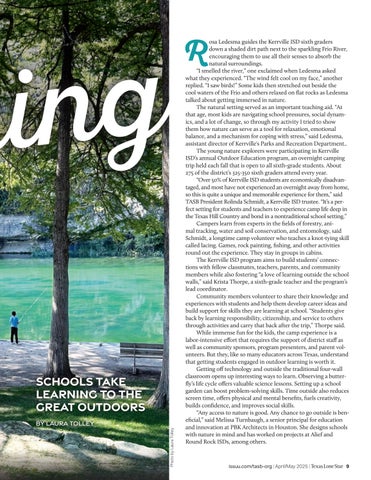
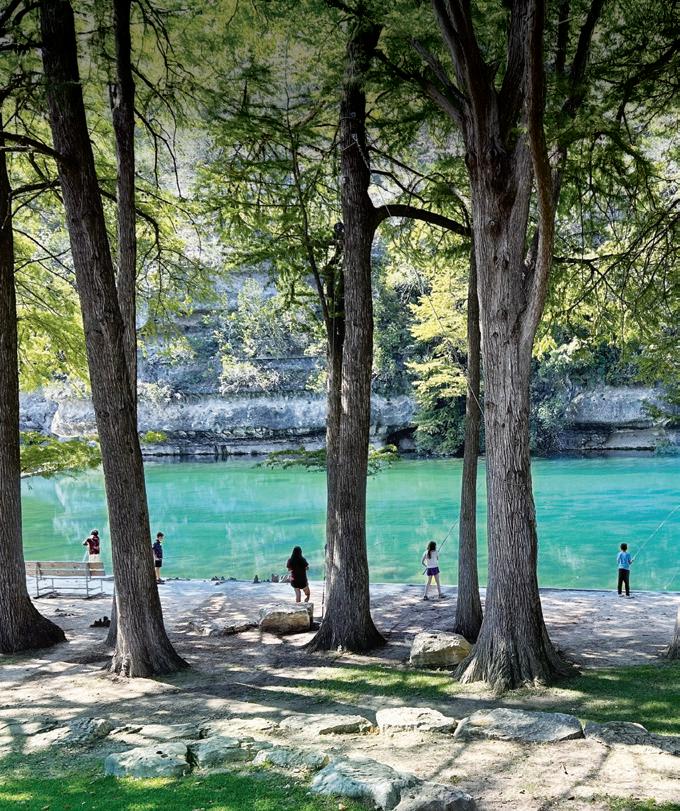
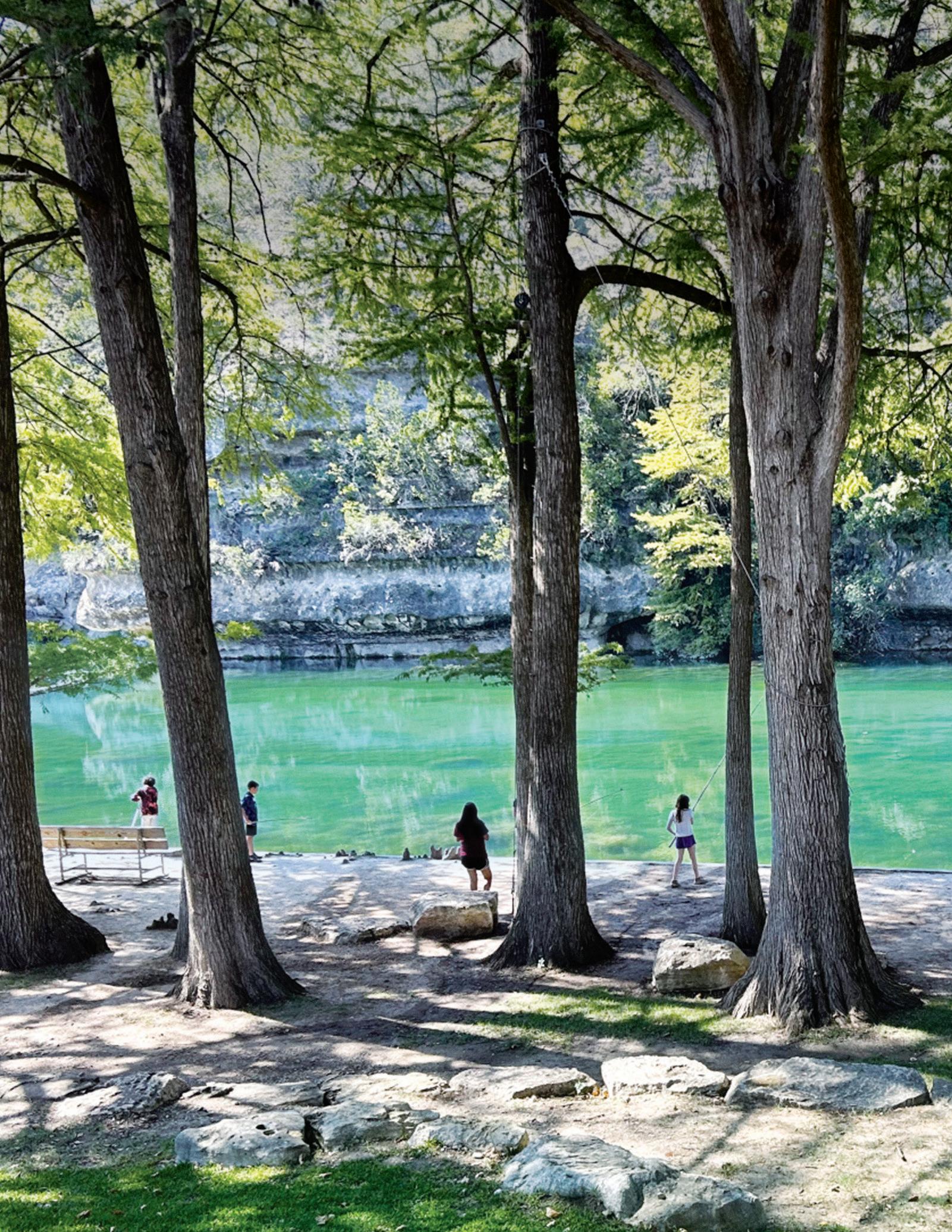
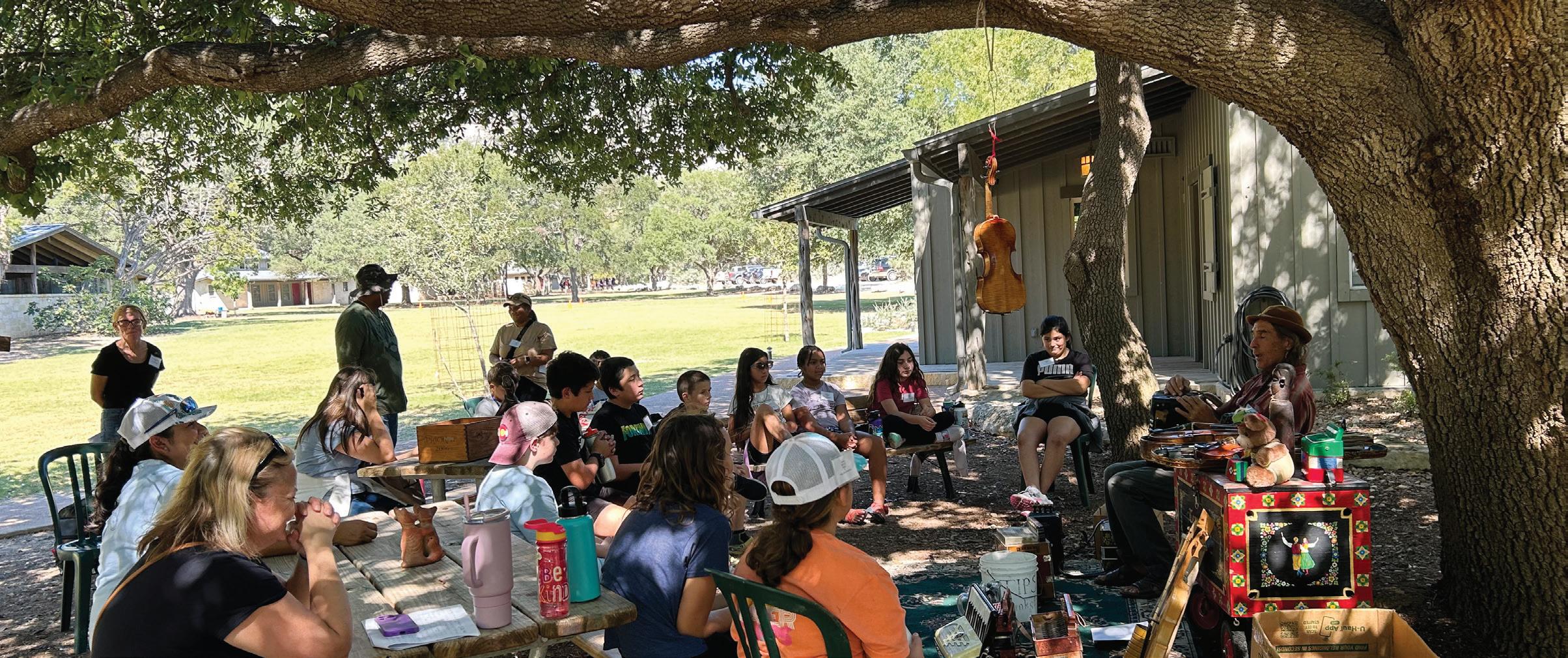
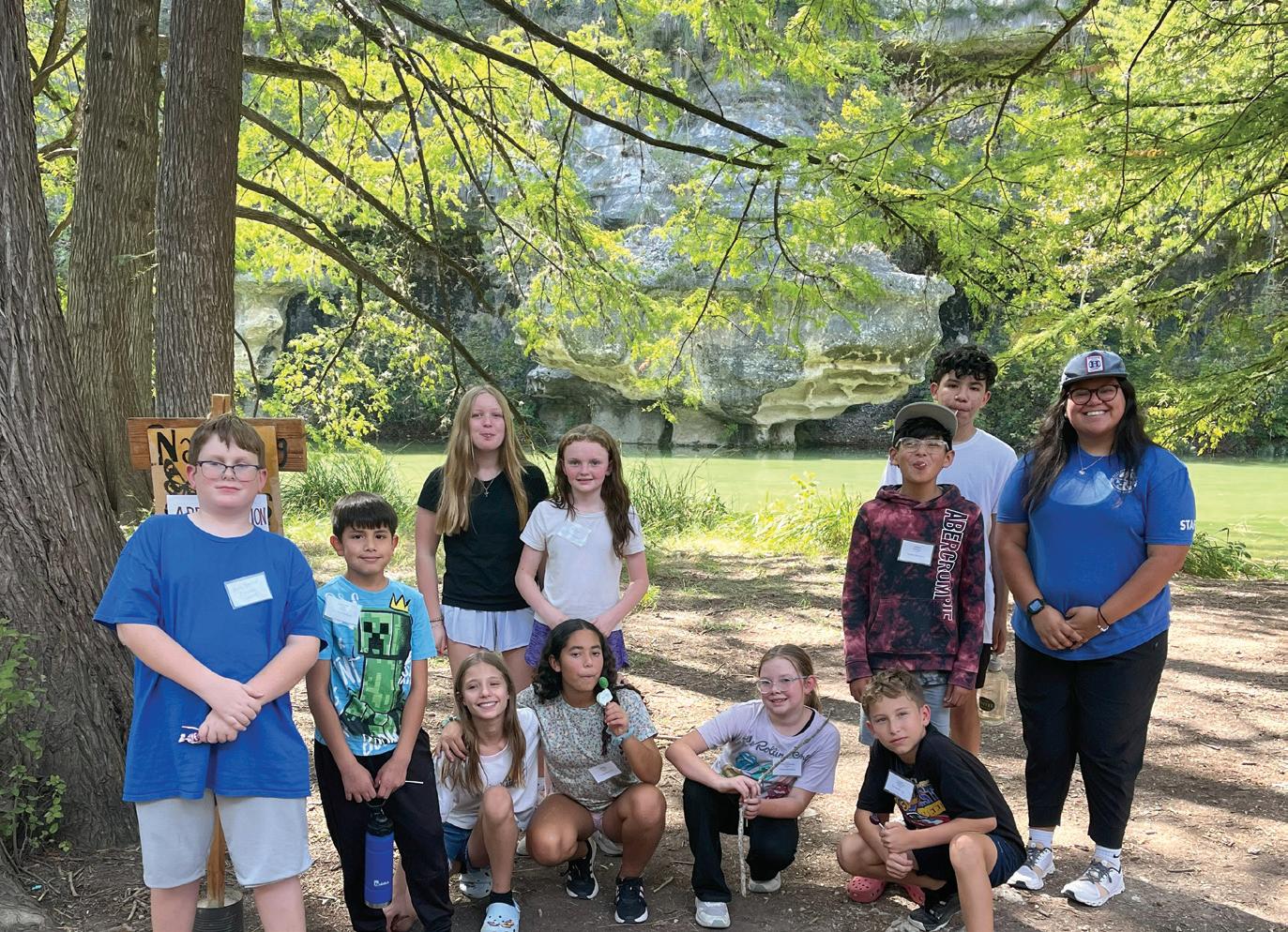
Rosa Ledesma guides the Kerrville ISD sixth graders down a shaded dirt path next to the sparkling Frio River, encouraging them to use all their senses to absorb the natural surroundings.
“I smelled the river,” one exclaimed when Ledesma asked what they experienced. “The wind felt cool on my face,” another replied. “I saw birds!” Some kids then stretched out beside the cool waters of the Frio and others relaxed on flat rocks as Ledesma talked about getting immersed in nature.
The natural setting served as an important teaching aid. “At that age, most kids are navigating school pressures, social dynamics, and a lot of change, so through my activity I tried to show them how nature can serve as a tool for relaxation, emotional balance, and a mechanism for coping with stress,” said Ledesma, assistant director of Kerrville's Parks and Recreation Department..
The young nature explorers were participating in Kerrville ISD’s annual Outdoor Education program, an overnight camping trip held each fall that is open to all sixth-grade students. About 275 of the district’s 325-350 sixth graders attend every year.
“Over 50% of Kerrville ISD students are economically disadvantaged, and most have not experienced an overnight away from home, so this is quite a unique and memorable experience for them,” said TASB President Rolinda Schmidt, a Kerrville ISD trustee. “It’s a perfect setting for students and teachers to experience camp life deep in the Texas Hill Country and bond in a nontraditional school setting.”
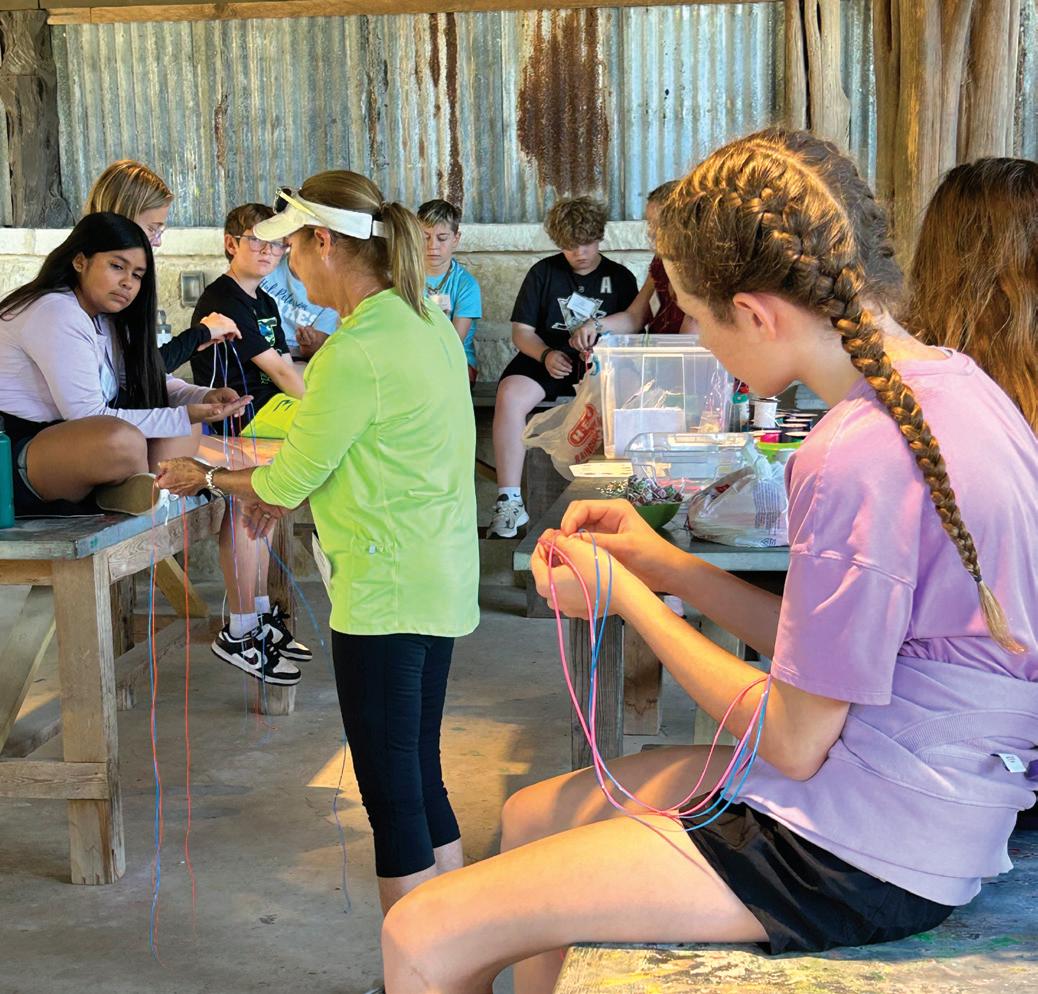
Campers learn from experts in the fields of forestry, animal tracking, water and soil conservation, and entomology, said Schmidt, a longtime camp volunteer who teaches a knot-tying skill called lacing. Games, rock painting, fishing, and other activities round out the experience. They stay in groups in cabins.
The Kerrville ISD program aims to build students’ connections with fellow classmates, teachers, parents, and community members while also fostering “a love of learning outside the school walls,” said Krista Thorpe, a sixth-grade teacher and the program’s lead coordinator.
Community members volunteer to share their knowledge and experiences with students and help them develop career ideas and build support for skills they are learning at school. “Students give back by learning responsibility, citizenship, and service to others through activities and carry that back after the trip,” Thorpe said.
While immense fun for the kids, the camp experience is a labor-intensive effort that requires the support of district staff as well as community sponsors, program presenters, and parent volunteers. But they, like so many educators across Texas, understand that getting students engaged in outdoor learning is worth it.
Getting off technology and outside the traditional four-wall classroom opens up interesting ways to learn. Observing a butterfly’s life cycle offers valuable science lessons. Setting up a school garden can boost problem-solving skills. Time outside also reduces screen time, offers physical and mental benefits, fuels creativity, builds confidence, and improves social skills.
Photo by Laura Tolley
“Any access to nature is good. Any chance to go outside is beneficial,” said Melissa Turnbaugh, a senior principal for education and innovation at PBK Architects in Houston. She designs schools with nature in mind and has worked on projects at Alief and Round Rock ISDs, among others.
Set in the stunning Hill Country, Kerrville ISD may have easier access to the great outdoors. But school leaders and educators in urban, suburban, and rural public schools across Texas are finding interesting ways to incorporate nature and the outdoors into learning activities:
• San Antonio ISD’s Advanced Learning Academy boasts an active garden program involving many teachers. At another SAISD school, students worked to transform an 11,000-square foot grassy courtyard at Collins Garden Elementary School into a monarch butterfly and pollinator garden.
• Alief ISD’s Jefferson Early Learning Center has an outdoor learning space for students that includes Texas ecology-themed trails with native grasses, plants, and trees. The surrounding community also has some access to the learning trails.
• Seguin ISD recently acquired the Irma Lewis Outdoor Learning Center and is using the 129-acre nature site as a focal point to further develop its outdoor education efforts. The center also recently hosted a leadership summit to discuss the importance of outdoor education. School leaders and educators gathered at the center in February to discover ways to better implement outdoor learning in their schools. (See sidebar on page 13.)
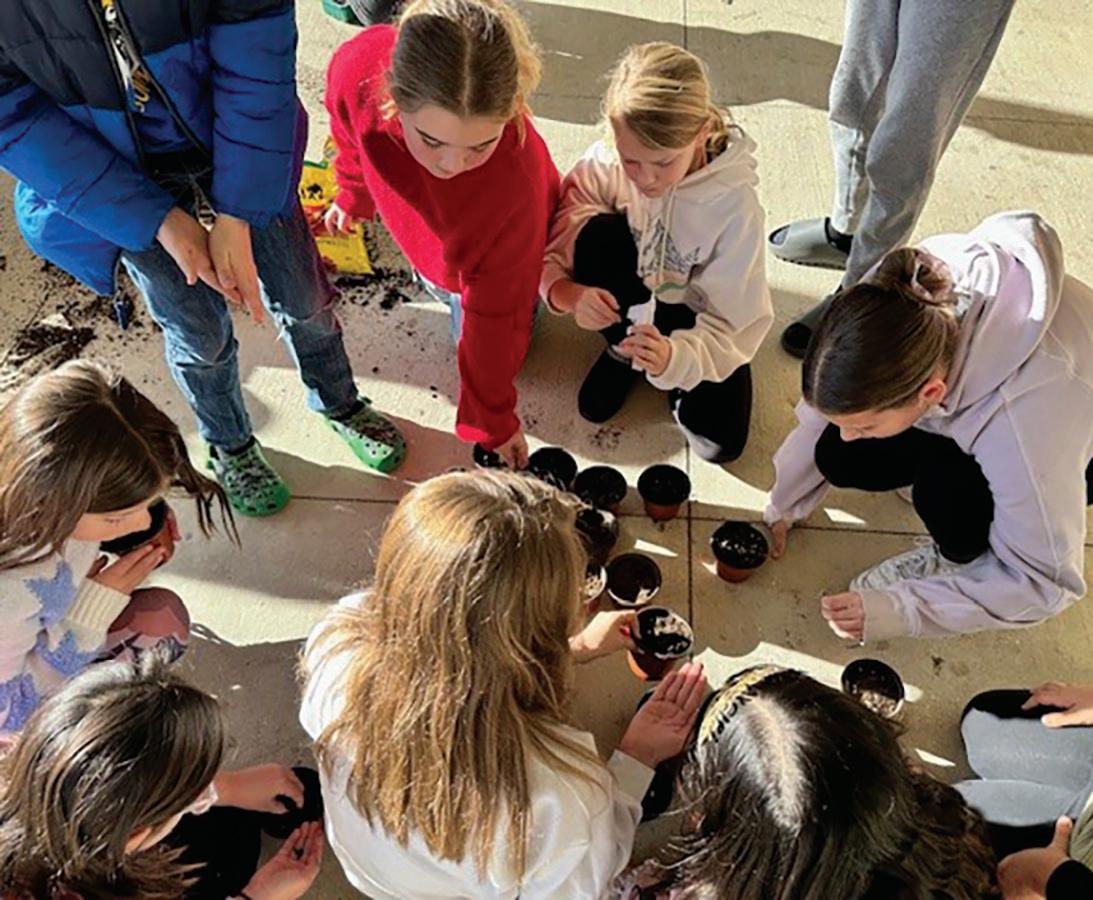
At Sunnyvale ISD’s Intermediate School in the Dallas area, budding agriculture scientists incubate chicken eggs and grow plants in different systems as part of a multidisciplinary school project that culminates in a student-run Garden Market for the community.
“We will sell these plants in our farmer’s market along with salsa and chicks that have been hatched in classrooms throughout our school,” said fifth-grade math teacher Lisa Stovall, who also runs the Junior Future Farmers of America program for students in third through fifth grade.
Science lessons are fairly easy to establish. To discover how different types of sunlight and weather affect growth,
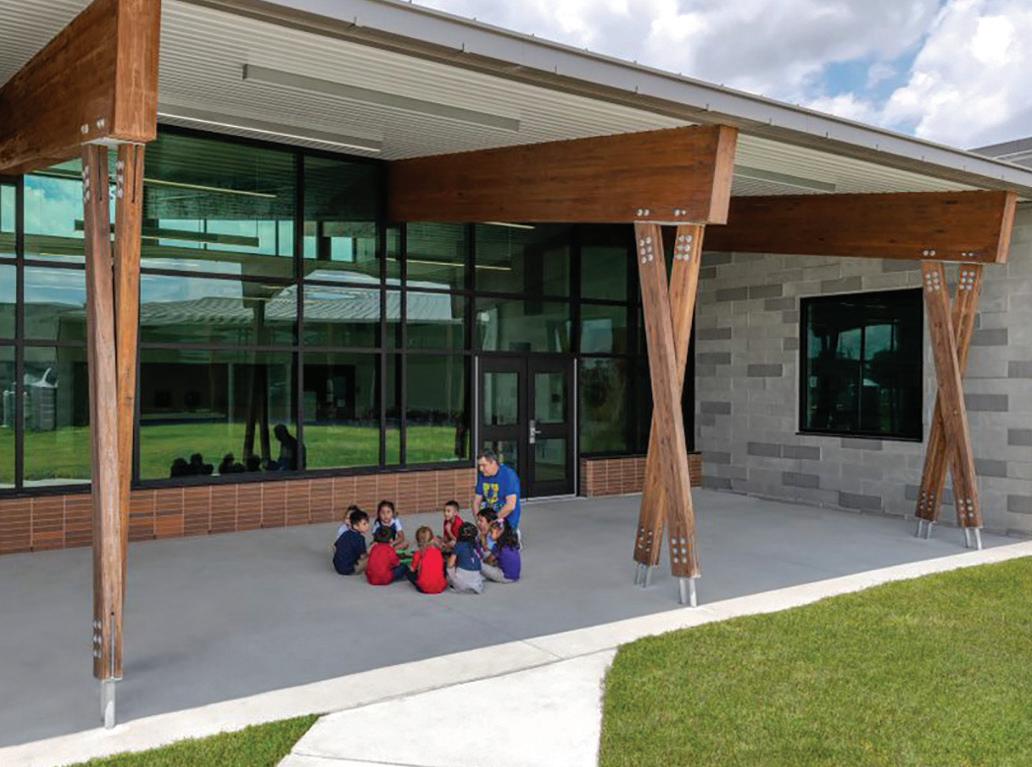
The outdoor education program at Sunnyvale Intermediate School features a chicken coop.

gardens and plants in pots are cultivated at spots around campus. Chicks are incubated in several classrooms, allowing students to learn the life cycle. A chicken coop was built outdoors near the playground for the chicks.
Using nature to teach math has to be more intentional, Stovall said. “I use probability with the chickens and then we measure, predict, and graph plant growth.” A financial literacy aspect to the project evolves around discussions about prices for plants and chicks and calculating profits from the market. At last year’s market, the students made $400, which goes back into the project’s account.
“My biggest goal for this project is to get kids outside and for them to learn where their food comes from! I want them to know how hard it is to raise crops and animals and to understand all that is involved with plants growing from seed to table,” Stovall said. “I think our kids have disconnected from the world and spend way too much time on screens. I want them to be involved in outside activities and learn about our environment.”
Linda Gooch, vice president of the Sunnyvale ISD school board and a TASB Director, credits Stovall for doing “an incredible job of making learning not only incredibly relevant but really fun for students.
“She has taken typical math lessons and created a truly memorable experience for our kids,” Gooch said. “They will never forget getting the hands-on, outdoor learning adventure of raising their chicks, planting their gardens, building their garden beds, and then hosting a community Garden Market — all while learning math!”
As the plants grow, so has the junior FFA program. A few outdoor garden beds were established last year. A butterfly garden with multiple habitats around school was added this year.
Stovall launched the project eight years ago with 50 students and now has 110 in the current class. A cut-off number had to be established. Most of the participating students have never been involved in farming or raising livestock before.
“The kids learn so much and love helping with the plants and chickens inside and out in the coop by our playground,” Stovall said. “When kids learn hands-on, they never forget the concepts taught. Making learning fun and exciting makes students want to be at school.”
Research shows other potential benefits to outdoor education, including improved focus for kids when they return to the classroom. And bringing the outdoors inside, through the use of natural lighting, interior plants, and use of natural materials, also can be beneficial for learning and students’ overall well-being.
Round Rock ISD’s Redbud Elementary School, for example, uses natural light and materials and colors to help create a nature-like feel inside the school. Turnbaugh, the architect, said providing a more natural interior in schools can be calming and restorative for students — and teachers and staff.
Alief ISD’s Jefferson Early Learning Center, which opened
in southwest Houston in August 2022, was designed to instill a deep appreciation for nature in a dense, urban setting in a largely disadvantaged community where concrete often prevails.
Located on about 20 acres, the property’s perimeter was designed to model the area’s natural habitats: wetlands, prairie areas, forest, and backyards. Using a spiral design found in nature, the outdoor area has six large covered back porches and four backyard spaces equipped with working cisterns used to irrigate plants. Students use child-size watering cans, gloves, wheelbarrows, and other tools donated to the effort. Additionally, community residents can walk some trails, and the district has had community events such as tree planting and wildflower seeding.
Indoors, textured and colorful materials are used along the corridor walls. Big windows offer views of nature. Themed learning environments reflect the region and include a spacethemed classroom, and one highlighting the ecosystems and wildlife native to the region.
“We know young children learn best through hands-on authentic experiences. Our indoor and outdoor learning is seamless by design,” said Kimberly Hammer, principal of the school of nearly 400 students. “It’s a joy to watch the children play in the grass, smell the flowers, and watch birds and butterflies as part of their daily routine. At Jefferson, we love to learn — both indoors and outdoors!”
The Alief ISD board was very supportive of the overall project and its long-term vision for the school and community, said Turnbaugh, the architect.
Darlene Breaux, Alief ISD board president and a TASB Director, said the center “is a shining example of how our district is committed to nurturing the whole child. By providing rich outdoor learning opportunities, we are not only enhancing early childhood education but also creating spaces that benefit the entire community.
by Laura Tolley
“I am so proud that Jefferson Early Learning Center is giving our youngest learners, their families, and our community a place to learn, explore, and grow through outdoor experiences! These opportunities go beyond the classroom — they spark curiosity, creativity, and a love for learning that lasts a lifetime,” Breaux said. “As Board President and a TASB Director, it means so much to see our kids thriving in a space where they can connect with nature, ask big questions, and discover the world around them.”
An active garden program involving passionate teachers is popular at San Antonio ISD’s Advanced Learning Academy. Students tend to different types of garden areas across the campus, including a vegetable garden and an outdoor learning center with native plants. Family workdays are scheduled twice a year.
A privately sponsored program, Blooming with Birdie’s Caterpillar Condos for Classrooms, placed 265 condo kits in San Antonio ISD classrooms last fall to provide a hands-on, TEKS-aligned curriculum. During the six-week program, students maintain the habitats, observing and learning about the life cycle of the brilliant black-and-orange winged insects.
Participants in the program, which is in its fifth year and involves other San Antonio-area districts, are encouraged to attend the free Monarch Butterfly and Pollinator Festival in San Antonio, said Cheri Tondre, a gifted-and-talented education instructional specialist in the district.
“I work on a number of nature-based projects,” Tondre said. “I am passionate about creating opportunities for students to explore their interests and engage with real-world issues.”
A decade ago, with the help of a local grant, Tondre and her students turned an unkempt courtyard at Collins Garden
Elementary School into a monarch butterfly and pollinator garden. The school will undergo a redesign, and the garden will be the center of the metamorphosis, she said.
Last fall’s trip for Kerrville ISD students at the H.E. Butt Foundation Camp marked the first time Ledesma was a presenter.
“Participating in this program has been a long-time goal of mine, so having the opportunity to contribute was very fulfilling on a personal and professional level,” said Ledesma, who attended the camp years ago as a Kerrville ISD student.
“Outdoor Education as a sixth grader was an amazing experience. I still remember collecting water samples with UGRA [Upper Guadalupe River Authority], lacing, and fishing,” she recalled. “It taught me a lot about the river, ways to be active in nature, and opened my eyes to how lucky we were to live in a community that had ‘wilderness’ in its backyard.”
Her camping adventure sparked a lasting interest in nature and creating spaces and programs outdoors that benefit her community. “It inspired me to pursue a career in parks and recreation, where the goal is to improve the quality of life for community members by providing access to nature, along with high-quality programs and services.”
And in a couple of years, Ledesma plans for her son Emmitt to join her at camp when he’s in sixth grade.
“I look forward to bringing him along and introducing him to the experiences that shaped me,” said the proud mom and outdoor enthusiast. “It’s going to be an unforgettable opportunity.”H
Laura Tolley is managing editor of Texas Lone Star
Public school leaders and educators across Texas are working to enhance and advance outdoor learning programs for their students. Some are in the beginning stages of designing an initiative.
“Start small, start simple,” advises Carol Harle, a Northside ISD trustee and a TASB Director. Harle is a longtime advocate for outdoor learning and serves as school experience director for CAST Schools Network in San Antonio.
Harle was the keynote speaker at the Outdoor Learning Outperforms Indoor Learning, a leadership summit at Seguin ISD’s Irma Lewis Outdoor Learning Center. Designed for school leaders, the summit was sponsored by regions 1 and 20 ESCs, the Guadalupe-Blanco River Authority, Northside ISD in Bexar County, and Seguin ISD. About 50 people attended the Feb. 7 event.
“Years of experience in education, teacher training, and conversations with outdoor advocates have highlighted a persistent challenge: integrating outdoor learning into the school day,” said Tessa Baden, an early childhood consultant at Region 20 ESC, who has a passion for the outdoors.
Baden said the summit was designed to help school leaders discuss the various challenges to establishing outdoor education programs and “collaboratively address these barriers and drive meaningful change.” Many teachers attended a similar summit in March 2024.
A panel of principals and their outdoor learning teams shared actionable strategies through real-world examples. A Q&A session highlighted the innovative efforts of an elementary school principal and the outdoor task force.
Research was presented from the UTHealth Houston School of Public Health underscoring the need for outdoor learning and play. The Texas Education Agency also gave a presentation.
Harle emphasized the power of starting with small, achievable steps in designing outdoor learning efforts. “Start small to go BIG,” she said:
• Start with your staff. Move parts of staff meetings outdoors. Host staff activities such as Wednesday walks-n-talks. Move professional development days to outdoor classrooms or parks. Schedule staff retreats to “camp” areas such as the H.E. Butt Foundation Camp. Buy picnic tables and/or build an outdoor classroom deck with shade to encourage teachers to hold a class outside.
• Turn a drab or undeveloped outdoor space into a garden or a place to pause and relax. Encourage grade-level or content-area teams to “adopt a spot” to “revitalize” with mini competitions.
• Small steps also work for students. Give them a chance to be outdoors in playful ways first, followed by ones that align to curriculum and combine it with a
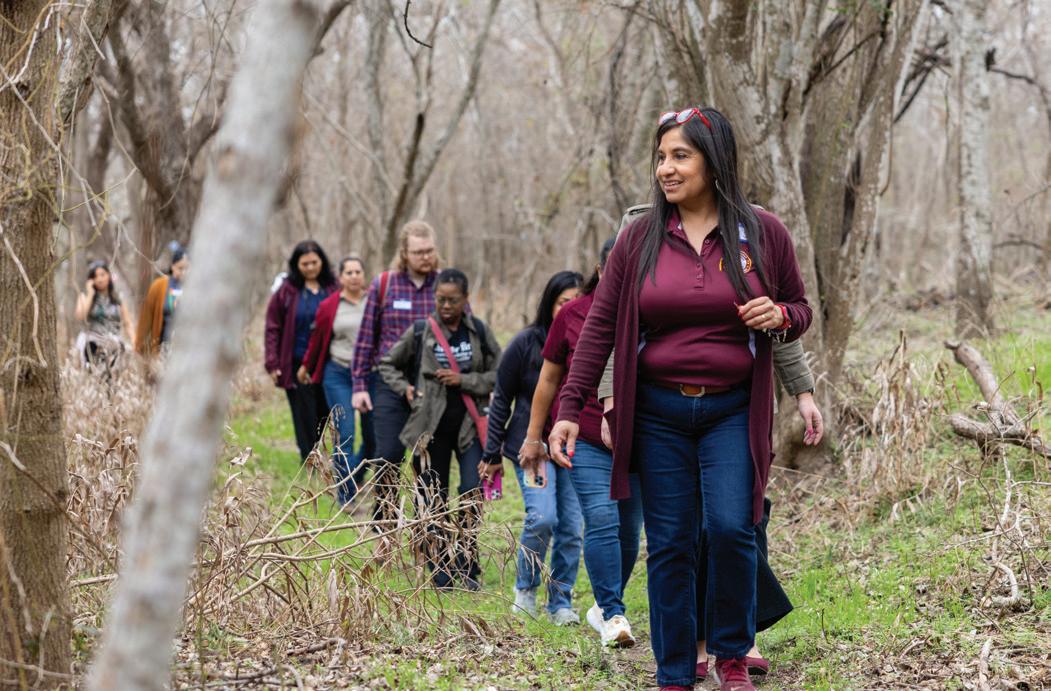
At the Outdoor Learning Outperforms Indoor Learning, a leadership summit held in February at Seguin ISD’s Irma Lewis Outdoor Learning Center, attendees went on a nature walk as part of the program.
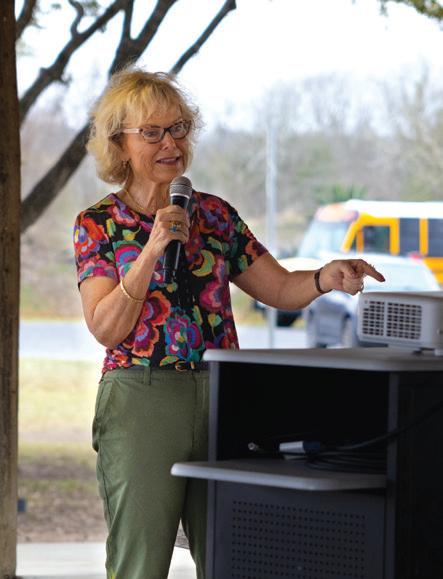
Carol Harle, a Northside ISD trustee and a TASB Director, was the keynote speaker at the leadership summit, which was held in February.
learning activity. Host monthly outdoor “fun” learning experiences.
• Find examples of successful outdoor education efforts and share them with your staff to get the creative juices going. ESCs and city departments can help locate places and spaces for staff and students.
• Provide time for teachers to collaborate on how to start small in including outdoor learning activities with existing units and initiatives. This can help teachers see outdoor learning as complementary versus “another new initiative.”
• Form a team of teachers who are passionate about the outdoors to help generate ideas for experiences, resources, and community partners.
• Celebrate wins. A hallway wall can be used to post highlights of flora and fauna activities. Host Mother Nature awards or nature nights for the students and their families.
• Schedule a visit with a school that has a successful outdoor learning program.
Summit success
“The summit was a wonderful event,” said Pete Silvius, director of Whole Child Initiatives at Seguin ISD. “More and more school leaders and educators are getting excited about outdoor learning. We’re beginning to understand that every student and campus can benefit from an outdoor learning space.”
by Mary Ann Lopez
When Victoria ISD was working on its strategic plan around 2019-20, the community’s residents made it clear they wanted all students to have exceptional teachers in the classroom, and that included certified bilingual teachers for the district’s growing number of bilingual emergent students.
“We don’t want to sell any of our students short in any way, shape, or form,” said Mike Mercer, Victoria ISD’s school board president. “And we have found that of all the positions we have to fill, that is one of the most difficult ones.”
Districts across the state are vying for certified bilingual teachers from the same limited pool of educators, making it a challenge for districts to be 100% staffed. And bilingual education is one of the few teaching areas where certification is federally required, along with special education and prekindergarten education. District leaders knew meeting the goal would be difficult, but they were ready to do what was needed to fill the positions, Mercer said.
“That’s been our charge as the board: to work within the strategic plan, setting the goals and the outcomes that we want to see within our district. And so one of the biggest goals is that
we believe every child can learn and every child can succeed,” Mercer said. “That is a mantra that we carry from the boardroom down to the janitor’s closet and everywhere in between.”
Finding a solution began with the board giving the district’s administration and curriculum teams the autonomy to explore creative options to fill its bilingual teaching positions, he said.
Mercer explained that the Victoria ISD board had high expectations but trusted the administration who were the experts, and they were ready to give them the support they needed to achieve the district’s goals.
Victoria is known by locals as the “oasis in the desert,” said Mercer, who is an outgoing board member. Surrounded by rural areas, Victoria has the benefits of a big city without being too large. The district, located in southeastern Texas near the coast, serves nearly 13,000 students, a large number of which are bilingual education students.
“Bilingual education teachers play a crucial role in the
alanguage, academic, cultural, and cognitive development of students in our system who speak languages other than English,” said Victoria ISD Superintendent Sheila Collazo. “The new Victoria ISD strategic plan emphasizes the importance of highly empowered staff with knowledge, skills, and disposition to effectively ensure that students achieve academic success and make expected progress. Bilingual education teachers provide the tools, resources, and support for students to succeed in an increasingly multicultural and multilingual world.”
According to the Texas Education Agency, the state of Texas serves nearly 1.2 million emergent bilingual students, and it says those numbers are steadily increasing.
éWhile Victoria ISD was working on making changes aligned with its strategic plan, it was transitioning to a two-way dual language program, in which students who are emergent bilingual are integrated with those who already read and speak English. Mercer said the program allows the district to serve bilingual students and students wanting to learn a second language.
Roberto Rosas, Victoria ISD’s director for multilingual education, was charged with developing the program and finding certified teachers.
“That was one of the biggest challenges that we had at our district,” he said. “As a result, we reached out to Region 13 [ESC] and started bringing in some teachers from Spain.”
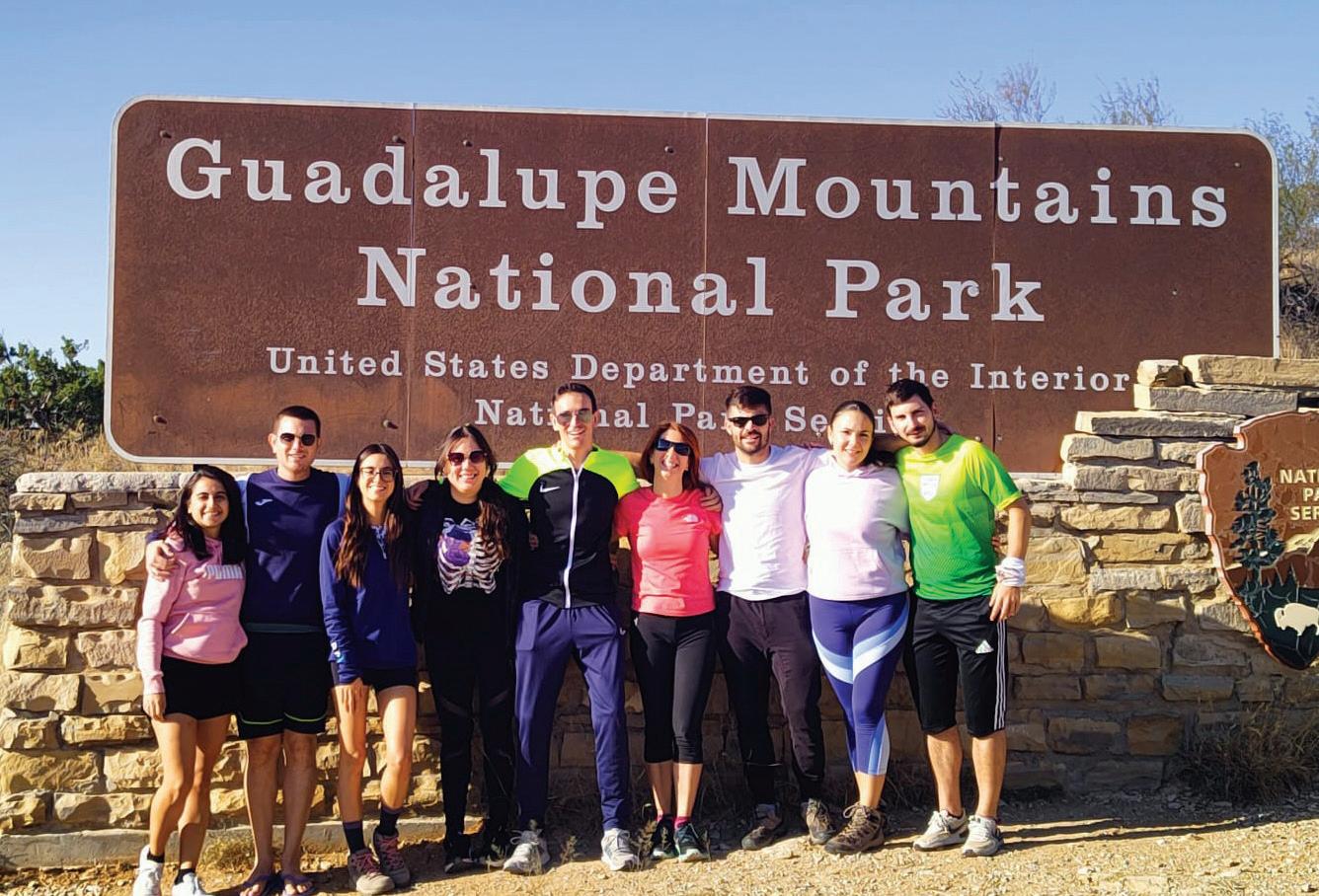
Victoria ISD is one of 19 districts from across the state taking part in the Texas-Spain Visiting International Teacher (VIT) Program.
The VIT Program is a collaboration between The Spanish Ministry of Education, Region 13 ESC, and The U.S. Department of State. Region 13 ESC serves as the program sponsor on behalf of the Department of State. The cultural exchange program’s goal is “promoting inter-culturalism between the United States and Spain, thereby encouraging citizens from both countries to foster an appreciation of the cultures shared by each community.”
Since 2011, TEA has charged Region 13 with administering the VIT program in Texas, said Jessica Pruneda, Region 13 ESC project coordinator for the Texas-Spain VIT Program.
Interested districts apply during the fall application cycle with applications due in December, she said.
“Districts are really encouraged to create a detailed plan of support for the visiting teachers, to assign a liaison that supports them throughout the duration of the program, to
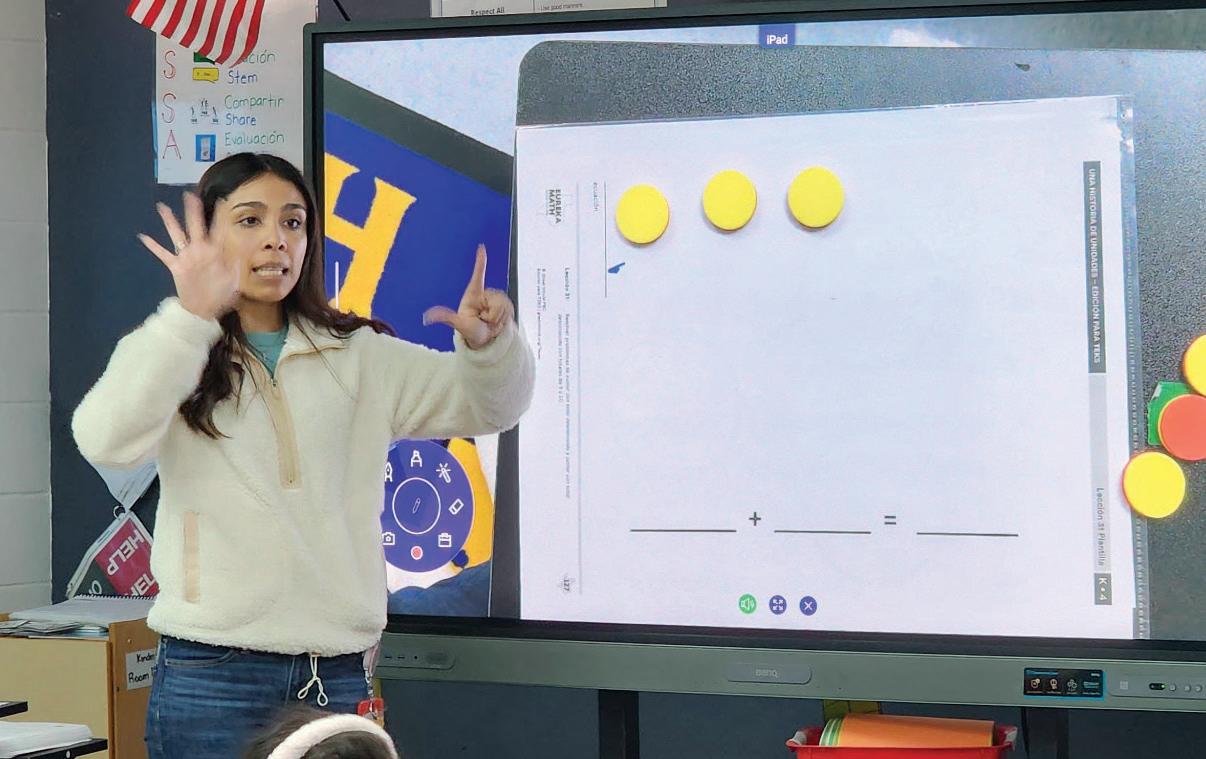
establish communication as soon as the teachers are selected, and to really, really begin interdepartmental planning, identifying each department’s role in the support it will provide teachers, and including all of that information in their plan of support,” Pruneda said.
Along with new applicants who must apply for consideration, participating districts must reapply every year for the program, she said. There were 17 districts in the program in 2023-24, but two new districts were accepted for the 2024-25 school year: Midland ISD and Harlingen CISD.
Pruneda and Erin Romero, Region 13’s director of special projects, administer and support the program, while collaborating with a Spanish education advisor housed at Region 13 who supports the teachers and districts.
“The daily technical assistance is a very important aspect of the framework of support that we have established in the VIT program at Region 13,” Pruneda said.
Region 13 doesn’t control the number of candidates available each year; that falls to The Spanish Ministry of Education, Pruneda said. Region 13 typically limits the number of teachers sent to a newly participating district.
c“We try to be cautious and understand that the district is going to be in its first year of the program, and it is going to be going through a learning curve,” Pruneda said. “That first year is a huge learning year for the district and for us as we guide the district as they host the teachers.”
At Victoria ISD, the district brought in three teachers from Spain in the first year and had a great experience working with them, Rosas said. “So, we continued with that program to be able to get some of those certified teachers that we were needing. However, it wasn’t enough.”
Right now, there is a pool of about 100 teachers available to districts per year, Pruneda said. There are close to 300 active teachers across the state in different districts. The teachers can work in the U.S. for three years and can choose to extend their J-1 visas for up to two years.
Still needing more certified bilingual teachers, Rosas came up with the idea to partner with a university in Mexico. Rosas approached several universities before finding a partner in Escuela Normal Superior de Jalisco. Just recently, the district signed on a second partner university that it will begin working with in the 2025-26 school year.
To prepare the university’s education students for success in the district, Victoria ISD provided the university with materials it wanted incorporated into its education classes, focusing on instruction, English fluency, and the financial and cultural challenges of living abroad, he said.
The university was charged with finding qualified teachers who were interested in the program. The students first went through the training program. Then, the university vetted the teachers, selecting the best candidates, who would then be interviewed for the open positions, Rosas said.
Getting the program off the ground took lots of planning,


ütrust building, and communication, he said. But much of the organization and planning were handled remotely.
In the first year, the district hired one teacher from Mexico, Rosas said. The university wanted to test the program out, sending one of its alums who taught fifth grade.
“He was instrumental in helping to refine the program,” Rosas said. “He was able to share his experiences with the program. That led the way to hire four more teachers.”
The district has 14 bilingual education teachers with five from Mexico and the remaining teachers from Spain. The teachers on the J-1 visa must have two years’ experience teaching, but some have far more, Rosas said.
“The overall statewide teacher shortage persists, underscoring the need for continued investment in teacher preparation programs, competitive compensation, and supportive work environments to ensure that all students, especially emergent bilinguals, receive the quality education they deserve,” Collazo said. “It is our ethical and professional responsibility to create the culture and conditions for these students to thrive.”
In June 2024, Victoria ISD held a session at TASB's Summer Leadership Institute, sharing the benefits of the programs in the district. Sara Burleson, a Midland ISD board member, was in the audience and ready to learn more.
Midland ISD’s school board had just voted to use J-1 visas to bring teachers into the district, she said.
k“There were some board members with concerns about that and then others who were not [concerned],” Burleson said. “I was interested in how they [Victoria ISD] navigated the J-1 visas.”
Victoria ISD’s proactive stance made sense to Burleson, a former teacher, who said, “Across the state of Texas, we all have the same problem: we all need bilingual teachers and they’re in very short supply.”
Midland ISD began working with the VIT program, along with hiring teachers with an H-1B visa, which is for specialty fields that are hard to fill within the U.S.
Filling positions for the district of 29,500 students — 20%
For districts that recruit teachers through a program, such as the Texas-Spain Visiting International Teacher (VIT) Program that Region 13 ESC administers, there are some best practices to consider that can help teachers make a successful transition.
Districts should keep in mind the cultural differences teachers might encounter. For example, Roberto Rosas, Victoria ISD’s director for the multilingual education, said that while a lot of teachers in the U.S. take pride and time to decorate their classrooms or to create anchor charts, in Mexico and Spain it’s not common to do that. The district has to educate the teachers about the benefits of those practices.
And while teachers in Mexico use the Socratic method of asking open-ended questions when teaching, at Victoria ISD, the district focuses on small groups, interventions, and supports. “That’s something very unique that they don’t do in Mexico,” Rosas said.
The staff from Region 13 visits districts in July, providing a welcome orientation to new teachers who have recently arrived from Spain. During professional development, the Region 13 education advisor provides cultural cues to the teachers, comparing and contrasting the educational system in Spain with that of the U.S., said Jessica Pruneda, Region 13 project coordinator for the Texas-Spain VIT Program.
mof whom are emergent bilingual — is also more challenging because of its remote location in West Texas, Burleson said.
“We need more teachers that are bilingual,” she said, adding, “But we also have 52 languages.”
Creating a pipeline
Edgewood ISD in San Antonio is using a grow-your-own program along with a paid residency program to fill the need for certified bilingual teachers, said Thomasina Montaña, the district’s director of professional learning and recruiting and hiring.
éThe district partnered with The University of Texas at San Antonio’s College of Education and Human Development to recruit student teachers for its residency program, Montaña said. The program was initially paid for with Texas COVID Learning Acceleration Supports grant funding.
The residency program allows students who are seniors in college to teach for the full year as part of their clinical, she said. The students are paid $20,000.
The first year Edgewood was trying to fill 13 bilingual education spots, competing with six other districts. In the end, eight of the 13 students chose to work in Edgewood, and five of the original residents are still with the district today, now employed as full-time teachers.
Those former residents have become an integral part of the recruiting process for new residents, she said. But changes to the residency program by the university put limits on the number of students they could recruit.
So, the district started its own grow-your-own program, tapping into the talent already on staff: its paraprofessionals, she said. The paraprofessionals are familiar with the district, its culture, and its students. The district sought out paraprofessionals who had 60 credit hours or more and were pursuing a bachelor’s degree in bilingual education.
The new hires took on the role of classroom instructors while also taking online courses through a partner university, Montaña said. It takes them two years to complete the program. While they work toward their degree, the teachers are paid their classroom instructor salary, their tuition is paid, and the mentors who support them receive a stipend.
“They know the community and so they are committed to the district,” Montaña said. “They know this is an opportunity for them, so they are willing to say, ‘You know what, Edgewood is going to support me. I’m going to stay with them.’”
Midland is also exploring a grow-your-own option. The district is offering its high school students the chance to sign a letter of intent stating that upon completion of their bachelor’s degree in education, the district will hire them, Burleson said. The district even held its first signing day last year with nearly 20 students signing a letter of intent.
“The bottom line is we’ve got to get more students back wanting to be teachers again,” Burleson said. “And make it a profession that is respected again and that pays for the work they’re doing.”H
Mary Ann Lopez is a staff writer for Texas Lone Star.
Pruneda and Erin Romero, Region 13’s director of special projects, suggest districts find multiple ways to engage and support teachers:
• Provide each teacher with a campus mentor
• Plan cultural and social activities
• Recruit staff members or families to welcome the teachers into their homes, providing a dinner or hosting them during holidays
• Help teachers secure housing and transportation
• Answer questions about navigating life in the U.S. that might be different or unusual
When Kerry Gain, Region 13’s deputy executive director, academic services worked at Del Valle ISD, a district in southeast Travis County that is part of the VIT Program, the district made a concerted effort to hold welcoming events.
“We’ve seen lots of districts provide that kind of
oversight,” Gain said. “We recognize we’re not just hiring you to teach our kids; we also have a responsibility to help you adapt and navigate this world that you’ve entered.”
At Victoria ISD, the district’s foundation provides support for those teachers who may need additional help, Rosas said. Sometimes the teachers arrive with only a suitcase or two and need a variety of items for their homes, or they may need some financial support to set up their classrooms, he said.
For the past year, when Texas VIT district representatives travel to Madrid, Region 13 has offered classroom tours so they can get a taste of the kind of education system they have in Spain and what the day-to-day looks like for a teacher.
“That’s been really helpful as they turn around and support those teachers,” Gain said. “So, they have an idea where they’re coming from and what the differences might be and how to accommodate them.”
by Sara Butler
Amanda Bigbee, division director of TASB Policy Service, understands the challenges public school leaders and educators face each day. For starters, Bigbee attended little Sundown ISD in West Texas, where her father was the district’s principal and chief financial officer. Her graduating class had 31 people. Before joining TASB in November 2023, she served more than 15 years as general counsel at Keller ISD, a suburban district of about 34,000 students in North Texas.
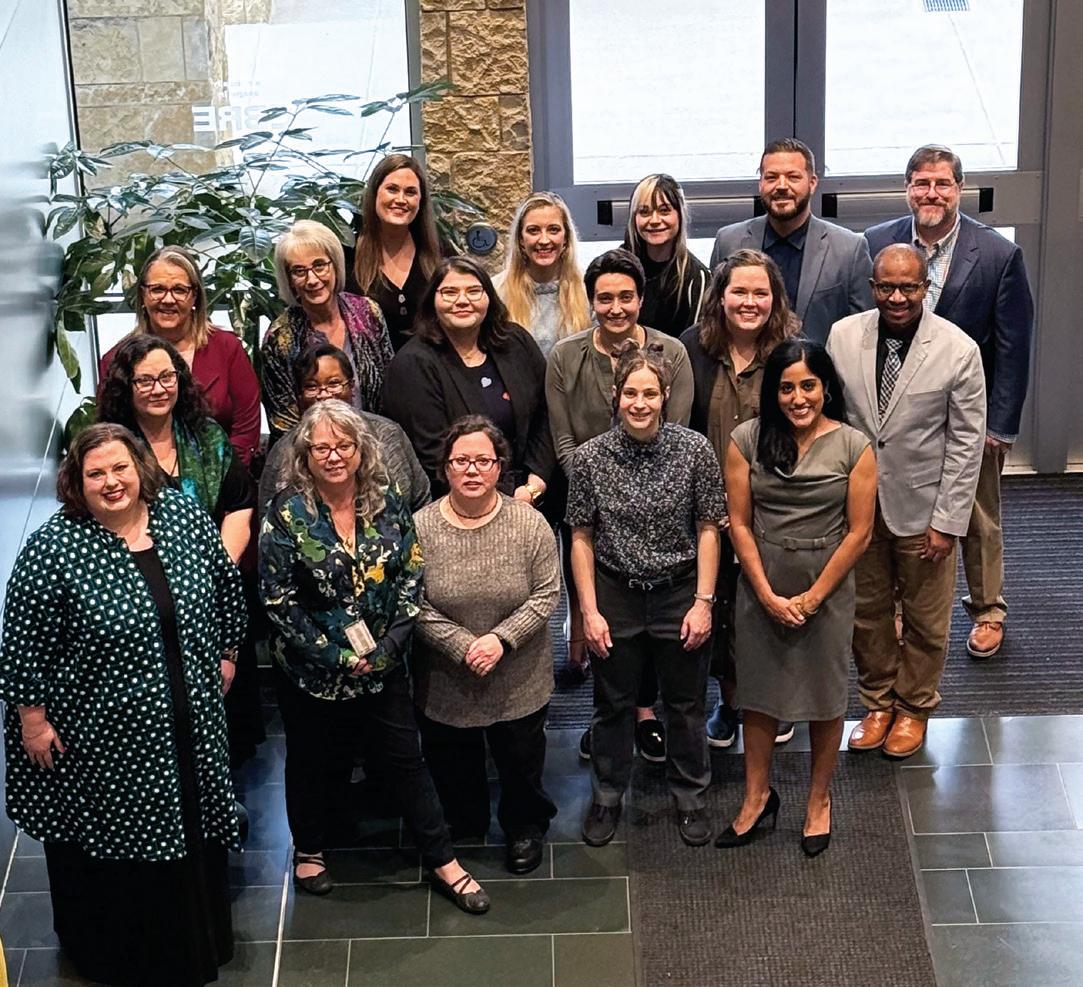
As TASB Policy Service honors its 50th anniversary this year, Bigbee is proud that the division continues to provide economical and quality services for districts of all sizes and needs. The skilled Policy Service team has decades of school experience. “I am incredibly proud of how effectively the Policy Service team works to lessen the burden of government on school districts,” Bigbee said.

Texas Lone Star talked to Bigbee about the TASB Policy Service’s history as well as the experienced team’s many efforts to serve member districts.
Q: Happy 50th anniversary! Policy Service has a long legacy of providing support to member school boards. Tell us how Policy Service’s efforts have evolved since 1975.
As far as we know, the first written policy-type documents for a Texas school district were Galveston ISD’s Rules and Regulations document, which was published in 1937. I think the history of school policy in this state starts there. Increasingly detailed state and federal requirements imposed on school districts during the late 1960s and early 1970s pushed Texas school districts to get serious about defining the parameters of local governance through the adoption of local policies. Early efforts by others to do this work failed in large part because of the pace of change, the cost of the work, the expertise required, and confusion over the function of local policies.
In 1970, then TASB Executive Director Cecil Rusk proposed to the TASB Board that the Association take a big step into this world by establishing a policy clearinghouse. The adopted proposal provided that “the staff would utilize the policy file, state and federal statutes, court decisions, attorney general opinions, and Texas Education Agency regulations and guidelines to develop and maintain a set of model policies. ... A distinguished board of review could be established for the purpose of ensuring a high-quality model that could meet the test of legality. ... The model policies set would be made available at a cost.”
The proposal also contemplated an updating schedule to alert districts to information needed to keep policies current. It also projected establishing what they called “field services” to help districts adapt models and to assist districts during the process of policy revisions. It’s exciting to me that the idea of dedicated consultants and local control of policy language is the foundation of the work we do now, and that was at the very center of the origin of Policy Service back in 1970.
TASB pushed through funding and staffing issues to bring the model policies project to life in 1973. But the giant evolutionary step came in 1975, when the Association hired a corps of writers to develop a Policy Reference Manual that would address the need of districts for authoritative information and model policies to support local policy decisions. At this time, membership in TASB was growing, which allowed it to take on the costly development of the service.
Throughout the winter of 1975 and the spring of 1976, work proceeded on the draft of the manual using TASB’s proprietary “alpha” coding system that is still used today. All of the initial drafters were attorneys other than the individual who wrote the E section (instruction), who held a doctorate in education. After the drafts were written and edited, a weekend retreat was held with board members, superintendents, and business managers to allow for a committee review of the work. That input allowed the group to reconstruct and refine the policy language. The result of this work was the launching of the first Policy Reference Manual in 1976. Workshops were held throughout the state to train and explain the tool and how it could help school districts across the state.
In the fall of 1976, Policy Service already had 152 districts subscribe to the policy service, and then Association President Ross Borrett called the response statewide “exhilarating.”
The initial Policy Reference Manual was a combination of legally referenced and local materials. This format proved

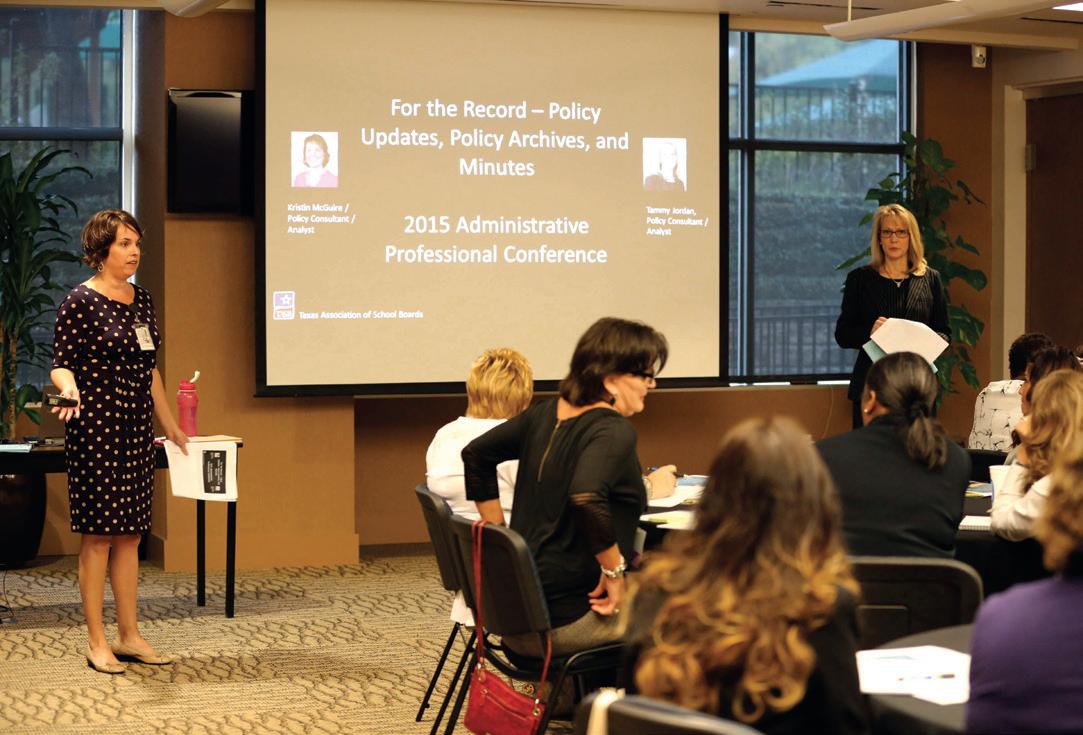
difficult because districts had difficulty determining where law stopped and local policy began, and updating was difficult because each staff member had to parse out which components were locally developed. These issues led to the manual being reconfigured into the format we use now — separate legally referenced materials and local policy statements.
Q: How did this format evolution ultimately impact the way school boards handle policy?
All of this increased knowledge and transparency led to school boards better understanding their responsibilities and executing them with more ease. One of the first attorneys to do this work recounted that “the manuals greatly enhanced the strength and quality of the local governance while concurrently guaranteeing the rights of those who deal with boards. Today, it is hard to imagine running schools without this wonderful tool.”
In 1977, Update 4 was released to the then approximately 300 district members. It was the first time the manual included an updated localized policy manual. All of that work was done on IBM Correcting Selectric typewriters. By 1980, the Association set up an in-house print shop to handle printing and duplicating needs, and by 1981, the department had its first word processor — a Lexitron VT 1303.
In 1981, Policy Service stepped into its computerization era when it hired a group to begin software development in advance of the 1982 purchase of a TI DS990 minicomputer. All of this took place just in time for the flood of policy changes required in school reform legislation [House Bill 72] passed in 1984.
After 1984, TASB Policy Service grew quickly, and by 1988, 1,062 school districts were members of Policy Service and 878 districts had completed localization of their manuals. TASB Policy Service now serves 1,015 school district members, which is 99.7% of the districts in the state!
Our services have evolved and become more sophisticated as the needs of school districts changed. The regulatory environment schools work within is complex and rapidly changing. Policy Service is committed to its founding principles and still aims to ease the burden of government by doing the hard work needed to create legal framework and model local policies that school districts need to function at their best. We are proud to support school board members as they localize their manuals and ensure that the policies adopted meet the needs of their communities.
Q: TASB Policy Service’s stated mission is to assist members with timely, expert, and economical development of board policy and administration resources. What types of specific services does the team provide to its members?
We offer a range of services and materials to our member districts, including:
• Consulting. Each member school district is assigned a policy consultant who can help draft language to meet your local needs, answer questions about policies, and help audit your entire policy manual through a Policy Review Session. Districts know they have a person they can call for help, and our consultants love getting to know their districts and the staff in them. That personal attention is part of what sets TASB Policy Service apart.
• Legal Framework. In coordination with Legal Services, TASB Policy Service organizes and hosts legal policies that provide context and serve as legal framework for our member districts.
• Local Policy Recommendations. TASB Policy Service
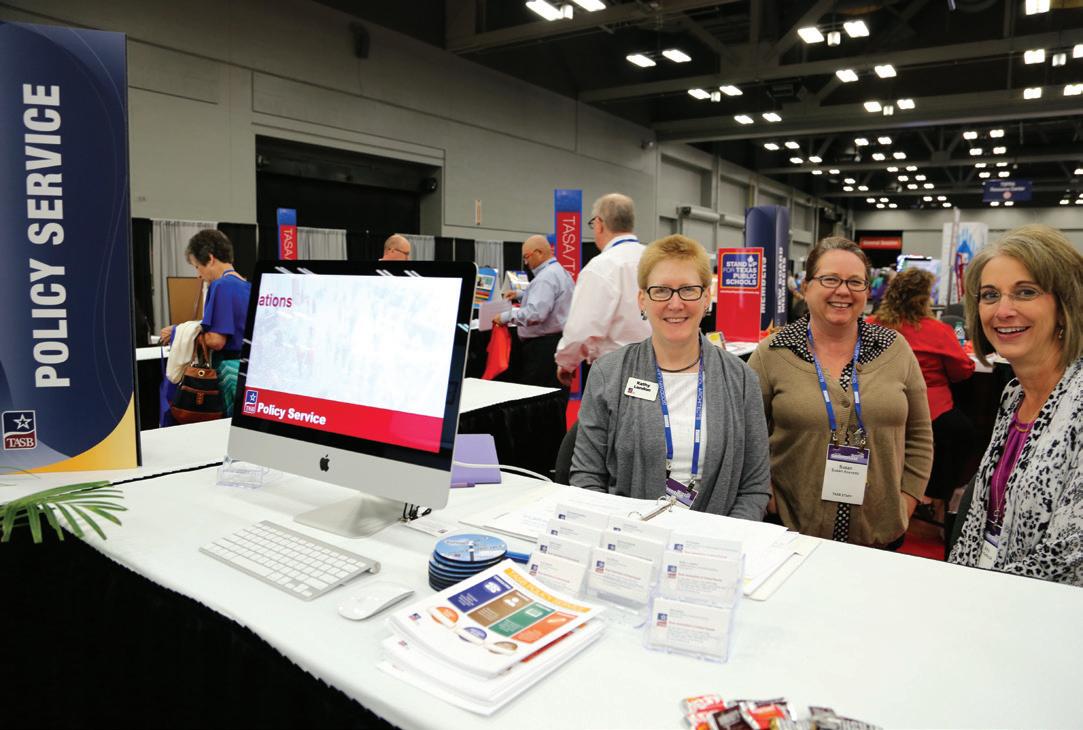
provides recommended local policy language to member districts roughly twice a year through numbered updates and upon request from a district. The recommended policy language has been vetted through TASB Legal Services. School boards have complete control over their local policies, and there is no obligation for districts to adopt these policy recommendations. Policy Service will publish adopted local policies to the district’s policy manual after adoption.
• Model Student Handbook and Student Code of Conduct. Every year, TASB Policy Service provides member districts with a model student handbook that complies with the law and best practices and can be updated to meet each district’s unique needs. A model student code of conduct is typically released during the summer every other year after legislative sessions.
• Policy Alerts. Occasionally, there are policy-related matters that require the attention of member district administrators. Policy Alerts may be issued when new laws or rules require attention or when action is needed promptly. Member districts are provided email communication when Policy Alerts are issued.
• Policy Online®. TASB Policy Service offers an online platform for member district policy manuals and other regulatory documents. Legal and local policies are organized by a proprietary coding system. Policy Online also houses the Regulations Resource Manual and tools to assist districts in preparing handbooks and resolutions.
• Regulations Resource Manual. The documents found in the Regulations Resource Manual are designed to provide administrators with a reference library of sample administrative procedures and forms by which the requirements of law and local policy are reliably met. They are designed to be a springboard to the development of local procedures and forms as needed.
Q: What have been some of the biggest challenges for Policy Service over the last 50 years? What are some of the team’s highlights in serving members?
I would say one of the biggest challenges was moving a completely paper process into the modern era and transitioning to providing policy documents on the internet. That’s a lot of growing and evolving processes while maintaining momentum for member school districts. All of the effort that went into digitizing the processes paid off exponentially when COVID-19 forced a change in the way work was completed. All of that growth has given member districts a more efficient service and access to policies through an online platform. We are excited to continue exploring how evolving technologies can help us provide a better service to school districts across the state.
Q: What are you most proud of in your role as division director of TASB Policy Service?
I grew up in a small town in West Texas and graduated with 31 people. My father has worked in school districts of all sizes. I grew up understanding how much is piled on the plates of a small-town superintendent and the school board members. Education is hard for everyone, but it’s a special kind of hard for rural districts. I say that for context for this answer: I am most proud that Policy Service provides an economical and quality option for governance documents for schools of all sizes with a wide array of needs. We provide that service through an exceptionally skilled team with decades of school experience. I am so proud of the quality of work this team does. We truly aim to lessen the burden of government, and I am incredibly proud of how effectively the Policy Service team does that.
Q: Does the team have any specific plans to honor this 50th anniversary?
I’ll never pass on an opportunity to have a party! There may be some surprises up our sleeves. We are excited to celebrate five decades of support of public schools and honoring all of the work that led us to 2025. Going back through the historical documents and photos has been such a treat. It’s an honor to carry on such a longstanding tradition of service to public school boards across the state.
Q: Looking forward to the rest of 2025 and following years, what are some specific goals for TASB Policy Service?
We always have customer service as a top priority. We want to make sure we are providing the best possible service to districts in the most economical and time-efficient way possible. We know school administrators and board members do not have the time to read hundreds of pages of legal codes to make decisions as fast as they have to be made. We are always endeavoring to find ways to make policy work more approachable and easier to manage. That may look like improvements to Policy Online, enhancements to the policies themselves, or even training to make sure policy contacts in districts know all of the resources at their fingertips.
Policy Service is also committed to harnessing technology in a safe way to be more efficient and make the work of policy easier for school districts. The human contact our consultants have with school staff and trustees cannot and will never be replaced, but saving time and money for school districts is a priority for us, and we’re always looking for ways to provide a better product in an economical way.H
Sara Butler is a staff writer for Texas Lone Star.
1975: Although TASB had assisted members with policy issues since the early years, the Association phases in the official Policy Service division to develop model policies, form a policy clearinghouse, and provide an updating service for districts.
1976: TASB Policy Service begins creating the Policy Reference Manual, which addresses the need for regulatory information and model policies to support local policy decisions.
1977: Policy Reference Manual is completed and sent out to the 300 subscribing members, streamlining the way that districts manage policy changes.
1981: Digitizing of Policy Service is completed, which allows the division to transition from a growing archive of hard copy manuals to a modern computerized system.
1982: Policy Service develops a Policy Reference Manual for community colleges at the request of the Texas Association of Junior and Community Colleges, providing
timely information of relevance for their unique governance requirements.
1983: Policy Service begins offering the Regulations Resource Manual to assist member districts with administrative regulations and forms.
1992: Policy Service production and member support began using an in-house-developed production system called OPUS (Online Policy Updating System) to manage and organize all policies.
1996: Policy Online® debuts to become the first interactive application on the TASB website.
2024: Policy Service adds online webinars to enhance access to in-depth training and resources on vital policy topics and updates.
by TASB Legal Services
As the school year draws to a close, it’s important for districts to review their policies on graduation, class rank, and local honors. Class rank is particularly important because state law ties it to higher education benefits, including scholarships and automatic university admission.
To ensure fairness, districts should have a well-defined system in place that establishes clear rules for students and parents. Class rank policies should be clearly written and effectively communicated. Graduation season brings strong emotions, and the stakes can feel incredibly high for both parents and students. School districts are well-advised to have policies in place that minimize the risk of complaints or litigation. Following are answers to key questions about policies regarding graduation, class rank, and local honors.
Q. Where is a district’s policy on class ranking and graduation requirements?
A district’s policies regarding class rank are found in your district’s policy manual under EIC, while graduation policies are located under EIF.
While the commissioner of the Texas Education Agency is authorized by statute to develop a standardized method for calculating high school grade-point averages, including assigning additional weight for advanced courses, TEA has not exercised this option. Tex. Educ. Code § 28.0252. Consequently, calculating GPA and class rank is based entirely on local school district policy and each school district is likely to have unique rules regarding class rank.
Q. What factors should my district consider when developing a class rank policy, and what details are usually included in EIC(LOCAL)?
Policy EIC(LOCAL) should specify which classes are included in or excluded from a student’s GPA calculation and whether any of the courses will be awarded special weight. Many districts elect to award extra weight to more demanding courses — such as honors, advanced placement, and international baccalaureate courses — when calculating GPA. If a district chooses to adopt a weighted grading system, the district policy should specify the method of weighting grades and state how the district will weight, if at all, transfer credits, credit by examination, dual credit, correspondence courses, and elective courses. The policy should also specify whether failing grades are included in a student’s GPA.
Q. How are the valedictorian and salutatorian chosen?
Local honors and awards, including designations like valedictorian, salutatorian, and honors graduates, are determined at the discretion of each school district. A district’s EIC(LOCAL) should outline the criteria for these honors and specify when the district will calculate class rank for the purpose of these designations. Typically, the policy also outlines eligibility requirements for receiving these honors, such as the minimum number of semesters a student must attend before graduation, or any other qualifications adopted by the district. As long as a school board does not exercise its discretion in a manner that is disallowed by law, the board has a great deal of latitude in determining the manner in which local academic honors will be awarded. Generally, Texas courts and the commissioner of education will uphold local decisions that are not arbitrary, capricious, or unlawful.

Q. What provisions will I find in Policy EIF regarding graduation?
Policy EIF(LEGAL) provides the legal framework for high school graduation, including the state’s minimum requirements for a student to graduate from a Texas high school, called the foundation high school program. While students are required to complete courses mandated by the state under the foundation program, districts have the option to require additional course credits beyond the state’s minimum requirements. Your district’s choices regarding requirements in addition to the foundation program are found in Policy EIF(LOCAL).
Q. Can we change our district’s class rank or graduation policies?
Yes, however, TASB Legal Services strongly recommends not changing class rank rules or graduation requirements during a current student’s high school education. If a school board changes its class rank policy midway through students’ high school education, and it makes the change effective immediately upon adoption, students could be negatively affected. These students have already made academic decisions based on the previous policies and relied on them in their pursuit of honors. Legal complaints could be filed. Since academic honors often come with monetary awards, such as scholarships, a student who is denied an honors position due to policy changes

may claim monetary damages in a potential lawsuit.
When a district plans to change its class rank or graduation policy, including how class rank is calculated and which classes are considered, TASB Legal Services advises adopting the changes prospectively, applying them only to incoming freshman classes. This approach reduces the risk of litigation by ensuring that current students are not affected by policy changes midway through their high school education. If different calculation methods are used for different graduating classes, the district’s policy should clearly specify which system applies to each cohort of students.
If you have questions about these issues, consult your district’s attorney or call TASB Legal Services at 800-580-5345.H
This article is provided for educational purposes and contains information to facilitate a general understanding of the law. References to judicial or other official proceedings are intended to be a fair and impartial account of public records, which may contain allegations that are not true. This article is not an exhaustive treatment of the law, nor is it intended to substitute for the advice of an attorney. Consult your own attorney to apply these legal principles to specific fact situations.

Whether you are planning for the next year, decade, or generation, find the bond investment solution you need with Lone Star Investment Pool. Contact our experienced team for advice on investing any amount and to see how Lone Star can help your district achieve its financial goals.
Large amounts or small, Lone Star invests it all.
by Dax González
First, I want to thank the almost 300 school trustees and administrators who traveled to Austin to attend the TASA | TASB Legislative Conference on February 18. Y’all were focused and committed to learning about the legislative session and advocating for your students. That energy was palpable as so many of you walked the halls of the Capitol.
The Texas legislative session continues to pick up steam. State leaders have identified their priorities for the session, and chairs are moving several bills through the process. Expect the pace to intensify as House and Senate committees find their cadences and start passing bills out of committee and on to the full chambers on a more consistent basis.
Legislators, so far, have been keen to move both education savings account legislation and various measures on school funding.
The House and Senate versions of ESA legislation differ slightly from each other with regard to the amount of the voucher and the prioritization of participants if a lottery is required. Both bills allocate between $2,000 for homeschooled children, around $10,000 for students in private schools, and between $11,500 and what the student would otherwise draw down in their home district (with a cap of $30,000) for children requiring special education services.
ESAs have been listed as priorities for both Lt. Gov. Dan Patrick and House Speaker Dustin Burrows (R-Lubbock). And Gov. Greg Abbott called it one of his top priorities at the start of the session.
“For the first time in our great state’s history, the Texas House has the votes to pass a universal school choice program,”
Abbott said in late February. “This session, Texas will usher in a new era where families have the opportunity to choose the learning environment that meets the unique needs of their children. I will continue working closely with both chambers of the Texas Legislature to get the biggest launch of any universal school choice program in the nation to my desk, where it will be swiftly signed into law.”
In addition to ESAs, Patrick’s education priorities also include Senate Bill 26 to increase teacher pay, SB 10, which would place the Ten Commandments in schools, SB 11, which would protect prayer in schools, and SB 12, which would establish a parental bill of rights in public education.
Burrows' priority education issues include ESAs, school finance, House Bill 4, regarding a school assessment and accountability revamp, HB 6, which would establish a teacher bill of rights, and HB 8, which would provide a reduction in the school district maximum compression tax rate.
The differences in school finance bills are starker, with the Senate advancing legislation to apply $4.85 billion toward teacher compensation, and the House using $3.2 billion to increase the basic allotment by $220 per student, while increasing the percentage of basic allotment increases that must be applied to staff salaries and increasing the small- and midsize allotments to the tune of $1.1 billion.
The House Public Education Committee, while chaired again by Rep. Brad Buckley (R-Salado), has a vastly different makeup than last session. Members this session include:

• Diego Bernal (D-San Antonio), vice chair
• Alma Allen (D-Houston)
• Trent Ashby (R-Lufkin)
• John Bryant (D-Dallas)
• Charles Cunningham (R-Humble)
• Harold Dutton (D-Houston)
• James Frank (R-Wichita Falls)
• Gina Hinojosa (D-Austin)
• Todd Hunter (R-Corpus Christi)
• Helen Kerwin (R-Glen Rose)
• Jeff Leach (R-Plano)
• Alan Schoolcraft (R-McQueeney)
• James Talarico (D-Austin)
• Terri Leo Wilson (R-Galveston)
The Senate Education K-16 Committee has a slightly new name — yes, the K-16 is new for you astute observers — and the committee is a little smaller and has a few new members:
• Brandon Creighton (R-Conroe), chair
• Donna Campbell (R-New Braunfels), vice chair
• Paul Bettencourt (R-Houston)
• Brent Hagenbuch (R-Denton)
• Adam Hinojosa (R-Corpus Christi)
• Phil King (R-Weatherford)
• José Menéndez (D-San Antonio)
• Mayes Middleton (R-Galveston)
• Tan Parker (R-Flower Mound)
• Angela Paxton (R-McKinney)
• Royce West (D-Dallas)

All committee assignments are available on the Texas Senate and House websites: house.texas.gov/committees and senate.texas.gov/committees.php You can stay up to date on legislative news regarding education topics by going to tasb.org, clicking on the Advocacy tab, and going to Capitol Watch, where you can register for updates.
TASB’s call for new Advocacy Resolutions is underway, and member boards have the opportunity to update the 202426 Advocacy Agenda.
Advocacy Resolutions are boardsubmitted positions guiding TASB’s response to issues that might come before the Texas Legislature, State Board of Education, federal government, or regulatory entities. While Advocacy Priorities are developed through the grassroots process and with consensus among trustees at the Legislative Advisory Council, boards can provide their proposed resolutions in the language and context that is important to them for consideration by the TASB Delegate Assembly.
Resolution proposals will be accepted until 11:59 p.m. June 16, 2025. Each resolution must be adopted by your board and must be submitted using the form provided at gr.tasb.org. Plan now to put any proposed resolutions on your board’s


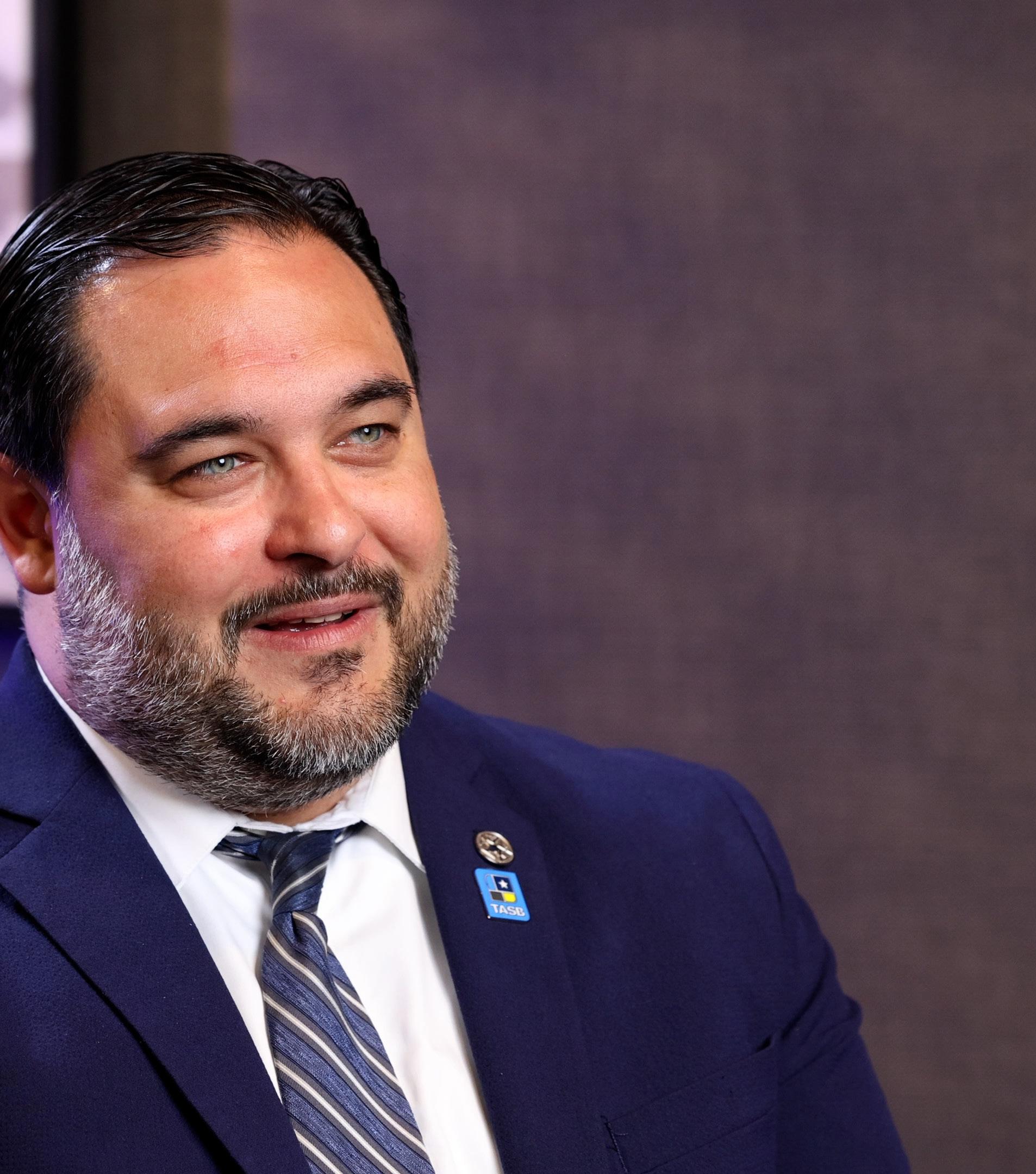
If you’re looking for a group that’s got a lot of experience with diverse communities, that’s cost effective, that’s willing to listen and to work with trustees, TASB ESS is a good choice for you.
– Justin Chapa, president of the Arlington ISD board of trustees
In its more than 30-year history, ESS has conducted over 800 searches on behalf of districts across Texas.
With a team of search consultants who know Texas and its diverse school districts, ESS has proven itself to be the go-to search firm for leadership recruiting.
ESS brings experience to the table and a guarantee, so trustees can feel confident they’ve found the best leader for the job.
tasb.org/ess
executive.search@tasb.org
800-580-8272
agenda well before the deadline for submissions if you have not already done so.
Proposed resolutions are first reviewed by the TASB Resolutions Committee and then by the TASB Board. In September, the 2025 Delegate Assembly will adopt approved resolutions that will update part of the 2024–26 Advocacy Agenda, which will remain in effect until the end of the 2026 TASB Delegate Assembly.
Please note that all current resolutions will remain on the Agenda unless amended by the Delegate Assembly.
Also, we strongly encourage your board to send a trustee to the TASB Delegate Assembly in Houston Sept. 13, 2025, to represent your board’s interests and support your advocacy positions and proposed resolutions. Learn more by going to tasb.org and clicking on the About tab and then scrolling to the Delegate Assembly box.
Please contact Dax González at 800-580-4885 or dax.gonzalez@tasb.org if you have any questions.H
Dax González is division director of TASB Governmental Relations.


by George Kazanas
School districts are complex, busy, yet dynamic places with students, teachers, administrators, and board members interacting in pursuit of educational excellence. But there is only one superintendent, and it can be a bit lonely at the top.
That’s where TASB Field Services representatives come in. As former superintendents and veteran educators, our field reps know exactly what it’s like to do the work of leading a school district. Each of the eight reps on my team have served as highly successful superintendents in districts from the Panhandle down to the Rio Grande Valley and everywhere in between.
“When you’re superintendent, you are one of one in your district,” said Bobby Ott, Temple ISD superintendent. “It’s so nice to just have someone you can call and talk to who’s had those kinds of experiences.”
Ott told me he appreciates getting updates about the educational landscape in the region and across the state from his field services rep, as well as talking through solutions to district challenges.
TASB’s field reps traverse the state, visiting every district in their assigned ESC regions. They also call on community colleges and special education shared service arrangements. This type of work translates into driving hundreds of miles in a day. Many of the districts they visit are small, rural districts where the superintendent wears many hats.
“There is a district that I am familiar with where the superintendent is the principal, superintendent, and the coun-
selor as well,” said Ruben Cervantes, field rep for regions 15, 18, and 19.
For these smaller districts, field reps are essential to connecting superintendents to solutions that allow them to be able to focus on students, whether that’s the right person to talk to at TASB or helping them find resources such as the School Law eSource.
“We can share information from a user perspective,” said Jack Damron, rep for regions 1, 6, and 13.
Field reps connect TASB services to districts in exactly the way they need them and offer potential operational efficiencies, which is particularly important in these times of budget constraints for districts across the state. They also let superintendents know there are choices in services and talk them through available options.
The other side of that is the insights the field reps take back to help TASB better serve districts, connecting the dots to develop solutions for the challenges districts are facing.
“We play a key role in communicating district needs to TASB,” said William Smith, field rep for regions 10 and 11..
Perhaps one of the most important roles our field reps provide is an experienced listener.
“We have been in their shoes and sometimes they need to talk to someone or even vent to someone, and that’s what we are there for,” Cervantes said. “We meet with every superintendent face-toface.” A group that this is particularly true for is new superintendents, who field reps often mentor informally.
As former superintendents, field reps embrace the philosophy of “paying it forward” in their work with acting superintendents. By cultivating relationships, building trust, and strengthening communication, they promote the advantages of TASB to districts while enhancing goodwill. What an awesome opportunity for both field reps and superintendents because students are the ultimate beneficiaries.H
George Kazanas is division director of Executive Search and Field Services.



by Matt Mitchell
The battle to support public education was a central focus of the 2025 TASA | TASB Legislative Conference.
“We’re engaged in a historic fight,” Rep. James Talarico (D-Austin) said before a crowd of nearly 300 Texas public school leaders.
The biennial event, hosted by TASB and the Texas Association of School Administrators, convened Feb. 18 in Austin to coincide with the 89th Texas Legislature. School board members, administrators, and superintendents from across the state heard firsthand from lawmakers and policy experts about what’s at stake for public education this legislative session.
“We take great pride in continuing to host this conference,” said Dax González, division director of TASB Governmental Relations. “It’s always a great opportunity for trustees to hear about the issues
impacting public schools across the state. We think it’s important for school leaders to hear directly from lawmakers and policy experts as they prepare to advocate for public education during the session and beyond.”
Lawmakers discuss session
House Public Education Chair Brad Buckley (R-Salado), a former Killeen ISD school board member, kicked off the morning session. He gave attendees a rundown of the education issues prioritized by the Legislature, including education savings accounts, special education funding, teacher pay raises, and school safety.
While Buckley noted concerns surrounding the ESA bill (Senate Bill 2) and its likelihood to pass, he promised “accountability and transparency” in its implementation. In addition, he told the

administrators, and superintendents

group there would be continued support for teacher pay and school funding.
This sentiment was echoed by Texas Lt. Gov. Dan Patrick, who called teaching “the most important profession,” as he indicated almost $5 billion in new funding would be put toward increasing teacher salaries.
The next round of speakers featured Ross Ramsey, a retired political journalist with more than 20 years of experience



covering the Texas Legislature, followed by legislative updates from Amy Beneski, TASA's deputy executive director, Governmental Relations, and Kelly Rasti, TASB Governmental Relations’ associate executive director. Each gave an overview of the issues they expect to loom large this session and what trustees can expect for public education in the months ahead. They then turned it over to a panel discussion with Talarico and fellow state Rep. Gary VanDeaver (R-New Boston). The pair touched on the importance of continuing to fight for public education and advised trustees on how to advocate for and communicate with their constituents. They stressed the importance of being honest about what’s on the line for public education, and to channel their districts’ frustrations in a productive way so their challenges can be heard by lawmakers at the Capitol.
Among the other key topics they discussed was raising the basic allotment, something VanDeaver said he’s continuing to support. “The basic allotment is really where I think it makes the most sense for us to invest,” he noted.
Remarks from Texas Comptroller Glenn Hegar and a presentation by Texas Permanent School Fund Corp. CEO Robert Borden capped off the speakers’ portion of the event.
After a morning of listening to lawmakers, it was time for trustees to talk. The group departed to meet with legislators at the Capitol to make their voices heard on behalf of their districts.
For many in attendance, it was their first trip. This was not the case for Julie Cole, a returning school board trustee from Hurst-Euless-Beford ISD and TASB
Director. Cole said these visits have been beneficial to her working with her district’s state representatives.
“We have several who serve our district, and I hope to meet with all of them eventually,” Cole said. “There are a few who I’ve created a relationship with over the years, and I look forward to continuing to cultivate that relationship as we talk about the needs of our school district.”
One district, Crowley ISD, wanted to make sure lawmakers heard from those impacted most by the issues facing public education: their students.
Board members Kelicia Stevenson and Nedra Robinson made the trip with three of their district’s student trustees to meet with state Sen. Bob Hall’s (R-Edgewood) office. They hoped the experience would be invaluable to their students’ continued advocacy efforts in shaping future public education policy.
“It’s important for students to have their voices heard,” Robinson said. “They are the ones impacted firsthand by policy in the classroom.”
Rose Jones, a senior at Crowley High School, said the experience as a student trustee has helped her grow as a leader in her community and hopes their efforts will continue to impact positive change.
“We are educated, we have a voice, and we need to be heard,” Jones said.H
Mitchell is a staff writer for Texas Lone Star.
by Bill Parker
Editor’s note: Leadership TASB is a unique board development program designed to take experienced board members to a new level of service and leadership by introducing them to a variety of issues, people, activities, and locations.
During the third week of February, the Leadership TASB Class of 2025 embarked on an impactful journey to Austin, where we honed our advocacy skills before heading to the Capitol to champion Texas public education. We also visited a fast-growing district to see how school leaders managed growth with the need to provide an excellent education for their students.
Before our official LTASB session, many in the class attended the TASA | TASB Legislative Conference in downtown Austin. The morning was packed with influential speakers, including Lt. Gov. Dan Patrick, House Public Education Chair Brad Buckley, (R-Salado), and Texas Comptroller Glenn Hegar. We also received legislative updates from Amy Beneski, TASA’s deputy executive director, Governmental Relations, and Kelly Rasti, TASB Governmental Relations’ associate executive director.
A highlight of the day was a panel discussion featuring Reps. James Talarico (D-Austin), and Gary VanDeaver (R-New Boston). Most of the conversation centered on education savings account (ESA) legislation, Senate Bill 2 and House Bill 3, and education funding in Texas. Attendees were captivated by the exchange, as both representatives emphasized the importance of bipartisan collaboration to benefit students.
Following the presentations, hundreds of superintendents and trustees boarded buses for a quick trip to the Capitol, where they advocated against ESAs and for
increased funding to the basic allotment. The rallying cry of the day was clear: “We must continue to fight for public education. Our funding is essential!”
The monthly LTASB meeting coincided with the inaugural Connect & Ignite Conference and Leadership TASB Alumni Reunion at the Otis Hotel, located a block from The University of Texas. The gathering also featured a legislative update from Dax González, division director for TASB Governmental Relations, who also discussed key advocacy strategies. Many attendees also were preparing to advocate at the Capitol, and by the session’s end, they were well-prepared and ready for action.
Talarico also attended the event and delivered a standout speech, sharing his experiences as an English teacher in West San Antonio and underscoring why Texas schools deserve better. He passionately spoke against ESAs, describing them as part of a “full frontal assault” on public education. His call to action resonated deeply, earning him a standing ovation as trustees left the session to meet with legislators.


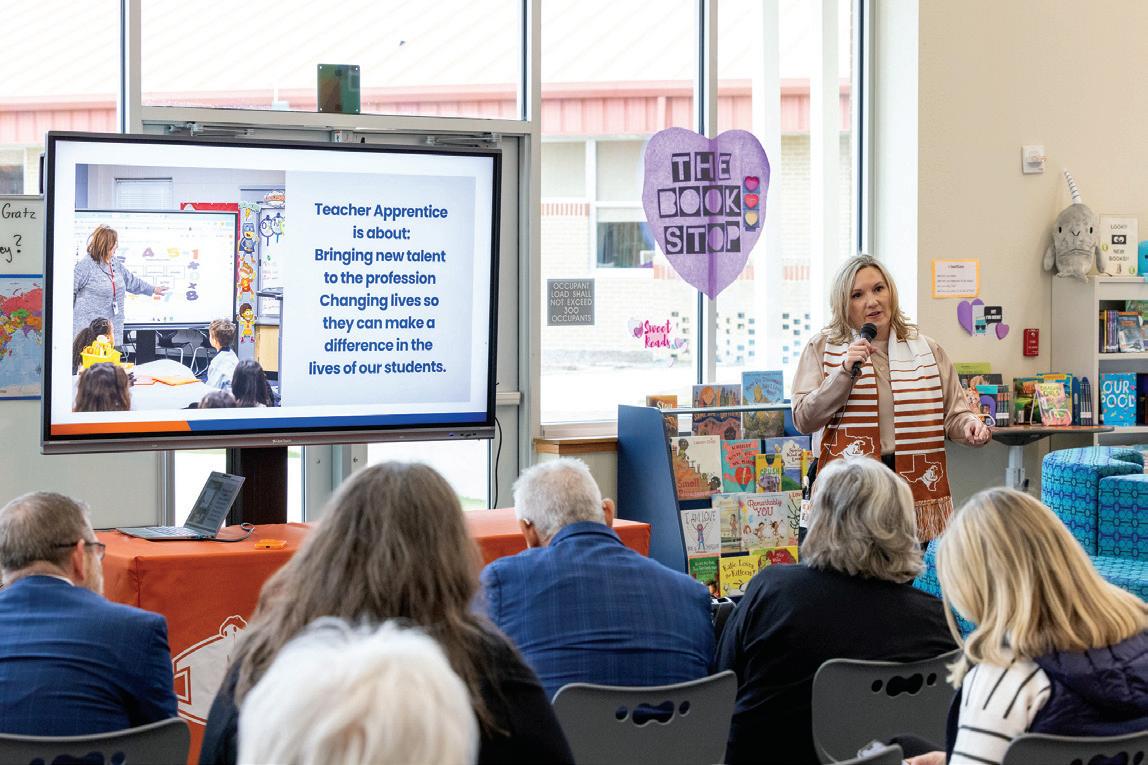
Once at the Capitol, current LTASB members and alums gathered in the rotunda before splitting into smaller groups for office visits. A key focus was visiting all 31 first-year representatives to express opposition to ESAs. Many of these legislators had expressed support for ESAs during their campaigns, yet our discussions revealed that many were not fully informed of the bill’s implications for Texas students. By the end of the day, every office had received a visit.
Connect & Ignite attendees returned to the Otis Hotel for the LTASB Alumni Reunion and Banquet that evening. It was a night of camaraderie, great food, and an inspiring keynote by Michelle Smith, a public education advocate and former executive director of Raise Your Hand Texas. She captivated the audience with stories of her father, former state Rep. Jimmie Don Aycock, and his journey from Killeen ISD trustee to chair of the Texas House Public Education Committee. Her message reinforced the power of education and advocacy as core values. The evening concluded with an enthusiastic class roll call, punctuated by the unmistakable energy of the LTASB Class of 2025 — the Best Class Ever!
The next day, our class visited Hutto ISD, a rapidly growing district about 30



miles northeast of Austin. We learned about the legend of the Hutto Hippo and the deep sense of pride it instills in the community. Hutto ISD has a strong commitment to educational excellence, and our visit provided valuable insights into the challenges faced by fast-growth districts.
At Gus Almquist Middle School, we received a warm welcome from cheerleaders, staff, athletes, and a student chamber quartet. Superintendent Jeni Neatherlin and Hutto ISD Board President Billie Logiudice greeted us before we toured the state-of-the-art facility, marveling at its modern design and innovative learning environments.
Next, we visited Hutto Elementary School to learn about the district’s groundbreaking Teacher Apprenticeship Program. Launched in fall 2024, the program offers full-time positions with tuition assistance and mentorship for aspiring teachers and is funded by the U.S. Department of Labor. Touring classrooms, we saw firsthand the seamless collaboration between teacher apprentices and experienced educators, reaffirming
A: Leadership TASB members gather in the Capitol rotunda on Feb. 20 before heading off in small groups to meet with legislators.
B: Hutto ISD’s Superintendent Jeni Neatherlin shares information about the district’s teacher apprenticeship program with members of the LTASB Class of 2025.
C: A student leader from Hutto Elementary shares information about the school and its students with members of the LTASB Class of 2025.
D: During a visit to Hutto ISD’s Ninth Grade Center, the LTASB cohort hear from a panel of Hutto ISD’s teacher apprentices.
E: Members of the LTASB Class of 2025 take a group photo alongside a few Hutto Hippos and some student leaders from Hutto ISD’s Gus Almquist Middle School.
the program’s positive impact on teachers and students.
Our final stop was the Hutto Ninth Grade Center, where we enjoyed a delicious lunch while hearing from a panel of four apprentice teachers. Their stories highlighted how the program addresses what was once viewed as a teacher shortage but is, in reality, an opportunity shortage. The panelists’ enthusiasm confirmed that this initiative is making a real difference in student learning and teacher retention.
The day concluded with presentations from Hutto ISD leadership, emphasizing their commitment to transparency and community engagement in the bond process. Their efforts have fostered trust within the community and underscored the importance of clear communication in educational leadership.
On an otherwise chilly day, the warmth of Hutto ISD’s staff and students was unmistakable. As we boarded our buses back to Austin, we carried with us a renewed commitment to advocacy and collaboration.
Throughout the trip, we were remind-
ed of the profound impact that educators, community members, and lawmakers can have on student achievement when they work together. Change happens when voices unite for a common cause, and we left Austin feeling inspired and determined to continue this critical work.
As we reflect on our experiences, the LTASB Class of 2025 remains committed to driving positive change in education. Whether through advocacy, supporting educators, or engaging with policymakers, we will continue to fight for the best possible education for all Texas students.
Our trip to Austin was more than just a visit — it was a call to action. We look forward to staying engaged and making a lasting difference in the future of education.H
Bill Parker, Ed.D., is an Allen ISD trustee and a member of the LTASB Class of 2025.
The LTASB application period opens May 1 for the LTASB Class of 2026. The deadline to apply is July 1. To be put on the application mailing list, email leadershiptasb@tasb.org
BY BETH GRIESMER
Hundreds of school trustees from across Texas brought joy, hope, and student success stories to TASB’s Governance Camp, held in Galveston March 5-8. The annual event was packed with educational sessions, as well as opportunities to gain insight into the learning experience of students with panels, exhibits, and sessions.
“We are always looking for solutions,” said Barbara Sanchez as she ate breakfast with her fellow trustees from Lockhart ISD on the first morning of Camp. “We try to go to sessions that address the issues we are having and look for new solutions.” The 6,000-student district in Central Texas has grown rapidly in recent years, and a session on facilities planning was of particular interest to the school board members.
In addition to facilities planning, the first day of Camp focused on other governance topics, including school safety, funding, student data, and more. A session from Floydada Collegiate ISD on the academic turnaround at an elementary school inspired those who attended.
“That’s the one,” said Thomas Sigee, a trustee from Beaumont ISD. He was impressed with how the principal of A.B. Duncan Elementary School changed her lowperforming campus in Floydada ISD into a highly rated school through parent engagement and teacher buy-in. Sigee would like his district of more than 14,000 students on the Texas coast to try the student-led conferences that were an important component of that school’s success.
“We have 14 elementary schools, but you have to start somewhere,” Sigee said as he compared the program at 600-student Floydada north of Lubbock.
“One of the many benefits of attending Governance Camp is the opportunity to network with peers from across the state,” said Rolinda Schmidt, TASB president and Kerrville ISD trustee, as she kicked off the conference. “I hope you all make new connections that will become valuable thought partners as you continue your work on behalf of your students.”
The keynote speaker in the first general session, Amanda Gore, applauded the work and dedication of trustees. “I


bow in awe of your commitment to the students in your districts.”
Gore, a motivational speaker who focuses on the importance of finding joy in life, encouraged school board members to be the chief joy facilitators in their districts.
It was easy to feel joyful and inspired about public education in Texas during the inaugural Teacher Voice Panel, held the first day of the event, during lunch. Educators from Beeville, Brazosport, Eanes, Fort Bend, and Spring Branch ISDs discussed their passion for the profession with moderator Sheleah Reed, chief storyteller at Shine Communications Group.
Teachers, administrators, and trustees were present the second day of Camp for 35 sessions and hands-on demonstrations led by students. Trustees could earn up to 17.25 hours of continuing education credit, with more than 2,450 credit hours awarded for this year's event.
Among the highlights of the day was the Student Voice Scholarship Panel, moderated by Paula Maddox Roalson from the law firm of Walsh, Gallegos, Kyle, Robinson, and Roalson P.C., also an event sponsor.
Four students from Anahuac, Brownsville, McDade, and Pflugerville ISDs spoke passionately about their commitment to serving their communities and connecting with their peers and teachers. While they aspire to fly to space, study law, and engineer new technologies, it was their spirit of service that impressed the audience.
The panel focused on the opportunities the students had experienced through their classes, extracurricular


activities, and school programs. McDade ISD senior Sheila Lugo Lopez Lisethe told the audience that she was amazed by the opportunities at her small Central Texas district of fewer than 400 students. “Being part of something so small can get you somewhere big,” she said.

Scan for a look back at an inspiring week with students and school leaders.
Students led sessions and demonstrations on everything from building an aircraft to FAA standards to the power of fresh flowers to brighten a community. (See photos on page 36.) Trustees walked away inspired by innovative programs and especially by the young people whose commitment, hard work, and dedication made them successful.
Camp ended with a focus on the “why” of the work of school boards from keynote speaker Mills Rodgers, an author and former educator. He echoed the theme heard throughout the conference from education leaders, teachers, and students about the importance of being seen, heard, and valued — a fitting end to a program powered by student voice.H
Beth Griesmer is a staff writer for Texas Lone Star
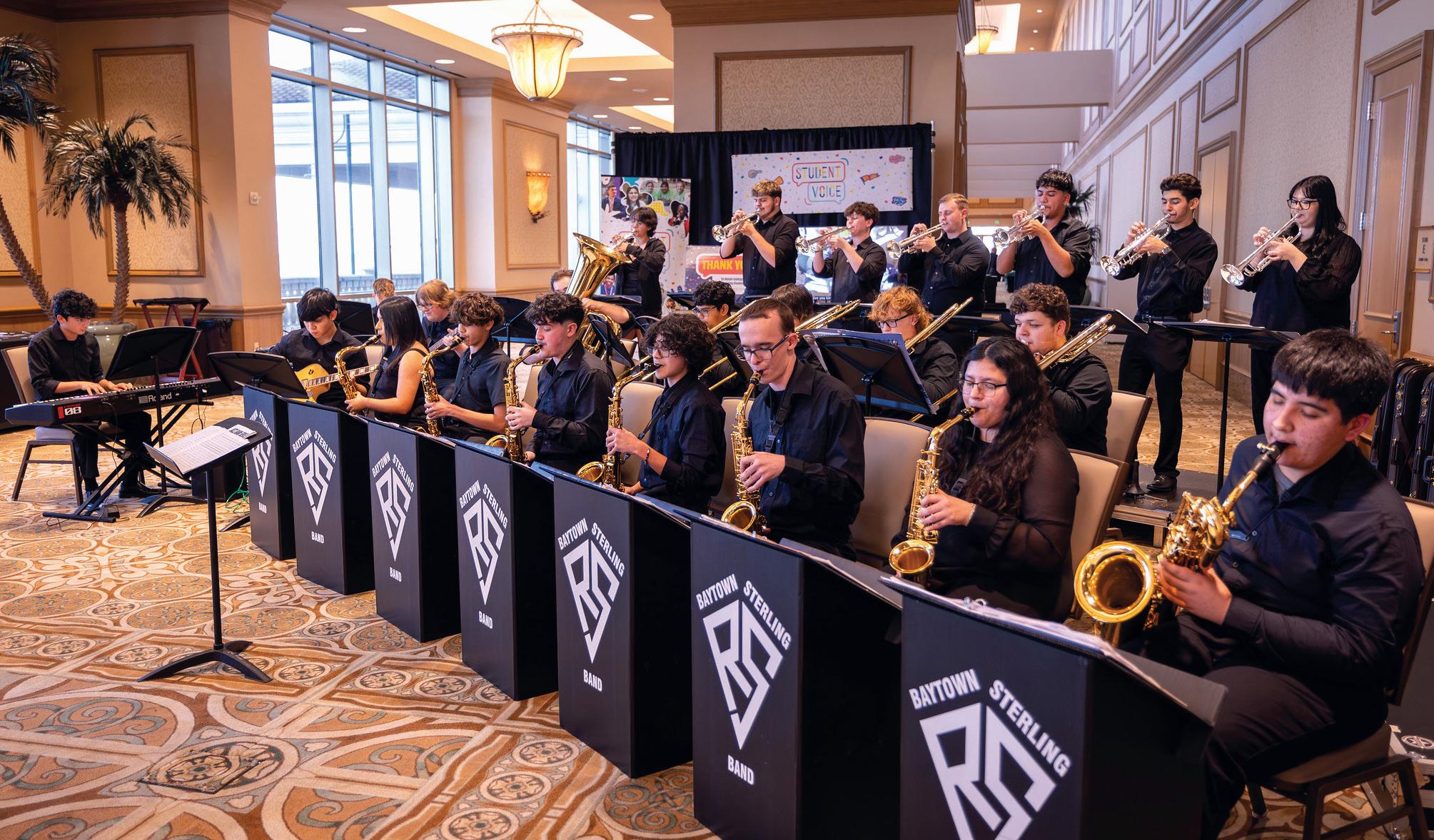

A: Motivational speaker Amanda Gore kicked off the first general session of Camp.
B: TASB President Rolinda Schmidt welcomed trustees to Camp.
C: Teachers from around the state spoke passionately during the inaugural Teacher Voice Panel.
D: The Student Voice Scholarship Panel is a crowd favorite every year at Camp.
E: Klip Weaver, president of Camp sponsor E3, talked to students during the Pep Rally showcasing student demonstrations.
F: Students from Goose Creek ISD performed at the reception on day one at Camp.

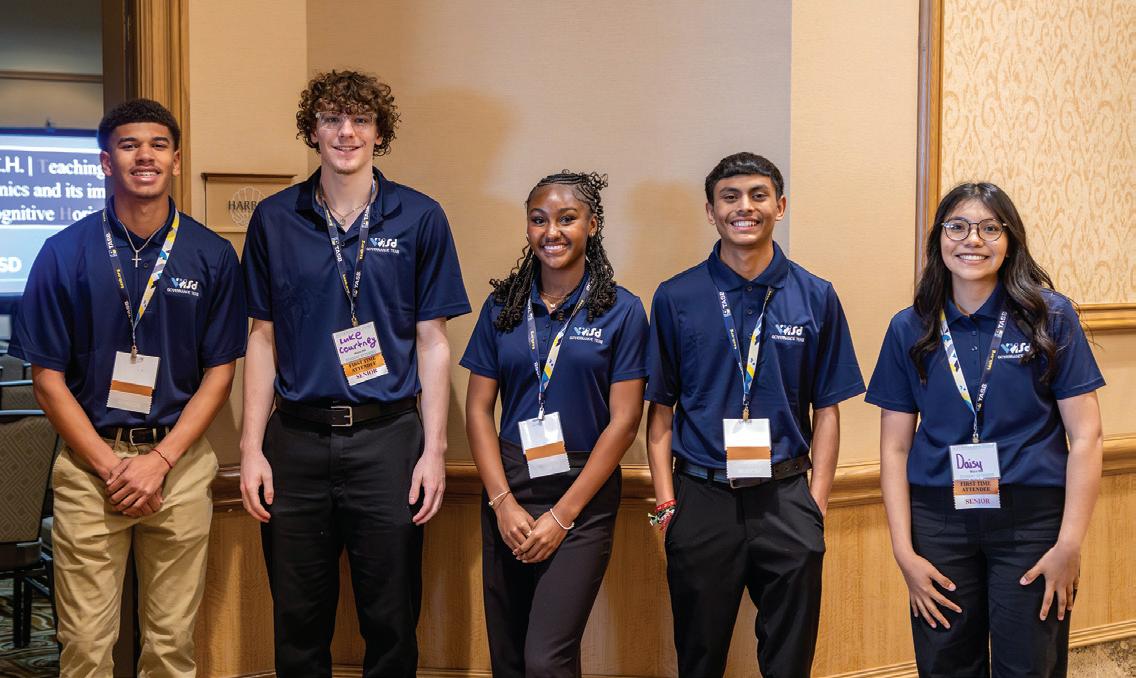



Trustees, administrators, and teachers traveled from all over the state to descend on Galveston for Governance Camp, which includes a student-centered day on March 7. And it is the students who make Camp a unique and inspirational conference. The Ross S. Sterling High School Jazz Band from Goose Creek ISD got the crowd moving at the end of the first day on March 6. Trustees were also wowed by Alief ISD students, who showcased their aerospace engineering program. Bridge City ISD’s High School Flower Factory worked endlessly to give out bouquets of fresh flowers grown by the students for their monthly flower market. Students from Dickinson ISD were back this year to promote safe driving with Teens in the Driver’s Seat. Throughout the day, students led sessions like Waco ISD’s on the impact of technology on cognitive development to packed rooms of trustees. As it is every year, Governance Camp, Powered by Student Voice, was heard loud and clear.
Photos by TASB Media Services
Nominations are open for the 2026 Texas Teacher of the Year awards.
Texas Teacher of the Year is the highest honor that the state of Texas can bestow upon a teacher. The official program, facilitated by the Texas Association of School Administrators since 2011, annually recognizes and rewards teachers who have demonstrated outstanding leadership and excellence in teaching. Each school district and charter operator in Texas may nominate two teachers — one elementary and one secondary educator — for Regional Teacher of the Year by completing an application
and providing all requested information to their regional ESC by midnight June 15. All district and charter nominees advance to a regional competition, coordinated by each ESC. The 40 regional winners — one elementary teacher and one secondary teacher for each region — then become semifinalists for Texas Teacher of the Year.
Six finalists are chosen, and following an interview process, the Texas Elementary Teacher of the Year and Texas Secondary Teacher of the Year are selected. One of the two goes on to represent the state in the National Teacher of the Year program.H
by Denise Schulz
With a May 9 deadline to nominate trustees for a position on the TASB Board of Directors, now is the time for local school boards to put forward one of their colleagues to represent their community and region.
“We are member led and need voices from all school boards — large and small, rural and urban. It’s so important that regions have representation at the state level so we can learn from each other and build a strong Association,” said TASB President Rolinda Schmidt.
The 2025 Delegate Assembly is set for Sept. 13, and the nominations timeline has been adjusted to ensure ample opportunity for boards to participate in the process. This year, local boards in regions 1, 2, 4, 6, 7, 9, 10, 11, 13, 16, and 20 are invited to review the vacancy list and take action to nominate a trustee from their board.
“The nominations period is just step one in this grassroots process,” Schmidt said. “Starting May 12, we will ask local boards to endorse candidates in their region.”
Candidates who receive endorsements from a majority of local boards in their region will be elected and take office at the end of txEDCON25. For vacancies without an endorsement majority, the candidates will be interviewed in August by the Nominations Committee, which will forward a recommended slate of candidates to the Delegate Assembly.
Active Members (local school boards and education service center boards) may approve endorsements only between May 12 and August 1.H
Denise Schulz is a staff writer for Texas Lone Star.

Scan for forms and details on nominations.


Scan to review the nomination and selection info.
Advocating (from page 5)
Fullan. They explain that “to be effective, trustees and superintendents must develop a governance mindset, a shared moral imperative, and unity of purpose, utilizing sound principles and practices — the keys to effective governance.” The best team is the one “working together for excellence for all children.”
Speaking of excellence, May also begins high school graduation for our 379,000 seniors across Texas. The parental and community pride we see when students walk across that stage compares to no other.
For trustees, the long nights, missed family time, and difficult decisions all seem to melt away as we applaud these young adults in their final preparation to leave our nest for dreams and opportunities ahead. Congratulations!H
Rolinda Schmidt, a Kerrville ISD trustee, is the 2024-25 president of TASB.
The TASB Communications, Marketing, and Events team earned 34 awards in the Texas School Public Relations Association’s Star Awards program.
The winning entries, announced Feb. 19 at the TSPRA conference in San Antonio, include two Best of Category Awards: one in the Website Design category for the Association’s recently redesigned tasb. org, and the second in the Marketing Campaign category for the TASB Energy Cooperative Fuel Campaign. Texas Lone Star magazine received a Gold Star award in the Annual Report category and a Silver Star award in the Magazine category as well as multiple awards for writing and original art.
The Star Awards recognize excellence in public school communications and marketing and include hundreds of entries from school districts, education service centers, and associations statewide.
Here’s is the full list of TASB’s awards:
Best of Category
• Website Design tasb.org
• Marketing Campaign
TASB Energy Cooperative Fuel Campaign
Gold Star
• Image/Identity Package TASB Logo and Brand Identity
• Handbook/Manual New Board Member Handbook
• Annual Report Texas Association of School Boards 2023 Annual Report
• Published News or Feature
A Cut Above
• Logo, Trademark, Symbol TASB 75th Anniversary Mark
• Original Art — Strengthening Good Governance Illustration
— Voices and Choices Illustration
• Published Print Ad
Map Your Journey to Success
• Video: Feature Story What Unites Us
• Website Design tasb.org
• Video: Marketing
TASB Careers: Join Us
• Miscellaneous Digital Media
— Funding Solutions for Districts’ Healthcare Needs
— txEDCON24 Exhibitor and Sponsorship Prospectus
• Marketing Campaign
— TASB Energy Cooperative Fuel Campaign
— TASB Special Education Solutions Name Change
Silver Star
• Magazine
Texas Lone Star
• Commemorative
Holiday Ornament 2023
• Writing
The Truth about School Finance
• Published News or Feature
— A Comforting Cause
— Building and Bonding Leaders
— Fulfilling the Future
— Funding Futures
— Honor Boards
— The Fund at 50
— The Kids Are Coming!
— Voices and Choices
• Booklet
— A Toolkit for Effective Parent Conversations
— A Toolkit for Strong Budget Discussions
• Original Art
School Board Recognition Month 2024
Bronze Star
• Published News or Feature
— Amplified Voice
— The Mesquite Promise
• Logo, Trademark, Symbol
TASB Risk Management 50th MarkH


by Sylvia Wood
A majority of Texans support increased funding for public schools and teacher salaries, according to a TASB poll. And if educational savings accounts are passed by legislators this session, Texans believe they need to be regulated, the survey showed.
The poll showed that 77% of respondents backed more funding for Texas public schools. Public education was ranked as the highest priority for the Texas Legislature this session, tied with border security and illegal immigration.
A majority of those polled are opposed to providing public tax dollars to families who home school or creating programs that give parents state money to send their kids to private or religious schools. When specifically asked about their stance on these issues, only 37%
were in support of those ideas. Those opposed include a majority of voters in urban and rural communities who were split nearly even between those with children and those without.
“A majority of Texans know the importance of investing in public education for a strong economy and prosperous future,” said TASB Executive Director Dan Troxell. “They not only value public education, but they want lawmakers to prioritize our teachers and our students by investing more in salaries and allocating more money for school safety.”
The poll of 807 registered voters was conducted in late January by Perception Insight, a Texas-based opinion research firm. Among those responding, 47% reported voting for Republicans most often, 34% indicated a preference for
Democrats, and the remaining 19% said they vote independent of party.
Following are other highlights from the poll:
• 71% of respondents have a positive impression of the teachers in their local school district.
• 89% of poll respondents were in favor of increasing funding for teacher salaries and school safety, respectively.
• 84% of poll respondents were in favor of increasing funding for special education, and 81% were in favor of adjusting student funding levels to help schools better manage the impact of inflation.H
Sylvia Wood is a staff writer for Texas Lone Star.
Summer Leadership Institute Offers Range of Learning Opportunities!
Discover a range of learning opportunities at TASB’s Summer Leadership Institute. This premier training event is designed to offer new and experienced school trustees a place to create their own learning journey.
Take part in SLI at one of two locations: San Antonio from June 11-14; and in Fort Worth from June 18-21. Both will offer a variety of sessions that will cover the latest trends, best practices, and innovative strategies in school board leadership.

TASB’s Texas Trustee Institute, an immersive learning experience designed for new board members, and Board Officer Institute, a program designed for trustees who are either officers or interested in a board leadership role, also will be offered at both locations.
Don't miss this opportunity to network with peers, gain new insights, and enhance your leadership skills at SLI. For more information, visit tasb.org/sli
Administrative Professionals Gather in Austin for TASB Conference
TASBTASB’s Executive Search Services is currently accepting applications for these positions listed below:
▄ Seguin ISD: Superintendent Deadline: TBD
▄ Socorro ISD: Superintendent Deadline: TBD
▄ Cameron ISD: Superintendent Deadline: TBD
For information about vacancies or services provided by TASB’s Executive Search Services, call 800-580-8272, email executive.search@tasb.org

Pflugerville ISD Superintendent Quintin Shepherd addresses attendees at administrative professionals conference.
hosted another successful conference for administrative professionals from Texas school districts in February. About 50 administrative professionals attended the two-day conference, which featured a range of informative sessions, inspirational speakers, and opportunities to network with peers from other districts. Pflugerville ISD Superintendent Quintin Shepherd told the group how they can cultivate compassion in their roles as quiet leaders in the district. TASB is dedicated to supporting these essential staff with timely and relevant training in all areas of K-12 public education. Thanks to all who attended the conference! The next TASB Conference for Administrative Professionals will be held Oct. 23-24, 2025.

We want to recognize school board members’ extraordinary work in TLS!

If you have received any awards or honors, please send your news and photos to tls@tasb.org.
TASB supports trustees at every point along the board leadership journey, offering training and programs to excel at board governance.
TTI offers a comprehensive program to build skills, dive into governance, and develop a leadership network.
Key offerings: Texas Open Meetings Act, Board Governance, Consensus Building.
Registration opens April 16!
For experienced trustees, meet with innovative districts and leaders, while learning what makes them successful. LTASB’s one-of-a-kind experience will expand your view of education leadership.
Learn more! leadershiptasb@tasb.org
Need support with your superintendent evaluation process? Board Development Services’ consultants are here to help! Get training tailored to your district’s needs.
board.dev@tasb.org
Find on-demand courses for new trustees, including the Top 10 Things to Know bundle of essential courses, in the Online Learning Center.
onlinelearning.tasb.org
For veteran trustees and board officers, BOI imparts knowledge and tools for effective and efficient meetings.
Key offerings: Important Tools for Meeting Preparation, Effective Meetings, Focused and Productive Board Discussions.
Registration opens April 16!
With the Online Learning Center, you can find courses to support your board service, including: Preparing for Superintendent Evaluation, Board Officers Forum, and Advocacy 101 and 201.
onlinelearning.tasb.org
For additional information on any of these offerings: 800-580-8272, ext. 2453 • board.dev@tasb.org
onlinelearning.tasb.org
With many school districts struggling with financial challenges as a result of inflation and stagnant state funding, more school boards have opted to hold voterapproval tax rate elections (VATRE) to increase revenue for staff and programs.
In essence, a VATRE is triggered when a board adopts a tax rate that goes beyond what is allowed by a statutory formula. In order to impose that higher tax rate, school boards must ask for voter permission by putting it on the November ballot.
Planning ahead is essential because of a long list of key deadlines that must be met, in addition to all of the community outreach involved in explaining a VATRE to the general public.
Even as more school districts decide to hold VATREs, success isn’t guaranteed. Here’s a look at recent VATRE results in Texas, including last November’s election. For school boards considering a VATRE this November, it’s helpful to have a big picture view of the data.
$248.7 million
The total amount of funding approved through VATREs in November
61 out of 1,024 school districts in Texas held VATREs or 6% of all districts
VATREs were approved by voters or a passing rate of 41% — the lowest passing rate in 5 years
The county with the most VATREs on the ballot was Lipscomb, where 3 school districts got voter approval for a total of $574,342 in funding.
Claude ISD
The smallest VATRE approved was in Claude ISD where 56% of voters approved a $42,274 increase.
Tatum ISD and Turkey-Quitaque ISD
More than 80% of voters overwhelmingly approved the VATREs in their school districts.
Austin ISD 4.
The largest VATRE approved was in Austin ISD where 58% of voters approved a $184.6 million increase.
Source: TASB Organization & Planning Services
■ Networking opportunities ■ TASB Delegate Assembly