INSIGHT


Your team has more important things to do than chase quotes for copier supplies.
With BuyBoard, procurement staff can skip the red tape and get what your schools need - fast. From toner cartridges to copy paper, BuyBoard connects you to awarded vendors offering competitive pricing, all through a compliant, time-saving process.
Plus, member districts are eligible for rebates on qualifying purchases at the end of the year - added value you can take to the boardroom.
Executive Director Kevin Brown
Deputy Executive Director, Charles Dupre Member Engagement & Support
Director, Communications Amy Francisco & Marketing
Coordinator, Graphics & Multimedia Marco A. De La Cueva
Editorial Director Dacia Rivers
INSIGHT is published quarterly by the Texas Association of School Administrators, 406 East 11th Street, Austin, Texas, 78701-2617. Subscription is included in TASA membership dues. © 2025 by TASA. All rights reserved.TASA members may reprint articles in limited quantities for in-house educational use. Articles in INSIGHT are expressions of the author or interviewee and do not necessarily represent the views or policies of TASA. Advertisements do not necessarily carry the endorsement of the Texas Association of School Administrators.
TASA’s mission is to promote, provide and develop leaders who create and sustain studentcentered schools and develop future-ready students.
We envision innovative, future-focused leaders for every public school student.
OFFICERS
Chris Moran, President, San Angelo ISD
Roosevelt Nivens, President-Elect, Lamar CISD
Jeannie Meza-Chavez, Vice President, San Elizario ISD
Martha Salazar-Zamora, Past President, Tomball ISD
EXECUTIVE COMMITTEE
Alejos Salazar, Jr., Region 1, Lasara ISD
Sharon McKinney, Region 2, Port Aransas ISD
Robert O’Connor, Region 3, Edna ISD
Walter Jackson, Region 4, La Porte ISD
Stacey Brister, Region 5, Little Cypress-Mauriceville CISD
Darol Hail, Region 6, New Waverly ISD
Carnelius Gilder, Region 7, West Sabine ISD
Jason McCullough, Region 8, Mount Vernon ISD
Brad Owen, Region 9, Burkburnett ISD
John “JJ” Villarreal, Region 10, Rockwall ISD
DesMontes Stewart, Region 11, Gainesville ISD
Bobby Ott, Region 12, Temple ISD
Mark Estrada, Region 13, Lockhart ISD
Bryan Allen, Region 14, Clyde CISD
Aaron Hood, Region 15, Robert Lee ISD
Greg Brown, Region 16, Perryton ISD
Scott Harrell, Region 17, Sudan ISD
Jay McWilliams, Region 18, Big Spring ISD
Diana Sayavedra, Region 19, El Paso ISD
Burnie Roper, Region 20, Lackland ISD
AT-LARGE MEMBERS
Sanée Bell, Katy ISD
Tory Hill, Channelview ISD
Nicole Poenitzsch, Bellville ISD
Tiffany Spicer, Waco ISD
COMMITTEE CHAIRS
Lauralyn Arterbury, Advocacy
Dana Bashara, Professional Learning
Donny Lee, Member Engagement
Roland Hernandez, Legislative
EDITORIAL ADVISORY COMMITTEE
Jeannie Meza-Chavez, San Elizario ISD, Chair
Lauralyn Arterbury, New Braunfels ISD
Dana Bashara, Alamo Heights ISD
Roland Hernandez, Corpus Christi ISD
Donny Lee, Wichita Falls ISD
Michael O'Malley, Texas State University
For details on TASA professional developement events, see https://tasanet.org/professional-learning.

txEDCON 2025, the annual TASA/TASB Convention, will be held September 11-14 in Houston. The convention is a tradition that goes back nearly 65 years! The first official TASA/TASB Convention took place September 24–25, 1961, at the Municipal Auditorium in Austin. Co-sponsored, co-staffed, and co-planned, it marked a new era of partnership between school governance and leadership. Admission was free, and meal tickets were just $1.75 for lunch and $3 for the banquet. Visitors to the exhibit hall were entered to win a 17-inch portable "television set." In 1967, a registration fee was introduced — $3 for members, $8 for non-members. In the early 1970s, the convention was scheduled around UT football. Though held in San Antonio, charter buses transported attendees to the games in Austin for $5 per ticket. Attendees departed at 5:30 p.m. from the convention center and returned after the game. Don't miss this year's convention in Houston! Get details at https://tasa.tasb.org!



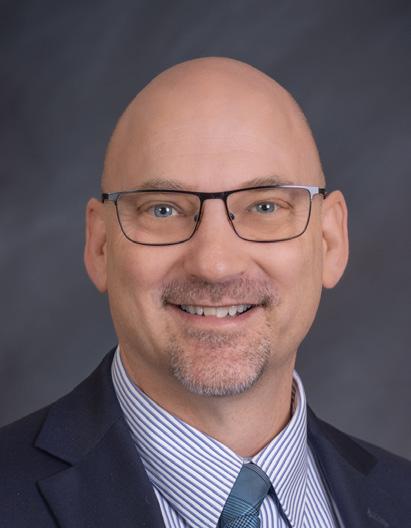
Chris Moran
PRESIDENT’S
My father often told me, “Get all you can and can all you get.”
In this issue of INSIGHT, we welcome new TASA President Christopher Moran. Dr. Moran is superintendent of San Angelo ISD, a post he has held since 2024. Before that, he was superintendent in Whitehouse and Brownsboro ISDs. A 34-year veteran educator, Moran has been married to his wife, Christa, for 30 years and he is a proud father to four children and two grandchildren.
Ioriginally intended to teach and coach basketball as a career, but I could never have imagined the journey that would unfold through my years as an educator. Born in Southern Arizona, just two miles north of the border, I was raised by loving parents who had little in terms of material wealth, but an abundance of faith and commitment to family. When a family divorce left my three male cousins without a home, my parents welcomed them in. At the age of 7, our new home — a 14-by-80 trailer in East Texas — became the center of a family.
Living in the country offered me a childhood of simple joys: riding bikes, romping through the woods, and playing in the creek. My time was divided between school, church, family work, and exploring the outdoors. Though our means were limited, I now realize how rich I was in love, opportunity, and support.
Neither of my parents had a college education, but they dedicated their lives to serving Jesus Christ and others. They instilled in us the belief that education was not only important but essential. My father often told me, “Get all you can and can all you get.” In Whitehouse, Texas, strong academics for me were complemented by band and basketball.
It wasn’t until college that I found my path toward a teaching certificate. Playing college basketball at an NAIA school in Missouri ignited a deep passion for coaching. What began as a dream to teach and coach slowly evolved. One step led to another, and now, in my 34th year in Texas public education, I am honored to serve as superintendent and the president of the Texas Association of School Administrators.
Along the way, I have been blessed with mentors who modeled integrity, servant leadership, and a standard of excellence. They challenged me to grow and taught me the importance of surrounding myself with people who are smarter than I am — people who can help build something greater than any of us could do alone.
Looking back, I recognize how much others have sacrificed, prayed, and encouraged me along the way. My parents and brothers have been steady examples of service and devotion to others. Their influence helped shape the foundation of who I am today.
Through it all, my prayer is that every student I serve experiences the same kind of support and love I received as a child. I believe every student is created in the image of God and possesses gifts and abilities of great value. My mission is to love and serve each student who enters through the doors of San Angelo ISD — regardless of race, religion, socioeconomic background, or any other label. By providing a rigorous academic experience paired with compassion and care, I aim to serve the God I love and empower every student to pursue a life of purpose and possibility.
Serving Texas public school students isn’t just my career — it’s my calling.


PHONE‑FREE BY THIS SEPTEMBER.
HB 1481 IS HERE. $20M IN TEA FUNDING.
Is your district ready? Yondr can help:
– Customized policy development
– Comprehensive training and onboarding
– Secure, durable equipment
– Smooth daily operations
– Ongoing support


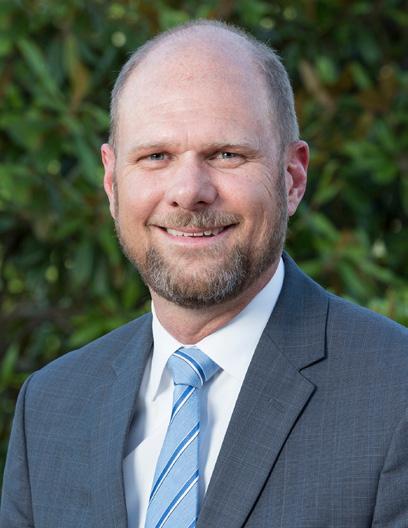
Kevin Brown EXECUTIVE DIRECTOR’S VIEW
Thank you to the educators, administrators and bus drivers who showed up — as you always do.
The Central Texas floods on July 4 were a terrible tragedy — the loss of so many lives, the grief of families and friends, the sorrow in our communities. The most profound losses, of course, were the children. They had been looking forward to attending their beloved camp for a month with old and new friends, or to a family vacation along the river.
Survivors face lifelong wounds as they process what they saw, heard and lost. It’s enough to test anyone’s faith and resolve.
It’s hard to find a silver lining. Nothing can bring back those we’ve lost. Yet as I watched the news and heard stories of heroic rescues — young counselors risking their lives for others, school employees, bus drivers, principals, and superintendents jumping into action to save hundreds — I felt hope.
Two stories in particular moved me. One father, searching for his son, helped others cope with their own grief. His quiet strength gives me hope in humanity. Another man, searching for his parents, told reporters he was overwhelmed by the public’s unity. Filled with grief, he said if their deaths brought our divided nation together, even briefly, their lives were not lost in vain. His words brought me to tears.
As school districts raise money and offer support, I’m reminded of the generosity of the people in our profession. Thank you for providing counseling to students and comforting your communities. Thank you to the educators, administrators and bus drivers who showed up — as you always do. You welcome every child, hold yourselves accountable to your communities, and serve selflessly in good times and bad.
A special thank-you to the educators and leaders in Kerrville, Ingram, Hunt, Comfort, and Center Point. You have carried the greatest burden and given the most.
It’s often said that when things are at their worst, people are at their best. We’ve seen countless examples of that during this ordeal. Perhaps one way to honor those we lost is to set aside our differences and strive for unity — not just in hard times, but always. In that regard, never forget: You model that for our society every day.
Kevin Brown TASA Executive Director
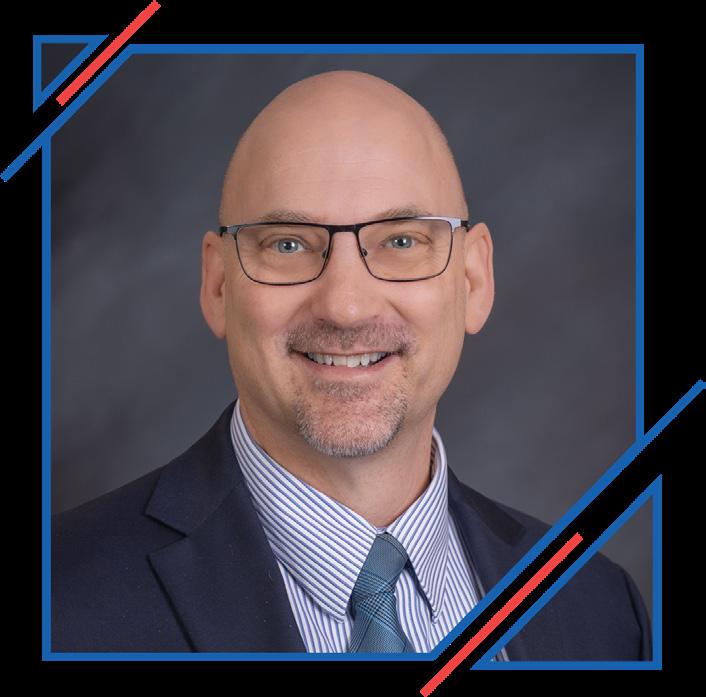
Chris Moran is serving as TASA president for the 2025-26 year. In 2024, he became superintendent of San Angelo ISD. With more than three decades of work in public education, Moran previously served as superintendent in Whitehouse and Brownsboro ISDs. In 2019, he was named the Region 7 Superintendent of the year. He has worked as a teacher, coach, bus driver, assistant principal and principal, all in Whitehouse ISD, the district from which he himself graduated.
Moran received his bachelor’s degree from Evangel University, his master’s from The University of Texas at Tyler, and a doctorate from Stephen F. Austin State University. He has also received post-doctoral training through the Lamar University Center for Executive Leadership and the SMU District Leadership Fellows.
Moran has served on the TASA Executive Committee since 2021. He has also served on the Commissioner’s Cabinet and enthusiastically advocates for all students.
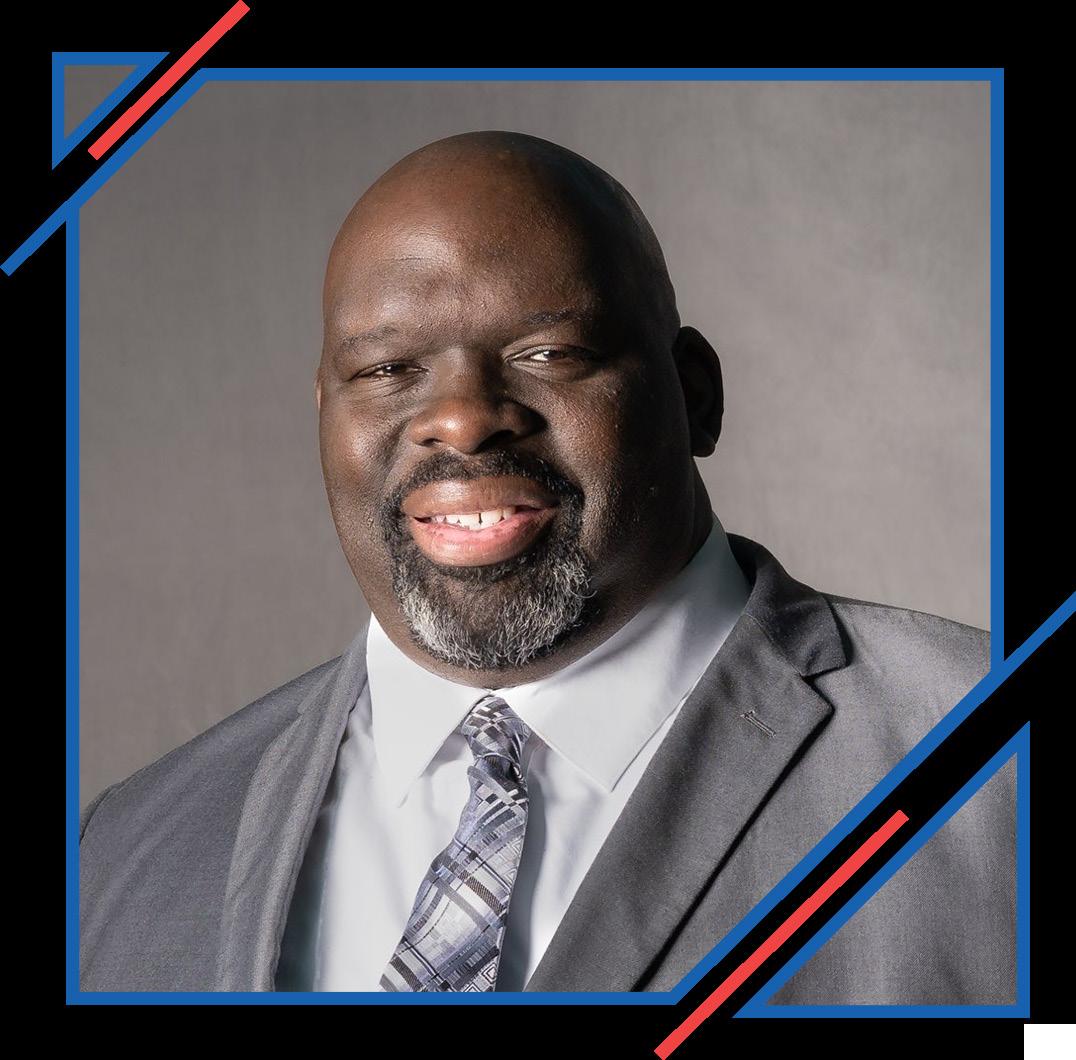
Since 2021, Roosevelt Nivens has served as superintendent of Lamar CISD. Prior to that, he was superintendent of schools in Community ISD. Nivens began his career in education as a teacher in Dallas ISD before working as an assistant principal, principal, and assistant superintendent of achievement and organizational management in Lancaster ISD.
The son of educators, Nivens earned his bachelor’s degree from Liberty University in Lynchburg, Virginia, and his master’s and doctoral degrees in education from Texas A&M University-Commerce. He also trained at the Harvard Executive Leadership Institute, the Harrison Williams Collins Executive Leadership Institute and the Thompson Executive Leadership Institute.
In 2019, Nivens was named Region 10 Superintendent of the Year and National Superintendent of the Year for the National Alliance of Black School Educators (NABSE). In 2022, he was named Latino Serving Superintendent of the Year by the Association of Latino Administrators and Superintendents (ALAS). As a TASA member, he has chaired the Advocacy Committee and the Editorial Advisory Committee.
Jeannie Meza-Chavez is superintendent of San Elizario ISD, a position she has held since 2017. Now in her 28th year working in education, Meza-Chavez was previously superintendent in Tornillo ISD. She began her career in education as a middle school English and reading teacher in Socorro ISD before moving to San Antonio to help open the Young Women's Leadership Academy.
After returning to the El Paso area, Meza-Chavez became principal at Nolan Richardson Middle School in El Paso ISD, then moved into district administration, working as the human resources director for secondary personnel before stepping into the superintendency in Tornillo.
Meza-Chavez earned her bachelor’s degree from the University of Texas at El Paso, her master’s from Sul Ross State University, and her doctorate from New Mexico State University.
Recently, Meza-Chavez served as president of the Texas Council of Women School Executives. She has served on numerous TASA committees. As vice president, she chairs the TASA Editorial Advisory Committee.
Tomball ISD welcomed Martha Salazar-Zamora as superintendent in 2017. In 2023, she was named Texas Superintendent of the Year — the first Hispanic female to receive the honor — and she was selected by AASA as one of four finalists for 2024 National Superintendent of the Year.
In 2024, Salazar-Zamora was named the Houston Area Educator of the Year, one of the Top 40 Women of Distinction in Houston, and she was listed by “District Administration” magazine as one of the 100 Most Influential Educators in the nation. In late 2024, she was also named one of two finalists for AASA’s Women in Leadership Award.
She has worked in education for 39 years, serving in several diverse districts across the state, including as deputy superintendent for instruction and administration in Round Rock ISD. Salazar-Zamora received her master’s and doctoral degrees from Texas A&M University.
Salazar-Zamora currently serves as president of the Texas Council of Women School Executives, and she has previously served as president of the Fast Growth School Coalition. She is also a past president and founding member of the Texas Association of Latino Administrators and Superintendents.
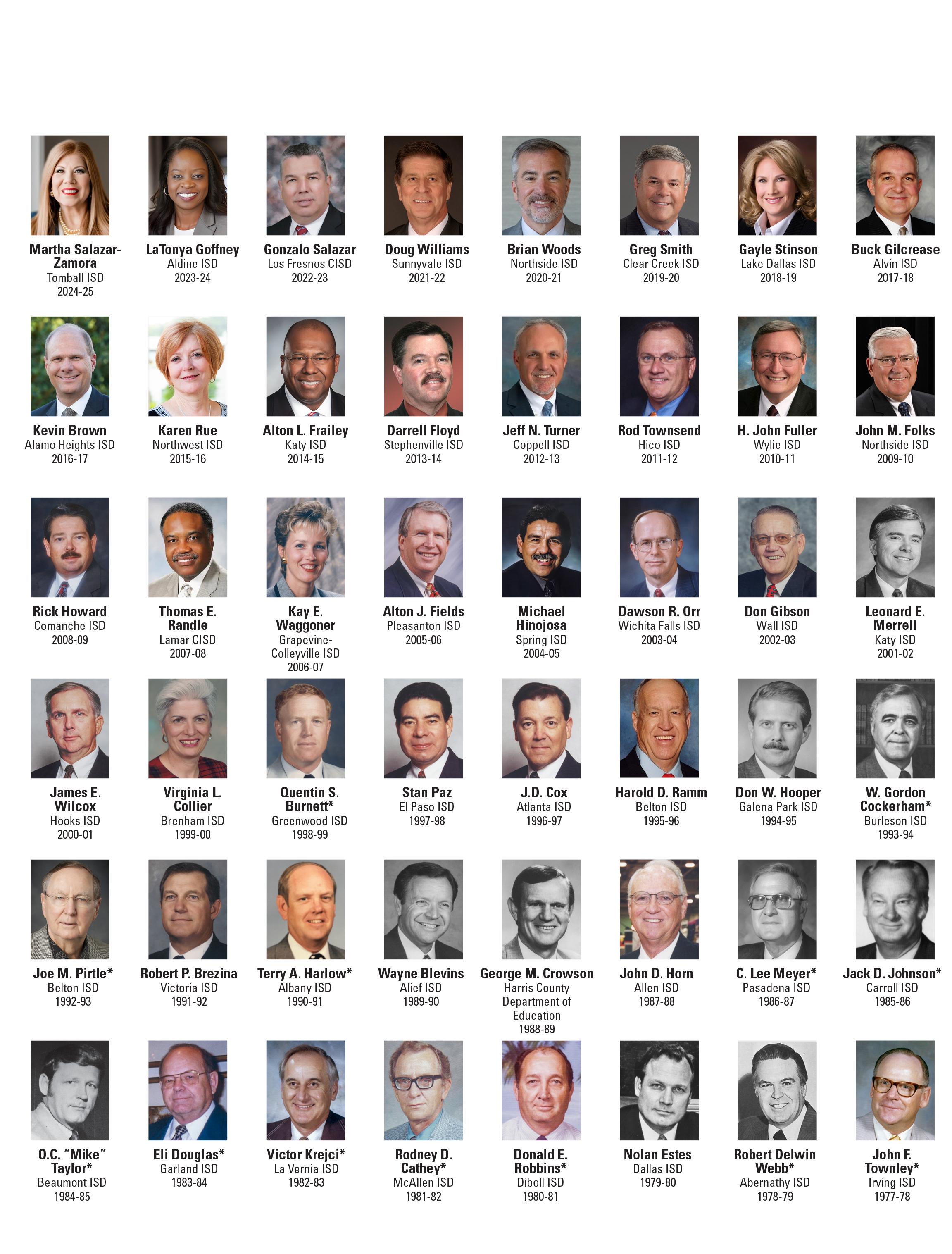
As we celebrate TASA's centennial this year, we honor all the outstanding school leaders who have served as TASA president over the past 100 years.


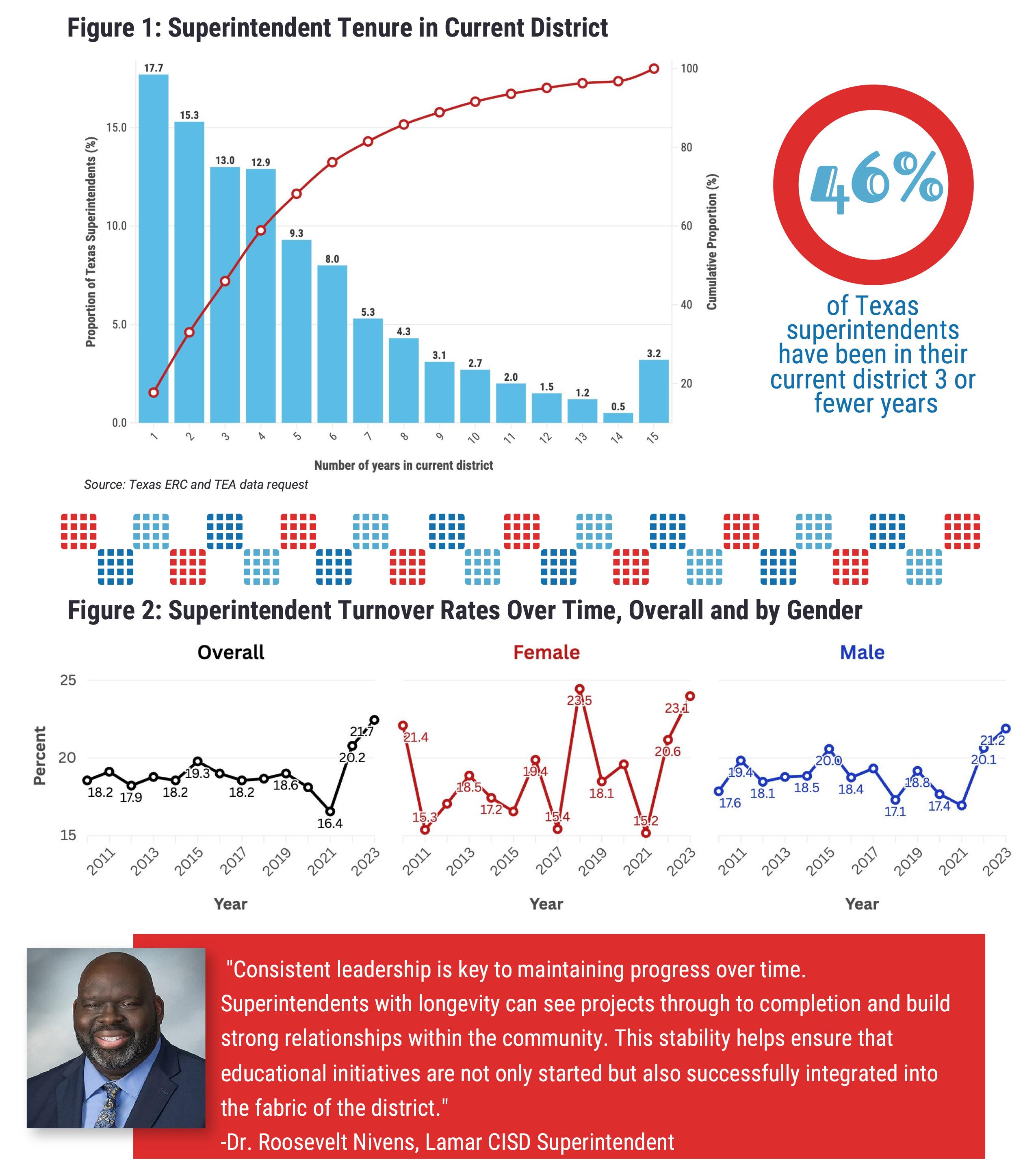
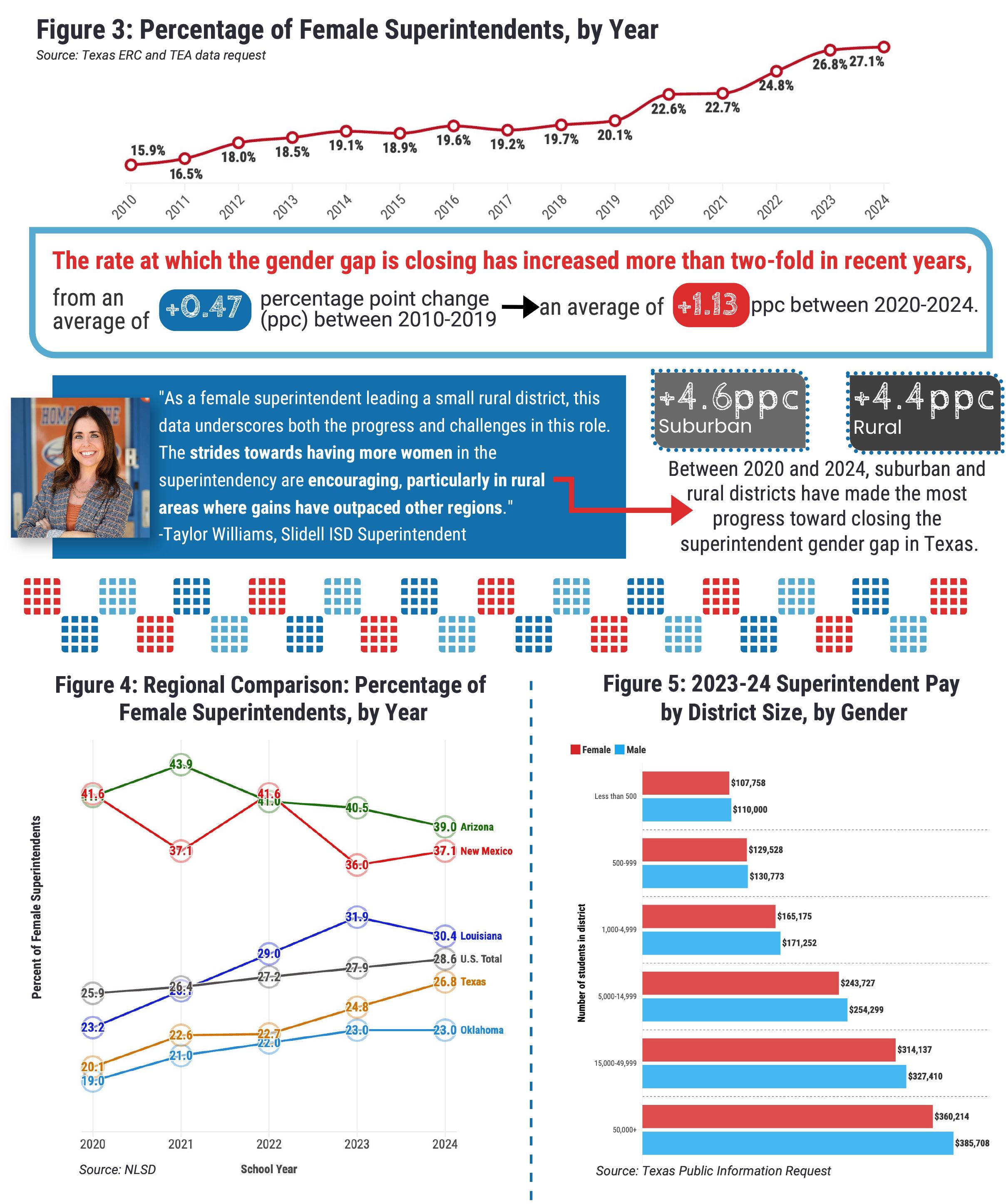
TASA and the Texas Education Leadership Lab at the University of Texas at Austin have partnered to publish what will become an annual report on the status of the superintendency, and we're excited to announce that the 2025 release of "The Texas Superintendent Workforce in 7 Graphics" is complete. This first-of-its-kind report includes demographics, turnover, tenure, pay and gender, and snapshots of the superintendency based on district size, serving as a resource for school districts, boards, policymakers, and the public at large. See the full report at https://bit. ly/2025-supt-workforce-report.


Before TASA was "TASA," it was the "Section of Superintendence" of the Texas State Teachers Association. Founded in November 1925 with 108 charter members, including 72 superintendents and 24 principals, the roster included one woman: Mary Carroll, superintendent of Corpus Christi ISD from 1922 to 1933.
Charter members paid a $1 membership fee, on which then-Secretary-Treasurer N.S. Holland commented: “Our objective is to get an organization among school administrators, in Texas, along professional lines. The membership fee of $1 should be substantially increased, so that we can find sufficient funds for this organization to assert itself.” One year later, the membership fee was increased to $5.
During the years the organization operated as the “Section of Superintendence,” it rarely exceeded 100 members, but after becoming the Texas Association of School Administrators in 1939, TASA began to grow. As 1942-43 TASA President J.W. Edgar once noted, "Since about 1938, the organizational structure had been in transition, moving from a passive research organization to an active membership organization.
"By 1952, TASA had 800 members. Back then, before the internet and email (or even faxes), TASA used paper and ink to communicate with those members, and volunteer leaders among the membership collected the dues and conducted the business of the association.
It wasn't until 1966, when the TASA Executive Committee appointed R.E. “Emmett” Harris as the first full-time executive director, that TASA had a full-time staff. Annual dues at that time were $15 (about $145 today), and that was after an increase was made to fund the hiring of Harris and establish a TASA headquarters.



Five years later, in 1971, the TASA membership approved a constitutional amendment to increase annual dues to $35. That increase enabled TASA to provide liability insurance coverage to members and hire a part-time assistant executive director.
It was in the early 1970s that discussion began about creating a dues structure based on a percentage of members' salaries. A Dues Structure Committee recommended that they be increased to 1.5% of the gross salary of each member, but that effort failed when put to a vote of the whole membership, as did another couple of efforts to raise dues in the early 1970s.
In 1975, an Executive Committee recommendation that TASA dues be set at fourtenths of 1% (.004) of each member’s gross annual salary with dues no less than $56 nor more than $120 was presented to the general membership and adopted by a vote of 234 to 48, with 83% of TASA members voting in support.
The effective date was June 1, coinciding with an announcement that applications were being accepted for a new executive director to replace Harris, who had announced his intent to retire in June 1976. By 1983, TASA grew to nearly 1,500 members.
Since that time, the dues structure has changed only once — in 1990 — when TASA’s “21st Century Task Force” recommended that
TASA revise its dues structure. The change eliminated the $120 cap on Active Category members’ dues instituted in 1975, deleted the institutional membership category, and provided for dues increases for Associate and Student Category members.
Modifications to TASA’s Constitution & Bylaws in subsequent years granted flexibility to the Executive Committee to change the dues amounts for members other than superintendents. However, the basic dues structure adopted in 1990, providing for growth in dues revenue annually based on member salaries, remains in effect today.
As a new millennium dawned in 1999-00, TASA reached 2,000 members. Two decades later, membership hit 3,000, and growth accelerated rapidly for the next five years. TASA is now stronger than it has ever been with 4,089 Active, Associate, Retired, College/University/State Agency, and Student members and a legacy of a century of service and support to Texas school leaders. In addition, we cur-
rently have 1,967 Honorary Life members. That special category is reserved for school administrators who have demonstrated extraordinary devotion to education and to the association during their careers. (See pages 20-29.)
Today, TASA members enjoy a range of benefits. However, the following 1954-55 TASA membership campaign call to action still sums it up pretty well:
“’Oughtness’ is not enough reason for belonging to TASA, but there are many reasons why every school administrator in Texas owes it to himself and his school district to affiliate himself with TASA. The genial, progressive, well-informed school administrator, with a TASA membership card, and with unshakable confidence in himself, his ability, his school district, his association, his state, and his country, is to millions the living representative of Public Education in Texas!"
Each year at the TASA Midwinter Conference, the association honors a new cohort of Honorary Life members. This special category of membership is reserved for school administrators who have demonstrated extraordinary devotion to education and to the association during their careers. TASA has awarded 2,205 Honorary Life memberships since 1943, the first year of the program.
Ramon Abarca
Elizabeth Abernethy
Truett Absher
Clyde Abshier
Glenn Acker
W. Acker
Stacy Ackley
Billy Adams
Gary Adams
H.G. Adams
Jeff Adams
Raymond Adams
Seth Adams
Vicki Adams
Robin Adkins
Antonio Aguirre
A. Aikin
John Alebis
Ruben Alejandro
Billy Alexander
C. Warren Alexander
Tommy Alexander
Bill Allen
Terry Allen
Frank Allenson
Daniel Allie
James Allison

Kevy Allred
Arturo Almendarez
Kenneth Almond
Ace Alsup
Ernesto Alvarado
James Alvis
Thomas Alvis
Joe Ammerman
Bill Anderson
Gerald Anderson
Gordon Anderson
J. Anderson
Karen Anderson
Marcus Anderson
S. Anderson
Joe Andrews
W. Andrews
Larry Appel
James Apple
Kent Appleby
Herbert Arledge
Billy Arnold
Dorothy Arnold
Doug Arnold
Paul Arnold
Raymond Arnold
Elvis Arterbury
Stephanie Arterbury
Steve Arthur
Ross Aschenbeck
Sarah Ashburn
Robert Ashworth
Morrison Asman
Joe Austin
Ted Averitt
Royce Avery
Fred Ayer
Thomas Baca
Jay Baccus
Larry Baer
Kelly Baggett
A. Bagley
Coleman Bailey
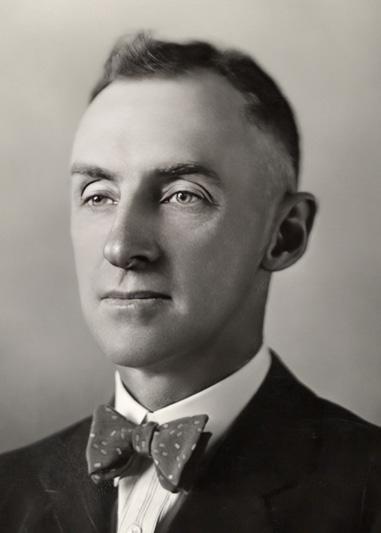
TASA’s First Honorary Life Member
John Bailey
Richard Bain
Jerry Baird
Betty Baitland
James Baize
Anne Baker
Billy Baker
Bobby Baker
TASA’s first Honorary Life Membership was bestowed at the 1943 annual meeting, when TASA President J.W. Edgar arranged for and conferred it on Dr. Fred C. Ayer, a professor of educational administration at The University of Texas at Austin.
Ayer, TASA’s “Director of Research” from 1931 to 1935, had published a series of reports titled “The Progress of Pupils in the State of Texas.” He was recognized for the importance of that research.
As TASA President Jake Hendricks noted in the foreword of one of Ayer’s reports, “All other educational issues are subsidiary to the problem of child progress.”
Carl Baker
Carlos Baker
Charles Baker
Charlotte Baker
Dewey Baker
Emmett Baker
Garth Baker
J. Baker
John Baker
Shannon Baker
Vivian Baker
W. Baker
Arzell Ball
James Ball
Michael Ball
Elaine Ballard
Orville Ballard
B. Banks
Bill Banks
Robert Banks
Amos Bankston
James Bankston
C. Barbee
R. Barber
Tony Barcelona
J. Barefield
Joseph Baressi
Charles Barker
Gary Barker
Monte Barnes
Sam Barnes
Tracy Barnes
Curtis Barnett
James Barnett
Shaun Barnett
William Barnett
Linda Barnhart
Rob Barnwell
Paul Barr
Robert Barrett
John Barron
James Barta
Frank Barton
Scott Barton
Elwyn Bass
John Bass
Billy Bates
Louis Baty
Sherri Bays
Harold Beam
Joe Bean
Von Rhea Beane
Bobby Beard
Kenneth Beard
Roy Beard
Janice Beasley
Marvin Beaty
Randel Beaver
Harry Beavers
Wes Beck
Woodie Beene
A. Bell
Ellen Bell
Roland Bell
Danny Bellah
Alda Benavides
Roy Benavides
Dennis Bennett
J. Bennett
Leslie Bennett
Gilbert Bernstein
Richard Berry
Randall Berryhill
Carol Bertholf
Gene Best
Raul Besteiro
Robert Bethea
Ray Bethke
James Bible
Jimmy Bickley
Pete Bienski
Eugene Bigbie
John Billings
Sandra Billodeau
E. Bills
Walter Bingham
Jerry Birdsong
A. Birdwell
Patti Birney
Merrill Bishop
Charles Bitters
G. Blackman
Larry Blair
James Blake
Leon Blake
George Blanch
Eddie Bland
Albert Blankenship
Don Blankenship
Gwinn Blankenship
O. Blaschke
Lori Blaylock
Philip Bledsoe
Wayne Blevins
Landell Blocker
A. Blunt
Billy Blythe
Michael Bodine
Charles Boggess
Vernon Bohach
Keith Boles
Elmer Bondy
Henry Bonorden
James Boone
John Booth
Bill Borgers
Paul Boswell
R. Boulter
Oscar Bounds
Jerome Bourgeois
Sharon Boutwell
Alton Bowen
Charles Bowen
William Bowen
James Bowie
Billy Bowman
James Bowman
Thomas Bowman
Clarke Boyd
James Boyle
S. Boynton
Charles Bradberry
Seburn Bradley
James Bramlett
Bill Brantley
Gerald Brashears
Rosalyn Bratcher
Hugo Brehm
Fred Brent
David Brewer
Raymond Brewton
Berry Bridges
Charles Bright
Elzo Brinson
M. Brockette
Anna Brodie
Ercell Brooks
John Brooks
Julee Broscoff
Glendon Broumley
Bobby Brown
Darrell Brown
Gordon Brown
James Brown
James Brown
Joe Brown
Johnny Brown
Keith Brown
Mortimer Brown
Patsy Brown
Ray Brown
William Brown
L. Bruns
Donald Bryan
Leslie Bryan
Sam Bryan
Walter Bryan
Pamela Bryant
Cathy Bryce

Stacey Bryce
Clarence Buck
J. Buckley
D. Buckner
Ross Buckner
Garland Bullard
W. Bunting
William Burden
Steve Burleson
Sam Burnes
C. Burnett
Floyd Burnett
Quentin Burnett
Bobby Burns
Otis Burroughs
Gene Burton
Lynn Burton
Elden Busby
Lawrence Bussard
Dan Bustamante
Charles Butcher
Douglas Butler
Larry Butler
Alberto Byington
Weldon Bynum
Buddy Byrd
W. Byrd
R. Byrom
Ron Cagle
James Cain
Peyton Cain
Elton Caldwell
Darlene Callender
Ronald Caloss
James Calvert
Peter Cameron
Rose Cameron
Thomas Cameron
Janiece Campbell
Joe Campbell
M. Campbell
Raymond Campbell
Thomas Campbell
W. Campbell
I. Candoli
Allan Cannon
Bobby Cannon
Jerry Cannon
Joe Cantu
Rafael Cantu
Michael Caplinger
W. Caraway
Julie Carbajal
Mike Cardwell
J. Carlisle
T. Carmichael
Bill Carnes
Jimmie Carpenter
David Carr
Rex Carr
E. Carrington
Ellis Carroll
Hazel Carroll
Irby Carruth
Robert Carruthers
Dorothy Carter
Arthur Casey
Ernest Caskey
C. Casselberry
Robert Caster
Rodney Cathey
Tommy Cathey
Arturo Cavazos
Marcelo Cavazos
James Caveness
Rodney Cavness
S. Cernosek
Jimmie Chadwell
W. Chalmers
H. Chambers
HD Chambers
Charley Chambless
Al Chance
Ray Chancellor
C. Chandler
Doyel Chandler
J. Chaney
Tylor Chaplin
Garland Chapman
William Chapman
H. Charles
Neal Chastain
Jesus Chavez
Clead Cheek
Joe Chenella
J. Cherry
W. Cherry
Wayman Chilcutt
Carl Chilton
Jerry D. Christian
Jerry R. Christian
Jerry Church
Monte Churchill
Kathy Cikanek
Derek Citty
Erwin Ckodre
Robert Clanton
Collin Clark
James Clark
Johnny Clark
Johnny Clawson
Gary Clay
Jack Clemmons
A. Clemons
Robert Clemons
E. Cleveland
Richard Clifford
Mike Clifton
Ruby Clifton
Don Clingenpeel
Paul Clore
Albert Cobb
B. Cobb
Gerald Cobb
Lester Cobb
William Cochran
W. Cockerham
Jasper Cockrell
Jack Cockrill
Leland Cockrill
Edmund Cody
Charles Coe
Larry Coffman
Richard Cohagan
Louie Coker
Bob Coleman
Shirley Coleman
Lana Collavo
J. Collier
Virginia Collier
Donald Collins
Gary Collins
James Collins
Thomas Collins
Ben Colwell
Coy Colwell
M. Combs
C. Comer
Alfred Conley
James Connel
Glen Conner
Treva Conner
John Connolly
Anthony Constanzo
C. Cook
James Cook
Jerry Cook
John Cook
Allen Cooper
Steve Cooper
A. Copeland
Jim Copeland
Rick Copp
Billy Coppinger
Weldon Corbell
W. Corder
Ruben Corkill
Ronald Corn
Nabor Cortez
Phil Cotham
Ted Cotton
Jim Coulston
James Counts
Jim Covert
Richard Cowan
Harold Cowley
James Cowley
Jessie Cowley
Charlie Cox
J. Cox
Jimmy Cox
Wilbur Crabbs
John Craft
Carl Craighead
Joe Crane
Ray Crass
Fred Craven
Debi Crawford
Erwin Crawford
Marvin Crawford
W. Crawley
Jimmy Creel
T. Crenshaw
Robert Criswell
William Crockett
Deborah Cron
Darryl Cross
D. Crossland
Robert Crouch
Denny Crow
Nolen Crow
Thomas Crowe
Gary Crowell
George Crowson
Carlos Cruz
J. Cullender
Mark Culwell
Chester Cunningham
Harvey Cunningham
James Cunningham
Nugget Cunningham
W. Cunningham
J. Curlee
Paul Curtis
Raymond Curtis
Paul Czerwinski
Holly Dale
Harold Dalton
Marvin Dameron
James Damm
Jack Damron
Robert Damron
T. Dane
Don Daniel

Diane Daniels
Jack Daniels
Rex Daniels
Anthony Daugherty
Bill Daugherty
Harlin Dauphin
Curtis Davenport
Gene Davenport
Thomas Davenport
Jack Davidson
Steve Davidson
Bryan Davis
Buddy Davis
C. Davis
Cecil Davis
Garland Davis
Gary Davis
Gilbert Davis
Jack Davis
James Davis
Jefferson Davis
Margaret Davis
Norman Davis
Shirley Davis
Benjamin Daws
L. Dawson
G. Day
Otis De Volin
James Deatherage
Greg Decker
Lynn Dehart
Milton Denham
William Denman
Cathy Denton
Danny Denton
Loran Denton
Robert Denton
Eddie Derr
Raymond DeSpain
Patrick Deviney
James DeWitt
Larry Dickerson
James Dickson
Jerry Dickson
Robert Dillard
C. Dillehay
W. Dillingham
Neal Dillman
O. Dinkins
Allan Dinsmore
E. Dixon
Ted Dockery
Marlin Dodds
Winifred Dodds
D. R. Dodson
Jerry Doherty
Everett Dollar
J. Donaldson
M. Donaldson
Jack Donnell
Don Dorman
Billy Dornburg
John Dosher
James Doughty
Art Douglas
Dale Douglas
Eli Douglas
O. Douglas
Dan Douglass
Charles Downer
Clayton Downing
Jerry Doyle
Cecil Drachenberg
Leonard Duckworth
Buddy Dulin
James Dunlap
Howard Dunn
Lyndon Dunn
P. Dunning
Daniel DuPree
Jodi Duron
Robert Duron
Robert Dwight
Mark Eads
Clark Ealy
Steven Ebell
Wilburn Echols
Jerry Eddins
J. Edgar
Eldon Edge
Leland Edge
Scot Edington
L. Edmondson
John Edmons
Cindy Edwards
Donald Egg
Nelson Eichman
Ray Elam
Bob Elder
Curtis Eldridge
Lawrence Elkins
Doyne Elliff
E. Ellis
John Ellis
Roger Ellis
Glenn Ellison
James Elms
Galen Elolf
Don Elsom
Charles English
Kenneth English
Maurice English
Bennie Enis
Larry Enis
Thilman Erickson
Aida Escobar
Dwain Estes
Nolan Estes
Raymond Etheridge
James Ethridge
Janice Evers
Alton Ezell
Bobby Fannin
Teresa Farler
Bill Farmer
Edd Farmer
Joe Farmer
Les Farmer
R. Farr
Jack Faubion
Richard Faulkner
Thomas Fausett
William Faver
Beverly Felts
Melvin Fenoglio
Garland Ferguson
John Ferguson
Tommy Ferguson
Charles Fielden
Alton Fields
Shane Fields
H. Fillers
Mal Fischer
Mack Fisher
Richard Flanagan
Virgil Flathouse
Dianne Fleming
Paul Fleming
Deane Fletcher
Sherman Fletcher
John Fling
R. Fling
Jack Flinn
Steve Flores
Darrell Floyd
Joe Folk
John Folks
David Foote
Bill Ford
M. Ford
Michael Ford
Walter Ford
Pat Forgione
James Forrest
Ben Fort
William Fort
Nelda Fortune Crawford
• Opportunities to stay engaged and connected after retirement
• Resources to stay informed and be an advocate for public education in Texas
• Special pricing on legal services
• Access to TASA membership directories and Career Center
• Get the details at https://bit.ly/tasa-honorary-life.
David Foster
H. Foster
Inez Foster
William Foster
Philip Fowler
Sam Fowler
Joe Fox
L. Fox
Alton Frailey
Horace Francis
James Francis
Euin Frank
Claude Franklin
Juana Franklin
K. Franks
Clarence Frase
Leland Frase
Lanny Frasier
Ray Freeman
Robert French
Bonner Frizzell
R. Froehner
Diane Frost
Jack Fry
H. Fuller
O. Fuller
Fred Fulton
Billy Galbreath
M. Galbreath
Tom Galbreath
E. Galyean
Allan Gamblin
Antonio Garcia
Roberto Garcia
Gena Gardiner
Kerry Garmon
Bob Garrett
Jody Garrett
Darrell Garrison
Harry Garrison

Enos Gary
William Gary
Eleuterio Garza
Joe Gassiott
Keith Gast
Gary Gazaway
Henri Gearing
Roger Gee
Bennett Geeslin
George Gentry
Mike Gentry
W. Gentry
Craig Gibbins
Catherine Gibson
Don Gibson
Greg Gibson
Jim Gibson
Joe Gibson
Travis Gibson
Vernon Gibson
Marley Giddens
Jerry Gideon
Johnny Giebler
C. Gifford
Ben Gilbert
Michael Gilbert
Roy Gilbert
Buck Gilcrease
Vickey Giles
John Gillett
Michael Gilley
Edward Gilliland
Ronnie Gilliland
Ted Gillum
Clarence Gilstrap
Linda Gist
Leigh Ann Glaze
Tom Glenn
Gene Glover
A. Godley
Ronald Goehring
Scot Goen
John Golmon
Thomas Golson
Luis Gonzalez
Hayden Goodgion
William Goodman
Thomas Goodwin
Guy Gorden
Max Gordon
Rodney Gordon
Jack Gorman
V. Gosch
Linda Gossett
Paul Gothard
Clyde Gott
Richard Gott
Brian Gottardy
William Graeber
Lance Graham
Leon Graham
Lloyd Graham
G. Grant
Sidney Grant
Ben Graves
Bill Graves
Hob Gray
J. Gray
Sam Gray
Charles Greenawalt
Kenneth Greene
Alfred Greer
Clyde Greer
Howard Greer
Julian Greer
C. Gregory
Larry Gregory
Ron Gregory
Lynn Grell-Boethel
L. Griffin
Merritt Griffin
Richard Griffin
Harry Griffith
Bob Griggs
John Grigsby
Ben Grill
Richard Grill
Bert Grimes
Noel Grisham
N. Grivich
Dennis Grizzle
Gary Grogan
Larry Groppel
D. Grounds
Elmer Grounds
Gordon Grubbs
James Grunert
Adelaida Guerra
Augusto Guerra
Lauro Guerra
Marla Guerra
Michael Guidry
Ernest Guinn
Bill Gunn
Cindy Gunn
Jim Gunn
Hal Guthrie
Arturo Gutierrez
James Gwaltney
Robert Haas
Barry Haenisch
Frank Hafernick
Weldon Hafley
George Haggard
James Hagler
Roger Hailey
Melody Haley
Charles Hall
Jack Hall
Joe Hall
Tommy Hall
W. Hallmark
Ann Halstead
Hank Halvorson
B. Hamblen
Al Hambrick
J. Hambrick
Gary Hamilton
H. Hamilton
Oran Hamilton
William Hamm
Gerald Hampton
Charles Hamrick
Don Hancock
Randy Hancock
T. Hancock
W. Hancock
W. Hanes
J. Hanks
Jeffrey Hanks
Mary Hanks
Clarence Hannel
Kerry Hansen
John Hardwick
Jerry Hardy
J. Hare
Pauline Hargrove
Tom Harkey
William Harlan
Cecil Harper
Herbert Harper
Gary Harrell
John Harrell
Doug Harriman
Harold Harrington
Dan Harris
E. Harris
Hubert Harris
R. Harris
Walter Harris
William Harris
Glenn Harrison
James Harrison
Robert Hart
Michael Hartman
Roy Hartman
Thomas Harvey
L. Haskew
William Hasse
George Hatfield
Richard Hatley
Johnnie Hauerland
Larry Hausenfluke
Fred Havel
Wayne Havens
Larry Hawkins
Rik Hawkins
Jesse Hawthorne
Robert Hawthorne
Bascom Hayes
Fred Hayes
James Haynes
Wesley Hays
Richard Hazlewood
Claude Hearn
H. Hebert
Lynn Heflin
Kermit Heimann
Glenn Hellman
Charlie Helmer
Crawford Helms
Ken Helvey
Ronnie Hemann
James Henderson
Johnnie Henderson
Patrick Henderson
Robert Henderson
H. Hendrick
O. Hendricks
Linda Henrie
Jim Hensley
James Hermes
Tina Herrington
James Hesson
Grady Hester
David Hicks
Donald Hicks
Richard Higginbotham
Harold Higgins
Dennis Hill
Don Hillis
Lawrence Hindt
Bruce Hineman
Christopher Hines
Michael Hinojosa
Saul Hinojosa
W. Hinson
Lynn Hise
Harold Hitt
Mart Hitt
Robert Hodges
Jerry Hogue
June Hogue
Lacy Hogue
Charles Hohertz
Karin Holacka
Freddy Holcomb
John Holcomb
Mark Holcomb
Coy Holcombe
Harrell Holder
Walter Holik
Francine Holland
Jim Holland
Melvin Holland
I. Holleman
Jack Hollensed
Susan Holley
Gus Hollomon
William Holm
Ernest Holman
C. D. Holmes
James Holmes
Pat Holmes
George Holst
Chuck Holt
Dennis Holt
Joyce Holt
Bill Hood
Jack Hood
Alfred Hook
Don Hooper
Wendal Hoover
Mona Hopkins
James Hopper
Rick Howard
Tom Howard
Walter Howard
Mollie Howell
Rachel Howell
Russell Howle
Randall Hoyer
Thomas Hoyer
Jimmy Hoyle
John Hoyle
Wendell Hubbard
B. Huber
I. R. Huchingson
James Huckaby
Ervin Huddleston
Joanie Hudson
William Hudson
B. Hudspeth
Thomas Huff
R. L. Huffman
Dennis Hughes
Donald Hughes
J. L. Hughes
A. Hughey
Jerry Huie
Chris Hulen
Charles Hundley
Andrea Hungerford
Robert Hunt
Fred Hunter
Joe Hutchinson
Preston Hutchinson
Duane Hyde
R. Hyden
Richard Hyden
Eduardo Infante
David Ingram
Truitt Ingram
Phillip Irby
Elmer Ireton
Edwin Irons
Gordon Irons
Hubert Irsfeld
Gene Isabell
Dan Ives
C. Jackson
Dorman Jackson
Frank Jackson
Mike Jackson
Noel Jackson
Albert Jacobs
Amy Jacobs
Bill Jacobs

Terry Harlow
Gordon Harmon
H. Harmon
Daniel Hernandez
Franklin Herndon
Mard Herrick
John Horn
Marilyn Hoster
E. H. Howard
L. Jacobs
Charles Jaggers
Jack James
William James
Bob Jameson
Michael Jansen
Tom Jarboe
Earl Jarrett
Hollis Jean
Donald Jefferies
H. Jefferies
Homer Jefferson
Steve Jenkins
Noel Jett
Milton Jirasek
Bob Johnson
Charles Johnson
Eddie Johnson
Harley Johnson
Harold Johnson
Henry Johnson
Jack Johnson
Jerry Johnson
Louis Johnson
Melody Johnson
N. Johnson
Roy Johnson
Scott Johnson
Steve Johnson
William Johnson
James Johnston
Johnny Johnston
Daniel Jones
Don Jones
J. Jones
John Jones
Larry Jones
M. Jones
Michael Jones
Sue Jones
Thomas Jones
Timothy Jones
Tony Jones
Byron Jordan
Jack Jordan
V. Jordan
Billy Julian
Jerrell Julian
Claude Jungman
Chester Juroska
Beeman Justice
Thomas Justiss
Kay Karr
Mary Kasting
Yvonne Katz
Johnnie Kay
W. D. Kay
George Kazanas
Johnnie Keeling
Arthur Kees
James Keese
James Kelly
John Kelly
Lamar Kelly
David Kelm
Frank Kemble
Jean Kemp
Billy Kennedy
David Kennedy
J.D. Kennedy
Leonard Kent
Solomon Kepley
Dane Kerns
Adyth Kerr
Ted Kerr
Billy Key
Carl Key
John Key
John Keys
Loretta Kibler
Michael Killian
Bobby Kimball
Knox Kinard
Ronnie Kincaid
Susan Kincannon
Daniel King
Harold King
Jo Anne King
John King
Mike King
W. King
Wayne King
Billy Kingston
Ray Kinnison
Jerry Kirby
Jim Kirkland
Marvin Kirkman
Richard Kirkpatrick
Richard Kitchens
Arnold Kleinschmidt
Duncan Klussmann
Harold Knape
Lee Roy Knauth
Deborah Kneese
Bill Knight
J. C. Knowles
Douglas Koebernick
J. Koepf
Richard Kolek
Allison Koonce
Charles Koonce
Brenda Krchnak
Victor Krejci
Gail Krohn
Preston Kronkosky
Larry Krumnow
M. F. Kruse
Pete Kucera
Stephanie Kucera
Marilyn Kuhn
Allen F. Labay
Allen J. Labay
Ray LaBeff
Brad Lancaster
James Lancaster
Thomas Lancaster
Liesa Land
C. D. Landolt
H. Landrum
Lawrence Lane
Robert Lane
Thomas Lane
Jimmie Lange
J. Langwith
James Lanier
Michael Lanier
William Lanier
Jill Lankford
James Largent
Gerald Lasater
Cathy Lauer
Lesli Laughter
Ernie Laurence
Jimmie Laurie
Thomas Lawrence
Gayla Lawson
Huelyn Laycock
Ray Lea
Edward Lechler
Bob Lee
Larry Lee
Michael Lee
Nathan Lee
Wilburn Leeper
Kent LeFevre
Charles Lemmons
John Lemons
M. Leonard
E. Leslie
Levatta Levels
Marc Levesque
Kirk Lewis
Richard Liardon
Ann Ligon Moore
Patricia Linares
Henry Lind
Bill Little
Eddie Little
W. Loessberg
Deanna Logan
James Logan
Bill Loggins
Louis Lohn
Gayle Lomax
Dan Long
Steve Long
Tommy Long
William Long
Mary Lookadoo
Deana Lopez
Ruben Lopez
John Lovelady
Norton Lovell
Deanna Lovesmith
Danny Lovett
S. O. Loving
J. R. Lowe
Sandra Lowery
Doyle Lowrance
H. W. Lowrance
Will Lowrance
Earl Luce
Thomas Luce
Samuel Lucia
Louis Ludwig
Kelly Lusk
Raymond Lusk
Edward Lyman
Bill Lytle
Jonathan MacBride
Robert Madding
Delbert Mahan
Steve Maikell
James Mailey
W. Malkey
James Mancill
William Mann
Kenneth Manning
Paul Manning
Gina Mannino
Ricky Mantooth
Dana Marable
Barbara Marchbanks
Peter Marecek
Francesca Marek
Irma Marsh
Raymond Marshall
Russell Marshall
Scott Marshall
Gary Martel
Don Martin
E. O. Martin
E. Wayne Martin
Guy Martin
James Martin
Jay Martin
Q. Martin
Robert Martin
Wesley Martin
Weyman Martin
Mike Martindale
Ernesto Martinez
G. T. Mason
J. Mason
Rosser Mason
James Masters
Charles Mathews
Clarke Mathews
Wilmar Mathis
Richard Matkin
Angela Matterson
Billy Matthews
Ernest Matthews
Dee Mattox-Hall
W. D. Mauldin
G. Maxfield
M. Maxwell
Sam May
D. Mayer
Bill Mayfield
Ron Mayfield
Jerry Maze
Theresa McAllister
Charles McAnally
Wendell McAndrew
Linda McAnelly
Bobby McCall
Warren McCarson
Jim McClellan
Cole McClendon
David McClendon
J. McClesky
Gerald McClure
Weldon McCord
Oscar McCormack
Ken McCraw
Olan McCraw
J. McCreary
Billy McCullough
J. McCullough
James McDaniel
William McDaniel
Fred McDonald
Randy McDowell
Carl McEachern
Eugene McElroy
John McFadin
Charles McFarland
Robert McGee
James McGehee
Pamela McGill
B. McGuire
L. McKamie

Kenneth McKay
Emmett McKenzie
Don McKinnerney
C. McLendon
Johnnie McLeod
Ronald McLeod
James McLeroy
Kay McMahon
Marshall McMillan
T. McMillan
Nancy McNeal
Arthur McNeil
Timothy McPherson
Bill McQueary
Richard McReavy
Charles McWatters
O. Meador
Edward Mercer

Jimmy Merchant
Leonard Merrell
Malvin Merrem
C. Lee Meyer
Richard Middleton
LeRoy Miksch
Randall Miksch
Sharron Miles
Dennis Miller
Fred Miller
James R. Miller
James T. Miller
Ken Miller
Lenard Miller
Ronald Miller
Gail Milligan
G. Mills
L. Mills
T. R. Mills
Weldon Mills
James Milstead
Harvey Milton
Gilbert Mircovich
Charles Mitchell
Glen Mitchell
Kenneth Mitchell
Lloyd Mitchell
Hugh Mixon
Gilbert Mize
Frank Moates
Jeanette Moczygemba
Randy Moczygemba
Larry Moehnke
Carol Moffett
F. Moffett
Randy Mohundro
Per the TASA Constitution, the Executive Committee may award complimentary Honorary Life Memberships to retiring administrators who meet the following criteria:
• Retirement from an administrative position in a public, county, or private school or association, college or university
• At least 25 years of experience in education
• 10 years of membership in TASA
• Be a TASA member at time of retirement
• A record of outstanding service to the education profession
• Approval by the TASA Executive Committee
If you are retiring from education this year or know a deserving TASA member who is, submit a nomination for Honorary Life Membership in TASA by November 1. Go to https://bit.ly/tasahonorary-life for more information.
Retirees who do not meet the above criteria may join TASA as Retired (Associate) Members. Go to https://tasanet.org/retired-membership to learn more.
Leonard Molotsky
James Monaco
Steven Monkres
Frank Monroe
Robert Montagne
David Montgomery
Sam Montgomery
William Montgomery
Carl Montoya
John Moody
Steven Moody
Dave Moore
Dorman Moore
Douglas Moore
Joe D. Moore
Joe P. Moore
Luther Moore
Richard Moore
Robert Moore
Rufus Moore
Will Moore
William Moore
J. M. Moorman
Linda Mora
Glen Morgan
Talmadge Morgan
Glenn Morris
Janet Morris
Tom Morris
Bob Morrison
Kayla Morrison
Michael Morrison
Dale Morton
Susan Morton
Warren Morton
A. Mosby
Dalton Moseley
Thomas Moseley
W. Moseley
Michael Moses
Morgan Moses
Mike Motheral
Kelli Moulton
Steven Muizers
Claude Mullins
Ron Munday
Dolores Munoz
Howard Murchison
Steve Murray
Tony Murray
Willard Murrey
Darrell Myers
Douglas Myers
Terry Myers
Thomas Myers
Charles Naiser
Clyde Nalls
Orval Nanny
Ed Nash
Joe Nation
Eusebio Nava
Shirley Neeley Richardson
Roy Neff
Joe Neill
George Nelson
Guy Nelson
M. Nelson
L. Neswick
Barry Nettles
John Neubauer
Alvin Newman
Max Newman
Ray Newman
Don Newsom
Ralph Newsom
Vernon Newsom
A. Newsome
H. H. Nicholas
J. Nichols
Joe Nichols
Larry Nichols
Bobby Nicholson
Fred Nickles
Robert Nicks
Sydney Nieschwitz
J. Nixon
Matt Noble
Kenneth Noles
J. Norman
James Norris
Kenn Norris
Sybil Norris
Tom Norris
W. Norwood
Lewellyn Notley
Faris Nowell
R. Nuckols
Andrew Nutt
John O'Brien
D. O'Quinn
Arnold Oates
Bruce Oberholtzer
Alfonso Obregon
Frank Odom
James Ogg
Terrell Ogg
Rudy Okruhlik
Ruben Olivarez
James Oliver
Roger Oliver
Richard Oller
David Olson
Dawson Orr
William Ortego
Vernon Osterloh
Richard Owen
Robert Owen
Michael Owens
Richard Ownby
Larry Palmer
Monte Pannell
Billy Parker
Bobby Parker
Dick Parker
Don Parker
Jimmy Parker
W. Parker
Joe Parks
Walter Parks
J. Parnell
David Parr
Jose Parra
J. Parrish
Marcellus Parrish
Curtis Parsons
Jimmy Partin
Tom Pate
Wilber Pate
Charles Patterson
Arnold Payne
Jimmy Payne
Kenneth Payne
Michael Payne
Stan Paz
Jerry Peacock
Jones Pearce
Glenn Pearson
Herbert Pearson
James Pearson
John Peck
Rex Peeples
Albert Pena
Roel Pena
Rolando Pena
James Pennington
Roy Pennington
Gerry Peoples
Sylvester Perez
James Perkins
Joe Perrin
Chris Perry
Cullen Perry
Henry Perry
Randy Perry
Russ Perry
Andrew Peters
Don Peters
Carl Peterson
J. Petty
Gus Pfeiffer
E. Pharis
James Phillips
Thomas Phillips
Daniel Pickering
James Pickett
Clive Pierce
R. Pierce
Wayne Pierce
Carolyn Pierel
Willie Pigg
Harry Piles
Adren Pilger
Johnny Pineda
Harold Pinkerton
Joe Pirtle
B. Pittinger
Terry Pittman
Dale Pitts
Joe Pitts
Norman Plemons
Edwin Plowman
David Plymale
Travis Poe
Carroll Pogue
Kent Pogue
Howard Pollard
Walter Pond
Darrell Pool
Robert Pool
Irwin Popham
Fred Porter
Thomas Portwood
Don Posey
Ralph Poteet
Dan Powell
J. Poynor
Sidney Poynter
Jenny Preston
Rondall Preston
George Price
John Price
Thomas Price
Tony Price
David Priddy
Pat Pringle
Thomas Pritchard
Dannah Procter
L. Procter
Robert Proctor
Nathan Pruitt
Sid Pruitt
Cloyce Purcell
Edward Pustka
Barbara Qualls
Sandra Radtke
Robert Rahm
Harold Ramm
Luis Ramos
O. Rampley
David Ramsey
John Ramsey
Thomas Randle
Warren Randolph
Elton Randow
Billy Jack Rankin
David Rastellini
Hal Ratcliff
Garland Rattan
Fred Rauschuber
Donna Rawlings
Maurice Rawlings
Alfred Ray
Carol Ray
L. Raynes
Dale Read
William Reader
Billy Reagan
Ron Reaves
Malcolm Rector
Penelope Reddell
Lynn Redden
James Reed
Jim Reed
Noel Reed
Sandra Reed
Rick Reedy
Glenn Reeves
Jack Reeves
W. Reeves
Randall Reid
William Reisdorph
Victor Rendon
Lonnie Renfro
C. A. Reynolds
Harold Reynolds
John Reynolds
Kent Reynolds
Mary Ann Reynolds
R. Reynolds
Roland Reynolds
Don Rhodes
J. Rhodes
Garner Rice
M. Rice
Ralph Rice
Walter Richards
Billy Richardson
James Richardson
Sharon Richardson
Thomas Richey
Wyman Richey
Kenneth Riley
James Risinger
Truett Roach
Michael Roasa
Donald Robbins
Edward Robbins
Archie Roberts
Bobby Roberts
Don Roberts
Hal Roberts
L. Roberts
Mike Roberts
Willie Roberts
Berhl Robertson
Guylene Robertson
C. Robinson
Carl Robinson
Joe Robinson
Lindy Robinson
Janet Robles
Marvin Roden
Erasmo Rodriguez
Oscar Rodriguez
Victor Rodriguez
Wilburn Roesler
Charles Rogers
Don Rogers
Gerald Rogers
J. Rogers
Jim Rogers
Kevin Rogers
Vernis Rogers
Jerome Rohan
Kenneth Rohrbach
Dan Rose
Shirley Rose
Gerald Rosebure
Mike Rosenberg
David Ross
Arvel Rotan
G. Rotan
Gary Rotan
John Rotzler
John Rouse
Ron Rowell
K. Rowland
Karen Rue
James Rueter
Jim Rumage
Fred Rush
William Rushing
Charles Russell
Elmer Russell
Jack Ryan
Jim Ryan
Jon Ryan
Robert Ryan
Robin Ryan
Abelardo Saavedra
Gary Sage
Imelda Salinas
Roy Sallee
Fred Salling
Michael Salvato
K. Sams
Glenn Sanders
Howard Sanders
James Sanders
Tommy Sanders
Thomas Sandifer
Gwendolyn Santiago
Neal Sattawhite
Fred Satterwhite
John Saul
Randy Savage
John Sawyer
Michael Say
Thomas Scannicchio
John Schaefer
Dan Schaffner
Keith Scharnhorst
Eddie Scheer
Mark Scheffler
R. E. Schlortt
Max Schlotter
Harvey Schneider
Rick Schneider
Steven Schneider
Todd Schneider
Marvin Schnelle
Ronald Schraer
Rod Schroder
James Schroeder
Ray Schultz
Herbert Schulz
R. Clinton Schulze
Robert Schumacher
Claude Schumate
Guy Sconzo
Archie Scott
George Scott
Henry Scott
Jerry Scott
Thomas Scott
Vernon Scott
Joe Scrivner
David Seago
John Seale

Alan Richey
Bennie Rutherford
S. Seale
Walter Sears
Joe Sebesta
Max Seidenberger
Lonnie Seipp
Pam Seipp
Doug Setliff
Timothy Seymore
Gene Shackelford
Julian Shaddix
Jack Shanks
David Shanley
David Sharp
Hiram Sharp
E. Sharpe
Bill Shaver
Donald Shearmire
Gene Sheets
Allen Sheffield
T. Shelby
Patricia Shell
Byron Shelley
Clarence Shelton
J. Sheppard
Jacob Sherman
Donald Shields
Hershel Shoffner
Jill Shugart
Claude Shumate
Frances Sicola-Cardwell
E. A. Sigler
Emory Sigler
L.B.T. Sikes
Archie Simmons
Don Simmons
Pete Simmons
Phil Simmons
Charlene Simpson
Hubert Simpson
Max Simpson
Archie Sims
Frank Singletary
C. Sivells
Charles Skeen
Dean Skiles
Erwin Sladek
John Slater
Harold Slaughter
Don Slocomb
Dale Smiley
Bob Smith
Bynum Smith
Dewey Smith
Don Smith
Greg Smith
Herbert Smith
J. Herman Smith
James A. Smith
James F. Smith
James W. Smith
Larry Smith
Lloyd Smith
M. Smith
Michael L. Smith
Michael T. Smith
Michelle Smith
Newman Smith
Paul Smith
Paul F. Smith
Randall Smith
Roel Smith
Rollin Smith
Travis Smith
W. Smith
Wanda Smith
Patsy Smith-Gasperson
John Sneed
Stuart Snow
Vernon Sockwell
Gene Solis
Velma Soliz-Garcia
Timothy Sonnenberg
Kermit Sorrells
Mario Sotelo
Richard Souter
Olaf South
Billy Sparks
Ty Sparks
Lynda Speak
Aubrey Spear
Bobby Spence
John Spies
Kevin Spiller
Gregg Spivey
Chester St. Clair
R. Stafford
J. Stambaugh
R. Standefer
J. Stanfield
Norris Starkey
Joe Starnes
Robert Stathem
Byron Steele
Diane Stegall
Douglas Steger
Kenneth Stein
Bennie Steinhauser
Michael Stevens
Sid Stevenson
Gailen Stewart
Irene Stewart
James Stewart
Marvin Stewart
William Stewart
Wade Stidevent
William Stidham
Delton Stilley
Larry Stinson
Richard Stockman
Craig Stockstill
Roy Stockstill
Donald Stockton
Eugene Stoever
Vernon Stokes
Martha Stone
James Story
W. Story
O. Stowe
Geraldine Strader
Marian Strauss
W. Stribling
Chester Strickland
Ben Stricklin
Donn Stringer
John Strnadel
Morris Strong
L. Sturgeon
Leo Stuver
Billy Sullins
F. Sullivan
Kip Sullivan
Barbara Sultis
Rick Summers
Jim Surratt
Ben Sustr
John Sutton
Stan Swann
Kenneth Sweatt
Shelley Sweatt
Graham Sweeney
Richard Swetnam
W. Swinburn
Donald Sykes
Wanda Talasek
Maurice Talbert
James Taliaferro
James Talley
Ramón Tanguma
Jon Tate
Carroll Tatom
Carl Taylor
Dale Taylor
Danny Taylor
Donald Taylor
Gordon Taylor
James Taylor
Larry Taylor
Leslie Taylor
Orace Taylor
Wesley Taylor
Carroll Teague
Clyde Teague
Richard Tedder
William Teel
Ronnie Teichelman
Tom Templeton
R. Tenney
Rick Teran
Charles Tergerson
James Terry
Harlan Thacker
George Thigpen
James Thigpen
Carrol Thomas
Charles Thomas
Dee Thomas
Jimmy Thomas
John Thomas
Luther Thomas
Michael Thomas
Wiley Thomas
Jack Thomason
Charles Thompson
G. Thompson
George Thompson
James C. Thompson
James W. Thompson
Jay Thompson
John Thompson
Marion Thompson
Marvin Thompson
Max Thompson
Ray Thompson
Sam Thompson
W. Thompson
Jesse Thornton
Larry Threadgill
Annette Tielle
Virgil Tiemann
R. Tolson
Steven Tom
Thomas Tope
John Townley
Dennis Townsend
Rod Townsend
Donald Trant
Paula Traynham
Elizabeth Treadway
Lloyd Treadwell
Vidal Trevino
Bob Tribble
John Trice
Thomas Trigg
Z. Trout
Philip Troutman
Paul Trull
Johnny Tubb
L. Tubb
James Tucker
W.R. Tucker
Roy Tully
George Turner
Jeff Turner
Joe Turner
Michael Turner
Rhonda Turner
Robert Turner
Vernon Turner
Daniel Twardowski
Gifton Underwood
Matt Underwood
Ronald Urbantke
Enrique Uribe
Charlie Uselton
John Uxer
Alvie Vaden
C. Vail
William Valigura
Leslie Vann
Bill Vardeman
P. Vardy
Grady Vaughn
Jerry Vaughn
Karl Vaughn
Larry Vaughn
Lamont Veatch
Lloyd Verstuyft
Johnny Veselka
Bill Vestal
Jessie Vick

J.C Smith
Clifton Stephens
Ernest Stephens
Lu Anna Stephens
W. Stephenson
Houston Stevens
P. Tanksley
Norris Tanton
C. Tarter
Delvin Taska
Earl Tate
G. Tillerson
M. Tilley
Coy Tindel
Joe Tison
Thomas Tocco
Maria Vidaurri
Mac Vincent
Walter Vincent
Joe Vinyard
Carla Voelkel
James Vornberg
Kenneth Voytek
Paul Vranish
Fred Waddell
Stephen Waddell
Carl Waddle
Linda Wade
Linda Wadleigh
G. Wadzeck
Charles Wages
Kay Waggoner
Justin Wakeland
C. Walker
Christie Walker
Jeff Walker
Thomas Walker
William Walker
Easton Wall
Elizabeth Wall
H. Wallace
Michael Wallace
Jim Waller
Robert Waller
Frank Walter
James Ward
Mary Ward
Joe Wardell
James Warlick
J. Warren
James Warren
Ryder Warren
Michael Wartes
Max Washington
Sidney Wasson
David Watkins
Harroll Watkins
Keith Watkins
Floyd Watson
Forrest Watson
Hoyt Watson
Ben Watts
Maxie Watts
Fred Weaver
Gilbert Weaver
John Webb
Robert Webb
Tom Weeaks
Arnett Weeks
Jim Weeks
Mark Weisner
N. Welch
Truman Welch
Jack Weldon
Kevin Weldon
Billy Welkener
Nola Wellman
Pam Wells
Pepper Wells
Robert Wells
Kenneth Welsch
Joseph Wenke
C. West
Ed West
Ted West
Jane Westbrook
Cal Wester
James Westfall
Richard Westfall
H. Wetzel
Reggie Whalen
Hubert Wheat
Jesse Wheat
C. Wheeler
Henry Wheeler
Stanley Whisenhunt
Aaron Whitaker
Burl Whitaker
J. Whitaker
Jerry Whitaker
Crystal White
Jim White
Joe White
Kenneth White
Melvin White
T. White
W. White
H. Whitehurst
Mary Ann Whiteker
Thomas Whiteley
Ray Whitley
Tommy Whitlock
Laura Whitson
Don Whitt
Pari Whitten
Paul Whitton
Pearl Wier
Bill Wiggins
George Wilcox
James Wilcox
E. Wildman
T. Wilemon
Fred Wilkerson
Odell Wilkes
Robert Wilkin
William Wilkins
H. Wilkinson
Edgar Willhelm
Alvin Williams
Angi Williams
Charles Williams
Dana Williams
Darrell Williams
David Williams
Don Williams
Donald Williams
Doug Williams
Gene Williams
Jackie Williams
James Williams
Marvin Williams
Melvin Williams
Nat Williams
R. Williams
Robert Williams
Tony Williams
Walter Williams
Dave Williamson
Joe Williamson
Lee Williamson
Lester Williamson
Louie Williamson
Gilbert Willie
Walter Willingham
Cecil Willis
Randy Willis
Marion Wills
Barbara Wilson
Ben Wilson
Harvey Wilson
Jamie Wilson
John Wilson
Roy Wilson
W. Wilson
Arthur Winkelman
Dwight Winkler
Clarence Winn
Travis Winn
Wayne Wise
Winnie Wisener
Joddie Witte
Orlie Wolfenbarger
Bennie Wolff
Roy Wollam
William Wolston
Bill Wood
Bruce Wood
David Wood
James Wood
Phil Wood
Roy Wood
Joe Woodland
L. Woods
E. Woodward
Tom Woody
William Wooldridge
Newell Woolls
Levis Worsham
Kevin Worthy
Ernest Wranosky
Franklin Wray
George Wright
Howell Wright
Jim Wright
Linus Wright
Telena Wright
Elbert Wuthrich
Guy Yarborough
Charles Yarbrough
Mel Yates
J. Yeager
Charles York
Dwain York
Coy Young
Crandall Young
David Young
James Young
Royce Young
Erwin Youngblood
Herbert Youngblood
B. Younts
Fred Zachary
Ernest Zamora
Roberto Zamora
Charles Zeigler
Charles Zeller
Charles Zepeda
Michael Zolkoski
George Zoller


Now more than ever, Texas public school staff members are looking to leaders to inspire them in their day-to-day work as we all cope with an ever-changing educational landscape. TASA’s “Inspiring Leaders” tagline is not just a reminder of TASA’s commitment to leadership development — it describes our members themselves. In this and future issues of INSIGHT, you’ll meet some of those Inspiring Leaders, and it’s our hope that they will guide you and invigorate you in the work that you do. To nominate a leader for inclusion, email drivers@texasschoolbusiness.com.
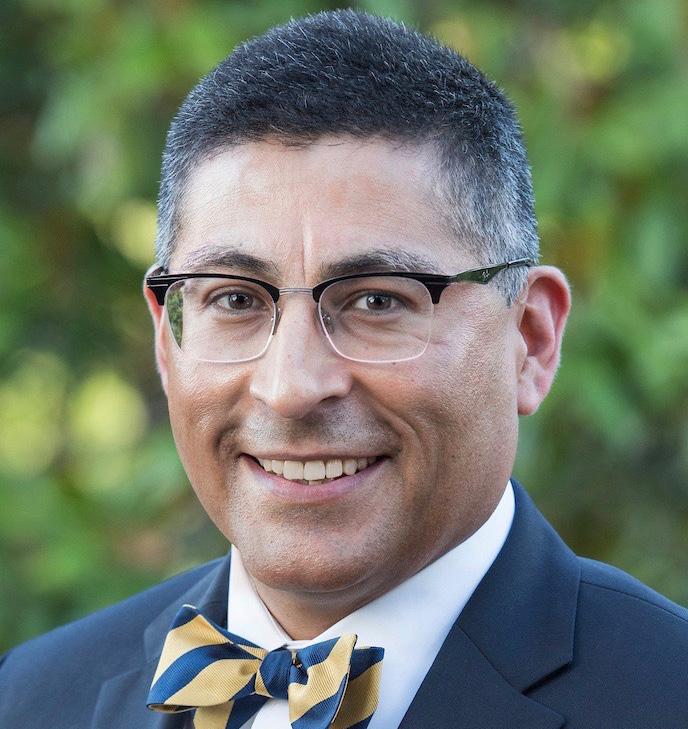
In Alamo Heights ISD, Dr. Frank Alfaro serves as assistant superintendent for administrative services, and those who work with him say that his dedication to leadership helps inspire them.
"There is no challenge that Frank cannot solve,” says Dana Bashara, superintendent in the district. “His support for me personally as well as our entire administrative team is so appreciated. I'm incredibly grateful he shares his talents with us in AHISD.”
What makes Alfaro proud of his district is the way AHISD functions as a pillar of the local community.
“Many of our parents and grandparents attended Alamo Heights and their own children represent several generations of families who have chosen to make this community their home, in large part because of our schools, our tradition of excellence, and our focus on the well-being of all children,” he says. “As a community, we see all children as our children. We celebrate each other’s victories, and we come together to support each other during times of challenge.”
As a leader, Alfaro says that being of service to others helps keep him going when the work gets challenging. When he struggles with motivation, he finds his spirits lifted when he is able to help a coworker or district parent with something that is important to them.
“Leadership, when done well, isn’t about you; it is about those you serve,” Alfaro says. “There may be certain things that only you can do for the organization, as the leader, and each leader certainly has personal strengths that make them unique. In the final analysis, however, my role as a leader is to serve the larger group and the greater good.”
To Alfaro, mentorship and support are key components of leadership. He says that he loves to help others maximize their own strengths and bring forth their unique skills to allow them to have the most impact on their schools.
“This is challenging work,” Alfaro says. “To be effective as a whole, we need each individual to contribute their unique talents. There is gold in each of us, and that gold might look different from one person to another, but it is there. We must bring out the best in each other to do the important work of public education.”

Toby Cox is executive director of student services in Joshua ISD and has worked in the district for more than three decades. Among his peers, he is known as a master at building effective, meaningful relationships.
“Toby Cox is truly one of the most genuine people I know,” says Debra Brakel, executive director of human resources in Joshua. “His ability to lead with both respect and kindness has created a strong sense of belonging and mutual respect among all of us who have the privilege of working with him.”
Cox is exceptionally proud of his district, pointing to the work those in the district have done and continue to do to serve students.
“Joshua ISD has always made family and people a priority and treated the staff and students like they are what is most important,” he says. “Joshua ISD continues to maintain a high standard for students and staff academically as well as professionally.
When the work gets tough, as it often does in public ed, Cox relies on his personal commitment to serve others to keep him going.
“I believe it is important to help people in any area that I can and try to make a difference, even if it is in the smallest way,” he says. “I hold on to things that people have given to me or said to me throughout my career and pull them out to re-read from time to time. It reminds me of my purpose.”
In his career, Cox has served as a teacher, counselor, elementary administrator, secondary administrator, and now central office administrator. He says that every step of the way, he has benefitted from unofficial members, and now he devotes himself to paying that support forward to others.
“The best part of my job is the relationships that have been built and seeing the kindness in others and their passion for education. I truly enjoy spending my days with my work family.”





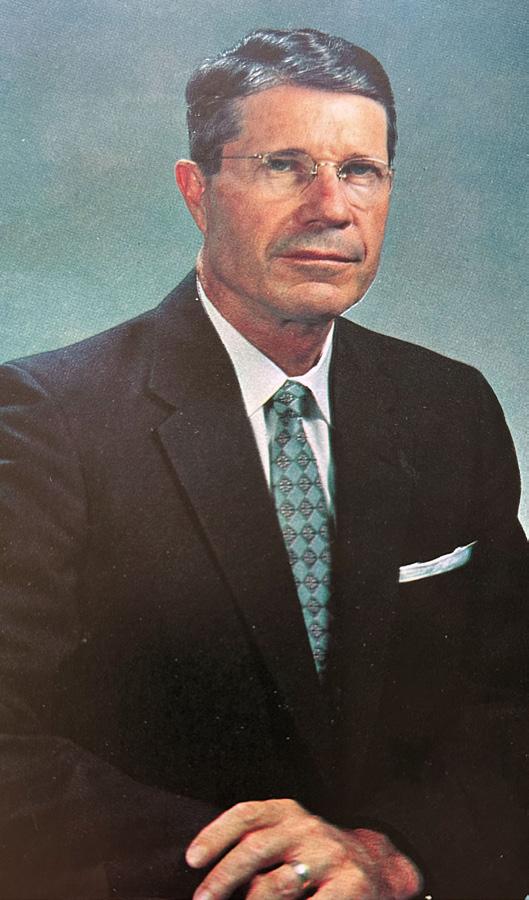

In 1985, TASA conducted an informal search to identify the school leader who had been a TASA member for the longest time. The search revealed that Past President Edward T. Robbins had been a member since 1926 — 60 years of membership at the time!
After earning his BBA from the University of Texas at Austin, Robbins served as the superintendent of Hearne ISD from 1926 to 1935, earning his master’s degree in 1933. From there, Robbins went on to become superintendent of Taylor ISD, where he served from 1935 to 1947. Later that year, he became superintendent of Alamo Heights ISD, where he stayed until 1966, when he joined the staff of Trinity University in San Antonio.
Robbins served as TASA president in 1951-52, having been passed the gavel when TASA President W.T. White (1950-51) announced he was resigning his TASA presidency because he was also serving as AASA president at the time and felt that he wasn’t able to focus enough on his TASA work. At the time, TASA was heavily involved in working with Commissioner of Education J.W. Edgar and the Texas Education Agency to implement the sweeping new Gilmer-Aikin legislation.
Robbins became an Honorary Life member of TASA in 1976 and worked as an educational consultant in the 1980s.
For more on J.W. Edgar and TASA's history, be sure to check out "Texas Association of School Administrators: A Century of Inspiring Leadership" by the late TASA Executive Director Emeritus Johnny Veselka at https://bit.ly/TASA-History.


by Stacey Edmonson and Abbie Strunc
School districts and universities continue to invest in strengthening the Texas teacher pipeline through innovative, contextually specific, and high quality educator preparation strategies. And, in a major show of support, the Texas Legislature has joined in this investment, notably through the passage of House Bill 2 (HB 2), which has significantly expanded support for aspiring teachers through multiple pathways. As we mentioned previously, the Texas Education Agency reported that 32.9% of the teachers who were employed and certified in the 2023-24 school year were prepared through an alternative certification program (Landa, 2024), and in the same school year, a reported 38,257 uncertified teachers were employed across Texas school districts. In other words, almost half (43.8%) of teachers in schools last year were alternatively certified or not certified at all (Ghazzawi et. al, 2025). For school and district administrators as well as for higher education, this isn’t just a statistic — it’s a call to action. The investment into high quality educator preparation pathways (EPPs), with meaningful connections across EPPs and school districts, is a clear first step in meeting the critical needs of today’s classrooms with well prepared teachers who can have a positive impact on students, Day 1.
HB 2 introduces transformative opportunities that both school districts and higher education institutions must embrace. Specifically, in addition to many other considerations, HB 2 provides financial support for teacher residency programs, alternative certification support, and grow-yourown programs.
HB 2 provides substantial funding for high-quality teacher residency programs, allowing teacher candidates to receive paid, in-classroom training under the guidance of experienced mentors. These programs are designed to improve teacher readiness and retention, especially in high-need districts. The residency model provides immersive, mentored experiences that mirror the success of yearlong clinical teaching models. The PREP (Paid Residency Educator Preparation) allotment offers stipends for residents, outcome-based bonuses for preparation programs, and incentives for districts to participate. As many preparation programs have shifted to yearlong residency models to replace traditional student teaching, this funding provides investments that allow teacher candidates to earn living expenses while they gain invaluable experience as teachers in classrooms, as well as adding important instructional support opportunities for the classrooms they serve.
To address immediate staffing needs, HB 2 also includes one-time financial incentives to help school districts certify existing staff through alternative certification programs. This support helps paraprofessionals and other school employees transition into full-time teaching roles, expanding the pool of qualified educators. Building meaningful, well supported alternative certification pathways is a direct opportunity for universities to partner with districts and offer high-quality, accelerated certification options.
HB 2 also enhances funding for Grow Your Own (GYO) initiatives, which aim to support future educators from within the context of their local communities. These programs target high school students, paraprofessionals, and community members, offering structured pathways into the teaching profession. Formula funding to support these efforts is provided through HB 2, recognizing GYO as a long-term strategy to address teacher shortages in hard-to-staff areas. Higher education EPPs are uniquely positioned to support these efforts through dual credit courses, early field experiences, and tailored certification pathways.
Together, these investments reflect Texas’ commitment to building a sustainable, contextually relevant, and well-prepared educator workforce. Aspiring teachers now have more accessible, supported, and community-based pathways into the profession than ever before, and the opportunity to capitalize on these investments is paramount.
Historically, higher education EPPs have led the charge in teacher preparation. But the current landscape — and the growing teacher shortage — is a wake-up call. Today’s aspiring teachers prioritize flexibility, accessibility, affordability, and time-to-completion (2025). Innovation is no longer optional; it’s essential. Fortunately, quality and quantity can coexist. We can meet both candidates and school districts where they are without compromising the integrity of teacher preparation.
Adapting the modality and structure of EPPs is key. The goal isn’t to replace traditional programs but to expand access. Long semesters and rigid entry points deter candidates — especially those already working in schools. Institutions like SHSU are leading the way with multiple entry points throughout the year, removing outdated barriers and building capacity.
Flexibility also means rethinking support. Mentoring, coaching, and consistent feedback are proven to reduce attrition and improve teacher effectiveness. At SHSU, Professors of Practice serve as mentors, collaborators, and instructional coaches — helping candidates with everything from lesson planning to classroom management.
Cost remains a major barrier. HB 2’s funding creates an opportunity for universities to reexamine pricing structures and make certification more accessible. High-quality alternative certification programs must be affordable, sustainable, and scalable.
Time-to-completion is equally critical. While traditional programs span years, many candidates need faster pathways. With intentional design — mirroring residency models, leveraging district partnerships, and embedding mentorship — universities can offer accelerated programs without sacrificing quality.
The data is clear: Texas needs more teachers, and nearly half of them are entering through non-traditional routes. HB 2
provides the resources and momentum to reimagine teacher preparation. Institutions of higher education must rise to the challenge — adapting, innovating, and leading the way toward a more inclusive, effective, and responsive system of educator preparation. For school administrators, this isn’t just a statistic — it’s a call to action.
District leaders are undoubtedly on the front lines of the teacher shortage. Administrators see and feel the impact of teacher shortages, retention gaps, and lack of general preparation every day. HB 2 provides supports to help address these challenges, but using these tools to build successful teacher pathways is up to all of us. We are responsible for building strong partnerships between districts and EPPs that build a more agile and effective teacher pipeline. The following strategies can be key components for next steps.
1. Partner strategically: Work with EPPs that offer multiple entry points, residency models, and alternative certification programs aligned with your district’s needs.
2. Leverage HB 2 funding: Use new state funding to support uncertified staff, host residents, and launch or expand GYO programs.
3. Prioritize support: Ensure novice teachers — especially those in alternative pathways — receive mentoring, coaching, and classroom-based support. SHSU’s Professors of Practice model is one example of how this can be done effectively.
4. Advocate for affordability and access: Encourage your higher education partners to keep costs manageable and programs
accessible. Affordability is a key barrier for many aspiring teachers.
5. Focus on time-to-impact: Accelerated, high-quality certification programs can help fill teacher vacancies faster without sacrificing teacher quality. Look for programs that mirror the structure and support of yearlong clinical teaching.
It continues to be critical that neither higher education nor school districts work in isolation. Becoming nimble, agile, and truly responsive to the needs of Texas students and schools requires building strong partnerships across candidates, campuses, districts, EPPs, and other institutions of higher education. The teacher preparation landscape is changing — and district and school leaders have a pivotal role to play. By embracing the opportunities in HB 2 and partnering with innovative EPPs, we help build a stronger, more sustainable educator workforce for your district. An era of opportunity awaits. Let’s reimagine what’s possible — together. n
Dr. Stacey Edmonson is Dean of the College of Education at Sam Houston State University. She was formerly Chair of the Department of Educational Leadership & Counseling and has been a teacher, principal, and central office administrator in Texas public schools.
Dr. Abbie Strunc is Associate Dean for Academic Administration & Enrollment in the College of Education at Sam Houston State University. She was previously chair of the School of Teaching & Learning at SHSU and a high school history teacher in Texas public schools.
Ghazzawi, D., Olofson, M., Landa, J., & Eluru, M.S. (2024). Uncertified teacher rates 2018 – 2019 through 2023 – 2024. Texas Education Agency. https://tea.texas.gov/reports-and-data/educator-data/uncertified-teachers-historic-2018-2019-to-2023-2024. pdf
Landa, J. (2024). Employment of initially certified teachers 2019 –20 through 2023 – 24. Texas Education Agency. https://tea.texas. gov/reports-and-data/educator-data/employment-of-initiallycertified-teachers-2023-2024.pdf


by Claudia McWhorter
My superintendent is Superman. On any given day, he is attending a STEAM Day at an elementary campus, chamber ribbon-cutting, Special Olympics competition, Education Foundation board meeting, Rotary Club luncheon, meeting at the Capitol, school carnival or one of many, many student awards assemblies. He even met families at a local barbeque restaurant on a weekend to hear input on a possible school closure.
But why this relentless engagement? Sure, he's a genuinely amiable man, but the truth runs deeper.
As a school district that sees 68% of its tax dollars go to recapture, Eanes ISD's reliance on community support is paramount. Relationships matter. Volunteers and support groups aren't just helpful extras; they are integral to our functioning, and ultimately, our success. These partnerships extend beyond mere financial aid, encompassing vital contributions of time and expertise, even extending to the intangible yet essential staff appreciation and recognition. Following are a few tips on ways we strengthen our partnerships in the community.

Every year we host an annual PTO/booster club boot camp for our incoming presidents and presidentselect. This one-day event introduces our operational intricacies but also serves as a forum for aligning efforts and rallying support for upcoming initiatives. Participants learn best practices, meet district go-tos, hear tips on campus relationships, fundraising, programs and events, parent involvement and more. This year, we introduced a new catering program spearheaded by our food services department. Booster clubs have eagerly embraced this initiative, making it their go-to option for events and meetings. This small mention has yielded additional revenue for the school district.

Following boot camp, we host the leaders of these campus-based groups for a monthly Presidents’ Council meeting where we discuss reports from Board of Trustees meetings, bond projects and more. The meetings provide an opportunity to hear concerns in the community, problem solve and collaborate. We look to this group when considering a bond referendum, showing possible projects and getting feedback and buy-in before the bond proposal is finalized. In doing this, we are cultivating a network of allies who can lend crucial support when challenges inevitably arise.
Recently, my superintendent initiated a collaboration with ministers, clergy and religious leaders from 15 area faith organizations to discuss mutual challenges and topics of interest. Topics range from the concerning trends of suicide, politicization and discrimination to gaining insights into the specific hurdles faced by students and families within our Jewish community. This partnership has not only provided valuable awareness but has also proven instrumental in connecting families with financial or other support resources when needed.
But it’s more than boot camp and meetings. It’s showing up for your partners, too. Which is one of the reasons my superintendent is so busy. True partnership means showing up — literally — at
the school carnivals, galas, and ribbon-cutting ceremonies hosted by our community allies. Remember that in some ways, our school district leadership is the chamber of commerce; we are intertwined with the fabric of the community, and that demands active involvement and support for our partners' endeavors.
And of course, the financial support is critical. With a slogan of “We Fund Teachers,” we are incredibly fortunate to have a strong education foundation that helps lessen the hit from recapture so we can provide supports in the classroom the state does not fund. We partner with the foundation in marketing and fundraising events to help leverage their messaging, and of course, my superintendent attends all their events — sometimes six or seven in a month during their busiest fundraising season.
By actively listening to our partners, we gain valuable insights into what meaningful involvement means to them. For instance, in response to feedback from our local rotary group, we recently expanded our educator appreciation program. Traditionally, the group awarded financial gifts to our educators of the year during an annual luncheon. However, they expressed a desire to
increase their support by offering monthly gifts to educators and visiting campuses.
This simple adjustment has yielded remarkable results. Not only do our educators receive delightful surprises throughout the year, but it also creates opportunities for Rotarians to engage meaningfully with both staff and students on our campuses. These interactions foster deeper connections within our community and contribute to a culture of appreciation and collaboration.
So yes, my superintendent will give up many weeknights and weekends, always with a smile. Whether it's enduring a pie to the face for a school fundraiser (yes, that happened) or lending a sympathetic ear to concerns, his boundless spirit and genuine commitment resonate deeply with our schools and community. It is a symbiotic relationship — one where his generosity of spirit enriches us all.
And if you want to see just how much he gets out around the community, follow him on Facebook @eanessupt. n
Claudia McWhorter is chief communications officer in Eanes ISD.


by the TETL Next Digital Shift Committee
Many districts across Texas are experiencing some financial challenges. Inflation costs have increased an average of 3.57% per year, which has resulted in a cumulative price increase of about 23.45% from 2019 to 2025. The Texas state basic funding allotment to school districts has not increased since 2019. Thus, districts are faced with the challenge of compensating for increased costs with static funding. Meanwhile, the mission of technology leaders remains the same. As technology leaders, we will support and enhance the educational experience for students and staff by providing reliable and secure technology solutions. Technology leaders will continue to ensure digital equity, work with other departments to integrate technology into the curriculum, and maintain a secure and efficient IT infrastructure. The goal is to create a safe and secure environment that supports learning and prepares students for the future.
The opportunity is for us as technology leaders to provide a safe and secure environment while operating on a reduced or static budget. These budget challenges will require us to be more resourceful, strategic, and innovative in managing limited resources while striving to meet the organization’s technology needs and goals. This paper is a collaborative response from districts across Texas. It discusses how different technology departments are addressing the budget challenges while providing and maintaining a secure and efficient IT infrastructure.
Cypress-Fairbanks ISD (CFISD) is Texas's third-largest school district, with 118,057 students, 19,000 employees, and 96 campuses. The district is a 1:1 device per student. CFISD maintains the fourthlowest administrative costs in the state of Texas. Currently, taxpayers receive a 20% local homestead of optional exemption with a tax rate of $1.0869.
Schertz-Cibolo Universal City Independent School District (SCUCISD) has 14,914 students and 16 schools. While the district’s residential developments are growing, the student population is slightly declining. This lowered student enrollment, combined with the challenge of having and celebrating the largest veteran population — which results in significant residential and deserved tax exemptions that are not held harmless by the state — has exacerbated the funding concerns. SCUCISD will continue to partner with the local community to seek prioritization on funding expenses and community input into future revenue options.
Mineral Wells ISD (MWISD) has 3,300+ students, 500+ employees, and six schools. MWISD is a rural district with approximately 73% of its students classified as economically disadvantaged. The district’s student enrollment has remained relatively static over the past decade. The most significant overall financial issue that the district faces is the lack of an increase to the basic allotment since 2019; a substantial increase to the basic allotment would help offset inflationary increases that have skyrocketed costs since the last increase.
Montgomery ISD (MISD) has an enrollment of 9,864 students with 1,660 active employees. The district is a 1:1 kindergarten through 12th grade district, with 12 school sites and five auxiliary sites. The adopted tax rate is $1.0912.
Our findings indicate that thriving districts in all circumstances are optimizing financial management and being good stewards of equipment, resources, money, time, and staff. By prioritizing projects and minimizing waste, technology departments will continue to get the most value for their money. Leveraging technology assets in strategic ways, as outlined below, will allow technology leaders to optimize their costto-value ratio.
Establishing an ongoing strategy for device replacements is an additional challenge for technology departments weathering the budget crisis in Texas. Other options are being explored as we use the standard processes of re-evaluating usable device lifecycles, in-house repairs, and lowerquality replacements. One option that bears promise is strategically replacing student devices based on the percentage of necessary classroom usage for those devices. SCUCISD calls this a "needs-based 1:1" replacement. In this process, student devices remain on campus, which aids in minimizing breakage, and the devices are shifted between standard classroom environments for the highest availability possible, with fine arts and athletics instructional spaces having less availability. This dynamic reassignment of devices throughout the school day allows districts
to purchase replacement student devices based on a percentage of each campus’ student enrollment rather than a device for every student. The process minimizes the issue of idle devices found in traditional 1:1 deployments, while still meeting the core academic needs of students.
As more online activity is required by students for state testing and advanced academics, districts will need to shift their expectations for the number of days within each testing window that must be devoted to testing on a given campus. Without the excess of devices in daily instruction, testing windows will need to be leveraged to provide students with the necessary opportunities to pursue college credit, demonstrate their learning on the STAAR test, or provide local district data on annual growth.
MWISD is a 1:1 district with cart-based prekindergarten (PK)-6 and take-home 7-12; PK is iPad, and K-12 is Chrome (nontouch). MWISD will test touch Chrome devices for PK this upcoming school year in hopes of being Chrome-based PK-12. MWISD is three years in on attempting to have all Chrome devices be in service for a six-year lifecycle. This was initially planned when the Chrome Auto Update Expiration (AUE) went to eight years, it’s now a 10-year AUE.
Devices are more likely to survive six years in the cart-based deployments versus the take-home model. Understanding this, MWISD purchases a set number of devices each year for the incoming seventh grade class; typically, this class ranges from 240260 students, so 275 devices are purchased and remain with that group of students. These student numbers hold fairly steady through freshman year and then slowly decline during the last three years of high school with the average graduation class being about 180-200 students. Devices from the original purchase of 275 that are no longer used by those students remain
with that group and replace devices that do not physically make it to graduation, whether because of unrepairable damage, damages too costly to justify, or because a device is lost or stolen. When students graduate, devices still have two to three years left on the AUE, so those devices either get moved into loaner pools, spare testing carts, replacements for other devices across the district, or sold via a buyback program with a third-party vendor (e.g., AGI, Bluum, Chromebookparts, etc.).
Once the AUE is reached, any remaining devices are sold via a buyback program. Besides consistently purchasing the same amount of devices each year for incoming seventh grade students, the district replaces the devices for each of three elementary schools at one school every other year. This keeps student device purchasing consistent and allows the department to coordinate increases in purchasing staff devices and classroom technology in years in which student device purchases are reduced.
CFISD is a 1:1 Lenovo Chromebook district. The district has Accidental Damage Protection (ADP) and the manufacturer’s warranty on the devices. Devices are currently on a five-year refresh cycle. The district became a 1:1 district as a result of the COVID-19 pandemic. Devices were delivered, enrolled, prepared, serviced, and deployed from a centralized location. Buses were used for transportation to and from schools. When students returned to campus, the department moved to another location but still operated in a centralized model: technicians on campuses hot-swapped devices and non-working devices came back to the centralized location for triage where a determination was made whether to send out the device for service or repair it (power-wash) at that location.
Analysis of resource data and support tickets indicated that this was not a sustainable model so the district moved to a decentralized support model whereby technicians were trained on power washing and Chromebook support, technician staff at the central location were assigned to buildings, and schedules were made with the warranty vendor for pick-up and delivery schedules. Moving to a decentralized model has allowed the department to provide better service time, and decrease the number of support tickets. Ticket analysis shows that most devices are now repaired through accidental damage protection versus warranty. CFISD’s vendor partners, Prime Systems and Lenovo, have worked extensively with the district to reduce service times and provide better communication to schools regarding service pick-ups and returns. Moving to a decentralized model and leveraging vendor resources has allowed CFISD to sustain this program.
Montgomery ISD is also a 1:1 Lenovo Chromebook district with Accidental Damage Protection and a manufacturer’s warranty on the devices. Devices are currently on a five-year refresh cycle.
MWISD lifecycles Windows devices every five years on a three - year purchasing cycle. Devices at two facilities are replaced each year (HS/JH one year, two elementary schools one year; and one elementary school with the district office, cafeterias, libraries, and labs in one year). Similar to student device purchasing, this keeps purchase projections relatively consistent. The district is completing the removal of many Windows labs, except CTE, and replacing any necessary labs (basically one lab per campus) with Chrome devices. Over the past three years, the district has reduced the Windows device
count from 850 to 550 total devices, which helps further reduce costs on items such as PDQ (Windows inventory and software management/deployment) and EDR (Endpoint Detection and Response) licensing.
In CFISD, most of the administrative fleet is a Dell Windows laptop or desktop device. A five-year Dell manufacturer warranty covers the Dell Windows devices. Dell provided training to all of the district’s technicians and they all have access to a Dell support portal. Technicians can elect to have a part shipped to their location and complete the repair. If they need assistance, they can escalate the ticket, and a Dell technician is dispatched the next day to complete the repair onsite. The district only had a handful of Dell devices that needed to be repaired off-site and GTS Technology Solutions, Inc., assisted in those instances. This service model was a lower-cost option than a third party performing the manufacturer's warranty support. This has also allowed the department to decrease device support turnaround time for administrative devices.
MWISD deals with a lot of damage, particularly with take-home Chrome devices for secondary (seven-12) students. The department uses work-in (zipper) cases for take-home devices and clamshell cases on cart-based devices for grades K-6. In 2019, all Chrome device repairs were being done by AGI, taking roughly two to three weeks from damage until return, and the district only took the standard one-year warranty with Chrome device purchases (this did not cover most damages). After evaluating four-year warranties with accidental damage versus the annual costs of paid repairs (actual collection from students was not considered — each year, the district ends up collecting about 35% of what is charged to students
for damages), it was determined to be less expensive to continue paying for repairs as they occurred. After COVID-19, the district began transitioning to in-house repairs, and by 2023 MWISD was no longer sending any repairs to a third party. With the reduction of actual expenditures by purchasing parts and managing the amount of labor spent doing repairs, along with the roughly 35% collection rate, the department ended in the black with repairs for the school year 2023-24. Additionally, a repair is generally completed within a day, two to three days at most, instead of a two- to three-week turnaround, which puts less strain on loaner pools and allows the department to reduce those device allotments in half.
CFISD uses two manufacturers, Dell and Lenovo, and two local resellers, Prime Systems and GTS Technology Solutions, Inc. Prime Systems services the Lenovo machines with a next-business-day warranty. Additionally, Chromebooks are covered by accidental damage protection. Support ticket analysis showed no difference in tickets on Chromebooks covered with a case versus those without a case and following discussions with the manufacturer and vendor, the district decided not to continue to purchase cases for new devices this year. Existing cases would, however, remain on existing devices. This resulted in a cost savings of about $29 per device. The district’s Dell machines are covered with a Dell warranty, and the first line of support are CFISD technicians with the Dell Support portal. Splitting the fleet between the two manufacturers has allowed the district to navigate many of the pandemic supply chain issues and leverage vendor/manufacturer relationships to provide better support service.
Continued on page

CFISD: It is well documented that color prints cost more per page than monochrome. Paper and ink costs are part of the total cost of ownership of any printer. For many years, the district worked extensively with instructional technology to standardize the printer fleet. Each school has a large color multifunction device in the library and other color printers are deployed based on curriculum needs. Printer drivers can be set for monochrome with the option to choose color. CFISD moved to shared network printers versus printers in each office or classroom. Additionally, the district has leased copiers in large-volume shared areas (e.g., workrooms). Printing is an area which the district continues to revisit. It is an area in which the district works to minimize waste while maintaining educational value for the money spent. CFISD has been able to reduce some printing through the implementation of an electronic document management solution. Records and needed information are retained digitally versus storing paper copies.
MWISD: Printers are primarily a campus-level expense, with technology simply supporting the printer fleet and approving any printers before purchase by a campus to maintain support. The technology department purchases or replaces very few printers district-wide. The district has a copier contract with a local vendor and each campus is financially responsible for the number of copiers on its campus. Printers and toners are then maintained from campus budgets; again, with technology approval for purchase, deployment, and support.
SCUCISD: Many cost-saving opportunities exist with printing services, but one that has had a significant impact has been secure document release. Print jobs sent to multi-function copiers do not automatically print with this arrangement but must be released by a secure PIN or RFID badge. A significant number of print jobs are never released, sometimes in the hundreds of pages per job. Without secure print release, these costs would have been incurred even though the print job was deemed unnecessary by the staff member.
MWISD uses E-Rate funding to the fullest potential. The infrastructure lifecycle is based on manufacturer EOL (end-of-life) in conjunction with five-year Category 2 E-Rate funding cycles and budgets. The district uses Category 1 E-Rate funding for Internet and WAN services, but does not use funding for hotspots due to the low number of hotspots needed for student use. MWISD applied for the Cybersecurity pilot program, but was not accepted. The district hopes for that to become permanent in the near future. MWISD finds having an E-Rate consultant extremely helpful and valuable in watching the current Texas legislative session for potential increases in safety and security funding, as well as an extension of funding from the expiring cybersecurity initiative (hopefully with fewer restrictions), and/or restoration/increase in IMTA funding.
Montgomery ISD uses a combination of funding sources: E-Rate Category 1 funds WAN and DIA services. E-Rate Category 2 funds some infrastructure lifecycling replacements such as UPSs, Firewalls, and core switching. Category 2 also helps to fund MIBS for Firewall and switch monitoring. The district passed a bond in 2022 which has been used to upgrade switching, WAPs, classroom technology, VoIP, and security cameras. Grant funds will be used for SPAT summer of 2025.
CFISD uses a combination of Category 1 and Category 2 E-Rate funding. Our E-Rate consultant, E-Rate Central has helped us maximize the reimbursement money coming back to the district. Additionally, we have recently viewed a demonstration of a product from TitanTech. This company’s product aims to provide a consolidated repository of grants, E-Rate, and other programs that align with your district’s profile criteria and areas of interest.
Additional input from smaller districts in the San Antonio area revealed other unique situations causing funding concerns. The school districts located on the Joint Base San Antonio military bases are public schools, but they lack the local residential tax revenue. These districts rely on additional federal funding to cover the overhead of administrative costs which cannot be scaled back, such as a campus administrator for their high schools. Although enrollment may be much smaller than other local districts, with very few non-base residents transferring into the
JBSA districts, they still need to maintain minimum administrative staff and operate buildings. In recent news, these districts have expressed concern about the loss of federal funding which could make the continued operation of their schools no longer viable.
With the pressure of budgets increasing, one method of creating additional space for necessary costs is to evaluate software usage and make necessary cuts. There are tools available for districts to track software usage, SCUCISD uses Classlink's Analytics tool to gather this data. In addition to specific applications available through the single-sign-on platform, this tool provides insight into common domains visited by both students and staff. If users are accessing paid tools outside of the expected method, their usage is still captured.
Additionally, if an alternative tool is being consistently accessed, it can be reviewed as a possible cost-saving replacement to one or multiple paid options. SCUCISD has adopted a three-year process for evaluation of effectiveness according to the pattern: software tool selection and rollout in the first year, integration of professional development and usage analytics in the second year, and assessment of possible student impact in the third year, which results in the necessary data to determine if the software’s fiscal burden is making an impact worthy of renewal.
CFISD has reviewed software for the 202526 school year via a digital resource review committee, which reviews applications for House Bill 18 compliance and district application compliance. The process helped the district identify applications that perform similar functions, allowing the district to consolidate applications, provide more standardization, and reduce the overall spend. Through this approved list of resources, the district has allowed a small number of school-funded approved
applications. By closely reviewing orders, the department realized that some of the small orders required more work support effort than larger bulk orders, thus the department worked this year with end customers to bulk up orders for next year. This will allow contract consolidation, single entry of requisition, anticipated lower pricing from bulk orders, single PO issue, and single rostering of data. The anticipated outcome is reduced costs to the end customer and reduced efforts of time from employees supporting application orders (through contract review, order entry, data rostering, and application push out). Additionally, CFISD uses a product called Digital Insight from Lightspeed Systems. This tool shows usage and assists the district with Return on Investment (ROI) calculations.
MWISD is using ClassLink Analytics+ for the same purpose as Digital Insight–usage & ROI. (Learn Platform from Instructure also does usage & ROI calculations). The district plans to implement AppTrack from ClassLink when it gets released this summer, which will allow an update to the current software vetting process. ClassLink appears to be working on bringing in badges for this edtech software approval process from trusted evaluation vendors such as 1EdTech and ISTE.
Montgomery ISD uses Classlink Analytics+ for usage and ROI. The Technology Planning Committee meets a minimum of three times a year to review applications for House Bill 18, changes to COPPA, and evaluation of district AI policy for both staff and students.
In conclusion, while Texas school districts continue to face the ongoing challenges of reduced or static budgets, technology leaders across the state are demonstrating resilience, innovation, and strategic foresight. Through collaborative planning, careful resource
management, and creative problemsolving, districts are finding ways to stretch limited funds while still delivering high-quality, safe, and secure technology solutions. By prioritizing what matters most — student learning, staff support, and long-term sustainability — these districts are not only surviving, but actively transforming to ensure that their technology infrastructure continues to support educational excellence in the evolving financial climate. n
Steve Barnwell is the Director of Technology for Schertz-Cibolo Universal City ISD.
Kim Bowlin is the Assistant Director of Technology Support Services/ Purchasing for Cypress-Fairbanks ISD.
Amanda Davis is the Executive Director of Technology and Digital Learning for Montgomery ISD.
Justin Lascsak is the Director of Technology for Mineral Wells ISD. LinkedIn: https://www.linkedin.com/ in/justin-a-lascsak/
In2013Dollars. (n.d.). U.S. Inflation Rate, $1 in 2019 to 2025. Retrieved Feb. 19, 2025, from https://www.in2013dollars.com/us/ inflation/2019?amount=1


Teaching is academic, social, and emotional labor all in one, and yet, despite the increasing demands placed on educators, teachers persevere.
More than content: why teachers are irreplaceable in today’s
by Kristi Leff
Each day across Texas, educators step into classrooms armed with far more than a lesson plan. They carry with them compassion, resilience, creativity, and an unwavering belief in their students. As the 2025 Texas Elementary Teacher of the Year, I am often recognized for my efforts in education, but this honor is not mine alone. It belongs to the thousands of educators across our state who teach with heart, lead with purpose, and persevere through challenges to do what is best for children.
In an age dominated by digital innovation and rapidly advancing technology, it's tempting to believe that screens and software might replace aspects of traditional instruction, but no matter how advanced a device becomes, it cannot replace the human connection that defines teaching. It cannot replicate the presence of a teacher who knows when a child needs a word of encouragement, a moment of redirection, or simply someone who believes in them because teaching is more than delivery of content. Teaching is the shaping of the whole child.
Teachers are often seen standing at the front of a classroom, delivering instruction, but the true impact of an educator stretches far beyond what’s visible. Teachers are constantly tuning in to more than just academic progress. We scan the faces of our students for signs of distress, withdrawal, or worry. We create safe routines for students who crave consistency, and we modify expectations for those who are carrying invisible burdens. We help children navigate friendship, conflict, failure, and growth. All of this happens while we also analyze assessment data, align to standards, differentiate instruction, and creatively rework lessons to meet the needs of 25 different learners in a single room.
This is the reality of teaching: It is both head and heart work. Teaching is academic, social, and emotional labor all in one, and yet, despite the increasing demands placed on educators, teachers persevere. They stay after school to tutor. They spend their own money to stock classrooms. They call home to celebrate small wins. They attend games, concerts, and events because they know that being present matters.
Technology will always be a useful tool, but it will never replace the irreplaceable; the human connection between teacher and student. Artificial intelligence can solve math problems, generate essays, and automate feedback, but it cannot celebrate a student’s improvement with joyful tears. It cannot ask a child how their weekend was and listen with empathy when the answer reveals a deeper need. It cannot model patience, flexibility, or integrity.
In a world where many children are navigating trauma, instability, or disconnection, the steady presence of a caring adult in the classroom becomes not just important; it becomes life-changing. Teachers humanize the learning experience. They offer a mirror for identity, a window into possibility, and a bridge to the future.
This profession is not for the faint of heart. Teachers face increasing scrutiny, changing standards, and the emotional weight of a job that never truly ends when the final bell rings, but even amid those challenges, they continue. They show up for the student who’s been absent more than present. They adapt when the plan falls apart. They celebrate every milestone, no matter how small. They believe in students when students haven’t yet learned to believe in themselves. It is this deep, unwavering commitment to the success and well-being of each child that makes teachers essential. Not just valuable. Essential.
As I reflect on being named Teacher of the Year, I do so with humility and perspective. This award represents the collective courage, passion, and perseverance of a profession that often works without fanfare. Texas teachers are not just delivering instruction. They are building futures. They are growing leaders. They are shaping hearts.
While technology continues to evolve, and as systems shift and adapt, let us remember this: the strength of our schools still rests in the hands of the educators who walk into classrooms each morning with hope, resolve, and the audacity to believe that every child can succeed because we do not just teach content.
We teach the future. n
Kristi Leff is the 2025 Texas Elementary Teacher of the Year. She is a fifth-grade science and English/language arts teacher at Humphrey’s Highland Elementary in Amarillo, where she has taught since 2015.

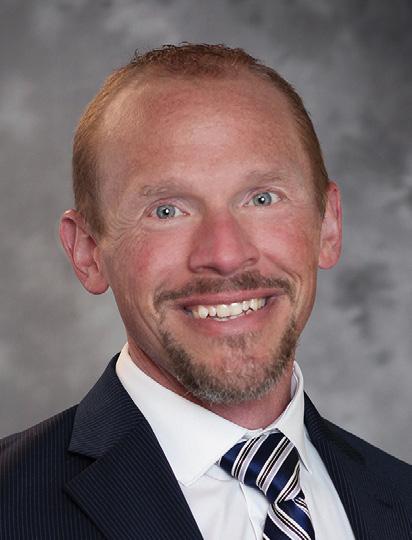
When schools face budget cuts, staff shortages, or public criticism, when families are hurting and students are struggling, it is not easy to summon a sense of thankfulness.
by Quintin Shepherd
Gratitude is one of those words that feels deeply personal yet universally understood. We know it when we feel it, and we admire it when we see it in others. But what does it actually mean? According to the Oxford English Dictionary, gratitude is “the quality of being thankful; readiness to show appreciation for and to return kindness.” A simple definition, but it invites deeper exploration because gratitude is not just an emotional response. It is also a practice, a discipline, and even a form of resistance against despair.
Consider how gratitude is understood within Buddhist philosophy. It is not simply about being thankful for what is pleasurable or beneficial. In fact, Buddhist teachings often emphasize being grateful even for suffering, because it can be a teacher. Gratitude in this context is not contingent upon comfort or gain. It is a way of being present and accepting what is, without clinging or aversion. This spiritual perspective is echoed in other traditions as well. Many Indigenous communities, for example, begin each day with expressions of thanks … not for a particular outcome, but simply for the gift of life, the land, the sky, and each other. Gratitude is communal, embodied, and expansive.
This deeper sense of gratitude brings us to a familiar metaphor: Is your glass half full or half empty? The phrase is often used to distinguish optimists from pessimists. Optimists see what is there and pessimists see what is missing. It’s a tidy way to frame our outlook, but it is also reductive. Because what if, in the moment, we’re neither? What if the glass is almost empty, and the room is dark, and no one is coming to refill it?
In those moments, gratitude can feel elusive. When schools face budget cuts, staff shortages, or public criticism, when families are hurting and students are struggling, it is not easy to summon a sense of thankfulness. A half-empty glass in education can feel like an indictment: Why don't we have more? Why is it so hard? Where is the justice?
But gratitude is not denial. It does not ask us to pretend things are better than they are. Instead, it invites us to anchor ourselves in what is, even if what is feels insufficient. The glass may be half-empty, yes ... but we still have something to work with. We are still here. The students are still showing up. The work still matters. That, too, is enough.
And when the glass is half full, when we have what we need, or nearly so, gratitude becomes a wellspring. We are thankful not because everything is perfect, but because we are aware of what we have. In this frame, gratitude amplifies joy. It builds resilience. It allows us to move forward not in fear of losing, but in celebration of what has been given.
Yet, even this dichotomy, half full or half empty, misses something essential.
The deeper truth is this: real gratitude is being thankful that you have a glass at all. Before the contents, before the conditions, there is the simple fact of existence. You are here. You are alive. You are capable of giving and receiving. That, in itself, is a miracle.
This shift, from focusing on the contents of the glass to appreciating the glass itself, is more than wordplay. It is a change in orientation. It allows us to move beyond optimism or pessimism and toward something more enduring: perspective.
In leadership, in education, and in life, this form of gratitude becomes a compass. It does not erase hardship, but it transforms how we meet it. It roots us in presence. It reminds us that the people around us are not problems to be solved but gifts to be honored. And it challenges us to find something to be thankful for even on the hardest days, perhaps especially on those days.
As we begin another chapter in our schools and communities, may we look not only at how full our glass is, but at the simple fact that we have one. May we teach our students not just to count their blessings, but to see them in the first place. And may we remember that gratitude is not a passive feeling. It is a deliberate practice … one that starts not with what we have, but with how we see. n

Dr. Quintin Shepherd is the superintendent of Pflugerville ISD. He works as an adjunct professor at University of HoustonVictoria and has served as superintendent for the past 19 years in three states.


N2 Learning and TASA are excited to partner to help districts transform the learning experiences for students, teachers, and administrators.

Our strategic initiatives in partnership with TASA are designed to create learning opportunities for school leaders across Texas. These initiatives cultivate purposeful networks of leaders engaged in meaningful work that advances the principles in the New Vision for Public Education
Scan the QR code or visit N2Learning.com for information, testimonials and registration for our institutes with TASA.

N2P
#TXN2P

New principals will collaborate to share leadership strategies, explore innovative solutions, and build strong, accountable professional networks across diverse districts.
$2,500 * per principal 10 SESSIONS
Ten, 90-minute online coaching sessions
#TXAPL
APL equips assistant principals with the skills and inspiration to become transformative leaders, preparing them for principal roles through targeted learning and leadership development.
$1,000 * per assistant principal 6 SESSIONS
Six, four-hour sessions during the school year
*Pricing excludes travel expenses.
#TXELI
ELI empowers district leaders to drive system-wide improvements in teaching and learning, offering strategic development sessions and year-round support from an Executive Coach.
$4,000 * per administrator 4 SESSIONS
Four, two-day sessions during the year rotating between Austin, Dallas, and Houston
#TXPVI
The Principals’ Institute is a year-long professional development series that equips principals with the knowledge and skills to lead and sustain transformative change in public education.
$6,000 * per principal
6 SESSIONS
Six, two-day sessions during the year rotating between Austin, Dallas, and Houston
#TXTLI
The boundary-breaking Teacher Leadership Institute empowers teachers to collaborate, move beyond traditional accountability standards, and create innovative, student-engaging classrooms.
$800 * per teacher
6 SESSIONS
Six sessions during the year customized for individual or regional consortium of districts
TASA is grateful to our 2024–25 corporate partners for their support. Each level of the Corporate Partner Program is designed to offer our partners quality exposure to association members. Partners at the President’s Circle, Platinum, and Gold levels may customize special events and opportunities.
BuyBoard
Coryell Roofing
DLR Group
Frontline Education
Huckabee
Imagine Learning
K12 Insight
Lone Star Investment Pool
Milliken & Company
N2 Learning
PBK
Stantec
TASB Energy Cooperative
TASB Risk Fund
TCG, a HUB International Company
ThoughtExchange
VLK Architects
WRA Architects, Inc.
Age of Learning
Capturing Kids' Hearts
Carnegie Learning
Centegix®
ClassLink
College Board
Curriculum Associates
EF Education First
Houghton Mifflin Harcourt
lead4ward
Lone Star Furnishings, LLC
NWEA
Scholastic Education
GOLD
Corgan
Edmentum
New Tech Network
Savvas Learning Company
Schneider Electric
Whizz Education, Inc.
Learn more about TASA’s Corporate Partner Program
AlphaBEST Education, Inc.
BRW Architects
Escamilla & Poneck, LLP
Gaggle
Gulf Coast Educators Federal Credit Union
Harris County Department of Education
H-E-B
Just Right Reader
LPA, Inc.
NoRedInk
Performance Services
Pfluger Architects
Raise Your Hand Texas
SFE - Southwest Foodservice Excellence
Stephens Inc.
Walsh Gallegos Kyle Robinson & Roalson P.C.
Aries Education Solutions, Inc.
BTC
Branching Minds
Cardonex
Claycomb Associates, Inc.
Corwin
Cory Hartsfield, P.C.
Digi Security Systems
Edia Learning
EveryDay Labs
HKS, Inc.
Hilltop Securities
INDECO
Lexia
Linebarger Attorneys at Law
M&R Roofing and Construction Company, LLC
McGriff Insurance Services
Meteor Education
MIND Education, Creators of ST Math
Panorama Education
PowerSchool
Protect|ED
Satterfield & Pontikes Construction, Inc.
SchoolStatus
Vista Higher Learning