I wish to express my appreciation to our local scribes at TAKE 5 for their contribution to our community in giving us a voice.
I am amazed and bewildered that anyone would think that the answer to a problem of too much garbage would be manufacturing thousands of new plastic containers that will obviously end up in the garbage.
It is insulting that whoever instigated this thinks we are too stupid or unwilling to be responsible for taking our waste to Peerless Road or similar facility and deposit it in the appropriate bin. The overly parental “one size fits all” system sucks. We are not giving away our compost. We make broth with our bones.
It would take us three months to fill a garbage bin. The cost is painful to us who live on a meager pension, OAP and CPP. We want out. This opinion is shared by several of my neighbours. Having our neighbourhood clutter with these eyesores while fuel and manpower is wasted driving it around is awful. As well, I really don’t like being told what my duties and responsi bilities are with their bleeping bins. - John and Siglind Tinsley
Letters – Re: Taxpayers Letter Hits Mark
I wholeheartedly agree with the letter from the Benoit Chabot family (TAKE 5/July 2025) regarding the CVRD shoving their new “three stream” waste collection system down our throats. I do not need this new bin, as we have our own composting system, yet I am forced to pay for something we will never use. CVRD needs to be making our lives more affordable, not charging for a service most of us don’t need or want. Judging
from what I see here in Saltair on waste pickup day, I would say over half the households are not using these new bins.
One unhappy overtaxed taxpayer — Mike Andrews, Saltair
Three Stream Waste Collection appreciated
After reading letters of people complaining about the new three stream waste collection in the CVRD, I felt compelled to write in with my opinion. I am THRILLED to have my garbage collected on a biweekly basis for such a low annual fee. We have lived rurally for over 35 years with no garbage collection service. We have used a commercial dumpster, which is very convenient, but also expensive. It costs over $2,000 per year to have our garbage taken away. I will GLADLY wash and sort my garbage to save that kind of money. Thank you for putting in a garbage collection system. It is long overdue.
— Lynne Williams, Cassidy
Local Lakes Are Dying
The article on “Are the Lakes Dying” caught my interest. Much like the rather ignorant senator from the USA said, “We’re all dying!” That, I am afraid, is what is happening to all shallow lakes, surrounded by bog land!
Apparently, the Wildwood Ecoforest has been relocated, to border on Micheal Lake — who knew?
I take my hat off to the fine people of the Quennell Lake Watershed Stewardship Society for all of their great sampling and documentation of the waters of Quennell Lake. It was great that it has come out that NO, the water being pumped out of the fields at the pot farm was NOT harming the lake!
I believe it was an article in TAKE 5 that made quite an issue of this discharge water!
As it turns out some of the worst contributors to silt travelling down stream into these lakes are trumpeter swans, Canada geese and various types of other waterfowl. These feathered friends stir up the peat fields with their feet so that they can dine on the fine roots and other edible goodies found on the muddy bottoms of flooded fields!
If any of us live long enough, we would see these lakes disappear if they are not dredged out. Oh, I can already smell the burning hair! – Murray McNab
Editors note: The error was ours, and we do know better. Wildwood Ecoforest borders Quennell Lake, not Michael Lake. Our apologies. Now go visit Wildwood and see what an amazing place it is.
A letter to the Community of Saltair
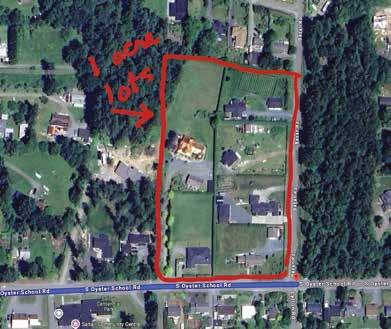
The CVRD is in the process of reducing residential rural lot sizes in all of Saltair to take effect sometime this coming fall. Current larger rural lots will be reduced from 2 acres (1 H.) minimums to 1 acre (1/2 H.), called “Country Suburban. Look at the subdivision on the NW corner of South Oyster School Road and Bazan Road to see what a subdivision of one-acre lots will look like – all natural vegetation has been clear-cut. Is this what most residents want the future Saltair to look like? Do we want to abandon the former vision that Saltair would be a greener, more rural area, between Chemainus and Ladysmith?
We don’t have to go this route. The Directors of other Areas in the CVRD are maintaining the rural designations for parts
of their Areas. We could too. “Small Lot Rural” would continue the R2 - 2-acre (1 H.) minimum that currently preserves our natural areas. Directors of other Areas are holding community meetings to involve and consult with their constituents. Why hasn’t our Director, Jesse McClinton, said anything to our community about this significant proposal? Why isn’t he holding community meetings to inform and consult with us? Residents and landowners in Saltair deserve better. We need a public meeting to discuss this significant change in land use, so people can understand the implications and decide what they feel is best for our community. - Jane Walton
Urban Renewal Devastates Communities
As a former resident of Vancouver, I’ve experienced firsthand the devastating impact that urban renewal has on a community – and the demolishing of the “old” to usher in the new was the start of it. Ladysmith, as it stands, is right on the precipice of it.
In my early twenties, I was able to afford cheap rooms in collective houses in the east end of Vancouver for a couple hundred dollars a month. Most of my friends and my community lived within a ten-block radius, artist studios were plentiful and new community-run shows and events were planned every week.
That was until the urban renewal began in the east end. Character homes were demolished and replaced by uniform beige townhouses. Renters were renovicted or priced out of their old neighbourhoods as property values soared. The number of unhoused people skyrocketed. Cute shops were replaced with characterless glass-and-steel three-to-six-story buildings. And, one by one, all of the artist studios and community run spaces disappeared.
Most of the “affordable” housing promised were never built, and the few that were built changed their definition of “affordable” to be able to fulfill their initial promises, but not actually provide below-market housing. Within five years, my rent quadrupled, I lost most of my friends and their young families to other cities so they could make ends meet, and I found myself working three jobs to stay in a concrete jungle that I once thought as full of character.
When I first visited Ladysmith three years ago, in 2022, I fell in love with it right away. I needed a change, and I thought to myself, Finally! A quiet, lush, unique place that values its historic character buildings and its sense of community, and that doesn’t want to just become another faceless steel-and-glass high-rise town.
It was what I desperately missed in Vancouver. I loved it so much that I packed up everything and moved here with my partner one year later.
As I’ve showed off this little town to friends over the last two years, they’ve all been taken by its picturesque historic downtown free of high-rises, its small locally owned shops and artisan spaces, its green spaces, and its free and accessible parking. They’ve all remarked on how this place is so unique because of its historic downtown core, and how they’ve never been to a town like this anywhere in Canada.
Now, as three of Ladysmith’s historic buildings are slated for demolition/renovation and to be replaced by five- and six-story buildings, this town will lose its charm and historic skyline forever. I wouldn’t be surprised if tourism dropped off significantly because of it, and if the quaint little town that we all love got lost to history and just became another generic, sprawling, unaffordable urban centre, all in the name of modernity and progress.
— Ruby Smith Díaz
Letters to the editor are welcomed. This is an open community forum. Hate, libel, defamation will not be tolerated. The letters published here do not necessarily represent the opinion of TAKE 5 or its affiliates. editor@take5.ca
Map courtesy of Google
Journey across the sea
Indigenous paddlers set off from Ladysmith on Sunday, July 27th, to follow traditional voyage routes and partake in a week of cultural celebration as Tribal Journeys marks a reclamation of culture as they paddle across the Salish Sea to Washington state for a Potlatch.
These canoe families are part of a much larger network of coastal First Nations who will make the trek known as the Paddle to Elwha. Nations from all over the island, mainland, and state of Washington will converge in Lower Elwha on July 31st. Festivities, including showcasing traditional arts and regalia, delicious food, and sharing knowledge, will take place from August 1st to 5th.
Any Amount Helps
The Cowichan Afghan Sponsorship Group will be running two fundraising events this month.
A storytelling event about a public health nurse’s work in Sierra Leone, Africa, will be held on August 26th. The event, titled “Rethinking Good Intentions,” is by donation at the Ladysmith
United Church at 7 pm.
On Saturday, August 30th, the Refugee Sponsorship Fundraiser Garage Sale will take place at Big O Tire from 10:00 a.m. to 2:00 p.m.
All proceeds raised in these events will go directly towards the group’s $110,000 goal, which is enough to sponsor a family of five for one year. Direct donations can be made through the Canada Helps organization with the designation of “Afghan Sponsorship”.
“Winged Wonders” at the Cowichan Exhibition
The Cowichan Exhibition is back for another year of fun for the whole family. Mark your calendars for September 1214th. This year’s theme, “Winged Wonders,” is inspired by the children’s book Bugs: A Day in the Life. It invites you to explore the magical world of dragonflies, ladybugs, bees and everything that flutters.
The barns are full of 4-H projects, animals on display, and quilted creations that are sure to amaze and inspire you. The ever-classic tractor pull, along with VI Wrestlers, Global FMX motorcross and the Company of the Blue Dragon, will be in the lower field at various times throughout the days. The main stage is where you can find an assortment of local bands, magicians, and dance performances.
The horse ring will be bustling with captivating equestrian performances, including horse shows, open divisions, 4-H, a registered goat show, farrier demonstrations and more. Back again for both days is the Logger’s Sports Competition. Offering a thrilling glimpse into our past, this event showcases axethrowing, sawing contests, pole climbing and, new to this year – log rolling!
With all the traditions you’ve come to love, the 157th Cowichan Exhibition is not to be missed! For more informa-
Paddles Up! One of the canoes escorted in Ladysmith. Photo: Bob Burgess.
tion, go to www.cowex.ca or follow us on Facebook and Instagram for the most updated news and announcements.
New Funding for 911 Enhancements
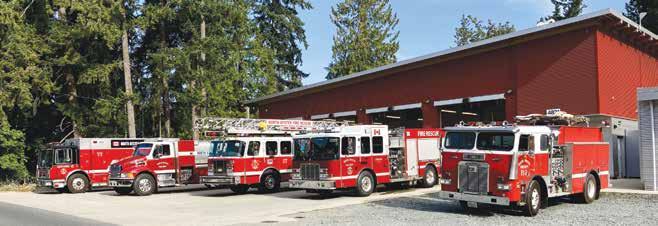
The Regional District of Nanaimo (RDN), in partnership with the District of Lantzville, is pleased to announce a $163,326 grant from the Government of British Columbia’s 2025 Next Generation 911 (NG911) funding program. $100,000 of that funding will be allocated to six fire departments funded and operated by the RDN. The remaining $63,326 will be given to the District of Lantzville.
The funding, which is granted through the Province’s Ministry of Citizens’ Services, supports the purchase and installation of up to 15 Mobile Computer Aided Dispatch (CAD) units. It will also cover the accompanying docking stations and cellular boosters in fire department vehicles.
“This investment in Next Generation 911 technology will significantly improve the safety and efficiency of our fire services,” said Vanessa Craig, chair of the RDN. “We’re grateful to the Government of British Columbia for recognizing the importance of modernizing emergency response infrastructure … and [for] providing this generous funding.”
The RDN is administering the grant and coordinating the distribution of the equipment to the fire departments on behalf of both jurisdictions. For information about fire services in the RDN, visit rdn.bc.ca/fire-departments and lantzville.ca.
Protecting the Forests
In the 2024-25 Annual Report, Ravi Parmer, Minister of Forests noted that the forestry sector has faced uncertainty driven both by the effects of climate change and the ongoing trade disputes. In a response to the softwood lumber antidumping duties, announced by the United States, Parmer says that the ministry will continue to fight for its workers and the future of the sector. “Not just to protect jobs, but to build a future where forestry workers and their families thrive for generations to come.”
Parmer’s action plan includes conven-
ing a Softwood Lumber Advisory Council to support the government as they navigate these changes. “Former Deputy Minister to the Premier, Don Wright [will act] as a strategic advisor on softwood lumber, to ensure BC’s interests are represented and to help us align with federal and cross-provincial efforts… By working together with industry, First Nations, and communities, we can build a resilient and sustainable forest economy that works for people, protects our resources, and ensures long-term prosperity for everyone in BC.”
The 2024–25 annual report is available on the board’s website: www.bcfpb. ca/
New Positive Results in BC’s 2024 Crime Severity Index
Nina Krieger, minister of Public Safety and Solicitor General, says that the newly released 2024 police-reported crime statistics are encouraging. The report shows an 11 per cent decrease on BC’s Crime Severity Index last year. This drop brings the index to its lowest level in six years and marks the largest drop in the country.
“This progress reflects the continued efforts by the BC government, First Nations and the local governments, police services, community organizations and businesses to work together to build safer communities. This reduction is also the result of focused investments in policing, mental-health, and addiction supports, housing, and crime-prevention initiatives.”
Krieger noted that while promising, these areas still need support. “I am committed to supporting front-line officers and community partners, addressing the root causes of crime and ensuring that there are specific areas where we need to strengthen our efforts.”
A Land Transfer to the Snuneymuxw First Nation
Snuneymuxw First Nation and the Province have completed a transfer of over 700 hectares of land on Te’tuxwtun, also known as Mount Benson North, to the Nation, advancing its reconciliation journey. This marks the latest step in the implementation of the Snuneymuxw First Nation and British Columbia Land Transfer Agreement (2020). Under this
agreement, over 3,000 hectares of land is being returned to Snuneymuxw.
“This third transfer marks another meaningful step forward in restoring our responsibility over our lands,” said Mike Wyse, Chief of Snuneymuxw First Nation. “Each parcel returned strengthens our Nation’s economic independence and renews our deep connection to Te’tuxwtun North. More than 2,000 hectares of our village lands have yet to be returned under the agreement, and we remain firmly committed to continuing this vital work until every piece is restored, for our people and future generations.”
Since 2020, Snuneymuxw and BC have partnered on numerous agreements and collaborative work. This work was made possible with local and regional government support in the RDN. “This agreement puts the Snuneymuxw First Nation in the driver’s seat, bringing economic prosperity, protection of cultural values and greater certainty to the land base,” said Ravi Parmer, minister of Forests.
RDN Grants Support Local Organizations
The Regional District of Nanaimo (RDN) Board approved community grants for 20 organizations across the region at the July 8, 2025, board meeting. The value of the community grants awarded for the spring 2025 intake totals $92,643 and will be used for a variety of community-focused projects. Community grants help registered non-profit organizations deliver social programs and services that serve a local community or provide a regional benefit.
Among the recipients were the Cedar Community Hall Associ-
ation to purchase and install additional heat pumps to support the hall during extreme weather conditions. The Coastal Invasive Species Committee Society to support the delivery of the Central Island Invasive Species Partnership’s Programs in the RDN, including the Education and Awareness Program and the Field Program. The Jananco Hobby Workshop Association to upgrade lapidary equipment and to purchase batting for quilt donations and materials for an adjustable woodworking table. Nanaimo Art Gallery to support the summer public engagement and outreach programming to expand into the RDN.
The next RDN grant application deadline for Electoral Area A Recreation and Culture Grants is September 26, 2025. For grant application forms and general grant information, visit rdn.bc.ca/grants.
Conserve Your Water!
The Province is urging people in to conserve water as forecasts suggest elevated drought conditions.
While the recent rains provided relief for some regions in BC, it has not been enough to overcome limited rain from previous months. In spring 2025, the government also updated BC’s Drought and Water Scarcity Response Plan to clarify the approach to monitoring drought and water-scarcity impacts ahead of the dry season, with an emphasis on early action and support for local decision-making.
Temporary protection orders may be issued as a last resort if voluntary efforts are not enough to restore water flows and protect vulnerable animals, fish and watersheds from long-lasting harm.
Arts Festival Celebrates Creativity
Ladysmith’s beloved Arts on the Avenue Festival returns this summer for its 27th year, bringing colour, creativity and community spirit to historic First Avenue. What began as a small gathering of local artists has grown into one of Vancouver Island’s most vibrant outdoor art markets – and this year promises to be the biggest yet. Over 50 artists will line the street, on Sunday August 24th, with original paintings, carvings, fabric art, jewellery and Indigenous-made works. It’s a true art collector’s dream –and a perfect day for anyone who simply loves to browse, and be inspired. And thanks to the support of their
Platinum Sponsor, the Ladysmith Downtown Business Association, festival goers can also enjoy a sidewalk sale and a Bayview Brewing beer garden –the perfect pairing for a summer stroll through the arts.
From the early hours as artists begin to set up, the market comes to life and so does the atmosphere: live music and a Youth Art Zone, where budding young artists can create their masterpiece to take home.
This year, Arts on the Avenue welcomes guest artist Patti Ransom, whose work continues to captivate and inspire.
Patti is an interior designer and mixed media artist based in Nanaimo, celebrated for her unmatched dedication to her craft. Describing herself as “off-thecharts passionate” about her work and the industry she represents, Patti is constantly learning, evolving and pushing the boundaries of creativity. Her sharp eye for design has been refined over years of experience, driven by a deep fascination with the endless possibilities of colour, texture and form.
As an artist, Patti views painting as her meditation and a personal explora-
submitted.
tion of what life might feel like without colour, of a mind unburdened by the constant visual noise of the world. In that space, what remains are the organic
Arts on the Avenue Guest Artist Patti Ransom. Photo
forms of nature, the musical rhythm of everyday sounds and a fluidity of thought free from outside opinions. Her abstract mixed media pieces reflect this journey inward, blending the world around her with her inner landscape.
Deeply moved by the architecture and atmosphere of Italy, particularly the light, structure and rhythm of the Amalfi Coast, Patti draws these elements into both her artwork and interior design. Every project she undertakes, whether a painting or a living space, is a layered process of feeling, discovery and storytelling. Her passion shines through in an extensive portfolio of residential and development projects across Vancouver Island, Western Canada and the United States.
Whether you’re a seasoned collector, a casual admirer or a curious visitor, Arts on the Avenue offers something for everyone.
Concerts in the Park
Music in the Park continues into August as well. Hosted by the LRCA, these Sunday evening performances are by donation and well worth it.
Demographix Band is Victoria’s top “dance and party” cover band, perfect for Concerts in the Park! They play classic rock tunes you can dance to and sing along with. Join the fun on Sunday August 10th!
On Sunday August 17, the Nanaimo Rock Choir will be taking the stage. My Coast Now describes the Nanaimo Rock Choir as, “Classic rock performed by an awesome rock choir with a four-piece rock band accompaniment. Think of this not as a choir concert, but a rock show!” It’s going to be awesome.
Ladysmith Art Gallery in August
BY FRANCESCA
RESIDE
The Ladysmith Gallery presents “Textures” (Aug 6–20), a member show that explores the emotional and sensory power of texture through painting, sculpture, photography and more. Visitors are invited to look closely and feel deeply as artists use contrast, materiality and form to tell tactile stories through their work.
From August 21 to 31, the gallery hosts “For the Love of Art, For the Joy of It,” featuring 11 accomplished local artists who share over 70 joyful and diverse new paintings. Guests can meet the artists, watch them create in real time and learn about their inspirations, techniques and shared connection to Vancouver Island. Both exhibitions take place at Ladysmith Gallery (Unit 7, 32 High St.) and are open daily from 9:30a.m. to 5 p.m. throughout the summer.
Petunia & The Vipers to Play Cedar Hall
Break out your two-steppin’ boots, shine up your dancin’ shoes and head to Cedar Community Hall on Friday, August 29, from 7 p.m. to 9:30 p.m., for an unforgettable evening of live music!
Petunia, often hailed as “the saviour of country music,” will be joined by his acclaimed band, the Vipers, for a night of high-energy honky-tonk, rockabilly and vintage country sounds. With a voice straight out of a 1950s jukebox and a deep love for the roots of the genre, Petunia is a musical historian, a restless wanderer, and a uniquely Canadian treasure. Known for their tight musicianship and dynamic stage presence, Pe-
tunia and the Vipers deliver a show that’s both nostalgic and refreshingly original – a perfect mix of toe-tappin’ rhythm and heartfelt storytelling.
Proceeds support the Ladysmith & District Historical Society. To get your tickets, email: info@ladysmithhistoricalsociety.ca. You can pick up advance tickets at TAKE 5 office, Ladysmith Archives, and Ladysmith Museum. Tickets will also be available at the door.
Don’t miss your chance to dance the night away with one of Canada’s most distinctive roots acts!
Special Woodstock
If you are looking for a free family-friendly music festival you’ll want to head over for Special Woodstock, an annual event at Providence Farm in Duncan on Sunday, August 17. Now in its 26th year, this heartwarming event features local bands, performers with diverse abilities, and three stages of music: the Island’s Band Stage, Rose Garden Stage, and Karaoke Stage. Admission by donation. All are welcome to come celebrate diversity, inclusivity, and good music.
A Sweet Treat
BY FRANCESCA PACCHIANO
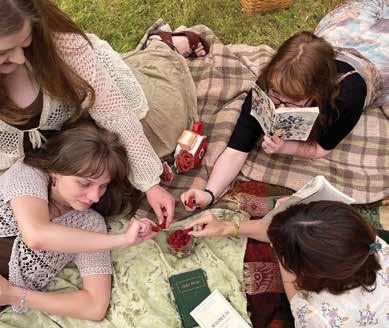
Summer is a time of abundance and The Raspberry Literary Magazine is excited to present some of the freshest stories on the island.
Launching later this month, the first issue is a collection of fiction, creative non-fiction and poetry from authors and artists around Vancouver Island and the Lower Mainland. The stories,
while each unique, come together to form a cohesive tapestry on the theme of late summer.
“It’s gonna be cozy for sure. We’ve got some creepy things happening, some fireside stories. We’ve got some mystical things and some yummy, tasty things going on,” said Beatrix Taylor, the acquisitions editor for the magazine.
The team behind the magazine are a group of editors who met at Vancouver Island University in the creative writing program. Inspired by their classes, the group decided to build a magazine that reflects warmth, curiosity and an undeniable sense of whimsy.
In the build-up to launching their first issue, the magazine has built a strong social media presence. Posts tease behindthe-scenes meetings as well as idyllic picnic photoshoots. The joy of creation is evident with this project, and it’s felt throughout the team.
Fiction editor Tara Wohlleben spoke about the experience of building a magazine. “Being part of The Raspberry is both scary and exciting. I’ve never been a part of a magazine that’s just starting out and it’s been really fun just collaborating with everyone as we figure out how to be a magazine.”
There will be a launch party in August to celebrate the publication of this issue, but a date has not been set. The issue will be published online and available in a PDF format on their website. Everyone is welcome to read the magazine.
The team has already started thinking about future issues and is hoping for a seasonal theme. “It’ll be more focused on whatever season we put it in. Right now, we’ve got late summer, and we’re talking about a cozy winter issue,” said Beatrix.
There is still work to be done, but the team is proud of the project and can’t wait to show it off.
“I’m so impressed by what each person brings to the team,” said Tara, “and I’m excited for us to share what we’ve put together with everyone when our first issue comes out.”
If you take a wander down to a nearby lake or pond, you’re likely to see one animal that, by all accounts, should not be there at all.
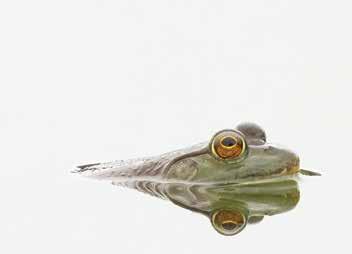
In the past ninety years, a population of smooth, sizable green-brown frogs has emerged on Vancouver Island. The creatures are robust and distinct; they sport golden eyes, croak noisily, grow up to twenty centimetres in size and are easily identified by their large, circular tympanum, or exterior ear, located just behind the eye.
The American bullfrog is not native to Vancouver Island. Naturally belonging to the east coast of North America, they were introduced to BC in the 1930s and ’40s for farming frog legs, a culinary delicacy. However, workers soon realized that farming bullfrogs was uneconomical, and the animal was released. Through the bullfrog’s movement as well as human assistance, they became an invasive species, now found throughout Vancouver Island.
Dr. Tim Goater worked as a professor in the Biology Departent at Vancouver Island University for 32 years. In addition to teaching various courses on zoology, evolution, parasitology and entomology, Goater has spent his career researching the ecological and evolutionary impacts of invertebrate animals, specifically parasites. This led him to the study of the American bullfrog.
Of course, the primary concern with any invasive species is its impact on the natural ecosystem. On Vancouver Island, bullfrogs are pervasive. “They have basically colonized virtually every aquatic habitat – from golf course ponds to fairly large lakes – [from Victoria] all the way up to Campbell River,” says Goater.
A constant threat to native fauna, bullfrogs are prolific predators with voracious and wide-ranging appetites, even outside
American Bullfrog researcher Dr Tim Goater. Photo submitted. Left: Bullfrog gliding through water. Photo: Bob Burgess.
their native land. Their primary prey are the insects found in aquatic environments, such as dragonflies, water beetles and yellowjacket wasps. But, Goater explains, “They’re not just feeding in the water. … They come onto land, and that’s where they get the garter snakes, potentially mice,” and even sometimes ducklings.
“These frogs get so large that they will eat anything that they can shove in their mouth,” he states. “Especially in the very large bullfrogs – they’re cannibals. They’ll eat their own kind.”
Even more, the bullfrog population can increase rapidly. According to the Ministry of Environment and Parks, a single female bullfrog can lay up to 20,000 eggs annually. Goater notes that the abundant offspring can quickly deplete available habitat and resources. “Not only do the [bullfrog] tadpoles compete with our local frog species,” he says, “but they potentially eat them as well.”
The Invasive Species Council of Metro Vancouver notes that bullfrogs “are responsible for the decline of other amphibians, including some that are endangered. … [They] also spread deadly viruses and fungi to other amphibians, and damage wetland habitats and water supply infrastructure.” Goater also notes that “our native fauna hasn’t evolved” to accommodate the sudden appearance of the bullfrog.
What’s more, bullfrogs disperse, and summertime is precisely when they do so. Mid-August brings about seasonal movement. “The juveniles … their first job, their first ecological feat is to get out of that pond and find a new one, because the population would be too big otherwise,” Goater clarifies. This,
paired with human intervention and the bullfrog’s ability to travel “a couple kilometres, especially on a rainy night” means the population is easily spreading.
Along with the introduction of the bullfrog comes another unique concern: the introduction of a parasite. According to a 2013 study conducted by Goater and Colin W. Novak on introduced bullfrogs and their parasites, “introduced parasites have not had the time to coevolve with the local fauna,” which can subsequently lead to “new infectious diseases and parasites to native species.”
The lung fluke, or Haematoloechus longiplexus, is abundant in introduced bullfrogs. To understand how and if the bullfrog’s parasite is affecting local wildlife, Goater has spent the past several years monitoring the lung fluke population in various freshwater habitats. He and his students have utilized local
Bullfrogs love swapmy ponds like this in North Oyster.
Photo: Marina Sacht
sites, such as Quennell, Diver and Michael Lake, to conduct a long-term study that will hopefully yield further knowledge on the topic.
So far, Goater’s research has yielded promising results; the parasite does not appear to have spread to local fauna and has not notably affected local wildlife. Still, there is likely more to be discovered, and it remains a stretch to call these frogs harmless or a seamless addition to Vancouver Island’s ecosystems.
“These are pretty magnificent animals,” Goater expresses. “And yet, they cause ecological damage by their presence.”
Naturally, one might wonder what action can be taken to control the bullfrog’s presence in BC. Goater’s answer is simple: “[There’s] nothing we can really do about it.” Though researchers have managed to exterminate the frogs in a few manageable cases, populations in larger bodies of water, where “tadpoles keep increasing over the years,” make the complete removal of the amphibian virtually impossible. Goater says, “[We] will never be able to control them,” and that the bullfrogs’ rapid reproduction process means they will continue to reemerge, year after year.
Still, work can be done by the public. Though people may view the bullfrog as an unwelcome nuisance, Goater suggests simply letting “nature take course” if you find them on your property. Euthanizing introduced frog species is legal in BC only with landowner permission, authorization from provincial or federal authorities and the absence of local regulations that outlaw the practice. An environmental professional is also critical to the process; without one to identify the amphibian, the public runs a significant risk of harming or killing a similar-
looking local frog – a crime under the province’s Wildlife Act. “The big problem is … [people] go out and kill what they think is a bullfrog, and they’ve killed a local frog. ... They don’t have the training to be able to recognize the other species that are here on the Island,” Goater says. “My most devastating one was, they said, ‘I’ve got bullfrogs in the freezer for you’ … and they weren’t bullfrogs. They were western toads, of all things”, a native toad designated as a species of Special Concern.
When Goater and his team do dispatch bullfrogs, they operate under strict guidelines issued by the Canadian Council of Animal Care and VIU to ensure safe, humane handling. Killing the frogs with pellet rifles, traps or chemicals, for example, is strongly discouraged and, indeed, illegal in many cases.
The British Columbia Ministry of Environment echoes Goater’s words, as the main objective at the moment is to contain bullfrogs and track their spread. To do this, the BC government instructs individuals to refrain from capturing, transporting, keeping or selling the frogs. Though tadpoles may tempt children who want to keep them as pets or gardeners who are looking to add life to their backyard, the government advises against both these practices, emphasizing that “transport seems to be one of the primary ways that bullfrogs are spreading in the province.” If one does encounter bullfrogs, the BC government’s Report Invasives app can be used to notify the government.
Although not a native of Vancouver Island, the American bullfrog has established itself as a long-term resident. Whether it is welcome or not, it seems like the bullfrog is a neighbour that will stay – at least for the foreseeable future.
Ready to Shine
BY FRANCESCA PACCHIANO
The restoration and enjoyment of classic and antique cars has been part of the Bell’s family for generations. When Fred was a boy, his father bought Mighty White, a 1913 White touring car, and fixed it up.
“My dad got the remains of it in 1966, and he put it together, you couldn’t really call it restored. But he put it together and made a car out of it. … It’s got wooden spoke wheels, and you crank it to start. It was put together out of all the old parts that he could scrounge up.”
The antique vehicle, which looks more like a horse-drawn carriage than a modern car, changed hands several times before Fred managed to buy it back. “It was my favourite car when I was a kid, and [my father] sold it in 1972. And it changed hands and went into decline over the years. And by 1990, it was in bad enough shape, so nobody else wanted it enough that I bought it back. And then I worked on it.”
That experience was formative for
Fred, but for most of his life, restoring cars was a hobby he didn’t have time for. It’s only been in the last few decades that he’s made time for it. “I’m as interested in antique cars as I’ve ever been, but the biggest problem with antique cars is that this island has grown up so much and there’s so much traffic that they’re very difficult to drive.”
Modern cars and roads are often too fast for antique cars. “Driving an antique car from 1913, it’s like driving a car with virtually no brakes compared
to the cars of today, and people don’t understand that, and they’ll cut in front of you.”
The hot rods, however, may look old, but those classic cars are often more modern in their driving capabilities. “Driving down the highway to get to Victoria – that’s just fun.”
Fred had just returned from the Deuce Days in Victoria when I met him at his home and workshop in North Oyster. The Deuce Days is a three-day long festival, the largest in the world, to cel-
Its a family affair. Fred Bell with his Deuce Coupe and Pickup. Photo: Bob Burgess.
ebrate hot rods. “The Deuce is a 1932 Ford, and they’re generally considered to be the ultimate in the hot rod world.”
While Fred enjoyed the drive down the Island, some people were shipping their cars internationally to attend the event. “There was somebody who brought a car from New Zealand. There was one gentleman with a 1932 Ford sedan who drove it from Vermont.”
The classic cars he owns are a Deuce pickup and a two-door sedan. He bought the pickup over forty years ago and restored it slowly, but the sedan he’s had for less than two years. “I got some help on the second one because one of the things that I’ve come to realize in life is there’s a difference between being capable of doing something and being capable of getting it done.”
Before photo of Deuce pickup taken in 1981. Bell paid
The pickup is fully restored, with gold paint and a sparkling trim. The drive stick is nothing short of excessive and is higher than the dashboard. The engine coil is housed in a Lucky beer can. It’s details like that make restoring and keeping these classic cars a joyful experience for Fred. “I get more questions about the beer can than anything else,” he said.
The restoration process – and staying close to the original –is important to Fred because of the nostalgia. “So, there’s all
kinds of different genres and people that are interested in cars that were built in 1955 or cars from the forties or fifties. The cars that were hot-rodded in the 1950s are totally different from what was done in the eighties or nineties or today. That nostalgia era of the sixties – that’s the one that interests me the most because I grew up in the sixties, and I can remember those times.”
The sedan has only recently been restored to a drivable state. A few months ago, it was little more than a husk and a frame. Now it looks powerful. He’s kept the original paint job – a matte red with lots of scrapes from its years of disrepair. It’s easier to drive it, he said, knowing that he’s not going to chip the paint.
He said he likes the sedan because the backseat allows him to fit his grandchildren into it and take them for a spin. The memories he made of working in and being around cars with his father is something that he hopes to share with his grandkids.
He will be taking his cars to the upcoming Rod Run and Show ’n’ Shine in Ladysmith. The Rod Run, on Friday, August 15, is a route for the registered hot rods to drive, winding through the town of Ladysmith, down Chemainus Road to the roundabout at Henry Road and then back to the A&W just north of Ladysmith.
The Ladysmith Show ’n’ Shine, on the following day, Saturday, August 16, is an opportunity to see these classic cars up close. It all starts at 10 am and wraps up at 3 pm. Registration begins at 8 am at the north end of First Avenue. The popular car show is hosted by the Ladysmith Lug Nuts Society, known formerly as the Ladysmith Show & Shine Society. You can still register but hurry. For more information and how to volunteer or participate please email showandshineladysmith@gmail. com
“If you want to walk up and look at them and ask questions, pretty much everybody’s receptive to that.”
It’s also an opportunity to appreciate all the hard work that has been put into refurbishing and restoring these cars. It’s truly a labour of love.
“I hope people enjoy seeing them as much as we enjoy working on them and driving them. If you see them on the road, try and give them a little bit of room.”
$150. Photo: Fred Bell
Recreation Strengthens Community Spirit in Cedar and Area
BY KERITH WADDINGTON
The importance of recreation to wellbeing is indisputable, and the Regional District of Nanaimo (RDN) – entering just its second year of programming for the Cedar Heritage Centre (CHC) – is ready to keep residents of Electoral Area A happy and healthy.
From Pro-D Day and summer camps for kids to daily fitness programs for youth and adults, the CHC is a hive of activity year-round. A LEGO-robotics camp this August is expected to be hugely popular! And when it’s not in use for programming by the RDN, the beautiful heritage site is available for locals to rent for meetings, workshops, small parties or medium-sized gatherings.
Given its location and the purpose it serves, the CHC really is part of the “heart” of Cedar, said Hannah King, superintendent for Recreation Program Services for the RDN.
“The CHC is an important community gathering place where memories continue to be made,” King said. “Recreational opportunities build community and resilience and are a huge determinant of health that reduces disease and loneliness. So I encourage locals to check out our programming and have a say in what programs get offered at the CHC.”
The CHC has a lot of history in the rural community just south of Nanaimo. The Cedar School and Community Enhancement Society (CSCES) served the Cedar and area community for over 25 years. The CSCES looked after recreational programming at the former school site while the RDN looked after building and site maintenance.
In 2023, CSCES Board Executives notified the RDN that the society would dissolve as of June 2024. As that date
Camp Timber, a day camp at Cedar Heritage Centre. Photo submitted.
approached, CSCES Board members and staff worked with the RDN Recreation Department team to ensure a smooth transition in the operation of the centre.
King believes the transition has been seamless.
“The programming continues to be popular and on point, thanks in large part to the tireless efforts of CSCES and volunteers prior to our involvement,” King said. “The RDN is thankful for their years of dedication and hard work.”
While the CHC continues to be a popular community hub, it is just one of several sites across Electoral Area A where the RDN offers recreation programming. The RDN rents space for recreational opportunities at the Cedar Community Hall (pickleball is hugely popular), Cedar Community Secondary School, Cedar Elementary School and the firehall in South Wellington.
Additionally, locals may have heard of – and be excited about – the remediation happening at the former South Wellington School site. The school, constructed in 1969 and operated until 2013, includes 9,108 square feet of functional indoor space and 2,207 square feet of covered outdoor space in addition to a playing field, a playground and a sports court. The RDN and Nanaimo Ladysmith School District (SD68) have entered a 25year lease of the building and site for operation as a community centre by the RDN. Programming at the site will be determined by the South Wellington and Area Community Association (SWACA) with the RDN again renting the space for use.
King is a huge advocate of locally-based recreation.
“It provides opportunity to create community within community, and strengthen hearts not only physically but emotion-
ally,” she said. “There is a reason why the words happy and healthy are so often used together: they are indivisible. And our programming is a way of nurturing both.”
Check out recreation programming in Electoral Area A at rdn.bc.ca/area-a-recreation.
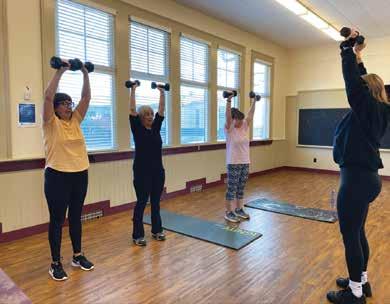
Power Hour session held at Cedar Heritage Centre.
Photo submitted.
Sea Life Festival and Harbour Boat Tours
BY JACKIE ELLIOTT, PRESIDENT, LADYSMITH MARITIME SOCIETY
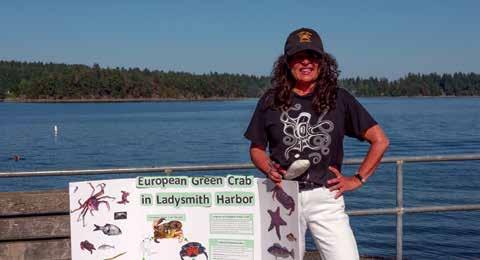
The popular Sea Life Festival will be held at Transfer Beach on August 17. Hosted by volunteer divers and biologists, this event showcases a variety of marine creatures and promotes ocean conservation. Attendees can also enjoy face-painting and crafts.
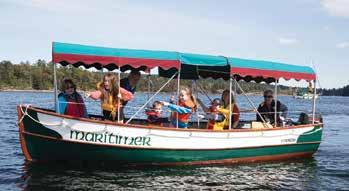
The much-beloved Harbour Tours on heritage vessels are making a comeback this summer. Starting July 26 and continuing through the summer, the Maritimer will offer 90-minute tours departing from the Government Dock in Ladysmith. Tours will run at 10 a.m. and 1 p.m., on Saturdays and Sundays.
These tours offer a unique opportunity for visitors and locals alike to explore Ladysmith Harbour and learn about the area’s rich maritime history from experienced volunteers. Online bookings are now available through the organization’s website.
The return of the Harbour Tours is made possible thanks to the tireless efforts of dedicated volunteers who contributed to boat maintenance, first aid training, and website updates.
The Ladysmith Health Care Auxiliary generously donated $4,000 to help us upgrade our safety equipment and offer first-aid training to our volunteers. Their donation was critical to our success this year. Our Harbour Tours would not be available this year without the generous support we have received from numerous organizations and community members.
The organization also received support from the Community Fund, with a grant of $500 for boat maintenance, and the Eagles, who donated $1,000 to help prepare the boats for touring.
In other news, the organization is gearing up for its first-ever online silent auction in September, to raise $20,000. The auction will feature a wide range of
items donated by local businesses and organizations, including gift certificates and unique artwork. The auction website is now live, and the organization encourages everyone to share it with their friends and family.
To book a harbour tour, visit www. lmsmarina.ca/explore/harbour-tours/.
To discover more about our upcoming silent auction, please visit https://auctria.events/LadysmithMaritimeSociety.
Safeguarding Shores
BY SUE WISLEY, STATION LEADER, RCMSAR STATION 29LADYSMITH
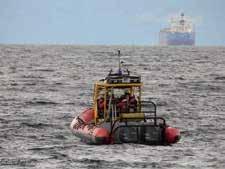
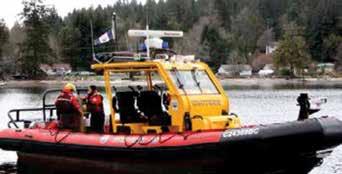
As well as responding to marine rescue calls, Ladysmith’s RCMSAR Station 29 was one of the first three stations on the coast to participate in the Canadian Coast Guard pilot project for Marine Environmental Hazards Response (MEHR) in October 2023. This program is now being expanded to all RCMSAR stations on our coast.
This task is solely to observe, record and report an environmental event such as an oil spill, a derelict vessel adrift or aground for fuel/oil leaks, or a sunken vessel with a risk of a fuel/oil leak.
Station members are offered an online course, “Introduction to Oil Spills,” provided by the Canadian Coast Guard, which focuses on investigating, documenting, and reporting marine pollution incidents. The course familiarizes our crews with ways to observe, assess and describe pollution situations using standardized procedures for documenting the nature, severity and extent of floating oil or other hazardous materials, including the location, extent,
source, characteristics (sheen, appearance, odour), direction of travel related to wind, wave and current movement, proximity to shore and sensitive locations, and other information that may be of assistance in deciding on the response required, if any, and the seriousness of the situation.
Crews are equipped with a kit supplied on the rescue vessel, which contains checklists of information to be reported, illustrations and categorization of spill types to be described and forms used for reporting findings. Essentially, our crew – equipped with our fast-response vessel and extremely familiar with the area – can quickly proceed to a location, investigate and often be first on the scene. They serve as eyes on the water to report their findings or assist as part of a larger team in responding to a situation. The sooner the report is communicated, the sooner the proper resources are tasked to clean up if necessary.
In many incidents involving vessels, a key first response is the need to report any pollutant situations involving fuel and other substances. Derelict vessels often present this hazard, as they may
Kim Loveridge, Vice President, Ladysmith Maritime Society is getting ready for Sea Life Festival, at Transfer Beach Park, August 17, 2025. Photo: Bob Burgess
RCMSAR Station 29 participates in Marine Environmental Hazards program. Photo: Bob Burgess
sink and emit pollutants or suffer damage and deterioration, which causes the release of polluting substances.
Even if there are no pollutants, a partially sunk vessel can be a hazard to navigation in our working harbour or in the areas around our Gulf Islands that all mariners are travelling.
A number of the station’s calls relate to these sort of situations, given the proximity of derelict/ abandoned vessels in the area, particularly in Ladysmith Harbour, but also in our surrounding waters.
The volunteers with RCMSAR Station 29 have significantly contributed to the work of reducing environmental impact of marine oil spills and hazards in our response area, but we realize there is much more work to be done to minimize environmental damage on our coast.
Harbour tours are back for the summer. Photo submitted.
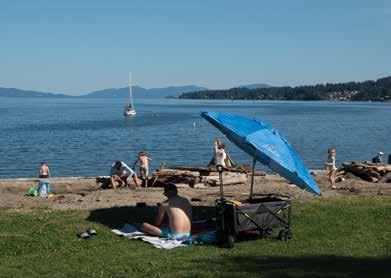
Is It Safe to Swim at Transfer Beach?
That is the question that many – especially young mothers with small children – want to know. They are asking this because the Town of Ladysmith has posted two Swimming Advisory Notices so far this summer. What do these notices mean? It means that two samples out of the 18 taken were found to be higher than the acceptable level for the bacteria group called enterococci. So what does an advisory mean to you and your family? According to Island Health, it does not mean the beach has to be closed to swimming. It is a notice indicating that a swimmer may contract an infection or experience a health-related issue.
When test results that exceed the recognized limits are received from Island Health, the Town can post a Swimming Advisory, cautioning the public and leave the beach open to swimming, or conduct a retest to determine if the test results are an anomaly.
Island Heath, in cooperation with the Town, collects samples from the north and south ends of the swim area at Transfer Beach. The samples are then tested by an Island Heath contractor for the bacteria group “enteroccci”, that live in the intestinal tracts of warm-blooded animals, including humans, and therefore indicate possible contamination of surface waters by fecal waste. Sources of fecal indicator bacteria include wastewater treatment plant effluent, leaking septic systems, stormwater runoff, sewage discharged or dumped from recreational boats, domestic animal and wildlife poop, such as from seagulls, otters and seals.
Enterococci bacteria occur naturally in the ocean because of the presence of wildlife. To account for the influence of these animals, the minimum bacteria level is set at less than five per sample.
The ocean water quality standard set for the testing for the enterococci bacteria by Island Health has two levels for contamination. One is an average of no more than 35 over five samples or 70 in a single 100 millilitre sample.
The posting of the advisory has a significant impact on the health and well-being of those who wish to swim at Transfer Beach. It also impacts businesses that rely on the public visiting the beach. Many stay away from the beach, even though the water spray park is safe to use, as it only uses fresh water supplied from our water system.
This year, the Town has been testing the water since May 12. As of July 9, a total of 18 samples have been tested. Twelve have been less than five, and four have been between five and ten – while only two have exceeded the threshold.
The first advisory notice was posted on the Town’s website on May 26 because the sample tested at 330 and remained up for eight days. (Then the test result was less than five.) During that time, 16 tide cycles occurred. The second one was posted on July 7, because the July 2 sample tested out at 155, and the lifting notice was posted on July 13. Between the time the notice was lifted and the next tide cycle, there were 22 tide cycles. (Then the next test was only five.)
I would strongly suggest that the Town develop a test regimen of taking five samples across the 100 metre of the swimming area and use the average of these samples to minimize the chance of having a single anomaly that could cause alarm for many days until the water is retested, and having to wait days for results.
Would I swim at Transfer Beach?
Yes, because it appears that the Town is taking only single samples (I have asked for confirmation that this is the case, but the Town was unable to confirm by press time), which may be contaminated as a result of natural occurrences in the water from animals. Moreover, no clear source of contamination has been identified, and the contamination levels are not continuous. Additionally, because the tide flushes the area twice a day, I have no concerns.
The Town must do its part to ensure that the public is informed and aware of the test results, and it should advise the public of its concerns. Mayor Beeston
Transfer Beach Park is a popular beach for swimming.
Photo: Bob Burgess
said, “The safety of our residents and visitors is always our top priority, and we are grateful for the collaboration with Island Health in ensuring the water quality at Transfer Beach.” Ultimately, it is up to you to decide if you want to swim at Transfer Beach or not. I personally will continue to do so. And that is as I see it.
RDN Area A Cedar, South Wellington, Cassidy & Yellow Point
Housing affordability is one of the top issues of our time. Many municipalities, City of Nanaimo included, are calling for housing to be legislated as a human right. RDN-conducted housing studies consistently reveal a significant local housing need, particularly affecting low-income households, seniors, single-parent families, people with disabilities, single-person households and young adults. In addition, both local research and what can be readily seen in the community point to a lack of social services for unhoused residents and for those needing substance treatment and recovery services. The lack of affordable housing is also apparent among the larger segment of people who are living in unstable, unsuitable or temporary living situations. This includes those living in RVs and those who rely on staying with friends and family.
The 2023 RDN Annual Report shows that each year an increasing number of households in our region are paying more than 30 per cent of their income on housing costs. Taken together, local data clearly display that the housing crisis across the RDN region is significant and growing. To varying degrees, the housing crisis impacts us all.
Despite the level of concern and the importance of housing on human and community well-being, RDN Board members do not agree on whether the
RDN should play an active role in addressing this problem. On July 15, 2025, RDN Board members received a Housing Affordability Options paper, at committee level, that recommended that the Board proceed with work to outline a public consultation process and budget for a Regional Affordable Housing Strategy (RAHS). The committee voted against proceeding with the proposed RAHS.
Although I personally voted in favour of moving forward on the RAHS, I also think the reasons to not proceed have merit. Next, I will explain what is currently happening to improve housing affordability and the Board members’ reasons for not moving forward on a RAHS.
For context, it is useful to understand that federal funding for affordable housing was cut in the 1980s, with deeper cuts following in the 1990s. Following this, housing prices increased, while wages remained relatively stagnant. Decades later, the federal government recommitted to a National Housing Strategy in 2017 with a 10-year plan and $115 billion plus in funding. Since then, there has been considerable growth in purpose-built rentals in BC. There has also been considerable population growth since 2017.
The BC provincial government passed several bills aimed at addressing the housing crisis, including the Housing Supply Act, which requires municipalities, including Nanaimo and Lantzville,
to fulfill housing targets (builds). Both the federal and provincial governments have ambitious housing plans that are increasing the housing supply and provide granting opportunities to municipalities, regional districts, First Nations and non-profit housing providers.
The question put to the RDN Board members was whether to contribute to the efforts to build the housing supply and pursue these funding opportunities through the creation of a regional housing strategy. A key consideration in this question is the RDN Regional Growth Strategy (RGS) that directs growth into the municipal centres with the intent of protecting the rural integrity of electoral areas. The RGS encourages densification in population centres and greater protection for natural environments in rural areas. By limiting growth in electoral areas, we protect agricultural communities and take advantage of the benefits of our natural assets in protecting our climate (e.g., more trees, more permeable ground to absorb rainwater). Another major factor in development in the electoral areas is the lack of water and sewer services necessary for population growth and the expense of expansion of those services. Building water and sewer systems would require considerable taxation, which would undermine the affordability of rural areas. With fewer people living in the rural areas, we do not have the population numbers to more broadly distribute the costs of major projects. While service expansion may be possible, water availability will limit growth. Given that water resources are decreasing, an understanding of water availability into the future is prudent before housing development. The committee argued that these servicing studies must come before the RAHS.
Another opinion expressed at the committee table against moving forward with the RAHS was concerns about the resulting increased taxation to create the plan and housing. The municipalities in the RDN have housing plans including the targets required by the provincial government. Municipal members reported that their area taxation already funded their housing plans and expressed reluctance to fund another housing plan (regional) through additional taxation.
As well, many committee members argued that housing was not a local government responsibility, but rather a federal and provincial responsibility. The federal and provincial governments’ housing plans include grant funding for local governments to create housing, but this arrangement necessitates that local government take on more work. Many local governments are already at, or beyond, capacity with other increased responsibilities that have been downloaded from other levels of government. Ultimately, the committee’s decision was to not move forwards with a RAHS with the acknowledgement that much of the work to build housing is already occurring in the municipalities. As you can see, the issue is complex involving multiple valid and differing perspectives. I was surprised by the outcome of the debate and had assumed that committee members would prefer to address the housing-related challenges that we experience in the electoral areas (e.g., encampments, RV living). However, I also understand the reasons to not move forward with a regional plan.
The data showing that more people across a variety of age ranges are experiencing housing affordability pressure
compels me to feel a moral obligation to explore what can and/or should be done in the electoral areas. The data also indicates that housing development is increasing and that some areas of housing are decreasing in cost (e.g., rent and condos). As in all complex situations, there is no easily found right or wrong answer. However, I do take solace in the fact that the issue was thoroughly debated by elected representatives who brought forward a variety of valid community considerations. As one municipal director stated, “We [the municipalities] have got this, folks.”
Surely, this will be an ongoing conversation and your thoughts and opinions on this (and all topics) are welcome. You can reach me at jessica.stanley@rdn. bc.ca or 250-268-7359.
I hope you all enjoy the rest of your summer.
CVRD Area H North Oyster/ Diamond
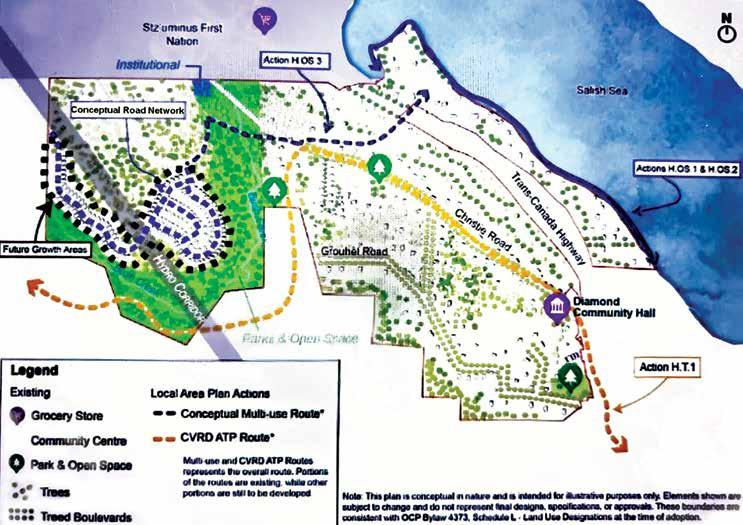
Diamond Local Area Plan – Community Update and Town Hall Invitation
This month, I’m sharing an update on the draft Local Area Plan (LAP) for Diamond. Your input continues to shape this plan, and I invite you to join a Director’s Town Hall on Friday, September 12, 2025, at Diamond Hall.
The event runs from 5 to 8 p.m., with a drop-in information session beginning at 5 p.m., where you can view maps and ask questions to CVRD staff and the area director. The town hall discussion will follow at 7 p.m.
You can find full reports, background documents and survey results at www. planyourcowichan.ca.
Here’s a summary of key points shap -
ing the Diamond LAP: Vision for Diamond
Diamond is envisioned as a rural community with deep ties to the land and its people, balancing nature with thoughtful development, preserving cultural heritage and fostering strong community bonds.
From the first community survey:
• 50 per cent agreed or strongly agreed with the draft vision.
• Residents valued balancing development with green spaces and community connection.
• Some called for stronger emphasis on environmental protection over growth.
Housing:
Current housing is primarily singleunit homes (68.7 per cent), with mobile homes (19 per cent) and some multi-unit dwellings. Compared to the regional average, Diamond shows slightly more diversity in housing types.
Community preferences identified:
• Townhouses and rowhouses rated highest as future housing options; highrises rated lowest.
• Preference for ownership and cooperative housing over rentals.
• Concerns about affordability and lack of variety.
• Desire for housing that’s sustainable, accessible for seniors and inclusive.
Services and Amenities
The most-used amenities are green spaces and parks. However, services like daycare, cafes and libraries are lacking.
Key challenges:
• No public transit or school buses – a reliance on personal vehicles.
• Mixed views – some see this as part of rural life; others find it limiting.
Desired amenities include corner
• Enhance marine access and highlight proximity to the airport.
• Strengthening environmental references in the plan; and
stores, a daycare, libraries, and more parks.
Infrastructure
Concerns raised:
• The water supply strain from new development;
• Aging infrastructure, including potential lead-lined pipes; and
• Limited firefighting capacity due to reliance on private wells.
Priorities:
• Water infrastructure is a top priority – seen as more important than sewer upgrades.
• Many residents value Diamond’s self-sufficient rural character.
Transportation
Diamond is car-dependent. Walking, biking and public transit are minimal.
Community suggestions:
• Recognize that private vehicles will remain essential, but explore interest in small-scale public transit.
• Improve pedestrian and cycling routes, lighting and equestrian facilities.
Local Context & Heritage
Diamond covers roughly 196 hectares, between Ladysmith Harbour and the Stz’uminus First Nation.
It lies within the traditional territories of the Stz’uminus, Snuneymuxw and Hul’qumi’num Treaty Group Nations.
Some commonly referenced amenities aren’t technically within LAP boundaries. The Area H Advisory Planning Commission (APC) recommended:
• Clarifying boundary maps;
• Including features like Bush Creek, Oyster Sto’Lo Road and major power lines; and
• Removing inaccurate heritage references like the Tudor Mill.
Final Engagement and Adjustments
During the last engagement round (May–June 2025), three Diamond residents provided input. Despite small numbers, feedback supported the vision and emphasized:
• Preserving cultural heritage while ensuring accuracy.
A lot of work has gone into developing this draft plan. The September 12, 2025 meeting is to share information and hear your thoughts. There are no proposed land use changes.
Please mark your calendar – I hope to see you there!
ben.maartman@cvrd.bc.ca
250-510-5930
Concept map courtesy of Ben Maartman
Craft Beer and Community
BY FRANCESCA PACCIANO
Chemainus is buzzing with the annual return of the Cowichan Craft Beer and Food Festival. It’s the perfect chance to enjoy good drinks, listen to local musicians, and support the community.
The Chemainus Business Improvement Association makes it their mission to create events that show a wider audience the beauty of Chemainus. Krystal Adams, the executive director for the BIA spoke about the event. “It’s really to get the name of Chemainus out there and appeal to a different market segment.”
The festival is the Chemainus BIA’s most popular event and is now in its sixth year. “We want to change the perception of Chemainus. We want to make sure people know we’ve got some really cool things going there…we want to get the word out and just bring a great event to a small town to represent Cowichan and really BC.”
The event is the largest on the island for craft beer and they are expecting up to two thousand people to attend. “We’re also essentially three festivals in one… we’ve got this whole music festival and food festival that’s combined with this beer festival.”
While beer is the drink of the festival, there are also ciders and non alcoholic drink options. The food vendors are a mix of food trucks and local eateries. And to keep the energy up, there will be four bands, including Chase the Bear, a heavy rock band from Vancouver.
The Chemainus BIA is also partnering with the Canucks Autism Network to increase awareness on the island for its programs and to generate funding for
that organization.
“They’re gonna be doing a really fantastic mystery wall where most of the breweries have donated a prize. The Autism Network have also sourced out additional prizes as well. Some large ones, some smaller ones, and you’re gonna be able to put in a token or give a donation, choose a bag number and see what you’ve won.”
Attendees at last year’s Cowichan Craft Beer and Food Festival. Photo: craftbeerandfoodfest.com
The general admission festival only goes until 6pm but the after party extends the night until 10pm. “It’s a more intimate setting in a smaller space that has both live as well as prerecorded music. It has tacos and hot dogs and things to eat afterwards. It also has a full bar.”
The only catch is that the after party is only accessible to festival goers.
This event, and others like it, aren’t just to attract tourists, it’s part of it, but they’re here to be enjoyed by everyone.
The BIA is the main organizer but it’s a community event, from donations of
generators and sound equipment, to grants for hosting the media, and giving back to the Canucks Autism network. This is a community event for the people. “The whole point of this event is to come and enjoy one of the festivals, or three of the festivals…bring a chair, come sit on the lawn, have a day out with your friends.”
Got news, a story idea, or cool photos? editor@take5.ca
Tree Care Tips to Keep Your Tree Happy and You Safe
BY GABRIELLE LEE
Proper care of your trees will ensure they continue thei role to clean the air, deaden noise, add to property value, and, of course, stand as uniquely beautiful flora.
However, they can become a liability if neglected, and owners must consider what needs to be done to maintain the trees on their property.
Mark Myers, the proprietor of All Acres Professional Tree Service, offers owners tips and insight on maintaining the health and safety of their trees. Myers has spent over 30 years tending to trees. His extensive experience ranges from complete takedowns to straightforward pruning. Here are his suggestions for identifying dangerous trees.
Monitor for root failure
Myers advises starting with the base of the tree: “If … you notice around the bottom of the tree that there are cracks around the roots … that’s a sign that that tree is moving.”
Cracks or separations in the soil suggest excessive root movement and are often a warning sign for root failure. Root failure can cause trees to structurally break down, leading to limbs dropping or the complete collapse of the tree.
Watch for external signs of decay
Myers points out that “if you find fungus on a tree … it generally means that the centre is rotten and the fungus is feeding from the centre. Bracket fungus in particular is a certain sign that … the tree could be dangerous.”
Fungal fruiting bodies and cavities are hallmark indicators of decay. Their presence may suggest further internal problems or a tree in declining health. Be aware of codominant stems
“When … they’re codominant, that’s when they can fail in a strong wind,” says Myers. “So always check the splits to see if there’s been any movement, any cracks.”
Codominant describes two or more stems growing from the same location on the main trunk, which gives the tree a distinct “Y” shape. This structure makes the tree more susceptible to separation, as these split stems fail much more frequently than others, especially in storms.
Tend to dead branches
“Cope with a tree as soon as it’s dying,” Myers warns. “[When the limbs] ... have been left too long … it [is] only a question of time before they’ll fail. They … get overmatured … very brittle and can just pop off at any time.”
These limbs should be cut back or removed swiftly, especially if they are overhanging property or roads.
Note weighty branches and limbs
“You can thin [some trees] out so that the wind resistance is less,” Myers advises. “You take a limb out, miss a limb, leave a limb, you’re … thinning [the tree] out as if to cut down a sail.”
This process, known as pruning, helps to maintain the structural integrity and aesthetics of a tree. It also prevents excessive weight from being concentrated at the ends of branches, which can lead to failure and falling limbs.
Take care of your trees and they will continue to provide environmental, aesthetic and economic value to the community.
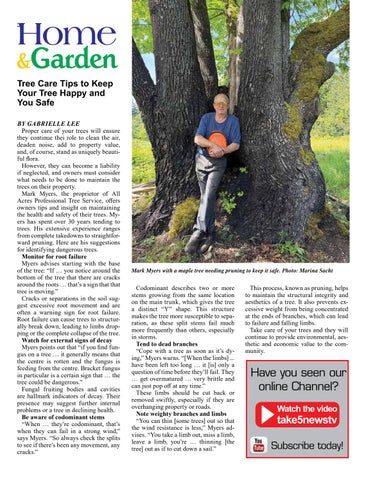
Mark Myers with a maple tree needing pruning to keep it safe. Photo: Marina Sacht
Is this a Possible Way to Save a Forest?
BY GUY DAUNCEY
In 2015, the long-time owner of 60 acres of gorgeous Douglas-fir forest in Yellow Point – north of Long Lake Road and west of Whiting Way – passed away. He had ensured his neighbours that he would protect his land in perpetuity, but when Father Death took him away, the property sale ended with every tree being felled, except in a riparian zone around a small wetland. It is now a sea
of dust and Scotch broom, soon to be developed as five acre lots.
Before the land was cleared, we – the Yellow Point Ecological Society (YES) – tried everything we could think of to save the land. Most forested land that’s not adjacent to a wetland or a creek has been ecologically abandoned; it has no
Mount Benson. Photo: Paul Chapman Eagles in flight. Photo: Bob Burgess
legal protection. An owner can cut it down without telling anyone. The only way to save the 60 acres would have been to raise $2 million and buy it. The Nanaimo Area Land Trust (NALT) advised us that this would typically take four years and a big community campaign. We had weeks, not years.
There is one other way, however. If someone owns land that has important ecological values that they want to protect, there is an old method they can use. They can approach a non-profit conservation society like NALT and register a conservation covenant on it, protecting it forever. If a future owner breaches the covenant, they have to pay a fine that’s far more than value of the felled timber.
NALT holds 13 local covenants, including four properties on Lasqueti, Gabriola, Link and South Winchelsea Islands; one in Mount Benson Regional Park; one at Yellow Point Lodge; two near Duncan; and one in Errington. The Land Conservancy (TLC) of BC holds 240 covenants across the province. Over 25 years, that’s just ten covenants registered a year.
Why so few?
Why so few? The answer is the cost, which TLC says is between $27,500 and $66,800, plus an endowment from $15,000 to $80,000 to cover the cost of an annual inspection. It’s a combination of legal drafting ($1,500 to $6,000); baseline ecological documentation ($16,000 to $32,000, $500 a day); a legal survey of the land ($3,000 to $15,000); legal advice ($4,000 to $8,000); and registration with the Land Titles Office ($500 to $800). If you want the land to be eligible for Environment Canada’s Ecological Gifts program, bringing a tax credit for 29 per cent of its value, that’s a further $2,500 to $5,000 for an appraisal.
If you think, “This is ridiculous!” join the gang. Between 1970 and 2018, we humans and our machines wiped out 69 per cent of the population of the world’s mammals, birds, fish and reptiles. With global biodiversity devastation happening at such speed, there’s got to be a cheaper way to protect ecologically valuable land. Could we get the cost down to $2,500?
These are just estimates, but they give the idea. First, the owner could document the land’s ecological values using a camera ($0) and use a standard conservation covenant template. For the survey, use a GPS app on a cellphone validated by a qualified surveyor ($250). Because you are using a standardized covenant, persuade the Land Titles Office to charge a reduced fee ($250), and the lawyer to reduce their fee ($250). The conservation society could potentially replace the need for annual site visits by using low-cost satellite monitoring every five years. This approach would confirm there are no breaches in the canopy by comparing before-and-after images, validated by a geospatial technician (estimated at $150, with a $1,000 endowment required). Add a $600 fee for the conservation society holding the covenant, and the total comes to $2,500.
Legally, this may be possible without formally changing the Land Titles Act, if the Association of British Columbia Land Surveyors can be persuaded to agree that surveying with a smartphone with a GPS app is sufficient. Clearly, there’s lots more discussion to be had, but imagine the results if it could be done. Would you be interested to protect your land this way, if it cost only $2,500? Email us at yellowpoint2020@gmail.com with your ideas.
Where the Wild things grow: Wetlands
BY RACHAEL MACDONALD, EIS NATURALIST
In the height of summer, between the bustle of school field trips and the return of fall programming, we embraced some time alone in the forest. At Wildwood, the title of naturalist contains multitudes – we’re educators, event planners, hoarders of knowledge and scientists. We love a good lull. It gives us space to step away from our busy schedules and wander – to study the parts of Wildwood that few ever get to see.
In a seldom-explored corner of the
property, drone images revealed a sizable wetland, and we were eager to see it in person. Wetlands currently make up about five per cent of British Columbia’s landbase, but that’s only around 20 per cent of what would have existed here before colonization. Settlers routinely drained wetlands with little thought, transforming them into farmland, homesteads and pasture. They were often viewed as obstacles – foreboding, smelly places or simply eyesores.
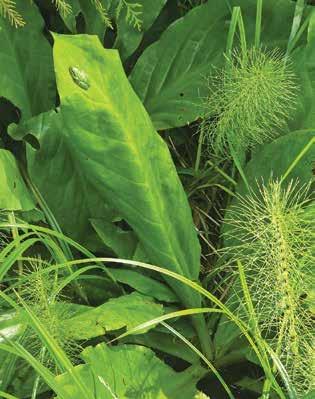
To us, Wildwood’s wetlands are something else entirely. They are lovely, quiet places that hold stories, water and life. Clad in waders and cruise vests, we hauled our canoe down to the lakeshore and paddled across, landing at one of the few usable sites along the steep, tree-lined edge. From there, we bushwhacked into the wetland to begin our assessment. We catalogued plants, collected environmental data and tried to
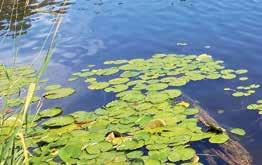
Tree frog on Skunk Cabbage. Photo Alexander Smith EIS. Opposite page: Pond lilies at Quennell Lake. Photo: Marina Sacht
determine whether we were standing in a peat bog, swamp, fen or marsh. Understanding exactly what kind of wetland we have will help us make decisions about its stewardship – how close we can selectively log without negatively impacting it, and what kind of support it might need as climate change alters local conditions in the years to come.
Beyond being critical habitat for a variety of wildlife and plant species – many of them endangered or vulnerable – wetlands play an underappreciated role in climate regulation. They are important carbon sinks. Most people are familiar with the role forests play in carbon storage: trees absorb carbon dioxide during photosynthesis, storing it in their tissues as they grow. But wetlands are the unsung heroes of the carbon cycle. Like other plants, those in wetlands absorb carbon throughout their lifetimes. The difference lies in what happens after they die.
Instead of releasing carbon back into the atmosphere, many wetland plants fall into waterlogged soils, where decomposition slows dramatically due to the lack of oxygen. This allows the carbon to stay trapped underground for centuries – sometimes even millennia. As a result, wetland soils can store more carbon per gram than neighbouring forests and fields, making them some of the most effective natural carbon vaults on Earth.
Later in the season, we’ll return to complete our assessment. By then, we’ll be joined by pink spirea, marsh speedwell, yellow pond lily and blue skullcap – plants whose predecessors lie deep beneath our feet, still clinging to carbon once pulled from the air. In the quiet between programs, we found more than stillness. We found curiosity, resilience and the quiet labour of ecosystems that keep giving, even when unseen.
Self Control?
“Do not waste time on what you cannot control.”
– Marcus Aurelius, Roman emperor and Stoic philosopher (161–180 AD)
Well, I’m not the only one who is relieved that the hay harvest is done. It’s always a tense and intense time for all of us, that makin’ hay while the sun shines. “Why so?” you ask. It comes down to two words: no control.
I can organize and multitask all I want – book Gord, my hay man extraordinaire, line up a crew of “studly farm-
hands” willing to sweat buckets to get the bales from field to barn, line up a flat-bed trailer, and then – drumroll –ready, set … rain!
And I wasn’t the only disgruntled soul around here. My ancient sheep Socs, although blind as a bat, decided that the grass was indeed much greener on the other side of the fence. Nothing wrong with her sense of smell, it seems. She pushed her head through the six-by-sixinch page wire and had a real good nosh. Unfortunately, she couldn’t pull her head back once satiated. The crying could be heard all the way up to the horse palace. It was wire-cutters to the rescue; then secure tiny-holed chicken wire to the page wire just in case she was tempted again. No control, that old ewe.
It was a bit of a different challenge for
the horses. Well actually, not as much for the two elderly gals, both visually impaired, but again nothing wrong with their olfactory senses. At 28 and 33, they’ve had many years of grass sniffing but have mellowed with age and had seemed content with their grains and hay. Not so for Sisco.
Some may recall his introduction to the TAKE 5 a few years ago. A handsome white unicorn with striking blue eyes and a voracious appetite – he’s always had a bit of an issue with selfcontrol when it comes to food (hmm … sort of like me), especially treats and sweets – actually, almost everything except parsnips!
But I digress. Sisco was finding it particularly hard being on the other side of a yummy field, starting to push his weight around, especially on the fence posts.
And at that very moment, Mother Nature stepped in. After two false starts, it was cut, tether, bale and store – and the task was complete. Whew!
Now for one final control issue: Sisco in the pasture. I just knew he would become a piggily-wiggly the moment he had his freedom. That was when Carys –my exceptional and oh-so-strong horsehelper/whisperer – told me about the magic grazing muzzle. It looks a little comical on him, but it just might do the trick. Time will tell. And who knows, it might not be such a bad idea for others with limited self-control!
Jackie Moad is still rejoicing over another successful hay season while mulling over her next task – what to do with three trees of ripe yellow plums? – as she continues to farm that 20 acres of organic paradise in Cedar.