75 YEARS OF VISION: THE LASTING GIFT
At first blush, the possibilities for new construction seemed nonexistent. The country was at war. Building materials were impossible to come by — nearly everything was rationed. Skilled labor was scarce. Without receiving priority certificates to secure building materials, moving forward could not occur. But the reality of wartime meant the armed forces needed doctors. As the war continued, the need increased. There was also an acknowledgment that new doctors would not only care for the sick and wounded on battlefronts halfway around the world, but maintain and protect the health of the home front’s growing population. It proved serendipitous that Dallas was the base of operations for the military’s Eighth Service Command. The Foundation realized it had a simple case to make. The military needed doctors, and the new medical school was in a position to turn out some of the best. General Walton H. Walters found the arguments persuasive. Col. Bradley Colley, chief of surgery for the Eighth Service Command, agreed to build prefabricated plywood barracks to house the school. On July 16, 1943, authorization and top priority were given to buy required materials and begin construction of nearly 30,000 square feet of buildings. On September 27, 1943, the first classes were held in the first of the newly completed barracks. Every surface was made of ¾-inch plywood — floors, ceilings, walls and roofs. The buildings were not air-conditioned. Windows would stick. Heating was inadequate. And the roof would leak. But while the architecture was best described as “henhouse classic,” it was home. They were quickly dubbed “The Shacks.” As the barracks neared completion, the medical school needed accreditation, a task Dr. Cary was uniquely suited for, having served as president of the AMA. Accreditation was given on December 15, 1943. The speed of the acceptance was unprecedented. Southwestern Medical College became the nation’s 68th medical school and likely the first to begin operations with an “A” rating — putting it on par with the oldest and best medical institutions in North America. To preserve the quality of education, the Foundation determined that a maximum of 64 new students would be admitted each year, ensuring time for individual instruction in clinical subjects. “They will learn from the outstanding physicians and surgeons of Dallas, who serve on the clinical faculty…that a sick person presents not merely a scientific question, but a problem of human values that involves the aspirations and frustrations of an individual,” Dr. Cary said.
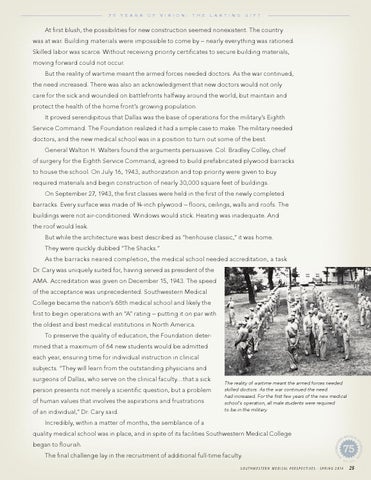
The reality of wartime meant the armed forces needed skilled doctors. As the war continued the need had increased. For the first few years of the new medical school’s operation, all male students were required to be in the military.
Incredibly, within a matter of months, the semblance of a quality medical school was in place, and in spite of its facilities Southwestern Medical College began to flourish. The final challenge lay in the recruitment of additional full-time faculty. S O U T H W E S T E R N M E D I C A L P E R S P E C T I V E S . S P R I N G 2 014
25