Culture
Confluence of styles
Dance
Nurtured in the heartland of the Cauvery basin of peninsular India, Bharatanatyam is among the oldest of the classical dances of India that was encouraged by royal patronage. Changing fortunes of kings and the subsequent change in political contours and resulting migrations led to regional cultural interactions. Today, various classical Indian dance forms like Bharatanatyam, Odissi, Kuchipudi, Kathak, Mohiniattam and contemporary dance thrive in Bangalore and other parts of the state, reflecting a reservoir of cultural growth.
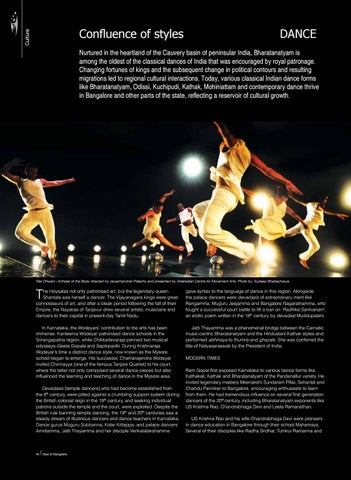
Mei Dhwani - Echoes of the Body directed by Jayachandran Palazhy and presented by Attakkalari Centre for Movement Arts. Photo by: Sudeep Bhattacharya.
T
he Hoysalas not only patronised art, but the legendary queen Shantala was herself a dancer. The Vijayanagara kings were great connoisseurs of art, and after a bleak period following the fall of their Empire, the Nayakas of Tanjavur drew several artists, musicians and dancers to their capital in present-day Tamil Nadu.
gave syntax to the language of dance in this region. Alongside the palace dancers were devadasis of extraordinary merit like Rangamma, Muguru Jeejamma and Bangalore Nagaratnamma, who fought a successful court battle to lift a ban on ‘Radhika Santvanam’, an erotic poem written in the 18th century by devadasi Muddupalani.
In Karnataka, the Wodeyars’ contribution to the arts has been immense. Kanteerva Wodeyar patronised dance schools in the Srirangapatna region, while Chikkadevaraja penned two musical odysseys-Geeta Gopala and Saptopadki. During Krishnaraja Wodeyar’s time a distinct dance style, now known as the Mysore school began to emerge. His successor, Chamarajendra Wodeyar invited Chinnayya (one of the famous Tanjore Quartet) to his court, where the latter not only composed several dance pieces but also influenced the learning and teaching of dance in the Mysore area.
Jatti Thayamma was a phenomenal bridge between the Carnatic music-centric Bharatanatyam and the Hindustani Kathak styles and performed abhinaya to thumris and ghazals. She was conferred the title of Natyasaraswati by the President of India.
Devadasis (temple dancers),who had become established from the 8th century, were pitted against a crumbling support system during the British colonial reign in the 19th century, and seeking individual patrons outside the temple and the court, were exploited. Despite the British rule banning temple dancing, the 19th and 20th centuries saw a steady stream of illustrious dancers and dance teachers in Karnataka. Dance gurus Muguru Subbanna, Kolar Kittappa, and palace dancers Amritamma, Jatti Thayamma and her disciple Venkatalakshamma
48
Best of Bangalore
Modern times Ram Gopal first exposed Karnataka to various dance forms like Kathakali, Kathak and Bharatanatyam of the Pandanallur variety. He invited legendary masters Meenakshi Sundaram Pillai, Sohanlal and Chandu Panniker to Bangalore, encouraging enthusiasts to learn from them. He had tremendous influence on several first generation dancers of the 20th century, including Bharatanatyam exponents like US Krishna Rao, Chandrabhaga Devi and Leela Ramanathan. US Krishna Rao and his wife Chandrabhaga Devi were pioneers in dance education in Bangalore through their school Mahamaya. Several of their disciples like Radha Sridhar, Tumkur Ramanna and