to an essential layer of overall room lighting,” says Kristen Crowell, Lighting Program Manager at Häfele. “Clients now expect lighting to enhance both function and
atmosphere…
once
customers
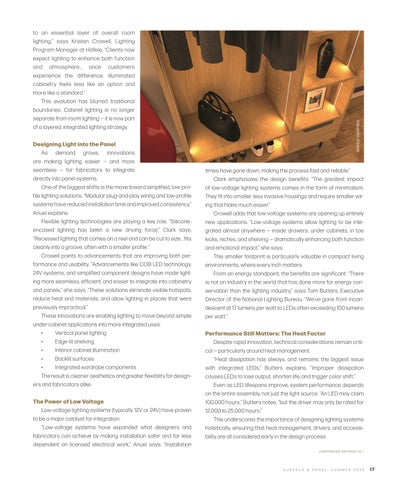
experience the difference, illuminated cabinetry feels less like an option and more like a standard.” This evolution has blurred traditional boundaries. Cabinet lighting is no longer HAFELE LIGHTING
separate from room lighting — it is now part of a layered, integrated lighting strategy. Designing Light into the Panel As
demand
grows,
innovations
are making lighting easier — and more seamless — for fabricators to integrate directly into panel systems.
times have gone down, making the process fast and reliable.” Clark emphasizes the design benefits: “The greatest impact
One of the biggest shifts is the move toward simplified, low-pro-
of low-voltage lighting systems comes in the form of minimalism.
file lighting solutions. “Modular plug-and-play wiring and low-profile
They fit into smaller, less invasive housings and require smaller wir-
systems have reduced installation time and improved consistency,”
ing that hides much easier.”
Anuel explains.
Crowell adds that low-voltage systems are opening up entirely
Flexible lighting technologies are playing a key role. “Silicone-
new applications. “Low-voltage systems allow lighting to be inte-
encased lighting has been a new driving force,” Clark says.
grated almost anywhere — inside drawers, under cabinets, in toe
“Recessed lighting that comes on a reel and can be cut to size… fits
kicks, niches, and shelving — dramatically enhancing both function
cleanly into a groove, often with a smaller profile.”
and emotional impact,” she says.
Crowell points to advancements that are improving both performance and usability. “Advancements like COB LED technology,
This smaller footprint is particularly valuable in compact living environments, where every inch matters.
24V systems, and simplified component designs have made light-
From an energy standpoint, the benefits are significant. “There
ing more seamless, efficient, and easier to integrate into cabinetry
is not an industry in the world that has done more for energy con-
and panels,” she says. “These solutions eliminate visible hotspots,
servation than the lighting industry,” says Tom Butters, Executive
reduce heat and materials, and allow lighting in places that were
Director of the National Lighting Bureau. “We’ve gone from incan-
previously impractical.”
descent at 17 lumens per watt to LEDs often exceeding 100 lumens
These innovations are enabling lighting to move beyond simple
per watt.”
under-cabinet applications into more integrated uses: •
Vertical panel lighting
•
Edge-lit shelving
•
Interior cabinet illumination
•
Backlit surfaces
•
Integrated wardrobe components
The result is cleaner aesthetics and greater flexibility for designers and fabricators alike.
Performance Still Matters: The Heat Factor Despite rapid innovation, technical considerations remain critical — particularly around heat management. “Heat dissipation has always, and remains, the biggest issue with integrated LEDs,” Butters explains. “Improper dissipation causes LEDs to lose output, shorten life, and trigger color shift.” Even as LED lifespans improve, system performance depends on the entire assembly, not just the light source. “An LED may claim
The Power of Low Voltage Low-voltage lighting systems (typically 12V or 24V) have proven to be a major catalyst for integration. “Low-voltage systems have expanded what designers and fabricators can achieve by making installation safer and far less
100,000 hours,” Butters notes, “but the driver may only be rated for 12,000 to 25,000 hours.” This underscores the importance of designing lighting systems holistically, ensuring that heat management, drivers, and accessibility are all considered early in the design process.
dependent on licensed electrical work,” Anuel says. “Installation CONTINUED ON PAGE 18 >
SURFACE & PANEL •SUMMER 2026
17