Feature
Structural Preservation Systems uses liquid fluoroelastomer in resealing procedure on sulfur pit Structural Preservation Systems of Deer Park, Texas, collaborates with clients to improve infrastructure by combining specialty construction, repair and maintenance services with proprietary technologies to provide innovative solutions for demanding engineering and construction challenges. A major industrial petrochemical facility in the Gulf Coast needed to reseal their sulfur pit—a Claus sulfur recovery unit—where recovered molten sulfur is stored. The pit is a large, square reinforced-concrete box lined with a steel plate incorporating a refractory liner and a stainless steel partition wall which runs the length of the pit. The roof of the pit is a series of pre-cast reinforced concrete panels, which were sealed with gasket material at each joint location to eliminate vapor emissions to the atmosphere. During maintenance and restoration activities, when the refractory liner is installed overtop of the steel plate, the refractory materials have a high water content and require a specified dry-out period
before the unit can be put into elevatedtemperature service. Unfortunately, during this process the stainless steel partition wall
lifted the precast concrete panels, due to stainless steel expanding 1.5 times more than
concrete and carbon steel (which have very
similar coefficients of thermal expansion). FLUOROELASTOMER SEALANT (PELSEAL® 2690)
GAP WIDTH VARIES (APPROXIMATELY 1/2”)
HIGH TEMPERATURE FOAM BACKER ROD
AREA TO BE PREPPED (1)
AREA TO BE PREPPED (1)(2)
GAP WIDTH VARIES (APPROXIMATELY 1/2”)
GAP WIDTH VARIES (APPROXIMATELY 1/2”)
HIGH TEMPERATURE FOAM BACKER ROD FLUOROELASTOMER SEALANT (PELSEAL® 2690)
FLUOROELASTOMER SEALANT (PELSEAL® 2690)
REINFORCING FABRIC OMITTED FOR CLARITY
AREA TO BE MECHANICALLY PREPPED USING PNEUMATIC NEEDLE SCALER AND/OR GRINDER DEPENDING ON ACCESS
4”
FLUOROELASTOMER COATING (PLV6032) WITH REINFORCED FABRIC
Sealant Detail – Overhead View of Concrete Lid.
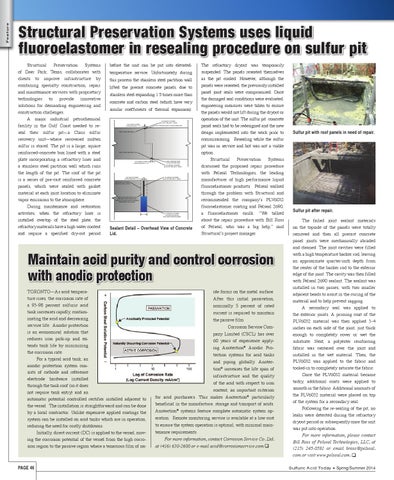
The refractory dryout was temporarily suspended. The panels reseated themselves as the pit cooled. However, although the panels were reseated, the previously installed panel joint seals were compromised. Once the damaged seal conditions were evaluated, engineering measures were taken to ensure the panels would not lift during the dryout or operation of the unit. The sulfur pit concrete panel seals had to be redesigned and the new design implemented into the work prior to commissioning. Resealing while the sulfur pit was in service and hot was not a viable option. Structural Preservation Systems discussed the proposed repair procedure with Pelseal Technologies, the leading manufacturer of high performance liquid fluoroelastomer products. Pelseal walked through the problem with Structural and recommended the company’s PLV6032 fluoroelastomer coating and Pelseal 2690, a fluoroelastomer caulk. “We talked about the repair procedure with Bill Ross of Pelseal, who was a big help,” said Structural’s project manager.
Maintain acid purity and control corrosion with anodic protection TORONTO—As acid temperature rises, the corrosion rate of a 93-98 percent sulfuric acid tank increases rapidly, contaminating the acid and decreasing service life. Anodic protection is an economical solution that reduces iron pick-up and extends tank life by minimizing the corrosion rate. For a typical acid tank, an anodic protection system consists of cathode and reference electrode hardware installed through the tank roof (so it does not require tank entry) and an automatic potential controlled rectifier installed adjacent to the vessel. The installation is straightforward and can be done by a local contractor. Unlike expensive applied coatings the system can be installed on acid tanks which are in operation, reducing the need for costly shutdowns. Initially, direct current (DC) is applied to the vessel, moving the corrosion potential of the vessel from the high corrosion region to the passive region where a tenacious film of ox-
PAGE 46
ide forms on the metal surface. After this initial passivation, nominally 5 percent of rated current is required to maintain the passive film. Corrosion Service Company Limited (CSCL) has over 60 years of experience applying Anotection® Anodic Protection systems for acid tanks and piping globally. Anotection® increases the life span of infrastructure and the quality of the acid with respect to iron content, an important criterion for acid purchasers. This makes Anotection® particularly beneficial in the manufacture, storage and transport of acids. Anotection® systems feature complete automatic system operation. Remote monitoring service is available at a low cost to ensure the system operation is optimal, with minimal maintenance requirements. For more information, contact Corrosion Service Co. Ltd. at (416) 630-2600 or e-mail acid@corrosionservice.com q
Sulfur pit with roof panels in need of repair.
Sulfur pit after repair.
The failed joint sealant materials on the topside of the panels were totally removed and then all precast concrete panel joints were mechanically abraded and cleaned. The joint cavities were filled with a high temperature backer rod, leaving an approximate quarter-inch depth from the center of the backer rod to the exterior edge of the joint. The cavity was then filled with Pelseal 2690 sealant. The sealant was installed in two passes, with two smaller adjacent beads to assist in the curing of the material and to help prevent sagging. A secondary seal was applied to the exterior joints. A priming coat of the PLV6032 material was then applied 3-4 inches on each side of the joint, just thick enough to completely cover or wet the substrate. Next, a polyester reinforcing fabric was centered over the joint and installed in the wet material. Then, the PLV6032 was applied to the fabric and tooled-in to completely saturate the fabric. Once the PLV6032 material became tacky, additional coats were applied to smooth in the fabric. Additional amounts of the PLV6032 material were placed on top of the system for a secondary seal. Following the re-sealing of the pit, no leaks were detected during the refractory dryout period or subsequently once the unit was put into operation. For more information, please contact Bill Ross of Pelseal Technologies, LLC, at (215) 245-0581 or email bross@pelseal. com or visit www.pelseal.com. q Sulfuric Acid Today • Spring/Summer 2014