
Regional Systems Edition
Regional Systems Edition


498,058
471,450
BY WAYNE NIELSEN

as a must-see. On the first morning we lined-up with others for an hour or so until we could go down into his mothballed WWII bunker.
Operational in August 1939, shortly before the outbreak of war in Europe, the Churchill War Rooms comprised an underground complex that housed a British government command center beneath the Treasury building in the Whitehall area of Westminster. One area of many that really caught my eye was a small closet which, according to the placard, was built in 1943 and housed a direct cable link from London to Washington – from Churchill to Roosevelt, and later Truman, which was most likely built in utmost secrecy by my former employer. (It was rumored at the time that
amongst the other bunker’s less-informed occupants that the room was Churchill’s private WC with real running water!) I surmised this cable link became a key lifeline between the two allies, as well as the vehicle to agree the next steps to manage the eventual roll back.
In the era of Orlando, Nice and Turkey, the thought of that ancient communications closet offers me some reassurance.
Good reading.

Wayne Nielsen is the Founder and Publisher of Submarine Telecoms Forum, and previously in 1991, founded and published “Soundings”, a print magazine developed for then BT Marine. In 1998, he founded and published for SAIC the magazine, “Real Time”, the industry’s first electronic magazine. He has written a number of industry papers and articles over the years, and is the author of two published novels, Semblance of Balance (2002, 2014) and Snake Dancer’s Song (2004).
+1.703.444.2527

wnielsen@subtelforum.com



AAG Internet Speed Back to Normal, Service Providers Say
AAG Submarine Cable Under Maintenance, Internet in Vietnam to be Slow for 6 days
Algeria Suffers Net Blackout
Arctic Fibre Acquired by Quintillion Networks
BT Tests 5.6 Tbps Optical Transmission Speed
CAT, Tata to Sign MoU for Submarine Cable Partnership
Chile Publishes Bidding Terms for Patagonia Fibre Tenders
Cinia Connects to Equinix Data Centers in Frankfurt and Helsinki
Cinia Opens Northern Digital Highway for Commercial Use
Cinia Plans to Take C-Lion1
Cable Branch to Hanko
Dialog Connects Sri Lanka to 100G-Plus BBG
Submarine Cable
Djibouti Launches Regional 60Tbps Cable
E-marine Adds CS Maram to Cable Laying Fleet
E-marine Wins Cable-Laying Project from ASN
FCC Passes Submarine Cable Licensee Reporting Rule
GlobeNet Offers 100-Gbps
Wavelengths Between Brazil, US
Google’s FASTER Cable System is Ready for Service, Boosts Trans-Pacific Capacity and Connectivity

Hawaiki Submarine Cable to Boost Performance and Reduce Latency for AWS Cloud customers in Australia and New Zealand
Hibernia Networks Announces Protected Wavelength Service Across the Atlantic for Unmatched Resiliency
Huawei Marine and Rostelecom Begin the Construction of Submarine Network Connecting Kamchtka-Sakhalin
KT Opens Undersea Network Center in Busan
Microsoft and Facebook to Build Subsea Cable across Atlantic
Mitsubishi Electric to Upgrade IMEWE Cable System
NEC Approaches the Limit of Transoceanic Optical Transmission Efficiency
Omantel lands AAE-1
Subsea Cable in Oman
Ooredoo Completes
Landing of SEA-ME-WE 5 Submarine Cable System
Ooredoo Launches AAE-1
Submarine Cable in Qatar
Proposed FCC Rules for Team Telecom Review of Applications with Foreign Ownership, Shorten Timeframes, Add Burdens
Small Polynesian Nations Look to Submarine Cable Link
Solomon Islands Gov’t Yet to Decide on Sub Marine Cable
SRG-1 Consortium Selected Xtera for Building a New Subsea Cable System across the Gulf of Oman
STF #88 Available
Submarine Cable Almanac Issue 18
SubTel Forum Announces Media Partnership With Submarine Networks World
Superloop Raises AU$22m Under First Stage of Entitlement Offer
Superloop Raising
AU$35.3m to Fund Asia Network Expansion
Telefónica Renews
Submarine Cable Maintenance Contracts
This Week in Submarine Telecoms June 13-17
This Week in Submarine Telecoms June 20-24
This Week in Submarine Telecoms June 27-July 1
This Week in Submarine Telecoms May 16-20
This Week in Submarine Telecoms May 30-June 3
This Week in Submarine Telecoms May 9-13
U.S. Military Wants to Buy Guantánamo Bay a Backup Fiber-optic Cable
Vietnam’s Internet to be Affected by pan-Asia Submarine Cable Cut
Viettel Invests in AAE-1 Submarine Cable Network
Virginia Beach Development Authority to Sell Land forTransoceanic Fiber Communications
Vocus raising $650m to buy NextGen: reports
Vocus to Buy Nextgen Networks for $861m
Wallis and Futuna Interested in Samoan Cable
Presenting the industry’s most extensive collection of 375+ current and planned submarine cable systems impacting financiers, carriers, cable owners, system suppliers, component manufacturers and marine contractors, and detailing more than 50 menu-based data fields and maps in a customer-customizable report.
REPORTING IN 5 BUSINESS DAYS
BY KIERAN CLARK

While 2015 was a bleak year for the submarine fiber industry, the next three years promise some of the busiest times the industry has seen in well over a decade. International bandwidth demand continues to skyrocket, with new cable systems announced left and right. The immense effort required to keep up with demand — largely driven by data centers and cloud services providers — will test the capabilities of the entire industry.
This is not a localized phenomenon, either. Every region in the world is slated for tremendous band-
width growth over the next three years, with all but the EMEA region expected to more than double existing capacity.
Welcome to SubTel Forum’s annual Regional Systems issue. This month, we’ll take a brief look at system progress around the world, and talk a little bit about some of the challenges the submarine telecoms industry faces. The data used in this article is obtained from the public domain and is tracked by the ever evolving STF Analytics database, where products like the Almanac, Cable Map, Online Cable Map and Industry Report find their roots.
At the time of our last Regional Systems edition, 19 systems were set to be ready for service in 2015, 23 systems in 2016, and five systems in 2017. One year later, those numbers have changed to six systems in 2015, twenty-one systems in 2016, 16 systems in 2017 and nine systems in 2018. While 2015 saw a tremendous reduction of planned systems and 2016 saw a slight decrease, the next two years should see a surge in activity. Overall, and despite the massive downturn in 2015, there has been 10.5 percent increase in systems under develop-
ment since our last edition.
Of the systems scheduled to be ready for service in 2016, only three have been put in to service. Nine systems have started their marine surveys, another three have started system manufacture, and three other systems due to be ready for service this year have begun installation. The remaining systems remain in the pre-engineering phase. Looking ahead to 2017, only two systems have started their marine survey, two systems have started the manufacturing process, and the remaining twelve systems are still in
the pre-engineering phase. Despite the slight increase in the number of systems under development, there will actually be a slight decrease in the number of kilometers added to the global infrastructure compared to last year’s data. There
was a decrease of more than 113,000 kilometers of planned cable in 2015 from this time last year, and 2016 decreased from 162,000 kilometers of cable to 125,000. The next two years should see some positive growth with 2017 going from 50,000 kilometers
to just over 90,000 and 2018 planned for 84,000 kilometers, with only a handful of systems announced.
Most of this rapid growth is largely driven by demand in the Pacific. With emerging markets in the South Pacific continuing to hun-
ger for more bandwidth, expect activity in the region to remain high. When paired with a renewed desire for Transpacific routes, these factors have resulted in more than half of all new systems to be planned for the Transpacific and AustralAsia regions over the

next couple years. The bulk of the remaining planned activity is centered on the Atlantic, stemming from a desire to connect with emerging markets in South America and Western Africa. Two new Transatlantic systems have gone live since this time last year — the first such systems in over a decade — hinting at a resurgence in Transatlantic growth.
Global capacity is projected to increase by nearly 65 percent through 2018. Except for the EMEA region, every region in the world is expected to more than double its existing capacity.
Such a massive bandwidth increase over a relatively short period of time is made possible by the cutting edge technology available to system owners today. With 100G wavelength technology being the de facto standard, 150G and 200G beginning to enter service and 400G available for commercial use within the next two years, these capacity totals could actually skyrocket even higher.
While all of this data seems very promising, reality settles in when looking at the percentage of systems that are contract in force, or CIF. There are 52
systems planned globally for the next few years and 48 percent have achieved this milestone. This is the first real determination of whether or not a system will ever see the light of day, and so expectations must be adjusted when CIF rates are observed. With this year being more than half over, 76 percent of planned systems for 2016 are CIF. This is a large increase over the same time last year, where only 44 percent of systems planned for 2015 had reached the CIF milestone. Overall, CIF rates are much stronger than they were a year ago, indicating that most of the planned systems for the next several years have stronger business cases and will more likely see implementation.
What remains to be seen in the coming months is the effect that the economic uncertainty throughout the world will have on the submarine fiber industry.
The relatively low growth of the EMEA region — despite its geographical size — is very likely a result of some of these economic woes, especially those in the Eurozone. Asian economies appear to be relatively stable for now, so impact on planned submarine fiber systems should be minimal for the AustralAsia and Transpacific regions. The Americas and Transatlantic regions continues to see growth, despite uncertainty in South America and Europe, and are heavily driven by North American cloud services providers.
Overall, despite some of the lingering economic uncertainty the world has been experiencing in recent times, the submarine fiber industry looks stronger than ever. Data centers and cloud services providers have appeared to be largely immune from the global economic climate, and have spurred on this explosive demand for bandwidth.
New technologies are seeing commercial use and new nations continue to connect to the global telecommunications network, providing a positive outlook for the industry in the years to come.

Kieran Clark is an Analyst for Submarine Telecoms Forum. He joined the company in 2013 as a Broadcast Technician to provide support for live event video streaming. In 2014, Kieran was promoted to Analyst and is currently responsible for the research and maintenance that supports the SubTel Forum International Submarine Cable Database; his analysis is featured in almost the entire array of SubTel Forum publications. He has 4+ years of live production experience and has worked alongside some of the premier organizations in video web streaming.
BY MIKE LAST

Africa has a growing population in excess of 1.1 billion people and is an increasingly important region for international carriers, — including providers of international bandwidth.
According to the latest figures from Internet World Stats1, in November 2015 nearly a third (just under 331 million people) of Africa’s population used the internet — whilst significantly less than the 49.7 percent internet penetration figure for the Rest of the World, this is nonetheless a remarkable figure for a region that started so late with the internet.
The ever-expanding rise in demand for reliable, high-capacity international bandwidth is being driven by business and the general public. Businesses are taking advantage of the improved international connectivity to boost their efficiency and competitiveness, and to open up new markets across the region and
globally. Individuals are using and then becoming reliant upon it to undertake a multitude of activities, such as:
• accessing information
• social networking, including Facebook, Skype and Twitter
• watching videos (e.g. YouTube)
• streaming music and films
• managing and transferring money
• online gaming
• education and research: from internet-enabled school classrooms to linking higher education research establishments throughout Africa
• accessing e-health and e-government services.
In recent months there has been speculation regarding the potential construction
of new submarine cable systems landing in sub-Saharan Africa, ostensibly to bring increased bandwidth and additional diversity to keep up with demand for cost-effective, high-quality international connectivity.
The business case for investing hundreds of millions of dollars in constructing a major new submarine cable needs to take into account existing and future trends in the international bandwidth market (includ-

ing customer budgets, price decline and the likelihood of market consolidation), as well as the scope for owners of capacity in existing systems to take advantage of low-cost capacity upgrades.
Despite sub-Saharan Africa already being served by multiple high-capacity submarine cables — including WACS and SAT3 on the West coast and EASSy and Seacom on the East — internet users across South Africa and beyond experienced lengthy service interruptions in late January
this year, as a result of concurrent failures on two of these cables.
Crucially however, the reason why these individual, synchronous cable cuts had such an impact was not a lack of submarine capacity into the region. Some broadband capacity suppliers had elected not to invest in all of the available cables, resulting in insufficient levels of diversity in their networks. By not utilising the four main cables serving South Africa, they left customers vulnerable to service interruptions arising
from individual and multiple cable cuts.
If telcos and ISPs split their traffic across more of the existing cables, total service interruption would only result from the most unlikely scenarios.
In reality, existing African submarine cable systems have more than enough capacity to meet the foreseeable demands of the continent. With two cable systems running the length of each coastline, there is also sufficient diversity to provide a suitable level of protection against all but the most extreme cable cut situations.
There are some gaps in the existing infrastructure that could be filled by new cables. Supplementing the aging SAFE system between South Africa and Asia by extending the SEAS system from the Seychelles to India is one such opportunity. This would create a new, direct, low-latency, deep-
sea route from Africa’s eastern seaboard into Asia, as well as providing Asian carriers with an alternative to using the existing Egypt terrestrial routes between Asia and Europe.
Meeting future demand: technology upgrades to boost existing cable capacity significantly
The 10,000km EASSy submarine cable, which runs along the East coast of Africa from South Africa to Port Sudan, has a design capacity of 10Tbps. Of this, only just over 5 percent — half a Tbps — has so far been lit and only 50percent of that — a mere 2.5 percent of the total current design capacity — is in use.
Next year, a further capacity upgrade of EASSy will add another 2Tbps of lit capacity. Meanwhile WACS and Seacom have also been upgraded recently, and now have large volumes of spare capacity available. The technology used in
all these cable systems not only allows for significant ongoing capacity upgrades, but also promises to boost design capacity even further in the coming years with further developments in optical technologies.
Clearly the existing submarine cable systems are more than capable of absorbing significant future increases in traffic, whilst the relatively low cost of upgrading them will ensure future competitiveness and lower prices.
Regional and local investment key to connecting the unconnected
Until quite recently, the international connectivity landed on the coast by submarine cables was only available to a limited set of consumers, mostly in the major cities - accessible via national terrestrial backbones and in some metropolitan area networks, such as in Johannesburg, Nairobi, etc.

Internet Service Providers
(ISPs) to be able to deliver the reliable, affordable, high-capacity international connectivity needed to serve an increasing percentage of the continent’s population, continued investment in ICT infrastructure is crucial.
This investment is needed to further expand terrestrial networks, to construct more metropolitan area networks, Data Centres and carrier Points of Presence (PoPs), and to enhance lastmile connectivity.
A key organization behind this growth is Africa’s
carriers’ carrier WIOCC, which has invested heavily in the region to support its customers and telco shareholders — organizations such as BoFinet in Botswana, TDM in Mozambique, TelOne in Zimbabwe and the LCA in Lesotho. WIOCC
is bringing significant amounts of traffic into the continent from multiple locations along Africa’s eastern seaboard, mostly via the EASSy submarine cable (in which it is the largest single investor); as well as from land-locked countries such as Botswana, Lesotho, Malawi, Zambia and Zimbabwe; and also from Europe and Asia, via the WACS and EIG cables.
WIOCC has spent over $200 million to ensure the quality, reach, accessibility and reliability of its unique,
award-winning network, which interconnects many countries in Africa - as well as offering direct connectivity to/from Europe, the Middle East and Asia.
As well as investing in major cable systems serving subSaharan Africa, WIOCC also continues to invest in its award-winning, 55,000km pan-African terrestrial network. This provides reliable connectivity to over 500 locations across 30 African countries, in addition to linking the east

and west coast submarine cable landing stations in South Africa.
Where next?
The submarine cables landed on Africa’s coastline between 2009 and 2015 are currently operating at low levels of utilization, and expectation is that their capacities will be significantly boosted by developments in optical technologies in the coming years.
With sufficient international submarine capacity to meet the demands of the continent already in place, the major focus for investment now needs to be on bringing the benefits of this international connectivity to a greater percentage of the continent’s population, to connect more of the unconnected by investing in enhanced terrestrial networks, more metropolitan area networks, PoPs, Data Centres and improved lastmile connectivity.
Mike Last is VP, Marketing & International Business Development at Africa’s carriers’ carrier WIOCC.

BY BRIAN LAVALLÉE
Meet Erik. Erik is a Submarine Network Field Engineer. Erik has a challenging job.
Like any Submarine Network Field Engineer, Erik faces a long list of challenges to get the job done. He must possess deep optical transmission knowledge, a willingness to travel worldwide at a moment’s notice and significant patience because whatever can go wrong while working in the field often does.
So, what makes Erik’s occupation different from his terrestrial network colleagues? Water and lots of it! Remember that a typical submarine cable will span an ocean over thousands of kilometers terminating in different countries on each side and therein lies the often difficult challenges that Erik must face. Different countries have unique operational practices, rules, regulations, skills sets, time zones, languages, cultures and other regional differences. All or a combination of

these regional differences can and usually do impact Erik trying to perform his job while on the road, such as troubleshooting a submarine cable experiencing unexplained and erratic bit errors over time resulting in reduced network performance.
So what does a day in the life of a Submarine Network Field Engineer such as Erik look like? Well, let’s review some of the real-world challenges that submarine cable operators and their field personnel encounter related to their subsea network assets, as heard about through the subsea grapevine and from personal experience.
First and foremost, Erik must fully understand submarine network technologies and components, including the book-ended terrestrial backhaul segments on each end. Since Erik is highly skilled and experienced,
he’s understandably in high demand in his industry — even within his own company. It would be nice to have many employees as skilled and experienced as Erik, but this luxury is typically not the case and often leads to project delays due to a lack of available skilled and trained personnel, when required. Let’s assume we do have a few people like Erik, what else can go wrong?
There’s no shortage of test sets available today capable of measuring optical network performance, which allows Erik to proactively and reactively maintain the health of a submarine network. Although a wide choice of test sets is good from a sourcing and pricing perspective, it also means that Erik must be highly competent across multiple test set vendors and models so he can perform consistent field measurements required for
him to properly do his job in a timely manner.
Even if Erik is fluent across multiple test sets, the actual test sets themselves have to be available in the first place and in the country where and when he needs them. The latter isn’t always as easy as it seems in this day and age, especially when a customs officer sees a crate with multiple “High Power Laser” warning labels on it. This often leads to significant delays in getting the required test set through customs and out to the site where Erik is urgently waiting for it.
Now if Erik is waiting for his test sets at a Cable Landing Station (CLS) on the beach, the delays may actually be tolerated, or even encouraged. Shipped items can also get lost or damaged leading to further project delays, which can then delay subsequent planned projects in the queue. When the test set does arrive, has its calibration expired? If so, local resources must be
secured to recalibrate the complex test set, if they even exist, resulting in further delays… you get the idea.
Even with the best of intentions and skillsets, different field engineers using different test sets often yield very different measured data, making it difficult to determine what measured data should be used for such purposes as link engineering, troubleshooting and network modeling. Manual measurements further exacerbate this problem due to possible human errors being incurred, especially when Erik is severely jetlagged, stressed, or even sunburned. Automating measurements using the same measurement processes solves this challenge and is indeed where the industry is headed, but many test set measurements are still performed today in a manual manner meaning
the person using it must be highly skilled.
We’re going to assume Erik has been a good citizen of the world and is allowed to travel unimpeded to most countries where his skills are required but he still must meet work visa requirements in many countries he visits, which is expected in any profession that entails worldwide travel. However, this can also lead to significant delays entering some countries, as work visa approvals
are often (inefficiently) passed through various government departments. If Erik’s trip is planned well in advance, this shouldn’t be an issue, but what about his unplanned trips (ex. an unexpected network fault)?
Some countries mandate that local resources must be sourced for work due to government regulations, meaning that if a submarine cable requires onsite technical support, someone local must aid or replace Erik entirely. Although this may be a viable solution in

some advanced countries, in other countries the required level of competence related to rather unique submarine cable networks may be lacking, or simply unavailable, thereby leading to significant project challenges.
As the latest submarine network technologies and products are rapidly deployed worldwide, the associated skillsets of local support personnel must be constantly updated to maintain pace with the latest leading-edge innovations being deployed, which is quite difficult. For instance, when SLTE changed from “on-off” keying to coherent detection just a few years ago, traditional skill sets were essentially rendered obsolete overnight, leading to a significant skills gap worldwide.
The time and cost associated with shipping people (Erik) and equipment (test sets) around the world and
successfully getting them to their final destination — intact and on time — can be challenging indeed. Travel and living expenses for Erik depends on his destination and how long he’ll spend there. The cost of reliably shipping very expensive optical test sets around the world shouldn’t be underestimated either, as it’s often very expensive. Being able to remotely test end-to-end services and performance across the entire submarine network is the panacea for all those involved, such as Erik and his company, by reducing the associated time, cost and risks related to managing networks that span the world’s oceans.
Most of Erik’s foreign travel destinations are very safe, but from time to time, he must travel to a remote CLS in a crime-ridden location of a generally safe country to locations in downright dangerous countries experiencing civil unrest,

political strife and even natural disasters such as earthquakes and typhoons. Erik is understandably stressed to various degrees when he travels to such locations, but he often has a critical task to perform. He mitigates risk by properly planning his trip in advance, which includes learning about new locations to be visited, leveraging colleagues‘ knowledge and experience, understanding local laws and customs and other common sense travel tactics any traveller should practice when traveling
abroad. Even so, Erik has still witnessed or experienced firsthand rather harrowing situations, which are better left unsaid.
All travelers must eventually satisfy a basic human need while they’re busy on the road… eating and drinking. Although not seen as a major issue to those who’ll eat anything (like me), it can be very problematic for those with narrower dietary restrictions such as vegans, vegetarians, pescetarians,
meatatarians (it’s a real thing) or those with other restrictions, such as food allergies that can lead from mild discomfort to an emergency visit to a nearby hospital, in a foreign country. Poorly prepared food can also lead to unfortunate situations such as when Erik got extremely sick after eating bad fish, or was it the water that he drank from a street vendor? Smart eating and drinking habits mitigate most of these risks, most times.
Most of the submarine cables Erik supports terminate on the other side of oceans thousands of kilometers away, meaning significant time zone differences causing mild to severe jet lag. Since Erik often travels to perform time-sensitive tasks such as turning up urgently needed capacity, performing tasks within a very rigid maintenance window, or addressing an existing network outage, he simply doesn’t have the
luxury of arriving early to acclimatize himself to the local time. As most travelers have experienced, severe jetlag negatively impacts our sleeping habits. This leads to deprived sleep, which is exacerbated by stress related to urgent tasks at hand and being in an unsafe location. Together, this impacts decision-making leading to potentially unintended and serious scenarios. Erik mitigates this by altering sleeping habits beforehand.
Erik enjoys travelling abroad because he gets the opportunity to meet and work with people of different cultures, which is one of the biggest benefits of his occupation while on the road. However, it sometimes intensifies stressful situations, such as having to optimize a submarine network cable carrying a hundred terabits of live traffic per second within a short maintenance window. Language barriers
often lead to misinterpreted operational tasks and processes, reduced teamwork effectiveness, or in some cases, downright frustration and arguments even with the best of intentions. Erik is fluent in English and French, but this of very limited use when working in countries with people who don’t speak either language.
Anyone on the road long enough will eventually succumb to being homesick given that we’re all social creatures at heart.
Travelling to foreign countries thousands of kilometers away for days to weeks on end over the course of a year can and very often does stress family bonds and this is the biggest challenge Erik experiences. Ironically, Erik is mitigating this very challenge firsthand by turning up and maintaining submarine cables, which allow him to correspond with his family in real-time using social media apps, including a video chat app, although time zone differences can still hinder this endeavor.


Erik’s (Hypothetical) Miserable Day
Now, let’s play devil’s advocate and make Erik’s day a rather miserable one by having him experience some of the very realworld challenges discussed above, all of which will come directly from actual situations experienced by real people in the field. It’s the combination of these challenges that result either in a rather good day or an extremely miserable day.
Let’s start with Erik receiving an urgent support call related to a
submarine cable that’s experiencing errors across multiple channels resulting in customers claiming their Service Level Agreements are being violated and liabilities imminent. Erik must travel across an ocean to connect his test sets to one end of the submarine cable while his colleague connects test sets to the other end of the cable so they can monitor end-toend network performance over the course of a few days.
Before Erik books his flight, he needs to ensure that his
work visa gets approved, which takes a week and then books his rather last minute flight at a wildly significant premium. Erik’s test sets, which were calibrated before being packed, are rush shipped to the remote location, at a significant cost premium, but get trapped in customs due to various paperwork issues. Once the paperwork is corrected, which takes a few days, the test sets are cleared by customs and shipped to Erik waiting at the CLS (on the sunny beach) but upon arrival inspection, there’s water and impact damage on the packaging.
Fortunately, the test sets are verified functional, although one was dented, but Erik was needlessly stressed nonetheless. Due to different time zones, a jetlagged Erik must now work the graveyard shift from 12 a.m to 8 p.m. in conjunction with his colleague located on the other side of the ocean. Erik
and his colleague work incessantly for close to a week battling jetlag, sleep deprivation, mild nausea from bad food eaten and homesickness. Once testing is successfully completed and the various network issues resolved, Erik packs up his test sets and ships them home, hopefully to arrive safely and intact.
However, while Erik is anxiously heading back to the airport to fly home, civil unrest leads to violent protests across the country resulting in all flights being cancelled. His next possible flight home is at least days away, so he heads back to the hotel waiting as the civil unrest grows causing his stress levels to increase by the hour. Although Erik’s next flight home is scheduled to leave at 8 a.m., he impatiently leaves for the airport at 3a.m. to ensure he has more than sufficient time to get there, all the while hoping the angry protesters are catching sleep at such an
early hour. He makes it to the airport safely and catches his flight home, only to find out when he arrives that the unforeseen delays in his last trip means he must fly out to another remote location the day after, leaving no time to catch his breath before the cycle starts all over again.
Although Erik’s trip above is hypothetical, it’s actually based on realworld experiences from a Submarine Network Field Engineer, which are likely familiar to any personnel travelling to remote parts of the world
on a regular basis. Talk to any Submarine Network Field Engineer and you’ll undoubtedly hear of analogous challenges that were experienced firsthand, or much worse. I have personally experienced similar issues while on the road throughout my career, some of which are captured in Erik’s miserable day when I was in the field all over the world deploying terrestrial optical networks years ago. It should be noted that overcoming such challenges often leads to a great deal of personal satisfaction for a job well

done even under the most trying circumstances. It also leads to unique and interesting talks with your colleagues over a drink.
Wouldn’t it be nice to avoid most, if not all, of these challenges by being able to remotely test submarine network issues using a laptop from the comfort of your office, home, or even your hot tub?
Fortunately, some vendors are now offering submarine network solutions with a wealth of integrated testing capabilities that can be accessed from anywhere in the world allowing support personnel to perform many operations that once required being onsite with physical test sets. Measuring OSNR, chromatic dispersion, PMD, bit-error rates and much more, can now be measured remotely, at home.

Solutions Marketing at Ciena Corporation.


Telecoms consulting of submarine cable systems for regional and trans-oceanic applications
BY HUBERT SOUISA & HORST ETZKORN
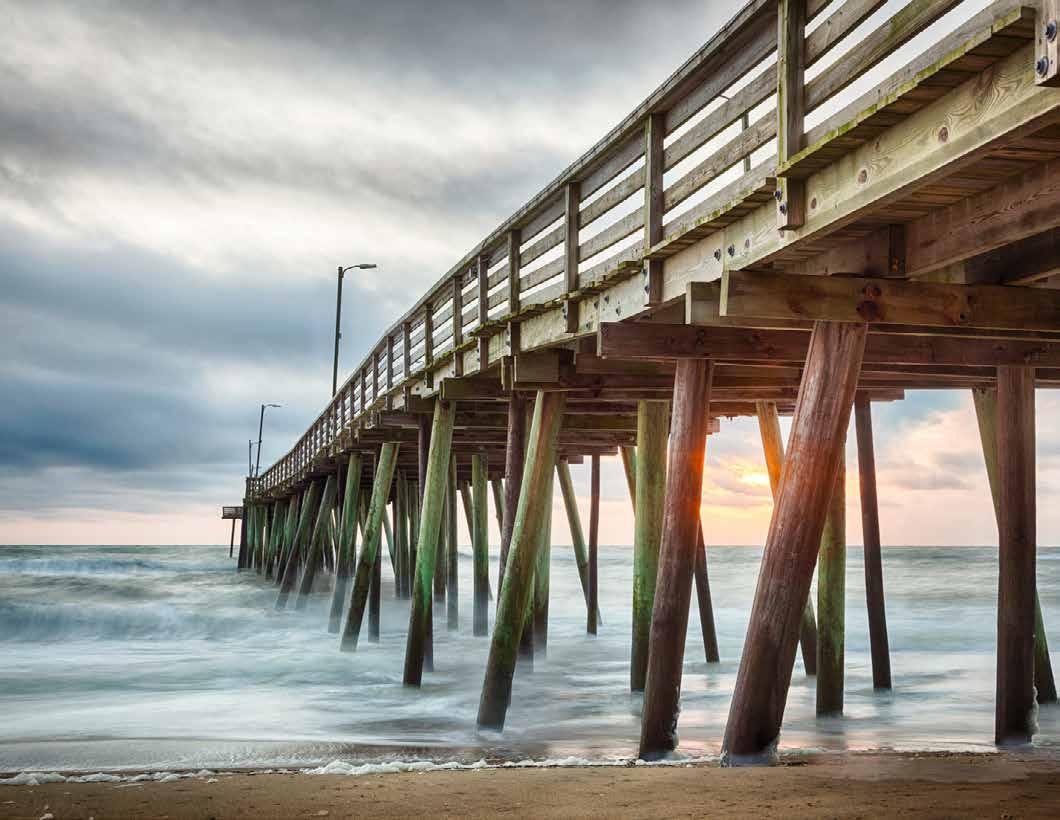
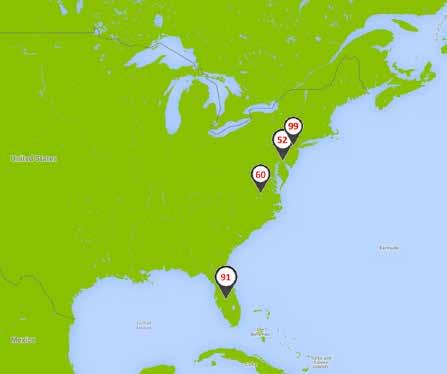
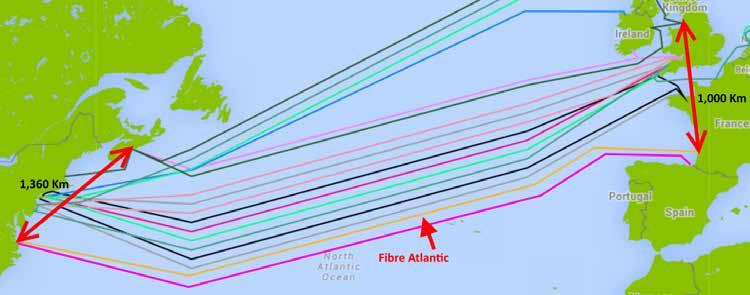
More than two years ago, SemanticNet started working on the “Fibre Atlantic”-concept – an open-access diverse fiber optic submarine cable system between Bordeaux, France and Virginia Beach. In our previous article in Subtel Forum Magazine, January 2016, we described the current state of the Atlantic infrastructure. We concluded that the best strategy is to utilize three or four paths across the Atlantic in order to minimize the probability of a complete network outage. We proposed that in order to improve resilience, newly developed systems between Europe and the USA should consider an alternate path — such as between Virginia Beach and Bordeaux. There are various reasons to land a cable in Virginia Beach, but the main one is a more diverse route across the Atlantic and a direct interconnection between Europe and the Ashburn/Dulles datacenter hub.
Virginia has more than 60 data centers; of which at least 16 are located in Ashburn. In 2012 Gizmodo called the Ashburn region
“The Bull’s-eye of America’s Internet” because it has become the home of data centers owned by large companies such as Equinix, Microsoft, Amazon and Level 3. Compared to the 48 data centers in New York City, Virginia is as equally important for Internet businesses and cloud providers and considering the rapid increase of data center to data center traffic, it is fair to assume that the role of New York as a cable landing region will change over time.
More importantly, Virginia state is able to provide for sufficient amount of land to develop data centers as well as access to utilities (e.g. water, electricity) which are important to content providers and cloud players such as Google, Microsoft,
Amazon and IBM. There are even multiple fibre networks available to connect data centers in the state or to other Internet Hubs such as Miami, Atlanta and New York City. The only thing that is missing is a direct cable to the European Internet Hubs. As foreseen by our team two years ago, selecting Virginia Beach as a landing point in order to supply a direct, diverse link for those who have invested or are going to invest in
new data center facilities in Virginia is the best strategy to move forward.
It took the market more than 12 years to build two new cable systems. Someone could argue that there is sufficient headroom for years to come, but the amount of capacity needed is growing faster than the amount of capacity Atlantic systems will be reasonably
able to supply. According to TeleGeography’s October 2015 forecasts the market would experience an exhaustion in mid-2020 with an expected growth rate of 35-40 percent per annum.
At the same time, the European Internet Hubs have become increasingly more important. Today, Europe is considered the second most important Internet gateway in the world — connecting whole continents to the In-
ternet. In 2013, Germany, The Netherlands, France and the United Kingdom had more than 80 Terabits of international capacity and nearly every European and International Internet business already has a presence in one or more of these countries in order to connect with other networks.
Europe is also considered to be an important market for US based companies for organic expansion as well as
access to highly trained staff with advanced hardware and software skills. Combine this with the European Internet culture, ambitions and steady growth in infrastructure usage and mobile Broadband investments, and it’s evident that data traffic between the two continents will grow even more over the next few years.
The forecasted growth between Europe and the USA
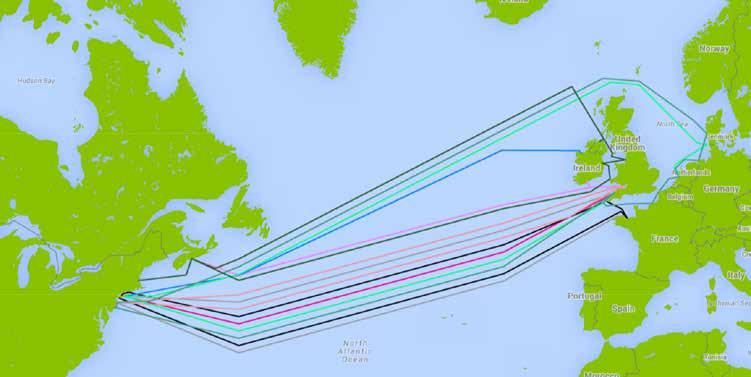
increases the importance of having a transatlantic infrastructure, which is robust and resilient. For any stakeholder it is important to expand and reinforce critical infrastructure security and resilience — the process of adapting well in the face of adversity, trauma, tragedy, threats or significant sources of stress — such as network outages and attacks, infrastructure maintenance or human error. It means the Internet needs to be able to “bounce back” from various states 24x7. For this there are only two answers: redundancy and diversity. Since there are 15 cables in the Atlantic, redundancy is easy to come by. Diversity has been important to telecom companies in the past as well. Yet, for the most part the industry is conservative and tends to stick with the tried-and-true, following existing lines across the ocean. Even though almost all Internet traffic between Europe and the USA is carried by undersea cables, most of these sys-
tems are clustered in only one zone endangering the resilience of the Atlantic. For the transatlantic cable systems this didn’t seem to be a pressing problem up to 2012 when Hurricane Sandy made us aware that distance matters today. The Department of Homeland Security even established the Regional Resiliency Assessment Program (RRAP) in order to identify and resolve pressure points in the USA’s infrastructure.
Creating a robust, diverse network is a challenge that can’t be solved easily. Innovations in network geography were perceived as “risky” by the industry, a new geography meant a set of new things that could fail. And yet, this negates the drive for diversity – a new set of routes and pathways that ensures our constant stream of data isn’t disrupted.
Projects proposing to open up a new corridor between Europe and the USA challenge current practices.
We have a fragile global network in which traffic is routed through narrow pressure points. For more than two years, SemanticNet has shared its vision: we need more distance between cable landing stations, terrestrial backhaul routes and between subsea cables themselves. If we want a truly reliable network, we need diversity. Cable designs should focus on avoiding pressure points between Europe and the United States of America, including the busy New York – London route, transit zones where ships can
easily drop anchor on the cables such as the English Channel as well as avoid multiple cable crossings. All of this is necessary in order to make sure that systems are secure and do not share the same failure prone areas with the other cable systems.
Marea is the first kind of cable across the Atlantic based on the concept of diversity — with the same configuration and route predicted and proposed by SemanticNet’s initial Fibre Atlantic concept more than
two years ago. Our initial findings show that market share of diverse Atlantic capacity will increase to 35 percent by 2024. With eight fiber pairs these kind of systems are able to provide a massive amount of capacity. The question is whether the deployment of these multi Terabit systems will be enough to deliver the capacity needed for the future. The Atlantic, being the core of the global Internet and interconnect the two main Internet gateways in the world, will have to cope with the increasing capacity demand of all kinds of in-
ternet traffic. Considering capacity usage by private network owners, a Lit capacity of 100Tbps or more will be easily achievable in a few years, but both this and the Internet of Things (IoT) will require a faster provisioning of new capacity in order to match the demand in the future.
With increasing traffic other projects in the Atlantic will be more relevant in a matter of a few years, especially since our technology is reaching the optical limits. With NEC achieving almost 35 Terabits per second on a single fiber we are nearing the Shannon limit in which Physics constrains us in the amount of power we can transmit across a certain channel. No other quantum leap in technology is expected in this field and we can no longer assume to make the progress we made before. An increase in channel bit rate will no longer mean an increase in capacity. This will force us to find new ways to
increase the total cable capacity such as by broadening the repeater bandwidth or implement space/time division or MIMO techniques. The best solution for tomorrow is to design high-fiber-count repeatered systems which are able to sustain future growth in the Atlantic in a more economical way.
Our findings are clear: we have a fragile global network in which traffic is routed through narrow pressure points while our lives are depending on it every day. If we want a truly reliable network we need to resolve this situation quickly by deploying more diverse systems between the continents in the Atlantic. Two or more open access systems between Europe and the USA as part of a more meshed network strategy to further increase the Atlantic’s resiliency, stability and capacity are needed.


Hubert Souisa is the founder and CEO of SemanticNet. Mr Souisa earned his bachelor degree in computer science and engineering at the Hague Univeristy and has worked for multiple organizations in the Netherlands, including Dutch based dark fiber and carrier Ethernet provider Eurofiber and the Dutch government. Supported by a strong team of industry specialists, SemanticNet is developing global Internet infrastructures in order to increase overall connectivity, resiliency and availability.
Horst Etzkorn is COO of SemanticNet. Mr Etzkorn holds a Ph.D in Fiber Optics and has more than 30 years of telecommunications industry experience spanning sub-sea and terrestrial fiber optic long-haul DWDM networks, voice switching and IP networks. He was previously Head of SIEMENS Submarine Cable Systems which, among others, encompassed the implementation of PLDT’s DFON Inter-Island Submarine Cable System in the Philippines.

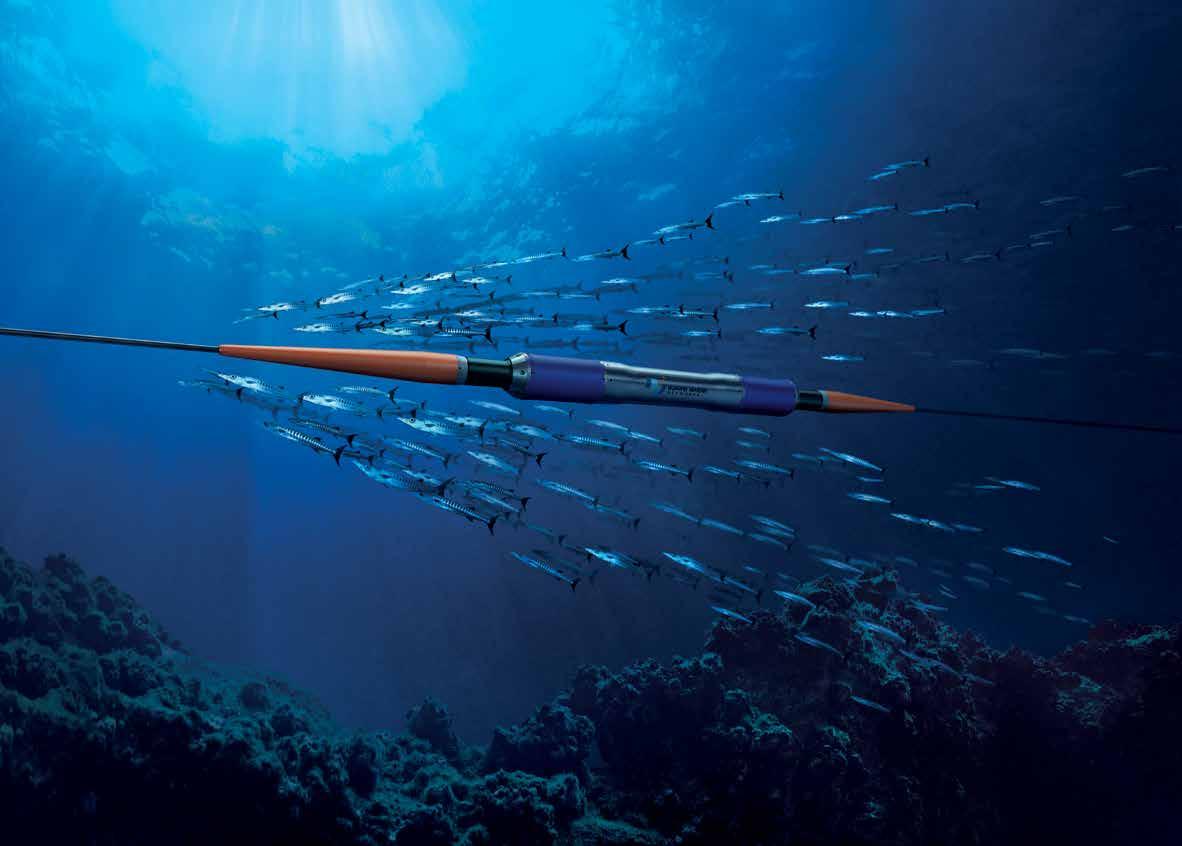

There’s a new power under ocean uniting the world in a whole new way. With unparalleled development expertise and outstanding technology, Huawei Marine is revolutionizing trans-ocean communications with a new generation of repeaters and highly reliable submarine cable systems that offer greater transmission capacity, longer transmission distances and faster response to customer needs. Huawei Marine: connecting the world one ocean at a time.
BY TOM MCMAHON
While the large transatlantic systems often dominate today’s news headlines, it is important to remember that the smaller subsea systems between countries are equally as critical in driving and securing growth for economies. Aqua Comms’ transatlantic America-Europe Connect (AEConnect) continues to be the subject of many headlines in the subsea cable press; however, it is the company’s shorter fibre optic route spanning just over 136 kilometres, CeltixConnect, that has had a significant impact on the Irish regions it serves in the four and half years since its commencement. In fact, more recent submarine cable and terrestrial network builds have only increased its vital importance to Ireland’s globalised, digital economy.
A Digital Island, Marooned
Until Aqua Comms’ Irish Sea subsea cable
CeltixConnect commenced operations in January 2012, Ireland was facing the distinct possibility of becoming a marooned digital island, cut off from the United Kingdom and greater Europe, and the opportunities of a globalized economy that rely on transnational connectivity. Since then, of course, many multinational companies such as Microsoft, Facebook, Google, and Amazon established large data centre operations in Ireland. So many, in fact, that the country has often been characterized as the “home of the hybrid cloud,” the “data capital,” and the “data centre hub” of Europe.
If you were to look at the map of the subsea cables in the Irish Sea five years ago, you could be forgiven for thinking that Ireland was well served in terms of international and UK connectivity. However, if you looked more closely at the age profile of these cables, the fault history, the fibre count and the glass
characteristics, you would have realised that these details told a very different story. Additionally, Irish Sea cables frequently suffered from poor burial techniques and exposed sections that became damaged.
Between 1997 and the turn of the century, a number of submarine cables were installed between Ireland and the UK, tapping into cables between Europe and the United States. However, because of the subsequent economic downturn, and despite advances in optical transmission capability, no new systems were built to satisfy the growing demand or to replace the older cable systems that were approaching end-of-life. The lack of new submarine cables between Ireland and the UK threatened to constrict the future growth of high-tech companies and enterprises in the region.
When CeltixConnect was initially considered in 2008, it was envisioned that a high fibre count cable
system would be required to enhance connectivity between Ireland and the UK, particularly as the last cables built in the Irish Sea were built between 1996 and 2001. In particular, many of those cable systems could not or would not provide dark fibre to the market.
When CeltixConnect went into service in 2012, it more than doubled the fibre capacity of all the other systems combined and offered open access dark fibre on an economical basis to carriers and directly to large corporate entities, matching the evolution in the data centre market. Moreover, the cable system was designed to provide the shortest yet most secure route across the Irish Sea and along with increased reliability, offered greater security, scalability and technical longevity.
A major initial challenge for this connectivity was to bridge the gap between the landing station located in Wales and key Points of Presence (PoPs) in London. This was solved
by sourcing multiple thirdparty dark fibre routes from Wales to London, such that a continuous dark fibre link could be offered from Dublin to London under a single Service Level Agreement (SLA). This was a major milestone in opening up a market that did not exist previously. It made it exceptionally easy and economical for carriers and large corporations to install their own lighting equipment on the fibre and link directly from data centres in Dublin to data centres in London over a single dark fibre network. Once established in London, connectivity to
Europe was a commodity product with multiple options available. Today, CeltixConnect extends from the East Point Business Park in Dublin to Holyhead, Wales. In Ireland, CeltixConnect connects to all major carriers and the T50, Dublin’s major metropolitan network, which links all the major business districts, data centres and business parks of the capital city. On the UK side, CeltixConnect links into the open access FibreSpeed network before connecting to its own strategic network at Halmer End, known as the

Staffordshire Gateway. This strategically positioned gateway facilitates fibre connections northward to Manchester, directly south to London and onward to Europe over multiple thirdparty fibre providers.
So, to what extent can CeltixConnect be considered to be directly or indirectly responsible for the growth of data centres in Ireland?
It is difficult to lay claim that CeltixConnect is directly responsible for the growth of data centres in Ireland. However, the Irish Sea cable system most certainly acted as a catalyst and is now a vital spoke of infrastructure that will support existing data centre builds as well as sustain future builds. While AEConnect spans more than 5,536 km across the Atlantic — landing in Shirley, New York and Killala on the west coast of Ireland, and including stubbed branching units for future landings — it uses CeltixConnect
to provide extended connectivity to London and greater Europe.
CeltixConnect, when first deployed, received the support of many Irish political leaders for its impact on the economy, job creation and for attracting foreign investment to the country. That legacy of positive economic impact continues today. Providing a direct dark fibre route from Dublin to London at economically attractive rates has changed the market dynamic for Ireland to UK connectivity. Moreover, with Aqua Comms’ AEConnect fibre optic cable system having gone live this past January, connectivity between Ireland and the UK is greatly enhanced. CeltixConnect is now part of the most advanced transatlantic cable system with an initial capacity of 13 Tbs per fibre pair. Aqua Comms can provide connectivity in increments of 10G or 100G to multiple terabits from all the major PoPs in Dublin, New
York and London. Hence, CeltixConnect, a vital link of the AEConnect system, undoubtedly underpins the growth of the data centre industry in Ireland.
The current and planned construction of data centres in Ireland, including that of Apple, Microsoft, Facebook and Google, amounts to a considerable investment in the Irish economy. This activity also directly creates countless construction jobs in addition to having a major impact on the growth of support services. Again, it is difficult to say that these developments are directly linked to subsea cables such as CeltixConnect and AEConnect. However, it is almost impossible to imagine such development being viable without the underlying subsea cable infrastructure.
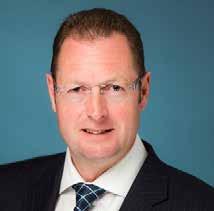
Tom McMahon, Chief Technology Officer for Aqua Comms, is responsible for the development and project management of all new infrastructure projects and ongoing operational support for existing systems. Tom is involved in all aspects including preliminary design, route selection, marine survey, licenses, permits and authorizations, detailed design, procurement and implementation. His role includes both subsea and terrestrial infrastructure.


BY JOSÉ CHESNOY

communication
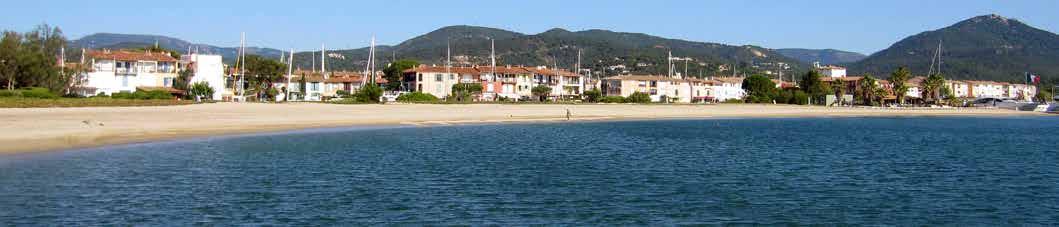
For this July Subtelforum, I propose a tour to the French Riviera, still sticking to the theme of this magazine: Regional Systems. In the domain of submarine cables, regional systems have always been the candidates for technology proofs of concepts for bright new technologies — and it was already the case in 1984.
Antibes Port-Grimaud : a world first in fiber optics communication
This is the title of the “NiceMatin” local newspaper on April 18th1984.
This news announced that the French telecommunication operator PTT had
Alcatel CIT and Cable de Lyon — the first working optical submarine cable with two optical repeaters, and a two fiber pair single mode optical cable. Despite its short length of 80 km, the cable was laid in relatively deep sea at 1800m depth. This demonstration with two optical repeaters spaced by 35 km was done more than one year before AT&T who has laid Optican-1 in Canarias Islands in September 1985, not forgetting UK-Belgium VI laid by STC in UK.
The advantage of optical technologies for submarine cables versus the coaxial cables still deployed was well understood by the operators: higher capacity and five-times fewer
Then the possibility to transmit digital signals in place of analog arrived in time to match the terrestrial network where switching became digital.
Then, it was clear to the more visionary people that the potential capacity and low latency of optical submarine cables will become key advantages in front of the young and aggressive satellite competition. The French PTT and its industrial partners had a strong belief in optical technologies for submarine applications, but they were late in the development of this technology versus AT&T. Thus, they decided to recover and rebuild the endangered technology.
An ambitious national program was launched in 1978, sponsored by French PTT, coordinated by its National Research Center CNET (Centre National d’Etude des Telecommunications) supporting the large CGE group including its research center Laboratoire de Marcoussis, Alcatel CIT and Câbles de Lyon that became later the present ASN Company after absorbing in addition STC in 1995.
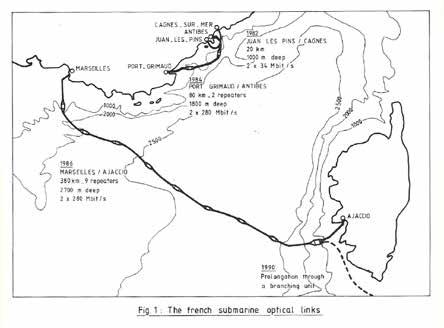
The program had 3 steps: first, an Unrepeatered segment between Juan-lesPins and Cagnes-sur-Mer deployed in 1982 to prove the optical cable viability.
Then the first Repeatered segment from Antibes to Port-Grimaud with two repeaters deployed in 1984. Finally, a longer link Marseilles Ajaccio from continent to Corsica (Continent-Corsica 3) with 9 repeaters deployed in 1986 (Figure1). The two later links were not only proof of concept, but also targeting operational links carrying traffic. This program involved the French PTT fleet (now Orange Marine fleet) that was based in La Seyne-surMer, close to Toulon.
The Mediterranean zone was chosen for many reasons. First, the land routes in French Riviera being very rocky and there was a clear interest of submarine regional cables to build the regional backbone of French PTT. An older analog coaxial cable existed linking La Foux (1 km from Port Grimaud) early 1980 since the PTT network was migrating to digital.
A cable carrying digital circuits was thus attractive. Then the small Venice city
of Port-Grimaud, now part of the “Twentieth Century Heritage” was hosting a switching station of the PTT network that existed before this nice seaside postcard tourist city created in the 1960s by the architect François Spoerry.
An additional reason for the cable proof of concept is that one can find deep sea floors very close to the shore in the south of France. Finally, indeed, the vicinity from La SeyneSur-Mer and the PTT cable fleet and technical team was a major reason to build experimental links on the Mediterranean Sea.
To achieve this world first, the right technologies were identified early. The deployment was done based on the so called S280 system on low loss single mode silica optical fiber. The transmitters were InGaAsP 1.3 micrometers lasers and receivers were Germanium PIN diodes matching the zero dispersion of silica standard
fibers. The program was launched targeting initially 140 Mbit/s with LED, but the advent of lasers during the development phase permitted to double to 2 x 140 Mbit bidirectional tributaries or 4000 digital voice channels at 64 kbit/s per fiber pair, or 20000 compressed voice channels using the equipment available at that time. The system could support a maximum of three fiber pairs per cable, two fiber pairs being equipped for the experimental link. The 280 Mbit/s rate provided obviously the name S280 for this new system.
The development teams of the S280 system had to solve many new technical challenges above the optical fibers that were pulling this technical revolution. The first was the cable to host the optical fiber. The funny idea at that time was that the tiny optical fibers are so fragile that they have to be packaged independently from each other. The
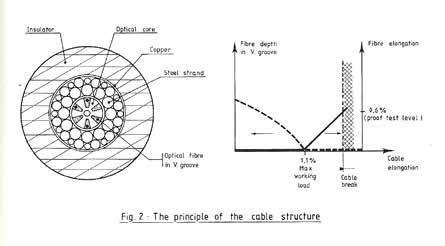
complex solution was to build a central slotted core with helical grooves with a controlled slack surrounded by a sealed tube to constitute a composite tube where each fiber is maintained isolated from its neighbors, as seen on figure 2.
In fact, all the industry adopted later the practical single tube to host all the fibers that was indeed much more manageable industrially. The other big challenge
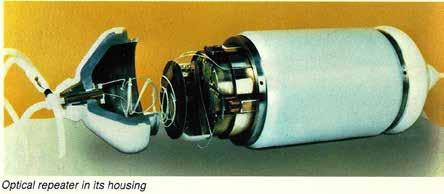
was to design a repeater based on completely new technologies. The repeater developers had at that time put in place large teams of several people fully devoted to qualify the new lasers, receiver and electronic circuitry. Nevertheless, at the end, they weren’t completely confident and the systems were fully redundant, and even doubly redundant for the laser transmitter (four lasers per fiber and two receivers but with optical switches!). Notice as a lesson
learned that the optical switches implemented to improve reliability revealed themselves at the end to be the weakest part of the full system!
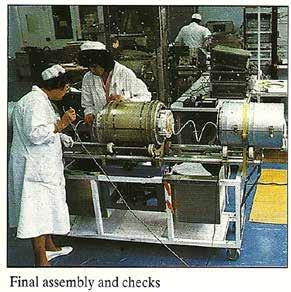
The completely new repeater housing had an original termination based on Gimbals. It was completely wrapped inside a polyethylene molded housing. See a picture of this optical repeater in Figure 3.
The transmission scheme was peculiar with the so called 5B/6B scheme that used
a redundancy to facilitate clock recovery and to some extend to correct transmission errors (a kind of archaic Forward Error Correction). Seventeen bright new integrated circuits had to be developed and qualified for this first optical system.
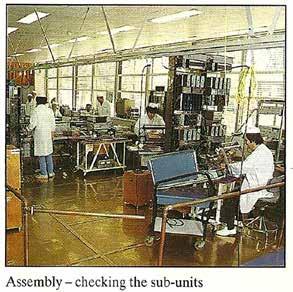
The 10 years development time of a system at that time looks long compared to present experience, but one has to realize that completely new research teams and industrial plants had to be put in place locally
in very diverse areas such as optical fibers, optical components, optical cable and wet plant equipment, starting from scratch. Fig 4 displays the new repeater plant that was built in Villarceaux - Nozay, close to Paris.
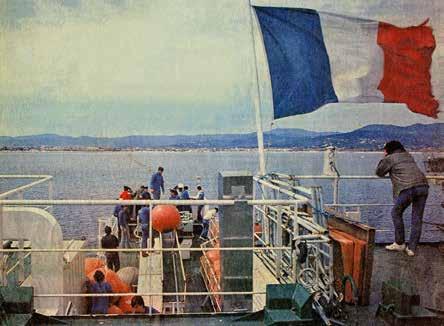
Coming back to the deployment of the Antibes Port-Grimaud link, the figure 5 taken from NiceMatin shows the cable ship Raymond Croze that was the second biggest ship of the French fleet (after CS Vercors) based in La
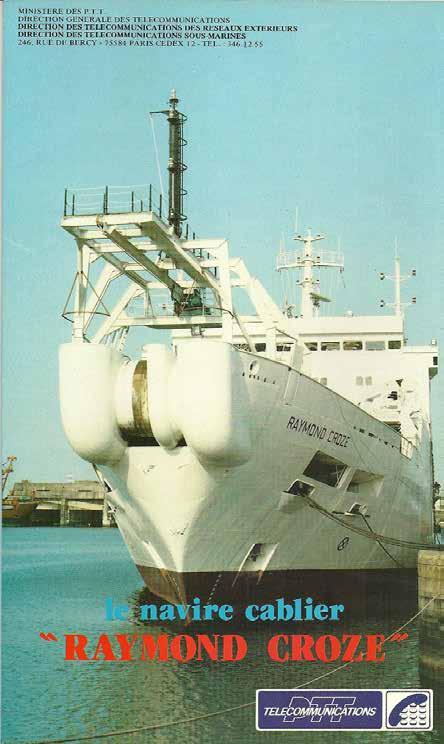
Seyne-Sur-Mer, only 60 km away from Port Grimaud, and still in maintenance operations in 2016. Figure 6 is presenting the brochure of the Raymond Croze ship with the French PTT logo. The loading of the two repeaters was done by quite basic means and
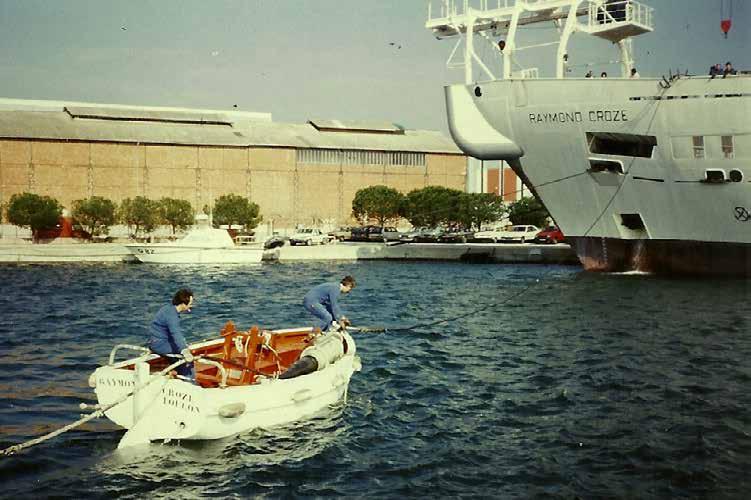
not representative of the future giant industry that was nascent. They were transported by the production teams in trains after link assembly in the cable factory (as done for al systems afterwords) and loaded on the Raymond Croze using barks as shown on Figure 7.
When the landing was prepared, we can imagine the surprise of the tourists discovering the trucks digging the trenches in front of their bungalow! When the team arrived in Antibes for the landing, after pulling the cable, they got 100 metres of armored cable in excess, negotiated
with the city mayor to let the cable buried in a large circle on the beach, but finally had to use all the metal blades from 100 km around to cut this excess cable in pieces 50 cm long, each becoming a trophy for each member of the team.
This Antibes Port-Grimaud first repeatered optical cable has bring many lessons and provided confidence in future ambitious deployments. It was the real start of the optical epic that made our today internet backbone. This cable was not only a proof of concept of optical cable and equipment, but was also used to prove feasibility of repair in hard sea conditions. The cable stayed in operation only during a short time, contributing to the regional French transmission backbone. During many years after its dismantling, the beach cleaning team crunched the cable. It is still deeply buried there and has now been forgotten by everybody.
After the Antibes-Port Grimaud experimental link, the next French system was the Continent –Corsica 3 that was the longest optical working system when it was laid in 1986. This was based on the same technology with some simplifications, in particular no longer use of 5B/6B coding and no redundancy of diode receiver that reduced the number of optical switches per system after the mixed experience with these devices, but still 4 lasers per fiber that was expected to be mandatory to keep operation during 25 years.
By this world first of the Antibes-Port Grimaud and then Continent-Corsica 3, ahead of US and Japanese competitors, the French companies gained their seat in the future first transatlantic optical cable TAT-8, that was deployed in 1988 jointly with US and UK companies AT&T and STC in this distant time of co-opetition, and at
longer term they became and stayed a key player of the submarine optical cable business. Then the booming opened to the new optical technology with cable systems that became famous: SardiniaItaly, Tasman-2, EMOS-1, or Sea-Me-We.
The present paper contains a large extent of unpublished information provided by Gérard Bourret, Manuel Vanneste and Lionel Weens who are gratefully thanked.
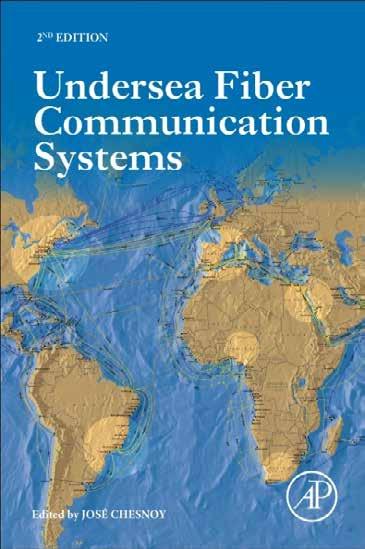
• Undersea Fiber Communication Systems, Ed.2, José Chesnoy ed., Elsevier/ Academic Press ISBN: 978-0-12-804269-4 (book)
• Proceedings of Suboptic 1986 Versailles
• Du Morse à l’Internet, R.Salvador, G.Fouchard, Y.Rolland, A.P.Leclerc, Edition Association des Amis des Câbles Sous Marins, 2006 (book)

José Chesnoy, PhD, is an independent expert in the field of submarine cable technology. After Ecole Polytechnique, and a PhD in physics, he had first a 10 years academic career in the French CNRS. Then he joined Alcatel’s research organization in 1989, leading the advent of amplified submarine cables in the company. After several positions in R&D and sales, he became CTO of Alcatel-Lucent Submarine Networks until the end of 2014. He was the chair of the program committee for SubOptic 2004, and is also Legal Expert at the Paris Court. José Chesnoy is the editor of the reference book “Undersea Fiber Communication Systems” (Elsevier/Academic Press) having a new revised edition just published end 2015.

Chesnoy Independent submarine Telecom Expert, former CTO of Alcatel-Lucent Submarine Networks
ISBN: 9780128042694
EISBN: 9780128043950
This comprehensive book provides both a high-level overview and the detailed specialist technical data for design, installation, aspects of this field

This comprehensive book provides both a high-level overview of submarine systems and the detailed specialist technical data for design, installation, repair, and all other aspects of this field
KEY FEATURES
• Features new content on:
• Features new content on:
Edited by: José Chesnoy
Ultra-long haul submarine transmission technologies for telecommunications
Ultra-long haul submarine transmission technologies
Alternative submarine cable applications, such as scientific or oil and gas
Independent Submarine Telecom Expert, former CTO of Alcatel-Lucent Submarine Networks
• Addresses the development of high-speed networks for multiplying Internet and broadband services with:
Alternative submarine cable applications, such as
Coherent optical technology for 100Gbit/s channels or above
Wet plant optical networking and configurability
• Addresses the development of high-speed networks for multiplying services with:
• Provides a full overview of the evolution of the field conveys the strategic importance of large undersea projects with:
With contributions of authors from key suppliers acting in the domain, such as Alcatel-Lucent, Ciena, NEC, TE-Subcom, Xtera, from consultant and operators such as Axiom, OSI, Orange, and from University and organization references such as TelecomParisTech, and Suboptic, treating the field in a broad, thorough and un-biased approach.
Technical and organizational life cycle of a submarine network
Coherent optical technology for 100Gbit/s channels
Upgrades of amplified submarine cables by coherent technology
9780128042694
9780128043950
PREVIOUS EDITION ISBN: December 2015 $195.00/ £120.00/€140.00
FORMAT: Paperback
PAGES: 702
AUDIENCE:
DESCRIPTION
Wet plant optical networking and configurability
• Features new content on:
• Ultra-long haul submarine transmission technologies for telecommunications
Since publication of the 1st edition in 2002, there has been a radical evolution of the global communication network with the entry of submarine cables in the Terabit era. Thanks to optical technologies, the transmission on a single fiber can achieve 1 billion simultaneous phone calls across the ocean!
• Provides a full overview of the evolution of the field conveys undersea projects with:
• Alternative submarine cable applications, such as scientific or oil and gas
Technical and organizational life cycle of a submarine
Upgrades of amplified submarine cables by coherent
• Addresses the development of high-speed networks for multiplying Internet and broadband services with:
• Coherent optical technology for 100Gbit/s channels or above
This comprehensive book provides both a high-level overview of submarine systems and the detailed specialist technical data for design, installation, repair, and all other aspects of this field.
PREVIOUS EDITION
ISBN:
9780121714086
Professionals (technical, marketing, product lines, etc) university faculty, advanced undergraduate and graduate students working in fiber optic communications.
Modern submarine optical cables are fueling the global internet backbone, surpassing by far all alternative techniques. This new edition of Undersea Fiber Communication Systems provides a detailed explanation of all technical aspects of undersea communications systems, with an emphasis on the most recent breakthroughs of optical submarine cable technologies. This fully updated new edition is the best resource for demystifying enabling optical technologies, equipment, operations, up to marine installations, and is an essential reference for those in contact with this field.
• Wet plant optical networking and configurability
• Provides a full overview of the evolution of the field conveys the strategic importance of large undersea projects with:
• Technical and organizational life cycle of a submarine network
Each chapter of the book is written by key experts in their fields. The book assembles the contributions of authors from key suppliers, such as Alcatel-Lucent, Ciena, NEC, TE-Subcom, Xtera, from consultant and operators such as Axiom, OSI, Orange, and from University and organization references such as TelecomParisTech, and Suboptic.
• Upgrades of amplified submarine cables by coherent technology
Since publication of the 1st edition in 2002, there has been a radical communication network with the entry of submarine cables in technologies, the transmission on a single fiber can achieve 1 billion across the ocean!
For more information, or to order visit store.elsevier.com/9780128042694
This has ensured that the topic of submarine telecommunications is treated with a broad, thorough and un-biased approach.
Enter ENG315 to save up to 15% when you order via the store!
Modern submarine optical cables are fueling the global internet
BY KRISTIAN NIELSEN

Last month, our an-
alyst Kieran Clark posted a story to the STF news feed announcing the completion of Google’s latest system, Faster.
As expected of most Google related news, the post exploded. What surprised me was the sheer volume of interest in the article. In a 24-hour period, that story was viewed over 150,000 times by unique users from all over the world. Generally, the STF news feed sees about 60,000 unique users in a given month, last month we hit 129,000 unique users with over 1 Million hits to the site, 40 percent more than usual.
I don’t usually share the nitty gritty details of our web traffic with you, however this story caught me, and
the industry, by complete surprise! I am proud to be a part of this industry—fiber has been in my blood for my some 31 years on this blue Earth—I revel in moments like these, where stories are shared across industries and shed even the smallest light on our quietly booming niche in the telecoms world.
But back to business, and to relate this story, our sponsors have an unparalleled level of visibility in this market of ours. Those 129,000 visitors to our site viewed each of our products, web banners, and our recently introduced online cable map – there is simply no better place for day-to-day visibility in this industry.
Also, we have the ever popular STF Analytics Industry
Report coming out in September, so this month officially marks the opening for ad sales! Until August 15, there is a 10% discount for all advertisers wishing to sponsor the Report.
Faithfully yours,
erally grew up in the business since his first ‘romp’ on a BTM cableship in Southampton at age 5. He has been with Submarine Telecoms Forum for a little over 6 years; he is the originator of many products, such as the Submarine Cable Map, STF Today Live Video Stream, and the STF Cable Database. In 2013, Kristian was appointed Vice President and is now responsible for the vision, sales, and over-all direction and sales of SubTel Forum. +1
knielsen@subtelforum.com

Submarine Telecoms Forum, Inc.
21495 Ridgetop Circle, Suite 201 Sterling, Virginia 20166, USA
ISSN No. 1948-3031
PUBLISHER:
Wayne Nielsen
VICE PRESIDENT:
Kristian Nielsen
MANAGING EDITOR: Kevin G. Summers
CONTRIBUTING AUTHORS:
José Chesnoy, Kieran Clark, Horst Etzkorn, Mike Last, Brian Lavallée, Tom McMahon, Hubert Souisa
Contributions are welcomed. Please forward to the Managing Editor at editor@subtelforum.com.
Submarine Telecoms Forum magazine is published bimonthly by Submarine Telecoms Forum, Inc., and is an independent commercial publication, serving as a freely accessible forum for professionals in industries connected with submarine optical fiber technologies and techniques. Submarine Telecoms Forum may not be reproduced or transmitted in any form, in whole or in part, without the permission of the publishers.
Liability: while every care is taken in preparation of this publication, the publishers cannot be held responsible for the accuracy of the information herein, or any errors which may occur in advertising or editorial content, or any consequence arising from any errors or omissions, and the editor reserves the right to edit any advertising or editorial material submitted for publication.






BY KEVIN G. SUMMERS

It’s been an interesting couple of months here on Planet Earth. Thanks to high capacity fibre optic cables that interconnect practically every nation in the world, and social networks that connect practically every person in the world, we are now able to receive news at a speed that Cyrus West Field couldn’t have imagined.
It’s now possible to be offended by the citizens of a nation on the other side of an ocean while you’re playing Pokemon GO at political rally. You can fire off a snarky comment that can deeply hurt a perfect stranger in a country that one of your ancestors died to make free. While you’re at it, you can post something that will make all the
people that already agree with you cheer and all the people that disagree with you feel stupid. The social world we’re creating is just like high school, complete with bullies and cheerleaders and principals that suspend a nerd for two weeks for standing up for himself.
Lately, there isn’t a day that goes by that I don’t think about canceling my Facebook account, tossing my iPhone into the duck pond, and retiring to the back country to live in a wigwam.
But it doesn’t have to be this way.
We’ve built something amazing with this Internet. We can talk to strangers on the other side of the world, and maybe, just maybe, we can think of something
better to say to them than vitrial and foolishness. The world is on fire and we’re pouring fuel on the fire every time we lash out without thinking. Please, be kinder with your words. It will make you happier in the long run, trust me on this.
Until next time...

Kevin G. Summers is the Editor of Submarine Telecoms Forum and has been supporting the submarine fibre optic cable industry in various roles since 2007. Outside of the office, he is an author of fiction whose works include ISOLATION WARD 4, LEGENDARIUM and THE MAN WHO SHOT JOHN WILKES BOOTH.
+1.703.468.0554
editor@subtelforum.com