
471,450



471,450
BY WAYNE NIELSEN

that I cut the front yard and half of the back before the rain clouds returned and dumped anew.
The good news is that all this rain is bringing about a lot of healthy, new growth in the yard. The grass is lush and full; the flowers are in bursting bloom.
When I talk to various friends in the industry I hear similar sentiments.
The spade work accomplished in the past is paying off; companies are busy with seemingly full order books and lots of kilometers of cable to manufacture and install. And it’s interesting that new systems are being discussed and considered.
So I guess the open, whispered question is for how long. I’ll certainly look for a sign in the stars whenever they deign to return.
Happy reading.

Wayne Nielsen is the Founder and Publisher of Submarine Telecoms Forum, and previously in 1991, founded and published “Soundings”, a print magazine developed for then BT Marine. In 1998, he founded and published for SAIC the magazine, “Real Time”, the industry’s first electronic magazine. He has written a number of industry papers and articles over the years, and is the author of two published novels, Semblance of Balance (2002, 2014) and Snake Dancer’s Song (2004).
+1.703.444.2527

wnielsen@subtelforum.com



Alcatel-Lucent Submarine Networks to Deploy Telefónica’s
New US-Brazil Open Cable System
Algeria: ‘Oran-Valence’ Submarine Cable to Be Operational in February 2017
American Samoa Signs Internet Cable Deal
Aqua Comms Signs Investment Agreement with Cartesian Capital Group
Asia-Africa-Europe-1 – AAE-1
Cable System Lands at Bari in Italy
Basslink Interconnector Fault Pinpointed
Basslink Subsea Cable Repairs Rely on 18 Days of Clear Weather
Brazil-Europe Submarine Cable to Connect Fernando de Noronha
Cinia Connects Russia’s Avelacom to C-Lion1 Cable
Cinia Connects to Equinix
Data Centers in Frankfurt and Helsinki
Cinia, ASN Demonstrate Capacity of 18 Tbps on C-Lion1
Cable
Construction Commences on Angola Cables’ South Atlantic Cable System (SACS) by NEC
Deal Signed for Samoa-Fiji Submarine Cable Link
E-marine Wins Major Cable Maintenance Contract
E-marine, Huawei Partner on Maldives Subsea Cable
Globe on Track to Complete Davao Cable Landing Station
Globe Says Investment in SE Asia-US Submarine Cable Link to Exceed $80M

GlobeNet Offers 100-Gbps
Wavelengths Between Brazil, US
Hawaiki Cable Announces Contract for Cable System Has Come Into Force and Construction Commences
Hawaiki Submarine Cable Becomes Tenant in Pacific City
Hawaiki Submarine Cable to Boost Performance and Reduce Latency for AWS Cloud customers in Australia and New Zealand
Hibernia Networks Announces Protected Wavelength Service Across the Atlantic for Unmatched Resiliency
Japan’s JBIC, SMBC Provide Finance for Angola-Brazil Underwater Cable
José Chesnoy Joins SubTel Forum as Magazine Feature Writer
New Undersea Fibre Cable for Africa-Asia trade: PCCW
No Action on SubPartners’ Third Fibre Optic Cable Plan for Tasmania
Nokia Appoints Philippe Piron as President of Alcatel-Lucent Submarine Networks
Ntel Set for Full Return of SAT3 Submarine Cable
Omantel Lauds Marseille Aid in Colossal Cable Project
Singtel in Deal to Build Singapore-Perth Submarine Cable
SRG-1 Consortium Selected Xtera for Building a New Subsea Cable System across the Gulf of Oman
STF #87 Available Now
STF Today @ SubOptic 2016 Day 1 Wrap Up
STF Today @ SubOptic 2016
Day 2 Wrap Up
STF Today @ SubOptic 2016 Day 3 Wrap Up
STF Today @ SubOptic 2016 Interview Series Now Available
SubOptic 2016 – Conference Programme Now Available!
SubOptic 2016 – The Conference Programme is Now Available
SubTel Forum Launches Interactive Online Map
TE SubCom to Perform Upgrade to South-East Asia Japan Cable
TE SubCom to Upgrade SubSea Line for Caucasus Online
Telstra Building More Fibre, Subsea Cables Across Asia-Pacific
This Week in Submarine Telecoms April 11-15
This Week in Submarine Telecoms April 25-29
This Week in Submarine Telecoms March 28-April 1
This Week in Submarine Telecoms May 2-5
This Week in Submarine Telecoms May 9-13
TWA Contracts Huawei Marine for 100G Upgrade on TW1
Vietnam’s FPT Invests $10 Million in Submarine Cable Project
Presenting the industry’s most extensive collection of 375+ current and planned submarine cable systems impacting financiers, carriers, cable owners, system suppliers, component manufacturers and marine contractors, and detailing more than 50 menu-based data fields and maps in a customer-customizable report.
REPORTING IN 3-5 BUSINESS DAYS


BY KIERAN CLARK

The world continues to consume ever-increasing amounts of data, with bandwidth demand projected to almost double every year for the foreseeable future. This demand — largely driven by a continued shift towards cloud services — provides numerous opportunities for the submarine fiber industry. Data center and cloud service providers continue to post strong earnings reports and grow at a rapid pace — hinting that this bandwidth demand won’t be tapering off any time soon.
Our global society’s hunger for data will not only keep the industry very busy, but also struggling to keep pace.
Welcome to SubTel Forum’s annual Subsea Capacity is-
sue. Every May, we aim to take the industry’s pulse by looking at the future of our section of the telecoms market. Specifically, how much cable owners are planning to add to the ever growing pool of capacity and what technologies are being implemented. The data used in this article is obtained from the public domain and is tracked by the ever evolving SubTel Forum database, where products like the Almanac, Cable Map, Online Cable Map and Industry Report find their roots.
As new systems come into service and existing systems are upgraded, there is a continuing upward trend in global capacity to address the world’s demand for more telecommunications services.
This is mostly due to an ever increasing demand for low latency, high bandwidth international connections, and to the almost exponential increase in demand for mobile services observed over the last few years. These factors show little signs of slowing down, so there is a strong expectation that demand will continue to rise at this rapid pace in the coming years.
Despite fewer systems entering service in 2015 than the previous two years, there was a much larger increase in capacity by comparison. With easy and cheap access to 100G wavelength upgrades, this comes as little surprise. New systems are also making
use of increasing numbers of wavelengths crammed on to a single fiber pair. Capacity that needed 6 or more fiber pairs in the past, can now be achieved with only 2 or 3 pairs. This allows cable owners to provide more capacity than ever, while keeping fiber manufacturing costs down.
Currently, the EMEA region has the largest share of global capacity at 36 percent. The AustralAsia, Transatlantic and Americas regions all have about the same amount of capacity. The Indian Ocean Pan-East Asian and Transpacific regions trail by a significant margin. With the EMEA region being the largest in the world – the Mediterranean
Current Capacity By Region
Sea in particular being host to several large systems connecting Europe to Africa and Asia — this explains why more than a third of all global capacity is found in this region. While the AustralAsia region has been extremely busy recently, it has yet to catch up in total capacity.
With more and more systems being announced, the SubTel Forum database team takes note of each region the new systems will touch. Developing markets in Southeast Asia continue to have a strong desire for additional low latency, high capacity connections to the global telecommunications network. When coupled with a strong desire for route redundancy to places like Japan and China, it’s clear the flurry of activity observed in
recent times in and around the Pacific Ocean will continue. The data collected strongly supports this, and shows that nearly half of all planned capacity for the next three years will be located in the AustralAsia and Transpacific regions. With the Americas and Transatlantic regions getting some new systems alongside continued upgrades to existing ones, expect these two regions to account for another one-third of planned capacity for the next three years.
Continued improvements to wavelength division multiplexing coupled with 100G wavelength technology becoming the de facto standard, new systems are able to provide ever increasing amounts of bandwidth over the same amount of fiber. In some cas-
complete portfolio
Planned Capacity By Region 2016-2018
es, a single planned system is projected to nearly double the entire capacity of a region. When combined with upgrades to existing systems, global capacity is expected to skyrocket over the next three years. As new wavelength technology such as 200G starts seeing commercial implementation and with a po-
tential for 400G in the near future, this capacity explosion should continue well beyond the next couple years.
Based on reported data, global capacity is estimated to more than double by 2017. Multiple systems slated for the next three years will have design capacities of more

than 60 terabits per second, with many others boasting bandwidth between 20 and 50 terabits per second. Looking ahead even further, 2018 already shows another strong increase in global capacity even with only a handful of systems announced so far. Nearly all of the systems cur-
rently planned are being designed with 100G technology in mind, so expect an even more drastic increase as new wavelength technologies begin to see widespread commercial use.
While all of these projections seem promising, it’s import-
ant to take a step back and assess how likely it is that all this planned capacity will enter service. There are 47 systems planned globally for the next few years and 45 percent have achieved the important contract in force milestone. This is the real determination on whether or not a system will ever see the light of day, so the numbers for future systems actually look promising. This time last year only 21 percent of planned systems for the following three years were CIF, indicating a vast improvement in the overall market climate.
The submarine telecoms industry can expect a very healthy amount of growth and activity over the next several years as it works to keep up with the explosive increase in bandwidth demand. The shift towards data center and cloud service providers driving demand for international telecommunications has breathed new life into the industry. More companies than ever before seem to want their own networks, providing numerous opportunities for the submarine fiber industry to do what it does best: connect the world.

Kieran Clark is an Analyst for Submarine Telecoms Forum. He joined the company in 2013 as a Broadcast Technician to provide support for live event video streaming. In 2014, Kieran was promoted to Analyst and is currently responsible for the research and maintenance that supports the SubTel Forum International Submarine Cable Database; his analysis is featured in almost the entire array of SubTel Forum publications. He has 4+ years of live production experience and has worked alongside some of the premier organizations in video web streaming.
BY DEREK CASSIDY

We have all heard of the new submarine cables being laid across the oceans and seas capable of carrying the next generation in optical engineering capacity, the 100GbE optical channel in a wave division multiplex (WDM) multiplexed format. We have also been introduced to the development of re-engineering existing submarine cables which are being engineered to carry these new 100GbE optical channels. The buzzword in terrestrial and submarine communications technology seems to be the sacred 100G — as in the 100GbE optical channel and when these optical channels are multiplexed together in WDM networks, they will deliver multiple terabits of available capacity and essential bandwidth.
By understanding the demand and engineering capability that is required for the delivery of this capacity and bandwidth which is needed for next generation

communication and high capacity systems; the Optical Engineering Designer will truly understand the capability of his network with exact precision. This poses the question: is the deployment of the multiple terabits of bandwidth, we have today, enough to deliver the capacity needed to
interconnect the networks and fulfil the bandwidth demand and requirement to deliver the network availability, and the many services that are transient across the internet and its web of networks, that use the existing terrestrial and submarine systems?
The Internet today is constantly growing at a significant rate and it is by the ever increasing demand on services and the interaction between the web user and the Internet that is creating this demand. The ever increasing use of on-line commercial activity and the development of on-line
video and music streaming has led to the launch of video and programme development companies who distribute their product across the Internet and allow for a real time interaction, between provider and end-user. This connection assists in enabling the interaction between the stakeholders involved, as well as allowing a real time
interaction that is designed to match the user’s preference to interact with these services. This development in online video and programme production has led to the Internet connectivity and demand, growing faster in 2015 compared to 2014 (http://www.Internetworldstats.com).
The biggest increase in Internet connectivity and de-

mand has been seen in Africa and the Middle East; whereas, the highest accessibility rates are clearly evident in North America, closely followed by Europe and Australia, and then the first world countries. Therefore, there is one thing in common with the growth in Internet activity, which is evidently transparent across all continents and that is the demand generated and the appliance of pressure on the existing networks to deliver this capacity and make available the physical routes and interconnects between the product providers and the end users. To deliver this capacity and to provide access to the physical routes so that the networks have the available interconnections will need to be maintained and increased, to provide this capacity.
The existing submarine networks and terrestrial systems, the backbone of the Internet, are coping with the increase in demand for
all types of Internet interactivity and will also be able to match the demand for these services in the short term, however there is a feeling within the industry that the increase in demand will soon outstrip available capacity as the Internet and Web services will push the boundaries already set, as the capacity made available to bandwidth hungry services like music and video streaming product providers increase as Internet connectivity and the growth in demand from new Internet users increase.
With the increase in mobile connectivity — 3G and 4G — services, the traditional mobile phone is no longer a phone but now also a mini-computer capable of connectivity with the Internet and enabling data, video and voice usage over the available mobile connection. This has delivered a scenario were the traditional voice call and SMS messaging has been replaced by interactive services that

enable the user to connect with other mobile users across the globe and communicate over the available Internet bandwidth. However, these services will not have a quality of service level, this will cause the service to degrade or fail as the link becomes congested.
However, if a subscription is paid for the service then a quality of service (QOS) will be enacted which will enable the connection to stay active, which is adding an extra burden on the available capacity and this will also use up the available bandwidth that is pro-
vided by the network providers for the provision of services and connectivity between the Internet service providers and the network operators.
As the increase in development and deployment of the Internet, Web and Mobile services continue to in-
crease and the development of new Mobile applications means that the increase in Internet connected devices will continue to grow as new users go online. This will draw on the available bandwidth for which the network providers and operators are struggling to keep up with.
The introduction of new submarine networks with the ability to offer multiple terabit transmission systems offers a short term “get out of jail card” for most network operators as they can take advantage of these services to provide the bandwidth needed for the increase in Internet traffic. However, that’s only for current Internet usage today and probably for the usage available for the next 12 months. However, there is another revolution in communication coming and it will consume the available bandwidth, at an exceptionally faster speed, faster than ever envisaged. This new communication
revolution coming down the tracks is a new force and it is called the ‘Internet of Things’ (IOT). This is where the Internet will expand far beyond the traditional interconnect devices such as the personal computer (PC) or the laptop to new devices like the smart phone, tablet and all other devices that can be operated, manipulated or programmed by using the local wireless network over an Internet access point and the far end user using the Internet to connect to these devices.
This goes beyond the traditional use of the Internet as a product that enables the user to carry out traditional research, search engine interaction and download or stream music and video, to new age services. With the Internet now acting as a link between the user and the end device and, therefore, bypassing the traditional Internet service provider.
The IOT is a new development in interactivity that is taking hold across the globe
and it is estimated that in 2016 there will be 6.3 billion connected devices using the Internet to communicate and establish connections and operate under the Internet of things umbrella (http://www.gartner.com).
This connectivity could increase to 20.7 billion devices
in 2020, which will create a monumental demand on the available bandwidth. This increase in demand will affect both terrestrial and submarine network operators and providers, as they will have to increase their bandwidth offering to ensure prevention of any
failure in the capacity provision, due to the new developments and interconnectivity caused by the high demand in IOT usage.
With the growth in the connected devices, under the umbrella of the Internet of Things (IOT), and the usage

of an ever increasing share of the available bandwidth including the existing Internet and Mobile services will mean that the existing next generation networks (NGN), providing high data transmission services and capacity at their maximum limitations, may not be enough to cope to with ever increasing demand. This will mean network operators and providers will have to look at new deployment strategies and models, so that they will be able to compete and cope with the increase in demand for extra bandwidth.
The available capacity will have to be shared amongst existing traditional network users using voice, data, streaming, global search engines and new communication era of the IOT’s that is consuming all the available next generation bandwidth. As the markets develop new products and services that are now aligned with the IOT, there needs to be a new change of
direction on how we, as a telecommunications industry, will be able to design, re-design and further develop networks to ensure delivery and accommodate the availability of demand for the new increase in capacity that is growing at a significant rate.
There is a question floating around the industry: “Is a terabit enough?” What this question is referring to is will these new and existing networks, both terrestrial and submarine, which are developing new strategies that will aid in deploying the extra capacity that they designed into their network, be able to meet the capacity demands that are being seen across the globe. However, with the development of the IOT’s, this question is being looked at more seriously and a change in direction will need to happen so that when the increase in demand begins to grow, the network operators will have the capability to offer this capacity that will be required.
The question being touted again and again has lead to Optical Network Designers trying to provide an answer. This new design strategy is now seeing some rewards with the new submarine networks capable of delivering multiple terabits and connecting Europe to the Americas, Africa and the Far East so that the tentacles of the submarine networks are strengthened with new growth and increased capacity, again I say, when increasing optical channel growth “Is a terabit enough?”

Derek Cassidy is from Dublin, Ireland. He has worked for 23 years in the telecommunications industry of which 21 years have been spent dealing with optical terrestrial systems and submarine networks. He works for BT in their Networks and Field Engineering division. He is Founder and Chairman of the Irish Communications Research Group, a voluntary organisation dedicated to the promotion, protection and research of Ireland’s communication heritage. He is a Chartered Engineer with the IET and Engineers Ireland, Chairman of the IET Ireland Network and is also a member of the IEEE, holding a position of Head of the IEEE (Ire) Consultants and Entrepreneurs Network. Derek holds the following Degrees; BSc (Physics/Optical Engineering), BEng (Structural/Mechanical Engineering) and BSc (Engineering Design) and has a Master’s Degree MEng (Structural, Mechanical, and Forensic Engineering) and a Master’s Degree MSc (Optical Engineering).

Presenting the winners of the SubOptic 2016 Excellence in Industry Awards

BY ALEXEI PILIPETSKII, DMITRI FOURSA, MAXIM BOLSHTYANSKY, GEORG MOHS, AND NEAL S. BERGANO
The capacity demand is expected to keep increasing exponentially over time. Transmission of tens of Tb/s per fibre requires higher output power for optical amplifiers. Attaining these high optical power levels in long-haul undersea systems is problematic, since the ability to deliver power to the optical amplifiers is limited due to the maximum voltage that can be applied to a cable from the shore ends [1]. The straightforward approach for solving this problem by increasing the maximum cable voltage is associated with significant cost and reliability risks. Thus finding more efficient ways of using the optical power becomes imperative.
Improvement of overall power efficiency of a transmission system depends on electrical power delivery and optical power utilization [1]. In this paper we discuss the ways to use optical power in a more efficient manner which means how to transmit more information having overall optical power limitations. We present results of the transmission capac-
ity demonstrations in C and extended C+L bands from the perspective of the achieved capacity vs. optical power. Special consideration is given to Space Division Multiplexing (SDM) as the method to scale transmission capacity up while keeping power constrains. We show that the use of SDM can also result in further power efficiency improvement by effectively mitigating nonlinear penalties and discuss the scaling of the capacity with power, bandwidth and index of space multiplexing. Optimization of power efficiency and capacity in turn requires optimization of transmission spectral efficiency and the search for the new power efficient modulation formats. The overall task of capacity increase and power efficiency improvement is considered as complex multi-dimensional problem with many aspects.
In order to understand the optical power efficiency achieved in the recent
long-haul transmission experiments in single mode fibres [2-4] let us analyze the optical power required to demonstrate the capacity. In [2] the capacity of 30 Tb/s was achieved in the full C band transmission at 6.1 bit/s/Hz spectral efficiency (SE) over transatlantic distance with ~20 dBm of EDFA output power set to near optimum from nonlinear operation point of view.
Subsequent experiment expanding the bandwidth to C+L bands improved transmitted capacity to 44.1 Tb/s over longer transpacific distance of 9,100 km with ap-
proximately the same optical power [3]. Further boost in the EDFA optical output by ~66 % to 22.2 dBm resulted in only ~ 10% capacity increase [4]. In all experiments the capacity was maximized by the choice of modulation formats with appropriate spectral efficiency.
Based on these results the following observations can be made: a) it is possible to increase capacity with similar total optical power by spreading the optical power over wider bandwidth. This is equivalent to spreading the power over more
fibre cores or space dimensions and suggests higher capacity for SDM systems with equivalent total signal output power, b) a choice of modulation format with appropriate spectral efficiency is required for optimizing system power efficiency, and c) operation at optimal system nonlinear point is not the most optimal power utilization from the standpoint of achievable capacity under power limitation condition.
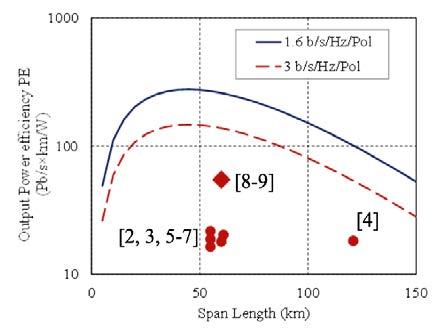
One of the metrics of optical power efficiency can be defined as a product of total capacity by transmission distance divided by the sum of output powers of amplifiers in the system.
Optical power efficiency metrics for two different values of spectral efficiency are shown in Fig. 2 as function of repeater spacing under the assumption of an ideal 3 dB amplifier noise figure. It demonstrates that
repeater spacing of about 50 km provides the highest power efficiency. For comparison, the power efficiencies achieved in recent transmission demonstrations [2-9] are also shown. The experiment [8, 9] that aims specifically at the power efficiency improvement is discussed in more detail below.
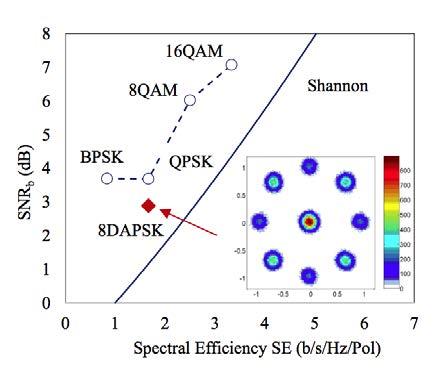
Improvement to the optical power efficiency can come from the use of modulation formats with the high receiver sensitivity. The example of eight dimensional coded 8D-APSK
modulation format with spectral efficiency equivalent of QPSK and ~0.8 dB better receiver sensitivity is shown in Fig. 3.
Operating transmission system in a linear regime by proper choice of repeater output power is another way of power efficiency improvement. The most efficient value of power is well below that for which the maximum fibre capacity is achieved in a nonlinear regime. In the experiment [8] the power efficiency is optimized by operating amplifiers at low output power.
The improvement in power efficiency can also come from the adjustment of the amplifier bandwidth. The bandwidth optimization can eliminate the need in gain equalization filter (GEF) in every repeater resulting in reduction of the average repeater output loss.
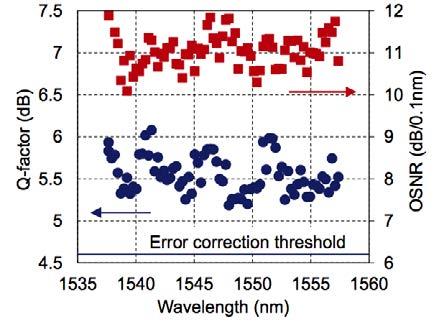
Power efficient transmission with low loss 60 km fibres spans, power efficient modulation format and bandwidth optimized EDFA’s with gain flattening performed on a block of 10 amplifiers has been demonstrated in [8]. Not more than 45 mW of pump power per EDFA is required in transmission of 8.12 Tb/s over 9750 km (Fig. 4). The transmission testbed operates in the linear regime and demonstrates the highest recorded power efficiency of 54.8 (Pb/s)*(km/W) [9].
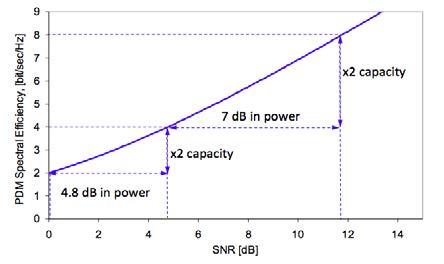
The ideas discussed above can be separately applied for power efficiency and capacity improvements in optical transmission systems. The highest capacity improvement can be achieved by applying all of them using space division multiplexing (SDM) concept. This follows from the consideration of the fundamental Shannon limit which shows that higher SE
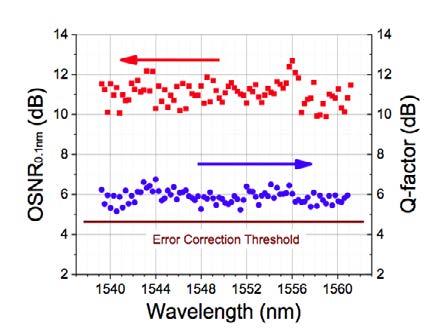
The demonstration of high capacity, power efficient SDM transmission hasticore fibre (MCF) [10]. In this work, the transmission path is based on 46 km 12core fibre spool with fan-in and fan out devices. The average loss of all 12 cores with 110 m2 effective area that includes fan-in fan outer efficiency is maximized through reduction of the power and nonlinearities in the fibre by using large number of space dimen-
after 14,350 km.
will entail the increase in nonlinear penalty. Alternatively, following the SDM approach, this 11.8 dB total power increase can be divided, for example, between 15 parallel space dimensions (cores, fibres), each carrying the initial SE of 2 b/s/Hz. The total SE in this case would be 30 b/s/ Hz as opposed to 8 b/s/Hz single dimension estimation that does not consider nonlinearities.
sions (fibre cores) and the use of single-stage EDFAs with ~22 nm bandwidth. The width and the location of the operating bandwidth is optimized for the maximum power efficiency and gain flatness and to avoid using GFFs in each amplifier.
A total transmission capacity of 105.1 TB/s has been demonstrated using 12-core fibre and power efficient 8D-APSK [8] modulation format. Fig. 6 shows performance measured for
82 channels in a single core. The total pump power used by 12 EDFAs in the transmission loop setup does not exceed the rating of a single pump laser diode with 800 mW rating.
Conclusion
Ability to deliver electrical power to optical amplifiers is a limiting factor in long-haul undersea optical cables. This limitation requires efficient ways of using optical power. Space Division Multiplexing in conjunction with optimization of the modulation schemes, repeater spacing and amplifier design is shown as a promising direction.
References
[1] T. Frish, S. Desbruslais ‘Electrical Power, A Potential Limit To Cable Capacity’, ‘SubOptic2013’.
[2] M. Mazurczyk et al., ‘30 Tb/s transmission over 6,630 km using 16QAM signals at 6.1 bits/s/Hz spectral efficiency,’ ECOC, Th.3.C.2. Amsterdam, 2012.
[3] D. G. Foursa, et al., ‘44.1 Tb/s transmission over 9,100 km using coded mod-
ulation based on 16QAM signals at 4.9 bits/s/Hz spectral efficiency,’ ECOC, PD3E1, London, 2013.
[4] J.–X. Cai et al., ‘Transmission over 9,100 km with a Capacity of 49.3 Tb/s Using Variable Spectral Efficiency 16QAM Based Coded Modulation,’ OFC, Th5B.4, Los Angeles, CA, 2014.
[5] H. Zhang, et al., ‘200 Gb/s and Dual Wavelength 400 Gb/s Transmission over Transpacific Distance at 6.0 bits/s/Hz Spectral Efficiency,’ OFC, PDP5A.6, Anaheim, CA 2013.
[6] D. Qian, et al., ‘30Tb/s C-and L-bands Bidirectional Transmission over 10,181 km with 121 km Span Length,’ Optics Express, vol. 21, no. 12, pp. 1424414250, 2013.
[7] S. Zhang, et al., ‘40×117.6 Gb/s PDM-16QAM OFDM Transmission over 10,181 km with Soft-Decision LDPC Coding and Nonlinearity Compensation,’ OFC, PDP5C.4, Los Angeles, CA 2012.
[8] H. Zhang et al., ‘Power-Efficient 100 Gb/s Trans-
mission over Transoceanic Distance Using 8-Dimensional Coded Modulation’, ECOC, Th.2.2.1, Valencia (Spain) 2015.
[9] H. Zhang et al., ‘Power-Efficient 100 Gb/s Transmission over Transoceanic System’, accepted for publication in Journal of Lightwave Technology, 2015.
[10] A. Turukhin et al., ‘105.1 Tb/s Power-Efficient Transmission over 14,350 km using a 12-Core Fiber’, to be published OFC, Th4C.1, Anaheim, (CA) 2016.

Alexei Pilipetskii is the Senior Director of System Research at TE SubCom. Alexei joined TE SubCom in 1997. Alexei has been involved in transmission research with a focus on next generation transmission technologies.
BY PAUL DESLANDES

This paper was originally presented at SubOptic 2016 WINNER OF SUBOPTIC 2016 EXCELLENCE IN INDUSTRY AWARD
When planning a fibre optic cable installation project many things need to be considered. Some of the challenges faced are obvious, some however are not, and some may even be hidden within the outlined in-country requirements. This paper assesses the key issues that are faced by an installer, it shares some examples from recent projects and highlights what needs to be factored in at the planning stage in order to minimise risk and maximise the opportunity regardless of system location.
In our general business dealings we take it for granted that we will be able to speak to a contact, or at least leave a voice message, at any time of the day. In sharp contrast, in new markets the lack of good, modern communications is often a significant obstacle which needs to be addressed at the outset of a project. After all, better communication is the main reason for the fibre optic installation in the first place! A recent project undertak-
en by Global Marine provides a good illustration of this fact.
This particular island was served by three mobile telecommunications companies, each providing varying levels of signal strength over the land mass. In effect the island had three separate communication zones served respectively by three individual companies. So, for island-wide coverage, three SIM cards were needed which could be exchanged in the mobile phones to provide the project team with the continuous communication required during the project implementation phase.
International communications can also be difficult as the internet connection in this instance was less than 1,000 Kb/s and often as low as 250Kb. Indeed, it was so slow, the hotel wi-fi could not even support web browsing beyond very basic pages. As a result, the only form of outside communications was via Skype text chat as the video was too bandwidth hungry. This lack of capacity is particularly rele-
vant when gathering data for surveys and also when fine-tuning shore end landings. Satellite phones are a possible solution of course, but this is not cheap technology and it all adds to the overall project cost. The challenges here can often be overlooked as in today’s society we are used to communication being seamless and accessible regardless of time or location. It is essential that various channels of communication are agreed and put in place ahead of a project to ensure continuous operations on site.
Supply chain logistics in new markets are often fragmented and inconsistent. One of the most extreme examples of this was a project Global Marine undertook in the Arctic Circle.
During the planning phase of the project, it became apparent that the mainland only received shipments once a week and deliveries to the remote landing site were made just once every month. This meant that deliveries of equipment to the mainland and then to the
project landing site could not be made in time for the second shore end landing on the original plan.
On this basis two sets of cable landing equipment needed to be sourced so the project schedules could be maintained. An additional complication was the fact that the only means by which personnel could reach the remote landing site was by air. There were only two flights per week and these were only operational if the runway was open, which was a considerable concern with the amount of snowfall in the region! This meant that arrangements had to be made for the shore end team to stay longer than necessary at the project site to accommodate these restrictions and as such a negative effect was felt on the finances. This is why it is vital to understand the logistical constraints as early as possible within the planning process.
Poor transport links also require consideration to be given to the level of spares that need to be held in case of equipment failure. If the
remoteness of the location means a replacement part cannot be delivered quickly enough to avoid unnecessary downtime then a decision needs to be made during the planning phase on how many spares need to be taken and held at the work site for each piece of equipment. The balance between additional costs for spares which are potentially not required and the impact of project downtime is one which needs careful consideration to define the correct balance.
The logistical challenges clearly differ location to location and in some cases as outlined above can be considerable and require significant time and effort to resolve. Nonetheless, as the network of subsea cables grows, and extends, more frequently to new previously unconnected territories these challenges will grow and the need for the installer to adapt becomes ever greater.
As cables often cross through waters of multiple countries, different govern-
ments and authorities will be involved. Principle permits are those that the customer will need to obtain for the cable to be installed and remain on the seabed for the operational lifetime of the subsea fibre optic system. These can include environmental studies, easements or seabed leases and any specific legislative requirements for the cable to be installed by respective governments. The red tape in some circumstances can be very long!
In many cases, customers, national and local authorities in new markets have never had to deal with a cable landing before. As a result they are uncertain about their responsibilities and have limited knowledge of any relevant international legislation in this regard. This can mean the learning curve is long and the permitting process can become protracted. As with the other challenges, however, being aware of this learning curve is key to preventing it compromising the outcome and is imperative to ensure the project timelines remaining on track.
Vessel clearance is another factor. Many authorities are used to dealing with vessels that enter their territorial waters, conduct the clearances at anchor prior to offloading merchandise or conducting operations solely within the countries territorial waters and then return to the same anchorage for clearing out formalities. However, this standard clearing out process can be difficult to conduct while installing fibre optic cable between countries, each with different rules and regulations. The vessel can easily become constricted in her ability to freely move to the known locations for vessel clearances unless the subsea fibre optic cable is cut at the location of the countries permitting limits.
To avoid these unnecessary cable cuts and associated jointing operations, it is important for the authorities to be aware of any potential restrictions as early as possible in the planning process so that pre-emptive action can be taken to avoid delays and additional project costs.
National protocols for fibre optic cable laying are fairly well documented but there can often be hidden trip wires at local level. A typical example might be when government approval has been given for the delivery of shore end landing equipment but further documentation is also required for the equipment to cross a number of local authority zones. If this is addressed during planning these local regulations can be researched so that the additional paperwork is in place to avoid in transit delays.
This section of the paper clearly identifies the need for pre-installation planning, as well as the importance of understanding the protocols of all the countries where the cable system route is planned.
. In many European countries similar health and safety regulations are applied nationally but it’s not the same across the world. Invariably, countries apply local practices and the project team must work to understand these and assess
how the variations work in accordance with their own company’s health and safety working guidelines.
Some of the countries that are yet to be connected by submarine fibre optic cables also face political challenges. This can potentially lead to a variety of security issues, which need careful assessment prior to deployment of personnel. Prior to any works being conducted with a country designated as requiring special consideration, a full security plan must be formulated which identifies the dangers and the level of security required to mitigate the risk as much as is reasonably practical.
During operations, the team should also consider carrying a satellite phone with GPS tracker at all times so that their movements can be monitored in real time by the project team in head office. Global Marine also advocates that their in-country personnel should attend a one-day specialist HEAT (hostile environment awareness training) course. Appropriate security arrangements will
also need to be taken to ensure survey personnel and shore end teams are able to work safely.
Maritime economic opportunities in several areas of the world are increasingly being threatened by piracy. The problem is monitored both by the International Maritime Organisation (IMO) and the International Maritime Bureau (IMB) which acts as a focal point in the fight against all maritime crime. Sadly, the IMO reports that piracy and armed attacks against shipping are increasing at an unprecedented rate.
Of course, such a threat needs to be included in the security plan to ensure the vessel and personnel have maximum protection against the risk but another consideration is the impact these threats have on the cost of insurance. While piracy is not a new insured risk, the increase in the frequency of attacks has seen a sharp risk in the cost of premiums. In some regions vessels are even required to purchase war risk insurance cover.
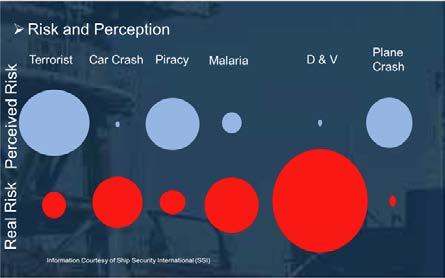
Figure 1 graph outlining actual vs. perceived risk of security issues provided by Ship Security International1
When a fibre optic system is to be installed in a new area of the world, risk profiles can be formulated based on perceptions of the area of operations. It is very important to spend time assessing the legitimacy of these observations and to collate risk profiles based on evidence rather than supposition. The above graphic compares perceived risk and real risk with regards to terrorism, travel accidents, piracy and medical issues. It can be
seen from this graphic that the items people generally perceive as the major risks on a project are in many instances the risks that are less likely to have an impact on the project implementation. All risks need to have a mitigation plan but as seen in figure 1, it is often items such as car travel and disease which are the highest risk to failure rather than the items such as terrorism or piracy which are regularly the first items discussed during the risk log collation meetings. Minimising financial risk is another important consideration. In countries where this type of project has rarely been seen, if at all, the
local business community will often ask for increased values of expected expenditure to be paid in advance. Whilst a small payment up front is common practise in the industry, the unknown nature of the works and first time experiences of the cable installers can lead to the value of advanced payments increasing.
The cable installer therefore needs to be mindful of the impact this can have on cash flow as more cash will be leaving the business at an earlier stage than would normally be anticipated.
Safety and security challenges as outlined within this paper commonly are overstated as the perceived risk is in actual fact greater than the actual risk, the management of this and clear communication with all personnel is vital to ensure perspective is maintained by all involved in the project.
Having considered the caveats, now let’s look at how these challenges can be managed. It’s all down to proper planning and the
gathering of all necessary intelligence at the start of the process.
For Global Marine, a desk top study (DTS) is a key part of the initial planning phase of any submarine cable system. Properly executed, a DTS should detail all the influences on the cable route and operational safety while providing sound engineering solutions for the environment encountered.
The DTS provides a technical reference for the entire project and throughout the life of the cable system, detailing factors likely to have a bearing on all subsequent activities, from survey through to installation and then throughout the system’s operational and maintenance lifecycles.
This paper has touched on many of these factors already but here is a quick résumé of the main elements that need to be considered when embarking on a project within developing markets.
The concept phase should first identify areas that will create difficulties for the
initial project survey, the installation process and subsequent maintenance. It will include any research and details gathered on environmental and cultural factors that are likely to compromise operations. The plan will also highlight relevant statutes and regulations imposed by the various authoritative bodies and factor in how different ways of working may impact cash flow.
The next step is to examine possible sources of risk to the cable, resources, assets and personnel associated with the delivery of the cable system and determine which permits, licences and other regulatory requirements that are necessary; both to install the cable and for the cable to remain in situ along the proposed route.
All these considerations may seem daunting and time consuming but the hurdles can be overcome. Meticulous methodology is the key to a smooth and successful cable laying project wherever it is in the world.

Paul has worked with Global Marine Systems Limited since 1998 in a variety of roles. In his current position he is responsible for overseeing project delivery in telecoms, oil & gas and offshore renewable projects.
Paul has a BSc honours degree in Land Administration & Geographical Information Systems.

BY AL DIGABRIELE
In today’s digital world, people expect to be connected anytime, anywhere. With over 10 billion connected devices globally, network speeds define the very pulse of human interactions.1 Financial transactions are executed in fractions of a second, new applications are launched every day and companies around the globe are moving data en masse to the cloud, all of which require reliable, low latency and high capacity global connectivity around the clock. Not only is the velocity of traffic placing increasing demands on the international telecom infrastructure, content-rich applications are driving the requirement for transporting more data-heavy information than before — such as video and M2M communications — at much faster speeds. The combined impact is a market projection that global IP traffic will grow to two zettabytes by 2019.2
1 http://www.cisco.com/c/en/us/solutions/collateral/ service-provider/visual-networking-index-vni/VNI_Hyperconnectivity_WP.html
2 http://www.cisco.com/c/en/us/solutions/collateral/
Emerging technologies and a growing population connected to the Internet are shifting international bandwidth usage trends. Facebook reports 1.6 billion users across the globe are members of their social media platform. Approximately 1 billion of them use it every day for an average of 20 minutes.3 In this new era of ubiquitous connectivity, the transatlantic route continues to be the busiest oceanic corridor. Bandwidth demand on this route is projected to grow at an annual rate of 40 percent, driven in part by web-based companies moving large amounts of data between data centers and more content rich applications traversing the network.4
The world’s subsea fiber optic infrastructure carries the preponderance of intercontinental traffic due to the service-provider/visual-networking-index-vni/VNI_Hyperconnectivity_WP.html
3 Imperial Ambitions. The Economist. April 9,
superior transmission capabilities of fiber. The high capacity and latency performance capabilities of the latest generation submarine cable transmission technologies are a key enabler of the global digital age. It is striking how far subsea cable technology has advanced during the last 150 years. A recent National Geographic Magazine article cited that in 1858, the first copper based telegraphy line across the Atlantic Ocean transmitted only a few words per minute. Today, the new Hibernia Express cable, owned and operated
by Hibernia Networks, is able to flash the equivalent of 125 years of the National Geographic Magazine in 30 milliseconds.5 The technology advancements have reached a level where 1.2Tbps transponder speeds on cable systems are now in lab testing.
Advancements in subsea cable technology also play an important role in enabling the highest levels of network performance between major commercial and financial centers across the globe. Today, submarine

cable operators are able to deploy faster, higher capacity and more resilient cables than ever before. By utilizing more innovative routing and next-generation optical transmission technology, providers are able to reduce latency and enhance scalability. These network performance capabilities are important for large content providers that are scaling up their networks and transporting latency sensitive applications.
A key element of latency is distance, with every 1,000 kilometers resulting in 10 milliseconds round trip delay (RTD). Next-generation submarine cables are using the latest in burial technology to reduce latency by pioneering new, more direct routes.
For example, Hibernia Express takes a considerably shorter route than existing submarine cable systems connecting North America and Europe by follow-
ing the great circle route. While not new to the industry, the route has not been used since the laying of telegraph cables during the early part of the 20th century. The route follows the earth’s curvature to create the shortest connection between New York and London. In doing so, the cable avoids the commonly used deep water routes between North America and the United Kingdom and instead traverses more hazardous shallow waters. In order to mitigate the risk of the shallower water, the cable was heavily armored and buried along nearly one-half of the route length utilizing the latest generation plowing technologies.
The combination of the shorter route and deployment of the latest generation transmission gear enable Hibernia Express to achieve industry leading network performance and scalability. The 53Tbps capacity exceeds that of any other transatlantic cable
system and the latency performance is approximately six milliseconds faster than any other cable connecting London to New York.
The Importance of Latency Latency has long been an important metric considered by customers when selecting a service provider, especially for those seeking efficient network connectivity to enable business critical financial, media and cloud computing applications. Latency has proven to be a network-changing differentiator for customers, placing pressure on submarine cable providers to deliver improved network speed and performance.
The global financial markets are defined by transactions made in fractions of a second. Network latency performance and reliability are not only important, they have a direct impact on market pricing efficiencies and firm profitability. For example, market makers rely on the most up-to-date
market information, which requires low latency connectivity to ensure buy and sell quotations are made on the most current data. Utilizing a network route that has been optimized for low latency performance can mean the difference of hundreds of millions of dollars to global trading firms, banks and exchanges. The transatlantic corridor is the centerpiece of the trading ecosystem, with New York and London being considered the financial pillars of the world. Key exchanges connected along this corridor include NYSE and NASDAQ in New York, CME in Chicago, TMX in Toronto, LSE in London, EUREX in Frankfurt as well as financial exchanges in other parts of the world such as the TSE in Tokyo.
Likewise, network performance is critical to web-centric companies and those in the media industry tasked with transporting very large amounts of digital content between major data centers
and to end-users. For these companies, network speed directly impacts the end-user experience, especially as more video is transported across networks. Forecasts suggest that all forms of video (TV, VoD, Internet, P2P) will be 80 to 90 percent of global consumer traffic by 2019.6
Many media companies are now connecting their cloud networks with data centers placed strategically around the world. Their customers rely on high speed, high capacity transport for photos, videos, music and other content.7 Low latency, high capacity connectivity is also required to support the delivery of the crystal clear, high definition video that global audiences demand when consuming content.
Network latency also impacts companies that rely on click-through rates and search result views with online marketing. Ecommerce
6 Cisco VNI Report 2015
7 https://www.de-cix.net/news-events/latest-news/ news/article/customers-demand-for-bandwidth-continues-to-increase-interview-with-al-digabriele/

sites have reported a direct correlation between latency performance and sales revenue.8 Additionally, the rapidly growing M2M applications segment relies heavily on network performance for properly functioning utility and efficiency.
Companies operating in today’s digital world rely on fast connections and scalable capacity to grow and stay ahead of their competition. A next generation subsea cable infrastructure
8 http://www.hibernianetworks.com/corp/wp-content/ uploads/2015/09/TeleGeography_White_Paper_Network-Latency_Final1.pdf
plays a vital role enabling this new digital world. State-of-the-art cable systems like Hibernia Express generate tangible benefits that impact the bottom line of financial firms, banks, content providers, cloud providers, web-centric companies and telcos alike.
Hibernia Express sets new industry standards for latency, offering the fastest connection between New York and London. The six-fiber-pair submarine cable has a cross-sectional design capacity of over 53Tbps and is optimized

for 100x100Gbps service. Hibernia Express is also designed to meet future capacity demands, as it is upgradeable to 400Gbps and beyond.
As it is often said, the future is uncertain. However, what we can depend on is the increasing importance for global connectivity. The digital age will continue to drive bandwidth demand higher, and companies across industries will rely on high performance networks to keep content flowing seamlessly and efficiently across the globe.

Mr. DiGabriele brings over 22 years of experience in the global telecom industry to the Hibernia Networks team where he serves as the Senior Vice President of Product and Marketing. At Hibernia Networks, he is responsible for driving the overall product strategy and profitability, product expansion and development roadmap, and Hibernia Networks’ go-to-market approach. Mr. DiGabriele has held a number of senior level leadership roles in product, marketing, finance, sales, commercial development and business development throughout the years. Prior to joining Hibernia Networks, he served as Vice President of Marketing and Pricing at Windstream Communications. Prior experience includes Vice President of Commercial and Offer Development at Level3 Communications, Vice President of Corporate Marketing at Global Crossing and Vice President of Product Management at Global Crossing. Mr. DiGabriele began his career at AT&T. Mr. DiGabriele earned a Bachelor’s degree in Mathematics from Duke University and an MBA in Marketing and Finance from the Simon School at the University of Rochester.
BY BRIAN LAVALLÉE

Why should all consumers and businesses care and appreciate the myriad of submarine cables that quietly rest upon ocean floors around the world? It’s because these jugular veins of intercontinental communication carry nearly 100 percent of the world’s digital traffic, that’s why. These submerged communication links stitch together continental landmasses resulting in the largest manmade construction feat in our history — the global Internet. Although they do not receive the media attention they undoubtedly deserve, until something goes wrong, they are incredible feats of engineering combining electrical, optical, and mechanical packaging technologies.
The first transoceanic transmission was achieved well over a century ago back in 1858 across a submarine cable that interconnected Newfoundland and Ireland, although the cable
insulation soon failed and the cable had to be abandoned. Since that early yet notable milestone, much has changed in the last 158 years; with submarine networks going from a science experiment to critical infrastructure enabling significant economic, political, and social change around the world. Not bad for long, thin strands of glass no larger than a human hair, right?
Submarine cables have advanced from a successful, albeit low-speed, telegraph communications medium to today’s high-speed digital networks which carry hundreds of terabits of data each second over many thousands of kilometers.
The next sea change is already on the horizon and will change how these submarine networks are designed, built, managed and even financed. Although the achievements from the early days of submarine cables to what is common today has been quite impres-
sive, a powerful new mindset is now dawning on our industry that will further accelerate technological advancements going forward – the openness mindset.
For a variety of interrelated historic, political, geographic and technological reasons, early submarine networks were proprietary turnkey systems — in other words, closed. Over the past few years, with the introduction of coherent detection technology originally developed for long haul
terrestrial networks, this has changed. Third party Submarine Line Terminating Equipment (SLTE) leveraged the technological advances, investments and production volumes of coherent detection modems, and applied this revolutionary technology over existing wet plants designed for 10G on-off keying. If one thinks about it, we have actually been operating in a quasi-open environment for years now — although the upgrade process can and should be far easier than it is today.

So how did we get to where we are today? Coherent detection technology was initially developed for long haul terrestrial networks. However, circa 2008, terrestrial coherent transponders were tested over a submarine cable in the Caribbean by deployment teams who readily volunteered to be onsite, given the sunny location. The 40Gbps ter-
restrial modems worked extremely well over the 3rd party wet plant and the proverbial light bulb went off, and the submarine cable upgrade market was changed forever.
Coherent technology made it possible to upgrade any 3rd party wet plant deployed a decade or more earlier, originally designed
for 10G on-off keyed modems, to 40G and 100G allowing submarine cable operators to massively increase the total capacity of existing undersea assets by an order of magnitude. This greatly extended the life of undersea assets, and deferred having to lay expensive new cables for many years. The cost per bit improved substantially result-

ing in far more affordable transoceanic bandwidth. This made remote data centers, seeking to benefit from lower energy and real estate costs, an economically viable alternative.
Data centers constructed around the world are having an immense impact on submarine bandwidth utilization. According to TeleGeography, private network bandwidth consumed by Internet Content Providers (ICPs) along the trans-Atlantic corridor connecting North America to Europe exceeded Internet bandwidth for the first time in 2014. And by 2019, they are forecasted to account for the majority of international bandwidth worldwide. So, what is driving this voracious bandwidth consumption? It is the need for Data Center Interconnect (DCI).
Constructing massive data centers in remote locations to take advantage of low energy and real estate costs is economically viable be-
cause coherent technology enables massive amounts of cost-effective bandwidth to be turned up over old and new submarine cables. Submarine DCI makes one wonder about the traditional practice of landing submarine cables in or nearby large cities where most of us live since submarine traffic patterns are increasingly content-to-content and not user-to-content. Shouldn’t new cables land nearer to data centers?
There is a strong movement afoot, driven primarily by the same ICPs consuming the majority of submarine bandwidth, which affects all parts of the global network infrastructure. This “open” movement aims to remove the proprietary nature from networks allowing network operators to choose best-in-breed technologies from a broad choice of vendors for their wet plants, SLTE and Network Management Sys-

tems (NMS). The era of closed, proprietary systems is quickly waning, especially for new submarine cable builds. Cable operators will be able to choose best-inbreed SLTE from a wide selection of vendors based on the best technology and at the right cost points that addresses specific business requirements – in short, the open movement enables choice.
For years now, cable operators have been upgrading wet plant capacity by selecting best-in-breed SLTE, which was often not from
the same vendor of the wet plant. This was a monumental shift away from the traditional practice where capacity upgrades were only performed via SLTE from the same wet plant vendor – the seeds of open submarine networks were already planted, with benefits and challenges experienced from the onset.
Although upgrading existing wet plant capacities by an order of magnitude and breathing new life into existing assets was a major business benefit, it was often not always easy
to achieve operationally speaking. Upgrading existing cables with 3rd party SLTE is not an easy task, far from it. Precise characterization of the wet plant must first be performed on most cables due to the lack of publicly available wet plant specifications. This optical characterization allows accurate link-engineering exercises to be run to determine the achievable capacity and reach of the cable being upgraded. So although 3rd party SLTE upgrades have taken place worldwide, it could be (and should be) far easier to do. This would allow cable operators to better maintain pace with bandwidth growth, which according TeleGeography, is growing at around 40 percent CAGR over the next five years in all regions.
As mentioned, it could be argued that the upgrade market has operated in a quasi-open environment for years, albeit a less than optimal environment. Tough
performance challenges must be overcome as upgrades are performed on legacy, non-coherent submarine cables with 15-year old specifications. SLTE upgrade vendors must gain access to submarine cables to perform meticulous and often difficult optical characterization by flying specialists around the planet, which is time-consuming and expensive. Even when submarine cables were upgraded, would wet plant vendors guarantee the performance of their wet plant, originally designed
for their own 10Gbps onoff keyed modems, when 3rd party SLTE was co-deployed with new, coherent 40Gbps and 100Gbps modems? This is a business and not a technology challenge, and has been dealt with in different ways depending on the cable operators and vendors involved. However, the cables were upgraded, regardless.
As openness undoubtedly gains in popularity within the submarine network

industry, issues mentioned above will ultimately be addressed and eliminated, especially as the next generation of coherent-optimized wet plants is deployed. These new cables are not dispersion-compensated like traditional cables are, which actually improves the optical performance of coherent SLTE. It’s rather ironic that for over a decade, dispersion was a villain to be defeated, but is now a friend to be embraced. Coherent SLTE coupled with coherent-optimized wet plants makes upgrades easier to model and deploy, even more so when the wet plant optical specifications are shared in an open, standardized manner. A set of open, standardized acceptance criteria will also be required allowing cable operators to sign off, with confidence, on capacity upgrades from any SLTE vendor.
Public, standardized wet plant optical specifications including such metrics as
Optical Signal-to-Noise Ratio (OSNR), gain profile, and bandwidth will greatly simplify the upgrade process to everyone’s benefit, operators and SLTE vendors alike. Opening cable optical specifications and final acceptance criteria is the first step in opening the submarine network. Open photonic architectures, such as adding open coupling ports to facilitate 3rd party SLTE upgrades, are also required to facilitate the upgrade process, without service interruptions.
Numerous open movements are directly and indirectly affecting submarine networks today, and will continue to do so in the coming years. ICPs are driving the Open Compute Project and Telecom Infra Project that aim to open the compute, storage, and connect industries, which together comprise the cloud. The Open ROADM MSA initiative, driven by AT&T, Ciena, Nokia, and Fujitsu aim to open ROADMs,
which are used in terrestrial and submarine networks. Open software movements will affect submarine networks in a significant manner from an NMS perspective in the coming years. These and several other open movements address different parts of the global cloud network infrastructure, and are all interrelated to varying degrees. It should be quite obvious by now that we’re now in the sunset mode of closed networks – openness is clearly our future.
Second, Open the Submarine NETWORK
Open networks go handin-hand with Software-defined Networks (SDN) where abstracting underlying assets is achieved via open Application Programming Interfaces (API), which are predefined sets of routines, protocols, and tools used to create software applications. These APIs allow for future innovations to take place within the virtual (software) do-
main, which has far faster innovation cycles than the hardware domain, where traditional innovation primarily took place in the submarine network industry. This enables network operators, terrestrial and submarine, to choose bestin-breed network hardware that support open APIs to facilitate application development by the same hardware vendors, 3rd party application developers, or even done in-house.
Once submarine cable optical performance specifications, testing methodologies, and acceptance criteria are shared in an open, standardized manner, the next step is to open the submarine network via the adoption of open APIs to some or all of the active elements of a typical submarine network. This includes the SLTE, power management control system, active (smart) repeaters, active Branching Units (BU), Power Feed Equipment (PFE), equalizers, and so
on. The submarine network industry is understandably a conservative group given subsea networks are typically designed for a 25-year lifespan and reside in some of the harshest environments on earth, the ocean floors. This means the adoption of open APIs and SDN may come at a slower pace than in terrestrial networks, but the wave of innovation unleashed in an open environment simply cannot be ignored.
It’s no wonder the open movement has come to the forefront of submarine network discussions, and
often-heated debates, in the past year. The benefits and possibilities offered by open networks create new business opportunities through transformational changes in how networks are designed and operated. Most of the current open movement within the submarine network industry is centered around facilitating SLTE capacity upgrades on coherent-optimized wet plants, but this is just the tip of the iceberg. The adoption of open APIs, a rather foreign concept to this particular market space, allows the entire submarine network to be

abstracted to where terrestrial networks are already rapidly headed. This will allow operators to abstract and virtualize their entire network from end-to-end and not know, or even care, whether traffic is carried overland or undersea. The virtualized submarine cable will be seen as just another network link, albeit a rather wet one.
From a technology perspective, open SDN-enabled submarine networks will completely change how they are modeled, designed, deployed, managed. From a business perspective, network operators can choose best-in-breed technologies from a broad selection of vendors, automate operational processes, accelerate service innovation, reduce time-to-market, enter new service markets, and maintain pace with the web-scale ICPs who increasingly account for the majority of transoceanic bandwidth growth and are major openness advocates.
Once the submarine network is virtualized via open APIs, coupled with SDN concepts, the possibilities are then left to app developers and their creative imagination. For instance, there has been a lot of hope, discussion, and debate associated with spectrum sharing over a single submarine cable fiber pair, where different users have access to a specific amount of the available spectrum. Although this is an innovative new service offering where customers buy GHz and not Gbps, the challenge has always been related to managing the shared optical spectrum to ensure that users do not interfere with each other, especially if they are using different SLTE from different vendors. Open APIs to each user’s SLTE allows a centralized controller running a power management and control application to police the shared spectrum and isolate one user from the other, shown in Figure 1.
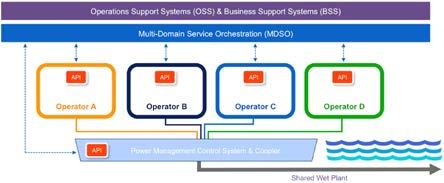
Figure 1: Centralized Spectrum Sharing Management & Control via Open APIs
Another application is a virtualized test set. Modern SLTE perform real-time optical measurements related to such parameters as OSNR, Chromatic Dispersion (CD), Polarization Mode Dispersion (PMD), and Bit Error Rate (BER), to name just a few. These measurements can be made available via an open API and could be polled and manipulated by an application that would replace complex and expensive standalone test sets. The application could be running on any open compute platform anywhere in the world and could be remotely accessed when and where required. This avoids having to ship expensive test sets along with highly trained experts into the field to perform such measurements. As open APIs are adopted by most/ all network elements, true end-to-end service performance is enabled resulting in vastly improved proactive and reactive network management.
The NMS is also undergoing an open movement and will allow submarine and terrestrial network operators to perform multi-domain service orchestration. Traditionally, manual provisioning across multiple terrestrial and submarine network domains was dis-
jointed, highly error-prone, and operationally inefficient creating great angst among network operators. The associated development and integration of new services via hard-coded Operations Support Systems (OSS) is also extremely costly and time-consuming. SDN orchestration completely abstracts the underlying complexity of virtual and physical domains, which results in a simpler and seamless end-to-end service delivery. Submarine cables stitch together terrestrial networks from POP-to-POP so having an SDN-based NMS treat the two as a unified network offers significant benefits to global network operators. This is why SDN is such a hot topic in the industry — operational simplicity, automation, and cost-effectiveness.
If one listens to what is happening in the compute, storage, and connect (network) industries, it is quite evident that the open move-
ment is gaining momentum and has become an unstoppable juggernaut. Service providers and ICPs alike see great business value associated with openness and are thus driving suppliers to embrace this powerful movement, which many already have. Operators want the biggest benefit of openness – choice.
Those not embracing the open movements will ultimately wither away, as the days of closed and proprietary submarine networks are quickly coming to an end. That said, the journey to a completely open industry from open cables to a fully virtualized global network is indeed fraught with technological, economical, operational, geographical, and political challenges, but the momentum will continue unabated since the benefits to both network operators and vendors alike is just too tantalizing. We will eventually get there, especially given that ICPs are driving much
of the open movement and are also turning up the majority of new subsea bandwidth. It will also likely be much sooner than the rather conservative submarine network industry believes. All that is needed to successfully compete and even thrive in this new industry reality is of course, an open mind.




There’s a new power under ocean uniting the world in a whole new way. With unparalleled development expertise and outstanding technology, Huawei Marine is revolutionizing trans-ocean communications with a new generation of repeaters and highly reliable submarine cable systems that offer greater transmission capacity, longer transmission distances and faster response to customer needs. Huawei Marine: connecting the world one ocean at a time.
BY JOSÉ CHESNOY

To take the responsibility of the historically based “Back Reflection” feature in SubtelForum is a hard challenge after Stewart Ash, and I do not intend to compete. My intention will be to modestly provide a historical perspective to today’s accomplishments and challenges, so that the younger members of our submarine network business will recognize that the submarine cable community experienced in the last 25 years epic has nothing to desire compared to the well documented early age of submarine cables.
Capacity is the theme of this May magazine and it will thus be the topic of this Back Reflection article. Many publications have treated capacity evolution
from the first telegraphic cable to the last coaxial cable technology. There is less analysis on the story of optical technology.
The last coaxial cables deployed in 1970 were fighting against the competition of satellites and were continued due to their lower latency and better voice quality, but not due to their capacity, which was not higher than the booming satellite technology. In years 1970-80, the market share of cables was decreasing dramatically versus satellite. The optical fiber technology arrived just in time to reverse the trend.
René Salvador and his colleagues have worked with brio this difficult period in Reference 1. The optical adventure started in 1980 and allowed them to double the
capacity transported in a submarine cable by a factor of 2 every year, reflecting the famous Moore law of microelectronics. For 25 years and up to now, capacity has been the key driver.
The optical systems were first made possible by two inventions: the optical fiber in 1966 by the Nobel Prize winner Charles Kao and the semiconductor laser in 1964.
The first deployment of optical fibers across the Atlantic was done 20 years after these discoveries by deploying TAT 8 in 1988. In the meantime, the proponents of coaxial electronics tried to develop the monstrous electrical waveguide technology, without success. With its 2 fiber pairs and 280 Mbit/s per fiber pairs carrying each 4400 digital voice channels, TAT 8 technology was very
weak, and didn’t significantly surpass the last transatlantic coaxial cable TAT 7 deployed using a technology developed in 1970 and already carried 4000 analog channels! The optical capacity was even below the capacity of Intelsat 7, launched at the same time.
Capacity following the Moore law was then the unique market driver during 12 years from year 1988 to year 2000. The increase of capacity was fast, but well controlled. A market and technology driven doubling of capacity every year was consuming considerable R&D efforts. The market attractiveness of each new step was constant since new cables could permanently surpass all previous ones.
A characteristic of this early time of optical cables up to 2000 was a fair control of the market with common developments between AT&T, Alcatel and STC in the Atlantic, and the Japanese club lea by KDD again with AT&T in the Pacific. Before the deregulation, the control was even better considering the cooperation of suppliers with their national operators, France Telecom for Alcatel, British Telecom for STC, and even better for AT&T and KDD that were at the same time operator and supplier. The global coordination was thus done by AT&T, with its FCC commission. In addition the huge R&D efforts of an evolving technology discouraged all new comers to enter the supplier market. This was the holly time of “co-opetition” the mix of competition and cooperation, where the selfless submarine cable community deployed the technology for the future of humanity.
The third technology cornerstone, Erbium Doped Fiber Amplification (EDFA), was in service in 1996 over the Atlantic (TAT12/13) and the Pacific (TPC5 ) after some early shorter reach deployments in 1994 (Tagide, now part of Sea-Me-We 3).
This happened 7 years after the invention of EDFA in Southampton University and at AT&T Bell Labs by the young French physicist
Emmanuel Desurvire (who being first to coin the EDFA acronym, has incidentally included his initials into it!).
Inside the submarine cable technology industry, the EDFA had to fight against regenerated systems to be adopted. Submarine cable users are traditionally conservative in term of technology for obvious reasons of reliability. Thus EDFA had
to prove some advantage versus regenerating repeaters to be adopted. The first EDFA system developed by AT&T with Alcatel (supported by France Telecom) started at 2.5 Gbit/s that is a natural bit rate in the SDH hierarchy. When STC announced the development of a 2.5 Gbit/s regenerated system, US and French EDFA promoters had to move the EDFA system bit
rate to the peculiar 5Gbit/s channel rate that was out of reach of the submerged electronic regeneration. Note that STC had taken the initiative to compete inside the western club, but the competitive landscape was cleared when Alcatel and STC merged in 1995, and with the acquisition of the last European newcomer Pirelli Submarine Cable by Alcatel.
The optical amplifier opened the way to Wavelength Division Multiplexing (WDM). Figure 1 is the design capacity per fiber at day 1 (without considering later upgradability). As shown in this figure, the twofold design capacity increased each year, with 4 x 2.5Gbit/s (Gemini), then 16 x 2.5Gbit/s (Southern Cross). The next SDH bit rate 10Gbit/s deployed over Japan-US cable allowed them to achieve 16 x 10Gbit/s and finally 64 x 10 Gbit/s, (Apollo in 2001).
The first Terabit optical system was I2I (100 x 10 Gbit/s)
but over a shorter 3000km distance. The increase of design capacity was done by a smooth increment of bandwidth and channel bit rate. Note that nevertheless the initial equipment of the terminal was well below the above design capacities. This heyday of EDFA optical systems led to the dismantling of all previous generations of cables — coaxial as well as optically regenerated — and to the replacement of satellite for all voice and for the new booming internet data services in countries connected to a submarine cable. The large satellite telecommunication stations were dismantled and the best placed in museums. The market of submarine cables and their design capacity were found a balance.
Submarine cable technology was growing with the internet bubble before 2000, and was thus abruptly hit by the dot-com collapse. The market of new cables became very slow from
2000 to 2008, and in parallel the design capacity of cables stagnated, perfectly correlated together again. This “bubble pause” is striking on figure 1 when compared to the previous booming period. The only technology that was progressing smoothly was the terminal technology, supported by the market of adding wavelengths over the WDM terminals, and sharing R&D efforts with developing WDM terrestrial networks.
In 2007-2008, the market restarted, and at the same time, the fourth key technology milestone “Coherent Technology” was introduced for terrestrial fiber networks by Nortel in 2008, and became immediately applicable to submarine cables. It fueled the increase of design capacity. Coherent technology had also a big impact on the upgrade market as we will discuss in next July edition. As seen in figure 1, the slope of capacity versus time from 2008 to 2014 is noticeable but much less than the previous twofold factor per year. It was again sustaining the market with channel capacity moving from 10Gbit/s to 40Gbit/s and 100Gbit/s. The new coherent systems at 100Gbit/s propose 10 Tbit/s (100 x 100 Gbit/s) per fiber pair from 2010 and are built implementing a +D fiber plant, first deployed on Jonah between Italy and Israel (in service
in 2012). The present design capacity of a transoceanic cable is around 15 Tbit/s per fiber pair. Once again, the market has been synchronized with the design capacity of cables.
For the last 3 to 4 years, the picture has been changing. The ultimate capacity that can be offered on submarine cables is approaching the glass ceiling — so called Shannon limit — of capac-
ity spectral density. The best present terminal technology can achieve close to 4 bit/s/Hz of capacity spectral density (bit rate in bit/s divided by spectrum in Hz) per fiber pair over a 6500km cable, while the Shannon theoretical limit is around 6 bit/s/Hz with EDFA. It means that for the first time in history of optical cables, the design capacity per fiber of a new
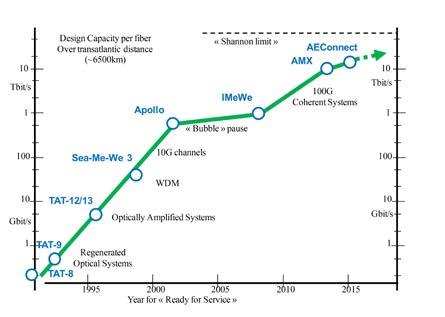
Design capacity per fiber versus time of deployment (time of RFS that is around 2 years after technology availability). This design capacity is the target day 1, without accounting the higher upgrade capacity demonstrated later.
cable is hardly higher than the design capacity of a cable designed in previous years. The increase of channel bit rate will decrease the terminal cost, but no longer increase the capacity (doubling the channel bit rate will divide by 2 the number of channels). There is still a potential increase of total cable capacity by increasing the number of fiber pairs, and broadening the spectral bandwidth, (broader C band, and implementing C+L band), but the capacity increase is definitely slowing down. On the other hand, there is a trend to enrich the features of large submarine cable networks. A complete recent complete review of the submarine cable technologies and their deployments can be found in Ref.2.
The competitive landscape has also changed a lot during this last period. First the terminal technology has converged between submarine and terrestrial applications, so that more than 10
suppliers can offer coherent terminal usable on submarine cables, and secondly, the wet plant technology becoming established with EDFA, new comers are being entering the wet plant supplier market, just mentioning Huawey and Xtera, or Padtek. This broadening of the competition is simply due to the stabilization of EDFA submarine cable technology that make viable the return on investment of R&D for a new comer. The increase of competition combined with the market opening first decreases the cost of regional systems, so that submarine cables becomes affordable for smaller countries or smaller regions.
In conclusion of this short summary, the optical technology has fulfilled a dream in the last 25 years, mainly based on the capacity it has offered. There is a perfect correlation in the last 25 years between the submarine cable design capacities and the cable market.
A transatlantic cable has achieved a design capacity increase by a factor 100,000 in 25 years. This has permitted to mesh the earth with more than 1 million km of cables (that would have deserved a celebration!) and to transport close
to 100 percent of the voice and data on the core networks of our planet. This model is changing. There are plenty of innovations that will sustain the market outside the design capacity, and first a new market driver: since capacity needs
continue to increase exponentially and cost continue to decrease under the competition pressure, all factors are present to observe an increase of the number of cables. This is already what is noticeable on the Transatlantic and Transpacific markets where a cycle of new cables is observable after a 15 years pause, as well as in the regional markets of shorter cables.
Du Morse à l’Internet, R.Salvador, G.Fouchard, Y.Rolland, A.P.Leclerc, Edition Association des Amis des Câbles Sous Marins, 2006 (book)
Undersea Fiber Communication Systems, Ed.2, José Chesnoy ed., Elsevier/Academic Press ISBN: 978-012-804269-4 (book)

José Chesnoy, PhD, is an independent expert in the field of submarine cable technology. After Ecole Polytechnique, and a PhD in physics, he had first a 10 years academic career in the French CNRS. Then he joined Alcatel’s research organization in 1989, leading the advent of amplified submarine cables in the company. After several positions in R&D and sales, he became CTO of Alcatel-Lucent Submarine Networks until the end of 2014. He was the chair of the program committee for SubOptic 2004, and is also Legal Expert at the Paris Court. José Chesnoy is the editor of the reference book “Undersea Fiber Communication Systems” (Elsevier/Academic Press) having a new revised edition just published end 2015.


Chesnoy Independent submarine Telecom Expert, former CTO of Alcatel-Lucent Submarine Networks
ISBN: 9780128042694
EISBN: 9780128043950
This comprehensive book provides both a high-level overview and the detailed specialist technical data for design, installation, aspects of this field

This comprehensive book provides both a high-level overview of submarine systems and the detailed specialist technical data for design, installation, repair, and all other aspects of this field
• Features new content on:
• Features new content on:
Edited by: José Chesnoy
Ultra-long haul submarine transmission technologies for telecommunications
Ultra-long haul submarine transmission technologies
Alternative submarine cable applications, such as scientific or oil and gas
• Addresses the development of high-speed networks for multiplying Internet and broadband services with:
Alternative submarine cable applications, such as
Coherent optical technology for 100Gbit/s channels or above
Wet plant optical networking and configurability
• Addresses the development of high-speed networks for multiplying services with:
• Provides a full overview of the evolution of the field conveys the strategic importance of large undersea projects with:
With contributions of authors from key suppliers acting in the domain, such as Alcatel-Lucent, Ciena, NEC, TE-Subcom, Xtera, from consultant and operators such as Axiom, OSI, Orange, and from University and organization references such as TelecomParisTech, and Suboptic, treating the field in a broad, thorough and un-biased approach.
Technical and organizational life cycle of a submarine network
Coherent optical technology for 100Gbit/s channels
Upgrades of amplified submarine cables by coherent technology
9780128042694
9780128043950
PREVIOUS EDITION ISBN: December 2015
FORMAT: Paperback
PAGES: 702
AUDIENCE:
DESCRIPTION
Wet plant optical networking and configurability
• Features new content on:
• Ultra-long haul submarine transmission technologies for telecommunications
Since publication of the 1st edition in 2002, there has been a radical evolution of the global communication network with the entry of submarine cables in the Terabit era. Thanks to optical technologies, the transmission on a single fiber can achieve 1 billion simultaneous phone calls across the ocean!
• Provides a full overview of the evolution of the field conveys undersea projects with:
• Alternative submarine cable applications, such as scientific or oil and gas
Technical and organizational life cycle of a submarine
Upgrades of amplified submarine cables by coherent
• Addresses the development of high-speed networks for multiplying Internet and broadband services with:
• Coherent optical technology for 100Gbit/s channels or above
This comprehensive book provides both a high-level overview of submarine systems and the detailed specialist technical data for design, installation, repair, and all other aspects of this field.
PREVIOUS EDITION ISBN: 9780121714086
Professionals (technical, marketing, product lines, etc) university faculty, advanced undergraduate and graduate students working in fiber optic communications.
Modern submarine optical cables are fueling the global internet backbone, surpassing by far all alternative techniques. This new edition of Undersea Fiber Communication Systems provides a detailed explanation of all technical aspects of undersea communications systems, with an emphasis on the most recent breakthroughs of optical submarine cable technologies. This fully updated new edition is the best resource for demystifying enabling optical technologies, equipment, operations, up to marine installations, and is an essential reference for those in contact with this field.
• Wet plant optical networking and configurability
• Provides a full overview of the evolution of the field conveys the strategic importance of large undersea projects with:
• Technical and organizational life cycle of a submarine network
Each chapter of the book is written by key experts in their fields. The book assembles the contributions of authors from key suppliers, such as Alcatel-Lucent, Ciena, NEC, TE-Subcom, Xtera, from consultant and operators such as Axiom, OSI, Orange, and from University and organization references such as TelecomParisTech, and Suboptic.
• Upgrades of amplified submarine cables by coherent technology
Since publication of the 1st edition in 2002, there has been a radical communication network with the entry of submarine cables in technologies, the transmission on a single fiber can achieve 1 billion across the ocean!
For more information, or to order visit store.elsevier.com/9780128042694 Enter ENG315 to save up to 15% when you order via the store!
This has ensured that the topic of submarine telecommunications is treated with a broad, thorough and un-biased approach.
Modern submarine optical cables are fueling the global internet
http://amzn.to/1pHdL87

http://amzn.to/1NXjjGm


Telecoms consulting of submarine cable systems for regional and trans-oceanic applications
BY KRISTIAN NIELSEN

Welcome back after SubOptic, I hope that your conference was as productive as ours!
As you may have seen, the production team attending the show was hard at work interviewing and producing daily news wrap-ups. If you weren’t able to attend the conference, or want to refresh what you saw,
I highly recommend that you check it out: SubOptic 2016 Playlist.
On top of that, we are also proud to present our new interactive online map: Submarine Cables of the World. The map is the product of countless hours dedicated by our analysis, mapping and news teams, all working together to bring you, our readers, an
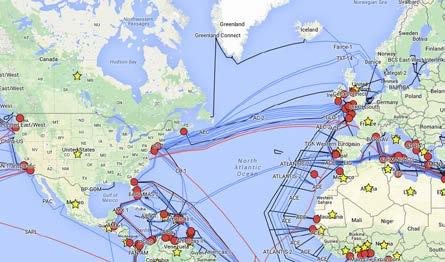
easy and regularly updated resource for submarine cable information.
Sponsorship for the map is a prominent banner on the page, priced at $2,500/ month, with two months free if you purchase a full year.

Up next is our quarterly Almanac, and after that the Regional Systems issue of the magazine. There is a special 15% discount for any ads purchased between now and the end of July.
erally grew up in the business since his first ‘romp’ on a BTM cableship in Southampton at age 5. He has been with Submarine Telecoms Forum for a little over 6 years; he is the originator of many products, such as the Submarine Cable Map, STF Today Live Video Stream, and the STF Cable Database. In 2013, Kristian was appointed Vice President and is now responsible for the vision, sales, and over-all direction and sales of SubTel Forum.
+1 703.444.0845
knielsen@subtelforum.com
Submarine Telecoms Forum, Inc.
21495 Ridgetop Circle, Suite 201 Sterling, Virginia 20166, USA
ISSN No. 1948-3031
PUBLISHER:
Wayne Nielsen
VICE PRESIDENT:
Kristian Nielsen
MANAGING EDITOR: Kevin G. Summers
CONTRIBUTING AUTHORS: Neal S. Bergano, Maxim Bolshtyansky, Derek Cassidy, Kieran Clark, José Chesnoy, Paul Deslandes, Al DiGabriele, Dmitri Foursa, Brian Lavallée, Georg Mohs, Alexei Pilipetskii,
Contributions are welcomed. Please forward to the Managing Editor at editor@subtelforum.com.
Submarine Telecoms Forum magazine is published bimonthly by Submarine Telecoms Forum, Inc., and is an independent commercial publication, serving as a freely accessible forum for professionals in industries connected with submarine optical fiber technologies and techniques. Submarine Telecoms Forum may not be reproduced or transmitted in any form, in whole or in part, without the permission of the publishers.
Liability: while every care is taken in preparation of this publication, the publishers cannot be held responsible for the accuracy of the information herein, or any errors which may occur in advertising or editorial content, or any consequence arising from any errors or omissions, and the editor reserves the right to edit any advertising or editorial material submitted for publication.






BY KEVIN G. SUMMERS

Ididn’t make it to Sub-
Optic this year. To be perfectly honest, I don’t like traveling. Living on a farm, it makes life awfully difficult for my wife whenever I skip off to Honolulu or Dubai for a week. She has to take up the slack and it isn’t easy for her. Farming requires all hands on deck, and as the saying goes... happy wife, happy life. But that’s not the only reason.
I don’t fly.
Go ahead, send me that email about how flying is statistacally safer than driving if it will make you feel better. Call me an excentric weirdo, it’s true. But I don’t care about the statistics, and I’ve come to a place in my life where I don’t have to fly so I’m simply not going to do it.
To quote Mr. T... “I ain’t getting on no plane.”
So, I didn’t make it to SubOptic this year, but I was able to keep tabs on what was happening from my little farm in Virginia. That’s right, even with my slow internet connection (my provider’s name rhymes with RENT), I was able to watch interviews with SubOptic participants and daily wraps ups on the SubTel Forum website. Do you realize how amazing that is? I was half a world away but able to keep tabs on my staff in Dubai and feel like I participated in SubOptic. That’s your submarine cable industry at work right there. Good job people!
Wayne often writes in his Exordium about how much he loves traveling
the world and networking with industry associates while drinking a Mai Tai on the beach while a volcano erupts in the distance. That’s Wayne. But here, in my Coda, I write about how much I love working from home in my overalls while the sheep are crying in the barn stall downstairs. It’s all good.
Until next time, this has been your farming editor...

Kevin G. Summers is the Editor of Submarine Telecoms Forum and has been supporting the submarine fibre optic cable industry in various roles since 2007. Outside of the office, he is an author of fiction whose works include ISOLATION WARD 4, LEGENDARIUM and THE MAN WHO SHOT JOHN WILKES