SubTel Forum Issue #85 - Upgrades and 14th Anniversary
469,928
Welcome to Issue 85, our Upgrades and 14th anniversary edition.
We have appreciated literally hundreds of articles from as many international authors from our industry on significant far-reaching topics. Some have merely informed; others have incited reaction; all have enhanced the discussion within our community. Through good times and terrible times, we have attempted to keep the vantage clear and concise. Hopefully, we have succeeded more times than not.
When Ted and I established our little magazine in 2001, our hope was to get enough interest to keep it going for a while. With his premature departure and the eventual
addition of Kevin, Kristian and Kier, and a boatload of others years later, we took the original idea and expanded it in a number of different and complimentary ways. One workhorse of a writer has been Stewart Ash, who has happily provided historical industry insight for a number of years, and with this being his last installment, we say simply, Thanks old friend!
We have published SubTel Forum with two key founding principles always in mind, which annually I reaffirm to you, our readers:
That we will provide a wide range of ideas and issues;
That we will seek to incite, entertain and provoke in a positive manner.
So here’s to you, our readers and supporters. Thank you as always for honoring us with your interest.
Lastly, but most importantly, our sincere thoughts and prayers are with our French colleagues and friends. Vive la France.
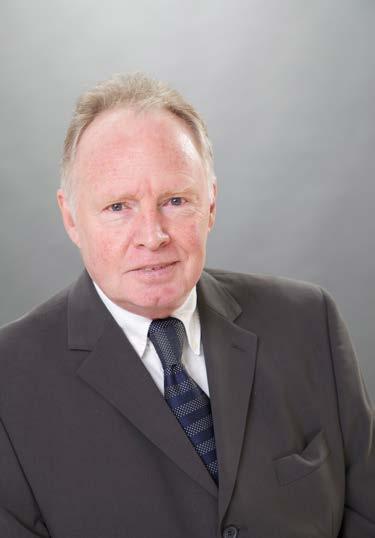
Wayne Nielsen is the Founder and Publisher of Submarine Telecoms Forum, and previously in 1991, founded and published “Soundings”, a print magazine developed for then BT Marine. In 1998, he founded and published for SAIC the magazine, “Real Time”, the industry’s first electronic magazine. He has written a number of industry papers and articles over the years, and is the author of two published novels, Semblance of Balance (2002, 2014) and Snake Dancer’s Song (2004).
+1.703.444.2527
wnielsen@subtelforum.com
In This Issue...
Alcatel-Lucent to Deliver Fiber
Optic Submarine Broadband
Connectivity to Oil and Gas
Production Facilities Offshore
Angola
Alcatel-Lucent to Retain Undersea
Cables Unit as Wholly-Owned
Subsidiary
Algeria Internet Traffic Hit By
Submarine Cable Cut
Algeria, Spain to Begin Submarine
Cable Rollout at End 2015
Algerie Telecom Restores Submarine
Cable
AquaComms Selects Ciena for New
Trans-Atlantic Submarine Network
C&W Networks Executes 20Year Agreement on Allied Fiber’s
Southeast Network
Call for More Submarine Cables to Help Thai Internet
China Unicom Seals Deal to Expand Cameroon’s Telecom Capacity
Cork Event Eyes ‘Big Data’
Businesses
Cut Submarine Cable Cripples
Apple Services for Telstra
Customers
Delivery Brought Forward for the QTrencher 1000
Equinix Offers Access to Hibernia
Express Transatlantic Submarine
Cable
Equinix Supports FASTER Cable System in North America
FASTER Trans-Pacific Cable System
Will Land at CoreSite’s Los Angeles
Data Center Campus
Gibraltar’s Telecommunications
Sector Becomes International
Google to Support Uruguay-Brazil
Fibre Cable
Hexatronic Launches Viper Micro
Cable Series
Huawei Marine to Deploy
Cameroon-Brazil Cable System
Internet Services Up as Fault
Rectified on I-ME-WE
Linxtelecom Chooses Ekinops to Upgrade Its Submarine Optical Ring
Connecting Estonia, Finland and Sweden
Local Kenyan Firm Plans Sh10bn
Investment in Data Centres
MainOne Upgrades Submarine
Cable Network to 100G with Xtera
NATCOM Raises Internet
Bandwidth As SAT3 Cable Goes
Live
New Agreement Points to Construction of Orval Undersea
Cable System
New Direct Data Connection Across Baltic Sea to Link Finland and Germany
NJFX Breaks Ground on Its Tier 3, Carrier-Neutral Data Center
NTT Com’s Global IP Network
Japan-U.S. Capacity Exceeds 1Tbps
Poor Network Hits Telecom Services in Tripura
Rini on Solomon Islands Submarine
Cable
Samoa Launches New Submarine
Cable Company
Saudi Telecom Deploys Mesh FiberOptic Network With Ciena
SEACOM’s Fibre Internet & Cloud Services Turning the Tide for African Business
SeaMeWe-3 Submarine Cable Spur Fault Until November 10th
Singtel to Set Up $400m Data Centre
This Week in Submarine Telecoms
November 2-6
South Africa: Seacom CEO – SA Has Enough International Connectivity
Spotlight on Software-Defined Network Capabilities of NextGeneration Subsea Systems at Submarine Networks World 2015
Submarine Cable Almanac #16 is Available
SubOptic 2016 – The Programme is Beginning to Take Shape!
TE SubCom Completes Hibernia Express Submarine Cable System
Telecom Italia Sparkle and Cyta Announce the Agreement for the New “KIMONAS” Subsea Optical Fibre Cable Subsystem
The Clock Is Ticking – Comment Deadlines Set for FCC’s Submarine Cable Network Outage Reporting Rulemaking
This Week in Submarine Telecoms
November 9-13
This Week in Submarine Telecoms
October 26-30
This Week in Submarine Telecoms
October 5-9
This Week in Submarine Telecoms
September 21-25
Vocus Communication and NextGen Networks in $198m Deal for New Submarine Cable
Xtera Communications Sets Terms for IPO
Zayo to Acquire Viatel
Hosted by
Meeting Demand
The Future of the Upgrade Market
Kieran Clark
While upgrades have been the name of the game for the past several years in the submarine fiber industry, last year saw a sharp decline in upgrade activity across the board. Most systems that have the greatest capacity needs have already upgraded to 100G. With 400G becoming available in the next year or so, expect activity to stay low for the time being as system owners wait for this new technology to become available.
Welcome to SubTel Forum’s annual Upgrades issue. This month, we’ll take a look at upgrade activity across the globe, and figure out where the future is heading. The data used in this article is obtained from the public domain and is tracked by the ever evolving SubTel Forum database, where products like the Almanac and Cable Map find their roots.
At this time last year, a total of 69 reported system
upgrades have been performed around the globe, including systems that have been upgraded more than once. One year later, there have only been an additional seven system upgrades, bringing the worldwide total to 76 upgrades. For four years straight the industry saw an ever increasing amount of upgrades being performed as systems work to keep up with global capacity demands, but the last two
years have seen a sharp decline in activity.
While upgrades give system owners a way to stay competitive at a fraction of the cost of entirely new systems, at some point systems can only be upgraded so much further. With the vast majority of systems along high bandwidth routes already being on the latest and greatest technology, there has simply been nowhere to go in recent
years. Indeed, some systems have upgraded capacity so heavily that they run the risk of affecting their revenue as a result of massive amounts of cheap bandwidth. The 100G wavelength upgrade continues to be the most prevalent, having been available since 2010. The market share of other technologies continues to shrink, as system owners keep up with capacity demands by jumping to the latest available
SYSTEMS UPGRADED BY YEAR
wavelength technology. However, expect these numbers to remain fairly static for the next year or so. With 200G and 400G pretty much right around the corner, many systems still on older wavelength technology may simply be opting to put a hold on upgrades until they can get the best bang for their buck. For those systems still on 100G, upgrading to 400G will allow for a 300
percent capacity increase.
System owners that have stayed on 40G, however, will have the opportunity to increase their capacity by a staggering 900 percent once 400G rolls around.
While 200G is already available, to date there have been no systems that have completed a 200G upgrade. Similar to 20G technology, expect 200G to be a very niche upgrade as 400G technology will provide
a much better option for the majority of system owners in bandwidth starved regions. With there being no currently known limit to just how much data can be packed on a single wavelength, the possibilities for upgrade technologies over the next decade could quite literally be limitless.
The vast majority of upgraded systems have only been upgraded a single
time. With 100G having been made available as early as 2010, it’s no surprise to see that most systems have only been upgraded once. The longest a system has been active before being upgraded was 18 years, while the shortest amount of time was a single year of service. Of the 60 total systems that have been upgraded, the average age before being upgraded for the first time is just over 8 years. With 400G upgrade technology on the horizon, it will be interesting to see if more recent systems decide to upgrade and start to bring that average down.
With bandwidth demands projected to increase at a rather rapid pace across the globe, expect the number of system upgrades to increase accordingly once 400G becomes available. Many aging systems will need to upgrade to stay relevant, while more recent systems will likely want to keep the demand for new systems low.
While nearly every region has seen at least some upgrade activity, the Americas and EMEA region have seen the most activity. This should come as little surprise, as these are two of the biggest regions in the world. A capacity upgrade can allow more customers to be served, and potentially drive out new systems by meeting or exceeding current capacity demands. As a result of owners trying to stay on top of the competition, 17 systems in the Americas have been
upgraded, with 18 in the EMEA region. Out of all systems upgraded since 2008, these two regions account for nearly half of all upgrades by themselves.
There are many companies today that provide upgrade services, but two companies in particular have managed to carve out their own niche in the submarine telecoms industry by focusing heavily on upgrades. These two companies account for nearly two-thirds of all
Upgrades by Region
18
global upgrade activity. In general, upgrades have given equipment suppliers a new way to generate revenue, rather than relying on manufacturing entirely new systems. While the money brought in from performing an upgrade is much less than building an
UPGRADE TECH
Alcatel-Lucent; 8
Ciena; 22
Infinera; 22
Fujitsu; 1
Huawei Marine; 3
Mitsubishi; 4
NEC; 1 Nokia; 1
TE SubCom; 3
Xtera; 9
Americas; 17
AustralAsia; 13
EMEA;
Indian; 6
Transatlantic; 12
Transpacific; 12
entirely new system, it is perhaps a more consistent form of income.
With upgrades slowing down in recent times, expect these companies to drastically reduce their market activity. However, once 400G becomes available, it should be
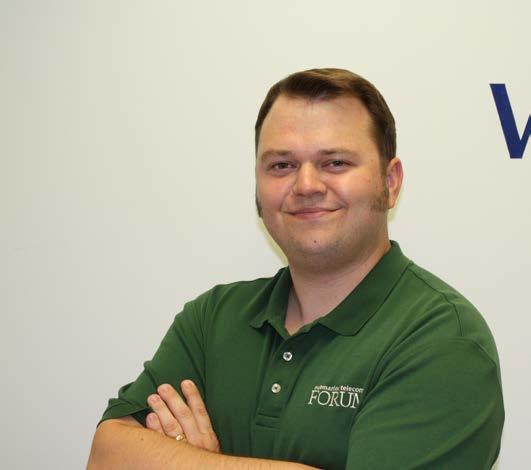
Kieran Clark is an Analyst for Submarine Telecoms Forum. He joined the company in 2013 as a Broadcast Technician to provide support for live event video streaming. In 2014, Kieran was promoted
Forum publications. He has 4+ years of live production experience and has worked alongside some of the premier organizations in video web streaming. to Analyst and is currently responsible for the research and maintenance that supports the SubTel Forum International Submarine Cable Database; his analysis is featured in almost the entire array of SubTel
business as usual again for all parties involved.
While recent trends have shown upgrade activity to almost come to a screeching halt, a system upgrade is still by far the most cost effective method of meeting ever increasing bandwidth demands. The time and money saved by performing a system upgrade instead of building an entirely new system has not changed, even if the industry seems to be in a holding pattern until the next generation technology arrives. The future for upgrades looks brighter than ever despite this temporary slowdown,
From shore to shore .
and as customers continue to clamor for more and more bandwidth expect to see a rush of upgrades almost as soon as 400G arrives.
Squeezing the Stone Extracting More Capacity and Achieving Enhanced Differentiation in Subsea Transmission
Geoff Bennett & Benoit Kowalski
The move from 10G non-coherent, to 100G coherent wavelengths in all forms of subsea transmission is more or less complete, and has happened faster than analysts originally estimated – with the 40G data rate rapidly falling out of favor once 100G economics became clear. Those economics were not only driven by increased spectral efficiency, but associated technologies such as coherent superchannels have become key factors for network operators to achieve service differentiation in a market that has long been seen as a commodity.
The Coherent Technology Miracle
While the DWDM industry has an excellent track record of increasing capacity and data rates over time, the move from 2010 onwards to coherent transmission has delivered a quantum leap in capacity-reach product that will be difficult to improve on in the near future.
Input data stream for
Figure 1: Coherent transmitter and receiver indicating optical (red) and electronic (blue) component blocks.
Figure 1 shows a typical 100Gb/s coherent optical circuit – with “first generation” coherent having all of its digital processing power in the receiver that was focused on chromatic dispersion and polarization mode dispersion (PMD) compensation; and “second generation” coherent adding transmitter-based digital pulse shaping, additional chromatic dispersion compensation, and receiverbased non-linear processing.
This optical circuit is extremely capable, delivering over a twentyfold increase in the capacity-reach product compared to 10Gb/s intensity modulation with direct detection (IM-
DD). A key point is that this achievement has been possible over existing submarine cable wet plant, enabling a massive upgrade capability as network operators replaced existing submarine line terminating equipment (SLTE) with coherent systems.
The next step, of course, is to take full advantage of new submarine cable types – in particular the large area/low loss G.654 fiber types that are being
8QAM, or perhaps even PM-16QAM modulation (instead of PM-QPSK). The value delivered by moving to these higher order modulation techniques is a dramatic increase in spectral efficiency, and thus a higher fiber capacity.
In March of this year, a major lab trial showed that it is possible to close “transAtlantic” distances (in this case over 7,400km) with PM-8QAM over a LA/LL fiber provided by OFS.
deployed in the latest subsea cable systems as positive dispersion cables (vs dispersion managed cable systems of previous deployment generations). These cables offer far better non-linear performance, coupled with significantly lower attenuation, to the point where it could be possible to close long Pacific spans using Pol Muxed QPSK modulation (instead of PM-BPSK), and transAtlantic cables using PM-
Following these successful lab trials likely that we will see field trials, and perhaps even real deployments of higher order modulation technologies on subsea cables in 2016.
Super-Channels: Beyond 100Gb/s
A number of academic papers have described how the industry is approaching a point of diminishing returns for capacity increases – and the conclusions are often simplistically represented as an approaching “capacity
exhaust” in optical fibers. It may be true, for example, that the next generation optical cables spanning the Atlantic could be limited to between fifteen and twenty terabits per second total capacity, and a trans-Pacific next generation cable to between ten and twelve terabits per second. It may be possible to double these limits by simply adding L-Band transmission to the existing C-Band systems, but this would require very different wet plant from what is installed, or is being installed, today.
Thus, when the industry asks the question “what comes after 100Gb/s” it is not typically a question of fiber capacity – this is a function of coherent technology, and the achievable fiber capacity is perfectly adequate for the current cycle of new deployments. Rather the question is focused on operational scalability; in other words, how can a single engineering team turn up significantly more subsea capacity in a given
operational cycle? How can a network operator deliver services more quickly, and with more efficient cash flow?
The seemingly obvious answer is to simply crank up the symbol rate for the optical and electronic circuits shown in Figure 1. To deliver today’s typical 100Gb/s data rate using PM-QPSK (which carries 4 bits per symbol) would imply a Baud rate between 32 and 35 GBaud (note that this quoted range of values is due to different sizes of Forward Error Correction, FEC, overhead
used by different vendors).
But increasing the Baud rate is not happening in practice for commercial products. The first single wavelength 100Gb/s implementation, operating in 32-35GBaud range, began shipping almost five years ago, and here we are today with leading edge implementations still operating in the 32-35GBaud range. The reason is that the electronics that drives the optical circuit is now a bottleneck for serial processing. Chip power is increasing, but it is doing so by offering more parallel processing power.
There are two ways that next generation coherent implementation may overcome this limit, and thereby increase the data rate per line card. One is by moving to higher order modulation techniques; ie. PM-BPSK -> PM-3QAM -> PM-QPSK -> PM-8QAM -> PM-16QAM (which carry 2, 3, 4, 6 and 8 bits per symbol respectively). As pointed out above, moving along this scale increases spectral efficiency – with each modulation symbol “carrying more bits”. But at the same time the optical reach will drop, with PM16QAM losing about 80% of
the reach compared to PMQPSK, for only double the line card or fiber capacity.
The other approach is to “go parallel” with multiple 100Gb/s optical carriers. This means implementing multiple optical circuits, each operating at the optimum Baud rate to achieve a balance between capacity and reach, on a single line card so that all the capacity can be brought into service in a single operational cycle. As mentioned above, the resulting optical signal is called a “super-channel”, and it is the direction
that the entire optical industry is now taking to achieve greater operational scalability. Super-channel subsea systems are now widely deployed in all parts of the world, from the longest Pacific routes, through to cables that circle South America and Africa, and crisscross South East Asia and the Mediterranean Sea.
Using today’s typical 500Gb/s super-channel line cards, a single engineer can turn up five times as much capacity in the time it takes to bring a 100Gb/s transponder into service; and the next generation of super-channel line cards will deliver 1.2Tb/s of capacity (an ideal way to support, for example, the next generation of 400GbE services).
Adding Cashflow Efficiency
It is tempting to assume that OpEx for subsea operators could be driven down by simply implementing super-channel line cards
with ever-more capacity. But is this a viable approach from a cashflow perspective? In other words, while the network planning department would readily embrace a 500Gb/s or even a 1.2Tb/s line card in which all of the wavelength planning is done in one step, the finance department might be reluctant to pay for it until there are revenuegenerating services that need to use it.
With a super-channel line card it is possible to license the capacity in 100Gb/s “chunks” (note that while this is technically possible for any vendor’s superchannel line card, you should check if your vendor offers this as a commercial option). With this approach, all of the wavelengths of the super-channel are lit from day one (avoiding the need for idler channels to be taken in and out of service), the network operator can pay for 100Gb/s slices of capacity as needed. More importantly these 100Gb/s bandwidth slices can be
activated “instantly” (ie. within the timeframe of the financial approval, and not usually limited by the technology activation timeframe).
This is a radical change in service delivery capability for a typical subsea network. An un-forecast subsea transponder might have a lead time of the order of nine to twelve months, whereas a new 100Gb/s
slice of an existing superchannel line card could be activated in minutes.
A novel option would be to allow a network operator to maintain a “floating pool” of bandwidth licenses. These could be moved around the network if spare capacity exists on a given link, and an obvious application would be as part of a service protection strategy.
Failures have occurred on Paths 1 and 2 between nodes A and B, and Fast Shared Mesh Protection has moved high priority services onto Path 5 in sub-50ms (route A-D-C-B in this example).
However, Path 5 is now more heavily loaded than the network operator’s Traffic Engineering guidelines permit.
An “instant bandwidth” feature allows the network operator to move super-channel capacity licenses from Paths 1 and 2 onto Path 5, thereby boosting the capacity on this link and rebalancing the traffic pattern in the network.
When Paths 1 and 2 have been repaired, FastSMP revertion can allow services to be put back on their original paths, and the Instant Bandwidth licenses can be restored to their original states.
original link is repaired, the licenses can be returned to the “pool”.
This capability was used earlier this year on the AJC cable system after a subsea cable fault in 7,000 to 8,000 metres of water depth. Over 400Gb/s of traffic was rerouted in just a few minutes using this “instant bandwidth” capability on the existing super-channels. This type of temporary capacity increase can come at no additional cost, and the licenses are simply returned to the bandwidth pool, in this case following the cable repair.
2: Dynamic Traffic Engineering using an instant bandwidth licensing technique for super-channel capacity
In Figure 2 we can see how this would work. Let’s assume a cable fault (eg. caused by a fishing trawl, ship’s anchor dragging, or a subsea earthquake) occurs between A and B. Protection techniques such
as ITU-T Shared Mesh Protection can ensure service continuity against SLAs, but in this case it may be that the protection path over A-D-C-B is now carrying more traffic than the network operator’s traffic engineering guidelines recommend. By activating a number of timebased bandwidth licenses it is possible to rebalance the traffic matrix and remain within traffic engineering parameters. When the
Conclusion: Subsea Service Differentiation
The move to 100Gb/s coherent transmission for SLTE upgrades is now well under way. Existing cable capacity can be increased by perhaps a factor of ten – and new cable types offer even greater capacity, while taking full advantage of second generation coherent technologies.
Figure
But capacity on its own does not offer a clear differentiation for subsea operators. New technologies based on super-channel line card designs offer dramatic reductions in operational scalability while an “instant bandwidth” capability on these line cards reduces new capacity deployment times from months to minutes.
As internet demands, driven by cloud services, higher video quality, and high definition mobile devices, continue to grow exponentially there has
Geoff Bennett is the Director of Solutions & Technology for Infinera.
never been a clearer reason for subsea operators to look to innovative network upgrades.
Geoff has over 20 years of experience in the data communications industry, including leading engineering roles at Proteon and Wellfleet, FORE Systems and Marconi, where he held the position of Distinguished Engineer in the CTO Office.
Geoff is the author of “Designing TCP/ IP Internetworks”, published by VNR.
Dr. Benoit Kowalski is Director Subsea for Infinera Corporation and brings more than 20 years of experience in the transmission on optical fibers for Telecom terrestrial and submarine applications. Prior to Infinera, Benoit held leading engineering roles at FLAG TELECOM, France Telecom research center CNET – where he acquired a PhD in Optics and Photonics – and Alcatel Alsthom Research in Paris, France.
Is Life Really Over At 25?
Extending the Practical Economic Lifetime of Submarine Cables by Proactive Health Monitoring
Colin Anderson
What do we mean by the Design Lifetime of a Submarine Cable?
When talking about the lifetime of submarine cable wet plant infrastructure, the industry standard for the “Design Life” is 25 years. But this expression is often misused, misunderstood, or misinterpreted. Design Lifetime is a contractual term. It guarantees to the cable purchasers that the supplier has engineered and manufactured the cable so that there is a high probability that no more than one fault will occur in the system during the first 25 years that would require a “ship repair” - in other words, a fault which requires the cable or a repeater to be recovered from the seabed and repaired. It is also the period that the supplier agrees to service for the system.
There is a huge engineering effort put into the design of the wet plant to achieve high levels of reliability.
However, assumptions are inherent in the calculations of Design Life, and exclude failures due to damage from human or natural causes, including shipping anchors, mining, dredging, undersea volcanoes, earthquakes, land-slides, etc.
The practical economic lifetime of a cable is not simply 25 years. It is driven by many factors including the reliability of the wet plant hardware, the incidence of human or natural intervention, and the overall business case for the network—including competition on that particular route. The actual lifetime of a cable network can vary and is determined on a case-by-case basis.
The Expectations at Time of Deployment
Around 2000 – 2002, many cables were put into service and the expectation was that the technology of each cable would remain constant, so the Design
Lifetime was considered as the real practical life. No one had a clear view of the rapid changes that coherent technology would bring some 8-10 years later, and it was reasonable to expect that it would not be possible to extend the cable life beyond 25 years.
Recent coherent innovations in the Submarine Line
Terminal Equipment (SLTE) have been a disruptive factor in subsea optical
networking. We have seen a transformation of the industry from 2.5 Gb/s and 10 Gb/s technologies to coherent 40 Gb/s and 100 Gb/s WDM technologies. This has enabled significant increases in the ultimate capacity on existing and new cables. New digital signal processors (DSP) solutions have allowed cable operators to apply the concepts of webscale IT to their networks, resulting in increased
capacity, lower cost per bit, increased levels of software-defined flexibility, and lower Operations and Maintenance (O&M) costs.
Submarine network infrastructure is expensive to build, maintain, and operate. Utilizing the latest SLTE technologies, submarine cable owners and operators can monetize their assets and extract the
maximum value from their investments in submerged plant infrastructure. Today, a single SLTE linecard can provision five programmable modulation schemes, so the transmission can be tailored to provide optimum performance on any submarine submerged plant (‘wet plant’) regardless of its technology or length.
For cables that are now approximately halfway through the 25 year “Design Lifetime,” there is no longer a need for specific engineered components to precisely match the original system design in case of repair. For example, newer fiber introduced into an older system will change the dispersion characteristics in a way that would have prevented operation with a 2.5 Gb/s or 10 Gb/s SLTE, but will have no significant impact (or even a positive impact) on performance when using the latest coherent SLTE. Similarly, it can easily be argued and contemplated that a newer repeater introduced into an older system will have no negative impacts on performance when using coherent SLTE. In theory, there is no need for a cable owner to contract with the original supplier for support of the wet pant after 25 years. An alternative supplier could supply repeaters, cable,
monitoring equipment, etc. to support a cable after 25 years, if the owner wished.
Is a Longer Life Better?
So what determines the practical lifetime of a cable, and is a lifetime longer than 25 years better? There is no easy answer, just as there is no single answer for the practical lifetime of a car, a washing machine, or a light bulb. Some will last longer than others, and sometimes there will be a reason why the owner of a car or a submarine cable wants to extend or shorten the working lifetime. In the case of a submarine cable, it is the owner’s decision based on the business case for the network.
What we do know is that there can be random faults, and there is the well-known ‘bath-tub’ curve which applies to the aging process of many things including submarine cables. It means there are some faults early in life, then a long
stable period of reliable performance, followed by an increasing probability of failures over time once we hit the “wear-out” phase. Cable owners have little information about the real engineering life of the cable, or how far it is from the beginning of the “wearout” end of the bath-tub curve.
More Data and Analysis – Hardware and Software Working Together
In the industry, we often quote Moore’s Law for the progress of semiconductor gate size and associated processing power improvements. But there have also been significant advances in software technologies in recent years.
Today’s coherent SLTE hardware provides a wealth of data about the operation and performance of every wavelength of the system, measured with very frequent sampling. But unless this data is analysed
and presented in a useful way then it is not of value to the cable owner. Today’s advanced software allows for real-time analytic insight on line performance, and
Proactive Monitoring and Trend Analysis Bring Valuable Results
What is key is the ability to perform background
the ability to present this to the end user in a friendly and readable format.
Taking the additional data from regular repeater scans and Cable Optical Time Domain Reflectometer (C-OTDR) scans of the wet plant, together with the data available from the coherent modems, gives an extensive ongoing analysis of the wet plant performance over months and years, without the need for human intervention to start or stop scans, as was traditionally required in the past. And, unlike in the past, the huge amount of data generated can more easily be presented in a summarised and useful way with today’s sophisticated Network Management System software. As SLTE technologies continue to progress, access to this information will help to squeeze more capacity out of legacy and newly built cables.
analytics on an ongoing basis, with parameters set by the user to identify any short-term, medium-term, and long-term anomalies or trends in performance.
In the future, when determining how to meet new capacity demands, leveraging this software will provide cable operators
with the critical information needed to consider if they should adopt new SLTE technologies on existing cable wet plants or build a new cable instead. Having an informed estimate of the condition and expected remaining lifetime of the existing cable’s wet plant is a critically important input to this decision.
With the Right Data, Cable Owners Can Make the Right Decisions
The Design Lifetime of 25 years is a contractual term, not an absolute lifespan at the end of which the cable should suddenly be switched off. Every complex system has its own real lifetime, and for each individual cable there will be an age - whether it is 20, 25, 30, 35 years or morewhen it is past the point of being economic to maintain.
If a submarine cable is inherently unreliable, due to unexpected problems in the submerged plant or
continued, unacceptably frequent external aggression, or if it is not profitable to keep the cable in service for any other reason, the cable owner may decide to take the cable out of service before it has served 25 years. Similarly, if the available data indicates that a cable is reliable and if its business case is still viable, then there is no reason to take the cable out of service after 25 years.
The key for cable owners is to know as much as possible about the existing performance of the wet plant at any point in time, and to have as much information as possible about the slow degradations in performance. This will allow owners to predict when the cable might reach a point where it is best to remove it from service.
Extracting as much data as reasonably feasible from the coherent modems, regular repeater scans, Optical Time Domain Reflectometer
scans, the Path Far End, and other sources, as well as doing extensive current analysis and trend analysis are among the most effective ways to help a cable owner prepare for the future. Leveraging advanced software and analytics can also help owners make more informed decisions between investing in new cables or upgrading existing cables.
Colin Anderson is marketing director for global submarine systems at Ciena. He has 29 years of experience in sales & marketing, engineering, and business development roles in the subsea and terrestrial telecommunications markets, and has been involved in the bidding and construction of many significant subsea cable networks - including Southern Cross Cable Network, Japan-US Cable Network, AAG, SEAME-WE 4, and FNAL/ RNAL - as well as the subsequent upgrade of these and many other cables.
The Power of Submarine Information Transmission
There’s a new power under ocean uniting the world in a whole new way. With unparalleled development expertise and outstanding technology, Huawei Marine is revolutionizing trans-ocean communications with a new generation of repeaters and highly reliable submarine cable systems that offer greater transmission capacity, longer transmission distances and faster response to customer needs. Huawei Marine: connecting the world one ocean at a time.
New Technologies for
Upgrading Existing Unrepeatered Cable Systems
Along with longdistance repeatered submarine cable systems, shorter distance unrepeatered cable systems are part of the worldwide subsea transmission infrastructure transporting the IP traffic across the globe. Unrepeatered subsea cable systems refer to submarine links with nothing under water but the optical cable, with active equipment –namely the Submarine Line Terminal Equipment (SLTE) – being located in the cable landing stations. The unrepeatered system category was extended to systems with submerged Remote Optically Pumped Amplifiers (ROPAs) jointed to the cable some distance away (typically 80 to 150 km) from the landing sites. The rationale for this definition extension is that ROPAs do not require electrical power – so no electrical Power Feed Equipment (PFE) needed in the cable landing station – and that there is no requirement for a copper-based power conductor in the cable.
Recent publications have reported increased unrepeatered distances with for instance 150 x 100G channel unrepeatered transmission over 410 km, 1 x 100G over 627 km and 1 x 10G over 645 km.
These demonstrations were carried out with commercially-available STLE and high-end line fibers offering ultra-low attenuation and very large effective area. These advanced line fibers are available, at the expense of higher cost compared with more standard fibers, for new builds that can achieve this Capacity – Reach performance in commercial service.
Because unrepeatered cable systems are loss-limited systems, there is a strong coupling between the link fiber capacity and reach performance: when one is increased, the other one is reduced. Every technical innovation that improves one characteristic has an impact (generally positive)
on the other one as described in the following section. This article describes the different ways the recent innovations can be used for upgrading existing unrepeatered cable systems.
There are two main reasons that lead to the need for a system upgrade. One reason is the increase in cable loss over time, due to for instance multiple cable repairs, which reduces the system margin or does not allow the system to operate error free. When several cable repairs are located along a small cable length, it may make sense to replace this cable length by a new piece of cable. But in the case these multiple cable repairs are distributed over a long cable length, this may not be a practical and/or economically viable approach. The second reason is the need for increasing the cable capacity by increasing the
channel rate or count. The objective here is to play first at the cable landing station by upgrading or replacing the existing SLTE using newer optical transport technologies. If the SLTE (or dry) upgrade is not enough to reach the desired capacity performance, wet upgrade can be contemplated as discussed at the end of this article.
Advanced Interface Cards
The need for higher capacity over longer distances in optical transmission systems has rekindled the interest in coherent detection. One approach to increase the data throughput is to maximize the spectral efficiency, measured in bit/s/Hz. Until the advent of 100G systems around 2010, most optical transmission systems use binary modulation formats with direct (noncoherent) detection and achieve spectral efficiencies of 0.8 bit/s/Hz. Higher spectral efficiencies call for more advanced modulation
schemes that encode the information to be transmitted along several axes: amplitude, phase, polarization. Recovery of the information symbols at the receiver requires the more complex (polarization alignment, carrier synchronization), but also higher sensitivity, coherent detection.
More stringent Optical Signal-to-Noise Ratio (OSNR) requirements, as imposed by higher channel rates, are the drivers for stronger Forward Error Correction (FEC) codes. Like with repeatered cable systems, and driven by the higher OSNR figure required by 100G and beyond channel rate, softdecision FEC have been used in unrepeatered systems since 2013, based on even more powerful encoding and decoding algorithms and soft decision mechanism.
Both coherent detection, including powerful digital signal processing, and FEC
code enable to increase the capacity over given cable length and attenuation.
Adding Raman Pumping for Distributed Optical
Amplification along the Cable
Distributed Raman optical amplification is a simple, field-proven way to instantaneously increase both capacity and system margin over the existing fiber plant. Raman amplification of an optical signal occurs when the signal is transmitted through an optically-pumped material with a frequency which falls within the Raman scattering spectrum of the pump source [3]. The signal photon triggers the stimulated emission of a photon at the signal wavelength, which is in phase with, and propagates in the same direction as, the original signal photon, and so leads to Raman gain. Practically speaking, the optical pump wavelength (launched from the cable landing station equipment)
is in the range of 1420 to 1500 nm in order provide optical amplification around 1560 nm where line fiber attenuation is minimal (Figure 1).
Distributed optical Raman amplification results in lower per channel power inside the fiber (leading to lower fiber nonlinearities) and higher OSNR compared to a fiber link made of discrete ErbiumDoped Fiber Amplifiers (EDFAs). Figure 2a shows an unrepeatered cable system with no distributed optical amplification. At the
Optical gain created by distributed Raman amplification inside the line fiber
the fiber nonlinearities threshold; also per channel power can go under the lower optical noise limit. A very efficient way to recover from this situation is to turn some parts of the line fiber into amplification media as shown in Figure 2b. This is achieved with Raman pump wavelengths launched from the received end (backward pumping) and/ or from the transmit end (forward pumping); Raman effect will create distributed
optical amplification inside the line fiber as shown in Figure 2b.
Figure 2: a) Per channel power as a function of the transmission distance in an unrepeatered cable system with only discrete amplification at the SLTE level at beginning (dashed green line) and mid (solid green line) life of the cable system, and b) Per channel power as a function of the transmission distance with
forward and backward distributed Raman amplification inside the line fiber.
Starting from a baseline where the SLTE is equipped with only EDFA amplifier at both transmit and receive sides, and assuming 100G coherent interfaces with 15% overhead SDFEC and a target OSNR of 13.5 dB / 0.1 nm, backward Raman pumping offers the equivalent of up to 9 dB
of extra cable attenuation; adding forward Raman pumping can offer another extra cable attenuation of up to 10 dB [4]. The exact figures depend on the line fiber type and linear attenuation but distributed Raman amplification is clearly a simple and very effective way to breathe new life in existing subsea cable system that becomes loss-limited over time.
Adding Remote Optically Pumped Amplifier
A
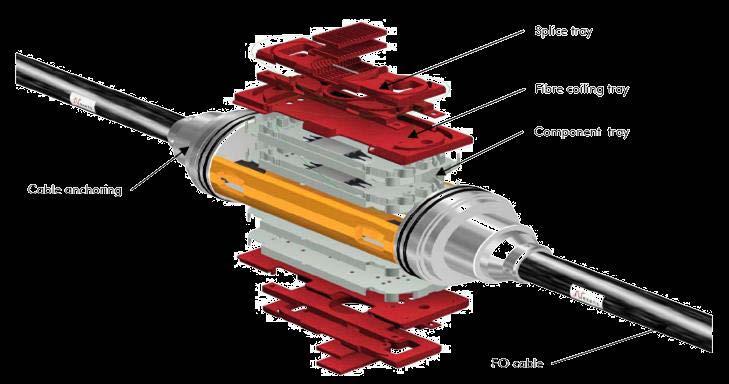
Remote Optically Pumped Amplifier (ROPA) is a very simple sub-system that is typically placed 80 to 150 km ahead of the receive end. This subsystem is based on a few passive optical components that are placed inside an enclosure jointed to the cable (Figure 3). By nature, the ROPA is a fully passive sub-system that requires no remote electrical power feeding from the cable end.
The energy, necessary for creating optical
amplification, is brought to the ROPA by optical pump waves launched into the line fiber from the terminal equipment. Actually this is the residual pump power that has not be consumed to build Raman distributed gain inside the line fiber that is used to pump the ROPA. As we are in a small-signal regime in the backward pumping scheme, 5 to 10 mW of pump power is
enough to create sufficient optical gain (in the range of 20 dB) at the ROPA level (Figure 4).
new piece of cable, actually the ROPA with its two cable tails). The cost of the required marine operations favorably compares with the cost of deploying a new cable system.
Figure 4: Per channel power as a function of the transmission distance in an unrepeatered cable system with forward and backward distributed Raman amplification inside the line fiber, and receive ROPA located before the receive end.
Starting from the same baseline as above, a receive ROPA offers the equivalent of up to 11 dB of extra cable attenuation. Here again, the exact figure depends on the line fiber type and linear attenuation. The addition of a ROPA to an existing subsea cable systems requires a few days of marine operations and is quite similar to a cable repair process (recovery of the cable and jointing a
Upgrading Network Configuration
Distributed Raman amplification and ROPA have been described so far in this article as ways to cope with cable loss increasing over time. Both technologies can be used for modifying the configuration of the subsea network based on unrepeatered cable systems. Two examples will be briefly discussed here.
The first example of unrepeatered system configuration upgrade can be found in festoon network. With previous optical transport technologies, festoon networks were usually made of cascaded single-span segments, with back-to-back regeneration
Figure 3: ROPA enclosure for subsea applications (Courtesy of Nexans).
in cable landing stations for pass-thru traffic as depicted in Figure 5a.
with ROADM optical switch offering optical passthru for the express traffic.
Figure 5: a) Traditional festoon network configuration with backto-back regeneration in cable landing stations for pass-thru traffic, and b) New festoon network configuration enabled by more advanced optical amplification technology
Implementing Raman pump source modules at the SLTE levels not only offers extra margins for single-span transmission but also enables express wavelengths to propagate beyond a single span. This opens the path for new SLTE architecture based
on Reconfigurable Optical Add Drop Multiplexers (ROADMs in Figure 5b) where express wavelengths are passed thru and local wavelengths are added/ dropped for local traffic purposes. By doing this, the cost per transported bit for express wavelength is greatly reduced and the global operation of the network is simplified as ROADMs can be remotely reconfigured via the network management system. The extra margins provided by distributed Raman amplification can be used to modify the configuration and reach of existing unrepeatered cable systems.
Figure 6 represents the example of an unrepeatered system connecting A to B, originally deployed with only EDFA amplifiers within the SLTE equipment (Figure 6a).
Back-to-back regeneration
ROADM for optical pass-thru and local add/drop
(a)
(b)
ROADM for optical pass-thru and local add/drop
ROADM for optical pass-thru and local add/drop
Figure 6: a) Originally deployed unrepeatered link between cable landing stations A and B, with EDFA amplifiers only, and b) Network extension enabled by distributed optical amplification technology, SLTE upgrade and wet plant upgrade.
At the expense of the insertion of a branching unit (assuming fiber pairs are free or can be freed up) and the upgrade of SLTE with Raman pump source modules to build
distributed again inside the line fiber, a new network configuration can be implemented, enabling to reach a new landing site C that may be more distant from the site A than the site B is (Figure 6b).
Conclusion
Although the advanced of unrepeatered transport technologies are usually advertised through the announcement of transmission demonstrations over state-of-the-art fibers, these
technologies can be deployed in many ways into existing unrepeatered cable systems. Taking into account wet plant upgrade and ROADM implementation inside cable landing stations, the tool box of subsea system designers is getting richer and richer for extending the lifetime and capabilities of existing unrepeatered cable systems.
Bertrand Clesca is Head of Global Marketing for Xtera and is based in Paris, France. Bertrand has over twenty five years of experience in the optical telecommunications industry, having held a number of research, engineering, marketing and sales positions in both small and large organizations.
Bertrand Clesca holds an MSC in Physics and Optical Engineering from Institut d’Optique Graduate School, Orsay (France), an MSC in Telecommunications from Telecom ParisTech (fka Ecole Nationale Supérieure des Télécommunications), Paris (France), and an MBA from Sciences Po (aka Institut d’Etudes Politiques), Paris (France).
pump
Branching unit
Hibernia Express
Phil Footman-Williams
Hibernia Express is the first transatlantic cable system built in more than 12 years. The Atlantic corridor is the world’s business transoceanic route where bandwidth demand is growing 40 percent annually according to TeleGeography estimates.1 Hibernia Express is designed to offer the marketplace a suite of lower latency, high capacity network connectivity solutions to enable split second financial transactions, the transport of media-rich content and big data, and efficient access to cloud applications. To achieve this objective, the new cable system utilizes the latest generation optical technologies and cable construction techniques.
Overall Description of the Route
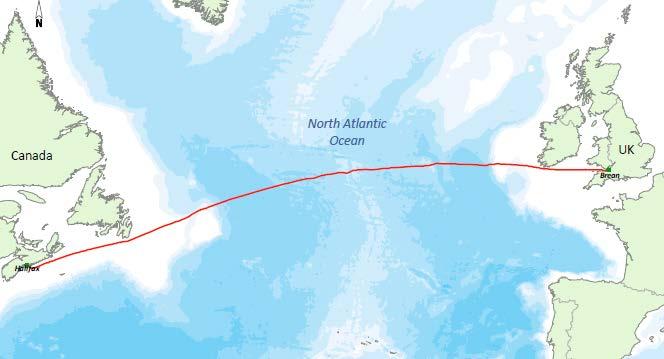
The Hibernia Express Cable System is a repeatered submarine cable system of »4,600 kilometres providing connectivity between Halifax in Canada and Brean in the United Kingdom, with a branch to Ballinspittle in Ireland.
The cable route has been specifically designed to provide the lowest latency and highest capacity cable system across the North Atlantic Ocean. The lowest latency route between any two points on earth is achieved by following the shortest end-toend route distance, which is a great circle route. The shortest route distance across the
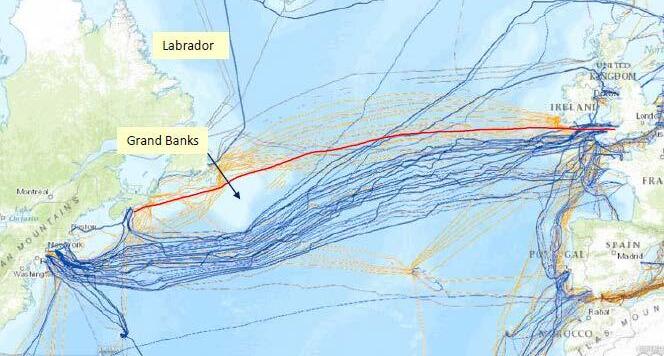
Atlantic is a northern, great circle route and Hibernia Express, which is based on a modified great circle route, is illustrated in the chart to the left.
This route is close to the original, historical route of the late 19th and early 20th centuries which was followed by telegraph cables whereas recent cables across the North Atlantic adopt the longer, more southern route. The chart below shows the original, telegraph cable routes in orange and the more recent cable routes in blue above.
The two main routes shown in the chart above highlight some clear differences:
• The northern (orange routes) are shorter than the southern (blue routes)
• The southern routes head south of the shallower water Grand Banks south of Newfoundland whereas the northern routes head directly across the Grand Banks
• The northern routes crosses the colder region of icebergs off Labrador whereas the southern routes remain in warmer, ice-free waters
Cable Route Planning
Submarine cable routes are engineered after due consideration of the natural and human factors that could affect the cable system
in the long term and also after consideration of the conditions and hazards that could affect permitting, surveying, installation and maintenance operations. Hazards and risks which are identified and assessed during the process of engineering a safe route include environmental, fisheries and physical seabed conditions and the investigation of these were particularly critical for Hibernia Express in order to ensure the long term integrity of the system along this northern route.
Detailed investigations of the expected conditions along the route were undertaken by Desk Top Studies and marine route surveys and revealed the distinctions between the northern and southern routes as outlined below. Once the hazards and risks were assessed, mitigation plans and methods were implemented. The hazards are outlined below:
• Wind and storm patterns indicate a highest frequency in northern areas of the Atlantic and the region off Canada is a zone of frequent,
strong depressions which trend NE along the coasts of Nova Scotia and Newfoundland. The highest gale frequencies occur during the winter between November and March, although storms occur in all areas of the North Atlantic and the difference between the northern and southern routes may not be significant – it is the time of year of the operation that is relevant.
• The northern route is affected by two main ice patterns, namely Seasonal Sea Ice and Icebergs, although the southern route is not affected by ice.
Seasonal Sea Ice forms and changes in extent annually between January and April, with its southern edge reaching towards Newfoundland and approaching the cable route, although its extent depends on the severity of the winter. In typical years, the northern cable route would be expected to be navigable, however, the winter of 2014/2015 proved to be severe and
the ice field crept over the route close to Newfoundland. Sea Ice does not represent a threat to cable security but can pose a moderate risk to a vessel working in the area. Sea Ice movement is monitored by the National Snow and Ice Data Centre and ice reports and forecasts were received by the vessels and operational team on a daily basis.
Icebergs calve from glaciers in West Greenland and drift with currents down Baffin Bay and southwards onto the Grand Banks off Newfoundland. This process can take a few
years and the resulting icebergs on the Grand Banks will have melted or disintegrated down to a smaller growler or an identifiable iceberg. Both growlers and icebergs can be dangerous to vessels during the average season between February and July. The Canadian and US Coastguard use aircraft and other means to monitor and track icebergs and they issue daily forecasts of iceberg movement. Icebergs and growlers represented a potential risk to the TE SubCom vessels operating in the area during the
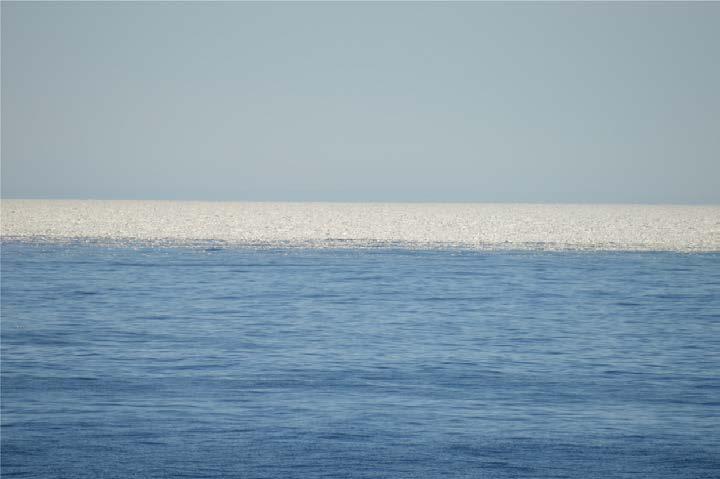
This photograph was taken from the ship undertaking the pre lay grapnel run showing it approaching a seasonal sea ice field on the route.
project, but they also have the potential to pose a threat to the installed cable due to ice scouring of the seabed.
• The route over the Grand Banks is subject to long periods of thick fog and is recognized as the foggiest place in the world and, given the presence of Seasonal Sea Ice and Icebergs, as well as fishing vessels, great care was taken by the vessels to avoid collision when operating in this area. The southern route avoids the Grand Banks and is not subject to these prolonged periods of fog.
• Fishing stocks have declined on the Grand Banks in recent decades, nevertheless, the Canadian fishing industry is dynamic and strong. There is a wide variety of fishing undertaken in the area, depending on the specific time of year, but it includes bottom trawling, long lining, long strings of large pots and also individually buoyed pots, with fishing activity beginning to extend down into deeper waters over 1000 meters. The large variety of fishing represents a potential hazard to the Hibernia Express cable and to the
installation as the route follows a route directly across the Grand Banks and through the fishing grounds. Fishing does also occur along the southern route, however, of a lesser intensity than encountered along the Grand Banks.
The cable route across the Grand Banks between Halifax and the deep water of the North Atlantic was »1600 kilometers and it was not possible to re-route around the hazards outlined above. In order to mitigate these hazards and risks, it was necessary to armour and
bury the cable throughout the entire route over the Grand Banks. Cable burial is dependent on the bathymetry and type of seabed and the route was surveyed in detail to establish a practical burial plan. It was decided to target >1 meter cable burial depth from the beach landing in Halifax, throughout the entire route across the Grand Banks and down to 1500 meters water depth.
The seabed geology over the Grand Banks varies from east to west with sand ridges and coarse sand/gravel on the eastern edge of the Grand
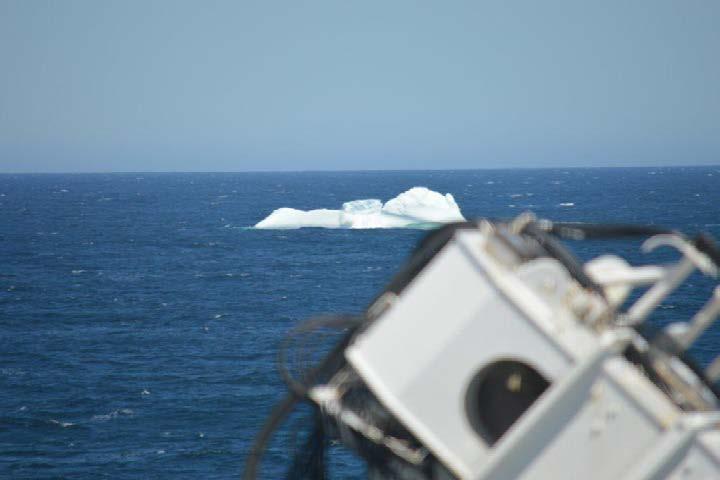
This photograph was taken from the ship undertaking the pre lay grapnel run showing it approaching an iceberg on the route.
Banks, in the deeper water – this was found to be over 1.5 meters thick and the installation vessel achieved deep burial here.
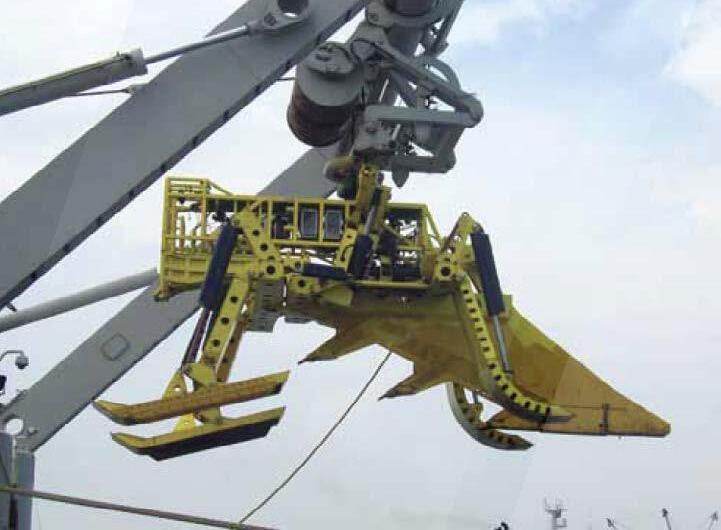
The shallower water plateau of the Grand Banks consists of glacial till which is composed of cohesive, silty clay with gravel and cobbles over bedrock which proved to be challenging for burial. The installation vessels used large, modern 35 ton ploughs, with up to 100 ton tow tensions and these were able to achieve sufficient burial.
Installation Planning and Operations
The objective of the project was to install the 4600 kilometre cable system along the northern route, including 1600 kilometres of burial on the Grand Banks, 900 kilometres of burial on the European continental shelf and 2100 kilometres of surface lay across the deep water section of the Atlantic Ocean. The installation planning team reviewed the objectives together with the hazard assessment at an early stage of the project and identified strategies to mitigate the risks
and complete the operations on time.
The weather patterns in the North Atlantic indicated an installation working window between April and September. In consideration of the large amount of cable burial and associated lengthy ploughing duration, with the narrow working window, it was decided that a three ship solution should be incorporated for the cable installation. In addition, there was an extensive Pre Lay Grapnel Run (PLGR) and route clearance (RC) scope to be undertaken prior to installation and outside the recommended working window. Accordingly, it was
decided to utilize a fourth TE Connectivity SubCom cableship to undertake this pre-installation operation. This vessel had the arduous task of clearing over forty out of service cables off the Canadian continental shelf. In total there were over sixty out of service cables to be cleared in preparation for the installation of the Hibernia Express cable.
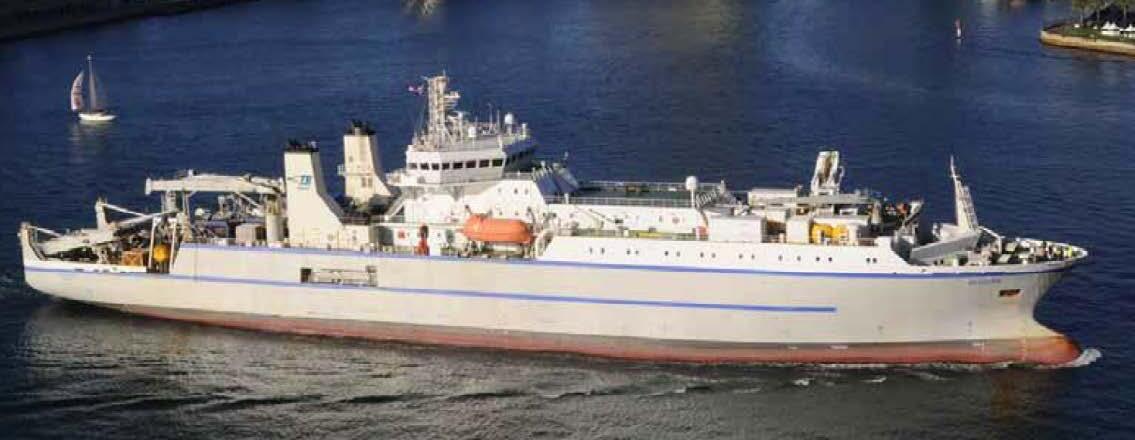
The
four TE
Connectivity
SubCom cableships were sister vessels and the vessel is illustrated in the photograph above.
Seasonal sea ice and icebergs represented a risk to the vessels during the operations and a
number of mitigation actions were adopted that allowed the cable to be installed safely and successfully:
• Airborne ice patrol services were procured and daily iceberg forecasts received. These forecasts tracked icebergs along and near the cable route and allowed the vessel master to operate safely
• The vessel and operational team liaised with, and worked closely with local companies who were experienced in working in the iceberg region
• The installation plan accounted for the ice season and scheduled operations
in the ice-hazard region outside the iceberg season
• A guide boat was employed which, although primarily chartered for fishing liaison duties, assisted in ice spotting duties
The fishing hazard on the Grand Banks, as well as on the European continental shelf, was identified at the earliest stage of the project and fishing liaison activities were instigat-
ed in advance of any marine operations. Liaison activities included port visits to fishing organisations to discuss the cable route and working windows, meetings with formal fishing authorities, distribution of cable warning charts, employment of fishing guide and guard boats and fishing liaison officers plus regular promulgation of Notices to Mariners. This resulted in very little interference with
fishermen and good relationships before, during and after the operations.
The large amount of cable burial and the harsh seabed conditions were reviewed and scrutinised during the planning stage and a large amount of plough spares were put on board the installation vessels. This enabled the vessels to carry out extensive ploughing operations and maintain and
repair equipment as required.
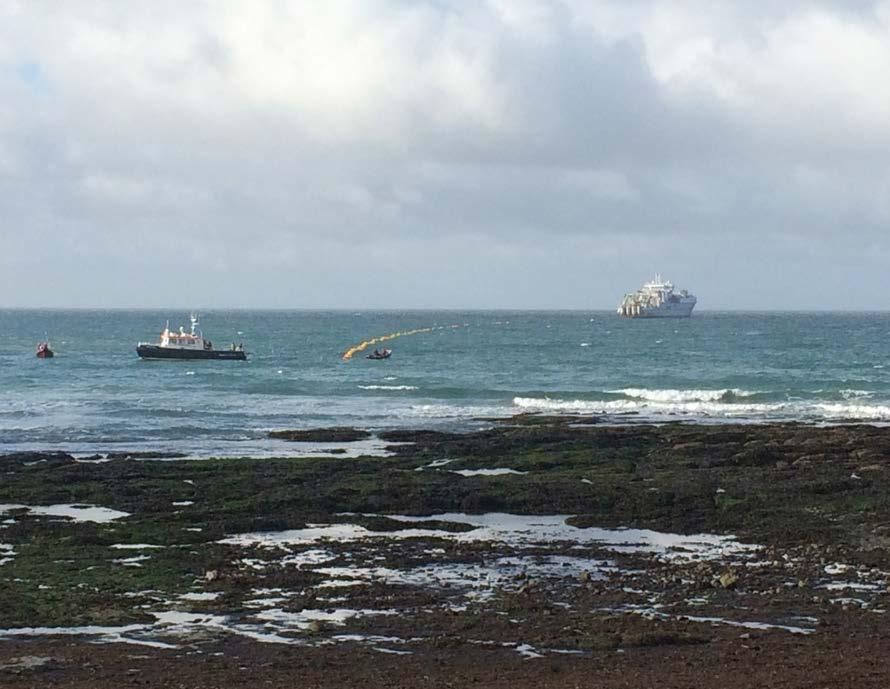
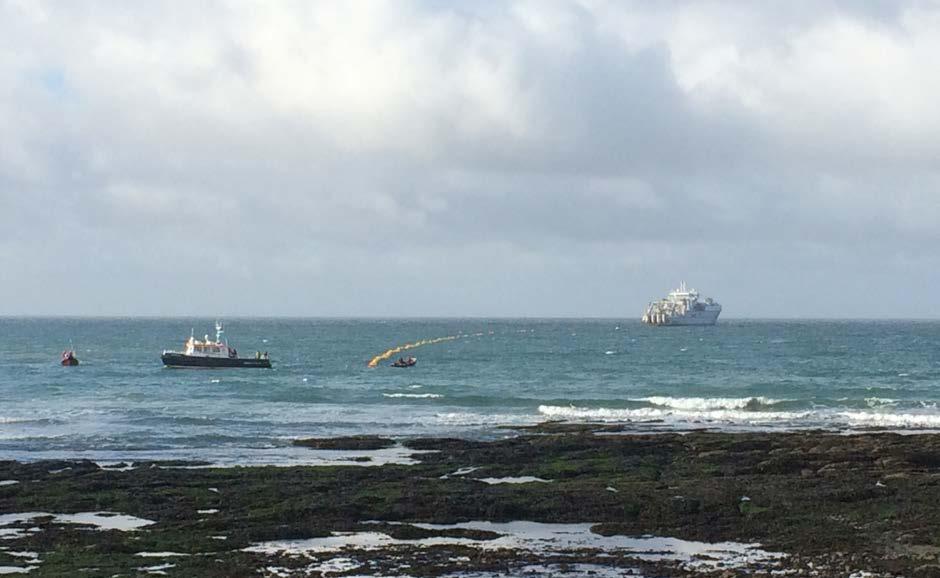
In certain areas close to shore it was not possible to bury the cable due to the existence of extensive bedrock. This was the case in Cork, Ireland where it was necessary to undertake a Horizontal Directional Drill (HDD) under the rock in order to protect the cable. The photograph to the left shows the shore end cable being landed into the HDD bore pipe.
The project Plan of Work and ships’ programme was developed to meet the stringent delivery date within a narrow working window and this was successfully achieved by the simultaneous utilization of numerous vessels, with a total of 19 vessels being used with ten being used at one time.
Benefits of the new Hibernia Express cable system
Hibernia Express benefits a variety of customer segments that rely on fast, secure high speed network connectivity. The optimized latency performance of Hibernia Express enables business critical applications in the financial markets and media and en-
tertainment segments. This includes efficient access to financial markets information supporting trading platforms and the transport of high resolution video content. The “webcentric” companies are another beneficiary of the high capacity capabilities of Hibernia Express, as these customers require large amounts of bandwidth that can scale up as business needs dictate. It is projected that globally, consumer Internet video traffic will be 80 percent of all consumer Internet traffic in 2019, up from 64 percent in 2014.This increase in video traffic traversing the network will continue to drive the requirement for higher capacity, lower latency network connectivity, which Hibernia Express has been engineered to address.
Conclusions
The decision to follow a northern route across the North Atlantic was successful in achieving low latency, end-to-end
transmission by installing along the shortest route.
The long-term hazards to the integrity of the cable were successfully mitigated by achieving burial along the entire route down to 1500 metres water depth.
The environmental hazards to the operations were successfully mitigated by increased liaison with local experts and advisors, vigilant seamanship and by scheduling marine operations in lower risk windows.
The use of numerous vessels, including the use of 3 installation vessels simultaneously ensured the maximum burial effort and completion on time.
Early and extensive liaison with fishing authorities and organizations proved successful in avoiding conflict with fishermen.
The most influential and critical factors in the success of the project were
the close and open working relationship between the Customer and Supplier, combined with outstanding teamwork between all parties.
Phil Footman-Williams has been involved in the submarine telecoms industry for 35 years, having joined the BT Marine cableship CS Alert as navigating officer in 1980. For the last 16 years, Phil has worked for TE SubCom in roles including Sales Support and Marine Project Coordination, where he now works. Phil has supported many projects world-wide including TGN in Europe, VSNL Intra Asia in the Far East, Main One in West Africa, Hibernia Express in the North Atlantic and projects in the Middle East Gulf Region and has always been available to live and work in-region for extensive periods. From coax to fiber and from surface to plough, Phil has always found this a challenging and innovative industry, full of surprises, opportunities and rewards.
Telecoms consulting of submarine cable systems for regional and trans-oceanic applications
Back Reflection
The North Pacific Winter Tour 1990
‘I cannot command the winds and weather’
`Horatio Nelson
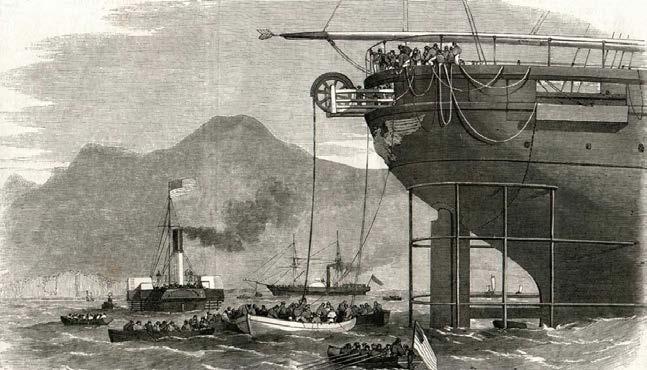
In July’s issue I briefly told the story of the SS Great Eastern’s historic first attempt to lay an Atlantic cable in 1865. Twentyfive years ago, I embarked on my on my own trans-oceanic cable laying adventure. After over twenty years of being a shipboard representative for STC Submarine Systems, it was my last cable laying operation and, as this will be my final Back Reflection, I thought that I would take this opportunity to reflect on the courage, professionalism and tenacity of the 120 men
by Stewart Ash
who sailed with me to lay the North Pacific Cable (NPC).
NPC was the first private trans-pacific, fibre optic cable system. It was built using regenerative repeaters and operating at 420Mbits/s. It was jointly supplied by STC Submarine Systems and NEC, with STC being responsible for supply and installation of 5,500km of deep water cable and more than 100 repeaters, spaced every 50km. NEC supplied the shallow water parts of the system at the Japan and US ends. The STC cable was manufactured in Southampton and its new factory in Portland, Oregon. The repeaters were all manufactured at the Greenwich factory and the
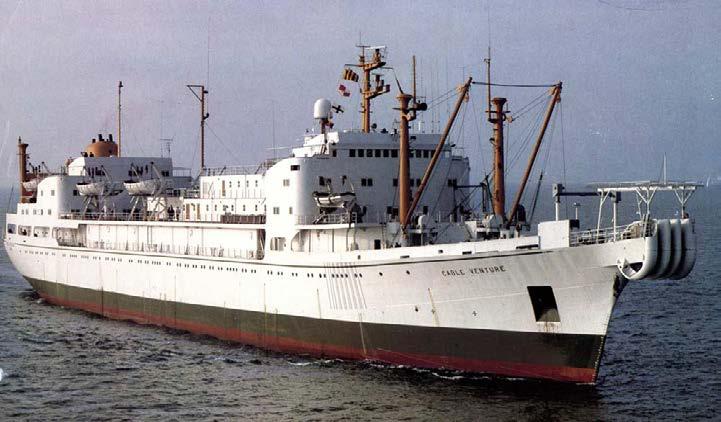
system was assembled in the two cable factories. Cable & Wireless Marine’s cableship, CS Cable Venture, was chartered to lay the cable. The second part of the assembled system to be laid was loaded in Southampton then Cable Venture sailed through the Panama Canal to Portland, Oregon where the remainder of the system was loaded into her 4 tanks. She then set sail for Yokohama to start the cable lay.
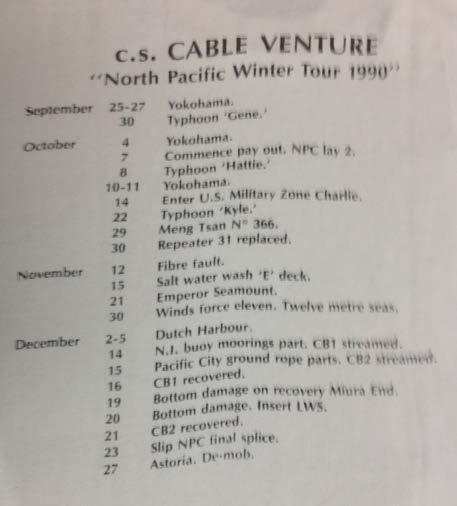
The STC team flew to Japan and we joined the ship in Yokohama on 26 September 1990; we sailed to the end of the already laid NEC cable the following day. However, the start of cable work was delayed as Typhon
‘Gene’ moved through the area. It goes without saying that ships should not be anywhere near the centre of a Revolving Tropical Storm, but if you can’t avoid it then the recommended strategy is to try and get around 200nm from the eye of the storm and sail in a wide circle with the wind at your stern. Gene passed through the cable working area on the 30 September and we spent an uncomfortable three days running before the storm before returning to Yokohama on the 4 October. On the 7 October, we recovered the NEC cable end and commenced payout, but almost immediately we had to cut the cable as Typhoon ‘Hattie’ changed
course and headed in our direction. A few more days were spent running before the wind before it was back to Yokohama. We sailed from Yokohama for a second time on 11 October, recovered the cable and jointed the onboard system to the outboard cable end, only to find we could not commence cable laying because a NATO exercise was in progress in the US Military Zone ‘Charlie’ that the cable route crossed. The lay finally commenced on the 16 October and the ship settled down to the routine of cable laying, However, on 22 October Typhoon ‘Kyle’ crossed our path and once again we had to cut and run. Fortunately,
this was the last Typhoon that would delay us but it was by no means the end of the bad weather.
Commencing laying operations on 26 October things went well for a few days until on 29 October, the test room team reported a problem with transmission which was localised to repeater 31 that had to be replaced. At that time, to replace a repeater during a cable laying operation was a very rare occurrence and there were no standard procedures in place. When laying optical systems, power is applied to the systems to energise the repeaters but
lightweight cable has no external earth screen, so the power must be turned off when people are in the tank. Whenever a repeater is laid, men go down into the tank to handle the cable bights. So, while laying a repeater, the power is turned off and once the repeater is overboard the power is turned back on to check nothing has gone wrong during deployment. It was, and still is, almost unheard of for repeaters to fail during deployment but because there is a small risk, there has to be a testing regimen. To replace a repeater required two termination joints which would take up to 48 hours to complete. From that point in the lay, at normal cable laying speed, some 540km of cable would have been paid out and several repeaters (including R31) deployed without being able to power and test the system. Rather than stop the lay the decision was taken to reduce the cable laying speed to the slowest practicable without losing placement accuracy and to joint in a spare repeater before we got to the position in the lay where it had to be deployed. Even
at the slowest maintainable laying speed it was a race against time, but, fortunately, the weather was amazingly calm and the jointing went without a hitch. When power could be re-applied to the system, all tests were normal again.
Cable laying speeds were once again brought up to normal and the next few days passed without incident. Foolishly, we all started to believe that getting home for Christmas was a possibility. It is a cable laying superstition that you should never predict when a cable operation will end because it always spells trouble, and so it proved. On the 12 November, the test room reported a fibre fault in the cable section just deployed. The lay was stopped; the cable was cut and transferred from the stern to the bow and picked up towards the fault. By the time the fault had been brought inboard the weather forecast indicated that a major depression was to pass some distance from our position. The decision was taken to pay-out the sealed cable end on ground rope and stand to
the end until the storm had passed, then recover the cable re-joint the system and start laying again.
The storm did not follow its predicted course and the weather worsened considerably, in 24 hours the barograph dropped from 1014 to 912 and we were facing phenomenal seas (wave height > 14m), with the forward hatches to the cable drum engines open. On the morning of 15 November a massive wave broke over the bow and flooded the lower forward decks and took out the bow thrusters. Without bow thrusters the ship turned beam on to the wind and sea and for what seemed like hours we rolled out of control until the main engines could be engaged and the ship turned. I have no idea how far over we rolled but later it was observed that inclinometer on the bridge had both its stops pushed to the maximum limit of 48° from the vertical, so it is likely that it was even more than that. This was more than half way to being on her side! After such a close call there was a lot of pumping out,
clearing up and drying out to be done but once the weather had abated, we grappled for and recovered the cable end, jointed on and started again. Things returned to normal and everyone got back into their practiced routines as we approached what had, at the planning stage, thought to have been the most challenging part of this laying operation, the crossing of the Emperor Seamount. This mountain range in the middle of the North Pacific has a limited number of passes through which to lay a cable and the plan required the deployment of ‘C’ armour cable into a depth of 5000m. This was a major challenge, not only because of the cable weight in the catenary, but the induced twist as the armour wires tried to unravel. It required perfect weather conditions and a constant pay-out speed to achieve. Given what had gone before, we approached the Emperor Seamount with some trepidation but the weather stayed fair and, thanks to the professionalism of the C & W officers and crew, we crossed it without incident
on 21 November. Thoughts of being home for Christmas re-entered our minds but once again our hopes were dashed. Bad weather came our way and the cable had to be cut and streamed. On the 30 November, once again we encountered Force 11 winds and phenomenal seas. By now we were now running low on supplies and morale was at a very low ebb. A port call was need and so it was agreed that we should head for Dutch Harbour, on Amaknak Island in what was then the Aleutian Islands (now
Unalaska). Three days were spent replenishing stores, changing some personnel and recharging personal batteries for the task remaining. Going ashore in Dutch Harbour after so long at sea, for the first and only time in my life, I experienced the sensation that the ground was moving and I was unstable on my feet.
We sailed from Dutch Harbour, recovered the cable buoy and started laying cable again to towards the USA. Thoughts and conversations turned to whether the buoy on
the NEC cable end deployed by the KDD Muira would still be there. Given the weather conditions that we had experienced opinions were diverse, pessimists are never disappointed! However, as we approached the charted location for the buoy on 14 December, it was spotted from the bridge, but after being so long in position the moorings had become badly chafed and as we recovered the buoy they parted. We then buoyed of the end of our system and set up to grapple for the ground rope on the end of the NEC cable. This is a time consuming operation
in 5000m of water and we very quickly discovered that the ground rope had been deployed on a rocky bottom. On 15 December, the ground rope was hooked but parted during recovery. There was nothing left to do but to grapple for the NEC lightweight cable, which was recovered on the 19 December. The cable to Pacific City was tested and it was found to have an insulation fault just outboard, so the cable was picked up until the bottom damage was brought inboard. The cable damage was cut out and the system was proved good back to Pacific City. There was no spare NEC cable onboard and so, given the sea bed conditions, STC Lightweight Screened cable was inserted into the system on 20 December then the cable was laid back to the buoyed off trans-pacific cable end. The buoy was recovered and the system tested perfectly in both directions.
The final splice of NPC was slipped on 23 December 1990 and CS Cable Venture headed for Astoria where we disembarked on the 27 December.
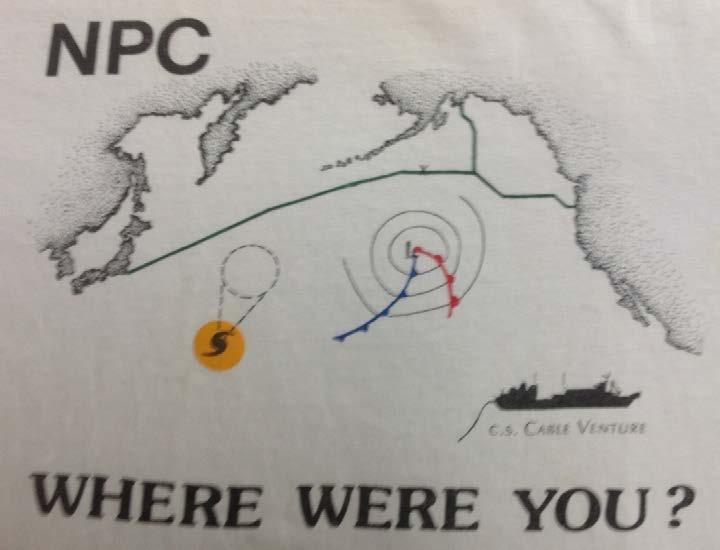
A laying operation that was originally planned for 30 days had finally been completed in 91 days. It was an experience that none of the people who took part in it will ever forget and the commemorative ‘T’ shirt is something that veterans of that epic voyage can be rightly proud of! After such an ordeal I should draw a discrete veil over the way we celebrated Christmas on the way to Astoria. I returned to Heathrow to be met by my wife, my three year old daughter and my six month old son. I had been away half his life!
Stewart Ash’s career in the Submarine Cables industry spans more than 40 years, he has held senior management positions with STC Submarine Cables (now Alcatel-Lucent Submarine Networks), Cable & Wireless Marine and Global Marine Systems Limited. While with GMSL he was, for 5 years, Chairman of the UJ Consortium. Since 2005 he has been a consultant, working independently and an in association with leading industry consultants Pioneer Consulting, Red Penguin Associates, Walker Newman and WFN Strategies, providing commercial and technical support to clients in the Telecoms and Oil & Gas sectors.
Here’s to the next 14 years!
Almost eight years ago, I joined SubTel Forum with a promise to help grow the magazine into the resource that this industry deserves – in those eight years, we’ve grown from roughly 4,000 monthly readers to almost 70,000, and our daily news feed is accessed on average over 850,000 times a month.
source that it is, I thank you, our dedicated readers.
For helping SubTel Forum grow into the trusted news
But enough reminiscing, on to the future! We’re barreling into 2016 with one of the busiest years our industry has seen in ages ahead of us, systems are planned for installation left and right. We’re just as busy here at SubTel, we are currently rolling out a limited test printing for a purchasable, printed version of our various products. Keep your eyes open for updates on how to snag a copy of the almanac in the coming days!
The end of year always brings our most anticipated products
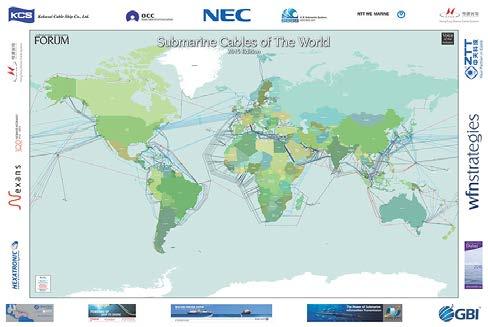
around, the annual Cable Map and Industry Calen dar. Both products will be handed out at PTC ’16 in Honolulu and mailed to our subscriber list. To any com panies that want to be fea tured in both, I am offering a special 15% discount for a packaged deal. For details on both, please see our Media Card or contact me.
Spaces are filling in quickly, reserve a space on the industry’s walls for 2016 today!
Kristian Nielsen literally grew up in the business since his first ‘romp’ on a BTM cableship in Southampton at age 5. He has been with Submarine Telecoms Forum for a little over 6 years; he is the originator of many products, such as the Submarine Cable Map, STF Today Live Video Stream, and the STF Cable Database. In 2013, Kristian was appointed Vice President and is now responsible for the vision, sales, and overall direction and sales of SubTel Forum.
+1 703.444.0845
Submarine Telecoms Forum, Inc.
21495 Ridgetop Circle, Suite 201
Sterling, Virginia 20166, USA
ISSN No. 1948-3031
PUBLISHER:
Wayne Nielsen
VICE PRESIDENT: Kristian Nielsen
MANAGING EDITOR: Kevin G. Summers
CONTRIBUTING AUTHORS:
Colin Anderson, Stewart Ash, Geoff Bennett, Kieran Clark, Bertrand Clesca, Phil Footman-Williams, Benoit Kowalski
Contributions are welcomed. Please forward to the Managing Editor at editor@subtelforum.com.
Submarine Telecoms Forum magazine is published bimonthly by Submarine Telecoms Forum, Inc., and is an independent commercial publication, serving as a freely accessible forum for professionals in industries connected with submarine optical fiber technologies and techniques. Submarine Telecoms Forum may not be reproduced or transmitted in any form, in whole or in part, without the permission of the publishers.
Liability: while every care is taken in preparation of this publication, the publishers cannot be held responsible for the accuracy of the information herein, or any errors which may occur in advertising or editorial content, or any consequence arising from any errors or omissions, and the editor reserves the right to edit any advertising or editorial material submitted for publication.
PTC 2016
17-20 January 2016
Honolulu, Hawaii USA Website
ICPC Plenary Meeting 12-14 April 2016 Hamburg, Germany Website
SubOptic 2016 18-21 April 2016 Dubai, UAE Website
You and 282 others like Submarine Telecoms Forum.
We had a production meeting when I first joined the staff at SubTel Forum. It was the first of many. We were all sitting around the conference table, pitching ideas, and I threw out the idea that we should include an article about the history of the industry.
I’ve always been a big history buff. I used to volunteer at Harpers Ferry National Park, where the great hero John Brown famously attacked a federal arsenal in hopes of ending human slavery in the United States. I spent countless hours helping vistors to understand this little town at the meeting of two rivers and the deep history that runs there. I also used to volunteer at the Claude Moore Colonial Farm, where we attempted to
show urban visitors what life was like for a farm family in the colonial period.
The idea for Back Reflection might have been mine, but there was no question in anyone’s mind that Stewart Ash was the person to take the assignment. Stewart is a student of the history of this industry, and he has always been there to talk about the ways that the past connects to the present and the future.
Stewart has announced that he’s leaving us after writing Back Reflection for close to 6 years. I have to admit that I’m sorry to see him go. But I’m pleased that I got the chance to work with such a class act who possesses a wealth of knowledge about the industry.
Thank you Stewart, for everything you’ve done for SubTel Forum. We all appreciate you, and you will be missed.
Kevin G. Summers is the Editor of Submarine Telecoms Forum and has been supporting the submarine fibre optic cable industry in various roles since 2007. Outside of the office, he is an author of fiction whose works include ISOLATION WARD 4, LEGENDARIUM and THE MAN WHO SHOT JOHN WILKES BOOTH.