is increased beyond that of spontaneous Raman scattering and the pump photons are converted more rapidly into additional Stokes photons. The more Stokes photons that are already present in the material, the faster additional photons are added. The resultant effect is that the Stokes light is amplified in the presence of the pump light. This effect is exploited in both Raman amplifiers and Raman lasers. In the telecommunications arena, it took until the early 1970s before Roger Hall Stolen (b.1937) and Erich Peter Ippen (b.1940) demonstrated Raman amplification in optical fibres. Throughout the 1970s and the first half of the 1980s, Raman amplifiers remained laboratory curiosities with little or no money being invested in research and development. However, by the mid-1980s, a large number of research papers spoke to the promise of Raman amplifiers for fibre optic telecommunication applications. Unfortunately, much of this work was put aside once the EDFA was demonstrated as a viable
optical amplifier (See Issue 57). However, by the mid to late 1990s there was a resurgence of interest in the use of Raman amplification for telecommunications systems. In a paper for the IEEE JOURNAL OF SELECTED TOPICS IN QUANTUM ELECTRONICS; VOL. 8, NO. 3, MAY/JUNE 2002, the founder of Xtera Communications Inc., Mohammed N. Islam stated: “By the early part of 2000s, almost every long-haul (typically defined 300 to 800 km) or ultra-long-haul (typically defined above 800 km) fibre-optic transmission system uses Raman amplification.” Of course, Islam was talking of terrestrial transmission systems but, at that time, Raman Amplification was already beginning to be deployed to extend the length of repeaterless submarine system spans. To see Xtera’s latest position on repeaterless system technology, please refer to Bertand Clesca’s article “Latest Developments for Unrepeatered Cable Systems” in this issue. As can be seen the principles that allow Raman Amplification
have been understood for a very long time and the ability to amplify optical signals in fibres, using this technique, has been in place for just as long, if not longer, than EDFA technology. Whether or not the Xtera repeater, incorporating backward Raman Amplification, proves to be the next major step forward in increased subsea capacity for transoceanic submarine system design, only time and the market will tell.
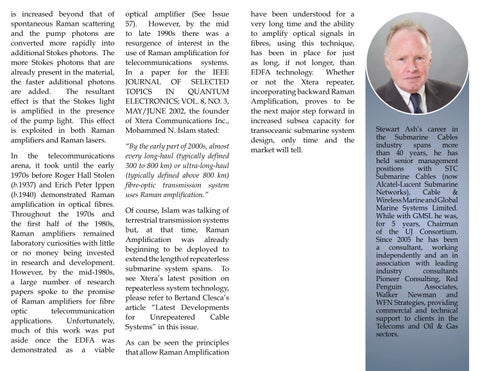
Stewart Ash’s career in the Submarine Cables industry spans more than 40 years, he has held senior management positions with STC Submarine Cables (now Alcatel-Lucent Submarine Networks), Cable & Wireless Marine and Global Marine Systems Limited. While with GMSL he was, for 5 years, Chairman of the UJ Consortium. Since 2005 he has been a consultant, working independently and an in association with leading industry consultants Pioneer Consulting, Red Penguin Associates, Walker Newman and WFN Strategies, providing commercial and technical support to clients in the Telecoms and Oil & Gas sectors.