Welcome to Issue 81, our Finance and Legal Edition.
After a fairly brutal winter here on the East Coast, we have just started to feel the early promises of spring; some would say, and none too late.
Three years ago, after another particularly brutal winter, I bought a big snow blower, and since that time I have used it only few times – until this year, which made up for all the other easy seasons. I actually enjoy running that big machine up and down my drive, and even help the neighbor across the road when I’m just getting warmed-up. I recently invited my wife to try it out on a 10 inch cover, but she simply said “No” and left the dog and me to our snowy fun.
It’s the same for my generator, which I bought the year we went for 45 hours powerless in the middle of one really tough winter. I haven’t used the generator yet this year, but one day not too distant away I will and be glad that my water pump and such are running.
I’m not saying it was so, so rough. I spent 15 years after all teaching boy and girl scouts about handling dicey situations; I’m just saying that it’s easier with a snow blow er and genera
tor some winters than without. I call them my insurance policy.
Kind of like the various author experts we have in this issue. In simple words, these are the kind of guys you want to have available when the business climate is tough and the lights are blinking uncontrollably. They provide some excellent perspective of this multi-faceted topic… and none too soon!
Happy reading.
Wayne Nielsen is the Founder and Publisher of Submarine Telecoms Forum, and previously in 1991, founded and published “Soundings”, a print magazine developed for then BT Marine. In 1998, he founded and published for SAIC the magazine, “Real Time”, the industry’s first electronic magazine. He has written a number of industry papers and articles over the years, and is the author of two published novels, Semblance of Balance (2002, 2014) and Snake Dancer’s Song (2004).
+1.703.444.2527
wnielsen@subtelforum.com
This Issue...
AAG Submarine Cable’s Latest
Recovery Effort To Be Completed By 6 March
Almanac Issue 13 Is Available Now
E-marine Plans Fleet Expansion
Byron Clatterbuck Now Takes Over As CEO At Seacom
C & C Technologies To Be Acquired By Oceaneering International
Caribbean IXP To Build Data Center
Hosting Facility In Trinidad & Tobago
China Approves New CrossingPacific Cable Project
Ciena to Further Upgrade JapanU.S. Cable Network
Damaged Submarine Cable Slows Down Internet To The US
Fastweb, MENA Sign Deal To Connect Cable System To Europe
Feasibility Study On New Submarine Fibre Optic Cable Launched
Fiber Optic Cable Proposed For Upper Lynn Canal
Gambia Opens Network Centre For ACE cable
Glitch In Submarine Cable Slows Bangladesh Internet Speed
GlobeNet Announces The Opening Of New Brazil Office
Don’t Blame Sharks For Asian Internet Problems
Government Of Equatorial Guinea Awards Huawei Marine Contract To Build Ceiba-2 Submarine Cable System
Guinea-Bissau Negotiates Submarine Cable Access
News Now
Huawei And Huawei Marine Show
Industry Leading Super 100G And Subsea Solution On IIR WDM Africa 2015
Industry Supplement Issue 1
Internet Back To Full Speed
Internet In Vietnam Back To 100%
Normal As Cable Cut Welded: Report
Level 3 Files For Extension With FCC UPDATED
Level 3 Files For SAC Extension With FCC
Natixis Announces Closing Of Seabras-1 Financing
New Player Building East Coast
Data Center For Trans-Atlantic
Connectivity
Nigeria: Council Plans To Increase Submarine Cable Landing Stations
Nigeria’s Investments In Submarine Cables Hit $2.24b
Nitel To Work With Lagos Govt Over SAT-3 Cable Restoration
OFS Launches New Optical Coherence Tomography (OCT) Probe Capability At BiOS / Photonics West Conferences
Pacnet First to Extend SDN & NFV Capabilities Into the Optical Layer
Pakistan To Get SEA-ME-WE-5
Submarine Cable Landing Through TWA
Samoa Fiber Optic Deal In The Pipeline
Seaborn Secures Metro Network And Fiber Backhaul In Brazil From Netell And Citatel
Submarine Cables in the Sargasso Sea
SubOptic 2016 Emerging Subsea
Networks – The World’s expanding treasure
Tele-Post Greenland Expects Sea Cable Extension In 2016
Telstra Hits 100G On Key Asia-Pac Submarine Cables
Vocus Communications To Expand Capacity On Southern Cross Cable Network
Tenerife Island Council Upgrades Metro Fiber-optic Network
TM Inks MoU With Time dotCom For New 3,500km Submarine Cable
Trans Pacific Express Selects Ciena for Submarine Cable Upgrade
Trans-Tasman Cable Gets Regulatory Green Light
UCL Researchers Double The Error Free Transmission Distance For Subsea Optical Cables
Undersea Cable Faults Reportedly Affect Internet Connectivity Across India
West Africa Cable System to Be Upgraded
West Lake Macquarie Without Phone, Internet For Three Weeks
WFN Strategies Receives 2015 Virginia Excellence Award
WFN Strategies to Accomplish Permitting and Environmental Monitoring for BLAST Submarine Cable
Finance & Legal
An Overview
Kieran Clark
Welcome to SubTel Forum’s annual Finance and Legal issue. This month, we will take a look at the industry’s current finance and legal status by presenting our most current data as tracked by the ever evolving SubTel Forum database, where products like the Almanac, Cable Map, and the STF Supplement find their roots.
It has been a full year since our last look at the financial situation of planned systems
around the world. New systems have been announced and announced systems have gone into service, while others have been delayed or changed. Quite a lot can happen in one year, and this year was no different.
Since our last Finance and Legal issue, we observed that of the planned systems announced to be ready for service in 2014, only 38 percent were actually accomplished. This is a far-cry from 2013,
where we saw 83 percent of systems go from planning to reality. Several of the remaining systems were either delayed to 2015 for various reasons, while 38 percent of the systems scheduled to be ready for service in 2014 simply died outright. While this is perhaps concerning, we have seen an additional 12 systems announced to be ready for service from 2015 to 2017 compared to last year’s numbers.
As we continue our comparison to last year’s numbers, we can also observe a slight shift in the type of system ownership. Last year, we saw an even split between single ownership and consortium ownership. This year, we can see a significant shift to single owner systems. Over the next three years, only 37 percent of systems will be owned by a consortium, with the remaining 63 percent having a single owner. This
PLANNED SYSTEMS ANNOUNCED RFS
Planned Systems 2015-2017
By Region
is an interesting development considering the current uncertainty in the industry at large and especially considering the rather dismal planned-to-implemented ratio observed in 2014.
Planned Systems CIF 2015-2017
Consortium ownership reduces the financial risk to any single owner should a cable system fail, so seeing
that trend decrease in the current market might seem counterintuitive. However, if we look a little deeper, we can see that many of the new systems over the next several years are relatively smaller systems, serving very specific needs. Many of the systems planned for 20152017 are connecting various island nations in the Pacific to existing international pipelines or are like the ones planned in the South Atlantic, connecting to only a few landing points. Keeping this shift in ownership in mind, this model makes more sense.
While single owners are back on the rise, the way a system is being financed has changed little from last year, although there has been a small change. One year ago, we observed that 43 percent of systems were financed through debt/ equity and 57 percent were entirely self-financed. This year, we’ve seen a shift that brings the two types of financing dead even with each other. This is not a large shift, but it does indicate that system owners and financiers are increasingly less willing
to take on the increased risk of debt/equity financing and are starting to prefer having cash more or less guaranteed up front.
When you consider the nature of many of the systems planned for the next few years, these numbers make sense. With so many of the planned systems addressing very specific needs in smaller areas, there is not much of a business case to justify financing based on the higher risk associated with debt/ equity financing.
Compared to last year, there has been very little change in the breakdown of planned systems by region. The Pacific and South Atlantic continue to see numerous systems planned and make up the majority of total planned systems. While still slight, the Middle East and Indian Ocean regions have seen the largest decrease in activity from a year ago, presumably due to political and financial instability in those regions. The factors driving growth in the Pacific and South Atlantic also remain unchanged from a year ago –
emerging markets clamoring for access to affordable and reliable international telecommunications.
With more than 40 systems planned to be ready for service over the next several years, it may seem like the industry is robust and booming. However, things start to look a little more troublesome when you look at whether or not a system has gone Contract in Force
Financing for Planned Systems
(CIF). This is the true measure of a system’s viability and is usually a strong indicator that a system will be completed. Last year at this time, we saw only 7 percent of the systems planned for 2014-2017 become CIF. One year later, things have only slightly improved, with 17 percent of announced systems from 2015-2017
Kieran Clark is an Analyst for Submarine Telecoms Forum. He joined the company in 2013 as a Broadcast Technician to provide support for live event video streaming. In 2014, Kieran was promoted
Forum publications. He has 4+ years of live production experience and has worked alongside some of the premier organizations in video web streaming. to Analyst and is currently responsible for the research and maintenance that supports the SubTel Forum International Submarine Cable Database; his analysis is featured in almost the entire array of SubTel
achieving the CIF milestone.
Looking at 2015 alone, 29 percent of systems planned to be ready for service this year have gone CIF so far. However, with nearly three months of 2015 passed, this seems like a low CIF rate. Considering that many of the systems scheduled to be ready for service this year
From shore to shore
have yet to complete a survey, we can expect several systems planned for implementation this year to at least be delayed.
Financing continues to be a major hurdle for new systems and is a trend that will likely never go away. The investment required for an international submarine cable can feel
daunting at the best of times and when there is uncertainty it can look even worse. These days, a system must have a rock-solid business case to convince investors to provide the needed capital. It is a difficult path for new systems, but 2015 promises to be a little easier on the financing side.
Coherent Transport
High Signal Power
Outstanding Bend Performance
Simplified Network Design
Long-term Reliability
Paid Prioritizations
The FCC & Net Neutrality
George M. Foote
OnFebruary 26th, the Federal Communications Commission (FCC) adopted its controversial net neutrality order. The FCC declared that blocking and throttling of internet signals is illegal and it banned “paid prioritization” that would allow one content provider to pay for faster service than its competitors.
Noting that more than half of all internet connections are now made from wireless devices, the FCC order extends the new net neutrality rules to wireless internet coverage.
The FCC also announced that it would enforce interconnection practices that extend net neutrality principles to the edge of the Internet Service Provider (ISP) networks, the point at which ISPs connect to other networks, content providers and content delivery services. The interconnection rules are not yet published, but will be important to operators of submarine cables and their customers. This is the third net neutrality try for the FCC. Both previous
attempts to adopt regulations have been thrown out by the courts.
The net neutrality debate in America has been fierce, with proponents of FCC action claiming that the internet is a public utility and deserves FCC protection. Opponents have proclaimed that any new rules amount to government
takeover of the internet. The battle lines split regulationminded Democrats from small government Republicans; internet content companies favoring regulation squared off against the telecom and cable companies that plan to sue to overturn the rules. The parties, however, are in closer agreement than most will acknowledge.
Everyone appears to support the basic principles of an open internet. Nobody defends blocking or throttling of signals or fast lanes for companies willing to pay. The congressional Republicans have even introduced legislation to make that point. Even Comcast, the ISP most maligned in net neutrality debates, pledges almost daily in full page ads that it will abide by net neutrality principles. Few examples of abuse of net neutrality principles have been shown.
So is net neutrality regulation a solution to a problem that does not exist?
“Yes,” argue anti-regulation policymakers and ISPs. They point to the growth of the unregulated internet in America and the swirl of innovation around the internet as evidence that the system does not need government involvement. They claim that regulation will stifle investment in the internet, lead to more taxes and even price controls by the government.
“No,” say consumer groups and content providers. They cite the lack of competition for high speed broadband service in most of the country and the potential for future control over content or speed by the ISPs. They point out that the level of proposed regulation is light and that the rules are similar to rules in effect for wireless telephones during a period when $300 billion has been invested in wireless networks.
While the FCC rules are not yet public, their outline is clear. Under the Communications Act of 1934, the FCC has authority to regulate telecommunications services in the United States. Title II of the law was written in the days of the old Bell System monopoly and treated the phone system like the utility that it was. Title II was a way for the government to control the monopoly. It gives the FCC power to award licenses, set rates, impose fees, force companies to share their equipment with competitors, file reports, respond to customer complaints and provide service to remote areas.
Is net neutrality regulation a solution to a problem that does not exist?
In 1996, Congress recognized that Ma Bell was not the only telecom competitor and that the FCC could manage the telecom system with a lighter regulatory regime. Congress added “forbearance rights” to the Communications Act. The FCC now has the right to scale the degree of regulation of a service to the need. It does not have to exercise all the heavy-handed regulatory powers in every case. In other words, it can choose what it will regulate and how.
From public comments and information released by the FCC, it is clear that FCC chairman, Tom Wheeler relies on forbearance. He intends to impose light regulation and to depend on complaint
proceedings to enforce the rules -- setting out boundaries and putting a referee on the field, as Wheeler says. The FCC order will not create new taxes, give rate setting authority to the FCC, require filing of tariffs or compel network unbundling.
The Wheeler approach is informed by FCC losses in court in the earlier attempts to adopt net neutrality principles. In striking down the last FCC regulations, the D.C. Circuit Court of Appeals told the FCC that it had the power to regulate the internet under the Communications Act, but that the FCC had gone about it the wrong way. Accepting the court’s invitation and following the
court’s roadmap, the FCC has now proposed to treat the internet as a utility but leave industry participants free to compete, set rates without government participation and manage networks in much the same way as they do today.
Republican leaders want a new law to limit the ability of the FCC to police net neutrality. However, they have not announced plans for how to enforce net neutrality if the FCC cannot. No congressional action can keep up with the needs of an industry that moves as fast as telecommunications. At the end of the day, the FCC is the only agency that can oversee the internet.
Three issues show how hard it would be for Congress to legislate responses to net neutrality questions.
First, while everyone agrees that there should be no paid prioritization that would allow wealthy incumbent content providers to pay for better service than their smaller competitors, consider “zero rating.” In zero rating,
a content provider, say Amazon, pays an ISP for the bits transmitted to Amazon customers. Streaming an Amazon movie would not count against the customer’s monthly allotment of megabytes of data. The payments would make Amazon more attractive than its competitors who did not subsidize users. Neither the FCC nor Congress has shown how they would treat zero rating.
Second, wireless telephone companies have much more complex systems than wired companies. Wireless traffic is managed closely, systemwide, to allocate spectrum in ways that will improve service for customers, with the inevitable effect that some calls are prioritized over others or are routed differently.
At what point does network management of wireless internet data become throttling of customer content? And at what point should the FCC step-in to dictate different management practices? Should one form
of content be favored over another? The Title II complaint mechanisms appear to be a ready answer for at least some of the questions, allowing a company or consumer that believes its service is being affected for reasons other than simple technical management to file a complaint with the FCC.
A third issue involves the interconnection rules that are so important to submarine cable operators and the overseas ISPs, exchanges and content providers who rely on the cables. Interconnection was a murky subject before the internet arrived and has gotten more complicated in recent years. ISPs that are happy to connect with each other for mutual benefit can turn frosty when asked to peer with a content delivery service or a smaller ISP that will send far more data down to the large ISPs customers than it will pick up from the ISP to send to other customers.
requirement has existed in the internet world. What if an ISP can charge another ISP for connections or if it can accept some and reject other connections or if it can impose speed or capacity limits on its connecting parties? Not only would the overall internet suffer, but the effect would be the same as if the host ISP could block or throttle local content or accept payment for prioritizing content.
Just as the FCC is taking a role to ensure an open internet within the United States, it has asserted its right to regulate connection of foreign ISPs to domestic ISPs. The ultimate rules are not yet known, but the principle of an open internet appears not to stop at the water’s edge.
George Foote represents telecommunications, public utility, technology, social media and defense companies in the United States and abroad. He represents established companies, joint ventures, start-up businesses and trade associations. His practice includes representation of clients in acquisitions, financing transactions, contract negotiation and regulatory proceedings.
In the regulated telephone system, carriers are compelled to carry service for other carriers, but no such
Flury Of Cybersecurity Initiatives May Impact Operators
Ross Buntrock
The early months of 2015 have seen an almost unprecedented level of action in the realm of U.S. cybersecurity policy. The Obama Administration, in response to a growing number of cybersecurity compromises and data breaches has announced an aggressive cybersecruity and data security agenda. The activity appears motivated at lease in part by the spike in the number of U.S. data breaches in 2014, which hit a record high of 783 according to a recent report released by the Identity Theft Resource Center (ITRC).
The numbers for 2014 represent an increase of over 27 percent over the number of breaches reported in 2013 and a significant increase of 18.3 percent over the previous high of 662 breaches tracked in 2010. The Cybersecurity agenda of the Obama Administration will have direct and indirect consequences for operators potentially adding to their already substantial regulatory burdens. The Administration has a recent privacy, data and cybersecurity proposal and other rules that may come to bear on operators in the coming years.
On January 13th, President Obama delivered remarks on proposed cybersecurity legislation and initiatives at the U.S. Department of
Homeland Security’s (DHS) National Cybersecurity Communications Integration Center (NCCIC). There, the President outlined proposed
legislation on cybersecurity aimed at defending the country from cyber threats by incenting he private sector to share cyber threat information with DHS by providing liability protections for companies that share information on cyber threats. Obama also highlighted an initiative to update the authorities of law enforcement to better combat cyber crime.
The NCCIC announcement came less than a year after the release of the voluntary Cybersecurity Framework, which President Obama announced in his 2013 State of the Union speech and released on February 12, 2013. The Cybersecurity Framework was intended to encourage companies to adopt best practices for critical infrastructure, including global digital infrastructure like undersea communications cables that land in the U.S. The Cybersecurity Framework remains entirely voluntarily and lacks many key incentives sought by industry stakeholders. That being said, given how little time has
passed since the Framework was announced, it’s too soon to handicap the success of the initiative.
President Obama / Privacy and Data Security:
On January 20th, in his State of the Union (SOTU) address, President Obama urged lawmakers to pass comprehensive cybersecurity legislation. The mention of the need for comprehensive data security and privacy legislation follows numerous White House legislative proposals and initiatives that the president has championed. Following the SOTU address a number of Congressional committees announced hearings on privacy and data security:
• Jan. 21: The U.S. Senate Commerce, Science and Transportation Committee’s hearing entitled “Protecting the Internet and Consumers Through Congressional Action”
• Jan. 27: The U.S. House Energy and
Commerce Committee’s Subcommittee on Commerce, Manufacturing and Trade’s hearing entitled “What Are the Elements of Sound Data Breach Legislation?”
• Jan. 27: The House Science, Space and Technology Committee’s Subcommittee on Research and Technology’s hearing entitled “The Expanding Cyber Threat”
Despite the flurry of activity from the President and both houses of Congress the prospects for legislation are relatively dim.
Big Data:
On February 5th, the White House published an interim report entitled “Big Data: Seizing Opportunities, Preserving Values” as a follow up to a May 2014 reports. The report is notable principally because it calls for utilization of big data for, among other things, law enforcement activities. The purpose of the report is to detail the impact that big data has on
the economy, government and society, as well as the privacy concerns raised in its collection.
Among the findings, the authors of the report conclude that individual privacy is “far from perfect” and that “technology alone cannot protect privacy absent strong social norms and a responsive policy and legal framework.” Specifically, the report makes policy recommendations for the President and Congress to consider, including:
• Advancing the Consumer Privacy Bill of Rights
• Passing national data breach legislation
• Extending privacy protections to non-U.S. persons
• Amending the Electronic Communications Privacy Act
The report specifically examines how big data may be used to strengthen the nation’s local, state and federal law enforcement communities.
Cyber Threat Information Sharing:
On February 10th, the White House announced the creation of the Cyber Threat and Intelligence Integration Center (CTIIC), which aims to enhance cyber threat information
sharing across government agencies. The newly created CTIIC will operate under the Office of the Director of National Intelligence and will collect and analyze cyber threat information to efficiently distribute to government agencies.
The creation of the CTIIC comes as the government has come to recognize the importance of quickly analyzing and assessing fast-moving cyberthreats or cyberattacks. The CTIIC is designed to enable existing government cyber units to
do their jobs more effectively and make the government more effective in responding to cyberthreats. The announcement of the CTIIC was followed by an Executive Order on cybersecurity information sharing.
Executive Order on Cybersecurity Information Sharing:
On February 12th, President Obama issued an Executive Order with the goal of “promoting private sector cybersecurity information sharing.” In the order, President Obama discussed the importance of cybersecurity information sharing across government agencies as well as between the government and the private sector.
According to the Order, “[r] apid information sharing is an essential element of effective cybersecurity, because it enables U.S. companies to work together to respond to threats, rather than operating alone.” The Executive Order outlines a framework to enhance information sharing, which includes:
• Developing a common set of voluntary standards for information sharing organizations.
• Clarifying the Department of Homeland Security’s authority to enter into agreements with information sharing organizations.
On February 13th, President Obama delivered prepared remarks at the White House Summit on Cybersecurity and Consumer Protection where he again addressed issues relating to cybersecurity. To combat cyberattacks, Obama outlined four principles private entities and government agencies should consider:
able to assist or provide information related to cybersecurity.
• Evolve the company’s or agency’s cybersecurity practices.
• Focus on protecting the privacy and civil liberty of the American people.
advocacy on these issues, many of the measures are voluntary or recommendations to industry for adoption of best standards. While both parties are focused in some ways on the issues of cybersecurity, there remains little consensus on what, if anything, should be done legislatively.
• Share cybersecurity information with each other.
• Recognize when the government may be
Finally, on February 27th, the White House released a draft of its “Consumer Privacy Bill of Rights Act of 2015.” The proposal would require companies to provide clear notice of how they use consumer data, ensure that data is being used for its intended purpose and provide consumers with a method of having their data deleted. The bill would permit industries to develop codes of conduct that would have to be approved by the Federal Trade Commission (FTC). The bill would also empower the FTC and state attorneys general to enforce the privacy and data security policies and practices outlined in the proposal through civil penalties.
Despite the Administration’s
Ross Buntrock is a Partner at Arnall Golden Gregory LLP in Washington, D.C. He is the head of the Firm’s Telecommunications Media & Technology group and a member of the Government & Regulatory; Litigation; Privacy & Consumer Regulatory groups. Ross Buntrock is a partner with nearly 20 years of experience representing all segments of the industry. He is nationally recognized for his work in communications, media, and technology law. Ross advises mobile and wireline carriers, technology companies, mobile-content providers, mobile payment companies, app and platform developers, and trade associations on all aspects of communications and trade regulation.
INTELLIGENCE, ANALYSIS, AND
THE INTERNATIONAL TELECOMMUNICATIONS INFRASTRUCTURE COMMUNITY
Terabit Consulting is a leading source of market intelligence, forecasting, and guidance for the international telecommunications infrastructure community. Its long history of accurate, innovative analysis and advisory services is in large part attributable to the trust and respect it has earned among industry leaders. Terabit Consulting has completed studies for dozens of leading telecom infrastructure projects worldwide and its analysts have traveled to research and deliver studies in more than 70 countries, giving it an unmatched level of experience in nearly every region of the globe.
Terabit’s primary clients include financial institutions, development agencies, government ministries, telecom carriers, project developers, suppliers, financiers, law offices, and industry associations, as well as other members of the international telecommunications infrastructure community.
Learn more at www.terabitconsulting.com or contact a Terabit Consulting representative today.
Terabit Consulting
245 First Street, 18th Floor
Cambridge, Massachusetts 02142 USA
Tel. +1 617 444 8605
info@terabitconsulting.com
Summary:
The FCC’s Net Neutrality Rules
Wesley Wright
Lastmonth, the Federal Communications Commission adopted net neutrality rules that prevent Internet service providers (ISP) from blocking traffic, throttling traffic, or entering into paid prioritization arrangements with content providers. And the Internet almost exploded.
At press time the text of the new rules has not been released. However, the Commission issued a summary of the new rules and various provisions have been widely reported in the trade press. But to understand where we are, it is helpful to review how we got here.
This was not the first time the Commission attempted to impose net neutrality obligations – the two prior attempts were struck down by the courts.
The (Short) History of Net Neutrality at the FCC:
In 2007, Comcast apparently restricted the ability of customers to use peer-to-
peer networking applications that permitted the direct sharing of large files and consumed a significant amount of bandwidth. Free Press and Public Knowledge filed a complaint with the Commission and petition for declaratory ruling arguing that Comcast’s actions violated the Commission’s
Internet Policy Statement. That Statement, issued in 2005, set forth the agency’s principles that consumers should be entitled to access lawful Internet content, run applications and use services of their choice.
In 2008, the Commission issued an Order concluding
that it had jurisdiction over Comcast’s network management practices and, having determined it had jurisdiction, elected to resolve the dispute through adjudication as opposed to formally adopting net neutrality rules. The agency found that Comcast “significantly impeded
consumers’ ability to access the content and use of applications of their choice,
In 2010, the Commission adopted formal net neutrality rules imposing disclosure, anti-blocking and anti-
discrimination requirements on broadband providers. The same appellate court provided the Commission with some further guidance.
In its opinion, the Court recognized that broadband providers have incentives that “represent a threat to Internet extent of future broadband deployment.” Despite striking down the 2010 net neutrality rules, the Court provided
the FCC with a roadmap for imposing more stringent net neutrality obligations in the future if it chose to do so; the agency could reclassify broadband Internet access as a “telecommunications service” subject to Title II of the Communications Act (i.e., public utility obligations).
Net Neutrality Heats Up:
The Commission was reluctant to impose Title II, public utility regulation on the Internet. In a blog entry last April, Chairman Wheeler outlined the Commission’s next iteration of net neutrality rules. The rules should:
1) Require ISPs to transparently disclose to their subscribers and users all relevant information as to the policies that govern their networks.
2) Prevent ISPs from blocking legal content.
3) Prevent ISPs from acting in a commercially unreasonable manner to harm the internet, including favoring traffic from an affiliated entity.
The proposed rules were released by the Commission in May. The agency declined to propose reclassification of broadband Internet access service as a telecommunications service under Title II. The proposed rules also permitted broadband providers to “engage in individualized practices [to accommodate ‘fast lane’ agreements], while
prohibiting provider practices that threaten to harm Internet openness.” In other words, content providers could pay ISPs for Internet fast lanes.
The Commission received more than four million public comments in response to these proposed rules, none more powerful than President Obama’s November statement urging the Commission to
subject the Internet to Title II regulation.
Shortly thereafter, Chairman Wheeler revised his viewpoint. In February, he summarized his most recent net neutrality proposal in an op-ed in Wired magazine, including a story with a personal touch.
In the 1980s, he was president
of NABU: The Home Computer Network. NABU used cable lines to deliver high-speed data service to consumers. Its main competitor was AOL, which delivered the same service at slower speeds over telephone lines. Though NABU’s service was better, it went broke and AOL was wildly successful because access to cable lines was not readily available to his company. Access to the phone network was open under the FCC’s rules.
With this op-ed and the subsequent rules, Title II regulation of the Internet became a reality.
NUTS AND BOLTS OF THE RULES
No Blocking, Throttling or Paid Prioritization:
The Commission adopted three “bright line” rules that have grabbed all the headlines in the wake of the contentious 3-2 vote by the FCC commissioners. These three rules ban practices the Commission views as
harmful: blocking, throttling and paid prioritization.
The prohibition against blocking prevents broadband providers from blocking access to legal content, applications, services or nonharmful devices. Similarly, broadband providers may not impair or degrade (throttle) lawful internet traffic on the basis of content, applications, services or non-harmful devices.
broadband providers from favoring some lawful internet traffic over other lawful traffic in exchange for consideration of any kind. In a reversal from the Commission’s proposed rules, there will be no internet fast lanes. This rule also prohibits ISPs from prioritizing content and services of affiliates.
of consumers to select, access and use the lawful content, applications, services or devices of their choosing. ISPs are also required to permit edge providers to make lawful content, applications, services and devices available to consumers.
Transparency, Reasonable Network Management and Interconnection:
The new rules expand on the Commission’s existing transparency requirement and mandate that ISPs disclose promotional rates, fees, surcharges and data caps. A temporary exemption is provided for fixed and mobile providers with 100,000 or fewer subscribers.
Forbearance:
Finally, the rules bar
A Standard for Future Conduct:
The rules prohibit ISPs from unreasonably interfering with or disadvantaging the ability
In addition, an ISP may engage in reasonable network management – other than paid prioritization. For example, ISPs retain the ability to manage the technical and engineering aspects of their networks as long as it is primarily used for and tailored to achieving a legitimate network management, non-business purpose. For example, an ISP may not renege on a promise to provide a customer with unlimited data citing a reasonable network management practice. The new rules also mandate that the interconnection practices of ISPs be just and reasonable. The Commission will be empowered to hear complaints and take appropriate enforcement action if it determines these activities are not just and reasonable.
Finally, to reduce the impact of its new regulatory approach, the FCC has refrained from certain key provisions of Title II of the Communications Act as part of its net neutrality rules. For example, the Commission will not subject broadband providers to full utility-style rate regulation, including tariffs and last-mile unbundling. The new rules will not require broadband providers to contribute to the Universal Service Fund.
Finally, broadband service will remain exempt from state and local taxation under the Internet Tax Freedom Act, recently renewed by Congress.
OUTLOOK
The immediate question –once the rules are released – is whether they will be appealed. The general consensus is Yes and several major ISPs have already threatened to sue. But no one can know for sure. In an article last month, Columbia University law professor Tim Wu argued that an appeal may be unlikely.
Of course, the jump in stock price may simply indicate that the industry craves regulatory certainty, regardless of its cost. If the industry elects not to challenge the rules, it is more likely to sit on the sidelines because victory is far from certain.
the rules in the near-term since Congress would need a veto-proof majority to override President Obama’s support for Title II regulation of the Internet.
Any aggrieved party would be required to file an appeal with the same court that provided the Commission with a roadmap for adopting net neutrality rules. The Commission largely followed that roadmap (despite a few detours along the way) and appellate courts afford federal agencies broad discretion to adopt rules of this nature.
His rationale is that broadband stocks went up when Chairman Wheeler announced his net neutrality rules last month and the jump in stock prices indicates strong net neutrality rules are a boon for broadband service providers. Broadband providers may be reluctant to file a lawsuit seeking to invalidate rules that seem to have created billions of dollars of shareholder value and cemented the status quo.
Another threat to the Commission’s rules is a bill circulating in Congress seeking to classify broadband service as an information service –not a telecommunications service – and prohibit the Commission from regulating broadband under Title II. However, legislative action seems unlikely to overturn
While it seems likely the industry will file a lawsuit challenging the rules, I believe it also is likely the court will uphold the rules this time. For the agency, it appears the third attempt to adopt net neutrality rules is the charm.
Disclaimer: these opinions reflect the views of Mr. Wright and not Keller and Heckman or its clients.
Wesley Wright is an attorney with the Washington, D.C. law firm of Keller and Heckman. Mr. Wright has been practicing telecommunications law since 2006 and assists corporate clients and trade associations with various legal and regulatory matters before the FCC, FAA, courts, and state regulatory agencies. Mr. Wright’s practice includes wireless compliance issues, FCC enforcement, and related transactional matters. He also has drafted and negotiated asset purchase agreements, telecommunications services agreements, interconnection agreements, and other telecommunications agreements.
Financing a New Private Submarine Cable Network
Andrew D. Lipman, Ulises R. Pin & Adam Sharp
The construction of a new submarine cable network generally requires many millions of dollars. Over the past few years, securing the necessary financing for a cable project after the “Great Recession” became more difficult as margins fell, operating expenses increased and such projects came under greater financial scrutiny.
But changes in the marketplace, particularly a shift of content away from the U.S. to servers in Europe, Asia and Latin America as well as increasing demand for internet connectivity and bandwidth, is starting to revive the submarine cable industry.
More than any other single factor, financing impacts the timing and success of a submarine cable project. Over the next few years, several billion dollars will be spent on submarine cable projects. This article describes the possible financing structure options available and the tasks that a sponsor should complete to successfully fund such a project.
Financing Options:
As a preliminary matter, the organizational structure of a submarine cable project will impact the range of available financing choices. There are two basic structures: private
systems and consortium systems, or “carrier clubs.”
Private systems generally begin with a sponsor who raises the capital necessary for construction and operation of the network. These systems provide long-term, bulk capacity to large corporations, content providers, internet companies and other telecommunications providers for a charge. Securing funding can be a challenge for such systems. Despite this, private cables are becoming more prevalent. For example, in January 2015, Seaborn Networks closed on the debt financing for its Seabras-1 system (connecting New York to Sao Paulo) with a fullyunderwritten debt of about USD 270 million from Natixis. Natixis is the corporate, investment and financial services arm of France’s second-largest banking group, Groupe BPCE.
Non-Member
Equity Investors:
Private systems tend to require outside equity investment more than carrier club systems, though carrier clubs too may find themselves in need of such investors. Now that the economic landscape in the telecommunications industry looks brighter, institutional investors such as private equity funds (PE) and venture capitalists (VC) have returned to the industry.
On the other side of the spectrum, two or more telecommunications providers from one or more countries may organize into a consortium system with the common goal of building and operating the cable network. Usually one member of the club will lead and have overall responsibility for network administration. In contrast to the private systems, funding tends to come from the telecommunications provider members themselves, but content providers too have sometimes invested directly in new submarine networks (e.g., Google, Facebook). It is uncommon for such clubs to need equity financing from non-members.
VCs and PEs differ in many ways, but as equity investors
there is still a good deal of common ground. VCs generally invest at earlier stages than PE, and as such, they are the obvious choice for developers in need of early stage equity capital. But their willingness to invest earlier should not be mistaken for a willingness to invest hastily.
VC funds are extremely selective with respect to the opportunities they pursue, despite their reputation for risk tolerance. The reason? They expect a higher reward for the risk that they are tolerating. VCs are generally looking for credible financial projections that promise a return on equity capital that exceeds 30 percent. In addition to the “sweat equity” expected of sponsors, VCs may expect hard assets, such as contracts, licenses or permits and even significant sums of money. More than 99 percent of all business plans that VCs initially review will not receive funding. Securing VC investment is a challenge that requires significant attention to overcome. Nevertheless it remains a
likely source for equity for projects in their early stages.
PE funds are also extremely selective and generally offer funding at stages later than VCs. PEs will tend to be available in the following scenarios:
• During the development of follow-on systems.
• When the network is undergoing upgrades.
• When systems have predictable cash flows and significant commitments from customers.
• As an exit strategy for a VC-funded system.
Despite their differences, VC and PE have much in common as well. They both expect, at a minimum a strong corporate governance provisions, a significant number of pre-sales, significant preference rights over other equity sources and anti-dilution protections, high returns (including free cash flow) and a clearly articulated exit strategy. VCs in particular will expect profitability in
three to five years and will want options to monetize their investment through an exit strategy.
Because Initial Public Offerings are often not an option, other options must be considered, such as identifying potential strategic buyers and merger candidates, combining with other regional networks and securing new PE or institutional investors that prefer mature systems.
Commercial Lenders:
Debt will tend to fund between 50 to 66 percent of
the total building costs, with equity funding the rest. The larger and more complex the project, the more likely developers will need a diverse portfolio of debt, including from technology vendors, a commercial bank syndicate, local bank financing and/or additional commitments (i.e., loans) by equity sponsors.
Having multiple sources of debt will trigger the need for inter-creditor provisions, which are often heavily negotiated. Lenders will generally desire to be on equal footing and may, for example, want to coordinate “required
lender” provisions or share collateral. The project will likely require short-term financing as well, therefore the business plan will need to incorporate other forms of debt such as revolving facilities and letters of credit.
Over the past few years, financial institutions have cautiously become more willing to fund private submarine cable systems. Moreover, interest rates remain at all-time lows. However, lenders still heavily scrutinize business plans and loan conditions tend to be more stringent. Performance history, reputation and effective accountability are prime factors that will differentiate which deals lenders choose to finance.
The “project finance” structure (i.e., senior secured, non-recourse or limited recourse debt payable solely from the cash flows of the project) continues to dominate the submarine cable system financing market, despite its association with increased transactional costs.
Its popularity is a result of its ability to adapt to the unforeseen circumstances common to submarine cable development projects.
deals. Cash sweeps and “lock box” structures are common. Lenders are likely to limit dividends and distributions during the term of their loans
Sponsors should expect to see significant restrictive covenants in lender debt documents. Financial covenants, including cash reserves and debt coverage and debt-toequity ratios, are critical to the banking industry in these
Multilateral Organizations:
Another option that has evolved in recent years is funding from multilateral organizations. In this group, we include multinational organizations, local or domestic development banks, infrastructure funds, sovereign wealth funds, broadband development plans and other stimulus sources from national or local organizations. Such organizations tend to provide debt financing and may sometimes invest in equity.
to ensure the project is well insulated with cash reserves to protect against contingencies. Free cash flow should be sufficient to guarantee return on equity and ensure payment of principal and interest and funding reserves.
For example, the International Finance Corporation (“IFC”), a member of the World Bank Group, has previously invested equity in submarine cable systems through a program that targets telecommunications companies and invests up to 5 to 15 percent of a project’s equity as a long term, passive investor. The Overseas Private Investment Corporation (OPIC) too has purchased equity in submarine cable projects. But submarine cable developers should not count
on equity investment by such organizations, as despite these examples, it remains uncommon. Additionally, willingness to invest as a lender or equity sponsor by such organizations will depend a great deal on the location of a project. Multilateral organizations tend to favor projects that will serve particular regions, especially emerging markets (e.g., Asia Development Bank, Inter-American Development Bank).
Multilateral organizations are sometimes willing to perform other roles. They can act as guarantors (generally partial guaranties of bonds or loans), insure against political and currency risk, provide grants for feasibility studies, provide technical cooperation, and act as second debt arrangers/ providers (typically through “B Loans” where the development agency acts as administrative agent and syndicates loans to other commercial banks).
In their role as lender, multilateral organizations
often provide better terms than commercial banks. They can be particularly valuable as capital structure partners in locations where legal and regulatory structures are underdeveloped, because they may facilitate local permitting and thereby reduce the legal and regulatory risk from government consent and licensing periods that often plague such locations.
But involving such
funding for a submarine cable project will take a significant amount of preparation. To succeed, sponsors will need to identify a market opportunity and prepare a credible business plan that includes a firm commitment from an appropriate technology vendor and that incorporates a wellconsidered financing plan. Only then should sponsors seek to secure and structure funding from external investors.
organizations does have a downside. Multilateral organization investment is often contingent on conditions that are more rigid than those typically imposed by commercial lenders (e.g., covenants related to child labor, collective bargaining, higher environmental standards, etc.).
Securing Financing:
Successfully securing the
Investors demand a clearly identified and justified target market. Credible and well-developed business plans that articulate specific opportunities in underserved areas, or in regions that require broadband and IP-enabled communications to cope with demand, are the plans that will command the attention of investors. South Asia and Latin America in particular are prime regions to search for such opportunities, as investors tend to favor them.
In addition to articulating an opportunity, sponsors will need a comprehensive and credible business plan. At a
minimum, the business plan must take smart advantage of tax reduction opportunities; recognize and plan for environmental and regulatory risks at the outset, such as licensing and government consents; identify sources of debt financing, including vendor financing; include only credible revenue assumptions, particularly regarding the ever declining cost of bandwidth; and be backed by a strong management team. To attract investors it will also need detailed, phased budgets with costs thoroughly considered. Accurate cost planning will require a firm commitment from a technology vendor.
Sponsors should be prepared for the fact that even with a credible and comprehensive plan, potential investors will incorporate a significant discount on projected revenues as they assess the proposal.
Other Considerations:
The structuring and negotiation of financing documentation is a delicate balancing act. Project sponsors must propose reasonable
debt and equity levels, and must be mindful of the risk/ reward ratio as it applies to each investor and approach equity providers and lenders with appropriately balanced proposals. Sponsors must also be thoroughly prepared to address corporate governance issues with financial sources in order to achieve the flexibility that may be required. The financial jigsaw puzzle is best completed in steps. Patience is crucial.
Sponsors should be ready to address diverse laws and cross-border, environmental and regulatory risks. The complexity of these issues rises with the number of jurisdictions that a cable project touches. For example, the requirements for perfecting collateral will vary across locales, requiring a multinational, and thereby costly, set of lawyers. Crossborder risks will stem from volatile political climates, expropriation, local laws and unstable currency markets. In some locations, insuring against these risks may be costly, but political
risk insurance, in particular, may be a requirement in many emerging market transactions. The timely securing of landing licenses and easements will also be crucial to lenders and equity sponsors.
In conclusion, the future for submarine cable sponsors looks much brighter than just a few years ago. However, the foundation for success in securing funding lies in a well-constructed business plan and precisely identified market opportunity.
Media and Technology practice group of Morgan, Lewis & Bockius LLP, a 2000-attorney international law firm.
Mr. Pin is a partner in the Telecommunications Media and Technology practice group of Morgan, Lewis & Bockius LLP, a 2000-attorney international law firm.
Mr. Sharp is an associate in the Telecommunications Media and Technology practice group of Morgan, Lewis & Bockius LLP, a 2000-attorney international law firm.
Understanding The FCC’s New International Reporting Requirements For Submarine Cable Operators, Capacity Holders, And Carriers
Kent Bressie & Danielle Piñeres
OnFebruary 11, 2015, new reporting requirements adopted by the U.S. Federal Communications Commission (FCC) for submarine cable operators and carriers took effect.1 The reporting requirements for submarine cable landing licensees are entirely new, while the reporting requirements for carriers reflect revisions to longstanding FCC requirements. The requirements are burdensome, technical and potentially very confusing. The submarine cable-related requirements are likely to catch many operators and capacity holders unaware.
Submarine cable landing licensees – regardless of whether they are regulated on a common-carrier or noncommon-carrier basis – must now report current and planned capacity on their systems in Circuit Capacity Report for Submarine Cable Operators (Cable Operator Reports), due by March 31
of each year, but postponed this year until April 30, 2015. Common carriers who provide common-carrier telecommunications services between the United States and a foreign point and hold submarine cable capacity on an ownership, IRU, or lease basis, as well as submarine cable landing licensees, must also report on their submarine cable capacity holdings in Circuit Capacity Report for Submarine Cable Capacity Holders (Capacity Holder Reports), also due by March 31 of each year, but postponed this year until April 30, 2015. Holders of satellite and terrestrial circuit capacity must also file Circuit Status Reports. U.S. providers of international telecommunications services (i.e., common carriers with international Section 214 authority) must also file annual Traffic and Revenue Reports, due by July 31 of each year. The FCC also released a new filing manual covering both reports.
1. Requirements Result from Long-Running, Under-the-Radar Proceeding
The FCC’s new reporting requirements may come as a surprise to many, as the proceeding producing them received scant attention from industry or the media. The FCC’s rulemaking proceeding commenced in 2004,2 with an initial order issued in 20113 and a second order issued in 2013.4 It took the FCC until 2015 to complete revisions to its filing manual, receive approval from the White House Office of Management and Budget for new paperwork requirements and test its electronic filing system.
Over the course of the decadelong rulemaking, very few parties filed comments or shared their views with the FCC. Only TE SubCom – then known as Tyco Telecom – and Level 3 Communications objected in early phases of the
2 Reporting Requirements for U.S. Providers of International Telecommunications Services; Amendment of Part 43 of the Commission’s Rules, Notice of Proposed Rulemaking, 19 FCC Rcd. 6460 (2004).
3 Reporting Requirements for U.S.
Providers of International Telecommunications Services; Amendment of Part 43 of the Commission’s Rules, First Report and Order and Further Notice of Proposed Rulemaking, 26 FCC Rcd. 7274, 7296-98 (2011) (“International Reporting Requirements First Report and Order”).
4 Reporting Requirements for U.S. Providers of International Telecommunications Services; Amendment of Part 43 of the Commission’s Rules, Second Report and Order, 28 FCC Rcd. 575 (2013) (“International Reporting Requirements Second Report and Order”).
proceeding to the expansion of the reporting requirements to non-common-carrier submarine cable operators. For carriers already subject to FCC reporting requirements, the expansion of the requirements posed only an incremental burden. During the rulemaking, many submarine cable operators were also likely preoccupied with reform of the FCC’s annual regulatory fees, collected in the form of
per-64 KB circuit or circuitequivalent fees until 2009, which posed a much greater financial burden to their businesses. The proceeding’s glacial pace might also have led many members of industry to discount the likelihood that the proceeding would ever conclude or result in new requirements.
The FCC made a weak case for new reporting requirements. It noted that the reporting requirements at the time made “a distinction based on regulatory classification even though the facilities are generally fungible and are often provided from the same platform,” and questioned whether the distinction was justified.5 Noting that only about 10 percent of available submarine cable capacity is used for common carriage, the FCC expressed concern that it lacked
6
reliable information about submarine cable capacity that “may be important for accurately assessing the market in analyzing proposed transactions,” or for “assessing the availability of international capacity in the event of natural disasters.”6 Given that the FCC already obtains relevant, and more timely, market information upon request during its reviews of proposed
transactions, however, the justification for extending these burdensome annual reporting requirements to non-common-carriers remains less than compelling.
Nevertheless, in its “International Reporting Requirements Second Report and Order” the FCC consolidated its existing requirements for common carriers—47 C.F.R. § 43.61 (traffic and revenue reports) and 47 C.F.R. § 43.82
• Any U.S. international carrier that owned or leased bare capacity on a submarine cable or on a terrestrial or satellite facility between the United States and any foreign point as of December 31 of the reporting period.
• Any person or entity that held a submarine cable landing license on December 31 of the reporting period.
• Cable landing licensees (one licensee per system).
(circuit status reports)— and extended annual circuit capacity reporting obligations to non-common-carrier submarine cable operators and customers.7
Who must file: The following categories of carriers and licensees must file annual Circuit Capacity Reports:
7 Id. at 604 ¶ 100.
• Any satellite licensee that is not a U.S. international carrier and that owns circuits between the United States and any foreign point as of December 31 of the reporting period.
Submarine Cable Information
: The FCC’s new rules and filing manual require the filing of two specific varieties of Circuit Capacity Reports with respect to submarine cable capacity:
• The “Cable Operator Report” provides the FCC with circuit capacity information for an entire
submarine cable system. The licensees of a submarine cable system extending between the United States and foreign points must select one licensee to report the available capacity of the cable in Gbps and the planned capacity of the cable; meaning the intended capacity of the cable two years out from the reporting date, which is December 31 of the prior year. Note that any of the following could be licensees for a particular system: any entity that owns or controls a cable landing station; and all other entities owning or controlling
a five percent or greater interest in the cable system and using the U.S. points of the cable system,8 but only one licensee per cable system must file.
• The “Circuit Capacity Report” provides the FCC with circuit capacity information for individual licensees. Each individual U.S. international common carrier — any person or entity in that provides telecommunications services on a common carrier basis between the United States and a foreign point — that owned or leased bare capacity on a
C.F.R. § 1.767(h).
submarine cable between the United States and any foreign point and each person/entity that held a submarine cable landing license on December 31 of the reporting period must provide information about the submarine cable capacity it holds individually. This includes owned capacity, IRU capacity and inter-carrier leased capacity. This capacity data should be reported in STM-1 units, rounded to one decimal place, and should also be broken out by activated and non-activated capacity.
Satellite and Terrestrial Circuit Information. To establish a basis for the payment of capacity-based regulatory fees (which still apply to satellite and terrestrial circuits), the FCC requires each individual facilitiesbased common carrier — a common carrier that holds an ownership, indefeasibleright-of-use, or leasehold interest in bare capacity in the U.S. end of an international facility — to report a worldtotal count of active (used or leased) international bearer
circuits as of December 31 of the reporting period in any satellite or terrestrial transmission facility, reported separately, for the provision of service to an end-user or resale carrier. This includes active circuits used by the common carrier itself and its affiliates. All circuits must be reported as 64 kbps circuit equivalents. Non-common carrier satellite operators must report a world-total count of circuits sold or leased to any customer as of December 31 of the reporting period – other than circuits sold or leased to an international common carrier authorized by the FCC to provide U.S. international common carrier services. This includes circuits used by or leased to the non-common carrier itself and its affiliates. All circuits must be reported as 64 kbps equivalent circuits.
Relevant Forms: In addition to the service-specific schedules, a filer must also submit a Registration Form, on which the filer must provide: basic contact and identification information; a list of all submarine cable licenses, satellite licenses
and international Section 214 authorizations; and an officer certification.
3. Carrier Traffic and Revenue Reports
Who must file: Each U.S. international authorization holder—whether or not it provided any services pursuant to those authorizations during the preceding calendar year—and each U.S. provider of international telecommunications services that provided services during the reporting period must file an annual Traffic and Revenue Report pursuant to 47 C.F.R. § 43.62. Note that this requirement applies to providers of international VoIP services connected to the public switched telephone network (“PSTN”).
Relevant Forms:
The FCC has adopted a set of new, simplified forms that international 214 authorization holders should use to report their revenue. The new forms include:
identification information, list its international Section 214 authorizations and provide an officer certification.
• A “Services Checklist” on which the filer notes which services it has provided during the reporting period (International Telecommunications Service,
International VoIP Service connected to the PSTN, U.S.- or Foreign-Billed Facilities International Calling Services, Traditional Transiting International Calling Services to foreign carriers, International Private Line Service or International Miscellaneous Services).
• Schedules specific to each service. The required filing schedules will depend on what types of services the filer provided during the reporting period. The FCC’s filing manual provides detailed instructions on how to report revenue for particular services, specific to each schedule.
• A “Registration Form” on which the filer must provide basic contact and
Accounting guidance: Filers should report revenues on an accrual basis of accounting rather than a cash basis, meaning that the amounts reported should correspond to the value of services provided or obtained during the reporting period, not to the amounts received or paid during the reporting period.
4. Other Changes of Note and Implications for Quarterly Reporting
Confidentiality: For both Circuit Capacity and Traffic and Revenue Reports, filers can now indicate on the Registration Form that they wish the FCC to keep the information submitted confidential. Filers should check the relevant boxes on the registration form with each filing in order to request non-disclosure. Should someone file a request to see a particular filer’s data, the filer would then need to justify its request for confidential treatment.
online system will not go live until March 30, 2015, the FCC has postponed the filing deadline for Circuit Capacity Reports until April 30, 2015.
Quarterly
reporting implications: The FCC’s new and revised reporting requirements also have implications for providers that file quarterly reports with the FCC pursuant to 47 C.F.R. § 63.10(c)(4) (regarding quarterly circuit status reports) and 47 C.F.R. § 63.10(c)(2) (regarding quarterly traffic and revenue reports). Providers filing quarterly traffic and revenue reports pursuant to 47 C.F.R. § 63.10(c)(2) must file according to the instructions set forth in FCC’s new filing manual for annual Traffic and Revenue Reports. The same is not true, however, for quarterly circuit status reports filed pursuant to 47 C.F.R. § 63.10(c)(4), which providers should continue to submit as they have done in the past.
Online filing: The FCC is in the process of developing an online filing system for the two reports. Because that
Kent Bressie is a partner and head of international practice at Harris, Wiltshire & Grannis LLP in Washington, D.C. Kent specializes in crossborder and nationalsecurity regulation of telecommunications networks, investment, and technology and law-ofthe-sea issues. He works extensively in the undersea cable sector and has led various industry-wide regulatory-reform and cable-protection initiatives. He chairs both the undersea cable working group of the FCC’s Communications Security, Reliability, and Interoperability Council and the legal committee of the ITU-UNESCO IOCWMO Joint Task Force on the use of undersea cables.
Danielle Piñeres is an associate with Harris, Wiltshire & Grannis LLP in Washington, D.C., and practices principally in the areas of telecommunications and international trade and investment law. She regularly represents submarine cable operators in telecommunications licensing and national security and foreign investment compliance matters before Team Telecom and other U.S. Government agencies. She also represents submarine cable clients in cable protection matters before the U.S. Government.
Telecoms consulting of submarine cable systems for regional and trans-oceanic applications
Back Reflection
by Stewart Ash
The Eponymous Enderbys
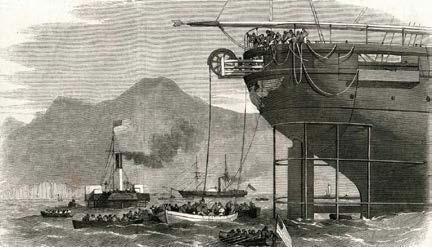
Any of our readers who have visited or worked on the AlcatelLucent Submarine Networks (ASN) site in Greenwich before 2008 will have been aware of a small, white building on the river-front in the north-west corner of the site, known as ‘Enderby House’ and perhaps you may have wondered about its history.
The plain facts are simple. The house was built for Charles Enderby (1797-1876) between June 1845 and April 1846 and he lived there until August 1849. Later that year the house and surrounding Enderby Hemp and Rope Works site were put up for sale. However, new owners were not found until 1857, when Glass, Elliot and Co. expanded from Morden Wharf next door and the
house became their management offices and boardroom.
For the next one hundred and fifty-one years it served many functions as an integral part of the manufacturing facilities of the world’s leading submarine cable suppliers. Under STC ownership, in June 1973, it was granted Grade II listed status by English Heritage. In 2008, it was sold by ASN to property developers.
However, the story of the family that had it built is perhaps a little more interesting.
The ancestors of Charles Enderby can be traced back to the English Civil War, during which they supported Oliver Cromwell (1599-1658) and were rewarded with confiscated lands in Ireland. These were sold off shortly after
the Restoration of the Monarch in 1660. By the time of the Great Fire of London (1666), a branch of the Enderby family, were proprietors of a tannery in Bermondsey which is now in the London borough Southwark.
The tannery business was passed down from father to son until, at the beginning of the 18th Century, it came under the control of Daniel Enderby (1681-1766). Daniel was keen to raise the social status of his family and in 1735 he indentured his son Samuel (1719-
Enderby House
1797) as an apprentice cooper, or barrel-maker. Samuel became a freeman of the Worshipful Company of Coopers in 1742 and set up his own business based at Paul’s Wharf in the City of London. Ten years later he married Elizabeth Buxton, the daughter of a rich merchant from Essex.
Buxton and Enderby went into partnership to exploit the growing market in whale oil. Their business was based on shipping finished goods from England and Europe to the colonies in America and returning with whale oil purchased from the American whaling fleets. The whale oil was used for oil lamps and the manufacture of soap and candles. The business grew rapidly until the Boston Tea Party (1773) and the subsequent
American Revolutionary War (1775-83).
Robbed of access to the American market, in 1775 Samuel Enderby set up his own company, Samuel Enderby & Sons, and for the first time became directly involved in whaling and seal hunting. He targeted the South Atlantic and Pacific Oceans. By 1791, the company owned or leased 68 vessels – a mixture of cargo and whaling ships. Five of which took part in the ‘Third Fleet’ transportation of convicts to Sydney Australia in 1791. The Enderbys planned to obtain contracts to transport convicts from the British Government and then send the ships whaling before they returned to England with whale oil and seal skins. However, the Third Fleet contracts were the only ones they were able to secure.
Samuel Enderby Senior died in 1797, passing the business on to his three sons: Charles (17531819), Samuel Junior (1755-1829) and George (1762-1829). All three married. However, Samuel Junior was the only one to have children and, more importantly, male heirs.
He became the managing partner in the business. The brothers presided over the zenith of the company, sponsoring a number
of expeditions south of Australia and New Zealand into Antarctic and sub-Antarctic waters, naming and claiming for Britain a number of new land masses.
However, two decades of intense whaling and seal hunting had driven the whale and seal populations close to the point of extinction. At the same time, completition from American and Australian based whaling companies was becoming difficult to withstand. Perhaps worse, the use of gas for lighting was becoming more popular, causing a major decline in the demand for whale oil.
By the time Samuel Junior died in 1829, the company was on the downward path. It was left to three of his five sons: Charles (1797-1876), Henry (1800-1876) and George (1802-1891). The company was then renamed Messrs. Enderby Brothers. They were not great business men, but they recognised the need to diversify. In 1830 they purchased a site on the Greenwich peninsula where they built a rope and sail manufacturing factory known as the Enderby Hemp and Rope Works. This was quite successful and brought over 250 jobs to the area. But, on 8 March 1845 the factory was destroyed by fire.
In parallel with developing
the rope and sail business, the brothers had spent large amounts of the company’s capital reserves on building a new ship, the Samuel Enderby, and sponsoring three expeditions to the Antarctic. These voyages were successful from a geographical discovery point of view, but were a commercial disaster. It also appears that the Hemp and Rope Works was underinsured. Instead of investing what insurance money they did get in rebuilding the factory, Charles built Enderby House, and leased even more land from Morden College in order to build a coach road up to his new front door.
As a last throw of the dice, Charles and George promoted a new company: the Southern Whale Fisheries Company. The mission of which was to
Samuel Enderby (1755-1829)
Charles Enderby (1797-1876
establish a settlement on the Auckland Islands, discovered by the Enderby ship Ocean in 1805, to support whaling and ship’s repairs in the region. The Enderbys could not afford to finance this venture themselves, but their name and the efforts of the two brothers got the project underway. Charles secured the position of Chief Commissioner of the settlement ,which was to be known as “Hardwicke” after Charles Philip Yorke (17991873) the 4th Earl of Hardwicke, the chairman of the company. Charles was also made Governor General of the Auckland Islands under royal charter.
The flotilla of ships left Plymouth in August 1849, arriving at Port Ross in the Auckland Islands in December. Things did not go well. Charles proved to be inept as both Commissioner and Governor. Eventually
the company’s directors sent out Special Commissioners to assess the settlement with the result that it was abandoned in August 1852. There was much antipathy between Charles and the two Special Commissioners, George Dundas (1819-1880), M.P. from Linlithgow in Scotland and Thomas Robert Preston the company secretary. Charles resigned as Commissioner, before he could be dismissed, and was then evicted from the Governor’s house. He was then forced to leave the Auckland Islands and was taken to Wellington, New Zealand, where he brought a court-action against the Special Commissioners which failed. When he returned to England in late 1853, he was determined to put his grievances before Parliament. Again his attempts to be heard were unsuccessful.
Almost immediately after his
departure for the Auckland Islands, it was announced that Messrs. Enderby Brothers was in financial difficulty and could not service its debts. At the same time the derelict Hemp and Rope Works had been put up for sale. With Charles’ return to England, the affairs of the Messrs. Enderby Brothers were finally wound up in 1654 and, in 1857, Enderby House and the 14 acres (5.66 hectares) site was sold to Glass, Elliot & Company. Enderby House’s 151 years association with the submarine cable systems industry had begun.
It is unlikely that Charles took up residence again in Enderby House during the three years before its sale. He died a lonely and bitter man on 31 August 1876 at his sister’s house in Kensington, London.
The Enderby Group that has been formed to try and ensure that Enderby House and its history is preserved and has a sustainable future is producing two companion booklets to tell the story of family and the house. Ones is called “The Eponymous Enderbys of Greenwich” and the other “The Story of Subsea Telecommunications and its Association with Enderby House”. For those readers who are interested, these will be available later this year.
Stewart Ash’s career in the Submarine Cables industry spans more than 40 years, he has held senior management positions with STC Submarine Cables (now Alcatel-Lucent Submarine Networks), Cable & Wireless Marine and Global Marine Systems Limited. While with GMSL he was, for 5 years, Chairman of the UJ Consortium. Since 2005 he has been a consultant, working independently and an in association with leading industry consultants Pioneer Consulting, Red Penguin Associates, Walker Newman and WFN Strategies, providing commercial and technical support to clients in the Telecoms and Oil & Gas sectors.
Anotherimportant month for the future of our industry has come along and here’s the Finance & Legal issue right in the middle of it! With all of the changes barreling towards us, there is no better resource than SubTel Forum for gathering great minds and opinions from around the industry. Looking towards the next two months, we have three excellent products set for release: the second edition of the STF Supplement, this time we will be covering surveyors, the ever-popular
second quarter update to the Almanac, and finally the 82nd issue of the Magazine, set to discuss subsea capacity.
I’d like to thank all of the System Suppliers that provided information for the first edition of the Supplement, as the first release in a new product line, the feedback has been very positive and we’ll be growing the publication in some very interesting directions.
As we move into the second quarter of the year, I’d like to invite you to advantage of
a special Spring discount for any of these three products: 15% off plus a free month for a web banner on the STF site.
For details on the three products, please see the following webpages: SubTel Forum Magazine, STF Supplement, Submarine Cable Almanac, and STF Web Banner.
Kristian Nielsen literally grew up in the business since his first ‘romp’ on a BTM cableship in Southampton at age 5. He has been with Submarine Telecoms Forum for a little over 6 years; he is the originator of many products, such as the Submarine Cable Map, STF Today Live Video Stream, and the STF Cable Database. In 2013, Kristian was appointed Vice President and is now responsible for the vision, sales, and overall direction and sales of SubTel Forum.
+1 703.444.0845
knielsen@subtelforum.com
Submarine Telecoms Forum, Inc.
21495 Ridgetop Circle, Suite 201
Sterling, Virginia 20166, USA
ISSN No. 1948-3031
PUBLISHER: Wayne Nielsen
MANAGING EDITOR: Kevin G. Summers
CONTRIBUTING AUTHORS:
Stewart Ash, Kent Bressie, Ross Buntrock, Kieran Clark, George M. Foote, Andrew D. Lipman, Ulises
R. Pin,Danielle Piñeres, Adam Sharp,Wesley Wright
Contributions are welcomed. Please forward to the Managing Editor at editor@subtelforum.com.
Submarine Telecoms Forum magazine is published bimonthly by Submarine Telecoms Forum, Inc., and is an independent commercial publication, serving as a freely accessible forum for professionals in industries connected with submarine optical fiber technologies and techniques.
Submarine Telecoms Forum may not be reproduced or transmitted in any form, in whole or in part, without the permission of the publishers.
Liability: while every care is taken in preparation of this publication, the publishers cannot be held responsible for the accuracy of the information herein, or any errors which may occur in advertising or editorial content, or any consequence arising from any errors or omissions, and the editor reserves the right to edit any advertising or editorial material submitted for publication.
Idon’t often share the SubTel Forum part of my life with my friends and acquaintences, but this issue is so timely that I’m going to have to post it on Facebook and Twitter.
I’ve seen so many people posting mainstream media articles about Net Neutrality, and we all know that the mainstream media is totally worthless for anything other than sports scores, and I’m not interested in sports.
Instead of politicized articles telling me what to think, I’m pleased that we have some of the most knowlegeable people in the field to write articles on this important subject.
I’m particularly proud of this issue because of the quality of our contributors. Our
annual finance & legal edition practically puts itself together every March and I can just spend a few weeks drinking coffee and working on my novel. This year was no exception.
So, here is a loaded question: How do you feel about Net Neutrality? Is this a good thing or a bad thing? How will affect your business? How will it affect you at home?
Send me your thoughts and I will gladly publish them in a future issue of SubTel Forum.
Personally, living out in the middle of nowhere, I tend to think that our internet couldn’t possible get any worse but perhaps that is naïve. Perhaps there are greedy politicians, each one wearing the wool suit, even now planning ways to make it even less possible for me to use Skype or watch a
video on YouTube. Or maybe I just need another cup of coffee.
Kevin G. Summers is the Editor of Submarine Telecoms Forum and has been supporting the submarine fibre optic cable industry in various roles since 2007. Outside of the office, he is an author of fiction whose works include ISOLATION WARD 4, LEGENDARIUM and THE MAN WHO SHOT JOHN WILKES BOOTH.