tem. Where this has occurred it has been expedient to recover sufficient submerged plant for optional routing to be implemented based on the survey findings. Route Engineering is complicated by the restrictions imposed from the cable types within the donor system and the levels of burial protection implemented on that system. In general, the difficulties encountered are inversely proportional to deployment depth by virtue of the relative ease of recovering a LW or LWP surface laid cable by comparison with the difficulties of armoured cables recovery, particularly when they are buried. A complication that projects faced was armoured cable availability. All the recycled projects Vodafone have undertaken have been systems shorter than the donor system. Since we have worked with a single donor system this meant that we reached a point where, while there was ample deep water cable to be recovered, only limited Armoured Cable and armoured cable types were available. Once the donor cable’s shore ends and armoured cables had been recovered to the fullest extent, project teams have approached Armour cable requirements by a combination of approaches such as acquisition and deployment of redundant re-
gional cable spares (at the end of operational life of cable systems it is common for “owners” to either sell or scrap their spares holdings since they will be keen to halt any recurring storage charges from their spare cable holdings in order to close their books on the Operation & Maintenance budgets) and re-use of existing shore end cables3. The availability of a compatible out of service shoreend at one or more locations of a proposed connection has proved to be valuable, not only in terms of the armour cable, but also the benefits in simplification of permits, existing fault history, installation cost savings and minimised environmental impact of the recycled system. The availability and the reuse of existing shore ends have made very positive contributions to overall project appraisal. The third option is to procure new armoured cable sections to meet the project requirements. Life Expectancy Obviously, reliability and life expectancy of a recycled system are also key factors for any potential project Vodafone conducted a thorough reliability simulation prior to committing to recycling projects. It is widely reported that cable recovered from the deep ocean is in pristine condition and 3 S Dawe, T Frisch, B O’Dwyer, D Toombs, “Shore Ends to Re-Use or Not to Re-Use?”, SubOptic 2004, Monaco, Paper Tu A2.3
it has been possible to return such cable to service without remedial work. This has certainly been the experience from Vodafone’s project involvement. System fault history has been consistent with industry norms with no failures observed due to submerged cable and plant. System life expectancy is the subject of a SubOptic sponsored collaborative project in which Vodafone is participating, to be reported on at SubOptic 2016 in Dubai Conclusion There have been a number of successful recycled submarine systems the majority completed in the last eight years the article has described three key factors contributing to a successful recycling project for the guidance of potential investors or stakeholders. The relative influence of each factor is always dependent on the particular case.
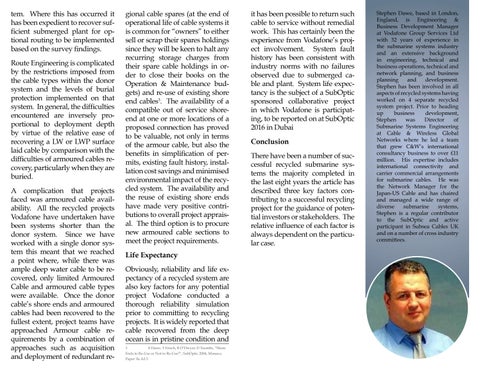
Stephen Dawe, based in London, England, is Engineering & Business Development Manager at Vodafone Group Services Ltd with 32 years of experience in the submarine systems industry and an extensive background in engineering, technical and business operations, technical and network planning, and business planning and development. Stephen has been involved in all aspects of recycled systems having worked on 4 separate recycled system project. Prior to heading up business development, Stephen was Director of Submarine Systems Engineering at Cable & Wireless Global Networks where he led a team that grew C&W’s international consultancy business to over £11 million. His expertise includes international connectivity and carrier commercial arrangements for submarine cables. He was the Network Manager for the Japan-US Cable and has chaired and managed a wide range of diverse submarine systems, Stephen is a regular contributor to the SubOptic and active participant in Subsea Cables UK and on a number of cross industry committees.