SubTel Forum Issue #8 - The State of the Submarine Telecoms Industry
Submarine Telecoms Forum is published quarterly by WFN Strategies, L.L.C. The publication may not be reproduced or transmitted in any form, in whole or in part, without the permission of the publishers. Liability: while every care is taken in preparation of this publication, the publishers cannot be held responsible for the accuracy of the information herein, or any errors which may occur in advertising or editorial content, or any consequence arising from any errors or omissions.
Contributions are welcomed. Please forward to the Managing Editor: Wayne F. Nielsen, WFN Strategies, 19471 Youngs Cliff Road, Suite 100, Potomac Falls, Virginia 20165, USA.
Two months ago in our last issue, we mentioned our partnership with TSA, that being the debut of News-Now, the online, complimentary submarine cable intelligence service, and thankfully, it seems to have been well received, and as designed, has become a weekly resource for the general community.
This month, we are pleased to announce the launching of STF MarketPlace, the new online resource for industry reports, newsletters and other cool stuff! By pre-negotiating favorable terms beforehand, we can offer various industry data sources with a favorable STF discount. So, watch that space as it grows.
Issue 8 brings some interesting insight into our dynamic submarine cable world. Alan Robinson welcomes all to the upcoming 2004 SubOptic Conference, and Tom Soja reveals some interesting signs of market life. Neil Lambert discusses broadband demand, while Paul Budde examines infrastructure, in the Asia-Pacific region. And of course, Jean Devos returns with his ever-insightful observations.
Lastly, we have included a one-page industry survey co-sponsored by SubOptic 2004, which we hope you will take the time to complete and forward, the results of which will be shared in an upcoming issue.
Happy reading.
SubmarineTelecomsIndustrySurvey
SubOptic 2004 and Submarine Telecoms Forum magazine are co-sponsoring the first annual Submarine Telecoms Industry Survey, the results of which will be shared online and published in an upcoming issue.
One lucky responder will receive a free copy of the 2002 edition of Undersea Fiber Communication Systems, which was edited by Jose Chesnoy, Head of System Design & Technology, Alcatel Optics Group, France.
Please take a moment to respond by printing this page and mailing or faxing to:
WFN Strategies
19471 Youngs Cliff Road, Suite 100
Potomac Falls, Virginia 20165 USA
Fax [1] 704 444 3047
1.Which best describes you?
Academic
Engineer/Project Management
Management
Marketing
Other
2.What best describes your business?
Cable owner
System Integrator
Cable Installer/Maintainer
Marine Surveyor
Other
3.Which Keynote Speaker would attract you to attend SubOptic 2004?
4.What would you find the most stimulating and relevant topic for a SubOptic Roundtable?
11.How would you rate the content of Submarine Telecoms Forum magazine
Excellent Unsatisfactory
Good Poor
Satisfactory
5.Are you planning to attend SubOptic 2004?
Yes No
6.Are business conditions improving or getting worse?
Improving Worse
7.Are you optimistic or pessimistic about the future?
Optimistic Other Pessimistic
8.Does your current business performance indicate that we are still in a recession, or has your business not been affected?
12.How would you rate the content of News-Now and the STF website?
Excellent Unsatisfactory
Good Poor
Satisfactory
13.Would you like to see any changes in STF or NewsNow, or other website information services?
9.How have client requirements changed over the last three years?
14.In your opinion, what does the industry most need?
10.How has the type of project you handle changed over the last three years?
Emails to the Editor
Dear Industry Colleague,
Further to my last email on this subject, I can confirm that Pro-Bank now has 18 registered candidates based in 4 different countries.
I am pleased to advise that the service has been promoted within “Submarine Telecoms Forum” - a free news information service aimed at the entire submarine telecommunications industry - visit: www.subtelforum.com/ 16_march_2003.htm.
NB: Submarine Telecoms Forum is an excellent publication - if you do not already receive it, visit the home page at www.subtelforum.com and sign up!
Graham Marle QUALTRACK
LTD
Another good edition.
John Graham ITG
I enjoy reading Submarine Telecoms Forum.
Donald Dean President DMM
International Inc.
Re: NEWS-Now
Good show, mate.
C.F. Chamberlain
T Soja & Associates, Inc. has published a new report entitled
The report provides a timely look at pipeline and submarine power cable projects that may provide opportunities for marine services companies and telecom infrastructure developers.
The report, available as an Adobe Acrobat .pdf file, identifies 68 terrestrial and submarine pipeline or electric power cable projects that may provide opportunities for marine service companies and telecom developers looking to use their expertise in major construction projects outside the traditional telecom industry.
Opportunities: Pipeline and Power Cable Projects is available now.
A quarterly update service is also available.
www.subtelforum.com/catalog
ContracttoGlobalCrossing
Global Crossing has announced an agreement to provide Latin America’s largest research and academic network, the Brazilian National Education and Research Network (RNP), with high-speed International Private Line and Dedicated Internet Access services.
www.subtelforum.com/23_march_2003.htm
CableShipReadytoInstallAustralian Cable
A state of the art international cable vessel installing Telstra’s additional communications capacity to Tasmania, has arrived in Burnie, Australia. www.subtelforum.com/4_may_2003.htm
CNBCtoUseLondon-PacificFiberLink forVideoFeeds
Singapore’s StarHub has sealed a substantial contract with CNBC Asia Pacific, the world’s leading business television news provider, to provide ‘live’ video feeds from London, Hong Kong and Japan to Singapore via fiber cable.
www.subtelforum.com/13_april_2003.htm
Corningestimatesfibermarketdown 50%in2002
Corning Optical Fiber estimates that the total worldwide fiber market was about 55 million fiberkilometers in 2002, down about 50% on 2001.
Abriefsynopsisofcurrentnewsitems from NewsNow, the weekly news feed available on the Submarine Telecoms Forum website.
Global Crossing has announced a new managed services offer to deliver an unmatched service commitment to customers worldwide. Global Crossing Managed Services can be provided over the world’s first integrated global IP-based network, which reaches 27 countries and over 200 major cities. www.subtelforum.com/23_march_2003.htm
GlobalCrossingFilesMORforJanuary
Global Crossing has filed a Monthly Operating Report (MOR) with the U.S. Bankruptcy Court for the Southern District of New York, as required by its Chapter 11 reorganization process.
www.subtelforum.com/6_april_2003.htm
GlobalCrossingSignsWithUniversity
Global Crossing has signed an agreement with Florida International University (FIU) to provide International Private Line (IPL) and Dedicated Internet Access (DIA) services.
www.subtelforum.com/30_march_2003.htm
InternationalTelecomWinsCanadian Project
International Telecom Inc. has been selected to install two marine cables connecting Cape Breton to mainland Nova Scotia, Canada.
www.subtelforum.com/20_april_2003.htm
IPSolutionStrategyforNTT
NTT Communications Corporation has announced a comprehensive strategy for transforming the company from a “Global IP Company” to a “Global IP Solution Company.”
www.subtelforum.com/23_march_2003.htm
KPNAddsServicesAcrossGermany
With the official launch of KPN EuroRings into the German market KPN is now offering a broad range of international data and IP services across Germany.
www.subtelforum.com/20_april_2003.htm
Level 3 Communications, Inc. has signed an agreement to provide network services to mpX technology AG in Munich and Frankfurt.
www.subtelforum.com/23_march_2003.htm
MinteraSetsNewTransmissionRecord
Mintera announced that it demonstrated error-free transmission of 40 data channels each operating at 40 Gbps over a record distance of 10,000 km of transmission fiber without electrical regeneration.
www.subtelforum.com/30_march_2003.htm
MoreCustomersforNAPoftheAmericas
Terremark Worldwide, Inc. has announced that the company signed eighteen contracts with new customers and had three existing customers expand their relationship with the NAP of the Americas by ordering additional space or services.
www.subtelforum.com/20_april_2003.htm
MPLS-basedIP-VPNServicesfor Thailand
NTT America, Inc., has announced MPLS-based IP-VPN services availability in Thailand for multinational corporations doing business in the region.
www.subtelforum.com/20_april_2003.htm
NewBankFacilityforSouthernCross
Southern Cross Cable Network has successfully concluded negotiations with its senior banking syndicate for a restructured bank facility.
www.subtelforum.com/4_may_2003.htm
OTEPicksInteroutefor“Olympic”Traffic
Interoute has signed an agreement with the Hellenic Telecommunications Organization S.A. (OTE), the largest Greek telecommunications operator, to provide high speed data networks services throughout Europe, in preparation for the 2004 Olympic Games in Athens, Greece.
www.subtelforum.com/23_march_2003.htm
PTCTokyoBayMid-YearSeminar2003
The Pacific Telecommunications Council invites companies to join them in Japan this May for a twoday power packed program.
www.subtelforum.com/13_april_2003.htm
TycoWinsSvalbardContract
Tyco Telecommunications (US) Inc. has been selected by a subsidiary of the Norwegian Space Centre (NSC) to supply the Svalbard Undersea Cable System linking the island of Svalbard with mainland Norway.
WFN Strategies, LLC recently announced that long-time industry expert, J.A. (Jack) Runfola has joined the company as Senior Consultant.
www.subtelforum.com/27_april_2003.htm
Europe-AsiaCableUpgraded
FLAG Telecom Group Limited has announced a capacity expansion to key segments of its FEA cable system, which links the telecoms markets of Western Europe and Japan through the Middle East, India, Southeast Asia and China.
www.subtelforum.com/6_april_2003.htm
FujitsuAnnouncesFLAGContract
Fujitsu Limited announced recently that it has been awarded a contract by FLAG Telecom Ltd to upgrade the capacity of key segments of the FLAG Europe Asia (FEA) submarine cable network.
www.subtelforum.com/6_april_2003.htm
GDSellsITInternationalTelecom
Canadian investors have entered into an agreement to acquire IT International Telecom Inc. and IT International Telecom Ltd. (UK), business units of General Dynamics Network Systems.
www.subtelforum.com/13_april_2003.htm
GlobalMarineLaunchesCable
AwarenessSite
Global Marine’s Cable Awareness section on its website ( www.globalmarinesystems.com) has been launched.
www.subtelforum.com/30_march_2003.htm
GlobalMarineWinsContract
Southern Cross Cables Limited has renewed and extended its maintenance agreement with Global Marine for the portion of the Southern Cross Cable Network installed in the North Pacific Ocean.
www.subtelforum.com/30_march_2003.htm
KPNUpgradesfor10-GbpsServices
KPN will use optical equipment from Nortel Networks to provide dense wavelength division multiplexing (DWDM), 10 Gbps service on its international fiber-optic network.
www.subtelforum.com/6_april_2003.htm
MoreCapacityforC&WIDCBackbone
Cable & Wireless IDC has greatly expanded its IP backbone to improve connectivity to its global IP network in Japan and Asia.
www.subtelforum.com/27_april_2003.htm
NewManagementforSeaworks
Seaworks, a New Zealand-based provider of installation and maintenance services for the submarine cable industry, has announced that its management restructuring has been restructured.
www.subtelforum.com/27_april_2003.htm
NewROVforGlobalMarine
Global Marine Systems Limited has introduced Atlas 2, a 300 Kw highly specified, remotely operated vehicle (ROV), capable of carrying out inspection, burial and survey of submarine cable systems down to 2000 meters water depth.
www.subtelforum.com/4_may_2003.htm
NewOwnersforState-of-the-Art TransatlanticCable
Columbia Ventures Corporation (CVC) has announced that its subsidiaries have completed the purchase of a state-of-the-art 12,200-kilometer fiber optic submarine cable system connecting North America with Europe.
www.subtelforum.com/6_april_2003.htm
NewUnderwaterVehicleServingthe GulfofMexico
Boeing announced that the Echo Ranger, an unmanned autonomous underwater vehicle, or AUV, that performs deepwater surveying in depths up to 3,000 meters (10,000 feet), for gas, oil and telecommunications companies, has entered service in the Gulf of Mexico.
www.subtelforum.com/13_april_2003.htm
PacificCrossingBoughtbyPivotal
PrivateEquity
Pivotal Private Equity announced today that it has signed an Asset Purchase Agreement to acquire the assets of Pacific Crossing Ltd. and its subsidiaries (PCL) for 63 million dollars. PCL, formerly a subsidiary of Global Crossing, operates the PC-1 fiber optic telecommunications network connecting Japan with the United States of America..
www.subtelforum.com/27_april_2003.htm
RegionalSubmarineNetworks–the
alternativefromGlobalMarineandBT
Global Marine launches its Regional Submarine Networks, the first truly vendor-independent solution for regional cable systems.
www.subtelforum.com/4_may_2003.htm
SMDTractorForOffshoreWindfarms
SMD recently announced that Mayflower Energy in Teesside, UK has awarded them a contract for a subsea cable installation vehicle.
www.subtelforum.com/30_march_2003.htm
STTTakesOverinGlobalCrossingDeal
ST Telemedia has assumed the rights and obligations of Hutchison Telecommunications Limited (Hutchison) to invest in Global Crossing under the purchase agreement signed August 9, 2002.
www.subtelforum.com/4_may_2003.htm
TelecomItaliaIncreasesPresence
Telecom Italia has further boosted its presence in South America by expanding, through Telecom Italia Sparkle (100% owned by TI) and Seabone, its international backbone to provide IP and data transmission services in the area.
www.subtelforum.com/4_may_2003.htm
By Alan Robinson
Eighteen months ago I was appearing as an “industry expert” as part of a Round Table panel discussion. The panel was asked an exacting question by a determined member of the audience. “When would we see the green shoots of recovery in our once, much admired industry?” Needless to say all the so-called experts threw bets on the table with forecasts that left as much room for vagueness and retraction as possible. I was the last to answer and I said, “March 29th 2004”. The questioner jumped to his feet immediately to ask for my reasoning for such a precise reply. “Because it is the start of SubOptic 2004……… “. I’m not sure why I answered as I did, but perhaps looking into the foggy crystal ball, I had an intuitive feeling that by this date we as an industry would have taken as much pain as we could bear. We would be driven to get together to understand how we had rationalised, how we might regroup and where the real value was in building, owning and operating submarine networks.
Firstly, it is probably worth recalling some of the objectives of the conference from the SubOptic Constitution:
•It is a mutual, non-profit making organisation •Its objective is to promote the interests of the submarine telecommunications cable community by exchanging ideas and information, educating within the community and fostering debate
•The SubOptic Executive Committee will maintain impartial academic excellence and the interests of the organisations within the community
So on March 29th 2004 we shall meet with the intent to look back over a torrid 3 years since the heady days of Kyoto, recount the lessons we have learned, and put every effort into confirming and reforecasting the future in both commercial and technical terms.
In the last few months I have been frequently asked a number of similar questions specifically around the timing and location of the next SubOptic……..
“Will the conference go ahead in 2004?”
“Why have we chosen Monaco, in times of economic hardship?”
The answer is a definite yes to the first question. There is a small proviso to that question –the financial success, i.e. break even, of the conference entirely depends upon the submarine cable community registering attendees, taking sponsorships and booking exhibition space. So early booking will be appreciated to keep the hosts, Alcatel, cash flow positive, or at worst, neutral and to keep the Executive Committee confident that they will not have to subsidise the event.
The latter question “why Monaco……?” can be answered very simply. Monaco has a superb conference and exhibition facility at the Grimaldi Forum. (By way of interest, the lecture
theatres are in fact built below sea level, on the waters edge, so this should add an extra theatrical dimension). Most hotels are within walking distance; attendee feedback from Kyoto strongly indicated a preference for this. The costs of hotels and restaurants are equivalent to a European capital such as Paris or London, with Alcatel having negotiated significant discounts. But more importantly, Monaco is home to the Musée Oceanographique de Monaco founded in 1910 by Prince Albert 1er. He sank all of his casino profits into a passion for deep-sea exploration, and the research laboratories were once headed by Jacques Cousteau. There is therefore a real tie between Monaco and the sea, and the Monaco government has been most welcoming and supportive of SubOptic 2004.
So what are the arrangements, format and timetable for the event? For details please see the website www.suboptic.biz which will be supported by a number of mail shots that commenced in mid-April. If for some reason you did not receive this initial mail shot, please contact Didier Provost at didier.provost@alcatel.fr or marion.ehbrecht@alcatel.fr and get on the mailing list. Unfortunately, with the turmoil in the industry since Kyoto, some companies have disappeared, changed ownership or address, so Alcatel’s database needs some amending. Please make sure that you make their task as easy as possible. The website has details of registration, with excellent discounts for early bookings, and
Alan Robinson is Vice President of Global Operations Engineering Services (GOES) for Cable & Wireless, responsible for strategic investments on behalf of C&W.
He is a Master Mariner and joined BT in 1976. He has since held positions in Sales and Project Management, before being appointed BT Marine’s General Manager for the Asia Pacific region, based in Singapore. On his return, he took up a position of Director of International Sales with the newly combined BT and C&W cableship fleet in C&W Marine. Alan was appointed Managing Director of Network Services in 1997 and Director of Capacity Management in January.
information concerning a range of sponsorship opportunities and, exhibition and hospitality space.
Both these latter opportunities are drawing considerable early interest so don’t delay your bookings as we have scaled back on available space in line with the industry downturn to ensure we run at maximum capacity.
The mail shot also has a call for papers, which will stay open until the end of August 2003. The Programme Committee is doing an excellent job in preparing a broader range of subject areas and for 2004 there will be significantly more emphasis placed on the state of the market and market forecasts, trends and opportunities.
We are prioritising the need to attract speakers and contributions from the financial and venture capitalist community, and also broaden our dealings with regulatory and permitting issues. So my hope is that, even with a continued downturn in investment, the value of the conference will be to establish a more predictable future, incorporating new and innovative solutions for an industry which went from regulated conservatism to wild opportunism in one disastrous leap.
In the SubOptic calendar, as part of a steady marketing and awareness programme, we had a SubOptic sponsored Roundtable at PTC in January in Hawaii. The panellists included Brooke Coburn, Managing Director of the Carlyle Group and Scott Davies, CEO of Macquarie Communications Infrastructure Group. Between them, they established that there was still an appetite in the financial community for properly packaged and managed, communications assets, with good long-term returns. But before this could happen the overhang of capacity from the boom years has to be rationalised and the players re-
structured before any form of investment stability will return. With prices still declining on the major long haul routes, sense has to prevail, or we will see another round of Chapter 11 and bankruptcies.
So this coming year is critical to the health of the industry. There are currently regional niche opportunities, and a clamour to shut down old uneconomic systems. Some companies have or will emerge from Chapter 11; others have gone under with assets sold off at staggering low prices.
When Stephen McClelland asks in Telecom International “is the submarine industry now in need of a lifeline?” he poses a number of significant questions that were articulated at that PTC Roundtable.
I’m sure by next year we shall be able to answer most of those questions, but in the meantime, SubOptic will be working hard to preserve one of the founding principles of the conference, namely the well being of the (submarine cable) community.
Please help to get the conference off to a very positive start by making a commitment to exhibition and hospitality space and sponsorship opportunities. Early registration has significant discounts. I am sure we will be rewarded with vigorous debate, eloquent presentations and powerful recommendations – of course supported by evenings that will enhance the days events – just the tonic for a hangover recovery!
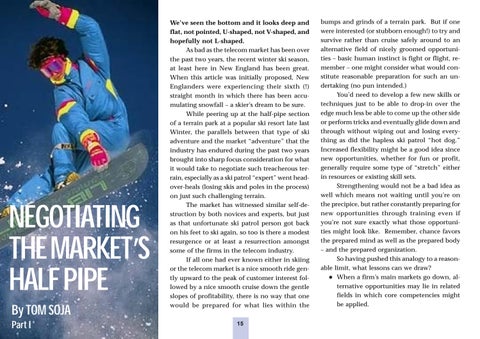
NEGOTIATING THEMARKET’S HALFPIPE
We’ve seen the bottom and it looks deep and flat, not pointed, U-shaped, not V-shaped, and hopefully not L-shaped.
As bad as the telecom market has been over the past two years, the recent winter ski season, at least here in New England has been great. When this article was initially proposed, New Englanders were experiencing their sixth (!) straight month in which there has been accumulating snowfall – a skier’s dream to be sure.
While peering up at the half-pipe section of a terrain park at a popular ski resort late last Winter, the parallels between that type of ski adventure and the market “adventure” that the industry has endured during the past two years brought into sharp focus consideration for what it would take to negotiate such treacherous terrain, especially as a ski patrol “expert” went headover-heals (losing skis and poles in the process) on just such challenging terrain.
The market has witnessed similar self-destruction by both novices and experts, but just as that unfortunate ski patrol person got back on his feet to ski again, so too is there a modest resurgence or at least a resurrection amongst some of the firms in the telecom industry.
If all one had ever known either in skiing or the telecom market is a nice smooth ride gently upward to the peak of customer interest followed by a nice smooth cruise down the gentle slopes of profitability, there is no way that one would be prepared for what lies within the
bumps and grinds of a terrain park. But if one were interested (or stubborn enough!) to try and survive rather than cruise safely around to an alternative field of nicely groomed opportunities – basic human instinct is fight or flight, remember – one might consider what would constitute reasonable preparation for such an undertaking (no pun intended.)
You’d need to develop a few new skills or techniques just to be able to drop-in over the edge much less be able to come up the other side or perform tricks and eventually glide down and through without wiping out and losing everything as did the hapless ski patrol “hot dog.” Increased flexibility might be a good idea since new opportunities, whether for fun or profit, generally require some type of “stretch” either in resources or existing skill sets.
Strengthening would not be a bad idea as well which means not waiting until you’re on the precipice, but rather constantly preparing for new opportunities through training even if you’re not sure exactly what those opportunities might look like. Remember, chance favors the prepared mind as well as the prepared body – and the prepared organization.
So having pushed this analogy to a reasonable limit, what lessons can we draw?
When a firm’s main markets go down, alternative opportunities may lie in related fields in which core competencies might be applied.
Core strengthening – all the rage among the various top sports gurus from running to biking to outdoorsmanship to team sports – speaks to an organizations’ ability to realize and constantly strengthen the foundation from which all other skills emanate and perhaps expand the core for potential applicability to new situations. This speaks also to the flexibility and training issue in that the more that specific skill sets are honed, the greater the potential to become blindered by increasingly specialized tasks and decreasingly open to new areas of potential opportunity.
Prosperity just around the corner?
So is the market climate beginning to change now that the sun has returned and the days grow longer? Indeed, has the half-pipe melted away and given way to verdant green opportunities or is there a continued threat from maniacal freerider downhill gravity-sport artists (think mountain bikers, all-terrain skateboarders, New Zealand-style gravity ball gonzos) that threaten to accelerate the self destruction cycle even further? Well, yes and no.
While it is much too soon to call a fullblown return to the go-go days of the recent telecom bubble – indeed those may never return, but even that’s hard to predict with any more than 50%/50% accuracy – signs of renewed activity are certainly beginning to appear. Within
“Stretch” markets: Some examples
Energy pipeline and terminal projects – ex. Saudi Aramco
Power cable projects
Offshore wind farm projects
Offshore oil & gas production platform opportunities – Fiber Web (Gulf of Mexico)
River, lake, and bay crossings – ex. Sonoque project in Quebec Province
Niche regional and micro-markets
Subsea research networks – ex. Project Neptune offshore tectonic plate monitoring and underwater laboratory environment
Note: There are 103 Pipeline, power cable and wind power projects listed in TSA’s Power Cable & Pipeline Opportunities Report which is published annually in January and updated quarterly.
the analysis and consulting sector, clients and others are starting to renew their efforts toward beginning to plan for future growth. There is convincing evidence that some vendors are actually doing this while others still have their heads in the sand, hoping that it doesn’t get much worse.
These future winners have recognized that reality dictates that you can’t cost-cut your way to growth or rely on the world to beat a path to your door in the hopes of writing up orders for your product or services. Proactive opportunity creation requires new ways of approaching markets and customers, and sometimes partnering with outside organizations in order to best leverage each other’s core competencies.
Several bright spots on the horizon. Carriers are still interested in buying capacity and have indicated so even during the past years’
darkness. Numerous capacity and service deals have been completed in the first four months of this year.
Pull-through at the end-user level is being borne out as evidenced through surveys such as that just published by America’s Network in which states, among other things, that demand for telecom services remains strong and that significant proportions of business end-users are planning to increase their spending on key telecom services over the next twelve months.
Similarly, a recent Information Week Research study showed that the number of processes and other metrics being monitored by businesses in real time will triple (i.e. increase by 3X) over the coming year from about eighty (80) such metrics today as companies of all types strive to move at the speed of their customers.
Inexpensive processing, storage, teleconnectivity, and software solutions will
make it easier and more cost effective to implement IT and IP-based business solutions.
Globalization of labor markets for high value-added services, not just for manufactured goods – outsourcing of software projects to India and also to China will require fat pipes.
As reported last December (2002) by Forbes:
Tech giant Hewlett-Packard has seen the future of technology consulting. It’s on the other side of the globe and it’s really, really cheap.
“We’re trying to move everything we can offshore…aggressively realigning our resources.” — HP Services chief Ann Livermore
Short term, that means adding to the software and services personnel HP already has in India. Further out, HP expects China to also turn into a major consulting center.
Napster: although severely hobbled by legal actions against it, descendents and imitators are now beginning to attract the interest of mainstream music publishing labels.
On the video entertainment front, Netflix – which offers DVD movie rental via the Internet – serves as the closest potential precursor yet to buying and delivering video content online.
Turmoil in the air travel business may spur the implementation of more frequent use of high-quality videoconferencing – at least where “pressing the flesh” is not absolutely crucial. Of course, this is an applications that’s been waiting to happen for many, many years now – but now
could be spurred on by various health and safety concerns.
Ultra-cheap and ubiquitous teleconnectivity via wireless phones of all types – and not necessarily full-bore 3G, but less expensive and complex versions such as 2.5G, WiFi and the various flavors of each with perhaps 80% to 90% of the functionality. NTT DoCoMo has 58 million cellular subscribers compared with KDDI which has 14 million subscribers.
However, NTT DoCoMo has only been able to sign-up 190,000 3G subscribers thus far while KDDI now has six million 3G subscribers in Japan – the second largest 3G subscriber base in the world (only SKTelecom in South Korea has more.)
“We never emphasized that our new phones were 3G, which is a technical thing most customers don’t care about; instead we focused on new services like personal GPS and the ability to take and send video clips using our phones,” says Yoshitaka Ishida, head of KDDI’s public relations department.
Innovation, as always the case, will drive the next boomlet. I nnovative applications follow naturally on technology that, while still evolving, delivers useful services for which customers are willing to pay. In a similar way, international bandwidth will begin to be rapidly devoured as new applications are developed that take advantage of the economies and plentitude of the capacity available.
Signs of Life in New Projects in Niche Markets – New Build Markets Beginning to Recover
SMITCOM St. Maarten – Puerto Rico cable
Bass Strait 2 project
Svalbard Undersea Cable System
Pakistan-UAE – at least two competing projects for that route
Telecom and Internet initiatives in Afghanistan, Croatia, Bangladesh
New projects in the Caribbean
Homeland security initiatives
Upgrades – FLAG Europe-Asia network, Southern Cross
Alaska United ring completion
Phenix Telecom transpipeline link
Bids for large end-user MNCs in some markets, especially in third-world markets, continue to be throttled by monopolistic behavior and expensive capacity pricing schemes
Refinancings – the fact that they are getting done is a sign that the capital markets believe there is hope, at least for some survivors – those that have gone through re-organization as well as those fortunate enough to have avoided the process and still remain standing.
Source: T Soja & Associates, Inc.
Mr. Soja has ten years experience as a Senior Analyst in the fiberoptics industry and as a Director of Submarine Cable Research. He has conducted feasibility and market demand studies for projects such as Atlantic Crossing. In the Pacific region, Mr. Soja completed a market study for the Hawaii-Americas and Western Hemisphere submarine cable systems. Mr. Soja holds an MBA from Babson College and a bachelor’s degree in mechanical engineering from the University of Rochester.
On a broader scale, the economic downturn is producing literally hundreds, if not thousands, of start-ups worldwide. The layoffs from established tech companies and from flame-outs has loosed upon the economy many would-be entrepreneurs who have both broadly applicable talents as well as an abundant talent pool from which to build their new organizations – at quite reasonable costs compared with those during the bubble years in which talent was scarce and expensive. These will provide the seeds of innovation-driven growth that will drive the “next big thing.”
Market Not Dead: More Signs of Life Among Recent Capacity and Service Deals
Network Services
Level 3 – Euronext network services (4-30-03)
Equant – EUMETSAT (4-24-03)
THUS – Capital Radio broadband network (4-24-03)
SingTel – Sumitomo Heavy Industries (4-18-03)
Cable & Wireless International – NTL IP Traffic (4-28-03)
Level 3 – Mesh Solutions co-location and IP transit services (4-01-03)
Global Crossing – Florida International University international private line (IPL) dedicated Internet access (DIA) services (3-26-03)
Global Crossing – Brazilian National Education and Research Network high-speed IPL and DIA services (3-21-03)
Level 3 – mpX Technology IPL and Internet access services (3-17-03)
Sprint – Hitachi Data Systems domestic and global voice and data services (3-12-03)
Equant – Behr GmbH & Co. KG connecting fourteen (14) sites on four (4) continents with IP VPN and Voice for IP VP (3-12-03)
Level 3 – University of Oregon Internet access and private line services
TeliaSonera International Carrier – Lycos Europe backbone capacity for its Europe-wide corporate network (2-10-03)
Wholesale Capacity Agreements
Interoute Hellenic Telecommunications (OTE) high speed data networks services throughout Europe for the 2004 Olympic Games (3-18-03)
France Telecom’s GlobeCast extends trans-world ATM Fiber Network to Asia with 45-Mbps transpacific fiber trunk between Singapore and Los Angeles (2-28-03)
Level 3 – HanseNet IP transit service (2-28-03)
Global Crossing – DANTE (Delivery of Advanced Network Technology to Europe) incremental 2.5 Gbps wavelength services (2-25-03)
Level 3 – George Washington University metropolitan dark fiber services (2-24-03)
Level 3 – The Southern Crossroads (SoX, Atlanta) private line, Internet access services, and other broadband services in aggregate for the University of Miami and Florida Atlantic University (2-24-03) CapEx plans (5-5-03)
Reporting on Equant’s revenues, Didier Delepine, president and CEO, said: “We are particularly gratified to meet revenue expectations in the first quarter.
Although Equant “…continue[s] to manage…costs aggressively [it] continue[s] to effectively manage…capital expenditure at less than 10 percent of revenues in the quarter…”
What’s notable is that revenues for Equant’s Network Services increased 3.7 percent to $408 million for the quarter, meaning that Equant would be budgeting CapEx expenditures in the tens of millions of dollars – a significant and far from “zero” amount.
Make no mistake about it, faith remains strong in the process of innovation – the virtuous cycle is not dead, merely going through a longer period of new expansion as the world catches up and digests the implications of the last round of technological innovation and what it has wrought in terms of opportunities – mainly benefits at lower costs in so many product areas.
The innovators and their angels and support structures (venture capitalists, academic connections, legal advisors, etc.) are also considering and taking to heart the lessons of the frenzy. However, it would also be reasonable to suspect that not all the lessons of the last boomand-bust cycle will necessarily be internalized. Most company starters are optimists by nature and necessity, and will be fully self-confident that what’s happened before would never happen again – at least to them. And that’s okay because free-market based capitalism is often a very messy process; but it beats the alternatives hands down.
There is the beginning of a shift away from rescue and resolution of the distressed assets and shareholder and vendor/customer lawsuits back toward evaluation of strategic growth opportunities, some involving more new-builds either via consolidation, re-deployment of assets, and genuine from-scratch physical infrastructure builds.
Source: TSA NewsFeed daily newsletter and diary of the international telecom and submarine cable industry.
As the Chief Technical Officer of Tyco Telecommunications, I am often asked how I balance the responsibility for the development of new technologies in our undersea system supply business while simultaneously managing the engineering and operation of the Tyco Global Network, which includes extensive amounts of fiber infrastructure, dozens of PoPs and cable stations around the globe, and all of the services and products that we deliver to our capacity customers. The answer that I give is always the same: When it comes to developing new technologies for the system supply market, the Tyco Global Network (TGN) provides us with a valuable and unique testing ground for differentiating what is important to a system purchaser from that which is superfluous.
Typically, the trend amongst all of the turnkey undersea system suppliers has been to increase the intrinsic traffic-carrying capacity of each new system and bring new, higher-capacity
technologies to market as soon as possible. Until recently, the most desirable technology was always the one that provided the greatest capacity by packing the largest number of carrier channels into the available optical bandwidth. The underlying belief was that the greater the overall bandwidth of a system, the lower the cost per individual circuit would be, thus making the system more financially attractive. In addition, the prospect of having extra fiber pairs was seen as a supplementary means of system financing; the sale of fiber pairs could generate sufficient revenue to cover a significant portion of the initial system construction cost.
This mindset resulted in the installation of a great deal of undersea infrastructure, which focused suppliers on dealing with ways to satisfy the prevailing market demand volumes while diverting them from focusing on the issues that most concern system purchasers: cost (both construction and operations), performance, and schedule. These three parameters are inter-woven
and I visualize them as a 3-dimensional matrix of system supply. This “supply matrix” needs to be carefully optimized for each purchaser’s requirements, objectives, and strategy. In this article, I will focus on the first two parameters: cost and performance, since my background as CTO and network operator give me fundamental experience with those issues.
Tyco Telecommunications’ historical roots lie in the Bell System (AT&T). As a Bell Laboratories development organization, we prided ourselves on being the technological leader in the industry. We pushed the limits of transmission, developed many of the fundamental technologies used today, and were instrumental in defining the international standards for undersea systems and their integration with terrestrial networks.
To give some examples of what we have accomplished over the past several decades: we
deployed the first commercial, repeatered fiber optic system in 1986, Optican 1; the first optically amplified system in 1994, Americas-1; and developed and installed the highest capacity trans-Pacific system in the world, TGN Pacific. But we also know, from first-hand experience, that leading-edge technology alone does not always win system supply contracts. Having been personally involved in the “bids and proposals” process, I understand that, regardless of bid strategy, our success is often tied to the initial costs of system deployment. Selecting the optimal technology for each application is an important contributor to minimizing initial system costs.
While many systems are awarded on the basis of initial cost, actual network viability depends on what we call the “total cost of ownership” of a system - the initial deployment costs combined with the long-term operating costs. Tyco’s understanding of the long-term operat-
ing costs has been significantly improved by owning and operating the Tyco Global Network. Today, we work with our customers to understand their needs, provide input from our experience of running a network, and create an optimal balance between the initial construction costs, the long-term operational costs, and the technological capabilities of the system. This cooperation yields a much more cost-efficient and profitable solution than simply focusing on the short term construction costs or on technological advances.
I am pleased to say that the Tyco Global Network incorporates the optimal technology (I happily acknowledge my own bias) to meet the needs of each individual sub-network, and that by being mindful of both the initial and the longterm costs when designing each sub-network, we have achieved one of the lowest OPEX figures in the industry for a transoceanic network. We have
learned a great deal from this experience and future undersea systems will incorporate this first hand knowledge reflecting lessons learned. I will summarize some of our key focus areas below.
Initial Costs
The initial costs of system deployment are fundamental to a purchaser’s ability to execute a project. They consist of the basic equipment infrastructure deployed at system start-up plus all of the associated cost overhead of equipment integration, installation and commissioning. At Tyco Telecommunications we carefully select each component that goes into our equipment designs; we examine the cost of the associated technology, and analyze the performance benefits of the technology and how our choices will impact the manufacturability and long-term reliability of the finished product.
In every dimension of our business we are driving costs down without sacrificing our fundamental commitment to quality and reliability. Once inventories are depleted, our reduced manufactured product costs and optimized system designs will drive down initial system construction costs.
One of the many lessons we have learned in being a network owner and operator is how to balance the economic life of an undersea network with the appropriate network design capacity. With this in mind, Tyco’s latest system proposals have utilized designs more precisely
focused on actual market needs for bandwidth. Determining the most cost-effective system design means working closely with the customer to understand his current and future traffic demands. This effort directly impacts the initial system deployment costs. For example, the difference between a system that carries sixtyfour 10-Gb/s channels and thirty-two 10-Gb/s channels is approximately 3 dB of net system performance. This additional margin can increase repeater spacings by approximately 15 km, thereby removing approximately 20 repeaters for systems of trans-Atlantic distance; this would reduce the total system cost by millions of dollars.
These lower capacity system designs should also allow for less costly wet plant fiber management and terminal designs, all contributing toward initial system cost savings for the customer.
Long-Term Costs
Long-term costs are those that have historically been of more concern to network operators than to system suppliers. They include, but are not limited to, equipment upgrades (software and hardware), equipment space, and operational and maintenance costs. The importance of understanding and managing the long-term costs of a network have been amplified in recent years with advances in DWDM technology and the increased competitive pressures on equipment and bandwidth.
Dr. William C. Marra is Chief Technology Officer and Vice President of Research, Development, Network En-
gineering, and Operations for Tyco Telecommunications where he is currently responsible the research, development and realization of current and future products required to support undersea systems solutions. He is also responsible for all aspects of network operations and services for the Tyco Global Network (TGN).
Over the last five years, Dr. Marra has had overall network design and engineering responsibility for Tyco’s undersea projects, including third party systems and Tyco’s own Global Network (TGN).
He received his BSEE from the Polytechnic Institute of Brooklyn, an MSEE from Stevens Institute of Technology, and a Ph.D. for joint work done at Stanford University and Stevens Institute. He joined the basic research organization of AT&T Bell Laboratories in 1969. Since that time he has worked on the development of numerous fiber-optic telecommunications systems for both terrestrial and undersea applications.
Network capacity upgrades are a major concern of every network owner. Owners want certainty that their initial investment will evolve in a cost-efficient manner. Of course, suppliers cannot predict the future any better than purchasers, but we understand that once a vendor’s equipment is initially installed, those components and software tend to “stick” to a system throughout its operating life.
Telecommunications components and software, as in the computer hardware and software industries, are manufacture-discontinued almost every day due to rapid advances in technology. Therefore, as a supplier, we must find ways to design equipment that is both forwardupgradeable and backward-compatible. A complex problem to be sure, but one that we are tackling because of the tremendous long-term value that such flexibility offers our customers.
there is a fixed cost associated with every square meter of floor space that equipment occupies. This fact alone is helping to guide our product development as we seek to increase equipment density while lowering heat generation and power consumption.
Finally, operational costs are of paramount importance to a network owner. The supplier’s challenge is to find cost-effective network management solutions that readily identify problems and provide fault isolation diagnostics that are simple to use and accurate in their findings. Being able to quickly collect valuable information from the network without extensive analysis can make the difference between a contented customer and a frustrated one. Having efficient network management tools greatly simplifies service troubleshooting, making life easier – and cheaper – for both customer and supplier.
Overall System Performance
Tyco Telecommunications is particularly aware of the issue and impact of equipment space. We recognize that for a system owner, and accurate, and eliminate the cumbersome and expensive non-essentials.
A good system supplier with a practical understanding of these realities will keep the essential network management features simple
The systems that Tyco Telecommunications constructs for the third-party supply market are optimized using the same technology design approach as the infrastructure we have installed for the Tyco Global Network. One of the benefits that we have gained through ownership of TGN is how to most efficiently operate, maintain, install, and commission networks from a total cost of ownership perspective. Virtually every undersea link in TGN has lit fiber for customer traffic as well as for experimental testing. We have done numerous in-field experiments on these actual, installed fiber systems, which, collectively, constitute the largest fiberoptic test bed available in the world. There are segments on TGN that utilize dispersion flattened fiber, the only commercially deployed system of this kind. This experimentation has
kept, and will continue to keep, Tyco Telecommunications on the cusp of the technology and performance curve. We understand what can be done on actual systems, and perhaps even more significantly, what cannot be done on real systems, the latter being crucial to ensure complete customer satisfaction.
Most importantly, we are incorporating what we have learned into the products and system designs that we provide to our customers at cost points that make sense. I believe that many of these ideas would not have been developed by a company that only does system supply without the benefit of owner/operator experience. So, while many of our system supply competitors grapple with the focus of their R&D during this difficult period of industry contraction, for Tyco Telecommunications the path is clear. Our broad experience over the last several years as both a system supplier and a network operator has given us comprehensive insight into the challenges facing network operators today, and thus, we are well positioned to address those challenges for our system customers.
The integrated structure of Tyco Telecommunications uniquely enables us to offer turnkey system supply solutions that are in-line with market conditions and customer needs. I believe we understand our customers better today than at any other point in our history – and we are now putting that understanding to valuable use for our customers.
The Delivery of Broadband Remains the key driver in the Asia Pacific Region
The constantly increasing level of demand by end users for internet and data service applications, has not mirrored the volatility experienced by other players in this market.
This increasing demand has never waned and whilst the rate of growth may be less than that predicted some years back, it has achieved rates that in some instances match and even exceed those experienced by mobile phone
operators of only a decade before. Many other industries seriously envy the growth rates achieved in the internet and data market, which today are being driven more and more by the deployment of broadband technology.
The Asia Pacific region in particular, has been predicted to achieve strong growth rates, as communication services expand into previously untapped and heavily regulated markets.
by Neil Lambert
Internet growth and broadband adoption, in this region, is currently the highest worldwide. The long term investment by many operators has made the current growth rates for these services possible.
In a relatively short period of time, we have seen statistics reported indicating that in some countries, there are already in excess of 50% of homes with internet connections and as very large
relatively undeveloped markets in Asia join the global trend for online services, we will see significant increases in demand levels for this region.
The key driver for current and future demand is the expanding deployment of broadband technology. Large capacity, interconnecting state of the art, fibre optic systems are linking all regions of the globe, making instant communications to anywhere, a reality.
These systems have the capacity and technology to ensure that they expand and upgrade to meet the increasing end user demand as it in turn grows. These systems are required to be sufficiently large so as not become redundant in only a few years.
As regions commence utilization of broadband services and become familiar with the resultant ease and speed of their communication facilities, significant changes occur to their usage patterns. In more established markets the following usage patterns have become apparent:
Broadband internet users tend to go online nearly 3 times more often and remain online 4 times longer than their dial up counterparts.
Broadband internet users also access between 1.5 – 2.0 times as many web pages during each session, as compared to other users.
Individual country studies have shown that although not as many users currently subscribe to broadband as to dial up services, the quantity
of aggregate bandwidth consumed by broadband users surpasses that of dial up users. The number of broadband subscribers in the Asia Pacific region is forecast to rise 3 fold by 2005.
Broadband take up was initially highest in South Korea, where high speed lines now reach significantly over half of all homes with internet access. Levels of adoption in Taiwan and Hong Kong are approaching South Korea, whilst Singapore and Australia are forecasting large rates of growth.
In South Korea, they have found that fast internet connections vastly increase access to information, lift productivity and create new markets. But entertainment of many sorts, as initially expected, remains the biggest attraction. Internet access is now a greater part of everyday life in both the consumer and business critical operations markets.
As these regional markets continue to develop and expand, the requirement by the online customers to access an increasing and diverse range of information and services increases. As familiarity and reliance on these expanded communication services grows, consumers expand their reach for information and range of services, not remaining static in the same simple tasks and applications initially undertaken or trialled.
In turn, as the range of services and time spent online increases, thereby increasing the dependence consumers place on them, the need
Neil Lambert
Neil has a Bachelor of Business degree with majors in Accountancy and Marketing and an MBA. He has been the CMO for AJC for the past 3 years. Prior to that he was the National General Manager of Market Information for Telstra Australia. He has 12 years experience in the telecommunications industry in Marketing and Finance strategy and prior to that, held management positions in corporate investment, legal and accounting organizations.
for security and stability in the provision of these services also increases. It is essential that the telecommunications networks supporting these applications and services meet the reliability re-
quirements of the users. This has lead to many global operators designing and developing their communication supply networks, based on the cost effective and technically efficient meshed network concept.
The very high capacity of these optical fibre submarine cables has led to the implementation of one for one redundancy in some recent systems. In some circumstances, one for one redundancy is an unnecessarily expensive solution and can add unnecessary infrastructure, and therefore end user costs as:
it may add redundancy where it is not justified by the failure evidence available; alternative network architectures are available which may offer alternative approaches to providing redundancy through meshed networks of non redundant systems
it can add to the maintenance costs where the costs of cable ships are related to sheath miles covered.
Alternative architectures can afford economic benefits without compromising reliability and leading overall, to a superior commercial arrangement in some deepwater routings.
Recent studies in the Asia Pacific region indicate that the analysis of available data from 1995 – 2001, shows that on past performance, for every 10,000 klms of cable deeper than 4000 metres, there is on average one outage every 18
years. Less than 2% of all faults occur at depths of 4000+ metres, so by constructing cost effective highly reliable systems such as the Australia Japan Cable, which utilizes the state of the art collapsed ring configuration, incorporation of such a system into the meshed network operation of both regional and global operators, provides the dual benefit of diversity and restoration.
Global meshed networks are a very effective way for operators to obtain instant networks at a cheaper cost than building them themselves, whilst providing the diversity and security expected by their users.
As end user broadband demand continues to grow in this region, we will see continued utilization of the capacity provided by these large, highly secure meshed network systems. At present, there are significant levels of capacity that remains unlit and unactivated on many of these systems in all regions.
Whilst the demand for this capacity to date has been considerably less than that forecast at the time of construction of these systems, they have been built to meet the demand requirements for many years. The current overhang of available capacity will be gradually consumed as the impetus of broadband ensures end user demand continues to grow. Those operators than can adjust their business models to the changed market conditions will survive to service this demand into the future.
Providing business solutions to companies seeking to evaluate a market segment or technology application in the submarine cable markets for telecom, oil & gas, and defense industries.
Analysis and development of business strategies
Business and financial plan development and evaluation
Examining the existing submarine telecommunications infrastructure reveals that the over-provision of submarine capacity in the region has been in the intra-regional networks rather than in the large regional and transPacific cables. In the case of the intra-regional cables, over the last few years major cables coming into service, including FNAL (FLAG North Asian Loop), EAC (East Asia Crossing), APCN2 and C2C (City to City), have resulted in 16Tb/s of extra capacity.
By mid-2002, only a tiny fraction (876Gb/ s) of this capacity was in use. On the other hand, the trans-Pacific routes do not have this luxury of over supply of capacity and the pressure to lay more such cables has been mounting. It is noted that a new Tycom Pacific cable that is planned for 2003 will add another 300Gb/s to trans-Pacific capacity.
This overview concentrates on some of the latest developments and highlights some of the lesser-known projects.
Paul Budde continues his article on the infrastructure of Asian
cable systems
StarHub, SingTel, Taiwan Fixed Network, Teleglobe, Telekom Malaysia and Williams Communications. NEC (Japan) was awarded the supply contract for the 19,000km cable system.
In April 2000, 44 companies joined forces to build APCN 2, a US$1.06 billion submarine cable network linking eight major markets. Major investors in the system include Cable & Wireless, China Telecom, China Unicom, Chunghwa Telecom, AT&T, BT, Global One, Japan Telecom, KDDI, Korea Telecom, KPN, Metromedia Fibre Network Services, NTT Com, NCIC, PLDT, Reach,
In December 2001, the APCN-2 became operational. Connecting China, Hong Kong, Japan, South Korea, Malaysia, the Philippines, Singapore and Taiwan, the network also tapped into trans-Pacific cables between China, Japan and the US. The system, which offers 80Gb/s of capacity and is planned to be upgraded to 160Gb/ s in 2003, will provide additional capacity to meet the growing demand for voice, data and Internet bandwidth in the region. With a designed capacity of 2.5Tb/s, the system will be upgradeable using Dense Wavelength Division Multiplexing (DWDM) technology.
APCN2 was the first pan-Asian submarine ring system to come into service.
In July 2002, the APCN2 cable consortium reported that multiple cable failures that had interrupted service on the APCN2 network had been fully restored, explaining that repairs were
delayed due to poor weather conditions in the sea off Japan. A section of cable near Taiwan had also apparently suffered damage. Customers had complained of major disruptions to Internet services. The company said that it was unfortunate that despite the resilient design of the APCN2 cable system, a double cable break practically put it out of service.
porting continued expansion of its customer base.
We expect that the cable would eventually pass through Japan and Asia and onto the US.
commercial traffic on most of its routes shortly after launch. The southern loop linking Hong Kong, Singapore and the Philippines was being installed.
Established in March 2000, the Australia-Japan Cable (AJC) has been designed to provide up to 640Gb/s of undersea capacity to a shareholder group of international carriers consisting of Telstra, Japan Telecom, NTT Com, AT&T, BT, TeleGlobe, and MCI WorldCom.
The planned capacity was more than double that currently available between Australia and Japan. The 12,500km cable had extensive potential, especially as it had a landing point in Guam and therefore could be connected to a significant number of trans-Pacific cable systems. NEC was contracted to build the link.
In December 2001, the consortium announced that the cable installation was complete on schedule and under budget. It commenced offering service in January 2002.
By August 2002, the operator was reporting that the AJC cable had moved smoothly into full operational mode, with the claim that it was achieving high performance standards and re-
Singapore Telecommunications Ltd (SingTel) set up a subsidiary called C2C Asia Pacific Pte Ltd to build and operate one of the largest-capacity submarine systems in the Asia Pacific. The project was also backed by carriers such as Globe Telecom of the Philippines, Hong Kong’s iAdvantage, GNG Networks of South Korea, KDDI-SCS and New Century Infocomm of Taiwan.
With a design capacity of 7.68Tb/s, the C2C system is a self-healing, highly redundant ring configuration for greater network resilience and route diversity. The consortium is targeting the telecommunications carriers and Internet Service Providers in the region with its city-to-city (C2C) connectivity.
C2C secured pre-launch capacity purchases worth US$710 million, mainly from its own partners, taking up around 15% of the network’s 160Gb/s initial capacity.
In December 2001 the northern loop of the US$2 billion 17,000km system was launched, connecting China, Hong Kong, Taiwan, Japan, Korea, and the Philippines with an initial 160Gb/s of fibre capacity. The northern loop began carrying live
The launch of C2C marked the first time a privately owned fibre cable system has landed in China. In this instance it was courtesy of China Netcom, a key partner in the C2C project. China Netcom’s involvement allows Chinese customers to be offered services using C2C’s network via PoPs in Beijing, Shanghai and Guangzhou.
In January 2002, having already put US$551 million of equity funding into its cable network, C2C secured a further US$700 million financing package to fund its US$2.1 billion system.
In August 2002, C2C Pte Ltd announced that it had signed US$13 million in new contracts, bringing total sales to US$62 million since the completion of its network in January 2002. This was in addition to the US$710 million worth of sales that it had secured before its January launch.
Global Crossing’s EAC is a 19,500km submarine system that was planned to connect Japan, Hong Kong, Taiwan, Korea, Singapore, Malaysia, the Philippines and China on completion, expected in early 2003. It was expected that the EAC would be fully integrated with the entire Global
Crossing Network and be the fastest system deployed in the region.
In August 2002, parent Asia Global Crossing (AGC) announced its EAC cable system had been completed. This meant that the fully redundant submarine system connected Tokyo, Osaka, Nagoya, Hong Kong, Taipei, Seoul, Singapore and Manila. The immediate effect was that about 80% of our data traffic would stay within Asia, rather than be hubbed via the US. The cable will be linked into China as regulations permit. The cable is also to be connected with the Pacific Crossing 1 (PC-1) system.
The EAC cable is monitored and maintained by AGC-owned Network Operations Centres in Singapore and Sydney. The cable system uses bi-directional transport capacity shared over four fibre pairs to provide initial transmission capacity of 80Gb/s and is upgradeable to 2.56Tb/ s, in scalable increments.
In October 2002, AGC, majority owned by bankrupt telco Global Crossing, was forced to restate certain financial results for 2001 to wipe out network capacity swaps it did with other carriers. The company had previously revised downwards its first-quarter 2002 revenue to remove sales from such swaps. Global Crossing had been in the habit of swapping network capacity to boost revenue and increase reported earnings.
In November 2002, China Netcom took control of AGC. It was planned that AGC’s regional network and customers will be moved
to a new vehicle, Asia Netcom for US$120 million in equity and a reported US$150 million in finance. As part of the deal, AGC filed for Chapter 11 protection in the US Bankruptcy Court in New York. Subsidiary Pacific Crossing was excluded from the deal, as was Taiwan Crossing, which AGC said would be sold to a US investor. The transaction was expected to be finalised by mid 2003.
between Mumbai and Chennai was the responsibility of Bharti Telesonic. The final phase of the project was the submarine link from Singapore to Mumbai.
In Singapore, the i2i cable will link to SingTel’s extensive cable network infrastructure to the rest of the world, including the C2C cable network, SEA-ME-WE 3 and APCN 2.
The cable installation was physically completed in April 2002. In July 2002, the cable con-
sortium, Network i2i Pte Ltd, announced that the i2i cable network had begun to carry commercial traffic. Bharti Telesonic, a subsidiary of the Bharti Group, was the first carrier to use the i2i cable network.
Singapore Telecom (SingTel) and India’s Bharti Group have set up a 50:50 joint venture in 2000 to build and operate the world’s largest submarine cable in terms of capacity, linking Singapore, Chennai and Mumbai, with a total bandwidth of 8.4Tb/s and capable of carrying more than 100 million conversations simultaneously. It was reported that the project would also represent the largest infrastructure project ever between Singaporean and Indian companies.
The joint venture partners, who formed Network i2i Pte Ltd to build and operate the network, said that they were committed to investing an estimated US$650 million on the selfhealing, 10,800km ring network. The entire i2i cable network utilises Dense Wavelength Division Multiplexing (DWDM) technology. The first phase of the cable network involved establishing the landing point in Chennai, and installing the 3,200 km Singapore-Chennai undersea leg of the cable network. The terrestrial cable link
A group of more than 44 telcos including AT&T, Sprint, MCI WorldCom, KDDI Corp and Japan
Telecom have invested US$1 billion in a project involving a 21,000km cable, consisting of a fourfibre pair, undersea fibre optic system that links Japan, Hawaii and the US. The J-US landing points include US-based stations in Manchester and Morro Bay, California and Makaha, Oahu, Hawaii; Shima South, Maruyama and Kitaibaraki, Japan.
The network was activated for commercial service in August 2001.
The J-US network was set using Wavelength-Division Multiplexing (WDM) technology and had an initial capacity of 80Gb/s. Upgrades to the landing station facilities that will boost the capacity to 400Gb/s have been commenced. Further capacity increases were being considered with a view to providing a capacity in the future of 640Gb/s. Total capacity of the cable is upgradeable to 1.5Gb/s.
The J-US cable network has been targeting the strong demand for Internet and data connectivity in the Asia Pacific region. There are over 200 million Internet subscribers throughout the Asia-Pacific region, the Asia-Pacific is tipped to overtake the US as the world’s largest Internet market by end-2003.
According to NUA, which is typically behind with its stats, the number of Asia- Pacific Internet users has already passed US Internet users. In September 2002, the figures were AsiaPacific 187 million and US-Canada 182 million.
Level 3 Communications leased 8Gb/s of capacity in J-US. When Reach acquired Level 3’s assets in December 2001, it took over the lease and upgraded to 40Gb/s in March 2002.
million submarine cable that will connect India with Singapore and Malaysia, providing 3.3Tb/s of bandwidth to Indian IT companies.
In May 2001, Japan Telecom, Korea Telecom, NTT Communications and Kyushu Electric Power signed a construction and maintenance agreement and a supply contract for their planned submarine cable between Korea and Japan. The main contractor for the US$60 million project was to be Fujitsu Ltd. The network was planned to be commissioned in the first half of 2002. Of the partners, the three carriers each have a 20% stake in the cable, with Kyushu Electric Power holding 40%. The KJCN system was completed and brought into service in March 2002. The completed cable network consists of two routes, each around 250km in length. These connect Pusan, South Korea, to Kitakyushu and Fukuoka, Japan. There are 12 optical fibre pairs per route and has a capacity of 2.88Tb/s. It is the Asia Pacific region’s first non-repeatered cable system.
In a deal signed in January 2001, MEASAT and the government of Andhra Pradesh set up a consortium for the construction of the cable platform, which was to link the southern Indian cities of Hyderabad and Vishakhapatnam with Singapore and Kuala Lumpur.
In the second phase of the rollout, the consortium planned to offer a gateway for traffic on its network to the US and Europe through strategic alliances with other bandwidth consortia.
The Malaysia East Asia Satellite (MEASAT) Company has linked up with the Indian state of Andhra Pradesh to build and operate a US$300-
The Nava-1 is a US$645 million, 9,000km long fibre optic cable linking the east and west coast of Australia to Singapore and Jakarta, effectively tripling available international capacity in 2002 and providing the first multi-terabit high bandwidth cable directly linking the major Australian cities of Perth and Melbourne. The company has indicated that it intends to expand throughout the Asian region.
Nava Networks is a privately owned company backed by Dolphin Networks, a broadband network developer, and its owner Dolphin Communications Partners, a New York-based private equity investor focused on the telecoms sector. Fujitsu has been appointed to build the cable. The network will use Dense Wavelength Division
Multiplexing (DWDM) repeatered 10Gb/s technology. The undersea cable portion of the system will have a minimum of 4 fibre pairs, each equipped with a minimum of 64 channels of STM-64. Minimum total transmission capacity will be 2.56Tb/s.
The Nava-1 network will provide high capacity strategic data connection between Singapore, Indonesia and Australia and also connect to international cables, closing the Southern Hemisphere loop for international systems between Europe, North America and Asia. The network will target telecommunications companies, ISPs, business-to-business e-commerce providers and Web broadcasters. Construction of the network began in 2001.
In March 2002, Nava announced that it had decided it would be more cost effective to acquire its broadband links on the Perth-Melbourne leg of the project rather than build new infrastructure. The company said that the decision was due to the emergence of new infrastructure on the route and the changed market conditions. It had previously made the same decision for the Sydney Melbourne leg.
s initial capacity. Global Crossing joined with Marubeni Corporation to build and operate PC-1.
Fully integrated with the entire Global Crossing Network, landing points for PC-1 include:
Grover Beach, California, shared with Pan-American Crossing (PAC), Harbour Pointe, Washington, Ajigaura, Japan, Shima, Japan.
Each of PC-1’s four fibre pairs have a transmission capacity of 20Gb/s, for a total system capacity of 80Gb/s, upgradeable to 640Gb/s. The total length of the system is approximately 21,000km.
The future ownership and deployment of the PC-1 system remained dependent on the outcome of Global Crossing/Asia Global Crossing (AGC) financial restructuring. A deal announced in November 2002 between AGC and China Netcom did not include Pacific Crossing.
Introduced into service in December 1999, Global Crossing’s PC-1 is a four-fibre-pair system linking the US and Asia via Japan. PC-1 uses advanced WDM technology to provide 80Gb/
The formation of Reach, a 50-50 joint venture between Australia’s Telstra Corp and Hong Kong’s PCCW, in 2000 has seen the emergence of a significant player in the market. Reach owns and operates a global network with a strong Asian focus. It has an ownership interest in 50 submarine cable systems. The operator signalled its in-
tentions to consolidate its market position when, in December 2001, it acquired the Asian assets of Level 3 Communications. These included Level 3’s North Asian cable system and capacity on the Japan-US (J-US) cable system, as well as data centres in Hong Kong and Tokyo. It has followed this up by signing major capacity leasing and interconnect deals with Level 3 to strengthen its global capability.
In February 2003, Telstra and PCCW announced a dramatic write down of their Reach assets, after reduced demand and tough price
competition had seriously hit revenues. The write down totalled US$1.6 billion in value and, in Telstra’s case, an adjustment of A$965 million (US$546 million) meant that the value of its stake in Reach had been reduced to zero.
wan. The entire cable system was designed with six fibre pairs, spanning over 10,000km and having a maximum capacity of 2.4-3.8Tb/s. With six fibre pairs, the cable system offers a maximum capacity of 2.4Tb/s on the Hong Kong-Taiwan-Japan leg and 3.8Tb/s on the second leg linking Japan, Korea and Hong Kong.
C2C network. Capacity on the C2C network is expected to allow 360networks to reach seven major Asian markets including Japan, South Korea, the Philippines, Taiwan, Hong Kong, China and Singapore. In return, C2C has committed US$200 million to buy capacity on the 360pacific cable.
Level 3 Communications Inc has built a highspeed, broadband undersea cable system called Tiger 1, connecting Hong Kong to Tokyo, Japan. The cable system was completed in mid 2001. In Hong Kong, the cable came ashore on South Lantau Island and was then connected to Level 3’s international gateway facility in Quarry Bay. In Tokyo, it interconnected with an undersea cable connecting Japan to Level 3’s network in the US.
The system was designed to initially run at 320Gb/s – more than eight times the combined existing undersea capacity to and from Hong Kong and significantly higher than other systems. It can also be expanded to 2.56Tb/s as demand increases. However, as of March 2002, only 80Gb/s of capacity was lit.
The cable is the first stage in the construction of a larger undersea network in the region, referred to as the Tiger network. The cable network was being extended to Taiwan and Korea with the completion of the proposed Tiger 2. Additional landing stations were under development in Pusan, Korea and Toucheng, Tai-
Level 3 Communications has been experiencing serious financial problems and in December 2001 signed a deal with Reach involving the sale of its Asian assets. The deal will see Reach takeover all Level 3’s contracted cable installation work associated with the Tiger cable system.
Construction began on 306pacific in November 2000 with the cable scheduled for service by April 2002. However, in June 2001, 360networks put its 360pacific cable on hold as it filed for bankruptcy protection in the US. In November 2002, parent company, 360networks Corporation, announced that its reorganisation plan had become effective and it had successfully emerged from Chapter 11 protection in the US and CCAA protection in Canada.
Canada-based global submarine cable operator 360networks set out plans to build a new trans-Pacific cable called 360pacific. The company proposed a 22,000km, six-fibre pair, 4.8Tb/s, submarine cable connecting the US, Canada and Japan, with Alcatel responsible for the network design, as well as the supply and installation of submarine transmission and protection equipment, including cable, repeaters and terminal equipment in a contract worth approximately US$1.1 billion.
Plans for the 360pacific cable connect to capacity on the C2C cable network being built by Singapore Telecom subsidiary C2C. 360networks has already leased two fibre pairs on the
The China-South East Asia Cable, a terrestrial optical fibre cable linking China, Vietnam, Laos, Thailand, Malaysia and Singapore came into commercial service in February 2001. The six participating countries formed a consortium in 1995 to build this 7,000km optical fibre cable link. The national enterprises involved in the project are China Telecom, Vietnam Posts and Telecommunications Corporation, Enterprise of Telecommunications Laos, the Communications Authority of Thailand, Telekom Malaysia, and
SingTel (Singapore). The cable connects the six countries at seven landing points, namely China (Shanghai and Guangzhou), Vietnam (Hanoi), Laos (Vientiane), Thailand (Bangkok), Malaysia (Kuala Lumpur) and Singapore. With a design capacity of 2.5 Gb/s, the cable utilises Synchronous Digital Hierarchy (SDH) technology and will carry traffic between the East and Southeast Asia on a Droit de Passage (DDP) basis as well as provide connectivity to other major systems.
Impact of Voice over Internet Protocol (VoIP) traffic
A sector of the market to watch is the level of International traffic now being carried on the VoIP platform. Whilst the conventional traffic volumes remain strong and continue to growing globally, Telegeography data indicates the emergence of what is now a significant VoIP component.
By the end of 2002, VoIP was running at about 10% of the total global call traffic volume, up from virtually nothing 3 years earlier. This trend will certainly also be reflected in the Asia Pacific region.
Paul Budde is a leading telecoms consultant in the Asia Pacific region. His company BuddeComm produces one of the largest telecoms research websites: www.budde.com.au
We, the few survivors, are all walking in a field of ruins, exhausted. We cannot recognise what was once, only 2 years ago, a field of bounty, where everybody could harvest with joy and excitement. At that time the relationships were easy, new comers were most welcomed, everyone was showing its good face. Now we can see here and there some “pockets of resistance”, like the planning activities toward a possible SMW4; we suffer sometimes from a desperate act of “suicide bombing” through a deadly dumping price on an upgrade.
Friendly shots have been seen here and there? Probable accident?
Some key people have disappeared, hiding themselves in their bunker office or having rushed out in another position, together with their guards.
Any idea where he could be? A rumour says he is most likely dead! But who knows, he could be back for
Suboptic next year!
My dear friend, for the time being the trust is gone, the game is over; everyone is suspicious of the other, and no one listens; yesterday best friends are now bashing each other. The much
needed reconstruction will require time, effort, creativity, open minds. What form will the new order take? Which model will prevail? Have lessons been learned? Where are the new leaders?
The route to peace is often much longer than the one to war! But, let’s walk!
Jean Devos, Past President of SubOptic, was formerly Senior Vice President of Sales and Marketing for Tyco Submarine Systems, and previously Director, Submarcom and Director Marketing and Projects for Alcatel Submarine Networks. He is currently President of Axiom.
FORTHCOMING CONFERENCES AND EXHIBITIONS
20-22 May 2003 Intelsat Global Telecommunications Meeting, Washington DC, USA. www.intelsat.com
26-28 May 2003 PTC’s “New Frontier of Info-Communications – Challenge from Asia” Tokyo Bay, Urayasu City, Chiba Prefecture, Japan. www.my2003.org/
4-6 June 2003 Oceanology International Americas, New Orleans, Louisiana, USA. www.oceanologyinternational.com
24-27 June 2003
Third International Workshop on the Scientific Use of Submarine Cables & Related Technologies, University of Tokyo, Japan. http://seasat.iis.u-tokyo.ac.jp/SSC03/
24-27 August 2003 13th International Symposium on Unmanned Untethered Submersible Technology, University of New Hampshire, USA. www.ausi.org/uust/uust.html
26-29 August 2003 Offshore Comunications Conference and Exhibition 2003, Houston, Texas, USA. www.offshorecoms.com
2-5 September 2003 Offshore Europe 2003, Aberdeen, Scotland, www.offshore-europe.co.uk/
9-12 September 2003 Defence Systems & Equipment International, London, UK, www.dsei.co.uk/
22-26 September 2003 Oceans 2003 MTS/IEEE, San Diego, California, USA, www.oceans2003.com/
7-8 October 2003 4th India Telecom Conference, Mumbai, India. www.indianteleconference.com
12-18 October 2003 ITU Telecom World 2003, Geneva, Switzerland, www.itu.org
24-26 November 2003 Hydro 2003: 4th Australasian Hydrographic Symposium, Christchurch, New Zealand, www.hydrographicsociety.org.nz/conference.htm
17-19 February Underwater Intervention 2004, NewOrleans, Louisana, USA. www.underwaterintervention.com
16-19 March 2004 Oceanology International 2004, London, UK, www.oceanologyinternational.com/
28 March - 1 April 2004 SubOptic 2004, Principality of Monaco, www.suboptic.biz