
Statistics
1,800,000
1,600,000
1,400,000
1,200,000
1,000,000
800,000
600,000
400,000
200,000
Sep-‐12 Oct-‐12 Nov-‐12 Dec-‐12 Jan-‐13 Feb-‐13 Mar-‐13 Apr-‐13 May-‐13 Jun-‐13
56,000
54,000
52,000
50,000
46,000
44,000
42,000
90,000
80,000
70,000
60,000
50,000
40,000
20,000
10,000
Magazine Downloads
Issue #66 Released Issue #67 Released
ISSN No. 1948-3031
PUBLISHER: Wayne Nielsen
MANAGING EDITOR: Kevin G. Summers
CONTRIBUTING WRITERS: Stewart Ash, Richard Elliot, Stephen Jarvis, Omar Jassim Bin Kalban, Brian Lavallée, Gregor McPherson, Yves Ruggeri, Yoani Sanchez
Submarine Telecoms Forum magazine is published bimonthly by Submarine Telecoms Forum, Inc., and is an independent commercial publication, serving as a freely accessible forum for professionals in industries connected with submarine optical fiber technologies and techniques. Submarine Telecoms Forum may not be reproduced or transmitted in any form, in whole or in part, without the permission of the publishers.
Liability: while every care is taken in preparation of this publication, the publishers cannot be held responsible for the accuracy of the information herein, or any errors which may occur in advertising or editorial content, or any consequence arising from any errors or omissions, and the editor reserves the right to edit any advertising or editorial material submitted for publication.
Contributions are welcomed. Please forward to the Managing Editor at editor@subtelforum.com.
Submarine Telecoms Forum, Inc. 21495 Ridgetop Circle, Suite 201 Sterling, Virginia 20166, USA subtelforum.com
Copyright © 2013 Submarine Telecoms Forum, Inc.
Welcome to the 71st edition of SubTel Forum, our Regional Systems issue.
My brother asked me last night if I was watching the “homerun shootout”. When I said I didn’t know what he meant, he reminded me that baseball AllStar game was on later. But my general lack of interest was not easily disguised with words.
I find it hard to be a fan of more than one sport at a time. I know people like my retired father-in-law, who can follow multiple sports during the day – clicking from golf to baseball to soccer to more golf and more baseball. That’s not me. Give me instead Lions Rugby and a visiting best Welsh friend, or better yet my annual pilgrimage of pain, the Tour de France!
Anyone who has read this magazine for a while knows I am rabid for le tour. I love everything about it – the physicality, the teams, the “cracking” of the peloton – everything. I have planned my day around that live feed in the morning or wrap-up in the afternoon. I
have watched would-be stars rising and falling in a matter of days or even hours. Three weeks of incredible endurance backed by sheer will power.
Anyone who has been in our industry for a while can appreciate the incredible endurance required. We experience a number of tough years sprinkled with a few good ones in between. The good old days seem a lifetime ago, and progress takes much more time and effort.
In chatting with various system suppliers recently one appreciates that a number of big system decisions are in the offing. Who is in the peloton? Who is chasing? Who is wearing the Maillot Jaune? Just like le tour there will be multiple winners of multiple prizes. And it will be interesting to see what companies are standing on the podiums at the end of the day.


A Cockatoo Ate My Internet: Online Stability Using Mesh Networks
Aarnet, Southern Cross Boost
SXTransPort Link
ACASIA Launches Global Data Centre
Alcatel-Lucent And Telkom Indonesia To Enhance Broadband
Connectivity In Indonesian Archipelago Through Undersea Cable Infrastructure Development
APTelecom & TopPatch Announce Strategic Partnership Agreement
APTelecom Announces Launch of ‘State of Subsea’ Event Series
News Now
BICS Opts For Infinera BT and Ciena Light World’s First 800G Super-Channel
Cable Ship Prepares To Roll-out Fiji-Tonga Fibre-Optic Cable
Cuba Activates Fibre-Optic Cable Link With Jamaica
DANTE and UbuntuNet Alliance Award Contract To WIOCC To Provide Connectivity Services To Sub-Saharan Africa
Egyptian Navy, Telecom Seek $40 Million To Settle Issue
Ericsson Closes Telecom Cable Manufacturing Facility
Federal Permitting Reform Initiative Continues to Ignore Submarine Cable Infrastructure
Fiber Optic Cable Linking Cuba To Jamaica Active
Fibre Needs The Regulators
GeoMesh Takes Global Provider, Hibernia Networks, Expands With CoreSite In Boston And New York
Google ICPC Plenary Inadequate Backhaul Holding Back West Africa Indonesia to Establish Submarine Cable Taskforce
Indosat Incurs Losses Due to Cable Theft
Infinera Demonstrates Transport SDN and Packet Technology on DTN-X Platform at Nissho Labs
ITC Completes 8 Years Of Strategic Alliance With Reliance Globalcom In Saudi Arabia
KT Submarine Wins Submarine
Fiberoptic Cable Project from NEC
Main One Rebrands To Address Broadband Challenges In West Africa
Montserrat Proposing Submarine Fibre Optic Cable Project
NCC Seeks Decentralisation of Cable Landings Stations
NEC To Upgrade APCN2 Submarine Cable Capacity
New Managing Director Joins DOF Subsea UK
New WACS outage details
News Now
NTT Communications Named Data Center Service Provider of the Year at 2013 Frost & Sullivan Japan Excellence Awards
NTT Communications to Launch World Ocean Specialists Inc. Achieves Major Milestone in Gulf of Thailand Offshore Fiber Network
OFAC Authorizes Certain Exports To Iran For Personal Communications
Pacnet Enters into Master Service Agreements with China Telecom, China Unicom, and China Mobile
Pentagon Requests $450M USD to Remodel Guantanamo?
Pharos acquires 1200HP Subsea Cable Trencher
Phoenix AUV Now Capable of Diving to 4,500 Meters
RINA Launches New Rules, Notations and Guide
Sea Fibre Networks Launch The METRO2C Alliance
Seacom to roll out 2,500 km cable in South Africa
Snowden: NSA Hacked China Telcos, Submarine Cable Network Firm
Southeast Asia-Japan [SJC] Cable System Strengthens Connectivity in 7 Territories
Submarine Cable Company Submarine Cable Equipment
Underdogs Prepare To Shake Up The Market
Submarine Cable To Connect Tunisia to Europe
Syria Disappears From The Internet Again
Tata Comm Tumbles After OFS Gets Weak Response
Tata Communications Limited : Confirms Its Delisting From The New York Stock Exchange And Termination Of ADR Program
Teamwork Needed For New Subsea Cables
Telkom Invests $30M In Fiber Optic Cable
Tender Issued For Construction Of New Telecommunications Cable
News Now
The International Cable Protection Committee Announces Search For A General Manager
The Price Of Loyalty
Tunisiana And Orange Tunisia Sign Partnership Agreement With Interoute For The Deployment Of Submarine Cable “Didon” Connecting Tunisia To Europe
UK Fibre Cable Spying Is “Unacceptable”
Vickie Hamah Urges Maritime Authority to Protect Submarine Cables
Warley Design Helps Develop Next-Generation Optical Repeater For Subsea Cable Systems
What Is The State Of ACE For Better Internet Service?
Xtera Communications Partners With Warley Design To Develop New Optical Repeater For Subsea Cabling
Xtera Expands Turnkey Offering And Joins ICPC
ZTE Slips By Alcatel-Lucent In Global ON Market
The Undersea Cable Report 2013
From Terabit Consulting

The most diligent quantitative and qualitative analysis of the undersea cable market - 1,600 pages of data, intelligence, and forecasts that can be found nowhere else.
Terabit Consulting analysts led by Director of International Research Michael Ruddy tell you what’s real and what’s not, where we’ve been and where we’re headed.
The Undersea Cable Report capitalizes on Terabit Consulting’s global on-site experience working with carriers, cable operators, financiers, and governments in over 70 countries on dozens of leading projects (e.g. AJC, BRICS, EASSy, Hibernia, SEAS, TBI)a world of experience, at your fingertips in a single resource!

YOUR KEY TO UNDERSTANDING AND HARNESSING THE $20 BILLION UNDERSEA MARKET OPPORTUNITY

Outlook: Regional Systems

Stephen jarvis
2013 is proving to have the smallest growth of regional systems produced since the beginning of the recession five years ago.
This year, only three new systems will be installed: one in the Mediterranean and two in the Atlantic. This is a sharp decline from last year, totalling 13 new systems.
This is in stark contrast to projected numbers from 2012, which suggested twice as many new systems. Instead, they were put off to later years.
“The climate is tough for financing new systems,” said Eric Handa, Co-Founder and CEO of APTelecom. According to him, a large part of the reason new systems are being delayed is a change in companies owning the systems.
Systems Announced RFS
Announced
“They’ve been told to really use what you got as much as you can,” Handa said. Whereas in previous years systems would be run at 70% capacity, a measure that extends the life of the cable, owners are using 85% - 90% capacity.
Part of the reason that measures like this are being taken instead of financing a new system to take up the load is because companies are choosing to invest in wireless, giving more customers access to capacity they already have.
“There’s been a period of neglect to fiber for the last 36 months,” Handa said. However, he explains, this period may be coming to an end.
Despite a rather quiet year in 2013, the growth of regional systems is looking up. Announcements for the next two years of system instillations expect a spike in regional systems, specifically in the Pacific and Atlantic.
Come 2014, the most cable systems in four years will open in both areas. Each region will be host to seven new
Systems Announced RFS 2014-‐2015
By Region
systems. The Caribbean and the Middle East will also open one each. There will be a total of 101,024 kilometers of cable added.
The following year is expected to be the greatest growth of regional systems since 2009 with an addition of 22 new systems to five different regions. 13 of these systems will be in the Pacific. The total cable that will be laid and ready for service is 165,580 kilometers, the most added in a single year in more than seven years.
According to Handa, this is because eventually the reach of wireless will become hindered by a lack of capacity, just as existing capacity distribution was hindered by a lack of wireless until recently. On top of that, existing systems are becoming antiquated.
Medi
Atlan3c
Pacific
Indian Ocean
Carribean
“They can’t really support cloud based services,” Handa said. As this is becoming a standard tool for many around the world, installation of new systems that can handle higher capacity is becoming necessary.
There is also good news for system owners: the average cost of systems is trending downward as well. By 2015, the average cost is estimated at $41,389 per kilometer, the lowest it’s been since 2010. Unfortunately, the cost will be up the year before at an estimated $46,092.
This all speaks to a general growth that hasn’t been seen in recent years.

Stephen Jarvis is a freelance writer in the Washington D.C. area. He has published articles and done editorial work with several publications including Submarine Telecoms Forum. Also, he has been a speaker for the Popular Culture Association / American Culture Association National

Broadband – From land To Sea To Economic Prosperity
Precious Manmade Resource
Now more than ever, broadband is life. It’s the modern heartbeat that connects our world. In just over a decade, network connectivity has transformed from a communications mechanism to easily and rapidly share information among friends and colleagues to one enabling significant economic, political, and social change. Broadband provides a voice to a global audience to anyone with a broadband network connection.
The Internet has erased many political borders and has fundamentally changed the way humans communicate and interact with each other locally, nationally, and even globally. As people become increasingly dependent upon this precious manmade resource, broadband technologies and connectivity will continue to evolve at a frenetic pace, as will their impact on citizens and nations around the world. Although how broadband technology works is covered in many

industry publications and conferences, this article will review how broadband connectivity can and is being used as a powerful agent for socioeconomic change the world over.
Changing World
A 2011 report1 uncovered several interesting social changes related to how people under 30 years of age perceive broadband connectivity. For example, over a half of respondents said they could not live without the Internet and actually cited it as an integral part of their lives, in some cases more than cars, dating, and partying. A third of respondents believed the Internet to be a fundamental resource for the human race, as important as air, water, food, and shelter, and almost half believing it is “pretty close” to that level of importance. Almost 80 percent believe the Internet is vitally important as part of their daily life’s sustenance and, if forced to make a choice, almost two thirds of respondents would choose an Internet connection over a car—quite different from their parents’ generation.
Cars used to be the symbol of mobility. However, in today’s connected world of smart, mobile devices, information is readily available in the palms of our
hands, anywhere, anytime. Rather than drive to the library to access information, the information is brought to us via an Internet-enabled device. This also helps explain why only a quarter of college students and employees cited traditional printed newspaper as their most important tool for accessing information. As younger generations grow up with broadband tightly integrated into their personal and business lives, global dependence on constant broadband connectivity will continue to increase in importance, at an accelerated pace.
Economic Development Engine
than being seen only as a social media communications vehicle, governments should view Internet connectivity as a vital and effective engine for continued economic growth and its associated positive social impacts. A 2012 study2

impact of the Internet on over a thousand organizations in Ghana, Kenya, Nigeria, and Senegal. Over 80 percent of Small and Medium-Sized Enterprise (SME) owners believe the Internet will help grow their businesses while offering significant cost reduction opportunities as businesses shift towards Internet-powered enterprise systems.
As telecom networks are increasingly deployed across Africa, Internet penetration continues to increase, although access to this coveted resource is still far from ubiquitous. Rather
found that the South African Internet economy contributes $7.1 billion, or two percent, to its Gross Domestic Product (GDP). A recent 20133 study examined the social and economic development
For example, the Kenyan National Health Insurance Fund (NHIF) was able to cut its administrative costs in half simply by automating their claims processing, accessing real-time data, and tracking payments. The agriculture sector also experienced significant benefits via access to online information that creates price transparency, improves Supply Chain Management (SCM), and provides timely climate and growth data. Ready access to all this information
helped reduce farmers’ operating costs while increasing their incomes, thereby fueling the economy in other sectors. Advancements in mobile money facilitate an Internet-based economy as people can access product and provide payment more readily. These are just a few examples of how broadband is helping developing African countries improve their economies, and should be used as examples for other developing countries.
Broadband access to the Internet benefits both developed and developing nations. A 2009 study4 found that 10 percent higher broadband penetration in a specific year was correlated with 1.5 percent greater labor productivity growth over the following five years. It also found that countries in the top tier of broadband penetration exhibited two percent higher GDP growth than countries in the bottom tier. A highly connected nation facilitates new business ventures and offers immediate access to literally billions of potential customers. However, online access to information has also created far more savvy consumers as well due to timely access to relevant information in the form of product reviews, pricing comparisons, customer service histories, merchant reputations, and even product recall
notices. Access to broadband services accelerates and facilitates the buying and selling process, making it faster, more convenient, and equally attractive to both buyers and sellers alike, which creates a win-win situation.

A different 2009 study5 estimated that a 10 percent increase in broadband household penetration boosts the GDP of a nation by up to 1.4 percent. Broadband access from the home allows individuals to more easily purchase products. It also allows individuals to establish home-based businesses quickly, which is evidence that broadband benefits both the
supply and demand sides of business. Beside the many environmental benefits of home-based businesses and telecommuting, broadband access facilitates numerous activities involved in running a business of any size. Product development, billing, inventory, SCM, and shipping functions may not be available in-house but are readily available online. This is of particular importance in developing countries where the required infrastructure required to successfully launch and sustain new business ventures may not yet be available locally. Broadband expands the available ecosystem of required functions to a global scale, allowing businesses to become more competitive.
A recent 2011 study6 produced similar findings, in which broadband was seen as a key driver for economic growth for developing countries. This study found an increase of 1.38 percent to their GDP growth for every 10 percent increase in broadband penetration—higher than for any other telecom service. What is clear from this and other studies is that increased broadband penetration boosts the GDP of developing and developed countries to the benefit of all. However, it is more important for developing countries to improve broadband availability to its citizens,

given their relatively weaker economic starting points. Internet access shrinks the digital and broadband divides to ensure developing nations are not left behind the rest of the increasingly interconnected world.
Healthcare, a Human Right
Even the important healthcare sector sees benefits from broadband access by using the Internet to improve and reduce the costs of training for medical professionals. These connections enable easier access to the knowledge, experience, and recommended best practices of medical experts around the globe. Healthcare is potentially one of the most important areas where broadband can make a positive impact on people around the world, especially in remote and underserved regions in
developed and developing countries alike. A 2011 study7 estimated that at least $5.5 trillion is spent worldwide on healthcare, yet a cost savings of approximately 10 to 20 percent could be achieved through the use of telemedicine services delivered by broadband connectivity. Broadbandenabled telemedicine can save the lives of those in remote regions who historically have been underserved in terms of access to medical services and equipment. The World Health Organization8 estimates a worldwide shortage of almost 4.3 million medical staff—a situation that is most severe in the poorest countries of the world. Online medical services such as expert advice, patient monitoring, diagnosis, and staff training can be greatly facilitated via broadband connectivity to greatly increase the availability and quality of healthcare. In some cases, telemedicine services can
mean the difference between life and death.
Catalyst for Change
Schools and students benefit from broadband access in a manner similar to the healthcare sector by accessing numerous online resources, many of which are free. Through a simple Internet connection, people from developing and developed countries alike gain access to a wealth of information that helps educate people, regardless of where students are located, to improve their lives and those around them. For example, Khan Academy9 is a non-profit learning organization whose stated mission is to change education for the better by providing a free world-class education for anyone anywhere, at any time. All of the organization’s resources
are available online to anyone at any time and free of charge. Such learning resources can and have changed the lives of people in developing countries. Education and knowledge, the most significant catalysts for societal change, are greatly facilitated and accelerated via remote access to online resources. For this reason, governments the world over are implementing national strategies and policies to improve broadband access to even the remotest of communities. Global connectivity increases the collective IQ of mankind, to which there is no limit.
Jugular Veins of Global Network Connectivity
Regardless of the differing quantitative benefits of broadband connectivity confirmed in study after study, one thing is clear, constant, and salient across all studies: broadband benefits mankind. At its most fundamental level, this is why overland and undersea networks are built in the first place. Of course, revenue is why network operators expand and grow their networks, but without direct or indirect benefits to their customers, there simply is not a viable long-term business case. It is precisely because of the numerous social, economic, political, and environmental benefits that broadband access continues to proliferate in every region of the world (albeit to varying degrees and different deployment paces), from increasing broadband availability to
individual homes to tapping into nearby submarine cables in Polynesia to connect entire islands into the global broadband network infrastructure.
Information itself is not knowledge. However, immediate access to the incalculable amount of information readily available to anyone with a broadband connection increases and accelerates knowledge transfer. It is said that the only real source of knowledge is experience, but having access to and learning from the experience of others around the world quickly shrinks the knowledge divide between developed and developing countries. Online collaboration of individuals and organizations further improves and accelerates the knowledge base of mankind. For this reason, huge Research and Education (R&E) networks are currently in use, allowing people to solve scientific mysteries that have baffled mankind for centuries. Developing countries and their learning institutions that collaborate in such R&E initiatives can benefit from this consolidated expertise to the benefit of their citizens. Who knows where the next Albert Einstein will be born just waiting for the chance to meet his/her potential?
So how important are submarine cables to improving the lives of people around the world? According to the ROGUCCI report, nearly 100 percent of the world’s intercontinental electronic communications traffic is carried by the undersea cable infrastructure. Although
the probability of a global or regional failure is very low, it is not zero. The impact of such a failure on international security and economic stability could be devastating10. This report’s findings clearly illustrate the critical importance of submarine cable networks to the global network infrastructure by stitching terrestrial networks together to erase geographic distances and political boundaries. By extension, submarine cable networks play a significant part in the evolution of mankind from social, economic, and political viewpoints. Although our industry understandably gets caught up in the ingenious wizardry of submarine network technology, what is often forgotten or overlooked is the direct and positive impact these technologies have on mankind, today and in the future.

Brian Lavallée is the Director responsible for Global Networks Solutions at Ciena
1. “Cisco Connected World Report”, September 21, 2011
2. “Internet Matters: The Quiet Engine of the South African Economy”, World Wide Worx and Google Africa, 2012
3. “Impact of the Internet in Africa”, Dahlberg, April 2013
4. “Digital Highways: The Role of Governments in 21st Century Infrastructure”, Booz & Company, 2009
5. “Mobile Broadband for the Masses”, McKinsey & Company, 2009
6. “Broadband – A Platform for Progress”, ITU/UNESCO, June 2011
7. Boston Consulting Group, 2011
8. “Scaling Up Saving Lives”, World Health Organization, 2008
9. www.khanacademy.org/about
10. “Reliability of Global Undersea Communications Cable Infrastructure”, Karl Frederick Rauscher, IEEE, 2009


SubOptic: Beyond Paris
yves Ruggeri
Iwas delighted to accept the nomination to become the President of SubOptic for the SubOptic 2016 cycle. Fiona Beck has done a marvellous job for the past two cycles, culminating in SubOptic 2010 in Yokohama and SubOptic 2013 in Paris and I, with the support of the SubOptic Executive Committee and the Host organisation, will be very pleased to take up the challenge to make SubOptic 2016, to be held in Dubai, as good if not better than those two events.
SubOptic 2016 will be the first time that we have organised a conference outside of Europe, Japan or the USA and we expect that E-Marine, the Host for this event, will do all in their power to make it as successful as the previous eight conferences, organised under our auspices. The UAE are a major hub in the submarine cable network and it seems only fitting that our next event is hosted in that region.
Though I have started this article by focussing on the conference we organise, SubOptic has the potential to be much more than a conference. We are currently a non-profit making organisation whose purpose in life is to promote our industry to our community of interest. Though this is defined quite broadly it is still much narrower than the
more global definition of community. In the past we have felt that the forum of our conference is sufficient in itself, to undertake this role, but we are now in the process of questioning whether we have a broader social responsibility and role.
If this is the case what should that role be and what would be the most appropriate SubOptic structure to undertake it.
Taking the Inform, Educate and Exchange key words from our Paris conference, what more can we do or should we do as representatives of the largest players in the global undersea communication community to promote our industry and for what purpose?
Helping to define this role and then organising an appropriate structure is likely to be one of the greatest challenges I face over the coming three years.
SubOptic is a voluntary organisation which relies upon its members to facilitate it activities. Its members representing as they do the various strands of the industry, have conflicting views and aims in their commercial life.
It is therefore going to take hard work and compromise to achieve an outcome
that all members can sign up to.
In undertaking this task I must also ensure that SubOptic takes account of what other organisations, such as ICPC may already be doing, or intending to do. We must avoid at all costs attempting to replicate or duplicate what other organisations already do and only add incremental value.
In these few words I have tried to outline what I see as my major challenges for the next few years.
I hope with your support - and SubOptic only exists because individuals and companies are prepared to provide this on a voluntary basis - to be able to succeed in making SubOptic of even more value to the industry and the wider community.


SubOptic: A Timely Note of Warning
Richard Elliott
Sub Optic in Paris in the third week of April will live long in the memory. Particularly the memory of those charged with organising it. They say that travelling is better than arriving but having organised the programme I am of the firm opinion that arriving was better than the journey, thus disproving that old adage. However, “you get out what you put in” does ring true. The event was by all accounts a success and perhaps reflected a lot of hard work by all involved and good luck to my successor in Dubai in 2016 I say.
What though did we learn from the event as a whole? For me it was that
Sub Optic has a place in our industry, just look at the attendance figures, more than 725 attendees, from more than 280 companies and 60 countries.. There is however, no room for complacency. Far from it, Sub Optic needs to change. Jean Devos, the founder and father figure of Sub Optic summed it up perfectly in his presentation. Jean feels and surely he’s right, that the structure of Sub Optic as it is today was appropriate for the industry pre and immediately post liberalisation but things have changed and Sub Optic hasn’t. Sub Optic now needs to communicate outward to the world at large. This voice for the industry is needed because in a liberalised
telecom world the political support for commercially orientated players has changed dramatically from the support quite reasonably shown to government owned monopoly national carriers. It’s hardly a surprise that marine jurisdiction is a more difficult issue now than it was pre 1982 when all nations’ telecom operators were extensions of government. It’s also more important that the industry is better able to communicate outward because of the increased geopolitical and economic importance of communication in the digital age. There is an aching role to fill, the question is how to do it. Yves Ruggeri in his new role as President of Sub Optic may agree, if he does

he has the challenge of adapting the organisation to be more of a voice for the industry and I wish him well with this.
Bendigo Advertiser (Vic. : 1855 - 1918), Saturday 14 May 1881, page 2
Bendigo Advertiser (Vic. : 1855-1918), Saturday 14 May, 1881, Page 2
STARTLING THEORY.
The London t>t James's Gazette writes Tiiia planet, ic soems, is threatened with serious changes by the extension of the tele graphic system. A timely note of warning to this effect is given by one of the American papers. Polarity, it observes) depends upon a current of electricity passing at right angles to the direction of the polos. The polarity of tho earth depends upon the electric or heat currents of the sun, and it is highly probablo that the earth's inclination to the ecliptic is governed by its polarity. If, therefore, there were instantly established sufficient electrical connection by wires around tho earth, with the earth itself, to instantly equalize the current and produce a complete reduction of all electrical excitement, what would be the effect 011 the polarity, and secondly 011 the inclination to the ecliptic ! Slay there not be a sudden change of polar ities-the Arctic region becoming equatorial, and tho tropica suddenly changed to polar temperature i The sudden melting of the vast ice fields would produce another glacial Hood ; tho present race would disappear, and the man of the quaternary would begin lifo ever again at the antipodes. All this is to be accomplished by the continuation of com plete circuits for telegraphing around the globe Of course tremendous earthquakes would follow, as the polar diameter is tiventv six miles too short and the equatorial twonty six miles too loug. Whether this theory prove correct or not, there cannot be a doubt that something has of late gone wrong with atmospherical arrangements, and perhaps tho telegraph wires aro uot wholly blameless in the matter."

On a lighter note and without wishing to undermine the seriousness of the message, this need to communicate outward has always existed as evidenced by the article reproduced below. It was published 131 years ago by an Australian newspaper (archived by the Australian national library) and reported a story that had appeared in London’s St. James’s Gazette. The Gazette said it was informing its readers about “a timely note of warning” that had appeared in “one of the American papers.”
The concern highlighted in this American paper was about the effect that the extension of telegraphic system might have on the climate. The article says that if there were “sufficient electrical connection by wires around the earth” the planet’s polarity could be reversed.
The result would be a “sudden melting of the vast ice fields” followed by a “glacial flood” that would wipe out the human race. The article continues:
Of course, “tremendous earthquakes would follow”…”Whether this theory prove [sic] correct or not, there cannot be a doubt that something has of late gone wrong with atmospherical arrangements, and perhaps the telegraph wires are not wholly blameless in the matter”.
Our keynote speaker on day one of Sub Optic, Matt Ridley, put forward the case quite brilliantly that we, as a race, are inclined to be overly pessimistic when a rational assessment of the improving lot of mankind is supportive of optimism. Far from bringing about the end of the world the telegraphic cable has been central to the growth in freedom and prosperity. It is Sub Optic’s role to ensure that in the fibre optic age it continues to do so.

Prior to joining Apollo full time, Richard Elliott was executive chairman of Band-X a company he co-founded in 1997 as a centralised trading exchange for communications capacity. From 1987 to 1997 he was at Dresdner Kleinwort Benson and as a director of the securities division advised institutional and corporate clients on valuation and investment. Of particular note were the financings of COLT, Telewest, Energis, and Orange. This was preceded by three years at the university of Edinburgh and six years service in the British Army. Richard is a Member of the Securities and Investment Institute and a Member of the Institute of Cancer Research

The Power of Submarine Information Transmission


There’s a new power under ocean uniting the world in a whole new way. With unparalleled development expertise and outstanding technology, Huawei Marine is revolutionizing trans-ocean communications with a new generation of repeaters and highly reliable submarine cable systems that offer greater transmission capacity, longer transmission distances and faster response to customer needs. Huawei Marine: connecting the world one ocean at a time.


Cutting Through The Challenges Of Submarine Cable Repairs
Omar jassim Bin Kalban
Submarine cables are not only the backbone of the international telecommunications network, but they provide critical infrastructure to the global economy. With modern economies and societies dependent on uninterrupted global data connectivity, repairs to severed cables must be tackled with a fast, efficient and economic response. This not only minimises costs for cable owners, but keeps the world moving and reduces disruption to end customers. But damage to a cable can take just a few hours or a few weeks to repair, so what are the challenges that maintenance teams and vessels have to cut through?
More data means more cables
The world today is rapidly evolving with new inventions and technologies being developed faster than ever. The information and communications technology (ICT) industry is one of the fastest growing sectors, with an explosion of new products and high speed capabilities over the last few decades such as the internet, which have changed the face of the world as we know it.
According to telecommunications market research and consulting firm Telegeography, the amount of data,

sent and received worldwide using the global network of submarine cables has experienced unmatched growth since the availability of the internet in the 1990s, which has driven up bandwidth. Forecasts for bandwidth employment show a staggering annual growth rate of 40% from 2009 to 2018, leading to an amount of more than 600 Tbps in 2018. At this pace the amount of international bandwidth in the world will double every two years.
This means more submarine cables are
required, particularly in developing economies such as the Middle East where adoption of the internet and mobile devices is moving at an incredibly fast pace, driving-up global data traffic. In the last 22 years since E-marine has been providing submarine cable solutions from the East Coast of Africa across the Gulf and Red Sea to India we have seen an increase in the cable that is maintained grow from 1,000 km to almost 100,000 km of submarine cable.
Developing economies driving data
In recent years, the Middle East region has seen an influx in the construction and announcement of new submarine cable systems and competing terrestrial systems and the total demand for international capacity from the Gulf countries has shown significant growth. The main drivers of this surge in activity are an increase of broadband penetration and availability, mobile penetration, and an increase in digital content consumption and emergence of local content.
These advancements have led to almost all businesses in all sectors becoming heavily dependent on these vital submarine networks. According to SWIFT (The Society of Worldwide Interbank Financial Telecommunications) its network uses submarine fibre optic cables to transmit financial data to over 8,300 financial institutions in 195 economies, handling nearly 15 million messages daily.

Speed is of the essence
This example highlights how a submarine cable and its capability can impact not just on the areas they are located, but the entire world. This is why repairing and maintaining submarine cables both economically and efficiently is so vital. Whole countries and industries can be impacted hugely by damage, whether caused by natural hazards and/ or manmade hazards. Any delays can also impact on cable owners’ revenue as they have to fulfil contractual obligations to their customers. Longer repair times can mean bigger potential losses and nothing can fully substitute the complete failure of a cable system, which could lead to a complete loss of regional network transmission.
Complexity of repairs
While the ICT industry has been evolving so too has the rest of the world. Increased shipping and sea bed users and an expansion in fishing, combined with a growing network of submarine cables, results in the likelihood of more cuts. There has also been a major change in the technological advancements of the systems that have to be maintained. Cables have changed from a mix of coxial and fibre optic cables carrying

much lower volume of data in a few tens of Mbps, to far more sophisticated all optical links carrying thousands of billions of bits of data (Tbps). This technological advancement has led to increased complexity for repair and maintenance, so it is essential that the technical team on board the vessels and crew have the right experience and expertise to provide the fastest and most effective solution. Gone are the days when cable repair vessels were sometimes idle waiting at any one location to move onto the next
repair. Since the dot.com bubble burst, investment in cable repair ships hasn’t increased at the same rate as the cable infrastructure, which can cause a backlog as there are more cables that need to be tended to. This is set to change over the come years as companies such as E-marine make significant investments in new vessels. This will enhance our existing fleet of three cable ships and ROVs (remotely operated vehicles).
Weather dependent
One major obstacle that all repairs are
dependent on, and cannot be controlled, is of course the weather. This can prevent repair ships from setting sail or cause crews to suspend repairs and move to safer waters in the wake of a storm. No matter if they are in dock or out at sea, crews need to continually monitor weather conditions to ensure cable repairs are completed as quickly as possible. Repairs are typically undertaken up to force BF 7(28-33 knots) winds with crews battling harsh conditions. However, further worsening of weather to levels of BF 8 with waves of 20-40 ft, sea state 7 then usually requires ships to go to standby mode in order not to undermine the safety of both the crew/vessel and the cable system itself. Repair teams simply have to sit out the storm and mobilise again as quickly as possible once conditions are safe again. Dynamic Positioning technology on board ships helps to guard against bad weather by using satellites to keep ships in an exact position by monitoring currents and winds, without dropping anchor.
Stepping up security
Although speed is of the essence, the number one priority that must be considered before setting sail is the security and safety of crews on board

ships. This is particularly important for contractors such as E-marine, which have to operate in and around declared war zones or dangerous waters that are prone to pirate attacks.
According to the International Chamber of Commerce, the number of recent pirate attacks, particularly in the Gulf of Aden and the Red Sea has dropped compared to recent times, which could be due to the increased military presence and preventative measures including the use of Privately
Contracted Armed Security Personnel (PCASP). But this doesn’t mean the number of pirates has decreased, but points more to the fact that there has been less successful attacks. The actual threat to vessels is still very real and crews must be vigilant. As an organisation we have to ensure the upmost levels of safety for those on board. In the past, piracy wasn’t such a major factor to consider for cable repairs, but nowadays it is a constant threat that can impact on repair and maintenance response times.
The threat of piracy also drives up the insurance cost, which is determined on where a ship has to travel and for how long. Not only can this increase requirements and project costs for cable owners, but it can add to delays while the correct paperwork and cover is implemented, which can be up to a few days in some cases. Then it may be necessary to mobilise security teams, which involves liaison at a Government level withthe relevant Ministries of Defence to allow permission to permit weapons on board. Even to transit through a country’s’ water with security guards, we have to seek security permission with that Government.
Red tape causing delays
Another significant hurdle for cable repair and maintenance is that they can be left waiting idly while the relevant permits and fees are secured to enter a country’s territorial waters. Each country has different regulations, but in some locations the amount of red tape can be a major obstacle and a danger to fast and efficient repairs or maintenance. Not only does this lead to direct costs for cable owners, pushing up the cost of repairs, but ultimately can cause economic harm to that country through a lack of stable uninterrupted
connectivity. New regulations issued by the Indian Ministry of Shipping for example now require foreign flagged ships entering Indian water to ensure that one third of the crew is made up of Indian nationals to grant a licence for period of 30 days, and if 90 days then this increases to half the crew.
Obviously the work undertaken by crews on board is very specialist and requires many years of training, so we have to spend time to find properly qualified staff that won’t comprise the safety or quality of the works being undertaken. This can mean that a cable repair that would take five hours to repair, could end up taking three weeks as the right crew has to be assembled and then the relevant licences and permits granted.
Dealing with a number of different authorities and obtaining permits can take a long time as each state has different requirements and procedures. Faster repairs could be achieved by promoting greater collaboration between different states and streamlining procedures. States that are members of UNCLOS (United Nations Convention on the Law of the Sea) should be encouraged to commit to obligations that grant the innocent passage for cable repair
vessels undertaking repairs. Those which do require permits should aim to accelerate processes through a single point of contact to reduce times to an absolute minimum.
No one’s off the hook
Cutting through these challenges to submarine cable repairs cannot be achieved by the cable repair and maintenance providers alone. An effective partnership approach between cable repair maintenance providers and cable owners in the private sector, combined with Government efforts will realise the importance of submarine cables as critical infrastructure. The risk to business and financial markets, society and security are hinged on enabling fast, efficient and economic repairs to submarine cables to prevent network damage impacting on economies.
customers.He oversees all elements of the business which operates in the Middle East subsea cable region stretching from Sri Lanka in the East, spanning across The Gulf and Red Sea, to South Africa in the West. This also includes E-marine’s cable and storage depots in Hamriyah, UAE and Salalah, Oman and the E-marine fleet of cable ships, remotely operated vehicles and marine facilities, which are considered to be one of the most important support pillars for the regional digital infrastructure. He began his career as a graduate trainee with Etisalat-UAE in the 1980s after graduating from North-Eastern University, Boston, Massachusetts, with a degree in Electrical Engineering. Omar was appointed as CEO of E-marine in 1998 to create, develop and grow a stand-alone unit for subsea cables and services at regional and international levels.

Omar Jassim
Bin
Kalban
is Managing Director and CEO of E-marine, the principal provider of submarine cable solutions in the Middle East. He is responsible for leading the company’s operations and driving profitable growth in the region, as well as ensuring a superior customer experience for regional and international

Publication Type: Quarterly Next Release: August 2013
SubTel Forum releases its Submarine Cable Almanac each quarter. This digital document serves as complement to our Submarine Cable Map and features each major international system on its own page, along with a system map, landing points, system capacity, length, RFS year and other valuable data. The Almanac also includes full-color adverts from some of the most important players in the industry.
Ad without bleeds
Ad with bleeds

Cable Companies Gearing up for Offshore Renewables
Gregor McPherson
With the growth in offshore renewable energy projects, demand for power cabling is prompting many telecoms cable laying companies to increase the flexibility of their fleets. Gone are the days of dedicated telecoms vessels, today multipurpose vessels are now the norm. This need for a broader handling capability has prompted the development of new cable handling technologies.
Telecoms has dominated the submarine cable laying market for well over a 100 years, and after faltering at the turn of new century will continue to show significant growth to meet the seemingly insatiable demand for higher Internet capacity. It is a fact that telecoms cable storage, handling and deployment techniques have remained largely unchanged for many years. The cable is stored in a basket or cable tank and handling requirements are varied, from high speed installation, joint/ repeater handling through to often high tension maintenance provisioning. Typically there is no requirement to prevent twisting of what are invariably small diameter cables, as it is being laid up in a cable tank. Easy to physically

handle, it is generally light enough to allow men to walk it into the correctly nested position for ease of subsequent deployment.
Developments in cable technology and manufacture allowed production of long, unrepeated cable lengths enabling festoon (or single span) cabling systems such that repeaters (or amplifiers) could remain on shore, have in practice had little impact on handling techniques employed. Multi-track cable engines, where one possible exception being
better suited to handling the small and slippery PU coated ‘skinny’ cables than traditional wheel engines, were developed. A further notable development during this period was the widening application of cable drum engines (CDEs). Hitherto used to recover up damaged cables, with improvements in load measurement technology, they were increasingly proposed as the sole method of laying as well. While lacking the lay speeds of wheel engines they required less space and therefore could be used on
smaller vessels. The other significant technology change has been the switch to variable speed electric drives in place of hydraulics, allowing greater control of cable laying.
From basket to carousel
Adapting an existing telecoms cable ships to handle power cable brings with it a new set of handling challenges. For a start the power cable is more susceptible to back tensions that telecoms cable. Also it is imperative to prevent the cable twisting. The options are to replace the existing cable tank store with either a carousel or large reel on the ship deck.
The selection of a carousel / turntable or reel is dependent upon: type of vessel and product storage and handling requirements. When cable is stored below deck it means modifying the existing basket or cable store with the installation of a carousel. Power cables are less able to cope with the 5-10Te back tension generally encountered with telecom systems; they are also relatively dense, and have small bend radii. The carousel combines the benefits of a basket – the cable can be
stored at zero tension – with the ability to accommodate slight mismatches in linear and rotary speed. It also allows significantly longer lengths of cable to be stored than a reel; thereby maximising the time spent offshore cable laying.
Replacing a basket with a carousel requires the addition of a large loading arm to ensure the cable is stored correctly and to reduce residual cable twist of the cable as it is deployed from the
carousel. and onto the seabed. Planning considerations influencing the ease of installation of the carousel include the availability of a circular cable tank and the suitability of the tank top to support the more concentrated loaded, ensuring that the amount of height taken up by the turntable is optimised. Access for personnel to both the storage area and below the floor has to be considered along with cable routing and the hence the loading arm configuration. This latter point is largely determined by
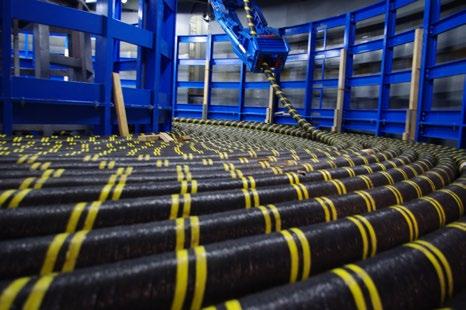
the required minimum bend radius. The required minimum bend radius largely determines this latter point, while the actual loading arm structural design is driven by the cable’s bend stiffness. Additionally, access space for installation will determine the detail of the carousel design. For example, the recent conversion of a telecoms cable vessel to also handle noncoilable power cable involved taking out the cable tank floor and installing two,
large capacity, 3,000 tonne turntables. The two, ‘basket’, turntables have open lattice outer walls, a closed hub and post positions for installing partitions, and are designed to operate at a maximum product linear speed of 1,000m/hr (at core). Loading arms and cable tracks have also been fitted to control the cable’s 4m minimum bend radius, along with all system controls. To save time and cost, the turntables systems were adapted to accommodate the vessel’s existing hydraulic power units (HPUs).

Carousels are not limited to below desk of course, they can also be deckmounted either on the vessel or on a barge. The advantage of a deckmounted carousel is that it is easier to increase the storage capacity by lowering the deck, for example, a 9.2 m diameter reel can take 300-400T of cable product. Moreover, it also has the added flexibility of allowing movement of the reel from port to starboard, if necessary. Of course, it is still possible to use the carousel as a basket when required. The ability to partition the basket allows gives greater operational flexibility a. And a positive advantage over a reel system where product is unloaded in reverse of the load sequence.
A recent trend has been the increasing use of modular reels and carousels. These bring another level of flexibility to cable laying, and offshore operations. At one end of the scale, Dutch company Blue Offshore, a specialist marine installation contractor, has opted for a deck-mounted, adaptable modular turntable system. With 9,000 tonnes of carrying capacity in its full 32m configuration, it will be the largest turntable of its type in the world. The design has been fully optimised for
telecom and power cable handling. At the other end of the scale, a 400 tonnes modular turntable for Aberdeenbased Mooring Systems can be readily configured in either ‘reel’ or ‘basket’ modes for handling a wide range of flexible products including cables, umbilicals, dynamic risers and hoses. It is road transportable, allowing it to be delivered anywhere in the UK and loaded onto a ship for immediate use.
Reel Systems
On deck, cable handling systems tend to be mostly reel, provided the cable is able to support some level of back tension. The benefits of using a reel include easier linear/rotary speed matching, lower installed power and generally a simpler lower arrangement. Moreover, by storing under tension there is more control over stiffer cable products. ItCable to taken from the reel and the tension optimised by passing the cable through a deck circuit incorporating an adjustable compensator, and finally a cable tensioner before being dispatched overboard via a cable chute.
wind farms in which cable arrays are deployed. The cable is variable diameter: maximum diameter at the furthest wind turbine and narrowest at the wind turbine closest to shore. The reel based system features a segmented reel allowing the different diameter cable to be loaded on to a single reel, thereby significantly reducing the cable handling complexity. In addition, the cable laying involved depositing a loop of cable of the sea bed at the site of each wind turbine. Disengaging the reel control and compensator and lifting the cable from its deck circuit and depositing it overboard achieved this.
Flexible Cable Storage and Handling Systems, more challenges to come
operation. All these issues are amplified when using mobile equipment. The technology has now developed to the point where we can provide cable handling systems that are highly adaptable and modular, to achieve the optimum conditions for ease of storage and handling during deployment, no matter the type of vessel and cable product.

Gregor McPherson is a professional mechanical engineer, Gregor McPherson holds an MBA from Glasgow University. He has worked in the marine handling equipment sector all his career. Mr McPherson joined Caley Ocean Systems in 1994 and has been Sales and Marketing Director since 2000.
Recently a cable handling system has been developed specifically for offshore
As has been shown, cable storage and handling technology continues to develop to meet the challenges faced by telecoms cable and offshore operators. The key engineering issues when modifying an existing vessel are: height of the reel and the load arm size together with bend stiffness; bend radius - ensuring good control of the product through all 4 corners; line of sight; and simple and intuitive


Eating A Cable: Internet Access Still Elusive In Cuba
yoani Sanchez

There is a popular expression in Cuba that is synonymous with difficulty and crisis. When you want to indicate that someone is doing badly economically, it is sufficient to say that he is "eating a cable." Street humor has identified the act of chewing and swallowing a bundle of wires with scarcity and material want. The parable has gained strength these days in reference to the fiber-optic cable installed between Cuba and Venezuela, which has yet to provide service to Cu-
ban clients despite reports that it is finally functioning.
In 2007, Cuba and Venezuela began working on installation of the Alba-1 submarine cable, named for the Spanish acronym of the Bolivarian Alternative for the Countries of Our America. At the cost of $70 million and after a series of delays, the cable touched ground in Santiago de Cuba in February 2011. However, the island continued to use satellite providers for what
little Internet service was available. In the two years since, government media has been silent about the cable, generating rumors of a possible failure due to mismanagement or the diversion of resources.
Three weeks ago, an expert at Renesys, a U.S. firm that analyzes Internet traffic, suggested in his blog that the Alba1 cable had started showing activity. At first, traffic was detectable in only one direction, but after several days he had

confirmed the sending and receiving of data. Doug Madory, a Renesys research engineer, said the Spanish company Telefónica SA had begun to direct Internet traffic to the government-owned Internet service provider ETECSA. Telefónica denied it was supplying routing services for the Alba-1, but confirmed that it was providing other services to ETECSA.
The expert said lower Internet latencies to Cuba could be evidence that the
island is using other sources of access in addition to the satellites. "While activation of the Alba-1 could be a good way to improve ETECSA's links to the Internet, Cuba will probably continue to be unable to provide a wide range of network access," Madory wrote on Renesys's website.
doubt by many analysts, who say that the rate includes users of the country's intranet, where no websites are available that dissent from the regime. Studies have ranked Cuba in last place in Latin America for international Internet connectivity with a rate of only 3 percent, but even that number seems optimistic.
In the two weeks since the first signs of cable activity, there has been no perceptible change in connectivity for users in work or educational centers. Nor, as far as can be proved, has the speed increased in the few Internet cafés that exist in Havana. With prices ranging between 5 and 10 euros (about US$7 to US$13) per hour, hotels continue to offer extremely slow connections to the Internet and many sites are blocked.
According to official statistics, 23 of every 100 inhabitants on the island have access to the Internet. That figure has been heavily criticized and put in
The same day the Alba-1 activity was reported, a young man who was waiting outside a crowded Internet café in Old Havana was surprised by the information provided by Renesys. "Now how will they explain why we have to pay so much for an hour of connection?" he asked. The various people waiting their turn for a computer concurred.
The independent journalist Frank Abel
Garcia, whose tweets under the handle @FrankAbelCuba are published only via text messages, was skeptical about the news. "I think there is no interest or political will on the part of the government for the people to have Internet access." In his estimation, if the cable was activated on a massive scale it could be a "strong blow to state propaganda. It would open the eyes of a lot of people in regards to what happens in the world and in our own country."
The official media, as usual, have been silent, and television programs continue to depict the Internet as a conglomerate of violence, pornography,
and false information. But many young people seem excited and anxious about the latest details on the cable that have appeared in the international press. Perhaps the great World Wide Web is closer than it appears.

Yoani Sánchez is a pioneer in the Cuban blogger community. Time magazine listed her as one of the world’s 100 most influential people in 2008. In 2009, she received a Maria Moors Cabot citation from Columbia University’s Graduate School of Journalism.

This article originally appeared on the Committee to Protect journalists website

Cuban citizens waiting to use the Web stand outside an Internet café in Havana.
(AFP)

Back Reflection

by Stewart Ash

The Atlantic Price War
As explained in our last edition, by the time the Commercial Cable Company (CCC) was incorporated, in 1883, telegraphy across the Atlantic was in the hands of four companies. These were the Anglo-American Cable Company, the Direct United States Cable Company, the P-Q Company and Western Union, operating over the cables owned by the American Telegraph and Cable Company. However, due to the commercial arrangements between these companies, pricing was effectively under the control of Anglo and Western Union.
Anglo-American were the owners of the original 1865 and 1866 cables. Both had been repaired several times before the 1865 cable was abandoned in 1877. The 1866 cable had ceased to function in 1872 but in 1880, the major part of it was replaced by the Telegraph Construction and Maintenance Company (Telcon) and
put back into service. So, at this time, Anglo operated four cables; the 1869, 73 & 74 cables inherited from the France Atlantic Telegraph Company and the refurbished 1866 cable. The Direct and P-Q Companies each operated a single cable and Western Union ran the two American Telegraph owned cables.
Due to the initial success of the CCC, in attracting customers away from the other cable operators, three of these companies, Anglo, Direct and Western Union approached the President of the CCC, John W Mackay (1831-1902), with an offer. The proposal was that the CCC should join the revenue pooling arrangement that they enjoyed. Mackay declined and chose to maintain a competitive relationship with these pooling companies. As a result, in May 1886, Anglo, Direct and Western Union dropped their Atlantic cable rate from 40 cents to 12 cents a word, in attempt
to put the CCC out of business. The CCC responded by reducing its Atlantic cable rate to 25 cents a word, a position it held until 15th September 1887. It then, reluctantly, reduced its rates to the loss making level of 12 cents a word. At this rate all four companies were unable to make a profit and they were all losing considerable amounts of money. This position could not be sustained for any period of time so, on 30th July 1888, the four companies met and agreed a fixed rate arrangement. The agreement allowed for messages between New York City, New England, the Canadian Provinces of New Brunswick, Newfoundland, Nova Scotia, Ontario and Quebec on the one side and France, Germany, Great Britain and Ireland on the other to be 25 cents, 1 shilling or 1.25 Francs per word for ordinary traffic, with effect from 1st September 1888,.
In parallel with these negotiations, on

1st June 1888, the CCC had taken over the operations of the P-Q Company. Sometime earlier that year, Count Dillon (1812-92) had identified an opportunity to acquire, cheaply, a controlling interest in the P-Q Company and by so doing give the CCC another Atlantic cable. He convinced Mackay to purchase a majority of the shares, which he did, obtaining 20,000 shares at a cost of US$798,756. An agreement was then made where the P-Q would continue to trade separately but CCC would transmit its messages over the P-Q cable during interruptions to CCC’s cables and in addition CCC would provide the funds necessary for the maintenance of the P-Q system.
In 1880, the P-Q Company had joined the pooling agreement between Anglo and Direct and they were joined in this by Weston Union, in 1882. This pooling agreement was set to run for a period of 46 years. However, on 30th December 1886, the French Government demanded that the P-Q Company withdraw from
the pooling agreement, because when P-Q obtained its landing rights in 1879, it had agreed not to combine with any other company, French or foreign, without the consent of the French Government. Such agreement had not been obtained, and accordingly, on 31st December 1886, P-Q notified the English companies that it would withdraw from the pool. Immediately, Anglo brought and action against P-Q in the French Courts, claiming 5,000 Francs per day, with interest, for the period that P-Q remained out of the pool. In January 1889, the Court of Commerce of France found for Anglo and ordered P-Q to re-enter the pool and pay Anglo 2,000 Francs per day for the number of days that P-Q was out of the pool, effective from 31st December 1888. P-Q appealed the decision.
Things did not go much better for Western Union, because they were forced to withdraw from the pooling agreement by the passing through Congress of the
Sherman Anti-Trust Act. This statute was signed into US law by President Benjamin Harrison (1833-1901), on 2nd July 1890.
In May 1892, hostilities broke out between the CCC and P-Q, when the Managing Director of P-Q, in France, a Monsieur Belleville, refused to allow the CCC to deposit it stocks with P-Q, which was common practice in France prior to voting at a shareholders meeting. Despite this, a shareholders meeting was held on 31st May 1892 at which Belleville and his associates were dismissed from the board and a new board elected. Belleville retained possession of the company’s books and records and refused to release them. In addition, he and his associate directors, dismissed when the new board was elected, sued the new directors for 100,000 Francs each, on the grounds that the meeting at which they had been elected was illegal. On 12th July 1892, a meeting was convened

between the rival factions, at which, it was agreed that three members of the old board should be retained and that four new members should be elected. However, on 26th December 1992, the French Tribunal of Commerce rendered a judgment annulling the May and July meetings and appointed a Provisional Administrator of the P-Q Company. At this point the CCC took the decision to take no further part in the affairs of the P-Q Company.
On 10th July 1894, the Court of Appeal of France passed down a decision requiring
the P-Q Company to pay damages and interest to Anglo for withdrawing from the pool, and appointed arbitrators to fix the amount of such damages. The P-Q was unable to pay these damages and so the affairs of the company were wound up and it was dissolved.
The Direct United States Cable Company had come under the control of Angola American in 1877, although it continued to operate under its own name. The company was acquired by the British General Post Office (GPO), in 1920, but when the Eastern an Associated Telegraph
Companies merged with Marconi’s Telephony Company, in 1924, the Direct Company cable was transferred to the new company, Imperial & International Communications Ltd. This company became Cable & Wireless Ltd., in 1934. The Direct Cable failed in 1943 and was not repaired until 1952. This was the last telegraph cable that Cable & Wireless operated across the Atlantic and was removed from service in the early 1960s.
In 1894, the CCC contracted Siemens Brothers to manufacture and lay another Atlantic cable over the same route as its original cables. This was the first cable to feature a solid as opposed to a stranded conductor. In 1900-01, a further Atlantic cable was laid for them by Siemens Brothers. This time the route was from Nova Scotia to the Azores and then on to Waterville. This was the last of eight Atlantic cables to be supplied by Siemens Brothers. The CCC continued as an independent company until 1928, when it amalgamated with All America Cables and Mackay Radio and Telegraph to form the American Cable and Radio Corporation, the controlling shareholder of which was the International Telephone and Telegraphy Corporation (ITT).
In 1908, Western Union came under the control of AT &T and it became possible to order a telegram by phone. However, it was only possible to order Western
Union telegrams. This had a negative effect on the business of Western Union’s main competitor, the Postal Telegraph Company and both AT&T and Western Union were in danger of government censure, under the Sherman’s Anti –Trust Act. In 1912, Western Union overcame one of its problems with the Sherman Anti-Trust Act by leasing all of the Anglo-American cables and the two cables owned by the Direct Company, making it the only real competitor to the CCC. The other problem was resolved, in 1913, by AT&T and Western Union separating completely.
In 1945, Western Union began a merger with its main competitor in the USA, the Postal Telegraph Company. A condition of this merger was that Western Union should separate national and international operations. However, it wasn’t until 1963, that an independent company Western Union International Inc. was incorporated to run the international cable operations and the merger with the Postal Telegraph Company completed. In December 1961, Western Union appeared before the Federal Communications Commission (FCC), with a request that a favourable response to an application by the CCC to abandon trans-Atlantic telegraph cables be extend to cover a similar Weston Union proposal, if and when made. In December 1965, the FCC finally gave Western Union

International permission to lease circuits on trans-Atlantic telephone cables and so, with FCC approval, it abandoned its Atlantic telegraph cables in1966; at that time, the only cables in working order were between the USA and Horta in the Azores.
Anglo-American also had a solid core, 1,847nm Atlantic cable, manufactured and installed by Telcon in 1894. They continued to operate well into the 20th century; its 1912 leasing agreement with Weston Union was final terminated in 1963, with Western Union paying substantial compensation. It finally went into liquidation on 10th December 1968.
where
it’s never been done before

Conferences

Submarine Networks World 10-12 September 2013
Marina Bay Sands, Singapore
Website
Submarine Cable Forum 4-5 November 2013
Miami, USA
Website
PTC'14
19-22 January 2014
Honolulu, USA
Website
November:


by Kevin G. Summers
Iknow that this is going to come as a shock to some of you, but I took a vacation at the beginning of July. My family and I traveled south, to Tennessee, home of country music, Davy Crocket and, strangely, a museum dedicated to the Titanic.
The Titanic Museum Attraction is full of artifacts that were picked up out of the water several days after the great ship went down. Among these are deck chairs, a leather suitcase, and for a limited time only, a violin owned by Wallace Hartley. That violin, literally, was being played as the pride of the White Star Line began to sink. The amazing thing about these artifacts, and the reason that I'm writing about my trip in this Coda, is that they were mostly recovered by a submarine cable ship. This is the story, quoted from Bill Burns' excellent atlantic-cable.com website:
Following the loss of the Titanic in April 1912 the White Star Line chartered four ships, of which two were cable ships, CS Mackay Bennett, owned by the Commercial Cable Company and CS Minia owned by the Anglo American Telegraph Company but operated by Western Union. All those recovered were brought to the Mackay Bennett where if it was possible they were identified and all personal possessions were removed and stored safely.
Those identified as first class passengers were placed in wooden coffins which were stored aft while third class passengers and crew were wrapped in canvas and placed for'rd. In all 328 bodies were recovered including one child. It was thought at the time that this was Gösto Leonard Paulson, the youngest of four sons travelling with their mother Alma Paulson. Of the remainder 119 were buried at sea of which 60 were unidentified and the remaining 209 were taken to Halifax.

The seventy five members of the crew of the Mackay Bennett adopted the child, paying for his funeral and headstone. He was one of forty-four unknown victims buried in the Fairview Lawn Cemetery.
It was incredibly moving to see these artifacts. The highlight of the museum, for me, was a room with a tank of water kept at 28 degrees Fahrenheit, the temperature of the water when Titanic sank. That water was damn cold, and it is amazing that even a few survivors were plucked out of the ocean. If you are ever in Pigeon Forge, Tennessee, I highly recommend a visit to the Titanic Museum Attraction.
Until next time...