Submarine Telecoms Forum is published quarterly by WFN Strategies, L.L.C. The publication may not be reproduced or transmitted in any form, in whole or in part, without the permission of the publishers. Liability: while every care is taken in preparation of this publication, the publishers cannot be held responsible for the accuracy of the information herein, or any errors which may occur in advertising or editorial content, or any consequence arising from any errors or omissions.
Submarine Telecoms Forum is an independent commercial publication, serving as a freely accessible forum for professionals in industries connected with submarine optical fibre technologies and techniques. The publisher cannot be held responsible for any views expressed by contributors, and the editor reserves the right to edit any advertising or editorial material submitted for publication.
© WFN Strategies L.L.C., 2003
Contributions are welcomed. Please forward to the Managing Editor: Wayne F. Nielsen, WFN Strategies, 19471 Youngs Cliff Road, Suite 100, Potomac Falls, Virginia 20165, USA.
Tel: +1 (703) 444-2527, Fax:+1 (703) 444-3047.
Email: WNielsen@SubTelForum.com
Advertising - Europe/ME/Africa - Hildegard Peltier
Tel: +[33] 1 4785 2207
Email: HPeltier@SubTelForum.com
Advertising - Americas - Pamela Barnett
Tel: +[1] (520) 384-6420
Fax: +[1] (520) 384-6422
Email: PBarnett@SubTelForum.com
Advertising - Asia Pacific - Carole Marsh McCormick
Tel: +[61] 2 48 611993
Email: CMcCormick@SubTelForum.com
Designed and produced by Ted Breeze
BJ Marketing Communications, Colchester, UK..
Welcome to the seventh issue of Submarine Telecoms Forum.
A European reader asked me at PTC in January, “When are you going to charge for subscriptions?”. My response was, “Never.”
But he persisted and said, “Everybody charges for subscriptions –so when are you gonna charge?” I responded again with a “Never.”
He pushed yet again and said, “You can’t keep your magazine free forever – when are you gonna charge?” I answered, “Never, but if you feel the need to send money, we’ll be happy to take it!”
The moral is simple: sometimes you get something for nothing; sometimes “never” means “never,” and I am pleased to reaffirm STF’s mission to provide discourse and analysis of the submarine cable industry in a complimentary, free of charge, manner.
We are also pleased to introduce News-Now, a complimentary online, weekly resource for telecoms business news and undersea market analysis. Produced in concert with T Soja & Associates, News-Now provides a reference point for timely details of industry merger and acquisition activity, contract awards, and company tracking within the global telecom market, plus information on worldwide bandwidth pricing and project status. News-Now may be viewed at www.subtelforum.com/news-now.htm.
Again we have assembled an impressive array of articles, which we hope you find thought provoking, interesting and useful. Sometimes you can get something for nothing. Happy reading.
Wayne Nielsen
A brief synopsis of current news items from NewsNow, the weekly news feed available on the Submarine Telecoms Forum website.
360networks Corporation has signed a multi-year contract extension with T-Systems Inc., the North American subsidiary of T- Systems International, Deutsche Telekom’s global IT and network services division. 23 February 2003
The Hellenic Telecommunications Organization S.A. has selected Alcatel to design and install a submarine cable ring and expand domestic and international terrestrial backbone network.
2 March 2003
Alcatel and MariPro have been selected as industry partners by the Monterey Accelerated Research System consortium to build a cabled science observatory test bed in Monterey Bay. 23 February 2003
Colombian telecom firms Empresa de Telecomunicaciones de Bogota, Orbitel and Internexa said recently they have signed for a $100million fiber optic network. 2 March 2003
Steven Wells ( steve.wells@datawave.ltd.uk) and his team announced the recent formation of a new Submarine Cable and Telecom Services company, known as Datawave Ltd.
2 March 2003
In the past six months, dot-com stocks rose almost 32%, according to the Dow Jones Index.
2 March 2003
Pakistan Telecommunication Company Ltd (PTCL) and FLAG Telecom have launched two new international bandwidth products to provide technologically superior services, available to PTCL valued customers.2 March 2003
Datawave Limited announced its first strategic relationship with PricewaterhouseCoopers LLP.
16 March 2003
FLAG Telecom has announced that Patrick Gallagher has joined the company as Chief Executive Officer. 2 March 2003
Southeastern University Research Association and ClearStream Communications of the US recently signed a Letter of Intent to explore a potential partnership to create an open-access network of distributed sensors. 2 March 2003
Level 3 Communications, Inc. has signed an agreement to provide IP transit service to HanseNet, one of the leading regional carriers in Germany. 2 March 2003
Nortel Networks recently announced new, customer driven enhancements to the Nortel Networks OPTera Long Haul portfolio for use in unrepeatered submarine applications. 16 March 2003
New carrier Tellas launched its first commercial services February 3, 2003. Tellas will offer broadband Internet access and services to major Greek cities.23 February 2003
Metromedia Fiber Network, Inc. (MFN) has filed its Plan of Reorganization with the United States Bankruptcy Court in Southern District of New York Court in White Plains. 16 March 2003
Qualtrack recently launched “Pro-Bank” - a webbased register of submarine cable professionals who are available for work, either as permanent employees or as consultants. 16 March 2003
Viatel Holding (Bermuda) Limited has acquired Netcom Internet Limited and Cybernet (Schweiz) AG. 16 March 2003
WFN Strategies, LLC, recently celebrated its second year in operation. 16 March 2003
Asia Global Crossing and China Netcom Corporation (Hong Kong) have announced that the Asia Netcom transaction has been completed. 16 March 2003
including the Broadwing name, to privately held C III Communications, LLC, for $129 million in cash. 2 March 2003
underlining the company’s strong momentum. 2 March 2003
Australian broadband connections last year consumed more international bandwidth than dial-up connections for the first time ever. 2 March 2003
A jury in the U.S. Federal District Court of Delaware has reached an interim verdict in a patent litigation Between Corvis Corporation and Ciena Corporation. 2 March 2003
Global Crossing has announced that it reached several significant corporate milestones in 2002 and is poised to capture market share as it finalizes its restructuring and emerges as a revitalized, healthy business. 2 March 2003
Broadwing Inc. has reached an agreement to sell the assets of its broadband business, Broadwing Communications Services Inc.,
EPIK Communications Incorporated as announced the successful completion of its transition by new owner Odyssey Telecorp, Inc.
2 March 2003
In 2002, France Telecom’s operating income increased rapidly (30.9% on a historical basis)
Global Marine Systems Limited is forging ahead after the introduction of Atlas 2, a 300 Kw highly specified remotely operated cable maintenance vehicle (ROV) capable of carrying out inspection, burial and survey of submarine cable systems down to 2000 metres water depth. 16 March 2003
Global Marine Systems Limited has won a private maintenance contract with New World Network, Ltd to provide private maintenance and repair services for the Americas Region Caribbean Optical-Ring System around the Caribbean Sea. 2 March 2003
Satellite broadcast provider GlobeCast has extended its trans-world ATM Fiber Network to Asia with the inauguration of a 45-Mbps transpacific fiber trunk between Singapore and Los Angeles, offering seamless fiber connectivity between Europe, America and Asia. 2 March 2003
in place sufficient fully protected capacity to allow for the widespread adoption of broadband to continue in its markets. 16 March 2003
Following a highly competitive, contract renewal negotiation involving many of the industry’s leading players Global Marine Systems Limited has successfully retained the maintenance agreement for WCI Cable’s Northstar system. 23 February 2003
US-based long-distance carrier IDT made a surprise bid for Global Crossing. 2 March 2003
Telstra announced significant changes to the operations of Reach Ltd, its pan Asian joint venture international voice and data carriage business based in Hong Kong. 23 February 2003
Southern Cross has completed the final stage of its capacity expansion to 240 Gbps, putting
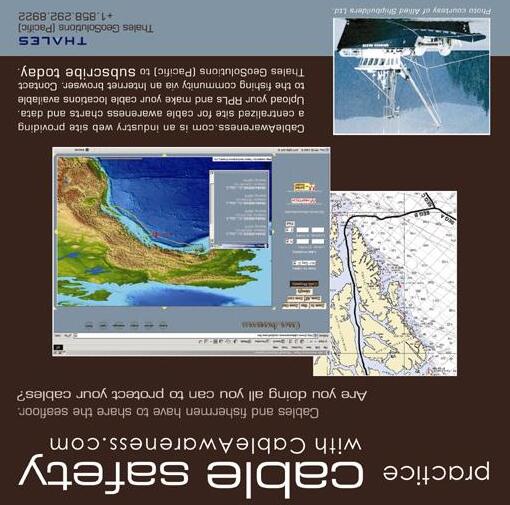
Thales GeoSolutions (Pacific), Inc. has launched an on-line information system aimed at providing submarine cable owners with added protection for their cable systems. 23 February 2003
CHALLENGES FORALL AnOverviewoftheTelecomsIndustry: CHALLENGES FORALL
Over the last decade, a combination of technological advances and policy changes has ignited a boom in telecoms infrastructure investment unprecedented in the history of telecommunications. The results were extraordinary. The telecom business is being transformed from one dominated by monopolies and owned by governments, to one marked by robust competition among private companies. If anything, we are now seeing some of the harsher effects of capitalism and competition, as the laws of supply and demand buffet the industry. While these are difficult times for suppliers, especially equipment manufacturers and operators, customers have never had it so good. Prices are falling, new services are becoming available, and more and more customers now enjoy a choice of supplier. The peaks and valleys on this rollercoaster ride have been felt so sharply and quickly that a longer-term policy perspective is clearly required.
Between 1995 and 2000, the volume of Internet traffic grew by four times, but available capacity grew by more than 200 times. The “dark fibre” available on the most popular routes, such as across the Atlantic, grew by several thousand times. Haphazard, overzealous planning has led to overcapacity, which in turn has led to falling prices and falling profits for telecom operators and manufacturers.
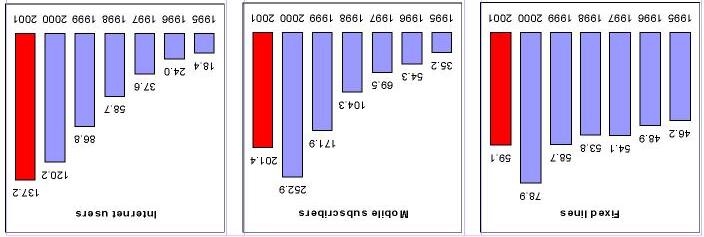
But although the reaction of the financial markets suggests an industry in crisis, the actual performance of the sector was not really so bad. Shipments of new fixed lines fell by around a third and new mobile users added fell by around a fifth). But in both cases, the performance in 2001 was actually better than that of 1999. The Internet also grew, but at a much slower rate. The problem was that 2000 was such a good year for the industry; it was hard to maintain the momentum, especially after the tragic events of 11 September 2001.
Part of the reason for the slowdown that commenced in 2001 and continued in 2002 was
the scale of past success. Much of the world is near to saturation point in fixed-line users and mobile.
The growth is shifting away from developed economies to the developing world. In some parts of the world, investment just cannot seem to keep up with demand.
There are still around 1.5 million villages worldwide that do not even have a basic telephone connection.
A Network and Market Shift
It is not simply a question of lack of resources. For instance, in 2001 China alone accounted for
more than half of all new fixed-lines and a quarter of new mobile subscribers added in the world. Africa, too, has added more mobile subscribers since the start of 2000 than in the decades that lead up to the turn of the millennium. The telecommunication operators and manufacturers that have suffered most are those that have not invested outside the developed nations. The competition to reach the last five per cent or so of potential users that do not use telecommunications in the developed world is much more intense than for the fifty per cent or so that are still unserved in the developing world. For instance, some
Thank goodness for the Internet. New fixed-lines, mobile subscribers and Internet users, added each year, 1995-2001 (millions). Source: ITU World Telecommunication Indicators Database.
18 developing countries grew their mobile networks by more than 200 per cent in 2001 and 13 of these were in Africa. Top prize went to Nigeria, which grew its mobile network ten-fold during 2001, following the opening of that market to competition.
The growth is also shifting from today’s low-speed networks to tomorrow’s high-speed ones. For instance, the Republic of Korea now leads the world in both the number of broadband users (with around 60 per cent of households served, and in the number of users (more than 12 million) equipped for high-speed (up to 144 kbit/s) mobile data services. Worldwide, the number of broadband users almost doubled during 2002. Online games and P2P file sharing are the main demand drivers. However, the broadband industry is still awaiting a true “killer application” that will appeal to users beyond teenage years.
New technologies, such as wireless LANs or in-car navigation devices, have also witnessed a boom. But predicting winners is a risky business and for every business venture that succeeds, several others flop.
The current plight of the industry is really due to a geographical mismatch between supply and demand. For instance, across the Atlantic, there is enough submarine fibre capacity to allow every single person in North America and Europe to make simultaneous phone calls. In 2001, the volume of international traffic grew by eight per
cent but prices were cut by an average of 20 per cent. Faced with such over-capacity, and tumbling prices, profits are falling too. But in the developing regions of Asia and Africa, there is a lack of capacity, especially for mobile communications and Internet traffic. The broader goals of humanity, such as those expressed in the UN Millennium Declaration, will be much easier to achieve once developing countries benefit from the same ubiquity of advanced information and communication technologies as developed countries.
Many Challenges, One Objective
The process of telecoms market reform is neither fixed nor finished. Policies that once worked well may no longer be relevant, as technological change continues at its never-slowing rate. For example, take the distinction between local and long-distance markets.
At one time, this distinction may have been useful for regulatory purposes, but now it is largely irrelevant as distance-insensitive tariffs are widely implemented by operators permitted to do so.
Another case is the distinction between voice delivered over circuit-switched networks and voice delivered over packet-switched networks. The value of such a distinction, if ever there was one, has long since been overtaken by events.
These changes are all part of the reinvention of the telecommunications industry.
Mr Yoshio Utsumi has been in the telecoms business for over 30 years and has a proven track record of expertise at senior policy levels both nationally and internationally. After earning a Bachelor degree of Law from the University of Tokyo and a Masters of Arts in Political Science from the University of Chicago, Mr Utsumi joined the Ministry of Posts and Telecommunications (MPT) where he helped shape Japan’s domestic and international policies. At the senior policymaking level, he served as MPT DirectorGeneral, assistant Vice-Minister and Deputy Minister until his election as Secretary-General of ITU in1998. He was re-elected for a second four-year term on 1 October 2002.
As telecom reforms are planned and implemented the roller coaster ride will continue with new challenges emerging, old ones resurfacing, and others still to be faced. Yet there remains one over-riding goal to which the ITU and its member states remain dedicated, regardless of the Sector’s ‘ups and downs’. That is to make universal telecommunication service available, accessible and affordable for all. In the new information society, where information is the key to economic, social and
cultural development, ITU must play a key role in helping our membership with policy development. This goes well beyond what the Union’s founders could have imagined in 1865.
The need for ITU to focus on a global policy perspective does not mean I intend to turn my back on the Telecommunications industry. Rather, it is within this industry that my hope lays. However, we must acknowledge that the broader goals of humanity, such as those expressed in the UN Millennium Declaration, will be much easier to achieve once developing countries benefit from the same ubiquity of advanced information and communication technologies as developed countries.
The telecommunication operators and manufacturers that have suffered most since the global industry downturn began in 2001 are those that have not invested outside the developed nations.
The competition to reach the last five per cent or so of potential telecommunication users in the developed world is much more intense than for the fifty per cent that are still unserved in the developing world.
Putting Policy into Action
For developing countries, the dawn of the information society poses the opportunity to leapfrog ahead; to be free of the constraints imposed by the distribution of natural resources or geography such as those landlocked African
nations lacking submarine cable connectivity. ICTs can directly assist those countries emerging from a troubled history. However, increasing access to ICTs is not without risk to some political leaders as it may give their citizens more power to control their economic and political destiny.
We must help our political leaders, on either side of the ‘digital divide’, to develop a common vision of how to turn the challenges created by the Information Society into opportunities.
The World Summit on the Information Society represents a unique opportunity to do this. The ‘two phase’ structure of the Summit provides a chance to set the policy agenda for years to come. The first phase of the Summit will be in Geneva 10 to 12 December 2003 and the second phase in Tunisia in 2005. We must ensure that we attract high-level participation in both phases of the Summit. To do that, the draft action plan we develop must be forward-looking and address tomorrow’s problems, not those of yesterday.
In recent years, there have been many initiatives designed to tackle the digital divide, including those of ITU and other UN Agencies. While some of these have been more successful than others, the time has come to seek new and innovative ways of mobilizing and coordinating our investment, by seeking a global perspective that ensures we work together, maximizing our collective strengths, resources and skills.
As our northern hemisphere turns to spring, and the quiet icy wastes transform into buzzing green pastures, it seems appropriate to look for signs of life in our industry. The chaos and mayhem have been well documented and we will not repeat that analysis, however it would be a good time to try to draw together some general patterns, to do the scientists job of formulating predictive rules, so that we can assist those who follow in avoiding our mistakes.
Yes, I said our mistakes. It was us, the industry and the players. Was it greed or a collective masshallucination that allowed us to believe that there was no practical limit to growth curves that led to suicidal over-supply of capacity on several benchmark routes? How did a dream drive prices and revenues so low, that even ‘creative’ accounting could not prevent the crash and burn of innocents along with the guilty? Thousands have lost their jobs and share prices have crashed, wiping billions off the stock market. Those who
have survived are treading water amongst the flotsam, hanging on in the hope that it will get better. Soon.
Understandably, the financial investors are insisting that assets be sweated to the maximum, and they expect to see “co-opetition”, a combination of co-operation with competition, as a strategy for survival. Technology allows the cake to be cut many ways. Why light a fibre if we can sell bandwidth in that fibre and let someone else bear the cost of equipping it? Why put in a dedicated new cable when we can purchase capacity on another cable or upgrade existing ones? Why have lit capacity sitting idle if we can swap it, or offer this as a service to a third, or even a competitive, party? Inevitably this will mean that there is more consolidation within the industry, and reduced sales of new networks, but this will be worthwhile if the ship as a whole remains afloat.
Some suppliers took the route of vertical integration, offering everything from network design and build to installation and maintenance. Along the way the business model changed as realities overtook predictions. Demand vanished, forcing radical strategy changes, new ships came off the slipway to find the tide was out, and factory closures became the norm.
Over the past few years we have read and heard many ‘experts’ talk about recovery, most with differing views with different focus and
outcomes. What is clear is that recovery has now begun , in a slow and fragile sense, and that consolidations and closures will be an integral but reducing part of that recovery.
From Math to Aftermath
We may point a finger at a misinterpretation of Moore’s Law concerning the time-increase in computer complexity and performance as one of the contributory factors. The trend lines illustrated exponential growth in data handling and storage, but at the same time we should note that a static price of around $1000 for a typical personal computer, on its own, implies no revenue growth whatever for the computer industry. Growth would be achieved by the separate exercise of widening the appeal for business and leisure markets and by cost-cutting of components and assembly processes. The spiral of operating system software updates, business application software updates and hardware capability will continue to drive the computer replacement market. Consequently, the practical monopoly in software supply will ensure that people will regard such updates as essential for the foreseeable future, and the PC market will continue at a broadly stable level.
Networks of PCs
Although most readers will be clear on this part of the subject it is worth reminding ourselves, how does this PC market translate into the effects
on the networks that interconnect PCs? Within homes, there has been a low level uptake of 10100Mb/s Ethernet connectivity as users form links between multiple PCs and their broadband adapters. Unfortunately, the UK in particular is suffering from a cripplingly slow broadband rollout, which has much delayed the forecast boom in wholesale international data demand. Even at the time of writing, the roll-out is, geographically, very limited. It seems fair to suggest that if every UK narrowband dial-up data link were upgraded to 500kb/s broadband, then the resulting ten-fold hike in internet demand would translate directly into that portion of international data demand, due to the preponderance of US and other major international destinations hosting internet sites. Part of the reason for the delay may be the inability of the UK core network to handle such a hike without major core switch upgrades, at a time when the revenues cannot comfortably support the corresponding investment.
Digital Cables
Following many years of single digit growth in international analogue voice circuit demand, stimulated by significant cost and price-cutting as technology allowed more circuits per cable, we arrived at digital cables. These were driven by the digital market revolution, and initial systems had a capacity below 1Gb/s and no upgrade potential. These systems allowed further
price cuts in voice services as well as allowing data (without modems) to gain a true global foothold. The relatively low cost and low transit delay allowed cable systems to replace satellite capacity, and the increased availability of cheap global data connectivity was a key enabler for what later became the world-wide web.
There was probably a good reason why the initial ‘unprecedented’ rates of data growth were ‘unprecedented’. The initial rise from zero supply, as the low-level latent demand was suddenly met, gave spectacular initial growth rates. The same pattern could have been observed when the first few voice circuits were turned up, or even when the first few burgers were sold! But a sensible analysis would have revealed that the take-up would soon level out to more reasonable real-world growth rates. This would be because of the divergence between revenue and volume growth, and because the changes in societal behavior – for example, time spent surfing the internet, or business travel substitution by teleconference – could not double every year without cost benefits that just did not exist. Individuals and companies were just not going to spend any more on their IT budgets, so the datawave floundered, unsupported as it was by the revenues that never came.
Technical Fuel to the Fire
Encouraged by the early growth, and undaunted by the initial falterings in that growth, the
technical development teams accelerated the pace of technical development. They increased the data speed, they increased the number of WDM channels carrying that data speed, and they increased the number of fibers carrying those WDM channels. Moreover they also increased the distances over which the signals could be carried.
The initial growth trends, when extrapolated even a few years, showed that capacity would be rapidly exhausted and uncompetitive, and that the new technologies would have to be deployed for capacity pricing to remain competitive.
This resulted in the installation of numerous cables at four wavelengths, capable of upgrade to sixty-four or more when demand arose.
The provision of this upgrade potential was expensive in terms of repeater count and amplifier/system design, and the revenues from the fully upgraded system were necessary to support the later years of the business model. Indeed, those later year revenues were intended to fund the wavelength upgrade cards necessary to increase capacity.
But, as we have seen, the delayed demand has delayed revenues and upgrades, and many operators were left with networks operating below 10% of ultimate capacity and no likelihood of profitability before their investors demanded their return.
Cheaper Upgrades to the Rescue
More recent technical study has addressed the problem of the high cost of wavelength upgrades. The initial business plans showed the fully upgraded system costs at many multiples of initial base capacity price, however the cost per 10Gb/s wavelength upgraded is now (from some suppliers) below 10% of the early estimates. This work has kept upgrade prices broadly in proportion to the system cost, when systems are emerging from Chapter 11 proceedings at around ten cents on the dollar of initial build cost.
Vendor Financing deepens the wound
While it can be argued that vendor financed systems delayed the final stage of the market collapse, they also laid down a further oversupply of dark-fiber capacity that will limit expenditure to little more than wavelength upgrades for a considerable time on many routes.
Market Controls and New Investors
Some might argue that we need to invent a body that controls international bandwidth supply, and hence price, in order to ensure a degree of normality can return to the supply-demand curve. Impossible, of course, as this would disadvantage the customer and breach anticompetitive legislation. What will happen is that the financiers will, in effect, regulate new build. In the immediate future there will only be new build where demand actually exists and business
Steve Wells joined BT submarine systems in 1970, studied mechanical engineering, followed by a postgraduate degree Masters in Business. He has worked in R&D for submarine systems for over 20 years and was a key engineer in burial technology, optical jointing and optical fibre packaging. He carried out several consultancy tasks before heading up marine engineering and maintenance at BT. He left BT to become director of global fibre networks at PricewaterhouseCoopers. He is a founding director of Datawave Ltd and is currently CEO.
Ian Fletcher studied Engineering at the University of Manchester (UMIST) and has a postgraduate degree in Telecommunication Systems. He worked on optical submarine cables at BT for over ten years, and another ten years as BT’s head of Submarine Cables R&D. He left to join PricewaterhouseCoopers as a member of their Submarine Cable Networks Consultancy practice. He is a founding director of Datawave Limited.
plans will need to match increased demand with the inevitable fall in prices as competitor systems come on-stream. You may rest assured that the investment community will not make the same mistake again - they cannot afford to.
Survivors in a Brave New World
The answer is very boring and we knew it all along. What will be required is the same as always – a solid business plan backed up by technology proposals of known risk, and a well informed management team who are respected enough to tempt investors back into the market.
The excess of easy money that fueled the fire will not be repeated, the banks and venture capital houses will remain closed to this market until it is seen to be safe once again. Even the more adventurous venture capital sources will require an order of magnitude increase in demonstrating the robustness of management teams and business plans, along with evidence of relevant past successes. Business plans will have to account for price erosion, weak markets, competitors emerging from Chapter 11 and flighty customers. There must be a robust delivery plan that will deliver competitive capacity pricing without technology overstretch.
The physical network must be reliable and robust against threats from fishing through to terrorism, and the terrestrial connectivity must be correct.
The true recovery will be evidenced by the appearance of orders for new large-scale networks on existing routes, and we should perhaps beware of false dawns as quantities of fire-sale capacity are dumped on the market at some lesser stage of the recovery.
So, when is a Bubble not a Bubble?
To return to the initial question raised in this article, you can only distinguish a bubble when it pops, otherwise you are still on a growth curve – you need to look at the fundamentals in order to see whether a growth trend is sustainable. For example, the arrival of a disruptive technology may give highly impressive initial growth rates, and the ownership of rising stock can bring a rosy tint to the view of even the most hardened analyst.
It is not difficult to imagine that we can see the first stirrings of the green shoots of recovery as they try to punch through the thawing snow. If they hide below too late they will rot, and if they push too early they will freeze. Over the past 12 months we have personally witnessed ‘analysts’ publicly mocking organizations that have come, or are coming, out of Chapter 11. Would-be investors in the audience might see this and reflect.
Collectively we have a responsibility to the industry to ensure that growth is controlled. If we can’t see the positives what chance do we have of convincing investors?
Specializing in providing business solutions to companies seeking to evaluate a market segment or technology application in the submarine cable markets for telecom, oil & gas, and defense industries.
Analysis and development of business strategies
Business and financial plan development and evaluation
Business environment assessment
Competition analysis
Partner screening and evaluation
QA/QC
RFP process mediation and support Strategic alliance initiation Technology assessment
WFN Strategies, LLC
19471 Youngs Cliff Road Suite 100
Potomac Falls, Virginia 20165 USA
Tel: +1 (703) 444-2527
Fax: +1 (703) 444-3047
Mob: +1 (703) 798-4630
wnielsen@wfnstrategies.com www.wfnstrategies.com www.subtelforum.com
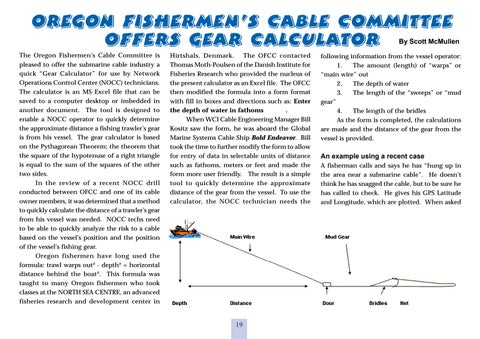
The Oregon Fishermen’s Cable Committee is pleased to offer the submarine cable industry a quick “Gear Calculator” for use by Network Operations Control Center (NOCC) technicians. The calculator is an MS Excel file that can be saved to a computer desktop or imbedded in another document. The tool is designed to enable a NOCC operator to quickly determine the approximate distance a fishing trawler’s gear is from his vessel. The gear calculator is based on the Pythagorean Theorem; the theorem that the square of the hypotenuse of a right triangle is equal to the sum of the squares of the other two sides.
In the review of a recent NOCC drill conducted between OFCC and one of its cable owner members, it was determined that a method to quickly calculate the distance of a trawler’s gear from his vessel was needed. NOCC techs need to be able to quickly analyze the risk to a cable based on the vessel’s position and the position of the vessel’s fishing gear.
Oregon fishermen have long used the formula: trawl warps out² - depth² = horizontal distance behind the boat². This formula was taught to many Oregon fishermen who took classes at the NORTH SEA CENTRE, an advanced fisheries research and development center in
Hirtshals, Denmark. The OFCC contacted Thomas Moth-Poulsen of the Danish Institute for Fisheries Research who provided the nucleus of the present calculator as an Excel file. The OFCC then modified the formula into a form format with fill in boxes and directions such as: Enter the depth of water in fathoms .
When WCI Cable Engineering Manager Bill Kositz saw the form, he was aboard the Global Marine Systems Cable Ship Bold Endeavor . Bill took the time to further modify the form to allow for entry of data in selectable units of distance such as fathoms, meters or feet and made the form more user friendly. The result is a simple tool to quickly determine the approximate distance of the gear from the vessel. To use the calculator, the NOCC technician needs the
By Scott McMullen
following information from the vessel operator:
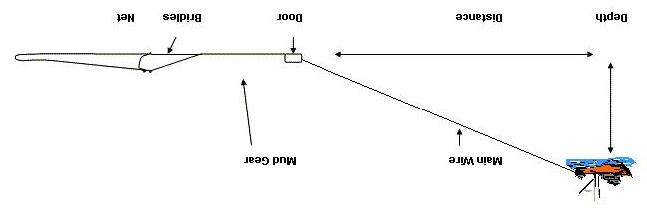
1.The amount (length) of “warps” or “main wire” out
2.The depth of water
3.The length of the “sweeps” or “mud gear”
4.The length of the bridles
As the form is completed, the calculations are made and the distance of the gear from the vessel is provided.
An example using a recent case
A fisherman calls and says he has “hung up in the area near a submarine cable”. He doesn’t think he has snagged the cable, but to be sure he has called to check. He gives his GPS Latitude and Longitude, which are plotted. When asked
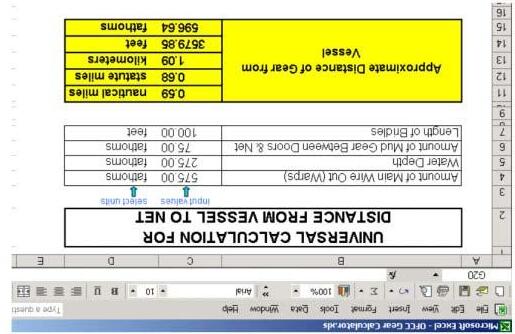
the amount of warps he has out, he replies that he has 575 fathoms out. When asked his depth, he says he is in 275 fathoms of water. When asked for the length of his mud-gear, he replies that he has 75 fathoms of mud gear and 100 foot bridles.
The values are entered into the Gear Calculator, which provides the resulting distance to the gear as .59 nautical mile or 1.09 kilometer. Since in this case the vessel was plotted at 1.3 nm from the closest point of the cable, it appears
that the vessel’s net is about .7 nm (1.3 km) away from the cable and the cable is not thought to be at risk. (It is believed that the relatively low horsepower vessel is not capable of de-trenching the well-buried cable in the area.)
The Gear Calculator is a useful tool for NOCC technicians to use in evaluating the risk of a trawler that has “snagged up” near a cable. As fishermen and cable owners work cooperatively to avoid incidents, the need for such tools will increase. When used with the
Scott McMullen is the Executive Director of the Oregon Fishermen’s Cable Committee, whose mission is to cooperatively solve issues between the Oregon trawl fleet and the submarine cable industry, and to promote cable awareness and safety in the Pacific Coast trawl fleet. Formed in 1998, this organization has served as a model for cable/fisheries relations internationally.
Mr. McMullen attended Clatsop Community College in Astoria, Oregon where he received an Associates of Science Degree in Commercial Fishing Technology.
protocols for safe fishing around fiber-optic cables established by the OFCC in 1998, trawl fishermen and cable owners can harmoniously share the seabed without needless expense or inconvenience to each other.
Credit for the creation of this spreadsheet goes to Ulrik Jes Hansen and Thomas MothPoulsen of The North Sea Centre in Hirtshals, Denmark, the Oregon Fishermen’s Cable Committee and Bill Kositz of WCI Cable. To receive the Excel file, email your request to the OFCC, email smcmullen@ofcc.com.
The term ‘risk management’ has now grown to cover virtually every aspect of business life.
For example, should a trend result in the fact that a market may no longer like the product this is not a matter for the selling side of a company. Instead it is now treated as a business ‘risk’ and a team of risk management experts (consultants) will be approached to sort it out. Trading companies might have thought that their internal controls would cover the use of such experts. No longer.
The experts in risk, who often turn out to be the accountants/lawyers hiding under different or more sophisticated hats, need to be brought in from outside.
This gives an odd result since, as risk and its management have become very fashionable in the business world, the very acceptance that risk is still part of the equation that linked risk to reward is reduced.
Is this possibility just an effect of the emphasis that is now put on risk management which seems to have, as its stated goal, the elimination of risk? The present trend seems, at least to this observer, to be that the only risk that is acceptable is a risk carried by someone else
In one case, ADT Ltd v BDO Binder Hamlyn [1995] where a board of directors sued a firm of accountants for £65m ($108m): the first instance Court found, in effect, that the directors were not responsible for the decision to take over another company.
The court took the view that the directors who, to the man on the Clapham omnibus, are sophisticated businessmen taking decisions based on comprehensive research and investigation, should not bear the loss (or a takeover that went wrong.
The directors argued that the only reason they had gone ahead with the takeover was because the firm of accountants had advanced that they thought that the accounts (of the company that was taken over) were OK.
The court appears to have said that the accountants were the ‘risk management’ experts and that they should pay for the decision made by the directors who relied on their assessment of the risk. The case was appealed but was settled, one presumes amicably, with liability underwriters picking up the bill.
These days it would appear that the auditor/ accountant, or plain ‘number cruncher’ is asked to provide insurance rather than assurance. This is about the idea of risk being shunted elsewhere. ‘Trading’ in whatever form or market has to be about accepting risk to obtain a suitable reward. Increasingly this is not so. In America liability suits arrive if you sell coffee too hot to open safely in a moving car or for the emotional damage of watching a violent movie (instead of hitting the off switch or waiting for the coffee to cool .)
But, surely, the management of risk can only begin when there is understanding of the risks involved.
If not then it is a system for children rather than an adult system. In a child’s world when something goes wrong then they naturally turn to an adult to sort out that problem. In turn the grownups rely on the child building up its experience and not making the same mistake again.
Hence the question in the title. Are the decision makers, be they directors, traders or underwriters playing at decision making? Are they safe in the knowledge that, if they do get it wrong and their decision does not earn a reward, they will, like children, look to adults (or their risk management consultants) to pay and put it right?
To look to accountants, lawyers or other so-called ‘risk managers’ is to rely on an assessment of a visitor to your business. That visitor is very unlikely to have your experience or understanding of the day-to-day risk involved in making more money in your field.
Once the money has been made there may well be reasons for accountants and lawyers to offer specialist advice. That advice would come from their own particular field of expertise and should never interfere with your own understanding of the risk in your business.
In commodity trading, no matter what the commodity is, the goods are exposed to a wide range of perils. The main risk is the risk of physical loss of, or damage to, the goods. So far and so good.
T Soja & Associates, Inc. has published a new report entitled
The report provides a timely look at pipeline and submarine power cable projects that may provide opportunities for marine services companies and telecom infrastructure developers.
The report, available as an Adobe Acrobat .pdf file, identifies 68 terrestrial and submarine pipeline or electric power cable projects that may provide opportunities for marine service companies and telecom developers looking to use their expertise in major construction projects outside the traditional telecom industry.
Opportunities: Pipeline and Power Cable Projects
costs $995 and is available now. A quarterly update service is also available. Contact Anne LeBoutillier by phone at +65-6243-2981 or email at alebout@tsoja.com.
Most prudent businessmen give up part of their expected profit to spread that risk, i.e. the risk of physical loss of or damage to the goods, by paving insurance premiums. In exchange for this premium the underwriter agrees to accept the risk of physical loss of or damage to the goods while on board the carrying vessel/train or whatever form of transport is chosen. Staying in the writer’s own field of goods carried by sea we shall speak of vessels.
The insurance contract buys you a specified list of things which will be covered and will, generally, include a list of things that are not covered. These are exclusions of cover where the underwriter will not accept the risk. A great deal of help is available from insurance brokers and underwriters, along with specialist surveyors, in the prevention of physical loss of or damage to the goods.
This is risk management coming from the right direction. Those with experience of the business, of handling the goods and paying claims do what they can to prevent damage occurring from known causes.
By pointing out the sources of claims and building cover around them, certain things are obvious such as making sure that the goods are correctly packaged and stowed and are well marked.
All of these concern risks attaching to the goods themselves. Risk is incidental to life in general and naturally occurs in business as well.
Some people live dangerously while others exercise extreme caution. Some like skydiving others go in for chess. The same applies in business.
All involved in business should understand what risk means. The chance of something happening is a fortuity and a fortuitous event is something that happens by chance. It is a risk.
Some risks, i.e. some fortuitous events, cannot be avoided. Some fortuitous events are to the advantage of the farmer and some are not.
A farmer, and therefore traders in the products that he produces, continuously run the risk of a chance event in the shape of weather and price fluctuations, on the world market. So we can say that a chance event, a fortuity, is equally relevant to making a profit or sustaining a loss.
To understand risk better we should look at: risk - chance - probability. Rather surprisingly there is no accepted terminology but the following approach, borrowed from the Chartered Institute of Insurance, is suggested.
Chance: Used in reference to the probable advantageous desirable or profitable outcome of a fortuitous event. The famous ‘Lucky Chance.’
Risk: Used in reference to the disadvantageous or unprofitable outcome of a fortuitous event. The risk of dying is 1% or the risk of bad weather affecting the harvest.
Probability: At the one end of the in-surance industry there are actuaries who are specialists in the mathematics of probability. It
After 10 years in the British Merchant Navy, Dick Faint joined Lloyd’s as a marine claims specialist. He spent 4 years as trouble-shooter for a European shipping fleet. After 15 years with Andre & Cie, Dick started Charter Wise Ltd.
Awarded his LLM at Southampton University in shipping law, he is a Member of The Chartered Institute of Arbitrators and The Institute of Export, and is vice-chairman of the GAFTA E-commerce committee.
is not the writer’s field but probability can be understood by looking at the toss of a coin. The probability of heads is 1 in 2. As probability is measured in a range from 0 to 1 we would have a probability of 0.5. (Expressed as P=O.5+)
If the risk is known we can take steps either to:
Accept the risk: In other words to treat the chance of something as being so low as to be not worth the payment of a premium to an underwriter. This is to be self-insured and should he properly accounted the in the company accounts. Risk can also be accepted by the simple expedient of not knowing what the risk was in the first place. Not knowing or understanding what the risk was can cause problems for the crisis management team - the same people under
a yet more sophisticated hat - but that is not the subject of this article.
Avoid the risk: As described above in working with the insurance broker and Underwriter.
Insure the risk: This calls for the risk to be identified before it can be shared with the underwriter.
Spreading the risk by the purchase of insurance, as mentioned above, is to ask the underwriter to take the risk of something happening, a fortuity, in brief the physical loss of or damage to the goods. The ordinary perils of the sea are theft, damage, fire and disappearance. They can be called risks of the trade and are coverable on the commercial insurance market.
Do not confuse this with a trade risk, which can be defined as a change in demand or a price drop. This is also known as the country risk or the commercial risk and is a risk that cannot be easily covered in the insurance market.
What of the risk arising from the contract (and not the goods the subject of the contract)? That is the risk contained in poorly understood rights and obligations in the contract?
Problems will arise in the performance of any contract. Between willing partners the occasional hiccup can be overcome with a minimum of fuss and co-operation.
So one golden rule of risk management should be: ‘Know who you are dealing with’. In
the world of commodity trading information on your trading partner can he obtained from various sources such as, for example, the International Maritime Bureau.
Once again this is risk management coming from the right direction in that it is information coming from people with hands on experience.
CONCLUSION: There can be no substitute for knowledge and experience of your own business. That should include a thorough understanding of the risks involved in the performance of’ the contract and not just in the risk of physical loss of or damage to the goods which are being sold.
Under English law sellers under a C&F or CIF contract are engaged in shipment sales and are obliged to provide the buyer with continuous documentary cover. In brief this means that if a fortuitous event happens, a peril of the sea, the buyer can realise the business value of’ the goods.
To do that he will rely on the seller providing him with proper and valid shipping documents allowing him to claim on the insurance policy and under the bill of lading.
Where the seller has not done this then it is open to the buyer to claim against the seller under the sale contract.
At the very minimum the seller has a duty of care towards the buyer under com-mon law. That duty must be not to pass on to the buyer unacceptable risks.
Perhaps the buyer who is on the wrong end of the seller’s management of the risk could look to the concept of due diligence which imposes a far more affirmative obligation.
In the Munster Castle a fitter working for a reputable ship repair firm, negligently failed to fix inspection covers on storm valves properly. Months later a cargo was damaged by water that entered through those valves. The shipowners were liable. The court held that they were not permitted to avoid liability under the Hague Rules by delegation to an independent contractor, even where that delegation was entirely proper and to a perfectly satisfactory contractor.
The House of Lords ruled that due diligence had not been exercised and the shipowner was liable. He could not delegate that responsibility, even to a perfectly satisfactory contractor. How then can passing the decision on a risk on to ‘risk managers’ who are from a different field be acceptable? The duty of care required of the shipowner was a duty to take positive steps and to guard the goods from harm, not just the usual duty of reasonable care to avoid damage.
This case may well be resurrected when the ISM code begins to bite.
There can he no substitute for experience and sound training of staff in the understanding of risk and the management of risk.
That way experience can be passed on and the risk managed in-house, or at least dealt with by people with hands-on experience.
Undersea systems have historically been designed for maximum capacity with signal margin depletion occurring at the land sea boundary. Recent technology developments enable undersea system capacity to exceed the demand of the market for the next few years. In addition, all-optical terrestrial networks have been in commercial operation for nearly two years and have evolved. Commercially, there is significant and increasing need to reduce the capital demand for projects and lower the cost of ownership. In view of these conditions, a new design concept is presented. The concept is for global seamless networks, which maintain signal margin after crossing transoceanic distances, to allow the continued propagation of undersea signals far into terrestrial systems.
By Todd Borkey
Vice President, Subsea Operations, New Product Introduction and Quality, Corvis Corporation
The concept significantly improves the transparency of systems, which gather and distribute the transoceanic traffic between the world’s major cities. The transparency of a network is determined by how much regeneration and electrical switching equipment is designed into the signal route. Networks have increased transparency when increased numbers of original optical signals can be allowed to remain in optical form until reaching their destination. As network transparency increases, the cost of upgrading and operating that system decreases.The design for transparency in an optical network is mostly determined by the bandwidth and signal to noise ratio of the signal routes. Transmission, amplifier, and fiber technologies have been developed, such that the concept of network transparency can be applied
to global network design. Today, and for the first time, the concept of transparency can be discussed in the context of combined undersea and terrestrial systems.
Global Seamless Networks
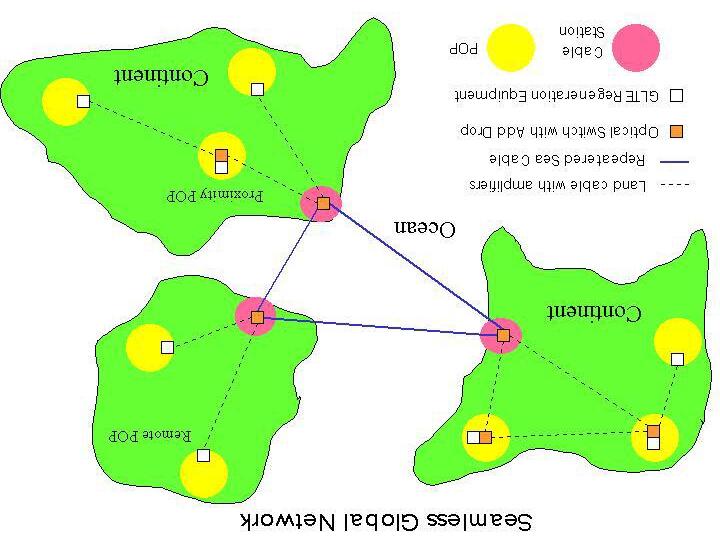
Next generation global optical networks will be constructed in configurations never before possible. New technical capabilities for longer optical transmission reach when combined with switching in the optical domain will permit transparent global networks consisting of integrated undersea and terrestrial systems. To be specific, transoceanic traffic will be able to originate deep inside the terrestrial portion of future global networks. This traffic will originate in a global transmission format and be sent to cable landing stations where other
transoceanic traffic from other interior locations are aggregated optically and combined into undersea cable fibers. The combined set of wavelengths travel from the cable landing station optically to the destination continent where they are optically routed to continue inland to terrestrial locations deep inside the receive-side continent. They will only be regenerated upon termination.
To support this type of extended propagation without regeneration, transmission design and optical switching challenges were overcome. New undersea system performance levels, when combined with terrestrial all-optical network products, achieve the capability to enable the global seamless network design. Although terrestrial fibers typically degrade optical signals at a rate much faster than undersea fibers, for example, due to PMD (Polarization Mode Dispersion) and other effects, the possibility for direct transmission through combined systems is upon us today.
This type of combined system creates truly global networks, which transform network design solutions for cable owner groups and carriers. Significant improvement to network flexibility is offered by the seamless global network design. At the same time, the products used to create such networks will greatly simplify network operation and dramatically reduce network upgrade and operational costs. Seamless global networks will be more adaptable and
flexible for changing traffic conditions of owners. Because seamless global networks eliminate the need for regeneration via backhaul systems, the impact of reconfiguring the tributary sources to the sea cable are greatly reduced. The cost of adding capacity to the network is also significantly reduced. New traffic patterns, or temporary high traffic periods, can be managed
by relocating the highly dense SLTE (Submarine Lightwave Termination Equipment) equipment. This technology, available today, presents a large opportunity for carriers to exploit technology and network innovation to lower their cost structure. The global seamless system will require substantially less initial equipment, create lower upgrade costs, and reduce operating
and maintenance costs. The carriers, when adopting this technology and system design, will be able to dramatically improve their economic performance. Carriers will satisfy their traffic demands with far less capital equipment, staff, and other operating expenses.
History of Undersea Systems and how Global Seamless Systems Differ
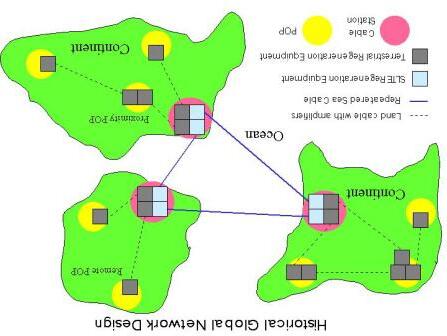
Global seamless systems differ from current system designs by dramatically reducing the amount of regeneration and electrical switching equipment needed to meet the carrier traffic needs. For example, undersea systems and terrestrial systems typically employ regeneration at the system interface of the land sea boundary. Historically, regeneration is done with backhaul systems to transport sea cable traffic to city-based POPs (points of presence) or other terrestrial network interface points.
Network innovation involving the interoperation of terrestrial and undersea systems has historically been limited. This is due to the historical design for depletion of system margin in purely the transoceanic segment of the system. Some recent projects were designed to perform direct signal propagation to nearby POPs, however these efforts were limited to short distance, e.g., less than 100 kilometers of the cable landing station, and attempted to address the short backhaul issue.
Global seamless systems can transport signals across the Atlantic Ocean and thousands of kilometers terrestrially through land cable routes on either side without regeneration. Between mainland Asia and the U.S., signals can originate
hundreds of kilometers inland on either side and be sent across the Pacific Ocean. Such systems will, for the first time, enable approximately ten major world population centers to come within direct transmission reach of each other across the Pacific.
Global seamless system concepts also create significant savings in undersea ring systems with many landing sites. In this application, extended transmission reach and all-optical switching can be used to create “pass-through” (express or bypass) wavelengths, which pass optically through a network node bypassing any regeneration equipment. This design allows ring operators to place the SLTE equipment at only the origination and termination nodes and eliminate regeneration mid-route.
Product Evolution for Seamless Global Networks
The heart of seamless global networks is ultralong transmission. Ultra-long transmission is achieved in these networks by a combination of factors. The two most consequential factors include lower noise amplifiers and improved transmission technology. Reduction in amplifier noise figure allows signals to arrive from far greater distances with higher OSNR (Signal to Noise Ratio). Fiber improvements also contribute to the design; however, this paper assumes that the current types of terrestrial fiber now in the ground are used. Increases in useable optical spectrum also contribute to the seamless global architecture as a larger set of tributary wavelengths can be combined into the wide spectrum undersea
cable. Increasingly wider optical spectrum in terrestrial systems also aids in the flexibility to originate signals at the terrestrial-based SLTE and continue them uninterrupted through the sea cable and onward into interior termination points of the destination. Seamless global network designs must establish signal performance margin for each signal route by considering the OSNR and nonlinear effects of both the undersea and terrestrial path impairments combined.
Several product characteristics have been engineered into the products of the global seamless network. Terminal equipment (formerly SLTE equipment), capable of unprecedented reach, is engineered to a very high floor-space density. This is so the products can be easily located at the interior traffic origination points on little space and use less power. The new design, more appropriately called global LTE or GLTE (global lightwave termination equipment), is a highly integrated design for universal application and capable of much faster deployment and commissioning.
In the absence of regeneration, all-optical switching products are another critical element to seamless global networks, because they eliminate the need for electrical switching of the signals at network nodes. These products, which switch whole optical bands, optical subbands, and individual optical channels, must
Todd Borkey has over 15 years’ of experience in undersea telecoms, including development, manufacture, and project management of submarine cable systems. His career began at AT&T in high reliability component engineering for the TAT-9 project. At AT&T-SSI, he worked in the development of EDFA system technology. He served as Program Manager for Atlantic Crossing and as General Manager of Tyco Telecommunications Optical Transmission Systems Division.
Todd Borkey was an original member of Dorsal Networks where he served as its Chief Operating Officer since its inception in 2000. Today, after completing their merger with Corvis Corporation, Mr. Borkey is Vice President of Subsea Operations at Corvis. Additionally, he is responsible for Quality and Reliability at Corvis.
Mr. Borkey lives with his family in Columbia, Maryland. He has an M.S. degree from the Stevens Institute of Technology Howe School of Engineering Management. He has undergraduate degrees in Applied Mathematics and Engineering.
be engineered to minimize degradation to the passing signals as they aggregate and distribute the wavelengths throughout the global network.
Management tools will be suited to manage consortium-owned global seamless networks. These improvements will complement the transmission technology by creating the individual traffic management controls needed for individual members of the owner group. Both GLTE equipment and network management systems will be engineered to allow combinations of protection schemes (1+1, 1:N, etc.) simultaneously to exist on the network.
Market Acceptance
There are no major commercial barriers to acceptance of these system design concepts. Instead, global seamless system designs offer a flexible alternative to traditional undersea system design. System planners and owners can tradeoff the economic performance differences between the highest capacity sea cable and a seamless network, based on their total network objective. New technology, available today, will meet current market undersea bandwidth needs and provide margins to serve signals into inland terrestrial locations. The choice of design method exists today.
The global seamless design choice also creates increased flexibility for carrier owner groups. Carrier owner groups can be more easily formed as inland carriers (carriers without POP proximity to the cable landings) can join the network owner group at nearly the same entry cost as those ashore.
The ease of upgrading and provisioning traffic in a seamless global network is a very compelling factor to market acceptance. Capacity can be added to the system at a very low cost and in a very short interval. Insertion of transport equipment at the origin and destination may be all that is required. This can create very short delivery lead times for carriers and allow carriers to conserve spending until bandwidth sales are made. The amount of capital put at risk by the carrier in speculation of bandwidth demand is substantially reduced.
The contracting method for seamless global networks will simplify as backhaul system procurements and installations are eliminated. Far less transmission equipment is needed for the seamless global networks, therefore it can be provided by a single supplier.
Initially, the supplier set will be limited as only select suppliers can provide a composite undersea and terrestrial system design. Only a subset of system suppliers have both the undersea and terrestrial combined set of design
skills with the optical switching products to create a global seamless design. There are no legacy conditions, which preclude adoption of global seamless systems. Terrestrial fibers, in the ground today, are technically suited to support these network concepts.
New fiber deployments will enhance the capability for these types of designs. Requirements for common network management protocols and compliance to terrestrial amplifier standards will take on increased importance for equipment makers.
Conclusions
Improvements in undersea system technology, combined with terrestrial all-optical networking concepts, create a possibility for global seamless networks today. The concept can change the way in which carriers meet their global bandwidth placement needs.
The seamless global network will change the way carriers plan and purchase undersea cables. Undersea cable designs, which optimize capacity by depleting signal margin at the land sea boundary, may no longer be the most economical solution. Instead, integrated terrestrial and subsea networks with wide spectrum and low noise will originate, carry, and terminate ultra-long reach optical signals without regeneration to the ultimate destination points.
A global seamless network transforms the economics for the carrier owners. Less capital expenditure is required to build the initial system.
The network can be upgraded and maintained at much lower cost. The network is more flexible to change and can be upgraded and provisioned much more quickly.
To support this, product design improvements were developed to allow the transport equipment (or GLTE) to reside remotely from the sea cable landing. Network management improvements have been designed to address the distributed elements and to meet multiple owner carrier group needs.
Integral to the global seamless design are all-optical switching products, the first generations of which are in commercial use and which will continue to evolve to address the specific networking requirements of global designs.
Global seamless networks improve every economic aspect of supplying bandwidth to users while increasing responsiveness and reliability.
The combination of this technology and network innovation will improve carrier profitability. Global seamless network architecture assists in the formation of owner groups for risk sharing. It can be a useful tool to aid in market recovery.
My dear retired friends.
I hope this letter will reach you in your remote retirement place .You retired during the nineties, after 35 years of loyal service to the submarine cable business. Some of you enjoy good golfing in Florida, or Spain. I am aware of the ones established in Provence, pruning their roses, playing “Pétanque”. I met some of you recently in Japan, keen on travel, reading and gardening. It took some time for you to adjust, to switch abruptly from a hectic professional life, with a lot of long trips, to a quiet, family oriented life. You are now member of the ever growing group of our “aging” society, the one the Telecom world needs to start looking at *. But you are all surfing on the internet, staying tuned with our Telecoms world, trying to understand the evolutions which sometimes puzzle you. Many of you stay in touch and play a consultant or advisory role. You were among the key players of this industry, esteemed and recognised by your peers on the international scene, for your technical or management skills as well as your ability to cooperate with other cultures. Your whole career was spent in a regulated world, a stable world where the role and identity of each player was clear, where each player enjoyed a home base from which he could cooperate and sometimes compete with the rest of the world .
Since you left, the landscape has completely changed, and we have already experienced the excesses of the new model. Deregulation together with the booming of the data traffic has opened a lot of opportunities. Competition on a global basis between old and new players has resulted in the building of several competing high bit rate networks, with inbuilt upgrade potential .The bubble has now collapsed and we need to wait for a more reasonable business.
My dear retired friend, the world does not need to come back to the past model. But it needs to settle somewhere in between both extremes. We need a nice balance between “entrepreneurial spirit” and the sense of the “general interest”. The recent bankruptcies will bring moderation and wisdom. Business plans will be looked at with more scrutiny. A little bit of cooperation will be brought back. Networks will be built based on real needs, not on speculation. Different types of managers, with long term views, will appear.
Investors will look at these opportunities with more moderate ambitions in term of return.
The community’s Convention, SUBOPTIC, will happen in March 2004, in Monaco, a short year from now. The retired people probably represent the largest group in our community. Two reasons: This activity restarted from scratch after the war, in the sixties, where a lot of people were recruited, and today the depression sees a lot of people leaving. The organisers of this convention would do good to themselves by looking at ways they could involve you in this event. Not only would it help to reach a reasonable number of attendees, but, more importantly, you may have something to say! It is time to mix both the old and the new culture.
Offering you, the former leaders, a “cheap sponsored travelling package”, and making you active participants on the stage through papers and round tables , could make this event, an event.
Jean Devos , Past President of SubOptic, was formerly Senior Vice President of Sales and Marketing for Tyco Submarine Systems Inc., and previously Director, Submarcom and Director Marketing and Projects for Alcatel Submarine Networks. He is currently President of Axiom.
My dear retired friend, I hope and dream to see you there. You have probably read P Mayle’s famous book, “A year in Provence”. If not please read it. We could go there and enjoy some good dinner at one of the places described in the book. Let me know.
Jean Devos.
(*) Please visit Probe research website and read “Artificial Hips, False Teeth, and Telecom”.
11-13 March 2003 11th Convergence India 2003 exhibition and conference, New Delhi, India, www.exhibitionsindia.org
24-27 March 2003 U.S. Hydro 2003 Biloxi, Mississippi, USA, www.thsoa.org/
12-14 May 2003 International Cable Protection Committee, Bahrain, www.iscpc.org
20-22 May 2003 Intelsat Global Telecommunications Meeting, Washington DC, USA. www.intelsat.com
4-6 June 2003
Oceanology International Americas, New Orleans, Louisiana, USA www.oceanologyinternational.com
24-27 June 2003 Third International Workshop on the Scientific Use of Submarine Cables & Related Technologies, University of Tokyo, Japan. http://seasat.iis.u-tokyo.ac.jp/SSC03/
24-27 August 2003 13th International Symposium on Unmanned Untethered Submersible Technology, University of New Hampshire, USA www.ausi.org/uust/uust.html
26-29 August 2003
Offshore Comunications Conference and Exhibition 2003, Houston, Texas, USA. www.offshorecoms.com
2-5 September 2003 Offshore Europe 2003, Aberdeen, Scotland, www.offshore-europe.co.uk/
9-12 September 2003 Defence Systems & Equipment International, London, UK, www.dsei.co.uk/
22-26 September 2003 Oceans 2003 MTS/IEEE, San Diego, California, USA, www.oceans2003.com/
7-8 October 2003 4th India Telecom Conference, Mumbai, India. www.indianteleconference.com
12-18 October 2003 ITU Telecom World 2003, Geneva, Switzerland, www.itu.org
24-26 November 2003 Hydro 2003: 4th Australasian Hydrographic Symposium, Christchurch, New Zealand, www.hydrographicsociety.org.nz/conference.htm
17-19 February Underwater Intervention 2004, NewOrleans, Louisana, USA. www.underwaterintervention.com
16-19 March 2004 Oceanology International 2004, London, UK, www.oceanologyinternational.com/
28 March - 1 April 2004 SubOptic 2004, Principality of Monaco, www.suboptic.biz