CONTRIBUTING WRITERS: Stewart Ash, Brodynt, Stephen Drew, John Hibbard, Stephen Jarvis, Jorn Jespersen, Zhao Ling, and Fan Xiaoyan.
Submarine Telecoms Forum magazine is published bimonthly by Submarine Telecoms Forum, Inc., and is an independent commercial publication, serving as a freely accessible forum for professionals in industries connected with submarine optical fiber technologies and techniques. Submarine Telecoms Forum may not be reproduced or transmitted in any form, in whole or in part, without the permission of the publishers.
Liability: while every care is taken in preparation of this publication, the publishers cannot be held responsible for the accuracy of the information herein, or any errors which may occur in advertising or editorial content, or any consequence arising from any errors or omissions, and the editor reserves the right to edit any advertising or editorial material submitted for publication.
Contributions are welcomed. Please forward to the Managing Editor at editor@subtelforum.com.
Submarine Telecoms Forum, Inc. 21495 Ridgetop Circle, Suite 201 Sterling, Virginia 20166, USA subtelforum.com
Welcome to our annual Global Outlook edition of Submarine Telecoms Forum!
I tend to go a little crazy for the Christmas and New Year seasons. I spend a lot of time decorating my long house with thousands of little bright lights that collectively illuminate also the drive and pathway . I have been noticing that even lights are evolving quite quickly these days. I used to use the old larger multi-colored house lights a few years ago that would pop a number of circuit breakers until I worked out the kinks. Then I moved on to the smaller, white cascades of lights that were supposed to resemble icicles hanging from the roof.
A couple of years ago these evolved to an LED version, which allowed me to string more strands together before “popping” the breaker inside. I bought a few strands of the latest and greatest this year, which were these small blue-ish strands, but I soon removed them because they were boring and looked nothing like icicles. So I went back to the white lights, which
work well and look good enough. But then, that’s just me.
Whether you require the latest and greatest, or are happy with making what you already have work a little better, 2013 looks to be another very interesting year, and we hope this issue helps illuminate the industry path before us. But don’t just listen to me – a boatload of very bright people have offered their thoughts in these pages for the months ahead. And as always, should you be attending PTC 2013, please come by our booth to say hello; and of course, save me a seat at the Mai Tai Bar.
In This Issue...
news now
French Government To Bid For Submarine Cable Unit Of Struggling Alcatel-Lucent
ACE Submarine Cable Now Live
Alcatel-Lucent Gets A $2.1-Billion Reprieve
Alcatel-Lucent Increases Capacity Of MAYA-1 Submarine Data Link Between Florida And Colombia
Network to Support OTN, Using Ciena SAEx Submarine
Cable To Bring Broadband To Coastal Cities
Seaborn Networks Show Cause Notice Keeps Undersea
Cable Ship Off India Coast
Southern Cross Price Drop
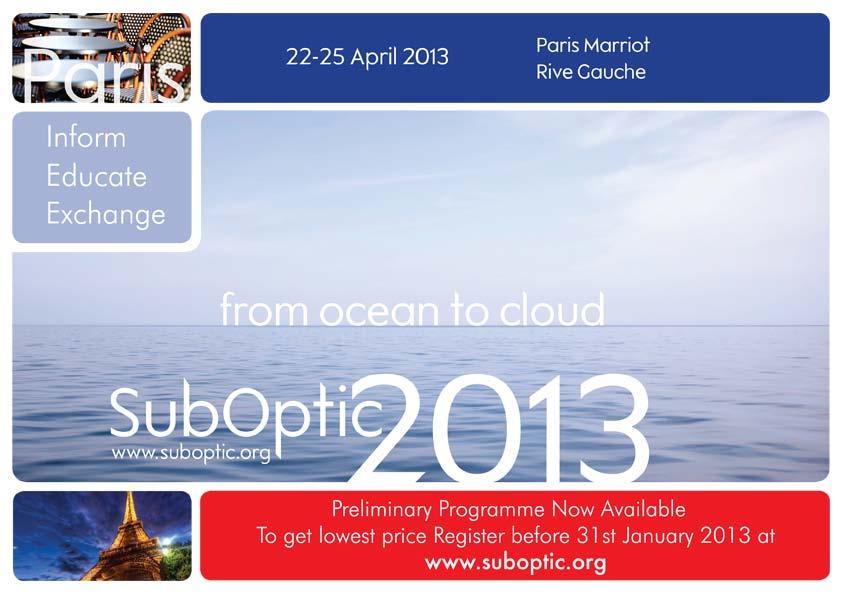
SubOptic 2013 Early Bird Registration Now Available
SubOptic 2013 Preliminary Programme - Now Issued!
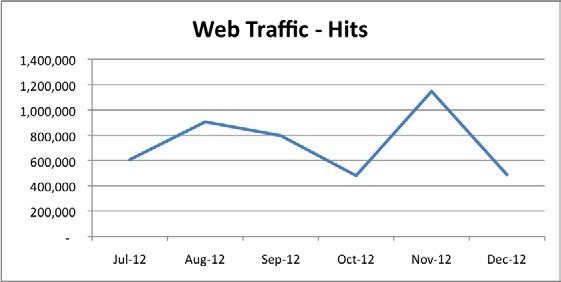
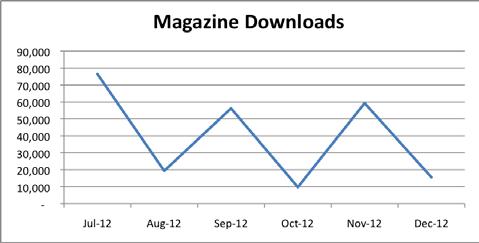
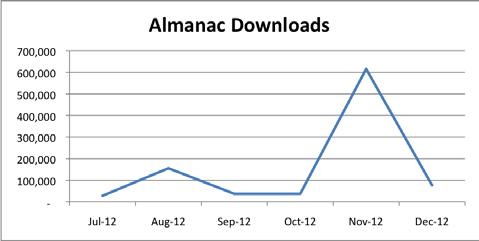
SubTel Forum Announces Record Readership in 2012
WFN Strategies to Support BLAST Submarine Cable
Global Outlook: 2013
Stephen Jarvis
2012 has ended and the time has come to look to the state of the submarine telecoms industry in the New Year. Times have been difficult in recent years with economic issues on an international scale, new technologies redefining the industry and political shifts generally muddling the waters.
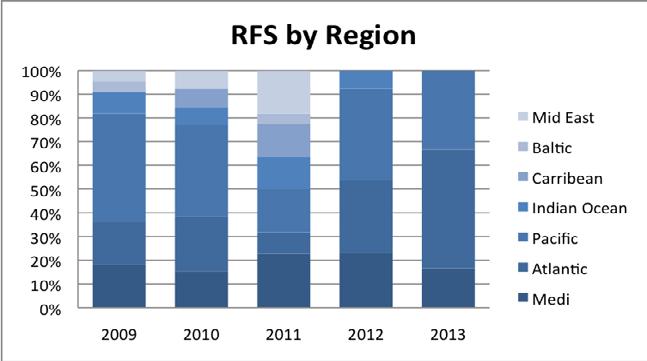
However, progress is still being made. As of this past year, 14 new systems have been completed: five in the Pacific, four in the Atlantic, three in the Indian Ocean and two in the Mediterranean. There was roughly 56,200 kilometers added. As has been mentioned in previous articles, even more has been done with upgrade technology in
this last year. It’s in this region that many see the most business for 2013.
Brian Lavallee, director of Global Network Solutions at Ciena, a company specializing in upgrades, believes that upgrades have and will continue to dramatically change the industry landscape.
“It’s basically turned the industry on its heels,” said Lavallee. He went on to comment that you see less cables being laid because of the improved upgrades technology, which saves time and money, as well as improving the investment in a cable system.
“If you design a cable with a life span of 25 years and it’s only 10 to 15 years in,” said Lavallee, “why would you replace it?” He said that being able to defer replacement by upgrading a 10 or 40 gigabyte system to a 100 gigs is the major draw in the upgrade market.
Eric Handa, co-founder of APTelecom, however, believes that this will eventually become a problem. While he agrees that the last two years have been dominated by upgrades, they are only “a short to medium term fix.”
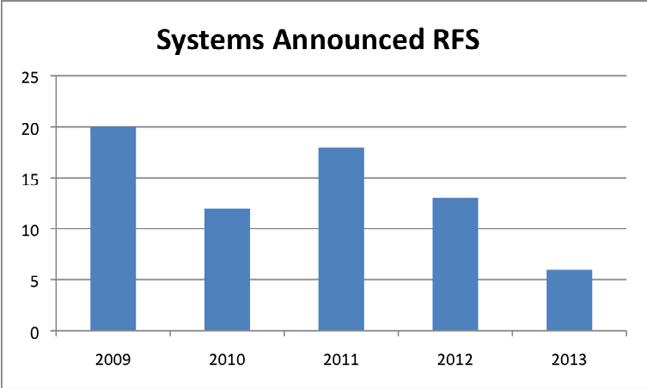
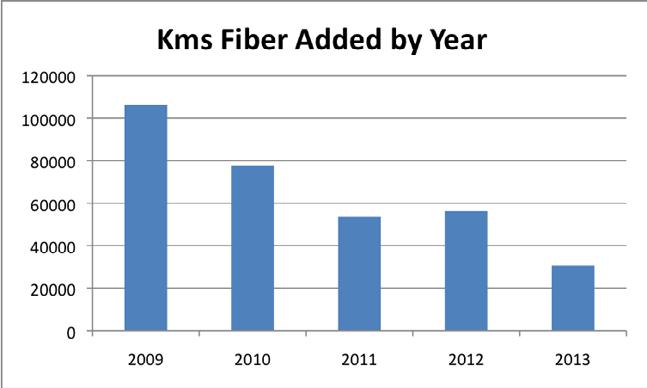
“We’re seeing fiber assets, both subsea (wet) and terrestrial (dry), largely neglected,” It’s no secret that the submarine fiber industry has been feeling sluggish lately. While the factors for the downturn are numerous, including FCC regulation, economic instability and regional instability, there is no doubt that the number of systems ready for service has been almost halved each year since 2011. This time last year, the number of systems RFS was double what it is now, indicating a serious concern for planned systems and their viability in the new market climate.
said Handa. Mainly, assets in the Atlantic are aging: the youngest of which is 11 years.
He comments that the time will soon come when cables reach the point of “diminishing marginal returns;” the point where even with the improved upgrades technology won’t make up for the age of the system. As Handa put it: “Do you really want to put a brand-new engine in a car that’s 15 years old?”
Still, upgrades aren’t the only new technology gaining momentum, according to Lavallee. Along with the ever improving coherent detection upgrades are the “ROADM” and “Intelligent Mesh”.
Systems have traditionally been designed beach-to-beach, where, at each end of the subsea optical cable is an electrical switch that routes the feed. Instead there is now the Reconfigurable Optical Add Drop Multiplexer (ROADM) as an option, doing away with the bulky electrical switch and keeping the signal optical.
“You can run a terabit from a two inch rack box,” said Lavallee. He went on to explain that the new technology for a cable’s landing site would allow the signal to be routed to where it needs to go, while staying optical. “You could have an optical signal from the center of New York to
the center of London.” Lavallee believes this technology will begin gaining real popularity in new 2013 systems.
“The next trend you’ll see is the cable will be put in an intelligent mesh,” said Lavallee. This is a technology of particular value since it applies to issues of economics or signal quality, but reaches beyond into issues of societal safety.
While it may not be the first thing that comes to mind, telecoms systems are equally at risk in a natural disaster as anything else. Particularly when dealing with something on the scale of the 2011 Japanese earthquake. According to The number of systems ready for service isn’t the only metric available to estimate market health. Evaluating the volume of fiber laid in the last five years shows a global down turn in the total length of cable needed worldwide.
Lavallee, there were a number of cables that were cut by not only the quake but the aftershocks that continued to shift the areas.
Despite this, the signal was never truly cut off. This, said Lavallee, is the best example of an intelligent mesh at work. As the cable is cut, the system reroutes to another cable to carry it. The implementation of such a system requires areas with many cables, but Lavallee believes it will be a growing technology.
New technology is nothing, however, without new systems on which to implement them. According to Handa, growth in this area isn’t necessarily something we’ll see this upcoming year. “I think we’re going to see a limited number of builds,” said Handa; specifically, four to five major ones.
There are a few areas that may have new systems built this year, in his estimation:
» Singapore to Perth
» Singapore to Africa/Middle-east
» Angola to Brazil
» Brazil to Florida
» New Zealand to Los Angeles
Interest in branching out from Africa can only be expected to get around Egypt, where recent political upheaval has created a chokepoint for the areas telecoms, when traffic has occasionally been shut off due to internal issues. Brazil will be looking to add a system to meet capacity demand for the 2016 Olympics, since existing systems are too old to upgrade. And, according to Handa, a new cable between the U.S. and New Zealand is simply long overdue.
For cables connecting to offshore developments, it is still expected that they will use fiber over other options (radio solutions like microwave or satellite), according to Antoine Lecroart, area marketing director for Alcatel-Lucent.
“Generally, there is a trend to try to use fiber for telecom in all future big offshore developments,” said Lecroart, “because fiber provides more bandwidth, less latency and better signal availability than radio solutions.” However, installation is complex and therefore more expensive to install. How many new offshore installations are planned for is unknown.
While there is still a great deal of uncertainty in the subsea telecoms industry for this upcoming year, there are still signs of continuing growth in different regions, both large and small. The continuing popularity of upgrades and the integration of other new technologies to increase the effectiveness of cables are just some of the aspects that will support the industry in 2013.
Stephen Jarvis is a freelance writer in the Washington D.C. area. He has published articles and done editorial work with several publications including Submarine Telecoms Forum. Also, he has been a speaker for the Popular Culture Association / American Culture Association National Conference.
Planned Systems as of January, 2013
The Undersea Cable Report 2013
From Terabit Consulting
The most diligent quantitative and qualitative analysis of the undersea cable market - 1,600 pages of data, intelligence, and forecasts that can be found nowhere else.
Terabit Consulting analysts led by Director of International Research Michael Ruddy tell you what’s real and what’s not, where we’ve been and where we’re headed.
The Undersea Cable Report capitalizes on Terabit Consulting’s global on-site experience working with carriers, cable operators, financiers, and governments in over 70 countries on dozens of leading projects (e.g. AJC, BRICS, EASSy, Hibernia, SEAS, TBI)a world of experience, at your fingertips in a single resource!
YOUR KEY TO UNDERSTANDING AND HARNESSING THE $20 BILLION UNDERSEA MARKET OPPORTUNITY
perspective
expertise
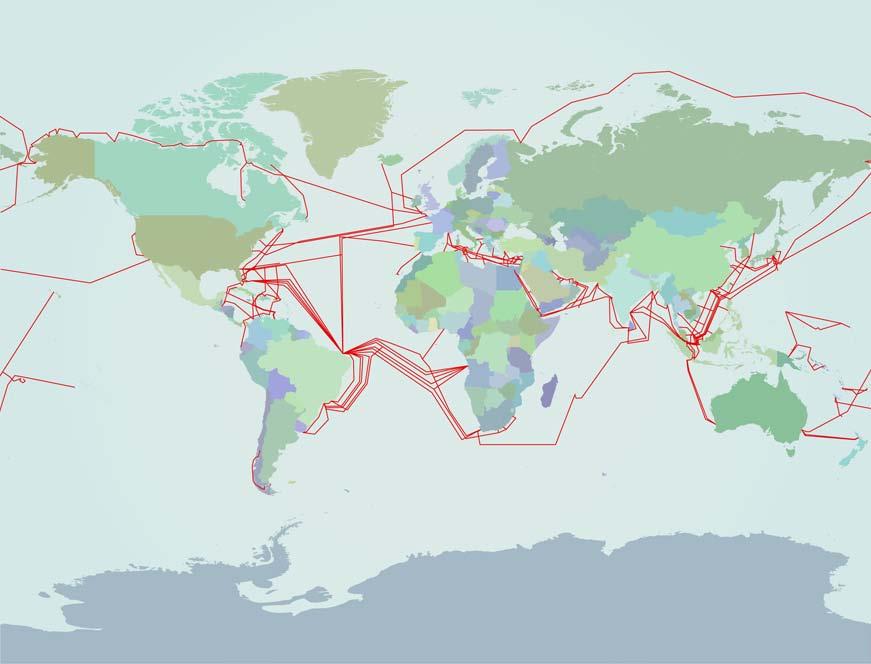
This Spring, SubTel Forum will release its second annual Submarine Telecoms Industry Report. The magazine bound report will serve as the final chapter in a trilogy of products beginning with the Submarine Cable Map. Featuring in-depth analysis and speculation on the submarine cable industry, the Report will serve as an excellent resource for anyone interested in the health of the market.
+1 (703) 444-0845
The Report will offer full-color advertisements from some of the industry’s leading businesses. As with all of SubTel Forum’s products, the Report will be provided free of charge to our subscriber list.
Adverts should be provided in Press Quality PDF format and should include crop marks.
Bleeds: n/a
Resolution: 300 dpi
Price: $3,000 USD
Size: 5.5” W x 8.5” H
Bleeds: .125
Resolution: 300 dpi
Price: $3,000 USD
Ad without bleeds
Size: 5.5” W x 8.5” H
Ad with bleeds
Thoughts From The Industry
Alcatel-Lucent Submarine Networks
Philippe Dumont, President of Alcatel-Lucent Submarine Networks
Today’s appetite of businesses and consumers for new applications and services continue to drive cable initiatives to expand connectivity and capacity in support of the worldwide internet and the cloud. A key aspect remains technology innovation. 100G has become the unique channel capacity of the new systems being proposed today and operators are expecting 100 Gbps on a single wavelength.
All our new-build contracts are designed for 100G from day one. In parallel, there is also the need for developing solutions that allow to add capacity quickly, and easily. Upgrades can be a cost effective means of adding high-speed capacity but they require a unique mix of skills and features including a very accurate analysis of system design, flexible and powerful SLTE, and an experienced commissioning team. Last but not least, marine maintenance has further raised its critical profile in operators' mind to contribute strengthening the reliability of their systems.
Bingham McCutchen
Andy Lipman, Senior Partner, Bingham McCutchen
I predict that 2013 turns out to be a particularly lucky year for submarine cable construction and financing. After a several year drought, worldwide demand, especially in Latin America, Middle East, Africa and South Asia, is reviving the submarine cable industry, as content and IP enabled communications are inexorably moving away from the US to multiple foreign locations. Recent reports suggest that over $3 Billion (US) will be spent on submarine cables over the next two years. Moreover, deep pocket content and search providers are enthusiastically joining the ranks of cable system owners. To facilitate this development, funding is becoming increasingly available for new cable systems and expansions and upgrades of existing networks. On the Equity side, vendor financing, Private Equity funds are returning to the industry. Multiple sources and levels of debt, including Project Financing is becoming more available, including from Multilateral Organizations. At the same time, managing exogenous risks, such as regulatory, environmental and national security considerations both complicate and make specialized legalfinancial planning increasing critical.
Ciena
Brian Lavallée, Director, Global Network Solutions, Ciena
The global submarine market experienced significant capacity increases in 2012, which was accomplished primarily by 10G to 40G channel rate increases over existing wet plants, rather than new submarine cable builds. In 2013, this will shift towards 100G channel rate increases, as technology supporting longer reaches is commercialized. An important element of this will be the Optical Bypass, which implements all-optical ROADMs in the Cable Landing Station, and will continue
to gain traction allowing forward-looking network operators to design end-toend networks by keeping traffic in the optical domain from PoP-to-PoP, which significantly reduces network complexity, cost, and latency while increasing overall network reliability. As part of this, intelligent mesh networks linking global PoPs will gain in popularity to improve overall network reliability and resilience, which is critical as the world’s dependence on constant connectivity increases.
CRU International
Richard Mack, Director of Research, CRU International
It’s becoming a wireless world, which means more traffic on undersea cables.
In CRU International’s work to assess and forecast the demand for optical cables – all types, not only undersea – we often find that mobile communication is the major driver for fixed-line traffic growth in many markets. This in turn is driving the installation of new cable systems for mobile-network infrastructure and for long-haul transport. It is also spurring some carriers to upgrade their transmission technology to 40 Gbps or more recently to100 Gbps. This response to mobile traffic is affecting both terrestrial and undersea cable system markets.
In Africa, for example, the number of fixed line telephone subscribers increased with a CAGR of 4% from 20 million in 2000 to 30 million in 2011. The number of mobile telephone subscribers increased with a CAGR of 40% from 16 million in 2000 to 646 million in 2011. And the number of broadband-mobile subscribers (3G or higher) in Africa increased with a CAGR of 1056% from 40,000 in 2008 to 61 million in 2011. The number of undersea cable systems with landing sites in Africa increased from 8 in 2000 to 31 in 2011, and the number of landing terminals in service on these cable systems increased from 11 to 93 – a CAGR of 21%.
Considering the rapid growth in the use of wireless Internet services, it’s not unexpected to find rising demand for international circuits among Africa’s mobile operators – the same trend is occurring worldwide. To emphasize this point, we note that the world’s largest customer for telecom cable is China Mobile, a wireless operator with more than 700 million subscribers. The amount of optical cable installed worldwide from 2007 through 2012 (six years of network construction) contained 1.1 billion km of optical fibre, and 17% or 0.2 billion fibrekm was installed by China Mobile. The company’s cap-ex budgets for those six years totaled more than US$100 billion. And in the past two years, China Mobile also has begun participating in new undersea cable system consortia.
“Although many of the world economies are still working hard maintain to achieve growth, in this specific industry segment we see a stable future for 2013 and the coming years. The upgrade market continues to develop, with some cables going through a third or fourth iteration, however there is still strong demand for new cables both overlaying traditional routes & connecting new regions and markets as well as new growth areas such as the provision of cable to oil assets. Huawei Marine continues to invest strongly in R&D of both wet and dry plant, enabling the tailoring of systems to Customer’s specific requirements and we look forward to announcing such developments in the coming year.”
Paul Budde Communications
Paul Budde, CEO, Paul Budde Communications
Africa--Submarine fibre capacity in subSaharan Africa has increased more than 100-fold in just the past four years, from 250Gb/s to more than 25Tb/s, which has driven wholesale bandwidth prices down by 90%. The propsed SAex cable between South Africa, Angola and Brazil will almost double this bandwidth again by 2014. The bottlenecks are now in the terrestrial fibre backbone infrastructure to take internet bandwidth from landing
points on the coast to population centres in the interior.
Asia--With the massive growth in demand for data capacity in Asia, the carriers are looking closely at the submarine links both within the region and to the rest of the world. In 2013 the focus is shaping to be on strengthening the intra-Asia networks, with a number of cable systems already in the pipeline. The proposed Southeast Asia Japan Cable System (SJC) will ultimately see landing stations in Japan, China, Hong Kong, the Philippines, Brunei, Indonesia, Thailand and Singapore. Another system set to be built is the Asia Pacific Gateway (APG) cable network which is planned to link Singapore, Taiwan, China, South Korea, Japan, Hong Kong, Philippines, Vietnam, Thailand and Malaysia. In the meantime other development effort in 2013 will see the SEA-ME-WE 5 cable system take shape, providing yet another interregional link between Asia and Europe via the Middle East. With a number of Chinese operators already heavily involved in this new SEA-ME-WE 5 cable consortium it is tipped that we will see some changes in the building and administration of this system. There are also rumours of a second Asia-Europe link in the same timescale to compete head to head with SEA-ME-WE 5.
2013 will be critical for installation projects that have been in the “development” stage for perhaps too long. We will start to get clarity on which new systems are going to succeed in the Americas corridor; whether a viable connection can be established between Africa and South America and between Western Australia and Singapore; whether low latency offers sufficient commercial advantage to justify transarctic and new transatlantic cables; and whether multilateral institutions and governments are willing to bear the risk of funding high bandwidth connections to remote island communities.
Installation and upgrade markets depend on continued growth in demand for bandwidth. China and the US will muddle through their economic woes and continue to provide impetus for our market. Days in Europe, however, will be darker. BRICS countries will grow but not at the spectacular rates that have been touted in the media. Africa is making great strides to bring its new submarine connectivity to the interior. There will therefore be sufficient growth to support these markets but availability of capital will necessarily remain a constraint.
Terabit Consulting
Michael Ruddy, Managing Director, Terabit Consulting
The difficult financing environment for investor-led projects that claimed Pacific Fibre in 2012 won’t show any sign of easing.
On the long-haul routes that have been the historic domain of consortia, private investors might still be able to extract short-term profits when telecom operators are caught dragging their feet, but competing head-to-head against carrierowned infrastructure will be challenging over the long-term. Investors should focus their attention on routes and markets that have been historically underserved,
especially where end-user demand has yet to materialize.
The upgrade market will be the biggest source of growth, but there will still be strong opportunities for new builds. Geopolitical pressures will drive investment in routes that offer alternatives to global pinch-points.
The market positioning of submarine suppliers will be up in the air as a well-established supplier explores the possibility of new ownership and a newer entrant seeks to gain a solid footing.
And finally, the posts of a certain Dale Carnegie-inspired blogger will continue to be exceedingly diplomatic.
Xtera Communications, Inc.
Herve Fevrier, COO of Xtera Communications, Inc.
Xtera has been part of the subsea cable system industry since 2004, and is excited to have developed the submarine applications of its products over the years.
The subsea cable system industry is likely to experience the following discussions and evolutions in 2013:
• From a technology perspective, 100G will generalize for new builds and upgrades with the goal to maximize the capacity per fiber pair. Other technologies will emerge over time like OTN switching.
• From a cable system operator’s side, the content providers will continue to increase their share.
• Will operators be ready to purchase the wet plant separate from the dry equipment? If a way to guarantee system performance and capacity can be found, such a scheme may happen sooner than expected.
WFN Strategies
Wayne Nielsen, Managing Director, WFN Strategies
Last year was tough on a number of fronts, and several systems expected to move forward did not. If 2012 was the year of the upgrade, is 2013 the year of new systems? Maybe. 2013 is looking to be a year that on one hand is considerably improved from before, but on the other, poses a number of challenges that may still negatively impact the industry. World economics and governmental deficits may still leave a demonstrative mark. Across the financial
markets, a lot of cash while available is still sitting on the sidelines. The good news is that the significant elections in the first world are largely complete; the bad news may be that little positive change may be forthcoming. 2013 will be an improvement from the prior year, but to what extent may still be in question.
Simulating for Success:
a study on Long-Distance, High-Capacity Optical Cable Systems
Fan Xiaoyan & Zhao Ling
Demand continues to increase
It is well documented and widely understood that international traffic growth is closely correlated with new telecommunications infrastructure that, combined with the new bandwidth hungry applications, continues to place ever increasing demands upon subsea telecommunication networks. With the recent push for greater data storage capability, video content sharing and cloud computing, there have been some new drivers for regional and transoceanic submarine cable system deployment to service such needs. For sure, the subsea cable system upgrade(s) still offer viable alternatives to new build (where existing infrastructure exists) although often the level of upgrade depends strongly upon the wet plant technology and system age. The maximum capacities for the existing deployed system, such as transatlantic submarine cable systems linking Europe
and America or the regional submarine cable systems in Europe,Asia-Pacific, Middle-East / North Africa regions have been upgraded to a higher capability in capacity terms during past years, compared to its original design.
Pushing the boundaries of technology
The capacity per wavelength, for example, has been greatly increased to 40Gbps, even 100Gbps. It is clear that the level of upgrade depends upon the technical specifications of the wet plant, specifically the optical repeater and the installed fibre base type. These represent costly elements of the subsea network that during such upgrades can form a limiting factor, so all energy and technological advancement that place in Submarine Terminal equipment can be lost. In short, there are ways to ‘sweat’ this ‘wet plant’ and therefore provide improved return on investment (ROI). This is an established
There has been interesting focus for low latency networks, pointing towards a more niche ‘financial’ market application and highlighting how subsea technology is being ‘tuned’ for specific customer demands beyond the simple capacity equation
trend for subsea cable systems and makes business sense.
Operational simplification
For a submarine cable system project that involves new deployment not only are the technical parameters of the building blocks or wet plant important but in today’s ever increasing drive from faster ‘turn-up’ of capacity , operational improvements and system reliability form critical factors. Quite often sub-sea cable systems are
It is well known cable system tend suffer from anchor and fishing activities that pose a threat to wet plant and represents a costly and timely process to recover and repair during fault conditions. Addressing these concerns provides improvement in system availability during the 25 year design life.
deployed in high shipping / fishing or other risk zones in which the possibility of external factors causing potential damage during the life span can be higher than desired.
As the ability to bury the wet plant has a direct correlation to system protection (from external threats) its only natural to consider how such technology can be enhanced to drive improvements in this space. But as most Marine installers know, burial is not a simple process and greatly depends upon the sea bed conditions, so many difference approaches are required to provide improved wet plant protection, during its 25 year life span.
Optimization of the mechanical design may help
Throughout the telecommunication industry with advancements in electrooptics there has been an increasing trend to drive more compact designs, build smaller chip sets and improve reliability. We have witness over the years how SLTE plant has reduced in footprint, power and offer operational advantages to Operations. However, until more recently such a trend has not been transferred into the wet plant used for subsea cable systems, well at least until now.
In normal traditional systems, size of the repeater plays a critical part in determining the burial depth together with seabed conditions forming another parameter. Thus one way to gain enhanced system reliability is to re-engineer the basic building block used in submarine cable systems, specifically the optical repeater to make it more slim line. Why is this important? Well during system installation a traditional marine plough is used to bury the repeater and with all things being equal a slimmer repeater will achieve improved burial compared to more traditional ‘legacy’ repeaters.
Put simply, improved burial means less risk from external damages, lower operational headaches for System owners and improvement in overall system reliability. If one can achieve a product that is engineered to work better with the tools used for installation, then clearly this drives to simplification and faster deployment therefore has the potential also to reduce overall cost. Let’s be clear here; Marine operations are the most complex and a costly element of the system solution. A short hiccup during operations can result in standby cost running into several tens of thousands of dollars, so simplifying the delivery and implementation must surely make sense.
Given, the sub-sea Industry is built solely upon reliability, bringing into play a new approach naturally has some barriers to overcome, after all in most aspects of life challenging the statusquo is bound to meet some resistance
The combination of mechanical and optical design may hold the answer
In this paper, the combinations of both advancements in mechanical and optical designs are described as to present a different perspective in subsea technology and highlight some of the results that are achievable.
The building blocks of a submarine system are illustrated below. A submarine cable system generally includes two parts: the ‘dry’ plant and the ‘wet’ plant, as shown in figure 1.
The dry plant is mainly composed of submarine line terminal equipment (SLTE), submarine line monitor system (SLM), power feeding equipment (PFE) and network management system (NMS). At present, the modulation format of SLTE has improved from the traditional noncoherent pattern to the coherent pattern combined with DSP technology. The application of DSP technology can improve the sensitivity of the receiver, eliminate or reduce the performance degradation caused by CD, PMD and nonlinear effects in long-haul optical transmission systems. Link transmission has changed from conventional dispersion-managed
solutions to dispersion uncompensated transmission schemes. By using single type of fiber in the cable, with large effective area, low attenuation and large positive dispersion (G654B), uncompensated link can drastically change the key features of signal propagation and thus reduce nonlinearity penalty and achieve transmission distances.
In addition, it makes the cable manufacture and maintenance simpler. Simplification here also means integration is a more controlled process and one that aid the delivery timescales. In a long-haul or ultra-long-haul submarine system, PDMBPSK/QPSK modulation format has been widely used for 40G/100G coherent
transmission. Meanwhile, FEC has been gradually evolving from the classical hard decision scheme to its counterpart; soft decision.
Leveraging new technological advancements is central to massive R&D investment and product engineering that firmly remains at the heart of Product engineering.
The wet plant is mainly composed of optical repeaters, optical power equalizers (OEQs), branching units (BUs, see figure 2) and the system cable. By using erbiumdoped fiber amplifiers (EDFAs), repeaters can boost the optical signal power to compensate for each span loss to make a long-haul optical signal transmission. OEQs can equalize the spectral power to maintain the flatness of all channels in the whole bandwidth. Branching units are used in submarine cable systems where multiple landing points are required, or to add in flexible access points for future new landings.
Fig1 submarine cable system
To meet various add and drop services, two types of branching units can be used: fiber pair BU (FP-BU) which provides fiber addand-drop connectivity, and optical add and drop multiplexing BU (OADM-BU) which provides a wavelength or multiple wavelengths add-and-drop connectivity.
(2) Ensure simple integration process through proven jointing technology; Universal Jointing™
Fig2 Branching unit with remote earth design, (with UJTM technology)
To meet the requirement of large capacity and ultra-long haul (ULH) transmission, broad bandwidth, high output power and enhanced system reliability some key factors have to be considered during the design cycle.
(1) Provide large-capacity and multiscenario delivery capability by customizing designs
The repeater shown in the figure 3 adopts the erbium-doped fiber amplification (EDFA) technology, operating in deep saturation regime with a maximum output power of 18dBm, spanning over a 33nm bandwidth and supporting a maximum span length of 120km. It can be used in various scenarios ranging from 1000km regional route to 12000km trans-pacific route, providing multi-scenario delivery capability. Particularly, for applications of special scanarios, the repeater’s gain and output power can be customized to provide system flexibility
(3) Enhanced reliability
The repeater, with its proven reliable pressure housing and seal, is capable of withstanding the hydrostatic pressures of a deep-sea deployment of up to 8000m. To ensure a 25-year service lifetime, redundancy design has been used both in the optical parts (in the figure 4) and in main electrical circuits. Especially, the 4*4 (in figure 5) pumps redundancy structure is provided to meet the fiber pair independent requirements. And the 2*2 (in figure 6) pumps redundancy structure is provided to enhance the pump reliability. The overall failure rate of a 6-fiber-pair R2 repeater is lower than 35FITs, which shows its reliability is higher than some similar products.
Fig3 V1R2 Repeater (with UJTM technology)
(4) Slim Line design
With a slim line housing that fits comfortably under the plough depressor arm during ploughing operations, this design does not have any traditional limitations, as such the burial profile follows that of the cable and represents a significant improvement over more traditional repeater designs. This means less post lay burial work and marine cost as burial is achieved in a single pass operation .
Furthermore, the repeater provides optical loopback paths for supervisory signals via the SLM 1630 to determine cable fault locations. Based on COTDR, SLM 1630 provides in-service status monitoring, and out-of-service fault location by U2000, the
same NMS used by SLTE and all other transmission equipment.
Single platform network management in today’s complex meshed networks leads to lower management complexity and whole life cost. As Terrestrial networks merge with submarine networks a single NMS makes sense at many levels for an Operator, as such the U200 is engineered at addressing Operator needs. It’s even possible to set up a SMS message should a fibre degrade be detected, thus so keeping Network Operations staff in touch 24 x 7
Fig4 Repeater optical diagram
Fig5 4 pumps redundancy
Fig6 2 pumps
Case 1: transatlantic submarine cable system
In the existing transatlantic submarine cable system from around 10 years ago we can see how more advanced technology can be used. Such a legacy system would have typical parameters; for example (128 x 10Gb/s), the average span length of about 45km and the total distance around 6,500km. In additional the system would have typical around 150 repeaters in total link whose output power is in the region of + 13dBm used in this example case.
With the application of these HMN R2 repeaters;
• 100G SLTEs technology at the cable landing stations
• Single type of system fiber with large effective area and low attenuation profile
We find in this the case the following is possible:
The optimum repeater parameters can be obtained based on the simulation result aiming at a project of 80 x 100 G wavelengths over 6552km distance. The simulation dispersion map is shown in
figure 7. On the premise of meeting 80 x 100Gb/s capacity per fiber over 6552km distance, figure 8 shows that the repeater number reduces with the increasing of repeater gain, and the system using repeaters which have 13dB gain uses the lowest repeater number.
So the customized repeater parameters are identified as below: the gain is 13dB, output power is 17dBm; and only 89 repeaters are used.
Fig7 6552km transatlantic system dispersion map
Fig8 gain vs. repeater count
With the application of Raman and intelligent monitoring capability within repeater, the product can be designed to have higher output power, broader bandwidth and support longer span length. These key parameters tend to offer flexibility and form a key factor for the overall system performance and, let’s not forget, whole life-time cost.
By using R2 repeater, it can be concluded from the simulation results that a submarine cable system could achieve a larger transmission capacity, higher reliability and greater operational efficiency.
Dispersion Map
Mechanical design is just as critical as the optical elements that for years have been widely promoted within the submarine industry without much focus on the housing technology and optimization with installation tools. Leveraging new technological advancements is central to massive R&D investment and product engineering. Coupled with Global Marine ‘know-how’, a marine installer with over 150 years’ experience to help engineer the product bringing extensive operational experience, adds credibility and helps delivers a robust ‘rounded’ solution.
Cable burial by ploughing has been a standard method used to protect undersea cables from hazards in that variable environment. By optimizing the mechanical design a neat solution to enhance overall system reliability can be implemented. Flexibility in pump design and configuration does offer Operators and Purchasers a way to further improve the optical aspects within the repeater. This forms a further critical element of the repeater design and underpins the reliability.
engineering concepts presented in this paper are all built upon 25 years’ service life span as the baseline. Taking this baseline further into a new enhanced standard as the focus, demonstrated with some innovative designs and new products. Some interesting developments will emerge during the journey ahead offering something new and exciting within the undersea telecommunications cable industry. After all, this is just the beginning!
In an industry, where reliability this is of paramount importance the design and
Christina (Fan Xiaoyan) has 8 years’ experience within the Terrestrial and Submarine Telecommunication & Service Provider sectors, currently serving as Senior System simulation Engineer for Huawei Marine Networks (HMN) in China. She has gained experience in large scale telecommunications project simulation of optical terrestrial and submarine systems. She was employed by Huawei Technologies co., ltd since year 2005 and then joined HMN in year 2008. She was involved in transponders development and a large number of transatlantic/ transpacific system simulations. Christina has published paper on Suboptic’10 and output several patents in optical transmission field. She holds a Master’s
degree in Optics Engineering from Nanjing University of Science and Technology.
Elva (Zhao Ling) has 6 years’ experience within the Terrestrial and Submarine Telecommunication & Service Provider sectors, currently serving as System simulation Engineer for Huawei Marine Networks (HMN) in China. She has gained experience in large scale telecommunications project simulation of optical terrestrial and submarine systems. She was employed by Huawei Technologies co., ltd since year 2007 and then joined HMN in year 2008. She was involved in transponders software development and a large number of transatlantic/transpacific system simulations. She holds a Master’s degree from Harbin Engineering University in 2007.
The Power of Submarine Information Transmission
There’s a new power under ocean uniting the world in a whole new way. With unparalleled development expertise and outstanding technology, Huawei Marine is revolutionizing trans-ocean communications with a new generation of repeaters and highly reliable submarine cable systems that offer greater transmission capacity, longer transmission distances and faster response to customer needs. Huawei Marine: connecting the world one ocean at a time.
External aggression: Global Risks, Local Solutions
Stephen Drew
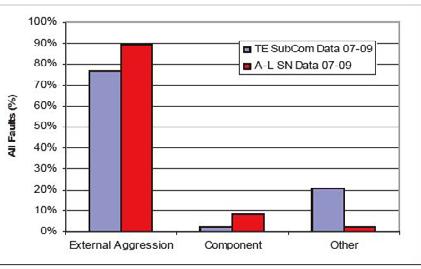
On a global scale, subsea cables are damaged on the order of 150-200 times per year. A repair may cost a few hundred thousand to a few million US dollars, depending on cableship proximity and other factors. Damage can also cause service degradation and interruption. Most cable faults are caused by external aggression, including ship anchors, fishing and other human activities, as well as natural hazards such as undersea sediment movement. The good news is that cable companies are starting to mitigate risks in ways not possible before, using new technologies including the Automatic Identification System (AIS) and satellite tracking of fishing vessels. However, different areas are often prone to different fault causes. In order to use technologies cost effectively, it is essential to determine which risks prevail in an area, and which tools address those risks. Organizations such as the International Cable Protection Committee (ICPC) and a number of national groups are also taking measures to deal with evolving risks.
What is AIS?
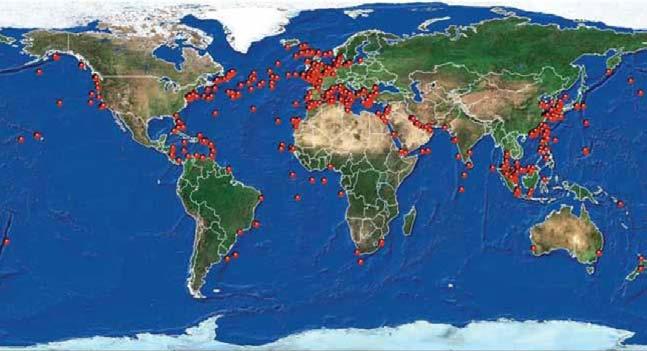
Figure 2: Global pattern of external aggression faults (From Carter et al 20092, courtesy ICPC/UNEP/TE SubCom)
Figure 1: Global Overview of Fault Causes (From Kordahi et al 20101 courtesy SubOptic, TE SubCom, Alcatel-Lucent Submarine Networks, & Submarine Cable
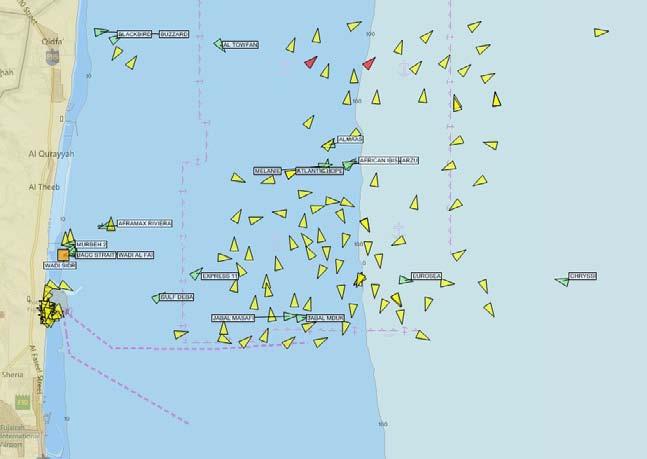
A cable operator can use AIS to track ship locations and activities relative to cables in real time to help prevent faults, as well as in the past to identify responsible parties. AIS was introduced in part to reduce the risk of collision at sea. Since 2003, oceangoing vessels over 299 gross tons are required to broadcast AIS signals via VHF radio at intervals ranging up to a few minutes. Each broadcast includes ship name, identification numbers, position,
speed, heading, length, destination and other data. The requirement is global, but there are exceptions such as military vessels, and limitations on the distance reached by the VHF signal. In practice this distance is often 15-50 miles, depending on height of antenna, weather and other factors. Depending on antenna placement, this can cover many areas near shore where cables are most vulnerable to ship anchors. The use of satellites to relay AIS data from broader areas is also becoming more widespread. Shore-based antennae can receive AIS signals and convert them to data streams fed into computers or sent via internet. Software can show ship locations and movements relative to cables, generate alerts, and archive the information. Real time AIS ship locations for many areas can be viewed on free internet sites. For more comprehensive and reliable ship data presented relative to cable routes, with the capacity to query historic information, several commercial solutions are available.
AIS can be valuable from the early stages of project planning and routing, to identify traffic patterns and uncharted anchorage areas. Before cable installation, management companies of ships frequenting an area can be notified (it is easier to build a working relationship before problems arise). Proactive notices
Figure 3: AIS often shows ships anchored beyond designated anchorages
to ship managers can also serve as a partial remedy for the delay between cable installation and presentation on navigational charts. In heavy traffic areas, ongoing AIS monitoring and notification can be very effective to warn ships of their potential to damage cables, and thereby prevent such damage. Authorities sometimes provide support by monitoring and/or regulating vessel movement in
problem areas identified with AIS. If faults occur in spite of these measures, AIS can sometimes provide evidence enabling the cable operator to recover damages.
What is VMS?
Many fishing vessels are smaller than 299 gross tons. In most areas they do not broadcast AIS, but some do so for safety
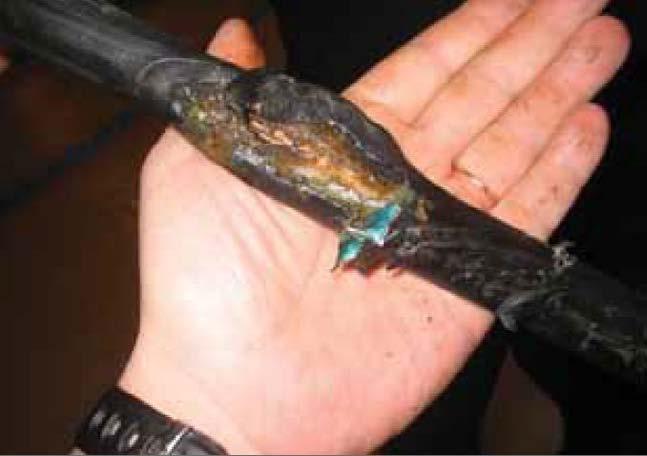
4: External aggression faults come in all sizes and shapes (From Carter et al 2009, courtesy ICPC/ UNEP/TE SubCom3)
or other reasons. Several countries are considering AIS requirements for fishing vessels. However, many governments already require their fishing vessels to broadcast confidential messages relayed by satellites to agencies that monitor fishing activities. These are often referred to as Vessel Monitoring Systems (VMS) or Vessel Tracking Systems (VTS). In some cases government policy dictates that VMS data is strictly confidential. In others, it is publicly available, or it may be provided
in aggregate or on request. Such data can help identify areas fished by different types of gear (which have different potential impacts on cables), determine which ports are bases for boats fishing in a cable area, or in some cases identify which vessel may have damaged a cable. A major difference between AIS and VMS is confidentiality. Whereas AIS data can be gathered continuously by anyone with a nearby antenna and appropriate equipment, VMS signals are confidential, broadcast less
frequently, relayed by satellite to achieve virtually global range, and safeguarded by agencies with different policies regarding confidentiality. In one country it has been used as evidence to show which vessel was present when a fault occurred.
Uncertainties in fault data
Sometimes a fault cause is clearly revealed by the “smoking gun” of a ship anchor or fishing gear found tangled in damaged cable, with intensive fishing or shipping observed nearby. In other cases the repair ship finds a section of cable damaged or parted, apparently by contact with an object or objects that could involve fishing, shipping or other activity impossible to confirm.
One revelation from AIS is that several faults which would probably have been attributed ten years ago to fishing were actually caused by ships inadvertently dragging anchors on the seabed while steaming. This was documented by Mick Green and Keith Brooks in their 2011 article “The Threat of Damage to Submarine Cables by the Anchors of Ships Underway”4. It has caused multiple faults around the U.K., Mediterranean, Red Sea, and northeastern USA. Many mariners and cable operators find it hard
Figure
to accept that a ship may drag an anchor along the seabed at cruising speed, apparently unbeknownst to officers and crew. However, AIS evidence of a ship crossing at the precise time and location of a fault plus other evidence have confirmed this on several occasions (and enabled cable operators to recover substantial settlements).
Analysis of fault trends is complicated by the confidentiality with which cable operators generally treat their data. There is no central global fault database. A few cableship providers have extensive databases, but these are also likely to contain gaps and uncertainties. The ICPC recently increased its efforts to compile and analyze global fault information. The degree to which cable operators and maintenance agreements will provide data remains to be seen.
Trends in fishing
The expansion of fishing into deeper water has concerned the cable industry for many years, and it illustrates why it is essential to understand local conditions. Although many coastal resources have been exploited to declining levels, much of the deep ocean does not appear to produce large quantities of commercially valuable fish. Moreover, deepwater bottom fishing is challenging and expensive. It is profitable only where substantial quantities of marketable fish can be caught. Many deepwater fishing areas have been
explored, and some exploited beyond their apparent sustainability. It is likely that some expansion and shifting will continue, but maximum fishing depths for many species and areas can be identified with some confidence.
Another important question is how deeply into the seabed cables should be buried. Again, the answer depends on local conditions. Different burial depths may be appropriate for areas subject to, for example, frequent ship anchorage, bottom trawling, scallop dredging that scrapes the surface of the seabed, more invasive clam dredging, or large anchors of fishing nets. Since fishermen normally target species living on or above the seabed, most gear does not penetrate the bottom very deeply. Considering fuel costs and environmental concerns, developments in trawl technology often focus on achieving lighter seabed contact and less environmental impact. When planning a new cable system, or determining fault causes on an existing system, it is important to understand which gear is used in which areas, as well as its seabed penetration and potential cable impacts. Recent advances in cable burial equipment are very valuable where needed, but in other areas deeper burial may add time and cost to an installation, and increase the difficulty of maintenance, without adding substantially to security.
Fishermen who receive cable information show responses ranging from anger, self-
interest or indifference to appreciation and strong cooperation. However, overfishing, overcapitalization, and increased regulation have led to declines in numbers of vessels and fishing days. It’s my observation that where such pressures exist, the surviving vessel owners must be competent managers to remain profitable. This trend sometimes provides a more receptive audience for cable awareness – and the abovementioned reduction in fishing activity is another factor that may make cables safer.
Many countries have institutions to educate fishermen. Requirements for training and certification in topics such as safety are increasing. Instructors are sometimes uninformed about cables, but when approached they are almost always interested in including them in their curricula.
Hydrographic charts and software
It is essential to ensure that cables appear on hydrographic charts and software, but sole reliance on these to achieve awareness is a dangerous strategy. Hydrographic offices with limited resources must process a constant deluge of information that impacts the safety of life at sea, and present it with precision. Different countries also have different practices regarding cable presentation and chart updates. For example, some have applied a policy of presenting cables only out to water depths ranging from 40-200 m, considering
that most seabed activities occur in such depths. At the mariner’s end, there is no guarantee that fishermen and ships’ officers will promptly update their charts or plot route position lists from Notices to Mariners. Electronic route positions that can be uploaded to navigation software can be an effective adjunct.
Expanding maritime activities and the role of cable organizations
We are seeing rapid offshore expansion of petroleum exploration, renewable energy, dredging, seabed mining, research, outof-service cable recovery, and marine spatial planning. It cannot be assumed that practitioners will be aware of the locations and importance of cables. There are many compelling reasons for the cable industry to engage these sectors proactively. One such reason is to limit cable damage to manageable levels. The ICPC has increased its engagement and developed information materials such as recommendations, publications and presentations. It is well positioned to develop further, but currently may not have the resources to engage to the degree warranted.
Regional and national cable associations such as Subsea Cables UK, the North American Submarine Cable Association, and the Danish Cable Protection Committee have also engaged other seabed users effectively. Such organizations are sometimes better positioned to address
local issues. They also facilitate sharing of resources and outreach materials.
As is true for many issues, it is far more cost effective to address problems involving external aggression earlier rather than later. Driving factors to reduce faults include intense pressure to cut costs, and awareness of cables as critical infrastructure. Opportunities arise from the increasing availability of maritime information and new technologies such as AIS. From the early stages of a cable project it is possible to identify areas of risk from shipping, fishing, and other activities. For each area, decisions must be made about routing, burial, monitoring, and engagement with other sectors. Similar risk mitigation technologies can be applied to existing cables in dangerous areas. With this convergence of factors, cable companies are better positioned than ever before to understand and reduce the risks - and costs - of cable damage.
Stephen Drew has spent eighteen years studying external aggression risks to cables on a global scale and developing mitigation measures. His experience includes fieldwork in more than 30 countries, five years on the Executive Committee of the ICPC, and proficiency in four languages. From 1998 to 2012 he developed and managed the marine liaison program for TE SubCom (formerly Tyco Telecommunications). Prior experience
includes service as a Fishery Industry Officer for the United Nations Food and Agriculture Organization, and commercial fishing. He holds a B.Sc. in Natural Resources and MMA in Marine Affairs from the University of Rhode Island. He recently founded Sea Risk Solutions, LLC, with the mission of identifying and addressing risks for subsea cables, fisheries and other sectors. He can be reached at sdrew@searisksolutions.com.
2. Carter L., Burnett D., Drew S., Marle G., Hagadorn L., Bartlett-McNeil D., and Irvine N., 2009. Submarine Cables and the Oceans – Connecting the World. UNEP-WCMC Biodiversity Series No. 31. ICPC/UNEP/UNEP-WCMC.
3. Carter L., Burnett D., Drew S., Marle G., Hagadorn L., Bartlett-McNeil D., and Irvine N., 2009. Submarine Cables and the Oceans - Connecting the World. UNEP-WCMC Biodiversity Series No. 31. ICPC/UNEP/UNEP-WCMC.
4. Green, M. and Brooks, K., 2011. The Threat of Damage to Submarine Cables by the Anchors of Ships Underway. In: Robert Beckman and Douglas Burnett, “Co-Chairs’ Provisional Report for the Workshop on the Protection of Submarine Cables,” 20 April 2011, online: Centre for International Law Website <http://cil.nus.edu.sg/wp/wpcontent/uploads/2011/02/Workshop_Report_21_ April_2011.pdf>.
Once again January is upon us which means that it is the time for the annual PTC conference. This will be the 35th, and this quantum is a real measure of the durability of this event through good times and bad. Over the years PTC has grown to become the major telecommunications conference of the region. This is particularly the case in the submarine cable segment of the industry. 2013 is a big year with SubOptic occurring in April so PTC has been expanded to provide a taste of what will be experienced in April.
PTC13 will again see the popular submarine cable workshop on Sunday morning (20th January) this year organized by the SubOptic content team. Richard
Elliott and Alice Shelton are bringing together an array of executives discussing and presenting on some of various facets of our global connectivity business. I am really looking forward to the sizeable segment on marine maintenance as we all know that there is a growing crisis with the cost of O&M and the availability, or should I say unavailability of sufficient cable ships.
On the Tuesday, there will be a session which brings together some of the interesting developments that are occurring, ones you may not have heard much about. This featured session will bring together discussion about what Hawaii is doing to avoid being bypassed, a new cable in Chile, new developments in the rules and
regs of the USA and the latest in initiatives surrounding trans-pacific cables. But the one that grabs me is hearing about the new body, the World Ocean Council, which through it aspirations to protect the seas of the world has the potential to frustrate the provision of cables even further. As if it is not challenging enough to get the approvals to provide a cable, here looks like an attempt to make it harder. I think the presentation will be a call to arms to protect our industry. What an ideal prelude to the SubOptic conference where the action plan can be developed further.
As a special treat we will have a new Executive Interactive Forum on the Wednesday and we have been fortunate to secure some of the more lateral creative
thinkers in our industry. Included in the panel will Jean Devos, arguably the patriarch of sub cables, Sunil Tagare, who in recent times has caused us to think about the traditional ways we have done business, and Mark Simpson, who is never backward in addressing the difficult issues. What a stimulating debate, you can look forward to.
And slotted into the PTC program is a special session on small island nations and the challenges they face in getting high quality abundant network capacity.
It is all making for a very exciting few days. Where better to enjoy interesting topics and do business than Hawaii in January.
And you can do a lot of it with Pina Colada or Mai-Tai in hand. Once again, PTC will be a great opportunity to catch up with the Wayne and the Sub Tel Forum team. Those of us from the PTC team look forward to seeing you there.
John Hibbard Board Member & Former President.
The diversity of our PTC membership across the many facets of our industry has ensured that continued attraction of the conference. Of course, being located in the beautiful setting of Hawaii has certainly helped contribute to annual attendance. There is surely no better place to hear challenging presentations, renew acquaintances, negotiate business deals and make a toast in the hub of global telecom networking for this special week in January at the Hilton Hawaiian Village.
Coming Soon
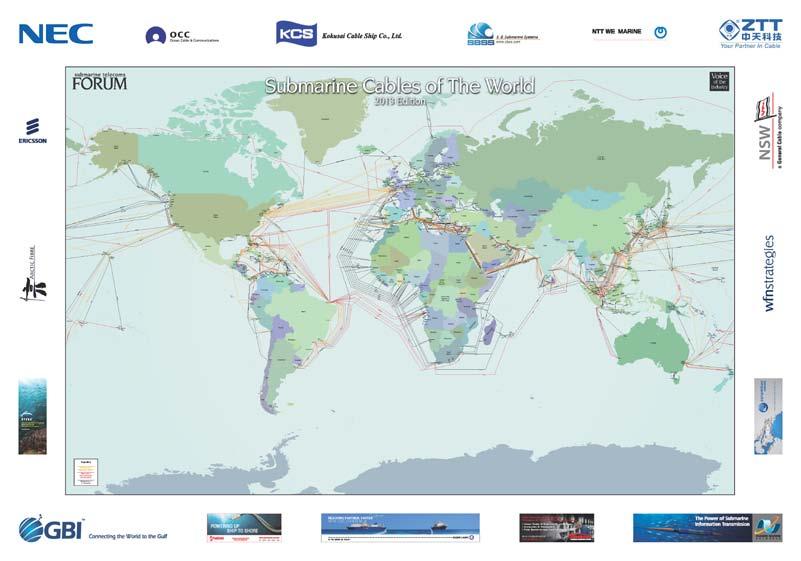
To a Wall near You
Protection Of Submarine Cable Landfall In arctic Waters
Jorn Jespersen
Part 1
Part 1 of this article addresses the project on Horizontal Directional drilling of tunnels to install conduits from the beach man hole out to 200 meters of water depth and make new landfalls to the Greenland Connect Submarine cable beneath the bedrock.
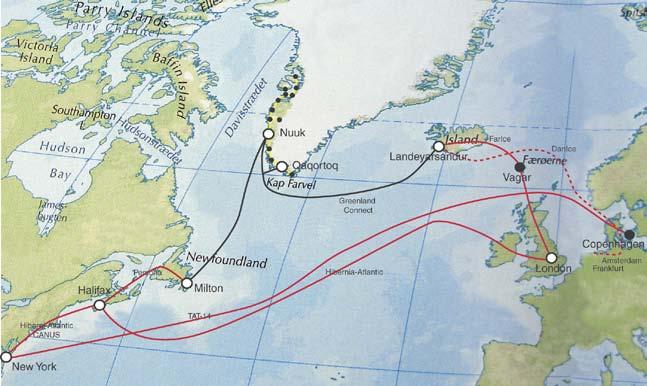
In 2006 Tele Greenland’s management team presented the “Greenland Connect” prospect to the management board. Greenland Connect is a submarine cable project connecting Greenland to Europe and North America. The solution is based on 20 year long backhaul agreements providing Tele Greenland backhaul traffic from landing sites in Iceland and Newfoundland to London and Halifax, where interconnect and IP peering can be traded at market conditions. The submerged cable system was planned as an amplified dual fiber link with the capacity of 2 times 128 wavelengths of 10Gb/s. Landing stations are established in Landeyersandur near Vest Manna Islands in Iceland, Qaqortoq, Nuuk in Greenland and Milton in Newfoundland. Landing sites accommodates high voltage power supply systems for the submerged optical amplifiers and transmission equipment for the DWDM- system. Tele Greenland’s financial position is strong and allowed for 100% company ownership and the business case has positive NPV in a less than 20 year time span. Commissioning of Greenland Connect in March 2009 has brought Greenland’s technology status
up from a satellite based backhaul with long latency and low speed to modern telecommunications quality similar to Europe and USA. Hence traffic volume has been growing with the same market trend as the business experience in all other modern societies.
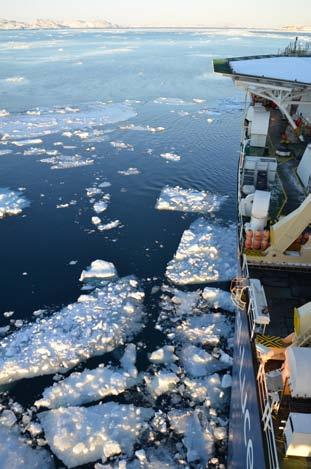
The system has been performing as expected and very few errors have occurred in the land based equipment. The system has not suffered any errors in the wet segment, besides the 4 occasions addressed in this article. Greenland Connect has since its installation on 4 occasions been damaged by glacial ice stranding on top of the cable during its natural passage through
the Godthåb fjord. All 4 encounters have caused damage close to the shore in shallow water. During the desk survey and wet survey, several candidates for landing of all segments shore ends, were analysed thoroughly and conclusion was that the two Nuuk landings were the best alternative. However reality shows that the landfalls near the coast has been damaged 4 times due to external aggression from glacial Ice. First incident was in the winter 2009 and had no customer impact since it happened before system was taken into active services. 3 other incidents happened in the winter 2010 – 2011. On all occasions the repair procedure has been replacement of the entire shore end to approximately
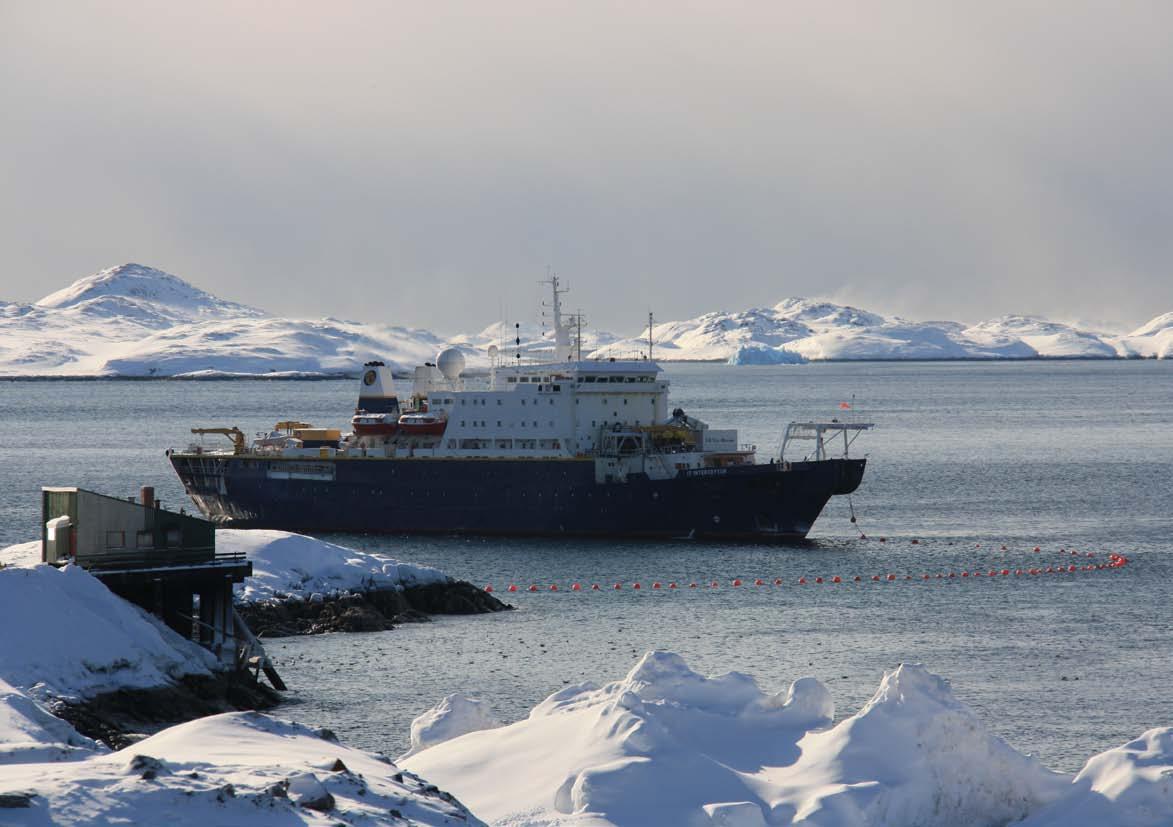
1000 meters from the beach. The systems 100% logical protection of all national services and automatic rerouting has secured effective contingency. Transatlantic carrier customers have unfortunately had inconvenience during the winter 2010 –2011 since their traffic was interrupted during the cable damage. All damages has been repaired under the maintenance agreement with Alcatel Submarine system and the repair process has been exercised professionally as described in the service level agreement. Mobilization and spare part logistics was managed by the book and repair time could not be optimized given the long vessel transit time and arctic winter conditions. 3 different vessels were involved in the work with the opportunity for the Tele Greenland staff to learn the working routine and atmosphere on board the different vessels; Peter Faber, Fladbed vessel with mobile spread Mariner Sea, and IC Interceptor. Local vessel Mads Alex Viking has assisted all cable ships involved in the repair operations.
In the beginning of 2011 it was evident that an unstable landing in Nuuk was unacceptable both due to expensive repairs but also to support carrier sales it was important to eliminate all weak spots in the cable system. The management team decided to pursue an efficient protection of the cable system. As a first step Tele Greenland ordered a report on the various options from the Canadian company C-Core. Report from C-core concluded that Glacial Ice in the fjord could have depths of 200 meters and consequently the landfall had to be protected to that depth corresponding to 1000 meters from the coastline. The report analysed an option of covering the cable with a thick layer of stones boxed in a steel grid box to prevent erosion of the material in the heavy tidal currents. Conclusion was that this solution is easy to implement, but do not give efficient protection.The ridge created on the seabed from this protective cover might even catch icebergs and make everything worse. Fencing of the water surface to guide icebergs away was also abandoned at an early stage due to the large mass of the icebergs combined with the rough weather conditions and large tidal differences at the site.
The only efficient solution at hand was Horizontal Directional drilling of both landfalls in two tunnels to keep physical separation and redundancy. Tele Greenland started a cooperation with consultancy company Sound and Sea Technology (SST) to scope and tender the work. Danish
Geological Institute GEUS was contracted to deliver a desk survey of the geological features in the target area. In the early spring of 2011 a tender was formed and submitted as a public bid according to Greenlandic legislation. 4 bids were received and one bid rejected at time of opening. 3 bids were feasible and roughly even, but the reservations in the bids placed Tele Greenland in an unpredictable situation and the budget could potentially exceed the pain threshold.
After rejection of the public tender an ice protection program was put in place where local vessel Mads Alex was set on standby to push dangerous ice away from the position of the cable landing. Video surveillance with night vision sight was put in place and these protective actions have worked in a sense that no ice damage has happened even though Greenland have had rough winters with massive glacial ice in the fjord.
It was clear that a bid with more narrow financial predictability called for a more detailed specification. A contract was made with Scottish company Caley Survey that at the time undertook advanced seismic surveys for the oil industry in the waters west of Greenland. Caley Survey had an equipped ship, Kommandor Stuart with very advanced seismic equipment. First and foremost the permit to undertake seismic surveys in these waters that are habitat for a wide range of maritime mammals had to be obtained. The
authorities played this application very accommodating and the possibility to study the impact of seismic survey impact on maritime mammals was utilized, Tele Greenland hired a professional Maritime mammal observer and invited the authorities and biologists from The Greenland Nature and Environmental Institute on board the Kommandor Stuart during the entire survey.
SST Geologist planed the route and was Tele Greenland’s representative on board. The exit holes of the tunnels had to be decided on the fly since the environmental permit required photo documentation of the seabed before the drilling and also several samples of the seabed. Samples should be kept sealed and frozen and hence compared with samples after drilling to document no pollution due to spill of drilling mud.
Based on the seismic survey, Caley Survey submitted the geological report in October 2011 and the new and more precise scope and tender document was prepared by Tele Greenland and SST in December 2011. The major change in the scope compared to the public tender was, that same launch site would be used for both landfalls, to cut mobilization cost. In previous tender launch site was at the original cable positions. Moreover the geological information was of a much better quality, which is obvious as a wet survey with a scientific vessel is cumbersome compared to a desk survey. Since the response to the
open tender was limited the legislation opened for an invited tender and material was send out to three contractors in the beginning of January 2012. A pre tender seminar was hosted by SST with an aim to cater for the tenderers’ comments in the tender documents. All three invited contractors submitted thorough bids and SST scored all qualifications and prices in a comprehensive matrix. Negotiations were exercised during the Spring and a letter of acceptance was granted 20. February to the Dutch company Visser & Smidt Hanab(VSH). VSH has extensive Horizontal directional Drilling experience, and a good track record .The construction site has been mobilized through April and drilling commences in the beginning of June.
Two tunnels at 12” diameter will be drilled from the launch site to a water depth of 200 metres. The tunnels will be +1100 meters long. The tunnel trajectory will follow a vertical position more than 7 meters beneath the seafloor. The exit is carefully planned to be at a suitable position where the otherwise steep sloping seafloor is relatively flat, at a plateau from the little ice age. This position secures that cable does not suffer any sharp downward bend at the exit.
A 5,25” steel pipe conduit will be installed from the beach man’s hole vault to the tunnel exit. Conduits are heavy pipes with threads connections at each ends. The inner diameter of 4 inches gives a wall
thickness of 22mm. Conduits must meet quality standards and have no shoulders or edges at the inner wall. The conduits will be pushed from land through the tunnel equipped with a so called “bull nose” at the far end. Bull nose is a rounded piece of conduit, with multiple nozzles at the end, to flush small obstacles away during installation. When conduit reaches the exit, the bull nose will be removed by a Remotely Operated Vehicle (ROV) and replaced with a so called “bell mouth”. A bell mouth is a funnel shaped devise that is tailored to a 5,25” conduit and shall guide the cable into the conduit when installed from the sea end. The plan is to bore between 40 and 60 meters per day during a 12 hour working day.
The marine operation is contracted as a separate operation and the scope is to install the new landfall from the sea end through the bell mouth and conduit to be connected to the land cable at the vault. Hence the new landfall cable piece is
connected to the old wet segment. The land cable is connected in the same planned outage slot to give minimal impact to the transatlantic carrier customers.
Part 2
Part 2 of this article addresses the project on Horizontal Directional drilling of tunnels to install conduits from the beach man hole out to 200 meters of water depth and make new landfalls to the Greenland Connect Submarine cable beneath the bedrock. The project was successfully completed 22 November 2012.
HDD Operation
Visser & Smidt Hanab (VSH) started the mobilization of the site in April 2012. A big HDD operation site takes up 50 by 50 meter space and the foundation as well as access road must be stable. The area sloping down towards the beach had the 4 meter of overburden soil removed and filled up with gravels. Two heavy 600 mm diameter by 16 meter long pipes was blasted down in the bedrock and adjusted to the exactly right starting azimuth and vertical angle to have a stable entering interface for the drilling aperture.
VSH erected the main elements; Diesel generator pack, 50 bar water pump, filter unit, drilling rig equipped with 5” drilling string terminated in a Gyro navigation unit and finally a 7 meter long mud motor with 12” drilling head. All machinery is operated in a control room staffed with drilling navigation engineer and a drilling control supervisor. The entire shift is staffed with 5 persons; Supervisor, Navigation engineer, Drilling control supervisor, Mechanical engineer, Mud control engineer.
The drilling work started 1. June 2012 and set off very successfully. The entering angle was changed late in the planning since VSH wanted to enter in a lower angle to reach solid rock as fast as possible and later change the vertical angle in a soft radius and eventually punch out in a 3 degree negative angle- We were very excited
the first drilling days where the drill eat more than 60 meters of Greenlandic rock per day which was even better than the budget had planned for. After only two successful drilling days did the progress suffer a setback due to problems with the gyro navigation system. Gyro is powered by 48Volt DC feed into the Gyro unit by a single 6mm^2 wire. The entire string was tripped out and the Gyro retrofitted and drilling commenced again. After two more days Gyro failed again. The now even longer string had to be tripped out again and Gyro and wire line had to be replaced once more. Problems with Gyro and wire line continued unfortunately throughout the project. VSH developed some solutions using more robust wire line and enforced the joints between each section of line but reality was that we had to accept to drill several days blindfolded without navigation other than continue the direction the string had when navigation was lost. At tunnel one which is the most southbound one the drilling continued for four days without navigation to wear out a drill motor without tripping out again to undertake wire line repair work. After navigation was reestablished we learned that one does not drive blindfolded without being hurt somehow. Even though the experienced drillers tried to compensate for the known ofset lile a sailor hold his ship op against the wind drift the drill have had a more negative vertical angle and the azimuth had drifted right. It was clear that we would never
make the planned exit position and had to accept that a new punch out position 20 meter deeper than planned had to be found as deskwork. Fortunately the water in Greenland is deep and the slope towards the bottom continued long enough to host a deeper punch out position. One can regret the big cost to the survey company to find the ideal punch out spot which originally was a flat terrace from the little ice age. The most central learning for the next project is that a drill always naturally drifts downwards and to the right. One advice is to start a HDD drilling less steep and keep left.
As the drill string eats its way through the Greenlandic massive rock consisting mainly of hard dark Gneiss the drilling speed slowed down and the progress on a good day was 30 meter and often only 20. The tine schedule was revised several times and the budget equally increased as the contract scheme partly was time and material based.
Reaching 900 meters the scenario all involved had feared for; Mud pressure was lost in the drill string and no cuttings or drilling mud returned to the pool at the ground site. It appeared that fed mud was lust to the ocean or a huge cavity in the rock. Being more than 70 meters under the seabed and more than 150 meters to punch out we were surprised. VSH deployed the standard measure diamond seal into the drill string and into the leak. Diamond seal is a white chip compound consisting
of hard crystals sized a bit bigger than rice. Deployed into water the diamond seal absorbs the water and expand and take form as hardened silicon. The good feature diamond seal has is that it can be deployed through the drill motor and drill head which means that it can be utilized without tripping the string out. It is a long procedure to trip out from 900 meters.
After waiting one day for the diamond seal to harden and close the leak drill rig was started again still no returns of mud and chippings and we understood that the leak to the ocean still was open. Crew deployed diamond seal once more and still no solution to the leaking problem.
New plan was to seal leak by grout consisting of 97% pure cement and 3% bentonite to make the grout more flexible. The procedure to inject the grout into the leak was to install a socalled packer at the end of the drill string. The packer is a rubber device like a car tire surrounding
the drill string and by a external double hose system the crew can fill the packer with high pressurized water till it expand and make a perfect seal between drill string and tunnel wall. The packer and hose system was ordered from Holland.
The only way to make some useful progress while waiting for the packer was to start drilling tunnel 2 which is the north tunnel carrying cable to Canada. Tunnel 2 started up like tunnel 1 with good 60 meter progress the first days. Already at day 3 the mood was grave singe we suffered the first mud loss. Leak to the ocean was in the water, but only about 50 meters from the shore. A big cloud of betonite was making the crystal clear arctic water impossible to penetrate with the human eye.
Diamond seal was deployed as a routine and seemed to hold in the second attempt. Hereafter drilling continued like the experience in tunnel one and since we learned thet the rock was harder than originally expected it was decided to reduce drill diameter from 12” to 9.5” inches.
Unfortunately the experience from tunnel 1 came alive reaching 900 meters. Mud pressure was lost and we understood that a big crack was following the coastline 900 meters from shore since it reached good 200 meters from tunnel 1 to tunnel2 and most likely extending even further. Diamond seal deployed as a standard two times – no result.
Tunnel 2 string was tripped back and a couple of days was used to undertake necessary rig maintenance waiting for the packer to arrive.
Packer system was rigged up and inserted in Tunnel2. The grout compound was injected and crew waited 12 hours for hardening. Unpressured the packer and tripped back. Rigged the drill motor, drill head and gyro up again and started drilling – waiting without breathing the excitement was great seeing mudflow and chippings returning to ground level. Equally big was the disappointment when the pressure was lost again after drilling less than 10 meters. It was clear that there was multiple cracks down there and they were not necessarily interconnected. Procedure gain with diamond seal was still not working and crew rigged it all up to inject grout again.
After having injected grout in for the second time some returns was coming to the ground site and it was decided to continue and accept some 30% lost bentonite leaking into the environment. And we had punch out for tunnel 2 at 20 august. Conduit was installed without any problems a few days after. The crew did not even have to turn conduit during the insertion. The pipe slides down the tunnel towards the exit hole more or less by its own weight meeting no obstacles to flush or push away. The bullnose at the end of the conduit was only tightened by hand enabling the ROV hence to dismount it
by applying as little force as necessary. The bullnose is a one meter long peace of pipe closed in the far end and rigged with nozzles to inject high pressured water for flushing obstacles away.
Conduit was left in position with a safe over length to be finally adjusted during a later planned ROV operation.
Going back to tunnel one at the end of august and run the packer and grout operation once more. Grout did not seal the leak completely and we experienced the well-known result that some flow returned but still 30% loss. After some days the crew ran out of bentonite. Having round 150 meters to punch out it was decided to drill with water as a driving force for the drillmotor. Using water instead of bentonite have more wear and tear on the drill motor and even more serious water does not have the bentonite feature that it can flush cuttings the long way back to the ground site. We had to accept the risk that drill pipe could get stuck in the tunnel
and not could be taken. A lost drill pipe and bit have the consequence that entire tunnel is lost and work have to start over. Just with less than 100 meters to punch out a new shipment of bentonite arrived to Greenland and the crew managed to retrieve all piled up chippings by turning the pipe and flushing with max flow. Bntonite have fantastic features to fill small cracks and by changing the viscosity of the fluid it can carry heavy clippings to an elevation above 200 meters from where chippings were cut.
Successful punch out were met 20 September and crew as well as Tele Greenland management were relieved. Two day spend on conduit installation with no problems.
The specialists for ROV inspection had arrived to the site and the ROV was deployed and the exit was located with some problems at the ROV organized by VSH had very limited navigation features. Basically ROV could only move and see having no idea of position or heading.
It was clear that both conduits had huge over length and the now randomly chosen exit points were far from ideal. Only action taken was to ajust the over length to 5 meters beyond the seabed for both exits by pulling conduits back with the drill rig.
VSH dig a good job by securing the conduits at the ground site by welding them to the 600mm pipe with two prepared shells fitting the components.
As a final action for VSH the crew flushed a endless pice of mule tape down to the end of the bullnose. Purpose of mule tape is to have a messenger wire that the ROV can catch and bring to the surface when that operation shall be exercised. Mule tape is a ¾”vide flat rope with a breaking force of 2,8 tonnes.
A few days after VSH had demobilized the entire site and chartered a boat to take all gear out of Greenland to the next job.
Marine Operation
The scope of the marine operation is to dismount the bulnose by means of a ROV. Mount a bellmouth at the end of the conduit. Pull a prepared Single Armored cable through the conduit and finally splice new cable landing to existing segments on the sea bed and on land.
Alcatel Lucent Submarine Networks
ASN was contracted to deliver cable ship to undertake the operation under Tele
Greenland management. ASN took no responsibility for the success since this operation never had been undertaken before at this depth. The contract was under the regime of the maintenance agreement and daily rates set up front. However lots of special costs appeared during the detailed planning and all in all were the budget revised in many loops. The insurance company called for a special ice management program – recommended by IMO, but not mandatory in these waters. Lots of special toots one may require, but never came into play. Lots of specialists and representatives involved made the budget hard to manage.
The ship available Il d Àix arrived after a tough transit in the north Atlantic winter alongside Nuuk Harbor 10 November. Ship loaded provisions and spare cable in Nuuk and was ready to commence the operation at 12. November as planned. The Ice management regime had set a time window ending 1.december and after that deadline ship had to leave do to ice risk.
12. November a lot of measurements was taken to prepare the work and ROV was launched just to experience some problems with hydraulics and some time was spend to do repair work at a very cold deck. Finally the ROV seems to be operational and launched for a second time. One exit was located and the crew noted that conditions were not good as we knew already from first inspection. Pipe was exiting 4 meters above the floor
coming out of a wall with a big boulder at one side. Consequently the ROV had to swim during the operation which is not easy tn the high tide current.
The very experienced operator tried to fit the tool to unscrew the bullnose multiple times and eventually he concluded that the tool did not fit. ROV docked at the ship again and a measurement of the tool revealed the classical error that tool is produced to the exact measure and not with some tolerance. A new tool was designed on board by good craftsmen and the Bullnose unscrewed by the ROV successfully. Hence the ROV mounted the bell mouth at the end of the conduit. The bell mouth act as a fairlead for the pulling and will make a perfect dock for the bend restrictor.
Beach team flushed the mule tape out by help from the local Fire brigade to the ocean and the ROV caught it and brought it to the ship. The ship crew attached a 12mm messenger wire to the mule tape and the beach team pulled mule tape and 12 mm messenger wire successfully to the shore.
On shore the Beach Team had erected a big 30 tones winch equipped with 2400 meter 24 mm torsion free wire.
Ship pulled messenger wire and 24mm pulling wire back to the ship and connected the prepared mini block to the end of the pulling cable. A mini block consist of the SAL cable and a piece of double armored
cable that will fit the existing segment coming to the splicing operation.
The beach team started to pull the sal cable through the conduit and the transition between wire and cable slides smoothly into the bell mouth. Coming to the length where the sal sable finally installed will meet the end of the conduit the ship crew mounted a prepared bend restrictor to the SAL cable. The bend restrictor is 7 meter long and 25 cm in diameter, made of massive nylon with slots to absorb force at the critical exit point.
The bend restrictor went into the water like a big fish and met the bell mouth in a ideal angle and the ROV did not have to intervene in anyway but did only observe. The pulling force was never near the max force of the winch – actually never more than one tonnes.
At the beach team the crew had designed a brilliant tightening device to keep the cable tight with a force of 1 tones to keep the bend restrictor safe in place. 20 meter
of over length is coiled up into the heavy concrete vault.
Having completed the pulling operation the beach team and ship crew prepared splicing to existing segments witch are standard operations well known in the business.
South landing was handled with the same procedure and commenced 17.November.
Overall learning and evaluation
summer time. You really do not need a 30 tonnes winch. Make sure the equipment is tested and operational when you start.
Money spends at survey and geologist did not bring a lot of value since exit position ended up in random positions. Cracks and features of the rock were not discovered up front.
It is a good idea to prepare a good launch site with stable surface.
Think how big tunnels you really have to drill. Advisors recommended 12” but 9.5 Inches was sufficient when the rock appeared to be hard.
You cannot make more progress than max 30 meters per day in hard rock. When you reach a crack you will lose time and it will be expensive. A HDD drill always drifts down and to the right. Do not underestimate failures on Gyro navigation systems. Be sure you have enough bentonite to cover a mud loss.
It is an advantage to charter a right sized ship. Il D`Aix was very big for the job. Preferable do sutch an operation during
Jorn Jespersen, Chief Technology Officer of Tele Greenland, has long experience from various senior managerial positions in the telecoms industry. TDC, Ben/T Mobile, Mobilix, Orange, Telia Sonera. Currently managing a major refurbishment of the entire Grenlandic teleinfrastructure pertaining; Microwave backbone swap, IMS implementation, Comprehensive Mobile optimization programme, submarine cable project and many others.
where
it’s never been done before
Is This The next new Major Cable?
John Hibbard
Thank heavens 2012 is over. We have survived the ‘end of the world’ scheduled for 21st December. And we have avoided (or deferred) another Luzon Strait cable bust. The first big one was in 2006 and the second in 2009. Being an engineer with a mathematical bent, I understand arithmetical progression and therefore felt there was the strong potential for another in 2012. Fortunately it did not happen but that does not mean that there won’t be another one in the coming years.
The Luzon Strait is one on the areas of the globe with the greatest concentration of submarine cables in a single narrow corridor (maybe the Red Sea is the only rival). There are over a dozen cables through this 300 km wide strait currently carrying in excess of 3 Tbit/s of active traffic. The Luzon Strait is the gateway to the Pacific for traffic from Hong Kong, South East Asia, India and Indonesia. Despite the concentration of cables, further cables are being laid through this narrow corridor. When project developers are challenged about the risk, the common answer is “we have found a route which will be immune from earthquakes and landslides”. Almost universally this is embellished with the comment that “we are on the south side of the channel”. The 2006 and 2009 interruptions by and large occurred on the northern side suggesting
1 Concentration of
Telegeography]
through the
the south side is safe. To me that sounds like wishful thinking. Given the submarine topography and the geological formations in the region, the next big bust need not occur on the north side.
So is it realistic to believe that if you have capacity in several of the cables through the Luzon Strait, and there is a big bust, you will have enough surviving capacity to serve your needs. In the last decade, there have been few new cables built on the major arteries. Most of the new cables have been constructed where fibre
optic cables are scarce or do not yet exist. Building, or rather over-building on major routes has proven really difficult to justify with the steadily reducing price and increased capacity of upgrade technology. So the new cables have generally been on the east and west coast of Africa, in/out of the Middle East and around the Pacific Islands. We are seeing interest in cables to South America where the economies of Brazil and the other LATAM countries are driving demand beyond what is currently available. On the other hand, we have not for instance seen a new cable implemented across the North Atlantic since Apollo.
Fig
Cables
Luzon Strait [Map courtesy of Equinix and
So where are the next major high capacity intercontinental arterial cables likely to be? I have mentioned South America earlier. For Australia, there is a demand for new cable capacity to Singapore from the west coast and another direct to the USA from the east coast. While there is adequate capacity on the traditional route from Asia to USA, the single most obvious large capacity route around the globe would seem to be one which provides diversity to cables through the Luzon Strait. There is an obvious business case for a cable which
runs south of the Philippines through the strait below Mindanao. It is one corridor from South East Asia to the Pacific which has yet to carry a cable. And it on the shortest route from Indonesia to the USA.
It is therefore rather puzzling why such a cable has not been built. One was planned as part of the SEACN cable in 2001 but did not proceed when the internet bubble burst.
The business case for such a cable is quite persuasive. Consider the configuration
in the diagram below. There are clearly two principal demands for such a cable –capacity to service the growing needs of Indonesia and diversity from the Luzon Strait.
Indonesia has some 250 million people and a resource rich economy. It is currently the 16th largest economy in the world and is forecast to be the 13th by 2017 and 9th by 2050. No wonder you see increasingly the extension of the BRIC group of emerging economies (Brazil, Russia, India and China) to BRIIC to include Indonesia. Here is an economy ready to step into the top group. Yet broadband penetration is only 2.2% (2011). Imagine what will happen to capacity demands when it rises to more normal levels around the globe. Currently with the exclusion of modest capacity to Australia, all of Indonesia’s cable routes traverse the shallow Java Sea landing at and passing close to Singapore. Access to the wider world is via either the Strait of Malacca or the South China Sea/ Luzon Strait corridor. This clearly presents some significant risks to Indonesia and its economy, as communications and hence global connectivity are so essential to the future development of the country. One obvious route to obtain to essential diversity and security is via the Mindanao Strait and onto Guam and then potentially the USA. At Guam, there are connections
Fig2: Potential new cable system[Map courtesy of Google Earth and the author]
to Japan, China, Australia and of course the USA. And for Indonesia, the route is not circuitous. From Java, this is lowest latency route to the USA. Furthermore, as part of the internal development of the Indonesia, Manado in North Sulawesi is being established as their eastern gateway, right on the southern side of the Mindanao Strait. If Indonesia was to route one third of its exploding international traffic demand via this new route, it would seem to justify a cable in its own right.
Now add to this the demand that should arise from carriers looking to build added security for the traffic normally routed through the Luzon Strait and South China Sea. As mentioned this traffic is around 3 Tbps and growing at greater 50% per year. Much of this traffic emanates from India via Singapore and Malaysia. If only 10% of the demand into the Pacific is put on the diverse route, then that alone should justify a cable. In combination with the Indonesian demand there is an enormously persuasive business case, I believe.
Developments
So I have been delighted to hear of recent initiatives to fill this apparent void. Firstly there is the proposed Serantau cable, a system from Malaysia routed between
Borneo and Mindanao then through the Celebes Sea and onto Guam, and onto the USA. Originally intended to provide added security and greater carrier diversity for Malaysian traffic, this cable clearly has the potential to provide security for all traffic through the Luzon Strait. It positions Malaysia to provide diversity to Singapore reducing the concern about the cables in the waters around the hub that is Singapore. The Serantau cable is being developed by a consortium of 24 Malaysian operators known as KRS (Konsortium Rangkaian Serantau) and promoted as part of the Malaysian Government’s national
development plan. It will be interesting to see how the cable is ultimately structured as it is truly a cable needed for the region, rather than one solely for Malaysian operators.
The second initiative is that being taken by Telkom Indonesia International (Telin). Indonesia has been progressively building a labyrinth of cables linking their many islands. Often known as the Palapa rings, these cables are designed to direct traffic to the various regional gateways, one of which is Manado as mentioned earlier. So it was really pleasing to see the plan
4: Telin plan for cable from Manado to the Pacific
[Telin at Capacity Asia conference, Bangkok, Nov 2012]
presented by Telin at a recent conference for a cable from Manado to Guam.
At last there is some real impetus to getting an alternative route from SEA to the Pacific. I consider it long overdue. One concern is that currently the two initiatives on the table are not integrated. Not only does it make it harder for each to individually justify their cable, but also that advantages of the economies of scale achievable with increased capacities (both extra fibre pairs and extra wavelengths) are not realised. One can certainly hope that the two systems are brought together to provide cost effective capacity for the region.
It is for these reasons that I consider this to be potentially the most prospective new high capacity route around the globe. No wonder suppliers are showing serious interest. I expect that the major global carriers will be seeking to be more engaged with the promoters to get their access to this all important capacity.
John Hibbard holds a Bachelor of Engineering degree from Sydney University and a Master of Electronic Engineering from the Netherlands. For over 40 years, he has been in the telecommunications industry with more than 30 years in the international side.
John has worked in the functional areas of engineering, technical and business operations, technical and network planning, business planning and development, sales and marketing before his elevation to general management, and as such has a comprehensive knowledge of the international telecom industry.
John is now CEO of his own consulting business Hibbard Consulting Pty Ltd specializing in international telecommunications leveraging off his experience as MD Global Wholesale where he led a team which grew Telstra´s international business to over $1 Billion. John specializes in international connectivity and carrier commercial arrangements including. submarine cables utilizing his experience as founding Chairman of the Australia Japan Cable.
Fig
Risk of Internet Disconnection Through Internationally Oriented Telecom Diversity
Is the level of Internet diversity at a country’s international frontier a good measure for internet disconnection risk? Renesys believes it is as published on November 2012. As a metric this makes a lot of sense as it is an easy to compute and fairly objective measurement.
We didn’t have access to the complete list of countries until now. We can now also see these categories as a level of international telecommunication openness to the world which would decongest international traffic coming in and out of the country
possibly affecting on international traffic latencies.
As Renesys points out we have to use the words ‘fairly objective’ as a Network Service Provider (NSP) could have a foreign transit provider not visible in the routing tables which would end up not being computed. Of course we should take into account that population, geographic and real bandwidth demand are also variables on this equation.
But is it really easy to disconnect a whole
country from the Internet? This would obviously relay on different factors like 1) the number of operators in the country having direct links with other operators through the national frontiers and 2) how much control is exercised by governments.
Renesys classifies a country as being at severe risk of Internet disconnection if it has only 1 or 2 companies at the international frontier. Significant risk if less than 10 operators. Low risk when a country has from 10 to 40 companies. Finally, if a country has more than 40 companies it is then likely to be extremely resistant to Internet disconnection. But how many countries would we find under each classification category? This information was not available until very recently and we were able to now list it and build a visual graph.
61 countries at severe disconnection risk. This means there is a very low internationally oriented Telecom diversity of only 1 or 2 companies at the international frontier:
Gambia, Guinea, Guadeloupe, Guyana, British Indian Ocean Territory, Jersey, Comoros, Saint Kitts and Nevis, North Korea, Lesotho, Libya, Monaco, Saint Martin (French part), Marshall Islands, Mali, Myanmar, Mauritania, Norfolk Island, Nauru, French Polynesia, Saint Pierre and Miquelon, Palau, Réunion, Solomon Islands, Somalia, Suriname, South Sudan, Sao Tome and Principe, Sint Maarten (Dutch part), Syrian Arab Republic, Swaziland, Turks and Caicos Islands, Chad, Tokelau, Timor-Leste, Turkmenistan, Tunisia, Tonga, Uzbekistan, Holy See (Vatican City State), Wallis and Futuna, Yemen.
72 countries at a significant disconnection risk. This means there is a low internationally oriented Telecom diversity of 2 to 10 companies at the international frontier: United Arab Emirates, Antigua and Barbuda, Armenia, Azerbaijan, Burkina Faso, Burundi, Benin, Bermuda, Brunei Darussalam, Bolivia, Bahamas, Botswana, Belarus, Belize, Democratic Republic of the Congo, Congo, Cameroon, Curaçao, Dominican Republic, Egypt, Fiji, Micronesia, Gabon, Georgia, Guernsey, Gibraltar, Equatorial Guinea, Guam, Haiti, Isle of Man, Iran, Jamaica, Jordan, Kyrgyzstan, Cayman Islands, Lao People's
Democratic Republic, Sri Lanka, Liberia, Morocco, Montenegro, Madagascar, Mongolia, Macao, Martinique, Malta, Mauritius, Maldives, Malawi, Namibia, New Caledonia, Niger, Oman, Papua New Guinea, Pakistan, Paraguay, Qatar, Rwanda, Saudi Arabia, Seychelles, Sudan, Sierra Leone, San Marino, El Salvador, Togo, Tajikistan, Trinidad and Tobago, Uganda, Uruguay, British Virgin Islands , U.S. Virgin Islands, Vanuatu, Samoa.
60 countries at a low disconnection risk. This means there is a high internationally oriented Telecom diversity of 10 to 40 companies at the international frontier:
Afghanistan, Albania, Angola, Bosnia and Herzegovina, Bangladesh, Bulgaria, Bahrain, Chile, China, Colombia, Costa Rica, Cyprus, Djibouti, Ecuador, Estonia, Ghana, Greece, Guatemala, Honduras, Croatia, Hungary, Israel, India, Iraq, Iceland, Kenya, Cambodia, Republic of Korea, Kuwait, Kazakhstan, Lebanon, Liechtenstein, Lithuania, Luxembourg, Latvia, Moldova, Macedonia, Mexico, Mozambique, Nigeria, Nicaragua, Nepal, New Zealand, Panama, Peru, Puerto Rico, Palestina, Portugal, Serbia, Slovenia, Slovakia, Thailand, Turkey, Taiwan, Tanzania, Venezuela, Viet Nam, South Africa, Zambia, Zimbabwe
30 countries are extremely resistant to Internet disconnection. This means there is a very high internationally oriented Telecom diversity of more than 40 companies at the international frontier:
Argentina, Austria, Australia, Belgium, Brazil, Canada, Switzerland, Czech Republic, Germany, Denmark, Spain, Findland, France, United Kingdom, Hong Kong, Indonesia, Ireland, Italy, Japan, Malaysia, Netherlands, Norway, Philippines, Poland, Romania, Russian Federation, Sweden, Singapore, Ukraine, United States.
Do you think this is a good metric for measuring disconnection resistance?
Back Reflection
by Stewart ash
The Gisborne Identity
One hundred and fifty years ago, the Newfoundland Electrical Company, founded by Frederick Newton Gisborne (1824-1892), was declared insolvent. This failure was the catalyst for the start of the Atlantic Telegraph story, but it was just one of many hiatuses in the career of a remarkable man.
Frederick Gisborne was an Englishman, born in Broughton, Lancashire, where he was educated by the town vicar. As a young man he travelled extensively to Australia, Guatemala, Mexico, New Zealand and Tahiti. In 1845, he went to Canada and took a job on a farm in St Eustache, Quebec, here he became interested in and began studying, electricity and telegraphy. In 1846, he gave up farming and took a job with the Montreal Telegraph, where he trained as an operator. Thanks to the experience gained, his expertise in electrical telegraph grew to such an extent that, by 1847, he was in a position
to establish and take a leading role in the British North American Telegraph Association. The objective of this group was to extend telegraphic communications from Montreal to the east coast of Canada. While head of this association Gisborne supervised the installation of 112 mile line between Quebec and Rivière du Loup.
Gisborne moved to New Brunswick where he tried to convince the Government to build a telegraph system to connect with the Quebec network. His representations fell on deaf ears as the Government was much more interested in a telegraph to Maine in the USA. By 1849, Gisborne had moved to Halifax, Nova Scotia and there he took up the post of General Superintendent of the Nova Scotia Telegraph Company. His first task was to supervise the construction of a line between Halifax and Amherst, Massachusetts. The completion of this link, connect Halifax to the North American telegraph network, which was extremely important to Halifax businesses, particularly the newspaper industry. The
reason for this was that news carried by ships from Europe, docking in Halifax, could be telegraphed to cities in the USA and published quicker than could be achieved by ships sailing to New York.
The idea of early delivery of European news resonated with Gisborne and he began to hatch a plan to extend the telegraph network to St John’s Newfoundland, which was North America’s most easterly port. Although, at that time, transatlantic vessels did not regularly stop in St John’s, Gisborne believe it could be made a hub for European news, because, once connected to the North American network European news could be distributed 24-48 hours ahead of news via vessels arriving at Halifax or New York.
Gisborne began detailed plans for his St John’s telegraph, while still working in Halifax. He petitioned the Newfoundland Government to grant him the right to build two telegraph systems. The first was to construct lines from St John’s to Carbonear
and Trepassey. Gisborne believed these would be beneficial to the local business community as well as being profitable to the operators and thus gain local support for his grand plan. The second petition was to build a line from St John’s to Cape Ray on the south-west coast of Newfoundland, where it would connect to a submarine cable to the mainland, and the telegraph system in Nova Scotia.
In 1851, Gisborne resigned from the Nova Scotia Telegraph Company and sailed, with his 15 year old wife, to Newfoundland to begin work. By September 1851, the St John,s and Carbonear Electric Telegraph Company had begun construction. Gisborne had been granted £500 by the Government to survey the 400 mile route from St John,s to Cape Ray and this commenced at the same time. Despite extreme weather conditions and the deaths of a six man survey team, the work was completed by the end of the year. Construction of the St John,s to Carbonear route was completed in December 1851 but, due to the lack of trained operators, it did not go into service until 6th March 1852. The line was a commercial success and was heavily used; however, after a few weeks service ceased due to vandalism. It was found that the lines had been brought down by boys throwing rocks at the ceramic insulators on the poles. The Newfoundland Government awarded the company £100 to make the necessary repairs.
Gisborne next turned his attention to the
Cape Ray cable. He applied to the Nova Scotia Government for permission to land a submarine cable on Cape Breton Island, at Cape North and thence overland to Sydney. However, the Nova Scotia Government were aware of his plans to make St John’s a news hub and they were concerned that this would detract from the business interests of the residents of Halifax. They; therefore, turned his request down. Undaunted, Gisborne looked at alternative routes to achieve his object and concluded that a submarine cable from Cape Ray to Prince Edward Island and then on to New Brunswick would be a viable alternative. Although the lengths of marine cable involved would be greater, the overall distance from St John’s to New York would be shorter.
The Newfoundland Electric Telegraph Company was incorporated in the spring of 1852, with the right to construct a telegraph line between St John,s and Cape Ray, with exclusive rights for thirty years. The authorised capital was £100,000, consisting of 1,000 x £100 shares. The company was headquartered in New York at 19 Trinity Buildings, with New York business men Horace B. Tebbets and Darius B. Holbrook being its majority shareholders.
In New York, Gisborne learned of the Brett Brother’s successful cross channel cable and so he set sail for England to find out more about the project. He met with John & Jacob Brett and, while in England, purchased a supply of submarine cable from R.S. Newall & Company. After his failure to obtain landing rights in Nova Scotia, this cable was laid across the Northumberland Straits, between Cape Tormentine, New Brunswick and Carleton Head, Prince Edward Island. It was laid in 1852, by the Ellen Gisborne and was North America’s first successful, commercial submarine cable.
Gisborne and John Brett continued to correspond and discuss the idea of a transatlantic cable, between Ireland and Newfoundland. Brett estimated a capital of £750,000 would be necessary, he advised Gisborne that he could raise half of this in England if Gisborne could raise the rest in North America. Raising this kind of capital was well beyond Gisborne,s capability so the idea was dropped.
In the summer of 1853, Gisborne began construction of the Cape Ray cable, employing a gang of 350 men, he initially decided to bury the cable to protect it from the weather and little boys throwing rocks! However, he quickly discovered the difficulties of digging trenches in the rocky terrain and reverted to lines on poles. After just 40 miles of the route had been constructed, Gisborne’s backers in New York failed to honour his bills. The project came to a standstill, Newfoundland Electric Telegraph became insolvent and Gisborne was declared bankrupt.
In order to try and rescue his project, in early 1854, Gisborne travelled to New York to see Horace Tebbets; however, Tebbets had lost interest in the project and Gisborne was forced to look elsewhere for finance. He wrote John Brett, to ask him if he would be interested in investing. Before Brett could respond, fate intervened when, by chance, Gisborne was introduced to a civil engineer named Matthew Field, at Astor House in New York. Field was not personally interested in his project but offered to introduce him to his brother Cyrus W Field, who he thought might consider investing.
The two men met in February 1854, at Cyrus Field’s home; 1 Lexington Drive, Gramery Park, New York. Although Field’s initial response to Gisborne’s project was not enthusiastic, later that evening he was sitting in his library looking at his globe, when he had an epiphany: a
cable between New York and St John’s was interesting but how much better a cable between New York and London. Field sort expert opinions from Professor Samuel B Morse and Lieutenant Matthew Maury, and, satisfied with the responses, he quickly brought investors together to launch the New York, Newfoundland and London Telegraph Company, which was incorporated on 10th March 1854. Field then set about purchasing the rights owned by the Newfoundland Electric Telegraph Company and negotiating his own rights of way from the Newfoundland Government.
Gisborne was named as Chief Engineer of New York, Newfoundland and London Telegraph but, for reasons unknown, resigned his position within the first month. Gisborne spent the rest of 1854 travelling around the USA while the company wasted vast sums of money in attempting to complete the Cape Ray cable under the supervision of Matthew Field. In the summer of 1855, an attempt to lay a cable from Cape Ray to Cape Breton failed and the company faced ruin. They offered Gisborne the Chief Engineer’s job again which he accepted. He had immediate success, laying the Cape Ray to Cape Breton cable in July 1856 and completing the line from Cape Ray to St John’s in the October.
In late 1856, Gisborne travelled to London with Cyrus Field and Edward Mortimer Archibald to promote a cable system
from London to Bombay via the Red Sea. While in London, Gisborne apparently discovered that, his partners were about to cheat him over the transatlantic cable. Filled with disgust, he abandoned the Bombay scheme, resigned from the New York, Newfoundland and London Telegraph Company, and quit the telegraphy business altogether.
Gisborne returned to St John’s in May 1857, where he engaged in the discovery and development of mineral deposits in Newfoundland and the Maritime provinces. He explored the Newfoundland coast, from Cape Ray to the Strait of Belle Isle, raised capital in England, and
developed at least two sites for the St John’s United Copper and Lead Mining Company. In 1861 a severe gunshot wound, put an end to his prospecting. He returned to England where he undertook research into telegraph, signal, and navigation equipment, patenting a wide variety of inventions. In 1865 he became London agent for mines and minerals of the Nova Scotia Government. Gisborne exhibited regularly at the Royal Society and won several medals for his inventions, but in 1867 he lost many of his British patents in a corporate swindle.
In 1869 he visited Nova Scotia to gather information as the province’s agent for mines and minerals, Gisborne became enthusiastic about the potential of the Cape Breton coal deposits, found a group of English investors willing to put up money and by the end of the year was chief engineer of a company operating on the island. He supervised the development of four collieries, the building of several associated railway branch lines, and the upgrading of port facilities at Sydney and Louisbourg. However, the depression of the 1870s and the subsequent collapse of coal prices wrecked the enterprise. Gisborne tried to bail out his personal finances by diversifying into gold mining in Nova Scotia, but this project also failed. By 1879, Gisborne aged 55, was once again financially destitute.
The Canadian Government took the opportunity of Gisborne’s misfortune to
offer him the new post of Superintendent of the Dominion Telegraph and Signal Service. Gisborne accepted and the appointment became effective on 1st May 1879. His first task was to reorganize the expensive and problem-riddled telegraph system in British Columbia. Gisborne supervised the repairing of the broken lines and, by the end of the year the system was beginning to produce some regular revenue.
In 1882, Frederick Gisborne was made a founding fellow of the Royal Society of Canada.
Gisborne’s principal accomplishment while superintendent of the telegraph service was planning and building a cable line that connecting stations along the Gulf of St Lawrence, to be used for transmitting information on fisheries, weather, and marine disasters as well as the normal telegraph traffic. While in this post he continued to lecture and write newspaper articles on a variety of subjects. He died quietly, at home in Ottawa, Ontario, after returning from an inspection tour of the gulf cable system. At the time of his death on 30th August 1892, he was busy planning a transpacific cable.
Frederick Newton Gisborne played a key role in engineering and promotion of the transatlantic telegraph and many other telegraph systems. He also discovered and developing the Cape Breton coalfields, but despite these achievements he died in obscurity. Throughout his life, his partners had repeatedly attempted to steal his innovations, enterprises, and his destroy his reputation, and some succeeded. However, described as “the indomitable Electrician,” by his friends, he was a key figure in the history of submarine cables, and was the epitome of the Victorian scientist-adventurer.
Conferences
PTC'13
20-23 January 2013
Honolulu, USA
Website
SubOptic 2013
22-25 April 2013
Paris, France
Website
ICPC
21-23 May 2013
Miami, USA
Website
Submarine Networks Africa
27-30 May 2013
Johannesburg, South Africa
Website
Submarine Networks World 10-12 September 2013
Singapore
Website
Submarine Cable Forum 4-5 November 2013
Miami, USA
Website
Issue Themes:
January:
March:
May:
July:
September: Offshore Energy
November:
Advertising enquiries:
SALES MANAgER
Kristian Nielsen
Tel: +1 (703) 444-0845
Email: knielsen@subtelforum.com
by Kevin G. Summers
I've been building a barn since October. It's not a huge barn, the outside footprint is 20 feet x 36 feet, but it is going to make life here on the farm quite a bit easier once everything is in place.
As I spent weeks and weeks watching a barren patch of ground turn into a useable structure, I was struck with just how much effort goes into building something. It's not like you can just snap your fingers and see a building appear out of thin air. The ground has to be graded, the forms set, the concrete poured, the framing built, etc. I'm still in the process of framing the interior rooms, and my wife has assured me that we are not anywhere near done until the doors have been installed. Still, it's quite a thing to build something with your own hands (and some help from our kindly friends and neighbors).
Normally, I spend a good deal of time in front of my Mac, but all of the time I've spent with a power drill and pocket full of screws has reminded me that there can be great joy in working with your hands.
I hope that all of our readers have a wonderful new year. And if you get the opportunity, turn off your computer, go outside and swing a hammer. I promise, you won't regret it.