In This Issue: Important and Necessary: The Rising Requirement of Oil
Behind The Scenes Of A Cable Repair: A Brief Overview
Improving System Procurement: Can We Make a Difference?
ISSN No. 1948-3031
PUBLISHER: Wayne Nielsen
MANAGING EDITOR: Kevin G. Summers
CONTRIBUTING WRITERS: Stewart Ash, Derek Cassidy, Digital Energy Journal, Stephen Jarvis, Stephen Lentz, Vicky Liang, Kris Ohleth, Bill Wall
Submarine Telecoms Forum magazine is published bimonthly by Submarine Telecoms Forum, Inc., and is an independent commercial publication, serving as a freely accessible forum for professionals in industries connected with submarine optical fiber technologies and techniques. Submarine Telecoms Forum may not be reproduced or transmitted in any form, in whole or in part, without the permission of the publishers.
Liability: while every care is taken in preparation of this publication, the publishers cannot be held responsible for the accuracy of the information herein, or any errors which may occur in advertising or editorial content, or any consequence arising from any errors or omissions, and the editor reserves the right to edit any advertising or editorial material submitted for publication.
Contributions are welcomed. Please forward to the Managing Editor at editor@subtelforum.com.
Submarine Telecoms Forum, Inc. 21495 Ridgetop Circle, Suite 201 Sterling, Virginia 20166, USA subtelforum.com
Friday the 14th. My day started at the orthopedic surgeon’s office where I was told that in order to get another half century out of my shoulder, a little maintenance and repair would be required.
I was reminded of the stories my parents and grandmother would tell of the Great Depression, and how they would squeeze out the very last drop of utility out of a car, a radio or even a loaf of bread. And these lessons were carried into my youth. Clothes and shoes were handed down to me in succession from my two older brothers or an older neighbor boy; new bicycles were something you earned from two summers of hard mowing of neighborhood lawns; your first car was something you bought, not received as a condition of high school. I grew up in a house where good enough was often good enough.
In strict economic terms, that makes complete sense how one would maximize the length of usefulness instead of spend scarse cash on something new.
To some extent, I think that phenomenah is what we are starting to experience in the submarine cable market; where
new systems are being delayed or even scrapped due to the scarcity of financing, and older systems are being rejuvenated to last that little bit longer. Maintenance and repair and even upgrades of existing systems may become the new norm for a while.
Maybe good enough is good enough – for now. Only time will truly tell…
In This Issue...
Alcatel Shakes Up Management
News Now
India Seeks Cable ‘Transit’
Alcatel-Lucent Layoffs: Telecom Equipment Maker To Axe 5,000 Jobs
Arctic Fibre Extends Capacity Nomination Process
Cable & Wireless Seychelles Completes Fiber To The Curb Deployment
Cat To Up Undersea Cable Invest
Dark-fibre Player PiPiper Strikes Deal With Apollo To Bring Transatlantic Cable Ashore In Ireland
French Cable Layer Vessel Chamarel Grounded And Still On Fire, No Salvage In Sight
Hawaiki Goes Public On Fresh Bid To Build Pacific Cable
Huawei Must Talk To US Intelligence Committee
Internet Connections Unstable Until Month-End
Latin American Nautilus Upgrades Submarine Network with Ciena Major Submarine Cable Outage Hit Business Hard
Namibia: Officials Monitor Burning Ship
Navy Plans $40 Million Fiber-Optic Link To Guant New Pacific Cable Link Plan Unveiled
New Undersea Cables To Boost Cross-Strait Communication
No Funding For SAex Cable Yet
No Internet For 3 Hours After Midnight
Ntt Com To Launch Asia Submarine-Cable Express In August, Offering Lowest Latency Network Service Between Tokyo And Singapore
Oil Falls Towards $112 As Isaac Misses Oil Platforms
Pacific Fibre: Sam Morgan Announces Closure Of Cable Company, Unable To Raise $400M
PIPE Networks Selects Infinera DTN-X for 100G Submarine Network between Guam and Sydney
Prysmian Acquires Global Marine Energy
Reliance Abandons IPO For FLAG Submarine Cable Unit
Sat3-Safe Cable Unaffected By Fire
Seaborn Networks To Offer Direct Route Between New York City And Sao Paulo
STC Leads In Submarine Cable Projects In Mideast
Submarine Cable Industry Directory
SubOptic 2013 - Remember to Submit your Executive Summary Before the Deadline!
SubOptic 2013 - Submit Your Executive Summary Now!
SubOptic 2013 - The Submission Date For Executive Summaries Has Been Extended To 30Th September 2012
Tagare Cable First Investor’s Meeting and DGM
Taiwan Gets Cable Link To Chinese Mainland
Telco Consortium Completes Asia Submarine-Cable Express System
Telebras, Islalink To Link Europe, South America Via Cable
Telecom Egypt Quarterly Net Drops 25% On Wholesale Decline
Transport Canada Still Not Committed To Fund Third Cable
Uganda: Nation In Alternative Undersea Cable
Ugandan Government To Build Undersea Internet Cable
UK ISPs Crippled By Undersea Cable Snap
Undersea Cables And Tourist Attraction Win CZM Approval
WFN Strategies to Accomplish End-To-End Desktop Study for Arctic Fibre
What The Pacific Fibre Collapse Means For NZ
Zamtel Says It Has Completed Connecting Its Fiber-Optic To Submarine Cables
SUBMIT YOUR FREE LISTING
Including nearly 150 individual companies, this Directory serves as an invaluable tool for anyone looking to familiarize themselves with the submarine industry. The directory is detailed by 11 distinct categories of submarine fiber businesses, from analysts to legal support and cable planners to cable suppliers.
Important and Necessary: The Rising Requirement of Oil
Stephen Jarvis
According to the CIA’s World Fact Book, as of 2009, the world was using 83.62 million bbl/day of oil, which has risen to 85.51 bbl/day in one year. The US alone used just over 18.5 million of that, thirty percent of which comes from offshore oil. In one year, this went up to 19.1 million bbl/day. Despite the recent push for more renewable energy sources, the need for oil has only increased.
Renewable energy is the dream of the energy industry. Clean, consistent energy that will never run out and, best of all,
will forever turn a profit because there must always be machines to produce it and people to produce the machines. Believing in this dream, countries around the world have begun efforts to create large-scale energy farms, specifically taking advantage of wind.
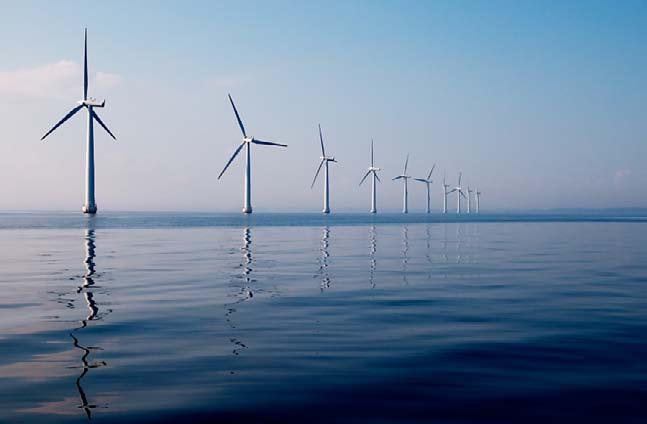
In 2010, Germany completed Alpha Ventus, an offshore wind farm. It promised enough energy to power 50,000 homes (220 gigawatts), and was hailed as the first of many such efforts as large multi-national companies sought approval to create their
own. Despite some initial issues with overheating, requiring replacement of parts, it has proven to be as effective as it has been proclaimed.
Since then, a number of new farm projects have been started in many other countries. Some include a number of places in America, approval in Ontario, Canada, and recently released news that China will require its dominant electricity producers to have at least 15% of their energy coming from wind.
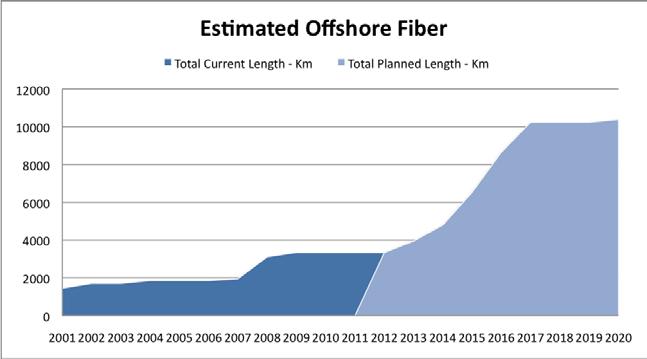
Being a relatively new niche market, the Offshore Fiber industry only really took off during the late 1990s and early 2000s. Since then, the low latency and reliability of fiber has proven to be an asset to platform owners, shown above as a steady increase in total kilometers of fiber added per year. Once the technology was proven, the demand for fiber doubled in 2008, almost 10 years after fiber started to become widely accepted. As the applications for fiber expand, the total number of systems and the required fiber is expected to grow exponentially. In 2001, the total length of all fiber cable in use was less than 1,800 Km, by 2020 that number is anticipated to increase over 550%.
And of this sounds very good; the dream of clean energy. But the realities can be a bit daunting. Alpha Ventus, arguably the most effective use of wind energy to date, produces 220 gigawatts annually. In the same time, America uses 3.741 trillion kWh (3,741,000 gigawatt hours). The AV wind farm take up roughly four square miles. To produce the kind of energy the nation would need with wind alone would
require a wind farm roughly 68,018 square miles. Even offshore, that’s a large chunk of land.
This isn’t to say that wind energy doesn’t serve a purpose. Combined with the other renewable energy sources, green technology can shave down the extremely large drain the world does on oil. However, all such technology runs in to
the same problems. On the large scale, it simply isn’t viable; whether because of the amount of space it requires or the cost to returns. For the time being, fossil fuels are the only option. Oil predominantly.
Offshore oil has become a particularly important facet of the industry. According to the Interior Department, as of 2010 there were 3,500 offshore platforms. As laws
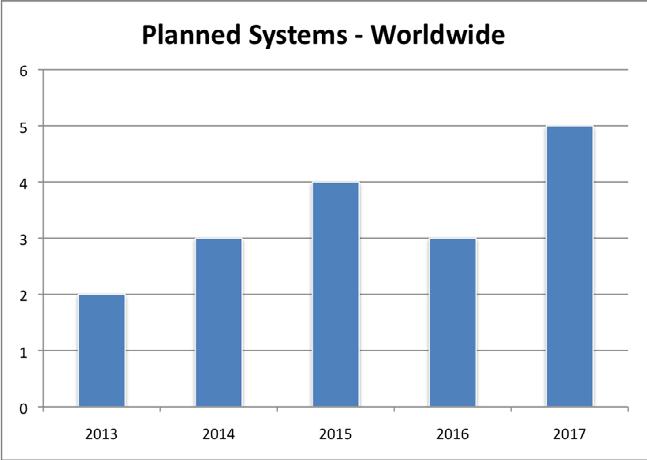
While demand for Fiber cable grows, the systems themselves aren’t expected to change a great deal; there are simply more of them. From the late 1990s through about 2008, the number of systems added could be counted on one hand, essentially seeing one system being added every other year. As the demand for reliability and lower latency continues to rise, the number of systems deployed by platform owners will grow. As shown above, systems for oil and liquid natural gas fields are expected to be deployed at a hugely increased rate in the coming years. Platform owners are adopting submarine fiber as their goto communications method for offshore platforms, made apparent by the huge shift in new system deployment.
have become increasingly strong since the Deepwater Horizon incident, production of new platforms has been slowed.
Despite this, companies have been changing and improving systems and technology to meet the increasing demand for oil, a fact that was recently stated in a company magazine by Chevron. In this magazine, they highlighted the new system management that centralizes the information coming in from their oil drilling sites worldwide. This is hoped to reduce information conflict and shorten response time when a problem arises. Chevron also plans to install new energy saving technology.
Coinciding with this has been the push for offshore oil to go digital. That is to say, to lay cable to the various platforms instead of relying on satellite. In a decade, around six cables have been laid to platforms. However, in the past few years, new projects have been created that suggest a large-scale move towards the use of cable for the oil industry. In the works now are at least 18 new cables that are schedule to go to platforms. This will open up the industry to more complicated data networking, allowing for more information review with more efficiency. They vary in length, but are located worldwide, suggesting more possible changes are on the way.
The offshore oil industry, which has lost a great deal of faith since the catastrophe in the Gulf of Mexico, is still an important and necessary part of the world’s energy solution. By developing inventive methods of managing information, companies will create more effective ways of producing oil.
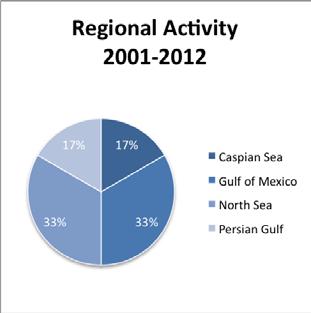
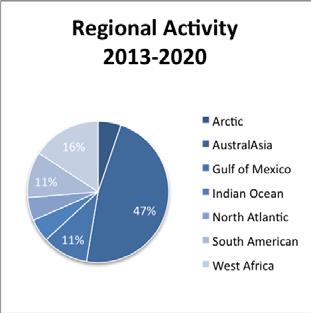
As new systems are deployed, it’s important to note the regions of growth and where platform owners are focusing their assets. In the past, owners have focused their attention on traditional oil and natural gas fields in the North Sea and Gulf of Mexico; seeing where their new systems are being planned, it is apparent that owners are now expanding their fiber operations into other developing regions. Most predominately, new systems are being planned for South Asia and Australia, showing that more non-traditional owners are embracing the submarine fiber solution.
Stephen Jarvis is a freelance writer in the Washington D.C. area. He has published articles and done editorial work with several publications including Submarine Telecoms Forum. Also, he has been a speaker for the Popular Culture Association / American Culture Association National Conference.
Oil & Gas Cable Protection
Like Australia, many nation states have, or are in the process of, dividing their EEZ into leasable blocks for Oil & Gas exploration and later production. The challenge in drafting the legislation for the necessary leases and licences will be to protect the rights of the lessee while maintaining the requirements of the UNCLOS to allow submarine cables free access to cross these blocks and permit maintenance and repair of cables within the blocks, when required. The Australian Government may well be leading the way in developing appropriate legislation to protect submarine telecommunications cable and will shortly need to readdress this legislation, as it relates to submarine cable for the offshore Oil & Gas industry. Therefore, an opportunity exists for rest of the world to consider the Australian approach, learn from it and where appropriate adopt their rules and regulations.
(Excerpts from Submarine Cable Industry Report, Issue 1, July 2012)
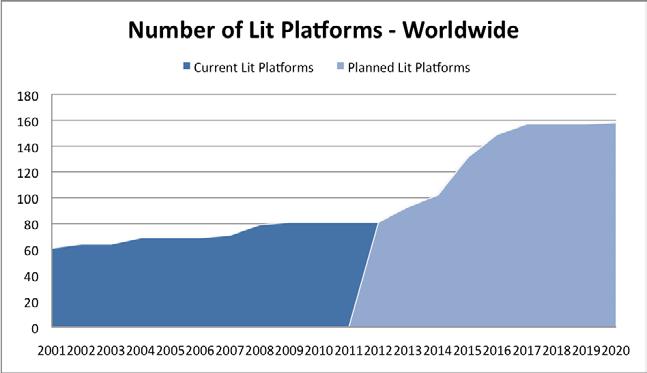
Platform connectivity has been a relative constant since platform owners have started deploying fiber as their primary means of telecoms in fields. During the late 1990s and early 2000s, the number of lit platforms only grew by a few, presumably while owners were still feeling out the utility of fiber. As the technology was tested and became apparently reliable, new systems added a 25% increase of lit platforms worldwide. Not all of these
platforms are still in operation today, some being floating liquid natural gas (FLNG) platforms or floating production storage and off-loading (FPSO) platforms which are added to fields as needed. The running tally of lit platforms is a good indicator of the market potential for submarine fiber growth in this niche market. Looking ahead, the number of lit platforms will be over doubled by 2020, showing a huge uptick in fiber demand 2012 and 2017.
The Undersea Cable Report 2013
From Terabit Consulting Publication Date: September, 2012
The most diligent quantitative and qualitative analysis of the undersea cable market - 1,600 pages of data, intelligence, and forecasts that can be found nowhere else.
Terabit Consulting analysts led by Director of International Research Michael Ruddy tell you what’s real and what’s not, where we’ve been and where we’re headed.
The Undersea Cable Report capitalizes on Terabit Consulting’s global on-site experience working with carriers, cable operators, financiers, and governments in over 70 countries on dozens of leading projects (e.g. AJC, BRICS, EASSy, Hibernia, SEAS, TBI)a world of experience, at your fingertips in a single resource!
Intelligent intelligencego beyond the numbers!
YOUR KEY TO UNDERSTANDING AND HARNESSING
THE $20 BILLION UNDERSEA MARKET OPPORTUNITY
The Undersea Cable Report 2013 is your single source of information for top-level decisionmaking - with the most detailed profiles, data, market analysis, and forecasts available.
• 680+ detailed undersea cable profiles
• Capacity demand, capacity supply, and capacity pricing
• Ownership, system supply, financing, and project costs
• The upgrade market
• Global, region-by-region, and route-by-route analysis
• Reliable, detailed forecasts
• accurate, reliable data
• valuable intelligence
• innovative modeling
• thoughtful insight
• global perspective
• respected expertise
Limited time re-introductory offer to celebrate the return of the Undersea Cable Report! Reserve your copy today. SAVE 50% UNTIL SEPTEMBER 7, 2012
Single-user license $10,995 limited-time re-introductory offer $5,500 Multi-user site license $24,990 limited-time re-introductory offer $12,495 Global organizational intranet licenses also available
Fibres For Equipment And Wells
UK company Smart Fibres is developing technology to use fibre optics for monitoring the condition of subsea equipment.
Fibre optic strain sensors can be placed close on the bearing race, and can provide data showing how much the bearings are vibrating and the frequency of the vibration.
Doing interventions on subsea equipment normally requires a heavy lift vessel, which is very expensive. So there is a big incentive to know as much as you can about condition of subsea equipment before bringing the vessel onsite.
All bearings have normal or characteristic vibration signature, but if the bearing is defective, the vibration signature will change, said Matthew Powell, business development manager with Smart Fibres.
"You can see when it's time to take action and intervene, or predict how much time we have left," he said. "Then you don't do it if you don't have to".
than ‘Interval based maintenance’ or ‘Run to failure’.
Smart Fibres works together with bearings manufacturer SKF, who have extensive experience in bearing monitoring.
The technology has also been used on risers, clamped onto the side of the tubing or built into the riser components.
The company's sensors use single optical fibre, 9 microns in diameter, wrapped into a sensor which is 0.15 or 0.25mm diameter.
The fibre optic sensors can also work at much higher temperatures – Smart Fibres
is developing sensors for use in steam assisted gravity drainage applications300 degrees C compared to the limits of 100 degrees C for quartz standard gauges, he said.
The company was founded in 1998, initially to do monitoring of carbon fibre masts on yachts and display the strain being measured in the mast. The sensors were embedded inside the carbon fibre mast.
It has been doing work in the oil and gas industry since 2003, and downhole work since 2007.
This is intelligent ‘Condition based maintenance’ rather
Silixa - advanced fibre optics
Silixa Ltd of Hertfordshire, UK, a company which develops advanced fibre optic technology for downhole, reports that it has grown the company from 6 employees to 35 in the past 2 years with an initial investment from Chevron Technology Ventures and Lime Rock Partners.
The company has recently opened a facility in Houston and anticipates growing employee numbers to 40-50 during 2012.
Silixa’s fibre optic technology provides "an order of magnitude" better response in terms of the resolution, the measurement time, the distance, and the sensitivity,” claims CEO Mahmoud Farhadiroushan.
The company’s technology, “Intelligent Distributed Acoustic Sensor”, or IDAS, can measure the acoustic field at every metre along tens of kilometres of optical fibre, capturing the amplitude, frequency and phase of the incident acoustic signal with a dynamic range of over 120dB.
Fibre optic technology can be used for many applications including cement evaluation, fracture analysis, integrity monitoring, flow profiling, artificial-lift optimisation, monitoring casing leaks as well as wellbore seismic imaging without the need to shutdown the wells.
The company has demonstrated the benefits of its high performance monitoring systems both in flow and seismic imaging, working working with Chevron, Statoil and Saudi Aramco.
The company has developed a wide range of installation methods for in-well surveillance applications.
It has completed a multiple logging operation in high temperature deviated gas wells using its micro-coil tubing fibre optic sensor.
The company is currently working on a permanent in-well installation of combined distributed temperature and acoustic sensors to monitor the well lifecycle performances.
Silixa has developed a number of signal processing techniques for handling and processing the distributed acoustic data. One of the key applications is distributed downhole flowmeter. The acoustic noise generated and propagated through the fluid can be characterised at every meter along the wellbore.
Using an array processing technique, the speed of sound can be determined at different intervals along the wellbore.
be then determined from the Doppler shift induced between the speed of sounds propagating in the same and opposite directions with respect to the moving fluid at different intervals.
This means you can see which fluids are flowing into the well at different places, or understand the fluid composition in different places.
People have asked about using it to monitor CO2 sequestration. "Every day we get a new enquiry with new applications," Mr Farhadiroushan says. "Some of them are very intriguing."
A lot of the work can be done with existing fibre cable installations, but cleverer processing, he says.
The speed of sound can be used to evaluate the fluid composition which can
The Atlantic Wind Connection
UPDATE September 2012: The Permitting Process Continues...
Bill Wall and Kris Ohleth
Last year in the September issue of STF we introduced the Atlantic Wind Connection project. Now in September 2012 we have an update to review the progress we have made in the regulatory permitting field in order to bring the project to fruition. First, an update on the basic project premise and configuration:
The US Mid-Atlantic region is home to one of the most powerful offshore wind resources in the world. Just 15 to 20 miles offshore there is enough wind energy to supply millions of homes with clean, renewable power. The area is also home to major population centers, with an ever-increasing appetite for energy. Geographically, it i0s perfect for offshore wind, with a relatively gently sloping continental shelf and relatively shallow waters - 100 to 150 feet deep - as far as 15 to 20 miles offshore. The seafloor is typically comprised of sand and gravel sediments, making for simpler civil marine construction using current, field-proven techniques. These factors combined create the “Perfect Storm” of offshore wind potential along the Mid-Atlantic shore.
Now, how to bring all that power to shore in the most efficient manner? The generation and collection of offshore wind power has matured well in Europe over the last 20 years. Turbine manufacturers are building ever larger generators, foundations are being designed for deeper waters, and
the submarine cable industry has expanded with new factories to meet the demand. The missing link is an efficient and flexible power transmission system to transfer the
1: AWC configuration
Figure
available power to the right place at the right time. This is where the Atlantic Wind Connection (AWC) project comes in.
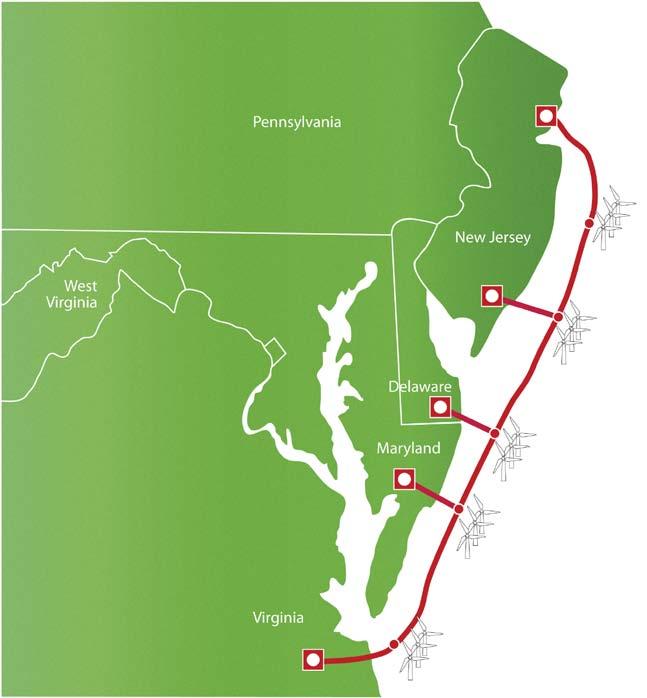
The Atlantic Wind Connection (AWC) Project is an offshore backbone electrical transmission system proposed off the MidAtlantic coast between Northern NJ and Virginia. The system will consist of an HVDC submarine cable system interconnecting a series of offshore “Hubs”. Each hub will consist of an offshore foundation housing an HVDC converter station on its deck. At each hub location utility scale offshore wind farms will interconnect to the AWC offshore grid. The Alternating Current (AC) power generated by the wind farms will be converted to High Voltage Direct Current (HVDC) and transmitted to shore via submarine cable connections. On shore the AWC HVDC system will follow an underground route to a strategic Point of Interconnection (POI) on the terrestrial grid where a land-based HVDC converter station will convert the DC power back to AC for distribution on the grid. The AWC Project will allow up to 7,000 megawatts (MW) of offshore wind turbine capacity to connect to the regional high-voltage terrestrial grid.
Figure 1 shows the proposed conceptual AWC configuration. Conceived as a project in late 2010, the AWC team then set out on the road to bring the project to fruition, beginning with a newly-minted permitting process and an eye towards stakeholder engagement, early and often.
The Permitting Process – An Overview At The National And State Level
The Bureau of Ocean Energy Management (BOEM), part of the US Department of Interior (DOI) is the federal government regulator for all renewable energy project developments planned for the US Outer Continental Shelf (OCS). BOEM has issued rules that govern the use of OCS submerged lands for renewable energy development. BOEM’s “Final Renewable Rule” states
the requirements wind developers and transmission line developers must follow to obtain a submerged lands lease to build a wind farm or a ROW to build transmission. BOEM is the lead federal regulatory agency for permitting leases (for wind farms) or grants (for transmission systems) on the OCS.
Numerous additional federal agencies in addition to BOEM must also be consulted in the AWC permitting process and, in
many cases, permits must be obtained from them, as well. The US Army Corps of Engineers, the US Coast Guard, US Fish and Wildlife Service, the US Environmental Protection Agency, as well as several others must review AWC project applications to determine what impacts the project may have on the environment, navigation safety, or other aspects of the existing marine and terrestrial environments.
Each of the coastal states also has jurisdiction over their adjacent coastal waters, usually to three nautical miles from the shore. The permitting processes for each state varies, but in order to site a transmission line like the AWC that will ultimately run through state waters and make landfall on a particular state’s shores, AWC will need to obtain several permits from state regulators. Those permits include ones which confer the rights to the states’ submerged lands, as well as environmental permits which confirm that the AWC will meet the environmental protection standards set by each state.
The Right-Of-Way Application – The First Step In The Boem Permitting Process
The Atlantic Wind Connection submitted an application to BOEM for access to the offshore right-of-way in March of 2011, the first step in obtaining a grant to construct a transmission system on the OCS. This application presented a
proposed cable route to BOEM as a first step in obtaining the grant for the right-ofway and initiated the official permitting process with BOEM. In their review of the application, BOEM wanted to determine if there was any competition for the area which AWC requested for the project, as well as understand the potential impact granting the right-of-way could have on the environment, existing marine uses and stakeholders.
BOEM invited stakeholders to comment on the potential impacts of the AWC. Over 50 comments were received during the comment period, and the majority of the comments were overwhelmingly positive.
AWC’s many benefits were highlighted by the stakeholders, including the project’s ability to reduce the environmental impact and overall footprint of offshore wind, and how the AWC would reduce costs for the offshore wind industry at large.
In May of 2012, BOEM granted a Determination of No Competitive Interest (DNCI) for the right-of-way, which confirmed that no other offshore transmission developers had a competitive interest in the route AWC proposed. This determination was based on BOEM’s review and analysis of the application, as well as the stakeholder feedback that was received. The DNCI allows BOEM to move forward in the environmental review of the AWC project.
The General Activities Plan – The Next Step In The Boem Permitting Process
As mentioned earlier, BOEM is the lead agency for the environmental review of the AWC project. The statute with which BOEM is required to comply is called the National Environmental Policy Act of 1969 (NEPA). Its purpose is:
“To declare a national policy which will encourage productive and enjoyable harmony between man and his environment; to promote efforts which will prevent or eliminate damage to the
environment and biosphere and stimulate the health and welfare of man; to enrich the understanding of the ecological systems and natural resources important to the Nation; and to establish a Council on Environmental Quality.”
NEPA’s basic policy is to assure that all branches of government give adequate consideration to the environment prior to undertaking any major federal action (including, granting a right-of-way for submerged lands) that significantly affects the environment. NEPA requires all of the
regulators with jurisdiction in the area of the proposed project to take a hard look at the proposed action and the proposed alternatives to the action, and assess the likelihood of impacts from the proposed project and alternative courses of action.
While BOEM is required by NEPA to perform the environmental analysis, the data used for the analysis must be provided by and funded by the applicant. Per the Renewable Energy Rule referenced above, a General Activities Plan (GAP) must be submitted to BOEM, and it becomes the principle support for the NEPA analysis.
BOEM will also hire an environmental consulting firm as a third-party contractor to assist in the review of the GAP and development of the NEPA analysis. BOEM and the third-party contractor will write an Environmental Impact Statement (EIS) as part of the NEPA framework.
This EIS preparation and review will take at least a year and will provide opportunities for the public to comment on the AWC project’s construction, operation and maintenance, and decommissioning phases. AWC will provide data from existing sources, detailed studies, and modeling exercises. The types of data presented in the application include assessments of the existing natural and cultural environments in the project area. Studies may include: an assessment of threatened and endangered species and essential fish habitat, modeling of electromagnetic fields, a baseline analysis of existing noise offshore and modeling of the noise created by the installation and operation of the AWC, cataloging existing geological and geotechnical conditions through extensive field studies, and a navigation risk assessment.
Once BOEM completes its NEPA analysis, it will determine whether or not the AWC will have significant environmental effects. Then a Record of Decision (ROD) will be issued by the Secretary of Department of the Interior. The ROD, in conjunction with the permits issued by the additional
federal and state agencies, will enable AWC to move forward in the final steps of the BOEM permitting process and move ahead to financing the construction of the project. Later in the project development process, the applicant will submit Facilities Design and Facilities Installation Reports (FDR and FIR, respectively) to BOEM with additional project technical information. At this phase of the project, AWC is also required by BOEM to select a Certified Verification Agent (CVA), who will work directly for BOEM and be on site during the construction of the AWC to ensure the project is being constructed per the construction plans BOEM approved for the AWC.
Bill Wall has spent nearly 40 years in the submarine cable industry. Starting at British Telecom (then GPO) Wall then spent 12 years with Cable & Wireless Marine Staff (now GMSL) where he was very active in the development of cable burial ROV systems. He was a member of the original Scarab 1 operations team. Wall then spent 18 years at Margus Co where he was VP Operations. His next assignment was Business Development Manager at Caldwell Marine International. He then joined the offshore wind industry as VP of Marine Operations at Deepwater Wind based in Hoboken NJ.
On-Going Operations
Currently, the AWC team continues with the drafting of the GAP submittal. Offshore survey planning and design and terrestrial route engineering are on-going as well.
He has a broad background in in sub-sea technical operations and submarine cable project management including Shore Ends, HDD, ROV operations, Plowing, Survey operations, cable repair etc. He is currently Director, Marine Operations at The Atlantic Wind Connection based in Chevy Chase MD just outside Washington DC.
Kris Ohleth is the Director of Permitting for the Atlantic Wind Connection backbone transmission project. Her past positions include Policy Manager for Coastal and Marine Spatial Planning issues for Ocean Conservancy and the Director of Environmental Affairs for both Deepwater Wind and Bluewater Wind. Kris worked as a research technician and editor for the National Marine Fisheries Service in Woods Hole, MA and as a communication coordinator for The Nature Conservancy. She earned an undergraduate degree from Rutgers University and a master’s degree from the University of Rhode Island in Coastal and Ocean Policy. She is on the Board of the US Offshore Wind Collaborative, the New Jersey Environmental Lobby, and is the Chair of the New York/New Jersey Chapter of the Women of Wind Energy.
Behind The Scenes Of A Cable Repair: A Brief Overview
Derek Cassidy
Submarine cables, the link that connects countries and continents across oceans, are the lifeline for telecommunications. They spread their web across the globe and help to create a single universal telecommunications platform. They are expensive to design, install and commission, but the return on the investment can be high and well rewarding. They are constantly been upgraded to meet the needs and demands of society so that the increase in communication content can be met and sustained.
Telecommunication infrastructure needs to be maintained and any breaks in the infrastructure can be dealt with by the deployment of a Civil Engineering Team and a Fibre Repair Team. The repairs usually last less that 24 hours and all services are usually up and working within the day. But a submarine cable is different; because of its location the mobilisation of a cable repair ship is needed. The deployment of a cable vessel is expensive, so to help with this cost a maintenance agreement between submarine cable operators and cable ship owners is setup. Agreements like the Atlantic Cable Maintenance Agreement (ACMA) are common and they cover areas such as the Atlantic, North Sea, Indian Ocean and Pacific etc.
But this does not stop here, the location of storage for spare submarine cable and submarine cable joints needs to be situated where the cable vessels have a docking
facility. The ACMA uses Portland, Brest and Vigo as storage bases. The Universal Jointing Consortium (UJC) is a consortium that has agreed to design a single type of joint that can be used for most of the cables being used today. With the idea of a single joint type, this helps to reduce the different jointing types needed and allows for a quicker repair and splicing time as the joint is one that is common and helps to increase the familiarity and commonality of the complex art of cable splicing and connection.
The average cost of a fibre repair on the side of the road is about €4,000 to €8,000 Euro, depending on road and cable repairs and the fibre count in the cable. The duration of a repair could be from 4 hours to 48 hours depending on location and type of repair needed. However, a submarine cable repair could cost about €150,000 Euros and could last from 5 days to three weeks. However, the duration of a submarine cable repair is dependant on the weather, location and distance from port.
So what is involved in a submarine cable repair and what are the procedures that are followed. Here is an overview of a repair and the procedures followed.
It is 4.00am in the morning and the Network Management Centre (NMC) sees an alarm on the International submarine link. These alarms indicate that there is a loss of signal and the connection between the two cable stations has been lost. The submarine cable procedure is not sent in process. Firstly the NMC technicians log into the add drop multiplexers (ADM) that he has communication to and interrogates the alarms to see if they can quickly identify the root cause. They also check the remote fibre testing system; this is a remote optical long rage OTDR that is located in the cable stations. It is a JDSU designed system with a cartographic platform linked to Google Earth, Ordnance Survey and marine charts. The RFTS indicates the precise time the optical alarm was raised. The alarm is raised when the optical trace is more that 2% out of reference from the optical trace it uses as a reference. The RFTS has taken multiple traces from the two units at the either end of the cable and presented these to the operator. The system has long range and short range optical traces indicating the exact location of the damage to within a couple of meters. The OTDR tests the submarine cable every 15 minutes. The alarm indicates the distance to the reflective or non-reflective event, location on various mapping sources and
attenuation. The NMC investigates these alarms and reviews the optical traces. With this information and alarm identification from both the ADM and the RFTS the NMC Technician rings the submarine cable vessel mobilisation number. They get in contact with the mobilisation officer (MO) and gives as mush information as they can.
The NMC technician gives the following details to the MO:
Cable identification name
Location of break/damage, with GIS coordinates
Distance from nearest cable station Type of suspected damage (cable cut, macro-bend or shunt fault)
Contact numbers
Name of company representative who will arrive at the cable ship to assist with repair
All this information is also sent via e-mail and fax to the MO.
The NMC then rings the submarine cable repair team and notifies them of the submarine cable issue and the suspected issue. The submarine cable team is mobilised and they set off to their respective locations, such as the cable stations, NMC and the cable ship location so that they can manage the loading of spare cable and cable jointing parts.
As the NMC are contacting the various teams, another team within the NMC check all services across the submarine link and check for diversity and protection, making sure that any wavelengths that have failed are rerouted across working links.
Another team check the automatic identification system (AIS) that vessels use for identification to see if there are any vessels in the area. They also contact the local coast guard to let them know about their cable repair. The NMC also contact the National Fishing Organisation, like the NFFO in the UK and organise for a fishing
vessel to carry out protective duties over the other working cables that carry protection.
By 5.00am the submarine cable repair is set in motion will stake holders in the procedure notified and mobilised. Now all they can do is wait for the cable ship to leave for and head for the cable ground with the spare cable.
Members of the submarine repair team head for the cable stations, if it’s an unmanned cable station, to carry out various tests. They agree between them who the lead Officer Responsible is and they contact the NMC and let them know who the lead contact is; this person is also called the Power Safety Office (PSO). The person who is going to be on board the cable ship is called the on-board representative and they are also contacted and notified who the PSO is.
The two cable station engineers acting as Officer Responsible for each station carry out power safety procedures and pass power handling between the two stations etc. The team carry out tests on electrical conductivity, electrical impedance and optical connectivity. These are done to determine if the cable is cut or damaged by a crushing or mauling. All the results are all saved and sent to the cable ship via fax and the NMC via e-mail and stored locally.
Within 24 hours the cable ship leaves port with the required cable, universal joint piece parts etc and on its way to the cable ground. Also on board is a representative of the cable owner so that they can, as cable owner representative, make decisions on board when the Power Safety Officer at the main cable station is not available or decisions are required immediately. Although this is not a common occurrence as the PSO (power safety officer) is and should be consulted first, when available.
When the cable ship nears the location of the reported damage the Ship Power Safety Officer (SPSO) will contact the PSO at the cable station and ask for all optical and electrical power to be disconnected from the cable and an electrical tone to be applied to the cable. This is done via fax and done under the power safety message
procedures. The PSO contacts the OR in the far end cable station and through agreed processed, applies an earth to the cable. The electrical tone is applied and the cable ship is made aware. The SPSO also takes the lead and technically the cable ship takes charge of the cable.
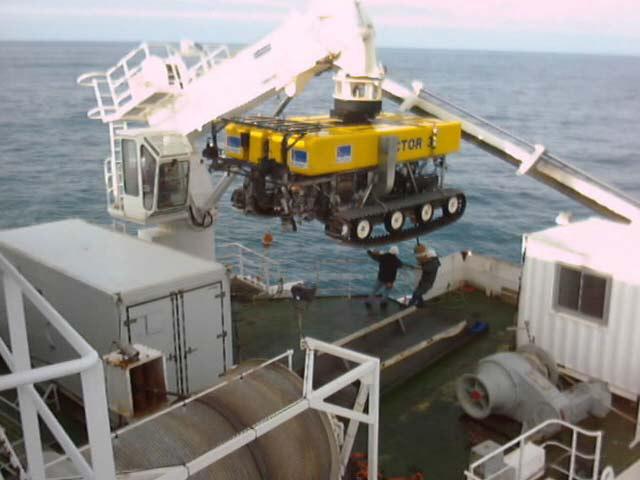
The cable ship carries out various tasks and lowers an ROV into the water to help trace the submarine cable. When the ship encounters suspected damage, it continues searching to make sure that this is the only area. It then goes back to the damaged area. Contact is made with the PSO and the tone is disengaged. The submarine cable is cut and the cable heading in the direction of the closest cable station is grabbed and raised to the surface. A specialist team on board the ship then cut away the damaged section and prepare the cable for optical
testing. Here they test the optical fibres for continuity and to make sure there is no other damage. When they finish testing the cable they seal it and buoy it off and put it back into the water.
They then retrieve the submarine cable that is in the direction away from the closest cable station and they also carry out the same procedure so that they can test the optical fibres for continuity and to make sure there are no other optical issues or damage to the cable. As all this is taking place, the NMC have guard vessels from the local fishing ports patrolling the diverse cable route and other procedures are followed and carried out.
After all tests have proved successful they
start the process of splicing on a new section of cable. This cable section will replace the piece that replaces the damaged section. However it is also a few hundred meters long as its needs to connect the two cables ends together. The universal jointing parts are gathered. The spare cable is loaded into the runners and pulled into the work shop where the end is prepared for splicing. The existing cable end, that was just tested, is also prepared to be spliced to the spare cable. The working party start the process of splicing the cables together and at certain stages they test the splices to make sure the connection is good.
collars and sleeves to the joints so that they are both protected. They are then sealed and then the cable is moved out of the workshop until the other end of the spare cable is now in the workshop. The cable ship retrieves the other end of the cable from the sea and it is pulled into the workshop. The two ends of the cable (the spare and working cable) are then prepared and the cable connection and fibre splicing continues. This process is continued and during this the fusion splices are tested. When the connection is completed the SPSO contacts the SPO and asks for an OTDR test on the cable through the new joints to see if they are happy with the splices. Any splices that do not conform to the agreed standard will mean that the connection procedures will need to be carried out all over again. The reason is that the connection, especially the fibre splicing needs to be within standard agreed dB levels because a submarine cable joint cannot be worked on like a standard optical joint in a traditional network.
When the first splice is complete, its protection by applied by the application of the armouring wires to the cable and
When the PSO has carried out the optical tests and he is happy that the optical traces are good and operationally sound he notifies the SPSO who then gives to go ahead to seal and protect the final splice. The cables and joints are protected and sealed to protect the fibres from the hydrogen affect. The cable is then released from the workshop and the process of laying it onto the seabed is carried out. When the cable is on the seabed, the
SPSO contacts the SPO and again more optical tests are carried out. When all ok the connection between cable and cable ship is released. The cable ship then starts the process of trying to bury the cable in the seabed, where applicable, so as to try and make sure that the new cable section is protected from any outside aggressive forces. Again when all the burying or jetting has taken place the SPO tests the cable again and when happy they then take charge of the cable by agreement from the SPSO. The two cable stations then electrically and optical power up the cable. When the network is reconnected and stable the cable ship is released and the cable is now in operations again.
The cable ship is now heading back to port ready to demobilise. The guard vessels are also demobilised as are the repair teams who were involved in the operation.
The company’s on-board representative then carries out a debriefing exercise with the SPSO and they collate all reports and testing results for the repair and soon the cable ship operators issue a final report on the repair. The submarine cable route coordinates are updates and sent to the various bodies such as the UKHO and Kisca for information and to update charts.
Derek Cassidy is from Dublin, Ireland. He has worked for 19 years in the telecommunications industry of which 17 years have been spent dealing with optical terrestrial systems and submarine networks. He is currently leading the Optical Engineering and Submarine technology areas which support BT Ireland and the wider BT Global business. He is currently a member of the IET, IEEE, Engineers Ireland, EOS & OSA and
has Degrees in Physics/Optical Engineering, Structural/Mechanical Engineering and Engineering Design and a Masters Degree in Structural, Mechanical and Forensic Engineering. He is currently researching his Thesis in Optical Engineering.
Winner Takes All?
Vicky Liang
Since 2009, nearly US$3 billion a year on average has been invested in new submarine cable systems worldwide. Global growth in demand for capacity of around 45% CAGR underpins these investments - although systems are also constructed for reasons of route diversity, cost efficiency, competitive advantage, entrepreneurial whim, and to address previously unserved routes or markets. However, some fiber optic cable developers are asserting low latency as another key driver. Arctic Fibre, ASE, Emerald Express, Hibernia Express, ROTACS, SAEx, and Seabras are all examples of recently commissioned
or planned systems that include low latency as part of their marketing pitch. But is low latency a significant factor for the typical customer? Does it drive their decision to select one cable over another? What is the value of latency improvement to the end user? Can low latency justify new builds?
Need for latency
The benefits of low latency networks are heavily promoted towards the high frequency trading (HFT) market. This tiny
niche segment of customers looks for fleeting arbitrage opportunities between financial markets. Their capacity purchasing creed is therefore to avoid being slower than their competitors. Consequently, these few traders are willing to pay a significant premium to guarantee access to the lowest latency route available and ensure that they are not at a disadvantage compared with their competitors. In other words, this is a “winner takes all” scenario.
There are other latency-sensitive customers. In the enterprise sector, video or audio streaming needs low-latency connections to avoid quality degradation. VoIP, video teleconferencing, storage area networking and cloud computing systems may also be sensitive to latency. Opportunities therefore exist in this larger market to provide added value through QoS. Computer gamers require a fast response time but are only willing to pay much smaller premiums, if any.
The average Internet user simply expects response times to improve over time with limited additional cost. According to Forrester in 2009, 47% of consumers will abandon loading an ecommerce website after 2 seconds and 40% after 3 seconds. These results show a significant shift from the 8 seconds quoted by Zona Research in 1998.
Although other routes and markets are beginning to develop interest in low latency, the transatlantic market is the crucible for low latency-driven submarine initiatives. The United States and Europe are financial hubs party to some of the world’s largest stock exchanges by market cap and trade value - the NYSE, NASDAQ, and the London Stock Exchange. Given that high frequency trading accounts for approximately 60% of all stock trading, the amount of interest in a lower latency transatlantic cable is unsurprising. It is a seemingly attractive option for cable operators to differentiate themselves in this otherwise highly competitive market. Both Hibernia Atlantic and Emerald Networks are planning new builds while other firms such as TELE Greenland and Perseus Telecom have announced cable re-lays and upgrades to promote latency reduction.
There are twelve subsea fiber optic cables servicing New York and the UK directly on low latency routes. In most cases, the latencies on these systems are similar and may be perceived as indistinguishable by the majority of customers. AC-1 South is currently the fastest cable in the transatlantic route, with a latency of approximately 65.2 ms from NY-London.
Project Express promises sub-60 ms latency between New York and London, while Emerald Networks claims 62 ms for its
submarine cable initiative which is slated to connect New York and London with a connection to Iceland’s emerging data center market. In response to Emerald’s plans, Hibernia Atlantic also recently announced a partnership with TELE Greenland for another low latency transatlantic link between New York and Iceland. This is technically not a new build since it will not involve laying a new cable; rather, TELE Greenland will re-lay the existing Greenland Connect cable to remove 1100 km for a more direct route. Perseus Telecom has also recently started promoting FLAG Atlantic-1 North’s low latency potential after
upgrades to the landing stations with Ciena’s end-to-end switching solutions and Apollo is talking about re-laying its northern cable to offer a lower latency route.
The Latency Pandemic
Some entities have begun to seek opportunities for lowest latency fiber optic systems in other parts of the world. Polarnet’s “ROTACS”, Arctic Cable Company’s “Arctic Link”, and “Arctic Fiber”, a Canadian venture, are seeking to provide lower latency between Asia and Europe,
as well as offering improved redundancy. These initiatives are joined by various Sino-Russian terrestrial initiatives. Seaborn Networks’ recently announced a redesign of the “Seabras” route to provide a low-latency connection between financial centers in Sao Paulo, Brazil and New York. eFive’s “SAEx” and Angola Cables’ “Angola-Brazil” cable are both predicated on the idea that they can offer an attractive lower latency transit route between Asia and the east coast of North America. Other more ambitious projects, such as BRICS and WASACE, include low latency as part of their rationale. Within Asia, a number of express cables have been or are being built to connect up major financial and commercial hubs within the region.
Risk vs. Reward
It is noticeable in the transatlantic market that, apart from Hibernia Express, other initiatives talk about reducing latency rather than attempting to be the fastest. The cable developer that successfully installs the lowest latency system on any given route will scoop the HFT business but there is still the opportunity for other competitors to make money from latency by offering cost-effective services to the enterprise, gaming, and general sectors.
tive routes. In the case of the transatlantic market, this risk is somewhat reduced for Hibernia Express because the planned route between New York and London can hardly be any shorter and because future cables will encounter difficulties in the Irish Sea where offshore wind farm developments are being given priority. Nevertheless, this type of low-latency cable initiative is by definition focused on one point-to-point route, leaving other pointto-point connections via the same body of water to be addressed potentially by other cables.
At the time this article was written, the SEC was in the midst of investigating ways to prevent volatile market swings emanating from high frequency trading, the results of which may pose potential legislative issues. High frequency trading drew negative attention during a “flash crash” which caused considerable volatility in the stock market on May 6th, 2010. The U.S. Securities and Exchange Commission has noted that high frequency trading firms have in recent years reduced their transmission time for trading activities through colocation, or placing their servers closer to the exchanges. There is debate around wheth-
The risk for the lowest latency provider is that even lower latency cables may eventually result from evolving technology in the terrestrial network or shorter alterna-
er this demonstrates an unfair advantage for high frequency traders over more traditional financial institutions and investors.
Implications
The increase in lower latency submarine fiber optic cable initiatives is driven by the need to differentiate in a highly competitive market. Apart from high frequency traders, the enterprise, gaming, and general use markets all exhibit some sensitivity to latency and some of these customers
may even be prepared to pay a premium for lower round-trip delay. The risk-reward tradeoff for lowest latency cable investments will be too risky for many investors, especially considering the pointto-point nature of such initiatives. Aspiring low latency cable developers must demonstrate sufficient barriers to market entry to obtain funding for these projects. Cables which can be justified as the providers of the lowest latency between two points are the exception. Cables which offer lower latency, along with reliability, redundancy, and reduced cost will be significantly more prevalent.
Vicky Liang is a Market Analyst at Pioneer Consulting, focusing on subsea fiber networks. She joined Pioneer in 2010 and is based in Boston. Follow Vicky on Twitter @ veesubfiber.
Improving System Procurement: Can We Make a Difference?
Stephen Lentz
It is generally accepted that the submarine cable industry runs in cycles. A quick look at the total length of new cables entering service over the last twenty years bears this out. Activity in alternative markets such as scientific systems and oil & gas has done little to smooth out the peaks and valleys. Furthermore, we are now entering, if not already in, what could be a severe dip. Yet, many of us are aware of promising projects that have so far failed to take off. A few regional projects are going ahead, but we are all looking forward to the next set of big projects.
Faced with this reality, what can be done? Can a change in planning, procurement and implementation of submarine cable systems make a difference? Or, has our industry done all it can, leaving us with no alternative but to wait for healthier demand and better economic
conditions? Is technology contributing to the drop in demand, as the transition to coherent transmission takes place? A brief review of the procurement process reveals some answers. To begin, what are best practices for system procurement, are they being followed, and is there room for improvement? The lifecycle of a submarine cable moves through familiar stages: planning, development, tendering, implementation, and finally operations. Actual procurement begins in the second phase, development, and continues through the operational phase, if upgrades and support services are considered.
Prior to procurement, the process begins with the inception of a new system, either to serve a new location, because existing systems cannot meet demand, or occasionally because a system is being retired and taken out of service. The new system may be discussed with partners
Submarine
Cable
Procurement
or shopped around privately before being announced at a trade show or other forum. Assuming the response is positive, the real work begins.
Prospective system owners now move into the development stage, begin to offer pre-sales, issue requests for information to suppliers, and initiate discussions with financiers. A desktop study may be undertaken at this stage or may wait until a more complete plan is in place. The information collected must be synthesized into a comprehensive plan that will facilitate making a “go – no go” decision. There are various terms for this, “feasibility study,” “business case,” or, in the oil & gas industry, “Final Investment Decision.” Whatever it is called, the plan should present a high level system design, sales and marketing objectives, expected utilization and pro forma financial statements.
Next, assuming the plan is approved by whatever authority, the project is put out to tender, or, occasionally, a sole source procurement. This stage involves detailed specification, the actual tender, supplier selection, and contract forming. A Desktop Study will be undertaken and, depending on the project, long lead activities such as permitting and environmental work will begin. Here, almost every system begins to follow a well worn path. System specifications, tender packages, terms and conditions, provisioning schedules, plans of work, and all the related activities are similar from one system to another.
The implementation phase begins as soon as a supply contract is in force. As in the tendering stage, much of the activity is well
understood, follows established practices and, in some cases, is formally standardized. System designs, performance budgets, quality plans, marine surveys, monthly reports, manufacturing, factory test, system assembly, system load and lay instructions, segment testing and system commissioning will all be recognizable and familiar to anyone who has experience with more than a couple systems.
Operations begins as soon as the system is placed in service. Some implementation activities may continue past RFS. Operations includes terminal equipment maintenance, shore station maintenance, marine maintenance, and service provisioning. Most of the day-to-day interaction will be through the network management system and, once services are provisioned, very little activity is required.
Now we can ask, at each of these stages, how well do standard practices serve the system owner and the industry in general?
During the planning stages, there are few, if any, formal processes. Some companies may have planning letters or prepare other documentation at this stage, but that really falls into the second, development, stage. This informal approach is probably best; the system design can be adjusted as partners are added (or lost), planners can quickly respond to market conditions, technology changes, or threats from competing systems.
During the development stage, in which a viable business plan should be produced, there continues to be a great deal of variability across systems and projects. Large carriers have many years’ experience and follow
well understood processes. The oil & gas industry has its own approach which is even more formalized. Independent, nonconsortium projects, however, often take an ad hoc approach. This is less than ideal, since many parts of the industry, from established carriers, to suppliers, to financiers, look for a “traditional” or “proven” approach. Here we may have found an area with potential for improvement.
Once projects reach the third stage of tendering, formal procedures are almost always adopted. A few smaller projects manage to get by without them, but any larger project is going to require documented and supported procedures both to manage the scale of the
project and to satisfy all interested parties that the project is well managed.
During implementation, the supplier’s processes and procedures will provide a great deal of control over the project. Again, these may be sufficient for smaller projects, but larger projects will require the purchaser to have their own set of processes and procedures for the same reasons identified above: to manage a large scale project and to demonstrate effective management, cost control, and technical compliance to all interested parties. Purchasers can transfer risk to suppliers through contracts, but some supervision is still needed.
Once a system enters service, operations and maintenance procedures tend to be well documented and controlled. Terminology may be different, but every system must have processes in place for routine monitoring, fault management, restoration, provisioning, spares management, security and so forth. Of all these areas, only the project development stage stands out as having potential for improvement. From tendering onwards, much of what is done is documented and controlled in a fairly standard manner. These practices have been tested by years of experience to where we can reasonably say they are “best practices.” The same cannot be said for the development phase. What constitutes a “best practices” feasibility study? A “best practices” business plan? If a system requires bank financing, for
example, what information must be collected and how should it be presented? What is the best format for presentation? A powerpoint deck is not enough, while hundreds of pages of analysis may never be read by anyone.
Some will say that the development of new systems is a source of competitive advantage for those who do it well. While this is true to an extent, there are many situations where this is not a factor. Regional systems, oil & gas systems, and replacing older systems are all case where a decision will be made for or against a new cable, rather than between two or more cable systems. Here, it is to everyone’s advantage to have a solid business case for optical fiber cable.
Clearly presenting the advantages, costs, potential return on investment and other key facts about proposed systems can only improve their chances for success. A clear plan communicates to potential customers, suppliers, and financiers that a proposed system is a serious proposition.
Now, could better presentation of prospective systems help the industry get moving again? A number of forces are working against short term prospects for the submarine cable industry. Global economic uncertainty is the most obvious of these. The availability of 100Gb/s terminal equipment is squeezing more capacity out of existing wet plant. The transition to wet plant which is optimized for coherent detection presents both an opportunity and risks to be managed. Ultimately, no amount of planning can address the real issue which is market demand.
As mentioned at the start of this article, there are a number of systems that could move ahead in 2013 or 2014, if only a few more customers were found or if a strong enough case were made. Here, presenting and communicating the business case could be the decisive factor.
Stephen Lentz is the Director of Engineering for WFN Strategies.
As Director of Network Engineering for 360networks, he oversaw installation, commissioning and city-to-city testing of Hibernia and GlobeNet cable systems. He was Lead Network Architect for the NEPTUNE Canada scientific cable system, and developed the network architecture for BP Gulf of Mexico Fibre System.
BP - Streamlining The Screens
It is becoming common to hear people say,“ don’t give me another screen, instead give me integrated information,” says Steve Roberts, VP of BP’s “Field of the Future” program.
Perhaps too often, when people need more information, the solution has been to give them another computer screen or window to monitor.
But there is a limit to how many screen people can manage.
The airline industry has managed to carefully synthesise a wide range of data and information for pilots onto a relatively
People working offshore are starting to say, don’t give me another screen..says Steve Roberts, VP of BP’s Field of the Future.
small footprint of screen, Mr Roberts said. “That's the journey we are on.”
program caused the production increase, Mr Roberts says.
“We can synthesize [all the information] into screens of rich information that shows you what you need to know when you need to know.”
One model for doing this is an online banking system. When you log on to your bank you can see only information which you need to know, taken out of the bank’s complex IT systems which have all customers’ account data together.
Field of the Future
The Field of the Future program aims to help improve production, and improve performance of production equipment, by providing digital technologies to help petroleum engineers.
BP has separate projects looking after exploration (including managing seismic data).
In 2005 BP set a target of adding 100,000 barrels of oil per day by the year 2017 through its Field of the Future Program, and by the end of 2011 it had achieved 73,000 bopd.
All of the figures have been signed off by the managers of the asset, to confirm that they agree that Field of the Future
There have been 400 examples documented at BP about how production has been improved as a result of these technologies. 80 per cent of the technology in Field of the Future concept is bought off the shelf, but the challenge is to use it consistently, he said.
The other 20 per cent needs to be developed specially, including sensors and algorithms.
BP works with several university maths departments to develop its algorithms, and employs statisticians with PhDs in modelling. This work gets more important as data sizes get larger.
It has wired up 80 per cent of the company’s “most significant wells”, providing information to experts anywhere in the world.
One area of attention is improving flow issues – faster well start-up to stable flow, management of sanding, controlling slugs, and removing bottlenecks. The Field of the
Future team developed 14 solutions which are deployed in 8 of its key regions, covering 80 per cent of its high value wells.
Collaborative working
With a team of different experts monitoring the asset, you can make sure it is being fully monitored and getting extra attention where it is required.
“Collaboration is at the heart of this, bringing the right experts together in a collaborative way, so they can interact around a common set of data,” he said. “The world of the past is people in their siloed environments.”
“We encourage a culture in BP around debate around information and interpretation of that,” he said. “We try to create systems better.”
There are 35 “Advanced Collaborative Environments”, across Upstream assets but in Houston and Sunbury (UK), “We're developing 2 centres where we can access information from anywhere in the world, so our scarce experts can sit in these centres and provide advice,” he said.
Data standards
Common data standards are very important in helping gather data, put it together, share it and bring it to experts, he says. “We still need stricter data management standards, for example making sure everybody uses the same name for a well.”
Steve Roberts is vice chair of the board of Energistics, the oil and gas data exchange standards organisation. “BP is fully behind the need for standard data exchange,” he says. “We're fully supportive of standards bodies like Energistics.”
There are analytics for drilling. “We have a well advisor system under development,” he said. It can help manage “hole control” issues and avoid stuck pipe.
BP is a firm supporter in the production data exchange standard PRODML, and believes that a data standard will be much more important the more complex the field and production arrangement is.
“We don't operate every field we have an interest in,” he says. “Everyone wants access to the information to help make their own decisions. A standard like PRODML will help facilitate that.”
Analytics
Analytics is an important part of the field of the future project, converting data into something which can be worked with.
There are analytics systems for facilities monitoring, including valves, chokes, pipelines, corrosion management, safety valves, equipment, predictive maintenance.
Analytics tools can alert the facilities engineers to the equipment they should be paying the most attention to.
There can be automatic ‘alert an expert’ systems. Doing this requires continuous WITSML data feeds on every drilling rig.
Graduates
An interesting question is what current graduates expect from their working environment at a company like BP.
Mr Roberts says he spends a lot of time asking graduates what they expect a working environment at a company like BP to be like.
Graduates say they do expect to come into an office. “They want to come together and meet and collaborate,” he said.
Many of them expect touch screens built into tables. “They want to press the desk and the information comes up,” he says.
They don’t expect to have to carry laptops, and they don’t expect to do their work on social media, he says.
Back Reflection
by Stewart Ash
The History of the Repeater
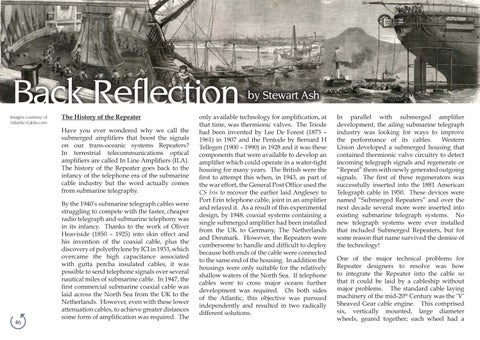
Have you ever wondered why we call the submerged amplifiers that boost the signals on our trans-oceanic systems Repeaters? In terrestrial telecommunications optical amplifiers are called In Line Amplifiers (ILA). The history of the Repeater goes back to the infancy of the telephone era of the submarine cable industry but the word actually comes from submarine telegraphy.
By the 1940’s submarine telegraph cables were struggling to compete with the faster, cheaper radio telegraph and submarine telephony was in its infancy. Thanks to the work of Oliver Heaviside (1850 – 1925) into skin effect and his invention of the coaxial cable, plus the discovery of polyethylene by ICI in 1933, which overcame the high capacitance associated with gutta percha insulated cables, it was possible to send telephone signals over several nautical miles of submarine cable. In 1947, the first commercial submarine coaxial cable was laid across the North Sea from the UK to the Netherlands. However, even with these lower attenuation cables, to achieve greater distances some form of amplification was required. The
only available technology for amplification, at that time, was thermionic valves. The Triode had been invented by Lee De Forest (1873 –1961) in 1907 and the Pentode by Bernard H Tellegen (1900 – 1990) in 1928 and it was these components that were available to develop an amplifier which could operate in a water-tight housing for many years. The British were the first to attempt this when, in 1943, as part of the war effort, the General Post Office used the CS Iris to recover the earlier laid Anglesey to Port Erin telephone cable, joint in an amplifier and relayed it. As a result of this experimental design, by 1948, coaxial systems containing a single submerged amplifier had been installed from the UK to Germany, The Netherlands and Denmark. However, the Repeaters were cumbersome to handle and difficult to deploy because both ends of the cable were connected to the same end of the housing. In addition the housings were only suitable for the relatively shallow waters of the North Sea. If telephone cables were to cross major oceans further development was required. On both sides of the Atlantic, this objective was pursued independently and resulted in two radically different solutions.
In parallel with submerged amplifier development, the ailing submarine telegraph industry was looking for ways to improve the performance of its cables. Western Union developed a submerged housing that contained thermionic valve circuitry to detect incoming telegraph signals and regenerate or “Repeat” them with newly generated outgoing signals. The first of these regenerators was successfully inserted into the 1881 American Telegraph cable in 1950. These devices were named “Submerged Repeaters” and over the next decade several more were inserted into existing submarine telegraph systems. No new telegraph systems were ever installed that included Submerged Repeaters, but for some reason that name survived the demise of the technology!
One of the major technical problems for Repeater designers to resolve was how to integrate the Repeater into the cable so that it could be laid by a cableship without major problems. The standard cable laying machinery of the mid-20th Century was the ‘V’ Sheaved Gear cable engine. This comprised six, vertically mounted, large diameter wheels, geared together; each wheel had a
‘V’ slot in the rim. The cable was fed around these wheels in a serpent, and rested in the V slots. When external tension was applied to the cable, it was forced further down into the V slots, thus increasing the gip. The challenge was to be able to get the Repeaters outboard of the engine without slowing the cableship too much. The US approach, led by Bell Labs, was to develop a long, thin flexible housing that could pass through the V sheave gear without significant reduction in speed. The initial work on this design started as early as 1919 and was completed in 1941; however, because of WWII, the first production Repeaters were not deployed until 1950, on the Havana Key West System. These flexible Repeaters were
subsequently deployed on the first TransAtlantic Telephone cable, TAT-1, in 1956. Because of the size and shape of the housing, the amplifiers could only be unidirectional and so two cables were required to provide a complete circuit. This design achieved a system capacity of 36 x 4kHz voice channels.
British development, led by the General Post Office (now BT), resulted in an in line, large diameter, rigid housing which had room inside it for filters which allowed it to provide bi-directionally transmission over a single cable. The British design could provide up to 60 x 4kHz voice circuits, nearly twice that of the US design and being bi-directional it only
required a single cable. However, because of the rigid housing, the Repeater would not pass through the V Sheave Gear and so the cable ship would have to be stopped, in order to deploy every Repeater. It was considered that, in deep water, this process would have a high risk of throwing cable loops on the sea bed, thus increasing the chances of cable faults. For TAT-1 this was risk was considered too high.
This British continued to work on this problem and by the time CANTAT-1 was installed, in 1961, it had been resolved. The solution was the use of a by-pass rope which was attached to the cable in front and behind the Repeater. The by-pass rope passed through the V Sheave Gear and the Repeater was carried past on a trolley. This remained the method of deploying Repeaters until the introduction of the Linear Cable Engine (LCE) in 1971. CANTAT-1 also presented another problem for the rigid housing design. CANTAT-1 was the first system to use Lightweight (LW) cable, with the strength member on the inside of the cable structure. The coaxial cable design at that time was one inch (0.990”) in diameter and it was believed that having to support the weight of the Repeater housing in the catenary to the sea bed would cause excess strain on the cable or cause cable run-away. A method was needed to relieve strain on the cable. The answer was to attach silk parachutes to the Repeaters as they were deployed, the theory being that the parachute would open in the water column and bear some of the weight of the Repeater during its descent to the sea bed. These parachutes were successfully trialled in Loch Fyne in 1960 and were used on all British Repeaters deployed in deep water until the introduction of a new, stronger, one and a half
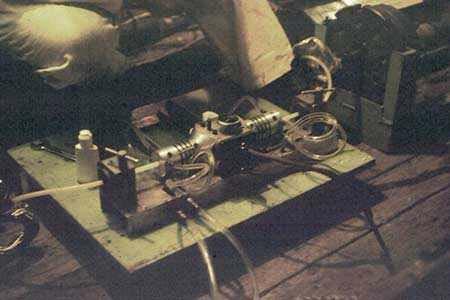
STC 0.310" moulding machine on the deck of CS John W Mackay
Repeater opened up for adjustment/ calibration inside the clean room of CS Alert.
(1.47”) inch cable design in 1968; after that the practice was abandoned.
CANTAT-1 marked the end of the flexible housing design and from then on manufactures in France, Japan, UK and the USA all adopted the rigid housing. For the remainder of the Telephone Era (1950-1986) Repeater mechanical design changed very little. Semiconductor transistors replaced thermionic valves in the early 1970s and system transmission capacity was improve through several iterations. System capacity being designated by the number of voice channels and then the highest frequency transmitted. The 80 circuits of CANTAT-1 soon became 160 circuits (1.2MHz), this was followed by system designs of 5MHz, 12MHz, 14MHz, 36MHz and finally 45MHz. The highest capacity submarine telephone system ever built was PENCAN 3, which installed in 1977. It was designed to support 71 supergroups or 5,680 x 3kHz voice channels.
The telephone cable Repeater contained the following elements. The electronics was contained in a rigid, cylindrical, housing with water tight bulkheads at each end. It was capable of withstanding water depths of 8000m. At each end it had an anchorage system capable of terminating a range of cable types. This anchorage system would include rubber buffers that tapered to easy the passage cable types. Rubber buffers provided bend limitation at the end of the housing and a taper to ease the passage of the Repeater through the LCE; for at least one manufacture the buffers supported sacrificial, zinc, anodes, provided to protect the steel casing against corrosion. The cable passed through the bulkhead through a gland that prevented water penetration of the
Repeater in the event of cable damage close to it. Within the Repeater, the DC power was separated from the AC transmission through power separation filters, which also contained surge protection circuitry. The transmission signals were separate into High and Low Bands using directional filters which then passed through wide band amplifiers. In early Repeaters a single amplifier was used for both bands of transmission but for the higher capacity systems there was a separate amplifier for each band. The Repeater would also contain a supervisory system; early systems allowed a unique signal to be sent form one terminal station and detected by a single Repeater, using very narrow, band pass crystal
filters, this signal was amplitude modulated with an oscillator in the Repeater and thus returned to the same terminal station in the other band. Later systems had unique crystal oscillators in each Repeater that transmitted frequencies below the Low Band transmission spectrum and above the High Band spectrum. To illustrate this, if we use the STC 14MHz system design, which was far and away the most popular (by sales volume) submarine telephone system, the frequency spectrum was as follows: Low Band Supervisory (200300KHz); Low Band (310KHz-6.0MHz); High Band (8.0-13.7MHz); High Band Supervisory (13.7-14.0MHz).
Diagram of a submarine cable repeater, United State Patent illustration
As we moved into the Optical Era, transmission technology, once again became unidirectional, but this time it was single fibres within the same cable. The first generation of optical Repeaters were based on regenerative technology i.e. receiving a light pulse and then transmitting a new light pulse over the next span. This required the development of new components such as lasers, photo-diodes and integrated circuits, with sufficient reliability to survive 25 years on the sea bed. Apart from the components, Repeater designers faced five new challenges; first the anchorages had to be re-designed to accommodate the changes in design of the cable; secondly, the Repeater bulkheads had to accommodate separate, water tight electrical and fibre paths; thirdly, there was no need for power separation filters but, due to the integrated circuits, surge protection became of primary importance; fourthly, as the attenuation of fibre is adversely affected by hydrogen ingress, care had to be taken in the choice of metals and coatings used, in order to minimise local generation of hydrogen; final the power consumption and heat generation within the housing increased significantly from the previous amplifier Repeaters and so heat dissipation was another major concern.
The capacity of optically regenerated systems developed over a decade and was characterised by the line rate. Initial system designs operated at a wavelength of 1,310nm and a line rate of 280Mbit/s and then increased to 420Mbit/s. The total system capacity being the line rate times the number of fibre pairs in the cable. BY 1990, systems were operating at 1,550nm and a line rate of 560Mbit/s
The latest iteration in optical Repeater design
occurred in 1995 when the first optically amplified systems, operating on a single wavelength at a line rate of 5Gbit/s, were deployed. The use of EDFAs as optical amplifiers in Repeaters opened the door for WDM and DWM transmission and increased line rates without any changes being required to the design of the Repeaters. It is roughly at this time that the capacity of submarine ceased to be calculated in terms of a number of 64Kbit/s voice channels and just became a total data capacity. The first generation systems used 1,410nm pump lasers, and then 980nm pumps were introduced for higher power and greater reliability. Initially four pump lasers per amplifier were used, but as confidence in laser reliability increased this was reduced to two pumps per amplifier. The submarine section of the modern optically amplified
system is now close to transparent, allowing system capacities of many terabits capacity being defined by the equipment on the ends and being the product of the following:
Number of Wavelengths X Line Rate X Fibre Pairs
In many ways things have come full circle, because to achieve these capacities, system design engineers must concern themselves with signal to noise ration and wideband equalisation, just as their predecessors did before, during the Telephone Era.
Conferences
Submarine Cable Forum
5-6 November 2012
Miami, USA
Website
OilComm 7-8 November 2012
Houston, USA
Website
PTC'13
20-23 January 2013
Honolulu, USA
Website
SubOptic 2013
22-25 April 2013
Paris, France
Website
January:
March:
May: Subsea
July: Regional Systems
September: Offshore Energy
November: System Upgrades
Advertising enquiries:
SALES MANAGER
Kristian Nielsen
Tel: +1 (703) 444-0845
Email: knielsen@subtelforum.com
by Kevin G. Summers
Idon't review many works of fiction here in the pages of SubTel Forum, but I read something recently that I think at least some of our readers might find interesting.
The Underwater Welder is a graphic novel written and illustrated by Jeff Lemiere. Best known for his work on Sweet Tooth and Essex County, Lemiere is an intimate storyteller whose quirky drawings have garnered him an international audience. He's a native of Canada, and it is there, off the coast of Nova Scotia, that The Underwater Welder is set.
Jack Joseph is an expecting father who has struggled his entire life with lingering regret about his own father. Jack is an underwater welder on an oil rig. He dives into the ocean one day and sees something that changes his life.
The Underwater Welder is reminiscent of an episode of The Twilight Zone. Damon Lindelof of LOST even called it, "The most spectacular episode of The Twilight Zone that was never produced."
I know that it might be a stretch to recommend a gaphic novel here, but I think there are at least a few of you out there that will really enjoy the time spent with this book. I know I did.