U.S. Regulatory Update: FCC Proposes Extraordinary Increases in Annual Regulatory Fees Paid by International Undersea Cable Operators Is It Time to Consider Landing in Canada? Proposed Changes to the FCC’s Universal Service Contribution Rules Threaten Undersea Cable Operators
ISSN No. 1948-3031
PUBLISHER: Wayne Nielsen
MANAGING EDITOR: Kevin G. Summers
CONTRIBUTING WRITERS: Stewart Ash, Kent
Bressie, Jas Dhooper, Jose Duarte, Zhang Kai, Katsuyoshi Kawaguchi, Brian Lavallée, Andrea Rodriguez
Submarine Telecoms Forum magazine is published bimonthly by Submarine Telecoms Forum, Inc., and is an independent commercial publication, serving as a freely accessible forum for professionals in industries connected with submarine optical fiber technologies and techniques. Submarine Telecoms Forum may not be reproduced or transmitted in any form, in whole or in part, without the permission of the publishers.
Liability: while every care is taken in preparation of this publication, the publishers cannot be held responsible for the accuracy of the information herein, or any errors which may occur in advertising or editorial content, or any consequence arising from any errors or omissions, and the editor reserves the right to edit any advertising or editorial material submitted for publication.
Contributions are welcomed. Please forward to the Managing Editor at editor@subtelforum.com.
Submarine Telecoms Forum, Inc. 21495 Ridgetop Circle, Suite 201 Sterling, Virginia 20166, USA subtelforum.com
The first day of my annual viewing of le Tour de France was marred by a freak storm that rolled through Washington, DC and a chunk of the east coast the night before.
The rare storm ravaged the Washington area, leaving more than 3.7 million people without power and killing at least 25 people. Known as a “Derecho,” the string of storms combined intense lightning and rain with hurricane-force gusts as it swept from the Midwest into the mid-Atlantic, blamed on the prolonged 100-plus temperatures that blanketed the eastern US the week before. Then traveling at an average speed of 60 miles per hour, it took just 12 hours to cover more than 700 miles before reaching the Atlantic Ocean. An ensuing State of Emergency was declared in Virginia, Washington, DC and Maryland, while power company representatives described the power outage as the worst they had ever seen.
Instead of shutting their doors and calling it a day, the Office of Personnel Management announced that federal agencies would be given the option to allow unscheduled telework. Plans were already in place to encourage telework not just from home, but from other agencies as well so agencies could mitigate the impact of disasters. Telework became a major issue after the blizzards of 2010, as five days of closures resulted in nearly $71 million in losses per day, which led to the creation of the unscheduled telework option. The system was tested after the high-powered Derecho hit the Eastern Seaboard on June 29th, and many businesses and services
were not yet operational until days later, as were many services hosted on Amazon servers in the area, raising questions about the sustainability of the Cloud.
As a good Scouter I had learned from past storms and was well prepared; our power went back on Sunday afternoon, 36 hours after the event, but I had my generator working for the duration, which we needed for well water, sewer, fridges, etc. I had talked with an industry friend the next mid-week some five days after the storm and his home was still out of power; yet he lived only a few miles away from me.
There seems to be a new Derecho brewing, but this one man-made. A recent FCC ruling plans to levy some 16% surcharge for cables coming into the US. So I suspect that the cables that were being planned are at a minimum now under significant business review and probably delayed and at a maximum, some are potentially now dead.
The first day of my annual viewing of le Tour de France was marred by this freak storm. We’ll have to wait and see how the intensity of the next storm impacts.
Vive le Tour!
In This Issue...
News Now
ALBA-1: Fiber-optic cable benefiting only Cuban government
Alcatel-Lucent wins contract to lay Tonga fibre-optic submarine cable
APTelecom Appointed as Pre-Sales Manager for Pacific Fibre
Arctic Fibre Undertakes Capacity Nomination Process
Bharti Airtel Considering Taking Part in Cable System Joining BRICS Nations
BRICS Cable Unveiled for Direct and Cohesive Communcations Services between Brazil, Russia, India, China and South Africa
Ciena to Demonstrate Advanced 100G Networking Capabilities at TERENA Networking Conference
Ciena Unveils Next Generation Intelligent Control Plane Software
Ciena’s Intelligent Mesh Selected for LION2 Submarine Project in Africa
Columbus Networks and Xtera Communications First to Unveil 100G in Pan-American Caribbean Region
CTC Marine Projects Appoints New Managing Director
CTC Marine Projects Invests in Integrated Trenching Spread Solution
CTC Marine Projects, Trico Offshore and DeepOcean become one
Dhiraagu tests submarine cable after repairs
Digicel Buys Rival Telecom In Haiti
Emerald Networks Appoints Dr. Gisli Hjalmtysson to Board of Directors
Emerald Networks Appoints Dr. William C. Marra as Executive Chairman and Chief Executive Officer
Erikas Napjus Elected To Seaborn Networks Board of Directors
Facebook signs on for Malaysia cable
FibreCo Telecommunications Deploys Corning Optical Fiber for its Next-Generation Network in South Africa
GBI Crosses the Mediterranean with the First 100G Repeatered Submarine Link from Xtera
GlobeNet and Alcatel-Lucent extend undersea cable link to Colombia to address fast-growing demand for broadband services
GlobeNet undersea cable route to link Colombia and Miami
Hibernia Atlantic i3 Africa calls for BRICS submarine cable cash
Improved international connectivity from WIOCC reduces bandwidth prices in Lesotho by 67%
Japan-U.S. Cable Selects Ciena for Trans-Pacific 100G Submarine Network
Main One Cable Company Upgrades Network Infrastructure Together With TE SubCom And Business Unusual Limited
MENA Submarine Cable System Works Under Way
MTN - Why Telecoms Operators Are Focusing On Data Solutions
NCC approves second submarine cable link between Taiwan and China
Pacific Fibre sets mid-June deadline
Pacnet and Infinera First to Demonstrate 500 Gb/s Optical SuperChannels in Asia
Pacnet Appoints Carl Grivner As Chief Executive Officer
Reliance Communications to list sub-sea cable business in Singapore
Reliance unit launches subsea cable service in Iraq
Seaborn Networks Closes Second Funding Round
Seacom set for upgrade
Seychelles set for its first underwater fiber-optic cable link
Sidera Networks to Acquire Capacity on Seaborn Networks’ USBrazil Cable
SubOptic 2013 Call for Papers now issued
SubOptic 2013 Sponsorship, Exhibition Booths and Hospitality Rooms Now Available
TE Subcom Completes Construction Of The TGN-EA (Jeddah) And TGN-Gulf Undersea Cable Systems For Tata Communications
TEAMS Submarine cable hitch disrupts internet services in East Africa
WACS switch-on date confirmed
WFN Strategies Announces Completion of Installation Implementation Support for AR-SAT
WFN Strategies to Accomplish End-To-End Desktop Study for Arctic Fibre
Regional Systems
In Cuba, Mystery Shrouds Fate Of Internet Cable
Andrea Rodriguez | Associated Press
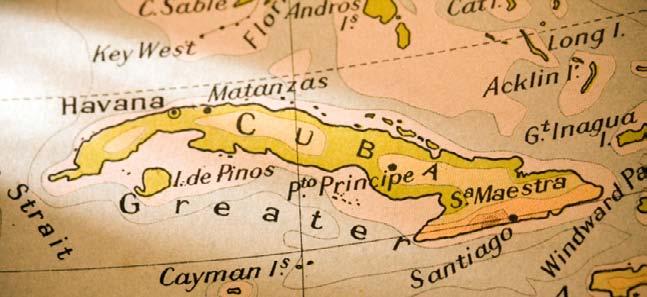
It was all sunshine, smiles and celebratory speeches as officials marked the arrival of an undersea fiber-optic cable they promised would end Cuba's Internet isolation and boost web capacity 3,000-fold. Even a retired Fidel Castro had hailed the dawn of a new cyber-age on the island.
More than a year after the February 2011 ceremony on Siboney Beach in eastern Cuba, and 10 months after the system was supposed to have gone online, the government never mentions the cable anymore, and Internet here remains the slowest in the hemisphere. People talk quietly about embezzlement torpedoing the project and the arrest of more than a half-dozen senior telecom officials.
Perhaps most maddening, nobody has explained what happened to the much-ballyhooed $70 million project.
"They did some photo-op ... and then that scandal came out, and then it just disappeared from human consciousness," said Larry Press, a professor of information systems at California State University, Dominguez Hills, who studies Cuba, referring to foreign media reports and whispers by diplomats that several executives at state phone company Etecsa and the two senior officials in the Telecommunications Ministry were arrested last year.
The cable was strung from Venezuela with the help of key ally Hugo Chavez. Government officials said from the start that the bandwidth boon would be prioritized for hospitals, universities and other usage deemed in service of the common good; the legions of Cubans with little or no access to the Internet from their homes would have to wait.
But a dozen employees of public institutions interviewed by The Associated Press said they have seen no noticeable improvement in their work connections. If anything, they say, download speeds have even gotten a little slower.
Going online in Cuba will try the patience of anyone who's ever had a taste of high-speed DSL connections.
The problem is that connection speeds here are still Web 1.0, while the world has moved on to fancier, bandwidth-hogging platforms like Flash. YouTube is irrelevant on Cuban dial-up, and barely useable on the rare broadband connections. Want to watch the latest episode of "Mad Men?" At 3-5 kilobytes-per-second dial-up transfer speeds, a 500-megabyte video file would theoretically take somewhere between 28 and 46 hours to download from iTunes.
Artists and photographers say it's nearly impossible to view others' work online. People swap digital pictures in person on memory sticks rather than simply sending them as email at-
tachments. Students have difficulty accessing research databases.
One doctor in Havana said she only has access to Cuba's domestic intranet, a bare-bones internal network of island-hosted sites that also lets users get email. Moreover, her institution recently began cracking down on the few who do have full Internet access, ordering them not to use sites like Facebook under threat of punishment.
"I had high hopes, great expectations for the cable. ... For me, doing a postgraduate degree, (the intranet) is no good. It's too basic and poor for our needs," she said. "They haven't given us any explanation."
She and the others spoke on condition of anonymity for fear of getting into trouble with their state employers.
Multiple attempts to get Cuban and Venezuelan government officials to comment were unsuccessful.
The Venezuela branch of Paris-based Alcatel-Lucent, which was contracted to lay the cable, referred questions to the Cuban-Venezuelan joint venture Telecomunicaciones Gran Caribe, where an official said he would need approval from Venezuela's science and technology ministry to talk about the project. The ministry did not respond to requests to interview officials.
Diplomats in Havana privately tell consistent stories of reported corner-cutting on the project that let corrupt officials skim millions of dollars from its budget.
A senior French official told AP that Alcatel had upheld its part of the contract and whatever problems exist must be on land with the network it was meant to be attached to.
"The cable must be connected to something or it won't work," said the official, who also spoke on condition of anonymity because he was not authorized to discuss the politically sensitive project.
The lack of transparency is not unusual for Cuba, where all media is state-run and tightly controlled. But it flies in the face of Fidel Castro's own enthusiastic words about the cable and the transformational power of the Internet.
"Secrets are over. ... We are facing the most powerful weapon that has ever existed, which is communication," Castro told Mexican daily La Jornada in an August 2010 interview in which he hailed the coming cable.
While some hold out hope that faster Internet has merely been delayed, others interpret the government's long silence as a sign Cuba's broadband dreams will be the latest grand pronouncement to end in disappointment.
"I have no expectations for the cable," said Marlene Blanco, a 25-year-old independent worker. "Nothing is going to change for ordinary Cubans. So why talk about it?"
According to government statistics, 16 percent of islanders were online in some capacity in 2011, mostly through work or school, and often just to the intranet. The National Statistics Office said last year that just 2.9 percent reported having direct Internet access, though outside experts estimate the real figure is likely 5 to 10 percent accounting for black market sales of dial-up minutes. For a variety of reasons including the 50-year-old U.S. economic embargo, Cuba is the last country in the Western Hemisphere to get a fiber-optic connection to the outside world, and has relied instead on costly and slow satellite linkups.
Some speculate that the Internet-fueled Arab Spring revolts, which began months before the cable's arrival in Cuba, could have altered the government's plan or at least made officials rethink the wisdom of making it widely available.
"They're afraid of it. They don't want a 'Cuban Spring,' so to speak," Press said.
President Raul Castro's administration has warned of a supposed plot by enemies in the United States to wage a "cyberwar" to destabilize the Communist-run government. In 2011, a Cuban court sentenced U.S. subcontractor Alan Gross to 15 years after convicting him of crimes against the state for importing restricted communications equipment that he insists was only meant to help the island's Jewish community gain better Internet access.
The official silence over the fiber-optic cable has given rise to other rumors: that the cable is operational but being used selectively. A pro-government blogger known as Yohandry Fontana wrote at the end of 2011 that people who attended a closed forum on social networks reported it was working fine.
"Here's a brief summary: 1. The cable has no problem, it is working. 2. Public Internet spaces will open on the island. 3. Costs for public connection will go down. Note: I am seeking more information," Fontana said.
Cuban-born economist Arturo Lopez-Levy said Havana has badly bungled the whole affair, and if it's true that corruption killed the cable, officials should "make heads roll over the scandal" and give an open accounting of what went wrong.
"The Cuban government failure to achieve this goal is one of the worst-managed situations," said Lopez-Levy, a lecturer at the University of Denver, "aggravated by an even worse public relations fiasco to address it."
Associated Press writers Peter Orsi, Paul Haven and Anne-Marie Garcia in Havana contributed to this report. Andrea Rodriguez on Twitter: www.twitter. com/ARodriguezAP
The Undersea Cable Report 2013
From Terabit Consulting Publication Date: September, 2012
The most diligent quantitative and qualitative analysis of the undersea cable market - 1,600 pages of data, intelligence, and forecasts that can be found nowhere else.
Terabit Consulting analysts led by Director of International Research Michael Ruddy tell you what’s real and what’s not, where we’ve been and where we’re headed.
The Undersea Cable Report capitalizes on Terabit Consulting’s global on-site experience working with carriers, cable operators, financiers, and governments in over 70 countries on dozens of leading projects (e.g. AJC, BRICS, EASSy, Hibernia, SEAS, TBI)a world of experience, at your fingertips in a single resource!
Intelligent intelligencego beyond the numbers!
YOUR KEY TO UNDERSTANDING AND HARNESSING
THE $20 BILLION UNDERSEA MARKET OPPORTUNITY
The Undersea Cable Report 2013 is your single source of information for top-level decisionmaking - with the most detailed profiles, data, market analysis, and forecasts available.
• 680+ detailed undersea cable profiles
• Capacity demand, capacity supply, and capacity pricing
• Ownership, system supply, financing, and project costs
• The upgrade market
• Global, region-by-region, and route-by-route analysis
• Reliable, detailed forecasts
• accurate, reliable data
• valuable intelligence
• innovative modeling
• thoughtful insight
• global perspective
• respected expertise
Limited time re-introductory offer to celebrate the return of the Undersea Cable Report! Reserve your copy today. SAVE 50% UNTIL SEPTEMBER 7, 2012
Single-user license $10,995 limited-time re-introductory offer $5,500 Multi-user site license $24,990 limited-time re-introductory offer $12,495 Global organizational intranet licenses also available
U.S. Regulatory Update:
FCC Proposes Extraordinary Increases in Annual Regulatory Fees Paid by International Undersea Cable Operators
On July 17, 2012, the U.S. Federal Communications Commission (“FCC”) issued a notice of proposed rulemaking (“NPRM”) in MD Docket Nos. 12-201 and 08-65 including a proposal that would increase by more than 230 percent the annual regulatory fees paid by providers regulated by the FCC International Bureau, including operators of FCClicensed international submarine cable systems. The FCC’s proposals are very technical in nature, but potential adverse outcomes are not difficult to understand. Nevertheless, the FCC’s proposals remain just that—proposals—and undersea cable operators have significant opportunities to influence the outcome of the proceeding, as they have done in past regulatory-fee proceedings.
In Section 9 of the Communications Act of 1934, as amended, the U.S. Congress established annual regulatory fees to be collected by the FCC in order to distribute and recover the costs of the FCC’s enforcement activities, policy and rulemaking activities, user information services, and international activities, and to offset congressional funding of the FCC’s operations. Section 9 requires that regulatory fees be derived by determining
the number of full-time equivalent employees (“FTEs”) performing certain activities, taking into account factors that are reasonably related to the benefits provided to the payor of the fee by the FCC’s activities.
As currently implemented, the FCC treats employees in its four core bureaus (International, Media, Wireless Telecommunications, and Wireline Competition) differently depending on whether an employee is “directly” involved in a feeable activity or “indirectly” involved in a supporting capacity. In the NPRM, the FCC proposes to eliminate the distinction between directly and indirectly-involved FTEs:
Nevertheless, it is clear that the work of all the FTEs in a core bureau, whether direct or indirect, contributes to the cost of regulating licensees of that bureau. Therefore, we may reasonably expect that the work of the FTEs in the core bureaus would remain focused on the industry segment regulated by each of those bureaus. We seek comment on whether we
should change the way FTEs are allocated within a bureau, and we propose that all the FTEs in each of the core bureaus should be considered direct FTE costs for that bureau.
This concept, if adopted without modification, would increase the total share of annual regulatory fees borne by payors licensed by the International Bureau (including international submarine cable operators—the proposal would have a similar impact on operators of terrestrial and satellite international bearer circuits, earth stations, and geostationary and non-
geostationary satellites) from 6.7 percent to 22.0 percent. Using the Fiscal Year 2012 fee schedule adopted by the FCC in MD Docket No. 12-116 on July 19, 2012, adjusted upward for the NPRM’s proposed new fee allocation, the fees for FCC-licensed international submarine cables would work as shown in Table 1 below:
Division (“SAND”)—which undertakes a variety of intergovernmental negotiations and research activities that benefit the FCC bureaus and FCC-regulated entities as a whole—would be allocated to payors licensed by the International Bureau.
FTEs the percentage of total regulatory fees allocated to the International Bureau would fall to 10.97 percent, resulting in a regulatory fee of $351.275 per >20Gbps Submarine Cable System (assuming the fees were assessed in FY 2012)—still an increase of 65 percent of FY 2012 fees just established in MD Docket No. 12-116.
The FCC has also sought comment on whether to alter the intra-bureau allocations among services.
Line 1 FY 2012 Budget
Line 2 Allocation to International Bureau
Line 3 Allocation to Submarine Cable Systems (36.1% of Line 2)
Line 4 Number
Line 5
Regulatory fee for >20Gbps Submarine Cable System assessed at rate of 1 payment unit (Line 3/Line 4)**
* Figures in this column reflect rounding in the FCC’s FY 2012 fee schedule.
** Smaller-capacity Submarine Cable Systems pay fees based on a fraction of the payment unit.
The extraordinary 232-percent increases that would result from the adoption of the NPRM’s proposals (shown in Line 5) would result principally from the fact that the FTEs of the International Bureau’s Strategic Analysis and Negotiations
$339,844,000
$22,769,548 (6.7% of Line 1)
$8,150,949
$339,844,000
$74,765,680 (22.0% of Line 1)
$26,990,410
$211,750 $704,471
Consequently, the FCC has also sought comment on whether or not to treat SAND as it treats other FCC support bureaus, with the related FTEs allocated across all categories of fee payors, not just those regulated by the International Bureau. The NPRM notes that “the International Bureau has estimated that as much as one half of the FTEs in the Bureau work on matters covering services other than international services.” Were the FCC to exclude SAND
We seek comment on whether it would better serve the public interest for management in each of the core bureaus to revise their internal FTE allocation percentages based on management’s assessment of the current distribution of work within the bureau. We also seek comment on whether they should do such analysis and update of the FTE allocation among fee categories within the bureau every three years unless a substantial shift in the nature or extent of a bureau’s duties warrants reexamination in the interim.
Undersea cable operators will likely find the FCC’s latest regulatory-fee proposals deeply frustrating. Following a sustained effort (and deployment of significant advocacy resources) from 2003 to 2009
Table 1:
by a number of undersea cable operators, the FCC finally revised its regulatoryfee methodology for undersea cables, eliminating the deeply problematic and distorting capacity-based International Bearer Circuit fees for international undersea cable operators and replacing them with per-system flat fees. While the FCC’s latest proposals would retain the flat-fee methodology, they threaten to reintroduce unpredictability and more significant regulatory costs, making it more difficult for operators to recover such costs.
Comments on the NPRM will be due within 30 days of the NPRM’s publication in the Federal Register, which had not yet occurred as of the date of publication, with reply comments due within 60 days of publication.
Please note that these proposals are separate from those in the FCC’s Universal Service Fund Contribution proceeding, WC Docket No. 06-122 and GN Docket No. 0951, wherein the FCC proposes to eliminate the “international-only” exemption and eliminate or modify the limited interstate revenues exemption See [cross-reference other SubTel Forum article].
Kent Bressie is a partner with the law firm of Wiltshire & Grannis LLP in Washington, D.C., and heads its international practice. An expert on telecommunications regulation and international trade and investment, he has extensive experience with the range of legal and regulatory issues affecting undersea cables, including licensing and permitting; national security, export controls, and economic
sanctions; transaction and investment reviews; market access; corporate and commercial transactions; and the law of the sea. He has represented undersea cable operators, suppliers, and investors in connection with projects on six continents.
25,000 DOWNLOADS AND COUNTING
The Submarine Telecoms Industry Report, authored by the submarine industry’s leading market analysis firm, Terabit Consulting, with research overseen by Terabit’s director of international research, Michael Ruddy serves as the final chapter in a trilogy of products beginning with the Submarine Cable Map and including the Submarine Cable Almanac.
The Submarine Telecoms Industry Report features in-depth analysis and prognoses of the submarine cable industry, and serves as an invaluable resource for all who are seeking to understand the health of the submarine industry. It examines both the worldwide and regional submarine cable markets, including issues such as the new-system and upgrade supply environments, ownership, technologies and geopolitical/economic events that may impact in the future.
Is It Time to Consider Landing in Canada?
Proposed Changes to the FCC’s Universal Service Contribution Rules Threaten Undersea Cable Operators
Kent Bressie
The U.S. Federal Communications Commission (“FCC”) recently released a Further Notice of Proposed Rulemaking seeking comment on various proposals to reform contribution requirements for the federal Universal Service Fund (“USF”).1 The FNPRM’s proposals, if adopted, would alter significantly the USF contribution obligations for operators whose undersea cables connect the United States or its territories (including American Samoa, Guam, Puerto Rico, and the U.S. Virgin Islands) to non-U.S. points.
The FCC proposes to eliminate the “international-only” exemption (which exempts providers from contributing if they provide telecommunications only between the United States and foreign points) and to eliminate or substantially modify the limited international revenues exemption (“LIRE,” which exempts providers of telecommunications from contributing on their international end-user revenues if their projected domestic interstate end-user revenues and those of their affiliates total in aggregate less than 12 percent of total domestic interstate plus international enduser revenues). If the FCC eliminated these exemptions, international undersea cable operators would be required to pay shockingly high contributions to the USF—15.7 percent of total end-user revenues for services originating and/or terminating in the United States, according to the current proposed contribution factor (though the rate fluctuates quarterly). Use of an offshore subsidiary to sell capacity would not protect an undersea cable operator from these requirements if the services originated or terminated in the
United States. Consequently, operators that previously paid little or nothing would face potentially large assessments, with limited prospect of recovering such charges from customers, particularly under existing IRU agreements and capacity leases.
The USF and International Services
The USF seeks to promote the availability of quality services “at just, reasonable, and affordable rates” for all U.S. consumers and increase nationwide access to advanced telecommunications services. The USF subsidizes services through a variety of programs targeted at high-cost areas, lowincome consumers, schools and libraries, and rural health care systems.2
Section 254(d) of the Communications Act of 1934, as amended (“Section 254(d)”), requires that “every telecommunications carrier that provides interstate telecommunications services shall contribute, on an equitable and nondiscriminatory basis, to the specific, predictable, and sufficient mechanisms established by the Commission to preserve and advance universal service.”3 The FCC expanded these provisions to include other providers of interstate telecommunications, even if they were not “telecommunications carriers,” i.e., common carriers.4 All interstate common carriers, as well as those interstate providers whose contributions are projected to exceed the FCC’s de minimis threshold, are required to report their revenues annually to the FCC on FCC Form 499-A and to report revenues and pay USF contributions quarterly
2.
3.
4.
according to a fluctuating contribution factor (which has risen as high as 17.9 percent).5 Over the past fifteen years, the FCC has undertaken numerous efforts to reform both how the USF is funded and how and for what purposes it should distribute its funds.
“International-Only” Exemption. At present, providers of exclusively international services (i.e., those between the United States and foreign points) are categorically exempt from contributing to the USF.6 Foreign-to-foreign revenues have never been assessable.7 The FCC had previously concluded that providers of exclusively international services did not qualify as “interstate carriers” or other interstate providers within the meaning of Section 254(d).8 Consequently, operators of
5.
6.
7.
non-common-carrier undersea cables systems with exclusively international end-user revenues neither file FCC Form 499-A nor report revenues or pay USF contributions quarterly. Operators of common-carrier undersea cables systems with exclusively international end-user revenues file FCC Form 499-A but do not report revenues or pay USF contributions quarterly (as the FCC requires all common carriers to register with the Universal Service Administrative Company by filing FCC Form 499-A).
Limited International Revenues Exemption
(LIRE). At present, providers of predominantly international services between the United States and foreign points are exempt, under the LIRE, from contributing to the USF on their international end-user revenues if their projected domestic interstate end-user revenues and those of their affiliates total in aggregate less than 12 percent of total domestic interstate plus international enduser revenues.9 The FCC developed the LIRE after the U.S. Court of Appeals for the Fifth Circuit’s 1999 decision in Texas Office of Public Utility Counsel v. FCC. 10 The court found that the FCC’s earlier rule, which included all interstate plus international end-user
revenues within the assessable base, failed to satisfy the “equitable and non-discriminatory” requirements of Section 254(d).11 The court seemed particularly persuaded by the fact that the USF contribution could exceed a provider’s total domestic interstate end-user revenues, making it uneconomic to offer domestic interstate services to end users.12
The FCC subsequently set the threshold for the LIRE at 8 (and later 12) percent to match the contribution factor at the time, though the LIRE threshold has remained static while the contribution factor has since increased.13
Proposed Changes in the Scope of Contributors
In considering changes to the scope of who should contribute and how contributions should be assessed, the FCC has now proposed in its FNPRM to eliminate the “internationalonly” exemption and to eliminate or substantially modify the LIRE exemption.14 The FCC seems particularly troubled by what it sees as the competitive distortions caused by prepaid calling card providers offering exclusively or predominantly
11. Id. at
12.
international services (thereby qualifying for the “international-only” exemption or the LIRE) in competition with interstate providers whose international end-user revenues are not exempt and therefore subject to USF assessments.15 The FCC is also enamored with the concept of increasing contributions through assessments on as-yet unassessed prepaid calling card international revenues.16
To justify its proposals, the FCC offers an alternative interpretation of Section 254(d)— that the statute only intended to distinguish federal from state jurisdiction—and notes that the Fifth Circuit in TOPUC v. FCC did not address the FCC’s jurisdiction over internationalservice revenues.17 The FCC also suggests that changes in the telecommunications industry and marketplace render the “internationalonly” exemption and the LIRE obsolete.
Nowhere does the FCC make any mention of international undersea cables or their operators, though the changes would severely distort the market for international undersea cable capacity serving the United States. In fact, the proposals reflect a complete lack of understanding of the operation of and sales
15. Id., ¶¶ 197, 198.
16. Id.
17. Id., ¶ 200.
of capacity on undersea cables. The proposals suffer from numerous legal defects and likely violate U.S. commitments under the World Trade Organization General Agreement on Trade in Services.
Parallels with IBC Fees. The FCC has also failed to understand the parallels between its proposals and the now-discredited and discarded methodology it used for assessing capacity-based annual regulatory fees (the “International Bearer Circuit” or “IBC” Fees) on undersea cable operators until the industry finally prevailed on the FCC to change its rules and methodology starting in 2009. In
that multi-year reform proceeding, the FCC conceded that capacity-based fees created severe economic harms, strategic behavior, and infighting between undersea cable operators and their customers.18 Operators pointed also out to the FCC that they had a limited ability to recover their costs or pass through charges, as most undersea cable capacity is contracted on a long-term basis (without provisions for a pass-through) and much of it is sold to customers located outside the United States, who take the position that such “domestic” assessments cannot be passed through to them or should be treated as overhead.
Other Issues
Scope of Contributors and Services. The lengthy FNPRM addresses a host of proposals to change the scope of USF contributors and assessable services. With respect to specific services, the FCC asks whether it should require the USF contributions from providers of: enterprise communications services that include a provision of telecommunications; text messaging services; one-way VoIP service; and broadband Internet access service.19 Alternatively, the FCC asks whether it should adopt a broader definitional approach to services subject to contribution obligations.20 Specifically, the FCC proposes to treat as assessable “any interstate information service or interstate telecommunications . . . if the provider also provides the transmission (wired or wireless), directly or indirectly through an affiliate, to end users.”21
Contribution Methodology. The FCC also asks about how contributions to the USF should be calculated, whether based on revenues, connections, telephone numbers, or a hybrid system.22 It is not at all clear how a connectionsbased approach would apply to international undersea cable operators, where the originating or terminating “connection” takes place outside the United States. Presumably under a telephone numbers-based approach, international undersea cable operators would, as a practical matter, be excluded.
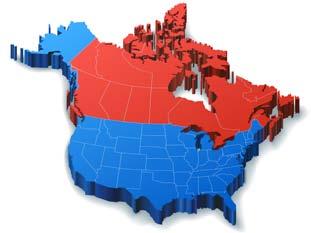
Time to Land and Store Internet Content in Canada?
The United States has long taken for granted that undersea cables will continue to land in the United States, providing abundant connectivity for U.S. consumers, businesses, and government agencies while permitting the rest of the world to continue to access a large percentage of Internet content located in the United States. If the Commission eliminated the “international-only” exemption and the LIRE, however, it would increase considerably the cost of U.S. undersea cable connectivity. These costs could render uneconomic certain service offerings, depress investment in new systems, and lead undersea cable operators to consider landing elsewhere. It would also give Internet content providers additional incentive to produce and store content outside the United States.
Consider the case of Canada. Historically, Canada has appealed less than the United States as a landing country due to a variety of factors, including: comparatively small Canadian demand for capacity; comparatively small Internet content residing in Canada; and foreign ownership restrictions that barred ownership of telecommunications facilities (including backhaul facilities) beyond the cable station. That calculus is starting to change, however, and could change radically if the FCC were to subject revenues from sales of international undersea cable capacity to USF assessments.
global network operators may now own domestic facilities in Canada.23 Moreover, the financial burden of Canadian universal service programs pales in comparison to that of the United States. While Canada does assess “contribution” on sales of international undersea cable capacity, the contribution rate is 0.66 percent of such revenues—one twenty-fourth of the FCC’s current proposed assessment rate.24
What Can Undersea Cable Operators Do?
Undersea cable operators still have the opportunity to weigh in on—and help shape or thwart—the FCC’s proposals. While initial comments were due by July 9, 2012, reply comments are due by August 6, 2012. Moreover, while the proceeding remains pending, undersea cable operators have the opportunity to make ex parte presentations to the FCC staff and commissioners.
Kent Bressie is a partner with the law firm of Wiltshire & Grannis LLP in Washington, D.C., and heads its international practice. An expert on telecommunications regulation and international trade and investment, he has extensive experience with the range of legal and regulatory issues affecting undersea cables, including licensing and permitting; national security, export controls, and economic sanctions; transaction and investment reviews; market access; corporate and commercial transactions; and the law of the sea. He has represented undersea cable operators, suppliers, and investors in connection with projects on six continents.
Canada is in the final stages of repealing most of its foreign ownership restrictions on telecommunications facilities, meaning that foreign undersea cable operators and
23. See Amendments to the Income Tax Act, a Related Act and the Income Tax Regulations, Bill C-38, §§ 595 et seq., www.parl.gc.ca/HousePublications/Publication.aspx?Lang uage=E&Mode=1&DocId=5524772.
24. See Canadian Radio-television and Telecommunications Commission, Decision 2000-745, Changes to the Contribution Regime (Nov. 30, 2000), www.crtc.gc.ca/eng/ archive/2000/dt2000-745.htm
BDM: Linking the Malacca Strait
jas Dhooper and Zhang Kai
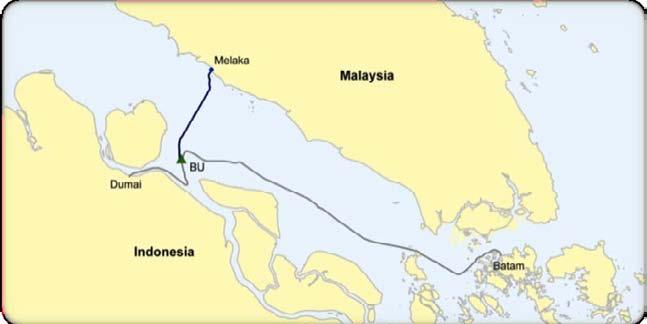
The ‘Batam-Dumai-Melaka cable system project’ (BDM) consisted of network upgrade, involving new SLTE equipment and a new landing point, on the southern side of the Malacca Strait linking Batam to Dumai, deployed for Telekom Malaysia Berhad, PT Mora Telematika Indonesia and PT XL Axiata TBK. By adding a spur to the existing branching unit, it was possible to introduce a third landing point and completed during Q4 2011.
Coupled with advanced SLTE installed in all three landing points, the purchasers effectively gained access to a new submarine cable system, at significantly lower cost through this system upgrade. It’s a common practice for existing system owners and generally more cost effective to upgrade existing systems compared to the deployment of new plant. In short, the purchasers get access to the latest SLTE technology and a new landing point, providing system longevity and improved return on investment. The spur to Melaka enables further reach and the ability to tap into a growing economic region in Malaysia.
The Malacca Strait lies on the crossroads between the Indian and Pacific Oceans. Trade routes from Asia through the strait lead to Europe, Africa, the Middle East, India, Australia and the Americas. International shipping in the region continues to increase in line with the economic growth experienced in South East Asia. There are currently around 50,000 vessels per year using the Malacca Strait (i.e. on average 1 vessel every 10 minutes), with about a quarter of all oil carried by sea passing through the strait, from Persian Gulf suppliers to Asian markets such as China, Japan, and South Korea.
Unrepeatered system linking Batam to Dumai adds a new landing point in Melaka, Malaysia
About 2/3 of the world oil trade (both crude oils and refined products) is moved by tanker in this area making it an extremely busy route, and for a submarine cable system this presented some challenges during installation. In fact, about 43 million barrels per day of that trade is crude oil. Tankers have made global (intercontinental) transport of oil possible, as they are relatively low cost, efficient, and extremely flexible. Due to the high level of vessel traffic in the region, the planning and installation of this cable system required very careful planning and operational management. Crossing the Strait of Malacca, characterized by extraordinarily busy shipping lanes and strong tidal currents requires looking into some stringent burial requirements to ensure the integrity of the system. Only with the right level of marine expertise can such stringent requirements be achieved. The operational aspects of the marine installation are critical to
ensuring the 25 year life span of the system as a part of a high quality turnkey solution and to meet customer expectations of a safe, reliable and effective subsea cable.
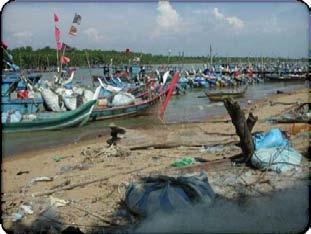
The fishing industry plays an important role in the Malaysian economy. The main contribution of fisheries to the national economy are as a source of food, generation of employment opportunities and income, as well as enabling foreign exchange, particularly for the rural population. Fish is generally acceptable to all the ethnic groups in Malaysia and plays a key role as a source of protein in the diet of many people. Nationally, it accounts for about 22 percent of the total protein intake and 50 percent of the animal protein supply. It is estimated that the fishing industry provides direct employment to approximately 79,000 fishermen, and to numerous others in the secondary and tertiary sectors, as well as in
ancillary industries. The majority, around 51,000 people employed in the fishing sector are in Peninsular Malaysia, 21,000 in Sabah and 7,000 in Sarawak. In addition, aquaculture provides employment to around 20,000 people, over 65 percent of who are engaged in freshwater farming.
Marine fisheries in the near shore waters off the coast of Malaysia is still the most important sub sector, as it contributes 80 percent of total fish production and supports 80 percent of the fisheries workforce.
Fishing boats – an industry and way of life
In 1981, Malaysia introduced a ‘Fisheries Comprehensive Licensing Policy’ (FCLP), which aims to ensure a more equitable allocation of resource, reducing conflict between traditional and commercial fishermen, preventing overfishing the inshore fishing grounds, restructuring of the ownership pattern of the fishing units in accordance with the New Economic Policy, and promoting deep-sea and distant-water fishing. With this policy in place, environment issues must be considered at the earliest opportunity
in any project; as it is well known that permits in this region can be lengthy and result in significant project delays. Thus the importance of stakeholder management, local liaison, education and general communications should never be underestimated.
The Operational challenges
The process of adding additional cable to an existing branching unit sounds relatively simple, however when considering some of the regional environmental aspects, there are operational challenges facing the project team. Firstly, the cable needed to cross the Strait of Malacca. and to avoid damage in this busy shipping lane the system was deployed with a target burial of 3m. Deep burial in such regions is critical to ensure the cable is well protected from vessel anchors and other human interactions. Second, qualification work needs to take place between the two cable type as to ensure performance remains during system life time.
A further operational challenge was associated with significant tanker movement which placed time restrictions on the cable vessel. In turn this required the marine team to plan and ensure every minute was used effectively and mitigation plans were in place to avoid setbacks and avoid any undue vessel downtime.
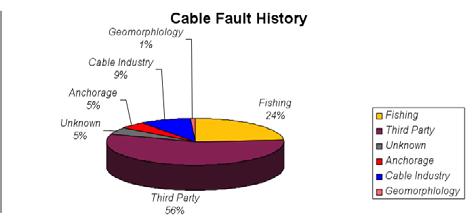
Although the provenance of reported faults is difficult to verify, the main contributor to the recorded faults for the area is indicated as being largely fishing and ‘third party’, which is generally also mainly accounted for by fishing activities. The proportion of faults in each category is shown below.
Given such busy shipping lanes, quite common to adopt not only increased cable armoring, but also stringent burial requirements. So for this turnkey solution the team utilized the skill and expertise of Global Marine to achieve a target burial of 3 meters. It is well documented that cable burial depth is always subject to seabed conditions and the survey information is a key factor in understanding this. This enables the marine installer to gain access to detailed seabed data from which many operational parameters are generated and analyzed. However, another key factor is the burial technology. For a target burial of 3m the team made use of Global Marine’s specialist ‘Injector’ tool. Injector has provided 15m burial for a power cable in the pastrepresenting what may be a world first!
Causes of cable faults in the Malacca strait area
Submarine cable systems are often at risk from potential failures due to many factors such as anchor damage, fishing and seismic activities. For the end customer, utilizing the latest marine technology and expertise for deep burial plays a critical part to the success of this project. GMSL brings a wealth of skill and experience in marine installation and burial which played a critical factor in this turnkey delivery.
The BDM Journey
Under the ‘turnkey’ umbrella and with the support of to Malaysia TM, Indonesia XL, MTI and Huawei Technologies, the objective was simple; to provide everything from system design, principle/operational permits, cable and equipment supply, marine, land cable, SLTE installation and of course NMS integration. Together with Nexan URC-1 cable used on the spur the system was enabled with up to 2.56Tbit/s in capacity. This is based upon current technology. As we have all witnessed within the submarine cable industry a common theme is continuous improvements in technology, as such it’s pretty certain this could be upgraded and improved in the near future.
Simplified supply chain for turn-key delivery model
Survey operations
The proposed route runs from the branching unit in the approach Channel to Dumai, across the Malacca Strait to a landfall at Melaka. The seabed as indicated by the survey consisted of some deep scour channels (over 30m WD in places) between shallow banks, whilst the northern side topography is generally less severe except around shoals caused by rock outcrops. One other aspect relates to Sand Waves. Such factors all need careful management and understanding the complexities also means fewer complications downstream.
These typically occur in shallow water where currents are strong. The sandwave fields generally comprise loose to dense, slightly gravelly sand. They exhibit bed forms that range in height from 1m to 11m and have wavelengths from approximately 100m to 400m. The variable shape in sand wave crests, from straight to sinuous, indicates a complex current flow. In such areas, the use of side scan/ multi beam sonar during the survey stage provides useful data and images of sandwaves.
These factors are important to understand as they can cause plough instability, in such areas where ploughing is considered through such topography. Normally, where possible sand waves should really be avoided. Of course, in cases where they cannot be avoided, they should be crossed at as near right angles as possible. However, the steep slopes associated
with sandwaves may prevent burial by plough and paints a complex operational picture, but with the right skills on the job and careful planning it was all achievable.
. A further aspect the team had to manage was associated with the two types of cable involved in this system. As the original submarine cable was NSW and upgrade cable spur was Nexan URC-1 so meant cable qualification work was needed. This work performed by GMSL was to provide UQJ adaptation for NSW to URC1 cable, and consisted of several levels of detailed testing. In the interests of adherence to quality and high standards, a test matrix was created so that both supplier and purchaser were able to fully understand testing and performance criteria during this qualification work. Customers were then invited to witness the testing and sign off the results, nothing better than a hands-on approach to such testing involving the both supplier and the end customers.
Managing the variables
The turn-key solution together with Global Marine relied upon the expertise of various key personnel throughout the installation process. The critical aspects of such a process really come together when there are multi activities concurrently running. Soon after the marine installation kicked-off, the local teams began installation of terrestrial SLTE equipment and associated commissioning process. The timing of cable completion and SLTE (to enable a seamless turn-up and final splice test) is
important whilst the vessel keeps a watchful eye and remains nearby. As we know, it is far easier to have full resource teams nearby to deal with unforeseen events than it is to release them too early during the delivery cycle. In the end, it comes down to strong team work / dynamics and risk management to bring the system in operational readiness stage.
In operational terms, this is no easy task and requires careful planning and skilled personnel to juggle such variables and still manage to come in line with project deliverables. It certainly represents a challenge, but with forward planning (and perhaps a small amount of luck!) it is possible.
Preparation work for shore end and land cable
A partnership approach with the purchasers made the process more productive and brought to the table a supportive environment for the team. Make no mistake; turnkey delivery involves managing many risks, ensuring the team performs and maintains transparency, fundamentally builds a trusted and robust customer relationship. This takes time and forms a key success factor in the
overall service delivery process plus a solid foundation for future work.
A calm shore end operation with GMSL vessel
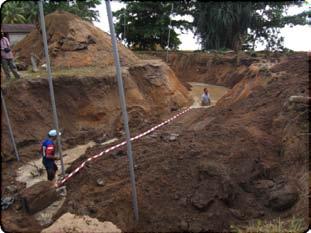
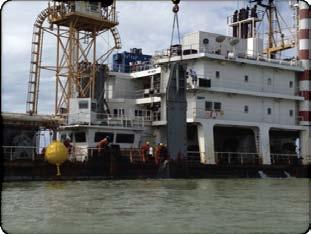
Along with the technology and engineering come the operational aspects. The photos below illustrate preparation work for the shore end using the CB Networker in the distance.
This process took place under the watchful eye of the skilled team responsible for maintaining vessel position as the shore end is laid and from which cable testing is conducted. Performing continuous cable testing, both for technical performance and with cable engineers monitoring the process, represents a joint activity with all parties keeping a
focus to ensure problems are anticipated and resolved before they occur. A strict adherence to quality management is maintained. The process also involves reviewing the base data gathered during cable manufacture, and as such the team can monitor both absolute measurements and any delta changes. The combination provides a suitable check point to ensure cable performance is maintained at every stage of the delivery process.
Shore end cable landing
Shore end cable preparation
Application
of articulated piping (AP)
for added protection
With a direct shore end in place and articulated pipe applied and secured, the focus shifts away from the marine aspect and more towards the shore and landing station. From the BMH, a pre-installed galvanized pipe was extended from the BMH and terminated outside the fenced BMH compound. This provided added cable protection and was buried to 3 metersexceeding customer expectations. Whereas the shore end burial for the BDM project started from the end of galvanized pipe and extended some 500m seaward, to the position of CB Networker.
CB Networker with 3m+ ‘Injector tool’
Throughout the operations in addition to the CB Networker two further tugs were utilized to support vessel operations. In a previous operation the injector tool was used to help bury a power cable to 15m in Malaysia, and the technology is again applied to this project to achieve the deep burial requirements. The marine operations went to plan with great teamwork and partnership with Global Marine and the installation was complete well within timelines. Despite some tricky work with shore ends, the sand waves did not present as great a problem. Once on land, it was a case of the land team together with Huawei local office to manage the cable installation and focus on the SLTE installation and commissioning process.
Quality all the way
GMSL integrated the navigation and data acquisition software ‘Navigator’ for ‘on-line’ positioning and survey. The system consisted of networked PCs, interfaced to the various positioning, attitude, cable instrumentation and subsurface sensors. The use of monitors enabled real-time navigation to the DPO desk. Andas such micro adjustment could be made
rapidly. The system allows users to share the same information with the ability to tailor each work station to individual requirements. Holding back on decision making process during a live installation can be a costly process, which this software goes some way to assist in. Rapid live detailed information is a must have and one that provides the level of quality needed during any marine installation program.
Every section underwent a disciplined testing methodology; adopting correlation of measurements taken at manufacture, measured against those gathered during installation. When it comes to quality and validating a cable system that has an operational life span of 25 years, every step is increasingly more critical as the previous step to ensure a continuous approach to quality control.
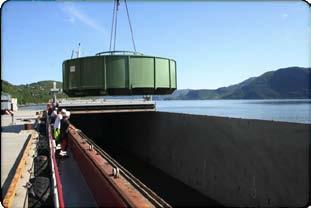
Loading operations in Rognan Quay sideNexan cable site
With over 25,000km of commercially deployed ‘Unrepeated Cable’ (URC-1) manufactured by Nexans at the most northern cable manufacturing facility in the world in Rogan
(latitude/longitude of 67° 6’ 0” N / 15° 23’ 0”), the cable was then loaded onto a freighter. This process combined the experience of a wellestablished manufacturing site in Norway for both repeated optical cable (ROC2) and un-repeatered cable, with a project team organized around a solution and partnership mindset. Such relationships make a significant difference for successful project delivery and help manage the risk of delivery. An interesting element of working life in Norway is the midnight sun makes northern Norway a fascinating place for customers to attend the Factory Acceptance Testing (FAT).
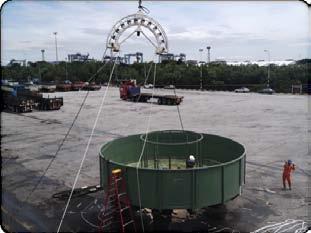
Cable loading at Port Clang
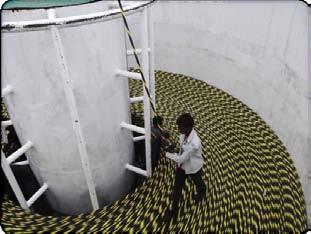
URC-1 Cable loading
With cable manufacturing process completed, a well-established process of using a cable quadrant is underway to transfer the cable onto the freighter. Cable parameters are checked before loading and after loading as part of customer acceptance process. Of course, the process is repeated during loading operations onto the main lay vessel as standard.
Implementing innovative technology
With the current development for more advanced modulation techniques enabling both (http://www.huawei.com/en/abouthuawei/newsroom/press-release/hw093215-kpn-100g-wdm.htm) 40G and 100G the SLTE platform has been engineered with such in-service upgrades. Leveraging the Research and Development from Huawei Technologies gives significant advantage to customers of Huawei Marine Networks. For the purchasers, it means they now have a foundation to achieve significant capacity with advances in Technology.
Providing Customers with a highly innovative product set represents advancements in technology that reduce cost of ownership with enhanced reliability through product engineering and design. Telekom Malaysia Berhad, PT Mora Telematika Indonesia and PT XL Axiata TBK have direct advantage of these factors along with a single network management system for both wet plant and terrestrial CLS equipment, simplifying the operational model and reducing the cost of ownership.
Customer SLTE, getting ready for live service
The SLTE was installed across all three landing stations, (Melaka, Dumai, Batam) and engineered to suit local traffic profile between each ‘Cable Landing Station’ (CLS). A day one requirement was agreed for a couple of 10G channels, representing a fraction of what the 1600 SLTE platforms is capable off, with simple in-service upgrades.
As the regional network expands (Melaka, Dumai, Batam) with further terrestrial roll-out, the purchasers will benefits of a homogenous platform all integrated with a single NMS. Often, such a feature outweighs the complications of a multi-layer network, particularly at a Service provisioning and Network Operations layer, in the long term. Of course, it’s an operator decision in the end but with today’s meshing of wet and terrestrial networks, there are clear advantages to have the ability to provision new services and reduce operational overheads. After all, multilayer vendor networks always have hidden unwanted cost.
Closing remarks
The team successfully completed the BDM project during Q4 2011. It brought together some great team work across Malaysia, Indonesia, UK, China and Norway. Truly demonstrating the ability to manage and delivery turnkey submarine systems; a multicultural team, supportive customers and a desire to drive for success were all key factors. Thanks go to many members of the HMN team, including the Huawei local offices, engineering team in UK, Nexans, R&D in Beijing, HMN HQ in Tianjin and the Global Marine installation team.
The primary objective for the purchasers was not only about capacity enhancement, but also the ability to introduce a new landing point by upgrading an existing cable system. Working together with likeminded organizations that have a strong desire for cutting edge turn-key submarine cable solutions has indeed played a critical part during this project. As important for HMN it has reached out and extended its partnership approach and demonstrated delivery capability in the region; now firmly in place with proven deployments spanning several regions across the globe.
We remain grateful to Telekom Malaysia Berhad, PT Mora Telematika Indonesia and PT XL Axiata TBK to have placed their trust in HMN. Working with the Customers in both Indonesia and Malaysia has been extremely productive as to help them service future demand. For sure, it has been an exciting adventure for all concerned with a great team effort to realize this network.
Jas Dhooper has over 20 years’ experience in the Submarine & Service Provider Telecom Sectors and currently serving as, VP Service Delivery Office for Huawei Marine Networks (HMN) in China. He has gained significant experience in large scale telecommunications project delivery of optical submarine systems and delivered many multi-million dollar projects in a number of countries. He was employed by STC Submarine systems in the late 1980’s, which consolidated into Alcatel Submarine Systems in the 1990’s. He was involved in a number of the major transatlantic submarine systems both in a development role and in delivery, including time on cable ships. Jas also has held a number of senior management &
technical positions in the operator side, working for Cable & Wireless, Interoute Communications since the mid-1990s and Global Marine Systems. Jas holds a Master of Business Administration (MBA), Engineering honors degree from London University and is a Fellow member of the IET.
Zhang Kai has 7 years’ experience within the Terrestrial and Submarine Telecommunication & Service Provider sectors, currently serving as Project Manager of Service Delivery Office for Huawei Marine Networks (HMN) in China. He has gained experience in telecommunications project delivery of optical terrestrial and submarine systems. He was employed by Huawei Technologies co., ltd since year 2006 and then joined HMN in year 2010. He was involved in the submarine MKCS project, connecting several islands within Indonesia during 2010 and project manager for the BDM submarine system in delivery. In addition Zhang Kais has supported many submarine projects in bidding stages. He holds a Master’s degree in Network Technology from Wollongong University in Australia.
Building Low Latency Global Networks
Brian Lavallée
Significant attention within the telecom industry is currently focused on reducing network latency… so what exactly is latency? As it pertains to optical networks, latency is the time delay between when a signal enters the ingress point of the network to when it exits the egress point of the network. The networking equipment traversed, coupled with transmission phenomena experienced between these two points, will incrementally increase the total latency. Consequently, network operators striving to design and build global networks with the lowest latency, overland and undersea, must thoroughly analyze and optimize their entire network from inland point-of-presence (PoP) to inland PoP. To minimize network latency even further, for the latency-obsessed market, the PoP to customer-premise network link must also be fully analyzed and optimized.
Network Latency Contributors
Several individual factors contribute incremental latency as a signal traverses an optical network, overland and undersea, that together accumulate into the total endto-end network latency. As we discuss the primary contributors to latency over optical networks, it will quickly become apparent that to fully minimize network latency, several interrelated factors will have to be considered. Some options available to reduce latency will result in increased network costs so associated business implications must also be taken into account to ensure that the cost-benefit is properly correlated into a financially viable service offering.
Be it man-to-machine or machine-to-machine communications, a computer is often the
network entry point. Regardless of how fast a computer operates, and how efficiently the software running on it is coded, it still takes a finite amount of time to manipulate data and present it to end users. Data is manipulated within the CPU, bused to and from memory, and written to and from hard disks, all of which incur incremental latency. Anyone who has opened a large presentation or run a complicated macro on a large spreadsheet can attest to latency incurred within the computer itself. For example, even though financial institutions use bleeding-edge computer hardware and highly optimized software coding to execute algorithmic securities trading, there is still a finite amount of latency
incurred by their high performance data centers.
The speed of light in a vacuum is ~ 300,000km/ sec but will propagate slower down an optical fiber due to the physical effects of its core. The speed of light propagating within a fiber core is c/n, where “c” is the speed of light in a vacuum and “n” is the index of refraction of the fiber. For a typical optical fiber with an index of refraction of 1.47, light travels down the core at ~ 204,081km/sec, or 30% slower. Although still extremely fast, the speed of light is not infinite meaning it takes a finite amount of time to travel down optical fiber links, which must be taken into account, especially
over long distances such as transoceanic network links where distances over 6,000km are common. The rule of thumb related to the propagation of light is approximately 5ms of latency incurred for every 1,000km of optical fiber traversed.
For global networks that include transoceanic segments, the most significant contributing factor to overall PoP-to-PoP latency will often be the propagation of light itself across the long distance submarine wet plant. When planning new submarine cable routes with minimized latency, the shortest path from Cable Landing Station (CLS) to CLS is the preferred choice, although this is not always possible as routes are also dictated by other mitigating factors, such as avoiding high risk zones, both manmade (ex. busy shipping/ fishing routes) and natural (ex. undersea earthquake zones). For already deployed submarine networks, aside from physically “straightening out” the wet plant and cutting off excess cable for a shorter overall route, the latency of the submarine cable is essentially fixed. In either case, one can further reduce the overall network latency by optimizing the network from the CLS on the beach all the way to the inland terrestrial PoP.
When light propagates down an optical fiber, it experiences Chromatic Dispersion (CD) leading to the “spreading out” of light resulting from the physical properties of the optical fiber. To counter this linear effect in legacy network designs, lossy Dispersion Compensating Fiber (DCF) was used, which exhibits physical properties that counteracts CD by “squeezing” the dispersed light back together, albeit imperfectly leading to residual CD. In legacy networks, the more CD to be
corrected the longer the DCF used, leading to increased incurred latency. Significant advances in DSP technology has enabled more cost-effective solutions that fully compensate for CD electronically allowing for the complete removal of DCF-based solutions, and the latency they incur, from both wet and dry plants. Fortunately, the latency incurred by the DSP pales in comparison to the total latency removed from the end-to-end network with the complete removal of DCF-based solutions. A significant side benefit of completely removing DCF from network designs is that modern coherent detection technology actually works better over uncompensated networks. Thus, removing DCF from wet and dry plant designs, when coupled with coherent detection, removes significant loss and latency from the network, while leading to far less complicated designs. Less loss also means less required amplification.
Each time a signal is converted to and from the electrical and optical domains, via OpticalElectrical-Optical (OEO) stages, incremental latency is incurred. This latency is attributed to internal buffering, queuing, data busing, and
processing operations, to name a few, making regenerators (REGENs) significant latency contributors. This implies that lowering latency is achieved by eliminating, or at least minimizing, the number of REGENs in the network, which is where photonic switching technologies, such as ROADMs, make sense. Operators can reduce REGENs usage by using more optical amplifiers spaced closer together, although this adds more cost to the network leading to required cost-benefit decisions. The ultimate goal is to remove OEO conversion stages, whenever and wherever possible, from the end-to-end network design since keeping signals in the optical domain results in lower latency, as well as simpler and more costeffective networks.
Forward Error
Correction (FEC) is one of the most important technologies adopted by the optical networking industry because it increases achievable reach in the far more cost-effective electrical domain using complex mathematical techniques. However, since FEC operates in the electrical domain, it does incur OEO-related latency, as discussed above. When FEC was introduced and adopted by
Figure 1 – Legacy Cable Landing Station
the telecom industry many years ago, network cost reduction afforded by increased reach was its primary goal. This led to very strong FEC schemes being introduced that maximized achievable reach, while incurring significant calculation-related latency. In general, the more powerful the FEC scheme, the more latency is incurred due to the increased number of calculations required, although this has been offset with the introduction of faster hardware.
Traditional Hard FEC determines if incoming data is a binary “0” or “1” strictly by virtue of a decision threshold circuit. Soft FEC uses a similar method but adds intelligence by examining incoming bits and uses the probability that they should be a “0” or a “1”, based on historical received bit streams. For example, as more consecutive “1” bits are received, the probability of the next received bit actually being a “1” is reduced, regardless of what the hard FEC decision threshold states. This added decision-making intelligence results in increased coding gain leading to longer achievable reaches. Soft FEC also
allows operators to “tune” FEC coding gain performance to the minimum required to meet link budget guidelines thereby minimizing incurred latency at the same time – a win-win scenario for both operators and end-users alike.
Numerous other latency contributors do exist related to packetization, serialization, data protocol conversion, routing, switching, queuing, TCP/IP handshaking, buffer management, and many others, but are beyond the scope of this article. It is readily apparent that there are a whole range of contributors to network latency from the Physical layer to the Application layer of the often quoted Open Systems Interconnection (OSI) stack. Informed decisions must be made to determine where and when a signal should remain in the optical domain or the electrical domain, some of which are contradictory. This implies that it takes a network specialist to understand all of the OSI layers, analyze the contribution of each and every layer, and then provide solutions for optimization, or outright elimination, of the contributors to overall network latency.
Photonic Cable Landing Station (CLS)
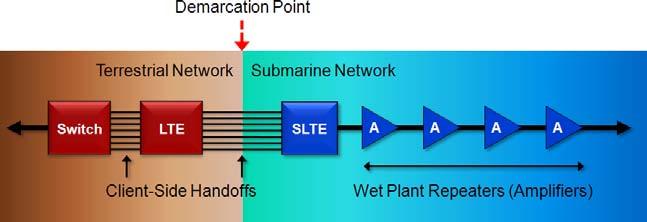
Significant changes are already underway related to next generation CLS designs. Although legacy CLS designs have served the telecom industry well for decades, they are now showing their age, especially when taking into account recent technological advances. Advancements in photonic switching, which by definition do not incur OEO-related latency, are helping to not only reduce the overall cost of the global network, overland and undersea, but also to simplify network designs while minimizing latency. Figure 1 illustrates a legacy CLS configuration that shows the distinct submarine network to terrestrial network demarcation point, which was the result of technologies that were available at the time and accepted design practices. As technological advances developed and deployed for terrestrial networks, such as coherent detection and Remotely Optical Add Drop Modules (ROADMs), find their way into submarine networks, this demarcation is blurring and in several real-world cases, is completely eliminated thus facilitate seamless global networking.
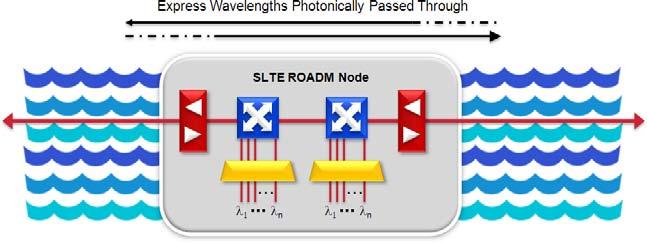
The extended reach afforded by Soft FEC, when coupled with coherent detection, enables CLS designs that leverage ROADMs to eliminate legacy back-to-back REGEN configurations used in legacy CLS designs for Express wavelengths not destined for the inland PoP connected to the CLS. By eliminating the Express wavelength REGEN pairs, latency is significantly reduced. Simplified CLS network designs are also achieved, due to a reduction in power, footprint, and associated costs. As illustrated in Figure 2, Express wavelengths coming into the CLS from the submarine wet
Figure 2 –
Photonic Cable Landing Station Express Bypass Wavelengths
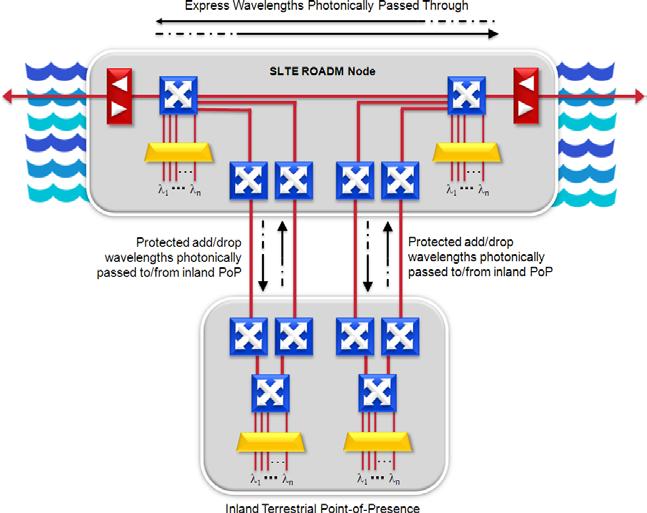
3 –
Photonic Cable Landing Station with Protected Local Add/Drop Wavelengths
plant, and not destined to be dropped locally, are photonically passed through to the next CLS through ROADMs, not REGENs, without incurring any OEO-related latency.
In many cases, ROADMs can be leveraged even further. Wavelengths entering the CLS from the wet plant destined to be added and/or dropped locally can do so purely in the photonic domain as well. The increased reach enabled by Soft FEC and coherent detection can also eliminate terrestrial backhaul networks by photonically
switching local wavelengths using ROADMs and then terminating these wavelengths at the SLTE, which has been physically relocated to the inland PoP. Network protection can also be implemented entirely in the optical domain using ROADMs, as shown in Figure 2. A significant side-benefit of the photonic CLS design is that the legacy terrestrial-tosubmarine network demarcation point in the CLS is eliminated, which simplifies building global networks since a common technology toolkit is now used, overland and undersea.
Although there exists a latency-obsessed market willing to pay lucrative premiums for the lowest latency network between data centers, everyone benefits from lower latency to varying degrees, making it a design goal of most network operators the world over. To minimize latency, network operators must consider each and every part of their network, right down to the length of patch cables, and then make informed cost-benefit design decisions, many of which can be quite difficult. Some latency-reducing options, such as reducing the spans between optical amplifiers and turning off FEC entirely, only make sense if the target customers are willing to pay significant premiums for these low latency services. Fortunately, the evolution towards the photonic “all-optical Cable Landing Station” benefits everyone, both operator and end-users alike, by simplifying network designs while lowering the cost, power, space, and of course, network latency.
Brian Lavallée is the Director responsible for Global Networks Marketing at Ciena and can be reached at blavalle@ciena.com.
Figure
Cable Link to the Land of Fire
jose Duarte and Wayne Nielsen
When the Argentine government sought to regain the initiative in a strategic area like telecommunications, they contracted AR-SAT SA, an Argentinian state company with extesive telecommunications experience. It was naturally the best option to meet the challenge of developing the Federal Network to meet the connectivity needs raised by the Argentine state. The project of laying fiber optic cable in Strait of Magellan is part of a larger project called the Federal Fibre Optic Network, developed under the National Telecommunications Plan “Argentina Connected”, that proposes the installation of more than twelve thousand miles of cable optical fiber throughout Argentina. The focus is on digital inclusion, optimizing the use of radio spectrum, the development of universal service, domestic production and employment generation in telecommunications, training and research in communications technology, infrastructure and connectivity and promotion competition.
AR-SAT engaged WFN Strategies (WFN) in October 2010 to support the provision and installation of fiber optic cable for the Strait of Magellan crossing, which was to be accomplished by Boskalis International bv Sucursal Argentina (Boskalis). WFN Strategies undertook the proposed services in two phases: Phase I included procurement assistance. Phase II included analysis of Installation Planning and Survey Report, cableship shipboard representation and eventual supervision of final acceptance testing.
Current Internet Climate in Argentina
Internet service in Argentina has grown rapidly in recent years and has been gaining
momentum across the region, becoming an indispensable tool to promote development and training, and allowing access to new job opportunities to its inhabitants. But this expansion is not the same in all regions, and connectivity with quality and right price is not guaranteed throughout the country. There is in Argentina a large deficit in terms of connectivity, with isolated regions with poor connectivity, very low quality and difficulty in integrating development; this is generating social inequalities due to lack of opportunities and access to education.
The Driving Need for Fibre
The Argentine state, noting that opportunity for development of regions and their inhabitants are not the same and that these inequalities have become a disadvantage from the standpoint of a barrier to social and national integration, has been looking for different solutions to this problem. One of these proposals is based on the population’s access to communications services and the Internet. Therefore, the main beneficiaries of this project are the populations that are now further away from the most densely populated areas. In particular, the objective for the installation of fiber optics in the Strait of Magellan was to integrate a province that could be defined as “Incommunicado in the era of communications.” The infrastructure in this province in terms of connectivity is very poor. This work is strategic and seeks to integrate the province of Tierra del Fuego and the southernmost city in the world to the rest of the continent.
given the possibility to access more and better services, training “on line” and a sense of belonging and being integrated, as well as job opportunities and development of new business.
for the installation of the submarine and terrestrial portions of the cable system. ASN is one of the world’s leading suppliers of turnkey submarine cable systems and has extensive worldwide experience in submarine cable design, manufacture and installation.
The impact generated on the inhabitants of the province of Tierra del Fuego is very important,
Combining ASN’s experience with Boskalis’ specific knowledge of Argentina and the Straits of Magellan (Boskalis installed the second of the two natural gas pipelines which cross the Straits) made a very technically credible team for the submarine cable crossing.
Alcatel-Lucent also has extensive experience with the installation of turnkey terrestrial networks, including the construction of terrestrial cable infrastructure. AL’s usual method of delivering terrestrial infrastructure was through the use of local, regional terrestrial contractors.
Following the review, a meeting was held with the Boskalis team in December 2010. During the meeting Boskalis informed WFN of Alcatel’s significant involvement and introduced the local AL representative attending the meeting. When asked about how the terrestrial work would be performed, AL informed WFN of their plans to use QTY for all terrestrial cable plant engineering and construction.
QTY was the Argentinean subsidiary of QFC that was headquartered in Ecuador. AL explained that they had used QTY/QFC on various projects in South America and had had good experience with their work. With the supervision of a world-class vendor such as AL and the overarching responsibility of Boskalis, WFN had full confidence in the technical qualifications of all of the underlying suppliers in the proposal.
Installation Methodology Employed
The Magellan Strait Cable Crossing Project Submarine Cable System would provide connectivity across the entrance to the Straits of Magellan between mainland Argentina and the Tierra del Fuego Province of Argentina. The system was composed of one segment with a total length of approximately 35 km.
The main Cable Lay Vessel (CLV) would load cable in Calais, France, and on-board
equipment would include an ROV system for Post Lay Inspection (PLI) and Post Lay Inspection and Burial (PLIB). The CLV would transit to Punta Quilla, Argentina to embark specialists and any ship riding representatives. The CLV would then transit to the Espiritu Santo landing, Argentina and perform the Pre Lay Grapnel Run (PLGR) prior to a ~4.6 km direct shore-end landing at Espiritu Santo. The CLV would then commence plough burial operations for approximately 30 km towards Punta Dungeness and then perform an approximate 0.5 km bighted direct shoreend at Punta Dungeness.
After the final landing, the CLV would perform PLIB activities, receive approvals, and exit operations site. The shore-end methodology would be a direct landing at Espiritu Santo (~4.6 km pull).
Schedule of Technical Support
In December 2010, WFN reviewed the technical proposal in detail and found that the proposal submitted was substantially compliant with all technical and commercial requirements, with only minor exceptions, which were largely points for negotiation. In addition, the team proposed by Boskalis was technically qualified, financially sound and fully capable of performing the work to complete the Strait of Magellan Crossing.
In August 2011, WFN was invited by AR-SAT to attend the project kick-off meeting at Boskalis’ headquarters in Rotterdam, Netherlands. As AR-SAT’s submarine cable representative, WFN was to ensure continuity between project team members and provide AR-SAT with onsite representation and analysis. The initial
Interesting Things to know about Tierra del Fuego
Spanish for “Land of Fire”
Archipelago off the southernmost tip of the South American mainland, across the Strait of Magellan.
Consists of a main island Isla Grande de Tierra del Fuego divided between Chile and Argentina with an area of 48,100 km2 (18,572 sq. mi), and a group of smaller islands including Cape Horn.
Initially discovered by Ferdinand Magellan’s expedition in 1520
Settled by people of European descent in the second half of the 19th century at the height of sheep farming and gold rush booms.
Today’s economic activity in the northern part of Tierra del Fuego is dominated by petroleum extraction; while in the south tourism, manufacturing and Antarctic logistics are important.
Tierra del Fuego hosts large areas protected as national parks and reserves, most of them in the mountainous south. meeting resulted in a high level of confidence that Boskalis and its subcontractors would provide a high-quality submarine cable system to AR-SAT. The kick-off meeting identified potential schedule risks associated with permitting, marine survey and marine
installation which WFN would later assist ARSAT in identifying and mitigating throughout the project. Overall, no major issues were uncovered during the kick-off meeting.
In March 2012, WFN reviewed the Marine Installer Alcatel-Lucent’s System Load and Lay Instructions (SLLI) for Magellan Strait Cable Crossing Project Cable System. Review of the document found no deficiencies and all items were satisfactory. Further, upon shore-end contractor award and conclusion of the prelay meeting, final lines of authority would be determined, and development of the method of procedure, permit requirements would be incorporated into installation operations. The shore-end operations would need to be integrated into the final installation plan. This was industry standard for cable installation operations.
In April 2012, WFN accomplished owner representation support on the Alcatel-Lucent
cableship, Ill De Batz, during the installation of the Magellan Strait cable. On 18 April, a WFN surveyor witnessed the calibration of the plough set-up procedures and wet test of ROV, and PLGR operations began 2 days later. The main cable lay began on the 25th, when the cable end left the ship, and a few hours later, the divers began removing the approximately 400 plus floats while placing the cable in the 10 meter previously dredged swath. After the floats were removed and all personnel were clear, Ship’s tester performed an IR test with the cable testing “OK.” The landing was without incident and completed in a very professional manner. Ile De Batz then moved off to deeper water to wait for high tide. By 30 April and with the Punta Dungeness side of PLIB finished, the ROV completed 3 jetting passes over the cable from plough up (1 m depth) up the slope to the 10 meter contour (130 to 150m off the beach). After the 3rd and final pass the ROV was recovered to the surface and the vessel eased off. Full burial depth was attained on the cable up to the slope. Ile de Batz then departed site for Espiritu Santo.
Summary
The project has gone through various difficulties. The need of the work was mainly based on a strategic necessity of inclusion and integration in the region. Therefore delays in the beginning were due to issues of decision as to the best opportunity for hoisting out and the availability of resources for the project.
The work was supported with funds from the Argentine state, and has made a significant effort whose benefits will be reflected in the future as the company complies with the objectives stated above.
Overall, WFN viewed the effort as a very professional installation by the contracting team. The Ships officers and the AlcatelLucent representatives were very open in sharing information regarding all aspects of the project. If the Ship Representative requested any information for specific data, charts or graphs they were supplied in a timely fashion and at no time was he denied access.
WFN Strategies was pleased to assist ARSAT as it expanded its satellite network into ground-based facilities, and the crossing of the Straits of Magellan was an interesting project in a unique part of the world and an important first step for AR-SAT.
Jose A. Duarte is an Industrial Engineer specializing in in telecommunications systems. Since 2010, he has been Project leader of the Engineering Department for Arsat S.A. of Argentina. He is the former Post Sale Service Manager of Mach Electronics S.R.L., and was employed by Telefónica de Argentina for 21 years where his last position was O&M Manager.
Since his days as a young budding Master’s scholar, Wayne Nielsen has studied and appreciated Argentina, and in particular the Peronist period, which after long last culminated in his first visit to Buenos Aires in 2010. He is a frequent imbiber of Malbec, but unlike his county neighbor, Robert Duvall, is a lousy Tango dancer; but he does love to polka! He is looking for an excuse to return so that he can visit the Teatro Colón, the main opera house in Buenos Aires, and acoustically considered to be amongst the five best concert venues in the world.
DONET: Submarine Cabled
Seafloor Surveillance Infrastructure for Earthquake and Tsunami
Katsuyoshi Kawaguchi
Cable Route and Observatory Arrangement of DONET / DONET2: (RED: Existing, Purple: Planning)
In the pacific coast of western Japan, there are three major hypo-central regions of megathrust earthquake outbreak known as Tokai, Tonankai and Nankai earthquake. Each region will work in a cycle of 100 to150 year interval with M7-8 class earthquake accompanied by generating of tsunami, and be anxious about two or more earthquake outbreak carrying out simultaneously like the 2011 earthquake off Pacific coast of Tohoku. Expand and improve the surveillance system on seafloor is essential to understanding the state and activity of seismogenic zone and associate tsunami event. DONET (Dense Ocean-floor Network system for Earthquakes and Tsunamis) is a unique development program of a submarine cabled real-time seafloor observatory network. This program has aimed to developing the infrastructure technology and construction method of large scale real-time seafloor research and surveillance network for earthquake,
geodetic and tsunami observation and analysis. The initial phase of this program has been carried out since 2006 to settle on ToNankai region in Nankai trough as the target of observation. The construction of observatory network was completed in the end of July 2011 and the twenty set of observatories are currently working on seafloor. In parallel to DONET construction, the second unit of observatory network DONET2 is developing for hypo-central region of Nankai earthquake which located the west of Tonankai region from 2010 (Fig. 1). The DONET2 is in research and development stage at present aiming at the completion in 2015.
DONET System Design
One of the difficult challenges of underwater technology is maintaining the function of large scale observing system over a long period of time (20-30 years) in sea-water. In the development of a submarine cabled observatory network, the distribution of observatories is very important to secure the performance of earthquake monitoring, however the number of observatory in the system has a large influence on the reliability of the system, because the state-of-art sensor component of the observatory has difficulty to secure high reliability such as equivalent to telecom submarine cable system.
A novel system design concept is required for the observatory network development to reconcile two conflicting demands of ‘high reliability system design’ and ‘preseice measurement’. The components of an observatory network should be replaceable, repairable and expandable during the operating lifetime, in order to take redundancy for an internal or external system failure such as cable abrasion, seabed movement, fishing activity, manufacturing defect, etc. To meet the requirements, the DONET proposes a system topology that consists of three major components with different system reliability, they are the high reliability backbone cable system, the repairable science node, and the replaceable / expandable observatory. The DONET backbone cable system is 320km length of looped submarine cable system with, six repeaters, five BUs (branching unit), and five TUs (termination unit). This system is designed to permit loading up to 3kW (3kVDC/1A) electric power during operation
Figure 1:
Figure 2: Network Component of DONET
which is generally used as a middle voltage subsea telecom power system. A pair of physical optical fiber communications channel is allocated between each TU and terminal equipment on land (pier to pier connection) by two independent routes (ring topology) to ensure the reliability of data distribution. Each TU is equipped with an optical fiber and electrical hybrid UMC (underwater mateable connector) for science node interface. A high voltage switching relay is built into the BU to manage the power feeding path to the science node and has the ability to electrically separate TU and science node from backbone cable system. A specially manufactured double conductor submarine cable was used for the bidirectional electrical and fiber optical connection between BU and TU (Fig.2).
The science node is equipment for providing the interface for observatories and processing multiple observatory data into one data stream to transmit to terminal equipment on land. Each science node is equipped with
nine optical fiber and electrical hybrid UMCs, one for an interface to backbone cable system and eight for interfaces to observatory. Each observatory interface manages power distribution, data transmission and time synchronization controls for versatile, precise and flexible measurements on the seafloor. The power distribution capacity of each observatory interface is 40 watts maximum. A constant current DC power output was selected for the system to obatain high power transmission efficiency through 10km long submarine cable connection between science node and observatory. A SONET/ SDH (Synchronous Digital Hierarchy) network management protocol is used for communicating digital information in this system over optical fiber. Data transmission capacity between terminal equipment on land and a science node on seafloor is approximately 600Mbit/s. A 50Mbit/s bidirectional data transmission capability is secured between science node and each observatory. Precise timing information and time stamp are embedded in the section overhead of SDH frame structure for time synchronization control. The DONET time synchronization control system can provide less than 1 microsecond of time synchronizing accuracy among the components of the network system.
The standard type DONET observatory is composed of a sensor package and an extension cable system. The sensor package consists of a ground motion sensing system and pressure sensing system to aim for precise earthquake, geodetic and tsunami observation. The ground motion sensing system is made up of a broadband seismometer, a strong motion accelerometer, and a gimbals stage. The constituent of the
ground motion sensing system is assembled in a titanium alloy pressure vessel. The pressure sensing system is composed of a pressure gauge, a differential pressure gauge, a hydrophone, and a thermometer. All components of the pressure sensing system are put in an oil filled container to protect the sensors from damage by the infiltration of seawater. A thin electrical / fiber optical hybrid submarine cable named “extension cable” is specially manufactured for the DONET project to secure the power distribution line and bidirectional data communication channel between any standard type observatory and science node. The hybrid
Figure 3:
Figure 4: Improvements of Focus Decision Accuracy
Figure 5: Improvement of Earthquake Early Warning: The assumed epicentral area of mega-thrust earthquake is located approximately 80km far from nearest shore line. 10-15 sec as to P-wave, and 20-25 sec as to S-wave forecast advantage will be expected from real-time analysis of DONET data.
UMCs fitted on both ends of the 10km length of extension cable, make possible the maintenance or replacement of observatories on the seafloor as the occasion demands.
DONET2 System Design
DONET2 is a system even greater than the original DONET system. The concept design of DONET-2 has 450km length backbone cable system with two landing stations, seven science nodes and twenty nine observatories,
because of the hypo-central region of Nankai earthquake is vaster than the To-Nankai earthquake. Most of the system components of DONET2 use the engineering that established in DONET development, but some new engineering introduction is indispensable to handle the observatory network which scale is larger than the DONET. The review of power feeding system and data transmission scheme between backbone cable system and science node is essential to realize the largescale network operation. Development of a backbone cable system that fit for the high tension power system has to be discussed for large scale observatory network construction because of the power management of five science nodes in a system is the limit of DONET middle voltage power system design. The telecom submarine cable system originally designed to allow loading up to 10kVA power operation, but the handling of high tension power in the very tight canister (pressure vessel) through UMC has engineering difficulty to secure the isolation between the seawater environment long periods of time. The DONET2 backbone cable system plan to supply a specially manufactured isolated potential converter (Fig. 3) in TU to solve this concern while securing compatibility with DONET. The primary power source of this converter is up to 10kV/1A constant current DC power and provide up to 600V/1A constant current DC secondary power to drive the science node to enables connection by the low potential
voltage between backbone cable system and science node. The number of optical fiber system in standard telecom submarine cable is a maximum of six fiber pairs. The DONET assigned one pair for backbone system control and 5pair of remainder physically allot to five science node. DONET2 scheduled to handle 7 science nodes in the system and high tension power system design able to manage 15 science nodes maximum from the calculation of power consumption. DONET2 introduced CWDM (Coarse Wavelength Division Multiplexing)
Figure 6: Improvement of Tsunami Forecast: As the same manner of the estimation of the improvement of earthquake early warning, 12-15min of TSUNAMI forecast advantage will be expected from realtime analysis of DONET data.
Figure 7: Filtered Pressure Gauge Record of 2011 earthquake off the Pacific coast of Tohoku
into a transmission method to make up for the lack of physical optical fiber line without a problem of science node compatibility between DONET and DONET2. Introducing an optical fiber coupler in BU and assigning an individual wavelength to each science node realized to share a physical optical fiber line in more than one science node. However, number of sharing of science node in a fiber is decided to minimize as much as possible using existing six pair of optical fiber system because of the increase of the optical fiber sharing of a physical line has the large risk at the time of optical fiber system failure.
Performance of Observatory Network
The optimum observatory arrangement on seafloor (of hypo-central region of mega-thrust earthquake) is adjust and determined by the comparison of simulation results of focus decision accuracy whether or not the existence of seafloor observatory network. A simulation result shows that the focus decision accuracy
only using a seismic network on land improves over a wide area include the hypo-central region by adding the data from seafloor observatory network DONET moreover DONET2 (Fig. 4).
After the optimization of observatory layout on seafloor, improvement of the ability of earthquake early warning and tsunami forecasting are also evaluated by the numerical simulations. Fig. 5 is a simulation result of improvement of earthquake early warning. It shows that DONET and DONET2 able to raise a warning alarm of 3-5 second earlier as compared with seismic network on land. Fig. 6 also shows a contribution to forecast the tsunami arrival and its scale on the shore line 20minitue earlier than the existing observatories along the coastal line. In the practical observation, an earthquake and associated tsunami were observed in ten seafloor observatories in DONET which had installed and in operation at the time of the occurrence of 2011 earthquake off the Pacific coast of Tohoku as Fig. 7. DONET was able to observe the tsunami arrival at Tonankai region in the forecast accuracy as expected. The effectiveness of the reinforcement of seafloor surveillance infrastructure for earthquake and tsunami observation was demonstrated from these practical records. The precious observation data from seafloor observatories is distributed to the Japan Meteorological Agency and related national research institutions, and practically contributes to the improvement of earthquake and tsunami monitoring program in Japan.
Katsuyoshi Kawaguchi is the Technology Development Group Leader / Principal Research Scientist for Earthquake and Tsunami Research Project for Disaster Prevention at Japan Agency for Marine-Earth Science and Technology (JAMSTEC)
submarine cable ALMANAC ISSUE 3 ARRIVING AUGUST 2012
R ESERVE
yOUR
SPONSORS h IP
TODAy
Back Reflection
by Stewart Ash
The Pathfinder of the Seas
As we explained in the March Issue (No. 62), with the notable exception of Cyrus W Field (1819 – 1892), the pioneers of the submarine cable industry were almost entirely British. It was they that had the vision, raised the capital, designed and manufactured the cable, developed the equipment to transmit telegraph signals over the long distances involved and created the laying and repair proceeds necessary to develop the industry. However, there is another American who I believe should be counted among the pioneers of our industry, and that is Matthew Maury (1806 – 1873). Although Maury only concerned himself directly with submarine cables on one notable occasion, his early work on navigation and oceanography was the starting point for modern day, cable route survey that is essential to the construction of all submarine systems. When, after his famous meeting with Frederick Gisborne (1824 – 1892), Cyrus Field had his vision of an Atlantic Telegraph, he sought two opinions as to whether the project was possible, one was
from Samuel Morse (1791 – 1872) the other was from Matthew Maury. Both gentlemen gave him positive responses and so the great project was launched.
Matthew Fontaine Maury was born on 14th January 1806, in Spotsylvania County, Virginia, but his family moved to Franklin, Tennessee when he was 5 years old. Matthew wanted to follow his elder brother John into the US Navy; however, when John died from Yellow Fever, his father refused to allow him to join. Maury considered going to West Point but eventually, in 1825, he took up a Naval appoint, this was secured mainly due to the influence of Senator Sam Houston (1793 -1863).
Maury joined the Navy as a midshipman and almost immediately began to study the seas and record methods of navigation. From 1826 to 1830 he was a member of the ships company of the USS Vincennes, the first US warship to circumnavigate the globe.
Matthew Maury’s seagoing days came to an abrupt end at the age of 33 after a stagecoach accident in which he broke his right leg.
Thereafter, he devoted his time to the study of naval meteorology, navigation, charting the winds and currents, seeking what he called the “Paths of the Seas”. Maury was a devout Christian and this reference comes from the Bible, Psalms 8:8.
His hard work on and love for plotting the oceans paid off when he became the first superintendent of the United States Naval Observatory in 1842, holding that position until his resignation in April 1861. The observatory’s primary mission was to care for the United States Navy’s marine chronometers, charts, and other navigational equipment. Maury was in fact one of the principle advocates for the founding of a national observatory, and appealed to science enthusiast and U.S. President John Quincy Adams (1767 – 1848) for the creation of what would eventually become the Naval Observatory. Maury hosted Adams, who enjoyed astronomy as a hobby, at the Naval Observatory on a number of occasions.
As a sailor, Maury noted that there were numerous lessons that had been learned by ship-masters about the effects of adverse
winds and drift currents on the path of a ship. The captains recorded these lessons faithfully in their logbooks, but they were then forgotten. At the Observatory, Maury uncovered an enormous collection of thousands of old ships’ logs and charts in storage in trunks dating back to the start of the US Navy. Maury pored over these documents to collect information
on winds, calms, and currents for all seas in all seasons. His dream was to put this information in the hands of all captains.
Maury also used the old ships’ logs to chart the migration of whales. Whalers at the time went to sea, sometimes for years, without knowing that whales migrate and that their paths could be charted.
Maury’s work on currents led him to advocate his theory of the Northwest Passage, as well as the hypothesis that an area in the ocean near the North Pole was occasionally free of ice. The reasoning behind this was sound.
Logs of old whaler ships indicated the designs and markings of harpoons. Maury was able to show that harpoons found in whales caught in the Atlantic had been shot by ships in the Pacific and vice versa, and this occurred with a frequency that would have been impossible had the whales traveled around Cape Horn.
Maury, knowing a whale to be a mammal, theorized that a northern passage between the oceans that was free of ice must exist to enable the whales to surface and breathe. This became a popular idea that inspired many explorers to seek a reliably navigable sea route. Many of those explorers died in their search, perhaps the most famous of these being the 1845 expedition of Lord John Franklin in HMS Erebus.
Lieutenant Maury published his Wind and Current Chart of the North Atlantic, which showed sailors how to use the ocean’s currents and winds to their advantage and drastically reduced the length of ocean voyages; his Sailing Directions and Physical Geography of the Seas and Its Meteorology remains a standard text. Maury’s uniform system of recording synoptic oceanographic data was adopted by navies and merchant marines of many nations around the world and was used to develop charts for all the major trade routes.
Maury advocated much in the way of naval reform, including a school for the Navy that would rival the Army’s West Point. The need for its reform was heavily publicised by Maury’s many “Scraps from the Lucky Bag” and other articles printed in the newspapers and many changes came about in the Navy including his finally fulfilled dream of the creation of the United States Naval Academy.
Maury also advocated an international sea and land weather service. Having charted the seas and currents, he worked on charting land weather forecasting. However, Congress refused to appropriate funds for a land system
of weather observations.
Maury became convinced that adequate scientific knowledge of the sea could only be obtained through international cooperation. He proposed that the United States invite the maritime nations of the world to a conference to establish a “universal system” of meteorology, and he was the leading light of that pioneer scientific conference when it met in Brussels in 1853. As a result of the Brussels conference a large number of nations agreed to cooperate in the sharing of land and sea weather data using uniform standards. Within a few years, the nations that owned three quarters of the shipping of the world were sending their oceanographic observations to Maury at the Naval Observatory, where the information was evaluated and the results given worldwide distribution.
There is little wonder that Cyrus Field should seek the opinion of Maury when he formulated his Atlantic Telegraph concept. When asked by Field about the feasibility of an Atlantic Telegraph, Maury reported that Lieutenant Commander O.H. Berryman had completed a series of soundings the previous year from Newfoundland to Ireland across the Atlantic Ocean. He had also investigated winds and currents in the area. Lieutenant Berryman found that the ocean floor in the 1,600 miles between Newfoundland and Ireland was primarily a plateau, deep enough to clear icebergs and ship anchors, yet shallow enough to make the deployment of a submarine line feasible. Lieutenant Maury, in his conclusion to his report stated, “I do not, however, pretend to consider the question as to the possibility of
finding a time calm enough, the sea smooth enough, a wire long enough, or a ship big enough to lay a coil of wire sixteen hundred miles in length”.
This report was the only direct involvement that Maury had with submarine cables; however,
he came to be known at various stages of his career as the “Pathfinder of the Seas” and the “Father of Modern Oceanography and Naval Meteorology” and later, “Scientist of the Seas”. He published a number of books, most notably Physical Geography of the Sea (1855), the first extensive and comprehensive book on oceanography to be published. Maury also made many important new contributions to
charting winds and ocean currents, including ocean lanes for passing ships at sea. All this information is integral to a modern Desk Top Study and Marine Route Survey for any new submarine cable system.
For his decades of hard and ground breaking work, Maury gain national and international recognition and acclaim. He was offered medals and honour titles by several countries, included a collection of medals struck by Pope Pious IX (1846 – 1878). As a United States Navy officer, he was obliged to decline awards from foreign nations as their acceptance was against U.S. military policy. However, they were offered to Maury’s wife, Ann Hull née Herndon-Maury, who accepted them on his behalf.
Matthew Fontaine Maury died at home in Lexington, on Saturday, February 1, 1873. Maury was initially buried in the Gilham family vault in Lexington’s cemetery. The following year, his remains were taken to Richmond, Virginia, where he was final laid to rest. On 11th November 1929, a monument to Maury “Pathfinder of the Seas”, by the sculptor Frederick William Sievers, was unveiled in Richmond.
Conferences
Submarine Networks World 2012
11-13 September 2012
Singapore Website Submarine Cable Forum 5-6 November 2012
Miami, USA
Website
OilComm 7-8 November 2012
Houston, USA
Website
PTC'13
20-23 January 2013
Honolulu, USA
Website
SubOptic 2013
22-25 April 2013
Paris, France
Website
July:
September:
November:
by Kevin G. Summers
As you are probably aware, SubTel Forum and Terabit Consulting released the first ever Submarine Telecoms Industry Report last week. We've had an influx of emails about this free report, and I want to share some of these with you:
Thank you very much for sharing the information.
~K.P. Verma
Fabulous valued-added report.
~Doug Cunningham
Thank you Kevin.
~Salvatore Vincenti
Kevin – you guys certainly are putting an excellent series of literature together – thank you!
~Paul McCann
A top job. Really good read. Good broad industry data although there are some points that I would not necessarily agree with eg I think it understates the potential upgrade capacity of existing systems. But overall very good and excellent for promoting the industry.
~John Hibbard
I want to thank Michael Ruddy of Terabit Consulting for all of his hard work on the report, as well as Fiona Beck of SubOptic for authoring the Foreword.