CONTRIBUTING WRITERS: Stewart Ash, Sean Bergin, Simon Brodie, Derek Cassidy, Erick Contag, Jorn Jespersen
Submarine Telecoms Forum magazine is published bimonthly by Submarine Telecoms Forum, Inc., and is an independent commercial publication, serving as a freely accessible forum for professionals in industries connected with submarine optical fiber technologies and techniques. Submarine Telecoms Forum may not be reproduced or transmitted in any form, in whole or in part, without the permission of the publishers.
Liability: while every care is taken in preparation of this publication, the publishers cannot be held responsible for the accuracy of the information herein, or any errors which may occur in advertising or editorial content, or any consequence arising from any errors or omissions, and the editor reserves the right to edit any advertising or editorial material submitted for publication.
Contributions are welcomed. Please forward to the Managing Editor at editor@subtelforum.com.
Submarine Telecoms Forum, Inc.
21495 Ridgetop Circle, Suite 201 Sterling, Virginia 20166, USA subtelforum.com
A Funny Thing Happened on the Way to the Occupy Rally…
I was really torn last week when I finished my last meeting in Chicago. It was a really beautiful day in the Midwest, typical for May, and blustery, typical for the “Windy City.” The streets to the south were starting to fill; the fencing was up. Chicago’s finest were in full force, but somehow I just did not feel the rising spirit of the day.
So instead I headed west to Oak Park, to a somewhat famous novelist’s birthplace, and stole away a few personal, thoughtful hours in Ernest Hemingway’s boyhood home and museum. I studied letters, type written notes and numerous international accolades, and breathed in the musty bouquet of the lost generation.
Upon my return to God’s country, Virginia, the next day, I was greeted with the news of the G8 leaders' meeting across the Potomac at Camp David. Reports of discord between the leaders had already surfaced, and there now seemed to be two distinct schools of thought regarding the latest financial crisis. One group wanted to continue an austerity approach to the problem, and the second, a newer and increasingly vocal chorus, wanted to promote increased debt
spending. Both groups seemed convinced of their divergent correctness in managing through the mess.
What the results of this split amongst our world leaders portend for the future is still anybody’s guess, but at a minimum, it suggests more stormy seas ahead. And yes, weather that will eventually impact significantly our little industry. So I guess I’ll just curl up with a good book and ride it out.
“You do not know how long you are in a river when the current moves swiftly. It seems a long time and it may be very short. The water was cold and in flood and many things passed that had been floated off the banks when the river rose. I was lucky to have a heavy timber to hold on to, and I lay in the icy water with my chin on the wood, holding on as easily as I could with both hands.” - A Farewell to Arms
In This Issue...
News Now
Africa: Continent Calls for Harmonised Policies on Submarine Cables
Alcatel-Lucent Wins Contract To Lay Tonga Fibre-Optic Submarine Cable
APTelecom Appointed as Pre-Sales Manager for Pacific Fibre
BRICS Cable Unveiled for Direct and Cohesive Communcations Services between Brazil, Russia, India, China and South Africa
Columbus Networks and Xtera Communications First to Unveil 100G in Pan-American Caribbean Region
CTC Marine Projects Appoints New Managing Director
CTC Marine Projects Invests in Integrated Trenching Spread Solution
CTC Marine Projects, Trico Offshore and DeepOcean Become One
Dhiraagu Tests Submarine Cable After Repairs
Digicel Buys Rival Telecom In Haiti
Digicel Leads Project To Deliver High-Capacity Undersea Cable To Haiti
Emerald Networks Signs A System Supply Contract For New Generation Trans-Atlantic Fibre Optic Cable System
Epeg - New Submarine Cable To Link Oman With Europe
GBI Crosses the Mediterranean with the First 100G Repeatered Submarine Link from Xtera
Haiti Moves Forward With Fibralink Submarine Cable Network
i3 Africa Calls For BRICS Submarine Cable Cash
Is Globe-Encircling Fibre Optic Cable Business Making Money for RCom, Tata and Airtel?
Main One Cable Company Upgrades Network Infrastructure Together With TE SubCom And Business Unusual Limited
Malawi Keen On Submarine Cable Connection With Tanzania
MTN - Why Telecoms Operators Are Focusing On Data Solutions
MTN, Vodacom Consortium Launches West Africa Undersea Cable
MTN NCC Approves Second Submarine Cable Link Between Taiwan And China
New Fibre-Optic Cable To Benefit SKA Project
New Submarine Cables Set to Revolutionize West African Internet
Nexans Establishing Cable Plant In Berkeley County, S.C.
Nexans Stock Declines on Submarine-Cable Production Delay
Pacific Fibre Stirs Up FUD About Huawei’s Sub Cable Technology
Planned Undersea Fiber-Optic Cable Projects in Arctic as Allegory for Changing Region
Prysmian Group Secures Order For Cables Worth Over Reliance To Divest 75% Stake In FLAG Submarine Cable System
Seychelles Set For Its First Underwater Fiber-Optic Cable Link
Submarine Cable Construction Continues Despite Untapped Potential Capacity
SubOptic 2013 Call for Papers Now Issued
Taiwan Approves First Direct Submarine Cable Link With China
Tata Communications Completes Cable Network Ring Around The World
TEAMS Submarine Cable Hitch Disrupts Internet Services In East Africa
Telkom Kenya Undersea Cable Goes Live In Kenya
Telstra International Deploys Infinera Telstra Sparks Up Reach Cable
Vodafone Bids For Cable & Wireless
WACS Switch-On Date Confirmed
West Africa: Bandwidth Cost to Drop As U.S.$650 Million Undersea Cable Goes Live
Will MTN Crash Internet Cost With WACS Cable?
The Emergence Of Carrier Neutral Networks and The Increased Capacity: an Irish Sea Perspective
Derek Cassidy
The Irish Sea, a body of water that divides the UK from Ireland, has been the deciding factor behind all decisions that have driven telecommunications between the two countries. From the earliest days in the 1850s to the present, engineers have been trying to connect the two islands together so that there is a seamless communications network between them.
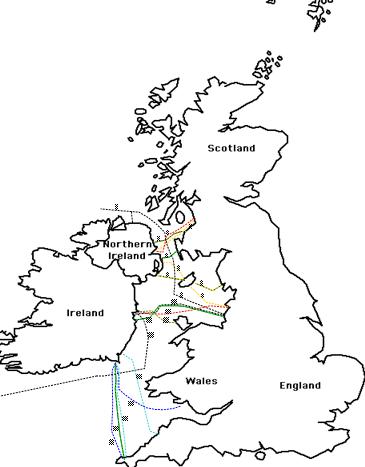
In the late nineties and early years of the 2000’s, the majority of the fibre optic submarine cable systems that are still in operation today were laid between the UK and Ireland, see figure 1. These systems were laid when the use of dense wavelength division multiplexing (DWDM) systems began to appear and launched a new era of communications. The DWDM systems allowed for the transmission of 32+ 10 GB channels per system which used single or dual fibre working. Submarine cable operators could have had multiple DWDM systems on their cable. Soon capacity across the globe was not enough and the look towards 40Gb channels began. It was normal to hear DWDM equipment vendors offering 80+ 10Gb channel count systems and discussing their design roadmaps for the technology to reach 120 channel count systems, but their hopes of reaching the 40Gb channel system were stymied due to non-linear affects such as polarisation
Figure 1: Existing submarine cables between UK and Ireland and further afield
mode dispersion (PMD) etc. However the recession or slowdown around 2003 had a negative impact on the development of these systems and they stalled and the search for a way forward came to a halt.
However, due to the communications slowdown there was a lull in the development of a 40Gb channel offering and the available channel bandwidth stayed at 10Gb. This also corresponded with a lull in the development of new submarine cables between the UK and Ireland. The existing cable infrastructure and capacity was capable of coping with the bandwidth demand. In the latter part of the 2000’s there was an increased demand for bandwidth due to the development and rollout of broadband, a new development in communications. This broadband development can be called the 7th revolutionary cycle in the evolution of communication across the globe. The development of communications also took a shift in a new direction, Ethernet became the flavour of the month and many operators began to change from SDH to Ethernet and optical transport network (OTN) as a transmission protocol. The existing submarine cable capacity was still capable of meeting these needs and demands as the systems could be upgraded with new DWDM systems. The development of new Ethernet technologies
helped drive research and develop new technologies that enabled DWDM networks to deploy these new 40Gb and 100Gb channel developments and with this new technology drive there was a new revitalised energy injected into the existing submarine cable networks which resulted in new investment.
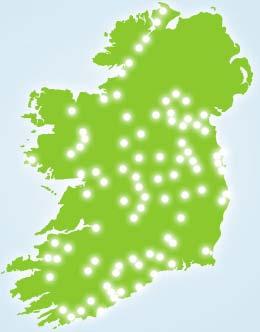
2: A snapshot of the Irish MAN locations
In 2010 the first of these new investments took place when a new submarine cable was landed at Portrush in Northern Ireland. This new link was a branch unit from an existing cable connecting the UK to the US. This new connection created a new link between Ireland and the UK and the US; the latter being the first since 1964 when the last service was in use. With this new investment the operator upgraded its network so that it could offer 40Gb optical channels, which increased its capacity on a cable that was already boasting 65ms RTD between Ireland and the US. Now with this new drive in the direction to reach the higher bandwidths the existing submarine cable operators continued to meet the existing demand while investigating in its capability to deliver the new 40Gb and 100Gb technologies.
Figure
Multiple 10Gb DWDM systems were the norm for large corporations, ISPs and research centres, however this was not enough and they wanted more at a cheaper price. At present the existing way of delivering these services was by managed services or wavelength solutions, which cost money and the higher the bandwidth the higher the cost. But none offered a carrier neutral offering, something that was now emerging across the globe, which would offer more bandwidth for a flat cost.
An ability to grow your own voice and data and increase your available bandwidth when you want, without incurring extra costs for infrastructure investment or bandwidth usage, is a solution most network operators, carriers or network users strive to achieve. The only way to do this is to have your own network or have access to another network in the form of dark fibre that is delivered via an open access network or a carrier neutral network. However at present dark fibre
offerings from operators on their networks are limited if rare and to over come this, a network will need to be constructed and made available for operators or users to build their own system and grow their own network.
In Ireland the Government had decided as early as 2003 that they would try and develop a carrier neutral fibre backbone network across Ireland and this soon developed into the numerous metropolitan area networks (MANs) that are deployed across the country, see figure 2. These were optical fibre rings built around large towns and cities and connected the various industrial and commercial areas together with a central point of presence (POP) or hub. The network deployments offered a neutral network solution to telecommunication operators so that they could extend their reach across Ireland without the need to build their own optical networks. This new open-access telecommunication network was formally
launched in 2004. The management company who operates these networks for the Government is one that is neutral and is one that does not operate as a telecommunication company so that neutrality can be maintained. The number of MANs is increasing every year with new networks being added to the Governments open access or neutral carrier network portfolio and with the increase in need for bandwidth to meet the needs of the new drive for broadband, this type of network flourishes. Due to its uniqueness in being able to offer a solution to all operators, that was being supported by the national government, the reach into the rural parts of the country could be achieved without large operator infrastructure investment. Just as in the film Field of Dreams and the famous quote “Build it and they will come” the same ethos is applied to this MAN or open-access telecommunication network. The Irish Government sponsored the building of the new networks and then
outsourced a carrier neutral company to operate them, meaning that no operator had any advantage over any other operator and access to new markets were opened up and new opportunities became available. This new network provided the capability to reach areas that would have not been infrastructurally cost effective for any operator and this investment created
the need to increase capacity in existing networks so that the network reach could be achieved. The broadband divide could be overcome so that broadband would be available for everyone.
A neutral carrier network was something that could not, as of yet, be mirrored within the submarine cable networks between
Ireland and the UK. All the submarine cables were owned and operated by existing telecommunication operators and they all competed with each other so the availability of an open access network or a neutral carrier network with available capacity was non-existent. The only bandwidth offerings were by a managed service or a managed wavelength solution
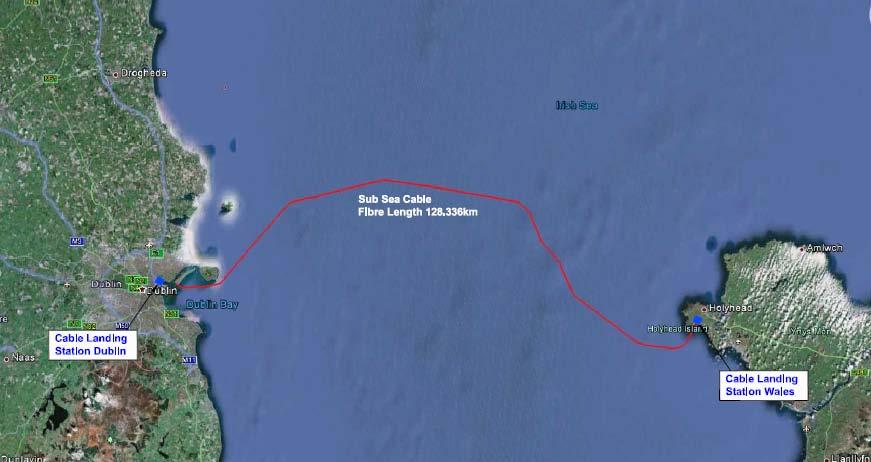
Figure 3: Cable route of new carrier neutral submarine cable, Dublin to Holyhead
between Dublin, London and Europe/US. One submarine cable operator did manage to have a dark fibre offering but this lead to conflict and the operator ended up competing for the same business with their own customers who were leasing the network from them. However all the submarine cable operators had one thing in common, they were intent on investing in the technology advancements in increased bandwidths to 40Gb and soon to be 100Gb DWDM networks.
The idea of a carrier neutral submarine cable is one that either brings dread to some operators and hope with a mixture of imagination to others. The biggest barrier to UK/Ireland growth is the cost of installing and operating a submarine cable and the costs of bandwidth across these cables. A carrier neutral submarine cable would allow operators and large corporations with their own networks to develop these networks and extend their reach across the water by building their own networks on dark fibre pairs that
they could lease without the operational overheads and headaches operating a submarine cable would bring.
The ability of an operator or large corporation to lease a fibre pair to the UK, by purchasing an indivisible right of use (IRU) on a submarine cable and connecting their own equipment to either end so that they could deliver what ever traffic solution they wanted, was not available but is one that most operators looked on with envy.
This year a new submarine cable was commissioned that connects East Point in Dublin to Porthdafarch in Holyhead and then to the Fibrespeed optical network in North Wales and then onwards to Manchester, London, the rest of the UK and Europe, see figure 3.
The new submarine cable has 144 fibres, each fibre pair is capable of delivering whatever bandwidth is required by the operator who leases them. From a single 10Gb wavelength to multiple 10Gb, 40Gb and even 100Gb DWDM systems. At present a DWDM system with a channel count of >80 x 100Gbs can be connected to one of these fibre pairs across a distance of 131Kms between the two cable stations. This would allow more telecommunication operators to expand across the water and extend the reach for many others. The
telecommunication connections between the UK and Ireland have now been opened up by the development of a carrier neutral network that will help to bring competition to the market, increase the available capacity and offer a new solution to telecommunication operators. Also being an open access or carrier neutral submarine cable, its capability to offer a diverse solution to other submarine cables so that operators could offer the diversity across land and for some operators a diverse solution across water.
that is a neutral carrier cable offering whatever solution an operator wants to build. The latter being the better prospect for a new entrant or an operator wanting to expand. This capacity will be available for future expansion, allowing for growth and increasing the ability to increase market share. In the near future two more submarine cables will come on stream but it is not envisaged that these will be open access or carrier neutral, but only time will tell if this will increase the capacity yet again. Never, in the history of
UK-Ireland
Derek Cassidy is from Dublin, Ireland. He has worked for 19 years in the telecommunications industry of which 17 years have been spent dealing with optical terrestrial systems and submarine networks. He is currently leading the Optical Engineering and Submarine technology areas which support BT Ireland and the wider BT Global business. He is currently a member of the IET, IEEE, Engineers Ireland, EOS & OSA and has Degrees in Physics/Optical Engineering, Structural/Mechanical Engineering and Engineering Design and a Masters Degree in Structural, Mechanical and Forensic Engineering. He is currently researching his Thesis in Optical Engineering.
This new network is a step in the right direction, having a carrier neutral connection between the UK and Ireland that will enable and assist bandwidth hungry industries to situate themselves anywhere in Ireland and still be able to reach the rest of the world in milliseconds. It is another cable that enables a seamless connection between Dublin and London and further afield.
At present there are 14 submarine cables between the UK and Ireland, offering managed solutions through the telecom operator owned systems and one cable
telecommunications, have there been so many submarine cables connecting Ireland and the UK with so many available optical fibres and capacity. What will happen in the near future and will this new capacity be capable of fulfilling the bandwidth growth or will it open up competition between the operators as the increased capacity becomes available? Will this growth in capacity lead to better things?
So you Think you Know your Cables?
Simon Brodie
There is a well-worn saying that out of sight is out of mind. That could hardly be truer than in the world of submarine cables. The average lay person often imagines that international traffic is all carried by satellites. Even in the industry we do rather take for granted the underlying infrastructure. Today’s fault or tomorrow’s new system grabs all the attention. The rest? Well it just goes on working doesn’t it?
The changes in ownership of inservice cable systems and transfers of responsibility for maintenance have further obscured our awareness of the installed base. As the digital global economy becomes increasingly important international telecom connectivity becomes an ever more strategic asset. So we thought it might be timely and fun to let you test your knowledge of them there cables under the sea.
Firstly, some rules of the game. The focus of this quiz is on international telecommunication cable systems in commercial service only. A number of older systems are out of commercial service but may still be in use for scientific or other purposes. Answers are based on public-domain information drawn from many sources. We believe it to be complete and current but if any of you can provide
updates we would love to hear from you.
Q1: What is the total size of the subsea cable network?
a) 500,000 km
b) 930,000 km
c) Over 5 million km
At best count the systems currently in operation measure around 930,000 km in length. Over 500,000 km of new systems has been lain from 2001 to date. These distances are for complete systems. If we were to count the total length as the sum of fibre pairs then there would be upwards of 5 million kilometres of fibre cable under the sea, enough to circle the globe 125 times.
Q2: What is the longest cable system in operation?
a) SEA-ME-WE-3
b) SEA-ME-WE-4
c) EAC-C2C
At 39,000 km SEA-ME-We-3 is the longest system in operation, indeed the longest ever lain. RFS in 1999 it was over twice the length of its predecessor SEA-ME-WE-2.
is comparatively a minnow at 20,000 km in length. The EAC-C3C system, at 36,800 km claims the number 2 spot. It was not designed however as a single system; it came about as a merger of the EAC and C2C systems. EAC was a 19,800 km system RFS in 2002. C2C (City to City) was a 17,000km system which became RFS in 2002.
The top 10 cables by length are:
Figure 1: The longest cable systems
If the two components of EAC-C2C were counted separately neither would make the top 10.
by year of introduction
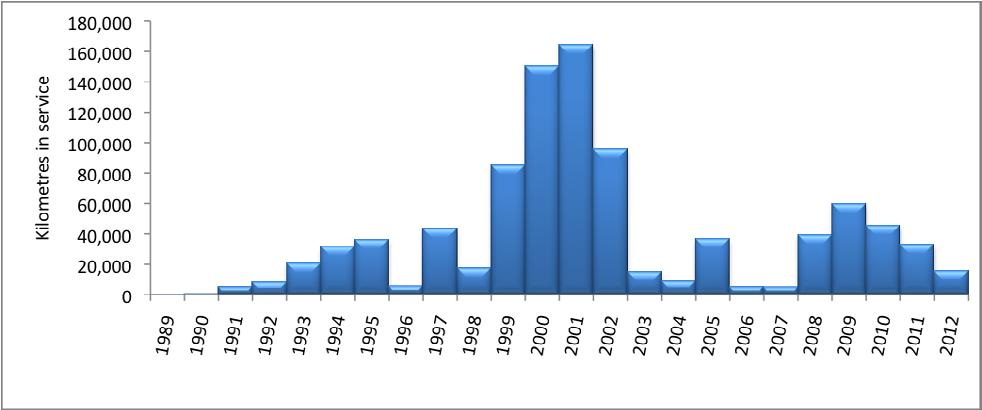
Q3: In which year was most capacity added?
This is perhaps not the hardest question to guess. 2001 saw around 165,000 km of cable enter service that is still active, reflecting the sentiment for required capacity from the Dotcom bubble. 2000 closely followed with a further 165,000 km delivered. Given the lead time in delivering new systems the industry should pride itself actually in anticipating the potential market, even 85,000kms were RFS in 1999. Although the economics turned sour the cables laid at that time continue to provide valuable service, and will continue to do so.
a) 2000
b) 2001
c) 2009
2009 saw around 60,000 km of new capacity added reflecting in part a return of confidence but perhaps a recognition that previously poorly-served routes were now becoming economically viable. SEACOM and TEAMS, for example, offer Sub-Saharan East African fibre connectivity for the first time.
Q4: Which cable system has most landings?
a) ARCOS-1
b) SEA-ME-WE-3
c) SAM-1
With 39 landing stations SEA-MEWE-3 wins a double crown as both the longest system, and the one with most landing stations, a reflection of its complex consortium ownership structure. ARCOS-1 is a ring system in the Caribbean
Figure 2: In service cables
and features 24 landing points providing connectivity to some very small markets such as Belize, Curaçao, The Turks and Caicos as well as the US, Mexico and Venezuela. Many of the segments are very short.
Sam-1 (South America-1) has 15 landing stations, including four in Brazil alone. It has one station fewer than SEA-ME-WE-4 although it is 25% longer.
Q5: Which country has most (international) landing points?
a) France
b) USA
c) UK
Here we have counted the number of cable/stations combinations rather than simply the number of geographical locations. There is then a question of definitions to consider; when is a system international? The Italian Festoon is an example of a domestic albeit submarine system. Is the same true of the Alaska United system that has various landings in Alaska but also connects to Washington and Oregon and thus transits international waters? If we say the Alaska cables are international then there are around 75 landings in the US. The next highest total
of landings becomes the UK with around 60, though that too becomes somewhat grey depending on how you categorise the status of islands like the Channel Islands and the Isle of Man. Next on the list would come Italy and Japan which rank roughly equal. Italy not only hosts connections to regional neighbours such as Croatia, Albania, Malta and Libya but also lands trans-Mediterranean cables at either Catania or Mazara Del Vallo, both in Sicily. France and Indonesia host around 20 international landings each.
Q6: Which country lands most cables?
a) US
b) UK
c) Japan
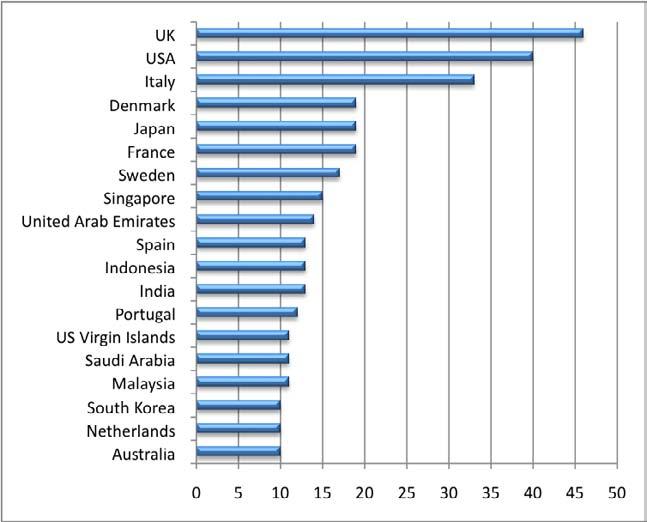
Hang on, isn’t this the same question as Q5? No, it’s subtly, but importantly different. It might seem that the US would the destination for most cables, a destination for traffic from Europe, Asia, the Caribbean and South America and after all it has the most landing points. However with 40 international cables it is actually second
in this category. The UK heads the list with 46 cable systems. Why are the results different than for Q5? Well the answer is in diversity. Many cable systems have more than one landing in the US. Whilst this is in part due to geography the practical consequence is that there is a high level of diversity of connectivity of cable systems landing in the US in case of failure: the average of landings to system is just below 2. For cables into the UK this figure falls to 1.3. As the shore end of a cable is the most exposed to damage there is more risk of a point failure around the shore of the UK taking a whole system out of service than in the US. The ratio for many other countries however is only 1. It does raise the question of whether it might not be prudent to design systems with branching units and diverse landings though there of course issues of increased cost. Recent problems of East Africa demonstrate how connectivity can be very fragile.
Figure 3 shows the countries with 10 or more connecting systems.
Q7: Which station lands most cables?
a) Porthcurno, Cornwall
b) Boca Raton, Florida
c) Fujairah, UAE
Figure 3: Cable systems connecting
This is perhaps a surprising answer and also one due to change. Although Porthcurno has a particular historical position in the world of cables having hosted up to 14 cables in the1930’s, today it is the landing point for 4 cables. The South West of the UK remains a very important area for terminating international cables into
Europe though they are geographically quite well dispersed through a number of stations such as Bude, Sennen Cove, Goonhilly Downs, Pottington and Highbridge.
Boca Raton is in a similar position to Porthcurno. It hosts 4 cables but is one of
6 stations close by on the southern tip of Florida. The New York area has a similar pattern of clustered stations offering diversity.
Fujairah is currently the most concentrated centre, hosting ten systems, closely followed by Mumbai and Jeddah with eight. Fortaleza in Brazil currently hosts six landings but as South America is currently the target for further development may have up to nine systems by the end of 2014.
Q8: Which is the oldest system still in service?
a) UK – Ireland 1
a) UK – France 3
a) Aden-Djibouti
Cables that are decommissioned from commercial service may continue in use for scientific or other uses. Some systems, even comparatively recent ones such as Gemini, have been recovered and sections reused. Until last year the answer to this question was reckoned to be been UK –Ireland 1which was laid in 1988, however after 23 years of service it was taken out if service. There are a couple of cables still in service lain in 1989, UK – France 3 and UK – Channel Islands 7 being examples (if the latter counts as international). Aden-
Djibouti is of 1994 vintage. It is an example of a number of relatively small systems from the early 90’s in service which are often forgotten but provide valuable regional service.
Q9: Which countries have no cable links?
a) Burundi
b) DRC
c) North Korea
Option a) is of course true since it is a landlocked country, one of 44 such sovereign states recognised by the UN. However the country is currently building a fibre-backbone that will allow access through its similar systems in its neighbours to link into the EASSy and TEAMS systems thus spreading the access to the international cable system.
There 33 states recognised by the United Nations with coastlines that, at time or writing, have no active cable links, though there are also a number of dependent territories and outlying islands lacking infrastructure. The Democratic Republic Of the Congo is the largest littoral country in terms of population (71 million) not yet served by a cable though this will shortly change as the WACS system has landed in Muanda and ACE will also connect at Muanda.
Cuba, for long boycotted for political reasons, will gain cable connectivity when ALBA-1 enters service. This cable links Cuba with Jamaica and Venezuela and should be RFS imminently.
The next largest littoral country by population not yet connected to a cable system is North Korea. It seems unlikely that that will change in the near term. When the ALBA-1, WACS and ACE systems go into commercial operation only 23 of the littoral states will be yet to connected to submarine infrastructure.
Q10: What is the shortest international cable route?
a) Denmark-Sweden
b) Denmark-Germany
c) UK-France
Well if there is a longest cable it’s logical that there would be a shortest route. Denmark – Sweden 15 is a mere 5 km. Denmark – Germany 3 is 44 km long. The shortest distance between France and the UK is around 40 km; the Tunnel is around 50km long and carries fibre links. Subsea routes are surprisingly longer, UK – France 3 for example is as long as 55 km.
Hopefully our little quiz has given you some added insight into the increasingly far-reaching and vital asset that it the international submarine cable system.
Simon Brodie is a founding Director of Futures Perfect, a specialist analysis and advisory firm that focuses on identifying and developing growth opportunities from the application of new technology. Simon leads the telecommunications practice and has been involved in a number of feasibility projects for investing in cable systems. Originally trained as an economist, his career has been in the ICT sector.
At this year’s International Telecoms Week, held in Chicago, AP Telecom hosted a Data Gathering Meeting for three of their clients: the Emerald, ASC and Pacific Fiber cables. The purpose of this meeting was to raise public awareness, garner support, and perform a market check on potential pre-sale opportunities.
Though the meeting was scheduled early on Wednesday morning, it was well attended, boasting more than 55 attendees from over 45 companies, ranging from suppliers and installers, to wholesalers and contracted support. Companies that attended ranged from Ciena, AT&T, Apollo, Level 3 and Hibernia to Pacnet, Seacom, Softbank, Tata Communications, and Telefonica. The event was kicked off with Eric Handa detailing Emerald Express, a newly announced system spanning the Atlantic from Ireland the New York.
Following Eric Handa’s presentation, Sean Bergin stepped up and gave details on two systems aimed at increasing available capacity in the Pacific, ASC and Pacific Fibre; ASC is announced to address the need for greater capacity between Perth, Australia and Singapore, while Pacific Fibre is an ambitious system that will span the Pacific, tapping into markets in the US, New Zealand and Australia.
While crowd participation during the question phase of the meeting was slim, many attendees were said to have seen the event as very informative, leaving few questions unanswered. The results of the Data Gather Meeting were reported to be roughly a Terabit of new interest from the participants. AP Telecom has detailed information on the presentation and three systems by request, or on their website.
submarine telecoms INDUSTRy REPORT
This Summer, SubTel Forum will release its first annual Submarine Telecoms Industry Report. The report, sponsored by SubOptic, will serve as the final chapter in a trilogy of products beginning with the Submarine Cable Map and including the Submarine Cable Almanac.
Featuring in-depth analysis and speculation on the submarine cable industry, the Report will serve as an excellent resource for anyone interested in the health of the market. The Report will offer full-color advertisements from some of the industry’s leading businesses. As with all of SubTel Forum’s products, the Report will be available free of charge, to our subscriber list.
Bleeds: n/a Resolution: 300 dpi
$2,500 USD
Ad without bleeds
Size: 5.5” W x 8.5” H
Ad with bleeds
Submarine Cable Systems
and the Rise of Privately Led Builds
Sean Bergin
Historically, the majority of submarine cable systems that have been constructed up until the mid 1990’s were led by a single Telco or consortia of Telco operators. Although still popular, the responsibility for the continued development and expansion of our collective global infrastructure is now largely being shouldered by privately led builds.
As the global capacity market continues to commoditize, you could argue that carriers have made the right decision to simply become buyers of capacity rather than owners of whole systems. This enables carriers to divert more resources (both cash and human capital) towards developing their core asset – their customers. Perhaps this is why privately led systems have become the rule, rather than the exception.
Privately led systems are confronted with significantly different challenges than those faced by Telco led systems. Typically, funding is the most challenging component to overcome with any build, be it Telco led or privately built, so let’s consider this element.
In a consortia led model, by default the equity is already in place. Carriers within the consortia typically have strong balance sheets and underlying demand for the chosen route, therefore debt is the biggest
obstacle. Qualified internal demand, coupled with a minimal level of presales to carriers outside of the consortia is usually all it takes to raise the required debt. By no means is it suggested that this exercise is a walk in the park, but it is certainly less onerous than those looking to establish and fund the build of a private system.
With any privately led build, there are typically three key ingredients in the recipe for success leading to a system
becoming ‘real’, those being debt, equity & committed pre-sales.
In most cases, debt will represent anywhere between 50% – 75% of the total cost to build, leaving the remainder, the equity needs to be found from interested investors. So securing the equity, and providing comfort to the lenders in any new privately led build demands significant capacity sales pre-CIF (Contract in Force with the system builder) as the key to success.
So, if we all want to see the continued expansion of our global networks on both thick and thin routes, we all have a role to play in supporting privately led submarine cable systems. Let’s face it, we all benefit either directly or indirectly by their existence, so it is in our collective interests to see them flourish and proliferate.
Let’s now take a look at some of the supporting roles we can potentially play
in ensuring the continued growth of our sub sea cable industry from both a raw capacity perspective and also route diversity – something that we and carrier’s customers are all enjoying the benefits of today, largely because of private builds.
route, indicative timelines for activation and desired price-points provide system developers with a greater understanding of the viability on a certain route. Even in a non-committal fashion, by simply sharing information in the early days of a cable system’s development and being prepared to go on the journey with the system owner will reap significant rewards once the system becomes a reality. Benefits such as pre-RFS preferential price points and a chance to influence system design to meet specific customer demands are there – in fact, these are some of the key benefits normally associated with building your own system, but without any of the pain.
Buying post-RFS doesn’t help these new systems get built, nor does it help get systems built that meet a carriers specific needs if they haven’t provided input in the early stages of development. Carriers should aim to get in early and have an influence on system design whilst at the back end, reaping the benefits of a significant discount for doing so.
Firstly, carriers need to be prepared to have confidential, yet open discussions with those looking to develop new systems. Indications of potential demand on a given
Submarine Cable Constructors / vendors also have an important role to play. Equipment vendors get behind terrestrial infrastructure rollouts and extend their contribution beyond equipment and
professional advice to vendor finance. Many of the world’s mobile networks would not exist today if it weren’t for this financial support underpinning the projects.
It is interesting to note that the same level of enthusiasm for providing vendor finance does not exist in the subsea segment of telecoms. Perhaps this is something that needs to be re-visited. As
we have learned in the past, there is a fine line between being a system constructor and a network owner and when that line is crossed, significant issues can arise. New vendor finance models need to be explored whereby vendors can participate in helping new systems become a reality, whilst still taking a ‘back seat’ role (or no role at all) in the overall management of the system post RFS.
They might consider taking equity with say a different class of share so they are clearly not setting themselves as an operator. Once the system is in service and generating cash, there is scope for the vendor to sell down their share, recover their cash and go off and help facilitate another new cable build.
In summary, the industry needs private builds to flourish in order to satisfy our never-ending appetite for bandwidth and diversity. It is our responsibility as buyers and users of capacity to do what we can to ensure the success of new builds on a mutually beneficial basis.
Sean Bergin is Co-Founder APTelecom, a global facilities based telecommunications consultancy business with vast industry experience in the commercialization of submarine cable systems and pre-sales capacity sales on all major routes. www.aptelecom.net
Leveraging Subsea Cable Systems for Video Transport Solutions
Erick Contag
When it comes to the Internet, submarine cable systems are a necessity for their ability to provide exceptional speed and reliability at the International level. Subsea cables deliver an enormous amount of capacity— the total carrying capacity of submarine cables is in the terabits per second –providing the fastest and broadest global interconnections available today.
Due to their extraordinary speed and high reliability, global submarine cable systems are ideal for carriers, service providers, and enterprises, as the systems provide ample capacity to meet the growing demand on their networks; and for national governments that view the network as an invaluable asset for their nations’ economies.
When it comes to long-haul video transport, submarine cable systems are, without a doubt, the best option to meet today’s increasing video demands across the globe.
According to Cisco Systems’ Visual Networking Index (VNI), Forecast & Methodology 2010-2015, Internet video will account for over 50 percent of consumer Internet traffic this year. In 2015, Cisco’s VNI predicts that it will take over five years to watch the amount of video that will cross-global IP networks every second. By this year alone one million
minutes of video content will cross the network every second.
The VNI also predicts that Internet Video, which is now roughly at 40 percent of consumer Internet traffic, will reach 62 percent by the end of 2015 – and this does not include the amount of video exchanged through P2P file sharing. With that, the sum of all forms of video, which includes TV broadcast, video on demand (VoD), Internet, and P2P, will constitute 90 percent of global consumer traffic by 2015.
The rapidly growing demand for data and video transport requires more than just traditional satellite services. While satellite services may be ideal for point-tomultipoint applications and distribution of content, submarine cable networks with high performance capacity are designed to easily meet these accelerating bandwidth needs. The bandwidth available using a single fiber optic pair of a modern subsea cable is far greater than what several satellites can provide.1
Lower latency, significant bandwidth, less interference, and lower costs are major benefits of utilizing subsea cable systems versus satellite for high-capacity applications. Specifically, fiber optics experience low and uniform signal loss over a wide frequency range, and are virtually immune to all types of interference. Additionally, subsea cables have the benefit of being shielded from wind, trees, storms and other destructive forces; and will not “short out” in bad weather. Once laid on the bottom of the ocean, cables can be left untouched for 15
to 25 years depending on conditions and location.
Subsea Cable System Ready Today, for Tomorrow’s Video Requirements
GlobeNet, an international provider of world-class transport solutions, and a wholly-owned subsidiary of Oi, Brazil’s leading full-service telecommunications provider, operates a 22,000 kilometer submarine fiber optic cable connecting the Americas.
GlobeNet’s low latency network has provided incredible contributions to key verticals including the fast growing video market. GlobeNet provides video transport services to support tele-conferencing, telemedicine, tele-education, multi-media/ streaming content, and interactive video to enable a phenomenal end user experience, with no delay, interruption or downtime.
Video is a huge part of what is shaping today’s communications – whether it’s for entertainment, business, or education, video is the number one go-to outlet for users across the glob.. In the past, end usersI used to be passive receptors of content. Today,sthey are active participants and contributors to the creation of mediarich content.”
In turn, this creates a challenge not only to telecommunications companies but broadcasters and services providers alike. To meet this challenge, they must be one step ahead in anticipating the market. With the adoption of social networks and cloud computing, Internet users except the best experience – to be able to not only create, view, and enjoy content – but also share more content rich information. To be able to deliver this exceptional end user experience, the distribution of true HD video requires robust and expandable networks supporting leading edge technology such as video streaming, over the top (OTT), and IPTV services.
Video Consumption Soaring in Latin America
The Latin American region is demonstrating solid growth, and it is considered one of the top emerging markets for submarine cable technology. IP traffic is growing the fastest in Latin America, closely followed by the Middle East and Africa, according to Cisco2. The 2012 Latin America Digital Future in Focus report by comScore states that Latin America’s online population increased by 16% to 129.3 million users in December 2011. Online video viewing grew quickly in the region as total videos viewed increased by double digits across Brazil, Mexico, Argentina and Chile.
According to telecom market research firm TeleGeography, Latin America is a burgeoning bandwidth market, with international bandwidth usage growing nearly 9-fold, from 659 Gbps in 2007 to 5.6 Tbps in 2011. “We project that growth will remain strong,” said TeleGeography analyst Greg Bryan, “with total international bandwidth usage reaching 53 Tbps by 2017.”
In anticipation of the upcoming events, such as for the 2013 Confederations Cup, the 2014 World Cup, and the 2016 Olympics – all held in Brazil, GlobeNet, in tight collaboration with its parent company Oi, who is a 2014 World Cup sponsor, is
engineering a new fiber network to access Brazil’s International Broadcast Center.
GlobeNet’s international capacity and Ethernet services are ideal for fulfilling demands for large volumes of video traffic. Media Rights Licensees, Broadcasters and Service Providers can utilize GlobeNet’s reliable, On-net, long term and occasional use video transport to connect the International Broadcast Centers (IBC) in Rio de Janeiro, Brazil to New York and Miami.
“GlobeNet’s network is designed to enable video and multimedia companies to transport and deliver timely and highest quality video and multimedia content across large distances,” added Luiz Alonso, Director of Engineering and Operations of GlobeNet. “This includes timely bursts of high capacity traffic. Additionally, our service level guarantees ensure optimal, lowest latency performance so our customers can deliver content quickly, reliably and with peace of mind.”
Considering the rapid advancement of video technology in today’s world, it is safe to presume that the telecom industry’s vision from ten years ago – “anytime, anywhere, any device” is being realized.
Companies such as GlobeNet are at the forefront of these technological advancements in supporting such vision. With the take-off of video communications, social networking, and cloud computing, subsea cable systems and fiber-based terrestrial networks are the market’s answer for high capacity, secure, reliable network infrastructure that will allow a truly exceptional end user experience.
Erick Contag is the Chief Operating Officer for GlobeNet. Mr. Contag brings more than 20 years of sales, marketing, business development, strategy and corporate management expertise to GlobeNet. His responsibilities include strategic management of the company's business operations as well as growing the business into new regions.
Protection Of Submarine Cable Landfall In arctic Waters
Jorn Jespersen
This article addresses the project on Horizontal Directional drilling of tunnels to install conduits from the beach man hole out to 200 meters of water depth and make new landfalls to the Greenland Connect Submarine cable beneath the bedrock.
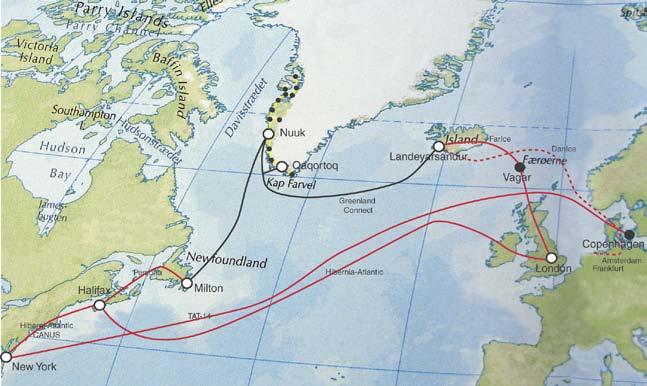
In 2006 Tele Greenland’s management team presented the “Greenland Connect” prospect to the management board. Greenland Connect is a submarine cable project connecting Greenland to Europe and North America. The solution is based on 20 year long backhaul agreements providing Tele Greenland backhaul traffic from landing sites in Iceland and Newfoundland to London and Halifax, where interconnect and IP peering can be traded at market conditions. The submerged cable system was planned as an amplified dual fiber link with the capacity of 2 times 128 wavelengths of 10Gb/s. Landing stations are established in Landeyersandur near Vest Manna Islands in Iceland, Qaqortoq, Nuuk in Greenland and Milton in Newfoundland. Landing sites accommodates high voltage power supply systems for the submerged optical amplifiers and transmission equipment for the DWDM- system. Tele Greenland’s financial position is strong and allowed for 100% company ownership and the business case has positive NPV in a less
than 20 year time span. Commissioning of Greenland Connect in March 2009 has brought Greenland’s technology status up from a satellite based backhaul with long latency and low speed to modern telecommunications quality similar to Europe and USA. Hence traffic volume has been growing with the same market trend as the business experience in all other modern societies. The system has been performing as expected and very few errors have occurred in the land based equipment. The system has not suffered any errors in
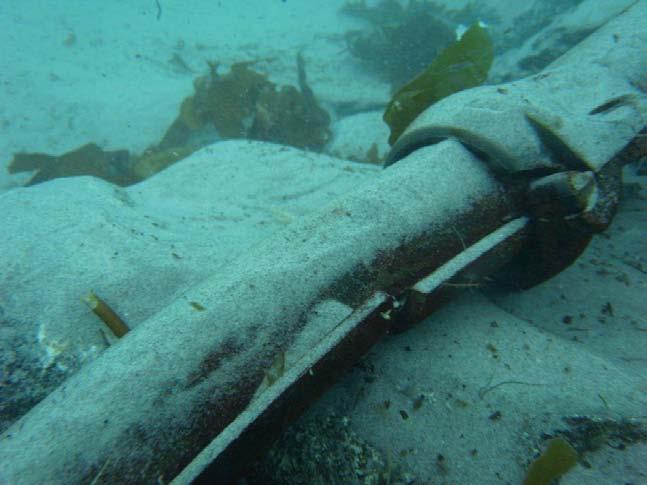
the wet segment, besides the 4 occasions addressed in this article. Greenland Connect has since its installation on 4 occasions been damaged by glacial ice stranding on top of the cable during its natural passage through the Godthåb fjord. All 4 encounters have caused damage close to the shore in shallow water. During the desk survey and wet survey, several candidates for landing of all segments shore ends, were analysed thoroughly and conclusion was that the two Nuuk landings were the best alternative. However reality shows that the landfalls near the coast has been damaged 4 times due to external
aggression from glacial Ice. First incident was in the winter 2009 and had no customer impact since it happened before system was taken into active services. Three other incidents happened in the winter 2010 – 2011. On all occasions the repair procedure has been replacement of the entire shore end to approximately 1000 meters from the beach. The systems 100% logical protection of all national services and automatic rerouting has secured
effective contingency. Transatlantic carrier customers have unfortunately had inconvenience during the winter 2010 –2011 since their traffic was interrupted during the cable damage. All damages has been repaired under the maintenance agreement with Alcatel Submarine system and the repair process has been exercised professionally as described in the service level agreement. Mobilization and spare part logistics was managed by the book
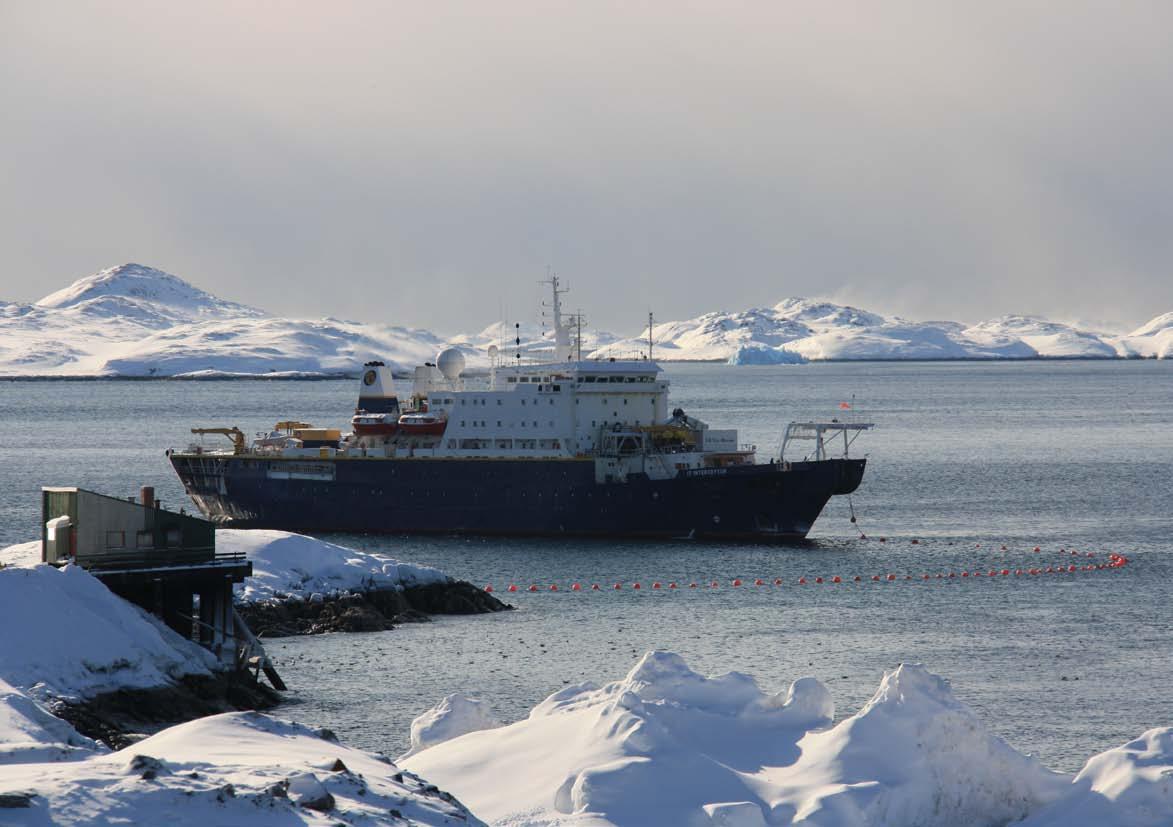
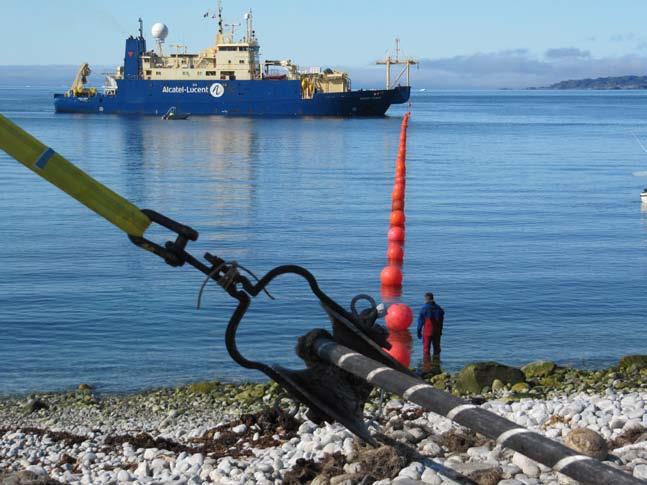
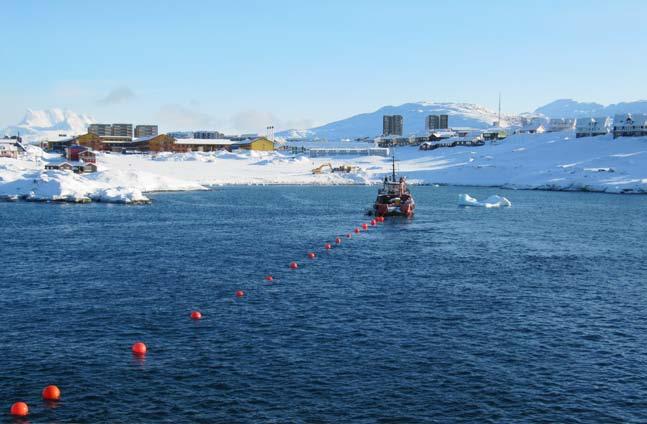
and repair time could not be optimized given the long vessel transit time and arctic winter conditions. Three different vessels were involved in the work with the opportunity for the Tele Greenland staff to learn the working routine and atmosphere on board the different vessels; Peter Faber, Fladbed vessel with mobile spread Mariner Sea, and IC Interceptor. Local vessel Mads Alex Viking has assisted all cable ships involved in the repair operations.
In the beginning of 2011 it was evident that an unstable landing in Nuuk was unacceptable both due to expensive repairs but also to support carrier sales it was important to eliminate all weak spots in the cable system. The management team decided to pursue an efficient protection of the cable system. As a first step Tele Greenland ordered a report on the various options from the Canadian company C-Core. Report from C-core concluded that Glacial Ice in the fjord could have depths of 200 meters and consequently the landfall had to be protected to that depth corresponding to 1000 meters from the coastline. The report analysed an option of covering the cable with a thick layer of stones boxed in a steel grid box to prevent erosion of the material in the heavy tidal currents. Conclusion was that this solution is easy to implement, but do not give efficient protection.The ridge
created on the seabed from this protective cover might even catch icebergs and make everything worse. Fencing of the water surface to guide icebergs away was also abandoned at an early stage due to the
large mass of the icebergs combined with the rough weather conditions and large tidal differences at the site.
The only efficient solution at hand
was Horizontal Directional drilling of both landfalls in two tunnels to keep physical separation and redundancy. Tele Greenland started a cooperation with consultancy company Sound and Sea
Technology (SST) to scope and tender the work. Danish Geological Institute GEUS was contracted to deliver a desk survey of the geological features in the target area. In the early spring of 2011 a tender was formed and submitted as a public bid according to Greenlandic legislation. Four bids were received and one bid rejected at time of opening. Three bids were feasible and roughly even, but the reservations in the bids placed Tele Greenland in an unpredictable situation and the budget could potentially exceed the pain threshold.
After rejection of the public tender an ice protection program was put in place where local vessel Mads Alex was set on standby to push dangerous ice away from the position of the cable landing. Video surveillance with night vision sight was put in place and these protective actions have worked in a sense that no ice damage has happened even though Greenland have had rough winters with massive glacial ice in the fjord.
It was clear that a bid with more narrow financial predictability called for a more detailed specification. A contract was made with Scottish company Caley Survey that at the time undertook advanced seismic surveys for the oil industry in the waters west of Greenland. Caley Survey had an
equipped ship, Kommandor Stuart with very advanced seismic equipment. First and foremost the permit to undertake seismic surveys in these waters that are habitat for a wide range of maritime mammals had to be obtained. The authorities played this application very accommodating and the possibility to study the impact of seismic survey impact on maritime mammals was utilized, Tele Greenland hired a professional
Maritime mammal observer and invited the authorities and biologists from The Greenland Nature and Environmental Institute on board the Kommandor Stuart during the entire survey.
SST Geologist planed the route and was Tele Greenland’s representative on board. The exit holes of the tunnels had to be decided on the fly since the environmental permit required photo documentation
of the seabed before the drilling and also several samples of the seabed. Samples should be kept sealed and frozen and hence compared with samples after drilling to document no pollution due to spill of drilling mud.
Based on the seismic survey, Caley Survey submitted the geological report in October 2011 and the new and more precise scope and tender document was prepared by Tele Greenland and SST in December 2011. The major change in the scope compared to the public tender was, that same launch
site would be used for both landfalls, to cut mobilization cost. In previous tender launch site was at the original cable positions. Moreover the geological information was of a much better quality, which is obvious as a wet survey with a scientific vessel is cumbersome compared to a desk survey. Since the response to the open tender was limited the legislation opened for an invited tender and material was send out to three contractors in the beginning of January 2012. A pre tender seminar was hosted by SST with an aim to cater for the tenderers’ comments in
the tender documents. All three invited contractors submitted thorough bids and SST scored all qualifications and prices in a comprehensive matrix. Negotiations were exercised during the Spring and a letter of acceptance was granted 20. February to the Dutch company Visser & Smidt Hanab(VSH). VSH has extensive Horizontal directional Drilling experience, and a good track record .The construction site has been mobilized through April and drilling commences in the beginning of June.
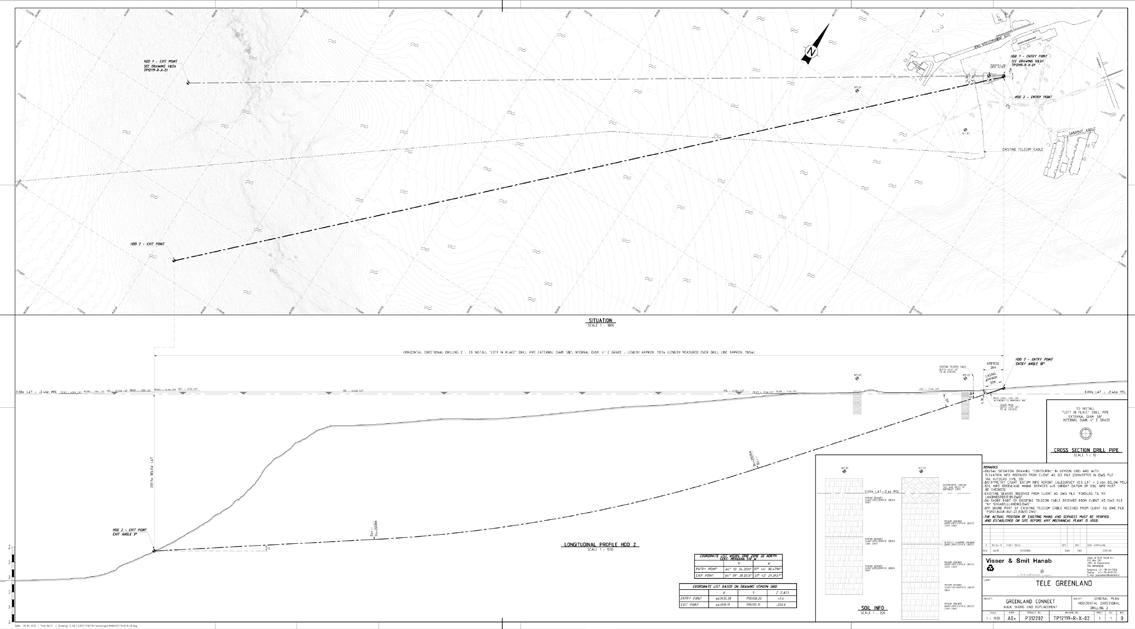
Two tunnels at 12” diameter will be drilled from the launch site to a water depth of 200 metres. The tunnels will be +1100 meters long. The tunnel trajectory will follow a vertical position more than 7 meters beneath the seafloor. The exit is carefully planned to be at a suitable position where the otherwise steep sloping seafloor is relatively flat, at a plateau from the little ice age. This position secures that cable does not suffer any sharp downward bend at the exit.
A 5,25” steel pipe conduit will be installed from the beach man’s hole vault to the tunnel exit. Conduits are heavy pipes with threads connections at each ends. The inner diameter of 4 inches gives a wall thickness of 22mm. Conduits must meet quality standards and have no shoulders
or edges at the inner wall. The conduits will be pushed from land through the tunnel equipped with a so called “bull nose” at the far end. Bull nose is a rounded piece of conduit, with multiple nozzles at the end, to flush small obstacles away during installation. When conduit reaches the exit, the bull nose will be removed by a Remotely Operated Vehicle (ROV) and replaced with a so called “bell mouth”. A bell mouth is a funnel shaped devise that is tailored to a 5,25” conduit and shall guide the cable into the conduit when installed from the sea end. The plan is to
Jorn Jespersen, Chief Technology Officer of Tele Greenland, has long experience from various senior managerial positions in the telecoms industry.
TDC, Ben/T Mobile, Mobilix, Orange, Telia Sonera. Currently managing a major refurbishment of the entire Grenlandic teleinfrastructure pertaining; Microwave backbone swap, IMS implementation, Comprehensive Mobile optimization programme, submarine cable project and many others.
bore between 40 and 60 meters per day during a 12 hour working day.
The marine operation is contracted as a separate operation and the scope is to install the new landfall from the sea end through the bell mouth and conduit to be connected to the land cable at the vault. Hence the new landfall cable piece is connected to the old wet segment. The land cable is connected in the same planned outage slot to give minimal impact to the transatlantic carrier customers.
Back Reflection
by Stewart ash
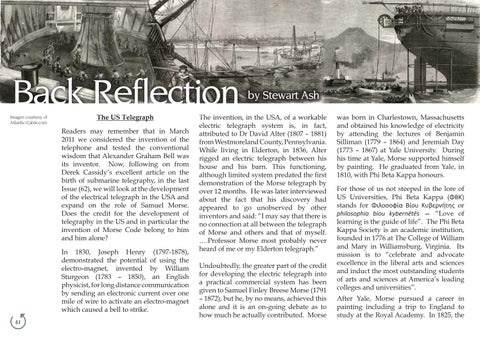
The US Telegraph
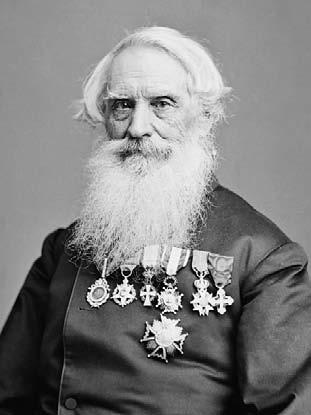
Readers may remember that in March 2011 we considered the invention of the telephone and tested the conventional wisdom that Alexander Graham Bell was its inventor. Now, following on from Derek Cassidy’s excellent article on the birth of submarine telegraphy, in the last Issue (62), we will look at the development of the electrical telegraph in the USA and expand on the role of Samuel Morse. Does the credit for the development of telegraphy in the US and in particular the invention of Morse Code belong to him and him alone?
In 1830, Joseph Henry (1797-1878), demonstrated the potential of using the electro-magnet, invented by William Sturgeon (1783 – 1850), an English physicist, for long distance communication by sending an electronic current over one mile of wire to activate an electro-magnet which caused a bell to strike.
The invention, in the USA, of a workable electric telegraph system is, in fact, attributed to Dr David Alter (1807 – 1881) from Westmoreland County, Pennsylvania. While living in Elderton, in 1836, Alter rigged an electric telegraph between his house and his barn. This functioning, although limited system predated the first demonstration of the Morse telegraph by over 12 months. He was later interviewed about the fact that his discovery had appeared to go unobserved by other inventors and said: “I may say that there is no connection at all between the telegraph of Morse and others and that of myself. ….Professor Morse most probably never heard of me or my Elderton telegraph.”
Undoubtedly, the greater part of the credit for developing the electric telegraph into a practical commercial system has been given to Samuel Finley Breese Morse (1791 – 1872), but he, by no means, achieved this alone and it is an on-going debate as to how much he actually contributed. Morse
was born in Charlestown, Massachusetts and obtained his knowledge of electricity by attending the lectures of Benjamin Silliman (1779 – 1864) and Jeremiah Day (1773 – 1867) at Yale University. During his time at Yale, Morse supported himself by painting. He graduated from Yale, in 1810, with Phi Beta Kappa honours.
For those of us not steeped in the lore of US Universities, Phi Beta Kappa (ΦΒΚ) stands for
or philosophia biou kybernētēs — “Love of learning is the guide of life”. The Phi Beta Kappa Society is an academic institution, founded in 1776 at The College of William and Mary in Williamsburg, Virginia. Its mission is to “celebrate and advocate excellence in the liberal arts and sciences and induct the most outstanding students of arts and sciences at America’s leading colleges and universities”.
After Yale, Morse pursued a career in painting including a trip to England to study at the Royal Academy. In 1825, the
city of New York commissioned Morse to go to Washington and paint a portrait of Gilbert du Motier (1757 – 1834), marquis de Lafayette. While Morse was painting the portrait he received a letter from his father that was delivered to him by a messenger on horseback. The letter contained one line, “Your dear wife is convalescent”. Morse immediately departed Washington for his home at New Haven, leaving the portrait of Motier unfinished. By the time he arrived, his wife was dead and had already been buried. Heartbroken in the knowledge that, because of the distance between them, he had been ignorant of his wife’s failing health and her lonely death, he quit painting and, from that moment on, dedicated himself to discovering a means of rapid long distance communication.
On a sea voyage home in 1832, Morse encountered Charles Thomas Jackson (1805 -1880), a man who introduced him to electro-magnetism. Having witnessed various experiments of Jackson’s with electro-magnets, Morse was able to develop his concept for a single-wire telegraph.
While a professor of arts and design at New York University, Samuel Morse proved that signals could be transmitted by wire. He used pulses of current to deflect an electro-magnet, which moved a marker to produce written codes on a strip of paper. However, these experiments were over very limited distances and
Morse encountered significant problems in getting a telegraphic signal to carry over more than a few hundred yards of wire. This problem was resolved with the assistance of Professor Leonard Gale (1800 – 1883), who taught chemistry at New York University. With Gale’s help, Morse introduced extra circuits or relays at frequent intervals along the line and was then able to send a message over a distance of ten miles (16 km) of wire.
At this stage a new character entered the story, one Alfred Lewis Vail (1807 – 1859). Vail was born in Morristown, New Jersey and was educated at Norris academy
before, in line with his father’s wishes he took a job as a machinist at the local Speedwell iron works that was owned by his father Stephen Vail (1780 – 1864). On obtaining his majority, Vail determined to study for the Presbyterian ministry and he enrolled at New York University, to study theology in 1832; here he was an active and successful student and a member of the Eucleian Society, graduating in 1836. While visiting his alma mater on 2nd September 1837, he happened to witness one of Morse’s early telegraph experiments. He became fascinated by the technology and proceeded to negotiate an arrangement with Morse whereby he could develop the technology at Speedwell at his own expense in return for 25% of the proceeds. Having secured his father’s financial backing, Vail proceeded to refine Morse’s crude prototype to make the telegraph system suitable for public demonstration and commercial operation. The first successful completion of a transmission with this system was at the Speedwell Iron Works on 6th January 1838, across two miles (3.2 km) of insulated wire. The message read “A patient waiter is no loser.”
Morse and Vail made the first public demonstration of the electric telegraph on 11th January 1838. Although Morse and Vail had done most of the research and development in the Speedwell ironworks facilities, they chose a nearby factory as the demonstration site. Without the relay the range of the telegraph was limited to two miles (3.2 km), and the inventors had
pulled two miles (3.2 km) of insulated wires inside the factory. The demonstration was witnessed by a small number of, mainly, local people. Over the next few months Morse and Vail demonstrated the telegraph to Philadelphia’s Franklin Institute, members of Congress, and President Martin Van Buren (1782 – 1862) and his cabinet. At an exhibition of his telegraph, in New York, Morse transmitted ten words per minute using what was later to become known as Morse Code.
Later in 1838 a trip to Washington D.C., failed to attract federal sponsorship for a telegraph line. Morse then travelled to Europe seeking both sponsorship and patents, but in London he discovered that Cooke and Wheatstone had already secured the world’s first patent for an electrical telegraph on 12th June 1837. Morse’s US patent 1,647, was applied for on 7th April 1838 and was eventually granted on 20th June 1840.
As an experiment and in the quest for financing, in 1842, Morse and Vail laid and insulated wire across New York Harbour using a rowing boat hired for the purpose. Morse ran an announcement in the New York newspapers that invited people to come and see how the telegraph worked. There were two telegraphs on opposite sides of the harbour, these were connected to the insulated wire and Morse and Vail proceeded to demonstrate the electric telegraph. The demonstration excited little or no interest as the general
accepted public view was that it could never work. The following morning, the wire was found to be broken and further demonstrations were cancelled. Later that same year, Morse and Vail conducted a similar experiment across a canal in Washington D. C., but once again it generated little enthusiasm.
In 1843 the U.S. Congress appropriated $30,000 to fund an experimental telegraph line from Washington, D.C. to Baltimore. By 1st May 1844, the line had been completed from the U.S. Capitol to Annapolis Junction in Maryland. That day the Whig Party nominated Henry Clay (1777 – 1852) at its national convention in Baltimore. News of the nomination was hand-carried by railroad to Annapolis Junction where Vail sent it, over the telegraph, to Morse in the Capitol. On 24 May 1844, after the line was completed, Morse made the first public demonstration of his telegraph system by sending a message from the Supreme Court Chamber in the U.S. Capitol in Washington, D.C. to the B&O Railroad “outer depot” (now the B&O Railroad Museum) in Baltimore. The famous message was: “What hath God wrought” which was taken from the Bible, Book of Numbers, Chapter 23: Verse 23:
“Surely there is no enchantment against Jacob, neither is there any divination against Israel: according to this time it shall be said of Jacob and of Israel, What hath God wrought!”.
Vail split his 25% share of the business with his brother George. However, when
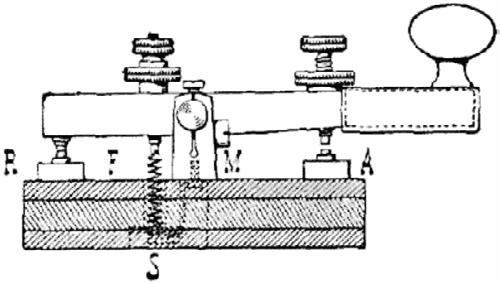
Morse took on Francis O.J. Smith (1806 – 1876), a congressman from Maine, as a partner, he reduced Vail’s share to oneeighth. Vail took charge of building and managing several early telegraph lines, installed between 1845 and 1848. He was also responsible for several technical innovations to Morse’s system, particularly the sending key, improved recording registers and relay magnets. However, Morse retained patent rights to everything Vail developed.
Vail left the telegraph industry in 1848 because he believed that the managers of Morse’s lines did not fully value his contributions. His last assignment, superintendent of the Washington and New
Orleans Telegraph Company, paid him only $900 a year, leading Vail to write to Morse, “I have made up my mind to leave the Telegraph to take care of itself, since it cannot take care of me. I shall, in a few months, leave Washington for New Jersey, ... and bid adieu to the subject of the Telegraph for some more profitable business.”
There has been and remains some controversy over whether Vail or Morse invented “Morse Code”. Morse’s first telegraph device, unveiled in 1837 produced an EKG-like line on a reel of tape. The dips in the line had to be decoded into letters and numbers using a code dictionary that Morse spent several months compiling. The problem with this method was that it depended on the pen or pencil marking the tape clearly, which did not always happen. In 1838, an improved system, using the familiar dot-and-dash code to represent the letters of the English alphabet and the ten digits, was introduced. This coding system was
significantly better, as it did not require printing or decoding, but could be “sound read” by operators.
What is clear is that the dotand-dash code did not appear until Vail joined Morse and the argument for Vail’s invention of it has been set out by a number of scholars. Vail was also credited, in his lifetime, as the inventor by Franklin Leonard Pope (1840 –1895), who later became a partner of Thomas Alva Edison (1847 – 1931). Morse supporters state that Morse originally devised the cipher code along similar lines to that used in existing semaphore telegraphs. Words were assigned threeor four-digit numbers and entered into a codebook. The sending operator converted words to these number groups and the receiving operator converted them back to words using the same codebook. This part, at least, is undisputed by Vail supports. However, the Morse supporters then justify his invention of the dot-anddash code by claiming that, in public and private writings, Vail never claimed this code for himself. According to one researcher, in a letter from Vail to his father, sent in February 1838, Alfred Vail wrote, “Professor Morse has invented a new plan of an alphabet, and has thrown aside the dictionaries.” It is also claimed that, in an 1845 book, where Vail wrote describing Morse’s telegraph, he also attributed the code to Morse.
Whether Morse or Vail invented the code is perhaps academic, because although the dot – dash form of code has been in use for more than 160 years — longer than any other electrical coding system – what is called Morse code today is actually somewhat different from the code that was originally developed by Morse and or Vail. The Modern International Morse code, or continental code, was in fact created by Friedrich Clemens Gerke (1801 – 1888) in 1848, and was initially used for telegraphy between Hamburg and Cuxhaven in Germany. Gerke changed nearly half of the alphabet and all of the numerals in Morse Code in order to align the length of each code for a characters with the frequency that it is transmitted. This adaptation resulted in the basis of what forms the modern form of the code. However, some further minor changes were made to the code before International Morse Code was standardized at the International Telegraphy Congress in 1865 in Paris, and later International Morse Code was made the standard by the International Telecommunication Union (ITU). After this the Morse/Vail original code system, which was largely limited to use in the United States and Canada, became known as American Morse Code or railroad code. American Morse Code is now seldom used except in historical re-enactments.
Conferences
Submarine Networks World Africa 2012
21-24 May 2012
Johannesburg, South Africa
Website
Submarine Networks World 2012 11-13 September 2012
Singapore
Website
PTC'13
20-23 January 2013
Honolulu, USA
Website
SubOptic 2013
22-25 April 2013
Paris, France
Website
Issue Themes:
January: Global Outlook
March: Finance & Legal
May: Subsea Capacity
July: Regional Systems
September: Offshore Energy
November: Subsea Technology
Advertising enquiries:
SALeS MANAgeR
Kristian Nielsen
Tel: +1 (703) 444-0845
Email: knielsen@subtelforum.com
by Kevin G. Summers
There's lots of excitement around the SubTel Forum offices, as usual. As you are probably aware, the latest edition of our Submarine Cable Almanac was released last week and the comments (and updates) are flying in.
Here are just a few of the comments that have crossed my desk:
Great initiative Kevin, this is very helpful!
-Patrick Pohlmann
Thank you for sending me this valuable resource.
-Simon Fletcher
Thanks a million for the information Kevin. This is a very useful report.
-Ebe Raso
I sincerely appreciate the almanac.
-Philip Pilgrim
Many thanks for this Kevin
-Brian Benson
I want to thank everyone who has sent us feedback, it will be used in the next editon later this year. SubTel Forum is a community, and thanks to our astute readers, it is one that will continue to improve.