CONTRIBUTING WRITERS: Stewart Ash, Kent Bressie, Derek Cassidy, Madeleine Findley, Jim Lemberg, Andrew D. Lipman, Keith Schofield, Christian von der Ropp
Submarine Telecoms Forum magazine is published bimonthly by Submarine Telecoms Forum, Inc., and is an independent commercial publication, serving as a freely accessible forum for professionals in industries connected with submarine optical fiber technologies and techniques. Submarine Telecoms Forum may not be reproduced or transmitted in any form, in whole or in part, without the permission of the publishers.
Liability: while every care is taken in preparation of this publication, the publishers cannot be held responsible for the accuracy of the information herein, or any errors which may occur in advertising or editorial content, or any consequence arising from any errors or omissions, and the editor reserves the right to edit any advertising or editorial material submitted for publication.
Contributions are welcomed. Please forward to the Managing Editor at editor@subtelforum.com.
Submarine Telecoms Forum, Inc.
21495 Ridgetop Circle, Suite 201 Sterling, Virginia 20166, USA subtelforum.com
Welcome to the 62nd issue of Submarine Telecoms Forum, our Finance & Legal issue.
March Madness is once again upon us.
To anyone outside of the USA, or even UK Prime Minister David Cameron’s inner circle, this may mean little. But to us here in the Commonwealth of Virginia or the people in the other 49 American states, it is a month of heroes, upsets and trepidation. Stories of David versus Goliath or basketball behemoths versus regional wonders abound. Descriptions, such as “epic” or “stunning” or “apocalyptic” are commonplace. We compare “brackets;” even our President has a “bracket.”
And then we read that not only does March Madness cause lifetime gambling problems, but also a drop of business productivity on the order of $70M!
It must be March.
March has also brought new, green shoots of flowers and grass to the browned landscape. Soon, what was a relatively mild winter will be completely gone, and in its place will be the sights and smells of
spring and the abundance of the summer beyond.
In this world of economic and geo-political stress I take solace in the thought of all that is yet to come this year, and the promise of spring. As William Shakespeare wrote in Richard III: “Now is the Winter of our Discontent; Made glorious summer by this sun of York…”
Maybe the madness and promise that is March will indeed bring a more interesting and productive time to the year ahead.
News Now
Ancotel in Frankfurt Selected by Cable&Wireless Worldwide to be one of three EPEG Terrestrial Landing Stations in Western Europe
ASSC-1 Announce Perth to Singapore Submarine Cable System
Australia Japan Cable Upgrades Submarine Link with Ciena 40G Coherent WaveLogic Technology
Axin and Huawei Marine Finalize Survey Agreement for Optikor Network
Bezeq International and Alcatel-Lucent turn up ‘JONAH’ Billionaire Ambani Said to Plan $1.5 Billion IPO of Submarine Cable Unit
Cable&Wireless Worldwide Selects Infinera CAT diagrams its backhaul overhaul
Ciena Widens Leadership in High Speed Optics with Innovative WaveLogic 3 Technology
Cross River Fiber Completes the Construction of an Express Fiber Route Between Carteret and Newark New Jersey
DeepOcean Group Holding AS Names Frank Eggink as CFO
Djibouti’s IP hub guarantees access to the Global Internet to Operators and Service Providers in East Africa despite recent triple submarine cables outage
Du undersea cable cut
E-marine expands its Salalah Storage Facility to match rising customer demand
EASSY Cable Repairs to Take 2 Weeks
EASSy downtime may last for days
East Africa undersea cable outage enters third week
Emerald Networks Signs A System Supply Contract For New Generation Trans-Atlantic Fibre Optic Cable System
EPEG - New submarine cable to link Oman with Europe
EUROPA and ALEXANDROS to enhance connectivity between Middle East and Europe
First Israeli-owned high-speed cable system goes live
GBI lands submarine cable in Iraq
GlobeNet And TE SubCom Begin Construction Of BermudaUS (Segment 5) Replacement
Gulf Bridge International And TE Subcom Achieve Status Of Ready For Service For The GBI Undersea Cable System
Huawei Marine Launches BDM Cable System Solution
Italian Cable Co’s Patents Make Their Way To Google
Lighthouse R & D Enterprises, Inc. 4000-m-rated physical oceanographic monitoring system reaches two-year milestone
LION2 submarine cable goes live in Kenya in April
Main One builds own network infrastructure
Pacific Fibre And TE Subcom Complete Permitting Study For Trans-Pacific Subsea Cable System
Pacnet Expands 10G IP Transit Service
PLN to lay $2b submarine cable from Sumatra to Java
Polatis 192x192 Optical Switch Enhances Availability of High-Performance Terrestrial and Undersea Networks
Rwanda: Govt Intervenes to Address Internet Disruptions
SAex cable plans on track: eFive CEO
Scripps Researchers, Noaa And TE SubCom To Implement Science Ports On Transoceanic Fiber Optic Cable Lines
Seaborn Networks To Deploy First Submarine Cable With Direct Route Between US And Sao Paulo, Brazil
SEACOM Signs Capacity Agreement with Mozambican Ministry of Sscience and Technology
Southern Cross Capacity Up and Price Down - Again
SubOptic supports internationally significant Porthcurno Telegraph Museum
TE Subcom Marks Crucial Milestone Toward Delivering World’s First Ultra-High Capacity, 100g-Based, New Undersea Cable System
Iam acquainted with the general manager of a service provider who tells an interesting tale: His company makes up about 1% of the parent corporation’s total revenues, but because his unit is high-tech, he sits on some senior groups within the corporation. He recently helped evaluate technologies for another unit’s project and subsequently participated in the analysis of that project’s likely cashflfow. His own professional assessment was that the project had equal chances of losing or making money. In his words, “Nobody can tell for sure which way certain trends will turn, and the models show that small changes in those trends have huge impacts on the cashflows. It’s basically a blind bet.” Some of his colleagues shared his views and opposed the project. Others, mostly within the group that “owned” the project, were convinced that the project would bring in a pile of cash and position the corporation as a forward-thinking leader within the marketplace.
We’ve all been there, in one way or another. Should we do the project? Should we stand pat? One group sees it as an opportunity for huge success. Another bunch is convinced nothing but disaster waits around the corner. And the judgments are rarely onehundred percent objective. The group that thinks the project is bound to succeed in a big way will have to hire 25 new staff if the project moves forward. The group that absolutely knows the project is doomed from Day 1 will become an after-thought in the larger company picture if the project is pursued.
So, how do some of the dynamics play out as the dollars and cents of submarine cable systems get studied? Who asks what kind of questions and why do they ask those questions? And how well do the risks of these projects get measured? Let’s roll up our sleeves and try to dig in for some answers.
I understand that you have a submarine cable project in mind and think that I can help assemble finance. Please tell me what you’re thinking. Why should I decide to help you out? What makes this a worthy effort? Well, with whom might I speak on your behalf? To whom might I present your project as deserving financial support?
financing, the mix of equity and debt financing, and the assessment of risk. Much more can and should be said about this subject, but time and space limit what we put our hands to at the moment.
Sources Of Financing
Before we actually get started on this quest, remember that, in most cases, we are not looking simply for tens of millions of dollars. We will most likely need hundreds of millions, and those funds may need to come from more than one source and arrive at different times in the project. So, we will very possibly need to assemble a team of folks to chase down this pot of gold, with each member having a network of professional and personal contacts to get us in the door of one or two particular funding sources.
This humble little article will only quickly visit three broad areas related to financing these large capital projects: sources of
The first pool of potential project investors is the world’s communications services providers. In point of fact, the service providers used to be the underlying owners and operators of submarine cable systems. Today, however, things have become a bit more… varied. To a significant extent, the ownership and operation of these systems has become a bit of a niche, in many cases at least one step removed from the true communications service provider. Having said that, we will want to at least explore the possibility of one or more service providers playing a leading part in your project.
The next obvious source is the commercial banks and financial institutions of the nations involved in your project. This includes both the countries in which your system will land and the countries that are home to the (potential) manufacturers of your infrastructure. In each case, those institutions likely have some vested interest in continued investment into their nation’s communications infrastructure. They may especially find themselves motivated to participate in an opportunity that holds the promise of bringing money into the national economy via the project’s manufacturer(s) and/or installer(s).
A third group of sources are various large commercial entities for whom communications infrastructure plays a strategic role. Some of these newer players anticipate a significant and growing requirement for robust networks to transport data literally around the world. Where such global entities previously expected traditional service providers to be the parties directly involved in submarine cable project development, these new entities possess a confidence and initiative that – when combined with mountains of cash – results in their eager entry to project participation. If you are fortunate enough to have targeted countries or regions into which they wish to gain or maintain strategic position, you could find yourself with a rich friend.
A fourth group exists that is sometimes overlooked or downplayed as far as participation in submarine cable system projects. Insurance companies and large investment groups have significant amounts of funds which they need to invest. The challenge with these players is that they might not have previously participated in a project such as yours. That is decreasingly the case, however, as such projects are becoming somewhat more widely known around the world. Having said that, you will have some interesting discussions with these funding sources about the various risks in your project (and which we will address in a moment).
your partners. We’ll talk about this in a moment when we talk about the mix of equity and debt financing. It’s enough for now to observe that any other project financial supporters will expect you to have made the first investment.
A fifth group of potential (actually, necessary) project investors is you and
Lastly, are you perhaps proposing to offer significant connectivity to a country or group of countries that have limited access to the outside world at present? Maybe you think the nation you propose to serve is well-positioned to take advantage of advanced communications technologies. Perhaps the country is widely perceived as needing advanced connectivity… so much so that even the World Bank might be willing to lend its strength to the effort. This is one possibility: political clout standing ready to support your very worthy project that promises to bring genuine opportunities for advancement to the countries in which it will land. Indeed, this has been a significant part of projects in recent years in both the African and Asia-Pacific parts of the world. Another recent European regional project that is not quite ready to create lots of public fanfare is reported to have obtained similar financing guarantees for 50% of its debt. These backstop provisions have at least two impacts on project financing: (i) bankers are significantly more willing to consider lending money under such conditions; (ii) the risk of nonpayment is significantly mitigated. Both are good for you!
Although we are not going to talk about it in detail, any potential investor (debt or equity) will expect you to have created a comprehensive business plan that at least includes:
• Market research about…
• Traffic demand
• Bandwidth available on existing infrastructure
• Other planned infrastructure
• Bandwidth pricing & trends
• The technologies your project will employ, including the project’s future expandability
• Rough order of magnitude costs to purchase, install & commission system
• Pro forma financial statements, including timing & type of investments required
• Management & staffing plan, including directly related previous experience
• Sales & marketing plan
• Network operating plan, including marine maintenance provisions
Equity & Debt
Before we go any further, let’s remind ourselves that some party is going to have to be the first to put cold hard cash into this adventure. And since it’s your idea, you are in the best position to appreciate its value and be Investor Number One. Subsequent investors will almost certainly expect you to have somehow put your skin into this game. And cash is considered the most valuable of skins.
You will possibly be tempted to substitute sweat-equity for cash. Depending upon how attractive potential investors will realistically see your project, you may decide to resist the easy path of sweat equity. If you have any uncertainty about how others will view your project, consider becoming its first equity investor. Form a legal entity, fund it with your own cash and pay yourself as you go about early project development activities. Most of this will be moving money from your left pocket to your right pocket. Depending upon specific conditions, some of your initial investment will likely not complete the journey from left to right pockets, but will instead end up in the government’s pocket via payroll taxes. As painful as that may be, consider it the cost of persuading subsequent investors to give your project a serious look.
If you choose to structure your initial project investment as debt, it will carry a similar message to that of an equity investment, but with less impact because it implies that you expect repayment from the project’s cashflows. On the other hand, the implicit message of equity is that you expect to get your money back, perhaps through dividends but more likely through a buyout (which in turn
implies a third party’s being able to clearly see value in the project).
As a result of having talked with system suppliers and having developed pro forma financials, you will know approximately how much funding the project will require and when those funds will be needed. You will also have some sense of how much debt service the project can support and when principal payments can be made. The sooner the debt can be repaid, the better both for the project’s cashflows and for the lender’s comfort. Having said that, an overly aggressive plan for debt repayment runs the risk of stressing the project’s cash position. Potential investors will want to see a realistic plan that maintains prudent cash reserves for unforeseeable developments.
If you plan to market equity investments into your project, you need to be prepared to answer the question of how the investor will recover his money. Although we mentioned dividends just a moment ago, very few investments truly pay dividends. Rather, financing people talk about exit strategies through which the initial investors receive their original cash plus some premium. You will need to tentatively
identify what kind of party might want to buy out the initial investors and at what approximate price.
The possible exception to the initial investor wanting to exit the project is the investor for whom the project provides some other reward. This generally comes in the form of access to bandwidth, either at a discount to prevailing market conditions or on an assured basis. In the former, the investor is likely an entity whose business operations require bandwidth and who has access to special pricing of some sort. To be clear, I am referring here to a special pricing schedule that is available to a general class of customers, typically the very first customers to have made commitments to purchase bandwidth on the system. Subsequent customers buy bandwidth from a price schedule that contains some premium reflecting the timing of the purchase commitment. With regard to a requirement for assured availability of bandwith, the investor is again an entity whose operations require the system’s capacity but this circumstance arises when bandwidth along the route in question is unusually difficult to obtain. This investor may consider it worth his money to hold an equity position in the project in order to guarantee access to the system’s bandwidth.
investment as equity will make a stronger impression on subsequent investors than will an initial debt investment. On the other hand, the relatively safer debt investment will generate far less return than the riskier equity investment. Which lead us to…
Assessing Risk
When a financial manager considers whether or not to loan you money, he is really just renting you that money. Those dollars are a tool that you are going to use for some particular job, and you will eventually return them to their owner. While you use them, you must pay rent. Financial folks call that rent either interest or return, depending upon whether the arrangement is one of debt or equity.
One of the major underlying factors that determines how much interest will charged or return will be expected is called “risk.”
The average person will agree with that, thinking that a given project has perhaps
low, moderate or high risk. Ah, yes. Financial folks look a bit more closely than simply a generalized, overall description like that. All sorts of different risks are identified and assessed. If really turned loose, a financial manager could probably produce hundreds of pages of analysis on the various risks in your project. You would be amazed at how risky your simple little project actually is!
One of the principles involved in assessing a project’s risk is that the greatest risks tend to exist in its very early stages. Another way of describing risk is to call it the possibility of bad things happening. It stands to reason that when there are a lot of things yet to be accomplished in a project, there is a pretty fair chance of something going wrong along the way. We might not be able to accurately predict what that will be or when it might happen, but we can say that there is a chance of some deviation from the plan. So, the earliest investors in a project, whether the investment is equity or debt, can reasonably be seen as exposing themselves to the greatest risks. Thus, the earliest debt or equity earns the highest interest or return.
At the end of the day, equity is understood to carry greater risk than debt. Your initial
If risk if significantly impacted by uncertainty, doesn’t it make sense that you should be able to reduce your project’s risk by reducing some of its uncertainties? Do your homework! Make realistic assessments of how much demand exists
for bandwidth along your system’s routes. Hire people with demonstrated experience. Do business with system suppliers who can be relied upon to deliver the technology and deliver it on time. And, be prepared to communicate this in a believable manner to potential system investors.
Three fairly specific risks exist for submarine cable systems that deserve just a bit of attention. These are risks that come into play for almost all such projects, but can be successfully mitigated by competent practitioners in the field. We will not deal with them in any particular order. All are important.
Presales
There is a very holy word in the world of these projects… p r e s a l e s. Pronounce that very slowly, with special reverence. However, there are presales and there are PRESALES. At least three significant factors are involved in determining the value of any given presale. First, is the firmness of the buyer’s commitment to actually purchase the bandwidth. Has a contractual obligation been created, or has a nonbinding statement of intention been made? Second, is the buyer a well-known carrier / bandwidth user or a lesser known party? Third, how much of the system’s initial bandwidth has been taken up through presales and how do the resulting revenues play out in your pro forma financials?
My wife and I once sold a house to a young couple. The parents on each side had given them money with which to buy their first home together. You’ve heard of “earnest money”? Maybe a few thousand dollars. Well, these folks gave the entire purchase price as their earnest money. They wanted the place! Presales are a lot like earnest money. Higher numbers make the deal much easier to do.
given system. Unless your project spans very short distances, the project engineers will design the system around fibers with very specific, tightly defined optical characteristics. Further, the fibers along any given portion of the system will be closely matched within the bounds of the defined characteristics. This all means that your system supplier will be very careful about fiber selection… and the desired fibers may or may not be readily available in the desired quantities within the desired timeframes. Uncertainty about adequate availability may exist. If it does, it gets translated into financial risk.
Manufacturing & Installation Capacity
Some risk will exist with regard to the availability of manufacturing & installation capacity within the broad submarine cable industry when your project is ready to be built & deployed. Your system’s technology will be comprised of three broad components, two of which have underlying limitations in their availability, fiber and cable.
From time to time, suppliers find themselves challenged to obtain the precise quantities & types of fiber they need for a
A finite number of cable factories exist throughout the world. Your selection of a system supplier may be partly driven by availability of cable manufacturing capacity within the timeframe in which you wish to undertake your project. That may in turn affect the price you pay to your selected supplier. If your system requires a fair amount of cable, the cable factory in which it is manufactured may experience any of several possible operational upsets. This area of difficult to predict uncertainties also gets translated into financial risk.
There also are a finite number of cableships throughout the world, and the limitations may become even tighter in the region of the world in which your system will be deployed. Weather conditions are related to but distinct from the availability
of cableships. These uncertainties are translated into financial risk.
Permitting
Significant delays in project execution sometimes arise during the permitting process. This is a risk component that you will be well-advised to address (and resolve) as early as possible. While most nations present few obstacles to obtaining licenses giving a submarine cable system the telecommunications regulatory right to land on the nation’s shores, the local permitting issues are often a very different situation. Environmental concerns are frequently huge, requiring significant time and resource to be satisfactorily addressed. A given landing site may even need to be abandoned because of intractable resistance. To the extent you have addressed and resolved these uncertainties, you will reduce the amount of uncertainty that gets translated into financial risk.
Finally, the process of determining the amount of overall risk in a submarine cable system project is a somewhat subjective matter. Although specific numbers are used, the process is filled with opportunities to move those numbers in one direction or the other. Your interest as the system developer and owner is for the lowest possible risk to be assigned. On the other hand, the parties from whom you will “rent” your funding will wish to see those numbers float as high as can be reasonably achieved. Reduce your costs by doing your homework and showing how the various risks will be minimized!
Additional Considerations
I worked for a number of years on the supplier side of the submarine cable market. Suppliers exercised various ways in which to effectively make certain projects happen. I can remember more or less sponsoring what used to be called “data gathering meetings” where carriers met to talk through how much capacity each would take on a given project. Those days, of course, are long gone. Today suppliers still have specialists who know what it takes to obtain project financing of different sorts. They are there to help people like you. Some suppliers have roots, connections or even participations in the carrier side of the market (each of which has its own facile way of finding dollars). Depending upon specific market conditions, you may be able to find a
particular supplier very eager to have your business… an eagerness that translates to any of several financial advantages for you.
Let’s go back to the parties who actually use your system to transport bits of data from here to there. Some of those parties will be carriers with true needs to get certain amounts of data to specific places. Others will be entities operating global networks and having gaps in those networks that you might be able to fill. Some will be the carriers in the countries in which your system lands; they need to get their bits to other parts of the world, and they want carriers from other parts of the world to bring bits to their country. You may even be pleasantly surprised to find one of these players willing to exercise significant influence to bring other players to your project in order to give you the critical mass necessary to turn your promising idea into reality.
Conclusion
The friend that I mentioned at the beginning of the article reports that the project he viewed as of questionable merit is moving forward. The largest factor in the decision to pursue the project was a cashflow analysis that portrayed many millions of dollars pouring into the corporation. He remains skeptical about the project’s playing out as depicted in that analysis, but admits that his colleagues won over the board of directors by presenting a great
deal of detailed information in support of a favorable outcome.
Any number of people and companies stand to gain from your project’s moving forward to reality. It takes money to make that happen, and you can significantly increase your chances of getting that money and getting it at affordable “rents” by identifying the parties who will benefit from your project in various ways and winning them to your side. Find a way to demonstrate that you have already placed some skin in the game, that some of your resources are at risk and dependent on your successful execution of your project plan. Do your homework, use the resources that lie within your reach and lay solid foundations upon which to ensure your project’s success.
Jim Lemberg is General Manager of LMF Data Networks in Central Florida, a provider of metro Ethernet, dark fiber and Internet bandwidth solutions. He was previously vice president of a competitive local exchange carrier in Hawaii, and before that worked within the submarine cable system industry. He also supports a select clientele of submarine cable system operators through private consultations.
arriving this summer:
Coping With India’s New Telecom Equipment Security requirements And Indigenous Innovation Policies
Kent Bressie & Madeleine Findley
The telecommunications sector is one of the great success stories of the Indian economy. Mobile penetration has grown more quickly in India than just about anywhere else in the world. Indian carriers own and operate the most extensive global networks of undersea cables. India’s telecommunications infrastructure has also helped to power one of India’s other great economic successes, the outsourcing industry. Notwithstanding the roaring successes of India’s telecommunications sector, however, the Indian Government feels threatened by the state of the sector. First, India sees telecommunications as the source of security threats. Fear of a repeat of the November 2008 terrorist attacks in Mumbai—where Lashkar-e-Taiba militants used mobile phones and VoIP to direct the attacks—or of having one’s agency blamed for such a repeat run deep within the Indian Government. Second, India sees a vibrant telecommunications services sector operating largely with equipment manufactured and tested outside of India using technologies developed outside of India, inflaming sensitivities about the need for self-sufficiency and about the comparative success of China in encouraging domestic innovation and manufacturing of electronic equipment. The Indian Government has cast such foreign-developed, -manufactured, and -tested equipment itself as a security threat.
To address the threats it sees, the Indian Government has over the last three years issued a series of amendments to the licenses granted to Indian telecommunications services providers (“TSPs”) and Internet service providers (“ISPs”), imposing new telecom equipment security requirements and proposing a variety of measures to encourage or require development, manufacturing, and testing of equipment in India. The Indian Government has also issued a serious of draft national policies designed to enhance infrastructure and information security and to increase reliance on electronic equipment designed and manufactured in India by Indian firms. All of these measures apply to undersea cable operators and their suppliers, as undersea cable operators hold licenses subject to the DoT amendments and fall within the scope of the contemplated policy changes. These measures will make it more expensive and burdensome to operate undersea cables landing in India and to sell new undersea cable systems and spare plant in India.
License Amendments
Since December 2009, India’s Department of Telecommunications (“DoT”) (in consultation with India’s Ministry of Home Affairs) has imposed new requirements it asserts are necessary to secure its telecommunications network infrastructure from malware, spyware,
Indian Customs and Tax Challenges
The challenges of landing, operating, and repairing undersea cables connecting into India extend beyond new national security regulation and indigenous innovation policies. With recent cable projects (particularly the Europe-India Gateway system), the Indian Government has also sought to impose excessive customs duties and taxes on undersea cable operators and their suppliers and maintenance providers.
Extraterritorial Assessment of Customs
Duties: Operating units of India’s Central Board of Excise and Customs (“Indian Customs”) have assessed customs duties on all goods “imported” into the Indian exclusive economic zone (“EEZ”), including those imported temporarily. These assessments conflict with the Indian Customs Act and with interpretative guidance issued by India’s Ministry of External Affairs, both provide for assessment of customs duties on non-energy-explorationrelated activities within the Indian territorial sea only. These assessments also conflict with India’s treaty obligations, namely United National Convention on the Law of the Sea (“UNCLOS,” which India has ratified) and India’s specific commitments under the WTO General Agreement on Trade in Services (“GATT”).
and other national security threats. DoT has issued multiple amendments to its operating licenses for TSP licensees (including undersea cable operators) and ISPs, and has created a template TSPvendor agreement, all designed to address infrastructure security and equipment testing, and to require technology transfer to Indian firms and employment of Indian engineers.
DoT issued the current license amendments in May 2011.1 Although the DoT originally mandated the template TSP-vendor agreement,2 in May 2011 DoT made it optional, with its clauses recommended for inclusion in equipment purchase agreements.3 Together, the May 2011 License Amendments and 2011 Template Agreement do the following:
• Licensee Liability: The May 2011 License Amendments each provide that the “Licensee shall be completely and totally responsible for security of their networks.” 4 A licensee is subject
1. See, e.g., DoT Letter to All Unified Access Service Licensees, No. 1015/2011-AS.III/(21), (May 31, 2011) (amending license ¶ 41.6A(viii)) (with amendments to other TSP and ISP licenses, “May 2011 License Amendments”). A subsequent amendment in July 2011 was limited to addressing capacity to comply with lawful intercept requests.
2. See DoT Letter to All Unified Access Service Licensees, No. 10-15/2009AS.III/Vol.II/(Pt.)/(25), at (July 28, 2010) (inserting license ¶ 41.6B(vi) (“Any Vendor/Supplier of equipment/software to the Licensee shall have a valid legal agreement specifying the duties and obligation of the Licensee and such Vendor/Supplier in a template as specified by the Licensor.”) (with amendments to other TSP and ISP licenses, “July 2010 License Amendments”).
3. DoT, Recommended Clauses in the Form of a Template for the Agreement Between Telecom Service Provider and the Vendor of Equipment, Products and Services for Addressing Security Concerns, May 31, 2011, http://www.dot.gov.in/as/2011/Template_31-05-2011.pdf (“2011 Template Agreement”).
4. See, e.g., May 2011 License Amendments at ¶41.6A(i).
to fines and criminal proceedings for security breaches.5 DoT has suggested, however, that a licensee may use the 2011 Template Agreement to assist in the licensee’s compliance efforts (meaning that the licensee could use the execution of such an agreement as a defense or to shift liability to the vendor).
• Vendor Assurance and Certification:
The 2011 Template Agreement’s relevant provisions, if executed in an equipment purchase agreement, would require that a vendor ensure and certify, and provide any test reports, demonstrating that the equipment: complies with the latest international security standards and recommendations; conforms to the licensee’s security policies; has been subject to penetration testing and is safe to connect; is secure against malware; is secured against cryptography-related vulnerabilities; and has been “future proofed” against data flow attacks.6 Effective April 2013, equipment testing must be conducted in an Indian lab.7
•
Escrow of
Source
Code and Design
Documents: The 2011 Template Agreement’s relevant provisions, if executed in an equipment purchase agreement, would require the vendor
Improper Assessment of Customs Duties on Services
: Indian Customs has also assessed customs duties on the value of services provided within the Indian EEZ. These assessments violate Indian law, Indian GATT commitments, and customary international law. Duties apply only to goods, not services.
Extraterritorial Assessment of Service
Tax: Indian Customs has also assessed the Indian Services Tax (Chapter V of the Finance Act, 1994) on the value of services provided within the Indian EEZ. Since 2009, Indian Customs has assessed its service tax on installations, structures, and vessels out to the limit of the Indian continental shelf and Indian EEZ. These actions conflict with UNCLOS and customary international law, which permit India to assert authority over fiscal matters only out to the edge of its contiguous zone (24 nautical miles) and over natural resource exploration and exploitation out to the edge of the EEZ (which is not at issue with the installation, operation, or repair of undersea cables).
Double-Exposure for Assessment of Customs Duties and Taxes on the Same
Services: Indian Customs has assessed customs duties and taxes on the very same value for the very same services.
8.
9.
to place certain intellectual property, including source code and design documents, into escrow, permitting the licensee to access such information in ill-defined circumstances involving security breaches.8
•
Inspection,
Audit, and Blacklisting Provisions
: Both the May 2011 License Amendments and the Template Agreement (if the relevant provisions of the latter were executed in an equipment purchase agreement) require vendors to permit the licensee, DoT, or designated agencies to inspect hardware, software, design, development, manufacturing facility and supply chain at the time of procurement and to additional inspections over the duration of the contract.9 The 2011 Template Agreement would require the licensee to insert into any purchase agreement penalty provisions for noncompliance; it would also require the licensee to conduct an annual audit, subject to the right to inspect the vendor’s records and premises.10 The DoT may at its discretion blacklist the vendor from any supply deal with any Indian operator.11
•
Personnel Nationality and Security Clearance Requirements: Both the May 2011 License Amendments and the 2011 Template Agreement (if the relevant provisions of the latter were executed in an equipment purchase agreement) require the equipment vendor to employ an Indian national with a security clearance as its security contact.12 This requirement applies regardless of whether or not the vendor has an Indian subsidiary or Indian operations.
As onerous as these provisions seem, their earlier versions were even more burdensome. For example, DoT’s March 2010 license amendments would have required TSP-vendor agreements for the purchase of critical equipment and software procured from foreign suppliers (whether or not they are the original equipment manufacturers) to require the transfer of technology to Indian manufacturers within a period of three (3) years from the date of the purchase order.13 Following extensive consultations between equipment manufacturers and software suppliers, the DoT later dropped this requirement.
New National Policies
In the last year, India has also issued a slew of new draft national policies addressing telecommunications,14 electronics,15 information technology,16 telecom security,17 and telecom equipment manufacturing.18 All of these policies seek to promote indigenous innovation and favor equipment, software, and technology developed, manufactured, and tested in India through the use of financial and tax incentives and to grant preferential access to products manufactured in India.19 More indirectly, they also seek to promote Indian national security through self-sufficiency. To that end, India issued in February 2012 a notification of a nearfinal policy for preferential market access for “manufactured-in-India” and “Indian products” in government procurements, including procurements by telecom licensees.20
12. See
No. 10-15/2009-AS.III/193, at viii (March 18, 2010) (“March 2010 License Amendments”).
14. DoT, National Telecom Policy-2011, at 7-27, http://mit.gov.in/sites/upload_ files/dit/files/Draft-c_4102011(1).pdf (“NTP”).
15. DIT, National Policy on Electronics 2011 (Oct. 4, 2011) (“NPE”), http://mit. gov.in/sites/upload_files/dit/files/Draft-NationalPolicyonElectronics2011_4102011(2).pdf
16. DIT, National Policy on Information Technology 2011 (July 10, 2011) (“NPIT”), http://mit.gov.in/sites/upload_files/dit/files/National_Policy_on_Information_ Technology_07102011(1).pdf
17. DoT, Draft National Telecom Security Policy, (Feb. 18, 2012) (“NTSP”) (document on file with authors).
18. Telecom Regulatory Authority of India, Recommendations on Telecom Equipment Manufacturing Policy, Apr. 12, 2011, http://www.trai.gov.in/WriteReadData/trai/ upload/Recommendations/133/Recommondation%20_telecom.pdf (“TRAI Recommendations”).
19. See NTP at 17, § IV, ¶¶ 2.11, 2.12; NPE at § IV ¶ 5.1 (prioritizing design and development of technologies and products developed and tested in, and appropriate for, India); NTSP at 25.
20. See DIT, Notification, Preference to domestically manufactured electronic goods in procurement due to security considerations and in Government procurement, File No. 8(78)/2010-IPHW (Feb. 10, 2012).
Of these draft policies, the TRAI Recommendations and preferential market access policy have generated the greatest concern, as they recommend elaborate requirements for requiring Indian TSPs to source over time more of their network equipment and infrastructure from manufacturers operating in India and, ultimately, from domestic, Indian-owned manufacturers.21 All of these policies remain subject to further review and development. DoT expects to issue the final NTP in June 2012. The timing of the other policies is less certain.
Some Final Thoughts
The 2011 License Amendments and the 2011 Template Agreement will increase compliance costs for Indian TSPs and ISPs and could also delay their access to equipment, given the various securityrelated prerequisites. These requirements will also continue to complicate the relationship between TSPs/ISPs and their equipment vendors, giving each an incentive to shift the risk of enforcement onto the other (though the current requirements still place the principal obligations on the licensees) and creating concerns about access to intellectual property. The indigenous innovation and preferential market access components
of the various draft policies have already generated significant concern among industry and foreign governments and could, if implemented, trigger trade disputes, particularly with respect to India’s various commitments within the World Trade Organization. Given the size of the Indian market, it remains to be seen whether suppliers would abandon it rather than comply with less favorable conditions for market entry, such as establishment of a commercial presence within India and escrow of intellectual property. While India would not be the first country to try to build a fence around its domestic market, its actions are particularly troubling for the undersea cable industry, which on the equipment side functions on a global basis.
Kent Bressie is a partner with the law firm of Wiltshire & Grannis LLP in Washington, D.C., and heads its international practice. An expert on telecommunications regulation and international trade and investment, he has extensive experience with the range of legal and regulatory issues affecting undersea cables, including licensing and permitting; national security, export controls, and economic sanctions; transaction and investment reviews; market access; corporate and commercial transactions; and the law of the sea. He has represented undersea cable operators, suppliers, and investors in connection with projects on six continents.
Madeleine Findley is a partner with Wiltshire & Grannis LLP in Washington, D.C., and practices principally in the area of telecommunications law. She regularly advises undersea cable operators and suppliers on a wide variety of legal and regulatory issues arising from cross-border operations.
Increasing Focus on Submarine Cable Operations Under Foreign Corrupt Practice Act
Andrew D. Lipman
Enforcement of the Foreign Corrupt Practices Act (“FCPA”) has strengthened over the past several years and seems likely to continue throughout 2012 and into the future. The United States Department of Justice (“DOJ”) and the Securities and Exchange Commission (“SEC”) are increasingly using the FCPA in their investigations, and the telecommunications industry generally, and submarine cable industry in particular, are becoming the subject of increasing focus. Three features of the submarine cable sector make it especially ripe for FCPA enforcement: First, in order to establish a submarine cable landing station, parties must necessarily obtain a number of licenses, permits and other government authorizations. Repeated contact with a foreign government gives foreign officials many chances to request or demand — directly or indirectly through agents, consultants and other third parties — improper gifts or payments in return for these government authorizations. Second, submarine cable landing facilities have recently been focused on developing countries, often with loose or no standards governing the requirements for authorization of those facilities. Third, prospective purchasers of telecommunications products or services, including submarine cable bandwidth, are often state-owned or controlled entities, and employees of state-owned or controlled entities are considered to be
“foreign officials” under the FCPA, and improper payments to employees of these entities to secure sales violate the FCPA. Likewise, many foreign incumbent carriers also hold monopoly rights to submarine cable facilities, and as such, are better able to extract concessions from U.S. companies seeking to transit traffic via those facilities.
Reflecting the recent focus on the submarine cable industry, on December 27, 2010, the DOJ and SEC announced the seventh-largest FCPA settlement of all time against Paris-based Alcatel-Lucent S.A. (“Alcatel-Lucent”).1 In all, Alcatel1.
Lucent and three subsidiaries will pay $92 million to the DOJ and $45 million to the SEC to resolve the charges arising from payments made to foreign officials in order to win business in Costa Rica, Honduras, Malaysia and Taiwan. According to the charging documents, the company also hired agents without proper controls in Kenya, Nigeria, Bangladesh, Ecuador, Nicaragua, Angola, Ivory Coast, Uganda and Mali. Overall, the charging documents assert that Alcatel-Lucent won more than $450 million in contracts, from which it earned $48.1 million in profit, as a result of improper payments to foreign officials.
The Deferred Prosecution Agreement filed in the United States District Court for the Southern District of Florida includes information alleging that Alcatel generated a significant portion of its revenue in Bangladesh, for example, from Bangladesh Telegraph and Telephone Board, the statecontrolled telecommunications services provider, and that Alcatel used an agent in Bangladesh but failed to conduct adequate due diligence on the consultant, and that Alcatel Standard retained the agent in connection with a submarine cable project
connecting fourteen countries.2 Alcatel’s portion of the contract was approximately $258 million. According to the information, Alcatel CIT paid the consultant approximately $626,492 in compensation for services provided in connection with the project and approximately $2,524,939 in connection with various upgrades to a predecessor of the project aware of a significant risk that Bangladsh Consultant would pass on all or a part of these payments to foreign officials. The Company
2.
also recently announced that it is under investigation concerning a submarine cable contract in French Polynesia. In November 2011, subsidiary Alcatel-Lucent Submarine Networks was charged in French Polynesia with “benefitting from favoritism” over contracts it was awarded in 2007 for a submarine cable between Tahiti and Hawaii.
Significantly, during the company’s settlement negotiations it pledged to stop using third-party sales and marketing agents when conducting its business worldwide. The government highlighted that the pledge was unsolicited and made on the company’s own initiative and at a substantial financial cost. Thirdparty agents have often been shown to be central players in many FCPA cases in the telecommunications sector, and they are often used by vendors, investors, and their partners when undertaking submarine cable operations, increasing the likelihood of FCPA violations. Notwithstanding this concession concerning the company’s business operations, the DOJ and the SEC each charged the parent company and all three subsidiaries with violating the internal controls and books and records provisions of the FCPA. In addition, the SEC charged the parent company, and the DOJ and the SEC each charged the three subsidiaries, with violating the FCPA’s anti-bribery provision.
Recent Enforcement Trends
The Alcatel-Lucent case, along with several other recent enforcement actions against telecommunications companies, reflect three significant trends in recent FCPA enforcement, and are of particular note for the submarine cable industry. First, FCPA cases in recent years increasingly have focused on the individuals responsible for making or approving the improper payments. Second, fines have grown significantly over the past several years. Third, voluntary disclosures by companies of their own FCPA violations, often discovered through due diligence when the company undertakes a merger or acquisition, are becoming a significant source of enforcement actions.
Aggressive Prosecution of Individuals
The government has focused increasingly on the involvement of individuals in FCPA cases in the telecommunications sector and the submarine cable industry in particular. For example, the Alcatel-Lucent case involved the former Alcatel executive Christian Sapsizian, a French citizen who was the company’s Deputy Vice President for Latin America. Mr. Sapsizian pleaded guilty to causing Alcatel to wire $14 million in “commission” payments to a consultant, who then transferred $2.5 million to a government official in Costa Rica, and in September 2008 was sentenced to 30
months in prison.3 His co-defendant Edgar Valverde Acosta, Alcatel’s senior country officer in Costa Rica, was sentenced to one year in prison in Costa Rica.
In 2005, the SEC filed a civil action against Yaw Osei Amoako, Regional Director for Africa for ITXC Corporation, an international carrier, specializing in VoIP. He was alleged to have bribed a senior official of the state-owned Nigerian Telecommunications Limited (NITEL), between 2002 and 2004, with payments of 3.
$166,541. The sums were paid in order to enable ITXC to terminate calls to Nigeria at preferential rates, and the government alleged that the company made $1,136,618 in net profits on this business. NITEL was a relatively small operator, but was the owner of the sole undersea cable landing station for Nigeria, connecting the country to SAT-3 and thus to Europe and the Americas, giving it a monopoly on international calls. In September 2006, the SEC filed a civil enforcement against Steven J. Ott (Vice President for Global Sales) and Roger Michael Young
(Managing Director for the Middle East and Africa), claiming they negotiated and approved bribes to senior officials of other government-owned firms in Rwanda and Senegal, and for causing ITXC to record the bribes as legitimate business expenses in violation of the Exchange Act. Without admitting culpability, the three consented to final judgments, and Mr. Amoako was ordered to pay $188,453 in disgorgement and prejudgment interest. The three entered guilty pleas to felony charges of conspiring to violate the FCPA and the Travel Act. Mr. Amoako was sentenced to eighteen months in jail and fined $7,500, Mr. Young received five years supervised release, three months each of home confinement and community confinement and a $7,000 fine, and Mr. Ott was given five years supervised release, with six months each of home and community confinement and fined $10,000.4
Another recent case involving Miamibased Terra Telecommunications Corp. and Telecommunications D’Haiti (“Haiti Teleco”) — Haiti’s state-owned telecommunications company and sole provider of landline telephone services to and from Haiti — resulted in the government charging numerous individuals. A former director of Haiti Teleco was accused of accepting bribes pleaded guilty in Miami to conspiracy to launder money. In February 2012 Patrick 4. DOJ
Joseph agreed to cooperate with the DOJ in exchange for consideration of a lighter sentence. He faces up to twenty years in prison and already agreed to forfeit $955,000 as part of his plea. In October 2011, the court sentenced two other defendants in the case to significant jail terms. Joel Esquenazi, the former president of Terra Telecommunications Corp., received a fifteen year prison term. Carlos Rodriguez, the former executive vice president of Terra, was given an 84-month sentence. They were convicted of multiple FCPA and money laundering
counts. Four other individuals have been convicted and sentenced for their roles in the Haiti Teleco case.5
Large Criminal and Civil Fines
Alcatel-Lucent’s $137 million fine is just one example of numerous recent headlinemaking fines under the FCPA. To date, the largest monetary sanction ever imposed in an FCPA case belongs to Siemens AG, one of the largest engineering and telecommunications companies in the world (and a major vendor in submarine
cable equipment), which settled FCPA charges with the DOJ, the SEC and the Munich Public Prosecutor’s Office with multiple guilty pleas and the payment of $1.6 billion in fines. A number of smaller telecommunications companies have also paid substantial fines to settle FCPA charges in recent years.6 In April 2009, for example, eLandia International Inc. (“eLandia”), a Florida-based information and communications technology company that recently entered into an agreement with American Samoa to reconnect and operate a previously defunct submarine
cable, paid a $2 million fine to the DOJ to settle FCPA charges arising from its acquisition of Latin Node Inc. (“Latin Node”), a Florida provider of wholesale telecommunications services using Internet protocol technology, involving Latin Node’s pre-merger activities. In December 2009, UTStarcom Inc. (“UTStarcom”), paid $3 million to settle FCPA charges.
Although these fines are smaller than those paid by Alcatel-Lucent and Siemens AG, they may have a much greater impact on these much smaller companies -- compared to their annual revenues, the eLandia and UTStarcom fines were roughly two to three times greater in magnitude than those paid by Alcatel-Lucent.
in corporate acquisitions and mergers. In the Alcatel-Lucent merger, both parties had pre-existing FCPA issues. In the merged company’s recent settlement, the majority of the alleged improper conduct was committed by Alcatel entities prior to the 2006 merger. On the other hand, in December 2007, only a year after the merger, Lucent settled FCPA charges with the DOJ and SEC for $2.5 million based on pre-merger promotional payments to Chinese government officials.
FCPA Issues
Arising from Mergers and Acquisitions
FCPA violation liability is increasingly becoming an area of significant concern
Likewise, soon after eLandia acquired Latin Node, eLandia discovered prior FCPA violations committed by the acquired company. eLandia immediately self-reported the violations and conducted an internal FCPA investigation, the results of which it shared with the DOJ. Subsequently, Latin Node pleaded guilty to one count of violating the FCPA’s antibribery provisions. The Latin Node case is significant because it was an FCPA enforcement action arising entirely from pre-acquisition conduct that was unknown to the acquirer when the transaction closed. The plea agreement reveals that eLandia received substantial credit for its voluntary disclosure. Given these recent FCPA cases, it is expected that merger and acquisition due diligence will increasing focus on FCPA violations.
Renewed Focus on FCPA Reform
While the government has seen some significant penalties related to FCPA fines ($1.8 billion in 2010, and another $508.6 million in 2011), and the number of cases continues to grow, increasing pressure is coming to bear on the government’s use of the FCPA against parent companies for the activities of their foreign subsidiaries and affiliates of which the parent company may have little knowledge. This has resulted in a renewed focus on the FCPA in Congress to modify the language in the Act to provide clearer guidelines on corporate enforcement. At a January 2011 hearing, Minnesota Senator Amy Klobuchar told Assistant Attorney General Lanny Breuer she was concerned that companies are unsure how to comply with the new enforcement regime. Under the FCPA individuals can only be prosecuted for a “willfull” FCPA violation, but there is no similar requirement for companies. That distinction, some believe, has led to an increased scope of potential corporate criminal liability, even if no one “knew” of the illegal conduct. The law is also vague in its definition of who qualifies as a “foreign official,” (currently defined to include anybody working for an “instrumentality” of a foreign government).
interprets the law. On February 15, 2012, the two Senators sent a letter to Attorney General Eric Holder requesting information about the benefits granted by the DOJ to companies that self-report a violation and cooperate with an investigation. They also sought, among other things, an explain from the DOJ what it considered an adequate corporate compliance program, how the DOJ interprets the terms “foreign official” and “instrumentality,” and the extent to which companies may be held liable for the actions of their subsidiaries. In November 2011, the DOJ said it would release further guidance on the FCPA-which remains pending. The Senators are expected to propose legislation to clarify the scope of the law although no timetable has yet been set for any proposed FCPA amendments.
Conclusion
The pace of FCPA enforcement shows no signs of slowing. Both the DOJ and SEC have dedicated additional resources to increase substantially their FCPA enforcement activity, and they appear to have their eyes firmly on the telecommunications industry and the submarine cable industry in particular.
Mr. Lipman is a senior partner at the law firm of Bingham McCutchen, LLP and Chairman of its Telecommunications Media and Technology Practice Group.
Along with Senator Klobuchar, Delaware Senator Chris Coons is also seeking information from the DOJ on how it
remote South Atlantic Island Lobbies For
Submarine Cable Landing
Christian von der ropp
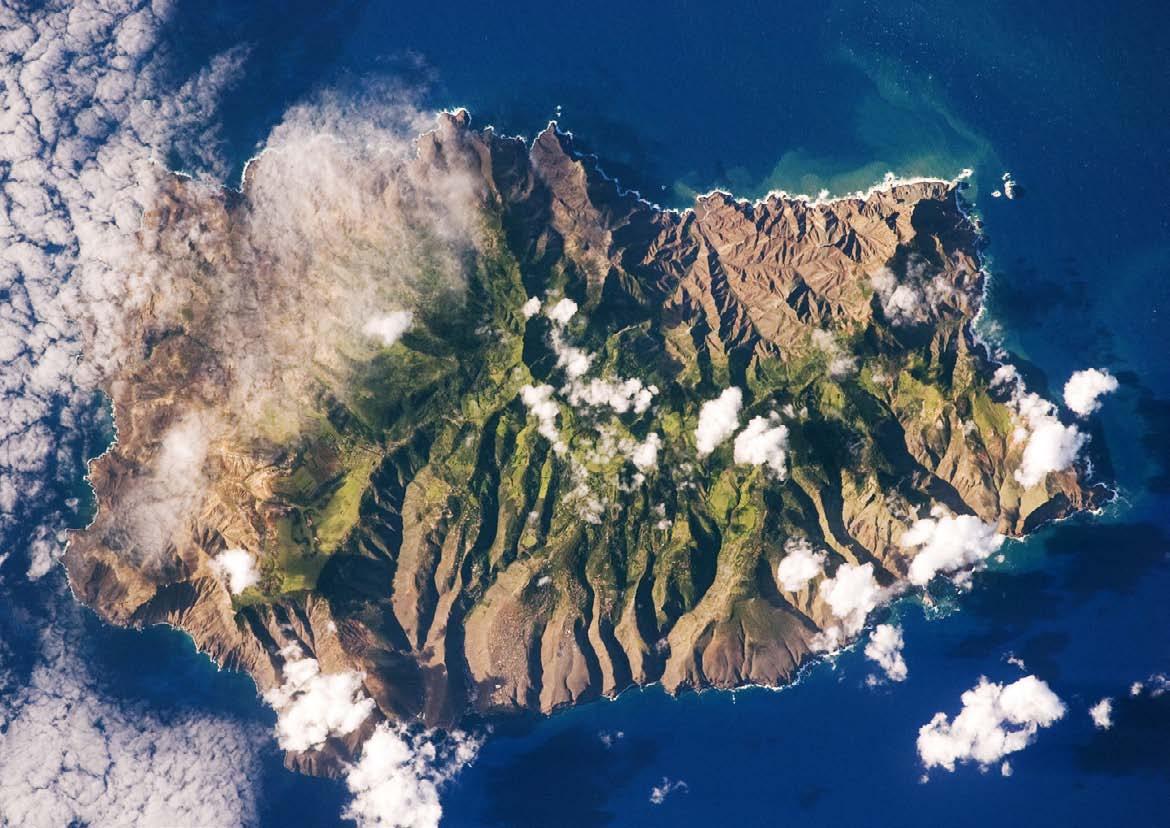
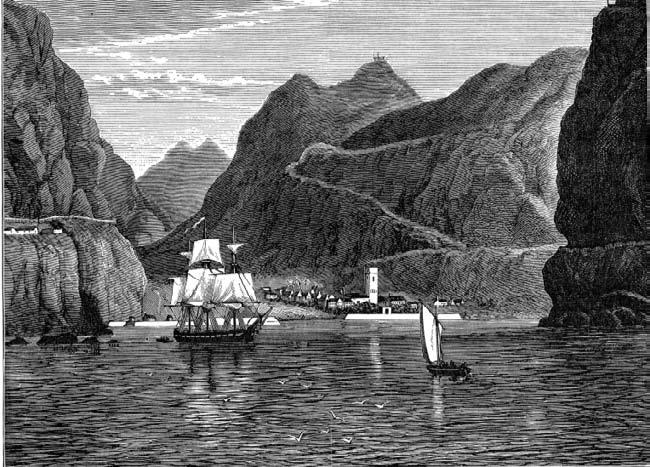
St. Helena made its last appearance in history as Napoleon Bonaparte’s place of exile and death in 1821. Situated in the South Atlantic, midway between Angola and Brazil, the small British island counts as one of the most isolated settlements in the world. While its remoteness was once a blessing, it has become a curse in modern times after it lost its strategic role as fuelling station for steamships, and thus its economic sustainability.
Today, the last British Royal Mail Ship is the only vessel calling at St. Helena, docking every couple of weeks and bringing in all required goods from Cape Town, which is a five-day's sail. Despite significant budgetary aids from the UK, the 4,200 islanders face low wages and high living costs while being cut off from any educational and employment opportunities. This caused an emigration wave reducing St. Helena’s population by 20% in the last decade.
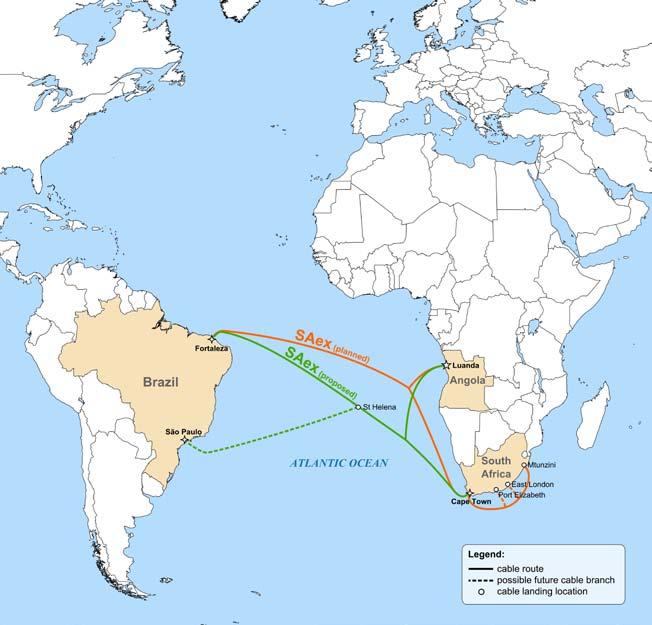
Broadband Internet access could change all this, and therefore a campaign called “Connect St. Helena” has been kicked off in January. This campaign is seeking to change the route of the South Atlantic Express cable (SAex) in order that a short unrepeatered branch to be landed at St. Helena during construction later this year. Providing broadband Internet access could significantly improve quality of life on
St. Helena by providing better education through e-learning, better healthcare through telemedicine, economic growth by establishing an IT-based offshoring sector and supporting tourism based on reliable telecom infrastructure. The campaign is supported by many islanders and “A Human Right”, an International NGO that advocates for the disconnected. They became influential for their plan to buy the TerreStar-1 satellite in order to serve internet-deprived regions after the owning company’s bankruptcy.
St. Helena is equipped with a modern digital telephone network, including ADSLservice, but with a single satellite link of just 10 Mbit/s for a population of over 4,000, bandwidth is chronically constrained. Additionally, a broadband subscription with a modest data allowance of 3.3 GB costs a third of an average islander’s salary. On top of that, the island’s community faces frequent outages of all international communications due to solar flares hitting Intelsat 707, the serving satellite which has exceeded its projected lifetime by far. “The island’s development is being hindered by its poor communications“ writes one
islander on the campaign’s website www.connectsthelena.organ undeniable conclusion in times of developed nations seeking to bring a multiple of St. Helena’s total bandwidth into every consumer’s home.
In November 2011, the UK government announced the construction of an airport on St. Helena worth £ 250 million. They believe this will attract up to 30,000 tourists per year and make the island self-sustainable, something many islanders doubt due to the lack of adequate infrastructure for high-end tourism and strong competition from other already developed archipelagos off Africa’s coasts.
While the airport undoubtably is a necessity, it can’t remove the shortfalls of education and healthcare. The economic prospects
of the current development plant focussing only on tourism are questionable, as well. Once the airport is in operation there will not be more than one weekly flight to South Africa, and few islanders will be able to afford tickets. In the end, St. Helena will remain separated from the next hospital, library and university by 2,000 miles and several days until the next flight departs. For such an isolated community, reliable communications and easy access to information would provide enormous social and economic benefits, which most bandwidthenabled citziens of the industrial nations can’t even imagine. Fortunately the outfit behind the cable, Johannesburg-based eFive Telecoms quickly showed readiness to shift its proposed cable’s route to
the South in order to enable a landing at St. Helena, which would require an extension of approximately 50 miles and would involve costs of several million Pounds Sterling. This amount is expected to be funded by the UK government, which recognises that landing the SAex cable is a unique opportunity that could have “a very significant impact on economic development in St. Helena.” The government is now considering funding the St. Helena cable extension after an e-petition on this matter was launched in the UK by James Greenwood, a British school teacher working on St. Helena.
But the campaign is not only about St. Helena. This would be the first time a landing point of a major submarine cable has been selected solely for social reasons. St. Helena, with a population of 4,200 and some 1,000 active Internet users, won’t do much for eFive Telecoms bottom line. eFive Telecom’s outstanding social responsibility shown in their readiness to land the cable on St. Helena is an unparalleld move, which we believe could become an example for future submarine cable projects.
Although there seems to be a good chance of St. Helena becoming connected by the SAex cable, the campaigners fear that Internet access will remain prohibitively expensive and the population will remain excluded from the information society. Even if the UK government funds the
landing point, running costs for leasing and maintaining infrastructure on the island will have to be born by a few thousand customers. If the project is realized on a profit-oriented basis, Internet access will barely become more affordable. That’s why the campaign is seeking industrial sponsors who would support connecting the world’s most isolated island by supplying network equipment and capacity at a discounted price.
Kosta Grammatis, founder of A Human
Right, has an idea to mitigate this however. “There’s so much over-capacity on most submarine cables while many nations struggle to get online. We’re working with carriers to contribute to the development of these places by taking their unused bandwidth and putting it to work for social and humanitarian causes.” The concept called “The Bandwidth Bank” seeks to give bandwidth grants to relief organizations, educational institutions, and others who could benefit from it - participating companies can reap
tax credits and explore new markets while organizations on the ground can continue their work sustainably.
"What our campaign also tries to convey is the need for a change of thinking. While nations’ level of development has been measured by literacy in the last century, this century it will be the level of information access that predetermines people’s development opportunities. As we bored water wells in the past, today we also need to bore “wells of wisdom” and provide equal information access throughout the developing world. The “Hole in the Wall” experiment of Sugatra Mitra has impressively shown how Indian slum kids were able to teach themselves not only to use a computer but even to speak some basic English just by using an Internet-connected computer. More and more universities throughout the world put their lectures online and open design projects provide construction plans (e.g. for wind turbines and even prosthetics) that can be build with easily accessible tools and materials. Unfortunately, most in need can’t access this precious information due to a lack of bandwidth while many submarine cables rot, largely unused on the seafloor, and their potential capacity keeps growing with the advancements of DWDM-technology. However, connecting developing nations should not only be regarded as charitable act, but as a stimulus to develop future markets.
Despite standards of living on St. Helena are relatively high compared to many African regions, landing the SAex cable is believed to potentially have an extraordinarily strong impact on the
“The Bandwidth Bank” seeks to give bandwidth grants to relief organizations, educational institutions, and others who could benefit from it...
island’s social and economic development not only because of the island’s isolation but because its population is natively English-speaking, literate and there’s a high computer penetration which would allow immediately making best use of the potentially increased bandwidth.
The go-ahead for the SAex cable is expected for the coming weeks leaving little time for us to obtain the British government’s support and to find industry partners. Unfortunately, none of the large international carriers potentially acquiring
an IRU on the SAex cable has reacted to our inquiries so far.
Christian von der Ropp is based in Germany, has a legal background and works as an independent analyst and consultant in the ICT sector with a special interest in telecom infrastructure. He campaigns for St. Helena in a voluntary capacity.
The Search for Submarine Telegraph Communications
It is said that Submarine telecommunications had its birth is 1842 with the New York Harbour submarine cable that was laid by Samuel Morse to demonstrate his new telegraph invention. However, this is not the case. It was in 1842 that the first electrically insulated submarine telegraph cable worked under test, but there were many years of experiments and hard work to get to this stage. We have to remember that in 1842 the submarine cable was, in fact, an electrical cable that was designed for telegraph communication. We have to look at the previous few years to understand how this technology came about and understand that the telecommunication age was powered by the age of electricity. Without electricity, communication was at a standstill and by developing means to extend the electrical signal and by manipulating it, communication could be advanced and the next step could be taken. If we look at the process of investigation and discovery carried out by many that aided and influenced the decision makers to move in the direction that they took we can see how the telegraph came about. We should take it year by year to understand the developments.
In 1729, Stephen Grey, an amateur astronomer from Canterbury in England, first discovered that electricity could be conducted along wires and that by applying a load he could send an electrical current
over a distance. He used materials such as hemp to conduct the electrical current, something that we would never think of using today, because the use of metal had not yet being discovered. These experiments would continue by Grey and others such as Volta, Faraday and Franklin and the use of metal and its conductive properties became the normal means of conducting electrical energy. It must be noted that this was one of the basic foundations of the science of electricity; it can also be said that it is one of the foundations in the science of communication.
As the search for the true electrical conductor and the use of electricity continued, people saw the potential in this and could somehow see a link between this and communications. In 1795, a Spanish theorist named Salvá discussed the probability of using insulated wires to transmit electrical current under water so as to prove that the transmission of electrical current could overcome the barrier of water if properly insulated against the earthing affects. This idea could be used as a simple means to communicate, and so he presented a paper to the Academy of Sciences in Barcelona. Although it was
only a paper, it opened the discussion about communication and its transmission medium. Communication was still only possible by word of mouth or written form, but now people were looking into other ways of communication. The 4th communication revolution was about to begin.
In 1803 ,Aldini Galvani, a nephew of Luigi Galvani the famous Italian scientist, went a bit further and performed experiments to see if electrical current could actually be transmitted under water by the aid of an insulated wire. He carried out his experiments in the sea near the port town of Calais on the English Channel and also across the river Marne, near Paris. There is no recorded mention of his results or his basis of investigation and his methods, however, but the idea that was planted was one that would drive future scientists to see if the envelope could be pushed even further.
These two mentions in history tell us that the idea of communication across electrical wires was actively being experimented with, especially under water. Unfortunately, no real records remain of Salvá's or Galvini's other than
Stephen Grey Aldini Galvani
mentions in history, so no real discussion of their experiments can take place.
In 1811 in Munich Germany two scientists, Schilling and Sommering, were actively investigating whether electrical current could travel under water if properly insulated. There investigations were based around the need to send electrical signals across country without rivers or lakes being a barrier. They knew that the electrical conductor needed to be insulated from the water, so they used a form of rubber as the insulation material. This was a primitive form of India rubber, but it foretold the use of Gutta Percha, which became the insulation material in the latter part of the 19th century. This is also the first mention of a rubber insulation material in any experiments. Their investigations and experiments proved so successful that, in 1812, Schilling successfully sent an electrical signal across an insulated electrical conductor that was laid across the river Neva near St. Petersburg in Russia. The electrical signal sent was one that would ignite gunpowder on the opposite bank, and at a distance from the river, extending the conductor out of the
waters and across land. These experiments proved that electrical conductors were also capable of sending electrical signals under water and over land, which could be used in communication.
Other people where also experimenting with electrical conductors under water, and though not all were for communications purposes, their experiments would advance the cause and science of communication. Just like electricity, communication along wires needs an electrical current to drive the signal, so these experiments actually went hand in hand. People such as John Robert Sharpe, who in 1813 successfully transmitted electrical current along several miles of insulated conductor under a lake, proved that once the conductor was properly insulated the water had no effect. This insulation was capable of keeping the electrical current isolated from the earthing affects of the water.
In 1816, Frances Reynolds investigated the idea of using the recent electrical discoveries to transmit signals for use in telecommunications. He was the first to fully demonstrate and example of a very early form of the telegraph. In 1820, Christian Oersted, the discoverer of Electromagnetism, proved that by manipulating electrical current the electromagnetism induced would move the needle of a compass, proving that some sort of telecommunications could take place (although telecommunications
was still not coined as a phrase yet). This discovery was the foundation to the basic telegraph that we know today. This discovery, proving that magnetism was related to electrical current, would have profound affects on the world of communications.
Also in the 1820’s, a chemist from Saxony in Germany, Johann Schweigger, was investigating the uses of electromagnetism. In applying the laws of electrical current he discovered that increasing the number of turns in a coiled spring also increased the sensitivity so much that any electrical current applied would be represented by a needle moving at the other end of the electrical circuit. By applying the electrical current in a coded fashion the needle at the far end would move in a certain direction as directed by the operator. This devise he called a Galvanometer after Luigi Galvani. It was this galvanometer design that lead Lord Kelvin to develop the famous mirror galvanometer 40 years later that was used for submarine cables.
Schilling, who had already investigated the use of electrical current travelling under water in an insulated conductor,
Paul Schilling
Johann Schweigger
was also interested in ways to represent the information sent. He studied the galvanometer, as discovered by Schweigger, and attached discs that were black and white. By the moving needle of the galvanometer the disks also moved and they represented letters in the alphabet. This was a primitive form of telegraphy.
It was Samuel Morse who in 1836 moved away from painting and directed his attention towards the development of a communication system that could transmit information to a far end. He investigated Schillings theories and, with the aid of others, produced the first telegraph system. He called it the Morse code, but as yet had no patent for it.
Between 1838 and 1839, Colonel Pasley and Dr William O’Shaughnessy separately conducted experiments with insulated conductors using the new Morse code. Their experiments were technically the first that investigated the use of insulated wire carrying electrical signals under water, seeing if the new telegraph system could be extended across rivers, lakes and even seas.
Colonel Pasley used an electrical conductor with a primary insulation of tarred rope and a secondary insulation of yarn that is covered in Pitch. This proved effective as the experiment did not notice any drop in voltage across the circuit when is use. Dr William O’Shaughnessy had used a wire covered in tar and pitch enclosed in a split ratan and then insulated with yarn covered with tar. He used this wire to conduct experiments across the river Hugli in West Bengal, India. His successful experiments were recorded in a scientific journal.
to send words down a cable and across continents as electrically driven signals. The operator or receiver at the far end would decode the electrical pulses into words and so the submarine telegraph cable was born.
Samuel Morse developed his new code over the following years and was successful in demonstrating the transmission of telegraph signals from Governor’s Island to Battery Park under New York Harbour in 1842, the first successful telegraph cable, albeit for one day. It was only in 1844, with the aid of Alfred Vail and a court ruling, that he was awarded the patent for the new electrical set of pulses that would become the communication system called Morse code. The telegraph using the communication called Morse eventually became the standard. This new code was made up of dots and dashes that where actually the electrical circuit being turned off and on, each short circuit connection, made by the telegraph operator tapping the circuit on/off would be a dot and each longer circuit connection would be a dash. It was simple, but in the 18th century it was a revolutionary idea that made it possible
Derek Cassidy is from Dublin, Ireland. He has worked for 17 years in the telecommunications industry of which 15 years have been spent dealing with optical terrestrial systems and submarine networks. He is currently leading the Optical Engineering and Submarine technology areas which support BT Ireland and the wider BT Global business. He is currently a member of the IET, IEEE, Engineers Ireland, EOS & OSA and has Degrees in Physics/Optical Engineering, Structural/Mechanical Engineering and Engineering Design.
William O'Shaughnessy
Submarine Cable Maintenance from Mess to Mesh?
Keith Schofield
Ask a submarine cable operator, and there’s only one thing that he will like less than normal operational expense: the cost of breakage and repair. When a fault occurs (through failure or more likely, external aggression) there has to be someone there to fix it. Over many decades, an ecosystem of cable maintenance providers has developed to take care of those breakages. But something is quietly going wrong. The number of cables is increasing yet the number of vessels to fix them is reducing.
What Carriers Think about Submarine Cable Maintenance
International Carriers are having a tough time making money these days. Squeezed by their customers, they are looking for any and every way to cut operational costs. Some are in a battle with some of their key clients—the content providers. Some content providers are entering the submarine cable market to control their own capacity and in some cases end their reliance on international carriers.
The former divisions between who owns ‘transport’ and ‘content’ are blurring. Carriers are constantly revisiting their cost base, and the bottom line is that marine
maintenance is rapidly being seen as a cost, not an insurance policy or an investment.
Does this mean that carriers do not care anymore about the resilience of their networks? Not at all. They want their networks to be faster (lower latency), more available (reliable) and more cost effective (cheaper). If their customers aren’t pressurizing them into this, their competitors will soon do it.
As Alex Hawkes of ‘Capacity1’ so eloquently put it: “In essence, the carrier market faces an identity crisis as it looks to other forms of revenues to supplement this potential loss in the value of capacity.”
Built, Broken, Buoyed, Booted.
What has been the maintenance market’s response to this crisis in delivering value from the built network? In essence, the lack of funds has caused the availability of maintenance vessels to shrink while the world’s stock of submarine cables expands. In response, both private and zone maintenance arrangements have sought to become more flexible and effective, but right now, they are expressing their concern about how we will all pay for the structural
1. “Capacity”
revival in marine facilities needed to replace the world’s ageing cable maintenance fleet. The market is almost broken. Maintenance providers and carriers ultimately know that broken links need fixing. Buoyed by this, the private maintenance providers are leading the charge to re-boot the world’s maintenance fleet by offering ways of offsetting the cost of leaving vessels in port on standby while systems are fault free. The zone maintenance arrangements are grappling with the same issue, but all the while this is happening, the world’s maintenance vessel fleet is ageing, and the world’s supply of talented personnel to deliver fast repairs is constantly under negative pressure.
Now there is a new opening for a third kind of player—the ‘spot’ maintenance provider, possibly operating in an ‘insurance-backed’ scheme. It remains to be seen whether they can prise carriers away from the security of known zone and private arrangements. Just as importantly, they must persuade conventional owners (sometimes with justly conservative views) that the right people, vessels, processes and equipment can be entrusted to maintain their networks on an ad-hoc basis. They may succeed, but it’s a tough sell.
It’s like we all want insurance as long as we do not pay the premium!
In Pioneer, we are increasingly seeing approaches from people willing to consider alternatives that will tailor the services to their needs. Fortunately for the carriers, there are experienced resources out there (whether it be from consultants like Pioneer, or from the maintenance vessel operators) to help navigate through these uncharted waters.
Mesh or Maintenance—Which will win?
Maybe technology can save us. At landing points or PoPs, submarine cables are being networked together to offer the prospect of incredibly improved resilience. Network providers such as Ciena are showing carriers how to integrate their existing diverse routes into a single, self-healing mesh-networked entity that can survive breakages by automatically re-routing traffic. This dangles the tantalizing prospect that repairs could be timed to coincide with the availability of resources to make them, and reduce reliance on ‘stand-by’ of what some consider to be largely unused marine maintenance facilities.
Carriers operating ‘thin,’ unmeshed or non-diverse routes may not have that choice. For them, it’s maintenance over mesh every time.
Whatever we think the solution is, it is bad business to leave broken links on the seabed. Ultimately, ‘Mesh’ and ‘Maintenance’ complement each other in such a diverse marketplace.
What’s the scale of the problem?
For years Pioneer has been observing and reviewing the resources in the market. Matched with our carefully researched forecasting and trend analysis for the growth in operational cable kilometers, for the first time we have been able to turn our attention to the likely forthcoming gap in the maintenance vessel marketplace. If we were to make the very optimistic assumption that no ageing maintenance vessels will be taken out of the market in the next four years, Figure 1 illustrates the impact that the anticipated growth in cable kilometers will have on the requirement for cable vessels, and illustrates the gap if
the current maintenance vessel numbers are not in a position to match that growth. Clearly there will be an unfilled gap which will only get worse unless ageing vessels are kept in the market, or unless it could be filled by ‘efficiency savings.’ The trouble is: while the market has got used to orders of magnitude capacity increases each decade in submarine cables, it has not come to terms with the fact that essentially the same marine facilities (requiring expert resources) repair those cables.
Figure 1 –Forecast Global Maintenance Vessel Demand
While mesh networking may bring a ‘soft landing’ to this problem for the larger
carriers who have diverse routings, what will happen to the smaller players with fewer ‘mesh’ options? Might we see some carriers (or even governments) feeling the need to intervene to arrange ‘security of supply?’
The fact that cable systems are dramatically more upgradeable than they were just 15 short years ago means that the economic lifetime of cable systems is now back on the increase. With upgrades, many systems implemented in the last ten years could see themselves as remaining economically viable for up to a further 25 years.
What’s the scale of the problem? Today, the problem remains almost imperceptible and little more than an irritation—we’re only one ship short of what we need to maintain the 2011 level of marine maintenance cover. Follow the trend through to 2016 though and it looks much less likely that the issue can be solved by efficiency savings. We
could see a seven ship gap based on current assumptions of vessel availability.
The topic of the shape of the future submarine cable maintenance marketplace will be the subject of Pioneer’s presentation at the April ICPC Plenary in Lisbon, where the right people will be in one place to address how these concerns will be resolved. If you cannot be there, please feel free to call us after the event to see what transpired.
Zone vs Private vs Spot Maintenance
In January 2012, this topic was recently debated in the Submarine Cable Systems Group of LinkedIn, as the following summary contributions indicate. Visit the group online to read additional debate details.
• Some stated that not only are the cable owners responsible for securing maintenance ships ready to make repairs, but all the attendant skills are needed: experienced deck officers, ROV operators and jointers/testers as well. There is a feeling that few carriers want to pay the true cost of marine maintenance repairs. In Southeast Asia, there is a more long term view, but this is very much the exception and the ultimate outcome will be less repair tonnage and as they are closely linked, fewer qualified people.
• Insurance based options could have a place in low fault zones but they still require the services of a cable repair vessel and its crew, or a vessel of opportunity and the associated bolt on equipment and specialist cable handling, testing and jointing personal (who for obvious reasons won’t be sitting at home waiting for a cable failure).
• Zone Maintenance offers an insurance policy against cable faults; what maybe is required is that cable owners or MA’s need to accept that not all cables carry the same fault risk and can develop pricing within their zone offering accordingly.
• The possibility of allowing interruptible outside work offers the opportunity to reduce baseline cost, but what is the appetite of the owners collectively to accept increased risk?
There will always be a debate on the relative merits of zone, private and spot maintenance arrangements (or the meaning of ‘insurance’ as applied to cable maintenance). The question is: will the industry be able to come to a new deal that accommodates the economics that maintains the excellent provision our forebears took for granted?
Who will fill the Gap?
There is currently an ecosystem already there which supports both zone and private maintenance alternatives, and ultimately, today, the cable owners decide which is in their best interests.
Of great concern is what we hear from carriers—that with the cost structures they are now facing in terms of earning revenue from their cable assets (out of which any operation and maintenance must be funded), they are finding it difficult to
afford what is already on offer (whether it be zone or private maintenance), let alone to pay for the improved maintenance assets that will become necessary as the global fleet of telecom maintenance assets ages or has to be replaced.
To bridge the gap, those providing maintenance (and those who provide professional advice) must help both the carriers and ultimately their customers realize and deliver increased value through the expertly provided (but ageing) maintenance solutions now available.
For the future, the market must decide to what extent the fundamental model for maintenance has to change to eliminate the emerging maintenance gap. Will the carriers or content providers end up having to take control by owning or controlling their own maintenance assets again? Perhaps we will see maintenance vessel(s) out there, funded and protecting the network owned by Google, Facebook, Apple or Microsoft, so we can all continue to benefit from the reliable business and recreation we have all come to expect from the internet!
Where the debate will start and end: ‘Who pays to fill the gap?’
You can discuss this topic further with Keith as he will be at the ICPC Plenary 2012 meeting on April 18, 2012 presenting: Bridging the Maintenance Gap: How will submarine telecom cables be maintained in 2020?
Keith Schofield, is the Managing Consultant and Director of Submarine Networks for Pioneer Consulting. He is a seasoned commercial development director and general manager of complex telecommunications infrastructure projects. He has more than 27 years’ experience of successfully implementing consultancy programs in the submarine fiber optics industry.
submarine cable ALMANAC
This Spring, SubTel Forum will release its second annual Submarine Cable Almanac. This perfect bound book serves as complement to our Submarine Cable Map and features each major international system on its own page, along with a system map, landing points, system capacity, length, RFS year and other valuable data. The Almanac also includes full-color adverts from some of the most important players in the industry. The Almanac is shipped, free of charge, to our subscriber list, including senior government and international organization officials, telecom company executives and team, support and supply company management, and technical, sales and purchasing staff, field and shipboard personnel, academicians, consultants, financiers, and legal specialists. Adverts should be provided in Press Quality PDF format and should include crop marks.
Advertising Inquiries:
Nielsen, Kristian
Sales Manager
knielsen@subtelforum.com
Tel: +1 (703) 444-0845
Sicking, Wilhelm
Sales Representative, Europe, Middle East & Africa
For nearly one hundred years, since its inception in 1850, the submarine cable industry was predominantly a British story; however, there is little doubt that one of its founding fathers and the driving force behind the first Atlantic telegraph cable was an American businessman and financier. That man was Cyrus West Field (1819 – 1892). On 10 March 1854, Field formed the “New York, Newfoundland and London Telegraph Company” with four other New York businessmen: Peter Cooper (chairman), Moses Taylor (Treasurer), and Marshall O Roberts and Chandler White (directors). The company was launched with a capital of $1,500,000 and its genesis marked the first tangible step in the famous adventure that was the Atlantic Telegraph. Although the majority of the money and virtually all of the engineering came from Britain, it was Field’s vision, enthusiasm and tenacity, over the next twelve years that kept the project moving forward, despite the many
technical setbacks and significant financial losses that were incurred.
Cyrus W Field was born on 30th November 1819 in Stockbridge Massachusetts, the sixth son and the seventh of nine children of a puritan clergyman David Dudley Field and Submit née Dickinson. At the age of 15 he left school and moved to New York where he became a clerk and errand boy in a large dry goods store, A.T. Stewart & Co. He worked there for three years and then moved to Lee Massachusetts where he worked in a paper mill, for two years with one of his elder brothers, Matthew Dickinson Field (1811 – 1870). In 1840, Field set up in the paper business for himself in Westfield Massachusetts where, at the end of that year he married Mary Bryan Stone. He very quickly became a partner in E Root & Co, a New York wholesale paper dealer, but within 12 months this business had failed and Field personally took on
the company’s debts, although he had no legal obligation to do so. Shortly after this failure, Field formed, in partnership with his brother-in-law, a paper manufacturing company, called Cyrus W Field & Co. This company was established to take advantage of the rapidly growing “penny press” market and the increasing demand for paper for stocks and bonds. By 1853, he had amassed a large personal fortune and had paid off the debts of E Root & Co in their entirety. He now had a large house at 1 Lexington Avenue in Gramercy Park, New York and was one of the wealthiest men in the city. At that point he took the decision, at the age of 34, to retire from active business.
After Field retired, he chose to sponsor and accompany the Connecticut born painter, Frederic Edwin Church (1826 –1900), on the first of many trips Church made to South America. Field planned to use Church’s paintings to encourage investors in a number of South American
projects he was considering. It was on his return from this six month trip that his brother Matthew introduced him to Frederick Gisborne and his obsession with the Atlantic Telegraph began.
Frederick Newton Gisborne (1824 – 1892), was an Englishman, born in Broughton Lancashire, who had for many years travelled the world. By 1845, he had reached Canada where he took a job on a farm in St Eustache, Quebec. After a year, he quit farming altogether and took up a position with the Montreal Telegraph Company. He became an expert in telegraphy and founded the British North America Electric Telegraph Association with the expressed purpose of extending telegraph communications from Montreal to the east coast of Canada. While head of this association he supervised the construction of 112 mile telegraph line from Quebec City to Revière du Loup. As Gisborne’s career in telegraphy progressed he developed an idea for extending the telegraph network further east to St. John’s, Newfoundland, North America’s most easterly city. Gisborne’s concept was based on the increasing demand for news from Europe. Gisborne reasoned that extending the North America Telegraph to St Johns would make it a major terminus for transatlantic news. Steamers would dock at St John’s and drop off the news,
which could then be relayed to North American newspapers, thus delivering the news 24 and 48 hours earlier than transatlantic steamers arriving in Halifax and New York respectively.
In early 1851, Gisborne commenced his attempt to turn this idea into reality by applying to the Newfoundland Government for permits to build his telegraph system. His applications were approved and, in the summer of 1851, Gisborne resigned as chief office of the Nova Scotia Telegraph Company to begin implementing his plans. The first stage was to construct a land cable from St John’s to Carbonear, which was completed and went into service on 6 March 1852.
Gisborne’s initial plans had included a cable across the Cabot Strait, so he applied to the Nova Scotia government to land a cable at Cape North. However, the Nova Scotia Government took the view that Gisborne’s telegraph, if built, would take valuable telegraph forwarding business away from Halifax and so his application was denied. Gisborne came up with an alternative routing for a submarine cable from Cape Ray to Prince Edward Island and then on to New Brunswick. Although the required length of submarine cable was greater than the original plan, the overall route length from Newfoundland to New York would be shorter. Gisborne now needed to build a cable from St John’s to Cape Ray and so in the spring of 1852
the “Newfoundland Electric Telegraph Company” was incorporated in New York, with local financing. While in New York, Gisborne learned of the 1850 and 1851 English Channel cables and so he sailed to England where he met John Watkins Brett (1805 – 1863) and his brother Jacob to discuss the channel cables. While in England he purchased a length of submarine cable from Newall & Company. In November 1852, this cable was laid by the Ellen Gisborne, across the Northumberland Strait, between Tormentine, New Brunswick and Charleton Head, Prince Edward Island. This was North America’s first commercial submarine cable of any note. The construction of the Cape Ray terrestrial cable commenced in the summer of 1853; however, after only 40 miles had been installed, the New York backers pulled out, the company became insolvent and Gisborne went bankrupt.
In early 1854, Gisborne went to New York to visit a financier, Horrace Tebbets, to try and convince him to support his project, but Tebbets was not interested in investing. Gisborne resigned himself to failure; however, while still in New York, he chanced to meet Matthew Field at Astor House, who introduced him to his brother Cyrus; and the rest, as they say, is history.
Conferences
Global Submarine Cable Forum 26-28 March 2012
London, UK
Website
ICPC Planery Meeting 17-19 April 2012
Lisbon, Portugal
Website
Submarine Networks World Africa 2012 21-24 May 2012
Johannesburg, South Africa
Website
Submarine Networks World 2012 11-13 September 2012
Singapore Website SubOptic 2013 22-25 April 2013
Paris, France
Website
Issue Themes:
January: Global Outlook
March: Finance & Legal
May: Subsea Capacity
July: Regional Systems
September: Offshore Energy
November: Subsea Technology
Advertising enquiries:
SALES MANAGER
Kristian Nielsen
Tel: +1 (703) 444-0845
Email: knielsen@subtelforum.com
SALES REPRESENTATIVE, EuROPE, AFRICA, MIDDLE EAST
Wilhelm Sicking
Tel: + 49 (0) 201-779861
Email: wsicking@subtelforum.com
by Kevin G. Summers
I'm still using an iPhone 3. While the newer models have tempted me since their release, the little contract I signed with AT&T back in 2010 has always stopped me from upgrading. I have this thing about paying out money for breaking contracts that has ensured that I'll be on my older model iPhone until May 2012. By that time, I could be upgrading to an iPhone 5. I've even considered going back to the dark ages of the early 2000s and using a dumb phone.
One thing that I would miss if I went this route would be access to the internet in boring places. You know, the doctor's office (do you smell snake oil?) or the line at the grocery store (does this contain pink slime?) or in a staff meeting (sorry Wayne, what did you say?). I would also have to go back to carrying a phone and an iPod since I don't go anywhere without an audiobook.
As someone that works in the telecommunications industry, I'm assuming
that you, Constant Reader, are also in possession of a smart phone. If not, the rest of this Coda is going to be pretty boring. But if the answer is yes, then I have some good news for you.
SubTel Forum now has a mobile website!
If you visit www.subtelforum.com on your iPhone, Android or other mobile device, you can access our mobile site. It contains all of the same great SubTel Forum content, but now it is formatted for easier use.
Check it out today or the next time you are standing in line at the coffee shop. And as always, thanks for reading!