Voice
of the Industry
Global Outlook Edition
In This Issue: 2012: The Year of the Upgrade A Coherent Plan For Capacity Upgrades The Lit and the Pendulum: Will 2012 Bring a Paradigm Shift in the Fiber World?
61 j a n
2012 ISSN 1948-3031
ISSN No. 1948-3031 PUBLISHER: Wayne Nielsen MANAGING EDITOR: Kevin G. Summers CONTRIBUTING WRITERS: Stewart Ash, James Case, Jean Devos, John Hibbard, Brian Lavallée, Neil Tagare Submarine Telecoms Forum magazine is published bimonthly by Submarine Telecoms Forum, Inc., and is an independent commercial publication, serving as a freely accessible forum for professionals in industries connected with submarine optical fiber technologies and techniques. Submarine Telecoms Forum may not be reproduced or transmitted in any form, in whole or in part, without the permission of the publishers. Liability: while every care is taken in preparation of this publication, the publishers cannot be held responsible for the accuracy of the information herein, or any errors which may occur in advertising or editorial content, or any consequence arising from any errors or omissions, and the editor reserves the right to edit any advertising or editorial material submitted for publication. Contributions are welcomed. Please forward to the Managing Editor at editor@subtelforum. com. Submarine Telecoms Forum, Inc. 21495 Ridgetop Circle, Suite 201 Sterling, Virginia 20166, USA subtelforum.com
2
Copyright © 2012 Submarine Telecoms Forum, Inc.
W
elcome to Issue 61, our Global Outlook edition. On the plane over to Pacific Telecommunications Conference this week, I finished reading Ayn Rand’s epic masterpiece, Atlas Shrugged, with which I had toiled happily for some time. I am glad I read this book at precisely this point in my career and not far earlier, as some grade-seeking student; I think having a few gray hairs, double-digit years behind me, and none too few scars afforded me a much deeper appreciation for what Rand was trying to convey. Her philosophy, embodied in this massive tome, promotes that the proper moral purpose of one’s life is the pursuit of one’s own happiness (or rational self-interest) and that the only social system consistent with this morality is full respect for individual rights embodied in laissez-faire capitalism. My Milton Friedman Monetarist upbringing liked that. She concluded her last public speech in 1981 quoting these words from her hero: “The world you desired can be won, it exists, it is real, it is possible, it’s yours. But to win it requires total dedication and a total break with the world of your past, with the doctrine that man is a sacrificial animal who exists for the pleasure of others. Fight for the value of your person. Fight
for the virtue of your pride. Fight for the essence, which is man, for his sovereign rational mind. Fight with the radiant certainty and the absolute rectitude of knowing that yours is the morality of life and yours is the battle for any achievement, any value, any grandeur, any goodness, any joy that has ever existed on this earth.” In the general malaise we see certainly from my window in the States, these are fighting, uplifting words, and whether you agree entirely or not, I think Atlas Shrugged is thought-provoking, amazing, inspirational, motivational; after all, “Who is John Galt?” Should you be attending PTC 2012, please come by our booth to say hello; and as always, save me a seat at the Mai Tai Bar.
In This Issue... Exordium Wayne Nielsen News Now
2012: The Year of the Upgrade A Coherent Plan For Capacity Upgrades Brian Lavallée The Lit and the Pendulum: Will 2012 Bring a Paradigm Shift in the Fiber World? James Case
3
2
4 7
Through The Looking Glass: The "Perceived" Future of the Submarine Cable
22
ICPC Call for Papers
25 27
12
Group Buying Of Bandwidth Is Now A Reality Neil Tagare
34
18
The Industry Needs Its Champion John Hibbard Back Reflection Stewart Ash
37
Conferences
40
Letter to a Friend Jean Devos
41
Advertiser Index
43
Coda Kevin G. Summers
44
News Now
AP Telecom Appointed as Arctic Fibre’s PreSales Manager for International Bangladesh cableco to be listed in 2012
MMT awarded survey contract in the Mediterranean between Italy and Malta
New Submarine Cable Between Iceland And U.S. Attractive For Datacenters
NTT Com Signs Contract for Asia Pacific Gateway Network
Pacnet Wins Best Pan-Asian Carrier Award Reliance Globalcom sets up world’s first highspeed data link
Chunghwa Telecom to participate in AsiaPacific Gateway submarine network Dhiraagu begins laying 1253 km of fibre optic cable
Du: Submarine cable cut in Suez repaired
Fintel to construct $40M cable to connect Suva with Nuku’alofa Maroc Telecom launches Loukkos fibre optic cable to Spain
Sea Fibre Networks commences long awaited lay of CeltixConnect a 15m subsea network investment for the most data driven island in Europe SeeByte & SMD Come Together to Offer Advanced Control for Work-Class ROVs
SubTel Forum to Moderate PTC’12 Submarine Cable Panel
TE SubCom and Gulf Bridge International announce completion of works of GBI cable system
TE SubCom Completes First 40G Upgrade Of A Trans-Pacific Cable System
The new EUROPA Cable System will provide resilient bridge between Europe and the Middle East
Wasace submarine cable headed SA’s way
WFN Strategies to participate at PTC’12
WFN Strategies To Support New Arctic Fibre Submarine Cable System
WIOCC is first to provide seamless low-latency network from Africa to Europe
6
2012: The Year of the Upgrade
7
A
new year is finally upon us, and the global economy is still struggling to regain its feet after several years of recession. After a year in which the president of Egypt ordered an internet shutdown, Japan was devastated by a major earthquake and the United States announced the formal end to the Iraq war, the submarine cable industry sailed forward as always. At least eight submarine cables were activated in 2011, and at least twenty new systems were announced during the year. The real story in 2011, however, was system upgrades. At least twenty current systems have been upgraded or were announced as an upgrade plan in order to extend system life. Systems In Development There are currently some 30 submarine cable systems in development. Interestingly, there are presently two planned competitive systems that, upon completion, will connect Europe, North America and Japan via the Northwest Passage. These systems, Arctic Fibre and Arctic Link, each span a huge portion of the globe and will provide low latency, secure routes from Japan to the United Kingdom. Of the systems currently in development, several are worth taking a moment to consider: 8
Arctic Fibre is a 15,000 km submarine cable that will bridge the digital divide between Canada’s Nunavut and North West Territories and the rest of southern Canada by providing a link from the Japan/United Kingdom fiber south to Clarenville, Newfoundland where onward connections can be made to terrestrial North American networks. The network will also provide much-needed bandwidth to Canada’s Department of National Defense and the new Canadian High Arctic Research Station (CHARS) that are situated at Cambridge Bay.
Systems in Development: ACE ALASIA Alexandros ANTEL Arctic Fibre Arctic Link Asia Pacific Gateway (APG) Asia Submarine Express (ASE) Australia-Singapore (ASC) Axin Batam-Dumai-Melaka BLAST
Arctic Cable Company is an international consortium to finance, design and construct the Arctic Link, the submarine fiber optic cable system spanning the arctic regions from Asia to Europe with a regeneration site in North America located in Alaska. The WASACE cable will connect Africa, Europe, North America and South America. This system is aiming to deploy the first trans-Atlantic 100 Gbp/s submarine cable route. The project is divided into four sections: WASACE North connecting Europe to North America; WASACE South connecting South America to Africa; WASACE America connecting South America to North America; and WASACE Africa connecting Nigeria, Angola and South Africa.
Dhiraagu-Maldives CS Emerald Express EUROPA Europe Persia Express Gateway (EPEG) GOKI Interchange Cable Network (ICN) Kinmen-Xiamen LION-2 Pacific Fibre Palapa Ring Project Express SAEx SJC Suva-Nuku’alofa Tonga-Fiji WASACE West Africa Cable System (WACS) West Africa Regional Communications Infrastructure Programme (WARCIP)
In Service 2011: CeltixConnect Gulf Bridge International (GBICS) Hawk LIME Matram-Kupang Pencan-8 TE North Zimbabwe-Mozambique
Some very interesting details come to light when we explore these statistics regionally. Fifteen planned systems are set to land, all or in part, in the Australasia region, nine are set to land in the European/Mediterranean region, eight in the Americas and five in the African/Middle East region. Of the systems that were lit in 2011, three came online in the European/ Mediterranean region, three in the African/Middle East region and one each in the Australasia and Americas regions. Systems in Upgrade
9
On the upgrade side of the story, some major systems are planning to accomplish or have completed upgrades. These systems include AAG, EASSy, Southern Cross, SAT-3/WACS, and SEA-ME-WE 4. It appears that many of the systems installed during the peak time of the
early-2000s are coming up for upgrades now a decade later. Let’s also consider some of these systems: EASSy is a 10,000km submarine fibreoptic cable system deployed along the east and south coast of Africa and is the highest capacity system serving sub-Saharan Africa, with a 4.72Tbps, 2 fibre-pair configuration. The system was upgraded in December 2011 by Cable & Wireless. Southern Cross is approximately 28,900 km in length, with landings in Australia, New Zealand, Hawaii, Fiji and the US mainland. The company announced a a 400G capacity upgrade with Ciena in October 2011. TE SubCom CEO, David Coughlan, in a recent press release, stated: “TE SubCom has long prioritized upgrade initiatives and helping our customers make the most of their systems and investments. Completing the first long-haul system upgrade from 10G to 40G highlights our advanced capabilities and commitment to providing the highest density cable systems being built. Further, the project is an important step forward for the industry, as it sets a new standard for upgrading existing submarine cable systems and paves the way for moving toward 100G achievements.”
Brian Lavallée, Director of Submarine Networks Industry Marketing for Ciena said: “Coherent 40G/100G optical transmission is allowing undersea cable operators to quickly and cost-effectively breathe new life into their existing 10G-based wet plant assets. A fourfold to tenfold increase in channel capacities raises the total capacity of deployed submarine cables to levels that far surpass their original maximum design capacities. This allows for improved System Upgrades 2011 & Beyond AAG APCN2 Caucasus CFX-1 Columbus Networks EAC-C2C EASSy FNAL GlobeNet GWEN Kodiak-Kenai PC-1 RJCN SAT-3 SEA-ME-WE 4 Southern Cross TAT-14 TBN TW-1 WACS
economies of scale while negating the need to deploy new submarine cable builds that are time-consuming, expensive, and financially risky. Given the number of submarine cables already deployed around the world, rapid and cost-effective capacity upgrades will be the way forward for the foreseeable future in most regions. Substantial capacity increases will also spur protection upgrades involving intelligent control planes that enable improved network resiliency, lower overall operating costs, and broader service differentiation. The world’s increasing dependence on global connectivity mandates improved network protection of these critical submerged network links against all natural and man-made cable cuts to avoid wide-scale outages that can affect millions of people.”
10
Herve Fevrier, Xtera COO, stated: "Xtera pioneered the upgrade market, with first commercial projects by 2005, offering the possibility to the cable owners to pick the best in class SLTE technology independently of the original supplier for higher capacity and lower incremental cost. This breakthrough breathed new life in existing cable systems whose old technologies offer limited capacity. Relying on original technical approaches for the development of innovative submarine line terminal equipment, Xtera has participated in a large number
of projects worldwide to increase the capacity of submarine cable systems of different generations. Today, Xtera has two platforms to upgrade different types of cable systems, from unrepeatered to repeatered, with channel rates up to 100G." The Australasia region and the Americas are neck and neck in the upgrade department with eight and seven systems, respectively. The African/Middle East region and the European/Mediterranean regions are tied with four system upgrades each. Given the number of current systems at mid-life and the increasing need for global capacity, it seems that 2012 might just be the year of the upgrade.
Coming Soon to a wall near you
YOUR SUBMARINE NETWORK JUST GOT SEVERED. IN MULTIPLE PLACES. WHAT DO YOU DO?
Absolutely nothing. With Ciena’s self-healing intelligent mesh technology, your submarine networks are protected. When disaster strikes, your global high-capacity networks must be highly resilient. Networks equipped with Ciena’s intelligent self-restoring switching technology have 99.9999% field-proven resiliency, ensuring that submarine connections remain at full capacity, even in the event of multiple cuts. And our award-winning 40G/100G coherent technology enables cost-effective bandwidth expansion on existing cable systems. Learn more about how Ciena can change the way your submarine networks compete. www.ciena.com/ocean
11
A Coherent Plan For Capacity Upgrades
12 Brian Lavallée
G
lobal demand for bandwidth continues to increase unabated— according to TeleGeography, it is forecasted to grow at a compound rate of nearly 50 percent annually for the foreseeable future. Although the increasing popularity of video-centric streaming content is the primary driver, an increasing number of subscribers at ever-multiplying per subscriber access rates are also fueling this consistent growth. Increases in continental bandwidth growth inevitably affect the submarine networks interconnecting these continents, as accessed content can be located anywhere on planet Earth—a situation that will only be compounded with the advent of cloud services that centralize content at a few select geographic locations. Unfortunately, this steady increase in bandwidth demand is also associated with steady global price erosion for intercontinental submarine capacity. The main concern facing submarine cable operators today, and in the coming years, is how to significantly increase the informationcarrying capacity of their networks while reducing their overall operating costs to protect margins.
13
According to the International Cable Protection Committee, submarine optical cables currently carry almost all transoceanic Internet traffic and more than 95 percent of all combined
international voice and data traffic. Satellite communications play a comparatively minor role, making submarine cables the critical links in worldwide communications. Most submarine network routes are in dire need of significant capacity upgrades to maintain pace with surging international bandwidth demands experienced worldwide. Since the submarine optical cables deployed along these intercontinental routes were deployed many years ago, they are rapidly approaching their original maximum design capacities. This situation is forcing global network service providers to decide how to cost-effectively increase the capacity of their networks. The logical choice is to upgrade existing channel rates from 2.5 Gb/s and 10 Gb/s channels to 40 Gb/s and 100 Gb/s while keeping their existing undersea wet plants untouched. This allows submarine cable operators to avoid having to deploy costly and financially risky new undersea cables, which can take years to
complete and cost hundreds of millions of dollars. As the global environment speeds toward a more connected environment, submarine cable operators are facing a daunting paradox, which is looming ever larger and ever faster. Due to significant intercontinental capacity growth and intensified global competition, undersea cable operators must significantly increase capacity for their customers albeit with fewer dollars for both capital and operational expenditures. To exacerbate this paradox even further, global intercontinental prices continue to fall annually. The submarine optical networking industry addressed these significant challenges with the introduction of a new technology known as coherent optical networking, which directly and effectively addresses this paradox. Coherent Optical Networking Coherent optical processing technology lays the foundation for increasing transoceanic submarine cable channel rates from 10 Gb/s to 40 Gb/s today, and 100 Gb/s in the near future. This technology also offers the ability to increase network intelligence by unlocking new network architectural possibilities such as gridless and colorless
networking for increased spectral efficiency and improved network agility, respectively. By integrating techniques for improved spectral efficiency and increased noise tolerance, and by adding an intelligent coherent receiver alongside advanced Digital Signal Processing (DSP) algorithms, coherent technology provides cost-effective ways to mitigate optical impairments, take advantage of existing undersea wet plants, and significantly increase undersea cable capacity. The advantages of coherent optical networking are significant and real, as evidenced by numerous undersea cable operators having already adopted this innovative optical transmission technology over both land and sea. Its adoption also justifies the significant time, money, and effort invested by the optical networking industry as a whole in this innovative new optical transmission technology. Coherent Optical Technology Ecosystem
14
Coherent detection offers greatly improved noise tolerance, enabling increased optical transmission capacity and reach when compared to the traditional direct detection that has served the optical networking industry so well for decades. Although commercially available coherent optical technology is relatively new, it was already being
researched as far back as the 1980s. The promise of improved receiver sensitivity, combined with the inherent difficulty of the coherent methods, meant coherent systems enjoyed a great deal of research attention. However, the invention of the optical amplifier provided a much cheaper and easier method to obtain this improved noise tolerance, so most of the coherent research was abandoned. Today, in addition to improved noise tolerance, coherent technology preoccupies research and commercial development in optical communications due to its inherent ability to costeffectively address the requirements of distortion compensation, polarization de-multiplexing, and carrier extraction. All of these capabilities are afforded by the most important characteristic of coherent transmission; namely, access to the optical electrical field, which is enabled by DSP technology. Working in conjunction with coherent optical detection, DSP is the mathematical engine whereby numerical processing is applied to recover received signals from impairments that are physically well-understood, but, until recently, electronically inaccessible. Mathematically compensating for such impairments as chromatic dispersion and Polarization Mode Dispersion (PMD) is far more cost-effective than doing so in the optical domain, which is how traditional networks were compensated.
A key component to compensating in the electrical (mathematical) domain is the Analog-to-Digital Converter (ADC), which must be extremely fast and highly accurate to properly transition a received signal from the optical to electrical domain. Real-time processing in the electrical domain allows for additional complimentary technologies that further enhance coherent optical networking capabilities, such as the implementation of soft Forward Error Correction (FEC). C-band Capacity Pb/s
Tb/s
Coherent + DWDM DD + DWDM
Gb/s Direct Detection (DD)
Current commercial transmission products use hard-decision FEC where the receiver determines if a received bit is a one or zero based only on a decision threshold. Soft-decision FEC uses probabilities in its algorithms that allow error correction decisions to be made with additional information, resulting in a significant increase in system reach
due to a (theoretical) noise mitigation improvement of approximately 3dB. The ADC and DSP present in a coherent receiver means that the soft metrics are already available to implement soft FEC. Since optical transmission systems must provide network operators with Bit Error Rates (BER) better than 10-15, complicated mathematical algorithms are required since multi-bit metrics for signals operating at 100 Gb/s, for example, implies greater than 100 billion information bits received every second thus creating huge data flows and a large associated processing task. For heat efficiency, this operation must be implemented within the same ASIC as the DSP, which is enabled with continued silicon integration.
15
The dramatic optical transmission improvements enabled by coherent optical detection are actually the result of an ecosystem of leadingedge technologies working together in harmony. Advanced ADC technology cost-effectively maps the received optical signal into the electrical domain such that the intelligence embedded in the DSP is fully leveraged. CMOS advancements and continued integration have driven significant advances in signal recovery, FEC and sequence estimation, and enabled the exploitation of the dimensions of symbol rate, bits per symbol, and the number
of carriers per channel. This ecosystem of complimentary optical transmission technologies allows undersea cable operators to cost-effectively upgrade their existing wet plants to aggregate capacities that far exceed their original design capacities.
Transatlantic Capacity Upgrades According to TeleGeography, the transatlantic route has the most lit capacity and is the most competitive submarine cable route in the world. Although new transatlantic submarine cables are planned, upgrades to the thirteen existing cables serving this region have accounted for all capacity increases since the introduction of the Apollo system back in 2003, a testament to the economic benefits of upgrading existing wet plants, whenever and wherever possible. TeleGeography expects the demand for transatlantic capacity to increase nearly nine fold between 2010 and 2017, meaning that upgrading transoceanic submarine cables from 10 Gb/s to 40 Gb/s today, and 100 Gb/s in
the near future, is expected to continue as the dominant method of intercepting worldwide bandwidth growth for the foreseeable future. Tata Communications’ global network consists of over 200,000 kilometers of terrestrial networks and 500,000 kilometers of submarine networks carrying 17 percent of the world’s Internet traffic. A key submarine cable in this important global network is their TGN-Atlantic subsea cable, which interconnects the important financial hubs of New York and London. TGNAtlantic is a ring system with four fiber pairs that are capable of carrying over 10 Tb/s on each leg. Due to the incredible growth expected to continue unabated across the Atlantic Ocean, it was necessary to upgrade the approximately 13,000 km TGN-Atlantic submarine cable from 10 Gb/s to 40 Gb/s to address increasing customer demands while lowering cable operating costs. Coherent optical networking addressed the opposing network objectives of both increasing capacity and lowering operating costs, breathing new life into a submarine cable that was put into service more than ten years ago—way back in 2001. Compared to incredibly expensive and time-consuming new undersea cable builds, capacity upgrades to existing wet plants are comparatively simple,
rapid, and far less expensive. Upgrading the capacity of existing transoceanic wet plants involves the addition of coherent 40 Gb/s channels inserted into available optical spectrum. If the submarine network is already fully loaded with 10 Gb/s channels, existing channels are swapped for 40 Gb/s transponder card pairs for an immediate quadrupling of channel capacity. As coherent 100 Gb/s technology capable of transoceanic reaches comes to market, immediate tenfold channel capacities will become available. A major economic benefit of coherent optical technology is that it is fully compatible with existing and future terrestrial and submarine optical line systems that enable economies of scale for optical networking vendors, as
16
well as reduced sparing requirements for global network operators. Coherent Capacity Upgrade Plans As global bandwidth demand continues to increase for the foreseeable future, the importance of the submarine network jugular veins of intercontinental communications will only increase. Given the time, money, and effort involved with deploying new submarine cables, capacity upgrade technologies that allow for extending the lifespan of existing wet plant assets will remain the dominant choice for cable operators the world over. Transoceanic capacity upgrades from legacy 10 Gb/s technology to coherent 40 Gb/s technology are already taking
place in all regions around the planet, which is proof to the values of coherent technology and shows its ability to address the paradox of increasing capacity while reducing costs. Brian Lavallée is the Director responsible for Submarine Industry Marketing at Ciena.
17
The Lit and the Pendulum:
Will 2012 Bring a Paradigm Shift in the Fiber World?
James Case
18
F
rom year to year we watch the economic pendulum of fiber activity swing back and forth from region to region, always tracking with new development and population growth around the world. Last year, the apex of the swing was in Africa, a region that still shows potential for growth. Economics are the primary driver for any new venture, be it opening a lemonade stand or installing a new fiber system, the same principle applies: will I achieve the greatest amount of profit with the least risk? With the continuing uncertainty and turmoil in the world economy, system owners are looking to “bunker down” and minimize their exposure, such as a new system. This year we find ourselves strapped to a board, watching the pendulum arc back toward us, only this time instead of opportunity in a newly exposed regional market, the pendulum is showing an increase in systems upgrades; more and more owners are opting to upgrade their existing systems increasing their lifespans, rather than installing new systems.
19
The market is still healthy; there are roughly 30 submarine fiber systems currently in development, at least eight fiber systems were lit and there were at least 20 new systems announced last year. While those are positive figures, another point to take into consideration
is that at least 20 systems were upgraded or announced to be upgraded for the specific purpose of extending their utility and lifespans. As the markets trudge on through the economic turmoil, one can’t help but notice a dwindling number of new “traditional” consortium fiber systems. In the last year, the market added only a handful of these traditional styled systems, two of which are still riding the Africa wave. While the number of large systems is decreasing, the demand
for small and unique systems is as strong as ever. These small systems are generally critical for communications plans in remote locations and in some cases require unique solutions for their individual requirements. For example, the BLAST project in American Samoa is linking the islands of Aunu’u, Ta’u and Ofu to the main island of Tu’tuila, requiring specialized installation and maintenance techniques to address geological, volcanic, tsunami and permitting restrictions. Logistics for supplies, vessels, heavy equipment and the like are a critical element to the success
and/or failure of the installation plan. While not new to the submarine cable industry, these challenges are foreboding for the soon-to-be cable system operator. It is up to the consultants and suppliers to ease the overall experience of installing and operating a cable system while educating and training along the way. One of the largest factors threatening the future of submarine telecoms is the current global economic down turn, some have even said the outlook is grim. By the end of 2011, significant economic downturn has taken hold in the US and internationally. In response to recent market turmoil, weak incoming data, and an unprecedented loss of confidence in policy makers, IHS Global Insight Inc. has downgraded its forecasts for the United States, Western Europe, and the global economy, specifically: •
•
20
IHS Global Insight has raised the probabilities of recessions in the United States and Eurozone to about 40%. The Eurozone sovereign debt crisis is a ticking time bomb; financial markets are skeptical of European governments’ ability to contain debt problems within the region; yet, this situation is nothing like the 2008-09 global recession.
•
Emerging markets are expected to sustain solid economic growth rates. They will, however, be affected by the deterioration in key export markets, financial market turbulence, and global investors’ flight to safety.
•
Despite lowering its crude oil price forecast, IHS CERA still projects relatively high prices in 2012 because of OPEC’s diminished spare production capacity and Asia’s continued demand growth.
•
Turmoil in financial markets has spilled over to other commodity markets, swiftly driving down prices of key exchange-traded goods. IHS Global Insight expects a relatively mild price correction--nothing like the rout in late 2008. It is possible that the current worldwide recession will stall future investment in telecoms, and thereby slow system development and installation.
2012 is going to be like the Wild West; the old guard may move aside and give rise to a new breed of system owners, with new priorities and expectations. The days of large consortium cables are all but over, smaller, more specialized systems are on the rise, upgrades are on track to become the norm in system development. I hear a lot about “the
good old days” from many of my friends and colleagues in the industry, I find myself having a hard time agreeing with them, there are ambitious and unique systems; if there is anything true about economic troubles, it’s that they make us sleeker and smarter, streamlined for excellence. As far as predicting how the future will turn out the best we can do is lay back and try to predict how far and deep the pendulum will swing this time, hoping it won’t be the last. James Case serves as the Director of Projects for WFN Strategies. He has managed or supported telecom projects in the Gulf of Mexico, Indonesia, Russia, Caribbean, North Sea, West Africa, Antarctica, Australia and the North Sea.
innovative. independent. inspired.
21
Through The Looking Glass:
The "Perceived" Future of the Submarine Cable
22
T
his year at PTC’12, Submarine Telecoms Forum is pleased to moderate a submarine cable breakout session called “Through the Looking Glass: The Perceived Future of the Submarine Cable Industry.” In the midst of a devastating worldwide recession, submarine cable system owners are working hard to extend the lifespan of their systems. Meanwhile, new systems are being lit all over the globe. System suppliers and upgraders are developing new technologies to expand capacity for the “backbone” of the internet, and new markets are emerging with a seemingly insatiable need for connectivity. The session will consist of several speakers, each from a different corner of the submarine cable industry: a system owner, a legal expert, a consultant and an upgrader. Each will each give a
23
brief presentation on their specific area of expertise, followed by an intense roundtable discussion and Q&A led by the moderator. Panelists for this session include: Kent Bressie Partner, Wiltshire & Grannis LLP Kent Bressie is a partner with the law firm of Wiltshire & Grannis LLP in Washington, D.C. and chairs its international practice. Kent is an expert on telecommunications regulation and international trade and investment who has worked throughout the Asia-Pacific region. Kent has extensive experience with the whole range of legal and regulatory issues affecting undersea cables and international carriers, including: licensing and permitting; national security, export controls, and economic sanctions; transaction and investment reviews; market access; corporate and commercial transactions; and the law of the sea. He has represented undersea cable operators, suppliers, investors, and capacity customers in connection with projects on six continents.
Kent holds a bachelor’s degree from Stanford University and a law degree from the University of Chicago. James Case Director, Project Management, WFN Strategies James Case serves as the Director of Projects for WFN Strategies. He has managed or supported telecom projects in the Gulf of Mexico, Indonesia, Russia, Caribbean, North Sea, West Africa, Antarctica, Australia and the North Sea. He received a BS in Ocean Engineering from the Florida Institute of Technology and has strong project management skills with technical areas of expertise in relational and spatial database development, GIS programming, web application development, network security and IT design. He also has 10 years of at-sea Ocean Engineering experience which includes survey system sensor integration, hydrographic survey, vessel mobilization and all aspects of data collection and product development for hydrographic and cable route surveys.
Mike Constable Director, Business Development, Pacific Fibre New Zealand Mike Constable has over 18 years of experience in the submarine cable industry, having been involved in the development and implementation of cable systems throughout the globe in strategic, commercial and programme management roles. Prior to joining Pacific Fibre, Mike was Director of Business Development at Pacnet (Global) Ltd, Singapore, where he expanded their submarine cable infrastructure including the Unity project. Mike also held a key role in developing New York based, Global Crossing's multi-billion dollar global infrastructure programme. While with Alcatel Submarine Networks, Mike managed the building of numerous submarine cable systems throughout the world. Mike earned his undergraduate degree at the University of Otago, New Zealand, and his MBA at Henley Management College, United Kingdom.
24
John Pennewell Director, International Network, AT&T During Mr. Pennewell’s career with AT&T he has worked in many aspects of the business from Bell Labs to National Account Sales. His most recent have been dedicated to international network development focused on submarine cables. He cut his teeth as Director of Submarine Cable Development in the Asia Pacific region where he successfully completed Japan-US, China-US and APCN2 consortia cables. During his years with AT&T’s Concert subsidiary he developed several private cable concepts and helped bring the Australia Japan Cable to life. Since rejoining the parent company he has expanded his scope to include both terrestrial and marine aspects of AT&T global transport network. Michael Ruddy Managing Director, International Research, Terabit Consulting Michael Ruddy is the author of Terabit’s 1,500-page Undersea Cable Report and has completed feasibility studies
for dozens of international fiber optic networks since the 1990s including Hibernia, the Australia-Japan Cable, EASSy, and the Seychelles-East Africa System. Prior to co-founding Terabit in 2000, he was responsible for undersea cable research at Pioneer Consulting, where he created the Worldwide Submarine Fiber Optic Systems report. He was also a market analyst at Kessler Marketing Intelligence (KMI), where he authored the study Beyond the Atlantic Cable Maintenance Agreement, as well as a Foreign Service Officer at the U.S. Department of State. Moderator: Kevin G. Summers Editor, Submarine Telecoms Forum Kevin G. Summers is the Editor of Submarine Telecoms Forum. Readers will be familiar with his Coda, the final article in each edition of SubTel Forum magazine. He was also instrumental in many of the design and content changes to SubTel Forum since 2009. He is a professional author of fiction and part-time farmer along with his wife, Rachel. They live in beautiful Amissville, Virginia.
Call for Papers Call for Papers FROM: Mr. Graham Marle, ICPCThe Secretariat ICPC therefore seeks presentations The next Plenary of the International Cable Protection Committee (ICPC) will be held in Lisbon, Portugal during the period 1715 November 2011 19 April 2012 inclusive.
TEL: +44 1590 681 673 long Presentations should be 25 minutes including and, to from interested parties that address the FAX: time +44 for 870questions 432 7761 ensure clarity when presented, should be importance and challenges of protecting E-mail: secretary@iscpc.org formatted in accordance with the guidance submarine cables. Topics could include, that will be provided. but are not limited to: Web-site: www.iscpc.org
The UN General Assembly Omnibus Prospective presenters are respectfully Resolution on Oceans & Law of the Sea of • Government & Industry working advised thatheld papers that are overtly together 7 December 2010 included the following The next Plenary of the International Cable Protection Committee (ICPC) will be in Lisbon, Portugal marketing a product or service will not be statement: during the period 17-19 April 2012 inclusive. accepted, however two marketing slides • Marine spatial planning and sharing can be included at the beginning or end of the seabed Recognizing that fibre optic submarine the presentation. cables transmit most of the world’s data
The UN General Assembly Omnibus Resolution on Oceans & Law of the Sea of 7 December 2010 and communications and are hence vitally • Submarine power cables: the included the following NB: Commercial exhibits may be displayed important to the global statement: economy and the challenges of sea to shore
adjacent to the ICPC meeting room by special national security of all States… Calls upon arrangement. Please contact the Secretary for States to take that measures to protect optic Recognizing fibre opticfibre submarine cables of the • Legal & transmit regulatory most challenges & world’s data and communications further details. submarine cables … solutionseconomy and the national security of all States…………. and are hence vitally important to the global Abstracts must be submitted via email In upon recognition this measures significant to protect fibre optic submarine cables Calls Statesofto take ……………………. • Social, strategic and economic reliance
25
to plenary@iscpc.org no later than 31 development, and the strategic importance on submarine cables January 2012. of submarine power cables, the theme of In recognition this will significant development, and the strategic importance of submarine power cables, this Plenaryof meeting be: • Emerging technologies, concepts & the theme of this Plenary meeting will be: The ICPC will evaluate all submissions best practices for cable protection based on content and quality. A sea change: Securing submarine cables in the modern world
A sea change: Securing submarine cables in the modern world
scanpartner Trondheim Foto: SPOT og Getty Images
arine depths m b u , Ne x At s
ans goes deeper
Erik Rynning Sales & Project Manager Offshore: “We produced the so far world’s deepest umbilical which was installed at 2350 metre in the Gulf of Mexico.”
Nexans was the first to manufacture and install a 384 fibre submarine cable. Nexans has qualified and installed their URC-1 cable family for fibre counts up to 384 fibres.
For further information please contact: Nexans Norway AS P.O. Box 6450 Etterstad N-0605 Oslo Norway Phone: +47 22 88 61 00 Fax: +47 22 88 61 01
Telecom: Rolf Bøe Phone: +47 22 88 62 23 E-mail: rolf.boe@nexans.com
Oil & Gas: Jon Seip Phone: +47 22 88 62 22 E-mail: jon.seip@nexans.com
Because so much of your performance runs through cables Global expert in cables and cabling systems
Group Buying Of Bandwidth Is Now A Reality
27 Neil Tagare
F
irst there was Groupon where you could buy a pizza for 50% off. That sparked up a race to create hundreds of sites around the world offering 50% discounts in the consumer services area. Now it is the turn of the B2B market to benefit from deals. The latest deals site is www.BuySellBandwidth.com, where enterprise customers, ISPs and carriers can get amazing deals on bandwidth anywhere in the world. BuySellBandwidth.com, sporting a mix of Priceline and Groupon, is a website that makes it easy for customers to provide their detailed requirements and also mention the price point at which they would be a willing customer. That makes it easy for carriers to know who is in the market to buy bandwidth and at what price-point they are willing to buy. Typically, less than 10% of carriers' leads get converted into signed contracts. BuySellBandwidth.com increases the conversion rates significantly.
28
Bandwidth is a perishable commodity which, if unused, ends up costing a lot of money to the carriers in terms of O&M costs, interest expenses and fixed costs.
It makes sense to lease out as much bandwidth as possible even at a steep discount, rather than keep it idle. That’s where BuySellBandwidth.com comes in. For the first time, carriers have the ability to selectively lease or sell bandwidth they have in excess. This can be done either through their own brand name or anonymously. Since the advent of the fiber optic industry, the biggest problem facing the carriers is that they always have excess capacity on some routes and not enough capacity on others. Attempts to barter this capacity have resulted in many top telecom executives going to jail for non-compliance of either the tax laws or disclosure laws in disparate jurisdictions. The Global Crossing disaster in the late 1990s resulted in senate hearings in the US followed by hunting down of telecom executives all over the world. Other attempts to smooth the capacity curve (like Project Oxygen) failed due to the sheer size of the problem they were trying to address. Telecommunications capacity is probably the most inefficient of all industries in terms of optimal
usage. It is estimated that over 70% of the fiber optic capacity in the world is not utilized. That is the reason the industry goes through mega cycles of boom and bust every 7 years or so. Let us take a random example of a
country like Bangladesh. In order to connect to the Internet, it needs to build a cable to Singapore. They would own multiple terabits of capacity on this cable and it would cost them, say, $250 million. Beyond that, they would have to buy capacity on another cable from Singapore to Japan costing another $50 million if they want the best prices as an initial party in, say, SJC. Beyond Japan, they would need to buy additional capacity from Japan to USA. Let’s say they bought $20 million worth of capacity. In all of these disparate links, they would have uneven amounts of capacity. The only capacity they could use is the Least Common Denominator of all the three links, which is the Trans-Pacific capacity. The rest of the capacity needs to be disposed off asap. The sooner they dispose it off, the better price they will get, not to mention sitting on the O&M expenses and so on. BuySellBandwidth. com provides this platform where any carrier can now dispose off unwanted bandwidth to customers around the world.
29
Bangladesh got lucky in the case of Sea-Me-We-4 where all the landing point countries were allowed to invest equally no matter whether a country was a full-landing or a branch-landing country. Rumors are in the case of SeaMe-We-5, the full-landing countries are not willing to “subsidize” the branch-
landing countries. Which means that even if Bangladesh was “invited” to be part of Sea-Me-We-5, they would have to pay (and own) the entire capacity from Bangladesh to the branch costing of approximately $50 million. On top of this, they would have to buy in to the main cable, perhaps another $50 million. This is not the end. Then they would also have to buy a Trans-Pacific route or a Trans-Atlantic route (including the passage from France). So ultimately they would again end up in a similar situation as described above and end up
having 70% or more excess capacity that they would have to sit on. The submarine cable industry has gone through major changes in the last few years, with carriers being forced to buy on a Distance Times Bandwidth basis on a multi-country destination cable. This means that on certain cables, a third country can sell bandwidth between other two countries from their bandwidth pool which if unused, is losing money every day sitting on the shelf. These third-countries (10 of them
opposite effect of flooding the market with unlimited capacity on a certain route. Even if there were unwritten rules about not flooding the market for a certain time, you only need one carrier to wander off the reservation and the entire price structure crumbles. The problem is that those deals are usually done in private settings where the pricing may not be optimal for either party. In such a distressed-sale situation, only the top carriers with deep pockets are sitting at the table.
on a 12-country cable in the case of I-MeWe) have every motivation to use up their allocated bandwidth for the entire term whether by selling IRUs or on a lease basis. These rates are only available to the insiders or people with scale power to buy in bulk. BuySellBandwidth. com is making the market more liquid with greater transparency so that every carrier, large or small has access to the same deals. 30
In addition, new players like Google have come up with their own business deals that essentially force the market to flood bandwidth on certain routes. The business plan in at least one of the cables Google is involved with gives complete autonomy to each of the owners of the fiber pair (while the cable itself is built in a consortium model). While this does not allow the consortium itself to hoard capacity with a view to control pricing as in other pure consortium cables like Sea-Me-We-4, it creates the exact
This is where BuySellBandwidth.com comes in to make the deals available to all the players in the world who may be interested. Carriers can offer deals that are time-sensitive and very lucrative which will create a time-bound marketplace to get rid of the excess capacity on any given route. Also, the carriers can define the minimum number of customers that need to buy in order to get the deal. Bandwidth is a perfect commodity for group buying since all the deals are based on quantity. As you buy more bandwidth, the price per unit declines significantly. If all the small carriers pooled their resources, they will get a significant price advantage compared to buying individually. The price differential between a 10Mbps link and a 10Gbps link is at least an order of magnitude if not more.
Carriers have to change their business models to take advantage of group buying sites like BuySellBandwidth. com. Instead of the traditional way of selling 10Gbps circuits individually, they should be open to multiple players pooling their resources to get the price point. It is especially a no-brainer if the bandwidth is being sourced from a data center or the point-to-point link is between two carrier-neutral data centers. This will open up the pool of potential buyers to hundreds of carriers +and a new generation of bandwidth brokers as opposed to the single-digit number willing to buy at those levels. The prices will then stabilize as a real market is formed with multiple carriers willing to bid on the excess capacity. Another problem facing the industry is the missing Buyer of Last Resort. Without such an entity, it is impossible to create a liquid and transparent marketplace trusted by all the players. BuySellBandwidth.com can potentially be the Buyer of Last Resort using its group buying platform. A Buyer of Last Resort is a market maker and should be willing to price any bandwidth that comes in the marketplace. Only when this starts happening, a true global bandwidth market will emerge.
31
We have been working with Cogent Communications in the US to showcase
their assets. They had a bandwidth sale that lasted only the last two weeks of December 2011 when they were selling 1Gbps of bandwidth for $1 per Mbps per month. This was an incredible deal for customers who moved quickly to grab the deal. For Cogent, it could be any number of reasons they offered the yearend deal. But customers don’t care. It is these kinds of deals where customers will save tens of thousands of dollars per month and in the case of IRU sales, millions of dollars in CAPEX. The game is on. Sunil "Neil" Tagare is an entrepreneur. He developed the concept of the FiberOptic Link Around the Globe (FLAG) project in 1989 when he was 27 years old. FLAG was the first privately financed submarine fiber optic cable to link several continents around the world. The cost of construction of the first phase was $1.5 billion. As the executive vice president of Marketing and Business Development at NYNEX (now Verizon), Tagare was responsible for breaking through regulatory barriers in some of the most difficult countries in the world such as Spain, Italy, Egypt, India, Saudi Arabia, China, Hong Kong, Korea and Japan. FLAG was featured in the Guinness Book of World Records as the longest telephone cable in the world and has been instrumental in lowering the cost of international calls to
countries like India by an order of magnitude that facilitated the creation of new industries like offshore call centers. Tagare went on to found a second submarine fiber optics company called Project Oxygen Ltd. in 1997 where he was the chairman and CEO. Its launch was attended by 300 telecom service providers from 200 countries. It was selected as one of the 12 "Cool Companies" by "Fortune Magazine"[1][2] and is widely believed to be one of the key contributors towards significant decrease in the cost of global bandwidth. Tagare was selected by Wired magazine as one of the "Wired 25"[3] in 1999 (25 people trying to achieve the impossible and change the world) and was a finalist as the Entrepreneur of the Year at the World Communications Awards event in Geneva. He was selected as a Global Leader for Tomorrow by the World Economic Forum and is a Charter Member of TiE (The Indus Entrepreneurs) New York. Tagare has made dozens of keynote speeches around the world on his lifelong passions: the advantages of lowering prices of bandwidth and creation of a level playing field for the common man around the world.
I
t’s January again and that means it is time for the annual Pacific Telecommunications Council (PTC) conference in Hawaii. Many of you from the industry will make the pilgrimage to the most significant regional event to take advantage of the congregation of people from the various facets of international telecommunications. Submarine cables will again be one of the principal topics covered. There will be workshops and featured sessions across a range of topics. This year OSI is organising the “can’t-miss” Sunday workshop which should again see the ballroom packed. I expect to see many SubTel Forum readers present.
32
So much for submarine cables for the moment, I want now to talk about
satellites. Hey you may ask well why and suggest that since this STF magazine, such is out of place. Normally yes, but there is reason for an exception. Satellite restoration of submarine cables is about to make a return. It has been decades since we had the capacity available to meaningfully restore cable systems. Not since fibre optics replaced coax has restoration made networking or economic sense. For big cable systems, they have back-up or there are enough parallel paths for mesh networking. But for the smaller, often island nations with their single cable, they don’t have that luxury. Emerging satellite provider, O3B has seen an opportunity. O3B is manufacturing now and will launch in 2013 a constellation of low earth orbit satellites to service those developing countries around the equator (the
“Other 3 Billion” people currently not well served by telecoms). However while these orbiting satellites will be heavily loaded with traffic over Africa, they will be effectively empty over the Pacific, so affording the scope to offer transponders on a shared basis to the cable owning carriers in the Pacific to be used as required for restoration. The available capacity will generally meet the needs of the region and enable a continuity of service while a cable interruption is repaired. This is an exciting development for the Pacific in particular and why PTC is pleased to support such an initiative while being thoroughly delighted to have O3B as a major sponsor of the January conference. I am sure that many of you in the sub cable space will want to hear more about this new development. Once again, I want to thank Kevin, Wayne and their team for STF’s ongoing cooperation with PTC and the opportunity for us to mutually share in the development of the industry. Jointly we look forward to seeing many of you in Hawaii. John Hibbard President and Chairman of the Board of Governors Pacific Telecommunications Council
S ubm arine C able almanac - 2 0 11 edition
s u b m a r i n e cable
aLManaC
2012
T
his Spring, SubTel Forum will release its second annual Submarine Cable Almanac. This perfect bound book serves as complement to our Submarine Cable Map and features each major international system on its own page, along with a system map, landing points, system capacity, length, RFS year and other valuable data. The Almanac also includes full-color adverts from some of the most important players in the industry. The Almanac is shipped, free of charge, to our subscriber list, including senior government and international organization officials, telecom company executives and team, support and supply company management, and technical, sales and purchasing staff, field and shipboard personnel, academicians, consultants, financiers, and legal specialists. Adverts should be provided in Press Quality PDF format and should include crop marks.
Advertising Inquiries:
Almanac ads due: 25 March 2012
Nielsen, Kristian Sales Manager knielsen@subtelforum.com Tel: +1 (703) 444-0845
Sicking, Wilhelm Sales Representative, Europe, Middle East & Africa wsicking@subtelforum.com Tel: + 49 (0) 201-779861
Ad without bleeds
Ad with bleeds
Size: 5.5” W x 8.5” H
Size: 5.5” W x 8.5” H
Bleeds: n/a
Bleeds: .125
Resolution: 300 dpi
Resolution: 300 dpi
Price: $5,000 USD
Price: $5,000 USD
The Industry Needs Its Champion
34
John Hibbard
This article ran one year ago in Issue #55. I reread it as I was assembling this issue and found it to be strikingly relevant. -Kevin
35
A
s the telecoms industry will again gather at PTC in Hawaii, the question again arises as to the means of getting a credible voice for the submarine cable industry. The industry needs a champion who will be listened to by those external parties who shape our industry through either pro-active action, reactivity or passivity. Submarine cables are effectively the pinnacle of optical fibre technology yet they are not understood nor appreciated even though they are a necessary (but not sufficient) requirement for the penetration of the internet and the economic benefits that it can bring.
The World Bank findings, which have been replicated by Booz and Company (and reinforced by McKinsey) indicate that every 10% of penetration of broadband increases a country’s GDP by around 1.3%. This is substantial economic growth which will not occur without high bandwidth, low latency international connectivity. For many countries, that means submarine cables. So why do so many countries seem to go out of their way to frustrate the provision, protection, operation and maintenance of submarine cables. At the SubOptic conference back in May, Kent Bressie provided an illuminating and persuasive argument that the lack of consideration for cables was a direct consequence of a series of myths held by our national and political leaders. Unless such myths are de-bunked, our industry will continue to be frustrated, and economies damaged, unknowingly by those aiming to stimulate economic growth. So how should we go about educating the politicians and the public of the importance of submarine cables and so encourage not
just the removal of roadblocks, but rather create an expressway which will accelerate the processes within our industry.
SubOptic is arguably our best known industry body. It holds the premier industry event every 3 years when the top thinkers and the leading content combine for our engagement. Comprised primarily of the vendors and the cable owners, SubOptic has a limited role between events. In the last triennium, SubOptic took the initiative to develop a supply contract template as a way to increase its value to the sub cable industry. Is this the first step to raising its profile so as to be the industry spokesman? Is the current structure of modest funding from vendors sufficient to enable such a transition, or is a more dramatic recasting of its organizational arrangements necessary for it to have the requisite clout?
The International Cable Protection Committee is another potential champion for our industry. The ICPC has been involved in lobbying in the past such as with the United Nations
Convention on the Law of the Sea. It has done much with the fishing industry to encourage harmony between competing forces. Historically only submarine cable owners could be members and hence much of the banter at their meetings involved preaching to the converted. The message was not getting out. At their most recent meeting, the decision was taken to widen their membership to allow governments to have representation with the aim of education, hopefully leading to better understanding and in due course supportive legislation. Very few countries have legislation to simplify the permitting for the provision of submarine cable while at the same time creating legally enforceable protection of a nation’s sub-sea umbilical cord(s). The ICPC move is clearly a step in the right direction but is it enough. The current ICPC charter is pitched towards cable protection and so can it be focussed on the simplification of permitting and provisioning. Should the charter of ICPC be extended to cover these aspects? Its funding from members has allowed active lobbying in the past so it may have the structure to expand and take on a broader role.
PTC is another body which has the possibility of being the industry spokesperson. It has the breadth of membership and a high degree of recognition, albeit mainly in Asia-Pacific and mainly for its annual conference. It has the capacity to extend its role but while it has always actively entertained the sub cable industry, its focus is much broader, and so its clout in presenting a case for our industry may be lessened. But with its breadth and
involvement with the broader aspects of telecommunications, it could well take a role in supporting the industry champion should one emerge.
ITU represents another potential spokesman, particularly as it is an arm of the United Nations and central body for telecommunications. However historically it has been hesitant at championing causes, and the operating logistics has made the generation of recommendations quite tortuous.
36
The industry needs its spokesperson to get out its message. It needs to educate those that matter on the merits of sub cables and to correct the myths that handicap the efficient operation of our business and the growth in the wealth of nations. So what are those myths that pervade the minds of public, government officials and politicians. Clearly the greatest one is the belief that most international communications are carried on satellite. Even those in the communications areas of government believe that, when in fact 98% of non-TV intercontinental transmissions travel via submarine cables. Why is it so? One of our biggest handicaps is that we are out of sight. Hidden away on the sea-bed, it is not something that the average person
will ever encounter. We try to keep our cable station unobtrusive to avoid attention. The media, through the news gathering process is primarily focused on satellite. How often do we hear that news reader crosses via cable to an on-the-scene reporter? Never!! Yet such media material only represents a miniscule amount of what is downloaded daily on submarine cable from You Tube. It is the squeaky wheel which gets the most oil. So assuming that we have a mouthpiece, how might we squeak loudly to get the desired attention. Maybe we could do so through extolling our technology. The gee-whiz factor is an important ingredient in why space travel or medical engineering get great recognition. People use the term “rocket scientists” as a synonym for engineering wizard. I doubt that many around the globe appreciate that submarine fibre optics is one of the highest tech pieces of science and engineering. By now everyone has heard of fibre optics. But how many comprehend the awesome nature of the technology which will transport billions of internet accesses across thousands of miles of ocean in a pipe the size of a garden hose which should remain faultless for 25 years. This is a story of supreme engineering which needs to be told. I am not even sure that we ourselves don’t take such an achievement for granted. This message came home to me many years ago when I was hauled onto radio to explain a cable break. I recalled the time when the original SEACOM cable failed crossing the Marianas trench at 26,000 feet (8000+ metres).. We take as a matter of course that we can fish up the cable, repair it and return it to the sea. But the recovery and repair of cable is truly a major engineering feat.
To put it context for the listeners I portrayed the picture of flying in a jumbo, throwing out a rope to hook a garden hose – and doing it blind-folded. It was quite overwhelming the discussion and commentary that subsequently occurred highlighting that we have a story to tell. So how do we tell this story of our business? Whether it is one of technology and one of economic importance, we need to get the message out there. But we can only do that with an industry champion. We need at least one body with an array of credible spokespersons to do this to cover the various facets of our business. We need a media campaign to ensure every opportunity is taken to maximize our exposure. Yes raising the profile of our industry could heighten the risks to our infrastructure but hiding our light under a bushel will see more and more adverse regulations introduced which will hamper our efficiency and raise the cost of cables. The industry needs a champion, at least one but several would be even better. John Hibbard is a leading consultant in international telecommunications, particularly in the development of submarine cable projects. He has over 40 years experience in the telecommunications industry, mostly in international activities and submarine cables. Prior to becoming a consultant, John was Managing Director Global Wholesale at Telstra Australia, where he managed Telstra’s international business, and was founding Chairman of the Australia Japan Cable. He is now President of the Pacific Telecommunications Council and Chairman of its Board of Governors.
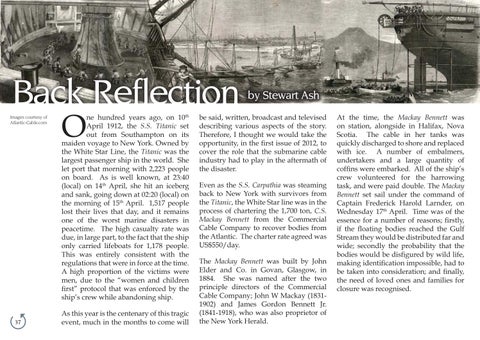
Back Reflection Images courtesy of Atlantic-Cable.com
37
O
ne hundred years ago, on 10th April 1912, the S.S. Titanic set out from Southampton on its maiden voyage to New York. Owned by the White Star Line, the Titanic was the largest passenger ship in the world. She let port that morning with 2,223 people on board. As is well known, at 23:40 (local) on 14th April, she hit an iceberg and sank, going down at 02:20 (local) on the morning of 15th April. 1,517 people lost their lives that day, and it remains one of the worst marine disasters in peacetime. The high casualty rate was due, in large part, to the fact that the ship only carried lifeboats for 1,178 people. This was entirely consistent with the regulations that were in force at the time. A high proportion of the victims were men, due to the “women and children first” protocol that was enforced by the ship’s crew while abandoning ship. As this year is the centenary of this tragic event, much in the months to come will
by Stewart Ash
be said, written, broadcast and televised describing various aspects of the story. Therefore, I thought we would take the opportunity, in the first issue of 2012, to cover the role that the submarine cable industry had to play in the aftermath of the disaster. Even as the S.S. Carpathia was steaming back to New York with survivors from the Titanic, the White Star line was in the process of chartering the 1,700 ton, C.S. Mackay Bennett from the Commercial Cable Company to recover bodies from the Atlantic. The charter rate agreed was US$550/day. The Mackay Bennett was built by John Elder and Co. in Govan, Glasgow, in 1884. She was named after the two principle directors of the Commercial Cable Company; John W Mackay (18311902) and James Gordon Bennett Jr. (1841-1918), who was also proprietor of the New York Herald.
At the time, the Mackay Bennett was on station, alongside in Halifax, Nova Scotia. The cable in her tanks was quickly discharged to shore and replaced with ice. A number of embalmers, undertakers and a large quantity of coffins were embarked. All of the ship’s crew volunteered for the harrowing task, and were paid double. The Mackay Bennett set sail under the command of Captain Frederick Harold Larnder, on Wednesday 17th April. Time was of the essence for a number of reasons; firstly, if the floating bodies reached the Gulf Stream they would be distributed far and wide; secondly the probability that the bodies would be disfigured by wild life, making identification impossible, had to be taken into consideration; and finally, the need of loved ones and families for closure was recognised.
abandoned the search and returned to Halifax.
Cable ship Mackay Bennett
As the bodies were taken aboard the Mackay Bennett, they were given a label with a number, and any possessions discovered on the body were placed in a small bag with the same number. Despite the best efforts of the authorities in Halifax and the officials of the White Star Line, only 56 of the 190 bodies returned to Halifax by the Mackay Bennett were positively identified.
The Mackay Bennett reached the disaster site on the evening of Saturday 20th April. It quickly became apparent that there were too many floating bodies for the Mackay Bennett to cope with, and a second vessel, the Anglo American Telegraph Company’s CS Minia, was quickly chartered by the White Star Line.
38
The crew began recovery operations the next morning and, despite heavy swell, managed to recover 51 bodies. Of these 26 were considered so badly disfigured as to make identification impossible. These were wrapped in canvas, weighed down with iron bars and committed to the deep in a burial ceremony that evening. The
remainder were embalmed and placed in coffins. On 23rd April, the Mackay Bennett rendezvoused with the Sardinian in order to take on more canvas for wrapping bodies. By Tuesday 26th April, the Mackay Bennett had recovered 306 bodies, of which 116 were buried at sea. Overwhelmed by the task they had undertaken, they headed back to Halifax with 190 bodies on board, roughly twice as many as the coffins they had taken. By this time, the Mania had arrived at the disaster site and continued to search. She recovered a further 17 bodies before she
Arrangements were made for the bodies that could not be identified, or where relatives could not afford, or did not want to repatriate them, to be buried in three of Halifax’s cemeteries: the Baron de Hirsch, the Fairview Lawn and the Mount Olivet. About half of the 150 people buried in Halifax were never identified, so the top line of their headstones were left blank, with only the body number engraved for reference and “Died April 15, 1912.” The crew of the Mackay Bennett recovered the body of a small, fair haired boy. There were no unique possessions on the body, so he remained unidentified. When people read about this, he became a symbol of the tragedy and the authorities in Halifax were overwhelmed with offers to sponsor the toddler’s funeral and
pay for a headstone. The difficult task of selecting a sponsor was made easier when Captain Larnder and the crew of the Mackay Bennett offer to sponsor the funeral. The boy’s epitaph reads: “Erected to the Memory of a of the an Unknown Child Whose Remains were Recovered after the Disaster of the Titanic, April 15, 1912.”
39
In November 2002, the American PBS television series Secrets of the Dead initially identified the body as Eino Viljami Panula, a 13-month old Finnish baby, the identification being based on dental records. However, Canadian researchers discovered through a test on the child’s HVS1, a type of mitochondrial DNA molecule, that this did not match the Panula family. DNA extracted from the exhumed remains and DNA provided by a surviving maternal relative helped positively match the remains and the re-identification was announced on 30 July 2007. The boy was Sidney Leslie Goodwin (1910 -1912) a 19 month old English boy, the youngest son of Frederick Joseph Goodwin and Augusta née Tyler. The Goodwins were travelling to the USA to join Fredrick's brother Thomas. They had booked third class passage on a small steamer out of Southampton, but due to the coal strike the voyage was cancelled and they were transferred to the Titanic. Frederick
had five other children, Lillian 16, Charles 14, William 11, Jessie 10 and Harold 9. Apart from Sidney, none of the family's remains have been identified, and it is probable that they are among the 1,188 bodies that were never recovered.. Captain Larnder was killed in action during the First World War, but the Mackay Bennett continued in service as a cable ship until 1922. She was then retired to Plymouth Sound where she was used as a cable storage hulk. During WWII, she was sunk at her moorings but later re-floated and refitted. In September 1965 she was towed away to Ghent and broken up.
Conferences
Pacific Telecommunications Council 15-18 January 2012 Honolulu, Hawaii Website Global Submarine Cable Forum 26-28 March 2012 London, UK Website ICPC Planery Meeting 17-19 April 2012 Lisbon, Portugal Website Submarine Networks World Africa 2012 21-24 May 2012 Johannesburg, South Africa Website Submarine Networks World 2012 5-7 September 2012 Singapore Website SubOptic 2013 22-25 April 2013 Paris, France Website
40
Letter to a Friend
for the spirit of competition instead of bloody war, and also my various shouts of protest such as "TAT-14 never again," or the inefficient and unfair "Bafo" process. Who will remember all these in the coming times? Who remember Buchanan‘s message to Queen Victoria?
Jean Devos My dear friend, I have been writing you letters several times a year for more than 10 years now, and this may be my last in SubTel Forum. My last "message in a bottle," my last "sermon on the mount,” my last "talk to a brick wall."
41
It could be my "last word," just like the first Transatlantic cable, which became definitively silent after having just transmitted the messages exchanged between Queen Victoria and U.S. President Buchanan in 1858. That
telegraph line was exhausted by the one hour and seven minutes effort to transmit a 100 words message! The "cable has given its final death rattle and taken its last dying breath." (Stefan Zweig in The First Word To Cross The Ocean.) Exactly so, I am giving here my final death rattle! The appeals I launched so often for more individual responsibility from our top managers--more personal involvement, my calls for a certain degree of self regulation from our community, my calls
“It is a triumph…far more useful to mankind than was ever won… proves to be a bond of peace and friendship…and an instrument destined by Divine Providence to diffuse religion, civilization, liberty, and law throughout the world. In this view, will not all nations of Christendom spontaneously unite in the declaration that it shall be forever neutral, and that its communications shall be held sacred in passing to their place of destination, even in the midst of hostilities.” Such language is clearly outdated, but I like the vision, the spirit, and the capability to finger-point the deep meaning of such a project for the whole society. At that time, science, talent, and energy were perceived positively. A new cable was perceived as a "bond of peace and friendship," a means for a positive development. One was placing confidence in civilization and religion; one had faith in the progress of justice and liberty. One wanted these cables to be useful to everyone, to be untouchable, a "sacred object."
The only message one can hear in our current press-releases and inaugural speeches is "more capacity!" It's like sex without love! The cultural dimension of our work, the sense of pride, of fulfilling a mission, these feelings are gone. I need to recognize that we have learned a few lessons since 1858. Science and technology are seen as sources of potential risks more than sources of progress. It is now normal to show skepticism, and one does not believe much in a better world. Our submarine cable industry refuses to put forward its major role in the globalization process, in the progress of emerging countries, in the possibility given to almost everyone to access the knowledge, in the way to govern a country, in everyone’s life. Utopia? Sure it is. As it was sheer utopianism to conceive, 150 years ago, that human beings could communicate through seas and oceans. Our community is wrong. We are contributing significantly to the emergence of a new and better world, but we behave as if we were just an ordinary activity. Collecting and accumulating stones is a real task, but designing and building a cathedral is another story. We are building and accumulating a lot of cables, not enough here, too many 42
there, but the overall result is not a piece of art inspired by an idea and designed by an artist or an architect. The global network is far from being perfect, far from arousing the admiration of all. The reason is that this network does not respond to a plan and does not translate a vision. When do we start the cathedral?
Dear Kevin and SubTel Forum team, Congratulations on your anniversary and achievements. I am really upset to have missed the quote deadline. Wishing you all more and more success. Best regards, Ola Khaled Telecom Egypt
Dear Kevin I apologize for missing your deadline but would still simply like to state that I find SubTel Forum a fantastic tool which helps to keep me well informed on industry happenings and going-on. I find it most informative and helpful. Cheers, Salvatore Vincenti Tata Communications
Advertisers Index ISSN 1948-3031
Issue Themes: January: Global Outlook March: Finance & Legal May: Subsea Capacity July: Regional Systems September: Offshore Energy
Ciena
www.ciena.com
11
Huawei Marine Networks
www.huaweimarine.com
17
Nexans
www.nexans.com
26
OFS
www.ofsoptics.com
4
SubOptic
www.suboptic.org
6
WFN Strategies
www.wfnstrategies.com
21
November: Subsea Technology Advertising enquiries: Sales Manager Kristian Nielsen Tel: +1 (703) 444-0845 Email: knielsen@subtelforum.com
Participate
Sales Representative, Europe, AFRICA, Middle east Wilhelm Sicking Tel: + 49 (0) 201-779861 Email: wsicking@subtelforum.com
Copyright © 2012 Submarine Telecoms Forum, Inc.
43
submit your article ideas to editor@subtelforum.com
by Kevin G. Summers
I
volunteered at Harpers Ferry National Park for several years leading up to the 150th anniversary of John Brown's 1859 raid. I spent most of that time in the John Brown museum, explaining the story of the infamous abolitionist to visitors. Their comments ranged from reverent to reviling, as Brown is still considered a controversial figure even to this day. I spent significantly less time in period costume, working in the men's dry goods store, but it is that time that I want to write about today. In the dry goods store at Harpers Ferry is a perfectly preserved sewing machine from the 1860s. Built from iron and wood, it is a beautiful machine that would be the centerpiece of any antique collection. Trust me, if you caught a glimpse of this sewing machine, you would want it for your living room. And in spite of the years, the damn thing still works! It is a 44
relic from a time when machines were built to be both functional and aesthetic. After 150 years, this machine is still both. As I'm flying across the United States today, finalizing this issue of SubTel Forum, I'm thinking about the things we build. This airplane, a 747, is certainly functional, but it is neither aesthetic nor comfortable. This plane will get me from Dulles to San Francisco (hopefully) and the next will carry me to Honolulu, but would anyone in their right mind call it a thing of beauty? I'm writing this article on a 2009 15" MacBook Pro. It's a sleek computer, as aesthetic as a laptop can get in my opinion, and it is certainly functional, but I'll be lucky to get 2 more years of life out of it. 5 years is about the most you can hope for from a computer these days, assuming you don't drop it in the
parking lot. I love my Mac, but it's not built to withstand years and years of use. It's a disposable tool. Hell, by 2014, most people will probably be using iPads instead of laptops! I'm sure you've read this issue's Letter to a Friend by Jean Devos. I'd like to reemphasize his final point. We are in business to make money, but the work shouldn't just be about the money. We're changing the world with our cables. We make history every single day, and it's important to recognize that. Thanks Jean!
What do you think? Click on the Letter To The Editor icon and drop me a line. I’d love to hear from you.