Back Reflection Images courtesy of Atlantic-Cable.com
W
A Girdle Round the Earth
illiam Shakespeare’s Puck claimed that, in A Midsummer’s Night Dream, “I’ll put a girdle round about the earth in forty minutes.” The circumference of the earth is 24,901.55 miles, and it took John Pender (1816 – 1896) the “Cable King,” around 4 years to achieve somewhere in excess of half of this feat. On 15th November 1872, the first telegraph service between Adelaide, the capital of South Australia and London (over 12,500 miles) went into commercial operation.
37
If India was the source of cotton for the British Empire in the 1850s, Australia was undoubtedly its source of wool. Each of the Australian colonies was self-governing and, at that time, totally independent of each other. There was no legal union except, of course, with the Crown. The campaign for full independence was led by New South Wales and, in its 1851 'Declaration, Protest and Remonstrance' it demanded an end to imperial control over taxation, land policy and revenues, a dilution of the Crown veto and a constitution similar to that already agreed with Canada. The British Government
by Stewart Ash
eventual conceded to these demands and, between 1856-7, democratic constitutions were introduced to all the colonies of Australia. By 1859, Australia was exporting £40,000,000 of wool to Britain and the 1861 Census showed that the total population was just over 1 million. Though small compared to India, it quickly became apparent that this export trade required better communication with the UK than was provided by the mail bag service on the monthly P & O steamer. In order to bring Australian telecommunications into the nineteenth century, the governments of Queensland and South Australia approached John Pender. They lobbied him with proposals for a lengthy period and, in 1868, Pender finally chose to support the South Australian Government proposal. Within 6 months, construction of a new submarine telegraph system was underway. Submarine cable telegraph connectivity already existed from London to Bombay through three independent telegraph companies--the Falmouth, Gibraltar and Malta Telegraph Company Ltd. (formed in 1869); the Anglo-Mediterranean Telegraph Company Ltd. (formed in 1868) and the British
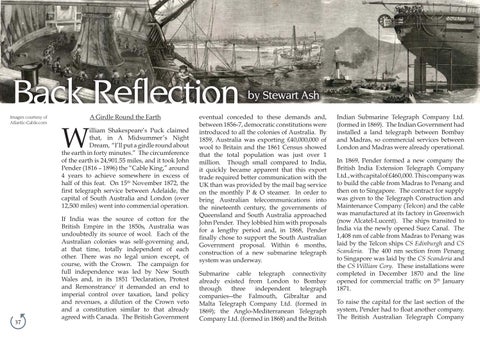
Indian Submarine Telegraph Company Ltd. (formed in 1869). The Indian Government had installed a land telegraph between Bombay and Madras, so commercial services between London and Madras were already operational. In 1869, Pender formed a new company the British India Extension Telegraph Company Ltd., with capital of £460,000. This company was to build the cable from Madras to Penang and then on to Singapore. The contract for supply was given to the Telegraph Construction and Maintenance Company (Telcon) and the cable was manufactured at its factory in Greenwich (now Alcatel-Lucent). The ships transited to India via the newly opened Suez Canal. The 1,408 nm of cable from Madras to Penang was laid by the Telcon ships CS Edinburgh and CS Scanderia. The 400 nm section from Penang to Singapore was laid by the CS Scanderia and the CS William Cory. These installations were completed in December 1870 and the line opened for commercial traffic on 5th January 1871. To raise the capital for the last section of the system, Pender had to float another company. The British Australian Telegraph Company