Voice
of the Industry
Offshore Energy Edition
In This Issue: The State of the Offshore O&G Market Fibre Installations Build A Subsea Connection Point From Ocean to Cloud - SubOptic 2013
59 s e p
2011
ISSN 1948-3031
ISSN 1948-3031 Submarine Telecoms Forum is published bimonthly by WFN Strategies. The publication may not be reproduced or transmitted in any form, in whole or in part, without the permission of the publishers. S u b m a r i n e Te l e c o m s F o r u m i s a n independent comm ercial publication, serving as a freely accessible forum for professionals in industries connected with submarine optical fibre technologies and techniques. Liability: while every care is taken in preparation of this publication, the publishers cannot be held responsible for the accuracy of the information herein, or any errors which may occur in advertising or editorial content, or any consequence arising from any errors or omissions. The publisher cannot be held responsible for any views expressed by contributors, and the editor reserves the right to edit any advertising or editorial material submitted for publication. Contributions are welcomed. Please forward to the Managing Editor: PUBLISHER Wayne Nielsen Tel: +[1] 703 444 2527 Email: wnielsen@subtelforum.com EDITOR Kevin G. Summers Tel: +[1] 703 468 0554 Email: editor@subtelforum.com 2
Copyright © 2011 WFN Strategies
H
urricane Irene wasn’t all she was cracked-up to be.
Not that I’m complaining; she brought the entire East coast of the USA to a standstill for a few days, dumped a whole lot of rain on a wide swath of the country and scared a boatload of people in the Northeast. She also followed within days the first appreciable earthquake in over one hundred years. My wife and I had the ‘pleasure’ of driving the main north/south motorway from Virginia to North Carolina the day after Irene left the area. On the highway bordering the two states we came to a 75 mile strip where all electricity had been disabled. We had decided to top-up our tank before heading towards the coast, and at every exit found all the side roads blocked with standing cars, owing to a lack of operational traffic lights, restaurants or other facilities. We finally found an “Oasis” gas station that was being powered by an external generator off the highway outside a small non-descript Carolina town. Even though gas and services were plentiful you could still feel a palatable tension in the air.
Voices were raised; conversations were short; prices were normal. To their credit, the proprietor remained calm when all else around were not. We seem to be entering a new phase in our industry. It will be interesting to see who remains calm after the storm passes.
In This Issue...
3
Exordium Wayne Nielsen
2
News Now
4
The State of the Offshore O&G Market Meredith Cleveland
6
Book Review: Pacific Wiretap Kevin G. Summers
10
Research Vessels Tackle Complex Marine Conditions to Navigate Offshore Wind Transmission Cable Requirements Robert Mecarini
11
Fibre Installations Build A Subsea Connection Point Stephen Lentz
18
The Atlantic Wind Connection The East Coast Super Grid for Offshore Wind Power Transmission William Wall
23
From Mataram to Kupang Jas Dhooper & David Liu Jianmin
28
From Ocean to Cloud SubOptic 2013
37
Back Reflection Stewart Ash
41
Conferences
43
Letter to a Friend Jean Devos
44
Advertiser Index
45
Coda Kevin G. Summers
46
ACE: President launches $25m Submarine Cable Project AP Telecom Announces Milestone Achievements Since Launch Asian Development Bank to finance Tonga-Fiji cable Bangladesh sees almost two hour internet blackout Boskalis Gets Contract To Install Fiber Optic Cable In Argentina BusyInternet crowned best Internet Service Provider of the year in Ghana
News Now
Cyta and STE provide fully resilient bridge between Europe and the Middle East via new ALASIA Cable System
Infinera Opens Hong Kong Office for Asia Pacific Customers
DeepOcean Group Holding AS Subsidiary, CTC Marine Projects, Mobilises the Volantis and UT-1 to the Far East
Kodiak Kenai Cable Company Deploys Infinera for Alaskan Subsea Network Upgrade
Internet goes off again
Kordia puts brakes on OptiKor Cable
Despite criticism, China pumps money into African telecoms
LION-2 lands in Kenya
Glo 1 makes inroads into Nigeria's oil sector
Mexus Gold US Submarine Cable Update
Gulf Bridge International achieves industry-wide milestone by offering 100G on its wholly-owned undersea cable across Gulf
Namibia hosts ICT summit Nigeria: NITEL announces disruption of Sat-3 fibre cable serving West Africa
Pacnet Breaks Ground on New Data Landing Station in Hong Kong Pacnet Speeds Digital Content Delivery Across Asia Perseus Telecom Opens the Fastest Available Trading Connection to Brazil’s BOVESPA Exchange PLDT to start its segment of Asia Submarine-Cable Express PPLive Selects Pacnet for Asia Network Expansion
Submarine cable business helps Omantel revenue grow to RO 223.3 Million Telecom Egypt Company : Telecom Egypt Puts First 40G Mediterranean System in Service Telecom Fiji secures Southern Cross access Vodafone NZ leaves Southern Cross for Pacific Fibre WACS construction progressing well
Reliance Globalcom upgrades FNAL network
WFN Strategies Announces Addition of Blair to Project Management Staff
SEACOM achieves global first with 500 Gb/s network trial
WFN Strategies to assist on new American Samoa cable
SEACOM appoints new CEO
Xtera Communications Inc. and Kokusai Cable Ship Co., Ltd. Awarded Contract to build Guam, Okinawa, Kyushu and Incheon � GOKI Submarine Cable System for AT&T
Seacom downtime a minor event Sierra Leone launches submarine cable project
Yenista Optics Releases New OSICS Module: Variable Backreflector
The State of the Offshore O&G Market
6 Meredith Cleveland
O
ptical fiber, for most of us, is a way of life. With the growth of email, Facebook, YouTube, and Twitter, fast telecommunications is more than a just a desire, it’s a necessity. However, until recently, these feelings were not shared by the O&G industry. Optical fiber was regarded as expensive and fragile. Moreover, fiber was expensive and the less costly satellite and microwave systems were more than capable of providing satisfactory telecommunications for most platforms. Not until drilling pushed further and further offshore did the tide begin to change; with the development of new subsea technology as well as the possibility of better profitability, O&G executives began to take a new look at fiber.
The increasing need for optical fiber for oil and gas has already been covered extensively in previous issues of Subtel Forum. However, what has been less defined is actual market for these systems. What are the trends in the oil and gas market and how do they pertain to telecoms? What is the market potential for O&G systems? To give a short background, the “typical” O&G telecoms system has truly evolved in under the past ten years. The first buzz of fiber optics being used for O&G besides merely linking adjacent platforms is still a fairly recent memory (North Sea area in 1988; BT Marine has the distinction of installing the first true O&G system). 7
Fast forward to 2005 when BP began to engineer and design the first O&G fiber optic ring in the Gulf of Mexico and the industry standard design for multiplatform interconnection was born. From this point onward, the same design was utilized in planning for a variety of other offshore networks around the world and it appeared the O&G telecoms market was growing faster than ever. Cue the financial crisis of 2009 and current stall-out in 2011. How well does O&G weather poor economies? And, in times of uncertainty, will O&G companies still be willing to invest large sums in telecommunications networks?
The short answer: yes. Even in today’s unstable economy, oil still drives our everyday lives. While O&G certainly suffered a loss in 2009, current high gas prices have meant that oil profits are substantial thus far in 2011. This has subsequently led to a rise in offshore oil and gas development projects. Even in 2009, O&G companies were still considering investments in more deepwater projects and the projected dip in global development after the BP disaster in 2010 has yet to materialize. Even more interesting to those in the telecoms market is the decreasing split between projects in deepwater and those in ultra deepwater. According to
8
china-ogpe.com, of the projects launched in 2001 to 2007, the percentage of projects in deep water (water depth over 500m) was 48% and the percentage of projects in ultra deep water (water depth over 1200m) was at 22%. Currently, that divide continues to lessen: Infrastructure Journal reports that between February 2010 and February 2011 international ultra deep water drilling increased 32%. At those critical depths, the importance of a good telecommunications system is unparalleled. The deeper the drill and the further from shore and the more significant comms become.
Therefore, it’s safe to assume that the O&G telecoms market will continue to grow. However, how big is the actual market potential? While statistics for O&G fiber telecoms systems are non-existent, it is possible to arrive at a number using a few reasonable assumptions. To begin, we need to know the amount of platforms pumping at any given time. In figure one, the worldwide offshore “active” rig count is provided for the past ten years (active rigs are defined by Baker Hughes any rig that is a “on location and be drilling”. If the numbers look low to you, keep in
mind that oil rigs and oil platforms are different, playing different roles during development, drilling and production. Drilling rigs are removed from the platform once oil production begins. While there are thousands of oil platforms worldwide, active rigs are in the hundreds.) Globally, it appears that active rigs are an unstable number over the past ten years, seesawing back and forth between extremes. However, when the North American rig numbers are removed, the trend becomes exactly the opposite (figure 2). Even as North American offshore active rig
numbers continue to be volatile (due to both political limitations as well as physical environmental ones – the US is drilling smaller basins than those internationally), international rig numbers are far more stable and clearly increasing. If the current trend remains the same, approximately 50
9
active rigs could be added in the next five years. The same number was added from the period of 2006 to 2011. Assuming that O&G companies would only invest in a fiber optic telecommunications system for new or relatively new projects for 1) ease of installation and 2) the fact that oil basins don’t last forever, we can estimate that projects started (or starting) in 2006 to 2016 are fair game. That leaves 100 projects that have potential for a telecoms system. Assuming that the typical O&G system costs somewhere in the range of $20 million (a mid-range estimate; this number could be much lower or higher depending on the number of platforms that need to be connected), that puts the O&G telecoms market potential somewhere near $200 million. Meanwhile, as the US O&G industry pushes to drill in areas such as the Florida Gulf Coast, off both the East/West coasts and Alaska, this number could be pushed substantially higher. As drilling pushes into more technically challenging areas, the market potential for O&G comms will only grow. Moreover, as comms technology becomes cheaper and easier to install, $200 million could end up
being a radically conservative number in 5 years. What was unprecedented in 1988 could become commonplace for a platform in 2016 since reliability and survivability have now become more important than ever. As O&G continues to search for profitability, high bandwidth will not only be the desire, but the necessity. Telecoms newest market is not only growing, but its here to stay.
Meredith Cleveland is a Project Engineer for WFN Strategies. She received a BS in Environmental Sciences from the University of Virginia and her MS from the University of New Hampshire in Earth Sciences with a specialization in Geochemical Systems. She is a trained scientist with areas of expertise in running highly specialized instrumentation as well as data collection, management, and interpretation.
$200,000,000
Book Review J
onathan had yet to attend a funeral in his life, but the descent of the elevator into the ground conjured up images of a casket gliding into its grave. Alone in the steel chamber, the silent, indiscernible motion raised the hair on his back, and after thirty seconds he was relieved when a wall rolled away as a door."
"
So begins Pacific Wiretap, a new novel by Patrick Downey. Downey, a 37year veteran of the telecommunications industry, has delivered an action-packed adventure with this, his first novel.
10
Pacific Wiretap is the story of Jonathan Fox, a telecommunications intern who becomes embroiled in the investigation of a wiretap of an undersea cable network. His journey carries him across the Pacific, through Japan, Guam, Hawaii and California, and in the process he finds love, flees murderers and finds himself doing things that he finds distasteful, but necessary, in order to complete him mission. The action is intense, and most SubTel readers will find the setting instantly relatable. Many of the scenes are set in cable stations or onboard a cable ship.
By Kevin G. Summers In his excellent memoir, On Writing, Stephen King suggests that "people love to read about work. God knows why, but
they do….What you need to remember is that there’s a difference between lecturing about what you know and using it to enrich the story. The latter is good. The former is not." My one criticism of Pacific Wiretap is that the telecommunications elements of this story read more like a SubTel Forum article than they do a piece of fiction. It's enough to say that Jonathan walked into a conference room and saw a map of international submarine cables on the wall. I don't need to know the RPL and capacity of each system. That said, once the story picked up and Downey found his voice, the telecoms lingo moved to the background where it belongs. Overall, I enjoyed this book and would recommend it to SubTel readers. It's available as both a paperback and digitally for the Amazon Kindle.
Research Vessels Tackle Complex Marine Conditions to Navigate Offshore Wind Transmission Cable Requirements
11 Robert Mecarini
A
s data collection ramps-up for offshore wind projects and grid connection, previous cable transmission routing and installation can inform efforts. Opponents and proponents of offshore wind energy agree on at least one thing: It will take a great deal of investment to get projects operational, connected to the grid, and price-competitive with traditional energy sources, offshore and otherwise. But U.S. wind resources offshore are more than abundant, and if harnessed, will deliver sustainable output capable of addressing a good chunk of the country’s insatiable appetite for electricity.
12
Since the country has yet to place any turbines off its coastline, skeptics say worries about grid connectivity are premature. But as wind projects off the East Coast and other regions gain momentum, developers need to ensure the electricity transmission infrastructure avoids, where possible, the pitfalls that have plagued the
early stages of wind site development. Clearly documented state and federal marine data requirements can significantly ease the data acquisition efforts needed to map transmission infrastructure routes. Addressing the complexities involved with collecting the required survey data for turbine-to-power-source transmission will require research vessels capable of efficient performance in a wide range of water conditions.
U.S. offshore wind projects, for example, have thus far suffered through complex permitting processes that have, in turn, hampered project financing, purchase power agreement negotiations, and industry investment. Accessible data will help streamline not just the offshore wind development phase, but upcoming wind farm construction, grid connection through new transmission cable, and ongoing turbine operations.
Any offshore energy project, whether in traditional energy sectors or in the nascent renewable sector, depends on a broad range of marine data collected across the entire project lifecycle. But U.S. offshore wind energy efforts are particularly datahungry at the moment. Not only does marine data feed individual projects, it’s needed to help the Department of Energy and collaborating agencies meet their stated objective of establishing networked national databases covering every aspect of the offshore wind lifecycle.
The good news is that U.S. offshore wind power transmission projects can learn valuable lessons from the vast amount of marine data that’s been collected for traditional offshore energy projects globally, offshore wind projects in Europe, and subsea transmission cable projects around the world. Moreover, here in the U.S., a significant amount of marine data has already been collected for the development phase of offshore projects in the Atlantic and Gulf of Mexico, driving the progress of several wind projects
Survey Platform Considerations Marine data collection for mapping transmission cable routes for offshore wind will be as time- and detail-intensive as previous power cable efforts. But while a research team may deal specifically with nearshore waters or deep waters offshore for a wind farm site survey, power transmission surveys require that teams be able to handle every marine condition that the cable travels through — from offshore power generation sources to nearshore converter stations to inshore power transmission plants sited on rivers, for example.
13
and providing an increasingly clearer picture of the physical characteristics of various geographies. Data acquisition efforts for offshore wind projects to date can help streamline upcoming surveys for the Atlantic Wind Connection (AWC) project, slated to deliver a single subsea HVDC transmission backbone capable of connecting 7,000MW of offshore wind capacity via a limited number of landfall points.
To ensure the safe and efficient collection of reliable survey data in the complex and varied marine conditions that characterize offshore wind projects, research teams will require stable, versatile research vessels. The ability to work in a variety of marine environments eliminates the need to remobilize a vessel and its assets when moving into a new area, or switching vessels to conduct all necessary surveys. Companies also don’t have to invest the time and money to outfit a vessel designed for another use. Project developers want vessels that can work in every environment from the offshore wind farm array to the point nearshore where the cable enters the horizontal directional drill pit. For energy distribution, most survey work takes place
in nearshore environments with high condition variance. Shallow waters in the Atlantic, such those where Cape Wind is sited, as well as rivers and bays, pose some of the biggest issues for research teams, requiring vessels that are highly maneuverable with strong stationkeeping performance. These complexities coupled with a growing business in offshore wind project surveying, drove Alpine Ocean Seismic Survey, with financing from parent company Gardline Group, to invest $3.5 million to retrofit a former U.S. Coast Guard vessel, an effort completed in 2011. Alpine had several criteria for the new R/V Shearwater to make it an effective survey platform. Given stringent survey requirements, stationkeeping and linekeeping performance were primary goals of the retrofit. The twin hull design provides a stable platform for research, while its size and shallow draft combine to create a vessel effective in a range of depths. The Shearwater’s dimensions — relatively large for a research vessel at 110’ by 40’ — allow researchers to work in deeper waters offshore, while its shallow draft (6.5’) accommodates coastal areas, estuaries, and tidal rivers. For maneuverability, Alpine chose to go with two azimuth hydraulic thruster propulsion units. This kind of propulsion provides improved fuel efficiency along with stationkeeping
and line-keeping performance, while reducing vessel noise that might impact survey results or disturb marine life. The stationkeeping provided by hydraulic propulsion might help address another issue the industry is starting to deal with in offshore surveys. Some state and federal regulations require that sites have archaeological clearance before researchers can collect sediment samples because of concerns that survey vessels that need anchors for stationkeeping may disturb archaeological features. However, this requirement slows project permitting and other processes, so more agencies and developers are favoring the use of research vessels that don’t require anchoring for sediment sampling and other tasks. Alpine opted to add an equipment moon pool in both the port and starboard hulls to simplify equipment deployment, as well as an hydraulic crane, hydraulic stern A-frame, fixed starboard A-frame, dedicated equipment-handling winches, and stern rescue deck for diver operations. As part of new environmental data collection services, Alpine added new sediment sampling technologies and underwater video cameras, including a freshwater lens camera system capable of capturing clear images in low-visibility marine conditions.
14
Extended Mobilization Impacts Survey Efforts and Costs For maximum cable survey project efficiency, research teams optimally secure a boat they can mobilize for extended periods offshore. This capability means crews avoid costly daily travel to and from port and allows them to conduct survey studies on a 24x7 basis when regulations allow. To achieve extended mobilization, Alpine equipped the Shearwater with redundant generators, fuel and water reserves sufficient for 14-day periods, and a desalination system. Design engineers also created dedicated office space, a laboratory where researchers can process data while underway, and sleeping accommodations for 20 people. Onboard data processing is a key differentiator for cable routing surveys and other marine data collection, because research teams can determine on-site, among other findings, if they need to modify their survey design. It’s much more cost-effective to adapt a survey in progress than remobilize for a second effort. Flexibility benefits are one reason it’s a good strategy to have a client representative join a crew for survey efforts, as they can coordinate decisions that affect survey design while underway. The complex realities of surveying cable routes require client reps and research teams that understand that with undersea installations, not everything always goes according to the initial plan.
infrastructure they need to deliver power to consumers. Complex power transmission cable projects completed in the U.S. serve as good preparation for upcoming offshore renewable cable surveys that will be the launch pad for grid-connection efforts. In 2002, Alpine began Neptune Transmission System’s HVDC cable route survey, a five-year effort that required two geophysical, hydrographic, and sediment sampling surveys for engineering and burial assessment, as well as positioning surveys for the cable-lay barge. The goal of the project, sponsored by the Long Island Power Authority, was to tap into power from more diverse electricity-generation resources from markets in other states to more cost-effectively serve customers. Though Alpine just launched the Shearwater, it has previously performed survey work for offshore wind projects in the Great Lakes for Lake Erie Energy Development Corp. (LEEDCo); for the Fishermen’s Energy projects off the coast of New Jersey; and for two other offshore wind projects under development. For Fishermen’s proposed 350MW wind farm in federal waters, it conducted the surveys for the meteorological tower required to characterize the site’s wind resources, as well as all the nearshore survey work for Fishermen’s 25MW demonstration site in state waters. It’s now supporting the project developers as they prepare for preconstruction efforts. 15
These efforts have not only provided industry-specific data collection expertise, they’ve enabled Alpine and its partners to work closely with BOEMRE and other agencies to determine data requirements. The complexities that characterized BOEMRE and other agencies’ early siting and permitting processes are starting to get addressed thanks to open collaboration among agencies and other stakeholders.
The effort required that the initial survey explore two possible routes, both starting in the Raritan River in N.J. Based on survey results, developers determined the final route, which stretches from Sayerville, N.J. to Jones Beach, N.Y. For the second development phase, which began in 2004, geotechnical, geophysical, and archaeological surveys were conducted along a corridor 81km long and 20m wide.
Transmission Cable Projects and Water Complexities
Because it required data collection in open water, bays, and rivers, the survey effort presented numerous challenges. The team had to efficiently collect quality data while contending with shallow water, tide and current complexities, and heavy marine
With the upcoming AWC project slated to stretch from New York to Virginia, East Coast wind farm developers can look forward to having the transmission
traffic. At the time of its completion, the Neptune Regional Transmission System represented the longest submarine transmission cable in the U.S. Neptune has since been surpassed by Trans Bay Cable’s HVDC submarine power transmission cable, which runs between San Francisco and Pittsburg, Calif. Trans Bay contracted with Alpine to run the survey operations, which began in 2009. The purpose of the survey was to collect data within a corridor 84km long and 250m wide to determine final alignment for the marine and land segments of the route, as well as to provide data needed for the cable design and installation. Like the Neptune project, the site presented a mix of challenging marine conditions, including complex tidal conditions, particularly where the Sacramento River merged with Suisan Bay, meaning data collection had to address both freshwater and saltwater acoustic characteristics. Also problematic were high currents, heavy marine traffic, and water depths ranging from 9’ to 100’. Alpine conducted surveys using sub-bottom profilers, magnetometers, side-scan sonar, and swath bathymetry; handled sediment sampling; provided surface and underwater acoustic positioning for dive operations; and conducted the barge-positioning surveys for the cable installation. Trans Bay’s submarine cable installation 16
is complete, but Alpine remains involved in ongoing work for its client. It conducts, for instance, the annual inspection of the transmission cable, and is working with Trans Bay to create an interactive database that can be updated as needed to ensure stakeholders have the most recent information across the installation’s lifecycle. These projects and others provide a wealth of lessons and experience as project developers, backing stakeholders,
and contractors, including Alpine, ready for the upcoming AWC effort. Without this backbone, offshore wind farms will be hard-put to cost-effectively deliver their power to shore. Because electricity costs vie with overall ramp-up costs as primary reasons cited by opponents to avoid offshore wind, many will be closely watching this effort over the next several years. Robert Mecarini is president of Alpine Ocean Seismic Survey Inc., based in Norwood, N.J. Part of the Gardline Group, Alpine has conducted surveys for Fishermen’s Energy, LEEDCo, and other ongoing wind energy projects, as well as for the Neptune Regional Transmission System and the Trans Bay Submarine Power Link Cable. The company delivers turnkey marine data collection services for offshore renewable energy, civil engineering, shoreline protection, submarine cable, oil, and natural gas projects. For more information, visit www.alpineocean.com.
innovative. independent. inspired.
17
Fibre Installations Build A Subsea Connection Point
18 Stephen Lentz
By building a subsea connection point, installing fibre optics to offshore platforms might be easier – because very few companies have both telecoms and oil and gas expertise.
T
he hardest part of an offshore fibre optic installation comes with the final connection onto a platform.
Only a small handful of firms have demonstrated the combination of capabilities needed to work with the telecommunications technology while satisfying the needs of the oil and gas industry. But if you have a subsea fibre connector, the system is separated into two parts – the long distance fibre cable, which can be installed by the communications industry, and the connection up to the platform, which can be installed by the oil and gas industry. Since operating procedures of the two industries are not always compatible, this has the effect of reducing the perceived risk on both sides. It has a secondary benefit of increasing the number of potential suppliers for the fibre communications service. Without the subsea connection point, only those few commercial installers willing to address the risks and complications of installing a riser cable can be considered as potential suppliers.
19
With the subsea connection point, a communication services provider such as a regional telecom operator or a specialized
oilfield communications services provider can more easily provide services. Connect to subsea In many cases, a long distance communications cable can be connected to a subsea umbilical (an existing sheath of cables running down to subsea
equipment). This means that the need for a new riser cable and cable ship operations close to the platform are avoided. The umbilical can be installed using proven techniques by installers experienced in oil and gas field work. The disadvantage of this approach is that
the signal attenuation associated with the subsea connector may complicate the overall communications system design and the connector represents a potential failure point. New offshore installations For offshore installations still in the planning stages, the opportunity exists to provision and install a communications fibre as part of the platform commissioning. Similar to a gas export platform, the communications fibres are installed and terminated a few kilometres from the platform. A cable termination module with subsea connectors can be installed on the platform, or a permanent end-seal left on the seabed for later recovery. If subsea connectors are used, the cable-laying vessel will deploy a connectorized assembly and perform the ROV operations to connect the fibres. Alternatively, the cable-laying vessel can recover the cable end and perform a jointing (splicing) operation. All work is performed at a safe distance from the platform so that the connection to shore can be completed without impacting platform operations. The availability of a pre-installed riser greatly simplifies the job of the cable installer. 20
Deepsea cables
Cost
The fibre cable and transmission technology are readily available from multiple suppliers. Subsea fibre optic cable installation is a well-established industry that traces its roots to the first telegraph cables installed over 150 years ago. Much of the technology used to install a cable across the Atlantic or Pacific Ocean can be readily adapted for connection to offshore oil and gas platforms.
The costs to bring optical fibre to an offshore platform can quickly run to tens of millions of dollars. Installing a deepwater riser can cost three million dollars or more. At the lower end of the scale, platforms in less than 300m of water can often be quickly connected using standard cable. Cable and installation range from $30K to $100K per kilometre depending on depth and seabed conditions.
Specialized cable installation vessels outfitted with cable tanks, cable engines, clean rooms for fibre optic splicing, power feed equipment, test gear, bow thrusters, and dynamic positioning capabilities are owned and operated both by major suppliers and systems integrators.
Mobilization, shore stations, landings, transmission electronics, project management costs, and permits add to the cost. Pipeline and cable crossings also incur additional cost. Terrestrial data links are needed to connect the landing site to operations centres or corporate offices.
A communications system built for several platforms will share the cost of the backbone cable, landings, and mobilization among those platforms. Fibre trends In just the last few years, some significant milestones have been achieved with offshore fibre. BP’s Gulf of Mexico system was completed, connecting seven deep-water platforms to a 1200km backbone cable. This system now provides direct communications from each platform to BP’s Houston offices with less than 20ms latency. Fibre has become essential for North Sea operators. The combination of CNSFTC, North Sea Com and Tampnet have covered the North Sea with fibre, with over a dozen major platforms connected by fibre and many more supported by radio links which connect to the fibre network.
21
Planning for fibre communications to West Africa’s offshore industry has moved past the concept stage, and fibre is showing up in a few other locations around the world. Many further fibre projects remain confidential. Business case With fibre installation costs running to tens of millions of dollars, fibre optics can be dismissed as a costly luxury. What does it take to drive the conversion to optical fibre communications? Some of the key factors are: • Improved production through integration of disciplines and control centres both on and offshore (Integrated Operations Level 1) and increased use of workflow management tools. Production gains of one half to a few per cent have been attributed solely to improved communications. • The ability to reduce staffing offshore through collaboration and integrated operations. Savings of up to $1m per month per platform are possible. • Capital cost savings, if the reduced manning requirements are considered during front-end design. • Fifteen to twenty-five year life cycles to recoup costs • Ability of the fibre communications system to survive storms, leading to faster re-manning and reduced
downtime after abandonment due to weather; this is particularly applicable in the Gulf of Mexico where hurricanes are a fact of life. • Requirements for integration among operators and suppliers, including automated processes and digital services (Integrated Operations Level 2); this is most applicable in the North Sea where operations and supply chains are highly consolidated. Offshore expectations People working offshore are beginning to expect the same network performance and capabilities that are available onshore. Support personnel onshore expect their offshore counterparts to access the same network and data resources. A host of applications and needs are driving an increasing demand for offshore bandwidth. Not only is raw bandwidth a requirement, but also low and predictable latency as well as high availability are needed to support these applications. Video collaboration can operate with as little as 2Mb/s, but performs best with low latency links; some video services become difficult or impossible to use over satellite. The performance of office LAN functions including e-mail, software updates, remote access and workflow management is greatly improved when bandwidth of 20Mb/s or more is available.
Streaming video for entertainment and crew welfare will use as much bandwidth as can be delivered. High definition video collaboration requires 6Mb/s or more. Control data and production monitoring can utilize 10Mb/s or more. Reservoir Management and Simulation can utilize 30 Mb/s or more. Permanent Seismic Systems utilize 30 to 100Mb/s Taken together, the desirable bandwidth for an offshore installation can quickly reach 50Mb/s, 100Mb/s or more. Planning for future needs has led some operators to equip 1Gb/s and establish a growth path to 10Gb/s per platform.
The Power of Communications
Yet operators are often content with 1-2Mb/s satellite links or microwave systems offering 50Mb/s or less. Stephen Lentz has over twenty years experience in the construction and operation of optical communications networks including metropolitan area networks, national networks, and international submarine cable networks. He has served as VP Network Engineering and Deployment for 360networks’ submarine division where he developed the network architecture, functional requirements, and performance specifications for international submarine cable networks and supervised testing, commissioning, and verification of compliance with contractual requirements. He was Manager of Transmission Engineering for Time Telekom, Sdn. Bhd. located in Kuala Lumpur Malaysia, and Director of Systems Engineering for Lightwave Spectrum, Inc. He joined WFN Strategies in 2005 as Network Design Manager, and has supported telecom projects in Antarctica, Oklahoma, Gulf of Mexico and West Africa. In 2011, he was promoted to Director of Engineering.
Experts. Networking. Technology. Solutions. You’ll discover it all at Offshore Communications! Offshore Communications will return to the Houston Marriott Westchase November 8 –
Opening Keynote Address
10, 2011 as the only event for the oil and gas
The Power of Communications
community focused on communications in the rugged offshore environment.
Register today with VIP Code: WFN11 to qualify for the Advance Discount on the conference.
Conference: November 8 - 10, 2011 Exposition: November 9 - 10, 2011
Admiral Thad Allen, USCG (Ret.)
Open tO All Attendees!
Houston Marriott Westchase
22
www.OffshoreComms.com
19186
The Atlantic Wind Connection
The East Coast Super Grid for Offshore Wind Power Transmission
23 William Wall
T
he US Mid-Atlantic region is home to one of the most powerful offshore wind resources in the world. Just 15 to 20 miles offshore there is enough wind energy to supply millions of homes with clean, renewable power. The area is also home to major population centers, with an ever-increasing appetite for energy. Geographically, it is perfect for offshore wind, with a relatively gently sloping continental shelf and relatively shallow waters - 100 to 150 feet deep - as far as 15 to 20 miles offshore. The seafloor is typically comprised of sand and gravel sediments, making for simpler civil marine construction using current, field proven techniques. These factors combined create the “Perfect Storm” of offshore wind potential along the Mid-Atlantic shore. Now, how to bring all that power to shore in the most efficient manner? The generation and collection of offshore wind power has matured well in Europe over the last 20 years. Turbine manufacturers are building ever larger generators, foundations are being designed for deeper waters, and the submarine cable industry has expanded with new factories to meet the demand. The missing link is an efficient and flexible power transmission system to transfer the available power to the right place at the right time. This is where the Atlantic Wind Connection (AWC) project comes in.
24
A traditional wind farm has an array of medium-voltage cables collecting power from individual wind turbine generators
to an offshore AC transformer platform. Subsea high-voltage AC (HVAC) cables transmit power from the transformer platform to land where power is fed into a terrestrial substation and onto the terrestrial transmission grid. This “radial” transmission infrastructure has only one limited purpose. It is useful for power transmission when the wind is blowing, but sits idle when the weather is calm. And the radial interconnection feeds the full variability of an offshore wind farm’s output, as it fluctuates with the weather, into just one point on a typically weak coastal transmission grid. Multiple wind farms also would require many transmission cables, each presenting permitting obstacles and environmental impacts. The AWC system is a markedly different network approach to the offshore wind transmission challenge. AWC provides the ability to connect multiple offshore wind farms over a broad geographic area. As weather patterns cross over the midAtlantic region, the AWC backbone would mix the output of several wind farms and reduce the aggregate or overall variability of wind energy delivered by the AWC system. The AWC Project is the first offshore backbone electrical transmission system proposed in the United States. The AWC Project would allow up to 7,000 megawatts (MW) of offshore wind turbine capacity to connect to the regional high-voltage grid controlled by PJM – the region’s
transmission operator – in a cost-effective manner. This transmission solution will deliver enough energy to power over 2 million homes and will make the existing congested land-based transmission grid more reliable and efficient. Spanning the distance between Norfolk, Virginia in the south, and the metropolitan northern New Jersey area, the AWC backbone’s HVDC submarine circuits will consist of a bundle of three cables; a positive 320KV HVDC submarine power cable, a negative 320KV HVDC submarine power cable, and a submarine fiber optic cable for communication purposes.
The Project is designed to be built in phases to match the expected offshore wind development in the region. It will connect the multiple offshore wind farms that will be built in designated midAtlantic Wind Energy Areas (WEAs) to the strongest parts of the existing terrestrial transmission grid. The completed Project phases would be owned and operated as a federally regulated public utility with the responsibility for providing openaccess transmission service. The project’s investors are Good Energies, Google, Marubeni, and Elia. Figure 1 shows a conceptual configuration of the cable route for the AWC project interconnecting a series of offshore “Hubs”.
25
The offshore hubs are positioned in the wind energy areas where several wind farms can easily and inexpensively connect. At each hub location an offshore platform foundation is installed that will support a high-voltage direct current (HVDC) converter station. HVDC is the preferred way to transmit large amounts of energy long distances through submarine and subterranean cables because it imposes low losses and the technology permits greater controllability of power flows. The converter station converts the highvoltage AC output from the wind farm sub-station to high-voltage DC, using a semi-conductor based technology known as insulated gate bipolar transistors (IGBTs). The converter station directs the HVDC output to the AWC subsea cable system. The power can be directed on the
AWC network to the north, to the south, or to a land-based point of interconnection with the terrestrial grid where another converter station converts it from direct current back to the appropriate AC voltage and frequency for injection into the terrestrial grid. Electricity is that rare commodity that must be consumed as soon as it is produced. This means that balancing sources of supply with demand, controlling power flows, and instantly moving power from where it is produced to where it is needed are critical. The controllable
AWC network meets this challenge with technology that can mix the variable output of several offshore wind farms to make the overall production less variable. And power produced with conventional generating technologies available at some AWC land-based POIs with reserve capacity can be injected into the offshore network, mixed with the wind power, and emerge at another AWC land-based POI as firm, reliable power. The IGBTs in the AWC converter stations also allow the AWC network to “clean up” voltage and frequency problems on the terrestrial grid. Figure 1 – The AWC Cable & Hubs [Illustration by Kevin HandPopular Sciencewww. kevinhand. com]
Figure 2 – AWC offshore hub artist’s rendering [Illustration by Kevin HandPopular Sciencewww. kevinhand. com]
26
These benefits of the AWC system provide PJM - the grid operator - with a variety of grid optimization options. For example, the grid operator could direct power from AWC’s offshore network to the AWC terrestrial converter station that is experiencing the highest prices. This would allow the grid operator to add supply where needed to reduce high local energy market prices. In addition, the grid operator could use the AWC system’s ability to independently control
active and reactive power to help manage grid voltages to maintain power quality. In extreme cases when the terrestrial AC grid has collapsed in a blackout, AWC’s network could be controlled to transfer power from a “live” part of the region’s grid to assist in restarting a “dark” part of the grid. The virtues of a controllable backbone like AWC will increase in importance as offshore wind energy grows alongside energy use in the congested, populous mid-Atlantic region.
Figure 2 shows a conceptual layout of the offshore hub configuration. AWC’s engineers designed the system to be operated as a single integrated system even though it would be constructed in phases. The full project would comprise about 790 miles (1,271kilometers) of offshore transmission submarine cable constructed over approximately a 10‑year timeframe:
Phase A. The offshore portion from southern-New Jersey to Delaware with a capacity of up to 2,000 MW; Phase B. The offshore portion from southern-New Jersey to the northern New Jersey metropolitan area with a capacity of up to 1,000 MW; Phase C. The offshore portion from Maryland to the northern New Jersey/ New York metropolitan area with a capacity of up to 2,000 MW; Phase D. The offshore portion from Maryland to Virginia with a capacity of up to 1,000 MW; and Phase E. The offshore portion from Delaware to Virginia with a capacity of up to 1,000 MW.
The first phase of the AWC system could be in service in 2016-2017, in time for the first offshore wind projects proposed for the mid-Atlantic region.
27
Regulatory permitting for the AWC project is under way with both federal and state agencies. The federal agency overseeing offshore wind and transmission development on the U.S. Outer Continental Shelf (OCS) is the Bureau of Offshore Energy Management, Regulation & Enforcement (BOEMRE). Earlier this year, AWC’s developer, Atlantic Grid Development LLC, submitted a right-ofway grant application to BOEMRE. As part of the BOEMRE regulatory framework, AWC must now develop and submit a General Activities Plan (GAP). This GAP
must include empirical field survey data as well as a synthesis of all relevant and existing desktop data. AWC is currently planning a Geophysical and Geotechnical Marine Route Survey for the Phase A offshore cable route along with surveys at the Phase A hub sites. A detailed biological and archeological survey of Phase A will also be conducted. System engineering and design for the project progresses, as does route engineering for both the marine and terrestrial portions. In addition, cable landing sites are being reviewed. The submarine cable landings will use Horizontal Directional Drilling (HDD) technology to minimize environmental impacts at the shoreline. The submarine cable sections will be buried for protection and to comply with regulatory requirements; a target burial depth of 4’ to 6’ utilizing jetting techniques is anticipated. Though the offshore wind industry in the U.S. is still in its infancy, the AWC project provides a glimpse into how the industry could grow into a large scale source of clean energy, and a new source of jobs and economic development for the mid-Atlantic region. This growth will require a power transmission system that ensures system reliability and operational flexibility with a minimal environmental impact.
Bill Wall has spent nearly 40 years in the submarine cable industry. Starting at British Telecom (then GPO) Wall then spent 12 years with Cable & Wireless Marine Staff (now GMSL) where he was very active in the development of cable burial ROV systems. He was a member of the original Scarab 1 operations team. Wall then spent 18 years at Margus Co where he was VP Operations. His next assignment was Business Development Manager at Caldwell Marine International. He then joined the offshore wind industry as VP of Marine Operations at Deepwater Wind based in Hoboken NJ. He has a broad background in in sub-sea technical operations and project management including Shore Ends, HDD, ROV operations, Plowing, Survey operations, cable repair etc. He is currently Director, Marine Operations at The Atlantic Wind Connection based in Chevy Chase MD just outside Washington DC.
From Mataram to Kupang
Jas Dhooper &28 David Liu Jianmin
T
he Successful completion of the MATARAM-KUPANG Cable System (MKCS) which spans 1,200km, connecting five islands in the east of Indonesia and a long unrepeated section reaching over 415km, represents a critical milestone for Indonesia. The system provides each district within the country access to significant multi gigabit capacity communications infrastructure and national broadband access to all local/ regional networks intended to be shared by all telecommunications operators. From a structural standpoint, the system enables connectivity to 7 distinct landing points, thus providing internet to a wide region; and also integrates into phase one of the Palapa rings. Because the system
The Palapa ring vision, start of an amazing journey for Indonesia & the wider region
29
embeds into the high capacity Palapa ring backbone, MKCS which is owned by PT Telkom, forms part of a wider Indonesian growth story connecting more than 33 provinces and some 440 cities/districts, with over 35,000km submarine cable and 21,000km of land cable. MKCS represents a major milestone in the strategic initiative launched by the Indonesian Government to meet the region’s expanding capacity needs, and provides improved communications infrastructure for the region and beyond to a wider global community. Central to the Governments objective is to establish a national backbone network that guarantees well distributed Broadband access throughout the country,
offering lower rates to stimulate business growth and opportunity. It is well documented that enabling the rollout of such telecommunication services drives economic growth. In Indonesia, providing broadband access to the outstretched 70,000 villages, enables high capacity Points for Presence (POPs) and underpins the roll out of a national high capacity backbone network. Deep touch points represent fundamental factors to driving growth.
As has been shown in many expanding regions around the world, modern telecommunications technology, when paired with proper education, training and economic development opportunities, can be a source of significant benefit to the wider population. Telecommunications infrastructure plays an important role in the roll out of ICT and acts as an enabler to enhance regional skills, competitiveness and economic growth. In conjunction with the provision of educational programs to enable both current and future generations to play a part in the transformation. Enhanced education via technology can be of real value to a society, becoming the source of new ideas, opportunities and regular touch points for the local community.
area around Sumba and Sumbawa typically 1,000 m in depth, and the Sawu Sea, a semi-enclosed and bordered by Flores, Timor and Sumba reaching nearly 3,500 m depth.
Huawei Marine Networks (HMN) Completion of the MataramKupang Cable System
The MKCS Journey
Simplified supply chain for turn-key delivery model
30
Under the ‘turnkey’ umbrella and the support of PT Telkom management team, the objective was simple; to provide everything from system design, principle/ operational permits, cable and equipment supply, marine, land cable, BMH, CLS build and of course NMS integration. Comprised of three segments, 7 shore ends, branching units and specialized remote optical pumped amplifiers, the building blocks of the system were manufactured together with Nexans unrepeated optical fibre cable (URC-1). A useful factor for such long unrepeated sections was the cable manufacturer’s ability to produce high
quality low attenuation cable, enabling further system margin and capability for improved capacity. The proposed cable system was engineered around the Lesser Sunda Islands, a small group of islands and basins which are divided administratively into Nusa Tenggara Barat (Lombok and Sumbawa Islands),Nusa Tenggara Timur (Flores and Sumba Islands and West Timor). Geographically it is bounded to the west by the Java Island, to the east by the Banda Arc, to the north by the Flores Sea and to the south by Indian Ocean. Water depth varied between the Sumba Strait with the
With significant volcanic and tectonic activity, with the possibility of Tsunamos in the regions and many other complications, the team had many aspects to manage and overcome during the delivery cycle. These factors were managed during the DTS and survey stages of the project,and clearly reflected upon the team performance when it came to later stages of the project, such as marine installation. The turn-key solution together with Global Marine Systems Ltd, relied upon the expertise of various key personnel throughout the joint venture, and at times several activities ran concurrently. Even when there were some customer variations, such as new adjustments for shore ends or dealing with the complexity of the Stape Straits known for rough seas and strong currents, (as well as spectacular marine life if one gets the chance to take a dive in the region), the team managed to deal with such situations well.
PT Telkom, Indonesian Governor, HMN & media representatives discussing cable engineering onboard CS Innovator In operational terms, this is no easy task and requires careful planning and skilled personnel to juggle such variables and still manage to come in line with project deliverables. It certainly represents a challenge, but with forward planning (and perhaps a certain amount of luck!) it is possible. A partnership approach with PT Telkom made the process more productive and brought to the table a supportive and productive environment for the team. Make no mistake; turnkey delivery involves managing many risks, ensuring the team performs and maintains transparency and fundamentally builds a trusted and robust customer relationship. This takes time and forms a key success factor in the overall service delivery process plus a solid foundation for future work.
31
Along with the technology and engineering comes the operational aspects. The photo below illustates a the cable transfer
Cable transfer operations between a frieghter and the Global Marine vessel, CS Innovator. This process took place under the watchful eye of the skilled team responsible for successful transfer whilst performing continuous cable testing, both for technical performance and with cable engineers monitoring the established ‘transfer’ process. In short, this represents a joint activity with all parties keeping a focus to ensure problems are anticipated and resolved before they occur, and a tight aherence to quality management is kept. The process also involves reviewing the base data gathered during cable manufacture, as such the team can monitor both absolute measurements and any delta changes, the combination provides a suitable check point to ensure cable performance is maintained at every stage of the delivery process. Such cable transfer operations make use of quadrents to ensure cable performance and quality is not jeapordised in any way,
GMSL Cable ship Innovator laying shore end at Sumbawa this follows the cable manufacturer and vessel owner’s strict adherance to quality management. Here we see the ROPA unit being carefully transferred to the main lay vessel, with cable engineers taking control of the process. With three main system segments and associated landing points, the marine operations began with Segment 1 including the deployment of the HMN 1650 branching unit and ROPA unit. As activities progressed, work commenced on the land side, with BMH, Land cable and CLS roll out. The activities converged to enable final segment testing once the wet section was completed. Every section underwent a disciplined testing methodology; adopting correlation of measurements taken at manufacture, measured against those gathered during installation.
Waingapu Shore End during segment 2 Sumbawa Shore end works at Segment1
loaded onto a freighter. This process combined the experience of a well established manufacturing site in Norway for both repeated optical cable (ROC2) and un-repeatered cable, with a project team organized around a solution and partnership mindset. Such relationships make a significant difference for successful project delivery and help manage the risk of delivery. Ambalawi shore end, some great landscapes
Sumbawa Shore end added protection Adding additional protection with the application of articulated pipe forms a standard approach to shore ends along with burial and the use of armoured cable. Subject to customer requirements, all three can be used where there is operational cable risk, or simply where the customer wishes to add a further level of protection. 32
An interesting fishing platform (we think!)
One of the interesting asides of offshore operations is coming across the more diverse aspects of the marine world - Here the vessel crew came across an ‘interesting’ looking fishing platform, during segment 3. With over 25,000km of commercially deployed Unrepeated Cable (URC-1) manufactured by Nexans at the most northern cable manufacturing facility in the world (latitude/longitude of 67° 6’ 0” N / 15° 23’ 0”), the cable was then
The midnight sun makes northern Norway a fascinating place for customers to attend the Factory Acceptance Testing (FAT). Whilst the delivery went to plan, there were operational challenges that had to be overcome, mainly due to a distinctly – non-marine natural disaster when the Mount Bromo volcano began to erupt mid November 2010. It was the first eruption since June 2004, and unlike most eruptions in recent decades turned out to be long lasting. It started with ash emissions, and increased in intensity between Dec.
Implementing innovative technology
Nexans Cable manufacturing site and Quay side for cable loading
Power of nature taking effect in Indonesia
2010 and Jan 2011, when huge ash clouds resulted in flight cancellations at Bali and Java. At end of Feb. 2011, the eruption was still going strong and has now become Bromo’s biggest eruption recorded in history since official records began in 1804. The eruption has caused widespread damage due to near continuous ash fall, damaging buildings, roads, and destroying farmland. The most heavily affected areas NW of Bromo have been declared disaster areas by the Indonesian government.
33
With the current development for more advanced modulation techniques enabling both (http://www.huawei. com/en/about-huawei/newsroom/ press-release/hw-093215-kpn-100g-wdm. htm) 40G and 100G the SLTE platform has been engineered with such in-service upgrades. Leveraging the Research and Development from Huawei Technologies gives significant advantage to customers of Huawei Marine Networks. For PT Telkom, it means they now have a foundation to achieve over 300Gbits per fibre pair. With further advances in modulation formats (already in production), the ability to increase capacity and gain improved return on investment are fleasible. Combined with the advanced SLTE technology, the 1650 optical branching unit (having been in commercial deployment for well over a year now), finds a useful application for MKCS. Adopting the same principles of the optical repeater (2, 4 or 6 FP Repeater) design the branching unit is small, compact, highly reliable and provides cost effective solution for end customers. Based upon proven UJTM technology the unit along with the family of HMN subsea product set (OADM and PSBU branching units) provides a small form factor design, with operational advantages and greater reliability for such applications. Combined with the deployed ultra high band amplifier and Raman technologies
1650 Optical Branching units, multiple commercial deployments with ROPA application, a communication network was engineered to service capacity needs that are expected to drive economic growth in that region. The combination of the cable and innovated product set has been a real enabler to realize some amazing repeater less distances, spanning some 415km+ for this system.
Providing Customers with a highly innovated product set representing advancements in technology that reduce cost of ownership with enhanced reliability, through Product engineering and design. PT TELKOM gains direct advantage of these factors along with a single network management system for both wet plant and terrestrial CLS equipment, hence simplifying the operational model and reducing the cost of ownership.
Critcal to each aspect for Customer testing is the work associated with Factory Acceptance Testing (FAT) as illustrated below. Here a specialised chamber is used to temperature cycle the Branching units in order to represent sea bed conditions and run through a series of Optical testing. Each test program being review and tested with Customer witness and members of the R&D team ensuring tigh adherence to Quality and performance. The envirnoment and set up represents the operating conditions of the MKCS cable system and all Environmental & Analysis testing were carried out to UKAS standards by the team. Specialised chambers created to conduct Branching unit factory acceptance testing
34
At the end of the process a test certificate is issued with customer review for acceptance ensuring both the technical system specifications and quality aspects are all within customer specifications and system requirements. Key outline functions of the SLTE: Multiple Services Access 2.5G/10G/40G OTN GE, 10GE
SDH/SONET/
Excellent Equipment Performance 10G SuperDRZ/10G DPSK and 40G eDQPSK coding technologies with good OSNR and nonlinear tolerance Tunable dispersion compensation G.823 Jitter & Wander compliant EDFA Pump 1+1 redundant and in service replaceable. 1*E1 data channel per Transponder Advanced cascaded FEC technologies with 9 dB coding gain
Closing remarks Our journey began in 2010 and was completed during Q1 2011, combining some great team work across Asia, the UK and Norway. The combination of a multicultural team, supportive customers and a desire to drive for success, made this an exciting venture. Thanks go to many members of the HMN team, including the engineering team in UK (Chelmsford), R&D in Beijing, HMN HQ in Tianjin and the GMSL crew on board the cable vessel CS Innovator. Building organizational capability and managing the complexity of turnkey delivery is now firmly established within HMN. As it moves forward adopting a measured approach, such capability will strengthen through delivery and the learning process that comes from this. The primary objective, which is to provide customers cutting edge turn-key submarine cable solutions, is now firmly in place with proven deployments spanning several regions across the globe. We remain grateful to PT Telkom to have placed their trust in HMN. It has been an exciting adventure for all concerned with a great team effort to realize this network as a key part of the wider growth story for Indonesia.
35
Jas Dhooper has over 20 years experience in the Submarine & Service Provider Telecom Sectors and currently serving as, VP Service Delivery Office for Huawei Marine Networks (HMN) in China. He has gained significant experience in large scale telecommunications project delivery of optical submarine systems and delivered many multi-million dollar projects in a number of countries. He was employed by STC Submarine systems in the late 1980’s, which consolidated into Alcatel Submarine Systems in the 1990’s. He was involved in a number of the major transatlantic submarine systems both in a development role and in delivery, including time on cable ships. Jas also has held a number of senior management & technical positions in the operator side, working for Cable & Wireless and Interoute Communications since the mid1990s and Global Marine Systems. Jas holds a Master of Business Administration (MBA), Engineering honors degree from London University and has published several papers in the field of Telecommunications and a Chartered member of the IEEE.
David (Liu Jianmin) has 10 years experience within the Terrestrial and Submarine Telecommunication & Service Provider sectors, currently serving as Senior Project Manager of Service Delivery Office for Huawei Marine Networks (HMN) in China. He has gained experience in large scale telecommunications project delivery of optical terrestrial and submarine systems and delivered many tens of millions dollar projects in a number of countries. He was employed by Huawei Technologies co., ltd since year 2001 and then joined HMN in year 2007. He was involved in SG-SCS submarine system in delivery and many global submarine projects in bidding. David also has held several positions in delivery, working in oversea offices of Huawei Technologies co., ltd. David holds Engineering honors degree from Tianjin University in China.
36
From Ocean to Cloud
37 SubOptic 2013
I
n our last article we announced the date and location for SubOptic 2013, which will be held in the Marriot Rive Gauche Hotel, Paris from April 22-25th, 2013 and hosted by Alcatel-Lucent. We also announced that, to help make our programme of even greater value to the industry and to potential attendees, we would be changing the way our Programme Committee operates. For the Chairperson, we would select an individual who does not come from the vendor side of the industry and would have great flexibility in choosing the structure, topics to be presented and the way in which some speakers and papers are chosen. The individual would have the support of a number of individuals from within our industry to make sure the breadth and depth of our programme is representative of all segments of our community. As a new feature the Programme Committee would also be supported by a Papers Committee, who would go through the traditional “Call for Papers” and peer review selection process for topic areas selected by the Programme Committee, to ensure that our professional credibility is still maintained We are now pleased to announce the names of the two individuals who will chair these demanding roles and give an early indication of their thoughts as they commence the planning for SubOptic 2013. 38
Richard Elliott SubOptic 2013 Programme Committee Chairman I am delighted to take on the role of Programme Chairman for SubOptic 2013. The submarine telecommunication industry is, by its nature, a global business. Compared to other global businesses sectors, it is operated and managed by a relatively small professional community. SubOptic provides a unique forum for this community to meet and to share ideas. Between now and the event, I will, with the support of my Programme Committee, devise a conference programme that will be stimulating and that will maintain the highest standards of presentation and debate. I would like the content to differ as far as possible from the series of company pitches so common at commercial conferences. To have a paper selected for presentation by the Papers Committee from the many that are submitted should be a source of pride to the author. This is the nearest the industry comes to a peer reviewed paper process. Lofty ideals but an achievable goal. I look forward to the challenge and to seeing you all in Paris in April 2013. Prior to joining Apollo Submarine Cable Systems Ltd full time as Managing Director, Richard was executive chairman of Band-X a company he co-founded in 1997, a centralised trading exchange for communications capacity.
From 1986 to 1997 he was at Dresdner Kleinwort Benson and as a director of the securities division advised institutional and corporate clients on capital markets, valuation and investment. Of particular note were the financings of COLT, Telewest, Energis, and Orange. Between 1978-86, he served in an armoured regiment in the British army. Richard is a member of the Chartered Institute for Securities and Investment, a member of the Institute of Cancer Research and has a BA from the University of Edinburgh. Alice Shelton SubOptic 2013 Papers Committee Chairman As Papers Committee chairman, I fully support the top level objectives for SubOptic 2013 as described by Richard. SubOptic has consistently managed to avoid any overt product or company advertising and this integrity will be maintained. But this should not prohibit debate between suppliers and customers, traditional and newer operators, or prevent diverging opinions from being openly discussed and contested. The Call for Papers will be launched in April 2012. Between now and then, the membership of the Papers Committee traditionally comprising 6-7 Vice Chairman will be established and the subject areas chosen in conjunction with the Programme Committee. I would be interested to hear
from anybody who is willing to take on any role relating to the Papers Committee, whether new to the role or a previous participant. An interest in making the Papers and Posters presented at SubOptic 2013 as far ranging and relevant to the industry today is what is most important, across the board and from any perspective within the industry. I would like to see the Papers and Posters sparking real debate, whether it be deliberating current issues or updating on recent technological advances, examining the past for lessons learned or pondering the future. I was surprised to discover that fewer than 10% of SubOptic 2010 attendees submitted post conference feedback forms. As we build up the preparation for the next SubOptic I would like emphasize that there is still the opportunity to provide feedback on what could be done better and what suggestions you have for SubOptic 2013. I encourage anybody interested in the future of SubOptic to provide comments and advice. This can be done via the Contact Us page on the SubOptic website. All feedback will be gratefully received, whether attributed or anonymous.
39
1620 Light Manager SLTE, leading the project through the implementation phase of several successful releases, culminating in the introduction of 40G coherent technology.
and tablets so evident will have on our networks, to how to achieve value from your investment, to operator and service delivery and much more.
She started her career as a design engineer in submarine systems at STC in the UK in 1989, just after the first fibre optic transatlantic system, TAT-8, went into service and has since been involved in the introduction of several new generations of submarine systems. Before joining STC she designed active infrared proximity fuses for surface to air missiles.
If you have an idea that you think will form the basis for a new topic area, a tutorial/ masterclass or any other presentational idea, or would like to offer to help Alice in her Paper Committee role, please do not hesitate to contact us, using the email addresses in the “Contact Us” tab, which can be found at the bottom of our website at www.suboptic.org
Alice is a Physics graduate from Durham University and is a Fellow of the Institute of Electrical Engineers (IEE), now the Institute of Engineering and Technology (IET). She has attended all the SubOptic conferences since 1997, actively contributing to the programme as an author and presenter of papers and posters on SLTE technology research and development.”
The Programme Planning has started – If you I look forward to working with the Programme Committee and Vice Chairman have an idea now and to SubOptic 2013 in Paris. From Ocean to Cloud will cover not only Alice is currently Technical Area Marketing Manager for Alcatel-Lucent Submarine the traditional topics, which our regular is to time to come Networks. Before joining the ASN marketing conference attendees look forward to, but also new areas such as the impact mobile team in 2010, she was the technical project forward! manager for the development of the ASN data generated by the smart phones Apart from introducing two of the key players who will help make the programme for SubOptic 2013 the best yet, we would also like to introduce the theme for our conference, which will encompass all elements of our programme.
scanpartner Trondheim Foto: SPOT og Getty Images
arine depths m b u , Ne x At s
ans goes deeper
Erik Rynning Sales & Project Manager Offshore: “We produced the so far world’s deepest umbilical which was installed at 2350 metre in the Gulf of Mexico.”
Nexans was the first to manufacture and install a 384 fibre submarine cable. Nexans has qualified and installed their URC-1 cable family for fibre counts up to 384 fibres.
For further information please contact: Nexans Norway AS P.O. Box 6450 Etterstad N-0605 Oslo Norway Phone: +47 22 88 61 00 Fax: +47 22 88 61 01
Telecom: Rolf Bøe Phone: +47 22 88 62 23 E-mail: rolf.boe@nexans.com
Oil & Gas: Jon Seip Phone: +47 22 88 62 22 E-mail: jon.seip@nexans.com
Because so much of your performance runs through cables Global expert in cables and cabling systems
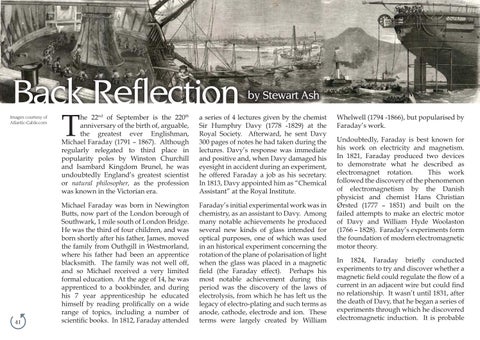
Back Reflection Images courtesy of Atlantic-Cable.com
41
T
by Stewart Ash
he 22nd of September is the 220th anniversary of the birth of, arguable, the greatest ever Englishman, Michael Faraday (1791 – 1867). Although regularly relegated to third place in popularity poles by Winston Churchill and Isambard Kingdom Brunel, he was undoubtedly England’s greatest scientist or natural philosopher, as the profession was known in the Victorian era.
a series of 4 lectures given by the chemist Sir Humphry Davy (1778 -1829) at the Royal Society. Afterward, he sent Davy 300 pages of notes he had taken during the lectures. Davy’s response was immediate and positive and, when Davy damaged his eyesight in accident during an experiment, he offered Faraday a job as his secretary. In 1813, Davy appointed him as “Chemical Assistant” at the Royal Institute.
Michael Faraday was born in Newington Butts, now part of the London borough of Southwark, 1 mile south of London Bridge. He was the third of four children, and was born shortly after his father, James, moved the family from Outhgill in Westmorland, where his father had been an apprentice blacksmith. The family was not well off, and so Michael received a very limited formal education. At the age of 14, he was apprenticed to a bookbinder, and during his 7 year apprenticeship he educated himself by reading prolifically on a wide range of topics, including a number of scientific books. In 1812, Faraday attended
Faraday’s initial experimental work was in chemistry, as an assistant to Davy. Among many notable achievements he produced several new kinds of glass intended for optical purposes, one of which was used in an historical experiment concerning the rotation of the plane of polarisation of light when the glass was placed in a magnetic field (the Faraday effect). Perhaps his most notable achievement during this period was the discovery of the laws of electrolysis, from which he has left us the legacy of electro-plating and such terms as anode, cathode, electrode and ion. These terms were largely created by William
Whelwell (1794 -1866), but popularised by Faraday’s work. Undoubtedly, Faraday is best known for his work on electricity and magnetism. In 1821, Faraday produced two devices to demonstrate what he described as electromagnet rotation. This work followed the discovery of the phenomenon of electromagnetism by the Danish physicist and chemist Hans Christian Ørsted (1777 – 1851) and built on the failed attempts to make an electric motor of Davy and William Hyde Woolaston (1766 – 1828). Faraday’s experiments form the foundation of modern electromagnetic motor theory. In 1824, Faraday briefly conducted experiments to try and discover whether a magnetic field could regulate the flow of a current in an adjacent wire but could find no relationship. It wasn’t until 1831, after the death of Davy, that he began a series of experiments through which he discovered electromagnetic induction. It is probable
of submarine telegraph cables. It was probably through Faraday’s suggestion to William Siemens (1823 – 1883) that Gutta Percha was first considered as an insulator for submarine telegraph cables. Faraday was also consulted by William Thomson, Lord Kelvin (1824 – 1907), in his research into the causes of distortion to telegraph pulses over transatlantic cables. Kelvin’s initial work was completed by Oliver Heaverside (1850 – 1925) and the effect, then described as “Retardation” and now known as dispersion, was explained.
Michael Faraday in his laboratory at the Royal Institution. From a painting by Harriet Moore. The original is in the Chemical Heritage Foundation Collections.
42
that American scientist Joseph Henry (1797 – 1878) discovered self-induction some months earlier and both men’s work may have been anticipated by the Italian scientist Francesco Zantedeschi (1797 – 1873). However, there is no doubt that Faraday discovered the phenomenon of mutual induction. Faraday’s experiments demonstrated that a changing magnetic field produces an electric field. This relationship was modelled mathematically by James Clerk Maxwell (1831 – 1879) as Faraday’s law and subsequently became one of the four Maxwell equations. All of which has evolved into what we now
call field theory. This science gives us generators and transformers. In his work on static electricity, Faraday’s ice pail experiment demonstrated that charge resides only on the exterior of a charged conductor, and that exterior charge has no influence on anything within the conductor, because the internal fields due to the external charge cancel. This shielding effect is now known as the Faraday Cage. In later years Faraday’s advice was sought by many of the English pioneers
Faraday became a member of the Royal Society in 1824, and in 1833 he was appointed Fullerain Professor of Chemistry for life. A great educationalist, Faraday gave a success series of lectures on the chemistry and physics of flames at the Royal Institution, entitled The Chemical History of a Candle. These were some of the earliest Christmas lectures on science given for young people. Between 1827 and 1860 Faraday gave these lectures a record 19 times. The Christmas lectures are still given today and bear his name “The Faraday Christmas Lectures”. The work of Michael Faraday touches virtually every aid to modern living, and is an integral part of every telecommunications system in the world. Michael Faraday has been immortalised, like his American counterpart Joseph Henry, in the SI units for Capacitance and Inductance that bear their names, respectively the Farad and the Henry.
Conferences
Submarine Networks World 2011 20-22 September 2011 Singapore Website Offshore Communication Conference 8-10 November 2011 Houston, Texas USA Website Pacific Telecommunications Council 15-18 January 2012 Honolulu, Hawaii Website
43
Letter to a Friend
and strategic partner, has a major investment,” said Greg Varisco, EA, President. It is all about cloud services and big data centers to be installed in Iceland, taking advantage of low cost energy. Then the 100X100!
Jean Devos My friend, 100X100 is not the shape and surface of my garden or the size of my town square, but the new transmission capacity of our submarine fibers: 100 WL at 100 Gigabits/s. Amazing!
44
You most likely red the announcement by Emerald and TE Subcom related to the construction of a new transatlantic cable by the northern route, Canada to UK with an Iceland spur. My instinctive reaction was “Tyco has found a powerful way to react to the Hibernia Express being laid by Huawei Marine.“ The new system posesses similar language (Express, Low
latency), similar route and the same timing, but much larger capacity. It is now clear that this is not the case. The herein press release tells us the full story behind the new transatlantic project! “The Emerald Express system’s combination of a 100x100G per fiber pair design and ‘great circle’ routing for optimized trans-Atlantic low latency will enable Emerald Atlantis to meet the tremendous demand for bandwidth driven by cloud services, while providing Iceland with the required connectivity to support the anticipated explosive growth of low cost, 100% carbon free, renewable energy powered data centers, in which the Wellcome Trust, Emerald Atlantis’ largest shareholder
I sort of like this 100X100. Simple, clear, square! I need to congratulate whomever chose this formula, the same way I think the “cloud” is a very well designed word! We used to have 96 or 128, figures which had a kind of technical logic behind them. I can only guess that there is a gentle touch of marketing skill behind this 100x100. “Could you give me two more for the same price?” “No, I rounded off already for you.” I adhere to this new slogan 100 per cent! Big pipes to send our data in the clouds, hoping that it will not turn into a storm of heavy rain falling on our heads. Once again, our industry is at a significant technology change, swiftly moving from 10G to 40G and now 100G! But it could be also a more fundamental evolution: A new generation for routes and applications! Will Iceland be a very special case, the only one, or are we going to see new submarine cables route reaching data centers located in very remote and exotics places for all kind of good reasons? Could we see the global network being reconfigured by such a phenomenon? What do you think my friend?
Advertisers Index ISSN 1948-3031
Issue Themes: January: Global Outlook March: Finance & Legal May: Subsea Capacity July: Regional Systems
Huawei Marine Networks
www.huaweimarine.com
36
Nexans
www.nexans.com
40
OFS
www.ofsoptics.com
4
Offshore Communications
www.offshorecomms.com
22
WFN Strategies
www.wfnstrategies.com
17
September: Offshore Energy November: Subsea Technology Advertising enquiries:
Participate
Sales Manager Kristian Nielsen Tel: +1 (703) 444-0845 Email: knielsen@subtelforum.com Sales Representative, Europe, AFRICA, Middle east Wilhelm Sicking Tel: + 49 (0) 201-779861 Email: wsicking@subtelforum.com
submit your article ideas to editor@subtelforum.com Copyright © 2011 WFN Strategies 45
by Kevin G. Summers
W
46
e had an earthquake in Virginia last month, the largest on record in this state for more than 100 years. It was felt as far north as Toronto, Canada and as far west as Ohio.
It was fascinating to watch the reaction of the people on my list of friends as they checked in after the earthquake. My wall looked something like this:
I was talking with our publisher, Wayne Nielsen, when the building started shaking, and I have to admit that my first thought was that we had been struck by a terrorist attack. After a few seconds of everything rocking and rolling, I realized what was going on. It was over in about half a minute, and then we were all in awe of what we had just experienced.
Earthquake? That freaked me out...
The first thing I did was call my wife. After confirming that she and the kids were all ok and that the house wasn't about to fall in, I did what apparently most of the people in my generation did: I went on facebook.
I think Brooklyn just experience a minor earth tremor. Weird!
They have virginia?
earthquakes
Thankfully, the damage caused by the earthquake wasn't too severe. Several historic buildings in Culpeper, Virginia were condemned after the quake, and the nuclear reactors at Lake Anna were taken briefly offline. But it was certainly an eye-opening experience to watch the aftershocks rippling across the internet.
in
Whoa! Earthquake! Did anyone feel that?
Earth quake???
What do you think? Click on the Letter To The Editor icon and drop me a line. I’d love to hear from you.