Submarine Telecoms Forum is published bimonthly by WFN Strategies. The publication may not be reproduced or transmitted in any form, in whole or in part, without the permission of the publishers.
Submarine Telecoms Forum is an independent com mercial publication, serving as a freely accessible forum for professionals in industries connected with submarine optical fibre technologies and techniques.
Liability: while every care is taken in preparation of this publication, the publishers cannot be held responsible for the accuracy of the information herein, or any errors which may occur in advertising or editorial content, or any consequence arising from any errors or omissions.
The publisher cannot be held responsible for any views expressed by contributors, and the editor reserves the right to edit any advertising or editorial material submitted for publication.
Contributions are welcomed. Please forward to the Managing Editor:
When I was working in Southampton for BT Marine a number of years ago, I had the responsibility of overseeing the process where the company was compiling and publishing its history. As a Yank who thought anything older than the 1950s was practically ancient, I was amazed to review old company documents, ship logs, etc., from a number of interesting “jobs,” including those from the world wars.
In WWII, one of the first waves of Operation Overlord was a Post Office cableship that began laying toward Normandy the day before D-Day in order to arrive at the beaches soon after they were supposed to be secured. Cableships came under frequent enemy fire, and one was sunk under suspected friendly fire by an American submarine.
Cutting off an enemy from the rest of the world has been a war tactic since the advent of submarine cables. One of the first naval operations of World War I, for instance, was a Post Office cableship that began cutting cables off the German coast soon after war was declared.
Today we are seeing such actions in countries experiencing internal strife. In a number of articles in this issue we consider various state attempts to limit their populace from the outside world at a time of crisis.
Many countries, including my own, possess the means for a legally codified internet “kill switch.” Only its virtue seems debatable.
As a postscript, our thoughts go out especially to our Japanese colleagues and others affected by Friday's devastating tsunami.
Atlantic Tele-Network, Inc. (ATNI) Upgraded by Zacks Investment Research to "Neutral"
Brazil, Angola to study building underwater fiber-optics cable
NEC said to win 30 billion yen undersea cable order
Offshore Marine Management obtains cable storage facility at Nordenham
OFS Introduces TrueWave HD Fiber for Medium and Long Haul Ocean Systems
Pacific Crossing Appoints New CEO
Pacnet Joins New Cloud Computing Initiative in China
Pacnet Launches Sydney Data Centre
Pacnet Simplifies Data Backup and Storage with New Cloud Service
Pencan-8 launched by Telefonica
Photos: From transatlantic telegraph cables to modern fibre optics
Reliance Globalcom Selects Ciena for 40G Ultra Long Haul Submarine Network
SEA-ME-WE 4 cable system to upgrade with 40G/100G technologies, significantly increasing its overall capacity
Seychelles communications to be transformed following European Investment Bank support for first international fibre-optic link
Sify Becomes the First ICT Player to Have Submarine Cable System
Subcom To Provide First 40G Upgrade Of A Trans-Pacific Cable System
Telekom Malaysia to Build 400-Km Cable System With XL, Mora
UK Shetland Islands Micro Trenching their Way to Superfast Fibre Optic Broadband
Verizon Ready to Activate Capacity on Europe India Gateway Submarine Cable System
WACS a Reality
WACS lands in Namibia
WACS: Namibia enters new era
WFN Strategies Nominated For The President's "E" Award For Excellence In Exporting
WFN Strategies Partners With MTN Ghana To Provide Technical Consulting For The Offshore Broadband Project
Yenista Expands Sales and Marketing Team
Yenista Sets the Standard with New O-Band Tunable Laser
SubTel Forum awards
We are currently taking nominations for the 1st Annual Submarine Telecoms Forum Awards.
Categories:
The Innovation Award will go to the company or organization that has produced the best best market innovation of the previous year.
The Industry Achievement Award will go to an individual or company that has done the most for the industry.
The Editor's Award will go to author of the best SubTel Forum article.
Please submit your nominations by 30 April 2011.
Finalists will be profiled in the May edition of SubTel Forum (Issue #57) and the winners will be announced in our July edition (Issue #58). Winners will receive a physical award that they can display in their office as a keepsake.
Please send your nominations to: editor@subtelforum.com
With Tunisia, then Egypt, then Libya aboil with protests, world attention has focused on the social and civic effects of the shutdown of communications. The Mubarak government, under siege and failing, ordered the cutoff of the Internet in Egypt; there was a great deal of talk about how this backfired, sending people into the streets when their computers died. Little notice was given to the enormous amounts of money lost by telecoms and businesses that depend on the ‘Net. The losses are “in the billions,” one official said. Who is going to measure those losses? Will anyone bother? Publicly, at least, no one seems to be attempting the count.
In Egypt, the Internet went down on Friday, January 28th. Telecom Egypt, Raya, Link Egypt, Etisalat Misr, and Internet Egypt all went dark a few minutes after midnight.
For Dean Lawrence Pintak of Washington State University in Pullman, it was no surprise. Pintak, a veteran television news correspondent, was based in Cairo from 2005 to 2009. During that time, he said, “the ‘Net came into Egypt on a single submarine cable...several times when I was in Egypt the place lost all Internet. A trawler might cut the cable,” or there was some other malfunction. “Once in ’08,” Pintak added, “it was out for 24 hours.”
The Mubarak government’s order to cut off service was accomplished quickly and easily. According to Ian Bedford, Vice President for Global Sales at Interoute Communications, Inc., “there were just a handful of people operating the Internet” connections in Egypt. Mr. Bedford, interviewed by this reporter over a conference call U.K. to U.S.A., tells a story that matches that of Dean Pintak. The government calls the Internet technician(s) on the phone, in the middle
of the night, and orders a shutdown. For those who resist, as Vodaphone reportedly did, the government threat is made clear. As Dean Pintak relates it, “they call up and say flip the switch, or else we will flip it ourselves, and if we do it, the recovery will be much longer, harder and more expensive.” The screens began to go dark, one by one. It took only a few minutes. As Mr. Bedford notes, “there are, inevitably, single points” of vulnerability.
A government contract with a communications provider, Mr. Bedford adds, provides for just such a shutdown, of course. “Governments can impose sanctions,” he says, “government can control the internet.” Mr. Bedford points out that the government contracts with providers contain shutdown provisions. Furthermore, Egyptian law gives authorities the right to order a disconnection, at the threat of loss of license to operate. How about connections between two private entities? “Even between two corporate entities,” the executive noted. Is a telecom company entitled to a penalty payment of any sort from the government when that authority orders a shutdown. “No,” was the clear answer from Mr. Bedford.
The government action worked only in cutting off information exchanges of the electronic sort. An unnamed Vodaphone worker in Egypt, quoted in the February 28th edition of the New Yorker Magazine, said “even after the phones went off...there was a kind of national telepathy of where to go.”
Readers of Submarine Telecoms Forum may wish to check out a nifty website which keeps track of this sort of Internet interruption, and many things in the world of communication. It is www.renesys. com. Renesys is a privately-held company based in Manchester, New Hampshire that calls itself the Internet intelligence authority. For its February 16th chart on the cutoff in Egypt, the New York Times
Cairo, Egypt - February 11, 2011: A car of Egyptian men drive over the 6th of October Bridge in downtown Cairo, holding their flag proudly and celebrating the just-announced resignation of Hosni Mubarak, who ruled Egypt for 30 years.
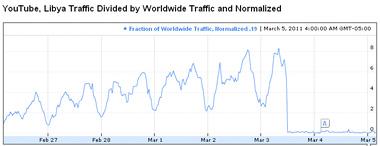
relied on Renesys data. More recently, Renesys has kept track of when Libya was disconnected from the ‘Net, and when signals were -- somewhat -- restored. By early March, with a promise of large protest demonstrations on Friday, the 4th, the Google Transparency Report show that, as Renesys put it, “Libyan query traffic had fallen to zero.”
For the dictator -- any dictator, anywhere -shutting off the Internet and the telephones is far easier than calming or dispersing the angry crowd. And the electronic cutoff that was so easily accomplished in the dark of night in Egypt only served to make the stirring mobs even more determined. Nonetheless, as Ian Bedford and others point out, Egypt is an important link, something of “a gateway to and from the middle east.” Even though the Internet was restored in a few days, the Interoute executive noted, “a few major operators lost lots of pipes” and the dollar losses may never be fully calculated.
David Keyes is the director and co-founder of CyberDissidents.Org in Washington, D. C. In an email on Feb 25th, Mr.Keyes said, “From Morocco to the Gulf, not one country has total free speech where you can criticize the king or president without fear of retribution. We’ll have to wait and see what kind of policies each of these new governments institutes vis-a-vis Internet freedom and freedom of speech more generally. It’s just too early to tell, I think. Many of the constitutions of the Middle East make it a criminal offense to insult religion or the state leader. Until this is changed there can be no free speech.”
What happens in the United States? Can an American president turn off the Internet? For more than two years a bill to give the president the power to turn off the ‘Net has been considered in the U. S. Senate. Leaders in both parties seem inclined to support the measure put forth
by Lieberman of Connecticut and Collins of Maine. It would give the president the authority to declare a “cyber emergency” and shut down the flow of information. Privacy advocates are wary of the bill, but some of the largest communications companies are making favorable noises about it. There could be some legislation by the end of 2011. In the meantime, has the FCC circumvented the legislative process with their Net Neutrality Act?
The communications industry, under the sea and over the ground, feels it needs to build a system that can quickly respond
planning new systems.” Systems that, as Mr. Bedford said, “will be larger and more resilient.” Indeed, Interoute advertises itself as “future-proofed.” Asked what that means, Mr. Bedford said “that means we don’t have legacy problems, we don’t have copper wires; we have oodles of fiber.”
That’s what communication executives like: oodles of fiber. More counterweight against those who would attempt to control thought and information exchange. The people won’t wait. Those in the Middle East and elsewhere will always have that telepathic telegraph. But engineers must keep designing work-arounds, because even as screens went dark in Egypt and then Libya, millions of hearts and minds were lighting up. They will not soon go dark again.
to the attempts of governments to control information. Matthew Finnie, CTO of Interoute, via spokesperson Katie Swan, wrote about the then-failing Egyptian government’s action in shutting down the Internet, and said it nicely: “This level of control by a single government at a major crossroads for the Global Internet is surely a concern that needs to be addressed by opening up greater diversity or routes to the region.”
Mr. Finnie’s colleague at Interoute, Ian Bedford, said there are “a few vulnerable points which we know about” and “we are
Jed Duvall worked as a reporter for WBAL-TVAM-FM in Baltimore, MD. From 1967 to 1982 he was a CBS News correspondent in New York, Los Angeles, Saigon, Atlanta and Washington. He covered the Vietnam War and Watergate coverup trial as well as various presidential campaigns including Fred Harris, Walter Mondale, Ted Kennedy. He was on ABC “Nightline,” and anchor for “Good Morning America.” Jill and Jed Duvall raised four children and now live in semi-retirement in Rappahannock County, Virginia.
Liverpool, England - February, 19 2011: Public protest against Libyan problems in Liverpool. A group of people protest against recent events happened in Lybia in the streets with signs and flags.
Libya's nationwide Internet blackout is entering its second full day. From a technical standpoint, it's clear that this is a very different strategy than the one used by Egypt in the last days of the Mubarak regime. The ultimate outcome is probably going to be the same. Let's take a few minutes to compare the two, and think about the implications for future Internet engagements in the Jasmine Revolution.
First, the facts as we know them. We observed nearly every host inside Libya becoming unresponsive on the afternoon of Thursday, March 2nd. You could attempt to "ping" them, send a traceroute along the path to them, try to retrieve pages, try to look up domain names ... but in nearly every case, there was no response. Simultaneously, we heard reports that all of the classic Internet communication services like Skype were down, and external websites were unreachable. To top it off, the Google Transparency Report showed query traffic from within Libya flatlining, and not recovering.
So far, these symptoms match what was experienced during the Egyptian Internet blackout pretty closely. But the underlying technical implementation couldn't have been more different. Look very closely at that Google plot again, and observe the floor. It's not perfectly flat,
is it? That's because the Libyan Internet is actually still alive, even though almost all traffic is blocked from traversing it. The BGP routes to Libya are still intact, which means that the Libyan ISP's border routers are powered on and the fiberoptics are lit. In fact, we've identified a handful of isolated live IP addresses inside Libya, responding to ping and traceroute, and presumably passing traffic just fine. Someone in Libya is still watching YouTube, even though the rest of the country is dark.
England - February, 19 2011: Public protest against Libyan problems in Liverpool. A group of people protest against recent events happened in Lybia in the streets with signs and flags.
Public protest against Libyan problems in Liverpool.
Libya vs Egypt: A Different Strategy
Why did Libya put its Internet in 'warm standby mode' instead of just taking it down, as Egypt did? Perhaps because they're learning from Mubarak's experience. Cutting off the Internet at the routing level (powering down the Internet exchange point, going after the remaining providers with secret police to enact a low-level shutdown) was a technically unsophisticated desperation move on
Egypt's part. It signalled to the world that the Egyptian government considered itself out of options, ready to cut off internal communications and external dialogue, looking for a last chance to turn off all the cameras and clean out the Square.
Implementation was straightforward because of centralized control of the Internet economy: Libya doesn't have five independent Internet Service Providers with international connectivity, as Egypt did. They have just one, Libya Telecom and Technology (LT&T). Founded in 1997 and run by the Gaddafi family, LTT was folded into the state-owned GPTC (General Post and Telecommunications Company) in 2004. Each Internet route to Libya, and therefore all of the traffic to Libya, flows through this one provider's infrastructure.
So on Thursday afternoon, like turning off a tap, the stream of traffic was slowed to a trickle, and then to a few drips.
This tactic makes all kinds of sense from the government's perspective. The Internet is a valuable wartime resource, like a critical bridge over which supplies can flow. As long as you can deny it to your enemy, you don't blow it up — you keep it intact for your own use.
We expected to see something similar happen in Libya as the crisis came to a head, and on Thursday afternoon, the government appears to have taken action ahead of Friday's Day of Rage.
Throttling the Internet to the point of uselessness, instead of killing it outright, also delayed International recognition of the fact that the Internet was down during the most critical period. Most international media didn't clue into the fact that the Libyan Internet had gone silent until after the sun had gone down in Tripoli on Friday. By taking a softer route to shutdown, the government deprived the opposition of much of the international "flash crowd" of attention and outrage that
an unambiguous "kill switch" tactic might have garnered.
Conclusions
Using denial of Internet access as a political weapon during crisis events is all about timing and messaging. Mubarak waited too long to implement his blackout, and then let it run past the point where the damage to the Egyptian economy and the cost of international outrage exceeded the dwindling benefits to the regime. In the end, all the Egyptian government accomplished was to attract the sort of sympathetic attention and message support from the Internet community that is pure oxygen to a democratic opposition movement. You can't buy that kind of press!
Libya faced this same decision in the runup to civil war, and each time, perhaps learning from the Egyptian example, they backed down from implementing a
multiday all-routes blackout. On 19 and 20 February there were two consecutive nights of routing-based blackout, but in each case, service was restored the next morning, at reduced levels. Through the course of the following week, traffic continued to grow, not only from Tripoli, but from eastern provinces where the government was no longer in control.
That message couldn't go unanswered. The current blackout, which probably signals the onset of the endgame, comes too late to contain the message. Together with restrictions on journalist movement, it will provide temporary cover for some of the endgame brutality, and for that reason, it's deeply sad.
When some future government faces this decision, backed into a corner by a popular uprising supported by Internet communication, they will probably reach the same conclusions that Libya and Egypt did: reestablish control over
national communications at any cost, and pick up the pieces later. That's why the Internet is too vital to be left in the hands of centralized authority, and it's why you should press for more diverse Internet connectivity wherever you happen to live.
Jim Cowie is the Chief Technology Officer, and Cofounder of Renesys. He has more than 15 years entrepreneurial and software development experience in high performance computing, network modeling and simulation, web services, and security. Prior to founding Renesys, Jim was a principal at Cooperating Systems, a consulting services company that provided rapid software prototyping and technology planning for advanced research and development in academia and industry. With a long standing interest in the Internet’s impact on security and collaboration since 1995, he authored the first web-based collaborative environment for cryptographic key factoring.
Jim is the primary architect of SSFNet, the first open-source network simulation framework to support transparent parallelization and multiprocessor execution. Jim holds a B.S in computer science from Yale University.
This article originally appeared on:
John Hibbard
Is it Time for a Bypass of the Luzon Strait?
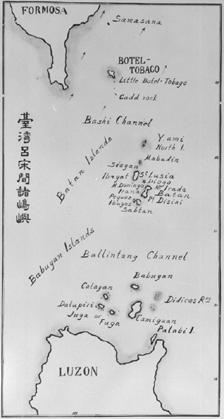
The Luzon Strait lies between the Philippine island of Luzon and Taiwan. It is the waterway which connects the South China Sea to the Pacific Ocean. It is a passage not just for ships but also for the submarine cables connecting South East Asia to Japan and the USA. These cables carry traffic from India to all the Pacific Rim countries. The cables also carry traffic from the Far East to Europe, Middle East and Africa. They represent an important element in the mesh of cables which girdle the earth. There are nearly a dozen cables which traverse this narrow waterway of less than 300 kms. It is quite congested. These cables have the potential capacity of over 50 Tbps and so represent an essential artery for global telecommunications and the economic wealth of nations. Even more cables are planned to be routed this way.
When is enough actually enough? Can the world afford to put its global business at increasing risk? This is a dangerous waterway. On Boxing Day 2006, an earthquake at the southern tip of Taiwan triggered a massive mudslide which crossed the strait breaking 8 cables in 16 places. It was a mess. Connectivity was severely interrupted and effectively cut SE Asia off from the internet. Chaos reigned for some time as few alternative routes existed. Fixing the cables was challenge due not just to the paucity of cable-ships to repair so many breaks but also to the difficulty in finding cables in the mud and identifying which was which – they don’t have their name on the outside!
The consequence of this catastrophe was a genuine focus on the need for real diversity. Putting both cables of a loop system through the strait was a recipe for disaster. New routings had to be found. However there aren’t many options. The principal response was to take advantage of cables connecting SE Asia with Europe and to send traffic
in the reverse direction around the globe. Overland routes were considered but these have major challenges as they cross borders, and the terrain can be hostile.
In August 2009, there was a second major interruption in the Luzon Strait. Typhoon Morakot, just off Taiwan, caused another mudslide this time disrupting 6 major cables. The global network was again in havoc. Fortunately, due to lessons learned from the 2006 event, not quite to the same extent. Mesh networking involving cable links both eastward and westward around the globe helped ameliorate the impact to a degree. They say lightning does not strike in the same place twice. But here nature did strike twice. And if it could do it twice, it could do it again.
Of course the Luzon Strait is not the only issue with the South China Sea routing for many cables. SCS is a main shipping artery and that raises greatly the potential for cable cuts. So even though mesh networking may do something to reduce disruptions, it still prompts the question “Is it time for a bypass to the Luzon Strait?”
Going west from Asia might seem like the answer but that route is certainly not immune. There were dual breaks off Egypt, recent cuts off Malta and interruptions in the vicinity of the Arabian Gulf. So what might be the answer?
For the last decade there has been a dormant plan for a cable for Guam to SE Asia, be it Indonesia, Singapore or Malaysia, via a route south of the Philippines. Guam has
become an even more significant Pacific hub with multiple cables landing there ( TGN, China-US, AAG, Australia Japan Cable, PPC1, Hantru, GP and several cables to the Northern Marianas). There are 3 existing cable stations, so Guam is well positioned for connectivity.
The distance from Guam to Singapore via the Luzon Strait is approximately 5500kms, whereas via the route between Mindanao and Borneo is around 5000 kms so latency would not be increased. Direct connection into Jakarta is possible. So is access to other locations such as southern Philippines, the Indonesian archipelago through the Palapa ring, and Malaysia, both east and peninsular. It would to have practical appeal.
Should such a cable be built, who might want to control the landing station to garner the benefits? Who want to have capacity in the cable? Who might want to part of any construction entity? The requirement is definitely there – it is just a question of who will be the first to make the move.
John Hibbard is a leading consultant in international telecommunications, particularly in the development of submarine cable projects. He has over 40 years experience in the telecommunications industry, mostly in international activities and submarine cables. He is now President of the Pacific Telecommunications Council and Chairman of its Board of Governors.
On 11 March, just before this issue went to press, Japan was struck with a massive 8.9 magnitude earthquake, the worst in that nation's recorded history.
This magazine has featured several articles covering the use of submarine cables to warn and track earthquakes and tsunami waves. Morgan Heim wrote an excellent piece called "Telegraphing a Tsunami" in Issue 50, and in that same issue was an article about Jamstec's "Project Donet."
In spite of the tragedy in Japan, it appears that these early warning systems were able to telegraph the path of the tsunami as it raced across the Pacific Ocean. When the wave smashed into Hawaii at 3:30 am local time, the citizens were prepared. Hotels on Waikiki moved tourists to the 3rd floor, and the streets were practically empty. Furthermore, the NOAA West Coast and Alaska Tsunami Warning Center was able to time the path of the Tsunami almost to the minute, saving untold numbers of lives.
At press time, there have been no announcements of cable breaks, though Chunghwa Telecom is reporting "some damage" to a cable system near Kita, Japan. Data transmission has not been interuppted, however. Meanwhile, both land and mobile telephony have failed. Our thoughts and prayers go out to all the people affected by this disaster.
Building a Submarine Cable:
Navigating the regulatory Waters of Licensing and Permitting
andrew D. Lipman and Nguyen T. Vu
Given the rising global demand for data, telecommunications companies around the world are scrambling to add bandwidth capacity on international and intercontinental submarine cable routes. Over 95 percent of overseas communications are now carried by submarine cables, as the increased capacity, speed, and security make submarine cables the preferred medium for transporting data. Data and voice transfer over these cables is not only cheaper, but also quicker than via satellite. According to recent reports, international bandwidth usage has been growing at close to 60% year over year during the past few years. Demand for
additional bandwidth has been especially prominent in emerging markets in Africa, Asia, and the Middle East. In fact, there are at least nine publicly announced submarine cables either under construction or in the planning stages around Africa.
Companies have sought to keep pace with this growing demand by constructing new submarine cables to connect points throughout the world. Indeed, construction of subsea cables is no longer limited to traditional telecommunications carriers, as large users of telecommunications capacity are now participating directly in consortia to build and operate submarine telecommunications cables.
Construction of new submarine cables, however, can be tempered by the licensing and permitting process and country-specific regulatory regimes that may stand as roadblocks to the rapid deployment of new international submarine cable systems.
Regulatory Issues Related to Building a Submarine Cable System
There are a multitude of regulatory issues involved in submarine cable licensing and permitting that can dramatically affect the time and cost for such projects. Many countries require that the builder of a subsea cable system obtain a telecommunications license and a separate submarine cable license issued by the relevant communications regulator. Depending on the jurisdiction, the process for obtaining these licenses can take months. Other permits may also be necessary, including defense or national security authorizations, environmental permits, and permits for construction and land use. To effectively
obtain all of the requisite permits and licenses, coordination of licensing and permitting is critical to the success of a submarine cable build-out.
In emerging markets, obtaining the required licenses and permits is generally more difficult, as these markets tend to have less developed legal and regulatory regimes while subjecting applicants to additional “red tape,” and the overall application and review process is less transparent. Many jurisdictions also have “localization” rules that require the use of the local labor force for construction, or other professionals such as attorneys licensed in that jurisdiction to submit the applications for the licenses and permits. Moreover, construction of submarine cables may also be met with opposition from commercial fisherman’s unions or other seabed users.
U.S. Regulations Concerning Submarine Cable Systems
There are a number of different permits and licenses required to land and operate a submarine cable in the United States. In addition to the Federal Communications Commission’s (“FCC”) telecommunications licensing requirements, other federal, state, and local permits are generally required. The number of authorizations required depends on where the cable lands, and whether the cable passes through any environmentally sensitive areas. Obtaining these federal, state, and local permits can be onerous and may take up to 12 or more months.
On the federal side, cable owners are required to obtain a cable landing license from the FCC, permits from the Army Corps of Engineers, and – depending on whether the cable goes
through a National Marine Sanctuary – a permit from the sanctuary superintendent.
FCC Approval Process
All submarine cables landing in the United States must be licensed by the FCC. This license is issued pursuant to the Submarine Cable Landing License Act of 1921 and Section 1.767 of the FCC’s Rules. The FCC has established a streamlined cable licensing process that can result in a license being granted within 45 days of the date the application is put on public notice. The application consists of a description of the submarine cable, including the type and number of channels and its capacity, a specific description of the cable landing stations in the United States and the foreign countries where it will land, a map showing the geographic coordinates of all landing stations, a statement
as to whether the cable will be operated on a common carrier or private carrier basis, and ownership information.
Parties to the License Application
Under the FCC’s cable licensing rules, all entities that: (1) own or control a U.S. landing station, or (2) own or control a five percent or greater interest in the cable system and will use the U.S. segments of the cable system must be parties to the cable license application. In other words, all such entities will be colicensees. In addition, all original owners of the cable, regardless of the amount of their ownership interest, must be identified in the application, although they do not have to be licensees if they do not meet the criteria discussed above.
Section 214 Authorization for Submarine Cables
In addition to obtaining a cable landing license, which authorizes the installation of the submarine cable facilities, a service license under Section 214 of the Communications Act of 1934, as amended (the “Act”), may be required. Many submarine cable systems in the United States are operated on a noncommon carrier basis. That means that the owners are not legally compelled to serve the public indifferently and may sell capacity on an individual case basis. To obtain non-common carrier status, the operator must show that there are alternative common carrier facilities available on the cable route and that there are no reasons implicit in the nature of the operations of the cable system that demand common carrier treatment. If this showing is made, no additional FCC authority is needed to operate the cable.
If, however, a proposed licensee plans to operate the cable system on a common carrier basis or is unable to make the above showing, the FCC’s rules require the licensees to operate the facility as a common carrier facility and obtain authority to provide international telecommunications services under Section 214 of the Act. The Section 214 application is submitted at the same time as the cable license application and the authorizations are generally granted concurrently.
“Team Telecom” Review
While acquisitions of U.S. telecommunications carriers and network operators (including submarine cable licensees) by non-U.S. persons have been subject to national security review for a number of years, more recently, however, “Team Telecom” -- an ad hoc task force comprising the Departments of Defense, State, Homeland Security and Justice, including the Federal Bureau of Investigations that examines such deals -- has begun to review new submarine cable landing license applications as well, particularly as most subsea cable applications have some form of foreign ownership or participation.
Although Team Telecom is an ad hoc group, the review process is fairly well-trod, especially in the context of new submarine cable licenses. The FCC provides copies of applications with foreign ownership to the Executive Branch for review. Team Telecom then typically asks applicants to answer a set of questions (referred to as the “triage questions”) concerning issues such as how call data and other information will be stored, how data will be secured, and who will have access to the applicant’s network and data. In most cases, Team Telecom will ask the FCC to defer granting
the license application until Team Telecom has completed its review. This typically results in the removal of the application from streamlined processing at the FCC and the withholding of FCC approval until Team Telecom’s review is complete. Team Telecom’s review of submarine cable applications, however, tends to be substantially more timeconsuming than a review of a Section 214 application. Moreover, given that the FCC will not grant a landing license until Team Telecom has approved, it is unlikely that a license will be issued in less than six months.
Although applicants can wait for Team Telecom to receive their applications from the FCC, most applicants are proactive and contact Team Telecom immediately upon filing an FCC application (and sometimes before filing). There are several advantages to this approach. Most obviously, contacting Team Telecom can move the application closer to the top of Team Telecom’s list and thus speed review. Second, it allows the applicant to begin to characterize its application for Team Telecom and answer any questions promptly.
Third, and most substantively, actively engaging Team Telecom puts the applicant in the best position to suggest and craft solutions to any law enforcement and national security issues in a more favorable manner, including negotiating any eventual conditions, such as a national security agreement (“NSA”) that Team Telecom may eventually require.
Foreign persons should not be dissuaded from entering the U.S. market. While the path to approval may be a bit more winding than in the past, and in most instances applicants will likely be required to enter into an NSA or other form of national security commitment, nearly all projects can ultimately receive approval. Moreover, the government is amenable to a variety of ownership and control structures provided that their basic security concerns are addressed satisfactorily in the NSA or other security commitment. Parties must be flexible and creative, but there is still room for foreign investment in the U.S. submarine cable market.
Other Federal Authorizations
In addition to the FCC cable license, submarine cable systems must obtain a federal permit from the Army Corps of Engineers (the “Corps”) under Section 404 of the Clean Water Act and Section 10 of the Rivers and Harbors Act of 1899 (the “Rivers and Harbors Act”). Section 10 of the Rivers and Harbors Act governs all work in or affecting navigable waters of the United States, while Section 404 of the Clean Water Act governs discharges of dredged or fill material into waters of the United States. If an individual permit is required for the project, the Corps must first complete an environmental review under the National Environmental Policy Act before issuing the permit. The Corps must also consult with the applicable federal resource agencies (such as the U.S. Fish and Wildlife Service and the National Oceanic and Atmospheric Administration’s National Marine Fisheries Service) under the Endangered Species Act if the project has the potential to affect protected species.
When the Corps issues a permit in an area where a state also asserts regulatory jurisdiction (limited to three miles off shore), it must receive from the state a consistency determination under Section 307(c)(1) of the Coastal Zone Management Act, stating that the activities authorized under the permit are consistent with the state’s Coastal Zone Management Plan. In addition, a Corps permit for any discharges in an area under concurrent state jurisdiction requires a certification from the state under Section 401 of the Clean Water Act that the authorized activities will be consistent with state water quality standards. Furthermore, in some cases special approval is required if the cable goes through a National Marine Sanctuary.
State and Local Authorizations
On the state and local side, the permits required depend on the state and municipality in which the cable lands. For instance, California has some of the most onerous environmental permitting requirements of any state in the country. If a cable project in California requires an approval from a state or local agency and if the landing of the cable may have a significant effect on the environment, an Environmental Impact Report (“EIR”) will be needed under the California Environmental Quality Act. The EIR process can take several years, especially for projects that are controversial, that are challenged by aggressive project opponents, or that are located in environmentally sensitive areas.
Depending on the route and landing point for the proposed cable, a coastal development permit could also be required. In some states, approval may also be required by the state lands commission, which exercises jurisdiction
over tidelands and submerged lands adjacent to the coast and offshore islands of the state.
Streamlining the Licensing and Permitting Process
In order to handle the myriad of federal and state permits, applicants -- either the subsea cable sponsors or their suppliers, depending on the division of permitting responsibilities in the cable’s supply contract -- generally convene a pre-application meeting with all federal, state and local agencies that may have jurisdiction over the project. In general, most of the permit applications require detailed information on the location of the cable and its potential environmental impact. Moreover, most of these permitting processes involve public consultation proceedings and can become politically charged. Past cable projects, have resulted in substantial opposition from environmental and fishing interests. Although these disputes have ultimately been resolved in most cases, they can result in delay and substantial additional costs. As such, having sufficient lead time to obtain all applicable permits and having knowledgeable and experienced advisors in this area is critical to securing all necessary approvals for timely commencement of operations.
Andrew Lipman has spent more than 30 years developing the firm’s Telecommunications, Media and Technology Group into one of the largest practices of its kind in the nation. He practices in virtually every aspect of communications law and related fields, including regulatory, transactional, litigation, legislative and land use. The TMT Group is international in scope, representing clients in the U.S., Central and South America, Europe, Asia and other parts of the world.
Nguyen Vu’s practice includes representing wireless and wireline carriers before the Federal Communications Commission, state utilities commissions and foreign regulatory authorities in a wide variety of regulatory, rulemaking and licensing proceedings. Nguyen also advises Internet communications and infrastructure service providers on market entry, licensing and regulatory obligations in Africa, Asia, Europe and the Middle East.
Francis audet and Mai abou-Shaban
From the planning stage to the deployment of an undersea fiberoptic cable, a considerable amount of time, money and resources are invested to ensure the success of the submarine network. Yet one point that is often overlooked during this process, and which can lead to unfortunate delays, is the final acceptance test of the fiber— simply put, this comes down to making sure that the fiber can deliver on the promised and expected bandwidth. This final acceptance test is often ignored since legacy data rates are considered as being extremely challenging to transmit. Yet with the deployment of 40 Gbit/s, newer and more serious challenges are at hand, and in order to face them, they must be understood and properly prepared for. To do so, some critical physical layer tests must be performed, including dispersion testing, such as chromatic dispersion (CD) and polarization mode dispersion (PMD). Tests that were considered as being of some importance at 10 Gbit/s, have become unavoidable at 40 Gbit/s transmissions. Once these parameters have been fully qualified and optimized, the system turn-up test must then be performed. These include signal power level and optical signal-to-noise ratio (OSNR) measurements, important in both repeated transoceanic or festoon links. Finally, the network end-to-end level qualification must be done; this is where all the relevant SONET/SDH tests
are performed, including tests such as bit error rate (BER).
This application note will review the challenges brought forth by the advent of 40 Gbit/s transmission, and will describe the in-depth importance of every test, where and how they should be performed; what’s more, we’ll examine a case study of a trans-Atlantic dispersion acceptance test that was performed earlier this year.
Context
As the demand for bandwidth continues to grow at a tremendous pace in submarine networks, service providers have no choice but to ride the wave and adapt their networks so that they can offer more services to their customers. Yet with new technologies rapidly approaching, service providers are faced with numerous difficult choices. In this context, upgrading from a 10 Gbit/s to a 40 Gbit/s advanced modulation format becomes a necessity— but not at any price.
The three main drivers behind each upgrade are: service providers want to use existing fibers and network elements to maximize revenues from infrastructure already in place; they want to improve operation flexibility, which translates into more efficient provisioning and increased revenues from new services to their customers; and they want to increase the density of the network elements to optimize central office space and power consumption. However, upgrading from 10 Gbit/s to 40 Gbit/s, or even to 100 Gbit/s, has a significant effect on the tolerance to optical impairments such as the level of noise with the signal, CD and PMD.
Both CD and PMD have been known facts for almost a decade now, yet testing these parameters on OC-192/STM-64 is not always done de facto. But now, with the current penetration of 40 Gbit/s, CD and PMD are becoming an even bigger issue. New 40 Gbit/s transmission rates come in many flavors, yet even the most resistant OC-768/STM- 256 (40 Gbit/s) can only tolerate a fraction of what OC-192/STM64 (10 Gbit/s) can accept—both in CD and PMD. The typical acceptable CD rate is around 10% of the 10 Gbit/s tolerance levels, while PMD tolerance is typically at 25%. This means that PMD values that were previously considered as acceptable, may not be anymore.
Moreover, CD compensation schemes were effective at 10 Gbit/s, yet the
residual compensation is much too high for 40 Gbit/s transmission rates and PMD specifically was never compensated— either it was ‘hoped to be good’, or it was tested more often and when it was too high, the fiber was limited to lower speeds. But chromatic dispersion was compensated via simple dispersion-compensating modules (DCMs), which are deployed automatically and installed by system vendors. On the other hand, accurately testing for this parameter allows one to fine-tune each stage of compensation, as well as to perform (if required) end-toend compensation adjustments to remove excess residual dispersion. The following case study highlights the importance of CD and PMD measurements in 40 Gbit/s submarine deployments.
CASe StUDY
This case study examines the submarine network going from the UK to New York, which was tested for dispersion parameters. The one-way trip (UK-USA) was 6008 km in length, and was comprised of 144 erbium-doped fiber amplifiers (EDFAs). Two fibers were tested: A4 and A5. The following tests were performed: CD and PMD on fiber A4, CD was performed twice to validate repeatability; CD and PMD on fiber A5, PMD was performed twice to validate repeatability. The results were quite revealing, as follows:
These results were in the range expected: CD compensated properly and therefore, was barely low enough for 10 Gbit/s, but was clearly out of specifications for any 40 Gbit/s. PMD was below the 10 Gbit/s tolerance, but one of them, fiber 4A, did not pass the 40 Gbit/s typical PMD tolerance (2.5 ps being the typical value).
To prove the accuracy of the test measurements, loopback tests were performed. CD being linear, looping it on itself should result in doubling the value. PMD being stochastic, the total expected value would be the quadratic sum. The results are as follows:
and therefore the conclusions. This clearly proves the importance of CD and PMD tests for 40 Gbit/s submarine deployments, regardless of whether it operates at 10 Gbit/s flawlessly. The second parameter to be monitored in 40G networks is OSNR, which is an excellent way to provide a representation of all the optical noise effects. Typically, there is a direct relationship between the OSNR and the BER; therefore, higher OSNR leads to a lower BER.
OSNR is generally measured by using the interpolation method, as recommended in IEC 61280-2-9. This method is based on the assumption that noise level is generally flat between and under adjacent peaks. Unfortunately, the interpolation approach is not possible when the peaks are very closely spaced—as with large 40 Gbit/s signals or ultra-dense wavelengthdivision multiplexing (UDWDM)—and crosstalk becomes dominant over ASE noise, see figure 1.
Both loopback results are within the expected range of value (considering the test equipment uncertainty), confirming the validity of the single direction tests
Figure 1. A case where interpolation is not possible: when the noise under the peaks is not flat
In this case, an innovative method based on advanced analysis using fundamental differences between signal and noise, namely polarization and spectral characteristics, allows an adequate measurement of the noise within the channel, without having to turn off the transmitter. This approach is referred to as in-band OSNR measurement and takes advantage of built-in polarization diversity detection combined with a polarization controller to measure the power versus the wavelength on two polarization axes for multiple polarization states; thereby discriminating between the polarized and non-polarized power and isolating the noise from the signal inside the channel. Relying on sophisticated algorithms that work concurrently on the signal shape enables the user to automatically
achieve accurate and repeatable OSNR measurements in 40G networks. Finally, qualifying the OC-768/STM256 40G payload is an essential part of turning up 40G submarine links and is typically conducted through the end-to-end, BER test across the network. With this test, service providers can be sure that all new 40G circuits in service are proven capable of handling any of the demanding services that may be placed on them in the future. Therefore, these test routines and more, when performed without the proper test equipment, can prove complex and cumbersome to perform.
ConClUSion
With the deployment of 40 Gbit/s and higher, new challenges are at hand as discussed above. In order to meet those challenges, they must be understood and planned for properly. Some critical physical layer tests include dispersion testing, such as chromatic dispersion (CD) and polarization mode dispersion (PMD). Further, network end-to-end level qualification is required where all the relevant SONET/SDH tests are performed,
including tests such as bit error rate. These are only some of the tests that at 10 Gbit/s are important, yet become mission critical at 40 Gbit/s transmissions.
Francis Audet joined EXFO in 2000 as the Senior Product Line Manager, Optical Business Unit. After earning his university degree in physics engineering from Université Laval, Francis began working for Gentec Electro-Optics in 1998, where he held a position of Technico-Commercial Engineer in the sales department and in 1999, he was promoted to Sales Director. Francis’ sales experience combined with his technical background and communication skills have helped him reach the position he holds today.
Mai Abou-Shaban brings to EXFO her extensive experience in optical transport networks in addition to working with major telecom accounts in Americas, EMEA and Asia. She holds a Bachelor degree in Electrical Engineering from Concordia University, Montreal, QC. Mai has 13 years of experience working for public and privately held companies in the areas of systems engineering and product management.
The ENTELEC 2011 Conference & Expo is returning to Houston, Texas for the 83rd annual event. Located at the George R. Brown Convention Center, the show gathers 1500 pipeline and gas technology professionals for quality education, technical training and an exhibit hall featuring more than 200 companies. This year’s event will be held May 24-26, 2011.
The Energy Telecommunication and Electrical Association (ENTELEC) is a broad community advancing knowledge of communicating technologies throughout the entire energy industry. ENTELEC is a user association that focuses on communications and control technologies used by petroleum, natural gas, pipeline and electric utility companies. Since 1928, ENTELEC’s primary goal has been to provide an educational platform for these industries, including technical presentations, exhibits and networking opportunities during the annual ENTELEC Conference & Expo.
We are excited to announce the launch of the new ENTELEC Regulatory Committee to address pressing regulatory developments of interest to the membership at the Federal Communications Commission (FCC) and elsewhere. All members of ENTELEC are eligible to join the Committee. This year’s Conference & Expo will allow current and future members to discuss the newly formed committee with current board members and
our legal counsel represented by Keller & Heckman LLP.
“Boardwalk Pipeline Partners welcomes the opportunity to be involved on the ground floor of this effort to bring together vendors and users in the energy industry in a way that promotes our mutual interests in the regulatory arena,” said Mr. Tom Frobase, inaugural co-chairman of the committee.
In addition to the launch of the new Regulatory Committee, the 2010-2011 Board of Directors and Technical committee members have listened to the feedback from past attendees and put together an event featuring more opportunities for knowledge sharing, peer discussions, technical training opportunities, 101 sessions and networking events.
“The ENTELEC association is a community,” states Joel Prochaska, ENTELEC President, “Our goal is to provide our community with the information and educational opportunities to meet the ever-changing industry demands and the responsibilities they face in their careers.”
A highlight of this year’s event features a change to the much anticipated “Vendor ShootOut”. This year, the conference will feature two “Shoot-Outs”. The M2M (Machine to Machine) technology Shoot-Out will feature a panel of experts from Verizon, Sprint, T-Mobile and Texas Energy Network. Attendees will
be able to interact with the panelist on the emerging M2M communications process and it’s wide range of applications.
The Wireless RF Shoot-Out will feature panelists from Aruba, Cisco and more discussing “What’s next on the horizon for wireless? The panelist will discuss the future road maps and technology advancements in wireless 2.4 GHz and other spectrums.
“ENTELEC is the avenue for individuals who work and support the energy field to share information, learn about new technology while integrating with older equipment and systems, having the opportunity to meet others throughout the industry - both vendors and corporate members - who can help answer questions/solve problems and expand the individual’s knowledge. The conference and seminar format allows the participant to obtain information and knowledge from others while having time to experience firsthand new equipment and hardware.” Richard Nation, Copano Energy.
Technical Presentations
Past ENTELEC attendees continue to attend the annual Conference & Expo for many reasons, including: Increasing their professionalism, advancing their careers, taking advantage of the latest products and services, learning from industry experts and the opportunity to
network with the leaders in their field. Above all, attendees have expressed their desire and a need for technical training programs that are geared towards the Communications Technologies in the energy industry.
This year’s conference features over 30 hours of technical training programs. A few session titles include: “80211n – Why Now?”, “IP Convergence for SCADA”, “Pushing Network Intelligence to the Edge”, “Securing Wireless SCADA Networks,” “Using Microsoft Windows as a HMI/SCADA Platform,” and “New Control Room Management Regulations and the impact on SCADA.
In addition, the event will feature Hands on Training in the Technology Labs. The GE MDS Technology Lab will provide a wide range of basic skills required to understand the structure and operation of the presented wireless equipment. The “hands on” practical exercises will allow participants the opportunity to learn from other participants
as well as engage in real world application discussion and have access to live equipment.
The Control Microsystems Lab will offer technical “hands-on” training sessions targeted to O&G prodction supervisors, automation technicians, well analysts and SCADA engineers. The sessions will cover well/pad controller configuration and how to leverage high-resolution data gathered by the controllers for production optimization. Both technical training labs will be offered on Wednesday and & Thursday for all fullconference attendees.
101 Training Series will be offered to ENTELEC attendees. SCADA 101 Training will provide attendees with an overview of the basics of SCADA, including terminology, field devices, communications, architecture, data acquision strategies, control room management, alarm management, security and more. RF 101 Training is designed to introduce very basic concepts in designing and understanding microwave systems. Attendees will identify some of the issues and the types of decisions needed to make be made as students consider implementing a microwave network. Networking 101 Training will provide a solid understanding of networking terminology and radio interfacing for technicians and network managers. Students attending this course will participate in a lecture style presentation with real life examples and instructor demonstrations.
Off Balance – On Purpose
The theme of this year’s conference is “Achieveing Balance – Integrating Technology: Past, Present and Future.” As our members and attendees strive to achieve balance in
their daily lives, our keynote speaker, Dan Thurmon, will kick-off the conference with his philosophy “You will never achieve perfect balance. You are in a constant state of being off balance, making adjustments in one area of life that affect other area’s in your life.” This hourlong discussion is intended to help attendees embrace a realistic, empowering approach to work/life balance. A complete Schedule of Events can be found at the ENTELEC website at www.entelecshow.org
Exhibit Hall
The ENTELEC exhibit hall allows attendees to be among the first to see the latest products released in the marketplace. Over 200 manufacturers, dealers and distributors will offer a variety of products and services that serve the oil, gas and utilities industries. This year’s exhibitors currently include: Telvent, Motorola, GE Digital Energy – MDS, Sprint Nextel, Honeywell, Evolution SCADA, Emerson Process Management and many, many more.The exhibit hall is open Wednesday from 10:00am to 5:00 pm and Thursday from 10:30 am – 2:30 pm.
Networking Events
Meeting new colleagues and reconnecting with industry peers is one of the most anticipated benefits of attending the ENTELEC Conference & Expo. This year, the planning committee, has the week jam-packed with events for attendees and exhibitors.
Tuesday Welcome Reception
“Happy Hour”
at the Four Seasons
This year’s Welcome Reception “Happy Hour” will kick-off the start of the ENTELEC 2011 Conference & Expo. Attendees can grab a bite and a cocktail and mingle with peers and
exhibitors in the beautiful Four Seasons Hotel. It’s a fun and casual way to unwind!
Wednesday Networking Mixer
Wednesday is an action-packed day from start to finish, wish is why the end-of-the day networking reception is always a good time. Located in the Exhibit Hall, attendees can talk “shop” with industry peers, hook up with colleagues and meet the best this industry has to offer.
Thursday President’s Reception at Lucky Strike Attendees are asked to bring their “A-Game”. Attendees and the ENTELEC Board of Directors’ will gather at the hippest joint in town for an evening of bowling, billards, great food and cocktails. It’s a relaxing way to end the conference!
In addition to our receptions, breakfast and lunch is served each day at the convention center.
With all these offerings, the show will provide attendees with even more compelling reasons to return to Houston for the 82nd Annual Conference & Expo. Professionals interested in more Conference & Expo information, or membership information for ENTELEC can visit their website at www.entelec.org
It Takes a Village
Submarine Cable Workshop at PTC’11
Judi Clark
With all of the rough weather this winter, and rough economics of the last few years, it’s nice to have a momentary break. The Pacific Telecom Council’s annual conference, January in Honolulu, Hawaii, was an informative break for me. This four day conference began with workshops on Sunday, Jan. 16, 2011. What intrigued me on the very first day: WFN Strategies’ three-part workshop on Submarine Cable.
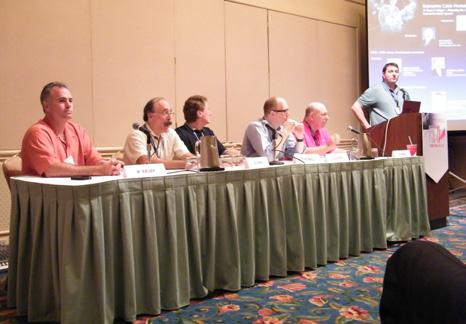
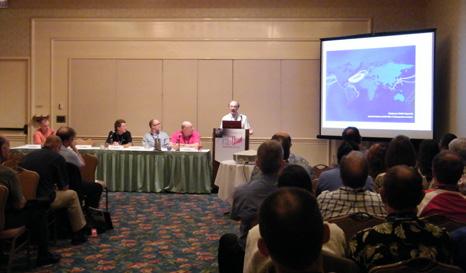
I attended only the first of the three parts: Infancy: Developing the Connection. I was interested in hearing the perspectives that the speakers represented: Simon Cooper represented Owners, Andrew Lipman represented Finance/Legal, and Michael Rieger spoke for Suppliers. This session was ably moderated by Guy Arnos, whose aim was to give us perspective on how it all gets started. Given the diversity of interests in the global cable market, I was curious to learn how these groups work together in these challenging times.
Guy Arnos started the discussion with the question “What does it take to get a program off the ground?”
First up was Simon Cooper, SVP of Network Strategy & Architecture, Tata Communications of Singapore. Representing cable system owners, Cooper noted that financing was a good idea as the process is “two and a half years of fun!”
Cooper stressed the need to convince
players, especially early on, that the project is a worthy investment. Talking about investments in the undersea cable market, Cooper outlined several project models:
Consortium (largely carriers’ opportunities such as in the middle east, which have a more organic growth and the lowest risk), Private cable (single carrier/ entrepreneur, such as SEACOM and Pipe Pacific Cable. This model emerges where there is a new need), and Partnerships (lead cable from
design & procurement, such as interAsia or WACS-West African Cable)
Cooper continued, “All parties need to share the risk and fill the pipes at revenue levels that [funders] believe in to get a project off the ground. If you have a sufficient part of the project funded and workable business model, great!”
Next up was Andrew Lipman, Partner with Bingham McCutchen, USA. Lipman stated that the best lawyers know how to balance
(Left to right) Mike Reiger, Andrew Lipman, Robin Russell, Simon Cooper, Guy Arnos, Wayne Nielsen
aggression with delicate handling. “To get a cable project done, it takes more than a village” (due to substantial bureaucracy).
Lipman showed that Trans-Atlantic capacity and requirements are growing. This raises a number of regulatory issues, especially around coordination. There is a need to coordinate licensing and permitting with construction activities such as telecom licenses, landing sites, and permits (environment, defense/national security, local construction and land use).
Typically, licensing and permitting is more difficult in emerging markets due to less developed regimes, more red tape, less
transparency in the process, and unique local rules and requirements. Lipman cited additional political considerations, including those representing fishermen’s unions and other seabed users. Cable landing stations can also be problematic. While beach access is less so (it’s handled at a national level), beach manholes to CLS are often difficult due to municipal permitting processes.
As a case study from the U.S., Lipman explained that defining telecom and information services are critical. There are several parties and interests involved, including common and private carriers,
the FCC, and matters of licenses and fees. In the U.S. you do need a license from FCC, including authority to construct and operate, as well as a landing license and Section 214 authorization. A significant distinction between working with common and private carriers is that common carrier is subject to FCC rules, which include nondiscriminatory access, reasonable prices and terms.
The FCC may compel common carrier status, and that’s a thin line based on things like insufficient capacity, characteristics like competition, or if the carrier serves groups of users, etc. Private carriers don’t have same rights (e.g., eminent domain, rights of way, interconnections, etc.) and obligations as common carriers do. Cable licensing: application requirements (US government is more intrusive about/ focused on equipment these days, also nationality/ownership info). Authority of other US Government entities: DOJ, DOD, Dept of State, DHS, Commerce’s national Telecom/Info Admin… get started with these groups early. Environmental auth: Section 10/404, others. Rights of way/ zoning: property acquisition, state/local permitting. It’s more than a village, it’s a bureaucracy!
Robin Russell added that building a cable is a bit like making a movie. It’s about getting the money, which is not so easy these days for many reasons. Banks are not prepared to take risks. Most governments around the world are scrambling, and
Andrew Lipman addresses the audience
that the technology is not done with satellites. Russell cited the Australian Tax Office decision, stating that it’s ok for a buyer to treat a cable investment as a depreciable, but to a seller the investment is considered a part-sale of an asset. The effects depend on structure of the business model. Russell also offered an observation: there is a significant risk of new fees and taxes coming out of this situation. We need to find some way, as an industry, to express our common concerns.
need to be cautious about what might happen in the sub-sea cable industry and telecom generally.
He suggested that the industry needs a common voice. He offered an interesting example. Submarine cables are not well understood in government circles: what they are generally, or the fact
Finally, Michael Rieger, VP, Sales, TE SubCom LLC, USA took the mic to offer a process overview about supplier roles in project development. The first task is to design the concept to support customer projects, then to define alternative cost and scheduling approaches. Next, support project financing process, develop flexible implementation models, and project assistance from suppliers. Rieger next outlined the customer stages: define the project, define the system, identify and secure financing, then project implementation. As for supplier aid: budgeting, scheduling, high level design, and feasibility studies. All of these pieces need to work together.
On defining the system, Rieger stated the need for good detail in describing your project, including the demand, the capacity involved, whether a project will use fiber pairs or branching, the initial equipment, and routing/permitting requirements. To obtain financing, the planner needs
to clearly describe a number of project elements: the project’s validity, technical and pre-sales support, anticipated capacity and revenue levels that are involved, any planned debt sourcing, equity and financing, also if there are privacy sovereignty issues, planned interconnecting agreements, partnering, and other collaboration issues. Make sure you have an effective program to manage cash flow, and can show program viability. This seemed very reasonable. However, with so many moving parts it’s a wonder any individual or small group of planners would remember all of it.
Rieger continued with suggestions on how to future proof your project. Make sure you understand local regulatory challenges, and work collaboratively with customer local supply chain partners. Get project finance assistance, for example through pre-sales (a wholesale chunk). It helps to assist in financial structuring by working with customer’s banks (establishing business cases and relationships), and to sponsor and support applications to government agencies and equity partners. Rieger painted a flexible picture with a lot of support connections and opportunities. The take-away message is that a project planner needs to clearly define the project criteria, the time elements (including time and cost of permits), pre-sales options, and your plan of work for flexible project strategies and partners. Again, this makes sense and helps me understand the need for shared industry best practices. The biggest hurdle to suppliers are concept
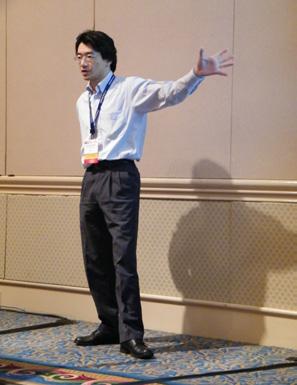
Motoyoshi Tokioka gives a presentation
credibility (especially for funding) and sales commitments. Financial sponsors are not looking through a rear-view mirror, but look through the windshield. Remember that lenders are risk averse. They may know something about cable, but not the industry!
Rieger spoke about permitting, noting that this and other processes are extremely reactive. Again Rieger suggested the need to create a lobbying group. Especially as governments change, the industry need
to develop some best practices to help our processes of development, deployment and operations. This is also true for matters concerning taxation. “The dog is awake.” Regulators, tax authorities are looking for revenue opportunities too, and this also calls for a collective need to act as an industry. We need rational programs put in place. It helps to view what connectivity adds to each country’s GDP. In India as many other areas, government is trying to figure things out too. It was fascinated to learn about the various
project models that are working around the world, and to get a feeling for the process flow that’s involved. I will admit to being surprised that there is no group representing the common interests in this industry, especially with as much time and energy as is obviously being invested in developing global undersea cable projects. It’s one matter to be involved in a technology with such a strong global impact. It’s quite another to have that work misunderstood, or treated as an interpretable financial act.
The work is complicated and depends on many factors and interests. It is timely and urgent that the industry come together and find their common voice, help to establish best practices for the evolution of the industry, and perhaps most importantly to help others (including politicians) understand and support the global connectivity and opportunity that this industry represents.
Judi Clark has been helping people understand computer-based and communications-oriented tools and technologies for over 25 years. She has lead advocacy and training programs on practical uses as well as explorations into cutting edge trends, futurefocused scenarios and policy planning. One of Ms. Clark's blogs is www.ManyMedia.com
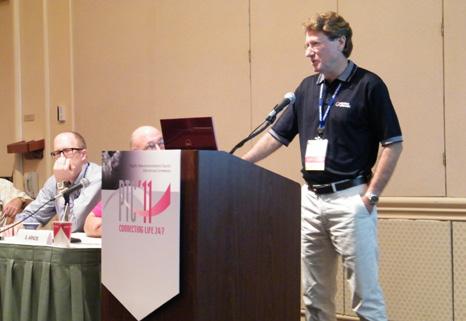
Robin Russell at the podium
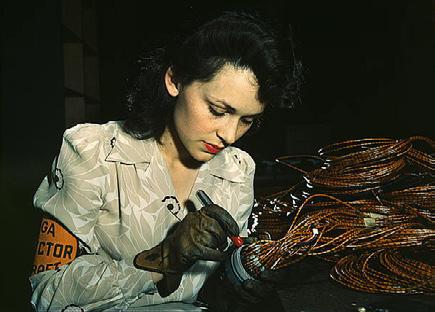
Less than seventy years ago, US women began the first mass movement into the technological field. Not as secretaries or stenographers, but as factory workers, military personnel, and yes, engineers. Recently, during my daily browsing of CNN.com, I stumbled across article that described the impact that scores of women engineers made during WWII. Unbeknownst to me, women engineers during the war made sophisticated calculations concerning weapons trajectories, worked on some of the earliest versions of computers and did some of the world’s first “computer programming.” While at the time they were only considered temporary substitutes for their male counterparts at war, these women were instrumental as the front-runners for their gender in the science and technology fields. Sadly, they were never recognized for their achievement until recently.
As a woman breaking into a technological field, I am extremely grateful for the sacrifice and boundary pushing these women accomplished during their careers, whether intentional or accidental. As a young professional engineer, I have had to endure none of the discrimination and stigma that used to be attached to a woman technologist. I have never been told to choose a different path or that that I was not capable of a task due to my gender. If anything, I
have found that I have been encouraged more than my male equivalents in my career choices. However, it should be noted that I am young, relatively new on the job scene, and my experiences may not be representative of women in telecommunications as a whole.
There are certain facts that cannot be denied. The field of telecommunications
engineering is still overwhelmingly male. In 2009, less than eleven percent of all employed engineers were female (according to the National Science Foundation) and telecommunications engineering certainly fits into this statistic. Frequently, this means a female telecommunications engineer may be the only woman on a project team or in a business meeting, a potentially
Lathe operator machining parts for transport planes at the Consolidated Aircraft Corporation plant, Fort Worth, Texas Reproduction Number: LC-DIG-fsac-1a34951 Repository: Library of Congress Prints and Photographs Division
Woman aircraft worker, Vega Aircraft Corporation, Burbank, Calif. Shown checking electrical assemblies Reproduction Number: LC-DIG-fsac-1a34456 Repository: Library of Congress Prints and Photographs Division Washington, D.C. 20540 USA
intimidating experience for those unaccustomed to it. This situation, depending on the people in room, can certainly cause some problems. Does the woman feel the need to prove herself as capable (or more so) than the other engineers? If she is a manager, is it more difficult when her staff is all men? This line of questioning, once started, is difficult to discontinue: will they still be viewed by their male counterparts as serious engineers or as equals?
What happens when female engineers decide they want to have children?
These issues and more plague women across the board in not only engineering but a variety of professional fields. It is impossible to say whether engineering (and telecommunications specifically) is any better or worse than other industries. However, according to an article published in TIME magazine in last April, women engineers leave their jobs at a much higher than average rate over other sectors. While some of these women leave to start families, the percentage that do so for that specific reason is proportionate to non-engineering industries. Instead, what makes the number so high is due to complaints with “pay and promotion opportunities”. This trend extends to other male-dominated fields such as financial management and economics. Why these women are dissatisfied with their
promotion opportunities, though, is the real issue – and the reasons for this are very unclear. It is unfair to put the onus of the blame directly on discrimination; instead, it is possible that women find it difficult to network and move up the career ladder in male-dominated companies. This has inspired some companies to start female mentoring networks, although whether they are making a difference or not is yet to be seen.
However, this being said, there are plenty of women who are clearly dealing with these issues and still moving up the promotion ladder within the telecommunications field. I recently attended a breakfast meeting held at the 2011 Pacific Telecommunications Conference held by the Global Telecom Women’s Network, whose mission statement includes networking opportunities for executive women, mentoring of younger women managers, and contributing to “the to the evolving global information society in a positive manner”. I listened to women from a variety of different positions within the industry, including engineers, speak about their experiences, both professional and personal. There were several women in attendance that had families and children, some just returning to the workforce and others who had remained in their positions when they had children. For the most part, their stories
were positive, and while there was some debate on whether the proverbial “glass ceiling” exists for executive women in the telecommunications industry, all the women in attendance agreed that a supportive company or mentor was the key to their accomplishments. Looking around the room of strong, capable businesswomen, I realized this belief could be taken a step further. Ultimately, the pathway to success in a maledominated field is as much a positive,
motivated attitude as a supportive mentor. These women refused to see or treat themselves as minorities, and therefore, those around them did the same. While an encouraging company was invaluable to their successes, their optimistic approach was just as important.
In the end, this attitude is the same held by the early female engineers during WWII. While the woman’s fight for equality and recognition in the
engineering field may be a long, ongoing process, those of us in the midst of it can continue to further our case by doing excellent work and maintaining a nonvictim stance. We’ve come a long way from the days when women were not even recognized for their achievements in technology, but we still have more to go in making engineering a completely friendly industry.
Meredith Cleveland is a Project Engineer for WFN Strategies. She received a BS in Environmental Sciences from the University of Virginia and her MS from the University of New Hampshire in Earth Sciences with a specialization in Geochemical Systems. She is a trained scientist with areas of expertise in running highly specialized instrumentation as well as data collection, management, and interpretation.
The female staff of WFN Strategies, taken at the Royal Hawaiian Hotel, PTC week 2011. (Left to right) Kacy Nielsen, Peg Nielsen, Meredith Cleveland, Heather Case.
Back reflection
by Stewart ash & Kaori Shikinaka
Intellectual Property Disputes; Nothing Changes!
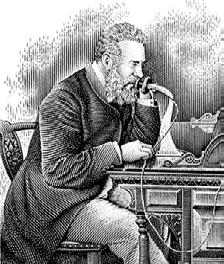
March 7th was the 135th anniversary of the United States Patent Office award, to Alexander Graham Bell of his much disputed US Patent 174,465 “Improvement in Telegraphy,” which was the first patent for the telephone. Bell’s valuable patent became the subject of controversy and litigation, and as such is an appropriate subject for our article in this edition of Subtel Forum, given its Legal & Finance theme. Contrary to what most of us were taught in school, Bell did not invent the telephone. There is significant doubt as to whether he was entitled to the US patent he received, or that he was the author of the liquid transmitter idea that made the invention practical.
Frenchman Charles Bourseul wrote an 1854 memorandum that was first published in the Paris magazine L’Illustration concerning the transmission of the human voice by electrical current.
Bourseul explained: “Suppose that a man speaks near a movable disc sufficiently flexible to lose none of the vibrations of the voice; that this disc alternately makes and breaks the currents from a battery: you may have at a distance another disc which will simultaneously execute the same vibrations.... It is certain that, in a more or less distant future, speech will be transmitted by electricity. I have made experiments in this direction; they are delicate and demand time and patience, but the approximations obtained promise a favourable result.” Although this clearly described the necessary principles of a telephone, Bourseul did not go on to produce a working apparatus. It is now widely accepted that in the same year, Antonio Santi Giuseppe Meucci invented the first successful electrical device for the communication of speech. In 1860, a German, Johann Philipp Reis made a device that could transmit musical notes as well as indistinct speech and, on occasions, distinct speech. The first
sentence spoken using it was reported to be “Das Pferd frisst keinen Gurkensalat” (the horse doesn’t eat cucumber salad). It is thought that this was the first device to actually be called a telephone. Clearly, any of these men have better claims to the invention of the telephone than Bell, but whether he was entitled to a patent as the inventor of a workable design is another matter entirely.
In 1871, Meucci set up an electrical voice communication system between the basement and the first floor of his Staten Island home, and shortly afterwards submitted a “patent caveat” to the US Patents Office in Washington D.C. A patent caveat (discontinued in 1909) was an instrument set up under the US Patents Act of 1836, which was similar to a patent application. It was required to contain a description and drawing of an invention, but no claim. It was effectively a notice of intention to submit a patent application at a later date. The filing fee was much less for a caveat than a full application, and the
caveat expired after a period of one year, although it was renewable by payment of a further annual fee. Meucci twice renewed his caveat, but in 1874 he neglected to or was unable to do so, and thus he opened the door for others to claim the prize that has been described as the most lucrative in US patent history. A US House of Representatives resolution, set down in 2002, stated, “if Meucci had been able to pay the $10 fee to maintain the caveat after 1874, no patent could have been issued to Bell.”.
The story of the awarding of the famous patent pits Bell against Elisha Gray. Bell and Gray had both been working independently on what was then called the “harmonic telegraph,” not for speech transmission
but as a method of multiplexing telegraph signals. Under Gray’s instructions, his lawyers filed a patent caveat with the US patents Office on Monday, 14th February 1876. The caveat contained a diagram from Gray’s note book showing the liquid transmitter he had invented. On the same day, Bell’s lawyer’s hand delivered a patent application to the US Patent’s Office for a similar device. This application did not contain a diagram of the transmitter. There is some dispute as to which application arrived at the Patent Office first. According to Gray, his caveat arrived in the morning (about 09:30) several hours ahead of Bell’s application (around 11:30). Bell’s lawyers insisted that the filing fee was registered in the ‘Cash Blotter’ (ledger) immediately. The fee for Gray’s caveat was not entered into the ledger until 13:30, so it is an undeniable fact that Bell’s filing fee was recorded in the ledger ahead of Gray’s.
The patents examiner Zenas Fisk Wilber initially suspended Bell’s application and Gray’s caveat for three months to allow Gray time to file a full application. He later lifted the suspension, based solely on the evidence of the ledger, as to which filing was delivered first. Bell was awarded the patent on 7th March 1876, less than one month after filing, a remarkably short time, especial considering that he was not able to provide a working patent model, as required by the regulations, until 10th March.
This irregular course of events followed shortly after Gray’s lawyer, William D.
Baldwin, stating that he had been made aware that Bell’s application had been signed by him and notarised on 20th January 1876. Baldwin advised Gray and his sponsors to drop the claim, which they did. Bell’s patent application, submitted on 14th February, does show that it was signed by Bell on 20th January. However, it appears that the vital information, that made the patent viable, contained in seven sentences and Claim 4 on the application, was only added to the document on 13th & 14th February. Gray had told nobody about his invention until Friday 11th February 1876, when he instructed his lawyers to file the caveat. Another interesting fact is that Bell kept meticulous and detailed notes of all his experiments, and it wasn’t until 8th March 1876 that the breakthrough diagram of the liquid transmitter appears, out of nowhere, in his notes. This diagram is remarkably similar to the diagram submitted by Gray with his caveat, which should have been confidential.
Conspiracy theories abound as to what actually happened. Neither Wilber nor Baldwin comes out of it with much credit. In a sworn affidavit from 6th April 1886, Wilber admitted that he was an alcoholic who owed money to his long-time friend and Civil War army companion Marcellus Bailey–Bell’s lawyer. Wilber says that after he issued the suspension on Bell’s patent application, Bailey came to visit. In violation of Patent Office rules, he told Bailey about Gray’s caveat and then
proceeded to tell his superiors that Bell’s patent application had arrived first, based on the ledger evidence. After the suspension on the application had been lifted, he claimed that during Bell’s next visit to Washington, “Prof. Bell was with me an hour when I showed him the drawing [of Gray’s caveat] and explained Gray’s methods to him.” He said Bell returned at 2 pm to give him a hundred-dollar bill. Wilber made five other affidavits prior to this, but only the one dated 21st October 1885 directly contradicts this story. Wilber claims it was “given at the request of the Bell company by Mr. Swan, of its counsel,” and he was “duped to sign it” while drunk and depressed. These conflicting affidavits totally discredited Wilber.
It was Baldwin who advised Gray to abandon his caveat and not turn it into a patent application, because he told him that Bell had invented the telephone before Gray, and Bell’s application was notarized before Gray began his caveat. Baldwin urged Gray to write a letter to Bell congratulating him on his new telephone invention and state, “I do not claim even the credit of inventing it...” Baldwin also appears to have failed to represent Gray’s interests properly in later patent cases. It further appears that Baldwin was on the payroll of the Bell Telephone Company at the same time he was representing Gray in a different patent office action involving the Bell Company. There is a strong school of thought that Baldwin or someone in his company leaked the details of Gray’s
caveat to Bell’s lawyers over the weekend of the 12-13 February.
Whatever the rights and wrongs of this patent award, the debate goes on to this day. In 1876, the telephone had arrived, although the public did not take to it straight away, nor was it an immediate commercial success. Later in 1876, Bell and his partners, Hubbard and Sanders, offered to sell the patent to Western Union for $100,000, but Western Union baulked at the opportunity, describing it as merely a toy. In 1877, the Bell Telephone Company was incorporated, and by 1878, when Western Union were prepared to pay $2.5M for the patent, Bell no longer wanted to sell.
It took until January 1878 for the world’s first telephone exchange to open in New Haven Connecticut. In Europe, the telephone was slow to establish itself as well; the first Bell exchange in London went into service in the autumn of 1879, followed by one in Manchester. The first licenses to operate the Bell telephone in France were awarded in September 1879; Germany’s first exchange was opened in Berlin in 1881 and Belgium had its first exchange by 1882. Two examples of the Bell telephone were imported into Japan in 1877, and a year later domestically manufactured replicas appeared. It wasn’t until 1890 that the first telephone service between Tokyo (155 subscribers) and Yokohama (42 subscribers) started, using the Gower – Bell telephone set. And the
rest, as they say, is history.
Telephony, of course, played a major role in the submarine cable industry, and for a period of just over thirty years, roughly between TAT – 1 (1956) and TAT – 8 (1987), it was the dominate technology for submarine cable system transmission. The Telephony Era was characterised by monopoly international carriers, usually government owned, and the “Big Four” submarine system suppliers. AT&T Submarine Systems Inc. (now TE Subcom); Alcatel Submarcom (now Alcatel-Lucent); STC Submarine Systems Ltd (now part of Alcatel-Lucent); and “Japan Inc” (comprising Fujitsu, NEC and OCC).
Conferences
Global Submarine Cabling Forum
28-30 March 2011
Reykjavik, Iceland
Website
ICPC Planery Meeting 12-14 April 2011
Singapore Website International Telecoms Week 2011 23-25 May 2011
Washington, DC USA
Website
ENTELEC
24-26 May 2011
Houston, Texas USA
Website
Submarine Networks World Africa 2011 25-28 July 2011
Singapore Website
Submarine Networks World 2011 27-29 September 2011
Singapore
Website
Pacific Telecommunications Council
15-18 January 2012
Honolulu, Hawaii
Website
a Funny Thing Happened...
Letter to a Friend
In cha’Allah,
During a good part of my professional life, from 1960-1980, I spent a lot of time working with the South Med countries, the Maghreb (West) and the Mashreq (East). I cannot count the number of trips that I took to Morocco, Algiers, Tunis, Tripoli, Cairo, Beyrouth and Damascus! A lot of old friends’ names and faces are springing back into my mind when looking at the TV as of late. And I keep saying to myself, “at last!”
I enjoy thinking that such events are made possible by the internet and social networks, that is to say, thanks to our cables! There is clearly a relation between these “revolutions” and the emergence of the internet access in
Jean Devos
these nations. The technology is shaping a new world, and I predict that all the cables we are presently laying around Africa will also bring significant changes in the future.
If ASN is today a significant submarine system provider, it is, in good part, thanks to the Med countries and their people. When I joined this industry as a young engineer in 1961, my first job in Calais was to work on the production of the Perpignan-Oran cable. Marseille-Algiers had recently been installed in 1957, just after a short experimental cable in Tunisia (KelibiaBou Ficha). These were our first “repeatered” cables, providing 60 circuits! These systems were considered “domestic” since Algeria got its independence in 1962.
The very first Marseilles-Algiers cable was a telegraph line laid in 1871, and at the war declaration in 1939, there were 10 MarseillesMaghreb cables in service. The cable ship Arago spent the war in Oran and Algiers protecting the systems. These cables have played an important role; the names of “Mers el Kebir” in Algeria, “Tobruk” in Libya, and “Al Alamein "in Egypt are all well known. The battle of Al Alamein, in the desert, was a turning point in the war. Churchill would say later on, “We had no victory before Al Alamein, no defeat after it”
During my time in Calais we produced FranceMorocco (1967), Marseille-Tel Aviv (1968), Marseille-Bizerte (1969), Marseille-Beyrouth (1970), Beyrouth-Alexandria(1972), MarseilleAlgiers2 (1972) Penmarch-Casablanca (1973), and Perpignan-Bizerte(1975).
One of my first jobs when I took the responsibility of Submarcom in 1977 was to negotiate Marseille- Tripoli (Libya), and SyriaGreece. Quite an experience for a young 40 year old!
One of my numerous surprises during this time was to realize how often these very capable and highly educated guys were saying, “In cha Allah” (God willing) during our discussions. I learned that it was part of their culture to never say ”I’ll definitively do that tomorrow” without adding, “if God is OK”. Actually, it's not that different from our “thank God” or the French “Grace à Dieu.” More surprising was the discovery that the parabolic language that Jesus-Christ used in the gospels is actually the way that most the Middle-Eastern people tend to speak. This was explained to me by my local Damascus agent, who was a non-Muslim Arabic. He was born in Anatolia, like St Paul
ISSN 1948-3031
Issue Themes:
January: Global Outlook
March: Finance & Legal
May: Subsea Capacity
July: Regional Systems
September: Offshore Energy
November: Subsea Technology
Advertising enquiries:
SALES MANAGER
Kristian Nielsen
Tel: +1 (703) 444-0845
Email: knielsen@subtelforum.com
SALES REPRESENTATIVE, EUROPE, AFRICA, MIDDLE EAST
Wilhelm Sicking
Tel: + 49 (0) 201-779861
Email: wsicking@subtelforum.com
who got converted on the “Chemin de Damas” (The road to Damascus). The Submarcom representative in Cairo was a highly cultivated old gentleman from the orthodox Copt community. At each of my Cairo visits he brought me to the old Arento( PTT) building , kissing every secretary while saying, “Allah is great.” I tell you, never go there believing that things are simple!!
More recently, these countries have grasped the opportunities to get connected to the numerous Europe-Asia cables and in some cases develop their own systems such as TE North (Telecom Egypt).
This holds even more true for Libya and its neighbors.
So, let’s hope that the current “explosion” will produce good solutions with more development, and that submarine cables will play an ever bigger role in the future. Why not the construction of a long and thick festoon, a Maghreb–Mashreq highway, from Morocco to Alexandria, Lebanon, Syria? And let’s dream that Israel and Palestine could have their own landing point in such a system!
It is to be noted that these countries have so far very little traffic between themselves. I keep hearing about the “Arab world,” but relations between these various countries are very limited. The Morocco-Algeria border is almost closed due to the Sahraouian conflict. , and the commerce between Tunisia and Algeria is indirect, with Marseilles as the middle point.
Jean Devos
by Kevin G. Summers
Remember last issue when I promised that we have some exciting things lined up for 2011? I'm pleased to announce that we are launching our First Annual Submarine Telecoms Forum Awards. These awards are meant to recognize some of the most important contributors and contributions to our industry over the past year.
The Innovation Award will go to the company or organization that has produced the best market innovation of the previous year. The Industry Achievement Award will go to an individual or company that has done the most for the industry. Finally, the Editor's Award will go to author of the best SubTel Forum article.
In order to do this right, we need input from our readers. Think about 2010, and all of the news that came down the pike last
year. Who would you recommend for the SubTel Forum Awards? What was the most impressive innovation? Who advanced the cause of our industry? Who wrote the best article?
We are looking for your nominations.
Finalists will be profiled in the May edition of SubTel Forum (Issue #57) and the winners will be announced in our July edition (Issue #58). Furthermore, winners will receive a physical award that they can display in their office as a keepsake.
Please send your nominations to me directly at editor@subtelforum.com. Thanks!
What do you think? Click on the Letter To The Editor icon and drop me a line. I’d love to hear from you.