SubTel Forum Issue #54 - Defense & Non-traditional Cable Systems
Multipurpose Submarine Cable Repeaters Required To Monitor Climate Change
Undersea Distributed Networks: open Architecture Connectivity
ISSN 1948-3031
Submarine Telecoms Forum is published bimonthly by WFN Strategies. The publication may not be reproduced or transmitted in any form, in whole or in part, without the permission of the publishers.
Submarine Telecoms Forum is an independent com mercial publication, serving as a freely accessible forum for professionals in industries connected with submarine optical fibre technologies and techniques.
Liability: while every care is taken in preparation of this publication, the publishers cannot be held responsible for the accuracy of the information herein, or any errors which may occur in advertising or editorial content, or any consequence arising from any errors or omissions.
The publisher cannot be held responsible for any views expressed by contributors, and the editor reserves the right to edit any advertising or editorial material submitted for publication.
Contributions are welcomed. Please forward to the Managing Editor:
Welcome to the 9th anniversary issue of SubTel Forum.
When Ted and I established our little magazine in 2001, I had to negotiate a special deal with America Online which allowed me to send emails in bulk and avoid being black-balled. I would first alphabetically organize issue announcements in Excel in baskets not to exceed 100 or so addresses, and then forward the download to the email system. The entire process would take a few hours or so, unless it “jammed,” and then I would be inundated with the inevitable bounce-backs for a couple of weeks or more; I could also field numerous subscriber complaints about the excessive 1 Mbit size of the Mag issue!
This now archaic method allowed us to unscientifically analyze the health of our industry by the percentage of bounce-backs from issue to issue, and at times in the darker days of 2002 or so, we would see as many as 10% coming back on a given month. The days of overloading and upsetting AOL are over, thank goodness, as technology has moved us forward to new, faster and more user friendly dissemination methods.
With 2001 beginning soon, our 10th year, we have a few enhancements to the SubTel Forum brand which we will be rolling out during the course of the year, and which we believe will further enhance your utility and enjoyment.
We will do so with two key founding principles always in mind, which annually I reaffirm to you, our readers:
1. That we will provide a wide range of ideas and issues;
2. That we will seek to incite, entertain and provoke in a positive manner.
SubTel Forum is an imperfect medium, and we have surely made our share of mistakes; but we continue to hope that in the long run we have helped our industry in some small way. Though our faces may change, our goals remain.
Happy Anniversary, and thank you as always for honoring us with your interest.
AAG Hit By Cable Faults
Atlantic Tele-Network, Inc. Signs Master Supply Agreement With DragonWave for Backhaul Products
Cuba-Venezuela cable does not involve expanded network access in Cuba
Fibre could hit ‘capacity crunch’ before technology improves
FLAG maintenance – no major outages expected
France Telecom-Orange acquires Telecom Italia’s submarine cable subsidiary, Elettra
Glimmerglass Networks Speaks at Submarine Networks World 2010, Addressing Commercial Viability of 40G Technology and Mesh Network Infrastructure
Glo-1 Inagurated
GlobeNet Announces New Network Upgrade, Adding 200 Gigabits of Additional Capacity Over Its Lowest Latency Submarine Fiber Optic Cable System Connecting the Americas
hibernia Atlantic’s GFN Utilized By Global Financial Firms And Exchanges For Transatlantic Low Latency Routes
ICPC Enhancing Submarine Cable Security
ICPC Plenary Meeting in Singapore, 1214 April 2011 – CALL FOR PAPERS
Infraco set for launch
Lebanese telecoms upgrade worth $500 million
Main One crashes bandwidth prices
Myanmar Internet link continues to meet with interruption
O3b Networks Signs Deal with Netcom, Nigeria to Provide Fast and Reliable Connectivity to Ships and Offshore Platforms
Pacnet Launches Asia Pacific’s First Data Landing Station
Pioneer Consulting and Main One Cable System Celebrate First 100 Days
Rwanda’s fibre optic cable 80% complete
Sierra ACE submarine cable project
Southern Cross Services Extended to 2025
SubTel Forum Podcast – Episode 6: Pacific Telecommunications Conference
TeleCuba Retains Wiley Rein as its Communications Counsel
Tyco building decision delayed
UNIFI and Alcatel-Lucent team up to deliver broadband connectivity to Albania via undersea cable
WFN Strategies to Sponsor Local Children-in-Need This Holiday Season
Zambia/Botswana fibre optic connection underway
Multipurpose Submarine Cable Repeaters Required To Monitor Climate Change
Yuzhu You
As part of a global effort to build a tsunami warning system, the USA has deployed a total 39 Deep-ocean Assessment and Reporting of Tsunamis (DART) tsunami stations (or buoys) in the Pacific and Atlantic Oceans and Caribbean Sea as of 2008. More buoys have been planning to deploy in other parts of the world oceans. At the same time, many other coastal countries have deployed or planned to deploy their tsunami buoys as well. The cost for purchasing a DART buoy is typically about US$250,000. And maintaining cost for a buoy is at about US$125,000/year, excluding ship-time which could cost perhaps more than the buoy itself. Assuming about 200 tsunami warning buoys are to be deployed worldwide in spotted locations, the total costs for purchasing the buoys would be about half a billion US dollars, and maintaining costs about quarter a billion US dollars per year. Including the shiptime, the total cost for all nations could reach roughly one billion US dollars each year. Tsunami buoys are usually deployed as far away from coastal line as possible for achieving longer warning and evacuation time. But obviously, further distance buoys cost more to maintain and use longer shiptime.
The principal of the DART (or other types) buoys, for example, developed by US National Oceanic and Atmospheric Administration (NOAA), is the ocean bottom pressure sensor which can record tsunami wave amplitude of less than 1 cm in open ocean. If the pressure sensors are
integrated into submarine cable repeaters, harnessing telecoms cable repeaters can form a global real-time tsunami warning network with cost far less than the present tsunami warning system, perhaps less than one tenth of the cost compared with the DART buoys. That is because maintaining cost and ship time can be saved. This unique business opportunity has simply been missed by telecoms companies.
A missed opportunity
Since 1850, over a million kilometres of submarine cables have been laid on the ocean floor, covering a significant part of the global oceans (Carter et al., 2009). The thousands of repeaters accompanied
Figure 1. Submarine cables repeaters (blue dots) are symbolically plotted overlapping the cables (in red). Actual number of repeaters is about 4 times more than that plotted with a distance of about 40150 km apart. For example, a typical transpacific cable would contain about 200 repeaters. The source of background cable distribution is from the cable map of Global Marine Systems Ltd.
with these cables, typically installed 50150 kilometers apart, are currently serving only the single purpose of amplifying communication signals (Figure 1). Slight modification of these repeaters – plugging in only one pressure sensor into their housing, for example – could turn the single purpose telecommunication network into
multipurpose, real-time global tsunami warning and sea-level rise monitoring network. Such a global network could quickly locate the source of the tsunamis triggered by an earthquake from anywhere of the ocean floor. The very dense repeater stations – typically about 100 repeaters for a transatlantic cable and 200 repeaters for a transpacific cable - provide time series of tsunami-wave travel times and speeds for early warning at every minute. Such a network can be sustained for several decades with a low cost. The bottom pressure time series data has also scientific value for oceanographers to study tides far from land (Munk, 1980).
Broadly, if more sensors – such as sensors for measuring temperature and salinity – are installed in the repeater housing, the harnessing telecoms cables are even more useful and can be turned into a deeply-needed real-time global climate change monitoring network (You, 2010a). Unfortunately, such a useful resource has simply been overlooked.
A prominent climate change issue
Oceans store more than 90% of heat and 50 times as much carbon as the atmosphere in the Earth’s climate system. Global warming causes polar ice melting, consequently reduces ocean’s capacity of greenhouse gas storage in the deep water and as a result further reinforces atmospheric greenhouse warming. The deepest water mass covering the world’s
ocean floor is originated from polar regions such as the Greenland, Labrador Sea, Weddell Sea, Ross Sea and around Antarctica. The polar water has a highest density and is the heaviest water mass in water column. The densest water plunges along the polar continental slope and spreads on the ocean floor filling up the global ocean bottom water (Figure 2).
Figure 2. Schematic of polar water formation. It sinks and spreads across the ocean floor which is affected by global warming and ice melting at its polar source formation region. The change of water properties such as temperature and salinity can be measured with sensors installed in the repeaters (optical amplifiers) of a submarine cable.
Since the polar bottom water is formed at the surface of polar seas through air-sea interaction, it carries signals of temperature and salinity as changed by ice melting and affected by the atmospheric greenhouse gases into ocean bottom, indexing climate change. Under a warming environment, polar water masses become less dense and less capable of sinking. Consequently, its transport decreases and thus less atmospheric greenhouse gases are brought into the ocean floor. Obviously, if polar water temperature and salinity can effectively be measured on the ocean floor, its relevant climate change signal can be monitored (You, 2010b).
At present, oceanographers cannot efficiently measure polar water mass due to its vast extent and volume. Particularly, the high pressure at abyssal depth (~6000 m) and complicated bottom topography cause instrumentation to be extremely difficult. In oceanographic traditional measurements, the sea bottom is intentionally avoided for possible damage of the instruments in case they hit bottom. Therefore, measurement of polar water mass on the ocean floor is virtually nonexistent. However, submarine telecoms cables lie on the ocean floor and can fill this gap. They can be used to measure on a continuous, sustained basis the bottom water they run through – something that cannot be done by other means. At the same time, electric signals from the cables can yield information about the ocean currents they run through as electromagnetic signals and cable
resistance vary when ocean currents and temperature change (You, 2010c).
New generation of multipurpose cable repeaters appealed to monitor climate change
The present submarine cables have limitation for scientific usage and can only be used at their landing stations where measuring instruments are connected to them (You et al., 2009, 2010). In particular, the repeaters have not been modified for their full potential of climate monitoring capacity. This is a significant opportunity for telecommunication companies to redesign the new generation of cable repeaters and to provide additional climate data to stakeholders other than their usual telecoms services. The new repeaters that are integrated with built-in sensors inside house enable to measure the major climate properties of temperature, salinity and pressure and cast cost-effective long-term climate change monitoring network. The redesigning cost of the new generation of repeaters is estimated roughly at a few million US dollars (Harasawa, personal communication in 2010). This is a onetime only cost for certain type of repeaters which is regarded as not too expensive, as thousands of this new type of repeaters will be assembled for many years to come. The new type of repeaters can be sold with a price higher than the present types. Telecoms companies can make additional profit by serving the stakeholders and broad community with very much needed climate data and relevant products such
as the aforementioned tsunami warning data. The depicted real-time global tsunami warning network - composed by thousands of harnessing cable repeaters’ built-in pressure sensors - is obviously an ultimate solution to replace the expensive and inefficient DART buoys warning system.
Since demand for internet use grows exponentially, telecoms cables will only expand and the new generation of cable repeaters is appealed to meet the requirement of very much needed climate change monitoring data.
Modern technologies enable the new type of repeaters to be assembled into one cable body but two operation systems without interference each other. The dualconductor cable and four-cable branch unit recently developed by Tyco Electronics Subsea Communications (Kordahi, 2010) and Modular Connecterized Distribution Unit by Ocean Design Incorporation (Flynn, personal communication, 2010) have fulfilled independent power and fibre connectivity in a layered network allowing three power path and nods for multiple connections. The currently used repeaters have space to install the temperature and salinity sensors inside repeater housing for measuring environmental temperature with thermistors and salinity with sensor to measure sea water conductivity and pressure with pressure sensor (Figure 3). The measured signals can be transmitted to shore end station via the dualconductor cable. As a result, the chain of
Figure 3. Cable and repeaters are being laid down in the ocean (upper panel) and the diagram of a submarine cable repeater (lower panel). Climate monitoring sensors could be integrated and the measured signals transmitted back to a shore station via the repeater’s transmission device.
repeaters in a cable can be turned into highly dense mooring-like time-series stations with instant data stream back to shore station for a time interval of every minute for encompassing a few decades. For a global ocean with harnessing cables and repeaters, that would consist of thousands of time series stations to form a truly real-time global network. Such a hugely useful network will effectively monitor global climate change at every minute.
At the UN Copenhagen Climate Conference in December 2009, all nations have unanimously agreed to curb global warming not to exceed 2°C. Since human-induced global greenhouse warming will soon cross the 1°C barrier and approach 2°C (IPCC AR4, 2007; You, 2010d), the next decades will be crucial for monitoring climate change. As oceans are one of the most important factors in governing the worldwide warming process and climate variability, they must be closely observed. Without other effective means for long-term measurements, harnessing telecoms cables for ocean observing is expected to play a major role in monitoring global climate change for the next decades.
and climatologist for over 30 years. Currently, he is leading an international group for launching climate monitoring of the Indonesian Throughflow using submarine cables.
References
Carter, L., D. Burnett, S. Drew, G. Marle, L. Hagadorn, D. Bartlett-McNeil and N. Irvine, Submarine cables and the oceans: connecting the world, UNEP-WCMC Biod. Series, 31, ICPC/UNEP-WCMC, 64 pp (2009).
IPCC AR4. Climate change 2007: the physical science basis (summary for policy makers), IPCC (2007).
Kordahi, M. E., Dual-conductor cable and a four-cable branching unit meet evolving needs for transoceanic undersea cable networks, Sea Tech. Mag., 51, No. 7 (2010).
Munk, W. H., Affairs of the sea, Ann. Rev. Ear. Plan. Sci., 1-17 (1980).
You, Y., Telecom companies could help create global monitoring network, Sea Tech. Mag., 51(10), to appear (2010a)
You, Y., Opportunity and responsibility: Towards a realtime global telecoms cable network to monitor climate change, ITU-T Tech. Watch Rep., 14, Interna. Telecom. Uni., Geneva, to appear, 14 pp (2010b).
You, Y., Monitor climate, monitor change, in: Climate Alert: Climate Change Monitoring and Strategy, Y. You and A. Henderson-Sellers (eds.), Uni. Syd. Pre., pp. 1-27 (2010d).
Yuzhu You is a senior research associate at Institute of Marine Science, University of Sydney, Australia. He is a physical oceanographer
You, Y., T. Sanford, C.-T. Liu, P. Sigray, M. Koga, W. Pandoe, J. H. Lee, N. Palshin, Z. Szuts and K. Taira, The First PACSWIN Submarine Cable Workshop, CLIVAR Exch., 14(4), 11-13 (2009).
You, Y., T. Sanford, T. and C.-T. Liu, Climate monitoring of the Indonesian Throughflow, EOS Transac. Amer. Geophys. Uni., 91, 13-15 (2010).
Undersea Distributed Networks: open Architecture Connectivity
Joshua I. Henson
There’s an old philosophy about how our oceans can be both a bridge and a barrier. Simultaneously, they have segregated civilizations and cultures while providing one of the most efficient means to carry vast amounts of cargo. While we still use the oceans as a bridge to transport more than 90% of the world’s cargo (Marisec.org), the Telecommunications industry has all but eliminated our idea of the oceans as a barrier. The world is shrinking because the Telecom infrastructure has brought connectivity to individuals and groups across the globe by linking one terrestrial network to another.
Soon however, connectivity between shore stations will no longer be sufficient. The need for real time data acquisition from offshore assets is more important now than ever. This is as true for the Navy as it is for Telecom, Oil and Gas, and the Scientific Communities. Instantaneous command and control of offshore assets enables a new realm of missions, products, and experiments.
Today, Unmanned Underwater Vehicles (UUV) as well as offshore drill rigs have the ability to be operated remotely. The scientific community currently receives data in real time and has the ability to assimilate it into prediction models (climate change, etc) almost as fast as received. Their sensors can be remotely reconfigured as needed. The Navy is seeking to improve ways of communicating
with remote locations in the ocean -applications include search and rescue, ship tracking, UUV systems, undersea training ranges, energy, and thru-water communication. In order to be tactically relevant, data needs to be collected and assimilated in real time. The bottom line is that as underwater technology continues to advance, so must the infrastructure which supports it.
The Global Information Grid (GIG) allows high speed, high bandwidth (HSHB) connectivity to disparate terrestrial assets across the globe using a relatively uniform means. Currently, offshore systems that interface with the GIG via a cable are unique, one-off systems that typically require non-recurring engineering (NRE). Any reconfiguration, upgrade, or expansion of these systems require additional NRE and impact the rest of the system. As advanced as the telecom infrastructure is, a standard means for interfacing with cables on the seafloor has yet to be developed. A standard interfacing component has the potential to enable a user to make those reconfiguration changes with minimal impact to rest of the infrastructure and other offshore assets.
Other than a few pioneering endeavors, a component that provides reliable, reconfigurable, upgradable, simultaneous HSHB access to the GIG from the ocean is severely limited, let alone standard. Additionally, in many cases data connectivity alone is not sufficient.
The same telecom cables that are used to transport data to and from offshore assets must also be used to provide power to them. Although undersea telecommunications technology can provide the backbone and infrastructure to accomplish this, the unique purpose of existing telecommunications designs does not meet Navy requirements for most power and undersea data interfaces. As a result, the Navy is investing R&D to bridge present technology gaps. The addition of this interfacing component to the standard telecom equipment arsenal will enable the development of Undersea Distributed Networks (UDN).
Undersea Networks
A UDN can be defined as an undersea system that uses open architecture (OA) design standards and provides power and data connectivity to Static and/or Dynamic Assets (SDA). There are several models that can be used to satisfy this definition but the basic components are shore station, trunk cable, and Underwater Distributed Network Node (UDNN). An example architecture is shown in Figure 1. This concept uses two separate nodes to distribute power and data connectivity to up to 12 different SDAs. Other concepts may co-locate the functions of the Trunk and Branch nodes (eliminating the branch cable) and perhaps provide connectivity to a different number of SDAs.
Figure 1. Example Underwater Distributed Network architecture and nomenclature.
This example also utilizes wet-mate connectors (WMCs), which allows the UDN to be reconfigured or upgraded without having to disturb any of the other cables or nodes. An ROV would be required for such an operation. WMC technology is used extensively in O&G, but is not necessarily required to reconfigure a system - cable ends could be brought into a dry environment and terminated instead. The utilization of WMCs is a system engineering exercise and needs to be weighed against all mission requirements.
The nodes in this scheme are packaged in Trawl Resistant Frames (TRFs). This too is dependent on the overall mission requirements. TRF’s have several pros and cons and other concepts may include an inline, linear cable engine (LCE) friendly body. In addition to ease of installation, this would allow the node to
be buried which could provide improved survivability protection from fishing and anchoring.
A notional UDN could consist of several power and data distribution access points along a few thousand km long trunk cable. The number and location of these points is a system engineering consideration but typically depends on the power available from the shore station(s) and data telemetry architecture. Figure 2 shows another UDN concept tailored to communication. It displays a dual end feed architecture and also illustrates the ability to combine wireless data connectivity with cabled. Think of it as a Wi-Fi hotspot.
Figure 2. Dual End Feed Architecture that shows communication hardware as example SDAs as well as the “hotspot” concept.
Some of the advantages of a modular, reconfigurable, reliable, scalable, and upgradeable network of OA building
blocks include the ability to incrementally install a system or expand a system later as funding or other conditions dictate. Such a system also enables installation and/or repair/replacement/upgrade using smaller, less-expensive, more easily accessible platforms than cable ships. Another benefit of this building block approach is its ability to simultaneously support otherwise unrelated payloads as well as reuse OOS cables.
Standardization
An example of infrastructure standardization is our highways. No matter where one is in the USA or who built it, all highways will have the same basic, minimum capabilities and vehicle interface requirements (width, speed, weight, on/off ramps, etc). This standardization allows a wide variety of manufacturers to produce vehicles able to drive on our highways.
Just like highways, a UDN is simply the infrastructure that enables connectivity with offshore assets in the form of power, command and control, or both. It provides the highway on/ off ramps potentially thousands of miles from a shore station. Like all network infrastructure, a standard UDN would need to be compatible with a wide variety of SDAs and transparent to the user, providing a seamless transition to the terrestrial network. Key components to this system are at its interfaces. The
UDNN, which enables this interface, not only requires the most development but can also benefit the most from standardization.
The problem is that each group is designing their own infrastructure, developing technology, and installing and maintaining their own systems. In most cases, this model is not economically sustainable. A primary objective of standardization is to make new (and upgraded/expanded) systems more affordable. There are several other business models to choose from but, a subsea network using standardized components has the potential to leverage resources from multiple stakeholders to create a multi-purpose infrastructure. Dual use (commercial and military) makes sense because it allows both communities to leverage investments and reduce life-cycle costs.
Getting there
In order to quantitatively determine if such a system makes business sense, the Program Executive Office Littoral Mine Warfare (PEO LMW) Program Management Office (PMS-485), in conjunction with the Naval Facilities Engineering Service Center (NAVFAC ESC) has started development of an UDN acquisition life cycle cost model. The purpose of the cost model is to compare different node technologies as well as give end users insight into cost details. This will enable them to make informed business decisions based on a return on their investment.
The majority of UDNN components are already COTS, and there are several US and international standards which apply. This includes functions such as mux/demux, SDA power supplies and signal adapters, as well as high-reliability sub-components used to assemble the high voltage power systems. However, the ability to provide highly reliable, fault tolerant power to the network is unique. Standard, OA fault tolerant power distribution and long haul data connectivity are two key areas for development.
Techniques and designs exist for drawing power from either a constant current or constant voltage backbone and are in use today (NEPTUNE, MARS, GATEWAY, etc). However they either do not use standard, proven wet plant or require additional development. Although, trunk cables in current Telecom systems are over 9,000 km long, the signals are generated on shore. Currently, for subsea transmission applications, this ultra long haul transponder technology doesn’t exist, at least as COTS.
use, reduce life cycle costs, entice cost sharing, and speed up development and implementation. The undersea telecommunications industry is naturally positioned to lead the way in redefining undersea infrastructure.
UDNs can help expand access to remote places in our oceans. The scientific community has pioneered the way by implementing this technology in deepsea observatories such as NEPTUNE and MARS. Commercial and defense applications for UDNs are on the horizon. The Navy is investing R&D dollars to demonstrate open architecture UDNs. Open architecture will promote multi-
Joshua Henson has worked for the Naval Facilities Engineering Service Center as an Ocean Engineer since 2006. His expertise is in seafloor and coastal engineering as well as technology development projects. Much of his work specializes in seafloor infrastructure design, installation, protection, and repair. Over the last four years Mr. Henson has worked as a project manager on nearshore infrastructure projects as well as undersea distributed network systems for DoD applications including communications, surveillance, power distribution, and port security. He has earned a B.S. in Ocean Engineering from Florida Tech. and an M.S. in Ocean Science from the University of South Florida. He is also a licensed Professional Engineer and U.S. Navy Diver.
The Non-Conventional Use of Submarine Cables An observation
Derek Cassidy
Submarine systems have a primary role, that of covering the immense span of oceans and seas to connect the world with communications, a role that they have completed successfully since 1850 and continue to do so today. However not all submarine systems are specifically designed to carry communications. Some are used as monitoring, others used for sensory and others for research, these are some of the many roles that submarine cables carry out today and very successfully as well.
There are many reasons why submarine cables, specifically optical cables, are laid on the sea bed and some off them are not so straight forward. Some cables are laid across the world to connect underwater listening devises so that any unnatural man made noise can be monitored and tracked. The monitoring acoustic devises that are connected to the cables, monitor their surroundings for any change in pressure and for noise or signal pulse. These
acoustic devises are specifically designed to work in deep water and operate with extreme accuracy. Any acoustic noise or change in pressure the monitoring devise converts this to electrical signal and these signals are transmitted back to the listening centre so that they can be analysed. The transmissions systems were submarine cables designed to carry data and were of the same design as submarine telephone cables. These cables were then connected to cable stations which were either listening facilities or transmission centres that distributed the signals to other centres. These networks were originally designed to listen in on or eaves drop on movements of Soviet and Allied shipping, specifically submarines. They were deployed in the 1950’s updated in the 1970s and then again in the late 1980s when there transmission cables were upgraded to optical submarine cables. The most famous system was the SOSUS system. SOSUS which is an acronym for Sound Surveillance System was a joint development with the US Navy
and the British Navy and stretched across the North Atlantic between America and Scotland and has connections to Iceland, although its main area of concentration was the straights between Greenland, Iceland and Scotland. In 1991 this system was declassified, due to the ending of the cold war but this was not the end of the system. As the system developed over the years, it also took on other attributes that were not originally in its portfolio. It soon became a research tool and now has data connections to many research institutes and universities that use the acoustic devises to log the calls of whales and migrating marine mammals and other sea life. They can also monitor the water pressure that can be associated with movements of currants and decipher how cold or hot the water is. They have become an instrument of research and a tool in research as they now offer an insight into the few places left to be explored, our planets oceans.
However there have been many other uses for systems like this. Submarine optical systems are now used as the connections between new monitoring systems and their land side listening facilities to monitor the movements in the seabed. The systems monitor the movement of the seabed around oil wells and are connected back to the on shore or off shore oil rig. It is the use of optical submarine cables that enables the transfer for real-time data between monitoring unit and analyser that makes these systems so important. The speed of data and the bandwidth available make it possible to run high definition submarine video cameras that can also provide a visual aid to the operator. These cables are permanently laid on the seabed attached to the monitoring devise so that that any movement can be quickly acknowledged that will enable immediate action to be taken like shutting down the well head. The video camera also provides visual acknowledgment. These
provided by the transmission capability provided by optical fibres. Actually optical fibre transmission systems are common on gas and oil rigs because optical fibres are an ideal transmission medium in a volatile environment because of the many chemicals and fumes that are present in this environment, which is an unavoidable by-product of the drilling process.
Other Systems that use submarine cables for monitoring are high voltage direct currant cables. These cables transmit electrical power from generation stations across water to other countries or to different parts of the same country. The optical submarine cable is installed with the high voltage direct current cable so that it can do three things. Firstly it is a communication link between the two power stations at either end of the link; secondly it monitors the power received at the opposite end to the transmitting station and thirdly the cable is connected
In fact the cable is usually tested every twenty minutes. This testing technique will cut down on the time it takes to mobilise cable ships and will in fact increase the repair time as the location of the damage is identified within a time span of 20 minutes maximum. This also leads to a higher chance that the perpetrator can be identified and damages sought through the courts. Also because the optical cable has a remote fibre testing solution, any degree in attenuation that is greater than 5%m or 2dB will enable an alarm within the remote fibre testing system so that it has to be monitored and investigated by an operator. This allows for the fault to be localised within minutes rather than hours or days.
The tsunami early warning system, although a wireless operated system, is looking at the use of optical submarine cable as a means of getting information quickly. The delay in getting information from
that is within the transmitters range. Again this is dependant on the weather and how rough the seas are. There is research being understand that will enable these seafloor devises to be connected to submarine optical cables that are then connected, via other cables to the listening facility on shore. The transmission is not affected by the sea or the weather and the signal, literally, travels at the speed of light. It would be more efficient than the existing systems and can even open up this area for research and remote two-way communication with the seafloor devise. The benefits to research are huge but the benefit to the local community under treat of a tsunami is immeasurable.
In a university in Ireland, there is research being undertaken that will use optical submarine systems as sensors. The cable is re-terminated onto highly sensitive optical transmission systems that include optical time domain reflectometer with Rayleigh
of all three tests and their results can determine where the movements are, from this point a determination on the probable cause can be analysed. This type of system would assist in ocean floor movements that do not create vertical uplift, in which case the tsunami early warn system can benefit because the cable is being monitored along its full length as opposed to being connected to a monitor. The tsunami early warning system can be a live monitoring system from sea floor monitoring devise to the cable station and will in effect monitor all movements.
As we can see submarine cable perform many important duties and their capabilities to carry these out are increasing everyday. A lot of these duties are basic communications but others are both important and critical that we sometimes fail to notice their importance.
the Optical Engineering and Submarine technology areas which support BT Ireland and the wider BT Global business. He is currently a member of the IET, IEEE, Engineers Ireland, EOS & OSA and has Degrees in Physics/ Optical Engineering, Structural/Mechanical Engineering and Engineering Design. He is currently researching his Thesis for his MEng.
Call For Papers
The next Plenary meeting of the International Cable Protection Committee (ICPC) will be held in Singapore during the period 12-14 April 2011 inclusive.
All of the World's major submarine cable owners are represented within the ICPC, whose principal purpose is to promote the safeguarding of submarine cables against man-made and natural hazards. This unique organisation also serves as a forum for the exchange of technical, environmental and legal information concerning the marine aspects of both telecommunications and power submarine cable systems. The current membership list and more information about the ICPC can be found at www.iscpc.org.
The ICPC has recently widened its membership criteria to include Governments with the objective of enhancing cooperation to protect a key component of the World’s critical infrastructure. In recognition of this development, the theme of this Plenary meeting will be:
Government & Industry working together: Enhancing the security of submarine cables
The Executive Committee (EC) therefore seeks presentations from interested parties that address the importance and challenges of protecting submarine cables. Topics could include, but are not limited to:
Presentations should be 25 minutes long including time for questions and, to ensure clarity when presented, should be formatted in accordance with the guidance that will be provided. Prospective presenters are respectfully advised that papers that are overtly marketing a product or service will not be accepted, however two marketing slides can be included at the beginning or end of the presentation. NB: Commercial exhibits may be displayed adjacent to the ICPC meeting room by special arrangement. Please contact the Secretary for further details.
Abstracts must be submitted via email to plenary@iscpc.org no later than 31 January 2011. The EC will evaluate all submissions based on content and quality.
IN-WATER SYSTEMS INSTALLATIoN AUTEC ANDRoS ISLAND, BAHAMAS
Dallas J. Meggitt
Photo by NASA
Current submarine radiated noise measurement systems operated by the US Navy in the Southern portion of the Tongue of the Ocean (TOTO), Bahamas are nearing their endof-life and require replacement prior to GFY09. The South TOTO Acoustic Facility Program, STAFAC, is a Naval Surface Warfare Center, Carderock, MD, Division (NSWCCD) program supported by the Naval Undersea Warfare Center, Newport, RI, Division (NUWCDIVNPT), which operates and maintains the Navy’s Atlantic Undersea Test and Evaluation Center, (AUTEC) on Andros Island, Bahamas, and the NAVFAC Engineering Service Center (NFESC), Port Hueneme, CA. This multi-year program, beginning in FY05, is replacing the existing surface ship-deployed radiated noise, high gain measurement systems with a fixed, bottom mounted, shore connected acoustic system installed in the same area.
The main system infrastructure was installed in April through May of 2008, and the acoustic sensors were installed in July – August 2008. Subsequent operations through 2010 have maintained and upgraded the system.
The Mechanical, Mooring, and Installation (MMI) Integrated Product Team, comprised of personnel from NUWC, NFESC, and Sound & Sea Technology (SST), Ventura, California, was tasked to design and manufacture the mechanical components of the STAFAC system, and install the entire STAFAC system, including the
MMI and array components at AUTEC, Andros Island, Bahamas. Figure 1 shows the STAFAC location in TOTO.
were assembled and integrated at the AUTEC site and at the mobilization site at Port Canaveral (PCAN), Florida. The MMI Integrated Project Team (IPT) participated in the design, development, procurement, integration, and test of all in-water systems with the exception of the individual sensor components, including the mobilization and installation of all inwater components. These systems include the following:
• Undersea power and telemetry cables
• Electro /optical/mechanical terminations
• STOTO Junction Box structure and pressure vessels
• Subsurface floats and suspension components
• Instrumentation mounting structures
• Mechanical mooring cable, fittings, and assemblies
• Anchors
STAFAC Design
Figure 1 shows the conceptual wet-end design of STAFAC. The mooring system is the key element necessary to provide a stable platform for the two HGMS arrays. The STAFAC Mechanical, Mooring, and Installation (MMI) System consists of all array telemetry, power, mooring, mechanical subsystems. The subsystems
• Installation systems and platforms including lease of cable winches, cranes, and deployment/retrieval vessels and associated equipment
• Shore landing, cable stabilization, and beaching systems at shore Sites 1, and in the shallows for the STOTO Junction Box in STOTO
UMBILICAL ANCHOR W/ SPLICE FROM UMBILICAL TO ARRAY INTERCONNECT CABLE
A unique feature of the design is the ability to recover the acoustic arrays for maintenance or upgrade without disturbing the basic cable structure or anchors. The four-leg mooring depicted in Figure 2 is designed to hold two “false bottom” 12,000 lb main mooring buoys as stationary as possible in all currents. A NILSPIN wire rope mooring line secures each anchor to each main mooring buoy. A “cross-wire” permanently holds the two main mooring buoys a fixed distance apart to maintain accurate array separation. A wire rope counterweight cable and counterweight anchor was installed through each main mooring buoy via a center channel. A stopper was fastened to the counterweight cable to mechanically set the depth of the array.
This arrangement allows for easy lifting of the array for servicing, with automatic repositioning when it is lowered back into position.
The project team engineers determined that the most economical and safe approach to deploy the STAFAC system in the relatively deep water (4,400 ft) in the Tongue-of-the-Ocean, would use a commercial telecom cable vessel. The installation of the system used the 340-ft long commercial telecom cable lay vessel IT International Telecom Cable Ship (C/S) INTREPID for the installation of the trunk cables, mooring system, and Tracking & Underwater Communications (TUC) System. Many of the system components and procedures adopted for STAFAC were
derived from the telecom industry, including the use of commercial telecom standard Universal Joints (UJs) for the cable; seven UJs were used for the STAFAC installation.
To provide the program with flexibility for future upgrades, the STAFAC team also determined that the two 900-ft long vertical acoustic arrays would be installed separately with a purposebuilt A-Frame and a shipof-opportunity with Class 2 Dynamic Positioning (DP2) capability. The purpose built deployment system was designed to be usable on most flatback workboats, and will also be used to recover and maintain the systems throughout the 15-year life of the arrays. The relatively tall (45-ft), 10-Ton capacity A-frame was specifically designed to deploy and recover 30-ft high vertical “bites” of the two 900-ft long vertical High Gain Measurement System (HGMS) arrays. Of critical importance was the handling and deployment of the two 29-ft tall, 9-ft diameter, 7,400 lbs (in air) Twisted Bi-Cone Array (TBCA). It is expected that the arrays will have to be recovered and replaced every 3 to 5 years. The 240-ft long Motor Vessel (M/V) DOMINATOR, provided by Hornbeck Offshore Services (HOS), Covington, Louisiana, a DP-2 class vessel, was used to install the two vertical arrays.
Figure 2: STAFAC Mooring Configuration
STAFAC Installation Approach
The overall approach to the installation of the STAFAC wet-end components was to use proven products and processes to reduce installation risks, and to provide the following:
• Reversible and controlled installation, recovery, and maintenance procedures
• Phased installation/recovery events (to provide “operational off-ramps” in case of unforeseen delays due to weather or equipment malfunctions)
• Duplicate components (where redundancy is warranted), and selected spare parts (for single point failures)
Top priorities for these operations are:
• Personnel Safety
• Minimize risks to the Bahamas environment (in particular, the coral reefs)
Installation Operations
The STAFAC Telecom cables, mooring system, and TUC cable system were installed in the following order:
1. Mobilization
2. Ground Cable and Cathode
3. Trunk Segment 1 Landing and Lay
4. J-Box and Tethers
5. Trunk Segment 2
6. Deep Water Joint
7. Primary Mooring
8. North Array and Umbilical Cables
9. South Array and Umbilical Cables
10. TUC Cable and Array
11. Demobilization
Makai Ocean Engineering provided cable engineering and cable and vessel navigation for the STAFAC cable installation operation. MAKAIPLAN and MAKAILAY have become the industry standard software programs for creating seafloor cable routes, ship installation routes and speed, versus percent slack and the given bathymetry. MAKAIPLAN provides a route planning list (RPL) and straight line diagrams (SLD). Operations were mobilized at Port Canaveral, FL and Andros Island, the Bahamas. The STAFAC installation relied on real-time estimates of the 3-dimensional positions of key components, anchors for example, to help guide the installation. These position estimates were determined using the shipboard SONARDYN Ultra-Short Baseline (USBL) tracking system.
The mooring system was deployed from the bow of the INTREPID using the ship’s bow roller, gantry system, two cable drums, two capstans, and two bow cranes (Figure 3). The four Mooring Anchors were installed with Acoustic Transponders to provide their relative bottom position utilizing the ship’s SONARDYNE USBL
system. Anchors were set as close as possible to predetermined locations using the USBL system and transponders. Transponders were also fastened to the two main mooring buoys, and these were equipped with accurate depth transducers to measure water depth within +/- 2 feet. The final locations of the two main mooring buoys would eventually provide the as-built locations for the two vertical HGMS arrays.
Installation
The mooring anchors were initially installed and positioned on the seafloor such that the main mooring buoys remained on the water surface. The two counterweight cables were installed through both main mooring buoys while they were still on the surface. The installation vessel then repositioned the two NORTH mooring anchors, while two small boats tended to the two temporary array cables on the surface. The USBL system was used to monitor the position of the two anchors f to their “desired
Figure 3: Mooring
final positions”. The USBL system also provided the final water depth (+/-2 feet in 4,400 ft water depth) and lateral position (+/- 5 feet) of the main mooring buoys.
The umbilical cables, anchors, and buoys were deployed from the stern of the INTREPID using both the plow and cable decks, the linear cable engine, the 3-meter diameter bow sheave, the A-Frame and two working lines, and the 5-Ton stern crane. The north and south umbilical anchors were deployed within 100 feet of the desired bottom locations, well within the required tolerance.
The TUC cable system was installed following the completion of the North and South Umbilical cable system. The TUC cables, nodes, and anchors, were deployed from the stern of the INTREPID using the plow and cable decks, the linear cable engine, and the 10-ft diameter bow sheave.
Summary
The successful installation of the STAFAC system by the combined GovernmentIndustry team represents a substantial achievement. The STAFAC system is the most complex cable system successfully installed in the deep ocean.
Mr. Meggitt has over forty years of professional technical and program management experience in Ocean Engineering, emphasizing subsea cable systems, undersea surveillance, undersea cable system installation and inspection, undersea ranges and sensor systems, and technical management. His project experience includes design and installation planning and execution for complex undersea sensor systems, planning and management of domestic harbor security installations, and anti- and counter terrorism projects. He has Bachelor’s and Master’s degrees in Engineering and a Master’s in Environmental Engineering Science, all from the California Institute of Technology. He has worked for the Navy in the Ocean Facilities Program and for industry in ocean engineering and marine security. He participated closely in the development of undersea sensor systems for acoustic measurement programs and waterside intrusion detection systems. He is currently Technical Director of Sound & Sea Technology.
offshore Marine Academy
Launched For Trainees
David Martin
It has been recognised within the offshore industry that there is a widening gap between the expanding offshore industry and the current output of existing academic institutions in the UK. Similarly, the progression of the courses and training offered by these institutions is not necessarily reflective of the development of the offshore market, not only in renewable energy, but also telecommunications, oil and gas. There
are more skilled workers falling off the top of the work ladder through retirement than there are younger skilled workers emerging into the industry. It is vital to the success of a potentially massive market that the supply of skilled workers is parallel to its growth.
The maritime industry historically provided training modules, both internal and external, which helped the UK develop
a great offshore industry. However, there has been a long-term demise of both offshore training facilities and opportunities within the maritime industry to enable safe training in an offshore working environment. This demise is evident by the widening gap between the offshore industry requirements and the availability of offshore and onshore personnel and management.
To address this situation Offshore Marine Management (OMM), a Bristol-based marine solutions company, decided that routes for progression and continuous development needed to be established. It was thought that this could be developed if strong, longstanding relationships were formed between the sector and academia. To achieve this and meet these challenges, OMM has created an independent industry training academy to address and provide the required skills and opportunities across the Science, Technology, Engineering and Mathematics (STEM) agenda.
The Offshore Marine Academy (OMA) was launched as a separate company in September 2010. OMA’s motto is the Latin phrase “Vires per Scientia” which translates to “Strength through Knowledge”.
A signature 12-month apprenticeshipstyle offshore induction course has been designed for 18-25 year olds whilst an offshore short-course programme is being prepared for 2011. The former
offers a foundation course to people new to the industry, providing them with a basic knowledge of the offshore sector on a multi-skilled, cross-training basis. Through the qualifications achieved and experience gained offshore, OMA will supply valuable personnel to a growing offshore market. Training is provided at the Academy offices in Bristol as well as a number of specialised training institutions across the UK. Trainees are also placed offshore on live projects throughout the course.
The first group of trainees, aged between 18 and 25, began in September this year. These candidates were selected from coastal communities around the UK and chosen on the basis of their previous interaction and experiences within the offshore environment.
OMM Managing Director, Rob Grimmond, said the Academy was derived from an increasing demand for skilled personnel, coupled with the lack of new people entering into the offshore sector, creating a significant gap in the skills market:
“On this basis, the Academy will be able to guarantee a sustainable supply of quality personnel to the offshore industry, the offshore installation companies and its offshore clients. OMA aims to provide and set the new standard of offshore certification and personnel,” he said.
“While the idea of working offshore is alluring for many, this programme is intensive and highly demanding for trainees, requiring long periods away from home in often rough and trying conditions offshore. The programme has been
designed on previous historical offshore training and introduces the trainees into the industry under a very safe learning environment.” he added.
“It will help people determine if this is the type of challenge they are really seeking, and if so, where their main interests lie. It’s tough but the rewards can be very appealing.”
Over the course of the year, the trainees will be placed offshore on working vessels to gain first-hand experience of operational projects in the marine field. Firstly on crew vessels, then onto multi cats and AHT whilst the final offshore experience is on installation vessels. This will open the door to the real world of an offshore career where they can utilise their newly gained skills, and most importantly help them to decide which area of the offshore sector they are most suited to.
The structure of the course aims to give the students comprehensive training and an understanding of the basics of the offshore industries; this includes renewable energy, as well as telecommunications and oil and gas. The benefits of a foundation course of this nature are that it will enable the students to choose which sector within the offshore industry is the most relevant and appealing for them. It will also allow them to adopt more precise skills further down the line; for example, surveys or project management and so on. The experience
and qualifications gained from OMA, will significantly increase their employability within the offshore market.
Upon graduation, some trainees may choose to join the industry workforce directly, while others may decide to progress their newly-acquired skills set into more specialised areas of offshore expertise via further education and training.
The ambition of the Offshore Marine Academy is for it to grow into a benchmark institution that sets the standards offshore training based on offshore operational practices. It will also offer increased opportunities to more people around the UK. It will focus on the reality of the offshore renewable energy industry, progressing its training in line with the rapid growth and advancement of this sector.
The qualifications gained by the students will be recognised within Europe, providing accredited qualification wherever possible. They will offer confidence to the skilled roles within the industry, whilst providing a benchmark standard and quality assurance throughout the sector.
Currently there are four trainees from the first programme undertaking their first trip offshore, on board the multipurpose support vessel the “Seabed Worker”. This vessel is carrying out a project
involving trenching and survey work for the installation of a subsea cable. For the trainees, the focus of the first trip is to give them all a taste of life working offshore and first-hand experience of the demands it presents. They will become familiar with the work routines, shift patterns, accommodation and the day-to-day operations of a working vessel.
In addition, a specialised area of work on board the vessel has been assigned to each of the trainees to enable them to become more actively involved in their respective area. They will shadow the relevant personnel on board, and in doing so will broaden their level of knowledge and experience. Taking account of their current levels of training and experience, they have also been assisting with as many of the operations as possible. The trip ends with the demobilisation at Teesside.
Each trainee will keep a log of their time on board and will record their experiences and achievements to build their CV as the training progresses throughout the year. This will assist them when the time comes to discuss the future and the next steps in their career progression.
It is essential that the Academy continues to deliver what the industry demands. To ensure this is the case, OMA will create a membership of clients who will directly or indirectly contribute to the progression of the course. This interaction will allow OMA
to monitor the evolution of the industry, and adapt the course content accordingly. With the involvement of organisations such as Renewable UK, universities and EUSkills, the skills gaps can be identified and thereupon addressed. In return, OMM and its clients or members will have access to the students, with the opportunity of offering employment upon the students’ graduation from the Academy. In short, OMA will supply highly motivated, multiskilled and competent personnel to the offshore industry.
Throughout the period of the course, students will be assessed and advised on their career progression and aspirations by members of OMA. They are encouraged to network throughout the course, and obtain as much information about the industry as possible. This will better equip them when deciding which direction they want to take after leaving OMA.
During the last two weeks of the course, a significant amount of time will be spent one-to-one with the students, assessing their performance (with the aid of exam results). They will be advised on their strengths and weaknesses and, if possible, introduced to companies in the relevant sectors.
will include networking skills, interview techniques and path-finding.
This comprehensive programme aims to address much of the current skills shortage entering the industry. However OMA is being established to do more and will provide training for people at all levels across a range of disciplines and subject areas. This will include those already working in the offshore industry who wish to increase their knowledge base. It will also seek to attract those who are not currently employed in the offshore industry but may wish to refocus their career into the sector.
After several years as a Training and Project Manager with Transco and Advantica, David Martin spent two years at CTC Marine Projects Ltd as Training and Development Manager implementing apprentice, graduate and offshore trainee programmes. More recently as part of the Subsea Future Talent Project he was Project Manager at Newcastle College for the implementation of a Foundation Degree in Subsea Engineering.
Further information about the Offshore Marine Academy can be obtained by contacting Academy Director, David Martin on email: davidm@offshoremarineacademy.com or visit the website: www.offshoremarineacademy.com
In this last block of the course, students will also be taught the skills and techniques needed to progress their careers. These
Offshore Marine Academy will develop, and focus on broadening the knowledge of new entrants and existing personnel within the offshore world.
Rob Grimmond, said “the Academy is our commitment to the industry and the people within it who will drive the offshore industry into the future. It is important that such initiatives are created and supported to ensure that safety and other standards in the offshore industry are continuously improving.”
Back Reflection
by Stewart Ash & Kaori Shikinaka
IAn Unsung Hero
n the last edition we brought you contemporary accounts of the historic Brett Brothers cable laid in August 1850 between Dover and Calais. This adventure is generally accepted as the start of the submarine cable industry but, as a commercial enterprise the events of September to November 1851 are perhaps more significant, for it was then that the first commercial international telegraph system between London and Paris was installed and went into service.
If you ever think of the early pioneers and major contributors to out great industry, which names spring to mind? John & Jacob Brett, Cyrus W Field, John Pender and William Thomson (Lord Kelvin) or perhaps Charles Bright, Daniel Gooch or even Samuel Morse? I’ll wager that all but the most ardent industry history buff will not come up with the name Thomas Russell Crampton, but arguably the industry owes more to him than any other individual. It was Crampton that
conceived and designed the first armoured cable, the fundamentals of which are still used today.
The failure of the 1850 enterprise created a great deal of scepticism as to the viability of submarine telegraphy and the Brett brothers found it very difficult to obtain investment for a second attempt. The project would never have happened if it weren’t for the enthusiasm, ingenuity and tenacity of Crampton. Crampton was a successful railway engineer and inventor who believed ardently that a viable cable could be laid across the Channel, so much so that he offered to put up £15,000 of his own money, half the sum required, if they would use his cable design. His confidence soon encouraged Sir James Carmichael and Lord de Meuley to invest the rest.
The Crampton cable comprised four copper conductors of No. 16 BWG (Birmingham Wire Gauge), each separately covered with two layers of gutta percha producing cores approximately ¼ inch in diameter. The four cores were laid up with tarred hemp
yarns and then lapped with similar tarred hemp yarn serving to form a bedding for the armour wires. The cable armouring comprised ten No. 1 BWG galvanised, iron wires. The completed cable weighed around 7 tons per nautical mile.
Unsurprisingly, the manufacture of this cable encountered many problems. The insulation of the copper conductors and laying up of the cores was carried out by the Gutta Percha Company. Their extrusion techniques were very primitive, and they had not fully solved the problems of extruding an even thickness of gutta percha over the copper, while keeping the copper core in the centre. Once the cores had been insulated lumps of gutta percha had to be spokeshaved down to allow them to pass through the guide plate on the laying up machine. The two layers of gutta percha frequently did not adhere to each other or the copper and often contained air holes. The copper itself was irregular in both gauge and annealing, varying in the same supplied length through “Hard, Brittle, Soft and Rotten”.
During the Laying up process the tension on the serving machine varied greatly and, at times the yarns cut deeply into the gutta percha. In addition, frequent knotting of the hemp yarns also indented the gutta percha. Despite all of these problems the cores were eventually manufactured.
The armouring was initially entrusted to Messrs Wilkinson and Weatherley, a wire rope manufacturer based in Wapping High Street, London, some distance from the river Thames. The galvanisation process for the iron amour wires was crude and sharp lumps of spelter often damaged the gutta percha cores. The iron wires were difficult to handle and lay up and it was found that the coal tar and pitch mixture, used to treat the yarns, became hard and brittle when cold.
Once several miles of core and a few nautical miles of the final cable had been manufactured the whole project was brought to a standstill when Newall and Company of Gateshead claimed that the armouring process infringed its patent for inserting a soft core into wire ropes to make them more pliable. After some disputes the remainder of the 25 nautical mile length of cable was finally made by Newell and Company and Küper and Company in Camberwell in Surrey.
The installation and commissioning of the cable also had its problems, with which many current project managers may empathise! The British Government lent the project the hulk (barge) Blazer to carry
and lay the cable. The first problem arose when the tenant of the property opposite the works of Wilkinson and Weatherley refused to allow the cable to pass through his premises to the quayside, except at an exorbitant fee. Stating that, “such a dangerous electrical device” would endanger his fire insurance. Fortunately the neighbouring property owner was more accommodating and the cable was hauled by hand over a longer route to where the Blazer was moored. The manual loading was time consuming due to cable handling characteristics and the frequent stops to apply canvas and wire bindings to broken armour wires.
The Blazer was towed by two tugs, while a British Government owned steamer the Fearless acted as pilot and escort. The cable was to be laid between South Foreland on the Kent coast and Sangatte near Calais on the French side of the Channel. In late September 1851, the Blazer was towed into position close inshore at South Foreland, where the cable was landed and connected to a test room in the lighthouse. On the morning of 25th September, the weather seemed promising and the lay commenced. The only means of restraining the cable was a simple wooden lever compressor called a “Brake” and worked by hand. Due to declining weather conditions, wind and tide blew the towing tugs of course, combined with the inadequacy of the Brake which allowed the cable to pay out quicker than required, as well as problems in the cable coil from fouled turns and broken armour wires, the Blazer
was still a mile short of the French Coast when the cable ran out. Crampton was forced to use an extra piece of the Sangatte land cable (gutta percha covered wires) to make a temporary connection to test the system, while an additional 1 nautical mile of Crampton’s design was ordered.
The additional cable was manufactured and coiled on the aft deck of the tug
Red Rover which set off for Sangatte the following month. The tug encountered server weather conditions on passage and had to put into Ramsgate for shelter. Once good weather returned, Red Rover set out again but it appears she was delayed in arriving at the shore end location as nobody onboard knew where Sangatte was. Finally, the tug anchored off of Sangatte, the shore end was landed and laid with the final splice being made onboard HMS Widgeon. On the English side, land cable was laid between South Foreland lighthouse and house in Dover that would become the telegraph office. However, commissioning of the system continued to be troublesome until it was discovered that a number of joints in the land cable had not been completed.
The telegraph between London and Paris went into commercial service on the 13th November 1851, over the Crampton cable, allowing the opening and closing prices of Funds in Paris to be known on the London Stock Exchange the same day. Thanks to Crampton’s cable design, despite several repairs for anchor damage, the cable remained in full service until 1859 and records indicate that it was still in good working order in 1861.
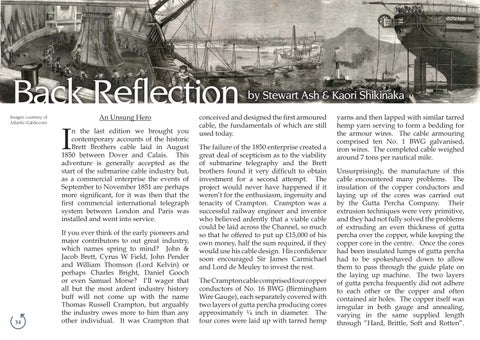
4 16-gauge conductors, 10 armoring wires, gutta percha insulation. 25 miles total length, weight 7 tons per mile
Conferences
Pacific Telecommunications Council
16-19 January 2011
Honolulu, Hawaii
Website
Global Submarine Cabling Forum
28-30 March 2011
Reykjavik, Iceland
Website
ICPC Planery Meeting 12-14 April 2011
Singapore Website
International Telecoms Week 2011
23-25 May 2011
Washington, DC USA
Website
ENTELEC 24-26 May 2011
Houston, Texas USA
Website
Submarine Networks World 2011
27-29 September 2011
Singapore
Website
Letter to a Friend
by Jean Devos
My Friend,
We are now six months after SubOptic Yokohama, and during all these months the event keeps coming back regularly in my thoughts, each time the same question: Where is the flaw?
Even though I personally enjoyed being there, meeting so many people I know, including some old Japanese friends, retirees who visited me at the hotel and also a lot of active players, I came back home with a sense of non-satisfaction.
As usual, the Japanese did a great job hosting the event; the program committee worked hard. The venue, a modern building--hotel plus convention center--looking like a sailing boat in the Yokohama waterfront, was superb! Just a bit too large maybe--700 registrants, was a bigger figure than expected. I particularly enjoyed the opening key-note speech of Utsumi-san: “The inscrutable Japanese.”
I very much liked the words from Michael Jones, Google Inc’s Chief Technology Advocate, about the value of information in society and the role of innovation, fascinating and very thought-provoking insights.
At the end of the event I could sense that the organizers were very happy and proud of SubOptic 2010. I can understand why. They did a very professional job. Well done guys!
But, but... then why did I came back home a bit frustrated?
I walked around this conference, from a tutorial to some key papers and round tables. I visited most of the booths, and to be honest, nothing grasped me. There was no real debate, no real news, no lessons
learned, no analysis of the past achievement and no perspective for the future. Nothing about this question: “Are we building the network that the world needs?”
There were no messages from the industry leaders. Most of them never show up at the conference as all are very busy in side private meetings in their suites or rented offices.
And one particular point of contention: There was almost no attendance and participation from the cable owners or cable operators, and debate between suppliers and their customers was basically absent.
It is my conviction that the present format is obsolete: Without some significant changes SubOptic will not survive.
SubOptic should be an “university," a moment of reflection, a break in everybody’s business life! It is now just the contrary: a fair or a selling place.
SubOptic is like the fruits one can find in the Supermarket these days , each year more beautiful with perfect shape and color, but each time less juicy and tasty .
My Friend, you most likely do not share my view. Not a problem! But please, don't misunderstanding me. It is because I like SubOptic that I call for changes. I would like to see all the work done by all these people devoted to SubOptic ended in a more useful result!
Here we are... another issue of SubTel Forum and another Coda by yours truly. I have to admit, it's been a bit difficult finding the time to sit down and write this article, as work has pretty much kept me going all out for the past few weeks.
Congratulations to Javiervaldez who won an iPod Touch after completing our industry survey
What are we working on here in the SubTel Forum offices? Our 2011 Submarine Cable Map.
This is the third time I've been a part of the cable map, and while this in no way compares to the effort it required to created the 2008 edition, it has taken quite a bit of time.
Back in 2008, the first time our publisher tasked me with generating the map, I had absolutely no idea what I was doing. Wayne
Nielsen handed me a flash drive with a few PDF files from the original map he and Ted Breeze produced in 2004. Ted had passed away and the original files were lost, leaving me with almost nothing to work with. I spent hours and hours staring at the submarine cables of the world, drawing lines in Adobe Illustrator and wondering if I was going to need glasses.
We're continuing to improve the product as we design the 2011 edition. Comments given during surveys and conference meeetings have been applied, and I'm hoping that you will find this version the most useful and appealing yet.
I've had an enermous amount of assistance on this years map from Meredith Cleveland, one of our project engineers. I'm pretty sure that Meredith is going to need glasses after this, but I have to say that I wouldn't have been able to finish the map without her. Thanks Meredith!
If you're signed up on our subscriber list, look for the map toward the end of January or begining of February. If you're not subscribed, please take this opportunity to do so. You can subscribe by clicking the subscribe button our our website. This will enable you to receive not only our cable map, but our annual calendar, notifications when new issues are released and the opportunity to participate in our industry surveys.
Thanks for reading and for supporting SubTel Forum throughout 2010. See you next year!
What do you think? Click on the Letter To The Editor icon and drop me a line. I’d love to hear from you.