Submarine Telecoms Forum is published bimonthly by WFN Strategies. The publication may not be reproduced or transmitted in any form, in whole or in part, without the permission of the publishers.
Submarine Telecoms Forum is an independent com mercial publication, serving as a freely accessible forum for professionals in industries connected with submarine optical fibre technologies and techniques.
Liability: while every care is taken in preparation of this publication, the publishers cannot be held responsible for the accuracy of the information herein, or any errors which may occur in advertising or editorial content, or any consequence arising from any errors or omissions.
The publisher cannot be held responsible for any views expressed by contributors, and the editor reserves the right to edit any advertising or editorial material submitted for publication.
Contributions are welcomed. Please forward to the Managing Editor:
Saturday - “Le Tour de France pour le petit déjeuner; 15 mile run for lunch; "Predators" and popcorn planned for Dinner... All's right with the world.”
I started a Facebook page last year in order to better communicate with my coed Venturing Crew.
For 9 years I have been passing event information the old fashion way – through email – and that seemed to work just fine until a new generation of Scouts arrived who cared little for that antiquated technology. For a number of months I would diligently forward necessary information, only to find out at one of our two monthly meetings that nobody was receiving the details. Why?, I asked, only to learn that the kids couldn’t be bothered to look at their emails.
I had resisted Facebook; I really didn’t want to discuss what I was doing at that moment, or what I was thinking about, or what I liked or disliked of someone else’s postings. Frankly, I don’t much care what others are momentarily feeling; so why should they care about me?
But I bent to the demand and created a Crew Group, as well as my own personal page. And information and news started passing via Facebook, which they then respond and comment and “like” or “dislike” or whatever. The funny thing is that it actually works, and my various 14 to 20 year olds, both here and at some college, “talk” and plan through our Facebook page.
I have just been informed by one of my twenty-somethings that Facebook is becoming passé, and texting is the new instantaneous way to express your innermost thoughts and annoyances. I really don’t know what I will do. My thumbs are too big…
20 Operators team with Alcatel-Lucent to bring fast, lower-cost broadband connectivity in Africa with a new 17,000 km submarine system
Activ Financial Selects Hibernia Atlantic
ALBA-1 Marine Survey Underway
Allied Fiber is Constructing a Nationwide, Network-Neutral, Dark Fiber Cable System
Bangladesh mulls alternative submarine cable link
Blue Offshore and Caley Commence Design of Innovative Basket Carousel
BMG Telecom Plans New Undersea Cable
News Now
Cable & Wireless to Boost Submarine Cable Links Between Caribbean Networks
EASSy cable system begins testing
EASSy on Track for July Launch
EIS awarded to AECOM for Hawaii interisland wind power project
Fujitsu and NSW Complete Indonesian Submarine Optic-fiber Network
Gateway Communications wins GTB Award for its African MPLS services on SEACOM
GBI and Pacnet Announce Network Extension Partnership
Global Marine Systems awarded consecutive Gold Awards from the Royal Society of Prevention for Accidents (RoSPA)
Hibernia Atlantic Adds Tibus To Its Channel Reseller Program To Further Its Reach in Northern Ireland
Huawei Marine and Global Marine Systems Complete Construction of the Suriname-Guyana Submarine Cable System
IFC supports Seychelles submarine cable project
Level 3 Invests in Manchester Resiliency, Deepens European Presence
Main One Cable Company Limited relies on Alcatel-Lucent to maintain 6,800 km cable system, linking Portugal to Nigeria
Main One Cable Goes Live
Nexans Adds Cable Solutions and Services for Ships and Platforms
NorGer uses Offshore Marine for cable consultancy role
NTT Com, Infinera and Ixia to Provide World’s First Practical 100 Gbps Ethernet Interconnection at Interop Tokyo 2010
O3b Networks and Telecom Cook Islands Sign Long Term Agreement on Bandwidth Provision for Internet Connectivity
Ocean Specialists, Inc. Introduces its Portable Dynamic Riser for Mobile Deepwater Assets
Offshore Marine supplies guard vessels for major European projects
OFS and Hengtong to Form Joint Venture Company to Produce Optical Fiber Preforms in China
SEACOM service down: SEACOM actively seeking solutions
SEACOM switches on direct cable link to Europe
Seasoned Investors and Directors Strengthen Pacific Fibre
Sify Technologies Limited (SIFY) Becomes the First-ever Integrated Information & Communication Technology (ICT) Company to Land an International Undersea Cable in India
SubCom Successfully Demonstrates 40 Gb/s Long Haul Transmissio
Submarine Cables Key to Telkom SA s Strategic Direction
Submarine Networks World announces 2010 conference
Tata, CEC Withdraw Equity Joint Venture Application for China
TE SubCom Completes Installation of Main One
TE SubCom Completes Phase 1 Marine Installation On Main One Cable System
Telecom Egypt to link undersea cable to Jordan
Thai Carrier Expands Internet Gateways, Drops Submarine Cable Plan
WFN Strategies announces new office location in Houston, Texas
WIND arrives in Cape Town with first load of recovered submarine cable
Coherent 40G and 100G Go the Distance
Per B. Hansen
Appetite for bandwidth has proven relentless. International Internet traffic has grown at an annual rate of more than 60 percent for the last three years. More people are getting access to the Internet, and the speed with which they connect keeps increasing.
While demand is strong, cable operators are facing challenges on service pricing. Price erosion of more than 20 percent annually is typical on many submarine routes. This can be attributed mainly to increased competition in certain markets, a general move toward higher-bandwidth services, and lack of service differentiation.
Competing for the growth in demand
Submarine cable operators are adding capacity to capitalize on the opportunity created by growing demand, but this does not necessarily mean laying new cables.
Novel transceiver technologies have greatly increased the potential capacity of already-deployed cables. Newer cables often can be equipped with four to ten times the capacity of their original design; older cables may offer an even higher multiple. Where each wavelength originally was designed to support 2.5G or 10G, now each can carry 40G and 100G over similar distances.
points. Avoiding deployment of a new wet plant saves both time and money.
When spectrum is available on the cable, new 40G or 100G channels can simply be added. Even when a cable is already at its maximum channel count and all spectrum has been used, replacing existing 2.5G and 10G transponders with new 40G or 100G cards is typically advantageous. Not only does this defer investment in a new cable system, but upgrading a cable also lowers the cost of bandwidth in most cases. In addition to capital expense advantages, higher-capacity transponders offer significant operational benefits—especially as demand grows for increasingly higherbandwidth wavelength services.
The most capital-intensive resource of a cable system is the optical spectrum. Often, 50 to 60 percent of a new transoceanic system’s cost—which may total $300 million to $900 million—can be attributed to cabled fiber and in-line amplifiers. Hence, spectral density is a key metric for the cable operator. While one 40G transponder alone offers capital and operational benefits over four 10G transponders, the appeal is even greater if the transponder also provides more efficient use of an operator’s most scarce resource, the spectrum.
Spectral efficiency
From a planning and deployment perspective, capacity upgrades also allow installation of all new equipment in easyto-access locations at cable termination
Conventional encoding schemes, such as intensity modulation or differential phase modulation with direct detection,
are simple to implement and have served optical networking well for years, both in terrestrial and submarine settings. However, design tolerance increases linearly or even exponentially with bit rates, and these architectures suffer from a number of limitations, including poor spectral efficiency.
Coherent detection provides the ability to access the phase of the optical signal and enables advanced modulation techniques, where symbols are encoded using both the amplitude and phase of the optical field. The ability to track polarization with coherent detection simplifies polarization de-multiplexing in the receiver, enabling dual-polarization modulation formats to further increase spectral efficiency. Likewise, the high rejection of neighboring channels allows very close spacing of carriers. In fact, the rejection is so high that encoding schemes can take advantage of sub-carrier multiplexing within a normal channel window of 50 GHz.
The vendor community has almost unanimously embraced coherent technology for high-speed networking. Performance is one reason for this acceptance—rather, it was a prerequisite for this level of support. Another key piece of the puzzle was advanced highspeed Digital Signal Processor (DSP) technology. While coherent transceiver technology is well known in wireless communication, breakthroughs in DSP algorithms and chip technology now have made it attractive for real-world optical
transmission applications. Since the early 2000s, Nortel*’s Metro Ethernet Networks (now part of Ciena) has invested significant research and development efforts in electronic dispersion compensation and advanced DSP technologies.
The advances made in DSP technology enable more extensive performance optimization for coherent receivers. Likewise, DSP opens the door to new modulation schemes and polarizationdiverse transmission techniques that allow for more efficient use of the optical fiber spectrum while spanning submarine distances.
Addressing
the challenges of ultra-long transmission distances
Technical requirements for submarine transponders differ from those typically seen for terrestrial systems because, obviously, the distances are much longer— often several thousands of kilometers— and the cable and in-line amplifiers for submarine systems do not accommodate impairment-mitigating equipment easily. A number of impairments, in addition to the inherent accumulation of noise, limit the transmission distance.
Some optical devices can mitigate impairments. For example, spools of
dispersion-compensating fiber may be used to counteract the residual chromatic dispersion of the cable. Such devices add loss, often requiring additional amplifiers to maintain signal level and fidelity.
Coherent technology allows for the correction of impairments in the electrical domain. The electrical domain is more costefficient than the optical domain for signal processing. Dispersion compensation, for example, is accomplished in the electrical domain through a conventional electrical filter. Furthermore, this technology supports adaptive compensation over a very wide range, simplifying deployment by eliminating much of the planning
and engineering effort that is required otherwise.
In fact, a number of impairments are not economically corrected in the optical domain. Instead, system margins are often set aside to accommodate these impairments. Typically this process applies to residual chromatic dispersion, polarization-dependent dispersion, and polarization-dependent loss. By correcting these factors on a per-wavelength basis, a coherent transceiver offers higher performance in addition to operational simplicity and provisioning velocity, allowing operators to deploy additional capacity in response to actual demand without having to worry about the engineering or equipment associated with additional dispersion compensation technology.
Other impairments are nonlinear in nature and therefore depend on the modulation format and power level of each channel. While advanced coherent transport implementations offer significant mitigation of nonlinear effects, these are generally irreversible and residuals lead to system margins. A highly sensitive coherent receiver allows for lower launch powers and pure phase modulation as the encoding format, both of which, in combination with high rejection of interfering signal components, minimize nonlinear penalties.
Because a coherent receiver is continually self-optimizing, time variations in
transmission performance are minimized in real time, so operating margins may be reduced safely, saving resources. The measures taken to mitigate impairments also may be analyzed and logged, allowing continuous observation of the fiber plant’s properties and enabling timely preventive maintenance with minimal traffic downtime.
Meeting the business requirements of cable operators
The advent of transponder technology, which supports higher bandwidths such as 40G over wet plants designed for 10G, has changed the way cable operators and international service providers can compete. The ability to add new wavelengths while preserving spectrum—or, by replacing old transponders, even recouping spectrum— in response to actual demand changes the business model.
The cable operator gains agility by adding bandwidth on demand. This capability aligns revenue growth with capital investments, lowering the financial burden that otherwise challenges the industry. Wet plants that were designed for a 25-year lifetime but usually got decommissioned after only 10 to 15
years—and in some cases, just five years— now can be rejuvenated and sustain profitability over much longer periods.
The capacity of a cable is, of course, finite, and new cables will be needed eventually, both because of increasing bandwidth demand and the number of undeserved geographies. Because new bandwidth can be added on demand, new cables may be installed with less bandwidth to minimize the initial fixed-capital investment. This strategy will allow for healthier business models in the submarine communications industry while keeping pace with evolving communication needs across the globe.
A proven technology
While coherent technology is clearly the next-generation upgrade for submarine networks, it is also a mature and proven
technology. Nortel Metro Ethernet Networks installed 40G coherent transceivers on already-deployed submarine cable systems in 2008, and these systems have been carrying live traffic ever since.
Maximum distances will depend on the design of the cable system. Likewise, the ultimate capacity will vary, as the width of the optical spectrum has varied greatly over the last 15 years—from single-digit to nearly 30 nanometers of spectral width.
A great deal of industry attention currently is focused on 40G deployments and upgrades. Trials and commercial deployments have shown that 40G coherent transceiver technology performs well on both submarine and terrestrial ultra-long-haul networks. Transmission distances as far as 12,000 km and spectral densities up to two bits/Hz (100G on a 50 GHz grid) have been demonstrated on deployed submarine cables.
While 40G is the next step in capacity-perwavelength for most cable operators, there is no reason to believe demand stops there. Coherent technology also supports higher bandwidths, such as 100G and beyond. Trials have shown the technology’s viability already, and 100G will follow in the footsteps of 40G.
The global mesh network
Coherent 40G and 100G technology offers performance improvements applicable to
both terrestrial and submarine networks, allowing for a true common architecture that, for the first time, supports a ubiquitous global mesh network.
The convergence of submarine and terrestrial network technologies offers tremendous benefits. Higher combined equipment volumes, resulting from a single platform for transport and switching across both domains, help drive down costs. With a global mesh, operators can manage just one platform to serve customers worldwide, mitigate the effects of cable faults, and provision services across the globe while maximizing utilization.
The concept can be applied regionally or globally, enabling service providers and cable operators to evolve their business models and enhance competitiveness.
Connecting the world
Nowhere is the impact of networking technology more apparent than in the submarine market. Over the course of less than 20 years, the maximum capacity of a single fiber pair on a transoceanic system has increased by a factor of 1,000, and is now approaching 10 Tb/s. Nevertheless, bandwidth consumption continues to grow and challenge the infrastructure.
Not any bandwidth will do, however; it has to be reliable and economical to meet the business needs of operators and the worldwide demand for high-bandwidth
applications. A reduction in service pricing over the last 20 years has allowed more customers to connect, irrespective of distance. Business models had to change, and new technologies were implemented. Coherent transceiver technology will push the envelope even further and help submarine cable operators bring more bandwidth to more people.
Per B. Hansen is currently Senior Director, Submarine Solutions at Ciena, where he is focused on the networking needs of submarine cable operators. Per joined Ciena in September 2008 from ADVA Optical Networking, where he was responsible for NA Enterprise Sales and Business Development. Prior to joining ADVA in 2004, Per was one of five founding professionals who established Photuris Inc., an early innovator of dynamic optical networking solutions. Earlier, he was with Bell Labs. Per holds a doctorate in electrical engineering from the Technical University of Denmark and Master of Business Administration from the Wharton School of Business at the University of Pennsylvania.
Optical Transmission Trials
Not quite as simple as they seem
Tony Frisch
Akey question for most upgrades is how much capacity can be achieved? Simulations can provide an answer, but the results are only good if the input data is correct, and potential buyers are not always able to supply what needed. Typically, the data available includes nominal values which may be deliberately a little pessimistic, or initial values which may no longer be up-to-date due to system repairs/ageing. Additionally, system owners may take the commercial position that they will not be responsible for the accuracy of data used. The value of a measurement/demonstration is that it gives the potential supplier the opportunity and responsibility for getting the data he requires and it should also demonstrate directly what capacity can really be achieved.
The reality, of course, is never quite so straightforward. There can be problems if the test fibre is carrying traffic and measurements can be done only in part of the bandwidth, or if a different, but “similar” fibre is offered for measurement – how similar is it? In the case of a network with several links it’s generally impractical to test all of them and the objective will be to test the most demanding one; in general this will be fairly obvious from a technical viewpoint, if not from a commercial one.
way to ensure a truly representative test, but is generally not a good solution. One operator recounted his experience of having a potential supplier ship him a complete terminal consisting of several racks, and the irritations of having to first install them and then take them down. The time taken and the disruption caused were much greater than for tests done by others who had used more compact, specialised test equipment; this approach tends to work well for all involved – for potential suppliers it reduces shipping and involves fewer people.
Assuming that a test fibre can be made available, how does one make sure that the results are meaningful? Using real terminal equipment sounds like the best
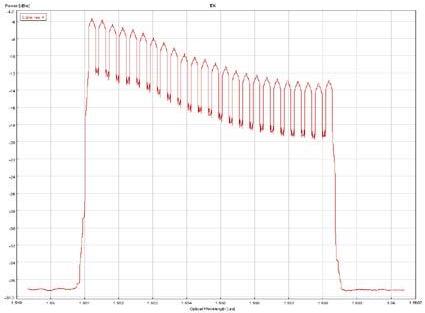
Given that tests will be done with specialised equipment, how can one ensure that the test results will be meaningful? Ensuring that the test equipment replicates the conditions of the proposed upgrade as closely as possible and performing tests over the full bandwidth are two key points. Experience shows that many systems show significant variations in transmission performance with wavelength, as seen in the following graph which shows how the power needed can vary with wavelength due to non-optimal gain flattening.
In this particular example, it’s clear that measurements done in the centre of the band, or at the long wavelength region, would produce a somewhat optimistic picture in terms of the power needed – in this case a 1.4 dB error using the centre point. Chromatic dispersion, non-linear effects and amplifier noise figure also tend to change across the band, with the noise figure sometimes changing quite rapidly at the edges of the band – important if the proposed upgrade puts wavelengths here. It’s worth noting, however, that the most extreme channels have only one adjacent neighbour, so they may not be the best ones to measure as they will experience less crosstalk than others.
Good test regions
The following diagram shows a simplified schematic of a test set-up that can get close to the ideal:
Here a number of adjustable light sources are set to the wavelengths and power levels of the proposed upgrade and then fed into a production unit which has been modified to allow the test wavelengths to connect to the modulator in place of the laser that is normally used. This ensures that the entire bandwidth can be filled with modulated signals and that the transmit and received units are representative of what will be supplied. There will usually be dispersion compensation & amplifiers, and most suppliers tend to interleave “odd” and “even” channels with different modulating signals to avoid any question that having the same traffic on adjacent signals might improve performance.
A tuneable optical filter before the receiver allows measurements to be done on any of
the wavelengths. While a Bit Error Rate Test Set (BERTS) can be used to supply test data, it cannot really measure anything because the power levels should be set close to those needed for real operation and FEC output should thus be error-free.
An Optical Spectrum Analyser (OSA) is usually needed to help with the initial set-up –checking existing wavelengths, measuring Optical Signal to Noise Ratio (OSNR) etc. to compare with predictions from simulations and (more importantly) to set power levels. Setting power levels –and sometimes establishing the best wavelengths to be used – usually represents the first day or so of a programme which takes a few days. Getting close to the proposed upgrade conditions makes it much easier to extrapolate to what performance is really possible.
Because optical power budgets focus on Q, the parameter one needs to measure is the FEC correction rate, from which the Q value is derived using the inverse error function, and the tests need to last 12-24 hours to assess fluctuations in the performance to determine Time Varying System Performance (TVSP), Line 2 in the power budget defined by ITU-T recommendation G.977, the most used standard for submarine systems with repeaters. The following table shows the G.977 parameters and how the field measurements should relate to them:
Line G.977 Parameter Field measurement
1 Mean Q value (assuming no impairments) Calculated from measured OSNR
1.1 Propagation impairments (nonlinearity etc.) Cannot be measured individually
1.2 Gain Flatness impairments
1.3 Non-optimal optical pre-emphasis impairment
1.4 Wavelength tolerance impairment
1.5-7 Mean polarisation penalties
1.8 Supervisory impairment Should be known
1.9 Manufacturing and environmental impairment Cannot be measured individually
2 Time Varying System Performance (5σ rule) Measured (5x standard deviation)
3 Line Q Value (Line 1 – Lines 1.1 to 1.9 –Line 2) Measured –TVSP
4 Specified TTE Q value (back to back) Known
5 Segment Q value Calculated from Lines 3 & 4
5.1 BER corresponding to segment Q without FEC Calculated
5.2 BER corresponding to segment Q with FEC Calculated
5.3 Effective segment Q value with FEC Calculated
6 Q limit after FEC correction (at 1E-13) Known (depends on FEC gain)
7 Repairs, ageing and pump failures Specified for the upgrade
8 Segment margin Calculated
Line 1 is useful mainly as a comparison with predictions; if there is a noticeable difference it suggests that some of the simulation inputs may have been incorrect. A number of lines (such as individual impairments, Lines 1.1–1.9) cannot be verified, but Lines 2 and 3 can. Line 2 should be equal to 5x the standard deviation of the long-term Q, while Line 3 relates directly to the average measured Q minus – Line 2. From Line 3 one can compute Lines 5 to 8 and verify whether the margin is sufficient. Key to this calculation is the FEC gain and it’s important that the Net Coding Gain (NCG) at the target BER is used.
For practical reasons, it may be hard to replicate the conditions of the proposed upgrade completely – supervisory equipment is rarely included, and getting the precise power levels may be difficult – so ultimate capacity has to be calculated by extrapolation from the tests. Most types of supervisory add 0.1-0.2 dB of penalty which should be included in the budget. More important is the extrapolation from the test conditions to those proposed for the upgrade, where it’s important to be meticulous in handling the different power levels needed for different parts of the band.
If it’s desired to make comparisons between potential suppliers then care needs to be taken, as the tests will almost certainly have employed different methods and equipment. For the final optical power budget all should use the same margins for repairs, ageing and operation, as these should not depend on which supplier is selected. Providing that all
measurements covered the full bandwidth, that test channels had adjacent channels and that all power levels and wavelengths are those proposed for start of life, the process is relatively straightforward. If this isn’t the case, then one will need to extrapolate from the results and there is the potential for errors and uncertainty which increase with the degree of extrapolation. As an approximation a 0.5 dB error is sufficient to make around 10% difference to the prediction of ultimate capacity. Channel separation during testing also needs to be fairly close to that proposed, as penalties can rise very rapidly as the spacing is reduced and there is generally no precise formula which can be applied.
An optical transmission trial doesn’t sound complex, but it represents a significant outlay in time and effort for all concerned and critical decisions may depend on the results. This short article has tried to identify some of the key issues and hopefully showed ways to minimise errors/uncertainty and make results from different suppliers comparable.
Tony started his working in British Telecom’s Research labs working on early optical fibre submarine systems. After a number of years he moved to Alcatel Submarine Networks in Australia and led the system testing team for the TASMAN 2 cable system. Following this, he spent a brief period with Bell Labs where he was involved in terminal design and troubleshooting. Family pressure took him back Alcatel Submarine Networks, spending a few years in France working in Sales and Marketing and then moving back to the UK. Most recently he moved to Azea Networks, a start-up which was acquired by Xtera Communications, where he is currently Product Line Manager for Repeatered Solutions.
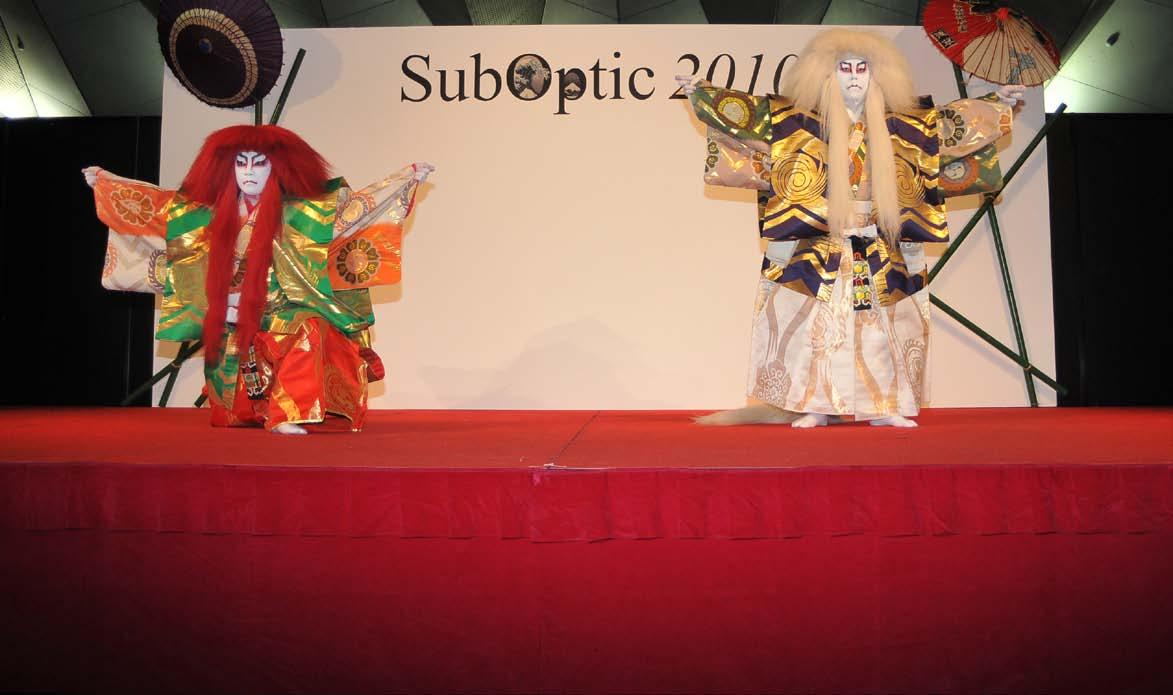
SubOptic 2010 The Almost Perfect Event!
john Horne
According to the responses from survey questionnaires, almost perfect is an apt description of SubOptic 2010 – a very good even excellent event, but not quite perfect.
This time round we received only 55 responses, which though a little disappointing from our experience of previous events, still represent approximately 8-9% of attendees. Therefore, this together with the anecdotal
evidence gathered by Executive and Program Committee members, still allows us to gain a flavour of what went right and what needs some improvement for our next event: SubOptic 2013.
So what were the views of our attendees?
The good thing is that the vast majority of people who attended enjoyed the event and found it of great value and were looking forward to attend the next one.
The overall assessment of the conference was that it rated good to excellent, with the results skewed more towards the latter.
The level of registration fee was again thought by some to be too high, but this is an argument we think we can never win. SubOptic is a non-profit making organisation which provides for one relatively low price, a full conference experience over three and a half days with an expert and diverse presentational programme, including: master class tutorials, Keynote Speakers and Roundtables, a full social programme to facilitate networking and an industry focussed exhibition. No other conference covering our industry comes near to providing this package at the price we charge, which can only be done by the industry itself arranging the conference programme.
The Programme for this conference, the item we pride the most, was also considered very good, with the Keynote Speakers coming in for exceptional praise. There was also thought to be a better balance between technical and commercial papers, with the technical papers delivering more value than at some previous events.
There was some criticism that we still do not get enough papers from carriers/ operators and that the strategic issues that drive their decision making are still underrepresented. We recognise this as fair, and next time round we will try to look at
procedures that allow us – for instance by encouraging more invited papers, if we do not receive the appropriate responses to our “Call for Papers” – to correct this.
We also received comment that there is quite a variation in quality of the presented papers, and there is insufficient time for Q&A at the end of presentations. Again we will review our selection procedure to try to ensure a consistency of quality in what is presented. This aspect, however, is also linked to the number of papers and number of parallel sessions we wish to run.
One approach is to have a diverse, heavily populated program to provide the greatest choice and coverage. An alternative approach might be to have a thinner programme, with fewer parallel sessions, or by providing authors with a longer time to present and field Q&A’s. We chose the former for this event to give as broad and diverse a programme as possible and will review whether this is the most appropriate, for the future.
We were glad that the Poster Session worked well, and I hope by the quality of papers, rather than the attraction of drinks, was well attended. This is intended to be one of the highlight sessions of the conference, and I think it achieved this goal. We did note that there was some criticism about physical spacing and the more successful the event, the more we will need to take this into consideration.
The Master Class/Tutorials attracted a good attendance, and again proved their value.
There was some comment however about their timing, the lack of suitable refreshments and the number that were run in parallel. We are, however, limited in the way that we can provide these presentations. They require considerable preparation and to provide them during the conference itself inevitably impacts the time available for the remainder of the programme.
The element of the programme that received the greatest criticism was the Roundtables. These were perceived as being a little unstructured, with the panellists taking too long to set out their own positions and
once again not allowing any time or space for any real dialogue with the audience to be realised. Some respondents went so far as to say that the “Day of the Roundtable is over,” and that a series of more focussed events covering more defined topics – say in the style of a workshop – may be the way forward. This is an area that we will have to review in depth before the next event.
In terms of the overall programme, one interesting statistic we gained was that in general about 50% of registrants are attending conference sessions, whilst the other 50% are doing other business. This
suggests that we are achieving a high quality programme and maintaining a reasonable balance between those who are attracted by this and those who come to meet other attendees for business and networking purposes.
In this sense one of the greatest requests for next time we received, was on the question of making a full list of registrants publicly available and providing some form of messaging service to allow attendees to contact one another. This is a service we recognise that other events, such as PTC, provide and we will examine its feasibility for the next event.
We were also asked to make the presentations themselves available to attendees, well in
advance of our plan to put them and our Conference Proceedings onto the “Archive Section” of our website, in the autumn. We are glad to report that this was done within three weeks of the conference ending and these are now available to attendees on a private section of our website. We will ensure that for future events this is done as a matter of course.
So what about the other elements of the conference?
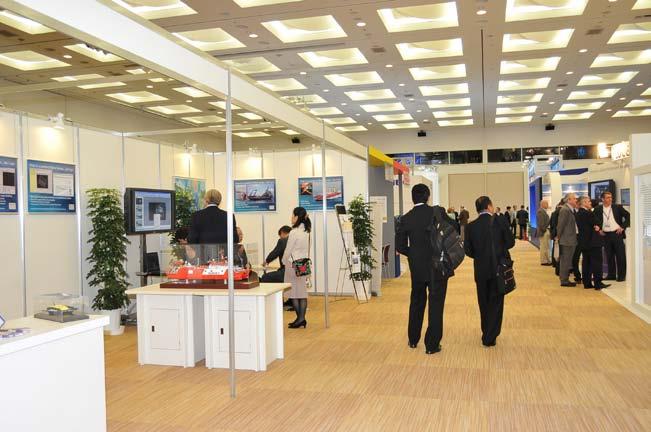
The Exhibition is an important element for us in revenue generation, allowing us to keep registration fees as low as possible. If we had had a larger exhibition hall we could have sold additional booths, and this is something we will need to consider next time, taking
into account the point in the economic cycle that the industry is likely to be in.
We also received some criticism about the opening hours of the exhibition, its position relative to the other conference activities and the fact that some booth structures did not allow for more discrete commercial conversations, especially if organisations did not have a hospitality room.
A suggestion was also made that oral presentations could be relayed either in real time or in time delayed mode to the exhibition area, to facilitate attendance and reduce time conflict. Again, we will look at improvements in this area for next time, though some of these difficulties are dictated by venue layout and company choice.
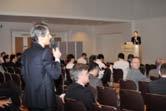
We laid on a full Accompanying Persons programme for this event, and we are glad to say we attracted more than 50 partners to Yokohama, who took the opportunity to attend some of these and gain an appreciation of Japanese culture.
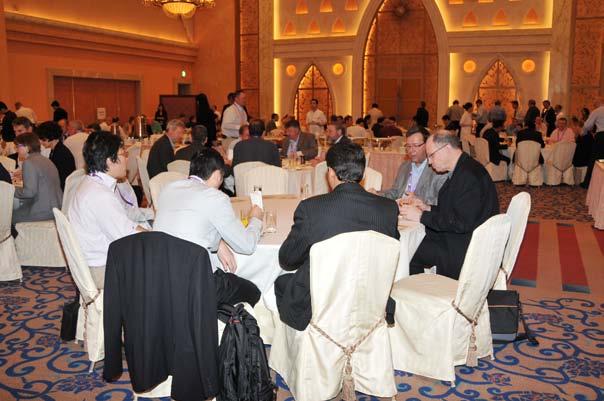
We also laid on a full Social Programme to facilitate networking, which is one of the most important aspects of this conference. Whilst most respondents commented favourably about their ability to do this during these occasions, some improvements to the Welcome Reception, Lunchtime arrangements and the Gala Dinner were suggested. This centred mainly about the quantity of food available and the lack of seating and entertainment programme during the Gala Dinner. We have heard these comments and will do better next time.
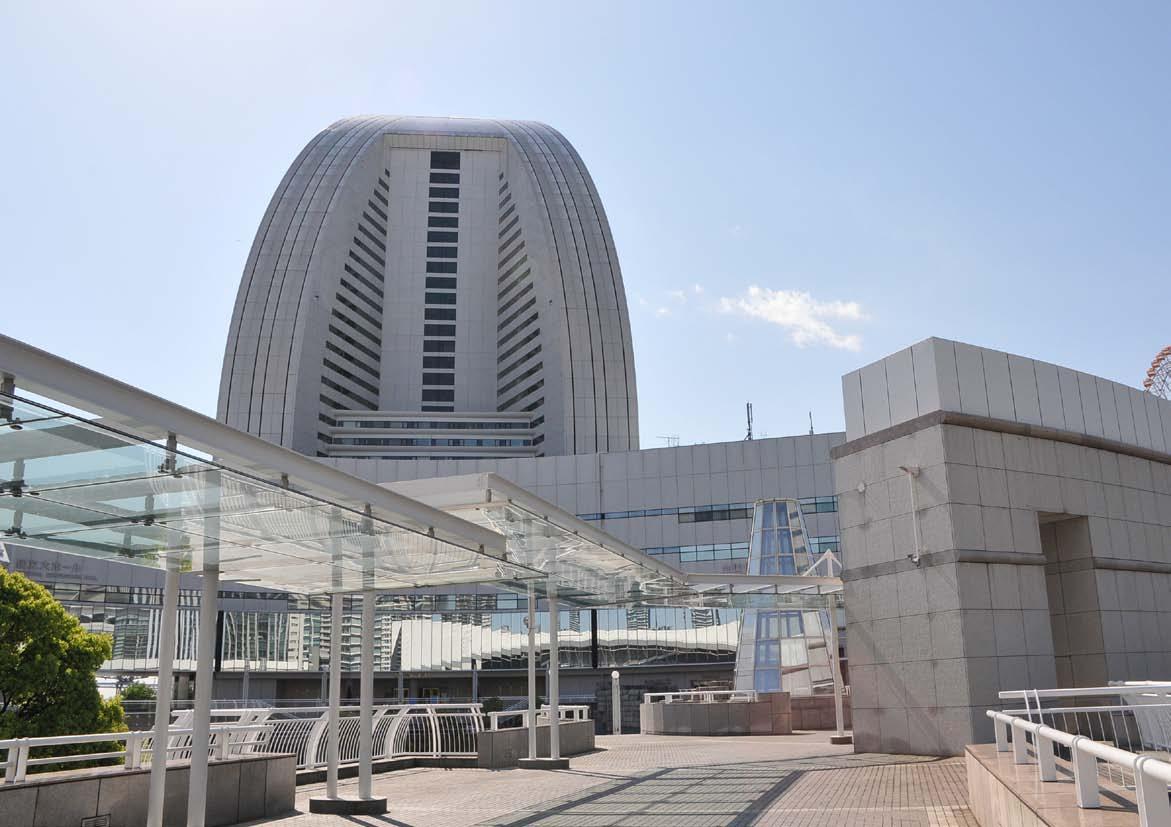
Yokohama as a venue was generally well received and the closeness of hotels and the conference centre was well appreciated by attendees. This followed the general principle established at our previous event in Baltimore. The distance between Narita and Yokohama was mentioned as a negative by some attendees, and more assistance
at airports to provide transit information would have been appreciated.
The hotels were thought good, but the wifi internet service in the Intercontinental was heavily criticised. A comment was also received that some corporate entities do not allow the use of wifi and require a wired LAN service to be used. There was also some comment about the lack of a good bar/social gathering point in the hotels that could have facilitated networking. The Irish Bar near Yokohama Railway Station was too far away to fill this gap, and no alternative nearby was found, or if it was it was not well promoted.
The general level of conference organisation was thought very professional and the event ran very smoothly, thanks to the efforts of our co-Hosts NEC & Fujitsu and their Event Management Company, ICS.
Many people used the SubOptic website, and though there was some criticism of the registration process, most found it workable. Many people also gained information about the conference itself, via the website or the associated eblasts that we sent out to our registered database.
Again of interest, most attendees seem to have registered, either because they attended previous events, accessed the SubOptic website or through word of mouth recommendation and not through any other form of formal marketing.
So the final conclusion from this review is that SubOptic 2010 was a very good conference. Not perfect in all respects, but one which met the needs of the industry at this time. Our challenge will be to make SubOptic 2013 even better!
To make sure you receive updates as this conference is developed, and to receive news on the Interim Activities we undertake, register for E-Alerts on our website: www. suboptic.org.
John Horne has been involved with telecommunications networks for nearly 40 years, most of the time in the international field.
John’s involvement with SubOptic started with the first conference in 1986, where he presented a paper on the branching potential for optical fibre systems. He was a Vice-Chairman of the Papers Committee for SubOptic 2001 and has been Secretary to the SubOptic EC since then. John is a Fellow of the UK’s Institution of Engineering Technology and holds a Diploma in Management Studies from Middlesex University.
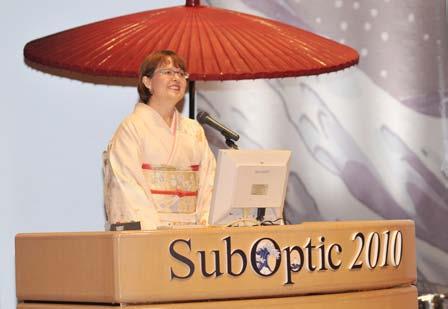
SubOptic 2010
The event, the moments and the memories
Fiona Beck
They say the cheery blossoms come out but once a year. They arrive; bloom and then they are gone so quickly. They are a fleeting moment of beauty.
In some ways SubOptic 2010 in Yokohama was similar. There was so much preparation and hard work by so many people to ensure the event would be a success, and then suddenly it is over. I am sure you will all agree SubOptic 2010 will hold many positive memories for those that were fortunate enough to attend.
I am very pleased and proud to say what a success SubOptic 2010 was. My thanks goes out to the co-hosts NEC and Fujitsu for such a commanding event. Also I would like to thank all the presenters of papers; both oral and poster and, of course, the keynote speakers. I think this was one of the best line up of keynote speakers we have had. The blend of culture and understanding, new technology, new ideas, the role of information and the wave of the future was just the ticket to get the each day started. The quality of papers presented this
SubOptic was of a very high standard and this is also a credit to the Programme Committee chaired by Colin Anderson. The Committee’s tireless work in refereeing and organizing the programme ensured we were able to deliver a quality product. It is important to me SubOptic is seen as an industry highlight and a pinnacle to strive for. In the past I have described Sub Optic as an Olympic event. To be accepted and recognized here is an achievement.
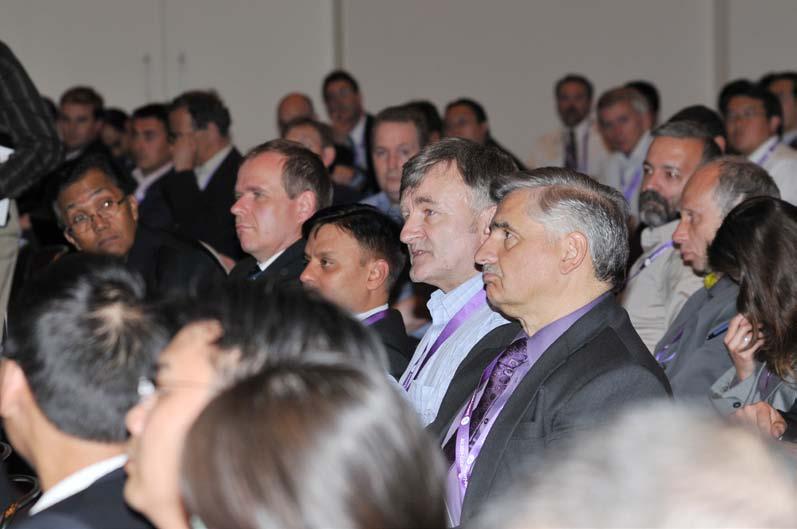
With over 735 participants in total, 296 companies and 50 countries and regions represented, SubOptic 2010 was a resolute success and had a wider reach than ever before. As I have said previously, we are a not for profit organsiation so any surplus funds are carried over to the next event.
SubOptic is unique in that it is a conference where you look forward to attending the sessions. I am pleased to say we had excellent attendance at our sessions and we received many comments from delegates that SubOptic is one of the very few conferences where they make an effort to clear their diary because the sessions are both interesting and relevant. This year we had some remarkable developments presented including 40G and 100G technology, questions on marine ships availability, on the next Trans Atlantic cable, on oil and gas platforms and their unique design features, on the technical life of systems and how OSS is getting more relevant information out to customers. These are some of the topics to name but a few.
The exhibition was sold out very quickly, and I know many delegates wished they could have spent more time going through the finer details of the exhibits. We will make sure more functions are held in the exhibition area
to ensure those opportunities can be taken up.
I know SubOptic has a rich tradition of mixing business with great networking opportunities, and we will look at ways to continue to deliver the value add for companies to attend, whether this be at an exhibition level or a meeting level. SubOptic is sometimes described as an extended family, and the social aspects of the networking are not to be underestimated. In many cases the friendships, understanding and relationship building that goes on at SubOptic carries forward to many future business associations.
Plus we have photos to prove what a success this event was. We have almost 1000 of them, and some of these will be posted on our website in the not too distant future!!! Our thanks goes out to the various companies that hosted events during the evenings of SubOptic 2010 leading up to the Gala dinner. I know many bars were frequented outside the events, and I am pleased everyone still made the early morning sessions.
I also know the accompany persons who joined many of you were pleased to have an opportunity to meet their partners’ business colleagues and associates and to put names to faces.
We will continue to see how SubOptic can grow, maintain its relevance and be enduring. We started developing our role in-between conferences with the interim working group concept. We were very pleased to see the first of these projects - the guidelines for a framework for Submarine Construction Contracts - presented at this SubOptic. Our next interim activity is targeting an industry reference guide and we have a range of other
interesting topics so we will see what can be done to progress others.
The success of SubOptic depends on the goodwill and support of many and this means we have to grow and to develop. This might mean:
• Engaging new support at the Executive/Programme Committee level.
• Better supporting host organizations.
• Looking at new sponsorship value.
• Providing exhibitors with a space that showcase their products and services and provides them with networking opportunities.
• Being the event where anyone can contribute a good idea, a paper and have their opportunity to deliver ground breaking thinking.
Also as an industry body we need to evaluate how we can add value, whether this is through our web site, our interim activities or through the conference itself. We have been asked also if and how we could extend our reach to become more of an industry voice. The vision of SubOptic is by the industry and for the industry. We do need resources, and support in order to fulfill that promise and this I am sure will be discussed over the coming months.
What I like about SubOptic is that you come away thinking “that was an event, something to remember”. The conference happens once every three years with the next one to be hosted by Alcatel Lucent, so watch this space (or our website www.suboptic.org) as to the
announcement of the next location. I am sure there is a sweep stake as to its location minus the cruise ship concept. It was also my privilege and honor to announce at the conference that I will be continuing on as President for the next cycle. As I mentioned there is more to be done in developing the SubOptic vision and to ensure we in the industry continue to support the industry.
And at the end of the day it is about quality. Quality is something that lasts and SubOptic 2010 was a quality event. I thank everyone for their participation and support and I look forward to seeing you again soon.
Ms Beck is the President and Chief Executive Officer for Southern Cross Cable Network. She was appointed to this position in May 2001 where prior to this she represented Telecom NZ as a Director on the Board of Southern Cross Cables and various other major companies such as EDS (NZ) and ConnecTel. Ms Beck was a senior manager within Telecom NZ responsible for Telecom’s corporate planning, EVA analysis, capital investment reviews and corporate advisory service. She is a chartered accountant and holds a Bachelor of Management Studies (Honours) degree in Accounting and Finance from Waikato University, New Zealand.
Some SubOptic 2010 Highlights
(and Things I learned After Senior-High)
Colin Anderson
Colin Anderson
Superanda Omnia Ferendo (Latin: “all can be conquered by endurance / hard work”) was the motto of my senior high-school. It would be nice if it was true, but of course, like many such catch-phrases it’s not.
Aristotle said, “it is possible to fail in many ways... while to succeed is possible only in one way”. To achieve something worthwhile you usually do need perseverance and hard work. But among other things you also need at least a modicum of skill or talent, preferably with help from some other skilled team-members, and equally importantly you need good luck.
Commenting in early 2010 on why it took the New Orleans Saints 43 years to get to the Super Bowl, Bob Marshall of The TimesPicayune in Florida USA contended that “Getting to the big game is one of the hardest accomplishments in sports because it requires a team to achieve in four areas, only three of which they can control: They need good management, good coaching, a handful of good players, and lots of luck ...”
I think it’s pretty much the same for SubOptic as for the Super Bowl. Success is a combination of effort, skill and luck - and the luck part is always beyond anyone’s control, except that of the Fates.
Fortunately, on the Program Committee for 2010 we did have skilled players, we had a lot of good external coaching, and one or more of the Fate sisters must have favoured us. The volcanic ash which started erupting
from Iceland in late March 2010 cleared for a critical period and so had almost no impact on the conference; and the conference timing (decided 3 years in advance) was such that other things like the talk of a double-dip recession in USA, or a financial meltdown in Europe seemed not very significant to our registrations.
Some Program Highlights
The MasterClass Tutorials which were held on Tuesday 11 May were very well received. In total almost 750 people attended one or more of the seven Tutorials. “The Benefits of Proper Route Engineering, to Mitigate Risk During the Design Life of Submarine Cable Systems” and “Enabling Technologies for Ultra High Speed Transmission” each attracted over 125 attendees, but the other Tutorials were not far behind in audience numbers.
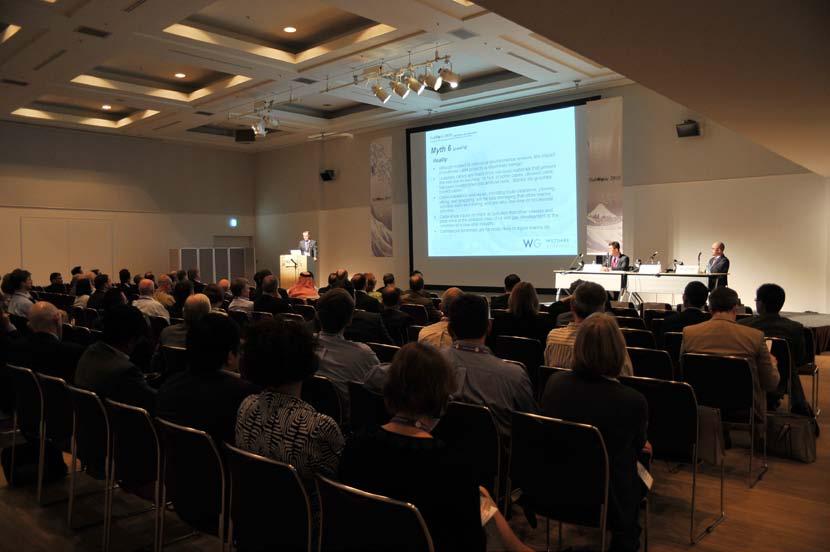
We had 70 oral papers presented in 14 separate Oral Presentation sessions, attended in total by 1,420 audience members. The Wednesday session “Global Markets: Growth Opportunities” was standing-room-only with over 140 in the audience. On Thursday, the sessions “Global
Markets: New Opportunities”, “System Design: Network Topologies”, “Operations & Maintenance”, and “Marine Services & Marine Operations: Tool of the Trade”, all had around 125 attendees. And the two sessions on Friday afternoon, “Marine Services & Operations: Special Topics”, and “Project Development & Implementation” also attracted audiences of 120~125.
The Roundtable “The Submarine Cable Environment’s Criticality to Global Economics” and the “SubOptic Construction Contract Workshop” had almost 250 attendees in total; and the Roundtable “Over the Horizon: the Future of the Industry” had almost the same number.
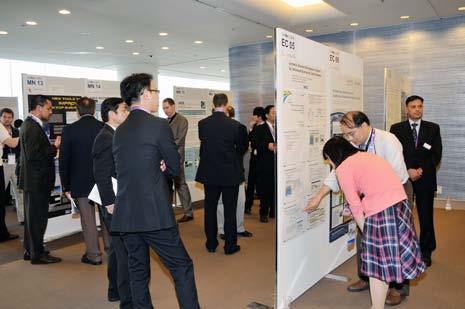
The Poster Session on Wednesday afternoon had over 70 posters, was very well attended, and as usual was one of the highlights of SubOptic.
Keynote Speakers
We were very fortunate to have three exceptional Keynote Speakers for SubOptic 2010. Keynote speakers can often polarise the audience of a conference, and I am delighted that we have had wonderful feedback this time and it seems that we managed to please most of the audience.
upon his experience in the international community.
Utsumi-san introduced us to the ‘magic word’, sumimasen, which in Japanese means “I am sorry” or “excuse me”. But it can also be used when you want to say “thank you”.
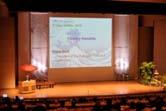
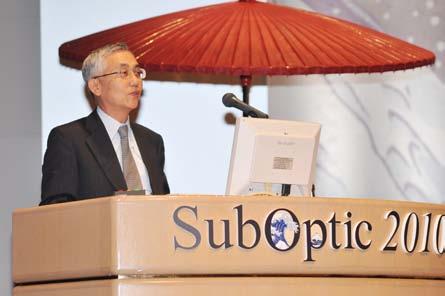
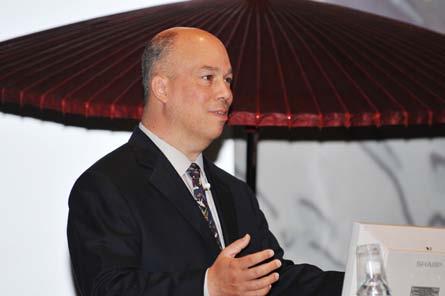
Following the formal opening of the conference by Fiona Beck, and brief welcome remarks from NEC and Fujitsu, we introduced our first Keynote Speaker. Mr Yoshio Utsumi, who was the deputy Minister of Telecommunication of Japan (1998~1999) and Secretary General of the ITU in Geneva from 1999 to 2006, gave a presentation titled “The Inscrutable Japanese”. In it, he gave us a personal insight into some of the fundamental cultural differences between Japanese and typical western cultures - based
Further, he explained that, sumimasen can also be used for “please” when you want to invite somebody. Or you can use sumimasen when you are requested to do something and you say “no, I cannot”. But surprisingly, you can also use sumimasen when you want to say “yes, I can”. So, in almost any case you can say sumimasen to the Japanese and they will understand you, while in the western world you should clearly say “yes”, or “no”.
This, he explained, can be seen as a link to the Japanese tradition that “silence is golden”. People can often understand others without hearing words. In this regard, Utsumi-san did caution us that there is one case where he imagined we should not use the ‘universal’
word “sumimasen” - if we wish to kiss our partner. His advice here was to simply “say nothing”.
He talked about how Japanese people are often perceived as inclined to group interests rather than individual interests, and more to long-term interests rather than short-term interests
Utsumi-san exemplified this by telling us the popular Japanese fairy tale “Shitakirisuzume”, about a small sparrow, an old man and his wife. In this fairy tale, we can see many of the philosophies which are considered to be fundamental virtues of Japanese society: love for the nature; kindness to others; humility; not to be greedy; to wait until you are given; and so on. He then contrasted this tale to some common western fairy tales, and the philosophies that they promote or invoke.
Utsumi-san concluded that the differences between Japanese and western societies can largely be attributed to geopolitical differences and the influence of Buddhism.
Japan is a mountainous island country, and historically people lived on rice, which was produced at rice paddies cultivated by multiple generations. Intensive farming was essential, and the productivity of farming depended upon the cooperation of community members, as well as their knowledge and experience of farmingwhich can be shown to lead to a preference of group interests rather than individual interests, and long-term interests rather than short-term interests. In general, in western societies the strongest were the most successful. But on the other hand, in Japan good coordinators who could maintain order were the most successful.
Utsumi-san gave us an simple introduction to Buddhism, which was adopted in sixth century by Japan’s rulers, primarily to establish social order and political control. It brought new theories on government, a means to establish strong centralized authority, a system of philosophy and ethics, and advanced new technologies for building, painting and sculpture. He talked about the fundamental difference between western monotheism and Japanese polytheism, and explained how, in Buddhism, different beliefs can coexist side by side, and so the Japanese are taught to avoid polarization. The “all embracing” nature which is a fundamental teaching of Buddhism, has permeated Japanese life so deeply that the
Japanese take the position of “as well as” in almost every aspect of their life.
Finally, Utsumi-san explained that the group philosophies which were essential for survival in an island country, together with the teaching of Buddhism and Confucianism, have developed in Japan a strong sense of responsibility called Bushido. Bushido stresses benevolence, especially to lower ranking people; honesty to anyone, justice, honor, loyalty, rectitude, frugality and selfsacrifice. The virtues stressed (such as honesty, honor, self-sacrifice, benevolence, etc) can all be linked to the interests of the community to which one belonged.
Utsumi-san concluded that generally it is not the distinction or identification of yourself from others, but rather the harmonization with others that the Japanese people consider to be the most important - because it was the wisest strategy for survival in the past, and present-day culture is influenced by that past.
The Japanese do not talk much, he said. Do not claim much. Do not show their sentiment much. They wait until they are given. But they think very much, and they take care of others. Only when they judge the situation is matured do they take action. They stand up only after they have pondered for a considerable time. When they decide to take actions, they will carry out their duties perfectly because they are very serious and industrious.
Though these are all general and broad statements, as someone who lived in Japan for almost 14 years, I can attest that they are very often correct.
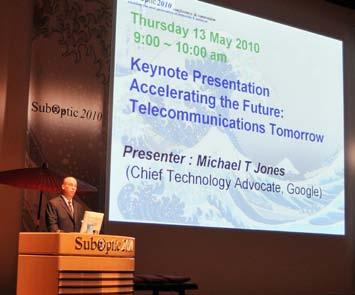
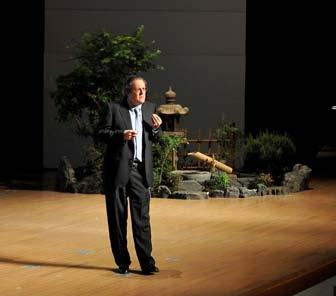
In his keynote presentation “Accelerating the Future: Telecommunications Tomorrow”, Michael Jones, Google Inc’s Chief Technology Advocate, gave us some fascinating and very thought-provoking insights into:
• the value of information in society;
• the role of innovation, ways to think about change in technology, and how to build a culture of innovation in any society, government, country, or business; and
• some often overlooked impacts of high-capacity data networks and submarine cable networks.
Michael talked about information only
being useful when it can be understood. He explored how new technologies and applications such as Google Earth can allow us to access and understand the earth, to see through the oceans, or see all of the artificial and natural satellites in the sky - not by ‘creating information’ but rather by allowing us to access it beyond the abilities of our normal senses, in this case human eyesight.
He then talked briefly about the ‘information economy’ and how it is in many ways outside the norms of conventional economic theories - for example, in conventional economies value often comes from scarcity, but it is not so for the information economy.
As a key point in his presentation, he asked us to keep in mind that although some of the statistics we regularly hear - such as 600 million users of Google Earth (which has only existed for 5 years); and one billion viewings per day of YouTube - may at first
seem huge and all-encompassing, in fact the current total use of the Internet only includes 22% of the world’s population. So 78% of the people on earth do not have access to the Internet. Aliens visiting Earth for the first time, he suggested, would report back that “humans generally do not use the Internet.”
Interestingly, at present, in many developing countries, the mobile phone fills many of the same information roles that the Internet fills in developed countries.
Michael went on to talk about uses of information by societies and governments, and how the same information can be viewed by different people as a cure or a weapon.
Using the example of legendary Japanese engineer and industrialist, Soichiro Honda, who founded the Honda Motor Company, Michael talked about Hondasan’s pioneering spirit, and his concepts that ‘failure’ is a good thing; you should learn from your failures; and you need courage to make decisions, because the right path often looks to be the wrong one.
He talked about the fundamentals of change management, and explained in simple terms the mathematics of the ‘random walk’ (which is so pervasive in nature at the atomic and molecular level), which exemplifies the importance of implementing ‘directed change’ rather than ‘random change’, and ‘thinking about the little things’, if we are to achieve our goals. We should challenge everything, he contended, and ‘progress’ means simplifying not complicating.
Looking at innovation at the organisational level, Michael talked about Google’s philosophy of spending 70% of its resources on its core business, 20% of its resources on ‘wild’ or ‘crazy ideas’ which might lead to development of the business in future, and 10% of its resources on things unrelated to what Google currently does, but might be big business in future.
He noted that innovative organisations usually have a meritocracy. You do not
need to have gone to the ‘right’ school or university in order to succeed or be promoted. You need to measure and trust people. But a good person is a good person - they have passion, and insight, they care, they are intelligent and curious, and the important thing is the ‘books in their head’ not the ‘books on the shelf’.
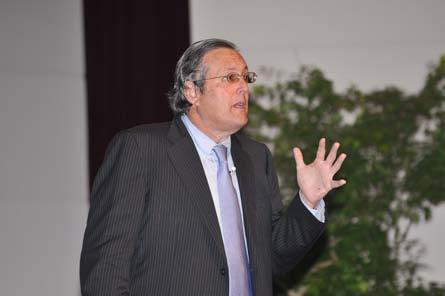
The third keynote presentation, by Jeffrey Cole, Director of the Center for the Digital Future, founder of the World Internet Project, and Research Professor at the Annenburg School for Communication at the University of Southern California, was titled “Falling Apart & Coming Together: Media & Consumer Issues in the Digital Age.”
Dr Cole gave us many insights about how digital technology is changing people’s lives. He talked about the migration form Radio to Television, the most powerful medium ever invented so far, and how the web will
be more powerful again. And he gave us a view of the motivations behind the World Internet Project, now involving over 30 countries, as well as many of its key conclusions from the past 10 years of research data.
Jeffrey looked at mass media (including radio, TV, newspapers, magazines, movies, and more) and discussed how they have adapted over the past decades, and made some predictions about how they may have to adapt in future to technologies such as Twitter, Facebook, YouTube, etc in the future..
He went on to talk about the music business, and the impact of legal as well as illegal online music downloading upon traditional music sales, in the past and in the future.
For example, in countries where the Internet penetration reaches 30%, then almost always the circulation of traditional printed newspapers declines sharply. Some magazine will be adversely affected while some others, for rational reasons, will not.
Television, he predicted, is going to ‘escape from the home’ through a proliferation of new technologies such as Digital TV & Internet on mobile phones. It will grow exponentially and become our ‘constant companion’, at the airport, in the aircraft, in the back seat of our car, and will supersede the 5 billion mobile phones (in voice or text mode) which are our current ‘companions’.
And then Jeff looked at social networking and some of its impacts on society and how people live their lives.
Finally, Jeff provided a fascinating summary of the conclusions which are coming from the World Internet Project data about teenagers’ behaviours (including 12 to 24 year olds). These include, for example that teenagers:
• will never read a print newspaper
• will read some magazines
• will never own a land-line telephone
• will probably never wear a watch;
• will usually not watch TV on a fixed program schedule;
• are likely to trust unknown peers more than experts;
• are increasingly willing to pay something for on-line digital content;
• often have little interest in the source of information;
• really believe that they are not affected or influenced by brand;
• want to be able to move their content form platform to platform;
• want to be ‘heard’;
• think ‘email’ is something that their parents or other ‘old people’ use;
• have achieved power over reporters or physicians, etc by use of digital media.
Cyrus Field & the Laying of the First TransAtlantic Submarine Cable
On Friday morning we had an invited presentation from Christopher Field who is a descendant of Cyrus Field, who pioneered the first trans-Atlantic submarine cable in 1853 to 1858. Chris’ presentation was also very well received. It included many wonderful old images of the period, and was able to give us an insight into the personality and the “will to succeed against all odds” of his ancestor, Cyrus Field. Listening to the problems that this first trans-Atlantic cable suffered, some of us in the audience were surely thinking how some things have not changed even in over 150 years.
Conference Proceedings and Presentations
In line with previous conferences we will also be arranging to put the Conference Proceedings and the actual presentations onto our website, www.suboptic.org in the late autumn of 2010. This will give everybody in the industry the opportunity to see what they have missed.
Awards for Outstanding Papers
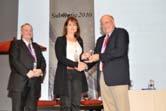
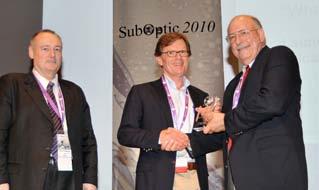
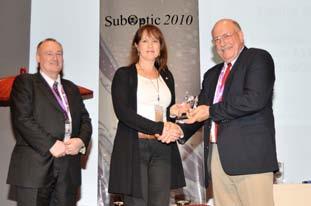
Submarine Telecom Forum sponsored two awards which the Program Committee decided to present to the authors of an outstanding poster paper, and an outstanding oral presentation paper.
Selection was not an easy task. There were many excellent papers on such a wide variety of technical and commercial topics that selecting just one poster paper and one oral paper was a difficult challenge. But we adopted the same criteria for evaluation as we had used during the initial Call for Papers, and selected papers were:
and, Oral Paper “What’s Cooking for Submarine Networks ?” by Laurie Doyle of Alcatel-Lucent Submarine Networks.
Poster Paper “Trans-Oceanic OADM Networks: Faults & Recovery” by Ekatarina Golovchenko of SubCom (with co-authors Alexy Turukhin, Adnan Akhtar, & Stuart Abbott);
Congratulations again to Ekatarina and Laurie, and also to all of our authors for 2010 for the high standard of papers submitted.
I am as guilty as anyone at not filling in the post-conference feedback forms after I attend a conference - we are all busy and in a hurry to get back home and to our normal job functions – and to and catch up on the dreaded email backlog etc. But please remember that SubOptic is “by the industry” and for “the industry.” So I encourage you to help the Executive Committee and future Program Committees to mould the next SubOptic events in a way which satisfies you the industry members, by giving your feedback about what we could have done better and what you would like to see more of or less of at future SubOptic conferences. It can be by the official forms or by direct email to John Horne, covering many parts of the conference or just one or two, and attributed or anonymous - it’s up to you. But all feedback will be appreciated, and will be seriously considered.
Thanks
During the closing ceremony of SubOptic 2010, I was thanked for the Program Committee’s effort and success in developing the program for 2010. Unfortunately I didn’t find an opportunity to formally thank the many people who helped me and the Program Committee to make the conference a success.
well as many personal tasks which were put ‘on-hold’ over that period), I am preparing to personally thank as many as I can in the near future.
To avoid a very long list I will not make a list of names here, but I do want to express my very sincere thanks to everyone who helped, including:
• the professional teams in the host organisations, NEC & Fujitsu;
• our Keynote and Guest Speakers;
• all of the authors, co-authors & presenters of papers and posters;
• the Abstract Review team members;
• the presenters and panellists of all of the MasterClass Tutorials, Roundtables & Workshops;
• the conference organising teams in ICS and JTB;
• the Strategic Advisers to the Program Committee;
• my colleagues and friends on the Program Committee for SubOptic 2010;
and anyone else that I have unintentionally omitted above. It was my pleasure and privilege to work with all of you over the past 3 years, and I sincerely thank you for your contribution to making the conference the success that it was.
sessions, which is such and enjoyable and important part of SubOptic. At the next SubOptic, I can promise that without the formal responsibilities, I intend to by a normal registrant who participates, enjoys, networks, and learns along with the other attendees!
Colin Anderson has been involved in the international telecommunications networks industry for over 20 years, and has held a range of marketing and engineering roles in the areas of terrestrial optical networks and digital radio networks, before entering the submarine networks industry, where he has played a significant role in the design, bidding, award, and implementation of many international submarine cable projects - among them SEA-ME-WE 3, Southern Cross, Japan-US, FNAL, SEA-MEWE 4, FLAG FEA, AJC, AAG, & Unity.
I am now catching my breath after the past 2 years of hard work, and trying to get back into my normal marketing and business development job activities with NEC (as
During the event itself I was like a frog on a hotplate, darting from place to place, and so I’m sorry that I did not get any opportunities to actually relax and participate in the friendly networking outside of the formal
On Issue #51
Wayne, I'm so impressed with the quality of thought and content that goes into your Forum.
Stephen Miller
Dear Editor,
I enjoyed enormously STF issue 51, especially the historical submarine cable articles. I am an end-user of your product (an average broadband user) but also deeply interested mostly in the social implications that broadband connectivity on various groups and businesses. I am also highly aware how empowered communities can potentially get with better broadband connectivity options. One interesting book on the subject which I am sure you are also aware which has been there on the subject are Telecosm: The World After Bandwidth Abundance and Microcosm: The Quantum Revolution In Economics And Technology both by acclaimed writer George Gilder.
I come from India where we haven't yet had a good broadband play. I also have ranted on the situation faced here in one of my blog posts http://flossexperiences.wordpress. com/2010/05/06/hosting-from-home/ or http://bit.ly/bCVNDW.
What was interesting to note that one of the authors (The article about Japanese) and mine also do share a nationalistic feel for being part of the solution, specially when the three top companies from India: Tata, Reliance Globalcom and Bharti Airtel do have the money and can build expertise if they really want to. As given in the Pacnet article above one good thing is there would be more connectivity and hopefully more landing stations leading to cheaper and faster broadband connectivity throughout.
I will be trying to see if I can get hands on the two previous issues you did this year (January and March) as I'm sure they would be equally interesting. At the end, kudos and keep up the good work.
Regards, Shirish Agarwal
Suriname to Guyana
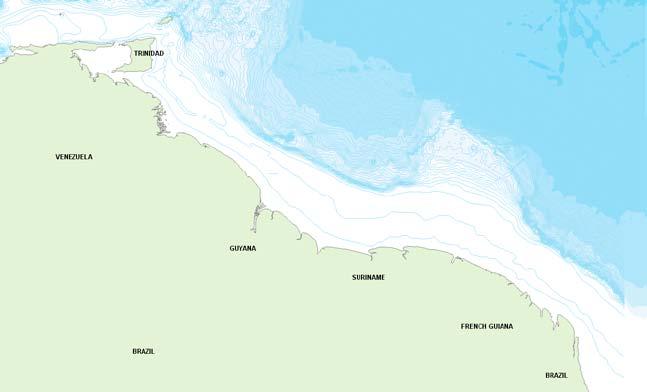
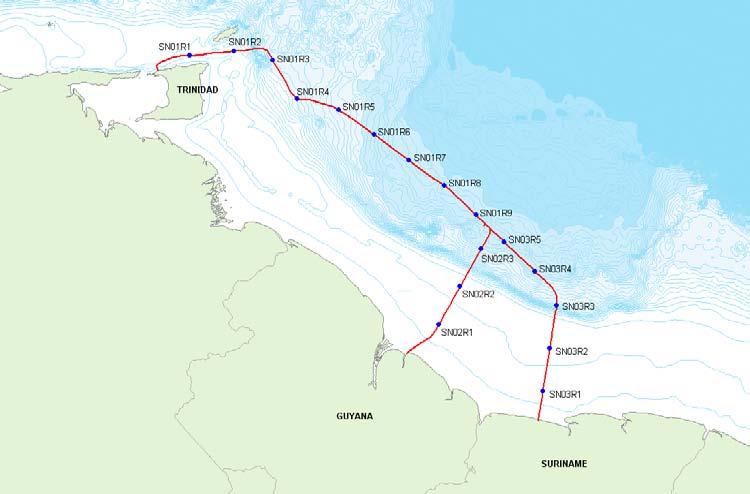
The 1,249-kilometer Suriname Guyana-Submarine Cable system (SG-SCS) recently installed by the JV, GMSL and HMN for Telesur & GT&T is an advanced telecommunications network aiming not only to provide sufficient bandwidth and digital communications capabilities, but also enhance communications between two developing nations. It also represents a common binding goal for their citizens, governments and economies. Two like minded organizations in South America; GT&T in Guyana and Telesur in Suriname are laying the foundations for the people of each nation that will positively impact the growth and development of their telecommunications sector and consequently expand the growth and development of the economic and social wellbeing of the region as a whole.
As
has been shown in many developing areas around the world, modern telecommunications technology, when paired with proper education, training and economic development opportunities can be a source of significant benefit to citizens.
South America is set to be an emerging growth, and neighboring Brazil is already home to active financial trading community
Telecommunications infrastructure plays an important role in the roll out of ICT and acts as an enabler to enhance regional skills, competitiveness and economic growth. In conjunction with the provision of educational programs to enable the young to play a part in the transformation this can be of real value to a society, whilst being aided by the application of internet hubs, or touch points for the local community.
Some key benefits of these initiatives are listed below:
Communication: Modern networks allow for easy, reliable, low cost voice, video and internet communications with the rest of the world, making global communications accessible to almost everyone for both business and personal use.
Education: Access to the Internet (IP Networking), allows teachers and students to receive instruction, skills and access to information at the press of a button. This provides a baseline to drive local knowledge and awareness into the home through last mile technologies, so everyone can access the internet.
It’s a combination effect that drives such communities to enhance technology at the ground level to drive home these aspects. Coupled with Governmental initiatives and investment, the foundation of SG-SCS cable system can really make a difference in an expanding and growing region.
The SG-SCS Journey
The scope of the project under the ‘turnkey’ umbrella was to provide everything from
system design, cable and equipment supplier, marine, land cable, beach manhole works, cable landing station build and of course network management integration. With three shore ends, 17 optical repeaters, a system branching unit, the building blocks of the system were manufactured together with optical fibre cable supplied by Nexans, based in Norway.
SG-SCS Submarine Fibre Communications System
Each building block was designed and engineered so as to ensure the best match against quality, design and delivery, underpinned by extensive quality testing. The end result of this intensive work was to give birth to the system components and a developed manufacturing process for future systems. The process is of course an iterative one, and tasked with delivering a complex solution, one always has a watchful eye to inspect every aspect of the build cycle for continuous improvements, learnings and risk management. Like all aspects of design and build, it’s the methodology and adherence to quality that ensures each element is connected in the final system configuration, and when powered all the lights are glowing green.
But those that have worked in the submarine market know that when at sea not all variables can be controlled as easily as one would wish or think. So any mishap often takes a few days to resolve or even longer, particularly when bad weather comes into play. It’s a fact of life that most in the marine sector consider to be normal!
The section of cable installed into Trinidad, being a direct shore end connection, was laid with few challenges and connected to an existing cable landing station (Columbus Networks) as the interface for onwards international connectivity.
GMSL
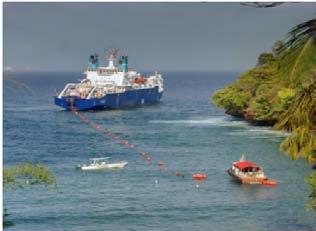
Cable ship Sovereign laying shore end at Trinidad
Pre-laid shore ends were installed in Suriname (18km) and Guyana (2.2km) ahead of the main lay installation works, meaning that one key aspect of the project had been completed – Landing the system ashore. The local teams in Totness and Georgetown enabled the operations to progress well. The supportive nature of the local customer’s engineers played a critical role, and helped to overcome any complications.
Taking a hands-on approach at every stage of the project, now where’s that cable?
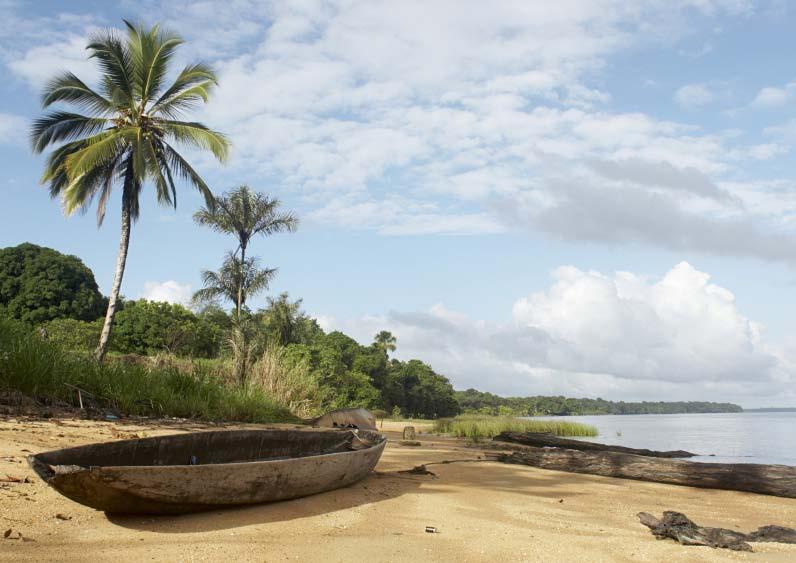
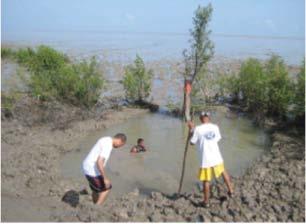
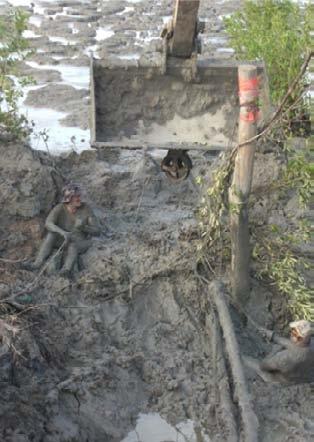
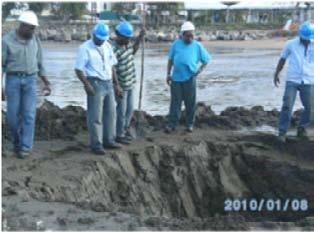
Heavy rain and hot sunshine during the installations provided opportunity for the install team to take mud baths, particularly during cable pulling activity into the beach man hole position. Simple operations are often delayed when bad weather sets in, so the teams were able to enjoy the local cultural aspects and warm sun of this region. As a close neighbor of the Amazon,
the region also experiences rainy seasons. Trinidad on the other hand was a direct shore end and marked the start of the system lay towards Guyana. Marine operations were undertaken by GMSL’s CS Sovereign (pictured laying out the system cable above) – she is a state-ofthe-art cable laying vessel, with previous history in almost all the oceans and seas in the world.
The Challenges
The turn-key solution relied upon the expertise of many different teams and key personnel, and at times several activities ran concurrently. This occurred through every stage of the process and even when there were some customer variations, such as new capacity or diverse land cable routing, the teams were able to adapt their plans to incorporate any changes within the project timescales.
This is no easy task as many will know, it takes a certain mindset and skill to juggle variables and still manage to conclude in line with project deliverables. A partnership approach with Telesur and GT&T made the process more productive and brought to the table a supportive and productive environment for the team.
Simplified supply chain for delivery model
Make no mistake; turnkey delivery is not easy, but ensuring a team performs and maintains transparency fundamentally builds a trusted and robust customer relationship. This takes time, but in the end, it forms a key success factor in the overall service delivery process and a solid foundation for future work. Each element of delivering a turnkey solution includes sub contractor management, potential delays due to weather & application of various management techniques, (PMI principles, six sigma, etc). This requires extensive experience, detailed analysis, intuitive knowledge and some luck. The planning tools are useful at some stages, but real experience comes into play during the execution phase, especially during the difficult stages when there are many concurrent activities or recovery plans in place. And if you think that all is going well, and that there is time to relax, then that is a wakeup call to take another look and ask some critical questions. Unless of course its Provisional Acceptance daythen a little rest is well earned!
A relaxing time during pre-laid shore end work and inspection in Georgetown
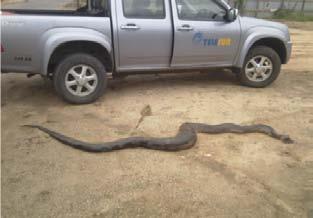
During the shore end operations we came across some interesting challenges. Some locals asked for assistance in searching for a dog that had gone missing near the beach works. One of the interesting aspects of working in South America, is dealing with the long snakes as pictured below which are often found in close proximity to the area around the cable landing station.
A visitor to the cable landing station, Totness Suriname
The snake was of particular interest in that it appeared to have a rather large lump in the middle. Coincidentally the little dog was never seen again!
The Application of New Technology
The beauty of using new technology in a well established market is that one can take a good look at what the customer needs rather than providing outdated technology. This paves the way to create some market disruption and innovative solutions. Maybe size does matter?
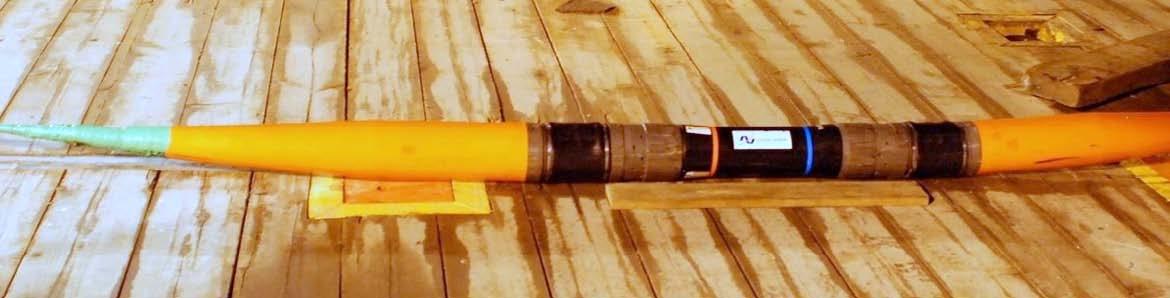
• Provide an innovative repeater design optimized to simplify the marine installation process based upon proven UJ technology easy to load, transport and bury
• The opportunity for slim line design and enhance reliability (component reliability has improved significantly over the past years), long-life lasers and proper pump redundancy
• Ensure key end user functionality for Service providers is build into the equipment, making Operational aspects simpler for lifecycle management
Key parameters of the repeater:
• Bandwidth 35nm
• Capable of nx40G, nx10G, and capability to mix 40G and 10G channels
• Compact slim line housing design
• Pump failure protection & Surge protection
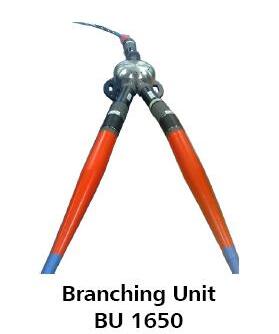
The 1650 Branching unit followed this concept of a compact structure, small body with 25 year service life as to ensure system performance meets SG-SCS requirements. Being based upon Universal JointingTM technology, the 1650 BU can be adapted to be used in powered and un-powered scenarios – and even for insertion into existing systems.
Product lifecyle is an interesting aspect of subsea telecommunications. Cable design has significantly changed over the past 10
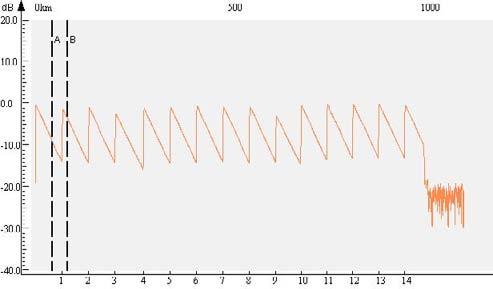
years and it seems a natural progression for repeater design to follow in this way. Most advancements in terminal equipment have been driven by demand from terrestrial network improvements geared towards increased capacity per wave and additional functionality. One key aspect the technology has majored on is having inbuilt COTDR capability. What the end user has here, illustrated below is the capability to monitor the submarine ‘wet’ plant both in service and out of service and add in performance measurements to monitor the system and trigger an alarm should they be exceeded. Adding such capability aids the monitoring of the network and enables the Network Operations Centre to setup appropriate alarm screens knowing that the NMS has their interest at heart, every second of the day.
COTDR example and application
The beauty really resides in the integration process, after all it’s the person in the NOC that would really like a simplified view to manage the network and possess the right integrated tools for fault finding. Simplifying the operational aspects are a key factor to driving down the complexity of managing this type of submarine cable system. Small touches really make a big impact to end users!
Adding the final touches in CLS Georgetown, Guyana
Key functions of the SLTE:
Multiple Services Access
2.5G/10G/40G SDH/SONET/ OTN
GE, 10GE
Excellent Equipment Performance
10G SuperDRZ/10G DPSK and 40G eDQPSK coding technologies with good OSNR and nonlinear tolerance
Tunable dispersion compensation
G.823 Jitter & Wander compliant
EDFA Pump 1+1 redundant and in service replaceable.
1*E1 data channel per Transponder
Advanced cascaded FEC technologies with 9 dB coding gain
Final inspection time at CLS Totness, Suriname
Are we there yet?
With the building blocks in place, integration work followed which was the final stage for the team ahead of the marine operations that would place the cable and repeaters on the seabed. The journey now extended to the world’s most northern cable manufacturing facility, located on a latitude/longitude of 67° 6’ 0” N / 15° 23’ 0” E being the Nexans cable factory based in Rognan. In November, the residents of the first town north of the Arctic Circle, and the gateway to the Polar regions, awoke to find a rather large cable vessel moored up alongside their quay.
GMSL Cable Vessel Sovereign alongside in Norway
With the delights of the midnight sun during summertime (very little darkness, unless the curtains are shut tight) and only about 2-3 hours daylight during winter months, coupled with snow and very low temperatures, it all adds an interesting dimension to cable loading activities. That said, it is an amazing place to work and very peaceful, with good opportunities for fishing.
As loading operations began, the advantages of repeater sizes almost a tenth of the industry norm became apparent. Loading a fully integrated repeater took no more than 2 hours each, saving almost four days from a typical system loading schedule.
The 1st Repeater leaves cable ship Sovereign, under the watchful eyes of the crew
Main lay operations now well under way, on board Soveriegn
Our journey began during early 2009 and was completed during the month of May 2010, combining some great team work across ASIA, UK, US and Norway. The combination of a multicultural team, supportive customers and a desire to drive for success, made this an exciting venture. Thanks go to many members of the team and their hard work.
The road to market credibility has begun and opportunity for customers to have an alternative submarine cable system provider is now a reality. We remain grateful to Telesur and GT&T to have placed their trust in us and the great support from the parents of the joint venture that created the enterprise that is: Huawei Marine Networks (HMN).
Jas Dhooper has 20 years experience within the Submarine & Service Provider sectors, currently serving as VP Service Delivery Office for Huawei Marine Networks (HMN) in China. He has gained significant experience in large scale telecommunications project delivery of optical submarine systems and delivered many multi-million dollar projects in a number of countries. He was employed by STC Submarine systems in the late 1980’s, which consolidated into Alcatel Submarine Systems in the 1990’s. He was involved in a number of the major transatlantic submarine systems both in a development role and in delivery, including time on cable ships. Jas also has held a number of senior management & technical positions in the operator side, working for Cable & Wireless and Interoute Communications since the mid-1990s. Jas holds a Master of Business Administration (MBA),
Engineering honors degree from London University and has published several papers in the field of Telecommunications and held technical positions on International conference bodies and a Chartered member of the IEEE.
Main One Cable Will Revolutionise Telecom
Tayo Adelaja
As the public lauds the activation of Main One submarine fiber optic cable which effectively went live on July 1, telecoms operators and other stakeholders are excited about the immense impact that it will have in the telecommunications and the entire business sector in Nigeria.
While telecom users await sweeping changes in the way they experience multi-layered communication on existing platforms, operators say the arrival of Main One is set to help them drive down costs, resulting in drastic cuts in tariffs for internet connectivity and international calls.
The Corporate Services Executive, MTN Nigeria, Mr Wole Goodluck, said activation of the fiber optic cables will impact the telecom services and bring down the cost incurred at present by operators and by extension to the telecom users. Said he: “With the activation of the submarine fiber optic cables, there will be a reduction in the cost of bandwidth, and the reduction in the cost of bandwidth will improve quality and drive down Internet prices. There will also be an improvement in the international voice calls. I am confident that the landing of the optic fiber cables will bring down tariff of internet and international voice calls.”
The activation of the fiber optic cables by Main One Cable Company will force down user rates with a more efficient link, delivering up to
1.92 terabit of data to its clients. As Main One becomes fully functional, expectation remains extremely high that it will usher the country into a new era in modern communication.
The President, Institute of Software Practitioners of Nigeria (ISPON), Mr. Chris Uwaje, said: “You will agree with me that because our bandwidth is low, cost of internet services in the country have been high with poor performance. The tariff is high because of the cable we are using at present. We are predominantly a wireless nation. This is why our tariff is high.”
Speaking on the aspiration of Nigerians, Mr. Ike Ekweremadu, an ISP provider enthusiastically said, “It will kindle prosperity because it will allow fast, cost effective, and reliable international calls as well as access to the internet at unprecedented and revolutionary speeds. This access to huge bandwidth and cheaper rates that it is expected to bring to Nigeria will empower every sector including, but not limited to education,
communications, agriculture and banking.”
In education, it is expected, according to Dr Yomi Oscar, Department of Education, Olabisi Onabanjo University, AgoIwoye, “With the switching on of Main One in July, broadband should reduce the marginalisation that has for so long paralysed our system. And if the proper mechanisms are put into place, we just might be able to achieve a more equitable delivery of educational services allowing us to improve national and global competitiveness. It will impact distance learning to the point where I presume universities in Nigeria will partner with schools and Nigerians in the Diaspora in an effort to obtain and retain a qualified and diverse repository of educators. Distance learning will enable Nigerian students to connect, participate, collaborate, and share educational and cultural experiences with other classrooms across the global spectrum.”
On her part, the CEO of Main One, Funke Opeke, assured that even in the health sector, Telemedicine, online diagnosis, and video conferencing during surgery and research which will be as a result of the take-off will provide opportunities for Nigerians to receive better and timely healthcare. She added, “In the business sector, Nigeria will have the capacity to engage in electronic commerce activities with African countries as well as Western countries. The security sector will benefit
from real-time information and engage in information sharing and collaboration that will facilitate law enforcement. Communications system in Nigeria will improve, becoming faster, reliable and cheaper. The agricultural sector will benefit from e-agriculture and m-agriculture; farmers will have media through which they can market their products in order to get a fair price. The banking industry will be able to provide online banking which will facilitate e-commerce in Nigeria. The government will be able to develop a robust, scalable, and interoperable E-government infrastructure that will be used as a tool to improve public service delivery. This e-government infrastructure will provide an interface for the development of the public sector, and the development of strategies to integrate those marginalised from national initiatives. Information-sharing will be enhanced thereby strengthening transparency and accountability through online reports, interactive debates, and public access to information.”
Reflectively, the Chairman of Main One, Fola Adeola said,” The Main One project began in 2008 when we carried out all necessary desk-top research and applied
for the requisite survey and operational permits. Among other activities, it also applied for and successfully obtained the first ever submarine cable landing licenses to be issued in Nigeria and Ghana, respectively. Main One obtained the necessary marine survey permits in January 2009 and commenced marine route survey operations afterwards. In May, it began cable manufacturing alongside the manufacture of Repeater Assemblies. By June, Main One had concluded its marine survey operations. It also commenced the construction of its cable landing stations in Accra, Ghana and Lagos, respectively based on designs earlier sourced in March and finalized in May. In Seixal, Portugal where the cable terminates, it is landing in an existing cable station with VSNL. Still in June, the post survey route was reviewed and the final cable route, engineered. Very importantly, Main One Cable Company secured commitments for all of the $240million (two hundred and forty US Dollars), required to fully fund the first phase of the project. The Phase Two of the project is expected to extend to South Africa.
Eventually, not only Nigerians will benefit from the widespread progress that Main
One is about to birth. Solomon Asamoah of African Finance Corporation is of the belief that, “As for foreign investment, many companies will want to ‘get a piece of the pie’; that is take advantage of the opportunities that Main One Cable Company broadband provides. And this will facilitate employment opportunities in Nigeria.” That, it appears, is a view shared by businesses eagerly awaiting this revolution.
Tayo Adelaja writes for African Interest(An American Media House), was formerly with The Guardian and The Sun Newspaper of Nigeria (at different timeas Correspondent and Senior Correspondent respectively.He is a member of the Nigeria Union of Journalist with about two decades of practice as a journalist
Back Reflection
by Stewart Ash & Kaori Shikinaka
Submarine Cable Ploughing
Since the advent of fibre optic technology, the burial of submarine systems on continental shelves to protect against external aggression has become ubiquitous. However, in an industry that celebrates its 160th birthday in August this year, simultaneous lay and plough (plow) burial is a relatively young technology. For the majority of the telegraph and telephony eras, cables were surface laid and external aggression was managed by heavy armour cable protection and network diversity.
Although a number of attempts to bury submarine telegraph cables on the UK continental shelf were made in the early part of the 20th Century, it is general accepted that it was the Western Union Telegraph Company that was the first company to develop a viable ship-towed cable plow. By the end of the 1930’s, Western Union had completed development of its design and concluded that a trench depth
of no more than 10 inches (25cm) would be practicable, given the tow forces that would be necessary. In 1938, this plow was deployed from the Cable Ship Lord Kelvin off the coast of Ireland to bury sections of three of Western Union’s transatlantic telegraph cables.
Another 20 years was to pass before, due to the number of faults caused by fishing, to TAT-1 (1956) and TAT-2 (1959) on the eastern continental self of the USA, it became apparent to the system owners that some improved form of protection was necessary. From the early 1960’s, Bell Labs, on behalf of AT&T, developed a series of plough systems (Sea Plow I to V) which were used in the 60’s and 70’s to bury AT&T’s transoceanic telephone cables. These plough designs, owed much to the Western Union plow, they produce an open trench of 24 inches (60cm), and could operate to water depths of 500m.
In the Far East, the first ploughing of a long haul submarine cable took place on
the 1976 East China Sea Cable (ECSC). The equipment used was a multi blade plough, developed by the KDDI group and towed by the KDD Maru. It was capable of a burial depth 60 – 70 cm, in water depths down to 200 metres. This PLOW was also used during the laying operations for the Okinawa - Taiwan cable in 1979, JapanKorea and Kuantan – Kuchin in 1980 and the MST cables in 1982.
By the early 1980’s, fibre optic technology was promising system owners an unheard of increase in cable system capacity. At the same time, commercial fishing was becoming more intensive; trawlers were getting larger and were operating in greater water depths. This combination made system security an increasingly significant consideration. In the UK, British Telecom International (now BT) conducted a thorough investigation into the risks to submarine cables for external aggression in the English Channel, North Sea and on the Atlantic Continental Shelf.
They concluded that:
1. It was uneconomic to bury cable to protect against anchor faults
2. Subject to soil strength, a burial depth of 600mm was sufficient to give good protection against all know fishing techniques.
3. Burial should be carried out down to the 1,000m contour.
From this study BT, in collaboration with Soil Machine Dynamics (SMD), developed a new design of ship towed plough. This plough was successfully sea trialled in early 1986 and was first used to install the historic UK-Belgium No. 5 system the same year. The plough design was a major step forward from the Sea Plow designs, solving a number of technical drawbacks, such as cable residual tension, catenary management, ability to steer and self loading/unloading of the cable
without cutting it. In the same year, KDDI modified its existing PLOW system, in order to increase its burial capability to 1.5 metres. This improved system was first used to enhance the burial protection for the ECSC system.
From 1987, BT Marine and C&W Marine were equipped with SMD ploughs and, in 1992, KDDI introduced the SMD designed and manufactured PLOW-I. All these companies were then capable of 1 meter burial to water depths of 1,000 metres. By 2000, this plough design, had became the de-facto industry standard.
Over the last 10 years, though SMD in the UK, and companies like Perry Tritech Inc. in the USA, development of plough technology has advance even further. Today we have 1, 1.5, 2 & 3 metre burial ploughs, plus jet assisted and rock ripping ploughs. Ploughing on the edge of continental shelves regularly takes place
into water depths of 1,500m and, where conditions allow, ploughing in even greater water depths has been achieved.
Submarine Networks World Africa 2010 12-15 July 2010
Johannesburg, South Africa
www.terrapinn.com/2010/submarineza/
Submarine Networks World 2010 12-14 October 2010
Singapore www.terrapinn.com/2010/submarine/
Offshore Communications World 28-29 September 2010
Kuala Lumpur, Malaysia www.terrapinn.com/2010/ofc/
Optical Transmission Vision APAC 11-13 October 2010
Novotel Clarke Quays, Singapore www.otv-apac.com/
Offshore Communications 2010 2-4 November 2010
Houston, Texas www.offshorecomms.com/
Pacific Telecommunications Council 16-19 January 2011 Honolulu, Hawaii www.ptc.org
letter to a Friend
by jean Devos
My dear Friend from South Africa, I lost the North!
I recently attended the retirement party of a good friend of mine. The participants, all members of the submarine cable in various roles and positions, were mostly French, but also British and Italian. Talking to someone, a glass in my hand, I could hear a group of engineers a few meters from me chatting about Africa and mentioning “France-South Africa.” This sounded natural to me since ACE’s C&MA and supply contract had just been executed a few days before at the Eiffel Tower: a 17000 Km project which will connect 23 countries, some for the very first time (namely Mauritania, Gambia, Guinea, Sierra Leone, Liberia, Sao Tomé and Principe, Equatorial Guinea), it was very logical for such an event to be the subject of exciting conversation within our community. South Africa has also been at the heart of our activity with projects such as WASC, Main One, EASSy, and SEACOM.
Walking around here and there, shaking the hands of the many people I knew, enjoying the friendly atmosphere, I passed by a group of Marine people based in the UK who were clearly speaking of “USA-England“ and also “Germany-England.“ They were guessing, I supposed, about the possible dates for these very high capacity projects.
I accepted a few more glasses of champagne and ate some more cheese toasts, happy to see and hear all of these people so dedicated to and enthusiastic about our business.
I ended up saying hello to two of my former Italian colleagues, interrupting their chat in their mother language. I had recognized “Italy-Mexico” and also “Argentina-Spain.”
They laughed loudly when I commented, “Eh, gentlemen are you dreaming of a possible Columbus 4?” I heard in the noise of the crowd “Japan-Netherlands” and “South KoreaGermany,” obviously referring to the rebirth of an Asia-Europe cable concept. This recently announced project would take the shorter northern route, the polar route, now open thanks to climate change.
Still a long way to go, I commented to myself. Someone came up to me, “Hi Jean, I suppose you’re not too happy with the French Team.” Suddenly I realized that they were all chatting about the world cup running in South Africa! Stupid old man that I was, I was hearing only what I wanted to hear.
As I sat at home that evening, slightly crestfallen, my mobile phone rang.
“Hi Bernard.” Bernard is one of my best clients, regularly seeking my advice.
“Jean, “Greece-Libya,“ does that ring a bell to you?”
“Oh no Bernard, I have lost interest in this World Cup!”
“What has happened to you Jean? I am speaking of a real cable project.”
“Sorry Bernard, I will investigate.”
I decided that it was time to sleep at the end of day not to remember.
My dear friend from down under, I have lost the North.
ISSN 1948-3031
Issue Themes:
January: Regional Outlook
March: Finance & Legal
May: Subsea Capacity
July: Subsea Technology
September: Offshore Energy
November: Defense & Non-traditional
Cable Systems
Advertising enquiries:
SALES COORDINATOR
Kristian Nielsen
Tel: +1 (703) 444-0845
Email: knielsen@subtelforum.com
SALES REPRESENTATIVE, EUROPE & AFRICA
Wilhelm Sicking
Tel: 0201-779861
Email: wsicking@subtelforum.com
SALES REPRESENTATIVE, NORTH & CENTRAL AMERICA
Ben Skidmore
Tel: +1 (972) 587-9064
Email: bskidmore@subtelforum.com
SALES REPRESENTATIVE, ASIA PACIFIC
Michael Yee
Tel: +65 9616 8080
Email: myee@subtelforum.com
Copyright
2010 WFN Strategies
by Kevin G. Summers
This June, I said goodbye to one generation and hello to another, all in the space of a few weeks.
While the rest of my staff traveled to and from Yokohama for SubOptic, I stayed in Virginia to be with my wife, who was expecting our third child. I'm happy to announce that our son, Roland Summers, was born on June 15th.
Congratulations to Geun-Chang lee who won an iPod Touch after leaving a business card in our SubOptic iPod drawing
Within a couple of weeks of Roland's birth, I got a call that my 93-year old grandmother had taken a turn for the worse. It was with a heavy heart that I made the lonely drive to Tennessee,
where she lives. During my long trek down I-81, I got to thinking about the many changes that have taken place in the years since my grandmother was born.
In 1917, the world was witnessing the dying throes of the telegraph, and at the same time, the inception of the telephone. Numerous telegraph cables stretched across the world's oceans, but submarine telephone cables were still more than a decade away. Meanwhile, the need for global communications was becoming increasingly important, as the world was embroiled in the First World War.
Ninety-three years later, the world is moving at light speed. Fiber optic cables crisscross the globe, and the air is bombarded with wireless signals. Well,
everywhere except for at my house. As he grows, Roland will have the opportunity to communicate globally in a way that my grandmother never could have imagined when she was growing up in rural Mississippi.
The question is, what will he do with that opportunity?
What do you think? Click on the Letter To The Editor icon and drop me a line. I’d love to hear from you.