Submarine Telecoms Forum is published bimonthly by WFN Strategies. The publication may not be reproduced or transmitted in any form, in whole or in part, without the permission of the publishers.
Submarine Telecoms Forum is an independent com mercial publication, serving as a freely accessible forum for professionals in industries connected with submarine optical fibre technologies and techniques.
Liability: while every care is taken in preparation of this publication, the publishers cannot be held responsible for the accuracy of the information herein, or any errors which may occur in advertising or editorial content, or any consequence arising from any errors or omissions.
The publisher cannot be held responsible for any views expressed by contributors, and the editor reserves the right to edit any advertising or editorial material submitted for publication.
Contributions are welcomed. Please forward to the Managing Editor:
Welcometo the 51st issue of Submarine Telecoms Forum magazine, our Subsea Capacity edition. Here are some thoughts at 32,000 feet, somewhere over the Pacific...
The Bose headphones with some lovely new Frampton playing on the iPod allow my mind to wonder. The last four days at SubOptic in Yokohama have been an incredible whirlwind of nonstop activity: selling, cajoling, learning and seeing faces of old friends from a few past lives. And yes, new acquaintances and friends have been made as well.
We come together as an industry just once every few years, but it was the host's words at TE SubCom's reception which best express why I have worked and stayed the last 25 years in this industry: how simply we help people converse; how we make this world a little smaller. Maybe that makes us a little more empathetic to each
other, and willing to listen just a little more to another point of view.
New fascinating technologies aside, it is altogether quite something to be a part of something a century and a half old. It is also quite comforting.
Till we meet again.
150 year old photos on BT’s new online gallery
Alcatel Lucent to compensate Telecom NZ over 3G network failings
Alcatel-Lucent Bell Labs showcases next-generation optical transmission technologies at annual Optical Fiber Conference
American Samoa Hawaii Cable owners Apply for Transfer Control
Apollo and Alcatel-Lucent break submarine networking speed barrier
AQEST, the expert company in submarine cable business, is born!
News Now
CanaLink and Alcatel-Lucent sign multimillion Euro contract to deploy 2000 km submarine cable network linking Canary Islands to Spain?s main
Ciena Highlights Market-Leading 40G and 100G Coherent Technology for NextGeneration Submarine Networks at SubOptic 2010
Confidex Ironside Micro And Confidex Rpc Tag Family Establish Confidex As The Tag Provider For Returnable Transit Items
Gateway Communications keeps East and Southern Africa connected during SEACOM outage
Global Crossing deploys new capacity using Xtera NXT next generation Submarine Line Terminal Equipment
Gulf Bridge International, Omantel sign agreement to land GBI’s sub-sea cable system in Oman
Main One, Seacom And Efive Telecoms Exploring Opportunity To Create A PanAfrican Fibre Ring Solution
Martha’s Vineyard to receive new submarine cable
Mauritania connected to submarine cable linking Europe to Africa
Media Services Company MediaXstream Rebranded as Hibernia Media
NEC Deploys Latest Submarine Earthquake Observation System with JAMSTEC
NTT Com to Establish New Global IPVPN POPs in Asia, U.S.A. and Europe
Offshore Marine Management registers as GmbH
Optical Cable Corporation Obtains New $6 Million Revolving Credit Facility
OTEGLOBE and Cyprus have announced their Reselling Agreement
Pacnet?s EAC Pacific Ready for Service
Qtel and GBI sign agreement for new international gateway for Qatar
Repair work on SEAMEWE-4 submarine cable to start
Rostelecom, As Part Of An International Consortium, Signed A Contract With Alcatel-Lucent To Modernize GeorgiaRussia Communications Line
Sea-Me-We-3 Suffers Fault
SEACOM Network Disturbance Caused By Extended Repair Work On Sea-Me-We 4 Cable
SEACOM Rival EASSy Set To Go Live
SubOptic Releases Final Program
SubTel Forum Podcast – Episode 5: Global Marine Systems
Tata Communications Partners With Infinity Africa To Expand Its Global Network And Service Offering Into Tanzania
Telecommunication Infrastructure Company Of I.R.Iran And Gulf Bridge International Agree To Land GBI’s Submarine Cable In Iran
Telecuba Request FCC Waiver
Unity Cable System Completed, Boosts Trans-Pacific Connectivity
USDA-RUS Issues New Guide For Broadband Stimulus Round Ii
Verizon Business Enhances European Network, Plans Europe India Gateway Activation
WFN Strategies Achieves BBB Accreditation
WFN Strategies Becomes Certified B-Corporation
WFN Strategies Establishes Aqest As European Business Development Office
WFN Strategies To Teach SubOptic 2010 Master Class
Upgrading to 40G
Jas Dhooper & Wang Jingwei
System owners have invested heavily in the construction of submarine cable systems, they want a longer service life along with good expendability on the capacity - always being partially lit when the cable commences operation. But, with the explosive escalation of the internet application, mobile communications and other related network applications, the system capacity will be upgraded until reaching its maximal design capacity. Then, you may ask, is that the end of the system’s maximum capacity? The answer is absolutely not.
With the development of transmission technologies such as the DWDM
technology and wavelength rate, the maximum capacity for an existing submarine system can be promoted to a higher level than its original design. The number of wavelengths can be upgrade up to 192 wavelengths per fiber pair (25GHz channel spacing) and the wavelength rate can be greatly increased to 10Gbps, even 40Gbps. The 40Gbps technology has become more mainstream as technology progresses. And the 100Gbps is destined to emerge as the future trend in industry.
All of these facts indicate that existing submarine cable systems have great potential in possible capacity expansion with the
of transmission technology.
Overlay (Hybrid) Wavelength Upgrade
Narrower channel spacing, more wavelengths
Trib: Tributary
CPL: coupler
CTB: Cable Terminal Box
SLM: Submarine Line Monitor
For different systems, operators can choose adding or replacing advanced terminal equipments to increase the bandwidth. There are two options for adding terminal equipments - lighting dark fibers; and overlay wavelength. These two solutions can add new wavelengths to the system as well as keep the old terminal equipments. Replacing terminal equipment enables full utilization of the advantages of new equipments and realize the maximum bandwidth, but there is also a waste of old equipment.
For many operators, these methods provide an effective way to boost traffic volume by introducing new services.
This is also an important way to increase revenue, but there are also various factors at an operational level that need to be considered.
Customers with mission critical services don’t want to have several hours of downtime, which equates to a loss of revenue, during such upgrades. Therefore, network planning and design for future demand is a key consideration. Depending upon the operator’s starting point, this will determine any potential impact, and it would be fair to say that the above upgrade options are a sound way to minimize
that pain, and if carefully managed, have proved to have virtually no impact to existing services. Where there is a potential traffic hit, then either restoration paths can be used to divert capacity, or planned works can be set up at a point in time that has minimal customer disruption.
From the operator’s perspective, the ability to add incremental channel cards or to introduce an overlay solution really does enable a significant improvement both to operational efficiency and a return on the investment. There is considerable economic sense in upgrading the landing
station equipment, before looking towards marine activities and potentially replacing the submarine cable system!
In the current climate these methods are proving to be very popular and cost effective, providing an increase in system life and enhancing both revenue generating opportunities and network headroom. Other options such as network restoration capability can also be serviced by these upgrade options.
Whilst the introduction of new DWDM technology may involve the implementation of separate NMS platforms adding complexity and cost, it does enable the service provider to leverage the existing asset base and gain an extension to its life span. However a single platform solution takes away such complexities and enables the operator benefits such as end to end management visibility, point and click functionality and performance management. With either option the importance of network optimization plays an important factor in the decision making process.
So how does this work in real life’?
We present two cases where the customer has given us specific conditions about their existing submarine network and capacity upgrade needs. These case examples are real system deployments, each with unique system baseline conditions:
A Southeast Asia cable system faced a great challenge due to its long service age, as well as a bandwidth of 2.5Gbps (one STM-16) per fiber pair. It is a crucial part of the backbone and also a backup route for a ring network. The customer has a couple of options, 1) Upgrade it or 2) build a new network. Thanks to the new technologies, a cost-effective solution was selected. This involved replacement the terminal equipment with an 8x10Gbps DWDM system.
The key features and system elements are follows:
• Avoid building new system, low investment achieves high return.
• Advanced technologies such as high boost amplifier, Raman, ROPA realize Ultra-Long hop transmission over 300Km.
• Realize 8ch@10G per fiber pair,
Terrestrial Network
Legend:
32 times of existing bandwidth, and the higher bandwidth is also upgradeable in future.
• Long-term stable operation, reduce the OPEX.
The new system provides 32 times the old bandwidth and successfully helps the operator to save their CAPEX. As such immediate benefits are able to be obtained during year one of the upgrade, with further upside as incremental capacity is turned on with this new upgrade option.
Another example is within the Mediterranean region; in this case the customer needed an upgrade on the existing system to meet their increased requirement for more bandwidth. But they faced a great challenge that they wanted to get a promotion on the capacity at the same time to avoid affecting their existing services. This is often a real operation concern - how do we ensure upgrades are really seamless?
A further customer requirement was that they needed to keep their legacy terminal equipment. So the solution is an overlay wavelength upgrade to increase the
total system bandwidth. The increased wavelengths will add more capacity as well as keeping existing traffic.
The key features and system elements are follows:
Coupling with existing SLTE (4 wavelengths), almost no impact on the existing wavelengths.
64ch@10G full configuration over 2000km.
DRZ format provides over 5dB system margin, better than the existing network performance.
So the combination of improved modulation and increased channel count enable the customer to gain these benefits in addition to improvement in system margin, and of course longevity in the submarine cable plant.
Conclusions
As many earlier systems have been deployed without the foresight of today’s new breed of bandwidth-hungry applications such as streaming media and social networking, the upgrade options
presented here provide the customer with a viable alternative option to full submarine network replacement. As we have seen with recent events in Iceland and loss of European air travel, high capacity networks will continue to play an ever increasing role within multinational and global organizations.
Through successful upgrade, the existing submarine cable systems could realize far greater bandwidth than the designed maximum capacity to lead to a longer service life. This is very exciting news for operators and cable owners around the globe. However, there are still many details regarding the techniques employed when handling an actual system upgrade to refine, such as the monitoring (and management - if needed) of wet plant, the allocation of the wavelengths, the chromatic dispersion compensation, the compatibility of the service interfaces, amongst other things. The engineering also needs to be carefully planned and executed. These techniques are now firmly established and undergoing continual improvement, with many cases studies
from our customers we can demonstrate a proven & robust methodology which is real and available today. Customers can now establish a DWDM service using automated provisioning and upgrades, depending upon existing system configurations. This means quick access to revenue.
Selecting the right choice of bandwidth to match the service set may place additional constraints, however today the application of multi service cards removes any conflict, meaning greater bandwidth per channel, lower number of system cards (especially for 40G transmission) and a simplified provisioning setup.
These factors all contribute to driving down the capital and operating cost. Advanced technology coupled with the right upgrade option means less hardware, lower CAPEX and reduced operational expenses.
Therefore carriers, who have invested heavily in the construction of submarine cable systems, now have a real and viable way to increase the service life span and
drive incremental revenue. The two examples presented within this short report give a flavor of what is possible and many other examples exist that truly enable customers to extend the life span of current submarine cable systems, far before the need to deploy new systems.
On top of all of this new technology, it will be a matter of time before a new development arrives on the market and stretches the system life time further still. R&D is heavily focused upon such technologies to enable customers some level of comfort that the next chapter of future upgrade options is already in development!
Jas Dhooper has 20 years experience within the Submarine & Service Provider sectors, currently serving as VP Service Delivery Office for Huawei Marine Networks (HMN) in China. He has gained significant experience in large scale telecommunications project delivery of optical submarine systems and delivered many multi-million dollar projects in a number of countries. He was employed by STC Submarine systems in the late 1980’s, which consolidated into Alcatel Submarine Systems in the 1990’s. He was involved in a number of the major transatlantic submarine systems both in a development role and in delivery, including time on cable ships. Jas also has held a number of senior management & technical positions in the operator side, working for Cable & Wireless and Interoute Communications since the mid-1990s. Jas holds a Master of Business Administration (MBA), Engineering honors degree from London University and has published several papers in the field of Telecommunications and held technical positions on International conference bodies and a Chartered member of the IEEE.
The Communication Revolution and Connectivity To Ireland
Derek Cassidy
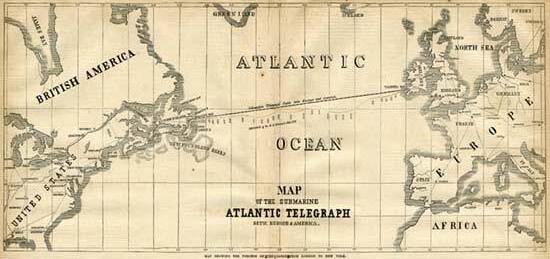
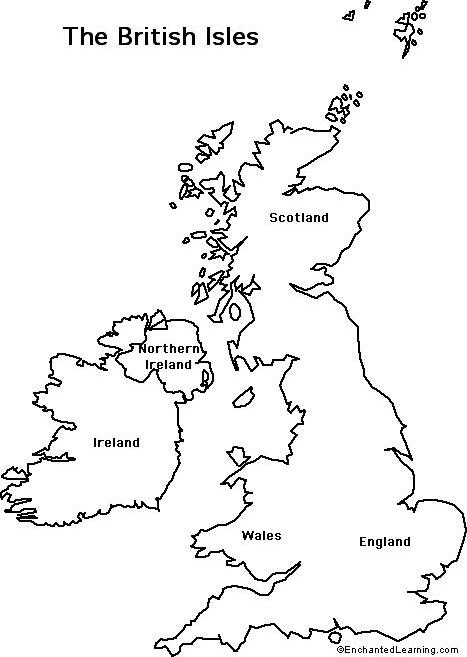
Figure 1. A map of the Atlantic cable with straight line diagram. Between Newfoundland, Canada and Valentia, Ireland.
It can be said that Guttenberg was among the first group of people and technologists responsible for the first communications revolution with the invention of the printing press in the 15th century. From here the ability to communicate with a bigger audience and to pass on and distribute information was made a lot easier by Guttenberg’s printing press. Three hundred years later, the daily newspaper became the normal system of delivery method used for passing and distributing information. For the next one hundred years, the daily newspaper was the main delivery method until the era of the telegraph took over.
It was thanks to men like Morse, Cooke and Wheatstone that we entered the second communications revolution. This revolution in communication aided the distribution of information across countries and continents in minutes rather than days, weeks and months before the telegraph age. It was soon discovered that there was not enough capacity to cater for all the information, and so an increase in network design, build and rollout took place where new telegraph networks were built across continents, usually following the newly laid tracks of
another new invention, the steam train. Actually, the rollout of the railways nearly always went hand in hand with the rollout of the telegraph. Soon the same obstacle to the railway was to become the same obstacle to the telegraph, the oceans and seas. However the telegraph was soon to overcome this obstacle.
Ever since the invention of the telegraph and the ability of man to communicate across land via the electric powered conducting wires delivering telegrams and telegraphs messages to all corners of the country, there was a desire to extend that reach across the water. The first step took place in 1850 with the laying and putting into use of the first submarine cable
between Dover and Calais. This was a feat so enormous that the original players did not realise that they were making history. It was made possible by surrounding the copper wires or conductors needed to transmit the electrical signals that made the telegraph with yarn tape, wire armouring and Indian rubber. However, the Indian rubber which was the water repellent insulator was soon replaced by a more sustainable product thanks to Bewley and Hancock. In 1845 they met and agreed to develop Hancock’s patent for a rubber insulator, which is generally thought to be the foundation of the Gutta Percha Company. In 1850, the year that the submarine cable was born, the cable also became a driver feeding the telegraph
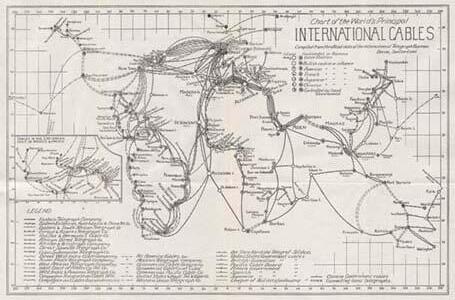
Figure2: A map showing the number of submarine cables in operation in 1921.
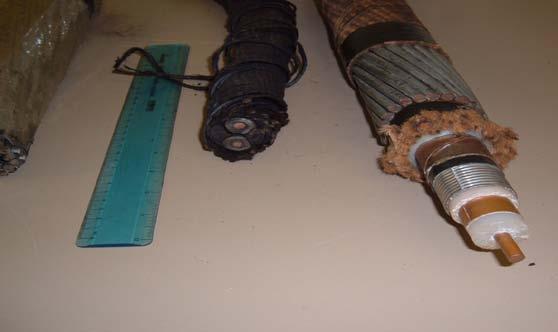
Figure 3: Coaxial cables soon became the norm and replaced the older telegraph type cables, however the external cable protection remained the same. The conductors were replaced with coaxial conductors.
communication revolution helping to distribute information. The telegraph passed its last and final obstacle: water.
Soon an interest in connecting Ireland to the Britain was envisaged, and in 1852 there were three attempts, all of which failed. However, in 1853 a connection was successful between Port Stewart in Scotland and Donaghadee in Northern Ireland. This being the first cable that actually operated lead to the desire to connect Europe to America, and so the idea that Ireland could connect to the US came allot closer. Between 1857 with the first attempt to land the trans-Atlantic cable to the successful attempt of 1866 there was four attempts to land a cable.
The 1857 cable failed, the 1858 cable lasted three months, the 1865 cable was lost like the 1857 cable. However the 1866 cable was successfully landed. The 1865 cable was picked up and finally landed. The 1866 cable was abandoned in 1872 while the newly connected 1865 cable was abandoned in 1877.
During these years the submarine cables laid between Ireland and Britain grew with numerous landings at Blackwater, Co Wexford; Howth, Co Dublin; Donaghadee, Co Down; Waterville, Co Cork; Cork Harbour, Co Cork; Whitehead, Co Antrim and Newcastle, Co Wicklow. These new links, 23 connections between 1852 and 1900, helped improve the communications
between the two islands which were the pillars of the empire or the United Kingdom. As time went on and as the British Empire grew, so did the need for communications, and soon there was an issue with the lack of available copper circuits to match the demand for communications links. New submarine cables and new links were laid from Britain, Ireland and France to the US, the Africa’s and the Far East. These cables helping spread the tentacles of power and influence that would help shape the societies and technological invention and evolution across the globe and was aided by the support from the Monarchy under Queen Victoria.
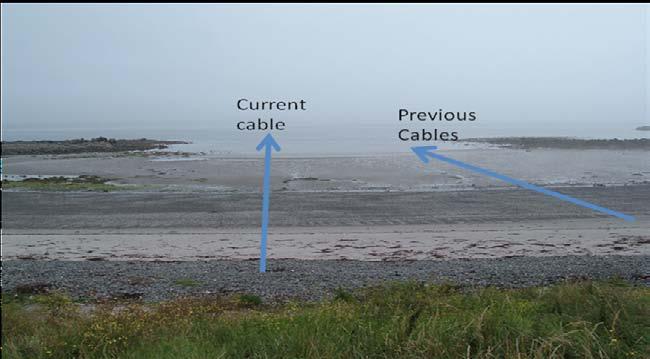
Figure 4: The two cable route; the current cable route is the one for ScotlandNI-2 while the previous cable route is the original cable between the same landing points first operationally connected in 1853, there is 136 years between the two.
As time went by, the engineering designs and the increased use of the telegraph helped make the world a smaller place. By 1900, Ireland was communicating with the far corners of the world with information being transmitted between people in minutes, when a mere thirty years earlier it would take weeks if not months for communications via the postal system to pass informatio. Now it was at light speed, or telegraph speed. As soon as the 19th century turned to the 20th century, there was a continuation in cable landings as the older cables were abandoned due to age, cable damage and natural wear and tear. With another 17 cables landed in Ireland
between 1900 and 1950. This increase in capacity was needed to cope with the increasing need for information. As the world was getting a smaller place, so was the available capacity and so yet again the submarine cable had to step in and meet the challenge that the increase in communication brought with it. The number of international submarine cables also increased in this period, as can be seen in figure 2.
Around 1921, the first coaxial cables (see figure 3) came into use and these slowly began to replace the copper conductor cables that existed as the main design. These coaxial cables catered for a lot more traffic, and with the aid of amplifiers they were capable of going longer distances with more calls per minute on the cable which allowed for the increase in traffic without the increase in cable installation.
However, there soon came a time when there was no more need for new submarine cables as there was now capacity on the existing systems to cope with the expansion of the communication web across the world. There was a slight decline just before World War II, but during the war and after the war there was an increase in the need to expand the submarine cable systems to cater for the increase in communications and the need for increased capacity. The reason was the fact that the war enabled new innovations in communications. These innovations soon became standard telecom practice and these soon replaced the existing communication systems. The telephone cable systems came into their own and soon they could cope with the increased capacity. The coaxial cable was perfect for the new telephone circuits and it became the primary submarine cable design.
The expansion of communication networks and the increase capacity being offered by new submarine cable installations between the 1950’s and the 1970’s continued along with continued innovation in analogue technology. The number of submarine cables landed in Ireland, to meet the increased development and communication
needs fell to about 10 cables. Ireland was in the middle of an industrial crisis, she led the way in agricultural technological development while the rest of the world followed the industrial development route.
Soon Ireland was being left behind. The available capacity in its submarine cable connections was more than enough to meet its communications needs.
However, during the late seventies there was a move towards digital communications. This was the start of the third communication revolution.
Analogue circuits were soon replaced by digital circuits. The advantage of digital communications over analogue was obvious, the attenuation in signal was lower, the increase in capacity and ability to transmit more data and pack more information into the signal was the basis of a new communications model.
The invention of the personal computer, digital communications and faster speeds laid the foundation for a new industrial and technological evolution that helped most economies across the globe. Ireland was no different, and soon over the next twenty years she soon evolved into a nation ready to meet any on the world stage. The changing communication environment
Figure 5: A map of the existing submarine cables connecting Ireland to the UK and the rest of the world.
also affected Ireland in a positive way. The lack of communication capacity was evident, and in 1988 the first optical submarine cable laid between Ireland and the UK was laid between Portmarnock, Co Dublin and Holyhead, Wales. It was a joint venture between Telecom Eireann and BT and was a digital optical system. Another one was laid in 1989 between Donaghadee, Co Down and Portpatrick, Scotland. This followed more or less the same route as the first operational cable between Ireland and the UK in 1853, see figure 4. The third submarine cable was laid between Girvan, Scotland and Larne, Co Antrim in 1993. Soon another submarine cable was laid in 1994 which was also around the same time that Ireland began to evolve as a leading economy especially in the financial area.
As the Irish economy grew and developed along came the 21st century and with it came the fourth communication revolution: broadband. The development of broadband and its penetration into everybody’s lives meant that the need for
more capacity was evident. The existing operators upgraded their submarine cable transmission systems to DWDM so that systems could now carry 10G wavelengths and so that, by changing the transmission equipment, they could increase capacity without the need to install new submarine cables. However, this could not solve all the problems and the need for more submarine capacity grew. Along with the existing operational systems, new systems were required and as late as last year the Kelvin project was delivered by Hibernia Atlantic, delivering much needed bandwidth to Ireland via Northern Ireland. Other operators have also signalled their intention to connect Ireland and the UK with new systems between 2010 and 2011, which will hopefully deliver Ireland out of the existing world financial crisis.
With this increased capacity, Ireland will soon be able to deliver its broadband promise and make the country a truly digital society.
Derek Cassidy is from Dublin, Ireland. He has worked for 17 years in the telecommunications industry, 15 of them dealing with optical networks and 12 years dealing with submarine networks. He is currently leading the Optical Engineering and Submarine technology areas which support BT Ireland and the wider BT Global business. He is currently a member of the IET, IEEE, Engineers Ireland, EOS & OSA and has Degrees in Physics, Optical Engineering, Structural/Mechanical Engineering and Engineering Design. He is currently studying for his MEng and MSc.
Linking africa To The World
Opportunities Provided By ICT Uptake Essential To Mobilising The youth Of africa
With its unique set of challenges, connecting Africa to the rest of the world provides an opportunity for submarine telecommunications experts. Long reliant on expensive satellites, Information and Communications Technologies (ICT)
infrastructure in Africa has lagged behind developed economies, limiting access of African youth to global economic opportunities. SEACOM, a privately funded and over three quarter African owned submarine fibre optic cable which assists communications carriers in
southern and eastern Africa through the sale of wholesale international capacity to global networks via India and Europe, is key to providing this access.
With an enormous capacity of 1.28 Tbps, SEACOM is the first cable to provide broadband to countries in east Africa.
African retail carriers can now enjoy equal and open access to inexpensive bandwidth, removing the international infrastructure bottleneck and supporting economic growth. Within Africa, South Africa, Mozambique, Tanzania and Kenya are inter-connected via a protected ring structure whilst additional express fibre pairs complete the network by linking into Marseille, France and Mumbai in India. SEACOM has also procured fibre capacity from Marseilles to London as part of the network.
Since SEACOM’s official launch on 23 July 2009, countries like Tanzania, Mozambique and Ethiopia have seen bandwidth supply grow by more than 1000% and 850% respectively, while bandwidth supply in Kenya has grown by 700%. With more and more countries getting connected to the rest of the world via the SEACOM system, it is only a matter of time before we see the direct socio-economic benefits this will have on the entire region.
Africa is a continent where 50% of its population is under the age of 25, and it is these younger generations that are born with an additional gene in their DNA makeup which makes them ICT “programmed”
- A special quality that lets any child pick up a piece of ICT equipment, sight unseen, and have it working to its full potential within minutes. As the African youth become accustomed to widely available connectivity and begin to contribute to the Web, the next programme that is “beyond
our wildest dreams” is most likely to come from a young African.
However, it is the access to economic participation that increased ICT uptake spawns that will make the difference to a youth that is largely unemployed and with limited levels of education. Providing broader access is a potential catalyst to unlocking sustainable economic and social development. By supporting a broad range of stakeholders to develop, create growth and promote the continent as a real player
in the global economy via the enablement of ICT linked opportunities will most certainly see acceleration towards socioeconomic development.
Thus far, Africa has lagged behind other continents in terms of information technology infrastructure and associated bandwidth availability. SEACOM and other similar ventures will assist Africa to meet its developmental needs through the provision of cheaper and widely available bandwidth. The reality is that increased
access to bandwidth opens up a variety of opportunities that were previously unheard of. Worker productivity, healthcare, education, innovation and many other areas will be improved by the introduction of true broadband.
The tremendous growth in mobile communications across the continent has been a marker of Africans’ readiness to use technology to improve their lives. Of course, in today’s world, ICT can only truly be exploited through the availability of broadband to establish effective and efficient international communications systems. Words such as high definition TV, peer to peer networks, IPTV and real internet are not that far away... in fact, it can be a reality subject to one requirement - the availability of affordable and plentiful bandwidth.
Through the provision of plentiful bandwidth at a fraction of the previous cost, SEACOM has opened up unprecedented opportunities for governments, businesses and ordinary citizens to compete globally, drive economic growth and enhance the quality of life across the continent. Change brings about opportunities. The world has already witnessed the dramatic and countless life-altering developments
borne out of the Web. This is only the beginning, and we often forget that whilst businesses become more competitive and inventive through readily available connectivity, it is the youth who will truly exploit the broadband and IP worlds.
“Africa’s
development trajectory will be exponentially improved by the provision of information super-highways and will no doubt form an important building block for Africa to build upon. Accessibility has been the single biggest stumbling block to creating this reality. Yet with the benefits of the SEACOM cable, everyone can have access to the world at their fingertips, particularly the youth who are hungry for tools to economic mobility”, says Brian
Herlihy, CEO of SEACOM.
To this end, it is education, and partnerships with educational institutions that will unlock the value that increased access to technology provides. SEACOM’s partnership with southern African research and education networks through TENET (Tertiary Education and Research Network of South Africa) will facilitate faster development by providing subsidised international bandwidth to research and education networks across
40 universities. These education and research institutions have 50 times more bandwidth for the same annual price they paid prior to the arrival of SEACOM. This bandwidth equals the amount available to the entire Southern African population in 2008.
TENET owns the capacity for the remaining life of the cable, resulting in substantial annual savings whilst enabling the affiliated institutions to develop and increase their international research collaborations and distance learning programmes. SEACOM is also replicating this programme in East Africa and has already donated a STM-1 of capacity (155Mbps) to the University of Dar Es Salaam and hopes to provide capacity to another 60 plus research and educational institutes at a discounted rate.
Partnerships are key to SEACOM’s continued success. Not only does the cable link Africa to the world, but within Africa, local service providers are the link to intercountry facilitation. SEACOM is using its subsidiaries and local partners in each country, who are licensed and established to carry communication infrastructure, to establish backhaul solutions/ last mile landbased fibre infrastructure, into landlocked countries. By way of example, Altech, a South African based telecommunications company operating in East Africa and SEACOM have taken a giant step towards unlocking this enormous potential. The success of SEACOM would not be possible without infrastructure which links their beach landing stations to metropolitan PoPs (Point of Presence). KDN’s extensive inland infrastructure in East Africa will link their landing station in Mombasa to Nairobi, and onward to Kampala and Kigali. Connecting Ethiopia is based on the same principle, and they will continue to connect additional landlocked countries.
The impacts of SEACOM’s affordable broadband pricing are already beginning
to be felt across the continent. In September 2009, MTN announced a 50% increase in capacity for certain corporate clients in South Africa while Telkom also announced similar increases. More recently, on March 18 2010, MWeb a South African ‘Internet Services Provider’ (ISP) launched a new uncapped ADSL offering for businesses and consumers which is 40% cheaper than anything previously available, providing South Africans with unlimited internet access. In Kenya, Safaricom and other Kenyan mobile operators have seen a dramatic increase in 3G demand. In Tanzania, TTCL announced in October 2009 that its internet prices were going down by as much as 65%.
In addition to the pricing impacts of SEACOM, national carriers have realised that they have to upgrade their networks to move large amounts of bandwidth. For example, Kenya is building three different national networks, South Africa is developing four national networks, and the government of Rwanda is rolling out huge fibre networks throughout the country. Ethiopia is now also following the same path.
SEACOM’s achievements show that, with an enabling environment, the private sector can mobilise the resources required to deliver complex and expansive projects for the benefit of the African people. The SEACOM cable will change the lives of every man, woman and child in the countries connected by making previously unavailable technology accessible to everyone.
Herlihy has extensive experience in megainfrastructure projects in Africa spanning a number of disciplines including project development, financing and governmental liaison supported by a strong understanding of African economics.
An American citizen, his career began in the UK in 1994 in the health waste sector before joining the Bank of America as a Marketing Analyst in 1997. From 1999 to 2003, he worked on the Africa ONE project where he gained valuable African experience. In 2003 he was appointed Vice President of Development at Global Alumina, a large alumina refinery project in the Republic of Guinea before being appointed President of SEACOM, responsible for overseeing the fiber optic undersea cable project at the end of 2006.
He holds a MSc (Development Studies) and BA (Economics and Philosophy) from the London School of Economics and Boston College respectively.
Bran Herlihy has extensive experience in megainfrastructure projects in Africa spanning a number of disciplines including project development, financing and governmental liaison supported by a strong understanding of African economics. An American citizen, his career began in the UK in 1994 in the health waste sector before joining the Bank of America as a Marketing Analyst in 1997. From 1999 to 2003, he worked on the Africa ONE project where he gained valuable African experience. In 2003 he was appointed Vice President of Development at Global Alumina, a large alumina refinery project in the Republic of Guinea before being appointed President of SEACOM, responsible for overseeing the fiber optic undersea cable project at the end of 2006.
Biography
Bran Herlihy, CEO of SEACOM
The 40G Undersea Market Heats Up
Harald Bock & Joe Capasso
The 40G market is taking off, with much of the action happening within the undersea segment. According to analyst firm Ovum1, network operators spent nearly $391 million deploying the technology, representing a 69 percent increase through the first half of 2009 versus full-year 2008. Going forward, this growth will only continue, as Ovum expects the 40/100G market volume to rise 79 percent annually through 2014.
Fueling the market is the demand for higher bandwidth, a rising proportion of data traffic and operators’ transitions to all-IP networks. Increasing usage of smart devices and bandwidth-hungry applications, such as video on demand and IPTV, as well as the sheer number of subscribers, are just a few of the irreversible trends that are creating severe capacity constraints on existing optical networks. Corroborating this growth story is the
analyst firm Infonetics, which expects that by 2011 there will be 4.4 billion mobile telephone users, more than 470 million broadband subscribers and an estimated 90 million IPTV users, all of whom need a robust transport network to accommodate data needs.
With a majority of optical backbones and metro core networks running at 10G channel line rates, operators increasingly feel the need to shift to 40G networks. However, adding new fiber is a very expensive and time-consuming option. This reality has been one of the roadblocks to a smooth migration from 10G to 40G in the past.
Now, faced with exploding bandwidth demand, operators must evaluate and plan for 40G deployments. Despite its higher cost relative to 10G, 40G provides networking benefits relative to administering – and managing – multiple 10G streams. In addition, there have been innovations in this space to keep rising costs in check. One change has been the adoption of technology used in terrestrial systems for upgrading the transponders in undersea links. This has significantly driven down costs and made the market for undersea line termination equipment more competitive.
Admittedly, installation of submarine fiber cables is a significant investment, with high costs for equipment and installation using fiber-laying ships. The costs for undersea applications by far surpass the budget required for a terrestrial application. For this reason, upgrades of undersea capacity can be done economically by upgrading
the undersea line termination equipment at the ends of the links to higher line rates. This enables operators to make optimum use of the investment into the undersea fiber plant.
Carriers continue to be guided by the need to protect their investments in 10G and
want to reuse existing installations and power feeds while making the move to 40G. The optimal option is to upgrade, rather than build anew. While considering an upgrade, carriers have different strategies that, in turn, dictate different technology options. Either way, whether the plan is to keep 10G channels running alongside 40G
or upgrading 10G sequentially to 40G, the idea is to minimize disruptions in traffic and leverage the embedded infrastructure.
One challenge of increasing channel line rates is the distortions a channel experiences when transmitted through a fiber over long distances (i.e. thousands of kilometers) unrepeated. As the speed increases by a factor of four, so do these distortions. In the past, this has necessitated putting Dispersion Compensating Modules (DCMs) at the beginning and end of each link, often for different bands of wavelengths or even each individual channel – a highly inconvenient option.
The industry, however, has much to look forward to. Currently, advanced transmission formats based on coherent detection are becoming available, enabling operators to install 40G transmission systems without the costly and time-consuming optimization of dispersion compensation at the beginning and end of the link, as well as
the fiber measurement required previously. Besides this challenge, which is caused by the new line rate itself, the performance of the 40G channels can be impacted if the operator wants to simultaneously run existing 10G channels. This effect needs to be mitigated by the choice of a suitable 40G modulation format or other measures, such as a larger wavelength gap between 10G and 40G channels. For upgrades from 40G to 100G, this effect is not present because 40G and 100G use similar modulation schemes.
Nokia Siemens Networks is ready to meet the network technology growth needs with a new solution: its SURPASS hiT 7300 40G coherent detection transponder. This latest addition to the 40G product portfolio supports 40G transmission over fiber dating back to the 1980’s and earlier. It fully utilizes the builtup capacity, protecting operators’ initial investments. In addition, the transponder is seamlessly integrated into Nokia Siemens Networks’ hiT 7300 dense wavelength division multiplexing (DWDM) portfolio and
will be available for trials in the third quarter of 2010.
Another development in this space is that undersea cable links increasingly require switching compatibility with terrestrial systems. With the rising proportion of data traffic, the landing site equipment requirements can range from Internet switches and routers to optical switching and modems.
Nokia Siemens Networks’ latest addition to its optical portfolio, the hiT 7100 OTN switch, also targets this space. Offering multiple benefits to operators, including efficient usage of network resources, multiservice support with a single platform, smooth network migration through support of SDH/SONET switching and interfaces and enhanced Ethernet and packet/Multiprotocol Label Switching (MPLS) functionality, the scalable switch supports capacity from 1.2 Tera bytes per second (Tbps) up to 24 Tbps with the hiT 7100 switch granularity at ODU0. With this capacity, it is well-suited to support the increasing capacity requirements at the landing sites of undersea installations.
into Nokia Siemens Networks’ SURPASS hiT 7300 DWDM platform to create a single network element that fills the gap between optical layer switching and other existing switching platforms. Generalized multiprotocol label switching (GMPLS), which currently is being used in Nokia Siemens Networks’ next-generation products, will also become part of a single control plane encompassing hiT 7300 and hiT 7100 products.
it is a packet-based circuit (MPLS-TP) or frame-based circuit (OTN).
Operators can achieve significant savings through the integration of the hiT 7100
Carriers continue to be guided by the need to protect their investments in 10G and want to reuse existing installations and power feeds while making the move to 40G.
In conjunction with a data control plane using a multiprotocol label switching transport profile (MPLS-TP), and the optical data unit control plane, GMPLS will mesh a seamless network of services generating OPEX and CAPEX savings for the customer. GMPLS will provide ease in end-to-end set up of connections, whether
GMPLS also will assist in operations, administration and maintenance of individual circuits on both platforms and provide provisioning automation, protection and resiliency in a combined multi-layer network. As an example a gigabit Ethernet (GbE) service originating on an access hiT 7300 shelf will be routed to a hub location where the GbE circuit will be channelized into a higher order optical data unit at the hiT 7300, which will generate a label switched path transported over a hiT 7300 long-haul network and dropped off to an access node at another location.
All of this end-to-end provisioning will occur automatically over the hiT 7300 and hiT 7100 via GMPLS tunnels. Each node in the GMPLS network will be aware of every other node and all of the traffic that is running between them. GMPLS extends signaling and routing in a frame-based network and the hiT 7300 and hiT 7100 systems will use this protocol efficiently, since Nokia Siemens Networks’ GMPLS control plane and data plane are technology and bit-rate agnostic. The OTN switch and the DWDM system common control
plane will generate alternate paths in case of failures on a working path. Switching will occur in milliseconds, assisting the customer with significant savings both from a time and money perspective.
While the industry is witnessing mass scale deployments of 40G, some experts say we are not far away from 100G either. However, as Ovum suggests, 40G is a necessary stepping stone to 100G. In fact, the transition from 10G to 40G simplifies the future execution of 100G line rates.
Against this backdrop, Nokia Siemens Networks finds itself in an advantageous position. With a 30 percent share of the 40G unit line card shipments market for the 3Q08-2Q09 period, the company is already reaping the benefits of an early start in the technology. It started 40G research in the 1990’s, was the first vendor to undertake a mass rollout of optical 40G technology as early as 2006 and is well
positioned to ride the 40G wave to be a driving a force in building the ecosystem for 100G technology.
In addition, the company can leverage technology from its commercially available 40G solution to upgrade to 100G without a major network reinvestment, helping operators get a jump start in the 100G market, too. No matter how you look at it, Nokia Siemens Networks is committed to deliver the highest capacity connectivity to a demanding customer base.
End-user demand for bandwidth will only continue to rise, making operators’ need to upgrade their networks to 40G and beyond essential. For this reason, now is the time to evaluate network needs and begin planning to upgrade. This advance planning will ensure operators’ ability to provide their customers with the experiences they seek, before capacity demands reach a boiling point.
Harald Bock works in Product Management Optical Networks for Nokia Siemens Networks. Since receiving his PHD in Physics in 1998, he has held positions in optical engineering, system design as well as sales of transport network products. Harald Bock has been working for NSN since 2007.
Joe Capasso is a solutions manager with Nokia Siemens Networks based in Iselin, NJ. He has more than 20 years of experience in the optical communications field, including R&D and product management roles for both terrestrial and undersea fiber optic transmission systems.
Back Reflection
by Stewart ash & Kaori Shikinaka
The Optical Era Japanese Submarine Cables Part 3
Japan consists of four large islands, Honshu, the main land, Hokkaido, Kyushu and Shikoku along with around 4,000 smaller islands. Because of this, submarine cables play an important role in Japan’s domestic telecommunication infrastructure. Therefore, it was not surprising that Japan became the first country in the world to implement submarine fibre technology commercially. By connecting optical fibre submarine cables to optical fibre land cables, it quickly built up a backbone network which stretched 4,500km from Asahikawa in Hokkaido to Okinawa in the South.
The first commercial, repeatered, optical submarine system deployed anywhere in the world was a Japanese domestic system owned by NTT. FS-400M was 300km long and was laid in 1986 by Kuroshio Maru between Hachinohe and Tomakomai, thus connecting Honshu and Hokkaido. The OCC supplied cable contained 6 single mode fibres and the system contained 7 NEC Repeaters; operating at 1,310nm, 400Mb/s; 445.837mB and a Line Code 10B1C RZ. The PFE was double end feed @ 1.8A.
The first international repeatered system involving Japanese technology was TPC – 3, which was installed in 1988 and went into service in 1989. Segments AC and BC of the system were supplied
by Japanese companies, they included OCC cable containing 6 single mode fibres (Seg AC 2,220km; Seg BC 1,531km) as well as Fujitsu and NEC repeaters, operating at 1,310nm, 280Mb/s with a Line Code 24B1F.
In 1992, repeater development in Japan moved from regenerating technology to optical amplification. Deep (6,000m) water sea trials of the new repeater designs were carried out before they went into full production. The first optical amplified submarine system to go into commercial service, anywhere in the world, was a 900km domestic linking Kagoshima in Kyushu with Okinawa. This system owned by NTT, commenced manufacture in 1994 and was completed in 1995.
The first international optical amplified system in the world was the long haul system TPC-5 and the Japanese industry played a significant part in its construction. TPC-5 is a ring system connecting Japan, North America, Hawaii and Guam. The laying operation commenced in November 1993 with the landing of the cable in Ninomiya Japan. The total system length was some 24,500km and the final splice was not completed until August 1996. KDDI-SCS laid Segments T2 (Ninomiya – Miyazaki), Segment I (Miyazaki – Guam) and part of Segment J (Ninomiya - Bandon), a total of 5,900km. These were completed in October 1994, February 1995 and May 1996 respectively. The Japanese manu-
factured equipment for these segments comprised OCC cable, repeaters of Fujitsu and NEC, and a number of Mitsubishi repeater amplifier units in OCC housings; the terminal equipment was supplied by Fujitsu, NEC and Toshiba.
By the mid 1990’s Japan was a leading supplier of submarine optical fibre technology, a position it has maintained through the development of 10Gbit/s line rates, WDM and DWDM technologies up to the present day. This was further demonstrated at SubOptic 2010 by presentations on the emerging 40Gbit/s and 100GBits/s coherent technology. Clearly, Japan has been a major pioneer in the development of fibre optic submarine cable systems and remains a major influence in the development of our industry today. Fujitsu and NEC, along with OCC, remain among the world’s leading suppliers of submarine systems; KDDI and the NTT group are unquestionably influential system operators, and KCS and NTT WEM are leading marine service providers. In addition, our industry has benefited greatly from the technological innovation and products provided by such companies as Fujikura, Furukawa, Hitachi and Sumitomo. One hundred and forty years on from its first exposure to submarine cables, Japan is critical to the future of the submarine cable industry.
& Zhu Hongda
Subsea Capacity Issues Between China and U.S.
Xu yewei
In recently years, globalization and emerging technology led to an explosive spread of Internet with presence of media, finance, politics, etc. Driven by the radical change of international telecommunication business, the construction of submarine system has again entered a rapid growth stage. Especially for China, as a key player in global economy and with 20.8% of world’s Internet users, the need of higher capacity
and more secured submarine system has been aggravated along with the integration to global networking.
On December 26, 2006, two consecutive earthquakes with a preliminary magnitude of 7.0 and centered about 10 miles (15 kilometers) south of Taiwan caused the severance of key submarine cables. By cutting over interrupted circuits to unaffected submarine, it took more than a
month for all services fully recovered. The earthquake didn’t cause fatal problems to international communications during the holiday season; however, the earthquake did give a remarkable alert to Asian telecommunication industry that had been over dependent on sole information source since long.
In 2008, Typhoon MoraKot battered Taiwan. Six submarine cables, including
SMW3, APCN, APCN2, EAC, C2C and FNAL/RNAL were damaged. 100G bandwidth gap of connections in between China, U.S. and Europe was generated due to the fracture of submarine cables. On August 17, a large scale of users reported problems of failure to log on MSN (instant messaging software). Meanwhile, Yahoo and other foreign websites also appeared to have a slower access speed. A large amount of Private IP and Private Line customers with traffic between the United States and China suffered unexpected interruption as a result of the submarine fracture.
Before year 2008, China connected to the world mainly through SMW3, CUCN, APCN2, EAC and FNAL/RNAL submarine systems at Beijing, Shanghai, Guangzhou and Hong Kong.
Before TPE was put into service, other than CUCN, the majority of the submarine cable systems between China and the U.S. were first through Asia-Pacific systems, such as APCN2 and EAC, inter-connected at Japan, and then through Trans-Pacific systems, such as PC1 and Japan US, to the U.S. This kind of network will cause long latency, and at the same time, the similar routes also led to catastrophic
destruction on submarine cable systems by earthquakes, typhoons and other natural disasters.
In 2006, six operators including China Telecom and China Unicom signed an agreement to jointly invest 500 million U.S. dollars to build a direct Trans-Pacific cable system (TPE) between China and U.S. The project completed before the 2008 Beijing Olympic Games. It has now become an important communication between the U.S. and arteries. China Unicom expanded the EAC submarine cable to Qingdao landing station, which made Qingdao become the only major international submarine cable landing station in northern China. It not only shortened the latency of the international submarine cable circuits, but also provided the physical route diversity of the submarine cable landing to avoid nature disasters. Qingdao landing station has successfully completed important international communication tasks for the 2008 Olympic Games. In the meantime, Asia Netcom and PacficCrossing also made investments to expand and upgrade their submarine systems.
All international carriers are expected to achieve diversity route of international
communications for maximum security by adjusting their submarine cable networks. The investment in construction of submarine cables has been more cautious after recent Taiwan earthquakes. Taiwan’s status in the international submarine cables has been gradually weakened. The major submarine cable operators have diversified routes to avoid earthquake zone, including Taiwan. Meanwhile, cable operators in the Pacific are gradually building the transition from ring to mesh. For international communication network security, changing a single submarine cable transmission to multi-directional and multi-channel is necessary.
With the fact that submarine resource is getting richer and richer, products of international telecommunication are being diversified while not compromising on quality. To bring a more secured communication network, multi-routing turns to be the best approach of hedging risk from unexpected interruptions; while, route optimization can lower latency, which is requested by financial industry for synchronized data services. At this point, carriers should be more focused on resource allocation and instructions for exigency. The general approach
of submarine system design includes three aspects, a self-protected network; QoS based exigency instructions; and International carrier cooperation.
Self-protected Network. Rational allocation of submarine resources to vest the network with capability to restore affected business circuits by using backup channels when there is an emergency caused by submarine system.
QoS based exigency instructions. When there is an exigency, carriers should provide protections for the most important business circuits based on QoS hierarchy.
International carrier cooperation. Cooperate with foreign carrier for purchase and replacement of submarine resources as a temporary measure to dispatch exigency.
Xu Yewei is the Director of Technical Support & Network Operation for China Unicom Americas. She began working in communications filed in 1997 after graduated from Xidian University. Served as senior project manager for the international communications network construction in China Netcom since 2000. Led and participated in many international network projects such as building China Netcom International Gateway and C2C submarine cable Nanhui landing station. Currently in charge of China Unicom Americas network construction, optimization and daily maintenance.
Zhu Hongda is Engineer of Technical Support & Network Operation for China Unicom Americas. He holds an MBA from Rensselaer Polytechnic Institute, Bachelor of Electronic Engineering from Shanghai Jiao Tong University; currently serving as Network Engineer at China Unicom.
Feed The Need: The Explosive Demand For Undersea
Technologies!
The arrival of the SEACOM cable gave us just a taste of the possibilities presented by sub-optic cables. But are you aware of what is happening in the African submarine sector? How will you ensure that your strategies are effective enough to ensure the long term survival of your business? Many businesses are unsure if they will be able to keep up with the demand for capacity at a low price.
Does your sub-optic strategy lack spark? You need to know that the strategies you have in place are effective enough to pull you through the boom and bust cycles when the excitement about connectivity wanes. If you do this, you will ensure your company’s long term growth.
Do you need ideas and case studies to learn from? We have assembled speakers from major players including Seacom, WIOCC, Dark Fibre Africa, Orange, France, Neotel, Kenya Data Networks and the Main One Cable Company to help you attain success.
If you answered yes to any of these questions you need to be at Submarine Networks World Africa 2010. Put your company on centre stage at Submarine Networks World Africa! Act now or you will lose out on this fantastic business opportunity. We have the solution for you.
Register now for Submarine Networks World Africa 2010 by going to www. terrapinn.com/2010/submarineza.
Imagine what you could do for your business if you are there. Imagine what MORE you could achieve if your whole team is there!
The world is so excited about Africa’s potential. Grab your opportunity to capitalise on the interest in Africa. Undersea cables have introduced an exciting new era. Learn from the successful industry leaders at this conference and ride your wave of opportunity. Submarine Networks World Africa 2010 is the big
picture event uniquely concerned with providing insight into how to capitalise on the abundant opportunities in Africa’s emerging market.
Five reasons why you’ll benefit from being there:
1. Discover the latest innovations in the sub-optics sector, helping you improve your profits
2. Get ahead using the knowledge on the latest trends and growth opportunities in the African continent
3. Align your company with the world’s best & expand your market
4. Network with the people who will
make a difference to your organisation’s bottom line & grow your customer base
5. Tap into the growing opportunities presented by the sub-optics sector
Hear from industry leaders and get ahead from the insight provided by:
• Olivier Noele, Sector Lead: Information & Communication Technologies, International Finance Corporation, South Africa
• Raynald Leconte, President: France
Telecom Marine, Orange, France
• Chris Wood, CEO, West Indian Ocean Cable Company (WIOCC), Kenya
• Aidan Baigrie, Head of Business Development, Seacom, Mauritius
• Taj Onigbanjo, Head of Middle East & Africa, Cable & Wireless, United Kingdom
• Diarmid Massey, Vice President of Carrier Sales, Cable & Wireless, United Kingdom
• Thierry Tomiet, Regional Director: Middle East & Africa, Telecom Italia Sparkle, Italy
• Annie Kithima, Head of International Relations, Vodacom, Democratic Republic of Congo
• Kai Wulff, CEO, Kenya Data Networks, Kenya
This is where you’ll learn from the success of others – and from their failures too! We are dedicated to providing answers to the challenges you face. Uncover the solutions for growth and development for your business, while you network and gain insight from our industry speakers.
Act now or lose this business opportunity.
Register online at www.terrapinn.com/2010/ submarineza to secure your seat. Also follow event updates on Twitter http://twitter.com/ submarineworld We look forward to meeting you at Africa’s premier sub-optics conference. Book your space early and save up to R3898! For more information visit www.terrapinn.com/2010/ submarineza
Lowest Latency Connectivity To South america Takes Center Stage
South America is becoming a hot, emerging financial marketplace, and on course for even more growth in the near-term future. The region has an expansive geographical footprint, densely populated in many areas. More so, it’s home to an active financial trading community, now gaining traction for global investors.
In May 2008, the São Paulo Stock Exchange (Bovespa) and the Brazilian Mercantile and Futures Exchange (BM&F) merged, creating BM&F Bovespa. According to the company, the merger created one of the largest exchanges in the world in terms of market value, the second largest in the Americas, and the leading exchange in Latin America. Today it is the world’s third largest stock exchange with offices in New York, Shanghai and London and fourth largest exchange in the Americas in terms of market capitalization.
Notably, since the merger in 2008, the stock market has had quite a volatile run – until recently. In early 2010, the stock market’s recovery inspired companies to reconsider how they conduct business. With more dependency on technology, particularly for trading transactions and connectivity to global exchanges, global financial institutions must become savvier about how they buy their network connectivity. They can no longer base buying decisions solely on getting from A to Z at a low cost. Financial companies must seek network providers that can offer quality, low latency and redundant connections – ensuring their financial transactions will be processed with the speed and accuracy demanded by their business.
Not only is Brazil an emerging financial market, according to Mercopress.com, the Brazilian economy as a whole is expected to
grow 6.1% due to a large number of global organizations setting up offices in the region. As a result the international data solutions required to connect these offices is expected to grow 70% through 2014.
With exchanges like BM&F Bovespa in São Paulo taking center stage, more banks and brokerages are migrating south for global trading requiring telecom carriers specialized in the support of financial transactions. To be competitive carriers need to be able to offer unique solutions to interconnect their customers’ offices in São Paulo, to major metropolitan cities in North America like New York, Chicago and Toronto. Given the growth opportunities, international carriers must understand the requirements of the financial organizations and offer the lowest latency services, as the speed of data communications services can mean millions – gained or lost for their customers.
Think Beyond Price
Often times, carriers make buying network service decisions solely based on price. Many carriers and end users assume that ‘all networks are created equal’ – that low latency and reliability are a given in this market, and ultimately the difference from one network provider to another is simply the price of the service. Often for a fraction of the cost more, financial networks could be transacting trades via a faster, low latency data pipe, increasing their overall profit margins and directly impacting their core business.
Simply stated, it’s not just the price, it’s the quality, route, redundancy and of course, the lowest latency. Carriers and end users opting for the lowest cost provider could end up paying more in the long-run, particularly if low latency is not a key factor in their decision process. When working with network providers on mission critical communications like financial trading, carries should ask the service provider to offer proof of the network latency from point to point. Although many organizations are still feeling the effects of a down economy, the potential money lost on such transactions because of potential
latency issues could negatively impact the overall business and ultimately loose far more money than that of the original circuit costs.
Selecting the Right Network for Mission Critical Communications
In 2010, 33 companies headquartered in Brazil appeared on the Forbes top 2000 global company list (www.forbes. com). This is a strong indicator of the region’s ability to sustain global business development, a trend that GlobeNet, an international wholesale carrier offering connectivity between North and South America, has anticipated by investing in a seamless solution of Clear Channel Data providing low latency connectivity of less than115ms between BM&F Bovespa in São Paulo, Brazil to Wall Street in New York City, USA. Additionally, the company is launching its international IP network in Q3 and will offer the most comprehensive IP network for point-to-point VPN in more than 20 cities of Brazil.
attracted to the region – driving more data communication requirements between Brazil and the rest of the world. However, there are still a finite number of providers that can provide high quality, low latency connectivity between North America and South America, particularly required by the global financial community. With
BM&F Bovespa as the third largest financial exchange in the world, low latency connectivity to the region is critical. The ability to transact stocks in real time is an absolute necessity for global financial institutions.
Global companies require secure international data solutions. With a healthy, burgeoning economy in Brazil, companies are growing and businesses are
GlobeNet offers both a regional knowhow and global connectivity. As a highavailability (default of 99.99%), low latency submarine cable network provider between United States, Bermuda, Brazil, Venezuela, and now Colombia, GlobeNet offers an optimal solution for carriers assuring secure connectivity for its carrier clients’ mission-critical business operations.
Since 2002, the GlobeNet system has not had a subsea cable outage. This is an incredible statistic that highlights the company’s diligent and proactive servicing and maintenance of its submarine cables
GlobeNet’s network enables global companies to connect to key global markets, such as BM&F Bovespa in São Paulo. The submarine network availability measures upwards of 99.99%. And for companies that require connectivity to some of the world’s leading financial exchanges, guaranteed round-trip latency is also provided.
In many cases, it is the latency that makes
or breaks a trading house, especially in today’s global financial climate. As South America steps into center page, and as carriers become more competitive to bid for financial network services, especially heading south, carriers must partner with a provider that offers lower latency routing, 99.99% reliability, a regional know-how and all the right global connections.
On Issue #50
Wayne,
CONGRATULATIONS on the 50th – I can’t wait to congratulate you on the 100th. Perhaps I’ll see you at SubOptic!
Erick Contag brings over 20 years of sales, marketing, business development, strategy and corporate management expertise to GlobeNet, a wholly owned subsidiary of the Oi (formerly Brasil Telecom), that provides the lowest latency, international capacity services to the Americas. Mr. Contag has been responsible for managing C-level relationships and telecommunications/high-technology projects for start-up enterprises through large multi-national and Global 100 companies. He has proven success in starting, building, and turn-around of high-tech businesses.
Hello Wayne,
Best Wishes Nigel Bayliff and its dedication to high performance networking. It is this critical reliability that financial networks require from its carrier vendors.
Best regards, Nicholas Koopalethes
Just a short note of congratulation on the 50th issue – well done. Look forward to seeing you at SubOptic.
International Cable Protection Committee 1-3 June 2010
Mauritius www.iscpc.org
Submarine Networks World Africa 2010 12-15 July 2010
Johannesburg, South Africa
www.terrapinn.com/2010/submarineza/
Submarine Networks World 2010 12-14 October 2010
Singapore www.terrapinn.com/2010/submarine/
Offshore Communications World 28-29 September 2010
Kuala Lumpur, Malaysia www.terrapinn.com/2010/ofc/
Pacific Telecommunications Council 16-19 January 2011 Honolulu, Hawaii www.ptc.org
Letter to a Friend
by Jean Devos
Letter to my Japanese friend,
I am writing you just before my trip to your country for SubOptic 2010, and I feel excited! My target is nothing less than to finally understand these "inscrutable Japanese." I have spent a good part of my professional life dealing with Japan while trying to find the key of the mystery. This is probably my last chance. If Yokohama brings me the light I am looking for, I’ll let you know.
Why doesn't Japan play more globally in the submarine cable business? During the past 20 years, ASN and Tyco captured the lion share (80%) of the business, leaving a meager portion to the Japanese industry. This is despite some very good cards in hands: a great submarine cable history, a favorable geographical position, first class technology, good companies, dedicated people, a highly populated and wealthy region, and an Asiacentric market. As soon as a project is a bit far away from their islands, the Japanese suppliers are either absent or unaggressive. Even in Asia-Pacific, they often show-up in consortium or as subcontractor. This remark also applies to the Japanese operators who do not seem to have global ambitions. Everybody is actively involved in Africa at this moment, but not the Japanese.
I've often told you, my friend, that Japan should work out a single supplier solution in order to compete on equal footing against ASN and Tyco. The NEC-Fujitsu competition seems to concentrate all their efforts, energy and attention. Like all family conflicts, such situations shift rapidly from "brotherly" to "fratricide!" And the "others" only need to play with this situation, bringing their own fuel to the fire. You did agree that this domestic competition was detrimental to Japan, but you keep telling me that there is no solution.
There are probably deeper factors behind this, and the probably lies somewhere in the Japanese culture. Japan is an island subject to heavy storms, earthquakes and other natural threats. Success is never sure, and tomorrow can be worse. Everything is fragile and ephemeral, so the priority is to survive in "my" little field of rice! "Asu no hyaku yori, kyou ga fuku," similar to the French saying "Un tiens vaut mieux que deux tu l’auras." In other words, "better 50 today than 100 tomorrow." Is that an A more subtle
thought comes to me from a book I read several times in English with great pleasure: Snow Country by Yasunari Kawabata. With pleasure, but with the strange feeling that what needs to be understood is not obvious, but is somewhere between the lines. Snow country refers to the western part of Japans’ central mountains–the snowiest region in the world. It suggests life divorced from time through the long snowbound months. The author is in the line of the haiku masters, these tiny seventeen-syllable poems that seek to convey a sudden awareness of beauty by a mating of opposite or incongruous terms. He keeps mixing motion and stillness such as "the roaring silence of a winter night."
I got it! The Japanese submarine cable industry is living in the "snow country," addressing the global market in a "slow rush," being satisfied with a "meager abundance."
I look forward to the key-note speech by the honorary Dr. Yoshio Utsumi, whose title attracted my attention "The inscrutable Japanese." I am reading in the SubOptic program, "It is often difficult for foreigners to understand Japanese people and society, without first having a basic knowledge of Japan and its culture…The submarine cable telecom business, have players from many diverse cultural, political, and ethnic backgrounds. So it is hoped that Mr. Utsumi’s presentation will not only be interesting and stimulating, but it may help some participants to adapt their approach in international business to achieve greater success.”
My dear friend, I sincerely hope that Dr. Utsumi will explain to you how you should "adapt your approach of the international business to achieve greater success."
p.s. Yokohama May 15–Mr. Utsumi confirmed that the Japanese culture is the root of the problem. Japan needs to find a way to be competitive in this time of globalisation, but it is going to be extremely difficult.
My entire staff is in Japan attending SubOptic 2010, and here I am back in Virginia, finalizing SubTel Forum #51 and taking care of my pregnant wife. It's been quite a couple of weeks leading up to the conference, and in spite of the looming deadline for this issue, it's nice to slow down just a bit.
Congratulations
to Brian Fenton who won an iPod Touch, and to Chris Butler, Takalani Tshivhase, and Fabian Vergara who won iTunes gift cards after completing our spring survey
We spent several weeks preparing our marketing materials for SubOptic. Can anyone else relate to that?
The brochures had to be printed, the artwork for the displays finalized, the posters sent to the sign shop, and finally the swag had to be ordered.
Once everything had arrived, then came the collating, inserting, packaging, and my personal favorite: trying to figure out how to transport all this stuff to Yokohama. Should we ship it and risk our materials getting caught up in Customs? Or should we load down our engineers with 75 lbs of marketing materials apiece? As I watched Guy Arnos cramming closed the lid of a suitcase, I knew we made the right choice.
We only had one item get lost in transit: a SubTel Forum pop-up banner. I wish you could have seen it; it was a great banner, possibly the most eye catching banner of all-time. Unfortunately, the airline misplaced it. Maybe we should have shipped everything afterall.
Did you attend SubOptic? If so, have you been able to solve the wire puzzle we placed in the attendee bags? Did you drop your card at our booth an register to win an iPod Touch? The winner will be announced in Issue #52 in July.
As always, thanks for reading SubTel Forum. Because of our readers, we can proudly proclaim the we are the Voice of the Industry.
What do you think? Click on the Letter To The Editor icon and drop me a line. I’d love to hear from you.