Submarine Telecoms Forum is published bimonthly by WFN Strategies. The publication may not be reproduced or transmitted in any form, in whole or in part, without the permission of the publishers.
Submarine Telecoms Forum is an independent com mercial publication, serving as a freely accessible forum for professionals in industries connected with submarine optical fibre technologies and techniques.
Liability: while every care is taken in preparation of this publication, the publishers cannot be held responsible for the accuracy of the information herein, or any errors which may occur in advertising or editorial content, or any consequence arising from any errors or omissions.
The publisher cannot be held responsible for any views expressed by contributors, and the editor reserves the right to edit any advertising or editorial material submitted for publication.
Contributions are welcomed. Please forward to the Managing Editor:
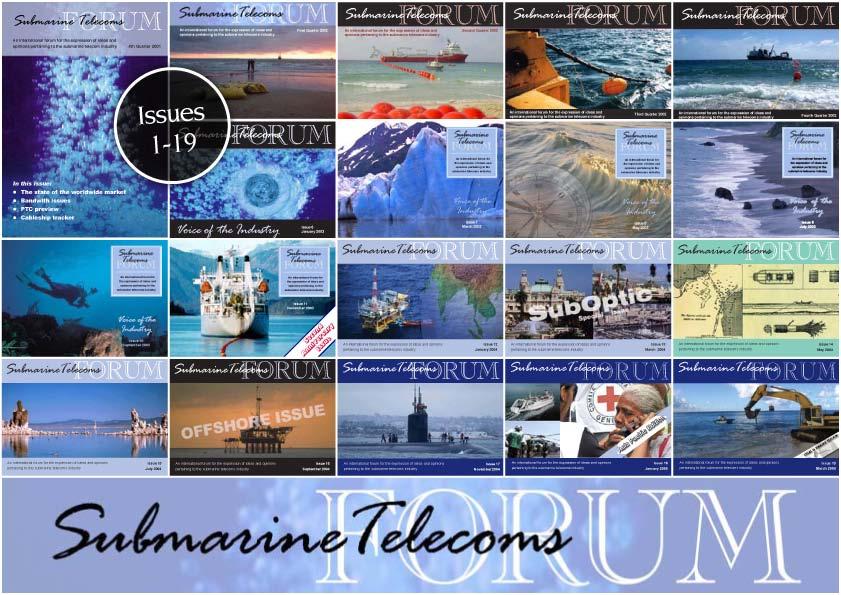
Welcometo the landmark 50th issue of Submarine Telecoms Forum magazine, our Finance & Legal edition.
So much has changed since we started publishing this magazine, especially in the submarine cable industry. We’ve seen an industry boom, a bust, and a recovery. We’ve seen the establishment of new industry conferences, and the steadfastness of SubOptic. And this month we celebrate the 50th issue of Submarine Telecoms Forum.
Ted Breeze and I created SubTel Forum with the expressed mission of creating an international forum for our submarine telecoms. At the time, our industry was headed nose down into an incredibly severe recession, and we felt that all of us would need a safe place to vent and converse and strategize – we wanted our magazine to become the Voice of the Industry. In November 2001, Issue 1 was rolled out to do just that.
Our first issue contained articles scraped together from industry leaders as well as a few new names; we called in all our chits from business friends and former colleagues, sold a few adverts on “faith,” had our name blessed by SubOptic, and then survived the malaise following September 11th. Ted provided the layouts, dark humor and cigarettes, while I begged and pleaded for copy.
So Issue 1 hit the virtual street, and then we waited – for applause – for anger – for calls from the lawyers! And slowly our peers responded with thanks and even some praise. And we then learned what would become our biggest technical challenge for the next five years – that files over 1 meg in size were too onerous for many of our
readers, as dial-up was still king! We also learned that we could track the relative health of our industry by the number of undelivered emails returned from recent laid off personnel – and we saw bounce-back rates of 10% - 20% for each bimonthly issue throughout 2002.
Kevin Summers took over layouts after Ted passed away suddenly in 2004, and soon began to make his mark on SubTel Forum. Summers was both a graphic artist and professional author, a combination that eventually led to his taking over the editorship of the magazine in early 2009.
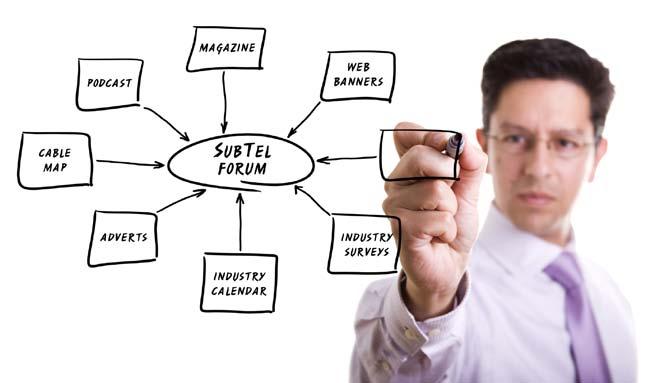
Other features and products were added along the way: an RSS feed, an interactive website, a submarine cable map, an annual calendar, and the industry’s first podcast. These were all designed to fulfill the mission we set out on way back in 2001: to create an international forum for the expression of ideas pertaining to our unique industry.
Now, as we’ve reached our 50th issue, please join the staff of SubTel Forum in saluting the many contributors who have made our magazine a success. We hope you like the updated look and feel, and look forward to another fifty issues of speaking as the Voice of the Industry.
Australian Researchers’ 10Gbps links to US guaranteed to 2020
Chunghwa Telecom Says International Service Restored After Quake
EASSy cable finally lands in Mtunzini
EASSy Fibre Cable Finally Set For Landing
FCC Releases Public Notice Regarding Applications to Connect Submarine Cables to Cuba
News Now
FiberZone Selected By GlobeNet
FLAG Submarine Cable Network Still For Sale
GBI to connect to lucrative Saudi Market
Global Crossing Upgrades Network Capacity to Meet Growing Demand for Broadband Service
Global Marine Systems announces Suriname Totness Shore Landing of the Suriname Guyana Submarine Cable System
Global Nexus Obtains Bahamas Operators License - New Submarine Network will connect the Bahamas, Canada, Brazil, Cuba and the USA
Globe seeks new permit for international cable landing station in Cagaya
Great Eastern Group Awarded Multi-year US Naval Facilities Support Contract
Gulf Bridge International (GBI) signs with Batelco
Gulf Bridge International and DU sign cable landing and partnership agreement
Gulf Bridge International Sign Agreement With Vodafone Qatar to Land GBI?s Submarine Cable in Qatar
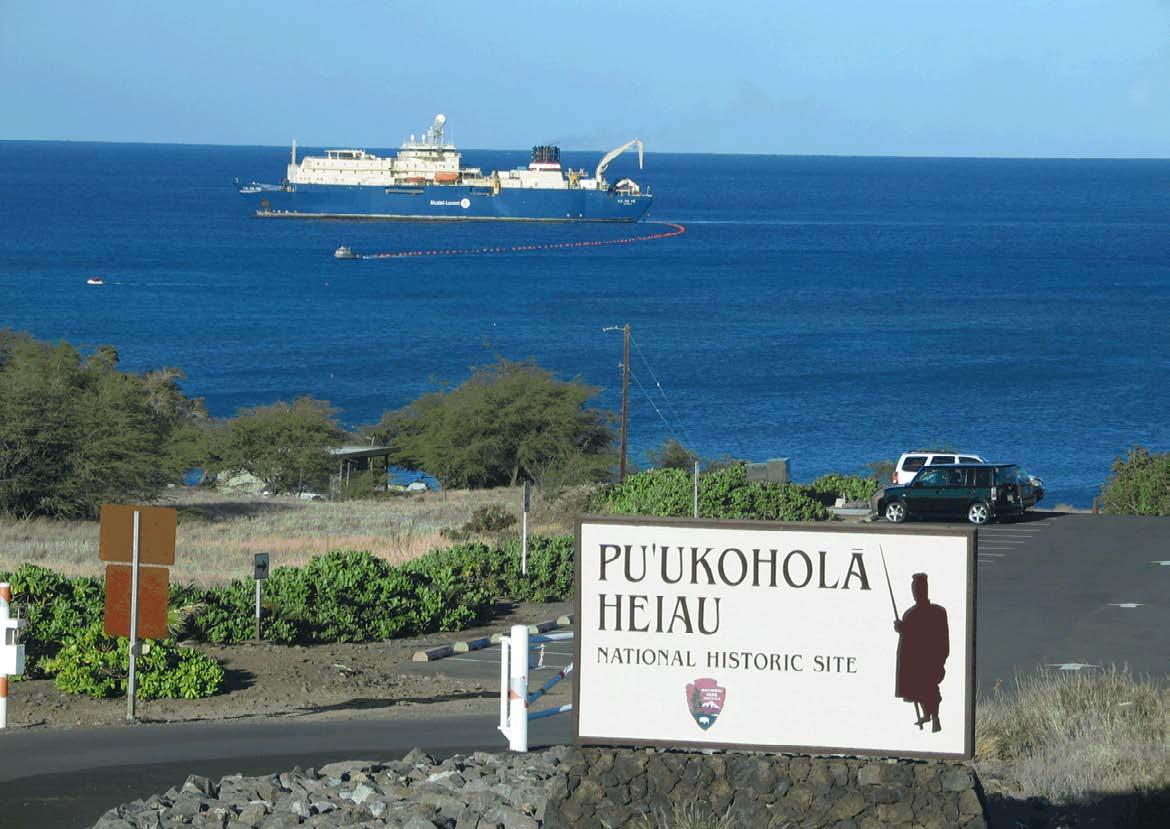
Honotua Cable Linking Tahiti to Hawaii Lands in Kawaihae
Interoute extends panEuropean fibre optic to Ireland as international enterprise investment in the region grows
Main One submarine cable project inches near completion
MTN bids for SAT-3
MTN satisfied with EASSy progress as cable lands in South Africa
Oi?s GlobeNet and AlcatelLucent complete upgrade of 22,000 kilometer submarine network linking the Americas
OMM team helps Lighthouse R&D Enterprise Inc. add depth to deepwater with installation of new seabed observatory
Otelwelcomes EASSy Cable To South Africa
OUR Extends Application for Submarine Fibre Optic Cable Licences
Pacific Fibre Submarine Cable Planned
Pacnet Accelerates India Expansion with National and International Long Distance Licenses Pacnet Delivers Enhanced
Services
Pacnet Managed Services Wins
Square Editors? Choice Award
Pacnet to Convert Cable Landing Facilities Into World Class Data Centers across Asia
can commercial Banks
return to the Submarine cable market?
Glenn S. Gerstell
Even a quick flip through the pages of Submarine Telecoms Forum or other industry publications makes clear that the subsea cable industry is in the midst of a rebound. The source of that rebound is equally apparent: the explosive growth of the Internet and the desire to replicate that growth in the heavily populated countries of the Third World. Surprisingly, those very factors are now creating difficulties in planning and financing for new submarine cable systems.
As the industry increasingly moves into Africa and focuses on regional systems elsewhere connecting, for example, Caribbean islands or countries in Southeast Asia, two consequences ensue that spell difficulty. First, obviously enough, building cables in the Third World is more likely to present construction challenges, permitting and licensing obstacles and cost overruns. Second, and potentially more worrisome, is the fact that revenue traffic projections are inherently uncertain in these markets with little history of broadband connectivity, or indeed any significant telecoms penetration. This uncertainty affects planning for all sorts of subsea projects – from the consortia model to the investor owned cable system. Predicting demand is always tricky in any scenario, but the problem is compounded where there is so little data from which to extrapolate and make revenue projections. For instance, a commercial lender looking to back a new trans-Atlantic cable can assess a borrower’s “base case” by comparing it to traffic on other existing cables or derive estimates with some degree of confidence from telecom/ Internet usage and connection rates in what are clearly more developed markets. Obviously, that’s not possible when the cable in question is running along the African coast. Moreover, the intrinsic difficulties of construction in the more problematic corners of the globe exacerbate the uncertainties in the revenue projections, since delays may be more common and thus push back “ready for commercial service” dates of submarine cable systems. Finally, the enticing prospects of robust growth in these underdeveloped markets mean
that many sponsors and operators are planning – if not racing to complete – cable projects that will inevitably compete with one another, further confounding revenue projections for any system.
Ironically, the growth in the subsea cable sector comes at a time when commercial banks are slowly staggering out of a recession and are greatly curtailing lending to anything other than highly creditworthy borrowers. Needless to say, submarine cable projects – with memories of the industry’s collapse several years ago not quite erased, and with new projects subject to the revenue uncertainties noted above – will not fall into that highly creditworthy category!
Capital expenditures continue apace in the industry and commercial banks will somehow have to play a role in funding those expenditures. The cable industry is on track by some estimates to spend over $3 billion over the next three years with a record 16 new cables placed into service this past year throughout the world. Cable system owners, telecom operators and some other service providers are intent on meeting demands for international data and voice transmission (engendered primarily by the explosion of web-based video, voice and date and multimedia-centric websites). The recent completion of the SEACOM cable and the anticipated installation of the EASSy, Main One, and Glo-1 cables in Africa are testimony to the fact that the development (and lending) “action” has in part shifted to Africa and other countries with low internet penetration. In fact, there are several new cables planned for the Caribbean, the Middle East and intraregional routes, as well as long-haul routes such as the proposed Arctic Link cables.
Commercial banks have been noticeably absent from the funding picture for some of the recent African cable systems and regional projects, leaving the field to multilateral development institutions or simply to equity investors. The multilaterals are a useful addition to financing options but they have special requirements and can sometimes not move as fast as commercial lenders. The massive
amounts of capital required by the subsea industry can ultimately be met efficiently only through the active participation of the commercial banking sector.
So how do wary lenders react to this burgeoning demand for capital in an uncertain seascape? Generally, the response has been with heightened attention to detail and assurance of returns to satisfy the credit committees to whom these lenders are ultimately responsible. The credit committees that are charged with approving new loans at almost every major financial institution around the world are consistently applying tougher standards (whether in the form of operational and financial covenants, due diligence or improving upon typical tax and yield maintenance provisions) than at the height of the “easy money” boom of a few years ago. These tougher standards are applied first and foremost to the project’s revenue projections, and will be discussed in detail later. In addition, those standards generate some notable requirements for cable systems, including: (i) the shift of permitting, construction, operation and management risk to sponsors instead of the financiers; (ii) the expectation that sponsors will contribute a substantial equity component to the project and be responsible for (and capable of) covering cash shortfalls of the project, whether due to construction cost overruns or revenue shortfalls; (iii) credit documentation for the transaction becoming much more tightly negotiated and limiting the borrower’s operational freedom while ensuring that complete collateral security remains paramount; and (iv) increased skepticism of using developing countries’ laws for any aspect of a subsea project (in the form of increased importance of governing law provisions, dispute resolution procedures and available judicial/arbitral relief).
These requirements translate into a “flight to quality:” Lenders will seek to do deals with reputable operators and sponsors who have solid track records, eschewing untested management teams or financial investors with little experience in successful subsea projects. Those operators and
sponsors can in turn shoulder the responsibility for further equity support as well as other risks noted above that lenders will not accept for their own account. Lenders are manifestly insisting these days on tighter credit agreement provisions (e.g., lenders will demand more stringent financial ratio compliance). As for collateral security, commercial lenders are demanding liens on both all assets as well as a pledge of shares of the operating company (where feasible). Of course, in practice this can sometimes prove difficult because of the multijurisdictional nature of a subsea system and the most valuable assets, the licenses, often being unpledgeable. Given these difficulties in obtaining “perfect” collateral packages, commercial lenders often utilize collateral as a means not to ensure repayment through actual enforcement, but as a means of control and to establish that no other creditor will have leverage in a financial distress situation. But that doesn’t mean operators and sponsors shouldn’t be prepared for robust negotiations over collateral with commercial banks. One battleground is a lender’s demand for express acknowledgements for contractual assignments from the borrower’s/operator’s key customers and other important counterparties.
Assuming the requirements outlined above can be satisfied, lenders are still left to grapple with uncertain revenue streams, which obviously are critical to ensure repayment of the loan. Commercial lenders are wisely concerned with the current declining bandwidth cost per unit, as the rate of long-term declines in bandwidth pricing is impossible to predict with any certainty. This uncertainty is exacerbated by the fact that in many markets there are simply too many telecom operators. For example, in India, the telecom industry is being further pushed towards consolidation and infrastructure sharing and thus operators (and their lenders) are forced to consider how this will affect pricing. Even precisely which direction market consolidation will push bandwidth prices is unclear. Will a decrease in ruthless competition allow pricing to “firm-up” in
a given market, or will the increased purchasing power of major operators (in say, a duopoly) drive capacity prices down further?
Competitive threats figure highly in any lender’s analysis of a project’s base case. In some cases, when faced with the prospect of investing in second or third projects in a developing market, commercial lenders have to account for the possibility that it may be relatively simple and cost-effective to upgrade a competing cable system and this would negatively affect the profit return to the project they have under consideration. In other situations, lenders may need to account for the fact that there might be a great amount of unlit fiber on some routes. Finally, alternative technologies such as satellites can shift traffic and revenues away from subsea cables.
Uncertainty in revenue forecasting only gets worse as the industry increasingly shifts to the lessdeveloped world. Extrapolating from demand patterns in the US and western Europe may be useless. In many of the developing markets fixed line telecom and cable TV penetration is very low, so the population is adopting wireless technologies directly, and users are leapfrogging to 4G, WiMAX and LTE. In these new and untapped markets, there is no accepted model to predict revenues, further vexing lenders.
Sustaining the current boom in the subsea sector will require that commercial banks turn on the spigot to a greater degree. While to some extent that will depend on macro-economic and bank regulatory issues, at least in the subsea cable
industry, borrowers should recognize that they will be asked by banks to assure adequate equity, stand behind project costs, make available full collateral security, engage competent local counsel to familiarize lenders with emerging market risk and legal requirements and to resolve licensing and permitting issues before drawing down a loan. Even more importantly, commercial banks and borrowers must analyze the base financial case and demand forecast with an eye for the uncertainties noted above. Inevitably that will mean that sponsors and operators must be prepared for lenders to discount, possibly significantly, their revenue projections. If so prepared, with a robust business case, borrowers should be able to find that middle ground with their bank lenders that enables successful deals to be launched.
Glenn S. Gerstell is the managing partner of the Washington, DC office of Milbank, Tweed, Hadley & McCloy LLP, and heads the firm’s global communications practice. He has been especially active in the submarine cable sector, having advised lenders, vendors and system operators in project financings, acquisitions and large capacity commercial arrangements. A partner in Milbank since 1985, he has also served in the firm’s New York, Singapore and Hong Kong offices. Mr. Gerstell is the general editor of Telecoms Project Documentation, published by Euromoney, and has been a regular speaker at Suboptic and other submarine cable industry conferences. Chambers Global, Chambers USA, Chambers Latin America, International Who’s Who of Business Lawyers, Lawdragon’s Leading Lawyers in America and other recognized guides to the legal industry have consistently ranked Mr. Gerstell as in the top tier of his fields of practice.
UNEp and The Icpc
Bringing reason To The Environmental Impact Discussion
Douglas Burnett & Lionel carter
Every owner, route surveyor and installer of an international submarine telecommunications cable probably have been exposed to uncertainty, risk and unsupported demands of permitting authorities who require proof a cable does not have an unreasonable impact on the marine environment. Usually, such demands are manifested in an environmental impact statement or assessment.
In response substantial costs may be incurred through the employment of environmental consultants and lawyers who try to prove what in many cases is a negative assertion. In other words, the cable owner must prove that a fiber optic cable does not have a negative environmental impact. Furthermore, although consultants hired by cable owners are often world class in their field, their advice may be considered “slanted” because a permitting agency perceives them as advocates for the cable industry.
The task is further complicated by an apparent dearth of peerreviewed science, published in quality science journals and other neutral academic sources, that permitting authorities may regard as authoritative and neutral.
A change to this reoccurring theme appears to have arrived with the publication of “Submarine Cables and the Oceans: connecting the world”, which was released in February 2010 by the United Nations Environmental Programme (UNEP) through the UNEP/World Conservation Monitoring Centre (WCMC) and the International Cable Protection Committee ICPC)1. The UNEP/ICPC Report stems from a three year collaboration between UNEP and the ICPC. The projects aimed at providing an overview of submarine telecommunication cables that focuses on their relationship with the natural and human-influence marine environment. Where possible, the report used peer-reviewed science papers which were supplemented with material gleaned from reputable sources.
But why submarine telecommunication cables? The development of the submarine fibre-optic network over the last 20 years along with the evolution of the internet, have reinvented the way the world communicates. Commerce, financial markets, education, entertainment, social networking or just a telephone call, are based on the unseen network of undersea cables, which carry more than 95% of all data and voice traffic.
The report is written with the non-specialist in mind, thus making it accessible to as wider audience as possible. It introduces the reader to the world of submarine cables that in our modern society, form
1 Carter L., Burnett D. Drew S., Marle G., Hagadorn L., Bartlett-McNeil Dl, and Irivine N. (2009). Submarine Cables and the Oceans-Connecting the World. UNEP-WCMC Biodiversity Series No. 31. ICPC/UNEP/UNEP-WCMC. (“UNEP/ICPC Report”) 64 pp.
Submarine cables and the oceans: connecting the world
the backbone of the global information highway. That introduction is captured in eight, easy-to-read chapters that cover the following topics:
A History of Submarine Cables: centres on the evolution of the global communication system, from the pioneering era of telegraphic cables in the mid 19thC to mid 20thC, to the coaxial systems of the mid 20thC and now the fibre-optic network
Inside Submarine Cables: this is essentially an insight into the workings of cables from the old telegraph to modern fibre-optic systems.
Survey, Lay and Maintain Cables: opens up the world of cable laying beginning with the surveys that define a route across the ocean floor, the actual laying of the cable in ocean depths down to 5,000 m and more, and system’s maintenance – how do you repair a cable that has been damaged in those depths?
International law: summarizes the international conventions that recognize the vital importance of sub-sea communications and accordingly provide legal rights and obligations, as well as guidelines for protecting this critical infrastructure asset.
Environmental Impacts: the effect of cables, including laying and maintenance operations, on the seabed environment are examined including interactions with whales and fish.
Natural Hazards: documents the various hazards such as submarine earthquakes and landslides that impact upon the cable network especially in hazard-prone regions such as the circum-Pacific rim.
Submarine Cables and Other Maritime Activities: as well as natural hazards, cables contend with threats from human activities, especially bottom trawl fishing and ships anchoring. These threats are
discussed along with various means of reducing their toll on the network
The Changing Face of the Deep: A Glimpse into the Future: the final chapter gazes into the crystal ball to evaluate potential threats to the global network in light of an increasing human presence offshore and the projected changes in the ocean associated with climate change.
All of the above are captured in just 64 readable pages that are embellished with suites of quality graphics. The report is supported by 190 peer review and authoritative references, which is a substantial resource for anyone wishing to delve into the world of cables. The compilation thus becomes an invaluable research “short-cut” for governmental regulators, the cable industry and the science community.
But the real qualitative value of “Submarine Cables and the Oceans: connecting the world” rests in the collaborative efforts of the authors. Besides the contributors of this article, the other authors include highly regarded names in the industry like Stephen Drew, Graham Marle, Lonnie Hagadorn, Deborah Bartlett-MecNeil, and Nigel Irivne. For UNEP , the wise council and guidance of Dr. Stefan Hain deserve special recognition. All contributions were cross-checked and edited by equally renown members of the cable industry, the environmental movement, and international legal scholars including Robert Beckman, David Billet, Kristina Gjerde, Malcolm Gilberd, Alan Green, Dr. Myron Nordquist, Alain Polloni, Neil Rondorf; John Tibbles, Dean Veverka, Bob Wargo, Robin Warner, Nigel Weaver and Ian Wright in a thorough peerreview process.
So what is the big deal about the report? Simple; for the first time there is a neutral document addressing all aspects of submarine fibre-optic telecommunication cables, including their impacts
on the marine environment that is in the public domain. This has resulted from an enlightened collaboration between a major environmental agency and a critical ocean user. But the report is neither UNEP’s view nor the industry view; rather it is a factual assessment of what is known. Such a compendium of knowledge will help bring evidence-based information into the discussion of submarine cables and the environment.
Oh, did we mention that the report is free? It is. It can be downloaded on the websites of the ICPC or UNEP.2 The next time you have a discussion with a permitting authority or a government regulator or environmental NGO, bring a copy along. Hopefully, the resulting outcome will be based on the science and not on viewpoints that are unsupported by reliable evidence.
Doug Burnett is a maritime partner in the New York City office of Squire, Sanders & Dempsey L.L.P, an international law firm with 32 offices in 15 nations. Mr.. Burnett is a 1972 graduate of the U.S. Naval Academy and a 1980 graduate of the University of Denver Law School. He is a retired captain in the U.S. Navy and has worked on submarine cable cases for over 25 years. He has served as the International Law Adviser of the International Cable Lionel Carter is a Professor at Victoria University, Wellington, New Zealand. He is also the International Marine Environmental Advisor for
From Coaxial to Fibre Cables: Japanese Submarine Cables Part 2
by Stewart ash & Kaori Shikinaka
Trans-Pacific Cable – 1 (TPC-1), the first transpacific submarine telephone cable, installed in 1964, provided 138 x 3kHz voice channels, which significantly improved the quality of telephone circuits between the US and Japan, and was a major contributory factor in the economic development of Japan at that time. However, the second transpacific submarine cable, TPC-2, connecting Hawaii, Guam and Okinawa, was not laid until over a decade later, in 1975. This added another 845 x 3kHz voice circuits to the existing Japan to US traffic. Over the next few years, in order to deal with the rapidly growing demand for international communications, an enormous amount of effort was expended by the Japanese industry as a whole in enhancing the bandwidth and voice circuit carrying capacity of coaxial cable systems. In the domestic market, Fujitsu and NEC Corp developed viable 36Mhz systems for NTT which provided 2,700 x 4kHz voice channels. This technology was first deployed in a shallow water system between Kure and Marsuyama, in 1971. The first deep water application was the Okinawa – Miyakojima system, installed in 1975. 36MHz technology was even commissioned by KDD for the Japan – Korea international system, which went into service in 1981. However, to achieve this transmission performance, repeater spacing was reduced to 2nm and so the power feed demands for such systems made the technology impracticable for transoceanic systems. In 1979, NTT commissioned from Fujitsu and NEC an experimental coaxial system (Sagami Bay No.4). This 15km cable loop contained 4 repeaters operating at 43.2MHz. It was able to provide 10,800 x 4kHz voice circuits but repeater spacing was reduced to 1.8nm. After this trail, in Japan as elsewhere, it was finally accepted
that for both domestic and international applications the technical and economic limits of submarine coaxial cables had been reached and an alternative technology was required.
Building on the pioneering work of Dr Charles Kao and Dr George Hockham at STL, Harlow UK. Corning Inc., in 1970, succeeded in producing the first “lowloss” optical fibre that surpassed the less-than-20dB/km benchmark by achieving a transmission loss of just over 16dB/km. This milestone was the catalyst for the start of research and development into the use of optical fibre for telecommunications systems. Use of the technology for land applications advanced rapidly and by the late 1970’s serious consideration was being given to applying it to the more challenging environment of submarine cable systems. Development work started in France, Japan, UK and USA at almost the same time, so, for the first time, the Japanese industry was on a level playing field relative to its international competitors.
The first experimental fibre optic submarine cable system deployed in Japan was a 50km cable loop between Inatori and Kawazu. The cable was supplied by OCC and contained 5 graded-index multimode fibres. There were no submerged repeaters and the system was laid for NTT by the cableship Tsugaru Maru. Terminal Transmission equipment was provided by both Fujitsu and NEC Corp. The system operated at 1,310nm and tests were carried out at bit rates of 6.3, 32 and 100 Mb/s. In 1981, NTT conducted the first sea trail of an optical regenerator using the cableship Tsugaru Maru; the trail system included a single regenerator repeater supplied jointly by Fujitsu and the NEC Corp.
The first Japanese experimental systems containing repeaters were deployed in 1982 by both KDD and NTT. The KDD system comprised a 50km loop from
a single landing at Ninomiya, the loop contained two regenerating repeaters (one supplied by Fujitsu the other by NEC Corp). The system cable was supplied by OCC and contained 6 single-mode fibres. The cable was laid by the cableship KDD Maru. Terminal equipment was once again supplied by Fujitsu and NEC. The system operated at 1,310nm and a line rate of 300Mb/s providing the equivalent of 4,000 voice circuits. The repeaters were power by a 1.0A PFE on a double end feed basis. The NTT system comprised a 50km loop from a single landing at Yahatano, the loop contained two regenerating repeaters (one supplied by Fujitsu the other by NEC Corp). The system cable was supplied by OCC and contained 6 single-mode fibres. The cable was laid by the cableship Kuroshio Maru. Terminal equipment was once again supplied by Fujitsu and NEC. The system operated at 1,310nm and a line rate of 400Mb/s providing the equivalent of 2 x 5,760 voice circuits. The repeaters were power by a 1.0A PFE on a double end feed basis.
In 1984, KDD conducted a deep water trail using the cableship KDD Maru. A 50km length of OCC cable containing 6 single mode fibres also included two regenerating repeaters. This mini-system was deployed and recovered from a water depth of 7,000m. The Fujitsu and NEC Corp supplied repeater designs were 280Mb/s operating at 1,310nm with a transmission speed of 295.6mBaud and a Line Code of 24B1P. The system was powered by a 1.6A PFE on a single end basis. This design was to form the basis of the first generation of international commercial fibre optic submarine systems. With this final trail the Japanese industry was perfectly placed to address what would effectively be a brand new market for submarine cable systems that would emerge in the next few years.
Broadband Stimulus
The American Recovery and Reinvestment Act of 2009 contains two sections that deal with broadband. These sections are designed to expand broadband penetration across the country. There are a number of ways that the bill intends to accomplish this goal.
The most intuitive way to expand broadband is to provide funds for the physical construction of networks – digging ditches, running wire, and connecting houses. There are also some provisions designed to increase demand for broadband and attempt to understand what level of connectivity already exists. In the bill these programs are all extremely vague and broadly written. However, the National Telecommunications and Information Administration (NTIA) and Rural Utility Service (RUS) are currently working to fill in the details.
BROADBAND TECHNOLOGy OPPORTUNITIES PROGRAM
Funding
$4,700,000,000 is allocated to this program. Ultimately, the NTIA (part of the Department of Commerce) and the FCC will be working together on this program. In addition to funds for the physical construction of broadband networks, the Program has two major initiatives:
$250,000,000 will be available in competitive grants to fund “innovative programs to encourage sustainable adoption of broadband service”
Up to $350,000,000 allocated for the creation of a Broadband Inventory Map.
Program Details
The Broadband Technology Opportunities Program (BTOP) is a program to develop and expand broadband service. Its goal is to increase broadband access in un- and under-served areas. A large part of the program will encourage construction of broadband infrastructure. In a victory for an open Internet, the law requires grant recipients to comply with non-discrimination and interconnection obligations, to be determined by NTIA in consultation with the FCC. Under the law, the obligations will, at a minimum, adhere to the FCC broadband policy statement.
Additionally, the BTOP is tasked with providing broadband education, awareness, access, equipment, and support. This education and support is intended to assist institutions of higher learning, organizations that provide outreach and support to vulnerable populations, job creation facilities, public safety organizations, and generally stimulate the demand for broadband.
This last category is potentially the broadest. Funds can be allocated to any “projects and activities as the Assistant Secretary [of Commerce] finds to be consistent with the purposes for which the program is established.” These funds may go towards addressing the “demand side” of broadband growth. Essentially, there is a feeling that many people who can get broadband access do not consider it a worthwhile or useful service. Programs that help to promote the positive features of broadband access – a type of “internet evangelism” - will help increase broadband penetration by making the public more aware of the benefits of connectivity.
Broadband Inventory Map
The Commerce Department has two years to compile and make publicly available a map of existing broadband service capability and availability. No details as to the granularity of this map were included in the statute. As we have pointed out in the past, mapping is more complicated than it might appear. A number of questions about disclosure, accuracy, and public accessibility will need to be resolved in order for the map to be truly useful and worthwhile.
FCC National Broadband Plan
The FCC has one year to submit a national broadband plan to relevant committees in both the House and Senate. This report must include an analysis of the most effective and efficient mechanism for ensuring broadband access, a detailed strategy to expand broadband, an evaluation of the development of broadband nationally, and a plan for the use of broadband to advance a host of goals such as consumer welfare, civic participation, public safety, and economic growth.
Rural Utility Service
The Stimulus Bill provides $2.5 billion to the Rural Utility Service (housed in the Department of Agriculture) for the construction of broadband networks. Priority is to be given to networks that promote rural development. The funds are funneled through the existing RUS program and statutory language appears to apply only to the construction of physical networks. Importantly, priority will be given to systems designed to give end users a choice of broadband providers. This could encourage open-access systems where any ISP could lease
the “last mile” connection to homes and businesses at a wholesale rate and compete for business. This system is in contrast to current models where the first movers to physically construct the infrastructure (usually cable and telephone companies) are able to capture the marketplace.
Implementation
Shortly after the passage of the bill, the NTIA and RUS held hearings and roundtable discussions to take public comment on how to implement the law’s requirements, as well as to inform potential recipients of grants how to submit proposals.
Although stakeholders were originally encouraged to request private meetings, the NTIA has since announced that they will not be able to accommodate every request due to overwhelming demand. Instead, stakeholders were encouraged to attend public meetings scheduled for March 10, 16, 17, 18, 19, 23, and 24. Information about these meetings, including agendas, participants, transcripts, and videos, are available here. Interested parties may also submit comments online. Additional information about the program can be found here
The 4 p’s in U.S. Environmental permitting
Virginia hoffman & meredith cleveland
With new environmental policies and awareness sweeping across the U.S., regulatory changes are almost inevitable. The submarine cable industry, already dealing with a complicated permitting processes, is as susceptible as any to new, resultant amendments to existing legislation. Today, cable operators are becoming increasingly inundated with more paperwork and longer time requirements associated with both permitting and licensing/regulatory processes. New policies, rules, and regulations can significantly delay the licensing of new cable landings or, at the very least create a headache for those mired in the procedure. In fact, the environmental permitting procedure can be the single most unpredictable portion of the entire submarine cable installation, and in some cases will entail significant additional cost.
As the permitting process can be very time consuming and costly, it is important to initiate the planning phase early. Submarine cables within the U.S. are subject to a variety of government authorities, including the U.S. Army Corps of Engineers, NOAA, EPA, U.S. Fish and Wildlife Services, individual state departments of Environmental Quality/ Protection, public park services, archaeological and cultural preservation bureaus, and local government units. The additional groups of environmental activists or seabed users are also entitled to comment during the regulatory process and may slow down the process. Preliminary planning is done with the general identification of the landing points, the backhaul/commercial requirements and their overarching regulatory agencies and sometimes with input from general interest groups. This construction of system requirements must remain flexible to allow integration of all the environmental, technical, commercial and regulatory requirements and is usually termed the Feasibility Study.
The second stage within the permitting process is the actual paperwork required to obtain the permit. To navigate permitting required by the various agencies, it is essential to first complete a desktop study (and either resultant or parallel route engineering study) to evaluate agency jurisdiction, regulatory requirements, any seabed user requirements, and determine
more accurate time and cost estimates for project budget and scheduling. Every opportunity is taken to avoid restricted areas with resultant route engineering and technical trade-offs. Individual agencies are contacted to determine which permits, licensing agreements, zoning waivers, and fees are necessary, both for cable installation and the subsequent maintenance requirements of the cable. As the route engineering process moves forward, permitting then becomes tighter and more defined with both processes integrating information and requirements. However, even the most comprehensive desktop study will only give a rough idea of total costs and number of permits required due to the permissions and review cycles within the permit application process. Each bureaucracy has its own standards and evaluations, and the unknown input from seabed users or special interest groups. Therefore, estimates will need to be augmented with the desktop study and integrated with the route engineering requirements.
Within this second element are the environmental impact assessments as determined by the regulatory agencies. Depending on the cable installation location, an environmental consultant could prove very helpful in areas where the cable operator is unfamiliar. A consultant will also most likely be better informed and attuned to any recent changes in environmental policy and any special interest group input, which can greatly affect speed of cable installation. In some cases, environmental consultants are required by the governing agencies as part of the application and installation processes.
Depending upon the project complexity and location, review and approval cycles are now initiated which leads to the third element: Persistence. This element is required in large amounts to contend with the questions and answers arising not only from the questions posed by interested parties or seabed users outside of the project, but as each step is completed, the resultant additional work to prove that the project
is necessary, environmentally sensitive and compliant with all agencies . And each project must contain the fourth element, patience, to work through all the issues presented, to maintain and sustain forward progress and to coordinate all the agencies and interested parties.
Currently of great importance to the permit effort is the Federal Communications Commission (FCC) who grants the landing license. Within the past three years, changes by the FCC to better enforce
the federal Coastal Management Zone Act (CZMA) have notably slowed the licensing process within the US and concerns about these new rules are a continuing hot topic of discussion and concern within the cable industry. Initially, the CZMA was a federal statute enacted in 1972 with the main objective of promoting preservation of coastal areas. States on both coasts were encouraged to create coastal management plans through the National Oceanic and Atmospheric Administration (NOAA). Most interestingly, the CZMA left it up
to the state to supervise any permitting or licensing actions per their own coastal management plan. Therefore, up until 2007, the CZMA and the undersea cable industry existed peacefully, aka without any direct involvement of the FCC. The Army Corps of Engineers was responsible for any CZMA consistency determinations. (In these cases, consistency is merely an effort for the state to maintain activities that are compatible with their specific coastal regulations.) Surprisingly, in 2007 the FCC then reversed its policy of letting
other government agencies take the lead in environmental permitting for cables with a new ruling. In this new policy, undersea cable projects were subject to review by states and territories that could compel any permitting requirements they saw fit before the FCC would grant a cable landing license. The FCC claimed this new ruling was more compliant with the CZMA, but many within industry were strongly opposed, including NOAA itself. However, the FCC went ahead in face of the opposition. Now, if a state decides a cable needs a consistency review, this must be included in the FCC application.
Clearly, this new ruling may cause problems for the cable industry by inserting delays of up to six months or more in the permitting process while it remains in place. Cables with multiple landing points in the US are especially susceptible: if one state decides there is an issue with permitting and/or consistency, the entire cable project is compromised until the issue is resolved. Moreover, this could possibly disrupt the FCC’s streamlining process for cable landing licensing, originally established in 2002.
With over 25 years of engineering and procurement experience, Virginia Hoffman received a BS degree in Physical Chemistry from Stockton State College in 1976 and a BS degree in Ocean Engineering from Florida Atlantic University in 1978. She joined the Naval Underwater Systems Center, Atlantic Undersea Testing and Evaluation Division supporting ASW and the various Navy ranges and then moved to Tracor Marine in Fort Lauderdale where she worked on different ship, salvage, and ocean construction projects. She established Great Eastern Group in 2002.
Therefore, the U.S. continues to persevere as a difficult country to permit undersea submarine cables and this statement will be underscored as more policy changes continue to be enacted without full appreciation of resultant effects. Rigorous planning for cables will become increasingly important with more extensive front end cost and schedule loaded feasibility studies, desktop studies, and integrated route engineering will be maintained as smooth a process as possible.
Meredith Cleveland is a Project Engineer for WFN Strategies. She received a BS in Environmental Sciences from the University of Virginia and her MS from the University of New Hampshire in Earth Sciences with a specialization in Geochemical Systems. She is a trained scientist with areas of expertise in running highly specialized instrumentation as well as data collection, management, and interpretation.
Landing The honotua cable
maui Sanford & John hibbard
Some cable landings are very different; the landing of the Honotua cable was one of those.
This cable, which runs from French Polynesia to Hawaii, not only had all the common technical and practical challenges, it had a major cultural dimension. In Tahitian, “te Hono” means path over the horizon and “Tua” means across the sea so the cable is ideally named to describe the system. The strong cultural dimension comes from the fact it is a thousand years since the Polynesians made their way from Tahiti north to populate the Hawaiian Islands. Anthropologists have discovered that migration did not occur across the north Pacific to Hawaii as many think, but rather from China and Taiwan through Micronesia, south to Melanesia, and then eastward from Fiji to Tahiti before the transit north to a Hawaii occurred a millennium ago. So, just as the outrigger canoes traversed the route, so will the cable, coincidently leaving from
Papenoo in Tahiti, the place considered sacred as the departure point for those original travelers.
The cultural element does not stop there, because the cable lands at Spencer Beach on the Big Island of Hawaii. This was the point where, 200 years ago this year, Kamehameha the Great defeated rival tribes to become the first King of Hawaii. We were planning to lay the cable across this hallowed ground. You can surely appreciate the symbolical importance of this landing, re-linking the Tahitian and Hawaiian peoples by the cable. Managing all the traditions and people with a heritage in the place was a daunting task.
With great cultural sensitivity and excellent guidance, this was achieved to the satisfaction of all, and this recognition of the importance paved the way for the approval of the landing site.
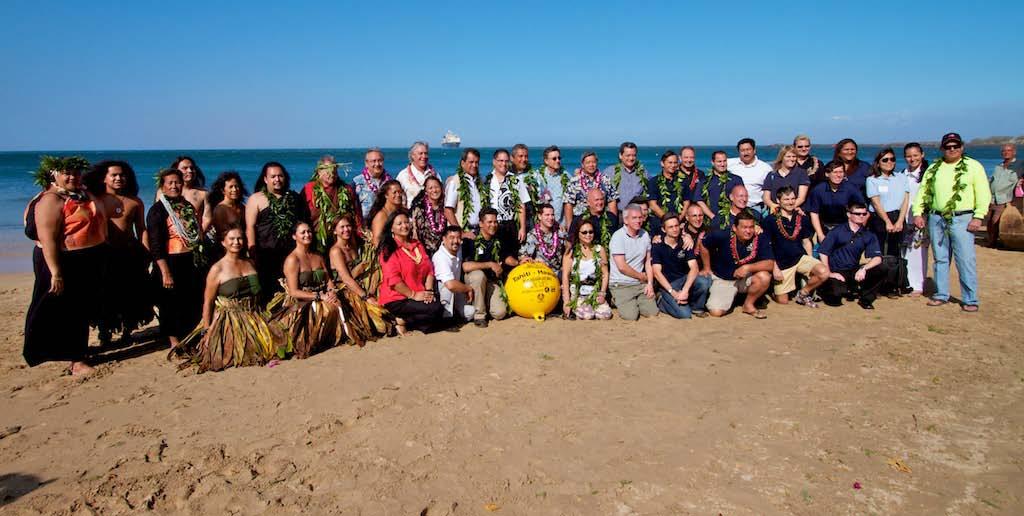
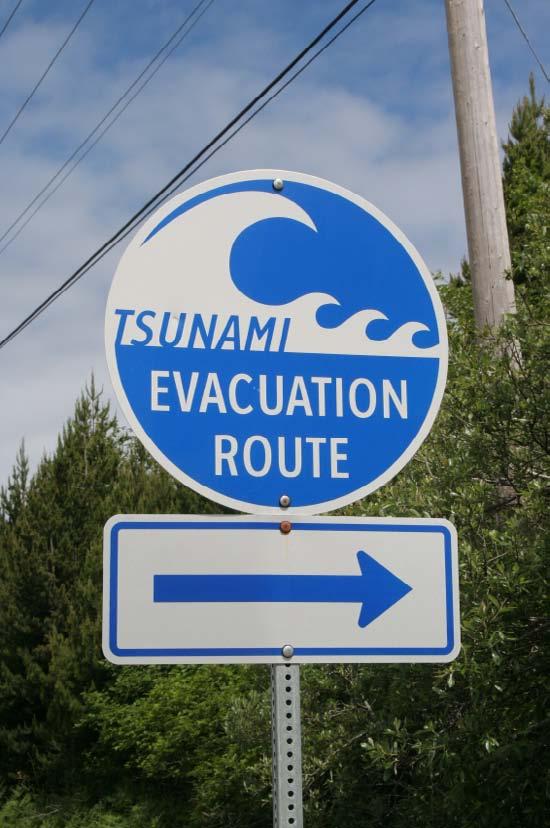
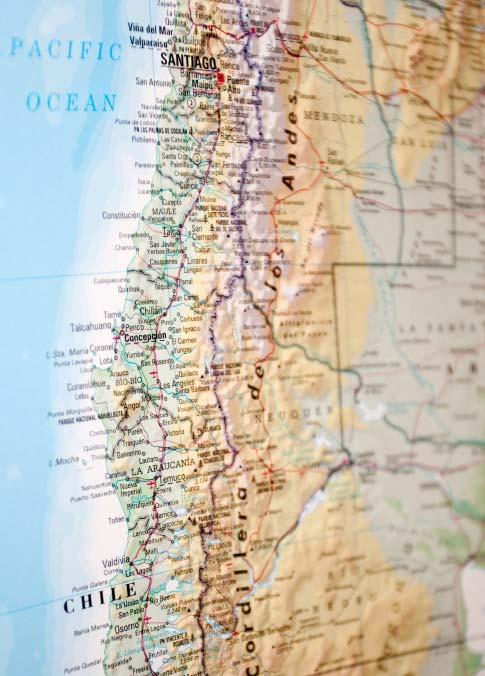
The day of landing was imminent with the ship a few kilometers off the coast. Many of us flying in for the landing were greeted with the warning of a tsunami from the cockpit, the concern arising from the Chile earthquake. The State was in evacuation mode as everyone fled to higher ground. Concern existed as the potential damage to the landing site. Fortunately, the tsunami waved passed without major incident. The weather was still, and anticipation was high for the easy landing. There were going to be some amazing cultural elements on that day, including a tribal greeting and the ceremonial buoy handover.
But as is wont to happen, the benign weather of the previous days became a 40 knot nor-easter for the big day. This did not hamper the celebrations, but it did prevent the actual landing, which occurred three days later when the wind moderated.
Honotua will provide French Polynesia with its first cable, linking Bora Bora, Raiatea, Huahine, Moorea and Tahiti with Hawaii. Owned by OPT (Office de Postes and Telecommunications) the cable connects to Hawaiian cable station at Kawaihae, owned by Wavecom Solutions (known till recently as Pacific LightNet). Nearby to the Southern Cross station and linked by a high capacity tie cable, this Wavecom station has been upgraded substantially to be capable of accommodating further cables beyond Honotua and the domestic Hawaiian interisland cable currently terminated there.
Some cable landings are very routine, being a simple implementation of infrastructure. So it was great to be involved with one that was different. The cultural overtones gave the landing a colour and character rarely experienced properly reflecting the significance of the occasion and resulted in something truly memorable.
Honotua cable adds yet another Pacific nation to those with cables so affording French Polynesia the consequential enhancement to business and commerce, health and education, research and entertainment that high speed abundant low latency capacity can bring.
Mr Sanford is 47 years old, lives in Papeete Tahiti, French Polynesia and is working for the Office des Postes et Télécommunications (OPT) since 1983 – He currently acts as International Relations Manager. Mr Sanford holds a law degree from the “Université française du Pacifique” in Tahiti (1991).
Maui Sanford is the current president of the Pacific Islands Telecommunications Association –PITA - a Fiji based non profit organisation whose main objectives is to promote telecommunication development in the Pacific (www.pita.org.fj).
Currently PITA membership is composed of operators, regulators and suppliers with a total number of around 135. Cooperation is established with all major international governmental or non governmental organisations (ITU, APT, PTC, APSCC, ICANN, APNIC…).
In relation with the interislands & Tahiti – Hawaii Honotua submarine cable project, he’s in charge of the permitting & licensing aspects both for French Polynesia and the United States
John Hibbard is a leading consultant in international telecommunications, particularly in the development of submarine cable projects. He has over 40 years experience in the telecommunications industry, mostly in international activities and submarine cables. Prior to becoming a consultant, John was Managing Director Global Wholesale at Telstra Australia, where he managed Telstra’s international business, and was founding Chairman of the Australia Japan Cable. He is now President of the Pacific Telecommunications Council and Chairman of its Board of Governors.
Telegraphing a Tsunami
Submarine communication cables have come a long way. Sure they transmit conversations, carry data, and help keep the internet connection alive between countries. But there’s a use I’m willing to guess few people would expect from this sprawling network of cables crisscrossing the seabed, tsunami detection.
Earthquakes, landslides, volcanic eruptions and even meteors hitting the ocean can trigger a tsunami. The trouble is tsunamis are hard to detect when in the open-ocean. Passengers dining on a cruise ship at the surface might not notice any unusual rolling around of tomatoes and veggies as the wave passes beneath them. Not until nearing landfall do the waves reach their most devastating power, such as the 2004 Indian Ocean tsunami, which killed more than 280,000 people in South-East Asia.
The current international warning system relies on coastal tide gauges and a network of deep-ocean pressure sensors, mostly in the Pacific, that transmit a steady stream of data to the United States and help forecast tsunami impacts. Since the catastrophic 2004 tsunami, U.S. government support for tsunami education and detection has grown. More than $100 million has been spent for tsunami research, the results of which are giving communities a better chance at knowing when a monumental wave might be headed their way.
But the current warning system, though good, is sparse and scattered, hardly covering all the tsunami prone regions. That’s where Manoj Nair, a scientist with NOAA and the University of Colorado at Boulder’s Cooperative Institute for Research in Environmental Sciences,
comes in. Nair and his colleagues, Alexei Kuvshinov of the Swiss Federal Institute of Technology in Zürich; S. Neetu of the National Institute of Oceanography in India and T. Harinarayana of the National Geophysical Research Institute also in India, discovered a new tool to add to the tsunami-warning arsenal, submarine communications cables.
“By monitoring voltages across this network of ocean cables, we may be able to enhance the current tsunami warning system,” said Nair.
The cables, Nair and his colleagues discovered, send out a little extra electrical signal when hit by a passing tsunami. It is the ocean’s saltiness that allows the cables to play this pivotal role.
Seawater likes to conduct electricity and does so all the time as it passes through the Earth’s geomagnetic field. The charge seawater produces in this way is not like sticking a finger in a light socket, otherwise no one would dare set foot in the ocean. But it’s this ability to conduct electricity that helps submarine cables stretching for miles transmit their signal.
Nair and his colleagues wondered if the same nature of the ocean would enable a passing tsunami to stimulate changes in the electrical field along the cable network. If so, it could help supplement warning systems in ways other options, like new sensors, might not. Submarine cables occur in most of the world’s oceans, no assembly required, and using what’s already there means it’s cheap. Most modern day fiber optic cables use a copper conductor to power their repeaters, and many cable
companies already measure voltages along the cables as part of their housekeeping activities. This could help make tsunami detection more accessible both logistically and to poorer countries.
The tsunami project isn’t the first time that submarine cables have played a role in the quest to understand the movement of water. In the 1980s, scientists J.C. Larsen and Thomas Sanford successfully estimated how much water moved through the Florida Strait by looking at the voltage it generated along submarine cables, a monitoring technique practiced regularly today. Another researcher, David J. Thomson noted changes in the electrical field across submarine cables after California’s Cape Mendocino earthquake in 1992. But while the electricity generating partnership of submarine cables and water movement was taking form in science, its potential for detecting tsunamis had yet to be put to the test.
For a case study, Nair and his colleagues chose the devastating 2004 Indian Ocean tsunami, the lethal outcome of the most intense deep-sea earthquake in the past 40 years. Using two kinds of computer models, Nair and his colleagues simulated both the tsunami and the electrical and magnetic fields generated in the ocean at the time. With the model churning away, they observed an electrical pulse along cable lines that coincided with the path of the wave.
One would think that a wave traveling through the ocean at the speed of a jetliner might generate a pretty big signal. But the change is surprising. “We estimate that the 2004 tsunami induced voltages of about 500 millivolts in the cables,” said Nair. “This is very small compared to a 9-volt battery, but still large enough to be distinguished from background noise on a magnetically quiet day.”
Nair cautions that there is still work to do in order to confidently isolate the tsunami signal from
other sources, such as Earth’s upper atmosphere, or other oceanic influences like ocean circulation and tides, whose signals can reach 100 millivolts or more.
Regardless, it’s astounding if you think about it. The wave that struck South-East Asia Dec. 26, 2004, killing 280,000 people, in the open ocean likely registered fewer volts than it takes to power your iPod®.
Shortly after this article was written, an 8.8-magnitude earthquake rocked the South American coast near Concepcion, Chile. The seismic rumble was the most intense earthquake to hit the country since 1960, when a 9.5-magnitude earthquake, the largest ever measured, shook the country. The earthquake that struck Saturday, Feb. 27, 2010, triggered a tsunami that endangered Hawaii and Japan. The wave that eventually reached Hawaii was small, but hit the northern Pacific coast of Japan with a 4-foot tsunami a day after the earthquake. Though a tsunami warning system expanded since 2004 helped alert Hawaii to the possible threat, a disclaimer on NOAA’s Pacific Marine Environment Laboratory website noted the potential inaccuracies stemming from preliminary data. This highlights the fact that tsunamis remain difficult to accurately forecast.
Morgan Heim is a science writer for the Cooperative Institute for Research in Environmental Sciences (CIRES), where she communicates groundbreaking research in the interdisciplinary Earth science, including polar process, hydrology, climate and geology. Heim is also a freelance multimedia journalist covering science and environment for such outlets as Smithsonian, the Nature Conservancy Magazine, and High Country News, and is an emerging league member of the International League of Conservation Photographers.
project Donet
1.System Overview Description
The DONET is a submarine cabled real-time seafloor observatory network for the precise earthquake and tsunami monitoring. For the purpose of understanding and forecasting the earthquake and related activities underneath the seafloor, the twenty sets of stateof-arts submarine cabled sub-sea measurement instrument will be deployed in seafloor at the interval of 15-20km. The twenty sets of preliminary interface are prepared in consideration of the improvement of observation capability in the future. Operating large-scale subsea infrastructure over a long period of time (20-30 years) is one of a challenge of underwater technology. The increase of measurement instruments has a big influence on the total system reliability, because of the state-of-arts instrument is a bottleneck to maintain long-term reliability. A novel system design concept is necessary for the observatory network development to make two demands such as ‘high reliability system design’ and ‘state-of-arts
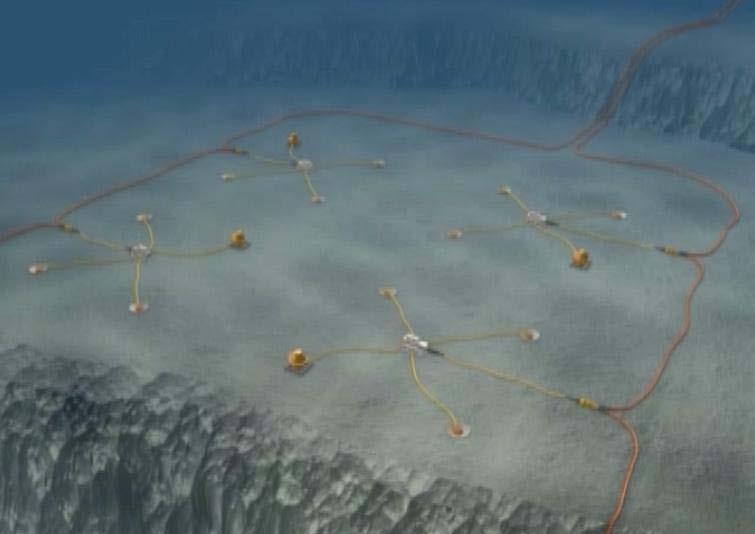
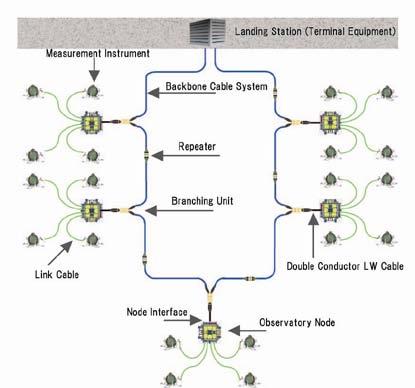
measurement’ united. The observatory network should be able to replace, maintenance and extend while operating, and should be have a redundancy for the internal or external observatory network component failure. To achieve these requirements, the DONET proposes a composition that consists of three major components with different system reliability. There are high reliability backbone cable system, replaceable science node, and extendable measurement instruments. Following figure1 shows the system design plan to be implemented in DONET.
2. Backbone Cable System
The backbone cable system provides the power feed line and the communications channel to the apparatus in the seafloor. The system brings a recently developed sub-sea telecomm cable technologies to fit for the high reliability requirement for 20years seamless observation. A constant current DC power supply technology provides high robustness against with unexpected power line failures. The
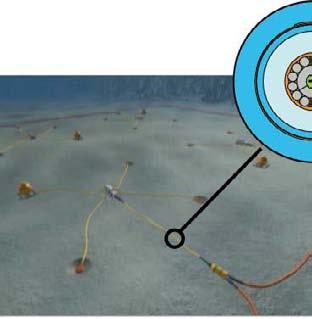
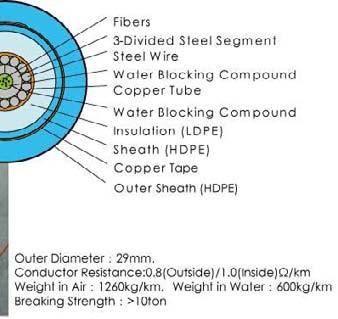
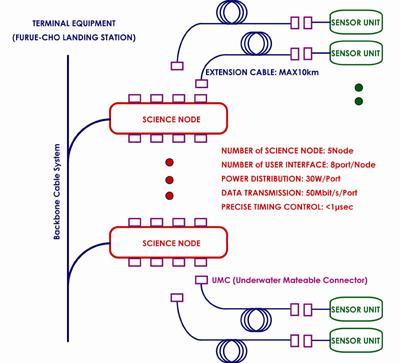
The five science node interfaces are scheduled to be equipped in the system. A duplicated pier-topier optical fiber physical communications channel is allocated between science node interfaces and terminal equipments on land to ensure the reliability. The optical amplifiers (repeaters) are prepared every 40-60km optical fiber length interval to transmit the signal longer distance without degradation. These repeaters correspond to the coherent optical time-domain reflectometry (C-OTDR) optical fiber fault detection system. The branching unit (BU) is an interface for science node interface. This unit controls the high voltage power feed path in backbone cable system, and has a function to separate a science node when the node interface one by one becoming unexpected status. For the connection between a BU and a science node interface, a dual conductor light weight submarine cable that met ITU-T recommendations is being developed in this project as Figure2.
3. Science Node
The science node is a device with the role of hub that connects the backbone cable system to sub-sea instruments. Many of novel technologies are consolidated in the science node development. A hybrid (fiber optic and electric) / high voltage sub-sea wet mate / demate interface make possible to put on and take off the science node from backbone cable system. Eight hybrid connectors per a science node have been reserved for measurement instruments. The power distribution control, data transmission control, and precise timing control function in the science node are most critical components of DONET development. The power distribution control system (Figure3) receives 500watts of constant current DC power supplied from the terminal equipment, and distributes 45 watts of secondary power output to a measurement instrument as the occasion demands. The secondary power output features a constant current DC power output system to ensure the reliability of sub-sea system and efficiency of power transmission to measurement equipment. The power distribution control system has a mechanism to balance the power consumption of science
node constant to prevent the system from unstable power distribution status. This function is essential for monitoring the condition of entire observatory network.
The data transmission control system handle data link and precise timing / clock control between measurement instrument and terminal equipment. The STM (Synchronous Transfer Mode) on SONET / SDH (Synchronous Digital Hierarchy) is selected to realize the precise time synchronization requirement. The data link between terminal equipment and science node is running at approximately 600Mbit/s. The bidirectional data transmission between measurement instrument and science node, is running at 50Mbit/s. precise time synchronization is a key function of science use of submarine cable system. The synchronous transmission system makes possible the high accurate time synchronization between GPS clock on terminal equipment and measurement instrument in seafloor. The timing circuit develops aiming at the accuracy of time synchronization of less than 1microsecond in this project.
MEASUREMENT INSTRUMENTS
Design of observation network
Observation targets of DONET are micro to large earthquakes, slow slip of the plate boundary seafloor deformation, and Tsunamis that occur beneath the area of DONET network. Currently, no long-term seafloor observatory exists in this area. Availability of no seafloor data is large limitation for us to observe these events in the seafloor. We aim, by DONET installation, not only to improve detection ability of events, but to model these events quantitatively with better accuracy. Number of observatories for DONET installation is limited from technical, financial limitation. We designed our submarine cable observation system to increase the number of observatories
significantly (in an order of ten) from present submarine cable network systems for earthquake monitoring which allow only several seismometers installed in each observation node. Increased number of observatory may be installed by extending cable from each observation node. Using multiple extension fiber-optic cables from observation node, our design allow maximum of 40 observatories from five observation nodes connected to backbone submarine cable. In the initial installation of DONET, by optimizing observatory density and location, we plan to install 20 observatories distributed densely, covering the area from the trench axis to the main rupture area of the last Tonankai earthquake. This distribution of observatory enables us to precisely determine hypocenter of small to large earthquakes and detect relatively small ground deformation in the seafloor. We evaluated this ability of DONET network by computer simulation.
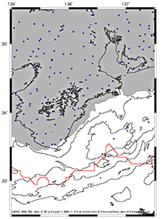
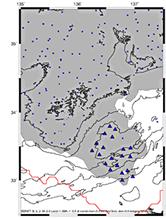
These figures shows results from our simulation. Distribution of existing land seismic station (blue dots) and DONET observatories (blue triangles). Precision of magnitude 2 earthquake location simulated using only land observatories (Left) and both land and DONET observatories (Right), are shown. Hypocenter accuracy better than 5 km is shown by gray shaded area and epicenter accuracy better than 5 km is shown by red line. Area of reliable hypocenter resolution from only land observatory data (Left) is only in land. In the seafloor, it is clear that we cannot expect good accuracy for earthquake depth. Even when we look at epicenter location (not depth of earthquake), area of reliable location (shown by red line boundary) is limited in the seafloor. With DONET data, we can resolve both epicenter and depth of earthquake in the seafloor beneath the DONET network (Right). By simulating with different DONET observatory distribution, we optimized our network so that area of good hypocenter location is maximized, yet
there is no obvious gap of such area in and around the DONET network.
We also evaluated detection ability of ground deformation due to small precursory slip event. With precision observation of seafloor pressure change in densely distributed seafloor quartz pressure gauges, we expect to identify occurrence of small ground deformation. By such observation, slow slip event on the plate boundary may be detected. An event of moment magnitude 6 slip on the plate boundary in the seafloor was evaluated for detection by DONET network. Our simulation result suggests that such detection is possible if such event occurs below the DONET network, and seafloor pressure gauge has resolution of 1 cm or better. Such detection of events in the seafloor is impossible only with current GPS geodetic observation network which are dense, but only on land.
Instrument Design
The observation targets of DONET, such as small to large earthquakes, slop-slip events on the plate boundary, Tsunamis, require precision
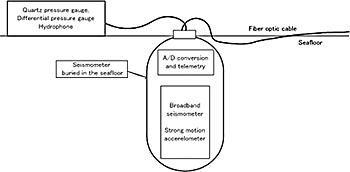
seismometers and pressure gauges. A small earthquake has very small amplitude and typically observed in frequencies higher than 1 Hz. Large earthquakes show very large acceleration up to 2 G or so. On the other hand, slow slip events may be observed between 0.01-0.1 Hz, and even lower frequencies such as days or months. In all, dynamic range and frequency band of DONET observation target are wide (smaller than 10-9 m/s2 to 2 G) and broad (from 1/years to 100 Hz). To cover the dynamic range and frequency band, we plan to combine two types of seismometer and three types of pressure gauges installed in each observatory. Two types of seismometer are a broadband seismometer to cover weak motion in the frequency band of 1/360 Hz to 100 Hz and a strong motion accelerometer to cover strong motion in the frequency band from DC to 100 Hz. The three types of pressure gauges are quartz pressure gauge to observe Tsunamis and seafloor deformation by absolute pressure from DC to approximately 1 Hz, a differential pressure gauge to observe broadband seismic waves as a small change of seafloor pressure from 1/200 Hz to 20 Hz, and a hydrophone to observe high frequency acoustic waves. A differential pressure gauge is very sensitive and can detect pressure change of 0.1 Pa or smaller in frequencies 0.02-0.08 Hz, where very low frequency earthquakes are known to be observed.
To determine the seismometers to combine for the DONET observatory, we evaluated noise characteristics of seismometers of different kind in a vault of Matsushiro Seismological Observatory, Japan Meteorological Agency. Evaluated seismic sensors were three types of broadband seismographs (Streikeisen STS2, Guralp CMG-3T, prototype
version of Kinemetrics Cronos), three types of strong motion accelerometers (JAE JA-5 typeIII, JAE JA-40G, Metrozet TSA-100S), and four types of geophones.
In DONET network observation, we aim to observe slow slip event by seafloor pressure change. As well to monitor Tsunamis generated in and around the network, to monitor ground deformation in vertical direction, quartz pressure gauge, that gives depth of seafloor in terms of seafloor pressure, is used. Quartz pressure gauges are stable over years typically better than 0.5 psi/year. Effect of seafloor deformation due to slip events on the plate boundary is usually very small. Therefore, the stability of quartz pressure gauge used is very important, and have to be evaluated. We evaluated quartz pressure gauges for their long-term stability in environment similar to the seafloor. We installed quartz pressure gauges in a laboratory, simulating seafloor environment by dead weight gauge and water bath to maintain constant pressure at 4000 psi and constant temperature at 4°C. Manufacturer of tested quartz pressure gauges were Hewlett Packard, Paroscientific, and Clark Oilfield Measurement. Two different full-scale sensors, of 10000 psi full-scale and 6000 psi fullscale from Paroscientific quartz pressure gauge
were evaluated. The laboratory test for more than continuous 150 days period was conducted to determine the type of quartz pressure gauge for the DONET observatory.
To isolate seismometers from the effect of seafloor current flow, we plan to design the seismometer package to enable surfacial burial in the sediment, while the pressure gauge package will be installed in the seafloor. From experience of previous seafloor deployments of Tsunami-meters, care
will be taken to minimize temperature change of pressure gauges. These are the part of actions taken to achieve very low noise observation by the future DONET observatory.
Sea Trial
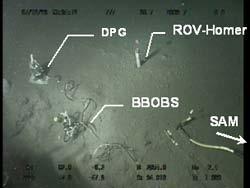
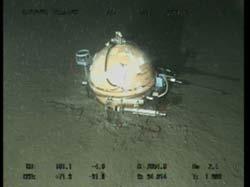
We’ve compared and evaluated the background noise data between the buried type seismometer and the seafloor type seismometer at the Sea of KUMANO in 2007. To find out what kind of influence will occur to the data with different conditions (pressure, temperature or underflow). The results show that the buried type Seismometer with less background noise than the seafloor Seismometer at most condition. With the vertical motion, these two results were the same under a calm water condition. With the Horizontal motion, the buried Seismometer data showed about 10 times quieter than the seafloor Seismometer.
RELATED TECHNOLOGIES
1. Cable Laying ROV
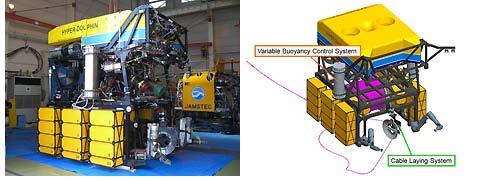
The cable laying ROV is remodeling of Japanese research ROV Hyper Dolphin for loading 10km length of extension cable and make possible to laying a cable between any two points on seafloor. The cable laying system is composed of three main components these are cable bobbin elevator, tension controlled extension cable pay out system, and VBCS (variable buoyancy control system). The
cable bobbin elevator make possible to equip and release the cable bobbin together with 10km length of extension cable in air and water. The cable payout system can control the cable payout speed voluntarily to manage the reasonable cable slack correspond to laying course or undulated seafloor terrain. The VBCS compensates the up to 100kg of buoyancy variation during the cable pay out and wind up operation to maintain the mobility of the ROV in water. In addition to these main components, cable laying ROV comes to be able to conduct cable recover operation by equipping it with a cable traverse actuator. Each component actuated by the hydraulic pressure distributed by the ROV hyper dolphin hydraulic interfaces for user payload.
Survey Information
In the first year of the DONET project, the location of the observatory has been tentatively determined. Then the deep-sea survey and other fundamental examinations related to deployed sensors have been conducted by using JAMSTEC’s research vessels and deep-sea vehicles. Natural events such as slumps, slides and turbidity currents on steep, sediment covered slopes, and earthquake events are potentially risks to the DONET in the deepsea area in the lifetime. Both deep-sea survey and risk assessment are required in order to find better observatory’s sites and safer submarine cable route. Sensors’ installation tests have been also done since 2007. Their results could contribute to the actual sensors’ development. We continue to carry out our surveys before deployment of DONET.
Click here to visit the Project DONET website.
As you are aware, an 8.8-magnitude earthquake struck just off the coast of Chile on Saturday, February 27 and caused catastrophic damage to the country. The University of Concepcion, currently Chile’s leading institution in oceanography, was hit extremely hard by the earthquake and is trying to re-build their oceanographic research and academic operations affected by this event.
The School of Natural Sciences and Oceanography facilities on the main campus will need significant help. The field station in Dichato was destroyed with the Kai-Kai, the school’s coastal vessel, stranded on land. Laboratory and field equipment and instruments are lost or have been destroyed both at the Marine Station at Dichato and the main campus in Concepcion. The pictures of Dichato are heart wrenching. The University of Concepcion is still trying to take a detailed inventory of their equipment, but needless to say, a lot of work and money is needed to recover from this disaster.
The faculty and students of the University of Concepcion are known to many of us as colleagues and friends. They need our help. Many of you have expressed interest on donating money to help provide an opportunity for them to rebuild their research and education infrastructure. The Consortium for Ocean Leadership has set up the Con-
cepcion Oceanographic Relief Fund with our bank, SunTrust, so that we can all make a difference. Deposits to this fund can be made in three different ways. IRS Tax receipts will be issued for all donations.
1. By check.
Make check out to Concepcion Oceanographic Relief Fund and forward to Ocean Leadership. Tammy Hancock will be handling the deposits of these funds and is the contact for any questions about the account.
1201New York Avenue, NW Fourth Floor Washington, DC 20005
2. By credit card.
A link on the Ocean Leadership web site is currently being set up for this purpose. It is anticipated that this link will be active within a week.
3.. By wire transfer.
Domestic wires:
ACH routing number: 061000104
Account number: 1000109780469.
Name of account: Concepcion Oceanographic Relief Fund
Bank Name: SunTrust
Bank Address: 1445 New York Avenue, NW Washington, DC 20005
Foreign wires:
SWIFT Code: SNTRUS3A
Account number: 1000109780469.
Name of account: Concepcion Oceanographic Relief Fund.
Bank Name: SunTrust
Bank Address: 1445 New York Avenue, NW Washington, DC 20005
I am sure that whatever amount you deem appropriate to donate will be greatly appreciated by our Chilean colleagues.
Thanks for your consideration.
Robert B. Gagosian, Ph.D. President and CEO
Consortium for Ocean Leadership
ENTELEc 2010
amanda prudden
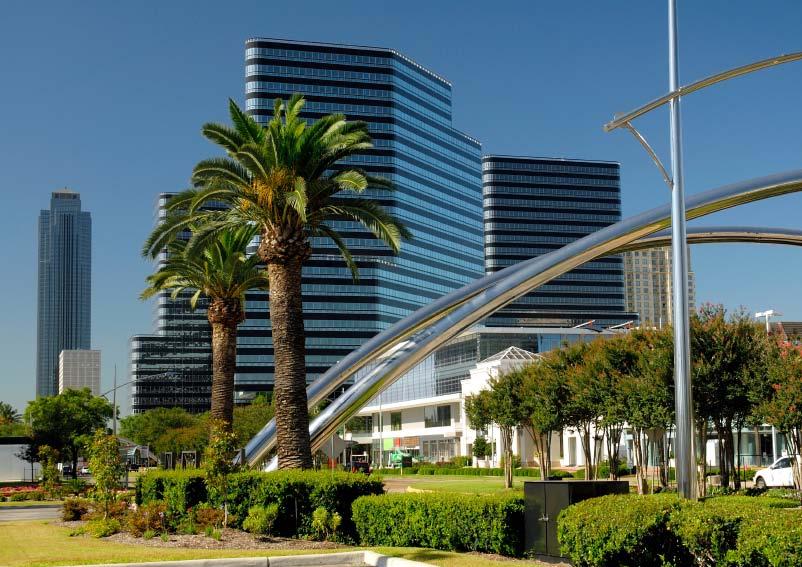
The ENTELEC 2010 Conference & Expo is returning to Houston, Texas for the 82nd annual event. Located at the George R. Brown Convention Center, the show gathers 1500 pipeline and gas technology professionals for quality education, technical training and an exhibit hall featuring more than 200 companies. This year’s event will be held April 13-15, 2010.
Based on feedback from attendees and vendors, the 2009-2010 ENTELEC Board of Directors’ have added more educational opportunities in addition to more interactive discussion and roundtable slots during the 3-day event. The conference theme, “Open Roads, Open Minds, Open Discussions,” evolved as Director’s decided to “open” the conference up for more opportunities to talk and discuss amongst industry peers.
“Our attendees have told us they come to ENTELEC to discuss ideas, find solutions to problems and meet with vendors to provide those solutions,” said ENTELEC President, Kenny Brazzale. “We want to offer them more opportunities for these discussions to take place. Our directors’ have worked hard this year to make subtle changes that will benefit both the attendee and exhibitor.”
The ENTELEC Conference & Exposition provides an incredible opportunity to take advantage of cutting edge technical education and training, hands on exhibits and product demonstrations, and industry networking. ENTELEC is a resource that will increase the attendee’s industry knowledge and advance their professional careers.
“Participating as an ENTELEC Committee and Board member has given me an opportunity to work with and get to know some great people in the SCADA industry as well as the opportunity to give back to the SCADA community. Attending the annual ENTELEC show is a great way to network with your peers, and it helps you keep up-todate with what others are doing.” Greg Vaughn, Kinder-Morgan
ENTELEC will soon be offering online training and education to its members. As 2010 continues, industry personnel can look for more 101 training on the ENTELEC website at www.entelec.org
“ENTELEC is the avenue for individuals who work and support the energy field to share information, learn about new technology while integrating with older equipment and systems, having the opportunity to meet others throughout the industry - both vendors and corporate members - who can help answer questions/solve problems and expand the individual’s knowledge. The conference and seminar format allows the participant to obtain information and knowledge from others while having time to experience firsthand new equipment and hardware.” Richard Nation, Copano Energy.
Technical Sessions & Professional Development Training
Attendees can take advantage of the energy industry’s most comprehensive technical conference with seminars, round tables and discussions that focus on real-world challenges, applications and will provide take-away solutions. Attendees can also focus on sessions dealing with rapidly evolving technologies such as the growing enterprise security issues of today.
The ENTELEC education program has been “reengineered” to include open discussions and more interaction with peers and vendors that will provide attendees with more information, options and eventually, more solutions.
This year’s technical sessions include: “When do Solar Electric & Utility Back-up Systems Make Sense?”, “Areas for Redundancy in Ethernet systems with focus on IEC 61850 Applications”, “SCADA Communications SecurityAuthentication, Encryption, Integration”, “Tower 101”, ”Integrating Field Infrastructure Using 3.65 GHz”, “The Evolution of Data Collection for Gas
Measurement”, “Improving Pipeline Integrity & Performance through Advance Leak Detection and Control Systems” and “The Future of Mobile VPN Technology: 2010 and Beyond”
A complete Schedule of Events can be found at the ENTELEC website at www.entelec.org
SCADA Security: What’s on the Horizon
On Wednesday, April 14th Al Rivero of Telvent will lead a panel discussing “SCADA Security: What’s on the Horizon”. On Thursday, April 15th, the highly anticipated Roundtables return. Attendees can spend the afternoon with fellow industry peers at either the SCADA or Telecom Roundtable.
GE Digital Energy - MDS Wireless Technical Training Lab at ENTELEC 2010
Maximize the investment and productivity of your wireless infrastructure by increasing your knowledge of GE Digital Energy’s MDS wireless solutions at the ENTELEC 2010 Technical Training Lab. This experimental, hands-on seminar will provide in-depth technical training on GE MDS wireless equipment, allow participants to engage in real-world application discussions with industry and product experts, and facilitate peer learning through collaborative idea sharing.
NEW – Professional Development Sessions
ENTELEC is expanding beyond just the technical sessions to feature two professional development classes.
What’s Wrong With THAT Generation?!?
For the first time in history, four generations are sharing the workplace at the same time. For many people, it does not seem like there is enough room for such different perspectives to co-exist peacefully and this sentiment is creating one of the biggest corporate challenges of our times. While there are many differences among the Veterans/ Traditionalists, Baby Boomers, X-ers and Y-ers that can cause confusion, aggravation and frustration, there are also many unique qualities that promote innovation, cooperation and collaboration if we can get past the differences. This high-energy, experiential learning session guides differences each generation possesses and learn practical ways to focus on those in a positive way to achieve successful interpersonal and business results.
Balance Schmalance–Is There Really Such a Thing as Work-life Balance?
The term “Work-life Balance” seems like an oxymoron to many people! Is there really a perfect
balance that can be achieved between work and the rest of our life? Or is that idea kind of like a unicorn—nice to think about but never going to happen in reality? The reality is that most people strive to achieve the beneficial outcomes of a healthy Work-life Balance but there is not a perfect, one-size fits all, generic formula that defines what the balance looks like for everyone! Work-life balance looks different for each person because we all have different priorities and factors influencing our lives! In this session, participants will have the opportunity to evaluate their own set of priorities, consider how the choices they make support their defined priorities and to use principles of personal discipline and accountability to achieve their own unique balance of “work” and “life”.
Exhibit Hall
The ENTELEC exhibit hall allows attendees to be among the first to see the latest products released in the marketplace. Over 200 manufacturers, dealers and distributors will offer a variety of products and services that serve the oil, gas and utilities industries. This year’s exhibitors currently include: Telvent, Motorola, GE Digital Energy – MDS, Sprint Nextel, Honeywell, Evolution SCADA, Emerson Process Management and many, many more.The exhibit hall is open Wednesday from 10:00am to 5:00 pm and Thursday from 10:30 am – 2:30 pm.
Steve Uzzell, a former photographer for the famed magazine, National Geographic, will present the keynote address on Wednesday, April 14th at 9:00 am.
Great photographers are right brain thinkers; they have a way of visualizing their problem and arriving at their solution. What can we learn from this? “Open roads, Open minds” is Steve Uzzell’s way of showing how he thinks we can learn from it by relating his decision-making to all creative problem solving. Using his striking photographs as illustrations of his metaphor about possibility and creativity, he invites to take advantage of his experience and vision, providing more than a little magic along the way.
As ENTELEC responds to the changes our attendees have requested, the 2010 ENTELEC Conference & Expo will now feature more opportunities for “Open Discussions” between vendors, attendees and the industry.
Launched in Denver, the highly successful Vendor ShootOut event brings together vendors and attendees for an open forum discussion on problems, solutions, changes and product capabilities. It’s a candid discussion with vendors on their products and services and how they are used in “real-world” formats.
With all these offerings, the show will provide attendees with even more compelling reasons to return to Houston for the 82nd Annual Conference & Expo. Professionals interested in more Conference & Expo information, or membership information for ENTELEC can visit their website at www.entelec.org.
Amanda Prudden is the Association Manager for the Energy Telecommunications & Electrical Association. She has worked with ENTELEC for five years in the areas of membership growth, conference and exhibition management, training seminars and marketing. Prior to joining ENTELEC, Ms. Prudden worked at the corporate office for Omni Hotels Corp.
Theodore Vail, president of AT&T in 1907 proposed “Universal Service” where the landline phone charges were structured so that phone service to a home at then end of a 3 mile roadway can have the same quality at the same price as someone else living in a multi-story apartment building in a city pays. This was supported by a government supervised monopoly that allowed small “overcharges” in densely serviced areas that provided funds to connect rural areas. One might think that a similar principle could be applied to high speed internet service though it runs against the current corporate thinking of never providing anything at what might be considered a loss let alone at a reduced profit.
At least in the US much high speed internet service is supplied by cable TV companies. Since they are already locally regulated monopolies the principle of universal service could be applied to them as well as the requirement of providing internet service, though that requirement may require upgrading to a 2-way system. The technology exists so only the will is required.
Cabling. In the past I note that new cable systems were often built, installed and operated by consortiums. Especially, noting the glut that formed around the year 2000 there were many individual companies built systems hoping to be the only supplier between locations only to find that they were one among several and their predictions of growth were reduced by the competitors often causing bankruptcy, etc. the thought of returning to consortiums seems advantageous. To be simplistic, part of a lot of money is still a lot of money. Loosing the bid yields nothing. Consortiums seem to lead to better planning and conservation of resources.
-Rich Riggs *****
Guy, I read and enjoyed “Travels with Charlie.”
-Chris Leste
I’d like to add a comment to Jean Devos’ thoughts about a “Green Attitude” in Undersea
ENTELEC
13-15 April 2010
Houston, Texas, USA www.entelec.org
SubOptic 2010
11-14 May 2010
Yokohama, Japan www.suboptic.org
Submarine Networks World Africa 2010
24-27 May 2010
Johannesburg, South Africa
www.terrapinn.com/2010/submarineza/
International Cable Protection Committee
1-3 June 2010
Mauritius www.iscpc.org
Submarine Networks World 2010
1-3 September 2010
Singapore www.terrapinn.com/2010/submarine
Offshore Communications World Asia 2010
28-29 September 2010
Kuala Lumpur, Malaysia www.terrapinn.com/2010/ofc
Letter to a Friend
by Jean Devos
My friend,
Let me tell you a few things about SubOptic and some little things behind SubOptic.
The history of SubOptic can be modestly compared to the history of the “World Expos.” The very first world expo took place in London in 1851, followed by another one in the same location in 1862. England was then the cradle of the industrial revolution. When the French Emperor Napoleon 3 decided to organize the 1867 world expo in Paris with the name “exposition de l ’Art et de l’Industrie,” the idea was clearly to promote the French industry and to show the world that Paris was a capital city, second to none, especially London. The Russian Tsar and many heads of state were invited to the expo, including Queen Victoria. The Eiffel tower was constructed for the 1889 world expo, and the message conveyed by its design was crystal clear. No surprise, this year, 2010, a world expo is taking place in Shanghai!
In a somewhat similar and logical manner, the very first submarine cable conference was actually organized in London in 1979 by STC and IEEE. It was a good, modest, technical meeting. The event had no message, and no hidden ambition attached to it.
My secret idea, when we launched the first event in 1986, was to put forward “Alcatel Submarcom” as a key actor. At that time, Submarcom was perceived as a second tier player compared to STC and ATT. The choice of Versailles, a prestigious symbol of power, done purposely to convey the message, without having to say it too loudly. You were there my Friend, and I am sure you remember the concert in the Royal Chapel “Musique à la Cour des Bourbons!”
Believe me or not, I had an even more hidden target in the back of my mind: to raise the visibility of the submarine cable activity within Alcatel, and especially to the eyes of the top corporate management. Submarcom was sitting between two companies within the group, with a very different culture, the cable side and the electronic side. Nobody, at the highest level, had a good knowledge of what Submarcom was all about. SubOptic 86 did this job very well!
And I did two little things which ended up being extremely valuable. We gave the event a name: SubOptic 86. The activity was living a transition from the analog/ coaxial era to the digital/optical period. By this simple fact we had created a concept. Also important was the
committee of a handful of industry senior figures that we managed to put in place, giving the event a kind of international blessing.
A few years later, I tried to convince ATTSSI, namely Bill Carter, to grasp the ball. Things were not ripe over there. So we did it again and that was Versailles 93. The temptation was there to establish Paris as the permanent place for the event, but at the closing ceremony I was able to announce that the next event would be hosted and sponsored by SSI. Bill would not let anybody else organize the following event. SSI could no longer remain as the sole supplier of ATT. Deregulation, privatization!
I very well remember some of my face to face discussions with Bill, who had the vision of the future high capacity global network. Such vision was requiring a new SSI with the ambition to “cable the planet.” Remember AC1, Africa One, FLAG, and Global Crossing. And that was San Francisco 97, where it was announced that the next event, in 2001 will be hosted by… KDD scs!
Yes, my Friend, in 1993 Doctor Niiro would not let anybody else grasp the ball. It was his hour! He had a vision and a legitimate ambition for his country that had, in his mind, for too long played in the backyard. Time for SCS to be a front runner: SMW3, APCN, TPC5, PC1, and finally TAT14! That was Kyoto 2001!
Now I can hear your question my friend: Things are now different?
Yes, very different now, and I'm not sure I can read and analyze it the same way I just did here above. It seems to me that neither ASN neither Tyco, the so dominant players, felt the need to invest so much time and efforts in such an event. Hosting Monaco 2004 and Baltimore 2007 was a kind of statutory obligation. And it is probably the case for NEC and Fujitsu in the coming Yokohama 2010. They are doing what the community is expecting from them. And, to take it positively, that could very well be the sign that that our industry has reached maturity. SubOptic is now really the industry gathering, not any more a tool in the hand of a few ambitious guys!
What do you think?
January:
May:
July:
September:
November:
Cable
Advertising
SALES COORDINATOR
Kristian Nielsen
Tel: +1 (703) 444-0845
Email: knielsen@subtelforum.com
SALES REPRESENTATIVE, EUROPE & AFRICA
Wilhelm Sicking
Tel: 0201-779861
Email: wsicking@subtelforum.com
SALES REPRESENTATIVE, NORTH & CENTRAL AMERICA
Ben Skidmore
Tel: +1 (972) 587-9064
Email: bskidmore@subtelforum.com
SALES REPRESENTATIVE, ASIA PACIFIC
Michael Yee
Tel: +65 9616 8080
Email: myee@subtelforum.com
Copyright
by Kevin G. Summers
My wife's grandparents held a huge party to celebrate their 50th wedding anniversary a few years back. They rented out a banquet hall in Williamsburg, Virginia, and invited brothers, sisters, children, grandchildren, and my own daughter who was, at the time, their only great grandchild. We had a hell of a time ringing in their golden anniversary, and every single one of us, from the older brother who lived through the Great Depression to my daughter, realized that it's important to mark occasions such as this with a celebration.
This is the 50th issue of Submarine Telecoms Forum magazine. We've had some memorable articles in that time. Like the cableship captain that rescued some passengers from a sinking ship, or the award-winning Sherry Sontag, who wrote about the U.S. military tapping Soviet submarine cables during the Cold War. How about Bill Burns and his fascinating article
marking the 150th anniversary of the Great Eastern? Or Guy Arnos' travelog as he trekked across Angola for three weeks?
It's been an honor to work with some of the leading voices in our industry as they labored to delve into our theme on any given issue. I can tell you that our authors put an incredible amount of effort into their stories, and without them, SubTel Forum couldn't exist. I'd like to raise a glass to every one of them, especially my feature authors Jean Devos and Stewart Ash, who provide content for every issue. Thank you all for contributing to SubTel Forum.
Where do we go from here?
Our industry has certainly seen some ups and downs in the last decade, but the global desire for broadband capacity is only increasing. Some areas still have too much capacity, while other regions are starving for any connection at all. No matter where the current industry hot spots are, SubTel Forum will be there. If the market spikes, or tanks, we'll be there to bring you the latest news and developments.
We have big plans for SubTel Forum in the coming year, and I hope you'll join us for our next 50 issues.
Please take a minute to drop me a line. I'd love to hear your thoughts on SubTel Forum, the state of the industry, or anything else you want to talk about. Just click the letter to the editor icon below. And please take our survey, which is also linked on this page.
Finally, thank you to all of our readers for supporting SubTel Forum. We couldn't do it without you.
What do you think? Click on the Letter To The Editor icon and drop me a line. I’d love to hear from you.