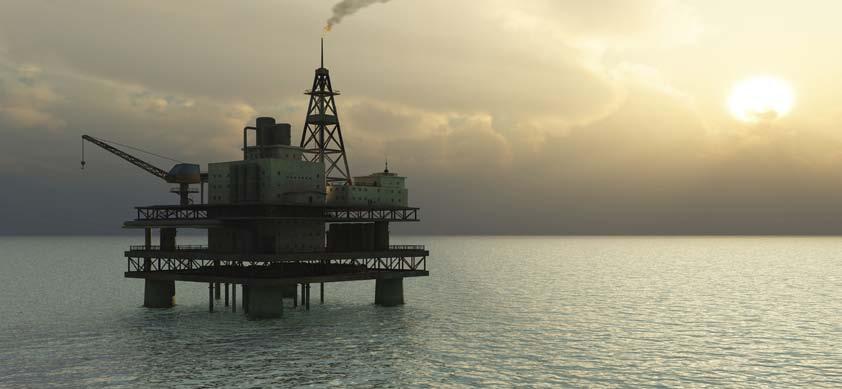
Welcome to the 46th edition of Submarine Telecoms Forum, our Oil & Gas issue. Following another interesting Submarine Networks conference in Singapore, I had the opportunity to visit Western Australia and environs.
To any outsider, Oz is by its very nature an amazing place - where surfers in the south share their waves with Great Whites, or sunbathers and casual boaters in the North dodge crocodiles laying in wait - and to this frequent beach comber and diver I found it both unnerving and exhilarating.
But I also must admit that the feel of the area was incredibly exciting. Gone was
the doom and gloom economic malaise I left behind in Virginia. The attitudes were positive and forward looking. I thought one afternoon sitting, in a café drinking a “flat white” coffee, that this is how Houston must have felt in the 1970s. Building was booming; people were smiling; things were happening. This is Dodge City, man.
Things are indeed happening in the Australian oil patch, and they are signing 25+ year production contracts for basins still under construction for customers in Japan and beyond. Things look up, up, up.
And just as other managers in other energy boom times have had to decide whether to go fiber or not, so, too, local
Oz IT managers are considering now how best they will control and manage and talk with a diverse array of offshore assets. Similar decisions have been made before, and it will be interesting to watch how they downunder in turn will choose.
A synopsis of current news items from NewsNow, the weekly news feed available on the Submarine Telecoms Forum website.
September 11th, 2009
x WFN Strategies Featured in Offshore Technology International
September 10th, 2009
x Pacnet Teams Up with Office Squared to Power Hangzhou’s New Outsourcing Hub
x Tata Communications Extends WAN Ethernet Service to China
September 9th, 2009
x FCC Announces Regulatory Fee Changes for Submarine Cable Systems
x TDM selects Alcatel-Lucent to extend nation-wide optical backbone and bridge digital divide in Mozambique
x AccessKenya and Tata Communications Sign Partnership Agreement to Launch Tier 1 Internet Point of Presence in Kenya
x Nexans wins a 39 million Euros power cable contract for an offshore windfarm project in Belgium
September 8th, 2009
x UUNET Connects to High Speed Internet via SEACOM
x EASSy Brings Business Opportunities to East Africa
x Telecom Experts in Africa Question Fiber Optic Demand
September 7th, 2009
x East Africa Not Ready For SEACOM?
x Telefónica and China Unicom enter into a broad strategic alliance and a mutual investment agreement
x Proposed Cable In Bangladesh
x Glo 1 Lands in Nigeria
September 4th, 2009
x Zain Tanzania Connects to SEACOM
x Nortel Achieves 12000Km 40G Milestone On Submarine Cable
September 3rd, 2009
x New Cables Will Kick-Start Africa’s New Broadband Era, Pyramid Research Finds
x New Artel Negotiating With SEACOM
September 2nd, 2009
x Gateway Communications goes live on SEACOM
x Tanzania Telecommunications Company Limited Connected to SEACOM
x Singapore Listco To Acquire Fibre-Optic Cable Business For S$376m
x Global Crossing Deploys New Solution for Capacity and Speed
September 1st, 2009
x Gulf Bridge International Appoints The David Ross Group as Overall Program Manager for its International Network Development
x Join the World - Class Keynote Speakers at SubOptic 2010
August 31st, 2009
x Tata Communications and Neotel Launch SEACOM Cable System
x Altech’s K DN Acquires Stake In TEAMS
x Australia Japan Cable and Pacific Crossing Limited Announce a Gigabit Ethernet service between the US and Australia
August 28th, 2009
x Submarine Cable Highlights Recent FSM Meeting
x PPC-1 successfully transmits first light between Sydney and Guam
August 27th, 2009
x Nexans secures major frame agreement with BP Exploration and Production Inc. for deep water umbilical projects in the Gulf of Mexico
August 26th, 2009
x WFN Strategies to Develop and Operate Remote Network Operations Center for ADONES
x Reliance Communications and China Telecom provide the first terrestrial cable to directly connect China and India
August 25th, 2009
x Safaricom Tests TEAMS Undersea Cable in Kenya
x Southern African Telecommunications Association Undertakes Submarine Cable Feasibility Study
x SEACOM Connectivity Extends Across East Africa
August 21st, 2009
x SAT-3 Service Restored
August 20th, 2009
x Broadband in for another price fall and capacity boost from Southern Cross
x OMM awarded guard vessel contract for Transpower Offshore GmbH
x CDP Group Powers On-Demand HR Outsourcing with Pacnet Internet Services
August 19th, 2009
x Outbound Communications Back to Normal after CHT’s Urgent Measures to Restore Damaged Subsea Cables
x Neotel Spreads Its Wings To Southern Africa Region
August 18th, 2009
x Tata Communications And Tyco Telecommunications Complete TGN-Intra Asia Cable System
August 14th, 2009
x Broadband in for another price fall and capacity boost from Southern Cross
August 13th, 2009
x Hibernia Atlantic Is The First Transport Provider To Offer Native 40 Gbps Wavelength Capacity Across The Atlantic For Commercial Use
x OMM opens office in Bremen, Germany
x WFN Strategies Ranks on the 2009 Inc. 5000
x CUCN Submarine Cable Down, CHT Setting up Backup Routes
August 11th, 2009
x China Crescent Enterprises, Inc. Expands Operations Into Africa Targeting Kenya as East African Hub
August 5th, 2009
x Interoute Fast Trade service speeds up the future of financial trading
August 3rd, 2009
x SubTel Forum Achieves Another Milestone
July 31st, 2009
x West Africa internet access hit by undersea cable damage
July 30th, 2009
x Alcatel-Lucent Releases Second Quarter 2009 Results
July 27th, 2009
x SubTel Forum Podcast - Episode 3: SEACOM
x IIR and Optical Transmission Vision announce the 2009 OTV APAC Network Operator Awards
July 24th, 2009
x Showcase Your Organization At SubOptic 2010
July 23rd, 2009
x SEACOM Subsea Cable Lights Up Africa
LIKE YOUR NEWS NOW?
GET THE LATEST INDUSTRY NEWS AS SOON AS IT HAPPENS WITH SUBTEL FORUM’S FREE RSS SERVICE. JUST CLICK ON THE BUTTON TO THE RIGHT AND ENTER OUR FEED ADDRESS INTO YOUR RSS BROWSER. DON’T HAVE AN RSS BROWSER? SEE THE CODA IN ISSUE #43 FOR A LIST OF FREE BROWSERS AND YOU CAN BE AN EXPERT IN MINUTES!
ISSN 1948-3031
Submarine Telecoms Forum is published bimonthly by WFN Strategies. The publication may not be reproduced or transmitted in any form, in whole or in part, without the permission of the publishers.
Submarine Telecoms Forum is an independent com mercial publication, serving as a freely accessible forum for professionals in industries connected with submarine optical fibre technologies and techniques.
Liability: while every care is taken in preparation of this publication, the publishers cannot be held responsible for the accuracy of the information herein, or any errors which may occur in advertising or editorial content, or any consequence arising from any errors or omissions.
The publisher cannot be held responsible for any views expressed by contributors, and the editor reserves the right to edit any advertising or editorial material submitted for publication.
Contributions are welcomed. Please forward to the Managing Editor:
Kevin G. Summers
Editor
Tel: +[1] 703 468 0554
Email: editor@subtelforum.com
Advertising enquiries:
Kristian Nielsen
Sales Coordinator
Tel: +1 (703) 444-0845
Email: knielsen@subtelforum.com
Kaori Shikinaka
Sales Representative, Japan
Tel: [+81] (0) 3 3375 9520
Email: kshikinaka@subtelforum.com
Ben Skidmore
Sales Representative, North & Central America
Tel: +1 (972) 587-9064
Email: bskidmore@subtelforum.com
Michael Yee
Sales Representative, Asia Pacific Tel: +65 9616 8080
Wayne Nielsen has over 25 years of telecoms experience and developed and managed international projects in the Americas, Far East/Pac Rim, Europe and Middle East. He possesses a postgraduate Masters degree in International Relations, and Bachelor’s Degrees in Economics and Political Science. In 2001, he founded WFN Strategies, which provides project development and engineering of remote communications for telecoms, defense and oil & gas clients. He is also founder and publisher of SubTelForum magazine.
Kevin G. Summers is the Editor of Submarine Telecoms Forum, our resident graphic designer, a creative writing teacher and a professional author of both fiction and non-fiction. He has written stories set in the Star Trek universe, including the critically acclaimed “Isolation Ward 4,” featured in Star Trek: Strange New Worlds IV. He has also published original fiction in Lords of Justice, Tales of Moreauvia, and the forthcoming Shadows of the Emerald City. Learn about his writing at his website: www.kevingsummers.com
Kristian Nielsen has been working for Submarine Telecoms Forum since 2008 as Business Manager, and has recently been promoted to Sales Coordinator. He has supported various international telecoms projects with his accounting expertise, and is the originator of many of SubTel Forum’s products. He has previously lived abroad, is an active leader in his Venturing Crew, an outdoors based, co-ed arm of Boy Scouts, and enjoys computer gaming, scuba diving, skiing, backpacking, and other outdoor activities.
Kaori Shikinaka has previously supported the submarine cable industry as Deputy Manager, Business Development and Sales & Marketing for KDDI Submarine Cable System Inc. in Shijuku-ku, Tokyo, and as Sales & Marketing, Submarine Networks for Fujitsu Limited in Kawasaki, Kanagawa-ken.
Ben Skidmore founded the independent media sales firm Partners Publishers’ Representatives in 2005, and has represented multiple industry publications. He has been involved in the media industry for over 7 years, and has a wide range of experience in online and print media marketing. He has worked with multiple Fortune 1000 companies, helping them market their products and services.
Michael Yee has been in the oil and gas industry for more than 20 years, first as regional editor of Asian Oil & Gas and Asia Pacific Correspondent of Offshore. He is now the Asia Pacific media representative of PennWell Corporation, specializing in media and event sales. He has now also joined SubTel Forum as Asia Pacific Representative. Michael has a Bachelor’s degree in civil engineering and a Master’s degree in English studies.
On Issue #45
SubTel Forum is always an interesting read – so keep up the good work (it doesn’t just disappear into the ether.)
Dr Tony Trapp
Managing Director
IHC Engineering Business Ltd ~~~~~
On ReachIng 25,000 VIsIts
Very impressive. Persistence furthers. Keep up the good work!
Steve Miller
~~~~~ Kevin, Congratulations on the new milestone!
Larry Codacovi NavaTel LLC
SubSea Fiber in the energy induStry
The Energy Industry has a long history of using fiber optic cable. For many years, fiber optic cable has been sent down well bores to collect data on the rock formations below the Earth’s surface which trap deposits of oil and natural gas. Some of the first fiber optic transmission networks were laid inside abandoned pipelines; the buried pipe reduced the cost of installation and served as armored conduit. Fiber is now the standard communication medium in refinery and other plant settings. The use of subsea fiber optic cable doesn’t enjoy as wide spread usage as in other facets of the Energy Industry, but its adoption has shown signs of growth. What is the outlook for subsea fiber in the Energy Industry? What will fuel its adoption rate? And what projects are best suited for subsea fiber optic networks?
Communication Technologies
Communicating with offshore facilities is always a challenge. Limited space for equipment, potential movement of the structure, geographic isolation, lack of power, and a corrosive environment are just a few of the challenges communication engineers must contend with.
The use of radio is widespread in the Energy Industry as RF is generally available and cost effective for many applications. Multiple technologies fall under the RF subheading, including: UHF, VHF, single side band, cellular services, troposcatter, and microwave. Of these, microwave delivers much more throughput and is used as a backbone for many offshore networks.
Microwave radio requires line of sight, and due to the curvature of the Earth, individual hops from land to a platform, or platform to platform, are generally limited to 20-25 miles. Should you need to reach a location 40 miles away, the microwave signal must be repeatered, requiring a second structure to mount the antenna and radios. If this isn’t feasible, satellite is generally the next alternative. While satellite coverage is available over large parts of the globe, bandwidth is expensive, and Ku- and Ka-band frequencies are subject to loss of signal in heavy rains.
Subsea fiber offers the communication engineer an alternative to both radio and satellite. Fiber offers many benefits, including: low latency, virtually limitless amounts of bandwidth, it can connect points which are long distances from the beach without relying on other structures, and since it is installed on the ocean floor, it is relatively unaffected by violent storms. Fiber requires more engineering up front, has higher capital requirements, has longer lead times, and lacks the mobility of other communications technologies.
How much does a subsea fiber system cost? It turns out that it is highly dependant on the location of
the installation. Paul Kravis, VP Marine Systems at International Telecom Inc., explained: “Mobilization costs have a significant impact on the overall price of a subsea fiber system. You need the same resources for a small project as a large one. When you divide those costs by a larger number, the price per kilometer will be lower for longer systems.”
Kravis gave examples of a relatively short system which, when completed, averaged $60,000/ kilometer, while much larger systems, 500 + kilometers in length were completed for $25,000/ kilometer. “Mobilization costs had a huge impact on the cost per kilometer. Since the numbers can vary greatly, you need to be very careful about relying on an average cost for budgeting,” he said.
In addition to location, the decision to use a repeatered or non-repeatered system also has a great impact on the cost of a subsea fiber optic network. Repeatered systems rely on a torpedoshaped amplification device that lies on the ocean floor to boost the signals, allowing them to transit information across thousands of kilometers of cable. A repeater is required every 60 – 80 kilometers and power is supplied through a metallic component in the cable. Since repeaters cost $250,000 – 500,000 each, it is easy to see why this decision has a major financial impact on the final system cost.
Non-repeatered systems need their signals to be amplified but rely on equipment housed above the water rather than on the ocean floor. Non-repeatered subsea fiber systems have been designed up to 450 kilometers in length. Non-repeatered systems are less complex and costly, but require a structure to house the electronics above the water.
Different Basins Demand Different Solutions
The different basins in which oil companies operate are all different, demanding different communication strategies. The Gulf of Mexico, a hot bed of offshore activity for the last 50 years, is relatively shallow and is dotted with 4,000 platforms
and pipe stands. The large number of structures makes it easy to hop from location to location with microwave radio to get back to the beach. Contrast this with a solitary offshore platform off Nova Scotia 60 miles, or more, from the coast. Every basin is different.
Fiber has a track record of success in some basins, such as the North and Caspian Seas, while subsea cable systems have a checkered past in others, notably the Gulf of Mexico. In the late 1970s Offshore Telephone deployed a metallic cable network in the Gulf. Several decades later, Petrocom’s FiberWeb system was deployed. Both systems failed miserably and were later shut down. Finger pointing and lawsuits quickly followed regarding who was at fault. Regardless of the outcome in court, the verdict didn’t do anything to alleviate fears of potential users who were left wondering if subsea fiber was a viable solution. It is apparent from discussions with those directly involved that mistakes were made and that a properly designed and installed system would have fostered the adoption of subsea fiber rather than retard it.
Spurred on by the Hurricanes Katrina and Rita, BP decided to move forward with a fiber loop that touched seven of their platforms in the deep water Gulf. Unlike past subsea networks in this basin, BP’s fiber is plowed into the bottom out to a water depth of 1,000 meters, thereby minimizing the chance of a disruption caused by anchorage or fishing trawls. Should the system be broken, data can flow in either direction back to the beach. Since the system utilizes subsea repeaters, there isn’t any reliance on other platforms to regenerate fiber optic signals.
Business Drivers
Just as general business processes have evolved over the last several decades, so has the exploration and production of hydrocarbons. This change is readily apparent offshore. A younger generation of
workers no longer find it appealing to work offshore for several weeks at a time, making it a challenge for energy companies to find skilled workers. Work on a platform can be dangerous, and health, safety, and environment (HSE) concerns are a bigger concern than in the past. The speed of business has escalated as well, requiring workers to collaborate and make decisions on quicker timeline.
All of these issues are being addressed by new initiatives, such as Field of the Future® (BP) , iField® (Chevron) , and Smart Fields® (Shell). Using a different paradigm to manage new fields, these companies have created centers of excellence onshore and make use of telecommunication and computing power to improve the management of offshore production, and to reduce risks. BP’s Thunderhorse platform is a good example. Personnel on the platform collaborate with a dedicated team in West Houston, making decisions together, with multiple stakeholders involved.
One might think that virtually unlimited bandwidth was the compelling issue driving BP to install their fiber system in the Gulf. While the company makes extensive use of teleconferencing between their seven deep water platforms and Houston, and the company monitors over two million different data points from each platform in real time, the survivability of a subsea fiber network during a major hurricane played a major role in their decision.
“Radio and satellite networks are particularly susceptible to hurricane damage and communication downtime on an offshore platform means lost production,” explained Rob Munier, Managing Director of Tyco Telecommunications, the leading supplier of subsea fiber cable and installations services in the world. “Subsea fiber networks are far less affected by hurricane events compared to other telecommunication technologies.”
During a hurricane, every subsystem on one of BP’s deepwater platforms in the Gulf can be
continuously monitored, allowing the company to make an informed assessment of the status of their assets immediate after the storm has passed. Speed is the key. Major production assets, such as BP’s Thunderhorse® platform, produce significant amounts of hydrocarbons each day. The tally of each day’s production depends on the market price of crude and natural gas; a year ago when oil was over $100 a barrel and natural gas was over $10, the platform’s daily production was estimated to be to be near $50 million/day. Prices for a barrel of oil have since dropped to around $70 with gas dropping to around $3; the daily production is now estimated to be in the $10 – 20 million/day range.
The total cost of the BP fiber loop in the Gulf has been calculated by industry sources to be around $80 million. If BP can use the information about the status of their on-board systems and can restart production earlier, they reap significant financial rewards. The net result is a bonus of $10 – 50 million/day for each day of recouped production. If we use $80 million as the benchmark price for the network, BP can pay for its total investment in their subsea fiber network in the Gulf of Mexico in about a week’s time. BP was contacted to confirm these numbers but declined comment.
Hurricanes rake the Gulf of Mexico every year and the decreased startup time needed to bring deepwater platforms back on line after a hurricane will pay BP handsome dividends for years to come and put competitive pressure on other energy companies to adopt a fiber strategy of their own.
As oil fields on continental shelves around the world play out, exploration continues into deeper water – sometimes over a mile in depth. The cost to do business in ultra-deep water is staggering and energy companies are looking for ways to mitigate risks and increase return on investment. As the cost of platforms surpass the billion dollar mark, the cost of a subsea fiber network as a percentage of the overall cost to develop a field becomes smaller as a percentage of the total, and likely will be factored
into the overall cost of doing business in the future.
Added Kravis: “The cost of a subsea fiber network must be evaluated over the lifetime of a field. It probably doesn’t make sense to install a network to a field with only half of its remaining life left. Fiber networks are designed to operate for decades. When you look at the costs of operating costs of satellite or microwave over a twenty year life cycle fiber will come out ahead.”
Energy companies are also exploring the production of oil directly from the ocean’s floor, even from under the polar ice caps. Antoine Lecroart, Oil & Gas Business development at Alcatel-Lucent, gave a glimpse of the future, explaining: As subsea technology improves, energy companies will be able to produce gas directly from the ocean floor, eliminating the need for fixed leg and floating platforms. Since there won’t be a topside component anymore, subsea fiber to shore will be the only feasible communication technology.”
Conclusion
Exploring for and producing hydrocarbons is now a global concern. The low hanging fruit is gone, making production increasingly difficult and expensive. The economies of developing countries have kept demand relatively high for fossil fuels, even in the worst economic decline in a lifetime. Energy companies are pushing the limits of technology to find and produce oil and natural gas from water depths unfathomable several decades ago.
BP has been extremely quiet over the last year about their experience with their subsea fiber network in the Gulf of Mexico. Although the company wouldn’t officially comment on their activities in the Gulf, and other basins around the world, it is understandable that they would like to get some experience under their belts and take time to fully understand it before sharing it with others. Rumors around the industry suggest that another global energy
company has reached an agreement with BP to tap into their fiber network in the Gulf. Oil companies have a history of collaborating with each other on expensive wells, pipelines, and communication projects. It would not be surprising to see other energy companies laying new fiber, but instead of building private and closed systems, they will work together to build a robust and highly reliable fiber system throughout the Gulf of Mexico so costs and risks can be shared by multiple companies. Once that has been accomplished in the Gulf, the model can be expanded to other basins around the world.
The Energy Industry has a long history of utilizing fiber optic cable for a variety of uses; the increased use of fiber in submarine networks is just around the corner.
Greg Berlocher owns Transcendent Global Networks LLC and has worked in the telecommunications industry providing solutions for the Energy Industry for the last thirty years. He is an award-winning writer, author, photographer, and public speaker.
In 2010, Submarine Telecoms Forum will once again release its annual calendar featuring the leaders of the international submarine industry. This calendar will be provided free of charge to our subscribers, including senior government and international organization officials, telecom company executives and team, support and supply company management, and technical, sales and purchasing staff, field and shipboard personnel, academicians, consultants, financiers, and legal specialists.
The Submarine Telecoms Forum industry 2010 calendar will be printed in full color on high quality 200gsm silk art paper, approx 600 x 300mm, giving sponsors an area of approx 300 x 300mm to display their corporate image. reserve your month today!
Sponsorship cost: $7,500 per monthly membership
According to a 2009 survey, 55% of respondents use SubTel Forum’s industry calendar on a regular basis.
(703) 444-0845
roV oPerable
Jorn wardeberg
INTRODUCTION
The increasing demand for communication, control and monitoring of offshore oil and gas fields has called for fibre optic links connecting to stationary surface plants, both land and intra-field. The applications taking advantage of such high capacity connections include permanent seismic monitoring, measurement of down-hole parameters, and subsea production equipment (see Figure 1).
The different required bandwidths vary from a few kbit/s for commands, to several Gbit/s for permanent sea bed seismic arrays.
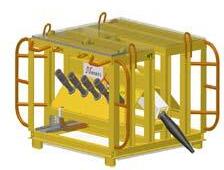
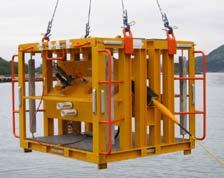
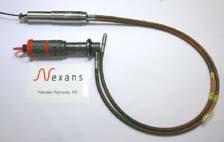
New applications, retrofit, and the maintenance and repair of existing installations call for use of dedicated FO cables, which may also include electrical conductors. This document describes the functions, design and qualification of CEM (Cable End Module), which facilitates quick and reliable connection between dedicated FO cable and permanent subsea equipment (see Figure 2).
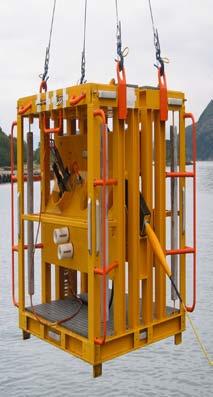
It is fitted with 4-part wire lifting arrangement suitable for ROV operable hooks
Pending on local sea-bed conditions, it can be fitted with a mud mat
It is designed to protect internal cabling, connectors and canisters from falling objects
ENVIRONMENT SPECIFICATION
Maximum depth: 3000 m
Operating temp range: -5°C to +45 °C
(Limited by connectors)
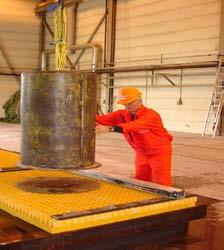
Dropped object protection: 20kJ impact energy
Corrosion protection: Sacrificial anodes
Figure 1. A generic fibre optic subsea network
In the oil and gas industry, subsea FO installations are often realized by including one or more FO cable elements in an umbilical, whose main function is to transfer electrical power, hydraulic fluids, and chemicals. FO connectors are typically integrated in the umbilical termination head (UTH). The FO connections are made up in a separate ROV operation, when the ROV connects jumper cables between the UTH and the permanent subsea equipment.
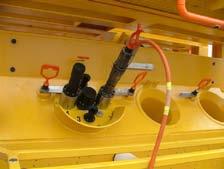
Figure 2. CEM main structure (shown with six FO connectors).
FUNCTIONAL DESCRIPTION
The overall objective of the Cable End Module (CEM) is to enable quick and reliable connection between a FO cable and auxiliary subsea equipment. This is realized by the following functions:
It forms a fixed structure for mechanical termination of an armoured FO cable
Its weight and mechanical stability is compatible with forces arising from CEM deployment, cable laying and ROV interventions
It can contain up to 5 off ROV operable wet mateable FO plugs/electrical plugs
It can contain up to 6 off ROV operable retrievable canisters with electronic and/or optical instrumentation
Figure 3. Impact Test (20 kJ) of cover hatch.
MODULARITY
CEM can be adapted to various soil conditions, from rock fillings to soft mud.
Furthermore, CEM accommodates various FO cable designs, including aramide and multi layer steel armoured cables. A typical armour termination for a light FO cable is shown in Figure 4.
Figure 4. Armour termination with bend restrictor.
The unit can also accommodate a variety of wet, mateable FO subsea connectors, which are generally diver or ROV operable.
It is also possible to replace one or more of the wet mateable connectors with ROV retrievable canisters (as shown in Figure 5). These canisters may contain electronic and/or optical equipment.
Figure 5. ROV retrievable canisters with wet mateable connectors and electronics.
SEA BED INSTALLATION
CEM is deployed using a vessel crane. The deployment requires close monitoring of the FO cable centenary in order to avoid interference with lifting wire (see Figures 6 and 7). Once positioned on the seabed, the lifting wire is detached by means of detachable ROV hooks.
The CEM seabed installation facilitates both firstend and last-end FO cable laying procedure.
6. CEM deployment.
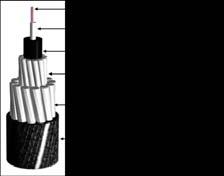
All Nexans Norway FO subsea cables include one or more steel tubes comprising the optical fibres, as shown in Figure 7.
Figure 7. FO submarine cable with stainless steel tube protection over the optical fibres..
Figure
FIBRE OPTIC TERMINATION UNIT (FOTU)
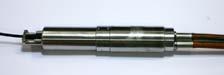
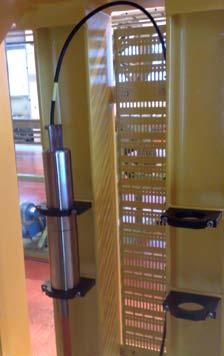
The steel tube design offers the best chemical and mechanical protection of the fibres, and also implies that the fibres reside in an environment close to atmospheric pressure. On the other hand, wet mateable FO connectors are generally designed for a limited differential pressure between their mating optical surfaces and the fibre inlets. This has motivated the development and qualification of a Fibre Optic Termination Unit (FOTU), whose function is to form a pressure-tight interface between up to three wet mateable fibre optic connectors and up to three FO elements (see Figure 8 and 9).
FOTU consists of two oil filled chambers separated by pressure tight fibre penetrators. One chamber is pressure equalized while the second chamber is atmospheric.
FOTU can be adapted to a wide range of FO cables and FO connectors.
FOTU is integrated in the CEM (ref Figure 13). The FOTU enables connection of one fibre optic cable to up to three wet mateable connectors, each with eight off-optical fibres.
FOTU Specifications:
Operational depth, max. 3000 m
Temperature range -10 °C to +35 °C
Weight, approximate 6 kg
Dimensions Length: 535mm OD: 95mm
Main structure Superduplex
Estimated min. lifetime 25 Years
No. of fibres, max. 48
Total optical attenuation, maximum 0.3 dB at 1550 nm
Mechanical vibration Three axis, 5 g, 5 Hz – 150 Hz and random vibration 20 Hz – 2000 Hz.
Mechanical shock Both directions in each of three axis, half sine, 30g, 11 ms duration
Pressure cycling, external pressure Four cycles between 1 bar and 330 bar
Pressure, long term test, external pressure 14 days, 330 bar
Pressure/temperature cycling
Pressure cycling 1 bar - 330 bar in temperature range -10 °C - +70 °C
Reverse pressure Four cycles between 1 bar and 25 bar
FO element fixation
Short term: 300 N up to 45° from axis. Long term: 100 N up to 45° from axis
Figure 8. Fibre Optic Termination Unit (FOTU)
Figure 9. FOTU (top) with two jumper cables (one blinded) and one wet mate-able connector.
Figure 13. FOTU Assembly, protected inside CEM.
CONCLUSION
Nexans Norway AS has developed and qualified a Cable End Module which enables quick and reliable connection between fibre optic cables and permanent subsea equipment. Thus, the seabed installation of the involved components may take place at widely separated times, a possible requirement for operational reasons.
A Fibre Optic Termination Unit (FOTU) has been developed and qualified – enabling the connection of up to three pressure compensated wet mateable FO connectors to one FO cable.
Inge Vintermyr graduated from the Norwegian Institute of Technology in 1989 with a Ph.D in Materials Science, and he joined Nexans Norway Norge AS the same year. He has been working with research, development and engineering of fibre optic cables with special emphasis on offshore applications. Technical Mgr for the Communications Cable Division since 2000.
Jørn Wardeberg graduated from the Norwegian Institute of Technology in 1981 with a MSc in He has been employed in several companies since 1982, within research, development and engineering of fibre optic cables and projects, with focus on oil/ gas and offshore applications.
Rolf Bøe graduated from the Norwegian Institute of Technology in 1986 with a MSc in Electronics. He has been employed in several companies since 1982, within research, development and operation of transmission systems for terrestrial and offshore applications. He has been Marketing Manager for Nexans Submarine Fibre Solutions since 2007.
Drive
Traffic to your website with a SubTel Forum Web Banner
subtel forum web banners are averaging 986 click-throughs per month
BP has installed real time monitoring systems on 80 per cent of its high rate wells – along with 2 million data tags and 2,000km of fibre – but there’s plenty further it can go, said David Latin, vice president of E&P Technology speaking at a recent OilVoice / Finding Petroleum Forum in London.
David Latin, vice president of E&P technology with BP, says he believes that connectivity is the grease that drives productivity at BP, speaking at the recent OilVoice / Finding Petroleum Forum (London, April 22nd).
Digital technology has “helped us do things more efficiently, more effectively and at lower cost,” he says.
“So far, BP has fitted 80 per cent of its high rate wells, and 40 per cent of its wells in total, with technology for real time monitoring,” he said.
It has already installed over 2m data tags and has 2,000km of fibre connecting its facilities.
The company has around 30 in house staff and 70 consultants working directly on its “Field of the Future®” project; it also has a staff member in each of its business units helping to roll it out, looking at change management aspects and application of the technology locally.
In a sense, everybody in the entire company has been involved in the project at some point, he said.
“We think we’ve delivered something like 80,000 barrels a day of extra production as a consequence of using this technology to date and saved more than 100m dollars of capital expenditure,” he said.
“This is a much cheaper way to increase production than to drill more holes,” he said. “This is very low cost.”
“The financial value works out at between $3 and $6 a barrel, which is similar, or better, to doing well workovers,” he said.
BP’s digital oilfield strategy started with its largest and most complex oilfields – where it has a lot of money tied up.
For example, an early target was its Gulf of Mexico Thunderhorse platform which produces 350,000 barrels of oil per day from 7 wells. “We need to manage them carefully and ensure we get maximum value,” he said.
“Digital oilfield allows you to manage your fields more effectively and more efficiently,” he said. “It’s about reducing capital costs and reducing operating costs and making people more efficient in what they do day to day.
The main benefits are being able to take real time measurements of oil, water and gas production, quickly optimize the complex production systems, and feed the data straight into reservoir models.
Future
But there is still a lot further to go.
“If you think of a future where information flows freely and easily to individuals wherever they are, and it’s been filtered so they’re only getting what they need, and as much as possible it’s automated, so it doesn’t need to go to an individual unless they need to make a human decision, and it’s applied across the whole
value chain, I would say we’re miles away from being done,” he said. “We’re all in the infancy really.”
Another challenge is working out how to use it viably in low rate onshore wells. “It requires different types of thinking and different solutions.”
“In North America a lot of the issues are to do with people driving large distances to gather data or do maintenance.”
“There is plenty more progress to be made in how the data is used to improved reservoir management,” he said; there is also new nano technology being developed which might be able to “revolutionise what we can do with reservoir engineering,” he said.
BP is making efforts to protect its technology investments. “The market is quite immature and we think we’re quite far ahead of where the market is and that adds value to us,” he said. “I think this will ultimately separate winners and losers in the future.”
Three layers
BP sees the digital oilfield in 3 layers – data infrastructure and architecture at the bottom, then a middle layer where that data is turned into information, then a top layer when you try to work out if you can do with the data to optimize what you are doing.
“That’s how we think of digital oilfield - and it really applies to everything from the oil in the ground through to our terminals - and we apply it to our refining as well. IT really touches every part of the business,” he said.
Fibre cable
In the Gulf of Mexico, BP has laid a 1300km cable which connects all of its platforms. The cables provide 2,500 times the bandwidth of a satellite connection.
“The cable has proved particularly useful in hurricanes,” he says. “We have 20:20 vision of what goes on in the platforms,” he said. “We’re down manned, but we can still see everything, we know everything. We know if anything has happened and we can start to plan a recovery. We’re the only company that has that capability in the Gulf.”
The system is very helpful for people actually working on the platforms. “You can use software and it downloads instantly,” he said.
Remote drilling
In Indonesia, drilling engineers in Jakarta watch real time drilling data from the field operation 2,000 miles away in West Papua.
“Having this real time connectedness between the field team and experts in the office really does improve how people work together,” he said.
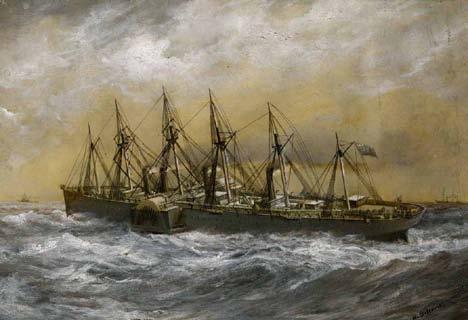
In light of the recent announcements by the Obama administration easing the restrictions on submarine cables between the USA and Cuba, it only seems right to look back in this edition at the Havana to Key West cable systems that are arguably as important to the development of the submarine cable industry as the pioneering Dover to Calais systems of 1850 and 1851.
The idea of a cable between Cuba and Florida was first put forward by a group of Cuba-based Spanish business men in the early 1860s. Unfortunately, despite them obtaining the necessary concessions and completing a route survey, the project failed to get off the ground. After the end of the American Civil War, however, two American soldiers rekindled interest. In 1864, Captain James Alexander Scrymser applied to the Florida State Legislature for permission to land cables at Punta Rassa in Florida, and was granted rights for twenty years. At the same time, General William Farrar Smith, the President of the newly formed International Ocean Telegraph Company (IOTC), was granted the cable landing rights in Cuba for forty years. An Act of Congress was passed on 5 May 1866 giving IOTC the sole right to handle traffic between Cuba and the USA for fourteen years. Two cable systems were installed between Havana and Key West, one in 1867 and another the following year. In 1873, the Western Union Telegraph Company took a two-thirds majority holding in IOTC, and a new Havana to Key West Cable was laid. Two more cables were added in 1899 and 1917.
Back Reflection by stewart ash
In 1921, AT&T joined with the Cuban Telephone Company (an ITT company) to form the Cuban American Telephone and Telegraph Company. The new company purchased three coaxial cables to connect Key West to Havana. These were the first ever coaxial cables deployed for submarine cable use, and were manufactured and installed by the Telegraph Construction and Maintenance Company (Telcon). They went into service on 11 April 1921.
AT&T promotional brochure for the new service
In 1928, Bell System (parent of AT&T) made its first proposal to the British General Post Office for a transatlantic telephone cable. Bell Laboratories had come up with a new cable design, but as there was no serous submarine cable manufacturing capability in the USA, the manufacturing rights were offered to Telcon. Amazingly, Telcon turned this opportunity down and the design was then offered to the German company Norddeutsche Seekabelwerke. Eventually, they produced a 111nm coaxial cable which was laid in 1930 between Havana and Key West. The system went into service on 6 June 1931. Bell Laboratories continued their development through the depression years and came up with a flexible repeater design which was complete by 1941. But, due to the intervention of WWII, it wasn’t until 1950 that a full scale trial of a long haul system could be implemented. Twin coaxial cables were laid between Havana and Key West, each cable containing three, unidirectional flexible repeaters. Simplex Wire and Cable manufactured the polyethylene (invented by ICI in 1933) dielectric coaxial cable and the six repeaters were supplied by Western Electric. The systems provided 24 x 4kHz voice channels and was the test bed for TAT-1.
the caSe For low latency
Low latency, high bandwidth is the key to the successful economic deployment of remote management and control systems. We take this tenet for granted more in terrestrial systems than in offshore systems because it is simply easier, it’s part of the deal in deploying broadband wireless or point-to-point fiber systems and all we seem to look at is throughput and deployment costs. As terrestrial assets become more remote, isolated from national networks or located in developing countries without extensive, ubiquitous infrastructure, the real challenge rears its ugly head, and as we move
offshore into deep water the beast begins to roar. The more isolated the asset, the louder is the Siren call of satellite service. It’s quick, it’s easy; sure the bandwidth is expensive and pretty limited, but why do you really need that gigabit Ethernet? But as the assets become more isolated it gets more expensive to transport and support personnel, to get parts and to make repairs and so we turn to automation, collaboration and control room extension. It is then we realize we must tie ourselves to the mast and ignore the Sirens, for the latency of satellite will prevent us from reaping
some of the largest benefits of the tools we hope to use.
On shore we see the benefits of tools like collaboration, video conferencing and surveillance, real time data collection and processing and electronic work management systems and the benefits are so great we wish to move them offshore. Our goals are simple: cost reduction and production improvement, but the steps to make major inroads to those goals are more complex.
Control room extension and remote support can allow de-manning of platforms, provide efficient sharing of experts onshore among multiple platforms and reduce downtime. To make the best use of remote experts, real time video conferencing is essential and wearable video cameras are best for allowing experts “in town” to look closely at problems offshore. Satellite circuits of 1-2 Mb/s will not support multiple channels of high quality video well while also providing all the other data collection and communications requirements of the platform. Likewise, true control room extension providing real time interactive control of critical systems will not tolerate the ½ second round trip delay as the Cyclops eye of the dish bounces its gaze off a satellite in geosynchronous orbit 36,000 km above the equator.
Production optimization and reservoir management are vital goals for offshore assets, perhaps with more urgency than terrestrial assets because the costs of offshore exploration and production infrastructure are so high. Modern tools for platform management may result in over 50,000 data tags on a single platform and real time management requires polling each of these tags multiple times per second. On shore, real time adjustments of well parameters based on real time data collection and analysis is providing production improvements of 1% or more, so the benefits are huge; but so are
the data flows. And then there is that ½ second delay again in the control system time constants. 4-D seismic is the latest tool being exploited offshore for reservoir management, and we all know the size of seismic data files - terabytes. Are you sure you don’t need that GigE?
There are also some of the simpler cost savers to consider. How about that control system software upgrade your vendor wants to install? Wouldn’t it be nice if the technician could go to one building in town and remotely download that 800 MB patch to seven platforms rather than having to helicopter out to each one, one at a time? Too bad all those retransmits caused by the ½ second latency on that 1 Mb/s satellite circuit left the file corrupted after an hour trying to download the file to the first vessel.
For those operations in areas plagued by hurricanes, cyclones or typhoons, survivable high bandwidth capacity can represent big opportunity savings. Following abandonment and the passing of the big storm the re-manning process begins. If the satellite dish survived the class 4 winds it probably needs to be re-aimed; that means getting personnel on board. First there’s a long flight over the wine-dark sea to look at the physical condition of the platform, then there’s a small recovery crew put aboard to verify that systems are working and reaim that dish or install a temporary so you can get a few phone lines working to allow re-manning of a skeleton crew to restart the shut-in wells at reduced production rates. What if instead the telemetry was still working and could report back the health of all platform systems? As the rosy-fingered dawn reaches the deck of the platform, still wet from the passing of the torrential rains, a full crew is being reboarded a day or two earlier than on other vessels and full production is being resumed faster. With big deepwater platforms producing 200,000 to 350,000 barrels per day, the reduction in lost revenue is huge no matter what the price of oil is on any given day.
So the case for high bandwidth, low latency fiber optic cable systems feeding remote terrestrial and offshore fields is very compelling technically, but we still have to justify the cost to management. With system costs ranging into many tens of thousands of dollars per kilometer we sail between the Scylla of “it’s too expensive and it doesn’t bring product out of the ground” and Charybdis of “we don’t want to operate a telecom system, we’re an oil company” while trying to accomplish all the real cost saving benefits that management really wants. Recent experience shows that, yes, low latency, high bandwidth capacity does bring more product out of the ground and I ask the question “how can you afford not to do it?” Unlike our friend Odysseus, I hope it doesn’t take ten years to reach your goal.
Guy Arnos has over 25 years experience in submarine and terrestrial networks, and has been responsible for the planning, engineering and implementation of transoceanic, transcontinental and metropolitan telecom systems. With WFN Strategies he has supported efforts in a number of submarine and terrestrial telecom projects, including the provision and installation of inter-platform submarine cable systems in the North Sea, Gulf of Mexico and Australia; engineering, provision and installation of fiber optic, RF, microwave and cellular telecom systems in Alaska, Antarctica and Colorado; and the engineering and provision of worldwide broadband services and trans-Pacific submarine cable systems. He joined WFN Strategies in 2001 as Director of Projects, and has been responsible for accomplishment of telecoms engineering projects in Angola (ADONES), Australia (NW Shelf), Antarctica, TransPacific cables (MPC, Unity North), UAE (Multi-use Submarine Cable System), Colorado/Oklahoma/ Wyoming (Broadband Wireless), and Gulf of Mexico.
ConferenCe Preview
Attend OTV APAC and you can choose from over 60 focused learning and networking sessions over two days. Hear senior professionals from APAC and beyond as they share unique insights into major transport networking and broadband infrastructure projects. Grasp the opportunity to benefit from exceptional networking opportunities with over 300 regional telecommunications professionals attending OTV APAC. Take advantage of the comprehensive educational programme addressing key potential cost-saving and new revenue driving opportunities - packet optical networking, packet transport, mobile backhaul, FTTx and submarine cable services. OTV APAC is set to become Asia’s premier forum for operators to meet, learn and share expertise in network design, technology selection, and vendor partner selection.
Session Focus – Submarine Network
Developments in APAC – Tuesday 20th October
Review the progress and success of current submarine developments in the APAC region and place them in context with progress in European and North American markets. Examine the capacity demand and new feature requirements placed upon submarine cables in the APAC region and discuss growth trends as well as potential bottlenecks in submarine capacity. You will be given the opportunity to hear firsthand experiences of submarine network deployment through senior level keynote service provider case studies from TATA Communications and PacNet.
Key session discussion points will include:
• Market developments and new systems
• TGN-IA case study
• Highlighting new features enabled on submarine networks
• Examining the challenges of delivering network resiliency in the sub sea environment
• Key developments in ultra long reach optics
• Should operators plan to deploy new fibre or is it cost effective to upgrade existing fibre to meet short and mid term demand for bandwidth?
• Identifying key submarine projects currently in the pipeline
Featured session speakers:
Ariane Moyes, Vice President, Global Transmission Services, TATA Communications
Andy Lumsden, VP Engineering, PacNet
Matt Walker, Principal Analyst. Ovum
Other conference highlights will include:
• The OTV APAC Network Operator Awards – Independent awards for excellence in networking services in APAC. Judged by senior analysts with specialist knowledge of global developments in key networking technologies and services, the OTV APAC Network Operator Awards are a totally independent and globally
significant expression of operator excellence in the region. Download an award entry form at www.opticaltransmission.com/otv-apac
• Over 70 knowledgeable speakers tackle challenging subjects in core, optical, mobile backhaul, FTTx and packet transport
• Analyst forecasts and market trends from OTV’s independent Analyst Partners
• Problem solving sessions harnessing the experience and expertise of the audience to address current operator challenges
• The OTV APAC exhibition hall –compare and contrast the latest technology offerings from industry leading vendors in the OTV exhibition
• Specialist sessions on key technology developments and implementing
business cases; MPLS-TP, Carrier Ethernet, IP Radio, broadband wireless backhaul
OTV APAC is the latest addition to IIR’s highly successful Optical Transmission Vision global events programme. Established in 1995, OTV events attract over 3000 international delegates each year.
For the full OTV APAC conference agenda and to register your place at the event please visit www.optical-transmission.com/otv-apac
reader statistics
Communications Under the Seas: The Evolving Cable Network and Its Implications
Edited by Bernard Finn and Daqing Yang
The MIT Press, (Dibner Institute Studies in the History of Science and Technology), Cambridge MA, 2009
303 pages. Price $40.00 (hb)
ISBN 978-0-262-01286-7
The history of the development of undersea telegraphy has recently become an attractive topic for serious academicians exploring the nexus of technology, global business, and over arching government strategic policy objectives. Coeditors Bernard Finn and Daqing Yang are to be commended for this latest contribution to the history of this technology. Communications Under the Seas is a compilation of eleven essays originally presented during a two-day symposium hosted in 2002 by the Dibner Institute for the History of Science and Technology.
While the focus of the book is explicitly historical, the submarine telecommunication professionals of today will certainly appreciate that the modern challenges and opportunities are not unlike those of the late 19th and early 20th centuries. In their introductory remarks, Finn and Yang point out that both the China Sea cable breaks of 2006 and the more recent the disruptions in the Arabian Gulf not only curtailed financial and strategic communications in Asia and the Middle East, but had significant global consequences as well. With more than 90 percent of the world’s voice and data traffic borne by submarine cables, the impact of the months-long repair process resulted in hundreds of millions of dollars in lost revenues and severe intercontinental communication problems. Readers may be surprised to learn about predecessors who confronted similar challenges years ago in the original deployment and repair of these vital communication links. Communications Under the Seas charts the development of submarine telecommunications from its inception in the 1850s to present day - admirably addressing the strategic, economic, and social implications of each technological development. Aside
from the essays themselves, the editors have also included a comprehensive bibliography for those who may be interested in further pursuing the topic. This book is strongly recommended to those interested in a concise and readable history of the submarine telecom industry.
Reviewed by:
Robert McCabe, Captain USN (Ret)
Associate Professor of Maritime Operations Naval War College
Captain Robert McCabe, USN (Ret), is an Associate Professor of Maritime Operations at the Naval War College in Newport RI, where he joined the faculty in 2007. Prior to assuming his War College duties, he was a career naval officer and served on active duty for 29 years. Upon retirement from the service he attended Johns Hopkins University where he earned an MA in the History of Science, specializing in 19th century ocean science and technology. He is currently interested in ‘Operational Protection’ issues associated with submarine cable telecommunications, as well as the application of Operational Hydrography and Oceanography within the context of multinational naval operations.
out of africa:
one cable, t hree continents
Renzo Ravaglia
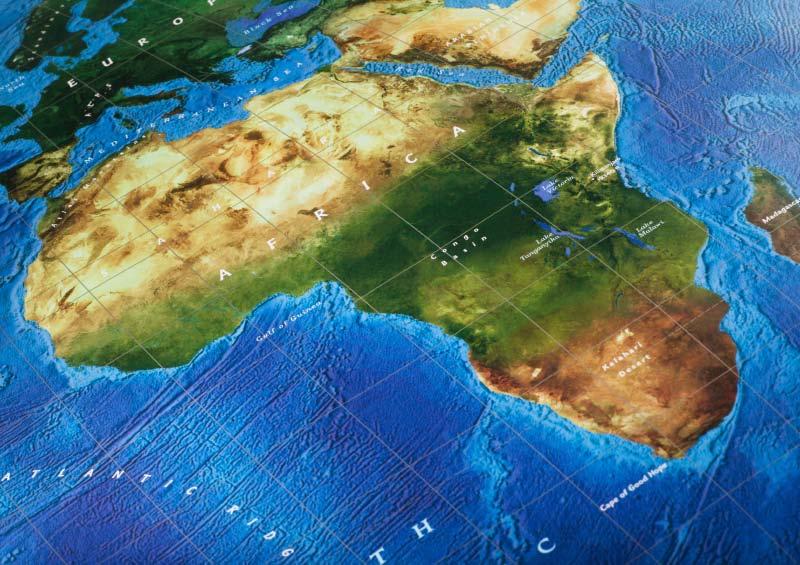
A click of a mouse and three minutes later the starting credits of the latest Blockbuster are playing on a home computer. Well, in Europe and America this is the likely outcome. In East Africa, however, it is a very different story. The same click would see you waiting seven days before the movie downloaded. That is, of course, if you are part of the 1.5 per cent of the population that even has access to the internet. With the majority of the region missing out on what the rest of the world takes for granted, SEACOM, a privately funded venture, set about landing a 17,000 kilometre cable off the coast of Egypt to change the way that East Africa saw the rest of the world, and how the rest of the world saw East Africa.
Achieving the impossible
Up until now, East Africa has been solely dependent on satellites for its internet connectivity. Notoriously unreliable and slow, it makes for a frustrating online experience. The low bandwidth of satellite means users experience delays of up to 600 milliseconds, 30 times more than that experienced in major US and European cities. East Africa needed a direct connection to international broadband to be able to receive a level of internet connectivity equal to the rest of the world.
world, internet access had to become more affordable. Then along came SEACOM, which recognized the importance of providing the same level of internet access to East Africa. Viewing telecommunications as a fundamental enabling tool in the development of the region’s economy and society, SEACOM set out to achieve what some thought was impossiblea group of like-minded investors, 76% of which are Africans, working together to connect the region to the rest of the world.
and steel armour plate, but as impressive as this sounds, accidents can still happen. Most cable damage is caused by shipping, either from a trawler net or a ship’s anchor. So, raising awareness of the cable within these industries was an essential precaution and shipping maps are regularly updated and all coastal authorities are informed.
The new fibre optic cable was laid along the east coast of Africa, creating a digital super highway that links South Africa, Mozambique, Tanzania and Kenya with Europe and South Asia. The cable extended to Marseilles, where it connected to Interoute’s network, which provides a speed of light route to Europe, North America and the Middle East. The new subsea cable offers 1.28 Tera-Bits per second of capacity, enabling high definition TV, peer to peer networks, and IPTV, as well as supporting surging internet demand.
The entire region has seen a phenomenal increase in demand for internet connectivity. Between 2000 and 2008, the number of users rose by 1,062%.1 With further surges in demand expected and upcoming international events such as the 2010 World Cup in South Africa, internet connectivity has never been more sought after.
But cost has been a major barrier. Some businesses are paying up to £3,000 per month for 1MB of internet from a satellite provider2; an exorbitant amount which has meant that internet access is viewed as a luxury item. For East Africa to catch up with the rest of the
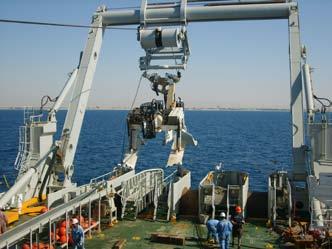
The landing of the cable was not an easy one. The deployment itself, which Tyco Telecommunications undertook, was a complex and dangerous process. It was vital that the cable was aligned exactly to the specification of the initial seabed survey. A difficult task, considering the deployment required the laying of 20 to 30 miles of cable each day at 2,000 meters below sea-level. It wasn’t just the choppy waters that the team had to contend with, this painfully slow process left the team exposed to pirate attacks, particularly common off the coast of Somalia.
The risk of cable cuts are something that had to be taken into consideration to ensure the cable remains lit. The cable itself was wrapped in a polycarbonate
Changing a nation
This is an historic occasion for East Africa. The cable will provide the region with the platform for change. Internet connectivity is an important enabling tool that can change politics, society, the economy and entertainment alike. Even the most simple of enhancements will have a high impact. Consider the simple process of emailing a high resolution image. For the medical profession, this means doctors can consult specialists around the world for complex medical predicaments, enhancing healthcare delivery for the people of East Africa.
Knowledge is power for industry and trade. Through the instant availability of information on local markets and access to a network of contacts, farmers can make informed decisions on business partnerships and price setting, removing the likelihood of middlemen taking advantage of their lack of knowledge.
It is not just the farmers that can benefit, the tourism industry is likely to boom. Most holiday seekers use the internet to get a feel for the local area, facilities and attractions of their destination. Without access
SeACoM landing station in Maputo, Mozambique
to the internet, East Africa hasn’t been able to make the most of its tourist attractions. With affordable, reliable, high speed internet connectivity comes the ability to host websites that display images, photos and interactive media content, as well as offering online booking processes.
Just as information can now be pushed out of East Africa, an influx of information can now come into the region as well. The internet brings access to information portals and global news sites, changing the way East Africa sees the rest of the world. Information can not only liberalize a nation; it can change the way opinions are formed and how it interacts with other countries. And, it is not just text. The cable will provide access to media rich international websites. With SEACOM capable of streaming approximately 1,600,000 simultaneous YouTube videos, millions of movies, music and games are at the region’s fingertips.
Brian Herlihy, SEACOM CEO, said: “The launch of the SEACOM network marks the dawn of a new era for communications between Africa and the rest of
the world. The tireless efforts of the past 24 months have come to fruition, and we are proud to be the first to provide affordable, high quality broadband capacity and experience to east African economies. Turning the switch ‘on’ creates a huge anticipation but ultimately, SEACOM will be judged on the changes that take place on the continent over the coming years.”
Conclusion
With 50 per cent of Africa’s population under 25, this information revolution will help formulate the views of the next generation of business leaders and develop the future economy. While the benefits of global internet access are clear, not every nation will be able to log on overnight. There is no denying that there is some work to be done to supply the East Africa with the tools to connect to the internet. The G1G1 scheme and ‘one laptop per child’ initiatives are a start, but such roll outs will take time. High-
speed internet connectivity is the greatest levelling tool available and we are on the cusp of changing an entire region, but we are not there yet. Although it may take East Africa a couple of years to really notice the difference, the infrastructure is in place to support this change and the possibilities are endless.
Renzo Ravaglia, Interoute’s Head of Global Sales, is a key part of Interoute’s history. After 20 years experience at Alcatel as the Telecommunications Division Director, Ravaglia joined Interoute when it was formed in 2002. He started as a sales director and then became Italy’s country manager in 2003. Since January he has undertaken the roles of country manager for rest of the world and director of the wholesale business division. Under his leadership, Interoute Italia has gained a prominent position among telecom operators, becoming a leader in the wholesale and corporate market in Italy and the whole of the Mediterranean, including Greece and Malta
advertise with the experts
Burial Plough - courtesy of Tyco Telecommunication and SeACoM image. credited to SeACoM
Featuring discussions with industry experts, the SubTel Forum podcast expands the platform for discourse on submarine telecom cable and network operations
Do you have a paper or topic you would like to have presented? Contact Kevin Summers: editor@subtelforum.com | 703.468.0554
“By installing ocean bottom seismic cables, you can increase overall recovery from your field by 3-5 per cent,” says Samir Seth of PGS
“By installing permanent seismic receivers on the sea bed, and feeding the data into reservoir models, to help build up a continuous picture of how the reservoir is changing during production, you can improve decision making and this should typically increase overall recovery by 3-5 per cent,” said Samir Seth, VP fibre optics business development, commercialisation and new ventures with Norwegian seismic company PGS, speaking at the April OilVoice / FindingPetroleum Forum in London.
With ocean bottom permanent monitoring seismic, a vessel on the water surface can fire down seismic shots into the subsurface, and the reflections can be recorded on the seabed, with the data sent back up to surface. This is typically done every 6 months.
Of course, the capital cost of installing permanent seabed equipment is not insignificant. So the challenge is often finding ways to justify them.
This is tricky, when you don’t know how much value it will generate. For example, the ocean bottom seismic can show up bypassed oil, which isn’t finding its way into the reservoirs. “Most of the gains are unexpected,” he said. One can’t quantify the exact amount of bypassed oil in advance.
The technology is too new to have been widely adopted, so statistical data showing success in a large numbers of fields does not exist yet.
Purchase decisions are often made on the basis of a calculated ‘net present value’ – ie an estimate of how much extra production can be achieved from having the system.
But companies would be better off treating the investment decisions in the same way as exploratory oil wells, where they have become comfortable with the financial risks involved.
“When you explore for oil, you say - I’ll spend $100m going to the Arctic - if I find oil, then I’ll spend $1bn to get $5bn,” he said.
In a way, this too should be treated as exploring for oil in existing fields. In fact the finding risks are lower as one knows hydrocarbons exist in those structures. And as production infrastructure such as pipelines and gathering stations already exist, overall production costs are lower for these ‘finds’.
PGS showed models showing what kind of increase in production you would need in order for a project to be worthwhile with different levels of investment – however it stresses that all fields are different and customers should put their own models together.
The system is initially finding most market acceptance for large fields, he says. “Typically larger fields with long lifetimes left have been the first ones we’ve worked on.”
The system is also answering growing demands within companies for better reservoir models.
“We’re seeing interest in complex reservoirs and where there is a high requirement for repeatability in seismic surveys,” he said.
“The system is probably going to be more expensive than using towed streamer if you are just planning to do one survey – but as you get to the 2nd and 3rd survey or more, then the cost of a permanent ocean bottom cable solution starts working out to be much cheaper,” he said.
A towed streamer system can be more flexible, and cover a wider area, he admitted. If the marine seismic companies renew their technology quickly and spend the capex on new streamers as soon as new technology becomes available, then it may be easier to implement new technology there too.
For example, PGS is updating its fleet with stateof-art Geostreamer technology nowadays. That said, in Permanent systems using fiber optics, the dry end which has the brains of the system is on a
platform, so it is easy to update as technology and improves (compared to electrical systems with insea electronics).
However one of the biggest advantages of ocean bottom detectors is that the lifecycle time of the survey (from deciding to do it to updating the fluid model using the results) can be a lot shorter. “We are taking about a way to do four component seismic on demand,” he says.
One advantage of ocean-bottom seismic receivers is that it can be much better to compare the results of one survey with another.
There are options to the density of the cables – a 1000m distance is considered “sparse” and 300m apart “dense”.
Better view
Oil companies have good information for the rock [formation] close to the well, because of the all the logging tools which can be lowered directly into the wells, but “as you go deeper in the reservoir it’s difficult to predict what’s going to happen,” he says.
“We think seismic, perhaps in future in conjunction with electromagnetics, is the only way to see deep into the reservoir,” he says.
Having seismic detectors on the ocean bottom mean that the quality of data recorded can be much higher, because there is less noise than doing seismic recording on the ocean surface. “The seabed is calmer than the sea surface so your readings will be better.” “Smaller changes can be detected in the reservoir as the repeatability is better.”
Having a more granular view of the subsurface means that you can see a lot of useful information much more clearly – including bypassed oil, waterflood fronts, and unswept parts of the reservoir.
You can also see parts of the reservoir which might be obscured using conventional surface seismic –eg if there is a platform in the way of the vessels. The aim is to see how a water flood is moving
through the reservoir, so you won’t be taken by surprise when it hits the well.
“Sometimes a seismic survey can be messed up by short term events (eg solution gas coming out of the subsurface) – but you’ll never know unless you do the same survey again shortly after,” he stressed.
“For example, if solution gas comes out - it might appear that the water table has risen. If that’s the day you did your seismic, you might have to wait 5 years before you know if the water table has risen or if its solution gas coming out.”
Technology
The “wet end” – the system that goes under water –is completely passive (ie it does not need any electrical power). It is expected to last for 20-25 years.
Since the technology is new, PGS has not yet been able to test it on the seabed for 20-25 years, so it has done what it sees as the next best thing, testing it using DNV’s “qualification procedures for new technology.”
“No-one could find a reason to say it wouldn’t work,” he said.
The sensors are made of fibre optic. It uses a sensing coil and a reference coil, and measures the difference in impact of light on those coils, due to the received seismic wave.
The fibre optic cables can carry a large amount of data, so there can be many sensors in the array. The different channels can all be sent at different frequencies, like on an FM radio.
All the demodulation (separating the signal from the carrier wave) is done on the surface, rather than at the ocean bottom.
This means that most of the complex data processing and electronics is on the surface – where it can be easily repaired or updated, if something better comes along.
The seabed array could be far, for example 40km away, from the platform where the data is processed, with no loss of data quality. Alternatively, the data can be collected on a separate floating structure away from the platform.
The first system was trialled in the North Sea in 2003, and showed it made comparable data to a retrievable ocean bed seismic cable system. Further successful tests have been made in 2006 and 2008.
How often
“Typically towed streamer (surface) seismic surveys are made every 3-5 years,” he said. “But with ocean bottom cable, it can be done every 6 months,” Mr Seth says, “if it is worth detecting small changes.”
“If the change is too small there’s no point in doing a repeat,” he said. “But with this system you can see smaller changes.”
The surveys can be done more often if there are faster changes to be monitored.
One delegate also involved in ocean bottom seismic receivers said he had seen trends of surveys being made twice a year.
The Submarine Telecoms Forum
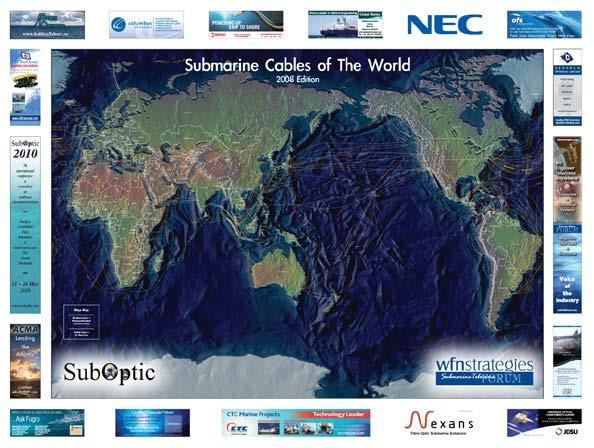
2010 Cable Map will again be produced in conjunction with SubOptic, and will be a poster provided free of charge to our subscriber list, including senior government and international organization officials, telecom company executives and team, support and supply company management, and technical, sales and purchasing staff, field and shipboard personnel, academicians, consultants, financiers, and legal specialists.
2010 Submarine cable maP
The Submarine Telecoms Forum
2010 Cable Map will be printed in full color on high quality art paper, measuring 914 mm x 610 mm, and provide participating advertisers an area of approximately 100 mm x 38 mm to display their corporate logo and contact information. According to a 2009 survey, 64% of respondents use our cable map on a regular basis.
entelec update
ENTELEC, The Energy Telecommunication and Electrical Association , has been actively working on several projects for its members and industry partners. At the April Annual Business Meeting, the 2009-2010 Board of Directors were sworn into office. The new Executive Committee consists of President Kenny Brazzale, Anadarko Petroleum Corp.; First Vice President, Joel Prochaska, Enbridge; Second Vice President, Dan Mueller, EPCO Inc.; and Secretary-Treasurer, Richard Nation, Copano Energy. The new Board of Directors include: Michael Burt, Chevron; James Coulter, El Paso; Brian Gore, Boardwalk Pipeline Partners; Becky Holland, NEC America; Brian Kovarik, Kinder Morgan; Al Rivero, Telvent; Greg Vaughn, Director, Ex-Officio, Kinder Morgan; Jack Richards, General Counsel, Keller and Heckman LLP; and Blaine Siske, Executive Manager, ENTELEC.
The new board of directors are working diligently on the Fall and Spring conferences, educational opportunities for members, and embracing the new interactive social media outlets. Their goal is to provide quality benefits for members and industry partners.
Fall
Seminar Series – Roundtable in the Rockies
For the last few years, ENTELEC has been working on the return of the ENTELEC Fall Seminar Series. The two-day event is aimed at providing an intimate setting for attendees to meet and discuss the current trends in the industry. The 2009 event will take place October 21-22 at the Inverness Hotel in Denver, CO.
“We have worked for several years to bring the ENTELEC Fall Seminar back for the members of ENTELEC.” Said Blaine Siske, ENTELEC’s Executive Manager. “The ENTELEC Technical Committee has worked hard to put together an educational program that promotes discussion, new ideas and technological advances.”
The theme of this year’s event is “The Digital Field of the Future”. Educational sessions will be offered based on their relevance to theme and the industry as a whole.
Educational Highlights
The Technical Committee has invited several industry vendors to take part in a panel discussion during the Fall Seminar Series. The panel will consist of representatives covering the industry sections of wireless equipment, process control, power, backhaul and integrators. During the discussion, the panelist will take questions from the audience pertaining to technical issues, the future of their products and how they will pertain to the changes in the “Digital Field of the Future”, etc.
“The goal of the panel discussion is to allow the attendees to ask questions pertaining to their reallife issues. We want them to not only have vendors available to answer the questions, but for other attendees to offer solutions, guidance and real-life answers as well,” states Siske.
The panel will take place on Wednesday, October 21st as the kick-off event for the Fall Seminar
Series. Participating companies include: GE MDS, Trident Micro Systems, CalAmp, Control Systems International, Uplogix, Sunwize, Qwest, Exalt Communcation, Primus Electronics and WinnMarrion.
Several educational sessions will be offered during the two-day event. Attendees can sit in on such topics as, “The Future of Mobile VPN Technology: 2010 and Beyond,” “When Does a Solar Electric System Make Sense?” “Fully Integrated Hybrid Communciations Networks,” “Strategic Implementation of Wireless IO,” “Un-breaking SCADA Security,” and “Wireless Communication to a Plunger Lift Well”
More information about the educational sessions can be found at the ENTELEC website, www. entelec.org
Exhibit Hall
Attendees will have the ability to meet with Fall Seminar Series exhibitors during the busy two-day event. Exhibitors such as: Alligator Communications, GE MDS, NEC America, Sabre Industries and Twin Eagle Consulting will be onhand to discuss their latest products and services. With over 6 hours of exhibit hall time, attendees will have the ability to visit over 30 companies and representatives in the hall. Exhibit hall activities will also include a Welcome Reception, lunch with exhibitors and a closing reception.
Houston, We’re Coming Back
In addition to planning the Fall Seminar Series, the ENTELEC board of directors’ have been working on the Spring Conference & Expo. Held annually in Houston, Texas, the 2010 event will take place from April 13-15 at the George R. Brown Convention Center.
among exhibitors, attendees and speakers will be the highlight of the event. Using his striking photographs as illustrations of his metaphor about possibility and creativity, keynote speaker Steve Uzzell, a professional photographer, will inspire the ENTELEC audience to take advantage of his experience and vision to make any venture an adventure. Steve spends six months of the year traveling the world for his clients; the remainder teaching and delivering his presentation “Open Roads Open Minds: An Exploration of Creative Problem Solving”. Steve will present his keynote address on Wednesday, April 14th at the George R Brown Convention Center.
The ENTELEC staff is currently accepting Call for Papers for the educational portion of the conference. In addition, the exhibit hall is more than 50% sold-out. Information on the spring show, fall seminar or association questions can be found at the ENTELEC website, www.entelec.org
“Open Roads, Open Minds, Open Discussion” will be the 2010 theme for the event. Discussion
Letter to a friend from Jean Devos
My dear friend
My Dear Friend
“Botany Bay”
By the time this letter reaches you, it will already be September. I am writing from my summer home in mid-August, enjoying the deep countryside and 32°C temperature. I spend more time in my garden than I do watching television or connecting to the internet. The noise of the rest of the world doesn’t really reach me here, at least not very clearly.
I published recently a modest novel, whose title is Botany Bay. It is the place in Australia where
Despite this, I have picked up a few things. I’ve heard that 40G is truly on the way, and that a typhoon recently hit several cables in the Taiwan area. People are saying “the network is now showing signs of resilience,” thanks to route diversity. I have also read two press releases...“Nortel and Southern Cross achieve 40G at 8,000Km on submarine cable” and “Hibernia Atlantic offers native 40-Gbps capacity across the Atlantic for commercial use.” I have also received messages from various sources reminding me that SubOptic 2010 paper submissions will be closing midSeptember. “Submit an abstract for SubOptic 2010 today and be a part of the premier event in our industry!”
Alcatel established a submarine cable factory in 1989 as part of its contract for the Tasman 2 link. In this same bay, where two centuries before the French expedition
“La Pérouse” made of two ships, La Boussole
We should be glad to see our industry moving forward with such energy. However, some of these readings have left a bad taste in my mouth. It took me some time to identify the reasons, but here they are:
and l’Astrolabe, landed in 1788 to discover that Captain Cook was already around bearing the British flag. So Botany Bay is now for me the symbol of a dream which becomes a reality!
In the first press release concerning 40G one can read: ”X and Z report successfully trialing 40G optical technology across ultra long-distance submarine cable to prove that available bandwidth can be quadrupled without the need for costly reengineering of the undersea network...the equipment delivers 4x the capacity of today’s 10G networks at a fraction of the cost of laying new cables”. These statements are intentionally unclear about the real capacity increase the new 40G technology will bring. Less experienced readers will naturally (though mistakenly) conclude that the overall capacity of the cable will be multiplied by four. The number of wavelengths is not mentioned. It should be the honor and pleasure of our industry to explain things in a clear manner, with the intention of properly informing our readers.
Warrior event was still in everyone’s memory. It is for these reasons among others that STC (UK) rejected the Alcatel‘s suggestion to come with a joint bid, to offer a “European” solution.
Tasman 2 has been yet another chapter in this long Anglo-French competition! The award to Alcatel came out as a big surprise to many, including inside Alcatel. Everybody was naturally expecting the British to win that battle, and such an expectation was at that time very logical.
There were so many difficulties and misunderstanding between Australia and France, the main one being the French presence in the Pacific area, the worse being the nuclear bomb experiment in Tahiti! The sad Rainbow
One of the winning factors has been the Port-Botany cable factory. Such a factory was a strong requirement from OTC (now Telstra) and the Australian Government.
SubOptic Language
Alcatel was the most motivated. Such a factory could expand its influence in the Pacific where the three other players were historically well established in this region, which represents a large part of their market. They saw this factory as a risk for their existing facilities!
I sincerely hope that this kind of language will not be a part of SubOptic 2010. I invite the paper selection committee to take this into account. SubOptic is not a conference where papers are designed to “sell something.” SubOptic should be a “university” where papers are geared academically, with a high level of intellectual honesty.
SubOptic ‘87 in Versailles came at the right time. It is where the Australian teams discovered the French model, a close cooperation between Alcatel and FT, exactly what they wanted to establish in their country.
Is this a dream, my friend?
Jean Devos
My friend, things are changed since, but one thing stays true: When you offer something, the reader can see between the lines if you are or not genuinely motivated and sincere. Then your offer becomes really attractive and this opens the route to “Botany Bay.”
See you soon.
Jean Devos
Submarcom Consulting
Jean Devos is a senior consultant with Submarcom Consulting. He is also one of the founders and a board member of Axiom, a Paris based company specialized in Submarine systems projects study & management. He spent three years developing Tyco’s international capability, and was the head of ASN (Alcatel Submarine Networks). Jean was born in 1938 and is graduated from the Lille University. He is the founder of SubOptic and carries a vast international experience in our field.
www.iir-events.com/iir-conf/Telecoms/
by Kevin G. Summers
Post’s reaction wasn’t surprising. If anything, it was logical. It was unknown what would happen to their market while the economy was collapsing. People were struggling to put food on the table... were they really going to pay for the convenience of ready-to-eat
spending on acquisition, advertising, and R & D during recessions do significantly better than those which make big cuts.”
What does this have to do with SubTel Forum?
Kellogs, realizing the opportunity before them, began advertising on the radio, pushing Rice Krispies, their newest cereal. Their famous tag line “Snap, Crackle, Pop” originated in the 1930s.
Kellogs’ marketing gamble paid off.
By 1933, the company’s profits had risen almost 30%, and Kellogs was the dominant cereal company in
Our web banners are averaging 986 clickthroughs per month, and the majority of this traffic comes from submarine cable professionals. Furthermore, web banners are the least expensive way of advertising with SubTel Forum. They are a bargain that you just might want to consider in these tough economic times.
Ask yourself, who would you rather be at the end of the current recession? Post or Kellogs?
The article went on to state that “numerous studies have shown that companies that keep