Welcome to the 45th issue of SubTel Forum, our Subsea Technologies edition.
I originally planned to write a piece about Twitter; though an interesting and fun technology, I could not get my head around how it could make money, how it was the ultimate in narcissistic excess -- blah, blah, blah and so on.
That’s what I originally planned.
But today I have a new comprehension of the power of Twitter and other ceiling-breaking social networks. It is truly an interesting world where we have arrived when news content can be derived from fragmented audios, videos and pictures from a simple cell
phone that has been then projected to the “outside”. This is made possible by the very infrastructure we build; the systems that allow and enhance the insatiable worldwide human conversation.
These new technologies are transforming not only the way we talk with one another, but also the way regions and continents disseminate and view and discern everyday information. Audacity and violence can now be analyzed on the individual level long before the world’s governments can offer timid or tepid retorts.
While countries and companies consider their moral equivalents and responses, streaming images engage the
average to reflect directly on potentially world changing events. No more is one held hostage to news flow or cycles. The anarchy of information, unfiltered and un-glossed and unglorified, has arrived.
And then I, too, can yell from the rooftops.
A synopsis of current news items from NewsNow, the weekly news feed available on the Submarine Telecoms Forum website.
July 9th, 2009
x SubTel Forum Names North & Central American Sales Rep
x SubTel Forum Names European Sales Rep
July 8th, 2009
x SubTel Forum announces winners of readership survey prize
x SubTel Forum Names Japanese Sales Rep
July 3rd, 2009
x SubTel Forum Podcast - Episode 2: Project Kelvin
July 1st, 2009
x SubOptic Call For Papers
x MMT Buys TSS 440 Cable Tracker
June 29th, 2009
x WFN Strategies to Supervise Maintenance of the ADONES Cable System
x Pacnet Continues To Expand Capabilities Across China
June 25th, 2009
x PCCW Global and Tata Communications jointly strengthen connectivity and reliability in Asia Pacific via the TGN-Intra Asia Cable System
x Seacom launch delayed to 23 July
June 22nd, 2009
x Hibernia Atlantic Completes Phase One Of Its Project Kelvin Transatlantic Fibre Optic Cable Build As Submarine Cable Comes Ashore
June 18th, 2009
x Pacnet Targets Thailand for Growth
June 15th, 2009
x Global Marine Systems and Cetrax Systems announce development partnership around Modular ROV
x Pacnet Expands into Vietnam
June 10th, 2009
x Gulf Bridge International Awards Tyco Telecommunications Its Supply & Construction Contract For Its Regional Undersea Cable Network
x TEAMS to be launched Friday
x ACE submarine cable extended to South Africa
June 8th, 2009
x Govt, private operators launch Angola Cable joint venture
x AFC Leads the Financing of a Pan-African Submarine Cable System
June 2nd, 2009
x Tata Communications Launches Application Performance Visibility Service
x Columbus launches international MPLS network in Caribbean
x Global Crossing Debuts New Model for Partner Program to Give Members a Business Advantage
May 28th, 2009
x ITU TELECOM WORLD 2009 set to open in October
May 25th, 2009
x NTT Com to acquire Pacific Crossing
LIKE YOUR NEWS NOW?
GET THE LATEST INDUSTRY NEWS AS SOON AS IT HAPPENS WITH SUBTEL FORUM’S FREE RSS SERVICE. JUST CLICK ON THE BUTTON TO THE RIGHT AND ENTER OUR FEED ADDRESS INTO YOUR RSS BROWSER. DON’T HAVE AN RSS BROWSER? SEE THE CODA IN ISSUE #43 FOR A LIST OF FREE BROWSERS AND YOU CAN BE AN EXPERT IN MINUTES!
Submarine Telecoms Forum is published bimonthly by WFN Strategies. The publication may not be reproduced or transmitted in any form, in whole or in part, without the permission of the publishers.
Submarine Telecoms Forum is an independent com mercial publication, serving as a freely accessible forum for professionals in industries connected with submarine optical fibre technologies and techniques.
Liability: while every care is taken in preparation of this publication, the publishers cannot be held responsible for the accuracy of the information herein, or any errors which may occur in advertising or editorial content, or any consequence arising from any errors or omissions.
The publisher cannot be held responsible for any views expressed by contributors, and the editor reserves the right to edit any advertising or editorial material submitted for publication.
Contributions are welcomed. Please forward to the Managing Editor:
Kevin G. Summers
21495 Ridgetop Circle, Suite 201 Sterling, Virginia 20166 USA
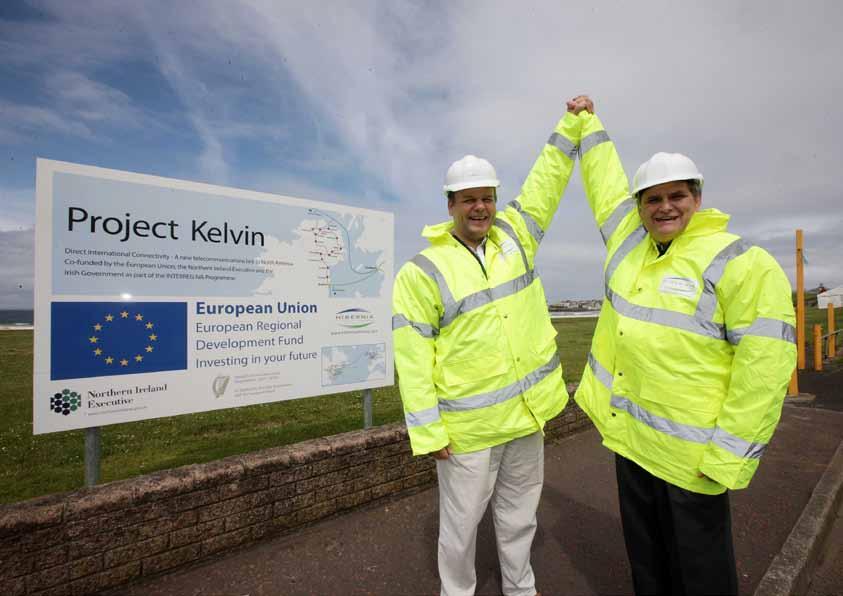
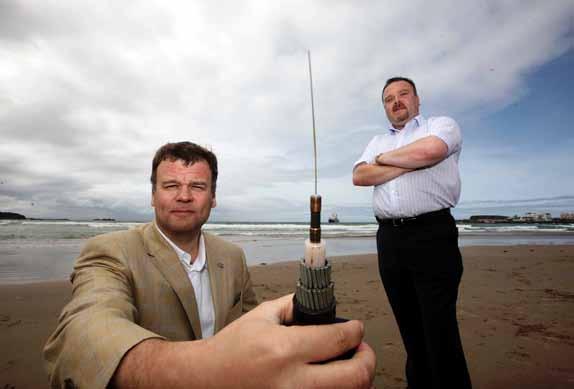
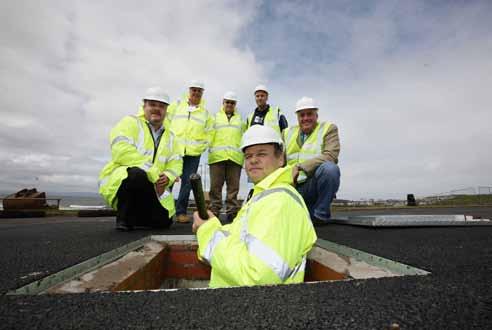
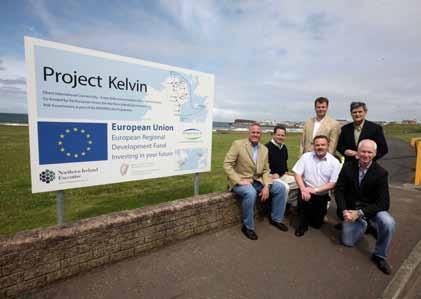
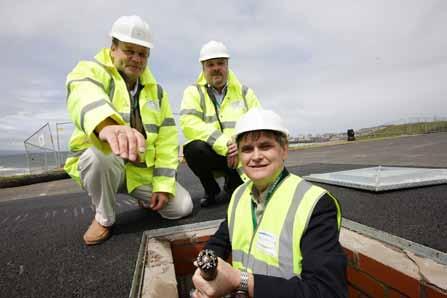
Within a fence, encircling a public beach park parking lot, lies an indistinct square manhole that is now home to ‘Project Kelvin,’ Northern Ireland’s newest modern fiber optic submarine cable system. On Saturday June 20th in Portrush, Northern Ireland, Hibernia Atlantic, in a project partially funded by the European Union and as part of the Department of Enterprise, Trade & Investment (DETI) for Northern Ireland and the Irish Department
of Communications and Natural Resources (DCENR), has brought ashore the most modern fiber optic cable to connect the island of Ireland directly to the rest of Europe and North America.
Team, DETI, DCENR, the Coleraine Chamber of Commerce, the Coleraine Council and members of the Special EU Programmes Body (SEUPB).
Bjarni Thorvardarson welcomed the crowd of nearly 60 people acknowledging “the significance of this day on Ireland’s future and its future ability to communicate through a modern infrastructure with the rest of the world.”
Cllr Sandy Gilkinson, the Mayor of the Coleraine Council, which includes the town of Portrush, agreed and expressed his excitement and hope for future innovation and industry within the Northern Ireland communities.
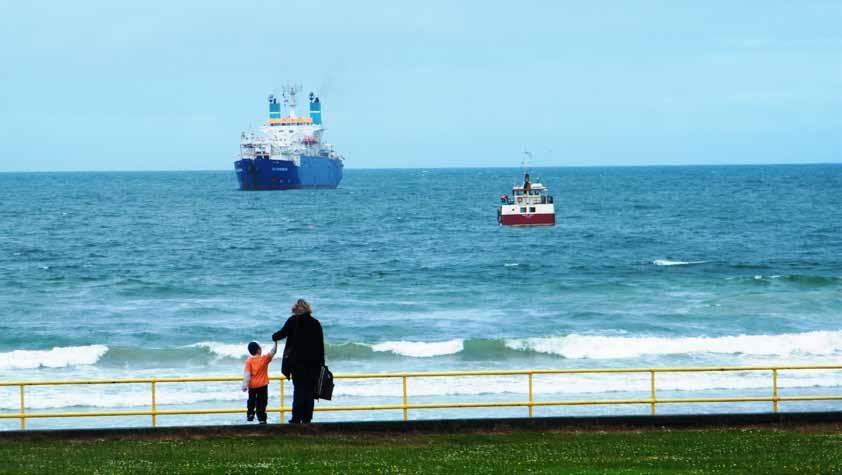
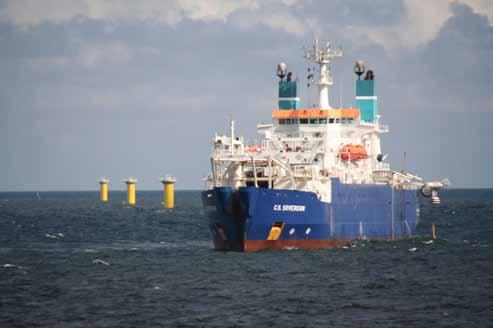
Attendees of the event witnessed the cableship Sovereign, operated by Global Marine, just off shore as it worked diligently in the bay to finalize and connect the submarine fiber optic cable to land. Divers on a smaller vessel prepared the shallow waters to bring the cable inland.
The cable coming ashore marks the completion of phase I of the Project Kelvin cable construction. The day was documented and celebrated by Hibernia Atlantic’s Executive
Derek Bullock, Vice President of Network Operations for Hibernia Atlantic, described the process of laying the cable: “The sailors aboard The Sovereign assist with the uncoiling of the cable located in the ship’s hull and with precise tension and technical expertise, carefully lay the cable along the ocean floor. Except in the deepest waters, submarine cables are usually buried in order to avoid the risk of damage due to anchors, trawling gear or tidal movements. So in more shallow waters, such as these, either a trench is dug or a pipe is drilled out to sea and then the cable is laid into the trench or pulled into the pipe. One of the most important aspects of installing a submarine
Bjarni Thorvardarson, CEO, Hibernia Atlantic (left); Derek Bullock, Vice President of Network Operations, Hibernia Atlantic (right)
cable is to keep in mind that the ocean floor terrain is rocky, hilly and as varied as the dry land we’re standing on. A submarine plough is pulled along the seabed, placing the cable into a trench up to 3 meters deep. This protects
the cable in shallow water - maximizing cable security.”
Now that phase I is completed, Mr. Thorvardarson described the next phase
which begins the dry-land phase of the project, bringing the cable over land via a terrestrial route that will link 13 towns throughout the island of Ireland, including Armagh, Ballymena, Belfast, Coleraine, Londonderry, Omagh, Portadown,
Mother and child standing on the beach in Portrush watching the C.S. Sovereign and Margaret Sinclair
Derek Bullock, Vice President of Network Operations, Hibernia Atlantic (right)
BOTTOM:
(In front) Bjarni Thorvardarson, CEO, Hibernia Atlantic (In back, left to right)
Derek Bullock, Vice President of Network Operations, Hibernia Atlantic
Stephen Swift, Director of Business Development (Ireland), Hibernia Atlantic
Alasdair Wilkie, Director, Marine and Projects, Hibernia Atlantic
David Smith, Senior Director of Network Operations, Hibernia Atlantic
Eric Gutshall, EVP of Sales and Marketing, Hibernia Atlantic
Strabane, Letterkenny, Castleblayney, Dundalk, Drogheda and Monaghan directly to Dublin. Mr. Thorvardarson added that the Telehouse facility is already in construction. It will serve as the initial interconnection point for other carriers and network operators to interconnect to the Project Kelvin network within the region.
The weather on the beach was windy, creating choppy conditions on the water, and a bit cool, further highlighting the extreme difficulties and unknown conditions that the sailors aboard The Sovereign faced on a day-to-day basis as they worked to complete the project.
The event concluded as Sovereign headed out of port, its work for the day completed. Ken Peterson, Chairman of the Board of Hibernia Atlantic and the Chief Executive Officer of CVC commented, “from shore to shore, we are bringing cutting-edge communications technology to Northern Ireland and throughout the island.”
Ilissa Miller brings over 10 years of experience in Sales and Marketing to Jaymie Scotto & Associates (JS&A).
Mrs. Miller brings a wealth of experience and knowledge in sales and marketing for emerging global telecommunications and technology companies where she implemented and spearheaded many global product and marketing campaigns that included international private line and networks, IP transit, peering, IPVPN, hosted PBX, managed services and colocation products and solutions.
Learn more about Project Kelvin on the Submarine Telecoms Forum
Episode 2: Project Kelvin
LISTEN ON iTUNES
KEYWORD: SUBTEL FORUM
Staff from Hibernia Atlantic and Columbia Ventures Corporation (CVC) celebrate the landing of Project Kelvin
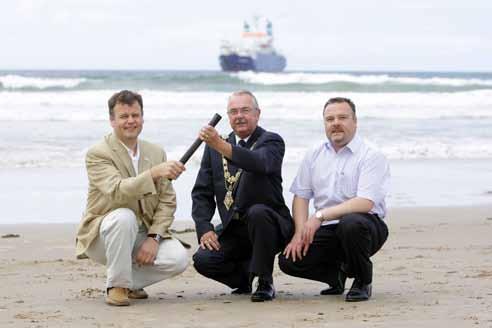
Bjarni Thorvardarson, CEO, Hibernia Atlantic (left); Derek Bullock, Vice President of Network Operations, Hibernia Atlantic; (In Front) Ken Peterson, Chairman and CEO of Columbia Ventures Corporation (CVC), Chairman, Hibernia Atlantic
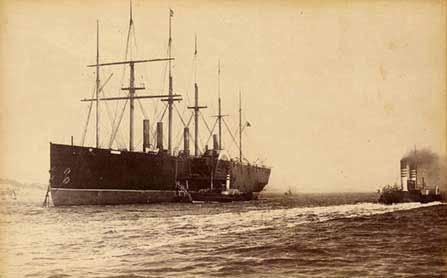
Great Eastern
celebrating the 150th anniversary of her maiden voyage
by Bill Glover and Bill Burns
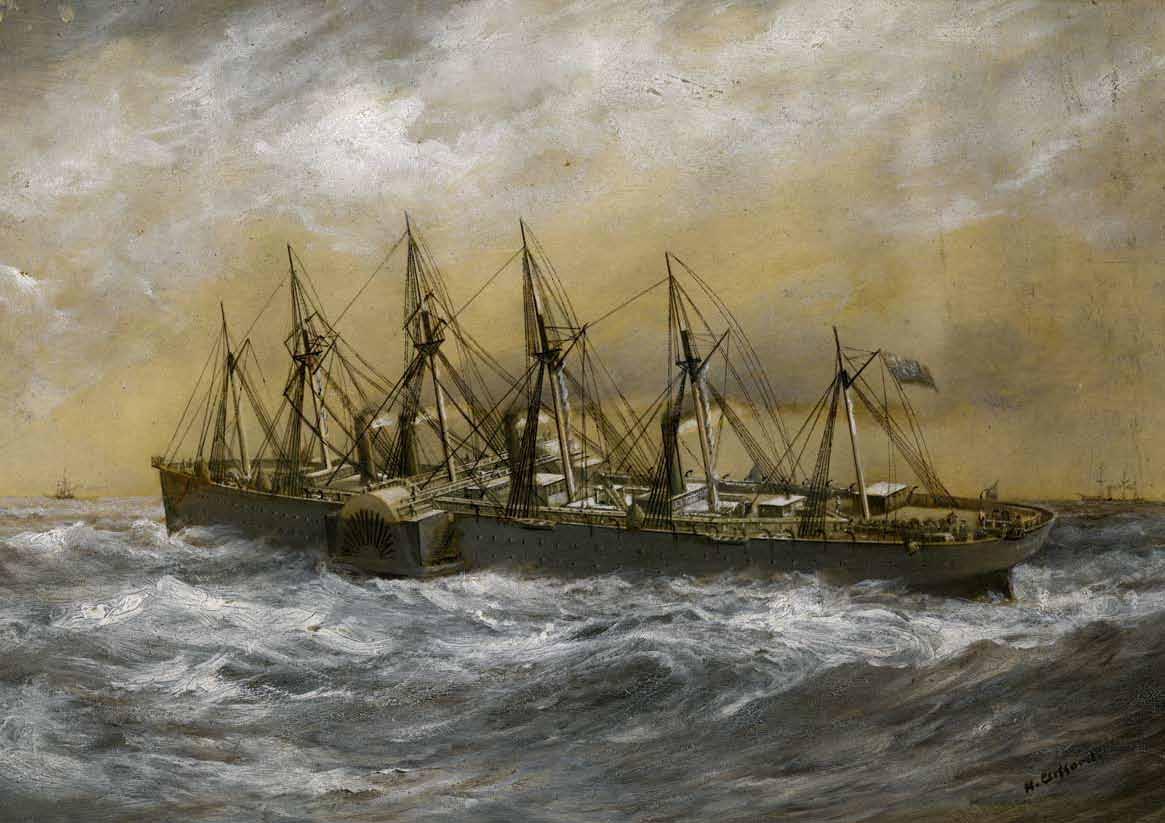
The Great Eastern at sea, 1866
Painted by Henry Clifford, who designed the paying-out machinery
September 2009 marks the 150th anniversary of the maiden voyage of a ship which was an engineering triumph but a financial disaster, so this is a good time to look at how the Great Eastern failed as a passenger ship but succeeded as a cable layer.
The Great Eastern was conceived in 1852 by Isambard Kingdom Brunel, but it would be seven long years before the ship finally went into service. Even after the muchdelayed launch in January 1858, it took another eighteen months to fit the ship out for passenger service, and the maiden voyage was not begun until 6 September 1859.
The ship’s first voyage was from London to Weymouth, and from there a trial trip into the Atlantic would be made. After this the ship would make for Holyhead which was to be its port for voyages to America. On 8 September 1859, accompanied by hundreds
of small craft and watched by spectators along the banks, the ship moved out of the Thames and headed for Weymouth. All went well until the ship was off Hastings when there was a violent explosion which blew off the forward funnel and completely wrecked the Grand Saloon. Five of the crew died from injuries suffered in the blast, and others were injured, but no passengers were harmed.
This was only the beginning of a series of further technical and financial difficulties, and the maiden voyage to America was not made until 16 June 1860, the ship taking 10 days 19 hours to reach New York. A second voyage to America was made in May 1861, and a third in September of that year was abandoned after the ship suffered heavy damage in a gale off Ireland. Two voyages to New York were made the following year, but while leaving for England in July 1862 the ship ran into a submerged rock in Flushing Bay which ripped a gash 80 feet long and 4 feet wide in the outer hull. Repairs took almost six months, and the ship finally returned to England in January 1863.
Three further Atlantic round trips were made in 1863, but it was now obvious that the ship was a losing concern, expenses exceeding revenue on every voyage. Overwhelmed with debt the company laid up the Great Eastern in August 1863, then
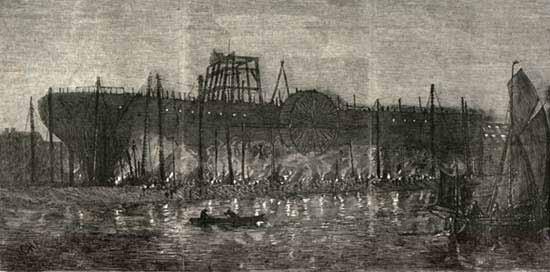
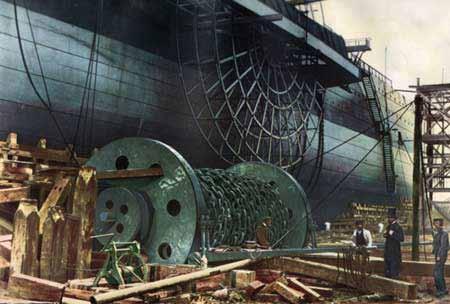
1857 Working on the Great Eastern by Gaslight
in January 1864 offered her for sale at auction.
Enter the cable guys.
Daniel Gooch who had had talks with Cyrus Field concerning his attempts to raise capital for another Atlantic cable, approached Thomas Brassey and John Pender to see if they would be willing to put up cash to buy the Great Eastern. They set a limit of £80,000. The opening bid was for £20,000 and after waiting some minutes John Yates, who was acting for Gooch, put in a bid for £25,000. No further bids were received and the ship, which was worth around £100,000 in salvabe materials alone, was sold to them. The three immediately set up a new company, The Great Eastern Steamship Company.
The Great Eastern was then chartered to the newly formed Telegraph Construction and Maintenance Company (Telcon) for £50,000 of its shares, and the company began carrying out the necessary conversion work on the ship, ready for a new attempt to lay the Atlantic cable in 1865. Telcon fitted Great Eastern with three cable tanks, each built using 5/8 inch iron plate for the bottom and first upright tier, the rest being ½ inch iron plate. The forward tank was 51’ 6” diameter by 20’ 6” deep with a capacity of 693 nm of cable; the midships tank 58’ 6” diameter by 20’ 6” deep, holding 899
nm of cable; and the aft tank 58’ diameter by 20’ 6” deep, holding 898 nm of cable. The total capacity was 2490 nm of cable.
Telcon also manufactured the cable, which had seven strands of copper wire each 0.048”, the conductor being insulated with eight layers of alternating gutta percha and Chatterton’s compound, and armored with steel wire wrapped in tarred hemp. On 29 May 1865 the last mile of cable was passed into the storage tanks at the factory and on 14 June the cable hulk Amethyst arrived at the Great Eastern with the last load of cable. Great Eastern left Sheerness on 24 June and took on board a further 1,500 tons of coal at the Nore, bringing her total
deadweight to 21,000 tons, of which 7,000 tons was cable.
At noon on 15 July the Great Eastern under Captain James Anderson weighed anchor and set out for Ireland. By 23 July the shore end had been laid at Valentia and was spliced to the main run on the big ship. With HMS Sphinx and HMS Terrible in attendance, Great Eastern Captain James Anderson in charge, set sail for Newfoundland. All was going well until the signal through the cable was lost the next day. The cable was hauled back on board, and the fault was found to have been caused by a small piece of armouring wire piercing the insulation. The offending piece was cut
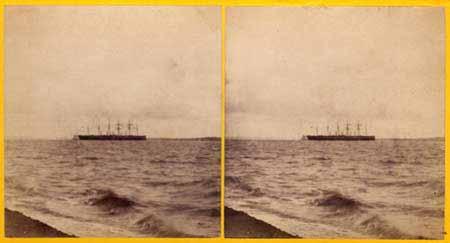
Great Eastern stereoview: “The Great Eastern in Southampton Water” Courtesy of Ken Rosen Image Archive
out and the cable ends spliced and Great Eastern got under way again, to the relief of those on board. But on the afternoon of Saturday the 29th another fault appeared and once again the process of picking up was set in motion. It was found that the same problem had occurred, and there was considerable suspicion that the damage to the cable might be sabotage. A watch was kept on the laying crew, but it was eventually discovered that the steel used for the armouring wires was too brittle, and was flaking off the short segments which had pierced the insulation.
On August 2nd, in a strong wind about 600 miles off Newfoundland, the cable broke and the end was lost to the depths of the Atlantic. Despite valiant efforts at recovery, in which the cable was several times successfully grappled and hauled towards the surface, the lifting tackle proved inadequate to the task and the cable could not be retrieved and the expedition had to be abandoned. But the engineers saw that success was in their grasp – there were no insurmountable problems in laying the cable, and the Great Eastern had performed admirably. They resolved immediately to make another attempt the following year.
A new company was set up, and the AngloAmerican Telegraph Company was formed in March 1866. The manufacture and procedure for the 1866 cable was the same
Attempting to launch the Great Eastern
as for the 1865 cable with the exception of the armouring wires, which this time were galvanized. Improvements were also made to the paying out and picking up machines. Great Eastern, again under Captain James Anderson, left Sheerness at midday on 30 June 1866 heading for Valentia, where the new 30 nm shore end was already in place. Laying began on Friday 13 July and at 3.00 pm Great Eastern set sail, heading once more for Newfoundland.
After the trials and tribulations associated
with the 1865 cable, the laying of the new cable went very smoothly, on two occasions the cable got tangled up and the ship had to be stopped to enable it to be sorted out. The laying took fourteen days and on Friday 27 July the Great Eastern sailed into Heart’s Content. For the first time since 1858, North America and Europe were in telegraphic communication, and this time it was a permanent connection.
Following the celebrations Great Eastern, with other ships accompanying, set out on
9 August 1866 to attempt the recovery of the lost cable of 1865. It took almost three weeks before the recover squadron was able to hook the cable and safely buoy the end. Upon being brought on board Great Eastern the cable was taken into the test room, cleaned up, and connected and the message; “Canning to Glass” was sent to Valentia. Once a reply was received the recovered cable was spliced to a new length in the ship’s tanks, and Great Eastern set out again for Newfoundland. Apart from a storm which lasted for 36 hours nothing untoward happened and the cable was landed at Heart’s Content on 7 September 1866. With the laying complete, Great Eastern headed home to England, where the Great Eastern Steamship Company paid a dividend of 70% following the success of completing the two cables.
After her return to England and with no cable work in prospect the Great Eastern was laid up at Milford Haven. In 1867 the company leased the ship for £1,000 a month to a French company, La Société des Affréteurs du Great Eastern, which was set up to transport wealthy Americans over to the Paris Exhibition that year. All the cable gear and tanks were removed and the ship was returned to its former glory. The engines were overhauled and power steering was fitted. In addition three dining saloons were built on the main deck. But this second attempt to use the big ship for passenger service also failed, and in 1869 the ship returned to cable service.
In June 1869 the Great Eastern was chartered by a French company to lay a cable between Brest and Cape Cod, via the island of St Pierre and Miquelon off the Newfoundland coast, a French possession. Despite some technical difficulties, the cable was successfully completed, the laying of long cables by now having become somewhat routine.
In 1870 Great Eastern laid over 2000 nm of cable for the British-Indian Telegraph Company, but after that there was no
further demand for her services until 1873, when another cable was laid from Ireland to Newfoundland. Great Eastern laid a second cable on this route the following year, but that was to be her last cable expedition and the ship was once more laid up.
In September 1881 the company put the ship up for sale with a reserve price of £75,000. The best offer received was £30,000. In 1883, the acting chairman Mr. Barber, reported to the board that all attempts
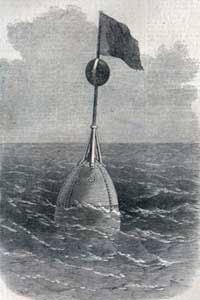
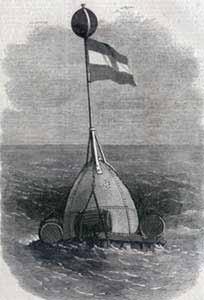
Buoys used during the attempted recovery of the 1865 cable
to sell or charter the vessel had failed. Further attempts to sell the ship over the next several years were also unsuccessful, and in February 1885 the mortgagee of the ship, foreclosed and took possession. The High Court of Justice ordered the ship to be auctioned and the Great Eastern was eventually chartered by its new owner to act as a floating exhibition.
The main and aft cable tanks were converted into ‘Music Halls’, the Grand Saloon into a bar (the spit and sawdust variety), and the Ladies saloon became a dining room. As well as all the stalls and sideshows spread around the ship, a group of trapeze artists performed their act between the Tuesday and Wednesday masts. In the first month some 50,000 people paid a shilling (worth
about 20 cents at the time) to go aboard, and during the four days of the Whitsun Bank Holiday 20,000 visited the ship. In all around 500,000 people visited the ship during its stay. This was a very successful charter for the ship’s owner, Louis Cohen; certainly one of very few to have made money with the Great Eastern.
It was then decided to take the ship to various ports around the country for similar exhibitions. In the spring of 1887 the ship was towed to Dublin, but it was a financial disaster. Very few were interested in the ship or the advertisements for tea which now adorned its sides, so she was towed back to Liverpool where, following the refusal of a liquor licence, the owners put on an exhibition of arts and industry, which was also a flop. The ship was then towed to the Clyde and moored near Greenock, but again the scheme failed to pay its way. The ship was again put up for sale, and an offer was accepted of £16,500 from the firm of Henry Bath and Sons, shipbreakers, who had the ship towed back to Liverpool to be scrapped
Henry Bath and Sons broke with tradition and auctioned the various metals from the
Great Eastern, the plates fetching £25,000, the copper and brass £7,000 and gunmetal £4,000. Souvenir hunters from all over the world came and helped push the total up to £58,000. They company estimated it would take 200 men one year to break up the ship at a cost of £20,000, ensuring a tidy profit. The Great Eastern had other ideas. In all it took the 200 men, working round the clock, two years to break up the ship.
In this sad end to the thirty-year life of the largest ship that had ever been built, Henry Bath and Sons, like so many owners, lost money. The ship’s only financial success had been as a cable layer, and the building of vessels designed specifically for cable laying, which began in the early 1870s with the construction of CS Faraday for Siemens, eventually made the Great Eastern obsolete.
Bill Burns is publisher and webmaster of the atlantic-cable.com website, which has over 800 pages on the history of cable laying from 1850 till the present day. Bill Glover is a cable history researcher and author based in England, who has written numerous articles for the site. A greatlyexpanded story of the Great Eastern may be read at http://atlantic-cable.com/ Cableships/GreatEastern/index.htm
Great Eastern at sea in the 1870s
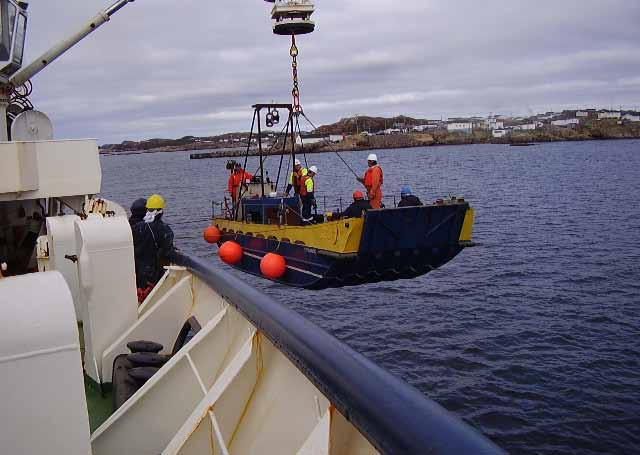
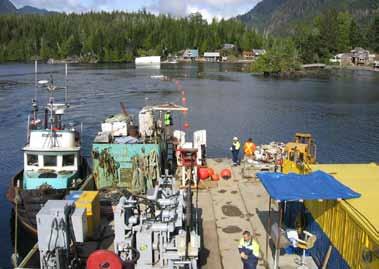
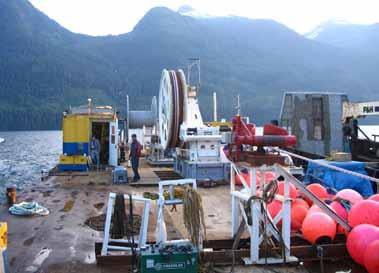
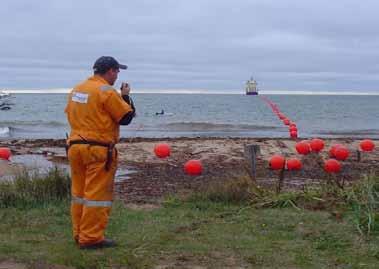
power cable shore end Western Canada power cable lay in Northern BC Canada
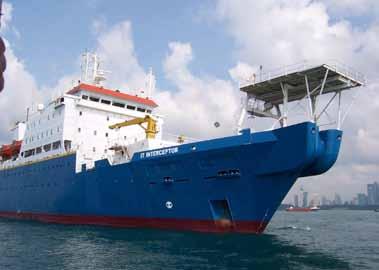
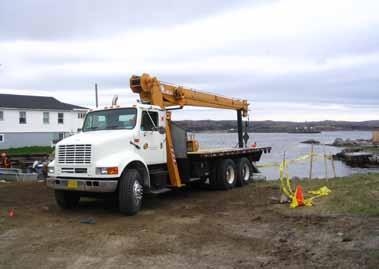
CS IT Interceptor Delivering N-Pipes in anticipation of the shore end
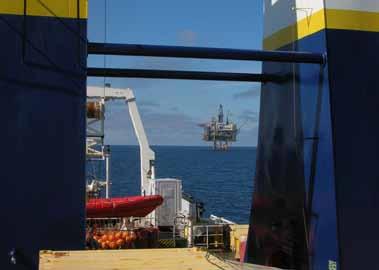
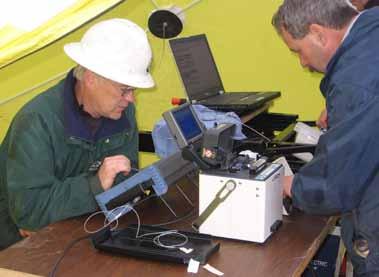
Laying cable to a BP platform North Sea Shore end landing splicing fibers
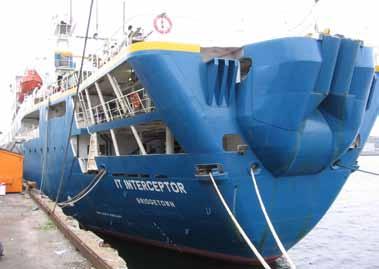
CS IT Interceptor stern at dock
Seize The Opportunities In The Current Economic Downturn
And Grow Your Business Successfully!
by Serena Seng
In recent months, the global economic downturn has catapulted many of the world’s economy into near despair with depressing news about red company balance sheets, involuntary company restructuring exercises and job cuts on a daily basis. Not only are the financial markets painted in a sorrowful light, the telecommunications industry is not spared as well. Even as we speak, we are still receiving news of our counterparts in the wireless and wire lined segments facing immense difficulties in emerging from this economic downturn unscathed. This is the ‘world’ that we hear and read in the news every day. This is the ‘world’ that is creating negative vibes and making us depressed and dimming all hopes of a recovery soon. Yet, out there, another ‘world’ exists, the ‘world’ of submarine cable networks that is booming and buzzing with activity. Hard to believe isn’t it? But it is true. In fact, 2009 could even be one of the best years since the submarine cable bubble burst!
And why is this so? While the global economic slowdown has not stopped the demand for international voice traffic between Asia, the United States and Europe, it has, redirected the focus of investors to emerging markets like Africa and the Middle East where new cable projects are currently being addressed. Africa, fuelled by strong demand for global connectivity coupled with inadequate telecoms infrastructure and expensive voice and internet connections, is becoming the hottest region for investors keen to gain an early mover advantage into what could soon become the world’s largest untapped telecoms market. Not only that, African operators, keen to own a share of the lucrative international traffic route pie are happy to form partnerships with international operators who could lend them their expertise in operating a submarine cable network.
The situation in the Middle East differs slightly. As Middle East becomes one of the largest trading hubs and financial markets in the world, a sound and reliable telecommunications infrastructure is imperative for its success. The recent 2008 submarine cable cuts has given the industry a “wake up” call for the need to have more resilient and reliable international connectivity. For a region that depends almost 90 percent on submarine cable connectivity for international traffic and only 10 percent on satellite communications, much needs to be done. Alternative and redundant traffic routes need to be put in place to safe guard future disruptions to international connectivity that are not only costly but also very disturbing.
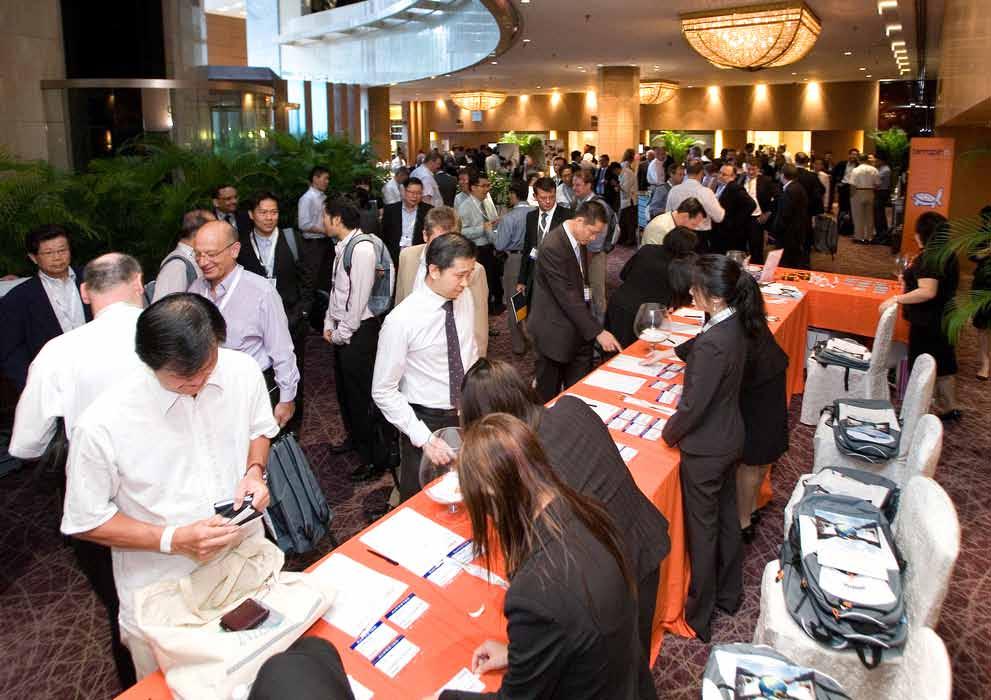
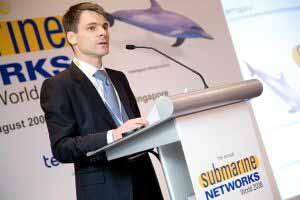
This year, in the 2009 and 12th edition of Submarine Networks World, Terrapinn is pleased to put together a conference agenda focusing on the investment opportunities in Africa and the Middle East, highlighting some cable projects as examples on financing and partnership acquisition strategies. Drawing on our long standing relationships with many industry insiders, we have crafted and shaped the content to address the
multiple needs of our clients from across the entire value chain. Leveraging on our sound reputation and brand, we have secured the very best speakers and partners in the industry for this year’s event. They will be sharing their perspectives and key strategies in a 3 days dynamic and spontaneous exchange of ideas.
If you have been following our Submarine Networks World series faithfully for the past 11 years, you would know that each year, we bring something ‘new’ to our conferences. If you haven’t, it is not too late to start. This year, apart from Africa and Middle East cable projects, we will also be focusing on the short haul submarine cables in the Caribbean as well as the long haul cable projects connecting Asia to the United States. Other topics that will be debated in length include:
• Upgrading of existing infrastructure vs. new fiber built
• Two network outages in the Mediterranean region: what’s happening over there?
• How can system operators add value on competitive routes?
• Dealing with piracy off the Somali coast and Gulf of Aden
• What are the new opportunities in marine maintenance agreements and the potential cost savings for cable owners and carriers?
A preconference master class on the ‘Life cycle of a submarine cable system’ is specially designed to equip attendees with key insights in the planning, design, implementation, maintenance and operation of a submarine cable system. And is a must attend for would
be operators and those aiming to understand the life cycle of a submarine cable project.
Some industry insiders, who have contributed their time and expertise to share their perspectives this year, include Jean Devos, Tom Soja, Fiona Beck, Robin Russell, Wilfred Kwan, William Kolb, Jim Byous, John Hibbard and Dan Hughes amongst others. Special mention also goes to our conference advisory board committee members who have contributed valuable ideas and suggestions. Our heartfelt thanks go out to Pierre Tremblay, Thomas Soerensen, Graham Evans, Eckhard Bruckschen and Stephan Beckert. And not forgetting our generous sponsors Nexans, Glimmerglass, Infinera, PIPE Networks and Pioneer Consulting for their contributions that have made Submarine Networks World a much highly anticipated event in 2009! Last but not least, a reminder to mark your diary and not miss our SubNets Ohana Luau party! Come deck in your coolest Hawaiian garb and join in the fun, great food, cool drinks and some serious hula dancing awaits!
More information about Submarine Networks World and Terrapinn can be found on our website www.terrapinn.com/2009/submarine
Serena Seng is currently a conference manager with Terrapinn since 2007 and has great interest in the submarine cables industry.
Legal Protection of Submarine Cables in Latin America
Since early 2008, Telefónica International Wholesale Services (TIWS) has been engaged in a plan designed to improve the legal framework protecting submarine cables in many Latin American countries. Despite laws to dissuade this, local fisherman caused serious cable cuts in Uruguay in 2007. The high market price of the catch was so substantial that they were willing to risk damaging cables, and applicable laws were not enough to prevent this.
by Andrés J. Fígoli Pacheco
These cable cuts proved that national authorities needed to be informed of the importance of higher economic penalties for fishing companies. To this end, several interviews with regulatory authorities took place, especially with Navy authorities; the natural watch keepers of the sea.
Under the advice of the International Cable Protection Committee, Telefónica has suggested to local authorities that the ideal regulation is the Australian 2005 legal framework (summarized in the Protection of Submarine Cables and Other Measures Bill 2005) which is considered the best model legislation for protecting submarine cables. The main points of this framework are establishing corridor systems between cable systems where certain fishing activities are prohibited and high penalties of up to USD 300,000 and 6 years imprisonment.
Some of these legal changes Telefónica proposes do not require a draft bill, so they focused on informing policy makers about the major risks telecommunications companies are facing and about the need to implement quick changes in administrative regulations. Some countries have also decided to adopt harsher criminal penalties for those who disrupt the telecommunication system performance, like Uruguay did with the amendment to its 1934 Criminal Code. Unfortunately, this amendment only allowed punishing willful misconducts and not negligent acts, which are the main reason for cable faults.
governments, including requests to change the regulation to increase administrative penalties against those responsible for cable cuts, even if they act negligently and not intentionally. Telefónica believes that high economic sanctions and civil proceedings requiring third parties to compensate for cable damage are the best dissuasive measures to avoid these incidents.
Despite the fact that cable awareness has proved to be a strong dissuasive measure against risky cable-damaging activities, the best result obtained so far was by raising the authorities’ awareness of the serious damages this can cause to national economies unless immediate actions are taken.
Since 95% of international communications are conducted by submarine cables, the need to guarantee the integrity of these assets is essential to avoid interrupting/delaying internet traffic, affecting cell phone/fixed line calls, and the international traffic of the whole continent. It’s not only the carrier’s public image that is affected by these disruptions, but end users as well. Let us just consider the idea of having banking systems and hospitals restricted to manual transactions, the breakdown of emergency systems are major impacts to economies and societies. That is why these same societies must increase the awareness of governments, industries, and people on the importance of fiber-optic networks.
cables is not only a national issue but also an international commitment. Although some of these countries have not even ratified the United Nations Law of the Sea Convention, which specifically requires ratifying countries to enact regulations to protect cables. Also, the Asia Pacific Economic Cooperation Working Group for protecting Critical Infrastructure is helping governments get involved in this matter.
Furthermore, Telefónica’s broad legal database with other countries’ legislations regarding these issues was opened to them, allowing the sharing of the best legal practices of other countries. For example, the obligatory implementation for the Uruguayan fishing fleet of the Vessel Monitoring System (VMS), an electronic transmitter controlled via satellite by the Navy, proved to be a good instrument for controlling their activities whenever the law enforcement controller detects by the position and speed that something prohibited is going on at sea.
This useful tool helps to detect the position of any vessel in the area when a cable fault occurs and every seaman knows the area is under surveillance. There is no point in denying it if your ship is above the cable when it breaks.
During 2008, several legal initiatives were presented before Latin American national
In Argentina, Chile, Brazil, Peru, and Uruguay, a strong collaborative approach is going on which emphasizes the idea that protecting
Also, the Automatic Identification System (AIS), a transponder fitted to the vessel which is connected to the ships GPS, transmitting over VHF, is a very helpful tool for protecting cables and providing legal evidence, and not just only for avoiding collisions. Of course, it would have been better if this tool had not only been limited to ships of more than
300 tons under the International Maritime Organization Regulations.
Sharing the seabed in harmony is something not easy to achieve, but it is not an impossible task. Government representatives are realizing that this is something that should be accomplished with new approaches and regulations for all ships. Otherwise, new problems to its economies and societies may surely arise, as submarine cables represent today the highways for the Information Society. To the present date, the strong collaborative approach between TIWS and local authorities contribute to achieve this goal of minimizing the risk of cable fault incidents.
The First Atlantic Telegraph
Back Reflection by stewart ash
Dr. Andrés J. Fígoli Pacheco is working as a Senior Legal Counsel in Telefónica International Wholesale Services (TIWS) in Montevideo, Uruguay, since early 2002. He is responsible for TIWS regulatory issues relating to submarine cable systems and telecommunications services, and he also works in privacy and commercial issues relating contract negotiations. Andrés is a lecturer for cable submarines in many organizations and also is currently a Commercial Law Assistant Professor at Law School, Universidad de la República.
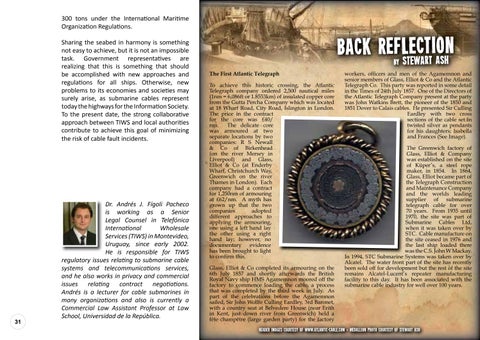
To achieve this historic crossing, the Atlantic Telegraph company ordered 2,500 nautical miles (1nm = 6,086ft or 1.8553km) of insulated copper core from the Gutta Percha Company which was located at 18 Wharf Road, City Road, Islington in London. The price in the contract for the core was £40/ nm. The delicate core was armoured at two separate locations by two companies: R S Newall & Co of Birkenhead (on the river Mersey in Liverpool) and Glass, Elliot & Co (at Enderby Wharf, Christchurch Way, Greenwich on the river Thames in London). Each company had a contract for 1,250nm of armouring at £62/nm. A myth has grown up that the two companies adopted different approaches to applying the armouring, one using a left hand lay the other using a right hand lay; however, no documentary evidence has been brought to light to confirm this.
Glass, Elliot & Co completed its armouring on the 6th July 1857 and shortly afterwards the British Royal Navy ship HMS Agamemnon moored off the factory to commence loading the cable, a process that was completed by the third week in July. As part of the celebrations before the Agamemnon sailed, Sir John Wollfe Culling Eardley, 3rd Baronet, with a country seat at Belvedere House (near Erith in Kent, just down river from Greenwich) held a fête champêtre (large garden party) for the factory
workers, officers and men of the Agamemnon and senior members of Glass, Elliot & Co and the Atlantic Telegraph Co. This party was reported in some detail in the Times of 24th July 1857. One of the Directors of the Atlantic Telegraph Company present at the party was John Watkins Brett, the pioneer of the 1850 and 1851 Dover to Calais cables. He presented Sir Culling Eardley with two cross sections of the cable set in twisted silver as pendants for his daughters; Isabella and Frances (See Image).
The Greenwich factory of Glass, Elliot & Company was established on the site of Küper’s, a steel rope maker, in 1854. In 1864, Glass, Elliot became part of the Telegraph Construction and Maintenance Company and the worlds leading supplier of submarine telegraph cable for over 70 years. From 1935 until 1970, the site was part of Submarine Cables Ltd, when it was taken over by STC. Cable manufacture on the site ceased in 1976 and the last ship loaded there was the C.S. John W Mackay. In 1994, STC Submarine Systems was taken over by Alcatel. The water front part of the site has recently been sold off for development but the rest of the site remains Alcatel-Lucent’s repeater manufacturing facility to this day. It has been associated with the submarine cable industry for well over 100 years.
Ploughing Ahead in Cable Lay
by Michael Craigs
Effective Ploughing
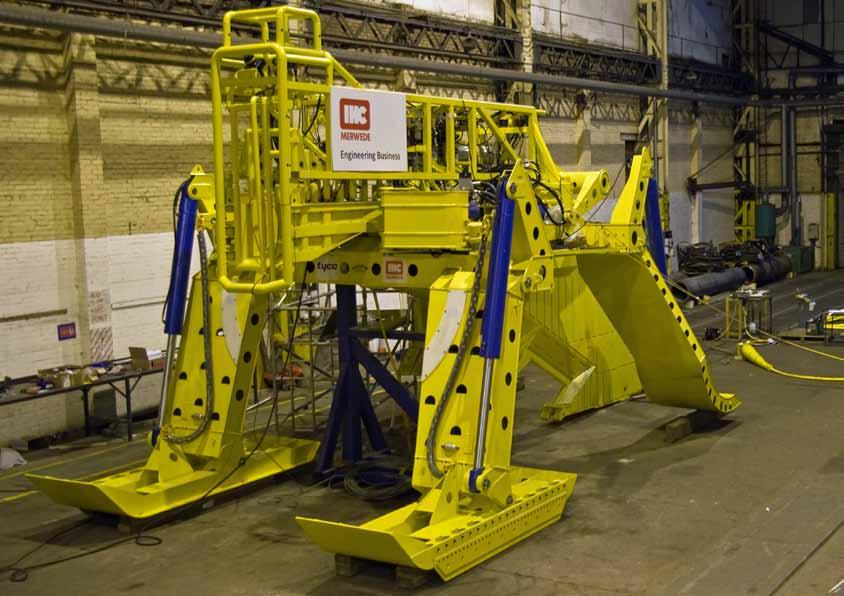
Cable ploughs combine agricultural ploughing principles with anchor technology to bury telecom and power cable beneath the seabed. This provides vital protection from other seabed users, such as anchors and particularly aggressive trawling nets. Cable plough developments have been built upon a fundamental understanding of saturated soil mechanics to design rugged and reliable machines, combating the inherent problems encountered when burying subsea cable.
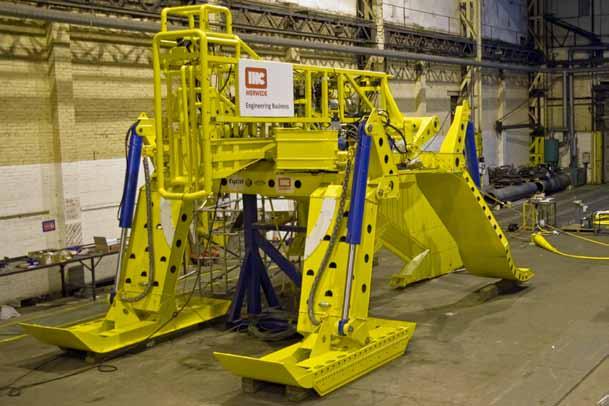
Over the past decade EB has developed four separate plough designs to provide optimal burial performance over a range of conditions. IHC Engineering Business Ltd (EB), an engineering company based in the North East of England. As well as producing a wide range of pipelay and handling equipment, the company has a track record in the design and delivery of ploughing and trenching equipment for the offshore sectors.
A cable plough has one simple aim: to bury the specified cable along the required route at the required depth whilst minimising the risk of any damage to the cable. Each subsea cable plough consists of a number of sub assemblies which are welded, pinned or bolted together; as shown in the illustration below.
Minimum burial depths are specified for each project (typically set using the industry standard Burial Protection Index) and are suited to local seabed conditions in order to avoid costly cable breakages. For example, deeper burial is required in softer sands where trawler nets may penetrate, and shallower burial is required in stiffer soils, such as dense clays.
Each plough may have one or more forecutters depending on soil conditions. These additional cutting tools reduce the tow force required to cut the soil, particularly in dense, impermeable sands and stiff clay. Less force is required to dig a trench in two or three shallow cuts than in a single deeper cut. EB ploughs are fitted with cutting tools which are raked forwards, giving very aggressive penetration, with the forces generated by the soil whilst towing acting to keep the plough in the ground, as opposed to causing the plough to ride out of the soil.
The burial depth is controlled by raising and lowering the front skids, with two large hydraulic cylinders. This method of depth control utilizes the well established “long beam” plough principle, whereby the plough is in equilibrium when supported by forces acting on the front skid and the heel. These forces balance the resultant of the tow force acting through the tow points, plough weight and soil force acting on the share.
As the front end of the plough is only supported by the forward skids, when they are raised the plough pitches forward, causing the heel of the plough to loose contact with the seabed. As there is no supporting force on the aft of the plough, the structure pivots around the skid pivot. As the plough is pulled forward the weight of the plough and soil force cause the plough to dig deeper until a sufficiently large heel force is generated (when the plough is running horizontal again).
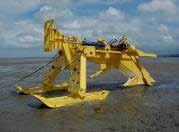
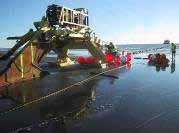
Sea Stallion 1
Sea Stallion 2
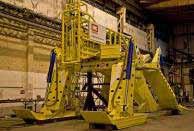
Sea Stallion 3
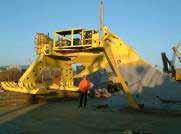
Sea Stallion 4
Bellmouth and HPU Cage (1)
Tow
Point and draw bars (7)
Depressor (6)
Front Skid and Skid Arms (2)
Chassis (5)
To prevent this issue, EB ploughs are designed with a shallow “s” curve which results in a reduction in residual tension, with typical values leading to a 45% increase in cable tension through the plough. The residual tension needs to be high enough to avoid any slack occurring which could lead to loops forming in front of the plough and being snared on, yet the tension must also be low enough to keep the cable stresses within allowable limits and allow the product to follow the contours of the seabed.
Overbending the cable is as much of a risk to the cable as over-tensioning. Each plate which the cable will rest on in the plough is designed to have a greater radius than the cables minimum bend radius, to avoid breaking fibres within the cable.
Ploughing
Skid Pivot (8)
Forecutter (3)
Share (4) Stabiliser (5)
EB Sea Stallion III Deep Water Cable Plough
EB Sea Stallion III Deep Water Cable Plough
When the skids are pushed down, the reverse happens. The plough is forced upwards at the front and the force on the heel increases. This causes the plough to rotate around the lower skid arm pivot until the heel runs level once more, at a shallower burial depth.
Effective Cable Lay
the bellmouth and down the back of the share where it emerges from the aft of the plough, forming an “s” curve.
The plough depressor keeps the cable in the share and ensures that it leaves the plough on the bottom of the trench. The depressor can be set to a “float” mode to allow telecom repeaters (large cylindrical devices typically 350mm in diameter and used to boost the signal to compensate for losses over the cable length) to be buried. The repeater is allowed to raise the depressor as it passes over the share and once it has been laid, the depressor switches back to “locked mode” and resumes pushing the cable to the bottom of the trench.
Due to the nature of the trench created by the cable ploughs it is not necessary to perform backfill operations as the parallel trench geometry is generally not stable and collapses, refilling the trench behind the plough.
“Horses for Courses”
burial depths are specified for each project (typically set using the industry standard Protection Index) and are suited to local seabed conditions in order to avoid costly cable
Cable can be loaded into the plough on deck before the plough is launched with the product routed through
As the cable passes through the plough the residual tension in the cable will increase. Ploughs which use a steep “s” curve can lead to residual tensions in the cables sometimes as high as 80%. This can result in the cable being laid in suspension (where it doesn’t lie on the trench bottom and bridges any hollows on the seabed) increasing the probability of damage occurring.
Plough design is optimised for varying conditions and can be split into two main categories; deep water telecom ploughs and shallow water power cable ploughs.
For example , deeper burial is required in softer sands where trawl er nets may and shallower burial is required in stiffer soils, such as dense clays.
Deep water telecom ploughs tend to be submerged for much longer and lay longer stretches of cable than
have one or more forecutters depending on soil conditions. These additional
the shallow water power cable ploughs. These ploughs are much more advanced with a greater range of functionality than their shallow water counterparts as it is not possible to support them with divers at operating depths of up to 2000m.
Each plough allows diverless recovery using a set of wires to both tow and lift. These wires are mounted on drawbars, which rotate from horizontal when towing to vertical during recovery. All the hydraulics and electronics must be mounted in the HPU cage above the cable passage to avoid clashes with the moving parts and protect against possible damage. Deep water ploughs also have steering capabilities, allowing a greater degree of directional control. Each skid and stabiliser is hydraulically actuated to deal with longitudinal and lateral seabed gradients. These features allow for improved control when towing a plough on continental slopes at increased depths.
At these water depths, soil is typically softer than in shallow water, so the required tow force is much lower. The latest EB telecoms plough is designed to bury Ø150mm cable with Ø350mm repeaters at up to 3m depth in 2000m of water, with the structure designed to withstand a pull force up to 130 tonnes (although the required force is usually much lower).
Shore end telecom ploughs have a different design basis and in contrast to deep water telecom ploughs they are designed as rugged and simple machines. They do not generally require diverless recovery functionality as the shallow water depths allow for diver support. Recovery of the plough is undertaken by a diver fixing a lifting shackle to the plough and a crane then used to recover it to the surface.
used to control burial depth with rear stabilisers bolted into place and positioned to avoid excessive sinkage in very soft soil conditions.
Generally, higher tow forces are required in shallower water as the seabed tends to be harder, with peak tow forces of 180 tonnes used as a design basis for Ø250mm cable burial in 1.3m chalk trench for the East Coast of England.
Conclusion
Although cable ploughs operate on a simple tried and tested principle, there is intricacy involved in designing and building the right plough for a particular job or application. This is based on a range of factors, including cable diameter, required burial and operating depths, soil conditions and maximum cable tensions. In combination with EB’s efficient and effective Sea Stallion design a range of cables have been laid quickly and easily around the globe.
Michael Craigs (MEng) joined IHC Engineering Business Ltd (EB) first as a Student Engineer in 2007, and then as a Mechanical Design Engineer in 2008 after graduating from Edinburgh University with a Masters Degree in Mechanical Engineering.
He is part of the dedicated Customer Support department, who fulfil a traditional customer support role, supplying spares and repairs for EB products. They also provide rapid upgrades, refurbishment and modifications of offshore and subsea equipment. Recently this has included providing and upgrading several subsea cable ploughs, the refurbishment and upgrading of a cable carousel, and modifications to offshore handling systems as well as supporting new and old equipment in the field.
There is less of a need for individually actuated skids and stabilisers as seabed gradients tend to be less steep at shallower depths. Obviously this depends on the local conditions and, if required, they can be supplied. Both forward skids are attached to a single skid arm,
Cable Installation In The Offshore Power Market
by Joel Whitman
Over the years we have all heard much about the potential of offshore wind as an energy source. Now, in 2009, the industry has finally reached a position to begin realizing much of that potential. The projections for offshore wind are staggering. As is well known, Denmark and the UK currently lead the world in installed offshore capacity. Currently there are plans for almost 40GW of offshore wind energy in the UK alone. In Germany, where the first offshore windfarm is expected to be powering German homes and communities by the end of this year, the expectation is that by 2030, 15% of German electricity consumption will come from offshore wind. Around the North Sea, many countries have set similar targets for themselves; the European Wind Energy Association has a projected target of 40GW offshore by 2020. These are huge, challenging goals.
The Offshore Power Market
The increasing price of conventional fuel which is projected as the world economy recovers in the coming years, and the potential destructiveness of global warming, have led many European governments to commit, that a certain amount of their nations energy will come from renewable sources by 2020. These commitments are the foundation of the offshore wind market and despite the current economic downturn, are forcing a transition to renewable energy across most European countries, and increasingly most leading industrialized nations throughout the world.
As part of this offshore build out, countries are increasingly looking to create efficiencies, and to maximize utilization through the interconnection of power grids across borders which quite often means under bodies of water. Currently there are projects in planning across Europe and the UK looking towards subsea cable installation, as a way forward in meeting the power consumption needs for the future.
core to the execution of a successful project. Long experience in route planning, permitting, cable handling, vessel management, environmental awareness, project installation and ultimately long term maintenance is core to success. In short, safely and efficiently delivering that power across great distances under the ocean, from either the turbine to the grid, or from one grid to another, is no small task.
Offshore Power Cable Installation Specialists
largest independent provider of submarine cable installation, maintenance, and related engineering services in the world.
To address this important market, Seabed Power delivers power-cabling solutions from the landfall to subsea for the power and offshore renewable energy markets. The companies’ experience in installation and maintenance of all types of subsea cables is in excess of two centuries.
In both cases, offshore wind and subsea interconnects, the role of the cable installer is
Launched in June of this year, Seabed Power is a joint venture between two premier marine engineering companies, Visser & Smit Marine Contracting and Global Marine Systems Limited. Visser & Smit Hanab’s parent company, Royal Volker Wessels Stevin, is one of the leading construction companies in Holland. Likewise, UK-based Global Marine Systems Ltd is the
With a head office located in Sliedrecht, Netherlands, an office in Chelmsford, UK, and an office opening shortly in Wilhelmshaven, Germany, Seabed Power, brings unparalleled expertise and resources to clients in the offshore energy market.
Successful Projects
Seabed Power, formerly known as Visser &
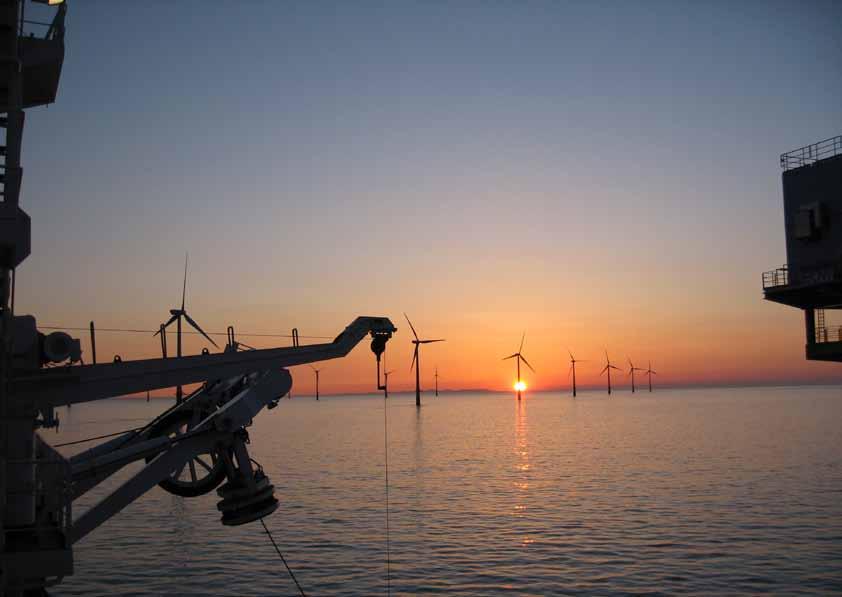
Smit Global Marine Contracting, has a history of executing successful subsea projects in the offshore power market. An excellent example of this experience is the Horns Rev Offshore Wind Farm, one of the world’s largest wind farms at sea. Comprised of 80 efficient wind turbines, it is capable of producing 160 MW, or enough to power 150,000 households per year. Horns Rev Offshore Wind Farm is located in the North Sea 14 kilometers west of Denmark.
Seabed Power is currently working on a Horns Rev II off the coast of Denmark and alpha ventus which is the first project of its kind in German waters, as well as several other projects throughout the UK and Europe such as: Sherringham Shoal, Thornton Bank and Nord Eon 1. With well over a century of experience, Seabed Power helps utilities and renewable energy companies build new capacity, increase efficiency, reduce risk and deliver energy in a more environmentally friendly manner.
Experienced People
to present realistic solutions that promote economy and long-term system security.
Resources & Assets
Vessels
Seabed Power has a full fleet of vessels available
Pontra Maris, Stemat 82 and the Stemat Oslo, all multi-purpose cable lay barges.
ROV’s and Ploughing Equipment
Subsea Power operates a fleet of ROV’s and other cable installation equipment. Examples include: Excalibur a high powered trenching ROV, incorporating exclusive technology designed to maximise its trenching and swimming efficiency. With 900 kW of power and a full 2000m water depth capability, it is configured for the full range of burial depths to three metres with the power and capability to bury into strong soils.
for installation projects. Examples include:
Perhaps more important than any physical assets, are the human ones that Seabed Power possess. When working in the subsea environment, reliability and risk reduction are paramount and the combined companies have by far the most experienced people in the industry with unparalleled history of installing and maintaining cables in some of the most demanding subsea terrain. Demonstrated experience in Marine Route Engineering puts the companies in an unrivalled position not only to evaluate risk, but also
CS Sovereign, a class DP2 vessel capable of undertaking Subsea cable installation and repair projects, which is equipped with powerful trenching/work, class ROV and a 35 tonne A-frame.
Stemat Spirit which will be available in late 2009 and will be equipped with a 4,000 ton turntable system capable of deploying a variety of products and cables, including power cable trunk lines, up to a weight of 150 kg/m.
Atlas 1 a powerful, state of the art cable working ROV, designed for both cable maintenance and post lay and inspection roles.
The Sea Stallion 4 cable plough system, designed specifically for the aggressive burial of power cables in shallow water featuring a unique share design and a robust chassis that can withstand tow forces up to 150 tons to permit cable burial in the hardest seabed conditions.
Looking Forward
The slow changes in the health of our environment, and our over-dependence on fossil fuel present some of the great challenges of our time. Increasingly the world’s energy supply is going to come from renewable sources. The build out of offshore windfarms and the installation of interconnects between European power grids will play a major role in helping to maximise the use of renewable energy. Seabed Power looks forward to playing a role in this important transformation.
Joel Whitman was appointed Director Corporate Strategy, Marketing and Communications in July 2005 and brings extensive marketing and consulting experience to Global
Telecoms Trade Disruption Insurance A Different View On Revenue by Graham White
In this increasingly interconnected and complex world the threat of business interruption on vital supply industries is of growing concern for the companies that offer these specialist services and for those that rely upon them.
Supply networks today are now truly global and sophisticated but rely on strong partner relationships and continuity. This equilibrium can be disturbed by many factors. Current economic conditions, fierce competition and unstable geo-political tensions only further
threaten the stability between supplier and customer.
The fibre optic cable industry offers a prime example of where supply balances and the potential for disruption are particularly acute.
Most of the world’s data traffic passes trustingly through submarine cables and the companies that distribute, own and derive income from this flow of data are totally reliant upon the physical wellbeing of the thousands of miles
of cable that transports it. Cables can break or be disrupted by other means, and loss of data flow can be instantaneous and without warning. Even with improved geographic diversity, government intervention and a heightened awareness in the industry, cable network safety remains a major issue and has the ability to seriously impact on commerce and security on a global scale.
On this fragile infrastructure rests the performance and profitability of many companies who are tied to the reliability of submarine cable systems. Firstly the providers and operators of capacity, their receivers or carriers and in turn their clients or sub-carriers down the supply chain. Whichever way you go upstream or down all parties can stand to lose in the event of failure. Even if the physical infrastructure remains sound the demise of a key company within it can cause equally telling damage and this can reverberate through a network. Financial consequences have the potential to be very costly, effecting revenue stream, market share, client relationships and ultimately shareholder confidence.
Such critical exposure which threatens loss of income, the ability to deliver and ultimately survival in such a competitive market should put pressure on companies to focus more strictly on their risk management strategy, and whenever possible take action to reduce or remove exposures.
If business continuity planning cannot risk manage these risks down to an acceptable level – and one that the company is comfortable retaining on its balance sheet - then risk transfer becomes an attractive and reliable option. Not surprisingly many companies are open to exploring new and innovative insurance
concepts which can help them respond to a disruption and maintain client and shareholder integrity, while also indemnifying them for any financial losses incurred.
In the past, traditional insurance policies did not address the potential disruption losses that companies faced from non-damage events, and were restrictive in the type of indemnity they offered. Historically, insurance was set up to respond to easily quantifiable risks. Risk managers and their brokers often had to approach different underwriters to secure physical exposures and political risks separately resulting in more than one policy and potential deficiencies.
Now, however, new business interruption covers have evolved to help enhance current risk transfer strategy. Russell White Marine Ltd, an independent UK based insurance broker has taken the business interruption concept and applied this knowledge to the submarine fibre optic industry. Unlike main stream business interruption cover, trade disruption insurance responds to interruption of supply from many causes beyond the physical damage of insured’s assets. Telecoms TDI sets out to adopt this concept specific to cable infrastructure, as a compliment to existing covers or as a potential substitute.
There are numerous threats that can disrupt the performance of supply, revenue and profit and the TDI concept addresses these exposures. Disruption can stem from traditional physical events such as impact of fishing equipment, malicious acts or deliberate sabotage, anchor drag or looting and natural perils from storm to earthquake and tectonic activity. Including various non-damage events that can have a direct or indirect effect on supply such as political risks, war, acts of terrorism, embargo,
civil unrest, sabotage, strikes, deprivation and asset confiscation, territorial disputes or trade restrictions. Company insolvencies and contractual failure may not actually result in damage to the cable but nonetheless prevent the normal flow of data. Telecom companies that rely on income from international feeder networks through extended links can be particularly vulnerable to outage if systems fail, as they have absolutely no control or influence over recovery.
Adding to the financial strain are increased costs and extraordinary expenses which can be incurred in addressing and mitigating disruption; restoration, re-routing, relocation and other reasonable expenditure necessary in re-establishing communications and customer services.
The extent and severity to which these exposures impact on submarine cable entities will depend on size, diversity and network topography, but as well publicised incidents over the years show outcomes can be totally unpredictable and severe, with the potential to cause considerable financial strain on the revenue stream, client relationships and ultimately shareholder confidence. Serious multiple failures in the Taiwan straight and more recently the eastern Mediterranean have served to underline on-going vulnerability.
With the squeeze on operating costs, dwindling margins in an increasingly tough environment and where credit is in short supply, many telecom companies will also be more concerned that if the worst happens they have sufficient contingency funds to counter a major disruption to revenue loss on their own. Transferring risk into the insurance market in these circumstances can be an attractive option. The Telecoms TDI insurance concept
looks at bridging such gaps and may also provide stimulus to unlocking renewed bank interest and financing.
The concept of Telecoms TDI insurance can also adapt to addressing cable lay projects, where debt servicing obligations, projected profit margins or similar expectations are potentially exposed to delay in start up, particularly so if key equipment relies upon foreign suppliers, manufacturers or cross border delivery and political risks have the potential to intervene.
In a contracting market protection of the revenue stream can take priority over the protection of fixed assets, but regardless of the state of the market, such risks as key supplier or customer insolvency, contract cancellation or the demands of key creditors can occur at any time, and all adds to the potential list of disruptions that can impact on future revenue and increased costs.
The Telecoms TDI insurance concept sets out to provide the answers, but also potentially to convert what could be a crisis into a corporate and market advantage.
Graham started his Lloyd’s insurance broking career in 1976 and has worked in a variety of capacities specialising in commercial marine and associated specialty risks. He is a Chartered Insurance broker of the Chartered Insurance Institute and has held senior positions in several Lloyd’s broking companies working both in London and overseas and is currently a director and the founder of Russell White Marine Ltd; an independent UK based insurance broker.
SubTel Forum ha S par T nered wi T h ai S live T o bring live cable S hip T racking T o our web S i T e. view The laTeST cableShip poSiTionS worldwide, or zoom in on a SpeciFic Ship. wiTh aiS live, iT’S now eaSier Than ever To keep Track oF ThoSe peSky cableShipS. click ThiS page To viSiT The SiTe
Letter to a friend from Jean Devos
My dear friend
My Dear Friend
“Botany Bay”
Warrior event was still in everyone’s memory. It is for these reasons among others that STC (UK) rejected the Alcatel‘s suggestion to come with a joint bid, to offer a “European” solution.
One of the winning factors has been the Port-Botany cable factory. Such a factory was a strong requirement from OTC (now Telstra) and the Australian Government.
My glass is small...
Alcatel was the most motivated. Such a factory could expand its influence in the Pacific where the three other players were historically well established in this region, which represents a large part of their market. They saw this factory as a risk for their existing facilities!
You probably read the announcement about NTT buying Pacific Crossing (PC1) for an amount of 105 million dollars. Ten years ago, the construction cost of PC1 was well above 1 billion US dollars. The system was constructed by Global Crossing after the commercial success of Atlantic-Crossing (AC1). The plan was to install a truly global network from which all the carriers would be pleased to buy capacity if and when they needed, avoiding the risks and burdens of investing in advance. The highly-voiced vision got a lot of attention and seemed irresistible at the time, but in reality, this model failed heavily. This was for two reasons: (1) the carriers never accepted the concept; and (2) the private investors did not pay sufficient attention to the technology.
I published recently a modest novel, whose title is Botany Bay. It is the place in Australia where
Alcatel established a submarine cable factory in 1989 as part of its contract for the Tasman 2 link. In this same bay, where two centuries before the French expedition
When I joined Tyco in 1997, I had the opportunity to meet and chat with Gary Winnick, the bright initiator of the concept, during a party in New York. He had my name on his list and tried to convince me to join his team.
“La Pérouse” made of two ships, La Boussole
“Thanks Gary,” I said, “but I have some doubts.”
“What do you mean?” he asked.
“I know the culture of the incumbent carriers,” I said. “Network is their obsession, and I can’t see them becoming just capacity buyers. They may buy from you marginally, but they will continue to invest and build their own networks. My other doubt comes from WDM technology; I perceive it as a killing factor for your strategy. This technology will create a surplus of capacity, which will kill your prices, and your profitability.”
and l’Astrolabe, landed in 1788 to discover that Captain Cook was already around bearing the British flag. So Botany Bay is now for me the symbol of a dream which becomes a reality!
These carriers, such as FT, are investing in Africa, taking significant shares in the incumbent operators. They want to bring “their” traffic on “their” network.
SubOptic ‘87 in Versailles came at the right time. It is where the Australian teams discovered the French model, a close cooperation between Alcatel and FT, exactly what they wanted to establish in their country.
Gary disregarded my remarks, walking away with the idea that I was a man of the past.
I know, my dear friend, that even today some people, including some of my closest business friends (especially in the US), do not see things that way. Some are currently embarking in similar ventures in Africa On both sides of the African continent, East and West, one can see two types of systems being built and promoted in parallel and in competition: the “private cables” and the “carrier’s cables”. Where there was not enough capacity recently we will see very soon too much capacity and the “private cables” in deep trouble!
Tasman 2 has been yet another chapter in this long Anglo-French competition! The award to Alcatel came out as a big surprise to many, including inside Alcatel. Everybody was naturally expecting the British to win that battle, and such an expectation was at that time very logical.
There were so many difficulties and misunderstanding between Australia and France, the main one being the French presence in the Pacific area, the worse being the nuclear bomb experiment in Tahiti! The sad Rainbow
There is a French saying: My glass is small but it is my glass. Lessons have clearly not been learned. I can predict that, a few years from now, despite a growing need, some cable systems will be for sale cheap,around Africa, very much like PC1.
Jean Devos
My friend, things are changed since, but one thing stays true: When you offer something, the reader can see between the lines if you are or not genuinely motivated and sincere. Then your offer becomes really attractive and this opens the route to “Botany Bay.”
See you soon.
Jean Devos
Submarcom Consulting
Their customers, the carriers, are building their own high-bandwidth, dense WDM cable.
Jean Devos is a senior consultant with Submarcom Consulting. He is also one of the founders and a board member of Axiom, a Paris based company specialized in Submarine systems projects study & management. He spent three years developing Tyco’s international capability, and was the head of ASN (Alcatel Submarine Networks). Jean was born in 1938 and is graduated from the Lille University. He is the founder of SubOptic and carries a vast international experience in our field.
NOW HiriNG
WFN Strategies is seeking qualified individuals experienced in submarine and terrestrial cable maintenance and operations to man a Network Operations Center (NOC) located in Sterling, Virginia USA. The NOC is staffed 24/7/365 and maintains a six-9’s uptime to provide continuous cable monitoring services.
The successful candidate must have 15+ years of experience in submarine and/or terrestrial cable operations and maintenance, and have the ability to travel internationally. Knowledge of the HP-UX operating system, network architectures and IT best practices is preferred.
Please forward curriculum vitae and applicable references to hiring@wfnstrategies.com. No telephone solicitations accepted.
WFN Strategies is a womenowned SBA certified 8a company, and Virginia certified Women’s Business Enterprise, and an equal opportunity employer.
by Kevin G. Summers
There isn’t much I like to listen to on terrestrial radio. Sports... not my thing. Politics... I abstain courteously. And music... my favorite singer is Johnny Cash, and you don’t hear a lot of “Folsom Prison Blues” on the radio these days. There is, however, an alternative thanks to power of the internet (power supplied by submarine cables thank you very much.)
What I’m referring to, of course, is podcasting.
Podcasts are a lot like radio in a way. You might find a host or a group of hosts talking about a subject or introducing music, just like on traditional radio. But instead of having to cast an enormous net because their show is being broadcast to an entire region, or syndicated across the globe, podcasts can zero in on a particular subject. That is their beauty.
Furthermore, when you listen to a podcast, you aren’t limited by show times. You can listen whenever you want, and if you miss something, just back up and listen to it again. This is truly one of the most user-friendly technologies available thanks to high-speed
As a Johnny Cash fan, I can actually download and listen podcast where the hosts discuss his music, tell stories about his life, and even introduce me to songs I’ve never heard before. And podcasts aren’t limited to music. There are shows about virtually any topic you can think of, including submarine cables.
The Submarine Telecoms Forum Podcast was launched in May, and we released our second episode
(and interview with Hibernia Atlantic about Project Kelvin) at the end of June. We’re planning to release episodes on a monthly schedule (at least for the time being), and have shows panned through the end of the year. Look for topics in the coming months such as regional systems, industry history, and conference discussions.
If you use iTunes, search “subtel forum” in the iTunes store, and you’ll find our show. Please give it a listen, and let me know what you think. You’re feedback, as always, is welcome.
Kevin G. Summers is the Editor of Submarine Telecoms Forum, and a professional fiction author. He lives in Leesburg, Virginia with his wife Rachel and their two daughters. Learn about his writing at his website: www.kevingsummers.com.