Dispelling The Myth: International Networks in the Australian IP Value Chain
Welcome to the 44th issue of SubTel Forum, our Regional Systems edition.
My 80 year old dad recently saved a life using the Heimlich maneuver.
Anybody who knows me knows that I am heavily involved in the international scouting movement, and that teaching such ‘survival’ skills is for Scouters an everyday thing. But I was nonetheless astounded that an octogenarian could possess the composure and wherewithal to accomplish such a feat in a room full of dumbfounded onlookers. Perhaps that also suggests that I underestimated the still relevant talents of those before me.
A business friend recently bemoaned that our industry was matching we grey hairs with the iPod generation with few in the middle; that over recent
years we had lost the middle-agers and all the talents they possessed, and a significant void of maturity existed. Maybe so – but maybe that matters less than I once thought.
In any case, the generations have converged once more to provide our readers with some interesting, thought provoking articles.
Lindsey McDonald examines how undersea cables are breathing life into Africa, while Jorn Jespersen discusses a new system in Greenland. Erick Contag examines telecoms demand in Latin America, as Lucia Bibolini analyzes that region’s submarine cable systems. Andrew Lipman, Paul Gagnier and Troy Tanner share their insights on new FCC regulation’s impact on submarine cable operators, as Stewart Ash continues his Back Reflection, and Robin Russell dispels the myth of international
bottlenecks. Jean Devos returns with his ever-insightful observations, and of course, our ever popular “where in the world are all those pesky cableships” is included as well.
Enjoy, and stay young!
A synopsis of current news items from NewsNow, the weekly news feed available on the Submarine Telecoms Forum website.
May 12th, 2009
x John Lawton joins Red Penguin
x SubTel Forum Podcast - Episode 1: The Challenges of Raising Cable Awareness in Developing Countries
x NEC forecasts return to profit on cost cutting
May 8th, 2009
x Telstra names Thodey as new CEO
x NEC Announces Revision of Financial Forecasts and Recording of Extraordinary Loss for the Fiscal Year Ended March 31, 2009
May 7th, 2009
x ICT development strategies agreed at AsiaPacific meeting
May 5th, 2009
x Alcatel-Lucent reports EUR 402 million net loss in Q1
x Pacnet Expands Its Asia Network With Xtera’s NXT Terminals
x Private Equity Investor Group Purchases Cable Product Line from Tollgrade
May 4th, 2009
x Undersea Cables to Breathe Life Into Africa: Frost & Sullivan Examines Their Impact
April 30th, 2009
x Tata Communications Positioned in the Challengers Quadrant of the Magic Quadrant for Managed Security Services
April 29th, 2009
x Phoenix Announces Award Of Deepwater Maintenance Projects
x Tyco Electronics Reports Second Quarter Results
April 23rd, 2009
x Tata Communications to Launch Cisco TelePresence Exchange
x Huawei forecasts FY contract sales up 29% to USD 30 bln
April 22nd, 2009
x AT&T Q1 revenues flat, profits fall
x Telstra wins contract from Commonwealth Bank of Australia
x ITU World Telecommunication Policy Forum opens in Lisbon
April 20th, 2009
x Opportunity, innovation and strategy for submarine cable owners, operators and investors
x TV5MONDE Selects Tata Communications’ Content Delivery Network Services to Reach Global Audience in Real-Time
April 17th, 2009
x ITU World Telecommunication Policy Forum focuses on future of ICT
x Sony Ericsson to cut more jobs as losses widen
April 16th, 2009
x Renesas, NEC starts talks on merger - report
x Telindus appoints new Product Manager for Service Provider division
April 14th, 2009
x WFN Strategies’ Director of Projects to speak at ICPC 2009
x Mobinil (Egypt): France Telecom requests Orascom Telecom to cease its media attack and comply with the ICC’s award
x US to boost telecommunications links with Cuba
April 10th, 2009
x ITU Optical technology standards guide available
April 9th, 2009
x Siemens Introduces OpenScale™ Operate Service Packages Designed To Give Enterprises Simpler, More Effective Ways to Manage Costs
April 8th, 2009
x Global Crossing Prepared to Optimize New Federal Broadband Fund
x WACS Consortium and Alcatel-Lucent Sign a Contract to Deploy New 14,000 km Submarine Cable Network
x NEC - Regarding Media Reports on April 8, 2009
x Pacnet Completes Significant Capacity Upgrades on EAC-C2C
April 7th, 2009
x KVH Announces $3.8 Million in New Orders for Fiber Optic Gyros
x Trans-Caribbean Cable Network acquired by Cobian
x SEACOM partners with Interoute to open a digital super highway between East Africa and Europe
April 6th, 2009
x Tata Communications and Dimension Data Partner to Accelerate Global TelePresence Market
April 2nd, 2009
x Global Marine Systems’ Energy Division prepared for growth
April 1st, 2009
x Global Crossing Announces Conference Call for GCUK’s Fourth Quarter and Full Year 2008 Financial Results
x Fujitsu Optical Components Established
x Pacnet Enhances Focus on SMBs with New Partner Program
March 31st, 2009
x Fiber Will Eclipse DSL in Taiwan’s Internet Market Within Next Five Years, Finds Pyramid Research
x The SubOptic 2010 website is launched
x NTT Com and Pacnet make an offer on Pacific Crossing
March 30th, 2009
x Asia Pacific Wire & Cable Announces an Amended and Restated Shareholders’ Agreement
x NEC Wins Contract to Build Submarine Cable Asia Network (SCAN) System
x Bharti Airtel and Australia Japan Cable collaborate to create a new connectivity solution to Australia from Singapore and the US
March 27th, 2009
x Pacnet named Best Wholesale Carrier at Telecom Asia Awards 2009
March 26th, 2009
x Telefonica Selects Level 3 for North American Network
x Tunisia signals its digital independence with a new sub sea cable linking North Africa to Interoute’s pan European network
March 25th, 2009
x Tyco Telecommunications Successfully Transmits 40 Gigabits Per Second Signal On Tata Communications’ Trans Pacific Undersea System
x Frost & Sullivan Recognizes ConceptWave(R) as a Formidable Player in the Global OSS/BSS Markets
x NEC to Upgrade PanAmerican Submarine Cable
March 24th, 2009
x Pacnet Boosts Investment in India, Sets Sight on High Growth Long Distance Market
x NEC to Upgrade PanAmerican Submarine Cable
March 23rd, 2009
x NEC and OptiComm Partner to Deliver FTTH Open Access Network to more than 50,000 New Homes and Businesses
x The Spanish Ministry of Public Administration awards its data communications and fixed telephony to BT for the second time
x Alcatel-Lucent and Politecnico di Milano reinforce their cooperation in optical research
x Australia Japan Cable completes testing and offers Gigabit Ethernet on its international network
x Global Marine Systems awarded Business Weekly’s East of England Business Award in the category of International Trad March 20th, 2009
x Hatteras and Overture Lead Growing Carrier Ethernet Access Platform Market Segments in 2008, Heavy Reading Reports
March 19th, 2009
x Pacnet Boosts Philippine Operations to Support Burgeoning BPO Industry
x ACCC institutes proceedings against Telstra for alleged breach of standard access obligations
x Lightwave Logic, Inc. Announces Positive Patent Update
March 18th, 2009
x Active Optical Cable Patent Awarded to EMCORE Corporatio
x Pacnet Bolsters Cross-Strait Connectivity to Support Accelerating Sino-Taiwanese Trade
x Interoute defies telco slow down - flight towards fibre boosts revenues
March 17th, 2009
x Tata joins forces with Seacom cable
x Ericsson And Deutsche Telekom Succeed In A Joint European 100g R&D Field Trial (100get) On Existing Optical Platform
x Australia Japan Cable signs as International Capacity stream sponsor at CommsDay Summit
x BT selected as SABMiller’s network and telecommunications partner
x Optical Cable Corporation Reports Fiscal First Quarter 2009 Financial Results
March 16th, 2009
x SubTel Forum announces winners of readership survey prizes
x Global Crossing Receives Two ATLANTICACM 2009 U.S. Wholesale Carrier Excellence Awards
x Fujitsu Conducts Collaborative Field Testing of LTE
x NEC Obtains BSI Certification for Business Continuity Plans
x Siemens supplies electric-propulsion and automation package for two deep-sea survey vessels
x BT ranked top global operator for customer satisfaction
LIKE YOUR NEWS NOW?
GET THE LATEST INDUSTRY NEWS AS SOON AS IT HAPPENS WITH SUBTEL FORUM’S FREE RSS SERVICE. JUST CLICK ON THE BUTTON TO THE RIGHT AND ENTER OUR FEED ADDRESS INTO YOUR RSS BROWSER. DON’T HAVE AN RSS BROWSER? SEE THE CODA IN ISSUE #43 FOR A LIST OF FREE BROWSERS AND YOU CAN BE AN EXPERT IN MINUTES!
Introducing the Submarine Telecoms Forum
Submarine Telecoms Forum is published bimonthly by WFN Strategies. The publication may not be reproduced or transmitted in any form, in whole or in part, without the permission of the publishers.
Submarine Telecoms Forum is an independent commercial publication, serving as a freely accessible forum for professionals in industries connected with submarine optical fibre technologies and techniques.
Liability: while every care is taken in preparation of this publication, the publishers cannot be held responsible for the accuracy of the information herein, or any errors which may occur in advertising or editorial content, or any consequence arising from any errors or omissions.
The publisher cannot be held responsible for any views expressed by contributors, and the editor reserves the right to edit any advertising or editorial material submitted for publication.
Contributions are welcomed. Please forward to the Managing Editor:
Kevin G. Summers
Submarine Telecoms Forum 21495 Ridgetop Circle, Suite 201
17 June 2009 may be a watershed date in Africa’s economic history. That is the date set for the Seacom cable to become operational.
The significance of the cable can not be understated. Currently, South Africans are dependent on the SAT3 cable for broadband connection to the rest of the world. This single cable is insufficient for the country’s needs, and is currently controlled by a consortium that has used its monopolistic position to keep prices high.
East Africa has no cable at all at the moment. Users there are entirely reliant on satellite, which is slow and expensive.
The Seacom cable offers the opportunity to change all that. It will link South Africa, Madagascar, Mozambique, Tanzania and Kenya to India and Europe at greater speeds and at significantly lower costs. Bringing down the cost of bandwidth will also decrease the cost of technologies such as unified communications.
Seacom has already outlined what sort of pricing it will offer, and the savings to South African wholesale users are expected to be as much as 75%. Seacom will be offering a 9.6 Gigabit per second (Gbps) wholesale connection at R267 per Mbps (megabit per second) per month. The SAT-3 cable currently costs between R3 500 and R11 000 per Mbps per month.
In addition to Seacom, the construction and maintenance agreement, and supply contract for the implementation of the $600-million West Africa Cable System (Wacs) were signed on 8 April by a multinational consortium of operators with interests in the project. The cable will offer an alternative to the Telkom-controlled SAT-3 cable, which is fast running out of capacity.
The cable will link Spain and Portugal to South Africa, landing at a number of sites along the way. Telecommunications companies from both Africa and Europe have shares in the project.
The deal was signed by Angola Telecom, Broadband Infraco, Cable & Wireless, MTN, Telecom Namibia, Tata Communications (Neotel), Portugal Telecom, Sotelco, Togo Telecom, Telkom SA and the Vodacom group.
What makes this cable different than the current installed capacity along the west coast of Africa is that a greater portion of
ownership is privately held. This offers the potential of more competitive rates and creates confidence that the project will run on time. It has been scheduled to be completed around the middle of 2011.
The cable will land in countries such as Namibia, the Democratic Republic of Congo, Congo Brazzaville, the Canary Islands, Togo, and Cape Verde, which are not currently served by SAT-3.
Unfortunately, not all of these countries currently have the required backbone infrastructure to take full advantage of the additional bandwidth. The true potential of the cables won’t be leveraged until this infrastructure is in place to take connectivity from the coast to inland regions. It will be interesting to see whether this will provide an incentive for these governments to increase their spending on telecommunications.
As far as South Africa is concerned, this cable will add to bandwidth being brought by the Seacom cable on the east coast. Frost & Sullivan maintains that additional bandwidth is always a good thing, and there is certainly no such thing as too much. Having these additional cables also creates competition in the market which should help to put downward pressure on prices.
The United States of America did reach a stage when they thought they had too much bandwidth and they wouldn’t be able to use it all. But they are now having to build more to catch up with demand. That said, the continent certainly won’t use all of the available bandwidth straight away. These cables are built with a 15-20 year lifespan, and with future technology in mind. As technology improves, it should be possible to increase the capacity of the cables through upgrades.
It’s important to understand that the impact of these cables will go far beyond allowing users to surf the web at high speed. The current lack of bandwidth in the region has stifled innovation and prevents companies from taking advantage of business opportunities.
For instance, local online digital media companies are unable to keep up with the advances of their foreign counterparts, as they are simply unable to create applications that require a large amount of bandwidth. Their competitors in places like the U.S. are, however, free to innovate as bandwidth is not a limiting factor.
Frost & Sullivan is convinced that this additional bandwidth will create new opportunities within the local ICT industry. IT Service providers such as Dimension Data will be able to provide additional services that they were
previously unable to. For instance, they have the expertise to offer software as a service and virtualization, but they are currently unable to deliver these due to bandwidth constraints. These kinds of offerings with materialise overnight.
Proper use of the bandwidth would also provide governments with the opportunity to improve service delivery. Services such as telemedicine could increase the reach of services into poorly serviced rural areas.
East Africa has no cable at all at the moment. Users there are entirely reliant on satellite, which is slow and expensive.
Frost & Sullivan has also found that many South African online marketing and advertising companies are currently exporting more services than they sell locally. This is not only because the client base in international markets is bigger, but because companies there have an understanding of the capacity of the internet and the ways in which tools such as search engine optimization can promote their online presence. South African businesses have yet to
fully utilise the marketing power of the internet because bandwidth has limited the scope of what they can do.
The lack of bandwidth in South Africa has also inhibited the ability of local ICT companies to deliver services and support to foreign clients. This is particularly true in the software development and online digital media sectors, as companies are unable to meet the needs of clients working in high bandwidth environments. South African companies have shown an incredible ability to innovate and offer niche solutions to sectors such as retail and banking, but they have been restrained by their bandwidth limitations.
It is fair to say that the more bandwidth people have, the more they need. South Africans are not realising the full benefits of Web 2.0 developments because they don’t have the bandwidth to engage fully in activities like file sharing and video streaming. Once we start using those sorts of platforms, our demands for more bandwidth will increase exponentially as we look to do more and engage the possibilities of the medium. The business opportunities for companies in this sector are potentially enormous.
Bringing down the cost of bandwidth will also decrease the cost of technologies such as unified communications. This will allow South Africans to engage
in the sharing of information in more convenient ways and allow new business opportunities for companies offering voice, data and video services.
While this is all promising, there is one caveat. These cables alone are not a magic wand that will suddenly transport Africa across the digital divide. For users to be able to take advantage of the cable, the infrastructure to connect them to the cable has to be in place and secure. There has already been a significant amount of activity from companies like MTN and Vodacom to ensure that they have the infrastructure to take advantage of the increased demand Seacom will create. However, much still needs to be done to ensure that the benefits reach all Africans, particularly those in rural areas where infrastructure is poor to nonexistent.
At a recent South African cabinet meeting, government recognised that expediting the roll-out of wireless broadband infrastructure had become imperative. Wireless broadband is essential for improving access for facilities in rural areas such as schools, clinics and courts. Overall, the development of these
undersea cables promises a revolution in the African ICT industry. With the continent already providing some of the fastest growth rates in the world, these developments serve as an additional boost to a booming sector.
Some analysts have pointed out that the economics of the digital age are not those of scarcity. Bandwidth is a resource that is potentially so abundant that it may, before long, become free. Until now, South Africans haven’t been able to think in anything near those terms, but Seacom is potentially the start of a new wave of thinking in Africa, in which we can start to see things in terms of abundance, not the scarcity that has plagued the continent for so long. It’s time we no longer thought in terms of our limitations, but rather our possibilities. And in the digital age, those are endless.
Lindsey McDonald has been employed as an ICT analyst with Frost & Sullivan’s African division since December 2005. She has conducted studies into smart card technology adoption, opportunities in mobile telecommunications, IT infrastructure outsourcing, the market for open source software in South Africa and capital expenditure trends for sub-Saharan African fixed line telecommunications service providers. Lindsey’s research experience has given her wide ranging exposure to many sub-Saharan African markets and she is an established expert on the African telecommunications industry.
The Tele Greenland company vision “Greenland in the centre of the world” is unfolding where massive investments in platforms and infrastructure are providing the 57,000 Greenlandic inhabitants with state of the art telecom services at affordable prices. The company vision states that one can live and work with even conditions whether you are based in Ilulissat, Hamburg, or Copenhagen. Greenland has a geographic area of 2.166.086km2 and the icefree land area is 410.449km2. Distance from north to south is 2.670km. The challenge of this vision is operating a telecom business in the tough conditions of a huge arctic country, hosting 17 cities and 55 settlements scattered across the coast embracing the inland icecap.
Jorn Jespersen
The launch of new services and growth of traffic at about 100% per year has created opportunities for a full range of telecom services at a reduced price. This delivery has been possible despite Tele Greenland’s telecom license, which requires countrywide service options at a homogenous price scheme. This even includes settlements of only 70 inhabitants.
A successful market strategy has lead to high penetration across all products and the result of this work positions Greenland within the range of leading OECD countries pertaining to penetration and revenue per user. Market strategy on broadband access to private households has been a package offering cheap installation fee, subscription free of charge and volume based billing. The result of this strategy had been a penetration of 51 installations per 100 house holds. Numbers for mobile and fixed telephons are equally high and this massive costumer growth is leading to increased traffic. MPLS service to business users are also driving increasing traffic growth. Data traffic covers 70% of the volume though these services still only bring 15% of the revenue. Mobile voice and fixed switching are still the cash cow as the case is for most full scale incumbent operators.
The technology strategy of Tele Greenland has always been to make wise decisions on technology, concepts, and application of proven technology. The cutting edge of development is a place Tele Greenland can’t afford to be. Deployment and commissioning in the field are extremely cumbersome in rural arctic areas where sites only can be reached in the short summer and even then only by helicopter.
The infrastructure architecture is based on a SDH microwave backbone, in a single line chain structure without physical redundancy, along the west coast from Nanortalik to Uumannaq. Fiber deployment is not commercially feasible in the desolate arctic environment, with huge distances between populated areas. Some areas are even
outside the reach of the microwave chain and can only be reached by satellite link. To cover cities in the north and east, Tele Greenland operates 16 earth stations using Intelsat C band satellites. Tele Greenland also owns and operates a satellite earth station in Copenhagen which is the single transmission route covering international traffic to the entire country.
The satellite and microwave backbone is at this time a very scarce resource and is almost saturated beyond the limit due to the growth in market and traffic. To remedy that situation, Tele Greenland is in the process of a comprehensive swap of the west coast microwave chain to increase traffic capacity to 7 times STM1 ( 155Mb/s). The undertaking encompasses updating all radio equipment, feeding systems, and antennas. The entire trunk from Nanortalik to Uummannaq has been made operational since 2008. Simultaneously, Tele Greenland is
upgrading all supporting site infrastructure like power, cooling, fire extinguishers, and general OSS equipment. The microwave upgrade will give Tele Greenland the needed scalable expansion dynamics to meet traffic demands until 2014. Satellite links take high operational expenditures even though Tele Greenland are in a fortunate position in that Intelsat satellites provide a hemi beam focused footprint on both north west Europe and Greenland. Until moving the service to Greenland Connect Submarine cable on March 23, 2009, Tele Greenland consumed 125Mb/s to cover all international traffic in and out of Greenland –broadband and data account for more than 70 % of the traffic volume. The transponder capacity is used with careful planning for the symmetry and balance between link budget and bandwith. The available capacity is able to meet the Greenlandic demand until the end of 2009, but only with implementation of all possible traffic optimization enhancements like advanced turbo coding and
cashing of frequently targeted internet sites. Even given the scenario that Tele Greenland absorbed all available satellite traffic in the entire world, the satellite technology would only be sustainable until 2012 and extremely costly since Tele Greenland would be forced to track commercial satellites with global beams which would lead to ineffective throughput per rented bandwidth unit compared to presently used hemi beam operation. Moreover, satellite telecommunication is threatened by other services’ need for frequency space to support launch of land based mobile services like wireless broad band access. A timely example is the
awarded licence to operate wireless broadband access Wimax in Denmark. Tele Greenland has raised concern with the Danish National Telecom agency that land based services which operates in satellite C band (3,5GHz) can’t co-exist with highly sensitive long haul transmission systems like Satellite earth stations. Moreover, it becomes more and more clear that application for private and public enterprises are becoming more and more sensitive to latency of the transmission link. Satellite links have delays of no less than 300mS, which are far more than many applications can cope with efficiently.
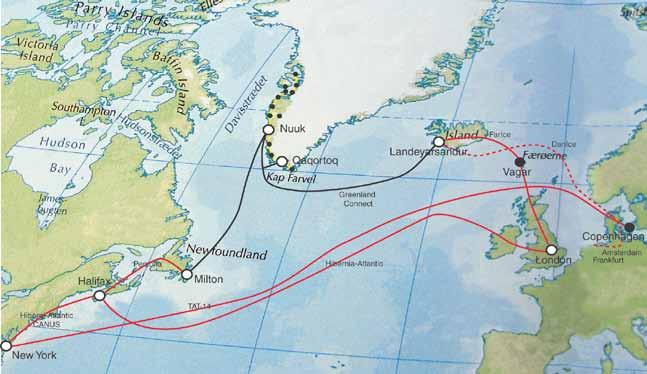
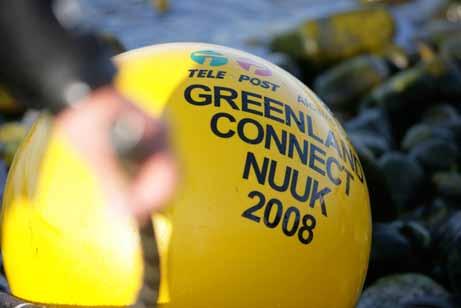
This picture leads to the decision to launch a new strategy for securing the continuous development of the vision “Greenland in the centre of the world”. In 2006, Tele Greenland’s management team presented the “Greenland Connect” prospect to the management board. Greenland Connect is a submarine cable project connecting Greenland to Europe and North America. The solution is based on 20 year backhaul agreements giving Tele Greenland market conditions on backhaul traffic from landing sites in Iceland and New Foundland, which are connected to London and Halifax where the lines interconnect and IP peering can be traded at fair market conditions. The submerged cable system is an amplified dual fiber link. Landing sites has been established in Landeyersandur near Vestmanna Islands in Iceland, Qaqortog, and Nuuk in Greenland and Milton in New Foundland. Landing sites are hosting high voltage power supply systems for the submerged optical amplifiers and transmission equipment for the DWDM system, covering 96 wavelengths, each with a capacity of 10GB/s.
Greenland connect was planned in 2006 and presented to the management board. Planning encompassed thorough break-even analyses addressing the optimal timing for migrating exponentially increasing traffic to high capacity submarine cable. This work was complemented by a survey on satellite availability and marked conditions in the north Atlantic region. This work unfolded a clear picture showing that satellite transmission to Greenland would be insufficient within a time span of a few years, even if all available capacity could be absorbed to serve Greenland alone. A set of objectives on Greenland Connect were set early in the planning phase: Secure the transmission capacity to Greenland for a 25 year time span, remove dependency on satellite transmission, improve latency and transmission speed, secure transmission capacity to remote areas (by releasing satellites to that purpose), and pursue transatlantic carrier business.
After approval of the concept and a 20 year business case, the sequential work commenced with speed in the spring of 2007. First and foremost, long time backhaul agreements had to be contracted to carry traffic from remote landing sites to tele houses with open competition on Peering and termination of traffic. Many routes were in play like Faroe Islands, Scotland, Halifax, and more. A backhaul agreement with complex bilateral pricing schemes covering the next 20 years was signed with E farice and Persona. The backhaul agreements froze decisions on making the landing sites Milton Canada and Landyersandur Iceland.
Hence, a series of parallel actions took place:
1. The route plan and network design was set and encompassed 5 stations; Landyersandur, Qaqortoq, Nuuk1, Nuuk2, Milton.
2. Land acquisitions and permission to erect the stations and install the submarine cable shore end.
3. Tender on a marine survey to chart the route was signed with Oceanographic Institute in Trieste and the entire route was documented by the survey ship Explorer in the summer 2007. Planning the route to connect Europe with North America across the arctic north Atlantic showed to be a delicate undertaking. Crossing through Unesco world heritage Surtsey volcanic Island leaving the continent into deep waters, climbing across the Atlantic ridge and into deep Greenlandic fjords with heavy ice activity, breaking south west across more flat Atlantic seabed to Canada crossing more fishing interests before entering into narrow shallow sound.
The comprehensive tender on the entire cable system entailed production of submerged armoured cable designed to meet requirements of the survey findings, optical repeaters, power feed and submarine line terminal equipment, and finally turn key installation of the entire plant. The tender was submitted to 10 possible vendors and only 3 usable quotes were delivered in due time. Negotiations evolved through Autumn and late December 2007 and the contract was given to ASN, Alcatel Submarine Networks. To meet the tight time schedule in the area’s short installation window due to arctic waters, the actual production started in Calais the first days of January 2008. Strong project management, focus and good planning lead to the start of the wet installation in – August 2008 with 4 Vessels in action; Blue Castor, Il de seine, Maersk Responder and blue Castor.
QEQERTARSUAQ
QASIGIANNGUIT
SISIMIUT
KANGAAMIUT
KANGAARSUK
Installation work progressed as planned throughout the entire implementation phase and the system was delivered for provisional acceptance to Tele Greenland by 22, December 2008. Engineering work to move traffic from insufficient satellite links to Greenland Connect has been planned and a good design with no active equipment beyond standard interfaces at the far ends and automatic rerouting of traffic to others segments if any part of the wet installation should fail was tested in the first month of 2009. Actual movement of the traffic was successfully instigated 23, March 2009.
To bring the full benefit of the Greenland Connect and the microwave project, Tele Greenland are working on a general refurbishment of other platforms like a total swop upgrade of IP backbone to increase capacity and redundancy on Internet and MPLS services. Extension of some PDH trunks feeding the larger settlements outside the reach of the microwave chain and a swap of the entire mobile access and core platform bring traffic blocking numbers down from double digit values to les then 2% and bring high speed GPRS services to mobile data users. New IMS core platform to bring state of the art telephonyservices to business users and successively swop out PSTN in the entire country.
This undertaking gives Tele Greenland a modern infrastructure to offer the customers fast and reliable internet and data services, with sufficient bandwidth and workable latency rates. All these new technologies open possibilities for new broadband and data services; especially close to the sea cable landing sites and cities where the new microwave chain has its termination points. Up till present time, Tele Greenland has offered the same services at equal prices everywhere in Greenland, but the new infrastructure opens technical possibilities for a differentiated set of options and call for delicate political decisions on a possible new scheme. The controversial price model for the volume based broadband rating, which has been physical unavoidable with a infrastructure saturated beyond its limits, can be open for political debate, but calls for a understanding of the need for implementation of one set of services in dense populated city of Nuuk and another set of services in rural settlement Kullorsuaq.
Jorn Jespersen, Chief Technology Officer of Tele Greenland, has long experience from various senior managerial positions in the telecoms industry. TDC, Ben/T Mobile, Mobilix, Orange, Telia Sonera. Currently managing a major refurbishment of the entire Grenlandic teleinfrastructure pertaining; Microwave backbone swap, IMS implementation, Comprehensive Mobile optimization programme, submarine cable project and many others.
The vision “Greenland in the centre of the world” and the technology strategy plan to deliver the vision and bring fast broadband services to Greenlandic users are set in stone and will progress for the years to come in a cycle with winter planning, logistic preparations, and fast summer roll out.
Submarine cable systems in Latin America
lucia bibolini
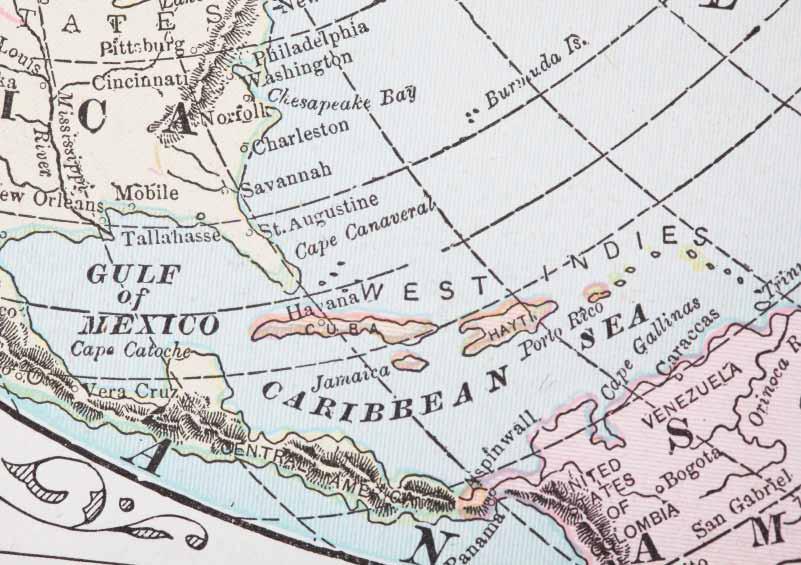
The Latin America and Caribbean (LAC) region is served by 23 significant submarine cable networks as well as a few minor links. Technologies used include Synchronous Digital Hierarchy (SDH), Erbium-Doped Fibre Amplifier (EDFA), Wavelength Division Multiplexing (WDM), and Dense Wavelength Division Multiplexer (DWDM).
All of the major submarine cable networks in LAC were launched between 1999 and 2002. Since then, the region has lived through a major recession from 2001 to 2004, as well as through a remarkable recovery from 2004 to 2008. Countries and operators in the region have been dealing with the rising transmission demands by upgrading the existing systems, as well as planning new submarine networks. Cable system owners are investing in upgrades that involve increases in lit capacity, improvements to resilience, and network links to new markets.
The following ten cable systems are the most important and connect a large number of LAC countries:
• Americas Region Caribbean Optical-ring System (ARCOS-1);
• Americas-II;
• Atlantis-2;
• Global Crossing’s Mid Atlantic, Pan American, and South America Crossing (MAC, PAC, SAC);
• Latin America Nautilus (LAN);
• MAYA-1;
• Pan-American (PANAM);
• South America-1 (SAm-1).
Major international submarine cable companies with networks in the LAC region include Columbus Networks (ARCOS-1, CFX-1, and FibraLink) and Global Crossing (MAC, PAC, and SAC). Several telecom operators have also been active in the construction and maintenance of submarine cable systems. For example, Brazil’s international telephony incumbent Embratel; Telefónica, through its International Wholesale Services (TIWS); and Telecom Italia, through Latin America Nautilus. Many of the submarine networks in the LAC region are owned and maintained by consortia of telecom operators.
In March 2009, the consortium of 11 telecom carriers that own the Pan-American Cable System (see table) contracted Australia’s NEC Corporation to upgrade its PANAM network. This is expected to boost regional capacities by multiple 10Gb/s wavelengths. The upgrade is scheduled to be completed by the end of 2009.
Major submarine cable networks in Latin America
Cable Launch Details
Americas Region Caribbean Opticalring System (ARCOS-1)
Sep 2001 Links the USA, Bahamas, Dominican Republic, Puerto Rico, Curaçao, Mexico, Belize, Guatemala, Honduras, Nicaragua, Costa Rica, Panama, Colombia, and Venezuela via an 8,400km fully redundant ring, consisting of both repeatered and nonrepeatered cable segments, with 15Gb/s capacity (upgradeable to 2.56Tb/s), using SDH and WDM technology. Columbus Networks is the principal owner and operator of ARCOS-1.
Americas-I South 1994
Americas-II
Aug 2000
Links the USA, the US Virgin Islands, Venezuela, Brazil, and Trinidad via a 6,014km cable with 1.12-1.68Gb/s capacity.
Interconnects with Americas-II, Atlantis-2, ECFS, PANAM, and Columbus-II.
Maintenance authorities are AT&T, CANTV (Venezuela), Embratel (Brazil), and Trinidad’s TSTT.
Links the USA, the US Virgin Islands, Puerto Rico, Martinique, Curacao, Venezuela, Trinidad, French Guiana, and Brazil via an 8,161km cable with 80Gb/s capacity, using SDH and WDM technology.
Maintenance authorities include AT&T, CANTV, Embratel, Trinidad’s TSTT, and others.
Antillas-1 Jun 1997
Antilles Crossing (Phase 1)
2006
Atlantica-1 Sep 2000
Atlantis-2 Feb 2000
Links the Dominican Republic and Puerto Rico, employing SDH technology. Capacity is 622Mb/s (upgradeable to 3.7Gb/s).
Links Barbados, St Croix, and St Lucia via a 940km cable with 20 GB/s capacity (upgradeable to 160GB/s).
Interconnects with SAC and PAC.
Links South America, North America, and Bermuda, via a 22,500km network. Launched by GlobeNet Communications.
Links Argentina, Brazil, Senegal, Cape Verde Islands, Spain, and Portugal, via a 13,000km cable network with 2 x 20Gb/s capacity.
Maintenance authorities for Latin America are Embratel, Telefónica de Argentina, and Telecom Argentina.
Cayman Jamaica Fibre System (CJFS)
1996
Columbus-2A 1994
Columbus-2B 1994
Links the Cayman Islands and Jamaica via a 1730km cable with 2.5-10Gb/s capacity.
Interconnects with MAC and Maya-1.
Maintenance authorities are C&W, France Telecom, and AT&T.
Links Cancun, Mexico with West Palm Beach, Florida via a 1,121km cable with 560Mb/s capacity
Maintenance authorities: AT&T, Telmex
Links the US Virgin Islands and the USA, via a 2,068km cable with 2.5Gb/s capacity.
Maintenance authorities: AT&T
Countries where submarine cable capacity has been particularly inadequate include Colombia, Guyana, Suriname, and Cuba.
In Colombia, outages on the ARCOS-1 network severely disrupted Internet access in early 2007; as a result, the Colombian government and several carriers sought additional submarine cables and cable landings. In May 2007, Columbus Networks began to install a submarine fibre-optic cable system dubbed USA-Colombia Express Route (CFX-1), which was launched in May 2008 (see table below). In March 2008, Telefónica International Wholesale Services (TIWS) linked its submarine cable network South America-1 (or SAm-1) to Colombia, doubling the country’s data, voice, and video transmission speed.
Suriname and Guyana are linked internationally via an overland cable link and the Americas-II cable, both subject to frequent cuts resulting in serious disruption of service. The system’s capacity has become woefully inadequate to meet the growing demand for bandwidth. In December 2008, Suriname’s Telesur and Guyana’s GT&T signed an agreement for the construction of a 1200km Suriname-Guyana Submarine Cable System (SG-SCS). The two operators said they would each invest about US$30 million in the project, to be completed by 2010. SG-SCS will link Trinidad & Tobago, Venezuela, Guyana, and Suriname.
In Cuba, the US embargo and the country’s difficult relationship with the US have prevented the implementation of submarine fibre-optic cables; thus, Cuba has had to rely almost exclusively on satellites for international connectivity. In January 2007, Telecom Venezuela and Cuban telecom operator Telecommunication Signals Transport (Transbit) signed an agreement to install a 1,552km submarine fibre-optic cable linking Venezuela with Cuba. The two operators formed a joint venture in October 2007 for the implementation of this project. The resulting company, called Telecomunicaciones Gran Caribe (TGC), is 60% owned by Telecom Venezuela and 40% by Transbit. The cable system will connect La Guaira, in the Vargas state of Venezuela, with Siboney, in the province of Santiago de Cuba, offering capacity to support an estimated 20 million simultaneous voice calls. TGC expects the submarine cabling to be deployed by the end of 2009 or early 2010, and the system to be up and running in the first half of 2010.
Cable Launch Details
Columbus-2C
1994
Eastern Caribbean Fibre System (ECFS)
1995
FibraLink
April 2006
Hawaii Americas-1 (HIAM-1)
Latin America Nautilus (LAN)
Links the US Virgin Islands, Italy, Spain, and Portugal, via a 9,116km cable with 560Mb/s capacity
Maintenance authorities: AT&T, Telefónica, Telecom Italia, and PT Comunicações
Links Anguilla, Antigua, Barbados, Dominica, Guadeloupe, Grenada, Martinique, Montserrat, St Kitts, St Lucia, St Martin, St Vincent, and Trinidad & Tobago. Cable capacity is 2.5Gb/s. Interconnects with Americas-1 and Americas-2.
Maintenance authorities: consortium of Operators incl. C&W
Links Jamaica and the Dominican Republic, and has 160Gb/s capacity. Interconnects with ARCOS.
Built by Columbus Networks.
Late 1999 Links the USA, Hawaii, Mexico, Guatemala, Costa Rica, and Panama. The system has enhanced international connections and transmission speeds, and provides direct communication between the USA, Latin America, and the Asian Pacific rim countries.
Mar 2002
MAYA-1
Oct 2000
Links the USA, Venezuela, Brazil, Argentina, Chile, Bolivia, Peru, Panama, and Mexico via a high-capacity backbone based on fibre optic ring networks, both land-based and submarine, with an overall length of 30,000km. The ring, which has automatic optical traffic protection and a capacity of up to 320Gbit/s, connects to a Mediterranean ring and pan European backbone. LAN is controlled by Telecom Italia.
Links the USA, Mexico, Honduras, Cayman Islands, Costa Rica, Panama, Colombia, Guatemala, Puerto Rico, and Jamaica via a 4,400km cable with 20Gb/s capacity, using SDH with EDFA technology. It is a collapsed SDH ring system with semi-passive branching units.
Mid Atlantic Crossing (MAC)
Pan American Crossing (PAC)
2000
Nov 2000
Pan-American (PANAM)
Feb 1999
A section of Global Crossing’s worldwide submarine fibre optic network, linking the USA, the US Virgin Islands, and Bermuda via a 6,000km cable with 20-80Gb/s capacity.
A section of Global Crossing’s worldwide submarine fibre optic network, linking California, Mexico, Costa Rica, Panama, Venezuela, and the US Virgin Islands via an 9,500km cable with 20Gb/s capacity (upgradeable to 80Gb/s).
Links the US Virgin Islands, Aruba, Venezuela, Colombia, Panama, Ecuador, Peru, and Chile, via a 7,300km cable with 5Gb/s capacity, using SDH technology. PANAM is constructed as a trunk and branch system in a collapsed ring configuration, allowing for self-healing within the cable. The Pacific segment was launched in November 2001.
Principal partners in the venture include Telefónica, CANTV, Entel Chile, C&W Panama, Telecom Italia, and others.
Other countries have also been looking to increase their submarine cable bandwidth. In July 2008, Uruguay’s stateowned incumbent Antel and Telecom Argentina agreed to deploy a 240km fibre-optic submarine cable from Las Toninas (Argentina) to Maldonado (Uruguay). The link, to become operational in September 2009, would increase Antel’s Internet capacity by around 500% to 600%. The operators expected to spend around US$15 million on the project, involving the installation of 12 fibre-optic pairs, each one with 320Gb/s capacity.
The Trans-Caribbean Cable Company (TCCC) is a consortium of 32 foreign and Jamaican telecom carriers and service providers planning a submarine cable network to link the US, Mexico, the Caribbean, and South America. The TCCC consortium members agreed in mid-2006 to fund the first phase of the plan. The Central Caribbean North Sub-Project phase would connect Jamaica with the NAP of the Americas in Miami. Upcoming phases of the network expansion would include extending the cable to Haiti, the Dominican Republic, Venezuela, and Columbia. The consortium also applied for permission to extend the Jamaica-Dominican Republic cabling section to Cuba.
The TCCC cable was designed to have transmission speeds of nearly 2Tb/s. Members of the consortium that agreed to provide funding and facilities for the first phase of the project included C&WJ, Jamaica Network Access Point (JNAP), Digicel Jamaica, and Reliant Enterprise Communications. In late 2008, JNAP acquired full control of TCCC. However, in early 2009, it appeared that construction of the cable had yet to begin.
Although the global downturn may hold back some of the expansion plans for 2009, the huge expansion of mobile telephony and broadband in the region has created an inexorable need for more bandwidth. In the next few years, we can expect to see not only some serious upgrades to existing networks, but also the deployment of new cable systems to replace outdated ones or to provide redundancy against network failure.
Cable
South America-1 (SAm-1)
South America Crossing (SAC)
Launch Details
Mar 2001 Links the USA, Brazil, Argentina, Chile, Colombia, Ecuador, Peru, and Guatemala via a 25,000km broadband cable. The SAm-1 cable ring has four fibre optic pairs with 40Gb/s capacity (upgradeable to 1.9Tb/s) using DWDM technology. It was constructed by Tyco Telecommunications for Telefónica International Wholesale Services (TIWS), previously known as Emergia, a wholly owned subsidiary of Spain’s Telefónica.
Oct 2000
Trans-Caribbean System-1 (TCS-1) (retired)
A section of Global Crossing’s worldwide submarine fibre optic network, linking the US Virgin Islands, Brazil, Argentina, Chile, Peru, Colombia, and Panama via an 18,000km four-fibre-opticpair system with 40Gb/s capacity (upgradeable to 1.28Tb/s). SAC uses WDM technology and forms a self-healing ring, with internal restoration capability in the event of link outage. SAC is operated by Global Crossing and is fully integrated with the entire Global Crossing Network.
Mar 1990 Retired in January 2004. TCS-1, also known as V Centenario, linked Puerto Rico with the Dominican Republic, Martinique, and Colombia.
Unisur Mar 1995
Links Argentina, Brazil, and Uruguay via a 1,700km cable, with 560Mb/s capacity.
Maintenance authorities are Embratel, Telecom Argentina, Telefónica de Argentina, and Antel.
USA-Colombia Express Route (CFX-1)
May-Jul 2008
Links Colombia, Jamaica, and the USA via a 2,500km cable, with 80Gb/s capacity (upgradeable to more than 2Tb/s). The first segment, connecting Colombia and Jamaica, was completed in May 2008. The second segment, connecting Jamaica and Florida, was completed in July 2008.
The cable is expected to eventually connect other countries in Central America, including Costa Rica and Panama. CFX-1 is owned and operated by Columbus Networks, the owner of ARCOS-1.
(Source: BuddeComm based on industry data)
Lucia currently lives in London, having moved there in 2003 from her former place of residence on the Central Coast, north of Sydney. Prior to joining the BuddeComm team, she worked as freelance simultaneous conference interpreter, primarily for the UN, and
also taught yoga for a number of years. She is fluent in English, Spanish, French, and Italian. Besides her telecom research work, she also writes and illustrates fantasy stories. Lucia has worked for BuddeComm since 2000 and has been responsible for their Latin American reports since mid-2003.
On March 17, 2009, the Federal Communications Commission (the “FCC”) issued an order that fundamentally revised the way in which regulatory fees are imposed on submarine cable operators and licensees. As a result of the FCC’s action, many submarine cable operators will pay significantly lower regulatory fees and all operators will benefit from the regulatory certainty that results from the new regime.
Andrew D. Lipman, Paul O. Gagnier, and Troy F. Tanner
For many years, U.S. submarine cable licensees have paid annual regulatory fees that often represent one of the largest operating costs of cable systems. These fees have put significant financial pressure on submarine cable operators, have caused distortions in the marketplace, and hindered the development of new and upgraded high-capacity cable systems. The FCC long declined to adopt a more rational and equitable methodology. However, beginning in 2007, the FCC, in response to demands from the industry, began to examine new approaches to regulatory fees. The new regime that resulted from the FCC order is the outcome of widespread industry consensus, and should make the calculation and imposition of regulatory fees more certain and equitable.
History of Regulatory Fees for Submarine Cable Operators
Beginning in 1994, the United States Congress required the FCC to collect annual fees from the companies it regulated. These fees were intended to reflect the costs incurred by the FCC in performing its regulatory duties and were to be distributed among telecommunications operators in proportion to the costs of regulating the various sectors of the industry. Submarine cable landing licensees were required to pay an international bearer circuit fee for each active “64 kbps circuit or its equivalent” (the “IBC Fee”).
Basing the IBC Fee on the number of 64 kbps circuits operated by a submarine cable licensee made sense in a voice-centric era. Under the channelized telephone system designed by AT&T in the 1960s, each 64 kbps international circuit represented a single voice channel that generated revenue in readily measured per minute increments. The 64 kbps circuit quickly became the global standard and thus provided a reasonable basis for determining the IBC Fees to be paid by a submarine cable operator.
Unfortunately, the FCC’s IBC Fee methodology didn’t keep up with the radical changes in the submarine cable industry at the turn of the century; particularly the exponential growth in data traffic, the increased entry of competitive “private” cable operators, and the vastly larger transmission capacity of new submarine cables. In the current broadband environment, packetized data is transported in unchannelized form over submarine cables carrying hundreds of gigabits or even terabits of data simultaneously. The underlying content of these data streams is a mix of video, voice, and data applications. FCC rules nevertheless required submarine cable operators to artificially divide their multi-gigabit data services into 64 kbps increments for the purpose of determining their IBC Fees. This resulted in a disproportionate financial impact on submarine cable operators in general and, in particular, on new entrants operating highcapacity, data-focused cable systems.
The excessive burden resulting from the FCC’s IBC Fee methodology encouraged operators to find creative ways to lower their regulatory costs. Some carriers developed legal theories as to why they did not have to pay IBC Fees for the circuits they owned. Others were able to pass through the fees to their customers. Some operators are alleged so have gone so far as to reduce their active circuits on December 31 of each year (the relevant date for computing IBC fees).
Reform of the IBC Fee Regime
Efforts to update the methodology for calculating IBC fees were begun by Tyco Telecommunications in 2004. The FCC declined to take action. Several years later, VSNL Telecommunications (now Tata Communications), restarted the effort to reform the IBC Fee system. After several years and numerous meetings among industry players and the FCC, the submarine cable industry developed a consensus solution that included AT&T and Verizon and a large majority of private cable owners.
The industry proposal recommended that the FCC create a new per-system fee for international submarine cable systems, called the ISCS Fee, that would replace IBC Fees. To determine the amount of the ISCS Fee, each year the FCC would calculate the total amount of regulatory fees needed from the cable licensees to meet its regulatory fee requirements, and divide that amount by the number of U.S. licensed cable systems. Large cable systems would be subject to the same annual ISCS Fee. Smaller systems would pay a reduced amount. In contrast to the IBC Fee, a consortium cable would be treated as a single system for purposes of the ISCS Fee, and the owners of the cable would be jointly and severally liable for payment of the fee, with the individual responsibilities allocated according to commercial terms agreed among the consortium members.
With an industry supported proposal in hand, the cable industry approached the FCC in Fall 2008. With unanimous support from the FCC’s Commissioners, the industry proposal was approved nearly intact on March 17, 2009. Specifically, the FCC adopted the concept of a “payment unit,” determined by dividing the FCC’s costs attributed to regulating the submarine cable sector by the total number of licensed cable systems. Large cable systems -those of 20 Gbps or more -- will pay a per-system fee equal to one payment unit. Smaller systems will pay reduced fees that range from 6.25% to 50% of a payment unit depending on their capacity. The FCC also adopted industry’s proposal for the treatment of consortium cable systems. While the amount of a payment unit will be determined in a separate proceeding, we expect that many operators will pay substantially less in regulatory fees under the new regime. Moreover, the new methodology will more accurately reflect the FCC’s costs of regulation and distribute those costs more equitably among cable operators. Finally, it will reduce the complexity and uncertainty of the IBC Fee regime. In short, the changes to the IBC regime
will ensure that all U.S. submarine cable operators are placed on an equal regulatory footing and allow them to compete more effectively in the international market place.
Andrew Lipman has spent more than 30 years developing Bingham’s Telecommunications, Media and Technology Group into one of the largest practices of its kind in the nation. He practices in virtually every aspect of communications law and related fields, including regulatory, transactional, litigation, legislative and land use. The TMT Group is international in scope, representing clients in the U.S., Central and South America, Europe, Asia and other parts of the world. Andy represents clients in both the private and public sectors, including those in the areas of local, long distance and international telephone common carriage; Internet services and technologies; conventional and emerging wireless services; satellite services; broadcasting; competitive video services; telecommunications equipment manufacturing; and other hightechnology applications. In addition, Andy has managed privatizations of telecommunications carriers in Europe, Asia and Latin America. Andy has been involved in nearly every new legal and regulatory policy at the Federal Communications Commission (FCC), at state public service commissions, in Congress and before courts to open the U.S. local telephone market to competition.
Paul Gagnier’s practice focuses on advising U.S. and foreign communications and technology companies on strategic business issues and transactional, corporate, regulatory and legislative matters, with an emphasis on inbound and outbound foreign investment. Paul’s practice spans the globe, from the United States to Europe, Asia, Latin America and the Middle East. Paul represents clients in all sectors of the communications and IT market, including local, long distance and international telecommunications carriers; information and application service providers; VoIP service providers; wireless carriers; satellite providers; builders and operators of submarine cable networks; and equipment manufacturers. In addition, Paul represents foreign governments on privatization and liberalization matters. Paul also advises private equity firms, venture capital companies and investment banks in connection with investments in the TMT sector.
Troy Tanner advises clients on broadcast, cable, telecommunications and satellite regulatory matters. His experience in domestic and foreign broadcast and telecommunications licensing and regulatory processes has helped numerous foreign and domestic companies establish operations in the U.S. through acquisitions or applying for new licenses. Troy also advises U.S. telecommunications companies on the intricacies of investing abroad. He helps them receive licenses and permits to provide traditional and Internet protocol-based services and establish submarine cable facilities, satellite facilities and terrestrial facilities. In the broadcast and cable area, Troy has helped companies receive licenses and comply with ongoing regulatory requirements. Prior to joining the firm, Troy was chief of the Policy and Facilities Branch in the Federal Communications Commission (FCC) Telecommunications Division of the International Bureau.
Several times each year, I see international networks cited as a bottleneck in the Australian market IP value chain. Invariably, this assertion is not supported by the presentation of any facts or subjected to any kind of critical analysis. However, it is repeated so frequently that there is a danger of it becoming part of the accepted vernacular. In this article I will propose a series of concepts aimed at dispelling this myth.
What kind of bottleneck are we talking about?
There are two possible aspects to the bottleneck claim. One possibility is that international networks are a capacity constraint. Under this interpretation, the lack of capacity on international networks would limit the speed available to retail customers at the end of the value chain.
That proposition can be despatched immediately. Each of the four networks that provides the bulk of international connections for Australia is capable of carrying at least a terabit of data per second. The total international capacity in use for the Australian market in 2009 is estimated to be around 300 gigabits per second. Accordingly, total capacity usage could double, then double again, then double again, and then double yet again before the capabilities of those networks was exhausted. It would, therefore, be difficult to say that international networks are a capacity bottleneck in the Australian market.
The other possibility is that the cost of international connectivity is too high, thus acting as a brake on the IP market. This is the most commonly held belief, and will be analyzed more extensively.
How significant are International Networks in the value chain?
A significant proportion of all internet transactions in Australia (recent estimates are as high as 70%) require international connectivity. International networks are essential to the delivery of IP services in Australia.
There are currently three high speed networks servicing the market for international connectivity with Australia, and a fourth is currently under construction. A rough estimate of the cost of construction of those networks is:
This seems to be a very large number, until one reflects on the cost quoted to deliver the National Broadband Network proposed by the Australian Government – 43 billion dollars.
Another way of looking at the relative significance of international networks to the overall picture is to consider the size of the markets. A conservative return of 10% on the investment of US$2B implies a market size of around US$200M pa.
There are currently around 5,700,000 broadband services in Australia. If we assume that they cost an average of A$50 per month, then that implies a total IP market of 5,700,000 services x $50 x 12 months x .716 conversion to USD = US$2,448,720,000 per annum.
In this analysis, if international networks returned 10% on their invested capital, they would comprise less than 10% of the value chain. Another way of looking at this is that even if the international network owners were to give away capacity for free, and even if Internet Service Providers were to pass on 100% of this saving to their retail customers, the price
of internet services would come down by less than 10%. It is clear that international networks do not make up a significant component of the overall IP value chain.
An Historical Perspective
It is worth noting that the evolution of Australia’s international networks reflects the fact that, as the number of connectivity options increases, the level of redundancy and resilience built into each option can decrease. Thus, the first network completed, Southern Cross Cable Network (2000) was a fully diverse, self-healing SDH ring, with duplicated landing stations and routes. The second, Australia Japan Cable (2001) was also a self-healing SDH ring, with duplicated landing stations but using a lower cost, collapsed loop configuration. Endeavour and PPC-1 are point-to-point networks, built at lower cost again but with significantly reduced redundancy and resilience.
When people talk about the mythical “international bottleneck,” they often raise the spectre of monopoly rents being extracted. Emotive terms like “gang of four” are deployed to support the assertion that prices are kept high by a sinister cartel.
Certainly, back in 2002, there were two high speed networks servicing Australia, the Southern Cross Cable Network and Australia Japan Cable. At the time, the total market for international capacity was about 10 gigabits per second, and the cost of a 10 gigabit per second wavelength connecting Australia with the USA was about US$200M. In 2007, the total market was around 40 gigabits per second, and the cost of a wavelength to the USA was about US$50M.
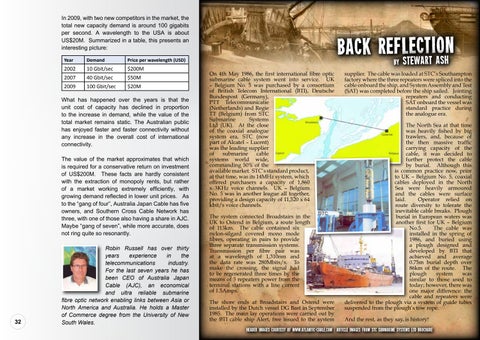
In 2009, with two new competitors in the market, the total new capacity demand is around 100 gigabits per second. A wavelength to the USA is about US$20M. Summarized in a table, this presents an interesting picture:
Year Demand Price per wavelength (USD)
2002 10 Gbit/sec $200M
2007 40 Gbit/sec $50M
2009 100 Gbit/sec $20M
What has happened over the years is that the unit cost of capacity has declined in proportion to the increase in demand, while the value of the total market remains static. The Australian public has enjoyed faster and faster connectivity without any increase in the overall cost of international connectivity.
The value of the market approximates that which is required for a conservative return on investment of US$200M. These facts are hardly consistent with the extraction of monopoly rents, but rather of a market working extremely efficiently, with growing demand reflected in lower unit prices. As to the “gang of four”, Australia Japan Cable has five owners, and Southern Cross Cable Network has three, with one of those also having a share in AJC. Maybe “gang of seven”, while more accurate, does not ring quite so resonantly.
Robin Russell has over thirty years experience in the telecommunications industry.
For the last seven years he has been CEO of Australia Japan Cable (AJC), an economical and ultra reliable submarine fibre optic network enabling links between Asia or North America and Australia. He holds a Master of Commerce degree from the University of New South Wales.
On 4th May 1986, the first international fibre optic submarine cable system went into service. UK – Belgium No. 5 was purchased by a consortium of British Telecom International (BTI), Deutsche Bundespost (Germany), PTT Telecommunicatie (Netherlands) and Regie TT (Belgium) from STC Submarine Systems Ltd (UK). At the close of the coaxial analogue system era, STC (now part of Alcatel – Lucent) was the leading supplier of submarine cable systems world wide, commanding 50% of the available market. STC’s standard product, at that time, was its 14MHz system, which offered purchasers a capacity of 1,860 x 3KHz voice channels. UK – Belgium No. 5 was in another league all together, providing a design capacity of 11,520 x 64 kbit/s voice channels.
Back Reflection by stewart ash
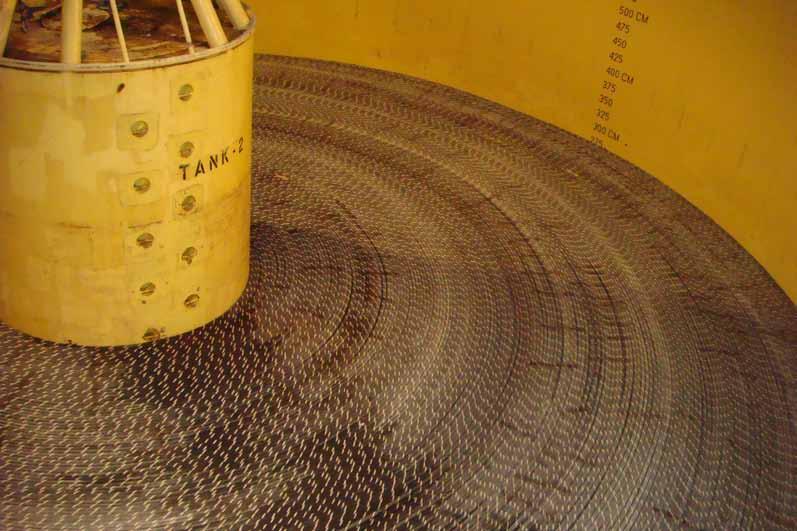
supplier. The cable was loaded at STC’s Southampton factory where the three repeaters were spliced into the cable onboard the ship, and System Assembly and Test (SAT) was completed before the ship sailed. Jointing repeaters and conducting SAT onboard the vessel was standard practice during the analogue era.
The system connected Broadstairs in the UK to Ostend in Belgium, a route length of 113km. The cable contained six nylon-silgard covered mono mode fibres, operating in pairs to provide three separate transmission systems. Transmission per fibre pair was at a wavelength of 1,310nm and the data rate was 280Mbits/s. To make the crossing, the signal had to be regenerated three times by the means of 3 repeaters power from the terminal stations with a line current of 1.5Amps.
The shore ends at Broadstairs and Ostend were installed by the Dutch vessel DG Bast in September 1985. The main lay operations were carried out by the BTI cable ship Alert, free issued to the system
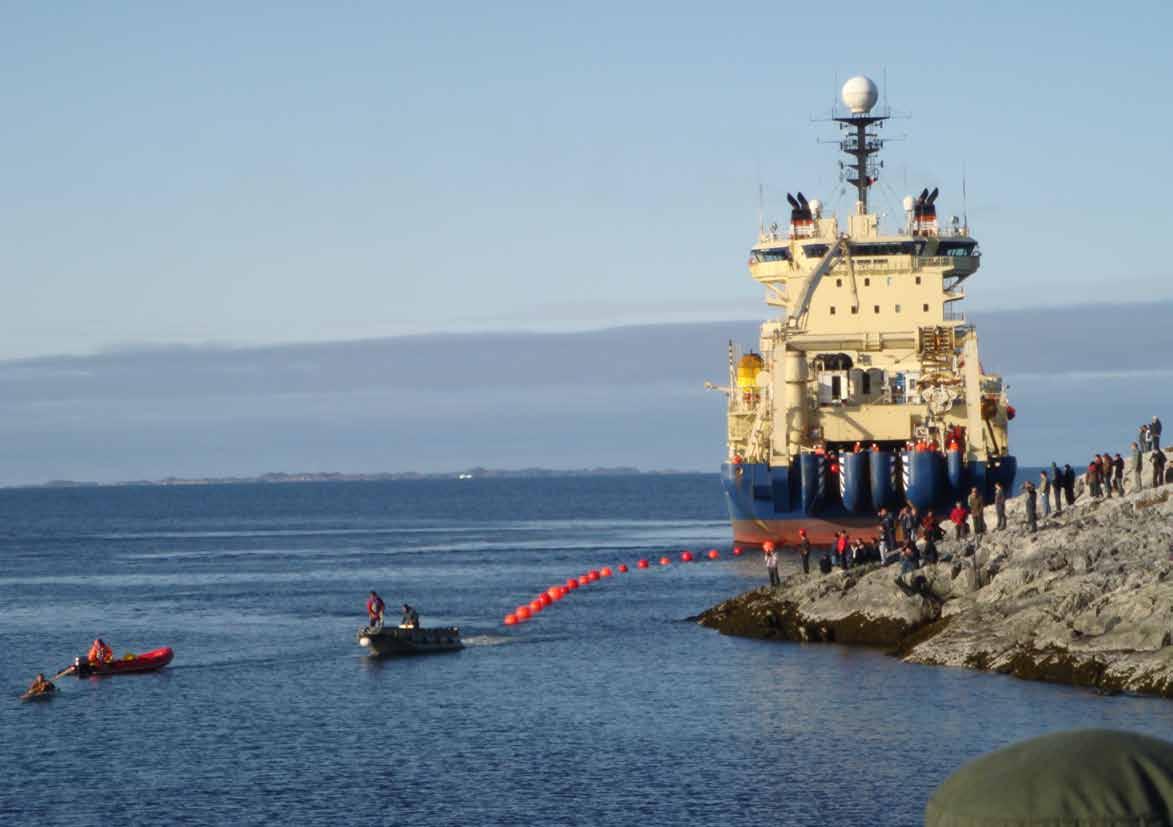
The North Sea at that time was heavily fished by big trawlers, and, because of the then massive traffic carrying capacity of the cable, it was decided to further protect the cable by burial. Although this is common practice now, prior to UK – Belgium No. 5, coaxial cables deployed in the North Sea were heavily armoured and the cables were surface laid. Operator relied on route diversity to tolerate the inevitable cable breaks. Plough burial in European waters was another first for UK – Belgium No.5. The cable was installed in the spring of 1986, and buried using a plough designed and developed by BTI that achieved and average 0.75m burial depth over 86km of the route. The plough system was similar to those used to today; however, there was one major difference: the cable and repeaters were delivered to the plough via a system of guide tubes suspended from the plough’s tow rope.
And the rest, as they say, is history!
With economies across Latin America continuing to expand, there is a growing need for superior quality connectivity within the region as well as to other parts of the world. Local carriers across Latin America need to provide their enterprise customers with high speed, reliable services connecting them to the communications superhighway. And international carriers, whose core objectives are to service global enterprises, are looking for the right partner to help them reach key destinations across the globe.
Erick Contag
“When choosing a backbone network that connects north America to south America and further, a number of critical requirements must be met,” believes Erick Contag, Chief Operating Officer of Brasil Telecom GlobeNet which owns and operates a fiber optic submarine cable network connecting the U.S.A., Brazil, Venezuela and Bermuda.
WHEN SPEED COUNTS
“Paramount in terms of requirements is speed. Speed to provision new capacities,” he states. Contag says this applies equally to those within Latin America looking out and those wanting to extend their reach into the region. “Our carrier customers in Latin America want to serve high speed internet users faster, and they want their partner to deliver fast, efficient, high quality services.”
Brasil Telecom GlobeNet also has customers looking to extend circuits that start in Asia, Europe and the U.S. with termination in South America. “We partner with several large international carriers who outsource their Latin American connectivity requirements to GlobeNet,” he says. “They want a PoP in Brazil and an all-encompassing solution from someone with a carrier neutral approach.”
With city PoP facilities in important centers like 60 Hudson Street and 111 Eighth Avenue, New York or the NAP of the Americas in Miami, he says “GlobeNet can provide carriers in Latin America with U.S. connectivity that’s only a cross connect away. Our presence at these major city PoPs provides our North American carrier customers the opportunity to link to one another and allows our Latin America carriers customers to reach beyond the region,” he says.
DELIVERING LONG-HAUL ETHERNET
“GlobeNet is also finding that many of its international customers are migrating from legacy technologies in favor of services based on carrier Ethernet,” says Contag. “Due to market demand, we were the first subsea network provider to offer full Layer 2 carrier Ethernet between north and south America,” he says. “We now provide carrier Ethernet services into a number of PoPs. This upgrade in technology allows us to provide the flexibility that customer’s need, as it inter-relates the capacity they are buying to how fast they can grow. With Ethernet services you can provision quickly and upgrade even faster when a carrier needs you to. The carrier isn’t forced to buy a block of capacity before they need it, or survive with not enough capacity.”
“Carriers in Latin America are generally smaller than those in the US, but are growing fast as their markets develop,” he adds. “They need a network that
ARGENTINA
BOLIVIA
PARAGUAY URUGUAY
truly fits their needs. A cookie cutter approach does not work for them. Carrier Ethernet provides them the flexibility they require to cost effectively grow their business.”
“In addition to flexibility, latency remains paramount to a carriers buying decision. A network that offers low latency is critical to our customers,” says Contag. “It’s especially important to those carriers that have customers in the financial services sector, or provide services to large enterprises that have ‘just in time’ information needs. When latency increases, these businesses are significantly affected. Our competitors have to route traffic extremely long distances to provide the same service, with potentially much higher latency.”
GlobeNet’s low latency gives it an excellent competitive advantage, especially among Brazilian and Venezuelan carriers looking for connectivity to the US, says Luiz Alonso, director of engineering and operations with the company. “But,” he says “network performance is something that requires constant investments. Last year, we strategically decided to upgrade the network yet again, taking our existing capacity and adding an additional 220Gbps. As early as June, we’ll be able to offer more than 350Gbps on our submarine cable network.” What does this mean to the market and our customers? Rather than having to wait months for a provider to build out a network or lease 3rd party capacity with the challenges that that brings—we have capacity ready and available for our wholesale carrier customers over the most reliable network to and from South America with impressive delivery times.” added Alonso.
To further meet market demands and trends, GlobeNet expects to roll out additional products and service during the second half of 2009. Similar to other international wholesale carriers, GlobeNet is currently launching a significant
business and product evolution to its existing international point-to-point services. Currently, GlobeNet offers products from Brazil to the U.S.A., from Venezuela to the U.S.A. and from Venezuela to Brazil. In addition, GlobeNet is looking to open new markets and as a result, introduce new products and services for existing and new markets (i.e. Colombia). The international markets (Brazil, Venezuela, Colombia, and U.S.A.) have been strategically identified as part of a marketing project for international expansion which evaluated on-net locations within the context of the existing submarine cable network, the cable landing stations and the international backhaul reach when formulating the scope, scale and breadth of an international product strategy and offering. Consequently, Brazil, U.S.A, Venezuela and shortly Colombia, are natural extension points for GlobeNet. Product enhancements planned for this year include the International iPoP-to-iPoP International Private Line (IPL), iPoP to iPoP E-Line and Managed Routers.
The iPoP to iPoP IPL which is a standard international point-to-point, over SDH, ranging from E1 (and T1) to STM-64, established between any two GlobeNet international PoPs within the reach of GlobeNet’s network (or extended GlobeNet network), in order to support different types of data services requiring international capacity. The iPoP-to-iPoP product is primarily designed for the wholesale market but, can be extended to the corporate market when local access is added from the iPoP to the customer’s premise (if/when demultiplex equipment is available to support speeds below 2 Mbps).
The International PoP-to-PoP Carrier Ethernet capacity product offered by GlobeNet is a standard international point-to-point Ethernet capacity established between any two of GlobeNet’s international PoPs within the reach of GlobeNet’s international network (or extended GlobeNet
network), in order to support different types of data services requiring international capacity compatible with specific Ethernet interfaces. So the data is delivered from a single entry point to a single exit point, with no switching or routing performed between end points.
The Managed Router Service is an extension of the IPL and/or Ethernet service. GlobeNet has strategically identified several partners in the U.S. and Venezuela to deploy CPE equipment at the customer’s premise to manage and monitor the router in conjunction with our submarine capacity solution to provide an end to end solution.
Erick Contag brings over 20 years of sales, marketing, business development, strategy and corporate management expertise to Brasil Telecom GlobeNet, a wholly owned subsidiary of the Brasil Telecom Group, that owns and operates the most advanced and lowest latency fiber optic submarine cable system serving the Americas. Mr. Contag has been responsible for managing C-level relationships and telecommunications / high-technology projects for start-up enterprises through large multi-national and Global 100 companies. He has proven success in starting, building, and turn-around of high-tech businesses.
A
Letter to a friend from Jean Devos
My dear friend
My Dear Friend
“Botany Bay”
Warrior event was still in everyone’s memory. It is for these reasons among others that STC (UK) rejected the Alcatel‘s suggestion to come with a joint bid, to offer a “European” solution.
My Conference
One of the winning factors has been the Port-Botany cable factory. Such a factory was a strong requirement from OTC (now Telstra) and the Australian Government.
Alcatel was the most motivated. Such a factory could expand its influence in the Pacific where the three other players were historically well established in this region, which represents a large part of their market. They saw this factory as a risk for their existing facilities!
I delivered a conference in the framework of my local “Université pour tous”1, and it went quite well. I was proud to show an audience of about 100 people the “système nerveux de la planète, une aventure humaine et technique.” In others words, and for the few of you who cannot read French, my subject was the global network as it is today, highlighting what it meant for the many people involved over the last two centuries.
I published recently a modest novel, whose title is Botany Bay. It is the place in Australia where
Alcatel established a submarine cable factory in 1989 as part of its contract for the Tasman 2 link. In this same bay, where two centuries before the French expedition
Younger folks today are often skeptical about science and industry. The media speaks of these as risky, polluting, and unethical. I wanted to show them an example of an enthusiastic development, offering the people working in its industry a lot of opportunity, passion, and rewards.
“La Pérouse” made of two ships, La Boussole
That night, most of the attendees, though highly educated and experienced, “discovered” the major role of the undersea fiber optic network. They were stunned to learn that emailed photos of their grandchildren were travelling
1 It means: University open to everyone, a polite way to actually say University for third age people.
through fragile glass fiber lying quietly on the ocean floors. They were glad to learn about the various aspects of our activity: Huge capacity, diverse ownership, suppliers, fibers, amplifiers, and marine work and hazards. They paid particular attention to the history behind this: Graham Bell, the Great Eastern, the gutta percha, the first transatlantic cable, and the message of Queen Victoria to U.S. president James Buchanan, which took an hour to cross the ocean.
and l’Astrolabe, landed in 1788 to discover that Captain Cook was already around bearing the British flag. So Botany Bay is now for me the symbol of a dream which becomes a reality!
Tasman 2 has been yet another chapter in this long Anglo-French competition! The award to Alcatel came out as a big surprise to many, including inside Alcatel. Everybody was naturally expecting the British to win that battle, and such an expectation was at that time very logical.
What they had difficulty believing is that this global network is not the result of a “plan” but the mere result of a great deal of “regional” initiatives–a typical French reaction!
There were so many difficulties and misunderstanding between Australia and France, the main one being the French presence in the Pacific area, the worse being the nuclear bomb experiment in Tahiti! The sad Rainbow
Infrastructure should naturally be a “common asset” i.e a “public asset”. How can someone think that the “marché,” i.e. the market, will produce an optimized network? The market overinvests on thick route, and under invests in thin route. If a plan had been possible, cables would have been built in Africa years ago, with the money saved in the Atlantic where fewer cables would have been built.
I fully supported their reactions, but I asked them to recognize the fact that there is not (yet?) such a thing as a “Global Government” or a “Global Regulator.” I invited them to think about, and perhaps come to the conclusion, that our situation today is “life,” like flowers at spring, when a “plan” could very well produce a “cold winter.”
SubOptic ‘87 in Versailles came at the right time. It is where the Australian teams discovered the French model, a close cooperation between Alcatel and FT, exactly what they wanted to establish in their country.
Jean Devos
My friend, things are changed since, but one thing stays true: When you offer something, the reader can see between the lines if you are or not genuinely motivated and sincere. Then your offer becomes really attractive and this opens the route to “Botany Bay.”
See you soon.
Jean Devos
Submarcom Consulting
Jean Devos is a senior consultant with Submarcom Consulting. He is also one of the founders and a board member of Axiom, a Paris based company specialized in Submarine systems projects study & management. He spent three years developing Tyco’s international capability, and was the head of ASN (Alcatel Submarine Networks). Jean was born in 1938 and is graduated from the Lille University. He is the founder of SubOptic and carries a vast international experience in our field.
by Kevin G. Summers
Marvel Comics is sometimes called the “House of Ideas.” I’d like to suggest that the same title would be fitting around the offices of SubTel Forum. Frankly, the brainstorming sessions that go on around here are sometimes so overwhelming that I have to work from home in order to bring anything to execution.
What have we been working on lately? We’ve been improving our web banners.
Before April, we only offered web banners in one size and price: 200 px x 80 px for $575. While that size is effective, I thought it would beneficial to offer some larger sizes as well. A larger canvas, if you will, can make quite an impact on weary eyes that have seen countless banners over the course of years. We now offer web banners at 200 px x 250 px and 200 px x 400 px in addition to the original size.
More importantly, the price for web banners has actually gone down. Yes, you read that right. The price for a small banner is $275, for a medium banner is $425, and for a large banner is $575.
Now is a better time than ever to purchase a banner on our website; not only because of the price and size, but also because we have
activated new ad management software that enables us to track the number of clicks and impressions each ad receives. We are providing these figures to our web banner advertisers every month. This is a powerful statistic, as our advertisers can assume that the people clicking on their banners are specifically interested in the submarine cable industry. Unlike other media, when you advertise with SubTel Forum, you can target your web banner (or magazine advert for that matter) to a specific audience: the submarine cable community.
Of course, I can’t divulge any of our advertisers’ specific data, but I can tell you that our web banners are receiving more than 5000 impressions each, and have a click-through rate between 7% and 9%. According to a study of 10 billion banner inquiries across Europe by ADTECH, the average click-through rate fluctuates between 0.11% and 0.19%. How are we doing?
We’ve also added another new feature to SubTel Forum... the industry’s first podcast. Our show is available through Apple’s iTunes service, and if you’ve never listened to a podcast before, I suggest you try it. There are shows on practically any topic you can imagine, and best of all, they’re all available at no cost to you.
Please try our show and let me know what you think. The topic for our first episode: The Challenges of Raising Cable Awareness in Developing Countries.
Finally, you will notice the rate this issue button on this page. Please take a moment to fill out this brief survey and let me know what you think.
Thanks for reading SubTel Forum!
Kevin G. Summers is the Editor of Submarine Telecoms Forum, and a professional fiction author. He lives in Leesburg, Virginia with his wife Rachel and their two daughters. Learn about his writing at his website: www.kevingsummers.com.