Subsea Technology Issue
Issue 39, July 2008
#39 Subsea Technology Issue An international forum for the expression of ideas and opinions pertaining to the submarine telecoms industry
Ju ly
200 8
Submarine Telecoms Forum is published bi-monthly by WFN Strategies, L.L.C. The publication may not be reproduced or transmitted in any form, in whole or in part, without the permission of the publishers. Submarine Telecoms Forum is an independent commercial publication, serving as a freely accessible forum for professionals in industries connected with submarine optical fibre technologies and techniques. Liability: while every care is taken in preparation of this publication, the publishers cannot be held responsible for the accuracy of the information herein, or any errors which may occur in advertising or editorial content, or any consequence arising from any errors or omissions. The publisher cannot be held responsible for any views expressed by contributors, and the editor reserves the right to edit any advertising or editorial material submitted for publication. Contributions are welcomed. Please forward to the Managing Editor: Wayne Nielsen WFN Strategies 21495 Ridgetop Circle, Suite 201 Sterling, Virginia 20166 USA Tel: +[1] 703 444 2527 Email: wnielsen@wfnstrategies.com General Advertising Email: sales@wfnstrategies.com Tel: +[1] 703 444 0845 Designed and produced by Unity Business Solutions © WFN Strategies L.L.C., 2008
2
Welcome to the 39 issue of Submarine Telecoms Forum magazine, our Subsea Technologies th
edition.
In spite of the exciting developments in our industry, “le Tour” once again dominated July -- at least in one person’s mind! New faces from new countries shaped the finals as never before, and now a new history with a different accent has been written. Similar changes are occurring in our industry as some old faces are reemerging in new guises, and some new names with new accents are standing up to be recognized. It must be July… And in the vein of our theme, we have some excellent articles to fuel your clever brain. Fiona Beck looks forward to the future for our industry, while Michael Nedbal describes the GIS revolution in cable planning. Edwin Danson introduces the new generation of precision positioning, as Cliff Scapellati and Paul Treglia details HV power supply technology. Abiodun Jagun presents the case for open access infrastructure in Africa, and Donald Hussong highlights AUVs for Deepwater Surveys. Chris Butler questions whether good customer service makes a project a success; Roger Hornsby illustrates a “survivable” fiber project. Ron Crean highlights an exciting new management tool for those most cherished
assets, the cableship. Jean Devos returns with his ever insightful observations, and of course, our ever popular, “where in the world are all those pesky cableships” is included as well. Lastly, we enclose our Author’s Index – our annual “you said what?” compilation. Lastly, we appreciate the significant feedback to SubTel Forum’s new discussion board and RSS feed, and encourage you to take advantage of this complimentary technology. Enjoy,
#39 Subsea Technology Issue Ju ly
3
38 24 20 28 16 5 54 35 31 4 42
200 8
5
News Now
11
The Sub-Sea Industry: Expanding in a Changing Market Fiona Beck
14
The GIS Revolution Spawns New Data And Tools For Cable Route Planners Dr. Michael Nedbal
17
Goodbye Differential GPS: Introducing the New Generation of Precision Positioning for Cable Surveys, Installation & Maintenance Edwin Danson
21
25
Eglin AFB - Santa Rosa Island Survivable Fiber Project Jan 2007 – May 2008 Mission Impossible Devin Sappington High Voltage Power Supply Technology for Use in Power Feed Applications Cliff Scapellati & Paul Treglia
29
Customer Service – What Makes a Successful Project? Chris Butler
32
Autonomous Underwater Vehicles Provide New Opportunity for Deepwater Surveys Donald M. Hussong
AISLive Cable Map 2008 CTC Global Marine Systems Nexans OFS STF Advertising STF Calendar 2009 Submarine Network 2008 WFNS Xtera
36
Real-time Cableship Tracking is Alive! Ron Crean
39
The Case for “Open Access” Communications Infrastructure in Africa: The SAT-3/WASC cable Dr. Abiodun Jagun
43
Author Index
55
The Cableships
61
Letter to a Friend Jean Devos
62
Upcoming Conferences
21495 Ridgetop Circle, Suite 201 Sterling, Virginia 20166 USA Tel: +[1] 703 444 2527 www.wfnstrategies.com Engineering of submarine and terrestrial optical cable, microwave/WiMax /WiFi, mobile, satellite and RF systems for commercial, oil & gas and government clients
A synopsis of current news items from NewsNow, the weekly news feed available on the Submarine Telecoms Forum website.
AAG Cable Station Inaugurated in the Philippines (May 30th, 2008)
SUBMIT A STORY
Philippines President Gloria Macapagal Arroyo visited La Union on Tuesday to lead the ceremony to inaugurate a new cable landing station for the Philippine leg of the AsiaAmerica Gateway (AAG) transpacific cable in the municipality of Bauang. The US$500 million milestone project is the first [Read more]
Alaska Communications Systems Wins Telly Awards for Advertising (July 8th, 2008)
SUBSCRIBE TO FEED
Alaska Communications Systems Group, Inc. (”ACS”) (NASDAQ:ALSK) today announced it won two Telly Awards for its advertising efforts. Founded in 1978, the Telly Awards honor excellence in local, regional and cable TV commercials. Non-broadcast video and TV program categories were later added. With over 200 categories, the Telly is one [Read more]
Alcatel-Lucent WiMAX Solution Selected by the U.S. Defense Information System Agency for Joint Capabilities Technology Demonstration (June 25th, 2008) LGS, a subsidiary of Alcatel-Lucent (Euronext Paris and NYSE: ALU) dedicated to serving the U.S. government community, announced today that the Defense Information System Agency (DISA) has chosen Alcatel-Lucent’s WiMAX wireless broadband technology [Read more]
Alcatel-Lucent opens Executive Briefing Center (EBC) in São Paulo, Brazil to showcase advanced communications technologies for carriers and enterprises (June 24th, 2008) Alcatel-Lucent (Euronext Paris and NYSE: ALU) announced today the opening of its Brazilian Executive Briefing Center (EBC) - a large workspace equipped with state-ofthe-art technology and demonstrations to
host customers, business partners and other stakeholders interested in [Read more]
Alcatel-Lucent to acquire Motive, Inc., a leading provider of service management software for broadband and mobile data services (June 18th, 2008) Paris, France and Austin, TX, June 17, 2008 Alcatel-Lucent today announced that it has entered into a definitive agreement to acquire Motive, Inc. (OTC: MOTV), a leading provider of service management software for broadband and mobile data services, through a cash tender offer for all outstanding Motive [Read more]
American Samoa’s Governor Signs Documents to Re-Route PacRimEast (June 13th, 2008) Togiola Tulafono, Governor of American Samoa, recently signed documents that will facilitate bringing the PacRimEast submarine fiber optic
cable to American Samoa. The project involves re-routing the decommissioned PacRimEast cable, which currently runs from New Zealand to Hawaii. Alcatel-Lucent has been [Read more]
SUBMIT A STORY
SUBSCRIBE TO FEED
BHP Billiton Begins Production From Neptune Facility In The Deepwater Gulf Of Mexico (July 6th, 2008) BHP Billiton announced today that first oil and natural gas production has commenced from the Neptune development in the deepwater Gulf of Mexico. The single-column tension leg platform (TLP) is designed to handle up to 50,000 barrels of oil per day and 50 million cubic feet per [Read more]
China Telecom Americas Says TPE Nearly Ready for Launch (June 2nd, 2008) China Telecom Americas, working with four other TPE Consortium team members, has announced that it is poised to launch the Trans-Pacific Express Cable. The Trans-Pacific Express Cable (TPE) is the first next-generation undersea optical cable system directly linking the United States and China, and [Read more]
Columbus Networks Builds 2nd Landing Station in Colombia (May 30th, 2008) 6
Columbus Networks has completed installation of a second cable landing station in Colombia,
where the country’s telecommunications providers interconnect their facilities with the undersea fiber optic cable network installed throughout the Caribbean and Latin America Region. Columbus Networks built the new state-of-the-art landing station in Cartagena, Colombia, to provide its carrier [Read more]
CSA International Expands Permitting Capability (July 7th, 2008) CSA International, Inc., (CSA) a leader in Marine Environmental Sciences and Services, has announced the expansion of its Permitting Business Line to address the increased level of activity in both the Oil & Gas as well as the Telecom industries. The expansion includes the addition of technical and science [Read more]
CTC appoints manager for Australia (July 17th, 2008) CTC Marine Projects (a division of the Trico group) today announces that it has appointed Marcus Hemsted as Technical Sales Manager for Australia and New Zealand, operating from the company’s newly opened Perth office. Marcus has extensive experience of the subsea and telecoms industries, having worked in project engineering and equipment design [Read more]
CTC receives Frame Agreement from StatoilHydro (July 17th, 2008) CTC Marine Projects Limited (a division of the Trico group) has recently been awarded a Frame Agreement by StatoilHydro ASA for the provision of trenching services. The Frame Agreement is for a three year period with options to extend for two x 2 years and covers offshore Norway. StatoilHydro will have access to [Read more]
CTC receives contract award from Bluewhale (June 13th, 2008) CTC Marine Projects Limited (a DeepOcean ASA subsidiary) has received a contract award from Bluewhale Offshore Engineering Technology for the installation of three interplatform power cables totalling 78km in the Wenchang field, offshore China. CTC will use the DP 2 vessel Maersk Recorder which will be mobilizing immediately from Singapore. On completion [Read more]
Denholm Launches Specialist Cable Arm (June 23rd, 2008) UK-based Denholm Shipping Company, part of the J & J Denholm Group, has established a new subsidiary, Denholm Offshore, to undertake submarine cable installation & maintenance
contracts, primarily in shallow water. The new company will focus on the planning, installation, burial and maintenance of power and telecoms cable and shore end services [Read more]
SUBMIT A STORY
SUBSCRIBE TO FEED
E-Marine Establishes New Cable Depot (June 20th, 2008) E-Marine PJSC, the UAE based leading submarine cable solution provider in the Middle East, has announced their new state-of-the-art cable depot in Port of Salalah, in the Sultanate of Oman is completed and ready for operation. This cable depot consists of eight submarine cable storage tanks, providing a [Read more]
Global Crossing Inaugurates Costa Rica’s Pacific Coast Cable (July 25th, 2008) Global Crossing has announced the lighting of its new fiber-optic submarine cable in Esterillos of Parrita, Puntarenas. Global Crossing; Instituto Costarricense de Electricidad (ICE), the state-run entity responsible for Costa Rica’s telecommunications; and the Radiográfica Costarricense S.A. (RACSA) will host a ceremony today at the new [Read more]
Global Crossing to Provide Link to Brazil During Beijing 2008 Olympics (July 7th, 2008) 7
Global Crossing has announced it will provide a link between Rio de Janeiro and New York
for Eurovision, the premier sports and news content distributor for the world´s top broadcast and media platforms, during the Beijing 2008 Olympic Games. The contract expands the broadcaster’s existing Private Line Services to accommodate enhanced [Read more]
Global Crossing Upgrades MAC (June 20th, 2008) Global has announced it has expanded capacity on its Mid-Atlantic Crossing (MAC®) undersea fiber-optic cable system to meet rapidly growing demand for Internet Protocol (IP) and Ethernet transport among its customers, and to enhance connectivity between North America, Latin America and Europe. [Read more]
Gtd Manquehue selects Alcatel-Lucent to deploy first fiber-to-the-home network in Chile based on GPON technology (July 29th, 2008) Paris, July 28, 2008 - Alcatel-Lucent (Euronext Paris and NYSE: ALU) today announced that it has been selected by Gtd Group, one of the main service providers in Chile, to deploy the country’s first network based on fiberto-the-home (FTTH) gigabit passive optical network (GPON) technology. Installation and deployment of the GPON [Read more]
Hitachi Cable to Supply African Project (June 2nd, 2008) Hitachi Cable has announced that it will supply submarine fiber optic cable for a project in Africa. The contract is the first for Hitachi Cable the region. The company will supply the cable to Tyco Telecommunications, with shipments beginning this summer. [Read more]
Huawei Completes MedNautilus Upgrade Ahead of Schedule (May 30th, 2008) Huawei Technologies Co., Ltd., a leader in providing next-generation telecommunications networks for operators around the world, has announced that the upgrade of Telecom Italia’s Mediterranean Nautilus Ltd (MedNautilus) DWDM submarine network has been completed one month ahead of schedule. [Read more]
Interim Working Group to develop a framework for a Submarine Cable (June 18th, 2008) The SubOptic Executive Committee is pleased to announce the formation of its first Interim Activities Working Group, specifically to develop a framework based on best practice for a Standard Submarine Cable Construction Contract and an associated Guide. These documents are being developed to provide insight into a critical but often [Read more]
Isocore Internetworking Lab validates AlcatelLucent IP/MPLS mobile backhaul solution (June 26th, 2008)
SUBMIT A STORY
Paris, June 25, 2008 - Alcatel-Lucent (Euronext Paris and NYSE: ALU)today announced that Isocore Internetworking Lab, the leader in validation and interoperability of emerging and next generation technologies, presented a comprehensive report confirming the scalability and resilience of Alcatel-Lucent’s [Read more]
Japan-Russia Cable System Starts Operations (July 11th, 2008)
SUBSCRIBE TO FEED
TransTeleCom Company CJSC (TTK), Russia’s leading telecommunications backbone operator, and NTT Communications Corporation (NTT Com) have announced that the HokkaidoSakhalin Cable System (HSCS), which directly links the two companies’ telecom networks via an undersea cable between Nevelsk, Sakhalin Island in Russia, and Ishikari, [Read more]
JDSU Introduces Fiber Optic Inspection, Cleaning and Testing Kits to Prevent Leading Cause of Network Downtime (July 8th, 2008)
8
JDSU today announcedthe release of all-in-one fiber optic test kits, providing network technicians with a simple way to avoid one of the leading causes of network downtime: contaminated, or “dirty,” fiber. Based on its recognized best
practice to “Inspect Before You Connect,” JDSU provides all of the tools [Read more]
(WCL) will hold a press briefing on Tuesday 22 July at [Read more]
Launch of Windward Telecom Network Announced (June 2nd, 2008)
NEC, Sumitomo Electric Acquire OCC (July 7th, 2008)
C.A. Bancorp Inc. has announced that its portfolio investment, Windward Telecom Ltd., has successfully launched its international telecommunications network in Trinidad and Tobago. Effective May 13, 2008, Windward’s network began carrying its first commercial phone traffic to the nation. “Expatriates and foreigners calling into Trinidad will [Read more]
NEC Corporation and Sumitomo Electric Industries, Ltd. have announced the acquisition of OCC Holdings and its subsidiary OCC Corporation, which manufactures fiber optic submarine cables of exceptional quality and reliability. [Read more]
Marine sector & Environmental Groups unite to launch Joint Statement on Draft Marine Bill (July 23rd, 2008) The Seabed User and Developer Group (SUDG) and Wildlife and Countryside Link (Link) will today (22 July 2008) come together to launch a joint statement on areas of agreement on the draft Marine Bill. The statement is a prime example of industry and environmental groups working together to ensure the [Read more]
Marine sector & Environmental Groups Unite to launch Joint Statement on Draft Marine Bill (July 21st, 2008) The Seabed User and Developer Group (SUDG) and Wildlife and Countryside Link
Northern Isles Take Step Closer To Mainland (July 7th, 2008) BT is laying a new fibre optic submarine cable between Orkney and the Scottish mainland to help bring its 21st Century Network to the Northern Isles. The 70 km cable will run from Skaill Bay in Orkney under the Pentland Firth to Dunnet Bay, around five miles east of Thurso. BT has awarded [Read more]
Omantel Signs Agreement to Extend MENA Cable to Oman (July 25th, 2008) Oman Telecommunications Company (Omantel) and Middle East and North Africa Company (MENA) of Egypt have recently signed an agreement on the landing of a submarine fiber optic cable on the Omani coast to enhance international telecommunications traffic between the Sultanate
of Oman and the world. Dr. Mohammed Bin Ali AlWohaibi, the Chief [Read more]
Pacific Crossing Limited Hires CFO (July 11th, 2008) Pacific Crossing Limited (PCL), the operator of transpacific cable system PC-1, has appointed industry veteran Kurt Johnson as Chief Financial Officer. Johnson brings to his new role over 27 years of experience serving as CFO and corporate controller for leading companies in the technology and [Read more]
Pacnet, Bharti Airtel and Pacific Crossing Launch “Gateway to India” Offering (June 20th, 2008) Following the signing of an NNI (network-tonetwork interface) agreement to interconnect their respective networks, expanding connections to and from India, Pacnet and Bharti Airtel have announced a special “Gateway to India” offering for STM-1 and larger International Private Line circuits between the [Read more]
Phoenix International Announces Completion of Crane Installation (July 11th, 2008) Phoenix International Holdings, Inc., (Phoenix) announced today that it has completed 9
installation of a 40-ton dynamic knuckle-boom crane on the M/V ANNE CANDIES. The M/V ANNE CANDIES is mobilized with a state-ofthe-art, Schilling Robotics 200-HP intelligent work class remotely operated vehicle (iWROV) rated to 11,480 feet. [Read more]
PIPE International Files with FCC to Land PPC 1 in Guam (June 13th, 2008) PPC 1 Limited and PPC 1 (US) Inc. have filed with the U.S. Federal Communications Commission (FCC) for authority to land and operate a non-common carrier fiber-optic submarine cable system, the PPC 1 System, connecting Sydney, Australia, Piti, Guam, and Madang, Papua New Guinea. [Read more]
Robert Keith Appointed Vice President – Oil & Gas For Phoenix International Holdings (June 18th, 2008) Houston, TX — Phoenix International Holdings, Inc. (Phoenix) announced the appointment of Robert Keith to the position of Vice President - Oil & Gas. In this newly established position, Robert will be responsible for setting the strategic direction and coordinating the marketing, sales and operations for all Phoenix domestic and international activities in [Read more]
Southern Cross to Increase Capacity with Nortel 40G Technology (July 11th, 2008) Southern Cross Cables has selected Nortel 40G optical technology to help meet demand for bandwidth from service provider customers in Asia Pacific for high-speed services and applications like IPTV and HD video. The Southern Cross network provides the major link for Internet traffic from Australia, New Zealand and [Read more]
Suo Cable Net selects Alcatel-Lucent for first commercial GPON deployment in Japan (July 23rd, 2008) Alcatel-Lucent (Euronext Paris and NYSE: ALU) today announced it has been selected by Suo Cable Net, a Japanese cable-TV operator, to design, integrate and deploy a Gigabit Passive Optical Network (GPON) solution. This new network, which will enable Suo Cable Net to begin rolling out high-speed Internet and video services [Read more]
Tata Communications Expands Connectivity to Africa (June 13th, 2008) Tata Communications has announced the further expansion of its network reach into Africa through an arrangement with Neotel, South Africa’s first converged communications network
operator. The South African government and business process outsourcing (BPO) industry has invested a tremendous amount of time and effort in positioning the country [Read more]
Tyco Telecommunications and NEC Begin Construction of Unity Cable System (June 24th, 2008) Tyco Telecommunications (U.S.) Inc. and NEC Corporation today announced the commencement of construction on the Unity Cable System, a high-bandwidth trans-Pacific, optical submarine cable system that will link Los Angeles, U.S. to Chikura, Japan. The contract for the project was signed on February 23, 2008, between the Unity Consortium [Read more]
Tyco Telecommunications prepares for new cable installations by installing/upgrading state-of-the-art MakaiLay software. (June 9th, 2008) Tyco Telecom has purchased a full license of MakaiLay with the Slack Control Module for the CS Decisive and upgraded the CS Durable to the latest MakaiLay with the Slack Control Module. The MakaiLay software provides TYCO with the ability to install submarine cables with the highest level of accuracy [Read more]
10
The Merger between China Unicom and China Netcom and the Sale of CDMA Business by China Unicom to China Telecom (June 2nd, 2008) China Unicom Limited (”Unicom”)(HKSE:0762, NYSE:CHU) announces that to build a stronger integrated telecommunication enterprise with full-service capability and to establish a leading edge based on 3G technologies, Unicom and China Netcom Group Corporation [Read more]
WFN Strategies to Supervise ADONES Cable System Installation (July 11th, 2008) WFN Strategies has recently announced the contract award by Angola Telecom for the provision of supervision support of the ADONES submarine cable system. WFN is providing network design and test plan review, factory acceptance and integration testing, review of survey reports, and acceptance monitoring of marine and terrestrial installation activities [Read more]
WFN Strategies Selected by SubOptic as a Media Partner (June 27th, 2008) WFN Strategies has been selected by the submarine telecommunications industry association, SubOptic, to act as Media Partner in support of its upcoming conference in
Yokohama in 2010. As Media Partner, WFN Strategies will be providing on SubOptic’s behalf support at a number of international [Read more]
Windward Telecom Launches Competitve Long Distance Services In Trinidad And Tobago (May 28th, 2008) Windward Telecom Ltd. has successfully launched its international telecommunications network in Trinidad and Tobago. The Company has been moving switched traffic through its Miami and Port of Spain switches on a commercial basis for the past week. “Expatriates and foreigners calling into Trinidad will be the initial beneficiaries [Read more]
Work Begins on Southeast Alaska Cable (July 25th, 2008) GCI has announced that the laying undersea telecommunications cable will begin in Southeast Alaska waters this month, placing 750 miles of fiber optic cable on the ocean floor. For residents in Ketchikan, Wrangell, Petersburg, Angoon and Sitka this means highspeed connections for Internet, phone and video; in Juneau, residents will [Read more]
The Sub-Sea Industry: Expanding in a Changing Mar ket by Fiona Beck I often get asked about the cyclical state of the subsea capacity market. Are there now too many new cable builds? Are we heading for another bust? It’s happened before but will it happen again to an industry that’s in a much different space to that of 2001–2003? There are fewer ships, manufacturing capability is smaller and there’s a waiting list on a number of fronts. We all have a reasonable idea of the big trends that underlie our industry but it’s always difficult to pick the timing, size and impact of the important changes. The subsea market, particularly the Asia-Pacific region, is currently experiencing strong growth and I believe that many of the cable systems that are being built will prove commercially sound where they have the backing of strong carriers who take a long term view of the telecommunications environment and who have an understanding of the fundamental demand outlook for low cost and reliable international capacity.
11
A number of the current cable builds target new markets while others augment existing routes, sometimes served by many cables. At the same time many upgrades will take place
as required. These will be at comparatively very low cost but will provide huge increases in capacity. The potential upgradability of many existing 10G systems has just been raised by 300% with the availability of 40G equipment and it will most likely be raised by 900% within a couple of years. Who knows after that? Looking forward there are three fundamental questions: • What do our customers want? • Where will customers demand come from? • How will we meet that demand? Our customers continue to need more and more capacity, they want reliability and they want their investment and operational costs to be low. They want the choice of quality suppliers and the choice of IRU products and leases. They want their networks on diverse paths and they are looking for new products. They will continue to favor quality suppliers so their networks are more robust and to ensure operational seamlessness
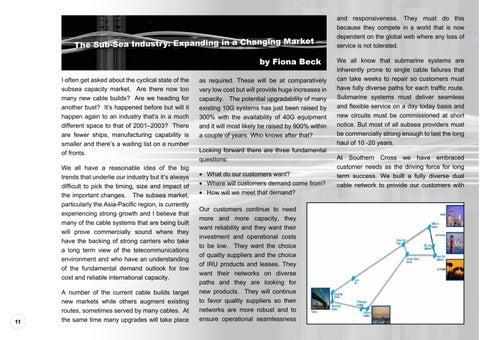
and responsiveness. They must do this because they compete in a world that is now dependent on the global web where any loss of service is not tolerated. We all know that submarine systems are inherently prone to single cable failures that can take weeks to repair so customers must have fully diverse paths for each traffic route. Submarine systems must deliver seamless and flexible service on a day today basis and new circuits must be commissioned at short notice. But most of all subsea providers must be commercially strong enough to last the long haul of 10 -20 years. At Southern Cross we have embraced customer needs as the driving force for long term success. We built a fully diverse dual cable network to provide our customers with
the fastest and most secure platform for connectivity between Australasia and the US mainland and between the Hawaiian Islands and the US mainland. We strive to be the best performer in the industry and we conduct independent Customer Satisfaction Surveys to ensure we achieve that. But it’s a continual, relentless process to stay in front so we are constantly looking at options to provide our customers with improving value. Price is always important to customers. Subsea customers do shop around but in the end they will optimize the need for diversity, low price, quality service, and timeliness. Low prices are also important because they allow potential demand to be realized. Southern Cross prices have fallen dramatically over time and the availability of low cost capacity from the current upgrade (with the prospect of much more from future planned upgrades) is enabling further enhancements to both our products and prices. On the price front our goal is to be an enabler for the Australasian broadband growth story and not an inhibitor. As such we look to price our capacity to support our customers’ needs. At the same time we must ensure that our capacity is bullet proof and our commercial longevity enhanced.
12
A key dynamic for the future is the fundamental driver of growth in international capacity demand. In the early years growth in international capacity came from the transition
of internet users from dialup to broadband. But in all established markets, future demand will be determined by increases in the average amount of capacity that each hi-speed broadband user needs and can pay for, not by subscriber growth. If average capacity consumption increases then demand for our product will continue to increase. Broadband is now considered an important part of national infrastructure. So it’s not surprising that many Governments now play an active role in helping ensure business and residential consumers get a full broadband experience from the competitive market environment. With broadband as the new international highway, Governments will intervene where markets do not meet national requirements such as with the role out of fibre to the home and demand for subsea capacity will rise as capacity consumption increases accordingly. Mobile is now also an emerging player as a source of significant capacity demand. You only have to look at the popularity of the recently released 3G iPhone to see how we have moved to a more mobile connected society where you can get any information you want at any time wherever you are. The mobile phone and its associated network technology has made significant advances in its ability to download data at speeds customers previously only enjoyed with a fixed line into their home.
From where we stand the fundamental outlook for demand looks strong. With strong growth at the retail level we are seeing corresponding growth at the international level and as such Southern Cross has recently completed a significant phase of its current upgrade in time to meet rapidly expanding demand. Once the complete upgrade is available at the end of this year we will have almost doubled our capacity but it won’t last for long. We are already considering the next upgrade and we are asking our suppliers how to get more from our network. What else can it do? As we all know the move from 2.5G to 10G is over. Now we can deploy 40G while 100G is fast becoming a reality. These technology leaps enable far greater capacity for new builds but they will also be applied at low cost to many exiting systems. I have been surprised at the speed of technology growth and the opportunity this affords us to upgrade earlier with a more cost effective price point and to deliver new services that make our products increasingly bullet proof. Will demand keep up with quantum shifts in supply? Given the enormity of supply potential I tend to think not. But this is not an industry issue like it was five years ago because many new systems are better grounded with strong carrier support. I have also been pleased to see how terrestrial systems suppliers are now deploying equipment
for the upgrade of submarine systems. With equipment supply constrained and long delivery cycles becoming the norm as resources are now stretched to satisfy new cable builds, the prospect of new reliable entrants being able to deliver quick, low cost, high capacity upgrades is extremely attractive. The flow-on effects of both new system builds and huge upgrades to existing systems will be very positive for our customers and for final consumers. By 2010 a number of new systems will have been commissioned, upgrades using 40G (if not 100G) will be considered the norm and the demand market will have been strong for some time. That said we shouldn’t be complacent, we will still need to carefully evaluate the need for every new system and for every upgrade. To be successful over the long term our vision as an industry must be to deploy the technology to enable societies to be continuously and ubiquitously connected with an enormous volume of low cost undersea capacity on tap. I suspect we will do this by increasingly deploying new builds to markets that are poorly connected today, while upgrades will easily provide the most cost effective solution where multiple systems have already been installed. But whether it is a new cable or upgrade, our
13
vision will only be realized if we embrace the need to understand and satisfy the needs of our customers though an addiction to ongoing service improvement. We can also do better as an industry that works together to find ways to be more responsive to our customers and to provide them with better service. SubOptic is about supporting the industry, and the 2010 conference hosted by NEC and Fujitsu in Yokohama will provide a useful platform for furthering debate to identify other ways in which we can all improve.
Ms Beck is the President and Chief Executive Officer for Southern Cross Cable Network. She was appointed to this position in May 2001 where prior to this she represented Telecom NZ as a Director on the Board of Southern Cross Cables and various other major companies such as EDS (NZ) and ConnecTel. Ms Beck was a senior manager within Telecom NZ responsible for Telecom’s corporate planning, EVA analysis, capital investment reviews and corporate advisory service. She is a chartered accountant and holds a Bachelor of Management Studies (Honours) degree in Accounting and Finance from Waikato University, New Zealand.
A geographic information system (GIS) is any system capable of capturing, storing, analyzing, managing and displaying data and associated attributes which are spatially referenced to Earth. In recent years the world has witnessed tremendous growth in the number of GIS-based software tools to support and geo-reference a large variety of data. The reason why GIS has become so popular, and is often referred to as the GIS revolution, is because a wide variety of data can now be precisely positioned in three-dimensional space. This allows engineers and researchers to easily compare and analyze multiple forms of data in a common spatial framework having the same units of measurements and geospatial context.
14
Due to the vast amount of information required to plan a cable route, working in a GIS environment is a necessity for modern day submarine cable planners. Data that need to be considered include bathymetry, fishing regions, dumping grounds, military restrictions, political boundaries, cable crossings and sediment characteristics, to name a few. In the not-to-distant past, these data were compiled from a variety of paper charts and independent electronic databases. The process of compiling and comparing the data from independent sources was time consuming and error prone. In today’s digital age the data are now in electronic format and, in theory, can be imported into a common GIS platform for accurate comparative analysis and record keeping. In practice, a lack of standardization
among data formats had lead to disparity among proprietary database management platforms and data types. The two primary competing management platforms (tools used to store, display and analyze GIS data) are Intergraph® products (e.g., Geomedia®) and the ESRI® products (e.g., ArcInfo®). Geomedia has no associated proprietary data format – it was designed to be compatible with a wide variety of data types. ArcInfo, however, favors its own proprietary data format making it difficult for other GIS platforms to integrate with ESRI data. Beyond ESRI’s proprietary data types, there are over 200 different types of GIS data formats that exist making it difficult for the submarine cable planner to easily integrate multiple forms of data. The introduction of a new tool to submarine cable planning software has simplified the integration of multiple data types. This flexible and powerful spatial toolset makes it easy for planners to translate, transform and integrate spatial data in a variety of formats. The core software, the Feature Manipulation Engine (FME®), is a product of Safe Software®. This software has now been integrated with GIS platform Geomedia and submarine cable route planning software to expand their data integration capabilities. Prior to the introduction of FME, submarine cable planners were forced to use third party tools (e.g., Import71) and become trained in the use of Geomedia in order to adapt various forms of spatial data into the
working in a GIS environment is a necessity for modern day submarine cable planners
15
planning software. A simple AutoCAD file containing bathymetry contours required the creation of a schema definition file, a coordinate system file and a warehouse database prior to importing the data into the planning software. Now, the entire process is embedded within the cable planning software making the creation of these files transparent to the user. Integration of the FME module in cable planning software is an important advancement to the submarine cable engineer because it bridges the gap between Geomedia, the most commonly used GIS platform for cable planners, and the many different data types typically found when collecting data relevant to a cable path. These include proprietary data types, such as ESRI ArcInfo and Autodesk AutoCAD, and other nonproprietary data formats, such as the International H y d r o g r a p h i c Organization S-57 standard for navigation charts. In total, there are over 150+ different GIS formats that are now accessible to submarine cable planners through the use of the FME module. The process of adding GIS data to the cable planning software is easy regardless of the format. A basic ESRI shapefile is just as easy to import
as a complex S-57 navigation chart. The process involves choosing the format, the coordinate system, and the specific layers containing the data of interest. Bathymetry data, in the form of AutoCAD bathymetric contours, requires the same information and follows the same easy steps.
Figure 1 – FME is a powerful spatial toolset that integrates with the cable route planning software making it easy for planners to translate, transform and integrate spatial data in a wide variety of formats.
Figure 2 – the process of importing GIS data is simple regardless of the type or complexity of the data.
The benefits of the FME Module for the submarine cable planner are two-fold. First, spatial data that may not have been available to the Geomedia platform can now be easily incorporated into the planning software and used in route analyses. Second, the time saved in transforming multiple data types can be put to more productive endeavors such as refining the cable route or installation plan. The GIS revolution has transformed the way submarine cable planners compile, manage and analyze data from different sources in order to arrive at the best possible cable route. Competing GIS platforms and data types have resulted in problems integrating multiple forms of data. A new tool available to cable planners alleviates much of the difficulty in integrating multiple formats of spatial data into a common GIS platform for cable route analyses. The tool benefits the cable planner
Figure 3 – the FME toolset was used to overlay an S-57 navigation chart on top of a landsat image of Pearl Harbor.
by making available a wider spectrum of spatial data and increasing the efficiency of the planning process resulting in lower planning costs and allowing for more time spent on analyses critical to the installation of the submarine cable. Michael Nedbal has been involved in the telecommunication industry for the past 10 years and currently works as the Operations Coordinator for Makai Ocean Engineering. In addition to supporting new product development, product testing, and product delivery, he is actively involved in research for submarine cable desktop studies and projects related to ocean-based sources of renewable energy. He received his Ph.D. from Texas A&M University and B.S. from University of Illinois at Urbana/Champaign.
scanpartner Trondheim Foto: SPOT og Getty Images
arine depths m b u , Ne x At s
ans goes deeper
Erik Rynning Sales & Project Manager Offshore: “We produced the so far world’s deepest umbilical which was installed at 2350 metre in the Gulf of Mexico.”
Nexans was the first to manufacture and install a 384 fibre submarine cable. Nexans has qualified and installed their URC-1 cable family for fibre counts up to 384 fibres.
For further information please contact: Nexans Norway AS P.O. Box 6450 Etterstad N-0605 Oslo Norway Phone: +47 22 88 61 00 Fax: +47 22 88 61 01
Telecom: Rolf Bøe Phone: +47 22 88 62 23 E-mail: rolf.boe@nexans.com
Oil & Gas: Jon Seip Phone: +47 22 88 62 22 E-mail: jon.seip@nexans.com
Because so much of your performance runs through cables Global expert in cables and cabling systems
Goodbye Differential GPS: Introducing the New Generation of Precision Positioning for Cable Surveys, Installation & Maintenance
satellites – irrespective of distance from land. The correction stream is broadcast to the user community through two independent networks; NET-1 and NET-2. Each network comprises of three high-power satellites to cover the Earth while facilitating the use of very small integrated GPS / L-Band antenna designs. C-Nav’s international Satellite Based Augmentation System SBAS, delivers real-time dynamic positioning accuracy (x, y and z) at the decimetric level. It includes many layers of security, quality control, resilience and assured access to provide a unique and robust solution to the cable industry’s need for self-regulating (autonomous) independent horizontal and vertical positioning solutions.
By Edwin Danson For those of us who can remember route surveying with Loran C and SatNav, the introduction of GPS and Differential GPS was a dream come true. Gone were the vagaries and uncertainties; in came reliable accuracy and precision transforming vessel positioning from an art form to a science. Since those heady days, DGPS has become a by-word for navigation – the norm, not the exception. Accuracy improvements accompanied by cost reductions were all very welcomed by the industry. But technology moves on and the days of the DGPS are passing, replaced by Globally Corrected GNSS (GcGPS) thanks to advances in Precise Point Positioning.
17
The accuracy and precision of traditional DGPS depended on estimating the errors observed by a network of reference stations. As the network’s spatial configuration opened and the distances
from reference stations grew, so the accuracy became compromised. This was particularly evident in mid-ocean, far from the nearest stations. DGPS essentially treated the symptoms and not the causes of the errors. To address that deficiency, C&C Technologies, Inc introduced its C-Nav GcGPS system. Unlike DGPS, C-Nav corrects for the source of the errors: the uncertainties in the GPS satellites’ clock and orbital parameters, satellite antenna alignment phase errors, and the modelable errors associated with dynamic tides and atmospherics. C-Nav’s software, with its pedigree in NASA’s Jet Propulsion Laboratory’s Real-Time GIPSY (RTG) suite, is an advanced proprietary RTG development for realizing the dynamic version of Precise Point Positioning. C-Nav delivers a single set of globally valid corrections for all GPS
The C-Nav ground segment comprises of a dense network of tracking stations around the world. Typically, up to seven stations track simultaneously the same GPS satellite. The C-Nav tracking stations are equipped with dual frequency receivers operating through a common IGS-style choke ring antenna; these stations are further augmented with tracking stations of the NASA/JPL network. The system is controlled through two independent, geographically separated, Processing Centers. Each centre receives the full complement of tracking station data with a latency of less than two seconds. With hot primary and secondary production layers at each Processing Centre, four sets of orbit and clock correction values are generated. The six geostationary high-power Inmarsat communication satellites provide global L-Band distribution between about 75° north and south
DGPS has become a by-word for navigation
2005) with a vertical accuracy of 15 cm. This level of accuracy enables the widest range of users to benefit. The C-Nav community includes the maritime and on-shore sector, the offshore oil & gas industry, RTK augmentation, airborne platform and autonomous robotic vehicle operators, ROV and DP operators, naval and EEZ charting and, of course, the submarine cable industry.
Cable route survey vessel Akademik Aleksander Karpinskiy fits with C-Nav latitudes. The satellite constellation is uplinked through six land earth stations, each equipped with primary and secondary layers of equipment. Each layer receives the corrections from both Processing Centers. The NET-1 and NET-2 satellite constellations are constantly monitored by the Processing Centers to ensure service continuity and data quality. In the user domain, Kalman filtering solves for satellite and receiver channel biases and a least squares solution calculates the position based on phase-smoothed refraction and bias-corrected code observables. The Precise Point Positioning (state-space) technique is so refined as to include corrections for distorting Earth-tides and ocean loading (and other geodetic effects) through an algorithm accessing the proprietary Sinko Earthtide model.
18
It was to meet the demands of C&C Technologies’ government and private sector customers that the real-time positioning of the C-Nav system was set at typically 10 cm level (in term of ITRF
However, it was to address the growing need for autonomous assured independence in solution integrity, quality assurance and confidence, that the latest advances in C-Nav have been instigated. The C-Nav’s service is based on a worldwide over-determinate tracking network and enjoys the exclusive benefit of generating and applying the satellite orbit and clock correctors in a tightly modeled integrated RTG solution. The vulnerability of system failure is mitigated by redundancy through route diversity and system backups. This robust structure provides redundancy at each layer. •
The tracking network has a 6:1 excess ratio; stations can be removed from the solution without affecting system performance;
•
The two Processing Centers each determine two independent RTG solutions which are compared for veracity before broadcast;
•
The communication satellite NET-1 and NET-2 configuration provides spatially independent communication delivery between the hubs and user community;
•
All C-Nav tracking stations have dual racks of equipment. In the event that a performance flag identifies an anomaly, a rack can be excluded without impacting the solution;
•
Each C-Nav tracking station has multiple communication links to the Processing Centers. In the event of a communications failure, an alternate method of communication is automatically put on line;
•
Each system user may employ multiple and / or differing C-Nav receivers;
•
The C-Nav GPS receivers can be configured to operate with either NET-1 or NET-2 correction signals or with both Networks for maximum reliability and technical redundancy;
•
The NET-1 and NET-2 configuration provides for independent delivery over each ocean region.
Customers’ have a choice of receivers. The 26-channel Nav2050 dual-frequency receiver with integrated L-Band receiver and tri-band antenna delivers typically 10 cm horizontal and 15 cm vertical accuracy. The C-Nav1010 L1 receiver, in common with all C-Nav receivers, integrates C-Nav correctors as well as WAAS / EGNOS data and provides sub-meter accuracy and is designed to maximize precision and stability in noisy and hostile environments. The C-Nav2000 is a ‘smart-antenna’ design with an integrated dual-frequency GPS, L-Band demodulator, and a tri-band antenna in one package.
There are no cost savings associated with a degraded performance
a second ‘QC’ system – it’s all there in C-Nav.
C-Nav 2020 dual frequency receiver with composite GPS/L-band antenna Benefits of accuracy and precision
Fourthly, having high positional accuracy virtually eliminates any ‘noise’ from the error budget so the management of swath (e.g. multibeam) system errors can be reduced to those inherent in the swath systems and those associated with sound-in-water. In shallow seas and coastal areas, where seabed information is critical to safe cable installation, the benefits of great precision are immediately obvious in the swath data. Fifthly, for station keeping when operating ROVs and recovery systems, for geotechnical investigations and other critical tasks, the stability
So what’s the point, it could be asked, for enjoying 10 cm accuracy in the middle of the Pacific for a vessel steaming several thousands of meters above the ocean floor? The point has many answers. Firstly, dynamic Precise Point Positioning, if done right, cannot offer anything other than great precision. There are no cost savings associated with a degraded performance, so 10 cm horizontal and 15 cm vertical is what you get, along the coast, inshore, offshore and in mid-ocean. The benefits of being able to correct for water level changes is one obvious attraction. Secondly, it is a cost-attractive solution compared with traditional DGPS – C-Nav passes on these cost-savings directly to the customer, reflected in the extremely competitive pricing structures.
19
Thirdly, C-Nav PPP is inherently robust so ‘outages’ are rare and precision is predictably assured. The design of the system, its inbuilt autonomy, is such that there is no longer need for
Laurentides LES- C-Nav’s NET-2 uplink covering eastern Pacific and western Atlantic (Courtesy NavCom, Inc)
and precision of C-Nav provides for a safe and reliable DP input. Lastly, the C-Nav Division of C&C Technologies, with over 15 years delivering quality GPS solutions, has learned and built on its own experience, and that of its competitors, to develop, operate a deliver a positioning solution worthy of the 21st Century.
Ed Danson is C-Nav’s Business Development consultant based in Europe. His career in marine geospatial engineering began in 1972 at UEL, the university for which he is now an external examiner. He has been involved with DGPS since its beginnings and has led a number of teams developing many of the innovative solutions in the market today. He is a Chartered Surveyor and was President of the Institution of Civil Engineering Surveyors 20067. He writes widely on industry matters and has four technical and three non-fiction books to his credit.
CTC Marine Projects
Technology Leader
Ploughs
Tel: +44 (0) 1325 390 500 Email: marketing@ctcmarine.com
Trenchers
ROVs
ctcmarine.com
ect Eglin AFB - Santa Rosa Island Survivable Fiber Proj Jan 2007 – May 2008
Mission Impossible By Roger Hornsby
21
In January of 2007 MTC Technologies, Inc. – (recently acquired by BAE Systems), as a subcontractor to Multimax/Harris on the Air Force’s Information Technology Indefinite Delivery/Indefinite Quantity contract vehicle NETCENTS, was awarded a $24 million dollar contract to install 18 miles of hurricane survivable fiber optic cable on Santa Rosa Island in Ft. Walton Beach, Fl. This cable supports the Range Information Grid (RIG) for the 46th and 96th Test Wings at Eglin Air Force Base. The RIG is used to collect telemetry data from flight and weapons tests conducted in the nation’s largest weapons test range located over the Gulf of Mexico. Such tests include flights of new airframes as well as test firings of new air launched weapons technologies.
In 2004 and 2005 the existing fiber suffered damage from hurricanes and was rendered useless in washout areas that formed between the Intracoastal Waterway and the Gulf. The previous installation had been direct-buried 5-6 feet below the surface, which
proved to be ineffective under extreme meteorological conditions. MultiMax/Harris teamed with MTC’s C4ISR Southeast Operations Engineering Division in Satellite Beach, FL and was selected to conduct an in-depth site survey to determine a better solution that offered a greater chance of surviving the storms that the Gulf region is so accustomed to. Over the course of a month MTC conducted the survey and drafted a Telecommunication Systems Installation Plan (TSIP) that impressed the selection authority at Eglin AFB. The proposed solution incorporated horizontally direct drill boring at 20 feet below the surface, pulling back 8” hardened conduit, installing inner duct, and then installing 244 strand fiber through the inner duct. It was determined that this solution presented greater than a 90% survival rate should a major hurricane impact the island. If the fiber were to wash up from this depth there would be much bigger problems than inoperable cable, the majority of the island would likely be washed away. The government was pleased with this solution and issued a Task Order for the team to perform the installation. Mr. Rich Font, 96th Comm Group, Director Plans and Programs, stated “We didn’t know if we would be able to find a contractor will to take on this unique challenge. Not only did we find a contractor that agreed to take it on – we found a contractor with innovative ideas – and we now have survivable fiber on our test range. The work that this team accomplished is absolutely amazing – no major delays, no serious injuries, and no environmental impact – simply outstanding!”
25 foot depth. The outerduct was then fused together with a specially designed coupling. Each tie-in pit had to be dewatered for a period of 3-5 days before digging could commence.
------> Depiction of technique used to bore 6000 feet across the sound. Bore depth reached greater than 30 feet below the bottom of the sound.
22
A project of this size and scope presented many different obstacles. For starters, it had never been attempted in this particular soil environment. The project was initially plagued with equipment malfunctions due to the boring crews being unfamiliar with boring at that depth in that type of soil. It was originally planned to make “shots” at distances of 2000 to 3500 feet but the teams quickly learned that the bendonite mixture used to sustain the walls of the bore was greatly affected by the salinity of the water underground. This was especially true during periods of high tide when the water table would rise significantly. Through trial and error the team realized that the bendonite could only hold at distances of just over 1000 feet. Also a major challenge was the “tie-in” process where the outer-duct runs were fused together at the 20 foot depth. This called for a 150x100 foot pit to be dug to a
Another challenge the team faced were the environmental issues that the island presented. There are several types of endangered species and plant life present on Santa Rosa Island, as well as historical and cultural areas, that had to be avoided. The team had to steer clear of these areas when plotting the bore path. To mitigate the risk of encroaching on these areas the team heavily involved the appropriate environmental organizations to ensure compliance with all guidelines and mandates. The environmental representatives lauded the team for this approach as no other contractors had ever included them from the onset of a project. This effort proved invaluable to getting the bore plot approved.
As if those weren’t enough obstacles to overcome, the team faced the challenge of meeting the requirement of a 6000 foot fiber run under the Intracoastal Waterway to complete the SONET loop back to Hurlbert AFB on the mainland. Several techniques were considered, to include laying fiber on the floor of the sound. However, the permitting process for that solution could have taken up to 3 years; a time frame unacceptable to the government. Since the team was already boring fiber along the entire island it was decided to bore under the sound at depths up to 30 feet below the bottom of the river bed.
<-----MTC C4ISR Southeast Operations Sr. Director Ron Prudhomme (right) and Sr. Program Manager
------> Washed up fiber after 2005 hurricane season.
MTC had been involved in many infrastructure installations prior to this project but nothing compares to the size and scope of this effort. At the height of the operation there were 10 boring companies on-site. In order to ensure all aspects of the project were managed correctly MTC brought the Great Eastern Group – to oversee the extremely important job of Quality Assurance. GEG has an excellent reputation in submarine cabling and their team lived up to it. This installation could not have been completed on budget and schedule without their technical expertise and significant contributions. Other subcontractors that contributed to the effort were: Trans-Tel Central – Outside Plant, Biological Research Association – Environmental Issues, and Columbine Cable – Inside Plant.
23
Other organizations had considered tackling this project but thought it was too risky for them to pursue, or they presented solutions that were unacceptable to the customer. C4ISR Southeast Operations leveraged their “there are no problems, only solutions” approach they have utilized on infrastructure efforts in over 30 countries and on all 7 continents to deliver a truly hurricane survivable solution to assist the US Air Force in conducting a very important mission.
Roger Hornsby is the Senior Program Manager for all program efforts within the Satellite Beach Operations, Technical Services Solutions, BAE Systems. He has over 30 years experience supporting DoD efforts. Roger retired from the USAF in 1994 and has continued to serve the Government on multiple defense contracts. He is committed to assisting our military and Government agencies by providing outstanding support on many contract vehicles.
The Team installed 116,135 feet of outer-duct, 379,316 feet of innerduct, and 235,225 feet of fiber. This connected to 27 buildings throughout the island and mainland. Mission Impossible – Accomplished.
While on active duty with the USAF, Mr. Hornsby distinguished himself in many different roles including: Avionics Technician specializing in electro-optic, laser, and “other” sensor systems; Quality Assurance NCO for data analysis; Lead Technician for classified R&D sensor systems; and Senior Technician for the Special Operations Branch that supplied direct support for the Threshold Test Ban, Intermediate Range Nuclear Forces, and the
24
High Voltage Power Supply Technology for Use in Power Feed Applications
by Cliff Scapellati & 25
Paul Treglia
Background The general technology area involving power supplies can be termed Power Conversion Technology. Within power conversion technology, there are many types of power supplies and devices for many varied applications. High Voltage power supplies are one of many niche markets existing in this broad technology area. Power Feed Equipment (PFE) is an even smaller niche within High Voltage power conversion technologies. For this reason, and others, PFE has traditionally been designed and manufactured by the captive manufacturers of undersea cable systems. Historically, this strategy was driven by the critical application knowledge required to design PFE, and the absence of this knowledge in the broader High Voltage power supply technology sectors. However, with power conversion technology advancing at a rapid rate, it is difficult for a systems manufacturer to devote the resources required to keep current on these advances. Outsourcing Model Advances PFE Technology In the early 1990’s the strategy of outsourcing “non-core technologies” started to take off. Many large companies doing complex systems outsourced subsystem components to companies specializing in the applicable technology. This strategy was adopted back then by AT&T (now Tyco Telecommunications) for a new low-cost PFE project. By partnering with a manufacturer dedicated to High Voltage power supply manufacturing, paired with AT&T’s application knowledge, unique solutions were implemented for PFE requirements. (Figure 1 shows a converter sub-system developed for AT&T in the early 90’s).
To date, this type of partnership is leading the way for future advances in PFE technologies. Key benefits are in the areas of smaller size, lower price, lower cost of ownership, and higher system reliability. High Voltage Technology Basics Let’s start off with a Warning: The High Voltage potential used in any PFE is Lethal! Only qualified operators and service personnel should be using or accessing any High Voltage equipment.
Figure 1
The High Voltage power supply as used in the PFE is often termed the Converter. Accurately so, because it converts one form of DC (-48 volts) to another form of DC (High Voltage DC). Within the converter there are a few basic building blocks: Input Power processing: Provides input power filtering and circuit protection. Often in Telecom applications dual-input battery power sources (BAT A and BAT B) are used. This provides redundant input power sources for each device. Inverter: Within any modern Converter is an Inverter. An Inverter “inverts” the DC power source to a high frequency ac power source. This allows for compact magnetic assemblies and high performance features such as ultra-low output ripple and fast output regulation response. The inverter uses high-speed transistors to “switch” the DC into
an ac signal. (Since Telecom power supplies are usually powered from 48 volts, MOSFET’s are the best transistor technology to use). High Voltage step-up Transformer: The high frequency ac power source is connected to a transformer with a high step-up ratio. In PFE applications, the transformer secondary winding needs to be isolated to voltages up to and greater than the output voltage rating of the PFE (typically 2x, to ensure high reliability) Output rectifier: Since the application requires a DC source, yes, we need to invert that AC back into DC again. This is accomplished by high speed, high voltage rectifier diodes. (These multiple stages of inversion may seem like a silly process to someone outside the power supply field, but it is the best way to achieve the end goal). Control: All of the building blocks of the Converter are monitored and controlled by control circuit electronics. In modern Converters, these circuits utilize advanced Digital Signal Processors (DSP) and Field Programmable Gate Arrays (FPGA). In PFE applications, the control circuits communicate to the PFE system controller for all control and monitoring. The Converter is packaged into an easy to replace blind-mating unit know as a FRU, (Field Replaceable Unit). Most of the FRU’s within the PFE are blindmating which allows quick replacement in case of failure. For PFE applications, multiple converters are often used to provide modularity to suit a variety of output voltage configurations, and for redundancy in the case of any individual converter going off-line.
26
PFE’s Unique Requirements In practice, the Converter is actually the most conventional component within the PFE. (Hence
it makes sense that the converter portion of the PFE was the first part of the PFE system to be outsourced). In addition to the Converter, PFE has many other functional building blocks: Safety: Although somewhat an intangible item, Safety is the major building block consideration when designing the PFE. Because the cable can be powered from either end, (a term known as Double-end Feeding), there exists the possibility of High Voltage being present even if the local PFE is turned off. Significant safety systems are deployed in PFE. These typically involve high-level, redundant monitors, Fail-safe switching devices, protection barriers, key-lock interlocks and access systems. Reliability: Since downtime is so costly, high reliability in Telecom equipment is mandatory and PFE is no exception. High reliability in the PFE is achieved via a combination of redundancy, high derating, and increased clearance spacing of all critical components. The margins are tested with a rigorous validation test plan to ensure the design performs as expected under all worst-case conditions in the field. Low Corona is also required in all High Voltage assemblies within the PFE and must be tested on every assembly built. Providing High Voltage assemblies with Low Corona is a daunting task. It is achieved by very specialized techniques utilized within the High Voltage Industry.
directly communicates with the cable station’s network management system for monitoring and limit control of the PFE. (For safety reasons, often controlling the PFE settings remotely is not done. However, modern PFE’s can offer unique remote control features that facilitate remote diagnosis of PFE or cable problems). Cable Monitoring and Access: The output of the Converters power the submarine cable via sophisticated monitoring and protection devices. Cable access and termination (shorting or opening) is also being provided at the PFE output point. This access point can be used to insert other ancillary cable testing devices into the cable path. Due to the dangers of High Voltage being present, significant safety features need to be incorporated at this point, and throughout the PFE. Figure Figure 2 2 shows a PFE Cable monitoring FRU, with Cable access and terminating mechanisms.
DC Distribution and Monitoring: Provides circuit breaker protection for each FRU and DC power distribution for the entire PFE. PFE Local Controller: Provides Local control and monitoring of the PFE via a Graphical User Interface (GUI). The Local Controller typically consists of an industrial PC (server), a multi-channel Ethernet switch connecting all other modules within the PFE together, a keyboard, mouse, and LCD display and/or touch-screen. The Local Controller
Figure 3
Test Load: The Test Load unit allows testing of a Converter within the PFE cabinet while the Cable remains powered by the redundant Converters. Or similarly, both converters can be tested on the Test Load. The Test Load is a unique concept in deployed High Voltage systems, found only in PFE’s. Traditionally, the Test Load was configured from an array of passive, fixed resistors. In Figure 4 order to change the load settings, high voltage relays were employed to select and reconfigure the fixed resistors. Nowadays, electronic test loads are available. These test loads use an array of active MOSFET transistors. The transistors can be programmed to offer an infinite range of load configurations within the PFE’s capabilities. In addition, highly compact Test Loads can be achieved. These modern Test Loads do come at a premium price though. However, their small size can offer a massive reduction in the size of the cabinets used for just the Test Load. Indeed, modern PFE’s can be realized within a single cabinet, including the Test Load! Figure 3 shows a modern 5kW Electronic Test Load, along with Figure 4, one of its MOSFET card arrays.
27
The Cabinet: Often referred to as “The Bay”, a PFE cabinet has some conventional, as well as unique features. The complete PFE needs to meet seismic requirements per GR63-CORE. The cabinet design is a critical factor in meeting this requirement. Due to the custom nature of the PFE hardware, the
cabinet too is a custom design. Safety interlocks and High Voltage cable routings need custom solutions. Modern single-bay PFE’s incorporate unique “Trap Door” mechanisms that allow removal of the FRU’s while High Voltage is present. The trap doors provide spring-loaded barrier protection so that live circuits cannot be touched if modules are removed. Figure 5 shows the innards of a PFE cabinet. Virtually all of the mechanics need to be custom designed. PFE for Cable Laying Ships A lesser known, but equally demanding need for PFE is in the cable laying ships. As a cable is placed, it is being tested with a Shipboard PFE system. During the cable laying boom of the 1990’s, nearly 100 shipboard PFE systems were put into service. These shipboard PFE systems are functionally very similar to standard land based PFE, only with reduced functionality and requirements, (and a substantially lower price). The shipboard PFE can operate from 220 VAC supplied from ship generators, and generally can use more “Off the Shelf” High Voltage power supply units. (No need to carry all those batteries on board and hopefully no seismic events while out at sea). But reliability is still paramount for the shipboard PFE, as a PFE failure out at sea would stop cable deployment until help arrived. Conclusion It has been demonstrated with the bringing together of experts in undersea cable powering applications and High Voltage power conversion technology, that highly advanced PFE solutions have been designed and deployed. Future advancements
Figure 5
and solutions are in the works, which have the possibility of providing significantly smaller systems with higher voltage capabilities, as well as lowcost, lower-voltage units (e.g. for branching power requirements). Thanks and acknowledgement to Tyco Telecommunications for their contributions to PFE technology advancement by providing cable powering expertise, and for use of some photos herein.
Customer Service – What Makes a Successful Project? by Chris Butler
what it produces and whether it will prosper. And what the customer buys and considers value is never a product. It is always a utility, that is what a product or service does for him…” Our challenge from this is to find out what our customers want. The true relationship with one’s customer is confirmed only when it is tested to the limit, when things get tough. My personal experience has seen a fantastic level of support from those people who put faith in our ability to deliver. What is written in a contract is one thing, but who are we actually working for, who actually has authority, or maybe it is who has the most influence. Is it the end client, the on site representative or maybe, even another third party that stands between one of these entities? The answer to this question can seriously impinge on the relationship with the “contracted customer”.
Or should I be asking “Does good customer service make a project a success?” Don’t get me wrong, I have absolutely no complaints with my customers (some of my customers customer’s; maybe) and with extraordinarily rare exceptions everyone in this industry is great to work with, dedicated and possibly, above all else obliging and cooperative. I am puzzled, though, at how to improve the relationship, how to give my customer what he wants and where does price start to effect customer satisfaction. In fact does the customer realise the cost of some “hidden” requirements, perhaps taken for granted in a larger conglomerate?
29
Okay, So, I can now hear you asking “So what’s his grouse?” Well, I know we are only as good as our last job. It has long been my philosophy that no project is
a success unless the customer is happy. But, what does it take to please the customer these days? And, is the customer always right? Perhaps more to the point: does he know when he has got what he wants? The following quotation from Peter Druker (“the father of modern corporate management”) underlines my point. “It is the customer who determines what a business is. It is the customer alone whose willingness to pay for a goods or service converts economic resources into wealth, things into goods. What the business thinks it produces is not of first importance - especially not to the future of the business and to its success…What the customers thinks he is buying, what he considers value, is decisive - it determines what a business is,
In this day and age it is not just the engineering of a project we have to worry about; one is expected to understand and work to, heaven knows how many regulations, on Quality, Health & Safety, Environment, Waste Disposal, SOLAS and the vagaries of local government agencies, how does the small contractor cope? Now I can hear you say, “If you don’t want to do it, get out!” but that is not my point. How much is one prepared to pay for it? Maybe more importantly, how long will we get to put the paperwork in order? I have written here before about the costs involved in leaving things to the last minute and I will not go over that again. I have come to the conclusion things will not change. It is that sort of business. The fact is, though, that it all costs money. It costs money to be innovative and it costs money to be prepared. Procedures, reports, trials, development, modifications all have to be cultivated to the satisfaction of our customers, but not to their cost.
What does the customer really want? Do you really know?
30
If we invest, time energy (and money) into the customer’s demands are we properly rewarded? I don’t think so. Being close to the end of the food chain should not devalue the expertise and professionalism that contributes to making a successful project – a properly installed cable (which, arguably, does not necessarily mean in accordance with the exactitudes of the contract). Recent events in which I have been involved have made it clearer than ever to me that considerable investment is required in tooling, methodology, personnel and above all preparation to make a project successful. The financial aspects of this are only one area to consider. Time is another. Finding time and at what stage is it worth spending the time are two more questions that have to be asked. How do I minimise the project risk? What are my risks and what are my customer’s risks? How much risk should I agree to take and how much is reasonable for my customer to accept? How is the overall project budget minimised – irrespective of who take the risk?
submitted (payment 60 days); Day 90 payment received. That requires project financing by the contractor for three months at yet a further additional cost. In reality what are we talking about here? Perhaps 1% of the Head Contract price, I doubt, in most circumstances more that 5%. In the end it all comes down to price. A fair price for a fair job. The foregoing improvements are necessary for a slick operation. But, clearly, if we are operating within ISO quality procedures, sending personnel to conduct site visits prior to contract awards, etc. there is a cost involved above those who do not show the same commitment to the industry. In reality a set-up as described here, dedicated to customer service and on time delivery is going to have an overhead above those who are not serious about quality and performance. Our customers are telling us that is required. What we are asking is; Is that what you want? And; how do you differentiate between those that do and those that don’t?
The vision is clear for the future; investment is required in engineering skills, systems, procedures and equipment. Forward planning is essential, local knowledge crucial and customer cooperation welcomed. In this the team that I have around me are in no doubt.
Is it so difficult to consider the future, especially when cable ships are signed up for 18-24 months ahead? Can we not achieve cost reductions by good planning and economies of scale rather that looking at each project as an entity in its own right?
The continuing credit spiral also has its impact. The pressure amongst individuals in a large organisation to purchase efficiently is blinkered when is come to the shore end contractor. Cash flow management is essential in today’s business environment; however, “targets” on items such as this takes the common sense approach out of contracting. It may work in the manufacturing industry where the cost of a widget can be controlled but delaying payment to an end of the line contractor simply because his Customer’s Customer has delayed payment policy causes no end of pressure for the smaller contractor. For Example
I am more than aware that there are many Installation Project Managers willing to make the points I am raising and many that would agree. I am also aware project budgets and financial investors/constraints conflict with good engineering practice. We have a strong industry at the moment, but one where engineering innovation has been restricted over recent years. The innovation I am suggesting here is back to basics stuff where preparation is the key to success and failure will be much more costly; with the effect that time and money that are better used on business-building activities are drawn into the black hole of failure.
A 30 day project with the vast majority of the payment on completion could end up looking like this for the contractor. Day 1 Contractor charters vessel (payment 30 days in advance), Day 30 project finished, invoice
This black hole of failure, of course, affects both the customer and the contractor. Neither party comes out a winner, however small, however insignificant and however isolated. Continuous improvement will help
with errors but failure eventually becomes terminal. It has to be engineered out. I am urging those of you with influence in the industry to consider the smaller contractors. It is not possible to have a “one man band” price with multinational company performance. It is just not feasible; not financially, not from a resource perspective. Off course I like a challenge, but just sometimes I would also like the easy option, the one that is there because we have done it countless times before: and because it is the best way of doing things! The trouble is then, the subcontractor’s professional approach that I have outlined above makes us more expensive than the competition. Fair do’s, competition is good, competition keeps us on our toes but only when the playing field is level. Fair enough politics, maintaining completion and personnel preferences will always play its part, however I go back to my earlier question. What does the customer really want? Do you really know? Chris Butler has a 19year background with the commercial and contractual aspects of submarine cable installation. Technically qualified, he has the advantage of looking at the industry from the eyes of system owner, system supplier, shallow water specialist and deep water installer and has enjoyed the responsibilities of Product Management, contract negotiation and profit & loss. Chris joined Denholm Offshore Limited in July 2008 as Commercial Director with the responsibility of building a new shallow waster cable installation business.
11th annual
Our sponsors
World 2008
Intelligent Infrastructure
18 - 20 August 2008, Marina Mandarin Hotel, Singapore
Don’t miss it! tely Separaable book
Robin Russell Chief Executive Officer Australia Japan Cable, Bermuda
Kittipong Tameyapradit Senior Vice President and Acting President TOT Public Company, Thailand
Associate Professor Sudharma Yoonaidharma Commissioner National Telecommunications Commission, Thailand
Brett O’Riley Chief Executive Officer Ochre Services, Australia
Andrew Kwok Vice President International Business Hutchison Global Communications, Hong Kong
Henry Au-Yeung Vice President International Products & Solutions PCCW Global, Hong Kong
Seth R Davis Senior Vice President Pacific Crossing, USA
Daniel Moffat Chief Executive Officer GTA Teleguam, Guam
C.B.R. Perera Chief Global Officer Sri Lanka Telecom
Gudmundur Gunnarsson Managing Director/CEO Farice, Iceland
Mohamed Maumoon Head, International & Regional Development Dhiraagu Maldives
Zvika Caspy Vice President, Sales & Marketing MedNautilus, UK
Bevan Slattery Chief Executive Officer PIPE Networks, Australia
Marvic Molina Head, International Business Bayan Telecommunications, Philippines
Pre-Conference Masterclass
Oil and gas applications of submarine cables 18 August 2008, Tuesday
Sunmarine Network World 2008
FAX (+65) 6226 3264
I am interested in attending the conference. I am interested in sponsorship/exhibiting at the event. Please send me the conference brochure
Media Partner:
Name: _________________________________________________________________________________ Designation: ________________________________________________________________ Organisation: _______________________________________________________________________________________________________________________________________________________ Address: ___________________________________________________________________________________________________________________________________________________________
Organised by:
Tel: _____________________________________ Fax: ____________________________________ E-mail: __________________________________________________________________________
Call today on +65 6322 2770 to register!
www.terrapinn.com/2008/snw
Introduction The use of Autonomous Underwater Vehicles (AUVs) in all areas of ocean exploration and mapping is expanding very rapidly. Initially built primarily for military purposes and for scientific exploration, these vehicles are now regularly equipped for seabed mapping using a full suite of sonar systems, including multibeam echo sounders to provide swath bathymetry, multifrequency side-scan sonars, and subbottom profilers. There are over 20 of these full-function sonar mapping AUVs in operation today, and more being built. Over a hundred more specialized AUVs are operating with cameras, laser sensors, magnetometers, and a wide variety of oceanographic and chemical sensors.
32
Full function seafloor mapping AUVs provide very high resolution throughout their operating range, typically to 3,000 meters water depth, because they operate at low altitudes -- often 30-50 meters above the seafloor. These AUVs use precise inertial navigation systems that are aided with position control from surface vessels and/or navigation transponders on the seafloor to maintain position accuracy that can be made accurate to a few meters. The sonar data acquired by a state-of-the-art AUV typically includes bathymetry that is accurate to a few tens of centimeters,
resolution of geologic features and other objects that are only a few tens of centimeters in size, and very precise acoustic profiles of the uppermost 10-30 meters of seabed sediments. The resultant data are as precise as would be expected using specialized survey vessels on the surface in water depths of less than 50 meters. AUVs maintain this precision to their full operational depth. To date AUVs have not been used for telecommunication cable surveys because they are considerably more expensive per route-kilometer, and because cable installations do not typically require the very high precision data that is necessary for pipelines and other complex seafloor installations. Cables are routed around areas of unfavorable seafloor, avoiding where possible the need to pick a fine route through specific small hazards on the bottom. The cable, and cable plows, can not be positioned on the seafloor with anywhere near the precision of an AUV map.
The use of AUVs in the oil and gas industry will continue to grow at a very fast rate as this industry pushes into deeper water. Present predictions are that production in water depths greater than 2,000 meters will nearly double in the next three years, and continue this rapid growth in the near term. This growth will buoy the AUV market, particularly offshore West Africa, Brazil, and even Egypt. Most of the full function AUVs in operation today are large vehicles, such as the Hugin 3000 shown in Figure 1, that require a large dedicated surface support vessel. The mobilization of these large AUVs, and transporting them between jobs on the specialized vessel, adds considerably to their cost. Several smaller AUVs that still have the full suite of swath bathymetry, side-scan and subbottom sonars,
Present AUV Applications By far the most use for full function AUVs in today’s market is for oil and gas development and production in deep water. Pipeline routes and the placement of drilling and production platforms require very precise seabed data. Sonar data acquired from surface vessels begin to lose the necessary resolution at around 300 meters water depth. Deep towed sonars do not have the necessary navigational accuracy unless they are positioned with a chase boat (adding considerable expense), and typically do not operate deeper than about 1,000 meters. Remotely Operated Vehicles (ROVs) can conduct sonar surveys, but are slow and require a DP vessel – so are even more expensive than AUVs.
Figure 1: The full-function Fugro Echo Surveyor (a Hugin 3000) normally operated for large projects on a dedicated vessel. There are presently five Hugin 3000’s in commercial operation, with more on order.
...production in water depths greater than 2,000 meters will nearly double in the next three years...
This might be a cost-effective solution for surveys that are needed in remote locations, such as re-routing a cable that has suffered a fault due to a local hazard. As more and more cables are installed, in some regions this will cause congestion that will force new cables to go over routes that would have been considered too hazardous for the previously installed cables. In some cases the very high precision provided by an AUV survey would help mitigate the risk of routing the cable over previously unacceptable regions of the seafloor. Figure 2: Fugro Echo Mapper, also a full-function AUV which is designed to be small and air-transportable. The entire vessel kit, including all navigation gear and the articulated launch/recovery A-frame in the picture, can be flown worldwide on passenger aircraft for mobilization on local vessels. and the essential precision inertial navigation systems are now coming into use. The Echo Mapper (Figure 2), based on a Bluefin 21 vehicle, is a full function AUV that can be quickly broken into three sections that are easily transported on commercial passenger aircraft. This air transportability and relative ease of mobilization onto relatively small vessels makes this type of AUV particularly attractive for relatively small surveys in remote areas. The Future for AUVs and Submarine Telecommunication Cables Several factors suggest that AUVs may become a more attractive tool for submarine telecommunication cable survey work in the future. As more AUVs are built and come in to operation, they will become less expensive. It is unlikely that AUVs will ever be as inexpensive per routekilometer as surface vessel or even deep-towed surveys, but there are several other factors that need to be considered.
33
will also likely require precision repeat surveys to monitor changes to the seabed around the cabled installation, both for maintenance of the seafloor installation and, in some cases, for environmental monitoring.
For appropriate projects AUVs, particularly the smaller systems like the Echo Mapper, could even be temporarily mobilized onto cable installation or maintenance vessels.
Other Types of AUV Surveys In many cases, AUV surveys will be ideal for electric power cables that are installed in deeper water. Power cables require precise surveys because they are larger and have a much greater bending radius than telecommunications cables. This means that power cables are more susceptible to being suspended if there is any relief on hard seafloor. In addition, electrical power cables generally have thermal dissipation constraints which govern how deeply they can be buried in certain types of seafloor. Although most present power cables traverse relatively shallow areas, in the future there will be cables between places like the Hawaiian Islands, where short, but very deep, routes will be required. AUV surveys will be ideal, and perhaps essential, for these deep power cables. Again, using Hawaii as an example, the ability to bring an AUV in on commercial aircraft and mobilize onto a local vessel-of-opportunity will be important. In many areas of the world there are now plans, and some early-stage projects, for installing ocean energy generating devices. All these devices, including windmills, will require power cables between devices and to shore, although many will be in shallow water. Some installations, however, will be in deeper water (such as turbines off Florida to harness energy from the Gulf Stream) and would be appropriate for AUV surveys. These installations are necessarily going into high-energy environments that would normally be avoided for a cable route. These high energy environments
Figure 3: 50-centimeter bathymetry contours showing over 2 meters of sediment scouring around coral boulders. The precision available from AUV surveys is illustrated in Figure 3, which shows seabed scouring around chunks of reef material that have broken off and rolled downslope into about 500 meters water depth. This area was previously considered to be quiet, low-energy, seafloor – yet there are unexpected deep scours and sand waves that have not been mapped from the surface, but show very clearly in the AUV data. It is now apparent that the seabed is quite active, so any installation on this seabed would need to be designed appropriately for the environment. There are also a number of deep ocean observatories now being planned, and in some cases installation has begun. In most cases the cables that operate these observatories and bring data ashore have the same survey requirements as commercial telecom cables, so do not require AUV surveys. The areas around the seabed sensors, however, will require very precise surveys. In many cases, multiple sensors will be installed at nodal positions along the main cable backbone of the observatories. These nodes will have a variety of sensors, such as seismometers, various devices
In many cases, AUV surveys will be ideal for electric power cables that are installed in deeper water.
for monitoring chemical and physical character of water, devices for monitoring aquatic and even sub-seabed life, etc. These installations have a design life of 25 years. They need to be installed in such a way that they do not disturb their environment, and so that there is no interference or effect of one type of sensor on another sensor. The placement of the cables connecting these various sensors must also meet the same criteria. These nodal regions, which can be fairly large, will require AUV surveys to provide the detailed seabed maps required for effective installation.
Cables connecting deepwater platforms require all the precise survey information that would be needed for any installation, with the added complication of working around other seabed installations such as pipelines. These surveys also need to get as close as possible to the platform where the cable will land, making it very impractical to use deep-towed sonars for mapping.
34
Summary Full function AUVs provide ultra-high resolution swath bathymetry, side-scan imagery, and subbottom profiles – typically down to 3,000 meters water depth. These systems are more expensive to operate than conventional surface or deep-towed sonars, so will likely be used only when the very high resolution data are required. These challenging applications include electrical power cables in very deep water and high energy environments where ocean energy electrical generators will be installed. AUV data will also be essential for optimal installation of seafloor scientific observatories in geologically complex areas. In addition to the data quality, AUVs can run complex survey patterns close in to oil and gas production platforms. Finally, the smaller air-transportable AUVs can be cost-effective for small projects in remote regions where they can be mobilized onto local vessels, including cable ships.
As with the ocean energy generation systems, the ocean observatories are being installed in areas of active and complex geology (such as crustal spreading ridges and plate conversion zones) that would normally be avoided for commercial cables. Installation of the inter-connecting cables will likely be tricky, with lots of rocky bottom with high relief. Over the 25-year design life of these observatories there will likely be crustal movement on the order of tens of centimeters in some areas such as the more active convergent plate boundaries– enough to pose a threat to the cables. On the positive side, this amount of crustal deformation would be measurable using precise AUV mapping that is controlled by bottom navigation. As discussed in the September 2007 issue of Submarine Telecoms Forum, high bandwidth submarine cables are also being rapidly installed to connect offshore oil and gas production platforms to land. These cables allow operators onshore to monitor and control the increasingly complex production process on the offshore platform, thereby reducing the number of people that need to be offshore. Remote control also greatly reduces the time lost if a platform needs to be evacuated due to potential extreme weather, such as hurricanes in the Gulf of Mexico. This data communication link has been largely established using microwave systems, but the new deepwater production is moving farther offshore and beyond microwave range. The microwave antennae also are very susceptible to damage during hurricanes.
and navigation systems are also being developed that allow an AUV to fly at very low altitude and follow a cable on the seafloor. This will provide a very cost effective alternative to using ROVs for inspection of installed cables.
Figure 4: AUV survey of an oil production platform site and the area covered by its anchor system in about 1,000 meters water depth. Figure 4 shows an AUV survey around and under the location of a deepwater floating platform (in this case in about 1,000 meters water depth) with anchors set in the outer portion of the circular survey, over three kilometers from the center of the platform. The AUV can run precise patterns, including the concentric circles shown. When necessary, an AUV can even run under the anchor cables, of course requiring precise calculation of the catenaries of the cables. Looking to the near-term future, new optical and laser sensors as well as ultra-high resolution multibeam sonars are now being developed for installation on AUVs. Guidance
Don is responsible for Business Development at Fugro Seafloor Surveys (FSSI) in Seattle. Until retiring from the position in mid-2007, he was the President of the company which he founded in Honolulu in 1985 after 13 years as a Professor of Marine Geology and Geophysics at the University of Hawaii. As a professor and in the early years of FSSI he devoted much of his time to the development of sonar mapping systems. The company began international surveys for submarine cables with HAW-4 and TPC-3 in 1987, and has concentrated on working in this industry ever since. More recently he has been involved with the development of the Echo Mapper AUV mentioned in this paper.
Submarine Cable Industry Calendar 2009 Submarine Telecoms Forum is seeking like-minded sponsors to contribute their corporate images to the 2009 Submarine Cable Industry Calendar. The 2009 Submarine Cable Industry calendar will be provided free of charge to Submarine Telecoms Forum’s subscriber list, encompassing some 3000+ readers from 85 countries, including senior government and international organization officials, telecom company executives and team, support and supply company management, and technical, sales and 35
purchasing staff, field and shipboard personnel, academicians, consultants, financiers, and legal specialists. The Submarine Telecoms Forum industry calendar will be printed in full colour on high quality 200gsm silk art paper, approx 600 x 300mm, giving sponsors an area of approx 300 x 300mm to display their corporate image.
Sponsorship Cost: $7,500 per monthly membership. For further information, reservations and information contact: Tel: +1 (703) 444 2527 Fax: +1 (703) 349 5562 Email: 2009calendar@subtelforum.com
Knowing the whereabouts of a commercial ship in real time has always been an elusive goal of the maritime industry until recently. In 2004, the quest became a whole lot easier with the introduction of the Automatic Identification System (AIS) system internationally. Originally designed as a pure collision avoidance tool, AIS has quickly become a key tool in the location of commercial ships around the world.
which pick up data from up to 2,500 ports in more than 100 countries. These stations pick up data from up to 27,000 commercial ships per day.
It works by having an AIS transponder fitted to the vessel which is connected to the ships GPS unit. Every 2 to 10 seconds the transponder broadcasts out a message over VHF with a variety of information including latitude and longitude, course, heading and speed and then every 6 minutes the transponder sends out the static data for the vessel such as the name, IMO number (the unique ID for the vessel issued by Lloyd’s Register Fairplay on behalf of the IMO) and the main dimensions of the vessel.
Taking the AIS technology a step further, it is now possible to remotely monitor any location in the world where sub sea cables come to land (for example) by using a simple AIS receiver set up. This consists of a dual channel AIS receiver, an antenna which ideally is tuned for the 2 AIS frequencies, a small TCP/IP converter which we pre-programme with a unique ID and the various cables required to connect over the internet to our servers. All that is required on a local basis is a suitable vantage point for the antenna and an ADSL connection and within seconds of switching on, the area could be monitored. The same technology and standards apply whether the station is in Djibouti or Dublin.
This is invaluable information on a local basis for the vessels that encounter each other in the fog. However the real power of this data comes when you can leverage the data against other sources of data, such as the location of assets like oil rigs, windfarms or of particular interest to this publication, subsea cables. Lloyd’s Register Fairplay through AISLive has been working with cable operators to protect their cables for the last couple of years with a good degree of success. In a typical day….
Real-time Cableship Tracking is Alive! 36
by Ron Crean
On an hourly basis we take a snapshot of all global activity. This works out to be 10 million ship movements per month and as the network grows on a monthly basis so does the amount of ship movements that we store. We have this information going back for up to 4 years. We have around 500 stations around the world
There are a wide variety of uses for the AIS data that we receive. These range from shipowners tracking their own fleets to coast guards monitoring traffic on their coasts and a myriad of other uses in between.
There are a variety of ways to use the AIS data and one company we have worked with a lot over the last 4 years is ICAN Marine who are a Canadian company that specialize in navigation software. They typically install whole country AIS networks and provide consultancy for coastguards for example. To illustrate how we work together for the sub sea cable community, we have a brief overview of how we can tackle a very common problem in a cost effective way. The problem An undersea cable has been cut. The cable’s owners are trying to piece together the probable cause of the cut. The owners did not have access to real-time vessel position data, and now do not have ready access to historical vessel position data in the area of the cut cable.
A Solution AISLive (www.aislive.com) and ICAN (www. icanmarine.com) have teamed together to provide a turnkey vessel monitoring and data logging solution. This solution, based on Automatic Identification System (AIS) technology, provides cable companies with real-time vessel traffic monitoring capabilities of areas near undersea cables. It also logs all the vessel data for future query, display and playback. With this solution is place, a cable company can define geographic areas near the undersea cables and set conditional alarms triggered when vessels enter these areas. As an example, the normal vessel speed through a particular undersea cable area may be over 15 knots. The cable company may not be concerned about vessels operating at greater than 10 knots, but may want to be notified when a vessel is making less than 5 knots. These notifications can be in the form of an audible alarm, text based alarms transmitted via e-mail or SMS, or logged in text or
In the event of a cut cable, and with this solution in place, the cable company has the capability to
The technology has been around for over 4 years now. The next big developments in the evolution of AIS technology are space based AIS and long range AIS receivers. Both of these technologies have launched in the middle of 2008 and both will be beneficial to the sub sea cable operator as they will extend the distance that vessels may be tracked. This becomes more useful, for example when a cable laying vessel needs to be located quickly. As you can see, we have merely scratched the surface of what is possible using this technology. The options for saving multi million dollar cables from peril with simple, low cost technology have never been more obtainable. Of all of the solutions available, AIS must surely rank as one of the simplest and quickest solutions of all.
replay the logged data and examine vessel traffic going back weeks and months if required. Data Query/Playback Interface The vessel data can then be made available via ICAN Horizon with Data Logging & Playback (DLP) application over the internet. Horizon is a shore-based vessel monitoring and management solution that displays AIS targets on a nautical chart. It provides users with tools to create alarmed zones around undersea cables. The DLP module stores all vessel data coming into the system for future query, playback and display.
XML files. 37
Example of Undersea Cable Area Zone
Using this type of application enables cable owners to tightly monitor all maritime traffic that passes over their cables. This ultimately saves time and money almost as soon as the solution is deployed.
Ron Crean has been working (mainly) in the maritime industry for 14 years in a variety of roles including container marketing management, tanker chartering, consulting and since 2000 on internet related ventures. For the last 4 years he has managed the AISLive.com business for Lloyd’s Register Fairplay from a startup position to its current position with customers in over 100 countries. He holds a BSc.(Hons) in Maritime Business and Marine Law from the University of Plymouth and an MBA from Cass Business School, London. He is a Chartered Fellow of the Chartered Institute of Marketing and a Chartered Fellow of the Chartered Institute of Logistics and Transport. He is married with 2 young sons.
AISLIVE
THE FIRST GLOBAL AIS NETWORK
AISLive 2.0 The award winning service has built, what is to our knowledge, the largest global AIS network with coverage in 100+ countries and over 2,500 ports and terminals. It also has over 200,000 visitors every month. AISLive 2.0 includes State of the art tile based chart application Global folio of charts 16 levels of zoom. Vessels tracked right down to the berth Email alerts on arrival in any of our global ‘trigger zones’.
www.aislive.com
Connect or Subscribe Connect your port to AISLive.com AISLive has the technology and equipment to connect your port to the AISLive network with an ‘Installation Kit’. This is available for a one off cost and contains everything needed to connect your port to our network.
A Lloyd’s Register - Fairplay Ltd company
Subscribe to AISLive.com For further information contact: Lloyd’s Register - Fairplay Ltd, Lombard House, 3 Princess Way, Redhill, Surrey, RH1 1UP, United Kingdom Tel: +44 1737 379700 Fax: +44 1737 379001 Email: sales@aislive.com Web: www.lrfairplay.com
38
If we already have coverage in your port then you also have the option of paying an annual fee to subscribe. The rate for subscription is £760 / $1480 / €1025 for a single user and £1330 / $2595 / €1795 per year for a 5 user licence.
By Dr. Abiodun Jagun
The Case for “Open Access” Communications Infrastructure
The SAT-3/WASC cable
The possession and control of information offers (at various levels) considerable strategic advantages. This ranges from information that is necessary for survival, and which facilitates the attainment of basic needs and freedoms;1 to more complex combinations of information that can become independent sources of productivity and power (van Dijk 2005). Information has also been described as a source of competitiveness - with respect to the business world the availability of information is said to change the structure of industries and thereby alter the rules of competition. Information bestows, on those that have access to it, new ways of outperforming their rivals; and it can also 39
create new business opportunities, even within existing business operations (Porter and Millar 1985). Could the ‘competitive advantages’ that emanate from having access and the capacity to use information be applicable to non-business entities of varying geographic scope – and especially to nation states? Popular opinion, amongst policy and decision-makers, asserts that affordable and accessible information can help nations to improve their global standing by lowering the cost of economic and social activities. It can also enhance their ability to differentiate themselves in the global marketplace by increasing the scope and range of activities. As a
in Africa:
result, many developing countries have invested extensively in infrastructure and advanced technologies.3 If indeed nations are like “…big corporation(s) competing in the global marketplace” (Clinton cited in Krugman 1994:29), it comes as no surprise that in an information-driven world the extent to which a country is ‘networked’ or ‘connected’ to the rest of the world is defined as critical to its development. Using comparative levels of communication infrastructure as indicators of levels of “connectedness” (see Table 1 and Figure 1), the scale of the infrastructural gap in sub-Saharan Africa and implications for the competitiveness of this region of the world are easily identified.
Information has also been described as a source of competitiveness
under-serviced the region is in terms of international submarine cable infrastructure. The dearth of international cable infrastructure in subSaharan Africa is further compounded by expensive international satellite coverage and inadequate terrestrial networks between countries in the region, to the extent that communication between African countries is often transited via Europe and/or North America. The result is a situation of prohibitively expensive connectedness. Strategies for increasing connectivity between countries in sub-Saharan Africa and between the sub-continent and the rest of the world must include the deployment of new communications infrastructure and, as importantly, the maximisation of existing infrastructure. The focus on maximisation is the result of criticism of how existing infrastructure is being utilised. In particular, questions are being asked about the way infrastructure Table 1 compares the amount of bandwidth (measured in megabits per second – Mb/s) that is available to people living in different regions of the world. It shows that (in 2004) approximately 88% of the total bandwidth available worldwide was located in developed regions of the world. More specific to sub-Saharan Africa, using the indicator ‘bits per inhabitants’, Table 1 also shows that a person living in Europe or North America had access to approximately 570 more bits of bandwidth than someone living in Africa. Poor bandwidth availability is again illustrated in Figure 1 – a map which summarises the amount of international bandwidth available per country adjusted by population. The map shows that the populations of most African countries have access to the least amount of bandwidth worldwide; they are the least ‘connected’ globally. Low bandwidth is associated with poor telecoms infrastructure. In this sense the poor bandwidth available in sub-Saharan Africa can be partially explained by how
40
Questions are being asked about the way infrastructure is traditionally built, owned and operated.
is traditionally built, owned and operated. In sub-Saharan Africa the criticism can be levied at one project: the single grey line in Figure 2, shown originating in Europe (Portugal), and running along the west coast of Africa down to southern Africa and across – via Mauritius (and Reunion) – to the Far East. It represents a pair of optical fibre submarine communication cables known as South Atlantic 3/West Africa Submarine Cable/South Africa Far East (SAT-3/WASC/SAFE). This briefing focuses solely on the ‘Africa section’ of the submarine cable - South Atlantic 3/West Africa Submarine Cable (SAT-3/WASC). It provides an introduction to the cable, including background information on its development and operation. It also outlines some of the key issues regarding the utilisation of SAT-3 that have been documented in various publications and the mass media. These issues are then discussed using data from a recently concluded research project by the Association for Progressive Communications (APC) that looked at the impact of the cable in four countries: Angola, Cameroon, Ghana, and Senegal. The research, initiated in November 2006, documented and analysed the way SAT-3/WASC has impacted on the telecom markets of these countries, and offers lessons that can be learnt from the implementation and management of SAT-3/WASC. The briefing concludes with recommendations (based on the findings of the research project) for maximising the impact of SAT-3/ WASC on Africa’s connectivity and global competitiveness. SAT-3/WASC is a 14,350km undersea fibre-optic cable running along the western coast of Africa to the southern part of the continent. When combined with the SAFE submarine cable, it forms part of a larger single network connecting Europe to Asia via western and southern Africa. The SAT3/WASC portion has a design capacity of 120Gb/s (or approximately six-million simultaneous telephone calls) and the SAFE portion a design capacity of 130Gb/s.
41
SAT3/WASC starts at Sesimbra, Portugal, passes through nine African countries, and ends at Melkbosstrand, South Africa. The Africa section of SAT3/WASC (see Figure 3) has the following landing points: SAT-3/WASC was commissioned in 1999 and entered commercial service in April 2002. Reported11 amounts invested in SAT3/WASC/SAFE differ, and have been stated to be as high as US$650-million (Jensen 2006; Goldstein 2004). However, a shareholders’ agreement signed on 17 June 199912 cites the cost of the cable as US$595-million. The consortium that owns the submarine cable comprises a mix of African, American, Asian, and European (predominantly telecommunication) companies; in total 36
investors from 35 countries (NITEL 2007; Meyer 2004). How much each company invested and the complete list of who these investors are is hard to ascertain. Analysis of the 1999 shareholders’ agreement reveals that the largest investors in the cable are: TCI, a subsidiary of AT&T (12.42%), France Telecom (12.08%),13 Videsh Sanchar Nigam Limited (VSNL) (8.93%), and Nitel (8.39%). However other sources show different figures. Individual participants in the consortium, through their investment, own capacity on the cable (calculated in Minimum Investment Unit kilometers (MIU km)).14 Capacity allocations can therefore be used as a proxy of the level of investment that was made. Table 3 presents allocation figures for some investors. In June 2003 the capacity of SAT-3/WASC was upgraded to 40Gb/s - a third of its maximum design capacity of 120Gb/s. Yet actual usage of the cable
Low bandwidth is associated with poor telecoms infrastructure
42
at this time was estimated to constitute less than 3% of its design capacity (Goldstein 2004). While unverified reports attribute savings of US$400million per annum to the SAT-3/WASC cable,15 such utilization figures question the efficacy of the investment that went into constructing the cable – for example South Africa and Nigeria are reported to have contributed nearly US$85-million and US$50-million respectively (Goldstein 2004). Demand for capacity is, however, very much on the increase, and the recent upgrade of the cable to 120Gb/s in 2007, which most African members of the consortium participated in, is beginning to raise concerns about the likelihood of capacity on the cable running out. The question is therefore not one of whether demand for capacity exists, but rather, at what cost? Abi Jagun earned her Ph.D. from the University of Strathclyde in 2006 with a thesis on the subject of “Telecommunications and the Structure of Economic Organisations”. She also has an MBA from the University of Cardiff and an MSc in Operational Research from the University of Strathclyde. Prior to joining the Management Science department, she worked with the Association for Progressive communications (APC) as ICT Policy Research Officer for the African region and also as a Lecturer in Information Systems and Development, with the Institute for Development Policy Management at the University of Manchester. Abi has also worked in the Nigerian office of the international consultancy Accenture. Her research interest is in the impact of technology on society - specifically the ways in which mobile communication devices impact on socio-economic development.
Author
43
Article
Issue
Date
Andres, Dr. Jose and Nedbal, Dr. New Tools For Cable Route Planning M., and Lipp, David
Issue 32
May-07
Andres, Jose
Improved methods of cable route planning
Issue 5
Oct-02
Annoque, Christian
The State of the Industry - Europe, the Middle East, Africa and India
Issue 2
Jan-02
Arbi, Zatri
Telecom: Not To Be Taken For Granted
Issue 18
Jan-05
Arnos, Guy & Doig, Russ
Bandwidth in the Oil Patch
Issue 22
Sep-05
Arnos, Guy W.
Design Challenges For Undersea Systems Serving Offshore Production Platforms
Issue 38
30-May
Arnos, Guy; Nielsen, Wayne; Wells, Steve
Nobody Said It Was Easy
Issue 16
Sep-04
Ash, Stewart
From Elektron to ‘E’ Commerce – Part I
Issue 14
May-04
Ash, Stewart
From Elektron to ‘E’ Commerce – Part II
Issue 15
Jul-04
Ash, Stewart
From Elektron to ‘E’ Commerce – Part III
Issue 17
Nov-04
Ash, Stewart
From Elektron to ‘E’ Commerce – Part IV
Issue 19
Mar-05
Ash, Stewart
From Elektron to ‘E’ Commerce – Part V
Issue 20
May-05
Ash, Stewart
History of the Industry
Issue 22
Sep-05
Ash, Stewart
Optical Systems For Offshore Platforms
Issue 32
May-07
Ash, Stewart
Where does the UJ Consortium go from here?
Issue 25
Mar-06
Bailey, Toby
Surviving the Telecoms Rollercoaster
Issue 4
Jul-02
Ball, Geoff
Deployment of Cabled, Incline Sensors, 3.5 tons in weight
Issue 23
Nov-05
Bannon, Robert
Homeland Security Technology Workshop
Issue 17
Nov-04
Bannon, Robert & Burnett, Doug
Underwater Infrastructure Protection – Risk Mitigation and Proactive Prosecution
Issue 23
Nov-05
Bannon, Robert & Burnett, Douglas
Underwater Infrastructure Protection, Risk, Mitigation, and Pro-Active - Prosecution: Part II
Issue 24
Jan-06
Bannon, Robert & Burnett, Douglas
Underwater Infrastructure Protection, Risk, Mitigation, and Pro-Active Prosecution: Part III
Issue 25
Mar-06
Barattino, William Dr. & Harrington, William
Broadband Communications for Maritime Users
Issue 6
Jan-03
44
Author
Article
Issue
Date
Baribeau, Yves & Poirier, Nancy
Viable. Flexible. Reliable - ITG’s branching unit
Issue 4
Jul-02
Barnett, Pamela
You and PTC
Issue 4
Jul-02
Barney, Bill
Welcome to the Digital Future – Again
Issue 29
Nov-06
Bax, Andy
Global Marine Technology Update
Issue 25
Mar-06
Bax, Andy
The Rise of Regional Submarine Networks
Issue 20
May-05
BenBenek, Jules
Autonomous Submarines - Alternatives for ROV and AUV operations
Issue 9
Jul-03
Bishop, Jim
Back to the Future in Cable Jointing
Issue 14
May-04
Bishop, Jim
Is Submarine Cable WEEE?
Issue 20
May-05
Bishop, Jim & Walker, John
The Security Issues of Multiple Cable Landings
Issue 25
Mar-06
Bland, Sir Christopher
Executive Forum
Issue 17
Nov-04
Boe, Rolf
Off-Shore Communications
Issue 20
May-05
Borkey, Todd
Seamless Integration of Undersea and Terrestrial Networks
Issue 7
Mar-03
Borries, Puja
Of Strategic Importance to Business - Pacific Telecommunications Conference
Issue 1
Oct-01
Borries, Puja
President of China Telecom at PTC 2003
Issue 6
Jan-03
Brask, Debra
Improving Time-To-Market and Reducing Risk Before and During Project Implementation
Issue 26
May-06
Budde, Paul
Asia- Developments in Submarine Cable Networks
Issue 24
Jan-06
Budde, Paul
International Infrastructure Developments in Asia
Issue 6
Jan-03
Budde, Paul
Signs Of Resurgent Asia-Pacific Submarine Cable Market
Issue 30
Jan-07
Burnett, Doug & Bannon, Robert
Underwater Infrastructure Protection – Risk Mitigation and Proactive Prosecution
Issue 23
Nov-05
Burnett, Douglas
Cable Owners Challenge New Jersey Department of Environmental Protection
Issue 3
Apr-02
Burnett, Douglas
New Developments on Out of Service Submarine Cables
Issue 19
Mar-05
Burnett, Douglas
The Importance of the United Nations Law of the Sea Convention to the Cable Industry
Issue 26
May-06
Burnett, Douglas & Bannon, Robert
Underwater Infrastructure Protection, Risk, Mitigation, and Pro-Active - Prosecution: Part II
Issue 24
Jan-06
Burnett, Douglas & Bannon, Robert
Underwater Infrastructure Protection, Risk, Mitigation, and Pro-Active Prosecution: Part III
Issue 25
Mar-06
Butler, Chris
Pioneer with Experience
Issue 4
Jul-02
Byous, Jim
Protection against financial aggression - System maintenance in today’s market
Issue 5
Oct-02
Byous, Jim
Sea Change - Gulf Fiber System
Issue 10
Sep-03
45
Author
Article
Issue
Date
Carragher, Daniel
A Troubled Chapter - Chapter 11 leaves its mark
Issue 9
Jul-03
Carter, Bill
So, where do we go from here?
Issue 5
Oct-02
Carver, Roger
Maritime Security
Issue 17
Nov-04
Carver, Roger
Maritime Security - The Need for Awareness and Compliance
Issue 10
Sep-03
Case, James
Submarine Telecommunication Desktop Studies – A Route Less Taken
Issue 30
Jan-07
Case, Jim
Desktop Studies – Foundations for Cable System Data
Issue 21
Jul-05
Case, Jim
Submarine Telecommunication Desktop Studies – A Route Less Taken
Issue 38
30-May
Chaires, Daryl
Unrepeatered Submarine Links Benefit From All-Raman Technology
Issue 25
Mar-06
Chba, Michel; Fevrier, Herve
Reaping the Benefits - all-Raman Transmission Technology
Issue 14
May-04
Chrisner, Ray
Branching Units Get Smart
Issue 27
Jul-06
Colonna, Jean Paul & Peuch, Alain
Continuous Burial Assessment of Cables: A State-of-Practice
Issue 6
Jan-03
Cooper, Graham
Marine Asset Management
Issue 12
Jan-04
Cooper, Graham
Vessel Automation Identification Systems (AIS) for Oilfield Operations
Issue 16
Sep-04
Coughlan, David
Executive Forum
Issue 13
Mar-04
Crawford, Brian
Executive Forum
Issue 20
May-05
Creese, Catherine
The U.S. Naval Seafloor Cable Protection Office “Call Before You Dig!”
Issue 29
Nov-06
Cuccio, Frank
Failure Was Never An Option – Marine Recovery Operations
Issue 14
May-04
Czajkowski , Igor
Upgrades: Theory and Practice
Issue 27
Jul-06
Davidson, Mark
BP to link Gulf platforms with fiber-optic cable
Issue 28
Sep-06
Davis, Tom
Offshore Oil and Energy Systems
Issue 16
Sep-04
Davis, Tom and Mazzarese, David
Avoiding The “Bends” By Specifying The Correct Fiber
Issue 32
May-07
Davis, Tom and Mazzarese, David
Avoiding the “Bends” by Specifying the Correct Fiber
Issue 38
30-May
de Hoop Scheffer, Jaap
Executive Forum: A view of the Industry
Issue 23
Nov-05
Dean, Barbara Dr.; Gardner, Jeff Dr.
Reliability by design - In practice and in the field
Issue 11
Nov-03
Demeroutis, Basil; Fletcher, Ian; Wells, Steven
Alchemy Restored
Issue 13
Mar-04
46
Author
Article
Issue
Date
Demeroutis, Basil; Fletcher, Ian; Wells, Steven
Alchemy Revisited
Issue 12
Jan-04
Demeroutis, Basil; Wells, Steve; Fletcher, Ian
Alchemy – Reversed then Restored
Issue 19
Mar-05
Devos, Jean
Letter to a friend
Issue 2
Jan-02
Devos, Jean
Letter to a Friend
Issue 4
Jul-02
Devos, Jean
Letter to a Friend
Issue 5
Oct-02
Devos, Jean
Letter to a Friend
Issue 6
Jan-03
Devos, Jean
Letter to a Friend
Issue 7
Mar-03
Devos, Jean
Letter to a Friend
Issue 8
May-03
Devos, Jean
Letter to a Friend
Issue 9
Jul-03
Devos, Jean
Letter to a Friend
Issue 15
Jul-04
Devos, Jean
Letter to a Friend
Issue 16
Sep-04
Devos, Jean
Letter to a Friend
Issue 17
Nov-04
Devos, Jean
Letter to a Friend
Issue 18
Jan-05
Devos, Jean
Letter to a Friend
Issue 19
Mar-05
Devos, Jean
Letter to a Friend
Issue 20
May-05
Devos, Jean
Letter to a Friend
Issue 21
Jul-05
Devos, Jean
Letter to a Friend
Issue 22
Sep-05
Devos, Jean
Letter to a Friend
Issue 23
Nov-05
Devos, Jean
Letter to a Friend
Issue 24
Jan-06
Devos, Jean
Letter to a Friend
Issue 25
Mar-06
Devos, Jean
Letter to a Friend
Issue 26
May-06
Devos, Jean
Letter to a friend
Issue 27
Jul-06
Devos, Jean
Letter to a friend
Issue 28
Sep-06
Devos, Jean
Letter to a friend
Issue 29
Nov-06
Devos, Jean
Letter to a friend
Issue 30
Jan-07
Devos, Jean
Letter to a friend
Issue 31
Mar-07
Devos, Jean
Letter to a friend
Issue 32
May-07
47
Author
Article
Issue
Date
Devos, Jean & Thornton, Geoffrey
The State of the Industry - Europe, the Middle East and Africa
Issue 1
Oct-01
Doig, Russ
Technology Transforms the Oil Patch
Issue 28
Sep-06
Doig, Russ & Arnos, Guy
Bandwidth in the Oil Patch
Issue 22
Sep-05
Douglas, Ian
GMSL Case Study: Aniva Bay
Issue 24
Jan-06
Drabble, John
Submarine Cable Decommissioning: Assessing the Environmental Risks
Issue 25
Mar-06
Duzevich, Gordon
Global Asia Pacific Completes a Challenging Project
Issue 22
Sep-05
Eastaugh, Paulo
TSS Moves Ahead
Issue 22
Sep-05
Edwards, Dr. Merrion and Rukosueva, Rita
Ultra-Low-Loss Fibers Enable Advanced Performance in Submarine Applications
Issue 27
Jul-06
Edwards, Katherine
Countdown to Apollo Launch The world’s most advanced cable system
Issue 2
Jan-02
Eldridge, Murray
So, Where Do We Go From Here?
Issue 3
Apr-02
Eldridge, Murray
What Price Market Forces?
Issue 24
Jan-06
Ellis, Chris
Hi-Tech Cables, Hi-Tech Project Management
Issue 3
Apr-02
Evans, Andrew
Unlocking the Broadband Opportunity — Middle East, India and Asia lead the way in industry recovery
Issue 13
Mar-04
Evans, Graham
AUVs for cable route surveys
Issue 4
Jul-02
Faint, Dick
In space no one can hear you scream . . . Trading in Cyberspace
Issue 5
Oct-02
Faint, Richard
Risk Management: Who is Playing at What?
Issue 7
Mar-03
Faint, Richard
What Kind Of War Are We Looking For?
Issue 29
Nov-06
Fevrier, Herve and Chba, Michel
Reaping the Benefits - all-Raman Transmission Technology
Issue 14
May-04
Fletcher, Ian & Wells, Steven
When is a Bubble not a Bubble?
Issue 7
Mar-03
Fletcher, Ian and Wells, Steven and Demeroutis, Basil
Alchemy Restored
Issue 13
Mar-04
Fletcher, Ian and Wells, Steven and Demeroutis, Basil
Alchemy Revisited
Issue 12
Jan-04
Fletcher, Ian; Demeroutis, Basil; Wells, Steve
Alchemy – Reversed then Restored
Issue 19
Mar-05
Ford, Peter
Digital India – The Underwater Connection
Issue 21
Jul-05
Foreman, Charles
Interference in the ISM Band: Mitigation Strategies
Issue 28
Sep-06
Frater, Simon
The Future for Cable Repair and Maintenance
Issue 24
Jan-06
48
Author
Article
Issue
Date
Frisch, Tony
Technology in Long-span Submarine Systems
Issue 2
Jan-02
Fullenbaum, Marc
Secrets and Lies in Regional Systems
Issue 18
Jan-05
Gaitch, Ian
Electricity Market Spotlight
Issue 29
Nov-06
Gardner, Jeff Dr. and Dean, Barbara Dr.
Reliability by design - In practice and in the field
Issue 11
Nov-03
Gibbs, Gary
From the Gulf of Mexico to Washington DC and Back
Issue 28
Sep-06
Golding, John
Oil & Gas Market Opportunities
Issue 28
Sep-06
Golding, John
Saving the Planet Means Being Green At Sea As Well: One Company’s Proactive Efforts in Sustainability
Issue 31
Mar-07
Grant, Paul
GIS – The Power of Spatial Management
Issue 15
Jul-04
Greenham, Derek
A Chinese Tale: How SBSS Expanded Business from a Cable Installer to an Offshore Service Supplier
Issue 22
Sep-05
Griffith, Scott
It’s not all a bed of roses
Issue 11
Nov-03
Harrington, William & Barattino, William Dr.
Broadband Communications for Maritime Users
Issue 6
Jan-03
Hibbard, John
Asia Pacific Vantage
Issue 23
Nov-05
Hibbard, John
Executive Forum
Issue 18
Jan-05
Hibbard, John
Future Price Trends
Issue 4
Jul-02
Hoffman, Virginia
Project Logistics for Regional System Installations
Issue 26
May-06
Hoffman, Virginia
The Forgotten Mile
Issue 20
May-05
Hollis, Rogan
Regional Reality
Issue 20
May-05
Hollis, Rogan
Why Are Welshmen Wearing Kilts? A Personal Perspective on Atlantic Evolution
Issue 29
Nov-06
Hollis, Rogan
You get further with a Carrot and a Big Stick
Issue 12
Jan-04
Hong, Iris
Chinese Telecom Operators 2007 Performance Review
Issue 38
30-May
Horne, John
Suboptic 2007: “The Event And Beyond”
Issue 32
May-07
Horne, John
SubOptic goes from strength to strength
Issue 11
Nov-03
Horne, John and Robinson, Alan
So How Was SubOptic 2004 for you?
Issue 14
May-04
Hotchkiss, Adam and Romagnino, Richard
Convergence of Terrestrial and Undersea Networks
Issue 13
Mar-04
Hua, Vivian
S.B. Submarine Systems – An Overview
Issue 18
Jan-05
Hynes, Mike
Upgrades - The Viable Alternative?
Issue 13
Mar-04
49
Author
Article
Issue
Date
Janaitis, Tim
New Phoenix Offices
Issue 22
Sep-05
Jean Devos
Letter to a Friend
Issue 8
May-03
Jeffery, Karl
Oil and Gas Fibre Optics
Issue 28
Sep-06
Jones, Michael
Breaking with Convention - A Different Way of Laying Submarine Cables
Issue 9
Jul-03
Kahn, Natasha
Bridging the Gap
Issue 16
Sep-04
Kasdan, John
Déjà-vu
Issue 6
Jan-03
Kassay, Travis; Nikolopoulis, Nikos
Fiber Optic Cables vs. Fixed Satellite Services
Issue 18
Jan-05
Kitamura, Ted
The State of the Industry - Asia
Issue 1
Oct-01
Krebs, Georges
A View of the Submarine Systems Supply Industry
Issue 26
May-06
Krebs, Georges
Executive Forum
Issue 14
May-04
Kwan, Wilfred
The Day The Internet Stood Still
Issue 30
Jan-07
Lambert, Neil
Key Driver - The Delivery of Broadband Remains the key driver in the Asia Pacific Region
Issue 8
May-03
Larsen, Vegard Briggar
High Fibre Diet
Issue 16
Sep-04
LeBoutillier, Anna
Telecom Conference 101
Issue 24
Jan-06
Lécroart, Antoine
Emerging Markets for Submarine Cables
Issue 14
May-04
Lentz, Steve
NEPTUNE Canada – Deploying New Cabled Observatory Technologies in the Deep Ocean
Issue 23
Nov-05
Lentz, Steve
NEPTUNE Canada – Deploying New Cabled Observatory Technologies in the Deep Ocean
Issue 29
Nov-06
Lichtman, Eyal and Schneider, Michael
Repeaterless DWDM – A 317km Caribbean Festoon Segment Upgrade
Issue 27
Jul-06
Lipman, Andrew
Is an IRU a Safe Bet for Submarine Capacity?
Issue 19
Mar-05
Lipman, Andrew and Pin , Ulises
Financing a New Private Submarine Cable Network
Issue 31
Mar-07
Lipman, Andrew and Pin , Ulises
How Are Submarine Cable Networks Of The Future Likely To Be Financed?
Issue 27
Jul-06
Lipman, Andrew and Tanner, Troy
Cables Beware FCC Regulations can Bite
Issue 10
Sep-03
Lipp, David and Andres, Dr. Jose New Tools For Cable Route Planning and Nedbal, Dr. M.
Issue 32
May-07
Manock, John
Issue 20
May-05
Back to the Future
50
Author
Article
Issue
Date
Manock, John
Broadband Explodes Across the North Atlantic
Issue 30
Jan-07
Manock, John
Industry Update
Issue 32
May-07
Manock, John
Recovery Year behind Us with a Solid Book of Business Ahead
Issue 25
Mar-06
Manock, John
Submarine Cables and Other Developments in West Africa
Issue 22
Sep-05
Manock, John
The State of the Industry - The Americas
Issue 2
Jan-02
Manock, John
The Place of Regional Submarine Cable Systems in the Current Boom
Issue 38
30-May
Marra, William C
Intelligence for the Coastline Protection
Issue 17
Nov-04
Marra, William Dr.
Walking a Mile in Our Customers’ Shoes - Being a System Supplier with Owner and Operator Experience
Issue 8
May-03
Matsudaira, Tsunekazu
The Winds of Change
Issue 4
Jul-02
Mauldin, Alan
Fueling Subsea Bandwidth Demand: Demand Drivers and Internet Traffic Growth
Issue 28
Sep-06
Mazer, Robert
From Circuits to Terabits
Issue 31
Mar-07
Mazzarese, David and Davis, Tom
Avoiding The “Bends” By Specifying The Correct Fiber
Issue 32
May-07
McMullen, Scott
Oregon Fishermen Offer Gear Calculator
Issue 7
Mar-03
Millar, David & Rein, Bruce
Cableawareness.com - An internet based awareness strategy
Issue 5
Oct-02
Miller, George
Back to Basics
Issue 4
Jul-02
Miller, George & Sheedy, Sally
A Bad Storm, Not a Perfect Storm - The Submarine Market in Context
Issue 3
Apr-02
Milstead, Matthew
Executive Forum
Issue 12
Jan-04
Munier, Rob
Back Seat Driver
Issue 23
Nov-05
Munier, Rob
Mind the Gap
Issue 3
Apr-02
Murfett, Marianne; Winter, Charlotte
What To Do When Things Go Wrong
Issue 17
Nov-04
Nedbal, Dr. M., and Lipp, David and Andres, Dr. Jose
New Tools For Cable Route Planning
Issue 32
May-07
Nickelson, Richard
A unique event - The PTC 2004: New Times - New Strategies
Issue 11
Nov-03
Nielsen, Wayne; Wells, Steve; Arnos, Guy
Nobody Said It Was Easy
Issue 16
Sep-04
Nikolopoulis, Nikos; Kassay, Travis
Fiber Optic Cables vs. Fixed Satellite Services
Issue 18
Jan-05
Nordgard, Olav Harald
Executive Forum
Issue 16
Sep-04
51
Author
Article
Issue
Date
Oak, Siew Ying
Cable Protector – A Specialized Deep Seabed Burial Barge
Issue 18
Jan-05
Peuch, Alain & Colonna, Jean Paul
Continuous Burial Assessment of Cables: A State-of-Practice
Issue 6
Jan-03
Pin , Ulises and Lipman, Andrew
Financing a New Private Submarine Cable Network
Issue 31
Mar-07
Pin , Ulises and Lipman, Andrew
How Are Submarine Cable Networks Of The Future Likely To Be Financed?
Issue 27
Jul-06
Pockett, John
Partnering For Success
Issue 15
Jul-04
Poirier, Nancy & Baribeau, Yves
Viable. Flexible. Reliable - ITG’s branching unit
Issue 4
Jul-02
Polishuk, Paul
The State of the Industry - The Americas
Issue 1
Oct-01
Polishuk, Paul
Unrepeatered Submarine Cable Technology and Its Impact on the Oil and Gas Industry
Issue 28
Sep-06
Pugh, Tim
Cutting the Gordian Knot - A Geoscience View of the Cable Industry
Issue 3
Apr-02
Ramsden, Rex
Bandwidth The State of the Market
Issue 2
Jan-02
Ranahan, Doug
Convergence
Issue 5
Oct-02
Rawle, Julian
Africans Are Doing It For Themselves (With A Little Help From Their Friends)
Issue 32
May-07
Rawle, Julian
Asian Pacific Overview
Issue 18
Jan-05
Rawle, Julian
Atlantic Tide Turning?
Issue 26
May-06
Rawle, Julian
New life discovered in the Caribbean
Issue 11
Nov-03
Rawle, Julian
The Importance of Being Integrated
Issue 21
Jul-05
Rein, Bruce & Millar, David
Cableawareness.com - An internet based awareness strategy
Issue 5
Oct-02
Richardson, Alfred & Runfola, Jack
Security and Submarine Telecommunications Cable
Issue 24
Jan-06
Riga, Andy
Telecom experts display market savvy - Entrepreneurs founded fibre-optic company, sold to a US giant and recently bought it back
Issue 9
Jul-03
Robinson, Alan
A Responsible Future
Issue 26
May-06
Robinson, Alan
Addressing the Future of the Submarine Cable Industry
Issue 12
Jan-04
Robinson, Alan
Recovery or Rationalisation: SubOptic - a tonic for the Hangover!
Issue 8
May-03
Robinson, Alan
SubOptic 2004
Issue 13
Mar-04
Robinson, Alan
SubOptic 2007
Issue 26
May-06
Robinson, Alan and Horne, John
So How Was SubOptic 2004 for you?
Issue 14
May-04
Romagnino, Richard and Hotchkiss, Adam
Convergence of Terrestrial and Undersea Networks
Issue 13
Mar-04
52
Author
Article
Issue
Date
Rudde, Paul
Major Submarine Cable Projects in Asia - The infrastructure of Asian cable systems
Issue 8
May-03
Ruddy, Michael
Searching for a light in the fog - A future for the submarine cable industry?
Issue 2
Jan-02
Ruderman, Kurt
O&G Wind Farm Energy Market
Issue 22
Sep-05
Ruderman, Kurt
Scientific Submarine Cable Projects
Issue 23
Nov-05
Ruhan, Gabriel
Cable Technology Snapshot
Issue 27
Jul-06
Ruhan, Gabriel
Global Marine helps install landmark seismic activity monitoring ‘Ocean Bottom Unit’
Issue 30
Jan-07
Rukosueva, Rita and Edwards, Dr. Merrion
Ultra-Low-Loss Fibers Enable Advanced Performance in Submarine Applications
Issue 27
Jul-06
Runfola, Jack
A Simple View
Issue 9
Jul-03
Runfola, Jack & Richardson, Alfred
Security and Submarine Telecommunications Cable
Issue 24
Jan-06
Russell, Robin
Strength In Diversity
Issue 30
Jan-07
Russell, Robin
How Much is Enough?
Issue 38
30-May
Schneider, Michael and Lichtman, Eyal
Repeaterless DWDM – A 317km Caribbean Festoon Segment Upgrade
Issue 27
Jul-06
Schwartz, Larry
Executive Forum
Issue 19
Mar-05
Seip, Jon
Fibre Optics in Offshore Communications
Issue 2
Jan-02
Shamburek, Steven
Nets and the Internet
Issue 12
Jan-04
Shaw, Andy
Rising Anew From the Ashes
Issue 25
Mar-06
Shaw, Nigel
General Offshore Ltd Back and working hard
Issue 29
Nov-06
Sheedy, Sally & Miller, George
A Bad Storm, Not a Perfect Storm - The Submarine Market in Context
Issue 3
Apr-02
Soja, Tom
Answer from a Friend
Issue 3
Apr-02
Soja, Tom
Back to the Future — The rise of the regional systems market
Issue 13
Mar-04
Soja, Tom
Internal Telecom Bandwidth - Drivers, opportunities and challenges
Issue 1
Oct-01
Soja, Tom
Negotiating the Market’s Half Pipe - Part 2
Issue 10
Sep-03
Soja, Tom
Negotiating the Market’s Half Pipe - The market “adventure” over the last two years
Issue 8
May-03
Spalding, Marsha
Survival of the Leanest
Issue 6
Jan-03
Stronge, Tim
Submarine bandwidth
Issue 4
Jul-02
Stroud, Doug
Deepwater Burial Record - Trencher Achieves Record in SE Asia
Issue 3
Apr-02
Stroud, Doug
Record Successes in Deepwater Cable
Issue 20
May-05
53
Author
Article
Issue
Date
Stuart, Bob
Future Project Finance Structures
Issue 4
Jul-02
Stuart, Bob
The Perfect Storm
Issue 3
Apr-02
Stubbings, Cate
Which Way Round the World?
Issue 17
Nov-04
Tanner, Troy and Lipman, Andrew
Cables Beware - FCC Regulations can Bite
Issue 10
Sep-03
Thornton, Geoffrey
A Passage to India
Issue 13
Mar-04
Thornton, Geoffrey & Devos, Jean
The State of the Industry - Europe, the Middle East and Africa
Issue 1
Oct-01
Tremblay, Pierre
Mountain of Debt
Issue 3
Apr-02
TSA Newsfeed
Bandwidth: Shattering the Myth - Carriers shatter the myth of the glut bears
Issue 1
Oct-01
Utsumi, Yoshio
Challenges For All
Issue 7
Mar-03
Walker, John & Bishop, Jim
The Security Issues of Multiple Cable Landings
Issue 25
Mar-06
Wall, Bill
ITG completes Apollo burial
Issue 5
Oct-02
Wall, Bill
Power Cable Installations
Issue 22
Sep-05
Wall, Bill
Those other submarine utilities
Issue 11
Nov-03
Warnes, David
A Big Fish in a Small Pond - Market Liberalization Driving Demand for Bandwidth in Latin America
Issue 3
Apr-02
Weisbruch, John
System Rights-Of-Way and Permitting – An Exercise in Patience
Issue 31
Mar-07
Wells, Steve; Arnos, Guy; Nielsen, Wayne
Nobody Said It Was Easy
Issue 16
Sep-04
Wells, Steve; Fletcher, Ian; Demeroutis, Basil
Alchemy – Reversed then Restored
Issue 19
Mar-05
Wells, Steven
Is there light at the end of the tunnel? The current subsea marketplace
Issue 1
Oct-01
Wells, Steven & Fletcher, Ian
When is a Bubble not a Bubble?
Issue 7
Mar-03
Wells, Steven and Demeroutis, Basil and Fletcher, Ian
Alchemy Restored
Issue 13
Mar-04
Wells, Steven and Demeroutis, Basil and Fletcher, Ian
Alchemy Revisited
Issue 12
Jan-04
Wilkie, Alasdair
Dublin is Attached to Boston
Issue 9
Jul-03
Winter, Charlotte; Murfett, Marianne
What To Do When Things Go Wrong
Issue 17
Nov-04
Worrall, Brett
PPC-1 Update – The Story So Far – Pipe International Week 15 2008
Issue 38
30-May
Advertise with the Experts:
S
ince 2001, Submarine Telecoms
Website Banners
Forum has been the platform for
Post your web linked banner to the
discourse on submarine telecom
Submarine
Telecoms
$500/month Forum
website,
Magazine pages Rates US$
1x
2x
3x
4x
5x
6x
cable and network operations. Industry
where 5000+ readers come to view the
Page
3,066 2,974 2,882 2,790 2,698 2,606
professionals provide editorial content
latest news feed and our bi-monthly
2/3
2,261 2,193 2,125 2,057 1,989 1,921
from their own niche and focus.
magazine.
1/3
1,459 1,415 1,371 1,328 1,284 1,240
All advertising rates effective as of January 2008.
Each bi-monthly edition includes commentary and information on system
Feature Section Sponsorship
and service provision, and issues critical
Available at full-page advertisement
to the industry.
rate, section sponsors are identified with a banner (link) at the beginning and end
54
Advertising Rates
of the featured section.
Advertising enquiries Tel: (703) 444 0845 Fax: (703) 349 5562 sales@wfnstrategies.com
A global guide to the latest known locations of the world’s cableships*, as of May 2008. Information Provided by Lloyds List. VESSEL NAME
ARRIVAL DATE
Acergy Discovery
4/15/2008 4/8/2008
Agile
Asean Restorer
Atlantic Guardian C.S.Sovereign
55
SAILED DATE
PORT NAME
COUNTRY NAME
Velsen
Netherlands
4/8/2008
Algeciras
Spain
4/8/2008
4/8/2008
Gibraltar
Gibraltar
4/27/2008
4/28/2008
Dubai
United Arab Emirates
3/28/2008
4/27/2008
Jebel Ali
United Arab Emirates
5/2/2008
Ajman
United Arab Emirates
4/21/2008
Singapore
Republic of Singapore
3/22/2008
4/21/2008
Singapore
Republic of Singapore
3/4/2008
3/16/2008
Singapore
Republic of Singapore
3/30/2008
4/12/2008
Takoradi
Ghana
4/12/2008
4/22/2008
Las Palmas
Canary Islands
3/14/2008
3/14/2008
Brunsbuttel
Germany
3/13/2008
3/13/2008
Korsor
Denmark
3/16/2008
3/30/2008
Portland(GBR)
United Kingdom
4/5/2008
4/5/2008
Dover Strait
United Kingdom
3/15/2008
3/15/2008
Dover Strait
United Kingdom
Singapore
Republic of Singapore
Taichung
Taiwan
C/S Vega
4/19/2008
Cable Innovator
4/5/2008
4/8/2008
3/13/2008
3/16/2008
Taichung
Taiwan
4/15/2008
4/18/2008
Yokohama
Japan
Singapore
Republic of Singapore
Cable Protector
4/21/2008 3/6/2008
4/21/2008
Singapore
Republic of Singapore
Cable Retriever
3/12/2008
3/24/2008
Subic Bay
Philippines
Certamen
4/10/2008
4/10/2008
Cagliari
Italy
VESSEL NAME
ARRIVAL DATE
SAILED DATE
PORT NAME
COUNTRY NAME
Certamen
3/7/2008
3/9/2008
Cagliari
Italy
Catania
Italy
4/25/2008
CS Fu Hai DP Reel
4/21/2008
Catania
Italy
3/11/2008
4/8/2008
Catania
Italy
3/4/2008
3/5/2008
Catania
Italy
4/24/2008
4/25/2008
Augusta
Italy
3/5/2008
3/6/2008
Augusta
Italy
4/8/2008
4/8/2008
Messina Strait
Italy
3/10/2008
3/10/2008
Messina Strait
Italy
3/18/2008
4/18/2008
Shanghai
People’s Republic of China
3/11/2008
3/18/2008
Kitakyushu
Japan
3/20/2008
4/20/2008
Abu Kir
Arab Republic of Egypt
4/20/2008
4/20/2008
Alexandria(EGY)
Arab Republic of Egypt
3/19/2008
3/20/2008
Alexandria(EGY)
Arab Republic of Egypt
Eclipse
3/10/2008
Kakinada
India
Elektron II
4/2/2008
4/2/2008
Verdal
Norway
3/31/2008
3/31/2008
Verdal
Norway
3/13/2008
3/14/2008
Kristiansand
Norway
3/9/2008
3/10/2008
Brevik
Norway
4/22/2008
4/22/2008
Rosyth
United Kingdom
3/16/2008
3/17/2008
Chatham
United Kingdom
Fender Care 2
4/6/2008
4/6/2008
Haugesund
Norway
4/20/2008
4/21/2008
Buckie
United Kingdom
3/28/2008
3/28/2008
Tyne
United Kingdom
4/28/2008
4/29/2008
Drammen
Norway
3/11/2008
3/12/2008
Drammen
Norway
5/1/2008
5/2/2008
Apapa-Lagos
Nigeria
Geowave Commander
4/24/2008
4/24/2008
Hammerfest
Norway
Geowave Master
3/17/2008
3/18/2008
Stavanger
Norway
4/4/2008
4/6/2008
Aalesund
Norway
4/30/2008
5/2/2008
Lerwick
United Kingdom
Naples
Italy
Giulio Verne
56
4/14/2008
4/26/2008 3/31/2008
3/31/2008
Porto Torres
Italy
3/17/2008
3/17/2008
Dover Strait
United Kingdom
VESSEL NAME
ARRIVAL DATE
SAILED DATE
PORT NAME
COUNTRY NAME
Giulio Verne
3/24/2008
3/24/2008
Gibraltar
Gibraltar
Ile de Batz
4/19/2008
4/22/2008
Yokohama
Japan
Ile de Brehat
4/24/2008
Brest
France
4/19/2008
4/23/2008
Brest
France
4/4/2008
4/7/2008
Brest
France
4/17/2008
4/17/2008
Dover Strait
United Kingdom
3/24/2008
3/24/2008
Dover Strait
United Kingdom
Ile de Sein
4/5/2008
4/8/2008
Sydney
Australia
IT Interceptor
4/28/2008
4/28/2008
Port Said
Arab Republic of Egypt
Valletta
Malta
Singapore
Republic of Singapore
5/2/2008 IT Intrepid KDD Pacific Link
KDDI Ocean Link
Leon Thevenin
3/25/2008
4/11/2008
3/12/2008
3/19/2008
Calais
France
3/19/2008
3/19/2008
Dover Strait
United Kingdom
3/11/2008
3/11/2008
Busan
Republic of Korea
4/8/2008
5/1/2008
Kitakyushu
Japan
3/14/2008
4/8/2008
Kitakyushu
Japan
4/20/2008
4/26/2008
Shanghai
People’s Republic of China
4/17/2008
4/20/2008
Yokohama
Japan
3/15/2008
3/19/2008
Yokohama
Japan
4/26/2008
4/26/2008
Hakata
Japan
4/26/2008
4/26/2008
Vigo
Spain
4/18/2008
4/19/2008
Vigo
Spain
Brest
France
Brest
France
4/28/2008 4/13/2008
Lodbrog
Maersk Recorder
57
4/16/2008
3/30/2008
4/8/2008
Brest
France
3/28/2008
3/29/2008
Bristol
United Kingdom
3/20/2008
3/22/2008
Bristol
United Kingdom
4/20/2008
4/21/2008
Cadiz
Spain
3/25/2008
3/26/2008
Taichung
Taiwan
4/13/2008
4/13/2008
Kaohsiung
Taiwan
3/19/2008
3/19/2008
Singapore
Republic of Singapore
4/20/2008
4/20/2008
Port Hedland
Australia
4/18/2008
4/20/2008
Port Hedland
Australia
3/6/2008
4/7/2008
Singapore
Republic of Singapore
VESSEL NAME
ARRIVAL DATE
SAILED DATE
PORT NAME
COUNTRY NAME
Maersk Responder
3/12/2008
3/12/2008
Rio de Janeiro
Brazil
4/25/2008
4/25/2008
Luanda
Angola
3/29/2008
3/30/2008
Luanda
Angola
3/20/2008
3/20/2008
Esbjerg
Denmark
3/22/2008
5/4/2008
Halden
Norway
Nexans Skagerrak
Nordkabel Normand Cutter
Peter Faber
Pleijel
Raymond Croze
Rene Descartes
58
5/4/2008
5/4/2008
Skaw
Denmark
4/10/2008
4/11/2008
Harstad
Norway
3/22/2008
3/24/2008
Bergen
Norway
4/16/2008
4/22/2008
Limassol
Cyprus
3/18/2008
4/1/2008
Limassol
Cyprus
4/1/2008
4/2/2008
Port Said
Arab Republic of Egypt
3/17/2008
3/18/2008
Port Said
Arab Republic of Egypt
5/4/2008
5/5/2008
Marsaxlokk
Malta
3/18/2008
4/1/2008
Genoa
Italy
Keelung
Taiwan
3/14/2008
5/5/2008 3/14/2008
Suez
Arab Republic of Egypt
3/17/2008
3/17/2008
Jeddah
Saudi Arabia
3/20/2008
3/20/2008
Bab el Mandeb Strait
Yemeni Republic
4/3/2008
4/19/2008
Singapore
Republic of Singapore
Kalmar
Sweden
4/30/2008 3/15/2008
4/6/2008
Kalmar
Sweden
4/10/2008
4/11/2008
Korsor
Denmark
4/28/2008
4/28/2008
Skaw
Denmark
4/9/2008
4/9/2008
Skaw
Denmark
4/12/2008
4/12/2008
Lysekil
Sweden
4/24/2008
4/24/2008
Catania
Italy
4/14/2008
4/14/2008
Catania
Italy
4/25/2008
4/25/2008
Messina Strait
Italy
4/20/2008
4/20/2008
Messina Strait
Italy
4/14/2008
4/14/2008
Messina Strait
Italy
3/24/2008
3/24/2008
Busan
Republic of Korea
4/19/2008
4/19/2008
Muara Port
Brunei Darussalam
3/25/2008
4/12/2008
Kitakyushu
Japan
3/12/2008
3/15/2008
Singapore
Republic of Singapore
VESSEL NAME
ARRIVAL DATE
SAILED DATE
PORT NAME
COUNTRY NAME
Rubicon Maverick
4/20/2008
4/20/2008
Suez
Arab Republic of Egypt
4/28/2008
4/28/2008
Bab el Mandeb Strait
Yemeni Republic
Salma
SD Newton
4/8/2008
4/11/2008
Gibraltar
Gibraltar
3/27/2008
4/8/2008
Gibraltar
Gibraltar
3/21/2008
3/23/2008
Praia(CPV)
Republic of Cape Verde
4/8/2008
4/21/2008
Setubal
Portugal
3/11/2008
3/13/2008
Setubal
Portugal
3/6/2008
3/6/2008
Las Palmas
Canary Islands
Portland(GBR)
United Kingdom
Portland(GBR)
United Kingdom
Sharjah
United Arab Emirates
4/14/2008 4/3/2008
4/5/2008
Seamec Princess
3/9/2008
Segero
3/26/2008
3/28/2008
Kagoshima
Japan
3/25/2008
3/26/2008
Kagoshima
Japan
3/14/2008
3/14/2008
Kagoshima
Japan
Setouchi Surveyor
3/23/2008
4/21/2008
Singapore
Republic of Singapore
Skandi Neptune
3/18/2008
3/18/2008
U.S. Gulf
United States of America
3/18/2008
3/20/2008
Mobile
United States of America
Subaru
4/2/2008
4/5/2008
Singapore
Republic of Singapore
Team Oman
4/4/2008
4/4/2008
Port Said
Arab Republic of Egypt
4/10/2008
4/10/2008
Messina Strait
Italy
Teliri Texas Horizon
4/28/2008
Luanda
Angola
3/17/2008
3/27/2008
Luanda
Angola
3/9/2008
3/9/2008
Malta
Malta
Valletta
Malta
3/14/2008 Tyco Decisive
3/9/2008
3/14/2008
Marsaxlokk
Malta
4/23/2008
4/24/2008
Taichung
Taiwan
Singapore
Republic of Singapore
Baltimore
United States of America
Keelung
Taiwan
Naha
Japan
4/30/2008 Tyco Dependable
3/25/2008
Tyco Durable
3/20/2008
3/23/2008
4/4/2008 Tyco Resolute
59
4/30/2008
4/30/2008
Panama Canal
Panama
3/17/2008
3/17/2008
Panama Canal
Panama
3/7/2008
3/8/2008
Curacao
Netherlands Antilles
3/18/2008
3/19/2008
Caldera(CRI)
Costa Rica
VESSEL NAME
ARRIVAL DATE
Tyco Responder
3/19/2008 3/9/2008
Tycom Reliance
4/30/2008
Viking Forcados
4/23/2008
Wartena
4/23/2008
Wave Mercury
Wave Sentinel
Wave Venture
60
SAILED DATE
PORT NAME
COUNTRY NAME
Curacao
Netherlands Antilles
3/9/2008
Christiansted
American Virgin Islands
Yokohama
Japan
5/4/2008
Apapa-Lagos
Nigeria
Kalmar
Sweden
4/22/2008
4/22/2008
Vestervik
Sweden
4/22/2008
4/23/2008
Oskarshamn
Sweden
3/4/2008
3/6/2008
Kabil
Indonesia
4/26/2008
4/27/2008
Singapore
Republic of Singapore
4/23/2008
4/23/2008
Singapore
Republic of Singapore
4/18/2008
4/23/2008
Singapore
Republic of Singapore
4/24/2008
4/25/2008
Portland(GBR)
United Kingdom
3/17/2008
3/18/2008
Portland(GBR)
United Kingdom
3/15/2008
3/17/2008
Falmouth
United Kingdom
4/15/2008
4/17/2008
Dublin
Republic of Ireland
3/8/2008
4/16/2008
Shanghai
People’s Republic of China
3/5/2008
3/8/2008
Shanghai
People’s Republic of China
Warrior event was still in everyone’s memory. It is for these reasons among others that STC (UK) rejected the Alcatel‘s suggestion to come with a joint bid, to offer a “European” solution. One of the winning factors has been the Port-Botany cable factory. Such a factory was a strong requirement from OTC (now Telstra) and the Australian Government. Alcatel was the most motivated. Such a factory could expand its influence in the Pacific where the three other players were historically well established in this region, which represents a large part of their market. They saw this factory as a risk for their existing facilities! Only very, very few in 1958! In 1958, I was 20 and I could not technical SubOpticdimension. ‘87 in Versailles came at the right time. show an interest in learning about travel freely to Eastern Europe, or Spain people It is where the Australian teams discovered the fiber optic submarine network! between orand Portugal -- Dictatorships close l’Astrolabe, landed in 1788 behind to discover that our French model, a close cooperation doors. And if it had been possible, I could Captain Cook was already around bearing the Alcatel and FT, exactly what they wanted to esWell… so goes the world! not afford such intra European trips; too British flag. So Botany Bay is now for me the tablish in their country. costly forof an ordinary the I’ll nowMy symbol a dream whichstudent! becomes aAnd reality! thingsorare changed gofriend, for a walk, a swim or asince, bikebut 2 life has was beenfar yetfrom another chapter world’sTasman level of being the run, one thing stays true: When you offer something, enjoying my new high tech hips. Great in this long Anglo-French competition! The technology one of today. the reader -can see between thethe lines if you They look like cable to are award to Alcatel came out as a big surprise to repeater or not genuinely motivated and sincere. Then mechanical couplings. Hope We canincluding be very inside proudAlcatel. of having built was a many, Everybody your offer becomes really attractive they will work flawless for 25 years. and Thatthis powerful network, thetohigh speed naturally global expecting the British win that batopens the route to “Botany Bay.” should do. vehicle the internet. I am convinced tle, andofsuch an expectation was at thatthat time this a significant contribution to a better veryislogical. See you soon. world.There This were bringssopeople to each many closer difficulties and other and helps people to betterAustralia understand misunderstanding between and each other. France, the main one being the French presence Submarcom Consulting in the Pacific area, the worse being the nuclear My friend, I have been asked recently to bomb experiment in Tahiti! The sad Rainbow
Letter to a friend from Jean Devos
My dear Friend, We in this industry are well aware that technolgy is the main factor of the global changes! But the dominant culture today is somewhat reluctant about it. Only very few people believe that the good future “Botany Bay” of human beings depend upon science technology. dominant culture Iand published recently aThe modest novel, whose title is Botany accusing engineers is Bay. the It is scientists, the place inthe Australia where Alcatel of degrading our planet! Theestablished number ofa submarine cable facyoung people keen to become engineers is tory in 1989 as part drastically coming down. This is worrying.of
My Dear Friend
its contract for the
61
When I was at the university learning Tasman 2 link. In this physics and electronics same in thebay, 50s, just two 10 where years after the war, wecenturies had the feeling to before the get prepared for the mission of expedition rebuilding French the country, bringing human beings to aof “La Pérouse” made better world. One of two my ships, professsors in La Boussole 1957 was claiming that “electronics will change the world.” We entered the industry full of enthousiasm and we have effectively changed the world! It is my view that despite all the problems today, the world is in much better shape in 2008 than it was
Technology!
Jean Devos
Jean Devos
give a lecture on our activity to a local “university for everyone,” but I was also requested “not to be too technical”; big honour to be perceived, at now 70 , as someone who could give a highly technical paper, but it shows how unpopular is the
4
62
Conference
Date
Venue
www
Submarine Networks World 2008
18-20 August 2008
Singapore
www.terrapinn.com/2008/snw/index.stm
ITU Telecom Asia
2-5 September 2008
Bangkok, Thailand
www.itu.int/ASIA2008
Offshore Communications Conference 2008
4-6 November 2008
Houston, Texas USA
www.offshorecoms.com
Pacific Telecoms Conference 2009
18-21 January 2009
Honolulu, Hawaii USA
www.ptc.org
SubOptic 2010
11-14 May 2010
Yokohama, Japan
www.suboptic.org