Submarine Telecoms Forum is published bi-monthly by WFN Strategies, L.L.C. The publication may not be reproduced or transmitted in any form, in whole or in part, without the permission of the publishers.
Submarine Telecoms Forum is an independent commercial publication, serving as a freely accessible forum for professionals in industries connected with submarine optical fibre technologies and techniques.
Liability: while every care is taken in preparation of this publication, the publishers cannot be held responsible for the accuracy of the information herein, or any errors which may occur in advertising or editorial content, or any consequence arising from any errors or omissions.
The publisher cannot be held responsible for any views expressed by contributors, and the editor reserves the right to edit any advertising or editorial material submitted for publication.
Contributions are welcomed. Please forward to the Managing Editor: Wayne F. Nielsen, WFN Strategies, 19471 Youngs Cliff Road, Suite 100, Potomac Falls, Virginia 20165, USA.
Tel: +[1] 703 444-2527, Fax:+[1] 703 349 5562.
Email: wnielsen@wfnstrategies.com
General Advertising
Email: sales@wfnstrategies.com
Designed and produced by Unity Marketing
Welcome to the 30th issue of Submarine Telecoms Forum magazine, our Pacific Outlook edition.
By all the prose I have been reviewing, 2007 looks to be a significantly better year than her predecessor. Whether a 2 year blip as some have suggested, or the start of things to come, the number of funded and potential systems is dramatically improved from the past, offering a welcome sight for all survivors.
With this in mind, we have some excellent articles to start this New Year.
Paul Budde outlines exciting developments in the Pacific region, while Jim Case discusses a new age in desktop studies. Robin Russell, Wilfred Kwan and Gabriel Ruhan separately illustrate the impacts and their companies’ responses to the recent Pacific earthquakes. SubOptic describes its upcoming conference and related activities, and John Manock details developments In the North Atlantic market. Jean Devos returns with his ever insightful observations, and of course, our ever popular, “where in the world are all those pesky cableships” is included as well.
To the new year, with all its new possibilities,
A synopsis of current news items from NewsNow, the weekly news feed available on the Submarine Telecoms Forum website.
Alcatel and Lucent Complete Merger
Alcatel and Lucent Technologies have announced the completion of their merger transaction and that they began operations as the world’s leading communication solutions provider on December 1, 2006.
www.subtelforum.com/NewsNow/10_december_2006.htm
Asia Netcom Extends EAC System Across the Pacific
Asia Netcom has announced plans to add a new trans-Pacific portion to its regional submarine cable system, EAC.
www.subtelforum.com/NewsNow/14_january_2007.htm
Asia Netcom To Expand IP Transit 10G Service For ISPs
Asia Netcom has announced that it plans to expand its IP Transit 10G service to more Asian markets by 2007 to serve a burgeoning broadband appetite. The pan-regional carrier already had tasted success with its service in Japan when it introduced 10G in June this year.
www.subtelforum.com/NewsNow/3_december_2006.htm
Bermuda Government Wants New Cable
The Ministry of Telecommunications and ECommerce of Bermuda has announced that it plans to take applications for the building of a new submarine cable system linking Bermuda and the United States.
www.subtelforum.com/NewsNow/14_january_2007.htm
Connect Holdings Limited Announces Offer for Pacific Internet Limited
Connect Holdings Limited has announced that it intends, subject to the satisfaction of certain preconditions, to make a voluntary conditional general offer to acquire all the issued shares in the capital of US Nasdaq-listed Pacific Internet Limited (PacNet).
www.subtelforum.com/NewsNow/14_january_2007.htm
Dhiraagu Inaugurates Service on Maldives-Sri Lanka Cable
Dhiraagu has announced that it has commenced providing service on its international fiber optic submarine cable with effect on December 12. This is the fist time the Maldives and the rest of the world has been commercially connected through a fiber optic submarine cable network.
www.subtelforum.com/NewsNow/10_december_2006.htm
Dhiraagu Lays First Inter-Atoll Submarine Cable in the Maldives
The Dhiraagu Submarine Cable Network (DSCN) project successfully completed the cable landing at Gaafu Dhaal Atoll. The submarine cable landed at Gadhdhoo on Friday, 24th Nov 2006 at 1200 hrs.
www.subtelforum.com/NewsNow/3_december_2006.htm
Dhiraagu Submarine Cable Network Reaches Maldives
Dhiraagu is in the process of connecting the Maldives to the rest of the world through an 837 km fiber optic submarine cable.
www.subtelforum.com/NewsNow/3_december_2006.htm
Etisalat, Telkom Kenya Sign MOU for TEAMS
Etisalat has signed a Memorandum of Understanding (MOU) with Telkom Kenya Limited to construct, operate and maintain a high capacity fiber optic submarine cable system between Mombassa, Kenya, and Fujairah, in the United Arab Emirates.
www.subtelforum.com/NewsNow/3_december_2006.htm
E-Marine’s Cable Ship Patrols Waters during Asian Games
Emirates Telecommunications and Marine Services FZE (E-Marine) has volunteered to assign one of its cable ships on full time standby in Qatar waters during the forthcoming Asian Games.
www.subtelforum.com/NewsNow/3_december_2006.htm
Global Marine Helps to Get Asia Back Online after Taiwanese Earthquake
Global Marine Systems Limited is playing a pivotal role in restoring vital telecommunications networks in Asia after an offshore earthquake on 26 December caused the largest outage of telephone and Internet services in recent history.
www.subtelforum.com/NewsNow/7_january_2007.htm
Global Marine installs South Korea’s First Deep Ocean Observatory System
Global Marine Systems Limited, the independent market-leading subsea cable installation and maintenance company has successfully installed South Korea’s first deep sea Ocean observatory system to help detect high levels of seismic activity.
Ekinops, a leading provider of optical transport, DWDM, and aggregation solutions, has announced that Mid-Atlantic Crossroads (MAX) has deployed the Ekinops 10-Gigabit LAN PHY (local area network physical layer device) to WAN PHY (wide area network physical layer device) protocol converter to connect its 10-Gigabit Ethernet network to an OC-192/STM-64 submarine network between the US and Europe.
www.subtelforum.com/NewsNow/3_december_2006.htm
New World Network Restoring Service after Two Cable Cuts
New World Network said that on December 5 it restored service after double cuts on its undersea fiber optic cable disrupted Internet access in seven countries in the Pan-Caribbean region.
www.subtelforum.com/NewsNow/10_december_2006.htm
OFTA’s Update on the Restoration of Submarine Cables Off Taiwan
The following is a statement issued by the Office of the Telecommunications Authority (OFTA) on January 15, 2007, on the latest status of the restoration of external telecommunications services and the follow-up work done by OFTA with regard to the incident of damages to submarine cables caused by the earthquakes near Taiwan on December 26, 2006.
Pacific Crossing Completes Shareholder Offering, Raising $50 Million
Pacific Crossing Limited, a provider of transpacific bandwidth and carrier-class managed network services, today announced that it has completed a shareholder offering memorandum on its common stock and raised more than $50 million in capital to pay off the company’s remaining debt and to support strategic growth opportunities in 2007.
www.subtelforum.com/NewsNow/14_january_2007.htm
Phoenix Takes Possession of Schilling UHD ROVs
Phoenix International, Inc. announced that it has taken delivery of two ultra-heavy duty (UHD) workclass Remotely Operated Vehicles (ROVs) from Schilling Robotics.
Nexans wins Power/Fiber Project for Danish Wind Farm
Nexans has signed a contract with Danish utility Energinet.dk to deliver and install the power export cable for Dong Energy’s Horns Rev 2 offshore wind farm on the west coast of Denmark.
www.subtelforum.com/NewsNow/10_december_2006.htm
www.subtelforum.com/NewsNow/14_january_2007.htm
Pacific Crossing Announces Board of Directors
Pacific Crossing Limited (PCL), a provider of transpacific bandwidth and carrier-class managed network services, has announced the completion of its first shareholder meeting since PCL launched as an independent operating company in January 2006.
www.subtelforum.com/NewsNow/10_december_2006.htm
www.subtelforum.com/NewsNow/14_january_2007.htm
Reliance Announces Four New Submarine Cable Networks
Reliance Communications has announced significant plans to expand FLAG Telecom’s global fiber optic network.
www.subtelforum.com/NewsNow/7_january_2007.htm
Russia, Japan to Be Connected by New Cable
Rostelecom and KDDI have signed an agreement on the construction and maintenance of the Russia - Japan Cable System to connect the two countries through a direct high-speed submarine cable.
www.subtelforum.com/NewsNow/10_december_2006.htm
Seaward Services / Great Eastern Group Team to Win Contract to Support Experimental Navy Ship
Seaward Services, Inc. has teamed with Great Eastern Group to win a federal prime contract to provide crew support, operations and maintenance services for the Navy’s newest and fastest experimental ship.
www.subtelforum.com/NewsNow/10_december_2006.htm
Telefonica to Extend SAm-1
Telefonica plans to further extend its Latin American submarine cable network, known as South American-1 Cable Network (SAm-1).
www.subtelforum.com/NewsNow/14_january_2007.htm
Trans World Conducts International Bandwidth Seminar
Transworld Associates Private Limited, Pakistan’s first private undersea fiber optic cable operator, conducted its first seminar on international bandwidth successfully on November 29 at Sheraton Karachi. International speakers and executives attended the seminar from leading telecom operators, ISPs, and multinationals of Pakistan.
www.subtelforum.com/NewsNow/10_december_2006.htm
Tyco Awarded Contract to Install Canary Island Cable
Tyco Telecommunications has strengthened its existing relationship with Telefonica de España by winning a contract to install 145 kilometers of fiber optic submarine cable between the Canary Islands of La Gomera and El Hierro.
www.subtelforum.com/NewsNow/7_january_2007.htm
Vietnam to Upgrade Domestic Backbone
Vietnam Telecoms National Company (VTN), P & T Material Joint-Stock Company (Postmasco) and Nortel Corp. have signed a contract to upgrade Vietnam’s North-South optical transmission system to 40 Gbps.
www.subtelforum.com/NewsNow/14_january_2007.htm
WFN Strategies Adds Director of Business Development
Greg Berlocher has recently joined WFN Strategies as Director of Business Development.
www.subtelforum.com/NewsNow/14_january_2007.htm
Find out at SubOptic 2007. With keynote speakers such as Ambassador David Gross, Mr. Jaron Lanier and Mr. Richard Karlgaard, and an impressive array of tutorials, roundtables and oral presentations, the future of the undersea telecommunications industry and global communications is in view.
SubOptic 2007 will be held in lovely, historic Baltimore, Maryland, USA at the beautiful Marriott Waterfront Hotel May 14-17, 2007.
Hosted by:
www.suboptic.org
Signs Of Resurgent Asia-Pacific Submarine Cable Market
By Paul Budde
In January last year, Paul Budde presented a view of the Asia Pacific submarine cable market as he saw it coming into 2006. He wrote then: ‘In the last 12 months or so, however, the bad news certainly seems to be easing. And development activity has started to pick up, although so far it has been centred around a few specific events.’ Twelve months later, he takes another look at this market and notes a substantial upturn in proposed investments in this sector, with some serious strategic planning happening.
IntroductIon Market bouncing back
After the collapse of the previous submarine cable boom (1998-2001), I predicted a new boom starting in 2008 with a ramping up period of 12 to 18 months. All the signs point to the Asia Pacific submarine cable market now moving into this new phase. I noted when writing on the topic last year that ‘the severe over-provision of undersea cables in the region five or more years ago has seen a lot of unlit fibre sitting doing nothing.’ Whilst there is certainly still a lot of fibre lying idle, the latest round of activity reflects a more complex market situation. Some of cable routes in the region are coming under considerably more pressure than others. Telegeography has estimated that
about 70% of lit capacity on the trans-Pacific route, for example, has already been purchased, noting that demand on this route grew by more than 75% last year.
The rising demand for bandwidth we are witnessing within and into Asia is largely driven by China and India. Whilst other rapidly growing Asian markets are definitely part of the equation, it is the big two that the operators are trying to satisfy by building bigger and faster pipes for the surging volumes of Internet and telephone traffic produced by multinational corporations doing business with these countries. Of course, we should not overlook the significance of the traffic generated by regional and local customers.
Although there is arguably still plenty of spare capacity between Asia and the US, this ‘route’ is now more than 50% controlled by one company, following VSNL’s acquisition of the Tycom trans-Pacific link in 2004/05. In fact, the VSNL network has reportedly been carrying as much as 80% of voice and data traffic across the Pacific from the US. For the last 12 months or so, there has been talk that carriers would combine to build a new cable to provide an alternative to the VSNL system. Remember the close scrutiny that the Tycom-VSNL deal underwent in the US, as sections
of the industry lobbied against the sale? As I noted last January, the Tycom network was described as a ‘strategic asset of incalculable value to United States security and commercial interests.’
Taiwan earthquake and need for system redundancy
Last month’s earthquake in Taiwan was a wake-up call to the operators (some might say yet another wake-up call) as it highlighted the serious vulnerability of the existing network of cables in the Asia Pacific region to natural disasters. So much of the region was quickly reduced to zero or limited connectivity as a result of the earthquake. Service restoration took days as it was heavily dependent on actually repairing the cables, rather than switching traffic to alternative systems. The reality was there were very few options available for alternative routing of traffic.
The signs were there even before this earthquake. The current shortage of direct cable capacity between China and the US, for example, has occasionally created a bottleneck for Web traffic. Also, most of the cable systems linking Japan and China are nearly full.
trans-PacIfIc ExPrEss (tPE)
In December 2006, US operator Verizon signed an agreement with five major Asian telecom carriers to build what is described as the first high-speed transPacific undersea cable system directly linking the US and China. The proposed 18,000km cable has been given a colourful name - the Trans-Pacific Express (TPE). According to Verizon, the planned US$500 million project will offer an alternative to the single low-capacity cable that now provides the only direct link between mainland China and the US. Currently most Internet traffic between the two countries has to go through Hong Kong or Japan, at times causing transmission delays. As for the capacity of the new
cable, Verizon says TPE will support the equivalent of 62 million simultaneous voice calls and claims it will increase by 60-fold the undersea capacity between China and the US.
The partners Verizon has managed to line up for this project include China Telecom, China Network, China Unicom, South Korea’s KT Corp and Taiwan’s Chunghwa Telecom. There is considerable pressure on the Chinese operators in particular to substantially upgrade Internet access for corporate users. The 2008 Olympic Games in Beijing, as well as the anticipated growth in IPTV and VoIP telephony, are pushing the Chinese operators to organise increased capacity in a timely manner.
Under the partnership agreement, the cost of the project is to be divided roughly evenly among the six partners. Construction of the cable system is scheduled to begin in the first quarter of 2007 and the project is due to be completed in time for the Beijing Olympics. Another one!
Verizon has noted that the project needs the approval of the US Federal Communications Commission (FCC). It will also need clearance from the US State Department. The FCC might also seek input from the Committee on Foreign Investment in the United States (CFIUS) a panel that studies the possible nationalsecurity implications of foreign investments.
asIa-amErIca GatEway Telecom Malaysia (TM) and Reach, together with a number of other telcos, announced in June 2006 a project to install a major new cable connecting Asia with the US. The cable, to be called Asia-America Gateway, is planned to run from Malaysia to Hong Kong, the Philippines, Guam, Hawaii and on to the US. Branches will connect Singapore, Thailand, Brunei and
Vietnam. The other telcos involved are AiTi of Brunei, CAT Telecom (Thailand), PLDT (Philippines), StarHub (Singapore) and VNPT (Vietnam). TM claims that its project targets ‘the existing cable capacity shortfall to the US and responding to the demand for higher bandwidth requirements from Internet users in the region’.
Much of the trans-Pacific capacity presently lands directly in north Asia, with very little capacity directly supporting the rapidly growing South East Asian markets. Nevertheless, this proposed cable system needs to be carefully considered. There is a substantial amount of unlit capacity still available across the Pacific; at the same time, we have the paradox of the struggling C2C cable which remains significantly under-utilised. It should be kept in mind that South East Asia’s bandwidth demand is still relatively modest. According to Telegeography, ASEAN countries such as Thailand, Malaysia and Indonesia currently use between 10Gb/s and 30Gb/s of international bandwidth capacity, considerably less than the hundreds of Gb/s used by North Asian economies of Japan, China and South Korea.
The consortium’s press release back in June 2006 stated that ‘the proposed Asia-America Gateway will provide much needed direct access and diverse routing between South East Asia and the USA and will have advantages over the traditional trans-Pacific routes (via the North Pacific) in that it will avoid some of the areas most prone to seismic activity, conditions which are hazardous to undersea cables.’ This turned out to be a most prescient statement, given the recent Taiwan earthquakes and the chaos in the regions telecommunications and Internet services resulting from damaged submarine cables.
StarHub Ltd with a view to joining the Asia-America Gateway.
australIa-HawaII cablE
A new undersea cable between Sydney and Hawaii is being planned by Telstra, according to a report by Communications Day in October 2006. Once in place, this cable could then connect with the proposed Asia America Gateway (in which Telstra’s wholesale carrier Reach is a partner.) Telstra’s US bandwidth requirement have been soaring. To meet this demand, it currently has no option but to source much of its capacity from the Southern Cross Cable Network (SCCN), owned by competitors SingTel and Telecom NZ. Telstra is one of five owners of the AustraliaJapan Cable (AJC), the other major cable serving the Pacific route. Telstra’s challenge is to decide whether it is cheaper to build its own cable to the US or to lease capacity from other operators. The difficulty for Telstra is that the amount of unlit capacity on SCCN and AJC remains considerable. Nor is cost the only consideration. Control of the asset and system redundancy are also important, as recent cable outages have highlighted.
australIa-Guam cablE
In December 2006, it was reported AT&T had been in discussions with Telekom Malaysia and Singapore’s
Late in 2006, Communications Day also reported an announcement by Pipe Networks of a partnership that it had established with India’s VSNL to build a US$240 million submarine cable from Sydney to Guam. It was expected that the cable would initially provide 640Gb/s of lit capacity, with a total maximum capacity of between 4Tb/s and 8Tb/s. Possible future landing stations in Asia en route to the US were to be considered. In describing why it was looking to build this cable system, Pipe Networks claimed that customers have been expressing frustration at the lack of international network provisioning and acceptable pricing. The cable project has already won a key
customer in Internode, an aggregator of international bandwidth. Pipe says it also in active discussions with at least six major carriers regarding their bandwidth requirements. The company is confident that the cable will be of interest to the Australian Department of Defence and others. Inevitably, such a cable link will compete directly with the AJC and SCCN cables.
nEw asIa nEtcom cablE Asia Netcom is understood to have raised US$800 million to build a cable system that will link the Philippines, Guam, Hawaii, the mainland US and Japan. An unnamed Indian telecom carrier is expected to be part of this consortium. As noted in my review last year, Asia Netcom had been operating as an autonomous subsidiary of China Netcom and there had been considerably interest from potential buyers looking for a major stake in the submarine cable operator. It came as no surprise when Asia Netcom was acquired by a group of private-equity firms in mid2006.
Is tHIs a cablE Gold-rusH?
We have seen a spate of projects being launched to provide high speed cable connectivity across the Pacific to link Asia and the US. The contenders are starting to line up for the race to be the first to provide an Asian-American high-speed superhighway. The questions is whether the spoils will all go to the consortium that gets in first and subsequently floods the market with capacity and successfully signs up Asia’s customer base. There is no doubt that the demand generated by high-capacity applications, such as IPTV, online gaming and business process outsourcing, will continue to grow.
China in particular is big part of the prize. With the Chinese government maintaining tight control on the telecom market (despite what might have been agreed
with WTO), any foreign company wanting access to the market needs to work with an existing Chinese carrier. This is why the composition of the various cable consortia can be important.
Verizon seems to be leading the race with its TPE project, having signed up an impressive list of consortium members (Chunghwa Telecom, China Netcom, China Telecom, China Unicom and KT Corp) and looking likely to get off to a quick start (early 2007).
Asia Netcom should not be written off yet. If, as reports suggest, the company has already raised US$800 million for its mooted Pacific submarine cable project (linking the Philippines, Guam, Hawaii, the mainland US and Japan), it will be a serious contender.
Then we should also watch AT&T as it considers an alliance with the Telekom Malaysia-backed AsiaAmerica Gateway cable and see how that consortium’s plans to link the US to South East Asia turn out.
Paul Budde is the managing director of Paul Budde Communication (trading as BuddeComm), a global independent telecommunications research and consultancy company, which includes 45 national and international researchers in 15 countries. His website (www.budde.com.au) has 2,000 research reports covering 170 countries, 400 companies and 200 technologies and applications. The company operates what is believed to be the largest telecommunications research service on the Internet and has over 3,000 customers in 80 different countries. Paul is frequently interviewed on radio and television current affairs and news programs, as well as by the leading national and international financial and business press. He is quoted in company prospectuses and his knowledge of the industry is a valuable resource at the governmental level.
Submarine Telecommunication Desktop Studies – A Route Less Taken
By Jim Case
This article will attempt to walk you through the events surrounding the start, middle and end of a submarine telecommunications desktop study from the viewpoint of the data gatherer, map maker and route planner. A fact finding journey this is not, but should provide some enlightenment to those that have not done one and a bit of amusement for those who have.
The question I receive most often is “Why go through the exercise at all?” The answer is simple, to learn how much you don’t know about the seabed and nearby waters between the landing points in order to reduce risks and costs related to the fact finding mission we all know as the cable route survey. Of course,
in the end it is all about protecting the cable while reducing cable length and yes, cost.
You start with two points…and little else
One would think that after completing a few submarine telecommunication desktop studies we would learn that they almost always start with a vague description of two remote beaches located on either side of a body of water. Someone has geographic coordinates, but choose to remain anonymous. In order to learn about these nefarious locations blood has been submitted for purity testing before used to sign a nondisclosure agreement. Once passing the test and signing we place a couple of large dots on a map of the world and say, “Draw a line
between them and see how much cable this is going to take.” The lines tend to intersect major land masses and other vulgarities the eventual cable system must avoid, but we can overlook that for now. The cost of cable determines if wallets are deep enough to proceed further. This step basically defines the project.
The waiting place…
Now that we have two (usually more) points and a line between them we must wait for the cable system to receive funding. This phase can take a while (i.e. years) and usually involves moving the points around a few dozen times so that the bandwidth is located appropriately. We all know that there are really only a few good places to land a cable, both from an economic and geomorphological viewpoint, but let’s not muddy the waters just yet.
Data, data everywhere and not a byte to believe
So we grossly know where the cable system may be installed eventually. Now we need to find all of the public, private, government and institutional data available on the planet to “engineer” a route. It is not so much engineering as it is art. That is not a bad thing. Layering and blending the data to visualize a path along the seabed is art, albeit done using sophisticated GIS systems, spatial databases and a seasoned eye.
This part of the process would consume the data gatherer forever, unless bounds are placed on the types of data to be searched. Of course, new types will be discovered along the way and more than likely added, but we need a place to start. Here is a brief listing of the data types typically searched for: aerial photos, aids to navigation, anchorage areas, bathymetry, bottom type, cables (all types and stages of installation/planning), coral reefs, coastlines, dumping areas, EEZ and UNCLOS boundaries, fish havens, historical lands, marine managed areas and sanctuaries, military exercise areas, nautical charts, obstructions, offshore recreation zones, offshore structures, pipelines (all types and stages of installation/planning), reserves, satellite photos, sewage outfalls, submerged features, topography, unexploded ordinance, whale sanctuary boundaries and wrecks. There are many more data types but I think you get the picture.
We just trolled, grappled and dredged for an assortment of data that contain levels of reality. It is important to categorize how trustworthy the data provider is and perform an in-depth quality check on the data in order to make route engineering decisions later. This is one of the most important steps and is effectively the task of creating metadata about the data you have gathered. This is best stored in a database with linkage back to the data provider to query on later in the visualization stage.
But where is it really?
Okay, so now we have data, which was hard enough to find. What makes the next step really challenging are determining the various projections and datums to place the data on the surface of the Earth correctly. After wading though the data’s metadata (if you are lucky) and consulting Google (more realistic), each discreet data layer is tagged with an acceptable projection and datum. These data layers are now ready to be digested by a spatial database and/or GIS system for visualization.
Do you have a permit for that?
The dreaded permitting phase of the project is managed before, during and after the desktop study. Depending on where the landing points have been chosen, permitting can be a very procedural process or become a political nightmare. All of the data used to design the route will be used to solidify the permitting for the cable system. Site visits are a crucial element to getting both the desktop study and eventual permitting completed properly. This step is sometimes overlooked or shrugged off as not being necessary as part of the desktop study. It has proven essential every time for one simple reason: if the landing is not feasible after visual inspection a whole new route will need to be chosen for that shore end. If this is discovered late in the program much time is wasted investigating data sources and acquiring permitting for a landing that will never be.
The fun part…route engineering
As stated earlier, route engineering is more of an art than true engineering. Sure, there are cable design considerations, geohazard assessments and other engineering aspects to the route design but the real key is having cable route survey, installation and maintenance experience to “see” where the cable should be placed. The route is moved about the GIS screen a considerable number of times before coming to rest on the seafloor as the pre-survey route. Many people will debate where the route should be placed based on their own experiences in different parts of the world so compromise is critical when planning a route. This aspect to route design can be tricky since the degrees of experience are unique to each individual. If this nuance is embraced a very effective route working group can be formed to design a well engineered cable system.
After all this, we still need to print?
Making maps has always been and is still a very tedious part of the overall process. Numerous data layers were turned on and off in rapid succession during the route engineering phase that now need to be statically visualized at an appropriate scale suitable for printing and plotting. Tradition dictates creating maps along the route between 1:10,000 and 1:20,000 scale, which can translate to hundreds of individual maps. There is a better way through web mapping.
Web mapping enables the route working group and customers to visualize each data layer individually or in groups. The controls are easy enough and the power to “see” the route as it was intended to be seen is a very powerful feature of web mapping. A nice feature of web mapping is the virtual route working group meetings that can take place. Significant time and travel costs are avoided and the overall timetable for the cable design phase is reduced.
The backend spatial database and GIS system all have hooks to provide their data in a web mapping format. Delivery of the data and maps are done electronically over the internet as soon as they are ready, speeding the processes even further. The technology is mature so let’s make use of it and save some of those tall terrestrial carbon sinks to balance the diesel we must consume surveying and laying cable.
Were we even close?
The pre-survey route has been chosen. The desktop study report is delivered. Now the question is how close will the pre-lay, surveyed-in route compare in geographic location and even more importantly route length when compared to the pre-survey route. If the data was gathered with an eye towards visualization and the fidelity of the metadata was preserved, the deltas can be extremely low. A route just planned for BP in the Gulf of Mexico only changed by a few
hundred meters overall. There have been other pre-survey routes where the scarcity and quality of the data meant thousands of meters of cable difference.
Questions?
Is the desktop study really worth doing? Let us compare the cost of the desktop study to one day’s cost of a fully loaded route survey vessel. If a survey vessel can survey in 300 kilometers of route in 24 hours and in shallow water has 12 lines to run to cover the 1 km swath width that roughly equates to 25 line kilometers of data acquired on that day. If the cable route is poorly chosen and 50 line kilometers are added to the overall length in shallow water that equals the cost of the desktop study. There are many other factors that need to be taken in to account. For instance, if the pre-survey route was placed on top of very complex geology that requires extra investigation using more subbottom profiles than planned, even more ship time is wasted.
The above analysis would suggest the desktop study is worth doing based on cost benefits alone. Having a thorough understanding of the route and what others have learned about the waters and seabed over the course of history are worth their weight in armor.
Jim Case is the Database Administrator for the Center for Coastal and Ocean Mapping at the University of New Hampshire with overall responsibility for data and database infrastructure, including servers and software, including the maintenance of the U.S. Law of the Sea database for NOAA, while accomplishing his Doctorate. He received a BS in Ocean Engineering from the Florida Institute of Technology, and technical areas of expertise are relational and spatial database development, GIS programming and IT development. He joined WFN Strategies in 2005 as GIS Specialist for Database Administration, and has supported telecom projects in the Gulf of Mexico, Pacific, Indonesia, Russia, Caribbean, North Sea, West Africa and the North Sea.
STRENGTH IN DIVERSITY
As I write this article in the last few days of 2006, carriers are scrambling to find network solutions to restore connectivity following the failure of several submarine cable networks as a result of the 26th December (UTC) earthquake off Taiwan. Yeom Woo Jong, of South Korea’s KT Corporation, summed it up for the New York Times: “This incident reminds telecommunications companies like us of the importance of acquiring alternative lines to ensure undisrupted services during an emergency.”
There have been two significant shifts in the thinking of network planners over the last few years that hold implications for network security. One is the migration from protected to unprotected capacity as the predominant transport mode. The second is the move towards mesh network topologies.
The move to unprotected capacity has been driven by the emergence of internet traffic as by far the largest consumer of bandwidth on submarine networks. As broadband penetration continues to grow and accelerating download speeds compound the impact on demand, the domination of internet traffic will only become more complete. Internet traffic, being packet based, does not require the virtually seamless transmission continuity demanded by voice networks and afforded by protected capacity. Planners have therefore increasingly demanded unprotected capacity, which provides more efficient utilisation of network resources and therefore lower costs.
Capacity at our launch back in 2001. Today, while protected capacity remains our flagship, the most popular product is FlexProtect™. This product offers customers the option to configure network protection as either:
(a) One Protected path, where a protection path on the SDH ring is reserved to protect traffic on the service path in the event of failure
(b) Two Non Pre-emptible Unprotected paths, where both paths are utilised to carry traffic and neither path is pre-empted by the other
(c) One Protected path plus one Pre-emptible Unprotected path, where high priority traffic is carried on the service path and lower priority traffic is carried on the protection path, where it may be pre-empted in the event of failure of the service path.
The third configuration is overwhelmingly the most popular with AJC’s customers, since it offers the same ultra-reliable transmission as traditional Protected capacity on the service path, with the bonus of additional throughput on the protection path at very acceptable availability.
It is important to note the different availability for the different types of capacity (which are all in accordance with the ITU-T recommendations, G.841 being the most relevant).
By Robin Russell
Submarine networks have responded with changes to their product offerings. In the case of Australia Japan Cable (AJC), we offered only Protected
*Range of figures as different unprotected paths (digital line sections) had different availability due to equipment element reliability in cable stations.
It can be seen that protected capacity can provide close to 100% availability. But with significant traffic volumes now carried on unprotected paths, some degree of unavailability is inevitable. At the same time, the importance of uninterrupted service has increased dramatically as the internet becomes more and more critical to the operations of business. Yet formal Restoration plans are now rare.
(a) The more paths, the more secure the network
The first point seems obvious, but it is worth noting that there are several aspects to the security issue. I think it is worthwhile to distinguish between path diversity, route diversity and commercial diversity.
The common causes of unavailability of submarine networks are not in the water, but on land. The vast majority of faults occur in the Submarine Line Terminating Equipment (SLTE) and Network Protection Equipment (NPE) in Cable Stations. Normally, these faults affect a single path. Accordingly, path diversity can adequately manage these risks even if all the paths are housed in a single submarine sheath. This helps explain the popularity Capacity Type
(b) The more paths, the more efficient the network
This seeming contradiction between customer needs and carrier product selection is explained by the second significant change: the move into mesh networks. Until recently, international networks have been based on loop network configurations, often supported by elaborate restoration plans. Today, however, as submarine fibre optic cables have become ubiquitous, carriers have enjoyed the option to acquire capacity on multiple networks. With carriers moving to unprotected capacity SDH loop networks are no longer required to provide ultra-reliable protected capacity, and they have also opted to provide their own restoration outside the submarine network boundaries. Multi-path mesh networks are preferred for two key reasons:
of once maligned point-to-point designs among the several large cable networks currently in advanced stages of development.
Route diversity enables customers to manage faults in submarine plant, whether caused by human activity (fishing and anchoring are by far the most common causes of submarine faults) or natural phenomena like the recent earthquake off Taiwan.
Commercial diversity enables carriers to manage the risk that non-technical issues can also threaten availability.
In terms of practical benefit, path diversity is the most important consideration…
Multiple paths are, up to a point, also significantly more efficient. For the purposes of illustration I assume a network rule of 100% redundancy for single path failure. That is, if one path fails, the traffic has to be able to be carried on the remaining paths with no loss of throughput speed (ie bits per second stay the same). This assumption approximates
the network planning rules of most carriers. NB Since concurrent path failures are extremely rare, it is usually regarded as uneconomic to provide sufficient redundancy for multiple concurrent path failures.
The following table demonstrates the efficiency gains of multiple paths.
As we can see, the effect of the law of diminishing marginal returns becomes apparent beyond four paths.
If we consider the Australian market addressed by AJC, which might be thought a little off the grid, there are still two viable options for ultra high speed connectivity – Southern Cross and AJC. Those two networks offer four path options.
And indeed the practical experience aligns with theory, with security conscious carriers in this market opting for unprotected capacity across both networks, obtaining the optimum blend of throughput, cost efficiency and security for their internet traffic.
So the question is, how much diversity is enough? The answer is very dependent on the market in question. To traverse the highly vulnerable South China Sea, even six diverse paths may not be sufficient. In the much less risky waters off Australia’s east coast, where there has been only one submarine incident in the last six years (anchor drag impacting Southern Cross in shallow water off Sydney in July 2001), the high speed options
provided by Southern Cross and AJC have clearly proved to be sufficient. Between them, the two networks offer enough paths to provide network efficiency. With both networks surviving the economic meltdowns of 2002/3, and now in position to exploit the lower unit costs of upgrade compared to new construction, commercial diversity has also proved to be sufficient.
To summarise, then, the trend towards unprotected capacity, driven by the predominance of internet traffic, makes diversity much more important from a security perspective. And the good news is, it also makes economic sense.
Photos:
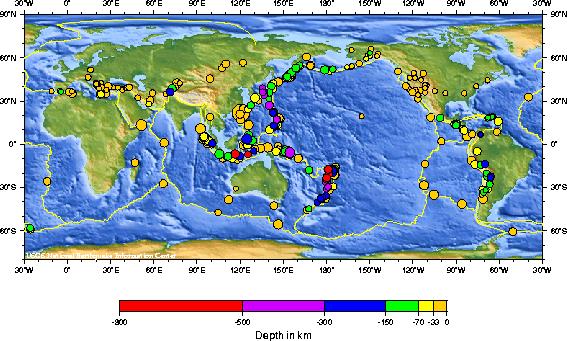
i. GIF from USGS showing 8 to 30 days ago of earthquakes including Taiwan. Should be topical if no one else is using it. Source USGS
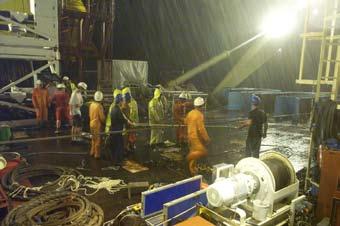
ii. The final splice of AJC from August 2001 (DCP 0708) taken by AJC shipboard rep, demonstrating that life on a cable ship is not all jelly beans and ravioli.
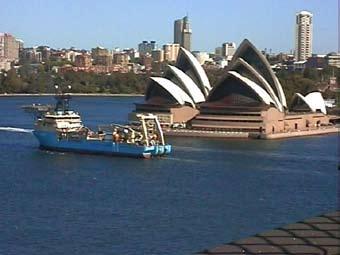
iii. AJC laying ship going past Syd Opera House in 2001 taken by AJC Head of Engineering Phil Murphy iv. AJC post lay burial.
It was quite informative and interesting. I do not think that you will be willing to provide such an information services free of charge for a long time. Best regards,
Spectacular job putting this together...it’s very impressive. Dr. William J. Barattino, Global Broadband Solutions, LLC
to the Editor
Robin Russell CEO, Australia Japan Cable
Les K. Valentine, NEXANS Norway
Robin has over thirty years experience in the telecommunications industry, the last six as CEO of Australia Japan Cable (AJC). AJC construction was completed on time and under budget in 2001. After five years of operation, AJC has established itself as a provider of economical and ultra reliable connectivity with Australia. Before AJC, Robin was Telstra’s GM, Indonesia, after a 20-year career in corporate finance and information technology with Telstra. He holds a Master of Commerce degree from the University of New South Wales.
Les K. Norway
Mike Wiseman, Esq.
Dear Wayne, Congratulations on your 5th anniversary! How time flies when you are enjoying yourself! Not sure to what you were referring in your exordium when you mention “mistakes” but we have always found your publication to be stimulating, relevant, and informative. Long may it continue!
Spectacular job putting this together...it’s very impressive. Dr. William J. Barattino, Global Broadband Solutions, LLC It was quite informative and interesting. I do not think that you will be willing to provide such an information services free of charge for a long time. Best regards, Sumio Yamano, Sumitomo Ocean Development & Engineering Co. Ltd.
Julian Rawle
Good work edition.
Bill Brock, For BP America Production Co Thanks for a great read and even though the business is “way down where the music plays”, wherever that may be, there is always a light at the end of the tunnel/ cable.
Mike Wiseman,
Bill Brock, America Thanks and even business where wherever there at the cable.
Thank you for your Email and the short cut to the Submarine Telecoms Forum. I briefly visited this website and found the information to be quite interesting.
Thank and the Submarine I briefly website information interesting.
Alcatel and Lucent Complete Merger
Alcatel and Lucent Technologies announced the completion of their merger transaction and that they began operations as the world’s leading communication solutions provider on December 1, 2006.
The new company, Alcatel-Lucent, with one of the largest global R&D capabilities in communications and the broadest wireless, wireline and services portfolio, is incorporated in France, with executive offices located in Paris. The company will be traded on Euronext Paris and the New York Stock Exchange (NYSE) from December 1, 2006, under a new common ticker (Euronext Paris and NYSE: ALU). As a result of the merger, each outstanding share of Lucent common stock has been converted into the right to receive 0.1952 of an Alcatel ADS. In connection with the merger, Alcatel has issued approximately 878 million shares, which is equivalent to the total number of ADS to be issued to the holders of Lucent common stock. Following the completion of the merger, approximately 2.31 billion ordinary shares of Alcatel-Lucent are outstanding.
Serge Tchuruk, appointed as Chairman of
the Board of Alcatel-Lucent, said: “AlcatelLucent will be for our customers a partner with the scale and scope to design, build and manage increasingly complex networks that deliver advanced converged services and communications experience to the end-user. That is what Alcatel-Lucent will deliver with an unparalleled focus on execution, innovation and service for our customers: the company will have the most experienced global services team in the telecommunications industry, as well as one of the largest research, technology and innovation organizations in the industry. In fact, our combined company is ideally positioned to help our customers transform their networks so they can offer new kinds of personalized, blended applications and services.”
Patricia Russo, appointed as Chief Executive Officer of Alcatel-Lucent, added: “Through this merger, we are bringing together two top-ranking companies to form an undisputed leader in the industry, a company poised to enrich people’s lives by transforming the way the world communicates. Alcatel-Lucent is a strong and enduring ally that service providers, governments and enterprises
can count on to help them unlock new market and revenue opportunities. This combination represents a strategic fit of vision, geography, solutions and people, leveraging the best of both companies to deliver meaningful communications solutions that are personalized, simple to adopt and available globally. Both Alcatel and Lucent embraced a common culture of innovation and excellence that will help ensure the success of our merger.”
With a comprehensive and diversified portfolio of complementary products, Alcatel-Lucent is well positioned to address the fastest growing areas of network transformation, the company said in a statement. The company is a leader in IPTV, broadband access, carrier IP, IMS and next-generation networks, and 3G spread spectrum (UMTS and CDMA). With more than 18,000 employees working in services worldwide, the company has the largest and most experienced global services team in the industry. In enterprise communications solutions, Alcatel-Lucent is No. 1 in Europe and has more than 250,000 enterprise and government customers worldwide.
With a worldwide presence in 130 countries, 79,000 employees (after completion of the Thales transaction) and balanced revenues across all regions, Alcatel-Lucent has strong customer relationships with the 100 largest telecommunications operators in the world. The company will have four geographic regions: Asia-Pacific, Europe and North,
Middle East
The oldest and traditional fiber optic route is via the Middle East, using the systems of Flag Euro Asia or SEA-ME-WE-3.
Europe and South and North America, to answer the needs of service providers, enterprises and end-users in the most advanced telecommunication markets, as well as in high-growth economies.
These two submarine systems were immensely significant developments at their time of construction. They are essentially branched systems designed to provide connectivity to large numbers of countries en route. Ring protected submarine systems in other oceans of the world were developed later and neither Flag nor SMW-3 are, in themselves, ring systems. Restoration of Flag and SMW-3 has to be created using support of capacity one from the other or from other, less immense systems which parallel some of the route.
Alcatel-Lucent recently unveiled the new brand mark that will represent the world’s largest communications supplier. The new brand mark visually signifies the two organizations flowing into each other, demonstrates an embrace of the respective cultures and symbolizes the company’s vision of enriching people’s lives by transforming the way the world communicates.
The company’s new logo is a stylized version of an infinity symbol that looks as if it were drawn by hand. Embedded within the symbol is an A and an L. It is both fluid and infinite. The signature color of the new logo is purple, a bold color that symbolizes ambition and is also associated with creativity, wisdom and dignity.
The RTD is circa 230 ms. Prices are quoted by various suppliers, offering a range of prices normally at least double those via USA/transPacific option.
It is obviously apparent that the buyer’s criteria will decide which route to use from the
above 3 options. If, for example, RTD is of optimum importance to the buyer, then the new additional option of routing via Russia, one would assume, will be of great interest.
course very difficult to predict. The USD 35 000 represents a small reduction on prices over the past 12 months. Price reduction in the last year has been small compared with the annual reduction of circa 50 % p.a. that has been recorded over previous years. We can but hope that prices across the Atlantic, across continental USA and across the Pacific have now stabilised. As regards the trends in prices on the route via the Middle East, the prices of Europe-Asia capacity following that route have declined less dramatically over the previous five years yet we can see nothing to cause upward pressure on prices on that route.
“Our new logo represents the endless possibilities for the future and our commitment to being a strong and enduring ally for our customers around the world,” said Patricia Russo, Chief Executive Officer of Alcatel-Lucent.
“The combined name of Alcatel-Lucent will enable us to capitalize on the strong brand equity that both companies enjoy,” said Serge Tchuruk, Chairman of the Board of Alcatel-Lucent. “In addition, the combined name of Alcatel-Lucent sends a message to
Indeed, with new cables opening up between India and Singapore and onward to Eastern Asia, there is now a lot more competition
our customers that the combined company will provide continuity as well as dynamism,” added Serge Tchuruk.
on those segments of the route than there was two or three years ago.
The likely trend in prices of capacity on the route via Russia and Mongolia is very hard to predict. There are relatively few suppliers capable of provisioning end-to-end circuits and therefore the intensity of competition is not as great as either of the other routes. The existence of the other routes nevertheless should continue to act as a downward pressure on prices on the shortest route.
Alcatel-Lucent has been involved in most of the major submarine projects launched over the past two years and a half including Sea-Me-We 4, FALCON, the Sea-MeWe 3 upgrade, Canada’s University of Victoria (NEPTUNE Canada subsea-cabled observatory), Columbus Communications (FibraLink network), Global Caribbean Network, Global Crossing, Kodiak Kenai Cable Company for the Kodiak Kenai Fiber Link (KKFL), INFN for NEMO undersea telescope in the Mediterranean, Maroc Telecom, Middle Caribbean Network, Orascom Telecom and the SAT-3/WASC network upgrade.
The growth of predicted traffic to China over the coming years is well known. Indeed China Telecom is pro-active in being a part of this business, launching plans to develop business in Europe by opening a new office in the UK. The company, which has already made similar moves into the North American market, is believed to be tracking corporate customers with bases in Europe and China.
China Telecom was granted an operating licence in the US two years ago, enabling
By Wilfred KWan
Multiple earthquakes off the coast of southern Taiwan severed six out of seven subsea cables passing under the sea in the Luzon Strait, cutting nearly all communications access between South Asia with North Asia and the US. When the initial shock was over, the Internet in much of Asia came to a standstill as traffic bounced back from the severed links on its way to the critical trans-Pacific route. Web sites timed out. Popular online services were suddenly unavailable. Emails bounced. The Internet collapsed. Luckily, not all communications systems were down for the count. Despite multiple cuts on its EAC system, Asia Netcom, backed by its multiring network topology, full route and systems diversity, a highly experienced and motivated operations team, and dedication to customer satisfaction, shifted into high gear and restored services to not only its customers, but with enough capacity to spare to help bring the rest of Asia back online.
In total, Asia Netcom’s engineers, field operation teams, service delivery and support professionals restored more than 100Gbps of intra-Asia capacity, equivalent to more than 20,000 residential broadband lines. Within hours of registering impacts to its network, Asia Netcom managed to restore all services to its customers, and was actively provisioning any remaining bandwidth to the region’s carriers and ISPs to reconnect the region to the global infrastructure.
It was no easy task. It took the right technology, the right preparation, the right attitude and perhaps a little luck, to restore what could very well be the equivalent of one-fifth of the entire used capacity in Asia previously in just a little over a day. Through the entire period, the company’s customer support professionals proactively informed customers of the latest network status and restoration progress. In the center of the restoration process was Wilfred Kwan, Asia Netcom’s Chief Technology Officer, who gives a run-down of how the company helped its customers get back online and back in business in the 24 hours after the quakes off Taiwan.
Prelude
It’s never good to get news of earthquakes, especially during a family dinner on the eve of Boxing Day. It also doesn’t help that most restaurants in Hong Kong now have television sets.
So it was minutes after 8:30 pm on the 26th of December 2006, I caught the tail end of a breaking news story about an earthquake that hit off the southern coast of Taiwan.
The first thing that popped into my mind was of course our cable system, the second being the potential threat of another tsunami, having just discussed the tragedy one year earlier.
On the other hand, years of experience told me that earthquakes were not rare in the area, and our cable system has survived many previously.
Nevertheless, it was second nature to call our network operations center to make sure everything was okay. Everything was, but I asked key members of my organization to stay alert, just in case.
Chapter One
Multiple SMS arrived on my phone around 1:30 am. Instinct told me it was trouble even before I read the messages: cable cut. Two minutes later, I dialed into our emergency conference bridge, a number that we keep set up for just such occasions.
Immediately, members of our crisis
management team joined the call. The situations began to crystallize. The ANOC, or Asia Network Operations Center, had registered a fault on the northern ring of the system, signifying a cut in one of the segments that impacted services between Hong Kong, Taiwan and Japan. Team members had already alerted the ASC, our customer support center, and implemented emergency restoration measures.
The marine operations team was then alerted. They in turn notified our marine maintenance contractor of the situation. A cable ship, anchored off Keelung, Taiwan, began preparation for cable repair operation.
Meanwhile, members of the ASC got on the phones to notify customers of the situation.
Forty-two minutes after the first fault, a detailed survey of the network status and review of the impacted circuits was carried out, and the majority of the traffic on one of two rings was re-routed in the other direction using the system’s Ring Switch capability.
An hour and six minutes following the first cut, traffic on the second of two rings was restored with a Ring Switch. EAC status was normalized and all customer services were restored.
Chapter Two
Another round of SMSs arrived around 10:30 am. More trouble, I thought. The same procedures followed – dialed into the
emergency conference bridge and received the latest update from crisis management team.
A new fault was detected on a second segment of the northern ring, impacting the restoration path used by previous Ring Switches. The new fault isolated Hong Kong from the northern ring, and interrupted traffic on the critical path between South Asia and Japan, as well as traffic heading to the transPacific route.
At that point, we faced a major network event because the segments that carried two of our northern rings were impacted. Luckily, we also had a southern ring and the foresight to land it in both Hong Kong and Taiwan, giving us effectively a third layer of redundancy to the affected area.
The core challenge for the engineering team at the time was the migration of the traffic load from the northern ring to the southern ring of the network, which involved at times, physically switching the circuits inside the transport equipment at each CLS node.
Teams were scrambled in the network’s Cable Landing Station to reconfigure the network.
We were a bit lucky – on two counts. First, one of the major projects we completed last year was the upgrade of our network to a new transport system. That gave us a really clear and concise picture of our network and where everything was, so we knew ahead of time exactly what needed to be done and where.
At the same time, we saw a rapid growth of demand in the past year and have just completed an upgrade of our entire network. In this way, we had plenty of capacity in the south to support the traffic from our northern routes.
About six and half hours after the second cut, we successfully restored the first of many 10Gbps rings from the northern segment onto the south ring. At this point, we proved that the methodology worked. The remaining 10Gbps rings were restored successively over the next four hours, returning all impacted circuits to full service.
In total, the engineering teams restored more than 100 Gbps of capacity between Hong Kong, Taiwan and Japan by rerouting via the south. The majority of ASC staff worked 18hour days
Our first priority was our customers. Once we got their services back up, we focused on helping the rest of the industry get back online. We knew by that time that all the cables in that area were cut, and the Internet was heavily congested and for many users, inaccessible. Request for capacity flooded in and we tried our best to accommodate each one.
Epilogue
The work for our engineering teams did not stop there. In addition to getting the services back to normalcy, the team then got busy
provisioning whatever spare capacity we had to other carriers and ISPs, so that they could get their end-users back online.
In the aftermath, Terence Lim, a provisioning engineer at the ANOC, worked three days straight provisioning services for customers.
Likewise, Dave Scott, our senior provisioning engineer, worked throughout the New Year holiday to provision customers.
Wilfred Kwan is President and Chief Technology Officer, Asia Netcom. Prior to the transition of Asia Global Crossing to Asia Netcom, Kwan was Senior Vice President of Network Operations at Asia Global Crossing since joining the company in June 2002.
With over 16 years of experience in the telecom industry, Kwan’s experience ranges from software development and integrated circuit design to product development, network planning and operations. Kwan joined Asia Netcom from WorldCom Asia Pacific, where he was the Director of Operations responsible for overall operational efficiencies such as MTTR, on-time delivery and operations cost. He also led the implementation of ISO 9000 and crossdepartmental processes for quality assurance at WorldCom. Kwan has also held various management positions with Global One, Lucent Technologies, Motorola and Nortel. Since 1999, Kwan has served as an advisory committee member to OFTA in Hong Kong.
Kwan holds an MS in Electrical Engineering from Cornell University, where he also received his undergraduate degree in the same discipline. Additionally he earned an MS in Financial Management from the University of London.
SUBOPTIC 2007
The COUnTdOwn BegInS
The final preparations for the SubOptic 2007 conference, to be held in Baltimore, Maryland, USA on May 14-17th are underway. This conference, which covers all aspects of the Undersea Communications industry, will be a significant industry event. Alan Robinson, President of the SubOptic Executive Committee, reflects on the thought and planning that has gone into this year’s program, “The Undersea Communications industry boasts world-leading technologists, of course; but in addition, this industry is comprised of experts in environmental and regulatory issues, marketing opportunities and challenges,
and the commercial realities of purchasing and operating high cost sub sea assets. The program for SubOptic 2007 has been designed to reach the concerns of all of these groups. It offers an impressive and relevant array of speakers, papers, and tutorials at a time when our industry is showing real signs of new and exciting growth after a prolonged downturn in investment.”
attendees can socialize with the publisher of one of the world’s leading financial magazines.
On day one, attendees can listen to a speech by a world-famous visionary computer scientist. The next day brings the opportunity to meet a US Ambassador, and on the following day
Add the 130 presentations from thought-leaders around the globe, roundtable discussions, tutorials, poster presentations and non-stop networking opportunities, and SubOptic 2007, scheduled this year in Baltimore, Maryland, promises to be like no other undersea telecommunications conference.
Suppliers, carriers, end users and even investors in the telecommunications, government or oil and gas industries know how the undersea telecommunications industry has connected the world through technology. Just as important because of recent events, they know how critical it is to be able to respond effectively to catastrophic disruption of these connections.
The SubOptic program is a true reflection of the issues that concern our industry, ranging from engineering to the business implications of new technologies and new opportunities. In fact, SubOptic 2007 will extend the trend which was apparent at both Kyoto and Monaco, where more than 50% of the presentations were related to non-engineering topics including, commercial, financial, regulatory, environmental and operational issues. Program Chairman Dave Robles gives credit to the
Program Committee for creating a program with a balance of current and future topics. “The Program Committee is an inter-company body of six industry professionals representing six different aspects of fiberoptic communications and infrastructure development. Together this group has assembled a program to address every perspective, while at the same time challenging those in the industry to think and plan for future developments,” explains Robles.
Keynote Speakers – The three keynote speakers for SubOptic 2007 represent the world of visionary thinking, international communications and information policy, and business. They are:
Jaron Lanier is a computer scientist, composer, visual artist and author and named one of the top 100 “remarkable people” of the Global Business Network. Lanier has a regular column, Jaron’s World, in Discover Magazine and holds several advisory positions, including his membership on the Science Board of the Pittsburgh Supercomputer Center.
U.S. Ambassador David Gross has served as the U.S. Coordinator for International Communications and Information Policy in the Bureau of Economic and Business Affairs.
Ambassador Gross has also been a member of the United Nations and Communications Technologies Task Force.
Richard Karlgaard is the publisher of Forbes Magazine – the world’s most popular business and financial magazine. He is a speaker and author of the twicemonthly column, Digital Rules. He also is the author of the book, Life 2.0
How People Across America Are Transforming Their Lives by Finding the Where of Their Happiness.
Surrounding these keynote speakers is the rest of the SubOptic 2007 program, which includes the following tracks expressed in oral presentations, tutorials, roundtables and poster sessions:
• Going Deep: Marine Services & Operations
• Weaving the Worldwide Web: System Design & Applications
• Evolution & Revolution: Equipment and Component Technologies
• Before You Dive In: Project Development & Implementation
• Carrier Essentials: The Undersea Bandwidth Market
• Charting the Course: The System Supply Market
Oral Presentations –Dozens of papers have been accepted for individual oral presentation sessions, providing well-considered program choices for attendees. The oral presentations fall within the program tracks and feature examples of exciting thinking in the industry today. Broadening the SubOptic appeal is the session focusing on offshore oil and scientific,
while the Spotlight Session is targeted for presentations with a broad appeal.
Poster Session –The Poster Session showcases a wide range of specialized printed presentations displayed for public viewing. During the Poster Session, enhanced by a social cocktail event, attendees will be able to read the printed material and interact with the authors to discuss their presentation topics in greater detail. According to Robles, “The SubOptic poster session is really a focal point of the convention; it is the central networking event of the week’s activities.”
Tutorials – SubOptic 2007 is continuing the venerated tradition of conference tutorials that provide a give-and-take discussion opportunity for all attendees. The ten tutorials currently slated range in topics from “Maintenance of Undersea Cable Networks” presented by James Coble of AT&T and Frederic Exertier of France Telecom Marine, to “International Law and Submarine Cables” presented by leading telecommunications attorney Douglas R. Burnett, to “Offshore Oil and Gas Applications of Undersea Cable Systems” presented by Greg Otto from BP America.
Roundtables – The Roundtables are debate forums on industry issues that encourage audience participation. Structured as a panel
of four to five speakers and a moderator, the Roundtables will cover topics of broad interest. Sometimes the Roundtable discussions lean toward challenging and provocative. These particular sessions are in the planning stage, but will be announced soon.
Exhibition – SubOptic 2007 will have an ample exhibition area within the Conference Hotel. More than 60% of the exhibit space has been reserved for large and small stands that will be visually interesting and educational about current products and services.
Within the conference schedule, attendees will have opportunity to network and socialize. The exhibition will open with a cocktail reception, the Poster Session will feature a social event and the Gala Dinner will be at the historic B&O Railroad Roundhouse.
It can be easily argued that SubOptic 2007 will cover an impressive breadth of the critical issues of the undersea telecommunications growing community, and will attract a wide range of attendees from related industries. Individual attendees will find, from the moment they arrive at the registration desk, representatives from around the world and around the industry. During the sessions, attendees will discuss issues with industry
leaders or new entrants who appear likely to make their mark in the industry. At the social receptions, attendees will be investing time in getting to know people who share their concerns and can contribute to the growth and health of the undersea telecommunications community. There will be students who might become future star employees, and visionaries who will change the way all who attend think about their businesses.
As is its tradition, SubOptic 2007 is structured to help attendees discover what’s coming in the future and how their business will benefit. This year, thought leaders in the industry will point to trends in meeting the growing demand for global information. Attendees can discuss, challenge, and stretch the industry perspective to meet new challenges on the horizon. .
Keep in mind that registering before January 31st will save over the standard registration fee.
Broadband Explodes Across the North Atlantic
By John Manock
There is no doubt that 2006 was a very strong year for the submarine cable industry. New systems were announced at an astonishing rate. Supply contracts were awarded and financing for new systems was secured. There was even a return to transoceanic systems – a type of project that was almost thought of as a thing of the past following the collapse of new cable construction in 2002.
TSA’s Radar Screen Report™ for January 2007, our annual review and forecast for the industry, has identified 24 major submarine cable projects that were under contract in 2006, up 30% from 2005 and up from just five projects during the depths of the drought in 2003. TSA is also forecasting that as many as two dozen new supply contracts will be awarded in 2007, many of which will be large scale projects in the several thousand route-kilometer range. Supply contracts for more than 100,000 route-kilometers of new cable systems could result.
Number of Supply Contracts Awarded by Year
The new submarine cable projects that are being developed show remarkable geographic distribution. Several transpacific cables are being seriously pursued. There are numerous regional projects planned and underway throughout the Pacific, Indian Ocean and Caribbean regions.
One geographic market that is not seeing much in the way of new submarine cable projects is the Atlantic. The transatlantic market was arguably the most overbuilt of all markets during the last submarine cable boom of the late 1990s and early in this century. It was often cited as a leading example of overbuilding in the popular press. With Internet demand lagging, it was believed by many that it might be decades before the huge amount of existing cable capacity across the Atlantic would be used up.
The focus of this article, however, is about demand bandwidth, not submarine cables. And as exciting as the announcements of new submarine cable systems were in 2006, some of the purchases of transatlantic bandwidth during the year were somewhat unexpected, if not outright astounding.
In February 2006, US carrier Level 3 announced that it was buying 300 Gbps of capacity, with the rights to 300 Gbps more, on Cable & Wireless’ Apollo transatlantic cable. This is believed to be a record for a single purchase of capacity.
Level 3 said at the time that it had 480 Gbps of traffic on its transatlantic network and that the amount had doubled in the previous 12 months.
Just a few months later, T-Com, the broadband/ fixed line strategic business area of Deutsche Telekom AG, announced that it was buying 180 Gbps of transatlantic capacity from FLAG Telecom on its FLAG Atlantic-1 (FA-1) cable. According to forecasts cited by the companies at the time of the announcement, the total capacity in use on the Europe-USA route had grown at around 48% year on year between 2002 and 2006 and is expected to clock a similar or higher growth rate in the coming years.
Yet another transatlantic cable operator, Hibernia Atlantic, cited strong growth last year. In early 2006, Hibernia Atlantic announced that it had sold or leased 220 Gbps of capacity during the previous 11 months. And that growth continued throughout the year.
“Transatlantic traffic has been increasing by up to 80% at Hibernia Atlantic,” said Bjarni Thorvardarson, CEO of Hibernia Atlantic, in December 2006. “This growth is a direct result of the continuing demand and use of broadband in Europe and the overall increase in end-users who are downloading and sharing video and content over the Internet.”
“In the transatlantic market, there has been a strong growth in overall Internet traffic,” continued Eric Gutshall, EVP of Sales and Marketing for Hibernia Atlantic. “This rapid increase allows service providers to lower their prices. This competitive pricing has significantly stimulated point-to-point corporate traffic across private, secure networks. It has been remarkable to see major banks and global pharmaceutical companies connecting their offices in Europe, US and Canada, and move from 2.5 Gbps
connections to now even 10 Gbps Ethernet connections. This is the beginning of a new way for large corporations to communicate securely -- via their own, managed private networks with a keen focus on network diversity.”
So why is there demand for hundreds of Gigabits of transatlantic traffic and why is it happening now? Rather than answer this question in the present, I can’t help but be reminded of a statement made four and one-half years ago on the other side of the world.
Remember 2002? For the submarine cable industry it was a year in which the reality of the collapse of the market was hitting home. It was also the year that the trade press was obsessed with the “killer app” -- the Internet application that would drive demand and usher in a new era for users for which the Internet would become more a part of their daily lives.
Does anyone remember the last time they heard the term killer app? And what is it? Is it downloading music? Is it streaming video? Is it IPTV? Is it all of them? Was there a killer app at all or just a bunch of little apps? Does it matter?
It seems that there is huge demand for Internet capacity yet there is no single killer application. What happened? Here is where we have to look back to 2002.
In August of that year, Australia Japan Cable (AJC) issued a statement saying that broadband technology itself is the world’s “killer app.”
Robin Russell, AJC’s CEO, said that despite industry pundits proclaiming that applications
like the Internet fridge and nanny cams are what the world has been waiting for, AJC believed broadband technology itself and the opportunities it provides will be the driving force behind uptake.
“The killer application is already here,” said Mr. Russell. “High speed Internet access improves the way we operate online as individuals, as companies and as a global community. Not only is broadband diversifying and accelerating communication channels, but it is also poised to deliver social benefits throughout Australia. For example, broadband will play a crucial role in improving the delivery of health services to rural Australia via affordable and reliable telemedicine.”
Mr. Russell pointed to reports showing increase in corporate broadband connections in Australia at the time. “These figures show that corporations are rapidly realizing the benefits of broadband access while small and medium enterprises and an increasing number of home users are quickly following,” he said.
“It’s interesting to note that broadband uptake is further along than mobile phone uptake at the same stage of the technology,” added Mr. Russell. “Just as increased mobile phone uptake led to the rapid development and deployment of applications such as SMS, WAP and now video, we believe rapid increase in adoption of broadband will result in the same spectacular array of applications.”
I don’t recall Mr. Russell’s comments getting too much attention in 2002 compared to the bankruptcies and submarine cable glut stories, but can anyone question his conclusions now in 2007?
This growing broadband demand, the true killer app, can be found everywhere throughout Northern Europe. Everyone expects there to be demand between New York and London and other major European cities, etc., but broadband is booming throughout the region and in some places that are rarely discussed.
Iceland has quietly become one of the biggest broadband success stories in the world. The country of 300,000 has reached the top of the charts in broadband penetration according to a recent survey and its leading carrier, Siminn, is a pioneer in advanced services such as IPTV.
According to an Organization for Economic Co-operation and Development (OECD) report released last year, Iceland, with 26.7 subscribers per 100 inhabitants at the end of 2005, surpassed perennial leader South Korea in broadband penetration rate.
Broadband is just one in a series of statistics demonstrating the degree to which the Internet has taken hold in Iceland. Approximately 80 percent of Iceland’s households are equipped with a computer, and more than 70 percent are connected to the Internet. Demand is high and continuous. And Iceland’s economy is strong and growing. In another OECD report published last year, Iceland’s economy and per capita income was shown to have grown at an impressive pace since the mid-1990s, making the country one of the most prosperous in the OECD. This growth has stimulated the need for modern submarine cables to serve the Icelandic market. It led to the deployment of the first DWDM submarine cable system to land in Iceland, Farice (completed in 2003), and plans for a second have been
announced by Farice hf, the company formed to build and manage the Farice systems.
“Farice hf is responding to the growing opportunities for Iceland and other North Atlantic economies that require an assertive vision for future connectivity. Among the future opportunities being considered is the implementation of data centers in Iceland, serving the fast increasing data storage needs of international organizations. Iceland is considered to be very competitive in that field with its “green power” from hydro and geothermal power plants, stable society and highly skilled workforce,” said Guðmundur Gunnarsson, Managing Director of Farice hf. “Farice is planning ahead to meet
the annual increase in bandwidth demand and change in technologies. Plans for a second submarine cable out of Iceland are underway, primarily for restoration and increased availability of connectivity.”
But dramatic broadband growth in the North Atlantic region is not limited to Iceland either. High broadband penetration rates are reported throughout Northern Europe, according to the OECD. The Netherlands, Denmark, Finland Norway, Sweden and Belgium are all in the top 10 worldwide with penetration rates ranging from 18.3 to 25.3 percent.
In Norway, for instance, Telenor made some interesting observations about how its broadband subscribers are changing.
“Recently, development in the broadband market has moved from an explosive increase in number of customers to an explosive increase in use by those who have broadband. You could say that it seems broadband customers have definitely seen how they can utilize broadband to the full,” said Olav Sande, Director of Broadband and Telephony in Telenor Consumer, in a statement issued in October 2006.
“Immediately after Telenor’s launch of ADSL in 2000, customers were most concerned about uptime and coverage,” said Mr. Sande. “From there, demand turned to capacity and price, while now we see that services and content, which require higher bandwidth, are more important. Downloading music, streaming movies and webTV, e.g. football matches, are all content services that require high-speed Internet. Football represents the greatest content success on the Internet so far, and is a major cause for increasing traffic both regionally and centrally. For example, in Bergen there has been at times a doubling of traffic when the local football team play, especially during away matches.”
In Finland, traffic is booming as well and TeliaSonera is responding with a fiber optic broadband service. “For consumers and housing companies the optical fiber opens a door to new services. The next generation television technology – HDTV – for example, sets entirely new requirements for broadband access. In future, it will also be important to further develop the transactions between citizens and authorities.
High-speed network connections are becoming a service comparable to the electric power network, and the optic fiber network offers a sufficient amount of capacity both now and in the future,” said Eero Sinkkonen, Head of the Information Society Structures and Services division at TeliaSonera Finland, in a press statement in August.
Global Crossing, when it opened a new Point of Presence (PoP) facility in Helsinki in 2006, noted, “There has been a huge surge in IP traffic and we have responded to the increasing customer demand by establishing this newest PoP facility,” said Pieter Duijves, Global Crossing’s Managing Director, Europe. Global Crossing also noted that Helsinki is an important gateway to the burgeoning Russian telecom market.
Finland and Denmark are also unusual in that broadband take up in rural areas is almost as great as in urban areas. Carriers in Sweden are also making a major push into rural areas.
Ireland did not make the top ten in the OECD’s broadband report, but the country is nearing one million Internet subscribers, according to Ireland’s Commission for Communications Regulation (ComReg). About 436,700 of those are broadband subscribers, up 106% from a year earlier.
Submarine cable operators are beginning to see the impact of
this growth. “We are seeing a notably higher growth in traffic from Ireland to the UK and Ireland to the US,” said Hibernia Atlantic’s Thorvardarson. “Traditionally, Ireland has been at the bottom of European league tables when it comes to number of broadband connections per 1000 households. But with this recent spike in traffic for Ireland, the country has clearly been catching up to the online boom. Companies like Magnet Entertainment, that offer phone, Internet and TV in one bundled package to Irish consumers, at the same price as typical phone and TV service, are taking Ireland to the top of those same broadband tables. And with Hibernia Atlantic¹s direct US, Canada and UK routing, Ireland now has secure and diverse access across the Irish Sea and the Atlantic Ocean.”
Hibernia Atlantic’s Network in Ireland
Even tiny, landlocked Luxembourg is making waves. P&T Luxembourg, the national carrier, announced during 2006 that it had built, using capacity on existing fiber networks, a 4,000kilometer, 6-country, 13 PoP European network. This network includes cross-channel submarine cable capacity to the United Kingdom. The network, known as TERALINK, has a capacity of 3.5 Tbps (3,500 Gbps!).
Like Iceland, P&T’s TERALINK is an effort to make Luxembourg an important location for data centers in Europe. P&T says that its data centers, run by a subsidiary known as eBRC, make Luxembourg a unique and reliable place to be for worldwide operating ICT companies, carriers and corporate customers. P&T has invested 75 million euros in its network to support the effort.
So if there is all this activity in the smaller markets, what are the big markets doing? Well, in the United Kingdom, broadband take-up has exceeded expectations in a big way.
BT announced in December that it would break through the ten million broadband barrier, smashing its initial target of five million connections by the end of 2006. That target was viewed as highly ambitious at the time it was set in April 2002, when there were fewer than 150,000 DSL connections. Broadband availability at that time was 66 percent whereas it is now more than 99.8 percent.
In Germany, there is a fear that the country is falling behind, in spite of the growth that caused T-Com to invest in 150 Gbps of transatlantic capacity. Germany held its first national IT summit in December, in which the government
announced a euro 1.2 billion strategy to advance communications and technology to keep the country at the forefront of the ICT revolution.
In France, broadband subscribers surpassed 11 million by the middle of 2006, an increase in 40 percent from the year before. The revenue generated by the service is approximately threequarters of a billion euros, according to regulator ART.
The uptake is so great that France Telecom has begun investing heavily in fiber-to-the-home so that it can deploy very-high-speed broadband services – up to 100 Mbps per home.
France Telecom is targeting 150,000-200,000 very-high-speed users in select cities by the end of 2008, out of a potential one million customers in the areas in which the services will be offered initially. The carrier envisions massmarket deployment of very-high-speed services beginning in 2009.
In summary, broadband is booming throughout Northern and Western Europe and there is no slowdown in sight. Subscriber numbers and usage in the big markets are skyrocketing and the smaller markets are showing great potential and provide opportunities for innovative operators and suppliers. And although there may not be any announced new transatlantic cable projects right now, given the broadband growth that the region is seeing, will it be much longer before there is a new wave in investment in cables to meet this demand?
John Manock is the Director of Information Services at T Soja & Associates, Inc. He is responsible for creating and maintaining TSA’s databases on fiber optic submarine cable systems. He is also the editor of TSA NewsFeed, a daily information services exclusively for TSA clients focusing on news and events affecting the submarine cable industry. Mr. Manock specializes in the development of information services for carriers, developers, and suppliers. He has over 18 years of experience in the fiber optics and telecommunications consulting business during which he has participated in numerous studies on submarine cable systems. He has also published numerous articles for the industry and is a frequent contributor to industry publications including SubTelForum and Soundings Magazine. Mr. Manock received a master’s degree in Library and Information Studies from the University of Rhode Island and bachelor’s and master’s degrees from Providence College.
GloBal Marine helps install landMarK seisMic activity MonitorinG
BottoM Unit’
By GaBriel rUhan
Asia is one of the world’s most active regions for natural disasters in the world. It experienced one of the devastating Tsunami in 2004 and on Boxing Day 2006 an offshore earthquake, measuring 7.2 on the Richter scale occurred in South East Asia. Two people lost their lives, 40 others were injured and the largest outage of telephone and Internet services in years.
The quake damaged the fibre-optic cables which lay on the ocean floor south of Taiwan and facilitate communications between the mainland, Taiwan, Hong Kong, the US, Southeast Asia and Europe. Millions of people experienced severe disruption in accessing websites and international dialling facilities were also affected.
Global Marine Systems immediately galvanised three of its cable ships to the affected region and it is working hard to prepare the cables and get Asia back online.
To understand tsunamis, and their causes, seismic variances needs to be closely monitored and evaluated and this is another key area in which Global Marine Systems plays a role.
In November 2006, the Korean Meteorological Association (KMA) commissioned the installation of a pioneering ‘Ocean Bottom Unit’ (OBU) 20km off the coast of Ulleungdo
(an island 135km east of the Korean peninsula) which acts as a “listening device” to detect and monitor high levels of seismic activity. Whilst not designed primarily as a tsunami early warning device the measuring of seismic activity will enable the KMA to better understand how this activity can lead to tsunamis, and how tsunamis work.
Global marine experts KMA enlisted the help of KIT valley, providers of seismic monitoring systems, and SpaceTech, project managers of space and terrestrial systems. In turn, it contracted world leader in subsea cable technology Global Marine Systems Limited to install the OBU 2,000m below sea level along with the essential seismic cable connecting the OBU to the island. The fibre optic cable not only provides power to the OBU, but also transfers the crucial activity measurements back to the island.
KIT Valley chose Global Marine Systems Limited as it is a leading provider of submarine cable installation and maintenance services and world-renowned for its specialisation in this area. KIT Valley was confident that its experience and expertise could ensure that the careful deployment of the cables would ensure optimal performance from the OBU.
If successful, the project will pave the way towards the installation of up to five similar
devices along the coastline of South Korea, providing a more comprehensive and effective measuring system for the whole country with the ability to detect tsunamis at a local level.
Understanding the problem
The earth’s crust comprises of seven tectonic plates which are constantly moving. When these plates collide or shift below sea level it results in a seismic shift of the plates which can cause an earthquake. It is the resulting shift in the sea level that makes tsunamis so devastating, as the ocean is trying to level itself once more, with an incredible combination of force and pressure.
The OBU device measures even the smallest changes in sea level, and reports it back in real time to a relay station on the shore of Ulleungdo via the armoured optic fibre sea
cable. The system can detect an earthquake and sea level change as soon as it happens so can also provide warning as early as possible. To do this, the OBU is equipped with state of the art technology including a pressure sensor and a geophone, which works to listen to changes in the sound of the sea bed.
A challenging operation
In installing the cable, Global Marine faced various challenges. The shore on Ullengeudo mainly comprises of rocks, which is an issue when trying to lay a subsea cable. In a best case scenario, a sandy shore would provide a soft ‘bed’ on which to lay the cable. To tackle this, Global Marine was able to install the cable through steal tubes which were laid on the rocks, and used from 500 meters away from the coast line.
The project also had to run to a tight timescale. Upon signing the contract, Global Marine had two weeks to complete the cable installation. Owing to its expertise and experience in the industry, it was able to complete this within the timeframe.
Getting it right
It was important that the cable was installed securely. This was emphasised shortly after the seismic cable was installed, when in
December 2006, an earthquake in Taiwan caused the rupture of two undersea data transmission cables resulting in massive telecommunications disturbances.
KIT Valley Director Han SehSub said, “Global Marine has a proven track record in working on underwater infrastructure projects. We knew the installation would be completed to the highest standards in our short timeframe, and the project would be operational as quickly as possible.”
He commented, “This test project could play a significant part in developing the long-term safety of South Korea’s coastal areas.”
Potentially lifesaving
The OBU device is a newer and cheaper form of technology for tsunami warnings. Its
success could help lead to the implementation of this innovative device worldwide.
With the potentially devastating effects of natural disasters monitoring and studying seismic activity is an essential task.
Derek Greenham, Solutions Design Manager at Global Marine Systems, said, “This is a vital and exciting new project for South Korea. We were delighted to work with KIT Valley to help provide the Korean Meteorological Association with a viable cost-effective monitoring solution to provide new insights into coastal activity across the region.”
The device is now up and running, and first signs show that it is fully operational.
GABRIEL RUHAN
Managing Director, Global Marine
Gabriel Ruhan currently serves as Managing Director of Global Marine Systems Limited. He has also served as a director of NaviSite since October 2002 and MD of the UK office since November 2004. From April 2004 until November 2004, Gabriel served as NaviSite’s Chief Operating Officer and from December 2002 until April 2003 he served as NaviSite’s Executive Vice President for Business Development. Gabriel is also a director of Clear Blue Technologies. From 1998 to 2002, Gabriel was Corporate Development Director of Global Switch Group, a data centre company in the United Kingdom.
Since 2001, Submarine Telecoms
Forum has been the platform for discourse on su b marine telecom cable and network operations. Industry professionals provide editoria l content from their own niche and focus. Each bi-monthly edition includes commentary and information on system and service provision, and issues critical to the industry.
Advertising Rates
Website Banners
Post your web linked banner to the home page, as well as News-Now sections of the Submarine Telecoms Forum website, where some 5000+ readers can come as often as every week to view the latest news feed, or our bi-monthly magazine.
Feature Section Sponsorship
Available at full-page advertisement rate, section sponsors are identified with a banner (link) at the beginning and end of the featured section.
All advertising rates as at December 2003.
At submarine depths, Nexans goes deeper
Nexans was the first to manufacture and install a 384 fibre submarine cable. Nexans has qualified and installed their URC-1 cable family for fibre counts up to 384 fibres.
For further information please contact:
Nexans Norway AS P.O. Box 6450 Etterstad
N-0605 Oslo Norway
Phone: +47 22 88 61 00
Fax: +47 22 88 61 01
Erik Rynning Sales & Project Manager Offshore:
“We produced the so far world’s deepest umbilical which was installed at 2350 metre in the Gulf of Mexico.”
Telecom: Rolf Bøe
Phone: +47 22 88 62 23
E-mail: rolf.boe@nexans.com
Oil & Gas: Jon Seip
Phone: +47 22 88 62 22
E-mail: jon.seip@nexans.com
www.iscpc.org
Call for Papers
The International Cable Protection Committee (ICPC) is planning its next Plenary meeting in Manila, Philippines during the period 13 – 15 March 2007 inclusive.
All of the World’s major telecommunications companies are represented within the ICPC whose principal purpose is to promote the safeguarding of submarine cables against man-made and natural hazards. This unique and prestigious organisation also serves as a forum for the exchange of technical, environmental and legal information concerning the marine aspects of both telecommunications and power submarine cable systems.
The theme of this Plenary will be:
Submarine Cables: Critical Infrastructure on a Global Scale
The Executive Committee (EC) therefore seeks presentations from interested parties highlighting the strategic importance of submarine cables to the modern world. Topics could include but are not limited to:
• Submarine Network Resilience
e.g. Diversity ; Restoration ; Future Design Considerations ; Implications for a Modern Economy
• Legal & Regulatory
e.g. Government Policies ; Cable Owners’ Obligations / Expectations / Experiences ; Coastal State Encroachment ; Continental Shelf Issues ; Impact of National Legislation ;
• Environmental Interaction
e.g. Cable Decommissioning ; Marine Life ; Documenting Ecosystem Impacts ; The Precautionary Principle ; Native Fauna ; Climate Change
• Cable Protection
e.g. Potential Uses of New Technology ; Cable Owners’ Experiences ; Regional Domestic Systems ; Fishing Activities; Prospective presenters are respectfully advised that papers which are overtly marketing a product or service will not be accepted. Presentations should be 25 minutes long including time for questions. The EC will evaluate all submissions based on content and quality.
NB: Commercial exhibits may be displayed near the ICPC meeting room by special arrangement. Please contact the Secretary for further details. Abstracts should be sent via email to plenary@iscpc.org no later than 31 January 2007.
Letter to a friend from Jean Devos
damaged several cables offshore Algeria. This country has since taken this into consideration diversifying the access routes and landing points.
Warrior event was still in everyone’s memory. It is for these reasons among others that STC (UK) rejected the Alcatel‘s suggestion to come with a joint bid, to offer a “European” solution.
One of the winning factors has been the Port-Botany cable factory. Such a factory was a strong requirement from OTC (now Telstra) and the Australian Government.
It is a fact that a sum of independent projects does not automatically lead to the most optimized global network. The shortest routes and the cheapest solutions do not often give the best answers.
My dear friend,
My Dear Friend
“Botany Bay”
knows that the vast majority of the internet traffic is flowing through undersea fibres optics!
Alcatel was the most motivated. Such a factory could expand its influence in the Pacific where the three other players were historically well established in this region, which represents a large part of their market. They saw this factory as a risk for their existing facilities!
We members of the submarine cable community; we used to regret the fact that our activity is so much ignored. This is now over! The recent Asian “Cyber black out” got a lot of press coverage, finger pointing about the “submarine cables multi breaks” around Taiwan.
A first possible reaction is: “This is great! Our vital role is now fully recognised!”
and l’Astrolabe, landed in 1788 to discover that Captain Cook was already around bearing the British flag. So Botany Bay is now for me the symbol of a dream which becomes a reality!
I published recently a modest novel, whose title is Botany Bay. It is the place in Australia where
Alcatel established a submarine cable factory in 1989 as part of its contract for the Tasman 2 link. In this same bay, where two centuries before the French expedition
The same way the newspapers only speak about trains when one is running late, the same way submarine cables come in the media when an earthquake cuts one or more causing an internet disruption. And this one was really big! Now everyone
“La Pérouse” made of two ships, La Boussole
Going a bit deeper one could also say “Well, thank god there is no real alternative to the sub cable solution and this type of earthquake is quite exceptional. So, no problem!”
Tasman 2 has been yet another chapter in this long Anglo-French competition! The award to Alcatel came out as a big surprise to many, including inside Alcatel. Everybody was naturally expecting the British to win that battle, and such an expectation was at that time very logical.
In reality this event will have and needs to have an impact on the way projects are designed and on the way the telecom operators work out their security plan. In 2003 an undersea earthquake
There were so many difficulties and misunderstanding between Australia and France, the main one being the French presence in the Pacific area, the worse being the nuclear bomb experiment in Tahiti! The sad Rainbow
My friend, I guess this will come as a debate in the upcoming SubOptic forum. SubOptic is not a conference like any other one where people tend to sell their products and services. It is our industry gathering, aiming to review and improve all aspects of our activity.
SubOptic ‘87 in Versailles came at the right time. It is where the Australian teams discovered the French model, a close cooperation between Alcatel and FT, exactly what they wanted to establish in their country.
See you there.
Jean Devos
My friend, things are changed since, but one thing stays true: When you offer something, the reader can see between the lines if you are or not genuinely motivated and sincere. Then your offer becomes really attractive and this opens the route to “Botany Bay.”