BREAKING NEWS . . BREAKING NEWS . . BREAKING NEWS . .
to share the latest news of the domain. SubOptic 2004 is the fifth in the series, which started in 1986. Hosted each time by one of the members, the 2004 edition will be organized by Alcatel, following the last one, in 2001, in Kyoto, Japan hosted by KDD.
In 2004, SubOptic will be held in the Principality of Monaco, the conference and exhibition being set up in the Grimaldi Forum, with its stateof-the-art auditoriums and huge exhibition hall.
In February Tyco Capital Corporation, the financial services subsidiary of Tyco International Ltd. announced several significant initiatives, in concert with Tyco International’s announcement today to repurchase its commercial paper, designed to strengthen its financial position and prepare the company to serve its customers as an independent public company.
WorldCom Inc. recently said its MCI Communications Corp. unit will redeem $700 million of notes, and that the company’s cash position improved during the first quarter of the year.
WorldCom, which the Wall Street Journal reported is set to cut as much as 10 percent of its work force, said it would redeem all $700 million of MCI’s 6.125 percent callable/ redeemable notes.
Two telecoms companies, TELUS Corporation (Canada) and Verizon Global Solutions Inc. (USA), are to co-sponsor the Pacific Telecommunications Council (PTC) Mid-year Meetings and Seminar, entitled “Building Strong Partnerships,” in British Columbia, Canada, on 24-27 June, 2002. Canada has been the largest trading partner for telecoms equipment with the USA for many years. Mexico and Japan are also among the larger trading partners with Canada.
Anyone interested in conducting telecoms business internationally would benefit from attending because of the scope of topics to be discussed and the opportunities to network with industry leaders and experts. More information will be on PTC’s website at www.ptc.org.
WFN Strategies of Sterling, Virginia recently announced a strategic venture with Harrison & Associates of Annapolis, Maryland to provide recruitment services for the submarine cable industry.
WFN’s Recruitment Support Service provides company clients with two key components for their hiring of permanent or occasional staffing - Direct Placement Support and Executive Search Services.
Target clients come from the submarine cable sectors serving the oil & gas, telecoms and defense industries.
Harrison & Associates, which was founded in 1999, focuses on recruiting, business development and state-of-the-art immersion videoconferencing solutions for a host of international clients, primarily in the telecommunications and government arenas.
The Clinton, Mississippi, company said it had more than $2.2 billion in cash and cash equivalents as of March 31, up from $1.4 billion at Dec. 31, 2001. Its debt level was essentially unchanged from yearend at $30 billion, and the company has no bank debt or commercial paper outstanding, it said.
Keep those press releases and news items coming. Let our subscribers know what’s happening in your company, and our industry.
Submarine Telecoms Forum reaches all the key people.
editor @subtelforum.com
Email: editor@subtelforum.com
I nteroute (www.interoute.com), the Londonbased company behind i-21, the newest and largest Pan-European fiber optic network, has established a North American operation under the direction of veteran telecommunications executive Les Hankinson.
The new unit, Interoute Americas, will be based in Atlanta with offices in New York and San Diego. As Interoute’s senior vice president sales and marketing Americas, Hankinson will lead a five-person executive team,
Founded in 1995, Interoute is a panEuropean telecommunications company with established operations in 9 European countries (Austria, Belgium, France, Germany, Italy, Netherlands, Spain, Switzerland and the UK). Interoute’s fibre-optic network connects 45 cities in 9 countries throughout Europe. Its product portfolio includes optical network services, Internet services, MPLS VPNs and communications services. Customers include other carriers, network operators, Internet and application service providers, and e-commerce companies.
State-owned Indonesia phone giant PT Telkom recently signed a $63.5 million loan facility agreement with Citibank NA and Bank Central Asia to finance a telecoms project in Sumatra.
Last year, Telkom awarded the contract for the project, which will cover the turnkey construction of a fibre-optic network, to a consortium of Pirelli and Siemens IC Networks, a telecom networks unit of Siemens AG.
Covering a distance of about 2,200 km, the network will include a 345 km long submarine transmission link between the east coast of Sumatra and the industrial resort island of Batam that lies approximately 20 km off Singapore.
A new company to service the industry has recently been established in Houston, Texas. Oceanworks International supplies atmospheric diving, submarine rescue and remote tooling systems for the military, oil and gas and submarine telecom markets. More info can be found at www.oceanworks.cc. Enquiries: Peter MacInnes at pmacinnes@oceanworks.cc
A confidential service for the supply of specialized positions for the submarine cable sectors serving oil & gas, telecoms and defense industries
Direct Placement Support
Executive Search
Confidential Reply Service
Visit our website or contact: Lisa Fontaine Managing Associate – Recruitment WFN Strategies, LLC lfontaine@wfnstrategies.com [+1] 410-268-2036
Job seekers can forward CVRésumé to our confidential résumé database at resumes@wfnstrategies.com
Since March, 2000 we have seen the precipitous decline in the equity value of telecom operators and equipment manufacturers resulting in a rash of highvisibility bankruptcies including, in our submarine fiberoptic sector, 360 Networks, Global Crossing, WCI Cable, Flag and Pangea. These filings, however, represent only the tip of the iceberg and the seeds of our current turmoil were laid
By Robert W. Stuart, PhD President & Chief Executive Officer
InDepth Financial Advisors LLC
well before March, 2000. This article will seek to outline the principle causes of our current situation attributable to activities in the financial markets.
The root financial causes to be examined include: 1) the rush by telecom start-ups to the IPO market at highly inflated and non-sustainable valuations; 2) the shift in telecom operators and network builders to be more closely associated with
the high-flying Technology Sector and; 3) failure to appropriately assess the dangers of “Financial Risk”, attributable to leverage, as well as “Business Risk”.
Misleading Weather Reports Valuation Analysis
The tried and true methodology employed to value a company, even a start-up company, had been some multiple of its current and projected future cashflow generation capability over the next 5 years discounted back at a discount rate to reflect both the time-value of money and the uncertainty of the Business Plan’s “Execution Risk”. IPO candidates normally demonstrated 3 or more solid quarters of performance and positive cashflow that served to validate its underlying Business Model and assumptions.
But what were financiers to do when IPO investors clamored for more deals but the new crop of telecom start-ups showed negative values over the 5-year projection period under traditional, tried and true valuation methodologies? The answer, unfortunately, was to modify the valuation methodology (not once but twice) to meet
Bob Stuart is President & CEO of InDepth Financial Advisors, a financial advisory firm meeting the strategic and capital raising needs of Global Telecom players. An industry veteran, Bob successfully completed numerous subsea financings while leading Telecom Finance Groups at Chase Manhattan, Bankers Trust and most recently CIBC World Markets.
investor expectations. No cashflow?. . . multiples of projected revenues were employed to justify IPO prices; No revenues? . . . multiples of dollars deployed to build new networks would do the trick. Before blaming solely the bankers, the entrepreneurs were willing participants in
these “ego building” exercises, as they used the bankers’ competitive juices and the lure of extraordinary IPO underwriting fees to bid up initial valuations. Market share capture was, in many cases, substituted for profitability during the initial valuation period and could only be justified by extraordinary success in the out-years. This success was to be fueled, in no small part, by the anticipated insatiable demands of the Internet.
The promise of a safe harbor
Internet Traffic
In the period leading up to March, 2000, an interesting shift occurred in the language of telecom operator and network operator Business Plans. Increasing the focus was away from the traditional “blocking and tackling” of providing customer and operator services, respectively. Substituted were phrases such as “technology-driven solutions” and “internet enablers”. The “New Breed” had shifted their focus away from the traditional Telecom Services Sector to the Technology Sector to derive the benefit of the euphoria (and Equity Analyst forecasts) associated
with “All Things Internet”. There was apparently little concern that in addition to aligning themselves with the most highflying sector, they had also shifted their eventual fate to the most volatile sector populated as well by the dot.coms. Increasingly, start-ups were looking to anticipate demand in the Internet-related, data transport arena to justify their capital outlays, often with expensive borrowed money. However, not one company had demonstrated that data transport could constitute a successful, profitable Business Model over a reasonable investment horizon. The rush of new players chasing the Internet Revolution cluttered the playing field, adding to the problem. Prices plummeted as an ever-expanding universe of players chased prospective clients whom, while loss-leaders today, would be crucial to their future success. The storm clouds were thickening.
Overloaded ships ride low in the water
The Dangers of Leverage
Amidst this euphoria and sky-high stock prices, bankers and investors were more
than willing to provide the industry with additional capital in the form of High Yield debt and Bank Loans. After all, the debt holders were well protected by significant equity cushions and the promise of debt servicing cashflows just around the corner. Most troublesome was the perception that High Yield debt was nothing more than “Cheap Equity”. Bankers took comfort from the fact that these High Yield debt note holders sat below them in the capital structure pecking order. Junior, yes… but Quasi-Equity, no… Not when it paid a hefty interest coupon and had a doomsday final maturity. The “refinancing risk”, the inability to refinance the High Yield notes in a buoyant market and stretch out their maturity, went essentially ignored. After all, investor appetite was so strong.
Even as certain network players completed their build programs with a corresponding reduction in the “Business Risk”, their insatiable demand for borrowed money (i.e. Their increase in leverage) dramatically increased their “Financial Risk”. The latter, they would soon find out, would be every bit as real (and as potentially deadly) as the former.
Wind and Wave Rips through the Sector
As is often the case, the devastating storm was initially triggered by forces and events outside the submarine fiberoptic sector. The first to fall were operators in the Competitive Local Exchange Carrier (CLEC) and Digital Subscriber Line (DSL) segments as they badly missed their projections. Investors, already reeling from the bursting of the dot.com bubble, ravaged their stock prices as the already shakey High Yield debt window also slammed shut.
The telecommunications equipment manufacturers, whom had extended easy credit (and in certain cases equity) to these start-ups, had geared up their production capacity and inventories in anticipation of continuing robust sales. They were next to fall pry to the new market sentiment. Massive write-offs associated with rationalizing their vendor/investment portfolios as well as inventory write-downs and lay-offs fueled investor fears with daily headlines in the financial press.
The die was now caste and “Anything Telecom” was immediately suspect closely associated with similar sentiment in the
now more similarly perceived and suspect Technology Sector. Every set of projections and underlying assumption were immediately questioned. The Venture Capital Community, reeling from losses, effectively shut down as “Smart Money” took devastating hits. The storm was feeding on itself. Even well-capitalized players saw their stock price slide as their future business prospects were questioned. True to form, the Capital Markets had not reacted but rather had over-reacted to events in the Sector.
Interestingly in the Submarine Sector, it was in most cases the Senior Bank Lenders who precipitated the financial crisis. Seeing
Get in touch with the right staff by advertising your vacancies in Submarine Telecoms Forum and reaching all the key people in the submarine telecoms industry. advertising@subtelforum.com
4advertising@subtelforum.com
their equity cushion melt away with plummeting stock prices, their once comfortable leverage covenants were first pressured and then tripped. Choked off from both the Equity and High Yield Capital Markets and with no prospect of these markets reopening, the Banks, as usual, were the “Lenders of Last Resort”. Unwilling to extend additional credit to fund ongoing losses, bankruptcies were inevitable.
On January 28th, 2002, Global Crossing filed for Bankruptcy Court protection. The darling of the Sector just 2 years earlier had seen its stock price go from $64.00 per share to $.30 per share. Having completed its network build program, it was Global Crossing’s Financial Risk more than its Business Risk that caused its demise.
Aftermath of the Storm
The Telecom Industry is too important not to rebound from the events of the past 2 years. The timing of that rebound, however, remains uncertain. Investors, particularly those whose Telecom and Technology-laden portfolios were devastated, have long memories. Incredible sums of capital sit at the sidelines still unwilling to re-enter the
Sector. If any good is to come out of this painful experience, it will likely be the following:
Valuations will likely return to traditional methodology where cash is king and the value of a company is tied to its ability to return profits to its investors over a reasonable investment horizon;
Venture Capitalists and Bankers will be more discerning in seeking to differentiate between superior Business Plans and “MeToo” players seeking to ride a wave of investor sentiment and; Surviving Telecom Players, as well as those that successfully emerge from reorganization, will operate in a new competitive universe where “blocking & tackling” are again more important than rhetoric and hype.
The human toll, however, is harder to measure as hundreds of thousands of displaced former employees scan the wreckage and many leave the Sector for good. We are not likely to ever again see the combination of forces and circumstances that led to this Perfect Storm but the irreparable damage is something
that we will live with for the foreseeable future. While it is inappropriate and unfair to place the full blame for the debacle at the feet of the bankers and financiers, we played a role in a scenario with plenty of blame to be spread around.
We believe in encouraging lively debate amongst our industry subscribers. Any observations you wish to make regarding this article would be welcomed. Email us at editor@subtelforum.com.
1editor@subtelforum.com
by Pierre Tremblay
The last 5 years has seen an incredible amount of so called wealth being created and subsequently destroyed in the telecommunication sector, resulting in the accumulation of a mountain of debt. This article provides background on the telecom euphoria and attempts to unearth the extent of the debt problem. It also explores how companies are dealing with the problem.
Serious Debt
In their quest to prepare us for the Internet century, US providers of telecom services borrowed over $353 billion (figure 1) from the beginning of 1998 until the end of 2000, with much of that money going to build new infrastructure.
In the same period they raised approximately $87 billion on the stock market for a grand total of $440 billion.
Telecom Fund raising in the US
According to Leo Hindery (ex CEO of Global Crossing), the total world-wide telecom debt is a staggering $900 billion, of which $700 billion may never be retired. Looking at the type of debt contracted should have raised alarm bells. Telecom companies had access to capital at the short end of the curve and they used it to fund speculative infrastructure projects which would have normally required medium to long term loans. This situation was also encouraged by banks who prefer the short term nature of those loans to mitigate risks.
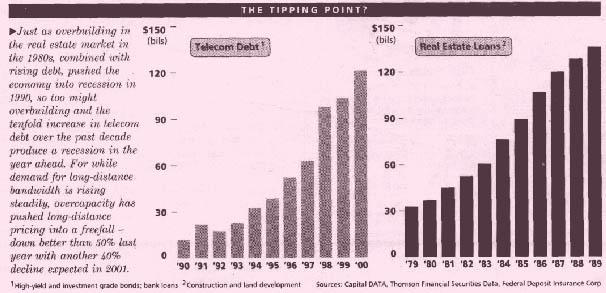
Most companies were happy to take that risk knowing that they could refinance debts in the bond market. As shown in figure 2, the borrowing frenzy by telecommunication companies had some uncanny similarities with the real estate bubble of the 80s.
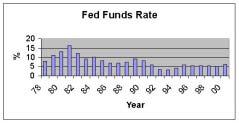
Figure 3
Looking Back
Below are some of the key reasons that explains this borrowing/investment frenzy: Deregulation, technological improvements, and increasing competition provided for significant investment opportunities. Unfortunately initial enthusiasm was contagious – no one could get enough technology stocks particularly in the telecom sector. Greed encouraged everyone to jump on the bandwagon. Venture Capital firms provided the early capital for companies to get off the ground and found themselves paying disproportionately high amounts for 2 nd and 3 rd round capital raising. Many banks could not get enough of these jumbo telecom debt issues with attractive spreads. Suppliers became part of the problem through aggressive vendor financing schemes, lending in some cases up to 200 % of purchase value. There was a very high level of liquidity on the market with the US interest and inflation rates at very low levels (figure 3). Too much capital encouraged companies to borrow excessively.
Figure 2
The party ended with the realisation that P/E in the hundreds (the historical average of the S&P 500 stands at about 16) did not make sense and that there was over (telecoms) capacity on some routes. Technologies that promised to absorb that extra capacity have been slow to materialise.
WAP was an almost total flop except in Japan and 3G is expecting to be quite late.
While broadband internet is starting to make inroads wider acceptance is a few years away for most markets.
Impact on telecom service providers
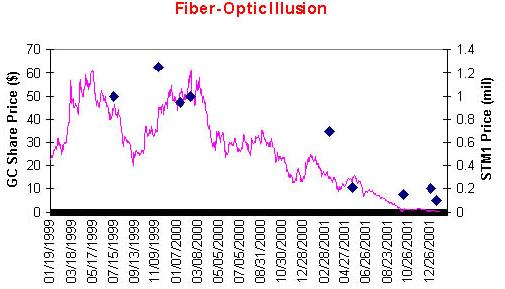
In the end excess supply drove prices down. As a result many telcos have seen their share prices collapsed in line with bandwidth prices. Figure 4 is a case in point with the solid line representing Global Crossing share price and the diamonds representing the price of an annual contract for an STM1 between Los Angeles and New York.
This caused many companies to collapse with Global Crossing being only the latest of a long list of bankruptcies:
GST Telecommunications, with $1.2 billion of debt,
Figure 4
ICG Communications, with $2.81 billion of debt,
360networks with $3.7 billion of debt, Pangea and Viatel
The surviving telcos have seen their debt rating being downgraded further. New comers such as Level 3 have seen their rating fall further into junk bond territories in recent times. Level 3 Communications had close to $10 billion dollars in debt and
current liabilities as of 30 June 01. Its debt to equity (total liability/total equity) ratio stood at 3.4 and its senior unsecured debt rating stands at Caa1.
Although not in default the debt burden of incumbents is impressive:
Verizon with $60 billion debt
France Telecom with $60 billion debt
Deutsche Telecom with $60 billion in gross debt
AT&T with $47.5 billion debt
British Telecom with $45 billion of debt with its rating falling below investment grade in April 2001.
Netherlands Royal KPN with $18 billion in debt and with all its free cash flows consumed by debt service
It may have been possible to service those levels of debt in good times but with earnings falling the situation has become untenable for many.
The downgrade of their debt rating means that telcos must now pay higher interest rates when refinancing. In addition a debt rating downgrade reduces the ability to raise capital from shareholders.
The blow of the rating downgrade has been somewhat cushioned because of aggressive monetary easing in the US but long term yields have stayed stubbornly high.
To make matters worse the high concentration of telecom debt among banks means that they are very reluctant to lend more.
Estimates vary as to the precise proportion of bank debt from this sector, but it is somewhere around half of all debt
raised in the European syndicated loan market in 2000.
The problem was serious enough that about 18 months ago European regulators gave notice that they were watching the issue carefully and were concerned about the level of telecom debt.
As of October 99 some 70% of outstanding debt in the high yield European sector was from the telecom/ media sector.
Now the high yield bond market has virtually shut down for telcos. Similarly, investment grade corporate bond issuance pushed the boundaries of market capacity and telcos are having to pay a premium to access this market.
Many telcos are resorting to asset disposal to reduce debt. BT disposed of its Yellow Page business, and its stake in Maxis, Bharti and Clear to raise $7 billion. AT&T is seeking a buyer for its cable assets which allow it to shift roughly $13.5 billion of debt (out of $47.5 currently) to the new owner.
Securitization
For companies left with assets capable of generating stable cashflows, securitization
Pierre Tremblay Area Manager, Alcatel Submarine Networks (Asia Pacific Region)
Based in Singapore since 1998, Pierre Tremblay is the Area Manager responsible for business development and marketing activities in Australasia. Prior to his posting to Singapore, Pierre was responsible for systems testing at the Port Botany Factory (Australia) from 1996 to 1998.
From 1994 to 1996, Pierre was in France working on the development of the first optical amplifier based repeaters. Pierre joined Alcatel Submarine Networks as a systems engineer in 1991. He spent the first two years of his career working on the installation and commissioning of several optical systems including Tasman 2, Sea Me We 2, and PacRim East.
Pierre holds a bachelor of electrical engineering from Universite de Sherbrooke, a Masters of Science from the University of Alberta, and a Masters of Business Administration from Macquarie University.
assets available to service unsecured debt.
We believe in encouraging lively debate amongst our industry subscribers. Any observations you wish to make regarding this article would be welcomed. Email us at editor@subtelforum.com. becomes one way out of the quagmire. It offers the advantages of having long term maturities and of providing cheaper fund than unsecured borrowings. In essence securitization is a loan/bond secured against cashflows from income producing assets.
Prime candidates for securitisation are real estate, receivables, equipment leases, and fixed line networks. It is estimated that the total securitization volume potential for these telco operators as follows: plant and equipment, $156 billion; land and buildings, $38 billion; and receivables, $38 billion.
With a growing investor base for assetbacked bonds and an increasingly favourable regulatory environment, securitization might seem the answer to many European companies’ prayers.
Telecom Italia has already jumped on the opportunity and raised $4.7 billion of debt secured by telephone bill receivables whilst BT also raised funds through its real estate assets. It is also believed that France Telecom is considering a similar deal.
But this market is no easy option. Securitization hurts companies’ existing debt holders by reducing the amount of
The two leading rating agencies, Moody’s and Standard & Poor’s, recently released guidelines about what impact securitization would have on senior ratings. Perhaps surprisingly, they claim that a little securitization does no harm to a company’s general creditworthiness.
If, as a general rule, asset-backed bonds are less than 15% of a company’s debt, they should not impact on senior unsecured credit ratings. Such tacit approval may give struggling companies the incentive to securitize assets at the expense of unsecured debt holders.
Conclusion
The future of telecoms is bright but the years ahead promise to be challenging for all players involved. The industry is in need of cash at a time when capital markets give telecoms the cold shoulder. This is forcing telcos to look at innovative ways (securitization) to raise liquidity.
With deregulation in full swing the arrival of many new comers threatened the position of incumbents such as AT&T, France Telecom and BT. For a while, the
2editor@subtelforum.com
premise that new economy companies (Level 3, Global Crossing) were going to dominate the world of telecom almost proved true.
As the fairy tale turned into a nightmare, many new comers were driven to the brink of bankruptcy. Incumbents operators (such as KPN and BT) and equipment suppliers have not been spared either and their salvation is not yet assured.
In the end, telecom companies with strong balance sheets are in a position to benefit from the situation by acquiring assets at reduced prices. For many new comers, the road ahead is uncertain and many will fall by the wayside in their quest for riches.
The mountain of wealth came to become the mountain of debt. In the end, all that is left is a mountain of losses for too many investors and financial institutions.
The news is repetitive: layoffs in the thousands, debt in the billions, attempts to strengthen balance sheets. Reporters quote financial analysts talking about a “market correction” and “the worst I’ve seen it.” Colleagues depart, budgets get cut, the frequency of staff meetings—and the scrutiny of management—both rise.
But as bad as it is right now, the worldwide telecom market continues to grow. It continues to employ thousands of people and provide them careers and livings at many economic levels. It continues to enjoy robust technology development and even hints of optimism when you look past these immediate difficult times.
We are in the middle of a bad storm…maybe golf-ball-sized hail. But it’s
A Bad Storm, Not a Perfect Storm: A Bad Storm, Not a Perfect Storm:
The Submarine Market in Context
George Miller and Sally Sheedy, KMI Research
not a so-called perfect storm, whose promise is an end to all.
When this storm passes, the worldwide telecom industry will not have been dismantled, nor its millions of kilometers of infrastructure abandoned. It will not undergo a catastrophic meltdown, as the dot-coms did. It has a real and steady core in the millions of phone conversations and data transmissions that take place every day, all around the world.
It will resume steady growth, enjoying robust technology development and providing thousands of people with careers and livings at many economic levels.
The How and The When
To put the submarine market in context, look first at the state of the worldwide telecom market.
A general measure of its health and growth is deployment of fiberoptic cable. It is measured in several ways, among them route-kilometers (the length of cable deployed) and fiber-kilometers (the number of fibers within a cable multiplied by the length of cable deployed).
It’s common knowledge that longdistance system deployments in some terrestrial markets underwent a severe turnaround in 2001; a growth phase in these long-distance markets may not resume for two or three years. Further, the “peak” deployments in 2001 may never be reached again.
This is a dramatic turnaround from the previous few years. In part riding the dotcom bubble of perceived bandwidth need and easy funding, the worldwide demand for cabled fiber grew by 47% in 2000, the second consecutive year that demand exceeded 40%.
The worldwide demand of 99 million fiber-km in 2000 was more than double the 47 million fiber-km of just two years earlier. The euphoria ended, however, more quickly than it came. The growth represented too much investment in new fiber networks and too many operators in several key geographic markets.
For example, in the United States alone, 33 long-distance network operators were established between 1996 and 2001. More significantly, the number of nationwide long-haul carriers grew to 17
Source: KMI Research
Source: KMI Research
from three. The effect of these nationwide long-distance carrier networks was to double the cumulative installed base twice in three years!
The new network operators were more than could reasonably be sustained in the mature United States telecom market. The combination of increased competition and declining bandwidth prices meant that carrier business models could not support the debt of new operators. Europe faced a similar situation.
The charts show how many fiber-based long-distance carriers were operating in the United States each year, and how much fiberoptic cable they had in their networks
in that year. The route-kilometer figure therefore refers to the installed base, and specifically to cable the carriers had installed themselves and not leased. We grouped the carriers into three major size categories, based on the quantity of fiberoptic route-kilometers. Thus, some carriers “moved up” to the next category as they installed more cable. In the United States, a network of 20,000 route-km is characterized as a nationwide network. The smaller size categories include some regional and even state-wide networks. Thus the number of nationwide operators jumped to 15 from 3 in five years (1996-2000), while the number of operators
United States Long-Distance Carriers
European Long-Distance Carriers
jumped to 62 from 36. The pan-European figures refer to carriers that have installed fiber to link cities in different countries. Some of these carriers span the major countries throughout the continent, and some focus on specific regions. The data again show the significant amount of cableroute construction in just five years.
Latin America Cumulative Fiber Deployment
Source: KMI Research
In Latin America, long-haul backbone building is nearing completion, though it never reached the fevered pitch found in North America and Europe. Latin America is emerging from a period of pulling itself up by its telecom bootstraps.
other world regions.
Nonetheless, cumulative fiber deployment will enjoy a slow by steady rise region-wide through 2006, although annual fiber deployment will spike downward country-by-country, leveling off and then beginning to rise again in 2004.
Signs of Light in the East
George Miller is a Senior Analyst at KMI Research, a fiberoptics market consultancy in Providence, RI. He is co-chair of KMI’s 8 th Annual Fiberoptics Submarine Systems Symposium, “Strategies for a Down Market” (June 13-14, 2002, in San Diego), and Publisher of the twice-monthly newsletter, Fiberoptics Market Intelligence.
Mr. Miller can be reached at gmiller@kmicorp.com.
In the past five years, most of the telecom markets that comprise the region have opened to competition. Attendant with the market openings have been teledensity and level-of-service requirements imposed by governments. The result has been a transformation of the region’s telecom sector from a mishmash of individual country initiatives to a cohesive and region-wide infrastructure.
Latin America is currently transitioning from long haul to metro/access buildout. Economic as well as market conditions are conspiring to apply the fiberdeployment brakes on a country-bycountry basis to a greater extent than in
Cumulative Fiber Network Installation in China
Source: KMI Research
In contrast to the Americas and Europe, China is still enjoying robust telecom growth. Continuing deregulation and ascension to the World Trade Organization will accelerate China’s fiberoptic network expansion beyond the 10% annual growth it has experienced in the last decade.
UNDERSEA RAMP-UP, MAJOR MARKETS
Route-Km12,76212,11514,45010,00017,50053,56112,000132,388
Fiber-Km51,04848,460115,60040,00092,000531,28896,000974,396
Est. Investment ($Millions)7305207152431,0704,3091,2008,787
Investment ($Millions)1,2503,5001,2601,7007,710 North-South/Latin America* Systems13419
Totals Systems221766226
Route-Km35,32236,51714,450111,83770,15083,16136,200387,637
Fiber-Km141,288238,268115,600758,932476,600865,530483,2003,079,418
Est. Investment ($Millions)1,9801,6127154,7403,6645,9692,90021,580
*Major systems linking North to South America: Latin America regional systems
Most carriers in China are expanding their networks, especially at the local access level. Annual demand for fiber for national long-haul networks will decrease while demand for intra-provincial local access network fiber will continue to grow.
From Land to Sea
The market for fiberoptic undersea systems is consistent with that of the long-distance telecom market as a whole. Undersea systems differ from terrestrial or domestic intercity networks in terms of rights-of-way, fiber counts, installation and maintenance, access to repeaters and cable for upgrades, and—in the case of consortium cables—in ownership.
But in many respects, undersea cable operators are experiencing many of the
same market and financial problems as their terrestrial counterparts.
These problems include: erosion in circuit prices, shorter-term commitments from high-capacity customers, high debt burdens, and low revenues relative to operational expenses. In short, too many carriers spent too much money too quickly, borrowing too much money relative to the near-term market opportunity.
These similarities are apparent in such developed undersea markets as the transatlantic. Statistics show a similar ramp-up in the major undersea markets. For these markets, 26 systems were cut over between 1995 and 2002, compared to only 12 between 1988 and 1994.
In the chart, a system is a named system that may have multiple segments, so it could be large (transoceanic) or small (a link between islands).
Like the terrestrial markets, the worldwide undersea markets saw record growth between 1999 and 2001. In 2001, more fiber –1.94 million km – was cutover than in any previous year. And the $12.4 billion invested in systems cut over that year is the largest for any year to date.
Another contributor to the dramatic ramp up in the late 1990s is technological: the recent systems have orders of magnitude more capacity than earlier generations. The amount of cable installed
since bit rates passed 2.5 Gbps is more than three times as much as installed with previous generations of technology. But the real contributor to capacity is WDM, which can multiply the capacity of one fiber by a factor of 80 or more.
So there has been a dramatic buildup in both undersea and terrestrial capacity. And in both cases, the picture has changed dramatically in the past 18 months. Undersea carriers, like their terrestrial counterparts, are experiencing financial difficulties. Global Crossing is notable among those currently in the auditors’ crosshairs. But it is not alone.
Sally Sheedy is Database Manager at KMI Research. She is responsible for KMI’s undersea fiberoptics database, corporate library, and research for KMI’s annual submarine systems report. She holds an MS in library and information science from the University of Rhode Island. She can be reached at ssheedy@kmicorp.com.
Give your exhibition or conference maximum exposure to the submarine telecoms industry.
Advertise your event in Submarine Telecoms Forum and reach all the key people.
production and installation of undersea systems.This slowdown will last longer than some of the previous downturns in the number of new undersea systems installed, and the recovery in this business may be more gradual than in previous years.
5advertising@subtelforum.com
advertising @subtelforum.com
Email advertising@subtelforum.com
Further, the telecom climate has been studied carefully by the investment community, and the result has been a reduction in the number of new systems being funded. The chart shows the number of new systems announced in past years, and a nearly 50% drop-off in announcements in 2001. In addition, no major systems have been announced in the first quarter of 2002, so we are tracking towards a low number announced this year. Fewer announced systems means fewer to be surveyed, engineered and installed. So 2002 and 2003 will be slow years for companies that are involved in the
One reason is that the trend away from consortium ownership experienced in the late-1990s will reverse itself partially as large operators seek partners or consortium-type deals as a way to mitigate risks and reduce overall investment per system.
To the extent that the industry’s recovery depends on consortium-owned systems, there will be slightly longer planning cycles before the ships depart to lay cable.
In the meantime, however, there is evidence of continued technological progress and efforts to pursue new markets.
One example is the recently announced Corvis/Dorsal agreement, which is noteworthy as a consolidation of two suppliers —one whose strength is submarine equipment, the other’s is terrestrial—whose technology development efforts involve streamlining the sea-to-land communications system interface.
Initiatives of the combined company will involve simplifying the submarine-cable/ landing-station/PoP routing now in use to make it easier for carriers to achieve the kind of PoP-to-PoP setup they desire, even when an ocean may separate the PoPs. It’s understandable that such deals become all but overlooked in the company of “worst-ever” headlines. But their presence is a harbinger of the submarine market’s next phase. Similar deals—on both the supplier side and the carrier side—will follow. Stranded assets will be acquired and put to use. Manufacturers will develop equipment tuned to helping suppliers get all they can out of existing infrastructure. And the submarine sector will continue its contribution to the worldwide telecom market, which will continue to employ thousands of people and provide them careers and livings at many economic levels.
We believe in encouraging lively debate amongst our industry subscribers. Any observations you wish to make regarding this article would be welcomed. Email us at editor@subtelforum.com.
3editor@subtelforum.com
In a recent McKinsey emerging markets report entitled, “Broadband’s Latin Future,” Ernesto Flores-Roux, Carsten Kipping, and Alejandro Sanchez stated that Latin America’s broadband market is “bigger and better than it seems.”
Despite reports of a telecom slump and a fibre glut, these analysts predicted that by 2004, there will be anything from 3.3 million to 4.3 million broadband subscribers in Latin America. That would make for a growth rate of from 88 to 102 percent in the years since 2000.
Whilst small in the absolute sense, the numbers show that broadband has already achieved a substantial penetration rate— from 21 to 43 percent—in the Latin American market, as compared with estimated rates of 38 and 65 percent in the European Union and United States, respectively. The affordability of broadband services will be the main source of difference amongst these regions.
The telecom industry in Latin America that was once dominated by government and monopolistic policies is now moving in a different direction, thanks in part to an increase in deregulation and
privatization. However, aside from that, many companies are responding to a call to move forward. They are providing the necessary communications tools to break down barriers, integrate economies and provide the region with leading-edge technology solutions for the 21st century. Internet penetration, pent-up demand and underserved markets are key reasons why telecom companies are moving south. According to an IDC study, there will be 75 million Internet users in Latin America by 2005, up 15 million from the year 2000.
Regional Connectivity
The best opportunities lie in narrowing our focus. Motorola went from mobiles to diversity: Nokia took the opposite approach and went from very great diversity to principally mobile phones, with huge success. Focus seems like common sense, but paradoxically the majority of business leaders would rather be a Motorola.
We will win by being focussed. By being a big fish in a contained pond or region and then by making the pond bigger by selective process. This will be achieved
by taking the existing successful capacity platform as the foundation for a service business taking advantage of building cooperation with our partners in the cable system. We can then make the small pond bigger by encompassing additional countries in the ring such as Haiti, Jamaica, the Cayman Islands, among others, and expanding our service portfolio.
New World Network focussed on a niche market: 15 countries in the Caribbean and the Americas. We wanted to be a big fish in a small pond; a major player in an underserved region.
Our company was founded in 1998 on the belief that while the larger market economies in South America, Europe and Asia already had sophisticated fibre networks, there were a few underserved nations with some 200 million people that had been largely ignored. Many did not view the Caribbean as a strong consumer market.
Yankee Group analysts predict a 68% compound annual growth rate for Latin America broadband, with an explosion in demand from 110 Gbps for the region in 2001 to 1,492 Gbps in 2006.
Our company was founded to fill a demand for broadband capacity that existed in the marketplace. We are opening a place that has a deep telephone penetration and previously never had a dedicated cable system with interconnection between countries. The increasing demand for faster, more reliable connections in the Caribbean and the Americas prompted our founders and executive management team to design a future-proof multi-gigabit submarine cable system that would satisfy this growing demand for bandwidth capacity in an underserved region. Our mission was to identify and address telecommunications opportunities in Latin America and the Caribbean with significant upside potential in both growth and value. Our business model was based on three key differentiators: Regional connectivity
Leading-edge technology with high security
Unique private-plus ownership structure
ARCOS is the first regional cable system to interconnect 15 countries in the
Caribbean and the Americas. ARCOS is a regional cable with global reach. It interconnects the U.S., Bahamas, Turks & Caicos, Dominican Republic, Puerto Rico, Curacao, Venezuela, Colombia, Panama, Costa Rica, Nicaragua, Honduras, Guatemala, Belize and México.
By serving a niche, underserved market, New World Network is enabling new business in the Americas. We are providing enhanced telecommunications services and unparalleled connectivity to and between 14 countries in the Caribbean, Central and South America.
Festooned, Future-Proof Technology
The ARCOS network was built as the region’s largest unrepeatered undersea network. It is a 8,600-km fully protected ring, consisting of 22 non-repeatered and two repeatered segments.
Unlike other repeatered systems in the region, ARCOS is capable of integrating future transmission technologies as they develop.
ARCOS has a unique festooned architecture rather than traditional spur
architecture that is common on repeatered undersea links.
Systems like ARCOS that are principally unrepeatered are effectively superior to those with repeatered sections because the repeatered systems have effectively built in obsolescence as technology evolves unless the whole cable is pulled up and repeaters modified. Cables such as ARCOS with short haul nonrepeatered links contain high fibre counts. These cables, containing up to 12 fibre pairs, offer sufficient reserves to meet future demand for capacity growth throughout the ARCOS ring.
This creates economies of scale that are similar to those achieved by terrestrial networks where incremental upgrades can be performed in days rather than months, making the system future-proof and abundant in capacity.
The technology of our cable allows for flexibility and scalability as well as the provision of capacity on an as-needed basis. We can reach distances in excess of 400 metres unrepeatered – this saves costs and provides flexibility.
David Warnes is President and Chief Executive Officer of New World Network.
Before joining New World Network in June 2000, Mr. Warnes was Chief Operating Officer of Global Light Telecommunications, Inc.
Prior to joining Global Light Telecommunications, he was Assistant Managing Director of Tele2 from 1992 to 1995, a telecoms service provider in Sweden that is partially owned by Cable & Wireless.. From 1982 to 1988 Mr. Warnes held various managerial positions with Cable & Wireless and its affiliated companies.
Mr. Warnes is a graduate of the University of East London. He is a chartered engineer and a Fellow of the Institution of Electrical Engineers.
Advantages of Redundancy
Due to the ring configuration with electrical and physical redundancy (the signal is transmitted in both directions simultaneously), full redundancy can be ensured in the event of a cable break.
To enhance network security, the entire system is controlled and monitored from two operation centers at separate locations, one in Miami, the other in Curaçao. In addition, landing stations are in buildings that have been pre-fabricated to meet all requirements for the severest weather expected in the region. This is advantageous to carriers because all benefit from the upgradability potential and reduced unit cost, in addition to having connectivity to 15 countries in the region.
Because ARCOS is a true physical ring, it provides complete signal redundancy, allowing ARCOS to automatically select the strongest signal for optimal transmission quality and reliability, while providing built-in, real-time traffic restoration. Open architecture allows easy upgrades of the number of channels in the future.
The ARCOS Architecture and design is:
A true ring configuration
Immediate traffic restoration
Built-in redundancy
Able to incorporate future technology
ARCOS is the only system that requires so few kilometers of cable (8,600) to
connect so many countries (15) in a true ring configuration. Now, the region’s growing demand for bandwidth can be met. New services, e.g. Gigabit Internet, will contribute to the economic development in the region. New World Network has contracted skilled experts to develop and install ARCOS throughout the Americas. Corning (NSW), TyCom (US) Inc. and Siemens A.G., are jointly constructing ARCOS.
Benefits include increased bandwidth availability, competitive prices and redundant or alternative paths. By use of this single ring, customers have access to high-speed bandwidth capacity in a reliable, fully protected communications network.
Private-plus ownership structure
New World Network has strategic alliances with 28 leading carriers in the region that provide network support, landing rights and interconnection to existing local networks.
The private-plus ownership structure combines the advantages of a private company with benefits of established relationships with leading strategic carriers.
The private model:
Quick decision making
Efficient contract execution
Expedite construction time
Reduce up-front capital requirements
Reduce risk in forecasting capacity needs
Flexible, low cost pricing
Carrier participation benefits:
Landing rights
Backhaul
Local network interconnection
Planning insight
Local O&M support
The Landing Parties have been assembled from telecoms companies already operating in each of the landing countries. This is highly advantageous to ARCOS as it allows for integration of service offerings into existing networks. Furthermore, it creates a barrier to other cable operators entering the region where ARCOS is the preferred system of the incumbent operators. New World Network, as a proven low cost carrier’s carrier, is not in competition with other systems and is a complementary network.
A global guide to the latest known locations of the world’s cableships, as at MARCH, 2002.
C.S.WAVEMERCURY1982GLOBALMARINESYSTEMS101051627/12/01WakamatsuJapan
CABLEINNOVATOR1995GLOBALMARINESYSTEMS1427711SingaporeRepublicofSingapore
CABLEINSTALLER1980GLOBALMARINESYSTEMS298612SydneyAustralia
CABLERETRIEVER1997SINGAPORETELECOMMUNICATIONS110261624/12/01SubicBayPhilippines
CERTAMEN1965ITALMARE49831412/02/02PozzalloItaly
DISCOVERY1990FRIARYOCEAN82481202/02/02continentalshelfUnitedKingdom
DOCKEXPRESS201983DOCKWISE147931515/02/02LisbonPortugal
ELEKTRON1969STATNETTENTREPENOR1628017/01/02TyneUnitedKingdom
FJORDKABEL1985UNKOWNPARENT331021/02/02HammerfestNorway
FRESNEL1997FRANCETELECOM647514.526/12/01PortSaidArabRepublicofEgypt
GIULIOVERNE1983PIRELLICAVI106171023/12/01BrindisiItaly
GLOBALMARINER1992TRANSOCEANICC ABLESHIP1251813.826/01/02HonoluluUnitedStatesofAmerica
HAVILAREEL1976HAVILASHIPPING31861129/12/01FalmouthUnitedKingdom
HAVILASKAGERRAK1976HAVILASHIPPING71721006/12/01HaldenNorway
HEIMDAL1983ALCATELSUBMARINENETWORKS104711620/02/02BusanRepublicofKorea
IBERUS1978TRANSOCEANICCABLESHIP83341701/02/02HitachiJapan
KDDOCEANLINK1992KOKUSAICABLE95101503/03/02YokohamaJapan
KDDPACIFICLINK1993TOKYOLEASE796013MojiJapan
KOUSHINMARU1998DOKAITUGBOAT482212MojiJapan
LEONTHEVENIN1983FRANCETELECOM484515BrestFrance
LODBROG1985ALCATELSUBMARINENETWORKS1024314.503/02/02DoverStraitUnitedKingdom
MAERSKDEFENDER1996MOLLERA.P.5746008/02/02RecifeBrazil
MAERSKFORWARDER29/12/01TyneUnitedKingdom
MAERSKRECORDER2000MOLLERA.P.62921405/01/02NagasakiJapan
MAERSKRELIANCE2001MOLLERA.P.629214SubicBayPhilippines
MAERSKREPEATER2000MOLLERA.P.629214ShanghaiPeople’sRepublicofChina
MAERSKRESPONDER2000MOLLERA.P.62921430/12/01PortSaidArabRepublicofEgypt
MANTA1992JADE-DIENST27231512/12/01HoustonUnitedStatesofAmerica
MIDNIGHTCARRIER1976TORCH26701320/02/02NewOrleansUnitedStatesofAmerica
MISSCLEMENTINE1996COASTLINEMARITIME3637916/01/02PulauBatamIndonesia
MISSMARIE1998COASTLINEMARITIME3639021/02/02SingaporeRepublicofSingapore
NORDKABEL1969UNKOWNPARENT3951012/02/02HarstadNorway
NORMANDCUTTER2001SOLSTADSHIPPING122911521/01/02BristolUnitedKingdom
OCEANCHALLENGER2000ROVDESHIPPING523516.711/01/02BusanRepublicofKorea
OCEANICKING2000POLARSHIPMANAGEMENT128671608/12/01SydneyAustralia
“With the exception of the instinct for self preservation, the propensity for emulation is probably the strongest and most alert and most persistent of the economic motives”. In today’s parlance this statement by Veblen in 1899 roughly translates to “if you see a bandwagon, jump on it”! In these simple statements lie the source of our current woes.
In January 2000, when it seemed that the litany of our industry was ‘Explosive
growth’ I wrote an article that at the time was almost a heretical treatise. Among other things it said, “In these magical times …such unprecedented and explosive growth contains the seeds of our future destruction…” and “…where [players] misread the market, miss the peak or are just plain over optimistic the results can be catastrophic…”
During the second half of 2001, as our industry crumpled into the buffers, numerous luminaries persisted in making
statements like “ a cyclical business …we are just in a down trend…”, or “…we have seen this sort of downturn before…” and “…This sort of thing happens every 5 or 6 years….”
We are now all aware that the telecom industry is not going through a ‘down’ cycle. What we are experiencing is a sector ‘crash’ that is unique in the telecoms industry and outside anyone’s experience in this market.
The structure and economics of our industry have fundamentally changed - and will continue to do so.
The purpose of this article touches on two elements of interest given the current state of the market. One is the potential short-term effect on delivery and service in the submarine sector. The second is the more macro view of ‘what happens next?’
Short Term Impacts – and how to deal with them
For submarine system contractors the short term really refers to the next eighteen to twenty-four months - and the prognosis is distinctly unfavourable. With overcapacity and debt plaguing purchasers top-level demand will be minimal and customers will
seek to expend as little cash as possible. With significant asset overcapacity in the system supply side any opportunities will be fiercely contested and any project that does proceed will do so at minimal prices.
A foretaste of market conditions under these circumstances has shown that on the system design and planning side there can be high variability in the quality in system engineering and, once funded, an undue rush to get systems ‘to market’ both of which can result in less than optimum planning and execution of projects.
On the commercial front, intense competition, a ‘Dutch auction’ environment and a ‘price war’ negotiating approach will squeeze contract prices to contribution levels if one is lucky and to cash costs if not! This in turn is likely to lead to more problems around payment and delivery, a higher level of contract disputes and claims and difficulties with managing cash flow in companies that are not robust enough to ride out these difficult times.
Such conditions tend naturally to increase the adversarial elements of contracts and execution – and much will rely on the relationship between Customer
and the Contractor as to how bad this becomes. In the first (undesirable) model, the customer, having awarded the contract, seeks to find ways of reducing costs and minimising cash out-flows by possibly reducing the work scope and engineering, trying to force through extra work without contract variations, disputing invoices, paying late, and generally seeking to reduce the contact value. Having won the contract the supplier/contractor seeks to increase the scope of work, seek all possible contract variations for extra work, minimise cost exposure during execution by adjusting work plans and deploying his cheapest assets. Both sides will probably get what they deserve and end up in arbitration – or worse – expending ever more money with lawyers trying to sort out the disputes.
The second way, even in these difficult times, is for both sides to be ‘honest’ about their problems early on, to express desired outcomes and advise on internal pressure points - in short to communicate! It is possible to develop a good relationship even under these tough market conditions. While it is best if this is done during the front-end negotiation it should still be done
In April 2000, after spending three years in Shanghai as General Manager of a company in joint venture with China Telecom, Murray returned as Director of Strategy for Global Marine Systems.
In January 2001 he became Director of Customer Services.
In 1984 Murray completed 13 years at sea as a Master Mariner in the North Sea Oil & Gas industry and has been a Chartering Manager, Project Manager and General Manager in the sub-sea oilfield construction industry.
Murray joined BT Marine in 1990 and was Regional Manager, Asia Pacific prior to going to China where, in 1999, the Shanghai Government honoured him with the coveted Magnolia Award for business performance. Murray has an MBA and is a member of the Institute of Directors and the Institute of Management.
even if after contract award. When organisations have a problem they generally form an internal team of experts to discuss and develop the optimum solution. It is amazing therefore that the minute a contract is in place between two parties the tendency is to form up into
isolated camps, work separately and occasionally get together to see how each camp is progressing. This style of working is counterproductive under normal market conditions but in today’s environment it can be a recipe for disaster for both parties. If an environment of mutual support can be created, where discussions of problems are immediate, open and frank, better solutions will be generated sooner with all the implementation benefits this brings.
Global Marine has examples of this latter model wherein the benefits are astoundingly clear and where, under difficult circumstances, key requirements have been delivered and complex adjustments have been with work ‘inprogress’ to the mutual acceptance and benefit of both.
The Longer Term
While statistics abound regarding capacity, pricing, PC and Internet usage, etc. I have deliberately avoided them in this article since I might be accused of using them rather as a drunk uses a lamppost – more for support than illumination!
For the TelecomsMediaTechnolgy (TMT) sector as a whole I am extremely optimistic for the long term. This view is predicated on the hypothesis that recent global political, regulatory, commercial and social developments have turned the maturing telecoms, entertainment and computer industries into a new sector that is in its embryo phase.
While the current ‘crash’ may be extremely painful it is entirely understandable in an industry that has not
even reached the first point of inflection on its ‘lifecycle’ curve.
I believe that this will be the most exciting industry to be in for the next 25 years as we see TMT infrastructure, innovation and services permeate every facet of our lives. If we thought television was big – watch this space for what comes next!
Clearly over the next few years we will see some ‘chicken and egg’ bottlenecks as infrastructure oversupply waits for applications and services demand. This in turn will be followed by such high capacity services being frustrated by slow infrastructure development. However, overall we will see the gradient of the growth curve increase as we cycle through these supply and demand bottlenecks, with each cycle
happening more quickly than the previous. The start of this sustained growth will be the delivery of ubiquitous, high capacity, broadband availability followed by increasing speed and robustness of the global ‘transport platform’.
However, one of the biggest breakthroughs will occur when the primary communicating and input medium for all devices is voice rather than a keyboard or stylus.
Moving more specifically to the submarine segment of the industry, optimism for recovery depends on numerous factors. In seeking to learn from similar events in other industries pundits have often drawn parallels with the oil industry crash of 1986.
The worrying aspect of this model is that even now, some 16 years later, in a period of very healthy demand, sub-sea engineering service companies in the Oil and Gas business sector are unable to deliver high returns – despite strong revenue growth.
The residual impact of cut-throat competition, high barriers to exit and a small customer base that communicates
amongst itself has prevented a return to really healthy margins.
Optimism for the submarine sector of our industry and avoidance of the oil & gas model will rely upon the customer base remaining large, diverse and geographically dispersed. It will also rely on the hope that the current difficulties do not lead to moves by governments to de-liberalise the sector and re-introduce elements regulation.
It will also require that universal high speed, high capacity access is closely matched by applications of increasing sophistication and consumer desirability.
At the system & marine supply side of the sector a return to health is predicated on the fact that the sector must continue its current, painful, rationalisation.
Perversely, quicker recovery in the industry would disadvantage strong companies as it would enable weaker competitors to just scrape through and prolong oversupply and poor returns.
For those strategists in the submarine supply sector the key questions revolve around, “What will recovery look like”? Will it be 50,000km per year? 60,000km? What we do know is that it is unlikely to
be the 140,000km we have seen in recent years – and so even for the medium term the industry is likely to be operating at levels last seen in 1996/97.
To conclude, I do not believe we face the crossroads immortalised by Woody Allen, who said, “one path leads to despair and utter hopelessness, the other to total destruction – let us pray we have the wisdom to choose correctly” . There is a strong case that says we are where we are today as a result of the financial institutions that funded the telecoms bubble failing to take account of the age-old adage that says, “by the time you see a bandwagon you are already too late to jump on it”.
Let us hope that when the recovery takes hold in a couple of year’s time a more rigorous approach towards lending and investment strategies leads to a more sane and sustained period of growth.
We believe in encouraging lively debate amongst our industry subscribers. Any observations you wish to make regarding this article would be welcomed. Email us at editor@subtelforum.com.
4editor@subtelforum.com
On January 7, 2002, NJDEP published proposed regulations dealing with submerged cables. In separate official comments filed by the International Cable Protection Committee (ICPC) and North American Submarine Cable Association (NASCA), cable owners served notice that New Jersey has gone too far.
The NJDEP Proposed Rules include 27 prohibitions and restrictions on cable laying, repair, and maintenance, and impose for the first time a financial penalty on submarine telecoms and power cables which will cost the cable industry millions of dollars over the life of each new cable installed. All of these changes were the result of political pressure applied by local New Jersey fishing groups on NJDEP who rely on clam dredging and bottom trawling as their principal marine activity.
The Proposed Rules in effect seek to expand the state of New Jersey’s claimed Atlantic Ocean jurisdiction over submarine cables from the present acknowledged three nautical mile limit of the state’s territorial
seas. They seek unprecedented jurisdiction expansion to between the 110 and 120 meters depth curves.
Using the 110 meter curve, the reach of the state’s jurisdiction ranges from roughlyy 60 to 80 nautical miles seaward of the coastal baseline and covers an area of roughly17,380 square miles of new jurisdiction territory.
Specifically, the Proposed Rules in this new area would have the following effects beyond three nautical miles:
The discouragement, which under the Proposed Rules is tantamount to denial, of undersea ring systems landing in New Jersey from other landings in the United States or from Canada which require transit of surf clam areas or areas where marine fish are commercially harvested in favor of land routes. Such land routes would involve crossing scores of sensitive land habitats, wetlands, rivers, and private and pubic lands prohibitive financial and delay costs. (If such regulations had existed when TAT-14 was built, the wet link of that ring system would have been impossible as it is presently constructed.)
A requirement that cables be buried with depth of 1.2 meters.
Restrictions on cable crossings and removal of third party out-of-service cables.
Mandating cable route restrictions to avoid fishing grounds.
Establishing mandatory inspections and periodic re-inspections of cables, with corresponding reburial, removal, and annual reporting requirements.
Payment of $100 per meter as a penalty for any cable not buried to a depth of 1.6 meters.
The Proposed New Jersey Rules envision using the Coastal Zone Management Act (“CZMA”) as a means to allow New Jersey to export its restrictions and penalties on cables beyond its threemile territorial sea out to depths of 120 meters, or even beyond if commercial fishermen want to fish in those waters in the future.
While New Jersey may have regulatory powers within its own three-mile territorial sea, the cable owners in their opposition comments highlighted the fact that (1) the New Jersey territorial sea is limited to three nautical miles and, (2) the U.S. Army Corps
Douglas R. Burnett practices primarily in the areas of telecommunications, international law and transportation litigation in the New York office of Holland & Knight LLP.
Mr. Burnett is the International Law Advisor to the International Cable Protection Committee (ICPC), an international organization of over 67 administrations and commercial companies from 39 countries owning or operating submarine cables. In his capacity, he advises members of their rights and responsibilities under international law and associated treaties and national legislation regarding undersea telecommunication cables. His unique experience includes litigation in numerous cases in U.S. and foreign courts concerning internationally protected submarine cables.
Mr. Burnett is a member of the Maritime Law Association of the United States where he has been Chairman of the Committee on International Law of the Sea since 1994, and the Intituto Iberoamericano de Derecho Maritimo.
For all your personnel requirements:
of Engineers’ jurisdiction over cables is also limited to three nautical miles. As a result, the CZMA may not be used as intended by the Proposed Rules.
In challenging this dramatic extension or New Jersey’s jurisdiction, the cable owners relied on the United Nations Law of the Sea Convention (UNCLOS) and other treaties to which the United States is party. The international law embodied in these
treaties limits coastal nation jurisdiction to 12 nautical miles.
Furthermore, in the case of the United States, Congress has not passed any legislation which would allow the state of New Jersey or the U.S. Army Corps of Engineers to expand their present threemile jurisdictions to the 12 mile limit, and certainly not beyond.
In a new development, the cable owners argued that the proposed NJDEP restriction against wet links is a violation of the Telecommunication Act of 1966 (TCA). Under the §253(a) of TCA, no state or local statute or regulation may prohibit or have the effect of prohibiting the ability of any telecom entity to provide any interstate or intrastate telecommunication services.
The cable owners point out that the proposed rules discourage ring systems and effectively limit the ability of companies to provide telecommunications to consumers in the United States.
On a positive note, the proposed New Jersey regulations do recognize and approve the use of “obsolete submarine cables in artificial reef projects, because they attain many of the biological and ecological
attributes of the natural reef.” This is de facto admission by NJDEP that submarine cables in the marine environment are environmentally benign is in harmony with the December 5, 2001 ruling by the FCC which reaffirmed their prior determination that submarine cables have no significant impact on the marine environment.
In their comments, the cable owners urged NJDEP not to adopt the Proposed Rules until they are modified to be in compliance with international and federal law.
These laws preempt attempts by local domestic states to interfere with telecoms through regulations which are contrary to established norms of international and national law. Whether NJDEP heeds this position remains to be seen.
The one thing for certain, however, is that the cable industry will be closely following the NJDEP response to their comments. We believe in encouraging lively debate amongst our industry subscribers. Any observations you wish to make regarding this article would be welcomed. Email us at editor@subtelforum.com.
5editor@subtelforum.com
In the submarine telecoms industry, trickle-down is not a theory when it comes to marine services. The “scheduleis-king” mantra of 18 months ago has been replaced by an emphasis on cost and cash, resulting in deferrals, lay-ups and lay-offs. Previously purchasers wanted the highest capacity, maximum diversity and the latest installation technologies. Now there is a perceived bandwidth glut so new systems are being shelved, fleets are being “optimized” and ROVs are finding their way back into the oil patch. The marine service segment, like the rest of the industry, is hunkering down, focusing on survival not innovation.
Great Expectations
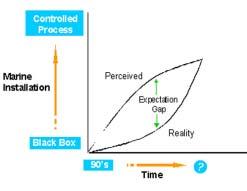
Prior to the downturn there was a growing awareness of a gap between the expectations of system purchasers and other stakeholders with respect to installation and the ability of installers to satisfy those expectations. This expectation gap arose from several factors including the deployment of new technologies, competitive pressures and an evolving regulatory environment.
Does a 3m plow really bury to 3m? How often does an ROV attain the advertised 1m burial at a 1 km/hour production rate? Are burial depth measurements always reliable? Can we guarantee fisherman unmitigated access to their traditional and future grounds with 100% burial? The frequent answer to these questions was “not as often as expected”.
To an extent, the expectation gap was the result of overselling and expediency. A vendor developed a new tool that, under certain circumstances, extended the previous performance limits. This tool was marketed up the supply chain to installers, system suppliers, purchasers and, in some cases, to the bandwidth end users to differentiate one system from another. The installer, the actual user of the tool, recognized its limitations, but wanted it in his tool kit.
Further up the supply chain, the less the limitations were appreciated and the more the enhanced performance was taken as a given. The feature became integral to a perceived competitive advantage, whether it was faster time to market or better system performance and security. In the frenzy
of applications for new cable landings and routes through various administrative jurisdictions, it was expedient to acquiesce to requirements of 100% burial or suspension-free installations rather than to try to educate the authorities of the limits of technology. Win the time to market race first, then manage the consequences of practical realities later.
The result was the expectation gap, which challenged the industry’s credibility. Many installations, which by any historical measure were well performed, still did not meet the new “standard” of performance. Instead, permit authorities challenged permits, fishing interests forced reroutes and purchasers and suppliers had contract disputes, which trickled down to the installers in the form of delays, extended warranties and commercial settlements.
Closing the Gap
The current slowdown provides an opportunity to rectify many of the bad habits acquired by the industry during the period of unbridled expansion. Included among these is the closing of the expectation gap. Even while licking their
wounds, this is the time for installers and suppliers to improve their processes through good engineering, innovation and exploiting lessons learned. This is also the time to educate stakeholders, including those above and below in the supply chain, the end users and regulatory agencies. Here are some areas where the gap needs to be closed:
Burial : Deeper is not always better, both in terms of depth of burial and the water depth to which burial is performed. New plows and ROVs enable work to depths in excess of 2000m. Standard plows have also been enhanced to deliver deep (3 m) burial. High-powered ROVs are now on the market to provide deep post lay burial. So
why not sign up for contracts requiring deep burial to 2000m water depth? Despite available technology, targets are not consistently achieved except under ideal circumstances.
Recent results from a 3m burial program indicate 3m or deeper burial was achieved 87% of the time. While this is an excellent result, the 13% that is not buried to 3m could be a commercial liability, but not necessarily a protection risk.
Similar data from a 1.0m burial project in a difficult region indicate the target was met or exceeded 60% of the total buried distance of 1500km. In both cases, bottom conditions were the primary factor in determining the burial depth achieved and the extent to which the results provided adequate protection far exceeded the percentage of the target depth achieved. Nevertheless, the results from these cases may not meet permit requirements negotiated by the purchaser with the cognizant authority, putting the parties at risk of a violation.
Maintenance of a deep buried cable is also problematic. Tools capable of recovering a cable from a 3 m trench are
just now being developed. As a result, the industry is currently accumulating hundreds of kilometers of 3 m buried cable that can not yet be effectively repaired.
The water depth issue is similar.
Plowing is now routinely targeted to depths seaward of the continental shelf break on the continental slope. Successful plowing is limited to slopes less than approximately 15°; such features are typical on the continental slope and occur at various depths between 500 and 2000 m depending on the local geology. Plow burial seaward of those locations is unlikely to be possible. System-wide specifications of burial to a nominal depth may lead to a deficient commercial performance at certain sites.
The purpose of burial is protection. If adequate protection can be obtained at 1m out to 1000 m water depth, there is no competitive advantage to a more stringent specification. Questions raised by the inability of an installer to meet an enhanced specification may actually be a competitive disadvantage. It also costs more to do more, even if not totally successfully.
The limits of burial need also to be understood. It is extremely difficult to find
Mr. Munier has a 25 year career in the marine industry, including interests in commercial undersea cable systems, military ranges, ocean energy and operations.
He has an undergraduate degree in geology and advanced degrees in ocean engineering and business.
Mr. Munier is the Managing Director for Engineering and Construction at Tyco Telecommunications, a leading supplier of undersea bandwidth and fiber optic cable systems based in Morristown, New Jersey. His responsibilities include the construction of undersea and terrestrial infrastructure for the Tyco Global Network and third party systems.
Prior to joining Tyco, he was Vice President of General Offshore Corporation where he was in charge of the US business unit.
a route across the continental shelf that will support 100% burial. Hard ground and uneven topography are as common on the ocean floor as road cuts on the interstate. As such, owners of systems and other sea bed users need to understand fully the risks of the route and the limitations of the tools.
The problem may not be solved by a more stringent specification or a blind faith in technology. Sometimes surface laying properly armored cable through a difficult terrain will provide better protection than a marginal burial program.
Cable Laying Precision : A variety of new tools have been developed to control the cable laying process by computer. In fact, these systems are moving towards a seamless management of the process from planning to simulation to cable laying and ultimately, documentation. They also are moving towards full integration and control of cable machinery and vessel operations so that complex lay plans can be managed automatically. These systems provide major improvements to manual methods, with their most compelling attraction being precise slack management. With perfect information, these systems can
theoretically install cables without suspensions. Unfortunately in this context, perfect information is an oxymoron. In deep water, significant topographic features may not be detected in electronic surveys because of the relative scale of the feature to the depth. Transients in operations such as loss of navigation, dynamic positioning failures and cable faults tend to confound even the best lay plan and most sophisticated algorithm. High tech, aesthetically pleasing screens with graphical, real time representations and data expressed to many decimal places give the impression of precision that may not be supported by the precision of the inputs.
Post lay inspection by ROV is the most reliable method of ground truthing an installation and is becoming standard practice, both as a quality control device and to meet verification requirements of contracts and permits. The increase in inspections has served to demonstrate the difficulty in delivering a suspension free installation over uneven topography, using computer controlled installation methods or otherwise. There is not an increase in the number of poor installations. There is
an increase in the kilometers of cable installed and the percentage of installed cable being inspected.
The precision of burial depth measurements is receiving considerable scrutiny. Although unusual, inconsistencies between plow as-laid data and post lay verification by ROV raise questions about the behavior of the plow in certain bottom topographies and the adequacy of the various technologies deployed in the indirect methods. An understanding of the accuracy of the data is critical to assessing the external aggression risk and the level of compliance with contract and permit requirements. Touchdown monitoring concurrent with installation is more common, also. One perception of touchdown monitoring is that suspensions can be reduced or eliminated because the end result can be observed in real time while there is still an opportunity for corrective action. The reality is that touchdown monitoring has shown how difficult it is to avoid suspensions: relays of difficult sections have provided only limited improvements. Sometimes the only choice left to the installer is one of loops or suspensions.

Permit Conditions and Specification:
Permit conditions and contract specifications both set criteria for marine installations, typically including burial targets and inspection requirements. Agreements with fishing interests are frequently a permit condition; the responsibility for fulfilling these agreements operationally is split between the installer and the systems supplier, whereas the system owner has the long term relationship.
Like purchasers, permit authorities generally assume more is better. This is frequently not the case.
A recent example is a trans-oceanic system that had a 2000 m burial requirement system-wide set by the
purchaser. At one landing, this 2000 m requirement became the standard for the local fishing agreement, even though there was no fishing seaward of 1500 m. The 2000 m standard was subsequently adopted by the cognizant authority and is now a codified requirement for future cables.
Ironically, the unworkable slopes seaward of the shelf break in the region occur at about 1450 m, so that plow burial beyond that depth is problematic.
Mind the Gap
In the London tube, there is a regular, polite announcement reminding riders to watch their step as they enter and exit the trains, “mind the gap”. The undersea cable industry needs to diligently “mind the gap” as well. The expectation gap between the purchasers and permit authorities and their perceptions of the state of installation technology versus the actual capabilities of the installers and their vendors needs to be recognized and managed.
Ideally, the expectation gap can be closed with continued initiatives on two fronts: 1) innovation and advancement by installers and 2) improved understanding
by purchasers and permit authorities of the limits of these technologies. Each party has the obligation to the other to provide the information necessary to help close the gap. In fact, the expectation gap can serve as a motivating force for process improvements and technological advancements. The overriding criteria for the fundamental installation decisions should be the real engineering requirements, determined by the traditional technical, cost/benefit and risk analyses, and not the latest fad in technology or administrative expediency. In the current state of the market, it will be tempting for purchasers to want more for less and for suppliers to agree to the impossible, at no extra charge. Instead, we should heed the gentle reminder to “mind the gap”. It is critical for the credibility of the industry if the coming period is to be one of renewal and sustained growth.
We believe in encouraging lively debate amongst our industry subscribers. Any observations you wish to make regarding this article would be welcomed. Email us at editor@subtelforum.com.
6editor@subtelforum.com
An alternative view of the cable industry
by Tim Pugh
An oracle foretold that he who untied the Gordian knot would rule all of Asia. According to legend, Alexander the Great cut the knot with his sword. From that time, “cutting the Gordian knot” came to mean solving a difficult problem.
It would be a gross understatement to say that the previous months have seen a dramatic decline in activity within the submarine cable sector. The analysts are busy dissecting the facts from the fiction trying to establish the causes of the devastating crash that has shaken the market. There are many differing views as to why the industry went into free fall and there is an even greater deal of speculation as to when it will recover. It is therefore felt inappropriate to burden you with another theory as to how and when the industry will pick itself up.
When an industry is in a state of flux it provides the perfect opportunity to take stock. The oil and gas sector, like the submarine cable industry, is renowned for its cyclical nature. Its last period of decline was as recent as 1999 and yet it continues to thrive. This industry sector uses periods of decline to reconsolidate and investigate new innovative technology that could be a benefit in the future. This has clearly been demonstrated over the past few years with the level of commitment to autonomous underwater vehicles (AUVs). This is seen as the new way of surveying, and although
the technology is in its infancy it shows great signs of promise. This is not to say the oil and gas sector are the leading lights but they certainly adopt concepts that the cable industry could take heed of. Is this the time to throw out some of the old and stagnated traditions and move the submarine cable industry more fully into the 21 st century? It is ironic that the submarine cable industry involves techniques at completely opposite ends of the technological spectrum. The electronics and laser science represents the pinnacle of telecommunication technology yet it is being placed on and under the seabed via a piece of equipment that was developed during the Neolithic. Likewise, the present way in which routes are generally planned, and surveyed are several years behind available technical skills. As an industry we now have the luxury of time to develop methodologies that will give more timely, cost effective and better technical solutions.
Traditionally points of presence (POP’s) were chosen, a straight line drawn on a map and a cursory check of available charts was made. This may be a little
simplistic but in essence this is all a feasibility study was and still is. By adding more information and a large price tag you get a desktop study (latterly known as Cable Route Study) from which the survey vessel undertakes limited mapping of the proposed route. This was followed by a second, larger vessel (quite often a cable ship) towing a small plough that provided a range of sometimes ambiguous tow tensions. In recent years the submarine cable sector has taken note of what is happening in other offshore industries and the simple grapnel plough has been replaced with detailed geotechnical analyses. In addition, burial assessment survey (BAS) now often includes electronic burial assessment tools (geoBAS) such as marine resistivity and refraction seismic as standard. This has demonstrated that the industry it is not as Luddite as some people think. So what is wrong with this way of doing things if we are taking on new ideas? There is still ample room for further improvements. Who can honestly put their hand on their heart and say that systems installed over the past few years have not had serious problems, and many of them

Tim Pugh was born in 1961 and graduated from Oxford Brookes University in 1983. His early career was in Gold and base metal exploration in Southern Africa and later in Oil Exploration. In 1991 he returned to the UK as a geophysical consultant involved in capital engineering projects ( Channel Tunnel High Speed Rail link and Selafield Nuclear Waste Repository).
He joined Hydrosearch Associates Ltd in 1995 and is now Manager of their Submarine Cables division.
could have been installed more efficiently and cost efficiently if the groundwork had been more thorough. We have seen cable ships hove to for months whilst breeding colonies of terns have finished nesting.
Routes running through the middle of ammunition and nuclear waste dumps have been plotted. Ploughs have disappeared down continental slopes and others have ground to a halt up against rock outcrops. Best of all, an entire system was put on hold whilst a amorous bunch of beavers looked for appropriate mates. We can all laugh at this now, but how much did these little diversions cost the installers and the carriers in down time and lost revenue?
The present way of doing things is still somewhat outdated, disjointed and may be of little benefit to the end user. What are we talking about costwise? A very small percentage of the overall project budget goes into the route study and route surveys, yet the ramifications of bad research can be very costly in time and monetary terms. In the worst-case scenario this can result in an entire system having to be replaced before it has paid for itself. It would seem that at present the cheapest possible option rules, and as the old adage goes “ Pay cheap, pay twice”
Cable Route Studies are currently awarded largely on price and not necessarily on the quality and usefulness of the end product. The surveying contractors are well placed to win such work and are able to offer the service at a reduced rate as they can recoup costs when winning the next phase of survey work. The industry now places incredible budget and time restraints on the CRS team, and what we are seeing is a system of data compilation that is creaking at the seams due to the stresses being placed upon it. The contracting fraternity cannot be blamed for this situation as it is being driven by economics and not what is overall best for the client. This can result in holes in the report with possible important exclusions that may only manifest themselves several months down the line. The production of a good cable route study is not just a case of looking up old charts, cable RPL’s and spending a couple of hours on the web.
So what is the answer? Do we need to re-invent the wheel? Quite simply, No! The
answer is dedicated management and integration of all the resources that are available. There is a considerable amount of talent in contractor, consultant, supplier and carrier offices. Yet at times it seems that many do not talk to each other as they are too busy trying to complete one CRS before the next one comes into the office. The submarine cable sector also does not have all the skills it needs and should not be shy to move outside its protective inner sanctum to bring in new ideas and talent. This situation will be further enhanced in the coming months as the reality of down sizing takes hold. Many individuals may not return to the industry thus leaving a severe skill shortage. Now is the time to start being smarter when using and collating information for route planning. In many cases we are still not utilising all available data, which make for a more thorough report. Environmental groups and fishing communities are a wealth of information and in many cases have demonstrated a superior knowledge of
seabed conditions. Furthermore, an incredible amount of data on the seabed is now being collected including swathe bathymetry, side scan data, reflective and refractive seismic, resistivity, porosity, density, ripability, temperature, biological data, the list goes on, yet at times it is still not being integrated to provide detailed ploughing predictions. In addition, ploughing data are not being crosscorrelated with the geophysical and geotechnical information. There are moves to provide ploughing data by an enlightened few, and they should be congratulated for such insight, but this is certainly not that common an occurrence. It should also be asked as to where all this data is being kept? The industry now has the perfect opportunity to establish a central repository for this information and make it available for all those who require access to it. We are beginning to feel the wind of change against our cheeks. Committees are being set up to look at best practice (ICPC) and instigate change in the way the submarine cable sector goes about its business. There are also a number of dedicated individuals who realise that this
is the time of opportunity and bring forward a number of radical ideas to stimulate growth. You could compare these people to the proto mammals living in the shadow of the dinosaurs who are about to flourish after the meteorite strike. Having said this you cannot fail to still feel the tug of resistance.
There is no doubt that areas of good practice that exist within the cable sector will be retained and enhanced. It is not as if the industry refuses to look at new methodologies. Take marine resistivity for instance. During the mid 90s the REDAS system was marketed to suppliers and contractors and was met with great scepticism and a certain level of scorn. Now electronic burial assessment has become standard practice as part of route selection. Although the cable route study has been criticised, this is an area of expertise in which the cable industry leads and the concept should be transferred to other offshore sectors. The crying shame is that their usefulness has been diluted over the past few years by the demand for quick and cheap results. Now is the time to modify and perfect the desktop study. There will
always be a place for a standalone feasibility study as potential projects will need to be presented to financiers, but we now have the opportunity to establish sound practice and integrate the physical survey with the data search, permitting and environmental studies. This is a logical evolutionary step and will ensure that future installations are not delayed. It can only make economic sense to spend a few more weeks collating accurate data at the beginning of a project than to allow very expensive vessels to ride at anchor for months on end.
The industry has to show the world it is responsible for its own destiny and prove that the past few years were a passing fad. We work within a mature industry and have to demonstrate that we are willing to accept change and seek outside expertise to drive forward. In other words we are more than willing to take up the challenge, pick up the sword and slice the Gordian knot. We believe in encouraging lively debate amongst our industry subscribers. Any observations you wish to make regarding this article would be welcomed. Email us at editor@subtelforum.com.
7editor@subtelforum.com
Examining the various components of managing an offshore operation in the cables industry reveals the true complexities of managing projects of this magnitude.
Take for example the Cable & Wireless Apollo project featured in the last issue of Subtel Forum. A complex project pulled together by Katherine Edwards and her team. If you think of the elements of a project like this it becomes clear just what is involved.
The check list looks large and this is just a précis of the major elements:
Source a cable supplier
Source up to four vessels
Run a seabed survey - contractor A
Perform a burial assessmentcontractor B
Perform a pre-lay grapnel run
Permit beach landings in France, England and the US
And finally start laying the cable
A project of this size will probably have a life cycle of two and a half years. How many people will have required access to the data? How many people will have joined and left the project in this time? How much data/information transferred
between the team members of this project. Think of the amount of email. Think of the attachments. Think of the massive gain in corporate knowledge if others can learn from this project.
Many of these questions I can only guess at but what we do know is that this data ends up spread around a vast number of servers in a number of companies. Emails are duplicated and attachments copied time and time again.
Is this knowledge passed on to the next project or is there a repeating of the learning curve?
Discussions held using email are not always stored with the main project data, indeed in my experience very rarely, meaning that when reviewing historic data there was no way to understand why decisions had been made at the time.
As with many major projects in all industries the cable industry adopts the standard reporting procedure of an email with attachment being sent for example with a daily report from a vessel to the operations manager who then distributes another ten or so copies of this attachment via email to interested parties. They in turn
may reply to one some or all of the parties. In effect data is not only being spread around a number of servers using up expensive memory but also being duplicated many times over. This can be referred to as 'push reporting'.
It can be seen clearly that these issues are costing all types of industries both time and money. In order to gain a further understanding of how industry has changed since the common use of the Internet as a communication tool Deltaic Systems sponsored by the UK government (DtiDepartment of Trade and Industry Energy
Group) undertook an in-depth Industry survey specifically focussed on the use of the Internet to maximise the potential of not only communicating via the internet but collaborating via the internet, in other words e-collaboration.
Following these results Deltaic Systems decided to develop a solution to the issue of mass data sharing using a state of the art e-collaboration project management tool.
The result is a Web basedcollaborative tool, which is accessible worldwide. Why distribute hundreds of documents images and files around the
world when one version could be placed in a shared project area which could then be viewed by all teams members at their will, be it someone traveling and checking progress from a hotel, airport partners office or simply operating partners in a different time zone and continent. This is referred to as 'pull reporting'. The responsibility for accessing information is now moved to the user requiring the information.
This collaboration portal now enables Operations Planning/Workflow Management and in turn provides a fully Digital Archive and Audit Trail of the entire project
Chris Ellis has 20 years experience of managing a wide range of offshore projects throughout the world and is now expanding the range of Deltaic project management tools to operate in energy, renewables, deep-sea salvage and now the cables sectors.
Source – Dti / Deltaic Systems study 2001
survey vessels and planned or operating projects in the world.
In addition a series of conventional databases carried information on operational and cost issues for operating in regions of the world, and service company directory.
The project management area is set up such that an operating company can create a project area and select team members for access.
Once invited to join a project multiple users can view, upload, download and edit documents from anywhere in the world using any computer without the need to download software but simply connecting to the Internet.
including email discussion and conversations which are recorded into the secure project management area. The portal is built and powered by Oracle 8i giving multiple access to the same
document / image by any number of users which also enables net meeting discussions.
At its launch the portal contained a series of GIS viewed databases showing details and locations of all the offshore
With the portal launched in 2001 a number of significant projects have now been run through this project management service. It seems logical that it could be of great benefit to the submarine cable industry and indeed later this summer a cable project is to be managed using this method creating full collaboration between Europe and North America.
Deltaic plans to open up the portal for the cables industry allowing access to
Submarine Cable Project Managers this year. I am sure it will be quickly seen that e-collaboration offers not only saving in terms of time and money but protects knowledge for the future and ensures that
with every project the learning curve is built on not simply repeated by a new team.
As a summary of the benefits an Online Information portal for offshore cable operations offers:-
Online collaborative project management available to offshore/ onshore team
Traveling team members with remote access
Complete project lifecycle storage of all project information
Multiple access by users in virtual team mode
Variable team and permissions control by project owner
Version controlled documents
Internal project discussion facility (Project integrated email)
Digital archive of the entire project
Digital audit trail of the project
In short:
Single point of access for multiple projects
Distributed teams collaborate easily across time and space
Clients and partners can contribute knowledge at a distance
New teams can easily access and use knowledge gained on previous projects.
Canyon Offshore T500 Trencher achieves record success in South East Asia deep water cable burial market.
Houston, Texas based Canyon Offshore has fashioned an enviable record in deep water, deep burial of Submarine Telephone Cables. In less than 3 years, Canyon Offshore has achieved a number of major milestones in telecom cable burial and has assembled an impressive inventory of Trenching systems, DP vessels and experienced personnel while performing a wide range of successful deepwater burial projects.
Applying the deepwater ROV experience gained in Canyon’s offshore oil and gas industry projects to the Submarine Cable Market has proven very positive for Canyon Offshore.
Canyon has developed and modified a number of major trenching system with advances culminating in the development of the T500 Trenching spread. The T500 began as an ROV Pipeline Burial System for the Oil and Gas Market. It was successfully used to complete an oil pipe burial project in 5,400 fsw in the US GOM in 1999 and 2000. Canyon then configured the unit for post lay burial of submarine cables down to three meters and produced one of the most powerful and capable trenching systems available today.
The system produces 500 shaft horsepower and is capable of operations in up to 7,200 feet of water. The system is capable of operating in the “tracked” or “untracked” mode.
The system was modified in Houston and reassembled in Singapore in Mar. 2001. In April, 2001 the system was mobilized to Global Marine Systems vessel the M/V Toisa Coral to perform APCN 2 burial operations,
ST212-200hptrencher
under an agreement between Canyon and Global Marine Systems, Ltd. to jointly provide PLIB and cable burial services in SE Asia. The ACPN 2 burial was achieved to 3.0m in 15-30kPa soil conditions, an industry first on the first project for NEC. Since this first successful result, the T500 system has performed a number of major projects for SE Asia clients.
All projects were complete to the burial specifications and the system has a very high reliability record with virtually 0 % downtime in the last 6 months.
Diverse, Geographic based Fleet
In addition to operating the T500 system , client ROV assets and Vessels, Canyon also owns and operates a fleet of 200 hp ST
trenchers and a wide variety of deepwater ROV systems up to 3,000m depth rated. Canyon recently opened a major facility in Aberdeen, Scotland as well as operating out of Singapore and Houston, TX. In 2002
Canyon merged with Cal Dive International, a major US Offshore contracting force, with significant vessel and deepwater project capabilities.
Future Integrated Services
Canyon Offshore will expand in 2002 to offer integrated vessel and ROV services with the charter of the M/V Northern Canyon being built in Norway for June 2002
delivery. The vessel will offer trenching and deepwater ROV services on a global basis. The DP 2 UT-745 design is state of the art and has been chartered for 3 years with options for longer term. It will accommodate 60 crew in 1 and 2 man rooms, client office space, a 50-ton Active heave Compensated crane and provision for a helideck.
The new vessel will also be outfitted with the upgraded T500 trenching ROV system as well as a 3000m depth rated work class ROV system.
Fleet Expansion
Canyon Offshore is also expanding its ROV fleet this year with the acquisition of 3 more work class ROV systems, and is reviewing the potential for larger , more powerful cable and pipeline trenching systems for 2003 and beyond.
You were greatly missed during this year’s PTC. I think you would have been amused by our industry round table discussion this year Of course there was the usual moaning and groaning about how the industry has gone all to hell. I guess that was unavoidable. Most of the obvious things were touched upon – just as you did in your November 2001 correspondence from Paris. Lots of blame was laid upon overly competitive suppliers, overly eager investors, inexperienced management, bullishly optimistic analysts (imagine!), etc., etc.
Oddly enough, the most sanguine outlook was expressed by one who might be viewed as an old-line incumbent carrier within the industry. That voice pretty much longed for the good old days of “nice orderly markets.” In other words, safe and controlled industry environment – and the audience nearly fell for it.
A long-time industry senior manager later confided, “I was livid” at the attitudes expressed throughout the room. “I thought they were going to bolt the doors and pass out the cigars and scotch as the industry
big-wigs decided how they were going to carve up the market. It really sounded like a call [to return] to the bad old days of robber barons and industrial titans,” (most of which were outlawed in the early part of the last century, at least in the US.)
Yes, unfortunately, most notable was a lack of strong disagreement with the notion that predictable markets are good or even an understanding for basic competitive market economics and the potential benefits to customers. The notion that the submarine cable industry is a holy “priesthood” that should not be subject to market forces whether good (as in plentiful capital for building new networks and rewarding investors) or bad (as in overexpanding old-fashioned productive capabilities that then get mothballed and decommissioned) still seemed be the predominant sentiment.
The fact that we, as an industry, are going through such real pain now is a direct result of having been protected for much too long already. The upside, however, is that pain this severe usually results in new innovations, forced by the creative destruction that is part and parcel of a
competitive economic environment (see Joseph Schumpeter.)
This innovation will take many forms – next generation transmission technology of various stripes, flexible installation vehicles and tools, multi-skilled work forces that needn’t be laid off if one sub-sector of a business is experiencing a down-turn, to name a few examples. It will extend to business models at all levels as well.
But the point is that over the past 11 years in which I have had the privilege to be involved in the business, we seem to have forgotten that the innovative process must continue to progress from humankind conquering the sea (most of the time) to continuing to innovate in all aspects of our business – not just in the labs.
Let’s face it, you have very rightly pointed out many times in the past that each new generation of technology over the past seven years rarely has had a chance to be deployed commercially more than one or two times before the next generation came along – with the implication that the huge R&D costs are barely covered. So technology alone cannot provide a total and defensible competitive edge.
Yet, hope springs eternal. There are at least three new start-up companies in the transmission technology space that will push the envelope even further to achieve unprecedented new economies in super long-haul and regional networks. All three, by the way, cite as their advantage a marketspecific focus from the very genesis of their approach to their products – a good thing.
But the point is, there are no silver bullets. The sooner we disabuse ourselves of the notion that the submarine cable industry can be run as a cozy club in which events occur predictably and nobody gets hurt, the sooner the players can adjust to reality (or be put out of their misery.) The notion of industrial planning is anathema to innovation and in the long run blinds us to the greater possibilities.
I doubt if any of us want to go back to the days of highly restricted, low-quality, and unappealingly expensive international We believe in encouraging lively debate amongst our industry subscribers. Any observations you wish to make regarding this article would be welcomed. Email us at editor@subtelforum.com.
8editor@subtelforum.com
long-distance service for either voice or data traffic. Yet this is exactly what we had when monopolies and cartels controlled the game. And by the way, such a system would certainly not tolerate the existence of entrepreneurs; much less the potential rewards fore those who dare rock the boat – even if they are beloved colleagues.
Is there reason for optimism in this time of uncertainty? Absolutely! Some traditions in the industry must and will remain – technical excellence, managerial skills, human capital, continued search for improvement. However, we must never fall prey to doing things because they’ve been done so “for a hundred years.” Although an industry planner’s maxim might be “if it ain’t broke, don’t fix it”, the true innovators maxim is more like “if you don’t break it so that it needs fixing, somebody else will.” And that somebody else will take your customers, profits and lunch, dinner, and breakfast with them.
In five years’ time, or even maybe less, we will all look back to this time as an inflection point between a time of great promise full of dashed hopes and unimaginable new dreams that will be
fulfilled by new uses for telecommunications technology. If there will be such a thing as a “submarine cable industry” anymore by that time (and it is debatable whether there is even one today) it will be much more seamlessly integrated with the multiple domains of terrestrial world – including not only terrestrial longhaul fiber, but also metro and last-mile fiber, wireless and all other manner of capillary communications networks.
This will place greater emphasis on satisfying customers’ total needs and less emphasis on a particular technological solution. Submarine cables will be viewed more transparently (no pun intended) as an integrated part of a total solution rather that as a special world unto themselves.
The infamous Virtual Cycle of Demand will continue. One way or another, the economics of communication will improve for end-user customers if competition can flourish. Those who can innovate or adapt in the changing environment will reap the rewards. And I am thoroughly convinced that many of those innovators are already subscribers to this Forum.
Your friend,