Submarine Telecoms Forum is published bi-monthly by WFN Strategies, L.L.C. The publication may not be reproduced or transmitted in any form, in whole or in part, without the permission of the publishers.
Submarine Telecoms Forum is an independent commercial publication, serving as a freely accessible forum for professionals in industries connected with submarine optical fibre technologies and techniques.
Liability: while every care is taken in preparation of this publication, the publishers cannot be held responsible for the accuracy of the information herein, or any errors which may occur in advertising or editorial content, or any consequence arising from any errors or omissions.
The publisher cannot be held responsible for any views expressed by contributors, and the editor reserves the right to edit any advertising or editorial material submitted for publication.
Contributions are welcomed. Please forward to the Managing Editor: Wayne F. Nielsen, WFN Strategies, 19471 Youngs Cliff Road, Suite 100, Potomac Falls, Virginia 20165, USA.
Tel: +[1] 703 444-2527, Fax:+[1] 703 444-3047.
Email: wnielsen@wfnstrategies.com
General Advertising
Email: sales@wfnstrategies.com
Designed and produced by Unity Marketing
Welcome to the September 2006, 28th issue of Submarine Telecoms Forum, our Oil & Gas edition.
Last year at this time we were just beginning to appreciate the magnitude of Hurricane Katrina, and its impact on this very significant industry. Since then we have experienced the most expensive oil the world has seen, due to political, economic and natural causes. We have also witnessed a potentially incredible find in the Gulf of Mexico, which poses interesting implications for the future. It is clear that the oil & gas industry will only grow in importance in the years to come.
We have some exceptional articles for your consideration.
Karl Jeffery provides an outstanding overview of the worldwide oil & gas industry, while Mark Davidson describes a future Gulf of Mexico inter-platform cable system. Paul Polishuk discusses repeaterless submarine systems for platforms, while Charlie Foreman outlines mitigation strategies for ISM bands. We reprise Russ Doig’s excellent article on requirements and drivers for broadband in the oil patch. Alan Mauldin explains subsea bandwidth demand, as Gary Gibbs reveals one company’s return to the oil patch. Jean Devos returns with his ever-insightful observations, and of course, our ever popular “where in the world are all those pesky cableships” is included as well.
Happy reading.
Middle East
The oldest and traditional fiber optic route is via the Middle East, using the systems of Flag Euro Asia or SEA-ME-WE-3.
These two submarine systems were immensely significant developments at their time of construction. They are essentially branched systems designed to provide connectivity to large numbers of countries en route. Ring protected submarine systems in other oceans of the world were developed later and neither Flag nor SMW-3 are, in themselves, ring systems. Restoration of Flag and SMW-3 has to be created using support of capacity one from the other or from other, less immense systems which parallel some of the route.
above 3 options. If, for example, RTD is of optimum importance to the buyer, then the new additional option of routing via Russia, one would assume, will be of great interest.
on those segments of the route than there was two or three years ago.
I enjoy reading through the SubTel Forums, even though I getting more and more distant from the field (unfortunately). There are few names I recognize anymore.
Spectacular job putting this together...it’s very impressive.
Hope business is good. I look forward to keeping in touch.
The RTD is circa 230 ms. Prices are quoted by various suppliers, offering a range of prices normally at least double those via USA/transPacific option.
Roy Samras
It is obviously apparent that the buyer’s criteria will decide which route to use from the
Future price movements, by nature, are of course very difficult to predict. The USD 35 000 represents a small reduction on prices over the past 12 months. Price reduction in the last year has been small compared with the annual reduction of circa 50 % p.a. that has been recorded over previous years. We can but hope that prices across the Atlantic, across continental USA and across the Pacific have now stabilised. As regards the trends in prices on the route via the Middle East, the prices of Europe-Asia capacity following that route have declined less dramatically over the previous five years yet we can see nothing to cause upward pressure on prices on that route.
The likely trend in prices of capacity on the route via Russia and Mongolia is very hard to predict. There are relatively few suppliers capable of provisioning end-to-end circuits and therefore the intensity of competition is not as great as either of the other routes. The existence of the other routes nevertheless should continue to act as a downward pressure on prices on the shortest route.
Spectacular job putting this together...it’s very impressive.
Dr. William J. Barattino, Global Broadband Solutions, LLC
Indeed, with new cables opening up between India and Singapore and onward to Eastern Asia, there is now a lot more competition
It was quite informative and interesting. I do not think that you will be willing to provide such an information services free of charge for a long time. Best regards,
The growth of predicted traffic to China over the coming years is well known. Indeed China Telecom is pro-active in being a part of this business, launching plans to develop business in Europe by opening a new office in the UK. The company, which has already made similar moves into the North American market, is believed to be tracking corporate customers with bases in Europe and China.
China Telecom was granted an operating licence in the US two years ago, enabling
Bill Brock, For BP America Production
Dr. William J. Barattino, Global Broadband Solutions, LLC
Thanks for a great and even though the business is “way where the music plays”, wherever that may there is always a at the end of the cable.
It was quite informative and interesting. I do not think that you will be willing to provide such an information services free of charge for a long time. Best regards,
Sumio Yamano, Sumitomo Ocean Development & Engineering Co. Ltd.
Good work on the edition. Thank you for your and the short cut Submarine Telecoms I briefly visited website and found information to be interesting.
Mike Wiseman, Esq.
A synopsis of current news items from NewsNow, the weekly news feed available on the Submarine Telecoms Forum website.
Alcatel Wins Contract for Alaskan Cable
Alcatel has announced that its Maersk Defender cable ship is about to start laying a regional submarine cable network for Kodiak Kenai Cable Company - a subsidiary of the Alaskan Old Harbor Native Corporation - in Seward, Alaska.
www.subtelforum.com/NewsNow/23_july_2006.htm
Australia to Establish Protection Zones for AJC, Southern Cross
The Australian Communications and Media Authority (ACMA) is inviting public submissions about its proposals to declare protection zones for two submarine cables off the New South Wales coast.
www.subtelforum.com/NewsNow/20_august_2006.htm
Authority Approves of Iceland’s Support for Farice Project
The EFTA Surveillance Authority announced on July 19 that it has closed its formal investigation procedure regarding the Icelandic submarine cable project, Farice. It authorized the two support measures granted by the Icelandic State in favor of this project, which consisted of a state guarantee and a share capital increase by the Icelandic State in favor of Farice hf, the company responsible for preparing, constructing and operating the cable.
www.subtelforum.com/NewsNow/6_august_2006.htm
Consensus on EASSy Project Following Stakeholders Meeting
The World Bank announced in a statement that following extensive dialogue and negotiations, the project structure of the Eastern Africa Submarine Cable System (EASSy) and the governments, NEPAD e-Africa Commission, telecommunications operators and the Development Financial Institutions (DFIs) have agreed on the roles of the respective stakeholder groups.
www.subtelforum.com/NewsNow/23_july_2006.htm
Cutting
EASSy News
The latest rift between the parties behind the EASSy project continues to grow – or isn’t a rift at all, depending on whom you listen to.
www.subtelforum.com/NewsNow/10_september_2006.htm
ECOWAS Supports West African Cable Plan
The Sixth Meeting of the Ministers in charge of Telecommunications and ICT of the Member Countries of the Economic Community of West African States (ECOWAS), held in Abuja on May 11, 2006, endorsed a declaration of support for the Infinity Worldwide Telecommunications Group of Companies, Inc.’s (IWTGC) submarine cable project linking the West Africa Region and Southern Europe and mandated ECOWAS to continue discussions with IWTGC in order to accelerate deployment of this vital infrastructure project.
www.subtelforum.com/NewsNow/23_july_2006.htm
Expansion of Fugro’s Seismic Fleet
Fugro has exercised its earlier agreed option to enter into a charter agreement with E Forland Shipowners (Norway) for the Seisquest, an 8-streamer 3D seismic survey vessel.
www.subtelforum.com/NewsNow/20_august_2006.htm
Tel:+44 (0) 1325 390 500 Fax:+44 (0) 1325 390 555
Cable Laying Completed
The laying of the Global Caribbean Network (GCN) submarine cable system linking Guadeloupe, St. Croix and Puerto Rico has been completed.
www.subtelforum.com/NewsNow/16_july_2006.htm
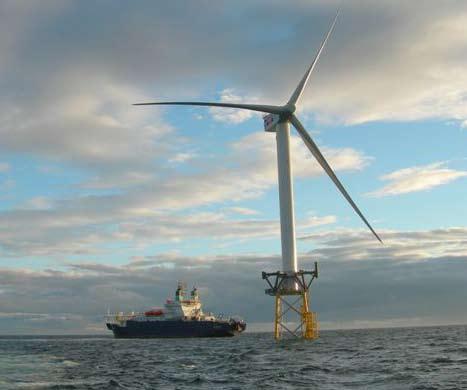
Global Marine Begins Work on Pioneering UK Wind Energy Project
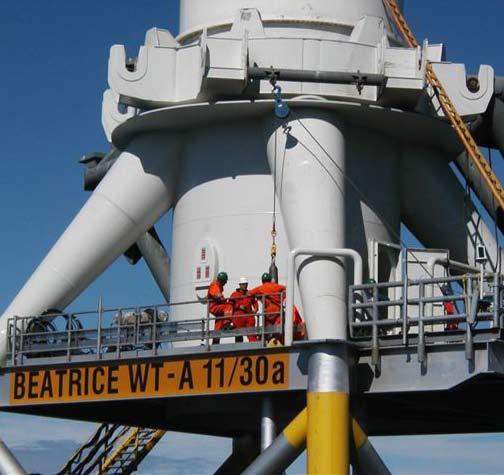
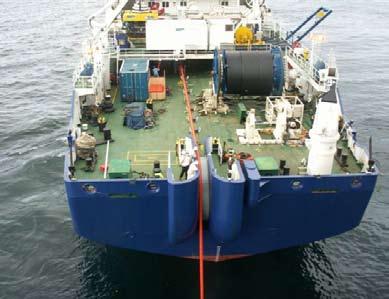
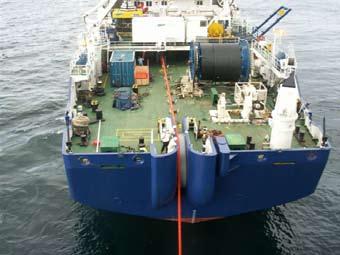
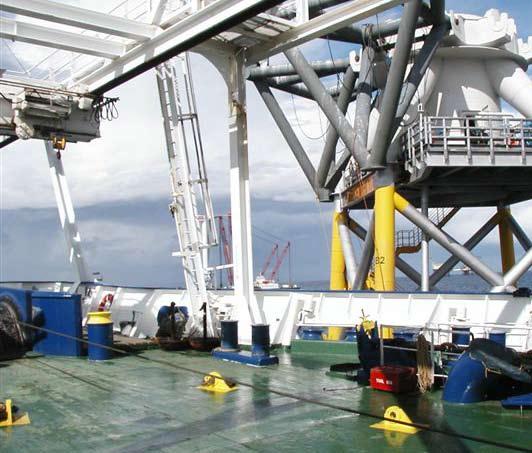
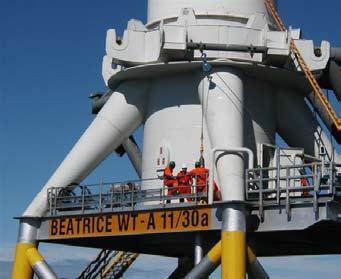
Global Marine Systems Limited has begun subsea cable installation work on the Beatrice Wind Farm Demonstrator Project (Beatrice Project), a flagship project for offshore wind energy development.
www.subtelforum.com/NewsNow/6_august_2006.htm
Indian Official Lauds New Projects, Wants to Bring Down Landing Costs
While inaugurating the new FALCON submarine cable system, Dayanidhi Maran, India’s Minister of Communications and Information Technology, said that the growth in the bandwidth demand would soon exhaust the current inventory of circuits on many submarine cables.
www.subtelforum.com/NewsNow/10_september_2006.htm
LINX Welcomes Latest Member Etisalat
Global Crossing Introduces Carrier VoIP Community Peering Service
Global Crossing has introduced to carrier customers its VoIP Community Peering service, what the carrier says is an industry-changing feature of the company’s VoIP Outbound Service.
www.subtelforum.com/NewsNow/10_september_2006.htm
Hibernia Atlantic Adds North American PoPs
Hibernia Atlantic has doubled its fiber-optic network in North America to now include seven new network points of presence (PoPs), one in Canada and the rest in the United States.
www.subtelforum.com/NewsNow/10_september_2006.htm
Howard Communications Established
Since leaving Verizon Business, Dave Howard has started his own company,
www.subtelforum.com/NewsNow/27_august_2006.htm
The London Internet Exchange (LINX) now connects the networks of 210 Content Delivery and Internet Service Providers across the world.
www.subtelforum.com/NewsNow/10_september_2006.htm
Marine Survey for Second Faroe-Scotland Cable Underway
Føroya Tele, the leading carrier for the Faroe Islands, has commissioned the marine survey for the company’s second cable linking the islands with Scotland.
www.subtelforum.com/NewsNow/16_july_2006.htm
7EE,England Tel:+44 (0) 1325 390 500
(0) 1325 390 555
Nexans Awarded Umbilical cable with 24 kilovolt power
BP America has awarded cable company Nexans a NOK 98m (USD 16m) contract to design and manufacture a 26km, 1700m deep umbilical cable with a 24 kilovolt power connection, believed to be the world´s first.
www.subtelforum.com/NewsNow/20_august_2006.htm
Nexans Wins Contract for Power/Fiber Cable to Long Island
Nexans has been awarded a contract worth over 73 million Euros to design, manufacture, deliver and install a 138 kV high voltage submarine transmission link between Norwalk, Connecticut, and Northport on Long Island, New York, in the United States.
www.subtelforum.com/NewsNow/10_september_2006.htm
Phoenix International Names General Manager
Phoenix International, Inc. (Phoenix) recently announced the promotion of Chris A. Klentzman, P.E. to General Manager of its Landover, MD facility.
www.subtelforum.com/NewsNow/20_august_2006.htm
Phoenix International Signs Term Charter Agreement
Phoenix International, Inc., (Phoenix) announced today that it has signed a term charter agreement for the M/V KIMBERLY CANDIES. The agreement includes options until June 2011.
www.subtelforum.com/NewsNow/6_august_2006.htm
Phoenix Supports US Navy ADS 2000 Certification
Phoenix International, Inc. (Phoenix) announced today its participation in achieving material certification of the US Navy’s one-atmosphere diving system, ADS 2000.
www.subtelforum.com/NewsNow/10_september_2006.htm
SAT-3 Conference Participants Issue Statement
African regulators, policy advisors, operators, businesspeople, civil society delegates, and consumer lobby groups, amongst others, gathered to discuss the issue of Africa’s access to international fiber connectivity in Johannesburg, on 24th and 25th July 2006.
www.subtelforum.com/NewsNow/6_august_2006.htm
SBSS Wins Papua New Guinea Gas Platform Project
SB Submarine Systems (SBSS) Co. Ltd, the joint venture between China Telecom and Global Marine Systems Limited, has signed a contract for a cable installation project for Saipem SpA, a leading offshore engineering Company, to enable power and remote communication to be supplied to two new gas production platforms off the coast of Papua, in Bintuni Bay.
www.subtelforum.com/NewsNow/6_august_2006.htm
Southern Cross Tackles Growing Bandwidth Demands with Nortel Optical Solution
Southern Cross Cables is significantly increasing the capability of its U.S. terrestrial optical network with a Nortel optical solution. Nortel will supply, deploy and maintain the optical solution on the U.S. mainland’s west coast as part of Southern Cross’ 30,500-kilometer submarine cable network that acts as the major link for broadband services and Internet traffic from Australia, New Zealand, Fiji and Hawaii to the U.S.
www.subtelforum.com/NewsNow/13_august_2006.htm
T-Com Picks FLAG Telecom for Transatlantic Bandwidth
FLAG Telecom, a subsidiary of India’s largest private telecom service provider Reliance Communications, has announced signing of a contract with T-Com, the broadband/fixed line strategic business unit of Deutsche Telekom AG.
www.subtelforum.com/NewsNow/13_august_2006.htm
Transworld Associates (Pvt.) Ltd Announces the Readiness of TW1
Transworld Associates Private Limited, Pakistan’s first private undersea fiber optic cable operator, has announced that its undersea fiber optic cable system, TW1, is ready for service.
www.subtelforum.com/NewsNow/6_august_2006.htm
Tyco Awarded Upgrade Contract for SEA-ME-WE-3
Tyco Telecommunications has announced that it has been selected by SEA-ME-WE-3 (SMW3) Consortium to implement the third upgrade to segment S6 of the SMW3 network as part of a global system upgrade.
www.subtelforum.com/NewsNow/13_august_2006.htm
Vietnam, Japan to Cooperate on ICT Issues
Mr. Tran Duc Lai, Vice Minister of Posts & Telematics, also received and worked with Mr. Tatsuya Ito, Japanese Member of Parliament cum Chairman of Special Committee on Economics and Foreign Affairs Cooperation under Public & Freedom Party on his occasion of the 1st visit to Vietnam on 3 August 2006.
www.subtelforum.com/NewsNow/27_august_2006.htm
Teledyne to Acquire Majority Stake in Ocean Design, Inc.
Teledyne Technologies Incorporated has announced that its subsidiary, Teledyne Instruments, Inc., has entered into an agreement to acquire a majority interest in Ocean Design, Inc. (ODI) for approximately $30 million.
www.subtelforum.com/NewsNow/20_august_2006.htm
TS Marine expand choosing SMD Hydrovision Quantum 150shp ROV systems
Aberdeen based offshore contractor TS Marine have chosen SMD Hydrovision (SMDH) for supply of two 150shp, 3000m Quantum Construction Class ROV systems and associated equipment.
www.subtelforum.com/NewsNow/27_august_2006.htm
VNPT Cuts Circuit Prices
The Ministry of Posts and Telematics (MPT) on July 10 issued five decisions allowing the Vietnam Posts and Telecommunications Group (VNPT) to reduce circuit-leasing charges.
Forum has been the platform for discourse on su b marine telecom cable and network operations. Industry professionals provide editoria l content from their own niche and focus. Each bi-monthly edition includes commentary and information on system and service provision, and issues critical to the industry.
Advertising Rates
Website Banners
Post your web linked banner to the home page, as well as News-Now sections of the Submarine Telecoms Forum website, where some 5000+ readers can come as often as every week to view the latest news feed, or our bi-monthly magazine.
Feature Section Sponsorship
Available at full-page advertisement rate, section sponsors are identified with a banner (link) at the beginning and end of the featured section.
Nexans Norway AS P.O Box 6450 Etterstad, N-0605, Oslo Norway
Tel: + 47 22 88 61 00
Fax: + 47 22 88 61 01
US Contact: Les Valentine
Tel. +1 281 578 6900
Fax: +1 281 578 6991
E-mail: les.valentine@nexans.com
Oil and Gas Fibre Optics
By Karl Jeffery
Transoceanic fibre optic communications are absurdly cheap. We have all spent many hours sending e-mails and getting websites across oceans and barely paid a penny for it.
Over 500,000 km of fibre optic cables have been laid so far in the world. Fibre optic cables can carry a multiple of terabits per second, enough to keep the oil and gas industry happy for a few years at least. So as the oil and gas industry demands faster and more reliable communications, it seems sensible to assume we will be seeing a lot more fibre.
And as the data requirements grow exponentially, with perhaps companies wanting to send continuously updated seismic data (5D?) and does videoconferencing for all staff members, wave technologies make is possible to for the fibre cables to carry a lot more data than it was originally designed for. But there are still plenty of oil rigs which do not have any fixed fibre connection, in areas of offshore activity such as the Gulf of Mexico, the Persian Gulf, off Africa and in Sakhalin.
“The odds are that fibre optic networks are bound to happen in the Gulf of Mexico and off Africa,” says Marc Fullenbaum, product marketing group manager with Alcatel Submarine Networks.
“Fibre in the Gulf of Mexico is under discussion,” he says. “I would say that the next interesting area is the West Coast of Africa.”
You don’t need a direct fixed connection from the rig to the fibre to benefit; a rig can communicate via Microwave or Wimax to a nearby rig which does have a fibre connection.
You can use a Microwave (line of sight) or WiMax link, carrying 80 mbps distances up to 80km, or 25 mbps of distances up to 15km, respectively.
Costs
The obstacle is the installation costs, and some kind of mechanism for them to be shared by several different companies. To give you an idea of the costs, BP has announced plans to spend $100m laying a 700km loop of fibre across its deepwater Gulf fields, entering the ocean in Freeport or Corpus Christi, Texas, and Pascagoula, Mississippi, in water depths of 3,000 to 8,000 feet. It will cover fields in the Viosca Knoll, Green Canyon, Atwater and Mississippi Canyon blocks, in a 700km loop. The intention is to start laying the cable in December 2006 and ‘light it up’ in summer 2007.
BP says that the fibre optic connections will provide each rig with the equivalent of 50,000 satellite dishes. The network will be hurricane proof, but will enable the rigs to be operated when they have been evacuated after a hurricane. It could provide the communications links for the planned security communications, such as radar, undersea acoustic monitoring and cameras.
Norway
Meanwhile the Norwegian Oil Industry Association (OLF) is so concerned that the networks are running sub-optimally with different operators, that it has proposed setting up some kind of central network infrastructure for all of the oil and gas fields.
OLF believes that a fibre optic network, connecting as many rigs as possible, is essential in ensuring that production can be optimized, and this means making maximum use of the available communications infrastructure, and never being beholden to one private company. The central operator would effectively buy the use of the infrastructure from the cable owners and then sell it as required.
BP to link Gulf Platforms with fiBer-oPtic caBle
By mark Davidson
(Reprinted with permission from Platts Gas Daily)
BP will spend $100 million to lay an undersea fiberoptic cable across the floor of the Gulf of Mexico to help maintain communications among its deepwater gas and oil production platforms during hurricanes, a company official said Tuesday.
Kenny Lang, BP’s vice president of Gulf production, told the Baker Institute for Public Policy at Rice University in Houston that the firm plans to begin installing the cable in December and “light it up next summer.”
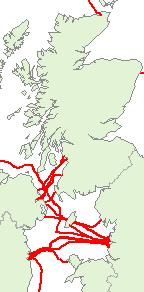
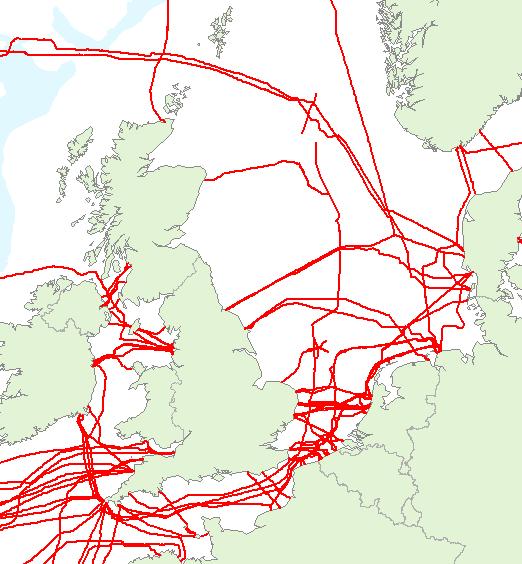
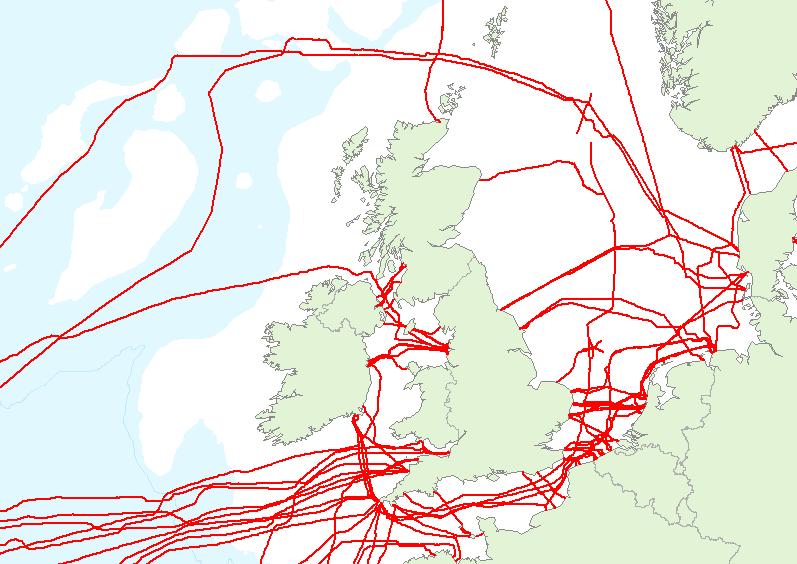
There are currently three networks in the North Sea, put in by a mixture of oil and gas companies (Statoil and BP), and private companies (North Sea Communications, and Data Marine Services, owned by Schlumberger).
“It is important to establish such an integrated common infrastructure well ahead of the implementation of integrated operations in bigger scale,” says OLF.
Currently there is a star-shaped fibre network in the Haltenbanken area on the North Coast of Norway, operated from a rig in Heidrun and connecting to shore. Currently it only serves Statoil rigs and bypasses BP (Skarv) and Shell (Draugen) rigs in the area.
He said the fiber-optic network, which will stretch from either Freeport or Corpus Christi, Texas, to Pascagoula, Mississippi, will provide an advanced communication link among all of the company’s platforms in the deepwater Gulf and with its operations headquarters in Houston.
The London-based supermajor will own the network and use part of the bandwidth for its own communications and lease the rest to other deepwater Gulf producers. “Others like Shell and Chevron have approached us,” Lang said.
The network will allow onshore operators to monitor what’s happening on the platforms during hurricanes when all personnel have been evacuated, as well as during normal operation, BP said.
Currently, the rigs use microwave transmissions and satellite links to communicate with each other and
For the North Sea, the TampNet fibre structure (owned by Statoil), a linear network which connects to Kollsnes and Karstø on the Norwegian Coast, also linking to BP fibre cables connecting with Aberdeen, and North Sea Communications (NorSeaCom) networks, linking with Lowestoft.
TampNet was established in January 2002, aiming to be an offshore telecom provider, serving central and northern North Sea, initially with five platforms connected directly to the system and 23 connected by radio links.
North Sea Communications owns or leases a ring of fibre optic, going from the North Sea rigs to Aberdeen and Lowestoft in the UK, undersea to France, via land to Copehagen, undersea to Finland, via land to Stavanger in Norway, then to the North Sea rigs.
to operators onshore. “The problem with that is it doesn’t work during a storm,” Lang said.
In order to maintain vital communication, the transmitter on the rig must remain in line of sight of the satellite. “During big storms, you have clouds come over that block the satellite,” he said. “There are periods where you don’t have communications.”
In addition, with microwave transmissions originating in the deepwater Gulf, the signal is bounced from one offshore platform to another on its way to shore, Lang said. “If any one of the facilities gets damaged, you suddenly lose communications.”
BP’s plans call for laying the fiber-optic cable on the sea floor at depths of about 6,000 feet — far from the reach of tropical storms raging on the surface. The offshore platforms will be tied into the fiber-optic
This ring structure means there is no single point of failure.
Central North Sea Fibre Telecommunications Company connects the Ula rig to Aberdeen. It is owned by BP and operated by Data Marine Services, part of Schlumberger.
A free market
Perhaps what we will eventually see is some kind of free market telecom system, where data packets can be transferred using a variety of different methods, such as fibre, satellite, microwave and wi-fi, depending on the amount of data, the urgency, the methods available, and the data urgency.
If one link is ever broken, or its price is put up, the market system can work out the next best way to send it.
With the increasing number of smaller oil and gas companies, having an offshore telecoms network which is independent of any single company will be attractive; but a third company will probably not find it easy to install the system speculatively will not be easy.
Fibre rings and lines
To date, most of the fibre installations in the oil and gas industry have been linear, with lengths of fibre going from one rig to the next, with data boosters (‘repeaters’) on each rig.
system via links that originate at the facility on the topside of the rigs and that travel down to the cable.
The new network will significantly increase the amount of data that can be transmitted, Lang said. “It’s the equivalent of each one of the facilities having access to 50,000 satellites.”
Once the fiber-optic network is installed, BP operators will be able to control from the shore a number of the functions of the offshore rigs. “More and more, rigs are becoming sophisticated with automation and advanced control,” Lang said. “You can monitor the health of the facility, learn about the position of it, and how it is performing during the storm.”
The system will allow operators on the shore to monitor the impact of the storms on the structural integrity of the rigs by measuring metrics such as metal fatigue. “You compare it to the calculation you
made when you designed it, and modify it if it needs to be beefed up,” he said. “It allows you to fine-tune.”
Lang said BP has received approval from the Minerals Management Service to leave certain rigs operating by remote control, even in the midst of a hurricane. “We don’t do it yet because we want to know that we can monitor it and have a robust telecommunication with it, so that in the event that it wasn’t performing as anticipated you can shut it down,” he said.
The fiber-optic network will give the operator the ability to remotely operate a platform and allow it to continue producing gas or oil even after the rig has been evacuated. “The way it is now, the last person to leave turns off the lights,” Lang said.
In addition, this remote operating capability will improve efficiency during times of normal operation
Alcatel, one of the largest providers of subsea cables, believes that a better approach is to have a ring of cable entirely underwater, with feeder risers going to all of the rigs.
This means that if the cable is ever broken anywhere, data can flow the other way around the ring, until a maintenance vessel can fix the break or replace that section of the cable.
The cable is not vulnerable to problems which might happen on any one rig, e.g. due to weather or explosion, because the whole of the ring is underwater.
Another layout possibility is the hub network, as seen in the Haltenbanken area North of Norway, where cables are run from a central point (probably a rig) to other rigs and to shore.
by allowing BP operators onshore to conduct routine monitoring functions. That will free the crews aboard the rigs “to do the things that only they can do, like maintenance on turbines,” Lang said. “You’re never going to be able to do that by touching a button.”
If there is a breakage in the cable, then communications from one rig to the star is broken, but not all communications are lost.
Repeaters
Repeaters, which lie on the ocean floor and boost the signal, are normally used every 50-100km in transoceanic cables; but this technology has not yet been used so much in the oil and gas industry.
If repeaters are not used, the data signal needs to come up to a rig every 50-100km for boosting, so the communications is vulnerable to a problem on a rig.
“Repeaters are absolutely reliable,” says Mr Fullenbaum. “We have deployed over 4,300 repeaters and none of them have failed so far. The mean time between failure for a repeater is 10,000 years.”
Protection from ships
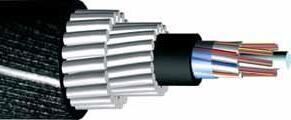
There have been a few problems about cables being broken by fishing and ship anchors. Normal practice is to use armoured cable at depths down to 1500m, putting a steel armouring around the cable. Armored cables are buried from 50 to 1500 m with a burial depth to 1 m. Below 1500-2000m, cables are surface laid.
Alcatel is very proud of the fact that none of the submarine cables were damaged during the Asian Tsunami.
Other projects
There are plans discussed to build fibre optic communications connecting rigs in Sakhalin to the shore, for Sakhalin Energy Investment Company, a joint venture between Shell, Mitsui and Diamond Gas Mitsubishi Corporation.
BP has also commissioned a 26km umbilical cable connecting two subsea wells, running 1700km deep, with a 24 kilovolt cable, also carrying high and low volt electrical power, fibre optic connections and lube oil connections, in its King Complex in the Gulf of Mexico, caring the tieback to the Marlin Tension Leg Platform, 135km South East of New Orleans. The whole cable’s design and manufacture will cost around $16m.
Karl Jeffery is editor and founder of Digital Energy Journal, a magazine based in London about information technology and communications in the upstream oil and gas industry, see www.digitalenergyjournal.com. He is also editor of Digital Ship, a magazine about information technology and communications in the deep sea maritime industry. He also produces conferences for the deep sea tanker operations industry and its oil major clients. He was staff writer for Hazardous Cargo Bulletin since September 1996 and has a bachelors degree in chemical engineering from Nottingham University.
Unrepeatered Submarine Cable Technology and Its Impact on the Oil and Gas Industry by Paul Polishuk
Introduction
With the increased demand for oil and escalating gas prices, there is growing pressure on off-shore drilling and exploration to become more efficient and effective.. As the sensor technology for exploration becomes more sophisticated, there is also a need for real time processing of large amounts of data. Often the processing of the data is many miles from the drilling site, usually on land at a data center.
The use of unrepeatered submarine cable technology can be used by the off shore oil and gas industry to extend their exploration and drilling distances, and develop undersea networks to transmit high speed data to data centers. This represents an opportunity for the submarine cable industry to take a proactive approach to undersea networks as in many off-shore oil exploration and production there are several different companies all requiring communications. For example, in the Gulf of Mexico alone, there are over 4,000 oil rigs. The industry will benefit from existing undersea
networks technology and that being developing by the research community undersea networks.
This article is based on a recently updated IGI Consulting report. “Unrepeatered Submarine Cable Fiber Optic Systems.” and an excellent article on the subject by Marc Fullenbaum of Alcatel Submarine Networks in the May 2004 issue of “Sea Technology Magazine.”
Costs of Unrepeatered Systems are Coming Down
The cost of an unrepeatered system is different from a typical repeatered system because of its design and means of installation. In a repeatered system, cost breakdown is typically 30% for cable, 15% for marine installation, 40% for repeaters, 5% for terminal equipment, and 10% for network management facilities and miscellaneous costs. In an unrepeatered system, 30% of the cost is for cable, 45% for marine installation, 15% for terminal equipment, and 10% again for buildings and instillation. One of
the major costs of installation of an unrepeatered system is due mainly to the need for complete burial of the cable to prevent damage form fishing trawlers and ship anchors. The cable itself, therefore, is often a lightly armored cable, and often with a higher density of fibers some cables have been installed with up to 192 fibers).
Marine installation technology is advancing at a pace equal to cable and terminal technology in many instances. Highly maneuverable sea bed tractors and remotely operated vehicles are useful for burial of cable and can often be deployed from shore or ship. As technology has been developed and introduced into submarine fiber-optic systems, unrepeatered transmission distances have steadily increased and prices have remained stable or have decreased.. As in repeatered systems, the maximum distances that can be traversed without repeaters is a function of bit rate and wavelength; the higher the bit rate, the shorter the distance. As illustrated in the following sections, developments in fiber optics technology increase both the length and usefulness of unrepeatered systems.
Trends in Repeaterless Systems Technology
Repeaterless fiber-optic systems by their very nature are highly dependent on technological advances. Advances in technology continue to push the limits of fiber-optic transmission, both in terms of system length and bit rate. The major
advances most important to repeaterless systems include:
♦ Improved light sources for transmitters and pumps
♦ Improved detection
♦ Forward error correction
♦ Improved fibers
♦ Optical amplification (EDFA and Raman)
♦ ROADM
♦ DWDM
♦ CWDM
Of the above list, optical amplification is perhaps the most important technology in submarine fiber optics today. For repeaterless systems, it is the one technology that has quickly and cost-effectively pushed the theoretical limits of fiber itself. Systems without optical amplification typically have a power budget of about 43dB at 622Mbps and 36dB at 2.5Gbps, for spans of 200km and 160km, respectively. Increases of 14 to 15dB are common today, and increases of 20dbB and greater have been demonstrated in the laboratory.
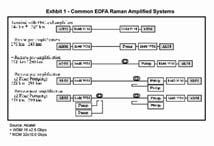
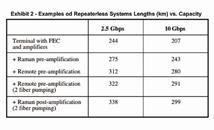
The following exhibits, 1 and 2, show the capabilities of existing and future systems. Further developments in future systems will include nonlinearity reductions and improvements in fiber design, both in dispersion compensation and large effective core area. Present unrepeatered submarine fiber systems can reach 450Km at 2.5G and 10G.
Other Unrepeatered Fiber-optic Cable Opportunities
In addition to unrepeatered submarine fiberoptical cables for telecommunications, there are a number of other potential markets for submarine fiber-optic cable. Developments in the technology for these applications will also benefit the oil and gas industry. These include:
♦ Off-shore platforms for oil exploration and production
♦ Research networks
♦ Military and government test ranges
♦ Sewer systems and canals
♦ Off-shore wind farms
♦ Hybrid power cables
Networks for Off-shore Platforms for Oil Exploration and Production
The oil and gas companies own and operate a number of Off-shore drilling platforms in various parts of the world. The present method of communications is by satellites or microwaves. These models of communications suffer from reliability and security issues. In addition, the data rates for data, control and analysis are increasing. There has been a recent trend to use fiber optics submarine cables either alone or in power cables.
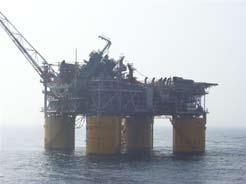
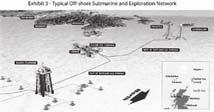
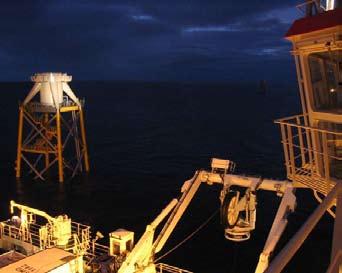
IGIC sees this as a potential growing market especially as the exploration and production occurs further off-shore and in deeper waters. Exhibit 3 shows a typical oil rig and undersea cable system linking various parts of an oil field installation in the North Sea,
Research Networks Head the Way for Future Undersea Networks
Undersea exploration is becoming a large potential market for submarine fiber-optic cable suppliers. Research indicates that only one percent of the total undersea area has been explored. Undersea fiber-optic networks allow large coverage of areas that can be covered by
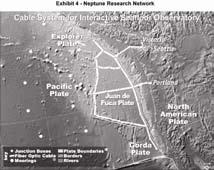
sensors of all types tied together by fiber-optic cables. Exhibit 4 shows an example of a research network for the Neptune scientific submarine system off the west coast of the United States. This is only one of many research networks being developed and installed around the world. The Neptune scientific submarine cable system plans to “wire” the Juan de Fuca tectonic plate and turn it into an interactive ocean science laboratory. Neptune will provide 30 seafloor nodes distributed over a 500x1000 km area to which many scientific instruments may be attached. The modes will supply power at several kilowatt levels and data communications at aGbps rate. Neptune will utilize an unconventional parallel power distribution system and industry-standard Ethernet data communications hardware.
The study of the dynamic, interactive process that comprises the earth-ocean system require new approaches that complement the traditional ship-based e expeditionary mode which has dominated oceanography for the past century. Long-term access to the ocean
is needed to characterize the divers range of spatial and temporal scales over which the natural phenomena occur. This can be facilitated by using ocean observatories to provide power and communications for distributed real time sensor networks covering large areas. Real time networks also enable an education and public outreach capability that can dramatically impact the public attitude toward the ocean sciences. The Neptune project (http://www.neptune. washington.edu) is a joint US-Canadian effort to “wire” the Juan de Fuca tectonic plate located off northwestern, North American with 330 km of dedicated scientific fiber-optic cable, hosting 30 science nodes spaced a nominal 100 km apart. Each seafloor node connects to the Internet. Exhibit 5 shows the planned layout for Neptune. Neptune differs from a conventional submarine telecommunications system in two key respects. First, Neptune requires data input and output at many seafloor sites rather than a few land terminuses. Second, Neptune has to distribute power at variable and fluctuating rates to many seafloor instruments in addition to energizing its own internal systems. For these and other reasons, the engineering solution for the Neptune power and communications system does not closely resemble those used in commercial telecommunications systems. However, Neptune will take advantage of the submarine fiber-optic cable technology used in telecommunications for its backbone, and will be installed using
conventional able laying assets and the technology developed will be useful in off-shore exploration and production.
Case Study of an Off-shore Communications Needs
Just this week, the oil industry announced that it was on the verge of opening a deep water region in the Gulf of Mexico that could become the U.S.’s biggest new domestic source of oil since the discovery of the Alaska North Slope more than a generation ago. Located 270 miles from New Orleans, a 300 mile wide swath of the gulf that lies below miles of outer and deep within a bed of ancient rocks estimates are that there could be reserves of oil and gas of 3-15 billion barrels. This would boost the nation’s reserve of 29.3 billion barrels by 50%. At today’s price of $70 per barrel, this represents a total potential revenue stream of $210-1050B. This is “real money” that could pay the freight for an extensive fiber network connecting the various oil rigs. At the present, there are five oil companies drilling in eleven locations. The distances are all within the capability of unrepeatered fiber optic systems. It is up to the submarine fiber optics industry to be proactive to promote the development of submarine fiber optics networks for the oil and gas industry.
Submarine Telecoms Forum is seeking like-minded sponsors to contribute their corporate images to the 2007 Submarine Cable Industry Calendar.
Submarine Cable Industry Calendar 2007
The 2007 Submarine Cable Industry calendar will be provided free of charge to Submarine Telecoms Forum’s subscriber list, encompassing some 5000+ readers from 85 countries, including senior government and international organization officials, telecom company executives and team, support and supply company management, and technical, sales and
purchasing staff, field and shipboard personnel, academicians, consultants, financiers, and legal specialists.
The Submarine Telecoms Forum industry calendar will be printed in full colour on high quality 200gsm silk art paper, approx 600 x 300mm, giving sponsors an area of approx 300 x 300mm to display their corporate image.
Sponsorship Cost: $7,000 per monthly membership.
For further information, reservations and information contact:
Tel: +1 (703) 444 2527
Fax: +1 (703) 444 3047
Email: 2006calendar@subtelforum.com
Interference in the ISM Band: Mitigation Strategies
By Charles Foreman
More and more, the ISM1 bands are being used for wide area, wireless networks in the oil patch. Because the ISM bands are unlicensed, anyone can use them so long as they comply with the FCC regulations. This can lead to potential RF interference between operators in the same geographical area, on the same frequency band, using different modulation techniques. Fortunately there are techniques and strategies to minimize the effects of the interference.
In the past, gathering a few data points from an oil or gas well once an hour was adequate to operate the field. “Good oil field practices” did not require large amounts of data to manage the reservoir. This has not been true for some time. As the oil and gas become more valuable, even small percentages in extraction efficiencies contribute significantly to hydrocarbon recovery from the reservoir and hence to the company’s bottom line. In order to improve extraction, more data, more often
1 Industrial, Scientific, and Medical bands are at 900 MHz, 2.4 GHz, and 5.8GHz. Equipment is unlicensed but must be FCC compliant.
is required so that the operator can model the reservoir with higher resolution.
Personal safety and environmental protection have always been important. The negative impact of an accident can take years to rectify. By recognizing that an “event” has occurred at the well head in a matter of minutes, instead of hours, the operator can take corrective action in a timelier manner and, hopefully, minimize the impact.
The challenge becomes one of: how do you collect the data from thousands of wells spread over hundreds of square miles with no connectivity back to the central operations location? Plus the connectivity must be highly reliable. Typically, the wells are located in remote areas without any commercial infrastructure to support mission critical, high throughput data.
did not always guarantee interference-free transmission of data, it allow for remediation through the FCC. Low speed data is no longer adequate to operate the field. The operators need more data, and it has to be closer to realtime. This requires higher bandwidth and higher polling rates. At the present time, the commercially available radios that economically fill this need are in the unlicensed ISM bands. While this unlicensed operation makes for one less step in the deployment process, it leaves operators in congested areas nervous about the ability to control potential interference from neighboring operators.
Depending upon the terrain, frequency, power availability, and RF interference, commercially available, point-to-multipoint radio systems can support from 512kbps to ≈12Mbps connectivity. Choosing the right frequency band, antenna height, and hardware can satisfy most of the system requirements for data throughput. RF interference can be much trickier.
One solution is to use radios to provide the connectivity. In the past, low speed (9600 baud), FCC licensed radios were adequate to meet the operator’s needs. While this solution
RF interference is a fact of life. It cannot be completely eliminated nor avoided. Any unwanted signals or background noise may introduce errors into the transmission path. These errors will decrease the system’s throughput due to the need for retransmissions, or in the worst case, block all throughput because the receiving radio cannot discriminate the data. Fortunately there are techniques incorporated in the radio equipment to mitigate the effects of RF interference.
There are two transmission techniques used in the ISM band, and they use different approaches to handle interference:
1. Direct-sequence spread spectrum (DSSS) is a spread spectrum wireless coding method that spreads the modulated information signal over a fixed frequency carrier signal. It uses suppression to mitigate interference.
technoloGy transforms the oil Patch
By russ Doig
Over the past 10 years there has been a radical transformation taking place in the oil production industry that has been facilitated by communications technology. This transformation has lead to rapid advances in drilling, process automation, and plant operations technologies. Ultimately these advances have reduced the time to market for field development and reduced the lifting costs for oil and gas extraction.
The ability to provide more cost effective bandwidth to drilling rigs has brought forth new applications and systems for rig operations. Drilling information systems now monitor all facets of the drilling operations both locally and remotely. These applications produce a real-time informational dashboard that displays operational parameters such as bit rotational speed, weight on
It’s C/I (carrier-to-interference) ratio is higher than that of a frequency hopping system. This means that a DSSS system can tolerate a higher noise floor and still maintain throughput.
2. Frequency-hopping spread spectrum (FHSS) is a spread spectrum technique that directly modulates a carrier that randomly hops between discrete frequencies within the band. It uses
bit, depth, direction, mud weight, etc. From this information the on-site rig staff can operate the rig more efficiently and remote engineers, geologists, and other experts can quickly come into play to diagnose and resolve issues. Other specialized applications can be brought into play for specialized drilling such as exploration. Real-time well logging and analysis allows geological and reservoir experts to quickly analyze exploratory drilling results. The end result is reduced costs for drilling because less time is required to drill a well, less staff is required on-site, drilling results are improved due to better information, and experts can manage multiple projects. The enabling communication technologies that make these applications possible are broadband wireless, wireless LAN, and direct broadcast digital and Internet satellite services. These systems allow drill rigs to be freed from the tether of point-topoint microwave systems and leased lines, which increases mobility, provides greater bandwidth, and reduces the need for human intervention
avoidance to mitigate interference. If it lands on a frequency that is in use, it retries on the next random frequency. As the noise floor rises, FHSS will hop more frequently to maintain connectivity. Excessive hopping decreases the data throughput and adds latency to the system.
Both of these techniques use adaptive modulation schemes that increase the
when relocating. Use of VPNs and IP encryption technologies over the transport insures data integrity and security.
High-speed secure networking has brought about change for production facility process control. Serial links and low speed SCADA systems are replaced by high-speed IP links supporting distributed process control automation systems. As with drilling, new applications provide a “dashboard” view of plant operations and control systems. The process systems take an incredible amount of data points and present the operations personnel with only the crucial information to do their jobs. In some cases the operations staff can do “what if” scenarios to simulate the effect of minor process changes on system operation and production efficiency to better tune day to day plant operations. Remote engineering staff can access views of the plant operation and historical data to do
probability of a robust and highly available link.
Forward Error Correction (FEC) also improves performance. These systems are capable of recognizing persistent interferers and avoiding those channels.
In spite of the inherent capabilities of the ISM radio systems, RF interference will still occur. There are some system design techniques that are used to minimize the interference. Also there are some operational practices that
might be used to share the band.
Before implementing any radio system, a RF study should be done to identify the existing radio systems operating in the local geographic area. Based upon the study, the advantages of a DSSS system vs. a FHSS system can be evaluated. If all the existing systems are frequency-hoppers, a new direct-sequence system will cause interference. If you install a DSSS system, care must be taken to use
frequencies in different zones than those the FHSS systems are using. The drawback is that you cannot tell what other operators may be planning. Picking a robust system now does not guarantee that it will be “future proof.” Because the ISM band is unlicensed, any operator can add to the RF noise at any time in the future.
“Good” RF engineering will help mitigate interference. Designing a frequency plan
long term modeling and planning in order to debottleneck operations and improve plant operating efficiency. Additionally, if a plant operations issue surfaces, the remote operational engineering staff can see what the on-site staff sees in real time to recommend immediate resolution. This automation increases the plant production efficiency, reduces staffing requirements, and improves health and safety therefore reducing operating costs. Gigabit fiber optic plant backbones running both proprietary and conventional IP protocols are the core transport for these systems. Outlying facilities and production areas can be brought into the plant transport via gateways that are connected via fiber, microwave, or satellite IP links. MPLS and other technologies are used for the wide-area links so that production data can share transport but still be segregated from other services to insure high reliability and availability.
Personal communications has changed radically in the recent past. Mobile field staff once dependant on two-way radio and paper and pencil for communication and data gathering has been liberated. Instead of returning to the field office to get blueprints, the next work order, submit a request for material, or turn-in a log sheets they can now do that from their vehicle. This reduces travel time and increases the overall mobility of field maintenance and operations crews. Use of hardened PCs and PDAs in the vehicles allows for data entry and retrieval. In harsh or remote climates GPS can be used for position location and tracking to improve safety. Wi-Fi, broadband wireless, and wireless LAN hotspot technologies are the key communication enablers for these applications.
Continuing technology advancements are already driving new systems and applications such as wearable computing and visualization devices. These devices can be used in a plant environment
to provide local data and images at the point of equipment malfunction or repair activity to assess those activities and send images and data to remote experts or vendor locations for assistance and consultation. Emerging mesh networking devices and sensors based on motes and nanotechnology will produce the next generation of innovative oil field applications.
without overlapping frequencies will minimize self-interference. Directional antennas (antennas with narrow beam widths) will help reject unwanted signals. The system can be configured to avoid interfering frequencies. For example, if a DSSS system is operating in a particular ISM zone, a FHSS system can be set up to skip that zone.
Before installing a new system, initiating a local users’ forum will go a long way towards being “a good neighbor” and sharing the ISM band. It is in everyone’s interest to share the band and not be knocked off the air by other operators. Even if you can’t identify every ISM operator, shortly after you up turn up a new system that interferes with their system, they will come looking for you. Moving both operations to other parts of the band will reduce mutual RF interference. This may result in increased retransmissions (decreased throughput), but you both will still have connectivity.
The ISM band offers a good solution for wide area, point-to-multipoint connectivity in the oil patch. However, because it is unlicensed, the system must be designed to alleviate the inevitable RF interference. Choosing the appropriate spread spectrum technology will help mitigate the interference. Contact and sincere interaction with other operators in the local area will help share the band between all interested parties.
References
[1] E. McCune, “DSSS vs. FHSS narrowband interference performance issues,” RF Design, September 2000, pp. 90 -104.
Charles Foreman has been involved in telecom systems for over 30 years, including serving abroad as Engineer responsible for the development of a strategic telecoms plan for Saudi ARAMCO, Manager of Systems Engineering for Fujitsu, Systems Engineer for NEC America, and Project Engineer for Arabian American Oil Company. He has supported WFN Strategies in the engineering, provision and installation of a fiber optic, RF, microwave and cellular telecom system in Prudhoe Bay, Alaska, as well as the development of microwave-based network in Wyoming. He possesses a Bachelor of Science degree in Electrical Engineering, and Masters of Business Administration, and is a Member of IEEE. He joined WFN Strategies in 2003 as Project Manager.
• High level and strategic; an event that provides insights on changing business models of
Oil & Gas Market Opportunities
By John Golding
As the telecom industry continues to strengthen, buoyed by a growing demand for new IP-based communication services, subsea cabling companies should not ignore the growing market opportunities which the oil and gas industry has to offer. Whilst cabling maintenance and installation services obviously have to be adapted to reflect the different challenges this sector presents, such as connecting power cabling to an oil platform, the development of Global Marine Systems Limited shows that telecom cable installation experience and technology can be successfully applied to the oil and gas industry.
In recent years, global energy markets have boomed and oil, gas and electricity prices are continuing to rise. By adopting a pragmatic approach to subsea cable contracts, Global
Marine and its joint venture partners, SBSS and NTTWE Marine have been able to tap into the knock on demand for oil and gas platform cable installation and maintenance services. This has included work in diverse locations such as China, Russia and the North Sea.
But what does this type of work involve?
Typically, it could be laying a composite cable which provides power and fibre optic control capabilities to an oil or gas platform, as these types of platforms require numerous offshore staff to operate many of the control functions. By installing fibre optic cable connectivity back to the mainland, many of these functions can instead be controlled from on land, saving the platform operator considerable time and expense through having more of their staff onshore, rather than on the platform.
For oil platforms, a cable installer could also be involved in “mattressing” work - a process which uses an electronic heave compensation control winch in the laying of protective concrete covers over parts of the oil pipeline which connects the platform back to the mainland. In all of these cases, much of the technology and skills required are exactly the same as for a telecoms network installation - such as the use of cable ploughs, grapples and ROVs.
Telecom cable installation will always be a core Global Marine service but, today, it forms part of a balanced portfolio of sector work which in addition to oil and gas, also includes regular work in the renewable energy, defence and scientific exploration markets. Ultimately, our strength should be our ability to diversify and adapt to changing market conditions. The oil and gas industry is an excellent way to showcase these transferable
skills and experience for long term benefits, and our work on the Beatrice Windfarm Demonstrator project completed earlier this month, has allowed Global Marine to improve our already enviable track record in this market.
John Golding is Company Security Officer and Designated Person Ashore for Safety at Global Marine, which means he is responsible for the company’s fleet of ships, their masters and commanders, officers and crew. After working on ships for 20 years he came ashore in 1999 and since joining Global Marine John has implemented a number of successful initiatives including a fleet security plan, which resulted in Global Marine having the first British flag vessel with an International ship security certificate.
Fueling Subsea Bandwidth Demand:
Demand
Drivers and Internet Traffic
Growth
Since the late 1990s, Internet capacity requirements have emerged as the principal source of overall bandwidth demand. As a result, gauging the pace of Internet traffic growth plays a pivotal role in understanding demand for submarine bandwidth. International Internet traffic growth took a somewhat surprising turn in 2006, as traffic growth reaccelerated on many routes. Based on data TeleGeography collected directly from providers during 2006, aggregate average international Internet traffic grew 75 percent annually, a significant jump over the 50 percent growth rate during 2005. TeleGeography’s latest research also shows that traffic growth outpaced the rate of underlying IP capacity deployment in the past year, leading to higher utilization levels on international Internet backbones. Global average traffic utilization levels increased from 28 percent to 33 percent, while peak utilization rose from 43 percent to 47 percent.
cable broadband. During 2005 the total number of broadband subscribers in the world rose 37 percent, to more than 221 million. Not only are the numbers of subscribers growing, but so is bandwidth available per subscriber. No longer does broadband just mean a 768 Kbps DSL line, but speeds of 10 Mbps, 20 Mbps, and even 100 Mbps connections are now possible in for many subscribers.
By Alan Mauldin
This is a positive development for submarine cable operators, since higher utilization is a harbinger for future bandwidth purchases.
Traffic Drivers
What is fueling the rapid pace of Internet traffic growth? It is no secret that the total amount of traffic generated by end-users has increased dramatically as consumers have switched from dial-up modems to higherbandwidth technologies such as DSL and
Increased local access speeds would have no effect on Internet traffic if there were no applications encouraging broadband subscribers to make use of their new connectivity. In addition to reporting total volumes of traffic on Internet networks, carriers surveyed by TeleGeography were also asked to report the share of traffic various end-user applications accounted for on their networks. The applications driving traffic on IP networks vary substantially among providers. However, it is clear than video content, whether downloaded from the Web, accessed through a file-sharing application, or streamed live has become the largest consumer of network capacity. Our data reveal that Web and peer-to-peer (P2P) file sharing are the two dominant types of traffic, accounting for more than two-thirds of total traffic on many networks. The share of P2P traffic on Internet backbone networks has surpassed Web traffic according to many providers surveyed by TeleGeography. In fact
some carriers indicated P2P traffic accounted for more than 70 percent of their traffic. Ranking below Web and P2P, streaming audio and video account for approximately 3 to 10 percent of total Internet traffic. Streaming audio and video are high bandwidth applications that can account for a large share of traffic for short periods of time; however, this traffic is small when compared to overall traffic levels. Four providers surveyed by TeleGeography indicated that streaming media accounted for 10 to 15 percent of total traffic.
Regardless of how the shares of Web, P2P, and streaming media vary by provider, the primary reason that these applications dominate Internet traffic is video content. Traffic from web-based video content providers such as YouTube and Apple’s iTunes store has surged. YouTube reported in early 2006 that it had 20 Gbps of outbound traffic and was growing approximately 20 percent a month. Apple reports that 15 million videos have been downloaded through its iTunes Store as of mid-2006. Although music has been the impetus behind much of the file trading in the past, video files now account for the 61 percent of P2P traffic, according to CacheLogic. Streaming video continues to experience rapid growth fueled primarily by live events. For example, the annual US college basketball tournament games in March 2006 were streamed for free by CBS
Sportsline. The company reported a peak of 268,000 simultaneous streams on the first day of coverage.
Online gaming traffic is believed to be a fastgrowing application on long-haul networks. Based on data collected by TeleGeography, gaming traffic is no more than 1 to 8 percent of total traffic as of mid-2006. One of the most popular online games, World of Warcraft, reported 6.5 million subscribers in early 2006, up from 1.5 million subscribers a year earlier. Providers of online games try to place their servers such that latency remains as low as possible. Thus, while gaming traffic is growing, the majority is more likely to be domestic than international.
Voice-over-IP (VoIP) is a rapidly growing application, but according to the providers surveyed by TeleGeography, VoIP traffic was no more than 1 to 5 percent of their total traffic. Although VoIP accounts for a rather small share of total Internet traffic, the level is actually impressive considering that VoIP is a lowbandwidth application.
Traffic Outlook
Predicting the pace of future Internet traffic growth is complicated given the myriad factors that influence the volume of traffic traversing international Internet links.
Although the continued growth of broadband subscribers access speeds and the rise of video content will continue to play a large role in the pace of international traffic growth, other factors exists which could mitigate or intensify the rate of future traffic increases over submarine cables.
As mentioned earlier, P2P traffic has emerged as a sizable portion of many carriers Internet traffic. However, several factors could limit the growth of P2P traffic on international bandwidth demand.
As P2P traffic levels surge, ISPs may employ new applications that cache P2P content locally or encourage file sharing between users that are in closer proximity. Notable companies working in this area include CacheLogic, Sandvine, and PeerApp. These approaches would reduce an ISPs upstream bandwidth costs by curtailing the amount of P2P traffic that leaves an ISP’s network and could potentially travel over international IP links.
Even when video is not P2P-based, the continued development of content delivery networks operated by companies such as Akamai and Limelight Networks will bring video content closer to users, leading to improved quality and reducing the demands placed on long-haul segments of networks. In addition, many companies are working on
new video compression technologies that could further reduce the file size of video content, in turn curtailing the impact of video content on Internet traffic growth.
Although technical solutions may allow backbone operators to limit the strain that video traffic places on submarine cable capacity, not all types of video traffic can be managed in this way. As opposed to P2P files and streaming video content, video calling is one type of traffic that cannot be cached locally. Video calling is a true longdistance application that has the potential to significantly boost international traffic growth. Video calling is already possible using several instant messaging applications, such as Skype and Microsoft Messenger. In fact, Microsoft claimed that users of Microsoft Messenger engaged in 1.1 billion minutes of video calling in January 2006. Some VoIP providers—such as Vonage and 8x8—have launched video calling add-ons as a means of differentiating themselves from other VoIP companies. I do my share to boost trans-Atlantic Internet traffic by making daily video calls from my home office in Europe to TeleGeography’s Washington, DC office via Apple’s iChat. Currently, few consumers have enough upstream capacity to take advantage of high-definition video calling. However, as broadband access speeds increase, the quality of video calling improves, and consumers come to regard video calling
as a household necessity rather than as a futuristic gimmick, the substitution of video calling for audio-only calls could someday account for a sizable—if not dominant—share of international traffic.
Rapid international Internet traffic growth is vital to the revenue prospects of Internet backbone providers given the continued decline of prices. But how fast will international Internet traffic continue to grow? TeleGeography is examining the topic of Internet traffic and bandwidth forecasts in our Global Bandwidth Forecast Service. We have always taken one of the most “bearish” stances in the analyst community; nevertheless, we think that demand for international bandwidth could grow at a compounded annual rate of 27 percent between 2006 and 2012—good news indeed for submarine cable operators.
of Alan Mauldin
Since joining the company in 2000, Alan Mauldin has served as a principal analyst in many areas of TeleGeography’s research, including international Internet infrastructure, submarine cable systems, and bandwidth demand modeling. Mr. Mauldin heads TeleGeography’s Global Bandwidth Forecast and Global Internet Geography research services. Mr. Mauldin also contributes to many of TeleGeography’s custom consulting studies. He holds a B.A. from Baylor University.
BIO
From the Gulf of Mexico to Washington DC . . . and Back
By Gary Gibbs
When Phoenix International, Inc. (Phoenix) was founded in 1997, the company consisted of nine employees. The majority of them lived in Louisiana, and had early and extensive backgrounds in the Oil & Gas sector working underwater projects throughout the Gulf of Mexico (GoM). At its inception, Phoenix competed for and won a US Navy contract to provide diving services, underwater ship repair, and related engineering. The founders were all involved in and committed to support of this contract.
In the last nine years, Phoenix has expanded from this small cadre to over 200 people working in six locales. Phoenix continues to hold the Diving Services contract, and has added the Navy’s multi-year Undersea Operations contract under which we maintain and operate Navy owned equipment used to conduct search and recovery missions to water depths of 20,000 feet. Phoenix is also the maintenance and operations Prime Contractor for the Navy’s next generation submarine rescue system. In response to these and other government contracts, Phoenix has built a highly capable, multidisciplinary engineering design staff. Among
a series of current projects, we are designing a portable, fly-away saturation diving system for Navy use, and a diver assisted underwater inspection system for taking ultrasound thickness measurements within sea chests of varying diameters.
Having parlayed our early oilfield expertise into a healthy government business, Phoenix is extending a path back into the oilfield sector; a market diversification effort to help secure a viable future. Preparations for oilfield activities started in late 2002 by negotiating service agreements with the smaller independents. Shortly thereafter, Phoenix began conducting shallow water, conventional diving operations to fill the slack periods in our government and commercial work schedules. By the time Hurricanes Ivan, Katrina, and Rita rampaged through the Gulf, our dynamic, young underwater services company was ready and able to assist in assessing and repairing the extensive damage caused by these storms.
We added the HardSuit™ Atmospheric Diving System (ADS) to our diving equipment inventory in 2003. The HardSuit™ is
manufactured in Vancouver, British Columbia by Oceanworks International. Commercially, the HardSuits™ gave us a 1,200-foot depth capability. The suits were primarily used to support subsea tree installation and platform inspection programs. The ADS soon proved to be the diving method of choice for us in water depths below 200-feet, yet they see considerable use in shallower waters. In addition to completely eliminating the requirement for decompression, the HardSuits™ physically protect the diver / pilot from most common traumatic injuries. In the subsea environment in which we operate, the HardSuit™ has proven to be a welcome addition to our already stringent safety program.
Our return to working in the oilfield has not been without some frustration. In 2005 we were launching our Subsea Projects Group in Houston, Texas and operating one of the largest dynamically positioned ROV support vessels in the GoM, the 450-foot converted cable ship M/V BOLD ENDEAVOR with an installed 200 horsepower Remotely Operated Vehicle (ROV). After Hurricane Ivan swept through the eastern portion of the
Gulf, the vessel was quickly employed for post-hurricane inspections of pipelines and platforms as well as for performing salvage duties associated with a downed drilling rig. Unfortunately, our promising start with the BOLD ENDEAVOR abruptly ended less than a year later when our joint venture partner lost ownership of the vessel.
Not to be deterred, by August of 2005 we gained first right of refusal for spot charter of the M/V KIMBERLY CANDIES while she was still in the shipyard in Lockport, Louisiana. Owned by Otto Candies, L.L.C. of Des Allemands, Louisiana, the KIMBERLY CANDIES is a 238-foot DP II vessel. We were scheduling a small flying lead project at a client’s subsea well sited in a water depth of 1,135 feet. We intended to mobilize our HardSuit™ ADS for the project. Hurricane Katrina then arrived and temporarily crippled the port of Fourchon, Louisiana, but left the vessel relatively unscathed in the shipyard. In realization of the scope of support work that would now be required throughout the Gulf as a result of Katrina, we supplemented the HardSuit™ installation by adding a surface supplied diving capability to 300-foot depths, and a 25-horsepower ROV with full ocean depth capability for inspection and light work. As soon as the waterways to Fourchon and to the GoM were clear to pass, we were underway.
Our first client kept the vessel and spread busy for about four months, primarily performing post-hurricane inspection duties and light repair work. Our next customer then kept us busy for nearly sixty days, conducting similar inspection and light repair tasks. Most inspections were associated with platforms and other fixed or floating structures as well as pipelines. The work often included nondestructive testing using cathodic potential, magnetic particle, and ultrasonic techniques. The benefit of our onboard spread was an ability to call on or supplement a given diving technique at any time in order to satisfy emerging client requirements.
The M/V KIMBERLY CANDIES spread is proving to be more versatile than we first imagined. The availability of the diverse diving modes assembled onboard the vessel, the high quality of embarked Phoenix operations personnel, and the professionalism of Otto Candies’ crew aboard the support vessel quickly gained a reputation for efficiency in the GoM and resulted in more scheduled work.
As a number of shorter follow-on projects initiated a trend away from inspection efforts toward more involved repair work, we put a 28-ton crane onboard the KIMBERLY CANDIES. The addition of the crane gave us an ability to overboard concrete mattresses and spool pieces of reasonable size, as well as an ability to handle other equipment and
repair items requiring launch or recovery to the deck during repair operations. The 28-ton crane will be replaced by a 40-ton crane in late fall.
In furthering the scope of our GoM services, we are presently negotiating a term charter for a 133-ft., ex-NOAA research vessel owned by Reservoir Geophysical Corporation of Sugarland, Texas. The M/V FERREL has a 6-ton knuckle-boom crane at her stern and a 1.5-ton box-boom crane forward, so she will be ideally suited for shallow water platform repair as well as being capable of inspection support. The term charter is contingent upon the vessel’s receipt of a United States Coast Guard (USCG) Certificate of Inspection (COI). Upon receipt of her COI, we will commence already scheduled work for platform repairs. Phoenix is one of a very limited number of qualified providers of high quality, certified hyperbaric welding services required for such work.
We have also negotiated an arrangement with Otto Candies to move the M/V KIMBERLY CANDIES from spot charter to term charter. This agreement has been fully executed giving Phoenix options on the KIMBERLY CANDIES for five years. This winter, a 40-ton knuckle-boom crane will be installed on her to further enhance her versatility and allow us to undertake ever more challenging projects.
This fall, Phoenix will take delivery of two state-of-the-art, 200 horsepower UltraheavyDuty (UHDTM) ROVs from Schilling Robotics. At their core, these sophisticated vehicles have a modular subsea control system, the Digital Telemetry SystemTM (DTSTM), based on a gigabit Ethernet backbone. The versatile DTSTM system is extremely flexible, configurable, and expandable allowing support of a wide range of tools through “plug and play” interfaces. Our Houston Subsea Projects Group will utilize these vehicles for infield development work.
All this is happening concurrently with inspection operations, subsea tree installations, and large platform repairs conducted from other client-supplied vessels and drilling rigs as well as with our on-going government and non-Oil & Gas commercial work. All Phoenix customers ultimately benefit from the skills developed while conducting work in other sectors. The value of our ability to support diverse global commercial and military markets was demonstrated several times this year when we utilized the capabilities aboard the M/V KIMBERLY CANDIES to conduct two critical recovery missions in the GoM for the Navy. Similarly, the commercial market has benefited from government funded endeavors. The extent, progress, and responsibilities associated with present day hurricane clean-up efforts are being monitored and tracked using an extensive
database developed by Phoenix for the Navy and Coast Guard.
It has been an extremely interesting and challenging period of growth for Phoenix. We have come full circle from the oilfields to the Beltway and back; an ebb and flow of talents and services with roots in each market now applied to the benefit of both. We are now re-entrenched in oilfield service from shallow to deep water. We will continue to utilize and further develop our expertise, providing underwater solutions worldwide to our government and commercial clients, as well as to our ever-expanding base of oilfield clients.
Gibby, aka Gary Gibbs, began sport scuba diving in 1971 at age 16 and entered military service with the United States Army in 1975 graduating from the United States Naval School of Diving & Salvage in 1976. After serving as an Army Diver through 1978 and receiving an honorable discharge as an E-5, Gibby arrived in the Gulf of Mexico in early ’79 and was employed by a major Gulf of Mexico diving contractor.
Working as a Diver, Atmospheric Bell Pilot and Diving Supervisor, assisting with bids while onshore and also traveling to bid complex projects, Gibby was promoted to Commercial Manager, all over a period of 23 years. Gibby took the position of Bids & Proposals Manger with Phoenix International, Inc. (Phoenix) in 2003 and became their Business Development Manager for the Gulf of Mexico in 2005.
Letter to a friend from Jean Devos
My dear friend,
A changing Asia-Pac!
My Dear Friend
“Botany Bay”
India runs the “Atlantic risk “of over building, though “over-competition”.
Warrior event was still in everyone’s memory. It is for these reasons among others that STC (UK) rejected the Alcatel‘s suggestion to come with a joint bid, to offer a “European” solution.
The following questions are also now coming to mind: What will the South-East Asia carriers do? And where stands the Japanese carriers?
One of the winning factors has been the Port-Botany cable factory. Such a factory was a strong requirement from OTC (now Telstra) and the Australian Government.
The Japanese carriers, NTT and KDDI are looking at building their own single direct Japan-US cable. They still have the possibility to upgrade the existing Japan-US.
AAG (Asia-America Gateway) is a MalaysiaTelecom initiative. The idea is to organise a consortium of SEA carriers and build their own connexion to US. Are they going to stay an independent project or are they going to join one of the other projects? We will see.
Alcatel was the most motivated. Such a factory could expand its influence in the Pacific where the three other players were historically well established in this region, which represents a large part of their market. They saw this factory as a risk for their existing facilities!
You try to understand what is going on in the Asia-Pacific region and you have requested my help. It is clear that the emergence of India and China is now the main driving force of our industry. Actually India, much more than China.
It is quite interesting to note that China plans to build TPE, a Transpacific loop, when Tata/ VSNL (India) own TGNpac, a 7 Terabits cable of which “only” 640 Mbits is presently lit. It means that the Chinese want their own cable direct to US.
and l’Astrolabe, landed in 1788 to discover that Captain Cook was already around bearing the British flag. So Botany Bay is now for me the symbol of a dream which becomes a reality!
I published recently a modest novel, whose title is Botany Bay. It is the place in Australia where
Alcatel established a submarine cable factory in 1989 as part of its contract for the Tasman 2 link. In this same bay, where two centuries before the French expedition
India - through companies like Tata/VSNL, Reliance/Flag, Barthi - is now playing a major global role when China is acting to respond to its own need. India is deregulated so there are a lot of business opportunities. China is growing rapidly and so is their international traffic, but under close control and a very cautious approach. China Netcom has now even sold their Asia-Netcom network.
“La Pérouse” made of two ships, La Boussole
VSNL has now announced the construction of a Singapore –Guam cable interconnecting TGNpac with their TIC, Tata India-Singapore cable. With their planned India-Europe cable (logically Portugal) this would close the TGN global loop. Reliance-Flag have now put their Falcon cable into service and may extend it to East Africa.
Tasman 2 has been yet another chapter in this long Anglo-French competition! The award to Alcatel came out as a big surprise to many, including inside Alcatel. Everybody was naturally expecting the British to win that battle, and such an expectation was at that time very logical.
MTNL/BSNL the state owned India companies are also planning to jointly build their network eastward and westward. This is a governmental reaction to the private entrepreneurs
There were so many difficulties and misunderstanding between Australia and France, the main one being the French presence in the Pacific area, the worse being the nuclear bomb experiment in Tahiti! The sad Rainbow
My dear friend, many discussions are probably taking place between all these players. Only “God” knows - and I am not even sure of that - how the final picture will look like! A lot of geo-political and economical factors are interplaying.
SubOptic ‘87 in Versailles came at the right time. It is where the Australian teams discovered the French model, a close cooperation between Alcatel and FT, exactly what they wanted to establish in their country.
My friend, things are changed since, but one thing stays true: When you offer something, the reader can see between the lines if you are or not genuinely motivated and sincere. Then your offer becomes really attractive and this opens the route to “Botany Bay.”
Forecasting is becoming an almost impossible task in a rapidly changing world. But it’s fun! And it is the right approach: infrastructures are now planned, built and financed by the one who need it!