Submarine Telecoms Forum is published bi-monthly by WFN Strategies, L.L.C. The publication may not be reproduced or transmitted in any form, in whole or in part, without the permission of the publishers.
Submarine Telecoms Forum is an independent commercial publication, serving as a freely accessible forum for professionals in industries connected with submarine optical fibre technologies and techniques.
Liability: while every care is taken in preparation of this publication, the publishers cannot be held responsible for the accuracy of the information herein, or any errors which may occur in advertising or editorial content, or any consequence arising from any errors or omissions.
The publisher cannot be held responsible for any views expressed by contributors, and the editor reserves the right to edit any advertising or editorial material submitted for publication.
Contributions are welcomed. Please forward to the Managing Editor: Wayne F. Nielsen, WFN Strategies, 19471 Youngs Cliff Road, Suite 100, Potomac Falls, Virginia 20165, USA.
Tel: +[1] 703 444-2527, Fax:+[1] 703 444-3047.
Email: wnielsen@wfnstrategies.com
General Advertising
Les Valentine
Tel: +[1] 281 531 7417
Email: lvalentine@wfnstrategies.com
Designed and produced by Unity Marketing
Exordium
Welcome to the May 2006, 26th issue of Submarine Telecoms Forum, our Regional Systems edition.
My original Scuba diving certification was accomplished some 30 plus years ago, and it wasn’t until recently that I decided to upgrade it to the next level. Not that I had any extra time to burn; but it just seemed like the right time to “confirm” the skills I had been using for all those years. Anybody can dive the tropics, but only the fanatical few dive a frigid Virginia quarry in April.
We have, once again, some excellent articles for you, the fanatical few of the telecoms industry.
Alan Robinson discusses SubOptic 2007, as well as the future of Apollo and Gemini cable systems. Georges Krebs gives his view of the evolving submarine cable market, while Julian Rawle outlines potential trends for the Atlantic market. Douglas Burnett describes the importance of the UN Law of the Sea Convention to submarine cables, as Virginia Hoffman assesses logistics for regional system installations. Debra Brask describes methods for improving time to market and reducing project risk. Jean Devos returns with his ever-insightful observations, and of course, our ever popular “where in the world are all those pesky cableships” is included as well.
Happy reading and remember rule #1 – Never hold you breath!
Emails to the Editor Spectacular job putting this together...it’s very impressive.
Thank you for your and the short cut Submarine Telecoms I briefly visited website and found information to be interesting.
Telecom to transmit traffic directly the US and China. This has enabled Telecom to boost its business while the carrier’s international operating
Brock,
China Netcom is also becoming more and international.
have not attempted to evaluate the differential growth in demand on the three that we examined. In general terms we expect a continuation of very high in traffic that is relatively RTD
Wayne, Excellent publication as usual. Keep up the good work.
Bill
Regards,
Dr. William J. Barattino, Global Broadband Solutions, LLC
Between Asia and Europe the deployment of systems that are less tolerant also likely to increase rapidly and should allow the low RTD route to to command a premium, assuming in-service performance proves to be exemplary.
Dr Tony Trapp,
Emails to the Editor
For America Production Thanks for a great and even though business is “way where the music wherever that may there is always at the end of the Mike
Wiseman, Esq.
Good work on the Les K. Valentine,
Spectacular job putting this together...it’s very impressive.
It was quite informative and interesting. I do not free of charge for a long
The Engineering Business Limited
order to maintain a premium price the quality” route needs to be high quality perceived by the users. the fifteenth and sixteenth centuries forefathers founded the “silk routes” and routes” between East and West. In the twenty-first century, carriers have to find the profitable “routes” between Europe and
Dr. William J. Barattino, Global Broadband Solutions, LLC
There is a choice of course. Like the of old we can go West or East. We decide what is the absolute right fit for customers.
A synopsis of current news items from NewsNow, the weekly news feed available on the Submarine Telecoms Forum website.
AfrISPA Proposes New Approach to Stimulate Internet Growth
On 23 March 2006, at the keynote session of the Digital Africa Summit in the Arebella Sheraton Grand Hotel, Cape Town, the African Internet Service Providers Association (AfrISPA) launched their first position paper in a series that is focused on strategies for increased Internet growth.
www.subtelforum.com/NewsNow/2_april_2006.htm
Agreement Signed for Colombia-Venezuela Traffic
Interlink Global Corp. has announced that an interconnection agreement was signed in Medellin, Colombia between Interlink and Internexa, a major telephone company in Colombia, South America.
www.subtelforum.com/NewsNow/14_may_2006.htm
Alcatel and Lucent Technologies Respond to Merger Talk Rumors
Alcatel and Lucent have released a joint statement regarding rumors of a merger between the two companies.
www.subtelforum.com/NewsNow/2_april_2006.htm
AGA Signs Major Nordic Agreement with Telenor
Gas supplier AGA has chosen Telenor to be its total supplier of telephony services for the company’s operations in Norway, Sweden, Denmark and Finland.
www.subtelforum.com/NewsNow/7_may_2006.htm
Alcatel and Columbus Communications Inaugurate FibraLink
Alcatel and Columbus Communications Inc., inaugurated a new submarine optical cable network, FibraLink, in Kingston, Jamaica.
www.subtelforum.com/NewsNow/9_april_2006.htm
Alcatel Sees Large-Scale Network Projects in Asia Pacific for 2007
Alcatel’s Asia-Pacific President Christian Reinaudo, addressing an Asia Pacific reporter event in Sydney recently, said that the Asia Pacific region’s telecommunications market is on the cusp of a new trend around network transformation.
www.subtelforum.com/NewsNow/2_april_2006.htm
Alcatel to Supply Telenor “All-IP” Network throughout Scandinavia
Alcatel has announced that it has signed an agreement with Telenor, Norway’s leading telecommunications service provider, to supply Alcatel’s next generation IP broadband services access platform, supporting Telenor’s “All IP” network strategy.
Alcatel, Lucent File Statement for Proposed Merger
Following the announcement on April 2, 2006, of their proposed merger transaction, Alcatel and Lucent Technologies has announced the filing of a Registration Statement with the U.S. Securities and Exchange Commission (SEC).
www.subtelforum.com/NewsNow/7_may_2006.htm
AT&T Wins Defense Department Contract
AT&T Government Solutions has been awarded orders totaling $8.2 million to provide 36 secure, high-capacity circuits to the Defense Information Systems Agency (DISA), which oversees the Department of Defense’s networking needs.
www.subtelforum.com/NewsNow/2_april_2006.htm
AT&T Wins Department of Defense Contract
Bids Received for Caribbean Cable System
Southern Caribbean Fiber SAS has announced that it has received five responses to the Request For Proposal & Quotation process for a new submarine cable system in the Eastern Caribbean.
www.subtelforum.com/NewsNow/7_may_2006.htm
Asia Netcom to Provide Internet Service for ICANN Conference
Asia Netcom, in partnership with FX Networks, an Internet Service Provider, announced its joint sponsorship of the ICANN (Internet Corporation for Assigned Names and Numbers) conference in Wellington, New Zealand.
www.subtelforum.com/NewsNow/2_april_2006.htm
AT&T Government Solutions has been awarded a contract valued at $95.4 million over three years to supply circuits and manage network bandwidth for the Defense Information Systems Network.
www.subtelforum.com/NewsNow/19_march_2006.htm
Batelco Launches Data Center
Batelco has announced the launch of INFORT, a world-class Data Center powered by Arabian Network Information Services.
www.subtelforum.com/NewsNow/2_april_2006.htm
Cutting
Brasil Telecom/GlobeNet Select tel(x) as International
Gateway
tel(x), the owner and operator of two of North America’s premier core interconnection facilities, has announced that Brasil Telecom of America, Inc./GlobeNet, an international carrier’s carrier linking North and South America, has selected tel(x) as its New York international gateway.
www.subtelforum.com/NewsNow/19_march_2006.htm
Broadwing, HGC Launch New Transpacific Inter-carrier Ethernet Network over VPLS
Broadwing Communications, LLC, a consolidated subsidiary of Broadwing Corporation, and Hutchison Global Communications Limited (HGC), a wholly owned subsidiary of Hutchison Telecommunications International Limited, has announced the joint establishment of a new inter-carrier international Ethernet network.
C&W, TI Sparkle Team Up to Offer Enhanced International MPLS Services
Cable & Wireless (C&W) and Telecom Italia Sparkle, a wholly owned subsidiary of Telecom Italia focused on international services, have announced that they are to interconnect their multi-protocol label switching (MPLS) networks to offer enhanced services to their carrier customers.
www.subtelforum.com/NewsNow/2_april_2006.htm
COLT Wins Hotel Industry Contract
COLT, a leading European provider of business communications, has announced a three-year contract with iBAHN, global broadband specialists to the hotel industry, which will boost the performance of its network across Europe. iBAHN is moving to an Ethernetbased service to take advantage of the flexibility, simplicity and cost effective benefits that the latest developments in Ethernet bring to wide area networking.
www.subtelforum.com/NewsNow/7_may_2006.htm
CTC, Choice One Acquire Conversent
CTC Communications and Choice One Communications, which on February 10, 2006, announced their agreement to merge, have announced they are jointly acquiring Conversent Communications, Inc., an integrated communications provider with significant facilities and customers in the Northeast as well as in West Virginia.
www.subtelforum.com/NewsNow/2_april_2006.htm
Dhiraagu Signs Agreements For Maldives-Sri Lanka
Maldives national carrier Dhiraagu has announced that it has signed a Construction and Maintenance agreement with Sri Lanka Telecom for operating a new international submarine cable system between Sri Lanka and the Maldives at a ceremony held recently at Nasandhura Palace Hotel.
COLT
Adds New Data Protection Services
COLT, a leading European provider of business communications, has launched Managed Storage and Managed Server Backup, the first in a range of new data protection services designed to help businesses reduce the risk of data loss and downtime and the continually rising costs of storage management.
www.subtelforum.com/NewsNow/2_april_2006.htm
Con Edison Completes Sale of Telecommunications Unit to RCN Corporation
Consolidated Edison, Inc. (Con Edison) has announced that it has sold Con Edison Communications, its wholly owned telecommunications subsidiary, to RCN Corporation. Cash proceeds from the transaction are $32 million, plus approximately $7 million in other adjustments. An agreement of sale with RCN was reached last December.
www.subtelforum.com/NewsNow/25_march_2006.htm
Cutting
www.subtelforum.com/NewsNow/14_may_2006.htm
EAC Upgrade Completed
Asia Netcom has completed a major network upgrade that will bring a 50% increase in lit capacity to its pan-Asia submarine cable systems, EAC.
According to a report in the New Vision newspaper, based in Kampala, Uganda, the EASSy consortium has told potential buyers that the opportunity to invest in the project will close in May.
www.subtelforum.com/NewsNow/19_march_2006.htm
EASSy Debate Continues
The debate over the future of the EASSy East African submarine cable project has reached a new level of activity following last week’s announcement by the Kenyan government that it would build its own cable separate from the EASSy cable. The announcement has prompted a spate of headlines featuring words like “chaos,” “threats,” and “clashes.”
www.subtelforum.com/NewsNow/7_may_2006.htm
EB Wins Pipe Handling Deck Spread Contract
A contract to design and supply a new pipeline handling system for its latest pipelay vessel ‘Audacia’ has been awarded to The Engineering Business (EB) by the Sociéte de l’ Exploitation du Audacia S.A. The awarding company is a sister company of Allseas Group S.A. in Châtel-Saint-Denis, Switzerland.
www.subtelforum.com/NewsNow/25_march_2006.htm
Equant Wins Contract for 48-Country Network
Equant has signed an outsourcing contract with Universal Music Group (UMG), the world’s leading music company, to transform its current network into a fully managed IP solution. The fiveyear deal, spanning 48 countries, covers all elements of UMG’s communications.
www.subtelforum.com/NewsNow/2_april_2006.htm
ETB Expands Its Bandwidth with ARCOS
Columbus Communications Inc, owner of the company New World Network which operates the ARCOS (America’s Region Caribbean Optical-ring System) Network, announced the signature of a contract with the Empresa de Telecomunicaciones de Bogotá (ETB) to increase its bandwidth and Internet capabilities in order to cover its customer needs in an efficient and effective manner.
www.subtelforum.com/NewsNow/16_april_2006.htm
FibraLink Submarine Fiber Network Ready for Service
FibraLink Jamaica Limited has announced that its submarine fiber optic network is ready for service.
www.subtelforum.com/NewsNow/9_april_2006.htm
FLAG Announces the Appointment of Punit Garg as its New President
FLAG Telecom has announced the appointment of Punit Garg as its new head in place of Patrick Gallagher.
Global Crossing Wins IP-VPN Contract for Latin American Company
Global Crossing has announced that it is providing fully managed IP VPN services for Odebrecht Engineering & Construction, Brazil’s largest services exporter and Latin America’s largest engineering and construction company.
Gateway Expands Network across 30 African Countries
Gateway Communications has completed its $1.4 million upgrade and expansion of its international long distance network.
www.subtelforum.com/NewsNow/7_may_2006.htm
Global Crossing Announces New Colocation Service
In response to growing enterprise demand for IP services, Global Crossing has announced Global Crossing Colocation OnSiteAssist, which enables customers to enter new markets and roll out converged IP services, while reducing their operating expenses as they expand.
www.subtelforum.com/NewsNow/25_march_2006.htm
Global Crossing to Extend Submarine Network to Costa Rica
At a signing ceremony on May 4 hosted by Costa Rica’s Instituto Costarricense de Electricidad (ICE), the state-run entity responsible for the nation’s telecommunications, and the national Internet Service Provider Radiográfica Costarricense S.A. (RACSA), Global Crossing announced plans to extend its core network to Costa Rica.
www.subtelforum.com/NewsNow/7_may_2006.htm
Global Crossing Touts Services to Lawyers
Global Crossing has announced that more than 200 of the world’s leading law firms utilize its collaboration portfolio, which includes attended and reservationless audio conferencing services, Web meeting tools, integrated audio and Web solutions, and IP videoconferencing.
www.subtelforum.com/NewsNow/7_may_2006.htm
www.subtelforum.com/NewsNow/19_march_2006.htm
Global Marine Joint Venture Partners Complete Installation of Segment 2 of Jasuka
Global Marine Systems Limited has announced that its Asian joint venture partners, NTT World Engineering Marine (NTTWEM) and S.B Submarine Systems (SBSS), have successfully completed the cable installation of Segment 2 of the Jasuka project in Indonesia.
www.subtelforum.com/NewsNow/9_april_2006.htm
Global Marine Sample Charts Now Online
Global Marine is showcasing its new submarine cable charting services on its website.
The Association for Progressive Communications (APC) is taking a leading role in efforts to make sure that the East African EASSy submarine cable project is open and affordable.
www.subtelforum.com/NewsNow/16_april_2006.htm
Hibernia Atlantic Announces New Customers
Hibernia Atlantic has announced that it has continued its “unprecedented” growth for a transatlantic cable, adding new customers on a weekly basis.
www.subtelforum.com/NewsNow/7_may_2006.htm
Hibernia Atlantic, RCN Sign Transatlantic Agree -
ment
Hibernia Atlantic and RCN Business Solutions have announced that they will work together as preferred partners to deliver and receive transatlantic bandwidth into the Boston and New York enterprise markets.
www.subtelforum.com/NewsNow/25_march_2006.htm
IDA Engages the Private Sector on Singapore’s Next Generation Infrastructure
Following the parliamentary announcement on 3 March 2006 by Dr Lee Boon Yang, Minister for Information Communications and the Arts, to deploy a Next Generation National Infocomm Infrastructure (Next Gen NII), the Infocomm Development Authority (IDA) has launched a Call-For-Collaboration (CFC) for its Wireless Broadband Network (WBN).
www.subtelforum.com/NewsNow/19_march_2006.htm
IIJ Announces New IP VPN Service
Internet Initiative Japan, Inc. (IIJ), one of Japan’s leading Internet access and comprehensive network solutions providers, has announced the June 2006 release of IIJ Managed VPN Pro, a new Internet-based VPN service that will offer a high level of flexibility through use of IIJ’s SEIL routers.
www.subtelforum.com/NewsNow/7_may_2006.htm
Interoute Launches Secure Corporate VoIP Service
Interoute, owner of a pan-European next-generation voice and data network, has announced the launch of iSip, the first genuinely secure corporate VoIP service for business.
www.subtelforum.com/NewsNow/2_april_2006.htm
Interoute Wins Contract for MPLS Network
Capio, the leading private healthcare company in Europe with hospitals, smaller clinics and doctors’ surgeries in Sweden, Denmark, Norway, Finland, France, Spain, Portugal and the UK, has selected Interoute to provide them with a pan-European MPLS based network.
www.subtelforum.com/NewsNow/7_may_2006.htm
Investors Poised to Buy Asia Netcom
According to several published reports, Simon Murray’s General Enterprise Management Services Ltd, Spinnaker Capital Group and Ashmore Investment Management have reached an agreement with China Netcom to acquire its international undersea cable unit, Asia Netcom, for US$350 or US$354 million, depending on the report.
www.subtelforum.com/NewsNow/16_april_2006.htm
KPN Issues EUR 1.25 Billion of Bonds
KPN has successfully launched a dual-tranche Euro and Sterling transaction with an aggregate amount of EUR 1.25 billion, consisting of a 850 million Euro tranche with a maturity of seven years and a coupon of 4.50%, and a 275 million Sterling tranche (approximately EUR 400 million) with a maturity of ten years and a coupon of 5.75%.
www.subtelforum.com/NewsNow/19_march_2006.htm
Level 3 Completes Progress Acquisition
Level 3 Communications, Inc. has announced that it has completed its acquisition of all of the membership interests of Progress Telecom, LLC, a regional wholesale network services company based in St. Petersburg, Florida.
www.subtelforum.com/NewsNow/25_march_2006.htm
Lucent to Provide Maintenance Services to Hanaro
Lucent Technologies has announced that Hanaro Telecom, Korea’s second largest wireline and broadband service provider, has selected Lucent as the single point of contact for all of the multivendor maintenance for its nationwide network.
www.subtelforum.com/NewsNow/2_april_2006.htm
Mexican Carriers Merge
Maxcom Telecomunicaciones, S.A. de C.V., a facilities-based telecommunications provider (CLEC) using a “smart build” approach to focus on micro, small- and medium-sized businesses and residential customers, announced that it has reached an agreement in principle, subject to certain regulatory approvals, to acquire Grupo Telereunion.
www.subtelforum.com/NewsNow/19_march_2006.htm
New
World Network Completes Multi-million Dollar
Network Upgrade
New World Network, the principal owner of the Americas Region Caribbean Optical-ring System (ARCOS), has announced that it has successfully completed a multi-million dollar network expansion.
www.subtelforum.com/NewsNow/25_march_2006.htm
Optically Modulated MEMS Scanning Endoscope
Santec, a leading manufacturer of optical components and test instruments for the fiber optics industry, announces a novel type of endoscope based on a low voltage MEMS scanner.
www.subtelforum.com/NewsNow/19_march_2006.htm
Cutting
PRIMUS Telecommunications ‘Global Managed Prepaid Platform Services’
In a separate announcement, PRIMUS announced the launch of its “Global Managed Prepaid Platform Services” targeted for carriers and distributors of prepaid card services around the world.
www.subtelforum.com/NewsNow/7_may_2006.htm
PRIMUS to Sell Its Interest in India Subsidiary
PRIMUS Telecommunications Group, Incorporated has announced that it and related entities have entered into a Share Purchase Agreement (SPA) with Videsh Sanchar Nigam Limited (VSNL), a leading international telecommunications company and member of the TATA Group, whereby VSNL will purchase 100% of the stock of Direct Internet Limited (DIL), whose wholly-owned subsidiary, Primus Telecommunications India Limited (PTIL), is primarily engaged in providing fixed broadband wireless internet services to enterprise and retail customers in India.
www.subtelforum.com/NewsNow/7_may_2006.htm
Russian Carrier Building Out Fiber Network
Golden Telecom, Inc., a leading independent provider of integrated telecommunication services operating in Russia and other countries of the Commonwealth of Independent States (CIS), has announced that it has completed construction and started operation of its fiberoptic communications line (FOCL) between Moscow and Nizhny Novgorod.
www.subtelforum.com/NewsNow/19_march_2006.htm
Starcomms Wants to Become Nigeria’s Third National Operator
Starcomms Limited, a Private Telecommunications Operator (PTO), has applied to the Nigerian Communications Commission (NCC) to become the country’s third national carrier.
www.subtelforum.com/NewsNow/16_april_2006.htm
T-Com Renews Supply Deal with Alcatel
Alcatel has announced the two-year renewal of its existing supply agreement with T-Com, the broadband/fixed line business division of Deutsche Telekom, for multi-service transport networks.
www.subtelforum.com/NewsNow/7_may_2006.htm
TelCove Expands Fiber Optic Network Infrastructure in Florida
TelCove, a leading provider of business critical telecommunications services to enterprise customers, carriers, and government organizations, today announced growing regional business demand for its Internet, data and voice solutions in Miami, Florida, particularly among medium to large enterprises looking for a statewide service provider.
www.subtelforum.com/NewsNow/16_april_2006.htm
Telekom Malaysia Buys Indian Carrier
Telekom Malaysia Berhad (TM) has secured a critical piece in its regional footprint, with the acquisition a 49% stake in Spice Communications Private Limited of India for a consideration of US$178.85 million.
www.subtelforum.com/NewsNow/19_march_2006.htm
Telenor Looks to Acquire 100% of Swedish Broadband
Provider
Telenor has increased its ownership interest in Swedish broadband provider Glocalnet to 50.1 percent. At the same time an offer was made for all outstanding shares in the company.
www.subtelforum.com/NewsNow/19_march_2006.htm
Telstra’s US Unit Names New President
Telstra Incorporated, the U.S. subsidiary of Australian global carrier, Telstra Corporation Limited, has announced the appointment of its new President, Mr. Andrew Morawski.
www.subtelforum.com/NewsNow/19_march_2006.htm
Virgin Radio Selects Hibernia Atlantic
Virgin Radio, the UK’s only national commercial rock and pop music station, telx, the premier operator of telecom “meet-me” network interconnection facilities, and Hibernia Atlantic, the only diverse trans-Atlantic transport provider, have announced that Virgin Radio has selected Hibernia Atlantic’s network to provide three different cable routes with Gigabit Ethernet services across the Atlantic and within the UK and New York City, including a direct connection to telx, New York City’s most network-dense interconnection facility.
www.subtelforum.com/NewsNow/2_april_2006.htm
TeliaSonera Delivers 622 Mbps Connection from Europe over Russia to China
TeliaSonera International Carrier has signed an agreement with DANTE for the TEIN2 network. The agreement enables Asian scientists to be connected with a new 622 Mbps high-speed fiber link from China to Europe, via Russia.
www.subtelforum.com/NewsNow/16_april_2006.htm
Tyco Telecommunication Awarded Contract To Perform Second Upgrade On Telefonica’s South American Undersea Fiber Optic Network
Telefonica International Wholesale Services and Tyco Telecommunications have signed a contract for a network upgrade of Telefonica’s undersea fiber optic ring network that connects Central, North, and South America.
www.subtelforum.com/NewsNow/19_march_2006.htm
WFN Strategies Establishes Strategic Alliance with MMG
WFN Strategies, a provider of telecoms engineering services for terrestrial and submarine systems, recently announced the establishment of a strategic alliance with Marine Management Group of the UK.
www.subtelforum.com/NewsNow/14_may_2006.htm
TNZ Moves to Next Generation Broadband
Telecom New Zealand (TNZ) announced that it would be rolling out the next generation of broadband technology.
www.subtelforum.com/NewsNow/2_april_2006.htm
Since 2001, Submarine Telecoms
Forum has been the platform for discourse on su b marine telecom cable and network operations. Industry professionals provide editoria l content from their own niche and focus. Each bi-monthly edition includes commentary and information on system and service provision, and issues critical to the industry.
Advertising Rates
Website Banners
Post your web linked banner to the home page, as well as News-Now sections of the Submarine Telecoms Forum website, where some 5000+ readers can come as often as every week to view the latest news feed, or our bi-monthly magazine.
Feature Section Sponsorship
Available at full-page advertisement rate, section sponsors are identified with a banner (link) at the beginning and end of the featured section.
Nexans Norway AS P.O Box 6450 Etterstad, N-0605, Oslo Norway
Tel: + 47 22 88 61 00
Fax: + 47 22 88 61 01
US Contact: Les Valentine
Tel. +1 281 578 6900
Fax: +1 281 578 6991
E-mail: les.valentine@nexans.com
SubOptic 2007
By Alan Robinson, President of SubOptic 2007
We are now just one year away from the launch of SubOptic 2007 to be held at the Inner Harbour in Baltimore, Maryland, USA. Under the careful hosting of Tyco, plans are now well advanced for the conference and exhibition.
The event will be from 14th to 17th May 2007 and will be held at the Baltimore Marriott Waterfront Hotel with accommodation, exhibition, hospitality rooms and conference facilities all under one roof. To ensure we maintain tradition, Baltimore has a number of Irish pubs, but in keeping with a centralised venue, we have made sure that the James Joyce hostelry is just around the corner from the hotel entrance!
Since we announced SubOptic 2007 at Monaco, I have had, and heard, a number of questions concerning Baltimore. Why Baltimore…….? Well, we took your
feedback after Monaco and tried to develop a more compact and cost effective event, in a marine environment, but with good facilities, access and transport. Baltimore is on the Patapsco River just off Chesapeake Bay. It is serviced by three airports, namely Baltimore International, Ronald Reagan Washington National and Dulles International. It has good railway connections to Washington and along the East Coast of the USA. It is renowned for its rich history and strong maritime character offering some of the finest restaurants and gastronomic delights, including the world famous, succulent sweet crab and fresh seafood. In short, it is an ideal conference venue with every attribute for a community that relies upon getting together every three years to exchange ideas and information and debate issues. And at the end of every full day, there will be a range of social events and functions designed to stimulate the professional and social networks which are
such an important element of every SubOptic. And finally, Inner Harbour is a safe area. It has been developed as one of the leading tourist attractions on the North East Coast and has the wonderful benefit to be a short ride from Washington D.C, which has limitless galleries, museums, and exhibitions. In short, Baltimore is “the” conference venue.
SubOptic held its first conference in Versailles in France in 1986. It was the brainchild of Jean Devos, Jean Godeluck and the late Emanuel Blanc, all of Submarcom. Its formula is one of simplicity – “by the industry and for the industry”. It is a non profit organisation, and the conference is hosted by a member of the Executive Committee on a three (used to be four) year rotational basis. The host is responsible for the conference venue, organisation, programme and accommodation. The key element of the host’s capability is the Programme Committee which is chaired by a member of their organisation and is responsible for the entire content of the conference agenda. Dave Robles of Tyco, who is based in their Madrid office, has this privilege for 2007. The key ingredients are, of course, the papers (submitted under six allied content headings), the “round table” debates and of course the key note speakers. A crucial element of the programme is the poster session, which
allows presenters and their audience the more informal opportunity to discuss, debate and inform upon a particular specialist subject, without the rigidity of a paper presentation which is timed and overseen by a session chairman. This programme is underpinned by an exhibition and a full social programme, including a programme for partners, to encourage and maximise the opportunity to network, or at very least, meet old friends over the occasional drink or meal.
The key success factor, therefore, for the Programme Committee (PC) is to add real value for the registrants. And to do this, the PC needs to review feedback from the last conference, repeat what was successful and renew and refresh the programme with topical content. And to this end, they are working hard to achieve an exciting programme which will be issued towards the end of the year. Obviously, the call for papers at the end of June is a vital ingredient, and everybody reading this article should think seriously about committing pen to paper for an abstract on any relevant subject that you believe is important and needs an airing within the community. Whoever you are, wherever you work and whatever you want to say (subject to the rules of libel and the “call for papers” criteria), please use SubOptic 2007 to say it!
One of the most interesting facts about SubOptic through the years is that, no matter whether the industry is on a high or a low, we receive roughly the same number of abstract submissions. The credit for this goes to you, everyday members of our industry. SubOptic is not just a conference for the senior members of our community, or consultants, or learned members of research departments. All are welcome……. This is a conference for everyone to reflect on the past, look to the future and try to generate ways of working which are more effective and productive. And there are no limits to the subject matter. The issues do not have to be technically based. They can be commercial, regulatory, legal, environmental, strategic or just futuristic meanderings. In fact, one of the gradual changes you will note about 2007’s programme is that we will be attempting to drive the breadth of subject matter as wide as possible into all commercial applications for sub sea equipment, as well as hopefully looking as far up and down the value chain from the retail users of capacity down to the smallest subcontractor who fills a vital niche in the supply of installation, operational and maintenance services. Our market has changed fundamentally since 1986 when the large telco’s invested via consortium agreements for the supply and operation of infrastructure to one where de-regulation and
open competition has seen the emergence of a brand new network owner (the carrier’s carrier) with the telco taking a decreasing role in infrastructure financing and development. SubOptic has to attract and give benefit to all the participants of that changing market. I can assure you that we will do this and you can follow developments of the programme, call for papers, registration, sponsorship and exhibition opportunities, and important announcements on www.suboptic.org or by contacting the host at suboptic-info@ tycotelecom.com. Make sure you put 14th – 17th May 2007 in your diaries now. This year, the registration and hotel bookings will be through one site with advantageous hotel rates negotiated by Tyco. SubOptic is a “must attend” event for everyone with an interest in submarine cables. Don’t miss it!
A View of the SubmArine SyStemS
Supply induStry
by
GeorGeS KrebS
Thanks to the emergence of new market drivers, the submarine system supply market is recovering. At the same time, the market is changing and many new customers have appeared. We propose to examine those new market drivers, the evolution of the customer base and the future of our challenging industry.
The main market drivers
For a very long time, the major market driver has been the development of international voice services provided by monopolistic operators in each country. The development was regulated and regular, in line with overall economic expansion and the more rapid growth of international trade and communications. The advent of facsimile provided a first boost to the market in the eighties.
At the end of the nineties, the availability of cheap individual computers and the development of the internet have combined to provide a major new source of traffic. In parallel, the development of WDM techniques has allowed to increase massively the capacity provided by submarine cable systems. This generated enormous optimism and massive over-investment, leading to the stupendous crisis of 2000-2001 and the associated losses and bankruptcies.
Clearly, investment was excessive and ahead of the time but it should not be forgotten that even during the worst years of the crisis the traffic continued to grow.
What is the situation today? We believe that there are at least four inter-related market drivers: an increased level of competition, the tremendous growth of mobile telephony, the explosion of high speed internet and the correlated increasing importance of network resilience.
Let us examine briefly each of them.
Increased level of competition:
The deregulation of the telecommunications market continues to progress rapidly on a worldwide basis. The wave of deregulation has been particularly strong in South and Central America, including the Caribbean, but it is also gaining very strong momentum in India, Africa and the Middle East where spectacular developments have taken place recently.
Everywhere, incumbent companies are trying to slow down the momentum of their competitors and access to international capacity available on existing submarine cables is one of the keys that they are holding. As a result, it is not uncommon to see new competitors building their own international submarine cable infrastructure when economically viable.
Mobile telephony:
For various reasons mobile telephony is the area that best exemplifies the rapid development of competition in telecom services. Obviously, one of the most lucrative segments of mobile telephony is international traffic, roaming and internet traffic.
Therefore, new mobile companies are keen to penetrate this segment and incumbents are keen to slow them down.
The market has seen numerous submarine cable projects initiated by such new mobile operators. Among many others, one can mention Vodafone Malta, Reliance in India, Globacom in Nigeria, Orascom in Algeria and Pakistan, Indosat in Indonesia, etc…
High Speed internet:
Internet and high speed Internet are obviously the major market driver today. The number of Internet subscribers is increasing exponentially and no country, however remote, is immune from this trend. The progress of ADSL (led by Alcatel and followed by many) and FTTH technologies allows to bring ever more bandwidth to the individual subscriber and to steadily move internet services in the direction of high definition video on demand. Internet servers are still largely concentrated in the USA and the internet traffic pattern is clearly centred on the USA, requiring the use of ever more bandwidth in transatlantic and transpacific cable. New transpacific cable systems are required and are in the planning stage. Even the depressed Atlantic market is starting to revive to the extent that capacity upgrades are needed in some systems.
It is becoming vital for each country and for each operator to secure very high capacity access from their country to the international network. As the number of internet users grows exponentially, we see countries building new high capacity submarine cable connections: examples include the OTE Greece to Western Europe system ( GWEN), the Morocco to France system of Maroc Telecom, and the connection of Turkey to the Med Nautilus System.
As mentioned above, the high capacity connection to the worldwide network is becoming vital for all countries and territories, including remote territories. Capacities provided by satellite systems cannot economically or practically cope with the demand, even for relatively small populations. In addition, the availability of the access is becoming paramount, as the prolonged disconnection of a territory brings the economy ( including, among others, banking and payment systems, airlines and tourism reservation systems as well as the general flow of information and services…) to a standstill. Many islands have been recently connected or are planning first or additional connections via submarine systems. Among many other examples, one can mention the Eastern Caribbean islands with the Global Caribbean Network, Jamaica with the recently commissioned Fibralink network, New Caledonia, Tahiti, the Samoas, Madagascar and so on…. Sooner or later, every island with a significant population will be connected via submarine cable(s) in addition to satellite links.
Network Resilience:
Internet and high speed internet is becoming the tool of choice of the global information economy. It is not any more possible to contemplate any prolonged interruption of the network. This is illustrated most clearly by the case of islands temporarily deprived of satellite services and where the entire economy and most of the population is immediately affected. For most territories and countries, a single high capacity cable connection is not sufficient and high capacity diversified restoration is necessary. For larger countries a fully meshed access to the international network is required. Combined with the effects of competition, this leads to the need for three or four cables in parallel over major routes. This is clearly illustrated by the case of India where
several cables have recently been planned and built, both towards the east and towards the west.
A new diversity of Customers
In line with the advent of new market drivers, the customer base of our industry is becoming more diverse.
Of course, the traditional customers continue to represent the lion’s share of the market, including the construction of very large transoceanic systems by traditional consortia. A typical example is the construction of the SeaMeWe 4 System, extending from Singapore to Marseilles, which was successfully completed last year.
Because of the specific requirements of the fast growing internet traffic, some traditional customers prefer to build their own separate cable system, when it makes economic sense. The big novelty is that these systems tend to be fully financed by a single customer rather than by two or more in a traditional bilateral or multilateral approach. The Greece – Western Europe ( GWEN ) system or the Morocco – France system are recent examples and other similar systems are planned in various parts of the world.
Operators not willing or not able, for whatever reason, to join consortium systems build their own systems. This is frequently the case for large mobile operators in emerging markets, such as Reliance, Orascom and Globacom. When geographical distances are shorter, companies operating on smaller scale can also construct their own infrastructure, like Vodafone in Malta or Meditel in Morocco.
In other cases, such infrastructure can be built by outside investors or carrier’s carriers. The Fibranet system out of Jamaica has been built in such a way and could extend to other countries. In a similar way, the Global Caribbean Network is rapidly spanning the eastern Caribbean Islands.
A special mention should be made of the carrier’s carriers. Most of them have survived the crisis, thanks to the use of the US chapter 11 legislation. Some of them continue to have a very active role in the promotion and construction of new cable systems. A noticeable example is the construction of the Falcon system ( connecting India, Arabian countries, East African countries and the AraboPersian gulf) by Flag.
However, it is to be noted that most carrier’s carriers have been acquired by solid incumbent or emerging operators: Flag by Reliance, TGN by VSNL, East Asia Crossing by China NetCom, Global Crossing by STT, and some of 360 Networks assets by Brasil Telecom…
Finally, independent operators in yet “uncabled” islands are also joining the long list of the industry’s customers. Examples include Telma in Madagascar and operators in New Caledonia and Tahiti. In the same way, it is likely that all operators in coastal African countries will soon enjoy the benefits of optical submarine cables, thanks to the EASSy and West African festoon projects.
A promising Future?
Should we conclude from the above that the future of our market is great and that we are going to witness a new area of growth in the submarine cable industry ?
We believe that we should not be excessively optimistic. In fact, in quantitative terms, the market is back to its “normal” pre-crisis level with about 1 billion $ total turnover and about 25 000 km of cable produced per year.
It is expected that the growth of telecommunication services penetration in emerging markets and high speed internet will continue to be formidable drivers of the market in the next five to ten years. However, this will not result in a large increase of cable kilometres because the potential capacity provided by current systems still exceeds the market requirements and because there is scope to deliver even more capacity in future systems, provided the market generates enough funding to enable our industry to resume the required R&D effort.
However, we can anticipate a significant increase in system capacity upgrades and we already see this happening all around the world.
A partially restructured Supply Industry
With the abrupt down-sizing of the market, all suppliers have suffered big pain.
In the repeatered systems market, the number of suppliers has reduced from six to four. Among these four suppliers, two, Alcatel and Tyco, are fully integrated turnkey suppliers and the two others, Fujitsu and NEC, are equipment suppliers relying on separate supply for cable and marine installation. Alcatel will continue to be a leader in this market if we are capable of maintaining our reliability, both as a strong company and as a supplier of reliable products. In addition, we will need to be able to reinforce our R&D effort when market demand will require more capacity at the lowest possible cost.
In order to achieve this in the most satisfactory way for our customers, we believe that we need to maintain our market share at the current level of about 40%.
The repeaterless system market is also covered, to a large extent, by Alcatel and the three other repeatered systems suppliers. A number of others companies are also active in this market but it is noticeable that none of these companies are integrated: they supply either marine services or cable or terminal equipment and combine in various ways, according to the circumstances.
To summarize the situation, one can say that the future of the submarine cable industry is secure as the need for international bandwidth will continue to grow very steadily. The number of direct and indirect customers of our industry will also grow, at least in the foreseeable future and new types of customers will continue to appear.
However, we do not believe that the number of suppliers of integrated submarine cable systems will increase in the future; in the contrary, we foresee that the industry will need to further concentrate in order to face efficiently the challenges of the future.
We are determined to continue to serve our customers by remaining one of these major players.
Georges Krebs started his career with France Telecom participating in the installation and maintenance activities of the cableship fleet. He was also in charge of managing new projects for the company such as the TAT 8 and TAT 9 projects. He joined Alcatel in 1988 as Engineering Manager for Alcatel Submarine networks in Australia and was later appointed as Vice President of the Asia Pacific region , responsible for the marketing of submarine cable systems in that region and based in Singapore. He returned to France in 1997 to be appointed as the Line and Marine Operations Director of Alcatel Submarine Networks. In 2002, he was in charge of the Sales & Projects Department within Alcatel Submarine Networks. Since 2003, he has been appointed Chief Operating Officer within the same entity.
The Importance of the United Nations Law of the Sea Convention to the Cable Industry
By Douglas R. Burnett1
Ladies and Gentlemen, thank you for the opportunity to tell you about why UNCLOS is important to the cable industry.
By way of disclaimer, my views are based on my experience and do not necessarily reflect the view of the International Cable Protection Committee (ICPC)2 , the North American Submarine Cable Association (NASCA)3, or their members. I am confident, however, that my views are consistent with those in the telecom industry who work with submarine cables on a daily basis.
I note in the audience there are several industry members whom I would like to point out in case you have questions after the presentation. Bob Wargo, Cable Protection Manager for AT&T, Catherine Creese, Director of Permits and Regulatory Affairs for Tyco Telecommunications, and Frank Salley, Project Manager, Submarine Cables for Verizon. Their presence this evening demonstrates the cooperative relationships which enable international telecommunications to function, and the importance they attach to UNCLOS.
The preamble of UNCLOS states, in part:
Recognizing the desirability of establishing through this Convention, with due regard to the sovereignty of all States, a legal order for the seas and oceans for the seas and oceans which will facilitate international communication . . .[Emphasis Added].
Nowhere is this statement truer than with respect to international communication carried by fiber optic cables. No other means provides the reliable and secure capability to absorb the exponentially increasing international communication growth relentlessly fueled by the internet.
For those of you who may be wondering about the importance of submarine cables to the United States, I urge you to take a look at the chart on the side wall which shows all of the active cable landings in the
United States. As you can confirm for yourself, there are about 29 international cables landing in this country in 9 coastal states.4
I should point out that the lines showing the cable diameters are not to scale on this chart. As you can see from the samples of actual cables on display here, each of these cables in the ocean is about the size of a garden hose. Their footprint on the seabed is indeed minimal. While their footprint on the vastness of the ocean seabed is benign and virtually unremarkable, their impact on the Unites States is huge.
What you may not realize is that 70% of all of the country’s international telecom traffic, which includes data transfer and video, is carried on these cables. If you eliminate Canada, 90% of the country’s international traffic is carried on these cables. The disproportionate importance of these cables to the nation’s communication infrastructure can be seen by the fact that if all of the cables were suddenly cut, using every single communications satellite in the sky, only 7% of the United States traffic could be restored. This underscores the incredible capacity of modern fiber optic submarine cables. By any standard, they constitute critical infrastructure to the United States, and indeed the world.
This critical infrastructure, by its very nature, depends upon international cooperation and law. The promise of continued advances in international communications hinges on an international standard providing a compass whereby nations and private companies may steer a course which efficiently allows international communications networks to be seamlessly planned, built, and operated.
UNCLOS provides this modern legal compass. Simply stated, without UNCLOS, US telecom companies are hurt in the planning, development, maintenance, and protection of the world’s undersea cable networks. UNCLOS is the key to the world’s international telecommunication system; it unlocks the door for the fullest participation and leadership possible by US telecom companies.
At present for the United States, the operative international treaty for international cables is the 1884 International Convention for Protection of Submarine Cables. This venerable treaty was designed for old international telegraph cables. While most of its features are included in UNCLOS, UNCLOS provides real improvements required by the steady progress made in international communications in the past 122 years since the 1884 treaty entered into force. UNLCOS is essential for modern telecom business.
For example, under the 1884 treaty, nations are required to provide criminal and civil sanctions for negligent or intentional actions which cause injury to a submarine telegraph cable. Unfortunately, under this treaty, the cable owner must wait until the damage is done before sanctions are triggered. Under UNCLOS, conduct which is likely to result in injury can also be sanctioned. Under UNCLOS, a cable owner has a remedy to prevent the injury to critical infrastructure in the first place. When one considers the average $1M plus cost of a cable repair and the potential disruption a cable break can cause to vital economic and strategic interests, it is easy to see why cable owners want UNCLOS now.
The 1884 treaty is limited to telegraph cables. UNCLOS provides and expands the protections accorded telegraph cables to all international cables regardless of use.
Besides fiber optic telecommunication cables, power cables are protected. The Juan de Fuca cable, an international electrical cable which will bring power from Canada to Washington state in 2007, is an example of this new international cable use close to home.5 Plans have also been made for a submarine power cable from Nova Scotia to New York. America needs Canadian energy.
The new scientific Neptune cable system, included in the Presidents Budget released earlier this year through funding of the National Science Foundation, is another example of a cable use recognized by UNCLOS, that is not the 1884 treaty. When completed in two years, along
with a segment now under construction by Canada, this international marine scientific research cable system will form the world’s most advanced undersea network of scientific observatories and 24/7 monitoring sites off the west coasts of Canada and the United States. This international cable system will yield new insights into the environment beneath the seas ranging from forecasting volcanic and seismic events to maximizing the benefits of living marine resources and protection of the marine environment. UNCLOS benefits are not just commercial.
Military cables with sensors vital to national defense and homeland security depend on UNCLOS to allow their placement on the high seas. No other treaty provides this international right. And customary law is often murky.
In modern times, cables are serving multiple uses. The Ocean Fiber system, a domestic submarine cable system linking Florida and Texas will connect 25 of the largest off-shore production platforms owned by five energy companies and will enable them to monitor and operate these platforms continuously from remote control centers ashore, impervious to hurricanes. The same cable system will provide a secure and alternative telecommunications to the public, largely unaffected by storms or other threats to land facilities. The same system will be equipped to connect with an undersea sensor network designed to improve homeland security far out to sea.
Cables for all of these uses benefit from UNCLOS. Fundamentally, the ability to lay, maintain, and repair cables outside of territorial seas on an international basis rests on the protections of UNCLOS. In a world where the competition for use of the oceans is accelerating, disputes by competing nations and seabed users will occur with increasing frequency. I provide recent examples, but keep in mind that these types of activities will increase over time in a global economy.
About two years ago, French fishing vessels unreasonably obstructed a British repair vessel in carrying out cable
maintenance off the coast of France by blocking its path. UNCLOS provides remedies which would protect the cable owner’s rights in these situations. Judge Wolfrum, the President of the International Law of the Sea Tribunal, is in the audience and could certainly expand on this point. For those who may feel that was only a British and French problem, you would be wrong. The cable involved carried US traffic.
Since 1998 China6 is requiring permits for cables not landing in the country, but which transit its EEZ. The Russian Federation since 1995 is claiming the right to delineate cable routes on its continental shelf in the Arctic as far north as the North Pole. Both of actions are violations of Article 79 of UNCLOS which does not allow a coastal nation to delineate or permit the routes of transiting international cables on the continental shelf.
Last February, in response to a proposal by the province of Nova Scotia to possibly mandate cable routes and require payments to bottom fishermen for use of the seabed in international waters, North American cable owners based their strong jurisdictional arguments against the plan on the straight forward provisions of UNCLOS, which since Canada is a party to UNCLOS, are binding.
UNCLOS is a powerful tool to overcome these encroachments on the freedom to lay cables, but US companies suffer, because the United States has not become a party. If the United States is a party to UNCLOS, then US telecom companies, the Navy, and scientists can enlist the U.S. government to enforce the rights of cable owners to lay, repair and maintain cables in international waters. Without the status of a party to UNCLOS, the United States has no access to the important remedies under UNCLOS to enforce treaty obligations on behalf of US companies or government agencies.
UNCLOS provides a universal standard of conduct, rights, and obligations agreed upon by 149 nations which fosters the development of international cables and can only benefit the United States and US
companies. Without UNCLOS, US telecom companies are handicapped in competing with foreign companies.
UNCLOS is needed as well close to home. UNCLOS provides clear boundaries between seabed users and coastal nations with universal norms. These same norms are needed with respect to federal and state government policy.
In the last eight years, the traditional rights of cable owners outside of territorial waters have been the victim of steady encroachment by certain state agencies and certain federal agencies which seek to expand their regulatory reach over international cables- in California or Oregon out to 200 nautical miles, in New Jersey out to 110 nautical miles off their coasts. Compare these with state jurisdictions over international cables of 3 nautical miles claimed by Florida or New York, and the quandary of cable owners can start to be appreciated. These jurisdictional differences translate into added delays of 1-2 years and millions of additional dollars for installing new cable systems. This jurisdictional confusion would be harmonized by UNCLOS.
The current uncertainty and conflicts over the limits of the United States continental shelf and margin and the rights and obligations of international cables laid on it will be largely resolved by UNCLOS. Without UNCLOS, the jurisdictional tug of war between various federal and state agencies will continue and may impact future decision on whether international cables will be landed in the United States or whether Canada or Mexico will provide better commercial opportunities. Such a result, if it comes to pass, raises important issues for US security.
UNCLOS provides a common reference which state and federal government agencies can use to gauge their jurisdiction with respect to a universally defined norm. The continued encroachment by the domestic US states on traditional cable freedoms, besides complicating any decisions and placing barriers to the installation or upgrade of existing US cable infrastructure, also encourages by example similar encroachment steps by foreign governments.
Critics of UNCLOS raise the argument that since many of the rights spelled out in UNCLOS can be considered customary international law to which the US adheres, there is not need to formally ratify the convention.
From first hand experience, I can say this academic argument fails in the real world. Customary international law requires a court decision to determine state practice, before it can be said to be binding law. Last year I involved in a non-cable major marine pollution case pending in a US court where the issue was the rights of a European coastal nation to refuse entry to a leaking supertanker after the crew had been rescued. I think the issue is well addressed in UNCLOS, but both sides presented expert witnesses and detailed memorandums arguing for different interpretations of what the applicable state practice and customary international law is. Ultimately, we won’t know the answer until the Judge decides the issue. The point is that telecom companies can not make business investments on such an illusive basis as customary international law. They need reliable and discernable international law which UNCLOS expressly provides.
I recall seven years ago working with the Oregon Department of Environmental Protection on new regulations affecting cables landing in that state. While the regulators agreed to incorporate any treaty to which the United States was a party as a compliance requirement for permitting decisions, they declined to include any reference to UNCLOS or customary law.7
The point I stress is that being a party to a treaty lends a quality, sharpness, and ease of reference to an issue which obscure aspects of customary international law simply can not.
If asked, virtually all telecom companies which own or operate international cables, would confirm that UNCLOS is essential for their continued success. This Convention has been carefully reviewed in the 12 years since the United States became a signatory. I know the strongest support exists in the industry for action by the
Senate this year by an up or down vote on UNCLOS.
Thank you.
1 International Cable Law Advisor, International Cable Protection Committee (ICPC), Partner, Holland & Knight LLP (dburnett@hklaw.com), Chairman, New York County Lawyers Association Admiralty & Maritime Committee (2004-Present); Chairman, Committee on International Law of the Sea, Maritime Law Association of the United States (1994-2000); Captain, USN (ret.); University of Denver, J.D. (1980); U.S. Naval Academy, B.S. (1972)
2 Information on international cables worldwide is available on the ICPC website www.iscpc.org
3 Information about telecom cables in North America is available on the NASCA website www.n-a-s-c-a.org.
4 Rhode Island, Massachusetts, New York, New Jersey, Florida, California, Oregon, Alaska, and Hawaii. 11 cables land in the Northeast, 10 in Florida, and 8 on the West coast.
5 http://www.jdfcable.com/
6 China ratified UNCLOS in 1996 and the Russian Federation did so in 1997.
7 Oregon State Regulation 141-083-0810 states:
(1) The placement of fiber optic and other cables on state-owned land within the Territorial Sea is recognized by the Division as a conditionally allowable use of that land, subject to and consistent with the requirements and provisions of applicable international treaties (for example, the Convention for the Protection of Submarine Cables of 1884; the Convention of the High Seas of April 1958; the Convention on the Continental Shelf of April 1958; and the Submarine Cable Act) and other applicable federal, state, and local laws.
Atlantic Tide Turning?
by Julian Rawle, Managing Partner, Pioneer Consulting
In February 2003, when Cable & Wireless lit a handful of fibers on “Apollo”, the latest in a series of state-of-the-art transatlantic systems, the lights effectively went out and the doors were firmly closed on what had once been the most vibrant market for investment in the submarine cable industry. With so much available capacity from so many cable systems, bandwidth prices fell below cost, causing devastation in the transatlantic market and creating a knock-on effect in the regional Europe Atlantic market. More than three years later, any discussion of these markets among industry veterans remains couched with wry smiles and ironic comments.
However, contrary to popular perception, the transatlantic and Europe Atlantic markets have not been stagnating entirely. First of all, there was consolidation with the decommissioning of a number of old and not-so-old cable systems whose O&M unit cost was too high for these ultra-competitive markets. “9/11” and the “War on Terror”, not to mention more natural disasters such as tsunamis, hurricanes, and earthquakes, have highlighted the vulnerability of many strategic installations, including cable landing stations and city PoP’s. Most recently, the much-hyped “Triple Play” (now also “Quadruple Play”) service offering is becoming a reality on both sides of the Atlantic, bringing bandwidth-hungry applications, such as IPTV, VoIP, MP3 downloads, Peer-to-Peer file sharing, Video Conferencing, and Multiplayer Interactive Gaming to the common man.
Furthermore, 3G wireless networks are finally beginning to gain traction in the European market and 4G technologies are promising broadband wireless connectivity of up to 70 Mbit/s. While much of this potential increase in data traffic will probably carry domestic or mirrored content, there will undoubtedly be some positive impact on demand for international submarine fiber optic capacity.
Undeniably, these are major potential drivers of demand for submarine fiber optic system bandwidth, upgrades, and
new installations. There are murmurings in the industry of a significant upswing in transatlantic capacity orders but the pace of growth is as yet unclear and so the timing of renewed activity in the submarine sector has yet to be determined.
Nevertheless, Pioneer Consulting believes that these new market drivers are sufficiently strong to merit some research with a view to publishing concrete forecasts of the regional Europe Atlantic and transatlantic markets in a forthcoming report later this year. This article summarizes our current findings from primary and secondary sources and some initial analysis of the supply-demand balances.
Market Update – “A Migration to Quality”
When FLAG Telecom announced a 500%, quarter-onquarter increase in capacity sales for the first half of 2005, FLAG’s VP of Marketing, Chris Wood, attributed the increase to a “migration to quality”. He was referring to the uptake of broadband services by businesses and the virtual ubiquity of multi-megabit residential connections in North America and Western Europe. However, this description could also apply to the “purging” of the corresponding submarine fiber optic markets. Inefficient cable systems have been removed, operational costs have been slashed, and the cable maintenance market has been forced to become much more competitive and price-conscious.
The cynics will say that FLAG’s announcement was merely sales hype. Pioneer would be inclined to agree with them if it were not for the cautiously optimistic feedback we have received from interviews with other industry players. Another major owner of multiple submarine cable systems told us that the majority of the RFP’s they had received in the last 6 months were for transatlantic capacity and the general consensus seems to be that transatlantic system upgrades are 2 to 4 years away.
Other cable system owners have complained to Pioneer that they are still being forced to sell transatlantic capacity at or below cost but there is also agreement that 50% annual reductions in bandwidth prices are a thing of the past. One school of thought suggests that there should be an increase in bandwidth prices as supply and demand come back into balance. This presupposes that bandwidth is a commodity like crude oil or coffee. Pioneer discounts the possibility that bandwidth prices will ever do anything more than allow operators a thin margin over cost. Volume will be the driver of future profitability and so successful operators will be those who can best leverage available economies of scale.
Apparently, interest from customers in IRU’s is increasing with one operator claiming that only 50% of their sales enquiries are now for leases. Global Crossing recently stated at an Analyst Briefing that they were seeing increased demand for dark fiber from non-traditional players, such as Google, as well as from carriers whose network utilization has passed the magic 45-50% mark.
Level 3 claimed in February this year that their purchase of 300 Gbit/s of capacity on the “Apollo” system, with an option for a further 300 Gbit/s, was sparked by their reaching 85% utilization of their existing 480 Gbit/s of transatlantic capacity. Level 3’s transatlantic IP traffic has increased 100% since the beginning of 2005. Moreover, they are stressing the route diversity of their transatlantic network which has alternative termination points to the usual UK-New York route. Ten out of twelve transatlantic cable landings in UK are located in the same south-western region of the country. Moreover, most of these systems provide connectivity to PoP’s in London with very little backhaul route diversity. Similarly, ten out of sixteen transatlantic cable landings in North America are located in two clusters along a 130-mile stretch of New Jersey and New York coastline, all of them serving PoP’s located in New York City.
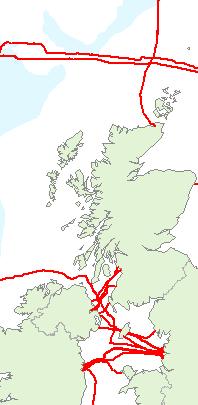
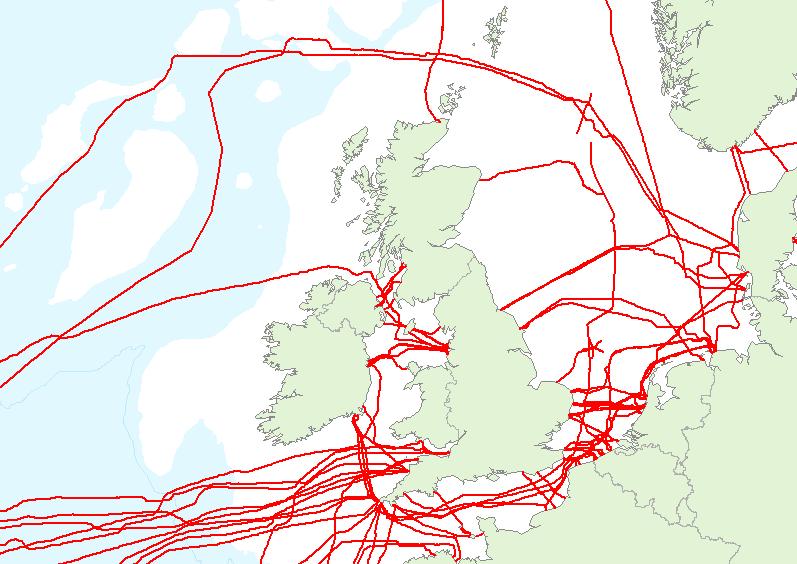
Exhibit 1: Transatlantic Cable Landing Countries
Price stabilization, long-term investment in capacity, concerns about having sufficient redundant capacity, and increasing demand for network resiliency also support the idea of a migration towards quality and away from survival mode.
Within the intra-regional Europe Atlantic market, the main area for potential growth in the submarine cable sector appears to be in the Baltic Sea and around Scandinavia. The main reason for this is the age profile of the systems in this region, coupled with worldwide growth in IP traffic. For example, of fifteen cable systems on the key routes between Denmark, Sweden, and Finland, nearly sixty per cent of the available capacity is located on cables which were built before 1999. The new Norwegian coastal festoon system between Trondheim and Narvik is tangible evidence of this trend.
cable and there are only three high-capacity cables in total. This route is considered critical by transatlantic customers for providing resiliency in the event of disaster at termination points in either UK or France. Cable & Wireless’ recently announced decision to construct “Hugo” (UKGuernsey-France) goes some way to addressing this issue.
Preliminary Forecasts
Pioneer’s new report will incorporate the latest figures on European Internet penetration and broadband demand, as well as corporate data and switched voice demand. Indications are that demand for intra-regional and transatlantic submarine fiber optic capacity is robust. Preliminary forecasts indicate compound average growth rates of more than fifty percent in demand for both transatlantic and Europe Atlantic intra-regional capacity.
Exhibit 2: Cable Age Profiles and Available Capacity on Key Europe Atlantic Regional Routes
Further impetus to growth in the Baltic region may come from a re-energized Russian telecom industry which is looking to follow its oil and gas counterparts by internationalizing its business. While Pioneer remains skeptical of grand plans to build a submarine fiber optic link along the planned No rth European gas pipeline and “Polarnet” remains stuck in the ice, there is strong potential for Russian investors to snap up any
Further impetus to growth in the Baltic region may come from a re-energized Russian telecom industry which is looking to follow its oil and gas counterparts by internationalizing its business. While Pioneer remains skeptical of grand plans to build a submarine fiber optic link along the planned North European gas pipeline and “Polarnet” remains stuck in the ice, there is strong potential for Russian investors to snap up any available assets which would offer an alternative to transiting numerous East European networks in order to reach the West.
Elsewhere in the Europe Atlantic region, the concern is not so much with the age profile of cable systems but with the lack of route diversity. For example, on the UK-France route, nearly half of the currently available capacity is on MCI’s “Ulysses”
Upgrades to transatlantic systems are likely to begin occurring within the next two years. However, if our assumptions are correct about the potential for growth in usage of broadband applications (fixed and mobile) and the “migration to quality” continues to drive requirements for better network resiliency, available unlit capacity on transatlantic systems could be consumed relatively quickly thereafter.
As highlighted above, there is already pressure on certain routes within the Europe Atlantic region for additional capacity to facilitate disaster recovery. Pioneer’s initial analysis suggests that “Hugo” is the first sign of new demand for intra-regional submarine fiber optic capacity which will be met over the next five years by a combination of upgrades to existing systems and construction of a few new feeder systems on key routes.
Since joining Pioneer Consulting, Julian has brought his broad international industry experience and his knowledge of the market to bear on the issues facing the submarine fibre optic industry today. He coauthored Pioneer’s latest submarine market report which combines a worldwide forecast of supply and demand with a comprehensive study of the equipment market and suppliers’ competitive positions. He is currently researching a transatlantic and Europe Atlantic report, as well as leading a Traffic Study for the West Africa Festoon System (WAFS). In February 2006, Julian became a Managing Partner and co-owner in the company. Julian has a first degree from Manchester University, U.K. in Russian Studies and a MBA from Cranfield, one of Britain’s top three business schools. He began his career with British Petroleum and was instrumental in developing BP’s first downstream activities in Russia before and immediately after the collapse of the Soviet Union. He went on to provide marketing and strategic consultancy services to Chevron International Oil Company in Eastern Siberia, Kazakstan, and Azerbaijan before switching to telecom. He spent 4 years as Cable & Wireless Representative Director in Moscow, building up a large and profitable business, based on aggregation of international PSTN traffic and provision of managed data services to multi-nationals. He then accepted a post with Cable & Wireless Global Marine as International Marketing Director, Japan. Based in Japan for two years, he assisted Global Marine’s Japanese joint venture partner, NTTWEM, to develop and implement a new international marketing strategy.
Since joining Pioneer Consulting, Julian has
“A banker is a fellow who lends you his umbrella when the sun is shining, but wants it back the minute it beings to rain”.
Mark Twain, US Novelist, 1836 – 1910
A Responsible Future
By Alan Robinson
I read with interest Jean Devos’ “Letter to a Friend” in the last edition (March 2006) of SubTel Forum and, having been directly involved in both Gemini and Apollo, felt the need to reply and articulate a view that I have formed with my experience of these two systems. The need to “say something” was further inspired by John Manock’s “Recovery year behind us….” This article took an analytical view of 2005 and a crystal ball attempt to see through 2006.
Jean is absolutely correct to look at Gemini as a prime example of a system developed at “the time of plenty”. The fundamental reason for introducing a privately financed cable to compete with the TAT’s, was to allow the newly de-regulated and licensed international carriers the commercial freedom to compete against the incumbent telco’s who formed the TAT consortia. Gemini had a simple shareholding structure, was underpinned by bank debt and had a small, capable management team. This allowed the venture to be planned, executed and operated in a very straightforward and effective manner, enabling quick decisions and sound profitability. The bank debt was repaid early, the company generated considerable amounts of cash and the business plan was exceeded in just about every aspect of its delivery. The sun truly shone, and Jean’s banker friends were busy replicating the model, firstly in the Atlantic and then around the world. Billions of dollars were
pumped into the supply side and the rest is history – the storm clouds gathered and the bankers ran for shelter, taking with them the valuable finance capability needed to build vital elements of global infrastructure. Bankruptcies, Chapter 11 filings, distressed asset sales all followed, and the industry is still trying to recover. The supply side was in meltdown, with companies having to slash costs to chase prices that were in free fall.
During this turmoil, Apollo was built as a successor to Gemini, using a very similar formula and business model. Supplier finance replaced bank debt, and the joint venture included the system manufacturer, ASN as a minority shareholder. A similar management structure was developed and almost all operational tasks were outsourced. The objective is always to achieve the lowest operational costs, whilst maintaining the highest level of operating capability and standards.
The differences in the operating characteristics of the 2 systems are relatively easy to understand even for the less technically minded. Gemini, after upgrades, had a maximum capability of approximately 6 x 10 g/bit wavelengths on a protected basis or approximately 12 x 10 g/bit wavelengths on an unprotected basis. Apollo was built without ring protection allowing customers to develop their own mesh networks. The fully lit capacity for the system is 640 unprotected 10 g/bit wavelengths, which over time, as more wavelengths are lit, guarantees our customers the most cost effective capacity across the Atlantic. In addition, Apollo differs from Gemini by offering a direct Europe (Paris) to Washington route which avoids New York. No other Atlantic system offers this route.
So in summary, Apollo has the highest capacity capability, with the lowest unit operating costs and two diverse routes from London to New York and Paris to Washington and New York. Our confidence in our service offering was underpinned by the recent Level 3 purchase of 300 g/bits (30 x 10 g/bits) of capacity, with Level 3 having an option to purchase another 300 g/bits in the medium term. The agreement with Level 3 established them as our major anchor tenant and was developed in a partnership approach. Both companies were looking to the long term and had a common objective to stablise supply in a period of increasing uncertainty and lack of investment.
John Manock in his SubTel article concluded that this was a refreshing change from the difficult conditions over the past 3 years. He is indeed correct…. But the Level 3 capacity deal with Apollo by itself will be insufficient to see the return of the bankers. Investment in new systems will have to be funded by the users as part of a consortium model in which the owners take the fundamental risk. And this situation is likely to be with us for some considerable time. The current, unsustainable situation in the Atlantic defies all the basic laws of economics. The buyers, presented with an oversupply situation, are intent upon forcing down prices to beneath incremental upgrade and operating costs. Level 3 took a long term, partnership approach, whereas the majority of Atlantic buyers seem focussed on the short term and appear to be determined to bankrupt their supply base. If this attitude continues, it will have serious repercussions and those systems that have already had one session of intensive care, may find they need another.
Prices have to rise in this “commoditised” capacity market. But capacity is not a true commodity, nor is it likely to be traded as such, for a long, long time. Investment in systems follows some very simple economic rules which is why the original consortium approach of risk and finance sharing was so applicable in the early days of submarine cable development. Competition is healthy, but the barriers to entry are enormous. The banker and the manufacturer helped knock down the barriers, but the rush for quick payback and profit not only led to a misguided appreciation of future demand, but a frenzy of investment.
The banker is not going to solve the problem he helped to create. The industry has to solve it by responsible buying and selling. After all, the bank financed system, with a small, dynamic management team focussed on running a business which generates returns for the shareholders does work. Southern Cross is a perfect example of such a model. But before we blame the bankers, we need to get back to some fundamental disciplines that are required to underpin long term, high risk, infrastructure investments and this includes buying and selling responsibly!
Alan Robinson Managing Director
Alan Robinson is Managing Director of Apollo and President of the SubOptic Executive 2007 committee. He has extensive experience across a broad range of international submarine cable businesses. Alan is a Master Mariner and commenced his career in BT in 1976. He held a number of appointments in the cableship fleet before taking an operational management role in 1981. He held positions in Sales and Project Management before being appointed BT Marine’s General Manager for the Asia Pacific region, based in Singapore, from 1990 - 1994.
On his return from the Pacific Alan joined Cable & Wireless where he has held a number of senior management positions in network operations and capacity management. He was a Director of Gemini from the system’s inception to closure.
PrOjeCT LOgISTICS fOr regIONaL SySTem INSTaLLaTIONS
By Virginia Hoffman
While the installation of cable systems may be perceived to be far removed from a military exercise or global disaster, the concept of logistical support for these complex project operations is analogous to a military campaign. Over the past several years, large, long distance trans-ocean cable systems have led the way to the linking and development of smaller, more decentralized regional systems. Generally, with large transocean systems, the submarine cable came ashore at one or two locations - the beginning and end of the system - with the shore end cost and risk budget comprising a small percent of the overall system total. Regional systems, comprised of shorter distances between landings and sometimes multiple landing sites, have now significantly increased shore end installation cost percentages with respect to the overall installation or project budget. This cost percentage increase then becomes of critical importance in accurately estimating and budgeting total system cost and risk. As with a military exercise or campaign, development of a logistics strategy becomes increasingly important to improve efficiency, increase cost savings, optimize resources, and reduce risk.
As with many processes, evolution of the concept of logistics has been driven by military dominance and strategy - winners supply their field troops efficiently and effectively. In a classic example of the importance of military logistics, in the summer of 1944 the United States Third Army, commanded by General George Patton, was moving speedily across France when it suddenly got bogged down. The problem was not opposition from the German army - it was a lack of fuel for the vehicles. The army had gotten so far ahead of its source of supply that it had to stop and wait for fuel to
catch up. Additionally in WWII, large pieces of equipment (for example cargo ships and cargo planes) were required to be manufactured to move large quantities of supplies overseas to support simultaneous and multiple theaters of operations – Europe, Asia, Africa and the Pacific.
You will not find it difficult to prove that battles, campaigns, and even wars have been won or lost primarily because of logistics.
- General Dwight D. Eisenhower
Historically, changes in the composition of military forces from isolated, small groups (for example, the Macedonian syntagma) to the global challenge of Operation Iraqi Freedom have shaped the development of logistical strategy. This evolution in how logistics is viewed has also supported the generation of an administrative function – the logistician - required to anticipate and sustain these large bodies of personnel and transportation requirements. And as armies grew larger, a natural progress in the emergence of tactical flexibility, increased geographic operations area (aero squadrons), and small groups operating within the larger army (Pacific island war fare) generated the additional need for effective communications between the support staff and field operations.
A little neglect may breed mischief: for want of a nail the shoe was lost; for want of a shoe the horse was lost; and for want of a horse the rider was lost.
- Benjamin Franklin
The Department of Defense Dictionary of Military and Associated Terms defines the term logistics as: the science of planning and carrying out the movement and maintenance of forces. In its most comprehensive sense, those aspects of military operations which deal with: a. design and development, acquisition, storage, movement, distribution, maintenance, evacuation, and disposition of materiel; b. movement, evacuation, and hospitalization of personnel; c. acquisition or construction, maintenance, operation, and disposition of facilities; and d. acquisition or furnishing of services.
The Asian tsunami and Hurricane Katrina as non military natural disasters have also affected the understanding and underscored the critical nature of the movement of supplies and personnel as part of an emergency response. In the case of the tsunami, logistical activity was complicated by the addition of third world health and transportation problems. The sheer immensity of these two events required global mobilization into areas of devastation with little or no support services. Major lessons were learned regarding movement of life saving materials and personnel and these lessons are now being applied and regulated to mitigate timely and costly mistakes within the logistics and emergency response community.
You realize when shoeing the horse that the shoe may be thrown--possibly causing the horse to run, so you have a mule on standby to get the rider to the war.
- Capt John P. Laverdure, Scott Air Force Base, HQ Air Mobility Command, 1996
Utilizing these lessons, in the development of an installation logistical strategy, the first item to be addressed is development of a logistics plan. Whether for a large or small regional systems, the plan should contain several key items: acquisition of data, development of working timeline, personnel responsibilities, a communications plan, and a contingency plan. This plan should be nominally developed during the bid process to identify any items that will escalate costs and then upon award, detailed, developed, and implemented and then studied for success/failure factors:
• Data regarding the political and geographical region. For instance, this would include local language(s), whether or not work permits are required, the time to process them (which must include subcontractor personnel), any regulations regarding passage of materials or personnel, contractor or subcontractor nationality issues, embargos on any materials, security (national or otherwise), identification of general transportation requirements, initial identification of critical path elements, currency or banking requirements, or any third party issues such as key subcontractors/services. Within the certain geographic regions such as the Caribbean, multiple island nations (and languages) may be part of the system. This generation of data will provide more accurate and timely visibility of requirements.
• Development of working time line to further quantify and identify critical path items. Within a regional system, the physical movement of project assets from one location to another may require
extra cost to meet schedule (for instance, limited flights between islands, equipment must be brought to the island to assist in shore operations), special equipment to handle freight, or identification of official personnel to clear items into the country. The development of a time line would better mitigate schedule and cost risk by 1) identifying possible non traditional methods of transportation or asset use (ferries, charter services), 2) implementing possible pre positioning/storage solutions, or 3) by identifying if assets are unavailable within country.
• Develop personnel responsibilities and locate resources. Seemingly simplistic, but the creation of a hierarchy and responsibilities within the logistics requirement will facilitate communication and efficiency. Single point of contact becomes necessary and mitigates risk, especially if field communications are compromised or non existent.
• Development of a communications plan. Field operations usually run 24/7; consequently clear lines of communication must be developed to efficiently anticipate any problems and to confirm assets. In some areas, cell phone coverage is basically non-existent or may require expensive roaming charges. Use of local systems may add considerable cost if not done properly. Additionally, the change in contact phone numbers for key individuals may frustrate or impeded field decisions. Setting up communications and notification of contact procedures prior to field operations will assist in efficiency. Other items to consider are email, project
information distribution methods, and incommunicado of key personnel.
• Development of a contingency plan. Within any plan, options must be considered for maximum cost savings and risk reduction. Projects scheduled for installation during “bad” weather seasons (for instance, winter in the northern areas, or hurricane season in the Caribbean), must have contingency plans available for both personnel safety and material movement. Additionally, assets may require movement through geographical areas that are vulnerable to weather patterns.
As the plan is being fully developed, the second major item is the acquisition of materials or services using subcontractors in accordance to the plan. In a larger project, this item may be a stand alone unit or division - it functions to identify and bring on line (or under contract) assets and points of contact, and to ensure availability of services and materials. Personnel in this position are sometimes referred to logisticians. Additionally, the process of either pre positioning assets or storage of either parts or finished materials as operational issues will also need to be addressed. In some instances, due to transportation or support equipment restrictions (such as cable loading operations onto smaller vessels in foreign ports or transport of heavy equipment to support shore end operations), pre positioning and/or storage may facilitate cable ship schedules and be more cost effective. Agents will need to be identified and contacted.
Transportation of equipment and shore personnel ahead of the cable ship becomes critical to keep installation or cable ship schedules. In some cases,
My logisticians are a humorless lot...they know if my campaign fails, they are the first ones I will slay. - Alexander
it may be necessary to have logistics support move in advance of the shore end operations if local assets have not been defined or developed within the logistics plan. The addition of a logistics support person to each operation to coordinate and negotiate local small assets regardless of the project size may reduce risk within the overall project.
Bottom line, development of a comprehensive logistics strategy and plan that includes field support personnel within the project team will mitigate risk, control cost, increase efficiency of operations, and ensure successful field installations for regional cable installation projects.
Virginia Hoffman With over 25 years of engineering and procurement experience, she received a BS degree in Physical Chemistry from Stockton State College in 1976 and a BS degree in Ocean Engineering from Florida Atlantic University in 1978. She joined the Naval Underwater Systems Center, Atlantic Undersea Testing and Evaluation Division supporting ASW and the various Navy ranges and then moved to Tracor Marine in Fort Lauderdale where she worked on different ship, salvage, and ocean construction projects. Since leaving Tracor, she has worked with several companies involved in marine engineering and most recently with Global Marine as the Offshore Liaison and Government Sales Representative. She joined WFN Strategies in 2005 as Project Manager, and has supported telecom projects in the Gulf of Mexico, Caribbean and West Africa.
Improving Time-To-Market and Reducing Risk Before and During Project Implementation
By Debra Brask
In today’s transoceanic and regional telecommunications markets, it is critical to provide capacity on newly constructed systems in the shortest time possible for system owners to meet or exceed business case expectations. The critical factors in reducing project intervals and risk are the manufacturing back log of the suppliers, preliminary planning of the project, initial capacity needed to meet business plan objectives, and the cooperation between the supplier and owner during the construction. A variety of approaches can be executed during the planning and implementation of submarine projects that show improvements in the traditional schedule intervals. The result is the potential reduction on the order of 4-6 months from traditional implementation.
Pre-Contract Planning
The first critical decision to minimizing risk is the identification of the system’s geographic locations. Once the locations are identified, a brief preliminary analysis of the ability to obtain an operators license within each country should be conducted. The best approach to obtain this information is to contact local counsel with experience in the telecommunications market. The contact will be able to provide advice on the interval needed to receive a license, or if a landing party will need to partner with the owner to land/ operate the system.
Once the need for a partnership is determined, identification of potential landing parties should begin as soon as possible. When the landing party partner has been selected, the team should proceed to negotiate and sign a landing party agreement as soon as possible. In circumstances where no landing party is required, the owner should begin the process to file for an operator’s license. This is critical in most countries because operational permits cannot be requested or obtained until the operator’s landing license has been granted. This license allows a supplier to begin filing for operational permits immediately after contract signing.
The next important factor in site selection is determining the feasibility of obtaining construction permits, both land and marine. Evaluation of the permits in various municipalities within a given country can determine if approval of permits will be a three-month or two-year process. If the approval process is too lengthy, potentially due to environmental impact studies, an alternate site may be selected and the system design can be modified to ensure that the key cities are still being integrated.
Owners may opt to install a branching unit, independent of the municipality selected for the landing site, which will eventually enable connectivity into a country that has too lengthy a permitting process. This facilitates generation
of revenue on the remainder of the system while awaiting approval to land in countries not initially included. This allows for a shorter interval to bring these countries online as soon as permitting is approved. Selection of a site that will not change during the implementation of the project, or be burdened with prolonged permit intervals, is critical to maintaining the accelerated schedule. Desk Top Studies are a direct way to obtain the required permitting information. This study aids in the permitting process as well as understanding the initial route and landing location. Changes during this stage of the project related to the landing site, accommodating permitting barriers, selecting marine routes or terrestrial connectivity to the landing station do not significantly impact the project duration. Contracting for a Desk Top Study, prior to the contract coming into force is highly recommended for project optimization. Desk Top Studies will also state if there are potential weather windows to avoid. Installation should occur when the weather window is most favorable for marine work to avoid downtime.
Preliminary planning, with respect to initial capacity (number of wavelengths and the number of fiber pair being lit), can reduce the project schedule interval while allowing an owner to turn on the first few wavelengths for capacity sales. The remainder of the wavelengths can be added on an “as needed” basis in accordance
with capacity demands. Lighting up a single fiber pair with multiple wavelengths rather than one wavelength on multiple fiber pairs, will save time on installation and testing.
Project Implementation
Interval reduction should focus on key areas in project implementation: permitting, route survey & engineering, system engineering, manufacturing & procurement, installation and testing. Related similarly to that depicted by Figure 1 below, the standard intervals and relationships between the work items can be improved for each of these major categories with cooperative efforts between the owner and supplier.
The implementation phase for the system supply begins with an “Intent to Proceed” (ITP) or “Memorandum of Understanding” (MOU) arrangement between owner and supplier. The next one-to-two months are spent negotiating the details of the contract, technical solution and overall expectations (Contract Forming). It is essential to maximize planning during this time, through collaboration between both parties, for any significant interval reduction to be achieved.
The two critical implementation activities to be initiated during the Contract Forming phase, if they have not been completed in the preliminary planning stage, are a Desk Top Study and longlead material ordering. A Desk Top Study should be undertaken to facilitate Route Survey & Engineering and permitting activities immediately after the contract is signed. Long-lead material orders can be placed during the Contract Forming phase if sufficient funds have been provided with the ITP. This allows the purchaser to reserve space in the manufacturing queue at the supplier’s factories. Depending on the length of negotiations, this may save one to two months. Figure 2 captures the impact of these actions.
Two activities are dependent upon information derived from the Route Survey & Engineering and Desk Top Study effort: Cable Manufacturing and System Design. Cable armoring and integration can be modified based on the Route Survey and Engineering output. Current Technology allows for a reduction in the Route Survey/Route Engineering interval as Route Survey data can be processed during the survey and transmitted to the Route Engineering team for real-time engineering of the system. This can potentially save a month of engineering time after the entire survey is complete. The owner should participate in both the deep sea and near shore surveys to
Figure 2. Accelerated Flowchart
Figure 1. Typical High-Level Project Flowchart
ensure that each is engineered and approved in the shortest time frame possible.
As the project moves into the manufacturing phase, flexibility is important in maintaining interval reduction options. Consideration might be given to staging cable or using freighters to transport and stage cable at or near the cable grounds. Separating the marine program into a main lay and burial program with two different vessels can reduce the overall interval, although the cost of the program would be higher due to an additional transit and mobilization. The burial portion of the program would be installed first since this is typically the longer of the two marine programs. This is particularly relevant for system with greater than 600km of burial.
Factory Acceptance Tests are an integral aspect of time effective practices. Traditionally, purchasers request to witness factory testing on all products. All equipment is tested in the factory and the results are provided to the purchaser. Purchaser witnessed testing is traditionally a repeat of a majority of these tests and can be eliminated or minimized to one piece of each type of equipment. The initial factory test results can be compared to the customer witnessed re-run of the tests, ensuring the product performs according to specifications. Purchaser confidence trials during manufacturing should also be eliminated to reduce the project interval. Overall, these measures can reduce the dry plant manufacturing interval by one month.
Dry Plant commissioning focuses on each segment as the final splices are achieved and evolve into a parallel effort. Improvements in testing intervals can be achieved through the elimination of separate Purchaser Test Periods
by incorporating purchaser tests into the standard commissioning program. Purchaser representation during the approval of test results is highly recommended because it can eliminate time required for a separate review period of the results. These efforts can eliminate one to two months in the overall schedule.
CONClUSIONS
Continued investment in the undersea fiber-optic infrastructure is required to support the demand for bandwidth across the globe. Effective upfront planning and initial groundwork, which will minimize change in scope after contract signing, can lay the foundation for a successful implementation. While much will be contingent upon the manufacturing backlog of suppliers, accelerating time-to-market is possible given the right circumstances and cooperative efforts between the supplier and purchaser. Tyco Telecommunications currently has reduced the interval for delivery of undersea fiber-optic telecommunications systems from previous years; however, efficient up front planning between the supplier and purchaser continues to be the key item in reducing project risk during implementation. Permitting and cable station availability delays continue to be the two factors that cause delays in the implementation of projects.
Ms. Debra Brask is Managing Director of Project Management at Tyco Telecommunications. She has been with Tyco Telecommunications since June 1997. In her current position, Ms. Brask manages the company’s Project Management, Documentation and Training organization. Prior to joining Tyco Telecommunications, Ms. Brask held the position of Program Manager at Lucent Technologies where she managed various Government Programs.
Prior to this, she held the position of Member of Technical Staff at Bell Laboratories. Ms. Brask graduated with a Bachelors degree in Ceramic Engineering from Rutgers University in New Brunswick, New Jersey USA, a Masters of Engineering in Material Science and a Masters of Science in Technology Management both from Stevens Institute of Technology in Hoboken, New Jersey USA.
Debra Brask Managing Director of Project Management
THE CABLESHIPS
Middle East
The oldest and traditional fiber optic route is via the Middle East, using the systems of Flag Euro Asia or SEA-ME-WE-3.
These two submarine systems were immensely significant developments at their time of construction. They are essentially branched systems designed to provide connectivity to large numbers of countries en route. Ring protected submarine systems in other oceans of the world were developed later and neither Flag nor SMW-3 are, in themselves, ring systems. Restoration of Flag and SMW-3 has to be created using support of capacity one from the other or from other, less immense systems which parallel some of the route.
The RTD is circa 230 ms. Prices are quoted by various suppliers, offering a range of prices normally at least double those via USA/transPacific option.
It is obviously apparent that the buyer’s criteria will decide which route to use from the
above 3 options. If, for example, RTD is of optimum importance to the buyer, then the new additional option of routing via Russia, one would assume, will be of great interest.
Future price movements, by nature, are of course very difficult to predict. The USD 35 000 represents a small reduction on prices over the past 12 months. Price reduction in the last year has been small compared with the annual reduction of circa 50 % p.a. that has been recorded over previous years. We can but hope that prices across the Atlantic, across continental USA and across the Pacific have now stabilised. As regards the trends in prices on the route via the Middle East, the prices of Europe-Asia capacity following that route have declined less dramatically over the previous five years yet we can see nothing to cause upward pressure on prices on that route.
Indeed, with new cables opening up between India and Singapore and onward to Eastern Asia, there is now a lot more competition
on those segments of the route than there was two or three years ago.
The likely trend in prices of capacity on the route via Russia and Mongolia is very hard to predict. There are relatively few suppliers capable of provisioning end-to-end circuits and therefore the intensity of competition is not as great as either of the other routes. The existence of the other routes nevertheless should continue to act as a downward pressure on prices on the shortest route.
The growth of predicted traffic to China over the coming years is well known. Indeed China Telecom is pro-active in being a part of this business, launching plans to develop business in Europe by opening a new office in the UK. The company, which has already made similar moves into the North American market, is believed to be tracking corporate customers with bases in Europe and China.
China Telecom was granted an operating licence in the US two years ago, enabling
Letter to a friend from Jean Devos
My dear friend,
Suboptic: A Celebration
My Dear Friend
“Botany Bay”
It was a pleasure to see you at the Lisbon “Submarine Communications 2006” conference last month. I have enjoyed our dinner on the river side where we discussed at length which great personality, which big name it would be good to invite to Suboptic 07 in Baltimore next year. Three names emerged among others: Bill Clinton, Bill Gates and Colin Powell. Somewhat more attractive than what we had at previous session: A narrow minded politician in San Francisco, an hermetic philosopher in Kyoto and a low profile chairman in Monaco! We deserve somebody with a vision!
not need just another Telecom conference. We need a family gathering, where we draw the picture of our community, and where we plan the future staying loyal to our roots.
Warrior event was still in everyone’s memory. It is for these reasons among others that STC (UK) rejected the Alcatel‘s suggestion to come with a joint bid, to offer a “European” solution.
I do hope the organiser of the coming event will stay on that line. The success of Suboptic should not be measured by the number of attendees only, but by their quality-I mean people who have something to bring or something to learn- and the spread of them.-I mean people from all around the world making a multicultural event. The success of Suboptic 07 is a Tyco challenge, but it is everyone’s job, because it is in everyone’s best interest. Each of us should feel committed to promote this event, and do whatever possible to stimulate the attendance, especially from the developing world. The organizers, but us also, needs to think “out of the box”, and work out innovative ideas toward cost effective solutions such as group package, etc.
One of the winning factors has been the Port-Botany cable factory. Such a factory was a strong requirement from OTC (now Telstra) and the Australian Government.
The underlined idea was that the world needs an optimised telecom infrastructure, a truly global network. Building such an infrastructure is a mission. Each of these three leaders could credibly illustrate and endorse such a message. Most of the projects at this moment are designed to connect very remote countries or territories which were kept out of the modern broad band network. No community,
I published recently a modest novel, whose title is Botany Bay. It is the place in Australia where Alcatel established a submarine cable factory in 1989 as part of its contract for the Tasman 2 link. In this same bay, where two centuries before the French expedition “La Pérouse” made of two ships, La Boussole
even small, can afford to stay away from such a development. Access to broadband internet is now as vital as water supply or electricity. Most of these projects are “governmental “initiative, sometimes with the World Bank support. Suboptic 07 needs to show a new business culture: Our capabilities needs to serve the need of the global economy through the construction of an optimised network accessible to everyone at fair conditions .This is our duty! Such structure will serve a harmonised world development. Suboptic 07 needs to be the gathering of our community, bringing people from really all around the world, including the most remote island, from Svalbard to Tahiti!
and l’Astrolabe, landed in 1788 to discover that Captain Cook was already around bearing the British flag. So Botany Bay is now for me the symbol of a dream which becomes a reality!
Tasman 2 has been yet another chapter in this long Anglo-French competition! The award to Alcatel came out as a big surprise to many, including inside Alcatel. Everybody was naturally expecting the British to win that battle, and such an expectation was at that time very logical.
Suboptic is a light house designed to help us at sailing in the right direction. Our business stays very specific in many ways and Suboptic must be based on such specificity. We have our culture, our language. What is our mission, what is our role? How best can we serve? We need to review and analyse what is happening. We need to revisit some of our procedures, some of our behaviours. We do
There were so many difficulties and misunderstanding between Australia and France, the main one being the French presence in the Pacific area, the worse being the nuclear bomb experiment in Tahiti! The sad Rainbow
Alcatel was the most motivated. Such a factory could expand its influence in the Pacific where the three other players were historically well established in this region, which represents a large part of their market. They saw this factory as a risk for their existing facilities! SubOptic ‘87 in Versailles came at the right time. It is where the Australian teams discovered the French model, a close cooperation between Alcatel and FT, exactly what they wanted to establish in their country.
My friend, at the very end of our Lisbon dinner – was it due to the “vino verde” - you told me: “I do not think I’ll attend Suboptic 07. I don’t see my management approving this spending for a 3 days conference in Baltimore”. This statement is why I am writing you today. Tell your management that attending Suboptic is a must for whoever wants to play a role in our business whether Bill Gates is there or not!
Not attending is like not celebrating Easter for a Catholic, or not going to the Mecca pilgrimage for a Muslim. As simple as that, an act of faith!
My friend, things are changed since, but one thing stays true: When you offer something, the reader can see between the lines if you are or not genuinely motivated and sincere. Then your offer becomes really attractive and this opens the route to “Botany Bay.”
So...See you next year in Jerusalem, I mean… Baltimore!