Submarine Telecoms Forum is published bi-monthly by WFN Strategies, L.L.C. The publication may not be reproduced or transmitted in any form, in whole or in part, without the permission of the publishers.
Submarine Telecoms Forum is an independent commercial publication, serving as a freely accessible forum for professionals in industries connected with submarine optical fibre technologies and techniques.
Liability: while every care is taken in preparation of this publication, the publishers cannot be held responsible for the accuracy of the information herein, or any errors which may occur in advertising or editorial content, or any consequence arising from any errors or omissions.
The publisher cannot be held responsible for any views expressed by contributors, and the editor reserves the right to edit any advertising or editorial material submitted for publication.
Contributions are welcomed. Please forward to the Managing Editor: Wayne F. Nielsen, WFN Strategies, 19471 Youngs Cliff Road, Suite 100, Potomac Falls, Virginia 20165, USA.
Tel: +[1] 703 444-2527, Fax:+[1] 703 444-3047.
Email: wnielsen@wfnstrategies.com
General Advertising
Les Valentine
Tel: +[1] 281 531 7417
Email: lvalentine@wfnstrategies.com
Designed and produced by Unity Marketing
Exordium
Welcome to the March 2006, 25th issue of Submarine Telecoms Forum, our Finance & Legal edition.
Spring has well and truly come to Virginia. The daffodils planted seasons before are coming up much more plentiful now. We are appreciating an early thaw with the promise of a bountiful harvest to come. And, funny enough, this month’s articles reflect a similar exuberance and wistful optimism not seen for some time.
Authors, who have come through and are willing to put their proverbial heads on the block of public opinion, have provided, once again, some excellent industry insight for your consideration.
John Manock discusses the positive trends ahead for the submarine systems market, while Jim Bishop and John Walker enhance the continuing cable security discussion. Daryl Chaires describes the benefits of all-Raman technology, while Ray Drabble assesses the environmental risks of cable decommissioning. Stewart Ash describes recent UJ developments, and Andy Bax announces a recent technology acquisition. We reprise Richard Faint’s excellent article about the ‘terrors’ of cyberspace, as Andy Shaw informs about the re-birth of an old industry brand name. We conclude the multi-part serialization by Bob Bannon and Doug Burnett of terrorism and cable infrastructure concerns. Jean Devos returns with his ever-insightful observations, and of course, our ever popular “where in the world are all those pesky cableships” is included as well.
Happy reading and we hope you enjoy this edition, and offer in closing the reflections of Don Corleone who once opined in awe, “A lawyer with his briefcase can steal more than a hundred men with guns.”
Middle East
The oldest and traditional fiber optic route is via the Middle East, using the systems of Flag Euro Asia or SEA-ME-WE-3.
Emails to the Editor
Wayne,
Spectacular job putting this together...it’s very impressive.
Thanks very much for the 2006 Submarine Telecoms Forum Calendar. Very much appreciated.
Dr. William J. Barattino, Global Broadband Solutions, LLC
Also congratulations on your 5th year of publication.
These two submarine systems were immensely significant developments at their time of construction. They are essentially branched systems designed to provide connectivity to large numbers of countries en route. Ring protected submarine systems in other oceans of the world were developed later and neither Flag nor SMW-3 are, in themselves, ring systems. Restoration of Flag and SMW-3 has to be created using support of capacity one from the other or from other, less immense systems which parallel some of the route.
Thank you for your Email and the short cut to the Submarine Telecoms Forum. I briefly visited this website and found the information to be quite interesting.
above 3 options. If, for example, RTD is of optimum importance to the buyer, then the new additional option of routing via Russia, one would assume, will be of great interest.
on those segments of the route than there was two or three years ago.
I was impressed with Issue 23. Can you please subscribe me to SubTel Forum?
John Walrod Asst. VP, SAIC Advanced Systems Division
Bill Brock, For BP America Production Co
Wayne,
You created a forum for all of us in the Sub-Cable industry and I am sure everyone cheers your initiative; here’s to celebrating the 10th year.
Steve Silvano
TSI Telecom Enterprises
The RTD is circa 230 ms. Prices are quoted by various suppliers, offering a range of prices normally at least double those via USA/transPacific option.
It is obviously apparent that the buyer’s criteria will decide which route to use from the
It was quite informative and interesting. I do not think that you will be willing to provide such an information services free of charge for a long time.
Best regards,
Sumio Yamano, Sumitomo Ocean Development & Engineering Co. Ltd.
Future price movements, by nature, are of course very difficult to predict. The USD 35 000 represents a small reduction on prices over the past 12 months. Price reduction in the last year has been small compared with the annual reduction of circa 50 % p.a. that has been recorded over previous years. We can but hope that prices across the Atlantic, across continental USA and across the Pacific have now stabilised. As regards the trends in prices on the route via the Middle East, the prices of Europe-Asia capacity following that route have declined less dramatically over the previous five years yet we can see nothing to cause upward pressure on prices on that route.
A confidential service for the supply of specialized positions for the submarine cable sectors serving oil & gas, telecoms and defense industries
Good day to you all at WFN. You guys are doing a great job. I got the SubTel Forum calendar. Many thanks to you guys. I look forward to meeting you at one of the conferences this year.
Alabaja Kayode .J Chairman/CEO, Kay Global Limited, Nigeria
� Direct Placement Support
� Executive Search
The likely trend in prices of capacity on the route via Russia and Mongolia is very hard to predict. There are relatively few suppliers capable of provisioning end-to-end circuits and therefore the intensity of competition is not as great as either of the other routes. The existence of the other routes nevertheless should continue to act as a downward pressure on prices on the shortest route.
� Confidential Reply Service
Thanks for a great read and even though the business is “way down where the music plays”, wherever that may be, there is always a light at the end of the tunnel/ cable.
I received the 2006 SubTel Forum calendar, thank you very much. It is very nice. I’m already campaigning to be a part of it next year.
Daryl Chaires Director of Marketing, Xtera Communications
Mike Wiseman, Esq.
Indeed, with new cables opening up between India and Singapore and onward to Eastern Asia, there is now a lot more competition
Good work on the latest edition.
Les K. Valentine, NEXANS Norway
5advertising@subtelforum.com
Visit our website or contact: Lisa Fontaine Managing Associate – Recruitment WFN Strategies, LLC lfontaine@wfnstrategies.com [+1] 410-268-2036
Job seekers can forward CVRésumé to our confidential résumé database at resumes@wfnstrategies.com
The growth of predicted traffic to China over the coming years is well known. Indeed China Telecom is pro-active in being a part of this business, launching plans to develop business in Europe by opening a new office in the UK. The company, which has already made similar moves into the North American market, is believed to be tracking corporate customers with bases in Europe and China.
China Telecom was granted an operating licence in the US two years ago, enabling
A synopsis of current news items from NewsNow, the weekly news feed available on the Submarine Telecoms Forum website.
Alcatel to Upgrade Global Crossing’s MAC Cable
Alcatel announced that it has signed a turnkey contract with Global Crossing (NASDAQ: GLBC), which owns and operates the world’s first integrated global IP-based network, to upgrade its Mid Atlantic Crossing (MAC) submarine cable network linking North America, Latin America, Europe and the Pacific. www.subtelforum.com/NewsNow/26_february_2006.htm
Asia Netcom Picks Lucent New EAC Optical Platform
Asia Netcom, a wholly owned subsidiary of China Netcom, has selected Lucent Technologies to supply a next-generation optical communications platform needed to upgrade its pan-Asian submarine cable network, known as EAC. www.subtelforum.com/NewsNow/19_february_2006.htm
Asia Netcom Provides Capacity for Asiakomnet
Asia Netcom, a wholly owned subsidiary of China Netcom, has been selected by Indonesian competitive carrier, Asiakomnet, to provide an extensive network connectivity between Singapore and strategic markets in North Asia as well as the US. www.subtelforum.com/NewsNow/19_february_2006.htm
AT&T Outlines Plans for Global Network Expansion
AT&T Inc. has announced details of its 2006 plans to expand its global network, providing enhanced connectivity in the United States and around the world in order to meet the growing demands of its multinational enterprise customers.
www.subtelforum.com/NewsNow/26_february_2006.htm
Bell Labs Announces Breakthrough in 100 Gbps Ethernet-Over-Optical
In a paper presented to the Optical Fiber Communication Conference & Exposition (OFC) in Anaheim today, Bell Labs, the research and development arm of Lucent Technologies, announced the first reported optical transport of electronically multiplexed 107 Gbps data.
www.subtelforum.com/NewsNow/12_march_2006.htm
Bookham Says Its Lasers Getting Attention from Submarine Cable Industry
Bookham, Inc., a leading provider of optical components, modules and subsystems, is highlighting its industry-leading line of 980nm pump laser modules at next month’s OFC/NFOEC 2006 by releasing reliability figures that exceed all expectations for such devices in terrestrial applications.
www.subtelforum.com/NewsNow/5_march_2006.htm
BT Deploys Global IP-based Voice Platform
BT has announced a £12 million investment in a first of its kind global voice platform based on Internet protocol (IP).
www.subtelforum.com/NewsNow/26_february_2006.htm
C&W to Sell Stake in Batelco
Batelco has confirmed that it has been informed about Cable & Wireless’ decision to sell their 20 percent stake in Bahrain’s leading information and communication’s company.
www.subtelforum.com/NewsNow/5_march_2006.htm
Cameroon’s Carrier for Sale
Cameroon’s incumbent carrier, Camtel, is up for sale. The Ministry of Economy and Finance has invited strategic partners to make their proposal to acquire 51% of the company.
www.subtelforum.com/NewsNow/5_march_2006.htm
Chunghwa Telecom Selects FLAG Telecom for Taiwan Academic Network
FLAG Telecom has announced a multi-million dollar contract for 2 x 10 Gbps Wavelengths with Chunghwa Telecom, Taiwan’s leading telecom operator.
www.subtelforum.com/NewsNow/5_march_2006.htm
Corning to Present 2005 Optical Fiber Market Overview
Corning Incorporated provided its perspective on the 2005 worldwide optical fiber market with a focus on global fiber-to-thehome (FTTH) activity. The 25th annual Optical Fiber Briefing was held via conference call and live audio webcast in conjunction with the OFC/NFOEC Conference in Anaheim, California. www.subtelforum.com/NewsNow/12_march_2006.htm
Etisalat Increases UAE Internet Bandwidth
Etisalat has announced a significant increase in Internet bandwidth in the United Arab Emirates (UAE) with a total of 33 STM-1 links being provisioned to meet user needs, compared to 15 in 2004. www.subtelforum.com/NewsNow/19_february_2006.htm
Farice increases reliability in UK backhaul
For the past months Farice has been preparing a reduntant route in the UK backhaul between the landing station at Dunnet Bay in North Scotland and Farice’s Point of Presence.
www.subtelforum.com/NewsNow/5_march_2006.htm
Global Crossing Reports Growth in Converged IP Services
Global Crossing has announced that the number of customers utilizing two or more converged IP services on its global fiber-optic network more than tripled in 2005, highlighting the company’s success in attracting enterprises and carriers to its highperformance, robust suite of IP solutions.
www.subtelforum.com/NewsNow/12_march_2006.htm
Global Marine Installs Power/Telecom Cable in Sakhalin
Global Marine Systems Ltd. (GMSL) has completed the installation of a power/telecom cable for an energy project on Sakhalin Island, Russia.
www.subtelforum.com/NewsNow/19_february_2006.htm
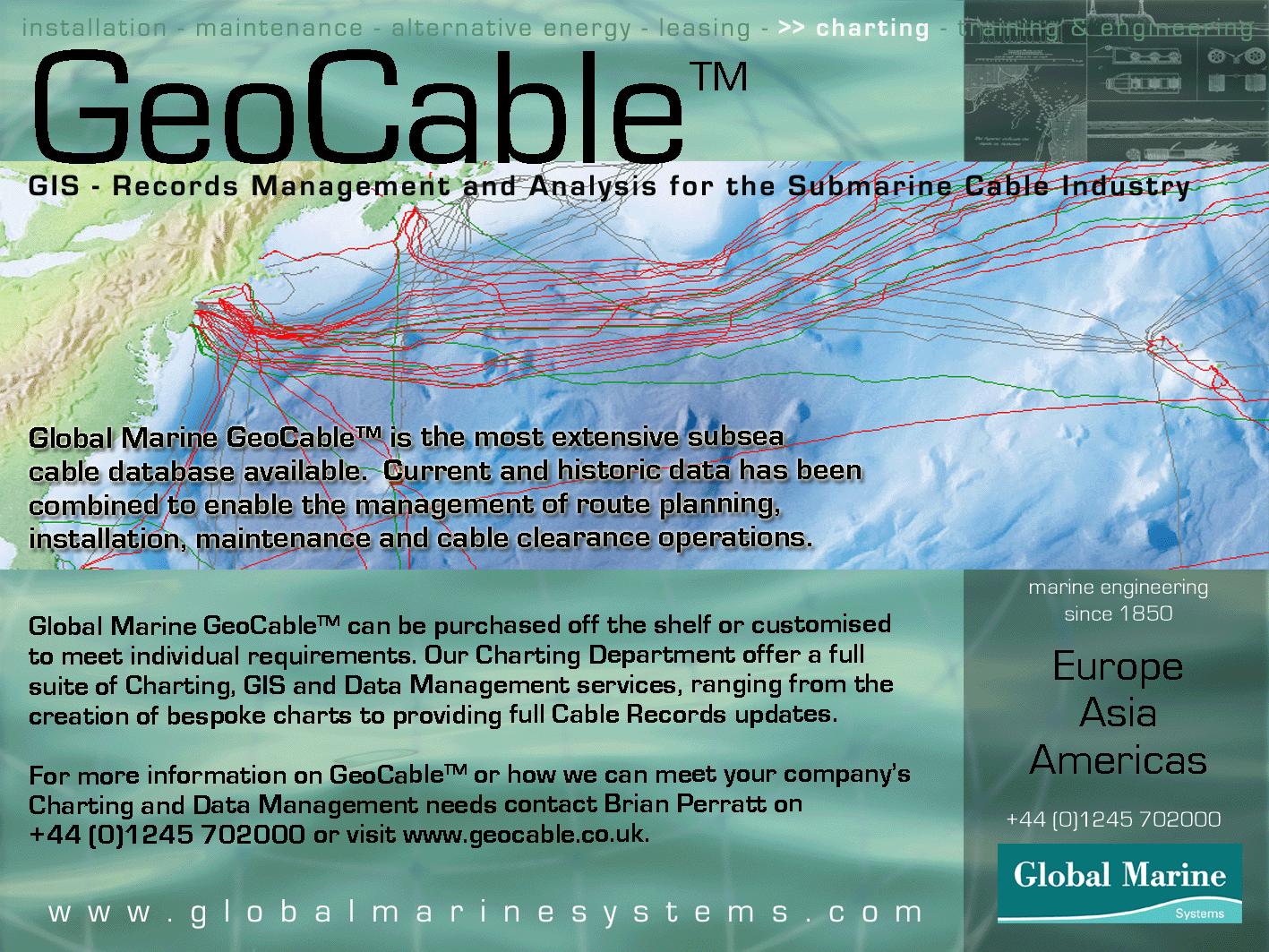
Global Marine launches GeoCable version
5.2
Submarine Cabling Software Package
Global Marine Systems Limited, the independent market-leading subsea cable installation and maintenance company, has launched version 5.2 of its unique GeoCable marine engineering software package.
www.subtelforum.com/NewsNow/12_march_2006.htm
Global Marine Outlines Regional Network Technology Solution
Following up on its announcement last month that it was acquiring the assets of Red Sky Systems, Global Marine has outlined its regional submarine cable technology solution.
www.subtelforum.com/NewsNow/12_march_2006.htm
Global Marine presents The VENUS Experience at Scientific Submarine Cable 2006
Global Marine Systems Limited, the independent market-leading subsea cable installation and maintenance company, is pleased to announce that its Director of Engineering, Dr Phil Hart, will be presenting The VENUS Experience - A Case Study of the Philosophy, Design & Implementation of an Undersea Observatory Network in Coastal British Columbia at 11.10am on Wednesday 8th February at SSC06’ in Dublin.
www.subtelforum.com/NewsNow/19_february_2006.htm
Hibernia
Atlantic Reports Record Growth
Hibernia Atlantic has announced that in the past 11 months, the company has experienced record-high growth in sales of leased Trans-Atlantic capacity.
A new undersea fiber now operating between St. Thomas and St. Croix provides Virgin Island business, government and residential customers with complete fiber connectivity and network diversity both inter-island and to the U.S. mainland, it was announced recently by Samuel Ebbesen, senior vice president of Innovative Communication Corporation (ICC). www.subtelforum.com/NewsNow/19_february_2006.htm
IT International Telecom Completes Fibralink Installation
IT International Telecom is pleased to announce that the Fibralink cable network marine installation is complete. IT was responsible for the marine installation through a direct contract with Columbus Communications. www.subtelforum.com/NewsNow/19_february_2006.htm
KPN Wins Network Contract from German Research Network
KPN has been selected by the public German research network association DFN as one of their long-term suppliers for the implementation of the new scientific X-Win network. www.subtelforum.com/NewsNow/19_february_2006.htm
Level 3 Adds Transatlantic Capacity
Level 3 Communications has announced that it has signed a definitive agreement with Apollo Submarine Cable System Ltd., to secure additional transatlantic capacity for its international network. www.subtelforum.com/NewsNow/19_february_2006.htm
Lucent, Japan Telecom Trial 40 Gbps System
Japan Telecom and Lucent Technologies have announced the successful completion of a field trial using Lucent’s LambdaXtreme® Transport, an industry-leading 40 Gbps optical networking system. Lucent LambdaXtreme® Transport, which can support both 10 Gbps and 40 Gbps traffic on the same system, is designed to help operators such as Japan Telecom address the growing demand for high-bandwidth applications such as mobile broadband, IPTV and other multimedia services by dramatically increasing the speed and capacity of their optical transport networks.
www.subtelforum.com/NewsNow/12_march_2006.htm
Magyar Telekom Enters Romania
Deutsche Telekom’s Hungarian subsidiary, Maygyar Telekom, has launched telephone services for business and residential customers in Romania under the EUfonika brand.
www.subtelforum.com/NewsNow/5_march_2006.htm
Cutting
Makai Ocean Engineering Sells MakaiLay System
Makai Ocean Engineering has just announced the sale of a 2nd MakaiLay system to SAIC.
www.subtelforum.com/NewsNow/19_february_2006.htm
New Pioneer Owners Promise Additional Capital to Provide New Products & Services to Clients
Pioneer Consulting LLC announced today a change of ownership and management that reflects renewed confidence in the telecom sector and increased demand for market research and customized consulting services.
www.subtelforum.com/NewsNow/5_march_2006.htm
New SMD Hydrovision Production Facility In Full Swing
Phase 1 of SMD Hydrovision’s (SMDH) new production facility on the banks of the River Tyne in Newcastle is now complete, with the works in full swing with a number of exciting projects.
www.subtelforum.com/NewsNow/19_february_2006.htm
NTT Optical Fiber Network Users Exceed One Million
NTT Communications Corporation (NTT Com) has announced that subscribers to its “Hikari” optical fiber network reached about 1.06 million as of the end of February. www.subtelforum.com/NewsNow/12_march_2006.htm
Lifting a land based 85 metre high wind turbine, weighing 950 tonnes, and placing it accurately and ‘softly’ onto its mounting is a complex enough task – carrying out this task offshore in deepwater while lifting from a floating barge presents a whole new set of challenges.
www.subtelforum.com/NewsNow/19_february_2006.htm
Online Publication Reports Problems for EASSy
Although the EASSy consortium continues to tout its successes in bringing new members into the consortium and raising money for the project (see yesterday’s NewsFeed), others are more skeptical. www.subtelforum.com/NewsNow/5_march_2006.htm
Orascom Telecom Secures US$2 Billion Committed Bank Facility
Orascom Telecom Holding S. A. E. has announced that it is has secured a five-year senior secured debt facility totaling US$ 2.0 billion on a committed and underwritten basis. www.subtelforum.com/NewsNow/26_february_2006.htm
Phoenix Information Technology Manager Recognized
Phoenix International, Inc., (Phoenix) is pleased to announce that Information Technology (IT) Manager, Claudia Deborah Kutzleb, has been selected by an independent panel of judges as a member of the Federal 100 for 2005.
www.subtelforum.com/NewsNow/26_february_2006.htm
PROMET Unveils A Second FiBOTM Model For Unsurpassed Testing Efficiency Of Polished Fiber Optic Ferrules InSitu
FiBO™ 260, a true phase-shifting Michelson interferometer for non-contact fiber optic ferrule endface verification, offers 3D surface mapping and 2D visual inspection capabilities, plus direct interface with ferrules mounted on a polishing plate, eliminating reproducibility errors and saving valuable time. www.subtelforum.com/NewsNow/5_march_2006.htm
PTCL Prepared for Management Transfer to Etisalat
Discussions were held in Islamabad, Pakistan, recently between the Government of Pakistan and UAE’s Etisalat with regards to Etisalat’s acquisition of Pakistan Telecom (PTCL). www.subtelforum.com/NewsNow/5_march_2006.htm
SBSS Completed Installation of Segment 2 of Jasuka
S.B. Submarine Systems Co. Ltd. (SBSS) has announced that its cable ship Fu Hai, equipped with the Hi-plough and ROV Sea Lion, has successfully completed the marine installation of Segment 2 of the Jasuka Indonesian submarine system on January 9, 2006. www.subtelforum.com/NewsNow/19_february_2006.htm
Shutterfly Selects Terremark’s NAP West to Consolidate Infrastructure
Cutting
Terremark Worldwide, Inc., a leading operator of integrated Tier-1 Internet exchanges and a global provider of managed IT Infrastructure solutions for government and private sectors, has announced that Shutterfly, a leading independent online photo service, has signed a multi-year, multi million dollar contract to house their mission critical infrastructure at Terremark’s NAP West facility in Santa Clara, California. www.subtelforum.com/NewsNow/19_february_2006.htm CTC Marine Projects Ltd. Coniscliffe House,Coniscliffe Road, Darlington,DL3 7EE,England
Sri Lanka Telecom Inaugurates Local Operations of SEA-ME-WE-4
Sri Lanka Telecom (SLT) recently inaugurated the local operations of the SEA-ME-WE-4 fiber optic submarine cable project – a multi-regional connectivity resource milestone spanning 20,000 kilometers.
www.subtelforum.com/NewsNow/26_february_2006.htm
Telecom Italia Sets Goals
Marco Tronchetti Provera, Chairman of Telecom Italia, and Riccardo Ruggiero, Chief Executive Officer, recently presented Telecom Italia Group’s strategic guidelines and targets for the period 2006-2008 to the financial community.
www.subtelforum.com/NewsNow/12_march_2006.htm
Telstra CEO Outlines Strategy for Growth
Chief Executive Officer, Sol Trujillo, recently outlined Telstra’s growth strategy for government officials and said that Telstra was the only communications provider committed to providing all Australians with access to national high-speed wireless networks. www.subtelforum.com/NewsNow/5_march_2006.htm
TNZ Announces New Structure for Australian Operations
Telecom Corporation of New Zealand Limited (TNZ) has announced that it is changing the structure of its Australian operations to enable greater focus on particular market segments.
www.subtelforum.com/NewsNow/26_february_2006.htm
Tyco Telecommunications (US) Inc. Lands Antilles Crossing Cable System
Tyco Telecommunications today announced the completion of both the St. Lucia and Barbados landings of the Antilles Crossing Cable System.
www.subtelforum.com/NewsNow/12_march_2006.htm
US National Research Network Completed
National LambdaRail (NLR), a consortium of leading U.S. research universities and private sector technology companies, has announced that it has completed deployment of a nationwide advanced optical, Ethernet and IP networking network infrastructure on more than 15,000 miles of fiber optic cable across the United States.
www.subtelforum.com/NewsNow/26_february_2006.htm
Verizon Announces New International Business Structure
Verizon Business, a unit of the newly combined Verizon and MCI, has announced a new structure and leadership team for its international business. Rory Cole will lead the international leadership team as chief operating officer.
www.subtelforum.com/NewsNow/26_february_2006.htm
Vietnam Turns Down BCC Plan, Wants Open Cable System
According to a news story posted on the VNPT website, the Vietnamese government has turned down Hong Kong-based Tricom Asia’s proposal to build an international terabit submarine cable line with VNPT using a business cooperation contract (BCC). www.subtelforum.com/NewsNow/5_march_2006.htm
VNPT Confirms Plans to Build Submarine Cable
Vietnam Posts and Telecommunications (VNPT) has confirmed that it plans to build a new submarine cable system as back-up for the SEA-ME-WE-3 submarine network, operated by Vietnam Telecom International Company (VTI).
www.subtelforum.com/NewsNow/19_february_2006.htm
WFN Strategies Accomplishes Site Surveys for World Bank Project
WFN Strategies, a provider of telecoms engineering and marine procurement services, recently accomplished the site visits for the Eastern Caribbean Submarine Cable System (ECSC), which is being developed by the World Bank. www.subtelforum.com/NewsNow/12_march_2006.htm
Forum has been the platform for discourse on su b marine telecom cable and network operations. Industry professionals provide editoria l content from their own niche and focus. Each bi-monthly edition includes commentary and information on system and service provision, and issues critical to the industry.
Advertising Rates
Website Banners
Post your web linked banner to the home page, as well as News-Now sections of the Submarine Telecoms Forum website, where some 5000+ readers can come as often as every week to view the latest news feed, or our bi-monthly magazine.
Feature Section Sponsorship
Available at full-page advertisement rate, section sponsors are identified with a banner (link) at the beginning and end of the featured section.
Nexans Norway AS P.O Box 6450 Etterstad, N-0605, Oslo Norway
Tel: + 47 22 88 61 00
Fax: + 47 22 88 61 01
US Contact: Les Valentine
Tel. +1 281 578 6900
Fax: +1 281 578 6991
E-mail: les.valentine@nexans.com
RecoveRy yeaR Behind Us With a solid Book of BUsiness ahead
By John Manock
The Year 2005 may be remembered as the year in which the submarine cable industry turned around. Following three long and dreadful years, 2005 proved to be a solid year in terms of submarine cable construction activities and supply contracts awarded. Although activity levels are not up to the same levels as the boom years in the late 1990s – nor are they likely to get there any time soon – investment and new construction appears to be entering a period of stable growth.
The results of T Soja & Associates, Inc.’s (TSA) most recent comprehensive look at the state of the industry provide at least reasonable cause for cautious optimism. The industry is witnessing a growing number of contract awards and actively developing new projects. Existing cables are being upgraded. And broadband Internet demand and deployments are skyrocketing.
To analyze the activity levels in the submarine cable industry, TSA has used a four-step rating system. The new rating system categorizes projects as follows:
Rating 1: Systems under contract in 2005
Rating 2: Systems for which supply contracts are expected to be awarded in 2006
Rating 3: Future projects that experienced positive movement in 2005 and may result in future supply contracts
Rating 4: Potential long-term projects, including projects under discussion as well as those for which TSA anticipates a need within a five-year timeframe
TSA’s tracking indicates that supply contracts awarded during 2005 amounted to 30,484 route-kilometers. This is an increase of nearly 30% over the amount of cable contracted for in 2004. The increase is more significant when one
considers that virtually all of the cable contracted for in 2004 was for a single project, the 20,000-kilometer SEA-ME-WE-4.
The total for 2005 is even more impressive when compared with 2002 and 2003. The total of route-kilometers contracted for in 2005 is about three times the amount contracted for in 2002 and 2003, combined.
Broad-based recovery ahead
The activity in 2005 is more significant considering that it does not appear to be an aberration. The recovery appears to be broadly based. The 14 contracts awarded ranged from 34 route-kilometers to 15,000 routekilometers and included consortium and privately financed systems, repeatered and unrepeatered systems, activity in every region of the world, extensions to existing systems, and both large market and small market systems.
Several of the projects in 2005 are the first phase of broader projects that could continue for the next several years. On many routes, older cables are nearing full capacity utilization and are too expensive to maintain or upgrade. New markets are opening and regulations are easing. All of these developments bode well for greater submarine cable activity in the coming years.
TSA expects that 2006 will be a solid year as well. TSA anticipates that roughly 28,000 route-kilometers of cable contracts will be awarded, only slightly less than in 2005. An annual awarding of approximately 30,000 route-kilometers of submarine cable may continue for the next several years thereafter. And although the annual total of 30,000 route-kilometers is far less than what was being awarded during the boom years, it signals a recovery and, perhaps, a period of stability for the industry.
Projects totaling more than 52,073 route-kilometers of submarine cable were under contract in 2005, representing Rating 1. There were 30,484 routekilometers contracted for in 2005. The rest consisted of projects contracted in 2004 but completed in 2005.
Rating 2, which represents the projects that TSA projects will be coming under contract in 2006, consists of 30,620 route-kilometers. Another 36,144 routekilometers makes up future projects that TSA believes experienced positive movement in 2005 – Rating 3. Although some or all of these systems may still not ever be built, this group represents strong possibilities for supply contract awards in the next two-to-three years.
The last and largest group makes up Rating 4, representing long-term potential projects. Totaling 109,000 route-kilometers, many of these projects are questionable regarding their ability to be funded. All are based on a recognized short- or long-term need, however, and are likely to continue to pop up in discussions of future systems in the coming years (see Figure 1).
Figure 1
Number of Route-Kilometers by Rating
Figure 2 looks at the number of route-kilometers by year based on RFS date. TSA uses the RFS year rather than the year in which the supply contract was awarded for its long-term projections. The figure shows a fairly consistent level of activity of nearly 30,000 route-kilometers through 2008, followed by a doubling to 60,000-70,000 in 2009 and 2010. The large increase in those years is due to the Rating 4 cable projects, many of which have significant hurdles yet to overcome for implementation. If only half of the Rating 4 systems are RFS in 2009 and 2010, however, the annual route-kilometer total will still be consistent with the level of activity in the previous four years – about 20,000 rt-km to 30,000 rt-km per year. If these assumptions come to pass, it again raises the possibility that the submarine cable industry is heading into a period of stability that could extend through the end of the decade.
Figure 2
Number of Route-Kilometers by RFS
More indications of fundamentals-driven growth
There are other indications of a healthy industry, however. In 2005, plans were announced to upgrade five major submarine cable systems: SEA-MEWE-3, SAT-3/WASC, SAFE, ARCOS and FLAG Atlantic. Numerous carriers
upgraded their international Internet backbones. And Niche markets, such as submarine fiber cables used for scientific applications or for linking offshore oil and gas platforms (neither of which are included in the above totals), also showed significant activity.
In November came the kind of announcement that was unheard of during the previous three years, when Southern Cross announced new capacity sales of US$218 million for the period March to October 2005 and had paid off its debt.
“Southern Cross is undoubtedly one of the most successful submarine networks in the world” said CEO and President Fiona Beck in a press release marking the occasion. “The recent sales reflect strong broadband growth and have enabled us to repay the bank debt which financed the project from when construction began in 1998. Our bank debt peaked at US$950 million but by 28 October 2005 this was repaid in full. Southern Cross is now in an even stronger position to further improve its network in response to the broadband explosion and to provide returns for its owners.”
CEO and President Beck said, “Southern Cross has already sold in excess of 40% of its recently expanded capability and the demand outlook is so strong it raises a question about the need for another capacity expansion. Any upgrade would need to be completed before activated capacity reaches 80% of available capacity and this could occur within the next 2 to 3 years.” Beck added that, “The Southern Cross network can readily double its total capacity size at a very low marginal cost.”
The good news has continued into the first two months of 2006. A C&MA was signed in January for the FOG-II cable system in the Persian Gulf, but it was system upgrades and capacity purchases that have been the big news so far. Contracts have been awarded for the upgrade of APCN-2, Maya and Mid Atlantic Crossing. Maya will be upgraded to support 10 Gbps technology, whereas to date it has only been operating as a 2.5 Gbps system, while the APCN-2 upgrade will add 120 Gbps to the system’s capacity.
Meanwhile, transatlantic systems made a huge splash with Hibernia Atlantic’s announcement of exceptional growth in the capacity carried on its cable, which
is now carrying more than 220 Gbps of traffic, while Level 3 announced a huge purchase on the Apollo Submarine Cable System.
The Level 3 agreement is stunning in scope. Under the terms of the agreement, Level 3 will purchase 300 Gigabits (30x10Gbps) of transatlantic capacity (equivalent to the capacity required to make approximately 10,000,000 simultaneous Internet Protocol (IP) based calls) and has immediate access to the capacity. Level 3 also has the right to purchase 300 Gigabits of additional capacity, taking the contracted capacity up to a total of 600 Gigabits (60 x 10Gbps).
The carrier also said that its global IP backbone network currently carries over 3.7 petabytes of Internet Protocol (IP) traffic every day (one petabyte is the equivalent of 2,000,000 CDs). Meanwhile, IP traffic carried across Level 3’s transatlantic network has doubled in the last twelve months. Prior to this transaction, Level 3 had 480 Gigabits of lit transatlantic capacity, with approximately 85 percent of this currently in service and being utilized. The Apollo purchase gives Level 3 scalable capacity on four diverse routes across the Atlantic, including the Level 3 developed Yellow submarine cable system.
“We continue to see growth in demand for IP transit and growth on our transatlantic routes,” said Brady Rafuse, president of Level 3 in Europe. “The purchase increases the total available capacity on our transatlantic network to more than 700 Gigabits immediately and greater than 1000 Gigabits should we exercise our right. This investment facilitates the ongoing scalability of our network, guaranteeing supply to accommodate growth in the medium term,” he added.
What a refreshing change from the quotes we have heard in the past three years that usually centered around the words “difficult conditions.”
“Critical Infrastructure”(Department of Homeland Security Initiative)
THERE IS NO SAFETY IN NUMBERS…
(James Thurber)
THE SECURITY ISSUES OF MULTIPLE CABLE LANDINGS.
Jim Bishop and John Walker
Further to the thought provoking article by Jack Runfola and Alfred Richardson in Sub Tel Forum 24, discussing the security of submarine telecommunication cable, it is clear that the topic is rising in importance with many network operators and owners. Great importance is now being placed on system design and self healing ring networks to reduce the impact of security breaches.
Optimizing maintenance costsManaging risks
The global telecommunications infrastructure is increasingly dependent on submarine cable networks. New cable infrastructure in the developing world is seen as one of the prerequisites for promoting growth in national and regional economies. Some countries depend on submarine cables to provide virtually all of the international telecommunications traffic. The term “Critical Infrastructure” is well justified.
The prime driver of maintenance costs is the frequency of repairs, combined with the efficiency of the maintenance response. Even with the newer model of fixed-cost maintenance agreements (unlimited repairs under a fixed standing cost), which Global Marine have undertaken on certain systems, the annual cost is indexed against the expected frequency of fault occurrence. This risk is dependent upon two factors:
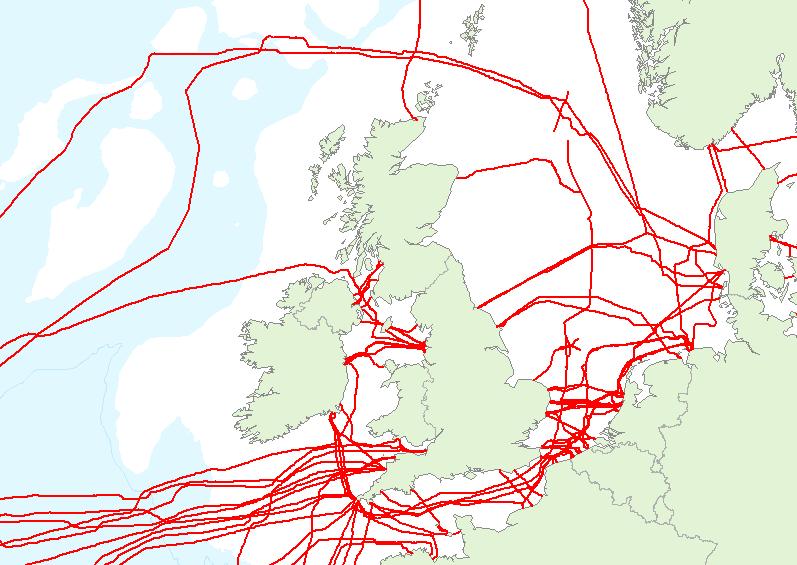
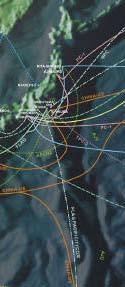
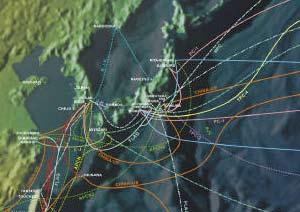
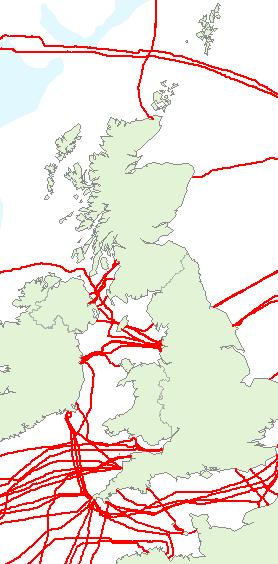
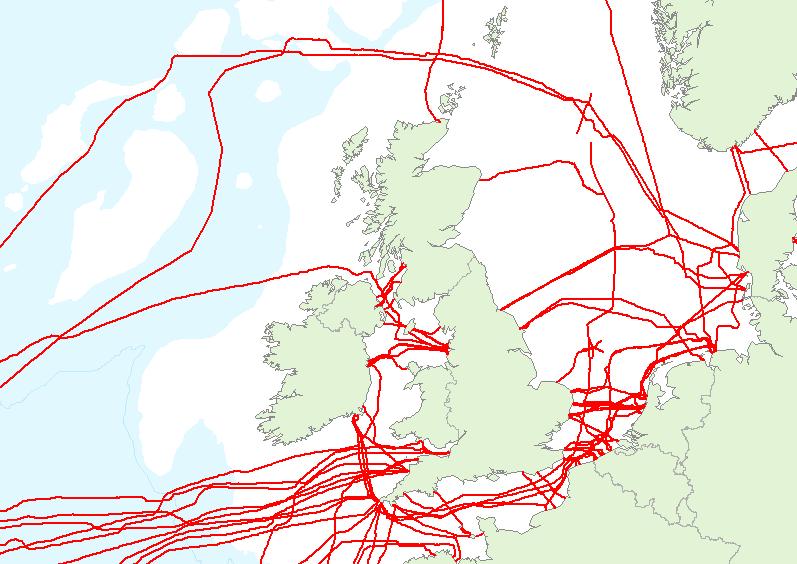
A glance at any world or regional map showing the technicolour spaghetti of existing submarine networks clearly displays the Achilles Heel in the security of the whole infrastructure. The landing points of the systems are clustered together, with some beaches being used to land multiple submarine cables. A good example can be clearly seen on the February page of the 2006 Sub-Tel Forum Calendar.
� The aggression threat existing in the region of the cable system (fishery density and techniques, dredging, other seabed users, etc.), and,
� The quality of the route planning and installation techniques used to mitigate the above risks.
Identifying risk – aggression faults
It is interesting to note that, with the incumbent systems now carrying more responsibility than ever to provide secure capacity, the external threat to these system cables has never been more abundant. The following data further illustrates a disturbing trend.
In the case of a multiple cable landing point, separation between the cables going seaward is quickly established. Most cables are buried below the seabed and are heavily armoured. However, in the other direction, where cables make landfall, the opposite occurs. The cables funnel into a duct system often no larger than 20 square inches. These
ducts then connect to a Beach Manhole where a transition is made from submarine cable to land cable. The land environment does not normally require the land cable to be as robust as the marine cable. Several international cables may only be separated by the wall thickness of a PVC duct. Between the beach manhole and the Cable Station, several international cables can share the same duct bank. Yet, it is immaterial whether a cable break occurs at sea or on land - system traffic is interrupted.
� 82% of all faults occur in less than 200 meters water depth (1997-2000)
“Fog In Channel – Continent Isolated” (Headline from “The Times” of London)
� 85% of faults arise through ‘external aggression’
� The incidence of external aggression faults has increased 69% between 1986 and 1996
Historically, submarine cable land routes have been well designed and engineered and consequently have proven to be fairly resilient to natural occurrences, such as landslides and floods.
� In this same time, component failure as a cause of faults is down from 17% to 6% of all faults
Remarkably, during a period when the construction industry’s combined capability to plan and install shallow water routes has continually grown, the above aggression fault
Utility providers are reporting an increase in the theft of cast iron manhole covers. Although this presents a real hazard to the general public, it also exposes the cable to further opportunists with an interest in the copper content of the cable. It is still not widely known in these circles that many optical land cables contain little or no copper.
statistics show that the continental resents a greater threat than The chart shown above of the key reasons for the increase low water threat. Simply put, landings are already taken’. Singapore, shown above, represents the most challenging sites tive to the planning and installation cure route. Global Marine every successful system installation landings since 1984, and there aggression faults in any buried landing.
��������������������������������������
The most likely cause of outage on land sections of a cable route continues to be civil engineering activities, particularly where mechanised excavators are being used.
“That was the past– this is the future”(David Beckham)
���������������������
Deliberate external aggression has not been widespread, but is a risk to plant which is increasingly being taken seriously. To a trained eye, or an observant local resident, the precise route of these land sections is easy to follow, and consequently must be considered to be a high potential risk. Furthermore, shifting sands on a beach can expose a shore end cable overnight, leaving it exposed and easily identified or suspended between rocks.
Instances have been widely reported where a single cable failure leads to loss of national or regional internet capability. The effects of simultaneous multiple cable outages can only be speculated upon. The jingoistic Times headline may well be an understatement of the effect – if not the cause.
The International Telecom Group (ITG) recently completed three shore end submarine cable installations for Alcatel’s submarine networks activity on the Apollo Project. The Apollo Fiber Optic Cable System is a state-of-the-art optically amplified submarine cable network comprising two trans-Atlantic cable routes of approximately 13,000km that cross between Europe and the USA. The initial system capacity of 160 gigabits per fiber pair is upgradeable using dense wavelength division multiplexing (DWDM).
Landing points for submarine cable systems are selected on a number of grounds. Consideration has to be given not only to the marine approaches but also to the land cable route. Increasingly prohibitive and complex regulations regarding permits and wayleaves are also significant and time consuming hurdles that need to be overcome, and can be influential in the selection of landing sites.
There can be a number of motives for returning to the same beaches, beach manholes and duct routes, including, but not limited to:
• and shallow water topography.
• Historical costs of using existing beaches are known.
detailed assessment of the landing should also be carried out to examine the potential risks to the plant, which should also consider the effects of multiple cable outages in close proximity.
With new cable installations becoming reality again, system designers and route planners have a real opportunity to incorporate security considerations in the early stages of planning. Cables have been on the seabed since the 19th century. Analogue and earlier optical cable systems are now being retired and recovered. As a result there are a large number of beaches and empty duct routes which have been successfully used to land cables and no longer used as cable landings. In addition many of these routes will have abandoned cable stations associated with them. Many disused cable stations were operational the last time when security was high on the agenda - during the Cold War.
equipped with an ITG fixed share Jet Plow submarine cable burial system. The Thomas C is a 57m LOA converted Offshore Supply Vessel fitted with a custom designed modular submarine cable laying system. The Thomas C is particularly suited for Shore end work, repeaterless telecom systems and submarine power cable installations. The landings at both Manasquan and Shirley were completed to full burial specification, on schedule and within budget.
As the earlier optical systems are in the process of being retired, the switching options in the event of an outage are reduced, placing yet further importance on newer high capacity systems. In some locations, it is conceivable that redundancy for a particular cable system is provided by a cable sharing the same duct route and beach landing.
At the European end a 6.7Km section was installed and buried at depths up to 2m in Lannion, France. ITG mobilized their modular cable lay system along with their 5m Jet Plow aboard the vessel MV Union Beaver at Flushing, Holland then loaded cable at the Alcatel factory in Calais and completed the operation at Lannion.
• The landowner is aware of the activities required to land a submarine cable.
• Known requirements to secure permit and wayleave consents from the relevant authorities, agencies and other interested parties.
Subsea burial was achieved to specification in a particularly challenging bottom environment that included a mixture of firm gravel & large cobble.
• The infrastructure (duct route) is in place to convey the cable to an existing cable station.
At the US end two landings were completed. A 1.4Km section was laid and buried at Manasquan, New Jersey and then a 2.3Km section was installed at Shirley, New York. ITG utilized their cable lay vessel MV Thomas C
• In the context of a large trans-oceanic cable network, the land and beach sections are a minor component.
A further consideration, that may have been overlooked, must be the security of the route. A
“Let the fear of danger be a spur to prevent it.” (Benjamin Disraeli)
The first step that can be taken is to restrict access to any of the manholes. It is important that the level of physical security is of a standard that will make entry to the underground chambers extremely
ITG Cable Jet Plow Deployment at Lannion, France
ITG’s MV “Thomas C” sets up off Manasquan New Jersey
difficult, by the use of locks and / or security bolts. This immediately secures the system against those in search of scrap metal. This can also be enhanced by the fitting of sensors that will detect unauthorized or forced entry into manholes.
“Ring before you dig” organizations provide civil engineering contractors with safe digging policies and run underground utility awareness programmes to help protect valuable underground assets. While these initiatives will not eliminate the risk of excavators breaching cables, participation in such schemes will reduce the risk of damage to cables during general civil engineering works.
While there is limited scope for actually preventing shifting sands causing cable exposures on beaches, mechanisms need to be in place to carry out speedy and timely reburial of the exposed cable. This minimises the time that a cable is visible, and thus the available time for organising planned mischief.
In the event that a security threat is considered a real risk to the integrity of the plant, especially where multiple cables share the same beach, the last resort must be to consider rerouting one, or some, of the cables. Encasing new duct routes with concrete will increase security and survivability and careful monitoring of the land route construction ensures that contractors comply with requisite standards and specifications.
“Work. Finish. Publish.” (Michael Faraday)
More than ever, the world is dependant on submarine networks for communication which must be seen as a key part of the economic infrastructure. Prior to the deregulation and subsequent massive expansion of the networks, the Cold War dictated that these national assets needed a dedicated, often bomb-proof, cable station and land route. Competing front-haul networks often run parallel and within feet of each other. Now security is moving up the agenda, they should be treated together for security considerations.
In many instances, suitable preventive measures have been in place since original installation. These measures require regular review to ensure that the security remains effective. Any review also needs to consider other plant in close proximity. There are a number of forums which have been established to discuss and take united actions on topics of mutual interest across the industry. Such gatherings could be used to formulate and agree a universal Security Standard for cable land routes, which details the minimum physical security requirements for the front-haul sections of the systems. If universally adopted by all cable owners, operators, and installers, this would ensure that there is continuity of security across all systems.
There is no benefit in owning, or operating, an amalgamation of protected and vulnerable plant. For upcoming and future cable installations, a further opportunity exists in the reuse of empty beaches and the refurbishment of empty duct routes and cable stations. Not only does this have cost benefits, these routes have a proven history, and will further serve the purpose of dissipating major economic assets and enhancing the resilience of the global network.
Jim Bishop has more than 15 years experience of submarine cable installationdesign, and maintenance. He has been Managing Director of A2-Sea Solutions
Ltd for nearly 10. From a background in cable joint engineering he has been involved in many land and marine cable related technologies, and has first hand experience of product development in compliance with International Standards and Directives.
John Walker has been involved with telecommunication cable installations for more than 30 years. After a number of years working on UK Outside Plant Networks as a Regional Engineer, he moved into the Submarine cable business in 1987. Based in Central America, John is now working as an independent consultant and contractor and has written and presented technical papers on outside plant maintenance.
Unrepeatered Submarine Links Benefit From All-Raman Technology
By Daryl Chaires
A worldwide increase of broadband penetration has created a renewed interest in fiber optic network builds and upgrades of existing links. These builds and upgrades include both terrestrial and submarine networks that support a worldwide exchange of information across public and private networks. New builds and upgrades are required to support efficient communications between detached regions and provide previously underserved areas with access to vast amounts of content located anywhere in the world. Prior consideration of builds and upgrades in many of these areas could not be financially justified. Today’s economic justification has been made easier by the recent introduction of technologies that enable more bandwidth to be transmitted even greater distances on all fiber types, giving service providers better options for new builds and upgrades.
For transport, all-Raman technology provides unprecedented reach for unrepeatered submarine DWDM systems. Commercially available systems, now allow unrepeatered transmission of 450 km with near term enhancements supporting 500 Km. Just as importantly, the technology helps service providers to extend the life of their current investment by significantly increasing the capacity of existing routes. All-Raman technology provides amplification over a much broader range of wavelengths compared to the Erbium-doped fiber amplifiers (EDFAs), used on many of the existing routes. Amplification over a wide spectrum provides flexibility for wavelength allocations resulting in increased capacity over a larger array of fiber types. In fact, an all-Raman DWDM system is uniquely capable of breathing new life into old fiber routes. It is the best option for maximizing capacity on DWDM challenged DSF and LS fibers. Without the performance enhancements of an all-Raman system, service providers would be forced to prematurely abandon low capacity systems in favor of more efficient new builds. It would simply be too costly to operate these links while also installing new links to support higher capacity demands.
The benefits of Raman amplification are well known and a number of DWDM manufacturers are exploiting the performance benefits of Raman amplification to extend the transmission distance of their unrepeatered submarine and terrestrial products. This is generally
achieved by implementing distributed Raman amplification (DRA) to improve the noise performance of their systems. In an unrepeatered application, DRA is placed in-line with receive erbium doped fiber amplifiers to effectively reduce the amplified spontaneous emission (ASE) noise contribution of the amplifiers. This improves the system noise performance while also increasing the receive channel input power level, leading to an increase of transmission distance. The result is an incremental improvement of distance. However, it falls short of maximizing the transmission distance. While distance improvements are important for new systems, operators of unrepeatered submarine links also require increased capacities for existing links. The addition of Raman amplification to existing systems cannot overcome the limited 33 nm spectral window of erbium doped fiber amplifiers.
Maximum benefit for high-capacity DWDM transmission on terrestrial and unrepeatered submarine routes is only achieved through the implementation of all-Raman technology. An all-Raman system utilizes properties of distributed Raman amplification as well as lumped Raman amplification to maximize both distance and capacity. Lumped Raman amplification (LRA) also referred to as discrete Raman amplification, can be used to enable access to previously unused spectral windows. This is achieved by tailoring pump sources to manipulate specific spectral windows thus perform signal amplification over a much wider spectrum than that supported by EDFAs. All-Raman technology has been implemented to manipulate wavelengths over a 100 nm spectral window.
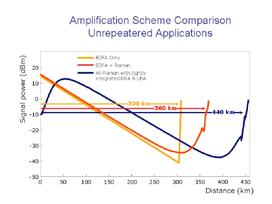
One of the benefits of all-Raman amplification for unrepeatered submarine networks was published at ECOC in September 2005. The paper, All-Raman Unrepeatered transmission over 440Km of Standard PSCF, published the results of a lab test confirming the feasibility of transmitting high-capacity signals (8 X 10 Gb/s) over a distance of 440 Km without the use of any passive or active in-line components. The demonstration spot lighted the characteristics of an all-Raman system which positions it to maximize the distance and capacity of unrepeatered submarine links. The demonstration used silica fiber that is typical for unrepeatered submarine systems. The minimal loss window of this type of fiber is centered approximately
at 1580 nm, which is outside the optimal operating range of Erbiumdoped amplifiers. The DWDM equipment used tightly integrated distributed Raman amplification (DRA) and lumped Raman amplification (LRA) to over come the loss (75.3 dB @ 1550 nm) and simplify the overall dispersion compensation. It did not use any special modulation techniques, but did implement enhanced forward error correction that yielded a measured gross coding gain of 8.5 dB. The ability to tailor the pumps to optimize the distributed gain of both the post amplifier and the pre-amplifier resulted in an improvement of transmission over both an EDFA only system and an EDFA plus Raman as shown in figure 1. The demonstration not only confirms the feasibility of transmitting high-capacity signals over a distance of 450 Km without the use of in-line equipment or special modulation formats, it lays the foundation to achieve transmission distances beyond 500 Km.
The wide-spectrum enabled by an all-Raman system using tightly integrated DRA and LRA, provides access beyond the C-band to include areas of the S-band and L-band. This additional spectrum enables flexible wavelength allocations that can be used to increase the number of transmitted channels for various fiber types. Dispersion shifted fiber, for example, is generally limited to less than 8 X 10 Gb/s channels over the typical 250 Km to 300 Km unrepeatered link. However, by selecting wavelengths outside the C-band, it is possible to achieve 30 X 10 Gb/s over that same distance. Another practical benefit of this wide spectrum was recently demonstrated to provide a cost-effective option for increasing the capacity of unrepeatered submarine cables equipped with remote optically pumped amplifiers (ROPA).
Systems using ROPAs which were installed a few years ago, generally supported a maximum of 16 2.5 Gb/s channels over an unrepeatered distance of 250 to 300 Km. Influenced by demand for more bandwidth and 10 Gb/s wavelengths, service providers are seeking simple cost effective ways to upgrade these systems to N X 10 Gb/s. The goal of the demonstration was to show that this type of upgrade is possible without the extra cost associated with retracting the cable and removing the ROPA. The demonstration confirmed that the ROPA, when left in place, does not interfere with the transmission
of information outside the C-band. In this demonstration, 33 10 Gb/s channels with 50 GHz spacing was transmitted over 300Km.
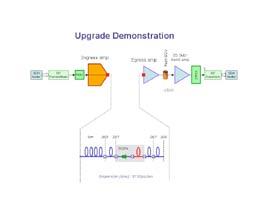
The demonstration system, shown in figure 2, consisted of a passive remote optically pumped amplifier, placed 217 Km from the transmit end. An additional 97 Km of fiber was added to the output side of the ROPA for a total transmission distance of 304 Km. The measured loss of the link, including all fibers, connectors and splices was 53.3 dB. 33 channels over a 25 nm spectrum using channels 1567.54 to 1592.10 were transmitted.
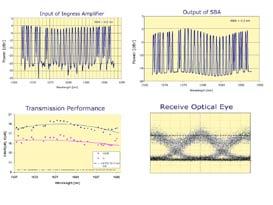
Performance measurements were made at strategic locations along the link. The transmission results are summarized and depicted in the graphs of Figure 3. The results show at least 5.1 dBQ of margin (worst channel) measured for FEC at a BER of 10-15. No measurable cross-channel penalty was observed.
This demonstration confirmed the benefit of an all-Raman system using the availability of a wide-spectrum amplifier to provide upgrade options to operators of unrepeatered submarine links. It proves that they can quickly and cost-effectively perform a no-risk upgrade. The demonstration showed an increase from 16 2.5 Gb/s channels to 33 x 10 Gb/s channels providing an 800% increase in capacity. The available margin indicates that the system can be grown to 60 X 10 Gb/s if required. System growth over the past few years may have been stagnant, but advances in technologies were not. Now that demand appears on the rise once again, service providers are well positioned to meet the challenges. All-Raman DWDM systems maximize capacity and reach for new unrepeatered installations and provide a cost-effective method of upgrading DWDM challenged fiber like DSF and LS as well as capacity limited systems using aged
Daryl Chaires, Marketing Director at Xtera Communications, is responsible for product-strategy development, requirements, positioning, and related sales support activities. He has been part of the telecommunications community for 20 years. Mr. Chaires has worked in various field and system engineering roles, where he helped carriers to design and implement wireless, wireline and unrepeatered submarine systems. Daryl received his BSEE from Southern Methodist University in Dallas, Texas.
Submarine Cable Decommissioning: Assessing the Environmental Risks
The Drivers
At the outset, it is helpful to identify the drivers which triggered the need for a generic risk assessment.
• Exponential demand for global network expansion
The industry has been engaged in both the replacement of first generation fibre optic cables and the expansion of its networks which have to keep pace with a near doubling in global demand for nonvoice communication every 12 months.
By Ray Drabble
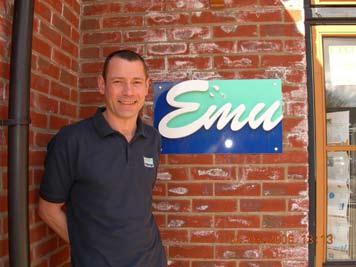
Early in 2004, Southampton based Emu Ltd. a Marine Environmental Survey and Consultancy company were commissioned by a consortium of cable companies (including British Telecom & Cable & Wireless), to undertake a generic environmental risk assessment to be used during the decommissioning of redundant submarine telecommunications cables. Eighteen months on, the generic risk assessment has been successfully applied in a number of different scenarios, and has also now been posted on the United Kingdom Cable Protection Committee (UKCPC) & International Cable Protection Committee (ICPC) websites as an example of ‘Industry best practice’. Copies of the report can be obtained by non-members from the respective secretary’s of the organisations.
This article affords an appropriate opportunity to briefly review this management tool and its application to the management of cable decommissioning.
• The pace of technological advance Capacity in submarine cables has increased exponentially, and is now generally 10Gbit/second per wavelength, with a single fibre carrying up to 100 wavelengths. This is an increase in capacity of approximately x2000 since the early systems were installed in the 1980s.
• Increasing competition for spatial use of the seabed
Trawlers have had historic claims to the seabed, but recent expansion in the oil and gas industry, marine dredging and more significantly in the development of offshore renewable energy installations means deployment and decommissioning of submarine cables now takes place in an increasingly congested environment.
• Awareness about the marine environment
The public have a greater awareness about the marine environment today than earlier generations. As a responsible
sector, the submarine cable industry wishes to demonstrate that their activities are causing no harm to marine life.
• Legislation
Following a landmark court ruling in favour of Greenpeace in 1999, the Habitats Regulations 1994 which implemented the requirements of the Habitats Directive (92/43/EEC) and the Wild Birds Directive (79/409/EEC) have been demonstrated to apply out to 200 nautical miles, the limits of territorial UK waters. As a result, the first UK offshore candidate Special Area of Conservation (SAC) has been accepted by Defra and there are a range of seabed habitats and species which are under consideration for designation with potentially far reaching implications for the submarine cable industry and other marine based operators.
The Requirement
The industry was looking for a management screening tool which could be used generically to highlight potential environmental impacts when initiating applications for consent to decommission and potentially remove redundant submarine cables. When submarine cable routes are initially planned, significant data is collected that includes a detailed interpretation of the seabed type, a depth of burial assessment, and other specific data relating to each section of cable. Emu Ltd. was tasked with developing a risk matrix which could be used in conjunction with this routing data that would trigger further investigations, to either confirm or discount potential impacts. Key features of the Risk Assessment are the requirements to:
• Correspond to standard route survey seabed descriptions;
• Consider the worst case scenario because
of the generic nature of the tool (precautionary principle)
• Be easy to use.
The Approach
A fundamental principle is that a tool of this nature can only identify potential sensitivity to a given impact. Emu Ltd. followed a similar approach to the model developed by Dave Carlin and Stuart Rogers of The Centre for Environment, Fisheries and Aquaculture Science (CEFAS) to assess dredging impacts upon fisheries, where the theoretical generic matrix of impacts has to be compared against site specific data to determine actual vulnerability.
“To describe the actual vulnerability of the fisheries issues to potential impacts on a site specific basis… requires balancing the theoretical sensitivity of a resource to an impact, and the local features of the site and the distribution of the biological resource, to derive an actual site-specific vulnerability.”
(Carlin & Rogers (2002))
The scope of significant issues associated with submarine cable decommissioning has been narrowed to those which potentially have a long-
term or permanent effect. The reasons for this are:
• The scale of disturbance resulting from cable removal, in general terms, is very small;
• The impacts associated with the installation of submarine cables are well documented;
• Environmental factors will have been taken into consideration during the initial rigorous consenting process to which all cable routes are subject prior to installation;
• The physical disturbance to the seabed associated with the removal of cables is significantly less than that caused by installation.
Furthermore, the benign chemical composition of submarine telecommunications cables, removes any risk of direct chemical contamination in the decommissioning process.
Generic Risk Assessment for Potential Impacts Associated with Submarine Cable Recovery Notes:
1. Prior consultation with appropriate regulatory authorities (EN / Countryside Council for Wales (CCW) for inshore/JNCC for offshore or equivalent bodies) should be undertaken when planning recovery.
2. Prior consultation with English Heritage (EH) /Welsh Historic Buildings (CADW)/ Historic Scotland / Environment & Heritage Service
NI (EHS) should be undertaken in relation to archaeological / historic issues when planning recovery.
3. Prior consultation with DEFRA (England and Wales) / Scottish Environment Protection Agency SEPA / Department of the Environment and Department for Agriculture & Rural Development in Northern Ireland in relation to potential impacts on the commercial fishing industry.
4. Prior consultation with the EA / SEPA / Department of the Environment and Department for Agriculture & Rural Development in Northern Ireland should be undertaken in relation to shellfish production areas.
5. Prior consultation with Maritime & Coastguard Agency (MCA), Hydrographer of the Navy and local harbour authorities should be undertaken in relation to navigational issues.
The Risk Matrix
The generic risk matrix is shown above. It evaluates the potential sensitivity for ten seabed categories to particular categories of risk related to cable removal, providing a tool for highlighting the significant issues for a given cable route. Accompanying text provides a more detailed explanation for each box of the matrix. E.g. the text for box C6, Stiff Clay / impacts to commercial fishing reds as follows:
C 6 Commercial Fishing
Recovery of cables from the seabed will have a beneficial impact on the commercial fishing industry by eliminating a potential snagging hazard for fishing gear. Both scallop dredgers and beam trawlers while not targeting working clay seabed may well pass over these areas and given the shallow burial depth (0.4m) there is a potentially significant risk of snagging for cables left in situ. If the minimum burial depth is increased, e.g. to deeper than 0.8m, then there is a much reduced likelihood of snagging and the positive benefits of recovery are marginal.
The impact on the commercial fishing industry of recovery of cables from stiff clay is assessed as localized, permanent and positive.
The matrix is colour coded for ease of reference; green boxes indicate a high potential for positive impact resulting from cable removal (for example by reducing the risk of snagging by fishing vessels in an area frequently trawled), and the Amber & Red boxes indicate their may be some negative impact of cable removal that will require further investigation. Qualifying sub-notes highlight appropriate consultation which should take place at the planning stage. The cable owners uses this generic risk assessment at an early stage in the decommissioning process, so that any issues are known about early in a project, and can be addressed in a professional and timely manner.
Case Studies
The following case studies demonstrate how the environmental risk matrix has been applied to aid decision making on a couple of cable decommissioning projects.
TAT9 – Poldu Cove UK
TAT9 was an international cable connecting the UK with the USA. During the initial investigation using the generic matrix, a number of issues were highlighted, including the fact that the beach was protected under SSSI (managed by English Nature) and was a popular tourist spot, and that the area was commercially fished from Falmouth. These issues helped lead the cable owners to the conclusions that the cable was generally considered a marine hazard, as it was also predominantly surface laid on bedrock, the risks of conducting cable recovery operations were low, and it could potentially benefit the local fishing community if it were recovered. It was also clear that the timing of any recovery operation must suit both the local community and conservation organizations, so a subsequent recovery operation was conducted after the summer season, in consultation with the local conservation and fishing communities, which was successfully completed on time & on budget.
Denmark 4 – Filey UK
Denmak4 was an international cable which connected the UK with Denmark. When this cable was installed, it was buried close into the shore where suitable sediments existed, but further offshore burial was impossible so many sections of the cable were ultimately surface laid. During the initial investigation using the generic matrix, a number of issues were highlighted, but most notably the requirement to liaise with the local fishing community, as they fished close into the shore.
During the investigation phase, it became clear that the removal of the inshore section of cable would cause not only considerable disruption to the local fishing community, but also could cause some negative impact on the local environment. Subsequently it was agreed with both the local community and the consenting bodies that the first 8km of cable where burial was good, would be left in situ, and that the remaining section of surface laid cable would be recovered.
In this instance, the real strength of the generic risk assessment was highlighted, where the decommissioning process really took into account the local conditions on the ground, ensuring the cable was recovered where the impact of the
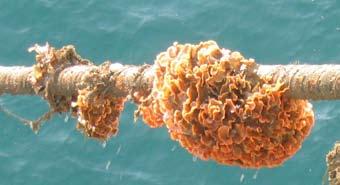
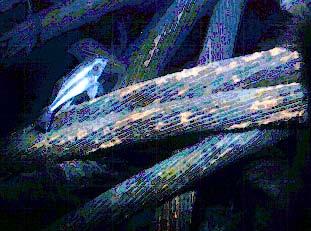
Ross Coral found growing on TAT9 during recovery
recovery was negligible, but leaving the cable insitu where it was well buried in a stable seabed, and the environmental impacts of the recovery would be negative.
Suggested Further Work
• Beneficial Disposal of Obsolete Cables
When redundant cables have been recovered, every effort is made to recycle the constituent components, but this generally involves shipment abroad, and inevitably some portion of the cable ends up in Landfill. The submarine cable industry has been looking at innovative ways of recycling this cable, and one idea that is currently being investigated is as a construction material for Artificial reefs. Projects in the USA have successfully shown that where cable has been deposited on the seabed to create artificial reefs, the structures have provided a protected nursery and habitat for various species of fish, crabs and lobsters and promoted a pelagic fish attraction desirable for recreation fishing. In view of the apparent success of this project, a grant application has been made by British Telecom to the Marine Stewardship Fund, administered by the Crown Estate to investigate the feasibility for using redundant submarine cables as a construction material for artificial reefs in UK waters.
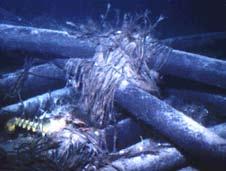
Submarine cables provide a protected nursery for many species in an artificial reef in the USA.
• Enhancement of the Industry’s GIS database
Environmental impact assessment in the marine environment necessarily encompasses a plethora of diverse topics including infrastructure / navigational considerations, commercial seabed developments, fishing activities, conservation designations, ecological sensitivity / biotope maps, geophysical maps, sites of cultural / historic interest, defence activities etc. The associated broad spectrum of data needed to support environmental impact assessment is held by disparate sources. While all this data can be supplied in response to a site specific request, there may be merit in maintaining certain data sets in a permanent geographical information system (GIS) format, compatible with the current system used by the industry. In particular, if not currently held, electronic maps on trawling activity and seabed characteristics may be particularly helpful in attributing causes for system failure.
Ray Drabble has seagoing experience spanning 21 years – predominantly in the Royal Navy but latterly in survey work under contract to the UK Maritime and Coastguard Agency to assess the impact of shipping traffic on designate Marine Environmental High Risk Areas. He has worked as an environmental officer for the UK Ministry of Defence and overseen environmental audits at a number of Ministry of Defence establishments. In conjunction with his MSc studies, he has undertaken research into the environmental effects of sunken warships and is providing ongoing support to the Ministry of Defence in this field. Key experience includes:
• Project Manager of a US Navy asset visibility project.
• Extensive experience as a Royal Navy ship’s diving officer.
• Seagoing MARPOL adviser.
Since joining Emu Ltd. in 2003, his primary tasking has been in environmental consultancy and project management for Environmental Assessments which have related to industrial discharges, wharf development and aggregate extraction. He has led a number of research projects including an investigation the requirement for and feasibility of undertaking remediation at marine aggregate dredging sites and a study into the environmental impacts of removing subsea telecommunications cables. In addition to his extensive seagoing travel, Ray has worked overseas in both Norway and the Pennsylvania, USA. He is married with four children and enjoys diving, skiing and supporting his local church.
Don’t miss your chance to “stay ahead of the curve”in the energy,telecommunications and electrical industry.
ENTELEC 2006 Conference & Exposition
The Premier Association Providing a Forum for SCADA,Automation and Communication Technologies
ENTELEC 2006 offers you:
•A unique Conference & Exposition designed specifically for energy communications and IT professionals from petroleum,pipeline,utility,municipalities,environmental and related energy industries
•Original papers on the current and future state of communication technologies delivered by key per sonnel including representatives from Cisco,Shell Global Solutions,Vyyo,Norse Pipeline,CapRock and many more
•Networking with peers and colleagues throughout the event
Conference: April 19-21,2006
Exhibits: April 19-20, 2006
Hilton Americas Hotel Houston,Texas
•Exhibits featuring the latest products and services
For complete details on the event and online registration or membership information,visit us at www.entelec.org or call 888-503-8700.
WHERE dOES THE UJ CONSORTIUM gO FROM HERE?
By Stewart Ash
For more than 15 years the owners of submarine cables have enjoyed the benefits to marine maintenance operations of a single jointing technology platform provided by the virtual monopoly of the UJ Consortium. Over these years significant technological advances have been made in all other areas of submarine cable technology but the Universal Joint (UJ) and Universal Coupler (UC) have changed very little. Today the market is significantly different to the one in which UJ technology was conceived. The members of the UJ Consortium are different with different aspirations and the requirements of systems owners are much more focused on the costs of marine maintenance than they ever were in the past. So, does the UJ still have a role to play in the industry and can the UJ Consortium continue to meet the needs of its customers?
History
The concept of a universal jointing technology was born out of the large cost to the owners of the first transatlantic fibre optic system TAT 8, who had to support three separate jointing technologies in order to maintain a system containing three cable designs (Alcatel, AT&T & STC). When TAT 9 was being planned, the major system owners, AT&T, BT and France Telecom agreed to jointly invest in developing a single technology to joint all three cable designs. This was the birth of UJ and in 1990 a ten year agreement was signed between Alcatel, AT&T SSI and BT Marine to develop and support the UJ (cable to cable) and the UC (cable to repeater) technologies. In 1992, the concept of universal jointing was successfully launched into the Pacific region and KDDI became a member of the UJ/UC Consortium.
By 1995, a large number of small diameter cables had been introduced to the market
to address the unrepeatered or repeaterless market. To respond to the needs of this market, a new consortium was formed to provide a smaller, quicker to build joint; the Universal Quick Joint (UQJ). The members of this new consortium were again Alcatel, AT&T SSI and BT Marine. However, the basis on which this new agreement operated was different in a number of ways to the UJ/UC agreement, which for a few years, while they operated in parallel, caused customers some confusion. Shortly after the inception of the UQJ Consortium, AT&T sold SSI to Tyco, BT sold BT Marine to Cable & Wireless and in 1999 Cable & Wireless sold Cable & Wireless Marine, including their UJ interests, to Global Crossing.
For the rest of this presentation I will be concentrating on piece part kits and therefore for those of you who are unfamiliar with the kit structure adopted by the UJ Consortium I have taken the liberty of using a slide presented by the UJ Consortium at PIOCMA in 2003 to illustrate this.
When the UJ/UC Consortium agreement ran out in 2000, it was replaced by a new 5 year agreement, which combined the UJ, UC and UQJ under a single agreement. The signatories to this agreement were Alcatel, Global Marine, KDDI-SCS, Pirelli and Tyco. This agreement carried the UJ Consortium through the boom and bust period. As part of the industry consolidation that followed, Global Crossing sold Global Marine to Bridgehouse Marine. KDDI-SCS ceased to trade and their membership of the UJ Consortium was transferred to KCS, KDDI’s marine service provider. Finally, Pirelli sold their interests in submarine cables to Alcatel and so dropped out of the UJ Consortium.
Customer Influence
There is little doubt that the existence of UJ technology is overwhelmingly for the benefit of system owners. It gives them the ability to optimise marine spares and the choice of marine maintenance service provider, with the ability to transfer from one to another without significant additional costs. For the system supplier and the marine service provider, it is a necessary evil. Suppliers cannot sell their cable unless it is UJ qualified and marine service providers have little chance of winning contracts if they are not equipped to support UJ technology.
The original UJ/UC agreement was, at its core, an engineering collaboration designed to meet the needs of the leading submarine cable system owners. However, it needed to be a commercially viable enterprise and was set up as such largely due to the work of BT Marine. The members of the consortium were predominantly subsidiaries of these system owners. Alcatel was a notable exception but it should be remembered that, France Telecom
was, like many others at the time, a monopoly international carrier in their own country and Alcatel relied heavily on their patronage. Contrast that with the situation that exists today, only KCS have any links to a system owner, Alcatel and Tyco are system suppliers but all four of the members are marine service providers and this is bound to colour the UJ Consortium’s perception of the services it needs to provide.
The last time customer influence had any real effect on the UJ Consortium, was at the time of the sale of Cable & Wireless Marine to Global Crossing. When this occurred, there was some concern amongst system owners that Global Crossing could use its dominant position in UJ to hold the industry to ransom in what had become by then a vital technology. Significant pressure was brought to bear and as a result the 2000 Consortium agreement was structured somewhat differently than it might otherwise have been. Apart from heading off the perceived threat, the system owners obtained improvement in service levels, which were unlooked for at that time.
UJ Consortium Services
The UJ Consortium offers the following products and services. Cable qualification to UJ/UC and or UQJ technologies; training of jointers and jointing instructors in UJ/UC and UQJ technologies; supply of piece parts and jointing equipment for UJ/UC and UQJ technologies. This portfolio was established for the original agreement and has remained unchanged ever since. Under the UJ/UC Consortium Agreement, AT&T SSI developed the UC and was responsible for qualifying new cable to housing interfaces. BT Marine developed the UJ and qualified all cable to cable combinations. In terms of jointing
equipment, AT&T SSI provided the moulding machine and initially Alcatel provided the fusion splicer although when KDDI joined in 1992 their fusion splicing machine replaced the less sophisticated Alcatel machine. BT Marine provided the X-ray Camera and all
A 09002 kit box showing kit number and serial number. Note: this information is also provided in bar code form for reading by a scanner. The kit box latch is sealed using a unique serial numbered seal (yellow)
The kit weight (14kgs) is also shown for shipping, storage and health and safety purposes.
the other tools and equipment. The supply of piece parts and training followed the same path, AT&T provided UC kits and training; BT Marine provided UJ kits and training.
Under the UJ/UC Consortium agreement, the UJ became BT Marine’s preserve and the UC solely AT&T’s. In the beginning, the volumes of business were small, but grew quickly. As the participants had longer term relationships of co-operation there was little or no concern
over the single sourcing approach that was being established. However, the industry, fairly quickly, came to the conclusion that spare repeaters and branching units (BU) should be provided with cable tails connected using the supplier’s proprietary jointing technology and the market for UC qualification, piece parts and training all but collapsed. As new cable designs came to market, BT Marine qualified the cable provided the training, the piece parts and with the exception of the moulding machine and the fusion splicer, all the jointing tools and equipment. Very quickly BT Marine became perceived as leaders and the shop window of the Consortium. They were slowly gaining a predominant and controlling influence of the technology, especially after UJ qualification activity was transferred from BT’s Martlesham laboratories to BT Marine. The industry was comfortable with this as BT Marine were owned and influenced by one of the major and respected international operators and were seen to be a centre of independent engineering excellence with no affiliation to any cable manufacturer.
BT Marine’s core business was not manufacture and supply of piece parts and equipment, therefore limited resources were available for production. Although quality standards were high, lead times were lengthy. Up to 28 weeks for tools and equipment and at best 14 weeks for piece parts. Once again the industry was comfortable with this. There were a limited number of cable ships to supply with equipment and if piece parts were on long lead times all that was necessary was for the owner to set up a large buffer stock to protect against shortages. In the market model that existed at the time, piece parts were supplied in two forms, “initial stock” purchased at the time the system was commissioned and “replenishment stock” to replace kits used in system repairs. In
manufacturing terms initial stocks were high volume to guard against the long lead times, and replenishment stocks were low volume.
When the UQJ Consortium agreement was negotiated the other members recognised that BT Marine had control of a growing and potentially lucrative market and even thought Alcatel and AT&T SSI did not regard UJ as significant business they ensured that the agreement contained cross licensing, which allowed all members to provide all products and services. This was not the way the UJ/ UC agreement was operating, hence customer confusion about where they could buy the different products and services.
In 1996, Cable & Wireless purchased a healthy and growing UJ business as part of BT Marine. They closed down the Southampton facilities and relocated the UJ business to Chelmsford, in the process they took the strategic decision to outsource manufacture and as a result Sea Talk Systems (STS) was established. By the time negotiations for the 2000 agreement started and Global Marine came under pressure to open up access to UJ Technology, they were in a position to offer the other Consortium members a licence to manufacture UJ piece parts but at the same time reduce lead times, in collaboration with STS, for their own products from 14 to 5 weeks, thus significantly increasing the barriers to entry of providing a competing service. In the short term, only Tyco chose to set up a competing manufacturing capability, Alcatel, KDDI-SCS and Pirelli continued to purchase their piece parts from Global Marine. However, this significant reduction in lead time allowed system owners to re-evaluate the size of initial and ongoing stock holdings. In 2002, Global Marine negotiated a new agreement with STS and licensed them to sell piece parts directly to the other Consortium members.
One of STS’s three Co-ordinate Measuring Machines (CMM), multi-loaded with a single batch 150 UJ Flange Clamps. However, it is possible to load these machines with any combination of different components, for simultaneous inspection.
With all Consortium members being able to offer similar lead times the system owners were, at last, able to see some real market competition.
Technological Developments
By its very nature UJ technology has to be the same for all cable designs, so any developments need to be backwards compatible to all previously qualified cables. This is a major limiting factor and therefore the basic mechanical structure of the joint and the equipment used to construct it is very much the same as it was 15 years ago. Notable exceptions to this are the 9002 Common Component Kit, introduced by Cable & Wireless Marine in 1998 to address the fibre movement in loose tube cable designs; the addition of electronic processing to the SAMS moulding machine, an improved X-ray Camera and most recently the UJS 100 fusion
splicing system developed by KDDI to deal with all the latest fibre designs. Comparing this to the advances made in repeater, BU and cable design over the same period, the record of UJ technology is not impressive. Why is this? One possible answer is that in the initial years of the product the end customer was not overly concerned about development of the product and by the time they began to focus on the need for improvements in efficiency and productivity their direct influence over the monopoly they had created was waning.
Customer Requirements Today
UJ technology has been firmly established right across the submarine cable industry, thus giving the flexibility of choice the systems owners require. Since 2000, lead times on piece part supply have come down significantly allowing owners to cut back on stock holding and competitive pricing has reduced their costs. So where is the focus now?
I believe the answer to this question is, owners are focussed on the cost and quality of the production of the joint onboard the ship. There appear to be two distinct approaches to this. Firstly there is the collaborative engineering evaluation of the IPRS forum, where statistical data is independently analysed and feedback is provided to the UJ Consortium and individual operators on areas of concern. Secondly, there is the more aggressive commercial approach adopted by maintenance agreements where key performance indicators (KPI) or service level agreements (SLA) are built into the contract requiring that the service providers achieve the construction of joints within certain time scales or incur a financial penalty. Given that there are over 600 combinations of UJ joints and couplers, each with a unique optimum time for construction, any times that
are set in these contracts can only, realistically, be very coarse approximations. These KPIs are euphemistically called “incentives”, but in my view they only motivate the service provider to do one thing, avoid paying the penalty, and not necessarily by doing what was intended i.e. produce a high quality product in the optimum time.
The inside of a UJ 09002 Common Component Kit showing the individual packaging and labelling of the components
Discussion
In my opinion, a system owner has every right to expect that every part of his submarine system is made to the same high standards. Therefore the production of cable joints onboard a cable ship should be carried out using quality procedures equivalent to those that would be expected in a factory. This includes the production records, traceability of materials, qualification/calibration of the tools and equipment and the qualification status of the operators. Unfortunately the culture of our industry for many years has accepted
that anything done on a ship is somehow different to doing the same thing ashore, a “marine adventure” if you will. Until recently little pressure has been applied to this basic requirement, and now that there is focus on it, the inevitable inertia has to be overcome. The UJ Consortium has not taken the lead, they provide very limited advice on the whole area of production control procedures, and it is left largely to the individual ship’s operator to establish what it thinks is appropriate.
When it comes to production ergonomics, once again the UJ Consortium do not take a leading role. They have always seen their job as developing technically sound, easily repeatable manufacturing processes using as few different tools as possible. Each process is, of course, designed to be as efficient as possible but the driver is “right first time every time construction” there has been little or no emphasis placed on improving the speed of construction once a process is qualified. The construction of a UJ is, of course, a series of disparate processes and the UJ Consortium has never addressed the issue of efficiently linking these processes to produce a time optimised total procedure. Finally, the UJ Consortium members have never cross licensed tools and equipment. The core equipment remains single sourced and so do many of the tools. The Consortium has taken the view in the past that, any tool developed to improve the efficiency/ speed of a jointing process is a matter for the individual member. The improved tooling can be sold to other members, if the designer so chooses, but it will not be defined as a UJ product. With all members of the Consortium now being major ships operators, it can be seen that any such development in this area is likely to be regarded as matter of competitive advantage and so generally the industry as a whole does not benefit.
Taking both these points together, I believe it is reasonable to say that, although UJ is a common technology it has many and varied methods of production and record keeping, without a central controlling authority. Therefore, by any objective standard it can only be considered as a partial product.
Conclusion
The UJ Consortium contains the leading experts in jointing technology in the industry. They come from the two leading system supply companies and four of the major marine service providers. They have the expertise necessary to address the issues outlined above and meet the needs of their customers. They only need the will to co-operate and address them.
The UJ concept started out as an engineering collaboration for the benefit of the industry. Now, with the down turn in the market, membership of the UJ Consortium is a strategic decision not a commercial opportunity. I believe that if it is to survive it needs to return to that original model of pooling knowledge and expertise to address the problems its customers want solved.
Clearly there is not much money available for development but much of what is required, in the short term, does not require large investment. The key improvements are about the Consortium taking full control of the joint production process and establishing common standards for the industry.
As stated before, the universal concept inhibits new developments because of the need for backward compatibility. Perhaps the time is right to draw a line in the sand and introduce a second generation Universal Joint (UJ2), only
qualified for the cable designs currently in production. This would allow the Consortium to collaborate on design improvements across the board with an additional focus on ergonomic efficiency. The existing technology could continue to support already qualified cables and on a case by case basis system owners could, singly or collaboratively fund qualification of an older design to UJ2 if it was economically beneficial to do so.
All qualification programmes cost money and it is questionable as to whether the current Consortium members, on their own, have the means to fund UJ2. It is therefore worth considering whether it would be possible to extend the scope of collaboration further. UJ technology, in the main, benefits the system owners. Owners will also benefit most from an improved joint through the reduction in their maintenance costs and so there is a case to suggest that they could contribute to the funding of a new development. By doing this, they could then secure influence over and share ownership in the IP of what to them is a vital technology, and for which the cost of substitution would be significant.
In summary, I believe there is a place for the UJ Consortium. However, its membership should be expanded to include one or more system owners with a willingness to invest in a second generation of the technology. I also believe that, the current membership needs to behave less like a monopoly supplier, listen and be more responsive to its customer’s wants. They need to collaborate in all areas of the technology to meet the customer’s current and future needs and to supply a total product package at reasonable price. Without this UJ will slowly waste away and the benefits of the common jointing platform will be lost to everyone.
Bio of Stewart Ash
Stewart has worked in the Submarine cable industry for 35 years. After graduating from Kings College London, he joined STC Submarine Systems as a development engineer, designing terminal equipment. By 1980, he was their senior field installation manager responsible for all major loading and laying operations. With the advent of optical technology Stewart headed up the Installation division responsible for all turn key installation. In 1993, he joined C & W Marine focussing on the development of cost effective installation solutions for the repeaterless systems market. After roles in business development and account management, in 1999, he was appointed General Manager of Global Marine’s Cable Services division, running their engineering and training facility at Boreham and becoming their senior representative an chairman of the Universal Jointing Consortium. Stewart left Global Marine in 2004 and is currently working with WFN Strategies as a Project Manager.
Global Marine is a participant and sponsor at the Submarine Communications 2006 conference taking place at Lisbon, Portugal Andy Bax, Head of Submarine Network Systems for Global Marine, is delivering a speech at 9:10 on Thursday 30th March, and participating in the panel discussion later that morning.
The 2-day European conference and networking event dedicated to telecom connectivity delivered by submarine cable, is taking place in Portugal’s capital city. Andy, now based in Florida, was thrilled to be invited to speak on Day 2. His speech is entitled “ Key Considerations When Deploying New Technologies and Applications in Submarine Communications” and he will be examining the key factors that newer optical fibre technologies need to ensure longer reaches, wider bandwidths and higher speeds. Andy will also be evaluating the cost considerations involved in the deployment of new technology, including the initial costs of deployment, maintenance and operational costs and upgrade capability and the costs involved. He will also assess the ability of new technologies and applications to improve the resilience of networks.
Andy said “Considering the capabilities of today’s terrestrial networks - delivering vast amounts of capacity over greater distances with a high degree of performance and reliability submarine networks, by comparison, lag far behind. In an ideal world the cost effective benefits and functionality of the terrestrial network should be seamlessly integrated into a submarine network much simpler than what is available today.”
There will also be an opportunity for Andy to reference Global Marine’s recent acquisition of Red Sky Systems. Global Marine announced that it had purchased the assets and Intellectual Property of Red Sky Systems during PTC2006 in January. Red Sky technology enables a simple integration of terrestrial and submarine networks and, through this technology, Global Marine will be able to offer network operators a more cost-effectiveand uncomplicated means of running or upgrading their networks relative to traditional submarine solutions. When combined with industry standard subsea components the unique Red Sky Optical Line Interface (OLI) allows network managers to operate subsea networks using industry standard applications common to terrestrial networks.
Also making the short trip from the UK to Portugal will be Chris Brooks, Sales Director, Jonathan Annals and John
global Marine Technology Update
by Andy Bax
Neal, Strategic Account Directors and Paul Deslandes, Key Accounts Manager.
Andy Bax leads the team responsible for providing turnkey regional submarine networks on a global scale. He has spent the past 10 years in the submarine telecommunications industry as both an engineering and operations leader in the organisations where he has worked. Andy has a proven track record in deploying submarine and terrestrial technology in order to get the most out of an expensive network infrastructure.
Global Marine Systems Limited
Proven technology eliminates significant complexity and cost from deployment and maintenance of subsea network, and allows subsea networks to be managed as a terrestrial network.
Global Marine’s Head Office
A state of the art optical transport solution specifically for regional submarine networks has been developed.
Global Marine Training School
cost maintenance enables carriers to dramatically reduce operational costs which is vital to sustaining competitive capacity offering.
Main features
• Flexible modular architecture
• Rapid, In service upgrades at minimum growth cost
• Simplified management through existing Network Management Systems
• 2.5 to 40G transmission speeds
• Can provide up to 64 DWDM wavelengths per fibre pair
• Continuous end-to-end performance monitoring analogous to terrestrial network
• Reduced footprint/ power consumption can be situated in city POP
Global Marine Training School
This system delivers rapid deployment of initial service at lowest capital cost. Final capacity of up-to 64 wavelengths x 10Gb/s is anticipated allowing low cost, low capacity, in service, upgrades throughout the system lifetime as traffic grows.
A specifically designed solution for the Regional Operator, fundamentally re-defines the way telecommunications systems are deployed. And the benefits? Ease of operation, smallest footprint and low
Optical Line Interface
• Complete OLI system fits in a 2200mm x 600mm x 300mm ETSI cabinet
• Transparent interface to terrestrial SDH/ SONET network
Trademark Repeater
• Size: Smallest size 86mm diameter x 35mm length
• Depth rating: 8000 m
• Power requirement: 4000 V (max)/-0.62
A- fully surge protected
• Weight: Approx 10Kg (non incl. of marine housing)
• Housing: Marine proven housing that can interface with any Universal Joint qualified cable
Global Marine Cardinal Repeater
Global Marine’s Cardinal repeater is the smallest of its kind in the world, weighing approx 10kg. The reduced size provides for simplified and cost efficient installation and maintenance activities in water depths of up to 8,000m.
Incorporating an Optical Amplifier Module, Cardinal brings together standard submarine amplifier components within an innovative design that improves upon functionality whilst reducing the size of traditional submarine amplifiers.
global Marine at Submarine Communications 2006
submarine segments to bridge the gap between unrepeatered and repeatered markets. In both configurations, Cardinal provides up to 64 x 10G/bit wavelengths per fibre pair.
Simplified operation and seamless integration into the DWDM network gives the operator ease of operation with low cost maintenance. With an ultimate capacity of up to 64 wavelengths x 10Gb/s per fibre pair with no requirement to upgrade the OLI during capacity upgrades, the total cost of ownership is dramatically reduced for the operator.
Exclusively designed for Regional Networks, Cardinal provides high capacity over two fibre pairs in its standard configuration, whilst also being capable of providing a single fibre pair/single repeater solution for 350km to 550 km
With its innovative design and functionality the Cardinal repeater is a technology leader within the submarine industry.
Optical Line Interface
The OLI is modular in architecture and has the smallest footprint in the submarine terminal market. Combined with the low power consumption this means the OLI can be installed in any POP/Telehouse without the need for a separate Cable station or alternatively a small, fully equipped container along with the DWDM equipment.
A fully integrated COTDR provides the OLI with continuous unobtrusive monitoring of the submarine cable.
The design enables use in both repeatered and unrepeatered marine systems with the ability to interface with all the major DWDM and submarine cable vendors.
Cardinal Repeater
Cardinal Repeater encased in polyurethane
Test bed facility
Cardinal Repeater
Interoperability test taking place
Manufacture of OAM
Andy Bax
�������� ������ �������� ��� ������������
As we discovered in the film “Alien”, in space no one can hear you scream. It is a thought that must pass through the minds of any business caught in a trade over the Internet (“Net”) that goes wrong. Much the same happens, you can scream and call for help all you want, there is little help in Cyberspace and little chance of enforcing any help. You cannot (yet) put a body into Cyberspace. So if you get caught in some
dodgy deal done over the Net you may feel like putting your trading partner into Cyberspace – and leaving him there – but you will have to find a way around the problem.
The problem is that in Cyberspace “Identities” are capable of being hidden or disguised. What you see may not be what you get. This can be useful to some people when it comes to payment but the lack of secure
identification over the Net is a recognised problem. What is not so well known to the business world at large is what the service providers, those who own the right to use submarine cables and other fibre-optic networks, are doing about it in order to protect their clients.
The world moves on and it will be only a matter of time before we see such service providers dragged into court for a failure of due diligence towards their clients.
The golden rule of trading is “know who you are dealing with”. A wise Trader does not overlook frequent credit checks on his trading partner. A wise Trader knows his counterpart and his financial standing and is careful to play (trade) in a known backyard. That is the trade is linked to a known jurisdiction where the obligations under the contract can be easily enforced should one party fail to meet its obligations and no settlement is reached. English law is readily accepted by all manner of Traders.
A known partner and careful attention to detail is required. Care to these details builds confidence in the International arena. Your bank and Underwriter expect this of you. Indeed lawyers may now argue that a
lack of “due diligence” could stop recovery from your Underwriters, the bank and even the other side.
The way you do business in the real, or physical, world also speaks for you when people are looking for a trading partner.
However with E-commerce there is a problem. On the Net, these physical clues are not so freely available.
Small Traders with not so good reputations can build an electronic presence (a “website”) just as easily as a bigger and longer established Trader. It can be run from anywhere — even a beach hut in the Caribbean. Messages can be drawn down, and contracts agreed, while travelling to check “offshore” bank accounts.
An offer, or acceptance, can be given on the move and this lack of a physical place where acceptance is made makes it difficult to apply the usual rules of construction.
Trading already takes place over the Net. Between two partners who know each other, and want it to work, ways will be found to overcome any problem “by agreement”. This will be in just the same way as present business is done — partners who want to do good business overcome the occasional minor
problems that occur in the real world without claiming that the contract is at an end.
It is said that fraud is waiting to explode on the Net. There is some protection in law for transactions covering the use of stolen credit card details. I am suggesting that we take the current fraud problem and look at it from the point of view of International Trade.
With the International Sale of Goods (and services) we are looking at an altogether different scene. One where the fraudsters are just sharpening their knives.
Identification and the control of the means of identification will have to be closely examined.
At present there is an apparent limited use of so-called digital certificates. A digital certificate must be a way of proving, over the Net, that whatever is being certified is verified and verifiable. The future (and trading over the Net must be the future) will require that any system will have to use high-security virtual ID papers.
That future, and any potential trading platform that stands up to be counted could be part of that future, must provide that any visitor to a website is able to obtain a digital certificate (a virtual ID) as proof that site is
After spending 10 years in the British Merchant Navy, Dick Faint joined Lloyd’s as a marine claims specialist. He then spent 4 years as trouble-shooter for a European shipping fleet. After 15 years with Andre & Cie, Dick started Charter Wise Ltd. Awarded his LLM at Southampton University in shipping law, he is a Member of The Chartered Institute of Arbitrators and The Institute of Export, and is presently vice-chairman of the GAFTA E-commerce committee. what it claims to be and that that proof can be verified (perhaps by something like Dunn & Bradstreet).
Digital certificates are encrypted using a public key system. If I understand this correctly, when a certificate is pre-sented, the recipient’s web browser automatically decrypts it using the key sent along with it, but cannot encrypt it again.
The Owners, or users, of a digital certificate have the only private key and, if it all works according to plan, only they can
encrypt their certificate. This would seem to be along the lines of an interbank “tested key” system used for Letters of Credit
If there is a proper control of the key it should prevent fraudsters being able to download a digital certificate and copy it. It is not “encryption” as a process that is the problem.
The European Union has issued a directive calling for the legal recognition of electronic signatures. In English law this was brought about by the introduction of “The Electronic Communications Act (ECA). The ECA requires the Secretary of State to keep a Register of service providers who will/should be providers of cryptography services. No electronic contract will be valid without such verification. American law has also moved to allow “electronic contracts”.
Under English law, once that register is up and running it should provide some peace of mind.
But there is still a gap. It seems rather odd to the writer, and difficult to confirm, but while the ECA is now law there does not yet seem to be a register as required by Part1, Sect 1, of the ECA. Absent this register, how will we know that the provider of this pri-
vate key is for real? What will be the “come back” if it goes wrong?
There does seem to be a possible standard system to link the digital certificate to the person or company providing that private key. This is the Public Key Infrastructure (PM). What is not clear is how far this has got.
In the USA there is a company called “VeriSign”. In the UK BT have set up BT Ignite as the UK partner of “VeriSign”. There are probably many others.
Deutche Bank has launched something called “Paybox” which links two important elements of any contract, security and payment. If I understand it correctly (and like many others the writer is feeling his way into this brave new world) Paybox allows Buyers to pay signed-up Paybox members (presumably Sellers) simply by giving out a mobile phone number. Sellers ring a freephone number; enter the Buyer’s mobile number and the amount to be paid. The Paybox computer then calls the Buyer at that mobile number, and (probably by way of an alien voice) requests entry of a PIN to authorize payment. When this pin number is entered into the system it acts as a trigger to allow
electronic payment by direct debit from the Buyers bank account.
A PIN number must authorize every direct debit and there is no need to sign up for another credit account.
The Grain & Feed Trade Association (GAFTA), one of the world’s largest trading associations, have created an “E-Commerce” committee and it could be possible that this committee will look at GAFTA developing something along these lines for members.
Presently it would seem that only a few “High Tec” companies can issue digital certificates. Few people will trust someone they have never heard of. Perhaps these companies will find their way on to the Register to be kept by the Secretary of State.
China Netcom is also becoming more and international.
have not attempted to evaluate the differential growth in demand on the three that we examined. In general terms we expect a continuation of very high in traffic that is relatively RTD Between Asia and Europe the deployment of systems that are less tolerant also likely to increase rapidly and should allow the low RTD route to to command a premium, assuming in-service performance proves to be exemplary.
The GAFTA E-commerce committee will need to examine security both from the points of view of individual members and for the Association itself. It may be that GAFTA will be well placed to provide some of the required services to the Trade for a fee.
The fact that GAFTA is well known and understood to represent the best interests of the Trade at large would alleviate one of the problems. If the identity of the service provider were a Trade Association that itself would provide some security. The Trade would know and trust a service that its own Association would provide.
This does not mean that GAFTA will take this route. The GAFTA E-commerce committee was formed to examine the problems and to gain a better understanding of the problems inherent in E-commerce. Only some of the problems of trading over the Net (E-commerce) have been mentioned here.
order to maintain a premium price the quality” route needs to be high quality perceived by the users.
the fifteenth and sixteenth centuries forefathers founded the “silk routes” and routes” between East and West. In the twenty-first century, carriers have to find the profitable “routes” between Europe and
It will be some time before recommendations can be put forward from that committee and, to avoid screaming in Cyberspace, Traders should tread very carefully indeed.
Until the rules are known, and better understood, the best advice to any Trader is to treat the Net as an Alien world.
There is a choice of course. Like the of old we can go West or East. We decide what is the absolute right fit for
Underwater Infrastructure Protection, Risk Mitigation, and Pro-active Prosecution: PART III
By Douglas Burnett and Bob Bannon
Cable burial has proved to be one of the most effective forms of system security and cable protection. In the past, the standard was 1-meter burial of cable systems out to water depths of 1200 meters. As fishing and trawling activities extended into deeper waters for a wider variety of fish, as part of a comprehensive cable protection involving education, monitoring, and enforcement, many companies recommended that cables be buried out to a water depth of 1,800 meters when practicable for cable protection considerations. Other members of the cable owners associations adopted this recommendation, which was considered the best protection against service interruption from fishing activities and anchor drags.
As the fishing community pressed to new depths for tautog, monk fish, etc., burial protection evolved to 1.2 - 1.5 meter burial out to water depths of 2500 meters1. It is expected that the increased burial depth will provide a 60% reduction in manmade aggressions. It is commonplace in Asian port cities, such as Hong Kong, to bury cables between 5 and 10 meters below the harbor floor to protect against fishing net anchors being dropped directly on the cables. However, if a cable is faulted and service interrupted, the ability to locate and retrieve a deeply buried cable for repair is greatly impaired due to limited access to high-power water jetting systems and deep de-trenching systems; therefore, replacement of a damaged section is often less time-consuming and cheaper than de-trenching and extraction for repair.
1
With the new threat to communications infrastructure, deeper retro-burial and re-survey of shallow water routes and shore approaches in preassigned usage lanes becomes even more critical to system security. Burial lanes serve as a form of protection to delicate eco-systems; however, burial lanes or corridors pinpoint fiber optic systems for would-be terrorists, and, therefore, deeper burial is required to prevent disasters. If the subsea bottom is not within the soil stiffness range below 150 kPa, or where water currents erode burial material, the use of flexible conduit such as uriduct, and even subsea matting, should be installed to protect the cables. However, burial and protection techniques require approval from state regulatory agencies, and the shoreline construction must be reviewed and approved by the Corp of Army Engineers as well as by coastal resource management organizations (CRMCs). In some cases, the facility provider has implemented directional drilling to provide deep burial beneath beaches, to avoid surf zones, and to prevent disturbing ecologically frail environments. The deep directional drilling techniques provide excellent protection from sabotage. Both the ICPC and the CCITT recommend consideration of these protective actions employed by the cable owners and installers where feasible.
Unmanned Marine Vehicles (UMV) for Protection and Maritime Perimeter Defense
Unmanned Marine Vehicles (UMVs) encompass surface, subsea, and bottom crawling unmanned vehicles used for surveillance, maintenance, and protective warfare against terrorist threats. Advanced sensor systems, visual observation with CCDs, and IR and thermal scanning are becoming
the backbone of identifying possible terrorist threats and acts of aggression to cables and other subsea infrastructure. Underwater approach corridors are becoming extremely congested in major metropolitan areas such as New York, with the at-sea approaches narrowing to less than 1400 meter separation. In addition, in gulf areas and along fishing beds, trawlers are fishing deeper and closer to the cables. Therefore, surveillance of cable routes by a variety of UMVs is rapidly approaching critical need.
Fiber optic systems have been installed through areas that earlier coaxial installations avoided. The next generation of submarine cables to be installed will be faced with harsher bottom topography, requiring more rigorous installation tools and jet-assisted plows for initial burial. These topographical features and soil density in the less desirable cable routes have created the need for more powerful Post Lay Inspection and Burial (PLIB) systems and Remotely Operated Vehicles (ROVs) capable of operating at greater depths. Because of terrorist activities and greater probabilities of natural aggression occurrences, increased protective measures must be implemented to protect these fiber optic communication channels.
A major development in the Unmanned Underwater Vehicle (UUV) arena is the use of Autonomous Underwater Vehicles (AUVs) for survey and video recording observation. In the past 25 years, UUVs have developed from scientific laboratory prototypes and sensor test beds to essential support systems for ocean industries. AUVs are unmanned robotic vehicles, free of umbilical cables, utilizing advanced program languages and protocols to define missions, i.e., seabed survey without fixed
communication links to the surface vessel. AUVs have become viable with the incorporation of advanced fuel cells and battery developments, which provide a 40- to 50-hour mission operation window, depending on payload configuration and vehicle speed.
This new generation of AUVs has performed programmed tasks such as a 320 km under-ice lay of fiber optic cable and highly precise side scan survey of the ocean seabed for commercial fiber optic telecommunication systems. AUVs, such as the HUGIN 3000 equipped with chirp sub-bottom profiler and dual frequency side scan Sonar, manufactured by Kongsberg, is now being ordered by vehicle operators and survey companies for deepwater seabed survey work. The current HUGIN 3000 configuration evolved from mine counter-measures research, requiring bathymetry and image identification functions, but the HUGIN has effectively detected mines in depths ranging from 80 to 200 meters from altitudes ranging from 9 to 30 meters from the seabed.
AUVs could carry out and record periodic cable ground conditioning surveys to establish a baseline to facilitate detection of new mine-like objects found on the seabed near cable paths. This function would be an adjunct to surveys carried out to meet cable environmental requirements under state and federal permits. As threat levels increase, AUV security patrols could be initiated to compare the seabed conditions with previously recorded and updated bottoms surveys. Its processing capacity is capable of effectively conducting post lay inspection or even processing current conditions compared to prior surveys to aid in planning remedial maintenance burial operations.
The burial of cable systems during initial installation is achieved using cable plows. There are a variety of designs that are based on earlier technologies from AT&T Bell Labs and Cable and Wireless. But once a system is installed, Post Lay Inspection and Burial (PLIB) and maintenance retroburial activity is accomplished by the Remotely Operated Vehicles (ROVs). These ROV systems are required to provide cost-effective performance under reasonably harsh environmental conditions. In addition to burial operations out to water depths of 3600 meters, the ROVs must operate in surface water currents up to 6 knots, mid-column water currents of 4 knots, bottom currents of 1.5 knots, and bury in soil densities up to 150 kilo Pascal (kPa). Additionally, these ROVs must be launched in Sea State 5 conditions and recovered in Sea State 6. The operational sea state criteria requirement mandates the use of an integrated Launch and Recovery System (LARS), which has migrated to an extendable A-frame that can allow the ROV to interface with the water more easily than the knuckle-boom cranes that were previously used.
The system design and operational requirements for this new generation of vehicle provides for “graceful operational degradation” so that effective mission performance is achieved. Engineered risk mitigation and system redundancy have limited the need for abrupt operations termination due to single sub-system or component failure. Because of the expenses associated with cable repair, the operator of ROV systems must minimize the repair vehicle downtime. It is, therefore, important that provisions be made for electrical and hydraulic subsystems degradation before final failure, where practical, to allow for operations to be completed or gracefully
terminated before the ROV resurfaces.
Redundant subsystems on the ROVs provide additional mission confidence. The operating personnel have ready access to a display of diagnostic information in order to properly assess vehicle system failures. The newest ROVs operate through fiber optic links, which will provide for all-command controls and transmission of sensor signals. Copper conductors are still used for electrical power. Reliability of the system meantime between failure (MTBF) and ease of maintenance time to repair (MTTR) are of paramount importance. Sensor systems can now process data locally on the ROVs, due to component miniaturization and the increased speed of the onboard processors. However, due to the increased number of sensor suites on the ROVs, the amount of data transferred from the ROV to the surface control van has increased drastically with the capability demands. The latest manufactured design for ROV umbilicals provide up to 4 Gb/s bandwidth for telemetry, video, and other data transfer. Special application ROVs needed for advanced survey, sensor suite platforms and surveillance technologies will utilize a 10 Gb/s fiber optic link. The operational requirements for these ROVs may resemble the following:
• 500-hp. ROV with removable jetting package
• Ability to jet in 150 kilo Pascal (kPa) soil
• Operate at water depth of 3600 meters or greater
• Perform survey operations and bottom sampling
• Initial Burial/retro-burial of submarine cable system up to 2 meters below subsea floor
• Locate and track buried fiber optic cable system
• De-trench/uncover buried submarine cable system to depth of 2 meters
• Determine burial depth +/- 2 cm
• Dredge holes for placement of special equipment and sensors
• Grip and cut submarine cable, rope, tow cable
• Grip and cut anchor chain
• Disengage debris (i.e., otter boards, trawling equipment, and fishing gear) tangled on cable
• Attach lift lines for recovery of cable, optical amplifier , and associated submersible plant
• Perform IR, thermal and/or visual inspection and video recording of submarine cable system in exposed areas, buried areas, sites of natural/aggressive cable faults or acts of terrorism
• Provide electronic detection and surveillance of fiber optic cable system
• Provide acoustic inspection of all types of surface laid and buried submarine cable systems
• Data logging/recording of all visual, electronic, and acoustic data, including Global Positioning System (GPS) information for interface with fiber gyro system
• Perform cable/equipment bottom positioning with +/- 6 cm accuracy
• Position cable protective matting with manipulators
• Install/remove uriduct with manipulators
• Recover artifacts with manipulators
The UMV marketplace is rapidly evolving due to the 2001 to 2004 terrorist activities throughout the world. Corporations who previously did not feel threatened by global events have chosen to
react to possible terrorist threat, and are investing in surveillance systems and UMVs that protect water approaches from ribbed hull inflatable boats (RHIBs), SCUBA divers, small disposable AUVs that might carry explosives, and even swimmers approaching their sites. Use of Unmanned Surface Vehicles (USVs) for Surveillance and Surveys
Another UMV that has recently gained attention as a result of the attack on the Cole is the Unmanned Surface Vehicle (USV). For the U.S. Navy the USV will play a significant role in the littoral battle zone, blue water and brown water engagements, and as surveillance and interdiction vessels in harbor and ports. For the USCG, the USV will be used for harbor and port surveillance and as the surface platform for a small electric ROV used for hull and dock inspections. But several of the most important roles that USVs will assume will be under the auspices of the department of Homeland Security. USVs will become their workhorse for infrastructure protection.
Likewise, underwater cable companies will employ USVs to provide continued surveillance of cable landing sites and shallow cable crossings, patrol depot areas, and provide surveillance of underwater approaches to cable ships and maritime assets. The USV will become the high-speed platform for transporting an inspection AUV to the site of a cable break to assess the damage and to determine the cause. The USV will be equipped with the capability of transmitting video and AUV survey data back to either the host ship or to headquarters for analysis.
Use of Unmanned Air Vehicles (UAVs) for Future
Infrastructure Surveillance
In the recent past, the cable owners significantly enhanced their ability to detect surveillance by simply redesigning the programs already in place for traditional cable protection and training their personnel to consider possible terrorist actions in addition to traditional threats to cable systems. These traditional procedures are described in ICPC Recommendation No. 6 and include:
• Radar and visual monitoring of vessel traffic from cable stations with clear views of cable landings.
• Vessel monitoring systems
• Air patrols2
2 Typically, private air patrol services under contract require the aircraft with a trained observer to be airborne within 30 minutes of being alerted to a fault. In addition, these aircraft fly random cable route patrols; their pilots become very familiar with normal traffic and ship identification. On occasion, it may be possible to utilize Coast Guard aircraft to assist. ICPC Recommendation No. 6 at 5.2 notes in part:
Air patrols are typically flown throughout the year. However, in areas where fishing vessels are concentrated over cable grounds during a certain season, the flights may be concentrated into that season. Randomizing the day of the week and time of the day of the flights is recommended. In this manner fishermen do not become comfortable fishing over a cable all week except during the regular flight. Fishing vessels spotted by the air patrol are hailed on VHF radio and informed of that they are in the vicinity of a submarine cables. Additinally, leaflets can be dropped indicating the location of the cable. Identifying numbers and names can be crossed referenced later to determine if the fishing vessels have been contacted during port visits or sent cable protection charts or if additional noficiation might be required. Air patrols shall be vailable on a 24-hour call-out basis in the event of a cable break. Modern night vision and image stabilizing optics can enable identification of possible cable breakers even at night. Identifying a cable breaker and collecting damages from them sends a strong message throughout the fishing community.
• Sea Patrol3
• Terrestrial Patrol4
Use of the above practices enhanced to detect terrorist surveillance may impose relatively little extra expense to cable owners already following ICPC Recommendation No. 6. The crucial element required and in many cases missing is to use these practices for antiterrorism defense in training cable station personnel, pilots, patrol skippers and other vendors to be aware of the threat of terrorism, terrorism surveillance tactics, and the importance of documenting and promptly reporting conditions or suspicious events to supervisors, local security, and the recently established National Maritime Intelligence Center.
3 Sea patrols are arranged under private charter; frequently using fishing vessels to patrol cable routes. ICPC Recommendation No. 6 notes, in part: Sea patrols are typically undertaken througout the year. However, in areas where fishing vessels are concentrated over cable grounds during a certain season, the patrols may be concentrated into that season. Randomizing the day of the week and time of the day of the patrols is recommended in order to ensure the fishermen cannot predict when the patrol will occur. Fishing vessels identified by the sea patrol to be near the location of submarine cables are hailed on VHF radio and informed of that they are in the vicinity of a submarine cable. Additionally, cable warning charts may be passed to the fishing vessel indicating the location of the cable. By recording the fishing vessel identifying number and name, the cable Maintenance Authority can later crossed reference the information to determine if the fishing vessels have been contacted previously during port visits or previously been sent cable protection charts.
4 ICPC Recommendation No. 6 notes, in part:
All actions for the protection of the submerged plant referred to above need to be complemented with an effective monitoring of the land cable route in order to ensure that the land cable suffers no aggression. For this purpose, Cable Station Managers shall establish a routine, preferable daily, consisting of a visual observation of all of the land cable routes to confirm that no construction work is being undertaken in the vicinity of the cable. Sometimes, this can be accomplished simply by delegating somebody from the Cable Station staff to follow the land cable route when driving to/from the Station, to observe it carefully and report any potentially dangerous activity.
The Department of Defense has included billions of dollars for the development of Unmanned Air Vehicles (UAVs). These UAVs are not the drones of the 1990’s, nor are they isolated laboratory projects. Because of military funding, these UAVs have evolved to integrated sensor platforms built on rugged airframes that have multiple detection and observation systems required to meet the requirements of government agencies and the military. In the recent Iraqi War, the Predator performed in an outstanding manner, proving the value to expanded unmanned observation. CONOPS (Concept of Operation) have defined detailed data-gathering techniques for these UAVs, and major defense contractors such as Northrop Grumman Corp., Boeing, and Lockheed Martin are looking to commercialize their platforms for homeland security and other surveillance operations. The commercial versions of these aircrafts would utilize the benefits of the Navy’s Tactical Control System (TCS) to fly cable routes and return to base after the completion of an aerial survey.
The USCG has selected and agreed to purchase the Eagle Eye unmanned tilt rotor aircraft from Bell Helicopter Textron, which is a subcontractor to the Lockheed Martin Deepwater Program. The Eagle Eye will fly coast and port surveillance missions, beginning in 2006. It will be replaced by a USCG version of the Global Hawk in 2016.
In addition, Northrop Grumman will market the Sea Scout, which is a USCG version of its Fire Scout unmanned helicopter, and it will be operational in 2005. These same vehicles can be marketed to the telecommunications and the gas and oil industries because they both invest in infrastructure that spans both the continents and ocean floor. Both
environments require aerial patrols and repetitive surveillance as part of their preventative maintenance and protection programs.
To further UAV development and other defense systems, the Department of Homeland Security plans to create a technology development office called the Homeland Security Advanced Research Program (HSARPA), which would operate similar to the Pentagon’s DARPA.
Conclusion
Protection of critical underwater infrastructure, as well as ports and harbor, must be ongoing. The terrorists are learning to use sophisticated technologies in their war against our way of life; therefore, protection today does not guarantee protection tomorrow. Thomas Jefferson is credited with having said “The price of liberty is eternal vigilance.” With the implementation of new safeguards for communications, whether the system protected is an underwater fiber optic or a wireless network, there occurs a new set of potential liabilities and vulnerabilities. Therefore, pro-active risk assessment and mitigation technologies for fiber optic cables and sensors are vital to the nation’s well-being. Uninterruptible communications are required for every phase of modern life; therefore, strong intervention and prosecution techniques are mandatory. In the
case of international communications, a centralized agency is required to coordinate permitting, and the security of all undersea infrastructures is desirous and long overdue. Industry must now recognize the value of partnering with government agencies on security issues, and jointly they must develop national and international policies. Governmental and industrial consortiums can do much to deprive the terrorists of easy targets to attack. Strong regulations and international laws based on UNCLOS should be put in place allowing for seizure of assets in reparation for acts of aggression, as well as mandatory sentences when convicted of terrorist activities.
Furthermore, current protection and recovery plans must be expanded to provide the support required for the recovery from multiple global disasters such as the devastation caused by Hurricanes Katrina and Rita in the south central United States, or the October 2005 earthquakes in Pakistan. The establishment of multi-national subsea infrastructure protection plans can lay the groundwork for making ports and harbors accessible for disaster relief assistance, clearing shipping channels, provide for the critical delivery oil and gas required for transportation, and provide the required communications via a restoration backbone network.
Robert T. Bannon, President, BANNON INTERNATIONAL CONSULTING LLC, IEEE Fellow, Secretary / Treasurer IEEE Sensors Council, IEEE Oceanic Engineering Society ‑ AdCom Member, Chairman‑ Submarine Cables Technology Committee, Advisory Committee Member to Japan Marine Science and Technology Center (JAMSTEC) and IEEE‑ Japan Committee on Submarine Scientific Cables Use and Related Technologies, U.S. – Russian Homeland Security Technical Lead (2005), Retired District Manager‑ AT&T International (Submarine Systems), DMTS Supervisor and Senior Engineer‑Bell Labs, Former Delegate to International Cable Protection Committee (ICPC), Pennsylvania State University ‑BSEE , George Washington University ‑ MSEE, PSU ‑ MBA‑Global Business, GW MBA‑International Business, Wharton School, University of Pennsylvania ‑ MBA.
Douglas R. Burnett, Partner, Holland & Knight LLP, International Law Adviser, International Cable Protection Committee Ltd. (ICPC) 1998 present, Chairman, Committee on International Law of the Sea, Maritime Law Association of the United States, 1994‑2000, Chairman, Committee on Admiralty and Maritime Law, New York County Lawyers Association (NYCLA, 2003 present), Instituto de Derecho Maritimo, Captain, USNR, DOD Level II Anti Terrorism Instructor Military Sealift Command 2002, Commanding Officer, NAVCENT NCAPS DET C, 2000‑2002, U.S. Naval Academy, B.S. 1972, Defense Language Institute (Portuguese and Spanish), 1976, University of Denver, J.D. 1980.
Rising Anew From The Ashes
By Andy Shaw
With the gradual recovery of the submarine telecoms industry becoming apparent, last year the senior management of three shallow water specialist companies decided that the time was right to re-form General Offshore. Before it had been amalgamated into the Cable and Wireless Marine organisation in the mid 1990’s, the original General Offshore had established a high reputation as a professional shallow water installation company that was capable of operating effectively world-wide. It is our aim that the re-formed General Offshore Ltd (GOL) should not only re-establish this reputation – but exceed it.
The three companies that provide the resources for the new General Offshore are: Wellington Offshore Ltd (wholly owned by Maritime & Underwater Security Consultants Ltd), Falmouth Divers Ltd, and Pelagian Ltd. The majority of the management within GOL have worked for the original General Offshore Corporation/ General Offshore UK, and Falmouth Divers is a well established international diving company that has consistently provided diving support for General Offshore UK’s installation operations since 1991.
By combining our skills, experience and resources we are able to provide the offshore cable installation industry with an exceptionally capable and well tried shallow water installation service world-wide. Our companies have offices strategically situated in Europe, Africa, the Middle East, Far East and the USA in order to provide effective support to GOL’s operations world-wide. Through Maritime & Underwater Security Consultants Ltd, GOL also has the financial backing of ICTS, one of the security industry’s leading international companies. GOL’s head office is on board the HQS Wellington, moored along the Victoria Embankment in London. Since its re-formation, GOL has had an excellent response from the industry. During the last quarter of 2005, the company successfully completed a contract to provide shallow water support for the removal of some 70 cables and to install a further 20 cables in the Western Approaches. GOL is currently preparing for cable installation operations in the Channel Islands, which will include the installation of 3 pre-laid shore
ends using two of our vessels and our burial tool GOJET.
Strong project management skills, good engineering and clarity of reports are considered by General Offshore to be the most important aspects to any project to ensure that it is completed safely, on time and within budget - whilst giving due regard to the environment and local interests. In order to ensure consistency and reliability, we manage our project in accordance with ISO 9000 standards.
We have extensive experience in locating and fitting out suitable locally based vessels in order to provide our client with the best and most cost effective solution. As a result, we have established contacts world-wide to assist us in finding these vessels. When we charter vessels, they are managed by General Offshore personnel to ensure a seamless operation for the duration of the project.
Similarly, if our own burial equipment will not provide the optimum solution, we have first hand experience of a wide range of burial tools – capable of jetting and rock cutting work – and we will select the best machine available for the job. We have the in-house expertise to engineer and install direct and indirect shore end landings with all necessary burial and remedial works.
Not only do our resources include shallow water vessels and burial equipment, we have around forty personnel available from within the organisation to support our ongoing and future projects. These personnel include project managers, engineers, superintendents, riggers, burial machine operators, divers, cable technicians and all the necessary officebased administration and technical staff to support the on-site operations.
We are therefore looking forward to re-establishing the name of General Offshore as one of the leading shallow water installation contractors serving the world-wide sub-sea cable market.
THE CABLESHIPS
Letter to a friend from Jean Devos
My preferred banker friend
My dear friend Bob,
My Dear Friend
“Botany Bay”
It has been a long time since I last heard of you. Actually I have not heard of any of my friends in the finance community for quite a while. No more brilliant and sophisticated papers in the last conferences I have attended! After ignominiously exiting the submarine cable segment, I suppose you are exercising your skill in some other “cash cow” area. Frankly speaking and don’t feel insulted, this is good news for me! This gives me the hope that our industry has recovered its self control and is now prepared to master its destiny again, and return to its original culture: Technology at the service of the community.
was impressed and came out of this reassured in the long term profitability of my supplier’s business. I was damn wrong: This methodology bears an inherent risk of over investing: Where there is a good case for one cable between A and B, nothing prevents 4 teams to raise funds and build 4 cables in the same timeframe based on the same business plan. This is what our business has done! Building far too many cables on the “thick” routes, and not enough on the “thin” ones.
Warrior event was still in everyone’s memory. It is for these reasons among others that STC (UK) rejected the Alcatel‘s suggestion to come with a joint bid, to offer a “European” solution.
One of the winning factors has been the Port-Botany cable factory. Such a factory was a strong requirement from OTC (now Telstra) and the Australian Government.
If my memory is correct we first met in New York for the Gemini project “road show”. You were at that time a key player in the development of private cables and the entrepreneurial emergence of the carrier’s carrier model. This model was the new gospel, the new vision, claiming “Urbi et Orbi”:”Wealth for everyone on earth”!
I published recently a modest novel, whose title is Botany Bay. It is the place in Australia where Alcatel established a submarine cable factory in 1989 as part of its contract for the Tasman 2 link. In this same bay, where two centuries before the French expedition “La Pérouse” made of two ships, La Boussole
I was there to tell the finance community all kind of good things about the project, the technology, the supplier’ seriousness, the quasi absence of real risks, the easiness of the implementation schedule. It was my very first exposure to the finance community, a strange planet speaking a kind of foreign language – to me at least – and I was not comfortable in my shoes , since I did not wanted my customer to fail in his attempt to raise their much needed money! It was so important that, very much against my will, I had been forced to enter in a two days rehearsal exercise in the city of London prior coming to New York!
and l’Astrolabe, landed in 1788 to discover that Captain Cook was already around bearing the British flag. So Botany Bay is now for me the symbol of a dream which becomes a reality!
Tasman 2 has been yet another chapter in this long Anglo-French competition! The award to Alcatel came out as a big surprise to many, including inside Alcatel. Everybody was naturally expecting the British to win that battle, and such an expectation was at that time very logical.
I found myself sitting next to you, Bob, at the dinner kindly hosted by the Gemini owners at the end of that session. You were kind enough to explain to me the complex and heavy process which was needed to reach a possible investment decision. Thanks to you, I was learning a new music: Debt or Equity, Return on investment, Info memo, Business case, Risks assessment, pricing strategy, venture capital etc. I
There were so many difficulties and misunderstanding between Australia and France, the main one being the French presence in the Pacific area, the worse being the nuclear bomb experiment in Tahiti! The sad Rainbow
A few years later with 5 colleagues, we made our mind to develop a much need project landing in India. An obvious one! We thought we were in good shape when your company, Bob, one of the most pre eminent banks, accepted to join our project. We had a highly recognised management team, a good business case, a signed supply contract, the support of some key customers, and a partner was bringing at his full risk the necessary seed money; But you drove us crazy in your exhausting process and procedures, legal issues, various “road shows” and you finally left brutally our table…and the submarine business.
Alcatel was the most motivated. Such a factory could expand its influence in the Pacific where the three other players were historically well established in this region, which represents a large part of their market. They saw this factory as a risk for their existing facilities! SubOptic ‘87 in Versailles came at the right time. It is where the Australian teams discovered the French model, a close cooperation between Alcatel and FT, exactly what they wanted to establish in their country.
My dear Bob, as you understand, I have bad taste in my mouth.
We both have been misled by the new dominant culture. The mere reality is that building the necessary global infrastructure is a duty not a business!
My friend, things are changed since, but one thing stays true: When you offer something, the reader can see between the lines if you are or not genuinely motivated and sincere. Then your offer becomes really attractive and this opens the route to “Botany Bay.”