Submarine Telecoms Forum is published bi-monthly by WFN Strategies, L.L.C. The publication may not be reproduced or transmitted in any form, in whole or in part, without the permission of the publishers.
Submarine Telecoms Forum is an independent commercial publication, serving as a freely accessible forum for professionals in industries connected with submarine optical fibre technologies and techniques.
Liability: while every care is taken in preparation of this publication, the publishers cannot be held responsible for the accuracy of the information herein, or any errors which may occur in advertising or editorial content, or any consequence arising from any errors or omissions.
The publisher cannot be held responsible for any views expressed by contributors, and the editor reserves the right to edit any advertising or editorial material submitted for publication.
Contributions are welcomed. Please forward to the Managing Editor: Wayne F. Nielsen, WFN Strategies, 19471 Youngs Cliff Road, Suite 100, Potomac Falls, Virginia 20165, USA.
Tel: +[1] 703 444-2527, Fax:+[1] 703 444-3047.
Email: WNielsen@wfnstrategies.com
General Advertising
Les Valentine
Tel: +[1] 281 531 7417
Email: lvalentine@wfnstrategies.com
Designed and produced by Unity Marketing
Exordium
Hurricane Katrina arrived half way through buttoning up this issue, which by chance happened to be our oil & gas
Hurricane Katrina arrived way up this issue, which chance to be our oil & gas edition.
The fact that this monster of a storm impacted the US and Gulf of Mexico so dramatically gave us some time to pause and
The that this monster a storm the US and Mexico so gave us some time to pause and take note to what worked, what didn’t, and what should be considered in the future. But even that recess was only a brief take note to what worked, what didn’t, and what should be considered in the But even that recess was a respite from the shock of the devastation that was to come in the hours and days to follow. the shock the devastation that was to come in the hours and to
Bureaucratic finger pointing aside, telecoms failed over a significant swath of the Gulf and its coastline, which only added
Bureaucratic aside, telecoms over a swath the and its coastline, which added to the confusion and hardship of one million persons left homeless in her wake. We can do better; we must do better. to the and one million persons homeless in her wake. We can do better; we must do better.
So we re-jigged our thinking following Katrina, and compiled what we believe is an impressive array of articles. So we our Katrina, and what we believe is an array articles.
Kurt Ruderman discusses submarine telecoms in oil & gas and wind farm markets, while Gordon Duzevich highlights a Kurt Ruderman discusses submarine telecoms in oil & gas and wind markets, while Gordon Duzevich a challenging pipeline and fiber installation. Guy Arnos and Russ Doig consider requirements and drivers for broadband and installation. Guy Arnos and Russ Doig consider requirements and drivers broadband in the oil patch, and Derek Greenham explains expanding business for an offshore service supplier. John Manock returns in the oil and Derek Greenham business an service John Manock returns with a presentation on West African developments, and Bill Wall tells of a recent power and telecom cable installation. with a presentation on West and Bill Wall tells a recent power and telecom cable installation. Stewart Ash, Mick Green and Stephane Delorme add an epilogue to the serialized From Electron to E Commerce. STF Stewart Ash, Mick Green and Delorme add an to the serialized From Electron to E Commerce. STF and SubOptic are conducting our 3rd annual pulse taking, asking you the industry to spend a few moments to describe and are our 3rd annual you the to a moments to describe your thoughts, concerns and hopes for our market, and as before, we will publish these results in the November issue; your concerns and our market, and as we will these results in the November issue; and some unsuspecting responder will win a complimentary copy of STF’s electronic submarine cable map Jean Devos and some will win a copy STF’s electronic submarine cable map. Jean Devos returns with his ever-insightful observations, and of course, our ever popular “where in the world are all those pesky returns with his observations, and course, our ever “where in the world are all those cableships” is included as well. is included as well.
If you haven’t already or can do more, please consider supporting the Red Cross ( you haven’t or can do more, consider the Red Cross (www.redcross. www.redcross. or org) for Hurricane Katrina evacuee relief. ) Hurricane Katrina evacuee
Wishing you clear skies ahead. you clear skies ahead.
has entered into an arrangement with Lloyd’s
Register
Fairplay making available, complimentary to subscribers, comprehensive databases of commercial vessels (www.sea-web.org/), ports and companies (www.portguide.com). In order to qualify for a free trial of these services, contact LRFTrialOffer@SubTelForum.com.
Global Marine Announces New Commercial Director
Global Marine has announced the arrival of Stephen Scott as Commercial Director, demonstrating the continued financial and managerial investment from its parent company, Bridgehouse Capital, the company said in a statement.
A synopsis of current news items from NewsNow, the weekly news feed available on the Submarine Telecoms Forum website.
A synopsis of current news items from NewsNow, the weekly news feed available on the Submarine Telecoms Forum website.
Alcatel Lands SEA-ME-WE-4, Med Cable in Marseilles
Alcatel has announced that two new international submarine cable networks, SEA-ME-WE-4 and Med Cable, were successfully landed in the city of Marseilles in France.
www.subtelforum.com/NewsNow/24_july_2005
Asia Netcom to Offer VoD in Japan
Asia Netcom, a wholly-owned subsidiary of Chinese incumbent telecommunications service provider, China Netcom, has announced it will join Digital Network Appliance, Inc. (DNA) in bringing a Video-on-Demand (VoD) service to broadband users in Japan.
www.subtelforum.com/NewsNow/14_august_2005
Australian Bill to Cover Cable Security, New Licenses
The Government of Australia has proposed broad new legislation aimed at the submarine cable industry. The new legislation covers submarine cable protection and licensing.
www.subtelforum.com/NewsNow/31_july_2005
BTC Awards Tyco Contract for 14-Island Domestic Network
In response to current demands for upgraded and advanced technology, Bahamas Telecommunications Company (BTC) has undertaken to construct a domestic optical fiber network ring extending from the Southern and Northern Bahamas to New Providence.
www.subtelforum.com/NewsNow/14_august_2005
www.subtelforum.com/NewsNow/24_july_2005
KPN Launches New International Ethernet Service
KPN has launched a new international Ethernet service that provides customers with switched Ethernet services between worldwide locations with speeds of up to 1 Gbps.
www.subtelforum.com/NewsNow/14_august_2005
Pirelli, Siemens Win Power Cable Contract
Neptune Regional Transmission System (RTS) has awarded Siemens Power Transmission and Distribution (PTD) a contract worth more than $200 million to construct an undersea high-voltage direct-current (HVDC) transmission link between Sayreville, New Jersey and North Hempstead in Long Island, New York.
www.subtelforum.com/NewsNow/31_july_2005
SubservPro to be sold to Mayday
Global Marine Systems Limited today announced an agreement to sell SubservPro, a wholly owned subsidiary to Oxfordshire based Mayday Employment SubServPro, a recruitment consultancy providing human resources to companies throughout the world, will become a division of Mayday Employment.
www.subtelforum.com/NewsNow/11_september_2005
Tyco Telecommunications Under Contract For Network Upgrade To South Africa Far East (SAFE) Cable System
The purchasers of the consortium cable system South Africa Far East (SAFE) and Tyco Telecommunications have signed a contract for the second network upgrade for the SAFE Cable System, the undersea fiber optic network across the Indian Ocean.
www.subtelforum.com/NewsNow/11_september_2005
VNSL to Acquire Teleglobe
Videsh Sanchar Nigam Limited (VSNL) has announced that the company has agreed to acquire Teleglobe International Holdings Ltd., a leading provider of wholesale voice, data, IP and mobile signaling services.
www.subtelforum.com/NewsNow/31_july_2005
VSNL
Cuts
Tariffs
on Tata Indicom Cable
Continuing on the roadmap chalked out in 2002 for rationalizing international bandwidth tariffs, VSNL announced another round of aggressive tariff cuts on August 15th, 2005.
www.subtelforum.com/NewsNow/29_august_2005
Washington-BC Power Cable Project to Include Fiber
Sea Breeze Power Corp. has announced plans to build two submarine power transmission lines linking the State of Washington with British Columbia. The line will consist of two HVDC cables and one fiber optic cable.
www.subtelforum.com/NewsNow/29_august_2005
WFN Strategies to Present at Upcoming Offshore Conference
WFN Strategies, a provider of telecoms engineering for remote oil & gas facilities, will be delivering a paper at the Offshore Communications Conference 2005 which is being held at the Marriot Westchase Hotel & Convention Center in Houston, Texas.
www.subtelforum.com/NewsNow/11_september_2005
ARCOS to Be Upgraded
New World Network, the principal owner of the America’s Region Caribbean Optical-ring System (ARCOS), has announced plans to upgrade its submarine cable system.
www.subtelforum.com/NewsNow/11_september_2005
Global Marine Managing Director to Deliver Keynote Address at SubNet World
Global Marine Systems Limited will be delivering the keynote address Submarine Networks World 2005 which is being held at the M Hotel in Singapore.
www.subtelforum.com/NewsNow/11_september_2005
Remaining UAE Internet Links Restored Following Cable Repair
eCompany, the business unit of Etisalat that provides Internet services to the United Arab Emirates, has announced complete restoration of the remaining four UAE Internet links following the repair of the cable by SEA-ME-WE-3.
www.subtelforum.com/NewsNow/11_september_2005
TYCO Telecom Awarded Turnkey System Supply Contract for Bahamas Domestic Submarine Network
Tyco Telecommunications, a leading supplier of undersea fiber optic networks and marine services, announced that it has begun network construction under the terms of a multi-million dollar turnkey contract with Bahamas Telecommunications
www.subtelforum.com/NewsNow/11_september_2005
Since 2001, Submarine Telecoms Forum has been the platform for discourse on sub marine telecom cable and network operations. Industry professionals provide editorial content from their own niche and focus. Each bi-monthly edition includes commentary and information on system and service provision, and issues critical to the industry.
Advertising Rates
Website Banners
Post your web linked banner to the home page, as well as News-Now sections of the Submarine Telecoms Forum website, where some 5000+ readers can come as often as every week to view the latest news feed, or our bi-monthly magazine.
Feature Section Sponsorship
Available at full-page advertisement rate, section sponsors are identified with a banner (link) at the beginning and end of the featured section. All advertising rates as at December 2003.
Nexans Norway AS P.O Box 6450 Etterstad, N-0605, Oslo Norway
Tel: + 47 22 88 61 00
Fax: + 47 22 88 61 01
US Contact:
Les Valentine
Tel. +1 281 578 6900
Fax: +1 281 578 6991
E-mail: les.valentine@nexans.com
Submarine Telecoms Industry
SubOptic 2007 and Submarine Telecoms Forum magazine are co-sponsoring the third annual Submarine Telecoms Industry Survey, the results of which will be published in an upcoming STF issue.
One lucky responder will receive a free electronic CD of STF’s International Submarine Cable Systems Map, the industry’s most comprehensive edition.
Please take a moment to respond by printing this page and faxing [+1] 703 444 3047, or mailing to:
WFN Strategies
19471 Youngs Cliff Road Suite 100
Potomac Falls, Virginia 20165
USA
1. Which best describes you?
q Academic
q Engineer/Project Management
q Management
q Marketing
q Other
2. What best describes your business
q Cable owner
q System Integrator
q Cable Installer/Maintainer
q Marine Surveyor
q Other
3. How would you rate the content of Submarine Telecoms Forum magazine
q Excellent
q Good
q Satisfactory
q Unsatisfactory
q Poor
(SPACE FOR COMMENTS)
4. How would you rate the content of News-Now and the STF website?
q Excellent
q Good
q Satisfactory
q Unsatisfactory
q Poor
5. Would you like to see any particular changes in Submarine Telecoms Forum or News-Now, or other website informational services?
6. If you attended SubOptic 2004, what aspect of the conference was most beneficial?
7. Would a conference session on trends in the user community be of interest to you?
8. What would you like SubOptic 2007 to discuss relevant to marine services?
9. Is there a specific topic you would like to see addressed? A particular session? A particular speaker?
13. Does your current business performance indicate that we are still in an industry recession?
10. What would you find the most stimulating and relevant topic to be discussed at a SubOptic 2007 Roundtable?
14. How have client requirements changed over the last five years?
15. How has the type of project you handle changed over the last five years?
11. Are business conditions improving or getting worse?
q Improving
q Worse
16. In your opinion, what does the industry most need?
12. Are you optimistic or pessimistic about the future?
q Optimistic
q Pessimistic
q Other
Submarine Cable In The Oil And Gas Market And Offshore Windfarms
By Kurt Ruderman
The soaring cost of oil and gas and the move to renewable energy sources such as windfarms are driving the demand for offshore projects that require specialized submarine cable.
Although these niche markets are modest in size compared to the submarine telecom market, demand for these specialty cables is growing steadily. Cable makers such as Pirelli and Nexans are turning out new cable designs to meet the demands of these markets, which include multifunctional cables called umbilicals for the oil and gas industry and hybrid power cables with optical fibers for offshore windfarms. Offshore shore gas and oil is the larger of these two niche markets
longest umblical for Statoil’s Snøhvit offshore gas field. Statoil installed the cable last month. The entire subsea operation located 144 km offshore is controlled from an onshore facility. Operating offshore sites from onshore is a nascent trend, which aims to reduce capex and opex. There are two other similar projects: the Ormen Lange project off Norway and The West Delta project in the Mediterranean off Egypt.
“There are less than 15 important offshore windfarms today, but the number will increase over the next few years, says Gordon Edge of the British Wind Energy Association (BWEA).
In Brazil, which has some of the world’s most important offshore oil and gas fields, Pirelli will open a new facility next year to manufacture umbilicals.
Nexans is also targeting projects in Brazil with newly designed umbilicals for offshore operations that require free hanging umbilicals in 2,500 meters of water to connect platforms to templates on the sea bottom.
In Norway, Nexans has supplied the world’s
Over the past 10 years, oil and gas companies have moved farther off shore and into deeper waters searching for new oil and gas fields. The jump in oil and gas prices has made it economically feasible to drill in deep waters, where operations are more costly than in shallow water. Companies are also investing in new technologies such as powerful electric sub sea pumps that will help them to squeeze the last drops out of old wells.
“By 2015, 25 percent of offshore oil will come from deep water wells – more than 500 meters deep – compared to 10 percent in 2004,” said Steve Robertson, manager oil and gas research at Douglas Westwood, a UK-based consultancy.
For BP, which today operates more than 150 subsea wells, the percentage will be higher than the industry average.
“Over the next four years, the proportion of oil and gas BP produces from sub sea fields around the world will more than double,” said David Brookes, program leader - Deepwater Facilities, BP. “By 2012, we estimate that over half of our field development projects that are likely to be under way by then will be in deep water. Many of these could be in water depths of 2,500 meters, 3,000 meters or even more. During this time, the investment levels in sub sea and deepwater facilities are likely to run in the range of $1.5 billion to 2.5 billion a year.”
The new technologies, which have allowed companies to go deeper, require new types of umbilicals that are longer and can deliver more power.
Umbilicals connect the wellheads at the bottom of the ocean to surface vessels, platforms, and more recently to onshore facilities such as Snøhvit. These cables carry out multifunctional activities, allowing the transmission of power and data (with copper and optical fiber) to the wellheads, as well as hydraulic fluids. All of these are combined to activate valves and pumping equipment to process the flow of oil and gas. Some 75 percent of umbilicals use optical fiber.
“Today, deep water accounts for one third (value) of umbilical installations,” Mr. Robertson said. “ It will be one 50 percent in two years.”
Mr. Robertson forecasts that the umbilical market,
which includes cable and installation costs, will increase from $1.5 billion in 2001 to $2.4 billion in 2006.
Today, the big three deep-water oil and gas areas are: Brazil, Gulf of Mexico and West Africa. Ninety percent of deep-water activity is in these three regions.
According to Mr. Robertson, in 2004, there were 80 new deep-water development wells in North America (Gulf of Mexico); 50 in Latin America (mostly Brazil) and 61 in West Africa (mainly Nigeria and Angola). The outlook for 2006 is 75 new development wells in West Africa; 62 in Brazil; and 81 in the Gulf of Mexico.
By 2008, there could be 100 deep development wells per year in Africa. West Africa, mainly off the coast of Angola, is one the most recent deep oil and gas areas to be developed. Many of the oil and gas fields are more than 200 km off the coast.
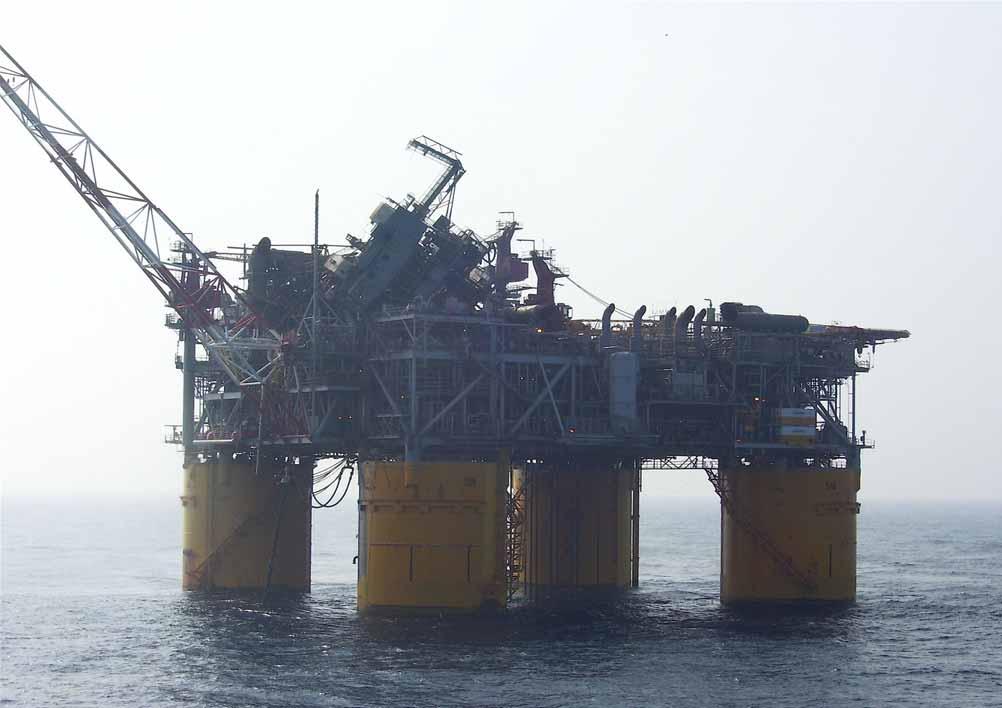
Some of the deepest operations including Total’s Girassol field, are also off the coast of Angola. The Girassol field, which began operations in 2001, was of one the first major deep water fields. It lies in 1,350 meters of water. Girassol uses a Floating Production, Storage and Offloading (FPSO) unit, which can produce more than 200,000 barrels per day and houses 150 people.
“Deep projects like Girassol rely heavily on undersea cables,” explained Pascal Talmont product manager Umbilicals and Monitoring, at Stolt, the company that installed Girassol. “There are fewer and fewer divers in the offshore oil business today. All equipment in deep water is telecontrolled with video. Work is done with ROVs and other robotic equipment. All this requires the transfer of a lot of data.”
Since the start of Girassol, work has begun in even deeper waters off Africa and in the Gulf of Mexico, where Shell developed a project called Na Kika in 2003, which is 230 km southeast of New Orleans in 2,000 meters of water.
Named after the Polynesian God of the Octopus, Na Kika has an undersea host platform that is connected via pipeline ‘legs’ to six dispersed subsea fields. This was the first time a central host system was used for the development of dispersed fields. Without this system the fields would have been
Figure: Forecast Offshore Wind Expenditure by Country
The Calendar
Submarine Telecoms Forum is seeking like-minded sponsors to contribute their corporate images to the 2006 Submarine Cable Industry Calendar.
The2006 Submarine Cable Industry calendar will be provided free of charge to Submarine Telecoms Forum’s subscriber list, encompassing some 5000+ readers from 85 countries, including senior government and international organization officials, telecom company executives and team, support and supply company management, and technical, sales and
purchasing staff, field and shipboard personnel, academicians, consultants, financiers, and legal specialists.
The Submarine Telecoms Forum industry calendar will be printed in full colour on high quality 200gsm silk art paper, approx 600 x 300mm, giving sponsors an area of approx 300 x 300mm to display their corporate image.
For further information, sponsorship costs, reservations and information contact:
Tel: +1 (703) 444 2527 Fax: +1 (703) 444 3047
Email: 2006calendar@subtelforum.com
Email: 2006calendar@subtelforum.com
too small to be economically viable. BP is the production operator for the project and runs the host facility and the satellite subsea fields.
New depth records will soon be set. Mr. Brookes said that BP has licenses to explore areas in the Gulf of Mexico and off Angola in 3,000 meters of water.
Offshore projects are becoming bigger and more complex requiring not only umbilicals for undersea operations but also submarine telecom cable for communications and data. Many of the fields have undersea LANs and MANs to connect onshore operations or with inter regional and international submarine cable systems.
“This is a growing niche market,” says Georges Krebs, CTO, Alcatel Submarine Networks. “In the future, because of increased automation in the offshore oil industry there will two cables: one for data and communications and another for power and fluids. Repeatered submarine cables could also supply some power.
“Today, the offshore oil and gas market accounts for five percent of Alcatel Submarine Network’s business, it will grow to 10 percent next year.”
The submarine fiberoptic telecom market for the offshore oil and gas industry exceeded $100 million in 2004, according Mr. Roberts of Doulgas
Westwood.
An important trend, says U.S.-based submarine cable analyst Tom Soja, is the development of submarine cables for the oil and gas industry by independent communications companies.
“Oil companies now have the same telecom infrastructure offshore as they do onshore,” Mr. Soja said. “Today, companies have high-speed LANs on platforms, which often have more than 100 people. Submarine cable systems allow the real time transfer of data from offshore operations to centers of expertise in Houston, London, Aberdeen and Amsterdam.”
In 2000, Enitel of Norway and Sweden’s Telia built Norsea Com, built of the first big systems. Norsea Com connects offshore platforms in the North Sea to Lowestoft in England. Similar systems have been developed in the Gulf of Mexico and the Persian Gulf. The latest project is Ocean Fiber Mission’s Gulf FiberNet cable system in the Gulf of Mexico, which when completed this year will go from Fourchon, LA to Freeport, TX. Gulf FiberNet will connect offshore oil and gas infrastructure and other non-oil & gas interests. It will also have a terrestrial fiber going through the major Gulf Coast cities, including New Orleans, Lafayette, Lake Charles and Houston.
The next wave of submarine cable projects will be off the coast of West Africa. Here, says Mr. Soja, oil and gas companies will connect their offshore operations to international submarine cable systems to reach their centers of expertise in
Europe and North America.
Infinity Worldwide Telecommunications Group of Companies, which is building an approximately 8,000-km submarine cable linking the west coast of Africa to Portugal, plans to sell services to the oil and gas industry. For now, SAT3 is the only submarine cable serving the West Coast of SubSahara Africa.
Windfarm developers are moving farther offshore to build bigger and more efficient windfarms. In less than a decade, windfarms builders have gone from a couple kilometers offshore to nearly 30 kilometers. Germany is talking about building a windfarm 100 km offshore before the end of the decade.
“There are less than 15 important offshore windfarms today, but the number will increase over the next few years, says Gordon Edge of the British Wind Energy Association (BWEA). “The main drivers for this growth will be government support in the EU, the rising price of oil, the phasing out of nuclear energy in Germany and mandated carbon reduction and renewable energy programs in the UK and other countries. In the UK and Germany, the governments also require future windfarms to be built farther offshore for ecological reasons.”
An offshore wind farm costs eight to 10 times more than an onshore wind farm. However, offshore windfarms can be much larger than onshore windfarms. The wind is also stronger and more consistent offshore.
Windfarm size is measured in megawatt (MW) output. Denmark is the global leader but could be overtaken later in the decade by the UK, which is now number two.
Today, according to Mr. Edge, offshore windfarm capacity is 600 MW around the globe. About 400 MW is in Denmark. Some 320 MW out the 400 MW is in two projects, Hornsrev, which was built in 2002 and Nysted, which was built in 2003.
The UK has 124 MW in three projects: Blyth, North Hoyle and Scruby Sands. A joint venture comprising Shell Wind Energy, EON and EnergiE2, plans to build the world’s largest wind farm off the coast of the UK in the Thames Estuary. The project, London Array Ltd., could start in 2008. It will be located 20 km offshore and have 270, fiveMW turbines. Today, the maximum is 3.6 MW. The project will generate enough electricity to meet needs of 25 percent of London’s residential users.
Based on London Array and other announced projects, Douglas Westwood, the UK consultancy, says the market for submarine cable to connect offshore windfarms will increase to $200 million in 2008 from only $5 million in 2001. During this period offshore total turbine output will jump from 61 MW to 1800MW. The forecast includes planned windfarms in a number of European countries Sweden, the Netherlands, Belgium, France Spain, and Germany.
The market outlook has attracted the attention of suppliers and cable installer like Global Marine, which created a renewable energy division.
“It’s a very young industry. We do not yet call it a market. We have 1 to 2 projects/year since 2001,” said Mike Prowse, business manager, renewable energy Global Marine. “ But there is a huge potential.
“Cabling windfarms is very demanding,” says Mr. Prowse. “Cable is very is large and heavy, which makes it hard to attach to turbines. There are a lot of pieces to install and the cable must be buried up to three meters in some places.”
Offshore windfarms use two types of cable: 33 KV (Infield) cables with fiber between turbines and 132 KV or 150 KV (Export) cables with fiber to the shore. Fiber is used for data and control the average fiber count is 12.
Turbines in lines can be connected and then connected to shore. This arrangement uses more than one cable to the shore. Turbines can also be connected to a hub that is connected via a single 132 KV or 150 KV cable to the shore. Average fiber count is 12 fibers.
Kurt Ruderman is based in Paris. He is the Editor and European Correspondent for Fiberoptics Market Intelligence, which is published by KMI Research, a division of PennWell. Mr. Ruderman’s reporting also takes him to Latin America, North Africa and the Middle East.
Global Asia Pacific Completes a Challenging Project
By Gordon Duzevich
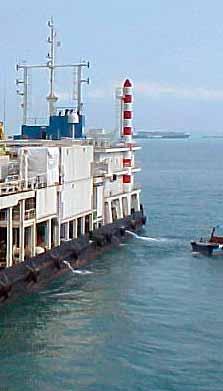
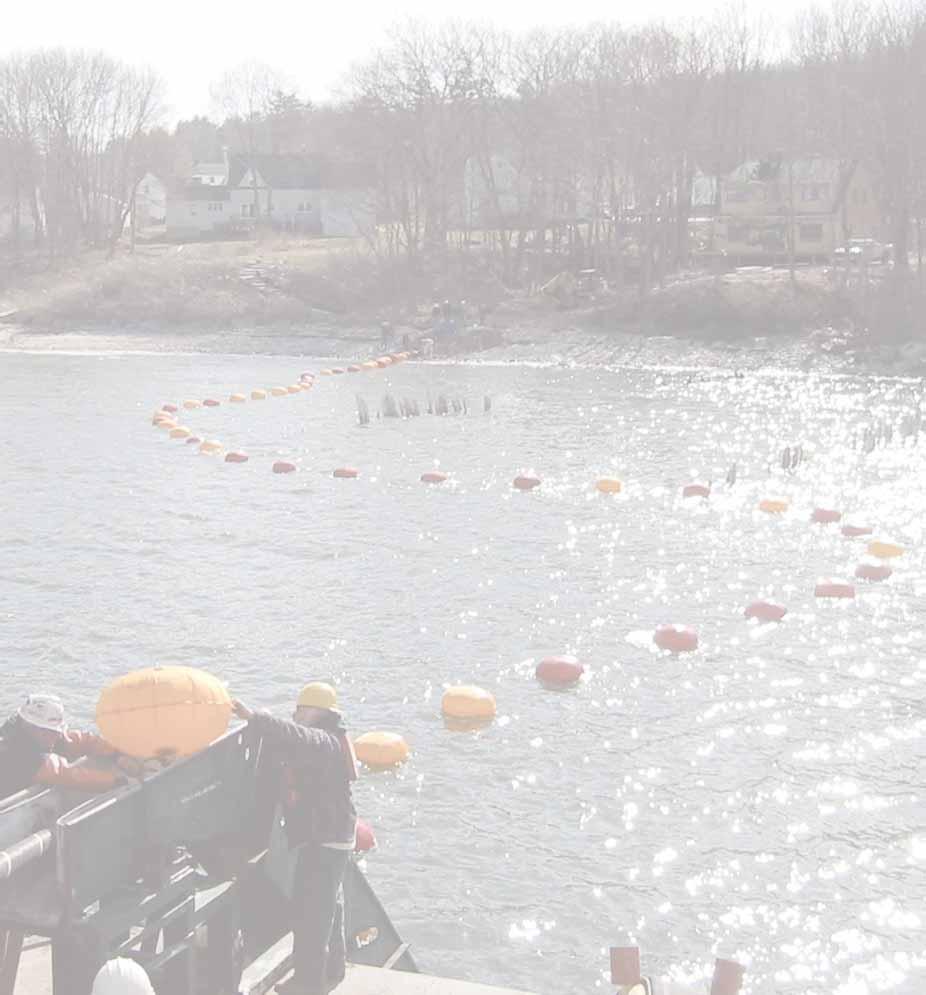
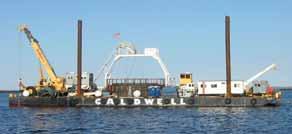
Global Industries Asia Pacific Region recently completed the Jan De Nul-Boskalis’s PGN/PowerGas Pipeline Project crossing the Singapore Straits between Sakra Island in Singapore and Palau Pemping (Island) in Indonesia, a distance of 26.2 kilometres.
The pipeline crosses three shipping channels in the Singapore Straits, with the Philip Channel reputed to be the busiest shipping channel in the world.
According to visiting Global barge superintendent Dave Nichols, “While visiting the DLB 264 on the PGN project, I witnessed first hand the unbelievable amount of shipping traffic passing the barge in the Philip Channel. This was one of the most technical and potentially dangerous operations I have ever been involved in. With intense planning and proper execution, the task went very well. The operation was impressive.”
For the technically minded, the X-70 pipe, 28 inches in diameter, was welded to specification DNV (2000), a very stringent standard, by Global welding engineers led by Ian Sykes.
An additional scope to the project included the deployment of an optical fibre communication cable, which was to be strapped to the pipeline during pipelay.
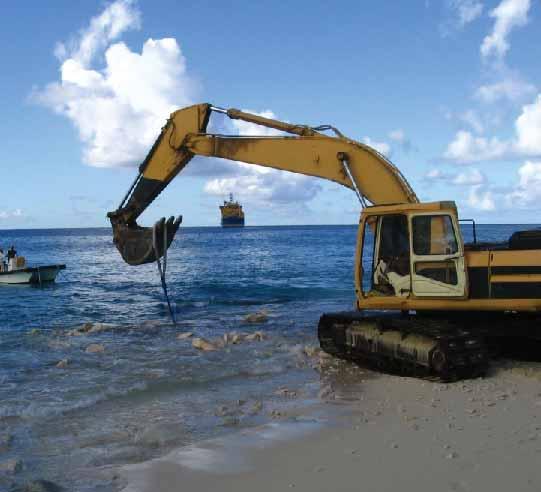
The crossing of borders (Singapore/Indonesia) with the plethora of regulations and government certifications that had to be met, two tricky beach pulls, and a midline tie-in with very strong currents posed significant challenges for project manager Amar Umap, senior project engineer Phanindhar C, and the project management team.
The real work, however, is on the barge laying the pipeline. Hats off to barge superintendents Jeff Johannsen and Greg Daigle, and their team of able hands.
The entire installation was completed safely, ahead of schedule, and to the satisfaction of our customers. “Technically, operationally, logistically…this project had lots of excitement. Despite the all challenges this project has clearly proven that with sound engineering, thorough planning, teamwork, sincere efforts, and commitment from everyone, we can together overcome any challenge in this industry,” said Project Manager Amar Umap.
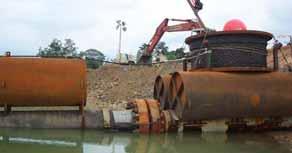
Cable Horseshoe Roller – One unique aspect of this project is that the fibre optic cable is attached to the pipe as it is laid. The cable goes over the horseshoe frame and then is attached to the pipe after the last welding station. The Serimer automatic welding equipment and procedures were used on the DLB 264.
Pemping Cable Tanks - The spool of cable on the top of the pipe is the fibre optic cable that was installed along with the pipeline. Buoyancy tanks were installed on the pipe to allow it to be floated into the beach in Pemping, Indonesia from the DLB 264. These are temporary tanks to provide floatation of the pipe while it was being pulled to the beach.
Prior to the past three years as quality manager for Global Industries’ Eastern Hemisphere operations, Gordon Duzevich was quality manager with Telstra’s Network Design and Construction division in Australia and had some involvement with the SE-ME-WE 3 telecommunications cable when it came ashore in Perth, Western Australia. As Quality Manager of Eastern Hemisphere at Global Industries, he actively supports the drive for continuous improvement in the Eastern Hemisphere and throughout the organization.
Bandwidth in the Oil Patch: Requirements and Challenges
By Guy Arnos
A fellow in Prudhoe Bay once told me “Pick the most remote places in the world, with the worst climate and that’s where you’ll find oil.” Prudhoe Bay, the North Sea, Angola, Indonesia, the deep waters of the Gulf of Mexico – I’d say he’s right.
In developing production assets in remote locations within the oil patch, the engineering challenges are great and the financial commitments immense. Safety and efficiency dictate the constant desire to move personnel from off shore platforms and other remote locations into “town.” Even with oil at over $60 per barrel, the pressure continues to reduce lifting costs. Producers are always looking for ways to maximize what can be withdrawn economically from proven reservoirs. Small percentage gains in extraction efficiencies can lead to a great expansion of known reserves, with resulting economic benefits.
often as several times per minute. New types of data are being added to the mix as new down hole sensors are added to existing wells. Wireless systems that operate at 9,600 baud are no longer sufficient for the relatively simple task of data collection. The increase in volume and complexity of production data creates new challenges in data analysis. What to do with the myriad of data points and how to synthesize the data and make it useful are the challenges of visualization software applications. These applications make further demands on bandwidth in the links between the field operation centers and collaboration centers.
In some terrestrial fields, the separation between wells and sheer number of locations makes the use of fiber optic cables economically unviable to provide high capacity.
Collaboration and automation are the new tenets of oil production. Both require new bandwidth technologies as well as a new way of looking at communications technology. Communication systems are no longer simply another cost to bear; high capacity, high reliability connections are now strategic assets that some producers consider key to their future positioning as industry leaders. Collaboration requires the sharing of well production data in real time between the field and engineers in centralized collaboration centers. Data which has been previously recorded and reported as seldom as once per hour is now being collected as
Real time video is another tool for collaboration as well as its traditional role for surveillance and security. Planners anticipate high quality video as a tool for remote operation of wells from distant collaboration centers, reducing the number of personnel required in the field for well inspections. While slow-scan video can provide routine monitoring during normal operations, real time inspections and operation during extraordinary conditions will require switching to much higher resolutions with their attendant high capacity demands. The use of multiple cameras at several locations within a single asset can easily require backbone communication capacity of many tens of megabits per second.
Of themselves, these high bandwidth requirements pose no significant challenges to modern communications technologies. The oil patch, however, is not a well-connected urban area
blessed with power and telecommunications infrastructure. Far from it. Terrestrial oil and gas fields in developed countries may have a thousand wells spread over a thousand square miles in remote areas far from commercial power and national telecom backbones. In developing countries national telecom backbones may be even farther from production assets. Apart from isolation and the ever-increasing distances from shore, the off shore environment adds additional challenges due to constraints on space and power, the unique requirements of engineering at sea and harsh climactic conditions as may be found in the North Sea.
Off shore platform equipment is also expected to operate and survive unattended during abandonment due to hostile weather events such as recently experienced during hurricanes Ivan and Katrina. Platform operators are demanding the survivability of telecom systems during abandonment to permit remote monitoring of platform health parameters and environmental concerns. The ability to fully re-man platforms and bring them back into production following abandonment is often limited by safety policies that require operational communications to shore. Where near shore platforms may rely on microwave and satellite links, the issue of survivability of both the platform antenna systems and the shore/ earth stations have been brought into sharp focus by widespread onshore devastation wrought by hurricane Katrina. Implementers of submarine cable systems must seriously consider ring architectures and separation of cable stations on land by hundreds of kilometers to ensure survivability of communications. Power systems for telecom systems aboard the platforms must be hardened and sized to provide many days of unattended operation and potential failures of generator systems.
Bringing broadband connectivity to and throughout these remote and widespread assets imposes a range of technical challenges. In some terrestrial fields, the separation between wells and sheer number of locations makes the use of fiber optic cables economically unviable to provide high capacity. Wireless broadband systems appear to be the solution in these cases, but have their own limitations such as propagation over rough terrain, limited distances for the highest capacity and the requirement to acquire and permit sites for a significant number of towers. Most broadband wireless systems currently available do not operate within licensed frequency bands. While this unlicensed operation makes for one less step in the deployment process, it leaves operators in congested areas where multiple companies hold production assets nervous about the ability to control potential interference from neighboring operators. WiMax standards are still evolving and suppliers are deploying product to the larger markets of unlicensed frequency applications before moving to licensed frequency products where government regulators may not have yet even allocated radio spectrum. The result leaves a product void for a specialized industrial market as suppliers chase the potentially huge public Wi-Fi and Wi-Max network markets.
Off shore platform operators are also feeling the squeeze of the limitations of “old school” telecommunications strategies. As platforms move into the deep waters farther off shore, line of sight microwave systems become impractical if not impossible to implement. Most of these microwave systems are owned and operated by third parties and rely on the survival of several different platforms (often owned by several other operators). Satellite communications are expensive,
limited in bandwidth and suffer from high latency. Submarine cables become the remaining viable alternative for high capacity communications far off shore, but submarine cable systems are expensive, and the core business of oil companies is the production of oil, not the construction of dedicated telecom systems. While there are many platforms operating in locations like the Gulf of Mexico, the distances between platforms (especially deep water platforms) is large as is number of disparate platform owners and operators. Creating a commercial communications entity to serve off shore platforms on a fee-for-service basis using submarine cables becomes highly problematic due to the difficulty of reaching and aggregating customers combined with the expense and complexity of implementing submarine cable systems.
Once a terrestrial field is networked or a series of off shore facilities connected back to shore, extending that connectivity to collaboration centers is straightforward by comparison. High capacity digital networks are available worldwide in all but a very few of the least developed countries where oil and gas are now being produced, or will be produced in the near future. Most of those countries are connected to (or connected to a country which is connected to) the pan-global network of undersea cables or the global satellite network. While the cost of leasing capacity in or through some countries maybe high, the connectivity exists. In many markets, the glut of submarine cable capacity built during the telecom bubble provides large quantities of bandwidth at attractive prices.
Deployment of high bandwidth networks to and throughout the oil patch is only the first challenge. As operation of production assets becomes more centralized and the public networks are used to connect far-flung assets and collaboration centers,
network security becomes a paramount issue.
Though “private line” networks may be carved out of capacity in the global public networks and be inherently secure, operators in collaboration centers will be using workstations which, realistically, must be connected with corporate networks. Those corporate networks will ultimately be connected to the wild, wooly and untamed world of the Internet. Something as simple as an undetected virus contained in a single e-mail could be passed to the servers in a collaboration center. That collaboration center now potentially controls the oil and gas production of not just a single field or asset, but a world region. Without properly engineered defenses, a concentrated malicious attack on a company’s assets by a hacker, a terrorist or a hostile government could be catastrophic, not just to the company or the environment, but to the economy of a nation.
Here are some simple truths:
• Reliable, high bandwidth communication systems are critical to the new operational model of the oil and gas industry.
• Reliable, high bandwidth communication systems are not inexpensive.
• In remote areas and/or harsh climates, with
a limited customer base, no third party will take the financial risk to build these systems without adequate compensation.
• With rare exceptions, it will always be less expensive for the operator to build these systems themselves. Th is may include “tail” circuits or backhaul network to connect with commercial network infrastructure.
• Aggregation of the management of assets will make security a critical consideration of the highest priority.
Conclusion: If the new operational model is to succeed, the oil and gas industry must consider communications systems as integral to their successful operations as the latest exploration and production technologies. Capital investment in telecommunications can no longer be considered a luxury or an afterthought or less important than drilling a new well or developing a new field. Obsolete and/or evolutionary systems need to be examined and upgraded, with due and appropriate business case justification, to become part of a seamless integrated exploration and production environment.
Guy Arnos
With over 20 years experience in submarine and terrestrial networks, Guy Arnos has directed WFN Strategies’ efforts in a number of submarine and terrestrial telecom projects in the US and Asia, providing engineering, provision and installation support of fiber optic, RF, microwave and cellular systems. He has been responsible for the planning, engineering and implementation of transoceanic, transcontinental and metropolitan networks. He joined WFN Strategies in 2001 as Director of Projects.
Technology Transforms the Oil Patch
Special Inset by Russ Doig General Communications Inc.
Over the past 10 years there has been a radical transformation taking place in the oil production industry that has been facilitated by communications technology. This transformation has lead to rapid advances in drilling, process automation, and plant operations technologies. Ultimately these advances have reduced the time to market for field development and reduced the lifting costs for oil and gas extraction.
The ability to provide more cost effective bandwidth to drilling rigs has brought forth new applications and systems for rig operations. Drilling information systems now monitor all facets of the drilling operations both locally and remotely. These applications produce a real-time informational dashboard that displays operational parameters such as bit rotational speed, weight on bit, depth, direction, mud weight, etc. From this information the on-site rig staff can operate the rig more efficiently and remote engineers, geologists, and other experts can quickly come into play to diagnose and resolve issues. Other specialized applications can be brought into play for specialized drilling such as exploration. Real-time well logging and analysis allows geological and reservoir experts to quickly analyze exploratory drilling results. The end result is reduced costs for drilling because less time is required to drill a well, less staff is required on-site, drilling results are improved due to better information, and experts can manage multiple projects. The enabling communication technologies that make these applications
possible are broadband wireless, wireless LAN, and direct broadcast digital and Internet satellite services. These systems allow drill rigs to be freed from the tether of point-to-point microwave systems and leased lines, which increases mobility, provides greater bandwidth, and reduces the need for human intervention when relocating. Use of VPNs and IP encryption technologies over the transport insures data integrity and security.
High-speed secure networking has brought about change for production facility process control. Serial links and low speed SCADA systems are replaced by high-speed IP links supporting distributed process control automation systems. As with drilling, new applications provide a “dashboard” view of plant operations and control systems. The process systems take an incredible amount of data points and present the operations personnel with only the crucial information to do their jobs. In some cases the operations staff can do “what if” scenarios to simulate the effect of minor process changes on system operation and production efficiency to better tune day to day plant operations. Remote engineering staff can access views of the plant operation and historical data to do long term modeling and planning in order to de-bottleneck operations and improve plant operating efficiency. Additionally, if a plant operations issue surfaces, the remote operational engineering staff can see what the on-site staff sees in real time to recommend immediate resolution. This automation increases the plant production efficiency, reduces staffing requirements, and improves health and safety therefore reducing operating costs. Gigabit fiber optic plant backbones running both proprietary and conventional IP protocols are the core transport for these systems. Outlying facilities and production areas can be brought into the plant transport via gateways that are connected via fiber, microwave, or satellite IP links. MPLS and other technologies are used for the wide-area links so that production data can share transport but still be segregated from other services to insure high reliability and availability.
Personal communications has changed radically in the recent past. Mobile field staff once dependant on
two-way radio and paper and pencil for communication and data gathering has been liberated. Instead of returning to the field office to get blueprints, the next work order, submit a request for material, or turn-in a log sheets they can now do that from their vehicle. This reduces travel time and increases the overall mobility of field maintenance and operations crews. Use of hardened PCs and PDAs in the vehicles allows for data entry and retrieval. In harsh or remote climates GPS can be used for position location and tracking to improve safety. Wi-Fi, broadband wireless, and wireless LAN hotspot technologies are the key communication enablers for these applications.
Continuing technology advancements are already driving new systems and applications such as wearable computing and visualization devices. These devices can be used in a plant environment to provide local data and images at the point of equipment malfunction or repair activity to assess those activities and send images and data to remote experts or vendor locations for assistance and consultation. Emerging mesh networking devices and sensors based on motes and nanotechnology will produce the next generation of innovative oil field applications.
Russ has worked for 30 years in the Alaskan oil industry with various positions in Production, Instrumentation, and Telecommunications. Russ is currently with General Communications Incorporated (http://www.gci.com), as a Program Director providing telecommunications outsourcing and project delivery services to industrial clients.
A Chinese Tale: How SBSS
Expanded Business from a
Cable Installer to an Offshore Service Supplier
by Derek Greenham
S. B. Submarine Systems Co. Ltd. (SBSS), like most other telecom marine suppliers heading into 2003, was faced with the prospect of an under utilized fleet and a difficult future. This of course was the down side of the installations boom. Revenues at their peak were three times the levels experienced just a few years later. Even though SBSS was only a four vessel company it started to look like we had three too many. In order to preserve our skills and experiences built up over the preceding years other non-telecom opportunities had to be searched out. Oil and Gas seemed the obvious choice with its high marine content and mix of charter and project opportunities plus a need for suppliers skilled in managing operations on the seabed. Here follows a small insight as to how we got on.
First Touch in Oil & Gas Field
SBSS’ first opportunity came from a small project for an oil company installing a medium size power cable. The customers were surprised that a DP vessel could lay a cable and not, as their past practice, a barge with a mooring system. We had to improvise using the techniques developed in the telecoms industry, as the customer seemed to offer little in the way of guidance or operational perimeters, a situation I can vouch is changing fairly rapidly. Our approach was similar to telecommunications cable as the composite cable behaved in a similar fashion. Some very sound rules of thumb and operational procedures were rapidly evolved and all went well. The project was combined with a pipe burial project in which SBSS provided Fu Lai as a host vessel. Some superb operational, on the job decisions were made which made a potentially difficult project run smoothly.
Equipment, People, Procedures…and StomachsChallenges of Being a Diving Support Vessel
So first time in the business and we had a warm feeling that we had performed fairly well. It was to be some months before we carried out our next excursion into the Oil and Gas business. This proved a somewhat
different story. Our next project involved providing Fu Lai as a dive platform for a saturation diving system, something we knew little about apart from the fact that it could be done. We engaged the services of a competent marine consultancy company based in Aberdeen. They immediately carried out an FMEA, Failure Mode Effects Analysis. This involved putting the vessel through a series of tests to simulate what would happen when certain mechanical and electrical components failed. The idea being that no single point failure will render the vessel powerless, she must remain operational although at a reduced capability. This would allow the vessel to recover divers and move away from a structure, repair the fault and return to operations as soon as confidence is restored. After a set of sea trials the vessel passed muster fairly easily with only a few minor hitches. We all breathed a collective sigh of relief, it was not that we felt that she would fail but that it was something we were unused to so imaginations run riot, old vessel from the cable industry, etc, etc.
Following on from the FMEA came a diving manual, a bible for operating as a dive platform. It contained a vast number of items that had to be worked through if we were to safely deploy divers and operate close by offshore structures. There were emergency response procedures, 500-meter zone procedures, operational weather limits and a whole host of other requirements. There were also particular requirements on the kind of experience levels acceptable for key staff (which seemed to be most of the vessels crew). Our staff both onshore and offshore gradually endowed the vessel with the necessary skills and operational procedures to enable safe and efficient operations as a dive platform.
The first diving project was a baptism of fire to say the least. Prior to sailing we were required to attend a HAZID, which is a hazard identification meeting, standard practice for the industry. Every move of operations is planned and any hazards identified and mitigated. Phases of an operation were broken down to a story board level, every position of a lifting strap, pad eye, vessel heading, danger to diver or equipment
and experience of personnel were brought up and criticized. Whilst cable operations are well planned this level of detail was new to us. Although on occasions it resembled a “pass the parcel” game on who was to provide mitigation it was a good process. After this we set sail for our first dive project. It did not go too well in the beginning; we were nearly abandoned by the client as a series of mechanical failures put the vessels abilities in question. Operating as a cable ship would have been fine but in close proximity to a platform with divers on the seabed the failures were unacceptable and operations had to stop. As the captain afterwards remarked “moving towards a major oil producing platform at 1 meter per second was not fun”. We were operating off shore in India, which was far from our communications lines, and we were beginning to feel that it was far from our core operating skills.
As is often the case in these circumstances the vessel crew, supported by a harassed and hard working facilities department returned the vessel towards dive support readiness and she completed the project without any further problems. We were not out of the woods yet. The client had a host of complaints regarding vessel laundry and hotel services. With over 30 people coming off shift in one go and having worked on the back deck they needed a change of clothes on a regular basis. Food was, and I guess in the marine industry, will always be an issue. Trying to please the European, Indian, Chinese and Filipino palate was, and still is not easy although at present the ship has over 30 nationalities onboard. Certain issues can become quite volatile on board and it was important to address these lesser but equally important issues. We gradually changed our thinking on how we did business in this new and sometimes difficult environment and started to grow accustomed to the industry.
Power Cable Lay
SBSS had been fortunate enough to bid and win a small number of power cable installation projects. Our first large scale system was designed to hook up two platforms and enable oil to be produced .The cable
at 144mm and 27kg per metre was larger then we had experienced required some special handling techniques. The most important stage of laying the cable was the design and installation of a large gantry deployment system. This was beyond our knowledge but a small engineering company based in the south of England provided all the necessary design and assistance. They were of great assistance in educating us in all the pitfalls to be expected in deploying large cables, from drop heights to crush resistance and engineering analysis.
There was limited space from which to deploy the cable, as the vessel was required to carry the saturation diving system as well for a project immediately after the cable lay. Whilst the project went well it was not without its hazards, the cable, despite its large size is easily damaged and all the parameters had to be closely monitored. These included the pull from the platform through the J tube and the normal requirements on the vessel side. Rigging crews had to be dispatched by, supply boat, helicopter and platform crane to set up pulling and rigging equipment. Manpower became an issue with a lot of pressure on bed spaces.
The vessel Master along with the officers and crew had to perform a number of functions, all in a new working environment “doing something a little different”. As well as manning the cable installation side, vessel staff was required to usher in and out helicopters and organizes basket transfers and maintains the normal functioning of the vessel. This was all carried out with limited numbers due to the requirement to have the diving system ready to operate along with an ROV system. We did complete the project without too many problems and all was signed off, the only delays being a typhoon, which happened to swing towards the installation. We took the opportunity to fit a bigger crane during this time.
We Love the Tough but Interesting Industry
Whilst our core competence is in the maintenance and installation of telecommunications cables, the Oil and Gas business has now become part of our mainstream operations. Our staff, both onshore and offshore switch from one to the other fairly easily. One of our vessels has not seen Shanghai for 18months and will probably not return for another 6 months. We have learnt a lot from our experiences over the past few years and vessel downtime is less than one percent, a far cry from when we first started. It is a tough industry where downtime is counted by the minute, budgets and costs monitored to the nearest cent and a procedure for practically everything.
You often find the vessel a few meters away from a multimillion dollar installation, a host of people and equipment hanging beneath the vessel and some one arguing over a 27 $ satellite phone bill. Our staff has had their skills tested and gained new skills and we have identified a number of ways to improve our performance in both industries through cross-fertilisation of the ideas and techniques we have experienced.
On reflection each project will have several companies involved, millions of dollars worth of equipment, a whole host of support services on the vessel and after the tool box talks, handover briefs and job notices are finished and the diving bell has been launched there will be a man holding a spanner to tighten up a nut!
Submarine Cables and the Oil & Gas Industry in West Africa
An Opportunity Worth Watching
By John Manock, T Soja & Associates, Inc.
West Africa provides an interesting contrast in the development of two industries – telecom and energy. The region’s telecom industry has historically been known for minimal levels (or complete absence) of investment, while the energy industry has seen a huge surge in sums of money invested to develop oil and gas deposits.
The current state of the two industries in West Africa can be summed up quickly. In telecom, there are few options, particularly for high-speed international fiber services. SAT-3/WASC is the only submarine cable currently serving the region and, as has been frequently reported, has prices so high and policies so restrictive that it has crippled the growing demand for the very services it was intended to provide. Meanwhile, other ventures are looking to fill the gap with a new cable to compete with SAT-3, but investors in the past have been hesitant to commit to such projects.
In the energy industry, the exact opposite is true. There is tremendous activity in developing onshore and offshore oil and gas deposits in Nigeria, Sao Tome, Cameroon, Gabon, Angola and other West African countries. Energy giants have committed huge resources in the region in spite of the political risk. Most noticeably, energy projects have little trouble getting funded. In fact, two of the most ambitious energy infrastructure projects ever are now being developed in the region – the Trans Sahara Pipeline and the underwater West Africa Gas Pipeline. In fact, West Africa is the recognized area for nearterm exploration and production of high-quality hydrocarbons and consequently it is also the #1 region in the world for capital expenditure toward development of these assets.
In spite of the differences that the two industries are experiencing in West Africa, they are more closely related than one would think. The scope of investment by the energy industry and the scale of the infrastructure projects being undertaken are creating a large pent-up demand for telecom services by the oil and gas companies – a demand that cannot be fulfilled by the current telecom infrastructure and environment. What Is So
broadband communications is vital to the operation, control and strategic decision making of the business.
Offshore platforms are the ‘factory environment’ of the industry. Yet, according to IT managers in the sector, in terms of communications capabilities, the offshore sector of the industry has historically not kept pace with the land-based operations. This has continued to be true even though the investment in plant and equipment for deepwater developments typically exceeds $1 billion per platform and frequently several multiples of that level.
Although the oil & gas sector in many ways is a very conservative industry and sometimes slow to adapt to innovations not directly related to exploration or production, this is beginning to change in a major way.
Communications Requirements for Oil & Gas
A convergence of worldwide trends is currently driving communications requirements in the oil & gas sector.
1. There has been a shift to offshore and deepwater exploration and production as surging demand for oil has outstripped the replacement rate of proven reserves on land and in more easily accessible shallow-water regions of the world.
2. There is a marked increased in use of highly sophisticated technology to increase odds of finding and then maximizing production of those hydrocarbons (the oil & gas.)
3. The increasing maturity of the North Sea and Gulf of Mexico plus political uncertainty in the Middle East shifts West Africa’s proven but still under-utilized potential to front and center in terms of global focus of future supply.
IT equipment giant Cisco is one supplier that is looking at opportunities in oil & gas. Cisco, working with industry specialists such as OSIsoft and WiredCity, is looking at ways in which to help the sector and has developed the “Oil Field of the Future” concept. This includes:
Special about Oil & Gas?
The oil & gas industry is an increasingly sophisticated and high technology business environment where
• Maximized effectiveness of seismic analysis, using optical networks on the sea bed to enhance companies' ability to manage data and make better exploration and prospecting decisions during production and extraction;
• Enhanced production capabilities, based on a real-time infrastructure for monitoring and managing manufacturing operations. The platform gathers, processes and delivers data from almost any source to almost any destination;
• Offshore data center applications, combining satellite communications with IP to carry voice, video and data on the same network, optimizing the available bandwidth to ensure business continuity and reliable availability of information and applications across an entire enterprise;
• Simplified application management, removing the need for a qualified engineer to visit the site in person and allowing the applications at the corporate center to be made available at remote sites, with no diminution of the quality of service, reliability or, critically, security;
• A single converged, secure network to handle all applications as well as voice, video and data. IP is open and standards-based meaning that new applications and devices can be introduced with relative ease. Monitoring and control are centralized, offering improved efficiency;
• Video on demand, allowing entertainment and training to be inexpensively and reliably offered to all installations and for platform workers to use to see and speak with their families over the Internet, at a tiny fraction of the cost of a satellite video link;
• Enhanced security, as information can be routed to where it is needed and accessed from a variety of devices. Equipment performance can be monitored from any point on the rig or onshore. Possible environmental breaches can also be monitored more effectively;
• Cheaper calls. A satellite phone from a rig in the North Sea can cost upwards of US$6,000 per month to operate. IP means that voice communications can be greatly improved and operated at a fraction of the cost that conventional satellite technology allows.
Broadband for Oil & Gas
All of this has created a bandwidth bottleneck not satisfied by satellites, troposcatter radio, or microwave.
These ‘competitive’ communications technologies offer only limited bandwidth at exorbitant costs, and are subject to weather-related quality degradation and/or unacceptable transmission latency (lengthy signal path delays).
Like all other well-run modern businesses, the energy sector ideally wants integrated ATM or IP-based communications backbones over which voice, data, and video can be transmitted in real time. Among the many benefits of being able to take advantage of broadband communications are:
• Improved recovery – faster and greater quantities of oil & gas produced per well,
• Decreased lifting costs,
• Reduced manpower costs and hazards exposure,
• Better monitoring of security and assets.
• Quicker detection and reaction to potential environmental breaches,
• More effective use of increasingly scarce technical expertise.
However, the oil & gas companies do not want to be in the telecom business – they would prefer to use a third-party to provide the service and ‘make it all work’ seamlessly.
In the course of dealing with oil & gas customers over the past five years, TSA has seen a noticeable acceleration of the increase in telecom capacity requirements growth. When TSA surveyed the oil & gas majors in the North Sea in 1999/2000 and in Gulf of Mexico in 2002, a T-1 (1.5 Mbps) per platform was typical – i.e. essentially sized on the basis of similar existing microwave and satellite link capacity on other platforms, which was all that was available. By mid-2003 as new long-term service contracts were being negotiated, customers had already increased their capacity requirements to about 50 Mbps per platform. This was a direct result of serious study and considerable deliberations within each organization regarding the greater implications for what was possible and achievable with respect to business process re-design if bandwidth were plentiful and priced reasonably rather than scarce and expensive. Notably, for those with fiber already in place in the North Sea, both then and today, an STM-1 (155 Mbps) per platform is quite typical.
Today in the Gulf of Mexico, customers are already seriously discussing 1-Gbps (1,000-Mbps) connectivity. 1 Gbps correlates directly with the ability to run 10/100/1000 Ethernet offshore similarly to what has already been implemented across their global operations onshore. This sentiment was also expressed as a ‘dream in an ideal world’ from a 2002 market study conducted by TSA but today is becoming more than a reality – it is becoming an operational imperative.
Growth of Bandwidth Demand, Per Platform
Source: T Soja & Associates, Inc.
One interesting development that has become evident from TSA’s research is the shift from within the energy companies’ organizations as to who wants broadband connectivity. Originally, the thought was that the access to broadband fiber on the platforms would primarily serve the needs of the most critical and bandwidth-intensive operations, such as the transfer of geological data to onshore data centers. Now, thanks to the availability of fiber in other regional markets and perhaps a greater expectation on the part of all constituents within the respective organizations, demand for fiber access is being driven by a much broader range of users –from geologists to cost accountants to the staff accommodations and commissary people.
Fiber Is in Use in Other Regions
Fiber connectivity to offshore platforms is a major
and growing trend in the industry. In the North Sea, BP (Forties & Everest Fields), Statoil (Tampen area, Troll, Grane, Oseberg, Sleipner area), ConocoPhillips (Ekofisk Field), and Shell (9 platforms in the Brent Field area); are served by private fiber networks -- the NorSea Com cable network and Statoil’s Tampnett. Fiber is also being used in the Ormen Lange gas fields off Norway.
In the Gulf of Mexico, BP, Chevron, Shell, and many others, operating the Holstein, Mad Dog, Atlantis, Thunder Horse, Na Kika, Horn Mountain, Marlin platforms, are or soon will be served by Ocean Fiber. As one example, BP’s Thunder Horse is projected to produce 250,000 barrels of oil per day beginning early next year (Q1 2006), so it is crucial not to have to shut it down for any reason, including communications outages.
Fiber is widespread use in the Persian Gulf. Saudi Aramco has a private offshore network connecting twelve (12) platforms linked by 250-km fiber ring network. A Kuwait-Iran cable that is currently under construction will include a link to the Soorosh oil platform. Fiber will connect two platforms in the Dolphin Gas project, also under construction.
Carriers are taking notice
At an oil & gas conference in April, a new player in the submarine cable field – Infinity Worldwide Telecommunications Group of Companies, Inc. (IWTCG) – presented its vision of providing high-speed telecom services to the oil & gas industry in West Africa.
IWTCG is proposing to build a regional submarine cable linking West African countries with each other and the rest of the world through Europe and utilizing that cable to offer high-speed connectivity and specialized services to the oil & gas industry. The company identified these services as:
• Special builds, both offshore and onshore, to meet the requirements of the industry
• High-speed connectivity to back-office operations globally
• IP-based support for global networking
Summary
The oil and gas sector in West Africa represents a very attractive vertical industry sector currently characterized by:
1. A known and well -established customer base with a need for broadband connectivity,
2. A sorely underserved telecom market,
3. Inferior and over-priced competitive alternative services,
4. Alternatives that are scarce and practically or actually non-existent,
5. Customers that can afford to pay for mission critical services, and
6. Customers that tend to be loyal;
all of which combine to create an attractive market opportunity.
Major energy companies have shown active interest in submarine cable projects in West Africa. Some have participated in discussions for private submarine cables, while at least a few have been willing to pay the high price for SAT-3 connectivity. However, there is still a strong undercurrent of pent-up demand nit yet addressed in the market.
Fiber, whether to offshore platforms or connecting onshore data centers in regions such as West Africa with the major hubs in Europe and the United States, is the desired mode of transport for companies in the oil & gas sector. As oil & gas exploration and production continues to expand in West Africa, the industry’s demand for fiber will inevitably increase. This will, just as inevitably, lead to opportunities for the submarine cable industry.
IWTGC Plans West African Submarine Cable
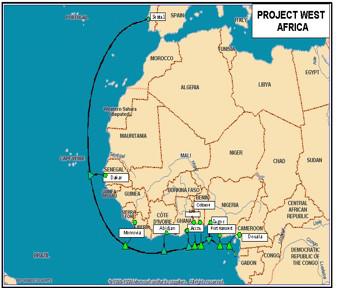
Infinity Worldwide Telecommunications Group of Companies, Inc. (IWTGC) has announced plans to build a high-capacity submarine fiber optic cable network linking West Africa with Europe. This stateof-the-art, terabit network backbone will be designed, engineered, and installed to world-class standards and will offer West Africa much needed managed, highcapacity, high-quality international communications. Known as “Infinity West Africa,” IWTGC will install
a submarine cable that will initially connect Nigeria, Cameroon, Ghana and Senegal with each other and with Portugal, where existing submarine cables and terrestrial fiber will carry traffic throughout the world. Additional branching units will be installed to bring the advantages of the new system to Guinea, Sierra Leone, Liberia, Cote d’Ivoire, Togo, Benin and possibly other West African countries either directly or through network extensions.
“Infinity West Africa” (IWA) will allow African carriers, ISPs and other operators to complement their existing networks with an entirely diverse path that can provide much needed increased capacity as well as physical route alternatives and restoration options. Capacity prices, commercial terms and conditions, activation times, and operating costs are expected to be significantly better than the current market offerings.
In order to provide onward interconnection beyond Southern Europe, IWTGC will purchase fiber capacity between Southern Europe and central Europe (Paris or Frankfurt) and London, and between London and New York, and will equip collocation space in all of these major hubs to offer seamless connectivity from West Africa to Europe, the US and Asia. The bulk of the international traffic to/from these markets is to the US and Western Europe. As trade expands with Asian partners, IWTGC will be positioned to interconnect seamlessly with competitively priced Europe-Asia networks as well.
“The goal of IWTGC is to allow West Africa to compete economically on the international stage by bringing the latest in telecommunications technologies and services to the region,” said Robert Woog, Managing Director and Chief Operating Officer at IWTGC. “The submarine cable is the most important feature of this project but we plan to be more than just a cable provider. We plan to interconnect with other systems to extend our footprint. We want to serve ISPs, carriers and other service providers directly.”
Infinity West Africa has already been endorsed by the e-Africa Commission of NEPAD (the New Economic
Partnership for African Development.) Regionallyfocused systems like IWA will serve to strengthen regional economic vitality by enabling integrated ICTs thereby repatriating more than $400 million per year currently paid by Africans to European operators for basic neighboring-country interconnection and Internet peering.
“This is a key point of consideration when skeptics and other conventional thinkers raise the affordability issue,” says Mool Singhi, Chief Network Architect for IWTGC. “If you look at the average GDP per person in Africa, one might conclude – incorrectly – that Africa could never afford most basic telecoms services, much less world-class broadband services. However, the sad fact is that the fees being paid today are for a relatively thin slice of the overall population that can afford to pay many times the prices than consumers in more developed parts of the world.
“IWTGC shares NEPAD’s goal of providing a regional broadband backbone infrastructure at competitive rates which will broaden the affordability and enlarge the overall market for services,” says Mr. Singhi. “Infinity West Africa will be an open system, ensuring equal access to all service providers. The company will set up subsidiaries in each country to sell bandwidth to all telecom, data, and application providers. This is in stark contrast to the existing situation in West Africa where access to international capacity is very expensive and highly restrictive. By having an open system, IWTGC expects to have a much larger customer base and lower costs than existing systems, without compromising quality.”
IWTGC will provide wholesale capacity and interconnection capabilities in competition with the existing satellite service providers and the primary national operators utilizing consortium built cables. IWTGC believes that it will enjoy significant technological and cost advantages as well as be better
positioned in the marketplace to provide wholesale services against both the former national monopolies and the incumbent satellite services providers.
world,” says Mr. Woog.
IWTGC will also offer premium, bundled, multi-media services to end customers that are not available through any incumbent. IWTGC will not compete directly with the incumbents that provide basic landline service, dial-up Internet or even standalone xDSL Internet access. Utilizing the high capacity international fiber optic system and the Next Generation service platforms, IWTGC will offer EOIP services (Everything Over IP.)
IWTGC will offer multinational firms in the region the latest data and voice networking capabilities. IWTGC will have a distinct advantage over the incumbent providers since IWTGC will deploy the same vendor technology in all countries in the region, be managed by one centralized location for provisioning and maintenance, and can offer specialized regional plans since IWTGC will be unrestrained by geographical boundaries unlike the incumbent networks.
“Interconnecting with Infinity West Africa in any single country point of presence (PoP) will provide a virtual gateway, or VPoP, into every other Infinity market of operation, as well as with the rest of the world. This seamless services platform will in turn offer tremendous leverage to end-user services providers for scaling-up applications and content for a wider audience not only within the region but also to the rest of the African Diaspora community throughout the
A major vertical-market focus for “Infinity West Africa” is the oil & gas industry. IWTGC has formed a strategic alliance with the leading provider of fiberbased services to major oil companies in the Gulf of Mexico. These same oil-producing firms are extremely active in West Africa and have already expressed their desire for similar capabilities in this region. IWTGC is ready to offer special end-to-end builds on a longterm contractual commitment to these oil producers straight from the oil producing offshore platforms in West Africa and neighboring countries to their back office operations in London, Aberdeen, New York, and Houston through the IWTGC network.
“In our experience in this sector over the past five years, the oil & gas industry is becoming an increasingly sophisticated, high technology business environment where access to reliable and cost effective broadband communications is vital to the operation, control and strategic decision making of the enterprise,” says Thomas Soja, President of T Soja & Associates, Inc. and special advisor to IWTGC. “In the West African region today, these capabilities are nonexistent.”
There is also the potential to offer “triple play” (voice, data, video) services directly to staff personnel on offshore oil platforms. This would provide a dual benefit of cost savings and improved quality of life
Infinity West Africa Submarine Cable Network West Africa Submarine Cable Network
for platform staff who are stationed for long periods of time away from home. Today they are dependent upon exorbitantly priced and spotty-quality satellite phones to stay in touch with loved ones but can easily be served using incremental equipment installed on the basic fiber network serving each platform.
“Despite surging oil prices, the industry still faces significant staffing shortages, particularly for those with a high degree of skills and experience. Providing high-quality broadband communications for sharing precious human resources and/or improving work-life quality is vital to the industry’s survival,” according to Mr. Soja.
In the near term, IWTGC plans to focus on the wholesale carrier and service provider market for the sale of competitively priced international long-haul capacity. For the medium and long term ITWGC will migrate to focus on higher value-added services, specialized enterprises and the consumer end-users that will be attracted to high quality, multi-media applications.
IWTGC will offer directly to all service providers a bundled bandwidth and Internet access product (IP Transit Service) that will allow these providers to not only increase their customer base, but to offer broadband connectivity to those users wanting improved performance and multi-media services from the public Internet. IWTGC will offer secure, neutral, “carrier class” collocation facilities for service providers wishing to locate their equipment directly adjacent to the international fiber system. These PoPs will be located in secure buildings within the major cities of the region and will be engineered, installed, and maintained with all of the latest proper physical environments for space, power, HVAC, and security to help ensure the efficient operation of all equipment which will significantly improve their reliability and longevity. With these reliable and consistent environments, high-quality carrier-class equipment, professional installation and service, fiber-based
private circuits, both internationally and domestically, and a full featured 24 x 7 Global Network Operating Center (GNOC), IWTGC and its partners will be able to provide high-quality, premium services with the benefit of stability, security, flexibility, scalability and global reach to the market.
Many West African countries do not currently have a regulatory framework in place yet to deal with the introduction of private international cable systems. Therefore, IWTGC has already begun discussions with the regulatory bodies in these countries to educate and provide information so that the proper framework can be developed that will support private, open cable systems.
IWTGC has also been invited to participate directly in the formal process. As this article goes to press, an IWTGC delegation will be traveling to Accra, Ghana to take part in the 3rd Ordinary General Meeting (OGM) of WATRA (the West African Telecommunications Regulators Assembly) on Sub-Regional Harmonised Guidelines Validation for telecoms regulations.
IWTGC has the vision and is committed to do its part for the economic development of West Africa by building and deploying the most modern telecommunications and IT infrastructure to link this region with Europe, the US, and Asia. IWTGC will offer state-of-the-art integrated services throughout the region over a single common architecture with the latest world-class service platforms.
IWTGC is privately financed and managed by a seasoned team of African and American executives. One of the founding tenets of IWTGC’s business philosophy and missions statement is to bring all of the same services and applications commonly enjoyed by consumers in the rest of the world to West Africa at prices and quality levels that equal or exceed those found anywhere in the world. At the same time, IWTGC also hopes to provide a conduit for sharing the rich cultural heritage of this vibrant and energetic region with the rest of the world.
John Manock is the Director of Information Services at T Soja & Associates, Inc. He is responsible for creating and maintaining TSA’s databases on fiber optic submarine cable systems. He is also the editor of TSA NewsFeed, a daily information services exclusively for TSA clients focusing on news and events affecting the submarine cable industry.
Mr. Manock specializes in the development of information services for carriers, developers, and suppliers. He has over 18 years of experience in the fiber optics and telecommunications consulting business during which he has participated in numerous studies on submarine cable systems. He has also published numerous articles for the industry and is a frequent contributor to industry publications including SubTelForum and Soundings Magazine.
Mr. Manock received a master’s degree in Library and Information Studies from the University of Rhode Island and bachelor’s and master’s degrees from Providence College.
Rural Island Community Needs Dependable Power Supply via Submarine Power Cable
By Bill Wall
The RFP issued by the Fox Island Electric Cooperative was not quite that simple when received by Caldwell Marine International in mid2004; in fact it was quite a complex bid package.
Caldwell Marine International was the successful bidder and recently completed the turnkey submarine power cable supply contract for the Fox Island Electric Cooperative (FIEC) of Vinalhaven, Maine. FIEC is the local electrical utility for the Fox Islands located off the coast of Maine.
The Fox Islands are located approximately 10 miles (16Km) off the mid-coast region of Maine in the North Atlantic Ocean. The City of Rockland Maine is the closest mainland town to the islands. The Maine State Ferries ply the waters between Rockland & the Islands on a regular year round schedule, except when they are cancelled due to high winds in the February/March period of the year. Sitting at the mouth of Penobscot Bay, the two largest Islands of Vinalhaven & North Haven are a rugged, windswept home to the largest and most productive lobster fishing fleet in the state of Maine. Visitors on the ferry approach to Carvers Harbor on Vinalhaven are greeted by a virtual sea of Lobster Pots. Another claim to fame are the now abandoned rock quarries that flourished in the 19th century and supplied granite lintels & columns for a host of banks, government buildings and monuments throughout the eastern United States.
The islands have been supplied with electric power via a submarine cable system installed in 1976. This nearly 30 year old system was plagued by breaks due to abrasion from a rock ledge in about 150 feet water depth. Each break led to painful outages where businesses and residences alike were left without power. In 2002 Dave Folce the General Manager of FIEC began the process of planning a replacement submarine cable system. FIEC hired Marenco Consulting & Testing of Prince Edward Island as a marine consultant. Marenco is headed by Wally MacDonald. Also hired, as an electrical consultant, was Chuck Swanson of ECS Inc of New Hampshire.
The FIEC team set about planning a new cable system. A Desk Top Study and a Marine Route Survey were completed. Due to the fault history on the existing cable system it was pretty obvious that a new route avoiding the rock ledges was necessary. (Not as easy as you think offshore ROCKLAND!) Full burial to 6 feet burial depth was also a requirement. A new southerly route of approximately 16km, with a maximum depth of 300 feet, was proposed. The sediment would support burial via a Jet Plow except for a short stretch on the Island approach where cable protection through a boulder field would be required.
Permits were the next hurdle! FIEC had to enlist the support of Maine’s 2 senators to assist in the permitting process. Permits were issued with an installation window of the May/June period during any year for the life of the permit. Hold on that
seems too easy, laying submarine cable in early summer? Sure enough somebody at the permitting authority heard the cheers of the crew and the installation window was changed to March with a drop dead date of April 11.
The contract Scope of Work called for the supply, installation and burial to 6 feet burial depth of 16km of 35Kv composite submarine power cable with a 24 fiber unit embedded into the power cable, and about 1.9km of land power cable.
(See Figure 1). The power cable was manufactured under contract to Caldwell by ABB High Voltage Systems at their factory in Karlskrona, Sweden. The cable, weighing almost 1,000 tons, was completed in early February 2005. Caldwell chartered a freighter in Europe, fitted it out for cable loading, and the cable was freighted across the Atlantic to the Caldwell yard in Elizabeth NJ in Mid February.
Caldwell Marine International mobilized its lay barge at the yard in Elizabeth NJ. The Caldwell articulated Jet Plow with a 2 meter burial stinger fitted for the main burial was mobilized on board.. Twin 440HP surface deployed water pumps handled the Jet Plow’s water supply. The Caldwell Jet Plow system is equipped with the Caldwell Plow 2000 integrated software package that is utilized for Plow Telemetry and digital data recording. The power cable was transferred from the freighter to the lay barge and the lay barge transited to Rockland ME. A thorough Route Clearance and PreLay Grapnel Run were completed. These garnered a length of about 9km of 70 year old telegraph cable and countless tons of debris. Due to the weather risk and the chance of missed debris it was decided to perform a dry run and complete a “Pre-Rip” of the route with the Caldwell Jet Plow System but with no cable installed. The Pre-Rip with the plow really proved the new route to all parties concerned.
Just before the lay was about to begin the old cable system failed for the last time and the Islands were on emergency generators. This is an expensive and somewhat risky alternative. The EPA determines how long you can run such
generators and if you exceed your monthly allocation you start paying fines. The clock was ticking!
To date the contract had been in force for about 7 months and all the work had been preparatory tasks for the cable lay. The route was clear, the land trenches had been excavated, manholes installed and the land cables were in place. All the thorough preparation paid off when a small weather window opened up the lay barge was on her way and the first landing, the lay & burial of 16km, the installation of Uraduct at the island approach and the second cable landing were all completed within a 48 hour timeframe. The interconnections to the substations were made and the various tests and commissioning were completed in record time. The cable was energized and the generators were shut down. A secure energy source was up and running.
As you can imagine 16km off the coast of Maine is a somewhat windy spot (Ask our cable laying crew!) FIEC are dedicated to finding and utilizing alternative renewable energy sources. A solar power trial is currently underway. To this end FIEC are planning a wind farm on one of the
islands that will eventually make the islands self sufficient and the cable will be used to transmit surplus power back to the mainland. As Dave Folce the FIEC GM puts it “We’ll run their meters backwards!” Good luck and good lobstering.
Caldwell Marine International would like to thank the people of Vinalhaven, Rockland and the surrounding areas for all the support during this project. Special thanks go out to the lobster fishing community for their cooperation. More often than not fishing communities and sub cable types are often at loggerheads with each other. This was not the case.
Last but not least thanks to Fox Island Electric Coop and all their members for the opportunity to serve them.
and gods’ speed in your recovery efforts.
The Fox Islands are a remote offshore community that now has a secure power and telecoms infrastructure in place via a buried submarine cable system. This buried system will be able to withstand the harshest of Maine’s winter storms with a sub-sea seismic event being most likely the only natural calamity that could affect the system. As we have all seen with the fury of hurricane Katrina the offshore and on-shore infrastructure is at risk of catastrophic damage in storms of such magnitude.
Along with all the rest of the marine technology community our thoughts and prayers go out to our friends along the US Gulf Coast, good luck
Bill Wall has spent over 30 years in the sub-sea cable industry. Starting at British Telecom (then GPO), for a 3-year apprenticeship Wall then spent 12 years with Cable & Wireless Marine staff, (now GMSL) where he was very active in the development of cable ready ROV systems. He was a member of the original Scarab 1 operations team. Wall then spent 18 years at Margus Co. where he was VP Operations. He has a broad background in sub-sea operations and project management including Shore Ends, ROV operations, Plowing, repair operations.
After a short stint with General Dynamics he is currently the Business Development Manager at Caldwell Marine International in
Phoenix Opens Offices in Houston and Norfolk
By Tim Janaitis
Phoenix International, Inc. ( www.phnx-international. com ) recently opened new offi ces in Houston, Texas and in Norfolk, Virginia. The new facilities are in response to the diversifi cation of Phoenix business in the Gulf of Mexico (GOM), and the increasing demand for its underwater ship repair business in the Hampton Roads area.
The Houston offi ce is home to Phoenix’s Subsea Projects Group whose business is to support GOM deepwater oilfi eld construction activities. The offi ce is directed by Mr. Karl Witherow, a manager with 24years of experience in subsea construction projects, and is staffed by personnel with more than 100 years of collective subsea construction experience in the offshore oil and gas industry. The Subsea Projects Group will primarily focus on light to medium subsea construction support projects using large DP construction vessels for the expansion of Phoenix’s existing ROV, diving, ADS, Project Management and Engineering services.
The Norfolk operations offi ce opened to better serve the underwater ship husbandry needs of Phoenix’s Navy and commercial clients in the Hampton Roads area. This offi ce will be under the direction of Mr. Chris Klentzman, P.E. who has over 23-years experience in marine operations and ship repair. Personnel; including diving superintendents, diverwelders, and tenders; and underwater husbandry equipment has been positioned in Norfolk to provide a mobile, rapid, and cost effi cient response to ship repair needs. This offi ce will also concentrate on expanding support to the marine construction and marine structure repair markets.
Phoenix International is a marine service company that conducts manned and unmanned underwater operations worldwide. Core capabilities include underwater ship repair, deep ocean search / recovery, submarine rescue, subsea construction support, and engineering design and development.
Phoenix gear arriving in Russia
Phoenix personnel accomplishing pressure tests of xBot
xBots on MIR
TSS MOVES AHEAD
The world’s leading manufacturer of cable trackers is geared-up for a new surge of activity following a successful change of ownership. On 1st June this year a small group of managers at UK-based VT TSS Ltd. succeeded in buying the company from the VT Group and, renaming it VT International Ltd, is planning to generate signifi cant growth with important new products in many of its markets. John Frost has remained as managing director and is eager to seize the opportunities that he knows exist for the company. These have been spelled-out in a new business strategy that highlights the planned introduction of several new products. TSS International is already well established as a supplier of motion sensors, gyro-compasses and inertial navigation systems for the marine and survey markets where it intends to build upon the technological lead that it enjoys in many sectors. TSS also intends to maintain its lead in submarine cable and pipe detection technology and is already working on the next generation of products that are aimed at bringing signifi cant benefi ts to customers in this sector of its market.
Madden who, as a former main board member of the VT Group, played a pivotal role in the acquisition. Other members of the team include Angela Suggate who is now fi nance director, Steve Cowls, technology director and Guthrie Robertson who is business development director.
With increasing sales in the previous trading year, TSS International Ltd has begun its new life on a very sound footing. This is has given exceptional confi dence to the new company’s board of directors which is chaired by Terry
As managing director John Frost has been prominent in presenting the company’s plans for the future. Of these, growth is the main objective and the 9.5 per cent improvement achieved last year makes John Frost optimistic that it will be possible to meet a 7 to 8 per cent year-on-year growth target over the next fi ve years. “This will be good for the company and for our customers. Our product segments are much better balanced and this will enable us to withstand the peaks and troughs that occur in different markets from time to time,” he said. TSS International already dominates the pipe and cable tracking market and will be aiming to strengthen its technological lead. It is currently working to extend the capability of the successful TSS 440 to include an add-on capability for measuring pipeline straightness. In response to a demand expected within the next fi ve years, the company has recently signed a Knowledge Transfer Partnership with Oxford University to develop the next generation of cable and pipe tracking technology that will permit the detection of cables buried at even greater depths.
Particular attention will be paid to customers in South America and the Gulf of Mexico where activity in this market has increased due to revised environmental standards.
As the former head of the VT Group’s Controls business, John Frost has seen considerable progress in the development of TSS since he was appointed as its managing director. “In the 18 months that I have been here, we have exceeded all of our targets,” he said. This has included moving the company from its original premises in Oxfordshire and into the factory at Watford. Modernised and refurbished and with a workforce of around 62, he now believes that the factory is ready to absorb the growth anticipated with the fi ve year plan. “Our workforce is unlikely to expand by more than around 10 per cent,” he said. “We intend to keep our offi ces in Aberdeen and Houston, but are also looking carefully at our presence in South America and the Far East. It’s an exciting time for all of us at TSS International and we are confi dent that our customers will also benefi t from some important new products and our continued emphasis on quality and service.”
Paul Eastaugh is a freelance writer and PR consultant specialising in work for the offshore and maritime industries, advising and supporting
businesses with their media relations and promotional strategy. In addition, he frequently undertakes journalistic and photographic commissions related to high technology marine and offshore products and projects. He is a regular freelance contributor to some of the UK’s leading maritime industry publications for which he writes on subjects related to technology, communications and aspects of subsea engineering. Before specialising in maritime business over 15 years ago, he worked in a range of mainly industrial media relations posts including mobile telecoms, the nuclear power industry and the UK Department of Trade. Paul Eastaugh is a full member of the Chartered Institute of Public Relations.
hen From Elektron to ‘e’ Commerce was published in August 2000, the submarine cable industry was on the crest of a wave, buoyed by what, in retrospect, was an insane optimism that the exponential growth, currently being enjoyed, would go on forever. The last pages of the book fully refl ect this confidence, but now, fi ve years on, things look rather different. Hindsight is, of course, always twenty-twenty but the classic warning signs were there for all to see and it is fair to say that some experienced and respected members of the community were, even then, warning of the dangers. However, the vast majority of us could not, or would not see that the bubble was about to burst. So why did this happen and what lessons can we learn for the future? In this article, the authors of the book will consider these questions from the differing perspectives of the system owner, the system supplier and the marine service provider.
System Owner
As we concluded the book in 2000, there were several statements that really set the scene for what was about to happen.
“The cost of running such consortia and the bureaucratic inertia they can produce has resulted in new start-up companies acting more nimbly and being fi rst to market by adopting different philosophies.”
“First to market is critical where the system operator is selling capacity externally rather than for own needs” “VCs moving into competitive systems in direct response to market demand, taking over the traditional planning methods of the past.”
“Fuelled by spiralling demand, especially from internet and corporate data traffi c, the fi rst 4-5 years of the new millennium are set to be the busiest ever for the fi bre optic industry… “ “The capacity explosion is likely to go on unabated….”
The rapid fi ll of existing systems and industry belief in extravagant forecasts was the trigger for much of what has happened. This belief left operators potentially short of capacity and a number of consortia projects were initiated to fill the gap. This belief also fuelled
new opportunities for the wholesale market in subsea capacity with the emergence of start-up companies and interest from venture capitalists to develop private systems alongside the traditional consortia systems. The market was further stimulated by attempts to commoditise the capacity market and trade along the lines of the energy market.
The need for a competitive edge on unit cost and the need to get to market fi rst drove a period of unprecedented technological development that saw the quantum leaps in technology, achieving ever greater system capacities and ever contracting implementation periods. The system suppliers and marine service providers rose to the challenge and increased their manufacturing and installation capabilities to match the demand which sustained this run away situation. When the system owners were unable to fully fund their systems, the suppliers provided vendor fi nance which continued to feed this run away situation.
However, in reality, it was the provision of new capacity and not the demand for capacity that was spiralling. The demand forecasts were based upon relatively short period of growth in support of internet and data services. These forecasts varied widely, from the optimistic to the pessimistic, but even the pessimistic turned out to be wildly optimistic. There was a period where the price and the volume of capacity sales in the wholesale market supported the business plans but the competition from a continual reduction in prices on the major routes, from a succession of new cables, ultimately led to an unsustainable business for many of the start-up companies.
There were other fall-outs from the explosion in new systems. The technological developments left a gulf between the capacity of pre and post “bubble” systems that has led to a spate of systems retiring many years ahead of their design life because of the disproportionately high cost of O&M on the lower capacity systems. It also resulted in a network of
submarine systems created through competition rather than collaboration that have left potential vulnerabilities through the lack of route diversity.
Supply continues to exceed demand in overbuilt regions and despite broadband rollout the revenue generated at the ends of the network is not enough to fi nance expansion of the transport layer. The competitive wholesale market still exists but there is consolidation amongst the players due to lack of demand/revenue. However liberalisation in some parts of the world and the drive for low-cost outsourcing platforms continues to drive investment in formerly “hard-to-reach” destinations. Incumbent operators have also rebuilt their balance sheets and can fi nance limited build again.
System Suppliers
Following the huge increase in demand for capacity during the late 1990s, the submarine cable industry was strongly hit by the telecommunications downturn. How have these markets and associated technologies evolved? How have suppliers adapted themselves to survive? What market strategies were developed by them to maintain their expertise and their capacity to implement new submarine systems for the time when operators would come back and express needs?
Market and technology
In 2000, the technology trend was for huge systems with high data capacity: up to eight fibre pairs in the cable and one hundred or more channels operating at 10 Gb/s. It was expected that hungry bandwidth applications such as video streaming, 3G mobile services, internet data, etc. would create the demand for these huge capacities to be available on the backbone and internet routes. However, history shows that this forecast was excessively optimistic. There are a number of factors that contributed to this: some technologies were delayed, data compression techniques improved
and the end-customer real needs for such services did not materialize as rapidly as anticipated. In Europe, operators invested large amounts of money for licenses and could not afford to upgrade their networks without a clear business return. Because a lot of capacity remains unlit on major bandwidth consuming routes, the leading telecommunications operators have no need at present to implement new systems.
During the last 5 years, no major technology breakthrough has occurred: the 40 Gb/s technology, once in development in the laboratories, is not yet strongly requested by the customers. Transmission limits have been pushed a little, such as for the unrepeatered market, where spans can now achieve around 450 km, but the main development efforts have been concentrated on design cost reduction. However, submarine systems are currently designed for a 25 year life and represent a long term investment. Although the networks are usually replaced before the end of this design life, the benefi ts to the customer, of these cost reductions cannot be realised until this occurs. Alongside their development programmes, suppliers need to maintain expertise on their existing products to be able to provide ongoing after-sales support and maintenance services.
Market and suppliers strategies
To survive during the past fi ve years, submarine system suppliers had to develop some new business strategies. Suppliers initially tried to maintain the market level by supporting new projects. In order maintain their production at a certain level, suppliers, either bought capacity as a form of fi nancing, developed vendor fi nancing schemes for new operators, or invested in shares or even building their own networks (TGN). This business strategy has reached its limits and we have seen that most, if not all of the suppliers have sold such assets, reverting back to their core business.
Unable to maintain the volume in the market, suppliers then had to reduce their workforce: some factories and production lines were closed, cable ships were sold or reconverted and research and development budgets were reduced. Some suppliers, such as KDDI-SCS and Pirelli (by way of an agreement with Alcatel), took the decision to leave the business.
Although it has been suggested that further consolidation through merger or acquisition is required, this has yet to occur. The submarine system supply business remains a market niche compared to the overall optical world and every submarine system supplier that remains involved in the overall transmission business still wants to keep his piece of the cake!
With reduced budgets for smaller systems and an active capacity upgrade market, suppliers have concentrated their development efforts on reducing the cost of submarine line terminals (smaller footprint, lower power consumptions, lower price). This need for cost reductions also seems to have provided opportunities to new entrants, using terrestrial technology, especially on the unrepeatered systems upgrade market.
In addition to the upgrade market, where suppliers are now able to deliver technical solutions that, offer greater capacity than was available at initial design, (e.g. the SMW3 system), commercial and technical developments are being undertaken in new vertical markets such as off-shore platforms and subsea scientifi c projects. This requires the development of specifi c products, such as risers, wet-mate underwater connectors, subsea power converter, etc. in order to be able to deliver full turnkey systems.
Conclusion
In the last past fi ve years, submarine system vendors have had to downsize their workforce and their production facilities to adapt to the changing market conditions. Customers’ requirements remained within
the capabilities of the existing technology and did not drive the introduction of any major new technology. To maintain their revenues, some suppliers tried to enter into the capacity sellers’ business through acquisition of capacity, share investment or network construction. This proved to be unsuccessful and the submarine system suppliers are now fully back in their supply role.
Over the period, submarine system suppliers had to rely largely on their after sales, operation and maintenance businesses, to maintain revenues. System capacity upgrades remained and is still a very active market. In addition, new market segments are being explored such as offshore platforms and subsea scientifi c projects.
Marine Service Providers
Ships, Ploughs & ROVs
During the industry boom the fl eet of specialist cable ships grew dramatically. At its peak there were in excess of 80, purpose built or converted vessels, operating to meet the demands of the market. The maintenance market expanded with some private contracts competing with traditional clubs, but here supply matched demand. The major growth of competition to meet demand was in the installation market and with it came the additional requirement for more ploughs and more ROVs. Despite the massive capital investment or long term leasing/chartering commitment involved, existing companies chose to expand and new companies entered the market. When the bottom fell out of the installation market, these expensive to operate facilities, became major liabilities, and companies became desperate to fi nd any form of revenue to cover costs. It has to be said that, the system owners took full advantage of this situation to driver prices down signifi cantly. Over the past few years a considerable amount of down sizing of the worlds’ fl eet has taken place through scrapping, sale or lay up. However, there remains an oversupply in the market and despite diversifi cation into off-
shore wind farms and oil & gas submarine telecoms, the marine service providers cannot run profi table businesses at current market pricing, therefore, further rationalisation is inevitable. Only the companies with the deepest pockets will survive. The logical outcome of this will be a shift in the balance of Porter’s “Five Competitive Forces” from purchaser power to supplier power. The system owners may fi nd they will reap what they have sown!
Marine Expertise
Despite the advances in technology, laying and repairing submarine cables remains an art form more than a science, and as such, is largely dependent on the experience and expertise of the service provider. Prior to the boom, companies developed this expertise with, in effect, long apprenticeships over several years. People gained their experience by working alongside experts, both ashore and on the vessels. Due to their commitment to support the exponential increase in demand, this approach was no longer viable. With some companies tripling the size of their fl eet, vast numbers of new personnel had to be recruited. To meet the programmes people were pushed quickly through basic training and into the fl eet or the office. Existing staff were asked to take on signifi cantly more responsible roles than they had been use to and real expertise was spread veneer thin across the industry. Only time will tell what legacy this has created. During the cut backs, many of the real experts were either casualties or chose to leave the industry. Whilst a core of expertise remains, the experience base of the industry is lower now than it was before the boom. Only the passage of time can rebuild this.
Universal Jointing Technology
Marine maintenance has, for 15 years, been built on the benefi ts to the system owner of a single jointing technology. Indeed, the development of Universal Jointing (UJ) Technology was funded by the major
system owners, albeit through subsidiary companies. From its earliest days, UJ was a commercially viable enterprise and at its peak a profi table business. In the boom years, a large number of new cable designs were qualifi ed, training schools were full with newly recruited jointers, sales of jointing equipment reached unprecedented levels and piece part sales reached 12,000 kits per annum. It’s all very different now. A strong second hand market exists in jointing equipment, very few new cable designs require qualification, demand for training is limited and kit sales have reduced to around 3,000/annum. During the boom years profi ts were feedback to improve the technology, but now there are none available. Membership of the UJ Consortium is now a strategic, not a commercial proposition! This has occurred at a time when system owners are looking for reduced costs through improvements in jointing process and product offerings. Over the past fi ve years the membership of the UJ Consortium has changed through corporate acquisition and now there is little system owner influence, the members are predominantly ship’s operators and it is questionable as to whether they have the appetite, let alone the funds, to meet the system owners’ aspirations. UJ stands at a crossroads and its long term future will depend on the co-operation or otherwise of interested parties.
Summary
Over the past decade the submarine cables industry has been through boom and bust, fuelled by market liberalisation, quantum leaps in technology and over optimistic forecasts of market growth. This type of thing is not unusual in a market economy, it happens all the time. However, for an industry that, for nearly one hundred and fi fty years, was regulated in its growth by what can best be described as, benevolent monopoly international carriers, enjoying long term relationships with established system suppliers and subsidiary marine service providers, it came as quite a shock. That old market model based on “club rules” has gone forever, and it is up to the survivors of the bust to redefi ne the
market in a way that is viable for business at all levels of the supply chain.
Much experience has been lost in the down turn and whilst there is some risk of throwing out the baby with the bath water, there is also an opportunity to take the industry forward without being hidebound by the accepted wisdom of the past. At the beginning of this article we asked the question, what lessons can be learned for the future? There is an old adage that says “it is a wise man that learns from his mistakes”. Over recent years, mistakes have been made at all levels of the industry and inevitably some of the people who made them are no longer in a position to learn from them or to ensure that they do not occur again. The industry went from co-operation and collaboration to overt competition and then fi nally, cutthroat competition with the predictable outcome. It is up to those that lived through it to fi nd a way that the industry can be moved into a commercial environment where there is a sensible level of co-operation and the opportunity of profi t for all the participants. This is easy to say but much more diffi cult to achieve. In these days of short term fi nancial objectives and the need for a quick return on investment, nobody believes they have the luxury to consider the health of the industry as a whole within their own business planning.
At the very end of “ From Elektron to ‘e’ Commerce ” we posed the question, what would Cyrus W Field, John Pender, Daniel Gooch and Charles Tilson Bright think of what we have done with their dream? Well, as pioneers of international communication, they would marvel at the technology and the diversity of its application. However, above all things, these were hard nosed business men who established an industry that would make them money. They would be distressed to see that the industry they gave birth to is now operating in such a way that makes it virtually impossible to make a reasonable profi t. There is little doubt that they would have collaborated to resolve the situation to their mutual satisfaction. The submarine cable industry probably needs leaders of similar courage, determination and vision if it is to fl ourish once again.
Mick joined the submarine cable systems unit of BT in 1980 with a degree in Physics and has subsequently held positions in engineering, project management and operations & maintenance with responsibility for many major projects. He is currently head of the subsea unit within BT with responsibility for planning, provision, operation and restoration of BT’s global subsea interests. He is also vice-chairman of the International Cable Protection Committee.
Stéphane graduated from the Institut National des Sciences Appliquées (INSA) as an Engineer with a degree in Physics. After a first position in the aerospace business (Aerospatiale), he moved to the U.K. in the electricity business (Nuclear Electric). Back to France in 1996, he joined Alcatel Space Division in a commercial role in the telecommunications satellites area, he then moved to Alcatel Submarine Networks in 1999. After 5 years within ASN sales, Stéphane is now in charge of marketing activities.
Stewart Ash
Stewart has worked in the Submarine cable industry for 35 years. After graduating from Kings College London, he joined STC Submarine Systems as a development engineer, designing terminal equipment. By 1980, he was their senior field installation manager responsible for all major loading and laying operations. With the advent of optical technology Stewart headed up the Installation division responsible for all turn key installation. Under his management 12 major international systems were delivered. In 1993, he joined C & W Marine focussing on the development of cost effective installation solutions for the repeaterless systems market. After roles in business development and account management, in 1999, he was appointed General Manager of Global Marine’s Cable Services division, running their engineering and training facility at Boreham and becoming their senior representative in the Universal Jointing Consortium. Stewart left Global Marine in 2004 and is currently working with WFN Strategies as a Project Manager.
Mick Green
Stephane Delorme
THE CABLESHIPS
Letter to a friend from Jean Devos
My Dear Friend
Septembre 2005
My dear friend,
“In medio stat virtus”
We human beings, we tend to be excessive in everything we are doing and in everything we believe. We tend to switch from one extreme to the other of the pendulum. We tend to kill today what we adored yesterday.
We both know people who were yesterday advocating the merits of a regulated world, the benefit for a given country of a single monopolistic telecom operator, and are now the most aggressive competitors, making no difference between sound competition and bloody war! They have quickly moved from one excess to another one. Between the North Pole glaciations and the equatorial jungle, who do not see that the ideal is somewhere in a temperate climate?
The deregulation has been like spring after the winter, a nice explosion of life: a lot of green, a lot of opportunities, a lot of
flowers, and a lot of energy. But we have quickly moved from an icy winter into a torrid summer which is not finally more bearable.
Let me show you, through real facts, some examples of today’s situation, without forgetting the positives aspects. As you can imagine, my friend, most of the facts hereunder are not publicised for obvious reasons.
• A working system was down recently for several months. The cable repair was so difficult to achieve that the owners found themselves without sufficient spare cable. It is now said that this route should not have been selected!
• One of the main suppliers in our industry decided recently to leave the contract negotiation table of a significant project. The customer’s requirement was just becoming unreasonable, then unachievable.
• Several major installed systems have encountered numerous repeater failures requiring their replacement at a very high cost.
In the time when things were fully regulated, the engineering and operational aspects were prevailing over an economical
one. The cost was not a real issue, shared between all parties; sufficient time was allocated to the various phases of the projects; but a technical flaw or a late delivery was just unacceptable!
Today we are in a very competitive environment and the economical constraints are prevailing. Fine! But we have now seen what a hyper competition can bring, what are the risks associated with too much pressure on prices and unreasonable delivery dates.
When I was a junior manager, my boss used to tell me, “What I expect from a good manager is not its ability to spare money, but instead to spend it properly.“ Some cheap and quick systems are actually very expensive in many aspects.
It is now time for the pendulum to come down to its stable position, where the economical value of sound engineering is recognised.
“In medio stat virtus “
Your friend,
Jean Devos
Jean Devos Submarcom consulting
Post Scriptum: My friend, it seems that my above remarks could apply to what happened at New Orleans. Jean-Baptiste de Bienville, sometimes called the father of Louisiana, chose to establish the town, between the Mississippi River and the Lake Pontchartrain (Minister of Louis XIV), an area lower than the sea level! Was this a good design? And since then, with the growing knowledge of the hurricanes, was sufficient money invest in those levees, protecting the town?
It is now clear that more money in a sound engineering would have save a lot of lives…and money.