Submarine Telecoms Forum is published bi-monthly by WFN Strategies, L.L.C. The publication may not be reproduced or transmitted in any form, in whole or in part, without the permission of the publishers.
Submarine Telecoms Forum is an independent commercial publication, serving as a freely accessible forum for professionals in industries connected with submarine optical fibre technologies and techniques.
Liability: while every care is taken in preparation of this publication, the publishers cannot be held responsible for the accuracy of the information herein, or any errors which may occur in advertising or editorial content, or any consequence arising from any errors or omissions.
The publisher cannot be held responsible for any views expressed by contributors, and the editor reserves the right to edit any advertising or editorial material submitted for publication.
Contributions are welcomed. Please forward to the Managing Editor: Wayne F. Nielsen, WFN Strategies, 19471 Youngs Cliff Road, Suite 100, Potomac Falls, Virginia 20165, USA.
Tel: +[1] 703 444-2527, Fax:+[1] 703 444-3047.
Email: WNielsen@wfnstrategies.com
General Advertising
Les Valentine
Tel: +[1] 281 531 7417
Email: lvalentine@wfnstrategies.com
Designed and produced by Unity Marketing
Exordium
Welcome to the 21st edition of Submarine Telecoms Forum, our Subsea Technologies issue.
It is summer in the northern half of the globe, and what a season so far! We are counting our fifth or sixth (I’ve lost count) hurricane in the Gulf of Mexico and Atlantic with record heat experienced throughout the continental US; the usual Washington summer political storm clouds are churning over Supreme Court nominees or leaks or some such; But bombings in London and elsewhere remind us of greater unseen dangers, as well as the resilience of everyday people.
And then there’s Lance...
The “Tour” has kept this sports neophyte piqued by this year’s record setting endeavors of that particular Texan, who by incredible staying power, resolute focus, and sheer will in overcoming so many wouldbe terminal obstacles, set a new and seemingly unbreakable standard. Lance Armstrong’s tenacity and perseverance is a model for sports, business and life alike.
Like le Tour de France, this issue brings some interesting ideas together during the dog days of summer for your consideration.
Julian Rawle discusses interesting new submarine system trends, coupled with Peter Ford defining India’s increasing regional connectivity, while James Case explains enhanced electronic tools for desktop studies. STF and SubOptic are conducting our 3rd annual pulse taking, asking you the industry to spend a few moments to describe your thoughts, concerns and hopes for our market, and as before, we will publish these results in the autumn; and some unsuspecting responder will win a complimentary copy of STF’s electronic submarine cable map. Jean Devos returns with his ever-insightful observations, and of course, our ever popular “where in the world are all those pesky cableships” is included as well. Lastly, STF’s annual Author’s Index is included as a useful reference for past articles from some very smart folks.
See you in the peloton.
Telecom to transmit traffic directly the US and China. This has enabled Telecom to boost its business while the carrier’s international operating
Emails to the Editor
China Netcom is also becoming more and international.
Number 20 is another outstanding issue. The articles are great!
have not attempted to evaluate the differential growth in demand on the three we examined. In general terms we expect a continuation of very high in traffic that is relatively RTD Between Asia and Europe the deployment of systems that are less tolerant also likely to increase rapidly and should allow the low RTD route to to command a premium, assuming in-service performance proves to be exemplary.
I find myself regularly looking forward to the next issue with great anticipation of catching-up on the latest goings-on in the industry.
Shallow Water Turnkey Solutions For Fiber Optic Cable Systems
Thanks and keep up the great work,
G. Herrmann
Naval Seafloor Cable Protection Office
order to maintain a premium price the quality” route needs to be high quality perceived by the users.
** Now that I have reached the happy stage of retirement (and enjoying every minute of it!) I find your journal an excellent way of keeping in touch with my favourite industry and its players.
the fifteenth and sixteenth centuries forefathers founded the “silk routes” and routes” between East and West. In the twenty-first century, carriers have to find the profitable “routes” between Europe and
Dave Shirt
**
There is a choice of course. Like the of old we can go West or East. We decide what is the absolute right fit for customers.
From Shallow Water Installation to Terminal Station Design & Fabrication
Herbert
Asia Netcom Touts the Philippines for BPO
E-Marine Completes Phase 2 of SEA-ME-WE-4 Construction
Emirates Telecommunications and Marine Services FZE (e-marine) has announced the completion of Phase 2 of the SEA-ME-WE-4 submarine cable project and all associated ancillary work that it was responsible for.
A synopsis of current news items from NewsNow, the weekly news feed available on the Submarine Telecoms Forum website.
A synopsis of current news items from NewsNow, the weekly news feed available on the Submarine Telecoms Forum website.
AboveNet UK Launches Optical Transport for Media Market
Asia Netcom Upgrades Tokyo Network
African
Power Venture to Have International
Fiber Network
AboveNet Communications UK Ltd., a leading provider of fiber connectivity solutions for business and a subsidiary of AboveNet Inc., has announced the launch of its first new product for 2005.
www.subtelforum.com/NewsNow/22_may_2005
Five African states launched a project to put a new 3,500 MW power station on the mighty Congo river and run power lines through Angola and Namibia to head off looming shortages and spur development.
ACP Numerique Announces Extension of Caribbean Cable System
www.subtelforum.com/NewsNow/ 31_october_2004.htm
Alcatel Wins Contracts from VNPT
Asia Netcom has completed its Tokyo DWDM Metropolitan Network upgrade and expansion to new facilities located in the NF Park.
www.subtelforum.com/NewsNow/15_may_2005
Alcatel has announced that it has been awarded two multi-million dollar contracts by Vietnam Posts and Telecommunications Corporation (VNPT).
BtNAccess Picks Hibernia
www.subtelforum.com/NewsNow/ 24_october_2004.htm
A landmark ACP Numerique Conference on the opportunities for the enhancement of digital connectivity in the Eastern Caribbean offered by the Guadeloupe Numerique fiber optic undersea cable took place in Guadeloupe on May 31, 2005.
Alcatel Outlines User-Centric Vision for Asia-Pacific
www.subtelforum.com/NewsNow/12_june_2005
Alcatel has announced that it is officially launching its vision of User-Centric Broadband services in the Asia-Pacific region.
Alcatel to Supply FibraLink Network
www.subtelforum.com/NewsNow/ 24_october_2004.htm
Alcatel has announced that it has signed a contract with Columbus Communications Inc. to deploy a new submarine optical cable network in the Caribbean.
www.subtelforum.com/NewsNow/12_june_2005
Antilles Crossing Plans Cable System
BtNAccess, a global IP telephony provider, has selected Hibernia Atlantic’s transatlantic cable network to provide optical level service from New York to London. BtNAccess says the agreement was driven by Hibernia’s ability to offer route diversity and enhanced optical level service, as well as Hibernia’s ability to route traffic directly to Dublin.
www.subtelforum.com/NewsNow/22_may_2005
Cable Failure Cuts Off Pakistan
Antilles Crossing has received landing approvals from the Governments of Barbados, St. Lucia and the United States to build, own, and operate a new submarine fiber optic cable between St. Croix and Barbados with a spur connection to St. Lucia.
A failure in the SEA-ME-WE-3 submarine cable has led to a nationwide disruption of Internet, telephone and mobile phone services for millions of people in Pakistan.
www.subtelforum.com/NewsNow/ 24_october_2004.htm
www.subtelforum.com/NewsNow/3_july_2005
During a media briefing, Bill Barney, Asia Netcom’s President and COO, outlined the importance of international telecoms solutions in facilitating the country’s emerging role as a provider of business process outsourcing (BPO).
Emirates Telecommunications and Marine Services FZE (e-marine) has announced the completion of Phase 2 of the SEA-ME-WE-4 submarine cable project and all associated ancillary work that it was responsible for.
www.subtelforum.com/NewsNow/27_june_2005
Global carriers operating in Asia Pacific have formed a telecommunications carriers group focused on promoting open market policies and best practice regulatory frameworks throughout Asia Pacific.
Global Crossing Reports Quarterly Financial Results
Florham Park, NJ - May 10, 2005 -- Global Crossing (NASDAQ: GLBC) today reported financial results for the first quarter of 2005. www.subtelforum.com/NewsNow/22_may_2005
AT&T Will Slash 7,400 Jobs and $11 Billion in Assets
Global Marine Announces Update
AT&T Corp. is cutting at least 7,500 more jobs and slashing the book value of its assets by $11.4 billion, drastic moves prompted by the company’s plan to retreat from the consumer telephone business.
GMSL announced the arrival of Stephen Scott who takes up a new appointment as Commercial Director and brings a wealth of telecom and marine expertise, combined with a successful track record as Sales Director at Global Switch and Managing Director at Clear Blue technologies, Navisite and more recently at PSI Net Europe. www.subtelforum.com/NewsNow/17_july_2005
www.subtelforum.com/NewsNow/ 24_october_2004.htm
Global Marine to Partner with University of Victoria on VENUS Project
A synopsis of current news items from NewsNow, the weekly news feed available on the Submarine Telecoms Forum website.
Global Marine Systems Limited and Canadian OceanWorks International have signed a contract with the University of Victoria, British Columbia, Canada, to install a cable and node in Patricia Bay near Victoria, British Columbia, Canada in October 2005.
Maldives Carrier to Build International Submarine Cable
Maldives national carrier Dhiraagu has announced that a Board decision has been reached to commence with the work to develop an international submarine cable for the Maldives.
Asia Netcom Touts the Philippines for BPO
Nexans Wins Contract for Kuwait-Iran Link
Nexans has been awarded a contract to supply all the submarine and land fiber optic cable, as well as cable accessories to create a new telecommunications link between Kuwait and Iran.
www.subtelforum.com/NewsNow/12_june_2005
During a media briefing, Bill Barney, Asia Netcom’s President and COO, outlined the importance of international telecoms solutions in facilitating the country’s emerging role as a provider of business process outsourcing (BPO).
NSW, a Corning Cable Systems company, has announced that it has completed the longest repeaterless submarine fiber link without Remote Optical Pumped Amplifiers (ROPAs).
Alcatel Wins Contracts from VNPT
www.subtelforum.com/NewsNow/17_july_2005
www.subtelforum.com/NewsNow/20_june_2005
African Power Venture to Have International Fiber Network
Five African states launched a project to put a new 3,500 MW power station on the mighty Congo river and run power lines through Angola and Namibia to head off looming shortages and spur development.
Global Marine to Present at CANTO’s Annual Conference
Larry Schwartz, CEO of Bridgehouse Marine Ltd, the parent company of Global Marine Systems Limited, will be presenting on behalf of Global Marine at the Caribbean Association of National Telecommunications Organizations (CANTO) annual conference.
www.subtelforum.com/NewsNow/ 31_october_2004.htm
www.subtelforum.com/NewsNow/20_june_2005
Alcatel Outlines User-Centric Vision for Asia-Pacific
IDA and T-Systems to Collaborate on Infocomm Security Initiatives
Alcatel has announced that it is officially launching its vision of User-Centric Broadband services in the Asia-Pacific region.
T-Systems Singapore Pte Ltd and the Infocomm Development Authority of Singapore (IDA) have announced a joint collaboration on infocomm security initiatives in the region.
www.subtelforum.com/NewsNow/ 24_october_2004.htm
www.subtelforum.com/NewsNow/17_july_2005
International Telecom Buys Cable Ship
NEC Signs Contract for EAC-1 Qingdao Landing
Alcatel has announced that it has been awarded two multi-million dollar contracts by Vietnam Posts and Telecommunications Corporation (VNPT).
Extension Submarine Cable System
www.subtelforum.com/NewsNow/ 24_october_2004.htm
Antilles Crossing Plans Cable System
NEC Corporation has announced today that it has signed a turnkey contract with China Network Communications Group Corporation (China Netcom) for the supply of EAC1 Qingdao Landing Extension Submarine Cable System, providing a comprehensive set of services including marine installation, commissioning and integration based on a full turnkey basis.
www.subtelforum.com/NewsNow/3_july_2005
NEC, Siemens Win Indonesian Project
Antilles Crossing has received landing approvals from the Governments of Barbados, St. Lucia and the United States to build, own, and operate a new submarine fiber optic cable between St. Croix and Barbados with a spur connection to St. Lucia.
NEC Corporation and Siemens Communications have announced that they have jointly signed a turnkey contract with PT Telekomunikasi Indonesia, tbk (PT Telkom) for the supply of a nationwide optical fiber telecommunications cable system in Indonesia.
www.subtelforum.com/NewsNow/ 24_october_2004.htm
www.subtelforum.com/NewsNow/3_july_2005
Asia Pacific Carriers Form Coalition
www.subtelforum.com/NewsNow/27_june_2005
Ocean Cable Acquires New Digs
Ocean Cable Technologies Ltd has moved to a new location.
www.subtelforum.com/NewsNow/17_july_2005
Global carriers operating in Asia Pacific have formed a telecommunications carriers group focused on promoting open market policies and best practice regulatory frameworks throughout Asia Pacific.
It has been reported in the press that it is likely that Ocean Challenger will be sold to DOF (District Offshore) towards the end of this year. CTC wish to emphasize that all obligations entered into with this vessel will be completed as contracted prior to handover.
AT&T Will Slash 7,400 Jobs and $11 Billion in Assets
www.subtelforum.com/NewsNow/3_july_2005
AT&T Corp. is cutting at least 7,500 more jobs and slashing the book value of its assets by $11.4 billion, drastic moves prompted by the company’s plan to retreat from the consumer telephone business.
Saudi Carrier Signs onto FALCON
www.subtelforum.com/NewsNow/ 24_october_2004.htm
Saudi Arabia’s Integrated Telecom Company (ITC) has confirmed a multi-million dollar investment in the Kingdom’s communications infrastructure with the official signing of historic agreements that provides full landing stations for FLAG Telecom’s FALCON cable system at Jeddah and near Ad Dammam, together with the purchase of capacity on the new regional cable system.
A synopsis of current news items from NewsNow, the weekly news feed available on the Submarine Telecoms Forum website.
Sea Tempest – A New Subsea Pipeline Burial System from The Engineering Business
Sea Tempest is an all new subsea pipeline trenching system developed by The Engineering Business Ltd (EB) for Mondial Contractors SA, the engineering and construction company based in Tunis.
www.subtelforum.com/NewsNow/3_july_2005
African Power Venture to Have International Fiber Network
Seaworks Sells Cable Ship
Five African states launched a project to put a new 3,500 MW power station on the mighty Congo river and run power lines through Angola and Namibia to head off looming shortages and spur development.
New Zealand-based marine services company Seaworks has sold its cable-laying vessel CS Searanger. However, Seaworks retains a significant specialist marine cable spread including a burial plough and ROV jet burial tools and Seaworks will continue to have an interest in the area of submarine cables.
SMD Hydrovision is pleased to announce the sale of a Quark ROV system to Offshore Oil Engineering Co. Ltd (COOEC) of P.R. China.
www.subtelforum.com/NewsNow/3_july_2005
Alcatel Wins Contracts from VNPT
TCCN
Consortium Announces “Central Caribbean”
Alcatel has announced that it has been awarded two multi-million dollar contracts by Vietnam Posts and Telecommunications Corporation (VNPT).
Trans-Caribbean Cable Company (TCCC) has announced that the TCCN consortium has identified a new network configuration for development.
Asia Netcom Touts the Philippines for BPO
TWA-1 Cable to Link Pakistan, UAE, Oman
Transworld Associates (Pvt.) Ltd. has announced the construction of the TWA-1 submarine fiber optic cable system between Pakistan, the United Arab Emirates and the Republic of Oman.
www.subtelforum.com/NewsNow/29_may_2005
During a media briefing, Bill Barney, Asia Netcom’s President and COO, outlined the importance of international telecoms solutions in facilitating the country’s emerging role as a provider of business process outsourcing (BPO).
India’s leading provider of international telecommunications and internet services, today announced that it has completed the acquisition of the Tyco Global Network (TGN), a state-of-the-art undersea cable network that spans 60,000 kms (37,280 miles) and the continents of North America, Europe and Asia.
www.subtelforum.com/NewsNow/3_july_2005
www.subtelforum.com/NewsNow/ 31_october_2004.htm
www.subtelforum.com/NewsNow/20_june_2005
Alcatel Outlines User-Centric Vision for Asia-Pacific
SingTel, Etisalat to Jointly Offer PLC Solutions
Alcatel has announced that it is officially launching its vision of User-Centric Broadband services in the Asia-Pacific region.
Singapore Telecommunications Limited (SingTel) and Emirates Telecommunications Corporation (Etisalat) have entered into a special one-stop-shop agreement.
www.subtelforum.com/NewsNow/15_may_2005
www.subtelforum.com/NewsNow/ 24_october_2004.htm
SMD Hydrovision awarded contract by COOEC to provide a Quark Ultra Compact 75HP workclass ROV
www.subtelforum.com/NewsNow/29_may_2005
www.subtelforum.com/NewsNow/ 24_october_2004.htm
Teleglobe Announces Agreement with Iceland ISP
Antilles Crossing Plans Cable System
Teleglobe International Holdings Ltd has established an agreement with IP Fjarskipti (IPF), a leading edge Internet service provider (ISP) in Iceland, for dedicated international access to Teleglobe’s IP backbone.
www.subtelforum.com/NewsNow/17_july_2005
TidEl Awarded DTI Grant
Antilles Crossing has received landing approvals from the Governments of Barbados, St. Lucia and the United States to build, own, and operate a new submarine fiber optic cable between St. Croix and Barbados with a spur connection to St. Lucia.
Global carriers operating in Asia Pacific have formed a telecommunications carriers group focused on promoting open market policies and best practice regulatory frameworks throughout Asia Pacific.
WFN Strategies Receives Defense Contracting Nod of Approval
In anticipation of an upcoming multi-year support contract, WFN Strategies has recently received approval of its cost accounting and contracting systems by the US Defense Contract Audit Agency.
www.subtelforum.com/NewsNow/12_june_2005
AT&T Will Slash 7,400 Jobs and $11 Billion in Assets
Xtera Communications Extends its Global Support Organization by Opening Five Regional Sales and Support Centers
AT&T Corp. is cutting at least 7,500 more jobs and slashing the book value of its assets by $11.4 billion, drastic moves prompted by the company’s plan to retreat from the consumer telephone business.
The UK Minister of State for Energy, Mr. Malcolm Wicks, recently announced grant funding assistance of £2.7m to SMD Hydrovision for the further development of the TidEl system.
www.subtelforum.com/NewsNow/ 24_october_2004.htm
www.subtelforum.com/NewsNow/29_may_2005
Xtera Communications Inc, announced recently the opening of five sales and support centers around the globe.
www.subtelforum.com/NewsNow/3_july_2005
www.subtelforum.com/NewsNow/ 24_october_2004.htm
Since 2001, Submarine Telecoms
Forum has been the platform for discourse on submarine telecom cable and network operations. Industry professionals provide editorial content from their own niche and focus. Each bi-monthly edition includes commentary and information on system and service provision, and issues critical to the industry.
Advertising Rates
Website Banners
Post your web linked banner to the home page, as well as News-Now sections of the Submarine Telecoms Forum website, where some 5000+ readers can come as often as every week to view the latest news feed, or our bi-monthly magazine.
Feature Section Sponsorship
Available at full-page advertisement rate, section sponsors are identified with a banner (link) at the beginning and end of the featured section.
All advertising rates as at December 2003.
Advertising enquiries
Tel:
Fax: [+1] (281) 531 7456
lvalentine@wfnstrategies.com
Submarine Telecoms
FORUM
Submarine Telecoms Industry
SubOptic 2007 and Submarine Telecoms Forum magazine are co-sponsoring the third annual Submarine Telecoms Industry Survey, the results of which will be published in an upcoming STF issue.
One lucky responder will receive a free electronic CD of STF’s International Submarine Cable Systems Map, the industry’s most comprehensive edition.
Please take a moment to respond by printing this page and faxing [+1] 703 444 3047, or mailing to:
WFN Strategies
19471 Youngs Cliff Road Suite 100
Potomac Falls, Virginia 20165
USA
1. Which best describes you?
q Academic
q Engineer/Project Management
q Management
q Marketing
q Other
2. What best describes your business
q Cable owner
q System Integrator
q Cable Installer/Maintainer
q Marine Surveyor
q Other
3. How would you rate the content of Submarine Telecoms Forum magazine
q Excellent
q Good
q Satisfactory
q Unsatisfactory
q Poor
(SPACE FOR COMMENTS)
4. How would you rate the content of News-Now and the STF website?
q Excellent
q Good
q Satisfactory
q Unsatisfactory
q Poor
5. Would you like to see any particular changes in Submarine Telecoms Forum or News-Now, or other website informational services?
6. If you attended SubOptic 2004, what aspect of the conference was most beneficial?
7. Would a conference session on trends in the user community be of interest to you?
8. What would you like SubOptic 2007 to discuss relevant to marine services?
9. Is there a specific topic you would like to see addressed? A particular session? A particular speaker?
13. Does your current business performance indicate that we are still in an industry recession?
FORUM Submarine Telecoms
10. What would you find the most stimulating and relevant topic to be discussed at a SubOptic 2007 Roundtable?
14. How have client requirements changed over the last five years?
11. Are business conditions improving or getting worse? q Improving q Worse
15. How has the type of project you handle changed over the last five years?
16. In your opinion, what does the industry most need?
12. Are you optimistic or pessimistic about the future?
Nexans Norway AS P.O Box 6450 Etterstad, N-0605, Oslo Norway
Tel: + 47 22 88 61 00
Fax: + 47 22 88 61 01
US Contact:
Les Valentine
Tel. +1 281 578 6900
Fax: +1 281 578 6991
E-mail: les.valentine@nexans.com
The Importance of Being Integrated
How many articles have you read on the submarine fibre optics industry that begin with a dreary look back at the last five years? Isn’t it about time that we started looking forward and getting our businesses in shape to deal with the challenges ahead? The submarine systems supply market has turned a new chapter. Suppliers have exited the market or downsized. New customers have different requirements. Marine contractors have decimated their fleets. New technologies and approaches are challenging the established paradigm. As existing suppliers pick themselves up off the floor and begin planning their business strategy, and new entrants create a clamour over new technologies, there is clearly a new world order developing.
Pioneer has recently conducted a study into the dynamics of the marketplace for the manufacture ofsubmarine fibre optic systems. The study looked at suppliers’ competitive positions and attempted to isolate the main factors which led to their survival or demise. In the course of the study, a key issue was raised which is now the subject of this article: “Is an integrated manufacturing operation necessary to succeed in this market?”
portfolio and trimmed its fleet of cable ships.
Tyco Telecommunications’ difficulties were magnified by its decision to enter the carriers’ carrier market with the construction of its own “Tyco Global Network” (TGN). This move diverted financial, manufacturing, and human resources away from the core business. TGN has now been sold and most of the submarine systems production has been consolidated into two well-established New England facilities.
In Japan, there has been talk for many years about the need to consolidate submarine fibre optic cable systems manufacturing capacity. By taking a non-integrated approach to manufacturing and outsourcing to companies such as NEC, Mitsubishi, and Fujitsu, KDDISCS actually created competition where there was none before. In the end, withdrawal from the market has proven to be a more palatable option for parent company KDDI.
by Julian Rawle, Senior Market Analyst, Pioneer Consulting and Howard Kidorf, Kidorf Innovative Methods
A Market in Flux
Overcapacity has driven the systems supply market into a period of consolidation. In 2004 Pirelli effectively exited the submarine fibre optics market. Alcatel has also rationalised its
Demand for international submarine fibre optic bandwidth is still being driven by the Internet. Pioneer estimates that growth in demand for Internet capacity continues to exceed 40% per year on average worldwide and the global broadband user population is growing at a compound annual rate of 15%. However, Pioneer estimates that still only about 16% of the world’s submarine fibre optic cable capacity is currently lit.
Under these circumstances, finding sources of
capital for new projects is problematic. The capital markets are wary of the telecom sector in general and submarine fibre optics specifically. In the absence of private equity, the balance of submarine cable ownership has shifted back towards the traditional incumbent consortium model. Moreover, existing private cable operators have become acquisition targets for wellestablished national network operators from regions where economic growth is strongest.
In less developed countries, where the incumbent PTT may see demand for additional international connectivity but may not have the funds, international financial institutions, such as the World Bank, have shown a willingness to assist.
In all these cases, the customer’s business is based on delivering services to end users. The submarine fibre optic network is not a profit centre in itself but a means to providing delivery of those services. To anyone involved in the submarine cable industry before the advent of the “Private” cable system, this model should sound quite familiar.
These customers are focused on end-to-end provision of connectivity and may not distinguish between the submarine portion and the terrestrial portion of the network. Furthermore, the driving factor for regional carriers is not the design capacity of the system but the ability to achieve connectivity to an international hub at the least cost.
Competition, Consolidation, & Opportunity
The table below shows the level of manufacturing integration among suppliers of submarine fibre optic equipment today :
Submarine Fibre Optic Equipment
The key competitive dynamics of the current repeatered systems supply market are
• Over the past five years, Alcatel and Tyco have been constantly vying for leadership in the repeatered market. Between the two companies, they have won over 70% of the available revenue from the market. Despite Tyco’s recent history, Pioneer firmly believes that the company remains a fundamentally strong competitor which, given the right kind of leadership, will rise to once again challenge Alcatel’s current market leadership.
• During this period, the three Japanese competitors won about one quarter of the available revenue. From the viewpoint of manufacturing capability, KDDI-SCS was the least integrated of the three Japanese competitors. NEC and Fujitsu gradually established their own track records in the submarine space and became less dependent on KDDI-SCS for subcontracted work.
• New entrants, Azea Networks and Red Sky Systems, possess interesting technologies which may enable them to establish a marginal position in the market but Pioneer believes that they will not be able to generate sufficient critical mass to engender a paradigm shift.
Compared to the repeatered market, the unrepeatered market has more suppliers vying for a portion of a smaller cake; the barriers to entry are also lower. NSW (Corning) has been most successful in challenging Alcatel’s dominance of this market segment. This has been achieved through a combination of pricing, delivery flexibility, and most notably, without an integrated manufacturing capability. Nevertheless, Pioneer believes that Alcatel remains committed to this market and is likely to fight back. There is considerable scope to do this as 60% of the value of visible future repeaterless projects has not yet been awarded to a supplier. These opportunities are also attracting the attention of new entrants from the terrestrial networking market.
“The Importance of Being Integrated”
So what does this tell us about the importance of an integrated manufacturing capability? The emphasis on manufacturing cost reduction and cost-effective system design is the main basis for the argument that a non-integrated approach is best. By outsourcing the manufacture of components and reducing inventories, savings can be achieved. However, as KDDI-SCS’s experience shows, there is a high risk attached to this approach because sub-contractors can easily become competitors.
Furthermore, when a supplier looks to remove costs from a system or to increase a system’s technical sophistication, it is more difficult to achieve these goals if initiatives have to be co-ordinated with external suppliers who may have a different agenda.
The memory of Chapter 11 filings are still fresh in the minds of cable owners so cost reduction remains a dominant factor in today’s environment. But by how much does the supplydemand balance have to change for carriers to develop amnesia? There will come a time when demand for a new generation of high-capacity transoceanic systems will appear and there will then be a scramble to ramp up production and technical sophistication to meet demand. When this happens, integrated manufacturers with greater control over scale, investment in technology, and timing of component supply will have an advantage.
The argument in favour of integrated manufacturing is perhaps strongest in the repeatered market. Project costs run into hundreds of millions of dollars and the engineering is complex. Potential losses from a system failure or late delivery are that much greater and so supplier reliability is a major concern.
With no repeaters to worry about, the balance of customer concerns in the repeaterless market shifts more towards minimizing the cost. Furthermore, it is in the repeaterless market where the demarcation between terrestrial and submarine systems has become blurred. Here, terrestrial suppliers have already demonstrated that a submarine manufacturing capability is not a prerequisite for competing in this market.
In the course of its research, Pioneer identified a number of other critical factors required to operate successfully in the submarine fibre optic system supply market. A long and proven track record is an important consideration for customers. The ability, not only to supply reliable equipment, but also to install and integrate it on a right-first-time basis are very persuasive factors. However, this capability can be undermined if, in the process of downsizing during the recent market slump, the supplier has shed a lot of its staff and expertise.
In the past, both Alcatel and Tyco had the resources to provide service to customers virtually anywhere in the world. In terms of
production facilities, Alcatel was perhaps more geographically diverse than Tyco, while Tyco has always had the edge in terms of fleet availability. However, in terms of human resources, representatives of both companies were stationed in key commercial centres around the world and could be deployed almost at a moment’s notice. This is a key factor in explaining the past dominance of the market by these two companies.
Buying decisions are generally made on the basis of price, track record, and the ability to deliver on time, on spec, and on budget. Integrated manufacturing capability is probably more important to suppliers in the repeatered market because of the additional complexity of these systems as compared with repeaterless systems. This creates another barrier to entry for new suppliers. In contrast, the relative simplicity of repeaterless systems, and stronger pressure from customers to minimize costs, creates an ideal
environment for a more flexible approach to systems supply and also makes the possibility of new entrants to the market more realistic.
2005 PTC Mid-Year Seminar
Global Telecommunications in Times of Crises and Turmoil
21-22 September 2005
Sheraton Delfina, Santa Monica, California, USA
Don’t miss this opportunity to benefit from the expertise and valuable insights from key industry leaders, providing perspectives on the latest telecommunication technologies.
Seminar topics will focus on:
• Disaster mitigation planning
• Natural disaster recovery systems and programs
• Telecom system reliability and recovery planning
• Challenges and opportunities unique to developing nations
• The demand for broadband capacity in government, military, humanitarian relief environments
• Telecom applications for homeland security
• Regulatory impediments to providing disaster relief
For program and registration information, please visit www. my2005.org, call +1.808.941.3789 or via email: my05@ptc.org.
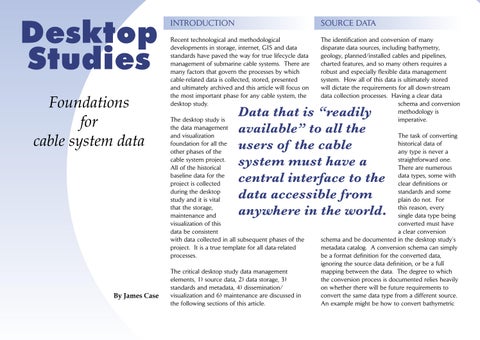
Desktop Studies
Foundations for cable system data
INTRODUCTION
Recent technological and methodological developments in storage, internet, GIS and data standards have paved the way for true lifecycle data management of submarine cable systems. There are many factors that govern the processes by which cable-related data is collected, stored, presented and ultimately archived and this article will focus on the most important phase for any cable system, the desktop study.
The desktop study is the data management and visualization foundation for all the other phases of the cable system project. All of the historical baseline data for the project is collected during the desktop study and it is vital that the storage, maintenance and visualization of this data be consistent with data collected in all subsequent phases of the project. It is a true template for all data-related processes.
SOURCE DATA
The identification and conversion of many disparate data sources, including bathymetry, geology, planned/installed cables and pipelines, charted features, and so many others requires a robust and especially flexible data management system. How all of this data is ultimately stored will dictate the requirements for all down-stream data collection processes. Having a clear data schema and conversion methodology is imperative.
Data that is “readily available” to all the users of the cable system must have a central interface to the data accessible from anywhere in the world .
By James Case
The critical desktop study data management elements, 1) source data, 2) data storage, 3) standards and metadata, 4) dissemination/ visualization and 6) maintenance are discussed in the following sections of this article.
The task of converting historical data of any type is never a straightforward one. There are numerous data types, some with clear definitions or standards and some plain do not. For this reason, every single data type being converted must have a clear conversion schema and be documented in the desktop study’s metadata catalog. A conversion schema can simply be a format definition for the converted data, ignoring the source data definition, or be a full mapping between the data. The degree to which the conversion process is documented relies heavily on whether there will be future requirements to convert the same data type from a different source. An example might be how to convert bathymetric
data from a gridded format, say netCDF, to point data in a spatially-enabled relational database. There are other netCDF-based data, such as geology, that if having a generic conversion schema would save overall conversion time.
DATA STORAGE
The term “data storage” has many definitions, depending on the particular application. Typical data storage means having data on a type of magnetic or optical media, such as hard disks or DVDs. The desktop study typically interfaces with all types of data storage in order to compile and integrate the massive amounts of identified disparate data sources.
The most beneficial storage mechanism is to warehouse all data in a spatially-enabled relational database. The database itself resides on multiple hard drives making for a potentially volatile design; however, the methods by which a database are audited, backed up and restored are extremely advanced and designed for complete fault tolerance. This mitigates the risk of data loss and at the same time centralizes all aspects of managing the data.
There are only a few open-source and commercial spatial databases available to the data manager capable of handling the quantity of data for a desktop study. The most GIS-friendly database is Oracle (Spatial) closely followed by PostgreSQL (PostGIS). Not only are all the traditional data stored in a relational database but so are all the spatial mapping data, which can be directly read from and written to by the GIS application.
By warehousing all data in a spatial database, management and visualization of the data becomes less complex.
DATA STANDARDS & METADATA
There are many active data and metadata standards in-use around the world today. Unfortunately, the community at large does not have a robust enough set of international standards by which to create and share information. The majority of the problems can be traced to proprietary or poorly documented data formats. That being said, the scientific community has made significant progress towards a unified data infrastructure in a short period of time, mostly through the use of metadata. One can think of metadata as the driving directions to data sources, which allows disparate data sources to be combined in to one virtual data center. This is sometimes referred to as a federated data system.
How does all of this relate to the desktop study for cable systems? The majority of the data sources used to generate the desktop study are now defined (the metadata) in a consistent framework, enabling the management, reporting and visualization of such data from a centralized location. Report writers have search capabilities over all of the data, cartographers can query the spatial data to produce maps and all of the deliverables are traced back to the source data for quality control. In the end, these benefits lead to efficiency gains and consistency for the lifecycle of the data.
DATA DISSEMINATION & VISUALIZATION
The phrase “lifecycle data management” is typically used by customers when defining requirements with the implication that all data for the project be 1) readily available, 2) quality controlled and 3) manageable from project kick-off to the decommissioning of the cable system.
Data that is “readily available” to all the users of the cable system must have a central interface to the data accessible from anywhere in the world. An information portal located on the internet is a typical solution to this requirement as it provides anyone with internet access and appropriate privileges to access data. The portal uses the consistent framework of the metadata to provide the user with simplified yet powerful tools for searching, viewing, editing, reporting and mapping the underlying data stored in the database.
Multiple spatially-enabled data warehouses located around the world unified in to one information portal has become a reality through the use of various Data Access Protocols. These protocols allow GIS systems and web mapping servers to harvest spatial data from many sources, combine them in to one window and serve that information to the user. Not only does this ease the burden on data visualization efforts but it also presents the end user with a seamless display of project data.
DATA MAINTENANCE
The maintenance of data is typically the most cumbersome of tasks for any given project. The data must be available to the users at all times,
physical evidence including the damaged cable itself. If possible, seal and tag the section of the cable which is removed during repairs. If analysis is required at a later stage, this will be a vital piece of evidence, providing clues as to the cause of the damage, for instance was it trawled over by a fishing vessel or dragged up by an anchor.
meaning on a server connected to the internet with appropriate fault tolerance and backup/recovery mechanisms. There are some severe drawbacks to the federated data model, the most notable is loss of data due to internet or remote server failures. If the web mapping application relies on data on a failed part of the federation then the users will not have the data in their map. This risk is partially mitigated by warehousing the data sources in multiple locations. Unfortunately, mission-critical applications require that all data be stored locally. This leads to large local datasets, inconsistencies between local and source versions and increased data management efforts.
Summary
Cable repair ships keep very detailed recordings of their work and these should be obtained. Request that reports are prepared detailing what repairs were undertaken, when, by whom and, where there were several repair options, a justification for the course of action chosen. Keep all invoices from the repair works as these are evidence of expenditure.
Keep precise records of any other loss which has resulted from the damage as these may also be recoverable. The extent to which recovery is possible will however depend on the jurisdiction in which the claim is heard.
Evidence from the suspect
Apart from gathering and collecting evidence to do with repair of the cable and other losses, you will need to obtain further evidence from the vessel you suspect was responsible for the damage in order to strengthen the case against it.
The desktop study effort for any cable system defines the lifecycle data management plan used for every phase of the project. The benefits to the project are realized in efficiency gains as the effort to manage and use the data are reduced. Desktop studies rely heavily on multiple data sources located around the world that are saved using a variety of standards. As daunting as that sounds, the use of standardized metadata and data access protocols have proven effective in the federated data model. This data model identifies data sources, catalogs their metadata locally and harvests the data over the internet using standardized format definitions and data access protocols. This may seem more complex than simply warehousing all source data locally; however, data managers typically agree they would rather be responsible for synchronizing source and local metadata consisting of hundreds of megabytes of information than all data that could escalate to terabytes of data.
In certain jurisdictions it will be possible to require disclosure before proceedings have started. You should consult local counsel early on this point as evidence may be lost
if action is delayed. If pre-action disclosure is a possibility it is important to request the following:
� Log books - including deck logs, navigational logs, fixing logs and Global Positioning System records.
� VDR - this is the equivalent of a ship’s black box and will record the position, course and speed of the ship, the radar picture, conversations and radio traffic on the bridge which may not have been appropriately logged in the ship’s log. As a record of the incident, it is extremely powerful evidence. However, this must be recovered quickly. VDR was designed as a record in the case of a collision, and so, is designed to over-record entries automatically, after a certain time depending on the system installed (often as little as 12 hours).
Pressure tactics
Once the defendant vessel has been accurately identified, establish who are the owners of the vessel and write to them informing them of the incident and the action you propose to take. At this stage, it would be appropriate to request the pre-action disclosure described above.
Jim Case is currently the Database Administrator for the Center for Coastal and Ocean Mapping at the University of New Hampshire with overall responsibility for data and database infrastructure, including servers and software, including the maintenance of the U.S. Law of the Sea database for NOAA, while accomplishing his Doctorate. He was the Data Services Manager for SAIC’s Marine Science and Technology Division, responsible for data management, processing, warehousing and advanced 2-D and 3-D visualizations in support of hydrographic and telecommunications marine survey operations and desktop studies. He received his BS in Ocean Engineering from the Florida Institute of Technology. Technical areas of expertise are relational and spatial database development, GIS programming and IT development. He joined WFN Strategies in 2005 as GIS Specialist, Database Administration.
It is important to ensure that the defendant has sufficient assets to meet your
Digital India The Underwater Connection
National Success on a Regional Scale
by Peter Ford
Thedemonstrable success of India over the recent period in developing and providing outsourced customer service facilities to major corporations outside its borders has been nothing short of remarkable. In short, India’s ability to provide highly educated, technically aware representatives to a broad range of product and service providing companies has shown that with the right educational system and a commitment to development at both a national and regional level, developing nations can enter the international market place in areas where little or no experience previously existed.
When it comes to measuring the success of India’s venture into the outsourced services market, the numbers speak for themselves. With an estimated value of (US) $70-80 billion by 2008 IT software and services will contribute 30% of all foreign exchange inflows, showing an increase from 8% in 2002. By 2008, this sector alone will provide around 2 million jobs in the services market with an additional 2 million jobs being provided in the parallel support services sectors. Potential for Indian Software and Service Industry by 2008
• Tap new service lines
As the off shoring model becomes more accepted in the mainstream IT markets, Indian IT companies are expected to penetrate new service lines such as Packaged Software Support and Installation; IT consulting; Network infrastructure management; Systems integration; IS outsourcing; IT Training and Education; Hardware support and Installation; and Network consulting.
• Focus on under penetrated geographies
While established markets such as the US and UK have been tapped to a marginal extent, large non-English speaking markets in Japan and Western Europe remain under penetrated by Indian IT companies. These two markets alone offer the Indian Industry over $5-6 billion in export potential. Indian companies have also great opportunities in English-speaking geographies like Canada, Netherlands, Sweden and Australia. Together these markets account for 6.7 percent of the world’s IT spend and represent an opportunity of US$ 1.2 billion by 2008
• Target high potential verticals
Source NASSCOM-McKinsey Study 2002
The additional growth opportunities for this services based sector are as impressive as the performance to date in the IT products and services market. Considering the abilities of India’s established service providing industry, the future challenges of growth can be seen as follows:
Indian companies have focused primarily on three key verticals (Financial Services, Telecom and Manufacturing) that account for nearly 45% of the industry’s revenues today. Indian companies need to aggressively target under penetrated verticals for the next wave of growth. Verticals like Retail, Telecom Service Providers and Healthcare are likely to offer the next wave of opportunities for the industry.
• Tapping Product Centric Opportunities
While India has been able to establish its strong credentials in the IT services arena, India has yet to make a dent in the software products market. To date, India has only been able to capture 0.2% of the US$ 180 billion market. A broader spectrum of opportunities
is however becoming available to Indian players in areas such as embedded Software; development and delivery of specialized components; tapping offshore product development opportunities; product acquisition and enhancement and developing shrink wrapped products.
Socially, the development of India’s economy is having a massive impact. The level of Indian’s population now considered to be middle class has risen in the past 10 years from around 150 million to around 300 million. With an upper class in excess of 10 million, the overall hunger for hi-tech personal commodities such as personal computers, internet access, international TV channels and a basic desire for information and entertainment has made national and international telecommunications access a basic requirement for the country.
Core to the success of India is the vast investment in education within the country. Based upon a census carried out within India in 2003, the following statistics substantiate a major success story in modern education:
• 9.2 million Educational students in 2002-03 compared to 7.26 million in 1997-98
• 1,265 Engineering colleges providing degrees
• 1,034 Additional colleges providing Master of Computer Applications
Even with the investment in people, colleges and industry, advances such as have been seen in India in the hi-tech products and services market are only possible with a solid underlying telecommunications infrastructure. Include the peoples’ need for additional information and entertainment and the scope and scale of the telecommunications industry within and outside of India become crucial to both the commercial and social development of the country.
Removing the Gap between the International ‘have’ and ‘have nots’
In providing the telecommunications enabling services for an ever increasing giant such as India, historical options would have been around the provision of satellite services or submarine cable infrastructure. Traditionally, the cost prohibitive nature of submarine cable technology would have removed it as an option for a country trying to insert itself into the international market place. Until the mid 1990’s, international submarine cable systems were normally built between a consortium of national telecom operators sharing the entire cost of the system between themselves and restricting direct access to the system to those same operators, the result of which was high cost of international access for countries or operators not involved in such systems. These cost prohibitive factors would have meant resorting to cheaper satellite technology for developing countries. Whilst proving to be a valuable asset in the rapid deployment of internal network and services infrastructure for large countries such as India, the inability to meet the massive information, entertainment and transaction based capacity needs of India and other similar countries or regions makes satellite technology restrictive in providing sufficient high capacity on an international basis.
Historically, the result of the high cost of submarine systems and capacity restrictions of satellite technology have restricted regional and national development as has been demanded by India and similar countries and regions in the past. In contrast, the ability of developed countries and carriers to bring huge capacity submarine cable systems into service has resulted in the construction of a number of high capacity ‘highways’ connecting major established economic locations throughout the world such as the USA, Europe and Asia. What was missed throughout the entire period of international submarine cable construction of the 1990’s was the ability to provide the
smaller, regional ‘slip roads’ onto the ‘highways’ that would enable smaller regional areas of development to enjoy the much reduced cost of these huge systems. The impact of this omission was that whilst the established economies thrived, the developing ones were restricted from doing so and the information gap and utilisation of technology differentiator widened.
Figure 1: Total Installed submarine cable systems globally
During the mid 1990’s, one exception to the rule in the international submarine cable industry was the Fibre optic Link Around the Globe (FLAG). FLAG was one of the first regionally based cable systems in the world, and India was able to take advantage of the booming international telecommunications market and gain entry into FLAG as the first private submarine cable system. Although not vast in its ability to deliver the capacity needs of India today, the original FLAG system provided the kick start in international access that India needed to recognise its development needs. Recognition of the increase in India’s and the surrounding region’s telecommunications needs has resulted in the start of construction of a second submarine system by FLAG to further increase the international connectivity for the region.
Figure 2: Providing the final link in a Regional submarine Network
The importance of such a regional submarine project cannot be understated in enabling the development of those countries involved in the program. Removing the cost of third party access to high capacity has enabled the Indian region and other similar regions to drive the benefits of such international telecommunications access into the region from both a commercial and social perspective. Aside from the enabling commerce and industry to compete on a level playing field with international competitors, the ability to provide the following products and services to the country as a whole encourages the country to strive to become more prosperous through raising the general awareness level of what can be achieved.
• International news and entertainment in the form of digital television
• Provision of high capacity broadband internet access
• High quality remote learning facilities in conjunction with international partners
Until very recently, the construction techniques and bespoke telecommunications technology available still made submarine cable systems extremely expensive to implement and operate. Recent developments and innovation in laying cables on and under the ocean bed and more importantly the technology utilised in carrying the huge amounts of capacity required for these systems, has resulted in the cost of ownership of a regional submarine network reducing vastly. The ability of existing smaller operators, new entrants and even regional development agencies to contemplate building and operating their own regional submarine network is now a reality.
As such, the ever growing success story that is India should not be seen as a one off. It is not outside the realms of reality to see India not just exporting their high quality products and services in the technology sector but also their expertise in regional development to other parts of the globe such as Africa, areas of the Middle East, South America and the Caribbean over the coming years as the web of regional submarine ‘slip roads’ spreads ever wider.
has entered into an arrangement with
making available, complimentary to subscribers, comprehensive databases of commercial vessels (www.sea-web.org/), ports and companies (www.portguide.com).
In order to qualify for a free trial of these services, contact
THE CABLESHIPS
Letter to a friend from Jean Devos
My Dear Friend
Paris July 1rst, 2005.
Even worse: In many developed countries there is now a worrying tendency: A significant decrease in the number of university students choosing engineering!! Science is not so attractive anymore and is perceived as a risk for humanity more than a progress!!
Warrior event was still in everyone’s memory. It is for these reasons among others that STC (UK) rejected the Alcatel‘s suggestion to come with a joint bid, to offer a “European” solution.
One of the winning factors has been the Port-Botany cable factory. Such a factory was a strong requirement from OTC (now Telstra) and the Australian Government.
But the fact is that our activity can only reborn from its ashes through another technical revolution!! We need “something” which would make all the existing networks suddenly obsolete, panicking all the established management, suddenly awake and concerned, in the absolute obligation to invest in the “novelty”!!
My Dear Friend
functionalities, the reliability figures, etc. The main area of competition was the technology and system performance.
The next revolution!
“Botany Bay”
My dear friend,
and l’Astrolabe, landed in 1788 to discover that Captain Cook was already around bearing the British flag. So Botany Bay is now for me the symbol of a dream which becomes a reality!
You are an old member of our industry and then you have an engineering background! Years ago all the leaders and even all the marketing and sales people were engineers. Technology was the main driver of our industry! Our industry was a high-tech industry, and the advanced technologies were at the heart of everything. It was impossible to manage such an activity without at least a technical culture. Impossible to attend meetings, visit customers, discuss a project without the basic understanding of the performances, the
I published recently a modest novel, whose title is Botany Bay. It is the place in Australia where Alcatel established a submarine cable factory in 1989 as part of its contract for the Tasman 2 link. In this same bay, where two centuries before the French expedition “La Pérouse” made of two ships, La Boussole
This is not true anymore and an engineering background is almost a handicap for someone who hopes to take management or marketing positions; much better to hold a business or a law degree!! This means that our activity is now just an ordinary one!! The boss does not need to understand the technologies involved, but he needs to be able to decrease the headcounts. The sales and marketing director does not need to explain to his customers the technical merits of the offered product, but he needs the ability to workout a business plan! The best R&D engineers are rushing to other areas. The submarine system activity is not sexy anymore. We are an old lady!!
Tasman 2 has been yet another chapter in this long Anglo-French competition! The award to Alcatel came out as a big surprise to many, including inside Alcatel. Everybody was naturally expecting the British to win that battle, and such an expectation was at that time very logical.
There were so many difficulties and misunderstanding between Australia and France, the main one being the French presence in the Pacific area, the worse being the nuclear bomb experiment in Tahiti! The sad Rainbow
Alcatel was the most motivated. Such a factory could expand its influence in the Pacific where the three other players were historically well established in this region, which represents a large part of their market. They saw this factory as a risk for their existing facilities! SubOptic ‘87 in Versailles came at the right time. It is where the Australian teams discovered the French model, a close cooperation between Alcatel and FT, exactly what they wanted to establish in their country.
Yes! We need something drastic, like an unrepeatered single fibre, ultra wide band, transpacific or transatlantic cable. I am told that nothing like this is to be expected soon, and I can see people laughing!
It does not really matter, my friend: It may take some time, but it will definitively come.
My friend, things are changed since, but one thing stays true: When you offer something, the reader can see between the lines if you are or not genuinely motivated and sincere. Then your offer becomes really attractive and this opens the route to “Botany Bay.”
Take care.
Jean Devos
See you soon.
Jean Devos
Jean Devos Submarcom consulting
Submarcom Consulting
AUTHOR INDEX
Faint, Dick
Fevrier, Herve and Chba, Michel
Fletcher, Ian & Wells, Steven
Fletcher, Ian and Wells, Steven and Demeroutis, Basil
Ian; Demeroutis, Basil; Wells, Steve
Poirier,
Alain & Colonna, Jean
Rudde,
Middle East
The oldest and traditional fiber optic route is via the Middle East, using the systems of Flag Euro Asia or SEA-ME-WE-3.
These two submarine systems were immensely significant developments at their time of construction. They are essentially branched systems designed to provide connectivity to large numbers of countries en route. Ring protected submarine systems in other oceans of the world were developed later and neither Flag nor SMW-3 are, in themselves, ring systems. Restoration of Flag and SMW-3 has to be created using support of capacity one from the other or from other, less immense systems which parallel some of the route.
Warnes, David
above 3 options. If, for example, RTD is of optimum importance to the buyer, then the new additional option of routing via Russia, one would assume, will be of great interest.
Wells, Steve; Arnos, Guy; Nielsen, Wayne Nobody Said It Was Easy
Wells, Steve; Fletcher, Ian; Demeroutis, Basil
Wells, Steven Is there light at the end of the tunnel? The current subsea marketplace
Wells, Steven & Fletcher, Ian When is a Bubble not a Bubble?
Wells, Steven and Demeroutis, Basil and Fletcher, Ian
Wells, Steven and Demeroutis, Basil and Fletcher, Ian
The RTD is circa 230 ms. Prices are quoted by various suppliers, offering a range of prices normally at least double those via USA/transPacific option.
It is obviously apparent that the buyer’s criteria will decide which route to use from the
Future price movements, by nature, are of course very difficult to predict. The USD 35 000 represents a small reduction on prices over the past 12 months. Price reduction in the last year has been small compared with the annual reduction of circa 50 % p.a. that has been recorded over previous years. We can but hope that prices across the Atlantic, across continental USA and across the Pacific have now stabilised. As regards the trends in prices on the route via the Middle East, the prices of Europe-Asia capacity following that route have declined less dramatically over the previous five years yet we can see nothing to cause upward pressure on prices on that route.
Indeed, with new cables opening up between India and Singapore and onward to Eastern Asia, there is now a lot more competition
on those segments of the route than there was two or three years ago.
The likely trend in prices of capacity on the route via Russia and Mongolia is very hard to predict. There are relatively few suppliers capable of provisioning end-to-end circuits and therefore the intensity of competition is not as great as either of the other routes. The existence of the other routes nevertheless should continue to act as a downward pressure on prices on the shortest route.
The growth of predicted traffic to China over the coming years is well known. Indeed China Telecom is pro-active in being a part of this business, launching plans to develop business in Europe by opening a new office in the UK. The company, which has already made similar moves into the North American market, is believed to be tracking corporate customers with bases in Europe and China.
China Telecom was granted an operating licence in the US two years ago, enabling