FORUM
SubmarineTelecoms
MS E T
NA O I EG
YS S L
R An international forum for the expression of ideas and opinions pertaining to the submarine telecoms industry
Issue 20 Issue 17 May 2005 January 2005 1
Submarine Telecoms Forum is published bi-monthly by WFN Strategies, L.L.C. The publication may not be reproduced or transmitted in any form, in whole or in part, without the permission of the publishers. Submarine Telecoms Forum is an independent commercial publication, serving as a freely accessible forum for professionals in industries connected with submarine optical fibre technologies and techniques. Liability: while every care is taken in preparation of this publication, the publishers cannot be held responsible for the accuracy of the information herein, or any errors which may occur in advertising or editorial content, or any consequence arising from any errors or omissions. The publisher cannot be held responsible for any views expressed by contributors, and the editor reserves the right to edit any advertising or editorial material submitted for publication. © WFN Strategies L.L.C., 2005 Contributions are welcomed. Please forward to the Managing Editor: Wayne F. Nielsen, WFN Strategies, 19471 Youngs Cliff Road, Suite 100, Potomac Falls, Virginia 20165, USA. Tel: +[1] 703 444-2527, Fax:+[1] 703 444-3047. Email: WNielsen@wfnstrategies.com
Exordium
Welcome to the 20th edition of Submarine Telecoms Forum, our Regional Systems issue. We are approximately 14 months from the previous SubOptic and only 24 months from the next! Whether that latter fact produces an air of excitement is certainly debatable, but I look forward to the next conference with far less trepidation than the last. As I discussed with a GIS colleague recently, it is really nice to be drawing lines on a chart again; even short lines are better than none of late. And while it’s still not time to cash in one’s stock, it is time to work again on some real projects. And those, even small, are a start. This issue brings some exciting articles together for your consideration. Brian Crawford of Trans Caribbean Cable Company gives his view of the world in this issue’s installment of Executive Forum. John Manock discusses regional system trends, coupled with Rogan Hollis explaining his vantage of regional reality. Andy Bax reveals the rise of regional networks while Rolf Boe suggests an interesting rise in offshore communication needs. Virginia Hoffman raises concerns of shore-end installations, as Jim Bishop explains the EU’s waste regulations and submarine cables. Doug Stroud presents record deepwater cable successes, and we will tempt all with a foretaste of SubOptic 2007. We conclude the multi-part serialization of From Elektron to ‘E’ Commerce. Jean Devos returns with his ever-insightful observations, and of course, our ever popular “where in the world are all those pesky cableships” is included as well. Good reading, and in the meantime, keep those certificates firmly papered to your bathroom walls – just in case.
General Advertising Les Valentine
Good reading.
Tel: +[1] 281 531 7417 Email: lvalentine@wfnstrategies.com Designed and produced by Unity Marketing
2
Contents Issue No 20 May 2005
Editors Exordium NewsNow
2 4-6
Global Marine
21
Great Eastern Group
14
Lloyd’s Register
31
Nexans
24
STF Reprints
17
Executive Forum Brian Crawford
7
Back to the Future: John Manock
9
Suboptic 2007
12
STF Advertising
8
Regional Reality Rogan Hollis
16
STF Cable Map
30
The Rise of Regional Submarine Networks Andy Bax
19
Tyco Telecommunications
Off-Shore Communications by Rolf Boe
22
WFN Strategies
34
History of the industry Part 4 - Stewart Ash
32
Submarine Communications 20th
19
The Forgotten Mile Virginia Hoffman
25
Letter to a Friend Jean Devos
43
Is Submarine Cable WEEE Jim Bishop
27
Record Successes in Deepwater Cable Doug Stroud
29
The Cableships
35
Diary
44
4,6,15
3
Asia Netcom Touts the Philippines for BPO Tyco RejectNetcom’s FCC to Asia Crest Communications Bill Barney, a media briefing,Urges During to VSNL Fiber Bid to Selland outlined the importance of inCOO, President
the available feedavailable newsfeed weeklynews the weekly current ofof A synopsis the onon NewsNow, the from NewsNow, itemsfrom newsitems currentnews A synopsis website. Forum website. Submarine Telecoms Forum SubmarineTelecoms
Alcatel Announces Contract for Algeria-France Cable Power Venture to Have International African Fiber has announced that it would be deploying a new, turnkey AlcatelNetwork
for OrascomaTelecom, networklaunched cablestates submarine put a new projectthetolargest African Five GSM network operator in the Middle East, Africa and South river Congo the mighty station MW power 3,500 the new half of 2005, in theonsecond for service Asia. Scheduled to France in Marseille connect will network cable submarine and run power lines through Angola and Namibia to Algiers and Annaba in Algeria spanning nearly 1,300 km and development. and spur shortagesbetween looming head European Algeria, the connectivity improving furtheroff and international networks. www.subtelforum.com/NewsNow/ www.subtelforum.com/NewsNow/10_april_2005 31_october_2004.htm
Alcatel Outlines User-Centric Vision for Asia-Pacific SEA-ME-WE-3 to Upgrade Alcatelhas that it is officially launching announced Alcatel in the User-Centric vision its a multi-million been awardedservices that it hasBroadband announced hasof Alcatel contract to deploy an integrated submarine US dollar turnkey region. Asia-Pacific and terrestrial optical solution for the 10 Gbps upgrade of the SEA-ME-WE-3 submarine cable network. www.subtelforum.com/NewsNow/ 24_october_2004.htm www.subtelforum.com/NewsNow/20_march_2005
BT Extends Reach in Asia Pacific Region from VNPT Wins Contracts Alcatel in Asia Pacific of further investment BT has announced
US$48 million. that it has been awarded two approximately has announced Alcatel
dollar contracts by Vietnam Posts and multi-million www.subtelforum.com/NewsNow/20_march_2005 Telecommunications Corporation (VNPT). www.subtelforum.com/NewsNow/ 24_october_2004.htm Columbus Communications Buys New World
Network Crossing Plans Cable System Antilles Columbus Communications Ltd. and New World Network
in facilitating telecoms ternational Crest the counsecurity concerns, homelandsolutions Citing significant Federal Communications Communications of business procprovider as athe roleurged emergingCorp. try’s Commission to reject Tyco Telecommunication's application outsourcing (BPO). ess to sell its global fiber network to VSNL Telecommunications, a company owned by the Indian government and the Tata Group, www.subtelforum.com/NewsNow/ India's largest civilian defense contractor. 26_september_2004.htm www.subtelforum.com/NewsNow/10_april_2005
Asia Pacific Carriers Form Coalition Global carriers operating in Asia Pacific have formed DMCS Completed a telecommunications carriers group focused on Sysmem Cablebest Melakaand completed NEC successfully practice policies marketDumai open promoting (DMCS) on 18 December 2004 and handed it over to PT Asia Pacific. frameworks regulatory Berhad. and Telekom Malaysia Indonesia, Tbkthroughout Telekomunikasi www.subtelforum.com/NewsNow/ www.subtelforum.com/NewsNow/27_march_2005 19_september_2004.htm
a have signed that they announced Ltd. have has International, approvals landing received Crossing Antilles letter of intent for Columbus to purchase New World Network, a St. Lucia of Barbados, Governments from and IPand clear channel of advanced, high-speed provider leadingthe owner principal the and region Caribbean the in services new the United States to build, own, and operateofathe Americas Region Caribbean Optical-ring System (ARCOS). submarine fiber optic cable between St. Croix and www.subtelforum.com/NewsNow/10_april_2005 with a spur connection to St. Lucia. Barbados
7,400 Jobs Slash AT&T FALCONin Assets OffBillion Kick$11 toand Celebration Hosts FLAGWill
www.subtelforum.com/NewsNow/ 24_october_2004.htm
www.subtelforum.com/NewsNow/ 24_october_2004.htm
AT&T Corp. is cutting at least 7,500 more jobs and FLAG Telecom recently hosted an official celebration of the $11.4 bilits assets value the book slashing of Muscat, hub cityby system's in theof cable FALCON submarine Oman. lion, drastic moves prompted by the company’s plan retreat from the consumer telephone business. towww.subtelforum.com/NewsNow/17_april_2005
41
Market Energy to Serve Partnership for BPO Philippines theOffshore Netcom Touts Asia
A synopsis of current news items from NewsNow, the weekly news feed available on the
to T-SystemsTelecomsManagement FLAG Telecom Providing CircuitsSubmarine Changes at Cable Bahamas Forum website. FLAG Telecom has announced the delivery of protected STM16 (2.5 Gbps) circuits for T-Systems International GmbH. The circuits, between T-Systems' locations in Tokyo and Hong Kong, International Haveservices Venture Power African and support advancedtonetwork to deliver will be used enterprise and wholesale customers.
Fiber Network
www.subtelforum.com/NewsNow/1_may_2005 African states launched a project to put a new Five 3,500 MW power station on the mighty Congo river and run power lines through Angola and Namibia to Southern Wins Global development. spurMaintenance andCross shortages looming offMarine head
Contract
www.subtelforum.com/NewsNow/ Southern Cross Cables Limited has announced it will renew 31_october_2004.htm and extend its undersea cable maintenance agreement with Global Marine Systems Limited (Global Marine) for the
Cable Bahamas Ltd. has announced the appointment of Brendan Paddick as Chairman to the Board of Directors and Chief Executive Officer. This appointment coincided with the VNPTand Richard Pardy Contracts Wins Alcatel as Chairman Keepingfrom of Philip resignations as Chief Executive Officer. Mr. Keeping will remain with the been awarded two Alcatel directors. boarditofhas member of the that as aannounced companyhas multi-million dollar contracts by Vietnam Posts and www.subtelforum.com/NewsNow/17_april_2005 Telecommunications Corporation (VNPT).
www.subtelforum.com/NewsNow/ 24_october_2004.htm Nexans Awarded Contract for Energy Project Nexans has been awarded a project worth around 22 million
Cable Plans by Antilles as operator for the Ormen HydroSystem trenching services, Euros for Crossing
Lift Europe HeavyAsia and SMIT Limited Bill Systems Global Marine Netcom’s Barney, briefing, a media During B.V., a division of SMIT International, have announced their of inimportance the outlined and COO, President growing of the the needs to meet intention to cooperate market. energy renewable ternational telecoms solutions in facilitating the counemerging role as a provider of business proctry’s www.subtelforum.com/NewsNow/1_may_2005 ess outsourcing (BPO).
www.subtelforum.com/NewsNow/ Qtel Signs Agreement for FALCON Landing 26_september_2004.htm
Station in Qatar Coalition Form Carriers Asia has confirmed a operator, telecom Qatar’s national Qtel, Pacific
multi-million dollar investment in the country’s communications have formed Pacific in Asia operating carriers Global agreements of historic official signing with the infrastructure FALCONon Telecom’s FLAG for station landing full a provides that a telecommunications carriers group focused cable system in Doha and purchase of capacity on the new open promoting system. policies and best practice cablemarket regional terabit/s regulatory frameworks throughout Asia Pacific. www.subtelforum.com/NewsNow/24_april_2005 www.subtelforum.com/NewsNow/ 19_september_2004.htm
SEA-ME-WE-4 Cable Laying Begins AT&T Will Slash 7,400 Jobs and $11 Billion in Assets
km USA-Australasia of the 30,000Vision portionUser-Centric northern for Asia-Pacific Outlines Alcatel
(Mono Ethylene two MEG group, forhas Lange licence approvals landingGlycol) received Crossing Antilles pipelines and two umbilical cables serving the undersea gas field and St. ofLucia Governments from Norway. km off the coast shelf aroundof120Barbados, continental on thethe
Asia-Pacific region.
the United States to build, own, and operate a new fiber optic cable between St. Croix and submarine www.subtelforum.com/NewsNow/27_march_2005 Barbados with a spur connection to St. Lucia.
Videsh Sanchar Nigam Limited (VSNL) reports that the cable linking submarine SEA-ME-WE-4 laying operation jobs and more 7,500cable at least Corp. isofcutting AT&T France to Singapore -- with Mumbai, India, as a landing point for the book value of its assets by $11.4 bilslashing VSNL -- commenced on February 24, 2005. lion, drastic moves prompted by the company’s plan retreat from the consumer telephone business. towww.subtelforum.com/NewsNow/20_march_2005
www.subtelforum.com/NewsNow/ Nexans Develops Innovative Dredger System 24_october_2004.htm
www.subtelforum.com/NewsNow/ 24_october_2004.htm
Southern Cross Cable Network to December 2010. Alcatel has announced that it is officially launching www.subtelforum.com/NewsNow/1_may_2005 its vision of User-Centric Broadband services in the
www.subtelforum.com/NewsNow/ Guadeloupe Numérique Project to Expand 24_october_2004.htm The "Guadeloupe Numérique" cable is a public initiative carried out by the Guadeloupe Regional Council, with the support of the European Commission (European Regional Development Fund); this cable, which is in the process of being installed, will directly connect Saint Martin and Guadeloupe to the Internet backbone in San Juan (Puerto Rico).
Nexans has developed an innovative terrain dredger/sub-sea intervention system, called the Spider. The Spider is the only technology capable of leveling the seabed in steep areas. www.subtelforum.com/NewsNow/8_may_2005
www.subtelforum.com/NewsNow/27_march_2005 51
Asia Netcom Touts the Philippines for BPO to Approvals Government All US VSNL Gains Asia Netcom’s Bill Barney, briefing, a media During Acquire TGN and COO, outlined the importance of inPresident
A synopsis of current news items from NewsNow, the weekly news feed available on the
Telstra, PCCW Detail New REACH Operational Teleglobe to Provide NORDUnet With HighSubmarine Telecoms Forum website. Model Speed Connectivity on CANTAT-3 Teleglobe International Holdings Ltd. has announced that the company has extended its agreement with NORDUnet and International to HaveInternet PowertoVenture African connectivity provide high-speed doubled capacity and education research Icelandic the and NORDUnet between Network Fiber community. Five African states launched a project to put a new www.subtelforum.com/NewsNow/24_april_2005 3,500 MW power station on the mighty Congo river
Following REACH's announcement earlier this year on data capacity and third party business (see TSA NewsFeed for VNPTfurther REACH Contracts Wins Alcatel announced Telstra hasfrom 2005), January 11, improvements. operational that it has been awarded two announced hasmodel Alcatel
and run power lines through Angola and Namibia to head off looming shortages and spur development.
www.subtelforum.com/NewsNow/ TYCO Global Network Strengthens Linx’s 24_october_2004.htm
Teleglobe, Virtela Announce Agreement
www.subtelforum.com/NewsNow/ Teleglobe International Holdings Ltd. and Virtela have 31_october_2004.htm announced that the companies have established an agreement for Teleglobe to provide Virtela's global managed network services to Teleglobe's regional ISP clients enabling them
Alcatel Outlines User-Centric Vision for Asia-Pacific
www.subtelforum.com/NewsNow/8_may_2005 Alcatel has announced that it is officially launching its vision of User-Centric Broadband services in the Asia-Pacific region.
www.subtelforum.com/NewsNow/ 24_october_2004.htm
dollar contracts by Vietnam Posts and multi-million www.subtelforum.com/NewsNow/24_april_2005 Telecommunications Corporation (VNPT).
Worldwide Links Programme With Direct TransEthernet Global Connectivity AtlanticCrossing System Cable PlansAnd Antilles Services
Antilles Crossing has received landing approvals provider of international a leading Tyco Telecommunications, St. Lucia and of Barbados, the Governments from wholesale capacity and colocation services on the Tyco Global a new operate own, and to build, States United the of the Programme the Partnership has joined (TGN), Network Internet largest Europe’s (LINX), Exchange Internet London submarine fiber optic cable between St. Croix and exchange, and will provide LINX members in New York City Lucia. to St. and a spur with Barbados Global to TGN’s connectivity accessconnection direct and Miami with Ethernet Services. www.subtelforum.com/NewsNow/ www.subtelforum.com/NewsNow/10_april_2005 24_october_2004.htm
counfacilitating inIndia's solutions telecoms ternational provider leadingthe (VSNL), Nigam Limited Videsh Sanchar services, has and internet telecommunications of international procof business role as a provider emerging try’s announced that the Federal Communications Commission outsourcing (BPO). ess (FCC) in the United States approved its application on April 29th, 2005 to transfer the Tyco Global Network (TGN) landing station www.subtelforum.com/NewsNow/ licenses from Tyco to VSNL. 26_september_2004.htm www.subtelforum.com/NewsNow/8_may_2005
Asia Pacific Carriers Form Coalition Global carriers operating in Asia Pacific have formed WFN Strategies Establishes Australian Strategic a telecommunications carriers group focused on Alliance promoting open market policies and best practice a established that it has recently announced WFN Strategies Pacific. Asia throughout frameworks regulatory strategic alliance in Australia with Walker, Newman & Associates for the purpose of expanding business opportunities in the oil & www.subtelforum.com/NewsNow/ gas and telecoms arena. 19_september_2004.htm www.subtelforum.com/NewsNow/27_march_2005
AT&T Will Slash 7,400 Jobs and $11 Billion in Assets AT&T Corp. is cutting at least 7,500 more jobs and slashing the book value of its assets by $11.4 billion, drastic moves prompted by the company’s plan to retreat from the consumer telephone business. www.subtelforum.com/NewsNow/ 24_october_2004.htm
61
EXECUTIVE
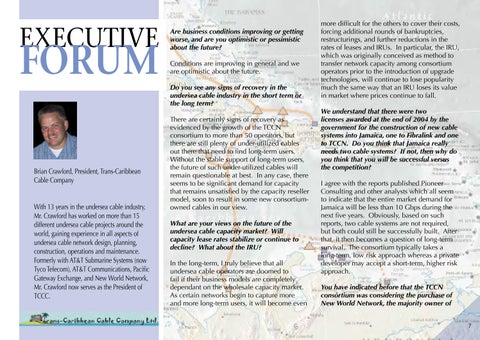
FORUM Brian Crawford, President, Trans-Caribbean Cable Company With 13 years in the undersea cable industry, Mr. Crawford has worked on more than 15 different undersea cable projects around the world, gaining experience in all aspects of undersea cable network design, planning, construction, operations and maintenance. Formerly with AT&T Submarine Systems (now Tyco Telecom), AT&T Communications, Pacific Gateway Exchange, and New World Network, Mr. Crawford now serves as the President of TCCC.
Are business conditions improving or getting worse, and are you optimistic or pessimistic about the future? Conditions are improving in general and we are optimistic about the future. Do you see any signs of recovery in the undersea cable industry in the short term or the long term? There are certainly signs of recovery as evidenced by the growth of the TCCN consortium to more than 50 operators, but there are still plenty of under-utilized cables out there that need to find long-term users. Without the stable support of long-term users, the future of such under-utilized cables will remain questionable at best. In any case, there seems to be significant demand for capacity that remains unsatisfied by the capacity reseller model, soon to result in some new consortiumowned cables in our view. What are your views on the future of the undersea cable capacity market? Will capacity lease rates stabilize or continue to decline? What about the IRU? In the long-term, I truly believe that all undersea cable operators are doomed to fail if their business models are completely dependant on the wholesale capacity market. As certain networks begin to capture more and more long-term users, it will become even
more difficult for the others to cover their costs, forcing additional rounds of bankruptcies, restructurings, and further reductions in the rates of leases and IRUs. In particular, the IRU, which was originally conceived as method to transfer network capacity among consortium operators prior to the introduction of upgrade technologies, will continue to lose popularity much the same way that an IRU loses its value in market where prices continue to fall. We understand that there were two licenses awarded at the end of 2004 by the government for the construction of new cable systems into Jamaica, one to Fibralink and one to TCCN. Do you think that Jamaica really needs two cable systems? If not, then why do you think that you will be successful versus the competition? I agree with the reports published Pioneer Consulting and other analysts which all seem to indicate that the entire market demand for Jamaica will be less than 10 Gbps during the next five years. Obviously, based on such reports, two cable systems are not required, but both could still be successfully built. After that, it then becomes a question of long-term survival. The consortium typically takes a long-term, low risk approach whereas a private developer may accept a short-term, higher risk approach. You have indicated before that the TCCN consortium was considering the purchase of New World Network, the majority owner of 7
ARCOS, but now Columbus Communications has announced its plans to buy New World. What happened? How does this impact TCCN and what do you think will happen next? Myself and many others were surprised at the news, especially considering that the bulk of New World’s customers are represented within the TCCN consortium. As for the TCCN consortium, this news basically clears the way for progress on alternative plans that do not depend on ARCOS. In the short term, I suspect that MAYA will now move forward with an upgrade plan and that some new initiatives will emerge for Colombia to challenge New World’s semi-exclusive position in that particular market. Current development/ implementation plans for TCCN are normally available at www.trans-caribbeancable.com. The following map shows the most recent development plan under consideration by the TCCN consortium:
S
ince 2001, Submarine Telecoms Forum has been the platform for discourse on sub marine telecom cable and network operations. Industry professionals provide editorial content from their own niche and focus. Each bi-monthly edition includes commentary and information on system and service provision, and issues critical to the industry.
Advertising Rates Magazine pages Rates US$ 1x 2x Page 1613 1564 2/3 page 1189 1154 1/3 page 768 744
3x 1516 1118 721
4x 5x 6x 1468 1419 1371 1082 1047 1011 698 675 652
Website Banners Post your web linked banner to the home page, as well as News-Now sections of the Submarine Telecoms Forum website, where some 5000+ readers can come as often as every week to view the latest news feed, or our bi-monthly magazine. Rates US$ 3 Months 6 Months 12 Months Home Page
540
900
1,440
NEWS-NOW PAGE 810
1,350
2,160
Both
2,026
3,240
1,216
Feature Section Sponsorship Available at full-page advertisement rate, section sponsors are identified with a banner (link) at the beginning and end of the featured section. All advertising rates as at December 2003.
Advertising enquiries Tel: [+1] (281) 531 7417 Fax: [+1] (281) 531 7456 lvalentine@wfnstrategies.com
Submarine Telecoms FORUM 8
Back to the Future Again: The Current State of the Regional Systems Market Purchasers?
One year ago, in SubTelForum’s issue on Regional Cable Systems, we wrote about the future of the industry and the opportunities presented by regional systems. In this article, we will look at what has happened in the past year and where the regional systems market stands. The most striking development in the past year in the submarine cable industry is the number of “real” systems that are under development. By “real” we mean projects that have a good chance of being built in the short term; not the long-term dreams or wishful thinking that seemed to float around constantly during the darkest days of the recent slump.
Regional systems can be grouped into two categories. Large regional systems under development range from 8,000 to 20,000 kilometers in length and usually have many landing points. Smaller “ T h e s e c o n d m a j o r a r e a o f regional systems are up to 3,000 kilometers long and are more often development in the Caribbean is point-to-point.
The definition of a “real” system is, of course, subjective. For the in the islands of the Lesser Antilles. purposes of this article, we are defining “real” as those systems Recently, the SMITCOM cable There are four large systems for that have awarded a supply linking Puerto Rico and St. Maarten which supply contracts have been awarded or will be awarded contract, those that we have entered service, but that was just soon. These are SEA-ME-WE-4, reason to believe will be going the beginning of efforts to improve FALCON, EASSy and Globacom’s to bid this year, or those that Nigeria-UK cable. All four point connectivity to the islands. “ have made substantial progress to two geographic regions that are over the past year. The latter seeing rapid growth in telecom and includes the raising of money, Internet demand – Africa and the Indian Ocean. acquisition of licenses, agreements with incumbent operators and other developments that indicate an At this time last year, supply contracts had just been actively developing project. awarded to the largest of all the planned regional systems, SEA-ME-WE-4. At 20,000 kilometers, SEA-ME-WE-4 Under this definition, there are more than a dozen will connect Singapore, Malaysia, Thailand, Bangladesh, projects underway, totaling more than 50,000 kilometers India, Sri Lanka, Pakistan, United Arab Emirates, Saudi of submarine cable. Of this total, more than 60% is now Arabia, Egypt, Italy, Tunisia, Algeria and France. The under contract. Another 35% could be under contract supply contracts were awarded to Alcatel and Fujitsu in by the end of this year. Considering that the industry April 2004. Installation is well underway in both the installed less than 50,000 kilometers in new construction Mediterranean Sea and India Ocean. during the period from 2002-2004, the systems currently underway represent a sizable growth spurt. And all of this growth is coming from regional systems. At this time last year, there were a few cable systems
by John Manock
under construction. Tata Indicom’s India-Singapore was the longest at a little more than 3,000 kilometers, but the remainder were quite small – less than 500 kilometers. The industry, however, was looking ahead to several large regional systems that showed promise. These systems included SEA-ME-WE-4, FALCON and EASSy. The promise has begun to materialize as all three have made great strides in the past year.
The next largest system is FLAG Telecom’s FALCON, a 10,000-kilometer system. FALCON will have multiple landings throughout the Gulf region, with submarine links initially stretching to India in the east and to Egypt in the west. Alcatel was awarded the supply contract in 9
February 2005 and FLAG Telecom and its partners, which include Omantel and Qtel, recently held a celebration kicking off the project. Initial service on FALCON is scheduled to commence by the end of 2005. EASSy, the East African cable system, is an 8,400kilometer network linking South Africa, Mozambique, Madagascar, Tanzania, Kenya, Somalia and Djibouti. The supply contract is expected to be put out to bids soon, with a supplier to be chosen by the end of 2005. The network is scheduled to enter service at the end of 2007. The fourth large regional system is planned by Nigeria’s second carrier, Globacom. This project has an interesting history. After it was licensed in 2002, Globacom tried to join the SAT-3 consortium so it could acquire capacity at the same price as its competitor, Nitel. The consortium effectively blocked Globacom’s efforts for more than two years, forcing the carrier to make plans for its own cable, which it announced last August. Alcatel was awarded the supply contract in February 2005. An RFS date has not been announced, however.
As a result, two new cable systems will be built, one by Jamaica FibraLink and another by the Trans Caribbean Cable Network (TCCN) consortium. Jamaica FibraLink will be a 2,600-kilometer ring network between Jamaica and the Bahamas. From the Bahamas, it will connect to the United States using the Bahamas Internet Cable System, which is owned by FibraLink’s parent, Cable Bahamas. TCCN will be a single link between Jamaica and the Dominican Republic in the short term and will be about 800-kilometers long. TCCN also proposes similar additional incremental builds throughout the Caribbean to supplement mostly existing infrastructure which would be integrated into a broader regional network. The second major area of development in the Caribbean is in the islands of the Lesser Antilles. Recently, the SMITCOM cable linking Puerto Rico and St. Maarten entered service, but that was just the beginning of efforts to improve connectivity to the islands.
Of the smaller regional systems, under 3,000 kilometers in length, there is greater variety in geography, as well as ingenuity in ownership structure.
Three other projects are under development – Guadeloupe/Martinique Numerique, Antilles Crossing and Eastern Caribbean-1 (EC-1).
The Caribbean is the hottest region for this size network – at least five major systems are being actively developed, while others are being discussed. Within the Caribbean, the main focus is on Jamaica and the Lesser Antilles.
Guadeloupe/Martinique Numerique is well underway and is perhaps unique in the way it is funded. A common dilemma with regional networks is the inability to raise money to build into small market countries. The Numerique concept uses public funding to pay for the cable system. The reasoning behind this is that Internet access is a service that not only can aid a country’s economic development, but is actually vital for the health and welfare of the nation. Whereas this may be obvious to us in the industry, it is a concept that has only recently taken hold in the world’s agencies that are concerned with funding essential services in developing countries.
The activity surrounding Jamaica stems from the decision late last year by the Jamaican government to license two companies to build new submarine cables serving the country. The need for these cables was clear. Jamaica is currently served only by the ancient TCS-1 cable and a pre-DWDM Cable & Wireless system to the Cayman Islands. The lack of affordable bandwidth was hampering economic development in the country and the government took firm steps to address the problem by issuing the new licenses.
The Guadeloupe Numérique cable is a public initiative carried out by the Guadeloupe Regional Council, with the
support of the European Commission (European Regional Development Fund). It is an 800-kilometer system linking Guadeloupe, St. Martin and Puerto Rico. Martinique Numerique is a 200-kilometer extension to Martinique. Further extensions are possible. Supply contracts have been awarded. Antilles Crossing Limited, a joint venture between Leucadia National Corporation and Barbados Light & Power Holdings Limited, will construct a state-of-the-art 40 gigabit per second network from Needham’s Point, Barbados, to St. Croix in the U.S. Virgin Islands, where it will interconnect with Global Crossing’s world-wide telecommunications network. The 938-kilometer network will also land in St. Lucia. The owners of Antilles Crossing say that the project is fully funded. Supply contracts may be awarded soon. Eventually, the owners envision a “figure-8” network from St. Croix to Trinidad, adding nearly 2,000 kilometers of additional cable. Island Fibre’s Eastern Caribbean 1 (EC-1) will also run from the U.S. Virgin Islands to Trinidad. The 1,872kilometer system will include at least one ring. Island Fibre has obtained dark fiber on another submarine cable to connect this network to Puerto Rico. The company also has gained landing licenses on several islands and is in discussions with others as they open their markets to new players. As we have noted, all of the systems discussed so far serve the three regions – the Indian Ocean, Africa, the Caribbean -- that are seeing strong telecom and Internet growth, as well as needing large amounts of affordable capacity. Opportunities can arise almost anywhere, however, and developers are moving quickly to meet them. One new player that has made a splash in recent months is Egypt’s Orascom. A mobile operator active in the Middle East and Africa, Orascom is now involved in two 10
major regional submarine cables supporting its mobile phone operations. The first of these new systems will link Algeria with France. The 1,300-kilometer system was awarded to Alcatel. Orascom is a major player in the Algerian market – both the mobile and the liberalizing fixed-line markets. Orascom’s second submarine cable project is through a joint venture in Pakistan. This cable will link Karachi with the United Arab Emirates. A 1,200-kilometer cable, this system is known as TWA-1. Orascom is working with Tyco on the project. Other significant systems worth noting are: • An Indonesian domestic network for which a supplier will be chosen soon, • A Vietnam-Hong Kong cable that may go to bid by the end of this year, • A domestic festoon in Vietnam and a South Pacific link that may go to bid next year, and • A Greece-Libya cable in the early planning stages, the concept of which has been approved by both governments Another small but notable market for new cables is the expansion possibility presented by regional systems. As noted, the Guadeloupe Numerique project has already been expanded to Martinique and can be expanded further using a branching unit installed between Guadeloupe and St. Martin. All of the other Caribbean projects that we have discussed have the potential to be expanded as well. This is largely being driven by liberalization in the region. As more of the island nations of the Eastern Caribbean open their markets to competition, more opportunities arise for expansion. This is also true of West Africa, where few countries have opened their submarine cable markets to competition and opportunities are sure to arise when such
competition is allowed. Both Orascom cables also include branching units. The cable linking Algeria and France will have one for a future extension to Tunisia, while TWA-1 has one branching unit for a potential link into Muscat, Oman. As we pointed out a year ago, there are many factors that drive the regional systems market – access to developing markets by new players, the ability to raise funding from traditional and non-traditional sources, late mover advantage, the continued need for consortium systems in certain regions, and many others. This variety is what is needed for a healthy market for regional submarine cable systems and this is just what is happening now. There is a wide variety in the justification for new regional networks and an even wider variety of funding mechanisms. These include: • Traditional consortium systems (SEA-ME-WE-4, EASSy) • Variations to the consortium structure (Trans Caribbean Cable Network virtual consortium) • Competitive private responses to consortium systems (Globacom’s Nigeria-UK cable) • Late-mover advantages (Antilles Crossing, EC-1) • First-mover advantages (FibraLink Jamaica) • Build-Operate-Transfer (BOT) type agreements (Vietnam-Hong Kong) • Publicly funded systems (Guadeloupe/ Martinique Numerique) • Domestic systems (Indonesia, Vietnam) As a result, the submarine cable industry is seeing its strongest growth in years, all of it thanks to the regional cable market.
John Manock is the Director of Information Services at T Soja & Associates, Inc. He is responsible for creating and maintaining TSA’s databases on fiber optic submarine cable systems. He is also the editor of TSA NewsFeed, a daily information services exclusively for TSA clients focusing on news and events affecting the submarine cable industry. Mr. Manock specializes in the development of information services for carriers, developers, and suppliers. He has over 18 years of experience in the fiber optics and telecommunications consulting business during which he has participated in numerous studies on submarine cable systems. He has also published numerous articles for the industry and is a frequent contributor to industry publications including SubTelForum and Soundings Magazine. Mr. Manock received a master’s degree in Library and Information Studies from the University of Rhode Island and bachelor’s and master’s degrees from Providence College.
11
SUBOPTIC 2007 Enabling Global Communications
Introduction Throughout the modern-day era of undersea telecommunications, SubOptic has been recognized as the organization to objectively promote the technologies, products, services and business practices for the industry as a whole. As the undersea telecommunications industry faces the opportunities and challenges of the 21st century, so too does SubOptic as we look forward and caste the die for our next international convention - SubOptic 2007. The SubOptic 2007 International Telecommunications Convention is the premier conference and networking event for the undersea telecommunications industry, and will be held on May 14-17th, 2007 at the lively and picturesque Inner Harbor in Baltimore, Maryland, USA. The Convention will be proudly hosted by Tyco Telecommunications, on behalf of the SubOptic Executive Committee. The SubOptic Executive Committee, which is comprised of 14 leading members of the industry including Tyco Telecommunications, provides strategic direction and acts as the supervisory board for the event. Tyco Telecommunications, a leading supplier of undersea systems and marine and maintenance services, has been an active part of the SubOptic community since the SubOptic series of conventions started in 1986. Tyco Telecommunications’ ability to consistently provide leadership and innovation to the industry qualifies them to not only host SubOptic 2007, but also to provide the stewardship necessary to ensure the success of the overall event. Location The entire convention will be held in a single premier hotel, the Baltimore Marriot Waterfront
which will be exclusively dedicated to SubOptic for the entire duration of the convention. Since the conference sessions, the exhibition area, hospitality suites, meeting rooms, refreshment areas and rooming accommodations are all provided in one facility, attendees will enjoy an ambience and opportunity for networking thereby enhancing the value and experience for attendees. Program structure More importantly, an additional change to SubOptic 2007 is with regards to the structure of the convention program itself. A couple of the key objectives which are being considered as the SubOptic 2007 theme and program tracks are established, is the need to communicate the value and importance of the undersea telecommunications industry to a broader audience. In contrast to previous events which were more focused on issues and topics that were of interest primarily to members of the undersea telecommunications industry, SubOptic 2007 is designed with the broader global telecom industry in mind. Telecom Carriers, Project Developers, Financial Institutions, Legal and Regulatory firms, as well as related industries that can benefit (Oil & Gas, National Security, etc) will all find a need to be a part of SubOptic 2007. As we look at undersea technology today, we recognize that the industry has matured to the point where undersea networks have become an integral and seamless part of the broader global communications network. As such, undersea networks and technology play a vital and irreplaceable role in the telecom spectrum. To ensure that the program design and topics 12
promote interest and value to this broader telecom audience, the SubOptic 2007 planning team has formed a marketing strategy team. Strategic Marketing Group Led by Tyco Telecommunications’ and SubOptic’s own marketing resources, this strategy team will leverage the insight of leaders from various facets of the industry. These will include the influential and insightful Senior Industry Advisors Wayne Nielsen (of WFN Strategies and SubTel Forum) and Tom Soja (of Tom Soja & Associates) plus members who have a broader perspective of the market we are attempting to reach. The formation of this externally focused strategy team is one of the initiatives that the SubOptic planning team is putting in place to ensure that SubOptic2007 will provide interest and value to the global telecom community. SubOptic 2007 will promote the inherent benefits that undersea telecommunications provide to the broader global communications community. In essence, the technical sophistication, incredible reliability and seamless integration with other telecom protocols have truly allowed the undersea telecommunications industry to be a valuable enabler of global communications. Program Committee The Program Committee, led by Chairman David Robles from Tyco Telecommunications, is currently being formed and will have the task of crafting an appropriate program. The program design will include topics that will be of interest and value to both the core undersea network community as well as the broader global telecommunications industry. Furthermore, the program will also include
prominent figures from various areas of the global telecommunications community and associated users and opinion formers as Keynote and Plenary Speakers. These visible and influential individuals will be of direct interest and provide value to the numerous segments within the global telecommunications industry. The Program Committee will also take particular care to design a Poster and Networking Session as a highlight of the Convention. This session was a tremendous success at SubOptic 2004. Attendees rated this session highly, appreciating that it was a prestigious event in its own right, providing a unique networking opportunity for authors, colleagues and customers to interact on a one-onone basis. Many felt that this offered more value than a short oral presentation with its limited opportunity for interaction between the author and the audience. Baltimore and the Inner Harbor Choosing the venue for SubOptic 2007 was no easy task. The location needed to be an attractive international destination that provides culture, history and entertainment to a global audience and it must have strong maritime presence and history. Baltimore’s Inner Harbor is just that venue….. Baltimore, a high-spirited, energetic city built on tradition and civic pride, is an American success story. Since the redevelopment of the Inner Harbor in the late 1970s, Baltimore has set the standard for urban renewal and is now a major travel destination welcoming over 11 million business and leisure visitors each year. The crown jewel of Baltimore is the Inner Harbor,
a picturesque waterfront area with a plethora of restaurants, retail stores as well as dozens of cultural and historic attractions. The Inner Harbor is one of America's oldest seaports, and is quickly becoming one of the newest and increasingly popular travel destinations for people from all corners of the globe. Since the 17th Century, Baltimore’s Inner Harbor has been welcoming people, ships and goods from all over the world. Its waterways have been a passage for ships carrying commercial cargo and new citizens, and it lies farther west than any other major Atlantic port, a point that endeared its harbor to shippers. More than 30 million tons of cargo passes through the port of Baltimore every year, which emphasizes the maritime significance of this historic international harbor. Charming historic neighborhoods surround the Inner Harbor, each offering their own character, history and cuisine. Little Italy is a pasta lover's paradise with outdoor movies on summer weekends, festivals of San Gabriel and St. Anthony, and two bocce ball courts. Fells Point is the oldest section of Baltimore and still has the feel of an old English neighborhood with cobblestone streets, unique shops and plentiful pubs and restaurants. And, there's Harbor East, a bustling waterfront stop with its own attractions, retail shops, and restaurants. Baltimore has restaurants to satisfy nearly every craving. Dining options include elegant gourmet cuisine, ethnic foods from around the world and plenty of fresh seafood from Maryland's Chesapeake Bay. Baltimore is known for its fabulous crabs, and dining at one of the city's many seafood restaurants or crab houses is a must for all who visit. 13
a Telecom to transmit traffic directly en the US and China. This has enabled Telecom to boost its business while we now look forward with anticipation to ng theAs carrier’s international operating SubOptic 2007 planning has begun in earnest. The
venue selection of the Inner Harbor, Baltimore and choice of the Marriot Waterfront Hotel reflects China the Netcom is also becoming more and the changing scale of the industry and will provide international. an unparalled opportunity to network. The design of the Program will reflect changing scope We have not attempted totheevaluate the of the industry, as it is now an integral and seamless ential part growth in demand on the three of the much broader global communications network. that we examined. In general terms we
d expect a continuation of very high The website for SubOptic 2007 (www.suboptic. org), which is set to go live in the next h in traffic that is relatively couple RTD of months, will provide a wealth of information ant. related Between Asia and to the SubOptic 2007Europe event, andthe the broader telecom industry. The design of the yment of systems that are less tolerant website will current not only provide the guest with D is also likely to related increase any information to therapidly event, butand will also provide a way to suggest ideas, ask questions, hould allow the low RTD route to view industry articles of interest and even learn more nue toabout command a Inner premium, assuming Baltimore’s Harbor and surrounding area. Anyperformance information about the event he in-service proves tocan be always be obtained by sending email to subopticplary. info@tycotelecom.com . n order to maintain a premium price the quality” route needs to be high quality ceived by the users. n the fifteenth and sixteenth centuries refathers founded the “silk routes” and routes” between East and West. In the y-first century, carriers have to find the profitable “routes” between Europe and
There is a choice of course. Like the ers of old we can go West or East. We o decide what is the absolute right fit for
14
15
REGIONAL
REALITY - a pragmatic look at the gap between expectations and economics By Rogan Hollis
L
et me start with a couple of questions: how can an island with a population of around 300,000, and a GDP of $10,000 or less, justify having three international submarine cables? In a competitive environment, where telecommunications providers are struggling for every dollar, where does the money come from to justify building even one international cable? Frankly, some islands might consider themselves fortunate to have had submarine cable connectivity in the past, because trust me, not all cables were justified on economic grounds. Rather than pounding the incumbent – always a fun and easy sport – perhaps people ought to recognise that there were some benefits to being in an environment where companies felt secure in building expensive infrastructure that required a long term commitment to achieve payback. The demographics of many islands could never have justified such major investment at the same time as demanding competition, and it is my personal view that far from all island economies can justify it in the future. There just isn’t enough money to go round to make it worth the while for the phone companies. The problem for some of the islands is that there are unrealistic expectations out there. In the case of regional systems, these expectations are that there is a divine right to have cheaper calls, and more bandwidth, and at higher speeds. Forgive me now for making an obvious statement, but it is one that I believe the many proponents of regional systems as our industry saviour need to acknowledge: submarine cables cost a lot of money. The next statement is perhaps less obvious to some but no less true: telecommunications providers are not working as charities (for proof of this we need only look at the numbers of our colleagues that are
no longer employed in our industry). Carriers are in business to make money, believe it or not, and the idea of investing massive sums in infrastructure is only realistic when there is a realistic chance of making your money back. Before Tom Soja and the like leap on my back and shout that I am advocating a return to the “regulated” days, let me say clearly that I am a believer in the benefits of competition and liberalisation. I’m a consumer like everyone else and like everyone else I tend to use something more if it is cheap. The issue I see is one of balance. There needs to be enough profit in a service for a company to justify providing it. When this simple truth is extended to regional submarine cable systems, it means that there needs to be enough return to justify a major investment. We can argue all we like that system costs are cheaper due to the pressure on suppliers. We can all argue that the benefits of competition to the consumer are lower prices and better service. How do we square the circle that less revenue justifies more investment ? This is where the classical argument comes in that competition will lead to lower prices but more takeup, thereby increasing the overall market size or the pie that the phone companies take their living from. It is this bigger pie that we are supposed to believe will provide the incentive to companies to risk investing in the infrastructure. How big a pie can 300,000 people make? How much bigger can it get just because they can each afford a little bigger slice ? How much pie can they afford with a GDP of less than $10,000 ?
16
Middle Eastaround the world are trumpeting the Governments
The and traditional fiber opticThese routeareis benefioldest ts of liberalisation and competition. political realities that governments afford to via the Middle East, using the cannot systems of Flag ignore if they want to be voted in. They are also very Euro Asia or SEA-ME-WE-3. true benefits in many scenarios, where scale justifies These two submarine systems were imthem. Everyone in the whole telecommunications mensely significant developments attstheir time industry believes, I suspect, in the benefi of being of construction. They are essentially branched connected to the international network, including the world designed wide web. to I don’t have to list all of the to systems provide connectivity possibilities because they will be familiar you proall; large numbers of countries en route. to Ring things like e-learning, e-medicine and the like could tected submarine systems in other oceans of the have inestimable social benefits especially to outlyworld were developed later and neither nor ing island communities. But please notice, IFlag slipped SMW-3 are,“social” in themselves, ring systems. in the word there just before benefits. RestoBusiness people tendand to distinguish between good ration of Flag SMW-3 has to be what’s created usfor society and what’s good business. It would be ing support of capacity one from the other or great, for instance, to connect up all of the islands in from other, less immense systems which paralthe Pacific – but who’s going to pay for it ? lel some of the route. RTD is circa 230 ms. Prices quoted These The issues – balancing the demands of are competitionvarious and economic returns, balancing the social and by suppliers, offering a range of prices the business benefits, balancing good old supply and normally at least double those via USA/transdemand – are the issues that ultimately will decide Pacific option. the fate of regional submarine systems. The bad It is obviously apparent that really the buyer’s news for some islands will be that they can’t justify a will singledecide new cable, never mind three, criteria which route to two use or from the
above 3 options. If, for example, RTD is of optiunless they are charity projects. The good news for mum importance to drivers the buyer, then new other islands is that the of today andthe tomoradditional option of routing via Russia, row exist to justify investment in them. As alwaysone in life, there will be winners and losers. would assume, will be of great interest. Future price movements, by nature, are of Enough of the dark side. As we are dealing in optics course very difficult to predict. 35and 000 here, let’s look on the bright side. IfThe my USD friends represents a Southern small reduction on prices colleagues in Cross, Australia and over New the Zealand will forgivePrice me, reduction let’s look at in SXthe as alast kindyear of past 12 months. “hyper-regional” system. I hope they will all forgive has been small compared with the annual reme because I am using them as an example of sucduction of circa 50 % p.a. that has been recorded cess and because the English can be popular Down over previous years. cansports. but hope Under as we lose at soWe many The that April prices across the of Atlantic, and Newsletter Southernacross Cross continental talks about theUSA growth of Australasian Broadband as astabilised. driver for increased across the Pacific have now As regards activation rates on their cable. If you look at Middle the the trends in prices on the route via the chart they have you can see spectacular growth East, the prices of Europe-Asia capacity followsince the middle of last year, which they are foreing that have less dramatically casting to route continue intodeclined the foreseeable future. All over previous five years yet we that can MCI see nothright,the it’s not quite the level of growth used to predict, butupward I guess Bernie has aon more foreseeable ing to cause pressure prices on that future now …. route. Indeed, for with new cables opening upvast beUnfortunately those of us that can spell, the tween and Singapore andproduced onward in to the EastmajorityIndia of internet content is still US. Asia, That means an island like Ausern there that is now a lot/ region more competition
REPRINTS Prices on on the the right right are are for for digital digital reprints reprints of of editorial editorial pages pages from from Prices SubmarineTelecoms TelecomsForum, Forum, unaltered. Page size is x8.25” x Submarine unaltered. Page size is 8.25" 11.75" 11.75” 28lbstock. paper stock. Shipping is in addition to reprint on 28lbon paper Shipping cost is cost in addition to reprint price. price.
on those segments of the route than there was tralia needs to be able to get to the US to deliver the two or three years ago. majority of what its broadband customers are deThe It’s likely trendforinany prices capacity on manding. the same otherof island, including the UK. What’s interesting to me is the amount the route via Russia and Mongolia is very hard of capacity theare broadband drive is suppliers consuming.cato predict. that There relatively few There’s an island in the Caribbean that right now has pable provisioning end-to-end circuits and about 6ofSTM-1’s of international capacity, and little therefore the intensity competition is not as serious broadband activity.ofThey are in the process of launching broadband, and routes. the international (i.e. great as either of the other The existence US) capacity requirements to meet their projected of the other routes nevertheless should condemand within the next three years is ten times what tinue to act as a downward pressure on prices they have now ! And this is still at relatively low on the shortest broadband speeds,route. compared to other countries. growth predicted traffic toinChina PeopleThe in Paris have of 8 mbit broadband now; the UK you easily get 4 mbit; and Iknown. gather in Indeed parts over thecan coming years is well of Asia (South Korea for example) they are up to of China Telecom is pro-active in being a part gbits to the home. Imagine how much international this business, launching plans to develop busicapacity these speeds can drive, if accompanied by ness Europe by of opening a new in the scale in in the number consumers, andoffice then rememUK. The which has already made ber that thiscompany, stuff can’t go over satellite – what an opportunity for undersea ! American marsimilar moves into thecable North ket, is believed to be tracking corporate customThere is the potential, I believe, that some broaders with bases will in Europe and way China. band operators go the same as some of China Telecom was granted operatthe early ISP’s … in their rush to get into an the market they licence will simply eachyears other.ago, This enabling kind of ing in undercut the US two
QUANTITY QUANTITY 100 200200 100
500 500
2-page B&W 2-page B&W
$50.00 $50.00
$65.00 $65.00
$130.00 $130.00
2-page Color 2-page Color
$260.00 $260.00
$360.00 $360.00
$600.00 $600.00
4-page B&W 4-page B&W
$100.00 $100.00
$130.00 $130.00
$260.00 $260.00
4-page Color 4-page Color
$520.00 $520.00
$720.00 $720.00
$1200.00 $1200.00
6-page B&W 6-page B&W
$150.00 $150.00
$200.00 $200.00
$400.00 $400.00
6-page Color 6-page Color
$790.00 $790.00
$1080.00 $1080.00
$1800.00 $1800.00
For more information informationcontact contactreprints@subtelforum.com. reprints@subtelforum.com. For more
31 17
competition will initially be good for the consumer but in the medium run it could be unsustainable and we will see broadband suppliers start to fall in the same way as ISP’s (and subsea cable companies) fell. What will this mean to the cable owner that sold the broadband provider his international capacity ? Where will that cable owner recover his money from ? And if the cable operator can’t see a stable income flow, why would he re-invest in new infrastructure? Broadband will not be the only driver of international capacity growth in the next few years, although it will be the major one. Another factor will be the increasing practice of “off-shoring” jobs – in other words, outsourcing jobs to lower cost countries. Already a political hot potato in the US and parts of Europe, this practice is set to continue and grow over the next few years, but again many people don’t yet realise that it is dependent upon reliable, cost-effective international capacity. Saving money on staff sat in India or the Caribbean is a quick false economy if your Customers can’t get through to buy their goods from you … and I think that the entrepreneurs have realised this ahead of some of us telecommunications companies. So as this practice grows there will be more demand into the so-called regional economies, which in turn will justify cable builds; but there is a finite number of countries that will be able to take on this kind of work. India is already well supplied, if not over-supplied, with subsea cables. I would look for growth in places where there is a highly educated and hideously cheap workforce, such as Vietnam, or looking slightly further ahead in time to Cuba, where the same conditions exist but the island is significantly closer to the US. Of course, neither of these places speak English as a primary language, so there should be an opportunity for a number of islands in the Caribbean, where
English is native, to consider that they should have an advantage in attracting US-based offshore jobs. Less and shorter travel times from the US should also benefit the Caribbean, further enhancing the need for international capacity. Although on the face of it this type of traffic growth does not correlate with population size, and so would seem to avoid my first question, actually in the end the population will matter as there will only be so many workers to go round. The GDP will matter because of the amount of education these people can afford. And with all of the islands fighting each other for these jobs, the question of scale will come back to haunt them, and thus the prospective undersea cable builders. In summary, my view (not a Cable & Wireless view) is that those people in our industry that believe regional systems are our salvation are overly optimistic. Liberalisation and competition will lead more people to consider building regional systems, but these same factors will scare off as many businesses as they excite. No doubt there will be those that are willing to take the risk, but truly sensible businessmen would not build multiple cables to islands with small populations and low GDP’s, however much governments and social imperatives would suggest otherwise. Scale will remain vital to the case for a submarine cable investment. There may be a case to build perhaps one new cable to some places, as much for diversity as for new capacity, but the economic justification needs to be robust and in many cases it can’t be whilst governments are pursuing opposing paths of additional investment and increased competition.
Rogan Hollis has been involved in the submarine cable industry for almost 15 years, including stints with BT (Marine) Limited and Cable & Wireless Marine. He started in the bidding team for BTM and progressed to be International Sales Manager for CWM before moving on to C&W plc. Amongst his key achievements at Cable & Wireless (Marine) was negotiating the creation of the Joint Venture company with NTT, NTT WE Marine Limited. In 1999 Rogan moved to Cable & Wireless plc where he was Head of Maintenance for the Cable & Wireless network. This gave him experience as a network operator and purchaser of maintenance services, which he continues to use in his role today guiding the Cable & Wireless wet maintenance strategy and network development. In addition to his maintenance responsibilities Rogan leads the commercial team within C&W looking at new submarine cable builds. Rogan is also the C&W representative for SubOptic 2007.
18
The Rise of Regional Submarine Networks By Andy Bax
The demand for regional submarine networks dominates our current market environment, although it has frequently been in the shadow of the longer, trans-oceanic systems. The industry has, however traditionally focused on the challenges presented by the more glamorous trans-oceanic, high capacity requirements. This has led to what many operators say is a mismatch in what they need for their network, compared to what the supply industry, offers them. Andy Bax, Head of Submarine Network Systems at Global Marine, considers what is being done to address this gap. Regional systems are the side roads to the submarine trans-oceanic highways. They allow more countries to gain advantage by accessing cheap transcontinental submarine bandwidth gluts. Thirty-eight percent of the world’s population lives within 100km of a coast line and so the impact of these regional builds are disproportionate to their size, for both the developed and developing worlds. For systems below 350-400km they often do not require any sub-sea signal amplification and are termed ‘unrepeatered’. Beyond this, ‘repeatered systems’ require a powered cable, and land-based power feed equipment to
power the signal amplification in the submerged repeaters. Clearly regional systems are as diverse in their technology as their owners are in their business models. Various definitions have been given as to what constitutes a regional submarine network. Generally it is regarded as having a subsea route length of below 4000km and not needing the transmission ‘tweaks’ of an oceanic system in terms of dispersion, gain, tilt and other factors. The market drivers for regional submarine capacity are as varied as the solutions. The reduction in system pricing has fuelled lower-capacity applications previously considered uneconomic for submarine cable solutions. Looking at the source of regional network contracts over the last two years shows that 56 percent were purchased by traditional customers (new and old style carriers), 7 percent were from diversified energy companies, 34 percent from companies not associated with fixed line provision, and 3 percent from alternative carriers in newly deregulated markets. Irrespective of the type of customer who buys them, regional submarine networks meet one or a combination of the following business needs: • •
• • •
• • •
Relief of a regional capacity bottleneck for traditional carriers Demand for higher capacity data links between offshore oil and gas platforms to support demanning and new applications such as 4-D seismic The long awaited ‘killer applications’ including HDTV, 3G, Mobile TV, Secure media on demand distribution networks International backhaul for mobile networks. Carriers emerging from Chapter 11 with delayed CAPEX plans who need to implement targeted new system build in response to new regional capacity sales. Requirements to support new technology and ‘off shoring’ industries in lesser-developed countries with limited bandwidth infrastructure High-reliability links for supporting critical operations such as satellite telemetry International connectivity for alternative carriers in
• • • •
deregulating markets Supporting the international tourist industry in their wish to take their office with them on vacation Replacement of low-capacity networks that are uneconomic to maintain following the collapse of capacity pricing Secure or dedicated government networks Alternatives to terrestrial new build as price per km of construction is lower and implementation times faster.
The single, unifying factor between these diverse customers is their fundamental need for regional connectivity that is cheap to implement, and reliable; and simple and cheap to operate and upgrade as their capacity needs grow. Bandwidth demand is growing, at a conservative rate of 5-10 percent per annum.. However, this growth is not being reflected in bandwidth pricing, in fact the reverse can still apply. Thus typically for every 1 percent that a carrier loses in revenue due to capacity price erosion they need to recover 150m Euro in operational cost savings. The price and time pressures in this market are substantial. The mismatch between the needs of the new regional system operator and the traditional submarine system solutions already mentioned deserves closer inspection. The first commercial challenge is the formulation and the financing of the business plan. Regional networks, with their more modest capital requirements, regionally-driven demand and faster implementation, are generally easier to fund than trans-oceanic systems. However, financiers still require extremely robust risk analyses, sustainable operational business plan and short payback periods before they are convinced to allow access to their Venture Capital money mountain. Another challenge is to minimise operation and maintenance (O&M) costs. With the majority of marine maintenance agreements operating on a capacityindependent per km charge structure, lower capacity regional networks incur a much higher O&M charge per bit than “trans-oceanic systems. This is further complicated for a regional repeatered systems that require different techniques and equipment to maintain compared to the terrestrial network. 19
There is a major commercial challenge in that the cable owner can only meet its long-term business directives if it can sell and provision additional capacity at a profit. However traditional repeatered systems capacity is added only in large bandwidth steps and is expensive and time-consuming to provision. Furthermore, they are often the sole domain of the original supplier to price and implement, reducing competitive pressures.. The final challenge occurs when the length of the regional network is just too long to be achievable by un-repeatered technology. Then it requires more expensive cable, submerged amplifiers and associated power feeding and test equipment. It also needs an approach to the operation and control of the repeatered equipment that is different to their terrestrial network. On that basis, a system that is only a few kilometres beyond the un-repeatered limit will incur total costs that are typically 60 to 100 percent higher than if it had been achieved using a terrestrial un-repeatered solution. The commercial challenges are therefore closely related to the solution of the technical mismatch challenges. The first technical challenge is to make the un-repeatered system stretch as far a possible. Just over a decade ago a typical un-repeatered span limit was 150km at an STM1 (155MBps)3-level. Modern un-repeatered systems have developed many techniques since to increase both capacity and system length. Many of the suppliers of terrestrial optical equipment such as Cienna, Huawei, Lucent, Marconi, Nortel, Siemens, ZTE, offer features that can be used by system integrators to provide not only a cheap solution (as the high volume of the terrestrial market allows lower equipment costs) but one that is operationally elegant as it matches the rest of the customer’s network in terms of operation and support requirements. Although the recent pricing levels of repeatered systems have decreased significantly, this has been principally due to inventory stock ‘fire sales’ rather than any fundamental value engineering exercise that is sustainable. Regional systems need fundamentally different solutions than just offering trans-oceanic equipment with less cable!
Some lip service has been paid to this with simplifying repeaters and re-packaging the same transmission equipment design in a smaller footprint. They are, however, still distinct from the terrestrial systems that they feed in technical approach, cost base, and O&M solutions. Even the two submarine conferences of 2004 were still dominated with papers describing 10 Gbps by 128 wavelengths, 7000km type solutions - technically interesting but not what operators need. One customer compared this to being forced to listen to presentations on the features of rambling mansion houses when all they wanted was a cheap to run bungalow! Regional operators, like all carriers, want connectivity that meets the 4S of telecoms: Super-Cost Effective, Simple, Secure and Scalable. Regional submarine networks offer the potential to meet these needs and be the core business of our industry for the foreseeable future. However, the great variation in regional system requirements needs commercial and technical solutions that are much more flexible than those designed to meet the needs of trans-oceanic systems. The alternative satellite solutions, although lower in capacity and availability, offer quick and cheap to implement solutions, although the ongoing operational costs can be prohibitive for larger bandwidths.. For repeatered systems the solution to the commercial and technical challenges is much more fundamental than value-engineering the traditional submarine solution. The customer needs to be offered the advantages of the un-repeatered system in terms of ‘look and feel’ of the terrestrial network and fast and simple upgrade paths for all regional networks, irrespective of their length.
Andy Bax leads the team responsible for providing turnkey regional submarine networks on a global scale. He has spent the past 10 years in the submarine telecommunications industry as both an engineering and operations leader in the organisations where he has worked. Andy has a proven track record in deploying submarine and terrestrial technology in order to get the most out of an expensive network infrastructure.
The supply industry must rise to these mismatch challenges. Global Marine is no exception, only through minimising the cost of our Guardian O&M solutions and working closely with our partners to sustain the cost and operational advantages of our Regional Submarine Network product can we expect the regional operators to chose submarine over satellite solutions to their connectivity needs.
20
Take a fresh look at Global Marine The demand for Regional Submarine Networks dominates our current market environment. To find out what we’re doing and the services we can offer - get in touch. contact: Andy Bax on +44 1245 702035 email: info@globalmarinesystems.com
www.globalmarinesystems.com
21
OFFSHORE COMMUNICATIONS – A FUTURE REQUIREMENT!
By Rolf Bøe
n offshore platform without communication is A impossible today, and in the future many installation managers will say: We need broadband to operate the platform!
Always communication Previously the communication has been there for necessary logistic information like people on/off, supply information etc. Today it’s getting more and more important with communication for control/ aid/production purposes from the shore. The development is turning into more and more remote operations, and in all offshore oil and gas areas there is a focus on how to implement the new technologies. The communication has previously been on narrow capacities, via simple troposcatter or satellite systems. Today the fibre optical systems are necessary to provide the required bandwidth for remote operation of offshore platforms; some short distances are covered by line of sight communication via Radio Links.
platforms, examples are the cable in GOM (without onshore communication due to cable breaks (fishing)) and several cables in the North Sea. In the North Sea a typical offshore broadband capacity for a field is 155 Mbit/s. After 3 to 5 years the field requirements for capacity have grown beyond that and more capacity is ordered from the network. The fibre optical networks provide an almost unlimited capacity to the users, there is only some advanced DWDM equipment (off the shelf ) that needs to be installed. Cost savings There is a lot of potential cost saving areas in operating platforms from the shore, de-manning as result of automation, more remotely operated equipment, improved technology and others. The savings are most significant on new platforms, where all processes and functions can be evaluated and implemented in the design phase of the platform. The reduction of people required on the platform will reduce the number of beds and size of accommodation facilities etc. In addition is the reduced cost of the low initial manning. On existing platforms the manning also provides savings due to remote operations. As examples two fields in the North Sea can be mentioned: Ekofisk (ConocoPhillips) has for several years operated some of the platforms from the field centre and so has the Brent field (Shell). The reductions in operating cost for these platforms are significant. When workers are re-located from offshore to onshore the savings are significant, and in some cases the positions are completely replaced by automated processes. This kind of reduction in operating cost will be very important
There have been installed several long subsea fibre optical cable systems that are tied in to offshore 22
when end of life for a field (tail-end production) shall be decided. The major players in the North Sea are building up Onshore Operations Centres (OOC), and according to press releases the investments have short payback. ConocoPhillips and BP have both platforms connected to the fibre optical network in the North Sea. The Ekofisk field and the Valhall field are both connected to the NorSea Com cable (installed by Nexans in 1998/1999), and have a protected ring structure of communication when onshore/other offshore cables are used for the backup connection. Before a remote operation can be operative the requirements for ring (or mesh) structures in communication have to be fulfilled. Without such backup the system can not be trusted, but only be used for testing or non critical operations. Broadband applications As described above OOC is one of the first steps to use the broadband communication, and typical values are 10 – 30 Mbit/s, in addition to this is video conference of high quality, surveillance video cameras and some data traffic. There are more and more applications for remote operations that are being developed; one of the most interesting ones in the North Sea is the LoFS (Life of Field Seismic) system that BP has installed at the Valhall field. This system covers 35 sqr.km in total 120 km seismic cable with 10000 sensors permanently
buried into the seabed. A full seismic shooting/survey lasts for about 15 days and require a transfer of about 7 terrabytes to be stored for the advanced calculations to be carried out. This equals an average data transfer rate at 43 Mbit/s (Ref. http://www.ameinfo.com/47176. html http://www.oilonline.com/news/features/oe/20030711. Seismic_.11875.asp ).
BP has reported that the LoFS system provides better seismic data than ever before. They are planning to shoot seismic much more frequently than in the past. This will improve their stability in production and enhance the drilling processes, and BP has calculated that the new technologies will provide about 60 million barrels extra production from the Valhall field. There are a lot of developments in the offshore R&D departments worldwide, and there will be other applications for broadband connections as well. Challenges in the future The challenges for the offshore industry are to provide secure communication with protective ring or mesh structures, providing back up capacities. In addition new areas should take part in the technological developments taking place where the fibre optical cables are, i.e. new cables should be installed to offshore platforms as the savings are significant. Some people are critical to introduce remote operation of platforms, but there are more pros than cons for performing this change: • Safety: 90% of accidents are caused by personnel • Average age on platform workers are high • Platform Environment is not recommended for workers, onshore is more healthy
• •
Union conflicts - renegotiation of work agreements Reduction in number of employees
The main challenge will be to get the oil companies on to the arena, how long can they not build up the communication networks? Do they need more information? How much are they willing to spend on expensive operations (as today), when savings in operations can be significant?
ROLF BOE Master of Science 1986, NTH Trondheim. He took part in the build up of Fibre Optical Communication in the two main networks in Norway, i.e. Telenor and Bane Tele (former Enitel). He has been an instrument in creation and implementation of new telecommunications services in ISDN and the Transport Network in Norway. He took part in the Planning of the fibre optical infrastructure in the North Sea. He was in the Project Management team of the NorSea Com system, 730 km of fibre optical submarine cable from Norway to UK via 5 oil/gas platforms in the North Sea, including transmission equipment. From 2002 he has been a part of the planning and installation management for LoFS (Life of Field seismic) at the Valhall field, both subsea and topside. From spring 2005 he is a part of Nexans Norway, Building and Telecom Cables Division. 23
500 m
At submarine depths, Nexans was the first to manufacture and install 384 fiber submarine cable.Nexans has qualified and installed their URC-1 cable family for fiber counts up to 384 fibers.
1500 m
For further information, contact: Telecom: Vegard Larsen Tel: + 47 22 88 62 21 E-mail: vegard-briggar. larsen@nexans.com Oil & Gas: Jon Seip Tel: +47 22 88 66 22 E-mail: jon.seip@nexans.com
goes deeper Nexans Nor way AS P.O Box 6450 Etterstad, N-0605, Oslo Nor way Tel: + 47 22 88 61 00 Fax: + 47 22 88 61 01 US Contact: Les Valentine Tel. +1 281 578 6900 Fax: +1 281 578 6991 E-mail: les.valentine@nexans.com
exans
Global expert in cables and cabling systems
24 41
The Forgotten Mile – the increased importance of the beach landing operation in regional systems By
Virginia Hoffman
Over the past several years, large, long distance transocean cable systems have led the way to the linking and development of smaller, more decentralized regional systems. Point-to-point systems, characteristic of the analog era and early fiber optic designs have all but disappeared. The allowance of branching unit designs and the ever increasing capacity made possible in the Fiber Optic Power systems and other configurations such as self healing rings and repeaterless festoons have given another dimension to the shore end segment. Generally, with large trans-ocean systems, the submarine cable came ashore at one or two locations - the beginning and end of the system - with the shore end cost and risk budget comprising a small percent of the overall system total. Regional systems, comprised of shorter distances between landings and sometimes multiple landing sites, have now significantly increased shore end installation cost percentages with respect to the overall installation or project budget. This cost percentage increase then becomes of critical importance in accurately estimating and budgeting total system cost and risk. The “forgotten mile” phrase is used in addressing the area of installation between the main lay vessel and the beach manhole otherwise known as the shore end or beach landing area. This installation area or distance, if not planned properly, can result in substantial cost increases, probable risk increase, and possibly result in environmental mitigation procedures. To alleviate or mitigate the risk associated with working in the surf environment and subsequently reduce the cost percentage for shore ending operations, it would seem that the addition of an experienced submarine cable installer familiar with all aspects of the shore ending operation to the overall system design team would bring a practical approach to the integration of both the terrestrial and submarine segments. This addition of final installation expertise would highlight and bring under discussion factors that, with smaller distance regional systems, have greater financial impact. For example, the draft of the main lay cable ship in the shallow water area of the shore end may require it to stand off further, subsequently requiring a longer cable distance offshore for the shore end operation. And that same draft, by requiring the cable ship to stand off a greater distance, may then require a pre-lay operation and not a
direct lay operation. This pre-lay would then lead to the necessity of hiring on a smaller cable handling vessel, thereby adding in additional cost and risk to the overall landing procedure. The addition to the design team of personnel experienced in shore end operations would give visibility to this issue early on and highlight either the additional cost or influence the choice of cable ship. Conversely, the draft requirement may also influence the landing area choice and then this impacts the terrestrial segment. At a minimum, experienced personnel would be available for discussion of options at the beginning of the procedure and not solely at the actual installation phase with a possible greater and unanticipated cost. Another example might be that of a bore pipe location exit point. Typically, the exit point is located outside of the surf zone, and the bore pipe is drilled well before the actual shore end operation. The actual distance offshore of the exit point may become an issue as perhaps local assets such as small boats or dive teams are not available to support these operations and assets must be brought in from other locations. Adding some length to the bore pipe would bring the exit point further offshore and allow local assets to support the landing operation. This may or may not have a contributory effect on the overall cost and risk budget, but the addition of installation team personnel in the design concept phase would at least allow the discussion of options and cost tradeoffs. Experienced installation personnel would also be able to assist in correctly interpreting the desk top study information, or in some cases, insufficient or incomplete information. Typically, a desk top study consists of collecting data for the entire route including the shore portion. Most times this study is subcontracted out to companies that are not involved in the system design phase or who do not have a vested in interest in the installation procedure –they just the collect and assemble the information and present it in a pre-agreed format. In some cases the data may not be available due to local weather conditions, and surf or reef structures may mask correct bathymetry or obstructions. Sometimes the desk top study is done months prior to the actual installation and that may also limit its value in that it is not available as real time data, subject to discussion and revision by the installer. In the Caribbean, severe weather patterns may add another element to data – for example, 25
there were four named storms during 2004 that affected coastline morphology. Adding an installer to the overall design team effort will bring to the table a solution to problems of data interpretation for items such as coast line morphology changes and local weather patterns. More importantly, it would allow the discussion of options with respect to final installation techniques prior to personnel appearing on site for the actual installation. Addition of installation personnel to the design team would also serve to assist in the overall system physical plant design. While issues of back haul lengths, permitting and location of terminal stations can traditionally be located under the heading of terrestrial concerns, there may also be cost savings in including the submarine installer as part of the initial discussions. Permitting or closed access areas with respect to submarine operations – for example current State of Florida legislation regarding availability of shore end installation points – may dictate the geographical positioning of terminal station locations and thus impact other terrestrial issues. The ability to intelligently discuss options may substantially serve to mitigate risk thereby decreasing cost factors. Additionally, while adding cable distance to accommodate shore end requirements may at first appear to add overall cost to the system, the added value of decreasing costs due to permitting or local government issues or lessen back haul distances and associated right of way issues, may actually decrease overall system costs. Typically, during a direct or pre lay shore end operation, a messenger line is passed from the beach to the cable ship, then attached to the cable, and pulled ashore by the shore end team. To pull in the weight of the cable and the messenger line requires the assistance of heavy equipment such as a back hoe, bulldozer or truck placed strategically on the beach. Placement requires knowledge of the local coastal morphology, weather patterns, cable parameters, and the heavy duty equipment. Physically, the placement of this equipment necessary to handle and pull the cable ashore without exceeding bend radius and cable loading parameters becomes critical for reduction of risk. Additionally, the general morphology of the beach is also important. On some designated shore end locations, the beaches are comprised of rocks, not sand and special techniques must be used to prop-
erly pull the cable without damage. Additionally, some sand beaches are narrow and do not allow the cable to be pulled by bights down the beach itself, but require additional equipment for handling. Some shore ending locations are parking lots with asphalt coverings and some landing points are situated in very remote locations and the transport of heavy equipment into the area is not possible. And in many parts of the world, the area of operation is considered environmentally sensitive and extreme care must be taken during shore end operations. Other factors such as rapidly changing local political situations may also impact the overall beach installation procedures. Again, the addition of experienced shore end installers in the initial planning phase allows discussion and planning of options, cost tradeoffs and risk mitigation. Finally, the appropriate cable protection in the approaches to the beach landing can be addressed in realistic details, making use of the most appropriate tools and equipment thereby insuring that the shore end section(s) is immune to damages from current, surf action and other local causes of faults, man made or otherwise. These issues may impact severely upon system integrity throughout its life, and in most cases, an experienced shore end installer will bring in a wealth of local knowledge which only benefits the cable owners in the short term and in the long run. He will also keep in mind that some of the records of other existing systems in the area of interest may or may not be as accurate as indicated on charts and indeed the installer may have participated in installation of other local systems and be aware of and respect the limits of the corridor in which he will be asked to operate. Within a regional system design, the forgotten mile distance can no longer be considered a subpart of the overall marine/terrestrial installation, but must be factored in as a separate entity. Due to the many aspects of the environment, governmental agency requirements, and geographical location, the unique installation challenges for each shore end which need to be considered become significant cost issues. Planning, preparing, and iterating on the available options for the “Forgotten Mile” distance will greatly serve to highlight cost and risk factors thereby reducing overall system installation costs.
Virginia Hoffman is President/CEO of Great Eastern Group, Inc., a marine engineering group based in Fort Lauderdale, Florida. GEG is a small business with personnel experienced in design, management and implementation of ocean construction, fiber and power cable shore end installation and repair, and marine research and development projects. She received a BS degree in Physical Chemistry from Stockton State College in 1976 and a BS degree in Ocean Engineering from Florida Atlantic University in 1978. She joined the Naval Underwater Systems Center, Atlantic Undersea Testing and Evaluation Division supporting ASW and the various Navy ranges and then moved to Tracor Marine in Fort Lauderdale where she worked on different ship, salvage, and ocean construction projects. Since leaving Tracor, she has worked with several companies involved in marine engineering and most recently before starting GEG, with Global Marine (Federal) as the Offshore Liaison and Government Sales Representative. Since its inception, GEG has supported the shore end repair of the Taino Carib cable in Miramar, San Juan Puerto Rico, the shore end installation of the AUFS system in Seward, Alaska and Warrenton, Oregon and the shore end installation of the SMPR-1 cable in Isla Verde, San Juan, Puerto Rico, Great Bay, St. Maarten and Long Bay, St. Martin. 26
IS SUBMARINE CABLE WEEE? Considerations on Waste Electrical and Electronic Equipment in the EU
A statue was recently unveiled on London’s South Bank, called WEEE Man. The statue is made entirely from waste electrical products, such as mobile phones computers and domestic appliances. The statue raises awareness of a recent European Directive - The Waste Electrical and Electronic Equipment Directive (2002/96/EC), commonly abbreviated to WEEE. The directive is being introduced in parallel with a complimentary Directive, the RoHS (Restriction of Hazardous Substances in Electrical and Electronic Equipment - 2002/95/EC) This directive restricts the use of Lead, Mercury and Cadmium and other toxic substances in electrical equipment. Both directives are scheduled to become UK law in summer 2005 and mandatory across the community in 2006. While acknowledging the relevance of the RoHS Directive to submarine cable systems, the WEEE Directive is considered here.
By
The WEEE directive applies a similar approach to the requirement for car manufacturers to recycle cars at the end of the car’s life. In the case of the WEEE Directive, the manufacturer must provide for recycling, reuse, repair or refurbishment and end of life disposal of electrical and electronic equipment. The Directive is mainly aimed at domestic appliances, but also covers telecommunications equipment. Within the telecommunications category covered by this directive are “other products or equipment for transmitting sound, images or other information by telecommunications”. It further defines electronic or electrical equipment as that which relies on voltages of up to 1,000 V AC or 1,500 V DC for correct operation. Based on these definitions, some submarine cables would clearly be considered as electronic equipment, while others, such as long haul transoceanic systems operating at voltages in excess of 1.5 kV and unpowered systems, with no electrical requirement, are beyond the scope of this directive. New products need to be designed with consideration of ‘design for dismantling’ or ‘design for recycling’ replacing the ‘Out of sight, out of mind’ approach of land-filling waste. Submarine cable is about as far out of sight as it is possible to get, and is designed specifically with the objective of making the cable and submerged plant as resistant to dismantling and degradation as possible.
Jim Bishop
WEEE MAN It is currently estimated that the fastest growing area of waste is electrical and electronic equipment, with the EU generating about 6.5 million tones per annum alone. It is hard to argue against the need for more environmental awareness and accountability and to raise the profile of recycling. The current practice of burying waste in the ground – for future generations to sort out, is reckless and unsustainable.
If submarine cables operating at less that 1.5 kV are considered to fall within the requirements of the directive, there are a number of concerns which will make life difficult for the producer of the cable, submerged plant and terminal equipment. The WEEE Directive places the responsibility for recycling on the producer of the product. Unlike domestic appliances, which have a design life of one day longer than the manufacturer’s warranty, submarine cables are designed for a 25 year service life. 27
The EU area of jurisdiction covers the current 20 member states. At the moment, international laws in the area of waste electrical equipment are not seamless and unified. Submarine cables between member states would be covered by the directive, but a cable with only one European landing would only need to take the WEEE Directive into account for that particular part of the cable route. To recover and recycle hundreds of kilometers of cable at the end of its useful life is possible but is time consuming and extremely expensive. A typical submarine cable is made up mainly of fibre, copper, polyethylene and steel, with a liberal application of tar. If a manufacturer needs to include the cost of recovery and recycling in the costs of the product, it will be necessary to forecast, or estimate, the likely costs of chartering a cable ship to carry out recovery operations in a quarter of a century’s time. If recycling a submarine cable is the chosen method of disposing of this waste equipment, the cost of this operation would have to be built into the initial purchase price of the cable. The well documented roller-coaster of activity in the submarine cable industry make it increasingly difficult to predict what will be happening in 1, 2 or 5 years time. 25 years time is far over the horizon. What is beyond doubt is that the costs incurred in recovering cable from the sea bed and recycling will outstrip the cost of manufacturing the products. By building these costs into the manufacturing costs, new projects which are currently considered just viable, may become uneconomic once the costs of recovery and recycling are added in. Redeploying a retired cable elsewhere is a difficult procedure. While the systems have been mechanically designed to cope with being recovered, consideration needs to be given to the possibility
of damage or distortion during and after recovery, as well as during reinstallation. Cable routes are planned based upon the use of varying levels of armouring depending on the local sea-bed conditions, fishing and other marine activity. To reuse such a cable, it is most likely that the lengths of the different cable types will need a significant amount of replanning and rework to suit reinstallation in a different environment. While it is clearly not currently practical to design a cable system that harmlessly degrades in situ after a fixed period of time, one possible solution is to increase the design life of the cable. Systems have been designed to operate for 25 years; and there is no reason why a cable could not operate for longer. Before proposing that a submarine cable system is capable of operating for, say, a further 20 years, extensive and system by system research would need to be carried out to determine how long each cable could continue past the original design life.
except long haul transoceanic traffic, which is carried on systems that operate at voltages beyond the scope of the Directive. One thing is certain – far reaching directives and legislation, designed to completely change attitudes and approach to the disposal of waste - not just within the European Union, are putting more and more onus onto the manufacturers of products for end of life, environmentally sensitive disposal. The time between concept of a submarine cable system and hand over of a cable system to the purchaser is such that Directives and legislation on waste electrical equipment needed to be considered by cable manufacturers as a matter of urgency, not immediately – but several years ago.
Jim Bishop has been involved with sub-
It also means that the producer of the cable has the even more complicated task of predicting the recovery cost even further into the future.
marine cables since
Once a cable system is retired from commercial use, a further possibility is that it could be redeployed in situ for scientific sea-bed research purposes.
varied engineering
1990, initially in capacities related to cable jointing. In 1996
Again, these possible options will only delay the producer’s responsibility for recovering the system.
he co founded A-2-Sea Solutions Ltd, and
Terminal equipment upgrades offer the possibility of prolonging the commercial life of a system, but the current bandwidth glut does not necessarily make this a viable option.
bilities beyond its cable jointing origins to
It may be that the constantly developing and evolving technologies used on submarine cable networks can provide the solution. As the lengths of unpowered systems continues to increase, systems which operate at below 1.5 kV may not be necessary at all, with unpowered systems carrying all traffic
new products in compliance with British and
has since established the company’s capacover cable installation, maintenance, repair and recovery as well as the development of International Standards and EC Directives.
28
while performing a wide range of successful deepwater burial projects.
RECORD SUCCESSES IN DEEPWATER CABLE AND ENERGY FLOWLINE BURIAL
By Doug Stroud
It now supports not only submarine telecom cable burial markets, but is a global provid trenching to 3,000m water depth. It has involved in burial projects inAfrica, the US Gul burialbeen projects in the US Gulf of Mexico, North Sea, Africa, Egypt and Southeast Asia. Egypt and Southeast Asia. Project work scopes have included burial of products
Project work scopes have included burial of products ranging fromFiber lightweight and armor ranging from lightweight and armored Optic Telecom cables, large armored power cables, hydraulic / electric control umbilicals, complex 3D cables, large armored power cables, hydraulic / electric assemblies, coiled tubing, flexible pipelines rigidcomplex pipelines up4D toseismic 20 inch controland umbilicals, 3D and cableoutside diam assemblies, coiled tubing, flexible pipelines and rigid pipelines up to 20 inch outside diameter.
Super Trencher I-750 HP System Canyon Offshore has fashioned an enviable record in deep water, deep burial of Submarine Telephone Cables, Offshore Pipelines, Control Umbilicals and complex Seismic Cable systems. Applying the deepwater ROV experience ��� ������ ���� ����� M/V�������� Northern Canyon with Super Trencher I �������� � gained in Canyon’s offshore oil and gas industry projects to the Submarine Cable Market has proven very positive for Canyon has developed a number of major trenching systems Canyon Offshore. It achieved a number of major milestones with advances culminating in the development of the in telecom cable burial during it’s heyday at the turn of the Canyon Super Trencher I and Super Trencher II Systems built millennium, including burial to 3m using advanced jetting by Perry Slingsby Systems and delivered this year (2005). It technology and purpose built trenchers. operates 5 trenching systems of its own: When the cable industry slowed down, and many players exited the market, willingly or unwillingly, Canyon Offshore adapted its proven cable trenching expertise and developed • 3 Ea. ST200 ROV Systems-200 Hp Cable Burial new international markets in the Offshore Energy pipeline systems for up to 2m burial and Seismic burial fields. In 5 yrs. Canyon Offshore, a subsidiary of Cal Dive International (CDIS) has assembled an • Super Trencher )-750 Hp System capable of 3m impressive inventory of Trenching systems, DP vessels and Cable burial, and 2m pipeline burial for up to 24 inch experienced personnel while performing a wide range of (60cm) OD Pipe Products. successful deepwater burial projects. It now supports not only submarine telecom cable burial • Super Trencher II- 600 Hp system capable of 10 markets, but is a global provider of advanced Pipeline ft. (3m) cable burial depth, and 6.5 ft. (2m) pipeline trenching to 3,000m water depth. It has been involved in 29
�������������������������� Trencher II- 600 Hp system capable of 10 ft. (3m) cable burial depth, and 6.5 ft. (2m) pipeline depth for up to 16 inch OD Pipe Products. ����������
��������� �������� burial depth for up to 16����� inch OD Pipe Products.
survey support and using � ����� the most experienced ������ ������ personnel has been a ������ �������������������������� ������� winning combination. ������ ������ ����������������������� ������� Canyon operates a fleet������ of DP Vessels with global ������ �������������� ������� ������ range and a variety of ������������������������ ���������� ������ deepwater work class ROV ������� systems up to 3,000m ���������������������������������������������������������� depth rated. Canyon ��������������������������������������������� recently moved into the ������������������������������������� ������������������ new Cal Dive House ����������������������������� � � ���������������������������������������������������� facility in Aberdeen, Scotland as well as operating out of ��������������������� ������ �������� ����� ��������������������������������������� Canyon Offshore Super Trencher II �������� �� Singapore and Houston, TX. In 2002 Canyon was purchased by Cal Dive International, a major US Offshore contracting � �������������������������������������������������� �� �������������������������������� Personnel are Key force, with signifi cant vessel and deepwater project success that Canyon has achieved �with������������������������������ their Trenching programs is due to the assembling of an A large part of the success that Canyon has capabilities and a number of deepwater vessel assets which national burial operators pool. Scott Sparks, Vice-President for Canyon’s Trenching Operations ������������ ������������ ������ ������ � ������������������������ achieved with their Trenching programs is due to the Canyon supports as well. hat” we feel confident that no other operator can provide the depth of experience in ROV based personnel offer. Machines are only as good as the operators. project ������� assembling of an experienced, international burial operators We provide good equipment, �� ������������������������������� at working environment for our crews. They generate the success for us and are the best salesman pool. Scott Sparks, Vice-President for Canyon’s Trenching Fully Integrated Vessel Spreads & Services ����������������������������������������������� e.” � we ���������������������������� Operations worldwide stated that” feel confident that Canyon Offshore������������ operates the����������������������������������� M/V Northern Canyon which � depth ���������������������������� no other operator can provide the of experience in offers trenching and deepwater ROV services on a global ����������� � ������������ ROV based Trenching that our personnel offer. Machines are basis. The DP 2 UT-745 design is state of the art and will only as good as the operators. We provide good equipment, accommodate 60����������������������������������������������� personnel. In addition Canyon currently �� ��������������������������������� project planning and a great working environment for our (April 2005) is operating 5 vessel spreads involved in ROV ���������������������������������������������� crews. They generate the success� for��������������������������������� us and are the best and Trenching projects around the world: ���������������������������������������������� salesman for Canyon Offshore.” � �������������������� This pool of experience has allowed Canyon to ◆ M/V Polar King ROV Service US Gulf of Mexico ����������������������������������������������� dominate the market for planned or call out PLIB and ROV ◆ M/V Polar Queen (Ex-CS Knight) Pipeline Trenching Services US Gulf of Mexico �������������������������������������� cable burial, and has led to a�������������������������������������� number of major long term ◆ M/V Northern Canyon����������������������������������������������� Pipeline Trenching Egypt & North Sea contracts with international cable system operators including ◆ CS Oceanic Princess Seismic Cable Trenching SE Asia ���������������������������������� ������������������������������������������������� the management, operation ������������������������������������� and support of third party ◆ M/V Binh Minh ROV Well Intervention Vietnam ������������������������������������������������� clients. Canyon also provides manpower for Cable Burial ◆ M/V Polar Queen Trenching Vessel M/V Polar King ROV Support Vessel ������������������������� ������������������������������������� ���������������������������� ROV and Plow Systems for Tyco Submarine Systems, and KST in Korea. Telecom Market Reemergence ������������������������ � � ���� ������������
���������������� ��������� ������������
Diverse, Geographic based Fleet The Canyon philosophy of integrating their trenching spreads into quality DP Vessels, with work class ROV systems for
With Canyons suite of trenching services, and current market strength, Canyon is confident that the Telecom Cable market will return strong soon and that Canyon Offshore will be
��������� �������� �����
���������������� ��������� ������������
��� ���
����� � ����
�����
�����
�����
������
����
�������
������������������������������������� ����������������������������� ��������������������� �� �������������������������������� � ������������������������������ � ������������������������ �� � � �
������������������������������� ���������������������������� ���������������������������� ������������
���� ���� �
� ��
����
�����
������
������
���� ����
������
������
�� ��������������������������������� � ��������������������������������� � ��������������������
Available electronically, the Submarine
�������������������������������������� Telecoms Forum Global Submarine Cable �������������������������������������� Map is today’s “must Have” systems ���������������������������������� ������������������������������������� �������������������������������������
����
����
������
�����
������ ������ ������ ����
Order online at www.subtelforum.com/catalog/maps_27999 0r call +1 (703) 444-2527
30
d as the operators. We provide good equipment, project generate the success for us and are the best salesman
well placed and prepared to continue to provide quality, technically innovative services to the international telecom community globally. Doug Stroud, Canyon Offshore Corporate VP for Sales states, “even though the cable market is still slow at the moment, there is always opportunity in the areas of maintenance, repair support and PLIB. We consider the cable market an important part of our growth and success and will continue to evolve and improve our technology, personnel experience and customer service to the international cable community, while expanding our trenching expertise and knowledge to other markets including deepwater flowline burial for flow assurance, shallow water flowline burial for fishing protection, product protection and stability and for regulatory requirements around the world”. Canyon Offshore, Inc., a member of the Cal Dive group of companies (NASDAQ: CDIS), is headquartered in Houston, and maintains operational offices in Aberdeen and Singapore, and a base in Vietnam. The company offers a wide range of subsea services to the oil and gas market, providing ROVSV / construction vessel and ROV services to support offshore construction, drilling support, survey, engineering, inspection, backhaul repair and maintenance. Canyon Offshore also provides flowline and umbilical trenching services in depths to 2,500 meters to the oil and gas market and submarine cable burial services to the Submarine Telecom Cable Industry.
Douglas Stroud Corp. Vice President-Sales and Marketing
Mr. Stroud is the Corporate Vice-President for Sales
has entered into an arrangement with
industry since 1975, building, operating and then
Lloyd’s Register Fairplay
marketing remotely operated vehicles (ROVs),
making available, complimentary to
and Marketing at Canyon Offshore, Inc., A Cal Dive subsidiary, (CDIS). He has worked in the offshore
Deepwater Burial Systems and intervention ROV services on an international basis. Mr. Stroud is a "Fellow" of the Marine Technology Society (MTS), a member of the National Ocean Industries Associa-
subscribers, comprehensive databases of commercial vessels (www.sea-web.org/), ports and companies (www.portguide.com).
tion (NOIA) Technical Policy Committee and serves on the Offshore Technology Conference (OTC) Board of Directors.
In order to qualify for a free trial of these services, contact LRFTrialOffer@SubTelForum.com.
31
Cable Design
From Electron to
E-Commerce
From the late 1980s, cable burial was adopted more and more frequently. This option meant that the cable designer had to determine the various de-trenching forces this could entail and to take them into account in the design of the finished product. The cable had to be rugged enough to cope with being buried and then possibly drawn up to the surface for repair work. But it required less armouring than cable laid directly onto the seabed. To make sure the cable delivers the required performance at a realistic cost, fibre-optic cable designers have in fact to optimise a whole range of parameters - mechanical, electrical and optical. Among the factors that have to be taken into consideration are protection against deep-sea water pressure, conductor resistance, electrical stress, water ingress, hydrogen susceptibility, tensile/torsional strength, and resistance to wear and fatigue. No easy task! Getting into Deeper Water
150 Years of laying submarine cables Serialised from the book by kind permission of Global Marine Systems Ltd. Compiled by Stewart Ash
PART IV - 1900 Today and beyond.
Since it is desirable that all the cables in the system be compatible, the ideal solution is to have the same basic cable with the same central package throughout, with outer layers of protection added for those zones that require it. In other words, varying amounts of armour are needed to cater for the range of hazards to cables, which range from, damage and snagging by trawl nets and anchors to natural hazards such as rock abrasion or slumping of the seabed. There are also a host of potential perils when the cable emerges onto the beach and finally goes overland where it is routed via ducts to the terminal building to connect with the terrestrial network. Cables laid in deep water can be unarmoured or lightweight since the deep ocean floor is generally a benign environment where they are unlikely to be exposed to damage from trawlers and ships’ anchors, although the cable still has to withstand the immense pressures that exist in the ocean depths as well as
occasional strong currents and mountainous seabed profiles. Another factor is that the steel strength members in optical fibre cables are susceptible to damage by seawater, if exposed. If the cable is accidentally severed, water can penetrate quite a long way along the cable. The challenge was to come up with a material that could be injected into all the interstices without compromising the properties of the cable or the fibre but that would effectively stop water ingressing great distances along the cable while waiting for the arrival of the repair ship. Modern cables are fully waterblocked with highly effective materials that prevent this problem. Another wrinkle cable designers have to deal with is the hydrogen generation of the cable components. This is because glass fibre is particularly sensitive to increased loss caused by the presence of hydrogen. So it is important to take into account the extent to which the cable components generate hydrogen both individually and in interaction with each other and to limit hydrogen ingress into the cable from any other source. This means the cable designer has to review as many materials as possible singly and in combination to find the optimum components for the cable structure. The Problem of Dispersion As system bit rates increased a new problem appeared. The problem was dispersion or spreading of the light pulse. It was recognised that these new types of submarine optical fibre systems were required for two main types of link. The first are high bit rate (Gigabit to Terabit) transoceanic links with repeater spacings of 50 to 100km. The second are high bit rate systems (2.5Gbit/s and 10Gbit/s per wavelength) repeaterless spans up to 430km between islands, from the mainland to an island, a coastal festoon or a close coast link. In both areas the effects
32
of dispersion were becoming increasingly significant and had to be dealt with. Initial attempts to develop so-called “dispersionshifted” fibre resulted in an unacceptable increase in attenuation or loss within the fibre. It seemed that either low attenuation or low dispersion was possible but not both at the same time. The conundrum was initially solved by adjustment of the optical fibre core profile. The resulting dispersion-shifted fibre was used successfully, right at the very tail end of the twentieth century, on Rioja, TAT-12/13, TPC-5 and on Gemini, the first transatlantic single supplier optically amplified system. Now, the problem for DWDM systems is not dispersion itself but the dispersion slope of the fibre between different wavelengths. To resolve this issue, a number of new fibre designs are being introduced and system design is being further complicated by the fibre span between two repeaters comprising more than one fibre type. This approach to dispersion management requires owners to maintain detailed fibre maps of the system and store a wider range of spare cable for repair operations. An interesting new challenge for the owner, manufacturer and marine maintenance provider! Joining Hands Across the Sea - The Universal Joint For TAT-8, the three different suppliers came up with three different cable designs. Each design provided a home for the fibres along the neutral axis of the cable. Features such as, tensile strength, protection from water pressure, hydrogen and water ingress were provided by water blocking and other concentric layers of the cable. Hydrogen was a major concern during the design of these optical cables once its negative effects had been established. A layer of insulation was provided to protect the high-voltage, power-feeding current on the central package. In shallow water, the cable was further protected by one or more layers of armour wires of varying sizes according to how much
protection was required. Although they appeared to have common problems to solve, each supplier adopted a significantly different design philosophy, which prompted a different in-house approach to jointing and jointing equipment. The owners of TAT-8 found themselves in the position of having to buy three jointing technologies to maintain their system. This was clearly an expensive and unsatisfactory situation. Therefore, when TAT-9 was being planned the owners agreed to fund the development of a single technology to join all the cable designs. This resulted in the Universal Jointing Consortium being formed in 1989 to provide the industry with a single jointing technology for system maintenance. The original members of the consortium were Alcatel, AT&T and BT Marine with KDD-SCS joining later. This consortium has provided the industry with an essential service for the past 10 years and on 8th March 2000, a new, enhanced, five-year agreement was signed. The five members of this new consortium are Alcatel, Global Marine Systems Ltd, KDD SCS, Pirelli and Tyco Submarine Systems Ltd. Late-Breaking News The first submarine cable system simply went from point A to point B. Many new links still do. More recently, systems have begun to evolve into complex integrated networks. The first to follow this approach was APCN, jointly supplied by Alcatel, AT&T SSI, and KDD-SCS, which consists of three interconnected rings. A ring provides instant restoration of the traffic in the event of a link failure by routing data the other way around the loop. Cable systems used to be owned by a small group of big telephone companies such as AT&T, France Telecom or British Telecom. Nowadays it could be anybody. For many years the floating of new transoceanic cables was achieved by the forming of large consortia known familiarly as “clubs”. This was the ownership structure adopted for APCN, TAT12/13, TPC-5, China-USA, Japan-USA, TAT-14, and
SEA-ME-WE-3 and many others before and indeed since. These clubs issue a detailed specification and adjudicate a lengthy, competitive tendering process. However, the cost of running such consortia and the bureaucratic inertia they can produce has resulted in new start-up companies acting more nimbly and being first to market by adopting different philosophies. Being first to market is critical where the system operator is selling the capacity externally rather than using it for its own needs. One of these different approaches is the sponsored cable network where a single customer or small customer group has a capacity requirement and works closely with the suppliers to provide the desired capacity and system configuration. This structure was adopted for example on PTAT, NPC, Gemini, Southern Cross and Flag Atlantic-1. Another approach is the private cable venture where a network is put together by a group of venture capital companies or private investors. The VCs are moving into new competitive systems in direct response to market demand, taking over from the traditional planning methods of the past. Examples include Northstar, who have implemented a festoon on the west coast of North America and Global Crossing (AC-1, PC-1, MAC-1, PAC-1, etc.). In the 14 years since the laying of UK-Belgium No. 5, the cable industry has moved through a tremendous bit rate explosion. Rocketing from 280Mbit/s in 1986 to 420Mbit/s in 1989, 560Mbit/s in 1990, 2.5Gbit/s in 1994, 5Gbit/s in 1995 to WDM in 1998 and now the truly astronomical capacities of DWDM. We have gone from 1,310nm and 1,550nm re-generating repeaters, to optical amplifiers and until recently this was all driven by demand for transatlantic capacity. However, the Japan-USA system, operating at 640Gbit/s and currently being installed, is probably the first time that the Pacific Ocean has
33
surpassed the Atlantic in terms of leading edge transmission technology. The Atlanticthe willdamaged soon bounce physical evidence including cable back; Level 3’s Project Yellow will be commissioned itself. If possible, seal and thea design sectioncapacof the on 1st September 2000 and willtag have ity of 1.28 Terabits. This will beduring followed repairs. in 2001 cable which is removed If by FLAG Atlantic-1 at 2.4 Terabits. FLAG have also analysis is required at a later stage, this will be recently announced a new Pacific cable which will go a vital piece in of2002 evidence, clues as into operation and willproviding more than double theto existing capacity in the region with mind boggling the cause of the damage, for ainstance was it 5.2 Terabit capacity. Meanwhile, a 96 fi bre pair cable trawled over by a fishing vessel or dragged up has already been laid between the UK and Belgium, by anchor. the an ultimate capacity of which will only be constrained by investment in terminal transmission equipment Cable repair ships keep very detailed and technological development. recordings of their work and these should be
obtained. Request of that reports are to prepared Satellite transmission, course, continues play an important role.repairs Satellites deliver total coverage of detailing what were undertaken, when, the earth’s surface and are ideal for covering broad by whom and, where there were several repair expanses of low population density and for broadcast options, a justification for the course action applications. Submarine cables, on the otherofhand, deliver secure very high capacity chosen. Keepcommunications, all invoices from the repair works and constant, irreproachable quality between zones of as these are evidence of expenditure. high density. Inner and outer space do not compete; Keep precise records any loss they are complementary. Havingof said that,other however, in a sense, amplifi cationthe hasdamage taken over which hasoptical resulted from asthe these world, and by cabling it from top to bottom and from may also be recoverable. The extent to which end to end, now it really is a wired world. recovery is possible will however depend on the The New Future jurisdiction in which the claim is heard. Fuelled by spiralling demand, especially from the
Evidence the data suspect Internet andfrom corporate traffic, the first four or
five years of the new Millennium are destined to be to Apart from gathering and collecting evidence the busiest ever for the fi bre optic cable industry, do with repair of the cable and other losses, you with deployment in each year greater than any year will to obtain furthercables. evidence from the sinceneed the advent of submarine Investment betweenyou 1999 and 2004 is estimated to total vessel suspect was responsible for $31.89 the dambillion, nearly twice the total fi bre-optic investment age in order to strengthen the case against as it. of year-end 1998. The figure for 1999 was $6.9 billion, In certain it will possithe industry’s mostjurisdictions robust year to date, andbe all indicationsto arerequire that this accelerating willproceedings continue into ble disclosure trend before 2004. have started. You should consult local coun-
sel early on this point as evidence may be lost
The amount fibre deployed in submarine systems is if action is of delayed. If pre-action disclosure with ready-for-service dates in 1999 and 2000 will sura possibility important the folpass one millionitfiis bre kilometres to forrequest each year. These two years will also see the activation of a number of lowing: high-fi�bre-count systems,- with some regional Log books including decksystems logs, entering service with as many as 96 fibre pairs. navigational logs, fixing logs and The capacity explosion is likely toSystem go on unabated Global Positioning records. with scientists continuing to raid the Greek language � VDR - this is the equivalent of a ship’s to come up with new terminology to describe the blackbig box and will record position, extraordinary bang mathematics of the the latest cable technology. Tomorrow’s systems are course and speed oflong-haul the ship, the radar likely to have eight fi bre pairs and beyond with more picture, conversations and radio than 100 wavelengths per fibre pair, each wavelength on10Gbit/s. the bridge which not operatingtraffic at, at least In the designmay laboratories, wavelength operating at 40Gbit/s are already have been appropriately logged in the a real possibility. What are we going to do with all ship’s log. As a record of the incident, those Terabits? No problem at all! An exponential it is extremely powerful leap in high-speed data, Internet and digitalevidence. video traffic willHowever, soon take care of all that capacity and this must be recovered soon the world’s long-distance cable technology will quickly. VDR was designed as a record no doubt be upgraded well beyond even one Terabit in the case of a collision, and the so, is per fibre pair. There is already talk of updating Internet’sdesigned increasingly inadequate plumbing. entries The to over-record world’s submarine cable industry will surely be automatically, after a certain ready, time as it always has over the past 150 years, to provide onand the system installed more thandepending adequate pipes plumbers to meet the demand. (often as little as 12 hours).
wfnstrategies wfnstrategies 19471 Youngs Cliff Road. Suite 100, WASHINGTON - PERTH Potomac Falls, Virginia 20165, USA Tel: +1 (703) 444-2527 LONDON - HOUSTON Fax: +1 (703) 444-3047
The Folly, Haughley www.wfnstrategies.com Stowmarket, IP14 3NS, UK Tel: +44 (0) 1449 771 793 Fax: +44 (0) 1449 678 031 www.wfnstrategies.com
Today’s Internet is almost entirely dependant on sub-
Pressure tactics marine cables for their speed and international trans-
parency anddefendant thanks to the highly reliable secure Once the vessel has beenand accurately networks they provide, the Internet has spawned identified, establish who are the owners ofan the entirely new global economy, based on e-commerce. vessel and Cyrus writeWtoField, them informing them of What would John Pender, Daniel Gooch and Charles Bright think what we to the incident andTilston the action you ofpropose have done with their dream? take. At this stage, it would be appropriate to request the would pre-action We hope they approve.disclosure described above. It is important to ensure that the defendant has sufficient assets to meet your 34 27
THE CABLESHIPS A global guide to the latest known locations of the world’s cableships*, as of May 2005. Information Provided by Lloyds list. PORT NAME
COUNTRY NAME
5/4/05
Victoria(BC)
Canada
Maersk Defender
4/17/05
Victoria(BC)
Canada
Wave Sentinel
5/4/05
Portland(GBR)
Wave Sentinel
4/20/05
4/20/05
Falmouth
Wave Sentinel
4/12/05
4/20/05
Portland(GBR)
Wave Sentinel
3/29/05
4/12/05
Falmouth
Wave Sentinel
3/16/05
3/29/05
Portland(GBR)
Peter Faber
4/9/05
4/9/05
Dover Strait
Ocean Challenger
4/2/05
Normand Cutter
4/5/05
Manta
4/25/05
Manta
4/21/05
VESSEL NAME
ARRIVAL DATE
Wave Venture
SAILED DATE
Tees 4/5/05
Dover Strait Peterhead
4/25/05
continental shelf
United Kingdom United Kingdom United Kingdom United Kingdom United Kingdom United Kingdom United Kingdom United Kingdom United Kingdom United Kingdom
* Over 1000 tons
35
PORT NAME Arrival Date Sailed Date
ARRIVAL DATE Group Owner Speed
SAILED DATE Operator
Manta
3/31/05
4/21/05
Peterhead
Manta
3/25/05
3/31/05
continental shelf
Manta
3/25/05
3/25/05
Peterhead
Maersk Reliance
3/29/05
3/31/05
Immingham
Maersk Reliance
3/12/05
3/13/05
Immingham
Ile de Sein
3/16/05
3/16/05
Dover Strait
DP Reel
3/24/05
3/24/05
Dover Strait
Elektron
4/12/05
4/12/05
Peterhead
Elektron
4/11/05
4/11/05
Tyne
Discovery
4/12/05
4/12/05
Dover Strait
Discovery
3/15/05
4/10/05
Dundee
Discovery
3/13/05
3/15/05
continental shelf
C.S.Sovereign
5/4/05
C.S.Sovereign
4/25/05
4/25/05
Southend Anch.
C.S.Sovereign
4/17/05
4/25/05
London
C.S.Sovereign
3/16/05
4/17/05
Portland(GBR)
Agile
4/26/05
Agile
4/16/05
VESSEL NAME Ship Status Vessel Name
GT
Portland(GBR)
Blyth 4/26/05
Tyne
Port
COUNTRY NAME Country United Kingdom United Kingdom United Kingdom United Kingdom United Kingdom United Kingdom United Kingdom United Kingdom United Kingdom United Kingdom United Kingdom United Kingdom United Kingdom United Kingdom United Kingdom United Kingdom United Kingdom United Kingdom
36
ARRIVAL DATE Group Owner Speed
SAILED DATE Operator
DP Reel
3/29/05
3/29/05
Team Oman
VESSEL NAME Ship Status Vessel Name
GT
PORT NAME Arrival Date Sailed Date
Port
COUNTRY NAME Country
Gibraltar
Gibraltar
4/8/05
Delfzijl
Netherlands
Ile de Sein
3/29/05
Alexandria(EGY)
Pleijel
4/26/05
4/28/05
Turku
Finland
Oceanic Viking
3/11/05
4/6/05
Fremantle
Australia
Fu Hai
4/2/05
Melbourne
Australia
Ile de Batz
4/4/05
Mumbai
India
Badaro
4/3/05
Mumbai
India
Pertinacia
3/26/05
Catania
Italy
Teliri
4/1/05
4/1/05
Catania
Italy
Teliri
3/15/05
3/17/05
Olbia
Italy
Raymond Croze
3/27/05
3/27/05
Catania
Italy
Raymond Croze
3/21/05
3/21/05
Catania
Italy
Certamen
3/30/05
3/31/05
Catania
Italy
Certamen
3/16/05
3/17/05
Catania
Italy
Certamen
3/16/05
3/16/05
Augusta
Italy
Certamen
3/14/05
3/16/05
Catania
Italy
Tyco Dependable
3/23/05
3/31/05
Hitachi
Japan
4/9/05
Arab Republic of Egypt
37
PORT NAME Arrival Date Sailed Date
COUNTRY NAME Country
ARRIVAL DATE Group Owner Speed
SAILED DATE Operator
Kouki Maru
4/5/05
4/13/05
Osaka
Japan
Kouki Maru
4/5/05
4/5/05
Tanoura
Japan
KDD Pacific Link
5/9/05
Moji
Japan
KDD Ocean Link
4/27/05
Yokohama
Japan
KDD Ocean Link
3/12/05
4/12/05
Yokohama
Japan
Giulio Verne
4/23/05
4/23/05
Yokohama
Japan
Giulio Verne
4/8/05
4/22/05
Hitachi
Japan
Giulio Verne
4/1/05
4/7/05
Kisarazu
Japan
Segero
4/12/05
4/17/05
Busan
Rene Descartes
4/11/05
Valletta
Malta
Normand Cutter
4/30/05
Marsaxlokk
Malta
Normand Cutter
4/24/05
4/30/05
Marsaxlokk
Malta
Normand Cutter
4/13/05
4/14/05
Marsaxlokk
Malta
DP Reel
4/30/05
5/1/05
Marsaxlokk
Malta
DP Reel
4/29/05
4/29/05
Marsaxlokk
Malta
DP Reel
4/22/05
4/28/05
Marsaxlokk
Malta
Tyco Durable
4/8/05
4/10/05
Colombo
Sri Lanka
Elektron
4/15/05
4/15/05
Copenhagen
Denmark
VESSEL NAME Ship Status Vessel Name
GT
Port
Republic of Korea
38
PORT NAME
COUNTRY NAME
Calais
France
4/20/05
Calais
France
4/9/05
Calais
France
4/14/05
Brest
France
Pacific Guardian
3/16/05
Labuan
Malaysia
Miss Clementine
4/7/05
4/8/05
Kemaman
Malaysia
Miss Clementine
3/29/05
3/31/05
Kemaman
Malaysia
C.S.Wave Mercury
5/4/05
Labuan
Malaysia
Maersk Responder
3/16/05
Curacao
Polar Queen
3/17/05
3/17/05
Panama Canal
Panama
Ile de Batz
3/11/05
4/1/05
Karachi
Pakistan
Skandi Neptune
4/1/05
4/1/05
Bergen
Norway
Normand Cutter
3/16/05
4/3/05
Moss
Norway
DP Reel
3/17/05
3/24/05
Kristiansand
Norway
DP Reel
3/15/05
3/15/05
Kristiansand
Norway
Elektron
5/6/05
5/6/05
Kristiansand
Norway
Elektron
4/16/05
5/6/05
Drammen
Norway
Elektron
3/17/05
4/11/05
Drammen
Norway
VESSEL NAME
ARRIVAL DATE
Peter Faber
4/28/05
Peter Faber
4/12/05
Peter Faber
3/11/05
Ile de Brehat
SAILED DATE
Netherlands Antilles
39
VESSEL NAME
ARRIVAL DATE
SAILED DATE
PORT NAME
COUNTRY NAME
Elektron
3/11/05
3/12/05
Hammerfest
Norway
Atlantic Guardian
5/4/05
5/4/05
Aalesund
Norway
Atlantic Guardian
4/18/05
4/18/05
Haugesund
Norway
Eclipse
3/16/05
3/16/05
Port Sultan Qaboos
Wartena
3/22/05
3/22/05
Kolobrzeg
Poland
Cable Retriever
3/31/05
4/26/05
Batangas
Philippines
Cable Retriever
3/23/05
3/31/05
Subic Bay
Philippines
Certamen
3/27/05
3/28/05
Kalamata
Greece
Certamen
3/18/05
3/18/05
Kalamata
Greece
Chamarel
3/22/05
3/23/05
Dakar
Senegal
Tyco Dependable
4/10/05
4/14/05
Singapore
Cable Protector
4/28/05
4/29/05
Singapore
Cable Protector
4/15/05
4/28/05
Singapore
Cable Protector
3/20/05
4/15/05
Singapore
Arcos
3/31/05
4/5/05
Singapore
Setouchi Surveyor
4/14/05
4/20/05
Singapore
Oceanic Princess
4/7/05
4/14/05
Singapore
Oceanic Princess
3/19/05
4/4/05
Singapore
Sultanate of Oman
Republic of Singapore Republic of Singapore Republic of Singapore Republic of Singapore Republic of Singapore Republic of Singapore Republic of Singapore Republic of Singapore
40
SAILED DATE
PORT NAME
COUNTRY NAME
VESSEL NAME
ARRIVAL DATE
Miss Marie
4/28/05
Miss Marie
3/15/05
3/17/05
Singapore
Miss Clementine
4/8/05
5/4/05
Singapore
Sarku Santubong
3/19/05
3/26/05
Singapore
Sarku Santubong
3/12/05
3/15/05
Singapore
Trinity Supporter
4/11/05
5/4/05
Singapore
Trinity Supporter
3/14/05
4/11/05
Singapore
Asean Restorer
4/24/05
4/29/05
Singapore
Asean Restorer
3/27/05
4/7/05
Singapore
Team Oman
3/31/05
3/31/05
Cape Finisterre
Spain
Normand Cutter
4/9/05
4/9/05
Tarifa
Spain
Normand Cutter
4/7/05
4/7/05
Cape Finisterre
Spain
Ile de Sein
3/19/05
3/19/05
Cape Finisterre
Spain
DP Reel
3/27/05
3/27/05
Cape Finisterre
Spain
Discovery
4/14/05
4/14/05
Cape Finisterre
Spain
Baron
3/13/05
Coatzacoalcos
Mexico
Bourbon Skagerrak
4/21/05
4/22/05
Forsmark
Sweden
Teneo
4/27/05
4/28/05
Bizerta
Tunisia
Singapore
Republic of Singapore Republic of Singapore Republic of Singapore Republic of Singapore Republic of Singapore Republic of Singapore Republic of Singapore Republic of Singapore Republic of Singapore
41
VESSEL NAME
ARRIVAL DATE
SAILED DATE
PORT NAME
COUNTRY NAME
Teneo
4/24/05
4/26/05
Bizerta
Tunisia
Arcos
3/19/05
3/31/05
Port Moresby
Umm Al Anber
4/16/05
4/18/05
Fujairah
Lodbrog
4/12/05
4/14/05
Keelung
Taiwan
Lodbrog
3/31/05
4/1/05
Keelung
Taiwan
Dock Express 20
3/23/05
Cape Town
South Africa
Chamarel
4/26/05
Cape Town
South Africa
Chamarel
4/4/05
4/26/05
Cape Town
South Africa
Maersk Defender
3/17/05
3/24/05
Hong Kong
Lodbrog
4/20/05
4/22/05
Hong Kong
KDD Ocean Link
4/12/05
4/27/05
Shanghai
Cable Retriever
4/26/05
DP Reel
3/12/05
3/15/05
Klaipeda
Chamarel
3/29/05
3/29/05
St. Helena
Team Oman
3/19/05
3/25/05
Las Palmas
Discovery
4/19/05
4/20/05
Las Palmas
Agile
4/6/05
4/6/05
Las Palmas
Hong Kong
Papua New Guinea United Arab Emirates
People’s Republic of China People’s Republic of China People’s Republic of China People’s Republic of China Republic of Lithuania St. Helena Canary Islands Canary Islands Canary Islands
42
friend a to Letter Letter to a friend Devos JeanDevos from Jean
My Dear Friend
My Dear Friend
My dear friend,
My glass is small... “Botany Bay” an interesting Thisa is vs. Global: Regional title whoseLike novel,subject. modest recently I published village; small a in childhood my spent I us of many is Botany Bay. It is the place in Australia where in my case a French Flemish village near the border Alcatel was part of a regionestablished between France and Belgium. This submarine under facFrenchcable the Low Netherlands before becoming to leave forced Louis the XIV. Many people were part of as their in 1989 tory bethem of many places for reasons of religion and its contract for the came the first “Dutch” immigrants in America, moving Tasman 2 link. In this brutally from “Regional” to “Global”? I have myself two bay, where same concentric waves, discovered the world through several Literature. through thebefore not forgetting all the discoveries the centuries already was I when My very first trip to Paris happened French expedition 18!! And it is in the 70 ies only, through my Market“La Pérouse” made of ing activities that I became sort of “Global”. During two ships, La Boussole
25 years I have enjoyed this “global” life where you measure everything; you evaluate everything in comparison with what you see elsewhere. Very often I had difficulty to understand the people who had a “regionselfish! looked Theyto perception. a regional culture, al” that discover in 1788 landed l’Astrolabe, and
west the Atlanticmemory. Nostrum) (Mare terranean It everyone’s still inand was event WarriorSea Japanese, the in walk to ambition no had We coast. is for these reasons among others that STC (UK) or the British or the American garden. In our home to come Alcatel‘s the rejected andwith a trust, relationship, based onsuggestion were things market, solution. a “European” jointI bid, project involved. A small the people all offer knew to culture. activity. year of was a fullOne the winning factors has been the Port-Botany cable factory. Such a factory was a (now Telstra) OTC“Global”; from strong the fulland became the sudden things all of requirement And Government. Australian thebecame Great opportunity! A project accessible. world not live withOne could size!most by itsthe onlywas was of interest Such a motivated. Alcatel contemnot could One (Oxygen!!). projectexpand a globalcould outfactory its influence in the Pacific plate a crossing which would be not Global (Global where the three other players were historically Crossing).The only loop which would make sense was represents which region, this established Jules Verne Even (Flag)). the world”inone “around an well predicted hada not of their market. They saw this part this! large factory as a risk for their existing facilities! at the came in Versailles ‘87wave we alltime. andright down, has now come this tsunami ButSubOptic where the Australian It is rediscovering individual the our owndiscovered the merit of teams retired, you can go much you livea “regional”, When garden. between close cooperation model, French Problems important. and useful feel can you deeper; Alcatel and FT, exactly what they wanted to escan be apprehended and resolved. You can commutablish in their country. nicate with your neighbours, speaking the same lanchanged since, but are culture. My friend, habits and the samethings guage, sharing one thing stays true: When you offer something, the reader can see between the lines if you are “My glass is small … but it is mine” or not genuinely motivated and sincere. Then Devos Jean offer becomes really attractive and this your opens the route to “Botany Bay.”
Captain Cook was already around bearing the me the Bay is So Botany British returning circle,for thenow I am closing am retired, that Iflag. Now I live; where town small the rediscover I being local! tosymbol of a dream which becomes a reality! local events, around, people the local I rediscover chapter another yet the been 2 has Tasman the local habits, the local problems. And it seems to this innow you to go deeperThe “regional” allowscompetition! beingAnglo-French thatlong me surprise a big outitsasfood came Alcatel tooak award and to deeper search that roots a large like you are was broader you live the land. When in including deeper Everybody Alcatel. inside many, The superficial. stay to condemned somewhat that batnaturally expecting the British to winchoice is between knowing everything on a small, restricted thatontime atlittle was an expectation such tle, and very and knowing a specialist, being subject, very logical. you soon. See in other word, being a generalist. everything; consulting Submarcom There were so many difficulties and Member of Don Quixote misunderstanding between Australia and Director Axiom The same applies to our business. From the 60’s to the presence French the being one main the France, Submarcom Consulting 80’s, I have enjoyed a “regional” professional life. We nuclear the area, in Pacific thehome in our Mediwas thethe case itbeing myworse business; had bomb experiment in Tahiti! The sad Rainbow
Jean Devos
Jean Devos
43
44
Diary
UPCOMING CONFERENCES AND EXHIBITIONS
Conference
Date
Venue
www
Submarine Communications 2005
30-31 May 2005
InterContinental Pudong, Shanghai, China
www.ibc-asia.com/subcom.htm
Oceans 2005 Europe
20-23 June 2005
Brest, France
www.oceans05europe.org
Oceans 2005 North America
19-23 September 2005
Washington, DC USA
www.oceans2005.org
2005 PTC Mid-Year Seminar - Global Telecommunications in Times of Crises and Turmoil
21-22 September 2005
Santa Monica, California USA
www.my2005.org
IEEE International Conference on Technologies for Homeland Security and Safety
28-30 September 2005
Gdansk, Poland
www.tehoss2005.gda.pl
ITU Telecom Americas 2005
3-6 October 2005
Salvador da Bahia, Brazil
www.itu.int/americas2005
Offshore Communications 2005
1-4 November 2005
Houston, Texas USA
www.offshorecoms.com
PTC 2006 - Shift Happens: Transition to IP
15-18 January 2006
Honolulu, Hawaii USA
www.ptc.org/conference/ptc06. html
44