SubTel Forum Issue #2 - The Future of the Submarine Cable Industry
An international forum for the expression of ideas and opinions pertaining to the submarine telecoms industry
First Quarter 2002
An international forum for the expression of ideas and opinions pertaining to the submarine telecom industry
Submarine Telecoms Forum is published quarterly by WFN Strategies, L.L.C. The publication may not be reproduced or transmitted in any form, in whole or in part, without the permission of the publishers. Liability: while every care is taken in preparation of this publication, the publishers cannot be held responsible for the accuracy of the information herein, or any errors which may occur in advertising or editorial content, or any consequence arising from any errors or omissions.
Submarine Telecoms Forum is an independent commercial publication, serving as a freely accessible forum for professionals in industries connected with submarine optical fibre technologies and techniques. The publisher cannot be held responsible for any views expressed by contributors, and the editor reserves the right to edit any advertising or editorial material submitted for publication.
Contributions are welcomed and should be forwarded to the Managing Editor: Wayne F. Nielsen, WFN Strategies, 115 Environs Road, Sterling, Virginia 20165, USA. Tel: +1 (703) 444-2527, Fax:+1 (703) 444-3047.
Designed and produced by Ted Breeze BJ Marketing Communications, Colchester, UK..
I never could sprint much.
Truth be known, I didn’t start running until I was well into my 30s, and before that I was a swimmer. But even in the water I preferred the longer race to the short, choosing instead to bear down, not looking ahead for the end.
I suppose that’s still true today.
When I look at this incredible, changing market, I choose not as some suggest, “to cry in my beer.” Instead I plan to bear down and finish the race – not in a single short burst, but in a slow, pedantic, purposeful way. This is after all a marathon of sorts.
I suspect those of us who are experiencing not our first, but second or third such slowdown, know that there will be indeed an end in sight – and we’ll keep from the temptation of others to jump from that ledge.
And when it’s time, we’ll bother to look up.
Wayne F. Nielsen Publisher
Emails to the Editor
Congratulations for the 1st edition. Excellent!
Jean Devos
President AXIOM/AXONE
Member of Don Quixote association
Thank for notifying us of your new magazine, which has been well received by those of us involved on cable projects in Fugro.
As the main commercial contact point for cable surveys in Fugro Survey can I request to be included in your notification notice for next quarter’s publication.
Thanks and best regards, Eric Robertson, Fugro
Very nice work with the Sub Tel Forum!! To the point, authoritative, and timely.
Stephen P. Miller
Head, Geological Data Center
Scripps Institution of Oceanography, UCSD
Nice publication, especially for the first version, congratulations.
John Warta
President & CEO, NextNet Ventures
I just read the premiere issue of subtelforum and I want to congratulate you for a very well done and informative webzine. My staff and myself will be waiting for the next issue.
John W. Graham
Executive Vice President, Sales and Marketing, International Telecom Group
Greatly enjoyed this first editionhope to see many more
Regards
Tony Trapp, Managing Director
The Engineering Business
I received a copy of this publication today. Thank you - this is a great way to stay informed and is long overdue. I’m looking forward to the next publication.
Best regards, Adien Agenbach
Congrats and thank you. A very goodlooking book. Looks like a metric ton of work.
Regards, Ján Vlcek President of Variant Inc.
Brilliant, the industry really needs this.
Steven Wells PricewaterhouseCoopers
Thank you very much for issuing to me the first publication of the Submarine Telecoms Forum.
I believe our industry will benefit from your initiative and wish you all the best and continued success with your new online magazine.
Best Regards
Steve Silvano
Vice-President, IT International Telecom
Nice magazine and web site - all very professional. My congratulations.
Chuck Chamberlain, Esq.
network maintenance
Malta state-owned energy provider Enemalta stated recently it would sue the owners of the Tonga-registered, 85-metre vessel Marwa M, which damaged one of two 33kV submarine power cables which supply power to the island of Gozo, three miles north of Malta.
The 9,000-tonne cargo vessel damaged the cable when it anchored between Malta and Gozo, apparently to shelter from bad weather. Enemalta said that according to investigations it would not be possible to repair the $2.3 million cable, laid in 1981.
Markers in the area forbid vessels from anchoring, due to the cables.
The damage to the cable caused thousands of people in Gozo to be without electricity between Sunday and Monday morning. Power is now being provided through the second cable.
The vessel has been held in Malta and is being guarded by a Maltese armed forces patrol boat one mile off Valletta harbour.
Global Marine Systems Ltd will be hosting the next Plenary meeting of the International Cable Protection Committee (ICPC) Florida, USA, 4-6 June inclusive.
All of the World’s major telecommunications companies are represented within this prestigious organisation whose principal purpose is to promote the safeguarding of submarine cables against man-made and natural hazards.
The Executive Committee (EC) seeks presentations by interested parties that would primarilyaddress the following topics:
It is envisaged that around four presentations will be accepted for each topic category. Papers which address other relevant areas of submarine cable business may also be considered. Prospective presenters are respectfully advised that papers which are overtly marketing a product or service will not be accepted.
NB:CommercialexhibitsmaybedisplayedneartheICPCmeetingroombyspecialarrangement.Please contact the Secretary for further details.
Presentations should be 25 minutes long including time for questions. The EC will evaluate all submissions based on content and quality. Abstracts should be sent for the attention of the ICPC Secretary via e-mail or fax no later than 29 March 2002. E-mail: secretary@iscpc.org FAX: +44 870 052 6049
network maintenance
CTC has been awarded a contract to supply twocable maintenance ROVs to NSCMA (North Sea Cable Maintenance Agreement). The 300kW vehicles will have a burial depth of 1.5m and the capability to launch and recover in seastate 6. The ROVs are currently being built at SMD and will be mobilised to Maersk Defender and Peter Faber by April 2002.
CTC Marine Projects is a leading subsea telecommunications cable installation and maintenance contractor based in Darlington. The company is a subsidiary of Alcatel, the worlds largest supplier of undersea fibreoptic cable systems.
In addition to installation and maintenance services, CTC is currently developing an ROV and Cable Laying Fault Analysis and Training Simulator which will be based in the company’s office in Darlington. This unique virtual reality centre is being developed in conjunction with
Teesside University and will serve the two-fold purpose of providing much needed training for offshore personnel through real-time simulations of live operations and being a tool by which to analyse, and consequently reduce, problems experienced during offshore operations.
The entire subsea cable industry currently suffers significant financial losses through inadequate training with many new crews being trained ‘on the job’. CTC’s Simulator will train crews, both internal and external, to a high standard and improve the productivity of offshore operations industry wide.
This project is the first of its kind in the world and is likely to attract considerable interest throughout the industry when it is completed in mid 2002.
Enhanced cable protection remains the principal focus of CTC and through the introduction of state of the art equipment the
company aims to be the industry pioneer of improved cable system security while having a significant market share in cable installation, protection and maintenance operations worldwide.
sub tech
Alcatel recently announced that it has achieved another world record in submarine optical transmission by transporting 3.65Tbit/s capacity over 6,850km on a single fiber; or 365 wavelengths, each operating at 10Gbit/s over a distance equivalent to most transatlantic cable links. Alcatel’s breakthrough would enable the simultaneous throughput of 45 million voice calls, 552 CD-Roms, 35 Encyclopedia Britannicas, or 16 high definition movies over a single optical fiber across the Atlantic Ocean.
An extraordinary step in the bandwidth race, the Vascade R1000 fiber solution utilizes dispersionmanagement fiber technology for undersea systems. Dispersion management is achieved by combining one fiber with positive dispersion and positive slope, Corning Vascade L1000 fiber, with a second fiber with negative dispersion and negative slope, Corning Vascade S1000 fiber.
The result is an integrated fiber solution that creates synergy by combining a high effective area fiber, which handles more power, with a complementary fiber design to achieve managed dispersion with a nearly flat dispersion slope.
control on soft ground the plough is suitable for use in operations up to a water depth of 1500 meters.
All functions from trench depth to final trench recovery are monitored using state of the art sensors throughout the entire package.
As mentioned, the depth of the trench is held to within 50-mm nominal. Sensors measure how the cable is being deployed: its tension and speed. In addition to these sensors there is an array of visual surveillance queues provided by B&W and color CCD cameras with a compliment of lighting to show the operator and client how well the equipment is holding to required specifications
Corning Incorporated recently introduced a new undersea optical fiber optimized for transoceanic networks. The Corning(R) Vascade(TM) R1000 fiber solution is an advanced dispersion-managed fiber solution for transoceanic systems.
The Vascade R1000 fiber solution enables the use of more channels, a wider bandwidth spectrum and longer system reach than can be achieved through other submarine fibers. Corning purports that this is the first commercial fiber solution to enable utilization of the entire C-band, making it possible to cross the Atlantic or the Pacific oceans at 10 Gb/s without signal regeneration. Higher power and managed dispersion also provide a clearly visible upgrade path to higher data rates and channel counts for undersea networks.
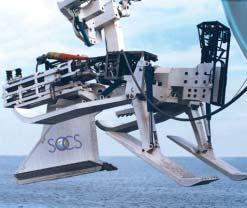
Smit-Oceaneering Cable Systems (SOCS) announces the successful completion of the Factory Acceptance Tests of their new MD3-JK Cable Burial Plough. This subsea plough is capable of burying 17 mm to 150-mm cable and repeaters up to 350 mm in a trench depth of up to 3.0 meters.
The plough’s cutting depth can be constantly varied between 0.15 meters and 2.0 meters. Ploughing deeper than the 2.0 meter depth is achieved by plough sinkage. In normal conditions this plough has a depth accuracy of better than 50 mm. With stabilizers at the rear that assist with depth
SOCS MD3-JK plough
sub tell
The Pacific Telecommunications Council (PTC) announced today that Minister Wu Jichuan of China’s Ministry of Information Industry (MII) has confirmed his participation at its 24th annual international conference, PTC2002, as a keynote speaker on Monday, 14 January 2002.
Minister Wu will lead a delegation of seven other Chinese officials to Hawaii. He will proceed to Washington, DC after PTC2002 for bilateral meetings with U.S. Government officials.
As the gatekeeper to China’s cyberspace, Wu has pressed hard to make the Internet more accessible to ordinary Chinese (among his achievements: forcing state-backed China Telecom to cut prices).
In the past 20 years, China has achieved leapfrog development in the infocomm sector by seizing the opportunities brought about by the IT technological evolution and global information network development and formulating correct policies.
Industry experts estimate that by the end of 2001, China will have a total of 300 million telephone subscribers (fixed: 170 million and mobile: 130 million) with over 25% telephone penetration rate and over 10% mobile penetration rate.
The international gateway bandwidth for Internet will basically meet the demands of various applications. There will be more than 30 million Internet users.
FLAG Telecom, a leading global network services provider and independent carriers’ carrier, recently announced that it has appointed Mr. Michel Cayouette as Chief Financial Officer.
Mr. Cayouette brings an extensive background in global telecommunications and finance, most recently as the Executive Vice President and Chief Financial Officer of TIW Asia N.V., a global communications investment fund, and Vice President and General Manager, Pacific Rim and Chief Financial Officer of Teleglobe Communications Corporation.
“I am pleased to join the highly talented management team at FLAG Telecom,” commented Mr. Cayouette. “I see a real opportunity for FLAG Telecom to weather the current economic conditions and continue to carve out a leadership position by providing a high level of service to its diverse carrier base and serving areas of the world where the company has a first-mover advantage.”
Mr. Cayouette will begin his tenure in January 2002 when he will replace Peter O’Donoghue who is FLAG Telecom’s acting Chief Financial Officer.
and bringing the former TyCom organization back under the Tyco umbrella as a wholly owned subsidiary.
As part of this restructuring change, its website name has changed to www.tycotelecom.com, while its e-mail domain now contains the extension @tycotelecom.com.
TyCom’s name has been changed to Tyco Telecommunications, reflecting the buyback of all outstanding TyCom shares by Tyco International,
Ailing wholesale telecommunications carrier Global Crossing Ltd. said recently it obtained a waiver from its lenders forpotential violations of a credit agreement covering $2.25 billion in borrowing.
Global Crossing said it will continue discussions with its creditors, led by J.P. Morgan Chase & Co. and Citibank, a unit of Citigroup Inc. , about the terms of its credit agreement as the company pursues discussions with potential equity investors.
The waiver is effective through Feb. 13, 2002 and requires Global Crossing to maintain certain cash balances, the company said. In November, Global Crossing said that it was in talks with banks to amend the covenants on the debt.
In November, the company posted a thirdquarter loss of $3.4 billion, or $3.84 per share, compared with a $602.4 million loss, or 69 cents per share, in the year-earlier period.
ventures
French telecoms equipment maker Alcatel said recently the group should post an operating profit next year despite the crisis in the industry as it cuts costs to bring down its breakeven point.
Alcatel Chairman Serge Tchuruk told an analysts’ meeting recently that even if sales were to decline as much as 20 percent from 2001, the group should still break even at the operating level.
Alcatel said in October that it faces a net loss of five billion euros for 2001 and an operating loss of around 100-200 million.
the years 2002 through 2004. The purchase price from $66 million $74 million is four to five times expected Canyon EBITDA. Canyon Offshore currently owns 18 ROV systems and operates six others in three regions.
The company entered the cable burial industry in September 2000 and presently operates eight trenching systems internationally, including four customer-owned units. The average age of the Canyon ROV fleet is approximately two years.
The final splice of Phase 2 of the MedNautilus project took place recently, linking Catania and Tel Aviv. The marine installation for the Eastern Mediterranean ring is now finalised. Singapore-owned submarine carrier, C2C , has activated capacity on its pan-Asian network. The 17,000km long network will eventually connect China, Hong Kong, Japan, Korea, Philippines, Singapore and Taiwan. The company will also deliver the trans-Pacific network between Japan and the US, connecting C2C’s customers from Asia to North America. The Japan-US route will be ready by the second quarter of the year.
New World Network, Ltd., the principal owner of the Americas Region Caribbean Optical-ring System (ARCOS), and Cable & Wireless (WI) Ltd. a top-tier global telecommunications provider, recently announced that Cable & Wireless (WI) Ltd. has acquired capacity on the ARCOS cable system.
It will also provide Cable & Wireless (WI) Ltd. with global connectivity and traffic expansion between major cities in the Eastern Caribbean islands, San Juan, Puerto Rico and the United States.
Phoenix International, Inc. recently announced its relocation to a new facility. Expanding government and commercial business necessitated a move into a modern 40,000 sq. ft. tech-flex office / warehouse complex located in Landover, Maryland. The site is 8 miles from downtown Washington, D.C. and in proximity to Andrews Air Force Base and several international airports.
The move results in the consolidation of Phoenix’s management and administration office with its Deep Ocean Operations support facility. The new spaces are of sufficient size to house the company’s commercial undersea search and recovery systems as well as the U.S. Navy’s substantial inventory of similar equipment.
Cal Dive International, Inc. recently announced that it has agreed to acquire 85% of Canyon Offshore, Inc., a supplier of ROVs and robotics to the offshore construction and telecom industries. Cal Dive would purchase the remaining 15% at a price to be determined by Canyon’s performance during
This newly acquired capacity will extend Cable & Wireless’ (WI) international fiber network footprint further into the Caribbean. New World Network will provide Cable & Wireless (WI) Ltd. with a multi- level, high capacity Synchronous Transport Module (STM) on its ARCOS fiber-optic cable network.
Phoenix holds the Navy’s multi-year Undersea Operations contract by which it operates and maintains the Nation’s most comprehensive and sophisticated capabilities in underwater search and recovery to water depths of 6,000 meters.
The new facility complements a 6-acre waterfront property in Morgan City, Louisiana, the company’s center for its diving, underwater welding, and inwater ship repair capabilities.
venturesvessels
Fujitsu Australia announced today that it has selected two suppliers, ABB Australia and Downer Engineering, for the works associated with the Nava1 terrestrial fibre-optic cable system from Perth to Melbourne via Adelaide.
Nava Networks recently awarded Fujitsu the role of prime contractor for the implementation of the Nava-1 network, a high capacity DWDM optical system that will link Singapore – Jakarta – Perth using submarine cable and Perth – Adelaide – Melbourne – Sydney using terrestrial cable.
ABB will perform the works for the link from Port Augusta to Kalgoorlie, while Downer Engineering will perform the works from Perth to Kalgoorlie and Melbourne to Port Augusta via Adelaide. As prime contractor for the Nava-1 network, Fujitsu will manage the integration of an existing PowerTel network for the Melbourne – Sydney segment.
ABB and Downer Engineering have already commenced the route design, selection and negotiations for the right of way, which will be followed by path excavation and then laying the optical fibre. ABB and Downer will use leading-edge technology to implement the terrestrial route across some of the harshest conditions in the country, including the Nullarbor Plains.
“With an extensive workforce throughout Australia and widespread experience with telecommunications projects, ABB is well placed to deal with the challenges an infrastructure build across the
Nullarbor Plains demands,” ABB’s General Manager, Mr Roy Rowe said.
Downer Engineering CEO, Mr Chris Denney, said “Downer Engineering is delighted to be associated with Fujitsu and Nava Networks on the Nava -1 terrestrial fibre link. We were able to propose a number of route alternatives which offered Nava-1 advantages, including diversity, over current and previously installed fibre links.”
The construction for the 3,700-km terrestrial route will commence late January 2002. The ready for service date is scheduled for 1st quarter 2003.
International Subsea & Telecom Services (ISTS) has announced its entry into the submarine cable market with the opening of an office in Vancouver, Canada.
ISTS President Adien Aggenbach says the company is viewing the depression as an opportunity to fine-tune the services of the company to an evolving industry and to adapt accordingly. “The recent downturn in the cable industry has given us the opportunity to procure the best marine and terrestrial consultants in the industry and position ourselves favorably for the inevitable turnaround in the market.”
Please visit www.ists.info.
On Saturday 20th October 2001 at 11.00am the cable layer ‘Pertinacia’ was launched from the Morosini slipway at the Cantiere Navale Fratelli Orlando in Livorno. This high-tech vessel was commissioned by the Elettra Tlc S.p.A. of the Gruppo Telecom Italia for the laying and repairing of underwater cables.
She has a dead weight of 10,000T, o.a. length of 129.9m, a width of 23.4m and is 12m in height. The vessel has a maximum speed of 14 knots and is equipped with a helideck.
‘Pertinacia’ has sophisticated systems for the laying, retrieval and repair of underwater optic-fibre cables; a submarine plough which can make troughs of up to 1.5m on the sea-bed to a depth of 1, 500 metres, a 35T A-frame crane for the lowering and recovery of the submarine plough, 40T cable laying drums for the laying and retrieval of underwater optic fibre cable, linear cable engines that can lay up to 200 km of cable a day. Two cable storage tanks with a capacity of 6,000T (8,000km) capable of laying a line across in the Atlantic in a single operation.
The vessel is being built under the watchful eyes of the R.I.Na (Registro Italiano Navale) and the ABS (American Bureau of Ships) to ensure she meets the most stringent standards and international requirements and will be a great asset to the fleet flying the Italian flag. The vessel’s delivery is scheduled for March 2002.
by Michael Ruddy
Is there a future for the
troubled submarine cable industry?
Although the three-year period leading up to 2002 saw the highest levels of investment in undersea cable systems ever, 2001 proved to be a major disappointment for the industry, and was marked by massive layoffs, downsizing, devaluation, and bankruptcy.
Consequently, the undersea cable industry enters 2002 with bated breath and low expectations.
There is a widespread belief that the undersea cable market will be significantly affected by the current economic downturn. Many in the industry also suspect that the capital required for major undersea projects has dried up, at least temporarily. And the undersea industry has been particularly disheartened by the view that it suffers from an enormous oversupply of capacity, and that this oversupply will prevent any significant deployment in the near-future.
Effects of an Economic Slowdown on the Undersea Cable Markets
The industry will indeed be negatively influenced by the current economic recession. The undersea industry is presently and will continue to experience a slowdown in investment and spending, but as of late-2001, this slowdown had already entered its fourth quarter (no major supply contracts have been signed since January of 2001, when Cable and Wireless commissioned Alcatel to build its Apollo system). Historically, there have been only three contractions in the undersea fiber optic cable market. None of these contractions lasted longer than six quarters.
Based on cable activation dates, the first contraction in undersea investment occurred in 1989 when it was off by five percent; the second occurred in 1995, when the market contracted by 15 percent; and the third took place in 1997, when
investment dropped by 16 percent (these dates can be moved back by two to three years to represent the date at which the cable systems were conceived).
The undersea industry has always been cyclical, and because the undersea industry experienced its highest levels of investment in the last few years, investment will inevitably slow. However, there is little empirical evidence to show a clear-cut correlation between undersea cable investment and economic growth. For this reason, Terabit believes that the current contraction in undersea investment is only moderately influenced by economic recession.
During the era of the fiber optic undersea cable, the greatest recessions in the growth of the worldwide economy occurred from 1988 to 1991 and from 1997 to 1998. During these two economic slowdowns, annual investment in undersea cable systems by ready-for-service date increased by 161 percent and decreased by 44 percent, respectively.
When investment is classified according to the estimated date of project conception (assuming a two- to three-year
development schedule for undersea systems from project conception to system activation), investment increased 168 percent during the first recession and increased 3 percent during the second.
An analysis of the undersea cable market’s performance during these two recessions gives insight into the correlation not only between economic growth and investment in undersea cables, but also the correlation between economic growth and carrier spending on international undersea capacity.
This is because from 1988 to 1998, undersea cable investment was, for all intents and purposes, equal to carrier spending on undersea systems, since almost all systems were constructed by carriers.1
As a result, the impact of economic recession on both undersea cable suppliers and
1 Only in 1998 was there any significant deployment of non-consortium cables. However, reinforcing the argument that carrier spending on undersea capacity during the period from 1988 to 1997 was equal to or greater than overall undersea investment, carriers spent almost $2 billion on undersea capacity in the only major non-carrier system, Atlantic Crossing-1. This was more than double the investment in the system.
undersea cable developers will not be as severe as many industry observers expect. Admittedly, the present recession may be somewhat different because of the undersea industry’s newfound reliance on capital markets to fund investor-led systems. However, historical analysis, as discussed above, shows that the industry has been able to increase investment levels even in times of economic recession. And, if necessary, the undersea communications market is able to redefine itself in terms of investment sources.
Historically, the undersea cable industry has been driven by factors that are only moderately influenced by worldwide economic conditions. It is recognition of these factors’ importance that will allow the industry to be resilient in the present recession. Therefore, it is important for the industry to isolate and examine the factors that drive undersea cable demand, rather than to accept forecasted economic growth as an indicator of the undersea cable industry’s future.
These factors include trends in the overall demand for capacity within the Internet industry (including application
development), new technological phenomena sparking demand for bandwidth, network architecture within the local loop, and the propensity of and incentives for new cable operators to enter an undersea market even when design capacity of existing systems has not been exhausted.
Sources of Capital for Undersea Cable Projects
One of the negative effects of the undersea communications market’s shift from consortium-led systems to investor-led systems has been the industry’s newfound reliance upon capital markets, specifically speculative investors. Until 1998, almost all undersea systems were financed by bluechip companies such as AT&T, KDD, BT, France Telecom, and Deutsche Telekom, which often financed the projects using their own internal capital. In some special cases, the carriers sought financing from financial institutions; however, these institutions had little doubt as to the financial viability of the carrier or the merit of the carrier’s decision to invest in an undersea project.
Forecast
of Worldwide Undersea Cable Investment by Ready-for-Service Date, 2001-2010
Upgrades New Systems
The market environment shifted dramatically in 1998 when Global Crossing assumed the risk of developing a transatlantic system and reaped huge rewards. The returns that were attained by the small group of financial institutions that had invested in Global Crossing inspired countless other financial institutions to stake their capital on the undersea market. New entrants to the undersea market abounded, drawing upon
the seemingly infinite sources of capital that were waiting to be funneled into undersea projects.
Beginning in 2000, investors and financiers have been reluctant to lend to or invest in telecommunications infrastructure projects. Because of the devaluation or bankruptcy of undersea specialist companies such as Global Crossing, 360networks, Level 3, and FLAG, many investors have sensed that the
undersea communications industry was particularly overvalued, and as a result they are likely to shun the market until indications emerge to convince them otherwise.
The indications for financial institutions and private investors to return to the undersea market will be those that show a strong undersea capacity market. Based on its highly-granular forecasts of demand, pricing, and competition, Terabit believes that the undersea IRU and leasetype capacity market will return to its historical high by the end of 2002. Financiers and investors may be reluctant to lend to or invest in undersea projects until the recovery has actually been proven. As a result, Terabit believes that at least a few investor-led systems will enter the market beginning in 2003.
Even if financial institutions and private investors sense a weakness in the
undersea capacity market, the undersea cable industry will still be able to reemerge, provided that overall capacity demand merits it. If the market gives rise to a scenario in which the IRU and lease-type undersea capacity market is weak but the demand for capacity is strong, then the market will become the domain of established operators that are able to tap traditional sources of capital. In this respect, the undersea industry will have returned to its carrier roots. However, there is strong evidence to suggest that the industry will not necessarily return to the consortium model that dominated the undersea fiber optic industry for the first ten years of its existence.
If investor-led systems fail to achieve financing, the most likely model to emerge will be hybrid-type systems which are led by one to three carriers. The carriers willing to invest in these systems will be required
to justify their construction based on the demand generated by the carrier’s proprietary (non-wholesale) traffic alone. However, the systems will still be IRU-based.
A cable constructed in this mold may only need to justify itself based on the premise that the carrier participants will fill 30 or 40 percent of the system’s capacity (or even less). The carrier participants will then seek to market the system’s remaining capacity on the IRU or lease market.
Terabit believes that the future undersea market will be a combination of both investor-led and carrier-led projects. It is likely that the carrier-led projects will be organized by either single carriers or very small groups of carriers, rather than consortia.
The proportions of carrier-led and investor-led projects will be determined by the willingness of the investment community to underwrite investor-led projects. Terabit asserts that at least some in the investment community will begin to assemble the courage to reenter the undersea communications market once the consistent robustness of the IRU capacity market is proven in late-2002.
The Perceived Oversupply of Undersea Capacity
Perhaps the biggest threat facing the undersea industry is the perception that the market is vastly oversupplied with capacity. For the most part, this perception was the result of grandiose statements on the part of cable developers as to the capacity of their systems. On transoceanic routes, cable developers touted their cables as “terabit systems” when in fact the systems’ initial capacities were typically only 160 Gbps. In order to achieve the design capacities of their systems, cable developers typically must invest anywhere from 30 to 60 percent more capital than they had invested to achieve the initial capacities of their systems.
Nevertheless, many investors and industry observers have focused on the supply capacity of systems as precluding the construction of any systems in the nearfuture. Using the assumption that no new systems will be needed until the design capacity of existing systems is fully consumed, these observers assert that no new deployment will occur for as many as ten years into the future. Indeed, if this
logic is to be believed, Terabit’s own analysis shows that the design capacity of existing and awarded systems will not be saturated until 2006 on the transatlantic route; 2007 on the transpacific, North America-South America, and east Asian regional routes; and 2008 on the Australian intercontinental route; thus, there would be no deployment along these routes until those dates.
However, Terabit asserts that the likelihood of this scenario coming to fruition is virtually zero. The decisions of developers to construct IRU-based undersea cables will be based on the size and growth of the undersea capacity market. The decisions of carriers to develop carrier-led cables will be based on their own internal requirements, as well as a comparison of unit development costs with the unit price of capacity on existing cables.
Future deployment will be driven not only by the increasing size of the undersea capacity markets and carriers’ own burgeoning requirements for capacity, but by the continuous decrease in the costs of constructing capacity.
Terabit’s analysis shows that the declining unit cost of constructing undersea
Michael Ruddy is the managing director of Terabit Consulting, based in Cambridge, Massachusetts. He is responsible for performing customized research for Terabit’s clients, which include cable suppliers, cable developers, carriers, component manufacturers, industry organizations, financiers, and governmental agencies.
Mr. Ruddy joined Terabit in 2000. Prior to Terabit, he was the senior fiber optics analyst for Pioneer Consulting, specializing in undersea cable market analysis. Mr. Ruddy was responsible for building up Pioneer’s submarine market research business. He did so with the creation of Pioneer’s annual report, Worldwide SubmarineFiberOpticSystems, which featured the first demand-based model of undersea cable deployment. At Pioneer, Mr. Ruddy also authored the feasibility studies for more than a half-dozen leading systems. These studies were used to secure several billion dollars of financing for undersea cable projects. cable systems will be a leading incentive for future deployment. In fact, this analysis shows that most cable systems will be rendered economically uncompetitive before they can upgrade to full capacity, rendering the argument surrounding the “capacity glut” irrelevant.
Because of the declining cost curve for constructing undersea cables, future cables will have a significant cost advantage over their predecessors. The unit cost of constructing systems at their initial capacity levels has fallen at an average yearly rate 39 percent along transoceanic routes. The unit cost of upgrading systems has fallen at an average annual rate of 46 percent.
Given the steep erosion in unit costs, undersea systems will quickly become less and less competitive vis-à-vis newer systems. Further, systems will eventually reach a point at which their unit cost of upgrading capacity will exceed the cost of building a new system and equipping it to an initial capacity level (one-tenth to onefourth of design capacity).
On average, once an undersea system has been in service for six years, the unit cost of upgrading that system will exceed the unit cost of deploying a new, initiallyequipped system. However, in times of technological advancement, such as the adoption of wavelength division multiplexing, the unit cost of building new systems has eroded at a rate as high as 65 percent; when the rate of cost erosion rises
THE GLOBAL MARINE
TELECOMMUNICATIONS MARKET
A Market Study Covering The Latest Developments And Opportunities
TMS International is pleased to announce the release of its latest market study - The Global Marine Telecommunications Market. The report has been commissioned by TMSI and compiled by industry experts from published information, reports from industry consulting and research organizations and from interviews with key players in the telecommunications industry particularly from the latest Submarine Telecommunications Conference.
The Report reviews the current market situation, and includes comment and analysis on
Cable Systems, Routes and Landings
System Planning, Investment and Implementation
Trends in Production, Supply and Demand
The Repeatered and Unrepeatered Sectors
New Systems are being planned now for installation in 2003/2004 –Make sure you are aware of these opportunities
The Global Telecommunications Market Report is available on CD direct from TMSI at US$1175 per copy.
You can order your copy directly from the TMSI Web site at http://www.tmsico.com/cablereport
to such levels, the upgrading of systems can be rendered economically detrimental within two years (that is, in such cases, it would be cheaper to construct a new system than to continue upgrading the old system).
Depending on the rate of technological advancement, systems will be able to upgrade their capacity for as few as three or as many as six years. Terabit’s demand forecasts show that within six years, systems will likely only be able to upgrade to between one-third and one-half of their design capacities, because of the additional systems that they will be competing against.
Given the fact that undersea cables could possibly under-price any future competition for as many as six years, it is reasonable to ask how newer cable systems will be able to compete. The answer lies in the dynamics of the capacity markets. The undersea capacity markets are subjected to continuous downward price pressure, and because undersea capacity is for the most part a commodity, operators are forced to accept the market price.
Typically, the cable operator is forced to accept a relatively low margin on the sale
of its initial capacity. However, the operator typically expects to offset these lower margins with the higher margins that it will receive by selling its lower-cost upgrade capacity. Cable operators with upgrade capacity have occasionally exerted downward price pressure on the markets, but rarely if ever have they engaged in practices which could be considered “dumping.”
Further, perhaps more importantly, if cable operators with upgrade capacity do decide to sell capacity at depressed prices, then cable developers can easily price down the unit costs of their initially-equipped systems by increasing the initial capacity of their systems, or by retreating to the original dynamics of the undersea capacity market, whereby carriers accepted lower margins on their initial capacity with the expectation that they would receive higher margins on their upgrade capacities.
Progression of the Industry
In the future, it is of primary importance that the undersea industry not fall victim to the pessimism that has pervaded the entire telecommunications industry. In
many ways, the industry already has become unhealthily pessimistic, with suppliers reducing their supply capacities (as was the case of Alcatel’s closure of its Portland, Oregon cable plant) and laying off thousands of workers. In an attempt to appease Wall Street analysts and demonstrate immediate returns, cable operators have also laid off thousands of workers.
Conversely, once the market begins to recover, its participants must ensure that they do not fall prey to the speculation, greed, and lack of planning that led to market collapse in the first place.
Terabit’s forecasts show that there will be adequate levels of capacity demand to support a robust undersea capacity market and significant increases in undersea cable investment.
Admittedly, the market will not return to its historical levels of activity until late2002. Thereafter, demand and capacity sales will be able to support greater deployment of cable and greater investment levels than it ever had in the past: Terabit forecasts that investment in undersea systems during the six years from 2004 to
2009 will total $49.6 billion, or $9 billion more than the historical investment in the 14 years from 1988 to 2001.
The fact of the matter is that the undersea industry has never truly experienced sustained success; compared to recent times, the industry’s growth from 1988 to 1997 was restrained and controlled. Its customer base was a known and unchanging entity: the consortia. Effectively, the industry was thrown into chaos by the introduction of unknown customer groups and runaway capacity demand, and most of all, by the allure of high double-digit and sometimes tripledigit returns. It responded with spontaneous and often contradictory actions that mimicked the performance of a day-trader of NASDAQ stocks rather than the decisions of multi-billion-dollar corporations. Plans for cable systems were no sooner announced than they were merged with competitors’ systems, their capacities were increased threefold, or plans for the systems were abandoned completely. Suppliers quickly rewrote their business plans so that they had become cable developers, or investors in systems.
The industry was ruled by speculation and the expectation of quick, painless returns. The end result was chaos. By the time the dust had settled on the marketplace in 2001, almost all the decisions of industry participants had uniformly resulted in major losses, or in some cases, bankruptcy. Although many thousands of jobs and many billions of dollars were lost, Terabit believes that the events of 2000 and 2001 will have served to lay the foundation for the rebirth of the industry. The industry had become a densely-populated forest wherein hundred-year-old elm trees were competing for water and nutrients with hastily-planted saplings. The industry collapse has effectively resulted in a severe forest fire which few have survived. However, a newly-fertile marketplace has emerged, with a clear view toward upward growth. Surviving market participants and new market participants must act swiftly to demonstrate their commitment to the market. They can do so by staking out territory which will provide comfortable returns; the mistake of past market participants may have been the belief that they could tap the entire market for profit.
OFFSHORE SITE INVESTIGATION AND GEOTECHNICS
International Conference 26, 27 & 28 November 2002, London
by Rex Ramsden M.A. (Cantab), F.Inst.D
Over the last 18 months my company has researched the buying intentions amongst a number of major buyers of capacity in four important segments of the bandwidth market – US/Asia, intra S.E. Asia, intra Mediterranean and US/S. America.
This work was done for clients who were investors or potential investors in submarine cables. For the last three years
we have also handled buying enquiries from potential purchasers in liberalising markets such as these and in the already intensely competitive markets including US/Europe, intra US and intra Europe.
Added to a previous ten years of experience in the submarine cable laying business, this gives a good perspective over the lifetime to date of the industry in the fibre-optic era.
Making sense of the market
Purchase and sale of channels of bandwidth started well over 100 years ago. Like their technological forebears, fibre-optic cables themselves are laid and may be bought and sold and, at the end of their useful lives, they are closed down. The commercial terms for the rights of use of fibre-optic cable capacity rely on methods of sharing capacity which are technologically elegant and unique. A channel of bandwidth allows the user a share in the use of the transmission medium which is distinct from ownership of the cable itself.
Two very significant trends have now been operating in the marketplace. The first of these is the logarithmic reduction in the unit cost of bandwidth creation. Each new generation of fibre-optic submarine cable has a design maximum capacity, far exceeding the previous generation, for roughly the same capital cost. Cables are also designed now to have their capacities doubled or quadrupled two or three times in their lifetime without changes to the submerged plant.
The second significant trend has been the division of this huge growth in
bandwidth supply into the hands of many very competitive sellers of transmission capacity. The bandwidth market is now a very aggressive “supply-push” type of market – a complete reversal from only 10 years ago.
Cable investment decisions
The business case for the investment in a submarine cable is inevitably sensitive to capacity selling prices and sales volumes in the bandwidth market. There were many early cases of financial successes when the timing was right to construct a new fibreoptic submarine cable on particular routes. Actual financial performance exceeded planned performance but sometimes contained evidence of capacity selling prices falling and volumes growing faster than expected. These successes, perhaps, did not serve to emphasise the sensitivities of the business case but created a wider confidence which allowed a bout of overbuilding. Geographical segments of the market – one after the other – suffered a tendency towards overbuilding until the recent, world-wide application of the brakes on investment.
Overbuilding was seen also in the terrestrial cable markets of the USA and Western Europe. The danger signals from all this have now led to reversals in earlier confidence.
Bandwidth market segmentation
Cables on the same geographical route compete for sales of bandwidth or capacity and owners of capacity in the same cables compete. Very recently, we have started to see some competition or interaction between geographical separate routes. An example of this is for bandwidth between the Middle East and USA – routing geographically westward now competes with going eastward around the planet. At the present state of the market it remains valid to segment the market into essentially linear geographical routes.
Capacity pricing
On very competitive routes, reductions in capacity prices have been dramatic. Prices on East/West routes across the Atlantic and across the Pacific have been reducing by over 50% per annum. Today a London/New York circuit of STM-1 (155 Mb/s) will
Rex M. J. Ramsden
Rex Ramsden has a degree in Natural Sciences and had a long career in the oil and gas industry including senior management roles in business development and management consultancy. He entered the telecommunications industry in 1988 on being recruited into BT as a member of the board of its submarine cableship subsidiary BT (Marine) Ltd and later transferred to the board of C&W Marine Ltd on the takeover of the BT subsidiary.
In 1997 he embarked upon a new career, setting up Mensard Ltd, his own company, to act as an intermediary on behalf of companies who use Mensard services in their sales and marketing of capacity in both submarine and terrestrial fibre-optic networks. The company has about 15 clients in several countries and receives capacity purchasing enquiries from a customer set of over 200 companies world-wide.
command a price of less than USD 0.5m as a lump sum acquisition for life of the cable. Four years ago the same unit of capacity would be priced at around USD 7.5m.
Whilst annual percentage rates of reduction in price are high, the shape of the price trajectory over time shows a flattening curve approaching zero price at an ever-decreasing slope. Price volatility has not occurred.
Prices in newly competitive markets have fast approached the prices in slightly older competitive markets. For example, prices of capacity on E/W routes across the Pacific have made a rapid approach towards prices on E/W routes across the Atlantic. The pricing process is not well understood but appears to be similar to pricing behaviour in other technology markets such as semi-conductor chips. Comparisons might exist with the prices of electronic components if we convert these into prices per MHz (for processor speeds) and per Gb (for storage). In those terms the patterns of price reduction have been similar to bandwidth prices per Gb/s and have continued for many years.
From most perspectives, the most competitive bandwidth market segments appear to be over-supplied and newly installed capacity under-utilised. The
revenues of capacity selling enterprises are variously reported as static or suffering slow growth.
Capacity purchasers’ risks
Achievement of promised delivery dates and continuity of supply after delivery are great concerns for buyers of bandwidth in the present market.
Buyers need financially secure suppliers. The uncertainties surrounding those issues outweigh uncertainties about future prices variations.
There is a growing preference amongst buyers of bandwidth for shorter lead times and for “pay as you go” terms rather than up-front lump sum payments. The drivers for this – cash rationing and risk management – are very clear today and have probably resulted in permanent shifts in buying policy.
On vital routes, splitting of capacity requirements into diverse paths and using diverse suppliers is now more common amongst the risk management strategies of capacity buying carriers.
All these changes transfer risk to cable owners on the supply side of the market.
Last mile issues
For corporate and other retail customers of the major carriers, the service package usually contains items besides the long-haul bandwidth. These other items are not reducing in cost nor experiencing the same intensity of competition as the long-haul bandwidth. Retail prices are therefore declining less quickly. This attenuates the price elasticity of demand for long-haul bandwidth.
Private owners lay their submarine cables into accessible points of presence in major cities. In some countries they have set up arrangements for responsive provisioning of last mile circuits extending the long-haul bandwidth to the buildings of retail customers. In present times of cash
constraint, choices are being made between two lines of focus:
1. Vertical concentration – which requires invest or partnering with others to achieve capillarity at the extremities of the existing long haul pipes.
2. Horizontal concentration – which means continued globalisation to provide presence in more and more countries. Similar choices between vertical and horizontal concentration face the international telcoms companies. As yet there is no strong signs of a settled pattern to the supply chain for transmission capacity across the industry.
Capacity buying intentions
Amongst international carriers, intentions to commit to strategic purchases of capacity were, to a great extent, abandoned or delayed in 2001. The level of enquiry for short term purchasing also fell and it is probably true to say that 2001 represented a trough in capacity purchasing activity.
We know of purchasing intentions which have moved into 2002 but these are often conditional on the growth of traffic demand for the last quarter of 2001 and first
quarter of 2002. Enquiries for short term purchasing appear to be increasing but from a very low level. These early indicators are showing mainly in the more recently competitive markets. This is probably because inventories of capacity purchased in the most competitive routes are still high.
Unusually for the industry, there are now cable-owning companies for sale at distressed prices. In the markets most affected by this, the forecasting of capacity supply, demand and future prices hold extra uncertainty. Also, particularly amongst the more recently built cables, there is huge potential to generate further multiples of their present total capacity by the investment in upgrades in land-based equipment. From these sources, the industry can expect to enjoy further shortening of lead times for creating new capacity within competitive markets. This suggests that the approach towards supply/ demand balance could be smooth on the busiest highways of the world.
Within this whole scenario we can see why purchase and sale activity has not embraced pure trading as a market clearing and hedging mechanism in any significant
volumes in the bandwidth market. Some transfers of commercial disciplines into telecoms markets have been made from outside the telcoms industry. A great deal more evolution is yet to come.
A basic problem remains. The capability of fibre-optic technology to supply new cables of enormous capacity results in huge step changes in supply, on the supply side of the industry. The bandwidth market has few mature mechanisms for clearing these inventories and fierce price competition seems unavoidable.
Countdown to Apollo launch . . .
The world’s most advanced transatlantic cable system, Apollo, should be ready for service in 2002.
By Katherine Edwards Apollo Project Director
In January this year Cable & Wireless, the global telecommunications group, announced it would build Apollo, the world’s most advanced transatlantic cable system, to meet growing IP and data demands.
Cable & Wireless is using its extensive experience in the engineering, procurement, installation commissioning and subsequent management of submarine cables to build and operate Apollo. Working with Alcatel Submarine Networks, the system supplier, work is well underway to completion by the end of 2002.
The Cable System
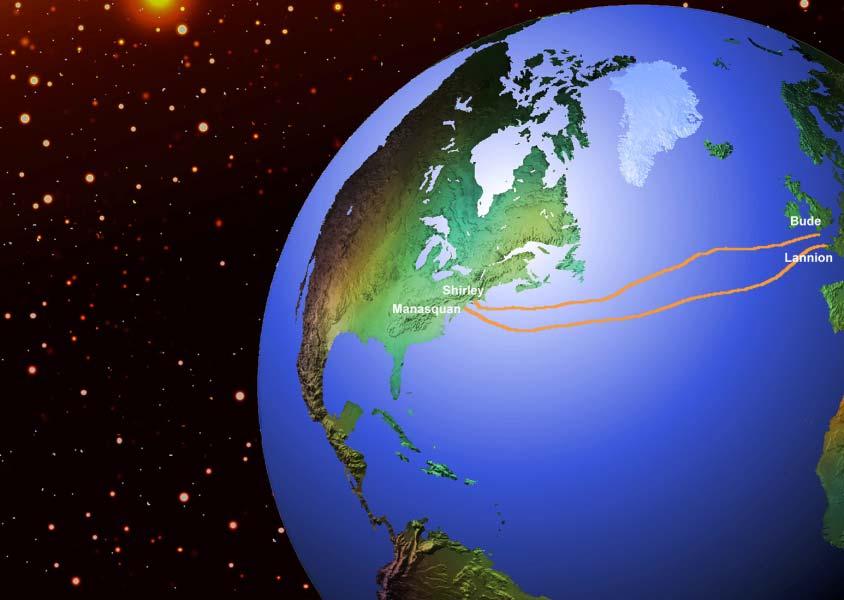
Apollo consists of two fully diverse transatlantic cables running 13,000 km under the Atlantic Ocean linking Long Island and New Jersey in the US with Cornwall in the UK and Brittany in France.
Each of the submarine legs contain 4 fibre pairs and is capable of at least 3.2 terabits of traffic on each leg - 25% more capacity existing transatlantic systems.
Each fibre pair utilises the latest technology dense wave division multiplexing (DWDM) transmission at
speeds of 10 Gbit/s and has a minimum capacity of 80 x 10 Gbit/s. To put this in perspective, each submarine cable leg could support the equivalent of 200 million simultaneous voice calls
In Built Strength
Cable & Wireless’ Global Operations Engineering Services (GOES) staff developed the system design and will be oversee the
project implementation and commissioning. A particular area of focus was the resilience and protection of the system.
Apollo is the first transatlantic cable system to use Alcatel’s enhanced cable on both the European and US continental shelves. The new design offers a 100% improvement in crush resistance over standard single armour and doubled armoured variants. In addition, a specially
Bude Lannion
Shirley Manasquan
The Apollo Route
designed larger diameter double armour cable (special purpose double armour (SPDA)) will also be used within the system and this cable offers a 200% crush resistance improvement over the traditional double armoured variant.
The use of the enhancement cable will assist in Apollo offering greater resilience in the event of external aggression.
The cable system will be installed using the latest plough burial techniques assisting in achieving burial in harder seabed substrates.
All this, combined with four diverse landing stations and separate fully surveyed routes, helps to increase significantly the cable system’s resilience.
Progress to date - where are we now?
A full route survey and separate burial assessment survey has been carried out to obtain the optimum route. Route clearance of out of service cables & other survey identified debris has been completed on both the European and US continental shelves. System manufacture is progressing to plan with over 90% submarine cable plant either procured or manufactured.
To derisk the marine program and minimise weather downtime periods the main marine lay has been tailored to match the optimum weather conditions in the spring and summer months of 2002. The continental shelf operations are planned for early spring 2002 with separate shore
Edwards is Cable &
Apollo Project Director. She has worked for Cable & Wireless for 12 years and has wide experience in both the submarine and satellite project fields.
She holds a degree in Electrical and Electronic Engineering and is a Chartered Engineer.
operations. The United Kingdom shore end was recently successfully installed at Bude, Cornwall.
Work on the cable terminal stations is progressing to schedule. European cable stations are nearing completion and the construction has commenced on US sites.
France Cable Station – Lannion, Brittany
Katherine
Wireless’
Connectivity Options
The system will also be connected by dedicated backhaul links to London, Paris and New York.
Of course it need not stop there: onward connectivity can be provided through a seamless infrastructure throughout US and Europe. Flexible connectivity options are offered. Network access can be either at the city POPS or carrier neutral hotels, or at the fibre pair level via dedicated co-location at the cable stations.
Right Timing
We’ve seen a rapid evolution in the transatlantic market and have seen bandwidth growth in excess of 100% a year. Despite the current volatile telecoms market, transatlantic traffic growth has still been robust. As the market adjusts and viable hi-tech businesses ride out the storm we can expect to see demand rising steadily over the coming years. With its ready for service date at the end of 2002 Apollo is perfectly timed to catch the next IP wave.
In addition the flexible, non-trafficaffecting upgrades on Apollo offer customised growth profiles depending on customers’ traffic requirements.
In Conclusion
With the significant amount of submerged plant already manufactured coupled with the clear progress on the civil builds, Apollo is on target for delivery by the end of 2002. In addition, with Cable & Wireless as one of the industry’s most solid, financially stable and established operators building it, customers can feel secure about Apollo’s timely delivery and ongoing operation.
Get in touch with the right staff by advertising your vacancies in Submarine Telecoms Forum and reaching all the key people in the submarine telecoms industry. advertising@subtelforum.com
2advertising@subtelforum.com
United Kingdom Cable Station – Bude
The submarine cable industry is famous for its peaks and valleys and nowhere is that seen more clearly than in the deployment of submarine fiber systems in Latin America and the Caribbean.
Since the beginning of the fiber era, there has been three clear “boom” periods in submarine cable building in this region, each coinciding with the introduction of new transmission technologies. In between are the “droughts,” where the few systems that are installed tend to be small in scope – domestic networks or short links between islands. We have just left a boom period in Latin America and the Caribbean and are facing one of these droughts in 2002.
The first boom in fiber optic submarine systems in Latin America and the Caribbean came in 1990. In this year the first large-scale fiber system for the Caribbean entered service – TransCaribbean System-1 (TCS-1). This 4,500kilometer cable linked Puerto Rico, the Dominican Republic, Jamaica and Colombia. In that same year, two other key systems – Florico-2 and CARAC linked the Caribbean to the US and to transatlantic cable systems, thus improving access to the
global network. These systems used 140Mbps technology – the standard of the day.
The next boom period began in 1994. This included the introduction of 560-Mbps systems as well as the newer Synchronous Digital Hierarchy (SDH) technology. Americas-1 and Columbus-2 were the most significant of these systems. Americas-1 provided a north-south system linking Florida, the U.S. Virgin Islands, Trinidad, Venezuela and Brazil. Columbus-2 was the first transatlantic fiber system to take a “southern” route directly from Mexico, Florida and the U.S. Virgin Islands to Spain, Portugal and Italy.
The following year saw other major systems enter service, including Unisur (Brazil-Argentina-Uruguay) and the Eastern
Caribbean
Fibre System
(ECFS).
The ECFS was an interesting system in many respects. Built by a consortium led by Cable & Wireless and other carriers serving the small islands of the eastern Caribbean, the ECFS replaced a microwave system that had been the only link between the islands. A series of devastating storms in that hurricaneprone region demonstrated the vulnerability of microwave towers, leading to interest in submarine cables. Ironically, one of the C&W cable ships installing the ECFS had to deal with another kind of natural disaster – it participated in rescue efforts when the volcano on Montserrat erupted. The last boom period began in the late 1990s and ended in 2001. This period saw an unprecedented wave of construction as
well as the introduction of dense wavelength division multiplexing (DWDM) technology to Latin America and the Caribbean. It also saw the first comprehensive efforts to link all of South America with fiber optic submarine cables. Major systems installed during this period include 360americas, Americas-2, ARCOS, Atlantis-2, Columbus-3, Emergia, Maya, Panamerican and the Global Crossing network – Mid Atlantic Crossing (MAC), Pan American Crossing (PAC) and South American Crossing (SAC). These added nearly 100,000 kilometers of submarine cable and several terabits of potential capacity to a region that probably had less than 30 gigabits of international submarine cable capacity in total.
What’s ahead for 2002? With virtually every country in the region now connected by at least one high-capacity system, the need for large-scale, regional projects is low in the short term. The projects that are being discussed now are modest, mostly involving unrepeatered systems.
The biggest project scheduled for 2002 is Aquatica. This is privately financed festoon system running down the coast of
Brazil. Similar in scope to one built by Embratel in the 1990s, Aquatica will take advantage of the opening of the Brazilian long-distance market by offering bandwidth, wavelengths and dark fiber to the new players in that market. Aquatica will extend 4,600-kilometers and will link the cities of Forteleza, Natal, Joao Pessoa, Recife, Maceio, Aracaju, Salvador, Vitoria, Rio de Janeiro, Praia Grande, Pontal do Parana, Florianopolis and Porto Alegre. It is planned to be ready for service by the end of 2002. Leading Aquatica is Grupo Schahin, a Brazilian conglomerate with interests in agriculture, construction, energy and other industries. A subsidiary of Grupo Schahin, Schahin-Cury, was the prime contractor for the first Brazilian festoon, built for Embratel in the mid-90s.
So where will the opportunities be for new cable projects in the short term? The Bahamas is an example of how smaller-scale opportunities to link several particularly fast-growing markets can develop.
The Telecommunications Act, 1999 ended the monopoly of the Bahamas Telecommunications Corporation (Batelco), and provided for the formation of a new,
As TSA’s Director of Information Services, John Manock is responsible for creating and maintaining TSA’s databases on fiberoptic submarine cable systems. He specializes in the development of information services for carriers, developers and suppliers. Mr. Manock has over 12 years of experience in the fiberoptics and telecommunications consulting business. Before joining TSA, he was employed by KMI Corporation. Mr. Manock participated in the Afrilink, AC-1, HIAM and WH feasibility studies. He also prepared numerous studies on the competitive local telecom and long distance markets in the US and on fiberoptic markets in developing parts of the world.
privatized company to take over most of the assets and liabilities of Batelco. It also established a licensing regime for telecommunications with provisions to enable existing operators to apply for and receive new licenses under the new regime. The Act created a semi-autonomous Public Utilities Commission (PUC), with responsibility for licensing and regulating the telecommunications sector. The Government of the Bahamas authority will instead be focused on setting broader policy
objectives and ensuring that the PUC’s actions are in the national interest, rather than in the day-to-day operations of the telecommunications sector.
Liberalization had an immediate impact on the submarine cable market in the Bahamas. Cable Bahamas, the country’s cable television operator, proposed in 2000 to build a system linking several of the major Bahamian islands to the US. A new company, Caribbean Crossings, was formed to build an unrepeatered system to link the major markets in the Bahamas and the US.
One of the forces driving the demand is tourism. Hotels in the Bahamas are major users of high-speed services, as is its not insignificant offshore financial industry.
Caribbean Crossings’ new system was named the Bahamas Internet Cable System (BICS). It entered service in summer 2001 linking Florida with the four most populated islands of the Bahamas – Grand Bahamas, New Providence, Eleuthera and Abaco.
The prospect for inexpensive capacity led to a flurry of new applications. In
November 2000, Lisa Wells, President of BahamasB2B, a business-to-business web site, predicted that, “With the arrival of DSL . . . and with the local cable company completing work on their fiber optic cable to the US, the pent-up demand for Internet usage [in the Bahamas] is going to explode.”
Jamaica is another Caribbean market that seems to be on a similar course. It is in the midst of a three-part program to open the telecommunications market and end C&W Jamaica’s monopoly by 2003.
Phase 1 was initiated last year when the government passed a new telecommunications law that set the ground rules for liberalizing the market. Phase 1 also saw the introduction of competition in the mobile phone market. Phase 2 will allow competition in the domestic fixed-line market, while Phase 3 will open up the international market, including the ability to land submarine cables in Jamaica.
Demand for services in Jamaica is growing at a rate that makes the opening of the market in 2003 appear quite
attractive. The Internet and demand for television services are driving that growth.
In the summer of 2001, Jamaica’s telecom regulator, the Office of Utilities Regulation (OUR), began taking licenses for Phase 2 licenses. There are three types of Phase 2 licenses — facilities-based carriers, resellers using fixed-line networks and cable television operators wanting to use their existing networks to deliver Internet access. There is no restriction on foreign ownership of new carriers in Jamaica.
The licensing of international carriers is expected in 2002. Winners will be allowed to begin providing services in March 2003.
Meanwhile, no discussion of future potential in Latin America and the Caribbean can conclude without mentioning Cuba.
With a population of over 11 million and a huge pent-up demand for Internet access and telephone service to the United States, Cuba is highly attractive to carriers and submarine cable developers.
There have been many efforts to build a fiber optic cable between Cuba and the United States. They have all failed because of political tensions between the two countries. Cuba is still under a trade embargo that has been in place for more than 40 years and the United States has not hesitated to pressure other countries against trading with Cuba.
The most recent attempt to build a submarine cable system between the US and
Cuba was announced in 1999. Quest Net, a Florida-based Internet service provider, planned to build a cable to carry Internet services only. As the cable would not have provided phone service, the ISP avoided one of the big obstacles that had derailed earlier efforts — the US embargo specifically prohibited phone service.
The issue is much too complex to be described in detail here, but in simplified terms, as there was no Internet forty years
ago, Internet services were not specifically prohibited.
Quest Net reported that it had made considerable headway in getting approval for the project, when tensions between the two countries again flared in early 2000 with the Elian Gonzalez affair. Faced with new opposition over any ventures in Cuba, particularly among the Cuban population in Florida, Quest Net abandoned the project in February of that year.
On 19 - 21 February, Terrapinn will for the fifth time organise the Submarine Networks World EMEA conference on Costa del Sol in Spain.
The submarine network industry will meet in Costa del Sol to learn,network and share ideas and experiences: Overcome your biggest challenges: financing, cost control, future supply and demand Plan for Atlantic market consolidation and EMEA opportunities
Your best opportunity to meet the submarine network industry leaders in 2002.
Top-level speakers at the three-day conference include: Andy McLeod, Executive VP, Global Operations, Cable & Wireless; Donald Kraftson, Managing Director, Dolphin Communications; Edward McCormack, COO, FLAG Telecom;
Leigh Frame, Director, Marketing & Business Development, Alcatel Submarine Networks; Patricia Bagnall, President, Africa ONE Limited.
Sponsors and exhibitors at the conference include TyCom, Global Marine, Ericsson and Cable & Wireless. Andy McLeod
Check out the agenda on: www.car riersworld.com/submarine_nets_2002/ Register TODAY on: www.car riersworld.com/submarine_nets_2002/ or telephone: +44 20 7242 2324.
1www.car riersworld.com/submarine_nets_2002/
By Christian Annoque
It has long been considered that, for worldwide telecommunications traffic there are 3 major trunk routes: Atlantic (EuropeAmericas), Pacific (Americas-Far East) and Europe-Middle East-Far East (or the EMAI region – Europe, Middle-East, Africa and India). This paper attempts to give an overview of the latter market from the viewpoint of submarine telecommunications systems; a brief history, current activities and, hopefully, a glimpse of the future.
Growth
This year aside, the global telecommunications market has recently seen growth rates unprecedented throughout its long history. This has been due to several factors all of which pointed to sustained and continued high growth well into the
future. On the back of this the world submarine market has increased five-fold from 1996 to 2000 ($1.1bn to $6bn). It would appear that some of the usual historical drivers have been responsible for this growth, for example the requirement for additional capacity and the introduction of a new technology (DWDM), but in addition there were other powerful factors at work. In Europe, privatisation and deregulation precipitated increased competition and reduced prices thereby stimulating growth in traffic, not only locally but also on major international routes leading from Europe. The growth of the Internet has also been a contributing factor (although on a more global scale) and finally the fact that markets are, for the most part, no longer monopolistic led to the reality of constructing and operating
private submarine systems for commercial gain as opposed to building of infrastructure to serve community needs.
However we can consider that the days of easily predictable slow traffic growths have long since left us and the move away from monopolistic consortiums to private systems has meant that business plans and system designs have become more and more complicated.
EMAI
As for all regions, in EMAI the necessity for submarine systems in the past has been governed by the growth of voice traffic, geography and politics. However, unlike the other two major routes (Atlantic and Pacific), the EMAI route is not two continents divided by an ocean but rather an old trade route strewn with countries
(and small seas) that contribute to the market. This has an effect, not only on the market dynamics, but also on the design and topology of the submarine systems themselves.
As examples, the FLAG and the Sea-Me-We cable systems faithfully follow the Europe, Med, Middle-East, Far East route skimming the top of Africa and terminating in India
(as far as the region is concerned). Along the way are a number of branching units allowing the systems to land in countries such as Saudi Arabia, U.A.E, Algeria, Egypt and Pakistan.
These networks have therefore taken on the characteristics of both trunk routes and regional systems. However this also means that some legs of the networks have
to fight off competition from terrestrial systems; not a concern of the Atlantic and Pacific trunk routes.
Market
The submarine cable industry is a cyclical one with market downturns when capacity needs are met and upturns with the introduction of new technologies and/or when demand could be seen to overtake “stock”. However the recent downturn in the industry is unusual in that it has coincided with reduced interest from investors in technology companies in general and a significant reduction in the involvement level of the financial markets in telecoms specifically. In other words, telecom companies have suffered amid the slowing economy, a perceived glut in fibre optic network capacity and a tightening of the capital markets. This has resulted in many telecom projects being cancelled, companies and operators filing for “soft” bankruptcies and a raft of redundancies in most telecom companies, as has been reported in the press in recent months. Carriers in the market are fighting to survive. While it was expected that at some
point there would be some rationalisation of the players, due to oversupply and market conditions, it would appear that carriers are simply closing down operations while the infrastructure remains unused and un-sellable. The future then looks difficult except that many would argue that, despite these differences, we have been here before and, in any case, not all telecom markets have become totally inactive . . . we will look at this later.
Historically these “troughs” last 12–18 months; could this one be any different? There are many more technologies/ applications than ever before with different market forces which makes for a much more complicated scenario. For submarine systems the negative “cyclical forces” are perceived to create upgrade potential in existing systems, technology uncertainty (10 or 40G?), telecoms ‘out of favour’ with the financial markets, debt within the industry, and fragility of new entrants. However the positive points could be considered to be the need to adopt 40G, telecoms “arrives” in India and China, “third world discovers data”, increase in access technologies, shift in customer base
and liberalisation still occurring or yet to take place in some markets.
Future?/Thoughts/Conclusions
Most analysts are predicting that the submarine cable market will once again pick up momentum by the end of 2002 and, perhaps, be back to full strength by the end of 2003. Time will tell but certainly the market will return from the current trough as it has done several times in the past, albeit that it may take some time to do so. We can be confident of this because, whilst orders are not being placed at previous levels with suppliers and restricted financing being made available to carriers, traffic still continues to grow. Therefore at some point submarine systems will have to be upgraded and/or replaced, not only to provide the market with more capacity but to make the current networks more efficient for IP use and utilise the latest technologies.
Christian Annocque joined Alcatel’s submarine networks activity as project manager. The Sea Me We 1 project (linking the Far East with the Middle East and Western Europe) was his first major international project. In early 1989, he went to Australia to participate in the start up of the new Alcatel company based in Sydney (the Alcatel Tasman Cable Company) in charge of implementing the Tasman 2 cable system (linking Australia to New Zealand). Other major projects Christian Annocque dealt with during his time in Australia include the PacRim East and West in the Pacific Ocean. He then moved to Alcatel Singapore where he became Vice-President for the Asia-Pacific Region. He is currently based in London UK as Regional Director for Europe-Africa-Middle East and India Subcontinent.
However, despite the current market climate, there are still areas of activity with some countries still looking to invest in infrastructure. The obvious three are Africa, India and China; two of which fall into the EMAI region. These markets still suffer from the financial downturn and its effects on the telecom industry but we have seen in recent months that where there is a demonstrable need for infrastructure and a sound business plan, investment can still be found.
Presently there is activity in India that is having a profound effect on her market dynamics. Part privatisation of public utilities, deregulation, a healthy increase in competition and targets set by the Government to increase teledensity are all elements fuelling growth in the industry. This in turn has meant interest in submarine systems.
Already a system between India and Singapore has been installed by Alcatel with further interest in domestic rings and festoon systems plus links to any landing point or system that can provide connectivity to the US.
Africa still desperately requires internal (domestic) connectivity. There are various initiatives to provide greater access to public phones that in turn will require infrastructure to cope with increases in domestic and international traffic.
Africa is in a position to take advantage of the latest technology but lack of investment and a small base infrastructure could very well lead to problems. Africa1, while seen as vital by many to Africa’s development is unfortunately being delayed.
Global entrants have been consistent big spenders and quick to take advantage of market conditions and readily available capital to install regional and global networks. While these companies are reviewing their strategies there is some evidence that at least some of them are looking at new opportunities.
Generally opportunities can be found with the introduction of new technologies. Therefore the coming of enhanced access technologies (such as xDSL and G3) and 40Gbps for long haul applications could provide stimulation for the market.
To promote this activity and growth, it is envisaged that, in the near term, more financing from suppliers will be required to support viable projects. However in these difficult times suppliers are having to face the same business problems as their customers.
Of course, cost per Gbit/km remains a major driver and “must” be achieved with the latest technology. However many customers still appear to be interested in huge capacities despite the fact that, on average, utilisation of current systems is around 14-16% of potential installed
capacity. This means that a large portion of the future market will be in upgrading existing systems to higher capacity as it is required.
In conclusion, while the submarine cable industry is in one of it’s “cyclical troughs”, there is some cause to believe that this will soon begin to improve and much of it will be thanks to the activities and growth that we are currently seeing in the sub-continent of India and parts of Africa. This activity, along with new technologies, could well be the catalysts that kick-starts the industry’s re-emergence from the downturn.
Give your exhibition or conference maximum exposure to the submarine telecoms industry. Advertise your event in Submarine Telecoms Forum and reach all the key people.
Email advertising@subtelforum.com
3advertising@subtelforum.com
advertising @subtelforum.com
Tracking the Cableships
A global guide to the latest known locations of the world’s cableships, as at January, 2002.
Submarine systems have already evolved a great deal. Only a few years ago the first WDM links offered 4-8 channels at 2.5 Gbit/s. Today contracts are signed for capacities of 80 x 10 Gb, and in the lab a variety of interesting technical solutions gives capacities which are 4-5 x greater still. What are realistic targets and how do we achieve them?
Perhaps a better question initially is why we are searching for more capacity when it seems that we already have more than we need? At present it seems clear that new cable orders are stalled as the potential of existing cables is exploited. Unless capacity growth stops, however, we will eventually need new cables. Assuming that in the long-term demands continue to increase at an ever-increasing rate, as they have in the past, we may need a lot more capacity. No supplier can risk not developing higher capacities even when it’s unclear when the technology will be used.
Consider current repeatered systems; these are based on Erbium doped fibre amplifiers (EDFAs) which offer a bandwidth of around 30 nm. With considerable effort this can be stretched to 40 nm, the difficulty
being that to get the same gain over the entire bandwidth requires complex gainflattening filters, which add significant loss to the amplifier.
Accurate gain flattening is important, as a long link may contain 100-200 amplifiers, so even small imperfections can accumulate to unacceptable levels.
Power is important as the amplifier output is shared between the wavelengths, increasing the bandwidth from 30 nm to 40 nm would add 33% more channels, thus requiring 33% more output power.
Since the wider band filters absorb more, the pump power needed is
significantly greater than 33%. This is why progress in pump development has been one of the key features of long-span system development.
Even more bandwidth can be achieved using dual band EDFAs, which amplify in the C and L bands, as shown below.
components and power. At present this doesn’t seem to be particularly attractive.
The Distributed Raman Amplifiers (DRA) is an alternative route to wider bandwidth which at first sight appears more attractive; using a number of pumps at different wavelengths it creates wideband gain in the fibre within the cable.
Since a dual band EDFA is effectively two EDFAs, it can offer 2x the bandwidth, but it also uses 2x the number of
Distributed gain offers system benefits in terms of effectively reducing the total noise. Two challenges are that a number of very high power pumps are needed, and that they have to be controlled separately in order to get gain flatness. It’s worth pointing out that pumps represent a significant part of the expense of a submerged amplifier. Needing high powers is a challenge for the pump supplier, and also adds to the electrical power needed to drive the pumps. Since this has to be supplied from the shore via the cable, increasing the power needed, automatically increases the expense of the power feed system.
Raman amplification in the cable before the repeater
The two types of amplifier can also be combined.
This approach doesn’t give any bandwidth gain, but does benefit from a low noise figure, which may make it of interest for very long systems, where noise build up is one of the limiting factors. A negative point is that it requires twice the number of pumps.
With today’s fibres, effects due to chromatic dispersion increase as the optical bandwidth is increased, thus requiring complex compensation at the terminals, but there are developments which may provide solutions. A new combination of fibres with high positive and negative dispersions promises to equalise dispersion over a wide band.
These are just moving out of the development phase and there remain issues such as cabling losses, splicing for production and repair, and purchase cost. Nonetheless, this type of approach sems promising. An added attraction for fans of Raman amplification is that the small core of the negative dispersion fibre requires less pump power than a normal fibre to achieve the same gain.
the terminal equipment, whereas increasing the amplifier bandwidth requires changes to submerged amplifiers. Changes to submerged plant are always more serious because of the need to maintain very high reliability.
An alternative to increasing the bandwidth is to reduce the spacing between channels. Initially the ITU grid which specifies 100 and 50 GHz was used but already we are seeing systems with 30-40 GHz spacing, based on better optical filter technology and other techniques may allow the channels to be squeezed even closer. Lab experiments have already shown that 25 GHz spacing of 10 Gbit/s channels is possible for long distance transmission. These results are based on simple modulation formats (e.g.(NRZ, VSB…) but there may be interesting possibilities using more complex modulation, which may also require more complex reception techniques. An attraction of this type of approach is that it adds complexity only to
Also applied at the terminal is Forward Error Correction (FEC), which is no newcomer to submarine systems. Its main benefit is that it allows the system to operate with a lower signal to noise ratio–the FEC reduces what would otherwise be an unacceptable error rate. This means that amplifiers operate with lower input levels and are thus spaced further apart, giving a reduction in the total number of submerged repeaters needed. New FEC codes are being developed to give even larger benefits. Second generation FEC is generally based on concatenating two stages of coding/ decoding, and work is already underway on schemes which use “soft-decision” decoding. Soft decisions improve the correction process by taking into account the size of each received signal; given a suitable code, this information can be used to improve the correction process. This requires a more sophisticated and complex
optical receiver chain to produce the multilevel signal required for the decoding process.
There has been much research into 40 Gbit/s, with impressive results such as:
·256 x 40 Gbit/s over 100 km
·32 x 40 Gbit/s over 2500 km
While the short distance capacity is large, it’s worth noting that the longer distance capacity is less than that achieved with N x 10 Gbit/s.
Moving from 10 to 40 Gbit/s, however, should not theoretically give more capacity, as a 40 Gbit/s signal takes 4x the spectral space.
In terms of long distance transmission 40 Gbit/s poses much more of a challenge due to dispersive effects, as the pulse width is much smaller than that of 10 Gbit/s signals, while the spectrum is much broader.
amplitude in order to have the same energy per pulse (and thus the same performance) as a 10 Gbit/s signal. This gives rise to potential problems due to non-linear effects.
The dispersive effects can be reduced by a variety of compensation techniques, most of which involve actively tracking the dispersion and adjusting the compensation to suit. Since this is generally needed for each individual wavelength, it threatens to be an expensive solution for long distances. One of the major drivers for 40 Gbit/s is to reduce unit costs, and on past experience it should be possible to make 40 Gbit/s terminal equipment ~2.5x more expensive than 10 Gbit/s units, which gives a unit cost of 2.5/4 = 65%. For long distance terminal equipment the need for adaptive compensation techniques, etc. will make this target extremely hard; if the new units become too complex, then the economic benefits will be lost. It’s worth also considering whether 40 Gbit/s may be too large a unit of traffic for the current economic climate.
After a first degree in physics, Tony Frisch worked in the research labs of British Telecom for several years, where he acquired a masters degree in telecommunications. He then spent a few years in Alcatel Australia handling the testing and commissioning of submarine systems. Following this, he worked for AT&T Bell Labs, designing terminal equipment in the US, before moving back to Alcatel’s submarine network activity in France, where he has made a gradual move towards the commercial world, while still keeping his interest in technology.
He is currently based in the UK, where he is in charge of product marketing for Alcatel’s submarine network activity.
All other things being equal, the 40 Gbit/s signal also needs to have 4x more
There are a number of interesting research possibilities (e.g. solitons, coherent
detection, optical regeneration…) which cannot be discussed in detail due to lack of space. As general remark, most of these seem also to involve significant complexity, which raises a question regarding their economic value. Today, more than ever, the
economic benefits will determine which technologies are successful.
Lower cost per unit of capacity, however, is not just a technical problem. Higher capacities generally yield lower unit costs, providing that most of the capacity is used : otherwise the cost saving is only potential. An expensive cable where the bulk of the capacity will be filled in the future may not be a good commercial choice.
Until we see rapid growth, it could be that small systems will appear more attractive, in which case technology will need to look for new ways to provide low cost capacity.
Making predictions is always uncertain, and the market is clearly in a situation which gives few good clues. In the short-term evolution of 10 Gbit/s systems combined with new fibre mixes seems the best route to reasonable increases in capacity while also giving cost reductions. Additionally, there could be room for additional sophistication (such as more powerful FEC or complex modulation/ detection) in the terminal equipment.
The 2002 edition of International Optical Networks and Fiber Optics Yellow Pages, a resource work and industry directory, is now being prepared for publication by Information Gatekeepers, Inc.
The worldwide directory will identify over 5,000 optical network, fiber optic and telecommunications companies. Approximately 20,000 copies of the 2002 publication will be distributed to attendees of OFC, Fiberfest, SuperComm, NFOEC, ECOC, IWCS, CompTel, PTC, SPIE, SG Cowan, Terrapinn and IGI events
Arrange for your company to benefit from inclusion in this publication and its associated online directory. The total fee for a basic listing, posted to both the print and electronic versions, is $25, USA dollars. A basic listing includes contact details for a representative of your company and a company description of up to 50 words.
Additional offices or related businesses may be included at $10 per listing. Your company’s capabilities may be advertised inexpensively in either version of the directory through purchasing embellishments to your listing. Such embellishments may take the form of bolding your company name or including your logo, which will serve as a link to your website in the online directory.
Please click here - www.fiberopticsyp.com - to review the listing for your company. Listings may be established or updated by emailing your company’s contact details and description, before January 28, to Pamela Barnett, pamela@vtc.net. Contact Pamela also to order a copy of the 2002 International Optical Networks & Fiber Optics Yellow Pages directory. The price is $89.95, USA dollars.
By Jon E Seip, MSc
Despite the tremendous attention on the development of telecommunication services everywhere, they are still not easily available offshore. On land and in submarine networks, systems are running with transmission rates of Gigabits or even Terrabits per second. Demand for bandwidth is increasing all over the world, and the offshore industry is definitely no exception.
“Fibre to the Home” and “Fibre to the Building” were the buzzwords in the early 90s all over the world.
However, fibre to the offshore platform was not a concept to the same
degree. Although some fibre optic links from shore to platform and between platforms were constructed. Cost of installation and lack of protection philosophy as well as lack of experienced operators willing to offer “land” services offshore are the most likely explanations.
Now, with increased competition in the tele- and data communication market and mature technology readily available, regional offshore networks are popping up.
It is a fact that some of these networks have not been easy to construct, however, experience has led to the development of an improved protection philosophy.
Nexans, with both manufacturing and installation capabilities, was prime contractor for the NorSeaCom I network and has world-wide experience in the domain of repeaterless fibre optic submarine cables
Early in the development of fibre optic cable systems offshore, oil companies called for the tenders. Now the evolution is that oil companies go to international service providers for a complete set of services,
security of operations and future safe technology. The result is thus functional specifications and a traditional relationship between equipment suppliers and telecommunication operators.
As indicated above, a key for a communication service provider to be able to offer competitive solutions, is to reduce the cost of installation. Studies performed by Nexans have shown that installation accounts for more than 70% of the completed network cost.
Other studies with a completely other perspective have shown that there are substantial opportunities in platform cost savings, safety and security through the provision of fibre optical cable based services.
Only in the North Sea there are altogether some 40,000 people working, the amount saved making some of these individuals capable of doing their job remotely, onshore, is estimated at 3 Billion USD with an estimated investment in fibre optic infrastructure of 200 MUSD. (Source AT Kearny)
A cash flow estimate through the establishment of fibre optic cables in these
OIL COMPANIES DIGITALISATION - CASH FLOW
Cumulative Net annual savings Total SEA (South East Asia)
Cumulative Net annual savings Total PG (Persian Gulf)
Cumulative Net annual savings Total GOM (Gulf of Mexico)
Cumulative Net annual savings Total NS (North Sea)
Cash flow for digitalisation scheme; Source: Facilium ltd.
areas show that there are significant investments and savings involved. Positive cash flow is generated in 2006.
One example of obvious saving if more people are working onshore, is the reduced number of helicopter transfers required. You would obtain not only reduced OPEX, but also reduced risk (HSE) and reduced pollution.
Having indicated that cost of installation is the major cost element in a
FOCS offshore, it would be interesting to discuss how these possibly could be reduced.
It is a fact that the requirements for installation vessels operating in an offshore environment are completely different than for cable laying vessels installing ordinary submarine networks. These requirements include dynamic positioning, back-up power, manoeuvrability and navigation, and are non-negotiable. So part of the cost
must be accepted in an offshore environment.
There may, however, be other ways of reducing installation cost. Efforts should be made at optimising the cable route with respect to reducing the number of cableand pipeline crossings, and to avoid areas with hard soil. Desktop studies based on previous surveys, as well as actual route surveys should be mandatory. Offshore more than anywhere, the best way between two points is not always (read: not often) the straight line. It should be noted that installing a FOC in an offshore environment is considerable more costly than in other areas.
As mobilisation of vessel is part of the cost picture, one could envisage cost saving in combining marine campaigns, and/or look for cost saving through the use of combined cables where for instance a power
cable has been decided constructed. Fibres could be introduced in power cables and service umbilicals at a small extra cost and virtually no extra installation cost.
Nexans has supplied and installed a wide range of composite cables containing fibre elements, and experience shows that once installed such links have an excellent track record.
Moreover, the network design should have the possibility of future extensions.
The use of Branching Units with blind ends represents a very small investment for future tie-in of planned fields links.
A physical ring network gives the best network protection against a cable or a system failure. For cost reasons it may not be possible to construct a physical ring initially, but through grand designs and switching traffic between telecommunication operators, physical rings may
well be possible at a later stage. In the intermediate phase a collapsed ring with all fibres in one cable offer some of the benefits of a ring structure.
A collapsed ring is a configuration between fibres in a cable so that they form a ring between synchronous (SDH/SONET) transmission equipment in both ends. On such a ring one can then add drop point on the way, either as one part of the ring only or on both parts. The branching units in such a ring would be so that some fibres will be connected straight through, while most of them will be connected to the branch.
Thanks to the above solution, and because unused fibres could be planned in the cable, it would be possible to manually reconfigure the rings to avoid a damaged branch if a platform or cable is damaged because of an incident. If the main cable
Components
Nexans offer an internationally recognised cable family referred to as the URC-1 (UnRepeatered Cable) consisting of 7 different armour designs plus a triple armoured design for dynamic applications. In order to offer maximum physical protection of the cable, the choice of correct
URC-family were damaged, the total system would be out until the cable is repaired.
armour package is important. For offshore use Nexans has offered the SAH, the HA and the triple armour designs
All the URC-1 designs are based on the same cable core consisting of a central tube, in which the fibres are protected by a laser welded stainless steel tube housing a maximum of 48 fibres. The SAH and HA designs can also be provided with up to 8 tubes giving a maximum fibre count of 384. The fibres have a controlled excess length
relative to the tube, and the tube is filled with a water-blocking compound. The hermetically sealed steel tube provides effective protection against excess fibre loss.
For electroding and/or tracking purposes a copper conductor in the form of a copper tape is applied over the steel tube for the uni-tube design and in the form of two solid conductors for the multi-tube design. A polyethylene sheath is applied over the steel tube(s) to complete the cable core.
The armouring consists of one layer for the SAH, two layers for the HA and three layers for the dynamic riser cable (RC - not shown in the picture). The outer protection consists of two layers of yarns flooded in bitumen or a polyethylene sheath.
The URC-1 cable design ensures that no strain and ultra low pressure is exerted on the fibres in normal operation. Even if the cable breaks, high strains and water ingress are limited to a short length, so that the bulk of the cable remains serviceable.
The Heavy Single Armoured cable (SAH) is intended for use in areas where the cable is buried. The Heavy Armoured (HA)
cable is intended for use in areas where maximum protection is required, typically on unburied sections, pipeline crossings, cable crossings, in areas with rock dumping, and also to be used as a riser cable for static or semi-dynamic installations.
Joint Box
The joint box (type URC-1-JB) shall provide optical and mechanical continuity between contiguous cable sections and serves as a factory or repair joint.
Branching Unit (BU)
The BU allows the connection of three different cables in a predetermined manner. The unit does not contain active network elements, and thus no unauthorised rerouting can be accomplished from the terminal stations.
The outer branching unit body is a simplified version of the type used in repeatered cable systems. The URC-1-Q1-JB cable joint (without bending strain relieves) fits directly into the same space as the moulded repeater cable joints and thus no further adaptations are required.
Branching Unit (BU)
Joint Box
In addition the following accessories are called for in an offshore environment:
Sealing arrangement – for some platforms where J-tubes are available, a sealing system might be required at J-tube inlet and outlet to reduce J-tube corrosion.
Weak Link - For some platform installations a weak link might be required on the cable system to reduce the breaking strength of the cable system at the platform.
Pull-in Wire - All riser cables will be terminated to a pulling wire for the pull-in operation.
Hang-off Head - All riser cables will be terminated to a pull-in head after that the riser cables have been pulled in by means of the Pull-in Wire.
Bend Stiffener - For some installations, especially dynamic configurations, bend stiffeners might be required at platform and/or subsea.
Buoyancy Elements - For some installations, especially dynamic configurations, buoyancy elements might be required to obtain the lazy S-shape to allow the cable to move in a controlled way.
Anchorage Collar - For some installations, especially dynamic
installations, an anchoring device might be required to obtain the optimum cable configuration between platform and sea floor.
Protection Philosophy
Different requirements for protection of fibre cable exist in any cable route. In general the fibre cable should be trenched with backfill to meet typical protection requirements.
Areas where trenching is not possible are typically pipeline crossings, crossing of telecommunication cables and in the proximity of platforms.
The basic rule is to protect the fibre cable from trench to trench.
Extra protection mattresses or tunnels should be installed if required from the Jtube to maximum 50m along the fibre cable. The purpose is to protect against object dropped at platform proximity.
Rock dumping should be considered in special cases where trenching to the required depth is not possible or unfavourable. Usually, the need for rock dumping is evaluated based on a posttrenching survey.
Crossing of cables
Separation between the new fibre optic cable and the existing cable should be in the area of 0.3 m. Mattresses on top of the fibre cable should be installed from trench to trench. 30 m of a special wrap should be installed on the new fibre cable at the section that will cross the existing cable.
Pipeline crossing – exposed pipelines
During a pre-survey of the lay route, prefabricated concrete bridges should be installed on top of pipeline crossings. The bridges should be provided with a groove to allow the fibre cable to rest securely. Bridges are designed with a sloping face to deflect trawl board strike. During laying operation the cable would be guided in position by using an ROV. Locking pins should be closed to keep the cable in position.
Concrete mattresses should be installed on either side of the bridges after the laying operation for protection of the cable from trench to trench. Again, a special wrap around the cable should be installed on the fibre cable at the section, which will cross the pipeline.
Applications
A wide variety of potential applications exist on a high fibre count offshore network.
Broadly applications could be described as remote monitoring, remote control and operations of the field. Remote service and training of offshore personnel could also be envisaged.
Coming straight from the SEG (Society of Exploration and Geophysicists) International Exposition in San Antonio, it is natural to envisage real time monitoring of fields. This would be possible if a permanent ocean bottom system is in place and a source is available (Gunboat). This could be referred to as intelligent well technology.
Videoconferences with nodes in, let’s say, Houston, London and on platform could easily be set up to analyse real time operational challenges.
Comments from potential users:
Here are some comments from potential users:
“We could have more servers onshore – less equipment offshore means less
maintenance and a reduced number of specialists offshore.”
“Software maintenance onshore –again less specialists offshore.”
“Personnel benefits – video calls home or to office, remote links for medical support.”
“Service request – link straight to contractors. Some of this work could be performed remotely e.g. data analysis.”
“Remote surveillance – of normally unmanned areas, for automatic shutdown, resets etc.”
“Real-time drilling data to the experts: reduction in downtime as better drilling decisions are made. Radically faster decisions when all the drilling data can reach the expert, not the other way around.”
“Integrate offshore applications into the value chain: equipment requests link to warehouses, other rigs and contractors.”
I believe the above mentioned applications are only the tip of the iceberg. With the network available and the existence of standard interfaces, a wide selection of additional applications will appear.
Conclusion
There is a considerable saving potential associated with the construction of fibre optic networks offshore. The investments are significant and especially the installation and protection of the fibre optic infrastructure have proved to become costly. The presence of telecommunication service providers with a vision is essential to ensure professional, future safe operations through open interfaces.
Jon Seip graduated as MSc from Norwegian Institute of Technolgy in 1986 and has worked with Alcatel and Nexans for almost 14 years in various positions. He has worked with marketing of high voltage and composite cables as well as design and marketing of complete communications networks.
During his career he has held positions in Paris for more than 5 years in international assignments for Alcatel Cable and Alcatel Telecom. He is currently Senior Marketing Manager for Oil & Gas for the Communiaction Cable Division of Nexans Norway AS.
The repair could take 2 to 3 years!
Submarine cable activity has suddenly come to a full stop.
Senior management really did not see this coming and have now had to resort to desperate measures, with no real visibility and often with a complete lack of vision! The “trough” looks very deep and painful, especially when contrasted with the historic peak of the last 3 years!
In the course of the year 2000, we saw the announcement, “Urbi et Orbi”, of several new global submarine cable networks : 360N FLAG TyCom 1Cybernet NMDG etc .
We saw the suppliers adjust their production capabilities to a $10B market when the market had for a long time been around $1B.
Worldwide cable production capacity was increased by a factor of 3; the number of specialised cable ships by 2.
In that same year, the transmission capacity of a single cable increased by a factor of 10, thanks to the explosion of WDM technology and the increase in the number of fibre pairs from 4 to 8.
Today, at the end of 2001, some networks operator are in bankruptcy or administration, a lot of projects are “dead” (25% of all projects).
New cable ships are coming out of their shipyard “jobless”, to get parked in front of “mothballed” cable plants!
Many good people are losing their positions.
Lack of wisdom: Success makes you blind and the competition makes you lose your common sense!
One of the reasons for this downturn can be summed up as
People Behaviour.
There is a general belief these days that things are somewhat predetermined, that they are inevitable and that the quality, wisdom, and forward vision, of the people in charge play a very minor role! How wrong can you be?
We tend to analyze situation evolution in a macro-economic manner. In reality, very often situations would have been quite different, had other managers been in place.
People’s behaviour has created an artificial peak that could create nothing else beyond other than a deep ravine!
The submarine cable world allowed itself to be torn apart by a Big Storm .
The tornado of change swept out the people in place, the traditional behavior, the vast experience acquired over a long period of time, the specific values.
The prevailing culture was “industrial” and “planning” and as a result it was very difficult for people accustomed to a slow moving environment to adapt themselves to a world suddenly very turbulent!.
But is this enough to explain the sudden “extravagance”! Does this explain why for instance SCS put its own existence at risk by trying to establish a position in the Atlantic?
But all this, despite the fact that international traffic continues to grow as planned!!
Some managers are more prudent than others, some are more bullish. Some are dedicated to the long term good of their activity, some are only looking to short term result.
The huge trough that we are seeing today could have been smoothed out.
Is it sufficient to explain why Tyco could not resist to the temptation to become another Global Crossing?
Does this explain the brief life of 360N? ( 360 !)
Or why ASN put so much money into cable ships instead of developing a deal with
FT (M) with whom they had historical links, and finally why system prices fell in such a suppliers market??
The decision to have TAT 14 built by SCS was the will of a handful of key players without consideration of the consequences.
The emotional reaction of the traditional Atlantic suppliers, who clearly perceived the message, was to some extent the cause of today’s situation. How?
The pride of the ASN and Tyco managers was deeply wounded. They felt unfairly treated, their technology underestimated !! They felt insulted!
As a consequence ASN chosen to give powerful support to the new competitors, the new carriers’ carriers: Flag Atlantic, Atlantica, then 360N,then Apollo.
In a similar way Tyco helped Yellow then Hibernia aggressively … and finally decided to become TyCom!
No doubt, the situation in the Atlantic would have looked today very different!
From then on people’s behavior changed radically: The cable market explosion(new operators) was such, and the profit so attractive that people started to loose their common sense.
Success made people blind and competition became a fight to the death rather than a high level sport. Competition drove suppliers mad! The bigger the better! Short term victories and so on.
Is this now just another business?
“Financers” have replaced the “Industry Managers”… The consequences are enormous. Priority is given to the short term, the visible, the immediate profit that is required by the stock market! It is now compulsory for managers at every level to be up to the minute, to drive with their eyes
Jean Devos , the Past President of SUBOPTIC, was formerly Senior Vice President of Sales and Marketing for Tyco Submarine Systems Inc., and previously Director, SUBMARCOM and Director Marketing and Projects for Alcatel Submarine Networks.
on the bottom line only. As if one can drive a car without looking on the road ahead!
Today’s figures are more important than to-morrow’s future! The preference is for the manager who can lay a straight line of stones, rather than the one who has the vision to build the cathedral! Instead of adding the finance capability to the existing culture it has simply replaced it!
Those who still had a long-term strategic view were either just not listened to, or choose not to fight against the wind!
Even worse, “internal people” were replaced by “new managers” bought at huge price from other businesses.
These guys started to be very vocal in our international scene where they taught the crowd the new gospel:” Yes the trees can now grow up to the sky”.. Serious analysis was replaced by “communication plans” where “looking like” was more important than real achievement!
The “industry managers” gave priority to the “mission” of their company and its long-term life, treating people’s capability and investors equally.
People’s skill and know-how were the values given priority.. The global network
was upgraded slowly, to fit the traffic growth. And the people who managed to develop the technologies had the right to contribute.
The new deregulated world, highly competitive, requires perceptiveness, so as to segregate the credible initiatives from the others. This common sense has been lacking! Everybody expressed more than scepticism for Oxygen … and then everyone followed a similar pattern!
The present letter reflects a disappointment more than a criticism. Some people will surely tell me that I am nostalgic for an earlier age. But the intention here is to invite the submarine community to sit and consider, since the activity will not restart without changes. I am awaiting your reaction.
This activity is not just another business.
This activity needs to return to wisdom, which is not incompatible with ambition.
John Legere, CEO, Asia Global Crossing, will address the 24th annual Pacific Telecommunication Conference (PTC2002) in a Plenary presentation on 14 January in Honolulu, Hawaii.
The Plenary Session will also be graced with presentations by Haruo Murakami, Chairman, Telecommunications Carriers Association and Chairman, Japan Telecom Co., Ltd, and Minister Wu Jichuan of China’s MII (see p8). Secretary-General of the International Telecommunications Union (ITU), Mr. Yoshio Utsumi, will address the delegates as a keynote speaker during the Opening Session on Sunday afternoon. He will speak to the conference theme: Next Generation Communications: Making IT Work.
Three Generations of ITU SecretariesGeneral are to speak at PTC2002. Mr. Utsumi’s two immediate predecessors, Pekka Tarjanne (Finland) and Richard Butler (Australia) will participate in the first concurrent session: Development Challenges for the Asia-Pacific Region. The session will be chaired by Richard Nickelson, Senior Advisor to PTC, who worked in senior positions in the ITU for 25 years. www.ptc.org
THE AUSTRALASIAN submarine communications industry gets its once-only chance to hear from the world’s most influential strategists and CEOs at a major submarine communications conference in Sydney on 19-20 March 2002.
In a keynote presentation, Cable and Wireless’ UK vice president, global operations, Alan Robinson outlines the telco’s revamped plans for strategic alliances with subsea operators and network service providers. In an analysis of the telco market, he signposts new business opportunities for cable operators, including the outlook for integrated voice, data and video communications.
Protecting submarine and network projects from partner insolvency is the theme for Baker & Mckenzie’s Michael Conradi.
Telecoms partner with the firm, Michael offers practical tips on minimising potential liabilities in cable crossing agreements. The dynamics of privately owned consortia and public cable projects are analysed for new opportunities.
Dan Campbell, US senior vice president for Dolphin Networks, a leading financier for cable systems, offers tips on turning paper projects into profits. ABN Amro’s Brian Tellam, director for project financing, Australasia, echoes this theme.
Submarine Networks World brings together a special CEO panel featuring Charles Jarvie of Nava Networks, Australia Japan Cable’s Robin Russell and Steve Liddell of Level 3 Communications in Hong Kong. This panel also draws on insights from Amcom IP One’s Andy Mclean and John Losco, Nextgen Networks.
A reality check on commercial opportunities is offered by Tom Soja and Associates’ director, Asia Pacific, Anne Le Boutillier. She tracks drivers for broadband networks in Asia Pacific and critically examines claims of a broadband glut. Trading bandwidth as a commodity and impact on carrier revenue is addressed by Europe’s leading bandwidth exchange firm, Band-X. The company’s co-founder and CEO, Richard Elliott, explains how Band-X’s successful strategy can be replicated in Asia Pacific.
Patricia Bagnell, Africa One’s US vice president, identifies commercial opportunities in emerging markets profiting from telco liberalisation.
Rajesh Kheny, Singapore managing director for TyCom Asia Pacific, offers updates into the company’s latest R&D effort.
For information and booking details, check out www.submarinenetworks.com.