From Electron to
E-Commerce 150 Years of laying submarine cables Serialised from the book by kind permission of Global Marine Systems Ltd.
Just a few years ago a phone call from Europe to New York or Tokyo was an expensive proposition, even for companies. Justyou a few years agotoathink phone callabout fromit.Europe to New Now hardly have twice Today, the cost of York or Tokyo was an expensive proposition, even for a transatlantic call is a matter of pennies rather than pounds, companies. Now you hardly have to think twice about thanks to two closely linked phenomena: the deregulation of it. Today, the cost which of a transatlantic call is a matter of telecommunications has unleashed ferocious pennies rather than pounds, thanks to two closely linked competition between the major players in Japan, France, the phenomena: the deregulation of telecommunications USA and the UK and the deployment of intercontinental which hasfibre unleashed ferocious competition the submarine optic cables. These two events between have revolutionised and, justthe likeUSA the laying of the major playersthe inindustry Japan, France, and the UKfirst and submarine cable inof1850, are changingsubmarine the world - fiatbre warp the deployment intercontinental optic speed. cables. These two events have revolutionised the indus-
try and, just like the laying of the first submarine cable
Revolutions, course, don’t just happen. Twenty years in 1850, areofchanging the world - at warp speed. before the first commercial submarine fibre optic cable was laid in 1986, two working at Standard Revolutions, of British course,scientists don’t just happen. Twenty Telecommunications Laboratories (STL), the research years before the first commercial submarine fibre optic division of STC/ITT in Harlow the UK, Dr Charles Kao and cable was laid in 1986, two in British scientists working at Dr George Hockham, reported a major discovery:
Standard Telecommunications Laboratories (STL), the research division of STC/ITT in Harlow in the UK, Dr “A fibre of glassy material constructed in a cladded Charles Kao and Dr George Hockham, reported a major structure with a core diameter of about l° and an overall discovery: diameter of about 100l° represents a practical optical waveguide with important potential as a new form of “Acommunication fibre of glassymedium...compared material constructed a cladded within existing co-axial structure with a core diameter of about l¯ and anhas overall cable and radio systems, this form of waveguide a diameter of about 100l¯ represents a practical optical larger information capacity and possible advantages in waveguide with important potential as a new form of basic material cost.”
communication medium...compared with existing co-axial cable and radio this1966 form of waveguide has PROC. IEE, Vol. 113,systems, No. 7, July a larger information capacity and possible advantages in basic material cost.” 70
PROC. IEE, Vol. 113, No. 7, July 1966
Compiled by Stewart Ash
PART III - The 1960s -1990s
Rightsomething of “Larger information capacity” proved to be Charlie Kao an understatement. When finally glass fibres replaced Below right George c Hockham traditional copper cables the amount of traffi that could be squeezed into a single strand of cable leapt from 5,500 to 12,000 channels but this was only a foretaste of what was to happen in the following years. What nobody realised in the late 1980s was that the ribbons of light beginning to gird the globe wouldn’t just revolutionise conventional telecommunica-
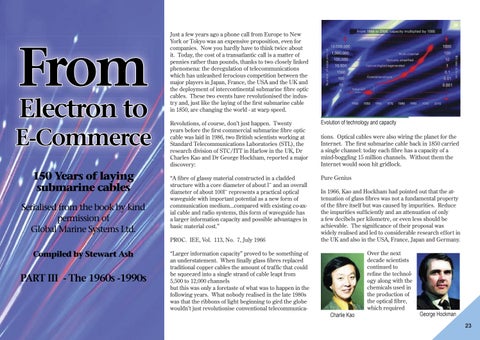
Evolution of technology and capacity Left Optical fibres
tions. Optical cables were also wiring the planet for the Above Internet. The first submarine cable back in 1850 carried Evolution of technology capacity aand single channel: today each fibre has a capacity of a mind-boggling 15 million channels. Without them the Internet would soon hit gridlock. 70
Pure Genius Right In 1966, Kao and Hockham had pointed out that the atCharlie Kao tenuation of glass fiBelow bres was not a fundamental property right George Hockham of the fibre itself but was caused by impurities. Reduce the impurities sufficiently and an attenuation of only a few decibels per kilometre, or even less should be achievable. The significance of their proposal was widely realised and led to considerable research effort in the UK and also in the USA, France, Japan and Germany.
“Larger understa tradition squeeze 12,000 but this following that the just rev cables w submari each fib channel
Pure Ge
Over the next capacity” proved to be something of an “Larger information In 1966, understatement. When finally glass fibres replaced decade scientists attenuat traditional copper cables the amount of traffic that could be the fibre squeezed intoto a single strand of cable leapt from 5,500 to continued impuritie 12,000 channels refi ne the technoldecibels but this was only a foretaste of what was to happen in the following years. Whatthe nobody realised in the late 1980s was The sign ogy along with led to co that the ribbons of light beginning to gird the globe wouldn’t chemicals used in just revolutionise conventional telecommunications. Optical USA, Fr were also wiring the planet for the Internet. The first thecables production of submarine cable back in 1850 carried a single channel: today Over the technolo fibre hasfi a bre, capacity of a mind-boggling 15 million theeach optical channels. Without them the Internet would soon hit gridlock. of the o 99.9999 which required
Charlie Kao
Pure Genius
George Hockman
In 1966, Kao and Hockham had pointed out that the attenuation of glass fibres was not a fundamental property of the fibre itself but was caused by impurities. Reduce the impurities sufficiently and an attenuation of only a few
Stevena
23