Submarine Telecoms Forum is published bi-monthly by WFN Strategies, L.L.C. The publication may not be reproduced or transmitted in any form, in whole or in part, without the permission of the publishers.
Submarine Telecoms Forum is an independent commercial publication, serving as a freely accessible forum for professionals in industries connected with submarine optical fibre technologies and techniques.
Liability: while every care is taken in preparation of this publication, the publishers cannot be held responsible for the accuracy of the information herein, or any errors which may occur in advertising or editorial content, or any consequence arising from any errors or omissions.
The publisher cannot be held responsible for any views expressed by contributors, and the editor reserves the right to edit any advertising or editorial material submitted for publication.
Contributions are welcomed. Please forward to the Managing Editor: Wayne F. Nielsen, WFN Strategies, 19471 Youngs Cliff Road, Suite 100, Potomac Falls, Virginia 20165, USA.
Tel: +[1] 703 444-2527, Fax:+[1] 703 444-3047.
Email: WNielsen@SubTelForum.com
General Advertising
Tel: +[1] 703 444 2527
Email: Advertising@SubTelForum.com
Designed and produced by Ted Breeze
Exordium
November’s issue marks the third anniversary of Submarine Telecoms Forum, and though we are not all sitting around fat and happy as I mused a year ago, things are still certainly much improved.
The few principles we established in the beginning, we continue to hold dear. We promised then, and continue to promise our readers:
· That we will provide a wide range of ideas and issues;
· That we will seek to entertain and provoke in a positive manner.
In the last year, we established specific monthly themes. This issue, our Defense edition, provides some excellent insight into this complementary, tangential submarine cable market.
Sir Christopher Bland’s vision of the industry is revealed, while Bob Bannon describes the upcoming homeland security technology workshop. William Marra outlines coastline security infrastructure, while we reprise Roger Carver’s discussion of piracy and maritime security. Marianne Murfett and Charlotte Winter show what to do when a cable breaks, and Cate Stubbings reviews aspects of cable connectivity. We continue serialization of From Elektron to ‘E’ Commerce, and an enlightening open letter from the senior marine staff of Global Marine.
STF is not a perfect medium, and we have surely made our share of mistakes, but we continue to hope that in the long run we have helped our industry in some small way.
Good reading.
Wayne Nielsen
A synopsis of current news items from NewsNow, the weekly news feed available on the Submarine Telecoms Forum website.
African Power Venture to Have International Fiber Network
Five African states launched a project to put a new 3,500 MW power station on the mighty Congo river and run power lines through Angola and Namibia to head off looming shortages and spur development.
www.subtelforum.com/NewsNow/ 31_october_2004.htm
Alcatel Outlines User-Centric Vision for Asia-Pacific
Alcatel has announced that it is officially launching its vision of User-Centric Broadband services in the Asia-Pacific region.
www.subtelforum.com/NewsNow/ 24_october_2004.htm
Alcatel Wins Contracts from VNPT
Alcatel has announced that it has been awarded two multi-million dollar contracts by Vietnam Posts and Telecommunications Corporation (VNPT).
www.subtelforum.com/NewsNow/ 24_october_2004.htm
Antilles Crossing Plans Cable System
Antilles Crossing has received landing approvals from the Governments of Barbados, St. Lucia and the United States to build, own, and operate a new submarine fiber optic cable between St. Croix and Barbados with a spur connection to St. Lucia.
www.subtelforum.com/NewsNow/ 24_october_2004.htm
Asia Netcom Touts the Philippines for BPO
During a media briefing, Bill Barney, Asia Netcom’s President and COO, outlined the importance of international telecoms solutions in facilitating the country’s emerging role as a provider of business process outsourcing (BPO).
Global carriers operating in Asia Pacific have formed a telecommunications carriers group focused on promoting open market policies and best practice regulatory frameworks throughout Asia Pacific.
AT&T Will Slash 7,400 Jobs and $11 Billion in Assets
AT&T Corp. is cutting at least 7,500 more jobs and slashing the book value of its assets by $11.4 billion, drastic moves prompted by the company’s plan to retreat from the consumer telephone business.
www.subtelforum.com/NewsNow/ 24_october_2004.htm
BT to Acquire Infonet
BT announced it has signed a definitive agreement to acquire Infonet, leading providers of international managed voice and data network services.
www.subtelforum.com/NewsNow/ 14_november_2004.htm
C&W to Sell Japanese Unit to Softbank
Cable and Wireless plc (C&W) has announced that it has agreed to sell its Japanese business, Cable & Wireless IDC Inc. to Softbank Corp. for a consideration of £72.4 million (including the assumption of debt amounting to £9.5 million).
www.subtelforum.com/NewsNow/ 31_october_2004.htm
Cable Ship Operators Join Together to Discuss Safety
On October 20, 2004, the first annual Cable Ship Operator Safety forum was held at the ASN Marine A/S headquarters in Copenhagen.
www.subtelforum.com/NewsNow/ 14_november_2004.htm
Caribbean Network Developer Sues Nortel
In a complaint, filed last week, West Indies NetworkI LLC (WIM-I), which has been trying to develop a submarine cable system linking islands in the Eastern Caribbean, has sued Nortel Networks.
www.subtelforum.com/NewsNow/ 31_october_2004.htm
DoveBid Offering Tyco Cabling Equipment
DoveBid is offering high-speed long-length submarine fiber cabling equipment, surplus to the continuing operations of Tyco Telecommunications (US) Inc.
www.subtelforum.com/NewsNow/ 14_november_2004.htm
FLAG Wins Yahoo! Korea Contract
FLAG Telecom has been selected by Yahoo! Korea to provide trans-continental connectivity and intraAsia advanced services across the FLAG Telecom global network.
Fugro Acquires AUV For Expand Deepwater Surveying Capability
Fugro has placed an order with Kongsberg Maritime for the purchase of a HUGIN 3000 Autonomous Underwater Vehicle (AUV). The vehicle will be delivered and tested before the end of 2004 and will be ready for service early in the New Year.
Global Crossing has announced that it filed with the Securities and Exchange Commission an amendment to its 2003 annual report on Form 10-K, which includes restated audited financial statements for 2003, and two Form 10-Qs, which include its financial results for the first and second quarters of 2004.
www.subtelforum.com/NewsNow/ 24_october_2004.htm
Global Crossing Names European Managing Director
Global Crossing has announced the appointment of Pieter Duijves as managing director of Europe with responsibility for expanding the company’s customer base and product portfolio in continental Europe and the Republic of Ireland.
www.subtelforum.com/NewsNow/ 31_october_2004.htm
Global
Crossing Will Continue to Be Listed on NASDAQ
Global Crossing has announced that, following the company’s filings with the SEC on October 8, 2004, it received notification from NASDAQ that its common stock will continue to be listed on the NASDAQ National Market.
www.subtelforum.com/NewsNow/ 24_october_2004.htm
Global Crossing Wins Contract from Argentine Contact Center
Global Crossing has announced a service agreement signed in February to provide managed IP VPN services and International Private Line (IPL) to Centro Interacción Multimedia S.A. (C.I.M.S.A.), a growing Argentine offshore contact center company. www.subtelforum.com/NewsNow/ 19_september_2004.htm
Global Marine Completes Survey of TAT-14
During an unbroken 32-day tour of duty Global Marine recently surveyed 160km of the TAT 14 cable.
Global Marine has entered into a period of Administration under the Enterprise Act, 2003 (UK).
www.subtelforum.com/NewsNow/ 24_october_2004.htm
Global Marine Exits Administration
Peter Ford, CEO of Global Marine announced the successful outcome of the recent process, which enabled Global Marine to restructure its business.
www.subtelforum.com/NewsNow/ 14_november_2004.htm
Global Marine’s Administrator’s Proposals Accepted by Creditors
Global Marine Systems Limited (In Administration) today announced that the administrator’s proposals have been accepted at a meeting of creditors.
www.subtelforum.com/NewsNow/ 7_november_2004.htm
IEEE and NAVSEA to host Homeland Security Technology Workshop
The IEEE – Oceanic Engineering Society (IEEEOES) and NAVSEA-Naval Undersea Warfare Center (NUWC) will host the IEEE-OES Homeland Security Technology Workshop.
www.subtelforum.com/NewsNow/ 7_november_2004.htm
Jamaica to License Two Submarine Cables
TSA has been following developments in Jamaica regarding the government’s licensing process for new submarine cable systems.
www.subtelforum.com/NewsNow/ 31_october_2004.htm
Level 3 CEO Calls for Free-Market View of Regulation
James Q. Crowe, chief executive of Level 3 Communications, Inc., has urged state and federal regulators to embrace a new, free-market view of telecom regulation appropriate to the Internet age.
www.subtelforum.com/NewsNow/ 24_october_2004.htm
Nantucket Airport Link Includes Submarine Cable
MCI, Inc. has implemented a reliable, diverse connectivity solution at Nantucket Memorial Airport to increase dependability of data/voice communications between Air Traffic Controllers and pilots.
www.subtelforum.com/NewsNow/ 31_october_2004.htm
New World Launches IP Services in Nicaragua
New World Network, Ltd., the principal owner of the Americas Region Caribbean Optical-ring System (ARCOS) submarine cable system, announced that it has launched IP services in Managua, Nicaragua. www.subtelforum.com/NewsNow/ 19_september_2004.htm
New World Says It Will Not Sell Capacity to TCCC
New World Network, Ltd. has responded to recent press releases by Brian Crawford and the TransCaribbean Cable Company (TCCC) concerning New World Network and ARCOS.
www.subtelforum.com/NewsNow/ 24_october_2004.htm
New World, BTC Announce Agreement
New World Network, Ltd., the principal owner of ARCOS, has signed a capacity agreement with the Bahamas Telecommunications Company Ltd.
www.subtelforum.com/NewsNow/ 14_november_2004.htm
New World, UTS Sign Agreement NOC Agreement
New World Network announced today that it has signed an agreement with United Telecommunications Services (UTS), Curacao, in which UTS Network Operations Center (NOC) will support the ARCOS System with backup NOC Services.
www.subtelforum.com/NewsNow/ 24_october_2004.htm
REACH CEO to Step Down
Telstra and PCCW’s submarine cable joint venture, REACH, confirmed Chief Executive Dick Simpson would step down around the first quarter of 2005.
www.subtelforum.com/NewsNow/ 24_october_2004.htm
TCCC’s Next Meeting in November
Trans-Caribbean Cable Company’s next information and management committee meeting is now scheduled for November 3-4 in Newark, NJ.
www.subtelforum.com/NewsNow/ 24_october_2004.htm
Telecom New Zealand Unbundling Plan Approved
Telecom New Zealand’s competitors and their business customers can get on with using data services following the Commerce Commission’s decision that the service meets expectations.
www.subtelforum.com/NewsNow/ 24_october_2004.htm
Telgua Announces IP Connectivity Using ARCOS
New World Network, Ltd., the principal owner of ARCOS, announced a multi-year lease agreement with Telgua, which will expand Telgua’s high-speed IP connectivity in the region.
Telstra has announced that more than one million broadband customers had been connected to its network across Australia.
www.subtelforum.com/NewsNow/ 24_october_2004.htm
Trinidad Carrier to Increase International Bandwidth
Telecom Services of Trinidad and Tobago (TSTT) has announced plans to modernize and expand its network.
www.subtelforum.com/NewsNow/ 24_october_2004.htm
TSTT Expands Internet Bandwidth to 180 Mbps
Telecommunications Services of Trinidad and Tobago (TSTT) has invested in a 33% increase in international Internet bandwidth to match a growing customer base and heavier Internet usage among homeowners and businesses.
www.subtelforum.com/NewsNow/ 31_october_2004.htm
TWA Plans Pakistan-UAE Cable
Pakistan-based Transworld Associates (Pvt.) Limited (TWA) is currently developing a project to install and operate a submarine fiber optic cable system between Karachi (Pakistan) to Fujairah (UAE), approximately 1180-kilometers long with a future branching unit to Muscat (Oman).
Videsh Sanchar Nigam Limited (VSNL) has announced the official launch of the Tata Indicom Cable (TIC), Singapore’s first fully Indian-owned, undersea fiber-optic cable. The TIC cable is 100 percent owned, operated and maintained by VSNL.
www.subtelforum.com/NewsNow/ 7_november_2004.htm
VSNL to Buy Tyco Global Network
Videsh Sanchar Nigam Limited (VSNL), India’s leading provider of international telecommunications and Internet services, has announced that the company
has agreed to acquire Tyco Global Network, one of the world’s most advanced and extensive submarine cable systems, for $130 million.
www.subtelforum.com/NewsNow/ 31_october_2004.htm
WFN Strategies Establishes Government Services Division
WFN Strategies (www.wfnstrategies.com) recently established its Government Services Division, based in the Washington, DC area in close proximity to existing and future US government customers.
www.subtelforum.com/NewsNow/ 31_october_2004.htm
International SALES ASSOCIATES required
Submarine Telecoms Forum is seeking advertisement sales associates to further our representation in Europe, the Far East and the USA.
This is a freelance opportunity that offers generous commission scales and an opportunity to work with an enthusiastic team at the heart of the submarine telecoms industry.
Please contact Wayne Nielsen: Tel: +1 (703) 444-2527
Fax: +1 (703) 444-3047
WNielsen@SubTelForum.com
Emails to the Editor
Great Article guys! But I don’t think it justified dumping the serial story. It was just getting exciting; did they manage to lay a telegraph cable across the Atlantic? Did they make a fortune? What happens to the Brett brothers? How come with Cyrus W Field leading the way did the Brits kick-arse when it came to setting up the industry? Most importantly what is the link between the Goliath and BT Marine?
You have left your audience hanging eager for more news, or perhaps it’s just me, wanting another 15 minutes in the lime light!
Keep up the good work
Best Regards
Stewart Ash, Esq.
Fear not. Our caped crusaders return in the upcoming issue!
Number of respondents: 137
Breakdown of Respondents: System Owner/Operator: 42
of Systems: 34 Supplier of Services: 25
19
How did Respondents find out about
EXECUTIVE FORUM
Sir Christopher Bland
Reprinted with permission from “Director” magazine which is published by the Institute of Directors, London
Sir Christopher Bland was appointed to the BT Board as Chairman on 1 May 2001.
He was chairman of the BBC Board of Governors from 1996 until 2001. From 1972 to 1979, he was deputy chairman of the IBA. In 1982, he became a director of LWT Holdings and chairman from 1983 to 1994. From 1994 to 2000, he was chairman of NFC, and from 1977 to 1985 chairman of Sir Joseph Causton & Sons.
Sir Christopher was knighted for his work in the NHS in 1993. He was chairman of the Private Finance Panel from 1995 to 1996 and part of the Prime Minister’s Advisory Panel on the Citizen’s Charter. He is senior adviser at Warburg Pincus, and was appointed Chairman of the RSC in April 2004.
Sir Christopher Bland is either an optimist or he’s kidding himself. Because in Bland land, everything is rosy. BT may be in the middle of a major regulatory review, customer service may still be a sore point and the company may still have £8bn of debt, but for Bland it’s business as usual. As he relaxes into a large white sofa in his top floor office at BT Centre, the career-chairman explains that regulatory interest in BT comes with the territory.
“We live in a highly regulated environment—and so we should, given our market power. I wouldn’t say I don’t begrudge the regulator, but regulation is necessary when you have a business as powerful as BT in a competitive market. We’ve got a pretty good relationship with Ofcom. We don’t expect to be cosy with them and we have fierce disagreements, but so far they have lived up to their idea of being an evidence-based regulator and that’s all that one can ask.”
The Strategic Review of Telecommunications that Ofcom is currently conducting is an opportunity to claw back some of BT’s market dominance. It’s the first major study of the industry by a regulatory body since 1991. A lot has changed in the industry since then and one of Ofcom’s objectives is to work out how BT fits into today’s market. But Bland refutes the suggestion that one of the review’s major objectives is to break up BT into separate parts.
“It’s not one of the five main questions, I’d put it at number 23 out of 23. First I don’t believe it’s desirable and second I don’t believe it will happen.”
Stephen Carter, chief executive of Ofcom, is unwilling to pre-empt the enquiry. But it seems he disagrees with Bland about the significance of BT’s structure to the review. Speaking at the launch of the review he listed the five fundamental questions, number five of which was whether the structural separation of BT was still a relevant issue. So is Bland in denial? At the launch, Carter did go on to explain that since privatization in 1984, the question about BT’s structure “has been the elephant in the corner of the room. And if there is an elephant in the corner, we think it better to acknowledge that fact rather than try to pretend it does not exist. But we are genuinely agnostic on this issue. We should be cautious in reaching for any single, magic-bullet solutions,” he said. Bland, naturally, is less neutral on the matter. He claims he is “totally confident” that it won’t happen. “It’s immensely time-consuming and expensive. Our competitors who argue in favour of it—and not all of them do—can see it as an advantage to tie BT up in knots for years and let them make hay while the sun’s gone in. But the advantages aren’t obvious. You’d still have two components requiring a lot of regulation. It isn’t as if you can split BT into a regulated bit and an unregulated bit. You’d split it into two regulated bits, both having a relationship with one another. It’s adding bureaucracy and a great layer of cost. It’s the Railtrack model and that’s not a model we should be pursuing.”
So, does Sir Christopher feel that BT is being victimised because of its size and power,
perhaps in the way Microsoft claims it has been?
“In the playground, it’s the big boy that’s the bully, not the other way round. We’re not victimised, but we are the target. When Tesco decides to go into the telephony business or when Carphone Warehouse says it is going to take customers, who are they aiming at? BT. Who’s the yardstick for pricing and customer service? BT. We could solve this by becoming smaller and less profitable, but I don’t think that’s a very good solution. We don’t feel victimised, we are too big and too strong for that.”
It’s typical of Sir Christopher to be so frank, maybe even gung-ho about how strong the business is. He shrugs off the suggestion that the business may hold too much—to use regulator speak— significant market power. “Are we too strong? It’s a legitimate question, but no, I don’t think we are. Countries benefit from a single, well-funded incumbent provider.
The network lends itself to market dominance. A strong incumbent can do things that a lot of fragmented players could not. If you look at the broadband push that’s going on now, it’s being led by BT. Others are coming in on our coattails and good luck to them, they are doing very well now. But the original push came from BT. If you look at the R&D in the industry, who does it? We do. Nobody else spends tuppence ha’penny on research in this market, we do it all. And it’s the same with training.”
This is Blandism too far for Mike Cansfield, research director at telecoms consultancy Ovum. “BT does invest in developing new ideas and technologies, but it is by no means the largest contributor. In fact, the majority of research is done by suppliers,” he says.
But Cansfield admits that under Bland’s stewardship BT has got progressively stronger. “Sir Christopher came in as a safe pair of hands, a nononsense chairman at a time when Sir Iain Vallance appeared to have lost the plot. It was in a number of European joint ventures, none of which were making money, and it had run up debts of £28bn. Now it is generating £2bn of free cashflow a year and its debts are down to just over £8bn. Sir Christopher was the type of person that BT needed—someone with no telecoms
experience, who could look at a deal and just ask ‘does it make sense?’.”
Sir Christopher claims BT may now be in a situation where it isn’t borrowing enough. “We don’t have a huge mountain of debt. It’s true that £8bn is a big amount in absolute terms, but in terms of what the business is capable of supporting that isn’t an issue for us anymore. We are a big company. Some analysts say our balance sheet is a bit inefficient and that we should borrow more. Now that we’ve climbed out of the debt valley we don’t want to end up with an ungeared balance sheet because that is inefficient.”
Bland is similarly upbeat about the repeatedly poor performance of BT’s core fixed-line business. He takes issue with use of the phrase poor performance, saying that it all depends on your definition of performance:
“We can’t expect the fixed-line business to expand. But we’ve done a reasonably effective job of protecting our core business. It declined for each of the last five years. And it will go on declining.”
The solution, says Bland, is to build new revenue streams, via broadband and the slow convergence of mobile and fixed-line telecoms. “Our fourth quarter produced a little growth on our top line and that was because new wave revenues grew 30 per cent, while our core revenue declined by six per cent. But new wave revenue is now 23 per cent of sales, so the task gets less as new wave gets bigger. If there came a point at which new wave was
Vismedia
half our business, then a six per cent decline in core business gets offset by six per cent growth in new wave. The arithmetic gets more benign.”
It’s easy to forget how bad the situation was when Sir Christopher arrived, fresh from a stint as chairman at the BBC. “BT was going through a crisis. Early on I had to be absolutely singleminded about the 10 most important things we had to do. Everyone at the top got on and did it as quickly as possible. We didn’t agonise about getting top dollar for businesses like Yell or our investments in Spain and Japan, but we sold them having gone through proper processes to make sure we got the best price available at the time.”
Sir Christopher remains unrepentant about the speed with which the sales went through. “If I am any good it’s because I am decisive and I have quite a quick analytical mind and can seize on what the important points are in a situation and focus on those. It’s often better to make a decision quickly than make the right decision. The right decision made slowly has the knack of turning into the wrong one.”
Bland came to BT with some experience in corporate turnarounds. His first chairman’s job was at a small printing firm, Sir Joseph Causton & Sons, in 1977. The company was in a mess—it had huge debts and was losing money. Did his experience there help him at BT? “Provided you don’t take things literally and assume everything’s the same, it is possible to learn lessons in different organisations. The techniques of reducing a
company’s debt and sorting out its balance sheet are pretty similar and pretty straightforward. What you do in little Causton is what you do at big BT—sell the stuff you don’t need, stop losing money and start generating cash. These are not very profound, but they are easier to say than do.”
One of his first tasks on arriving BT was to change the management team. He is clear that the chairman’s key role is to get in place the right chief executive and finance director. That meant an early exit for incumbent chief executive Sir Peter Bonfield. Sir Christopher denies it was about personalities, but says it was about sending a signal to the City: “We had to show that BT was under new management,” he says.
In his previous choices for chief executives— notably Greg Dyke as BBC director-general—he has shown a preference for charismatic leaders. The City was initially sceptical about the choice of Ben Verwaayen as Sir Peter’s replacement. But as Cansfield explains: “Verwaayen has grown into the role and it’s obvious that he is very passionate about the business. He has been able to spread that passion though the business. I’d say that charismatic is a good way of describing him.”
Sir Christopher denies charisma is the only quality he looks for. “It’s most fun being led by a charismatic leader, providing he knows what he’s doing. There are some charismatic leaders who take you to some pretty terrible places. No one would deny that Robert Maxwell was a charismatic leader.”
As to the balance of power between chairman and chief executive, he takes an unusually cagey stance. “It depends on the organisation and personalities, but you can’t have two leaders. The full-time chief executive ought to be the leader, unless he is very shy and retiring—in which case he is in the wrong job.”
“But,” he adds, with just the trace of a smile, “that doesn’t mean the chairman has to be totally devoid of charisma and enthusiasm.”
Heroes
I think John Browne at BP is everybody’s [business hero]. He has done a remarkable job. Chris Gent at Vodafone also did a tremendous job in building an international brand and a global business. I also admire Greg Dyke. He was one of the most enjoyable people to work with, as you can imagine.
What do you look for in a CEO?
A lot of intangible things. It’s important to find someone who understands the business. Ben Verwaayen is someone with a deep understanding of telecoms and that was important, given that I didn’t have that. A chairman can afford to take a strategic view but the CEO had better know the product. Ben has that, but also has leadership skills, is numerate—he and I felt we could work together. We can disagree and not get pouty about it if we lose. You look for a spark. Ben’s got that spark and Greg Dyke’s got it, too.
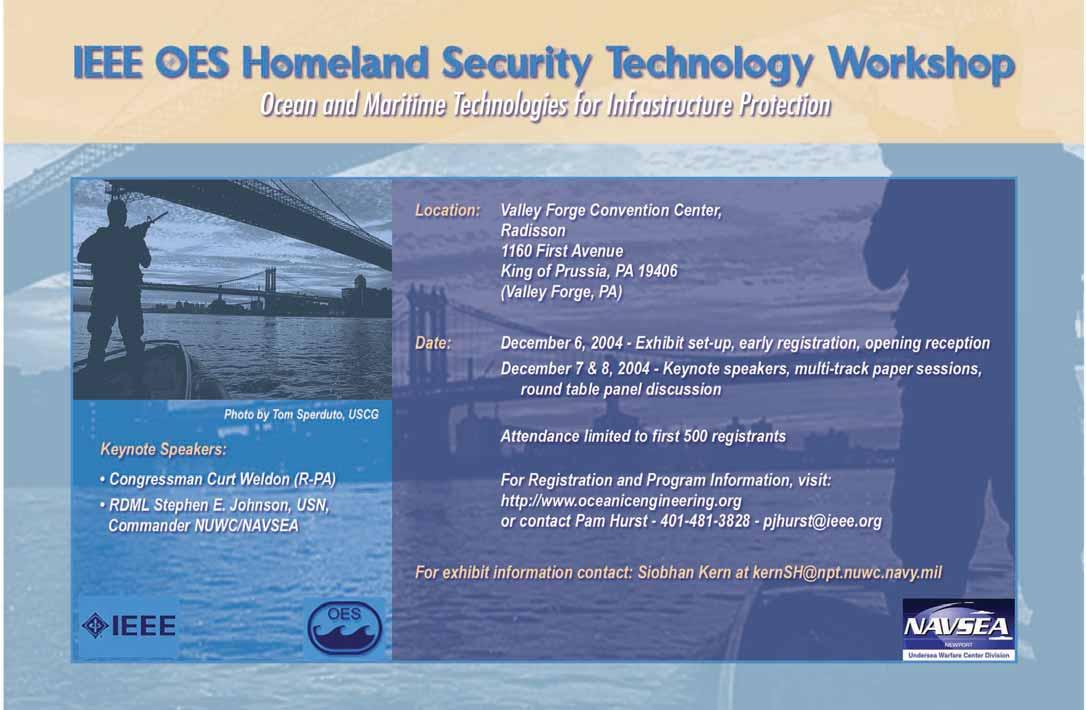
The IEEE – Oceanic Engineering Society (IEEEOES) and NAVSEA-Naval Undersea Warfare Center (NUWC) will host the IEEE-OES Homeland Security Technology Workshop - Ocean and Maritime Technologies for Infrastructure Protection to be held at the Valley Forge Convention Center at the Radisson, 1160 First Ave., King of Prussia, PA 19406 on December 6, 7, and 8, 2004. The theme for this second annual is “Under the Water, On the Water, and Over the Water to Protect the Homeland with Integrated Technologies”.
The purpose of the workshop is to bring together small technology companies, and large defense contractors, military, government, academia, and not-for-profit institutes who are developing technologies and products for Ocean and Maritime Technologies for Infrastructure Protection. This IEEE-OES workshop provides an unprecedented opportunity to network with engineers, scientists, maritime legal experts, and local, state, and federal government personnel who all share a common concern and goal in providing advance technologies to protect vital maritime infrastructure and provide for the safety of our ports, harbors, coastal eco-systems and our oceans.
Pamela Hurst, IEEE Chair, and Robert Bannon, Fellow of the IEEE and Co-Chair, of this technology forum, along with the Honorable Curt Weldon, U.S. House of Representatives – R-PA 7th District, have chosen
the venue because of the importance that Valley Forge holds for American freedom. Ms. Hurst is from Westerly, RI and Mr. Bannon is from East Stroudsburg, PA; both have served the underwater community for over 36 years. Congressman Weldon is serving his 9th term in the U.S. House of Representatives.
The first annual meeting of the IEEE-OES Homeland Security Technology Workshop cohosted by NAVSEA NUWC was held December 10 and 11, 2003 in Warwick, RI. The Warwick homeland security event, emphasized advanced underwater and port and harbor security technologies, hosted 48 exhibitors, 5 tracks featuring 87 technical speakers who are leaders in their fields of expertise, and 3 author book signings. Last years congressional speakers included Hon. Curt Weldon, U.S. Representative (R-PA), Hon. Rob Simmons, U.S. Rep (R-CT), Hon. James Langevin, U.S. Rep (D-RI).
The 2003 workshop was recognized as having an extremely strong focus on poignant maritime topics including underwater telecommunications protection, harbor security and container risk, management and unmanned maritime vehicles.
Security issues for the Greek Olympics were also featured because of the venue’s easy access by water. The 2004 Workshop will feature a lessons learned review of the actual port and harbor security enacted in Greece.
Homeland Security Director
The 2004 Valley Forge event will feature members of the Congressional House Committees on Homeland Security and Armed Forces, representatives from the Department of Homeland Security and the Department of the Navy,
the US Coast Guard, NAVSEA NUWC, NOAA, ONR, NRL and the National Science Foundation. The plenary speakers and panel members will represent some of the most recognized individuals and organizations from industry, government and academia.
Speakers will represent not only Views from the United States, but will include global issues presented by European Union Community members, Canada, and Japan.
A major focus will be underwater communications protection chaired by Bob Bannon and will feature presentations by Wayne Nielsen of Submarine Telecoms Forum, Jim Coble of AT&T, Doug Burnett of Holland & Knight LLP, and others.
The technical program offers two days, featuring 6 multi-track PowerPoint presentations and papers covering the following topics:
Underwater Telecommunications Protection Issues and International Legislation
Sensors and Underwater Vehicle Technology for Protecting our Ports, Waterways, and Coastlines
Preempting and Disrupting Terrorist Threat
Maritime Domain Awareness
Biometric and Screening – including Personnel and Containers
Technologies for Countering Chemical, Bio-terrorist, Terrorist Attacks on Ocean Industries
HLS First Responders
Beyond Homeland Defense and Homeland Security – Over the Horizon The Homeland Security Technology Workshop ’04 costs are listed below.
Online Registration http://www.oceanicengineering.org (click on “Conferences & Workshops”) or http:// www. hlsworkshop04.org
Early Bird Registration$395 for IEEE members
$495 for all others
Registration $450 for IEEE members
$550 for all others
Attendance limited to the first 500 Registrants
Corporate Booths in Hall for Product Info Display: $500
Individual Luncheon Tickets: $50
Dinner Tickets: $75 each
Corporate Dinner Table: $750 (10 seats)
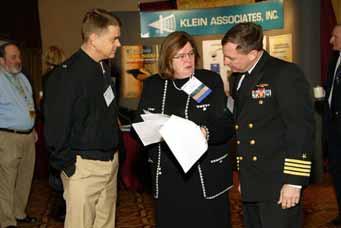
Pam Hurst, Chair and RADM Timme at the 2003 Homeland Security Technology Workshop
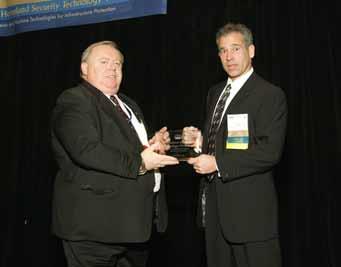
Bob Bannon, Co-Chair presents 2003 Award to Jim Pollack, NUWC
INTELLIGENCE FOR COASTLINE PROTECTION INTELLIGENCE FOR COASTLINE PROTECTION
William C. Marra, Vice President and CTO of Tyco
The ‘homeland’ of homeland security does not refer only to America’s heartland. Indeed, the thousands of miles of US coastline are some of the most valuable – and vulnerable – of US commercial and residential communities. The complexities of harbor and coastline security are only now becoming fully appreciated, yet security in these areas is one of the most critical aspects of our overall homeland security. The accessibility of our nation’s ports of entry, or harbors, is a strong contributor to the US economy, but may very well be a key weakness when it comes to security. We are accustomed to relatively free transport of cargo and passengers into dozens of ports along US coastlines.
The dangers today, however, may not be from events as obvious as the arrival of large combat vessels. Much more subtle, but perhaps more devastating, threats to US harbors are possible today through transport vessels.
The entry of conventional, biological, chemical or radiological weapons into our nation via sea vessels of any size along the extensive coastline, ports of entry or harbors, is today’s constant threat.
Addressing this threat has resulted in considerable improvements in harbor protection methods, ranging from increased
local security to electronic ‘tagging’ of cargo at foreign ports of export in order to track the cargo along its route. More aggressive funding for the US Coast Guard and grants targeted at technological innovation have brought a higher security presence and aided in the development of new technology aimed at addressing this issue.
These, however, are only spot solutions.
Arriving at a comprehensive solution to protect the entire US coastline requires a fresh perspective, one that extends the vision outside of US ports. The drawback of the current focus is that it concentrates on a methodology that detects threats only once an ocean-going vessel has arrived in port.
Even with the best possible coverage provided by the Coast Guard, extending our ability to detect threats along the entire coastline seems insurmountable.
An innovative perspective
There is a vision that stretches out from our seaports and harbors to address coastline security in a new, but proven approach. For the last 25 years, undersea fiber optic networks have joined continents and countries by providing telecommunications capability across the oceans and seas of the world.
Over time, this technology has matured to the point where today the undersea hardware and cable technology boasts reliability for a design life of 25 years in the harshest of environments – the depths of the ocean. Extending this technology to create an infrastructure platform designed to guard the US coastline not only has merit, but is quite feasible.
What’s more, it requires the use of technology that today is mostly ‘off-the-shelf ’. A complete solution would result from the coordination of a variety of disciplines, all of which are fairly standard with readily available products.
For example:
Transmission and network management design for undersea and terrestrial networks.
Detection technologies and network designs developed for anti-submarine warfare for the last 40 years. Technologies currently in development for the detection of chemical, biological and radiological threats (short-range capabilities are already available with current products).
The creation of this platform allows for the security focus to shift from spot or local detection to broad monitoring of large areas of vulnerability. It signals a change in perspective.
A network view
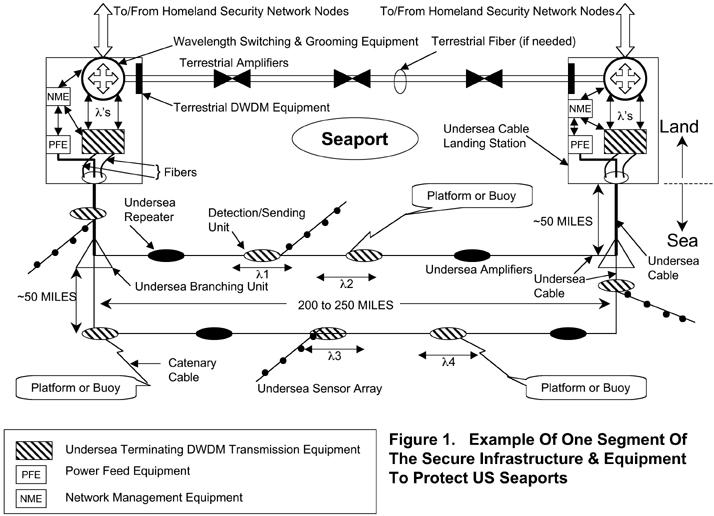
While innovative, the solution is not overly complex. Figure 1 illustrates the basic network
design (an aerial view) and shows a single seaport with an average distance around the seaport of 250 miles. Standard cable landing stations with their normal equipment are adjacent to, but spatially diverse from, the seaport.
From these cable landing stations, an undersea cable extends out into the water. In the featured example, there are two layers of detection for added reliability.
The first surveillance layer is approximately 50 miles offshore,while the second layer is approximately 100 miles offshore. The undersea branching units split the fiber within the undersea cable into these two layers,which define the fields of surveillance.
These surveillance fields allow for detection and, ultimately, interception of a sea vessel that may constitute a threat before it becomes a threat to the mainland.
The offshore distances are flexible and can be selected to ensure that vessel interception is accomplished sufficiently far from shore to protect the mainland from potential hostile ramifications of the interception, even including the detonation of a dirty bomb.
Along each layer, undersea detection and sending units integrate the information gathered from the sensor arrays. Each unit generates and transmits a unique wavelength
of information to both cable landing stations. This information is transmitted back to a Homeland Security Network Node,where it is interpreted in real-time. Information is gathered both at the sea bottom and at the ocean surface from sensors located on floating buoys. The actual design would enable detection of any sea vessels, either submerged or traveling on the surface.
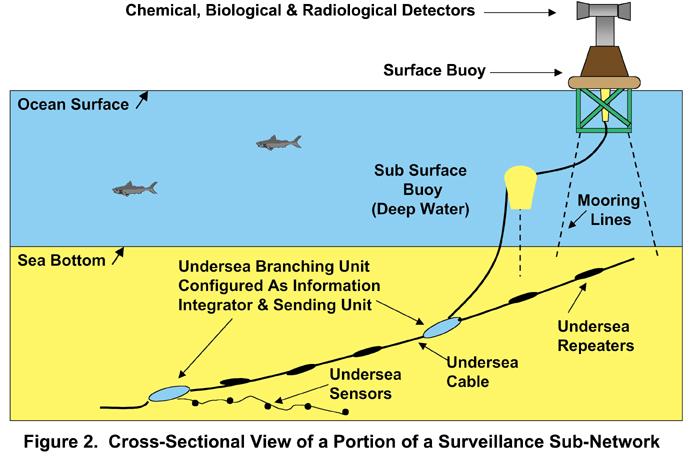
Figure 2 depicts a cross-sectional portion of the network as viewed between the ocean surface and sea bottom. The illustration is not futuristic. These products and techniques have been used as part of undersea infrastructure deployment over the last decade or more. The components include subsurface buoys, mooring lines, surface buoys and cable catenaries to the surface.
To meet this new security mission, a development effort is required to ‘sea-harden’ the types of detection devices envisioned for the surface buoy.
This development effort would be reasonable, and not technically prohibitive. If the mission focus is there, and the resources are available, sensor-hardening would be achievable.
Figure 2 also illustrates a two-phase deployment of the network. All but the buoys (surface and sub-surface) and catenary cable are deployed in phase 1. The catenary cable is ‘stubbed-off ’ and would remain on the ocean
floor until the sea-hardened detection devices for the surface buoy are available. At the completion of phase 1, the full undersea infrastructure would be in place and operational, capable of detecting all sea vessels entering into the grid.
Phase 2 implementation requires that the cable be retrieved and attached to the
subsurface and surface buoys. Retrieving cable is common practice in undersea networks. At the completion of phase 2, the network would be able to detect any sea vessel carrying cargo that would be a threat to the US.
Assuming that a cascaded array of surface buoys is deployed so that all vessels can be detected, ‘corridors of entry to the coast’ can
Dr. William C. Marra is Chief Technology Officer and Vice President of Research, Development, Network Engineering, and Operations for Tyco Telecommunications where he is currently responsible for the research, development and realization of current and future products required to support undersea systems solutions.
He is also responsible for all aspect of network operations and services for the Tyco Global Network (TGN). Over the last five years, Dr. Marra has had overall network design and engineering responsibility for Tyco’s undersea projects, including third party systems and Tyco’s own Global Network (TGN).
He received his BSEE from the Polytechnic Institute of Brooklyn, an MSEE from Stevens Institute of Technology, and a Ph.D. for joint work done at Stanford University and Stevens Institute. He joined the basic research organization of AT&T Bell Laboratories in 1969.
Since that time he has worked on the development of numerous fiber-optic telecommunications systems for both terrestrial and undersea applications.
be defined consistent with the range of the surface buoy detection. Vessels not adhering to, or traveling outside of, these corridors can be detected in real-time and readily intercepted.
Extending the protection
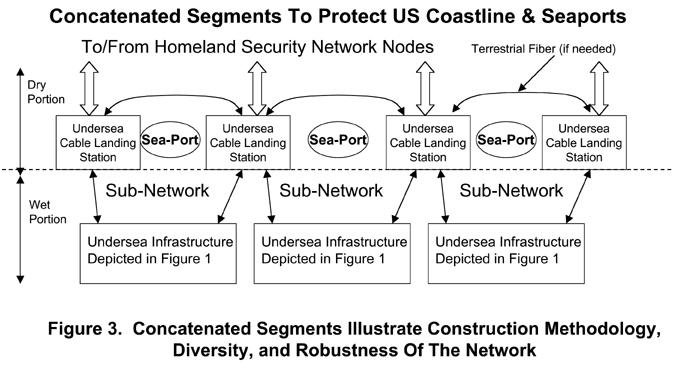
The solution described earlier addresses protection of a single harbor or seaport. The ultimate goal, however, is much larger. If the solution has true merit, it must be able to guard the entire coastline – and it can. The concept can easily be extended to describe the methodology needed for a larger program to protect the entire coastline. For example, Figure 3 is a network architecture characterized by concatenated sub-networks.
Each sub-network is customized for its seaport or harbor along the coast, with adjacent seaport sections concatenated – more than one seaport or harbor can be covered by each subnetwork, and adjacent sub-networks share common cable landing stations. All of this means that this network architecture is extremely scalable.
The huge number of major seaports and harbors – and corresponding volume of cargo imported along the US coastline – requires a scalable solution. This scalable network solution, based on an innovative use of current technology with minimal investment in new technology, would be within our
reach. Effective planning would suggest that initial deployments should focus on the largest seaports and harbors, with small seaports and harbors added to the network as appropriate.
Eventually, the concatenated subnetworks would form a continuous grid to protect the entire coastline.
Before the threat occurs
As a nation, we have learned that security threats can be embedded in familiar and even necessary things. Cargo ships, passenger ships and other sea transport vessels all have the potential to threaten our homeland security. With the technologies available today, it is quite feasible to implement an undersea fiber optic network and infrastructure that can dramatically increase our ability to detect threats to the security of our coastline from hostile attacks from sea-going vessels.
Further, with the scalable network described, experts can scan cargo imported into this country for chemical, biological and radiological materials or weapons while that cargo is still at sea. Indeed, we can determine that a threat exists before it becomes an immediate threat.
The technologies for deployment, with only modest additional engineering, are available today. All it takes is a new perspective to further protect our shores.
The issue of maritime security is a matter of critical importance to all marine companies. Certainly maritime security is of vital interest to Singapore and the region. Some of the most important shipping lanes and trade routes straddle the archipelago of Southeast Asia.
Over a quarter of the world’s trade and half its oil pass through the Malacca Straits. But it is not merely the littoral states that have a stake in the safe passage of ships through these waterways.
In a world linked by international trade and commerce, and with a global economy built on integrated supply chains, any disruption to the security of navigation in these waters would be a shock to the international system. This would clearly induce severe implications for trading nations all around the world.
Why are ships easy prey?
Low manning of ships
Lack of effective implementation of strict anti-piracy measures
Ships are often registered under flags of convenience registers
Reluctance by governments to provide resources to pursue piracy investigations.
Piracy
In recent times there has been a substantial rise in hijackings in the waters neighbouring Singapore, up from 16 to 25 incidents in 2002.
MARITIME SECURITY THE NEED FOR AWARENESS AND COMPLIANCE
by Roger Carver
Many such incidents involved smaller boats, such as tugs, barges and fishing boats, in the Malacca Straits and Indonesian waters. Crime syndicates in the area were believed to be targeting vessels carrying valuable palm oil and gas oil.
Indonesia again experienced the highest number of attacks, with 103 reported incidents in 2002. Piracy attacks in Bangladesh ranked second highest with 32 attacks and India was third with 18 attacks.
“Indonesia’s piracy problem calls for serious government action.”
International Maritime Bureau.
Small scale Piracy:
Rob the crew and depart
Attacks usually take place whilst the vessel is at anchor or in port
Ship’s safe is often targeted
Occasionally the ship is taken to be sold.
Large scale Piracy:
Rob the crew and steal the cargo
Cargo easily disposed of is usually targeted, ie timber, metals and minerals
Occasionally the ships engines are taken
Usually part of a larger criminal organisation.
Phantom ships
Robbers steal the ship
Re-paint, re-name, re-flag and re-register
Offer the services of the ship to a shipper
Sail to an undisclosed destination
Unload the cargo to be sold, then repeat the process
Nearly always part of a larger criminal organisation.
What is being done?
The issue has come to a head post September 11 and the world’s subsequent response to terrorism.
A new, comprehensive security regime for international shipping is set to enter into force on 1st July 2004 following the adoption by a Diplomatic Conference of a series of measures to strengthen maritime security and prevent and suppress acts of terrorism and piracy.
The International Maritime Bureau’s figures show reported worldwide piracy acts were up 18 % in the first quarter of 2003.
The Conference, held at the London headquarters of the International Maritime Organization (IMO) from 9 to 13 December 2002, was of crucial significance, given the pivotal role shipping plays in the conduct of world trade.
The Conference adopted a number of amendments to the 1974 Safety of Life at Sea
Convention (SOLAS), the most far-reaching of which enshrines the new International Ship and Port Facility Security Code (ISPS Code).
The Code contains detailed security-related requirements for Governments, port authorities and shipping companies in a mandatory section (Part A), together with a series of guidelines about how to meet these requirements in a second, nonmandatory section (Part B).
IMO is concerned that piracy continues to be a major threat to shipping safety. During the last few years South East Asia has been the scene of numerous pirate attacks and armed robberies and this is a problem not only for the crews and ship owners, but for the coastal States as well.
The Resolutions require new Ship Security Plans:
Every shipping company must designate a Ship Security Officer for each of its ships.
This officer will be responsible for implementing the Ship Security Plan.
Compliance with New IMO
Maritime Security Measures is due by July 2004.
The Resolutions go on to require that: A Ship Security Assessment is completed for each ship according to IMO and Government regulations.
Originally with the British Royal Navy, Roger F. Carver is extensively trained in counter insurgency. Upon leaving the Royal Navy, he remained within the maritime environment, working as a marine and security consultant with various organizations around the world. He is now resident in Singapore.
Roger has spent the last eight years as a consultant to various companies installing Safety Management and Security Systems. He is Managing Director of Nemesis Maritime Private Limited.
Ship Security Plans are prepared and submitted for approval by Contracting Government.
Each ship carries on-board an approved Ship Security Plan.
Who can help?
Companies with experienced security and maritime professionals on staff can ensure your prompt compliance with the relevant IMO Resolutions and allow you to spend time developing your business without distraction.
An Open Letter from Senior Marine Staff of Global Marine Systems Limited
Dear Customers, Former Customers and Potential Customers,
This letter is unashamedly written by some of the most experienced, long serving and loyal cable ship officers afloat. The twenty five signatories alone represent 532 years of cable ship service, and that is just the beginning. Our Captains have 247 years on cable ships, while our Chief Engineers rack up an amazing 309 years. At Global Marine we have depth of experience unrivalled in the industry, yet we find ourselves in a position where some of our Customers are moving their business elsewhere. We are writing this letter of our own accord. It is not sponsored or instigated by Management. We (Marine Staff) are dedicated to Global Marine, and we will do whatever we can to save this wonderful company. Our roots go back 150 years, and we will not let that legacy be easily lost.
Of course we understand that this awful downturn in the industry requires drastic measures.
Of course we realise that we do not have divine right to your custom.
Of course we know that we have had a few bad results over the years but, when you look at how much we have achieved, they really are relatively few and most probably less than any others would suffer had they done so much cable work!
What worries us is that, through press coverage etc., our Customers may assume we are down and out, or that we now lack experience
following our latest redundancies! Nothing could be further from the truth!
By the time we come out of this current rationalisation of the Fleet, (okay, administration), we will have a Fleet of very fine cable ships, manned by a committed team of hugely experienced officers and crew. We have many initiatives soon to become apparent, that will truly change the face of cable work. We are determined to become the fastest, highest quality cable workers afloat, and our management and R&D staff have got many of the answers already. We have recently shown some of our Customers dramatic improvement in jointing times, for example. We are working towards KPIs that will startle. Only by surviving this administration, and going out on to the oceans to install and repair cables, can we prove it to the rest of you.
Some of you may recognise most of the names below. For those of you who don’t, the figure in brackets represents years on cable ships, not age (sadly). We truly are more committed than ever to giving our Customers all that they could wish for, and more besides. We will spare no effort on your behalf. We will change as change becomes necessary. We will be flexible, multi-skilled, proactive and daring. We will move with the times and, wherever possible, show ourselves to be ahead of the times. All we need is the chance to show WE ARE STILL IN BUSINESS.
To those of you who remain our Customers; our heartfelt gratitude. We won’t let you down. To former Customers; we miss you! If
we have let you down in the past, please give us a chance to make it up to you. To our potential Customers; please come and see us. Let us show you who we are and what we are. We need not just be cable workers. We are already proving we can move into oil and gas successfully, as we feel we can adapt to any marine activity you could challenge us with, including wind farms.
Please don’t anybody write us off. We can do the job for you. We will do the job foryou. It is not only BUSINESS AS USUAL, it is BUSINESS BETTER THAN EVER BEFORE. The Global Marine Systems Limited Senior Officers, indeed all our officers and crew, will not rest until we have given our best.
Yours most sincerely,
Global Marine Systems Limited
Captains: Dave Foster (33), Franklin Kitt (28), Simon Hibberd (15), John Tollady (20), Charlie Smallshaw (18), Chris Neave (18), Kevin Widdowson (15)
Chief. Engineers: Bob Shields (36), Tam Peters (29), Steve Whitehead (29), George Rollinson (28), John Bruty (23), Grahame Stageman (28)
Chief Cable Engineers: Gareth Roberts (19), Guy Harding (15), Mark Inskip (17)
ETOs: Mike Scott (28), Paul Murt (23), Keith Sheldon (15)
Senior Submersible Engineers: Neil Jackson (14), David Goode (9), Steven Beezer (9)
Offshore Superintendents: Mark Armstrong (29), Phil Chenford (25), Andy Smith (10)
What to do when things go wrong
Making the most of a cable break
By Marianne Murfett and Charlotte Winter Construction, Energy and Transportation Dispute Resolution Group, Norton Rose
You have just had a report that one of your cables has been damaged. Although you might be able to establish where the damage occurred relatively quickly, it may be much harder to establish who the perpetrator of the damage was. However, if action is taken quickly it may be possible to identify the culprit and recover some of your costs from him. This article will look at: 1) finding the culprit; 2) proving your loss and expenditure; 3) proving the culprit’s liability; 4) applying pressure with the aim of inducing a favourable settlement; and 5) your duties as the injured party.
Identify the culprit vessel
The key ingredient is speed. Immediate action must be taken on notification of the damage to identify the vessels in the vicinity at the time of the break. Unless the vessel responsible for the damage is identified quickly (within 24 hours), it will prove extremely difficult even to draw up a list of suspects, let alone pin the blame on one vessel.
Cable or pipeline operators should have an emergency response system with a reporting line clearly set out so that the investigation, and any other action which needs to be taken after the incident, is not delayed.
The first step in any investigation is to contact the port and harbour authorities. In areas where traffic volumes are high, the au-
thorities may have a Vessel Traffic Service (VTS) or other system of traffic control which automatically records details of vessels in the area. The usefulness of radar systems as a means of identifying vessels has vastly improved following the introduction of the International Ship and Port Facility Security Code (ISPS) on 1 July 2004. The ISPS establishes a requirement for all ships over 300gt but less than 50,000gt (although all passenger ships and tankers must also satisfy the requirement) to install an Automatic Identification System (AIS). This is a transponder which transmits details of the ship which appear on the controlling authorities’ and other ships’ radars, giving them the means to identify the vessels that were in a particular area at any given time. The coastal authorities must, however, be equipped with VTS and have recording facilities for this information to be of any use to a cable operator. If VTS is in place, it is very persuasive evidence, and records of movements of ships may be kept for months, in some cases years, depending on the practice of the relevant authorities. A party can approach the relevant authorities and request a recording of radar and radio information for a small fee. Whether it is available will depend on the approach of the national authority and the type of recording equipment used.
If VTS is not available, it is nevertheless useful to contact the port and harbour authorities in the first instance. In many cases, they may have received a report from the defendant vessel itself
Marianne Murfett is a solicitor and associate in the Construction Energy and Transportation Dispute Resolution Group at Norton Rose, London. Her experience covers a wide range of disputes including international arbitration, mediation, shipping, submarine cable disputes, international trade and energy.
Charlotte Winter is a solicitor and associate in the Construction Energy and Transportation Dispute Resolution Group at Norton Rose, London. She has worked on a wide variety of shipping and insurance matters including charterparty disputes, ship arrests, as well as energy and international trade disputes. Charlotte also spent 2½ years in Norton Rose, Bahrain where she worked on shipping and insurance but also dealt with telecoms, banking and construction.
informing them of the incident. They will monitor (but not necessarily record) a radar picture which will now have AIS information on the display and might recall vessels that did not make contact.
All possible efforts should be made to identify any vessels in the vicinity, either using radar
readings or more traditional methods (such as sending representatives to identify ships visually or talking to local fishermen and yachtsmen). Steps should then be taken to contact these ships. It is surprising what a good source of information other vessels can be and particularly now each vessel can positively identify other vessels using the AIS information. Give details of the time and place of the cable break and ask whether they recall a vessel in the vicinity. Ensure that a record is kept of any information provided and in particular who gave the information. Memories fade quickly, so it is important to make contact early.
If the defendant vessel was going to anchor when the damage occurred, it may be intending to land. Immigration authorities may be able to provide details of what vessels have asked permission to land personnel. Local chandlers, agents and suppliers may have supplied provisions. If the vessel docked, it may have used on shore services such as wholesale food suppliers or laundry services. These services are all potential sources of information to tap when trying to identify the culprit. The key is to be imaginative and not delay your investigations.
Once you have found your suspect, it is often surprisingly easy then to build a case and find evidence against them.
Gather evidence to support your claim
It is essential to keep an accurate record of when and where the cable break occurred. Retain all
physical evidence including the damaged cable itself. If possible, seal and tag the section of the cable which is removed during repairs. If analysis is required at a later stage, this will be a vital piece of evidence, providing clues as to the cause of the damage, for instance was it trawled over by a fishing vessel or dragged up by an anchor.
Cable repair ships keep very detailed recordings of their work and these should be obtained. Request that reports are prepared detailing what repairs were undertaken, when, by whom and, where there were several repair options, a justification for the course of action chosen. Keep all invoices from the repair works as these are evidence of expenditure.
Keep precise records of any other loss which has resulted from the damage as these may also be recoverable. The extent to which recovery is possible will however depend on the jurisdiction in which the claim is heard.
Evidence from the suspect
Apart from gathering and collecting evidence to do with repair of the cable and other losses, you will need to obtain further evidence from the vessel you suspect was responsible for the damage in order to strengthen the case against it.
In certain jurisdictions it will be possible to require disclosure before proceedings have started. You should consult local counsel early on this point as evidence may be lost
if action is delayed. If pre-action disclosure is a possibility it is important to request the following:
Log books - including deck logs, navigational logs, fixing logs and Global Positioning System records.
VDR - this is the equivalent of a ship’s black box and will record the position, course and speed of the ship, the radar picture, conversations and radio traffic on the bridge which may not have been appropriately logged in the ship’s log. As a record of the incident, it is extremely powerful evidence. However, this must be recovered quickly. VDR was designed as a record in the case of a collision, and so, is designed to over-record entries automatically, after a certain time depending on the system installed (often as little as 12 hours).
Pressure tactics
Once the defendant vessel has been accurately identified, establish who are the owners of the vessel and write to them informing them of the incident and the action you propose to take. At this stage, it would be appropriate to request the pre-action disclosure described above.
It is important to ensure that the defendant has sufficient assets to meet your
19471 Youngs Cliff Road. Suite 100, Potomac Falls, Virginia 20165, USA
Tel: +1 (703) 444-2527
Fax: +1 (703) 444-3047
The Folly, Haughley Stowmarket, IP14 3NS, UK
Tel: +44 (0) 1449 771 793
Fax: +44 (0) 1449 678 031
claim. Vessels are often owned by special purpose companies whose only asset is the ship itself. Swift measures should be taken to ensure that the vessel responsible for the damage is not sold or otherwise put beyond reach when the time comes to enforce any decision or award.
The best way to achieve this, whether the claim is pursued by litigation or by arbitration, is to arrest the ship in question. The ship is then detained until the claim has been decided or acceptable security is put up, often by the ship’s third party liability insurers in the form of a Letter of Undertaking. However, claims for wrongful arrest can be large so you do need to be sure of your case.
It is advisable to track the movements of the vessel and wait until it has entered a jurisdiction in which arrest is cost effective and efficient, at which point local legal advice
should be sought. You will want to be in a jurisdiction where you can either make a ‘security only arrest’ or in a country in which you would be happy to bring your claim. However, the reality is that the arrest of a ship is a significant inducement to settle any claim early.
Duties of the injured party
It is wrong to suppose that, once damage has been sustained to the cable, all losses flowing from that event will be recovered. In most jurisdictions, recovery is subject to the claimant’s duty to mitigate its losses.
All reasonable steps should be taken therefore to minimize any losses by initiating any contingency plans as soon as practicable. Ensure that scrupulous records are kept, as any claim will be scrutinized, and seek legal advice early on. If the
damaged cable is insured, the injured party has a duty to act as a ‘reasonable uninsured’. This means that insurers will require the claimant to take any steps to protect its property that an uninsured person, acting reasonably, would be expected to take. Insurance claims may be rejected or reduced unless such steps are taken.
Conclusion
In summary speed is of the essence. Legal advice should be sought early on in the claim so that the evidence can be preserved and action can be taken with a view to early settlement. Act quickly to identify the defendant vessel, to gather your evidence and to obtain security for your claim. Failure to do so may prove fatal to your case and may result in you obtaining a less favorable settlement.
PTC’05 - Broadband and Content: From Wires to Wireless
PTC’s 27 th Annual Telecommunications Conference & Exhibition Hilton Hawaiian Village Beach Resort & Spa, Honolulu, Hawaii, USA,16-19 January 2005
PTC’05 will be a milestone conference to address key shifts in telecommunications as the issue of broadband availability gives way to content, access and use. The PTC’05 conference will focus on the value of content in broadband networks, the market forces that drive demand for content, the players positioning for new revenue opportunities – and the rising importance of content delivery over mobile networks. Interact with the top executives from ICT carriers, suppliers, broadcasters, user organizations; content providers, technologists and international consultants.
Mark your calendar and maximize your participation in PTC’05: Register early and save Exhibit, sponsor & advertise Full-time volunteer
For more information, please contact Claudine Naruse at: +1.808.941.3789 ext.124 or claudine@ptc.org or visit www.ptc05.org.
Which Way Round The World?
By Cate Stubbings
International Capacity Broker, Mensard
From time to time Mensard reviews different aspects of the international fibre optic cable industry. We have recently looked at the three main geographical routes for linking Europe and Asia. The following insights result from a Client request for information about currently available capacity linking Frankfurt and Hong Kong. The information has relevance for other cities of North West Europe and North East Asia.
The main issues we were looking at were:
(a)Price of transmission capacity
(b)Round Trip Delay (RTD) time
The three main routings are via:
1.USA/trans-Pacific
2.Russia
3.Middle East
USA/trans-Pacific
Routes via the USA can be supplied on high quality, latest technology, mesh protected or ring-protected systems – on land networks right across mainland United States and in submarine systems across the Atlantic and Pacific Oceans.
The RTD for the whole link between Frankfurt and Hong Kong is circa 345 ms. This is significantly shorter than the RTD for geo-stationary satellite systems but is nevertheless the longest of the three surface routes.
Capacity buyers can procure the overall Europe – Asia link in segments and integrate
them in, say, New York and Los Angeles. Alternatively there are global suppliers such as Tyco who can offer the whole link on their own globally integrated land and sea systems.
In recent years routing via USA has become the most popular with carriers sourcing circuits from Europe to East Asia, the main reason being that suppliers on this route have reduced their prices so very dramatically. The collapse in prices of trans-Atlantic, trans-USA and trans-Pacific capacity is the direct result of the well-known over-building of capacity on those routes. The surviving competitors are eager to supply wholesale capacity and make themselves very feely available to do business.
In Mensard’s view, a typical price for STM1 (ring-protected), on 1 year lease, is circa USD35,000 MRC(Monthly Recurring Charge), subject to negotiation.
Russia
The main attraction of routing via Russia is the low RTD of circa 190 ms. This is an important benefit in certain data applications. The route also provides diversity from more established routes especially as a way of reaching mainland China.
The Mensard investigation considered the two main systems that cross Russia from Europe to Asia. These are the TEA System – not to be confused with TAE - and the Europe Asia Network.
TEA is essentially a Russian system owned by Rostelecom with international nodes in St Petersburg and Helsinki at the European end and in cities close to the Russian border with mainland China at the Asian end.
In Europe Rostelecom have partnerships, which extend the system to Stockholm, London and Frankfurt and with Chinese partners in China for the extensions to Hong Kong, Shanghai and Beijing. This system does not transit Mongolia. The Frankfurt – Hong Kong link is essentially the product of Russian and Chinese initiative.
TEA capacity is offered as mesh protected or restored capacity end to end between Frankfurt and Hong Kong. Prices of capacity on oneyear lease are more than double the MRC for ring-protected transmission capacity routing via USA. Availability of IRU’s for sale on the trans-Russia route is very limited compared with availability of IRU capacity for sale on transUS routes.
A press release in July this year announced that the TEA System will be enhanced by an Agreement, made between Rostelecom and China Telecom for the construction and maintenance of a new China-Russia cable system, which will provide a second high-capacity access to China. This new system will be based on DWDM equipment.
The RFS date for the system is December 31st, 2004. At the first stage, the system will be
Cate Stubbings, International Capacity Broker, has worked in telecommunications, advertising, marketing, public relations and electrical power supply. Before joining Mensard she worked for senior management at BT. She has travelled extensively working in Canada, Australia and the USA. Her time spent with BT, together with her experience of dealing with executive management throughout the world has enabled her to take on the challenges of international telecommunications brokering.
2.5 Gb/s (one wavelength), at the 2nd stage 2x2, 5 Gb/s (two wavelengths) but with the use of DWDM technology, it is upgradeable up to 300 Gb/s (30 wavelengths 10 Gb/s each). There will be two separate routes, each consisting of 24 fibres.
The Europe Asia Network is the route built by TransTeleCom in Russia, in conjunction with Mongolian Railcom in Mongolia and China Unicom in China.
The system principally uses the rights of way along the main rail routes. TransTeleCom itself is a joint entity of the relevant regional railway companies in Russia. TransTeleCom is able to offer capacity linking London and Hong Kong at DS3 level on one year lease terms.
Middle East
The oldest and traditional fiber optic route is via the Middle East, using the systems of Flag Euro Asia or SEA-ME-WE-3.
These two submarine systems were immensely significant developments at their time of construction. They are essentially branched systems designed to provide connectivity to large numbers of countries en route. Ring protected submarine systems in other oceans of the world were developed later and neither Flag nor SMW-3 are, in themselves, ring systems. Restoration of Flag and SMW-3 has to be created using support of capacity one from the other or from other, less immense systems which parallel some of the route.
The RTD is circa 230 ms. Prices are quoted by various suppliers, offering a range of prices normally at least double those via USA/transPacific option.
It is obviously apparent that the buyer’s criteria will decide which route to use from the
above 3 options. If, for example, RTD is of optimum importance to the buyer, then the new additional option of routing via Russia, one would assume, will be of great interest.
Future price movements, by nature, are of course very difficult to predict. The USD 35 000 represents a small reduction on prices over the past 12 months. Price reduction in the last year has been small compared with the annual reduction of circa 50 % p.a. that has been recorded over previous years. We can but hope that prices across the Atlantic, across continental USA and across the Pacific have now stabilised. As regards the trends in prices on the route via the Middle East, the prices of Europe-Asia capacity following that route have declined less dramatically over the previous five years yet we can see nothing to cause upward pressure on prices on that route.
Indeed, with new cables opening up between India and Singapore and onward to Eastern Asia, there is now a lot more competition
on those segments of the route than there was two or three years ago.
The likely trend in prices of capacity on the route via Russia and Mongolia is very hard to predict. There are relatively few suppliers capable of provisioning end-to-end circuits and therefore the intensity of competition is not as great as either of the other routes. The existence of the other routes nevertheless should continue to act as a downward pressure on prices on the shortest route.
The growth of predicted traffic to China over the coming years is well known. Indeed China Telecom is pro-active in being a part of this business, launching plans to develop business in Europe by opening a new office in the UK. The company, which has already made similar moves into the North American market, is believed to be tracking corporate customers with bases in Europe and China.
China Telecom was granted an operating licence in the US two years ago, enabling
China Telecom to transmit traffic directly between the US and China. This has enabled China Telecom to boost its business while reducing the carrier’s international operating costs.
China Netcom is also becoming more and more international.
We have not attempted to evaluate the differential growth in demand on the three routes that we examined. In general terms we would expect a continuation of very high growth in traffic that is relatively RTD tolerant. Between Asia and Europe the deployment of systems that are less tolerant to RTD is also likely to increase rapidly and this should allow the low RTD route to continue to command a premium, assuming that the in-service performance proves to be exemplary.
In order to maintain a premium price the “high quality” route needs to be high quality as perceived by the users.
In the fifteenth and sixteenth centuries our forefathers founded the “silk routes” and “spice routes” between East and West. In the twenty-first century, carriers have to find the most profitable “routes” between Europe and Asia.
There is a choice of course. Like the explorers of old we can go West or East. We have to decide what is the absolute right fit for our customers.
Elektron
From Elektron to
150 years of laying submarine cables
Serialised from the book by kind permission of Global Marine Systems Ltd.
Compiled and edited by Stewart Ash
Part 2 The Telegraph Era 1856-1956
The Great Enterprise Begins
The first great adventure in the story of long distance submarine cable communications was the laying of the cable across the Atlantic. This has since been described as the Victorian equivalent of the Apollo moon landing project, due to its great cost and technological sophistication. This parallel gives us a good sense of the amazing nature of this project and its world-changing effect.
As with most major capital undertakings, the key incentives for laying an Atlantic telegraph cable were economic. The growing export industry of the 1850s in Britain made it ripe for improved international communications. This boom helped to encourage industrialists and entrepreneurs with access to capital and technology, turn their visions into reality. The London banker needed to know the state of the stock exchanges
in Paris and New York. The Liverpool shipper gained considerably if he could communicate with his ship’s captain in Singapore about the commodities available and their prices. The atmosphere was conducive to change and development of the most radical kind. The Atlantic cable was one such radical idea.
Following the formation of the Atlantic Telegraph Company, activity was intense. Firstly, the £350,000 required to fund the project had to be raised. No prospectus was published, no advertisements were made and, at the outset, there was no Board of Directors or officers of the company. The fundraising began in Liverpool on 12th November 1856 following the issue of a short notice by Mr Edward Bright. This notice brought the scheme to the attention of the foremost traders and businessmen of the city. Cyrus Field, John
Brett and Charles Tilston Bright spoke and inspired the audience to hand over their money! The first subscribers were Charles Tilston Bright, the Mayor of Liverpool and Mr Charles Pickering of Messrs Schroder. Many others soon followed them. Similar meetings were held in Manchester, Glasgow and London. Within just a few days the £350,0000 had been raised through the issue of 350 shares of £1,000 each. The shareholders included George Peabody, better known today as the philanthropist who provided (and who through his trust still provides) good public housing in London. Two other names stand out because of the influence they were to have on the future development in international communications. One was the Manchester-based cotton merchant and entrepreneur John Pender, who was already a Director of the Magnetic Company. The other was Professor William Thomson of Glasgow University. His work on the operating equipment for submarine cables was key to the development of the industry.
A Glorious Failure
The construction of the Atlantic cable began in February 1857. The job of making the core was given to the Gutta Percha Company of London. The outer sheathing of the cable was divided equally between Glass, Elliot & Company of Greenwich and R S Newall & Company of Birkenhead. This was a practical solution as the cable was to be laid in two main sections by two
ships. The process involved 119.5 tons of copper drawn out into 17,500 miles of wire. Seven strands of this wire were combined to make the core 2,500 miles long and 300 tons of Gutta Percha were used for the insulation. To strengthen the cable, 315,000 miles of steel wire were made into about 45,000 miles of outer sheathing. The total mileage of wire made for the project was more than enough to have gone around the earth 8 times, and all in 4 months!
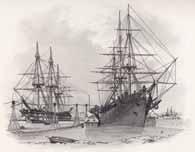
The ships used to lay the cable of 1857 were the finest available. The British ship was HMS Agamemnon. At 3,500 tons, she had a huge hold of 45 feet square and 20 feet deep suitable for holding nearly half of the cable, with the rest divided into two smaller coils. The other half of the cable, made at Birkenhead, was coiled on board the new 5,540 ton American steam frigate USS Niagara, captained by W I Hudson. Both ships were fitted with specially devised machinery for paying out the cable.
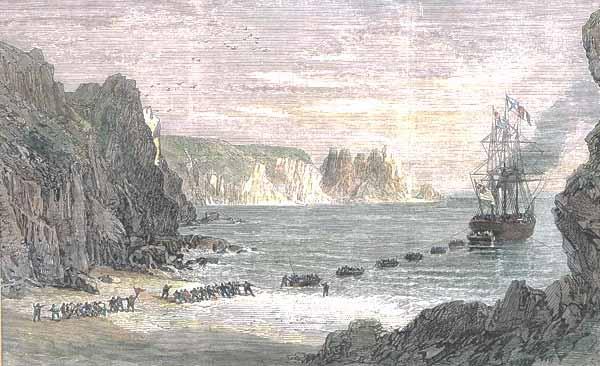
The plan was to start the lay from mid-ocean but this was changed to a start from Ireland at the insistence of Dr Edward Whitehouse the electrician. So, on 7th August 1857 the Niagara began laying the cable from Valentia Island, off the far-west of County Kerry in Ireland. Trouble started early when the cable broke after only threequarters of an hour so they started again, only to break the cable again after 334 nautical miles had been laid. The ships returned to port and were unloaded, and 900 hundred miles of new cable
were ordered for another attempt the following year.
On 19th June 1858, the two ships set out again with 3,000 miles of cable between them. This time, despite the Agamemnon nearly sinking in a massive storm on the way, they met in mid-Atlantic and after splicing the cable together, set off on 26th June in opposite directions to lay the cable. After three breaks, the ships once again returned to port. Fortunately, it was discovered that there was still enough cable left to make one last attempt so they returned to mid-ocean and began laying again on 29th July. Finally, on August 5th both ships arrived at their respective destinations, Valentia and Trinity Bay Newfoundland. The cable was laid! On 13th August, Queen Victoria and President Buchanan exchanged messages over the cable to mark its formal
HMS Agamemnon at Greenwich loading the 1857 Atlantic cable
inauguration. There were widespread celebrations in America and somewhat more muted ones in Britain; Charles Tilston Bright was knighted for his role as project engineer. However, the cable never opened to commercial traffic, because by September, it had become difficult to get any clear reading from the receiving apparatus and after 20th October it was not possible to send a signal of any kind.
The reasons for the failure of the cable, as far as could be ascertained, were damage it had sustained in transit and the application of huge
3,000 volt pulses required to operate the standard receiving equipment used.
Cyrus Field and his colleagues were not put off by the failure of the 1858 cable. They had demonstrated that it was possible to lay a cable under the Atlantic and to send messages along it, they just needed to improve the technology involved. However, the American Civil War and another major cable-laying disappointment in 1859 with the failure of the Suez to India cable at a loss of £800,000, made many investors rather wary of sinking any more of their money in this new and so far, unproven technology.
The Industry Advances
The particular electrical characteristics of a long undersea telegraph cable meant that it was vital that someone invented an effective device
for receiving the faint signals which made their way to the other end. The two main problems were the feebleness of the signal received and the fact that the cable stored electricity (capacitance) as well as transmitting it, which caused a blurring of the signals. This meant that signals had to be sent very slowly to stop pulses from merging into one another. Later, measures were taken to stop this, enabling great increases in the speed of signaling.
The man whose ingenuity solved these problems in the early days was William Thomson (1824-1907), professor of Natural Philosophy at the University of Glasgow and an adviser on the Atlantic cable project. He designed many instruments which were key to the development of international communications. One of these inventions was the Mirror Galvanometer, the first receiving device with sufficient sensitivity to detect the tiny attenuated electrical signals coming over early long distance cables.
The cable industry had come a long way since the early 1850s. R S Newall & Co had a quiet year in 1856, making only three cables. However, the 1857 order for half of the Atlantic cable improved things significantly. Newall’s was also commissioned to manufacture and lay cables in the Mediterranean between Sardinia, Malta and Corfu in 1857. In 1858, they made and laid cables in Greece and were also awarded a contract for cables which they part funded, laid by the Red Sea and India Telegraph Company across the Suez isthmus and down the Red Sea. All the concessions granted to this company eventually were transferred to the British Indian Submarine Telegraph Company. The main feature of Newall’s cables was that they were lightly armoured and tended to fail after short periods. Between 1860 and 1866 they did not make any cables at all but were later commissioned by the Danish-Norwegian-English Telegraph Company (which would become part of Great Northern) to make and lay a rubber core cable. They also supplied the cable linking Cornwall with the Isles of Scilly in 1869 and a duplicate Scotland-Ireland cable (Portpatrick to Donaghadee) in 1870. After this, the company ceased to make submarine cables. With R S Newall’s departure from the scene almost the entire world’s submarine cable manufacturing capability was based on the River Thames in London. On the north side of the river there was Hooper’s Telegraph Works Ltd at Millwall, USS Niagara, with HMS Agamemnon at Keyham, re-loading for the 1858 Atlantic expedition
This was essentially a very light mirror and magnet suspended at the centre of a coil. The received signal from the cable was directed through the coil, creating a very small magnetic field, which turned the magnet and mirror. A beam of light shone onto the mirror and this in turn deflected onto a scale so that when the signal came through, the mirror moved slightly and showed a corresponding movement of the light beam on the scale.
The India Rubber, Gutta Percha and Telegraph Works Co at Silvertown and W T Henley Telegraph Works Co at North Woolwich. On the south side was Siemens Brothers at Charlton and at Greenwich the company that would dwarf them all.
On 7th April 1864, a new cable-making and laying company was founded, the Telegraph Construction & Maintenance Company (Telcon). This was a merger of the Gutta Percha Company and Glass, Elliot & Company. The first chairman of the new company was John Pender.
An Ocean Tamed
One of the first actions of Telcon was to approach the Atlantic Telegraph Company with an offer to make and lay a new cable across the Atlantic. John Pender and Daniel Gooch raised most of the £500,000 necessary capital and
chartered Brunel’s huge ship, the Great Eastern, to lay the cable. The shore end cables were made by W T Henley in North Woolwich. The Great Eastern left Valentia on 23rd July 1865 and paid out 1,186 nautical miles of cable until, in an attempt to correct a fault in the cable, it broke and was lost. This near success led to another attempt. An additional £600,000, was raised by Gooch and Pender by establishing a new limited liability company, the Anglo-American Telegraph Company, and on Friday 13th July 1866 the Great Eastern set out again.
Improvements in System Design
Cables continued to be made in more or less the same way for the next 100 years. Broadly speaking, they were composed of many layers of different conducting, insulating and strengthening materials. In the centre there was a core of copper wire covered in a layer of Gutta Percha. This was followed by a layer of jute with a covering of steel armouring wires. Further layers of jute were then applied and finally the cable was dipped in a protective compound. This type of cable was used for many years. The thickness of the steel armouring wires differed, depending on whether the cable was for use in shallow or deep water. In shallow water the armouring was thick and heavy to protect the cable from damage on rocks or by anchors of nearby boats. As the cable went into deeper waters, there was less need for heavy armouring and the wires were not so thick. There were however some important developments in cable design and capacity. After 1879 brass tape was often added around the insulated core to protect it from boring insects which liked to eat the Gutta Percha. In terms of cable capacity and the speed of signaling, in the 1920s an iron-nickel alloy called Permalloy was produced by Western Electric and a copperiron-nickel alloy called Mu-metal, was produced by Telcon. This was incorporated into the cable design to “load” the cable with inductance so that the signals would not become so distorted by the capacitance of the cable. The first Brunel’s huge ship, SS Great Eastern, laying the Atlantic cable
This time the cable was successfully laid all the way to Heart’s Content, Newfoundland, arriving on 26th July. The Great Eastern then returned to the location of the lost 1865 cable and, after many attempts, managed to retrieve it. A new end was spliced on and by 8th September there were two new Atlantic cables. This brought the personal crusade of Cyrus Field to a successful conclusion, and his untiring efforts were properly recognised in the United States, by a unanimous “Vote of Thanks” in Congress. In Britain, the success was recognised by Queen Victoria, Daniel Gooch received a baronetcy (Gooch of Clewer), William Thomson was knighted, as were Samuel Canning and Richard Atwood Glass, Chief Engineer and Managing Director of Telcon respectively. Surprisingly John Pender was not honoured even though he had risked his entire fortune to under-write the successful project.
“loaded” cable, using a tapered loading Mumetal design, was laid in the Atlantic in 1924 and achieved five channels, each at 50 words per minute in both directions simultaneously an increase of over five times the unloaded design capability. Many other loaded telegraph cables were to follow across the Atlantic and elsewhere in the world. The last to cross the Atlantic was laid by Telcon for the Western Union Telegraph Company in 1928, between the Azores and Newfoundland.
By the 1930s there were just two firms making submarine cables in Britain, Telcon and Siemens Brothers. With the depression and competition from radio, business became more and more difficult to obtain and in 1935 there was a merger of Telcon with the submarine communications cables section of Siemens Brothers to form Submarine Cables Limited.
Transmitting and receiving equipment also evolved slowly over the years. Special keys were designed for Curb transmission, described by William Thomson and Fleeming Jenkin in an 1861 patent. Curbing employs a reverse pulse transmitted immediately after the main pulse to help sharpen the received signal. In the 1880s, automatic machines fed by punched tape were introduced. At first, the punched tape was produced manually but after 1900, it was produced by keyboard perforators, which were operated in a manner identical to an ordinary typewriter. Problems at the receiving end were
Cable being landed at Porthcurno, Cornwall
more complex. William Thomson designed a siphon recorder, which was less sensitive than the mirror galvanometer but had the advantage of creating a permanent record of the received signal on a narrow strip of paper or “slip”. The siphon recorder was used from around 1870, with ten being specially made for the new England to Bombay route, which was completed in that year by John Pender’s companies.
All this technology still required expensive human input to transmit the tape, read the mes-
sage at the other end and re-transmit it on to the next cable on the route if necessary. With a view to economy of operation, a great deal of effort was put into finding a technology which could cut out the middle man and automatically receive and retransmit telegraph messages. To do this the signal first had to be magnified at the receiving station. One method of magnifying, was invented by E S Heurtley, in 1908. It consisted of a moving coil similar to that of a siphon recorder, which was attached to two wires. The wires were heated
by the electric current flowing through them and cooled by two small blowers. When the coil turned, one wire moved closer to its blower, the other moved away. Since resistance depends on temperature, the resistance of the first wire decreased and that of the other increased. This upset the balance of the electrical circuit of which the two wires were a part and produced an amplified signal, large enough to operate an electro-mechanical relay and generate a new pulse.
Another important development in cable capacity was the introduction of duplex signalling. This simply meant sending signals down one telegraph wire in opposite directions simultaneously. This began as early as the 1850s on overland telegraph wires but it was a much more difficult task to achieve on submarine cables because of their capacitance. However, duplex working was achieved successfully in the 1870s using, initially, a method developed by J B Strearns, and then more effectively in 1875, by using H A Taylor and Alexander Muirhead’s method which employed an “artificial line” to duplicate the electrical characteristics of the cable. At the transmitting end of the cable the signal would be sent down the real cable and the artificial line simultaneously. The effect of this was that the local receiver would only see the incoming messages.
An Eastern Empire
With the success of his investment in the Atlantic cable, John Pender saw great opportunities in
laying cables along other routes, where communications were vital. In particular, he foresaw the importance of communications with India for government and trade purposes. In 1868, Sir Daniel Gooch replaced John Pender as Chairman of Telcon as Pender devoted more time to his grand plan. The first order for this new network received by Telcon was for the Malta to Alexandria cable of 1868 and the success of the company thereafter was based largely on Pender placing orders with them for the cables which linked the British Empire.
In 1863, the British Government had sponsored the laying of a cable in the Persian Gulf from Karachi to Fayal. This was linked to Europe via land lines through Persia and Turkey. Charles Tilston Bright was the engineer on this project and the cable was successfully completed in 1864. The main problem with this line to the East was the landlines, which proved unreliable and passed through the territories of various tribes who had little respect for the telegraph wire. Again, these flaws in the quality of service encouraged people such as John Pender to further pursue the idea of an all submarine cable network, which could not be interrupted by local problems. In 1868, John Pender set about forming a number of telegraph companies to lay an all-submarine route to India, which by-passed these problems and by 1870 the link was complete. The UK landing point for this cable chain was Porthcurno in the far-west of Cornwall. Also in 1870, UK inland telegraphs
were finally nationalised, releasing private capital and boosting investment in international telegraphs.
By 1872, the Far East and Australia were also linked up to the network and on 1st June of the same year, John Pender merged his group of companies to form one large company under the name of “The Eastern Telegraph Company Limited”. In 1872, the Eastern owned 8,860 miles of submarine telegraph cables, owned or rented 1,200 miles of landline, had 24 stations and two cable repair ships. Its revenue for the year was £376,900. The cost of sending a telegram from England to India in “Via Eastern” was £4 per message, prohibitively expensive for anyone other than government and large businesses. However, for those who could afford it, the telegraph revolutionised the speed of business and greatly improved the effectiveness of British Government around the Empire. The service from London to Bombay and beyond was very efficient; the sender of a message from London to India in 1872 could expect a reply within 24 hours.
Under John Pender’s guidance, the Eastern Telegraph Company grew and grew, duplicating and even triplicating cables on the busiest routes. It was not long before the West Indies, South America and Africa were the scene of feverish cable-laying activity by many new companies and one-by-one, these small companies were taken over by the Eastern Telegraph Company and became part of the company’s international network. By
1887, the Eastern owned 22,400 miles of cable, had 64 stations, a capital of £5,900,000 and gross annual revenue of £650,971. In recognition of the widening geographical coverage to the West as well as the East, the company adopted the name Eastern and Associated Telegraph Companies.
To its employees it continued to be known as “Father Eastern”. John Pender’s contributions to the Empire were finally recognised in January 1888 when he was knighted KCMG. This honour was raised to GCMG on 29th June 1893.
By the turn of the 20th century, John Pender’s company had created the world’s largest international telecommunications system, linking Britain with the Empire and most of the world by an almost totally submarine network. The effect on the world of this and the other communications networks was immense.
Whether the cables inspired greater nationalism or whether they were a vehicle for peace is debatable but there is no doubt that the increased speed of communication radically affected the speed of political negotiation as well as war. The effect of the telegraph cables on trade was clear, as were the effects on the communication of press information. Public awareness and reaction to world events was made possible via this vast communications network.
To be continued in our next issue
has entered into an arrangement with
Lloyd’s Register -
Fairplay making available, complimentary to subscribers, comprehensive databases of commercial vessels (www.sea-web.org/), ports and companies (www.portguide.com).
Call for Papers
FROM: Mr. Graham Marle ICPC Secretary FAX: +44 870 432 7761
TEL: +44 1590 681 673
DATE: 15 November 2004 E-mail: secretary@iscpc.org
Web-site: www.iscpc.org
The International Cable Protection Committee (ICPC) is organising its next Plenary meeting in Sydney, Australia during the period 15 – 17 March 2005 inclusive.
All of the World’s major telecommunications companies are represented within the ICPC whose principal purpose is to promote the safeguarding of submarine cables against manmade and natural hazards. This unique and prestigious organisation also serves as a forum for the exchange of technical, environmental and legal information concerning the marine aspects of both telecommunications and power submarine cable systems.
Recent feedback from ICPC membership revealed that the following topics would be of most interest to them:
• Cable owners’ experience/problems of cable protection
• Legal issues associated with cable retirement and cable protection
• Cable repair experience and techniques
• Topical fishing issues - e.g: deep water fishing, stow nets etc.
• Submarine power cable issues.
The Executive Committee (EC) therefore seeks presentations by interested parties that would primarily address the above topics.
Papers which address other relevant areas of the submarine cable industry (e.g. environmental issues and scientific use of retired cable systems) may also be considered.
***NB: Recognising the location of this Plenary, papers with content that is relevant to the Asia-Pacific region will be especially welcome.
Prospective presenters are respectfully advised that papers which are overtly marketing a product or service will not be accepted.
In order to qualify for a free trial of these services, contact LRFTrialOffer@SubTelForum.com.
Presentations should be 25 minutes long including time for questions. The EC will evaluate all submissions based on content and quality.
NB: Commercial exhibits may be displayed near the ICPC meeting room by special arrangement. Please contact the Secretary for further details.
Abstracts should be sent via email to secretary@iscpc.org no later than 28 January 2005.
Nexans Norway AS P.O Box 6450 Etterstad, N-0605, Oslo Norway
Tel: + 47 22 88 61 00
Fax: + 47 22 88 61 01
US Contact: Les Valentine
Tel. +1 281 578 6900
Fax: +1 281 578 6991
E-mail: les.valentine@nexans.com
Globalexpertincables andcablingsystems exans
BAL BAL BAL BAL BALTIMORE TIMORE TIMORE TIMORE TIMORESubOptic 2007 The planning begins
Just as you thought you were safe with a successful Convention in Monaco behind you, so you are rudely reminded that planning for SubOptic 2007 has to begin now, if it is to be held in May 2007.
So with this thought in mind the SubOptic Executive Committee (EC) recently held a meeting in Baltimore to review the outcome of SubOptic 2004 and decide what worked well and what could have worked better.
To support this activity they had the results of the Review Questionnaire that many of you filled out at the end of the event in Monaco. A summary of the results is inset in this article.
So what did you say!
Well, most of you marked the event as a success, having a good Programme Structure and being of the right duration. The various sessions that comprised the programme were all rated highly, with the Poster Session especially so.
The EC were particularly pleased with this result, because they had worked hard to promote the Poster Session as a prestigious event in its own right and not as a depository for papers, which were not deemed good enough for the Oral Sessions.
For SubOptic 2007 we will work even harder to crystallise this session as a highlight of the Convention - and this time we promise that there will be some alcoholic refreshments to help promote the networking opportunities this event provides.
The one reservation many of you expressed about the structure was the Exhibition. It was considered too small and not representative enough of the industry to be of great value to attendees. For SubOptic 2007 the EC will be reconsidering the value that the Exhibition brings to the Convention, and if it is held, what could be done to attract more exhibitors including smaller companies to exhibit.
Now we come to the location, the supporting social programme and registration cost.
Whilst these are separately marked within the Questionnaire they are all intimately linked. Most respondents felt that Monaco – apart from the hotel rebuilding programme - and the Grimaldi Forum were superb and that together
The Grimaldi Forum, venue for SubOptic 2004
with the supporting social programme, which was also rated highly, they provided the perfect opportunities to promote - the Networkingthat is so important at this event.
There is no doubt however that Monaco and the Grimaldi Forum were not cheap locations – though no more expensive than many other cities and their corresponding conference facilities around the world.
The registration fee, unlike that for some other conferences, also pays for attendance at all the Conference Sessions and the full supporting social programme. So you do get a lot for your money!
The Executive Committee recognises however that registration fees are an emotive issue and this has influenced our choice of location
for SubOptic 2007 and the level of fees that will be charged.
Underpinning this however is the fact that SubOptic is a non-profit making organisation and that it’s only source of income is via fees and sponsorship. Therefore to provide the ambiance and services that our attendees rate so highly, a certain minimum fee level is required.
The final area of the Questionnaire related to the Website. The EC appreciates that improvements, including the ability to register online are necessary. These will be incorporated for SubOptic 2007.
The above gives a flavour of the results the EC reviewed, though this is not the complete story as we also received over 300 individual comments. The task of incorporating the most critical of these will fall to the Programme Committee and the next Host Organisation, Tyco Telecommunications.
To continue this process another important decision made at the Baltimore EC Meeting was the appointment of David Robles from Tyco Telecommunications, as Chairman of the SubOptic 2007 Programme Committee. David was a Vice-Chairman of the SubOptic 2004 Convention and therefore brings with him substantial experience of the event.
Further articles on the progress of SubOptic 2007 will appear in future editions of Submarine Telecoms Forum.
BOTANY BAY a novel by Jean Devos
The Engineer Martin Dubos is propelled forward by a compelling force, similar to the one which were pushing high in a few weeks the hop branches in its childhood’s farm .This energy, drawn from its Flemish roots, half catholic and half protestant, he invest it into an industrial ambition ; with a small but motivated and enthusiastic team , he will conquer the Asian and Pacific markets
Despite his own top management cautiousness, he enter into a fierce competition against the British, then in a leading position .These one will finally loose… but they will take revenge . The chairman will be dismissed through a legal process; the marketing director will lost his life and Martin will be forced to resign, after 36 years of success.
Surprising practices in a large, international corporation!
Speaking at SubOptic 2004:
Alan Robinson (left) and Jean Godeluck (right)
Letter to a friend from Jean Devos
My Dear Friend
“Botany Bay”
I published recently a modest novel, whose title is Botany Bay. It is the place in Australia where Alcatel established a submarine cable factory in 1989 as part of its contract for the Tasman 2 link. In this same bay, where two centuries before the French expedition
“La Pérouse” made of two ships, La Boussole
and l’Astrolabe, landed in 1788 to discover that Captain Cook was already around bearing the British flag. So Botany Bay is now for me the symbol of a dream which becomes a reality!
Tasman 2 has been yet another chapter in this long Anglo-French competition! The award to Alcatel came out as a big surprise to many, including inside Alcatel. Everybody was naturally expecting the British to win that battle, and such an expectation was at that time very logical.
There were so many difficulties and misunderstanding between Australia and France, the main one being the French presence in the Pacific area, the worse being the nuclear bomb experiment in Tahiti! The sad Rainbow
Warrior event was still in everyone’s memory. It is for these reasons among others that STC (UK) rejected the Alcatel‘s suggestion to come with a joint bid, to offer a “European” solution.
One of the winning factors has been the Port-Botany cable factory. Such a factory was a strong requirement from OTC (now Telstra) and the Australian Government.
Alcatel was the most motivated. Such a factory could expand its influence in the Pacific where the three other players were historically well established in this region, which represents a large part of their market. They saw this factory as a risk for their existing facilities!
SubOptic ‘87 in Versailles came at the right time. It is where the Australian teams discovered the French model, a close cooperation between Alcatel and FT, exactly what they wanted to establish in their country.
My friend, things are changed since, but one thing stays true: When you offer something, the reader can see between the lines if you are or not genuinely motivated and sincere. Then your offer becomes really attractive and this opens the route to “Botany Bay.”