FROM MAXWELL’S EQUATIONS TO SUBSEA FIBRE OPTICS: OPTICAL FIBRES AS WAVEGUIDES- [PART 3] SUBMARINE NETWORKS AND THE FUTURE OF CONNECTIVITY By Anna Bridget Sheehan, Derek Cassidy
ABSTRACT
This paper traces the evolution of optical waveguides, from the foundational laws established by Newton, Huygens, and Maxwell to today’s cutting-edge submarine cable technologies. It examines the progression of fibre optic science through key milestones, including Dense Wavelength Division Multiplexing (DWDM) and specialty fibres, while exploring emerging frontiers such as spatial division multiplexing, hollow-core, and multicore fibres. It is presented in three parts.
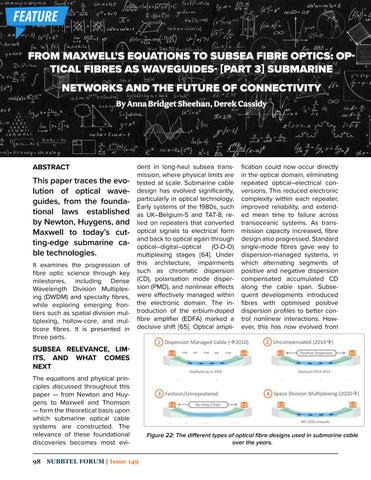
dent in long-haul subsea transmission, where physical limits are tested at scale. Submarine cable design has evolved significantly, particularly in optical technology. Early systems of the 1980s, such as UK–Belgium-5 and TAT-8, relied on repeaters that converted optical signals to electrical form and back to optical again through optical–digital–optical (O-D-O) multiplexing stages [64]. Under this architecture, impairments such as chromatic dispersion (CD), polarisation mode dispersion (PMD), and nonlinear effects were effectively managed within the electronic domain. The introduction of the erbium-doped fibre amplifier (EDFA) marked a decisive shift [65]. Optical ampli-
fication could now occur directly in the optical domain, eliminating repeated optical–electrical conversions. This reduced electronic complexity within each repeater, improved reliability, and extended mean time to failure across transoceanic systems. As transmission capacity increased, fibre design also progressed. Standard single-mode fibres gave way to dispersion-managed systems, in which alternating segments of positive and negative dispersion compensated accumulated CD along the cable span. Subsequent developments introduced fibres with optimised positive dispersion profiles to better control nonlinear interactions. However, this has now evolved from
SUBSEA RELEVANCE, LIMITS, AND WHAT COMES NEXT The equations and physical principles discussed throughout this paper — from Newton and Huygens to Maxwell and Thomson — form the theoretical basis upon which submarine optical cable systems are constructed. The relevance of these foundational discoveries becomes most evi98
SUBBTEL FORUM | Issue 149
Figure 22: The different types of optical fibre designs used in submarine cable over the years.